




 nueva página del texto (beta)
 Inglés (pdf)
 Artículo en XML
 Referencias del artículo
 Traducción automática
 Enviar artículo por email
 Citado por SciELO
  Similares en
SciELO
Similares en
SciELO 
 Permalink
1. INTRODUCTION
Today, the threat that some NEAs, especially potentially hazardous asteroids (PHAs), pose to terrestrial civilization in case of a collision with our planet, is widely recognized (Chapman 1994; Morrison et al. 2002). On the other hand, NEAs with low relative velocities with respect to Earth may become targets for future robotic sample-return and manned space missions (Reddy et al. 2012). In both cases, the determination of the physical properties of these objects is of crucial importance, in particular, its taxonomic classification and, eventually, when near-infrared observations become available, the analysis of their possible mineralogical composition.
Near-Earth Asteroid 2018 CB made a close approach to Earth on February 9, 2018 (22:29 UT), at a distance of 0.000466 AU (69,700 km or 0.18 lunar distances), with a relative velocity of V rel =7.2710 km/s. It was first observed by the Catalina Sky Survey on February 4, 2018 (MPEC 2018-C12), using the 0.68 m Schmidt telescope. Despite its rapid sky motion (1459.5 arcsec/min at the closest approach) that caused a drastic change of its coordinates, from RA=08h 01m and DEC=+48 d 54 m, on Feb 8 (00:00 UT) to RA=23 h 15 m, and DEC= 14 d 15 m, on February 10 (00:00 UT), we were able to observe this NEA during the night of February 8, 2018, a day before its closest approach. Asteroid 2018 CB is a super-fast rotator (P=0.089241 ± 0.000027 h, (Birtwhistle 2021)) Apollo object.
Close approaches offer a unique opportunity to better observe asteroids in order to determine their physical properties; in particular, small asteroids such as 2018 CB, because of their size (H=25.9), are generally faint and inaccessible to a 2m diameter telescope such as the one at the Observatorio Astrofísico Guillermo Haro (OAGH) observatory.
The observations we report here for 2018 CB are part of an ambitious program to establish the taxonomic classification of NEAs and other asteroids belonging to different families of the Main Belt. In this program, asteroids at close approaches are included as high-priority objects. At the time of observation, 2018 CB reached a magnitude of 14.9 in the V-band, representing an excellent opportunity to observe it at the OAGH.
With these goals in mind, we have begun a large program of optical spectroscopic observations of NEAs and main-belt asteroids of different families. Up to now we have observed more than 900 asteroids from different families. The results of the taxonomic classification of NEAs and asteroids of the Flora family will be presented in forthcoming papers.
In this paper, given the importance of 2018 CB as an asteroid that passed very close to the Earth, we present the results of its taxonomic classification. In § 2 we describe the observations and data reduction procedure; in § 3 we present the results, including the proposed taxonomic classification; and in § 4 we discuss about the size and the possible mineralogical composition of 2018 CB.
2. OBSERVATION AND DATA REDUCTION
Optical spectra of 2018 CB were obtained with the 2.1 m telescope of the Guillermo Haro Astrophysical Observatory, located in Cananea, Sonora, Mexico, using a Boller & Chivens spectrograph with an E2V42-40 2048 × 2048 pixels CCD. A low-resolution diffraction grating of 50 l/mm, which provides a dispersion of 5.2 Å/pix and a spectral coverage between 4200 Å and 9500 Å was used. In order to minimize the effects of the atmospheric differential refraction, and to reduce the loss of light, a slit width of 400 microns was selected. With an image scale of 8.18 arcsec/mm in the focal plane of the telescope, the slit width corresponds to 3.2 arcsec in the sky. The slit remained fixed in E-W orientation.
The new control system installed in the OAGH allows for moving the telescope, in both coordinates, at non sidereal rates, performing the tracking based on the instantaneous position of the observed asteroids, instead of guiding the telescope with a position in the sky.
Using the orbital elements of asteroids, referred to the equinox J2000.0, and the rectangular geocentric equatorial coordinates X, Y, and Z of the Sun referred to the same equinox, the control system is capable of calculating the geocentric positions (equatorial coordinates) of these objects for a given epoch.
The orbital elements of 2018 CB were taken from the le MPCORD.dat, provided by the Minor Planet Center (https://minorplanetcenter.net/data). The equatorial coordinates of the objects were calculated at one hundred millisecond intervals, and the control system instructed the telescope to follow this series of coordinates, guaranteeing that 2018 CB was always in the same position of the slit. In addition, every time that the control system calculated the position of an observed asteroid, it also calculated the corrections for precession, nutation, and atmospheric refraction, as well as the parallax correction to the equatorial coordinates.
The use of this new control system, with non-sidereal tracking, has been one of the most important factors in the success of our asteroid spectroscopic observations program.
The observations were carried out on February 8, 2018, a day before the closest approach. The observational circumstances of 2018 CB are listed in Table 1. The coordinates, the V -band magnitude, the distance from the observer (Δ) and from the sun to the object (r), the phase angle (Ph), and the phase angle bisector longitude (L PAB ) and latitude (B PAB ) refer to the time of observation, and were taken from the Minor Planet & Comet Ephemeris Service of the Minor Planet Center.
To remove the contribution of sunlight from the 2018 CB spectra, and to obtain the asteroid relative reflectance spectrum, the solar analog HD047309 (López-Valdivia et al. 2014) was observed at an air-mass of X = 1.072, closely matched to the NEA airmass (X = 1.096).
The image reduction was performed using the standard Image Reduction and Analysis Facility (IRAF) packages to reduce long-slit spectra. The extinction corrected spectra of 2018 CB and the solar analog HD047309 were normalized to 5500 Å. The relative reflectance spectrum of 2018 CB was obtained by dividing the object spectrum by the solar analog spectrum. Upon extraction, the spectrum of 2018 CB was rebinned to a uniform dispersion of 25 Å per pixel. The normalized optical spectrum of 2018 CB, obtained by this procedure, is shown in Figure 1.
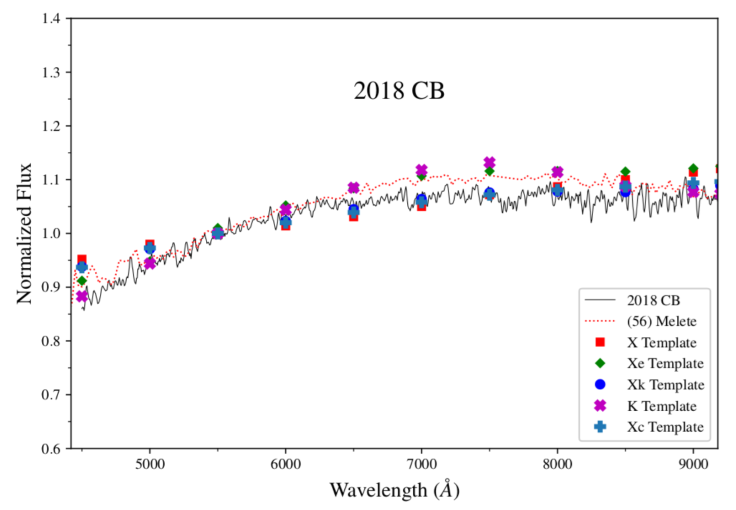
Fig. 1 Comparison of the 2018 CB spectrum (solid line) with the lowest calculated D x values templates from DeMeo et al. (2009). Additionally, the spectrum of (56) Melete (dotted line), the prototype of the Xk class proposed by DeMeo et al. (2009), is plotted.
3. DETERMINING THE TAXONOMIC CLASS OF 2018 CB
A direct way to determine the taxonomic class to which an asteroid belongs is to calculate the “spectral distance" (Yang et al. 2003) between the asteroid spectrum and known spectral templates, defined by:
where D x is the spectral distance between the un-classified spectrum X and a classified spectrum Y (spectral template), n represents each of the individual selected points in the spectra to find the best fit between X and Y, and k is the total number of points used in the fitting procedure.
We have calculated the spectral distance between the reflectance spectra of 2018 CB and the mean spectra of the 24 taxonomic classes of DeMeo et al. (2009). The best ts obtained are for the following taxonomic classes: Xk-class (D x = 0.0830), Xc-class (D x = 0.0872), K-class (D x = 0.0916), Xe-class (D x = 0.1076), X-class (D x = 0.1132), and S-class (D x = 0.1499).
A similar result arose when the spectral distance was calculated with respect to individual asteroid spectra from the Phase II of the Small Main-Belt Asteroid Spectroscopy Survey (SMASSII) database (Binzel et al. 2001; Bus & Binzel 2002). By checking the resulting fifteen lowest values (7 Xk, 4 K, 2 Xe & 2 X) of spectral distances with the corresponding taxonomic class of the SMASSII database, a trend indicating that this asteroid can belong to the X-complex was observed.
It should be noted that while DeMeo et al. (2009) and Bus & Binzel (2002) implemented similar but not identical taxonomic schemes, our analysis is not in con ict with their results. The taxonomic classes in our discussion (Xk, Xe, and Xc) are directly linked, with no significant changes, between these schemes.
Extending the results of the fitting procedure to the one hundred lowest values of spectral distances, we have 31 objects with spectral templates belonging to the Xk-class, 26 objects to the K-class, 18 objects to the S-class, 12 objects to the Xe-class, 9 objects to the X-class, and 4 objects to the Sk-class, with 21 Xk-class objects among the 50 lowest values of Dx (42%). There is no available information about the albedo of this asteroid, so we based the analysis of the 2018 CB taxonomic classification only on its spectral properties.
We found some S-type asteroids among the one hundred smallest values of spectral distance D x . S-type asteroids are considered to be the most likely progenitors of ordinary chondrites. Spectrally, they are redder than ordinary chondrites and tend to show weaker absorption bands in the visible and near-infrared regions of the spectrum. It is clear, from the spectrum of 2018 CB that we obtained (Figure 1), that its reflectance increases with wavelength, at least up to 9500 Å. The continuum slope between 0.45 m and 0.75 m, in units of μm-1, calculated as the change in normalized reflectance with respect to wavelength, is 0.864, but it does not show any absorption band, indicating that 2018 CB does not belong to the S-complex. Thus, we discarded the Sk- and S-class as taxonomic classification possibilities for 2018 CB.
Due to a similar spectral analysis, we have also eliminated the Xe-class from the list of likely candidates for the taxonomic classification of this NEA. Within the DeMeo et al. (2009) classification system, an absorption band feature short-ward of 0.55 μm distinguishes the Xe-class, which is evidently absent in our spectrum of 2018 CB. This leaves us with only those taxonomic classes that belong to the K-complex (K- and Xk-class), and the X-class.
Taking into account the high frequency (42%) of the Xk-class among the fty lowest values of spectral distance, and the 47% among the fifteen lowest values of D x , calculated from the spectra of the SMAS-SII database, we suggest that 2018 CB is an Xk-class NEA, an intermediate class between the X- and K-class. In the taxonomic classification proposed by Bus & Binzel (2002), the Xk objects are a combination of T, C, X, M, P, and E objects from the Tholen (1984) classification.
As discussed in DeMeo et al. (2009) and Bus & Binzel (2002), the Xk taxonomic class exhibits a subtle feature between 0.8 and 1.0 microns. However, this feature is not consistently observed in 100 % of the spectra in the SMASSII database, and even in the prototype of this class suggested by DeMeo et al. (2009), (56) Melete, this feature is not evident, as seen in Figure 1. While we have high condence in the proposed taxonomic classification, we acknowledge that the distinction between the classes included in the type-X may fall within our uncertainty. Therefore, we assign, conservatively, a type-X for 2018 CB.
4. SOME WORDS ABOUT THE SIZE AND THE POSSIBLE COMPOSITION OF 2018 CB
As is known, there is a relationship between the absolute magnitude H, the albedo value, and the diameter of an asteroid, as well as a relationship between the albedo value and the taxonomic class of these objects. We used both relationships to estimate the size of 2018 CB. The absolute magnitude H = 25.9 was taken from the JPL HORIZONS online solar system data service. In § 3 we proposed that 2018 CB was an asteroid of the taxonomic complex X. As its albedo is not known, to estimate its size we use the average albedo values for different taxonomic classes reported by DeMeo and Carry (2013). Taking into account the EMP degeneracy, the extreme values of albedos for a X-type asteroid are 0.053+-0.012 and 0.536+-0.246 for P- and E-class asteroids, respectively. Using, in addition, equation (2) from Pravec & Harris (2007), we estimate that the size of 2018 CB is between 11.9 and 38.1 meters.
Having proposed a taxonomic classification for 2018 CB and taking into account that it has a featureless visible spectrum and a clear positive slope towards the red wavelengths, we discuss the possible mineralogical composition of this NEA. We have to remember that some important asteroid minerals do not exhibit characteristic absorption features. In particular, iron meteorites have featureless spectra, with red spectral slopes (Cloutis et al. 1990). On the other hand, enstatite chondrites, because of the absence of Fe2+ in their silicates, also show relatively featureless VNIR spectra (from 0.3 to 2.5 μm), with red spectral slopes, for example, EH4 Abee and EL6 Hvittis (Gaffey 1976). However, because of the limitations of a classification scheme based only on spectral features, the mineralogy represented in the X-complex is much more diverse that in the C-and S-complexes. Several types of meteorite analogs have been proposed to match the VNIR spectra of X-complex asteroids: the anhydrous CV/CO carbonaceous chondrites (Barucci et al. 2012; Clark et al. 2009; Burbine et al. 2002; Burbine & Binzel 2002), enstatite chondrites (Vernazza et al. 2011; Ockert-Bell et al. 2010), stony-iron (Ockert-Bell et al. 2010), and iron meteorites (Fornasier et al. 2011).
Given the limited available information about the physical properties of 2018 CB, we are not able to make a definitive assertion on its mineralogical composition. Albedo, density, and degree of porosity determinations and radar observations during future oppositions of 2018 CB, as well as e orts in the shape and size modeling of this NEA, will be necessary and very useful to clarify its composition.
5. CONCLUSIONS
Based on observations made during the close approach to Earth of Near-Earth asteroid 2018 CB in 2018, we obtained the reflectance spectrum of this NEA in the range between 4000 Å and 9500 Å. We then calculated the spectral distance (D x ) with respect to the mean spectra of the 24 taxonomic classes of DeMeo et al. (2009), and to individual asteroid spectra from the Phase II of the Small Main-Belt. From this analysis, we classify 2018 CB as an Xk-class NEA, and being more conservative, as an X-type. As we have mentioned, several authors have proposed different types of meteorite analogs to match the VNIR spectra of X-complex asteroids. However, because the insu cient information on the physical properties of 2018 CB and the limitations of a classification scheme based only on spectral features, we were not able to make a definitive assertion on its mineralogical composition. More optical, NIR, and radar observations during future apparitions of 2018 CB are needed to provide its physical properties (albedo, density, and degree of porosity) in order to distinguish between iron, stony-iron, and enstatite meteorites that have been proposed by many authors, as the most probable meteorite analogues that could explain the VNIR spectral characteristics of Xk-class asteroids.

