




 nueva página del texto (beta)
 Inglés (pdf)
 Artículo en XML
 Referencias del artículo
 Traducción automática
 Enviar artículo por email
 Citado por SciELO
  Similares en
SciELO
Similares en
SciELO 
 Permalink

Introduction
The Aztec Calendar Stone (hereafter referred as ACS) has been the subject of investigation since it was unearthed in 1790 from beneath the Zocalo, the main square, in Mexico City.1 Initially identified by León y Gama in 1792 as a sundial and later by Chavero as a sacrificial altar (1876), the stone is a massive basalt disk covered with carvings of calendar signs and images of which religious, historical, and political meanings are intertwined (Townsend 1979, 63-70). The specific significance of the ciphers and carvings has over the years generated scholarly debate and multiple interpretations (Matos Moctezuma and Solís 2004; McDermott 2000; Milbrath 2017; Peperstraete 2009; Stuart 2016; Umberger 1999); this study adds to that conversation.
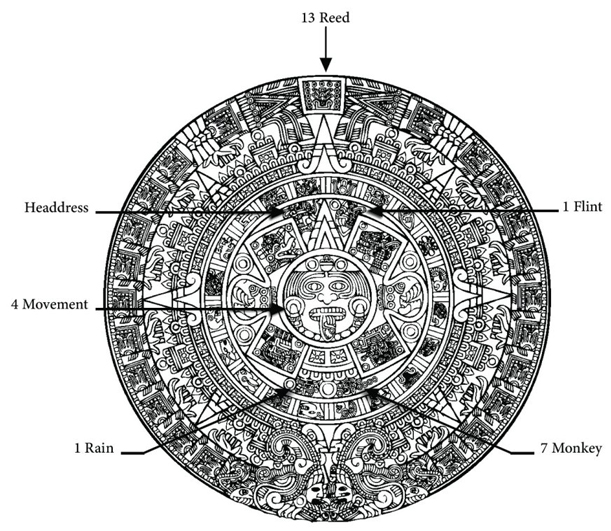
This essay proposes that the central message conveyed in the ACS was to commemorate and merge the mythistoric creation of last Mexica era, the “Fifth Sun,” with the ascension of Motecuhzoma II (Xocoyotzin) to the Mexica throne. This conflation of mythic time to an historic event can be understood by reading five of the monument’s glyphs as representing specific days in the Mexica 260-day divining calendar (tonalpohualli).2 The glyphs to be considered are identified as 13 Reed (mahtlactli omei acatl), 4 Movement (nahui olin), 1 Flint (ce tecpatl) 1 Rain (ce quiahuitl), and 7 Monkey (chicome ozomahtli). These ideographs are thought to represent the day and year of the current sun’s creation (4 Movement and 13 Reed respectively), days that associated with the Mexica’s gods Huitzilopochtli (1 Flint), and Tlaloc (1 Rain), and a festive day 7 Monkey which was observed by the Mexica merchant class, the pochteca. All are days that according to Richard F. Townsend (1979, 69) “illustrate immediate historical importance to the Mexica state”.
I begin this essay with a brief description of the Aztec Calendar Stone and its iconography with attention to the ideograms 1 Rain, 1 Flint and 7 Monkey. After a brief discussion of a memorial that commemorated the inauguration of Motecuhzoma II in 1503 C.E., I examine the ideograms for their significance in Mexica religion and their association with the celebrations of the gods Huitzilopochtli, Tlaloc, and the merchant class, the pochteca. I then correlated the Gregorian calendrical days designated by the ideograms with astronomical events recognized as important by the Mexica. The results of this procedure gave a sense of singularity to 1503 C.E., the second year attributed to Motecuhzoma II’s inauguration. This led to a search for a 13 Reed year whose dates corresponded to the uniqueness of 1503 C.E. with a near-perfect match found in 1167 C.E., a year that marked the end of a 1 000-year drought and the final throes of the much emulated and romanticized Toltec civilization.3 The possible reason for the conflation of 1167 C.E. and 1503 C.E. is examined and I end the essay with the inclusion of data that suggests the presence of two 365-day calendars within the year studied.
A Description of the ACS and the Myth of the Fifth Sun
The center of the ACS depicts a face that has been identified as the sun god, Tonatiuh (Nicholson 1993), the earth monster Tlaltecuhtli (Navarrete and Heyden 1974; Townsend 1979), the god of the night Yohualtecuhtli (Klein 1976), or a mythologized image of Motecuhzoma II (Stuart 2016). The face appears inside the Mexica glyph for Movement (olin) and there are four squares that surround the god’s face that represent previous suns or eras, 4 Jaguar (nahui ocelotl), 4 Wind (nahui ehecatl), 4 Rain (nahui quiahuitl), and 4 Water (nahui atl). The additional glyphs that are found among the four squares will be shown to represent historic and/or cosmic significance; these are 1 Flint, 1 Rain, 7 Monkey and a carving that has been described as representing Motecuhzoma II’s Headdress (Umberger 1988, 244-9; 2010, 23; Villela and Miller 2010).
A ring circling the center of the stone contains the 20 Mexica ideograms that are enclosed by another ring with symbols of jade, a stream of blood, pendants, and sun rays. Two serpents nearly completely encircle the outermost or third ring at the bottom of which are profiles of human heads which may represent deities (Matos Moctezuma and Solís 2004). At the top of the ring between the two serpents’ tails is a cartouche that contains the glyph of the Mexica year, 13 Reed. On either side and below the year glyph are representations of a glyph of 1 Flint and the carving of Motecuhzoma II’s Headdress.
It has been recognized that the 13 Reed enclosed in a cartouche is a year sign (Hassig 2001, 69; Townsend 2009, 124; Umberger 1988, 250-2) that represents the moment in mythic time that gave birth to the Fifth Sun. I regard the other glyphs that appear without cartouches to represent days in the tonalpohualli which will be shown to have correlates in the Gregorian calendar. The ACS is seen in Figure 1.
According to De los Arcos (1967), the key to the meaning of the ACS is found in the Mexica myths that describe the birth of the Fifth Sun at Teotihuacan. The most complete version of the myth is thought to have been written by Bernardino de Sahagún in books III and VII of the Florentine Codex (Carrasco and Pharo 2016, 248). Sahagún writes that the gods gathered at Teotihuacan and asked for a volunteer to become the sun and to bring light to the world. Two gods volunteered: the wealthy Tecuciztecatl (Old Man Moon) and the poor and diseased Nanahuatzin (the Pustular One). For four days the volunteers did penance and at midnight on the fifth day they were taken to a blazing divine fire, the teotexcalli. Tecuciztecatl was told to throw himself into the flames and four times he tried but each time the flames drove him back. When it was Nanahuatzin’s turn he jumped in without hesitation. Tecuciztecatl then tried again, and he followed Nanahuatzin into the fire. In the morning, Nanahuatzin rose and shone brightly in the sky; he had become the sun. Tecuciztecatl appeared later, and after being hit in the face with a rabbit to dim his brightness, he became the moon. However, the celestial bodies were stationary and failed to move. Finally, through the sacrifice of all the gods and after the forceful blowing of Quetzalcoatl-as-Ehecatl the Lord of the Wind, did the sun and moon begin their journeys through the heavens (adapted from Sahagún 1979, book VII: 431-434).
The Codex Chimalpopoca provides both the tonalpohualli day and xiuhpohualli year to the sequence of events described by Sahagún. The Codex states that, “the sun that exists today was born in [the year] 13 Reed and it was then that light came, and it dawned” (1998, 26). The specific day that the sun came into existence is identified in the third part of the Codex, in the Leyenda de los Soles, as follows: “The sun is named 4 Movement. We who live today [have] this one, it’s our sun, though what’s here is [merely] its signification, because the sun [itself] fell into the fire, the spirit oven (teotexcalli), at Teotihuacan” (Bierhorst 1998, 147).
A Memorial to the Inauguration of Motecuhzoma II
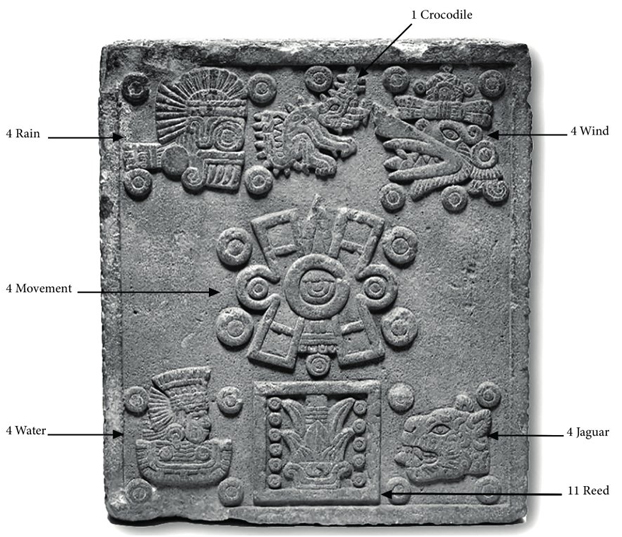
A stone monument commemorated the ascension of Motecuhzoma II to the throne of the Mexica Empire (Figure 2). Known as “the Stone of the Five Suns,” (hereafter referred to as SFS), the artifact measures 55.9 × 66 × 22.9 centimeters and was originally located in the ritual center of Tenochtitlan.4
A cartouche at the base of the SFS identifies the year 11 Reed, 1503 C.E., and like the ACS, the monument incorporates a centrally placed glyph for 4 Movement. Aside from the glyphs that represent the five previous ages, 4 Movement, 4 Jaguar, 4 Wind, 4 Rain, and 4 Water, a sixth glyph of 1 Crocodile appears centered at the top of the stone which corresponds to July 25, 1503 C.E. in the tonalpohualli for that year. The underside of the stone is carved with a glyph of 1 Rabbit, an ideogram associated with the earth (Ruiz de Alarcón 1984, 78, 86).
The placement of the 1 Crocodile glyph on the SFS had two interrelated functions pertinent to this essay. According to Durán, 1 Crocodile marked a traditional day of Mexica emperors’ enthronement and as we have seen, it was also the first day of the tonalpohualli’s trecena that ends on 13 Reed (August 6 in 1503 C.E.).5 The SFS therefore gives us an exact date for the beginning of the new political era and, as stated above, the tonalpohualli for 1503 C.E. identifies the ideogram 4 Movement as falling on August 10, four days after August 6. The day of the year-bearer, 11 Reed, occurs on May 18.
In summary, the 1 Crocodile glyph seen on Motecuhzoma II’s memorial to his 1503 C.E. inauguration gives the resultant tonalpohualli calendar an aura of divine time. This sanctity can be found in the 1503 C.E. calendar in the final day of 1 Crocodile’s trecena, 13 Reed (August 6), which is also the day of the ignition of Teotihuacan’s spirit oven (teotexcalli) into which Nanahuatzin self-immolated and became the Fifth Sun. Motecuhzoma II’s inauguration in 1503 C.E. is therefore equated with the beginning of mythic time.
The Significance of the Second Ring Glyphs
The Headdress Glyph - Is a carving that has been described as representing Motecuhzoma II’s headdress (Umberger 1988, 244-9; 2010, 23; Villela and Miller 2010). The glyph is located at the 11 o’clock position on the ACS and directly below the tonalpohualli Crocodile ideogram of the third ring.6
Emily Umberger (2010, 23-24) discusses the historical interpretations of the Headdress glyph in her article “Montezuma’s Throne”. After examining the glyph found on eight stone sculptures, she concluded that “style and imagery dictate that all eight of the sculptures with the glyph must date from the reign of Motecuhzoma II, who ruled from 1502 C.E. to 1520 C.E.” (Umberger 2010, 23, 27). I hypothesize that as Motecuhzoma II’s “signature,” the glyph acts as an imprimatur that gives the emperor’s stamp of approval to the ACS. The glyph differs from the other hieroglyphs within the second ring because it is not a tonalpohualli day-sign.
One Rain - Seen near the bottom of the second ring, the 1 Rain glyph is correlated with January 24 and October 11 in the tonalpohualli calendar for 1503 C.E. January 24 falls at the driest and coldest time of the year with frosts virtually certain in the valley of Mexico basin (Robertson 1983, 21; Weather Spark: Mexico City). The second occurrence of 1 Rain in the tonalpohualli is found 260 days after January 24 on October 11. October marked the last days of the rainy season and the end of maize harvest in the artificial agricultural islands (chinampas) in the lakes surrounding Tenochtitlan (Robertson 1983, 142).
Seven Monkey - Immediately to the right of the 1 Rain glyph, the 7 Monkey ideogram combines the good fortune of the number seven with the qualities of fertility, procreation and abundance attributed to the monkey (Sahagún 1979, 241; García 2015, 226). The ideograph appears on February 25 and November 12, days that mark the end and beginning of the dry season respectively (Weather Spark: Mexico City).
The 7 Monkey glyph is embedded as the seventh day of the 1 Serpent (ce coatl) trecena which began on February 19 and November 6 in 1503 C.E. Sahagún (1979, 237) describes the trecena as “lucky and prosperous” and “very favorable for merchants and traffickers.” In the following pages of the Historia general the friar further describes the elite merchant class, the pochteca, who served as long distance traders, provided intelligence to the military, and played a central role in the veintena of Panquetzaliztli (Townsend 2009, 198, 201).
One Flint - The 1 Flint glyph is prominently located at the top of the second ring and is separated by the vertical ray from the Headdress glyph. The glyph is associated with both the Mexica’s patron god Huitzilopochtli and the god of the hunt, Mixcoatl-Camaxtli (Sahagún 1979, 242). The glyph marks two days in the tonalpohualli for 1503 C.E., March 4 and November 19.7
Thirteen Reed - I have shown that as a day-glyph, 13 Reed falls on August 6 in 1503 C.E., a day that represents the immolation of Nanahuatzin and four days before he began his movement as the Fifth Sun. Because it is enclosed in a cartouche at the top of the ACS, 13 Reed is also considered to be a marker for the Fifth Sun’s creation. According to Umberger (1999, 84), the 13 Reed year-glyph at the top of the ACS does not represent the year of the monument’s construction.8
Four Movement - The glyph is the centerpiece of the ACS and represents the name of the current era, the Fifth Sun. In the tonalpohualli for 1503 C.E. the ideogram is correlated with August 10, and thus gives us the mythic day that Nanahuatzin began his movement through the heavens.
Astronomical Correlations and the ACS’s Date of 1503 C.E.9
The close interrelationship between Prehispanic astronomy, the calendrical system and cosmovisión has been the subject of study in the joined disciplines of ethno-archaeoastronomy (Aveni 1982; Aveni et al. 1988; Broda 2000; Kelly and Milone 2005; Krupp 2019; Šprajc 2010). Mesoamerican astronomy included the observation of celestial events such as the sunrises and sunsets toward points on the horizon, the rising of stars and the passage of the sun through the zenith were all given cultural significance (Aveni and Hartung 1981; Aveni 1982; Šprajc 2001; Šprajc and Sánchez Nava 2013; Šprajc 2018). The dates derived from the tonalpohualli ideogram carvings on the ACS can be correlated with astronomical events; the result of these correspondences give a sense of uniqueness to the 11 Reed year of 1503 C.E.
Architectural orientations - As noted above, the 1 Flint and 1 Rain ideograms were associated with the Mexica’s patron god Huitzilopochtli and the lord of fertility and rain, Tlaloc. The pairing of these two gods was seen in Tenochtitlan’s bifurcated Templo Mayor and was both incorporated into the pyramid’s construction and its orientation to the horizon and celestial events (Aveni et al. 1988; Boone 1987).
López Luján (2005, 55) has published the findings of the first investigators of the pyramid’s astronomical orientation in his The Offerings of the Templo Mayor of Tenochtitlan:
According to Aveni, Calnek, and Hartung (1988), the sun would rise perpendicularly over the façade of the Huey Teocalli (Templo Mayor) on March 5 and October 9, that is, sixteen days before and after the spring and autumn equinoxes. For their part, both Tichy (1978, 1981) and Ponce de León (1982) affirmed that the solar ephemeris for the Templo Mayor would be set on March 4 and October 10 of each year. Tichy (1978) called attention to the fact that these dates correspond to the first day of the month of Tlacaxipehualiztli and the first day of the month of Tepeilhuitl, according to the calendric correlation of Sahagún.
There have been seven stages in the building of the pyramid to which López Luján (2005, 54, Figure 19) has proposed a chronology for the Tempo Mayor’s construction beginning at Stage II which is thought to have occurred between 1375 C.E. and 1427 C.E. The five later construction stages corresponded to the ascension of succeeding rulers with the last modification occurring sometime during the reign of Motecuhzoma II, from 1502 to 1520 C.E. Ivan Šprajc has found similar sunrise dates for the Templo Mayor’s orientation as cited by López Lujan above. In addition, Šprajc’s (2001, 384, Table 5.161) has added sunrise/sunset dates derived from the orientation azimuths of Stage II and from the later stages of the Templo Mayor’s construction (Table 1).
Three of the Stage II dates of the temple’s orientation have been noted earlier in this essay; the sunset date of March 4 is 1 Flint and 1 Rain falls on October 11. A third sunset date, September 1, occurs on 13 Rain and a fourth sunset date on April 9, is 11 Jaguar in the tonalpohualli for 1503 C.E.10
Table 1 ASTRONOMICAL ORIENTATION OF THE TEMPLO MAYOR AND TONALPOHUALLI DATES FOR 1503 C.E.
| Stage II | |
| Orientations | Dates |
| 97˚42’ ± 30’ | March 3 ± 1 day (March 4 = 1 Flint) |
| “ | October 10 ± 1 day (October 11 = 1 Rain) |
| 277˚42’ ± 30’ | April 9 ± 1 day = 11 Jaguar |
| “ | September 1 ± 1 day = 13 Rain |
| Later Stages | |
| Orientations | Dates |
| 95˚36’ ± 30’ | March 9 = 6 House (+ 105 days = June 22) |
| “ | October 5 = 8 Reed (+ 260 days = June 22) |
| 275˚36’ ± 30’ | April 4 = 6 Water (+ 260 days = December 22) |
| “ | September 8 = 7 Death (+ 105 days = December 22) |
I have added the tonalpohualli derived periodicities of 105/260 days to the sunrise and sunset days seen in the orientations attributed to the temple’s later construction phases. A possible function of these orientations was to mark the difficult to observe solstices by counting 105/260 days from the March, April, September and October sunrise/sunset dates.11
The Pleiades - Susan Milbrath (1981) writes that “The Pleiades are the most important calendar stars among the Aztecs and the Yucatec Maya. Known in Náhuatl as the tianquiztli, the “market place,” the star cluster is visible from dusk until dawn throughout November and announced the end of the rainy season, the advent of cold weather and, as stated above, the start of military and trade expeditions.
The Pleiades and their midnight zenith passage in November are associated with the Mexica celebration of the New Fire which was held every 52 years (Broda 1982; Hassig 2001). The specific date of the zenithal passage of the Pleiades at midnight in November has varied depending on the investigator. For example, Broda (1982, 83) uses November 18 as the date of the Pleiades’ midnight passing and the day of the New Fire ceremony. Ross Hassig (2001, 89) provides a different date and writes that the Pleiades zenith passage was on October 26 Julian November 6 Gregorian and that “There is no other time that the Pleiades reaches its zenith at midnight in the Tenochtitlan area, and it is largely from the scientific certainty of this fact that a late October date for the New Fire ceremony has been supported.”12 In actuality, the open star cluster reached its highest altitude (+87˚00’) one minute after midnight (12:01 a.m.) on November 12, 1503 C.E., the day commemorated by the 7 Monkey ideogram.13
Hassig (2001, 86) has written that “any celestial body that rises just as the sun set would reach the zenith at midnight. Moreover, Milbrath (1999, 292) writes that “(a) constellation’s position in opposition was also important, rising at dusk and setting at dawn, as seen in the Aztec New Fire ceremony, which focuses on the longest visibility of the Pleiades.” The sun sets at 5:21 p.m. on November 12 while the Pleiades rose at 5:22 p.m. on the same day. The symmetry between sunset and the rising of the Pleiades on November 12 is seen in Table 2.14
In Broda’s discussion of the New Fire Ceremony she writes that there existed a certain “opposite symmetry” between the course of the sun and that of the Pleiades (Broda 1982, 97). As we shall see, the sun reaches its zenith on May 18 and the Pleiades passes through the meridian six months later in November.15 The day of the sun’s nadir on November 19 is symmetrically opposite the sun’s May 18 zenith passage.16
Table 2 PLEIADES/SUNSET 1503 C.E. TEMPLO MAYOR, TENOCHTITLAN, N19˚, 26’, 09’’; W99˚ 07’ 54”
| Sunset time | Pleiades rising time |
|---|---|
| November 18 5:20 pm | 04:59 am |
| November 17 5:20 pm | 05:03 am |
| November 16 5:20 pm | 05:07 am |
| November 15 5:21 pm | 05:10 am |
| November 14 5:21 pm | 05:14 am |
| November 13 5:21 pm | 05:18 am |
| November 12 5:21 pm | 05:22 am |
| November 11 5:22 pm | 05:26 am |
| November 10 5:22 pm | 05:30 am |
| November 9 5:22 pm | 05:34 am |
Source: Redshift planetarium software
The 7 Monkey glyph is found on February 25, 1503 C.E. in a time period that is also linked to the appearance of the Pleiades. Ross Hassig (2001, 41-48, 85-110) has discussed the alternative dates for the New Fire ceremony which he suggests may have taken place in February. According to his study, the relationship of the Pleiades and the calculation of the New Fire involved the observation of the star cluster’s setting on the western horizon at midnight. That event took place on February 19, 1503 C.E. at 12:02 a.m. on the pochteca-associated day of the 1 Serpent trecena and seven days before the 7 Monkey day on February 25.17 The latter date’s time of the Pleiades setting took place at 11:35 p.m.
As I described earlier in this essay, the 1 Serpent trecena with its embedded 7 Monkey days was closely associated with the pochteca. It is therefore not surprising that Sahagún’s “merchants and traffickers” should be so closely associated with the Pleiades, named by the Mexica as tianquiztli, “market place.” While a glyph of 1 Serpent does not appear on the ACS, I propose that the two Serpents that are displayed in the monument’s outer ring represent that trecena and therefore bear a relationship to the Pleiades. This association is further strengthened by noting that the serpents’ humanoid faces meet at the bottom of the monument where each wears a headdress adorned with seven stars which have been interpreted to represent the Pleiades (Darlington 1931, 645; Turner and Coe 2018, 69). Moreover, Darlington (1931, 640) noted that each xiuhcoatl, “fire serpent” has 13 (trecena) segments to its body.18
Finally, as stated earlier, Matos Moctezuma and Solís (2004) have written that the two human profiles on serpent bodies at the bottom of the ACS may represent deities. Both Xiuhtecuhtli and Tlahuizcalpantecuhtli are identified as patrons of the 1 Serpent trecena and are consistently represented together in the Mexican manuscripts (Taube and Bade 1991, 20). The former is the presiding deity of Izcalli and Xocotl Huetzi; the latter is conflated with Mixcoatl-Camaxtli, Huitzilopochtli and Tlahuizcalpantecuhtli who were honored in Quecholli (Milbrath 2013, 134-135; Nicholson 2015, 426).
Zeniths and Nadirs - While an ideogram linked to the zenith does not appear on the ACS, the timing and date of the sun’s passage through the zenith in Tenochtitlan is relevant to this essay. I have noted that the year-bearer for 1503 C.E., 11 Reed, fell on May 18 for that year.
The importance of observations of the sun’s passage through the zenith in Mesoamerica has been studied by Aveni and Hartung (1981), Broda (1982), and Šprajc (2018) among others. Since latitude can be considered the terrestrial equivalent of celestial declination, the first zenith passage at the Templo Mayor’s latitude, N19˚26’, occurs on May 18 with the sun’s declination at N19˚25’. According to the tonalpohualli, the ideogram for May 18, 1503 C.E. was 11 Reed which is also the date of the year-bearer glyph engraved on the SFS that designated the year of Motecuhzoma II’s enthronement.
The second zenith passage occurs on July 27 and falls two days after the presumed day of Motecuhzoma II’s coronation on 1 Crocodile, July 25. The closeness of the two dates may be significant because, as we have seen, 1 Crocodile begins the first of the divine tonalpohualli trecenas whose thirteenth day is 13 Reed, the date in the ACS’s cartouche for the year of the Fifth Sun. 19
The observation and ceremonial importance of the sun’s nadir passages in Mesoamerica is problematic and continues to be debated.20 The first nadir passage at the Templo Mayor’s location is on January 24 (1 Rain) and the second nadir occurs 299 days later on November 19 (1 Flint).
Table 3 ZENITHS AND NADIRS AT THE TEMPLO MAYOR FOR 1503 CE (LATITUDE 19˚26’N)
| Zenith Dates and Day-glyphs | Declinations |
|---|---|
| May 18 (11 Reed), first zenith passage | N19˚25’ |
| July 27 (3 House), second zenith passage | N19˚21’ |
| July 25 (1 Crocodile), coronation date | N19˚47’ |
| Nadir Dates and Day-glyphs | Declinations |
| January 24 (1 Rain), first nadir passage | S19˚24’ |
| November 19 (1 Flint), second nadir passage | S19˚19’ |
Source: http://www.Starpath.com
A Summary of Astronomical Events
The three ideograms within the second ring of the ACS are correlated with the following celestial and calendrical events for 1503 C.E.:
1 Rain (January 24) First nadir passage of the sun.
7 Monkey (February 25) Pleiades setting at 11:35 p.m.
1 Flint (March 4) Sunrise orientation of Stage II Templo Mayor.
1 Rain (October 11) Sunrise orientation of Stage II Templo Mayor.
7 Monkey (November 12) Pleiades at zenith at 12:01 a.m.
1 Flint (November 19) Second nadir passage of the sun.
Recognizing the interrelationship of the tonalpohualli and the astronomical events has placed the calendar’s ideograms in a context that is unique for 1503 C.E. A clear example of this distinctiveness is the zenith passage date of May 18 falling on the tonalpohualli day of 11 Reed; the date carved on the SFS and the year of Motecuhzoma II’s enthronement. This gives added singularity to the year of Motecuhzoma II’s inauguration since the zenith passage/year-bearer correlation would have only occurred in the years from 1496 C.E. to 1503 C.E.
In sum, the dates derived from the tonalpohualli ideogram have been correlated with selected invariant astronomical events; the orientation of the Templo Mayor to sunrise and sunset, and the position of the star cluster Pleiades at midnight on the 7 Monkey day and the dates of the sun’s zenith and nadir passages. The result of these correspondences gives uniqueness to the 11 Reed year of 1503 C.E. The presentation of these findings leads to the question of whether there was a 13 Reed year on which the ACS was based. I submit that the requisite year had to match the 1503 C.E. astronomical calendar and its divine tonalpohualli dates.
The Search for the Year of 13 Reed
According to Graulich (Graulich et al. 1981) there have been fifteen 13 Reed 52-year “centuries” between the proposed adoption of the Mexica calendar in 682 C.E. and 1479 C.E., the last 13 Reed year before 1503 C.E.21 I examined these years for tonalpohualli dates and astronomical events that defined the distinctiveness of 1503 C.E. The search resulted in identifying 1167 C.E. as a near-perfect fit; its attendant tonalpohualli days differ from 1503 C.E. by only one day.22 Hence, 1 Rain falls on January 25 and October 12, 1 Flint on March 5 and November 20 and the 7 Monkey days on February 26 and November 13. The most important day, 4 Movement, the day of the movement of the Fifth Sun, is on August 11 in 1167 C.E. This day occurs four days after 13 Reed, the sign of the year and the moment of the ignition of the teotexcalli, the sacred fire.
To students of Mesoamerican calendrics August 11 has another, equally significant meaning; according to the Maya, it was the day a new age began in 3114 B.C.E. (see note 2 above). This coincidence raises questions since as Prudence Rice (2009, 44) has noted, the Long Count, in which August 11 figures so prominently, “was used by the Maya and the Epi-Olmec, but not by Mexican cultures.” However, while the Long Count was evidently restricted to the Maya and Gulf Coast Olmecs, Brotherston (1975, 11) notes that “the peoples surrounding them can hardly have failed to notice or understand it.”23
13 Reed: A Year in Mythistory
I have been unable to find specific reference to the year 1167 C.E. in the writings that appeared in the years after conquest, however, the following year 1168 C.E. (1 Flint), is mentioned in at least three of the important works of the second half of the sixteenth century. The Azcatitlan and Aubin codices place the Mexica at Aztlan in 1168 C.E. and the Boturini Codex has the Mexica in Colhuacan in the same year (Codex Aubin; Rajagopalan 2018).
The year 1168 C.E. is also cited in Durán’s account of the Mexica migrations; the friar recounts the circumstances that led to the expulsion of the Mexica from a valley briefly settled near the city of Tula. At this location, Coatepec, the Mexica dammed a river which formed a lake that teemed with fish, edible plants, and waterfowl. The Mexica were satisfied with their new settlement, abandoned their search for the home promised by Huitzilopochtli, and became complacent to the wishes of their patron god. Enraged, Huitzilopochtli ordered that the dams be breached which resulted in the absolute desiccation of the once-verdant valley. Resuming their wanderings, the Mexica were sent back to Tula in 1168 C.E. for a short time (Durán 1994, I: 28). As will be seen in the climatic record, the deficit of water was repeated in the mythistoric narrative.
Tula’s Importance to the Mexica and Empirical Evidence of its Fall
Contact with the city of Tula and the Toltecs played an important role in the mythistory of the Mexica (Healan, Cobean, and Diehl 1989; Smith 2016) and was thought of by the Mexica as a kind of Elysian paradise where maize and squash grew to unimaginable size and cotton produced bolls of red, violet, yellow, green, white, gray, and brown (Townsend 2009, 44). Indeed, their very name came to “denote a people admirable, noble, and accomplished”; the Náhuatl word toltecayotl, means “to have a Toltec heart, to excel, to be worthy, to possess extraordinary qualities in the manner of the ancients” (Townsend 2009, 43-4). Furthermore, Ross Hassig (2001, 6) observes that the Mexica “thought their major cultural traditions had been invented by the Toltecs”. The mythistoric tales of Tula and its contributions to sixteenth-century Mexica thought can hardly be overstated; they considered themselves to be the inheritors and standard bearers of all that was finest in Mesoamerican culture that was derived from the Toltecs.24
There is consensus that Tula’s glory was in its final throes by the second half of the twelfth-century. Professor Healan (Healan, Cobean, and Diehl 1989, 379) writes, “The ca. 1150-1200 dating at the end of the Tollan-phase, based initially on Aztec II ceramics in the Basin of Mexico, is supported by some forty-seven published radiocarbon dates from Tollan-phase contexts, who two-sigma ranges consistently fall short of or do not extend significantly beyond 1150 AD.”
Climatological data supports the archaeological interpretation for the final years of Tollan and provides added specificity to the time frame. Using tree-ring reconstruction, Stahle et al. (2011) make the following observations:
The Toltec state was the dominant imperial civilization of central Mexico during the early Post-Classic era and archaeological, chronometric, and historical data indicate that the collapse of Tula occurred ca. 1150 (Diehl, 1983), a period of reconstructed drought […]. Diehl (1983, p. 158) noted that “subsistence agriculture has always been a precarious enterprise in the arid Tula area […] dry years meant total crop losses on un-irrigated fields and river levels which were so low that water could not be drawn off into the canal systems. A single bad year caused hunger; several in a row could easily create famine. The Toltecs faced this problem all along, but it became more critical as the population grew.” The new reconstruction identifies a 19-year drought from AD 1149 to 1167, the first evidence that the massive mid-12th century megadrought, the most extreme drought of the past 1000-years over western North America (Cook et al., 2007), extended into central Mexico (Emphasis provided by the author).
Note that Stahle’s research identifies 1167 C.E. as the year that the disastrous 19-year drought ended and it draws attention here because it is a 13 Reed year in which the Mexica thought the Fifth Sun had been created. I therefore hypothesize that the ending of a prolonged drought that coincided with the fall of the city of Tula was considered by the Mexica to initiate a new era, 4 Movement, the “Fifth Sun.”
Discussion
I have proposed that the Aztec Calendar Stone memorializes the coronation of Motecuhzoma II and equates that event with Mexica mythistory, the creation of a new age, the Fifth Sun. My correlation of the Gregorian and tonalpohualli calendar dates derived from the ideograms on the Aztec Calendar Stone has found that the 1167 C.E. divining calendar’s template matched within a day of the year of Motecuhzoma II’s coronation in 1503 C.E. The Aztec Calendar Stone therefore memorialized and conflated two events; it marked the date of the birth of the Fifth Sun, 4 Movement, in the year 13 Reed, 1167 C.E., and it commemorated the beginning of another new age, the inauguration of Motecuhzoma II to the Mexica throne in 11 Reed, 1503 C.E. I have further hypothesized that 1167 C.E. was thought of by the Mexica as the beginning of the Fifth Sun because it occurred in the year that ended the “most extreme drought of the past 1,000 years over western North America” and it coincided with the fall of the much-emulated Tula.
I have noted that the central glyph of the Calendar Stone, 4 Movement, has been found to have fallen on August 11 in 1167 C.E., a day that to the Maya signified the mythical beginning of the world (Thompson 1927, 12). The coincidence of the tonalpohualli 4 Movement days on August 10, 1503 C.E. and August 11 C.E. in 1167 C.E. supports my hypothesis that the Mexica Fifth Sun began in the later year and that date was appropriated by Motecuhzoma II and his cohort as the moment for the birth of a new age, the enthronement of an exalted ruler-tlatoani in 1503 C.E.
These findings raise the question of why the Gregorian dates derived from the tonalpohualli differ by only one day; the closeness of the 1167 C.E. and 1503 C.E. calendars’ templates strongly suggest that this was not a chance event; rather it was a result of forethought and planning. A brief look at the history of Mexica accessions to the imperial throne may provide a direction for further research.
Durán devoted a chapter of his Historia to the death and funeral of Motecuhzoma II’s predecessor Ahuitzotl. The friar writes that prior to his death Ahuitzotl suffered “a strange and terrible illness that the doctors couldn’t understand” and although he was a young man “he withered up and was reduced to skin and bones” (Durán 1994, 1: 382). The answer to the cause of Ahuitzotl’s mysterious death lies in the possibility that Motecuhzoma II’s coronation was manipulated and planned to coincide with a propitious year through a previously practiced method of succession, regicide. Hassig (2016, 55) points out that “early deaths were the fates of all the kings after Motecuhzoma Ilhuicamina (I) until the reign of Motecuhzoma Xocoyotzin (II) and that “ruling too long could put a king in danger of assassination”. Ross Hassig (2016, 55) describes Mexica political machinations regarding the change of administrative power in the following words:
When Ahuitzotl died he was still a young man and had been an extremely successful military leader who had returned the Aztec empire to the peak of its power. Ahuitzotl’s personal qualifications as king were excellent, but the cohort who had placed him on the throne was aging, and another young and powerful cohort had emerged. If that challenger cohort had merely waited for Ahuitzotl’s death, it, too, might have aged and weakened and thereby missed its chance to place a member on the throne. Thus, when Ahuitzotl died, another powerful cohort emerged and did not merely displace the aging cohort that put Ahuitzotl on the throne, but likely had a hand in the king’s untimely death.
In sum, although there appears to be some question as to the year of Motecuhzoma II’s coronation, e.g., 1502 C.E. is found in López Luján and Morelos García (1990), the data presented in this paper supports 1503 C.E. as the planned year for the new regent’s coronation and rise to power.25
Final Remarks
While I used the tonalpohualli glyphs to correlate with specific Gregorian dates for 1503 C.E., I have avoided placing the derived dates into a xiuhpohualli, a 365-day calendar for that same year. My reticence is based on the observation of the ongoing questions regarding interpretations of the Mexica calendar such as the day of the first veintena, the ordering of the months, and whether intercalation either periodic or permanent was present (Kruell 2019; Maciel 2019). These questions continue to be debated in the literature (Maciel 2019). However, I would be remiss if I didn’t point out that there are hints of two xiuhpohualli templates contained within the periodicities of the focused glyphs. The first of these templates in from the Caso and Nicholson (2015) non-intercalated calendar described in their contributions to the Handbook of Middle American Indians.
The Caso/Nicholson Calendar - Appendix A
I have shown that the year-bearer, 11 Reed, fell on May 18 in 1503 C.E. and noted that this date also marked the day of the first passage of the sun through the zenith at Tenochtitlan’s latitude. The relationship between the date of the year-bearer and the days that attend the year’s veintena ritual events has been described by Umberger (2002, 93) as follows:
The last day of each Veintena was its feast day. The day that gave its name to the year (called the year-bearer) was found in the same two positions every year, first as the feast day of Veintena IV (Hueitozoztli, “great vigil”) and second as the feast day of Veintena XVII (Tititl, “stretching/shrinking”).
By following the Caso/Nicholson calendrical model the xiuhpohualli for 1503 C.E. begins with 1 Atl Cahualo on February 28.26 Seventy-nine days later, May 18 (11 Reed), is the last day of the fourth veintena, Hueitozoztli. Eleven Reed is repeated 260 days later on the last day of the seventeenth veintena Tititl on February 2, 1504 C.E. These findings appear to give validity to Caso and Nicholson’s calendrical model and added singularity to the year of Motecuhzoma II’s inauguration since the zenith passage/year-bearer correlation would have only occurred in the years from 1500 C.E. to 1503 C.E.
A second glyph, 13 Reed, is found on August 6, 1503 C.E. on 20 Huei Tecuilhuitl in the Caso and Nicholson calendar; both the day-glyph and date are significant in the Mexica mythistory presented here. According to the interpretation proposed in this essay, August 6 is the mythic day of the ignition of the sacrificial fire in which Nanahuatzin self-immolated, rose to the sky, and began his journey as the sun on August 10 as 4 Movement. The 13 Reed glyph is also enclosed in a cartouche at the top of the ACS and signifies the year that I have interpreted as giving birth to the Fifth Sun in 1167 C.E.
A Sahagún/Observational Calendar - Appendix B
The possibility of a Sahagún-like calendrical template was recognized by Franz Tichy in his interpretation of the sunrise orientations at the Templo Mayor. In a Tichy (1978) analysis, the first day of the Mexica year is February 12 as opposed to February 28 in the Caso and Nicholson calendar for 1503 C.E. February 12 is recognizable to students of the Mexica calendar as the first day of the first veintena of the year according to Bernardino Sahagún’s Historia General (1979, 77). Following the Tichy interpretation, I have placed the focused day-glyphs in the calendar seen in Appendix B.
With the exception of the afore mentioned 11 and 13 Reed dates, the ideograms that have played an important part in the astronomical correlations presented in this essay lack prominence in the Caso and Nicholson year. For example, 1 Flint and 1 Rain fall unobtrusively on 5 Atl Cahualo, 5 Quecholli, and 6 Teotl Ehco respectively and the center-piece of the monument, 4 Movement, is found on the fourth day of Tlaxochimaco.
In the Sahagún-like calendrical template, Huitzilopochtli’s 1 Flint dayglyph is found on the first day of Tlacaxipehualiztli (March 4) and again 260 days later on 1 Panquetzaliztli (November 19).27 The former veintena was associated with both Huitzilopochtli and Xipe Tótec; the latter veintena honored the birth of Huitzilopochtli. The 1 Rain day-glyph is seen on October 11, the second day of Tepeilhuitl in a veintena dedicated to the god of rain Tlaloc. Perhaps most importantly according to this interpretation, the day-glyph that is the center of the ACS, 4 Movement, falls on August 10, the last-day of Tlaxochimaco, a day and veintena committed to the god of the Mexica state, Huitzilopochtli.
Finally, I return to May 18, 1503 C.E., a day found to be significant in both the Caso/Nicholson and Sahagún-like calendars. According to Sahagún (1979, 81), the most important celebration of the Mexica year was Toxcatl, the veintena that ended when a young man who had been an ixiptla28 of Tezcatlipoca was sacrificed. In the Caso/Nicholson calendar for 1503 C.E. the sacrifice would have taken place on June 7 in Toxcatl (May 19-June 7). According to the Sahagún-like calendar seen in Appendix B, Toxcatl was observed sixteen days earlier, from May 3 to 22. Following the Sahagún timeline, five days before the feast of Toxcatl on the day of the zenith passage May 18, the young man honored as Tezcatlipoca’s impersonator underwent a transformation and became one with the god of the first sun.29 On the same day, the tlatoani retired to his palace and in so doing, acknowledged the primacy of Tezcatlipoca (Brundage 1983, 99).
The existence of a Sahagún-like calendar that began on February 12 has been extensively studied by Šprajc (2000a; 2000b; 2001; 2004; 2009; 2021), González-García and Šprajc (2016), and Šprajc et al. (2009). According to Šprajc (2000a, 404), this observational calendar was necessary to supplement the civic calendar because of a “lack of concordance of the calendrical and tropical years” and that it was used to carry out the seasonal agricultural pursuits by being synchronized to the tropical year through the surveillance of celestial phenomena.30 The architectural orientations described for the Templo Mayor and the observance of the sun’s zenith passage theoretically fulfilled this function.31
In sum, these last comments suggest that two instruments for measuring time may have been simultaneously present in the year studied and were incorporated into the carvings of the Aztec Calendar Stone. It is fitting that the memorial to an historical civil event-the coronation of an emperor-would have been merged with eternal astronomic time and framed in the templates of two calendars, one civic and cyclical, the other calibrated by perpetual celestial events; the rising and setting of the sun, its passage through the zenith, and the movement of the stars.

