




 nueva página del texto (beta)
 Español (pdf)
 Artículo en XML
 Referencias del artículo

 Traducción automática
 Enviar artículo por email
 Citado por SciELO
 Similares en
SciELO

 Permalink


Introduction
The functional group known as raptors (birds of prey) includes members of the orders Falconiformes, Cariamiformes, Cathartiformes, Accipitriformes, and Strigiformes (McClure et al., 2025). These birds are considered top predators or scavengers in trophic webs and are fundamentally important to the functioning, stability, and dynamics of their respective ecosystems (Peisley et al., 2017; Finkelstein et al., 2020).
At a large-scale ecogeographic level, the distribution and patterns of bird species richness are influenced by various ecological and physiographical factors (Hawkins et al., 2003) related to the size of the area of interest and the type of habitat (Rosenzweig, 1995). Among these patterns, a latitudinal decrease in species richness is generally observed from the Equator to the boreal regions (Rahbek & Graves, 2001; Hawkins & Felizola Diniz‐Filho, 2004). This ecogeographic pattern is also expressed altitudinally: species richness is higher at low altitudes and decreases progressively as altitude increases and temperature decreases (MacArthur, 1972; Gaston et al., 2008). The high mountains in the northern region of the Baja California peninsula, Mexico, provide an example of the formation of bioclimatic belts formed by plant communities that are environmentally influenced by ombrothermic parameters. From this perspective, the mountain systems in the northern region of the Baja California peninsula, Mexico, are represented by different bioclimatic belts along an altitudinal gradient (Peinado et al., 1994a), which are formed by plant communities that show correlations with specific thermoclimatic intervals (Rivas-Martínez, 1987; Peinado et al., 1994a).
In the context of raptor taxonomic richness, the number of species occurring in Mexico (57 spp.) reflects the edge effect at the confluence of the Nearctic and Neotropical biogeographic regions (Del Olmo-Linares, 2017; McClure et al., 2025). In Baja California, at least 20 species have been recorded (Erickson et al., 2013), of which 17 are known to occur in the Sierra de San Pedro Mártir (SSPM) (Ruiz-Campos et al., 2024). Despite this established record, the pattern of seasonal richness and abundance for raptors in the various bioclimatic belts of this mountain range, which has boreal affinity, remains unknown. This study determined the seasonal composition, abundance, and diversity of raptors across the four bioclimatic belts present in SSPM, Baja California, Mexico, to test the ecogeographical rule that both community attributes change with altitude. We hypothesized that the abundance, composition, and diversity of raptors in this mountain system decrease progressively as altitude increases in any climatic season.
Materials and methods
Study area. Located in the central region of Baja California, Mexico (Fig. 1), the SSPM is the highest geographical complex on the Baja California peninsula and covers an area of 340,000 ha (Barajas, 2018). The eastern slopes of the SSPM are highly uneven and descend abruptly over a short distance of 8 km, from 3,100 m asl (Picacho del Diablo) to 600 m asl in the Laguna del Diablo and the great plains of the San Felipe Desert (Barajas, 2018). The western slopes cover a larger area containing three hydrological basins (San Rafael, San Telmo, and Santo Domingo) that drain into the Pacific Ocean (Ruiz-Campos, 2017). While the climate of the SSPM is classified as Csb (warm-summer Mediterranean climate) (García de Miranda, 2004), characterized as sub-humid with principal precipitation in winter, it is also considered semi-cold, with an annual median temperature between 10 and 15°C. This climate features warm-dry summers that contrast with cold-rainy winters, and annual precipitation ranges from 300 mm at low altitudes to 500 mm at high altitudes (Delgadillo-Rodríguez, 2018).
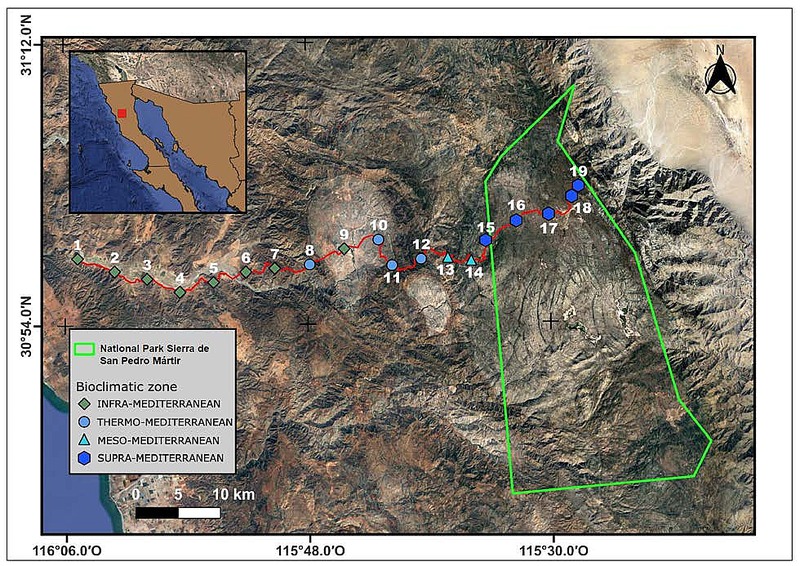
Figure 1 Location of the study area and the route of the 19 sampling points distributed across the bioclimatic belts of the Sierra de San Pedro Mártir, Baja California, Mexico. Prepared by Iván A. Meza-Matty.
The vascular flora of the SSPM includes 500 species in 251 genera and 78 families, of which 453 species (236 genera) are native, 23 species and one variety are endemic (Thorne et al., 2010; Harper et al., 2021). According to Peinado et al. (1994a, 1994b) and Delgadillo-Rodríguez (2004), the “bioclimatic vegetation belts” described below can be delineated by the altitudinal temperature gradient of the SSPM. The Infra-mediterranean belt (Fig. 2A) extends from the coast up to 500 m asl, with a thermicity index (TI= annual mean temperature + average maximum temperature of the coldest month + minimum temperature of the coldest month x 10; cf. Rivas-Martínez, 1987) greater than 470. This belt is represented by two associations: rosetophilous shrubland dominated by Bergerocactus emoryi Engelm. (Britton & Rose), Agave shawii ssp. shawii Engelm., Rosa minutifolia Engelm., and Aesculus parryi A. Gray. The Thermo-mediterranean belt (Fig. 2B) ranges from 500 to 1500 m asl, with a TI of 350-470. This belt features chaparral and oak grove associations, with the former dominated by sclerophyllous shrubs and dry deciduous trees, such as Xylococcus bicolor Nuttand and Ornithostaphylos oppositifolia (Parry) Small, and the latter dominated by Quercus agrifolia Née var. oxyadenia (Torr.) J.T. Howell at sites with edaphic humidity or on with slopes characterized by accumulations of mist. The Meso-mediterranean belt (Fig. 2C) is found between 1500 and 2000 m asl, with a TI of 210-350. This belt is dominated by heliophilous conifers, such as Pinus monophylla Torr. & Frém. and P. quadrifolia Parl. ex Sudw., in association with Adenostoma sparsifolium Torr. and Juniperus californica Carrière. The Supra-mediterranean belt (Fig. 2D) occurs from 2000 m asl upwards, with an IT of 70-210. This belt is dominated by large conifer formations comprising Pinus jeffreyi Grev. & Balf., P. contorta Douglas ex Loudon subsp. murrayana (Grev. & Balf.) Critchf, Abies concolor (Gordon & Glend.) Lindl. ex Hildebr. subsp. murrayana (Grev. & Balf.) Critchf., and Calocedrus decurrens (Torrey) Florin.
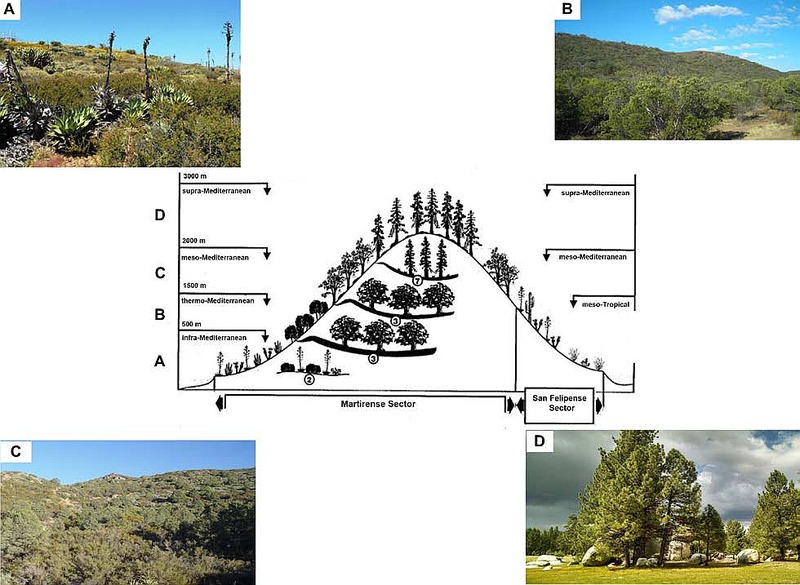
Figure 2 Vegetation associated with the bioclimatic belts of the Sierra de San Pedro Mártir: (A) Coastal rosetophilous shrubland (Infra-Mediterranean); (B) Coastal chaparral (Thermo-Mediterranean), (C) mountain chaparral (Meso-Mediterranean), and (D) conifer forest (Supra-Mediterranean). Modified from Peinado et al. (1994).
Spatiotemporal sampling. Four seasonal surveys were conducted along an 85 km stretch of State Highway 3 leading to Sierra de San Pedro Mártir National Park, from October 2017 to July 2018 (Fig. 1), to record sightings of diurnal birds of prey using a combination of strip transects and point counts (Ruiz-Campos et al., 2014; Rodríguez-Estrella et al., 2020). Sampling occurred in autumn (26-27 October 2017), winter (12-13 January 2018), spring (5-6 April 2018), and summer (5-6 July 2018). Each sampling event consisted of two consecutive daily surveys conducted across 19 consecutive transects, each 5 km long with an effective width of 300 m (150 m on each side of the transect), placed equidistantly from the 10th Km (125 m asl) to the 95th kilometer (2,761 m asl) of State Highway 3 (Fig. 1). Each transect was surveyed from a vehicle traveling at an average speed of 40 km/h, with surveys conducted between 09:00 and 12:00 and 16:00 and 18:00.
The number of transects sampled per bioclimatic belt was as follows (Fig. 1): Infra-Mediterranean-8; Thermo-Mediterranean-4; Meso-Mediterranean-2; and Supra-Mediterranean-5. Only two transects crossed the Meso-Mediterranean belt because it is narrower and has steeper slopes. A 15-minute point count was conducted once each 5 km transect was completed, with a 30 m observation radius (Fuller & Mosher, 1987; Ralph et al. 1996). At each georeferenced observation point, the species composition and number of individuals identified were recorded, along with temperature (°C), wind speed (km/h), and altitude (m asl). These three environmental parameters were measured using a Kestrel 3500 FW portable weather meter. Each site was observed with binoculars (8 × 10) and two telescopes (50 X and 40 X) and was photographed to facilitate identification of the dominant vegetation in the corresponding bioclimatic belt.
Species were identified using the Kaufman (2005) and Dunn and Alderfer (2011) field guides. To corroborate the taxonomic identification of the observed species, photographs were taken with a digital camera (Nikon© Coolpix P1000) equipped with a 3000 mm telephoto lens. Taxonomic classification and nomenclature follow Chesser et al. (2024). The conservation status of the species was based on Official Mexican Standard NOM-SEMARNAT-059-2025 (SEMARNAT, 2025) and the guidelines of the International Union for Conservation of Nature (IUCN, 2021).
Species composition, abundance, and diversity. Species abundance in the study area was assessed for each species as the average number of individuals observed per transect across different bioclimatic belts and climatic seasons. Species were classified according to their seasonal presence in the study area using the criteria established by Ruiz-Campos and Rodríguez-Meraz (1997) as follows: permanent residents (PR), species identified in at least three seasons of the year; seasonal visitors (SV), species identified in one or two seasons of the year; and occasional visitors (OV), species observed on a single occasion involving only one individual. Community attributes of species diversity, calculated using the true species diversity index (Hill), and species dominance, calculated using Simpson’s index (D), were both determined with the BPMSG [Business Performance Management Singapore] diversity online calculator (BPMSG, 2025).
The true diversity values of the bioclimatic belts were compared across climatic seasons using a one-way ANOVA. Similarly, the true diversity values of the climatic seasons were compared across bioclimatic belts, also using a one-way ANOVA with a significance level of 0.05. Additionally, the similarity in species observed among different seasons or among bioclimatic belts was calculated using the Bray-Curtis index, which accounts for both the presence or absence of species and their abundances. The index was calculated using the UPGMA (unweighted pair group method with arithmetic mean) algorithm in the PAST 4.13 program (Hammer et al., 2001).
A principal components analysis (PCA) was conducted to identify the ecological and environmental variables that best explain the variation in species composition in the study area. True species diversity was included as a supplementary variable and transect was used as the grouping variable. The values of the ecological and environmental variables were log-transformed for the PCA. Species richness was excluded from the PCA because it is positively correlated with true species diversity and inversely correlated with species dominance. This analysis was performed using the Statistica 7.0 statistical package (StatSoft Inc. Tulsa, OK).
Results
We recorded a total of 15 raptor species from three families (Cathartidae, Accipitridae, and Falconidae) based on 76 transects (19 per season) conducted across four climatic seasons, at altitudes ranging from 125 to 2,761 m asl. The effective observation time during the study was 19 hours. Sampling dates for each season covered the different bioclimatic belts of the SSPM, Baja California.
Seasonal sampling along the transects recorded 182 individuals belonging to 15 species, as described below. Cathartes aura (n= 69), Buteo jamaicensis (n= 64), and Falco sparverius Linnaeus, 1758 (n= 27) had the highest numbers of individuals with relative abundances of 37.9%, 35.2%, and 14.8%, respectively (Table 1). The remaining species had abundances ranging from one individual (0.5%) including Elanus leucurus (Vieillot, 1818), Circus hudsonius (Linnaeus, 1766), Accipiter striatus (Vieillot, 1808), Buteo lineatus (Gmelin, 1788), Buteo swainsoni (Bonaparte, 1838), and Falco peregrinus (Tunstall, 1771) -to five individuals (2.7%) for Astur cooperii (Bonaparte, 1828) (Table 1).
Table 1 Seasonal composition, absolute (N) and relative (%) abundance, ecological density (D= individuals per 5 km-transect), and ecological attributes of raptors (all bioclimatic belts combined) in the Sierra de San Pedro Mártir, Baja California, Mexico, from October 2017 to July 2018. SV: seasonal visitor; PR: permanent resident; OV: occasional visitor. P: endangered; E: threatened; Pr: special protection. Taxonomic classification of the species follows Chesser et al. (2023).
| Seasons | ||||||||||||||
| Autumm | Winter | Spring | Summer | Total | ||||||||||
| Family/Species | N | (%) | D | N | (%) | D | N | (%) | D | N | (%) | D | (N) | (%) |
| Cathartidae | ||||||||||||||
| Gymnogyps californianus (SV, P) | 0 | 0.0 | 0.0 | 1.0 | 1.3 | 0.1 | 1.0 | 1.9 | 0.1 | 0.0 | 0.0 | 0.0 | 2 | 1.0 |
| Cathartes aura (PR) | 14 | 35.9 | 0.7 | 34.0 | 44.2 | 1.8 | 18.0 | 34.6 | 0.9 | 3.0 | 21.4 | 0.2 | 69 | 37.9 |
| Accipitridae | ||||||||||||||
| Elanus leucurus (OV) | 1 | 2.6 | 0.1 | 0.0 | 0.0 | 0.0 | 0.0 | 0.0 | 0.0 | 0.0 | 0.0 | 0.0 | 1 | 0.5 |
| Aquila chrysaetos (PR, E) | 0 | 0.0 | 0.0 | 1.0 | 1.3 | 0.1 | 1.0 | 1.9 | 0.1 | 1.0 | 7.1 | 0.1 | 3 | 1.6 |
| Circus hudsonius (OV) | 0 | 0.0 | 0.0 | 1.0 | 1.3 | 0.1 | 0.0 | 0.0 | 0.0 | 0.0 | 0.0 | 0.0 | 1 | 0.5 |
| Accipiter striatus (OV, Pr) | 0 | 0.0 | 0.0 | 0.0 | 0.0 | 0.0 | 1.0 | 1.9 | 0.1 | 0.0 | 0.0 | 0.0 | 1 | 0.5 |
| Astur cooperii (PR, Pr) | 1 | 2.6 | 0.1 | 1.0 | 1.3 | 0.1 | 2.0 | 3.8 | 0.1 | 1.0 | 7.1 | 0.1 | 5 | 2.7 |
| Parabuteo unicinctus (SV, Pr) | 1 | 2.6 | 0.1 | 0.0 | 0.0 | 0.0 | 1.0 | 1.9 | 0.1 | 0.0 | 0.0 | 0.0 | 2 | 1.1 |
| Buteo lineatus (OV, Pr) | 0 | 0.0 | 0.0 | 0.0 | 0.0 | 0.0 | 0.0 | 0.0 | 0.0 | 1.0 | 7.1 | 0.1 | 1 | 0.5 |
| Buteo swainsoni (OV, Pr) | 0 | 0.0 | 0.0 | 0.0 | 0.0 | 0.0 | 1.0 | 1.9 | 0.1 | 0.0 | 0.0 | 0.0 | 1 | 0.5 |
| Buteo albonotatus (SV, Pr) | 0 | 0.0 | 0.0 | 0.0 | 0.0 | 0.0 | 2.0 | 3.8 | 0.1 | 0.0 | 0.0 | 0.0 | 2 | 1.1 |
| Buteo jamaicensis (PR) | 15 | 38.5 | 0.8 | 28.0 | 36.4 | 1.5 | 17.0 | 32.7 | 0.9 | 4.0 | 28.6 | 0.2 | 64 | 35.2 |
| Falconidae | ||||||||||||||
| Falco sparverius (PR) | 7 | 17.9 | 0.4 | 10.0 | 13.0 | 0.5 | 8.0 | 15.4 | 0.4 | 2.0 | 14.3 | 0.1 | 27 | 14.8 |
| Falco peregrinus (OV, Pr) | 0 | 0.0 | 0.0 | 1.0 | 1.3 | 0.1 | 0.0 | 0.0 | 0.0 | 0.0 | 0.0 | 0.0 | 1 | 0.5 |
| Falco mexicanus (OV, E) | 0 | 0.0 | 0.0 | 0.0 | 0.0 | 0.0 | 0.0 | 0.0 | 0.0 | 2.0 | 14.3 | 0.1 | 2 | 1.1 |
| Number of individuals | 39 | 77 | 52 | 14 | 182 | |||||||||
| (%) | 21.4 | 42.3 | 28.6 | 7.7 | ||||||||||
| Number of species | 6 | 8 | 10 | 7 | 15 | |||||||||
| Average dominance | 0.520 | 0.281 | 0.424 | 0.414 | ||||||||||
| Average evenness | 0.457 | 0.904 | 0.85 | 0.934 | ||||||||||
Species abundance and seasonality. Regarding the number of individuals (n) per season, winter (n= 77) and spring (n= 52) had the highest numbers of individuals observed, accounting for 42.3% and 28.6%, respectively (Table 1). For seasonal species presence in the study area (all bioclimatic belts combined), the highest number of species was observed in spring (n=10), followed by winter (n= 8), while autumn and summer recorded six and seven species, respectively (Table 1). During seasonal sampling in the study (all bioclimatic belts combined), five species were recorded as permanent residents, while the remaining ten species were seasonal visitors (Table 1).
In decreasing order, the average true species diversity (Hill) per season for all bioclimatic belts combined was spring (H’= 3.05 ± 1.28), summer (H’= 2.75 ± 1.05), winter (H’= 2.75 ± 0.95), and autumn (H’= 1.45 ± 1.64). These values were statistically similar (one-way ANOVA, F= 1.293, p= 0.322). By bioclimatic belt, the highest true diversity occurred in spring and the lowest in autumn (Fig. 3A). The highest species dominance was observed in autumn (D= 0.520) and the lowest in winter (D= 0.281) (Table 1). The similarity of raptor species among seasons (all bioclimatic belts combined) was highest between spring and autumn (83.5%), while summer showed the lowest similarities with spring (33.3%), autumn (37.7%), and winter (24.2%) (Fig. 4A).
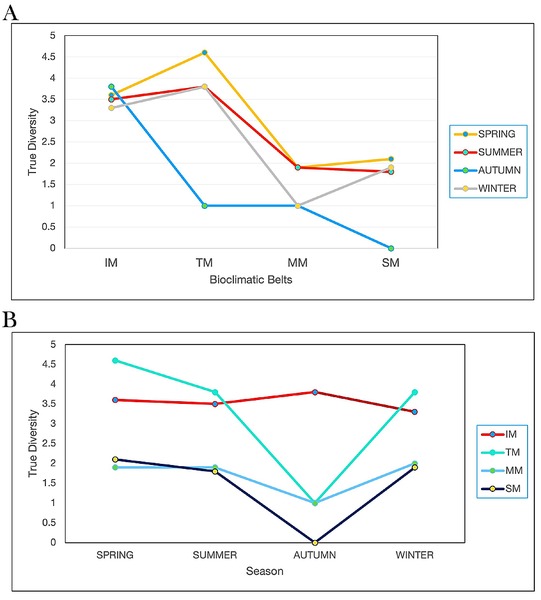
Figure 3 Seasonal species diversity across the bioclimatic belts (A) and zonal species richness across climatic seasons (B) in the Sierra de San Pedro Mártir, Baja California, México. IM= Infra-Mediterranean, TM=Thermo-Mediterranean, MM= Meso-Mediterranean, SM= Supra-Mediterranean.
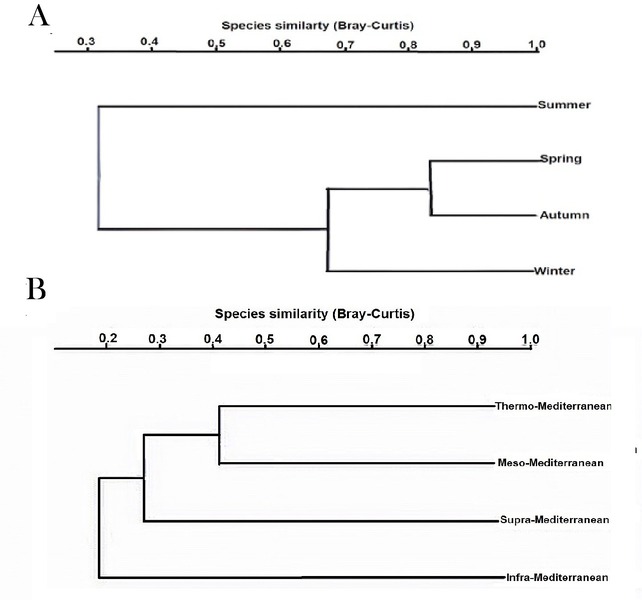
Figure 4 Dendrograms of species similarity (Bray-Curtis) for raptors in the Sierra de San Pedro Mártir, Baja California, Mexico. (A) among seasons (all bioclimatic belts combined), and (B) among bioclimatic belts (all seasons combined).
Bioclimatic belts. The most abundant species by number of individuals (n) and percentage (%) for each bioclimatic belt (all seasons combined) were as follows: Infra-Mediterranean - C. aura (n= 54, 41%), B. jamaicensis (47, 36%), and F. sparverius (19, 14%); Thermo-Mediterranean - B. jamaicensis (9, 45%), F. sparverius (6, 30%), and A. chrysaetos (2, 10%); Meso-Mediterranean - B. jamaicensis (5, 56%) and G. californianus (2, 22%); and Supra-Mediterranean - C. aura (13, 62%) and B. jamaicensis (3, 14%) (Table 2).
Table 2 Composition, absolute (N) and relative (%) abundance and ecological attributes of raptor species by bioclimatic belt (all seasons combined) in the Sierra de San Pedro Mártir, Baja California, Mexico, from October 2017 to July 2018.
| Bioclimatic belts | ||||||||||
| Infra-Mediterranean | Thermo-Mediterranean | Meso-Mediterranean | Supra-Mediterranean | Total | ||||||
| Family/ species | N | (%) | N | (%) | N | (%) | N | (%) | N | (%) |
| Cathartidae | ||||||||||
| Gymnogyps californianus | 0 | 0 | 0 | 0 | 2 | 22 | 0 | 0 | 2 | 1.1 |
| Cathartes aura | 54 | 41 | 1 | 5 | 1 | 11 | 13 | 62 | 69 | 37.1 |
| Accipitridae | ||||||||||
| Elanus leucurus | 1 | 1 | 0 | 0 | 0 | 0 | 0 | 0 | 1 | 0.5 |
| Aquila chrysaetos | 1 | 1 | 2 | 10 | 0 | 0 | 0 | 0 | 3 | 1.6 |
| Circus hudsonius | 1 | 1 | 0 | 0 | 0 | 0 | 0 | 0 | 1 | 0.5 |
| Accipiter striatus | 1 | 1 | 0 | 0 | 0 | 0 | 0 | 0 | 1 | 0.5 |
| Astur cooperii | 4 | 3 | 0 | 0 | 1 | 11 | 0 | 0 | 5 | 2.7 |
| Parabuteo unicinctus | 2 | 2 | 0 | 0 | 0 | 0 | 0 | 0 | 2 | 1.1 |
| Buteo lineatus | 1 | 1 | 0 | 0 | 0 | 0 | 0 | 0 | 1 | 0.5 |
| Buteo swainsoni | 0 | 0 | 1 | 5 | 0 | 0 | 0 | 0 | 1 | 0.5 |
| Buteo albonotatus | 0 | 0 | 1 | 5 | 0 | 0 | 1 | 5 | 2 | 1.1 |
| Buteo jamaicensis | 47 | 36 | 9 | 45 | 0 | 0 | 3 | 14 | 59 | 32.4 |
| Falconidae | ||||||||||
| Falco sparverius | 19 | 14 | 6 | 30 | 5 | 56 | 2 | 10 | 32 | 17.6 |
| Falco peregrinus | 1 | 1 | 0 | 0 | 0 | 0 | 0 | 0 | 1 | 0.5 |
| Falco mexicanus | 0 | 0 | 0 | 0 | 0 | 0 | 2 | 10 | 2 | 1.1 |
| Number of species | 11 | 6 | 4 | 5 | ||||||
| Number of individuals | 132 | 20 | 9 | 21 | 182 | |||||
| Average true diversity | 3.55 | 3.30 | 1.70 | 1.45 | ||||||
| Average dominance | 0.328 | 0.448 | 0.540 | 0.509 | ||||||
Across zones, the highest number of species (all seasons combined) was recorded in the Infra-Mediterranean belt (11), while the lowest was in the Supra-Mediterranean belt (5) (Table 2). True species diversity per bioclimatic belt was highest in the Thermo-Mediterranean belt (4.6) during spring, in contrast to a null true diversity in the Supra-Mediterranean belt in autumn (Fig. 3B).
Three species (C. aura, B. jamaicensis, and F. sparverius) were found in all bioclimatic belts during the study period (Table 2). At the bioclimatic belt level, for all seasons combined, true species diversity differed significantly among belts (one-way ANOVA, F= 5.582, p= 0.0124), with the highest diversity in the Infra-Mediterranean belt (3.55 ± 0.21) and the lowest in the Meso-Mediterranean (1.45 ± 0.52) and Supra-Mediterranean (1.45 ± 0.97) belts (Table 2). The similarity of species among the bioclimatic belts (all seasons combined) was low in all cases (< 50%) (Fig. 4B).
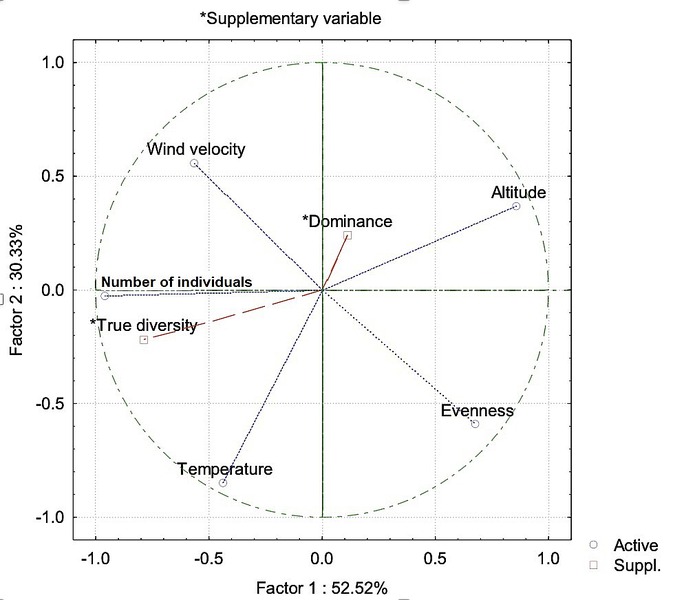
We applied principal component analysis (PCA) to identify the ecological variables influencing the diversity and number of individuals (all species combined) of raptors at the study site. The PCA showed that factors 1 (52.5%) and 2 (30.3%) together explained 82.9% of the total observed variation (Fig. 5). Based on the correlations, altitude and the number of individuals (all species combined) contributed most to explaining Factor 1, with values of 0.281 and 0.349, respectively, while temperature (0.475) and evenness (0.230) contributed most to the variation observed for Factor 2. The true species diversity of raptors during the study period showed a significant inverse relationship with altitude (r= -0.675, p< 0.05) and a significant direct relationship with environmental temperature (r= 0.617, p<0.05). The number of individuals (all species combined) also showed a significant inverse relationship with altitude (r= -0.785, p<0.05).
Discusion
This study quantified the seasonal diversity and abundance of raptors along an altitudinal gradient in the SSPM, Baja California, Mexico, which features four bioclimatic belts within the Mediterranean climate region. A total of 15 species were recorded during the study period, slightly more than the 13 species previously reported by Short and Banks (1965) and Short and Crossin (1967). However, this number is lower than the 18 species reported by Ruiz-Campos et al. (2024) over 30 years of observations in this mountain range. Species not detected in the present study but occasionally recorded in this range include the Osprey (Pandion haliaetus Linnaeus, 1758), Bald Eagle (Haliaeetus leucocephalus Linnaeus, 1766), Ferruginous Hawk [Buteo regalis (Gray, 1844)], and Merlin (F. columbarius Linnaeus, 1758) (Grinnell, 1928; Ruiz-Campos et al., 2024).
The Red-tailed Hawk (Buteo jamaicensis) was the second most abundant species in the study area, found across all bioclimatic belts and climatic seasons. This species is considered one of the most common and abundant raptors in the western United States (Preston & Beane, 2024), especially in California, where populations have increased since the 1980s, but may have stabilized or begun to decline since the late 20th century (Hoffman & Smith, 2003). Various studies on raptor species richness in the Baja California peninsula have found that B. jamaicensis includes both resident and migratory populations (Ruiz-Campos et al., 2004, 2024). The present study recorded nesting of this species in the Infra-Mediterranean, Meso-Mediterranean, and Supra-Mediterranean bioclimatic belts.
Another common and abundant raptor species recorded in this study was the American Kestrel (F. sparverius), which occurs year -round across all bioclimatic belts. This is because it is one of the Falconidae with the widest distributions in the western United States (Smallwood & Bird, 2020), with a range in San Diego County that extends from the coastline to the mountains (Unitt, 2004). Similarly, the Turkey Vulture (C. aura) is present in all bioclimatic belts and throughout all seasons, with frequent sightings of individuals searching for carrion along the highway leading to the National Astronomical Observatory facilities in the SSPM (Kirk et al., 2024).
In the wetlands adjacent to the floodplains of the Infra-Mediterranean belt in the SSPM, Ruiz-Campos et al. (2004, 2005) reported a high number of raptor species (13), as these wetlands provide more prey resources for species such as E. leucurus, C. hudsonius, A. striatus, A. cooperii, B. jamaicensis, and F. sparverius. These species were also recorded in our study in coastal shrubland areas (Infra-Mediterranean) and chaparral (Thermo-Mediterranean).
Regarding species numbers by bioclimatic belt, the highest presence of raptor species and individuals was recorded in the Infra-Mediterranean belt (n=11 species), followed by the Thermo-Mediterranean belt (n=6 species). This pattern shows a notably lower species richness with increasing altitude, consistent with the biogeographical rule that describes reduced species richness at higher altitudes and latitudes (Gaston et al., 2008; Loera-Casillas et al., 2022).
The higher number of individuals observed in the lowest bioclimatic belts is related to land use changes and habitat modification, which have been reported as beneficial for certain raptor species (De León-Girón et al., 2016). Species such as C. aura, B. jamaicensis, and F. sparverius exploit landscapes fragmented by ranch fencing and street lighting; Rodríguez-Estrella et al. (1998) reported similar findings in the agricultural areas of Baja California Sur. Additionally, the road connecting the transpeninsular highway to the National Astronomical Observatory facilities has a high incidence of roadkill, including passerines, rabbits, and hares, providing a year-round food source for scavengers such as the turkey vulture and the California Condor, further highlighting the human influence on resource availability. In contrast, the Meso-Mediterranean and Supra-Mediterranean belts supported a combined number of raptor species (7), which may indicate a high level of environmental quality and low fragmentation in the conifer forest of the SSPM (Ruiz-Campos, 2017; Harper et al., 2021; Ruiz-Campos et al., 2024).
Although the avifauna of the SSPM has been documented for more than 90 years (Grinnell, 1928; Wilbur, 1987; Ruiz-Campos et al., 2004; Erickson et al., 2013; Ruiz-Campos et al. 2024), no study has spatiotemporally evaluated the diversity and abundance of raptors in this mountain system of boreal affinity, which includes different bioclimatic belts. This habitat heterogeneity supports raptors with specific vegetation preferences, which can be altered by anthropogenic factors (Rodríguez-Estrella et al., 1998; De León-Girón et al., 2024). Diurnal birds of prey are top predators in trophic chains and have a key role in maintaining ecological balance (Sergio et al. 2008; Donázar et al., 2016; Merlo & Merlo, 2021). Some species, such as A. chrysaetos, P. unicinctus, B. lineatus, B. albonotus, and F. mexicanus, are more sensitive to disturbances and prefer pristine habitats (Wiens et al., 2022; Steenhof, 2024).
In contrast, species such as E. leucurus, C. hudsonius, and B. swainsoni have adapted to changes in the landscape due to their ability to forage in areas modified by agriculture (Smith et al., 2020). Others, such as C. aura, B. jamaicensis, and F. sparverius, exhibit notable ecological plasticity that enables them to thrive in both anthropogenic and less modified environments (Smallwood & Bird, 2020; Santangeli et al., 2022). The composition and diversity of raptors can be used as indicators of habitat quality (Rodríguez-Estrella et al. 1998, Sergio et al., 2003; Finkelstein et al., 2020). However, factors such as the temperature gradient and ecosystem heterogeneity directly influence the diversity of this avian group, highlighting the importance of conserving these unique landscapes for the maintenance of these populations.
In summary, this study shows that the diversity and abundance of raptors in the Sierra San Pedro Mártir, Baja California, México follow well-defined patterns shaped by the altitudinal gradient and seasonal climatic dynamics. This mountain island in the northwestern part of the Baja California peninsula is an area of biogeographic and evolutionary interest, as the combination of latitude and altitude allows the establishment of different bioclimatic belts (vegetation) that contribute to the alpha, beta, and gamma diversity of the avian component (Ruiz-Campos et al., 2024).

