




 nueva página del texto (beta)
 Inglés (pdf)
 Artículo en XML
 Referencias del artículo
 Traducción automática
 Enviar artículo por email
 Citado por SciELO
  Similares en
SciELO
Similares en
SciELO 
 Permalink

Introduction
Spiders are a diverse group, with a total of 51, 939 species globally, that occur in almost all terrestrial habitats worldwide (Coddington & Levi, 1991; World Spider Catalog, 2024). Predominantly insectivores, spiders play a fundamental role as predators and biological control agents in natural environments and agroecosystems (Coddington & Levi, 1991; Foelix, 2011).
In Mexico, there are 2,345 species recorded, belonging to 455 genera, and 70 families (Ponce-Saavedra et al., 2023). In Mexico, Chiapas (379 species), Veracruz (360), and Guerrero (291), harbor the highest species diversity of spiders (Ponce-Saavedra et al., 2023). In Sinaloa, the number of documented species has steadily increased since Hoffmann (1976) work, who enumerated 48 species, then Jiménez (1996) enumerated 82 species, and recently Ponce-Saavedra et al. (2023) cited 93 species.
Sinaloa, a northwestern state in Mexico, exhibits remarkable biodiversity due to diverse physiographic, climatic, and altitudinal factors. It encompasses several vegetation types, including tropical deciduous forest, thorn forest, low deciduous forest, and pine-oak forest, among others (Rzedowski, 2006). Despite the vegetation diversity, few faunistic inventories have been conducted in Sinaloa, limiting current knowledge of spider diversity in the state. Only a single faunistic inventory has been conducted within the state's geographical boundaries. Hernández-Reátiga et al. (2017) studied weaver spider diversity in an agroecosystem in Surutato, Badiraguato, identifying 18 species belonging to 15 genera and five families. However, their work, while offering a valuable baseline study, raises questions about certain identifications and is limited to a small region of the state.
The study aims to increase the knowledge of the diversity of spiders in Sinaloa, by (1) providing new distributional data of 13 species not previously recorded in the state and (2) compiling a species list of spiders.
Materials and methods
Deposit of specimens. All spiders are preserved in 70% ethyl alcohol and deposited in the Colección de Arácnidos e Insectos (CARCIB, curator Dr. María-Luisa Jiménez) at the Centro de Investigaciones Biológicas del Noroeste S.C. (CIBNOR).
New records. Serendipitous samplings were conducted in Ahome and Guasave municipalities, Sinaloa, Mexico, by the first author during June 2022 and July-September 2023. Following Gómez-Moreno et al. (2023), any spider encountered in any habitat, including synanthropic ones, was collected using diverse techniques outlined by Ubick et al. (2017). Representative localities are Cañón del Diablo (Fig. 1), Isla San Ignacio and Isla Nescoco (Fig. 2), and Los Mochis City (Fig. 3). Furthermore, a small collection of specimens from Mazatlán, Sinaloa deposited at CARCIB were examined. Precise information, e.g., locality data, number of specimens examined, sex, and other important data, are given for each species, following the format of Gómez-Moreno et al. (2023).
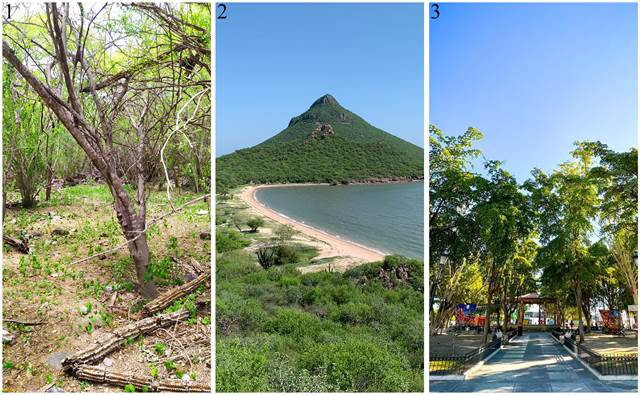
Figures 1-3 Collection sites in Sinaloa. 1. Cañón del Diablo in Sierra Barobampo. 2. Isla Nescoco in Navachiste, Guasave. 3. Plazuela 27 de September in Los Mochis city.
Identification and imaging. Species identification was carried out with a VELAB VE-S6 microscope at the Benjamín Francis Johnston Botanical Garden, Sinaloa. The species names were verified with the World Spider Catalog (2024). The photographs were taken with an AxioCam HSc camera attached to a ZEISS SteREO Discovery.V20.
Spider list. The species list was generated using the data compiled by second and third authors, only tally by states published in Ponce-Saavedra et al. (2023). Moreover, we used web search engines to look for more published studies from Sinaloa but discarded species records from grey literature.
Results
New records. From the samplings, we examined 17 specimens (eight males, six females, and three immatures) belonging to 7 families, all representing new distributional data (see below). Twelve spiders were collected inside houses or nearby, while five came from low deciduous forest or coastal scrub. Plexippus petersi Karsch, 1878 (Salticidae) is recorded for the first time in America. The following 12 species represent the first record for Sinaloa: Hibana incursa Chamberlin, 1919 (Anyphaenidae), Diguetia sp. (Diguetidae), Filistatoides sp. (Filistatidae), Crossopriza lyoni Blackwall, 1867 (Pholcidae), Physocyclus globosus Taczanowski, 1874 (Pholcidae), Hasarius adansoni Audouin, 1826 (Salticidae), Lyssomanes mandibulatus F. O. Pickard-Cambridge, 1900 (Salticidae), Menemerus bivittatus Dufour, 1831 (Salticidae), Plexippus paykulli Audouin, 1826 (Salticidae), Heteropoda venatoria Linnaeus, 1767 (Sparassidae), Synema sp. (Thomisidae), and Xysticus lassanus Chamberlin, 1925 (Thomisidae).
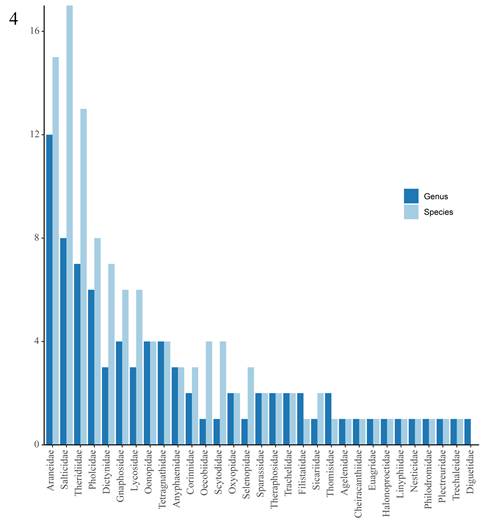
Spider species list of Sinaloa. A total of 31 families, 82 genera, and 118 species are distributed in Sinaloa (Table 1). Salticidae (8 genera and 17 species), Araneidae (12 genera and 15 species), and Theridiidae (7 genera and 13 species) are the most diverse families (Fig. 4). Eleven families have only one recorded species in Sinaloa (Fig. 4).
Table 1 List of spiders of Sinaloa. * New state record, ** New record for America, 1 = species only known from Sinaloa, 2 = introduced species, 3 = synanthropic species.
| Infraorder/Family | Genus and species | Consulted literature |
|---|---|---|
| Mygalomorphae | ||
| Halonoproctidae | Ummidia pustulosa Becker, 1879 | Gondwin & Bond (2021) |
| Theraphosidae | Brachypelma emilia White, 1856 | Mendoza & Francke (2020) |
| Magnacarina moderata Locht, Mendoza & Medina, 2016 | Mendoza, Locht, Kaderka, Medina & Pérez-Miles (2016) | |
| Araneomorphae | ||
| Agelenidae | Novalena sinaloaMaya-Morales & Jiménez, 20171 | Maya-Morales & Jiménez (2017) |
| Anyphaenidae | Anyphaena judicata O. Pickard-Cambridge, 1896 | Platnick & Lau (1975) |
| Wulfila tantillus Chickering, 1940 | Platnick (1974) | |
| Hibana incursa Chamberlin, 1919* | ||
| Araneidae | Araneus colimaLevi, 1991 | Levi (1991) |
| Araneus detrimentosus O. Pickard-Cambridge, 1889 | Levi (1991) | |
| Argiope argentata Fabricius, 1775 | Levi (1968); Hoffmann (1976) | |
| Argiope blanda O. Pickard-Cambridge, 1898 | Levi (1968); Hoffmann (1976) | |
| Cyclosa walckenaeri O. Pickard-Cambridge, 1889 | Levi (1999) | |
| Edricus productus O. Pickard-Cambridge, 1896 | Levi (1991) | |
| Eriophora edax Blackwall, 1863 | Hoffmann (1976) | |
| Eustala conchlea McCook, 1888 | Levi (1977) | |
| Gasteracantha cancriformis Linnaeus, 1758 | Levi (1978) | |
| Larinia directa Hentz, 1847 | Harrod, Levi & Liebensperger (1991) | |
| Mangora mobilis O. Pickard-Cambridge, 1889 | Levi (2005) | |
| Metepeira petatlanPiel, 2001 | Piel (2001) | |
| Micrathena funebris Marx, 1898 | Levi (1985); Hoffmann (1976) | |
| Micrathena mitrata Hentz, 1850 | Levi (1985) | |
| Neoscona oaxacensis Keyserling, 1864 | Berman & Levi (1971); Hoffmann (1976) | |
| Cheiracanthiidae | Strotarchus nebulosus Simon, 1888 | Bonaldo et al. (2012) |
| Corinnidae | Castianeira dorsataBanks, 1898 | Reiskind (1969); Hoffmann (1976) |
| Castianeira nanella Gertsch, 1933 | Reiskind (1969); Hoffmann (1976) | |
| Creugas gulosus Thorell, 1878 | Bonaldo (2000) | |
| Dictynidae | Dictyna calcarata Banks, 1904 | Chamberlin & Gertsch (1958); Hoffmann (1976) |
| Dictyna peonChamberlin & Gertsch, 1958 | Chamberlin & Gertsch (1958); Hoffmann (1976) | |
| Dictyna sinaloaGertsch & Davis, 19421 | Gertsch & Davis (1942) | |
| Dictyna tucsona Chamberlin, 1948 | Chamberlin & Gertsch (1958); Hoffmann (1976) | |
| Mallos niveus O. Pickard-Cambridge, 1902 | Bond & Opell (1997) | |
| Phantyna mulegensis Chamberlin, 1924 | Gertsch & Davis (1942) | |
| Phantyna segregata Gertsch & Mulaik, 1936 | Gertsch & Davis (1942) | |
| Diguetidae | Diguetia sp.* | |
| Euagridae | Euagrus gertschiCoyle, 1988 | Coyle (1988) |
| Filistatidae | Filistatoides sp.* | |
| Kukulcania tequilaMagalhaes & Ramírez, 2019 | Magalhaes & Ramírez (2019) | |
| Gnaphosidae | Cesonia lugubris O. Pickard-Cambridge, 1896 | Platnick & Shadab (1980) |
| Drassyllus gammusPlatnick & Shadab, 19821 | Platnick & Shadab (1982) | |
| Drassyllus villusPlatnick & Shadab, 19821 | Platnick & Shadab (1982) | |
| Micaria jeanaeGertsch, 1942 | Platnick & Shadab (1988) | |
| Zelotes monachus Chamberlin, 1924 | Platnick & Shadab (1983) | |
| Zelotes unionPlatnick & Shadab, 19831 | Platnick & Shadab (1983) | |
| Linyphiidae | Mermessus denticulatusBanks, 1898 | Millidge (1987) |
| Lycosidae | Arctosa tenella (Keyserling, 1877) | Dondale & Redner (1983) |
| Pardosa bellonaBanks, 1898 | Dondale & Redner (1984) | |
| Pardosa vadosaBarnes, 1959 | Barnes (1959); Hoffmann (1976) | |
| Pardosa sierraBanks, 1898 | Barnes (1959); Hoffmann (1976) | |
| Pardosa valensBarnes, 1959 | Barnes (1959); Hoffmann (1976) | |
| Sosippus californicus Simon, 1898 | Brady (1962); Hoffmann (1976) | |
| Nesticidae | Eidmannella pallida Emerton, 1875 | Gertsch (1984) |
| Oecobiidae | Oecobius culiacanensisShear, 19701 | Shear (1970); Hoffmann (1976) |
| Oecobius isolatoidesShear, 1970 | Shear (1970); Hoffmann (1976) | |
| Oecobius piaxtlaShear, 19701 | Shear (1970); Hoffmann (1976) | |
| Oecobius rivulaShear, 19701 | Shear (1970); Hoffmann (1976) | |
| Oonopidae | Cinetomorpha bandoleraOtt & Harvey, 2019 | Ott et al. (2019) |
| Escaphiella hespera Chamberlin, 1924 | Platnick & Dupérré (2009a) | |
| Noonops culiacanPlatnick & Berniker, 20131 | Platnick & Berniker (2013) | |
| Opopaea concolor Blackwall, 1859 2 | Platnick & Dupérré (2009b) | |
| Oxyopidae | Peucetia longipalpis F. O. Pickard-Cambridge, 1902 | Brady (1964); Hoffmann (1976) |
| Oxyopes felinusBrady, 1964 | Brady (1975) | |
| Philodromidae | Apollophanes punctipes O. Pickard-Cambridge, 1891 | Dondale & Redner (1975) |
| Pholcidae | Artema atlanta Walckenaer, 1837 2, 3 | Gertsch & Davis (1942) |
| Crossopriza lyoni Blackwall, 1867* 2, 3 | ||
| Micropholcus fauroti Simon, 1887 2 | Gertsch & Davis (1942); Hoffmann (1976) | |
| Physocyclus globosus Taczanowski, 1874* 3 | ||
| Physocyclus platnickiValdez-Mondragón, 20101 | Valdez-Mondragón (2010) | |
| Physocyclus validus Gertsch, 1971 | Valdez-Mondragón (2010) | |
| Psilochorus sinaloaGertsch & Davis, 19421 | Gertsch & Davis (1942); Hoffmann (1976) | |
| Tolteca hesperiaGertsch, 1982 | Gertsch (1982); Huber (2000) | |
| Plectreuridae | Plectreurys ardeaGertsch, 19581 | Gertsch (1958); Hoffmann (1976) |
| Salticidae | Habronattus abditusGriswold, 19871 | Griswold (1987) |
| Habronattus aztecanusBanks, 1898 | Griswold (1987) | |
| Habronattus carpusGriswold, 1987 | Griswold (1987) | |
| Habronattus contingens Chamberlin, 1925 | Griswold (1987) | |
| Habronattus fallax Peckham & Peckham, 1909 | Griswold (1987) | |
| Habronattus pugillisGriswold, 1987 | Griswold (1987) | |
| Habronattus pyrrithrix Chamberlin, 1924 | Griswold (1987) | |
| Habronattus virgulatusGriswold, 1987 | Griswold (1987) | |
| Hasarius adansoni Audouin, 1826* 2, 3 | ||
| Lyssomanes mandibulatus F. O. Pickard-Cambridge, 1900* | ||
| Menemerus bivittatus Dufour, 1831* 2, 3 | ||
| Pelegrina variegata F. O. Pickard-Cambridge, 1901 | Maddison (1996) | |
| Phidippus pacosauritusEdwards, 20201 | Edwards (2020) | |
| Phidippus californicus Peckham & Peckham, 1901 | Edwards (2004) | |
| Plexippus paykulli Audouin, 1826* 2, 3 | ||
| Plexippus petersi Karsch, 1878** 2, 3 | ||
| Sassacus vitis Cockerell, 1894 | Richman (2008) | |
| Scytodidae | Scytodes atlatoninRheims, Brescovit & Durán-Barrón, 20071 | Rheims, Brescovit & Durán-Barrón (2007) |
| Scytodes chiconahuiRheims, Brescovit & Durán-Barrón, 2007 | Rheims, Brescovit & Durán-Barrón (2007) | |
| Scytodes fusca Walckenaer, 1837 | F. O. Pickard-Cambridge (1899); Hoffmann (1976) | |
| Scytodes redempta Chamberlin, 1924 | Rheims, Brescovit & Durán-Barrón (2007) | |
| Selenopidae | Selenops actophilus Chamberlin, 1924 | Crews (2011) |
| Selenops debilisBanks, 1898 | Crews (2011) | |
| Selenops nesophilus Chamberlin, 1924 | Crews (2011) | |
| Sicariidae | Loxosceles seriGertsch & Ennik, 1983 | Gertsch & Ennik (1983) |
| Loxosceles sonoraGertsch & Ennik, 1983 | Gertsch & Ennik (1983) | |
| Sparassidae | Curicaberis culiacanRheims, 20151 | Rheims (2015) |
| Heteropoda venatoria Linnaeus, 1767* 2, 3 | ||
| Tetragnathidae | Chrysometa alboguttata O. Pickard-Cambridge, 1889 | Levi (1986) |
| Glenognatha minutaBanks, 1898 | Cabra-García & Brescovit (2016) | |
| Azilia affinis O. Pickard-Cambridge, 1893 | Levi (1980) | |
| Leucauge argyra Walckenaer, 1841 | Levi (1980) | |
| Theridiidae | Anelosimus pacificusLevi, 1956 | Levi (1956); Levi (1963); Agnarsson (2006); Hoffmann (1976) |
| Anelosimus studiosus Hentz, 1850 | Hoffmann (1976) | |
| Asagena medialisBanks, 1898 | Levi (1957b); Hoffmann (1976) | |
| Argyrodes elevatus Taczanowski, 1873 | Exline & Levi (1962); Hoffmann, (1976) | |
| Latrodectus geometricus C. L. Koch, 1841 2, 3 | Cabrera-Espinosa & Valdez-Mondragón (2021) | |
| Latrodectus hesperus Chamberlin & Ivie, 1935 | Valdez-Mondragón & Cabrera-Espinosa (2023) | |
| Steatoda punctulata Marx, 1898 | Levi (1957b); Hoffmann (1976) | |
| Steatoda grossa C. L. Koch, 1938 2 | Hoffmann (1976) | |
| Theridion elisabethae Roewer, 1951 | Levi (1959); Hoffmann (1976) | |
| Theridion dilutumLevi, 1957 | Levi (1957a); Hoffmann (1976) | |
| Theridion positivum Chamberlin, 1924 | Levi (1957a); Hoffmann (1976) | |
| Theridion sinaloaLevi, 19591 | Levi (1959); Hoffmann (1976) | |
| Wamba crispulus Simon, 1895 | Levi (1957a); Hoffmann (1976) | |
| Thomisidae | Synema sp.* | |
| Xysticus lassanus Chamberlin, 1925* | ||
| Trachelidae | Meriola decepta Banks, 1895 | Platnick & Shadab (1974a) |
| Trachelas mexicanusBanks, 1898 | Platnick & Shadab (1974b) | |
| Trechaleidae | Trechalea connexa O. Pickard-Cambridge, 1898 | Carico (1993) |
Species with current distribution restricted to Sinaloa. In total, 17 species belonging to 14 genera and 11 families (Table 1) are only recorded within state boundaries. The municipalities of Culiacán, Villa Unión, and Piaxtla are the most common type localities of these species. Furthermore, among these species, some are toponyms of Sinaloa localities. For example, Dictyna sinaloaGertsch & Davis, 1942, Psilochorus sinaloaGertsch & Davis, 1942, Novalena sinaloaMaya-Morales & Jiménez, 2017, Curicaberis culiacanRheims, 2015; Noonops culiacanPlatnick & Berniker, 2013; Oecobius culiacanensisShear, 1970; Zelotes unionPlatnick & Shadab, 1983, and Oecobius piaxtlaShear, 1970. The most recent species described from Sinaloa is Phidippus pacosauritusEdwards, 2020, which is only known from Mazatlán.
Of the 17 species restricted to Sinaloa, only six species have both sexes described. In contrast, Curicaberis culiacan (Sparassidae), Habronattus abditus (Salticidae), Theridion sinaloa (Theridiidae), and Zelotes union (Gnaphosidae) are described only from males, while Dictyna sinaloa (Dictynidae), Psilochorus sinaloa (Pholcidae), Drassyllus gammus and Drassyllus villus (Gnaphosidae), Novalena sinaloa (Agelenidae), Scytodes atlatonin (Scytodidae) are described only from females. Plectreurys ardea (Plectreuridae) is an obscure species described with immature specimens, known only from Concordia, Sinaloa.
Introduced and synanthropic species. Eleven species belonging to 10 genera and five families (Table 1) have been introduced in Sinaloa and Mexico; none of these are naturally distributed in North America. Salticidae is represented by four introduced species, followed by Pholcidae (3 species), Theridiidae (2), Sparassidae (1), and Oonopidae (1). Among these introduced species, eight exhibit synanthropic habits (Table 1). The exception is Physocyclus globosus Taczanowski, 1874, the only native North American species found with synanthropic behavior (Table 1).
Spiders of medical-toxicological importance. Only four spiders belonging to two genera and two families are species of medical-toxicological importance. The violin spiders, Loxosceles seriGertsch & Ennik, 1983 and Loxosceles sonoraGertsch & Ennik, 1983 of the family Sicariidae. The widow spiders, Latrodectus geometricus C. L. Koch, 1841 and Latrodectus hesperus Chamberlin & Ivie, 1935 of the family Theridiidae.
Species under special protection. Brachypelma emilia (White, 1856), better known as the Mexican red-legged tarantula, is the only species categorized as threatened in Sinaloa. This species, as well as other Brachypelma species, is under special protection in the Convention on International Trade in Endangered Species of Wild Fauna and Flora (CITES) and the Official Mexican Standard NOM-059-SEMARNAT-2010 (DOF, 2010).
New records
Family: Anyphaenidae Bertkau, 1878
Genus: HibanaBrescovit, 1991
Hibana incursa (Chamberlin, 1919)
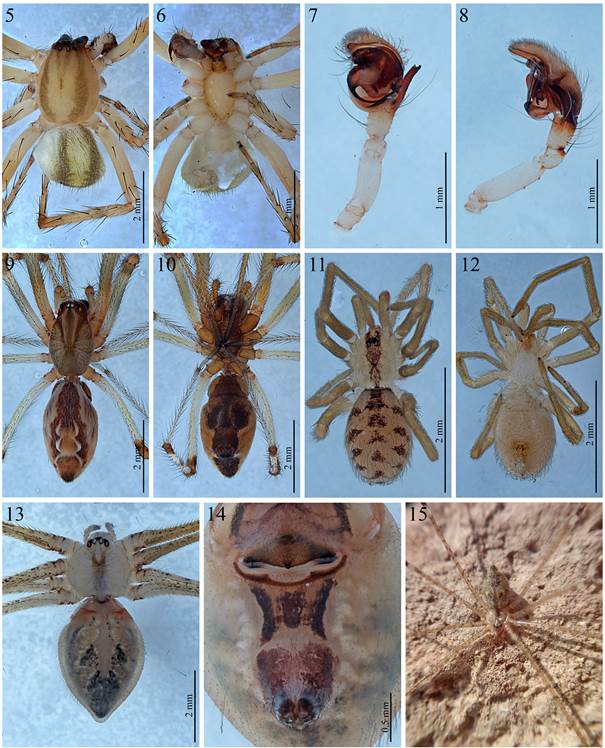
Figures 5-15 Hibana incursa. 5-8. 5. Habitus male, dorsal view. 6. Same, ventral view. 7. Male palp, ventral view. 8. Same, retrolateral view. Diguetia sp. 9-10. 9. Habitus, dorsal view. 10. Same, ventral view. Filistatoides sp. 11-12. 11. Habitus, dorsal view. 12. Same, ventral view. Crossopriza lyoni. 13-15. 13. Habitus female, dorsal view. 14. Epigynum, ventral view. 15. Habitus female in situ, dorsal view.
Material examined. MEXICO: Sinaloa, Ahome, Los Mochis, Plazuela 27 de September, 25.789967°N, 108.998099°W, 14 m a.s.l, 19 August 2023, J. Alcántar leg., manual collection in a park, 1 ♂, CARCIB-Ar-5128.
Distribution. USA to Panama (World Spider Catalog, 2024). In Mexico, it has been previously recorded from Baja California, Baja California Sur, Chiapas, Chihuahua, Guerrero, Hidalgo, Morelos, Oaxaca, San Luis Potosí, Sonora, and Tamaulipas (Brescovit, 1991; Platnick, 1974).
Remarks. This species has a distinctive sharp point on the retrolateral tip of the tegulum and a sharp point underlying embolus (compare Figs. 7-8 and Platnick, 1974: figs. 114-115). This finding constitutes the first record in Sinaloa.
Family: Diguetidae F. O. Pickard-Cambridge, 1899
Genus: Diguetia Simon, 1895
Diguetia sp.
Material examined. MEXICO: Sinaloa, Guasave, Isla Nescoco, 25.492319°N, 108.881087°W, 7 m a.s.l, 28 August 2023, J. Alcántar leg., manual collection in low tropical deciduous forest, 1 juvenile, CARCIB-Ar-5129.
Distribution. United States, Mexico, and Argentina (World Spider Catalog, 2024). In Mexico, this genus has been previously recorded in Baja California, Baja California Sur, Ciudad de México, Chihuahua, Coahuila, Durango, Guerrero, Jalisco, Michoacán, Nuevo León, Puebla, Sonora, and Tamaulipas (Jiménez et al., 2022b).
Remarks. Among the two Diguetidae genera, Diguetia is easily distinguishable by the presence of thick, white setae on both prosoma and opisthosoma, and its characteristic behavior of spinning aerials webs with vertical retreats (Jiménez et al., 2022b). The specimen examined was found inside its silk retreat on a dead bush, with its web positioned very close to the ground. Due to the specimen being immature, identification to the species level was not possible. This finding fills the distribution gap of the genus in northwestern Mexico.
Family: Filistatidae Ausserer, 1867
Genus: Filistatoides F. O. Pickard-Cambridge, 1899
Filistatoides sp.
Material examined. MEXICO: Sinaloa, Ahome, José María Robles, 25.981285°N, 109.042989°W, 37 m a.s.l, 2 September 2023, J. Alcántar leg., manual collection in low tropical deciduous forest, 1 juvenile, CARCIB-Ar-5130.
Distribution. Cuba, Guatemala, and Mexico (World Spider Catalog, 2024). In Mexico, it has been previously known from Chiapas, Guanajuato, and Sonora (Brescovit et al., 2016; García-Villafuerte & Brescovit, 2019; Gómez-Moreno et al., 2023).
Remarks. Filistatoides is distinguished from other North American genera by its elongated carapace with a dark stripe, an abdomen with purplish chevrons, and legs concolorous (Ubick et al., 2017). Also, males have a long embolus with short paraembolic lamina, while females possess paired receptacle with large base (Brescovit et al., 2016). While the examined specimens are potentially conspecific with the undescribed Sonoran species identified by Gómez-Moreno et al. (2023), confirmation require comparison with mature specimens. This finding represents the first record of the genus in Sinaloa.
Family: Pholcidae C. L. Koch, 1850
Genus: Crossopriza Simon, 1893
Crossopriza lyoni (Blackwall, 1867)
Material examined. MEXICO: Sinaloa, Ahome, San José de Ahome, 25.937187°N, 109.259583°W, 13 m a.s.l., 15 July 2023, J. Alcántar leg., manual collection inside house, 1 ♀, CARCIB-Ar-5131; Cerro de “La Memoria”, Los Mochis, 25.804925°N, 108.969358°W, 42 m a.s.l, 22 February 2022, J. Alcántar leg., manual collection in low tropical deciduous forest, 1♀, CARCIB-Ar-5132.
Distribution. Probably native to Africa and/or Asia. Introduced to the Americas, Belgium, Germany, Australia, Micronesia (World Spider Catalog, 2024; Huber, 2022). Within Mexico, it was previously known only from Guerrero (Rodríguez-Rodriguez et al., 2015).
Remarks. This species can be distinguished from congeners by its short epigyne and elongated pore plates (compare Fig. 14 and Huber, 2022: figs. 796, 798). While photographic records on the iNaturalista platform (the citizen science platform) potentially suggest widespread distribution in Mexico, verification through voucher specimens is crucial. Most published records lacks supporting evidence (illustrations or photographs) and originated from grey literature. This finding represents the first record of this synanthropic species in Sinaloa, where was usually found in both low tropical deciduous and houses.
Genus: Physocyclus Simon, 1893
Physocyclus globosus (Taczanowski, 1874)
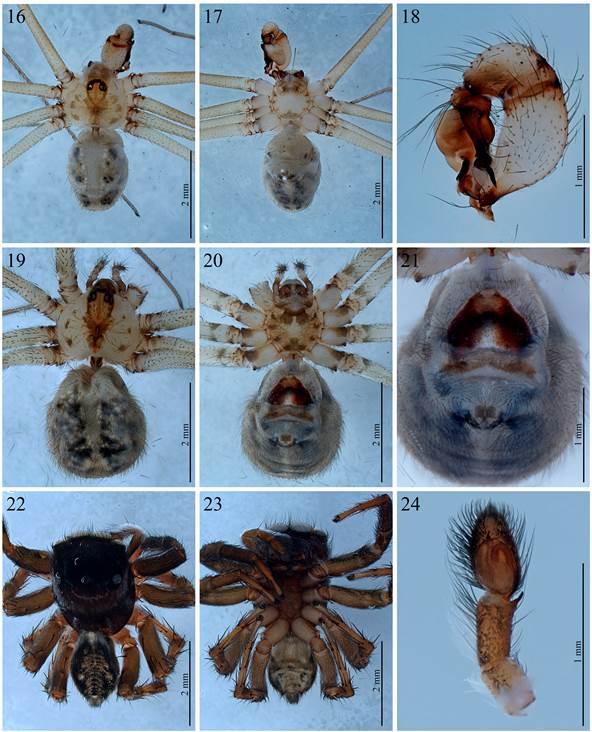
Figures 16-24 Physocyclus globosus 16-21. 16. Habitus male, dorsal view. 17. Same, ventral view. 18. Male palp, retrolateral view. 19. Habitus female, dorsal view. 20. Same, ventral view. 21. Epigynum, ventral view. Hasarius adansoni 22-24. 22. Habitus male, dorsal view. 23. Same, ventral view. 24. Male palp, ventral view.
Material examined. MEXICO: Sinaloa, Ahome, Los Mochis, 25.824039°N, 108.999263°W, 13 m a.s.l., 12 July 2023, J. Alcántar leg., manual collection inside a house, 1 ♂, CARCIB-Ar-5133; El Aguajito, 25.961904°N, 109.331931°W, 6 m a.s.l., 15 July 2023, J. Alcántar leg., manual collection inside a house, 1 ♀, CARCIB-Ar-5134.
Distribution. North America, introduced to Africa, Australia, China, Czechia, Galapagos, Indonesia, Iran, Japan, Mexico, Pacific Islands, Philippines, and Sri Lanka (World Spider Catalog, 2024). In Mexico, was previously known from Estado de México (Durán-Barrón, 2004; Desales-Lara et al., 2013), Baja California Sur (Banks, 1898; Jiménez, 1998), Ciudad de México, Yucatán (Valdez-Mondragón, 2010), Chiapas, Colima, Guerrero, Jalisco, Oaxaca, Quintana Roo, San Luis Potosí, Veracruz (Gertsch & Davis, 1942), Tabasco (Pickard-Cambridge, 1902), and Tamaulipas (Gómez-Rodríguez et al., 2014).
Remarks. Males are distinguishable by the combination of crescent-shaped embolic sclerites and ventral notch of embolus (compare Fig. 18 and Valdez-Mondragón, 2010: fig. 44), while females are characterized by subtriangular epigyne in ventral view, epigynal plate with pronounced curvature in lateral view (compare Fig. 21 and Valdez-Mondragón, 2010: figs. 46, 48). This finding constitutes the first record in Sinaloa.
Family: Salticidae Blackwall, 1841
Genus: Hasarius Simon, 1871
Hasarius adansoni (Audouin, 1826)
Material examined. MEXICO: Sinaloa, Ahome, Los Mochis, 25.824011°N, 108.999304°W, 13 m a.s.l, 3 August 2023, J. Alcántar leg., manual collection in garden house, 1 ♂, CARCIB-Ar-5135.
Distribution. Africa, Middle East, introduced to America, Australia, China, Europe, India, Japan, Laos, Pacific Islands, Taiwan, and Vietnam (World Spider Catalog, 2024). In Mexico, it was previously known only from Guerrero (Rodríguez-Rodríguez et al., 2015).
Remarks. The sole representative of the genus Hasarius in Mexico, H. adansoni is distinguishable by its short, robust, triangular embolus (compare Fig. 24 and Pupin & Brescovit, 2023: fig. 21). While Richman & Cutler (1988) mentioned its presence in Mexico, confirmed records were lacking. Therefore, this finding constitutes the first record in Sinaloa. While multiple photographic records exist on iNaturalista, including sightings from various localities in Sinaloa, these require verification through voucher specimens.
Genus: Lyssomanes Hentz, 1845
Lyssomanes mandibulatus F. O.Pickard-Cambridge, 1900
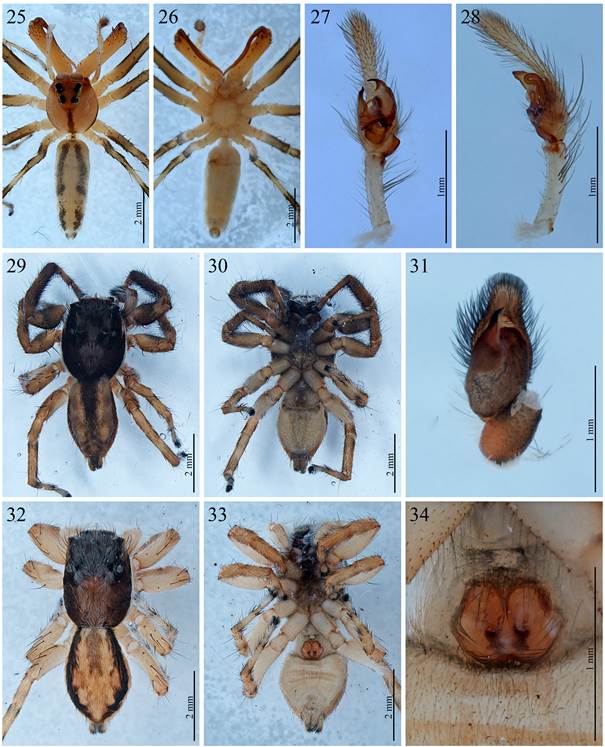
Figures 25-34 Lyssomanes mandibulatus. 25-28. 25. Habitus male, dorsal view. 26. Same, ventral view. 27. Male palp, ventral view. 28. Same, retrolateral view. Menemerus bivittatus. 29-34. 29. Habitus male, dorsal view. 30. Same, ventral view. 31. Male palp, ventral view. 32. Habitus female, dorsal view. 33. Same, ventral view. 34. Epigynum, ventral view.
Material examined. MEXICO: Sinaloa, Ahome, Cohuibampo, 25.941974°N, 109.160363°W, 14 m a.s.l., 4 July 2023, A. Cota leg., manual collection inside a house, 1 ♂, CARCIB-Ar-5136.
Distribution. Costa Rica (Logunov & Marusik, 2003), Guatemala, Mexico, and Panamá (Galiano, 1980). In Mexico, was previously known from Tabasco (Pickard-Cambridge, 1900), Jalisco (Logunov, 2014), Guerrero, and Oaxaca (Galvis, 2020).
Remarks. Males of L. mandibulatus are similar to those of L. pescaderoJiménez & Tejas, 1993 in coloration, but can be distinguished by the shape of the bulb in lateral view (compare Figs. 27-28 and Galiano, 1980: figs. 92-93), shape of median process and embolus, number of cheliceral teeth, and leg spination (Jiménez & Tejas, 1993). This finding constitutes the first record in Sinaloa.
Genus: Menemerus Simon, 1868
Menemerus bivittatus (Dufour, 1831)
Material examined. MEXICO: Sinaloa, Ahome, El Aguajito, 25.961904°N, 109.331931°W, 6 m a.s.l., 15 July 2023, J. Alcántar leg., manual collection outside of house in a guava tree, 1 ♂, CARCIB-Ar-5137; Jardín Botánico Benjamin F. Johnston, 25.789226°N, 109.005850°W, 12 m a.s.l, 24 August 2023, J. Alcántar leg., manual collection inside of house, 1 ♀, CARCIB-Ar-5138.
Distribution. Africa, introduced to North, Central and South America, southern Australia, Europe, China, India, Japan, Pacific Islands, Taiwan, and Turkey (World Spider Catalog, 2024). In Mexico, was previously known from Baja California, Campeche, Guerrero, Quintana Roo, Sonora, Tabasco, and Veracruz (Hoffmann, 1976).
Remarks. Males of M. bivittatus can be distinguished by the narrower bulbus and the shape of embolus and retrolateral apophysis (Wesołowska, 1999), while females by the large anterior epigynal atrium, and short median septum and copulatory ducts (compare Figs. 31, 34 and Pupin & Brescovit, 2023: figs. 9, 11). While this cosmopolitan species has numerous sightings in several locations of northwestern Mexico, voucher specimens are required to confirm its widespread distribution in the country. This finding represents the first record in Sinaloa.
Genus: Plexippus C. L. Koch, 1846
Plexippus paykulli (Audouin, 1826)
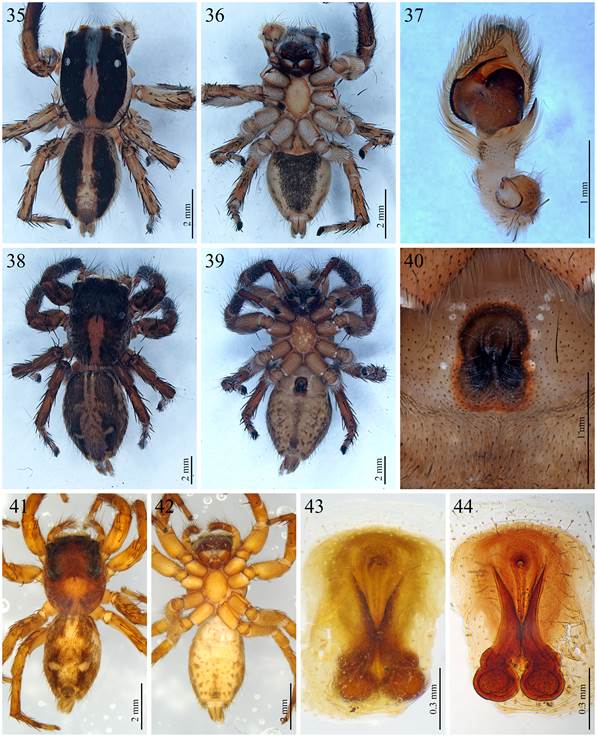
Figures 35-44 Plexippus paykulli. 35-40. 35. Habitus male, dorsal view. 36. Same, ventral view. 37. Male palp, ventral view. 38. Habitus female, dorsal view. 39. Same, ventral view. 40. Epigynum, ventral view. Plexippus petersi. 41-44. 41. Habitus female, dorsal view. 42. Same, ventral view. 43. Epigynum, ventral view. 44. Same, dorsal view.
Material examined. MEXICO: Sinaloa, Ahome, El Aguajito, 25.961893°N, 109.331964°W, 6 m a.s.l., 15 July 2023, J. Alcántar leg., manual collection outside a house, 1 ♂, CARCIB-Ar-5139; Los Mochis, 25.824100°N, 108.999312°W, 14 m a.s.l., 17 July 2023, J. Alcántar, D. Alcántar leg., manual collection inside a house, 1 ♀, CARCIB-Ar-5140.
Distribution. Africa, introduced to America, Europe, Middle East, Nepal, southern Asia, Australia, Pacific islands (World Spider Catalog, 2024). In Mexico, previously known from Baja California Sur (Jiménez, 1998), Ciudad de México (Durán-Barrón et al., 2009), Estado de México (Durán-Barrón, 2004), Guerrero (Hoffmann, 1976; Rodríguez-Rodríguez et al., 2015), and Tamaulipas (Gómez-Rodríguez et al., 2014).
Remarks. Males can be distinguished by a long and robust retrolateral tibial apophysis, thinned embolus, and relatively shorter tegular apophysis. Females have an epigynum with an oval plate and with lateral edges approaching each other at the base and separated in the distal part (compare Figs. 37, 40, and Pupin & Brescovit, 2023: figs. 3, 5). This finding constitutes the first record in Sinaloa.
Plexippus petersi (Karsch, 1878)
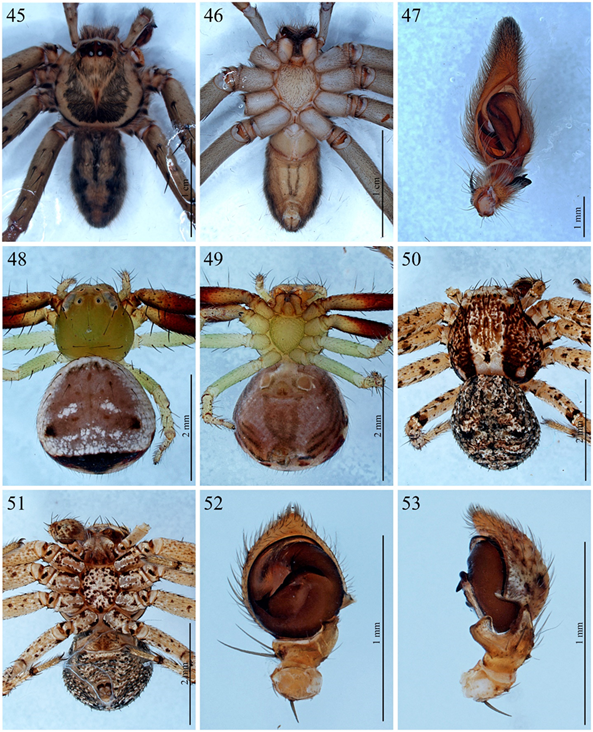
Figures 45-53 Heteropoda venatoria. 45-47. 45. Habitus male, dorsal view. 46. Same, ventral view. 47. Male palp, ventral view. Synema sp. 48-49. 48. Habitus, dorsal view. 49. Same, ventral view. Xysticus lassanus. 50-53. 50. Habitus male, dorsal view. 51. Same, ventral view. 52. Male palp, ventral view. 53. Same, retrolateral view.
Material examined. MEXICO: Sinaloa, Mazatlán, Colonia Benito Juárez, 23.249362°N, 106.41116°W, 6 m a.s.l, 1995, without collector, manual collection outside a house, 1 ♀, CARCIB-Ar-5127.
Distribution. Asia. Introduced to Africa and Pacific islands (World Spider Catalog, 2024).
Remarks. This species is close to Plexippus paykulli (Audouin, 1826), but can be differentiated by having a longer and narrower epigynum, and shorter insemination ducts (compare Figs. 43-44 and Żabka & Gardzińska, 2017: figs. 4D, 4F). This finding constitutes the first confirmed record of P. petersi in the Americas. While photographic records on the iNaturalista platform potentially suggest its presence in Guerrero, Nayarit, Oaxaca, Sinaloa, and Yucatán (iNaturalista, 2024), these records lack voucher specimens and require verification for conclusive identification. Therefore, the species' potential widespread distribution in Mexico remains unconfirmed until further investigation.
Family: Sparassidae Bertkau,1872
Genus: Heteropoda Latreille, 1804
Heteropoda venatoria (Linnaeus, 1767)
Material examined. MEXICO: Sinaloa, Ahome, El Aguajito, 25.957524°N, 109.330570°W, 7 m a.s.l., 15 July 2023, J. Alcántar leg., manual collection outside a house, 1 ♂, CARCIB-Ar-5141.
Distribution. Tropical Asia, introduced to Africa, Europe, Macaronesia, North, Central, and South America, and Pacific Is. (World Spider Catalog, 2024). In Mexico, previously known from Baja California Sur (Jiménez, 1998), Baja California, Chiapas, Guerrero, Nayarit, Quintana Roo, Veracruz (Hoffmann, 1976), and Tamaulipas (Gómez-Rodríguez et al., 2014).
Remarks. Males can be distinguished by the two tooth-like projections on the retrolateral tibial apophysis (compare Fig. 47 and Jäger, 2014: fig. 1). This finding constitutes the first record in Sinaloa.
Family: Thomisidae Sundevall, 1833
Genus: Synema Simon, 1864
Synema sp.
Material examined. MEXICO: Sinaloa, Guasave, Isla San Ignacio, 25.415605°N, 108.851213°W, 2 m a.s.l, 28 August 2023, J. Alcántar leg., manual collection in coastal scrub, 1 juvenile, CARCIB-Ar-5142.
Distribution. Africa, Asia, Europe, North America, South America, and Oceania (World Spider Catalog, 2024). In Mexico, previously known from Estado de México (Jiménez, 1988), Morelos, Nayarit, Tabasco, Veracruz (F. O. Pickard-Cambridge, 1900), and Tamaulipas (Gómez-Rodríguez & Salazar, 2012).
Remarks. This genus can be distinguished by having the carapace strongly convex and tarsal claws of forelegs with six to twelve teeth (Gertsch, 1939). The specimen examined was found on leaves of Jatropha cinerea (Ortega) Müll.Arg. (Euphorbiaceae) in coastal scrub. This finding represents the first record of the genus in Sinaloa.
Genus: Xysticus C. L. Koch, 1835
Xysticus lassanus Chamberlin, 1925
Material examined. MEXICO: Sinaloa, Ahome, Cañón del Diablo, Sierra de Barobampo, 26.029711°N, 109.032640°W, 86 m a.s.l, 27 June 2022, J. Alcántar leg., manual collection in low tropical deciduous forest, 1 ♂, CARCIB-Ar-5143.
Distribution. United States and Mexico (World Spider Catalog, 2024). In Mexico, it was previously known only from Chihuahua (Gertsch, 1953) and Baja California Sur (Jiménez, 2004).
Remarks. Males of X. lassanus can be distinguished by their strongly sclerotized median and distal apophyses, with the median one attached near the middle of the tegulum (see Figs. 52-53, and compare with Gertsch, 1939: fig. 124). The specimens examined were found in leaflitter and small logs, while Jiménez (2004)) reported finding them in soil of sarcocaule and xeric scrubs. According to Jiménez (2004) the Chihuahuan records of X. lassanus is dubious. This finding represents the first record in Sinaloa.
Discussion
This study increases the documented spider diversity in Sinaloa to 31 families (previously 29 families), 82 genera (previously 63 genera), and 118 species (previously 93 species). This represents an approximately 12% increase in documented species richness compared to Ponce-Saavedra et al. (2023). The families Diguetidae and Thomisidae are newly recorded for Sinaloa, while P. petersi is first recorded for the American continent.
Six newly recorded species are identified as synanthropic and introduced: C. lyoni, H. adansoni, M. bivittatus, P. paykulli, P. petersi, and H. venatoria. These widely distributed species in Mexico are primarily found indoors. Conversely, H. incursa, P. globosus, and X. lassanus are identified as native species of America with broad distributions. Furthermore, Diguetia sp. and Filistatoides sp. may represent undescribed species because they do not resemble the current known species (pers. obs.). However, mature specimens of these two taxa are necessary for confirmation and identification. As emphasized by Ponce-Saavedra et al. (2023), further studies are crucial to document the distribution of synanthropic species and understand their potential impact on native spiders. While numerous photographic records exist across the country, primarily on citizen science platforms, documenting these synanthropic species requires genital photographs or voucher specimens deposited in recognized collections.
Among the documented species, at least 17 (14% of the total) are considered to have restricted distribution in Sinaloa. This highlights the need for further investigations to expand our knowledge of spider diversity in the state. Undoubtedly, increased sampling efforts would likely yield additional species records and undescribed species for the state and surrounding region. For instance, recent and ongoing spider surveys in Sonora, a neighboring state to the north, have resulted in a significant increase in documented species richness (Jiménez et al., 2022a; Ponce-Saavedra et al., 2023; Gómez-Moreno et al., 2023). Furthermore, neighboring states such as Sonora, Baja California, and Baja California Sur possess at least double the number of documented spider species compared to Sinaloa. This also suggests that the spider diversity of Sinaloa has the potential to reach similar levels with further research.
This study highlights the remarkable diversity of spiders in Sinaloa and emphasizes the critical need for further research to comprehensively document the spider richness of the state and northwestern Mexico. Future efforts should prioritize comprehensive inventories in natural protected areas and agroecosystems, as well as in urban environments to study synanthropic species.

