SciELO - Scientific Electronic Library Online

 
vol.70 número5Are neutrino oscillation mixings linked to the smallness of solar neutrino scale?Nigella sativa seed-mediated green biosynthesis of silver nanoparticles and antimicrobial activity índice de autoresíndice de materiabúsqueda de artículos
Home Pagelista alfabética de revistas  

Servicios Personalizados

Revista

Articulo

Indicadores

Links relacionados

  • No hay artículos similaresSimilares en SciELO

Compartir


Revista mexicana de física

versión impresa ISSN 0035-001X

Rev. mex. fis. vol.70 no.5 México sep./oct. 2024  Epub 07-Oct-2025

https://doi.org/10.31349/revmexfis.70.050802 

High Energy Physics

PDM-Coulombic effects of non-inertial cosmic strings on a Klein-Gordon oscillator

A. Boumalia  * 

A. Bouzenadaa  * 

N. Messaia   

O. Mustafab   

a Laboratory of Theoretical and Applied Physics, Echahid Cheikh Larbi Tebessi University, Algeria.

b Department of Physics, Eastern Mediterranean University, G. Magusa, North Cyprus, 99628, Mersin 10 - Turkiye.


ABSTRACT

This paper addresses the problem of a three-dimensional Klein-Gordon oscillator with position-dependent mass in a non-inertial cosmic string background. We provide solutions to this problem and analyze the eigensolutions, considering the influence of non-inertial effects and the presence of position-dependent mass (PDM) on the eigenvalues. Expressions are obtained for the bound state energies and wave functions.

Keywords: Non-inertial cosmic string; Klein-Gordon oscillator

1 Introduction

Domain walls, cosmic strings, and monopoles are topological defects formed during the vacuum phase transition in the early universe [1, 2, 3]. Among them, cosmic strings have garnered significant attention in particle physics, particularly in cosmology and astrophysics, where gravitational effects play a crucial role [4, 5, 6, 7, 8, 9, 10, 11, 12, 13, 14, 15, 16]. Cosmic strings do not induce local gravitational interactions; however, they alter the spacetime geometry, resulting in planar and solid angle deficits, respectively [17].

The term Dirac oscillator (DO) was coined by Moshinsky and Szczepaniak [18, 19] in their study of a harmonic oscillator, which introduces strong spin-orbit coupling through the substitution pp-imωβr. Its physical applications have been extensively explored by various researchers [20, 21, 22], making it the most renowned interaction due to its myriad physical applications and its role in exact solutions of Dirac’s equation examples (see Ref. [21] and references therein).

Relativistic wave equations for the (DO) interaction in a cosmic string background constitute a significant field in current research. Their solutions are employed to determine the curvature’s influence on various physical properties and to derive the quantum states of these systems[22, 23, 24, 25, 26, 27, 28, 29, 30, 31, 32, 33, 34, 35, 36, 37, 38, 40].

The interaction induced by position-dependent mass (PDM) has been a focal point in recent years [41, 42, 43, 44, 45, 46, 47, 48, 49, 50]. These quantum systems with dependent effective mass have been studied extensively in both theoretical and applied physics. The primary objective of these studies is to derive eigenfunctions and energy levels using the Schrödinger equation for a system with mass varying with position and subject to a specific potential. Among the applied aspects of PDM are semiconductor heterostructures [45], Helium clusters [51], neutrino mass oscillations [52], quantum wells, and quantum dots [53, 54, 55, 56, 57, 58].

Non-inertial effects resulting from a rotating frame in a cosmic string background have been investigated extensively. Recently, several intriguing papers have been published on this subject: Zare et al. [27] examined the relativistic generalized DKP oscillator for a spin-zero field in a cosmic string background spacetime characterized by a stationary cylindrical symmetric metric. Santos et al. [28] studied the non-inertial effects on a non-relativistic quantum harmonic oscillator in the presence of a screw dislocation. The non-inertial effects of a rotating frame on a spin-zero system with non-commutative geometry in momentum space have been addressed in [29]. Ahmed [30] investigated the effects of rotation on the KG oscillator with a scalar potential in magnetic cosmic string spacetime using Kaluza-Klein theory. The effects induced by a rotating frame on the Klein-Gordon equation in spacetime with a screw dislocation have been discussed in [31].

The primary objective of this paper is to analyze the effects of non-inertial forces on the dynamics of a KG oscillator in cosmic string spacetime (with and without position-dependent mass (PDM) settings) characterized by a stationary cylindrical symmetric metric. Our contribution thus introduces a novel aspect to the work by Zare et al. [27], which considered the same system but for the DKP oscillator.

The outline of our letter is as follows: In Sec. 2, we present the solution to the KG equation and KG oscillator in a non-inertial cosmic string background. In Sec. 3, we investigate PDM KG-particles in non-inertial cosmic string spacetime. Finally, in Sec. 4, we present our conclusions.

2 An overview of the Klein-Gordon equation in curved spacetime

In this section, we delve into the relativistic quantum description of a spin-0 particle propagating in Minkowski spacetime, characterized by the metric tensor ημν=diag1,-1,-1,-1. For a scalar massive field Φ with mass m>0, the standard covariant Klein-Gordon (KG) equation is given by

ημνDμDν+m2Φ(x,t)=0, (1)

where Dμ=ipμ-eAμ denotes the minimally-coupled covariant derivative.

The equation of motion for a scalar particle in a Riemannian spacetime, characterized by the metric tensor gμν, can be obtained by reformulating the KG equation as [32, 33]

+m2-ξRΦ(x,t)=0, (2)

where

=1-gμ-ggμνν, (3)

represents the Laplace-Beltrami operator, ξ is a real dimensionless coupling constant, R is the Ricci scalar curvature defined by R=gμνRμν where Rμν is the Ricci curvature tensor, gμν is the inverse metric tensor, and g=detgμν.

Now, we aim to investigate the quantum dynamics of spin-0 particles in the spacetime induced by non-inertial effects on a cosmic string’s Klein-Gordon oscillators.

2.1 Free Klein-Gordon equation in non-inertial cosmic string space-time

Let us first derive the KG wave equation for the free relativistic scalar particle propagating in the cosmic string space-time that is assumed to be static and cylindrically symmetric.

The general expression for a (3+1)-dimensional cosmic string metric is defined by the line element [31]

ds2=gμνdxμdxν=dt2-dr2-α2r2dφ2-dz2, (4)

in cylindrical coordinates i . Here -t+, r0, 0φ2π, -z+, and α0,1 is the angular parameter which determines the angular deficit δφ=2π(1-α), and it is related to the linear mass density μ of the string by α=1-4μ.

Consider a string with a linear mass density μ along the z-axis, with the Lorentz metric ds2=dt2-dx'2-dy'2-dz'2, and the coordinate changes

x'=R cos(αΦ),y=R sin(αΦ),z=Z,and t=T,

which leads to the line element of a cosmic string space-time with the cylindrical coordinates [34, 35, 36, 37, 38]

ds2=dT2-dR2-αR2dΦ2-dZ2. (5)

In addition to the presence of a dislocation, we will analyze a frame that rotates evenly with a constant angular velocity Ω. To include this rotation into our line element, we use the coordinate transformation used in [35, 36, 37, 38] to obtain

ds2=1-α2Ω2r2dt2-2Ωα2r2dφdt-dr2-α2r2dφ2-dz2. (6)

Since we do not want the term g 00 to become positive, we impose that the corresponding radial wave function must vanish at some

rr0=1αΩ. (7)

When the metric and inverse metric tensor components are, respectively,

gμν=1-αΩr20-Ωαr200-100-Ωαr20-αr20000-1,gμν=10-Ω00-100-Ω0Ω2-1αr20000-1, (8)

we arrive at the following second order differential equation for the radial function ψ(r) , after some simple algebraic manipulations.

1-gr-gr-j2α2r2+E+Ωj2-m2-K2ψr=0, (9)

and consequently

γ2=E+Ωj2-m2-K2, (10)

and the rest of the results should be corrected accordingly. Setting

ς2=j2α2, (11)

yields

d2dr2+1rddr-ς2r2+γ2φsr=0. (12)

Equation (12) represents a Bessel differential equation, and its solutions can be expressed in terms of a first-order Bessel function as:

ψr=A' Jjαγr, (13)

where A’ denotes the normalization factor. We may now seek finiteness of such a radial part at r=r0=1/Ωα so that Jj/αγr0=0 for γr01. In this case,

Jjαγr02πγr0cos(γr0-π|ς|2-π4)=0, (14)

to imply the energies in the form of

En±=-Ωj±m2+K2+α2π2Ω2(n+|j|2α+3/4)2. (15)

2.2 Klein-Gordon oscillator in non-inertial Cosmic String Space-time

We start by considering a scalar quantum particle embedded in the background of gravitational field space-time described by metric (5). To retrieve the Klein-Gordon oscillators we replace the momentum operator pk=-ik by its non-minimal coupling form pk=-ik-iFk, where Fk=(Fr,0,0);Fr=ar for KG-oscillators iii and Fr=r-(rfr/4fr), where pk is the position-dependent mass momentum operator.

In this case, one would rewrite the KG-equation as

1-g(μ+Fμ)-g (ν-Fν)+m2×Ψ(t,r,ϕ,z)=0, (16)

to obtain

1-gr+Fr-g r-Fr-j2α2r2+E+Ωj2-m2-K2ψr=0. (17)

Following the same procedure as described in section II, we get

2r2+1rr-M(r)-j~2r2+δψr=0, (18)

where j~=j/α, and

δ=E+Ωj2-m2-K2,M(r)=Fr/r+F'r+Fr2. (19)

Let us now take Fr=ar, to obtain KG-oscillators equation, and use ψ(r)=R(r)/r to yield

2r2-(j~2-1/4)r2-a2r2+δ~Rr=0, (20)

where

δ~=δ-2 a. (21)

This equation represents KG-oscillators as it resembles the two-dimensional Schrödinger radial oscillators (hence the notion KG-oscillators) and admits exact solution.

Manipulating exactly the same steps before, we obtain the following radial equation

2r2+1rr-a2r2-ϑ2r2+δ~ψr=0, (22)

where we have defined

ϑ2=j2α2,        δ~=E+Ωj2-m2-K2-2a. (23)

To solve Eq. (22), we introduce a new dimensionless variable U=ar2, and by substitution into Eq. (22),the resulting equation reads

d2dU2+1UddU-ϑ24U2-14+δ~4aUψU=0. (24)

Consider the following change of variable

ψ(U)=U-12JU, (25)

then, Eq. (24) becomes

d2JUdU2+-14+δ~4aU+14-ϑ22U2JU=0, (26)

which has the form of the Whittaker differential equation [59, 60]. The general solution of this equation, which is regular at the origin, is given by

JU=|C|U-12Mδ~4a,|ϑ|2,U, (27)

where |C| is an arbitrary constant and Mδ~/4a,|ϑ|/2,R is the Whittaker M-function defined via the confluent hypergeometric functions as [34]

Mδ,ϑδ~~4a,|ϑ|2,U=e-U2Uϑ+12×1F1|ϑ|2-δ~4a+12,|ϑ|+1,U. (28)

The other solution is the Whittaker W-function given by

Wδ~,ϑδ~4a,|ϑ|2,U=e-U2ϱϑ+12U|ϑ|2-δ~4a+12,|ϑ|+1,U, (29)

which U|ϑ|/2-δ~/4a+1/2,|ϑ|+1,ϱ is the Tricomi confluent hypergeometric function (or Kummer’s function of the second kind) [59, 60]. In general, Ua,b,z has a branch point at z = 0, i.e, it has a singularity at zero. Thus we keep only the solution described by (28).

Using the definition (28), the final expression of the wave-function of the spinless KGO propagating in the non-inertial effects on a cosmic strings can be represented as

ψr=|C2|ar2ϑ2e-a2r2e-iEt-jφ-iKz×1F1|ϑ|2-δ~4a+12,|ϑ|+1,ar2, (30)

where the parameters ϑ and δ are defined in Eq.(23).

Again, The asymptotic behavior of the confluent hyper-geometric function implies that

|ϑ|2-δ~4a+12=-n, (31)

hence, after inserting ϑ and δ~, and by solving Eq. (31) for E, we obtain the energy levels for our scalar particle

En±=-Ωj±m2+K2+2a2n+|j|α+2. (32)

The relativistic energy levels (32) represent the energy spectrum of the Klein-Gordon oscillator within a non-inertial cosmic string spacetime background. The inclusion of distinct geometrical parameters α and Ω modifies the degenerate spectrum of the particle. Unlike the scenario with the Dirac oscillator [14, 16] and in contrast to flat space, the presence of these defects disrupts the degeneracy of energy levels. As α tends toward 1 and Ω tends toward 0, and with N = 2n + j denoting the principal quantum number, we retrieve the energy spectrum of the Klein-Gordon oscillator in flat space [14, 16].

In the classical limit, utilizing the relation E'=E+Ωj=ε+m, and considering the non-relativistic condition εm, (32) simplifies to

E'2-m22mϵ=2a2n+|j|α+2. (33)

We observe that only the presence of α in equation ((33)) breaks the degeneracy of the spectrum. The other parameter Ω has no influence in the classical limit.

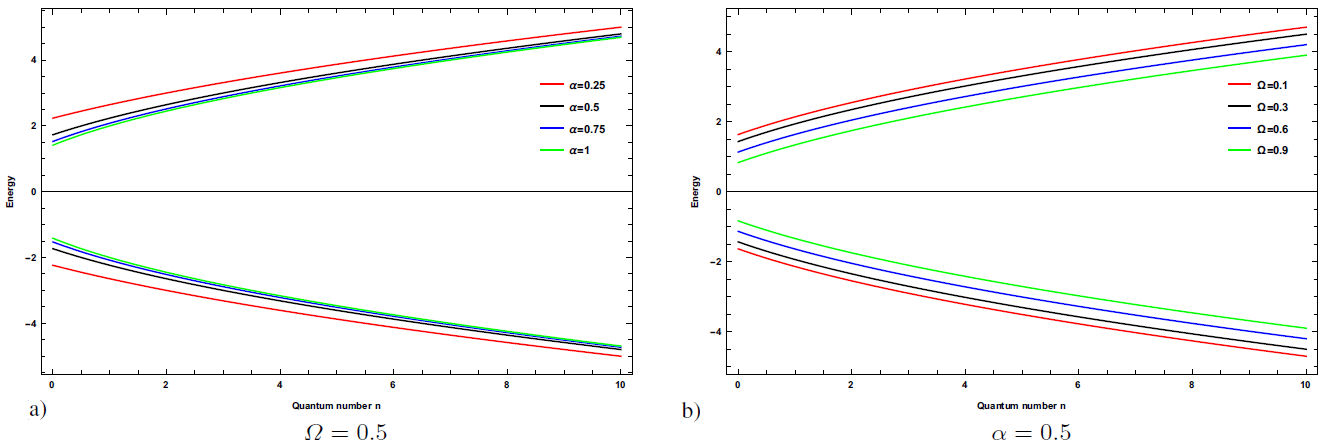
To examine the impact of both α and Ω parameters on the energy spectrum, we graphed the energy of the Klein-Gordon oscillator in non-inertial cosmic string spacetime across different values of α and Ω (where j=a=1).

Figure 1 shows that when the value of α is bigger, the energy spectrum becomes cramped. Also, we plotted the energy density of Eq. (30)

Figure 1 Energy Spectrum of KG oscillator in Non-inertial cosmic string for different values of n

By analyzing these results, we can estimate the density of the probability of KGO in the non-inertial cosmic string space-time. The purpose of this study is to determine how α and Ω affect this density. The density of the positive energy spectrum of KGO is provided by the following equation

ρKGr=2Eψ*ψ. (34)

Figures 2 and 3 illustrate the probability density of KGO in the non-inertial cosmic string space-time with respect to the radial distance r for four levels n = 0, 1, 2, 3 for different values of α and Ω.
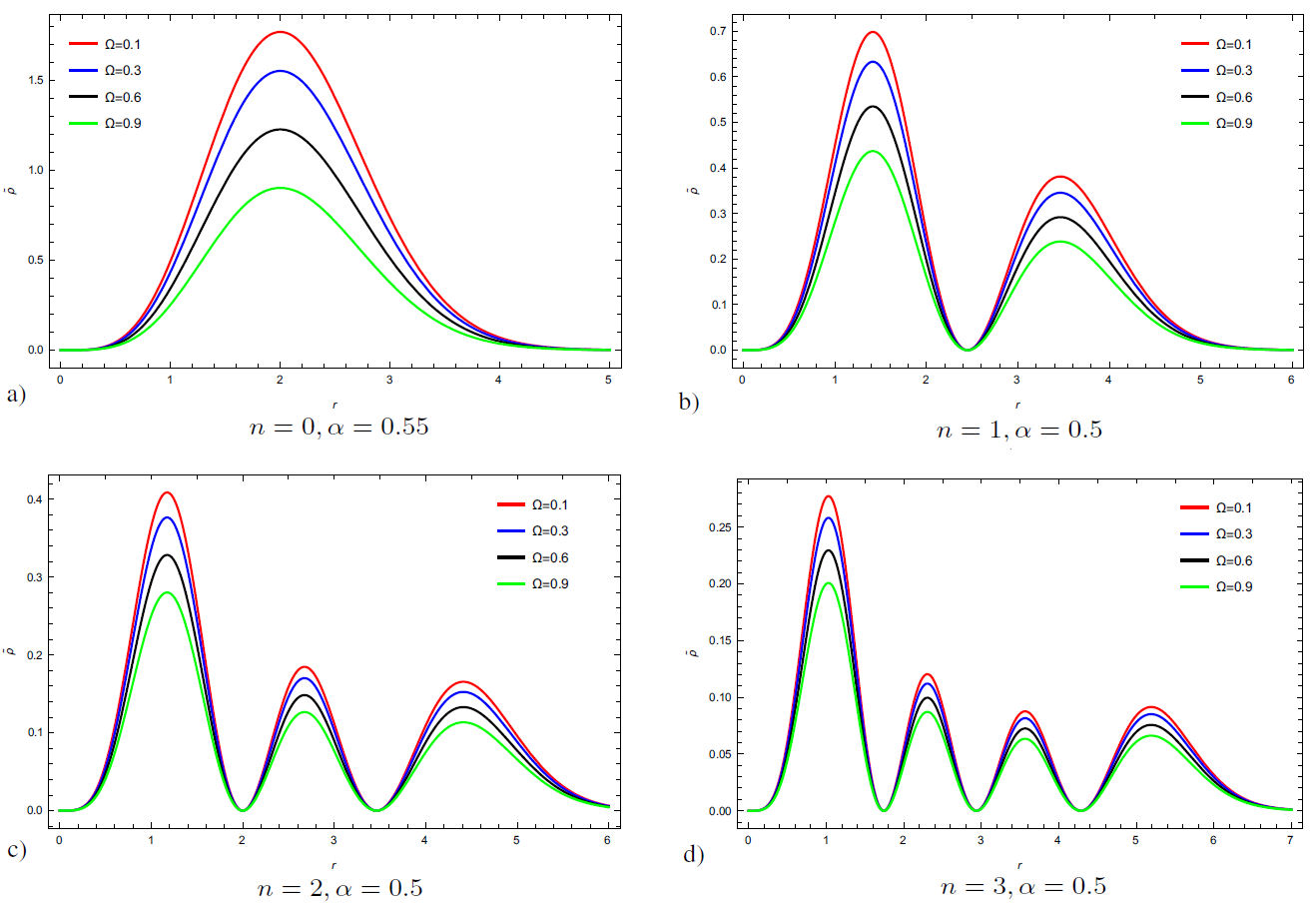
Figure 2 Plots of the positive density of KG oscillator in Non-inertial cosmic string for different values of Ω
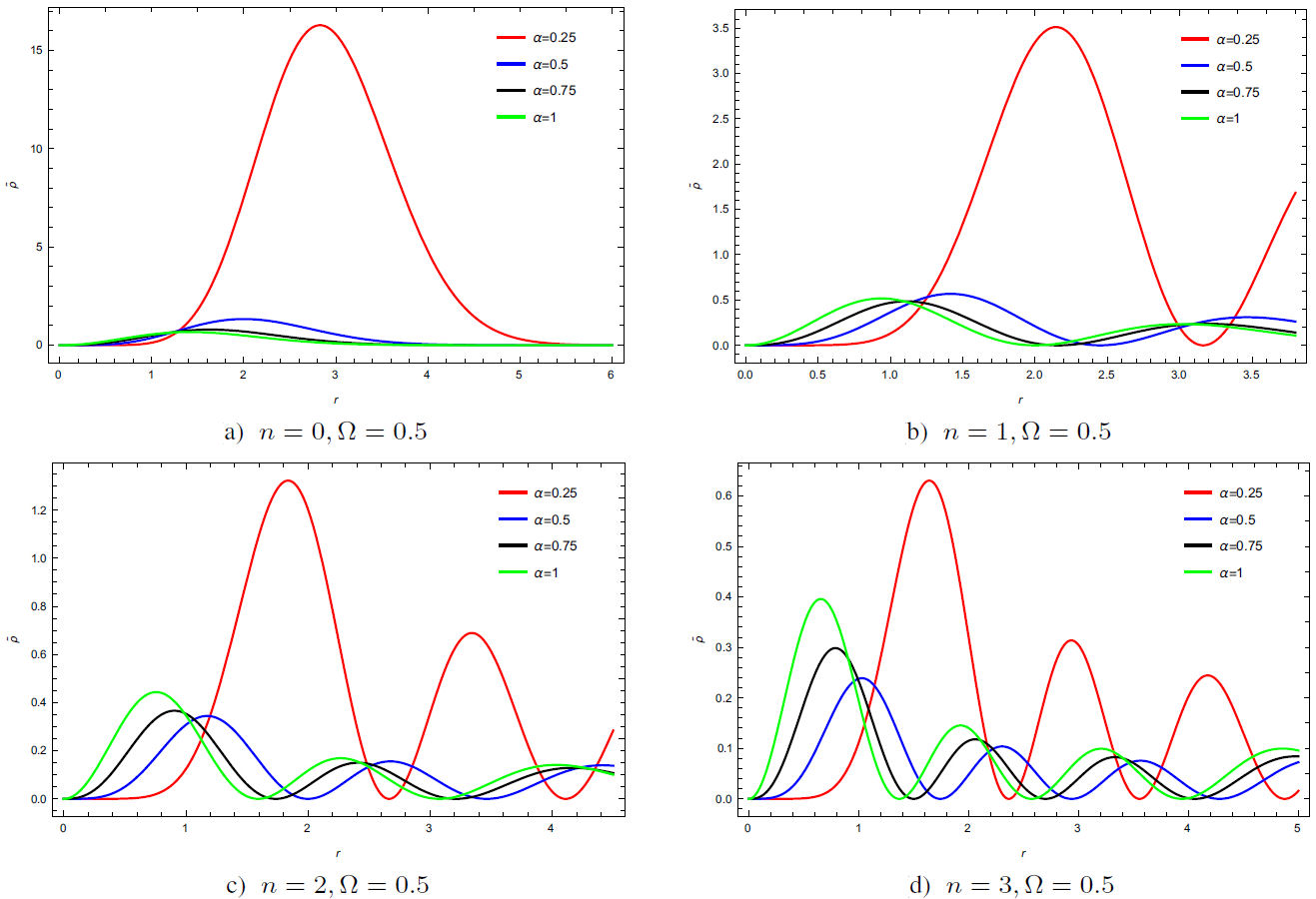
Figure 3 Plots of the positive density of KG oscillator in Non-inertial cosmic string for different values of α

Based on the depicted figure, several observations emerge:

  • • The probability density of Klein-Gordon oscillators (KGO) in non-inertial cosmic string spacetime is notably affected by the choice of the quantum number n, alongside the parameters α and Ω.

  • • With a constant value of α (refer to Fig. 2) and varying Ω, the following trends are evident:

    • - The magnitudes of each density peak exhibit considerable variations.

    • - The quantity of these peaks increases as n rises. Additionally, they display symmetry at a fixed point r, with the width of each peak diminishing as the quantum number n escalates.

  • • Conversely, for a constant Ω (as shown in Fig. 3) and diverse α values, the scenario differs markedly from the previous case:

    • - At a fixed rotational value Ω, the intensity of each density peak declines as the angular α deficit increases. Moreover, the peaks lack symmetry.

    • - Similar to the prior case, the number of peaks multiplies with increasing n.

    • - As with the previous observation, the width of each peak diminishes with the increasing quantum number n.

We are now ready to discuss the PDM KG-particles in non-inertial cosmic string space-time.

3 PDM KG-particles in non-inertial Cosmic String Space-time

In this section, we wish to discuss PDM KG-particles in non-inertial Cosmic String Space-time using the substitution of

Fr=ar+f'(r)4f(r), (35)

in Eq. (17) and consider two cases of fundamental interest, PDM KG-oscillators and KG-Coulombic like [41, 42, 43, 44, 45, 46, 47, 48, 49, 50] particles.

3.1 PDM KG-oscillators

We consider the case a = 0 and f(r)=exp(2ηr2) to obtain M(r)=2η+η2r2 (19). Using such settings in (18) we obtain

2r2-(j~2-1/4)r2-η2 r2+δ~Rr=0, (36)

where

δ~=δ-2η. (37)

This equation represents KG-oscillators for it resembles the two-dimensional Schrödinger radial oscillators and admits exact solution, with ψ(r)=R(r)/r,

ψ(r)=C exp-η2r2r|j~|×1F112+|j~|2-δ~4η, 1+|j~|, ηr2, (38)

and the condition of finite polynomial solution requires that

12+|j~|2-δ~4η=-nr, (39)

where nr=0,1,2, is the radial quantum number.

Consequently,

δ~=2η 2nr+|j~|+1, (40)

or

δ=2η 2nr+|jα|+2, (41)

that would, using (19), yield

En±=-Ωj±m2+K2+2η2n'r+|j|α+2. (42)

with n'r=nr+1. Equation (42) represents the energy spectrum of the Position-Dependent Mass (PDM) Klein-Gordon oscillators. This expression bears resemblance to (32). Here η has a role of frequency compared with (32). It depends on various geometrical parameters α and Ω, along with the parameter η denoting the position-dependent masses (PDM). Additionally, the geometrical parameter also breaks the degeneracy of the energy spectrum. In the classical limit, employing E'=E+Ωj=ε+m, and under the non-relativistic condition ε<<m, (32) simplifies to

E'2-m22mϵ=2η2n'r+|j|α+2. (43)

Similar to the previous scenario, we observe that only the presence of α in (43) disrupts the degeneracy of the spectrum. The parameter Ω exerts no influence in the classical limit.

3.2 PDM KG-Coulombic like particles

We now consider f(r)=J0(2Ar)4 to imply that M(r)=-(A/r) (19). This would allow us to write (18), with ψ(r)=R(r)/r, as

2r2-(j~2-1/4)r2+Ar+δψr=0. (44)

This is represents the KG-Coulombic particles for it resembles the two-dimensional Schrödinger radial Coulombic particles and admits exact solution in the form of

R(r)=B e-A~r/2 r|j~|+1/2×1F112+|j~|+iA2δ,1+2|j~|,2iδr. (45)

where B is a normalization factor. We now need to satisfy the condition

12+|j~|+iA2δ=-nr

so that the confluent hypergeometric series is truncated into a polynomial of of order nr. This would yield to

δ=-i A~δ=-A~2,A~=A2(nr+|j|α+12), (46)

and with ψ(r)=R(r)/r we obtain

ψ(r)=Nnorm e-A~r/2 r|j|α1F1-nr,1+2|j|α,2A~r, (47)

Where N norm denotes the normalization factor.

With δ in (19) we obtain

E+Ωj2-m2-K2=-A~2, (48)

and

En±=-Ωj±m2+K2-A24(nr+|j|α+12)2. (49)

This form can be rewritten in the two dimensions as

En±=-Ωj±m1-A24m2(nr+|j|α+12)2. (50)

Equation (50) depicts the energy spectrum form within the PDM KG-Coulombic scenario. It is evident that various parameters such as A from the Coulombic potential, along with α and Ω, the geometric parameters of the curved spacetime, significantly influence this spectrum. In the non-relativistic approximation, the behavior of the spectrum of energy, for very small values of the constant A, can be expanding in a power series in A as follows

En±=m-Ωj-A28mN2-A464mN4, (51)

where

N=nr+|j|α+12, (52)

is the principal quantum number, and [N] means the biggest integer inferior to N. The components of Eq. (51) can be understood as follows: the initial term represents the particle’s rest energy adjusted by the factor jΩ. The second segment mirrors the energy of a particle with mass m in a Coulombic field under non-relativistic conditions. This portion is contingent upon the spatial geometric parameters denoted by α. The third segment elucidates the relativistic adjustment to the energy. Notably, this correction relies on the geometric parameter of spacetime, α.

4 Conclusion

In this study, we investigate the fascinating interaction between the Klein-Gordon oscillator and a non-inertial cosmic string defect. Our primary objective is to ascertain the system’s energy and elucidate the repercussions of this interaction. Notably, we observe that the energy density remains entirely positive for positive energy states E +, whereas it turns negative for negative energy states E - . To tackle this issue, we advocate for the utilization of the Feshbach-Villars Approximation method, previously examined in [34], which has consistently produced entirely positive outcomes. Additionally, we have derived the eigensolutions of the problem at hand and scrutinized the influence of non-inertial effects and the presence of the PDM on the eigenvalues.

Acknowledgments

The authors express their gratitude to the anonymous referees for their meticulous review, insightful feedback, and thoughtful suggestions.

References

[1] T. W. B. Kibble, Topology of cosmic domains and strings, J. Phys. A: Math. Gen. 9 (1976) 1387, https://doi.org/10.1088/0305-4470/9/8/029. [ Links ]

[2] A. Vilenkin, Cosmic strings and domain walls Phys. Rep. 121 (1985) 263, https://doi.org/10.1016/0370-1573(85)90033-X. [ Links ]

[3] K. D. Krori, P. Borgohain, and D. Das, Exact scalar and spinor solutions in the field of a stationary cosmic string, J. Math. Phys. 35 (1994) 1032, https://doi.org/10.1063/1.530649. [ Links ]

[4] K. Bakke, Bound states for a neutral particle analogous to a quantum dot induced by the non-inertial effects of the Fermi-Walker reference frame, Phys. Lett. A 374 (2010) 3143, https://doi.org/10.1016/j.physleta.2010.05.049. [ Links ]

[5] J. Carvalho, C. Furtado, F. Moraes, Dirac oscillator interacting with a topological defect, Phys. Rev. A 84 (2011) 032109, https://doi.org/10.1103/PhysRevA.84.032109. [ Links ]

[6] K. Bakke, C. Furtado, On the interaction of the Dirac oscillator with the Aharonov-Casher system in topological defect backgrounds, Ann. Phys. 336 (2013) 489, https://doi.org/10.1016/j.aop.2013.06.007. [ Links ]

[7] F. M. Andrade, E. O. Silva, Effects of spin on the dynamics of the 2D Dirac oscillator in the magnetic cosmic string background, Eur. Phys. J. C 74 (2014) 3187, https://doi.org/10.1140/epjc/s10052-014-3187-6. [ Links ]

[8] K. Bakke , C. Furtado, Persistent currents for a moving neutral particle with no permanent electric dipole moment, Eur. Phys. J. B 87 (2014) 222, https://doi.org/10.1140/epjb/e2014-50106-5. [ Links ]

[9] A. Boumali, N. Messai, Klein-Gordon oscillator under a uniform magnetic field in cosmic string space-time, Can. J. Phys. 92 (2014) 11, https://doi.org/10.1139/cjp-2013-0431. [ Links ]

[10] A. Boumali and H. Aounallah, Exact Solutions of Scalar Bosons in the Presence of the Aharonov-Bohm and Coulomb Potentials in the Gravitational Field of Topological Defects, Advances in High Energy Physics 2018 (2018) 1031763, https://doi.org/10.1155/2018/1031763. [ Links ]

[11] H. Aounallah, A. Boumali, Solutions of the Duffin-Kemmer Equation in Non-Commutative Space of Cosmic String and Magnetic Monopole with Allowance for the Aharonov-Bohm and Coulomb Potentials, Phys. Part. Nuclei Lett. 16 (2019) 195, https://doi.org/10.1134/S1547477119030038. [ Links ]

[12] A. Boumali and H. Aounallah , Exact solutions of vector bosons in the presence of the Aharonov-Bohm and Coulomb potentials in the gravitational field of topological defects in non-commutative space-time, Rev. Mex. Fis. 66 (2020) 192, https://doi.org/10.31349/revmexfis.66.192. [ Links ]

[13] K. Bakke , C. Furtado, On the Klein-Gordon oscillator subject to a Coulomb-type potential, Ann. Phys. 355 (2015) 48, https://doi.org/10.1016/j.aop.2015.01.028. [ Links ]

[14] N. Messai , A. Boumali , Exact solutions of a two-dimensional Kemmer oscillator in the gravitational field of cosmic string, Eur. Phys. J. Plus 130 (2015) 140, https://doi.org/10.1140/epjp/i2015-15140-3. [ Links ]

[15] L. B. Castro, Quantum dynamics of scalar bosons in a cosmic string background, Eur. Phys. J. C 75 (2015) 287, https://doi.org/10.1140/epjc/s10052-015-3507-5. [ Links ]

[16] A. Boumali , N. Messai, Exact solutions of a two-dimensional Duffin-Kemmer-Petiau oscillator subject to a Coulomb potential in the gravitational field of cosmic string, Can. J. Phys., 95 (2017) 999, https://doi.org/10.1139/cjp-2016-0800. [ Links ]

[17] A. Vilenkin, Cosmological Density Fluctuations Produced by Vacuum Strings, Phys. Rev. Lett. 46 (1981) 1169, https://doi.org/10.1103/PhysRevLett.46.1169. [ Links ]

[18] M. Moshinsky and A. Szczepaniak, The Dirac oscillator, J. Phys. A: Math. Gen. 22 (1989) L817, https://doi.org/10.1088/0305-4470/22/17/002. [ Links ]

[19] M. Moshinsky , G. Loyola, and C. Villegas, Anomalous basis for representations of the Poincar’e group, J. Math. Phys. 32 (1991) 373, https://doi.org/10.1063/1.529422. [ Links ]

[20] A. Bermudez, M. A. Martin Delgedo, and A. Luis, Chirality quantum phase transition in the Dirac oscillator, Phys. Rev. A 77 (2008) 063815, https://doi.org/10.1103/PhysRevA.77.063815. [ Links ]

[21] A. Boumali and H. Hassanabadi, The thermal properties of a two-dimensional Dirac oscillator under an external magnetic field, Eur. Phys. J. Plus 128 (2013) 124, https://doi.org/10.1140/epjp/i2013-13124-y. [ Links ]

[22] M. Hosseinpour and H Hassanabadi, DKP equation in a rotating frame with magnetic cosmic string background, Eur. Phys. J. Plus 130 (2015) 236, https://doi.org/10.1140/epjp/i2015-15236-8. [ Links ]

[23] K Bakke, Rotating effects on the Dirac oscillator in the cosmic string spacetime, Gen. Relativ. Grav. 45 (2013) 1847, https://doi.org/10.1007/s10714- 013-1561-6. [ Links ]

[24] H. F. Mota and K. Bakke , Noninertial effects on nonrelativistic topological quantum scattering, Gen. Relativ. Grav. 49 (2017) 104, https://doi.org/10.1007/s10714-017-2266-z. [ Links ]

[25] L. C. N. Santos and C. C. Barros, Relativistic quantum motion of spin-0 particles under the influence of noninertial effects in the cosmic string spacetime, Eur. Phys. J. C 78 (2018) 13, https://doi.org/10.1140/epjc/s10052-017-5476-3. [ Links ]

[26] F. Ahmed, Aharonov-Bohm and non-inertial effects on a Klein-Gordon oscillator with potential in the cosmic string space-time with a spacelike dislocation, Chin. J. Phys. 66 (2020) 587, https://doi.org/10.1016/j.cjph.2020.06.012. [ Links ]

[27] S. Zare, H. Hassanabadi and Marc de Montigny, Non-inertial effects on a generalized DKP oscillator in a cosmic string space-time, Gen. Relat. Grav. 52 (2020) 25, https://doi.org/10.1007/s10714-020-02676-0. [ Links ]

[28] L. C. N. Santos , F. M. da Silva, C. E. Mota and V. B. Bezerra, Noninertial effects on a non-relativistic quantum harmonic oscillator in the presence of a screw dislocation, Int. J. Geom. Methods Mod. Phys. 20 (2023) 2350067, https://doi.org/10.1142/S0219887823500676. [ Links ]

[29] R. R. Cuzinatto, Marc de Montigny and Pedro Jos´e Pompeia, Noncommutativity and non-inertial effects on a scalar field in a cosmic string spacetime: II. Spin-zero Duffin-Kemmer-Petiau-like oscillator, Class. Quantum Gravity 39 (2022) 075007, https://doi.org/10.1088/1361-6382/ac51bc. [ Links ]

[30] F. Ahmed, Non-inertial effects on Klein-Gordon oscillator under a scalar potential using the Kaluza-Klein theory, Pramana - J. Phys. 95 (2021) 159, https://doi.org/10.1007/s12043-021-02193-y. [ Links ]

[31] L. C. N. Santos , F. M. da Silva , C. E. Mota and V. B. Bezerra, Some remarks on scalar particles under the influence of noninertial effects in a spacetime with a screw dislocation, Eur. Phys. J. Plus 138 (2023) 174, https://doi.org/10.1140/epjp/s13360-023-03783-y. [ Links ]

[32] K. D. Krori , P. Borgohain, P. K. Kar, and D. Das, Exact scalar and spinor solutions in some rotating universes, J. Math. Phys. 29 (1988) 1645, https://doi.org/10.1063/1.527912. [ Links ]

[33] K. D. Krori , P. Borgohain, and D. Das. J. Math. Phys. 35, 1032 (1994). [ Links ]

[34] A. Bouzenada and A. Boumali , Statistical properties of the two dimensional Feshbach-Villars oscillator (FVO) in the rotating cosmic string space-time, Ann. Physics 452 (2023) 169302, https://doi.org/10.1016/j.aop.2023.169302. [ Links ]

[35] A. Vilenkin, Phys. Rep. 121 (1985) 263. [ Links ]

[36] K. Bakke, Noninertial effects on the Dirac oscillator in a topological defect spacetime, Eur. Phys. J. Plus 127 (2012) 82, https://doi.org/10.1140/epjp/i2012-12082-2. [ Links ]

[37] K. Bakke, C. Furtado, Anandan quantum phase for a neutral particle with Fermi-Walker reference frame in the cosmic string background, Eur. Phys. J. C 69 (2010) 531, https://doi.org/10.1140/epjc/s10052-010-1431-2. [ Links ]

[38] K. Bakke , C. Furtado, Geometric phase for a neutral particle in rotating frames in a cosmic string spacetime, Phys. Rev. D 80 (2009) 024033, https://doi.org/10.1103/PhysRevD.80.024033. [ Links ]

[39] K. Bakke , C. Furtado, Bound states for neutral particles in a rotating frame in the cosmic string spacetime, Phys. Rev. D 82 (2010) 084025, https://doi.org/10.1103/PhysRevD.82.084025. [ Links ]

[40] T. W. B. Kibble, J. Phys. A 9 (1976) 1387. [ Links ]

[41] P. O. Mazur, Spinning Cosmic Strings and Quantization of Energy, Phys. Rev. Lett. 57 (1986) 929, https://doi.org/10.1103/PhysRevLett.57.929. [ Links ]

[42] O. Mustafa, Z. Algadhi, Position-dependent mass momentum operator and minimal coupling: point canonical transformation and isospectrality, Eur. Phys. J. Plus 134 (2019) 228, https://doi.org/10.1140/epjp/i2019-12588-y. [ Links ]

[43] O. Mustafa, S. H. Mazharimousavi, Ordering Ambiguity Revisited via Position Dependent Mass Pseudo-Momentum Operators, Int. J. Theor. Phys. 46 (2007) 1786, https://doi.org/10.1007/s10773-006-9311-0. [ Links ]

[44] O. Mustafa, PDM creation and annihilation operators of the harmonic oscillators and the emergence of an alternative PDM-Hamiltonian, Phys. Lett. A 384 (2020) 126265, https://doi.org/10.1016/j.physleta.2020.126265. [ Links ]

[45] O. von Roos, Position-dependent effective masses in semiconductor theory, Phys. Rev. B 27 (1983) 7547, https://doi.org/10.1103/PhysRevB.27.7547. [ Links ]

[46] O. Mustafa, PDM Klein-Gordon oscillators in cosmic string spacetime in magnetic and Aharonov-Bohm flux fields within the Kaluza-Klein theory, Ann. Phys. 440 (2022) 168857, https://doi.org/10.1016/j.aop.2022.168857. [ Links ]

[47] O. Mustafa, Confined Klein-Gordon oscillator from a (2+1)-dimensional Gürses to a Gürses or a pseudo-Gürses space-time backgrounds: Invariance and isospectrality, Eur. Phys. J. C 82 (2022) 82, https://doi.org/10.1140/epjc/s10052-022-10043-3. [ Links ]

[48] O. Mustafa, Confined Klein-Gordon oscillators in Minkowski spacetime and a pseudo-Minkowski spacetime with a space-like dislocation: PDM KGoscillators, isospectrality and invariance, Ann. Phys. 446 (2022) 169124, https: //doi.org/10.1016/j.aop.2022.169124. [ Links ]

[49] O. Mustafa, PDM Klein-Gordon particles in Gödel-type Som-Raychaudhuri cosmic string spacetime background, Eur. Phys. J. Plus 138 (2023) 21, https://doi.org/10.1140/epjp/s13360-022-03630-6. [ Links ]

[50] O. Mustafa, PDM KG-Coulomb particles in cosmic string rainbow gravity spacetime and a uniform magnetic field, Phys. Lett. B 839 (2023) 137793, https://doi.org/10.1016/j.physletb.2023.137793. [ Links ]

[51] B. G. da Costa and E. P. Borges, A position-dependent mass harmonic oscillator and deformed space, J. Math. Phys. 59 (2018) 042101, https://doi.org/10.1063/1.5020225. [ Links ]

[52] E. Barbagiovanni, S. Cosentino, D. Lockwood, R. N. Costa Filho, A. Terrasi, and S. Mirabella, Influence of interface potential on the effective mass in Ge nanostructures, Journal of Applied Physics, 1174 (2015) 15430, https://doi.org/10.1063/1.4918549. [ Links ]

[53] G. Barbagiovannia, D. Lockwoodb, R. N. Costa Filho, L. Goncharovad and P. Simpson, Quantum confinement in Si and Ge nanostructures: effect of crystallinity, Proc. SPIE 8915, Photonics North (2013) 891515, https://doi.org/10.1117/12.2036323. [ Links ]

[54] M. Barranco, M. Pi, S. M. Gatica, E. S. Hernandez, and J. Navarro, Structure and energetics of mixed 4He-3He drops, Phys. Rev. B 56 (1997) 8997, https://doi.org/10.1103/PhysRevB.56.8997. [ Links ]

[55] H. A. Bethe, Possible explanation of the solar-neutrino puzzle, Phys. Rev. Lett. 56 (1986) 1305, https://doi.org/10.1103/PhysRevLett.56.1305. [ Links ]

[56] M. G. Burt, The justification for applying the effective-mass approximation to microstructures, J. Phys.: Condens. Mat. 4 (1992) 6651, https://doi.org/10.1088/0953-8984/4/32/003. [ Links ]

[57] A. D. Alhaidari, Solutions of the nonrelativistic wave equation with position-dependent effective mass, Phys. Rev. A 66 (2002) 042116, https://doi.org/10.1103/PhysRevA.66.042116. [ Links ]

[58] S. H. Dong and M. Lozada-Cassou, Exact solutions of the Schrödinger equation with the position-dependent mass for a hard-core potential, Phys. Lett. A, 337 (2005) 313, https://doi.org/10.1016/j.physleta.2005.02.008. [ Links ]

[59] M. Abramowitz and I. A. Stegun, Handbook of mathematical functions with formulas, graphs, and mathematical tables (Dover Publications, New York, 1970). [ Links ]

[60] G. Arfken, H. Weber, and F. Harris, Mathematical Methods for Physicists: A Comprehensive Guide (Elsevier Science, 2012). [ Links ]

[i] Note that this metric is an exact solution to Einstein’s field equations for 0 ≤ μ < 1/4 and by setting φ’ = αφ, then it represents a flat conical exterior space with angle deficit δϕ = 8πμ.

[ii] Not Fr = m(r that yields dimensional inconsistency, see our equation below, where m 2 = m2 c4 multiplied by ω2r2 to give an overall dimensionality of energy to power 3 instead of power 2.

Received: August 10, 2023; Accepted: April 19, 2024

Creative Commons License This is an open-access article distributed under the terms of the Creative Commons Attribution License