




 nueva página del texto (beta)
 Inglés (pdf)
 Artículo en XML
 Referencias del artículo
 Traducción automática
 Enviar artículo por email
 Citado por SciELO
  Similares en
SciELO
Similares en
SciELO 
 Permalink
1 Introduction
During the last years, there where a significant development in investigating properties of Heusler and half- Heusler alloys and their applications in spintronics and magneto-electronics [1, 2, 3, 4]. Several researchers have investigated the structural, electronic, elastic, thermal, and magnetic properties of many Heusler-alloys at ambient pressure and under higher pressures [5, 6, 7, 8, 9]. Heusler-alloys are half-metallic materials which may be defined as a new state of matter between insulating and metallic materials. In half-metallic material, the spin-up channel presents metallic behavior, while the spin-down channel exhibits insulating behavior. The polarization of these compounds at Fermi level is 100%. These alloys have many promising applications in spintronics. There are three types of Heusler-alloys: Full-Heusler alloys such as Ru2MnSb, Ru2NbSb, Fe2CrSb, and Co2CrIn alloys [5, 6]. The second type is half-Heusler alloys such as LaPdBi and ZrCoBi alloys [7, 10], and the third type is Quaternary Heusler-alloys such as CoFeXSn (X=Ru, Zr, Hf, Ta) [11]. Half-Heusler alloys show a high efficiency spintronic application [12, 13], such as magnetic tunneling junctions (MTJs), giant magnetoresistance devices (GMRs), topological insulator, thermoelectric power, and piezoelectric and optoelectronic semiconductors [14, 15, 16, 17, 18, 19, 20]. These features make the half-Heusler alloys the most interesting of Heusler-alloy types. It is a common sense to expect that devices using strained materials will not have a long lifetime. To ensure longevity, the material should at least be metastable. There are two conditions for utilizing half-Heusler alloys as device materials, first to be at the optimized lattice constants corresponding to their respective configuration, and second, they should possess a large magnetic moment (>
Recently, Wenfeng Li et al.[21] studied the electronic structure and thermoelectric properties of FeNbSb using first principles calculations. They predicted that FeNbSb compound is a promising material for high temperature thermoelectric materials. The structural, electronic, elastic, dynamical, and thermodynamical properties of FeXSb (X=Hf, Nb) compounds were investigated by A. Musari [22]. He predicted that FeNbSb has a semiconductor behavior, while FeHfSb is a half-metallic ferromagnetic compound with a small magnetic moment (0.9
Many half-Heusler alloys have been predicted to be a half-metal at higher pressures and to behave as a metallic material at zero pressure. The half-metallicity of half-Heusler alloys is very sensitive to high pressure as predicted by E. L. Habbak et al.[24]. They predicted the absence of half-metallicity of PtCrSb at zero pressure up to 26 GPa, then this material transforms into a half-metallic material with 1 eV energy gap. The stability of these materials under ambient and hydrostatic pressure is very important for feature applications. In this study we introduce a theoretical investigation of the electronic, elastic, and magnetic properties of the hypothetical half-Heusler XNbSn alloys where X= Co, Cr, Fe, Mn, and V atoms. The pressure effect of the elastic properties, bulk modulus, shear modulus, and Young’s modulus will be covered in this study using the generalized gradient approximation (GGA) and modified Becke-Johnson (mBJ) [25, 26].
1.1 Theory and computations
This study is a first-principles study of the electronic, elastic, and magnetic properties of hypothetical half-Heusler alloys within the framework of density functional theory (DFT) [27, 28] using the electronic code WIEN2K [29]. This code uses the full-potential (linearized) augmented plane-wave and local-orbitals
Table I The three possible conventional cubic cell structures of half-Heusler alloys.
| X | Y | Z | |
|---|---|---|---|
| Type1 | 4c (0.25, 0.25, 0.25) | 4d (0.75, 0.75, 0.75) | 4a (0, 0, 0) |
| Type2 | 4a (0, 0, 0) | 4d (0.75, 0.75, 0.75) | 4c (0.25, 0.25, 0.25) |
| Type3 | 4b (0.5, 0.5, 0.5) | 4d (0.75, 0.75, 0.75) | 4a (0, 0, 0) |
The theoretical values of the equilibrium lattice constant, total and partial magnetic moment, bulk modulus, elastic constants, shear modulus, Young modulus, and Poisson ratio
We used the Born-Huang conditions and calculated the three cubic elastic parameters (C
11, C
12, and C
44), which indicate the stability of these compounds. We used these parameters to calculate other mechanical constants such as bulk modulus (B), Young’s modulus (E), shear modulus (G), and Poison’s ratio (
2 Result and discussions
2.1 Crystal structure and stability
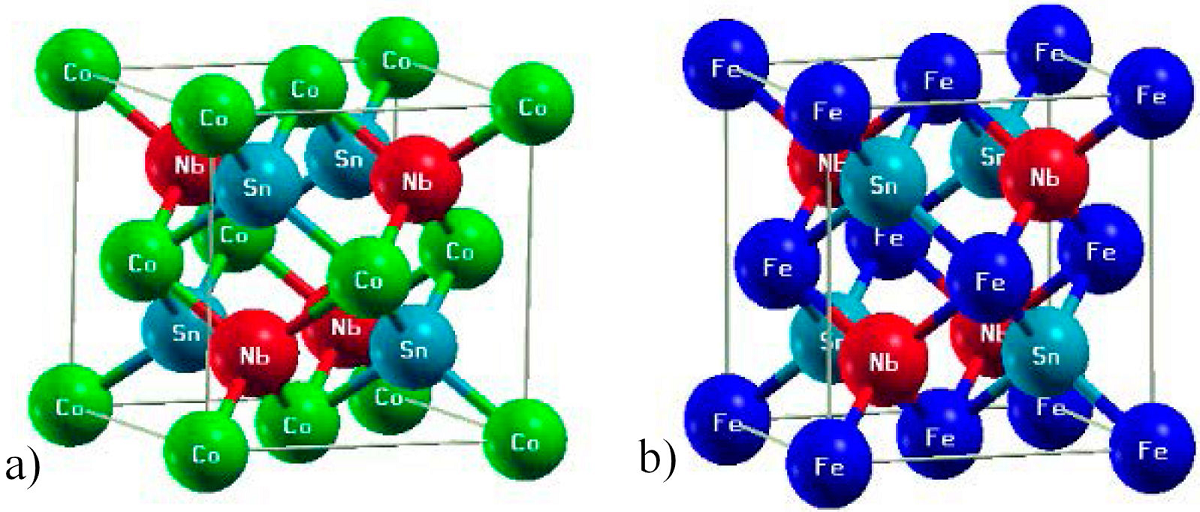
We have studied the structural, magnetic and elastic properties of XNbSn with (X= Cr, Mn, Co, Fe, V) half-Heusler alloys in the cubic
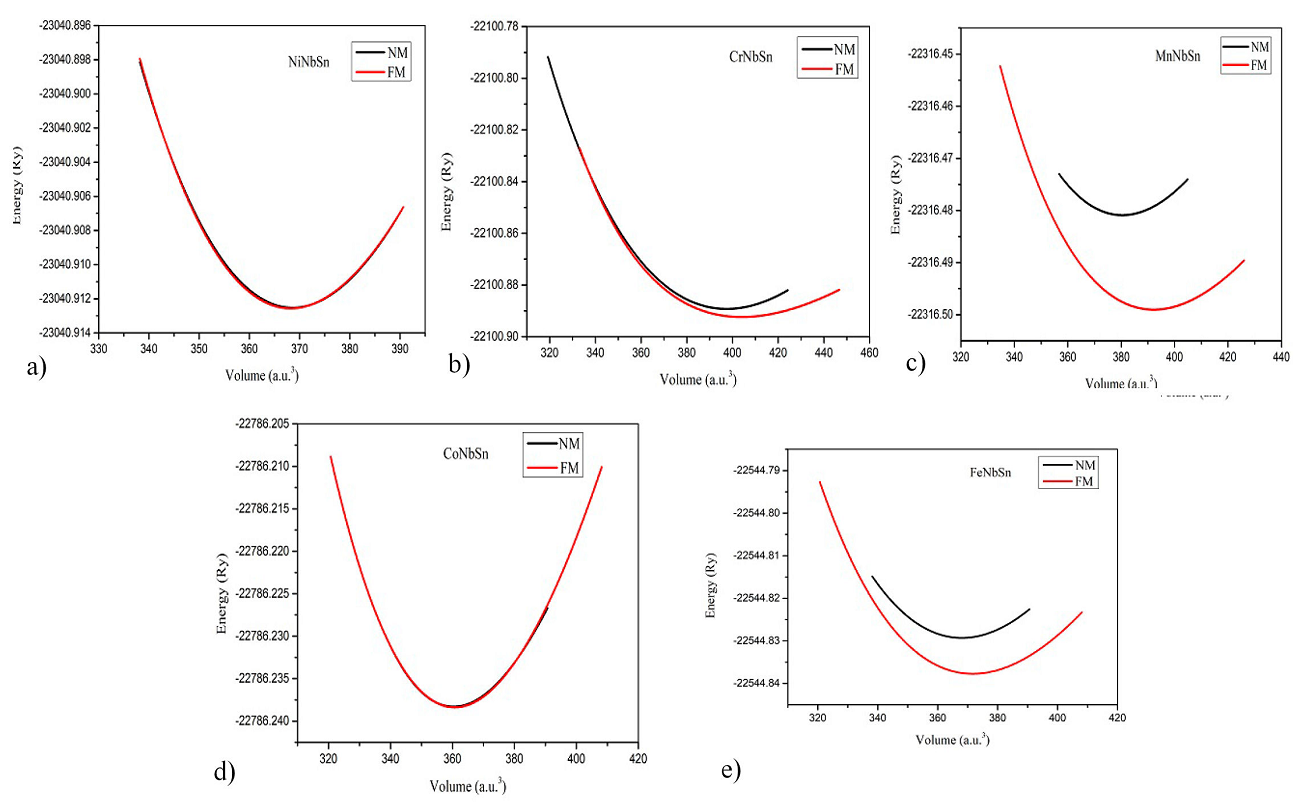
Table II The lattice constant, equilibrium volume, bulk modulus, energy gap, total and partial magnetic moments of XNbSn alloys.
| XNbSn | a(Ao) |
|
B(GPa) | B’(GPa) | Eg (eV) | Energy (Ry) | mx( |
mNb( |
msn( |
mtotal( |
|---|---|---|---|---|---|---|---|---|---|---|
| VNbSn | 6.296 | 420.97 | 113.952 | 3.823 | 0.0 | -21897.73685 | 1.27063 | 0.36501 | -0.00879 | 2.15803 |
| CrNbSn | 6.176 | 404.011 | 88.4762 | 6.969 | 0.0 | -2100.892389 | 2.62634 | -0.09800 | 0.01631 | 3.00247 |
| MnNbSn | 6.086 | 391.991 | 113.746 | 5.09 | 0.0 | -2316.498951 | 2.65052 | -0.64591 | 0.01832 | 1.96550 |
| FeNbSn | 6.0199, | 371.725 | 141.441 | 4.678 | 0.0 | -2544.837730 | 1.44945 | -0.34087 | 0.00749 | 1.00244 |
| 6.014[23] | 366.969[23] | 139.39[23] | 5.15[23] | 0.239[23] | 1.23[23] | -0.22[23] | 0.0173[23] | 1.00[23] | ||
| CoNbSn | 5.978 | 360.717 | 161.584 | 3.740 | 0.990 | -2786.238376 | 0.07851 | -0.08089 | 0.01955 | -0.05154 |
3 Pressure effect on elastic properties
The mechanical behavior of crystals, interatomic interaction forces, phase transition mechanism, stability and stiffness of materials could be known from the elastic constants of solids. In ab- initio calculations there are two common methods to obtain the elastic constants from the crystal structure of solid:
The first method is the volume-conserving technique, which is based on analysis of the total energy of the properly strained state of the material. The second method is the stress-strain method, which is based on the analysis of the changes occurring in the calculated stress resulting from the changes in the strain [34]. In the present work, we have used the first method “volume conserving technique” to calculate the second-order elastic constants (
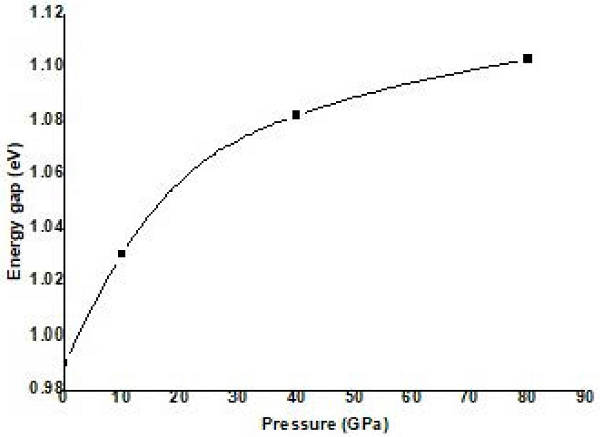
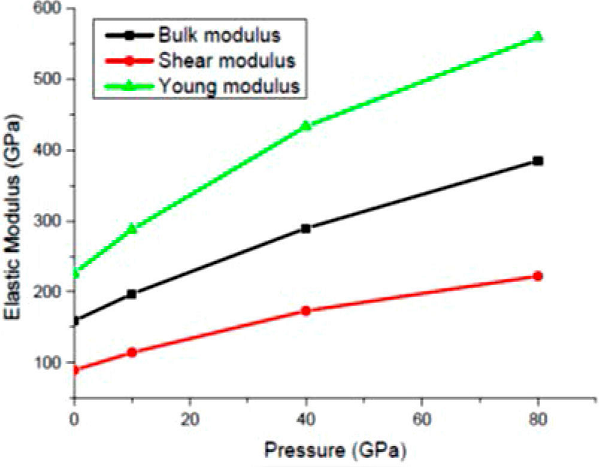
We investigated the pressure effect on the lattice constant, energy gap, bulk modulus, elastic constants, shear modulus, young modulus, and Poisson ratio for XNbSn (X = Co, Fe, Cr, Mn, and V) alloys at different pressures up to 80 GPa. Table III, displays these parameters at different pressures (0, 10, 40, and 80 GPa) of CoNbSn alloy. By increasing the pressure by 80 GPa, the lattice constant compresses by nearly 7.6%. The value of the energy gap is 0.99 eV at zero pressure and increases slowly to reach 1.103 eV at 80 GPa as shown in Fig. 3. This increase in the value of the energy gap results from increasing the hybridization between the 3d-state of Co atom with the 5s-state of Nb atom.
Table III The lattice constant, bulk modulus, shear modulus, Young modulus, and Poisson ratio
| Pressure(GPa) | A(A0) | Eg(eV) | B* | C11 (GPa) | C 12 (GPa) | C 44 (GPa) | B(GPa) | G(GPa) | E(GPa) | v |
|---|---|---|---|---|---|---|---|---|---|---|
| 0 | 5.977665 | 0.990 | 159.019 | 275.838 | 100.609 | 90.615 | 159.019 | 89.4025 | 225.877 | 0.263259 |
| 10 | 5.871664 | 1.030 | 200.362 | 353.243 | 119.226 | 112.753 | 197.231 | 114.36 | 287.672 | 0.256908 |
| 40 | 5.674468 | 1.082 | 301.014 | 517.014 | 175.920 | 174.805 | 289.618 | 173.09 | 433.007 | 0.250817 |
| 80 | 5.52222 | 1.103 | 405.492 | 680.945 | 236.618 | 222.245 | 384.727 | 222.12 | 559.011 | 0.257832 |
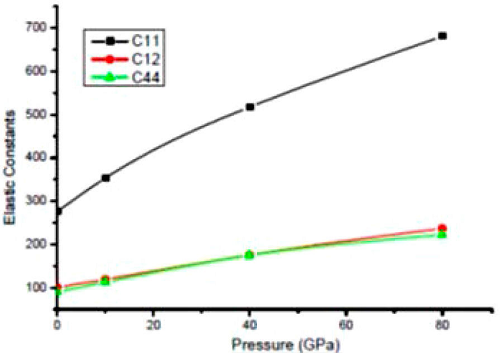
We calculated the bulk modulus using two methods: first bulk modulus B from the Murnaghan equation, and the second modulus B * using the elastic constants. Both modulus have a value of 159.019 GPa at zero pressure and become different at higher pressures. From our calculated elastic constants, it can be emphasized the mechanical stability of CoNbSn according to the Born-Huang conditions. We have also studied the variations of elastic constants under different pressures up to 80 GPa as shown in Fig. 4. The elastic constant C
11 of CoNbSn showed a change of 400 GPa after Appling 80 GPa pressure, while the other constants showed a small variation with pressure. The pressure effect on the bulk modulus, shear modulus, and Young’s modulus of CoNbSn is displayed in Fig. 5, where the three moduli increase by increasing the pressure. The Poisson ratio shows a small variation by increasing the pressure. According to Pugh’s proposed criterion [35], if a material has a low value of
We present the pressure effect on the lattice constant, bulk modulus, shear modulus, Young modulus, and Poisson ratio
Table IV The lattice constant, bulk modulus, shear modulus, Young modulus, and Poisson ratio
| Pressure(GPa) | A(A0) | Eg(eV) | B* | C 11 (GPa) | C 12 (GPa) | C 44 (GPa) | B(GPa) | G(GPa) | E(GPa) | v |
|---|---|---|---|---|---|---|---|---|---|---|
| 0 | 6.019959 | 0 | 161.282 | 250.23770 | 116.276380 | 96.76460 | 160.93 | 83.5021 | 213.568 | 0.278872 |
| 10 | 5.903745 | 0 | 195.375 | 301.192 | 137.759 | 101.029 | 192.237 | 92.8036 | 239.819 | 0.29208 |
| 40 | 5.807682 | 0 | 239.160 | 363.531 | 167.1098 | 107.065 | 232.584 | 103.431 | 270.234 | 0.306353 |
| 80 | 5.655097 | 0 | 321.522 | 522.102 | 200.518 | 154.781 | 307.713 | 157.158 | 402.886 | 0.281785 |
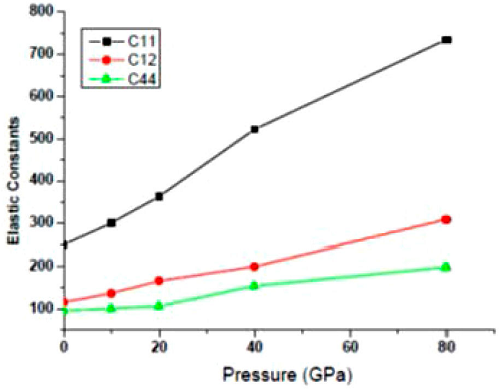
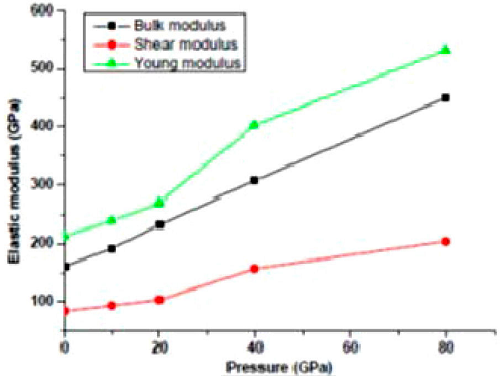
Table V The lattice constant, bulk modulus, shear modulus, Young modulus, and Poisson ratio
| Pressure(GPa) | A(A0) | Eg(eV) | B* | C 11 (GPa) | C 12 (GPa) | C 44 (GPa) | B(GPa) | G(GPa) | E(GPa) | v |
|---|---|---|---|---|---|---|---|---|---|---|
| 0 | 6.176139 | 0 | 123.376 | 154.709064 | 108.536424 | 43.689584 | 123.927 | 33.8223 | 93.0057 | 0.37492 |
| 10 | 6.038825 | 0 | 170.868 | 212.831 | 144.938 | 71.326 | 167.569 | 52.9453 | 143.701 | 0.357073 |
| 40 | 5.768698 | 0 | 281.182 | 364.600 | 219.091 | 116.091 | 267.818 | 96.1653 | 257.657 | 0.339657 |
| 80 | 5.5173 | 0 409.886 | 555.075 | 297.991 | 160.360 | 383.686 | 146.773 | 390.522 | 0.330364 |
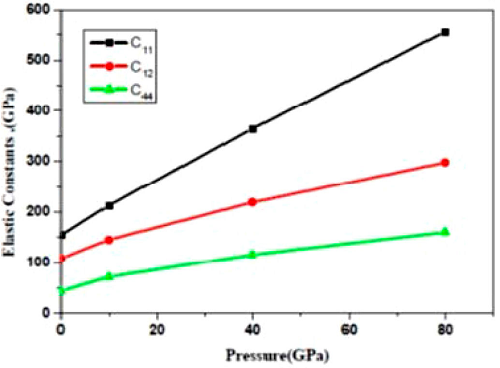
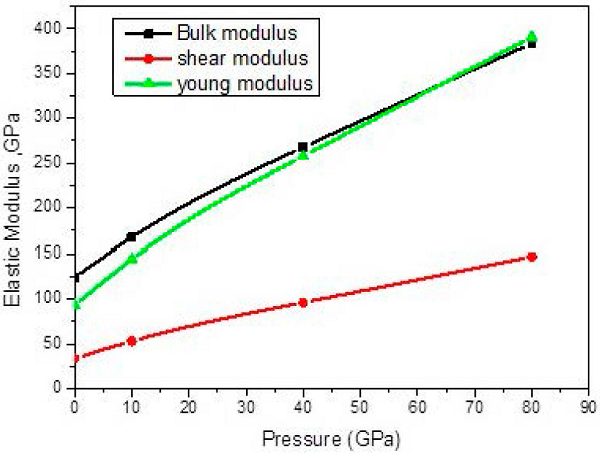
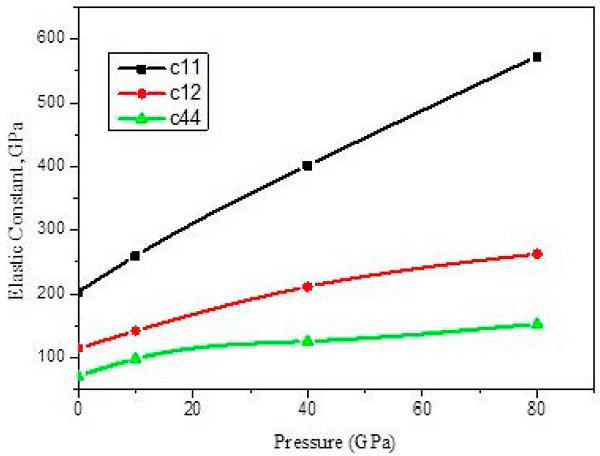
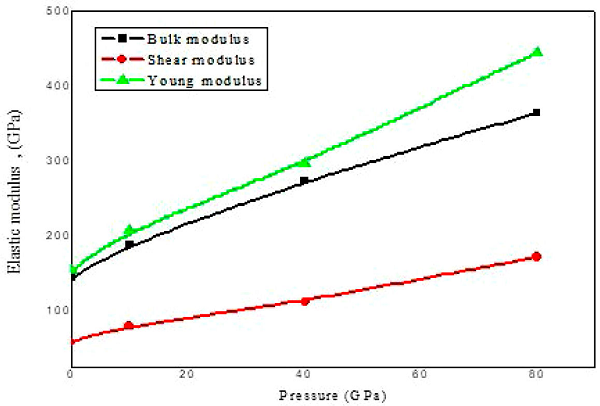
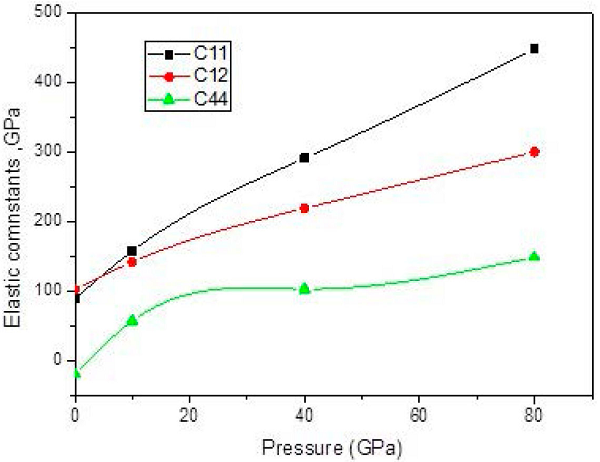
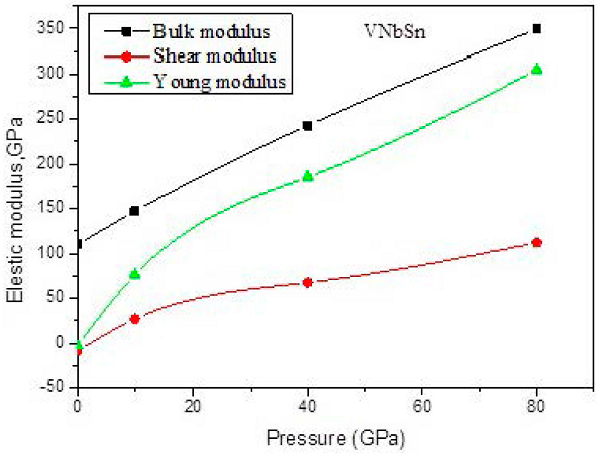
Table VI The lattice constant, bulk modulus, shear modulus, Young modulus, and Poisson ratio
| Pressure(GPa) | A(A0) | Eg(eV) | B* | C 11 (GPa) | C 12 (GPa) | C 44 (GPa) | B(GPa) | G(GPa) | E(GPa) | v |
|---|---|---|---|---|---|---|---|---|---|---|
| 0 | 6.0861 | 0 | 143.679 | 202.937 | 114.219 | 70.138 | 143.791 | 58.3677 | 154.234 | 0.321229 |
| 10 | 5.964 | 0 | 183.859 | 259.279 | 141.699 | 97.848 | 188.892 | 79.7647 | 208.629 | 0.307778 |
| 40 | 5.741165 | 0 | 286.286 | 401.716 | 211.041 | 125.339 | 274.599 | 112.332 | 296.558 | 0.320006 |
| 80 | 5.571816 | 0 | 387.510 | 573.178 | 262.533 | 152.803 | 366.082 | 153.806 | 404.735 | 0.315735 |
4 Conclusion
We have performed first-principles calculations to investigate the structural and elastic properties of the half-Heusler XNbSn (X = Cr, Mn, Co, Fe, V) alloys in the ferromagnetic state FM. The elastic constants and elastic moduli are investigated under different pressures (0, 20, 40, and 80 GPa). These hypothetical half-Heusler alloys show a mechanical stability under higher pressure up to 80 GPa. All the studied alloys show a metallic characteristic except CoNbSn which shows a semiconductor behavior with energy gap of 0.99 eV. The pressure effect on the elastic constants of these compounds was investigated. We predicted that C 11 constant is highly more sensitive to high pressure than C 12 and C 44.

