Nuclear Physics
Simulation of the 2E Technique on neutron multiplicity measurement as a function of fragment mass in spontaneous fission of 252Cf
1 Universidad Nacional de Ingeniería, Av. Túpac Amaru 210, Rímac, Lima, Peru.
Abstract
A Monte Carlo simulation algorithm to investigate the measurement of the average prompt neutron multiplicity as a function of pre-neutron mass, ν¯(A), for fragments from the spontaneous fission of 252Cf is presented. The input data consist of experimental measurements of the kinetic energy and mass distributions obtained by Göök et al., and the values of ν¯(A) calculated using the FIFRELIN model by Piau et al., ν¯th(A). We analyze the output curve, ν¯sim(A), obtained by simulation of the 2E technique, which should ideally match ν¯th(A). However, we find that ν¯sim(A) exhibits a maximum value at A≈122, close to mass symmetry, while ν¯th(A) has a maximum at A≈118. Additionally, we observe that ν¯sim(A) >ν¯th(A) for A< 90 and A> 169, respectively. We attribute this discrepancy to inaccuracies in the relationship between provisional mass and the pre-neutron mass used in the 2E technique for data processing in each fission event.
Keywords: Spontaneous fission; californium 252; neutron emission; fragment distribution; neutron multiplicity
1. Introduction
The fission process begins with the fissile nucleus, culminating at the scission point, where the nuclear interaction fades, and two complementary fragments with proton and nucleon numbers (Z, Z’) and (A, A’) whose excitation energies are XE and XE’, respectively, are formed [1-3]. The study of fission dinamics requires knowledge of the distribution of these variables [4], which is not directly accessible due to the particle emission from fragments before they reach the detectors [5].
An intermediate step would involve measuring the distribution of kinetic energy values acquired by the fragments due to the Coulomb repulsion they experience after the scission point (KE, KE’). Additionally, it is essential to measure the excitation energy of the fragments (XE, and XE’), which is expressed in the decay through particle emission. With these values, the available energy of the reaction can be calculated [6]:
Q=TKE+TXE=(KE+KE')+(XE+XE'),
(1)
where TKE = KE + KE’ is the total kinetic energy and T XE = XE + XE’ is the total excitation energy.
However, for each fission event, the fragments arrive at the detectors after having emitted (n, n’) prompt neutrons [7]. Thus, the post-neutron values of the kinetic energy of the fragments (e, e’), respectively, result from mass loss and recoil effects due to neutron emission. The final mass and kinetic energy of one fragment may be measured using a mass separator as the LOHENGRIN at the ILL Institute in Grenoble, France [8], but the emitted neutrons are not detected.
The so-called double energy (2E) technique consists in measuring (e, e’) to calculate the pre-neutron mass. However it would be necessary to detect all neutrons emitted by the fragment, which represents an unresolved issue in terms of efficiency [9]. The recoil effect from the emission of those neutrons is not fully accessible.
Göök et al. [10] and Al-Adili et al. [11] have employed the double kinetic energy (2E) technique to calculate the average prompt neutron multiplicity as a function of fragment mass, denoted as ν¯ex(A) for the spontaneous fission of 252Cf. On the other hand, there are results from calculations based on theoretical models that compute the values of ν¯(A), in this work referred to as ν¯th(A). Among these is the FIFRELIN model used by Piau et al. [12].
In this study, a simulation algorithm has been employed to investigate the disparity between the results obtained through the 2E measurement technique and the values of the average prompt neutron multiplicity as a function of pre-neutron mass, ν¯th(A), assumed as real, for fragments from the spontaneous fission of 252Cf.
2. Monte Carlo simulation of ν¯(A) measurement using the 2E technique
Before neutron emission, the distribution of fragment mass is characterized by the pre-neutron fragment mass yield (Y (A)). The complementary fragments with mass (A, A’) have a total kinetic energy distribution characterized by its average (TKE¯(A)) and its standard deviation (σ
TKE
(A)).
For each pair of fragments with (A, A’) and a total kinetic energy T K E, there is a distribution of prompt neutron number whose average is represented by ν¯(A, T K E), which is approximately a linear function of T K E, having (∂ν¯/∂T K E) as slope. The fragments with mass A emit prompt neutrons with an average kinetic energy relative to the center of mass represented by η-(A).
The above functions have been measured by Göök et al. [10]. Piau et al. [12] have calculated the average neutron multiplicity as a function of pre-neutron mass (ν¯th(A)).
The experimental Göök et al. data [10] and the function ν¯th(A) calculated by Piau et al. [12] are the input data for the simulation of the experiment measuring the average prompt neutron multiplicity, with the 2E technique.
For the simulation, we assume a Gaussian distribution of T K E(A):
TKE=TKE¯+rσTKE(A),
(2)
where r is a number that follows a Gaussian distribution with a mean of 0 and a standard deviation of 1.
For the neutron multiplicity, we employ the following approximate relationship:
ν¯th(A,TKE)=ν¯th(A)×1+∂ν¯∂TKE(TKE¯-TKE).
(3)
We assume that complementary fragments with masses A and A’ with total kinetic energy T K E emit n and n’ given by relationships:
n=intν¯th(A)1+r3+0.5,
(4a)
n'=intν¯th(A')1-r3+0.5,
(4b)
where r is a number that follows a Gaussian distribution with a mean of 0 and a standard deviation of 1.
Additionally, we assume that fragments with mass A associated with the total kinetic energy T K E emit isotropically n neutrons with kinetic energy η-(A). The recoil effect due to neutron emission is then calculated to obtain the final kinetic energy values of the complementary fragments e and e’. Based on these values, the provisional mass of the two complementary fragments is calculated:
(μ,μ')=252(e',e)tke,
(5)
where tke = e + e’.
3. Results
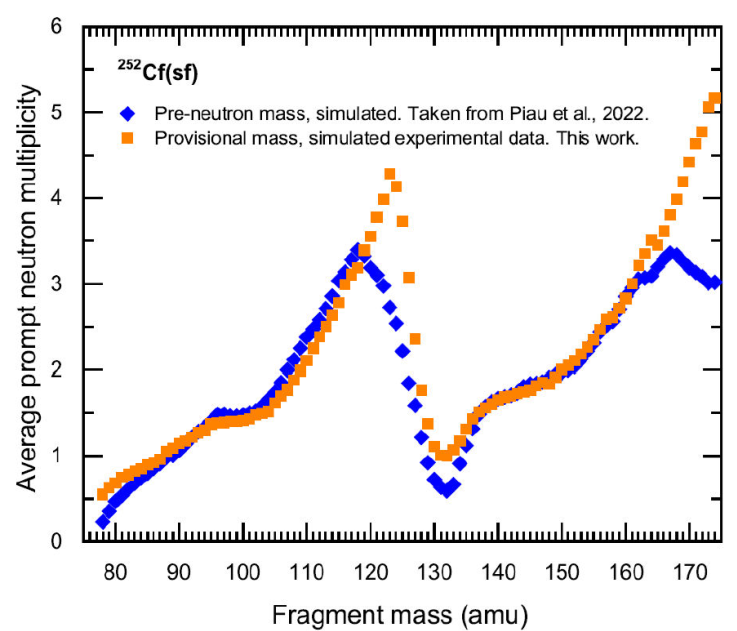
The outcome of the Monte Carlo simulation for the 2E technique measurement of ν¯ as a function of provisional mass, ν¯prov(μ), is presented in Fig. 1.
To approximately calculate the pre-neutron values of kinetic energy, we utilize the relationship used by Göök et al. [10]:
KE≈tkeμμ-ν¯prov(μ,tke).
(6)
This relation is an approximation of the formula:
KE=TKEAA-n,
(7)
which relates the pre-neutron kinetic energy to the final energy of fragments emitting n neutrons with zero kinetic energy in the center of mass frame.
From the approximate values of kinetic energy obtained using Eq. (6), we calculate the approximate values of the primary fragment masses:
(A,A')≈252KE',KETKE.
(8)
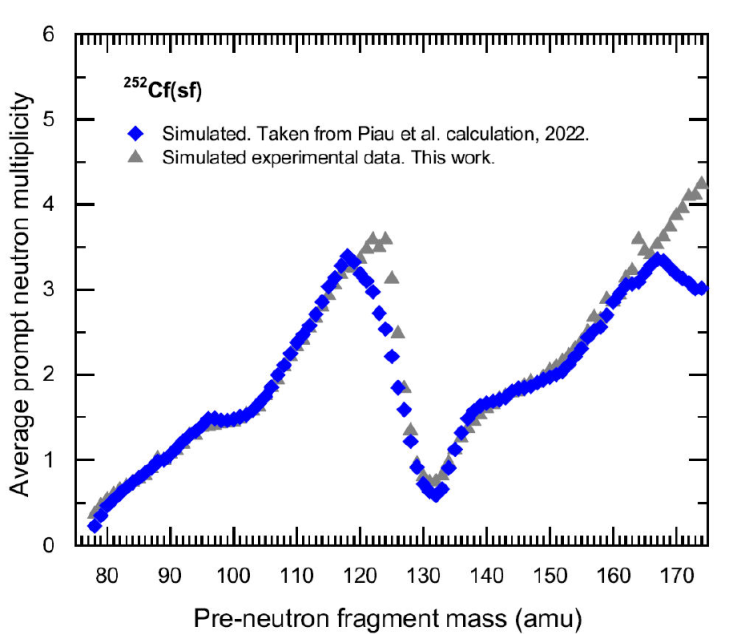
With the values of n corresponding to each mass A, the ν¯sim(A) curve is constructed and presented in Fig. 2.
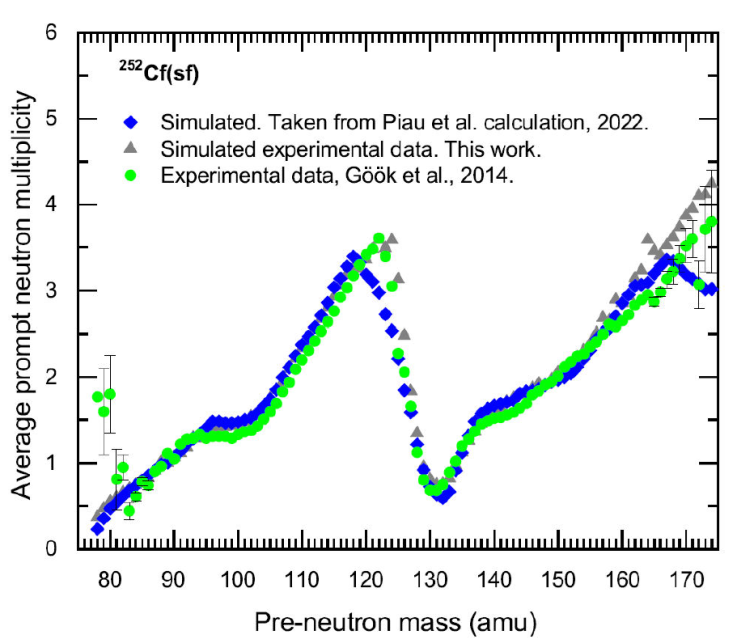
Figure 3 presents the curves ν¯th(A), ν¯sim(A), and the experimental curve ν¯ex(A), obtained by Göök et al. [10]. The curves ν¯sim(A) and ν¯ex(A) exhibit similar trends, except for the region A < 80, where ν¯ex(A) greatly surpasses ν¯sim(A). Both curves reach a maximum value around A = 122, while ν¯th(A) presents its maximum value at A = 118. Additionally, both curves have higher values than ν¯th(A) for A > 169.
4. Conclusions
Initially, we assume that the average prompt neutron multiplicity as a function of the pre-neutron mass (ν¯th(A)) is as calculated by Piau et al. [12]. Subsequently, we simulate an experiment employing the 2E technique to measure this parameter based on the provisional mass. As a result of this simulation, we obtain the curve ν¯prov(μ). Figure 1 illustrates that ν¯prov(μ) exhibits a peak around μ = 123, whereas the theoretical primary mass-related variable, ν¯th(A), reaches a maximum at A = 118. Moreover, ν¯th
<ν¯prov for A < 90 and A > 162.
Afterward, we simulate the same experiment, this time calculating the average prompt neutron multiplicity as a function of pre-neutron mass. The result of this simulation is represented by the curve ν¯sim(A), which more closely approximates or aligns with the curve ν¯th(A) than does the curve ν¯prov(μ). However, both curves are higher than the curve ν¯th(A) around A = 122 and in the mass region A > 169.
The discrepancy between the simulated curve ν¯sim(A), generated through the 2E technique simulation, and the input curve ν¯th is attributed to the inexactness of the relationship (6), which connects provisional mass and pre-neutron energy. A better approximation could be achieved by considering the number of neutrons n emitted by the fragment instead of ν¯prov(μ, tke), representing an average value. However, even with this refinement, the relationship would still be imprecise, as it does not account for the recoil effect caused by the emission of n neutrons, which alters the kinetic energy of the emitting fragment.
If the output data from the simulation algorithm of the experiment based on the 2E technique replicate the experimental results, we can assume that the input data are compatible with the pre-neutronic characteristics of the fragments.
The simulation method enables the calculation of pre-neutron values which, when used as input in the simulation of any experiment, accurately replicate the values observed in the experimental findings. In this sense, this method can be applied in the analysis of the results of experiments based on other measurement techniques. For this purpose, the corresponding algorithm should consider the physical processes involved in these techniques.
References
1. O. Hahn and F. Strassmann, Nachweis der Entstehung aktiver Bariumisotope aus
Uran und Thorium durch Neutronenbestrahlung; Nachweis weiterer aktiver
Bruchstücke bei der Uranspaltung, Die Naturwissenschaften
27(1939) 89, https://doi.org/10.1007/BF01488988.
[ Links ]
2. L. Meitner and O. R. Frisch, Products of the Fission of the Uranium Nucleus,
Nature
143(1939) 471, https://doi.org/10.1038/143471a0.
[ Links ]
3. N. Bohr, et al., The Mechanism of Nuclear Fission,
Physical Review
56(1939) 426,
https://doi.org/10.1103/PhysRev.56.426.
[ Links ]
4. K. H. Schmidt, et al.,, General Description of Fission
Observables: GEF Model Code, Nuclear Data Sheets
131(2016) 107,
https://doi.org/10.1016/J.NDS.2015.12.009.
[ Links ]
5. A. E. Lovell, et al., Extension of the Hauser-Feshbach
fission fragment decay model to multichance fission, Physical Review
C
103(2021) 014615,
https://doi.org/10.1103/PHYSREVC.103.014615.
[ Links ]
6. K. Shimada, et al., Dependence of total kinetic energy of
fission fragments on the excitation energy of fissioning systems,
Physical Review C
104 (2021) 054609,
https://doi.org/10.1103/PHYSREVC.104.054609.
[ Links ]
7. E. E. Maslin, A. L. Rodgers, and W. G. Core, Prompt Neutron Emission from
U235 Fission Fragments, Physical Review
164(1967) 1520,
https://doi.org/10.1103/PhysRev.164.1520.
[ Links ]
8. D. Belhafaf, et al., Kinetic energy distributions around
symmetric thermal fission of U234 and U236, Zeitschrift fGür Physik A
Atoms and Nuclei
309(1983) 253, https://doi.org/10.1007/BF01413757.
[ Links ]
9. A. Tudora, et al., Sensitivity of Prompt Neutron
Multiplicity to Fission Fragment Characteristics, Nuclear Science and
Engineering
181 (2015) 289,
https://doi.org/10.13182/NSE14-108.
[ Links ]
10. A. Göök, F. J. Hambsch, and M. Vidali, Prompt neutron multiplicity in
correlation with fragments from spontaneous fission of Cf 252, Physical
Review C - Nuclear Physics
90 (2014) 064611,
https://doi.org/10.1103/PHYSREVC.90.064611.
[ Links ]
11. A. Al-Adili, et al., Prompt fission neutron yields in
thermal fission of U 235 and spontaneous fission of Cf 252, Physical
Review C
102 (2020) 064610,
https://doi.org/10.1103/PHYSREVC.102.064610.
[ Links ]
12. V. Piau, et al., Neutron and gamma multiplicities
calculated in the consistent framework of the Hauser-Feshbach Monte Carlo code
FIFRELIN, Physics Letters B
837 (2023) 137648,
https://doi.org/10.1016/J.PHYSLETB.2022.137648.
[ Links ]





 nueva página del texto (beta)
 Inglés (pdf)
 Artículo en XML
 Referencias del artículo
 Traducción automática
 Enviar artículo por email
 Citado por SciELO
  Similares en
SciELO
Similares en
SciELO 
 Permalink