




 nueva página del texto (beta)
 Inglés (pdf)
 Artículo en XML
 Referencias del artículo
 Traducción automática
 Enviar artículo por email
 Citado por SciELO
  Similares en
SciELO
Similares en
SciELO 
 Permalink
1. Introduction
Owing to their variable and interesting properties, Perovskite and double Perovskite compounds (DPs) have attracted the attention of many scientific researchers for the development of innovative materials. Some of the double perovskites with the formula A2BB’O6 (A = alkaline earth or rare earth metal; B, B’ = transition metals or rare earth) turn out to be half metallic materials, which are metallic in one spin channel while insulating in the other such as Sr2FeMoO6 [1, 2] and Sr2FeReO6 [3]. The crystal structure of this ordered double perovskites A2BB’O6 consists of corner sharing BO6 and B’O6 octahedral, which alternate along three cubic axes, and a large (A) cations occupies the hollow formed by the BO6 - B’O6 octahedral. Very interesting physical properties of these compounds can be attributed to small changes in their chemical composition. Thus, depending on the choice of A, B and B’ cations, a wide variety of electrical and magnetic properties emerge such as metallicity, half metallicity, multiferroicity ferromagnetic (FM), ferrimagnetic (FIM), antiferromagnetic (AFM) and colossal magneto resistance [4-10]. This diversity provides opportunities for a wide range of potential applications such as magnetic refrigerant [11, 12], dielectric resonators, voltage controlled oscillators, filter duplexes in mobile phones and satellite communications that operate in the microwave frequency range (300 MHz to 30 GHz) [14], and magneto-optic devices [13], etc. Information technology needs a rising number of material resources for digital storage and processing, these resources are increasingly made with materials that have specific properties [15]. Among these materials, are oxide compounds perovskite of various crystal formations. Other notable chemical, physical and electrical properties characterize double perovskites due to their flexible chemical composition. Tunnel junctions, X-ray storage phosphor materials and scintillators [16], giant magneto-resistive devices [17,18] and other magnetic devices (CMR) [19] are just some of the numerous technological applications of perovskites, which makes it a lively and rich subject of research involving both chemists and physicists. Double perovskites compounds (DPs) are one of the most studied types of materials due to their A2BB’O6 stoichiometry. Moreover, they have undeniable advantages, such as the ability of using a large majority of elements in the periodic table [20] and whose manufacture is simple, fast and profitable. The majority of current research has focused on double perovskites with two oxides (DP) due to (i) a variety of crystal structures, (ii) flexible chemical composition and (iii) the possibility of varying electronic and magnetic properties. Halide double perovskites (HDP) compounds, having A2BB’X6 structure, where B is monovalent and B’ is a trivalent element, also known as elpasolite [21], are potential alternative compounds proposed for technical applications various. Furthermore, promising optoelectronic materials based Cs have been successfully synthesized [22-24], these compounds shows remarkable properties and has been utilized in many applications such as scintillators, catalysts [25], photoelectric absorption layers of solar cells [26, 27] and are characterized by a high absorption coefficient and are therefore suitable for photovoltaic application [28-31]. The study carried out in this article concerns the determination of the structural, electrical, magnetic and thermoelectric properties of the double perovskite material Ba2GdReO6 using the full potential linearized augmented plane wave (FP-LAPW) method with different approximations such as the generalized gradient approximation (GGA), GGA+U and GGA plus modified Becke-Johnson (GGA+mBJ) methods[32]. For the determination of thermoelectric properties, we have used a semi-classical Boltzmann transport theory and rigid band theory as implemented in BoltzTrap code [33], within the Wien2k program in order to evaluate series thermoelectric parameters such as Seebeck coefficient S, electrical conductivity, thermal conductivity and figure of merit ZT for this compound, which could indicate a suitable use of these double perovskite materials in spintronic and thermoelectric applications [34-37]. This paper can be divided in four sections: the calculation method is given in Sec. 2, in Sec. 3, the structural, electronic, magnetic and thermoelectric properties of the compound Ba2GdReO6 are presented and finally Sec. 4 includes a brief conclusion of this study.
2. Computational details
To calculate and evaluate the structural, electronic and transport properties (thermoelectric properties) of the double perovskite compound Ba2GdReO6, we relied on the method of augmented plane waves linearized at full potential (FP-LAPW) [38-40] such as implemented in the WIEN2K code [41]. In addition, different approximation methods have been considered, such as the generalized gradient approximation (GGA), the generalized gradient approximation with the Becke Johnson modification modified by Trans Blaha (mBJ-GGA) to correctly appreciate the value of the gap, the generalized gradient approximation added to the influence of the Coulomb interaction on site (GGA+U) (where U is the Hubbard correlation term), this with the aim of processing and approximating the exchange-correlation functional of rare earth elements Gd and Re, which are highly correlated, in fact, it is a question of making an adequate correction of the GGA approximation by adding the parameter U to it to correctly describe the electronic correlation of the rare earth elements Gd (
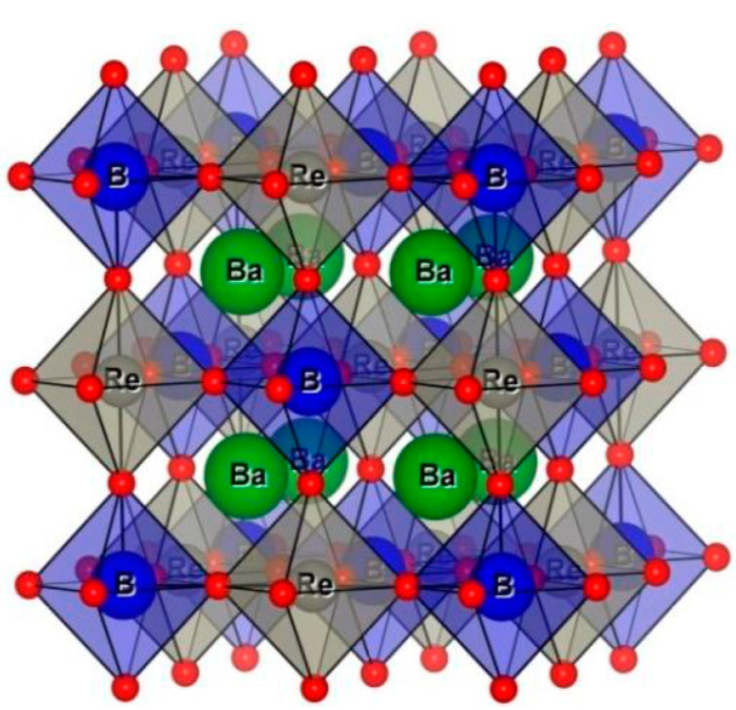
As thermoelectric parameter calculations are sensitive to dense sampling of k points, a high density of 150000 k-points is used to calculate the thermoelectric properties, the latter are determined using the BoltzTrap code [33, 44] implemented in the Wien2k package and the relaxation time is taken as
3. Results and discussions
3.1. Structural properties
The objective of this section is to find the adequate stable state of the compound Ba2GdReO6. Calculations of the total energies for different volumes were performed using the GGA and GGA+U approximations, following three configurations: the Ferromagnetic (FM), Non-magnetic (NM) and Ferrimagnetic (FiM) configuration. Two configurations were considered when using the GGA+U method: Ferromagnetic (FM) and Ferrimagnetic (FiM). The results obtained by plotting the curves in Fig. 2.
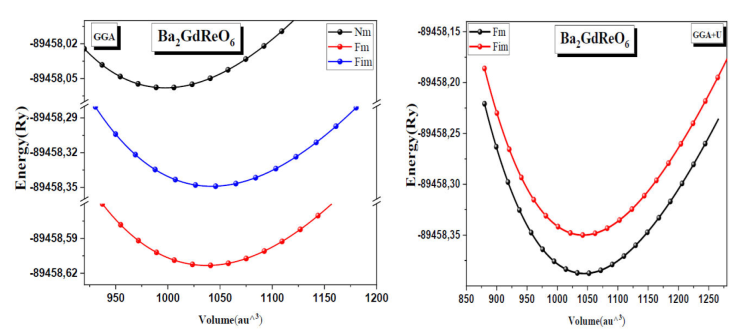
Figure 2 Calculated total energy (Ry) as a function of volume for Ba2GdReO6, using GGA and GGA+U approximations for different magnetic phases.
Representing the total energies as a function of the volume, for the two approximations (GGA and GGA+U), reveal that the FM phase has an energy lower than the other phases (NM and FiM), therefore, the double perovskite compound Ba2GdReO6 in the ferromagnetic state is the most stable in comparison with the other phases. In addition, this fundamental state makes it possible to determine the equilibrium values of the different parameters such as the lattice constant a, bulk modulus B and its pressure derivative B’ for this material (Table I), let us recall that the total energies calculated for the double perovskites Ba2GdReO6 were adjusted by the Birch Murnaghan equation of state[45].
Table I Calculated equilibrium lattice parameters 𝑎A, bulk modulus B GPa, its pressure derivative B’ and the ground state energy E eV of the cubic double perovskites Ba2GdReO6, using GGA and GGA+U, in comparison to the available values in the literature.
It can be clearly seen that the values of the lattice constants using the GGA and GGA+U approximations are in excellent agreement with those found in the literature [46, 47]. For the bulk modulus B, their experimental and theoretical data are not available; these are therefore predictive studies for future investigations.
3.2. Electronics properties
3.2.1. Band structure
The electronic band structures calculated for the Ba2GdReO6 material at the equilibrium lattice constant are shown in Fig. 3.
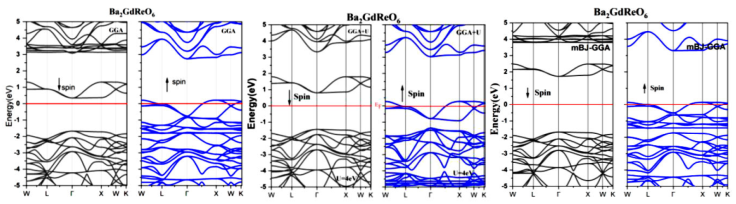
Figure 3 Calculated total energy (Ry) as a function of volume for spin-up and spin-down band structures of Ba2GdReO6 compound using GGA, GGA+U and TB-mBJ approximations.
The graphs are structurally similar, but the difference is the gap value given by each approximation. These spectra are calculated for both spins; spin up (↑) and spin down (↓) in the GGA, GGA+U (U = 4 eV) and TB-mBJ-GGA approximations. The arrows (↑) and (↓) are the directions of the spins: (↑) for spin-up and (↓) for spin-down. For the Ba2GdReO6 double perovskite and in the spin-up channel, we observe that the bands overlap at the Fermi level while the states of the conduction band and those of the valence band in the spin-down channel exhibit band gap energy, therefore this compound exhibits a semiconductor behavior in this channel of spin (spin down). From these results, we can deduce that the compound Ba2GdReO6 has a half-metallic character. Moreover, the energy gap between the valence band maximum and the conduction band minimum is direct in nature, i.e. a direct band gap at the point Γ, equal to 2.00 eV, 2.624 eV and 2.670 eV, for the GGA, GGA+U and TB-mBJ-GGA approximations respectively. Using GGA + U (with U = 2, 4, 6 and 8 eV) approximation, the band structure dependence with this parameter for Ba2GdReO6 is shown on Fig. 4.
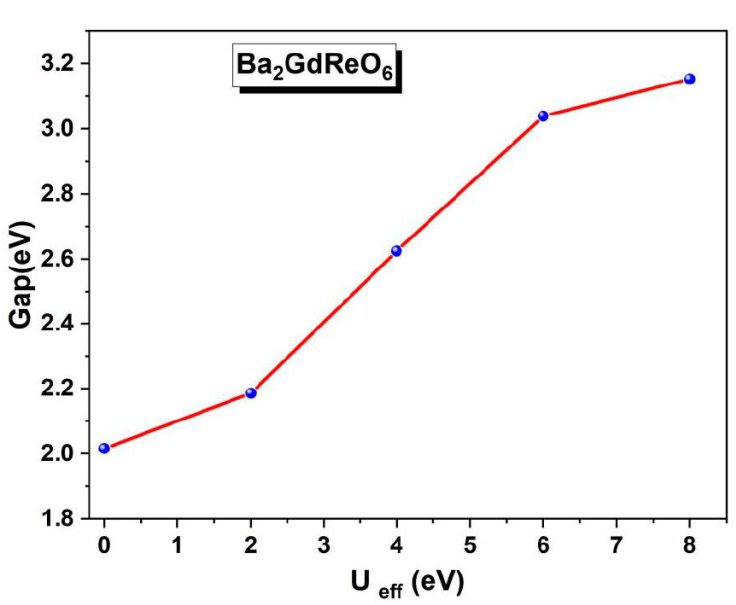
We notice the increase of band gap with the incensement of Hubbard parameter, with linear increase between U = 2 eV to U = 6 eV. This figure shows the effect of the parameter U on the band gap values.
3.2.2. Density of states
In order to delve into the interpretation of the band structure curves, we have plotted the PDOS and the TDOS densities of states for the double Perovskite Ba2GdReO6, following the approaches using the GGA, the mBJ-GGA and the GGA+U approximations, which are illustrated in Fig. 5. The Fermi level (EF) being represented by a vertical dotted line (0 eV). At first glance, from the calculations carried out according to the three approximations: GGA, GGA+U (U = 4 eV), mBJ-GGA and materialized by the curves illustrated in Fig. 5, it is noted that the latter presents a similar aspect as to the shape of the peaks and by the obvious anti symmetric between those of the spin up and those of the spin down with a shift of the peaks different from one approximation to another along with a bursting of the energy bands.The main distinction between the three approximations comes from the fact that the TB-mBJ-GGA approximation estimates a more accurate value of the gap in the spin down channel compared to the other two approximations (GGA and GGA+U).
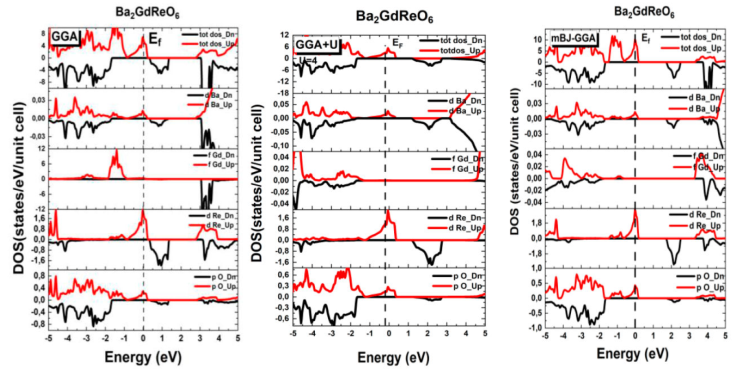
Figure 5 Total (TDOS) and partial (PDOS) density of States of Ba2GdReO6 double perovskite using GGA, GGA+U and Tb-mBJ approximation. Fermi level is set to zero.
From the shape of the TDOS curves, it is clear that the Ba2GdReO6 double perovskite exhibits a half-metallic character; in the spin-up sense (↑) the metallic nature is essentially attributed to strong hybridization of the 5d and 2p orbitals of the Gd and O elements respectively. As it is known, the presence of oxygen atoms around the Gd and Re sites in the compound Ba2GdReO6 leads to a doubling or even a tripling of these levels, i.e. a doubly or triply degenerate state of the Re atom (d, d- e.g. and d-t2g); a strong hybridization of these states is at the origin of the gap in the spin down channel. Note that a gap exists between the occupied O (2p) states and the unoccupied Re (d-t2g) states in the spin down channel in the compound Ba2GdReO2. Furthermore, the valence band maximum is dominated by the O (p) states with a tiny contribution of Re (d-t2g), while the conduction band minimum is dominated by the Re state (d-t2g) as well as the states of Gd atoms. The half-metallic nature of this compound makes it a good opportunity for spintronic applications.
3.3. Magnetic properties
The density of states is essential in the determination of the magnetic properties of the double perovskite Ba2GdReO6 and, in particular, in the proven prediction of the ferromagnetism and the half-metallicity of this material. In order to calculate the magnetic properties of this double perovskite material, we have optimized our calculations for this compound in its ferromagnetic phase as well as the ferrimagnetic and non-magnetic ones. The stable state being in the ferromagnetic phase, this compound is therefore ferromagnetic in nature. For the spin effect, we took the GGA approximation with the inclusion of the Hubbard parameter U; the obtained results of the interstitial and total atomic magnetic moments per unit cell in the Bohr magneton μB are shown in Table II.
Table II Calculated total μ Cell , local and interstitial μ inst magnetic moments in the units of μB for Ba2GdReO6 double Perovskite.
| Ba2GdReO6 | |||
|---|---|---|---|
| GGA | GGA+U (U=6e V) | mBJ | |
| μ Ba | 0,0039 | 0,0083 | 0,0037 |
| μ Gd | 0,989 | 1,343 | 1,602 |
| μRe | -0.060 | -0.077 | -0.130 |
| μ O | 0,021 | 0,005 | 0,013 |
| μ Cell | 8,969 | 9,005 | 8.999 |
| μ inst | -1 ,3209 | - 0,7759 | - 0,5425 |
For the compound Ba2GdReO6, these calculations were performed using the GGA, GGA+U and TB-mBJ-GGA approximations. From the values indicated by this table, it can be noticed that the Re and Gd atoms in the double perovskite Ba2GdReO6 play an important role to different degrees in the magnetism of the compound studied. This essential contribution obviously comes from the d-d transition in the Re and Gd atoms. Moreover, a minor contribution of other atoms as well as interstitial sites is also involved in the total magnetic moment of the cell; the latter has a positive integral value equal to 9.00 μB. This integer value of the total magnetic moment confirms the ferromagnetism and the half metallicity of this compound. Note then that the positive values of the magnetic moments of the interstitial sites and of the Gadolinium atoms confirm their alignment parallel to the magnetic moments of Ba. The values of the total magnetic moments according to the GGA, GGA+U and TB-mBJ-GGA methods are 8.969 μB, 9.005 μB and 8.999 μB respectively, these moments come from the Gd ion with a small contribution from the O site. On the other hand, the negative values of the magnetic moments of the Re element with the interstitial sites of the Ba2GdReO6 material reduce the net magnetic moments of this compound.
3.4. Transport properties
Thermoelectricity or conversion of electrical energy from heat is booming with the growing interest in the recovery of waste thermal energy. The conversion of thermal energy into electrical energy is one of these new sources of renewable energy and is of absolute importance because millions of tons of fossil energy are sacrificed every day to obtain electrical energy so essential for our different needs (domestic and industrial). Yet much of this energy is lost to the atmosphere as heat that cannot be efficiently harnessed. However, faced with the growing demand for energy and the desire to use sustainable and renewable sources, this waste heat represents an immense reservoir that can be exploited wisely. Thermoelectric modules, thanks to the Seebeck effect, are able to generate an electric current from a thermal gradient, thus making it possible to exploit the sources of waste heat [48, 49]. In order to describe the thermoelectric behavior of our double perovskite material Ba2GdReO6, it would be useful to know how a series of fundamental parameters evolve as a function of temperature (or chemical potential) such as electrical conductivity per relaxation time σ/τ, the Seebeck (or thermopower) coefficient S, the electronic thermal conductivity per relaxation time ke/τ and the figure of merit ZT. The variations of these four parameters mentioned previously as a function of the temperature for the double perovskite material Ba2GdReO6 and according to different approximations, i.e. the mBJ-GGA approximation and the GGA+U approximation by varying the Hubbard parameter (2 and 6 eV), are represented by the Figs. 6a), b) and c) for the Seebeck coefficient S following the approximations: mBJ-GGA, GGA+U (U = 2 eV) and GGA+U (U = 6 eV) respectively; Figures 7a), b) and c) for the electrical conductivity per relaxation time
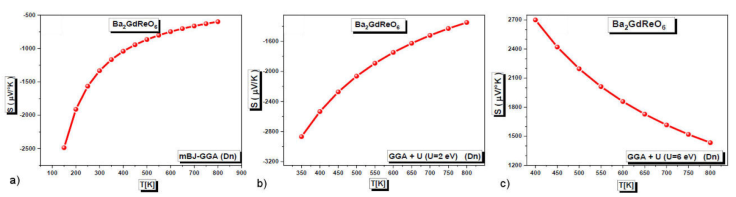
Figure 6 Variation of Seebeck coefficient S as a function
of temperature for Ba2GdReO6: a) using mBJ-
GGA approximation, b) using GGA+U (U=2eV) approximation and c) using
GGA+U
(
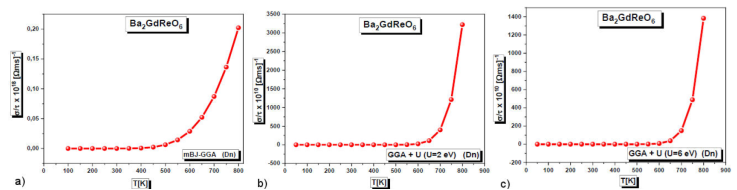
Figure 7 Variation of the electrical conductivity per relaxation time (σ/τ) as a function of temperature for Ba2GdReO6: a) using mBJ- GGA approximation, b) using GGA+U (U = 2 eV) approximation and c) using GGA+U (U = 6 eV) approximation.
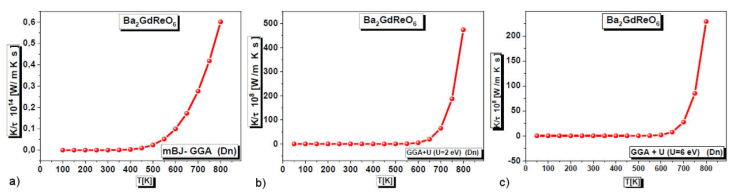
Figure 8 Variation of the electronic thermal conductivity per relaxation
time
(
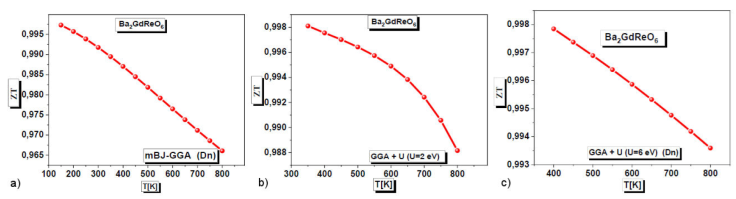
Figure 9 Variation of the figure of merit (ZT) as a function of temperature for Ba2GdReO6: a) using mBJ- GGA approximation, b) using GGA+U (U = 2 eV) approximation and c) using GGA+U (U = 6 eV) approximation.
However, good materials suitable for thermoelectric applications must have a high Seebeck coefficient, a high electrical conductivity, a low thermal conductivity and a figure of merit close to unity or greater than unity [50-53], The transport properties of the compound Ba2GdReO6 were determined using the BoltzTrap code [54] within the Wien2k program, and the approximation for the relaxation time constant τ as implemented in the BoltzTraP code is taken as 0.8 × 10⁻¹⁴ s, as suggested in the BoltzTraP user manual, all these thermoelectric parameters as indicated above are calculated and analysed in the spin down state, and where our material is semi-conductive in nature with gap values of 2 eV, 2.18 eV and 3.03 eV for the approximations: mBJ-GGA, GGA+U (U = 2 eV) and GGA+U(U = 6 eV) respectively. The Seebeck effect is a phenomenon which consists of the appearance of a potential difference at the junction of two materials subjected to a difference (or a gradient) in temperature, this potential difference being generated by the movements of electrons free from the high temperature region to the low temperature region, in materials where the prevailing charge carriers are holes (p-type), the Seebeck coefficient has a positive sign, while those dominated by electrons (n-type) have negative Seebeck coefficients. The use of materials with a high Seebeck coefficient is important for a high performance of thermoelectric generators and thermoelectric coolers, i.e., for good thermoelectric predispositions, the material must have a high Seebeck coefficient S. Figure 6 show the variation of the Seebeck coefficient S as a function of temperature for the double perovskite material Ba2GdReO6, let us note first of all, the high values of the Seebeck coefficient for the three approximations, this is in fact due to strongly degenerated bands in the band structure of this material, according to Fig. 6a) (mBJ-GGA approximation), the Seebeck coefficient increases with the increase in temperature passing from a minimum threshold of -2485.75 μV/K (150 K) up to a maximum threshold of -599.29 μV/K (800 K), similarly, following the GGA+U approximation (Fig. 6b)) with U = 2 eV, the Seebeck coefficient increases by a minimum threshold of -2868.44 μV/K (350 K) up to a maximum value of -1348.26 μV/K (800 K) while for the GGA+U approximation [Fig. 6c)] with U = 6 eV, the Seebeck coefficient decreases with temperature from a maximum value of 2699.63 μV/K (400 K) to a minimum value of 1433.63 μV/K (800 K), in absolute value, the values of the Seebeck coefficients for the three approximations for this material are quite high, which bodes well for thermoelectric applications, in particular with regard to its value at room temperature (330 K) according to the mBJ-GGA approximation and which is:
We note that the approximation having the smallest gap (in this case the mBJ-GGA approximation having a gap of 2 eV), presents the greatest value of the electrical conductivity, this is due to the fact that, the higher the value of the gap is low, the greater is the concentration of the carriers, which implies a greater mobility of these carriers and consequently a greater electrical conductivity. These results indicate a very high electrical conductivity and consequently a very low resistivity of this material, which implies a transport of electrical charges at very low losses by Joule effect; this is undeniably a major advantage for being a good thermoelectric material. Thermal conductivity is an important parameter that contributes to the optimization of thermoelectric materials. A good thermal conductivity would tend to oppose the establishment of a thermal gradient, the heat would cross the material without encountering resistance, it would therefore be necessary to optimize a thermoelectric material, to reduce the thermal conductivity without degrading the electrical conductivity, given that the thermal conductivity in semiconductor materials comes from the contribution of electrons K e and phonon such that where and are the electronic part (electrons and holes transporting heat) and the vibration part of the lattice (contribution of phonon) respectively, it is the contribution of the vibrations of the lattice which must be reduced and not the contribution due to the charge carriers (electrons and holes). Figure 8 shows the evolution of the electronic thermal conductivity by relaxation time k e /τ as a function of the temperature for the Ba2GdReO6 material according to the three aforementioned approximations, by these curves, the thermal conductivity for the material studied, increases with the increase of the temperature. It should be noted that the plots of electrical and electronic thermal conductivity have a very similar appearance, in fact, these results are in agreement with the law of Wiedemann-Franz which states a proportionality between these two quantities as follows[55]:
where L is the Lorenz number; σ represents electrical conductivity while T is absolute temperature. The electronic thermal conductivity value is approximately
where T the absolute temperature, S the Seebeck coefficient, σ the electrical conductivity and K the thermal conductivity. In order to optimize the transport properties of a material, the figure of merit ZT must be as high as possible (close to or greater than unity), which implies that the Seebeck coefficient S and the electrical conductivity must be as large as possible while the thermal conductivity must be minimized without affecting the electronic transport of charges. Figure 9 shows the plot of the merit factor ZT as a function of the temperature
By introducing Hubbard’s parameter in the GGA approximation (U = 2 and 6 eV), apart from the representative curves of electrical and thermal conductivity by relaxation time, being all similar for the three approximations considered (mBJ-GGA, GGA+U (U = 2 eV) and GGA+U (U = 6 eV)), the notable differences come from the shape of the curves of the Seebeck coefficient and the merit factor, with regard to the Seebeck coefficient, it was affected compared to the mBJ-GGA approximation, because of the positive values acquired for U = 6 eV. Moreover, the Seebeck coefficient and the merit factor under the GGA+U approximation (U = 2 eV and 6 eV), are observable and quantifiable from a certain temperature threshold, in this case T = 350 K for the two values of the parameter of Hubbard, which makes this material thermoelectrically efficient for mid-range and high temperatures, unlike the mBJ-GGA approximation, and where this material is thermoelectrically efficient for the entire temperature range, by favoring the GGA+U approach, which in my opinion is the most suitable for the study of this material. As no experimental study has been made on this material, it would be highly beneficial to do so to confirm these results.
4. Conclusion
In summary, based on the Full Potential Linearized Augmented Plane Wave (FP-LAPW) method, and advocating as exchange and correlation potentials the following three approaches: the Generalized Gradient Approximation (GGA), the generalized gradient approximation with the Becke-Johnson modification modified by Trans-Blaha (TB-mBJ-GGA and the generalized gradient approximation with Hubbard parameter U (GGA+U), we performed extensive research to calculate and evaluate the structural, electronic, magnetic and thermoelectric properties of the rare-earth-based double perovskite compound Ba2GdReO6. From the results obtained, we can deduce that this material is stable in its ferromagnetic phase, moreover, by the analysis of the electronic properties, it turns out that this compound is half -metallic in nature: metallic nature in spin up channel and semiconductor one in spin down channel with a direct gap equal to 2.00 eV, 2.624 eV and 2.670 eV for the GGA, GGA+U and TB-mBJ-GGA approximations respectively, and therefore presents an interest evident for spintronic applications. Moreover, this double perovskite compound, due to the substantial value of the merit factor (nearing unity for the three approximations) shows very interesting thermoelectric predispositions in the minority spin or spin down channel. Note this singularity in the approximation GGA+U (U = 2 and 6 eV), and where the Seebeck coefficient and the merit factor are appreciable and quantifiable from a certain temperature threshold, in this case T = 350 K, therefore, this material is an excellent thermoelectric TE material for medium and high temperatures. Our theoretical predictions of the structural, electronic and thermoelectric properties of the double perovskite Ba2GdReO6 are awaiting confirmation and experimental verification.

