




 nueva página del texto (beta)
 Inglés (pdf)
 Artículo en XML
 Referencias del artículo
 Traducción automática
 Enviar artículo por email
 Citado por SciELO
  Similares en
SciELO
Similares en
SciELO 
 Permalink

1. Introduction
In Mexico, most electric power (83.66%) is generated with fossil fuels (SIE-BNE-SENER, 2024), producing large amounts of greenhouse gases (GHG); therefore, the energy transition is highly urgent to decrease the production of greenhouse gases and their effects. Different paths to reduce the production of GHG related to energy production have been suggested. In the beginning of this century, several approaches to reduce GHG production that included several different actions that, when combined, would reduce greenhouse gas emissions dramatically (Pacala & Socolow, 2004). Some of those actions, such as the increase in clean energy production, have been partially implemented; however, the production of clean energy is still dragging behind. Geothermal energy is one of the most important clean energy sources because of its high plant factor (~90%) and low cost (IRENA, 2024), and when binary plants are used the GHG emissions are null because the thermal fluid is only used to transfer its thermal energy to the secondary fluid and does not undergo a vapor-gas separation process that would release the dissolved gas to the atmosphere. Geothermal resources are abundant in Mexico; however, only five high temperature systems (Cerro Prieto, Los Azufres, Los Humeros, Las Tres Vírgenes and Domo San Pedro) are being exploited for electric power production that in Mexico is focused on fossil fuels (oil, gas condensate, dry natural gas, coal). As a result, Mexico has failed to meet the commitments made in the Paris agreement to reduce its dependence on fossil fuels and the Greenhouse Gas Emissions (GGE), which are: 30% GGE reduction in 2020 and 50% in 2050, and at least 35% electric power generation from clean sources in 2024.
The proportion of clean energy production in Mexico in 2023 was 13.97% and 2.37% of nuclear energy (SIE-BNE-SENER, 2024) and the large contribution of fossil fuels is appalling for a country rich in clean energy sources. The energy mix is dominated by fossil fuels in spite of the abundance of clean energy sources because the government favors the use of fossil fuels especially in electric power generation. The planned energy mix for the next years (2024-2038) includes solar and wind as clean energy sources and maintains the generation with gas. The increase of energy production with new plants, planned until 2038, does not include any new geothermal fields and the increase in geothermal energy production planned for the next 14 years is of only 14 MW by retirement and substitution of plants (PRODESEN-SENER, 2024-2038). Mexico has a great geothermal energy potential in all the country that has been evaluated to be 10,000 MW by CFE (Ordaz-Méndez et al. 2011), which accounts to almost 20% of the maximum electric power demand (approximately 50,000 MW; https://www.gob.mx/cenace), but low investment by the government company that by law is the only one allowed to exploit clean energy sources, has hindered the development of geothermal resources for the last two decades, in spite of the abundance of promising geothermal prospects. In more than 70 years of geothermal surveys in Mexico, only four plants have been commissioned by the government company (CFE) that are presently functioning, and one geothermal plant (Domo San Pedro) that is owned by a private company. The high risk and initial investment are the main deterrents for geothermal energy further development; however, the large potential of the oil wells is an important option to develop geothermal plants in the oil fields for simultaneous exploitation or by using abandoned oil wells, without the large risk involved in exploiting an unknown field and the initial investment for exploration and drilling.
The presently active geothermal fields in Mexico correspond to high-temperature hydrothermal systems that produce electric power with the same process that any electric power plant that is fueled by oil, gas, coal or nuclear: high-temperature water undergoes a boiling process and the produced vapor is directed to a turbine that will propel a generator that will deliver electric power. This process is used in geothermal systems that have temperatures well above 150ºC.
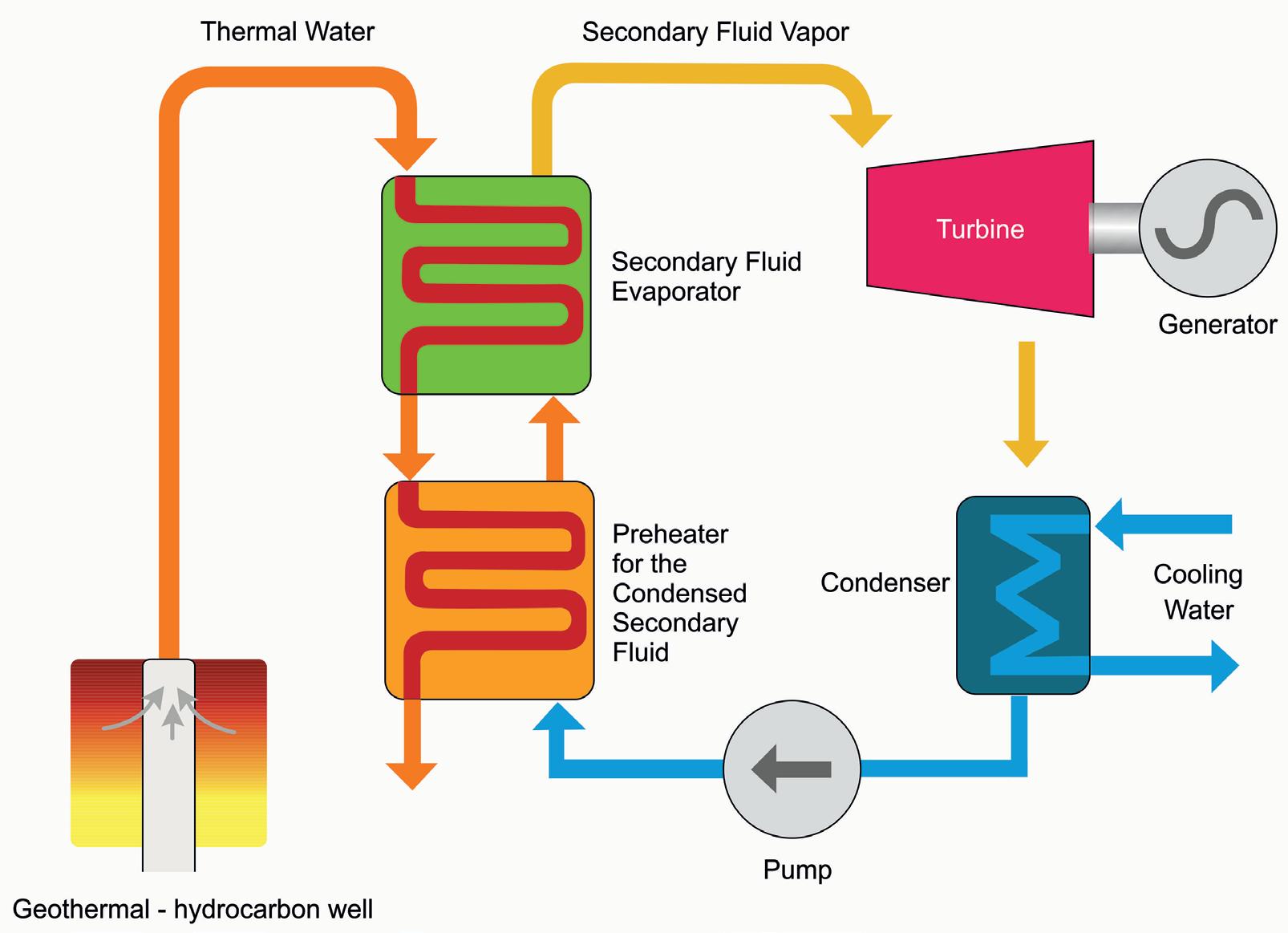
Lower temperature systems were not generally considered for electric power production until 1980-1985, when a technological advancement applied the organic Rankine cycle binary plants to produce electric power from geothermal energy (USA-DOE, 2006). Presently, there are binary plants that can produce electric power with fluids at temperatures as low as 90ºC (Hirahmah et al., 2025). The binary plants utilize a secondary fluid with boiling point below that of water and use the thermal water to heat the secondary fluid up to its boiling point to drive the turbine (Figure 1), commonly low-boiling point organic fluids are used (Tomarov & Shipkov, 2017; DiPippo, 2016).
In Mexico, mature oil and gas fields are characterized by a large amount of co-produced hot water because of the high geothermal gradient in most parts of the country (Prol-Ledesma & Morán-Zenteno, 2019). The co-produced water (in some cases ten times higher than oil production – https://sih.hidrocarburos.gob.mx/) cannot be released to the environment and represents an extra expense to the oil company. The waste thermal energy recovery from the co-produced water would be an economic option to produce electric power, while the wells are still producing oil and/or gas; otherwise, when the oil field is exhausted, the wells may be used as those in a geothermal reservoir to extract the remaining thermal energy. Research on geothermal exploitation in hydrocarbon fields has increased (Xiaolei et al., 2018; Nick et al., 2021; Watson et al., 2021); however, in Latin America only one geothermal plant is producing electric power simultaneously with hydrocarbon production (Franco et al., 2021).
The aim of this work is to evaluate the geothermal potential of the Comitas field (Burgos Basin) with the application of the volumetric method by estimating the reservoir parameters using the available geological information and the well data accessible from the oil company (Petróleos Mexicanos – PEMEX) reports. The geological characteristics of the basin and the temperatures at depth are available, as well as the characteristics of the La Yegua formation that is the reservoir for oil and gas in the Comitas field. It is located at approximately 72 km from the city of Reynosa, the short distance to a major city poses a large opportunity for electric power production and industrial direct use, this is especially important in this region where fossil fuels are the predominant energy source.
2. Geological setting of the Comitas oil field
Hydrocarbon exploitation is concentrated in the provinces located in the eastern part of Mexico and one of the most important oil provinces is Burgos Basin (NE Mexico) that has high dry gas production with only some wells producing small amounts of condensed hydrocarbons but more importantly, according to the System of Information on Hydrocarbons (CNIH-https://sih.hidrocarburos.gob.mx/) water production in the basin is almost 10 times higher than the gas condensate production, which supports the proposal of geothermal exploitation.
The Burgos Basin has geological favorability to store fluids, like dry gas, gas condensate and formation water, also has a geothermal gradient between 40 and 70°C/km (Prol-Ledesma & Morán-Zenteno, 2019). The conditions present in the Burgos Basin suggest the existence of a geothermal resource that can produce electric power with binary power plants. The Burgos Basin contains several gas-producing fields; among them, the Comitas field is an interesting area because there are many wells with depths between 2,000 and 3,000 meters (The well depths are referenced to the wellhead datum), that have temperatures within the range 100°C to 180°C and it has been geologically characterized to define the location and dimensions of the possible reservoir (Eguiluz de Antuñano, 2009, 2011a,b).
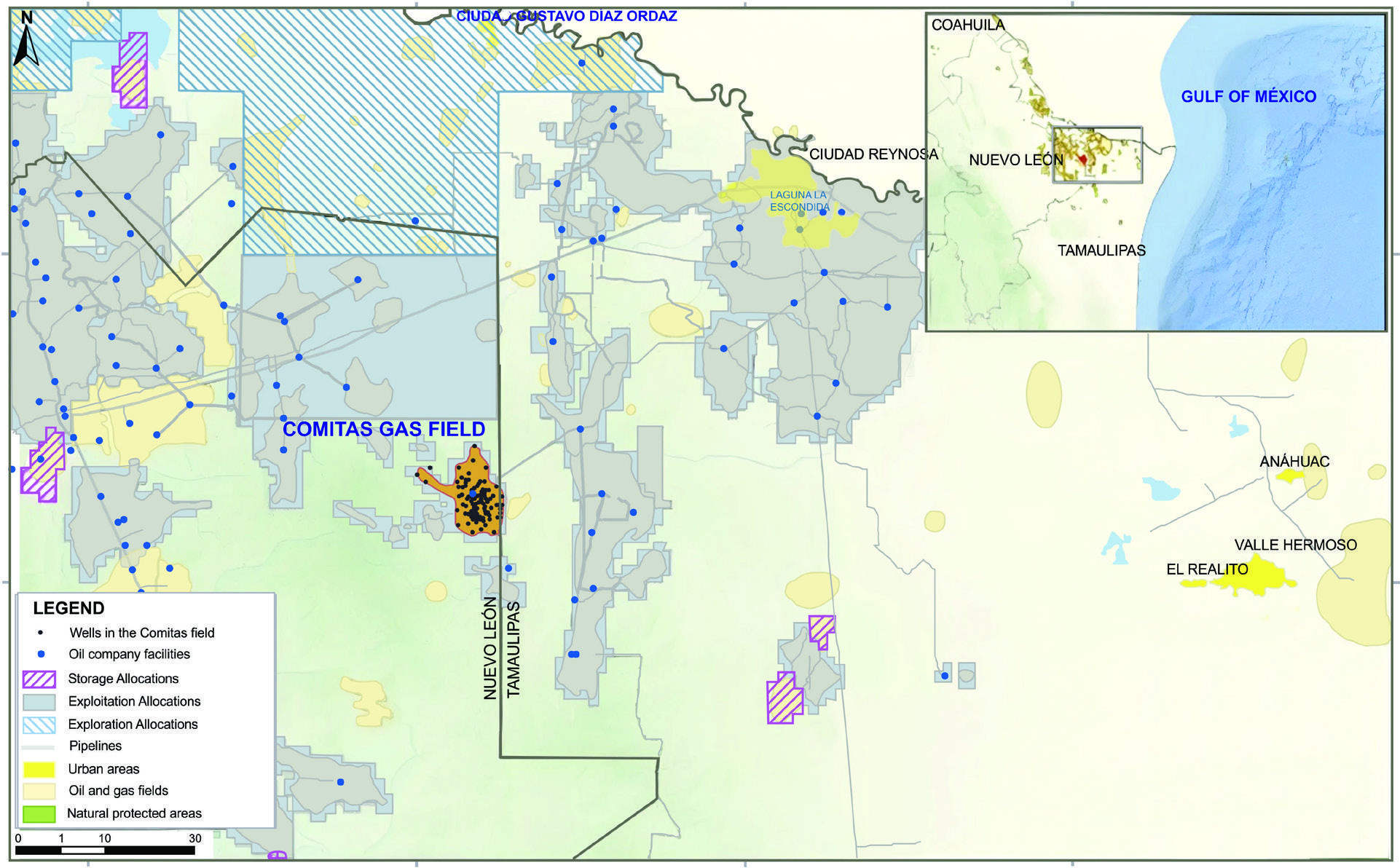
The Comitas gas field is located in NE Mexico (Figure 2) between the states of Nuevo León and Tamaulipas (latitude 25.7549349 N and longitude -98.609181W) with an extension of approximately 39 km2. The Comitas field has 120 gas producer wells (out of a total of 132 wells; CNIH, 2025) with depths between 2,000 and 3,000 m, that currently produce a mix of water and gas. The oil exploration in this field started in 2000, and the geological surveys (2009 – 2011) allowed the identification of the net pay intervals with a reservoir thickness of 50 to 100 m (Eguiluz de Antuñano, 2009) related with the relative motion along the listric faults J and N (see Figure 3). The measured geothermal gradient varies between 40 and 50 °C/km within the Comitas field (Eguiluz de Antuñano, 2009) that is within the range reported for the Burgos Basin of 40 and 70°C/km (Prol-Ledesma & Morán-Zenteno, 2019).
The reservoir corresponds to the Yegua formation, one of the most important formations for hydrocarbon production. The Yegua Formation is formed by Eocene-Oligocene sediments from the Sierra Madre Oriental (SMO) deposited in a basin environment overlying the Queen City formation and overlaid by a clay seal from the Jackson formation that presents a discontinuity at 39.5 million years and buried part of the formation that was overlaid by more recent sediments with thickness between 50 and 250 m; these sediments formed the reservoir of hydrocarbons and water (Eguiluz de Antuñano, 2009). The Yegua formation is divided into three units: the lower, the middle and the upper Yegua units. The lower unit is formed by sandstone deposited in a near shore environment of a highstand systems tract (HST), and the top is truncated by an unconformity at around 39.5 Ma. The middle unit is a complex facies of basin-floor fan sandstones, channels, and unconformities. The upper unit is formed predominantly by sandstones deposited in a near shore environment and underlies the base of the Jackson Formation (Eguiluz de Antuñano, 2011a).
The Yegua formation was probably the result of the influx of sediments from the Gulf of Mexico due to the Laramide orogeny and the NE Mexico deformation (Eguiluz de Antuñano, 2011a).
The geological cross section of the Comitas field (Figure 3) shows the relationship of the reservoir with the Yegua superior formation, and the downward displacement produced by the faults Y, J, and N. This displacement produces a thickening of the Yegua and Jackson formations that adds to the reservoir volume (rectangle in Figure 3).
3. Methodology
The accepted method to evaluate the geothermal energy potential of a hydrothermal system, especially in the reconnaissance stage, is the volumetric method also denominated as “heat in place”, that was initially proposed by Muffler & Cataldi (1979) and further adapted to the use of binary plants for the medium enthalpy hydrothermal systems by Garg & Combs (2015).
The evaluation of the potential of a geothermal system is a continuous process (Garg & Combs, 2010) that improves as more reservoir data are available; however, during the exploration process it is useful to have preliminary assessments of the energy potential of the prospect, even if the uncertainty is relatively large. In many projects, the decision of future advanced exploration in a prospect is influenced by the preliminary evaluations of the system. Further evaluations with the volumetric method have been conducted in producing fields during exploitation to compare with previous evaluations to refine the estimation for future production, as in Ahuachapán in El Salvador (Turner, 1969; Bodvarsson and Bolton, 1971; MacNitt, 1978), in some geothermal fields in the Great Basin (Williams, 2014); in the Sumikawa geothermal field (Garg & Combs, 2015), and in the Cerro Prieto and Las Tres Vírgenes geothermal fields (Prol-Ledesma et al. 2016). In the case of the Comitas field, the estimation of the potential relies on the available data and is aimed to show the possibility of electric energy production as a by-product of the hydrocarbon exploitation.
The volumetric method is based on the calculation of the thermal energy that can be economically extracted from the reservoir by estimating the volume, heat capacity of the reservoir and the temperature change from the initial reservoir stage to the reference temperature of the secondary fluid, in the case of exploitation using a binary plant (Eq. 1, Garg & Combs, 2015).
where, QR= thermal energy contained in the reservoir V-Volume of the reservoir ρ-rock density of the reservoir rocks c-heat capacity of the reservoir rocks ϕ porosity of the reservoir rocks TR-Initial temperature of the system Tr Reference temperature of the secondary fluid.
After the calculation of the amount of the available thermal energy in the reservoir, the maximum work (WA) available for a binary cycle plant is calculated using Equation 2 proposed by Garg & Combs (2015) that considers that the maximum energy output per unit mass of the secondary fluid is related with its enthalpy and entropy at the turbine inlet conditions and the exit conditions:
where: TR-Reservoir temperature Tp- Pinch point Temperature Tc-Condenser temperature Tb-Bubble temperature of the secondary fluid a - Recovery factor given the thermal energy stored in the reservoir hsfg(Tb) enthalpy and bubble temperature of the secondary fluid (gas state) hsfl(Tc) - Secondary fluid enthalpy (liquid state) at condenser temperature TcK condenser temperature in Kelvin degrees Ssfg(Tb) Secondary fluid enthalpy (gas state) at the bubble temperature of the secondary fluid Ssfl(Tc) -Secondary fluid enthalpy (liquid state) at the condenser temperature Vsf(Tc,psfb) - Secondary fluid specific volume at the condenser temperature and bubble pressure pin-Turbine inlet pressure psfb(Tc) - Secondary fluid pressure at the condenser temperature.
The maximum work available (WA) from the Exergy equation for a binary cycle is related to the electric energy (E) that may be produced by the Conversion efficiency (η) (Muffler & Cataldi, 1979; DiPippo, 2008; Williams, 2014; Garg & Combs, 2015). This utilization factor has a value between 70 to 80 % (Garg & Combs, 2015). Therefore, the output power is evaluated considering the efficiency of the binary plant that will be used for transforming the thermal energy in electric energy (Eq. 3).
The selection of the secondary fluid and the pressure conditions are highly important in the evaluation of the energy potential of a hydrothermal system for exploitation with a binary cycle plant because those values are fundamental in the process of thermal energy exchange between the thermal fluid and the secondary fluid. In this case, the temperature and pressure of the thermal fluid indicates that Isobutane is appropriate as the secondary fluid (Garg & Combs, 2015). This fluid is commonly used in geothermal projects because it is not expensive and is highly efficient at the temperature and pressure of low- and medium- enthalpy hydrothermal systems (DiPippo, 2012). The secondary pressure is set to correspond to the saturation conditions (pressure and temperature) of the secondary fluid that are determined from laboratory data (NIST) or thermodynamic tables (Garg & Combs, 2015).
The uncertainty of the estimation of parameters as volume and temperature of the reservoir, recovery factor and efficiency of the process must be evaluated using probability density functions, which are calculated using the Montecarlo application to appraise the energy potential of the system (Garg & Combs, 2010). The Montecarlo method was applied with a rectangular distribution considering the minimum and maximum value estimated for the reservoir parameters presented in the Input Data section.
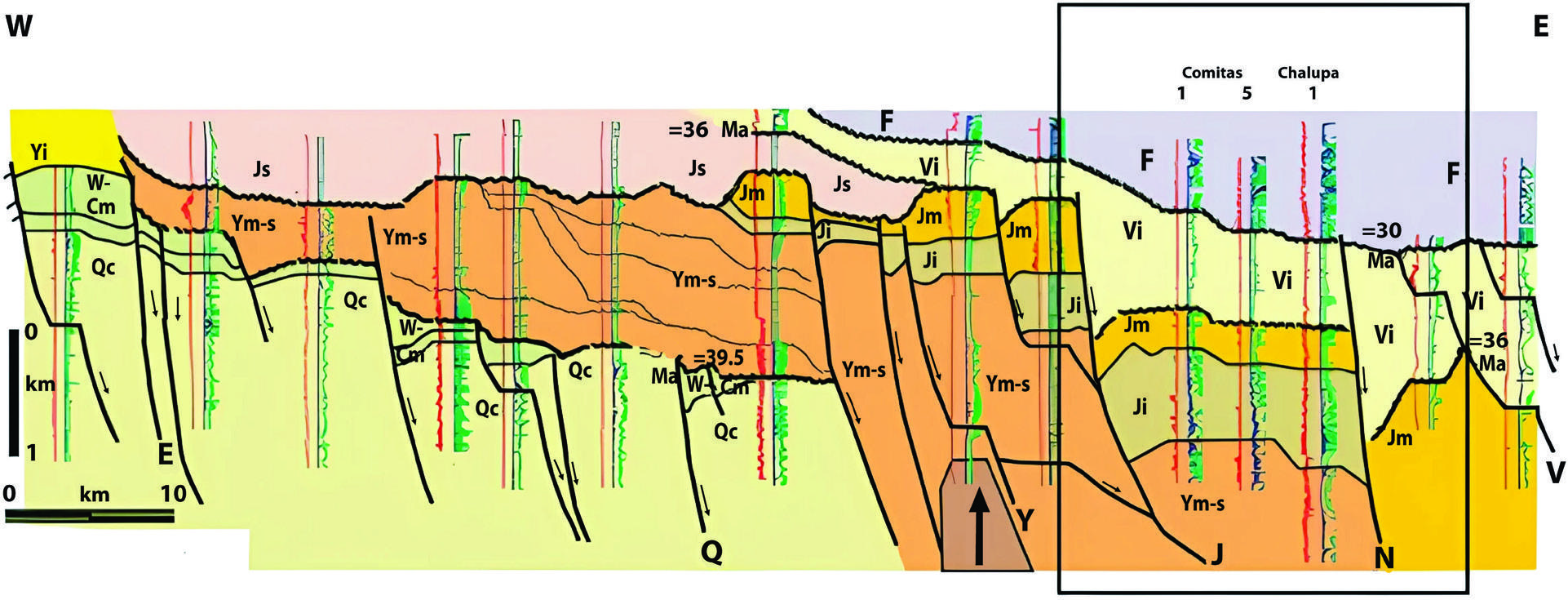
Figure 3. Geologic section across the Comitas field (Modified after Eguiluz de Antuñano, 2009, 2011). Formations: Queen City (Qc); Weches y Cook Mountain (W-Cm), Yegua inferior (Yi), Yegua intermed. and superior (Ym-s), Jackson inferior (Ji), Jackson med. (Jm), Jackson superior (Js), Vicksburg (Vi), Frío indiferenciado (F), Catahoula (Ca). Expansion faults: Eoceno (E), Yegua (Y), Jackson (J), Vicksburg (V). This figure was based on the correlation of the following well logs: gamma rays, resistivity and porosity (Eguiluz de Antuñano, 2009, 2011). (Well numbers are not included because they were not identified in the original reference).
4. Input Data
The input data (Table 1) were obtained from the available reported information: the volume, porosity, density of the reservoir were estimated from the geological model proposed by Eguiluz de Antuñano (2009, 2011a,b). The reservoir fluid was represented as a mixture of water and hydrocarbon-gas with a saturation from 60 to 100% as reported by CNIH. The recovery factor was defined between 0.1 and 0.25 as suggested by Williams (2014) for sedimentary reservoirs. The secondary fluid is represented by Isobutane with 20 bar as input pressure (Pin) and saturation temperature of Tb= 100.36 °C. The secondary fluid (isobutane) is assumed to be saturated in the turbine with a temperature difference ΔT of 5°C; therefore, Tp=105.36 °C (Garg & Combs, 2015). The properties of the isobutane that are required to calculate the energy produced by the binary plant were obtained from the thermodynamic tables (Waxman & Klein, 1980).
The uncertainty in the prospect parameters requires a probabilistic evaluation of the resource potential, and the Montecarlo method is commonly used in the volumetric assessment of geothermal resources.
Table 1. Parameters used in the evaluation of the Comitas Field using the volumetric method. Data sources: Comisión Nacional de Hidrocarburos (CINH; CNIH, 2024), Eguiluz 2009 (E), Toht y Bobok 2017 (To; Toht & Bobok, 2017), Cengel Y (C; Cengel & Boles, 2012), Thermal properties of the Isobutane: Waxman 1980 (TPTI), Garg y Combs 2015 (GC).
| Parameters of the prospect | Minimum value | Maximum value | Reference |
|---|---|---|---|
| Area (km) | 39 | 50 | CINH (CNIH, 2024) |
| Depth (m) | 2500 | 3000 | Eguiluz |
| Thickness (m) | 50 | 150 | E |
| Geoth. Grad. (°C/km) | 40 | 50 | E |
| Temperature res. (TR) (°C) | 120 | 180 | E and CINH |
| Recovery factor (%) | 0.05 | 0.25 | E |
| Water saturation (%) | 60 | 100 | E and CINH |
| Mean values | |||
| Porosity (%) | 18 | 18 | E |
| Heat capacity (kJ/kg°C) | rock = 0.87 | To | |
| Heat capacity (kJ/kg°C) | water = 4.2 | To (Toht & Bobok, 2017) and C (Cengel & Boles, 2012) | |
| Gas = 1.28 | |||
| Temperature ref. (Tr) (°C) | 100.36 | TPTI | |
| Density–rock (kg/m3) | 2300 | Toth | |
| Density–water (kg/m3) | 1052 | C (Cengel & Boles, 2012) | |
| Density–gas (kg/m3) | 211 | C (Cengel & Boles, 2012) | |
| Conversion efficiency (%) | 77 | GC | |
| Plant factor (%) | 90 | GC | |
| Life (sec)-30 years | 933120000 | GC |
5. Results and discussion
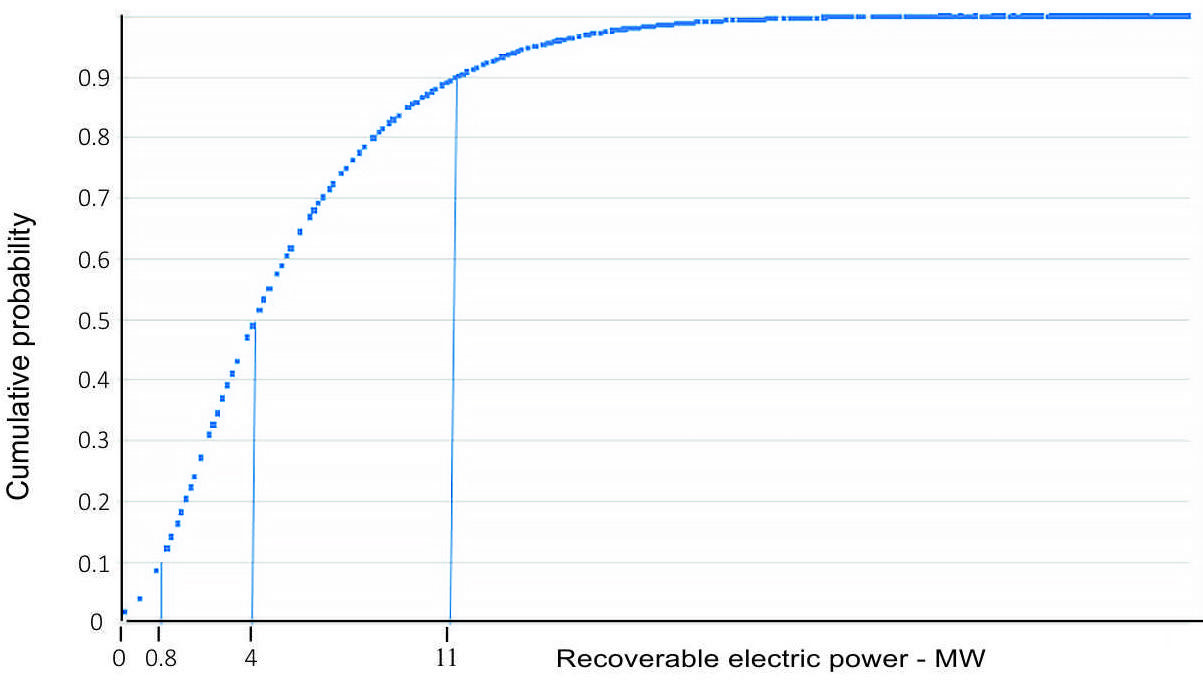
The Montecarlo method (Shah et al., 2018) was applied to estimate the geothermal potential for electric power production with a binary plant using the parameters shown in Table 1 for 100,000 repetitions. The results for Montecarlo methodology cumulative probability are shown in Figure 4.
Table 2 presents the electric power production potential for three probability values: 10, 50 and 90.
The results obtained indicate that the highest probability (90%) corresponds to a production of approximately 1 MW and the 50% to 4 MW. It is important to consider that the Comitas oil field is one of the smallest fields in the Cuenca de Burgos oil province, and the amount of energy that it is feasible to produce only in this prospect would provide enough electric power to a small town in this area of approximately 4,000 households (the commonly accepted energy consumption average parameter is that 1000 households can be supplied by 1 MW electric power). Additionally to this electric power generation, agricultural and climatization projects for direct use of the geothermal resource would be an important contribution to the energy mix in this region that is highly dependent of fossil fuels.
Additionally to the electric energy production, the Cuenca de Burgos hosts a growing food processing industry that would benefit of geothermal direct use such as fruits and vegetables geothermal dehydration; additionally, climatization is an important energy use in the region and the use of geothermal climatization would significantly lower the electric energy demand for this purpose.
6. Conclusions
The results of this study prove the possibility of exploiting the geothermal resources in an area with hydrocarbons exploitation, which would reduce the cost of geothermal energy production as the wells drilled for hydrocarbons exploitation would be used to produce clean electric power and the waste fluids may be used in diverse direct uses of geothermal energy. The most important contribution of this study is that it proves the viability of extending the use of oil wells in Mexico for geothermal energy exploitation. Presently, there are more than 20,000 drilled oil wells, and most of them could be used for geothermal energy production because of the high geothermal gradient in most oil provinces (Prol-Ledesma & Morán-Zenteno, 2019).

