


 (pdf)
(pdf)


 SciELO
  SciELO
 Permalink
Introduction
International mobility has become a common practice as a result of globalization in recent years, where some nationalities, such as Haitians, Venezuelans, and Bolivians in Latin America, stand out in search of a new life in other countries such as Brazil, Chile, Canada, the United States, Mexico (Cavalcanti, Oliveira and De Macedo, 2020; Exime, 2023). Haitians in particular, due to the challenges of climate change, unemployment, and political crises that increase hunger, poverty, food insecurity, social inequalities, as well as the lack of resources that are multiplied by corruption, drive international mobility (Lanza and Lemes, 2023; Gabellus and Paul, 2023).
As such, they are unable to remain in their own country due to Haiti's natural, social, and cultural calamities. Haiti is located in Central America, specifically in the Caribbean Sea, which shares a land border with the Dominican Republic. The small Spanish island country has approximately 11 million inhabitants, 60 per cent of whom live in extreme poverty and suffer from hunger, especially after the 2010 earthquake that devastated the country (Exime, 2021; Rasul, Rouzier and Sufra, 2022; Exime and Barbosa Filho, 2024).
January 12, 2010, marked the saddest and most devastating moment in the history of the Republic of Haiti (Exime, 2021). The immense sadness of Haitians became palpable throughout the world as the tragedy unfolded in the distance; international organizations and neighboring countries expressed their sorrow at the country's situation. Consequently, this situation affected the economy, the state, and all the institutions of Haitian society, considering a small country already plunged into an economic crisis that depended on agriculture and local businesses, as well as organizations to remain functional, since then, considerable aid from the Haitian diaspora in the world has increased through remittances (Klassen and Murphy, 2020; Cavalcanti, Oliveira and Silva, 2021; Exime, 2024).
The second source of financial resources is considered to come from abroad, through the “diaspora”, i.e. Haitians living in other countries to work or study, who send financial resources to relatives or friends living in the country to meet their basic needs. The amount received was 3,214.47 million dollars in 2018. In the Brazilian context, remittances reached 90.9 million dollars in 2021, thus putting Brazil in the sight of many of the Haitians who urgently needed to leave in search of a better life (Cavalcanti, Oliveira and Silva, 2021). Brazil has become one of the favorite destinations for Haitians in South America and currently has 149,085 Haitian immigrants (Cavalcanti, Oliveira and Silva, 2021).
In addition, the calamities, the insecurity produced by a failed state, and the violence between armed gangs in the metropolitan area of Port-au-Prince have contributed to the internal displacement of hundreds of Haitians. It is estimated that 171 thousand Haitians have left the major cities, especially the country's capital. All these issues have led to the forced international mobility of Haitians in search of quality of life (Exime, Gonzalez and Ahlert, 2022). In this process, Brazil has become the second home of Haitians, but they face enormous difficulties such as unemployment, particularly during the Covid-19 pandemic, ranging between 10 and 13.7 per cent, according to the Brazilian Institute of Geography and Statistics (IBGE). In the context of the new SARS-CoV-2 coronavirus, which emerged in Wuhan, China, causing Covid-19, it has affected daily life and global economies in all countries of the world, as pointed out in the researchers' research (Silva, Machado and Oliveira, 2020; Romero and Silva, 2020).
In addition to this crisis, immigrants face discrimination, racial prejudice, language barriers, and cultural adaptations. In this context, solidarity has emerged as a crucial aspect in dealing with the collective challenges faced by Haitian immigrants in Brazil. In addition, racial and ethnic factors compound the challenges, underlining the limitations of affirmative action policies in combating prejudice and discrimination (Santos, 1993; BRASIL, 1989). In this complex landscape, the original context of solidarity among immigrants, rooted in Durkheim's functionalist theory, provides a theoretical lens for understanding and navigating the dynamics of immigration based on collective support (Durkheim, 1999; Linares, 2012).
In this way, the solidarity proposal already presented in the previous article. View first article, Exime (2023), called IMMIGRATORY INFORMATIVE SOLIDARITY, has played a significant role in helping Haitians face these challenges. Thus, the continuation of this conceptual proposal allows us to reflect broadly on this issue, which led to a second investigation, encompassing solidarity among Haitians and their stay in Brazil. In this sense, the second article on this concept must maintain the initial theoretical discussions and broaden the object of the research to other groups of participants. The theoretical basis of the in-depth article is presented below.
Review and theoretical understanding of the theme of solidarity
The Functionalist theory allows us to analyze society, social classes, and the factors that impact its growth, from institutions to the behavior of individuals in society. At this point, our concern is to discuss the most important points of a specific author, respecting other theorists who contributed to the construction of the Functionalism theory, one of which is the French Émile Durkheim, for whom:
Functionalism strongly influenced social theories until the 1980s, becoming the hegemonic method in sociology during this period. Its major philosophers in social theory were Émile Durkheim, Talcott Parson, and Robert Merton. Far beyond the impact on the very constitution of sociology as an academic discipline, these authors influenced the way social relations were seen and the questions that arose from this view. Undoubtedly, Functionalism had a profound influence on the theories that sought to explain the modernization process of the “less developed” or “developing” countries. Considering this strong influence, especially Parsons, in Modernization Theories, we can see that the major problems posed by this theory refer to matters of order and integration ... (Dos Reis, 2016, p. 8).
Concerning this process, developing and underdeveloped countries have a big problem related to social structures, integrating, in general, besides economic situations, inequalities as a fundamental point to rethink solidarity. Thus, this discussion requires a greater understanding of the Functionalist theory for its main ramifications under the light of Mechanical and Organic Solidarity. For Émile Durkheim, solidarity has its basis in consensus, which allows people to commit to society, allowing the idea of collectivity to circulate among people. In this respect, we must understand that the emergence of a problem or the appearance of difficulty makes it possible for society to become part of the context of continuous evolution. As for the proper functioning of the system that exists there or is available for people to build a balanced social system is necessary a clear way to develop the values of solidarity (Linares, 2012; Silveira, Luz, and da Silva Ramos, 2023).
Émile Durkheim's theory helps us with the division and explanation of two forms of solidarity: the mechanical and the organic. However, it is understood that these two concepts treated in the work On the Division of Social Labor, in 1893, have not had the proper appreciation in theoretical analysis since its publication. It is only in the last few decades that a movement has begun to rescue their value and importance, as shown by De Vares,
... In the first place, we address the concepts of Mechanical and Organic Solidarity, emphasizing their importance for the main ideas developed by the author in his doctoral thesis; in the second place, we rescue the main criticisms directed to the supposed “abandonment” of these interpretative keys in his final works; and, in the third and last moment, we intend to demonstrate, from the analysis of some of his works, that Durkheim never abandoned his original premises, and that the failure to employ them again in no way invalidates the importance of these concepts for the development of his sociological theory (De Vares, 2013, p. 150).
Max already brought the idea of the union of workers that connects with the theory under discussion. Without the purpose of analyzing or explaining social facts, one must consider that sociology has much to do with social facts and the daily events of everyone, reaching, therefore, the purpose of the smooth functioning of society (De Queiroz, 1995). It is expressed through the work factor, which encourages reciprocity between individuals, cooperating to improve the social aspects of certain groups in need. (Da Silva, 2021).
In the pre-capitalist context, which involved perception, especially in what each occupation consists of to make a society function, even if there was no high degree of complexity of work in Mechanical Solidarity. From this, the soy relied on traditions, especially in the productive context. An important fact is the simplicity of societies before capitalism, where certain people in society knew where all the products of their needs came from, the manufacturing processes, and the construction, since they did not depend much on other sectors (Durkheim, 1999).
According to Durkheim's theory, today we live in an Organic society in which society works like the human body, in which the lack of an organ, this body would stop working or would have serious problems, causing an interdependent process. Today, with its high degree of division of labor, there is a lack of knowledge about the work process, which leads society to be much more individualistic. So, any impact in one sector can interfere with another. For example, the current Covid-19 crisis in the world directly implies the functioning of life in society, (Guadagno, 2020; Da Silva, 2021). From the perspective of Émile Durkheim's Organic Solidarity, the debate about the phenomenon of individualism and the modernity of labor capitalism opens, becoming a very present discussion in the 21st century (Durkheim, 1999).
Starting from the idea of a well-functioning human body, the extremely necessary idea of adding another type of solidarity called INFORMATIVE IMMIGRATORY SOLIDARITY, emerged. The informative immigration solidarity aims to present a type of cooperation among immigrants, based on information sharing, to improve life from the informative collective. Because of this, one of the immigrants' difficulties is to choose the city that will be their home during the first months in the foreign country. The formation of an informative network makes it less challenging to adapt to life and serves as a marketing tool for the exchange of useful information in the immigration process.
In this perspective, the transformation of the world goes through changes throughout the past centuries, where it is fundamental to emphasize the objective of sharing, cooperating, and emphasizing collectivism, for a cohesive society, in the sense of fighting together for a better world (Durkheim, 1997; 1999; 2000; Exime, Pallú and Plein, 2021a; Yusrifa and Murtiningsih, 2023). All this should necessarily be linked to improved income distribution; access to jobs anywhere in the world; fighting poverty; reduction of inequalities; and respect for the human being, constantly in any part of the universe.
This theory, with its essential focus on solidarity, guides the logic of the analysis of the individualism issue as an obstruction to the progress of immigrants, because in an Organic society, everyone is interconnected and interdependent (Durkheim, 1997; Durkheim, 2000). By interpretation, we understand IMMIGRATORY INFORMATIVE SOLIDARITY as a set of aids, of dissemination through digital communication channels (WhatsApp, Facebook, and phones) based on the sharing of relevant information, which helps immigrants to find jobs, buy goods, rent, promotional products, scholarships, vocational courses, and others.
Therefore, it is a problem of social and racial equity, a lack of ethnic social policy aligned to immigrants in Brazil, this is a problem of ethnicity embedded in Brazilian society, even before the immigration fluxes. It is noted that the racial problem that overflows under the immigrants in the question of equal opportunities, is an issue that is configured in the Brazilian constitution of 1988, two articles stand out (Silva and Santiago, 2016; Segatto, Alves and Pineda, 2023). The first is related to the victory of Black people referring to Article 4, item VIII and Article 5, item XLII that help in the promotion of acts of social inequality, race, and sexes, to combat and eliminate discrimination (Santos, 2018).
Those were victories demanded by the Black movements of the time to deal with problems not only racial but also unemployment, unequal positions, lower salaries, and even exercising the same professions or having identical qualifications to whites (Santos, 1993). In this perspective, Law 10.639/2003 stands out, having contributed to press the Brazilian State to take sides with not only the implementation of the same but to work so that this ethnic policy of equality could be respected daily at the conjuncture of the right of all through equality. (Santos, 2018; De Araújo, Nogueira and Guerra, 2023). As Oliveira (2017), demonstrates, the formation of the Brazilian nation-state is naturally formed by a mixture of racial ethnicities, black, brown, white, and Indigenous. From this, the forgetting or silencing of the groups that contributed to the formation of the State is a matter of social injustice of less equity that pushes poverty to the present day (Albuquerque and Lima, 2011; Silva and Santiago, 2016).
The role of ethnic policies to the less favored for the equality of rights in Brazil is a present social reality, but still short of reach. The ethnic equality of the Brazilian Black population was transformed into concrete actions after the government of Fernando Henrique Cardoso in 1995 (Santos, 2010). Already in the subsequent government of Luiz Inácio Lula da Silva in (2003), resulted in the creation of the Special Secretariat for Policies to Promote Racial Equality (SEPPIR), seeking to acknowledge the existing inequality of racial ethnicity to give voices to the black population that still suffering today with discrimination and prejudice (Ribeiro, 2006; Cordovil, 2014; Silva and Santiago, 2016; Santos, 2018). With everything, it states that it is a social imbalance with political aspects that help the growth of inequalities between groups of Black people (Draibe, 1993).
According to the demographic census produced in 2010, Brazil is a country that is characterized mostly non-white with a population of 50.7 per cent between blacks and browns, and another 49.3 per cent whites, yellows, and indigenous (IBGE, 2010), currently in 2022, the country would be with approximately 54 per cent blacks, which includes immigrants residing in the Brazilian territory. Looking at this percentage, it understands that more initiatives are needed, such as the IMMIGRATORY INFORMATIVE SOLIDARITY, therefore, it would be outsourcing the role of the State in the fight against discrimination and prejudice.
In this way, prejudice is understood as (...) a negative predisposition directed at people, groups of people, or social institutions (Jaccoud and Beghin, 2002, p. 35). To achieve this purpose, the same authors state
Affirmative action policies are not the only necessary initiatives to promote greater racial equality in the country. But they would be essential to achieve objectives that cannot be reached by repressive anti-discrimination measures, by universal policies, or by valorizing actions. By promoting a greater presence of the black population in the different public and private sectors of national life, affirmative action policies would act as “solidarity chains” to reverse historical processes of exclusion. The combat against unacceptable indices of racial inequality and the promotion of equal opportunities must confront the discriminatory acts that run through institutional and individual decisions that materialize in racist preferences, whether in the field of education, hiring, or professional advancement (Jaccoud and Beghin, 2002, p. 49).
Based on this, to encourage inclusion among citizens, it should be interesting to consider this starting point to better interest the insertion of the presence of black people in government positions, in addition to boosting increased awareness in private sectors in this fight against ethnic racial prejudice. In the case, of immigration in Brazil, it believes that the need for proposal in the perspective of affirmative action, which in turn aims at equal opportunity for the less favored (De Lima Linhares, 2023).
Affirmative action began in fact from 1990 until 2003, to balance opportunities through differential treatment focusing on political, economic, and social measures for historically discredited and discriminated groups (Bernardino-Costa, Borges and Ferreira, 2023). In this way, the government proposed publishing affirmative action policies to help these groups rise and acquire the ability to compete equally in society with whites (Jaccoud and Beghin, 2002). This debate that prioritized the proposals to solve these issues of inequality took place in the context when Brazilian society was facing a poverty rate that exceeded 20 per cent, so it was a political measure of inclusion that eventually became affirmative action to push for ethnic equality. (Campello, 2017).
In the current case, the social reality in the Brazilian context, where the Haitians are inserted, besides problems with low pay, the racial issue must be considered, since it is an all-Black group. As Santos (1993) states, the salaries of less favored groups are extremely low related to work performed, even with equal professions and abilities. With everything, the racial ethnicity in Brazil can general distinct remunerations due to the discriminations and prejudices of a diverse group as the immigrants, in what concerns him victim who need to overcome the ethnic barriers of the society, be it blacks, Indians and immigrants whom every day seek a way out of these problems. (Rocha, 2000; Dos Santos, Oliveira Penteado and de Lima Brum, 2023).
These barriers, interconnected with the absence of measures against ethnic racial challenges in the Brazilian national context, end up affecting these groups of people who seek to improve their lives. From this, it is understood that solidarity can help contemplate where it does not reach the current policies or those that are configured only in roles as projects that could help in the conservation of the very ethnic identity of the subjects involved, that is, in a local, (inter)national conjuncture, since we are dealing with black people coming from other countries (Shulman, 1998). Thus, this ethnic issue in a continental context, and not only in Brazil, needs an urgent revolution for the evolution of treatment, of ethnic policy plans.
From the point of view of solidarity, the importance of the role of social integration is emphasized in the perspective of looking at groups that are often despised, such as the blacks and the Indians, in this way the groups seek the possibilities of recognition of their work, their abilities, besides respecting their identity as a people without prejudice and discrimination (Calhoun, 1993; Oliveira, Silva and Mendes, 2023).
From this, it is necessary to think of solidarity as part of the motor force for empowerment, the boosting of these excluded groups through inclusion, without their race, ethnicity, or color being an obstacle to this (Segatto, Alves and Pineda, 2023). From the political point of view or governmental actions, one is inclined to agree with Esman (2018), in thinking that the problems of ethnicity, of ethnic politics, can be solved through the undertaking coming from politicians, but the opposite happens in most societies, such as, for example, the Brazilian one.
Now, solidarity depends on the society, be it of several ethnicities or a single ethnicity, at the same time the lack of this solidarity ends up frustrating the most necessary. The adaptation of Émile Durkheim's theory, in the current context, is essential, especially in the social aspect of the 21st century, where the organization of society is important for political, economic, and social problems. With everything, one must agree with the ambiguity of Durkheim's attitude, in the sense of offering margins of interpretation to help explain, deal with, and understand the challenges of society and not in fact in a perspective of uncertainty (Dos Santos, Oliveira Penteado and de Lima Brum, 2023).
One can use this form of solidarity to improve the lives of immigrants in the general sense, however, it is characterized, therefore, as one of the pillars of dissemination to boost information about life and the problems faced. This way, one can see the importance of improving the image of immigrants, especially how the subject is seen in society, thus, it would be possible to know the culture of those involved, since the IMMIGRATORY INFORMATIVE SOLIDARITY needs people joining together to work in the form of sharing networks, like the members of a body according to what Durkheim (1997), said.
The process of transferring and sharing information plays a fundamental role in the lives of immigrants, aligned to avoid unemployment, frustration, heartbreak, misery, poverty, and hunger that have been occurring in less developed countries. The notion of IMMIGRATORY INFORMATIVE SOLIDARITY in the immigration context remains, necessary to the adaptation process in society so that the immigrant can reach his goals; and that the work, and education factor can reign to improve the immigrants' lives.
In this sense, the conceptual proposal of the theory of functionalism is innovative, especially since the first introductory article of this concept, so it is necessary to know more about the country of origin of the subjects that led to this conceptual proposal (Exime, 2023). This logic of informational immigration solidarity simultaneously perpetuates social solidarity among Haitians in Brazil.
The Republic of Haiti is located in a relatively small area of 27,750 km², and its economy is based on agriculture; however, despite this base, one of its main problems is the lack of food. In addition to the worsening political crisis in the country, the lack of food has led to the formation of a culture of permanent destruction that can be summed up by the expression “Koupe Tèt, Boule Kay”, in Portuguese, “cut off heads, burn houses”. This expression is famous on the streets of Haiti and in the minds of the inhabitants because it represents a culture of violence that encompasses hunger and poverty and leads to the inevitable movement of Haitians around the world, especially in Brazil.
Haitian citizens leave their country in search of a way to satisfy their hunger for food, medicine, hospitals, drinking water, clothes, work, and human dignity. Therefore, defining hunger in Haiti is a great challenge, because Haitian hunger is the lack of everything, including prospects for the future. For Ribeiro (2016, p. 64), “hunger is malnutrition is”, an interpretation that considers only the physiological condition, but the hungry person, as Santos (2018) explains, also has needs, experiences humiliation, lacks money and opportunities, expressions that reveal a life immersed in misery.
Like Haiti, countries such as Ghana, Nepal, Bolivia, and Rwanda are considered economically fragile and vulnerable (Babones, 2005), where hunger is linked not only to the lack of quality food, but also to the absence of public policies (Monteiro, 2020), which associates poverty with a lack of employment, low income, and other socio-economic aspects. Reinforcing this idea, Dallmann (2018, p. 213) argues that being poor is more than a question of income, it is “the lack of access to everything that society has produced that is best for us to live with dignity”, including access to quality education, health, and essential services.
In the case of Haiti, poverty is also associated with a lack of care for the environment, and agricultural practices that affect nature and directly imply a shortage of agricultural products to meet the needs of the people. According to Fontana (2014, p. 53), poverty usually “associates environmental degradation (...) with the dissolution of their collective identities, their social solidarity and their traditional practices”. In other words, the culture of deforestation legitimizes hunger.
In this respect, there is no denying the impact of the colonial legacies that underdeveloped countries have had, particularly Haiti, which has been plunged into debt repayments for its independence, taking out high-interest loans and suffering external invasions that have affected the country's sovereignty (Marques, 2017; Exime, 2021). These characteristics have made the country more vulnerable and poorer over the years and set it apart from other countries.
The evolution of these problems has left many Haitians with no options for living in the country and the expression "nou lèd, nou la" reveals this feeling of powerlessness, despair, and hopelessness. As a result, many choose to flee in search of human dignity to other countries, which they believe are better places to escape poverty (Marques, 2017). This is the immigration process, the choice of a country to live in or, as it is called in Haitian immigrant communities, the choice of a second home.
To elucidate migration, several verbs can help, such as move, displace, mobilize, transfer, or migrate in a given space, place, or territory, which, in their conjuncture, express the act of dependence, since the migratory process includes entry and permanence. Thus, migration can be made up of two main axes: leaving the country of origin for another, using any means of displacement or routes (emigration( and welcoming and arriving in another space (immigration. This second movement includes border requirements for those arriving as refugees or legal entry visas, with seals and stamps, by land, sea, and air (Oliveira, 2013; Oliveira, 2017; Exime, 2023).
As immigrants and protected by Normative Resolution No. 97 of January 12, 2012, of the Conselho Nacional de Imigração (CNIg), based on art. 16 of Law No. 6,815 of August 19, 1980, Haitian nationals were granted permanent visas, which led to the enactment of the new immigration law1 by the National Congress in 2017, which deals with entry, residence, refuge, work, and the rights of immigrants (BRASIL, 2017).
It is estimated that 1.3 million immigrants live in Brazil and Haitians are in second place, with 149,085 temporary and permanent immigrants, second only to Venezuelans with 172,306 (Cavalcanti, Oliveira and Silva, 2022). In the case of Haitians, it is worth noting that there has been a significant increase, as in 2019, data from the OBMigra 2019 Annual Report, reported that there were around 106,100 in Brazil (Simões, Cavalcanti and Pereda, 2019).
This flow of Haitian immigration has been intensifying since 2011 and 2012, when humanitarian visas were granted due to the 2010 earthquake (Cavalcanti, Oliveira and Silva, 2022; Exime, 2023). In addition, economic crises, insecurity, hunger and poverty, food insecurity, and natural disasters have accelerated Haitians' decision to leave their homeland. In this context, Haitians in Brazil seek and dream of a life of quality, dignity, and well-being. Due to the difficulty of achieving these goals, they seek social solidarity through IMMIGRATORY INFORMATIVE SOLIDARITY. In addition to this research, which confirmed solidarity among Haitian immigrants in Brazil as an important means of success in the workplace, integration, and dignified life (Exime, 2023), other researchers, such as Putnam (2007), have already stated that the success of immigrants is necessarily based on the formation and creation of solidarity. This is a clear way of boosting social integration in a given minority group (Stewart, 2023).
This last point is intrinsically linked to network theories, which emphasize the importance and necessity of individuals and groups in the construction of society. One of the pillars of these theories is the consensus that social relations cannot be isolated, and that interaction between people is fundamental, expanding to organizations, which seek units for certain purposes. Network theory highlights the importance of collaboration, the exchange of information and building trust between the actors involved, whether in organizations, communities or social movements. This perspective contrasts with individualism, highlighting the fundamental role of social ties in generating collective strength and promoting social cohesion (Granovetter, 1973; Castells, 1999; Bereczki, Benczik and Balogh, 2025). Thus, building solid social networks is essential for strengthening the social structure and promoting the integration of society.
Returning to informational immigration solidarity, it is believed that this practice among Haitian immigrants is really necessary to face the challenges of Brazilian society, which include low wages, discrimination, and acceptance of labor exploitation even with qualifications that the Brazilian labor market needs, consequently severely affecting the quality of life that immigrants came to Brazil to seek. In light of this reality, the proposal of informative immigration solidarity among immigrants plays the role of minimizing these situations. The research methodology is presented below.
Material and methodology
First, a characterization of the area studied is presented, allowing us to understand the locations of the participants involved in the research, then the research method, the research subjects, and how the data was obtained, which then allows us to make a quality analysis, as well as pointing out the limitations of the research. The purpose of this topic is to introduce the reader to the conditions in which the study was carried out.
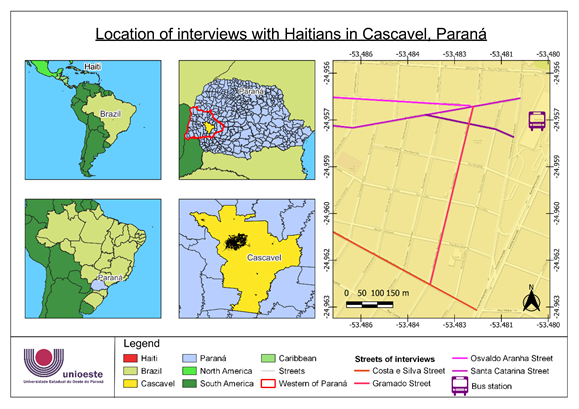
Source: elaborated by the author (2024).
Map 1 Field research locations in the city of Cascavel, Paraná, Brazil
Located in western Paraná, Brazil, the municipality of Cascavel has a population of 348,051 inhabitants, according to the 2022 census (IBGE, 2023). The city has an area of 2,091.199 km². The locations of the field research carried out on site are the bus station, where Haitians constantly visit a stationery store, facilitating meetings to talk. The other locations are the streets outlined on the map, which indicate the homes where the research interviews were conducted.
It focuses on studying the solidarity between immigrants in Brazil as a parameter of the subjects involved. To gather data, we first used a WhatsApp group called “Haitians in Brazil”. As this research continued, it was deemed necessary to use other data to solidify the discussions, which led to a second phase, also with Haitian subjects in the city of Cascavel, already characterized above. This research is qualitative, as it allows for a comprehensive and reflective approach to theories and results to conclude certain interpretations (De Oliveira, 2008).
Research methodologies
The main objective was to investigate the relationship between Haitians in the WhatsApp group (Haitians in Brazil) from the perspective of maintaining solidarity during and after the Covid-19 pandemic in Brazil. A secondary objective is to analyze the role of solidarity in other groups and communities with a strong presence of Haitians. We sought to answer the following questions: How can the existence of solidarity among Haitians be explained in the context of the pandemic and post-pandemic in Brazil? And the second question was, how can solidarity contribute to Brazil being the promised land for Haitians?
To respect scientific rigor, we first adopted the content analysis methodology, which helps to interpret documents in the form of messages, letters, and large volumes of reports, among others, with a comparative observational characteristic added for an in-depth understanding of the data. The possibility of this analysis is thorough because it has journalistic characteristics. This methodology is a set of techniques widely used in the media, establishing a commitment to the truth of the facts that allows a very broad and complex investigative process for researchers who intend to bring innovations to the research (Bardin, 1977).
The second methodology is characterized by interpretive social research, as it involves life stories based on in-depth open interviews, as well as describing, analyzing, and interpreting all forms of discourse, allowing for high-quality results. The analytical capacity of this methodology makes it possible to obtain reliable results and information, through data generated from the relationship and trust established between the researcher and the subjects interviewed, which is considered the basis for the life story method, i.e. the narrated story of the subject based on life events (Nogueira, de Barros and Araujo, 2017).
Data collection and research subjects
The first was a questionnaire previously validated in two previously published articles (view Exime, E. (2023), consisting of 17 questions answered by 35 Haitian citizens. The questions covered aspects of informational solidarity, immigration, the economic situation of Haitians during the pandemic and post-pandemic, and their perceptions of Brazil from the perspective of well-being, permanence in Brazil, and quality of life, among others.
The WhatsApp group “Haitians in Brazil”, made up of 40 people during the pandemic (currently in Jan. 2024, the group has 65 participants), 25 female and 40 male, for dissemination and request to fill in the survey questionnaire, between the months of June and July 2023.
The second stage was carried out with Haitian residents in the city of Cascavel-PR, Brazil, and involved 21 Haitian citizens, between August 12 and 25, 2024, using a single question in the form of an initial dialog, considering the life history of each interviewee, eight women, and 13 men. The research began in a semi-structural way, to listen to the subjects in depth, about who they are, where they come from, what their lives were like before Brazil, and, finally, a key question: how can solidarity contribute to Brazil being the "promised land" (analogy for social integration) for Haitians?
Analysis and limitations of the research
For the analysis, the MAXQDA tool was used, a world-leading software package for qualitative and mixed-methods research, which allows the analysis of data from various categories, such as structured interviews, semi-structured interviews, structuring based on keywords and questionnaires, among other data categories (MAXQDA, 2021; Exime, Nepomoceno and Silvestre, 2022). The data from the responses of the two moments were characterized considering the first article of the immigration information solidarity and pending the other categories that may arise, such as jobs, and salaries, among others. The data will be presented in graphs, tables, etc. During the discussions, it is intended to keep some statements and findings from the interviews in Haitian Creole to make the results more faithful. Participants will be referred to as “participant, man/woman of... years old”.
The limitations of this research are the need to interview more people to create a larger database that would enable in-depth statistical analysis such as correlations. Another is due to the lack of funding to include more cities in the field research and to invest in the dissemination of the forms, which remain the next goals of this conceptual proposal. Finally, it lacked a deeper understanding of Haitian history, to better understand how this impacts the lives of Haitians in the diaspora, as well as Haitian culture, which needs to be explored in a second investigation. The discussions and results of the research are presented below.
Discussions and results
This section presents the discussion of the results in two topics, the first presents the salaries, professions, and racial discrimination, and the second focuses on how informational solidarity between immigrants can contribute to the social integration of Haitians, i.e. Haitians consider Brazil to be a second home “a promised land”.
Salaries, professions, racial discrimination
Before discussing the problem of immigration in Brazil from the perspective of informational immigration solidarity, it is important to understand the life situation of immigrants before they came to Brazil, mainly because of basic needs such as hunger and unemployment. It should be noted that this is a country that is going through several economic, political, and social problems. In the context of this investigation, the biggest challenges facing Haitian society are the chronic natural, social, and cultural disasters. These can be considered incomprehensible, since these calamities persist, the root of misery has taken root and remained in Haitian society (Neiburg, 2022; Stotzky, 2023). Certainly, we cannot define Haitian society or Haiti as a place of hunger (Trouillot, 2020; Price-Mars, 1954; Trouillot, 1956), even though 60 per cent of the population is in need and lives below the poverty line (Faure, Wang and Chen, 2022).
In addition, the earthquake on January 12, 2010, with a magnitude of 7.0 on the Richter scale, unconditionally hit the entire Haitian territory. The impacts on the population, the lack of electricity and drinking water, are important elements for thinking about Haiti, in addition to the increase in extreme poverty and hunger, etc. (Weitzman and Behrman, 2016).
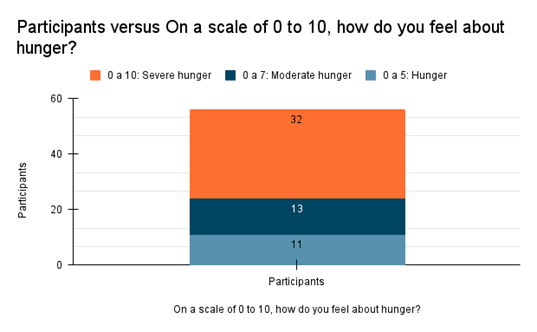
Believing that these issues amplify Haiti's vulnerable situation, they have further plunged the country into economic, political, and social crises, which encourage waves of violence, and insecurity, and have consequently led to waves of immigration to Brazil and other countries (Koenig, Rouzier and Vilbrun, 2015; Cerna-Turoff, Kane and Devries, 2020). Graph 1 shows the hunger situation of the participants.
Source: Data from surveys carried out with Haitian immigrants, considering their lives in Haiti, by questionnaires and in loco (2024)
Graph 1 Ratings of the level of hunger of the 56 participants before immigrating to Brazil
The intuitive school of the graph has the function of demonstrating the depth of hunger in Haiti. From the data, the majority of participants reported facing severe hunger before moving to Brazil (32). From a broader perspective, it can be understood that 45 of the 56 participants fall between moderate and severe hunger, which leads to greater concern, indicating mainly calamities, since none of the participants who chose the path of immigration, have the profile of a fluid immigrant, that is, people who did not leave their countries forcibly.
This scale demonstrates the problematization of hunger that affects humanity, causing extremely negative impacts on the lives of people who want a quality and dignified life. As Frutuoso and Viana (2021) put it, in line with the participants' situation, this condition of severe and moderate hunger can easily become a collective problem, which is why 60 per cent of the population is already believed to be a collective catastrophe.
It is understood that severe hunger, in addition to moderate hunger, causes significantly severe malnutrition, influencing life in general (Silva, Santos and Gama, 2022), as can be seen in one of the hundreds of statements below, “look, I've already hidden under the bed, out of shame and pain for not having anything to eat, listening to my children fighting and crying because of hunger, it breaks my heart” (participant, 45-year-old woman). At the time, she continues, “I was earning 15,000.00 gourdes, practically twice the minimum wage, which was incapable of facilitating a dignified life in Haiti”. It should be noted that they were one of the few participants who had a job (Graph 2).
Source: Data from surveys carried out with Haitian immigrants, considering the employment situation in Haiti vs. Brazil, by questionnaires and in loco (2024).
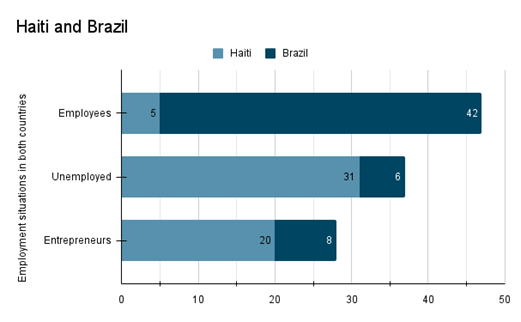
Graph 2 The employment situation of Haitians before immigration vs. the Brazilian employment context
This data shows the employment situation between the two countries, ' Haitian citizens, in an attempt to understand what their lives were like before they moved to Brazil. In this natural comparison of data, Haitians in Brazil have a high number of employed workers (42), with (6) unemployed participants, and several (8) Haitians work as entrepreneurs in Brazil. From the Haitian perspective, there is a crisis related to unemployment: at the time there were (5) employed participants and 31 unemployed. In addition, the number of entrepreneurs in Haiti was higher than in Brazil. In Brazil, the entrepreneurs were three street vendors selling various products, such as clothes and cell phones, two with small stores, and one as a partner in a mechanic's workshop.
In Haiti, on the other hand, the entrepreneurs were mostly people who worked in sales, agriculture, fishing, and product retail, and the employees were elementary school teachers, nurses, and agronomists. This notable difference can be discussed mainly from the countries' unemployment rate, for example, Brazil had 7.7 per cent unemployment in the third half of 2023, before, in the context of the pandemic, it was between 10 and 13.7 per cent in the last two years, according to the Instituto Brasileiro de Geografia e Estatística-IBGE (IBGE, 2020). on the other hand, Haiti has always had a higher unemployment rate than Brazil. Thus, according to data from the l’Institut Haïtien de Statistique et d’Informatique - IHSI, (IHSI, 2021) and the Ministère de l'Economie et des Finances (MEF), it is estimated that 30 per cent of the Haitian population is unemployed and 50 per cent of the younger population. These figures refer to 2020, according to the economic plan launched in the same year2 (MEF, 2020; IHSI, 2021).
In this way, the data analysis has shown the reasons why Haitians flee the country, causing a brain drain characterized by forced intra-national mobility. In general, in individual and co-authored research, I have already pointed out the reasons for Haitian immigration to Brazil as an example of brain drain, which is characterized by desperation for a dignified life that Haiti is unable to offer (Exime, Gonzalez and Ahlert, 2022; Exime, 2023). All these issues, earthquakes, insecurity, poverty and hunger, unemployment, and misery, together with the country's relationship with Brazil, began with the peace game held in 2004 (Exime, Pallú and Plein, 2021a). Then there were the MINUSTAH3 peacekeepers deployed between 2014 and 2017 to stabilize Haiti and police urban areas to prevent threats and gang actions, as well as the misery increased by the 2010 earthquake.
After the tragedy, Haitians, with no solution to the crises of natural, social, and cultural calamities in the country, opted for international mobility in 2010, with the help of the Brazilian government and supported by the immigration law, which facilitated the stay of Haitians in a humanitarian way (Oliveira, 2020). With the enactment of the Refugee Law (9.474/1997); Decree 6.893/2009, which allowed the regularization, within 180 days of citizens who had entered the country before 01/02/2009; and the publication of Normative Resolutions 77/2008 and 93/2010, Haitian immigrants were allowed to be accommodated and welcomed.
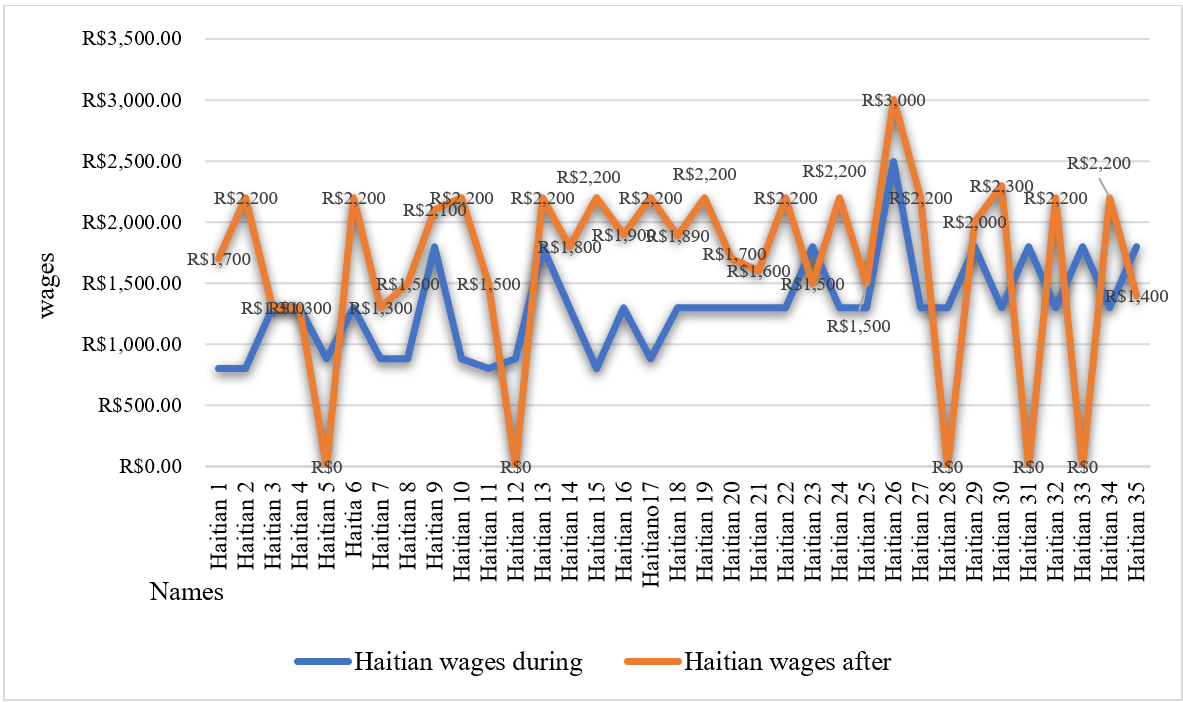
Thus, in the Brazilian context, Haitians find their first economic and social aid through jobs that allow them to pay their bills and help family members who have remained in Haiti, even with salaries that are considered low. For example, the Instituto Brasileiro de Geografia e Estatística-IBGE (IBGE) published an average salary of R$2,500.00 in 2020. Years later, the average salary usually received by workers over the age of 14 in the third half of 2023 was R$2,982.00 (IBGE, 2020; 2023). To deepen this discussion, we present the salaries of Haitian immigrants (Graph 3), considering the first survey published in 2023, by Exime (2023), where the average salary was 880 reais and the median was 1,300.00, allowing a comparison of incomes.
Source: Data from surveys conducted with Haitian immigrants, considering salary comparisons (2024).
Graph 3 Earnings of Haitian immigrants during and after the Covid-19 pandemic
The data analyzed is divided into two periods, during the Covid-19 pandemic and afterward, using the data from the first survey as a parameter. It should be noted that only one participant receives a salary of R$ 2,500.00 per month, as the highest income among those interviewed, then seven Haitian immigrants receive R$ 1,800.00, equivalent to R$ 300.00 more than the national average for immigrants, which was R$ 1,500.00 reais in 2020 (IBGE, 2020). According to this data, four Haitians received R$ 800.00; six received R$ 880.00 reais, and 17 participants received R$ 1,300.00 reais at the time.
In the post-pandemic context, the data of the same research participants has changed, and there has been an improvement in income, mainly after applying immigration informational solidarity to find better jobs and cities with lower living costs (Exime, 2023). It can be seen that only one participant receives a salary of 3,000.00, with a difference of 500.00 reais between the two best incomes, 12 participants frequently receive 2,200.00 reais, five with no income, four participants with incomes of 1,500.00 reais, in addition to three workers with 1,300 reais, the other frequencies are two and one participants with salaries between 1,700.00 and 2,100.00 Brazilian reais. There has been an improvement in the participants' incomes as they use collective networking to look for jobs that pay more, but the five participants who have lost their jobs and are currently living on unemployment insurance, who earn between 1,360.00 and 1,700.00 reais each, stand out.
To deepen the discussions around the construction of the concept of informative immigrant solidarity, we sought to expand the research through on-site interviews with Haitians who were already working in companies similar to the previous participants in the west of Paraná. This allowed us to obtain data on 56 Haitians. The first curiosity that stands out is that the Haitians who earn the highest salaries are friends and work in the same company. Therefore, some of them used to live in cities like Porto Velho, Rio de Janeiro and when they moved to the city of Cascavel, in the west of Paraná, they received better salaries of between 1,700.00 and 3,300.00 reais, allowing us to carry out basic descriptive statistics (Table 1) to deepen the content analysis.
Table 1 Income of Haitian immigrants after the pandemic extended to 56 participants
| Statistical Measure | Wages during the Pandemic | Wages after the Pandemic |
|---|---|---|
| Minimum | R$ 800,00 | R$ 0,00 |
| 1st Quartile | R$ 880,00 | R$ 1.300,00 |
| Median | R$ 1.300,00 | R$ 1.800,00 |
| Media | R$ 1.007,69 | R$ 1.678,18 |
| 3rd Quartile | R$ 1.300,00 | R$ 2.200,00 |
| Maximum | R$ 2.500,00 | R$ 3.300,00 |
Source: Research data from questionnaires and on-site surveys (2024).
This is an analysis of the 56 participants according to their overall income. For this purpose, the parameter used to understand the impact of the salaries received by Haitians is based on the average income of Brazilian workers of 2,982.00 reais (IBGE, 2023). In this way, the incomes of Haitians during and after the Covid-19 pandemic are observed, which consist of a variation of significant values. The median salary was R$1,300.00 at the time, with an average of R$1,007.69. In the post-pandemic context, the median rose to R$1,800.00, with an average of R$1,678.18 among the participants.
It is understood that there was an increase in salaries during the pandemic and afterward, as the survey data suggests, but the decrease and disappearance of salaries between the two periods should be emphasized. During the pandemic, the minimum wage received by workers was R$800.00, as evidenced by the data, and some salaries fell to R$0.00 after the pandemic. Thus, there have been improvements in the lives of Haitians economically, especially for those who have been involved in solidarity. On the other hand, the concern remains, as incomes are equally lower than those of workers at the national level.
This salary situation allows us to understand that the majority of Haitians receive a salary that is insufficient for a good quality of life, as one participant (a 38-year-old man) says, “because of the price of things, in recent years I've moved in with the boys, we split the bills to make ends meet, now I'm doing a course, I'm hoping for better salaries”. This is a participant with an income of 2,100.00 reais per month. Similarly, others say mwen pa anfom zanmi (I'm not well), nap boule freo (ah, I'm well or I'm getting by). These expressions show that they are worried about family members who need financial help in Haiti, as well as the quality of life in Brazil (participant, 52-year-old man; participant, 35-year-old woman).
Thus, “I came to help my family, after years I managed to bring my children, because I worked hard, even today we share houses with two cousins behind the bus station” (participant, 55-year-old man). Bagay yo te réd (things are difficult), this is how he defines his current living conditions and says “when I lived in Vila Velha (a city in the state of Espírito Santo), the wages were worse. Two years ago, a friend of mine told me that there were better wages and jobs here, now I help my other brothers in Haiti more” (participant, 31-year-old man).
Like the other participants, the majority help their relatives in Haiti: 88 per cent send money to relatives every month, which impacts the salaries they receive, so they have to pay the bills. 92 per cent of the participants share bills such as electricity, water, internet, and rent, even though they are married with children, to save money. This reality of insufficient salaries, even with academic and professional qualifications (Table 2), has already been pointed out by researchers such as (Oliveira, 2017; De Mello, 2019, Exime, Reis and Gonzalez, 2021b; Exime, 2023). Judging by the data presented, the average salary of immigrants is generally not enough to cover monthly expenses and help their families in Haiti.
Table 2 Professions and educational levels of the 56 Haitian immigrants participating in the research
| Level 1 | Level 2 | Level 3 |
|---|---|---|
| 02 Computer Engineers | 02 Air conditioning installation and maintenance technician |
03 No instruction |
| 02 Nurse | 10 Professional masons | |
| 04 Journalist | 01 Mechanical Technician | |
| 01 Professor of Informatics | 01 professional photography technician |
|
| 01 Cultural journalism | 02 Traders | |
| 03 University teacher | 03 Electricians | |
| 01 Agronomist Technician | 01 Mechanic Technician, Painter | |
| 05 Teacher of early education | 01 Commercial seller | |
| 01Professional teacher | 07 Construction professional | |
| 03 art/artist | ||
| 02 Musician |
Source: Research data from questionnaires and on-site surveys (2024).
These are observations that provide a deeper understanding of the situation of Haitians in terms of income. The education of the Haitian immigrants is presented in Levels 1, 2, and 3 in which their educations are presented. In Level 1, are the Haitian citizens with complete higher education; Level 2 with technical, vocational education; and Level 3 with no specific education or no school education at all. The data shows the presence of professionals with degrees in computer engineering, nursing, journalism, and university teaching, among other areas, demonstrating the diversity of skills and knowledge that Haitians bring with them. These qualifications can make a significant contribution to various sectors of the Brazilian economy, such as technology, health, communication, and education.
You can see that, from the second level onwards, they have professionals in the areas of construction, arts, mechanics, and others needed for the Brazilian job market; they are immigrants with a diversity of skills for quality jobs that would soon lead to a dignified life. It can be seen that they are qualified workers, so the majority do not work in their fields of training, and of the 56 participants, only 11 works in jobs related to their training in Haiti. In addition, another four participants work directly in their fields of training, after specializing in various subjects in Brazil. All in all, the other 41 Haitians work in underemployed jobs.
Now, similar results have been pointed out by Pierre (2023), as well as researchers Simões, Cavalcanti, and Pereda (2019), together with researcher Exime (2023), who agree that the skills of Haitians should be put to better use by companies, particularly meatpacking plants in the west of Paraná, which employ more than half of Haitians in underemployment. In this sense, the solution that Haitians find to deal with these problems is informative immigrant solidarity, which goes beyond the idea of cooperating, since it includes living together to save on rent, doing agricultural fairs together, taking advantage of extension projects that provide access to courses and food, as well as raffles to raise money, among others.
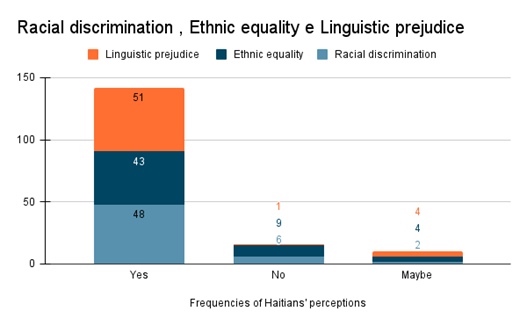
The solidarity that is present among the group of Haitians extends to dealing with bureaucratic things such as permanent visa documents, Brazilian naturalization which requires proof of Portuguese, as well as how to deal with racial prejudice and discrimination, which has happened, in fact, since the last survey (Exime, 2023), the reports have increased considerably, as can be seen in (Graph 4) below.
Source: Prepared from data collected by the author (2024).
Graph 4 Haitians' perceptions of how racial discrimination, prejudice, and others affect the acquisition of jobs in their fields of training
Graph 4 shows that immigrants' perceptions that they suffer from racial discrimination, lack of ethnic equality or racial inequality, and linguistic prejudice have considerably affected the lives of Haitians. Of the results, 51 of the 56 participants believe that their jobs are directly related to how well they speak Portuguese or how little they know the language. In terms of ethnic equality, 43 of the 56 participants say that their income and their jobs are directly linked to their origin, because, as an immigrant, there is no choice of jobs, there are bills to pay and families to help in Haiti. Concerning racial discrimination, 48 of the 56 participants believe they are discriminated against, whether because of their skin color, language, etc.
All of these issues affect the quality of life that Haitian immigrants come to Brazil for (Exime, Gonzalez and Ahlert, 2022). The reality indicated by the data contributes to and confirms the situations of discrimination, prejudice, racism, and other types of inequality faced by Haitian diasporas in Brazil (Joseph, 2015a; 2015b; Solouki and De Souza, 2022). In this way, we can see a racist structure has been created, which is increasingly forming in the Haitian context.
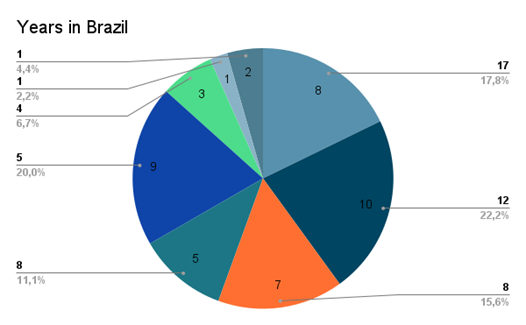
It can be seen that the data points to flaws in Brazil's ethnic policies in the context of immigration, even though these practices are considered a crime under the 1989 constitution, in Law No. 7.716 (BRASIL, 1989), companies and a large part of society still practice some types of discrimination and prejudice against this group. All these issues and shortcomings corroborate the underemployment of immigrants, even those with high qualifications. These precarious jobs affect not only Haitian immigrants but also Venezuelans, Senegalese, Bolivians, and others (Grisotti and Porto, 2022). It should be noted that these are immigrants who have been in Brazil for an average of 7.36 years, as shown in Graph 5.
Source: Prepared from data collected by the author (2024).
Graph 5 Haitians have lived in Brazil for between 1 and 10 years
The data shows that the Haitians surveyed are not newcomers, as 17 of the participants have lived in Brazil for eight years, 12 participants have had ten years of experience facing these difficulties, and 21 participants have been in Brazil for between five and nine years. This data indicates work experience, and cultural and linguistic knowledge, which leads to an understanding of the grievances accumulated over the years. To face these challenges, many try to study again and seek other qualifications. Of the 56 participants, 18 Haitians have already completed a specialization or degree in Brazil. Even against these problems, the way that has helped is solidarity among Haitians. Collectivism has made a difference during the pandemic and now, where the informative immigration solidarity that has been maintained among the participants stands out.
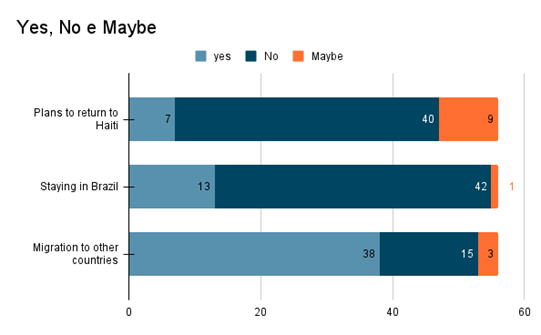
This is solidarity in its broadest context, i.e. organic solidarity acting in favor of this particular group (Durkheim, 2000; Durkheim, 1997). It plays an important role in the context of collectivism when facing difficulties linked to unemployment, informal jobs, low wages, discrimination, and racial and ethnic inequality, making solidarity necessary (Carleial, 2022; Pachi, 2021). This is also seen in network theory, which emphasizes this need, especially for social integration (Bereczki, Benczik and Balogh, 2025). These facts generally help to maintain the existing solidarity and the index suggests that this practice should continue among the participants so that they can evolve economically and socially, but there are doubts as to whether all Haitians will remain in Brazil, mainly because of these constant challenges, which lead to the next topic, in particular with the data from the on-site surveys in (Graph 6).
Informative immigration solidarity can turn Brazil into the promised land for Haitians
Returning to interpretative social research, which allows us to deepen discussions about the situation of Haitians in Brazil (Nogueira, de Barros and Araujo, 2017), preferably by trying to understand whether Haitians would be willing to remain in Brazil, or by thinking about the idea that Brazil could be considered a promised land for those seeking a dignified life as immigrants from the perspective of social integration. Considering mainly jobs, quality of life, and the impact of solidarity.
The perspective of the data in Graph 6, shows the perceptions of the survey participants in three main spheres that can be explained by the possibility of returning to Haiti, remaining in Brazil, or migrating to other countries. In this sense, it should be emphasized that of the 56 participants, 7 have plans to return to Haiti, while 13 say they intend to remain in Brazil and 38 state that they have the will and goals to migrate to other countries. This means that 40 participants do not wish to return to Haiti permanently. When asked whether they would stay in Brazil, 42 said no, with a view to not being internationally mobile. Only 15 have no plans to migrate to any other country. As for the participants who might return, stay, or migrate, they range from 1 to 9 participants, with no strong influence on the results.
The data suggests that the participants have no plans to return to Haiti to live there permanently, with seven affirmative respondents. This is due to the social, economic, and political problems that the country of origin is immersed in, in line with what the researchers Exime, Pallú and Ahlert (2024, p. 1) state: “In the heart of Haiti, hunger persists and natural, social and cultural calamities, like open wounds, mark the passing of days”. In addition, the lack of rights and freedoms due to insecurity in the country, lack of basic sanitation, food insecurity, and hunger take over the country (Seitenfus, 2020; Audebert and Joseph, 2022; Stotzky, 2023; Exime, Pallú and Ahlert, 2024).
Similarly, the data showed that the participants have no plans to stay in Brazil, even after 7,8,9, or 10 years of living in Brazil. The reasons are diverse and variable, as the data suggests: prejudice, discrimination, racial inequalities, underemployment, incompatible and low salaries, and the professional devaluation faced by Haitian immigrants in Brazil, all drive the participants' desire to leave. Several researchers have already pointed out these problems directly or indirectly from the perspective of Haitians and other immigrants in Brazil (Gonçalves and Sangalli, 2018; Klassen and Murphy, 2020; David, Rizzotto and Gouvêa, 2023; Exime, 2023), and the participants' statements below corroborate the results already pointed out.
“Bagay yo pa fasil isi a” (things aren't easy), I remember when I received around R$1,500.00, I even went hungry, I had to choose between eating or paying the rent, Brazilians are “bon bagay” (good people), but the salaries don't help to support my family, even though I earn R$2,700.00 (participant, 40-year-old man).
I keep telling my family that I'm not going back because it's worse. Now I've married a Brazilian woman here, so this is my place, I'm selling, doing business here. “La vi a pa janm fasil” (life is never easy), if you earn less than 2,000, you can't help anyone, it's a disappointment. (participant, 36-year-old man).
“Mwen ap sanble” (I'm saving), I'm getting organized, I was a teacher in Haiti, Brazil was a way out, but my cousin in Canada is helping me to go there, I've lived here for 8 years, prices have only gone up and salaries haven't, “se sa Brezil la ye” (that's Brazil). (participant, 41-year-old woman).
I've already been to French Guiana, I came back here after two years, and I enjoyed the experience, I specialized here in various areas for ten years, I already have a tourist visa for the United States, and I hope to get a job there with my courses, “nég yo pa gen vale” (we are not valued) (participant, 47-year-old man).
“Manmanm vini wi” (my mother is here), I have a brother here too, “nap brase jou pa jou” (we are negotiating, trying to survive daily). I know I'm going to another country because here the salary and the exchange rate don't work out, “gen moun ki pale mal ak mwen nan travay” (people don't treat me well at work) (participant, 41-year-old man).
“Danje, danje, baz mwen” (dangerous my fellow countryman), I do jobs for people who earn more than me, with no training and they always say to me, I always have more experience and always like this, I get sad, I finished a new course and I want to do another degree, but I can't find the time to do it, I work hard for 2,100.00 reais. (participant, 38-year-old woman).
In short, one of the first observations that can be made is the economic situation that Haitians find themselves in, the complaints of low wages that affect their dignity and lead them to go hungry, as has been pointed out. This also has an impact on the lives of family members who are in Haiti, as they live in a country plunged into an economic, political, and social crisis, as Klassen and Murphy (2020) point out, in which remittances from immigrants are considered one of the ways to tackle hunger and poverty in the country. Since they are unable to send money to their families, most of them are considering moving to another country to improve their lives and those of the people who need them economically.
We can see the precariousness of working conditions, practically an injustice because they don't get paid for the work they do. Even those Haitians who consider staying in Brazil complain that life isn't easy, for example (participant, 36-year-old man), who considers Brazil to be his second home. In addition, many Haitians feel belittled by prejudice, racism, and discrimination, which are extremely detrimental to their adaptation in Brazil, making Haitian immigration complex. From this perspective, solidarity in the Brazilian context also stands out. As a result of these problems, the movements of the 1980s emerged, which were social movements of solidarity against racism and ethnic problems and prejudices in society (Ramos, 1998; Oliveira, 2004). In this sense, solidarity worked, and it is believed that immigration problems, it is also possible to approach and bring solutions to these issues through solidarity.
In this way, the participants cooperate based on the informative immigration solidarity that has helped them with these issues, facilitating improvements in their living conditions. It is understood that the search for solidarity among the participants contributes immensely to Haitians being able to face the challenges of these problems. It is therefore believed that solidarity and collectivism are part of the reality of Haitians as problem-solvers. In this sense, the researchers Bizarria, Barbosa and Rodrigues (2022) point to solidarity as a determining factor. In a similar case, the researcher Exime (2023) states that solidarity among Haitians is of the utmost importance for the daily lives of immigrants, whether in matters such as jobs, seeking a better quality of life, or saving money, among others.
Conclusions
The realities pointed out in this research certainly cannot be applied to all Haitians living in Brazil. There may be other realities that have not been addressed in this study. This is an investigation into the solidarity between Haitians in Brazil during and after the pandemic. To this end, interpretive field research was carried out, evaluating questionnaires answered by Haitian citizens in Brazil, who use solidarity daily. The 56 participants made it possible to understand how solidarity came about among them, to fight against discrimination and prejudice, low wages, underemployment, and living costs.
It can be seen that, through solidarity, the Haitians were able to get better jobs than their previous ones, thus increasing their chances of improving their quality of life and helping their families in Haiti more with remittances. It should be noted that the majority of Haitians share houses to save more money, which leads them to make family dreams come true, such as bringing their mothers and brothers to Brazil, as well as studying and specializing to increase their income.
It was concluded that Haitians' incomes increased between the pandemic and post-pandemic, the median was R$1,300.00, with an average between R$880 and R$1,007.69. During the pandemic, which made it difficult to buy basic groceries, there were reports of Haitians going hungry at the time. In almost two years, there have been significant changes in salaries, even though they remain lower than the average salaries of Brazilian workers. In the post-pandemic context, the data shows an increase in the median to R$1,800.00, with an average of R$1,678.18 among the Haitians investigated.
There have been changes in jobs and extra qualifications for Haitians, those with higher salaries have done more specializations and extra professional courses, which contributes to the majority feeling undervalued in companies for doing the work of people who are not as qualified and earn less.
It was also concluded that the Haitians felt wronged by the companies and reported sadness at the discrimination they suffered, especially at work. Based on the analysis, it was concluded that the Haitians had a hard time in Brazil and showed clear indignation, which contributed to the fact that 42 of them said they did not want to stay in Brazil any time soon. Even with the success of informative immigration solidarity, due to these problems, Brazil does not appear to be the promised land for Haitians, mainly due to a lack of social integration.
Even though the data in Graph (6) shows that Haitians don’t intend to stay in Brazil, this Even though the data in Graph (6) shows that Haitians don’t intend to stay in Brazil, this doesn’t undermine the concept of solidarity, because throughout the text it has become clear that even those who want to migrate to other countries use solidarity to face the problems in Brazil today. Furthermore, there is no guarantee that immigrants will actually go to other countries, until this fact is established and transformed into a migratory process. Solidarity is a powerful tool in this daily struggle. Informative immigration solidarity manifests itself concretely, for example, among the groups that share messages of support, job vacancies, cheaper rents, qualification courses and facilitate explanations for recently arrived Haitians who need visas and others who need to understand the Brazilian naturalization process.
Among those interviewed, there are several reports of first jobs found through referrals from other immigrants who form the solidarity network. It is noteworthy that this practice not only increased access to better working conditions, but also strengthened community ties, participation in cultural activities, sales of typical Haitian food, allowing most of the participants to send more consistent financial remittances to their families in Haiti, even if they were minimal. Justifying the need to address cultural, social and political issues in depth in the text, which demonstrates the importance of solidarity for the Haitian community, which punctuates the innovation of the concept.
In addition, solidarity in housing proved to be an essential strategy for reducing costs and making family dreams come true. Many Haitians shared houses or apartments in outlying areas and common streets in the city of Cascavel, which allowed them to save money and finance the arrival of close relatives in Brazil. It’s also a change of life. There are three Haitians who have managed to bring their children and wives to live together, issues that demonstrate the strength of this practice, and others who have entered the university of their dreams. Of these immigrants, even though they don’t consider Brazil to be the “promised land”, they benefit from solidarity, that is, the efficient demonstration of how this concept works in the Brazilian migratory context.
From this, it is clear that it was necessary to statically introduce other data on income, hunger, racial discrimination, labor qualifications and lack of correspondence with working conditions and salaries in order to broaden the meaning of the concept and its importance for understanding the difficulties of Haitian immigrants. Therefore, solidarity among Haitians is the driving force behind the community’s survival, which needs to be optimized and expanded to Brazilian territory and other parts of the world. In addition, this concept marks a fight against the lack of public policy, a measure against discrimination and tackling structural barriers that affect the integration of immigrants.
As a critical appeal to the companies that hire immigrants, we call on them to take concrete steps to address the frustrations of this qualified group, and for the government to implement public policies to raise awareness among companies and the population about the treatment of immigrants. Solidarity is still the way to prevent Haitians from moving to other countries, but concrete action is needed from companies, cities, and local government officials to take new institutional support measures for immigrants.

