(pdf)
(pdf)


 SciELO
  SciELO
 Permalink

Introduction
With thirty-six genera encompassing more than 400 native species, Mexico has the fifth richest assemblage of Acanthaceae among the world’s nations, after Madagascar, Brazil, Tanzania, and India (Daniel, 2022). Seven genera of the family are currently treated as endemic to the country (Aphanosperma T.F. Daniel, Chalarothyrsus Lindau, Gypsacanthus E.J. Lott, V. Jaram. & Rzed., Holographis Nees, Hoverdenia Nees, Mexacanthus T.F. Daniel, and Mirandea Rzed.), and at least 251 species (62% of 403 currently recognized natives) are endemic there (Daniel, unpublished). Along with its size and rugged topography across 18 degrees of temperate and tropical latitudes, the country's diversity of both wet and dry biotic communities, in which various taxa of the family thrive, likely accounts for its species richness, diversity, and endemism.
By its territorial area of ca. 22,352 km2, the State of Mexico (hereafter Edomex) in south-central Mexico occupies 1.1% of the national territory (INEGI, 2024) and is the 25th largest in size among the country’s 32 states. Villaseñor (2016) recognized more than 5000 species of vascular plants in the state, ranking it ninth in richness among Mexican states. Subsequently, Martínez-De La Cruz et al. (2018) attributed 3924 species of flowering plants to the state. The 61 species of Acanthaceae in 19 genera recognized below with native and naturalized occurrences in Edomex place it eighth in species richness of that family among Mexican states, following Oaxaca (144), Chiapas (136), Guerrero (113), Veracruz (108), Jalisco (84), Michoacán (81), and Puebla (68) (Daniel, unpublished, based on described and currently accepted species only). Villaseñor (2016) noted the occurrence of 37 species of vascular plants endemic to Edomex, and Martínez-De La Cruz et al. (2018) indicated 29 species of flowering plants endemic there. Only two species of Acanthaceae are currently known to be endemic to the state, Poikilacanthus capitatus (Leonard) Ramamoorthy and Pseuderanthemum hirsutum (Leonard) T.F. Daniel. Both occur in the southwestern portion of Edomex near the borders with Guerrero and Michoacán (Fig. 1), in one or both of which states either species may eventually be found to occur as well. Regional endemic Acanthaceae (i.e., restricted to Edomex and nearby regions of surrounding states) include: Holographis haenkeana (Nees) T.F. Daniel, McDade & Kiel (Edomex, Gro., Mich., Mor.), Justicia matudae T.F. Daniel (Edomex, Gro., Mich.), Lepidagathis danielii Cruz Durán & J. Jiménez Ram. (Edomex, Gro.), and Ruellia foliosepala T.F. Daniel (Edomex, Gro., Mich.); their distributions in Edomex are shown in figure 1. The nomenclatural types of at least 12 species of Acanthaceae were collected in Edomex: Aphelandra lineariloba Leonard, Beloperone longibracteata Leonard, Buceragenia hirsuta Leonard, Carlowrightia lanceolata Leonard, Dicliptera aquatica Leonard, Jacobinia capitata Leonard, Justicia matudae, Pseuderanthemum axillare Leonard, Ruellia bourgaei Hemsl., Stenandrium mexicanum Leonard, Tetramerium hintonii Happ, and T. rubrum Happ. Not all of these species are currently recognized, and their taxonomic dispositions are noted below. In an outdated but comprehensive account of the state’s flora, Martínez (1957) included 15 genera and 25 species of Acanthaceae. In the species accounts below, most of the names in his flora are either recognized or noted to be synonyms. Some of his names refer to plants not known from the state at present, and his brief descriptions and illustrations do not always permit association with a species currently recognized as occurring there (e.g., Siphonoglossa pilosella (Nees) Torr.). Subsequent floristic studies of regions of Edomex (e.g., Torres-Zúñiga and Tejero-Díez, 1998; Zepeda-Gómez and Velázquez-Montes, 1999; López-Sandoval et al., 2010; López-Patiño and Serrano-Garrido, 2012; Luna-Céspedes, 2014; see Martínez-De La Cruz et al., 2018 for additional studies) and collections at several herbaria (see Materials and Methods) have significantly increased the number of acanthaceous species known from the state. Daniel (2013) noted the occurrence of 39 species in Edomex. Villaseñor (2016) listed 73 species from the state (without vouchers); however, 20 of these appear to represent misidentifications, four are here treated as synonyms, two are species not otherwise verified by us via vouchers, and one is only known from cultivation in the state. Subsequently, Martínez-De La Cruz et al. (2018) listed 41 species of Acanthaceae from Edomex as documented in literature. As in the list of Villaseñor (2016), specific vouchers were not cited for each species in that study but are presumably provided in their literature cited. At least six names on the updated list by Martínez-De La Cruz et al. (2018) are treated by us as either synonyms or probable misidentifications. Most of these are discussed in the following treatment.
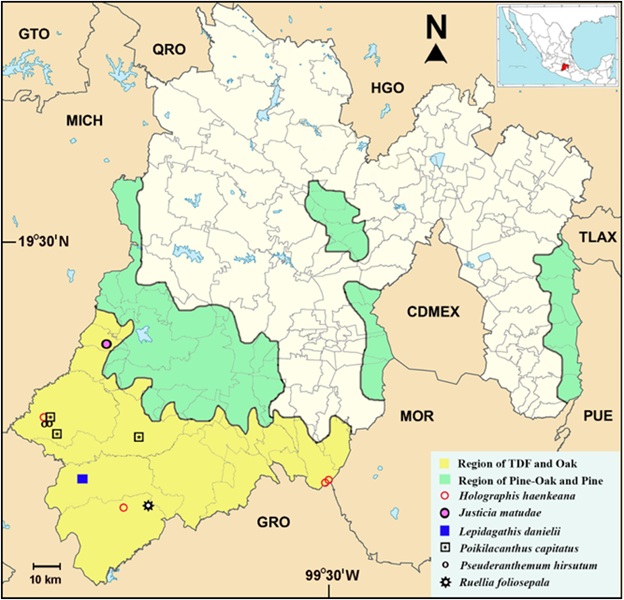
Figure 1: Map of Edomex showing generalized regions in which four major biotic communities are most prominent (tropical deciduous forest = TDF, oak forest, pine-oak forest, and pine forest), distributions of two species of Acanthaceae endemic to the state (Poikilacanthus capitatus (Leonard) Ramamoorthy and Pseuderanthemum hirsutum (Leonard) T.F. Daniel), and occurrences in the state of four regional endemics. Uncolored regions represent cultivated lands, urban areas, and small regions of various biotic communities.
Below, we attempt a comprehensive revision of the species of Acanthaceae that occur in Edomex based on our field and herbarium studies over the past 10 years. The data we have collected and present will be useful toward a nearly completed, nation-wide taxonomic account of the family currently in progress by the senior author, provide ecological and geographic information on each species, and note taxonomic issues that remain to be resolved. Such information will be of assistance for identifying Acanthaceae in ongoing floristic studies in the state, for increased knowledge of the overall distributions of these species in Mexico, and for assessing the conservation status of taxa in the family.
Materials and Methods
Most of the specimens on which this research is based have been studied from the following herbaria (via loans and/or visits): A, ARIZ, ASU, B, BM, BR, CAS, CHAPA, CODAGEM, DES, DS, ENCB, F, FCME, G, GH, IBUG, IEB, K, L, LL, MEXU, MICH, MO, MPU, MSC, NY, P, PH, RSA, S, TEX, UC, UCR, US, W, WIS, and XAL (acronyms fide Thiers, 2024). Because this catalogue is basically an annotated and augmented checklist, not a detailed taxonomic monograph, full publication and nomenclatural data are provided for only two species (Justicia sphaerosperma and Pseuderanthemum hirsutum) as recommended or required (Turland et al., 2018) to effect the taxonomic and nomenclatural adjustments made herein.
Type specimens of accepted names of Acanthaceae from Edomex are noted for all other species in their respective “specimens examined” sections and discussed (when appropriate) in their respective “notes” sections. Because typification remains unresolved for numerous names of plants that occur in Edomex, but whose type specimens are from other regions, they are not dealt with here. A forthcoming comprehensive taxonomic account of all Mexican Acanthaceae, which includes publication data for both accepted names and known synonyms, will resolve remaining typification issues (Daniel, in preparation).
Additional specimens cited as "-image" were studied only via images. Most collection localities on specimens lack municipalities and/or geographic coordinates, and several are from places that were not located. Most of Hinton’s collections were labeled using “district,” a term that refers to historical administrative divisions in Edomex. Thus, collections from the state are cited alphabetically by the collector’s surname, first by municipality (when known), then by district (if any) when the municipality is undetermined, followed by collections for which neither the municipality nor district were provided. Approximate geographic coordinates for collections of Hinton based on Hinton and Rzedowski (1972) or Hinton et al. (2019) are placed in brackets, whereas those georeferenced by the authors are placed in parentheses. Localities of some of Matuda’s collections that were georeferenced by us based on locality and elevational data from the specimen labels are very much approximations; these coordinates are placed in brackets.
Locality data for collections emanating from the study by López-Patiño and Serrano-Garrido (2012) and seen at CODAGEM (unmounted and without final labels) were obtained online (Serrano-Garrido, 2024). Field studies in Edomex by the authors since 2014 have been concentrated in the municipalities of Ixtapan de la Sal, Santo Tomás de los Plátanos, Tonatico, and Zumpahuacán. The studies included making ecological observations, collections, and photographs. Some of the collections made by the authors from Sendero Jerónimo were made along the Edomex/Guerrero border and are included here.
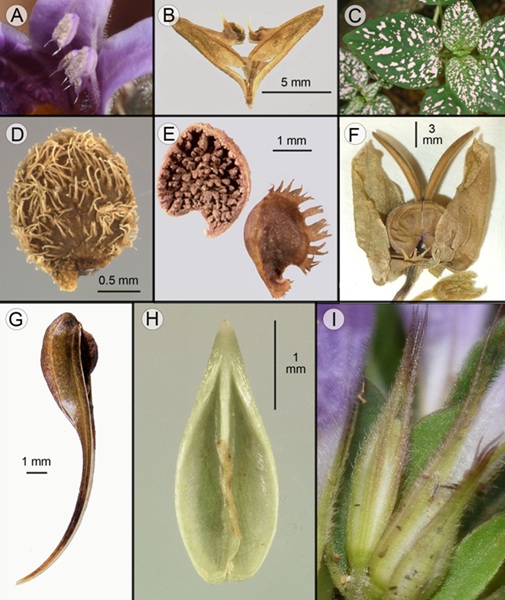
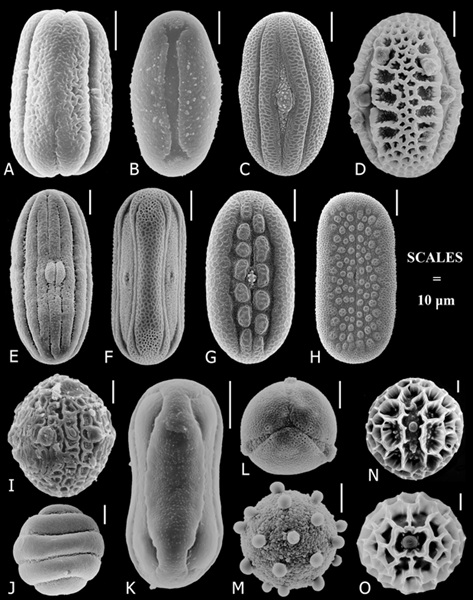
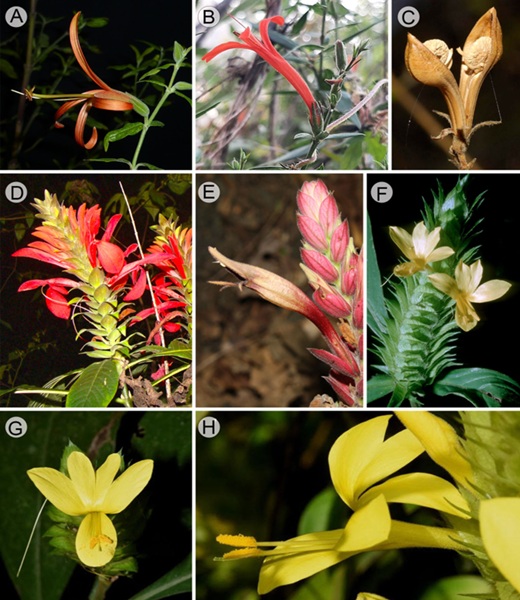
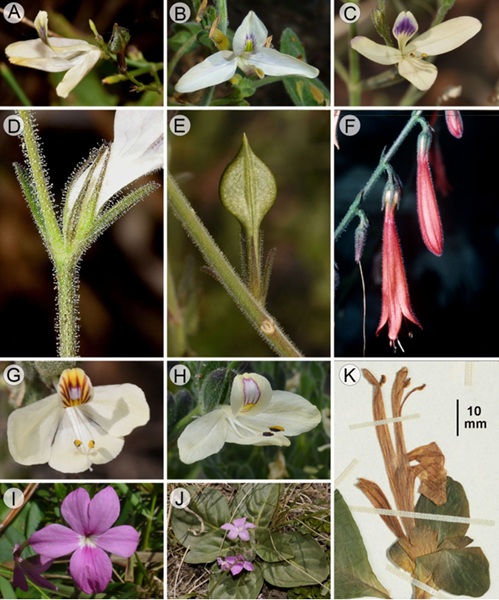
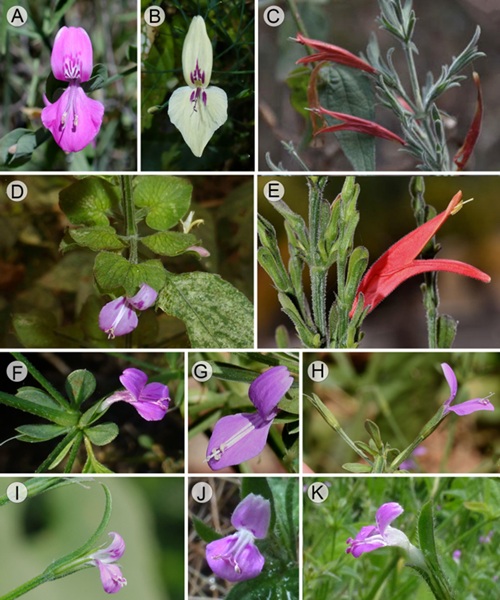
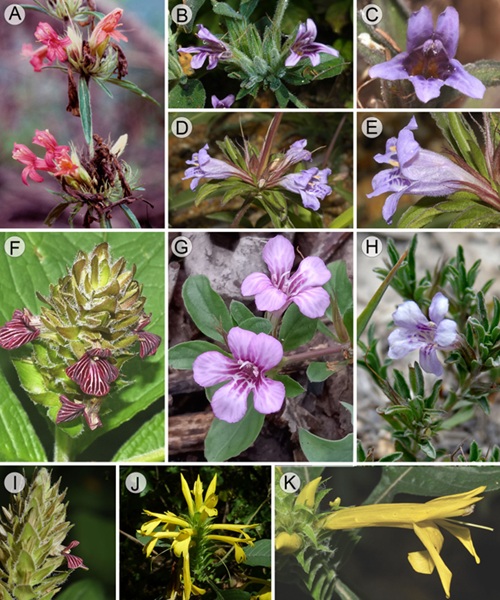
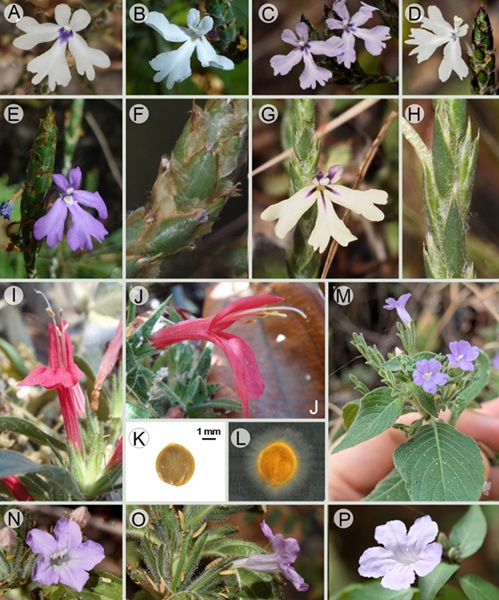
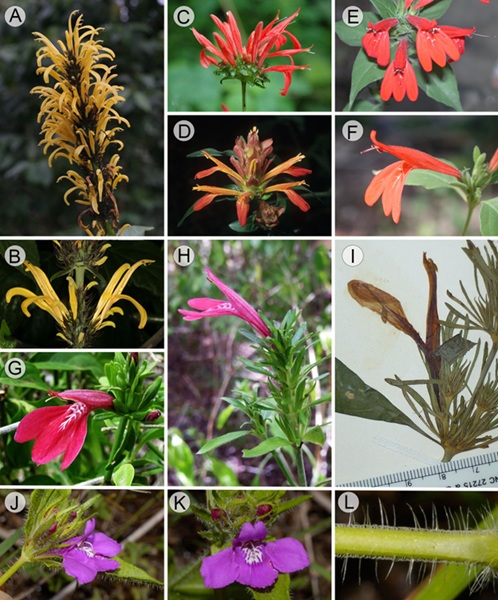
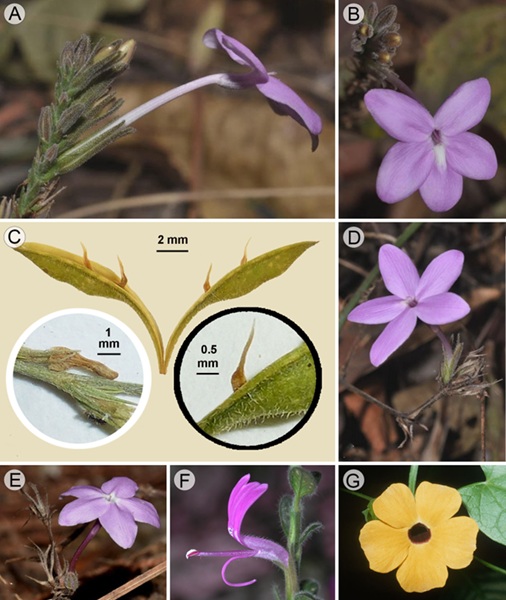
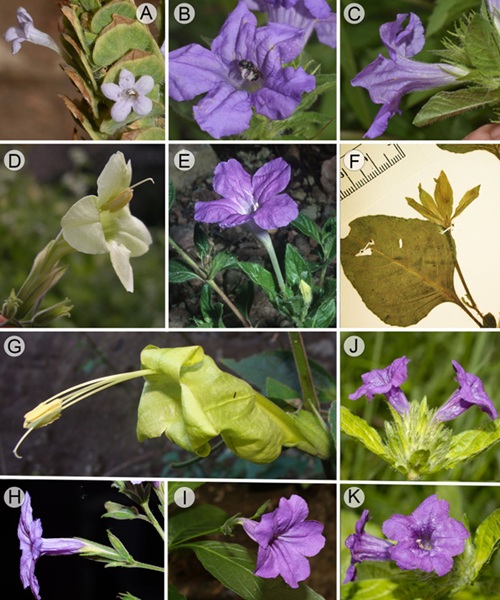
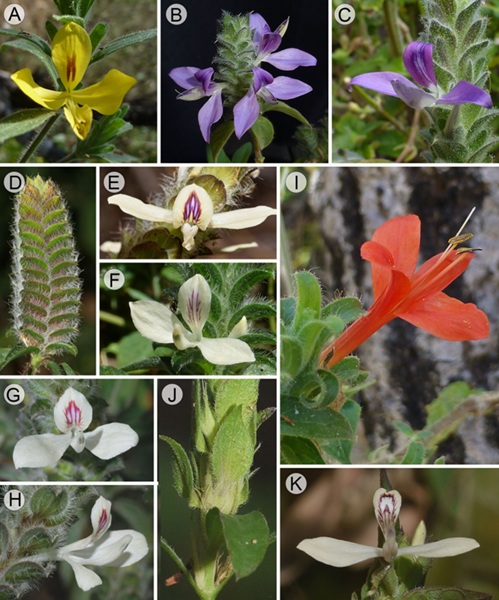
The key to genera and species of Acanthaceae includes measurements and characteristics for plants from Edomex and from nearby states. Some morphological characters of leaves, flowers, fruits, seeds, and pollen utilized in the key are imaged in Appendix 1. Some morphological attribute(s) is/are provided among these figures for all species except Pseuderanthemum standleyi Leonard. Pollen preparation techniques and terminology generally follow those described by Daniel (1998; 2024). Grains were imaged in the scanning electron microscopy lab at the California Academy of Sciences using a Hitachi SU3500 SEM microscope (Tokyo, Japan), as well as two former SEM instruments from other manufacturers, for which no further technical or provenance information is available.
In addition to the information in the key, a very brief confirmatory description of each species offers information usually not in the key, but that might be useful for verifying taxon identities. Thus, these characters vary for each taxon, depending on what might be helpful for confirmation. Reference to a detailed description of each species is also provided. It is from these references that the identifications of collections from Edomex were determined. Information on biotic communities, elevational ranges, and phenology are derived from data on the herbarium specimens cited, personal observations in the field in the state, and information from iNaturalist (2024; when the identifications of images there were verified by us). In instances where some of these data are lacking, information from nearby states is usually noted, when available. When biotic communities of occurrence are not given or are unclear on herbarium labels, information is augmented using the vegetation maps of Rzedowski (1981) and INEGI (2024). Some information on biotic communities of Hinton's collections is taken from data provided about his localities in Hinton and Rzedowski (1972).
Results
Below, we report what appear to be the first documented occurrences for at least 11 species in the state: Anisacanthus pumilus (F. Dietr.) Nees, Aphelandra guerrerensis Wassh., Carlowrightia neesiana (Schauer ex Nees) T.F. Daniel, Dicliptera sexangularis (L.) Juss., Henrya tuberculosperma T.F. Daniel, Holographis peloria (Leonard) T.F. Daniel, Justicia sphaerosperma Vahl, Pseuderanthemum hispidulum (Nees) Radlk., P. standleyi Leonard, Ruellia intermedia Leonard, and Tetramerium glandulosum Oerst. Of the 61 species of Acanthaceae now recognized and vouchered from the state, 55 are natives and six are naturalized non-natives. Two of the latter are from the Old World (Hypoestes phyllostachya Baker, Thunbergia alata Bojer ex Sims) and four of them are native, or at least currently treated as such, elsewhere in Mexico (Dicliptera sexangularis, Justicia aurea Schltdl., J. spicigera Schltdl., and Ruellia simplex C. Wright).
In addition to the native and naturalized Acanthaceae occurring in Edomex, several additional genera and species of the family have been observed on iNaturalist (2024a) or collected in markets and/or from gardens where plants are cultivated for ornamental and/or medicinal purposes in the state. These include: Acanthus mollis L., Crossandra sp., Justicia brandegeeana Wassh. & L.B. Sm., J. carnea Lindl., J. leonardii Wassh., Megaskepasma erythrochlamys Lindau, Odontonema spp., Pachystachys lutea Nees, Thunbergia fragrans Roxb., T. laurifolia Lindl., and T. mysorensis (Wight) T. Anderson.
Taxonomy
Acanthaceae Juss.
Herbs and shrubs (less often trees or twining vines), perennial and terrestrial (in ours); vegetative and floral organs glabrous or pubescent with various types of eglandular and glandular trichomes, often beset with cystoliths visible in epidermis; young stems often swollen at or just above vegetative nodes; leaves opposite and decussate (rarely quaternate, alternate, or clustered at base of plant), simple, exstipulate (in ours), sessile to petiolate, blade margin entire (less often ± crenate); inflorescences axillary or terminal, usually consisting of dichasia or dichasiate spikes (dichasia and flowers sessile), racemes (dichasia pedunculate and flowers sessile), or thyrses (dichasia pedunculate and flowers pedicellate); dichasia reduced (i.e., 1-flowered with flowers subtended by 2 bracteoles) or expanded (dichasia multi-flowered with or without peduncles and/or pedicels), borne in axils of leaves or bracts; bracts large and brightly colored or small and green; paired bracteoles subtending flowers rarely absent; flowers sessile or pedicellate, complete, bisexual, chasmogamous and sometimes cleistogamous, rarely heterostylous; calyces synsepalous, usually comprising 5 sepals, usually deeply 4- or 5-lobed (or entire to multi-lobed in introduced Thunbergia Retz.); corollas sympetalous, usually comprising 5 petals with upper two usually fused to near apex, tube cylindric or funnelform (i.e., gradually or abruptly expanded distally into a ± distinct throat), sometimes twisted 180° (i.e., corollas resupinate), limb nearly regular to irregular, commonly bilabiate with upper lip 2-lobed and lower lip 3-lobed, lobes variously arranged in bud (for aestivation patterns, see Manzitto-Tripp et al., 2022: Fig. 5): descending cochlear (lower-central lobe innermost and overlapped by lateral lobes, lateral lobes overlapped by lobes of upper lip, lobes of upper lip overlapping each other), ascending cochlear (lower lip outermost and overlapping lateral lobes, lateral lobes overlapping lobes of upper lip, lobes of upper lip overlapping each other), left-contort (each lobe overlapped by a lobe and overlapping another lobe), and quincuncial (lower-central lobe innermost and overlapped by lateral lobes, lateral lobes outermost and overlapping lobes of upper lip, lobes of upper lip overlapped by each other); stamens epipetalous, included or exserted, usually 2 or 4 and didynamous, filaments free or connate in pairs proximally, anthers monothecous or bithecous, thecae dehiscing longitudinally, those of a pair parallel to perpendicular, collateral to superposed to widely separated by a modified connective, one or both sometimes with basal appendages, staminodes 0-3, comprising minute projections or sterile filaments; pollen extremely diverse, 2-many-aperturate (apertures simple or compound) or rarely inaperturate; gynoecia 2-carpellate, ovary superior, generally bilocular, style simple, terminal, filiform, stigma subfunnelform or 1- or 2-lobed; fruits (in Edomex) a loculicidal, explosively dehiscent, stipitate or exstipitate, 2-valved capsule; seeds 2-many, each subtended by a hook-shaped retinaculum (absent in Elytraria Michx. and Thunbergia, and often malformed in Chalarothyrsus), usually lenticular, surface smooth or variously ornamented, glabrous or pubescent, trichomes sometimes hygroscopic and becoming mucilaginous when wet.
The family consists of ca. 4900 species in 191 genera concentrated in tropical and subtropical regions worldwide (Manzitto-Tripp et al., 2022). The morphological description of the family above pertains primarily to taxa in Mexico (with some qualifications noted for taxa in Edomex) and surrounding regions of the United States of America (60 native species) and northern Central America (Belize with 40 and Guatemala with 128 native species). The Appendix 2 provides a taxonomic hierarchy that places the genera of Acanthaceae from the state into the currently recognized infrafamilial classification (Manzitto-Tripp et al., 2022).
Key to the genera and species of Acanthaceae in Edomex
1a. Twining vines; calyces inconspicuous, 10 (or more)-lobed; capsules with a prominent and sterile distal beak longer than fertile and ± globose base (Appendix 1: Fig. 2F); seeds 2, with a prominent pore on flat side; pollen spiraperturate (Appendix 1: Fig. 3J) ..................................................................................................... Thunbergia alata Bojer ex Sims
1b. Herbs, shrubs, or small trees; calyces ± conspicuous, 4- or 5-lobed; capsules lacking a prominent sterile distal beak (an apical beak, if present, considerably shorter than fertile portion of capsule); seeds (2-)4-20 or more, lacking a prominent pore on flat side; pollen not spiraperturate ........................................................................................................................................................ 2
2a. Leaves opposite, quaternate, or in a basal cluster; inflorescence lacking peduncles covered with clasping, coriaceous scales; corollas not with descending-cochlear aestivation; stigmas not touch-sensitive; capsules with conspicuous hooklike retinacula on which seeds are borne (if retinacula malformed, as often in Chalarothyrsus, then with seeds fused to and permanently retained within capsule valves, Appendix 1: Fig. 2G); seeds all similarly shaped (except in Carlowrightia pectinata), but not blocky ...................................................................................... 4
2b. Leaves subopposite, alternate, or often clustered in pseudowhorls; inflorescences of axillary and/or terminal spikes borne on peduncles covered with clasping, coriaceous scales; corollas with descending-cochlear aestivation; stigmas flat and touch-sensitive (i.e., folded over and covering anthers in undisturbed flowers, becoming erect and exposing anthers when touched); capsules lacking hooklike retinacula (Appendix 1: Fig. 2H); seeds irregularly shaped, often ± blocky, not permanently retained in capsule valves ....................................... 3 (Elytraria Michx.)
3a. Inflorescence bracts (at least distal ones) apically 3-dentate (lateral teeth hyaline and alate, central tooth aristate; lateral teeth rarely absent), abaxially glabrous (or very slightly and inconspicuously pubescent); corollas blue-purple to purple with yellow (sometimes absent) and white markings on lower lip (corollas rarely white or pinkish, see discussion in notes of this species and Fig. 8A-E), 5-8.5 mm long, lower lip 3-4.5 mm long ……... Elytraria imbricata (Vahl) Pers.
3b. Inflorescence bracts mucronate to subaristate at apex, lacking lateral teeth, abaxially conspicuously pubescent; corollas light yellowish to white with dark purple markings on upper (and sometimes lower as well) lip(s), 7-18 mm long, lower lip 4-9 mm long .................................................................................................. Elytraria mexicana Fryxell & Koch
4a. Calyx deeply 4-lobed, lobes heteromorphic with anterior and posterior lobes larger than lateral lobes, anterior lobe apically 2-fid or 2-cleft; corollas with quincuncial aestivation; pollen 3-colporate (to 3-colpoidorate, i.e., colpi sometimes short or ± indistinct), exine coarsely reticulate with lumina psilate, gemmate, baculate, or pilate .......................................................................... 5
4b. Calyx deeply 5-lobed (sometimes 4-lobed in Justicia), lobes homomorphic (or if heteromorphic in Justicia, then not with lobes as described above), anterior lobe apically entire; corollas with ascending cochlear or left-contort aestivation; pollen otherwise (except 3-colporate in Ruellia blechum,Appendix 1: Fig. 3L) ...................................................................................... 6
5a. Flowers nototribic; corollas red, 29-34 mm long, upper lip of a single, apically 2-cleft, lobe (comprising of 2 fused lobes), lower lip 3-lobed; stamens 11-14 mm long, anther thecae 2-2.5 mm long; pollen with exine conspicuously heterobrochate (i.e., reticulate with lumina adjacent to apertures larger than those in center of mesocolpia, Appendix 1: Fig. 3D) ............................................................................... Lepidagathis danielii Cruz Durán & J. Jiménez
5b. Flowers sternotribic; corollas yellow (drying dark purplish), 35-55 mm long, upper lip usually appearing 4-lobed (i.e., with lateral lobes of lower lip oriented closer to upper lip than to lower-central lobe), deeply lobed with lobes 10-18 mm long; lower lip 1-lobed; stamens 14-20 mm long, anther thecae (3.5-)4-6 mm long; pollen with exine homobrochate to inconspicuously heterobrochate (i.e., reticulate with lumina of ± similar size, Appendix 1: Fig. 3N) ............................................................................................... Barleria oenotheroides Dum. Cours.
6a. Corollas often ± pendant or downward pointing via recurved pedicels; retinacula often malformed and/or inconspicuous; seeds partially fused to inner capsule wall and permanently retained in capsule valves (Appendix 1: Fig. 2G) .................. Chalarothyrsus amplexicaulis Lindau
6b. Corollas not pendant or downward pointing via recurved pedicels; retinacula neither malformed nor inconspicuous; seeds free from inner capsule wall and when mature, expelled from capsule valves upon dehiscence ...........................................................………..….....……..……. 7
7a. Cystoliths absent; anthers 1-thecous; corollas with ascending-cochlear aestivation; pollen prolate and 3-colpate (or spheric and inaperturate, exine with large and small gemmae in some plants of Stenandrium dulce, Appendix 1: Fig. 3M) …........................................................…..… 8
7b. Cystoliths present; anthers 2-thecous (1-thecous in Hypoestes, a non-native weed, usually with pink or white discolorations on leaves); corollas with ascending-cochlear or left-contort aestivation; pollen otherwise ...................................................................................................... 12
8a. Leaves quaternate or in a basal cluster; corollas pink, reddish purple, white, or yellow, often with colored and linear markings, 10-30(-38 in Holographis haenkeana with quaternate leaves and yellow flowers) mm long; stamens 1.5-28 mm long, thecae included in throat or partially to fully exserted from mouth of corolla; pollen with colpi (when present in Stenandrium dulce) bifurcated (e.g., Appendix 1: Fig. 3B) or expanded (e.g., Appendix 1: Fig. 3K; or at least not narrowed in Holographis peloria) at each poleward end, interapertural exine psilate-perforate to roughened and perforate .................................................................................................................................….. 10
8b. Leaves opposite; corollas red (at least partially in A. lineariloba), lacking colored and linear markings, 30-85 mm long; stamens 27-60 mm long, thecae fully exserted from mouth of corolla; pollen with colpi narrowed at each poleward end, interapertural exine heterobrochate (i.e., reticulum of mesocolpia near center of colpi with larger lumina, Appendix 1: Fig. 3A) ............................................………………............……......................…….. 9 (Aphelandra R. Br.)
9a. Corollas concolorous (red), 50-85 mm long, upper lip 19-36 mm long, lower lip 21-40 mm long; stamens 40-60 mm long, thecae glabrous; stigma ± funnelform ...................................................................................................... Aphelandra guerrerensis Wassh.
9b. Corollas discolorous with narrow proximal portion of tube and limb darker (red) than throat (greenish yellow), 30-42 mm long, upper lip 6-13 mm long, lower lip 3.5-9 mm long; stamens 27-32 mm long, thecae pubescent with arachnoid eglandular trichomes; stigma unequally 2-lobed ...................................................................................................... Aphelandra lineariloba Leonard
10a. Caespitose, ± acaulescent perennial herbs to 20 cm tall; leaves in a basal cluster; corollas subactinomorphic, lobes ± homomorphic; stamens 1.5-2.5 mm long, thecae 1.2-1.5 mm long, included in corolla tube ............................................................... Stenandrium dulce (Cav.) Nees
10b. Erect, caulescent herbs to 0.7 m or shrubs to 3 m tall; leaves quaternate; corollas zygomorphic, lobes heteromorphic; stamens 3-28 mm long, thecae 1.5-3, partially to fully exserted from mouth of corolla …............................................................................. 11 (Holographis Nees)
11a. Shrubs to 3 m tall; corollas yellow with no discolorous markings, 25-38 mm long; capsules pubescent with eglandular trichomes Holographis haenkeana (Nees) T.F. Daniel, McDade & Kiel
11b. Perennial herbs to 0.7 m tall; corollas reddish purple with pink linear markings, 12-17 mm long; capsules glabrous ................................................. Holographis peloria (Leonard) T.F. Daniel
12a. Anthers 1-thecous; leaf blades usually beset with pink, reddish, or white spots (Appendix 1: Fig. 2C) and bracts of a pair (when present) heteromorphic with fertile one larger than sterile one and corollas resupinate 180° (3-lobed lower lip uppermost); non-native weed ........................................................................................................ Hypoestes phyllostachya Baker
12b. Anthers 2-thecous; plants lacking the combination of leaf blade discoloration coloration, heteromorphic bracts, and resupinate corollas noted above …….........……......…....………..… 13
13a. Stamens 4; corollas with left-contort aestivation; seeds up to 28 per capsule, pubescent with hygroscopic trichomes either covering entire surface or restricted to margin ............................. 14
13b. Stamens 2 (additional staminodes present in Pseuderanthemum); corollas with ascending-cochlear aestivation; seeds up to 4 per capsule, lacking trichomes (or if trichomes present, either not hygroscopic (i.e., Justicia pringlei, J. salviiflora) or with hygroscopic trichomes occurring on only one surface of seed (i.e., Henrya insularis) ........................................................................... 29
14a. Thecae basally appendaged, appendages (rarely absent in D. xylopoda) spinose (Appendix 1: Fig. 2A) or blunt; calyx tubes with elongate hyaline regions below sinuses (Appendix 1: Fig. 2I); seeds (= number of retinacula) 2-4; corollas 11-25 mm long; pollen 3-colporate, ora flanked by protruding exine (“sexine lips”), interapertural regions microverrucate and sometimes also microfoveolate, each multi-striate with 4-6 pseudocolpi (Appendix 1: Fig. 3E) ....................................................................................................................... 15 (Dyschoriste Nees)
14b. Thecae lacking basal appendages; calyx tubes without hyaline regions below sinuses; seeds (= number of retinacula) 4-28; corollas (9-)16-110 mm long; pollen 3-porate or 3-colporate, neither pores nor ora flanked by “sexine lips,” interapertural regions finely or coarsely reticulate, lacking pseudocolpi (Appendix 1: Fig. 3L, O) ....................................................................... 19 (Ruellia L.)
15a. Young shoots (usually), bracteoles (usually), calyces, and corollas conspicuously pubescent with glandular trichomes .................................. Dyschoriste hirsutissima (Nees) Kuntze
15b. Young shoots, bracteoles, calyces, and corollas lacking glandular trichomes ................. 16
16a. Corollas red, reddish brown, orange-red, or pinkish ……………………………………………………….. Dyschoriste angustifolia (Hemsl.) Kuntze
16b. Corollas bluish purple ..................................................................................................... 17
17a. Corollas 21-25 mm long, tube 15-20 mm long, 2-3 mm in diameter near midpoint, limb 12-20 mm in diameter; anther thecae 2-3 mm long, each including a basal appendage 0.2-0.3 mm long ......................................................................................................... Dyschoriste xylopoda Kobuski
17b. Corollas 10.5-20 mm long, tube 7.5-15 mm long, 0.9-2 mm in diameter near midpoint, limb 7.5-13.5 mm in diameter; anther thecae 0.7-1.3 mm long, each including a basal appendage 0.05-0.1 mm long .................................................................................................................................. 18
18a. Leaves linear to narrowly elliptic to oblanceolate (proximal pairs sometimes obovate), 2-4(-7) mm wide, length:width = (2.4-)4-12, apex acute, surfaces pubescent ............................................................................................. Dyschoriste schiedeana (Nees) Kuntze
18b. Leaves obovate to broadly elliptic to subcircular, (3-)5-15 mm wide, length:width = 1.2-3.3, apex rounded to obtuse to acute, surfaces glabrous or very nearly so ............................................................................................ Dyschoriste microphylla (Cav.) Kuntze
19a. Corollas 9-29 mm long ..................................................................................................... 20
19b. Corollas 30-110 mm long ................................................................................................. 21
20a. Inflorescences of terminal, 4-sided, densely bracteate spikes with dichasia contracted and 1-3-flowered in axils of broadly ovate to cordate to subcircular bracts; calyces 2.5-5 mm long, lobes subulate, homomorphic, abaxially pubescent with eglandular trichomes; corollas 9-20 mm long, externally pubescent with eglandular trichomes; pollen 3-colporate, colpi fused at poles, exine finely reticulate (Appendix 1: Fig. 3L); capsules 5-7 mm long, pubescent, rupturing near base and septa with attached retinacula separating from inner wall of capsule upon dehiscence; seeds with trichomes restricted to margin ......................................................... Ruellia blechum L.
20b. Inflorescences of expanded, 3-many flowered dichasia in axils of leaves; calyces (8-)10-16.5 mm long, lobes heteromorphic (4+1), linear to oblanceolate to spatulate, usually widest distally, subequal in size with 1 lobe conspicuously larger than others, abaxially pubescent with eglandular and glandular trichomes; corollas 16-29 mm long, externally pubescent with eglandular and glandular trichomes; pollen 3-porate, exine coarsely reticulate (Appendix 1: Fig. 3O); capsules 7-9 mm long, glabrous, not rupturing near base and septa with attached retinacula remaining attached to inner wall of capsule upon dehiscence; seeds completely covered with hygroscopic trichomes .................................................................................................. Ruellia galeottii Leonard
21a. Corollas pale yellowish white to yellow to greenish; anther thecae 6-13 mm long ........ 22
21b. Corollas purple to blue-purple (or sometimes whitish in R. foliosepala); anther thecae 1.5-4.2 mm long ................................................................................................................................. 23
22a. Throat of corollas strongly gibbous, 35-65 mm long and 21-35 mm in diameter (measured flat) near midpoint; stamens exserted more than 10 mm beyond limb of corolla, 50-90 mm long, thecae 10-13 mm long; capsules 32-65 mm long, glabrous; seeds 20-28 per capsule ................................................................................................................... Ruellia bourgaei Hemsl.
22b. Throat of corollas obliquely and broadly obconic, 13-28 mm long, 9-17 mm in diameter (measured flat) near midpoint; stamens exserted from mouth of corolla, either not exserted beyond limb or not more than 10 mm beyond limb, 20-26 mm long, thecae 6-10 mm long; capsules 17-35 mm long, inconspicuously pubescent near apex with sessile to stipitate glandular trichomes to 0.05 mm long and sometimes also with a few eglandular trichomes; seeds 6-8 per capsule ......................................................................................................... Ruellia speciosa (Nees) Lindau
23a. Leaves, bracteoles, calyces, corollas, and capsules bearing conspicuous sessile-patelliform glands (punctate-glandular) 0.05-0.20 mm in diameter; capsules 8-11 mm long; seeds up to 4 per capsule ........................................................................................ Ruellia hookeriana (Nees) Hemsl.
23b. Leaves, bracteoles, calyces, corollas, and capsules lacking conspicuous sessile-patelliform glands (or if sometimes present, then inconspicuous and <0.05 mm in diameter); capsules 10-27 mm long; seeds 6-24 per capsule ................................................................................................. 24
24a. Calyx lobes ovate to narrowly elliptic, 3.5-6.5 mm wide ….. Ruellia foliosepala T.F. Daniel
24b. Calyx lobes subulate to lanceolate-subulate to linear, 0.3-1.6 mm wide ......................... 25
25a. Bracteoles triangular-subulate to lanceolate-subulate, 1-3 mm long; calyces 3.5-6 mm long, lobes 0.3-0.4 mm wide; seeds with trichomes restricted to margin ……………………………………………………………………….... Ruellia oaxacana Leonard
25b. Bracteoles subulate to lanceolate to ovate to linear to elliptic to obovate to oblanceolate, 3.5-23 mm long; calyces (5.5-)7-20(-24) mm long, lobes 0.8-1.6 mm wide; seeds with trichomes covering surfaces and margin ...................................................................................................... 26
26a. Dichasia reduced and usually ± congested in axils of distal leaves and/or bracts, sessile or subtended by peduncles to 2.5 mm long ..................................................................................... 27
26b. Dichasia expanded, solitary in axils of leaves often ± throughout plant, subtended by peduncles to 90 mm long ............................................................................................................ 28
27a. Corollas externally with pubescence including stipitate glandular trichomes; bracteoles, calyces, and capsules (at least distally) often with glandular trichomes …....... Ruellia lactea Cav.
27b. Corollas lacking stipitate glandular trichomes externally; bracteoles, calyces, and capsules lacking stipitate glandular trichomes ............................................................ Ruellia spissa Leonard
28a. Leaf blades lanceolate-linear to elliptic, length:width = 2.3-19; bracteoles lanceolate to lanceolate-linear, abaxially glabrous or with sparse glandular trichomes; corollas externally pubescent with glandular (sometimes sparse and/or inconspicuous) and eglandular trichomes; capsules 20-29 mm long, sparsely pubescent only at apex with glandular (and sometimes also eglandular) trichomes .............................................................................. Ruellia simplex C. Wright
28b. Leaf blades ovate to elliptic to broadly elliptic to obovate, length:width = 1.1-1.9; bracteoles subfoliose, ovate to elliptic to broadly elliptic to obovate, abaxially pubescent with eglandular trichomes only; capsules 12-23 m long, glabrous or usually pubescent at apex with eglandular (and sometimes also glandular) trichomes ......................... Ruellia intermedia Leonard
29a. Upper lip of corollas rugulate (i.e., internally with a central, enfolded stylar furrow); anther thecae of a pair collateral to superposed, parallel to perpendicular, one or both sometimes with a basal appendage ………...……………………………...…................................................…….. 30
29b. Upper lip of corollas not rugulate (i.e., lacking a stylar furrow); anther thecae collateral (or slightly offset), parallel to subsagittate, lacking basal appendages …………...………….......... 40
30a. Leaves sometimes anisophyllous; bracts lighter colored proximally and dark green distally; corollas (especially lips) punctate-glandular (i.e., with sessile, ± circular, dark or glistening punctations); seeds 3.5-5 mm long, 3.5-4.3 mm wide; pollen 5- or 6-aperturate, interapertural exine consisting of loops and bands of linked areolae, which consist of thick muri surrounding pilae, or gemmae (Appendix 1: Fig. 3I) ……………….. Poikilacanthus capitatus (Leonard) Ramamoorthy
30b. Leaves isophyllous; bracts not bi-colored (except in Justicia fulvicoma with bracts often with both green and reddish purple regions); corollas not punctate-glandular; seeds 2-3.5(-4) mm long, 1.5-3.9 mm wide; pollen 2- or 3-aperturate with 3 or more rows of small, psilate, gemmae present on each side of apertures or 1-4 rows of large and reticulate insulae and/or peninsulae (protruding from interapertural exine) present on each side of apertures (Appendix 1: Fig. 3G, H) ................................................................................................................................... 31 (Justicia L.)
31a. Corollas yellow, 48-70 mm long, buds prominently curved near apex (appearing cobra-like); pollen with 3 or more rows of small, psilate, and hemispheric protrusions on each side of apertures ....................................................................................................... Justicia aurea Schltdl.
31b. Corollas red, orange, or pink, and often with white markings on lower lip, if sometimes greenish yellow (i.e., J. salviiflora) then 13-21 mm long and lacking a curved apex in bud; pollen with 1-4 rows of large and reticulate insulae and/or peninsulae on each side of apertures (Appendix 1: Fig. 3G, H) ............................................................................................................................... 32
32a. Calyces with 4 ± equal lobes, or 5-lobed with 4 ± equal lobes and 1 (posterior lobe) much reduced in size (4+1); corollas pink-purple or pink (pinkish to greenish yellow in J. salviiflora); bracts subtending dichasia homomorphic (i.e., fertile and sterile bracts similar) ....................... 33
32b. Calyces with 5 ± equal lobes, posterior lobe similar to other lobes; corollas red to orange (or pink to pink-purple in J. carthaginensis with bracts subtending dichasia heteromorphic: fertile bracts larger than and/or dissimilar in shape from sterile bracts at nodes; bracts in other species homomorphic) ............................................................................................................................. 35
33a. Bracts subtending dichasia 10-15 mm long; bracteoles 8-18 mm long, 0.8-1.2 mm wide; calyces 11-18 mm long .................................................... Justicia clinopodium A. Gray ex Greenm.
33b. Bracts subtending dichasia 2-6.5 mm long; bracteoles 1.9-5.5 mm long, 0.2-0.8 mm wide; calyces 3.3-10 mm long ................................................................................................................ 34
34a. Bracts lanceolate-linear to linear; corollas pale pinkish to greenish yellow, 13-21 mm long, tube 7-12.5 mm long; stamens 7-10 mm long; anther thecae 1.5-2.3 mm long, dorsally pubescent with eglandular trichomes, lower theca with a basal appendage 0.9-1.2 mm long; style 13-17 mm long; seeds with eglandular barbed trichomes 0.05-0.2 mm long ............. Justicia salviiflora Kunth
34b. Bracts subulate to lanceolate-subulate; corollas dark pink, 6.5-11 mm long, tube 4-6 mm long; stamens 4-5 mm long; anther thecae 0.7-1.1 mm long, glabrous, lower theca with a basal appendage to 0.7 mm long; style 5-8 mm long; seeds with eglandular barbed trichomes 0.3-0.4 mm long (Appendix 1: Fig. 10G) ............................................................ Justicia pringlei B.L. Rob.
35a. Corollas pink to pink-purple .................................................... Justicia carthaginensis Jacq.
35b. Corollas red to orange ...................................................................................................... 36
36a. Bracts subtending dichasia triangular, 1-2 mm long, 0.5-1.2 mm wide; corollas externally glabrous except for a few scattered and inconspicuous sessile to stipitate glandular trichomes to 0.1 mm long near base of tube, lower lip recoiled at maturity; stems and leaves emitting a pinkish blue dye in water ...................................................................................... Justicia spicigera Schltdl.
36b. Bracts subtending dichasia linear to lanceolate to ovate to elliptic to oblanceolate to obovate; 2.5-33 mm long, 1.5-12 mm wide; corollas externally pubescent with conspicuous eglandular (and sometimes also glandular) trichomes, lower lip not recoiled at maturity; stems and leaves not emitting a pinkish blue dye in water ............................................................................ 37
37a. Bracts subtending dichasia partially or entirely reddish purple; corollas orange with lighter orange-yellow discoloration on the lower lip; pollen 3-aperturate, apertures flanked by 1 row of insulae on each side (Appendix 1: Fig. 3G) .............................. Justicia fulvicoma Schltdl. & Cham.
37b. Bracts subtending dichasia green or greenish; corollas red, usually with a white herringbone pattern on lower lip; pollen 2-aperturate, apertures flanked by 2-4 rows of insulae (and sometimes peninsulae) on each side .............................................................................................................. 38
38a. Inflorescences of terminal panicles of spicate axes; bracts subtending dichasia 18-26 mm long, abaxially glabrous or with trichomes restricted to midvein; bracteoles 17-20 mm long, margin pubescent with eglandular and glandular trichomes; calyces 10-12 mm long; corollas externally pubescent with eglandular and glandular trichomes ........................... Justicia sphaerosperma Vahl
38b. Inflorescences of dichasia clustered in axils of leaves or subfoliose bracts (some dichasia rarely solitary in leaf axils in J. candicans), usually appearing as dense axillary verticels or terminal headlike clusters; bracts subtending dichasia 7-16 mm long, abaxially pubescent with eglandular trichomes (not restricted to midvein); bracteoles 0.7-14 mm long, margin pubescent with eglandular trichomes only; calyces (3.5-)4-8.5 mm long; corollas externally pubescent with eglandular trichomes only .......................................................................................................... 39
39a. Young stems glabrous or sparsely pubescent; leaves adaxially glabrous; calyces 4-5 mm long; pollen with apertures flanked by 2 rows of insulae/peninsulae ............................................................................................. Justicia candicans (Nees) L.D. Benson
39b. Young stems ± densely pubescent; leaves adaxially pubescent; calyces 6-8 mm long; pollen with apertures flanked by 3-4 rows of insulae/peninsulae (Appendix 1: Fig. 3H) ............................................................................................................. Justicia matudae T.F. Daniel
40a. Young stems ± distinctly hexagonal in cross-section; corollas sometimes resupinate 180° (not resupinate in D. sexangularis or in specimens of D. inaequalis seen from Edomex); inflorescence units consisting of cymes bearing 1-5 sessile and/or pedunculate cymules, cymules consisting of 1 or more flowers subtended by an involucre of 2 or more pairs of bracteoles, outer cymule bracteoles conspicuous and larger than inner pair(s); capsules with septa and attached retinacula separating from inner capsule wall at maturity and protruding prominently from each capsule valve, dehisced capsule valves ruptured near base of head (Appendix 1: Fig. 2B) ….......................................................................................................................41 (Dicliptera Juss.)
40b. Young stems mostly terete to quadrate in cross-section; corollas not resupinate; inflorescences various, but not as described below, cymules not present; capsules with septa and retinacula remaining attached to inner capsule wall at maturity or retinacula separating slightly near base of head (in Henrya and Tetramerium) but not protruding prominently from capsule valves, dehisced capsule valves not or barely ruptured near base of head …........................….. 46
41a. Corollas red, orange-red, or reddish pink (salmon colored), (22-)24-34 mm long, not resupinate (i.e., with upper lip entire to 2-lobed and lower lip 3-lobed); anther thecae 1-2.4 mm long .............................................................................................................................................. 42
41b. Corollas pink to pale purple or white, usually with darker purple markings on one or both lips, 8-19 mm long, resupinate 180° (i.e., upper lip 3-lobed and lower lip entire to 2-lobed); anther thecae 0.3-0.7 mm long ............................................................................................................... 43
42a. Outer cymule bracteoles distally tapered to a pointed and usually mucronate apex; anther thecae of a pair unequally inserted (partially overlapping), each theca 1-1.3 mm long .......................................................................................................... Dicliptera inaequalis Greenm.
42b. Outer cymule bracteoles distally not attenuate, ± abruptly truncate- to rounded- to acute-mucronate at apex; anther thecae of a pair equally inserted, each theca 1.8-2.4 mm long ..................................................................................................... Dicliptera sexangularis (L.) Juss.
43a. Outer cymule bracteoles reniform to cordate to deltate; inner cymule bracteoles 1.3-2.5 mm long; calyces 1.5-2.5 mm long ............................................... Dicliptera resupinata (Vahl) Juss.
43b. Outer cymule bracteoles linear-lanceolate to linear to oblong to elliptic to broadly elliptic to subcircular to obovate to oblanceolate and sometimes with a slight medial constriction; inner cymule bracteoles 4-7 mm long; calyces 3-5 mm long ................................................................. 44
44a. Cymes pedunculate, peduncles (3-)15-40 mm long; cymules also long-pedunculate; staminal filaments glabrous; corollas white with dark purple markings on lips, 14-19 mm long; capsules glabrous ................................................................................ Dicliptera thlaspioides Nees
44b. Cymes sessile (or if subsessile, peduncles to 3 mm long); some cymules sessile and at least central cymule usually long-pedunculate); staminal filaments pubescent; corollas pink to pale purple, sometimes with darker purple markings on lips; 8-14 mm long; capsules glabrous or pubescent (at least distally) with eglandular trichomes ............................................................... 45
45a. Outer cymule bracteoles equal in size, narrowly elliptic to obovate to oblanceolate; capsules 6-6.5 mm long ……………………………………………………..... Dicliptera haenkeana Nees
45b. Outer cymule bracteoles conspicuously unequal in size, linear to linear-lanceolate to oblanceolate to hour-glass shaped; capsules 4.5-5.5 mm long ........ Dicliptera peduncularis Nees
46a. Corollas subsalverform (i.e., tube cylindric, slender, and longer than limb, limb subactinomorphic or at least with similar lobes) and pink (i.e., chasmogamous flowers) or corollas small, bud-like, and not conspicuously colored (i.e., cleistogamous flowers); androecium of 2 stamens and 2 staminodes, stamens included in corolla tube ..........................................................................................................47 (Pseuderanthemum Radlk.)
46b. Corollas not subsalverform, variously colored, but not pink, cleistogamous flowers, if present, not seen; androecium of 2 stamens and 0 staminodes, stamens exserted from corolla tube ..............................................................................................................................................….… 50
47a. Capsules pubescent throughout with eglandular trichomes and usually with very few inconspicuous glandular trichomes (to 0.05 mm long) at or near apex .......................................................................... Pseuderanthemum hirsutum (Leonard) T.F. Daniel
47b. Capsules glabrous or often with a few sparse sessile to short-stipitate glandular trichomes to 0.05 mm long and sometimes with a few eglandular trichomes only at apex ......................... 48
48a. Leaves present during anthesis of chasmogamous flowers; inflorescences of axillary and/or terminal, elongate, curved or flexible, and loose spikes (or panicles of spikes) .............................................................................................. Pseuderanthemum standleyi Leonard
48b. Leaves mostly or entirely absent (or beginning to change color or wilt) during anthesis of chasmogamous flowers (leaves present during anthesis of cleistogamous flowers); inflorescences of axillary multi-flowered dichasia (appearing as axillary clusters) or axillary and/or terminal, ± dense, stout, and unbranched spikes of 1-flowered dichasia ..................................................... 49
49a. Inflorescences of 1-2 mostly multi-flowered dichasia in axils of leaves (when present) or leaf scars (when leaves absent), appearing as axillary clusters (i.e., rachis either absent or inconspicuous) distally; primary bracteoles linear to lanceolate-elliptic to oblanceolate-elliptic to lanceolate-subulate, 6-16 mm long ......................... Pseuderanthemum praecox (Benth.) Leonard
49b. Inflorescence of terminal, erect, stout, and unbranched spikes of 1-flowered dichasia in axils of reduced leaves transitioning to bracts (or if in axils of proximal leaves, at least a short rachis evident); bracteoles subulate, 2-3.3 mm long …………………………………………………….. Pseuderanthemum hispidulum (Nees) Radlk.
50a. Either bracts or bracteoles conspicuous, concealing calyces; capsules 3.5-11 mm long, septa with attached retinacula separating slightly from inner wall of mature capsule near base of head; seeds 0.8-2.8 mm long …………………..…………….........…….................................…. 51
50b. Neither bracts nor bracteoles conspicuous, not concealing calyces; capsules 5.5-18 mm long, septa with attached retinacula remaining attached to inner wall of mature capsule; seeds 2.1-6 mm long ...…....……………………………………………………….……............................. 57
51a. Bracteoles of a pair connate along one side from base to apex forming a conspicuous subellipsoid to obovoid floral involucre; inflorescence neither densely bracteate nor 4-ranked; bracts usually less conspicuous and shorter than bracteoles; seeds 2; pollen with colpi broad, far exceeding width of centrally positioned ora (Appendix 1: Fig. 3F) ……............ 52 (Henrya Benth.)
51b. Bracteoles fused, if at all, only at base up to 1 mm, not forming a floral involucre; inflorescence densely bracteate and 4-ranked; bracts conspicuous and longer than bracteoles; seeds 4 (rarely fewer); pollen with colpi narrow, barely exceeding width of centrally positioned ora (Appendix 1: Fig. 3C) ................................................................................. 53 (Tetramerium Nees)
52a. Seeds pubescent on convex surface and margin with slender, flexuose-appressed, hygroscopic trichomes lacking barbs (Appendix 1: Fig. 2D); bracteolar mucros apical or subapical; mature stems green, gray, white, or light brown; calyces 0.6-2 mm long ....................................................................................................... Henrya insularis Nees ex Benth.
52b. Seeds glabrous, convex surface and margin covered with stout, conical tubercles bearing barbs; bracteolar mucros apical; mature stems often turning reddish or dark brown; calyces 2.5-3 mm long ............................................................................... Henrya tuberculosperma T.F. Daniel
53a. Corollas red, lacking discoloration or markings on inner surfaces of lips, (23-)27-40 mm long, ± erect in stance, tube (14-)18-26 mm long; bracts 12-38 mm long .............................................................................................................. Tetramerium rubrum Happ
53b. Corollas white, pale yellowish white, yellow, or purple, inner surface of upper lip with reddish purple (and sometimes also white and/or purple) discoloration or markings, (7-)9-27 mm long, ± horizontal in stance, tube 3-12 mm long; bracts 4-13(-26) mm long ............................... 54
54a. Plants ± viscid and fragrant; corollas bright lemon yellow or purple, with discolorous markings on upper lip, 17-27 mm long; pubescence of abaxial surface of bracts including conspicuous glandular trichomes 0.2-1.5 mm long; capsules glabrous ....................................... 55
54b. Plants neither viscid nor fragrant; corollas white, pale yellowish white, or pale yellow with reddish purple (and sometimes also purple) markings on upper lip, (7-)9-19 mm long; pubescence of abaxial surface of bracts either with inconspicuous glandular trichomes 0.05-0.2 mm long or lacking them; capsules pubescent (sometimes partially so or rarely glabrous in T. nervosum) ..................................................................................................................................................... 56
55a. Corollas bright lemon yellow with two reddish purple streaks on upper lip; bracts truncate- to rounded- to acute-mucronate at apex, mucro inconspicuous, 0.1-0.2 mm long .................................................................................................... Tetramerium glandulosum Oerst.
55b. Corollas purple with white central area streaked with darker purple lines (veins) and partially framed by darker purple on upper lip; bracts acute-mucronate at apex, mucro conspicuous, 0.5-2.4 mm long ............................................................................ Tetramerium glutinosum Lindau
56a. Spike width near midspike 10-20 mm; bracts near midspike usually 8-13 mm long and 3-8 mm wide, apex usually ± twisted and slightly recurved, margin ciliate with trichomes to 2.5 mm long (some or most trichomes at least 1 mm long); corolla tube 5-12 mm long; capsules 5.5-6.5 mm long; seeds 1.3-2 mm long .......................................................... Tetramerium nervosum Nees
56b. Spike width near midspike 5.5-8 mm; bracts near midspike 4-6(-8) mm long and 2-3.5 mm wide, apex straight and erect, margin ciliate with trichomes 0.05-0.5 mm long; corolla tube (2.5-)3-5 mm long; capsules 3.5-5 mm long; seeds 0.8-1.3 mm long ….....................................................................................................Tetramerium tenuissimum Rose
57a. Perennial herbs or weak shrubs to 1 m tall; corollas white to pale yellowish white, with prominent discolorous markings (e.g., nectar guides), 6-21(-25) mm long, tube 1.7-8(-10) mm long, lateral lobes of lower lip ovate-elliptic to elliptic to obovate to oblanceolate-elliptic; anther thecae 0.8-2 mm long; capsules 5.5-16 mm long; seeds 2.1-4.5 mm long ................................................................................................................58 (Carlowrightia A. Gray)
57b. Stout shrubs to 4 or more m tall; corollas red, lacking prominent discolorous markings, 26-54 mm long, tube 12-25 mm long, lateral lobes of lower lip ± linear; anther thecae 2.5-4.5 mm long; capsules 14-18 mm long; seeds 4.5-6 mm long .................................. 60 (Anisacanthus Nees)
58a. Corollas subactinomorphic, white to pale yellowish white with purple region streaked with darker purple veins on upper lip, 6-10 mm long, lower-central lobe neither conduplicate/keel-like nor enclosing the stamens and style; capsules 5.5-7 mm long, pubescent, seed-bearing head subspheric; seeds 2-4, 2.1-2.6 mm long, first 2 seeds subdiscoid, 3rd and 4th seed (when present) usually differing from others by being flattened, partially conduplicate, and having prominent wing-like marginal teeth (Appendix 1: Fig. 2E) ……………………………………......................................... Carlowrightia pectinata Brandegee
58b. Corollas zygomorphic (pseudopapilionaceous), white to pale yellowish white with yellow "eye" ringed and sometimes streaked with reddish purple or purple veins on upper lip, 14-21(-25) mm long, lower-central lobe conduplicate/keel-like and enclosing (fully or partially) stamens and style; capsules (9-)11-16 mm long, seed-bearing head partially flattened; seeds usually 4 per capsule, (3-)3.5-4.5 mm long, homomorphic (all discoid and with margin entire, crenulate, or minutely spinose-dentate) .......................................................................................................... 59
59a. Vegetative stems and leaves pubescent with eglandular trichomes or stems also with inconspicuous understory of glandular trichomes 0.1-0.2 mm long; inflorescence axes eglandular or with glands 0.05-0.2(-0.5) mm long; seeds with margin spinose-dentate ...................................................................................................... Carlowrightia arizonica A. Gray
59b. Vegetative stems and usually leaves pubescent with conspicuous sparse to dense glandular trichomes 0.2-1 mm long (rarely with conspicuous glands largely restricted to inflorescences); inflorescence axes (if present) pubescent with conspicuous glands; seeds with margin entire (to crenulate or rarely dentate) ............................................................................................................................................................................................................................... Carlowrightia neesiana (Schauer ex Nees) T.F. Daniel
60a. Corollas 44-54 mm long, tube shorter than limb (tube:limb = 0.53-0.86); calyces abaxially pubescent with erect to flexuose eglandular trichomes to 0.4 mm long (and with an inconspicuous understory of subglandular trichomes < 0.05 mm long); anther thecae 3-4.5 mm long ................................................................................................. Anisacanthus pumilus (Dietr.) Nees
60b. Corollas 26-38 mm long, tube often longer than limb (tube:limb = 0.80-1.25); calyces abaxially pubescent with conspicuous glandular trichomes to 0.1 mm long (sometimes also with inconspicuous subglandular trichomes to 0.05 mm long as well); anther thecae 2.5-3 mm long .............................................................................................. Anisacanthus quadrifidus (Vahl) Nees
Catalog of species
Anisacanthus pumilus (F. Dietr.) Nees (Appendix 1: Fig. 4A, C).
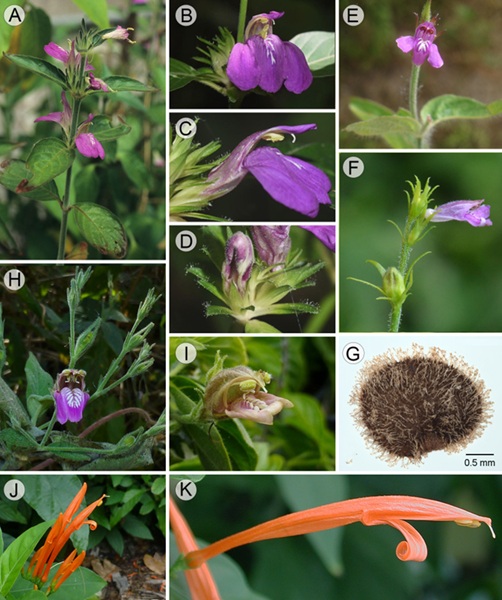
Shrubs to 4(-5, when growing through branches of trees) m tall with corollas zygomorphic, large, red or orangish red, and with strongly recurved lobes when mature.
Full description: Daniel and Acosta Castellanos (2003).
Biotic community: tropical deciduous forest.
Elevation: 1600-1950 m.
Phenology: flowering: February-May; fruiting: February.
Specimens examined: MEXICO. Estado de México, municipio Ixtapan de la Sal, between Ixtapan de la Sal and Tonatico, 0.5 km E of Hwy. 55 in El Salitre, 18°49'17.49"N, 099°39'50.03"W, T. Daniel and D. Denham-Logsdon 12602 (CAS); Rancho San Diego, D. Denham-Logsdon 3216 (MEXU); Laguna Verde, 18°49'56.60"N, 099°40'3.02"W, D. Denham-Logsdon 3386 (CAS); 18°51'24.85"N, 099°40'39.52"W, D. Denham-Logsdon 3387 (CAS, CODAGEM). Municipio indeterminado, 20 mi E of Zitácuaro [ca. 19°24'47.17"N, 100° 06'56.59"W] near [toward?] Toluca, R. Smith M78 (TEX).
Notes: this species was cited from the state by Villaseñor (2016) without a voucher, but was not included by Martínez-De La Cruz et al. (2018). It appears to occur in two regions of the state: west-central and the southeastern portion of western Edomex.
Anisacanthus quadrifidus (Vahl) Nees (Appendix 1: Fig. 4B).
Shrubs to 3 m tall with smaller reddish corollas sometimes ± subactinomorphic, and with the lobes spreading, but with at least the lower lobes not or not strongly recurved at maturity.
Full description: Daniel and Acosta Castellanos (2003).
Biotic community: "dry scrub;" plants from nearby states occur in thornscrub.
Elevation: 2300-2460 m.
Specimens examined: MEXICO: Estado de México, municipio indeterminado, Sierra de Guadalupe, Cerro de Sta. Cruz, E. Matuda et al. 29509 (CAS, MEXU); Cerro de Santa Cruz, extremo norte de Sierra de Guadalupe, [ca. 19°37'13.76"N, 099°07'23.49"W], E. Matuda 37329 (DS, LL, MEXU-image, MO).
Notes: based on the leaves being lanceolate to lanceolate-ovate, to 9.5 mm wide, and borne on petioles to 3 mm long; the calyx lobe:tube = 3.3; and the corolla tube subcylindric to gradually ampliate and longer than limb, the collections noted above pertain to A. quadrifidus var. quadrifidus (Henrickson, 1986). Martínez's (1957) listing of Anisacanthus insignis A. Gray (currently treated as a synonym of a different species, A. puberulus (Torr.) Henrickson & E.J. Lott) from Edomex was likely based on Matuda et al. 29509, which was originally identified as A. insignis.
This species was cited from the state by Villaseñor (2016) without voucher. Both of the collections cited above are from the Sierra de Guadalupe in north-central portion of the state, north of Ciudad de México. A series of iNaturalist (2022) images (e.g., Appendix: Fig. 3B) also document the occurrence of this species in that region of the state. The species was cited by Torres-Zúñiga and Tejero-Díez (1998) from the Sierra de Sultepec based on Torres Zúñiga 114, 380 and Flores 79. Of those collections, only Torres Zúñiga 114 was located at IZTA. It was subsequently redetermined as pertaining to Stachytarpheta Vahl in the Verbenaceae.
Aphelandra guerrerensis Wassh. (Appendix 1: Fig. 4D).
Shrubs to 2 m tall with corollas red throughout and the lobes of the lower lip prominent with the lower-central lobe obovate to elliptic and 5.7-19 mm wide.
Full description: Daniel (1991a).
Biotic community: tropical deciduous forest.
Elevation: ca. 1955 m.
Phenology: flowering: November-December; fruiting: unknown.
Specimen examined: MEXICO: Estado de México, municipio Malinalco, 0.3 km NW del Centro Ceremonial, E. López-Patiño et al. 8262 (CODAGEM).
Notes: this species, newly reported for Edomex, was previously known from Guerrero and Oaxaca (Daniel, 1991a). The specimen cited above was originally identified as A. aurantiaca (Scheidw.) Lindl. and was likely the basis for the inclusion of that species from the state by López-Patiño and Serrano-Garrido (2012), Villaseñor (2016), and Martínez-De La Cruz et al. (2018). Images of this species taken near Malinalco appear online (e.g., iNaturalistMX, 2020). An image that appears to be Aphelandra aurantiaca from Villa Guerrero (iNaturalistMX, 2023) is likely cultivated or possibly naturalized there; the plant is considerably outside of the known native Mexican distributional range (Chiapas, Oaxaca, Puebla, Tabasco, Veracruz) and wet forest habitat of that species.
Aphelandra lineariloba Leonard (Appendix 1: Figs. 3A, 4E).
Shrubs to 3 m tall with corollas red and greenish yellow and the lobes of the lower lip inconspicuous with the lower-central lobe linear and 0.8-2 mm wide.
Full description: Daniel (1991a).
Biotic community: not recorded on labels of Hinton's collections, and noted as "Tropical" by Hinton and Rzedowski (1972). Hinton 3156 was collected in the region of southwestern Edomex dominated by tropical deciduous forest (Rzedowki, 1981). Plants in nearby states occur in tropical deciduous forest, tropical subdeciduous forest, oak forest, and pine-oak forest.
Elevation: ca. 1130 m.
Phenology: flowering: January-February; fruiting: February.
Specimens examined: MEXICO: Estado de México, municipio indeterminado, distrito Temascaltepec, Acatitlán [San Juan Acatitlán; ca. 19°01'N, 100°19'W], G. Hinton 3156 (BM, G, GH, K, MO, RSA, US); Villaneda, [Villa Neda; 19°01'50.01"N, 100°28'24.99"W], G. Hinton et al. 7412 (holotype: K-000064506!, isotypes: ARIZ!, BM!, F!, G!, GH!, LL, MEXU!, MO!, NY!, RSA, US!).
Barleria oenotheroides Dum. Cours. (Appendix 1: Figs. 3N, 4F-H).
Shrubs to 2 m tall with dense and quadrangular inflorescences, yellow corollas that turn dark purplish on drying, and 4 stamens.
Full description: Daniel (1995a).
Biotic communities: thornscrub, tropical deciduous forest, and oak forest.
Elevation: 1100-1600 m.
Phenology: flowering: August-December, March-April; fruiting: January, May.
Specimens examined: MEXICO. Estado de México, municipio Santo Tomás de los Plátanos, Mesa de Malpais E of Santo Tomás de los Plátanos, ca. 0.4 km NE of N end of dam at W side of Presa Ixtapantongo, ca. 19°10'49.12"N, 100°14'59.98"W, T. Daniel et al. 12331 (CAS); Sto. Tomás de los Plátanos, 19°11'N, 100°16.3'W, H. Flügel and E. Geiseler 9056 (B); Sto. Tomás, [Santo Tomás de los Plátanos, ca. 19°10'58.88"N, 100°15'8.14"W], E. Matuda et al. 27546 (CAS, COAGEM, MEXU). Municipio Zumpahuacán, Puente Viejo, 18°48'1.76"N, 099°36'3.54"W, D. Denham-Logsdon 3870 (MEXU). Municipio indeterminado, distrito Temascaltepec, Pantoja [ca. 18°52'N, 100°01'W], G. Hinton 2857 (MO, US); Salitre [Puerto Salitre; 18°52'48.04"N, 100°16'12.06"W], G. Hinton et al. 8738 (US); Rincón del Carmen [ca. 18°53'N, 100°08'W], G. Hinton et al. 8764 (BR, US, W); Tenayac [San Pedro Tenayac, ca. 19°03'N, 100°10'48"W], G. Hinton et al. 8782 (US). Municipio/distrito indeterminado, Tonatico, [ca. 18°48'18.45"N, 099°39'28.36"W], E. Matuda et al. 27510 (CAS, CODAGEM, MEXU); C. de San Vicente, cerca de Sn. Antonio, Tlatlaya, [ca. 18°36'46.00"N, 100°13'22.03"W], E. Matuda et al. 32120 (CAS, CODAGEM, MEXU).
Note: Martínez (1957) treated this species with the name B. discolor Nees, a synonym.
Carlowrightia arizonica A. Gray (Appendix 1: Fig. 5A).
Perennial herbs or weak shrubs to 1 m tall with corollas pseudopapilionaceous and white to pale yellowish white with yellow and purplish markings on the upper lip.
Full description: Daniel (1983).
Biotic communities: thornscrub and tropical deciduous forest.
Elevation: 550-1100 m.
Phenology: flowering: August-December, April; fruiting: August-December.
Specimens examined: MEXICO: Estado de México, municipio indeterminado, along Hwy. 130 between Bejucos and Tejupilco, 2.6 mi NE Guerrero - Edomex border [18°47'12.58"N, 100°24'03.82"W], T. Daniel 1231 (ENCB, MEXU, MICH, US); Sto. Tomás, [Santo Tomás de los Plátanos, ca. 19°10'58.88"N, 100°15'8.14"W], E. Matuda et al. 27548 (MEXU); La Junta, cerca de Tingambato, [ca. 19°04'44.02"N, 100°20'12.52"W], E. Matuda et al. 29798 (CAS, ENCB, MEXU).
Carlowrightia neesiana (Schauer ex Nees) T.F. Daniel (Appendix 1: Fig. 5 B,D,E).
Perennial herbs or weak shrubs to 35 cm tall with corollas pseudopapilionaceous and white with yellow and purplish markings on the upper lip.
Full description: Daniel (1983)).
Biotic communities: tropical deciduous forest and tropical subdeciduous forest (?).
Elevation: 1425-1940 m.
Phenology: flowering: November-December; fruiting: January, April.
Specimens examined: MEXICO: Estado de México, municipio Ixtapan de la Sal: Laguna Verde, 18°51'22.76"N, 099°40'35.57"W, D. Denham-Logsdon 3225 (CAS). Municipio Zumpahuacán, Puente Viejo, ca. 7.5 km (linear distance) ESE of Tonatico, 18°47'49.02"N, 099°35'56.39"W, D. Denham-Logsdon 3866 (MEXU), 4007 (MEXU).
Notes: this species was cited from Edomex by Villaseñor (2016) without voucher. The species is currently known from south-central regions of the state.
Carlowrightia pectinata Brandegee (Appendix 1: Figs. 2E, 5C).
Perennial herbs to 0.5 m tall with corollas subactinomorphic and white with purple markings on the upper lip.
Full description: Daniel (1983).
Biotic community: tropical deciduous forest.
Elevation: 700-1500 m.
Phenology: flowering: November-December; fruiting: November-December.
Specimens examined: MEXICO. Estado de México, municipio Zumpahuacán, Sendero Jerónimo, ca. 19 km (air) SE of Tonatico, 18°41.362'N, 099°31.501'W, T. Daniel and D. Denham 12312 (CAS). Municipio indeterminado, distrito Temascaltepec, Tejupilco [ca. 18°55'N, 100°09'W], G. Hinton 2672 (holotype: C. lanceolata Leonard: K-000529405!, isotypes: ARIZ-image, ENCB!, F!, G!, GH!, K!, MEXU!, MO!, NY!, PH!, RSA!, TEX!, US!); Plaza de Gallos [ca. 18°48'N, 100°18'W], G. Hinton 2990 (GH, US). Municipio/distrito indeterminado, C. de San Antonio, Tlatlaya, [ca. 18°36'46.00"N, 100°13'22.03"W], E. Matuda et al. 32101 (CAS, MEXU).
Note: Martínez (1957) treated this species with the name C. lanceolata, a synonym.
Chalarothyrsus amplexicaulis Lindau (Appendix 1: Figs. 2G, 5F).
Perennial herbs or weak shrubs to 1.5 m tall with large leaves that often taper along a winged petiole to an amplexicaulis base, red corollas that often hang downwards, and seeds that remain permanently retained in the capsule valves.
Full description: Lindau (1904).
Biotic community: pine-oak forest.
Elevation: 1700-1800 m.
Phenology: flowering: January-April; fruiting: March.
Specimens examined: MEXICO. Estado de México, municipio indeterminado, distrito Temascaltepec, Nanchititla [ca. 18°53'N, 100°28'W], G. Hinton et al. 7384 (BM, G, GH, K, MEXU, MO, RSA, US-image); 7624 (BM, G, GH, K); 8867 (ENCB, GH, K, MO, PH, RSA, US-image, W).
Dicliptera haenkeana Nees (Appendix 1: Fig. 6F-H).
Perennial herbs to 1.4 m tall with pink to pink-purple corollas that are resupinate 180°.
Full description: Daniel (2009).
Biotic community: tropical deciduous forest.
Elevation: 1250-1450 m.
Phenology: flowering: July, November-December; fruiting: July, December.
Specimens examined: MEXICO. Estado de México, municipio Zumpahuacán, Sendero Jerónimo, ca. 19 km (air) SE of Tonatico, 18°42.115'N, 099°31.698'W, T. Daniel and D. Denham 12316 (CAS). Municipio indeterminado, distrito Temascaltepec, Volcán [Volcán de Tejupilco, 18°51'N, 100°09'W], G. Hinton 2498 (K, US). Municipio/distrito indeterminado, Cascada de los Diamantes, P. Beltrán L. 35 (MEXU-image).
Note: some collections from Edomex have been identified as D. rigidissima Miranda, a synonym of D. haenkeana.
Dicliptera inaequalis Greenm. (Appendix 1: Figs. 2B, 6D).
Shrubs to 2 m tall with corollas dark orange, orangish red, or salmon colored and not resupinate.
Full description: Daniel and Acosta Castellanos (2003).
Biotic community: tropical deciduous forest, oak forest, and pine-oak forest.
Elevation: 1500-2000 m.
Phenology: flowering: February-May; fruiting; February-May.
Specimens examined: MEXICO. Estado de México, municipio Ixtapan de la Sal, Ixtamil, 18°49'26.36"N, 099°40'31.65"W, D. Denham-Logsdon 3398 (MEXU). Municipio Tejupilco, Almoloya de las Granadas, G. Albiter 66 (ENCB); ca. 1.5 km E de El Platanal, Cañada del Coyote, 18°58'14"N, 100°12'24"W, V. Steinmann et al. 4135 (ARIZ-image, CAS, MEXU). Municipio Temascaltepec, Parque Universitario “Las Orquideas”, Centro Universitario UAEM Tamascaltepec, km 67.5 carr. Toluca - Tejupilco, 19°02'36.72"N, 100°03'24.54"W, C. Monsalvo J. CBMJ-57 (MEXU). Municipio Tonatico, Grutas de la Estrella, 18°44'40.88"N, 099°38'6.45"W, D. Denham-Logsdon 4161 (MEXU). Municipio Zacualpan, Cerro La Corona, [ca. 18°42'1.75"N, 099°48'20.74"W], E. Matuda et al. 30339 (MEXU). Municipio indeterminado, distrito Temascaltepec, Rincón (ca. 19°01'N, 099°58'W), G. Hinton 238 (US-image); San Lucas del Maíz (ca. 18°57'42.21"N, 100°10'56.25"W), G. Hinton 3337 (holotype: D. aquatica: K-000064987!, isotypes: ARIZ-image, F!, GH-image, K!, MEXU!, MO-image!, NY!, US!); Las Mesas (Las Mesas de Real de Arriba, ca. 19°03'22"N, 099°59'10"W), G. Hinton et al. 5602 (US-image). Municipio/distrito indeterminado, Temascaltepec, barranca honda, [19°02'44.29"N, 100°03'32.09"W], E. Matuda et al. 30428 (MEXU); Sultepec, L. Paray 2917 (ENCB); just outside Temascaltepec, road near Río Real de Arriba, B. Schubert et al. 1800 (US).
Notes: Martínez (1957) included D. aquatica Leonard (the type and only known collection: Hinton 3337, see above) among the species of this genus in the state. Daniel and Acosta Castellanos (2003) tentatively treated this species as a synonym of D. inaequalis. Morphologically diverse plants treated under the latter name are deserving of additional studies to better understand the taxonomy of the group.
Dicliptera peduncularis Nees (Appendix 1: Fig. 6I-K).
Perennial herbs to 0.5 m tall with pale purple (sometimes with darker purple markings on lips) corollas that are resupinate 180°.
Full description: Daniel and Acosta Castellanos (2003).
Biotic communities: thornscrub, grassland, and pine-oak forest.
Elevation: 1735-2350 m.
Phenology: flowering: September-May; fruiting: September-December, April-May.
Specimens examined: MEXICO. Estado de México, municipio Chalco, San Pablo Atlazalpan, A. Ventura A. 4391 (MEXU-image, XAL). Municipio Chiautla, Cerro La Promesa, cañada arriba de Tepetitlán, S. Koch 8231 (CHAPA). Municipio San Simón de Guerrero, 1 km antes de San Simón de Guerrero, 19°01'06"N, 100°01'06"W, J. Rojas G. et al. 2543 (FCME). Municipio Texcoco, Campo Experimental Chapingo, la orilla de los caminos y sitios valdíos, A. Alcántar s.n. (MEXU-image); Huexotla, M. Ascencio 42 (CHAPA); San Joaquín, M. Ascencio V. 105 (CODAGEM, MEXU-image); San Vicente Chicoloapan, A. Ventura A. 4102 (ASU, MEXU-image); San Andrés Chiautla, E. Ventura V. 35 (CHAPA, MEXU-image); Coatlinchán, E. Ventura V. 371 (ASU, MEXU-image); Papalotla, E. Ventura V. 1643 (CAS, MEXU-image); San Dieguito, E. Ventura V. 1700 (CAS, MEXU-image); vía férrea México-Veracruz, tramo Montecillo - Coatlinchán, 19°26'59.1"N, 098°54'04.2"W, H. Vibrans 6676 (CHAPA, MEXU-image). Municipio Tonatico, Salitre S, 18°49'21.78"N, 099°39'49.25"W, D. Denham-Logsdon 3375 (MEXU). Municipio Zitácuaro, La Encarnación, 5.5 km SW de Zitácuaro, carr. Zitácuaro - Huetamo, 19°24'33.5"N, 100°23'31.1"W, J. Soto N. 14470 (MEXU). Municipio Zumpango, San Juan Citlaltepec, orilla N del Lago de Zumpango, P. Jaquemin 1223 (MEXU-image). Municipio indeterminado, Escuela de Agricultura, Urbina s.n. (MEXU-image).
Note: this often “weedy” native species was cited as a roadside plant in Edomex by Martínez-De La Cruz et al. (2024).
Dicliptera resupinata (Vahl) Juss. (Appendix 1: Fig. 6A, D).
Perennial herbs to 10 cm tall with pink corollas that are resupinate 180°.
Full description: Daniel (1997).
Biotic communities: tropical deciduous forest.
Elevation: 1100-1245 m.
Phenology: flowering: January, August; fruiting: January, August.
Specimens examined: MEXICO. Estado de México, municipio Santo Tomás de los Plátanos, valley just N of (below) Nuevo Santo Tomás, 19°11'05.37"N, 100°15'55.93"W, T. Daniel et al. 12321 (CAS); Sto. Tomás de los Plátanos, 19°11'N, 100°16.3'W, H. Flügel and E. Geiseler 9021 (B); Sto. Tomás, [Santo Tomás de los Plátanos, ca. 19°10'58.88"N, 100°15'8.14"W], E. Matuda et al. 27556 (CODAGEM, MEXU).
Note: Martínez (1957) treated plants from the state as pertaining to D. resupinata var. orbicularis B.L. Rob. & Seaton (as "var. orbiculata Rob. & Greenm."), a subspecific taxon usually not recognized.
Dicliptera sexangularis (L.) Juss. (Appendix 1: Fig. 6E).
Perennial herbs to 0.7 m tall with red corollas that are not resupinate.
Full description: Daniel and Acosta Castellanos (2003).
Biotic community: tropical deciduous forest.
Elevation: 1730 m.
Phenology: flowering: March; fruiting: March-April.
Specimens examined: MEXICO. Estado de México, municipio Ixtapan de la Sal, between Ixtapan de la Sal and Tonatico, 0.2 km E of Hwy. 55 in El Salitre, 18°49'04.07"N, 099°40'01.16"W, T. Daniel and D. Denham-Logsdon 12601 (CAS); Salitre Centro, 18°49'2.86"N, 099°40'0.70"W-18°49'3.84"N, 099°40'1.05"W, D. Denham-Logsdon 4377 (MEXU).
Note: this species is locally abundant in and around a disturbed field, where it appears to have been unintentionally introduced from Veracruz in cattle feed, which is used at that site for grazing cows. Thus, the species is treated as newly documented and locally naturalized in the state.
Dicliptera thlaspioides Nees (Appendix 1: Fig. 6B).
Perennial herbs to 0.65 m tall with corollas white with dark purple markings on the lips and resupinate 180°.
Full description: Daniel (2009).
Biotic communities: tropical deciduous forest, oak forest, and pine-oak forest.
Elevation: 650-2900 m.
Phenology: flowering: November-December; fruiting: November-January, April.
Specimens examined: MEXICO. Estado de México, municipio Malinalco, 1.3 km NE de Agua Dulce, E. López-Patiño et al. 8225 (CODAGEM). Municipio indeterminado, distrito Temascaltepec, Acatitlán (19°01'N, 100°19'W), G. Hinton 3155 (ARIZ, US-image); Palmar (Palmar Chico, ca. 18°42'N, 100°24'W), G. Hinton 5177 (K). Municipio/distrito indeterminado, C. de San Vicente, cerca de San Antonio, Tlatlaya [ca. 18°36'46.00"N, 100°13'22.03"W], E. Matuda et al. 32117 (CAS, ENCB, MEXU); Tezoloapan, Pelón de Tres Reyes, [not located], E. Matuda et al. 38228 (CHAPA).
Dyschoriste angustifolia (Hemsl.) Kuntze (Appendix 1: Figs. 3E, 7A).
Perennial herbs to 1.5 m tall with red (to orange-red, pinkish, or reddish brown) corollas and short (to 0.2 mm long), recurved basal appendages on the anther thecae.
Full description: Daniel and Acosta Castellanos (2003).
Biotic community: tropical deciduous forest.
Elevation: 400-950 m.
Phenology: flowering: July; fruiting: unknown.
Specimen examined: MEXICO. Estado de México, municipio indeterminado, Rincón Grande y Llano Grande, Tlatlaya [ca. 18°26'50.14"N, 100°20'16.10"W], E. Matuda et al. 31062 (MEXU).
Note: This species was reported from the state by Daniel et al. (2024).
Dyschoriste hirsutissima (Nees) Kuntze (Appendix 1: Figs. 2A,B, 7B, C).
Erect or spreading, often sticky and foul smelling, perennial herbs to 0.52 m tall or long with glandular trichomes usually throughout the plant (rarely only on calyces and/or corollas), and with corollas light purple with dark purple markings in the throat and on the lower (and often also upper) lip.
Full description: Daniel and Acosta Castellanos (2003).
Biotic communities: thornscrub, tropical deciduous forest, tropical subdeciduous forest, and oak forest.
Elevation: 1100-2200 m.
Phenology: flowering: October-February; fruiting; January.
Specimens examined: MEXICO, Estado de México, municipio Malinalco, Palmar de Guadalupe, E. López P. et al. 3906 (CODAGEM). Municipio Zumpahuacán, Puente Viejo, 18°47'49.01"N-18°48'19.79"N, 099°35'55.71"W-099°36'18.01"W, D. Denham-Logsdon 3862 (MEXU), 4193 (MEXU). Municipio indeterminado, distrito Temascaltepec, Rincón [ca. 19°01'N, 099°58'W], G. Hinton 204 (US-image); Plaza de Gallos [ca. 18°48'N, 100°18'W], G. Hinton 2982 (K, US-image). Municipio/distrito indeterminado, Zacanozapan, 19°36'N, 100°16.6'W, H. Flügel and E. Geiseler 9074 (B); Tejupilco [ca. 18°51'43.83"N, 100°11'29.37"W], E. Matuda 27872 (CAS, CODAGEM); Cerro La Corona, Zacualpan [ca. 18°42'1.75"N, 099°48'20.74"W], E. Matuda et al. 30343 (MEXU); Zumpahuacán [ca. 18°45'58.96"N, 099°34'45.01"W], E. Matuda et al. 31908 (CAS, CODAGEM, MEXU); C. de San Vicente, cerca de Sn. Antonio, Tlatlaya [ca. 18°36'46.00"N, 100°13'22.03"W], E. Matuda et al. 32119 (CAS, CODAGEM, MEXU); Cerro Muñeca, Tejupilco [ca. 18°51'05.59"N, 100°10'19.52"W], E. Matuda et al. 38211 (CAS, CODAGEM); 7 km S de Temascaltepec, 5 km SE de Tejupilco de Hidalgo, L. Rico and E. Martínez 841 (K, MO).
Dyschoriste microphylla (Cav.) Kuntze (Appendix 1: Fig. 7G).
Erect or spreading perennial herbs to 35 cm tall or long, lacking glandular trichomes, with leaf surfaces glabrous or nearly so, and with corollas light purplish with dark purple markings in throat and on proximal portions of lips.
Full description: Daniel and Acosta Castellanos (2003)).
Biotic communities: thornscrub, grassland, oak forest, and pine-oak forest.
Elevation: 700-2700 m.
Phenology: flowering: May-November; fruiting: May-November.
Specimens examined: MEXICO. Estado de México, municipio Huizquilucan, 2 km W de Río Hondo, J. Rzedowski 29603 (CAS). Municipio Ixtapaluca: carr. México - Puebla, arriba de Ixtapaluca, 19°19'49.4"N, 098°49'43.7"W, H. Vibrans 7384 (MEXU). Municipio Tepotzotlán, camino a Colonia Dolores, entre la carretera a Arcos del Sitio y San Juan de las Tablas, F. Espinosa-García 637 (CAS, MEXU); Presa de la Concepción, H. Iñiguez s.n. (MEXU, WIS). Municipio Texcoco, ca. 5 km SE de Huexotla, 6 km SE de Texcoco, camino que va hacia la mina de arena, J. García P. 658 (CAS, F-image, MEXU); San Miguel Tlaixpan, E. Ventura V. 1093 (MEXU); Tequexquinahuac, E. Ventura V. 1322 (MEXU); San Dieguito, E. Ventura V. 1353 (CODAGEM). Municipio Tultitlán, 2 km WSW de Lechería, R. Cruz-Cisneros 700 (DS, WIS). Municipio Villa Nicolás Romero, Col. Miguel Negreta, A. Ventura A. 3336 (ASU, CAS, MEXU, US). Municipio indeterminado, Sierra de Alcaparrosa, 10 km NW de Tepotzotlán, R. Fernández N. 1726 (MEXU-image); 69.1 mi N of Toluca, M. Johnston 2648 (MEXU); off Toluca Road, C. Lundell and A. Lundell 12379 (US-image); Jilotepec [ca. 19°55'19.34"N, 099°31'27.81"W], E. Matuda et al. 26744 (US); Oro de Hidalgo, cerca de presa [ca. 19°46'17.68"N, 100° 8'34.97"W], E. Matuda et al. 27676 (CODAGEM, MEXU); Jilotepec, E. Matuda et al. 30965 (CAS, MEXU-image); hills in the Valley of Mexico, C. Pringle 11322 (MEXU); Sierra de Guadalupe, N de Cuautepec, J. Rzedowski 15692 (MEXU); Sierra de las Ánimas, Chapa de Mota, Cerro de las Ánimas, 19°48'26.8"N, 099°30'50"W, C. Trejo-Díaz 222 (MEXU); along Hwy. 57, 26 mi SE of tollgate near Querétaro, Wieder et al. 48 (USF-image).
Notes: the description by Daniel and Acosta Castellanos (2003) treated the species in a broader sense (e.g., including D. schiedeana) than that recognized here. Martínez (1957) recognized both D. microphylla and D. decumbens (A. Gray) Kuntze from the state. His concept of D. decumbens, a species of the southwestern United States of America and northwestern Mexico, might have pertained to some of the more decumbent plants (e.g., Espinosa G. 637, collected in 1979 and so identified by the collector). At least two of the collections noted above (Cruz C. 700 and Espinosa G. 637) resemble most other collections of D. microphylla from the state (e.g., having leaf blade surfaces glabrous or nearly so), but their leaf blades are somewhat less broadly elliptic (length:width up to 3.3). Some plants from elsewhere in the country appear to be somewhat intermediate between D. schiedeana and D. microphylla. The taxonomy of plants variously treated as D. microphylla, D. schiedeana, D. decumbens, and others remains to be satisfactorily resolved.
Dyschoriste schiedeana (Nees) Kuntze (Appendix 1: Fig. 7H).
Mostly decumbent perennial herbs with narrow leaves that are usually linear to oblanceolate, acute at the apex, and conspicuously pubescent on the surfaces.
Full description: Henrickson (1999), as D. schiedeana var. schiedeana).
Biotic community: unknown (see below); elsewhere, the species occurs in arid scrub and oak forest.
Elevation: 2500 m.
Phenology: flowering: November; fruiting: November.
Specimen examined: MEXICO, Estado de México, municipio indeterminado, Hochebene bei [plateau near] Agua Zarca [ca. 19°32'01.37"N, 100°03'42.89"W], E. Matuda 32443 (MEXU).
Notes: Dyschoriste schiedeana has been listed as occurring in the state (e.g., Villaseñor, 2016; Martínez-De La Cruz et al., 2018), but without citation of a voucher. Matuda’s collection, identified as D. microphylla, possibly came from near Agua Zarca in the west-central region of the state (ca. 19°31'44.29"N, 100°03'39.68"W), in which forests of oak and conifers are the dominant biotic communities (Rzedowski, 1981). Henrickson (1999) proposed a much broader circumscription of this species that includes several varieties, some of which pertain to previously and/or currently recognized species. Plants showing morphological intermediacy between D. microphylla and D. schiedeana are not infrequent.
Dyschoriste xylopoda Kobuski (Appendix 1: Fig. 7D,E).
Usually erect perennial herbs to 40 cm tall (sometimes spreading or decumbent and up to 60 cm long) that lack glandular trichomes and have corollas pale purple with dark purple markings in the throat and on the lower lip.
Full description: Daniel (1995a), as D. ovata (Cav.) Kuntze).
Biotic communities: thornscrub, tropical deciduous forest-oak forest transition, and oak forest.
Elevation: 600-1940 m.
Phenology: flowering: June-November; fruiting: August-November.
Specimens examined: MEXICO. Estado de México, municipio Ixtapan de la Sal, Divisadero, 18°52'33.32"N, 099°39'23.78"W-18°52'33.53"N, 099°39'23.64"W, D. Denham-Logsdon 4224 (MEXU). Municipio indeterminado, distrito Temascaltepec, Chorrera [18°55'N, 100°14'W], G. Hinton 1287 (K, LL, TEX, US); Mina de Agua [ca. 19°00'N, 099°56'W], G. Hinton 1398 (K, US); Tejupilco (Tejupilco de Hidalgo, 18°54'21"N, 100°09'10"W), G. Hinton 4584 (K). Municipio/distrito indeterminado, Volcán Toluca, bei Tenancingo, C. Heller 447 (W); Los Bejucos [ca. 18°47'5.22"N, 100°25'7.65"W], E. Matuda 57600 (CODAGEM, MEXU); 2-3 km (air) SW of Luvianos, 18°50'N, 100°20'W, K. Roe et al. 1588 (US).
Notes: plants comprising what is here treated as D. xylopoda include a diverse assemblage distributed from Sonora and Chihuahua southward to Guatemala that varies in cauline pubescence (though lacking glandular trichomes, the eglandular trichomes vary in density, form, and length), thecal size and pubescence, and presence/absence of thecal mucros. It is possible that more than one taxon may be represented within this circumscription. Daniel (1995a) tentatively used the older name D. ovata (Cav.) Kuntze for plants now treated as D. xylopoda. He noted that potential types of the basionym (Ruellia ovata Cav.) do not appear to apply to Dyschoriste. The type of D. xylopoda (Pringle 4442 from Jalisco) generally conforms to plants from Edomex. The species (as D. ovata) was vouchered from Edomex by Hinton et al. (2019).
Elytraria imbricata (Vahl) Pers. (Appendix 1: Figs. 2H, 8A-F).
Perennial herbs to 0.5 m tall having corollas purple with white (and usually yellow) regions on the lower lip at the mouth (uncommonly pink with purplish throat, entirely white, or white with purple markings on lower and upper lips around mouth).
Full description: Daniel and Acosta Castellanos (2003).
Biotic communities: thornscrub and tropical deciduous forest.
levation: 440-1700 m.
Phenology: flowering: August-April; fruiting: December-April.
Specimens examined: MEXICO. Estado de México, municipio Malinalco, 0.8 km NE de Noxepec de Zaragoza, E. López-Patiño et al. 6293 (CODAGEM). Municipio Santo Tomás de los Plátanos, valley just N of (below) Nuevo Santo Tomás, 19°11'05.37"N, 100°15'55.93"W, T. Daniel et al. 12324 (CAS), 12329 (CAS); Sto. Tomás de los Plátanos, 19°11'N, 100°16.3'W, H. Flügel and E. Geiseler 9041 (B). Municipio Tejupilco, carr. de Luvianos a Tejupilco, W de El Estanco, 18°54'N, 100°15'W, H. Vibrans 6353 (CHAPA, ENCB, MEXU). Municipio Tlatlaya, carr. de Arcelia a Tejupilco, N de San Antonio del Rosario, 18°27'N, 100°19'W, H. Vibrans 5066 (MEXU). Municipio Zumpahuacán, Sendero Jerónimo, ca. 19 km (air) SE of Tonatico, 18°41.645'N, 099°31.460'W, T. Daniel and D. Denham 12313 (CAS); Sendero Jerónimo, ca. 19 km (air) SE of Tonatico, 18°41.761'N, 099°31.516'W, T. Daniel and D. Denham 12314 (CAS); Sendero Jerónimo, ca. 19 km (air) SE of Tonatico, 18°41.437'N, 099°31.490'W, T. Daniel and D. Denham 12318 (CAS); Sendero Jerónimo, ca. 19 km (air) SE of Tonatico, 18°41.414'N, 099°31.490'W, T. Daniel and D. Denham 12319 (CAS); Sendero Jerónimo, 18°41'53.37"N, 099°31'43.37"W, D. Denham-Logsdon 4036 (MEXU); Puente Viejo, 18°48'24.14"N, 099°36'20.04"W, D. Denham-Logsdon 4188 (MEXU). Municipio indeterminado, distrito Temascaltepec, Ypericones (Los Pericones; ca. 18°53'49.26"N, 100°28'55.65"W), G. Hinton 2962 (K, MICH), 2963 (US); Peñon (El Peñon, ca. 19°02'56"N, 100°06'46"W), G. Hinton et al. 5762 (BM, K, US-image). Municipio/distrito indeterminado, Malpaís, San Nicolás, 25 km SW de Valle de Bravo, E. Matuda et al. 27407 (CAS, CHAPA, CODAGEM, MEXU); Sto. Tomás [Santo Tomás de los Plátanos, ca. 19°10'58.88"N, 100°15'8.14"W], E. Matuda et al. 27563 (CAS, CODAGEM, MEXU); La Junta, cerca de Tingambato [ca. 19°04'44.02"N, 100°20'12.52"W], E. Matuda et al. 29805 (CODAGEM, MEXU); C. de San Antonio, Tlatlaya [ca. 18°36'46.00"N, 100°13'22.03"W], E. Matuda et al. 32098 (CAS, CODAGEM).
Notes: Martínez (1957) treated this species with the name E. squamosa (Jacq.) Lindau, a synonym. Hinton 2963 at US is E. imbricata whereas Hinton 2963 at K is Tetramerium nervosum.
Throughout its broad geographic distribution in North and South America, most plants have purple corollas with a white region (usually with a central yellow spot) on the lower lip just distal to the mouth. Plants from Guerrero and Edomex show considerable variation in corolla color in this species (Appendix 1: Fig. 8A-F), some of which possibly represent hybrids with the occasionally sympatric E. mexicana. Variation evident among plants of E. imbricata in Edomex includes those having purple corollas with white and yellow markings near the base of the lower lip (typical for the species; e.g., Daniel et al. 12329, CAS), the typical coloration but lacking the yellow discoloration at the base of the lower lip (e.g., Daniel and Denham 12318, CAS), entirely white corollas (e.g., Daniel and Denham 12314, CAS), white corollas having dark purple markings on both the upper and lower lips around the mouth of the tube (e.g., Daniel and Denham 12319, CAS), and pale pinkish corollas with white and dark purple markings on the lower lip (e.g., Denham-Logsdon 4188, MEXU). Several of the color variants were observed occurring more or less sympatrically at two localities south of Ixtapan de la Sal in the south-central portion of the state. In spite of variation in corolla color of E. imbricata, most plants readily conform to the characters used above in the key.
Elytraria mexicana Fryxell & Koch (Appendix 1: Fig. 8G, H).
Perennial herbs to 30 cm tall having corollas pale yellowish white with dark purple markings on the upper lip and sometimes also on proximal portions of the lower lip.
Full description: Daniel and Acosta Castellanos (2003).
Biotic community: tropical deciduous forest.
Elevation: 1080-1590 m.
Phenology: flowering: November-December; fruiting: November-December.
Specimens examined: MEXICO. Estado de México, municipio Tonatico, Grutas de la Estrella, ca. 7.5 km (air) SE of central Tonatico, 18°44.787'N, 099°37.866'W, T. Daniel and D. Denham 12310 (CAS). Municipio Zumpahuacán, Puente Viejo, 18°47'52.75"N, 099°36'0.00"W, D. Denham-Logsdon 4035 (MEXU). Municipio indeterminado, distrito Temascaltepec, Vigas [Las Vigas, Paso de Vigas, ca. 18°55'N, 100°15'W], G. Hinton 2616 (BM, G, GH, K, NY, US-image); Pungarancho [ca. 18°53'N, 100°35'W], G. Hinton 3135 (BM, G, GH, K, NY, US-image); Tenayac [San Pedro Tenayac, ca. 19°03'N, 100°10'48"W], G. Hinton 5111 (G, GH, K, NY, US-image).
Notes: Hinton’s collections were previously identified as E. imbricata. Elytraria mexicana was listed as occurring in Edomex by Villaseñor (2016) and Martínez-De La Cruz et al. (2018), but without indication of a voucher. Daniel et al. (2024) cited the specimens listed above to document the occurrence of this species in the state.
Henrya insularis Nees ex Benth. (Appendix 1: Figs. 2D, 5G).
Perennial herbs to 1.5 m tall having corollas white to pale yellowish white with yellow and red to reddish purple markings on the upper lip and seeds bearing hygroscopic trichomes on one side.
Full description: Daniel (1990).
Biotic community: tropical deciduous forest
Elevation: 1245-1520 m.
Phenology: flowering: January-April; fruiting: January-April.
Specimens examined: MEXICO. Estado de México, municipio Santo Tomás de los Plátanos, valley just N of (below) Nuevo Santo Tomás, 19°11'05.3"N, 100°15'55.93"W, T. Daniel et al. 12325 (CAS). Municipio Zumpahuacán, Puente Viejo, ca. 3.6 km (linear distance) SW of Zumpahuacán, 18°48'50.28"N, 099°36'22.22"W, D. Denham-Logsdon 4191 (MEXU). Municipio indeterminado, distrito Temascaltepec, Nanchititla, G. Hinton 3410 (GH, K, NY, US); Tejupilco [ca. 18°55'N, 100°09'W], G. Hinton et al. 5756 (CAS, F, GH, K, MO, NY, US); Nanchititla [ca. 18°53'N, 100°28'W], G. Hinton et al. 7611 (K, US). Municipio/distrito indeterminado, beyond Valle de Bravo, near Rancho San Nicolas, M. Carlson 2879 (F).
Henrya tuberculosperma T.F. Daniel (Appendix 1: Figs. 3F, 5H).
Perennial herbs to 0.5 m tall having corollas white to pale yellowish white with yellow and/or reddish purple markings on the upper lip and seeds lacking trichomes.
Full description: Daniel (1990).
Biotic community: tropical deciduous forest.
Elevation: 1180-1800 m.
Phenology: flowering: January, April; fruiting: January, April-May.
Specimens examined: MEXICO. Estado de México, municipio Malinalco, 0.8 km NE de Noxtepec de Zaragoza, E. López-Patiño et al. 6315 (CODAGEM). Municipio Zumpahuacán, Sendero Jerónimo, 18°41'49.56"N, 099°31'53.39"W, D. Denham-Logsdon 3447 (MEXU). U.S.A. California, San Francisco County, plants cultivated from seed of Denham 3447, T. Daniel s.n. cv (CAS).
Notes: this species from south-central Edomex is newly reported from the state. It has been previously documented from the following Mexican states: Guerrero, Jalisco, Morelos, Nayarit, and Sinaloa (Daniel, 2008a).
Holographis haenkeana (Nees) T.F. Daniel, McDade & Kiel (Fig. 1, Appendix 1: Figs. 3B, 7J, K).
Shrubs to 1 m tall with quaternate leaves and large, tubular, and lemon yellow corollas.
Full description: Daniel (1991a), as Aphelandra verticillata Hemsl.
Biotic community: tropical deciduous forest.
Elevation: 1360-1700 m.
Phenology: flowering: August, November-December; fruiting: unknown.
Specimens examined: MEXICO. Estado de México, municipio Zumpahuacán, Sendero Jerónimo, ca. 19 km (air) SE of Tonatico, 18°41.761'N, 099°31.516'W, T. Daniel and D. Denham 12317 (CAS); Sendero Jerónimo, 18°42'06.50"N, 099°31'35.72"W-18°42'06.94"N, 099°31'35.81"W, D. Denham-Logsdon 3904 (CODAGEM). Municipio indeterminado, distrito Temascaltepec, Ypericones (Los Pericones; ca. 18°53'39.97"N, 100°29'03.46"W), G. Hinton 2971 (BM, G, GH, K, MO, NY, RSA, TEX, US). Municipio/distrito indeterminado, Tlatlaya y cercanías [ca. 18°36'46.00"N, 100°13'22.03"W], E. Matuda et al. 29997 (MEXU).
Note: Daniel et al. (2020; 2021) clarified the generic placement and nomenclature of this species, previously known as Aphelandra verticillata.
Holographis peloria (Leonard) T.F. Daniel (Appendix 1: Fig. 7F, I).
Perennial herbs to 0.6 (-1.2) m tall with leaves quaternate and corollas small and dark reddish purple streaked with pink veins.
Full description: Leonard (1960), as Stenandrium pelorium Leonard).
Biotic community: tropical deciduous forest.
Elevation: 1960 m.
Phenology: flowering: June-August; fruiting: August-September.
Specimens examined: MEXICO. Estado de México, municipio Ixtapan de la Sal, Laguna Verde, ca. 0.25 km (linear distance) NE of Parque Acuático Ixtapan, 18°51'18.42"N, 099°40'35.79"W, D. Denham-Logsdon 3261 (MEXU), 3553 (CODAGEM).
Notes: this species is newly documented from Edomex. It was previously reported from Durango, Guanajuato, Nayarit, and Zacatecas (Daniel et al., 2024).
Hypoestes phyllostachya Baker (Appendix 1: Figs. 2C, 11F).
Perennial herbs to 0.6 m tall with leaves pink-spotted and corollas pink (with white markings on the lip in upper position) and resupinate 180°.
Full description: Daniel and Acosta Castellanos (2003).
Biotic community: commonly cultivated and also found in secondary scrub with elements of mesophytic montane forest and oak forest.
Elevation: 1850-2000 m.
Phenology: flowering: September-January; fruiting: unknown.
Specimens examined: MEXICO. Estado de México, municipio Ixtapan de la Sal, Barranca Nenetzingo, entre El Abrojo y El Puente Nenetzingo, carr. libre Toluca - Ixtapan, 18°53'30"N, 099°40'30"W, J. López S. and S. Hernández J. 1221 (CHAPA, CODAGEM, MEXU). Municipio Malinalco, 1.5 km NW de Monte Grande, E. López-Patiño 4069 (CODAGEM).
Notes: this species, native to Madagascar, is cultivated for ornament (e.g., Koch 931 at CHAPA, ENCB) and has become naturalized throughout the state. The collections noted above are presumed to have come from naturalized occurrences. The species was noted to be rare at some sites and locally common at others. The plant has become a weed in portions of the Neotropics (e.g., Daniel 2001).
Justicia aurea Schltdl. (Appendix 1: Fig. 9A, B).
Shrubs to 2.5 m (or more) tall with large yellow corollas in a ± dense and terminal inflorescence.
Full description: Daniel (1995a)).
Biotic community: tropical deciduous forest.
Elevation: ca. 1850 m.
Phenology: flowering: April-August; fruiting: unknown.
Specimen examined. MEXICO. Estado de México, municipio Malinalco, 1.3 km NE de San José Chalmita, E. López-Patiño 4701 (CODAGEM); Tenancingo-Malinalco - Zumpahuacán, 0. 1832 (CODAGEM).
Notes: phenological information noted above includes flowering plants seen on iNaturalist (2024a) from the state. Plants are often cultivated in Edomex, with some potentially naturalized (i.e., collections not noted to be cultivated on labels or specifically noted to be native), but probably not native. The species appears to be native in southern Mexico and possibly Central America. The synonym Jacobiana umbrosa (Benth.) Blake has sometimes been applied to plants from the state.
Justicia candicans (Nees) L.D. Benson (Appendix 1: Fig. 9E, F).
Perennial herbs to 1 m tall with red corollas that usually have a white herringbone pattern on the lower lip, and with seeds often reddish.
Full description: Daniel and Acosta Castellanos (2003).
Biotic community: unknown; plants in nearby states occur in thornscrub and tropical deciduous forest.
Elevation: 650 m.
Phenology: flowering: November; fruiting: November.
Specimen examined. MEXICO. Estado de México, municipio indeterminado, distrito Temascaltepec, Palmar [Palmar Chico, ca. 18°42'N, 100°24'W], G. Hinton 5190 (US-image).
Notes: originally identified as Jacobinia mexicana Seem., this collection was included by Leonard (1942) in Jacobinia roseana Leonard. Both of those taxa appear to pertain to J. candicans sensu lato as treated by Daniel (2004) and Daniel and Acosta Castellanos (2003). Similar pollen occurs in plants attributable to these three names (Daniel, unpublished). Additional studies of plants in this complex are desirable to determine the best taxonomic treatment for them. Macromorphological data used in the key above for Hinton 5190 is derived from Leonard's protologue (Leonard, 1942) and an image of the specimen at US (Smithsonian, National Museum of Natural History, 2024). Justicia candicans was cited from Edomex by Villaseñor (2016) without voucher, and Hinton 5190 was cited (as Jacobinia mexicana) from the state by Hinton et al. (2019).
Justicia carthaginensis Jacq. (Appendix 1: 10A-D).
Perennial herbs to 0.75 m tall with pinkish corollas having a white herringbone pattern on the lower lip.
Full description: Daniel and Acosta Castellanos (2003), as J. caudata A. Gray.
Biotic communities: thornscrub, grassland, tropical deciduous forest, and tropical subdeciduous forest.
Elevation: 1525-2500 m.
Phenology: flowering: August-October, February; fruiting: November-December.
Specimens examined: MEXICO. Estado de México, municipio Tejupilco, en falda sur de Cerro Nanchititla [ca. 18°50'19.20"N, 100°25'17.85"W], E. Matuda et al. 31586 (UCR, MEXU-image). Municipio Tonatico, Grutas de la Estrella, 18°44'43.96"N, 099°38'07.14"W, D. Denham-Logsdon 3585 (MEXU). Municipio indeterminado, 1 km SE de Coacalco, R. Cruz-Cisneros 2426 (DS); ladera SE del Cerro de la Mesa, Sierra de Guadalupe, J. Espinosa 568 (DS); cerros N de Huehuetoca, límite con el Edo. de Hidalgo, D. Gold and Eheberle 21752 (MEXU-image); 1 km SE de Coacalco, E. González R. 113 (DS, MEXU-image); Huehuetoca [ca. 19°49'34.83"N, 099°12'04.24"W], E. Matuda et al. 29087 (MEXU-image); Cima de Cerro Gordo, Santa Clara, Ecatepec, D. Noya 368 (IEB); 3 km W de San Cristóbal Ecatepec, base de la Sierra de Guadalupe, J. Rzedowski 32142 (MEXU); San Cristóbal Ecatepec, F. Salazar s.n. (US-image).
Notes: Martínez (1957) treated this species as Justicia furcata Jacq., an illegitimate name that pertains to a species of Ruellia. Other names often attributed to this species include J. caudata, J. pacifica (Oerst.) Hemsl. and J. runyonii Small (e.g., Daniel, 1995a, 2011).
Justicia clinopodium A. Gray ex Greenm. (Appendix 1: Fig. 9J-L).
Perennial herbs to 33 cm tall with pink to purple corollas that have a white herringbone pattern on the lower lip.
Full description: Daniel (1995a).
Biotic communities: "matorral (con elementos de bosque mesófilo y de encino)" and oak forest.
Elevation: 1410-1850 m.
Phenology: flowering: February, May-September; fruiting: May-July.
Specimens examined: MEXICO. Estado de México, municipio Ixtapan de la Sal, Divisadero, near Hwy. 55D, ca. 3.8 km (linear distance) NE of Ixtapan, 18°52'33.40"N, 099°39'23.60"W, D. Denham-Logsdon 3531 (MEXU); Barranca Nenetzingo, entre El Abrojo y el Puente Nenetzingo, carr. libre Toluca - Ixtapan, 18°53'30"N, 099°40'30"W, J. López S. and S. Hernández J. 1027 (CHAPA, CODAGEM), 1395 (CHAPA, CODAGEM). Municipio Zumpahuacán, 0.5 km SW de San Gascar, E. López-Patiño et al. 3897/a (CODAGEM). Municipio indeterminado, distrito Temascaltepec, Volcán [Volcán de Tejupilco, 18°51'N, 100°09'W], G. Hinton 1084 (F, K, MO, US-image); Nanchititla [ca. 18°53'N, 100°28'W], G. Hinton 4535 (K, MEXU-image, US); Ixtapan [ca. 18°48'N, 100°09'W], G. Hinton et al. 8065 (K, MICH, US).
Justicia fulvicoma Schltdl. & Cham. (Appendix 1: Figs. 3G, 9D).
Shrubs to 2 m tall having orange corollas with the lower lip reddish usually with some orange discoloration.
Full description: Daniel and Acosta Castellanos (2003)).
Biotic community: tropical deciduous forest.
Elevation: ca. 1630 m.
Phenology: flowering: August-September; fruiting: unknown.
Specimens examined: MEXICO. Estado de México, municipio Zumpahuacán, 0.5 km SW de San Gaspar, E. López-Patiño et al. 3897/a (CODAGEM). Municipio indeterminado, Barranca de Malinaltenango, cercana a Ixtapan de la Sal, L. Paray 3076 (ENCB).
Notes: Martínez (1957) treated this species as Beloperone comosa Nees, a synonym. Justicia fulvicoma is usually encountered in northeastern and east-central Mexico, but plants apparently from natural habitats in the states of Edomex, Guerrero, and Oaxaca appear to represent native (or possibly naturalized) occurrences. The label of Paray 3076 at MEXU indicates “cerca de Cacahuamilpa,” which is in Guerrero, just south of the border with Edomex.
Justicia matudae T.F. Daniel (Fig. 1, Appendix 1: 3H, 9C).
Shrubs to 1.5 m tall with red corollas having some white discoloration on the lower lip.
Full description: Daniel (2019).
Biotic community: thornscrub.
Elevation: 1300 m.
Phenology: flowering: September; fruiting: unknown.
Specimens examined: MEXICO. Estado de México, municipio indeterminado, distrito V. de Bravo, Otzoloapan, [ca. 19°07'08"N, 100°17'18"W], E. Matuda et al. 31440 (holotype: MEXU-77628!, isotypes: ARIZ!, CAS!, CODAGEM!).
Justicia pringlei B.L. Rob. (Appendix 1: Fig. 10E-G).
Perennial herbs to 0.5 m tall with pink corollas having a white herringbone pattern on the lower lip.
Full description: Daniel and Acosta Castellanos (2003).
Biotic community: pine-oak forest (fide Hinton and Rzedowski, 1972).
Elevation: 1130 m (fide Hinton and Rzedowski, 1972).
Phenology: flowering: November; fruiting: November.
Specimens examined: MEXICO. Estado de México, municipio indeterminado, distrito Temascaltepec, Acatitlán [ca. 19°01'N, 100°19'W], G. Hinton 5122 (F, GH, K, RSA); Nanchititla [ca. 18°53'N, 100°28'W], G. Hinton 5245 (GH, K, MO, US-image).
Justicia salviiflora Kunth (Appendix 1: Fig. 10H, I).
Perennial herbs to 1 m tall with corollas mostly greenish yellow externally and internally greenish yellow to pale or dark pink and having white and darker pink discolorations in a conspicuously topographic herringbone pattern on the lower lip.
Full description: Daniel (1995a).
Biotic community: tropical deciduous forest.
Elevation: 1245-1900 m.
Phenology: flowering: December-April; fruiting: January, April.
Specimens examined: MEXICO. Estado de México, municipio Malinalco, La Tortuga, E. López-Patiño et al. 3650 (CODAGEM). Municipio Santo Tomás de los Plátanos, valley just N of (below) Nuevo Santo Tomás, 19°11'05.37"N, 100°15'55.93"W, T. Daniel et al. 12322 (CAS). Municipio Tonatico, Salitre Sur, 18°49'20.40"N-18°49'21.73"N, 099°39'49.15"W-099°39'49.20"W, D. Denham-Logsdon 3379 (MEXU). Municipio Zumpahuacán, Puente Viejo, ca. 6.7 km (linear distance) E of Tonatico, 18°48'18.78"N, 099°36'18.01"W, D. Denham-Logsdon 4194 (MEXU). Municipio indeterminado, distrito Temascaltepec, Tejupilco [ca. 18°55', 100°09'W], G. Hinton 438 (K); Pineda [18°58'48.00"N, 100°17'24.00"W], G. Hinton 3194 (K, US-image); Peñon (El Peñon, 19°02'56"N, 100°06'46"W), G. Hinton 7232 (K).
Justicia sphaerosperma Vahl (Appendix 1: Fig. 9G-I).
= Beloperone longibracteataLeonard, Bull. Misc. Inform. Kew. 1938: 72.
TYPE: MEXICO. Estado de México, municipio indeterminado, distrito Temascaltepec, Tenayac, 1480 m, [San Pedro Tenayac, ca. 19°034'N, 100°10'48"W], 20.X.1932 (flr), G. Hinton 2159 (holotype: K-000064679!, isotypes: BM-image!, G!), syn. nov.
Perennial herbs to shrubs to 2 m tall with large, red corollas that have a white herringbone pattern on the lower lip.
Full description: Leonard (1938), as Beloperone longibracteata.
Biotic community: oak forest (fide Hinton and Rzedowski, 1972).
Elevation: 1480 m.
Phenology: flowering: October; fruiting: unknown.
Specimens examined: MEXICO. Estado de México, municipio indeterminado, distrito Temascaltepec, Tenayac, [San Pedro Tenayac, 19°03'00"N, 100°10'48"W], G. Hinton et al. 8368 (ARIZ-image, K, MO, US).
Notes: Beloperone longibracteata is newly recognized as a heterotypic synonym of J. sphaerosperma. Leonard spelled the epithet as “longibractea” on his annotation of the holotype at K, but employed “longibracteata” in the protologue. Plants referable to Justicia sphaerosperma in Mexico sometimes have been treated as J. carthaginensis or with synonyms of that species (see above). Hinton’s collections of J. sphaerosperma cited above appear to represent the first and only records of the occurrence of the species in Edomex.
Justicia spicigera Schltdl. (Appendix 1: Fig. 10J, K).
Shrubs to 1.5 m tall with leaves and stems yielding a bluish dye in water, and with bright orange to orange-red corollas.
Full description: Daniel and Acosta Castellanos (2003).
Biotic community: pine-oak forest (fide Hinton and Rzedowski, 1972).
Elevation: 1750 m.
Phenology: flowering: February-July; fruiting: unknown.
Specimens examined: MEXICO. Estado de México, municipio indeterminado, distrito Temascaltepec, Temascaltepec, [ca. 19°03'N, 100°02'W], G. Hinton et al. 340 (K, US-image), 3714 (K). Municipio/distrito indeterminado, vicinity of Toluca, Aschenborn 101 (?-holotype of Sericographis moctli Nees).
Notes: the location of the holotype of Sericographis moctli Nees, a presumed synonym of J. spicigera, remains unknown; it was likely at B and destroyed. At GZU, there is a fragment of an Aschenborn collection from “Mexico” that was identified as S. moctli (barcode GZU000330235), and that pertains to J. spicigera. This species is often planted in home gardens for medicinal purposes and/or ornament. Hinton 3714 notes the vernacular name “muicle,” and that a concoction of leaves and flowers is used as a tonic. Linares 517 (MEXU) from "el mercado de Ozumba de Alzate" (municipio Ozumba) noted the local name "muitle," and that for medicinal purposes, the stems and leaves are prepared in a tea "solo o con unas gotas de limón," taken at night or in the morning, and used to treat inflammation of the kidneys. Linares 533 (MEXU) from the same market noted medicinal uses for "afecciones del estómago" and "fortalecer la sangre." Some plants from Edomex have been identified as Jacobinia mohintli (Nees) Hemsl., a synonym of J. spicigera. Martínez (1957: 31) treated plants from Edomex as Jacobinia spicigera (Schltdl.) L.H. Bailey. He also noted the common name, "muicle," and common uses: "Las hojas puestas en agua caliente dan a ésta un color azuloso que en algunos casos se usa para teñir telas. Popularmente se toma el cocimiento de las mismas hojas contra la disenteria." It is likely that most or all collections from the state are either cultivated or naturalized. Martínez-De La Cruz et al. (2024) noted that J. spicigera is a roadside plant in the state. The species is presumably native in southern Mexico and northern Central America (Daniel, 1995a).
Lepidagathis danielii Cruz Durán & J. Jiménez Ram. (Fig. 1, Appendix 1: Figs. 3D, 8I, J).
Shrubs to 1 m tall with leaves, bracts, and bracteoles spine-tipped, and with red corollas.
Full description: Cruz-Durán and Jiménez-Ramírez (2011)).
Biotic community: thornscrub.
Elevation: 750 m.
Phenology: flowering: April-June; fruiting: June.
Specimens examined: MEXICO. Estado de México, municipio indeterminado, Palmar Chico, [ca. 18°41'34.09"N, 100°21'41.80"W], E. Matuda et al. 30688 (MEXU, MO); Palmar Chico, L. Paray (E. Matuda) 2408 (ENCB).
Poikilacanthus capitatus (Leonard) Ramamoorthy (Fig. 1, Appendix 1: Figs. 3I, 5K).
Perennial herbs to 1 m tall with large (41-52 mm long) corollas having both eglandular and glandular trichomes on the external surface, bracts that are much lighter (color unknown) proximally than distally, and pollen (Appendix 1: Fig. 3I) unique among Acanthaceae in the state.
Full description: Daniel (1991b)).
Biotic communities: oak forest and pine-oak forest.
Elevation: 1800-2300 m.
Phenology: flowering: July-September; fruiting: October.
Specimens examined: MEXICO. Estado de México, municipio Tejupilco, Ipericones (Los Pericones; ca. 18°53'49.26"N, 100°28'55.65"W), G. Hinton et al. 8075 (F, GH, K, MO, US), 8598 (F, GH, K, MICH, MO, PH, RSA, US). Municipio indeterminado, distrito Temascaltepec, Cerro Muñeca, (Cerro de la Muñeca, ca. 18°51'05.59"N, 100°10'19.52"W), G. Hinton 1354 (holotype of Jacobinia capitata Leonard: K-000064814!, isotypes: A!, BM!, CAS!, F!, G!, GH!, K!, MEXU!, MO!, NY!); Nanchititla, (ca. 18°51'17.83"N, 100°27'3.83"W), G. Hinton et al. 8100 (F, GH, K, MO, RSA, US).
Notes: Martínez (1957) listed this species as Jacobinia capitata, the basionym. It is currently known only from Edomex, where it occurs in the southwestern region of the state. It likely also occurs in nearby regions of Guerrero and Michoacán. The exact number of apertures (whether 5 or 6) on pollen of this species remains undetermined.
Matuda et al. 31440 (ARIZ; from Otzoloapan, ca. 19°07'2.53"N, 100°18'20.92"W), shows similarities to this species, but differs in several macromorphological characters (e.g., corollas 30 mm long and externally pubescent with eglandular trichomes only), and has 2-aperturate pollen. Although currently unidentified, this collection undoubtedly pertains to a species of Justicia.
Pseuderanthemum hirsutum (Leonard) T.F. Daniel, comb. nov. (Fig. 1, Appendix 1: Fig. 11C).
≡ Buceragenia hirsutaLeonard, Bull. Misc. Inform. Kew 1938(2): 71. 1938.
TYPE: MEXICO. Estado de México, municipio indeterminado, districto Temascaltepec, Nanchititla, 1100 m [ca. 18°52'36.88"N, 100°29'02.77"W], 8.XII.1933 (fl., fr.), G. Hinton et al. 5318 (holotype: K-000064474!, isotypes: ARIZ-image!, BM-image!, CAS!, F-image!, GH!, NY-image!, MEXU!, MO-images!, NY-image!).
Perennial herbs to 0.45 m tall with inconspicuous corollas that are cleistogamous (bud-like), 2-3 mm long, and mostly glabrous (sparsely pubescent with eglandular trichomes only at or near tips of lobes).
Full description: Leonard (1938).
Biotic community: pine-oak forest (fide Hinton and Rzedowski, 1972).
Elevation: 1100 m.
Phenology: flowering: December-January (cleistogamous); fruiting: December-January.
Additional Specimens examined: MEXICO. Estado de México, municipio indeterminado, distrito Temascaltepec, Nanchititla, G. Hinton et al. 8865 (ARIZ, F, GH, K, MO, NY, RSA, US).
Notes: Martínez (1957)) treated this species as Buceragenia hirsuta. Buceragenia consists of at least five species, most or all of which appear to represent species of Pseuderanthemum with cleistogamous flowers (Daniel, 1995a; b). Pseuderanthemum hirsutum is currently known only from Edomex, where it occurs in the southwest, near the borders of Guerrero and Michoacán. It is similar to P. standleyi in many characters (e.g., cauline pubescence; leaf shape and size; inflorescence rachis pubescence; bract, bracteole, and calyx shapes, sizes, and pubescence; and corolla pubescence). They appear to differ primarily by the pubescence of capsules as noted in the key above, if they are truly distinct. Hinton et al. 8865 was identified as P. standleyi, but it has only cleistogamous flowers 2-3 mm long present (e.g., GH) and styles 1-1.5 mm long (e.g., MO). Chasmogamous flowers remain unknown for P. hirsutum. These two species along with the widespread P. cuspidatum (with corollas and capsules glabrous; a species sometimes noted to occur in Edomex, e.g., Martínez-De La Cruz et al., 2018), undetermined plants from Jalisco (e.g., McVaugh 23384, MICH; with corollas smaller and capsules glabrous), and plants from Oaxaca (e.g., Alexander 456, MICH; with leaves auriculate, corollas sparsely pubescent, and capsules sparsely glandular) appear to be morphologically distinguishable by only a few characters. All of these plants and others may be representatives of a species complex. Additional studies, including molecular data, are needed to better resolve their phylogenetic relationships and taxonomic dispositions.
Pseuderanthemum hispidulum (Nees) Radlk. (Appendix 1: Fig. 11A,B).
Perennial herbs to 4.5 m tall with pink flowers having an elongate slender tube and elliptic corolla lobes.
Full description: Daniel and Acosta Castellanos (2003).
Biotic community: tropical deciduous forest.
Elevation: 1225-1485 m.
Phenology: flowering: December (cleistogamous, e.g., Daniel and Denham 12320), February (chasmogamous, i.e., Denham-Logsdon 4315); fruiting: December-February.
Specimens examined: MEXICO. Estado de México, municipio Zumpahuacán, Sendero Jerónimo, ca. 19 km (air) SE of Tonatico, 18°41.387'N, 099°31.510'W-18°41'53.84"N, 099°31'43.03"W, T. Daniel and D. Denham 12320 (CAS), D. Denham-Logsdon 4315 (MEXU); Sendero Jerónimo, 18°41'51.89"N, 099°31'45.19"W, D. Denham-Logsdon 4131 (MEXU).
Notes: this species is very similar to P. biceps Lindau, which may be conspecific with it. The species has been previously reported from Chiapas, Guerrero, Querétaro, and Veracruz (Daniel and Acosta Castellanos, 2003). It was cited from Edomex by Villaseñor (2016) without voucher. The collections cited above document the occurrence of P. hispidulum in the state.
Pseuderanthemum praecox (Benth.) Leonard (Appendix 1: Fig. 11D, E).
Perennial herbs to 40 cm tall producing both bud-like cleistogamous flowers and chasmogamous flowers with pink corollas usually with white coloration at the base of lobes of the lower lip.
Full description: Daniel and Acosta Castellanos (2003).
Biotic communities: thornscrub, grassland, tropical deciduous forest, oak forest, and pine-oak forest.
Elevation: 1485-2700 m.
Phenology: flowering: December (cleistogamous), January-June (chasmogamous); fruiting: December-April.
Specimens examined: MEXICO. Estado de México, municipio Chiautla, Tepetitlán, E. Ventura V. 515 (ENCB, MEXU-image). Municipio Huehuetoca, 7 km N de Huehuetoca, carr. a Apaxco, casi límite con Hidalgo, E. Lott and T. Wendt P-137 (ARIZ, ENCB, MEXU). Municipio Tepotzotlán, Sierra de la Muerta (Sa. de Alcaparrosa), NW de Tepotzotlán cerca de la estación microondas, E. Lott and T. Wendt P-146 (MEXU-image). Municipio Texcoco, La Purificación, E. Ventura V. 607 (MEXU-image). Municipio Tonatico, Grutas de la Estrella, ca. 7.5 km (air) SE of central Tonatico, and ca. 0.8 km upslope from cave entrance, 18°44.757'N, 099°38.015'W, T. Daniel and D. Denham 12311 (CAS). Municipio Valle de Bravo, Rancho San Lorenzo near Valle de Bravo, D. Dodds and R. Simpson 50 (MICH); Avándaro, Rancho Cerro Gordo, Cerro El Venturoso, 19°07'10.6"N, 100°08'09.2"W, J. Ledesma-Corral 2200 (MEXU). Municipio Villa Guerrero, carr. Tenancingo - Ixtapan de la Sal, 5 km W de Villa Guerrero, J. Arellano et al. 410 (IBUG). Municipio Zumpahuacán, 1.7 km SE de Achochoca, E. López-Patiño et al. 8291 (CODAGEM). Municipio Zumpango, Cerro Xalpan, al N de San Juan Citlaltepec, J. Rzedowski 34767 (ENCB). Municipio indeterminado, Distrito Temascaltepec, Rincón [ca. 19°01'N, 099°58'W], G. Hinton 351 (GH, US); Luvianos [18°55'N, 100°18'W], G. Hinton 3200 (holotype of P. axillare Leonard: K-000534386!, isotypes: GH!, US!); Ypericones [ca. 18°48'N, 100°16'W], G. Hinton et al. 8879 (F, GH, K, MO, RSA, US); Distrito Valle de Bravo, Zitácuaro - Llano Redondo (ca. 19°21'22.19"N, 100°18'29.30"W), G. Hinton et al. 11805 (GH, K, LL, NY, PH, RSA, US). Municipio/distrito indeterminado, Cerro de Acatitlán [vic. San Juan Acatitlán?, ca. 19°00'24.45"N, 100°16'41.13"W], E. Matuda et al. 30778 (MEXU); 3 km NE de Coatepec Harinas, camino a Agua Amarga, J. Rzedowski 30350 (ENCB); 6 km N de Huehuetoca, carretera a Apaxco, J. Rzedowski 34746 (ENCB); Nepantla, M. St. Pierre 2538 (P).
Notes: Martínez (1957) treated this species with the name Eranthemum praecox Benth., the basionym. Pseuderanthemum axillare Leonard, described from Edomex, appears to be conspecific with P. praecox, and specimens so identified are included above. As treated here, P. praecox shows considerable morphological variation over it broad distribution. Daniel (2004) discussed variation among plants from a limited region of Sonora during their life cycle that was attributed to seasonality, cleistogamy/chasmogamy, and morphological plasticity. Plants of some Mexican species that are not currently known from Edomex (e.g., P. alatum (Nees) Radlk. and P. cuspidatum (Nees) Radlk.) also exhibit heterostyly.
The differences between Pseuderanthemum praecox and P. hispidulum noted above in the key are based solely on plants from Edomex, where only a few collections are known for the latter species. Several species of Pseuderanthemum, including these two, show apparent seasonal differences. Late in the year, these species have green leaves and cleistogamous flowers that appear as buds (less than 5 mm long), self-pollinate, and produce fruits. Plants collected early in the year have few (usually discolored or fading) or no leaves and bear colorful chasmogamous flowers. Daniel and Denham 12311 (collected in December) consists of two plants; one appears to be typical P. praecox (except with sparse eglandular trichomes at the apex of capsules), whereas the other (with glabrous capsules and smaller primary bracteoles) is not readily assignable to species. Both have only cleistogamous flowers. The taxonomic status of species (and plants not attributable to species) in Edomex, and elsewhere in the country, remains to be fully resolved. This is partly due to an incomplete assessment of seasonal differences, including correlations of leafless plants bearing chasmogamous flowers with leafy ones having cleistogamous flowers. Plants of the latter type have often been treated in the genus Buceragenia (see above under P. hirsutum).
Pseuderanthemum standleyi Leonard
Erect perennial herbs to 0.5 m tall. The sole collection from Edomex has chasmogamous flowers (corolla color not indicated, but elsewhere pinkish) and glabrous capsules.
Full description: Daniel and Acosta Castellanos (2003)).
Biotic community: pine forest.
Elevation: 2350 m.
Phenology: flowering: March; fruiting: March.
Specimens examined: MEXICO. Estado de México, municipio Sultepec, cerca de La Ciénega, 4 km S de Sultepec, S. Moreno G. 59 (ARIZ, ENCB, IEB, MEXU, NY).
Notes: Pseuderanthemum standleyi was cited as occurring in Edomex by Villaseñor (2016) and Martínez-De La Cruz et al. (2018) without specific vouchers, and Hinton et al. (2019) cited Hinton et al. 8865 as pertaining to this species in the state. Based on the taxonomy used here, Hinton et al. 8865 pertains to P. hirsutum. Thus, Moreno G. 59 represents potentially the first and sole documentation of P. standleyi in the state.
Ruellia blechum L. (Appendix 1: Figs. 3L, 12A).
Perennial herbs to 0.5 (-1) m tall having corollas light blue-purple to nearly white and capsules that rupture near base and septa with attached retinacula separating from the inner capsule wall upon dehiscence.
Full description: Daniel and Acosta Castellanos (2003), as Blechum pyramidatum (Lam.) Urb.
Biotic community: oak forest with elements of tropical deciduous forest.
Elevation: 1100-2000 m.
Phenology: flowering: August, December-April; fruiting: August, December, March-April.
Specimens examined: MEXICO. Estado de México, municipio Tejupilco, ca. 2 km NW del centro de Tejupilco, camino a San José de la Laguna, col. Vista Bella, 18°54'46.1"N, 100°09'26.5"W, J. Soto N. 21297 (MEXU). Municipio indeterminado, distrito Temascaltepec, Plaza de Gallos [ca. 18°48'N, 100°18'W], G. Hinton 2992 (US). Municipio/distrito indeterminado, Sto. Tomás [Santo Tomás de los Plátanos, ca. 19°10'58.88"N, 100°15'8.14"W], E. Matuda et al. 27551 (CAS, CODAGEM, MEXU); Cerro de Acatitlán [vic. San Juan Acatitlán?, ca. 19°00'24.45"N, 100°16'41.13"W], E. Matuda et al. 30775 (CAS, CODAGEM, MEXU).
Note: this widespread and sometimes weedy species has often been listed under the synonyms Blechum brownei Juss. and B. pyramidatum.
Ruellia bourgaei Hemsl. (Appendix 1: Fig. 12G).
Perennial herbs or subshrubs to 1 m tall with large tubers on the roots and with large, greenish white to pale yellowish white or pale yellow corollas having an enlarged, pouch-like throat.
Full description: Tripp (2010).
Biotic community: thornscrub, tropical deciduous forest, and oak forest.
Elevation: 1600-2450 m.
Phenology: flowering: August-November; fruiting: unknown.
Specimens examined: MEXICO. Estado de México, municipio Malinalco, 0.4 km W de San Sebastián, E. López-Patiño et al. 8066 (CODAGEM). Municipio Zumpango, ladera S del Cerro Xalpa, Romero-Rojas 1677 (MEXU). Municipio indeterminado, Vallée de Mexico, “montagne près Guadalupe,” E. Bourgeau 885 (lectotype: K-000064198!, isolectotypes: F!, G!, K!, L!, MEXU!, MPU!, P!, S!); Tepotzotlan, Cerro de Alcaparrosa, D. Gold 102 (CODAGEM); Malinalco, camino a las ruinas, I. Moncada D. et al. 59 (CODAGEM); 6 km N de Huehuetoca, J. Rzedowski 29506 (CAS).
Notes: flowers of this species are largely nocturnal and presumably pollinated by bats. The exact locality of the type (here treated as Bourgeau 885 from “Montagne près Guadalupe, Vallée de Mexico”) is vague and could pertain to either Edomex or Ciudad de México. Although sometimes cited as from the latter state, it is here tentatively treated from Edomex because Bourgeau also collected from the region of Zacoalco on the northern side of the Sierra de Guadalupe (in Edomex) during the same month as he collected R. bourgaei (fide an online list of Bourgeau’s collections from 1865 at Harvard University Herbaria & Libraries, 2025).
Ruellia foliosepala T.F. Daniel (Fig. 1, Appendix 1: Fig. 12F).
Perennial herbs to 40 cm tall with blue-purple to whitish corollas and with large (13-22 mm long, 3.5-6.5 mm wide) and foliose (ovate to narrowly elliptic) calyx lobes.
Full description: Daniel (2008b).
Biotic community: thornscrub.
Elevation: 850 m.
Phenology: flowering: unknown; fruiting: August.
Specimens examined: MEXICO. Estado de México, municipio indeterminado, Dolores, Amatepec [ca. 18°37'06.88"N, 100°08'07.72"W], E. Matuda et al. 31279 (CAS, MEXU).
Note: Previously known from Guerrero and Michoacán, Daniel et al. (2024) reported this species from the Depresión del Balsas Biogeographic Province of Edomex and cited Matuda’s collection listed above.
Ruellia galeottii Leonard (Appendix 1: Figs. 3O, 8K-O).
Perennial herbs to shrubs to 1 (-1.5) m tall with purplish corollas having the tube proximally narrow and cylindric but ± abruptly expanded distally into a ± triangular throat (trumpet-shaped) that is shorter than the narrow proximal portion of the tube.
Full description: Leonard (1938).
Biotic communities: tropical deciduous forest and oak forest.
Elevation: 1100-1450 m.
Phenology: flowering: August-December; fruiting: August.
Specimens examined: MEXICO. Estado de México, municipio indeterminado, distrito Temascaltepec, Tejupilco [18°55'N, 100°09'W], G. Hinton 2659 (K, US-image). Municipio/distrito interminado, Sto. Tomás, E. Matuda et al. 27545 (MEXU); Zumpahuacán [ca. 18°45'58.96"N, 099°34'45.01"W], E. Matuda et al. 31908 (MEXU); C. de San Vicente, cerca de San Antonio, Tlatlaya [ca. 18°36'46.00"N, 100°13'22.03"W], E. Matuda et al. 32119 (MEXU).
Notes: this species has been confused with Ruellia inundata Kunth (e.g., Daniel, 1997; 2004), and was listed with that name by Villaseñor (2016) and Martínez-De La Cruz et al. (2018). Ruellia inundata is a similar species that mostly occurs to the south of Edomex. It differs from R. galeottii by its generally pinkish corollas with a ± oblong throat that is longer than the narrow proximal portion of the corolla tube. Hinton 2659 was included in the protologue as a paratype of R. galeottii.
Ruellia hookeriana (Nees) Hemsl. (Appendix 1: Fig. 12E).
Perennial herbs to 40 cm tall with conspicuous and pervasive disk-shaped glands on most surfaces and with blue-purple corollas.
Full description: Daniel and Acosta Castellanos (2003).
Biotic communities: thornscrub and tropical deciduous forest.
Elevation: 1000-1310 m.
Phenology: flowering: January (cleistogamous), July-October (chasmogamous); fruiting: January.
Specimens examined: MEXICO. Estado de México, municipio Santo Tomás de los Plátanos, valley just N of Nuevo Santo Tomás, 19°11'05.37"N, 100°15'55.93"W, T. Daniel et al. 12327 (CAS). Municipio Zumpahuacán, Sendero Jerónimo, ca. 18 km (linear distance) SE of Tonatico, near border with Guerrero, 18°41'53.84"N, 099°31'43.03"W, D. Denham-Logsdon 3499 (MEXU). Municipio indeterminado, distrito Temascaltepec, Ixtapan [ca. 18°48', 100°09'W], G. Hinton 1068 (K); Acatitlán [ca. 19°01'N, 100°19'W], G. Hinton et al. 8117 (K, US-image). Distrito V. del Bravo, Otzoloapan [ca. 19°07'06.85"N, 100°17'17.48"W], E. Matuda 31418 (MEXU). Municipio/distrito intederminado, along Temascaltepec - Amatepec rd., 3 mi S of Tejupilco, W. Anderson and C. Laskowski 3954 (MICH); Piedras Negras y cercanias de lindero con Gro. [? ca. 18°44'24.34"N, 099°36'36.91"W], E. Matuda et al. 31094 (MEXU).
Notes: fruiting plants in January (Daniel et al. 12327) exhibit bud-like cleistogamous flowers (2 to 3 mm long) remaining atop several of the capsules. A somewhat similar species, R. parva (Nees) Hemsl., was listed by Villaseñor (2016) and Martínez-De La Cruz et al. (2018) as occurring in Edomex, but no specimens representing that species (usually listed under the later name, R. hirsutoglandulosa (Oerst.) Hemsl.) have been seen from the state.
Ruellia intermedia Leonard (Appendix 1: Fig. 12H).
Perennial herbs to 0.5 m tall with pedunculate and expanded dichasia from leaf axils bearing blue-purple corollas.
Full description: Daniel (1997).
Biotic community: tropical deciduous forest.
Elevation: 1300-1362 m.
Phenology: flowering; unknown; fruiting: December.
Specimens examined: MEXICO. Estado de México, municipio Santo Tomás de los Platanos, 19°11'03.34"N, 100°16'29.01"W, UNAM-Facultad de Estudios Superiores Iztacala, lab. 12. 291 (MEXU). Municipio Zumpahuacán, Sendero Jerónimo, ca. 19 km (air) SE of Tonatico, 18°41.761'N, 099°31.51'W, T. Daniel and D. Denham 12315 (CAS).
Notes: Ruellia intermedia was cited from Edomex by Villaseñor (2016) without voucher and was not listed by Martínez-De La Cruz et al. (2018). The specimens listed above document occurrences of this species in the state. Flowering in adjacent states occurs from July through January. Plants of R. intermedia are sometimes mistakenly identified as R. nudiflora. Plants from Cuautitlán Izcalli resembling R. nudiflora and growing in cracks of pavement were observed/imaged on 22.VI.2024 by G. Escobar (iNaturalist 2024a); thus, that species may be naturalized in the state. These two species can be distinguished by the following key:
1a. Young stems and leaves pubescent with eglandular trichomes only; chasmogamous flowers borne in pedunculate dichasia from axils of leaves ± throughout plant; corollas externally pubescent with mostly eglandular trichomes (glandular trichomes few and inconspicuous); capsules proximally glabrous and pubescent at apex with eglandular (and sometimes glandular) trichomes ..................................................................................................... R. intermedia Leonard
1b. Young stems and leaves bearing conspicuous glandular trichomes; cleistogamous flowers born in dichasia from axils of proximal leaves, chasmogamous flowers in dichasia from axils of distal leaves and bracts forming a terminal thyrsoid inflorescence; corollas externally pubescent with conspicuous glandular trichomes; capsules usually glandular pubescent ± throughout .............................................................................................. R. nudiflora (Engelm. & A. Gray) Urb.
Ruellia lactea Cav. (Appendix 1: Fig. 12J, K).
Perennial herbs to 0.5 m tall with dichasia sessile or ± short-pedunculate and mostly opposite in axils of distal leaves and bracts, often with little elongation of the main axis or of dichasial peduncles (thus, often appearing with a dense terminal cluster of flowers), and with blue-purple corollas with at least some glandular trichomes externally.
Full description: Daniel and Acosta Castellanos (2003).
Biotic community: tropical deciduous forest and oak forest.
Elevation: 1410-2600 m.
Phenology: flowering: February, May-August; fruiting: June-September.
Specimens examined: MEXICO. Estado de México, municipio Huehuetoca, 7 km N de Huehuetoca, carr. a Apaxco, E. Lott and T. Wendt P-136 (MEXU). Municipio Ixtapan de la Sal, Laguna Verde, ca. 0.2 km (linear distance) E of Parque Acuático Ixtapan, 18°51'12.54"N, 099°40'37.71"W, D. Denham-Logsdon 3254 (MEXU). Municipio Malinalco, 1.7 km E de Aguacaticlo, E. López-Patiño et al. 4084 (CODAGEM). Municipio Tepotzotlán, camino a Calonia Dolores, entre la carr. Arcos del Sitio-San Juan de las Tablas, F. Espinosa-García 646 (MEXU); alrededores de la Presa de la Concepción, L. Hilerio A. 120 (DS, MICH); Presa de la Concepción, Pascoe G. 222 (DS, MICH); 2.5 km NW de Tepozotlán, G. Quintero G. 25 (DS). Municipio Texcoco, Río Hondo, A. Ventura A. 4239 (MEXU); San Miguel Tlaixpan, E. Ventura V. 1094 (MEXU), 1263 (MEXU); San Dieguito, E. Ventura V. 1145 (MEXU). Municipio Tlanepantla, Sierra de Guadalupe, E. Martínez S. and J. Martínez 28518a (MEXU). Municipio Tonatico, ca. 0.2 km (linear distance) E of Hwy. 55 in El Salitre, 18°49'21.76"N, 099°39'59.56"W, D. Denham-Logsdon 3163 (MEXU). Municipio Tultitlán, 2 km WSW de Lechería, R. Cruz-Cisneros 787 (DS). Municipio indeterminado, distrito Temascaltepec, Volcán [Volcán de Tejupilco, 18°51'N, 100°09'W], G. Hinton 1076 (AS, K, US-image); Telpintla [Tempincla, 19°06'N, 100°04'W], G. Hinton 4258 (K, US-image). Municipio/distrito indeterminado, cerros N de Huehuetoca, límite con el Edo. de Hgo., D. Gold and Eheberle 21739 (MEXU); Cerritos, NW de Tlalnepantla [ca. 19°33'34.88"N, 099°12'41.81"W], E. Matuda 21128, (MEXU); C. de Guadalupe, falda norte [ca. 19°37'13.76"N, 099°07'23.49"W], E. Matuda 21332 (MEXU); Tlalnepantla, C. Orcutt 1236 (DS); Sierra de Guadalupe N de Cuautepec, J. Rzedowski 15722 (MEXU).
Notes: as currently treated, the name R. lactea likely does not pertain to potential types of the species described by Cavanilles (see Daniel, 1995a: 120). Plants usually bearing this name are widespread in Mexico and show considerable variation in pubescence (e.g., presence or absence of glandular trichomes) of vegetative and reproductive structures and size of corollas. These plants may represent a species complex of more than one taxon. Indeed, R. spissa (see below) appears to differ from plants treated as R. lactea only by lacking the stipitate glandular trichomes as found on at least some structures of the latter species (see key above). Indeed, R. spissa could be readily included in a slightly broader concept of R. lactea. It remains to be determined if another published name may appropriately apply to plants currently treated under the name R. lactea, and whether R. spissa should also be treated under that name.
In addition to caulescent individuals to 0.5 m tall, plants from Edomex include shorter acaulescent to subcaulescent individuals (e.g., Lott and Wendt P-136, Martínez S. and Martínez 28518a). The latter plants were treated by Gibson (1972) as Ruellia abbreviata D.N. Gibson and by Hemsley (1882) as R. lactea var. acaulis (Nees) Hemsley. Plants intermediate between acaulescent and caulescent individuals are known from the state (e.g., Matuda 21128, MEXU) and elsewhere (e.g., Michoacán: Escobedo 934, MEXU).
Ruellia oaxacana Leonard (Appendix 1: Fig. 8P).
Perennial herbs to 30 (or more?) cm tall with inflorescences of sessile dichasia in axils of distal leaves or bracts and with corollas light purple.
Full description: Leonard (1938).
Biotic community: unknown; elsewhere in Mexico, plants occur in tropical deciduous forest and tropical perennial forest. Rzedowski’s (1981) vegetation map shows a preponderance of tropical deciduous forest in the region of Hinton’s collection in southeastern Edomex.
Elevation: 1000 m.
Phenology: flowering: May; fruiting: unknown.
Specimens examined: MEXICO. Estado de México, municipio indeterminado, distrito Temascaltepec, Ixtapan [ca. 18°48'N, 100°09'W], G. Hinton 3922 (K, US-image).
Notes: Ruellia oaxacana is morphologically nearly identical to R. terminalis (Nees) Wassh. (including R. barbillana Cufod. and R. metallica Leonard), which occurs farther south in the American tropics. Molecular phylogenetic data (Manzitto-Tripp and Daniel, 2023) indicate that both species pertain to a common clade within section Stephanophysum (Pohl) Baill. of Ruellia, but that they are not sister taxa. They can be distinguished by the following key:
1a. Fertile head of capsules narrowly ellipsoid to narrowly obovoid, tapering proximally, longer than the sterile proximal stipe, retinacula spread-out in ca. 2/3 of head; stems subquadrate to quadrate; El Salvador and northward .......................................................... R. oaxacana Leonard
1b. Fertile head of capsules broadly ellipsoid to subglobose, often ± constricted at base, shorter than or equal to the sterile proximal stipe, retinacula ± clustered in proximal 1/3 of head; stems quadrate-sulcate to quadrate; Honduras and southward ........................ R. terminalis (Nees) Wassh.
Ruellia simplex C. Wright (Appendix 1: Fig. 12I).
Perennial herbs to 1 m tall with spreading and conspicuously pedunculate inflorescences in leaf axils, large and variously colored corollas, and capsules with 16-24 seeds.
Full description: Daniel and Acosta Castellanos (2003), as R. coerulea Morong.
Biotic community: often cultivated and apparently naturalized in regions of dry forest.
Elevation: ca. 2300-2500 m.
Phenology: flowering: April, October; fruiting: unknown.
Specimen examined. MEXICO. Estado de México, municipio Ozumba, Mercado de Ozumba de Alzate, E. Linares 778 (MEXU).
Notes: Numerous occurrences of this species from throughout the state are recorded on iNaturalist (2024a). Most appear to be from cultivated plants, but some suggest presence in natural areas (e.g., nature parks and reserves; e.g., iNaturalist 2024a) and are presumed to be naturalized. The ecological data noted above is derived from the latter occurrences. Cultivated plants reveal that flowering (and probably fruiting) can occur throughout most of the year. Linares 778, cited above, is noted to have come from a market. Ethnobotanical notes on the label of that specimen reveal that the tender branches are sometimes eaten as a breakfast food. Plants from Edomex pertain to both the narrow- and broader-leaved forms of the species, sometimes referred to as R. brittoniana Leonard (or R. coerulea Morong) and R. malacosperma Greenm., respectively. Villaseñor (2013) listed (without vouchers) both R. malacosperma and R. simplex from Edomex. The species was not included from the state under any of these names by Martínez-De La Cruz et al. (2018). Although usually with blue-purple corollas, white- and pink-flowered plants are known for the species and also occur in the state. The various foliar and corolla color forms are widely cultivated in the Neotropics, where they sometimes become naturalized. Thus, plants from Edomex appear to be largely cultivated, but some have likely become naturalized. The native geographic distributional range of this species remains unresolved. Many of its occurrences in North America and Central America appear to represent naturalized plants, but others may represent native occurrences. The species is also widespread in southern South America (Ezcurra and Daniel, 2007).
Ruellia speciosa (Nees) Lindau (Appendix 1: Fig. 12D).
Shrubs to 2 m tall with large corollas that vary from pale yellowish white to yellowish to greenish yellow.
Full description: Tripp (2010).
Biotic communities: thornscrub and grassland.
Elevation: 2250-2550 m.
Phenology: flowering: June-November; fruiting: October-November.
Specimens examined: MEXICO. Estado de México, municipio Huehuetoca, ladera E del Cerro Sincoque, Romero-Rojas 752 (MEXU); W side of Cerro Sincoque, J. Rzedowski 34443 (ASU, MEXU, MICH, P); E side of Cerro Sincoque, J. Rzedowski 35383 (CAS, MEXU). Municipio Los Reyes, base del Cerro del Pino, cerca de Magdalena, J. Rzedowski 29538 (CAS, MO, UC, US-image). Municipio Teoloyucan, Sierra de Alcaparrosa, J. Reynoso 1916 (FCME, MEXU). Municipio Tepotzotlán, Sierra de Alcaparrosa, L. Paray 7010 (MEXU). Municipio Zumpango, ladera S del Cerro Xalpa, Romero-Rojas 551 (MEXU). Municipio indeterminado, “Montagne de Zacoalco près Guadalupe Vallee de Mexico,” E. Bourgeau 703 (BR, C, CAS, K, L, MEXU, MO, P, S); Cerritos, NW de Tlalnepantla [ca. 19°33'34.88"N, 099°12'41.81"W], E. Matuda 21127 (MEXU); 3 km W de San Cristóbal Ecatepec, base de la Sierra de Guadalupe, J. Rzedowski 32124 (MEXU, MO).
Notes: in addition to Ruellia speciosa, Martínez (1957) included "Ruellia albicaulis Fern." (from "cerca de San Antonio Tlatlaya") and "R. pilosa Pav." The name attributed to Fernald appears to be an error for R. albiflora Fernald, a synonym of R. foetida Willd., which has white corollas (not "rojizas") and is not known from the state. However, Ruellia albicaulis Bert. ex Spreng., a synonym of R. inundata, agrees with much of Martínez's description (i.e., pinkish or reddish corollas), but is also not known from the state at the present time. Martínez's name undoubtedly derives from a collection (Matuda et al. 32119) from "cerca de San Antonio, Tlatlaya" bearing the name "Ruellia albicaulis Fern." The specimen of this collection at MEXU can be identified as R. galeottii, which is known from the state, but has purplish corollas. The name Ruellia pilosa Pav. ex Nees was published as a synonym and possibly refers to R. pilosa (Nees) Hemsl., a synonym of R. hookeriana. That species occurs in the state and Martínez's brief description bears some resemblance to it.
Ruellia spissa Leonard (Appendix 1: Fig. 12B, C).
Perennial herbs to 37 cm tall with dichasia sessile or short-pedunculate and mostly aggregated in axils of distal leaves and bracts (usually forming a dense terminal cluster), and with blue-purple corollas that lack glandular trichomes.
Full description: Daniel and Acosta Castellanos (2003).
Biotic community: oak forest (fide Hinton and Rzedowski, 1972).
Elevation: 1000-2300 m.
Phenology: flowering: May-August; fruiting: August.
Specimens examined: MEXICO. Estado de México, municipio Ixtapan de la Sal, Laguna Verde, ca. 0.2 km (linear distance) E of Parque Acuático Ixtapan, 18°51'12.33"N, 099°40'34.89"W, D. Denham-Logsdon 3234 (MEXU). Municipio Zumpahuacán, Santa Ana Despoblado, E. López-Patiño et al. 3955/a (CODAGEM); Santa Ana Despoblado, E. López-Patiño et al. 3955/a (CODAGEM). Municipio indeterminado, distrito Temascaltepec, Timbres [Los Timbres, 19°02'24.00"N, 100°04'12.00"W], G. Hinton 1231 (K, MICH, US-image).
Municipio/distrito indeterminado, 0.5 mi E of reservoir dam in Valle de Bravo, Bennett et al. 702 (MO); Valle de Bravo, W. Boege 1742 (MEXU); Tlalnepantla, Rose et al. 8408 (US-image).
Notes: plants are very similar to those of Ruellia lactea (see above), and the two species may not be distinct. Their flowering periods in Edomex (primarily during the summer rainy season) appear to be very similar. Also, as in R. lactea, some plants of this species are ± acaulescent (e.g., Kishler 861 from Guanajuato, at MEXU).
Stenandrium dulce (Cav.) Nees (Appendix 1: Figs. 3K, M, 5I, J).
Acaulescent perennial herbs to 11 cm tall with pink corollas having a white region at the base of the lower lip, and with stamens included in the corolla tube.
Full description: Daniel 1984(1985).
Biotic communities: thornscrub, grassland, oak forest, and pine-oak forest.
Elevation: 1230-2700 (-2830, fide observation by D. Denham-Logsdon) m.
Phenology: flowering: March-July, November; fruiting: June-July.
Specimens examined: MEXICO. Estado de México, municipio Coacalco, Coacalco de Berriozábal, Col. San José Ejidal Coacalco, ca. 19°06'N, 099°37'W, R. Bye and E. Linares 21817 (MEXU-image). Municipio San Juan Teotihuacán, Cerro Gordo, R. Angeles 2 (DS, MICH). Municipio Tepetlaoxtoc, carr. Texcoco - Apizaco, poco después de Tepetloaxtoc, 19°33'01.3"N, 098°47'23.5"W, H. Vibrans 7253 (MEXU). Municipio Tepotzotlán, parte alta del Cerro de la Cruz, 7 km N de Tepotzotlán, J. García P. 1606 (CHAPA). Municipio Texcoco, San Miguel Tlaixpan, E. Ventura V. 672 (MEXU), 1099 (MEXU). Municipio indeterminado, distrito Temascaltepec, Chorrera [ca. 18°55'N, 100°14'W], G. Hinton et al. 754 (ASU, ENCB, GH, K, LL, MO, NY, US), 8080 (K, LL, MICH, NY, US); San Lucas (San Lucas del Maíz, ca. 18°57'42.21"N, 100°10'56.25"W), G. Hinton et al. 4292 (holotype of S. mexicanum Leonard: K-000064464!, isotypes: ARIZ!, CAS!, GH!, LL, MO!, NY!, RSA, US!), 8127 (GH, K, MICH, NY, US); Peñon, (El Peñon, ca. 19°02'56"N, 100°06'46"W), G. Hinton et al. 6086 (CAS, F, GH, K, MEXU, MO, NY, US); Tule (El Tule, ca. 19°01'29.99"N, 100°05'19.22"W), G. Hinton et al. 7707 (GH, K, NY, UCR, US). Municipio/distrito indeterminado, 3 km NW de Atizapán de Zaragoza, R. Cruz C. 632 (ENCB); Tlalnepantla, C. Orcutt 1226 (DS); 4 km N de Atizapán, M. Padilla 8 (ARIZ, DS, MICH); E slopes of Cerro Gordo near San Juan Teotihuacán, J. Rzedowski 22205 (MICH); parte alta de Cerro de la Cruz, 7 km N de Tepotzotlán, J. Rzedowski 33241 (IEB);
Notes: in addition to Stenandrium dulce, Martínez (1957) also included both S. mexicanum (a synonym of S. dulce) and S. verticillatum Brandegee, which is not currently known from the state. Plants of S. dulce reveal two types of pollen (e.g., Daniel, 1998): 1) prolate, 3-colpate with colpi bifurcating poleward (Appendix 1: Fig. 3K), and 2) spheric, inaperturate, and with the exine covered throughout with large and small gemmae (Fig. 3M). Among specimens sampled for pollen from Edomex, Hinton et al. 6086 has the 3-colpate type whereas Angeles 2 and Padilla 8 have the spheric, inaperturate type.
Tetramerium glandulosum Oerst. (Appendix 1: Fig. 13A).
Shrubs to 1.5 m tall with sticky stems and leaves, and with corollas ± pseudopapilionaceous and yellow having two reddish purple markings on the upper lip.
Full description: Daniel (1986).
Biotic community: tropical deciduous forest.
Elevation: 1430-1790 m.
Phenology: flowering: December-April; fruiting: January.
Specimens examined: MEXICO. Estado de México, municipio Ixtapan de la Sal, along Hwy. 55 between Ixtapan de la Sal and El Salitre, near entrance to Rancho San Diego (ca. 1.5 km SE jct. Hwys. 55 and 7 in Ixtapan), 18°49'55.83"N, 099°40'03.31"W, T. Daniel and D. Denham-Logsdon 12600 (CAS); Rancho San Diego, along Hwy 55 ca. 1.3 km (linear distance) N of El Salitre, 18°49'57.45"N, 099°40'3.00"W, D. Denham-Logsdon 3210 (CODAGEM, MEXU). Mpio. Zumpahuacán, Puente Viejo, ca. 6.9 km (linear distance) E of Tonatico, 18°48'11.85"N, 099°36'13.62"W, D. Denham-Logsdon 4097 (MEXU).
Notes: Tetramerium glandulosum was cited, without specific vouchers, from Edomex by Luna-Céspedes (2014), Villaseñor (2016), and Martínez-De La Cruz et al. (2018). Hinton et al. (2019) erroneously listed Hinton 3375 (the type of T. hintonii, a synonym of T. glutinosum, see below) as being T. glandulosum. The collections cited above document the occurrence of this species in the state.
Tetramerium glutinosum Lindau (Appendix 1: Fig. 13B, C).
Perennial herbs to shrubs to 1 m tall with corollas pseudopapilionaceous and purple with white and dark purple markings on the upper lip.
Full description: Daniel (1986).
Biotic communities: grassland and tropical deciduous forest.
Elevation: 1157-1490 m.
Phenology: flowering: February-May; fruiting: April-May.
Specimens examined: MEXICO. Estado de México, municipio Santo Tomás de los Platanos, 19°10'50.84"N, 100°16'29.81"W, UNAM-Facultad de Estudios Superiores Iztacala-Unidad de Morfología y Función, Lab. 12 237 (MEXU). Municipio Tejupilco, Los Arrayanes, cerca del Cerro Pericones, ca. 10 km SW de Tejupilco, E. Martínez S. et al. 3580 (MEXU). Municipio Zumpahuacán, Sendero Jerónimo, ca. 18 km (linear distance) SE of Tonatico, near border with Guerrero, 18°41'53.84"N, 099°31'43.03"W, D. Denham-Logsdon 4133 (MEXU). Municipio indeterminado, distrito Temascaltepec, Guayabal [ca. 18°51'N, 100°18'W], G. Hinton 3375 (holotype of T. hintonii Happ: K-000080056!, isotypes: LL!, MICH!, MO!, NY!, P!, RSA!, UC!, US!); Bejucos [ca. 18°47'N, 100°26'W], G. Hinton 3589 (K, NY, US). Municipio/distrito indeterminado, 25 km S de Amatepec, terracería Amatepec - Arcelia, G. Flores F. and L. Terpán A. 745 (MEXU).
Tetramerium nervosum Nees (Appendix 1: Fig. 13D-H).
Perennial herbs to subshrubs to 1 m tall with corollas pseudopapilionaceous and pale yellowish white to white with reddish purple (plus sometimes also purple) and white markings on the upper lip.
Full description: Daniel (1986)).
Biotic communities: tropical deciduous forest, tropical deciduous forest-oak forest transition, oak forest, and pine-oak forest.
Elevation: 1200-2330 m.
Phenology: flowering: August-April; fruiting: November-January, April.
Specimens examined: MEXICO. Estado de México, municipio Ixtapaluca, Cerro del Pino, M. Zamudio D. 145 (ENCB). Municipio Ixtapan de la Sal, Barranca Nenetzingo, carr. libre Toluca - Ixtapan, 18°53'30"N, 099°40'30"W, J. López S. and S. Hernández J. 1242 (CHAPA), 1255 (CHAPA, CODAGEM, MEXU). Municipio Malinalco, 1 km W de San Simón el Alto, E. López-Patiño et al. 4901 (CODAGEM). Municipio Santo Tomás de los Plátanos, valley just N of (below) Nuevo Santo Tomás, 19°11'05.37"N, 100°15'55.93"W, T. Daniel et al. 12326 (CAS). Municipio Tejupilco, ca. 2 km NO del centro de Tejupilco, camino a San José de La Laguna, en la col. Vista Bella, 18°54'46.1"N, 100°09'26.5"W, J. Soto N. 21287 (MEXU). Municipio Valle de Bravo, Rancho San Lorenzo near Valle de Bravo, Dodds and Simpson 11 (MICH). Municipio indeterminado, distrito Temascaltepec, Tejupilco, San Simonito [ca. 18°59'27"N, 099°32'17"W], G. Hinton 437 (K); Tejupilco [ca. 18°55'N, 100°09'W], G. Hinton 711 (K); Ypericones (Los Pericones, ca. 18°53'49.26"N, 100°28'55.65"W), G. Hinton 2963 (K); Plaza de Gallos [ca. 18°48'N, 100°18'W], G. Hinton 2991 (ARIZ, BM, DES, F, GH, K, MO, TEX, US). Municipio/distrito indeterminado, La Junta, cerca de Tingambato [ca. 19°04'44.02"N, 100°20'12.52"W], E. Matuda 29804 (CAS, CODAGEM); entre Valle de Bravo y Donato Guerra [ca. 19°13'33.10"N, 100°07'37.80"W], E. Matuda et al. 31622 (MEXU-image); Rancho El Copal, cerca de San Juan Ixhuatepec, J. Rzedowski 23300 (DS, ENCB, F, LL, MICH, MSC, TEX).
Notes: Martínez (1957) treated this common, widespread, and morphologically variable species as Tetramerium hispidum Nees, a synonym. Daniel (1986) discussed and mapped variation in calyx lobe number in this species throughout its wide range. Most plants from Edomex have four calyx lobes, but others (e.g., Daniel et al. 12326) have five.
Tetramerium rubrum Happ (Appendix 1: Figs. 3C, 13I).
Shrubs to 1 m tall with elongate, red corollas that are usually ± erect in stance and often appear to be oriented on their side.
Full description: Daniel (1986).
Biotic communities: thornscrub and tropical deciduous forest.
Elevation: 1245-1405 m.
Phenology: flowering: October-January, April-June; fruiting: December, April.
Specimens examined: MEXICO. Estado de México, municipio Santo Tomás de los Plátanos, valley just N of (below) Nuevo Santo Tomás, 19°11'05.37"N, 100°15'55.93"W, T. Daniel et al. 12323 (CAS); Sto. Tomás de los Plátanos, 19°11'N, 100°16.3'W, H. Flügel and E. Geiseler 9039 (B). Municipio indeterminado, distrito Temascaltepec, Nanchititla [ca. 18°53'N, 100°28'W], G. Hinton 3767 (holotype: K-000080070-image, isotypes: MO!, US!). Municipio/distrito indeterminado, Malpaís, San Nicolás, 25 km SW del Valle de Bravo [ca. 19°10'33.10"N, 100°14'33.99"W], E. Matuda 27410 (GH, MEXU); entre Mal País y Sta. Bárbara, ladera volcánica [ca. 19°10'38.48"N, 100°14'57.68"W], E. Matuda et al. 30117 (MEXU-image).
Notes: all of the collections of Tetramerium rubrum cited above have red corollas. In nearby Guerrero and Michoacán, plants of this species with yellow flowers appear to be almost as frequently collected as those with red flowers (Daniel, 2024). Plants of Daniel et al. 12323 were primarily terrestrial shrubs to 1 m tall, but at least one individual grew as an epiphyte to 3 m tall from a crotch (about 1 meter above the ground) in a tree of Bocconia Plum. ex L.
Tetramerium tenuissimum Rose (Appendix 1: Fig. 13J, K).
Perennial herbs 0.5 (-1) m tall with corollas pseudopapilionaceous and white to pale yellowish white with purple (and sometimes also white) markings on upper lip.
Full description: Daniel (1986).
Biotic community: tropical deciduous forest.
Elevation: 1225-1845 m.
Phenology: flowering: October-April; fruiting: November-April.
Specimens examined: MEXICO. Estado de México, municipio Malinalco, 1.3 km NE de San José Chalmita, E. López-Patiño 6274 (CODAGEM). Municipio Santo Tomás de los Plátanos, valley just N of (below) Nuevo Santo Tomás, 19°11'05.37"N, 100°15'55.93"W, T. Daniel et al. 12328 (CAS); ca. 4 km (linear distance) W of Santo Tomás de los Plátanos, 19°10'59.81"N, 100°18'2.00"W, D. Denham-Logsdon 3956 (MEXU).
Note: Denham-Logsdon 3956 appears to have only cleistogamous flowers early in its flowering season.
Thunbergia alata Bojer ex Sims (Appendix 1: Figs. 2F, 3J, 11G).
Twining vines with winged petioles and subactinomorphic corollas that are usually orange or yellow except for a dark brown colored throat.
Full description: Daniel and Acosta Castellanos (2003)).
Biotic community: commonly cultivated and also found in disturbed sites, in regions dominated by tropical deciduous forest.
Elevation: 1000-1340 m.
Phenology: flowering: all year; fruiting: November.
Specimens examined: MEXICO. Estado de México, municipio indeterminado, distrito Temascaltepec, Tejupilco [ca. 18°55'N, 100°09'W], G. Hinton 4822 (US); Ixtapan [ca. 18°48'N, 100°09'W], G. Hinton 5154 (MICH, RSA, US).
Notes: this African species is often grown for ornament and has become a naturalized weed in many parts of the American tropics, including throughout Edomex. Additional color forms with white, red, or pink corollas are also cultivated in the state and may become naturalized, as well.
Discussion
Prominent plant collectors in Edomex
Plant collections at Mexico’s national herbarium (MEXU) reveal that of the country’s 32 states, 19 (of varying sizes and locations), have more collections of Acanthaceae than Edomex (142 total specimens as of 27 February 2025; UNAM, 2025). The average number of collections per state for the 32 states is 399. Thus, despite its relatively small size and below average number of collections of Acanthaceae, as noted above, it is one of the ten richest Mexican states in numbers of species of vascular plants occurring there. Among prominent plant collectors in Edomex, two stand out based on the number of collections made and the diversity of biotic communities visited. Without their collections, our knowledge of the state’s acanthaceous flora would be severely diminished.
George B. Hinton (1882-1943), including Hinton et al., made 7681 collections of plants from Edomex (6815 fully identified, from 102 localities). These include more than 2485 species of which 205 were described as new (with 133 currently accepted; Hinton et al., 2019). Nearly all of Hinton's plant collections from Edomex were made in west-central and southwestern regions of the state (Hinton et al., 2019). Thirty-five species of Acanthaceae are represented among the 77 collections of the family that he made there. Hinton’s collections from Edomex include nine of the 12 nomenclatural type collections of Acanthaceae from the state. Seven species of the family remain known from Edomex only by one or more Hinton/Hinton et al. collections: Aphelandra lineariloba, Chalarothyrsus amplexicaulis Lindau, Justicia candicans (Nees) L.D. Benson, J. sphaerosperma, J. pringlei B.L. Rob., Poikilacanthus capitatus, and Ruellia oaxacana Leonard. Thorough accounts of the Hinton family's (including his son and grandson) collecting activities (e.g., methods, locales, identifications, accomplishments, etc.), have been summarized by Hinton and Rzedowski (1972; 1975), and Hinton et al. (2019).
Eizi Matuda (1894-1978) and Matuda et al. made at least 8285 collections of vascular plants in the state of Edomex (as of 15 July 2024, UNAM, 2025). Fifty-two of these consist of Acanthaceae (representing 24 species) collected between 1951 and 1970. All of these collections are from the western 2/3 of the state (mostly south-central and southwestern) and north-central (north of Mexico City) portions of the state. Four species of Acanthaceae remain known from the state only by one or more collections of Matuda: Dyschoriste angustifolia (Hemsl.) Kuntze, Justicia matudae, Lepidagathis danielii, and Ruellia foliosepala. Although Matuda was a prominent collector of plants in other regions of Mexico (e.g., Chiapas), as far as we are aware, there is little published information summarizing his collecting activities or itineraries in Edomex.
Biotic communities
Rzedowski (1981) recognized five major vegetation types (or biotic communities) in the state: thornscrub (matorral xerófilo), thorn forest (bosque espinoso), tropical deciduous forest (bosque tropical caducifolio), pine-oak forest (bosque de pino y encino), and various grassland associations formations (pastizal). Smaller regions of additional biotic communities noted in the state by collectors of Acanthaceae and outlined in more detailed vegetation maps of the state (e.g., Fig. 2.13 in Hernández-Cesár, 2020; Mapa 13 in INEGI, 2024; 2025) include tropical subdeciduous forest, oak forest, and mesophytic montane forest. Acanthaceae are present in all of these communities, and occur at elevations from 440 to 2830 m. Most (at least 34 of the 55 native species) occur in regions of tropical deciduous forest (often in riparian habitats) at elevations below 2000 m. Figure 1 shows regions of the state dominated by tropical dry forest/oak forest and oak forest/pine-oak forest. Elsewhere in the state smaller regions of other biotic communities occur among human-altered landscapes.
Distribution within Edomex and species richness
Most of Edomex’s 55 native Acanthaceae species are known from the south-central and southwestern regions of the western ca. 2/3 portion of the state (i.e., west of southern Mexico City and Morelos, and north of Guerrero, Fig. 1), where plant collecting appears to have been focused and where significant regions of Acanthaceae-rich tropical dry forests (especially tropical deciduous forest) are concentrated in the Depresión del Balsas Biogeographic Province. The eastern portion of the state (i.e., northeast and east of Mexico City) is especially lacking in collections of native Acanthaceae. Hinton et al. (2019) attributed underexploration of portions of the state to ruggedness of the topography and social/political unrest. Much of this eastern region of Edomex is dominated by cultivated lands and high elevation conifer forests (e.g., Mapas 2 and 13 in INEGI, 2024) where fewer native species of the family naturally occur. iNaturalist (2024a) reveals numerous observations with images of Acanthaceae from this eastern region. While most of these represent cultivated (or naturalized) occurrences of Thunbergia alata (numerous color forms), Hypoestes phyllostachya, and Justicia spicigera, the native and weedy Dicliptera peduncularis Nees was also frequently observed there. Infrequent occurrences of the following native Acanthaceae were also observed/imaged in the eastern portion of the state: Dyschoriste microphylla (Cav.) Kuntze, Justicia carthaginensis Jacq., Pseuderanthemum praecox (Benth.) Leonard, Ruellia lactea Cav. and/or R. spissa Leonard, and Stenandrium dulce (Cav.) Nees. The relative richness of Acanthaceae in Edomex in spite of its small size is likely due to several factors, including the diversity of biotic communities present, the presence of large regions of tropical dry forest, the broad elevation range (ca. 354 to 5400 meters), and proximity to other states especially rich in species of the family (i.e., Guerrero and Michoacán). The southwestern and south-central portions of the state are dominated by regions of tropical dry forests, communities particularly rich in Acanthaceae throughout Mexico and northern Central America. These regions also contain significant natural areas (i.e., less land area devoted to human habitation and agriculture than elsewhere in the state) that presumably preserve and foster species diversity.
Climate and floral phenology
In general, seasonality in Edomex is divided into wet and dry climatic periods with ca. 1 month-long transitional periods between them. November through April are dry months, June through September have considerably more rainfall and are wet months, and May and October are transitional periods between the wet and dry periods (e.g., INEGI, 2024). Among the 55 native species in Edomex for which flowering collections have been made, 23 flower only during the dry season (sometimes including one transitional month as well), eight flower primarily during the dry season (depending on the number of collections, sometimes including one or two wet month(s) plus sometimes transitional months), six flower more or less equally during both seasons, six flower exclusively during the wet season, and eight flower primarily during the wet season (sometimes including a transitional month and/or a dry month). Two species are not known from flowering collections (Ruellia foliosepala and Ruellia intermedia) and another two were collected in flower only once during the transitional months (Justicia sphaerosperma and Ruellia oaxacana). All of the naturalized species with more than one collection flowered in both wet and dry seasons.
Some Acanthaceae have cleistogamous (small, unopened, budlike) corollas present before, during, or after the period of chasmogamous (typical) flowers. Cleistogamy was observed in four acanthaceous species in Edomex: Pseuderanthemum hirsutum, P. hispidulum, P. praecox, and Ruellia hookeriana (Nees) Hemsl. Based on their currently known flowering periods, Pseuderanthemum hirsutum, which is known only with cleistogamous flowers, flowers in the dry season (December-January); P. hispidulum and P. praecox both produce cleistogamous early in the dry season and subsequently produce chasmogamous flowers in the following months of the dry season, with the latter species continuing to produce chasmogamous flowers into the early wet season; Ruellia hookeriana produces chasmogamous flowers during the wet season (July-October) and appears to have only cleistogamous flowers during the dry season (January). Fruiting periods remain unknown for several species of Acanthaceae in the state. However, in most Acanthaceae (including those in Edomex), fruiting occurs either simultaneously with flowering or begins about a month following the onset of flowering. It continues through the flowering period or extends about a month beyond the end of flower production.
Future studies
Additional exploration and collecting, especially in the undercollected northwestern and eastern regions of the state, will undoubtedly increase the known number of Acanthaceae in Edomex. Additional species likely to be found within the state due to their occurrences in the same biotic communities in adjacent and/or nearby states include: Carlowrightia mcvaughii T.F. Daniel, Justicia hilsenbeckii T.F. Daniel, Odontonema callistachyum (Schltdl. & Cham.) Kuntze and/or O. cuspidatum (Nees) Kuntze, Pseuderanthemum alatum (Nees) Radlk., Tetramerium barlerioides (Nees) T.F. Daniel, T. langlassei Happ, and Thunbergia fragrans Roxb. Plants resembling a possible naturalized occurrence of Ruellia nudiflora (Engelm. & A. Gray) Urb. are noted above under R. intermedia. Also, a potential new species of Ruellia from near Tonatico is currently being studied. At least one additional species of Justicia that remains unidentified is known from the state. Hinton 1025 was collected in 1932 from the vicinity of Tejupilco. The sole known specimen at K shows affinities with J. breviflora (Nees) Rusby, J. cobensis Lundell (if distinct from J. breviflora), and similar undetermined specimens of those taxa from other states (e.g., Chiapas, Jalisco, Oaxaca, Puebla, and Veracruz). The specimen at K was identified at some point (in pencil) as “Justicia.” It was not listed by Hinton et al. (2019) and has not been sufficiently studied to determine whether it pertains to a currently known taxon or if it remains undescribed. It is not discussed further herein. Hinton et al. 10316, noted on the label as from Edomex (Distr. Montes de Oca, Murga, 200 meters, at LL) conforms to J. breviflora. However, this locality is in the state of Guerrero.
Several widespread and morphologically variable species recognized above likely represent species complexes that potentially comprise multiple taxa. These include: Carlowrightia arizonica A. Gray, Dicliptera inaequalis Greenm., Dyschoriste microphylla, Justicia candicans, J. carthaginensis, Pseuderanthemum praecox, Ruellia spp., and Tetramerium nervosum Nees. Studies using molecular data from these and other variable taxa throughout their distributions should help to clarify their taxonomic dispositions.