




 nova página do texto(beta)
 Inglês (pdf)
 Artigo em XML
 Referências do artigo
 Tradução automática
 Enviar este artigo por email
 Citado por SciELO
  Similares em
SciELO
Similares em
SciELO 
 Permalink

Floras and floristic lists remain relevant as part of broad taxonomic work; these lists allow us to increase knowledge about plant diversity, offering more and better information to other biological disciplines and addressing current socio-environmental problems with greater discernment, such as the climate change crisis, endangered species or invasive species (Agababian et al. 2013, Morrone 2013, Villaseñor & Meave 2022). Since 1991, a continuous effort has been made in the Flora of Bajío (FBRA 2025), with more than 140 taxonomic treatments of families coordinated by Instituto de Ecología A.C. This effort is due in part to the fact that the change in land use is constant (Villaseñor & Ortiz 2012). Cactus-floristic studies for the region include the contribution of Bárcenas (1999), who recorded 20 genera and 92 species in Guanajuato. Hernández et al. (2004) documented 90 species in Guanajuato and 93 in Querétaro. Scheinvar (2004) reported 30 genera and 112 species in Querétaro, and Sánchez-Martínez et al. (2006) reported ca. 18 genera and 54 species in the arid zone of Querétaro. A comparative analysis carried out by Rzedowski & Bedolla (2021) revealed that Cactaceae contributes 2.4 % to the total richness of vascular plant species in the Flora of Bajío, which confirms the floristic importance of Cactaceae in this region. More recently, Arias & Aquino (2019) and Arias et al. (2024) reported 28 genera and 110 wild species of the Flora of Bajío, excluding species introduced: Opuntia auberi Pfeiff., O. cochenillifera (L.) Mill., O. ficus-indica (L.) Mill., O. megacantha Salm-Dyck, O. undulata Griffiths and Selenicereus undatus (Haw.) D. R. Hunt. Additionally, a significant portion of species from the region have been the subject of study; for example, Santa-Anna-del-Conde et al. (2009) carried out an analysis of endemism considering only the species listed in the NOM-059 (SEMARNAT-2001) distributed in the Sierra Madre Oriental; from a core from the eastern portion of the territories of Hidalgo, Guanajuato and Querétaro, the authors reported ca. seven endemic species distributed in this mountain chain. Further, recent phylogenetic and species delimitation analyses in Cactaceae (e.g., Vázquez-Sánchez et al. 2019, Baker 2022, Franco 2020, Franco-Estrada et al. 2022, Rosas-Reinhold et al. 2022), as well as new taxa discovered in the region (González-Zamora et al. 2023a,b, Aquino et al. 2024), confirm that floristic knowledge of Mexico, particularly the Flora of Bajío, is dynamic and actively advancing. The vulnerability faced by this family originates from anthropogenic activities, such as the expansion of agriculture and livestock, residential development, and the collection of live plants and seeds for the horticultural trade (Hernández-Oria et al. 2007, Goettsch et al. 2015). Therefore, based on an updated list, the objectives of this contribution are 1) determine how many taxa are distributed in the Bajío and adjacent regions, 2) which types of vegetation and biogeographic provinces contain the greatest richness of species, and 3) which are the areas with the highest level of endemism.
Materials and methods
Study area. The Flora of Bajío includes that found in the states of Guanajuato and Querétaro in its entirety (46 and 18 municipalities respectively) and the northeastern part of the state of Michoacán (53 municipalities), delimited by the areas located east of the meridian 102° 10 ' W (Figure 1A, Villaseñor & Ortíz 2012). Xerophilous scrub has been recorded in large areas in the municipalities of San Luis de la Paz, Santa Catarina and Victoria in Guanajuato (Figure 2A, Rzedowski & Galván 1996). In Querétaro, this vegetation extends into the municipalities of Tolimán, Peñamiller and Cadereyta de Montes (Figures 1B and 2B, Rzedowski et al. 2012). The xerophilous scrub is found mainly in the Chihuahuan Desert, but also extends into areas within the Trans-Mexican Volcanic Belt in the foothills near Morelia, Michoacán (Contreras & Silva 2020). Deciduous tropical forests are present in Querétaro and Guanajuato; in the first cover the municipalities of Jalpan and Landa, but isolated patches have been also recorded in Tequisquiapan, San Juan del Río and Querétaro (Figures 1B and 2C, Zamudio et al. 1992). In Guanajuato, this vegetation type has been observed in the ravines of the municipalities of Xichú, Atarjea and Victoria, which correspond to Sierra Gorda, which is part of the Sierra Madre Oriental, as well as some remnants toward the central area of the state (Figures 1B, 3A, and 3B, Rzedowski & Galván 1996, Zamudio 2012, Rzedowski & Calderón 2013). The thorn forests extend into the municipalities of San Juan del Río, Pedro Escobedo and Querétaro. In addition, there is a strip of thorn forests that extends toward the states of Guanajuato and parts of Michoacán, surrounding the Trans-Mexican Volcanic Belt (Figure 1B, Rzedowski 2006, Zamudio 2012). The Quercus forests, associated or not associated with conifers, such as Pinus and Abies, are distributed in Guanajuato on the Sierra Gorda, Sierra de Pénjamo and Agustinos; (Figures 1B and 3C, Zamudio 2012). In Querétaro, this type of vegetation is distributed toward the mountain ranges of Pinal de Amoles, San Joaquín, Arroyo Seco, Jalpan and Landa, extending toward Guanajuato in the municipalities of Xichú and Atarjea. Overall, the floristic composition indicates the influence of the Sierra Madre Oriental (Argüelles et al. 1991, Rzedowski et al. 2012, Zamudio 2012). Quercus and Pinus forests have been recorded to a lesser extent toward Amealco, which includes the Sierra del Rincón, whose extension reaches the northern part of Michoacán (Cabrera-Luna et al. 2015). The grassland is located in a small strip within the municipalities of San Juan del Río (Chihuahuan Desert), as well as in Amealco and Huimilpan (Trans-Mexican Volcanic Belt), although in some cases, the grassland was likely induced (Figure 3D, Zamudio et al. 1992).
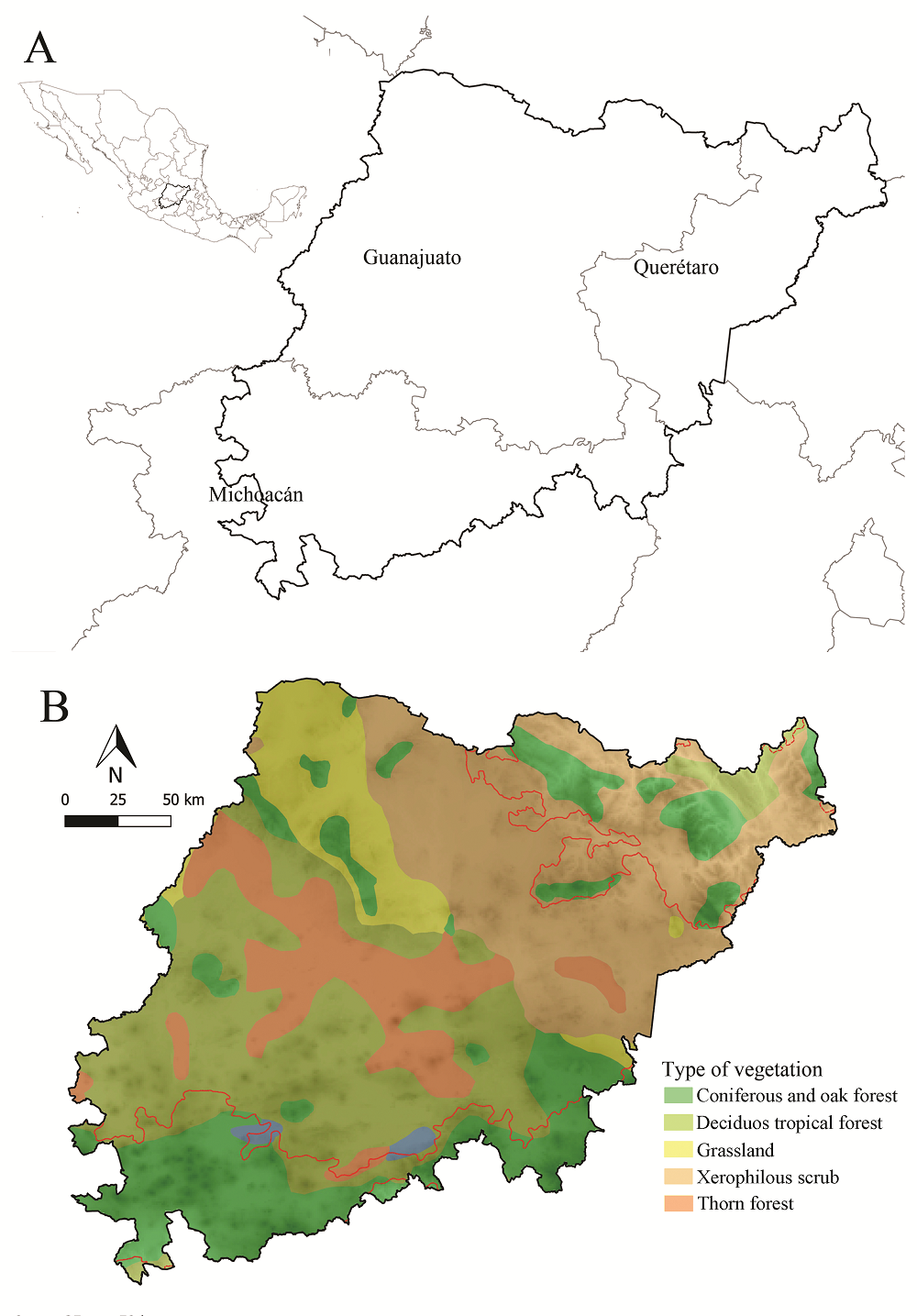
Figure 1 A. Flora of Bajío and adjacent regions, Mexico. The gray line indicates the state division, the bold black line indicates the boundaries of the Bajío Region. B. Map of vegetation types. The background shade shows the altitudinal range (light = low, dark = high). The red line indicates the biogeographic provinces. The northeast polygon is the Sierra Madre Oriental, the central polygon is the Chihuahuan Desert, and the southwest polygon is the Mexican Transvolcanic Belt. The blue polygons are water bodies.
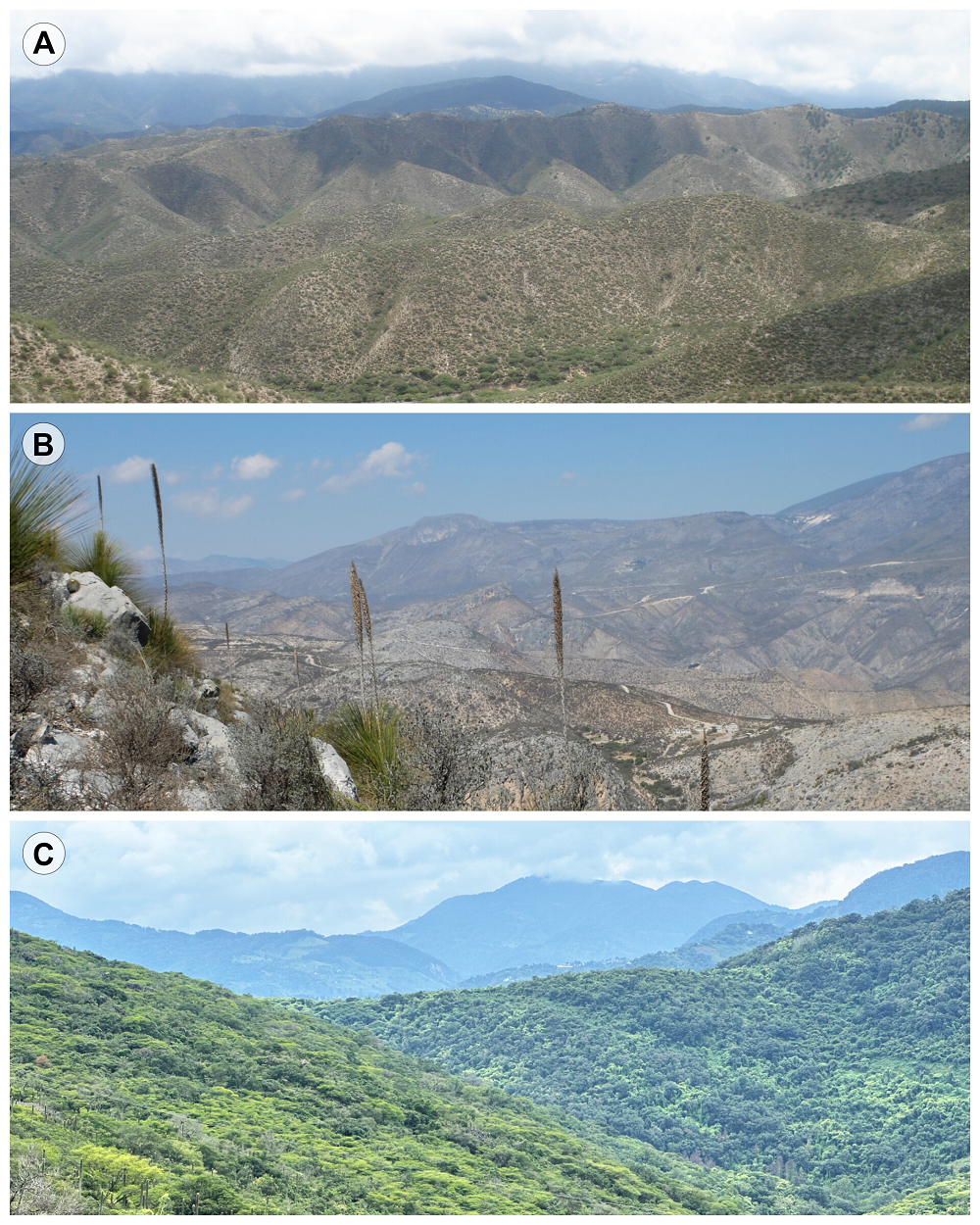
Photo. D. Aquino (A, B), S. Arias (C).
Figure 2 Vegetation types in the Bajío and adjacent regions. A. Xerophilous scrub in Atarjea, Gto., and B. Cadereyta de Montes, Qro. C. Tropical deciduous forest in Jalpan, Qro.
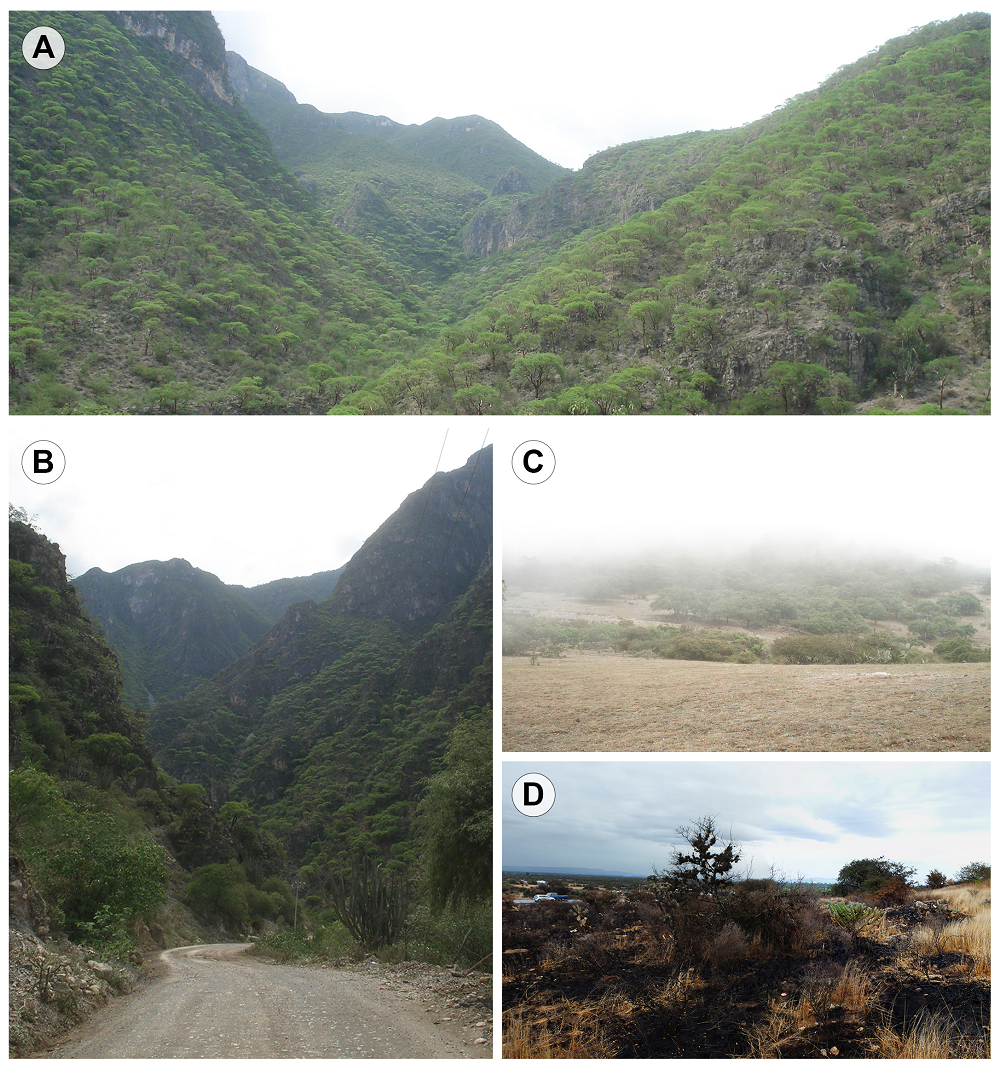
Photo. D. Aquino.
Figure 3 Vegetation types. A, B. Tropical deciduous forest in Xichú, Gto. C. Secondary grassland with Quercus forest in the background in Santa Catarina, Gto. D. Xerophilous scrub disturbed to induce grasslands in San José Iturbide, Gto.
Field work. Routes were established in the Flora del Bajío region between 2014 and 2022. Based on the type of vegetation and state of conservation of the locality, surveys were carried out in an area of approximately 500 m2 of land and were inspected to locate individuals belonging to the Cactaceae family (Aquino & Arias 2010). For each location, the geographic position was recorded via a Garmin eTrex Vista H WGS84 geopositioner, photographs were taken, one or two samples of the Cactaceae’ species found were collected, and phenological events were recorded. The collected samples were herborized and deposited in MEXU and IBUG (Thiers et al. 2023).
Database. A database was developed from the field collections and the herbarium records from ANSM, ASU, CIMI, ENCB, FEZA, IBUG, IEB, IZTA, MEXU, QMEX and UAMIZ (Thiers et al. 2023). Upon completion of herbarium and field work, three observations corresponding to species not listed in previous works (Arias & Aquino 2019) were added from iNaturalistMX (2023). The identification of the samples was carried out using the treatment for the Cactaceae family of the Flora del Bajío (Arias & Aquino 2019, Arias et al. 2024). The names were updated following the proposal of Korotkova et al. (2021). Additionally, recent taxonomic revisions were considered: Coryphantha (Engelm.) Lem. (Sánchez et al. 2022), Echinocactus Link & Otto (Vargas-Luna et al. 2018, Baker 2022) and Stenocactus (K.Schum.) A.Berger (Franco 2020). Cultivated species were excluded from the analyses.
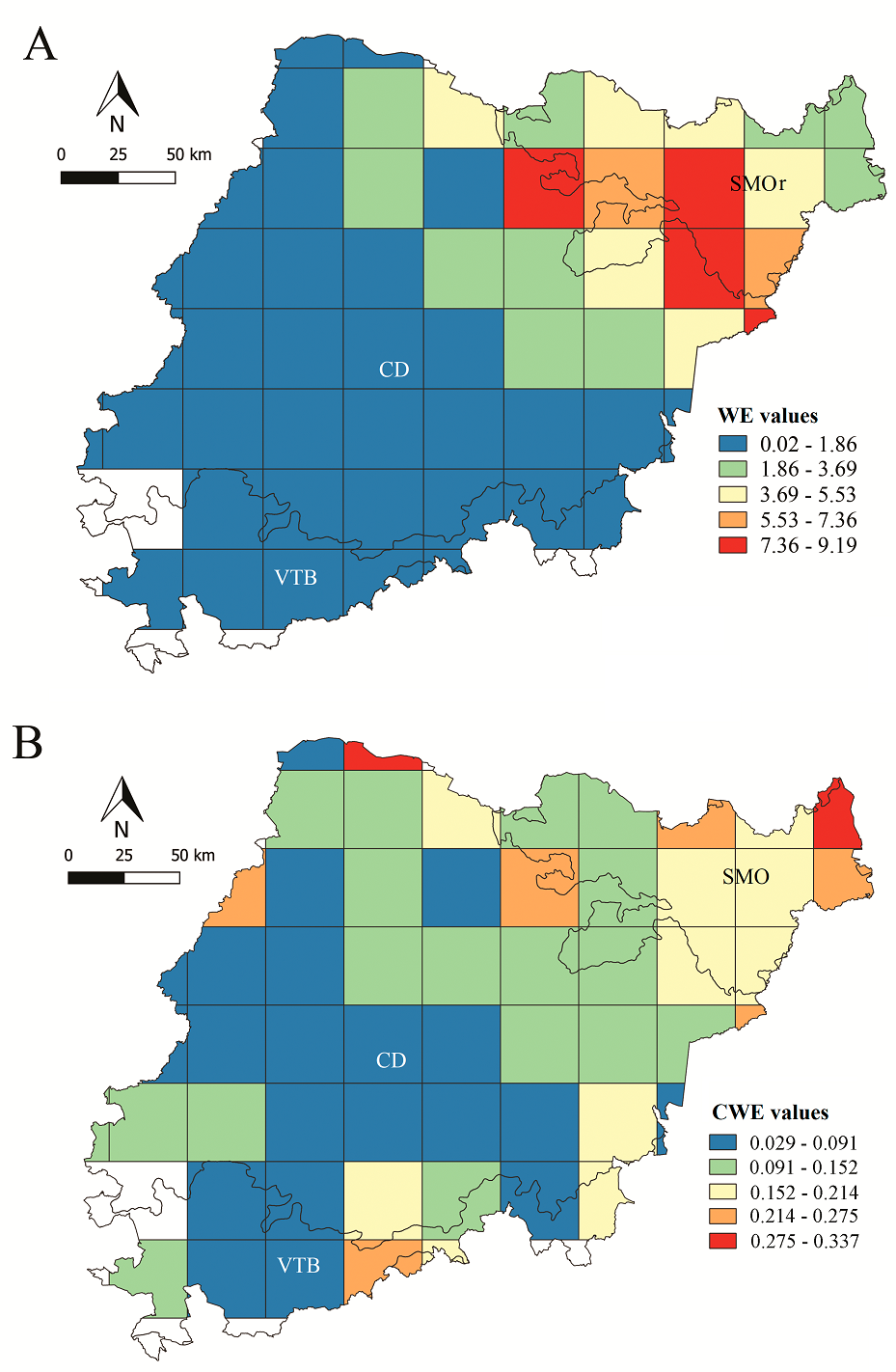
Analysis of richness and endemism. Cactaceae richness was calculated by municipal political divisions (INEGI 2019), vegetation types (Rzedowski 2006) and biogeographic provinces (Morrone et al. 2017). In the present study, an endemism is a taxon restricted to the Bajío (Morrone 2008). To identify centers of endemism, weighted endemism (WE) was calculated, taking grid cells as the unit of comparison (Noguera-Urbano 2017). Furthermore, CWE seeks to reduce the correlation between species richness and endemism (Crisp et al. 2001, Noguera-Urbano 2017). Finally, the distribution of endemic taxa in the Flora of Bajío was represented in relation to the richness estimates. The visualization and editing of the maps were performed using QGIS 3.2.2 (QGIS Development Team 2009).
Results
The Cactaceae family was represented in the Flora of Bajío by 125 species of the ca. 700 reported for Mexico (17.8 %, Korotkova et al. 2021), grouped into 30 genera of the ca. 58 recognized (51.7 %, Korotkova et al. 2021, Table 1). The most diverse genus was Mammillaria Haw., with 45 species representing 30 % of the ca. 150 species (Korotkova et al. 2021, Aquino et al. 2024). Next in importance was Opuntia (L.) Mill. with 18 species of the 78 reported for Mexico, representing 23 % (Arias et al. 2024). Only three species were represented with more than 100 records: Cylindropuntia imbricata (Haw.) F.M.Knuth, Myrtillocactus geometrizans (Mart. ex Pfeiff.) Console and Coryphantha cornifera (DC.) Lem.; in contrast, 11 species presented between one and three records: Echinocereus weinbergii Weing. Mammillaria bombycina Quehl; M. monochrysacantha Gonz.-Zam., D.Aquino & Dan.Sánchez, M. multihamata Boed. M. occulta Zamudio & U.Guzmán, M. scheinvariana R.Ortega V. & Glass, M. schwarzii Shurly, M. rzedowskiana Zamudio & U.Guzmán; Selenicereus ocamponis (Salm-Dyck) D.R.Hunt, Stenocactus sulphureus (A.Dietr.) Bravo, and S. wippermannii (Muehlenpf.) A.Berger. We report here four species not listed by Arias & Aquino (2019), including Echinocereus weinbergii, which was located via herbarium records (IBUG) and three more records found in the review of iNaturalistMX (2023): Mammillaria bombycina, Selenicereus ocamponis and Stenocactus wippermannii (Table 1).
Table 1 List of Cactaceae in the Flora of Bajío and adjacent regions; risk category NOM-059 (SEMARNAT 2019), IUCN (2022); CITES Appendix I (Lüthy & Moser 2001), vegetation type (Rzedowski 2006), biogeographic province (Morrone et al. 2017), registered municipalities (INEGI 2019), and supporting specimens. Interpretation: + recently described taxon. * New record for the area. ε Endemic taxon to the Flora of Bajío. CAOF: coniferous and Quercus forest; BE: thorn forest; TDF: tropical deciduous forest; XS: xerophilous scrub; G: grassland. DC: Chihuahuan Desert, TVB: Trans-Mexican Volcanic Belt, SMOr: Sierra Madre Oriental.
| No. | Ta xon | NOM | UICN | CITES | Endemic | Vegetation | Province | Voucher (herbarium or iNaturalistMX) |
|---|---|---|---|---|---|---|---|---|
| SUBFAMILIA Cactoideae | ||||||||
| 1 | Acanthocereus tetragonus (L.) Hummelinck | CAOF, TDF, XE | SMOr | E. Sánchez 02 (QMEX) | ||||
| 2 | Aporocactus flagelliformis (L.) Lem. | Pr | CAOF, TDF, XE | SMOr | U. Guzmán 3382 (IEB) | |||
| 3 | Ariocarpus kotschoubeyanus (Lem.) K.Schum. | Pr | NT | I | XE | CD | S. Arias et al. 1704 (MEXU) | |
| 4 | Astrophytum ornatum (DC.) F.A.C.Weber ex Britton & Rose | A | CAOF, XS | SMOr, CD | S. Arias et al. 1718 (MEXU) | |||
| 5 | Cephalocereus polylophus (DC.) Britton & Rose | CAOF, TDF, XE | SMOr | E. Sánchez & G. Galindo 27 (MEXU) | ||||
| 6 | Coryphantha clavata (Scheidw.) Backeb. | CAOF, XE | SMOr, CD | H. Bravo-Hollis s.n. (MEXU) | ||||
| 7 | Coryphantha cornifera (DC.) Lem. | CAOF, TDF, XE | SMOr, CD | D. Aquino & S. Arias 275 (MEXU) | ||||
| 8 | Coryphantha elephantidens (Lem.) Lem. | A | CAOF, TDF, XE, G | CD | A. Cabrera 1074 (QMEX) | |||
| 9 | Coryphantha erecta (Lem.) Lem. | CAOF, XS, G | CD, SMOr | D. Aquino & S. Arias 273 (MEXU) | ||||
| 10 | Coryphantha glassii Dicht & A.Lüthy | TDF, XS | SMOr | S. Arias & D. Aquino 2214 (MEXU) | ||||
| 11 | Coryphantha jalpanensis Buchenau | CAOF, TDF, XE | SMOr | S. Arias 111 (MEXU) | ||||
| 12 | Coryphantha octacantha (DC.) Britton & Rose | XS, G | CD, SMOr | S. Arias & T. Terrazas 1705 (MEXU) | ||||
| 13 | Coryphantha ottonis (Pfeiff.) Lem. | CAOF, XS, G | CD, SMOr | E. Sánchez et al. 52 (IEB) | ||||
| 14 | Disocactus speciosus (Cav.) Barthlott | CAOF, TDF | CD, TVB | G. Cornejo 3985 (IEB) | ||||
| 15 | Echinocactus horizonthalonius Lem. | |||||||
| 15a | Echinocactus horizonthalonius subsp. australis M. A.Baker + | XS | CD, SMOr | G. Navarro 23 (MEXU) | ||||
| 16 | Echinocactus platyacanthus Link & Otto | Pr | CAOF, XS, G | CD, SMOr | S. Arias & T. Terrazas 1679 (MEXU) | |||
| 17 | Echinocereus acifer (Otto ex Salm-Dyck) Jacobi | CAOF, G | CD, SMOr | D. Sánchez & S. Arias 01 (MEXU) | ||||
| 18 | Echinocereus cinerascens (DC.) Rumpler | XS, G | CD, SMOr | E. Sánchez 159 (MEXU, QMEX) | ||||
| 19 | Echinocereus pectinatus (Scheidw.) Engelm. | XS | CD, SMOr | G. Navarro 79 (MEXU) | ||||
| 20 | Echinocereus pentalophus (DC.) Lem. | CAOF, XS | CD, SMOr | J. Rzedowski 42999 (MEXU) | ||||
| 21 | Echinocereus schmollii (Weing.) N.P.Taylor | P | I | ε | XS | CD, SMOr | S. Arias 91 (MEXU) | |
| 22 | Echinocereus weinbergii Weing. | |||||||
| 22a | Echinocereus weinbergii subsp. venustus (W.Blum & W.Rischer) Gómez-Quint. & Dan.Sánchez | G | CD | J. P. Ortiz-Brunel 773 (IBUG) | ||||
| 23 | Ferocactus echidne (DC.) Britton & Rose | CAOF, TDF, XE, G | CD, SMOr | S. Arias & T. Terrazas 1682 (MEXU) | ||||
| 24 | Ferocactus glaucescens (DC.) Britton & Rose | CAOF, XS | CD, SMOr | S. Arias & T. Terrazas 1701 (MEXU) | ||||
| 25 | Ferocactus histrix (DC.) G.E.Linds. | Pr | CAOF, XS, G | CD, SMOr | U. Guzmán 14 (MEXU) | |||
| 26 | Ferocactus latispinus (Haw.) Britton & Rose | XS, G | CD, SMOr | J. Gutiérrez 641 (MEXU) | ||||
| 27 | Ferocactus macrodiscus (Mart.) Britton & Rose | |||||||
| 27a | Ferocactus macrodiscus subsp. septentrionalis (J.Meyrán) N.P.Taylor | ε | CAOF, XS | CD, SMOr | U. Guzmán 2553 (IEB) | |||
| 28 | Ferocactus mathssonii (Berge ex K.Schum.) N.P.Taylor | A | ε | XS | CD, SMOr | H. Sánchez-Mejorada 3891 (MEXU) | ||
| 29 | Isolatocereus dumortieri (Scheidw.) Backeb. | CAOF, TF, TDF, XS, G | CD, SMOr | E. Sánchez et al. 251 (MEXU, QMEX, IEB) | ||||
| 30 | Kadenicarpus pseudomacrochele (Backeb.) Doweld | |||||||
| 30a | Kadenicarpus pseudomacrochele subsp. pseudomacrochele | P | VU | I | XS | CD | L. Scheinvar et al. 5050 (MEXU) | |
| 30b | Kadenicarpus pseudomacrochele subsp. krainzianus (Gerhart Frank) Vázquez-Sánchez | I | XS | CD | C. Glass et al. 9217 (IEB) | |||
| 30c | Kadenicarpus pseudomacrochele subsp. lausseri (Diers & Gerhart Frank) Doweld | I | XS | CD | G. B. Hinton 2605 (GBH) | |||
| 31 | Kroenleinia grusonii (Hildm.) Lodé | P | CR | XS | CD | L. Scheinvar 5742 (MEXU, QMEX) | ||
| 32 | Lophocereus marginatus (DC.) S.Arias & T.Terrazas | CAOF, XS, G | CD, SMOr | E. Sánchez 142 (MEXU) | ||||
| 33 | Lophophora diffusa (Croizat) Bravo | A | VU | ε | XS | SMOr | S. Arias & T. Terrazas 1698 (MEXU) | |
| 34 | Mammillaria albiflora (Werderm.) Backeb. | CR | ε | XS | CD | D. Aquino et al. 506 (MEXU) | ||
| 35 | Mammillaria ariasii U.Guzmán & D.Aquino + | ε | CAOF, XS | SMOr | D. Aquino et al. 510 (MEXU) | |||
| 36 | Mammillaria bombycina Quehl | |||||||
| 36a | Mammillaria bombycina subsp. perezdelarosae (Bravo & Scheinvar) D.R.Hunt * | Pr | CAOF | CD | https://mexico.inaturalist.org/observations/221031599 | |||
| 37 | Mammillaria candida Scheidw. | A | CAOF, XS | SMOr | T. Hernández-Hernández 103 (MEXU) | |||
| 38 | Mammillaria compressa DC. | CAOF, XS | CD, SMOr | J. Rzedowski 46456 (MEXU) | ||||
| 39 | Mammillaria crinita DC. | |||||||
| 39a | Mammillaria crinita subsp. crinita | CAOF, XS, P | CD, SMOr | W. A. Fitz Maurice & B. Fitz Maurice 2187 (MEXU) | ||||
| 39b | Mammillaria crinita subsp. leucantha (Boed.) D.R.Hunt * | XS | CD | U. Guzmán 3541 (IEB) | ||||
| 40 | Mammillaria decipiens Scheidw. | |||||||
| 40a | Mammillaria decipiens subsp. decipiens | XS | CD, SMOr | R. Bárcenas 371 (MEXU) | ||||
| 40b | Mammillaria decipiens subsp. albescens (Tiegel) D.R.Hunt | Pr | ε | XS | CD | E. Sánchez et al. 20 (MEXU) | ||
| 40c | Mammillaria decipiens subsp. camptotricha (Dams) D.R.Hunt | ε | XS | CD, SMOr | A. Cabrera 5916 (QMEX) | |||
| 41 | Mammillaria densispina (J.M.Coult.) Orcutt | CAOF, TDF, XS, G | CD, SMOr | S. Arias & D. Sánchez 1756 (MEXU) | ||||
| 42 | Mammillaria duwei Rogoz. & P.J.Braun | Pr | EN | ε | XS | CD | W. A. Fitz Maurice & B. Fitz Maurice 1641 (MEXU) | |
| 43 | Mammillaria elongata DC. | CAOF, XS | CD, SMOr | S. Arias & T. Terrazas 1697 (MEXU) | ||||
| 44 | Mammillaria formosa Galeotti ex Scheidw. | |||||||
| 44a | Mammillaria formosa subsp. pseudocrucigera (R.T.Craig) D.R.Hunt | ε | CAOF, XS, G | CD, SMOr | S. Arias & T. Terrazas 1696 (MEXU) | |||
| 45 | Mammillaria geminispina Haw. | CAOF. XS | CD, SMOr | D. Aquino et al. 515 (MEXU) | ||||
| 46 | Mammillaria gigantea Hildm. ex K.Schum. | XS | CD, SMOr | G. Navarro 74 (MEXU) | ||||
| 47 | Mammillaria gilensis Boed. | CAOF, TF, TDF, XS, G | CD | W. A. Fitz Maurice & B. Fitz Maurice 1761 (MEXU) | ||||
| 48 | Mammillaria hahniana Werderm. | A | CAOF, TDF, XS | SMOr | U. Guzmán 3389 (IEB) | |||
| 49 | Mammillaria herrerae Werderm. | P | CR | ε | XS | CD | L. Scheinvar et al. 5735 (MEXU) | |
| 50 | Mammillaria jaliscana (Britton & Rose) Boed. | TF, TDF | CD | R. Bárcenas & C. Gómez-Hinostrosa 450 (MEXU) | ||||
| 51 | Mammillaria longimamma DC. | A | XS | CD, SMOr | U. Guzmán 1378 (MEXU) | |||
| 52 | Mammillaria magnimamma Haw. | CAOF, TDF, XS, G | CD, SMOr | E. Sánchez 216 (MEXU) | ||||
| 53 | Mammillaria mathildae Kraehenb. & Krainz | P | VU | ε | XS, TF, TDF | CD | W. A. Fitz Maurice & B. Fitz Maurice 1647 (MEXU) | |
| 54 | Mammillaria microhelia Werderm. | Pr | VU | ε | XS | CD | U. Guzmán et al. 577 (MEXU) | |
| 55 | Mammillaria monochrysacantha Gonz.-Zam., D.Aquino & Dan.Sánchez + | ε | XS | SMOr | P. González-Zamora et al. 84 (IBUG, IEB) | |||
| 56 | Mammillaria morganiana Tiegel | ε | CAOF, XS | SMOr | H. Hernández et al. 3536 (MEXU) | |||
| 57 | Mammillaria muehlenpfordtii Foerster | CAOF, XS | CD, SMOr | S. Arias & T. Terrazas 1692 (MEXU) | ||||
| 58 | Mammillaria multihamata Boed. | CR | ε | CAOF | SMOr | U. Guzmán 1462 (MEXU) | ||
| 59 | Mammillaria nana Backeb. ex Mottram | Pr | XS | CD | W. A. Fitz Maurice & B. Fitz Maurice 2371 (MEXU) | |||
| 60 | Mammillaria occulta Zamudio & U.Guzmán | ε | CAOF | SMOr | R. Hernández et al. 11315 (QMEX) | |||
| 61 | Mammillaria painteri Rose | ε | XS | CD | E. Sánchez 70 (MEXU) | |||
| 62 | Mammillaria parkinsonii Ehrenb. | Pr | ε | XS | SMOr | L. Scheinvar et al. 2386 (MEXU) | ||
| 63 | Mammillaria perbella Hildm. ex K.Schum. | XS, G | CD, SMOr | G. Navarro 81 (MEXU) | ||||
| 64 | Mammillaria petterssonii Hildm. | CAOF, XS, G | CD | H. Bravo-Hollis s.n. (MEXU) | ||||
| 65 | Mammillaria polythele Mart. | CAOF, TF, TDF, XS, G | CD, SMOr | S. Arias & U. Guzmán 234 (MEXU) | ||||
| 66 | Mammillaria pringlei (J. M. Coult.) K.Brandegee | Pr | XS, G | CD | M. Rivas 2903 (MEXU) | |||
| 67 | Mammillaria prolifera (Mill.) Haw. | CAOF, TDF, XS | SMOr | U. Guzmán 797 (IEB) | ||||
| 68 | Mammillaria rettigiana Boed. | Pr | VU | XS, G | CD | W. A. Fitz Maurice & B. Fitz Maurice 2098A (MEXU) | ||
| 69 | Mammillaria rhodantha Link & Otto | |||||||
| 69a | Mammillaria rhodantha subsp. rhodantha | CAOF, XS | CD, TVB, SMOr | J. Rzedowski 44425 (MEXU) | ||||
| 69b | Mammillaria rhodantha subsp. fera-rubra (Schmoll ex R.T.Craig) D.R.Hunt | TDF, XS | CD | J. Rzedowski 49239 (IEB) | ||||
| 70 | Mammillaria rzedowskiana Zamudio & U.Guzmán | CAOF | SMOr | S. Zamudio et al. 15083 (MEXU) | ||||
| 71 | Mammillaria scheinvariana R.Ortega V. & Glass | ε | XS | CD | D. Sánchez & A. Martínez-Poiré 884 (IBUG) | |||
| 72 | Mammillaria schiedeana C. Ehrenb. | A | CAOF, XS | SMOr | D. Aquino & S. Arias 270 (MEXU, IBUG) | |||
| 73 | Mammillaria schwarzii Shurly | P | CR | ε | G | CD | W. A. Fitz Maurice & B. Fitz Maurice 1687B (MEXU) | |
| 74 | Mammillaria sempervivi DC. | XS | CD | U. Guzmán et al. 28 (MEXU) | ||||
| 75 | Mammillaria uncinata Zucc. ex Pfeiff. | CAOF, TDF, XS, G | CD, SMOr | R. Bárcenas 17 (MEXU, IEB) | ||||
| 76 | Mammillaria vetula Mart. | |||||||
| 76a | Mammillaria vetula subsp. vetula | XS, CAOF | SMOr | R. Bárcenas 1494 (MEXU) | ||||
| 76b | Mammillaria vetula subsp. gracilis (Pfeiff.) D.R.Hunt | XS, CAOF | SMOr | E. Sánchez 97 (MEXU) | ||||
| 77 | Mammillaria zeilmanniana Boed. | Pr | EN | ε | XS, CAOF, G | CD | W. A. Fitz Maurice & B. Fitz Maurice 1764 (MEXU) | |
| 78 | Mammillaria zephyranthoides Scheidw. | A | TDF, XS, G | CD | D. Aquino & S. Arias 287 (MEXU) | |||
| 79 | Myrtillocactus geometrizans (Mart. ex Pfeiff.) Console | CAOF, TF, TDF, XS, G | CD, SMOr | G. Navarro 30 (MEXU) | ||||
| 80 | Neolloydia conoidea (DC.) Britton & Rose | CAOF, TDF, XS, G | CD, SMOr | S. Arias & T. Terrazas 1695 (MEXU) | ||||
| 81 | Nyctocereus serpentinus (Lag. & Rodr.) Britton & Rose | CAOF, TDF, XS, G | CD, SMOr | E. Sánchez et al. 259 (MEXU) | ||||
| 82 | Pilosocereus leucocephalus (Poselg.) Byles & G.D.Rowley | CAOF, TDF, XS | SMOr | S. Zamudio & E. Carranza 9965 (MEXU, IEB, QMEX, UAMIZ) | ||||
| 83 | Rhipsalis baccifera (J.S.Muell) Stearn | TDF, XS | SMOr | J. Rzedowski 42969 (IEB) | ||||
| 84 | Selenicereus spinulosus (DC.) Britton & Rose | CAOF, TDF, XS | SMOr | U. Guzmán 3429 (IEB) | ||||
| 85 | Selenicereus ocamponis (Salm-Dyck) D.R.Hunt * | CAOF | TVB | https://www.naturalista.mx/observations/27771446 | ||||
| 86 | Stenocactus coptonogonus (Lem.) A.Berger ex A.W.Hill | Pr | XS, G | CD | R. Bárcenas 154 (MEXU, IEB) | |||
| 87 | Stenocactus dichroacanthus (Mart. ex Pfeiff.) A.Berger ex Backeb. & F.M.Knuth | CAOF, TDF, XS, G | CD, SMOr | J. Rzedowski 50656 (MEXU) | ||||
| 88 | Stenocactus lamellosus (A.Dietr.) A.Berger ex A.W.Hill | CAOF, XS | CD, SMOr | S. Arias & D. Aquino 2259 (MEXU) | ||||
| 89 | Stenocactus ochoterenanus Tiegel | CAOF, XS | CD, SMOr | D. Aquino et al. 360 (MEXU) | ||||
| 90 | Stenocactus pentacanthus (Lem.) A.Berger ex A.W.Hill | CAOF, XS, G | CD, SMOr | L. Scheinvar & C. Orozco 3198 (MEXU) | ||||
| 91 | Stenocactus phyllacanthus (Mart. ex A.Dietr. & Otto) A.Berger ex A.W.Hill | XS | CD | G. Navarro 92 (MEXU) | ||||
| 92 | Stenocactus sulphureus (A.Dietr.) Bravo | Pr | ε | XS | CD | V. Huerta 1235 (MEXU) | ||
| 93 | Stenocactus x irregularis Gonz.-Zam., D.Aquino & Dan.Sánchez + | XS | CD | D. Aquino et al. 366 (MEXU) | ||||
| 94 | Stenocactus wippermannii (Muehlenpf.) A.Berger | CAOF, XS | CD, SMOr | https://mexico.inaturalist.org/observations/22721563 | ||||
| 95 | Stenocactus zacatecasensis (Britton & Rose) A.Berger ex A.W.Hill | CAOF, TDF, G | CD | R. Bárcenas & C. Gómez-Hinostrosa 785 (MEXU) | ||||
| 96 | Stenocereus huastecorum Alvarado-Sizzo, Arreola-Nava & Terrazas | CAOF, TDF, XS | CD, SMOr | S. Arias & S. Gama 716 (MEXU) | ||||
| 97 | Stenocereus queretaroensis (F.A.C.Weber) Buxb. | CAOF, TF, TDF, XS | CD | S. Arias & S. Gama 716A (MEXU) | ||||
| 98 | Strombocactus corregidorae S.Arias & E.Sánchez | ε | XS | SMOr | S. Zamudio 14107 (IEB) | |||
| 99 | Strombocactus disciformis (DC.) Britton & Rose | |||||||
| 99a | Strombocactus disciformis subsp. disciformis | A | I | CAOF, XS | CD, SMOr | U. Guzmán 3317 (IEB) | ||
| 99b | Strombocactus disciformis subsp. esperanzae Glass & S.Arias | I | ε | CAOF, XS | SMOr | D. Aquino et al. 524 (MEXU) | ||
| 100 | Thelocactus hastifer (Werderm. & Boed.) F.M.Knuth | Pr | VU | XS | CD | S. Arias & D. Aquino 2263 (MEXU) | ||
| 101 | Thelocactus leucacanthus (Zucc. ex Pfeiff.) Britton & Rose | CAOF, XS, G | CD, SMOr | S. Arias & T. Terrazas 1678 (MEXU) | ||||
| 102 | Turbinicarpus alonsoi Glass & S.Arias | CR | I | ε | XS | SMOr | E. Pérez-Calix 3339 (IEB) | |
| SUBFAMILIA Opuntioideae | ||||||||
| 103 | Cylindropuntia imbricata (Haw.) F.M.Knuth | CAOF, TF, TDF, XS, G | CD, SMOr | M. A. Baker 12842 (ASU) | ||||
| 104 | Cylindropuntia kleiniae (DC.) F.M.Knuth | XS, G | CD, SMOr | J. Rzedowski 51023 (MEXU) | ||||
| 105 | Cylindropuntia leptocaulis (DC.) F.M.Knuth | CAOF, XS | CD, SMOr | E. Sánchez et al. 206 (MEXU, IEB) | ||||
| 106 | Cylindropuntia tunicata (Lehm.) F.M.Knuth | XS | CD | G. Navarro 37 (MEXU) | ||||
| 107 | Opuntia decumbens Salm-Dyck | CAOF, TDF, XS | SMOr | C. Gómez-Hinostrosa 2136 (MEXU) | ||||
| 108 | Opuntia dejecta Salm-Dyck | CAOF, TDF, XS | SMOr | U. Guzmán 3560 (IEB) | ||||
| 109 | Opuntia elizondoana E.Sánchez & Villaseñor | ε | XS | CD | S. Arias et al. 1502 (MEXU) | |||
| 110 | Opuntia engelmannii Salm-Dyck | |||||||
| 110a | Opuntia engelmannii subsp. cuija (Griffiths & Hare) M.H.J.van der Meer | CAOF, TDF, XS, G | CD, SMOr | O. Rubio 501 (QMEX) | ||||
| 110b | Opuntia engelmannii subsp. lindheimeri (Engelm.) U. Guzmán & Mandujano | CAOF, TDF, XS, G | CD, SMOr | E. García & L. Scheinvar 42 (MEXU) | ||||
| 111 | Opuntia fuliginosa Griffiths | TF, TDF | CD | L. Scheinvar & S. Arias 1601 (MEXU) | ||||
| 112 | Opuntia hyptiacantha F.A.C.Weber | CAOF, TDF, XS, G | CD, TVB, SMOr | R. Bárcenas & C. Gómez Hinostrosa 770 (MEXU) | ||||
| 113 | Opuntia joconostle F. A.C.Weber ex Diguet | TF, TDF, XS | CD, SMOr | R. Bárcenas & M. Meade 1480 (MEXU) | ||||
| 114 | Opuntia karwinskiana Salm-Dyck | TDF | CD | A. Martínez 82 (MEXU) | ||||
| 115 | Opuntia lasiacantha Pfeiff. | CAOF, TF, TDF, XS, G | CD, TVB, SMOr | L. Scheinvar et al. 3767 (MEXU) | ||||
| 116 | Opuntia leucotricha DC. | CAOF, TF, TDF, XS, G | CD, SMOr | G. Navarro 10-24 (MEXU) | ||||
| 117 | Opuntia microdasys (Lehm.) Pfeiff. | XS | SMOr | E. Sánchez 208 (IEB. QMEX) | ||||
| 118 | Opuntia pachyrrhiza H.M.Hern., C.Gómez-Hinostrosa & Bárcenas | XS | SMOr | R. Puente-Martínez 1260 (ASU, DES, SLPM) | ||||
| 119 | Opuntia pubescens H.L.Wendl. ex Pfeiff. | CAOF, TF, TDF, XS | CD, TVB, SMOr | S. Arias et al. 1503 (MEXU) | ||||
| 120 | Opuntia robusta H. L.Wendl. ex Pfeiff. | CAOF, TF, TDF, XS, G | CD, SMOr | S. Arias & T. Terrazas 1685 (MEXU) | ||||
| 121 | Opuntia stenopetala Engelm. | CAOF, XS | CD, SMOr | S. Arias et al. 1504 (MEXU) | ||||
| 122 | Opuntia streptacantha Lem. | CAOF, TF, TDF, XS, G | CD, TVB, SMOr | C. Gómez-Hinostrosa et al. 1617 (MEXU, MO) | ||||
| 123 | Opuntia tomentosa Salm-Dyck | CAOF, TF, TDF, XS, G | CD, TVB, SMOr | A. Cabrera 5737 (QMEX) | ||||
| 124 | Opuntia velutina F. A.C.Weber | CAOF, TF, TDF, G | CD, TVB | R. Bárcenas & M. Meade 187 (MEXU) | ||||
| 125 | Pereskiopsis diguetii (F.A.C.Weber) Britton & Rose | CAOF, TF, TDF, XS | CD, TVB | L. Hernández 4682 (IEB, QMEX) |
Species richness. The analysis revealed that the municipalities of Cadereyta de Montes and Peñamiller in Querétaro, as well as San Luis de la Paz in Guanajuato, presented the highest richness of cacti, with 60, 44 and 50 species, respectively (Figure 4A). Other municipalities with a high level of richness were Atarjea, San Miguel de Allende, Victoria and Xichú in Guanajuato, with 34, 32, 40 and 37 species, respectively; and Colón, Pinal de Amoles and Tolimán in Querétaro, with 33, 32, and 39 species, respectively (Figure 4A). Myrtillocactus geometrizans was recorded in 40 municipalities of the study area; followed by Opuntia streptacantha Lem., which was recorded in 31 municipalities; O. lasiacantha Pfeiff. and O. tomentosa Salm-Dyck, which were observed in 30 municipalities.
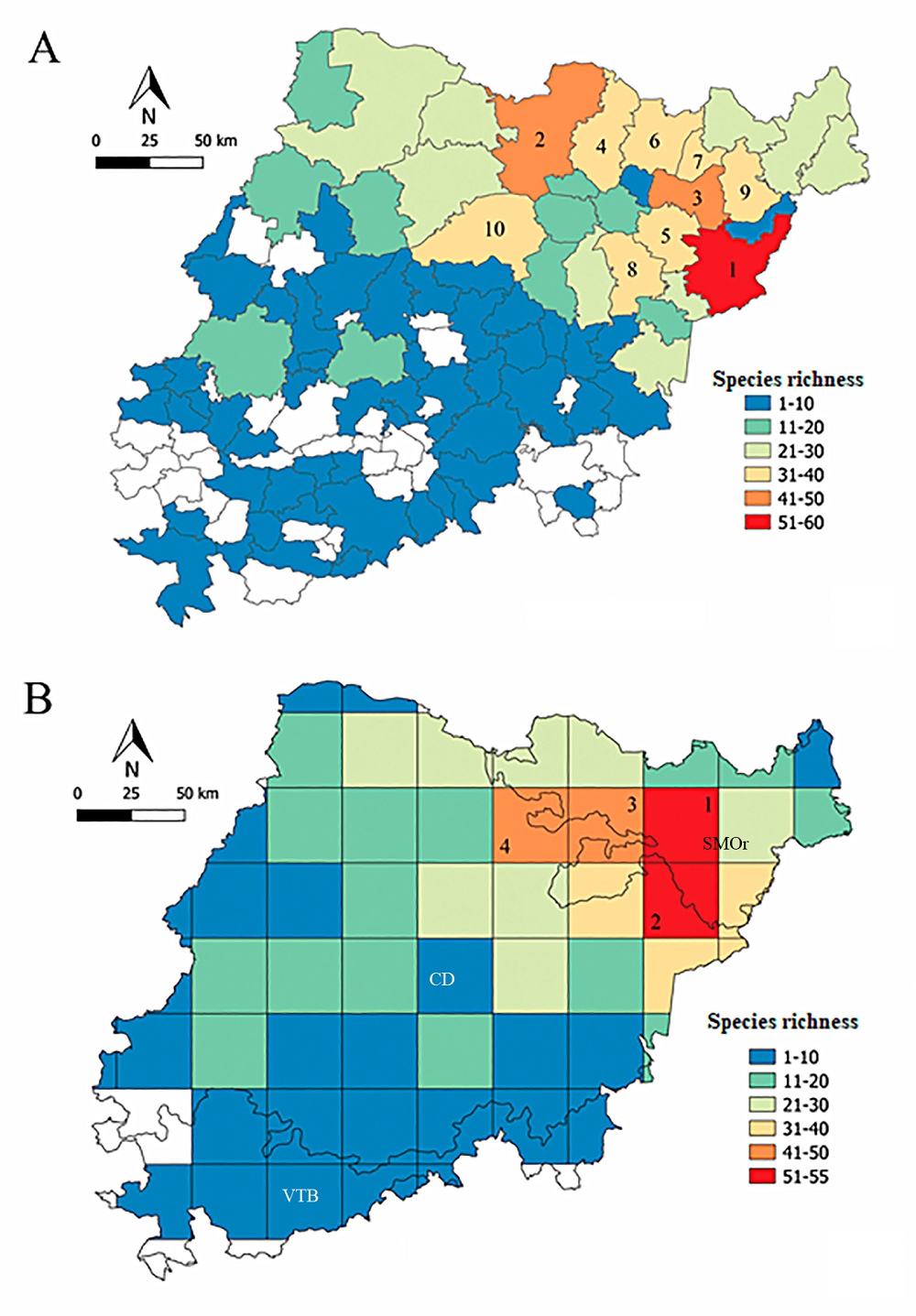
Figure 4 Richness of cactus species in the Bajío and adjacent regions. A. Municipal political division. 1: Cadereyta de Montes; 2: San Luis de la Paz; 3: Peñamiller; 4: Victoria; 5: Tolimán; 6: Xichú; 7: Atarjea; 8: Colón; 9: Pinal de Amoles; 10: San Miguel de Allende. B. Species richness by cell; the regions delimited within the study area represent the VTB, CD and SMOr.
The analysis of richness by vegetation type revealed that the xerophytic scrub had the greatest diversity of species, with 112 (Table 2). Cylindropuntia imbricata, Isolatocereus dumortieri (Berge ex K.Schum.) N. P. Taylor, Mammillaria gilensis Boed., M. polythele Mart., Myrtillocactus geometrizans and five species of Opuntia occurred in all types of vegetation in the study area (Table 1), whereas 37 species inhabited only one vegetation type (Table 1). With 97 species the Chihuahuan Desert was the biogeographic province with the greatest number of species (Table 3). Mammillaria rhodantha Link & Otto and five species of Opuntia inhabited the three biogeographic provinces in the study area (Table 1). Cell-based richness analysis revealed two quadrants with the highest cactus richness, i.e., 55 and 54 species, respectively, as well as two secondary cells, with 47 and 41 species (Figure 4B). Species richness was concentrated to the east of the Flora of Bajío area and decreased in the extreme southwest, mainly in the portion of Michoacán included in the Trans-Mexican Volcanic Belt, as well as the southern end of Guanajuato (Figure 4B).
Table 2 Species richness by vegetation type (Rzedowski 2006).
| Vegetation type | Richness |
|---|---|
| Coniferous and Quercus forest | 74 |
| Thorn forest | 19 |
| Tropical deciduous forest | 46 |
| Xerophilous scrub | 112 |
| Grassland | 46 |
Table 3 Species richness by biogeographic province (Morrone et al. 2017).
| Biogeographic province | Richness |
|---|---|
| Chihuahuan Desert | 97 |
| Trans-Mexican Volcanic Belt | 9 |
| Sierra Madre Oriental | 88 |
Endemism analysis. The distribution of endemic species was related to the distribution of species richness in the region. These species were concentrated to the northeast of the Flora of Bajío area, on the borders of the Chihuahuan Desert and the Sierra Madre Oriental, and decreased toward the southern region on the borders with the Trans-Mexican Volcanic Belt. The xerophilous scrub was the type of vegetation with the greatest number of endemisms, with 24 species (Tables 1 and 2). On the other hand, the Chihuahuan Desert and the Sierra Madre Oriental included 18 and 16 endemic species, respectively.
At the municipal level, Cadereyta de Montes hosted the greatest number of endemic species, with seven species, followed by Peñamiller, with four species. A second center of endemism was San Luis de la Paz, with four species, while the neighboring municipalities, i.e., Victoria and Xichú, each hosted 2 endemic species (Figure 5). The municipalities of El Marqués and Querétaro hosted 3 and 2 species, respectively. Finally, the municipalities of San Juan del Río, Tequisquiapan, Colón, Pinal de Amoles, San Miguel de Allende, Dolores Hidalgo, Guanajuato and San Felipe, hosted only one endemic species within their perimeters (Figure 5).
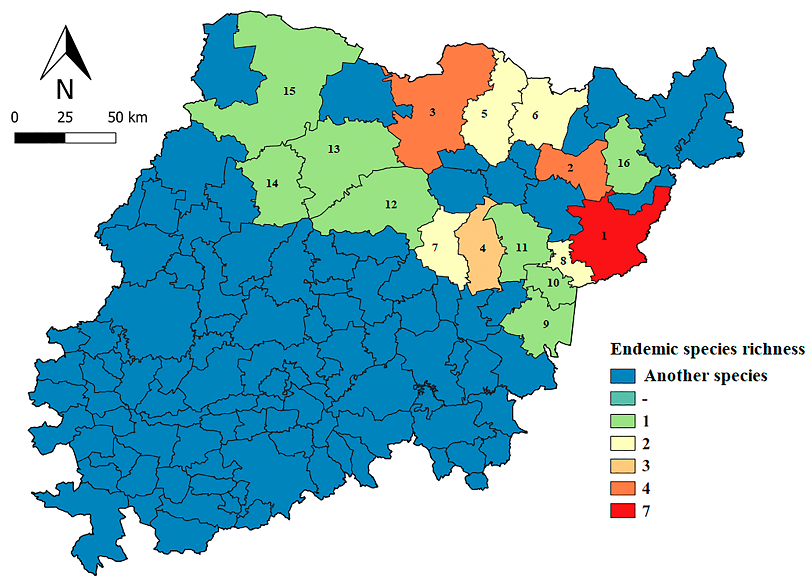
Figure 5 Richness of endemic cactus species in the Bajío and adjacent regions by municipal political division: 1) Cadereyta de Montes, Qro.; 2) Peñamiller, Qro.; 3) San Luis de la Paz, Gto.; 4) El Marqués, Qro.; 5) Victoria, Gto.; 6) Xichú, Gto.; 7) Querétaro, Qro.; 8) Ezequiel Montes, Qro.; 9) San Juan del Río, Qro.; 10) Tequisquiapan, Qro.; 11) Colón, Qro.; 12) San Miguel de Allende, Gto.; 13) Dolores Hidalgo, Gto.; 14) Guanajuato, Gto.; 15) San Felipe, Gto.; and 16) Pinal de Amoles, Qro.
On the other hand, the analysis of endemism by cell revealed that four of the cells presented high WE values (Figure 6A), which were located in the same region observed in the richness analysis. Moreover, the CWE analysis revealed only two cells with high values (Figure 6B) at the northeast and northwest ends of the Bajío Flora area. A cell in the far north is surrounded by others with a WE value of >1.86. It is likely that there are no endemic taxa for that cell. The CWE corroborates this assertion because, despite being a species-rich area (Figure 4B), there are no restricted species for that cell.
Discussion
This work recognizes the Flora of Bajío area as a region with an important diversity of cacti, with 30 genera and 125 species distributed over an area of 60,171.42 km2 (Suárez-Mota et al. 2015, Figures 6 and 7). This value is higher than that of other regions with high diversity, such as the Tehuacán-Cuicatlán Valley, which has 28 genera and 87 species distributed over an area of 10,000 km2 (Valiente-Banuet et al. 2000, Arias et al. 2012, Tristan et al. 2018). In turn, it is comparable to the richness of a State such as Tamaulipas, where 33 genera and 157 species are currently known, with an area of 80,249 km2 (García-Morales et al. 2022).
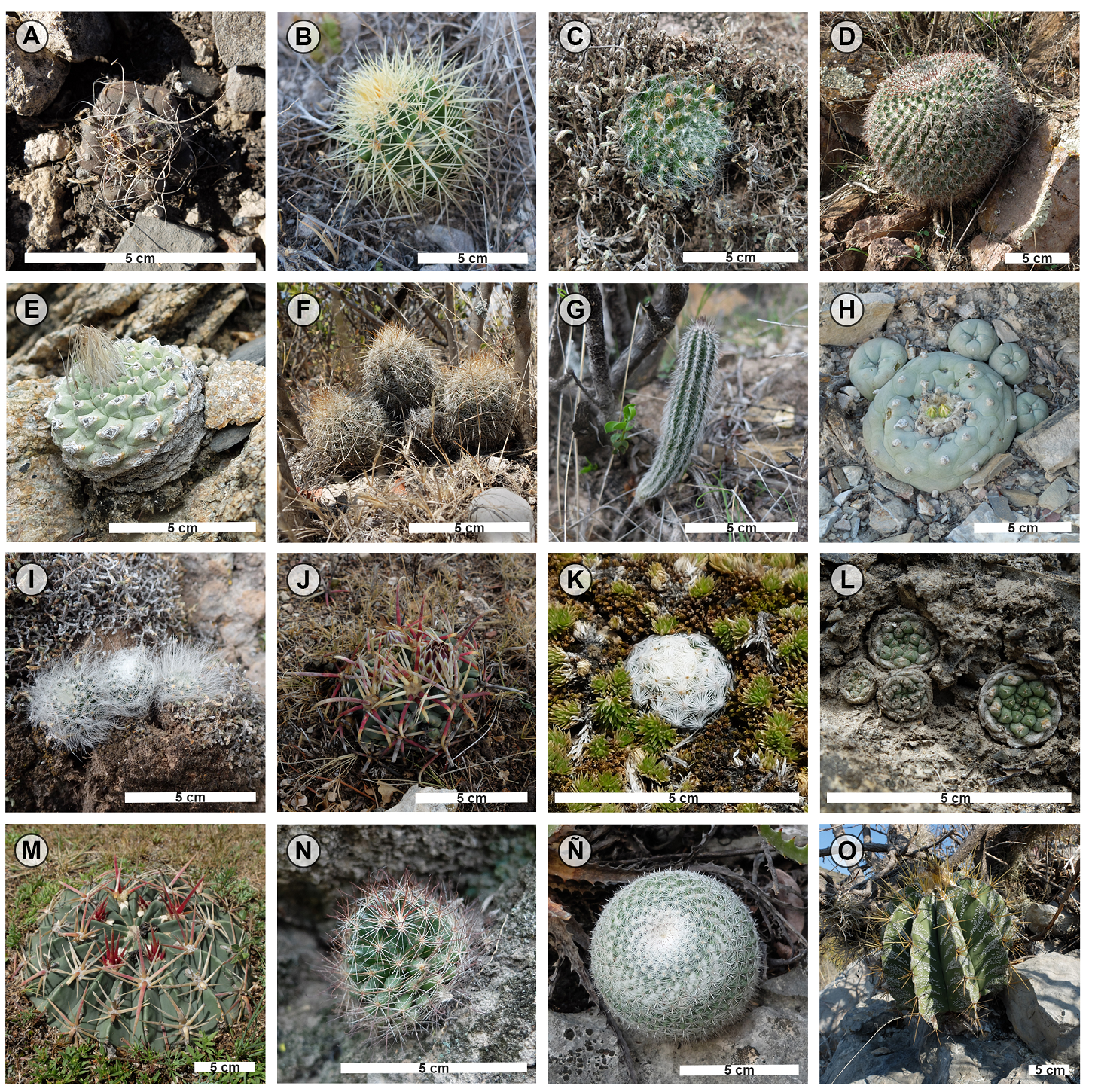
Photo D. Aquino (A-H, J-O), D. Sánchez (I).
Figure 7 Some Cactaceae representative in the Bajío and adjacent regions. A. Kadenicarpus pseudomacrochele (D. Aquino & M. Vázquez-Sánchez 572 (MEXU)). B. Kroenleinia grusonii (R. Ortega s. n. (MEXU)). C. Mammillaria monochrysacantha (P. González-Zamora et al. 84 (IBUG, IEB)). D. M. ariasii (D. Aquino et al. 510 (MEXU, IBUG)). E. Strombocactus disciformis (D. Aquino & P. González-Zamora 547 (MEXU)). F. Thelocactus hastifer (S. Arias & D. Aquino 2263 (MEXU)). G. Echinocereus schmollii (D. Aquino & P. González-Zamora 550 (MEXU)). H. Lophophora diffusa (S. Arias & T. Terrazas 1698 (MEXU)). I. M. scheinvariana (D. Sánchez & A. Martínez-Poiré 884 (IBUG)). J. Ferocactus mathssonii (S. Arias & T. Terrazas 1688 (MEXU)). K. M. albiflora (D. Aquino et al. 506 (MEXU)). L. Strombocactus disciformis subsp. esperanzae (D. Aquino et al. 524 (MEXU)). M. F. macrodiscus subsp. septentrionalis (D. Aquino et al. 364 (MEXU)). N. M. mathildae (D. Aquino & P. González-Zamora 553 (MEXU)). Ñ. M. hahniana (D. Aquino et al. 522 (MEXU)). O. Astrophytum ornatum (D. Aquino et al. 517 (MEXU)).
The number of genera of Cactoideae recorded by Arias & Aquino (2019) for the Flora of Bajío differs from the present work, since recent phylogenetic analysis allows the recognition of Kadenicarpus Doweld (Vázquez-Sánchez et al. 2019) and Kroenleinia Lodé (Vargas-Luna et al. 2018) as independent genera, which are included here (27 correspond to Cactoideae and three to Opuntioideae), thus adding up to 30 genera. On the other hand, studies focused on the delimitation of species in Stenocactus allow us to confirm that the individuals previously identified as Stenocactus obvallatus (DC.) A.Berger ex A.W.Hill corresponds to S. pentacanthus (Lem.) A.Berger ex A.W.Hill and S. dichroacanthus (Mart. ex Pfeiff.) A.Berger ex Backeb. & F.M.Knuth (Franco 2020). Likewise, field observations allow us to rule out the presence of Mammillaria fittkaui Glass & R.A.Foster for the study area and that, such records correspond to M. mathildae Kraehenb. & Krainz, so its distribution previously known only for Querétaro now includes Guanajuato. iNaturalistMX (2023) allow us to corroborate the presence in Guanajuato of Disocactus speciosus (Cav.) Barthlott and Opuntia pachyrrhiza H.M.Hern., C. Gómez-Hinostrosa & Bárcenas, previously known for the northern part of Michoacán and northeast of Querétaro, respectively. On the other hand, we confirm the presence of Echinocereus weinbergii, Mammillaria bombycina, Selenicereus ocamponis and Stenocactus wippermannii as new records for the study area (Table 1). Additionally, owing to recent exploration work, three new taxa in the study area are described: Stenocactus × irregularis Gonz.-Zam., D.Aquino & Dan.Sánchez (González-Zamora et al. 2023a), Mammillaria monochrysacantha (González-Zamora et al. 2023b) and M. ariasii U.Guzmán & D.Aquino (Aquino et al. 2024), so new discoveries in the future should not be ruled out.
Species richness. The sites that host the greatest number of species occur in the eastern region of the Flora of Bajío area, with Cadereyta de Montes in Querétaro being the municipality with the highest concentration of species. In contrast, toward the south, in the municipalities of Guanajuato that border Michoacán, the richness decreases noticeably. In the case of Asteraceae of Flora del Bajío, Villaseñor & Ortiz (2012) reported that the greatest number of species is concentrated at the southern end of the study area, while the eastern region occupies second place in terms of species richness. On the other hand, our results for the Flora of Bajío Cactaceae agree with those reported by Hernández-Oria et al. (2007) for central Querétaro, since quadrants 1 and 2 of our results (Figure 4B) coincide with the “Tolimán” quadrant, where the areas corresponding to Cadereyta de Montes and a sector bordering Hidalgo are recognized as areas of high species richness. The high incidence of species can be explained by the fact that it is a transition zone between the canyons of the Estórax and Moctezuma River basins and the mountainous areas of the El Doctor massif (Hernández-Magaña et al. 2012). Bárcenas (1999) reported a high number of species in the central-eastern and northeastern regions of Guanajuato. This area corresponds to the municipalities of San Luis de la Paz, Victoria, Xichú, Atarjea and San Miguel de Allende (Figure 1A) in quadrants 3 and 4 (Figure 4B). This richness is probably related to its condition as a climatic refuge during the Pleistocene and to the wide diversity of soil types of presents (Hernández & Bárcenas 1995). Additionally, Sierra Gorda (including the Querétaro sector) presents a diverse relief that supports different types of vegetation such as the Quercus Forest and xerophilous scrubs (Rzedowski et al. 2012), so lineages were isolated and diversified in this mountain range, which is reflected in the WE and CWE values which are significant (Figure 6). There are no previous investigations of the northeastern part of Michoacán; however, based on our results, the low level of taxon richness is relevant, and only widely distributed species such as Disocactus speciosus and Opuntia streptacantha are recorded in the area. Based on the presence of members of Asteraceae, Villaseñor & Ortiz (2012) consider the southern sector of the Flora of Bajío to be relevant, as it hosts a significant number of species belonging to this family. However, many species of Asteraceae tend to be synanthropogenic, which is why they withstand severe disturbance events (Ruiz-Acevedo et al. 2024). In contrast, members of the Cactaceae are affected by severe disturbances (Figure 3D). With the notable exception of Cylindropuntia (Engelm.) F.M.Knuth, Opuntia, and Pereskiopsis Britton & Rose, they can be synanthropic, having the ability to establish themselves on roadsides or persist through in situ management (Bravo-Hollis & Sánchez-Mejorada 1991, Arias et al. 2024).
Endemism and conservation areas. The distribution of endemic species occurs toward the east of the study area, whereas toward the south, the level of endemism is very low. The strictly endemic species for the Flora of Bajío are concentrated between Cadereyta de Montes, Peñamiller and Ezequiel Montes (Figure 2). Some of the endemism presents are Mammillaria herrerae Werderm., M. scheinvariana, M. occulta, Strombocactus corregidorae S.Arias & E.Sánchez and Stenocactus sulphureus, among others. It has been proposed that Cadereyta de Montes, Peñamiller and Tolimán be declared protected natural areas, since anthropogenic factors have been detected that negatively affect the diversity of the flora in general and the Cactaceae in particular (Sánchez-Martínez et al. 2006, Suárez-Mota et al. 2015). The second most important center of endemism is the municipality of San Luis de la Paz, with four species, followed by Victoria and Xichú, with two species each (Figure 3A). Some endemic species are Ferocactus mathssonii (Berge ex K.Schum.) N.P.Taylor, Mammillaria albiflora (Werderm.) Backeb., M. ariasii, M. duwei Rogoz. & P.J.Braun, M. monochrysacantha, M. multihamata and Turbinicarpus alonsoi Glass & S.Arias.
The quadrant endemism analyses do not include information on the distribution of the taxon outside the study area, examples of which are Kroenleinia grusonii (Hildm.) Lodé, Strombocactus disciformis (DC.) Britton & Rose and Thelocactus hastifer (Werderm. & Boed.) F.M.Knuth, which are distributed in Cadereyta de Montes and in localities in the state of Hidalgo (unpublished data). The limits of the Chihuahuan Desert and its continuation to the north with the Sierra Madre Oriental are recognized as centers of endemism for Cactaceae (Figure 3A). The WE analysis does not consider subspecies; however, at the recovered center of endemism is distributed, Strombocactus disciformis subsp. esperanzae Glass & S.Arias, a very particular morphotype of the Sierra Gorda. Additionally, some species endemic to the Flora of Bajío (Mammillaria schwarzii, M. zeilmanniana Boed. and Opuntia elizondoana E.Sánchez & Villaseñor, among others) are distributed in areas with a low level of endemism. Similarly, Mammillaria microhelia Werderm. is distributed in the Sierra de Zamorano (municipality of Colón), which is also an area with a low level of endemism for Cactaceae (Figure 2); however, this region is relevant for other plant families (Suárez-Mota et al. 2015). Although the portion belonging to Guanajuato is recognized as a protected natural area (SMAOT 2024), it is necessary to include the portion of the Sierra de Zamorano corresponding to Querétaro, since it is a mountainous massif covered with temperate climate vegetation (Abies forest) surrounded by arid climate vegetation (xerophilous scrub), forming an ecological island, which favors the isolation of species (Rzedowski et al. 2012). A similar case occurs in the municipality of San Felipe, where Mammillaria schwarzii is found, although it is recognized as a relevant area for conservation (Suárez-Mota et al. 2015). The WE and CWE values indicate that they are low, however, in this quadrant the presence of endemism has been reported for other families such as Crassulaceae (Pérez-Calix 1997), so a floristic study is required to integrate other families to evaluate the presence of endemism in San Felipe.
The CWE shows cells with high values at the northern and southern ends of the study area because it recovers species that are found only in that cell and not in others; however, these taxa are common in regions outside the study polygon; for example, Rhipsalis baccifera (Sol.) Stearn and Selenicereus spinulosus (DC.) Britton & Rose at the northern end and S. ocamponis were distributed in a single quadrant at the southern end (Figure 3B).
Considering that species such as Mammillaria monochrysacantha, M. microhelia or Lophophora diffusa cover an area of less than 150 km2 (Hernández et al. 2010, González-Zamora et al. 2023a), and that a set of species that are listed under the protection of national and international laws are distributed in Sierra Gorda (Santa-Anna-del-Conde et al. 2009), including species that are not endemic to the study area but are in vulnerable conditions, it is necessary to evaluate the direct and indirect impacts on these populations to propose in situ preservation strategies (Hernández-Oria et al. 2006, Záhora et al. 2017). Notably, the work carried out at the Regional Botanical Garden of Cadereyta’s "Ing. Manuel González de Cosío", where propagation exercises have been carried out of an initial number of nine to 19 priority species (Sánchez-Martínez et al. 2006, Chávez et al. 2006). In addition, their research has contributed to the understanding of the biology of threatened species, such as Echinocereus schmollii (Weing.) N.P.Taylor (Hernández-Oria et al. 2006), as well as the discovery of a new species, namely, Strombocactus corregidorae (Arias & Sánchez-Martínez 2006).

