




 nova página do texto(beta)
 Inglês (pdf)
 Artigo em XML
 Referências do artigo
 Tradução automática
 Enviar este artigo por email
 Citado por SciELO
  Similares em
SciELO
Similares em
SciELO 
 Permalink

Bromeliaceae is represented in Mexico by 20 genera and ca. 475 species (updated from Espejo-Serna & López-Ferrari 2018). Pitcairnia L’Her., the third largest bromeliad genera in the country (after Tillandsia L. and Hechtia Klotszch with 236 and 102 species respectively, updated from Espejo Serna & López-Ferrari 2018), is represented by 58 species in Mexico (including the new species herein proposed), with ca. 82.7 % of them endemic to the country (updated from Beutelspacher & García Martínez 2019, Flores-Argüelles et al. 2017, 2022 and González-Rocha et al. 2024). In the currently accepted classification of the family (Givnish et al. 2011), Pitcairnia and Fosterella L.B.Sm., are the only two genera of Pitcairnioideae with representatives in Mexico; both are the most mesic genera of the subfamily (other genera are the mostly Brazilian, succulent Dyckia Schult. f., Encholirium Benth., and Deuterocohnia Mez, the members of the xeric clade of Pitcairnioideae). Characters such as succulence and highly specialized foliar trichomes for water and nutrient uptake, are poorly developed in Pitcairnia where the species likely rely mostly on the radical system and humid environments to obtain water and nutrients. Instead, many Pitcairnia species have evolved deciduous leaves to cope with the often long dry season.
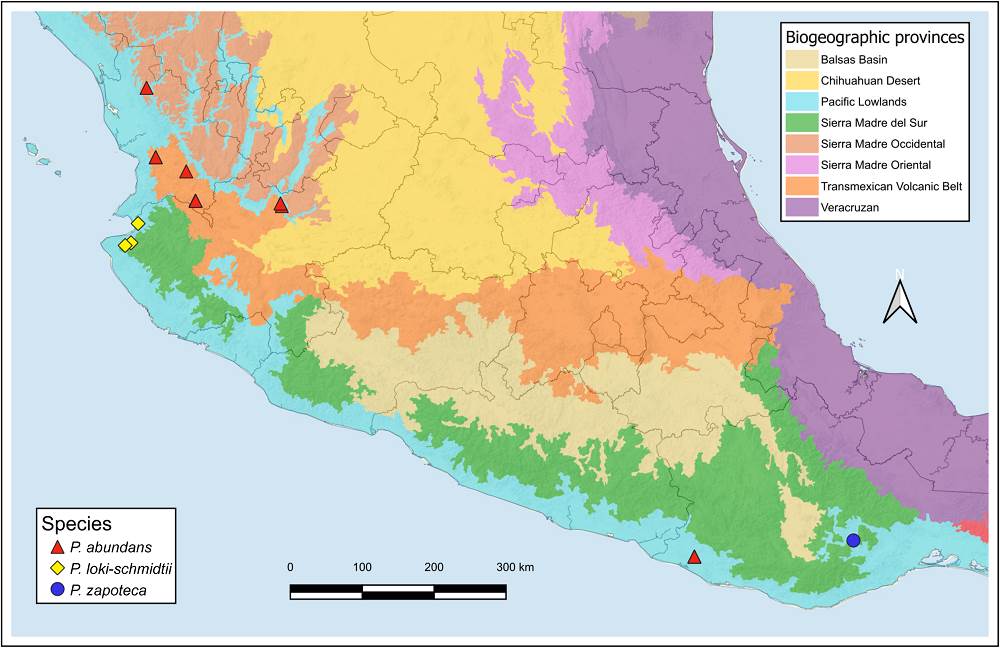
Pitcairnia, with ca. 417 species (Gouda et al. 2024), ranging from Mexico southwards to northern Argentina and some islands of the Caribbean (even one in western tropical Africa, P. feliciana (A.Chev.) Harms & Mildbr.), includes plants that are extremely variable. The leaves are mostly basal, spiraled with short internodes and seldom they form a true rosette (i.e., Pitcairnia tabuliformis Linden), with entire to spinose margins, ligulate, mostly thin but succulent at least along the mid nerve; some are deciduous, some dimorphic (as in P. heterophylla (Lindl.) Beer), and at least some species feature leaves that are succulent (e.g. P. pruinosa Kunth). This vegetative architecture is repeated along the genus. The greatest morphological variation within Pitcairnia is found on the inflorescence and its parts: origin of the inflorescence (basal vs apical), length of the peduncle, from very abbreviated, almost sessile (as in Pitcairnia tabuliformis), to variously elongated, and then from condensed racemes or panicles, often with large primary bracts (i.e., P. imbricata (Brongn.) Regel), covering the floral axis, to those with lax racemes or panicles where the main axis is clearly visible. Flowers usually have zygomorphic, petaloid corollas, colored yellow, red, white, light green, to even almost black (i.e. Pitcairnia rubro-nigriflora Rauh or Pitcairnia alata L.B.Sm. var. andreetae (H.Luther) Manzan. & W.Till); floral bracts, when conspicuous, usually contrasting in color with the corolla; flowers show the characteristic hummingbird-pollinated syndrome (brightly colored, tubular corollas, which are nectar-rich and odorless). However, our assessment of the genus indicates that a small group of species across the geographical range of the genus, feature actinomorphic, campanulate, white, yellowish to greenish corollas with nocturnal anthesis (fragrant, nectar-rich). Among this group, whose relationships are not yet fully understood, there are two species reported from Mexico, Pitcairnia lokischmidtiae Rauh & Barthlott, and Pitcairnia abundans L.B.Sm. (Smith 1964), both endemic to the country, the first in Jalisco (Rauh & Barthlott 1987) and the second known disjunctly from Nayarit to Jalisco and NW Oaxaca (Macías-Rodríguez et al. 2007). Here, we present an additional species with pale yellowish corolla, native from SE Oaxaca, in the western section of the Tehuantepec Isthmus region.
Espejo Serna & López-Ferrari (updated from 2018) found that in Mexico, Pitcairnia had the largest number of species in the state of Chiapas with 19 species, followed by Guerrero with 16 species, Oaxaca (13 species), Jalisco (12 species), Veracruz (9 species), Nayarit (8 species), Michoacán and México (7 species), whereas all of the other states feature fewer than 6 species. Chiapas and Guerrero have the most endemic species (e.g., restricted to the state, 11 and 7 respectively), followed by Jalisco with four, Oaxaca with three including the one described here, whereas Durango, México, Michoacán, Veracruz, and Sinaloa, have one endemic species each.
The objective of the present contribution is twofold. First, we formally propose Pitcairnia zapoteca as new and provide a full description and complete iconography of the species. Second, we assess its conservation status.
Materials and methods
Complete material of the new species, including living plants as well as herbarium specimens, were cross-examined against Pitcairnia abundans and P. lokischmidtiae, and images of the types of the names that apply to both species, as well as photographs and spirit floral material for P. lokischmidtiae; we also consulted Macías-Rodríguez et al. (2007) for P. abundans as well as herbarium specimens, and vegetative material in cultivation of the species. Finally, a comparative table with selected characters of the three species is included herein. The description of the new taxon is based on fresh material (in the field and under cultivation), and high-resolution photographs complemented with features easily observed in herbarium material and in the field. Terminology was based on Scharf & Gouda (2008) and Radford et al. (1974).
Table 1 Comparison between Pitcairnia lokischmidtiae, P. abundans and P. zapoteca.
| Characters | P. lokischmidtiae | P. abundans | P. zapoteca |
|---|---|---|---|
| Leaves | Monomorphic, persistent, without an abscission zone | Dimorphic; with an abscission zone | Monomorphic; with an abscission zone |
| Foliar sheaths | Entire; glabrous | Minutely spiny; sparsely white-flocculose | Spiny; glabrous |
| Foliar blades | Ca. 80 cm long, 4.5 cm wide; glabrous both sides; underneath mid nerve prominent | 60-78 cm long, 3.3-4.3 cm wide young; leaves sparsely white-flocculose abaxially throughout, glabrescent in age; mid nerve prominent | 40-60 cm long, 1.3-1.5 cm wide; white lepidote abaxially; mid nerve inconspicuous |
| Inflorescence (fertile portion) | 50 cm long; ca. 25 flowers | 11.5-22 cm long; 27-50 flowers | 25-26 cm long; 30-35 flowers |
| Peduncle | ca. 70 cm long, 6 mm diameter; green, white floccose | (33-)60-70 cm long, 10-17 mm diameter at the base, 4-8 mm at the apex; green, glabrous | 40-60 cm long, 5-7 mm diameter at the base; green occasionally with brown hues, densely covered by an indument of white hairs |
| Peduncle bracts | Persistent, scattered white floccose, triangular-acuminate; 1.8-3 cm long | Deciduous, floccose to glabrous, linear to lanceolate, acuminate, entire, 3.5-4 cm long | Persistent, glabrous adaxially, white floccose abaxially, narrowly triangular, acute, serrate, 3.5-9 cm long |
| Floral bracts | As long as pedicel, 1 cm long | Surpassing pedicel and half the length of sepals, 1.2-3 cm long | Surpassing the pedicel, as long as the middle length of sepal, 1.5-2 cm long |
| Floral pedicel | Ca. 1 cm long; terete | 4-7 mm long; strongly bisulcate adaxially | 3-4 mm long; terete |
| Sepals | Ecarinate, 1.5 cm long, lanceolate, acuminate, light green, glabrous | Ecarinate, 2-3 cm long, 0.5-0.7 cm wide, green, minutely tuberculate | Carinate, 1.8-2.1 cm long; 0.6-0.7 cm wide, reddish adaxially, green abaxially, oblong, acuminate, scattered white tuberculate |
| Petals | 5 cm long, 1.3 cm wide; green; with an appendage 7 mm long, white | 6-8.1 cm long, 1.4-2.0 cm wide; light green to yellowish green; with an appendage 8-13 mm long, white | 6 cm long, 2 cm wide; pale yellowish and reddish at the apex; with an appendage 9 mm long, white |
| Ovary | 1/3 inferior, 0.5 cm long, 4 mm diameter | 2/3 inferior, 11 mm long, 4-6.5 mm diameter | Superior, ca. 1 cm long, ca. 8 mm diameter |
| Style | 3 cm long | 5.5-6.3 cm long | 6-6.2 cm long |
| Flower fragrance | Flower emits a smell like unripe apple | Flower emits a skunk-like fragrance | Flower emits a musky fragrance |
| Distribution | Jalisco (type) | Jalisco, Nayarit (type), Oaxaca | Oaxaca (type) |
Field work was carried out under the scientific permits (SGPA/DGVS/01280/21 and SGPA/DGGFS/712/2913/17) issued by the Secretaría de Medio Ambiente y Recursos Naturales (SEMARNAT) to researchers at the Centro de Investigación Científica de Yucatán, A.C. (CICY). Plants were collected and bloomed under cultivation at the Roger Orellana Regional Botanical Garden at CICY (accession number 2021-012) and in a private collection in order to obtain and study fresh flowers and conduct detailed studies of the vegetative portions. Herbarium specimens were deposited at CICY and MO. High resolution images of type specimens and regular vouchers from herbaria CICY, ENCB, F, GUADA, HEID, IBUG, MEXU, MICH, MO, NY, TEX, UAMIZ, US, WIS, and WU (acronyms according to Thiers 2024, continuously updated) were studied, and localities were annotated to elaborate the distribution map. The new species was compared with all species with similar floral symmetry and overall coloration from Mexico, in order to determine its status. These species are P. lokischmidtiae from Jalisco and P. abundans from Nayarit, Jalisco, and Oaxaca. The conservation status of the new species was assessed using the IUCN Red List Criteria (IUCN 2024).
Results
Pitcairnia zapoteca I. Ramírez, G. Carnevali & K. Romero, sp. nov. (Figures 1-4).
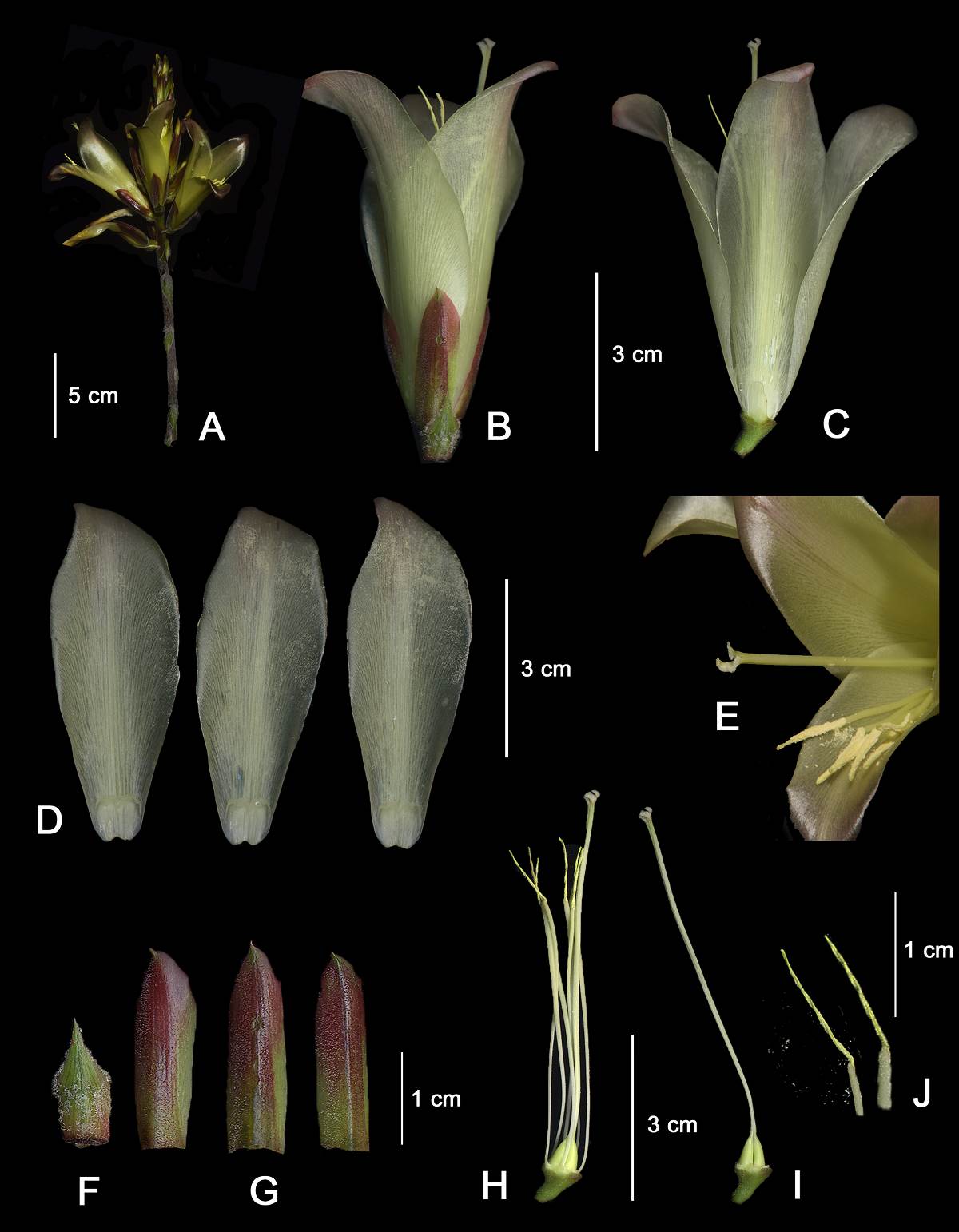
(Based on I. Ramírez & G. Carnevali 2459 (Holotype: CICY)
Figure 1 Pitcairnia zapoteca (A-J). A. Inflorescence. B. Flowers with floral bract and sepals. C. Flowers with floral bract and sepals removed. D. Petals, note the appendage at the base of each one. E. Apical view of the corolla, note the stigma and stamens resting on one petal. F. Floral bract. G. Sepals. H. Ovary with style, stigma and stamens. I. Ovary with stigma. J. Apical portion of filaments and anthers.).
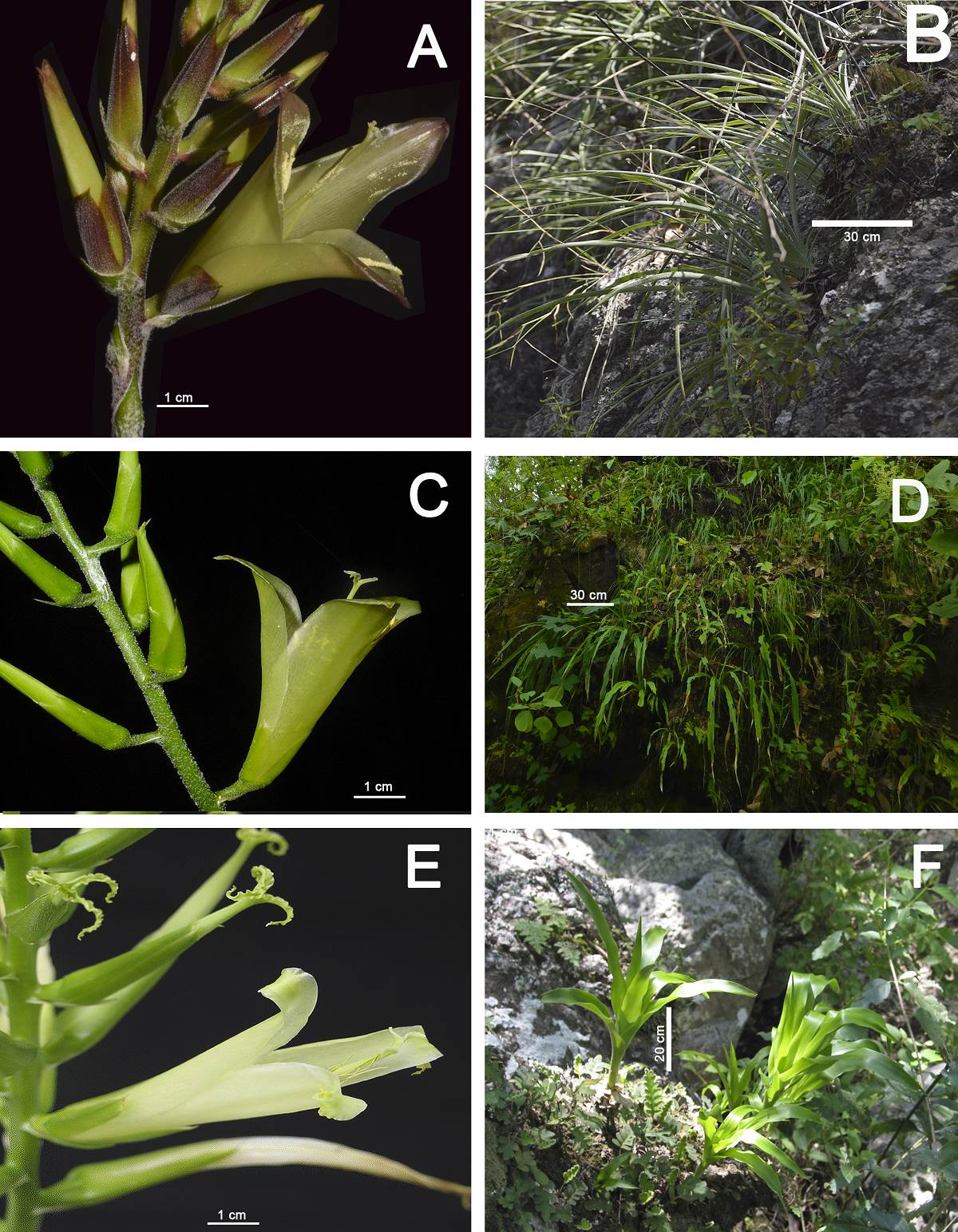
(Photographs A, C: Germán Carnevali; B: Ivón Ramírez; D: Alejandra Flores-Argüelles; E, F: Eduardo Sahagún-Godínez)
Figure 3 Floral details and plants in habitat. A-B. Pitcairnia zapoteca. C-D. Pitcairnia lokischmidtiae. E-F. Pitcairnia abundans.
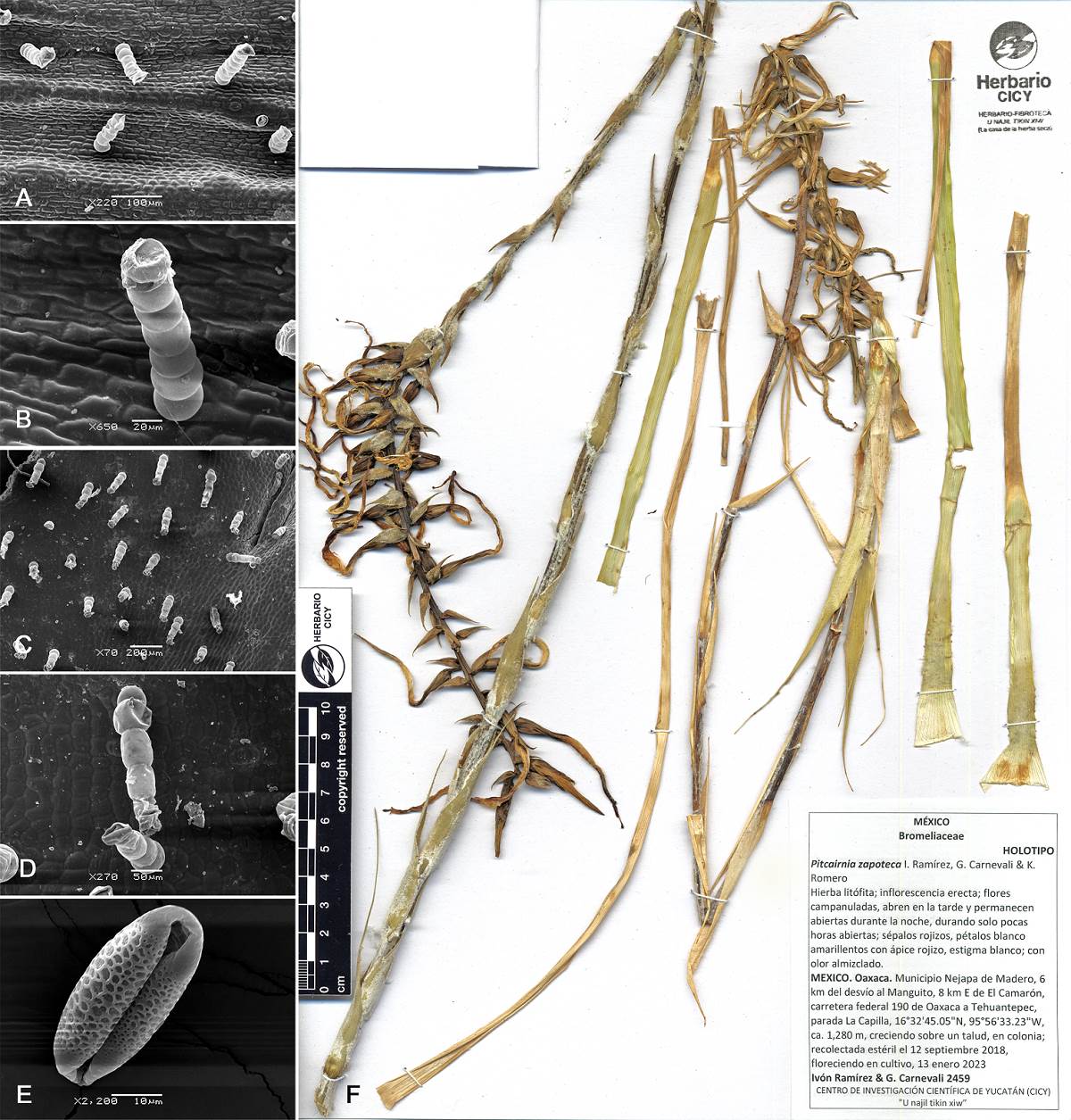
(Photographs by Lilia Can and Néstor Raigoza based on I. Ramírez & G. Carnevali 2459 (Holotype: CICY))
Figure 4 Microscopic structures under SEM for Pitcairnia zapoteca. A. Floral bract indument, B. Floral bract detail of trichome. C. Sepal indument. D. Sepal trichome. E. Pollen. F. Holotype of Pitcairnia zapoteca.
Type. Mexico, Oaxaca, municipio Nejapa de Madero, distrito de Yautepec, 6 km del desvío al Manguito, 8 km E de El Camarón, carretera federal 190 de Oaxaca a Tehuantepec, parada La Capilla, 16° 32' 45.05" N, 95° 56' 33.23" W, ca. 1,280 m, creciendo sobre un talud, en colonia; recolectada estéril el 12 September 2018, floreciendo en cultivo, 13 enero 2023, I. Ramírez & G. Carnevali 2459 (Holotype: CICY, isotype, MO).
Diagnosis. This new species resembles Pitcairnia lokischmidtiae. However, P. zapoteca differs by the fewer leaves per rosette (10-15 vs. (16-)18-25 in P. lokischmidtiae), shorter leaves (40-60 vs. 80-100 cm), which are also narrower (1.3-1.5 vs. ca. 4.5 cm wide), and deciduous (vs. persistent); it also features shorter inflorescences (70-80 vs. 120 cm), larger floral bracts (1.5-2 vs. ca. 1 cm), sepals tinged dull brown-red (vs. totally green), pale-yellowish petals with distal, dull red brown tinges (vs. greenish white), the stigma surpassing the petals when the flower withers (vs. included), and ovary superior (vs. almost completely superior).
Description. Lithophytic plant, acaulescent, forming colonies of (3-)5(-10) rosettes; roots to 15 cm long, fibrous. Rosettes 30-50 cm high (only the leaves), 60-80 cm diameter, with 10-15 leaves per rosette. Stem 5-10 mm thick, stout, cylindrical. Leaves sessile, erect to pendulous, monomorphic, seasonally deciduous by an abscission layer between sheath and blade, blade and sheath distinct. Foliar sheath 2.5-3.5 × 1.5-2.8 cm, amplexicaulous, conspicuous, widely ovate, entire, thin, membranaceous, light green, venation conspicuous, glabrous on both surfaces, the apical portion rolls outwards upon drying. Foliar-blades 40-60 × 1.3-1.5 cm, linear, long acuminate, canaliculate, sub-succulent, central nerve conspicuous, deciduous, green, glabrous adaxially but the bases slightly white lepidote, abaxially densely white lepidote, entire above the line of abscission, basal portion (2.5-3 cm) serrate, spines antrorse, black, irregularly distributed, 1-5 mm apart, less than 1 mm long. Inflorescence 70-80 cm long, terminal, an erect raceme, cylindrical in general outline, rachis ca. 20 cm long, accounting for the distal ¼ of the inflorescence (thus, flowers crowded in the apical fourth of the inflorescence), flowers 20-35, polystichous, 3-5 mm apart. Peduncle 40-60 cm long, 5-7 mm diameter at the base, longer than rosette height, erect to slightly arching downward, green or green with brown-red hues, densely tuberculated; internodes 3.5-4 cm long, becoming shorter distally toward the fertile area of the inflorescence. Peduncle bracts 3.5-9 cm long, 0.5-1 cm wide, narrowly triangular, acute, serrate, green, glabrous adaxially, white-floccose abaxially, multinerved, amplexicaul, appressed to the peduncle, surpassing the internodes in the half basal portion, much shorter and base bulging distally. Floral bracts 1.5-2 × 0.8-1 cm, widely oblong, abruptly acuminate, basally white, then green, abaxially with scattered white, simple, erect trichomes (Figure 4A, B), adaxially only apically white floccose, margins sinuose, smooth but erose at the apical half, multinerved. Flowers 6.5-7 cm long, funnel-like, at an angle of approximately 45 degrees to the axis, anthesis nocturnal, with a musky fragrance, stigma and stamens exerted, sepals, petals, stamens and style twisted upon drying. Pedicels with receptacle 3-4 mm long, 3 mm in diameter, green, stout, covered by scattered white, simple, erect trichomes, brown when dried. Sepals 1.8-2.1 × 0.6-0.7 cm, oblong, acuminate, erect, free, adnate to the petal, reddish adaxially, green abaxially, apical margins laxly dentate, covered by scattered white, simple, erect trichomes (Figure 4C, D) that turn brown upon drying, carinate. Petals 6.0-6.2 × 2.0-2.1 cm, broadly and shallowly concave at anthesis, elliptical, apically short acuminate, multinerved, pale yellowish, distal third reddish, apically incurved; petal appendages ca. 9 mm long, two, one at each side of the filament, apically with 2-ligules, exceeding by 2-3 mm the height of the ovary, white. Stamens ca. 5.3-5.4 cm long, equal in length, free; filaments ca. 4.4 cm long, white; anthers linear, sagittate, basifixed, 9-10 mm long, yellow, dehiscence lateral, pollen yellow. Ovary ca. 1 cm long, ca. 8 mm wide, conical, superior, light green basally, apically green or reddish; style 6-6.2 cm long, exceeding the stamens and petals, stigmatic area ca. 4 mm long; stigma conduplicate-spiral before anthesis, then lobes spreading, these covered by white papillae. Ovules 4-5 mm long, numerous, white, filiform, placentation axial. Fruits ca. 1 cm long, ca. 0.8 cm diameter; obconic, seeds, ca. 3 mm long, 0.5 mm diameter, falcate, brown, with a distal wing of 1-1.5 mm long, proximal one ca. 0.5 mm long. Pollen with polar diameter ca. 38.5 µm, equatorial diameter ca. 18.6 µm, fusiform, monosulcate, exine reticulate (Figure 4E).
Distribution and ecology. Pitcairnia zapoteca is only known from the type locality, in the Mexican state of Oaxaca. The only population known grows on semi-shady rocky outcrops in the leeward slopes of the Sierra Madre del Sur, at the SW end of the Valle Central de Oaxaca. There it grows in mesophilous forest in transition to seasonally dry forest dominated by oak species. The outcrops where it grows supports a varied flora of succulents and epiphytes (there growing as lithophytes); species to be found there include orchids such as Encyclia hanburi (Lindl.) Schltr., Meyracillium trinasutum Rchb.f., and Bletia roezlii Rchb.f., succulent bromeliads such as Hechtia marnier-lapostollei L.B.Sm., and representatives of miscellaneous other plant families such as Agave L., Pinguicola L., Opuntia Mill., Sellaginella P. Beauv., Oxalis L., Dahlia Cav., and others.
Conservation status. The conservation status of Pitcairnia zapoteca is currently unknown as it has only recently been discovered and is only known from a single locality. Thus, strictly according to the IUCN methodology, it should be assessed as DD (data deficient). However, given its limited known distribution and the specific habitat requirements (vertical rocky outcrops and cliffs), it could potentially be at risk. The single known population occurs in a steep rocky outcrop facing NE of approximately 300 m long and 50 m tall and it may consist of several hundred plants. A quick assessment of the area with the use of Google Earth seems to indicate that there are many other rocky outcrops that may harbor additional populations of P. zapoteca. Further field studies are needed to assess the size and health of other populations, if any, as well as potential threats.
Phenology and floral observations. Plants under cultivation have bloomed from December to February and fruit in March. The flowers we have observed open approximately at 16:00 h, and in a couple of hours the corolla is about 50 % expanded into a funnel-like structure. At anthesis, the stigma is erect and central, and the stamens are oriented towards the lower side of the corolla. The stigma lobes are initially conduplicate-spiral but later in anthesis they spread (Figure 2E); the stigma exceeds the anthers and petals by approximately 1.5 cm. Pollen starts being released as flowers open, and the transparent nectar is deposited at the bottom of the corolla, around the ovary. The flower emits a musky fragrance. Flowers in the genus Pitcairnia are generally zygomorphic, but the new species has an actinomorphic corolla that becomes only slightly zygomorphic as the anthers and stigma are oriented towards the lower part of the corolla (Figure 1E). When flowers wither, the stigma protrudes above the twisted petals. The shape, structure and size of the flowers, as well as the timing of the musky fragrance release strongly suggest pollination by small bats or moth species, probably a long tongued sphyngid, but we have no observations to support this hypothesis.
Etymology. The name zapoteca honors the Zapotecan people, an ethnic group that have traditionally inhabited the type locality area.
Discussion
This new species resembles Pitcairnia lokischmidtiae, from Jalisco and against which it is compared in the diagnosis section. With this species, it shares the campanulate corolla that is initially actinomorphic, later becoming pseudo-zygomorphic due to a change of position of the stamens and stigma; they also share the nocturnal anthesis and stigma with spreading lobules. Pitcairnia zapoteca is also similar to P. abundans, known from the Mexican states of Nayarit and Jalisco (Macías-Rodríguez et al. 2007), with which it shares characters similar to those shared with P. lokischmidtiae.
The poorly known Pitcairnia koeneniana E. Gross & Barthlott is very similar to P. abundans and may be conspecific. However, since we have not studied material of this species, we have refrained to make any nomenclatural decision regarding the status of this taxon. Should they be conspecific, the name P. abundans (proposed 1964) takes precedence over P. koeneniana (proposed 1997)
The phylogenetic relationships of these three (perhaps four) species with flowers of nocturnal anthesis is currently unknown. However, judging from vegetative and floral similarities, as well as a distribution restricted to the lowlands of the Pacific coast of tropical Mexico, north and west of the Tehuantepec Isthmus at the Pacific Lowlands Biogeographical Province (sensu Morrone et al. 2017), it seems sound to hypothesize a relationship.
We have successfully cultivated Pitcairnia abundans, P. lokischmidtiae, and P. zapoteca. They require relatively small pots with well-draining substrate, a semi shaded position, and abundant water during the growing season and a thorough rest during the dry season, when they can be watered every other week or less often. During the extended dry season, the plants may drop some or all of the leaves. They flower toward the end of the rainy season, mostly November-December, and start producing new shoots during the late dry season in April-May.
Additional specimens studied. Pitcairnia abundans. Mexico, Nayarit, 10 miles southeast of Ahuacatlán, on the road to Barranca del Oro and Amatlán, alt. 1,100-1,300 m, November 17-18, 1959, R. McVaugh & W. N. Koelz 751 (Holotype US-2429396!; isotypes MICH!, NY-03856236!). Acaponeta, km. 15 de la brecha entre Santa Cruz de Acaponeta y San Blasito, es descenso al Rio San Pedro, 22° 24’ 59.84’’ N, 105° 6’ 8.37’’W, 88 m, 6 November 2013, A. Castro-Castro et al. 3377a (IBUG!). Mun. Tepic Las Tierritas, 2 km NE del Izote, Cerro San Juan al W de Tepic, 21° 31’ N, 104° 59’ W, 1,200 m, 23 March 1989, P. Tenorio et al. 15609 (MEXU!, TEX!). Oaxaca, Mun. Pinotepa Nacional, Cañón del Rio de Arena, 6.5 m al este de Pinotepa Nacional por la carretera a Puerto Escondido, 50 m, 9 November 1979, Koch et al. 79444 (ENCB!, F-1896083!, LL-TEX-00370232!, MEXU-304698!, MICH-1662810!, MO-3385800!, NY-03856236!, US-2905637!, WIS-0353950!). Jalisco, Mun. Autlán de Navarro, Est. de Microondas Los Mazos, 1,700 m, 03 September 1991, R. Ramírez-Delgadillo et al. 2522 (IBUG!).
Pitcairnia koeneniana. Mexico, Nayarit, Bei Santa María del Oro, zw. Ixtlan und Tepic, Prov. Nayarit-W. Mexiko, 308 m, 29 December 1990, M. Koenen 13.19.MK (Holotype: BONN!).
Pitcairnia lokischmidtiae. Mexico, Jalisco, south of Puerto Vallarta, 1981, Hannelore Schmidt s.n. sub B.G. Bonn 24105 (Holotype HEID-302372!, HEID-302371!, HEID-602369!, HEID-602370!; isotype BONN). Mun. Cabo Corrientes, ejido Pedro Moreno, 1 km después del puente Las Guinas, ca. 0.5 km después del ejido Pedro Moreno, 20° 24’ 23’’ N, 105° 18´ 12’’ W, 637 m, 30 July 2003, flowers in spirit, I. Ramírez et al. 1094 (CICY!).

