




 nova página do texto(beta)
 Inglês (pdf)
 Artigo em XML
 Referências do artigo
 Tradução automática
 Enviar este artigo por email
 Citado por SciELO
  Similares em
SciELO
Similares em
SciELO 
 Permalink

Introduction
Soursop (Annona muricata L.) is a vital alternative fruit crop in Mexico, contributing 30,790.70 t per year, with 75 % (23,230.08 t) concentrated in Nayarit. Key producing areas in Nayarit include Compostela (2,371 ha), San Blas (52.40 ha), and Tepic (12 ha), with yields of 10.63, 8.86, and 8.29 t ha⁻¹, respectively (SIAP, 2022). Soursop production in Nayarit faces challenges such as limited irrigation technology, pest and disease management, manual pollination techniques, and pruning, resulting in yields of 10.53 t ha⁻¹, comparable to Veracruz (10.55 t ha⁻¹) and Colima (10.06 t ha⁻¹) (SIAP, 2022).
Soursop is significantly impacted by poor flower pollination. In most orchards, the yields obtained are incompatible with the total number of flowers produced by the plant, due to the late natural pollination process inducing early flower drop or drying (Rebolledo et al., 2009). The low fruit set is mainly due to the behavior of floral dichogamy in soursop, that is, hermaphrodite flowers that have female and male parts with outdated maturation, causing that there is no self-pollination (Pinto de Lemos, 2011; Rebolledo et al., 2009). Additionally, the closed preantesis and early anthesis floral morphology hinder wind and insect pollination, with 10 % of the flowers being self-fertilized and lacking nectar (Peña et al., 2002; Franco-Mora et al., 2001).
Rebolledo et al. (2009) reported that environmental conditions significantly influence natural pollination, with optimal conditions requiring 80 % relative humidity and a temperature of 22 °C. Temperatures exceeding 28 °C and relative humidity below 60 % result in flower and fruitlet drop, causing up to 80 % of deformed fruits, further impacting production due to quality and size (Cambero-Ayón et al., 2019; Betancourt-Aranguré et al., 2019 In arid locations, rapid stigmatic liquid drying prevents pollen germination, leading to stigmas falling and blocking the sexual process, impeding ovarian fertilization (Rebolledo et al., 2009; Cárdenas-Torres, 2002).
Given this context, hand-pollination has emerged as a strategy to enhance fruit set. In countries like Brazil, this technique is established among small producers, increasing tree production and fruit quality by up to 50 % (Oliveira et al., 2005). Hand-pollination practices should be done in flowers that are on thick branches that support the fruit load and should take advantage of the characteristics of this fruit species that can generate flowering in lateral buds of the whole plant, so that pruning is necessary to design the required tree canopy. In Mexico, high-density orchards have demonstrated that pruning contributes to yields of up to 12.79 kg per tree and 28.42 t ha⁻¹ (Reyes et al., 2018). Recent studies indicate that fungicides such as maxtrobyn and flutriafol can aid in controlling anthracnose development on soursop inflorescences and leaves (Betancourt-Aranguré et al., 2019; Hernández-Guervara & López-Rodríguez, 2019).
Given the challenges in yield and fruit malformation faced by soursop, evaluating the effect of hand- and natural pollination with fungicide application in pruned trees is imperative for soursop cultivation in Nayarit, Mexico.
Material and Methods
The study was conducted in a 4-hectare commercial rainfed soursop orchard, five years old, situated in the ejido El Capomo, Las Varas (21°7ʼ39" N and 105°10ʼ6" W) in the Municipality of Compostela (Nayarit), at an altitude of 80 meters. Weeding was performed with a machete before selecting the experimental plot. The leaves were isolated in the drip zone of each tree and fertilized by broadcasting. In July 2020, at the beginning of the rainy season, a compound mixture (ammonium sulfate, DAP, potassium sulfate, boron, magnesium sulfate, manganese sulfate, and zinc sulfate) was applied at a rate of 1 kg per tree. A second fertilization took place in September 2020 with 300 g per tree of the original Terratec mixture (urea, man, DAP, sam, phosphonitrate, KCl, sop, sulfomag).
During the cleaning process and prior to the flowering of the soursop plants, applications of insecticides, including copper oxychloride (2.5 mL L-1), permethrin (0.36 mL L-1), and imidacloprid (1 mL L-1), were made.
Percentage of fruit moorage with pruning and without fungicide application
A total of 236 inflorescences, mature or receptive at stage 4 and displaying a sulfur yellow color (Escobar et al., 1986), were randomly selected in June 2021. These were distributed among trees with different pruning percentages (100 %, 75 %, 50 %, 25 %, 0 %). The inflorescences were hand-pollinated using pollen obtained from mature inflorescences collected manually and stored in #5 paper bags one day prior, kept at room temperature under shade. The collected pollen was stored in a glass jar and applied with a fine bristle brush (#10) using a gentle cross-shaped movement on the gynoecium of the inflorescence. Pollination was conducted between 9-and 12 a.m., coinciding with the receptivity of the female organs. Priority was given to inflorescences located on primary branches and carrying capacity. After pollination, the fungicide Maxtrobyn (Azoxystrobin) was applied to 107 inflorescences using an atomizer on a single occasion at a dose of 3 mL L-1, while the remaining 129 inflorescences did not receive the fungicide. All inflorescences were recorded and labeled for follow-up.
Natural pollination
A total of 256 inflorescences, mature or receptive at stage 4 and displaying a sulfur yellow color (Escobar et al., 1986), were randomly selected in June 2021. These were distributed among trees with different pruning percentages (100 %, 75 %, 50 %, 25 %, 0 %). They were not naturally pollinated. The fungicide Maxtrobyn (Azoxystrobin) was applied to 128 inflorescences with an atomizer on a single occasion at a dose of 3 mL L-1, while the remaining 128 inflorescences did not receive the fungicide. All inflorescences were recorded and labeled for follow-up.
Percentage of mooring
Mooring percentage was considered from the moment the first morphological change of the flower was observed, transitioning from the brown fruit bud to a brown-spiked ball, indicating the onset of fruit growth.
Fruit development (diameter and length)
Using a Vernier caliper, the polar and equatorial diameter of fruits during their tree-bound development was measured. The initial measurement was taken at the first morphological change in the flower, from the brown fruit bud to a brown-spiked ball. Subsequent measurements were taken at 15-day intervals.
Statistical analysis
The data were analyzed using a randomized block design with a factorial arrangement, considering the factors of pollination type, pruning percentage, and fungicide application. Analysis of variance (ANOVA) and mean comparisons were performed with Tukey's test (α≤ 0.05) using the statistical package SAS (Statistical Analysis System).
Results and Discussion
Fruit mooring percentage with pollination and fungicide application
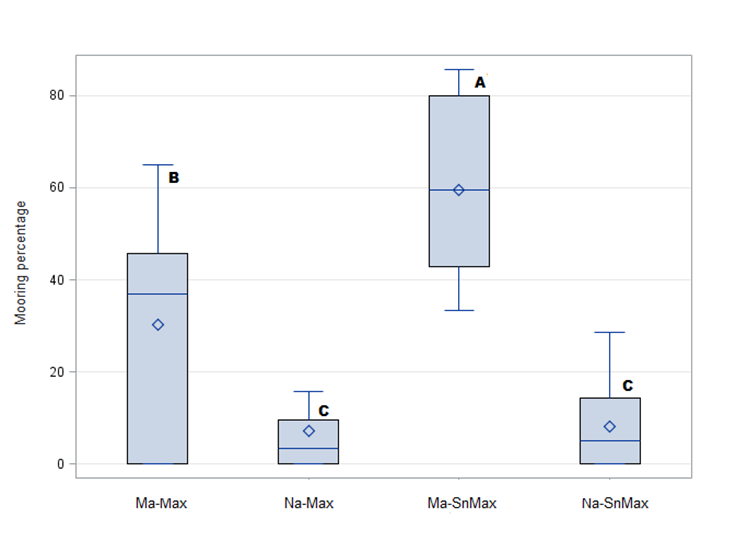
Trees subjected to hand-pollination without fungicide exhibited a statistically higher fruit set, averaging 59.58 %. This was followed by the treatment involving hand pollination with fungicide, which showed an average fruit set of 30.24 %. Trees undergoing natural pollination, both with and without fungicide, displayed a lower fruit set at 7.61 % on average, with no statistically significant differences (Figure 1).
Hand-pollination resulted in an 83.04 % higher fruit moorage compared to naturally pollinated trees. In terms of fungicide application, the hand-pollination treatment without fungicide showed a 49.24 % improvement in the fruit set compared to the hand-pollination treatment with fungicide. Sánchez-Monteón et al. (2019) stated that the low percentage yield or fruit set of hand-pollinated fruit could be due to inadequate flower selection during pollination (lack of receptivity), resulting in the absence of fertilization. Contrary to this, the results of this research indicate that flower selection was adequate, leading to a higher fruit set. Although anthracnose has been reported as one of the main diseases affecting inflorescences (Betancourt-Aranguré et al., 2019), during the experiment, flowers not treated with fungicides exhibited a better fruit set.
Percentage of fruit set with pruning and fungicide application
The percentage of fruit set with pruning and fungicide application was statistically significant among various treatments. Trees treated with fungicide (Max), hand-pollination (Ma) with pruning at 100 %, 75 %, and 50 %, as well as trees with natural pollination (Na) at pruning levels of 75 % and 25 %, showed a significantly higher fruit set at 24.60 %, compared to hand-pollination treatments with 25 % and 0 % pruning levels and natural pollination with 100 %, 25 %, and 0 %, which did not yield any fruit (0 %) (Figure 2).
Martinez & Vidal (1993) reported a 65 % fruit set with hand-pollination without the use of fungicide, while Nakasone & Paul (1998) reported up to 80 % fruit set with hand-pollination without fungicide. In soursop, fruit abortion or drop is attributed to anthracnose, which can cause up to 90 % fruit abortion or drop if environmental conditions favor its development (high relative humidity, poor aeration, and low light penetration in the tree) (Cambero-Ayón et al., 2019). Betancourt-Aranguré et al. (2019) reported that the use of Maxtrobyn (Azoxystrobin) can inhibit the development of anthracnose in vitro in inflorescences by up to 71.60 % with a dose of 0.88 mL. Meanwhile, Hernandez-Guevara & Lopez-Rodriguez (2019) reported a 67.50 % control of anthracnose on soursop leaves using Maxtrobyn (Azoxystrobin) and Flutriafol at a dose of 1200 mL ha-1.
In fruit trees, pruning is one of the most relevant agronomic factors, enabling greater aeration and light penetration in the tree, and preventing conditions conducive to the development of pests and diseases such as anthracnose. Additionally, pruning helps create a desired canopy with load support (Cruz-Barrón, 2011). Alternative methods, such as the use of microorganisms, have also been explored. Anaya-Martínez (2022) applied rhapsody (Bacillus subtilis) at a dose of 17.5 cm 7 L-1 water, achieving a 70 % decrease in anthracnose incidence in soursop fruits and a 58.7 % control efficiency. This alternative proves to be environmentally favorable.
Percentage of fruit moorage with pruning and without fungicide application
Trees without fungicide application (SnMax), manual pollination (Man) with pruning at 50, 25, and 0 %, as well as trees with natural pollination (Nat) with pruning at 25 and 0 %, were statistically significant, showing higher fruit mooring (38.12 %) compared to manual pollination treatments with 100 % and 75 % pruning and natural pollination with 100 %, 75 %, and 50 %, which did not moor the fruit (0 %) (Figure 2).
The results obtained in fruit mooring are highly variable, as some authors report a high percentage of fruit moorage, while others report a low percentage. With the manual pollination technique, Nakasone & Paul (1998) reported up to 80 %; Franco-Mora et al. (2001) recorded values of 70 to 30 %, and Martinez & Vidal (1993) reported values of 65 % fruit moorage. Meanwhile, Rubi (1994) found 8 % moorage in cherimoya under natural pollination conditions.
Percentages of fruit moorage have also been evaluated with hormone application. Guaycha-Armijos (2020), with the application of eco-hormones (750 mL ha-1), accelerated flower production (in 4 days) and formation of the first fruits (in 6 days) and decreased flower abortion by 25.26 % compared to the control (without hormones). Chávez & Sabando (2022), with the use of manual pollination, recorded an average of 73.33 % in the fruit set, and with the application of naphthaleneacetic acid at 2 %, recorded a maximum average of 63.33 %. This high percentage of fruit set represents an alternative to increasing yields in the orchards of this Anonacea.
The abortion or low fruit moorage is attributed to a deficiency in pollination or a blockage in the sexual process, as pollination may occur before the pollen grains germinate and fertilize the ovary (Escobar et al., 1986; Nakasone & Paull, 1998). It is also important to mention that pollination and fertilization in soursop are limited by the characteristic phenomena of its flower (Worrell et al., 1994). Temperature and relative humidity conditions are important during the pollination process; in dry places, the drying of the stigmatic liquid occurs faster, a situation that makes the germination of pollen grains on the stigma, the growth of the pollen tube, fertilization, and later the moorage impossible (Franco-Mora et al., 1999; Nakasone & Paul, 1998; Rebolledo et al., 2009; Cárdenas-Torres, 2002).
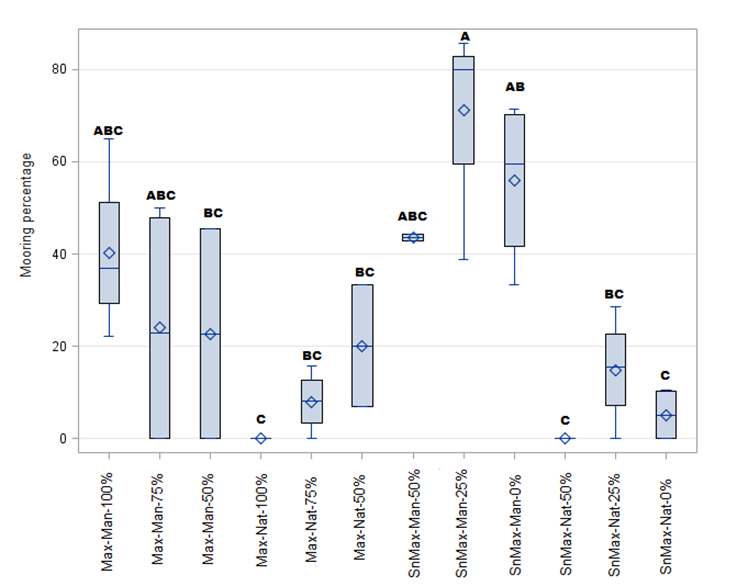
Max: Maxtrobyn, SnMax: No Maxtrobyn; Man: hand-pollination; Nat: Natural pollination.
Figure 2 Percentage of fruit set in trees with different pollination and pruning intensity. With and without Maxtrobyn (Azoxystrobin) fungicide application. Means with a common letter are not significantly different (p > 0.05).
Fruit development with different pollination types
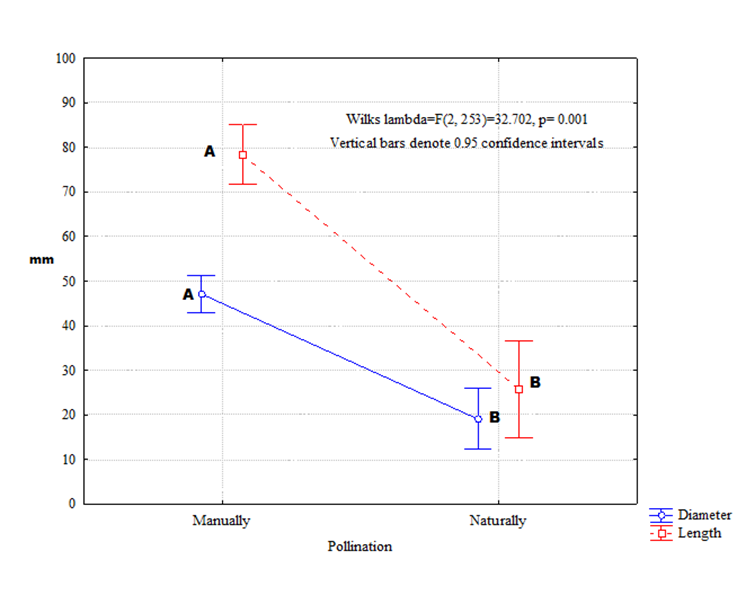
Hand-pollinated fruits were statistically significant, presenting a greater diameter (46.75 mm) and length (78.76 mm) compared to naturally pollinated fruits with means of 21.86 mm in diameter and 29.29 mm in length (Figure 3). Hand-pollinated fruits were found to be 53.23 % and 62.80 % larger in diameter and length development, respectively. Hand-pollination increases tree production and fruit quality by up to 50 % (Oliveira et al., 2005). Chávez & Sabando 2022), with the use of hand-pollination and the application of 2 % naphthaleneacetic acid, obtained diameters of 2.019 cm.
Fruit development with the use of fungicides and different pollination
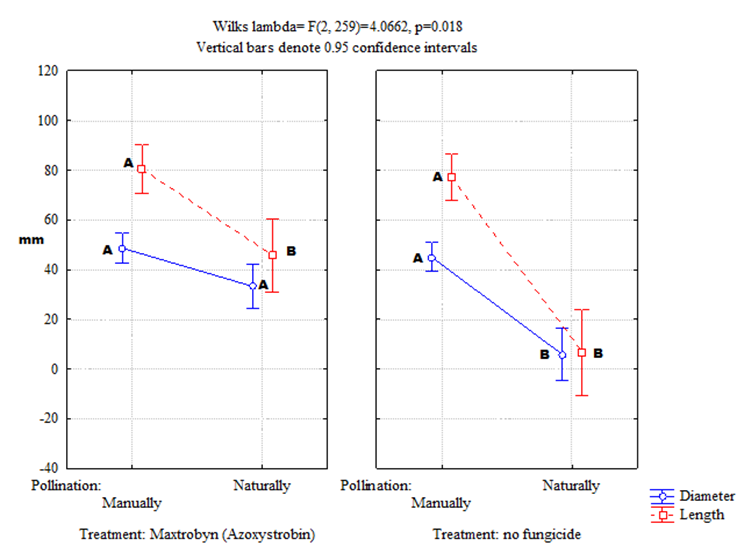
Fruits treated with fungicide and subjected to hand-pollination demonstrated statistically greater size, with means of 48.64 mm in diameter and 80.48 mm in length. In contrast, fruits without fungicide and undergoing natural pollination exhibited smaller sizes, with means of 5.90 mm and 6.60 mm in diameter and length, respectively (Figure 4). In fruit development, it was observed that the treatment with hand-pollination and fungicide was 87.87 % larger in diameter and 93.91 % in fruit length. Betancourt-Aranguré et al. (2019) mentioned that the use of Maxtrobyn (Azoxystrobin) can inhibit the development of anthracnose in vitro in inflorescences by up to 71.60 % with a dose of 0.88 mL. Meanwhile, Hernandez-Guevara & Lopez-Rodriguez (2019) reported a 67.50 % control of anthracnose on soursop leaves with the use of Maxtrobyn (Azoxystrobin) and Flutriafol at a dose of 1200 mL ha-1.
Fruit development with different pruning and pollination intensity
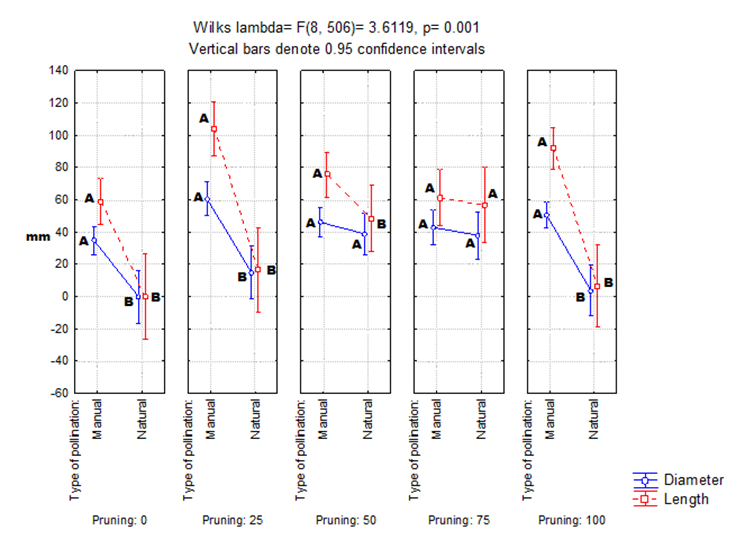
Fruit development varied according to the intensity of pruning and pollination. In the treatment with 0 % pruning and manual pollination, the fruit presented an average diameter of 34.99 mm and a length of 59.05 mm; on the contrary, there was no mooring with natural pollination. The treatment with 25 % pruning and hand-pollination was outstanding in fruit development, with a diameter of 60.62 mm and a length of 103.88 mm. The treatments with 50 % pruning and hand-pollination, as well as natural pollination, were not significant in fruit diameter, with an average of 42.53 mm; however, fruit length was greater with hand-pollination, reaching 75.69 mm. The treatment with 75 % pruning and hand- and natural pollination was not significant, with an average fruit diameter of 44.22 mm and a length of 59.20 mm. The treatment with 100 % pruning and hand-pollination showed better fruit development, with a diameter of 50.86 mm and a length of 91.89 mm, in contrast to fruits with natural pollination, which showed a diameter of 3.69 mm and a length of 6.61 mm (Figure 5).
Nolasco et al. (2019) reported a mean of 21.82 cm in longitudinal diameter and 117.96 mm in equatorial diameter in harvested fruits, while Avila et al. (2012) reported a mean of 24 cm in longitudinal diameter and 41 cm in equatorial diameter.
Conclusions
The hand-pollination technique promoted a 31.64 % increase in soursop fruit mooring. The combination of Maxtrobyn fungicide application and different pruning intensities (100 %, 75 %, and 50 %) increased the fruit set by 28.97 %. Similarly, the interaction between manual pollination and different pruning intensities (100 %, 25 %, and 0 %) showed greater fruit size, with means ranging from 34.94 to 60.62 mm in diameter and 59.05 to 103.88 mm in length.

