




 nova página do texto(beta)
 Inglês (pdf)
 Artigo em XML
 Referências do artigo
 Tradução automática
 Enviar este artigo por email
 Citado por SciELO
  Similares em
SciELO
Similares em
SciELO 
 Permalink

Introduction
Many birds obtain a significant portion of their diet through scavenging, with Laridae and Corvidae being notable examples (Smiddy 2023). Scavenging behavior is also observed among specialized predators, including Hawks, Buzzards, and Owls (DeVault et al. 2016). The Common Buzzard (Buteo buteo), and large raptors such as White-tailed Eagle (Haliaeetus albicilla), and Golden Eagle (Aquila chrysaetos), efficiently exploit carrion, particularly from hunter-killed animals (Selva et al. 2019). Additionally, some raptors scavenge roadkill, including Mississippi Kites (Ictinia mississippiensis), feeding on White-winged Dove (Zenaida asiatica) carcasses in Texas (Boal 2023), and Merlins, (Falco columbarius) consuming Snowshoe Hare (Lepus americanus) carcasses in Alaska (McIntyre et al. 2009). Even Peregrine Falcons (Falco peregrinus) occasionally feed on carrion (Varland et al. 2018).
The Corvidae family is a widespread group of passerine birds that are well-known for their adaptability and intelligence (Ehrlich et al. 1988), and are omnivorous, opportunistic feeders (Winkler et al. 2015). Corvids are facultative scavengers and play a vital role in ecological processes by facilitating carcass discovery and contributing to biomass removal (Selva et al. 2019, Bragato et al. 2022). Frequent visitors to carcasses include Jays, Magpies, Crows, and Nutcrackers (Selva et al. 2019). While some species, such as the Carrion Crow (Corvus corone), and Eurasian Magpie (Pica pica) are well-documented scavengers, many corvids consume carrion opportunistically (Gomo et al. 2017, Fielding et al. 2020, Rees et al. 2020).
Most, if not all, species of the genus Corvus scavenge on vertebrate carrion, and roadkill is an important source of carcasses (Sazima 2020). Despite their carrion consumption, corvids lack specialized beaks for tearing flesh, often depending on other predators to open carcasses or scavenging roadkill where meat is more accessible (Marzluff and Neatherlin 2006). However, although corvids are recognized as opportunistic omnivores and facultative scavengers (Moreno-Opo and Margalida 2013, Winkler et al. 2015), there are no direct records of Cyanocorax species scavenging on carrion.
The White-throated Magpie-Jay (Cyanocorax formosus) is a versatile omnivore and opportunistic predator (Langen and Berg 2016, Echeverri et al. 2019, Fielding et al. 2020). Diet of the species includes caterpillars, katydids, roaches, beetle grubs, small amphibians and lizards, fruits, seeds, bird eggs, and nestlings (Stiles and Skutch 1989). The species also consumes crops such as maize and it feeds on nectar from balsa tree blossoms (Stiles and Skutch 1989). Unlike many other corvids, the White-throated Magpie-Jay does not engage in food caching (de Kort and Clayton 2006). This study documents the opportunistic scavenging behavior of the White-throated Magpie-Jay on a bird carcass killed by a vehicle in northwestern Costa Rica, providing new insights into the dietary flexibility of this species.
Methods
We conduct wildlife monitoring and bird surveys at the Taboga Forestry Reserve in San Miguel, Cañas county (Fig. 1), Guanacaste, as well as in its surrounding buffer area. The reserve lies within the tropical premontane moist forest, at the basal transition life zone (Holdridge 1967). Annual rainfall in this zone ranges from 1,200 to 2,200 mm, with mean temperatures between 23ºC and 24ºC (Bolaños et al. 2005). The area experiences a distinct dry season lasting 3.5 to 5 months, from December to May, followed by a rainy season from June to November (Bolaños et al. 2005). Adjacent sites to the reserve are primarily dedicated to agriculture, with sugarcane and rice as the main crops (Astorga and Mora 2022).
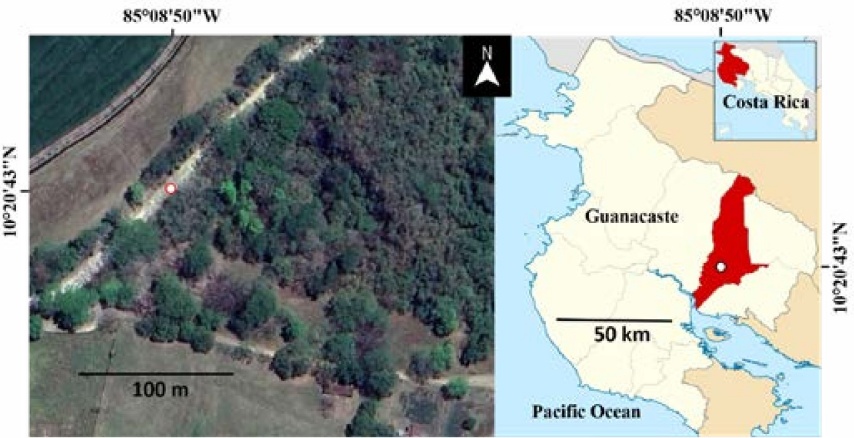
Figure 1 Location (white dot) where a White-throated Magpie-Jay (Cyanocorax formosus) was observed feeding on a road-killed Common Pauraque (Nyctidromus albicollis), in San Miguel, Cañas County (highlighted in red), Guanacaste Province (outlined in white but displayed in red on the map of Costa Rica). Figure prepared by José Manuel Mora using Google Earth (left section) and Wikipedia under the Creative Commons Attribution-ShareAlike 3.0 license (right section).
Results
On 25 August 2023, at 08:13 h, in the buffer area of the Taboga Forestry Reserve at 15 m elevation, along a gravel road (10°20'42.8"N, 85°08'49.7"W; Fig. 1) with frequent vehicle traffic, we observed a group of three White-throated Magpie-Jays feeding on the ground. The birds were highly active, and upon our approach, two of them flew away while one continued eating. Upon closer inspection, we identified the object of their feeding as the remains of a Common Pauraque (Nyctidromus albicollis), likely struck by a vehicle.
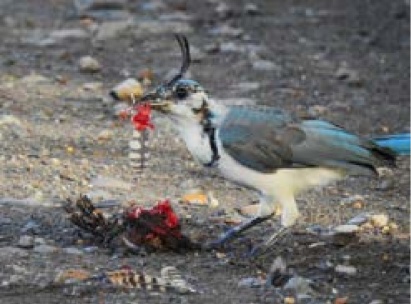
The White-throated Magpie-Jay was easily identified by its notably long, graduated tail, and a lengthy, curled crest (Stiles and Skutch 1989). Also notorious were its upperparts predominantly pale blue, while the underparts were plain white (Stiles and Skutch 1989). This bird exhibited a white throat and sides of the head, contrasting with a long black crest and a variable black neck-stripe that extended to a narrow breast-band (Stiles and Skutch 1989). The Pauraque’s distinctive plumage (Fig. 2) and physical characteristics facilitated its identification, particularly the cryptic pattern of gray, gold, and brown, with cinnamon-colored cheeks and golden edges on the feathers of the back and wings.
The Pauraque carcass appeared relatively fresh, with the flesh exhibiting a normal coloration and no noticeable odor of decay. The remaining Magpie-Jay was observed picking up relatively large pieces of meat from the gravel and occasionally taking chunks that still contained feathers (Fig. 2).
Discussion
This study provides the first documented evidence of the White-throated Magpie-Jay scavenging on roadkill, specifically the carcass of a Common Pauraque. Although the White-throated Magpie-Jay is known for its versatility as an omnivore, with a diet encompassing fruits, insects, and small vertebrates (Stiles and Skutch 1989), carrion, including roadkill, has not previously been reported in its diet. Notably, no records of carrion consumption exist for Central and South American corvids (Lopes et al. 2005).
Carcasses in natural environments are typically sporadic and difficult to locate. However, roadkill provides a predictable and readily available food source for opportunistic scavengers, potentially influencing their behavior and distribution near roadways (Fielding et al. 2020). During wildlife monitoring in northern Costa Rica, we observed White-throated Magpie-Jays congregating along the main highway (CR1) before sunrise, seemingly to exploit nocturnal roadkill. Over six visits, three to four individuals were recorded at the site between 05:00 and 05:30 on consecutive days. Due to the high traffic volume, we could not confirm the specific roadkill species consumed by the jays. On a quieter road in San Miguel de Cañas, we documented White-throated Magpie-Jays feeding on the intact portion of a Pauraque carcass. Common Pauraques, being nocturnal and frequently found resting along roadsides, are particularly vulnerable to vehicle collisions (Accordi and Barcellos 2006). Their foraging behavior, which involves catching insects in flight, likely increases their exposure to road traffic (Stiles and Skutch 1989).
Despite the ecological importance of the White-throated Magpie-Jay as an insect predator and seed disperser, farmers and urban residents in Guanacaste view the species negatively, surpassed only by the Great-tailed Grackle (Quiscalus mexicanus) in unpopularity (Echeverri et al. 2019). While scavenging on carrion may not constitute a primary feeding strategy for this species, such behavior contributes to essential ecological processes, including nutrient cycling and carcass decomposition (Beasley et al. 2019, Meisuria et al. 2024).
Scavenging among vertebrates is more prevalent than traditionally acknowledged, representing a critical ecological process rather than an anomaly (DeVault et al. 2003). Changes in land use and the expansion of road networks may increase the prevalence of roadkill, influencing populations of opportunistic predators like corvids (Fielding et al. 2020). However, the long-term ecological implications of roadkill as a supplementary food source remain largely unexplored. Further research into the dynamics of roadkill and its role in supporting scavenger populations is crucial for understanding its broader impacts on biodiversity and ecosystem processes.

