




 nova página do texto(beta)
 Inglês (pdf)
 Artigo em XML
 Referências do artigo
 Tradução automática
 Enviar este artigo por email
 Citado por SciELO
  Similares em
SciELO
Similares em
SciELO 
 Permalink
1. Introduction
Reliable surface roughness measurement is essential to ensure and reliability of the finished product, as surface roughness is a critical parameter in many industrial applications and has a significant impact on the quality of equipment consisting of many machined components (Menezes et al., 2006) is the one that is most frequently used for quality control. This characteristic is not sensitive to minute profile changes, but it can provide a fair overall description of height variations. As a result, there is no significant link between Ra and coefficient of friction (COF) when comparing two surfaces, which may have highly distinct profiles but are like Ra (Menezes et al., 2008). Many distinct factors, such as maximum profile height (Rt), are defined as the separation between the most crucial factor in sliding wear under lubricated conditions that are suggested to be a space between the greatest and lowest trough peaks in the computed surface length. The combination of amplitude and spacing results in hybrid parameters, which are well related to COF, according to previous studies (Bigerelle et al., 2013; Gualtieri et al., 2011; Menezes et al., 2009; Menezes & Kailas, 2016). One of these hybrid parameters (a) has been found to describe changes in COF (Menezes et al., 2011). Its definition is the average of slopes between every two succeeding locations of estimated length. (Koura & Omar, 1981) have shown at least 59 distinct roughness parameters. One of the earliest methods of micromachining is chemical processing. Chemical etching can be used to alter the surface roughness characteristics of items for a variety of reasons (Lee et al., 2002) by using a strong acidic or alkaline chemical solution. AlSi10Mg alloy components are chemically etched for a specific application to examine how it affects various surface roughness characteristics and how relates to COF. Recently, it has become more important than ever to learn more about friction in sheet metal stamping processes. The tensile bend test, which has been studied extensively, is currently the most widely used method for determining the COF (Deng, Tieu, Su et al., 2020(. To imitate the same deep drawing die radius conditions, the strip is bent and threaded through a pin with a certain radius (R) in this test. This test is used by Lee et al. (2002) to investigate the connection between COF, lubricating film thickness, and surface roughness. (Ceretti et al., 2008) have used "pin on the disc" to examine how COF changed based on the workpiece's speed, pressure, and temperature. However, specific tools are needed for the test created for this use; no maker of such a device exists. A simulation program is utilized by others (Darendeliler et al., 2002) to estimate the COF using easier techniques such as sheet-only tribological testing, like a pin-on-disk test. (Kim et al., 2007) investigated the performance of five lubricants that considered changes in surface topography and roughness, punching force, shelf perimeter, and workpiece holder force. A software,
PAMSTAMP is used to calculate the COF and compare the measured and calculated results. (Murakawa & Takeuchi 2003) used a diamond-like carbon (DLC) coated ball to measure the COF when the ball moved on an aluminum sheet. (Guillon et al., 2001) have utilized an additional friction experiment; however, the slider is cylindrical to complete the study of surface topography using several instrument spans. The impact of various surface post-treatment techniques and use of various lubricants are examined by Fratini et al. (2006) They have discovered that Teflon has the lowest friction and lubrication is necessary to reduce friction, where chromium alone is insufficient.
(Hao et al., 1999) have researched variations of stamping speed, lubricant employed, and pin material in response to sheet deformation provided more significant information. Other side, (Lovell et al., 2006) examined the COF in connection with using ecologically friendly oils, they discovered that canola oil infused with a blend of boric acid gives satisfactory results for friction. Torques are measured on a pin during testing subjected to friction from actuation and back-pull forces. It is expected for further studies on friction and its relationship with surface roughness parameters, which open the horizons for future experimental works and theoretical calculations (Li et al., 2022). This work aims to investigate the relationship and interaction between the surface roughness parameters (Ra), maximum profile height (Rt), and average profile slope on COF of AlSi10Mg alloys, considering the surface quality criterion described by roughness parameters, and their effect on the Frictional properties. This work is divided into the following: Section 2 is devoted to experimental work, followed by elaborate results and discussion in Section 3. Finally, the conclusions are presented in Section 4.
2. Materials and methods
The AlSi10Mg alloy samples utilized in this experiment have 14. 5 x 8 x 6.5 mm in size and put through a chemical treatment using an alkaline substance. The outcomes are compared using various chemical treatment times. The samples undergo a chemical treatment by being submerged in an alkaline solution for different periods and changing the surface of the samples. The intervals of chemical treatment are 0, 5, 10-, 15-, 25- and 50-min. T-05 block-on-ring tribometer is used to perform tribomechanical testing on samples in dry conditions, tribotester "block-on-ring" has (a) A diagram of the apparatus. b) Test location and (c) samples of blocks and rings (Figure 1). In this test, a load is put on the samples while the ring rotates at a specific pace. The equipment records the frictional force for every test, and COF may be calculated by dividing this number of COF by the applied force. To ensure that all starting average roughness values are the same, 2.25 m for all samples, the roughness is determined with an optical 3D measuring device before testing. AlSi10Mg alloy and AISI D2 (cold wrought steel) are materials used for block and ring samples, respectively.
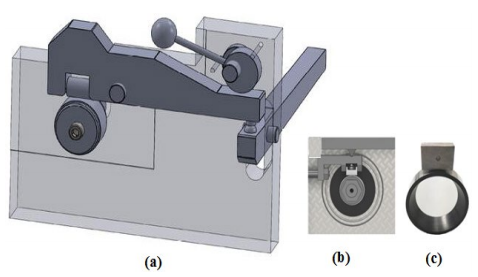
Figure 1 Tribotester "block-on-ring": (a) An apparatus diagram. b) Test location. (c) Samples of blocks and rings.
All experiments are performed at a temperature of 27 °C, with 495 N load and 25 rpm spin for 35 seconds. The MathWorks MATLAB 2018 program specifically processed the test data to derive the parameters a, Rt, and Ra. It is crucial to highlight that, using Dixon's methodology, five runs are completed for each parameter, giving a 95% confidence level.
Equations 1-3 are employed to compute Ra, Rt and Δa, respectively.
Where yi is vertical, Rp is tallest peak and Rv is valley's lowest point's depth, all are relative to the horizontal axis; n is amount of data collected, δyi is deviation between a series of vertical coordinates and δxi separates two adjacent horizontal coordinates (Matuszak, 2000).
3. Results and discussion
Figure 2 illustrates the related 3-dimensional of picture samples materials' surfaces together with COF and Ra values that are discovered from the study. It should be noted that although the COFs values fluctuate significantly for samples exposed for 0 -25 min, there are no appreciable changes in Ra. This demonstrates that this parameter does not directly correlate with samples' frictional behavior (Lanzon et al., 1998; Matuszak, 2000). The average values of COF, Ra, Rt, and are displayed in Table 1. According to the findings, the samples exposed to chemicals for 25 minutes have greatest COF and Ra levels, which increased by 118% and 5.5%, respectively, compared with other samples. Additionally, it should be noted that samples exposed to chemicals for 25 minutes have 23% maximum rise in value compared to samples that are not exposed chemical treatment (Matuszak, 2000). A prolonged chemical treatment, 50 min has the effect of surface polishing, resulting in a reduction in all surface roughness and COF indicators. Figure 3 shows the comparison of COF with Ra, while Ra values are similar, COF results are noticeably different, especially for chemical exposure lasting between 0 and 25 minutes. A definite association is not seen due to the same COF is present in specimens with extremely varying Ra values (chemical attack for 50 min). According to certain studies (Darendeliler et al., 2002; Kim et al., 2007) two surfaces can have the same Ra but differing friction properties. This is attributed to the average roughness parameter, which is solely sensitive to height deviation from main profile and does not effectively characterize the surface topography. As a result, there is no direct correlation between Ra and COF behavior as confirmed by previous studies (Darendeliler et al., 2002; Kim et al., 2007).
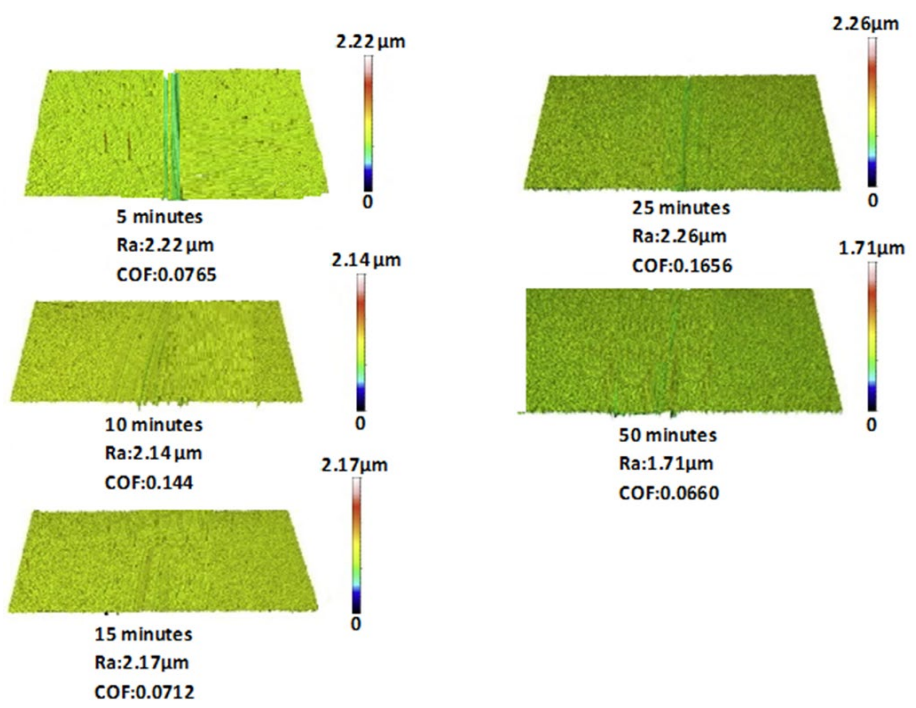
Figure 2 Chemical etching test's representative 3-D surface pictures with the corresponding Ra and COF
Table 1 The test results' parameters Ra, Rt and COF.
| Attack Time (min) | Δa(mrad) | Rt (µm) | Ra (µm) | COF | Increment (%) COF |
|---|---|---|---|---|---|
| 0.0 | 93 | 8.45 | 2.22 | 0.076 | - |
| 05 | 105 | 8.96 | 2.22 | 0.0765 | 21.32 |
| 10 | 107 | 8.77 | 2.14 | 0.144 | 61.55 |
| 15 | 113 | 8.66 | 2.17 | 0.0712 | -1.88 |
| 25 | 94 | 8.74 | 2.26 | 0.1656 | 118.07 |
| 50 | 97 | 7.75 | 1.71 | 0.0660 | -17.76 |
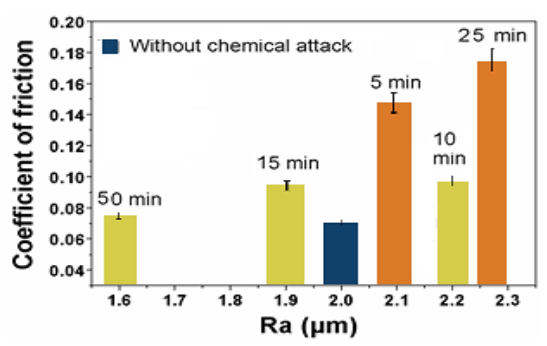
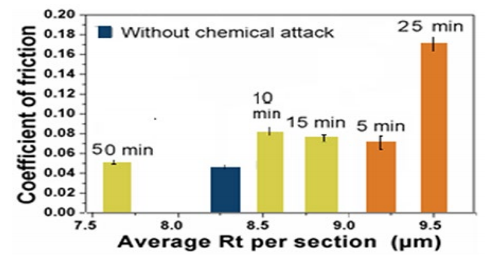
Figure 4 depicts the relationship between COF and Ra. There is a distinct pattern; typically, COF increases as Ra increases, demonstrating a positive correlation between the mentioned two. According to several studies, there is a high association between COF and Ra, making this relationship the strongest for all parameters According to (Lee et al., 2002), Changes in slopes, denoted by Ra, which influence the mechanical properties of friction, the occurrence of fatigue failure, elastic contact, and the hydrodynamic lubrication effect, can help clarify this relationship. Rt and COF is shown in Figure 5. This agrees with (Koura & Omar, 1981; Menezes & Kailas, 2016), who discovered a general tendency towards increasing in COF and increasing of Rt as well. A contour sketch of correlation between Ra, Rt and COF, can be shown in Figure 6. Here, it is demonstrated that a greater COF can be obtained if Ra or Rt are high.
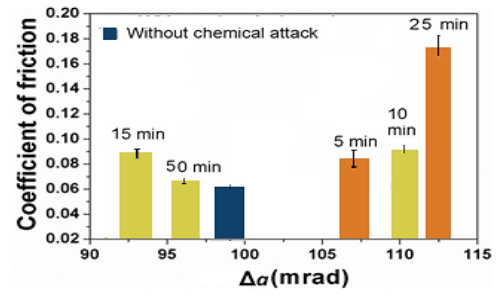
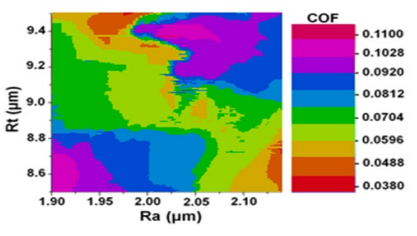
Through the results, we have noted that the relationship between roughness parameters (Ra,Rt) and COF measured on designed and chemically treated samples can be somewhat complicated as it can partially reduce the surface roughness during continuous sliding, while the processing followed by polishing is most effective in producing smooth surfaces (Ceretti et al., 2008).
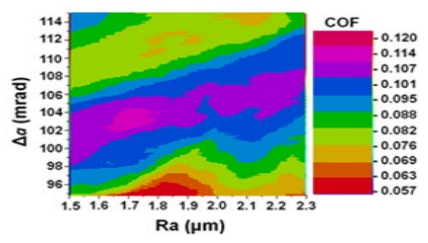
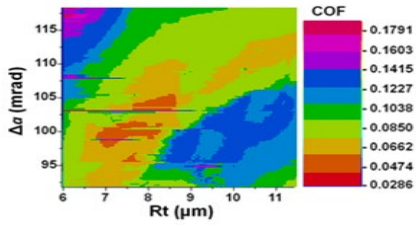
Figure 7 illustrates a contour of relationship between Ra and COF. The COF values gradually increase with the increase of Ra values, and it is also obvious that different Ra values are affected by the increase of COF values. It is no clear correlation between the Rt and Ra (Figure 8). A lower COF may be obtained from lower values of Rt. Finally, the effect of any surface feature is removed by chemical treatment. We have observed the relationship between roughness parameters (Ra, Rt) with COF and after careful examination of all surfaces, there is evidence of correlation between the mentioned parameters and friction (Heidarzadeh et al., 2019).
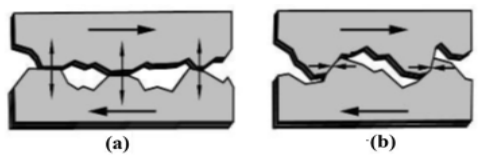
The frictional force acting on actual deformation affects the actual contact areas (Figure 9a), when it penetrates the surface roughness in softer areas (Figure 9b). One of the key factors influencing the fatigue behavior of metals is the surface roughness of parts that are conventionally fabricated (Matuszak, 2000). Given the surface textures produced by laser processing, it has been explored how roughness affects fatigue strength (Huang et al., 2019).
The average values of COF, Ra, Rt, and are displayed in Table 1. According to the findings, the samples exposed to chemicals for 25 minutes have the greatest COF and Ra levels, which increased by 118% and 5.5%, respectively, compared with other samples. Additionally, it should be noted that samples exposed chemicals for 25 minutes have 23% maximum rise in value compared to samples that are not exposed chemical treatment (Ceretti et al., 2008; Lee et al., 2002). A prolonged chemical treatment of 50 min has the effect of surface polishing, resulting in a reduction in all surface roughness and COF indicators (Deng, Tieu, Lan et al., 2020; Hao et al., 1999; Lovell et al., 2006).
4. Conclusions
In this research, a chemical change was performed on the surface roughness characteristics of the AlSi10Mg alloy sample directly. However, a direct relationship between Ra and COF was discovered. It follows that high Ra values will always lead to corresponding high COF values. The results showed that changes in inclination have a more pronounced and immediate effect on COF. After a 50-minute testing process, a 20% increase in Ra resulted in a higher COF of 118.07%. Alkaline substances were used for chemical treatment. Long-term chemical strike firing is not recommended because it will increase Ra in industrial applications, which will affect the surface roughness of the samples and track stability. Although there is only about 4 µm of surface roughness, this significantly reduces the surface quality.

