

SciELO - Scientific Electronic Library Online

 
 número132Potencial actividad prebiótica de la inflorescencia del huauzontle (Chenopodium berlandieri subsp. nuttalliae, Amaranthaceae)Moquilea fasciculata (Chrysobalanaceae): una novedad corológica para Colombia índice de autoresíndice de assuntospesquisa de artigos
Home Pagelista alfabética de periódicos  

Serviços Personalizados

Journal

Artigo

Indicadores

Links relacionados

  • Não possue artigos similaresSimilares em SciELO

Compartilhar


Acta botánica mexicana

versão On-line ISSN 2448-7589versão impressa ISSN 0187-7151

Act. Bot. Mex  no.132 Pátzcuaro  2025  Epub 08-Set-2025

https://doi.org/10.21829/abm132.2025.2430 

Artículos de investigación

A contribution to the taxonomy and phylogeny of the genus Pisolithus (Sclerodermataceae, Boletales) in Mexico

Contribución a la taxonomía y filogenia del género Pisolithus (Sclerodermataceae, Boletales) en México

Iván Sandoval-Islas1 
http://orcid.org/0009-0008-3759-0549

Eduardo Hernández Navarro1  *  , conceived the main research, collected specimens, and elaborated the map. ISI performed molecular protocols and elaborated the rest of the plates. Both authors morphologically characterized the specimens, performed the bioinformatic protocols, and prepared the final manuscript.
http://orcid.org/0000-0002-0031-6932

1Universidad Nacional Autónoma de México, Instituto de Biología, Circuito Zona Deportiva s.n., Ciudad Universitaria, Coyoacán, 04510 Cd. Mx., Mexico.


Abstract:

Background and Aims:

The genus Pisolithus is characterized by its angiocarpic basidiomes, which have a pulverulent gleba composed of peridioles, apical maturation, and echinulated basidiospores. In Mexico, two closely related species have been cited based exclusively on morphology: Pisolithus tinctorius and P. arhizus, associated with Pinus, Quercus, Carya and Eucalyptus. However, it has been pointed out that none of those species form associations with eucalyptus, and P. arhizus is distributed just in Eurasia based on ITS sequences. This study aims to contribute to the taxonomy and phylogeny of the genus Pisolithus in Mexico by characterizing Pisolithus specimens from temperate and arid zones, based on morphology and ITS barcode sequences of fungarium specimens, as well as soil metabarcoding sequences.

Methods:

Thirty-two specimens from the MEXU herbarium were characterized macro- and microscopically by light and scanning electron microscopy. Specialized literature was used for morphological identification. DNA was extracted with a CTAB 3% protocol. The ITS region was amplified with the ITS5 and ITS4 primer pairs. Phylogenetic analyses included 21 newly generated sequences, metagenomic soil sequences and sequences deposited in NCBI, and were performed using maximum likelihood and Bayesian Inference methods.

Key

results: We confirmed the presence of P. tinctorius associated with Pinus, Quercus, and Carya illinoinensis. Pisolithus albus, a new record for Mexico, is distinguished by its association with Eucalyptus sp., a whitish exoperidium, ochraceous gleba, and echinulate basidiospores with short, isolated spines up to 1 µm high. Phylogenetic analysis supports the identity of the Mexican collections.

Conclusions:

Among the Mexican samples analyzed, two well-defined species of Pisolithus were taxonomically identified, P. albus and P. tinctorius. Based on the material considered in this work, we did not find any that corresponded to P. arhizus.

Key words: barcoding; Basidiomycota; fungi from drylands; mycorrhizae

Resumen:

Antecedentes y Objetivos:

El género Pisolithus se caracteriza por sus basidiomas angiocárpicos, que presentan una gleba pulverulenta compuesta por peridiolos, maduración apical y basidiosporas equinuladas. En México, se han citado dos especies estrechamente relacionadas con base exclusivamente en su morfología: P. tinctorius y P. arhizus, asociadas con Pinus, Quercus, Carya and Eucalyptus. Sin embargo; se ha señalado que ninguna de estas especies se asocia con el eucalipto y P. arhizus se distribuye solo en Eurasia, con base en secuencias ITS. Este estudio busca contribuir a la taxonomía y filogenia del género Pisolithus en México mediante la caracterización de especímenes de Pisolithus de zonas templadas y áridas, con base en la morfología y las secuencias de código de barras ITS de especímenes de fungarios, así como secuencias de metabarcoding del suelo.

Métodos:

Se caracterizaron macro y microscópicamente 32 especímenes del herbario MEXU mediante microscopía óptica y electrónica de barrido. Se utilizó literatura especializada para la identificación morfológica. El ADN se extrajo con un protocolo CTAB al 3%. La región ITS se amplificó con los pares de cebadores ITS5 e ITS4. Los análisis filogenéticos incluyeron 21 secuencias recién generadas, secuencias metagenómicas del suelo y secuencias depositadas en el NCBI, y se realizaron mediante métodos de máxima verosimilitud e inferencia bayesiana.

Resultados clave:

Se confirma la presencia de P. tinctorius asociada con Pinus, Quercus y Carya illinoinensis. Pisolithus albus, un nuevo registro para México, se distingue por su asociación con Eucalyptus sp., un exoperidio blanquecino, gleba ocrácea y basidiosporas equinadas con espinas cortas y aisladas de hasta 1 µm de altura. El análisis filogenético respalda la identidad de las colecciones mexicanas.

Conclusiones:

Entre las muestras mexicanas analizadas, se identificaron taxonómicamente dos especies bien definidas de Pisolithus, P. albus y P. tinctorius. Con base en el material considerado en este trabajo, no se encontró ninguna que correspondiera a P. arhizus.

Palabras clave: Basidiomycota; código de barras; hongos de zonas secas; micorrizas

Introduction

The species included in the genus Pisolithus Alb. & Schwein. (Boletales: Sclerodermataceae) present globose, reniform, or pyriform basidiomes characterized by a peridium with irregular dehiscence and an alveolar gleba conformed by peridioles, which become pulverulent at maturity, with globose, echinulate basidiospores (Burgess et al., 1995). The genus is widely distributed in temperate and tropical regions, forming ectomycorrhizal associations with a wide range of woody plants, highlighting species from the families Pinaceae, Myrtaceae, Fagaceae, Dipterocarpaceae, and Cistaceae (Marx, 1977).

In Mexico, two species of Pisolithus have been cited: P. arhizus (Scop.) Rauschert. and P. tinctorius (Mont.) E. Fisch. The first was reported from the states of Sonora (Esqueda et al., 1990, 1998, 2000; Moreno et al., 2010; Hernández-Navarro et al., 2015), Chihuahua (Moreno et al., 2010), Hidalgo (Bautista-Hernández et al., 2018) and Jalisco (Rodríguez Alcántar et al., 2019), while the second was reported from the states of Aguascalientes (Pardavé, 1991), Chihuahua, Querétaro, Guerrero, Coahuila (Guzmán and Herrera, 1969; 1973), Mexico City (Herrera, 1964), Oaxaca (Welden and Guzmán, 1978), Veracruz (Welden and Guzmán, 1978), Hidalgo (Frutis and Guzmán, 1983), Baja California (Ayala and Guzmán, 1984), Michoacán (Díaz-Barriga et al., 1988), Chiapas (Herrera et al., 1989), Durango (Herrera et al., 1989), Morelos (Herrera et al., 1989), Sonora (Pérez-Silva et al., 1994), Mexico State (Nava Mora and Valenzuela Garza, 1997; Zarco, 1986), Nayarit, Tabasco (García-Rodríguez et al., 2006), Nuevo León (Urista et al., 1985; Garza Ocañas et al., 2023), Tamaulipas (Garza Ocañas et al., 2023), and Zacatecas (Herrera, 1964). However, in all records, the determination of the species was based exclusively on the morphological characteristics of the basidiome, considering the validity status of the species cited at the time. For this reason, both names have been indiscriminately cited worldwide (Chambers and Cairney, 1999).

The description of new species of the genus and its delimitation has been carried out using ITS barcode sequences (Martin et al., 2002, 2013; Reddy et al., 2005; Phosri et al., 2012; Rusevska et al., 2015; Lebel et al., 2018; Abel-Aziz and Bakhit, 2023; Crous et al., 2024). Moreover, based on ITS sequences, it has been reported that P. arhizus is primarily distributed in Eurasia and has been introduced to South Africa (Phosri et al., 2012; Rusevka et al., 2015; Lebel et al., 2018), while P. tinctorius s.s. is distributed in Europe, Canada, Kenya, Nicaragua, and the USA (Díez et al., 2001; Martin et al., 2002; Lebel et al., 2018). Most records of Pisolithus from Mexico correspond to Pinus-Quercus associations (Calonge et al., 2004), with a few records from Pecan Orchards (Carya illinoinensis (Wangenh.) K. Koch) (Sáenz-Hidalgo et al., 2023) and Eucalyptus L’Her. (García Rodríguez et al., 2006). However, neither P. arhizus nor P. tinctorius are associated with Eucalyptus, leading to the need to confirm the Mexican specimens already cited under the name “P. arhizus”.

Our objective was to morphologically and molecularly characterize Pisolithus species based on collections from temperate and arid zones of Mexico preserved in the fungal collections of the herbarium MEXU. In addition, soil metabarcoding sequences were mined to integrate additional information that will contribute to the taxonomy and phylogeny of Pisolithus in Mexico.

Materials and Methods

Fungal material and morphological characterization

Thirty-two collections labeled as Pisolithus and preserved in MEXU (Appendix 1) were examined. The habitat, potential host, and collection date mentioned in the text are based on field notes or data annotated on the herbarium labels, and a distribution map (Fig. 1) was created using the ggplot2 package in R (Wickham and Chang, 2008). The specimens were photographed, measured, and characterized following the suggestions by Cifuentes et al. (1986).
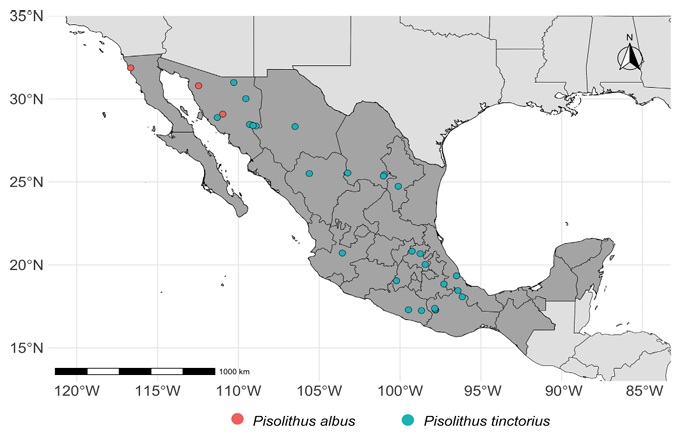
Figure 1: Distribution map of the studied material of Pisolithus Alb. & Scwein from Mexico. 

Portions of the gleba were mounted in 10% KOH and observed under an OLYMPUS IX81 optical microscope (Tokyo, Japan). A portion of the gleba was metalized and visualized under Scanning Electron Microscopy (SEM) in a HITACHI SU 1510 microscope (Hitachi, Japan) in the Laboratorio de Microscopía y Fotografía de la Biodiversidad, of the Laboratorio Nacional de la Biodiversidad (LaNaBio), Instituto de Biología, Universidad Nacional Autónoma de México (IBUNAM).

DNA extraction, PCR amplification, and sequencing

Genomic DNA was isolated from a small portion of the basidiome of 32 species (Appendix 1), placed in a 2 ml tube with a sterilized Tungsten sphere, frozen in liquid nitrogen, and ground with a TissueLyser Lt (QIAGEN, Hilden, Germany). After adding 500 μl of CTAB and 2 μl of β-mercaptoethanol per sample, the tubes were incubated in an Eppendorf ThermoMixer C (Hamburg, Germany) at 45 °C for 30 minutes at 300 rpm. Next, 500 μl of SEVAG (chloroform: isoamyl alcohol; 24:1) was added and incubated in the Thermo Fisher Scientific Clinical Rotator (Massachusetts, USA) for 30 minutes at 85 rpm.

The mixture was centrifuged at 13,000 × g for 10 minutes in an Eppendorf centrifuge 5424R (Hamburg, Germany). The supernatant was transferred to a 1.5 ml tube, and 500 μl of isopropanol was added. The mixture was gently mixed and stored at -20 °C for one hour. Subsequently, the mixture was centrifuged for 10 minutes at 12,000 × g, and the supernatant was discarded. The pellet was washed with 70% EtOH at -20 °C, vacuum-dried for five minutes, and resuspended in 50 μl of ultrapure water. The sample was quantified using a NanoDrop 2000 instrument (Thermofisher Scientific, Waltham, Massachusetts, USA), and its integrity was visually verified on a 1% agarose gel stained with RedGel™.

The ITS5 and ITS4 primer pairs were used to amplify the complete ITS1-5.8S-ITS2 region (Schoch et al., 2012) using the PCR Mix (5’BIO, Mexico). The PCR amplicons were visualized on a 1% agarose gel stained with RedGel™. The successful amplicons underwent treatment with ExoSAP-IT™ according to the manufacturer's instructions. Clean PCR reactions were sequenced at both ends in the Laboratorio de Secuenciación Genómica of LaNaBio-IBUNAM.

Phylogenetic analysis

Twenty new sequences of Pisolithus, and one of Scleroderma albidum Pat. & Trab. were generated (Appendix 1). The ITS rDNA dataset consisted of 127 sequences and 824 positions, of which 150 were conserved, and 614 variable, 211 were singletons, and 401 were informative. For the metabarcoding soil sequences, the search was conducted in the Global Soil Mycobiome Consortium database (Tedersoo et al., 2021) using the awk command to retrieve all rows annotated as Pisolithus in the genus column (column 10). Only two OTU sequences were recovered: 2904dd2b5e2b1bd4c81f5402c904a0e93246127e (SOIL 2904 from Nuevo León (24°43'48.0"N, 100°06'36.0"W)) and 44b8a06bdba1c02587989f9e3302edb4a542d7ae0 (SOIL44b8 from Coahuila (25°21'00.0"N, 101°01'48.0"W)).

The remaining sequences were downloaded from the NCBI database (NCBI, 2024) (Appendix 2); 99 belonged to different species of Pisolithus, four to Scleroderma Pers., and one to Astraeus hygrometricus (Pers.) Morgan as outgroups (Anderson et al., 1998, 2001; Gomes et al., 2000; Díez et al., 2001; Malajczuk y Dunstan, 2002; Martin et al., 2002, 2013; Kanchanaprayudh et al., 2003; Thomas et al., 2003; Reddy et al., 2005; Palmer et al., 2008; Phosri et al., 2009, 2012, 2013; Jourand et al., 2010; Kasuya et al., 2008; Hitchcock et al., 2011; Wilson et al., 2011; Montagner et al., 2015; Crous et al., 2016, 2024; Lebel et al., 2018; Abdel-Aziz and Bakhit, 2023; Patel y Rajput, 2023).

The newly generated sequences were manually curated by inspecting their chromatograms in Geneious Prime v. 2025.0.3 (Geneious Prime, 2025). Sequences were aligned using the online version of MAFFT v. 7 (Katoh et al., 2019). The alignments were reviewed in MESQUITE v. 3.81 (Maddison and Maddison, 2023), followed by minor manual adjustments to ensure character homology among the taxa. Phylogenetic inferences were estimated using the Maximum Likelihood Method in W-IQ-TREE (Trifinopoulos et al., 2016), and ModelFinder (Kalyaanamoorthy et al., 2017) was used to select the best substitution model. Bayesian inference analysis was conducted using MrBayes v. 3.2.6 × 64 (Huelsenbeck and Ronquist, 2001).

The information block for the matrix included two simultaneous runs, four Monte Carlo chains, a temperature set at 0.2, and a sampling of 10 million generations (standard deviation ≤0.1) with trees sampled every 1000 generations. The two simultaneous Bayesian runs continued until convergence parameters were met, and the standard deviation fell below 0.0001 after 10 million generations. The final tree was edited using FigTree v. 1.4.4 (Rambaut, 2018).

Results

The 32 collections studied and preserved under Pisolithus come from 23 municipalities of 12 states of the Mexican Republic (Fig. 1, Appendix 1). After examining the collections, we determined that the specimens correspond to two well-defined species: Pisolithus albus (Cooke & Massee) Priest, a new record for Mexico, associated with Eucalyptus in the semiarid zones of Northwest Mexico, and P. tinctorius associated with Pinus spp., Quercus spp., and Carya illinoinensis, with a broader distribution in our country.

We successfully amplified and sequenced the ITS region of 21 Pisolithus collections, and the data of Tedersoo et al. (2021) resulted in two consensus sequences of P. tinctorius from Coahuila and Nuevo León. One collection (MEXU 11889) deposited under the name “P. arhizus” was analyzed using both molecular and morphological methods. After our examination, we concluded that this collection corresponds to Scleroderma albidum.

The result of Posterior Probability (PP) from Bayesian inference and bootstrap from maximum likelihood (BS) generated trees with similar topologies; the topology of the Bayesian analysis is shown (Fig. 2). The genus Pisolithus recovered as monophyletic (PP/BS=0.70/92). It presents three distinct lineages: the first comprises seven species (PP/BS=0.74/90): P. arhizus, P. capsulifer (Sowerby) Watling, Phosri & M.P. Martín, P. calongei M.P. Martín, Phosri & Watling, P. hypogaeus S.R. Thomas, Dell & Trappe, P. marmoratus (Berk.) E. Fisch, P. orientalis Watling, Phosri & M.P. Martín and P. tinctorius. Most sequences generated in this work grouped with P. tinctorius with high support (PP/BS=0.99/100) and are associated with Pinus spp., Quercus spp., and Carya illinoinensis. The second lineage includes five species (PP/BS=0.97/ 95): P. albus, P. croceorrhizus P. Leonard & McMull.-Fish., P. microcarpus (Cooke & Massee) G. Cunn., P. thermaeus T. Lebel, Pennycook & Beever, and P. tympanobaculus T. Lebel & M.D. Barrett. Three sequences generated in this study grouped with P. albus (PP/BS=0.99/95), a new record for Mexico. Two species form an unresolved polytomy: P. abditus Kanch., Sihan., Hogetsu & Watling, and P. madagascariensis Rivas-Ferreiro, Dentinger, Suz & A.M. Ainsw. The third lineage (PP/BS=0.99/94) is composed of P. aureosericeus M.P. Martín, Kaewgraj., Phosri & Watling, and P. aurantioscabrosus Watling. The P. indicus sequence was grouped within the Scleroderma genus (PP/BS=0.6/100).
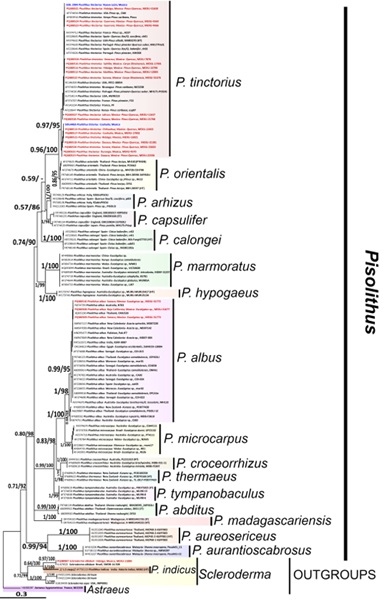
Figure 2: Phylogram of Bayesian inference (BI) tree from the ITS sequence data of Pisolithus Alb. & Schwein. The numbers above branches represent Bayesian Posterior Probabilities (PP=0-1), and Bootstrap Values (BS=0-100) for Maximum Likelihood. The scale bar represents the expected number of nucleotide substitutions per site. The taxa whose sequences have been obtained in this study are marked in bold red. Metagenomic soil sequences are marked in blue. Accession numbers of NCBI (2024) are indicated in each sequence. 

Taxonomy

Basidiomycota

Agaricomycetes

Boletales

Sclerodermataceae

Pisolithus albus (Cooke & Massee) Priest, in Lebel, Pennycook and Barrett, Phytotaxa 348(3): 167. 2018. Fig. 3.

Polysaccum albumCooke and Massee, Grevillea 20 (no.94): 36. 1891.

TYPE: AUSTRALIA. Queensland, Dundoo, on the ground, undated, Martin 916 (holotype K!).

Basidiome epigeous or semi-epigeous, 45-110 mm wide × 65-190 mm tall × 30-120 mm diameter, subglobose, ovoid to pyriform, with a robust and rooted base; peridium thin, smooth, cracking into irregular segments from top to bottom at maturity, whitish when young, cream or beige when mature; gleba conformed into peridioles 2-5 mm diameter, subglobose to ovoid, cream-colored when young and turning ochre to olivaceous when mature; basidiospores 7-11 µm, globose, echinulate, bright yellowish, in SEM isolated straight to slightly curved spines up to 1 µm high; basidia not observed.

Habit: on soil, associated with Eucalyptus spp.

Distribution: Africa: Egypt (Abdel-Aziz and Bakhit, 2023), Morocco (Eddine Bakkali Yakhlef et al., 2009), Senegal (Duponnois and Bâ, 1999), Tunisia (Jaouani et al., 2015). America: Mexico (this study), USA (Phosri et al., 2012). Eurasia: India (Singla et al., 2004), Italy (Gargano et al., 2018), Malaysia (Martin et al., 2002), Spain (Díez et al., 2001), Thailand (Kanchanaprayudh et al., 2003). Oceania: Australia (Lebel et al., 2018), New Caledonia (Hosaka, 2009), New Zealand (Moyersoen et al., 2003).

Studied material: MEXICO. Baja California Norte, municipio Ensenada, 31°52'12.9"N, 116°39'59.0"W, under Eucalyptus sp., 25.I.2019, E. Hernández-Navarro 774 (MEXU 31677). Sonora, municipio Caborca, 30°47´46"N, 112°27´56"W, under Eucalyptus sp., 18.IV.2019, R. Gutierrez and A. Gutierrez s.n. (MEXU 31773). Municipio Hermosillo, 29°04´53"N, 110°58´07"W, under Eucalyptus sp., 06.IX.1995, M. Esqueda s.n. (MEXU 31772).

Notes: Pisolithus albus is recognized by its white exoperidium, olivaceous gleba, and basidiospores 7-11 µm diameter with isolated, low, straight spines. The P. albus specimens in this study were always collected under Eucalyptus sp.; however, this species is also associated with Acacia s.l. and Kunzea Benth. (Abdel-Aziz and Bakhit, 2023). This is the first record of P. albus from Mexico. Mexican specimens, mainly from Caborca, Sonora, are stouter (up to 19 × 11 cm diameter) than reported in the holotype (5-6 cm diameter) (Cooke, 1891). However, materials from Italy are 3-20 cm diameter (Gargano et al., 2018), while those from Tunisia are 3-12 cm diameter (Jaouani et al., 2015), and those from Egypt are 4.5-15 × 6-18 cm diameter (Abdel-Aziz and Bakhit, 2023). Additionally, in the holotype, basidiospores are 9-10 µm, while our materials are 7-11 µm diameter; however, it matches with Egyptian materials (7-11 µm diameter), while Tunisians are 9-12 μm diameter and Italians are 8.75-10.25 µm diameter (Jaouani et al., 2015; Gargano et al., 2018; Abdel-Aziz and Bakhit, 2023).

Young specimens of P. albus may recall P. croceorrhizus, as both species are commonly associated with Eucalyptus trees. However, P. croceorrhizus has a distribution practically restricted to Australia (Southeast Queensland) and New Caledonia. Moreover, P. albus presents larger basidiospores (7-12 μm diameter) with irregular pyramidal spines. In contrast, P. croceorrhizus presents smaller basidiospores (5.3-6.9 μm diameter) densely covered with pyramidal spines connected basally in a low reticulum (Leonard et al., 2013).
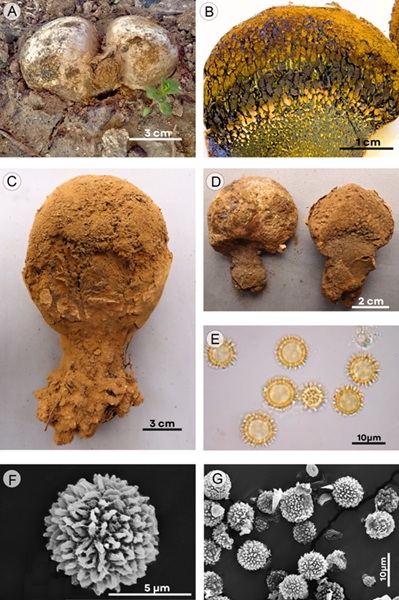
Figure 3: Pisolithus albus (Cooke & Massee) Priest. A. specimen in its habitat (MEXU 31677); B. peridioles (MEXU 31677); C-D. herbarium specimens (MEXU 31772); E. basidiospores in light microscopy (MEXU 31772); F.-G. basidiospores in SEM (MEXU 31677). 

Pisolithus tinctorius (Mont.) E. Fisch., in Engler and Prantl, Nat. Pflanzenfam., Teil I (Leipzig) 1: 338 (1900). Fig. 4.

=Polysaccum tinctorium Mont., in Webb and Berthelot, Hist. nat. Iles Canar. (París) 3(2): 87. 1840.

=Lycoperdodes canariense Kuntze, Revis. gen. pl. (Leipzig) 2: 859. 1891.

TYPE: SPAIN. Canary Islands, without precise location, at the roots of Cistus, s.f., coll. Despréaux s.n. (holotype: not located).

Basidiomes epigeous, globose, claviform to irregularly shaped, subglobose, ovoid or pyriform, 35-90 mm wide × 55-150 mm high × 30-120 mm diam, with a robust or sometimes sessile base; peridium thin, papery, smooth, and brittle, yellowish-whitish when young, brown when mature; dehiscense through irregular cracks; gleba reddish-brown to dark brown, structured in peridioles that become powdery with maturity; peridioles 2-5 mm, subglobose, ovoid or irregular and somewhat angular, creamy when young and becoming yellowish when mature, smaller and more compact towards the stipe; basidiospores 8.5-12 µm, globose, strongly echinulate, dark ochre; in SEM spines primarily straight, coalescent, some slightly curved towards the apex; basidia not observed.

Habit: on soil, associated with Pinus-Quercus and Carya illinoinensis.

Distribution: Africa: Kenya (Martin et al., 1998), South Africa (Martin et al., 2002). America: USA (Gomes et al., 2000; Martin et al., 2002; Phosri et al., 2012), Mexico (Herrera, 1964; this study), Nicaragua (Martin et al., 2002). Eurasia: France (Gomes et al., 2000), Philippines (Anderson et al., 2001), Portugal (Martin et al., 2002), Spain (Díez et al., 2001; Phosri et al., 2012).

Studied material: MEXICO. Chihuahua, municipio Cd. Cuauhtémoc, km 67 Chihuahua - Ciudad Cuauhtémoc road, 28°26'57.8"N, 106°52'10.1"W, under Quercus, 25.IX.1978, E. Pérez-Silva y R. Hernández s.n. (MEXU 12463). Ciudad de México, alcaldía Cuajimalpa de Morelos, Desierto de los Leones, 2900 m, 19°17'51.4"N, 99°18'56.0"W, under Pinus sp., 02.VII.1950, T. Herrera s.n. (MEXU 1409). Coahuila, municipio Saltillo, 25°26'56.3"N, 100°57'44.4"W, under Carya illinoinensis, 10.VIII.1982, T. Herrera s.n. (MEXU 17901). Municipio Torreón km 22 Torreón - Matamoros road, 25°32'18.9"N, 103°14'13.3"W, agricultural land, 12.VIII.1982, T. Herrera s.n. (MEXU 17902). Durango, municipio Tepehuanes, Sierra de la Candela, 25°30'10.6"N, 105°36'56.9"W, 17.IX.1960, F. Sánchez s.n. (MEXU 4570). Estado de México, municipio Temascaltepec, 1100 m, 19°02'37.1"N, 100°13'30.2"W, in Pinus-Quercus forest, 12.I.1978, R. Hernández s.n. (MEXU 12005). Guerrero, municipio Chilpancingo de los Bravo, Rincón Viejo, 17°14'40.5"N, 98°40'30.2"W, in Pinus-Quercus forest, 13.VI.1963, H. Kruse s.n. (MEXU 4569); 17°17'28.8"N, 99°28'46.0"W, in Pinus-Quercus forest, 21.VI.1963, H. Kruse s.n. (MEXU 4566). Hidalgo, municipio Cardonal, 45 km east of Ixmiquilpan, 2000 m, 20°38'53.4"N, 98°57'52.5"W, 02.X.1980, R. Hernández y D. Rodríguez s.n. (MEXU 16021). Municipio Metztitlán, 20°40´30" N, 98°45´09"W, in Pinus-Quercus forest, 11.X.2023, E. Hernandez-Navarro 720 (MEXU 31650). Municipio Santiago Tulantepec de Lugo Guerrero, 2370 m, 20°03'35.5"N, 98°26'07.3"W, in Pinus-Quercus forest, 03.VII.1979, R. Hernández s.n. (MEXU 13200). Municipio Zimapán, La Majada, 20°49'08.6"N, 99°15'33.6"W, in Pinus-Quercus forest, 06.X.1979, R. Hernández s.n. (MEXU 13790). Jalisco, municipio Zapopan, Cañón de las Flores, km 25 Guadalajara - Tequila road, 1500 m, 20°40'27.9"N, 103°23'37.1"W, in Pinus-Quercus forest, 25.VIII.1977, R. Hernandez s.n. (MEXU 11637). Oaxaca, municipio Acatlán de Pérez Figueroa, 2100 m, 18°26'44.8"N, 96°25'18.0"W, in Pinus-Quercus forest, 23.IV.1976, E. Pérez-Silva et al. s.n. (MEXU 10485); La Carbonera, 19°02'37.1"N, 100°13'30.2"W, in Pinus-Quercus forest, 23.VI.1976, E. Pérez-Silva et al. s.n. (MEXU 10996). Municipio San Juan Mixtepec, 8 km from la Cañada El Águila, 1900-2250 m, 17°16'09.6"N, 97°48'07.2"W, in Pinus-Quercus forest, 03.X.1989, E. Pérez-Silva et al. s.n. (MEXU 22336); 17°18'20.5"N, 97°49'54.7"W, under Pinus-Quercus, 02.X.1988, J. Reyes-Santiago s.n. (MEXU 21301); Cerro del Rio Azucena, 2000 m, 17°22'52.1"N, 97°51'20.9"W, Pinus-Quercus forest, 21.VII.1989, J. Reyes Santiago s.n. (MEXU 21768). Municipio Tuxtepec, 18°04'20.3"N, 96°08'52.8"W, under Pinus caribaea, 31.I.1974, R. Singer s.n. (MEXU 8969). Sonora, municipio Cananea, 30°59'23.6"N, 110°17'19.9"W, in Pinus-Quercus forest, 10.IX.1993, E. Pérez-Silva y M. Esqueda s.n. (MEXU 23820); km 18 Santa Rosa - Yécora road, 28°26'03.8"N, 109°10'34.3"W, under Quercus sp., 05.VIII.1989, A. Aparicio s.n. (MEXU 22604). Municipio Hermosillo, 28°52'48.8"N, 111°18'14.2"W, under Carya illinoinensis, 03.X.2019, E. Hernández-Navarro 746 (MEXU 31676). Municipio Yécora, Rincón de Güerigo, 28°26'03.8"N, 109°10'34.3"W, under Quercus sp., 26.VII.1989, A. Aparicio s.n. (MEXU 22605); 28°23´41"N, 109°05´26"W), under Pinus sp., 10.IX.1995, M. Esqueda et al. s.n. (MEXU 31778); 28°23´41"N, 109°05´26"W, Pinus-Quercus forest, 13.IX.1996, M. Esqueda et al. s.n. (MEXU 31777). Veracruz, municipio Maltrata, Cumbres de Maltrata, a 1700 m, 18°50'21.2"N, 97°17'08.8"W, under Quercus, 28.VIII.1969, R. Hernandez y R.C. Trigos s.n. (MEXU 7877); Cumbres de Maltrata, a 1600 m, 18°50'21.2"N, 97°17'08.8"W, under Quercus, 28.VIII.1969, R. Hernández y R.C. Trigos s.n. (MEXU 7876). Municipio Emiliano Zapata, 950 m, 19°20'29.3"N, 96°30'33.0"W, under Quercus, 10.VII.1974, R. Hernández s.n. (MEXU 9575).
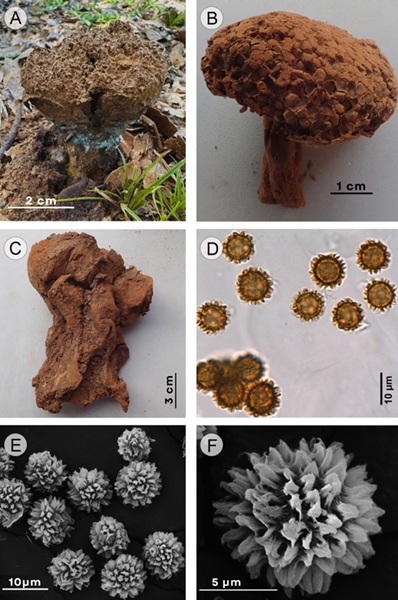
Figure 4: Pisolithus tinctorius (Mont.) E. Fisch. A. specimen in its habitat (MEXU 31650); B-C. herbarium specimens (MEXU 4569, MEXU 13790); D. basidiospores in light microscopy (MEXU17902); E-F. basidiospores in SEM (MEXU-31650). 

Notes: Pisolithus tinctorius could be confused with P. arhizus, which has the same spore size and is associated with Pinus L. and Quercus L. plants. Rusevska et al. (2015) mention that P. arhizus and P. tinctorius are so similar that it is almost impossible to separate these species morphologically. However, based on materials from Macedonia, Rusevska et al. (2015) mention that P. tinctorius presents a shorter pseudostipe (40-50 × 20-25 mm), a very thin yellowish olivaceous peridium, and basidiospores with spines on average of 1.6 μm long, more or less isolated; while P. arhizus presents a larger pseudostipe (≤95 mm × (20-)25-40(-50) mm), pale ochre to brown black peridium, and the spines of the basidiospores are smaller in average (1.2 μm), isolated but very compact, in parts forming small pyramids (Rusevska et al., 2015). Nevertheless, molecular data support two distinct taxa restricted in distribution in the northern hemisphere: P. tinctorius s.s. is distributed in Europe and North America, while P. arhizus occurs in Eurasia and has been introduced in South Africa (Lebel et al., 2018).

The species P. tinctorius could also be confused with P. marmoratus, as they share the size of their basidiospores and spines. However, the latter is associated with Eucalyptus and is distributed in the southern hemisphere (Martin et al., 2002). Additionally, P. marmoratus presents a peridium with black warts and black pseudostipes (Leonard et al., 2013).

Discussion

We present the first formal taxonomic study of Pisolithus in Mexico based on morphological and molecular data of fungarium specimens. According to Index Fungorum (2024), the genus currently includes 19 valid species. However, some controversies persist regarding the correct identification, nomenclature, and possible synonymy of some species.

Since the description of Pisolithus, with P. arenarius Alb. & Schwein. as the type species, Albertini and Schweinitz (1805) denoted the lack of detailed information on closely related species, then placed in Scleroderma such as Scleroderma arhizum (Scop.) Pers. (=P. arhizus) and S. tinctorium Pers. (=P. tinctorius), to which P. arenarius most closely resembled. Although P. arenarius is a valid species, it still requires more up-to-date information on its macromorphological variation, and specimens in various herbaria have not been reexamined or sequenced for verification.

For a long time, P. arhizus was considered conspecific with P. tinctorius. Consequently, both species were cited interchangeably worldwide (Chambers and Cairney, 1999). Later, phylogenetic studies using ITS barcode sequences confirmed them as distinct species: P. arhizus is primarily distributed in Eusaria and introduced to South Africa, and P. tinctorius s.s. is found in Europe and North America (Leonard et al., 2013; Martín et al., 2013).

Numerous fungal collections and sequences in public databases require updating (Lebel et al., 2018). Pisolithus tinctorius originally was described under the genus Polysaccum Mont., associated with Cistus L. from the Canary Islands; however, global identification of the species has primarily followed Coker and Couch (1928), focusing on samples related to Pinus-Quercus forest, but P. tinctorius (Pers.: Pers.) Coker & Couch turned out to be an illegitimate name for a taxon nowadays recognized as P. arhizus.

In the case of P. kisslingii E. Fisch., no barcode sequences or recent collections exist, while P. indicus Natarajan & Senthil is represented by a single sequence in NCBI (2024) which, in our analyses, grouped with Scleroderma. This species was described from India as having grayish gleba, a characteristic not reported in any other Pisolithus species (Reddy et al. 2005). The combination of characters and the sequence analysis suggests that this could be a Scleroderma species. Additionally, Reddy et al. (2005) did not provide photographs of the peridioles, no sequences of Scleroderma were included in the analysis, and the clade containing P. indicus grouped with the rest of the Pisolithus species with low support (BS= 36). Leonard et al. (2013) included the P. indicus sequence, which was grouped with P. aurantioscabrosus. Nonetheless, no Scleroderma sequences were included.

Lebel et al. (2018) included some LSU sequences of P. albus, P. croceorrhizus, and P. indicus; the latter was placed as a basal taxon, paraphyletic to P. aurantioscabrosus and P. aureosericeus. Nevertheless, they did not include any Scleroderma sequences in the analysis. On the other hand, most published phylogenies present low support values in the deepest branches of the genus, as only ITS sequences have been analyzed, except for the one proposed by Lebel et al. (2018), which included some LSU sequences. Hence, other markers, such as EF1α or RPB1, are needed to resolve these ambiguities within the genus.

In our studied materials, P. tinctorius was primarily collected from Pinus-Quercus, except for two collections found under Carya illinoinensis (MEXU 17901; 31676). Both collections originate from arid zones transformed into commercial pecan agricultural lands with abundant canopy, organic matter, fertilization, and irrigation, which favor the development of P. tinctorius despite the high temperatures of the zone. This aligns with reports that P. tinctorius can be associated with C. illinoinensis (Sáenz-Hidalgo et al., 2023). This is due to soil and plant inoculation practices, as P. tinctorius has historically been used in forestry to promote tree growth (García-Rodríguez et al. 2006). As a result, it has been introduced globally (Lebel et al., 2018). This adaptability explains its presence in diverse environments, including acidic soils and areas with heavy metal contamination (Lampky and Peterson, 1963; Sebastiana et al., 2020).

Regarding P. albus, a new record for Mexico, the specimens from Sonora and Baja California, whose sequences are similar to those from Senegal and Egypt, are also associated with Eucalyptus spp., a widely distributed introduced genus (Abdel-Aziz and Bakhit, 2023). Hence, the presence of other Pisolithus species in unexplored regions of Mexico is possible. For example, García-Rodríguez et al. (2006) reported collections of P. tinctorius from Eucalyptus plantations, but no barcode sequences were generated; ergo, their specimens are likely to correspond with another species, since P. tinctorius does not form associations with Eucalyptus. These reports support the need for further sampling across Mexico, primarily in underexplored arid and semiarid zones where gasteroid fungi are more diverse and abundant, as well as areas with vegetal species that match the known host of the genus.

Of the 32 collections reviewed, 21 were successfully sequenced; however, DNA degradation posed challenges due to specimen age, with collections ranging from 1 to 74 years old (average age: 45 years). Future collections should prioritize conditions that preserve DNA integrity for molecular analyses. This work underscores the need for continued research on Pisolithus to achieve comprehensive species diversity in Mexico.

Conclusions

We confirm the presence of two species of Pisolithus widely distributed in Mexico. Pisolithus tinctorius is mainly associated with Pinus-Quercus trees and Carya illinoinensis trees. Until now, its presence has been molecularly confirmed in the states of Chihuahua, Coahuila, Durango, Guerrero, Hidalgo, Jalisco, the State of Mexico, Oaxaca, Sonora, and Veracruz, while P. albus is associated with Eucalyptus in semiarid zones of northwestern Mexico, in Sonora and Baja California. Among the specimens studied from Mexico and soil metabarcoding sequences, we had no evidence of any that could be identified with P. arhizus.

Funding

This research was funded by the Programa de Apoyo a Proyectos de Investigación e Innovación Tecnológica (PAPIIT) de la Universidad Nacional Autónoma de México (UNAM), Project IA205323.

Acknowledgments

We are grateful for the service of the Laboratorio Nacional de la Biodiversidad of the Instituto de Biología of the Universidad Nacional Autónoma de México. In particular, we thank the technical support of Lidia Cabrera-Martínez, Nelly López, Andrea Jiménez, Berenit Mendoza, and Laura Márquez (LaNaBio). We also thank the herbarium MEXU and its curator, Elvira Aguirre Acosta, for her technical support. We also thank Bernardo Águila Salgado for his technical support in mining soil sequences.

Literature cited

Abdel-Aziz, A. E. and M. S. Bakhit. 2023. Pisolithus albus (Sclerodermataceae), a first record from Egypt. Plant and Fungal Systematics 68(1): 232-238. DOI: https://doi.org/10.35535/pfsyst-2023-0004 [ Links ]

Albertini, J. B. and L. D. Schweinitz. 1805. Conspectus Fungorum in Lusatiae Superioris Agro Niskiensi Crescentium e Methodo Persooniana. Sumtibus Kummerianis. Leipzig, Germany. Pp. 376. DOI: https://doi.org/10.5962/bhl.title.3601 [ Links ]

Anderson, I. C., S. M. Chambers and J. Cairney. 1998. Molecular determination of genetic variation in Pisolithus isolates from a defined region in New South Wales, Australia. New Phytologist 138(1): 151-162. DOI: https://doi.org/10.1046/j.1469-8137.1998.00894.x [ Links ]

Anderson, I. C. , S. M. Chambers and J. W. G. Cairne. 2001. ITS-RFLP and ITS sequence diversity in Pisolithus from central and eastern Australian sclerophyll forests. Mycological Research 105(11): 1304-1312. DOI: https://doi.org/10.1017/S0953756201005044 [ Links ]

Ayala, N. and G. Guzmán. 1984. Los hongos de la Península de Baja California, I. Las especies conocidas. Boletín de Sociedad Mexicana de Micología 19: 73-91. [ Links ]

Bautista-Hernández, S., T. Raymundo, E. Aguirre-Acosta, M. Contreras-Pacheco, L. Romero-Bautista and R. Valenzuela. 2018. Agaricomycetes gasteroides del bosque mesófilo de montaña de la Huasteca Alta Hidalguense, México. Acta Botanica Mexicana 123: 21-36. DOI: https://doi.org/10.21829/abm123.2018.1266 [ Links ]

Burgess, T., N. Malajczuk and B. Dell. 1995. Variation in Pisolithus based on basidiome and basidiospore morphology, culture characteristics and analysis of polypeptides using 1D-SDS-PAGE. Mycological Research 99(1): 1-13. DOI: https://doi.org/10.1016/S0953-7562(09)80309-2 [ Links ]

Calonge, F. D., G. Guzmán and F. Ramírez-Guillén. 2004. Observaciones sobre los Gasteromycetes de México depositados en los Herbarios XAL y XALU. Boletin de la Sociedad Micológica de Madrid 28: 337-371. [ Links ]

Chambers, S. M. and J. W. Cairney. 1999. Pisolithus. In: Cairney, J. W. and S. M. Chambers (eds.). Ectomycorrhizal fungi. Key genera in profile. Springer. Berlin, Germany. Pp. 1-31. [ Links ]

Cifuentes, J., M. Villegas and L. Pérez-Ramírez. 1986. Hongos. In: Lot, A. and F. Chiang (eds.). Manual de Herbario. Consejo Nacional de la Flora de México, A.C. México, D.F., México. Pp. 55-64. [ Links ]

Coker, W. C., and J. N. Couch. 1928. The Gasteromycetes of the Eastern United States and Canada. Chapel Hill, The University of North Carolina Press. Chapel Hill, United States of America. 195 pp., 123 tabs. [ Links ]

Cooke, M. C. 1891. Australian Fungi. Grevillea 20(93): 4-7. [ Links ]

Crous, P. W., M. J. Wingfield, D. M. Richardson, J. J. Leroux, D. Strasberg, J. Edwards, F. Roets, V. Hubka, P. W. J. Taylor, M. Heykoop, M. P. Martín, G. Moreno, D. A. Sutton, N. P. Wiederhold, C. W. Barnes, J. R. Carlavilla, J. Gené, A. Giraldo, V. Guarnaccia, J. Guarro, M. Hernández-Restrepo, M. Kolařík, J. L. Manjón, I. G. Pascoe, E. S. Popov, M. Sandoval-Denis, J. H. C. Woudenberg, K. Acharya, A. V. Alexandrova, P. Alvarado, R. N. Barbosa, I. G. Baseia, R. A. Blanchette, T. Boekhout, T. I. Burgess, J. F. Cano-Lira, A. Čmoková, R. A. Dimitrov, M. Yu. Dyakov, M. Dueñas, A. K. Dutta, F. Esteve-Raventós, A. G. Fedosova, J. Fournier, P. Gamboa, D. E. Gouliamova, T. Grebenc, M. Groenewald, B. Hanse, G. E. ST. J. Hardy, B. W. Held, Ž. Jurjević, T. Kaewgrajang, K. P. D. Latha, L. Lombard, J. J. Luangsa-ard, P. Lysková, N. Mallátová, P. Manimohan, A. N. Miller, M. Mirabolfathy, O. V. Morozova, M. Obodai, N. T. Oliveira, M. E. Ordóñez, E. C. Otto, S. Paloi, S. W. Peterson, C. Phosri, J. Roux, W. A. Salazar, A. Sánchez, G. A. Sarria; H. D. Shin, B. D. B. Silva, G. A. Silva, M. TH. Smith, C. M, Souza-Motta, A. M. Stchigel, M. M. Stoilova-Disheva, M. A. Sulzbacher, M. T. Telleria, C. Toapanta, J . M., Traba, N. Valenzuela-Lopez, R. Watling and J. Z. Groenewald. 2016. Fungal Planet description sheets: 400-468. Persoonia-Molecular Phylogeny and Evolution of Fungi 36(1): 316-458. DOI: https://doi.org/10.3767/003158516X692185 [ Links ]

Crous, P. W., Ž. Jurjević, S. Balashov, S. De la Peña-Lastra, A. Mateos, U. Pinruan, A. Rigueiro-Rodríguez, E. R. Osieck, A. Altés, P. Czachura, F. Esteve-Raventós, S. Gunaseelan, M. Kaliyaperumal, E. Larsson, J. J. Luangsa-ard, G. Moreno, F. Pancorbo, M. Piątek, S. Sommai, S. Somrithipol, M. Asif, G. Delgado, A. Flakus, T. Illescas, K. Kezo, P. Khamsuntorn, A. Kubátová, R. Labuda, C. Lavoise, T. Lebel, P. Lueangjaroenkit, J. G. Maciá-Vicente, A. Paz, M. Saba, R. G. Shivas, Y. P. Tan, M. J. Wingfield, T. Aas, B. Abramczyk, A. M. Ainsworth, A. Akulov, P. Alvarado, F. Armada, B. Assyov, R. Avchar, M. Avesani, J. L. Bezerra, J. D. Bhat, P. Bilański, D. S. Bily, F. Boccardo, F. Bozok, J. C. Campos, S. Chaimongkol, N. Chellappan, M. M. Costa, M. Dalecká, V. Darmostuk, V. Daskalopoulos, J. Dearnaley,, B.T.M. Dentinger, N.I. De Silva, D. Dhotre, J. R. Carlavilla, C. Doungsa-ard, F. Dovana, A. Erhard, L. O. Ferro, S. C. Gallegos, C. E. Giles, G. Gore, M. Gorfer, F. E. Guard, S.-Å. Hanson, P. Haridev, R. Jankowiak, S. N. Jeffers, H. Kandemir, A. Karich, K. Kisło, L. Kiss, I. Krisai-Greilhuber, K. P. D. Latha, M. Lorenzini, S. Lumyong, P. Manimohan, J. L. Manjón, F. Maula, E. Mazur, N. L. S. Mesquita, K. Młynek, S. Mongkolsamrit, P. Morán, R. Murugadoss, M. Nagarajan, S. Nalumpang, W. Noisripoom, S. Nosalj, Q. S Novaes, M. Nowak, J. Pawłowska, M. Peiger, O. L. Pereira, A. Pinto, M. Plaza, E. Polemis, A. Polhorský, D. O. Ramos, M. Raza, M. Rivas-Ferreiro, P. Rodriguez-Flakus, M. Ruszkiewicz-Michalska, A. Sánchez, A. Santos, A. Schüller, P. A. Scott, İ. Şen, D. Shelke, L. Śliwa, H. Solheim, H. Sonawane, D. Strašiftáková, M. Stryjak-Bogacka , M. Sudsanguan, N. Suwannarach, L. M. Suz, K. Syme, H. Taşkın, D. S. Tennakoon, P. Tomka, N. Vaghefi, V. Vasan, J. Vauras, D. Wiktorowicz, M. Villarreal, A. Vizzini, M. Wrzosek, X. Yang, W. Yingkunchao, G. Zapparoli, G. I. Zervakis and J. Z. Groenewald. 2024. Fungal Planet description sheets: 1614-1696. Fungal systematics and evolution 13(1): 183-440. DOI: https://doi.org/10.3114/fuse.2024.13.11 [ Links ]

Díaz-Barriga, H., F. Guevara-Féfer and R. Valenzuela. 1988. Contribución al conocimiento de los macromicetos del estado de Michoacán. Acta Botanica Mexicana 2: 21-44. DOI: https://doi.org/10.21829/abm2.1988.564 [ Links ]

Díez, J., B. Anta, J. L. Manjón and M. Honrubia. 2001. Genetic variation of Pisolithus isolates associated with native hosts and exotic eucalyptus in the western Mediterranean region. New Phytologist 149(3): 577-587. DOI: https://doi.org/10.1046/j.1469-8137.2001.00036.x [ Links ]

Duponnois, R. and A. M. Bâ. 1999. Growth stimulation of Acacia mangium Willd by Pisolithus sp. in some Senegalese soils. Forest Ecology and Management 119(1-3): 209-215. DOI: https://doi.org/10.1016/S0378-1127(98)00524-6 [ Links ]

Eddine Bakkali Yakhlef, S., Mousain, R. Duponnois, M. Ducousso, A. Belkouri, B. Kerdouh, M. M. Perrineau and M. Abouroh. 2009. Molecular phylogeny of Pisolithus species from Moroccan forest woodlands. Symbiosis 49: 157-162. DOI: https://doi.org/10.1007/s13199-009-0043-9 [ Links ]

Esqueda, M., T. Quintero Ruiz, E. Pérez-Silva and A. Aparicio Navarro. 1990. Nuevos registros de Gasteromycetes en Sonora. Revista Mexicana de Micología 6: 91-104. [ Links ]

Esqueda, M., E. Pérez-Silva, T. Herrera and G. Moreno. 1998. Adiciones al conocimiento de los Gasteromicetos de Sonora, México. Revista Mexicana de Micología 14: 41-52. [ Links ]

Esqueda, M., E. Pérez-Silva, T. Herrera, M. Coronado-Andrade and A. Estrada-Torres. 2000. Composición de Gasteromicetos en un gradiente de vegetación de Sonora, México. Anales del Instituto de Biología, Universidad Nacional Autónoma de México, Serie Botánica 71: 39-62. [ Links ]

Frutis, I. and G. Guzmán. 1983. Contribución al conocimiento de los hongos del estado de Hidalgo. Boletín de la Sociedad Mexicana de Micología 18: 219-266. [ Links ]

García-Rodríguez, J. L., J. Pérez-Moreno, A. Aldrete, V. M. Cetina-Alcalá and H. Vaquera-Huerta. 2006. Caracterización del hongo silvestre ectomicorrízico Pisolithus tinctorius (Pers.) Coker et Couch en cultivo y en simbiosis con Eucalipto y Pino. Agrociencia 40(5): 665-676. [ Links ]

Gargano, M. L., S. Maisano and G. Venturella. 2018. Pisolithus albus, a new record for Italy. Field Mycology 19(3): 86-89. DOI: https://doi.org/10.1016/j.fldmyc.2018.07.008 [ Links ]

Garza Ocañas, F., J. García Jiménez, G. Guevara Guerrero, M. Quiñonez Martínez and M. I. Yáñez Díaz. 2023. Especies de macrohongos en matorrales del Noreste de México. Revista Mexicana De Ciencias Forestales 14(79): 213-236. DOI: https://doi.org/10.29298/rmcf.v14i79.1365 [ Links ]

Geneious Prime. 2025. Geneious Prime ver. 2025.0.3 3 https://www.geneious.com (consulted January, 2025). [ Links ]

Gomes, E. A., L. M. Abreu, A. C. Borges and E. F. Araújo. 2000. ITS sequences and mitochondrial DNA polymorphism in Pisolithus isolates. Mycology Research 104(8): 911-918. DOI: https://doi.org/10.1017/S0953756200002586 [ Links ]

Guzmán, G. and T. Herrera. 1969. Macromicetos de las zonas áridas de México, II. Gasteromicetos. Boletín de la Sociedad Mexicana de Micología 40: 1-92. [ Links ]

Guzmán, G. and T. Herrera. 1973. Especies de macromicetos citadas de México, IV. Gasteromicetos. Boletín de la Sociedad Mexicana de Micología 7: 105-119. [ Links ]

Hernández-Navarro, E., M. Esqueda, M. Lizárraga, D. López-Peña and A. Gutiérrez. 2015. Registros nuevos de hongos gasteroides y mixomicetes de la Sierra de Mazatán, Sonora, México. Scientia Fungorum 3(42): 45-52. [ Links ]

Herrera, T. 1964. Clasificación, descripción y relaciones ecológicas de Gasteromicetos del Valle de México. Anales del Instituto de Biología, Universidad Nacional Autónoma de México 35: 9-43. [ Links ]

Herrera, T., E. Pérez-Silva and E. Aguirre. 1989. Distribución y hábitat de Sclerodermatales de México. Revista de la Sociedad Mexicana de Historia Natural 40: 59-64. [ Links ]

Hitchcock, C. J., S. M. Chambers and J. W. Cairney. 2011. Genetic population structure of the ectomycorrhizal fungus Pisolithus microcarpus suggests high gene flow in south-eastern Australia. Mycorrhiza 21(2): 131-137. DOI: https://doi.org/10.1007/s00572-010-0317-3 [ Links ]

Hosaka, K. 2009. Phylogeography of the genus Pisolithus revisited with some additional taxa from New Caledonia and Japan. Bulletin of the National Museum of Nature and Science 35(3): 151-167. [ Links ]

Huelsenbeck, J. P. and F. Ronquist. 2001. MRBAYES: Bayesian inference of phylogenetic trees. Bioinformatics 17(8): 754-755. DOI: https://doi.org/10.1093/bioinformatics/17.8.754 [ Links ]

Index Fungorum. 2024. Index Fungorum, database. http://www.indexfungorum.org/names/Names.asp (consulted November, 2024). [ Links ]

Jaouani, A., M. L. Gargano, Z. Ouali, I. Sbissi, R. Compagno and G. Venturella. 2015. Pisolithus albus (Sclerodermataceae), a new record for Tunisia. Flora Mediterranea 25: 73-78. [ Links ]

Jourand, P., M. Ducousso, C. Loulergue-Majorel, L. Hannibal, S. Santoni, Y. Prin and Lebrun, M. 2010. Ultramafic soils from New Caledonia structure Pisolithus albus in ecotype. FEMS Microbiology and Ecology 72(2): 238-249. DOI: http://dx.doi.org/10.1111/j.1574-6941.2010.00843.x [ Links ]

Kalyaanamoorthy, S., B. Q. Minh, T. K. F. Wong, A. von Haeseler and L. S. Jermiin. 2017. ModelFinder: fast model selection for accurate phylogenetic estimates. Nature Methods 14(6): 587-589. DOI: https://doi.org/10.1038/nmeth.4285. [ Links ]

Kanchanaprayudh, J., T. Hogetsu, Z. Zhou, S. Yomyart and P. Sihanonth. 2003. Molecular phylogeny of ectomycorrhizal Pisolithus fungi associated with pine, dipterocarp, and Eucalyptus trees in Thailand. Mycoscience 44(4): 287-294. DOI: https://doi.org/10.1007/s10267-003-0110-7 [ Links ]

Kasuya, M. C., I. Coelho, Y. Tamai, T. Miyamoto and T. Yajima. 2008. Morphological and molecular characterization of Pisolithus occurring in Hokkaido Island, Northern Japan. Mycoscience 49(5): 334-338. DOI: https://doi.org/10.1007/S10267-008-0420-X [ Links ]

Katoh, K. J. Rozewicki and K. D. Yamada. 2019. MAFFT online service: multiple sequence alignment, interactive sequence choice and visualization. Briefings in Bioinformatics 20(4): 1160-1166. DOI: https://doi.org/10.1093/bib/bbx108 [ Links ]

Lampky, J. R. and J. E. Peterson. 1963. Pisolithus tinctorius associated with Pines in Missouri. Mycologia 55(5): 675-678. DOI: https://doi.org/10.2307/3756442 [ Links ]

Lebel, T., S. Pennycook and M. Barrett. 2018. Two new species of Pisolithus (Sclerodermataceae) from Australasia, and an assessment of the confused nomenclature of P. tinctorius. Phytotaxa 348(3): 163-186. DOI: https://doi.org/10.11646/phytotaxa.348.3.1 [ Links ]

Leonard, P. and S. J. McMullan-Fisher. 2013. Pisolithus in Queensland. Fungimap Newsletter 49: 4-8. [ Links ]

Leonard, P. L., S. J. McMullan-Fisher and T. Lebel. 2013. Pisolithus croceorrhizus P. Leonard & McMullan-Fisher sp. nov. from Queensland, Australia and New Caledonia. Australasian Mycologist 31: 25-29. [ Links ]

Maddison, W. P. and D. R. Maddison. 2023. Mesquite: a modular system for evolutionary analysis, ver. 3.81 81 http://www.mesquiteproject.org (consulted March, 2025). [ Links ]

Malajczuk, N. and W. Dunstan. 2002. Persistence of some Australian Pisolithus species introduced to eucalypt plantations in China. Forest Ecology and Management 139(3): 271-281. DOI: https://doi.org/10.1016/S0378-1127(01)00750-2 [ Links ]

Martin, F., C. Delaruelle and M. Ivory. 1998. Genetic variability in intergenic spacers of ribosomal DNA in Pisolithus isolates associated with pine, eucalyptus and Afzelia in lowland Kenyan forests. New Phytologist 139(2): 341-352. DOI: https://doi.org/10.1046/j.1469-8137.1998.00195.x [ Links ]

Martin, F., J. Díez, B. Dell and C. Delaruelle. 2002. Phylogeography of the ectomycorrhizal Pisolithus species as inferred from nuclear ribosomal DNA ITS sequences. New Phytologist 153(2): 345-357. DOI: https://doi.org/10.1046/j.0028-646X.2001.00313.x [ Links ]

Martín, M. P., F. Durán, C. Phosri and R. Watling. 2013. A new species of Pisolithus from Spain. Mycotaxon 124(1): 149-154. DOI: https://doi.org/10.5248/124.149 [ Links ]

Marx, D. H. 1977. Tree host range and world distribution of the ectomycorrhizal fungus Pisolithus tinctorius. Canadian Journal of Microbiology 23(3): 217-223. DOI: https://doi.org/10.1139/m77-033 [ Links ]

Montagner, D. F., G. Coelho, A. O. Silveira, D. B. Baldoni and Z. Antoniolli. 2015. Morphological and molecular analyses in Scleroderma (Basidiomycota) associated with exotic forests in Pampa biome, southern Brazil. Mycosphere 6(3): 337-344. DOI: https://doi.org/10.5943/mycosphere/6/3/9 [ Links ]

Moreno, G., M. Lizárraga, M. Esqueda and M. L. Coronado. 2010. Contribution to the study of gasteroid and secotioid fungi of Chihuahua, Mexico. Mycotaxon 112(1): 291-315. DOI: https://doi.org/10.5248/112.291 [ Links ]

Moyersoen, B., R. E. Beever and F. Martin. 2003. Genetic diversity of Pisolithus in New Zealand indicates multiple long-distance dispersal from Australia. New Phytologist 160(3): 569-579. DOI: htts://doi.org/10.1046/j.1469-8137.2003.00908.x [ Links ]

Nava Mora, R. and R. Valenzuela Garza. 1997. Los macromicetos de la Sierra de Nanchititla, I. Polibotánica 5: 21-36. [ Links ]

NCBI. 2024. National Center for Biotechnology Information (NCBI). National Library of Medicine (US). https://www.ncbi.nlm.nih.gov (consulted june-october, 2024). [ Links ]

Palmer, J. M., D. L. Lindner and T. J. Volk. 2008. Ectomycorrhizal characterization of an American chestnut (Castanea dentata)-dominated community in Western Wisconsin. Mycorrhiza 19(1): 27-36. DOI: https://doi.org/10.1007/s00572-008-0200-7 [ Links ]

Pardavé, L. M. 1991. Gasteromycetes del estado de Aguascalientes. Revista Mexicana de Micología 7: 71-78. [ Links ]

Patel, R. and K. Rajput. 2023. Molecular and morphological studies on some gasteroid (Basidiomycota) fungi from Western India. Asian Journal of Mycology 6(2): 72-88. DOI: https://doi.org/10.5943/ajom/6/2/6 [ Links ]

Pérez-Silva, E., M. Esqueda and T. Herrera. 1994. Contribución al conocimiento de los Gasteromicetos de Sonora. Revista Mexicana de Micología 10: 77-101. [ Links ]

Phosri, C., M. P. Martín, N. Suwannasai, P. Sihanonth and R. Watling. 2012. Pisolithus: a new species from southeast Asia and a new combination. Mycotaxon 120(1): 195-208. DOI: https://doi.org/10.5248/120.195 [ Links ]

Phosri, C., M. P. Martín, R. Watling, M. Jeppson and P. Sihanonth. 2009. Molecular phylogeny and re-assessment of some Scleroderma spp. (Gasteromycetes). Anales del Jardín Botánico de Madrid 66(S1): 83-91. DOI: https://doi.org/10.3989/ajbm.2199 [ Links ]

Phosri, C., M. P. Martín and R. Watling. 2013. Astraeus: hidden dimensions. IMA Fungus 4: 347-356. DOI: https://doi.org/10.5598/imafungus.2013.04.02.13 [ Links ]

Rambaut, A. 2018. FigTree: tree figure drawing tool version 1.4.4. http://tree.bio.ed.ac.uk/software/figtree- (consulted March, 2025). [ Links ]

Reddy, M. S., S. Singla, K. Natarajan and G. Senthilarasu. 2005. Pisolithus indicus, a new species of ectomycorrhizal fungus associated with Dipterocarps in India. Mycologia 97(4): 838-843. DOI: https://doi.org/10.3852/mycologia.97.4.838 [ Links ]

Rodríguez Alcántar, O., D. Figueroa García and M. de J. Herrera-Fonseca. 2019. Catálogo de los hongos de San Sebastián del Oeste, Jalisco, México. Acta Botanica Mexicana 126: e1364. DOI: https://doi.org/10.21829/abm126.2019.1364 [ Links ]

Rusevska, K., M. Karadelev, C. Phosri, M. Dueñas, M. T. Telleria, R. Watling and M. P. Martín. 2015. DNA barcoding is an effective tool for differentiating Pisolithus species from Macedonia. Mycotaxon 130(4): 1007-1016. DOI: https://doi.org/10.5248/130.1007 [ Links ]

Sáenz-Hidalgo, H. K., J. L. Jacobo-Cuellar, E. Zúñiga-Rodríguez, G. D. Avila-Quezada, V. Olalde-Portugal, A. Hashem and E. F. Abd_Allah. 2023. Soil Structure and Ectomycorrhizal Root Colonization of Pecan Orchards in Northern Mexico. Journal of Fungi 9(4): 440. DOI: https://doi.org/10.3390/jof9040440 [ Links ]

Schoch, C. L., K. A. Seifert, S. Huhndorf, V. Robert, J. L. Spouge, C. A. Levesque, W. Chen and Fungal Barcoding Consortium. 2012. Nuclear ribosomal internal transcribed spacer (ITS) region as a universal DNA barcode marker for Fungi. Proceedings of the National Academy of Sciences 109(16): 6241-6246. DOI: https://doi.org/10.1073/pnas.1117018109 [ Links ]

Sebastiana, M., A. Corrêa, P. Castro and M. Ramos. 2020. Pisolithus. In: Amaresan, N., K. Annapurna, A. Sankaranarayanan, M. Senthil Kumar and K. Kumar (eds.). Beneficial microbes in agro-ecology: bacteria and fungi. Elsevier. Philadelphia, USA. Pp. 707-726. DOI: https://doi.org/10.1016/B978-0-12-823414-3.00036-8 [ Links ]

Singla, S., M. S. Reddy, R. Marmeisse and G. Gay. 2004. Genetic variability and taxonomic position of ectomycorrhizal fungus Pisolithus from India. Microbiological Research 159(3): 203-210. DOI: https://doi.org/10.1016/j.micres.2004.03.003 [ Links ]

Tedersoo, L., V. Mikryukov, S. Anslan, M. Bahram, A. Nasir Khalid, A. Corrales, A. Agan, A. M. Vasco-Palacios, A. Saitta, A. Antonelli, A. C. Rinaldi, A. Verbeken, B. P. Sulistyo, B. Tamgnoue, B. Furneaux, C. Duarte Ritter, C. Nyamukondiwa, C. Sharp, C. Marín, D. Q. Dai, D. Gohar, D. Sharmah, E. Machteld Biersma, E. K. Cameron, E. De Crop, E. Otsing, E. A. Davydov, F. E. Albornoz, F. Q. Brearley, F. Buegger, G. Gates, G. Zahn, G. Bonito, I. Hiiesalu, I. Hiiesalu, I. Zettur, I. C. Barrio, J. Pärn, J. Heilmann-Clausen, J. Ankuda, J. Y. Kupagme, J. Sarapuu, J. G. Maciá-Vicente, J D. Fovo, J. Geml, J. M. Alatalo, J. Alvarez-Manjarrez, J. Monkai, K. Põldmaa, K. Runnel, K. Adamson, K. A. Bråthen, K. Pritsch, K. I. Tchan, K. Armolaitis, K. D. Hyde, K. K. Newsham, K. Panksep, L. A. Adebola, L. J. Lamit, M. Saba, M. E. da Silva Cáceres, M. Tuomi, M. Gryzenhout, M. Bauters, M. Bálint, N. Wijayawardene, N. Hagh-Doust, N. S. Yorou, O. Kurina, P. E. Mortimer, P. Meidl, R. Henrik Nilsson, R. Puusepp, R. Casique-Valdés, R. Drenkhan, R. Garibay-Orijel, R. Godoy, S. Alfarraj, S. Rahimlou, S. Põlme, S. V. Dudov, S. Mundra, T. Ahmed, T. Netherway, T. W. Henkel, T. Roslin, V. E. Fedosov, V. G. Onipchenko, W. A. Erandi Yasanthika, Y. Woon Lim, M. Piepenbring, D. Klavina, U. Kõljalg and K. Abarenkov. 2021. The Global Soil Mycobiome consortium dataset for boosting fungal diversity research. Fungal Diversity 111: 573-588. DOI: https://doi.org/10.1007/s13225-021-00493-7 [ Links ]

Thomas, S. R., W. Dunstan, B. Dell, J. Trappe and N. Malajczuk. 2003. Pisolithus hypogaeus sp. nov.: A hypogeous representative of the genus Pisolithus from Western Australia. Mycotaxon 87: 405-410. [ Links ]

Trifinopoulos, J., L. T. Nguyen, A. V. Haeseler and B. Q. Minh. 2016. W-IQ-TREE: a fast online phylogenetic tool for maximum likelihood analysis. Nucleic Acids Research 44(W1): W232-W235. DOI: https://doi.org/10.1093/nar/gkw256 [ Links ]

Urista, E., J. García and J. Castillo. 1985. Algunas especies de Gasteromycetes del Norte de México. Revista Mexicana de Micología 1: 471-523. [ Links ]

Welden, A. L. and G. Guzmán. 1978. Lista preliminar de los hongos, líquenes y mixomicetos de las regiones de Uxpanapa, Coatzacoalcos, Los Tuxtlas, Papaloapan y Xalapa (parte de los estados de Veracruz y Oaxaca). Boletín de la Sociedad Mexicana de Micología 12: 59-102. [ Links ]

Wickham, H. and W. Chang. 2008. ggplot2: An implementation of the Grammar of Graphics. R package ver. 0.7. http://CRAN.R-project. org/package= ggplot2 (consulted July, 2025). [ Links ]

Wilson, A. W., M. Binder and D. S. Hibbett. 2011. Effect of gasteroid fruiting body morphology on diversification rate in three independent clades of fungi estimated using binary state speciation and extinction analysis. Evolution 65(5): 1305-1322. DOI: https://doi.org/10.1111/j.1558-5646.2010.01214.x [ Links ]

Zarco, J. 1986. Estudio de la distribución ecológica de los hongos (principalmente macromicetos) en el Valle de México, basado en los especímenes depositados en el herbario ENCB. Revista Mexicana de Micología 2: 41-72. [ Links ]

To cite as: Sandoval-Islas, I. and E. Hernández Navarro. 2025. A contribution to the taxonomy and phylogeny of the genus Pisolithus (Sclerodermataceae, Boletales) in Mexico. Acta Botanica Mexicana 132: e2430. DOI: https://doi.org/10.21829/abm132.2025.2430

Appendix 1:

List of specimens analyzed. Fungarium collection number, taxonomic ID of the collection according to the herbarium, NCBI (2024) accession, municipality/state, coordinates, date, collector, and potential host. ***Indicates specimen with low quality DNA with no amplification. 

Voucher Specimen Collection ID ITS Accession Number Locality Coordinates Collection Date Collectors Potential Host
MEXU 31772 Pisolithus albus (Cooke & Massee) Priest PQ380510 Hermosillo, Sonora 29°04'53''N, 110°58'07''W 06/09/1995 M. Esqueda Eucalyptus sp.
NCBI (2024) Pisolithus albus (Cooke & Massee) Priest PQ380509 Caborca, Sonora 30°47'46''N, 112°27'56''W 18/04/2019 R. Gutierrez and A. Gutierrez Eucalyptus sp.
NCBI (2024) Pisolithus albus (Cooke & Massee) Priest PQ380508 Ensenada, Baja California 31°52'12.9''N, 116°39'59.0''W 25/01/2019 E. Hernández-Navarro Eucalyptus sp.
NCBI (2024) Pisolithus arhizus (Scop.) Rauschert PQ380520 Cananea, Sonora 30°59'23.6''N, 110°17'19.9''W 10/09/1993 E. Pérez-Silva and M. Esqueda Pinus sp.
NCBI (2024) Pisolithus arhizus (Scop.) Rauschert *** Acatlán de Pérez Figueroa, Oaxaca 19°02'37.1''N, 100°13'30.2''W 23/06/1976 E. Pérez-Silva et al. Pinus-Quercus
MEXU 31777 Pisolithus tinctorius (Mont.) E. Fisch *** Yécora, Sonora 28°23'41''N, 109°05'26''W 13/09/1996 M. Esqueda et al. Pinus sp.
MEXU 31778 Pisolithus tinctorius (Mont.) E. Fisch *** Yécora, Sonora 28°23'41''N, 109°05'26''W 10/09/1995 M. Esqueda et al. Pinus sp.
MEXU 31676 Pisolithus tinctorius (Mont.) E. Fisch PQ380522 Hermosillo, Sonora 28°52'48.8''N, 111°18'14.2''W 03/10/2019 E. Hernández-Navarro Carya illinoinensis (Wangenh.) K. Koch
MEXU 22604 Pisolithus tinctorius (Mont.) E. Fisch *** Yécora, Sonora 28°26'03.8''N, 109°10'34.3''W 05/08/1989 A. Aparicio Navarro Quercus sp.
MEXU 22605 Pisolithus tinctorius (Mont.) E. Fisch *** Yécora, Sonora 28°22'25.7''N, 108°54'36.7''W 26/07/1989 A. Aparicio Navarro Quercus sp.
MEXU 1409 Pisolithus tinctorius (Mont.) E. Fisch *** Cuajimalpa de More- los, CDMX 19°17'51.4''N, 99°18'56.0''W 02/07/1950 T. Herrera Pinus sp.
MEXU 10485 Pisolithus tinctorius (Mont.) E. Fisch *** Acatlán de Pérez Figueroa, Oaxaca 18°26'44.8''N, 96°25'18.0''W 23/04/1976 E. Pérez-Silva et al. Pinus-Quercus
MEXU 22336 Pisolithus tinctorius (Mont.) E. Fisch PQ380519 San Juan Mixtepec, Oaxaca 17°16'09.6''N, 97°48'07.2''W 03/09/1989 E. Pérez-Silva et al. Pinus-Quercus
MEXU 21301 Pisolithus tinctorius (Mont.) E. Fisch PQ380518 San Juan Mixtepec, Oaxaca 17°18'20.5''N, 97°49'54.7''W 02/10/1988 J. Reyes Santiago Pinus-Quercus
MEXU 21768 Pisolithus tinctorius (Mont.) E. Fisch PQ380528 San Juan Mixtepec, Oaxaca 17°22'52.1''N, 97°51'20.9''W 21/07/1989 J. Reyes Santiago Pinus pringlei Shaw, Pinus lawsonii Roezl ex Gordon & Glend, Quercus magnoliifolia Née
MEXU 8969 Pisolithus tinctorius (Mont.) E. Fisch *** Tuxtepec, Oaxaca 18°04'20.3''N, 96°08'52.8''W 31/01/1974 R. Singer Pinus caribaea Morelet
MEXU 31650 Pisolithus tinctorius (Mont.) E. Fisch PQ380521 Metztitlán, Hidalgo 20°40'30''N, 98°45'09''W 11/10/2023 E. Hernandez-Navarro Pinus-Quercus
MEXU 13790 Pisolithus tinctorius (Mont.) E. Fisch PQ380514 Zimapan, Hidalgo 20°49'08.6''N, 99°15'33.6''W 06/09/1979 R. Hernández Pinus-Quercus
MEXU 16021 Pisolithus tinctorius (Mont.) E. Fisch PQ380515 Cardonal, Hidalgo 20°38'53.4''N, 98°57'52.5''W 02/10/1980 R. Hernández and D. Rodríguez -----
MEXU 13200 Pisolithus tinctorius (Mont.) E. Fisch *** Santiago Tulantepec de Lugo Guerrero, Hidalgo 20°03'35.5''N, 98°26'07.3''W 03/07/1979 R. Hernández Pinus-Quercus
MEXU 9575 Pisolithus tinctorius (Mont.) E. Fisch *** Emiliano Zapata, Veracruz 19°20'29.3''N, 96°30'33.0''W 10/07/1974 R. Hernández Quercus sp.
MEXU 7876 Pisolithus tinctorius (Mont.) E. Fisch PQ380526 Maltrata, Veracruz 18°50'21.2''N, 97°17'08.8''W 28/08/1969 R. Hernandez and R.C. Trigos Quercus sp.
MEXU 7877 Pisolithus tinctorius (Mont.) E. Fisch *** Maltrata, Veracruz 18°50'21.2''N, 97°17'08.8''W 14/10/1971 R. Hernandez and R.C. Trigos Quercus sp.
MEXU 17902 Pisolithus tinctorius (Mont.) E. Fisch PQ380517 Torreón, Coahuila 25°32'18.9''N, 103°14'13.3''W 12/08/1982 T. Herrera -----
MEXU 17901 Pisolithus tinctorius (Mont.) E. Fisch PQ380516 Saltillo, Coahuila 25°26'56.3''N, 100°57'44.4''W 10/08/1982 T. Herrera Carya illinoinensis (Wangenh.) K. Koch
MEXU 12463 Pisolithus tinctorius (Mont.) E. Fisch PQ380513 Ciudad Cuauhtémoc, Chihuahua 28°26'57.8''N, 106°52'10.1''W 25/09/1978 E. Pérez-Silva and R. Hernández Quercus sp.
MEXU 12005 Pisolithus tinctorius (Mont.) E. Fisch PQ380512 Temascaltepec, Mexico State 19°02'37.1''N, 100°13'30.2''W 12/01/1978 R. Hernández Pinus-Quercus
MEXU 4570 Pisolithus tinctorius (Mont.) E. Fisch PQ380525 Tepehuanes, Durango 25°30'10.6''N, 105°36'56.9''W 17/09/1960 F. Sánchez -----
MEXU 4566 Pisolithus tinctorius (Mont.) E. Fisch PQ380523 Chilpancingo de los Bravo, Guerrero 17°17'28.8''N, 99°28'46.0''W 21/06/1963 H. Kruse Pinus-Quercus
MEXU 4569 Pisolithus tinctorius (Mont.) E. Fisch PQ380524 Chilpancingo de los Bravo, Guerrero 17°14'40.5''N, 98°40'30.2''W 13/06/1963 H. Kruse Pinus-Quercus
MEXU 11637 Pisolithus tinctorius (Mont.) E. Fisch PQ380527 Tequila, Jalisco 20°40'27.9''N, 103°23'37.1''W 25/08/1977 R. Hernández Pinus-Quercus
MEXU 11889 Scleroderma albidum Pat. & Trab. PQ380507 Mineral El Chico, Hidalgo 20°11'46''N 98°43'38''W 12/09/1976 Huacaja et al. Abies sp.

Appendix 2:

List of species, potential host, country of origin, and NCBI (2024) accession number of the downloaded sequences used in the phylogenetic analysis. 

Taxa Accession number Country of origin Potential host Reference
Astraeus hygrometricus (Pers.) Morgan (Neotype) HG000287 France ----- Phosri et al., 2013
Pisolithus abditus Kanch., Sihan., Hogetsu & Watling (Isotype) AB099922 Thailand Dipterocarpus alatus Roxb. ex G. Don Kanchanaprayudh et al., 2003
Pisolithus abditus Kanch., Sihan., Hogetsu & Watling AB099920 Thailand AnthoShorea roxburghii (G. Don) P.S. Ashton & J. Heck. Kanchanaprayudh et al., 2003
Pisolithus abditus Kanch., Sihan., Hogetsu & Watling FR748119 Thailand Shorea sp. Phosri et al., 2012
Pisolithus albus (Cooke & Massee) Priest AF374694 Senegal Eucalyptus camaldulensis Dehnh. Martin et al., 2002
Pisolithus albus (Cooke & Massee) Priest AB099918 Thailand Eucalyptus camaldulensis Dehnh. Kanchanaprayudh et al., 2003
Pisolithus albus (Cooke & Massee) Priest AF228655 Morocco Eucalyptus sp. Díez et al., 2001
Pisolithus albus (Cooke & Massee) Priest AF228656 Spain Eucalyptus sp. Díez et al., 2001
Pisolithus albus (Cooke & Massee) Priest AB099914 Thailand Eucalyptus camaldulensis Dehnh. Kanchanaprayudh et al., 2003
Pisolithus albus (Cooke & Massee) Priest AF228654 Morocco Eucalyptus sp. Díez et al., 2001
Pisolithus albus (Cooke & Massee) Priest AF270782 Australia Eucalyptus sp. Anderson et al., 2001
Pisolithus albus (Cooke & Massee) Priest AF374622 Senegal Eucalyptus sp. Martin et al., 2002
Pisolithus albus (Cooke & Massee) Priest FR748123 Thailand Eucalyptus camaldulensis Dehnh. Phosri et al., 2012
Pisolithus albus (Cooke & Massee) Priest AF374690 Senegal Eucalyptus sp. Martin et al., 2002
NCBI (2024) KY689599 New Zealand Kunzea sp. Lebel et al., 2018
NCBI (2024) KY689592 Australia Eucalyptus rupestris Brooker & Done Lebel et al., 2018
NCBI (2024) AJ629887 Thailand Eucalyptus camaldulensis Dehnh. Phosri et al., 2012
NCBI (2024) FJ874751 Australia Eucalyptus sp. Hitchcock et al., 2011
NCBI (2024) AF374670 Australia Eucalyptus tereticornis Gaertn., Corymbia tessellaris (F. Muell.) K.D. Hill & L.A.S. Johnson Martin et al., 2002
Pisolithus albus (Cooke & Massee) Priest MN295477 Pakistan ----- Phosri et al., 2012
Pisolithus albus (Cooke & Massee) Priest FJ874739 Australia ----- Hitchcock et al., 2011
Pisolithus albus (Cooke & Massee) Priest AM947069 New Caledonia Acacia sp. Jourand et al., 2010
Pisolithus albus (Cooke & Massee) Priest AM947117 New Caledonia Acacia spirorbis Labill. Jourand et al., 2010
Pisolithus albus (Cooke & Massee) Priest AM947099 New Caledonia ----- Jourand et al., 2010
Pisolithus albus (Cooke & Massee) Priest MF510372 India ----- Patel y Rajput, 2023
Pisolithus albus (Cooke & Massee) Priest OK184610 Egypt Eucalyptus occidentalis Endl. Abdel-Aziz y Bakhit, 2023
Pisolithus albus (Cooke & Massee) Priest JQ365190 Thailand ----- Phosri et al., 2012
Pisolithus albus (Cooke & Massee) Priest AF374688 Senegal Eucalyptus sp. Martin et al., 2002
Pisolithus arhizus (Scop.) Rauschert FR748129 Italy ----- Phosri et al., 2012
Pisolithus arhizus (Scop.) Rauschert AF228648 Spain Quercus helferiana A. DC./Quercus coccifera L. Díez et al., 2001
Pisolithus arhizus (Scop.) Rauschert FR748128 Italy ----- Poshri et al., 2012
Pisolithus arhizus (Scop.) Rauschert FM213365 Spain Pinus sp. Phosri et al., 2009
Pisolithus aurantioscabrosus Watling EU718112 Malasia Shorea sp. Phosri et al., 2012
Pisolithus arhizus (Scop.) Rauschert AF415227 Malasia Rubro Shorea macroptera (Dyer) P.S. Ashton & J. Heck. Martin et al., 2002
Pisolithus arhizus (Scop.) Rauschert AF415226 Malasia Rubro Shorea macroptera (Dyer) P.S. Ashton & J. Heck. Martin et al., 2002
Pisolithus aureosericeus M.P. Martín, Kaewgraj., Phosri & Watling KU351840 Thailand Hopea odorata Roxb. Crous et al., 2016
Pisolithus aureosericeus M.P. Martín, Kaewgraj., Phosri & Watling KU351838 Thailand Hopea odorata Roxb. Crous et al., 2016
Pisolithus aureosericeus M.P. Martín, Kaewgraj., Phosri & Watling KU351839 Thailand Hopea odorata Roxb. Crous et al., 2016
Pisolithus aureosericeus M.P. Martín, Kaewgraj., Phosri & Watling (Isotype) KU351837 Thailand Hopea odorata Roxb. Crous et al., 2016
Pisolithus calongei M.P. Martín, Phosri & Watling FR748140 Spain Cistus sp. Phosri et al., 2012
Pisolithus calongei M.P. Martín, Phosri & Watling AF228644 Spain Cistus ladanifer L. Díez et al., 2001
Pisolithus calongei M.P. Martín, Phosri & Watling AF228642 Spain Cistus ladanifer L. Díez et al., 2001
Pisolithus calongei M.P. Martín, Phosri & Watling AF228641 Spain Cistus ladanifer L. Díez et al., 2001
Pisolithus calongei M.P. Martín, Phosri & Watling (Holotype) HE578141 Spain Cistus ladanifer L. Martin et al., 2013
Pisolithus capsulifer (Sowerby) Watling, Phosri & M.P. Martín AF374629 Japan Pinus pumila (Pall.) Regel Martin et al., 2002
Pisolithus capsulifer (Sowerby) Watling, Phosri & M.P. Martín FR748134 England ----- Phosri et al., 2012
Pisolithus capsulifer (Sowerby) Watling, Phosri & M.P. Martín (Epitype) FR748135 England ----- Phosri et al., 2012
Pisolithus capsulifer (Sowerby) Watling, Phosri & M.P. Martín FR748136 England ----- Phosri et al., 2012
Pisolithus croceorrhizus P. Leonard & McMull.-Fish. (Holotype) JX444161 Australia ----- Lebel et al., 2018
Pisolithus croceorrhizus P. Leonard & McMull.-Fish. KY689612 Australia Acacia sp., Eucalyptus sp. Lebel et al., 2018
Pisolithus croceorrhizus P. Leonard & McMull.-Fish. KY689610 Australia Eucalyptus miniata A. Cunn. ex Schauer Lebel et al., 2018
Pisolithus hypogaeus S.R. Thomas, Dell & Trappe (Holotype) AY179747 Australia Eucalyptus sp. Thomas et al., 2003
Pisolithus hypogaeus S.R. Thomas, Dell & Trappe AY179746 Australia Eucalyptus sp. Thomas et al., 2003
Pisolithus indicus Natarajan & Senthil (Holotype) AY756113 India Vateria indica L. Reddy et al., 2005
Pisolithus madagascariensis Rivas-Ferreiro, Dentinger, Suz & A.M. Ainsw. (Isotype) OR704320 Madagascar ----- Crous et al., 2024
Pisolithus madagascariensis Rivas-Ferreiro, Dentinger, Suz & A.M. Ainsw. (Holotype) OR704319 Madagascar ----- Crous et al., 2024
Pisolithus marmoratus (Berk.) E. Fisch. KY689589 Australia Eucalyptus miniata A. Cunn. ex Schauer, E. tetrodonta F. Muell. Lebel et al., 2018
Pisolithus marmoratus (Berk.) E. Fisch. AF440866 China Eucalyptus sp. Malajczuk y Dunstan, 2002
Pisolithus marmoratus (Berk.) E. Fisch. AF374719 Australia Corymbia calophylla (Lindl.) K.D. Hill & L.A.S. Johnson Martin et al., 2002
Pisolithus marmoratus (Berk.) E. Fisch. AF374644 Australia Eucalyptus globulus Labill. Martin et al., 2002
Pisolithus marmoratus (Berk.) E. Fisch. AF003914 Kenya Eucalyptus camaldulensis Dehnh. Díez et al., 2001
Pisolithus marmoratus (Berk.) E. Fisch. AF004734 Wales Eucalyptus sp. Anderson et al., 1998
Pisolithus marmoratus (Berk.) E. Fisch. AF004733 Wales Eucalyptus sp. Anderson et al., 1998
Pisolithus marmoratus (Berk.) E. Fisch. HQ693099 Brazil Eucalyptus sp. Kasuya et al., 2008
Pisolithus microcarpus (Cooke & Massee) G. Cunn. AF004735 Wales Eucalyptus sp. Anderson et al., 1998
Pisolithus microcarpus (Cooke & Massee) G. Cunn. AF142991 Brazil Eucalyptus sp. Gomes et al., 2000
Pisolithus microcarpus (Cooke & Massee) G. Cunn. AF228657 Morocco Eucalyptus sp. Díez et al., 2001
Pisolithus microcarpus (Cooke & Massee) G. Cunn. AF374704 Brazil Eucalyptus dunni Maiden Martin et al., 2002
Pisolithus microcarpus (Cooke & Massee) G. Cunn. AF270784 Wales Eucalyptus sp. Anderson et al., 2001
Pisolithus microcarpus (Cooke & Massee) G. Cunn. AF374718 Australia Eucalyptus sp. Martin et al., 2002
Pisolithus microcarpus (Cooke & Massee) G. Cunn. AF374674 Australia Eucalyptus sp. Martin et al., 2002
Pisolithus orientalis Watling, Phosri & M.P. Martín AB099919 Thailand Pinus kesiya Royle ex Gordon Martin et al., 2002
Pisolithus orientalis Watling, Phosri & M.P. Martín AF374711 China Eucalyptus sp./Pinus sp. Martin et al., 2002
Pisolithus orientalis Watling, Phosri & M.P. Martín FR748149 Thailand Pinus kesiya Royle ex Gordon Phosri et al., 2012
Pisolithus orientalis Watling, Phosri & M.P. Martín AF374679 China Eucalyptus sp. Martin et al., 2002
Pisolithus orientalis Watling, Phosri & M.P. Martín AB099845 Thailand Pinus kesiya Royle ex Gordon Kanchanaprayudh et al., 2003
Pisolithus orientalis Watling, Phosri & M.P. Martín AF374625 Thailand Pinus kesiya Royle ex Gordon Martin et al., 2002
Pisolithus orientalis Watling, Phosri & M.P. Martín (Holotype) FR748148 Thailand Pinus kesiya Royle ex Gordon Phosri et al., 2012
Pisolithus thermaeus T. Lebel, Pennycook & Beever KY689621 New Zealand Kunzea sp. Lebel et al., 2018
Pisolithus thermaeus T. Lebel, Pennycook & Beever KY689625 New Zealand Kunzea sp. Lebel et al., 2018
Pisolithus thermaeus T. Lebel, Pennycook & Beever (Holotype) KY689622 New Zealand Kunzea sp. Lebel et al., 2018
Pisolithus tinctorius (Mont.) E. Fisch. AF003916 Kenya Pinus caribaea Morelet Díez et al., 2001
Pisolithus tinctorius (Mont.) E. Fisch. AF374712 France Pinus sp. Martin et al., 2002
Pisolithus tinctorius (Mont.) E. Fisch. AF374626 Portugal Pinus pinaster Aiton Martin et al., 2002
Pisolithus tinctorius (Mont.) E. Fisch. (Holotype) AF374632 USA Pinus elliottii Engelm. Martin et al., 2002
Pisolithus tinctorius (Mont.) E. Fisch. AF374630 Portugal Pinus pinaster Aiton/Quercus suber L. Martin et al., 2002
Pisolithus tinctorius (Mont.) E. Fisch. AF374634 USA Pinus sp. Martin et al., 2002
Pisolithus tinctorius (Mont.) E. Fisch. AF143234 France ----- Gomes et al., 2000
Pisolithus tinctorius (Mont.) E. Fisch. AF228645 Spain Quercus ilex L./Quercus coccifera L. Díez et al., 2001
Pisolithus tinctorius (Mont.) E. Fisch. AF374636 Portugal Pinus pinaster Aiton/Quercus suber L. Martin et al., 2002
Pisolithus tinctorius (Mont.) E. Fisch. AF374633 Nicaragua Pinus caribaea Morelet Martin et al., 2002
Pisolithus tinctorius (Mont.) E. Fisch. EU718114 USA ----- Wilson et al., 2011
Pisolithus tinctorius (Mont.) E. Fisch. AF228646 Spain Quercus ilex L./Cistus ladanifer L. Díez et al., 2001
Pisolithus tinctorius (Mont.) E. Fisch. AF374707 France Pinus pinaster Aiton Martin et al., 2002
Pisolithus tinctorius (Mont.) E. Fisch. KC146359 USA ----- Martin et al., 2002
Pisolithus tinctorius (Mont.) E. Fisch. AF228647 Kenya Pinus caribaea Morelet Díez et al., 2001
Pisolithus tympanobaculus T. Lebel & M.D. Barrett AF374648 Australia Eucalyptus sp. Martin et al., 2002
Pisolithus tympanobaculus T. Lebel & M.D. Barrett AF374658 Australia Eucalyptus sp. Martin et al., 2002
Pisolithus tympanobaculus T. Lebel & M.D. Barrett AF374646 Australia Eucalyptus sp. Martin et al., 2002
Pisolithus tympanobaculus T. Lebel & M.D. Barrett (Isotype) KY689619 Australia Eucalyptus sp. Lebel et al., 2018
Scleroderma albidum Pat. & Trab. KJ676525 Brazil ----- Montagner et al., 2015
Scleroderma cepa Pers. EU819439 USA Castanea dentata (Marshall) Borkh. Palmer et al., 2008
Scleroderma citrinum Pers. FM213344 USA ----- Phosri et al., 2009
Scleroderma citrinum Pers. FM213345 USA ----- Phosri et al., 2009

Received: January 27, 2025; Revised: March 20, 2025; Accepted: July 04, 2025; Published: July 17, 2025

*Author for correspondence: eduardo.hernandez@ib.unam.mx

Creative Commons License This is an open-access article distributed under the terms of the Creative Commons Attribution License