




 nova página do texto(beta)
 Inglês (pdf)
 Artigo em XML
 Referências do artigo
 Tradução automática
 Enviar este artigo por email
 Citado por SciELO
  Similares em
SciELO
Similares em
SciELO 
 Permalink

Introduction
Axinaea Ruiz & Pav. is a genus of the tribe Merianieae with 44 Neotropical species (Michelangeli et al., 2022). Except for Axinaea costaricensis Cog., which grows in Costa Rica and neighbouring Panama, all its species are distributed in the Andes from Venezuela to Bolivia, between 1100 and 3800 m elevation, with a higher concentration of species between southern Ecuador and northern Peru (Cotton et al., 2014).
Axinaea is characterized by trees or shrubs with flowers with cucullate corolla, stamens with globose or ellipsoid dorsal connective and capsular fruits with abundant cuneiform seeds (Cotton et al., 2014). It is very similar to Meriania Sw. and phylogenetically they are two closely related genera that form a well-supported clade (Michelangeli et al., 2022). The only character that separates them is the shape of the dorsal connective of the anther, which tends to be subulate in Meriania, while in Axinaea it is globose (bulbose) (Mendoza-Cifuentes and Fernández-Alonso, 2010; Cotton et al., 2014; Mendoza-Cifuentes, 2021). However, some species, such as Meriania macrophylla (Benth.) Triana, M. ninakurorum (Bussmann & Paniagua) E. Cotton & Balslev, M. rubriflora Michelang. & R. Goldenb., Axinaea colombiana Lozano & Alvear and A. dependens Ruiz & Pav. ex D. Don, have intermediate characters of the shape of the anther connective between the two genera. This makes their delimitation and separation difficult (see Lozano and Alvear, 2001; Bussmann and Paniagua Z., 2012; Cotton et al., 2014; Michelangeli and Goldenberg, 2018; Mendoza-Cifuentes, 2021).
In the present paper we describe a new species with stamen characters that are intermediate between Axinaea and Meriania, but which we associate with the first genus. Accordingly, the circumscription of Axinaea is addressed, and internal groups in Meriania are discussed.
Materials and Methods
The new species described here was collected in 2006 during an ecological restoration project implemented in the municipality of Filandia, Quindío, Colombia, where floristic inventories were carried out as part of the project. Subsequently, when the collections were deposited in a regional herbarium (UDBC), it was possible to establish its taxonomic distinctiveness as a new species, but at that time, it could not be assigned to a genus, given the intermediate characters of the cucullate corolla and the shape of the stamens. Thanks to the monograph of the genus Axinaea by Cotton et al. (2014), as well as the recent publications on Meriania (Mendoza-Cifuentes, 2021; Fernandez-Hilario et al., 2023) and the tribe Merianieae (Michelangeli et al., 2022), it can definitively be placed in the genus Axinaea by the characters of the stamens.
For the description, measurements of the vegetative parts and inflorescences were made on dry herbarium material, using a digital calliper of 0.01 mm of precision (Mitutoyo 500 Series, Neuss, Germany). Measurements of the floral parts were taken from rehydrated flowers of the type specimens. Trichome types were identified according to the Atlas of Trichomes of Melastomataceae (Wurdack, 1986). The conservation status of the species was assessed by estimating its Area of Occupancy using the program GeoCAT (Bachman and Moat, 2012) and applying the IUCN Red List criteria (IUCN, 2022). Finally, a discussion of the species groupings within Meriania is presented along with comments on the circumscription of Axinaea.
Results
Taxonomy
Axinaea filandiensis Humberto Mend. & W. Vargas, sp. nov. Figs. 1, 2.
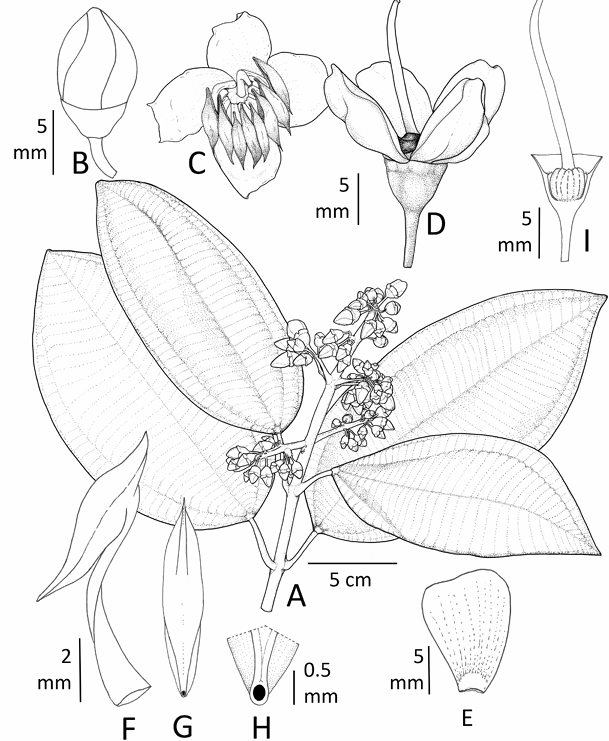
Figure 1: Axinaea filandiensis Humberto Mend. & W. Vargas. A. flowering branch; B. floral bud; C, D. flower at anthesis; E. petals; F. stamens; G. dorsal view of the anther; H. anthers apex with pore; I. longitudinal section of the hypanthium-calyx with the gynoecium. Illustration by Humberto Mendoza and Angelica Ramírez based on the type.
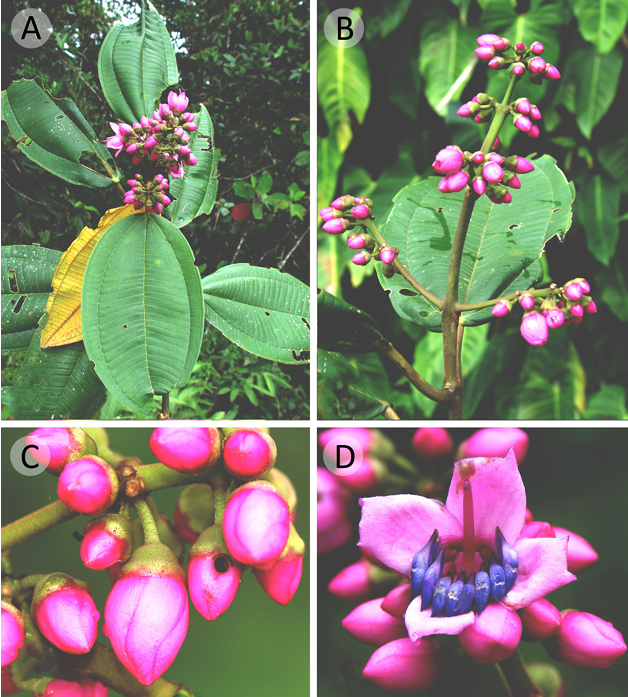
Figure 2: Living plants of Axinaea filandiensis Humberto Mend. & W. Vargas. A. flowering branch; B. detail of stem and inflorescence; C. floral buds; D. open flower. Photos from Vargas 17591 (UDBC).
TYPE: COLOMBIA. Quindío, municipio de Filandia, vereda Cruces, finca El Paraiso, 1950 m, 3.X.2006, fl, W. Vargas 17591 (holotype: UDBC!, isotype: COL!).
Axinaea filandiensis is recognized by its arborescent habit, 4-merous flowers, cucullate corolla, dark pink petals, isomorphous stamens, and blue anther with inappendiculate globose-elliptical connective. It is similar to Axinaea colombiana Lozano & Alvear since they share the 4-merous flowers, but the latter differs in the plinervate smaller leaves, red petals and yellow anthers. It is also morphologically similar to Meriania macrophylla (Benth.) Triana and M. ninakurorum (Bussmann & Paniagua) E. Cotton & Balslev, but the latter have 5-merous flowers with dimorphic stamens.
Trees 10-28 m tall; internodes and petioles glabrous, except in the apical parts where a lax pruinose indumentum is present of dendritic trichomes with moderately long thin-walled arms (type 31 of Wurdack, 1986); inflorescence axes with similar indumentum to the internodes; young internodes 2.6-5.2 cm long, oblong-flattened to subquadrangular; nodes without stipuliform flap; leaves isophyllous; petiole 2.5-4.3 cm long, 2.4-2.7 mm wide, laterally flattened, without scutum; leaf blade 16.5-21.5 × 8.3-11 cm, oblong to ovate-elliptic, rigid and chartaceous, base rounded to obtuse, apex obtuse, margin entire and revolute towards the base; adaxially glabrous, abaxially glabrescent, with lax indumentum on the veins of dendritic tiny trichomes with short thin-walled arms (type 31); venation with two pairs of basal secondary veins accompanying the midrib, tertiary veins adjacent to the middle vein numbering 38 to 48, spaced 4-8 mm apart in the middle part of the blade; inflorescences 8-15 cm long, paniculate, pedunculate or sessile, with more than 50 flowers, peduncle up to 3 cm long, rachis with 4 branching nodes, basal paraclades 4.5-7 cm long, branches with fascicles or glomerular points with more than 4 flowers; bracts and bracteoles absent; flowers 4-merous, diplostemonous, pedicellate; pedicel 5-8 mm long; hypanthium 3-3.2 mm long, cupuliform, externally glabrous or with lax indumentum of dendritic trichomes with moderately long thin-walled arms (type 31), walls 0.5-0.6 mm thick; calyx truncate, without external teeth, externally with a indumentum similar to that of the hypanthium, tube 1.7-2.2 mm long; corolla cucullate, petals 11.5-13.3 × 8.3-9 mm, obovate, glabrous, dark pink, apex sigmoid truncate; stamens isomorphic, arranged on one side of the flower, with anthers and connectives dark blue; filaments 7.0-8.4 × 1.2-1.6 mm, flattened, glabrous, pink; elbow 1.4-3.0 mm long, triangular; dorsal connective elliptically widened in a canoe-like fashion, 1.1-1.3 mm wide, indistinguishable from thecae; anthers 4.5-5 × 1.5-1.6 mm, sigmoid elliptic, with a dorsal pore of 0.2-0.3 mm diameter; ovary 3.1-3.3 × 3.1-3.8 mm, 4-locular, completely blunt, oblong, glabrous, apex with rounded or dentiform lobes 0.5-0.8 mm long; placentas ovoid with ovules on all surfaces; style 1.5-1.6 mm long and 1.2-1.3 mm in diameter at the base, cylindrical or a little wider at the base, slightly curved towards the apex in open flowers; stigma punctiform; capsules and seeds not seen.
Etymology: the name refers to the place of origin of the type, in the municipality of Filandia, Quindío, Colombia.
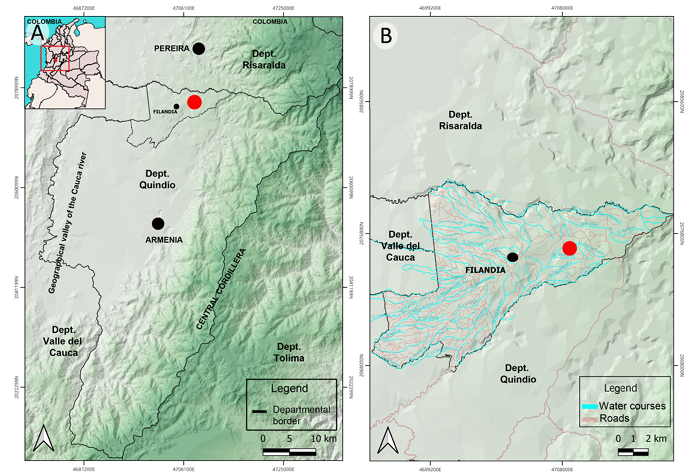
Distribution and habitat: the type locality in the department of Quindío and surrounding areas where the new species was found are relatively well-inventoried, so there is certainty that A. filandiensis corresponds to an endemic species so far known from the type locality, around 2000 m elevation (Fig. 3). It grows in mature and secondary forests, forest edge and near streams, in areas with deep and fertile soils. The climate in the region is considered temperate and warm, with an average annual rainfall of 1387 mm and a temperature of 17.4 °Celsius (Climate-Data calculated by Climate-Data, 2024). The vegetation type of the area of origin is classified as sub-Andean Forests, according to van der Hammen and Rangel-Ch. (1997), and species of the following genera predominate: Aiouea Aubl., Nectandra Rol. ex Rottb., Ocotea Aubl. (Lauraceae), Miconia Ruiz & Pav. (Melastomataceae), Cordia L. (Cordiaceae), Brunellia Ruiz & Pav. (Brunelliaceae), Citharexylum L. (Verbenaceae), Ladenbergia Klotzsch, Elaeagia Wedd., Palicourea Aubl. (Rubiaceae), Montanoa Cerv., Verbesina L. (Asteraceae), Dendropanax Decne. & Planch., Oreopanax Decne. & Planch. (Araliaceae), Alchornea Sw., Croton L. (Euphorbiaceae), and Hieronyma Allemão (Phyllanthaceae).
Phenology: the only collection of this species has flowers, and they were collected in October, which corresponds to the second winter period in the region.
Preliminary conservation status: Axinaea filandiensis is an endemic species, previously recognised by only five adult individuals in an area no larger than three hectares. This zone corresponds to a relic of the sub-Andean forest and areas that were restored in 2006, the original cover being cut down for cattle ranching and later to establish pine plantations (Pinus patula Schltdl. & Cham. and Cupressus lusitanica Mill.). Currently, the fragments where the species lives are surrounded by Hass avocado plantations. Their regeneration is very limited due to the impact of cattle ranching and avocado plantations. Its populations have been severely reduced and are only found in forest fragments that are not guaranteed to be conserved and that are heavily affected by agricultural activities, tourism and timber extraction. Given that only the type locality is known, its endemicity and the high degree of habitat fragmentation, it is classified as Critically Endangered (CR) on the basis of criteria A1a2a and Bb2ab(ii) (IUCN, 2022). As the area of occupancy (AOO) for this species is only 0.006 km2, it is not possible to estimate the extent of occurrence (EOO).
Discussion
The new species Axinaea filandiensis
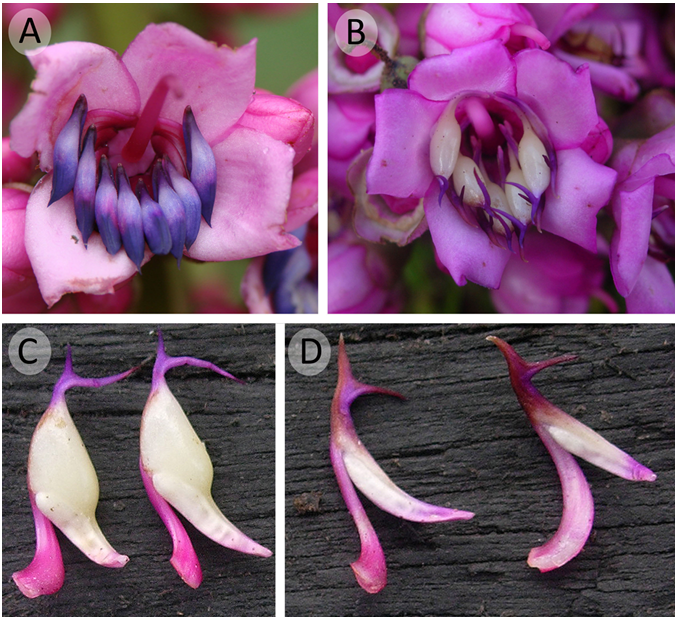
This species is described in Axinaea because of the dorsal connective tissue of the anther, which is inappendiculate and broadly ellipsoidal, the cucullate corolla and the isomorphic stamens. Another important characteristic of Axinaea filandiensis is the 4-merous flower, a feature that it shares with only seven other species of the genus (Bussmann et al., 2010; Cotton et al., 2014): A. colombiana, A. crassinoda Triana, A. dependens, A. fernando-cabiesii Bussmann, J.A. Gruhn & A. Glenn, A. mertensioides Wurdack, A. pendula E. Cotton, and A. reginae Bussmann, J.A. Gruhn & A. Glenn. Of this group, A. colombiana also has anthers with a broad elliptical connective, while the rest of the above mentioned species have globose anthers that are typical of the genus. Axinaea colombiana differs markedly from A. filandiensis by its smaller, plinervate leaves, red petals and yellow anthers. Additionally, it is a species that grows in paramos and subparamos, while A. filandiensis grows in sub-Andean forests. Vegetatively (shape of leaves and indumentum) and by the shape of the corolla, A. filandiensis is similar to Meriania macrophylla and M. ninakonorum; however, the latter have 5-merous flowers and strongly dimorphic stamens with subulate dorsal connective appendages (Fig. 4).
Groups in Meriania and Axinaea circumscription
Recent phylogenetic analyses show that Meriania and Axinaea form a well-supported clade, not suggesting separation of the two genera (Michelangeli et al., 2022). In this analysis, Axinaea forms a natural group; however, it is only represented by nine species. Meriania is the largest genus of the tribe Merianieae and currently consists of 119 species restricted to the Neotropics, including recent novelties from Ecuador (Chiavegatto and Baumgratz, 2009; Mendoza-Cifuentes and Fernández-Alonso, 2012; Mendoza-Cifuentes, 2021; Michelangeli et al., 2022; Fernandez-Hilario et al., 2023; Jimenez et al., 2024a, b). The only morphological feature that separates Meriania from Axinaea is the shape of the dorsal connective of the anther, which is globose in the latter, while in Meriania it tends to be spurred and not globose (Cotton et al., 2014; Mendoza-Cifuentes, 2021). However, exceptions are found in the two genera, such as the species M. macrophylla, M. ninakurorum, and Meriania rubriflora, with globose connectival appendages, and A. colombiana, A. dependens and A. filandiensis described here with globose-elliptical appendages (Fig. 4). Accordingly, it is possible to consider the inclusion of Axinaea within Meriania. However, we are in favour of keeping the genera apart, considering that Meriania is a non-natural group that should be divided into several genera (Mendoza-Cifuentes and Fernández-Alonso, 2011; Mendoza-Cifuentes, 2021; Michelangeli et al., 2022).
Figure 5 is a schematic depiction of the species groupings in Meriania, associated with those documented in the phylogeny of tribe Merianieae in Michelangeli et al. (2022). In the genus, it is possible to establish seven groups, including Axinaea, according to the following characters complemented with the pollination syndromes documented for Meriania (see Dellinger et al., 2019a).
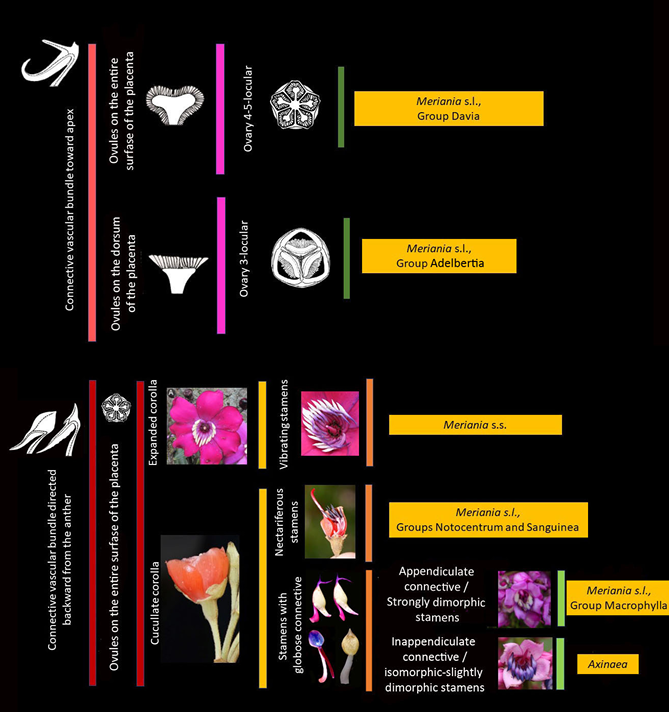
Anthers with the connective vascular bundle toward the apex
Meriania s.l., Davya Group: characterized by ovules on all surfaces of the placenta and the 4-5-locular ovary. It comprises about 18 species from the Mata Atlantica of Brazil, Andes of Peru, Mesoamerica and the Magdalena Medio of Colombia.
Meriania s.l., Adelbertia Group: characterized by ovules only on the dorsum of the placenta and 3-locular ovary. Comprises eight species from the Guiana Shield, Mata Atlantica in Brazil and Magdalena Medio of Colombia.
Anthers with the vascular bundle of the connective directed backward from the anther + ovules on the entire surface of the placenta
Meriania s.s.: characterized by the expanded or rotate corollas and vibrating stamens where the flowers are adapted for buzz pollination by bees (documented in at least five species of the group, Dellinger et al., 2019b). Another important feature is the anther of antepetalous stamens with dorsal pore. The type species M. leucantha (Sw.) Sw. belongs to this group and comprises ca. 53 species of the Andes and Antilles.
Meriania s.l., Notocentrum group: characterized by the cucullate corolla, nectariferous stamens (nectar produced from the filaments, Dellinger et al., 2019b) and anthers that are frequently partially or completely resupinate with respect to the connective. The petals are orange or white, exceptionally fuchsia. Their pollination is associated with hummingbirds, bats and rodents (Muchhala and Jarrín-V., 2002; Dellinger et al., 2019b). It comprises about 23 species from the Andes and Mesoamerica.
Meriania s.l., Sanguinea group: characterized by the cucullate corolla and probably nectariferous stamens (in M. sanguinea Wurdack, Dellinger et al., 2019b; 2022). The anthers are not resupinate with respect to the connective, dorsal-basally they have a rough appendage, and the petals are red. Pollination by hummingbirds and rodents was documented in M. sanguinea (Dellinger et al., 2019b; 2022). It comprises about five species from the Andes.
Meriania s.l., Macrophylla group: characterized by the cucullate corolla, strongly dimorphic stamens and dorsal connective with subulate appendages. Comprises three species from mountainous areas of Mesoamerica and the Andes. There is no evidence of nectariferous stamens. For M. macrophylla there is evidence of possible pollination by birds (by parrots, Mauricio Posada pers. comm.; and by passerine birds, Valverde Espinoza et al., 2021), which consume the anthers in a syndrome like that documented for Axinaea.
Axinaea: characterized by non-nectariferous flowers, cucullate corolla, stamens that are isomorphic or slightly dimorphic in size, the connective vascular bundle directed backward from the anther, anthers inappendiculate with globose or globose-elliptic dorsal connective. These bulbose connective appendages are co-adapted into multifunctional organs serving as an attractor cue and sugar reward for passerine birds (tanagers) and as “bellows”-organ for effecting pollen release (Dellinger et al., 2014; 2019a; 2022).
There is a group of six species, M. acostae Wurdack, M. amischophylla Wurdack, M. boliviensis Cogn., M. kirkbridei Wurdack, M. sumatika Rob. Fern., R. Goldenb. & Michelang. and M. weberbaueri J.F. Macbr., which do not fit into the previous groups because of their intermediate floral characters between Meriania s.s. and the Notocentrum group, which require further revision. Two of these species have polysporangiate anthers (Mendoza-Cifuentes, 2021).
According to these characters, groups close to Axinaea are separated by strongly dimorphic stamens in the case of the Macrophylla group; non-globose dorsal connective and with a rough basal-dorsal appendage for the Sanguinea group; nectariferous flowers with resupinate or partially resupinate anthers in the Notocentrum group; and flowers with expanded-rotate corollas and vibrating stamens in Meriania s.s. The other groups of Meriania s.l., such as Davya and Adelbertia, are separated by the vascular bundle of the connective toward to the apex and dorsal connective appendiculate and not globose.
All species of Axinaea, including the new taxon described here, share the abovementioned combination of characters, but there is one species in Meriania that also shares these: Meriania rubriflora. Fernandez-Hilario et al. (2023) hints at the misplacement of this species in Meriania. We here consider that it is indistinguishable from A. dependens and accordingly synonymize it.
Axinaea dependens Ruiz & Pav. ex D. Don, Memoirs of the Wernerian Natural History Society 4: 321 (1823).
TYPE: PERU. Peru. Junín, Vitoc, H. Ruiz L. and J. A. Pavón s.n. (lectotype: MA!; isotype: B (destroyed), photo in F!, GH, MO, NY).
= Meriania rubriflora Michelang. & R. Goldenb., Phytotaxa 374(3): 190-192. 2018, syn. nov.
TYPE: PERU. Pasco, province Oxapampa, distrito Huancabamba, sector Oso Playa, camino a la parcela Oso Playa, 10°19'05''S, 75°36'28''W, 2565 m, 25.VI.2006 (fl), L. Cárdenas et al. 458 (holotype: USM; isotypes: AMAZ, CUZ, HOXA, HUT, MO!, MOL, USM).
The authors of the original description of M. rubriflora do not compare it with A. dependens. Fernandez-Hilario et al. (2023) comments that M. rubriflora has a closer resemblance to Axinaea species with interpetiolar flaps, 4-merous flowers and red corollas, such as A. crassinoda, A. dependens and A. pendula. They state that M. rubriflora is morphologically close to A. dependens, and the first can be differentiated by its branches sparsely to moderately covered with glandular projections (vs. moderately to densely furfuraceous in A. dependens) and petals 11.7-12.3 mm long (vs. 8-10 mm long). Comparison of the main characters of these two taxa (Table 1) indicates that they do indeed share most shapes and sizes, but with slightly larger floral dimensions in M. rubriflora, with petals 2 mm longer and especially the style 3-6 mm longer. Another difference is found in the indumentum of dendritic trichomes in A. dependens. However, in figure 3C of M. rubriflora (Michelangeli and Goldenberg, 2018), dendritic trichomes are evident on the internodes, so it is deduced that this difference is a product of subjectivity in the interpretation of the indumentum. The type collections of these two taxa come from nearby localities in the department of Pasco, central Peru, at elevations between 2300-3200 m (Table 1). Accordingly, these are two taxa endemic to nearby localities and with minor distinguishable characters in flower size, which can be continuous and attributable to population variation, so it is not practical to keep them separate.
Table 1: Comparison of characters and distribution of Axinaea dependens Ruiz & Pav. ex D. Don and Meriania rubriflora Michelang. & R. Goldenb. (based on Cotton et al., 2014; Michelangeli and Goldenberg, 2018).
| Character/ Distribution | Axinaea dependens Ruiz & Pav. ex D. Don | Meriania rubriflora Michelang. & R. Goldenb. |
| Internodes indumentum | Densely to moderately furfuraceous when young, glabrescent with age, hairs minute, 0.5-1 mm long, dendritic | Sparsely to moderately covered with glandular projections up to 0.1 mm long, sometimes long and slender, sometimes shorter and globose, usually with very short enations. |
| Nodes | With stipuliform flaps 1-5 mm high | With stipuliform flaps 3-7 mm high |
| Petiole length | 15-45 mm | 14-52 mm |
| Leaf blade | 11-17 × 5-7 cm, oblong-elliptic to elliptic-ovate | 10-19 × 3.2-7.6 cm, elliptic to elliptic-lanceolate |
| Venation | 5-plinerved, excluding the tenuous inframarginal nerves | 3 or 5-plinerved |
| Inflorescence | Thyrse, pendulous, 10-35 cm long, >26-flowered | Panicles (thyrse), apparently pendulous, 27-34 cm, multiflorous |
| Flowers | 4-merous | 4-merous |
| Hypanthium | Cupuliform, 1.5-3 mm long | Campanulate, 3.6-4.7 mm log |
| Calyx | 1 mm long, obscurely 4-obed, external teeth obscure or absent | 0.4-0.7 mm long, truncate to slightly undulate, external teeth absent |
| Petals | 8-10 × 8-9 mm, red | 11.7-12.3 × 7.8-8.8 mm, red |
| Stamens | Isomorphic | Subisomorphic |
| Filament length | 3-4 mm | 3.9-4.9 mm |
| Dorsal connective | Ellipsoidal | Ellipsoidal |
| Anther length | 4-5 mm | 4.7-5 mm |
| Ovary | 4-locular | 4-locular |
| Style length | 11-14 mm | 17-20 mm |
| Distribution | Endemic to the eastern slopes of the Andes in central Peru (Dept. Pasco), at 2300-3200 m elevation | Only known from the Oso Playa area in the northwestern portion of the Yanachaga-Chemillén National Park (Dept. Pasco) at 2200-2600 m elevation |

