




 nova página do texto(beta)
 Inglês (pdf)
 Artigo em XML
 Referências do artigo
 Tradução automática
 Enviar este artigo por email
 Citado por SciELO
  Similares em
SciELO
Similares em
SciELO 
 Permalink

Introduction
The Llanos de Ojuelos, in the southern part of the central plateau of Mexico is a complex, semiarid, anthropized landscape, in which native habitats persist as remnants within a diffuse farmland matrix (Riojas-López et al., 2011). Over the past 500 years the region´s landscape has undergone significant transformation: wetlands have been modified dramatically in form and extension; native grasslands have been impacted severely by grazing or transformed into farmland, arborescent nopaleras (communities of wild nopales) were felled to establish agriculture or were thinned to allow the entrance of livestock; and forests have been cleared for lumber and firewood (Riojas-López & Mellink, 2005, 2014, 2023; Mellink et al., 2018; Mellink & Riojas-López, 2020). In addition to the most common drivers of landscape change, agriculture and animal grazing, recent threats are the establishment of wind turbines and large areas of photovoltaic solar farms. The latest trend in landscape change is the clearing of land to grow tequila agave on an industrial scale.
The mammal fauna of this area has not been thoroughly surveyed, and most recent reports have derived from ecological studies and occasional observations (Riojas-López, 2006; Riojas-López et al., 2011, 2018, 2019); as well as those reported in the citizen science platform Naturalista (https://mexico.inaturalist.org/). Formal mammal collection has been limited to the 1965-1967 collections by Percy Clifton at a few locations. The lack of comprehensive data hinders the preparation of a pertinent conservation plan, which is increasingly urgent due to the widespread and intensive transformation of the area (Mellink & Riojas-López, 2020; Riojas-López & Mellink, 2005, 2023).
One landscape component in arid and semiarid lands that has remained especially understudied in Mexico is xeroriparian habitats. These systems cover small portions of landscapes (e.g. less than 1% in southwestern United States in the 1980; Knopf et al. 1988), yet despite their rarity, they are greatly important for wildlife (Soykan et al., 2012; Sánchez-Montoya et al., 2017). In many of these systems water flow is intermittent or ephemeral, but the plant communities associated with them are lush in comparison with the surrounding landscape. These habitats provide food and shelter for many mammals, as well as for other animals. In arid and semiarid regions where water is naturally scarce, the demands of livestock production and agriculture place significant demands on xeroriparian systems (Patten et al., 2018). As a result, an estimated 95% of lowland riparian habitat in western North America has been altered, degraded, or destroyed within the past one hundred years (Krueper, 2000).
In the Llanos de Ojuelos, the biodiversity supported by xeroriparian habitats has been scarcely surveyed. These habitats currently cover approximately 0.1% of the landscape (Riojas-López et al., 2024). While their original distribution and transformation have not been assessed, a comparison of early accounts and place names (such as Ojuelos, Ciénega de Mata, and several localities named “Ojo de agua de …”) with current conditions reveals a significant reduction in the flowing and free-standing water in small streams fed by artesian wells, seeps, and pools. In contrast, large dams and water tanks have notably increased since colonial times (EM & MERL, unpub. obs.).
In the southern part of the central plateau of Mexico xeroriparian systems are important for birds (Riojas-López & Mellink 2019; Riojas-López et al. 2024). Some locations have provided valuable information on their use by mammals, including species like puma (Puma concolor [Linnaeus, 1771]), raccoon (Procyon lotor [Linnaeus, 1758]), white-tailed deer (Odocoileus virginianus [Zimmermann, 1780]) (Riojas-López et al. 2019), and collared peccary (Pecari tajacu [Linnaeus, 1758]) (Carrasco-Ortiz et al. 2021;). However, this information remains insufficient for effective management and conservation, and further data are needed to provide a clearer understanding of the habitat´s value for biodiversity. The objective of this contribution is to present new data on seven mammal species in xeroriparian habitats that were either previously undocumented in the region or had only a few records. These data help fill critical gaps in our knowledge on mammal distribution and habitat use, contributing to a better understanding of the region´s mammal composition.
Materials and methods
Our records pertain to the Llanos de Ojuelos in the southern part of the central plateau of Mexico (extreme coordinates of 21.4545° and 22.4103° N and 101.3526° and 101.7974° W), a semiarid tableland for the most part above 2000 m asl, characterized by low mountains and valleys (Nieto-Samaniego et al., 2005). The natural vegetation of the region consists of grasslands (42.6% of the region's surface), largely overgrazed (Mellink & Riojas-López, 2020), xerophytic shrublands (15.66%) and stands of dwarf oaks (Quercus spp. L.; 4.61%). The grasslands are composed primarily by species of the genera Bouteloua Lag., Aristida L., Lycurus Kunth, and Muhlenbergia Schreb. The regions´ shrublands are dominated by catclaws (Mimosa spp. L.), silver dalea (Dalea bicolor Humb. & Bonpl. ex Willd.), leatherstem (Jatropha dioica Sessé), huisache (Vachellia spp. Wight & Arn.), nopales (Opuntia spp. Mill), Peruvian peppertree (Schinus molle L.; peppertree from here on) (Harker et al., 2008; MERL and EM, pers. obs.). Xeroriparian habitats persist as small remnants scattered throughout the region. All xeroriparian systems we have studied in the region are subject to grazing and browsing by domestic animals.
We obtained information from the following xeroriparian systems (Fig. 1): La Laborcilla (22.090590°, -101.724236°), an ephemeral stream that has a straight, steep-sloped streambed covered predominantly by boulders. Both the system and adjacent land support junipers (Juniperus deppeana Steud.), dwarf oaks, yuccas, and huisaches. The range is used for raising sheep and goats, along with a few cattle. Santoyo (21.919544º, -101.7918886º), a slow-flowing, straight stream on sand and tepetate streambed and low slope, with permanent water in parts of it. The dominant plant species go from willows (Salix spp. L.), peppertrees and nopales near the spring that feeds the system, to dense stands of willow ragwort (Barkleyanthus salicifolius (Kunth) H.Rob. & Brettell), broom (Baccharis sp. L.) and other shrubs, and further downstream, grassy seeps with dispersed catclaw, huisache and nopales. The surroundings are overgrazed grassland with huisaches, and shrubland with arboreal nopales, huisaches, and peppertrees. The range is used to raise fighting bull cattle. La Colorada (21.791682°, -101.625996°), an ephemeral, sinuous stream, with a low slope, on a sand and tepetate streambed. Xeroriparian components are primarily peppertrees, arboreal nopales and huisaches. It is surrounded by grasslands, some overgrazed and some in good condition, and farmland. The range is used mostly for the raising of fine horses. Huerta Grande (21.743761°, -101.857599°), a river system enclosed by low mountains, at the sides of a straight tepetate-sand streambed with a low slope. Its main riparian components are willows, ash (Fraxinus sp. Tourn. Ex L.), and pepper trees. The immediate surroundings support a small stand of ahuehuetes (sabino or Montezuma cypress, Taxodium mucronatum Ten), and Mexican cypress (Cupressus lusitanica Mill.), open orchards, some farmland, a thick community of mesquite (Prosopis sp.), catclaw and huisache, and, on the mountain´s slopes, severely grazed remnants of shrublands. The land immediate to the stream is grazed and browsed by cattle, while the hills are used by goats, cattle, and sheep. El Mayal (21.825915º, -101.622037º), a small reservoir fed by an artesian spring surrounded by a fringe of cottonwoods (Populus sp. L.), eucalypts (Eucalyptus spp. Dietz, 1891), and tree tobacco (Nicotiana glauca Graham). The immediate surroundings are covered by xerophytic shrubland. La Luz (21.74201º, -101.67650º), composed of oaks, nopales and peppertrees along a moderately sinuous streambed with a low slope through a rocky ravine. The surroundings are hilly and are covered by a thick community of catclaw with some yuccas, nopales and peppertrees, and, farther from the stream, grassland. The area is used for the raising of beef cattle.
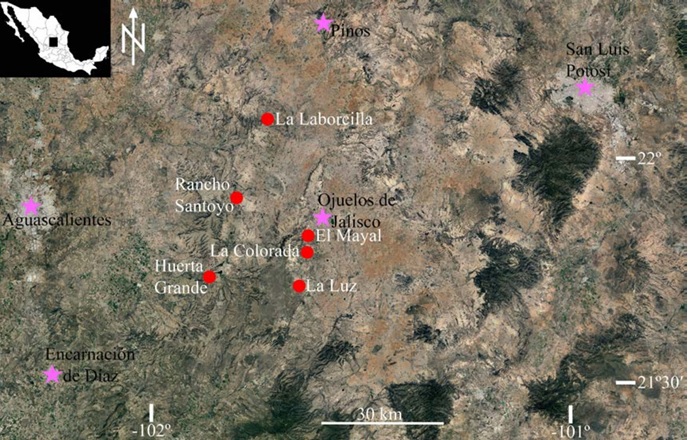
Figure 1 Localities in the Llanos de Ojuelos, Jalisco indicated in the article. Dots are our localities, and a stars indicate reference cities.
To contribute to the knowledge of the region´s biodiversity, we have deployed automatic trail cameras in xeroriparian habitats since 12 July 2015, when we placed five such cameras at Santoyo. Relevant data of mammals and birds from that date until 23 May 2017 were included in Riojas-López et al. (2019), and Riojas-López & Mellink (2019). Three of these cameras continued operating thereafter. On 25 Jul 2019 we deployed three cameras at La Laborcilla, and three at La Colorada. These cameras and those at Santoyo were removed on 6 Nov 2021. Subsequently, we deployed three cameras at Huerta Grande from 17 September 2023 to 11 March 2024, and three cameras at La Luz from 20 December 2023 to 12 March 2024 (Table 1). All cameras were set to record images day and night, triggered by motion sensors. In addition, from 2015 to April 2024 we recorded other evidence at all locations, such as tracks and dens. The detailed results are presented in the supplementary file.
Table 1 Placing of individual trail cameras in five xeroriparian systems in the southern part of the Central Plateau of Mexico, and period active (in reference to this article).
| Location | Section | Coordinates | Period |
| La Laborcilla | Upper | 22.092206°, -101.725935° | 25 Jul 2019 – 6 Nov 2021 |
| Middle | 22.090644°, -101.724483° | 25 Jul 2019 – 6 Nov 2021 | |
| Lower | 22.090206°, -101.721542° | 25 Jul 2019 – 6 Nov 2021 | |
| Rancho Santoyo | Upper | 21.916864°, -101.792325° | 23 May 2017 – 8 Nov 2021 |
| Middle | 21.919911°, -101.792022° | 23 May 2017 – 8 Nov 2021 | |
| Lower | 21.924475°, -101.790661° | 23 May 2017 – 8 Nov 2021 | |
| La Colorada | Upper | 21.797200°, -101.637263° | 25 Jul 2019 – 6 Nov 2021 |
| Middle | 21.796092°, -101.635049° | 25 Jul 2019 – 6 Nov 2021 | |
| Lower | 21.791689°, -101.626794° | 25 Jul 2019 – 6 Nov 2021 | |
| Huerta Grande | Upper | 21.743959°, -101.852094° | 17 Sep 2023 – 11 Mar 2024 |
| Middle | 21.743761°, -101.857599° | 17 Sep 2023 – 11 Mar 2024 | |
| Lower | 21.744291°, -101.861033° | 17 Sep 2023 – 11 Mar 2024 | |
| La Luz | Upper | 21.742154°, -101.679267° | 20 Dec 2023 – 12 Mar 2024 |
| Middle | 21.742035°, -101.676230° | 20 Dec 2023 – 12 Mar 2024 | |
| Lower | 21.743356°, -101.675832° | 20 Dec 2023 – 12 Mar 2024 |
Results
We obtained 44 records of Virginia opossum (Didelphis virginiana Kerr, 1792) from three localities (Table 1), which add to a 2003 record of one individual caught in a pitfall trap in a fruit-oriented nopal orchard (21.726200°, -101.664612°; MERL, unpubl. obs.). Most observations were nocturnal, although some were diurnal. Two records involved an adult with young.
We obtained 93 records of nine-banded armadillos (Dasypus novemcinctus Linaeus, 1758) from four localities (Table 2). Of these, 90 were photographs from trail cameras (Fig. 2), 2 were carapaces, and 1 was a track. Eighty-six percent of our armadillo photographs were taken at night, though five were obtained during morning twilight hours, one during evening twilight, and four during daylight (until 10:25). Most of the photographs were from La Colorada and Santoyo (Table 1). Armadillos were photographed mostly between July and January, with almost none at other times (Fig. 3). An old armadillo den was found in Huerta Grande, where adult armadillos along with young have been observed (Jesús Capuchino, pers. com. Huerta Grande, 2 Feb. 2024), although the numbers here have diminished lately (Juan Tavares, pers. com. Huerta Grande, 3 Feb. 2024). Additionally, an old digging in the bank of an ephemeral xeroriparian system in La Luz (5 Feb. 2024) had the characteristics of an armadillo den but was currently occupied by a white-toothed packrat (Neotoma leucodon Merriam, 1894).
Table 2 Noteworthy mammal records in xeroriparian habitats in the Llanos de Ojuelos, Jalisco and Zacatecas, in the southern portion of the Central. Column letters are: L, lower part of the system, M, middle part of the system, and U, upper part of the system. An X indicates that several individuals were seen on multiple occasions, and a V, that we were informed verbally about the presence of the species.
| Species | La | La | Huerta | La | El | ||||||||||||||
| Laborcilla | Santoyo | Colorada | Grande | Luz | Mayal | ||||||||||||||
| L | M | U | L | M | U | L | M | U | L | M | U | n/a | n/a | ||||||
| Opossum | 6 | 16 | 1 | 21 | |||||||||||||||
| Armadillo | 32 | 5 | 1 | 53 | 1 | 1 | |||||||||||||
| Peters´ squirrel | X | X | |||||||||||||||||
| Ringtail | 2 | 1 | 1 | 1 | 1 | 1 | |||||||||||||
| Badger | 2 | 1 | 2 | 3 | 2 | 3 | 10 | ||||||||||||
| Puma | 2 | 2 | 4 | ||||||||||||||||
| Peccary | V | 1 | |||||||||||||||||
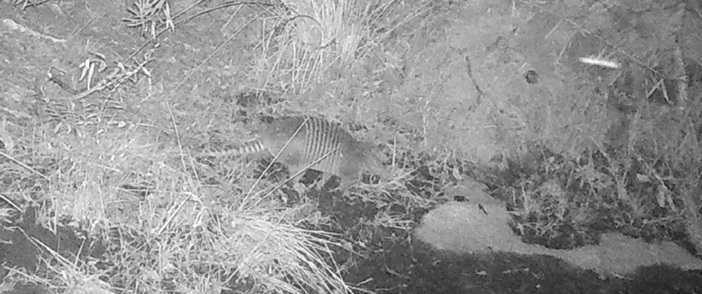
Figure 2 Nine-banded armadillo (Dasypus novemcinctus) recorded at the xeroriparian habitat at the arroyo at Huerta Grande, Jal. Photo by an automatic trail camera on 27 September 2023.
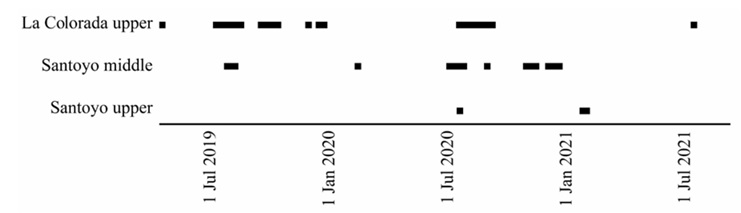
Figure 3 Chronological sequence of photographic records by trail cameras of nine-banded armadillos in the Llanos de Ojuelos, Jalisco and Zacatecas, between 18 April 2019 and 6 November 2021.
We surveyed the stream at Huerta Grande on 7 occasions totaling 19 days since 8 July 2023. On all of them we observed Peters´ squirrels (Sciurus oculatus Peters, 1863) both in the riparian habitat and in the ahuehuete stand. Additionally, two of our trail cameras at this site also recorded them (Fig. 4).
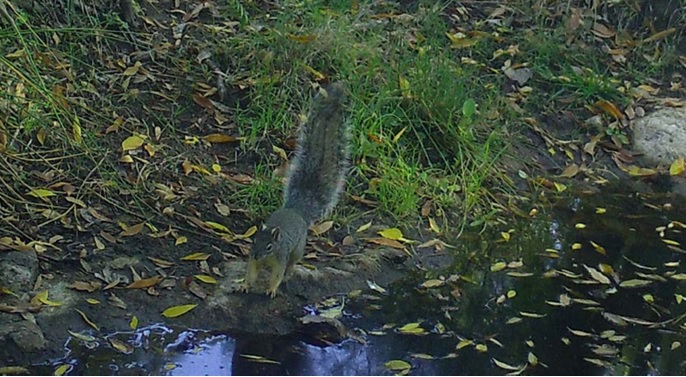
Figure 4 Peters´ squirrel (Sciurus oculatus) from the xeroriparian habitat at arroyo at Huerta Grande, Jal. The clean back that distinguishes it as S. o. shawi is clearly visible. Photo by an automatic trail camera on 18 December 2023.
We recorded evidence of ringtail (Bassariscus astutus [Lichtenstein, 1830]) at four different localities (Table 2; Fig. 5). All records were at night.
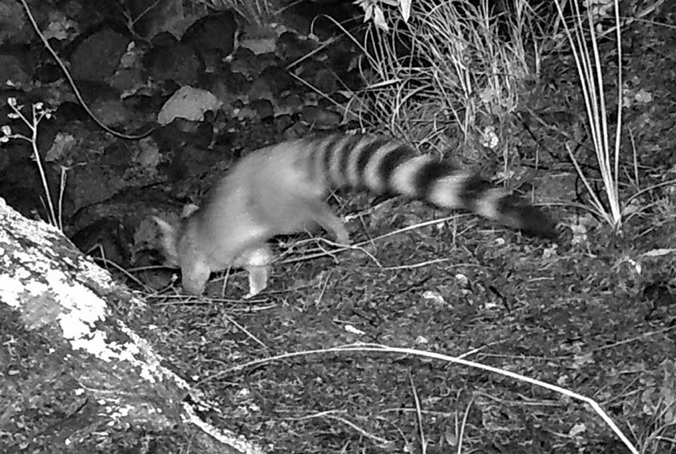
Figure 5 Ringtail (Bassariscus astutus) from the xeroriparian habitat at arroyo La Laborcilla. Photo by an automatic trail camera on 2 January 2020.
American badgers (Taxidea taxus [Schreber, 1777]) were recorded by our cameras on 11 occasions, and we found 10 dens, both at two localities (Table 2; Fig. 6). Only two photographs were taken before midnight (at 20:49 and 23:11), while all the others were taken between 2:59 and 6:57. The last record was obtained during daylight, and the three records before it were taken during morning twilight.
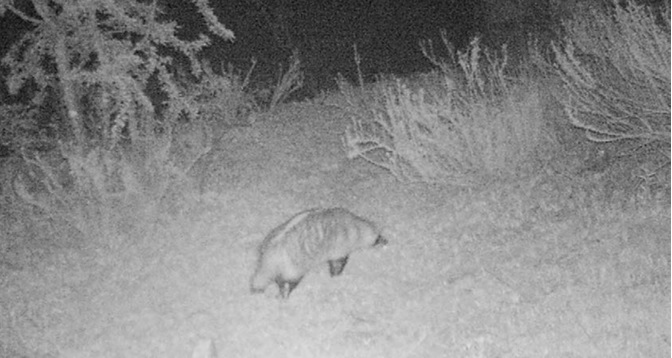
Figure 6 Badger (Taxidea taxus) from the xeroriparian habitat at Rancho Santoyo. Photograph by an automatic trail camera on 27 Apr 2019.
We recorded puma on eight occasions from two localities (Table 2). One record was a track, and seven were photographs taken by trail cameras. Six of the seven “photographs” were taken during the night, while one was taken in the early morning. This morning record was of a 6-7-month-old cub closely followed by an adult (Fig. 7). The cub and adult were separated 11 seconds (7:37:14 and 7:37:25, respectively).
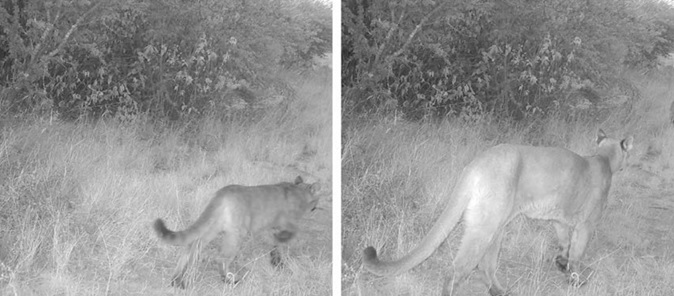
Figure 7 Cub and adult puma (Puma concolor) from the xeroriparian habitat at La Colorada. The photograph of the adult was taken 11 seconds later than that of the cub by the same camera (7:37:14 and 7:37:25, respectively). The edge of the cub´s tail is visible in the upper part of the second photograph (right). Photographs by an automatic trail camera on 1 Nov 2020.
We obtained photographic evidence of peccary at La Luz and verbal confirmation of its presence at Huerta Grande (Table 2).
Discusion
Xeroriparian systems in the Llanos de Ojuelos are used by several species of large and medium mammals, despite being greatly diminished and impacted. Previous records include pumas, raccoons, white-tailed deer, bobcats (Lynx rufus [Schreber, 1777]), southern spotted skunks (Spilogale angustifrons Howell, 1902), hooded skunks (Mephitis macroura Lichtenstein, 1832), American hog-nosed skunks (Conepatus mesoleucus [Lichtenstein, 1832], American badgers, gray foxes (Urocyon cinereoargenteus [Schreber, 1775]), coyotes (Riojas-López et al., 2019), and collared peccaries (Carrasco-Ortiz et al. 2021) . The data we present here not only further highlight the value of xeroriparian habitats for puma, American badger, and collared peccary, but also add Virginia opossum, nine-banded armadillo, Peters´ squirrel, and ringtail to the list.
The Virginia opossum appears to be relatively common in the region, yet surprisingly only two records have been uploaded to Naturalista, one of which was by us. The second was uploaded twice by different people, once indicating only the region and once specifying a precise location (https://mexico.inaturalist.org/observations/55649302 and 55568339, respectively. The supporting photographs show it to be the same individual). Our records came from three xeroriparian locations.
The nine-banded armadillo is a species of tropical affinity, widely distributed in South and Central America and much of México (McBee & Baker, 1982). In México its reported range extends along the coastal slopes from southern Sonora and eastern Coahuila southward, and from Michoacán southward to Central America (Leopold, 1977; Hall, 1981; McBee & Baker, 1982). Hall (1981), Mendoza Durán (2005) and Chávez-Andrade et al. (2015) included the state of Aguascalientes in its distribution, while Martínez de la Vega (2022) indicated that it was in “part of” the San Luis Potosí arid region, but neither provided specific locations. On the other hand, the published information and lack of its collection by Percy Clifton suggest that the nine-banded armadillo was absent from the southern part of the as late as the 1970s (Dalquest, 1953; Matson & Baker, 1986). Until 2006, when we found a carapace at El Mayal, it was not clear that the species occurred in the Llanos de Ojuelos. Armando Esparza, knowledgeable about the region´s wildlife, recalls armadillos as very rare, with sightings only in the last ~15 years. The 2006 piece of carapace was found in a thicket near a water tank with xeroriparian vegetation, while the 2021 carapace in La Colorada was on the bank adjacent to an ephemeral stream. In addition to our records there are two on Naturalista. The first is from Las Cardoncitas, located between Huerta Grande and Santoyo (https://www.naturalista.mx/observations/57793012, 21.806935º, -101.817598º), while the second was indicated only as being from the region (https://www.naturalista.mx/observations/168937361).
Our records, along with the two posted on Naturalista, confirm that Nine-banded armadillos are present in the southern part of the Central plateau of Mexico, not as accidental visitors, but as an established population. Its current presence in the region suggests a recent expansion of its distribution. Nine-banded armadillos are highly capable of territorial expansion. Before the mid-19th Century, they crossed the Rio Grande barrier into Texas (Audubon & Bachman, 1854), eventually reaching the Atlantic coast to the east and Illinois to the north (Clark et al., 2008). More recently, the species expanded its distribution in Sonora as well (Gallo-Reynoso et al., 2018).
The geographical origin of the individuals of this species that colonized the Llanos de Ojuelos is unknown. To explain a nine-banded armadillo record in Nochistlán, in southwestern Zacatecas, Matson and Baker (1986) speculated that the species might have arrived by following the Juchipila River from Nayarit. It is possible that, from the southwest of Zacatecas, the species continued its expansion toward the Llanos de Ojuelos, 125 km to the northeast. The Gulf of México slope appears to be a less likely source due to its much greater distance and the presence of large areas that seemingly lack suitable habitat for the species. The broader geographical distribution records in Naturalista appear consistent with such a southwesterly origin.
The factors enabling the expansion of the nine-banded armadillo in the U.S.A. and Sonora are not clear, but it has been argued that the conversion of grasslands to shrublands created suitable habitat that contributed to it (Taber 1945). In the Llanos de Ojuelos, transformation of the original grasslands into shrubbier plant communities began with the arrival of the Spanish but intensified after the agrarian land distribution in the mid-20th Century (Mellink & Riojas-López, 2020). Such an increase in cover by shrublands may have played an important role in the current presence of nine-banded armadillos in the area. While the development of shrubs on grasslands might have facilitated the colonization by the species, its presence in xeroriparian conditions might be favored by water and an abundance of insects, as well as soft, easily diggable soil (Taber, 1945; Leopold, 1977; McBee & Baker, 1982). The near absence of photographs of armadillos at our sites between January and July (Fig. 3) coincides with the dry season in the region.
Arboreal squirrels have been understudied in México, and information on their populations is urgently needed (Ramos-Lara & Koprowski, 2014). Therefore, our records of Peters´ squirrels are particularly significant. All our observations come from a single location that lies between the known distribution of this species and that of the Nayarit squirrel (S. nayaritensis J.A. Allen, 1890) (Leopold, 1977; Hall, 1981). These two species are very similar (Álvarez, 1961; Leopold, 1977; Aragón, 2005; Hall, 1981) and detailed studies might someday justify their synonymizing (Lee & Hoffmeister, 1963). Until such a taxonomic revision occurs, both species remain valid and are distinguished based on geographical distribution. Peters´ squirrel occurs from the center of the state of San Luis Potosí southward, while the Nayarit squirrel inhabits the Sierra Madre Occidental, ranging from southeastern Arizona southern of Jalisco. According to Alfonso Rincón Gallardo (pers. com., Ciénega de Mata, 3 Feb 2024) this squirrel has been present in Huerta Grande for at least six decades, based on his earliest memories.
Nayarit squirrels in Zacatecas are primarily a montane species living in oak and pine-oak forests (Matson & Baker, 1986). In contrast, Peters´ squirrels not only inhabit pine and oak forests, but are also found in arid mountains in San Luis Potosí, Guanajuato, and Querétaro (Nelson, 1899), as well as in valley streams in San Luis Potosí (Dalquest, 1953). Since the Llanos de Ojuelos are geographically and ecologically more closely related to the San Luis Potosí-Guanajuato plains than to the Sierra Madre Occidental, and given the habitat of the squirrels we recorded, we identify them as Peters' squirrels.
The specimens we have recorded lack a distinct dark central stripe along their back (Fig. 4), a characteristic that aligns them with S. o. shawiDalquest, 1950, following Dalquest (1950). The closest records of S. o. shawi in Naturalista come from the mountain ranges south of San Luis Potosí, about 90 km NE of the Llanos de Ojuelos. Meanwhile other Peter´s squirrel records from northern Guanajuato, 46 km to the SSE, correspond to the distribution of S. o. tolucae Nelson, 1898 (Dalquest, 1950). Recent observations of Peters´ squirrels from both regions have not been assigned to subspecies.
Peters´ squirrel was considered between rare and fragile (Ceballos & Navarro, 1991) and is listed as “under special protection” in México´s catalog of species at risk (SEMARNAT, 2010). However, this category does not prevent the legal hunting of S. o. shawi (sensuDalquest, 1950) in the state of San Luis Potosí (Martínez de la Vega et al., 2016). The habitat of Peters´ squirrels at Huerta Grande is different from the pine, oak and, or fir forests that it typically inhabits (Nelson, 1899). This population is the only known one in a large semiarid area and is isolated from any other populations. Given these factors, it should be of significant conservation concern.
The ringtail occurs throughout most of México (Leopold, 1977; Hall, 1981; Poglayen-Neuwall & Toweill, 1988). It was suspected to be present in the region, but only a specimen from Matanzas, just south of the Llanos de Ojuelos, existed. This specimen was collected by Percy Clifton on 11 May 1966 (https://www.gbif.org/occurrence/686436624). No confirmed observations have been reported from our study region, except for a photograph of a scat that was attributed this species uploaded on 21 July 2019, but which remains unverified and uncommented (https://www.naturalista.mx/observations/29265538).
Ringtails typically inhabit rocky outcrops, canyons, and talus slopes with oaks, pines, and junipers, and they also use riparian habitats (Dalquest, 1953; Leopold, 1977; Poglayen-Neuwall & Toweill, 1988). At La Colorada and La Laborcilla the habitat consists of rocky ravines with junipers, peppertrees, and willows, while our Santoyo and Huerta Grande records come from riparian habitats on level terrain, lacking rocks, and characterized by willows, ash, and peppertrees. All the sites where we recorded ringtails had nopales, whose tunas (the fruits) they feed on (Dalquest, 1953).
The reported distribution of the American badger includes the entire Mexican Plateau (Leopold, 1977; Hall, 1981; Jiménez Guzmán & List, 2005), but no specimens were found to support its presence in the Llanos de Ojuelos, until Riojas-López et al. (2019) presented evidence of it. Since then, no additional records have been published in the literature or uploaded to Naturalista. The observations we present here (Table 2, Fig. 5) come from two localities, different from those in Riojas-López et al. (2019), and indicate that the species is widespread. American badgers are listed as threatened in México´s list of species at risk (SEMARNAT, 2010).
A relevant record of puma presence in the region was published by Riojas-López et al. (2019). Additionally, we received reports of two puma sighting between Huerta Grande and Santoyo in 2020 (Armando Esparza Govea, pers. com., Ojuelos de Jalisco, Jal., 13 Sep 2021) and of two individuals in a roadkill in the same area in December 2022 (Alfonso Rincón Gallardo, pers. com., Ciénega de Mata, 9 Sep 2023; they might have been the same). Our data, along with these verbal reports, further support the presence of widespread puma population in the region, particularly in xeroriparian systems.
Collared peccaries were reportedly common in the region until the 1950s, after which their population was decimated to the point of extirpation or near-extirpation (Roberto García Maldonado, pers. com. San Luis Potosí, S.L.P., 1980; see also Leopold, 1977, and Dalquest, 1953). In addition to the collared peccary that we recorded on a trail camera image at La Luz, we received verbal reports of groups of 15 and more peccaries at Huerta Grande (Alfonso Rincón Gallardo, pers. com., Ciénega de Mata, 3 Feb 2024; Jesús Capuchino, pers. com., Huerta Grande, 2 Feb 2024). These records, along with those reported by Carrasco-Ortíz et al. (2021), suggest that the species is regaining its presumed former distribution to a greater extent than previously believed.
The species reported on in this paper align with three key aspects of the limited knowledge about biodiversity in this highly anthropized region. First, some species escaped formal detection and are thus absent from scientific literature, such as Peters’ squirrels, ringtails and American badgers. Second, some species colonized the region as habitat conditions changed, as the nine-banded armadillo. Third, certain species who were extirpated from the region or whose population was greatly reduced -likely as a result of hunting-have recently increased or recolonized former habitats in the area, such as the collared peccary and the puma. The fact that we continue to generate relevant information on the presence of mid-size and large mammal species highlights the urgent need for further surveys, not only on mammals but also other animal groups in the region.
Xeroriparian habitats in the region are used by mammals of all taxonomic orders, though most of our findings pertain to medium and large mammals, and we still have little information on smaller species. All but one species from the mammalian orders of (usually) medium and large mammals (Mammalia: orders Didelphimorphia, Cingulata, Carnivora and Artiodactyla) are known to inhabit xeroriparian systems. Some species use xeroriparian habitats as their preferred environment, others as part of a broader range of habitats, and other species seem to use them as corridors.
The origin of the Peters´ squirrel population is uncertain-whether it is a Pleistocene remnant or a human introduction warrants further investigation. Regardless, given the limited data on other populations of the species, the Huerta Grande population holds clear conservation value. The role of xeroriparian habitats in the region for other mammal groups not addressed here-such as rodents (Mammalia: Rodentia), shrews (Mammalia: Eulipotyphla: Soricidae), rabbits and jackrabbits (Mammalia: Lagomorpha), and bats (Mammalia: Chiroptera)-remains to be assessed.
Although much remains unknown on the relative value of xeroriparian habitats in the southern part of the Central Plateau of Mexico for mammals, we can safely state that their disappearance, reduction, or severe transformation would have negative impacts. Despite existing knowledge gaps, the data presented in this article, along with other recent publications by us indicate that, despite the extensive anthropization of the Llanos de Ojuelos (Riojas-López et al., 2011), xeroriparian habitats play a crucial role conserving mammalian biodiversity.

