




 nueva página del texto (beta)
 Inglés (pdf)
 Artículo en XML
 Referencias del artículo
 Traducción automática
 Enviar artículo por email
 Citado por SciELO
  Similares en
SciELO
Similares en
SciELO 
 Permalink

1. Introduction
The Internet of Things (IoT) refers to a network of physical items, such as machines, cars, buildings, and other objects, that are equipped with sensors, software, and connectivity features to enable data collection and exchange. The concept of IoT has been around since the 1980s, but it gained momentum in the early 2000s due to the development of low-power sensors and the widespread use of wireless networks and the internet [1]. It is expected to grow in the coming years as more products and devices connect to the internet. In the early 2000s, there was a notable surge in interest in the Internet of Things (IoT) due to technological advancements such as the creation of low-power and affordable sensors, as well as the widespread adoption of wireless networks and the internet. This allowed for a range of devices and objects to be connected to the internet [2]. The emergence of the IoT was largely due to the increasing availability of low- cost, low-power microcontrollers and wireless networking technologies, which facilitated the addition of connectivity to various devices. This enabled the development of smart appliances and devices that could communicate with each other and the internet. Additionally, the increased access to and adoption of cloud computing played a significant role in the development of the IoT. The data generated by IoT devices can be stored and analyzed, allowing for more advanced applications such as real-time monitoring and predictive maintenance [3].
The IoT, however, may potentially have some disadvantages, such as: 1) Concerns about privacy and security: As more things and devices link to the internet, there is a higher chance of hacking and data breaches. Data and personal information could be in danger if the right security measures are not implemented. 2) Complexity: IoT systems can be complicated since they require the integration and management of numerous different technologies and devices. 3) Dependence on technology: Because IoT systems can become essential to operating some systems and processes, they are susceptible to outages or other issues if the technology fails. 4) Cost: Setting up and maintaining IoT systems can be costly, and they might not offer a good enough return on investment. 5) Limited standardization: Due to the sheer variety of IoT-related devices and technologies, there is currently a lack of standardization, making it challenging to guarantee system compatibility and interoperability. 6) Lack of regulation: IoT is a very new technology, and there may be security and privacy concerns because there are no regulations at present [4]. Overall, even though IoT has a lot of potential benefits, it's necessary to think about any negative effects and put the right security and privacy precautions in place to reduce the dangers [5].
On the other hand, Radanliev et al. [6] reviewed literature from 2010 to 2021 on the fourth industrial revolution, commonly referred to as Industry 4.0, and the integration of AI and IoT. They contrasted this with qualitative study findings that align with the most important Industry 4.0 frameworks. The authors then identified existing and emerging methods for boosting automation in cyber-physical systems. The essay discusses the impact of integrating AI and IoT into cyber-physical systems on cybersecurity requirements. The paper uses grounded theory methodology to investigate and model the relationships and interdependencies between edge components and automation in cyber-physical systems. It presents a technical and social analysis of the increasing automation in cyber-physical systems.
Other studies have focused on the AI aspects of IoT. For instance, [7] explores the idea of AI, including machine learning, computer vision, fuzzy logic, and natural language processing, in- depth. The study suggests that combining AI with IoT could lead to the development of engaging and significant applications. The authors discuss the long-standing question of whether machines can replicate human thought processes and deceive individuals into believing they are conversing with a real person. Despite significant advancements in AI and its integration with IoT, the authors assert that further research is required in this field.
According to some researchers, the use of AI in IoT could lead to the creation of more intelligent machines and programs that can assist us in our daily lives. Additionally, integrating various sectors could create new opportunities, as demonstrated by related research. Other studies have focused on the AI aspects of IoT, such as machine learning, computer vision, fuzzy logic, and natural language processing, which are explored in-depth in [8]. The study found that combining AI with IoT could lead to the creation of compelling and meaningful applications. The authors then discussed the long-standing question of whether machines can replicate human thought processes and deceive individuals into believing they are conversing with a real person. Despite the significant progress made in integrating AI with IoT, the authors conclude that further research is necessary in this field. The literature review in this study shows that previous research has analyzed various aspects of the IoT, such as the general concept [9]. However, there has been a lack of research on the topic of IoT in conjunction with artificial intelligence. The current study aims to fill this gap by conducting a thorough analysis of the growth and recent trends in AI-IoT [10].
The structure of this paper is as follows, in section three the methodology is presented; section four shows the common terms; in section five presents the results and discussion; section six shows the areas of the web of science; section seven shows the conclusions and finally, section eight provides the references.
2. Methodology
A total of 15,957 records were found, of which 526 were related to 2023 and excluded from further analysis. The remaining 15,431 records were then grouped by publication type. Most of the publications are articles, which make up 57.2% of the total, followed by proceedings papers at 34.4%. Review and Editorial Material account for a smaller proportion of the total, at 6.2% and 0.9%, respectively. The remaining publication types constitute less than 1% of the total, with the lowest being Retraction, Meeting Abstract, Correction, and Editorial Material; Book Chapter and Article; Retracted Publication and Review; Book Chapter, Book, News Item, Letter, and Book Review, each representing 0% of the total number of publications.
3. Common Terms
The following terms are commonly used in bibliometrics to measure the research output and impact [11], [12]:
TP: refers to the number of publications (such as journal articles, conference papers, book chapters, and others) in a particular field or on a particular subject.
PR%: refers to the proportion of total publications that a particular subgroup or category represents relative to the entire collection of publications.
Number of authors participating (AU): represents the number of authors who have published on a specific subject or field.
Number of participating institutions (Inst): indicates the number of institutions with which the publication's authors are affiliated.
Number of participating regions (Regions): indicates the number of nations to which the authors of the publications belong.
Total citations (TC): refers to the number of times publications in a specific field or on a specific topic were cited by other publications.
Total citations per total publication (TC/TP): indicates the average number of citations per publication in a specific field or topic area.
Total participating authors per total publication (AU/TP): reflects the average number of authors per publication in a specific field or topic.
H-index (HI): refers to a metric that assesses the productivity and influence of a researcher or group of researchers based on the number of publications and the number of citations those publications earned.
It is important to note that these terms are widely used in bibliometrics to evaluate the research output, authorship, collaboration, institutional and geographical distribution, and impact. Moreover, the following terms are frequently used in bibliometrics to measure authorship and collaboration patterns:
Number of publications with the first author (AU1): indicates the number of publications that contain the first author. The first authorship is typically viewed as an indicator of the author's leading role in the research and its significance.
Number of publications where the corresponding author is listed (AUC). The corresponding authorship is typically viewed as a measure of the author's contribution to the research and its dissemination.
Number of independent (Indep) and collaborative (Collab) publications refers to the number of publications written by a single author versus multiple authors. Independent publications are written by a single author, whereas collaborative publications have multiple authors.
The percentage of collaborative publications relative to the total number of publications (Collab/TP%) represents the ratio of collaborative publications to the total number of publications. This metric can indicate the level of research field collaboration.
Noting that these terms are widely used in bibliometrics to measure the authorship pattern, the authors' leading and corresponding roles, and the collaboration pattern of research is essential. All these terms can be applied to any other research object, including institutions, regions, keywords, and subject areas. In addition, the following terms were also employed to analyze the publication sources and interconnected objects:
Impact coefficient: The frequency with which the "average article" in a journal was cited during a specific year or period. It is frequently used as a proxy for a journal's relative importance within its field.
Connectivity system: A type of network graph that illustrates the connections between various elements (such as articles or authors). It can be used to analyze the relationships between various elements, such as the co-citation of articles and the author collaboration network.
WOS subject area: WOS is a bibliographic database that provides access to scholarly literature in the sciences, social sciences, arts, and humanities. It utilizes a system of subject areas to classify articles.
Author Keywords: Keywords assigned by the authors of an article that can be used to indicate the article's primary topics and aid in finding relevant articles.
4. Results and discussions
The data reveals a consistent rise in the number of regions involved over time, from one in 2008 to 121 in 2022. This suggests a growing global interest and activity in the field of AI-IoT. In 2019, the number of involved regions increased to 102, a 17% rise from the previous year. In 2020, the number of involved regions decreased to 99, a 3% drop from the previous year. In 2021, the number of involved regions increased to 107, an 8% increase from the previous year. In 2022, the number of involved regions increased to 121, a 13% increase from the previous year. These results indicate that AI-IoT is an active and productive area of research with strong growth potential. The consistent growth in the number of publications, authors, and institutions, as well as the TC/TP ratio, and the increasing global interest and activity in the field, indicate that research in this area is gaining recognition and impact. The notable increase in the number of authors and institutions involved in certain years suggests significant developments or breakthroughs in the field that have attracted more researchers and institutions.
In conclusion, Table 1 presents a comprehensive analysis of the scientific publications and collaborations of various regions. It is evident that China has the highest number of publications and citations, as well as the highest number of collaborations and independent publications. The USA and India also have significant numbers in these categories. Singapore has the highest TC/TP ratio, indicating that its publications are cited more frequently on average. On the other hand, the UAE has the lowest citation ratio, indicating that its publications are cited less frequently on average. Pakistan, the UAE, and Saudi Arabia have the highest percentage of collaborations in total publications, while India has the lowest percentage. The data also shows that China and India have the highest number of publications with at least one author from their respective regions and the highest number of publications with a corresponding author from their respective regions. China has the highest H- index, indicating that its researchers are highly productive and have a significant impact on their publications. The tables offer valuable insights into the scientific and technological advancements of various regions, their international collaboration, and impact levels.
Table 1 WOS regions statistics analysis: publications, citations, collaborations, first author, corresponding author, and H-index. WOS Regions with more than 500 publications were reported.
| WOS | TP | PR | TC | TC/TP | Collab | Indep | Collab/TP | AU1 | AUC | HI |
| Regions | (%) | (%) | ||||||||
| China | 3461 | 24.3 | 45434 | 13.1 | 1514 | 1947 | 43.7 | 3063 | 2934 | 90 |
| USA | 2484 | 17.5 | 37276 | 15 | 1229 | 1255 | 49.5 | 1621 | 1612 | 82 |
| India | 1989 | 14 | 16736 | 8.4 | 772 | 1217 | 38.8 | 1734 | 1569 | 56 |
| South Korea | 956 | 6.7 | 9696 | 10.1 | 407 | 549 | 42.6 | 685 | 758 | 45 |
| Saudi Arabia | 832 | 5.9 | 7825 | 9.4 | 669 | 163 | 80.4 | 375 | 385 | 43 |
| England | 811 | 5.7 | 13700 | 16.9 | 617 | 194 | 76.1 | 371 | 377 | 56 |
| Italy | 637 | 4.5 | 5611 | 8.8 | 292 | 345 | 45.8 | 469 | 473 | 36 |
| Canada | 626 | 4.4 | 9593 | 15.3 | 415 | 211 | 66.3 | 335 | 327 | 47 |
| Australia | 625 | 4.4 | 12151 | 19.4 | 443 | 182 | 70.9 | 339 | 332 | 53 |
5. Web of Science Research Areas
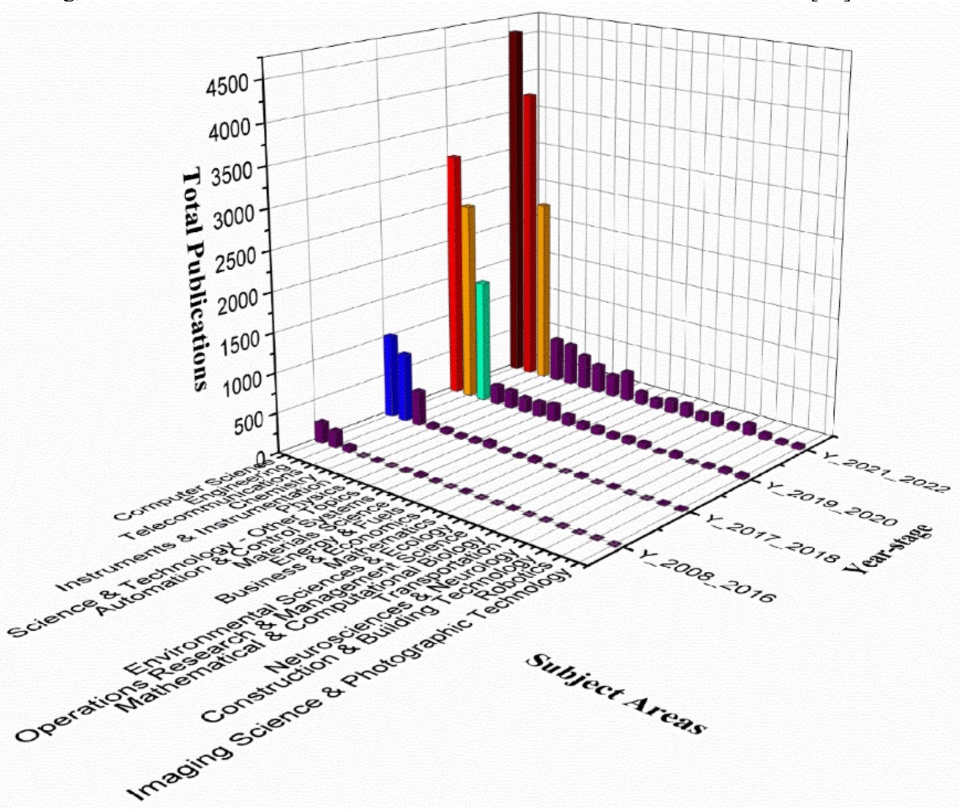
Figure 1 shows the top twenty subject areas across four distinct periods. The first period, from 2008 to 2016, is considered a single period due to the small number of publications. The remaining six years are divided into three additional periods. Computer Science, Engineering, and Telecommunications are the dominant subject areas in terms of the number of publications across all periods. Furthermore, the number of publications in these categories increases over time. Figure 1 shows that the last stage of research in the field of AI-IoT experienced a surge in the subject areas of Chemistry, Instruments & Instrumentation, and Material Science [13]. Computer Science, Engineering, and Telecommunications have remained prominent and stable, while newer topic areas have recently emerged and gained interest. This trend highlights the interdisciplinary nature of AI-IoT research and the potential for contributions from other scientific fields in this sector [14].
The figure 1 shows a significant triangular relationship between the subject areas of Computer Science, Engineering, and Telecommunications, indicating a high number of joint publications and a strong correlation. Furthermore, there is also a moderate triangular relationship between Engineering, Chemistry, and Instruments & Instrumentation. In the figure, Engineering is the largest circle and acts as a hub between other categories due to its numerous connections. Energy & Fuel, on the other hand, only has two connections: one to Science & Technology - other Topics and one to Engineering. This suggests a lower degree of correlation between Energy & Fuel and other subject areas in the field of AI-IoT.
In their article, Wang et al. [15] proposed an adaptive federated learning algorithm for edge computing systems with limited resources. Federated learning is a technique used to train machine learning models on data that is distributed across multiple edge nodes without transmitting raw data to a central location. This technique is advantageous in situations where centralized data storage is impractical due to bandwidth, storage space, or privacy concerns. The authors investigate the convergence bound of distributed gradient descent in machine learning models that focus on gradient descent. They propose a control algorithm based on this analysis that determines the optimal balance between local parameter updates and global parameter aggregation to minimize the loss function within a given resource budget. The proposed algorithm is evaluated in a networked prototype system and a simulated environment. The results suggest that it performs optimally with various machine learning models and data distributions. Future research could focus on utilizing heterogeneous resources for distributed learning and studying the convergence of non- convex loss functions in deep neural networks.
Edge Intelligence (EI) is the combination of AI with edge computing. Zhou et al. [16] provided a comprehensive overview of research on EI. The authors argue that with the proliferation of mobile computing and the IoT, there is an increasing demand to bring AI capabilities closer to the network edge to fully utilize the vast amounts of data generated at the edge of the network [17]. Edge computing, which involves transferring processing activities and services from the network core to the periphery, is seen as a potential solution to this issue. The authors provide an overview of the background and motivation for AI at the network edge [18]. They also discuss the underlying architectures, frameworks, and key technologies for deep learning models used in training and inference at the network edge. Additionally, they address open challenges and future directions for this field [19].
Tao et al. [20] investigated the importance of big data in facilitating smart manufacturing, a novel approach in the manufacturing industry that aims to enhance competitiveness and efficiency through data-driven methods. The authors provide a historical overview of the evolution of industrial data, from the era of handicrafts to the current age of big data. Additionally, the authors present a conceptual framework for data-driven smart manufacturing. This framework details common application scenarios and includes a case study to illustrate its implementation. The authors acknowledge that data collection technologies are not yet fully prepared for smart data perception, especially when dealing with heterogeneous devices. There are still unresolved issues with cloud-based data storage and analytics. However, there is potential for future work in incorporating key technologies such as IoT gateways, fog computing, edge computing, and digital twin technologies into the framework for data-driven smart manufacturing. These technologies can expand the manufacturer's data computation, storage, and networking capabilities, lower the required bandwidth and latency time, and enable a high level of cyber- physical integration. This work is considered a preliminary examination of data-driven intelligent manufacturing and its potential applications.
AI and the IoT are increasingly important in healthcare delivery as they can assist in the fight against and prevention of emerging diseases, such as COVID-19 [21]. In a study conducted by Vaishya et al. [33], the role of AI in evaluating and planning for the COVID-19 pandemic was examined. The study conducted a rapid literature search using COVID-19 and AI-related keywords on databases such as Pubmed, Scopus, and Google Scholar [22]. The study identified seven significant uses of AI and IoT for the COVID-19 pandemic. These include using AI to detect clusters of illnesses, evaluating historical data to anticipate the virus's future spread, tracking the transmission of the infection, monitoring the health of affected patients, aiding in the development of a COVID-19 vaccine, and assisting healthcare organizations in their decision-making processes [23]. The study concludes that AI and IoT are useful tools for detecting early infections, monitoring patient health, and facilitating virus research. Additionally, they can assist in creating treatment protocols, prevention methods, drugs, and vaccines [24].
The Internet of Things (IoT) has rapidly expanded, resulting in an explosion of data collected by sensors and smart devices. As a result, computer resources have been relocated from the cloud to the network's edge to manage the massive amounts of data being generated. Edge computing is an attractive solution to this issue since it enables lower latency and more effective resource utilization [25]. However, the increasing use of AI and deep learning (DL) has highlighted the inadequacy of the current cloud computing service architecture in providing AI services to individuals and organizations. As a solution, edge intelligence has emerged, which focuses on deploying DL services through edge computing [26].
6. Conclusions
Parameters such as total publications, percentage of total publications, number of involved authors, institutions, and regions, total citations, and H- index were used to evaluate the research output, authorship, collaboration, institutional and geographical distribution, and impact. This study provides an overview of the current state of research in the field of AI-IoT.
This paper analyzes the scientific productivity and impact of various regions in the field of AI- IoT. The data indicates that China has the highest number of total publications and total citations, followed by the USA and India. Singapore has the highest ratio of total citations to total publications, indicating that its publications are cited more frequently on average. The UAE has the lowest ratio, indicating that its publications are cited less frequently on average. Additionally, China has the highest number of collaborations, independent publications, and H- index, indicating a high level of productivity and impact in its researchers' publications. Regarding collaborations, Pakistan, UAE, and Saudi Arabia have the highest percentage of collaborations in total publications, while India has the lowest percentage. The data provides valuable insights into the scientific and technological advancements of different regions and their level of international collaboration and impact, with percentage data provided.
parameters such as total publications, percentage of total publications, number of involved authors, institutions, and regions, total citations, and H- index were used to evaluate the research output, authorship, collaboration, institutional and geographical distribution, and impact. This study provides an overview of the current state of research in the field of AI-IoT.
This paper analyzes the scientific productivity and impact of various regions in the field of AI- IoT. The data indicates that China has the highest number of total publications and total citations, followed by the USA and India. Singapore has the highest ratio of total citations to total publications, indicating that its publications are cited more frequently on average. The UAE has the lowest ratio, indicating that its publications are cited less frequently on average. Additionally, China has the highest number of collaborations, independent publications, and H- index, indicating a high level of productivity and impact in its researchers' publications. Regarding collaborations, Pakistan, UAE, and Saudi Arabia have the highest percentage of collaborations in total publications, while India has the lowest percentage. The data provides valuable insights into the scientific and technological advancements of different regions and their level of international collaboration and impact, with percentage data provided.
The top twenty subject areas across four distinct periods showed that Computer Science, Engineering, and Telecommunications dominate in terms of the number of publications across all periods, with an increase in the number of publications as time progresses. The connectivity network of the top ten subject areas in the field of AI-IoT showed a strong triangular connection between Computer Science, Engineering, and Telecommunications.
Telecommunications are still the most popular and fastest-growing fields, these newer fields are getting much attention in recent years. This trend could mean a shift toward multidisciplinary approaches, with fields like Chemistry, Instruments and Instrumentation, and Material Science all contributing to developing AI-IoT systems. Furthermore, this trend highlights the importance of cross-disciplinary collaborations for advancing this field.

