




 texto en
  Inglés (pdf)
 Artículo en XML
 Referencias del artículo
 Traducción automática
 Enviar artículo por email
 Citado por SciELO
  Similares en
SciELO
Similares en
SciELO 
 Permalink

INTRODUCTION
In Mexico, the crab fishery is considered a traditional artisanal fishery with great socioeconomic value in the coastal zone of the Pacific Ocean, mainly in the states of Sonora and Sinaloa (DOF 2023). The target species are the Cortez or Warrior Swimming Crab (Callinectes bellicosus Simpson, 1859), the Arched Swimming Crab (Callinectes arcuatus Ordway, 1863), and the Black Crab (Callinectes toxotes Ordway, 1863).
In the state of Colima, Mexico, the artisanal C. arcuatus fishery has an official record of 24 small vessels (DOF 2023), with a production volume of 46 t in 2024 and an estimated value of $1,343,318 MXN according to the 2024 statistical production yearbook database (CONAPESCA 2024). Although the crab fishery in the central Mexican Pacific, specifically in Cuyutlán Lagoon, Colima, is small-scale, it shows great growth potential for the fishing communities in the state (Estrada-Valencia 1999), compared to the potential of the northern states, where production oscillates around 54% of the national production (27,173 t) in Sinaloa and where considerable fishing effort data are recorded (1,069 vessels) (DOF 2023).
During their daily work, some fishermen off the coast of Colima have found crabs that are morphologically distinct to the blue crab, which has raised the following question: to which species do these specimens belong? The presence of other species could influence the fishery of C. arcuatus, which is of great importance in Cuyutlán Lagoon, Colima (Estrada-Valencia 1999, Salas-Maldonado et al. 2021). Furthermore, the ecological and socioeconomic implications of the presence of invasive crab species in the coastal lagoon are unknown. In Mexico, the presence of the Spiny Hands Crab or Indo-Pacific Swimming Crab (Charybdis hellerii A. Milne-Edwards, 1867), the only invasive alien species of the Portunidae family on the Checklist of Invasive Alien Species of Mexico (DOF 2016), has been detected in Yucatan (Simoes et al. 2019). On the other hand, in the northeastern Pacific, the presence of 3 invasive crab species has been reported: the Common Sea Crab or European Green Crab (Carcinus maenas Linnaeus, 1758), the Harris Mud Crab (Rhithropanopeus harrisii Gould, 1841), and the Chinese Mitten Crab (Eriocheir sinensis H. Milne Edwards, 1853).
Traditionally, the taxonomic identification of most species is based on phenotypic characters, but in some cases morphological differences are not definitive, as for some fish species such as the Common Snook (Centropomus undecimalis) (Martínez-Brown et al. 2021). On the other hand, forensically informative nucleotide sequencing (FINS) is one of the procedures to identify biological specimens; this consists of the extraction of DNA, amplification of a specific segment by the polymerase chain reaction (PCR), sequencing of the amplified fragment, and phylogenetic analysis of the sequence, which is compared with databases to identify the species that is genetically closest (Bartlett and Davidson 1992). This procedure has served to elucidate snooks species and establish new morphological characteristics for each one (Martínez-Brown et al. 2021).
The objective of this work was to use the FINS technique to molecularly identify crabs caught in Cuyutlán Lagoon, Colima, Mexico, to evaluate the presence of invasive species previously reported in the northeastern Pacific or in Mexico (C. maenas, R. harrisii, E. sinensis, and C. hellerii).
MATERIALS AND METHODS
In Cuyutlán Lagoon, Colima, Mexico, 6 crabs were caught using artisanal fishing (Fig. 1). Of these, 1 specimen showed distinct morphological characteristics (Table 1). The specimens were transported to the Centro Regional de Investigación Acuícola y Pesquera of Manzanillo, Colima, where they were measured with a Vernier caliper (precision of 1 mm) and weighed with a granataria balance (precision of 1 g). Pleopod and muscle samples from all crabs were fixed in 96% ethanol. The fixed samples were transported to the facilities of the Centro de Investigación Científica y de Educación Superior de Ensenada, Baja California (CICESE) and kept at -20 ºC until processing. DNA extraction was performed using the salt method (Sambrook and William 2001). DNA integrity was confirmed by 1% agarose gel electrophoresis and its concentration and purity by spectrophotometry (Nanodrop; Thermo Fisher Scientific, Waltham, USA), evaluating the absorbance ratios at 260/230 and 260/280 nm. Subsequently, of the 6 crab samples (called j1-j6; Fig. 1), 4 (j1, j4, j5, and j6) amplified adequately for the 16S rRNA gene fragment by PCR with the primers reported by Geller et al. (1993): 16SAR (5’-CGCCTGT-TTATCAAAAACAT-3’) and 16SBR (5’-CCGGTCTGAACT-CAGATCACGT-3’). These have been used in molecular phylogenetic analyses of Callinectes using C. hellerii as an outgroup (Robles et al. 2007).
Table 1 Morphometric data of crabs collected in Cuyutlán Lagoon, Colima, Mexico.
| Common name | Species | Organism | Geographic coordinates | Sex | Carapace width (mm) | Carapace length (mm) | Total weight (g) |
| Arched Swimming Crab | Callinectes arcuatus | J1 | 19°0'33.67"N, 104°12'27.94"W | Male | 95.0 | 57.0 | 64.0 |
| j2 | 18°59'53.84"N, 104°11'41.92"W | Male | 107.0 | 60.0 | 66.0 | ||
| j 3 | 18°59'56.86"N, 104°11'0.26"W | Male | 99.0 | 50.0 | 57.0 | ||
| j4 | 18°59'56.86"N, 104°11'0.26"W | Female | 99.0 | 58.0 | 49.0 | ||
| j5 | 18°59'56.86"N, 104°11'0.26"W | Male | 100.0 | 57.0 | 65.0 | ||
| Average | 100.0 | 56.4 | 60.20 | ||||
| Standard deviation | 4.4 | 3.8 | 7.19 | ||||
| Crab | Unidentified at the time of capture | j6 | Female | 67 | 30 |
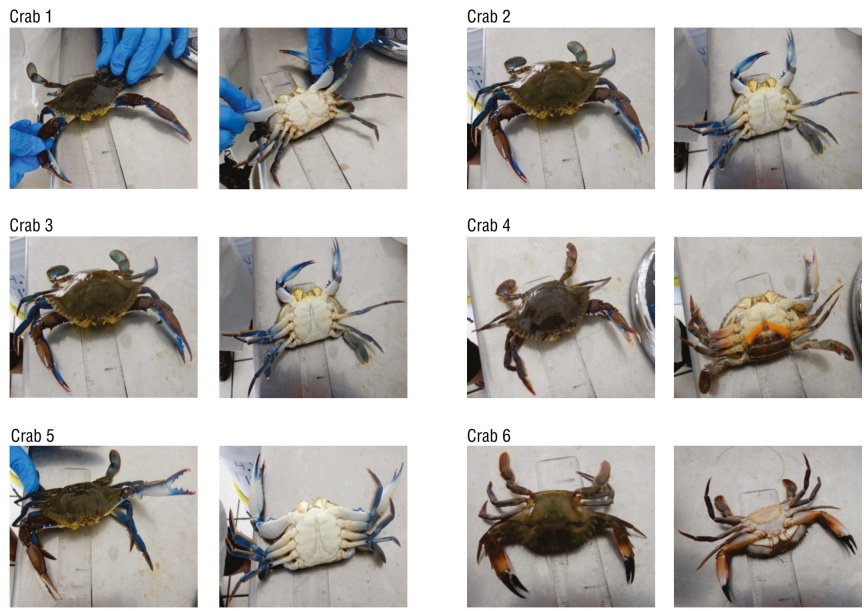
Figure 1 Photographs of the 6 crabs caught for this study from Cuyutlán Lagoon, Colima, Mexico: Crab 1-Crab 5 (Callinectes arcuatus) and Crab 6 (Charybdis hellerii).
The PCR reaction mix consisted of 0.20 µM primers (final concentration) and the Kapa Biosystems PCR kit (Willmington, USA). A magnesium buffer A was used for a final reaction volume of 12 µL, with 0.2 mM dNTPs and 0.5 U of Taq polymerase (Kapa Biosystems) per reaction. Finally, the PCR product was sent to Eton Bioscience (San Diego, USA) for cleanup and bidirectional Sanger sequencing.
Once the sequencing files were obtained, low-quality regions were removed using CLC Genomics Workbench v. 10.1 (QIAGEN CLC Genomics, Aarhus, Denmark), and the 2 sequences were assembled to obtain a unique fragment per organism. A search for similar segments was performed using the BLAST tool of the National Center for Biotechnology Information (NCBI) using the blastn option (BLAST-NCBI 2024) to identify species by comparing the obtained sequences with the public database. Sequences were subsequently submitted to NCBI GenBank (NCBI 2024). Subsequently, Clustal Omega (Sievers et al. 2011, Sievers and Higgins 2018) was used to align fragments with some sequences found using BLAST results (Table 2) and using C. maenas (GenBank accession number: FM208763) as an outgroup. The best-fitting nucleotide substitution model was selected using default settings with the jModelTest2 tool (Guindon and Gascuel 2003, Darriba et al. 2012). The phylogenetic tree was then constructed with MrBayes v. 3.2 (Ronquist and Huelsenbeck 2003), using the best-fitting Hasegawa-Kishino-Yano model with gamma distribution and a gamma-distributed rate variation between sites (HKY+I+G). A Markov chain Monte Carlo simulation was performed with 50,000 generations, a sampling frequency of 100, and default settings. Finally, FigTree v. 1.4.4 (Rambaut 2018) was used to generate the phylogenetic tree image from the information generated by the MrBayes program, and the figure was edited with Python v. 3.08.
Table 2 Information on the sequences that had 100% identity with sample j6 from the Cuyutlán Lagoon, Colima, Mexico, which corresponded to the species Charybdis hellerii.
| GenBank accession number | Location | Date | Reference |
| KX060544 | Port Jackson, New South Wales, Australia | May 1974 | Negri et al. (2018) |
| KX060532 | Tolo Port, Hong Kong, China | September 1986 | Negri et al. (2018) |
| KX060500 | Baguala Bay, Maluku, Indonesia | December 1990 | Negri et al. (2018) |
| KX060489 | Apra Harbor, Sasa Bay, Mariana Island, Guam | January 2000 | Negri et al. (2018) |
| KX060443 | Angra dos Reis, Rio de Janeiro, Brazil | April 2011 | Negri et al. (2018) |
| PP118357 | Guinea-Bissau | 2011 | Muñoz et al. (2024) |
| NC_060621* | Not indicated | Gong et al. (Not published) |
*Not included in further analysis because the location was not provided.
Once the BLAST results were obtained, we conducted a search for records of the presence of the identified species in the locality, surrounding areas of Colima, and the Mexican Pacific. Various databases and public reports were reviewed to corroborate the presence of the species detected through the FINS analysis, including iNaturalist (iNaturalist 2024), a platform with accurate information for species identification (Unger et al. 2021, Callaghan et al. 2022).
RESULTS
Morphological characteristics allowed us to differentiate the Arched Swimming Crab (j1-j5 [blue stripes on its body]) from the unknown crab (j6; Fig. 1 and Table 1). The average (± standard deviation) carapace width (Cw) of the Arched Swimming Crab samples was 100.0 (± 4.4) mm, whereas the average total length (TL) was 56.4 ± 3.8 mm and the average weight was 60.0 ± 7.2 g. The unknown crab was a smaller female (Cw: 67 mm; TL: 49 mm), with a weight of 30 g.
Good quality DNA was obtained to amplify a ~560 bp fragment in 4 of the 6 sampled crabs. The 3 C. arcuatus samples (j1 [male], j4 [female], and j5 [male]) with the highest quality amplifications were sent for sequencing (Table 1). After primer removal, 517 bp fragments were obtained for j1, j4, and j5; the fragment was 518 bp for j6. The amplified fragments from j1 and j4 were identical (GenBank accession number PQ800080), whereas the fragment from j5 differed by only 1 nucleotide (GenBank accession number PQ800081). BLAST analysis detected 100% identity of 2 samples (j1 and j4) with C. arcuatus sequences in the GenBank database, one from Nicaragua (GenBank accession number: MW264141) (Windsor et al. 2019, Marco-Herrero et al. 2021) and another from Oaxaca, Mexico (GenBank accession number: DQ407669) (Robles et al. 2007). The amplified fragment from sample j5 had 99.91% identity with these same C. arcuatus sequences, indicating a new sequence and 16S rRNA segment for this species. However, the corresponding 518 bp fragment from sample j6 (GenBank accession number: PQ800082) had 100% identity with C. hellerii when compared with the 7 sequences deposited in the database (GenBank accession numbers: KX060544, KX060532, KX060500, KX060489, KX060443, PP118357, and NC_060621; Table 2). The latter (NC_060621) belongs to the complete mitochondrial genome of C. hellerii. However, since information on the location and date of collection was unavailable, it was not included in subsequent analyses.
An attempt was made to identify the origin of the j6 crab by considering the distributions reported in the sequence metadata. However, because the sequence timeline and geographic information did not match, its possible origin could not be elucidated (Table 2). In other words, it was not possible to determine the origin of the crab found on Mexican coasts and whether it came from the Indian Ocean or the Atlantic Ocean.
BLAST and phylogenetic analyses of the sequences from 4 crabs (j1, j4, j5, and j6) showed a clear separation between the genera Callinectes and Charybdis (Fig. 2). Charybdis was found in the Thalamita clade, whereas Callinectes was found in the Arenaeus clade.
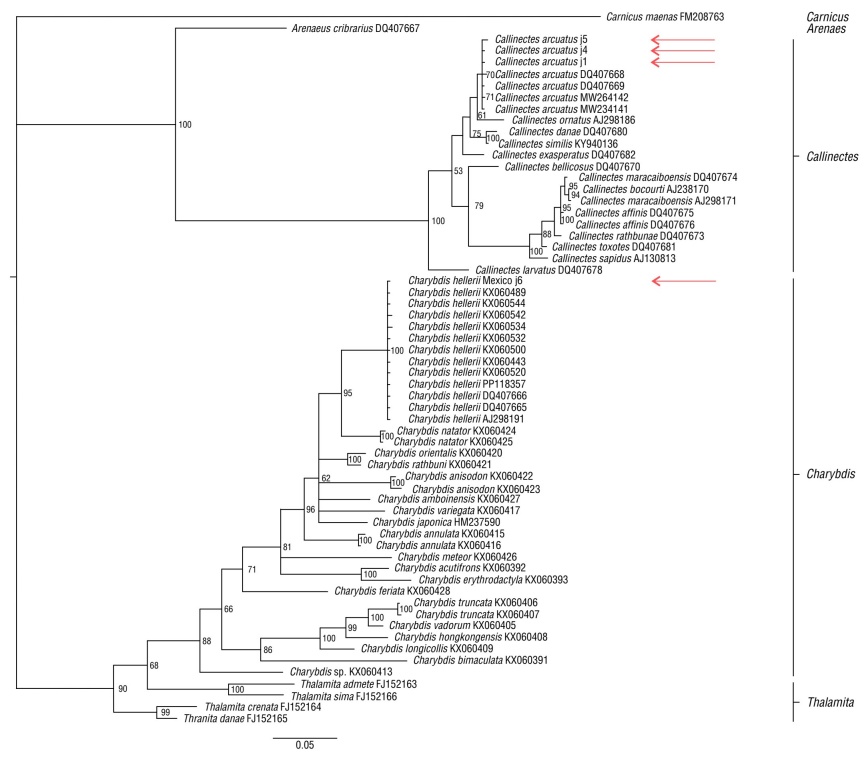
Figure 2 Phylogenetic tree obtained with the amplification of the 16S rRNA segment of 3 samples of the Arched Swimming Crab (Callinectes arcuatus) and 1 of the Indo-Pacific Swimming Crab (Charybdis hellerii) caught in the Cuyutlán Lagoon, Colima, Mexico (red arrows).
No record of the presence of C. hellerii was found on the Mexican Pacific coasts until December 2024. However, when consulting the photographs recorded in iNaturalist, the presence of the invasive species C. hellerii was detected on the coasts of Colima (Table 3) on 5 occasions (the first in 2019 and the others in 2024). In the case of the native species C. arcuatus, only one record was found in 2024.
Table 3 List of photographic sightings of the Indo-Pacific Swimming Crab (Charybdis hellerii A. Milne-Edwards, 1867) and the Arched Swimming Crab (Callinectes arcuatus Ordway, 1863) on the coasts of Colima, Mexico.
| Species | Website | Observer | Geographic coordinates | Date |
| Indo-Pacific Swimming Crab (Charybdis hellerii) | https://mexico.inaturalist.org/observations/24484267 | alboertoalcala | 19°6'13.994"N, 104°23'56.767"W | 03-may 2019 |
| https://mexico.inaturalist.org/observations/212167157 | alboertoalcala | 19°6'14.704"N, 104°23'56.511"W | 29 April 2024 | |
| https://mexico.inaturalist.org/observations/198085794 | guillermomtz11 | 19°0'4.06"N, 104°16'17.537"W | 31 January 2024 | |
| https://mexico.inaturalist.org/observations/218041232 | hectorjmz | 19°6'15.012"N, 104°23'57.191"W | 24-may-25 | |
| https://mexico.inaturalist.org/observations/218020269 | fernando0c | 19°6'15.001"N, 104°23'56.908"W | 24-may 2024 | |
| Arched Swimming Crab (Callinectes arcuatus) | https://www.inaturalist.org/observations/226341793 | Hannia_aseret | 19°6'19.731 "N 104°23'58.477"W | 30 June 2024 |
*The words jaiba and cangrejo (Spanish words for crab) are used interchangeably on the iNaturalist platform.
DISCUSSION
The artisanal fishery of C. arcuatus in Cuyutlán Lagoon, Colima, is an activity of great socioeconomic importance for the region, so the presence of invasive species could impact the abundance of this fishing resource through ecological competition for habitat or food.
The FINS analysis of the ~560 bp fragment of the 16S rRNA gene was sufficient to identify the specimen that was morphologically distinct from C. arcuatus to be the invasive crab C. hellerii. A fragment of this gene has been used, together with a segment of the COI gene, to identify megalopa (late larval stage) of different crab species, including C. arcuatus and C. hellerii from different parts of the world, with good results for species differentiation (Negri et al. 2018, Marco-Herrero et al. 2021).
Charybdis hellerii is native to the Indo-Pacific and is considered an invasive species that has spread throughout the Mediterranean Sea, the Pacific Ocean, and the Atlantic Ocean (Brockerhoff and McLay 2011). Its presence has already been detected on the Yucatán Peninsula (Simoes et al. 2019). There are keys to its identification in the Mexican Caribbean and a rapid assessment method for its invasiveness (Gob Mx 2024a). Note that, of the 5 reports on iNaturalist (iNaturalist 2024), the first record dates back to 2019. Based on all the records made on this platform, the frequency of sightings may have increased in recent years in the same area, without having been detected elsewhere in the Mexican Pacific.
iNaturalist is an initiative of the California Academy of Sciences (San Francisco, USA) in conjunction with the National Geographic Society (Washington, D.C., USA) that began in 2017. It has an application that can be installed on smartphones to upload photographs and, through its algorithm, identify the species to which the organism in the photograph corresponds. This application has been used in educational activities and is considered highly accurate in identifying known species (Unger et al. 2021, Callaghan et al. 2022). In addition, the results of the FINS analysis confirmed the identified species. Therefore, it is considered important to use citizen science reports in species identification, as they provide valuable information and continue to gain global relevance.
For now, the presence of C. hellerii could be considered restricted to the coasts of Colima, as there are no other sightings recorded in surrounding areas. However, other questions arise, such as: How did it reach these areas? What is its current distribution? And does it have an established population? Ballast water has been reported to spread C. hellerii in different parts of the world (Negri et al. 2018), and this is likely how it reached the coasts of Manzanillo, Colima. The Port of Manzanillo is of great national commercial importance in terms of container movement, accounting for 68% of the total movement in the Mexican Pacific and 46% of the total movement in the country. Large vessels from different parts of Mexico arrive at this port, as well as container ships from various countries such as Canada, the United States, Guatemala, Colombia, Ecuador, Chile, South Africa, Japan, China, Taiwan, Korea, Indonesia, Malaysia, Singapore, and the Philippines, and from the European Union (Spain, Russia, and Germany) and Oceania (Australia and New Zealand) (Gob Mx 2024b). There is a possibility that this species may be transported from this area to other parts of Mexico or to the Pacific Ocean in the same way it arrived in Colima.
The use of the 16S rRNA fragment allowed the identification of the species C. hellerii, but the analysis of only a fragment was not sufficiently detailed to identify the possible biogeographic origin of the specimen found in the artisanal fishery of the Arched Swimming Crab in Cuyutlán Lagoon because this haplotype has been detected in various parts of the world (Table 2). Therefore, we recommend conducting further in-depth genetic research on this species in the locality and relating it to other studies of the distribution of C. hellerii worldwide (Negri et al. 2018). In addition, systematic monitoring is required in Colima and other locations to obtain a greater number of samples, produce more genomic data through (partial) genome sequencing of the species, and conduct a population genetic analysis to identify the geographic origin of the invasion.
On the other hand, given that the first record dates back 5 years (2019), it is highly likely that a local population of C. hellerii already exists. Therefore, the following questions arise: How could it affect native populations of the Arched Swimming Crab? And was there a single introduction or have there been multiple introductions? Knowing the answers to these questions is of utmost importance because reports, in some cases, indicate there could be a greater impact on populations of other crabs with low genetic diversity (Negri et al. 2018). Furthermore, C. arcuatus reaches carapace width sizes larger than the minimum legal size of 95 mm (DOF 2014, Ortega-Lizárraga et al. 2016), whereas C. hellerii reaches carapace width sizes of up to 65 mm on Brazilian coasts (Medina-Mantelatto and Biagi-Garcia 2001). This would imply that, if a specific management plan is not implemented, C. hellerii would be excluded from the fishery because it does not reach the minimum legal size for the Arched Swimming Crab.
Furthermore, the fact that there is only 1 record of C. arcuatus on the iNaturalist website is worth noting, given that it is a native species exploited in the region. Given that C. arcuatus is the native species and a fishery has existed for decades, a greater number of sightings of C. arcuatus than of C. hellerii would be expected. However, these records are not considered to be associated with the abundance of the species, as there are biases among those who observe and report on iNaturalist (Dimson and Gillespie 2023). Therefore, encouraging the population (primarily fishermen and divers) to record sightings of these crab species is recommended to support studies on their presence and dispersal.
CONCLUSIONS
The presence of the Indo-Pacific Swimming Crab C. hellerii was detected in Cuyutlán Lagoon, Colima, Mexico, using the FINS method. Species identification through citizen science projects can be very useful to detect invasive species in new areas. It is important to conduct studies on the current distribution of this species, given that reports from 2019 in the Manzanillo region of Colima, Mexico, suggest the existence of a population that may already be established on these coasts.

