




 nueva página del texto (beta)
 Español (pdf)
 Artículo en XML
 Referencias del artículo
 Traducción automática
 Enviar artículo por email
 Citado por SciELO
  Similares en
SciELO
Similares en
SciELO 
 Permalink

Introduction
Biological collections represent the natural heritage of a country or region (Suárez-Mayorga & Vivas, 2003, Montaño et al., 2012, Trujillo-Trujillo et al., 2014); and their increase, through the collection of specimens, supports the knowledge of the biodiversity (Suárez-Mayorga & Vivas, 2003). Biological collections allow us to document the richness and distribution of species, which is essential for any study on taxonomy, systematics, ecology and biogeography, and essential for the conservation of species (Andrade et al., 2013). In Mexico, there are several entomological collections, the portal of the National Commission for the Knowledge and Use of Biodiversity (CONABIO) reports at least 38 entomological collections. One of the largest entomological collections in the country is the Colección Nacional de Insectos (CNIN) del Instituto de Biología de la Universidad Nacional Autónoma de México (UNAM), which has approximately five million dry-mounted specimens (CONABIO, 2023). It includes the orders: Coleoptera, Dermaptera, Diptera, Embioptera, Hemiptera-Heteroptera, Homoptera, Hymenoptera, Lepidoptera, Odonata, Orthoptera, Psocoptera, Thysanoptera and Trichoptera. Another important collection is the Entomological Collection of the Institute of Ecology (IEXA) of Xalapa, Veracruz, which is made up of 419,535 specimens (INECOL, 2024).
The CIBE is the acronym for the Colección de Insectos Benéficos y Entomófagos, it was started in 1986 by Dr. Alejandro González Hernández with the support of projects from the Ministry of Public Education, the National Council of Science and Technology, the National Commission for Knowledge and Use of Biodiversity, University of California (UC MEXUS), Texas A&M University-CONACYT and the Scientific and Technological Research Support Program (PAICYT) of the Autonomous University of Nuevo León (CONABIO, 2023). It is a collection specialized in parasitoid wasps (Hymenoptera), particularly, those in the superfamilies Ceraphronoidea, Chalcidoidea, Cynipoidea, Evanoidea, Ichnemonoidea, Megalyroidea, Mymarommatoidea, Platygastroidea, Proctotrupoidea, Stephanoidea and Trigonalyoidea (Huber, 2017). These superfamilies are of great importance in many fields because they are parasitoids of other insects, that is, they need a host to develop (Fig. 1). Several of these families include species that are considered beneficial because they act as biological control of insect pests of importance to agriculture. In fact, some countries mass-breed and release these organisms for integrated pest management (Simaz et al., 2023).
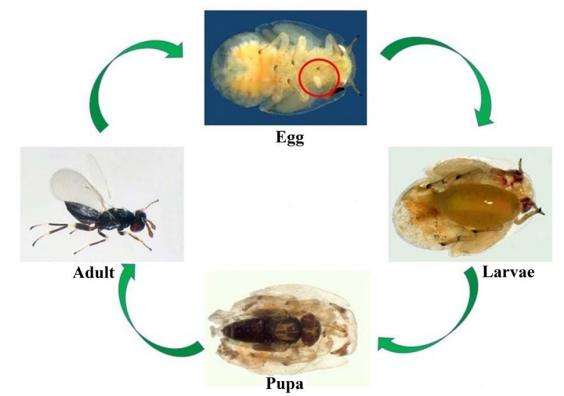
Figure 1 Life cycle of the wasp Tamarixia triozae (Chalcidoidea: Eulophidae) parasitoid of Bactericera cockerelli (Hemiptera: Triozoidae) or the potato psyllid. The adult wasp oviposits on its host; later, larvae emerge from the eggs and feed on its hemolymph until completing their life cycle, which results in the death of the host.
The importance of the CIBE lies in the documentation, recording and preservation of the biodiversity of Mexican parasitoid wasps; in addition, it constitutes a reference collection for both national and international specialists. The collection has type specimens and provides parasitoid identification services to research institutions, private industry, as well as undergraduate and graduate students. According to our knowledge, to date, the CIBE is the largest and best kept collection of parasitoid wasps in Mexico.
Materials and methods
The dry and slide-mounted specimens (as well as those kept in ethanol) deposited in the CIBE were revisited and counted. The dry-mounted material is stored in metal drawers (Fig. 2 A-B ) and arranged in entomological boxes with airtight glass lids (Fig. 2C). Each specimen contains a label with the locality data, a second label with the host data, and a third one with the taxonomic determination. The material that is in slides is found in plastic boxes and each slide includes collection data, determinant (who identified it) and the CIBE reference key (Fig. 3). The material preserved in ethanol (75%) is stored in refrigerators at a temperature of 4°C, the specimens are separated by families in 2 mL microtubes. Each tube has an internal label with the CIBE key and an external one with the replica of said key (Fig. 4).
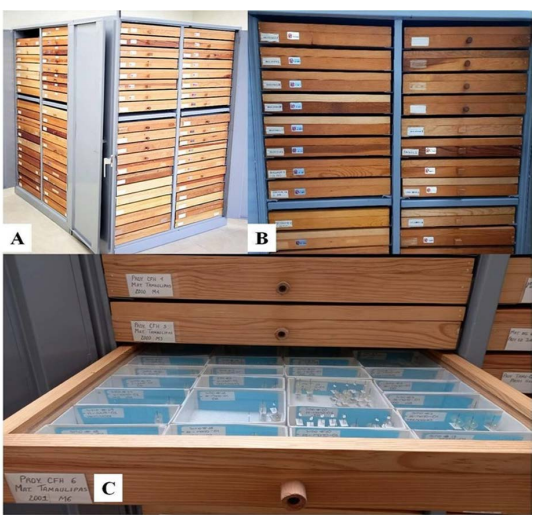
Figure 2 A, B) Metal drawers where the entomological boxes of dry-mounted material are stored. C) Inside the drawers, the insects are arranged in entomological boxes with airtight glass lids.
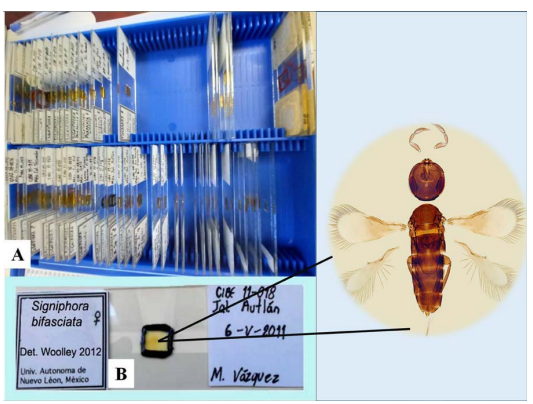
Figure 3 A) Slides in plastic boxes. B) Detail of labeling of the individual slides and the arrangement of the specimens.
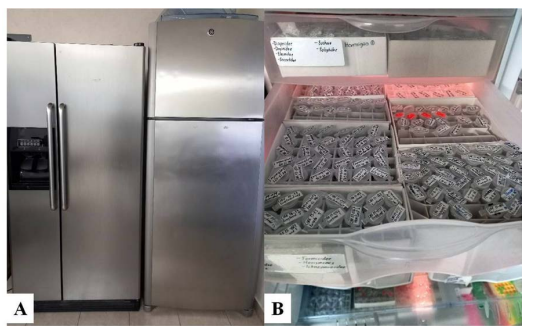
The curatorial processes of the dry-mounted specimens follow the process of Borror & DeLong (1971). Which basically consists of dehydrating the specimens in alcohol at increasing concentrations (70%, 80%, 90% and 96%), then they are placed in amyl acetate for 30 minutes and then on paper for drying. Finally, the specimens are mounted in triangles and labeled. The specimens prepared in permanent mounting on slides follow the standardized techniques for micro Hymenoptera recommended by Castro (1996) and Noyes (1982). It basically consists of permanent preparations in Canada balsam.
Results
Currently the collection has more than 105,000 specimens. The collection represents 40 families of parasitoid wasps, which have been collected in practically all states of the country. Although there is also material from countries such as Argentina [Tamarixia radiata (Waterston)], Brazil (Tamarixia radiata), Colombia [Diaphorencyrtus aligharensis (Shafee, Alam and Argarwal) and T. radiata], Ecuador (Euplectrus Westwood), USA (Diaphorencyrtus aligarhensis, Euplectrus spp., T. dahlsteni Zuparko, T.radiata, and T. schina Zuparko), Pakistan (T. radiata), Trinidad and Tobago (Ixodiphagus Howard) and Uruguay [Melittobia acasta (Walker) and Sceliphron asiaticum (Linnaeus)].
The collection is organized into superfamilies, in the first is the superfamily Ichneumonoidea with its families Braconidae and Ichneumonidae, Braconidae is organized by genera and species; these are arranged in alphabetical order. In another drawer the superfamily Chalcidoidea is organized with its families and each family with its genera and species. The other superfamilies are organized in other drawers following the aforementioned order.
The best represented families at the CIBE is Braconidae with 123 genera and 23 species, Ichneumonidae with 52 genera and 59 species, Encyrtidae with 100 genera and 29 species and Eulophidae with 53 genera and 65 species (Fig. 5, 6). The oldest specimens belong to the Braconidae family, collected in 1984 and determined by the group's specialist, Dr. Robert Wharton. Some species of Ichneumonidae were determined by Kasparyan. The species within Chalcidoidea were determined by the group's specialists such as Lasalle, G.A.P. Gibson; M.A. Reyes, Deluore, A. González Hernández, V. A. Trjapitzin, J. Woolley, and J.S. Noyes as for Platygastroidea, they were determined by N.F. Johnson, A. González-Hernández, E. J. Talamas, and M.L. Ramírez Ahuja.
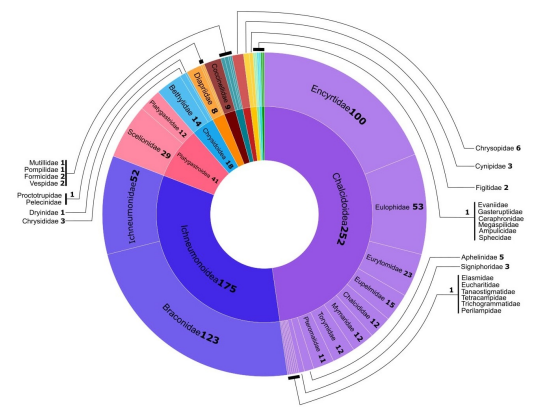
Figure 5 Genera, families and superfamilies of Hymenoptera. The numbers next to the family represent the genera that it has in CIBE.
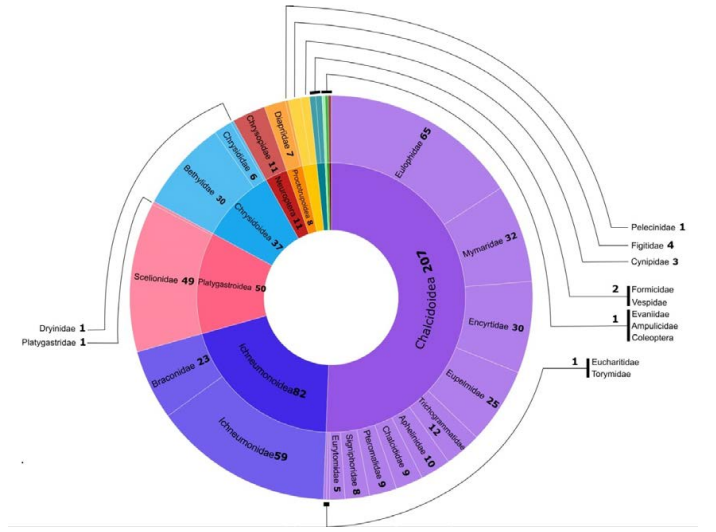
Figure 6 Species of Hymenoptera. The numbers next to the family represent the species it has in CIBE.
At CIBE the specimens are available for consultation or loan, one only must fill a form with the applicant's information, as well as their academic affiliation and deliver it to the corresponding author (curator of the collection). The CIBE also receives donations of Hymenoptera. One of the most recent donations to the collection was from the Conkal Institute of Technology, which donated many parasitoid wasps of the superfamily Platygastroidea and Hymenoptera of Quintana Roo from Jorge Rojas in 2022.
Type material. In the CIBE there are ten paratypes of the species: Triaspis eugenii Wharton & López-Martínez, Retusigaster albopilosus Mercado, Retusigaster noguerai Mercado (Braconidae), Itoplectis gonzalezi Kasparyan, Itoplectis nigrithorax Kaparyan, Itoplectis specularis Kasparyan, Iseropus hylesiae Kasparyan (Ichneumonidae), Aranobroter rayorae LaSalle, Baryscapus uetzi LaSalle (Eulophidae), and Spalangia imitator Gibson (Pteromalidae).
Superfamily: Ichneumonoidea
Family: Braconidae
Triaspis eugenii Wharton & López-Martínez, 2000
Paratypes. Mexico, Nayarit, Baladero, 02-II-1997. E. Mariscal (1♀; 1♂); Host: No hosts. Additional data: Malaise trap, Drawer 1, box II (CIBE). They do not have geographic location and altitude information.
Retusigaster albopilosus Mercado, 2003
Paratypes. Mexico, Yucatan, Xmatkuil, 04-08-VI-1996. F. Leon (1♀); Mexico, Yucatan, Xmatkuil, 18-28-VI-1996. H. Delfin & F. Leon (1♂); Host: No hosts. Additional data: Malaise Trap, Drawer 1, box II (CIBE). They do not have geographic location and altitude information.
Retusigaster noguera Mercado, 2003
Paratype. Mexico, Jalisco, Biologia Chamela Station, 04-05-VII-1993. Wharton & Sharkey (1♀; 1♂). Additional data: Malaise trap, Drawer 1, box II (CIBE). They do not have geographic location and altitude information.
Superfamily: Ichneumonoidea
Family: Ichneumonidae
Itoplectis gonzalezi Kasparyan, 2007
Paratype. Mexico, Chiapas, San Cristobal, Reserva Cerro El Huitepec, 02-14-VIII-1997. A. González-Hernández (1♂); Host: No hosts. Additional data: Malaise Trap, 7900 msnm, 16° 46´06´´ N, 92° 41´04´´ W. Drawer 1, box III (CIBE 97-072).
Itoplectis nigrithorax Kasparyan, 2007
Paratype. Mexico, Chiapas, San Cristobal, El Huitepec Hill Reserve, 02-14-VIII-1997. A. González-Hernández (1♀); Host: No hosts. Additional data: Malaise Trap, 7900 msnm, 16° 46´06´´ N, 92° 41´04´´ W Drawer 1, box III (CIBE 97-072).
Itoplectis specularis Kasparyan, 2007
Paratype. Mexico, Chiapas, San Cristobal, El Huitepec Hill Reserve, 02-14-VIII-1997. A. González-Hernández (1♀); Host: No hosts. Additional data: Malaise Trap, 7900 msnm, 16° 46´06´´ N, 92° 41´04´´ W Drawer 1, box III (CIBE 97-072).
Iseropus hylesiae Kasparyan, 2006
Paratype. Mexico, Chiapas, San Cristobal, El Huitepec Hill Reserve, 17-II-05. Y. Balam-Ballote (1♀); Host: Ex nidos de Hylesia sp (Lepidoptera: Saturniidae), sobre Arbutus xalapensis (Ericaceae). Box # 14. Additional data: Drawer 1, box III. They do not have geographic location and altitude information.
Superfamily: Chalcidoidea
Family: Eulophidae
Aranobroter rayorae LaSalle, 1990
Paratype. Mexico, Veracruz, Fortin de las Flores, 1000m, 27-VIII-1983. G. W. Uetz (4♀); Host: From eggs sacs Metepeira incrassata (Araneidae). Additional data: Drawer 3, box VIII. They do not have geographic location and altitude information.
Baryscapus uetzi LaSalle, 1990
Paratype. Mexico, Veracruz, Fortin de las Flores, 1000m, -XI-1988. R. S. Rayor (1♀); Host: From eggs sacs Metepeira incrassata (Araneidae). Additional data: Drawer 3, box VIII. They do not have geographic location and altitude information.
Superfamily: Chalcidoidea
Family: Pteromalidae
Spalangia imitator Gibson, 2009
Paratypes. Mexico, Michoacan, La Posta, Tarimbaro, 02-X-1987. S. Diaz F. (1♀); Tamaulipas, Cd. Victoria, Valle del Libramiento 20-VII-1987. C. Hernández (1♀); Tamaulipas, Cd. Victoria, Cañon del Novillo, 22-V-1987. A. González (1♂); Host: No data. Additional data: Drawer 4, box I. They do not have geographic location and altitude information.
Publications. Since its creation to date, the CIBE has served as a reference for the making of taxonomic catalogs and identification tools such as: Illustrated catalog of the parasitic Hymenoptera of Mexico (González-Hernández, 1997); illustrated catalog of Mexican Braconidae (Hymenoptera: Ichneumonoidea) (González-Hernández et al., 2003a,b); Identification and distribution of the genera of Encyrtidae (Hymenoptera: Chalcidoidea) in Mexico (González-Hernández & Woolley, 2001). State studies have been carried out such as the Ichneumonoidea Wasps work in Veracruz (González-Hernández et al., 2011). Taxonomic keys such as Mymaridae, Scelionidae have been published to recognize the species of the different families and, in addition, CIBE has contributed to the training of specialists in various families of Hymenoptera such as the family Aphelinidae, Bethylidae, Encyrtidae, Mymaridae, Trichogrammatidae, Scelionidae, Signiphoridae, Braconidae, Ichneumonidae, etc.
Regarding the publication of scientific articles, since its creation, CIBE has served as a source of information and reference for the publication of various articles, focused on the biological control of a wide variety of pests of agricultural importance. For example, “Species of Trichogramma Westwood (Hymenoptera: Trichogrammatidae) present in breeding centers in Mexico” (García-González et al., 2005). According to Van Lenteren & Bueno (2003), in our country, Trichogramma is released in 1.5 million hectares annually, so having reference specimens is of utmost importance to guarantee the certainty of the species that are reproducing.
On the other hand, research has also been carried out based on the records of the collection in order to provide candidates for use as biological control agents against pests of possible invasion in our country. As an example, given the high risk of invasion by the stink bug Halyomorpha halys (Stål) (Hemiptera: Pentatomidae) which invaded the United States of America. In Mexico, studies were carried out to search for and determine parasitoids associated with stink bugs of the Pentatomidae family, which could represent potential biocontrol agents against this species of polyphagous bug (Ramírez-Ahuja et al., 2019).
In 2009, when Diaphorina citri (Kuwayama) (Hemiptera: Liviidae) invaded the country, its associated native parasitoids were studied, and the genetic variability of wild populations of Tamarixia radiata (its main biocontrol agent) was also characterized. This study was carried out in order to search for races or populations of T. radiata that are more aggressive against D. citri (Peña-Carrillo et al., 2014; Peña-Carrillo et al., 2015).
During 2018, work was carried out on the determination of the parasitoids and hyperparasitoids of the yellow sorghum aphid Melanaphis sacchari (Zehntner) (Hemiptera: Aphididae) in the sorghum crop (Payán-Arzapalo et al., 2018; García-González et al., 2018). Since M. sacchari was introduced into the country in 2013, this pest has spread to practically all sorghum-producing states, causing losses of 30% to 100% in sorghum cultivation (Rodríguez del Bosque & Terán, 2015). Accordingly, in areas where the yellow sorghum aphid occurs in Mexico, the species Chrysoperla carnea (Stephens) (Neuroptera: Chrysopidae) is released for its control. Although C. carnea is the only species that is released against M. sacchari, at least eight other species of Chrysopidae reproduce in Mexico which represent potential biocontrol agents for said pest (Arredondo-Bernal, 2019). Chrysopidae egg collections were recently carried out in Sinaloa, where two species of Telenomus Haliday that parasitize Neuroptera eggs were found (Ramírez-Ahuja et al., 2020). Therefore, the activity of the parasitoid on Chrysopidae populations must be considered in biological control and integrated pest management programs.
In another work, the parasitoid species associated with the American leaf miner, Liriomyza trifolii (Burgess) (Diptera: Agromyzidae), were identified in Baja California Sur during 2017 (Holguín-Peña et al., 2019). In another study, the parasitoid Ganaspis brasiliensis Ihering (Hymenoptera: Figitidae) was reported for the first time in the country, in Michoacán, parasitizing Drosophila suzukii Matsumura (Diptera: Drosophilidae), one of the main pests of strawberries in Mexico. Additionally, in this study, other parasitoid species such as Leptopilina boulardi (Barbotin, Carton, & Kelner-Pillault) (Hymenoptera: Figitidae), Pachycrepoideus vindemmiae (Rondani) (Hymenoptera: Pteromalidae) and Trichopria drosophilae (Perkins) (Hymenoptera: Diapriidae) were reported attacking this fly species (Toledo-Hernández et al., 2021).
Among the CIBE collection, the parasitoid wasps from the “El Edén” reserve are also registered at the family level, which has contributed to the list of the Diversity of Chalcididae (Hymenoptera: Chalcidoidea) in protected natural areas of the state of Yucatán (Chay-Hernández et al., 2009).
Perspectives. Currently, the CIBE has included the molecular identification of species through the use of the barcoding technique or barcode of life. To date, of the species deposited in the collection, only 5% have a barcode. In the future, it is planned to have all the species in the collection identified morphologically, and for each one to have its barcoding sequences registered in databases such as GenBank and BoldSystems (http://www.boldsystems.org/index.php/ MAS_Management_UserConsole) for universal availability (Boldsystem, 2024). The possibility of digitizing the content of the collection is also being considered, since previously there was a server on which photographs and data of the species were available.
Due to the importance of native bees, a new line of research has been created at CIBE focused on the study of these species. Stingless bees of the Meliponini tribe are native bees in Mexico and are classified as threatened due to habitat loss, changes in land use, indiscriminate use of insecticides, among other factors. This new line of research consists of determining the profile of amino acids and acylcarnitines (metabolomes), identifying the bacteria found in the midgut of these species (microbiome) and knowing the miRNome of these species. With these objectives, the aim is to know and contribute to the preservation of native bees.
If we want our collections to be considered a permanent source of information and national heritage, they must be properly cared for and maintained. With the care, management and conservation of specimens from biological collections and their associated data, a wide variety of research can be carried out that leads us to know the biodiversity of the planet. The richness of a scientific collection is found in the information it contains.

