




 nueva página del texto (beta)
 Inglés (pdf)
 Artículo en XML
 Referencias del artículo
 Traducción automática
 Enviar artículo por email
 Citado por SciELO
  Similares en
SciELO
Similares en
SciELO 
 Permalink

1. Introduction
Abraham Leo introduced FinTech in 1972, a combination of two words, Fin, which means Financial, and Tech means Technology, explained as a contraction between a variety of financial institutions and digital technology. FinTech refers to digital technology built on the block chain, big data, and artificial intelligence advice used to facilitate financial transactions. Data from the Accenture consultancy organization in the United States shows that global FinTech investment surged by more than 12 times between 2010 and 2016, compared to the same period the previous year (Siek & Sutanto, 2019). Before April 2015 Cai (2018) mentioned that there were around 800 FinTech companies in the world according to industry estimates. A total of $215.2 billion in FinTech investment was made by the end of 2020, marking a 21.5% increase over the same period last year. More than 10,755 companies were in operation in the United States of America, and 9323 FinTech companies’ build-up in Europe and the Middle East region by November 2021, in Italy there are more than 280 FinTech companies where 40 companies have already adopted artificial intelligence (Torriero et al., 2022). On the other hand, these companies are restricted to three primary financial services: lending, borrowing, and investing. However, some are more focused on providing clients with a better user experience as their specialty than banks (deposit, payment, and lending). Barari & Furrer (2018) considering the importance of customer experiences, traditional financial service organizations, such as banks, have begun to acquire or collaborate with FinTech startups to strengthen their core competitiveness and market dominance in the financial services industry. DeYoung et al. (2009); Elsaid (2021) stated that a firm primarily focused on internet banking operations in the United States and has obtained high levels of consumer satisfaction, Banco Bilbao, Vizcaya Argentaria, and Banca Carige has announced that it has acquired simply.
The long history of the development of the banking industry is studied with most of the innovative advancement that has occurred in the financial services industry (Gomber et al., 2018). Early in the 15th century, banks began using physical media technology to store information or value to conduct transactions, a practice still prevalent today (Stojakovic-Celustka, 2023). The market could extend beyond its initial regional borders by the late 19th century, which continued into the 20th century using simulation technology. Up until the financial crisis of 2007, digital information and communication technology was applied to financial services, assisting in the development of transnational electronic networks, the establishment of interface standards, and the development of standard software, all of which contributed to the development of financial services (Udeagha & Breitenbach, 2023; Gallego-Losada, 2023). With the advancement of information and communication technology, the number of banks that outsource operations and activities has increased dramatically (Viller & Khan, 2021). However, at this point in the digital transformation process, the degree of vertical integration is still relatively high.
Furthermore, there is a growing gap between the number of bank employees and the number of banks currently operating. During the same period, banks spent more on digital information and communication technology than any other company in the financial industry, exceeding the spending of all other businesses combined (Kitsios et al., 2021). There needs to be more money spent on information technology and the digital transformation of banking business models and operations in the banking industry. As can be seen, the inefficiency of the current scenario has also encouraged the expansion of FinTech banking because of the current state of affairs (Shao, 2022; Chinnasamy et al., 2021). For financial institutions, incorporating FinTech into their operations is intended to improve the client experience while also increasing the efficiency of the financial organization (Awotunde et al., 2021; Gomber et al., 2018). The current state of research focuses mainly on the supply-side implications of FinTech strategy and risk for the banking industry which is a relatively new field of study (Lee & Kim, 2020). Several researchers have investigated the "peer-to-peer" collaboration between Indonesian banks and Fintech companies (Hassan et al., 2022; Tambunan, 2022; Todorof, 2018). Tamabunan investigated the use of FinTech by Indonesian banks and their ability to compete with FinTech companies (Tambunan, 2022).
However, FinTech deployment in major established institutions, notably in Italy, has been difficult. This is because legal and regulatory regulations, security concerns, and employee resistance to change measures. Another noteworthy and essential finding that emphasizes the human component is that bank employee' attitudes and acceptance of new technologies are crucial to FinTech solutions integration. Employee approval and adherence are crucial because they are the end-users of these technologies.
Oladapo et al. (2022) stated that banks can provide better service to their customers while strengthening their long-term relationships with their customers in the long run. There is potential for new insights and a better understanding of the issue if more attention is paid to FinTech service uptake attention (Cai, 2018; Alt et al., 2018). Millennials are less financially savvy than prior generations. They rely on something other than banks as much as prior generations when making real-world decisions. The financial capacity of millennials will improve in the long term, resulting in them becoming the primary consumers in the future. The knowledge that various factors influence bank employees' adoption of FinTech services may help banks better meet the financial expectations of millennials in the future (Quah & Chua, 2018). Our research question is
RQ1: Does TAM effects on FinTech adoption process in Italian banks?
FinTech services are widely used in the United States, the United Kingdom, China and India, and Europe. Many Italian banks use FinTech, but there has yet to be any prior research on how the TAM affects employees' views on adopting FinTech. That was vague and insufficient, thus it's crucial to know how Italian banks apply the TAM model for employee FinTech adoption views. Some prior research describes limited analytical TAM and FinTech studies, which solely examined consumers and users. The results and analysis of this research will discover and provide an excellent contribution to Italian banks, the Italian digital economy, and the crypto world of Italy. This research will benefit Italian banks, small companies, insurance companies, crypto traders, block chain developers, and financial analysts.
Along with considering additional factors that influence the adoption of FinTech services (Singh et al., 2020), it does so comprehensively and concretely. It represents a significant advancement in the use of typical TAM models (Palmié et al., 2020).
The remaining portions of the paper are organized in the following manner. In section 2 a survey of relevant literature is conducted, and a conceptual framework, a few hypotheses, and some reasons for their selection are all described in further detail. Section 3 consists of research methodology. Section 4 summarizes the data analysis and findings, followed by a discussion. The conclusion is provided in the Section 5 that concludes the paper, which brings the study to a close, contains a few caveats and ideas for further research and development.
2. Literature Review
2.1. FinTech Adoption
FinTech is a company's internal department that uses modern information technology to improve financial service quality and management efficiency (Leong et al., 2017; Jünger & Mietzner, 2020). It might boost banking productivity and expand financial services. FinTech expansion has led to new technologies including big data, cloud computing, the Internet of Things, and analytical tools (Meng et al., 2021; Chen et al., 2022; Ashta & Biot-Paquerot, 2018). FinTech security and privacy fall into four categories: data-oriented, facilities and equipment, applications and service models, and applications and service models (Gai et al., 2017). FinTech differs greatly from traditional financial services (Gimpel et al., 2018). FinTech goes beyond information technology in Romania's non-banking capital markets. FinTech is financial services that use big data, cloud computing, mobile computing, and other connectivity, according to this study. TAM was designed to fix numerous faults in the 1986 suggested method for development of reasoned action, which has since gained popularity. This behavioral science method uses anticipation and self-efficacy theories to examine technology users' behavioral intentions (Zhang et al., 2023). Another name for this strategy is expectation theory technique. Individual behavioral attitudes regarding perceived utility and perceived ease of use considerably influence public administration technology adoption in Indonesia due to the TAM model (Warsono et al., 2023). This model is one of the most widely used in information technology adoption research because it accurately characterizes employee desire to use technology and can be tailored to the analytic issue (Aw et al., 2023). The TAM mentioned in this article is adjustable because FinTech services are based on using new information technology capabilities to financial innovation. FinTech services are unique, thus the application procedure differs from traditional e-commerce, even if TAM is commonly used for technology adoption in areas like mobile e-commerce payment. Traditional e-commerce and FinTech application processes differ due to privacy and security concerns, government support, etc. (Cha et al., 2023).
2.2. Perceived Usefulness
The perceived usefulness of information systems in the TAM is a critical aspect of the adoption process. It is described as the extent to which an employee's productivity increases because of incorporating new technology (Tasnim et al., 2023). Employee acceptance of a service is higher when employees believe that the implementation of FinTech, that will have a beneficial impact on their working life (Basdekis et al., 2022). Over the past decade, much empirical research have shown that information technology usability positively influences perceived usefulness. Mainarde et al. (2022) found a significant effect of perceived usefulness on FinTech adoption in FinTech companies of Brazil. Singh et al. (2021) also found a positive effect of TAM on FinTech in telecommunication sector of India. Similarly, Le (2023) found a positive effect of usefulness on FinTech in online shopping companies of Vietnam. Roh et al. (2022) studied Chinese banking institutions as research objects, and an essential advantage of FinTech is the ability to mine user data in-depth and create a user knowledge map. Rahim et al. (2022) researched that adoption of FinTech by millennials is influenced by characteristics such as their life expectancy and level of financial understanding in Malaysia.
2.3. Employee’s Trust
FinTech apps handle multidimensional data, making trust increasingly important (Choung et al., 2022). Understanding how trust affects user attitudes and adoption readiness and what factors can hamper trust is crucial. This study defines trust as a person's overall opinion of an object's utility, as shown by their actions (Ahl et al., 2022). Trust comes from individuals' fundamental qualities and affects employees' conduct (Gbongli et al., 2020). FinTech adoption has risks due to these traits, and researchers have shown that trust is inversely linked to brand image and perceived risk (Wang, 2021). Employees trust banks more if they are familiar with their services and think service risks are significant. Several academic studies have shown that employees' trust in FinTech services is vital to uptake. When employees trust banks and service providers, they are more likely to use the service, making it easier to modify their behavior (Usman et al., 2022), suggesting an indirect association between trust and FinTech adoption.
2.4. Brand Image
Brand Image is a monetary asset that distinguishes itself from abstract and distinctively recognized conceptions (Bapat, 2018). It has a comprehensive reflection of positive effects on employees and customers. The service provider brand effect aids customers in achieving their objectives by encouraging them to choose dependable services. One of the grounds offered to support the use of the government administration information system was the improvement in the organization's brand image among peers (Baber, 2021). According to research in the field of FinTech, employees' views of value and general satisfaction are highly influenced by their impressions of the brand. It has been discovered that employees' opinions of a brand are created in the context of FinTech applications, which is a precondition for organizational trust (Akyuwen et al., 2022). Employees need to provide a significant amount of sensitive information to access FinTech services. A positive brand image may increase consumer trust by lowering the perceived risk of purchasing the product (Le et al., 2022). A positive brand image can aid in the development of user trust among consumers (Setiawan et al., 2021). A company's brand image guarantees its products and services, allowing customers to clearly define the firm's service orientation. It supports both the company and its customers in creating solid relationships and increasing both customer recognition and satisfaction (Reyes-Mercado & Reyes-Mercado, 2021).
2.5. Perceived Risk
As a result, many individuals believe that the perception of danger is the most crucial element inhibiting widespread acceptance of new technologies (Huei et al., 2018). Employees' perceptions of threat when interacting with FinTech services are described using the term "perceived risk." Privacy risk occurs when people pick internet financial products like loans or credit cards over traditional ones, which may reveal their personal data, transaction data, and other private information (Susilo et al., 2019). Puspha et al. (2023) stated that perceptions of risk substantially impact the adoption of e-services. Among the most common concerns expressed by employees while using FinTech services is the possibility that their personal information may be misused. These concerns may impact employees' willingness to utilize FinTech for purchases or consumption, and their perceptions of the risk associated with FinTech use will substantially affect their desire to use Fintech. Taufiq et al. (2023) researched that employees should be aware of the hazards related to FinTech services, such as big data, the Internet of Things, and cloud computing, before engaging in their use. Employees of financial institutions are regularly required to give their private information. Bureshaid et al. (2021) suggested that their confidence in financial organizations is eroded. Employees' perceptions of risk impacted their level of trust.
2.6. Government Support
Finance from the government has a significant influence on the adoption of FinTech. Chowdhury & Hussain (2022) researched that increased public awareness of technology in financial services and investment in infrastructure, such as communications network construction, can boost product and service credibility and trustworthiness. Singh et al. (2020) found that government funding affects the adoption of new technologies and the intention to use them eternally, providing realistic guidelines for the government to create acceptable policies. Shaikh et al. (2020) found that TAM model assess online banking uptake and government support is needed for confidence.
2.7. Innovativeness
Innovativeness may be characterized as an individual's proclivity to accept an innovation at a young age, whether that invention is in the form of a new product, a new technology advancement, or a new service, among other things (Singh et al., 2020). When faced with considerable uncertainty, highly innovative people maintain a solid drive to profit from their discoveries. As a result, they are less concerned about potential dangers and are more open to new technologies (Bureshaid et al., 2021). The tendency for creativity in human beings results from their interest in a recent issue or problem (Hu et al., 2019). Individual inventiveness has a critical positive impact on people's intention to use mobile payment services. It has been demonstrated when considering that most people lack professional knowledge about a wide range of mobile services (Dwivedi et al., 2021).
The relationship between TAM and FinTech has been the subject of several studies by local and international economist and financial experts, who have approached the subject from various approaches. The notion of financial deepening, which introduced in 1980, has gained substantial traction in recent years (Fry, 1980). Dwivedi et al. (2021) researched current challenges United Arab Emirates banks and capital markets use the TAM model towards FinTech. They found a positive relationship between TAM and FinTech. Shaikh et al. (2020) used the TAM model and attitude as a mediating element to study Malaysian consumer attitudes about FinTech and found a favorable link. Based on the above literature review, the hypothesized model has been developed. (See Figure 1).
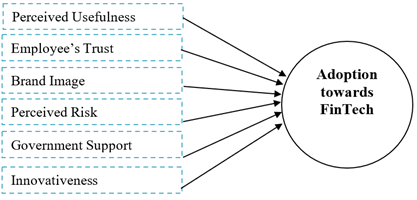
Thus, we have compelling grounds to consider and form the following hypothesis.
H1 = Perceived Usefulness is significantly affected by employees' attitude towards adopting FinTech in Italian banks.
H2 = Employee Trust is significantly affected by employee's attitudes towards adopting FinTech in Italian banks.
H3 = Brand image is significantly affected by employee's attitude towards adopting FinTech in Italian banks.
H4 = Perceived Risk is significantly affected by employee's attitude towards adopting FinTech in Italian banks.
H5 = Government Support is significantly affected by employee's attitudes toward adopting FinTech in Italian banks.
H6 = Innovativeness is significantly affected by employee's attitude towards adopting FinTech in Italian banks.
3. Empirical Methodology
The data gathering process is categorized into two components: primary data and secondary data. Gathering data from primary sources is a time-intensive task, but in many study domains, relying solely on secondary sources is not feasible. This research is exclusively reliant on primary data obtained from a restricted demographic. The study has focused on Italian banks that provide FinTech services and are under the authority of the European Central Bank. Collecting data is challenging because of the language barrier, so the questionnaires were developed in Italian. The data was implemented in the time ranging between 1st June 2023 to 1st August 2023.
3.1 Data and Estimation Technique
A snowball sampling method was applied for the Survey. Since living in Cyprus, it was challenging to gather the data but reaching by one participant from Medio Banca by email and that participant suggested another from Banca Italia. The sample size is 300 which consists of blockchain developers, financial analysts, product managers, cyber security analysts, and quantitative analysts. The data was collected through Surveys via questionnaires. Performa, the research framework contains five exposure variables (Perceived usefulness, Employee trust, Brand image, Perceived risk, Government support, and Innovativeness) and one explained Variable (Adoption towards FinTech). The first variable, perceived usefulness, was adopted by (Lockett & Littler, 1997), which contains four items. The second variable, the employee trust scale adopted by (Zandhessami & Geranmayeh, 2014), which includes two items. Brand image scale adopted by (Ruparelia et al., 2010) has three items. Perceived risk scale contained three items and adopted by (Marakarkandy et al., 2017). Government Support has three items and is adopted by (Marakarkandy et al., 2017). The last exposure variable, Innovativeness, contains two items in the scale adopted by (Zhang et al., 2018). The explained variable adoption towards FinTech includes six items adopted by (Marakarkandy et al., 2017) that measures the Employee's intention towards adoption of FinTech.
For the data analyses, Statistical Package for Social Sciences (SPSS) Amos 26 version has been used. Frequency distribution tables presented demographic tables and Harman common method variance test has been used. For factor analysis using principal axis factoring, further calculate Cronbach Alpha for measuring the validity of items (Kement et al., 2023). For composite reliability and Average Variance Extract (AVE) using the below formulas (Kement et al., 2024):
Composite Reliability = (Σ λ) 2 / (Σ λ) 2 + (Σ δ)
Average Variance Extracted = (Σ λ) 2 / (Σ λ) 2 + Σ Variance θ
After that Discriminant validity has measured. For more analysis of the model, Structured Equation Modelling (SEM) was used (Kement et al., 2023; Teo et al., 2013).
SEM is a highly sophisticated method of statistical modelling wherein the actual variable can be articulated in observed and unobserved index, with all the relationship among the several variables being interlinked. Here we get knowledge not only of what is intelligent or satisfied etc., but we also learn that the error of measurement is in modeling of variable. This has been seen when using it in analyzes involving more than one causative variable and in determining not only first order effects but second as well as total effects. This flexibility of SEM means that different model specifications can be developed and tested such as confirmatory factor analysis and structural regression models. Hence, can be extremely useful in the testing of theories and in the process of developing theories. On that note, the follow-up of the assessment of measure model and its application in research questions as well as hypothesis testing is important as discussed in the SEM. Furthermore, SEM uses IFA procedures for model-fitting that provides calculate measure like RMSEA and CFI; it handles issues in data including missing data or data of the longitudinal format. Such capabilities make SEM an irreplaceable tool of present days’ quantitative section of the research programs offering an all-including, data-fitted versatile instrument, allowing for studying complex data and relations.
4. Analysis and Discussions
4.1 Demographic Statistics
Table 1 presents the demographic characteristics of respondents. Out of the total sample size of 180, 60% are male, and 40% are female. Of the responses, 105 (35% of the total) fall into the 31-40 age bracket, 30 (10%) into the 18-30 age bracket, 120 (40%) into the 51+ age bracket, and 45 (15%) into the over-50 age bracket. The European Central bank controls six banks. Medio Banca is one of the top banks working in Italy, so the highest sample, 60 (20%), was collected from there, and collected equal samples, 48 (16%) from the rest of the five banks, namely, BPER Banca, UBI Banca, Credito Banca, Banca Popolare di Sondrio, and Banca Carige. Employment status in these banks is block chain developers 72 (24%), Quantitative analysts 60 (20%), Cyber Security analysts 54 (18%), Financial Analysts 63 (21%), and Product managers 51 (17%) which have intentions to adopt the FinTech. The educational backgrounds of respondents are in Italian banks, mostly professionals having Master's degrees 174 (58%), 72 (24%) have completed their graduation, while 54 (18%) are doctors and have Ph.D. degrees. The income level of respondents under $3000-$6000 is highest at 174 (58%). Secondly, $6001-$9000 are 105 (35%) in 21 (7%) out of 300 who earn less than $3000. 231 (77%) respondents said that every day they use FinTech, while 45 (15%) said usually and 24 (8%) said that occasionally they use FinTech.
Table 1 Demographic information.
| Characteristics | No. | % | |
|---|---|---|---|
| Gender | Male | 180 | 60% |
| Female | 120 | 40% | |
| Age Group | 18-30 | 30 | 10% |
| 31-40 | 105 | 35% | |
| 41-50 | 120 | 40% | |
| 51 and above | 45 | 15% | |
| Name of Banks | Medio Banca | 60 | 20% |
| B.P.E.R. Banca | 48 | 16% | |
| U.B.I. Banca | 48 | 16% | |
| Credito Banca | 48 | 16% | |
| Banca Papolre di Sondrio | 48 | 16% | |
| Banca Carige | 48 | 16% | |
| Employment Status | Block Chain Developers | 72 | 24% |
| Quantitative Analyst | 60 | 20% | |
| Cyber Security Analyst | 54 | 18% | |
| Financial Analyst | 63 | 21% | |
| Product Manager | 51 | 17% | |
| Education | Bachelors | 72 | 24% |
| Masters | 174 | 58% | |
| Ph.D. | 54 | 18% | |
| Income Level | Less than $3000 | 21 | 7% |
| $3000-$6000 | 174 | 58% | |
| $6001-$9000 | 105 | 35% | |
| FinTech Usage | Daily | 231 | 77% |
| Occasionally | 24 | 8% | |
| Usually | 45 | 15% |
4.2 Factor Analysis
For exploratry data analysis factor analysis was used in one data reduction technique. Table 2 represents the analysis of factors and items used in the variables. Harman test is used for constructing the eigen values and sum of squared loadings. Bagozzi & Foxall (1996) suggested that if r is more significant than 0.90, there is a strong positive correlation among factors in common method bias. Principal Axis factoring extraction and variance in the common method is 31.43%, below 50%. In this study, CMV was analyzed by the Harman Single factor test. This analysis suggests that there is no specific concern and inflates relationship among percived usefulness, ease of use, brand image,percieved risk, government support and innovativeness and employee's attitudes toward adopting FinTech. This study has yet to initial results of the current common method variance.
The model was constructed and measured through the SPSS Amos and SEM approach in figure 2. For Discriminant validity, AVE is checked by (the Fornell Larcker ratio). And Composite reliability by (Amini-Tehrani et al., 2020) suggested the cut-off is 0.70. Conformity factor analysis is used in Table 3, which discussed Item loadings by composite reliability and Cronbach Alpha in Perceived usefulness loadings values of 1st, 2nd, and 4th items are 0.877, 0.839, and 0.728. It is above 0.7. As suggested in the SEM approach, these items can be extracted while the 3rd item value is below 0.7, so it can't remove. So this item should be deleted from the measurement model figure 2.
Everything in the employee trust variable is valid. Cronbach Alpha (CA) and Composite reliability (CR) are 0.851 and 0.811, above 0.60, and AVE is 0.53 greater than 0.5, indicating good validity for perceived utility. Because all item values are greater than 0.7, CA and CR are high, and AVE is greater than 0.5, employees believe all item loadings. Brand Image's two items both had item loadings of 0.919, indicating perfect items. CR, CA, and AVE excel. Risk perception AVE, CR, and CA exceed 0.6. CA is 0.796 and item loadings are valid, so all items are valid. This variable has strong validity because government support loadings are over 0.5 and CA, CR, and AVE are over 0.7. Innovativeness has CA, CR, and AVE over 0.7, and the cut-off value and item loadings are 0.928 (high validity). Six things make up FinTech, the last variable. The first five items' loadings are good, but the last one is below 0.4, so we can't extract it. Since CA, CR, and AVE exceed their cut-off values, validity is good.
Since all loadings are under one, the measurement model has no negative residuals. Table 4 discusses the Discriminant validity suggested by (Amini-Tehrani et al., 2020) and the correlation among the variables for the correlation Pearson method is used. All correlation values range between 0.5 to 0.8, so there is a moderate and strong correlation among variables. Since all correlation values are below the squared root of AVE values., there is no discriminat or divergent validity in the model.
Table 5 presents the overall model fit summary of the model; X2 is the chi-square value is 1105.862, and Chi-square value concerning the degree of freedom is 4.915, and it is below than critical value of 5, the goodness of fit value is 0.937, and it is above than 0.90 so model is fit in goodness is acceptable, CFI value is 0.98, comparative fix index is also below than 0.90, and it suggested value well. The normed fit index is 0.96, which is also above 0.95, which suggests a very good fit. The root mean square residual value is 0.047, and it is below 0.05, so it is acceptable and the RMSEA value is 0.074; not so good, but it is acceptable because it is below than critical value of 0.08 (Chen et al., 2008). The P-value is 0.000, below the 0.05 significant value. The overall model is good and statistically substantial for structured model analysis.
Table 2 Harman Common Method Variance test
| Factor | Initial Eigen Values | Extraction Sum of Squared Loadings | ||||
|---|---|---|---|---|---|---|
| Total | % of variance | Cumulative % | Total | % of variance | Cumulative % | |
| 1 | 7.230 | 31.436 | 31.436 | 6.881 | 29.916 | 29.916 |
| 2 | 2.945 | 12.802 | 44.238 | |||
| 3 | 2.252 | 9.792 | 54.030 | |||
| 4 | 1.800 | 7.826 | 61.856 | |||
| 5 | 1.498 | 6.512 | 68.369 | |||
| 6 | 1.116 | 4.850 | 73.219 | |||
Extraction Method: Principal Axis Factoring
Table 3 Measurement Model, Item Loadings, Composite Reliability and Convergent Validity
| Constructs | Coding | Loading | CA | CR | AVE |
|---|---|---|---|---|---|
| Perceived Usefulness | PU1 | 0.877 | 0.811321 | 0.536669 | |
| PU2 | 0.839 | 0.851 | |||
| PU3 | 0.379 | ||||
| PU4 | 0.728 | ||||
| Employee’s Trust | ET1 | 0.874 | 0.907967 | 0.766831 | |
| ET2 | 0.869 | 0.848 | |||
| ET3 | 0.884 | ||||
| Brand Image | BI1 | 0.919 | 0.915731 | 0.844561 | |
| BI2 | 0.919 | 0.815 | |||
| Perceived Risk | PR1 | 0.837 | 0.880792 | 0.711231 | |
| PR2 | 0.846 | 0.796 | |||
| PR3 | 0.847 | ||||
| Government Support | GS1 | 0.848 | 0.87749 | 0.704935 | |
| GS2 | 0.860 | 0.791 | |||
| GS3 | 0.810 | ||||
| Innovativeness | IN1 | 0.928 | 0.925415 | 0.861184 | |
| IN2 | 0.928 | 0.837 | |||
| Intentions To adopt FinTech | FT1 | 0.573 | 0.838333 | 0.572813 | |
| FT2 | 0.817 | 0.766 | |||
| FT3 | 0.620 | ||||
| FT4 | 0.813 | ||||
| FT5 | 0.760 | ||||
| FT6 | 0.467 |
Extraction Method: Principal Component, AVE= Average Variance Extracted, CR= Composite Reliability, CA= Cronbach Alpha
Table 4 Discriminant Validity
| Variable | AVE | SAVE | 1 | 2 | 3 | 4 | 5 | 6 | 7 |
|---|---|---|---|---|---|---|---|---|---|
| FinTech | 0.572813 | 0.756844 | 0.756 | ||||||
| Perceived Usefulness | 0.536669 | 0.732577 | 0.545 | 0.732 | |||||
| Employee’s Trust | 0.766831 | 0.875689 | 0.594 | 0.685 | 0.875 | ||||
| Brand Image | 0.844561 | 0.919 | 0.614 | 0.646 | 0.521 | 0.919 | |||
| Perceived Risk | 0.711231 | 0.843345 | 0.645 | 0.623 | 0.645 | 0.751 | 0.843 | ||
| Government Support | 0.704935 | 0.839604 | 0.610 | 0.528 | 0.647 | 0.721 | 0.790 | 0.839 | |
| Innovativeness | 0.861184 | 0.928 | 0.690 | 0.503 | 0.746 | 0.712 | 0.640 | 0.644 | 0.928 |
Extraction Method: Principal Axis Factoring
Table 5 Overall Model Fit Summary.
| Constructs | X2 | CMIN/DF | GFI | CFI | NFI | RMR | RMS | P Close |
|---|---|---|---|---|---|---|---|---|
| Indicator Value | 1105.862 | 4.915 | 0.937 | 0.983 | 0.963 | 0.047 | 0.074 | 0.000 |
Extraction Method: Principal Axis Factoring
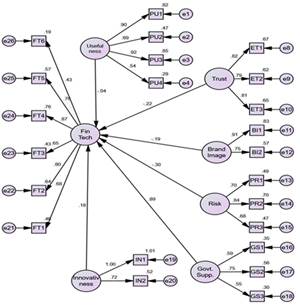
4.3 Structured Model and Hypotheses testing
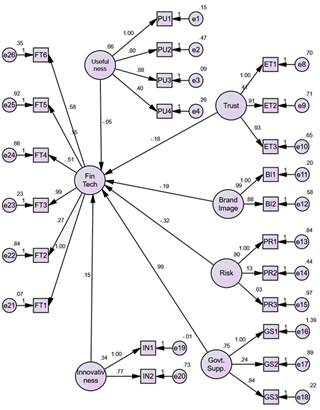
Figure 3 Structured model interpreted in SPSS Amos maximum likelihood method is used in SEM. Although this research is relatively simple because there are no mediate and moderate variables, we used it for better and authentic results because the SEM model always generates more valid and valuable results. β values, p-values, standard errors, and critical values in structred model presented in Figure 3. Beta value gives the coefficient and shows how much % changes in the independent variable will affect the dependent variable.
Table 6 presents the Hypotheses testing (Critcal Value (CR)=0.743, P < 0.457, β1=0.043) p-value is greater than 5% critical values, so it rejects the H1 that perceived usefulness has significant effect on adoption towards FinTech services in Italian banks controlled by European Central bank. (CR=3.401, P < 0.000, β2=0.222) A p-value of employee trust is 0.000 at all significance levels. It is statistically significant, meaning employee trust significantly affects the adoption of FinTech services; Hence; it supports H2. (CR=2.534, P < 0.11, β3=0.191) The p-value of the brand image is 0.11, which means brand image has no significant effect on the adoption of FinTech services so H3 reject. (CR=4.069, P < 0.000, β4=0.301). A p-value of perceived risk is 0.000, Hence, H4 supported that perceived risk has a significant effect on adopting FinTech services (CR=6.050, P < 0.000, β5=0.889). A p-value of Government Support is 0.000 that supports H5 that government support significantly impacts the adoption of FinTech services. (CR=2.242, P < 0.02, β6 =0.176) A p-value of Innovativeness is 0.02 implying that Innovativeness has a significant effect on adopting FinTech services so that H6 supported.
Table 6 Hypotheses Testing
| Hypotheses and Path | B | Beta (B) | Sd. Error | Critical ratio | P-Value | Result |
|---|---|---|---|---|---|---|
| H1: PU → FT | 0.051 | 0.043 | 0.068 | .743 | .457 | Not Supported |
| H2: ET → FT | 0.180 | 0.222 | 0.053 | 3.401 | *** | Supported |
| H3: BI → FT | 0.185 | 0.191 | 0.073 | 2.534 | 0.11 | Not Supported |
| H4: PR → FT | 0.322 | 0.301 | 0.079 | 4.069 | *** | Supported |
| H5: GS → FT | 0.988 | 0.889 | 0.163 | 6.050 | *** | Supported |
| H6: IN → FT | 0.146 | 0.176 | 0.065 | 2.242 | 0.025 | Supported |
B= unstandarized Regression weights, Beta (B) = Standarized Regresion Weights and ***P < 0.005
5. Discussions
This survey examines TAM and employee FinTech opinions. TAM and FinTech service research was done by banking customers and end-users. TAM's impact on FinTech employee adoption is also examined in this study. In Italian banks, perceived usefulness doesn't affect FinTech uptake. FinTech adoption depends on usability. FinTech is easy to use for non-technical persons due to its user-friendly interface and convenient operation. It allows simple navigation so consumers may use the service with little effort. User satisfaction and frequency will grow with FinTech application simplicity of use. Ease of use boosts word-of-mouth referrals and customer retention, increasing user adoption. User-centered design and functionality are crucial for FinTech companies to build their user base and compete in a competitive industry. Our findings match Zhang et al. (2023) for Pakistan; Oladapo et al. (2022) for Malaysia and Saudi Arabia and Torriero et al. (2022) for Italian banks. Brand image doesn’t have significant effect on FinTech adoption in Italian banks.
FinTech adoption in financial technology is heavily influenced by perceived risk. As most services are complicated and innovative, user perceptions of risk considerably influence their path. Data security, privacy, financial loss, and new technology trustworthiness are concerns. If there is a risk of unlawful access to sensitive financial data or an automated system breakdown, users may avoid FinTech services. Uncertain regulatory frameworks and FinTech company survival add to risk perception. FinTech firms must address these concerns with solid security, open data communication, and regulatory compliance. Effective risk management will build trust and enable widespread adoption and expansion of FinTech innovations in financial services. Our findings are included with Baber (2021) for Indian banks, Xie et al. (2021) for China, and Meyliana & Fernando (2019) for Indonesia.
Government action in regulatory frameworks, financial incentives, and cooperation initiatives may affect FinTech adoption in business. Stable and understandable rules encourage investment, while financial incentives from assistance programs give FinTech businesses valuable resources. Government-driven initiatives that encourage traditional banks and FinTech startups to collaborate promote knowledge transfer and innovation. Government funding would help Italian banks implement FinTech technologies, making them more competitive and robust in the digital age. Hu et al. (2019) Hefei Science and Technology Rural Commercial Bank China; Huei et al. (2018) for Malaysia, and Balaskas et al. (2024) Greece found similar results.
Innovativeness drives FinTech uptake in Italian banks. Banks should embrace technological innovation to survive the rapid digital change in the financial sector. Such banks will naturally explore and integrate FinTech solutions into their operations, realizing the potential efficiency, customer experience, and competitiveness benefits. However, banks that resist change or lack innovation may avoid FinTech for fear of disrupting systems. Leadership innovation also accelerates FinTech adoption among Italian banks. This will keep banks nimble and competitive in the digital age. Our results supported by Setiawan et al. (2021) for Indonesia; Tambunan (2022) for Singapore and Chowdhury & Hussain (2022) for Bangladesh.
5.1 Conclusions
There is high demand for FinTech services across Europe and the rest of the world. Italian banks that the European central bank controls have been growing in the usage of FinTech since 2018. Internet and Technology based equipment has increased daily, and banks are switching from typical financial characteristics towards FinTech. Six hypotheses were proposed in the model. Based on the analysis, perceived usefulness and brand image are not statistically significant in employees' attitudes to the adoption of FinTech services in Italian banks. At the same time, perceived usefulness is one of the primary tools supported by many past studies on end-users adopting FinTech services. Employees' trust, perceived risk, government support, and innovativeness are statistically significant with employee's attitudes to adopting FinTech. At the same time, Italian banks give FinTech services to reduce the perceived risk. The findings of this study provide empirical research and Employee assessment for Italian banks to generate unique and new, employee-centered services.
5.2 Managerial Implications
It also means that perceived ease of use and perceived usefulness in FinTech adoption should be critical; hence, user-friendly and highly functional FinTech solutions should be designed. Consequently, managers should invest in technology that is easy to use and offers benefits that are apparent and tangible to employees so that they will willingly adopt them. When further elements such as trust and perceived risks are added to the adoption framework, it requires that security is guaranteed and transparently communicated about in order to overcome these concerns. Managers ought to design comprehensive training and clear protocol programs, thereby addressing security concerns related to FinTech at their source and creating trust in FinTech solutions among the workforces. Organizational support and regulatory compliance also matter. Managers must provide resources, a culture of creativity, and regulatory compliance to promote technological development. Professional development, effective communication of FinTech's benefits and strategic importance, and strong regulatory engagement through compliance awareness can achieve this. Understanding staff variability in technology skills and job requirements offers distinct FinTech implementation options. Another reason why strict, one-size-fits-all FinTech implementation strategies may not work for an organization. Managers should implement adaptable tactics that accommodate diverse technological skill levels and provide tailored training and assistance for different segments. This individualized strategy can improve transitions and organization-wide acceptance. Finally, managers can utilize peer influence and develop a FinTech adoption infrastructure by combining UTAUT elements like social influence and facilitating conditions. The promotion of technology champions within the organization as examples and the influence of other employees in its favor will further enhance attitudes and behaviors toward FinTech.
5.3 Limitations and Recommendations
When applied to the situation of Italian banks, the TAM has some limitations, but it does offer a basic framework for studying the uptake of FinTech. We can gain a more complete and context-specific understanding of FinTech adoption if we extend and modify the models to address these limitations. These improvements should be considered in future studies so that we may better understand the dynamic, multi-faceted, and intricate nature of FinTech adoption among bank employees and develop methods to encourage technological innovation in the banking industry. Not all Italian banks are included in this analysis; only those supervised by the European central bank are. All Italian financial institutions, including banks, should undergo the following examination. For more accurate findings, we should employ the random sampling method. Research into the past has shown that TAM can have an immediate impact on the uptake of FinTech services, and that attitudes and behaviors can act as moderating variables. It is advised to employ simplicity of use and verify the outcomes because this variable is impacting the FinTech service. Financial risk (including interest rate, liquidity, and foreign exchange risk) and cyber security risk should be studied in the future to see how they influence attitudes towards FinTech service adoption. Since, we have used SEM methodology, future research can be actionable by doing on case studies, interviews, cross sectional surveys, Delphi method and predictive modelling. Although TAM offers a strong theoretical foundation to estimate the factors that influence FinTech adoption, a consideration of mediating which includes perceived risk, trust, user satisfaction and attitude toward using technology, as well as the moderators which involves demographic factors, experience in the use of technology, culture, regulations, social pressure and ease of access to technology, can enhance the understanding of the adoption process.

