Artículos
Current academic relevance of Personalist Bioethics. Quantitative Analysis and Comparison with Elio Sgreccia’s original proposal


-
Publication dates-
June 16, 2025
Apr-Jun , 2025
- Article in PDF
- Article in XML
- Automatic translation
- Send this article by e-mail
- Share this article +
Abstract
Ontological personalism and personalist bioethics place the human person at the center of ethical considerations, advocating respect that reflects the intrinsic dignity and value of the person. This paper seeks to quantitatively evidence what is the academic influence of BPOF in today’s world and what is the vision that current bioethicists, considered personalists, have of BPOF itself, in order to establish a comparison with the original proposal. This helps us to better understand their criticisms and updates to favor a better understanding of the BPOF proposal and its dialogue with today’s world. The number of publications shows the influence of the BPOF in the academic world. The analysis of these reveals that many of the bioethical publications catalogued as personalist are not specific to the BPOF, as they lack the foundation, methodology or argumentation of the BPOF itself. This lack can lead to these singular proposals not being truly effective in the defense and promotion of the dignity of every human being, in addition to generating confusion in the understanding of the BPOF due to its lack of unity.
Keywords::
personalist bioethics, ontological personalism, metaethics
1. Introduction
Bioethics has just completed 50 years of existence as an autonomous discipline. Among its various currents, ontologically grounded personalist bioethics (BPOF), proposed by Elio Sgreccia with the publication of his Manual of Bioethics since 1988, is presented. BPOF starts with a realistic anthropology rationally founded on philosophical metaphysics and develops its (bio)ethics on this foundation. Due to the influence of utilitarianism and current pragmatism, especially liberalism and consumerism, other currents with a relativistic foundation have become more widespread, often offering simply what individual or social subjectivities wanted to obtain. Therefore, it is important to better understand the BPOF in order to have a more solid guide for bioethical conduct. Sgreccia affirms that the reality of the person should not be reduced to the quantitative-experimental field but should be sought above all in its ontological and axiological dimension and, in these dimensions, develop bioethical science in favor of the person (1- 3). The aim of this paper is to understand the academic influence of BPOF in today’s world and to know the vision that personalist bioethicists have of BPOF. First, we will present the results of a research on the latest publications of the personalist current in bioethics; then, we will compare them with Sgreccia’s original proposal in order to promote a better understanding of the BPOF proposal itself and its dialogue with today’s world.
-
(1-Manual de Bioética I. Fundamentos e ética biomédica, 2016
-
3)Aportes del personalismo ontológico moderno a la bioética personalista, 2019
2. Method
To this end, a bibliographic research was carried out in 2021 on BPOF publications made in the period 2015-2020 in the digital meta-search engines scopus, redalyc, pubmed, scielo, latin index, world of science, philosophers index, using a set of crossed keywords referring to the various areas of bioethics in the field of research related to “Article title, Abstract, Keywords”, giving emphasis to scientific articles, although without excluding other publications found as books and dictionary voices. The reason for concentrating on these five years was twofold: first, its scope was to better understand the current view held of BPOF, its understanding, application and relevance. But also, in January 2017, research on the main bioethics journals located between 1975-2015 was published, of which 22% were presented as belonging to the humanist-personalist philosophical current (4). In order to discriminate which publications were really pertinent to the topic sought, we proceeded to read the summary or presentation of all the publications found. The publications considered pertinent to the research topic were analyzed in their entirety with greater attention in order to identify those publications that were really specific (lato sensu) to the research topic. Once these publications were found, a more in-depth analysis of their contents was carried out according to the comparative-analytical method in accordance with three criteria that, together, show what is specific to the BPOF (1): anthropological foundation, triangular methodology, bioethical argumentation. It was on the basis of this analysis that the reflection on the main points found was carried out.
-
(4)Pertinencia de las publicaciones de bioética: análisis del contenido epistemológico, 2017
-
(1)Manual de Bioética I. Fundamentos e ética biomédica, 2016
3. Result
As a result of the research, publications were found coming in decreasing order from articles, book chapters or encyclopedia and dictionary entries, giving priority to articles from indexed journals, due to the purpose of individualizing the academic impact of the BPOF. As throughout the review some BPOF publications were found to be present in the bibliography of the results found, a new research was carried out in the search engines WHOLIS, Lilacs, Dialnet and sciencedirect with the aim of obtaining a more complete picture. The inclusion criterion for the publication to be considered relevant (lato sensu) to the searched topic was that it should be a personalist publication related to bioethics, excluding those strictly related to philosophy, politics or theology. Of the 340 publications found, a little more than 13% -46 publications- were relevant to the topic sought and only 5% -19 publications- were specific in a broad sense, because they considered in the bioethical reflection itself the anthropological basis and/or the methodology, principles, specific argumentation of the BPOF.
As shown in Table 1, of these 19 publications, 10 originated from Scopus and 9 from Dialnet, Scielo, Sciencedirect. The order of the search engines and the proposed keywords was followed, collecting the new results and leaving aside the repeated ones, with only a slight alteration in the concentration of the data obtained to prioritize the results of other keywords. Thus, the results for “Personalism” AND “Human Being” OR “Person” OR “Health” OR “Illness” were placed after the results for “Personalism” AND “Bioethics Committees”, since that subtopic encompassed, to some extent, a large part of the results for other keywords.
Table 1
BPOF publications (2015-2020). Overall quantitative results
BPOF publications (2015-2020). Overall quantitative results
| Bioethical content | Keywords | Total | * | ** |
|---|---|---|---|---|
| 1. General principles | “Personalism” AND “Bioethics” OR “Global Bioethics” | 147 | 18 | 16 |
| “Personalism” AND “Human Being” OR “Person” OR “Health” OR “Illness” | 9 | 0 | ||
| 2. Beginning of life | “Personalism” AND “Human Sexuality” OR “Fertilization” OR “Conception” OR “Pregnancy” OR “Gestation” OR “Childbirth” | 24 | 5 | 0 |
| 3. Throughout life | “Personalism” AND “Sexuality” OR “Family” OR “Maternity” OR “Sex shop” OR “Neuroethics” OR “artificial intelligence” | 10 | 0 | 0 |
| 4. End of life | “Personalism” AND “Quality of life” OR “Thanatology” OR “Palliative Care” OR “Living Will” OR “Brain Death” OR “Bad News” OR “Suffering” | 5 | 1 | 0 |
| 5. Clinical bioethics | “Personalism” AND “Clinical Bioethics” OR “Health Care” OR “Investigation Techniques” | 3 | 1 | 0 |
| 6. Bioethics and ecology | “Personalism” AND “Ecological protection” OR “environmental risks” OR “Environmental disasters” OR “Bioethics Committees” | 1 | 0 | 0 |
| 7. Personalism | “Personalism” | 145 | 3 | 1 |
| Total | 340 | 46 | 19*** | |
Due to the purpose of the research, it was decided to emphasize the 19 specific publications, as shown in Table 2, in a broad sense, in the analysis of the contents.
Table 2
BPOF-specific publications (2015-2020)
BPOF-specific publications (2015-2020)
| Publication (APA) | Source of origin |
|---|---|
| Amo Usanos, R. (2015). From biophilosophy to bioethics: the concept of human life and its impact on bioethics (Doctoral dissertation). Universidad Rey Juan Carlos. | Extra |
| Bermeo Anturi, E. (2019). Contributions of modern ontological personalism to personalist bioethics (Doctoral dissertation). Universidad Autónoma de Madrid. | Dianet |
|
Di Nardo, M., Ore, A. D., Testa, G., Annich, G., Piervincenzi, E., Zampini, G., & Kirsch, R. (2019). Principlism and personalism: Comparing two ethical models applied clinically in neonates undergoing extracorporeal membrane oxygenation support. Frontiers in Pediatrics, 7(July). |
Scopus |
|
Di Pietro, M. L., Teleman, A. A., Gonzalez-Melado, F. J., Zace, D., Di Raimo, F. R., Lucidi, V., & Refolo, P. (2018). Implementing carrier screening for cystic fibrosis outside the clinic: Ethical analysis in the light of the personalist view. La clínica terapéutica, 169(2), e71-e76. |
Scopus |
|
Floris, P. (2015). Il paradigma Englaro: Scelte personali, regole etiche e risposte giuridiche. Quaderni di Diritto e Politica Ecclesiastica, 18(1), 173-196. |
Scopus |
|
Giglio, F. (2017). Bioethical perspective of ontologically based personalism. Bioethics Update, 3, 59-73. |
Sciencedirect |
|
Gómez-Tatay, L., Hernández-Andreu, J. M., & Aznar, J. (2016). A personalist ontological approach to synthetic biology. Bioethics, 30(6), 397-406. |
Scopus |
|
Gómez-Tatay, L., Hernández-Andreu, J. M., & Aznar, J. (2017). The conception of synthetic entities from a personalist perspective. Science and Engineering Ethics, 25(1), 97-111. |
Scopus |
| Gómez-Tatay, L. (2019). Ethical issues of synthetic biology: A personalist perspective (Tesis doctoral). Universidad Católica de Valencia San Vicente Mártir. | Dialnet |
| Insua, J. T. (2018). Principlism, personalist bioethics and principles of action in medicine and health services. Persona y Bioética, 22(2), 223-246. | Scielo |
| Pastor, L. M. T. (2016). Reflections on the complementarity between education and bioethics. Option, 32(Special Issue 12), 768-783. | Scopus |
| Petrini, C., & Costa, A. N. (2018). The “new charter for health care workers” and the ethics of organ donation and transplantation. Annali dell’Istituto Superiore di Sanità, 54(2), 79-81. | Scopus |
| Reig Mezquida, J. P., Sales Badía, G., & Tudela Cuenca, J. (2020). Age limitation in lung transplantation. Ethical aspects. Cuadernos de Bioética: Official Journal of the Spanish Association of Bioethics and Medical Ethics, 31(101), 43-56. | Scopus |
| Ríos Uriarte, M. E. (2018). Reflections on the possibility of a neopersonalism from personalist bioethics. Medicine and Ethics: International Journal of Bioethics, Deontology and Medical Ethics, 29(1), 189-206. | Dialnet |
| Robles Morejón, J. B. (2016). Contributions of steinian anthropology to personalist bioethics. Cuadernos de Bioética: Official Journal of the Spanish Association of Bioethics and Medical Ethics, 27(90), 195-205. | Scopus |
| Sanches, M. A., & Monteiro, T. M. (2019). Divergent anthropological visions in scientific articles on bioethics in Brazil. Persona y Bioética, 23(1), 64-83. | Scielo |
| Sanches, M. A., Cunha, T. R. da, Siqueira, S. S. de, & Siqueira, J. E. de. (2020). Bioethical perspectives on decision-making in times of pandemic. Revista Bioética, 28(3), 410-417. | Scielo |
| Valera, L., & Terranova, C. (2016). An ethical dilemma in the field of gynecology. Persona y Bioética, 20(1), 62-69. | Scielo |
| Vásquez, H. T., Acero, M. T., & Florián, S. T. (2018). Radical penal functionalism from bioethics. Revista Republicana, 25, 179-198. | Scopus |
-
Amo Usanos, R. (2015)De la biofilosofía a la bioética: el concepto de vida humana y su repercusión en la bioética, 2015
-
Bermeo Anturi, E. (2019)Aportes del personalismo ontológico moderno a la bioética personalista, 2019
-
Di Nardo, M., Ore, A. D., Testa, G., Annich, G., Piervincenzi, E., Zampini, G., & Kirsch, R. (2019)Principlism and Personalism. Comparing Two Ethical Models Applied Clinically in Neonates Undergoing Extracorporeal Membrane Oxygenation SupportFront Pediatr, 2019
-
Di Pietro, M. L., Teleman, A. A., Gonzalez-Melado, F. J., Zace, D., Di Raimo, F. R., Lucidi, V., & Refolo, P. (2018)Implementing carrier screening for cystic fibrosis outside the clinic: ethical analysis in the light of the personalist viewClin Ter., 2018
-
Floris, P. (2015)Il “paradigma Englaro”: scelte personali, regole etiche e risposte giuridicheQuad Dirit E Polit Eccles, 2015
-
Giglio, F. (2017)Bioethical perspective of ontologically-based personalismBioeth Update, 2017
-
Gómez-Tatay, L., Hernández-Andreu, J. M., & Aznar, J. (2016)A personalist ontological approach to synthetic biologyBioethics, 2016
-
Gómez-Tatay, L., Hernández-Andreu, J. M., & Aznar, J. (2017)The conception of synthetic entities from a personalist perspectiveSci Eng Ethics., 2017
-
Gómez-Tatay, L. (2019)Ethical issues of synthetic biology: a personalist perspective, 2019
-
Insua, J. T. (2018)Principlism, Personalist Bioethics and Principles of Action in Medicine and Health ServicesPers Bioét., 2018
-
Pastor, L. M. T. (2016)Reflections on the complementarity between education and bioethicsOpción, 2016
-
Petrini, C., & Costa, A. N. (2018)The “new charter for health care workers” and the ethics of organ donation and transplantationAnn DellIstituto Super Sanità, 2018
-
Reig Mezquida, J. P., Sales Badía, G., & Tudela Cuenca, J. (2020)Age limitation to lung transplant recipients. ethical aspectsRev Of Asoc Espanola Bioet Etica Medica, 2020
-
Ríos Uriarte, M. E. (2018)Reflexiones en torno a la posibilidad de un neopersonalismo desde la bioética personalistaMed Ética Rev Int Bioét Deontol Ética Médica, 2018
-
Robles Morejón, J. B. (2016)Contribution of Stein’s anthropology to personalistic bioethicsCuad Bioet Rev Of Asoc Espanola Bioet Etica Medica, 2016
-
Sanches, M. A., & Monteiro, T. M. (2019)Visões antropológicas divergentes em artigos científicos de bioética no BrasilPers Bioét., 2019
-
Sanches, M. A., Cunha, T. R. da, Siqueira, S. S. de, & Siqueira, J. E. de. (2020)Perspectivas bioéticas sobre tomada de decisão em tempos de pandemiaRev Bioét., 2020
-
Valera, L., & Terranova, C. (2016)An ethical dilemma in the field of gynecologyPers Bioét., 2016
-
Vásquez, H. T., Acero, M. T., & Florián, S. T. (2018)Criminal radical functionalism from bioethicsRev Repub., 2018
4. Analysis of the content of the publications
Sgreccia affirms that the BPOF’s own rationale is due to three criteria (Cf. 1): 1) adequate anthropological foundation; 2) methodology proper to BPOF (triangular and interdisciplinary method of reflection-dialogue between scientific-medical-biological data, anthropology and ethics) and principles proper to BPOF (defense of life, freedom and responsibility, totality or therapeutic, sociability and subsidiarity); 3) specific argumentation of the BPOF from its anthropological foundation and not from principles, personal wills or collective decisions, because “anthropology offers a criterion of discrimination between what is technically and scientifically possible and what is ethically lawful... and beneficial for the good of man” (1). Following this criterion, this analysis will focus directly on the bioethical foundation that such publications have. As we shall see, not all of them meet all the characteristics of the BPOF, which further reduces the number of publications that are truly specific (stricto sensu) to the BPOF.
-
1Manual de Bioética I. Fundamentos e ética biomédica, 2016
-
(1)Manual de Bioética I. Fundamentos e ética biomédica, 2016
4.1. Vision offered on personalist bioethics based on its anthropological foundations
In relation to the vision that each author offers of BPOF, starting from its anthropological foundation, most of them, eleven, have a proposal of personalist anthropology similar to that of Sgreccia (1). It is presented as moderate anthropocentrism (5), an integral vision of the human being (3,5,6). The ontological dimension highlights the centrality of the person: It shows that every human being is a person (5,6,7), manifesting the foundation and objective value of the person (8), what the person is and not his personal properties or some of them (9); as a consequence, it manifests the full (5,10,11) and inalienable (12) dignity of every human being due to his ontological specificity or difference (1,8,10) in relation to other beings, because of his spiritual dimension manifested through his intelligence and will (7).
-
(1)Manual de Bioética I. Fundamentos e ética biomédica, 2016
-
(5)Reflections on the complementarity between education and bioethicsOpción, 2016
-
(3Aportes del personalismo ontológico moderno a la bioética personalista, 2019
-
5Reflections on the complementarity between education and bioethicsOpción, 2016
-
6)Visões antropológicas divergentes em artigos científicos de bioética no BrasilPers Bioét., 2019
-
(5Reflections on the complementarity between education and bioethicsOpción, 2016
-
6Visões antropológicas divergentes em artigos científicos de bioética no BrasilPers Bioét., 2019
-
7)Ethical issues of synthetic biology: a personalist perspective, 2019
-
(8)A personalist ontological approach to synthetic biologyBioethics, 2016
-
(9)Bioethical perspective of ontologically-based personalismBioeth Update, 2017
-
(5Reflections on the complementarity between education and bioethicsOpción, 2016
-
10The conception of synthetic entities from a personalist perspectiveSci Eng Ethics., 2017
-
11)Perspectivas bioéticas sobre tomada de decisão em tempos de pandemiaRev Bioét., 2020
-
(12)De la biofilosofía a la bioética: el concepto de vida humana y su repercusión en la bioética, 2015
-
(1Manual de Bioética I. Fundamentos e ética biomédica, 2016
-
8A personalist ontological approach to synthetic biologyBioethics, 2016
-
10)The conception of synthetic entities from a personalist perspectiveSci Eng Ethics., 2017
-
(7)Ethical issues of synthetic biology: a personalist perspective, 2019
Due to its intimate interpenetration (13), foundation of the personality in the human being and of all its subjective dimension (7), the human being is a unitotality of body and soul (3,6,7,9,12,14). For the BPOF, the concept of person expresses the real way of being of man that persists as a substantial unity of the corporal and spiritual dimension from fertilization to death, since this is the beginning and the end of every human being; this is the reason why every human being must be considered a person throughout his life (7,9) and deserves respect in accordance with his dignity (15). Giglio affirms that “from the moment of fertilization, a new system emerges, functioning as a new individual, intrinsically directed to its end” (directed) so that in case the necessary conditions exist, “to reach its specific final form in accordance with the information contained in a single genome”. “The project included from the beginning in the new genome, which confirms both the individual identity and its belonging to the human species, will develop throughout the life of the individual according to a coordinated, continuous and gradual process.” We see in this a meeting point between metaphysics and biology: in metaphysics, substance is not that which belongs to a subject, but the subject itself that exists in itself and for itself, instead of existing in something else or in function of something else. Therefore, substance is that which exists and persists in time, developing through continuous accidental changes that do not alter the essence of the substance. We perceive that “from the beginning of its existence in fertilization, the human individual shows a substantial unity, which develops maintaining that ontological unity in all stages, without interruptions”; substantially, it is the same subject from its fertilization, its infancy, adulthood until the end of life (9).
-
(13)Contribution of Stein’s anthropology to personalistic bioethicsCuad Bioet Rev Of Asoc Espanola Bioet Etica Medica, 2016
-
(7)Ethical issues of synthetic biology: a personalist perspective, 2019
-
(3Aportes del personalismo ontológico moderno a la bioética personalista, 2019
-
6Visões antropológicas divergentes em artigos científicos de bioética no BrasilPers Bioét., 2019
-
7Ethical issues of synthetic biology: a personalist perspective, 2019
-
9Bioethical perspective of ontologically-based personalismBioeth Update, 2017
-
12De la biofilosofía a la bioética: el concepto de vida humana y su repercusión en la bioética, 2015
-
14)Implementing carrier screening for cystic fibrosis outside the clinic: ethical analysis in the light of the personalist viewClin Ter., 2018
-
(7Ethical issues of synthetic biology: a personalist perspective, 2019
-
9)Bioethical perspective of ontologically-based personalismBioeth Update, 2017
-
(15)Principlism and Personalism. Comparing Two Ethical Models Applied Clinically in Neonates Undergoing Extracorporeal Membrane Oxygenation SupportFront Pediatr, 2019
-
(9)Bioethical perspective of ontologically-based personalismBioeth Update, 2017
The intimate interpenetration of the bodily and spiritual dimension of the person is such that, at the same time that organized matter becomes a body vivified by the spirit, the latter becomes incarnated and organized. The two being the intrinsic principles of the person, its spiritual dimension is the center that unifies it in its being and acting, the nucleus that converts the person into an indissoluble and unrepeatable uniqueness (13,16), independent of its state of development and intellectual maturity. Intelligence is seen as the intellectual capacity of the person that allows him to go out of himself, to access the world that surrounds him, to understand and apprehend it; in addition, such capacity makes possible the reflexivity on himself, manifesting his immaterial nature. The same experience of the transcendence of the human being in action (self-determination) shows that human life is a psycho-organic-spiritual structural unit, which has the particularity of not being closed or totally concluded; on the contrary, starting from its personal reality - not only as a starting point, but also as a horizon of its possibilities - the life of the person is a process of construction and self-determination in its various vital acts, giving this human life a deeply personal character and thus revealing the existence of someone concrete, unique and unrepeatable (3).
-
(13Contribution of Stein’s anthropology to personalistic bioethicsCuad Bioet Rev Of Asoc Espanola Bioet Etica Medica, 2016
-
16)La estructura de la persona humanaObras Completas IV Escritos antropológicos y pedagógicos, 2003
-
(3)Aportes del personalismo ontológico moderno a la bioética personalista, 2019
Highlighting the spiritual dimension of the human person, the foundation of his special value (dignity) was present from the origins of personalism. Faced with the situation of the world in the period between the two Great Wars, Mounier perceived the need to act to change the world panorama; according to him, it was necessary to “think with his hands”, since thought alone does not change the world. For this reason, he founded the magazine Esprit in 1932 in search of the transformation of society through a fresh and totally renewed humanism, purifying it from exacerbated individualism and promoting the primacy of the spiritual and communitarian dimension of the human person (17).
-
(17)An introduction to personalism, 2018
If the ontological difference with respect to other realities surrounding the person manifests that only the human being has a moral status and full dignity due to his spiritual dimension (7), although it is possible to recognize a moral value to various realities related to persons, thanks to the ontological equality between all human beings, it is possible to affirm the equal dignity and value of each of the members of the human family (9) by the simple fact of being human (6), the foundation of law (18). Therefore, due to the absolute equal value of the dignity of each human being, without any distinction from the moment of human conception until death (19), in all personal situations of health or suffering, the person is the reference and the standard for morally distinguishing between the lawful and the unlawful (7).
-
(7)Ethical issues of synthetic biology: a personalist perspective, 2019
-
(9)Bioethical perspective of ontologically-based personalismBioeth Update, 2017
-
(6)Visões antropológicas divergentes em artigos científicos de bioética no BrasilPers Bioét., 2019
-
(18)Criminal radical functionalism from bioethicsRev Repub., 2018
-
(19)An ethical dilemma in the field of gynecologyPers Bioét., 2016
-
(7)Ethical issues of synthetic biology: a personalist perspective, 2019
It is the dignity of the person, because of his ontological difference united to the fact of the unitotality of his bodily and spiritual dimension that generates as its central value the value of life in its personal totality. Because of the centrality of the person, the value of life in its totality, which implies the integrity of life and human freedom, is seen as the main value derived from human dignity and, consequently, is presented as the fundamental basis of (bio)ethics. It is on these values derived from the foundation of personalistic anthropology that the BPOF proposes hierarchical bioethical principles in opposition to those of Beauchamps and Childress (12).
-
(12)De la biofilosofía a la bioética: el concepto de vida humana y su repercusión en la bioética, 2015
Among the other eight remaining authors, two of them, Floris and Sanches (2020), directly or indirectly, refer to BPOF as “Catholic bioethics”, that is, as part of Catholic moral theology, whose epistemological foundation would not be medical-philosophical-anthropological-ethical (triangular method), but the Magisterium of the Church (21). Its foundation would not be a metaphysical-philosophical anthropology, but mainly a theological anthropology (11).
-
(21)Il “paradigma Englaro”: scelte personali, regole etiche e risposte giuridicheQuad Dirit E Polit Eccles, 2015
-
(11)Perspectivas bioéticas sobre tomada de decisão em tempos de pandemiaRev Bioét., 2020
The other six remaining authors, Insua, Petrini, Reig Mezquida, Valera, Vásquez, Sanches (2019), some of them, even without speaking of the ontological dimension of the human being as the foundation of his dignity, start from an absolute value of the dignity of every human being without any distinction (19). And they affirm that the latter has a special dignity in all phases of life, by the simple fact of existing, and that the bioethical approach should focus on the person and the search for his or her good (22) as a global criterion (23). Such dignity is the foundation of their rights over the rights and interests of others (18). But, even so, whether or not they express that the BPOF is realistic because it has an ontological foundation (24), they do not develop it clearly; moreover, they may not see it with pleasure (25), having the focus and foundation of their reflection centered on how this dignity should be applied or how personalist principles should be applied, as if it were a “personalist reading of principlism” (24,25).
-
(19)An ethical dilemma in the field of gynecologyPers Bioét., 2016
-
(22)The “new charter for health care workers” and the ethics of organ donation and transplantationAnn DellIstituto Super Sanità, 2018
-
(23)Age limitation to lung transplant recipients. ethical aspectsRev Of Asoc Espanola Bioet Etica Medica, 2020
-
(18)Criminal radical functionalism from bioethicsRev Repub., 2018
-
(24)Principlism, Personalist Bioethics and Principles of Action in Medicine and Health ServicesPers Bioét., 2018
-
(25)Reflexiones en torno a la posibilidad de un neopersonalismo desde la bioética personalistaMed Ética Rev Int Bioét Deontol Ética Médica, 2018
-
(24Principlism, Personalist Bioethics and Principles of Action in Medicine and Health ServicesPers Bioét., 2018
-
25)Reflexiones en torno a la posibilidad de un neopersonalismo desde la bioética personalistaMed Ética Rev Int Bioét Deontol Ética Médica, 2018
4.2. Vision offered on personalist bioethics based on the methodology and principles of the BPOF
Starting from the use of the methodology proper to BPOF and its principles, the majority of publications, nine authors (Usanos, Anturi, Di Pietro, Di Nardo, Giglio, Valera, Gómez-Tatay 2016, 2017, 2019), offer a proposal similar to that of Sgreccia: the methodology proper to BPOF and its principles derive directly as a consequence of the dignity of every human being expressed in the ontological-anthropological foundation. It is the anthropological foundation that provides the criterion of discrimination between what is technically possible and what is ethically permissible (8).
-
(8)A personalist ontological approach to synthetic biologyBioethics, 2016
In relation to the vision that the other authors offer of the BPOF, starting from the use of the methodology and principles proper to the BPOF, some of them, Petrini, Reig Mezquida, Ríos Uriarte, do not develop or expose the methodology proper to the BPOF. Petrini and Reig Mezquida, although they do not develop or expound the methodology of BPOF, their way of reflecting and arguing is personalistic: starting from the anthropological foundation (the fact of being human) they affirm, directly or indirectly, the personal dignity of each human being and thus place the person at the center of bioethical reflection and its principles (23), seeking the good of all those involved (22).
-
(23)Age limitation to lung transplant recipients. ethical aspectsRev Of Asoc Espanola Bioet Etica Medica, 2020
-
(22)The “new charter for health care workers” and the ethics of organ donation and transplantationAnn DellIstituto Super Sanità, 2018
On the other hand, Insua and Ríos Uriarte focus more on personalist principles, but without developing the BPOF methodology. Thus, by not justifying these principles as a direct consequence of the dignity of the human person from the ontological-anthropological foundation, although they place human dignity as the first principle of BPOF followed by the other four personalist principles (25), they present the personalist principles as a personalist vision of principlism (24) in which the basis on which decisions in bioethics are made are the principles and not the objectivity (metaphysical) of the anthropological-ethical reality.
-
(25)Reflexiones en torno a la posibilidad de un neopersonalismo desde la bioética personalistaMed Ética Rev Int Bioét Deontol Ética Médica, 2018
-
(24)Principlism, Personalist Bioethics and Principles of Action in Medicine and Health ServicesPers Bioét., 2018
The other six authors, some simply start from the principle of human dignity and the anthropological dimension for the defense of the right of the most vulnerable, for the right to respect for the autonomy and integrity of the person (18), without developing the methodology of BPOF as a means to achieve it, either because they propose another means of bioethical reflection, such as social bioethics (11), either because, being more concerned with philosophy and not with bioethics, they do not develop or mention the methodology and principles of BPOF, although they offer some criteria for bioethical action such as empathy, which makes humanizing treatment possible (13), or because they are more concerned with education and offer other criteria such as the ethics of the first person, or education in freedom and integrity (5).
-
(18)Criminal radical functionalism from bioethicsRev Repub., 2018
-
(11)Perspectivas bioéticas sobre tomada de decisão em tempos de pandemiaRev Bioét., 2020
-
(13)Contribution of Stein’s anthropology to personalistic bioethicsCuad Bioet Rev Of Asoc Espanola Bioet Etica Medica, 2016
-
(5)Reflections on the complementarity between education and bioethicsOpción, 2016
Some of these authors of the second and third groups, although they do not make explicit the triangular method or the principles of BPOF, develop it in part, starting from the analysis of the concrete clinical situation and, based on this, reach the conclusions they consider most just, having the person as the center of bioethical reflection (23), but without demonstrating the conclusions in a personalist key, because they do not start from the anthropological analysis.
-
(23)Age limitation to lung transplant recipients. ethical aspectsRev Of Asoc Espanola Bioet Etica Medica, 2020
4.3. Vision offered on personalist bioethics based on the specific argumentation of the BPOF
Starting from the specific argumentation of BPOF, which is from its anthropological foundation and not from principles, personal or collective wills, a little more than a third of them -Bermeo Anturi, Di Nardo, Di Pietro, Giglio, Gómez-Tatay (2016, 2017, 2019)- offer a proposal similar to that of Sgreccia, for whom the specific argumentation of the BPOF is made from the ontological-anthropological foundation through the triangular methodology, since it shows the objective value of the person based on its ontological structure and it is from there that its corresponding values flow (7). It analyzes who the agent subject is, who is being acted upon and whether the action put into practice is good for the persons involved in the intervention, both for the subjects executing the act and for those receiving the action; if said action is good both in its origin and in its modality and end, it will be considered lawful (26). The methodology and principles of the BPOF seek to be a way for the main values of all human persons, “the values related to life, integrity and dignity” (1,9), to be defended and promoted. The properly ethical dimension of this triangular methodology aims to provide guidance and direction so that the actions proper to the health field defend/promote each person and his or her fundamental values according to his or her clinical circumstances. This is not the only path, but it is the specific path that the BPOF has followed since its emergence.
-
(7)Ethical issues of synthetic biology: a personalist perspective, 2019
-
(26)El debate en bioética. El personalismo en el pensamiento de Elio Sgreccia. Entrevista a Elio SgrecciaMed Ética Rev Int Bioét Deontol Ética Médica., 2018
-
(1Manual de Bioética I. Fundamentos e ética biomédica, 2016
-
9)Bioethical perspective of ontologically-based personalismBioeth Update, 2017
Other authors mention and some of them even go as far as describing the methodology and principles of BPOF, but without great depth; they focus more on the value and dignity of the human being, his moral status, from which ethical and normative values come (12). However, although they do not develop or even expose the methodology of the BPOF, the way of reflecting and arguing of some authors is properly personalistic: precisely because they start from the anthropological foundation (the fact of being human) they affirm -directly or indirectly- the personal dignity of each human being and thus place the person at the center of bioethical reflection and its principles (13,23), seeking the good of all those involved (22) and for this reason, through personalized attention and in search of the truth (clinical-moral), they really manage to solve a clinical problem with respect for human dignity, both for the accuracy of the diagnosis and for the mode of treatment (19).
-
(12)De la biofilosofía a la bioética: el concepto de vida humana y su repercusión en la bioética, 2015
-
(13Contribution of Stein’s anthropology to personalistic bioethicsCuad Bioet Rev Of Asoc Espanola Bioet Etica Medica, 2016
-
23)Age limitation to lung transplant recipients. ethical aspectsRev Of Asoc Espanola Bioet Etica Medica, 2020
-
(22)The “new charter for health care workers” and the ethics of organ donation and transplantationAnn DellIstituto Super Sanità, 2018
-
(19)An ethical dilemma in the field of gynecologyPers Bioét., 2016
We perceive a third group of authors who start from a common anthropological foundation or even directly from the basis of human dignity. However, they lack a proper BPOF argumentation since they come from an anthropological foundation that is more theological than metaphysical (11), or from a social vision of defense of the rights of the most vulnerable (6), or from the fundamental rights provided by the Constitution (21), or from the right to respect for the autonomy and integrity of the person (18), or from principles similar to the mode of argumentation proper to principled bioethics (25).
-
(11)Perspectivas bioéticas sobre tomada de decisão em tempos de pandemiaRev Bioét., 2020
-
(6)Visões antropológicas divergentes em artigos científicos de bioética no BrasilPers Bioét., 2019
-
(21)Il “paradigma Englaro”: scelte personali, regole etiche e risposte giuridicheQuad Dirit E Polit Eccles, 2015
-
(18)Criminal radical functionalism from bioethicsRev Repub., 2018
-
(25)Reflexiones en torno a la posibilidad de un neopersonalismo desde la bioética personalistaMed Ética Rev Int Bioét Deontol Ética Médica, 2018
Table 3 shows the data provided by the analysis of the 19 publications as a whole, in addition to a table illustrating the 46 publications relevant to the BPOF:
Table 3
Specific BPOF publications (2015-2020) in relation to Sgreccia’s proposal
Specific BPOF publications (2015-2020) in relation to Sgreccia’s proposal
| Publication | Anthropological foundation of the BPOF | Methodology and principles of the BPOF | BPOF’s own argumentation | Specific (stricto sensu) of the BPOF |
|---|---|---|---|---|
| Amo Usanos | Yes | Yes | Yes/No | No |
| Bermeo Anturi | Yes | Yes | Yes | Yes |
| Di Nardo | Yes | Yes | Yes | Yes |
| Di Pietro | Yes | Yes | Yes | Yes |
| Floris | No | No | No | No |
| Giglio | Yes | Yes | Yes | Yes |
| Gómez-Tatay (2016) | Yes | Yes | Yes | Yes |
| Gómez-Tatay (2017) | Yes | Yes | Yes | Yes |
| Gómez-Tatay (2019) | Yes | Yes | Yes | Yes |
| Insua | Yes/No | Yes/No | Yes/No | No |
| Pastor | Yes | No | Yes/No | No |
| Petrini | Yes/No | Yes/No | Yes/No | No |
| Reig Mezquida | Yes/No | Yes/No | Yes/No | No |
| Ríos Uriarte | Yes | Yes/No | No | No |
| Robles Morejón | Yes | No | Yes/No | No |
| Sanches (2019) | Yes | No | No | No |
| Sanches (2020) | No | No | Yes/No | No |
| Valera | Yes/No | Yes | Yes/No | Yes/No |
| Vásquez | Yes/No | No | No | No |
-
Gómez-Tatay (2016)A personalist ontological approach to synthetic biologyBioethics, 2016
-
Gómez-Tatay (2017)The conception of synthetic entities from a personalist perspectiveSci Eng Ethics., 2017
-
Gómez-Tatay (2019)Ethical issues of synthetic biology: a personalist perspective, 2019
-
Sanches (2019)Visões antropológicas divergentes em artigos científicos de bioética no BrasilPers Bioét., 2019
-
Sanches (2020)Perspectivas bioéticas sobre tomada de decisão em tempos de pandemiaRev Bioét., 2020
5. BPOF publications (2015-2020)
Thumbnail
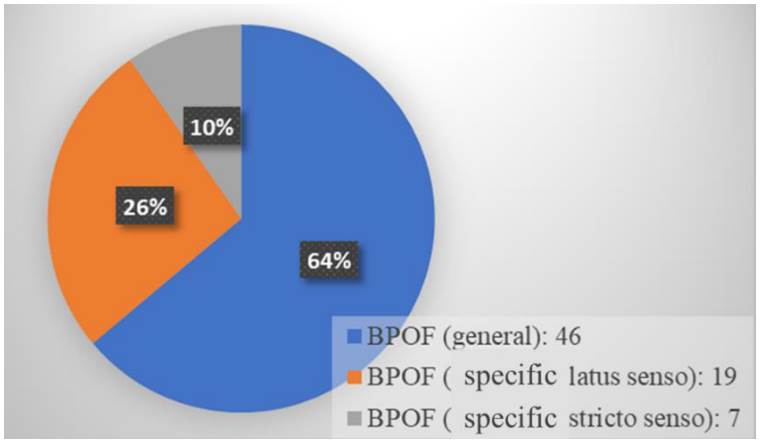 Source: prepared by the authors.
Graph 1
BPOF Publications 2015-2020
BPOF Publications 2015-2020
Conclusion
The study carried out shows a low number of bioethical publications that truly follow the personalist current. Moreover, many of the publications classified as personalist are not specific to the BPOF, because, although they are close, they lack the anthropological foundation, the methodology or the argumentation proper to the BPOF. They start from a common anthropological or ethical foundation and conclude in the dignity of every human being. Following the analysis carried out, we conclude that we can only consider seven publications as specific stricto sensu of the BPOF (Anturi, Di Pietro, Di Nardo, Gómez-Tatay). We can consider one article very close to the BPOF proposal, since, although it does not develop an argumentation specifically for BPOF, it starts from the ethical-anthropological principle of the absolute dignity of each human person and, seeking personalized care, comes to solve a clinical problem in respect of human dignity (19).
-
(19)An ethical dilemma in the field of gynecologyPers Bioét., 2016
While questions arise as to why there are so few publications on BPOF, on the other hand, the divergence of the publications in relation to the fundamentals of BPOF raises several questions about the understanding and acceptance of BPOF, both points related to its dissemination and acceptance. Such reflections need to be deepened in a subsequent analysis. Although the publications related to the BPOF start from a common anthropological or ethical foundation concluding in the dignity of every human being, such lack of specificity, besides generating confusion regarding the understanding of the BPOF due to a lack of unity, can lead to these singular proposals not being really effective in the defense and promotion of the dignity of every human being, much less to the dissemination of the objectivity of ontological personalism.
Referencias
-
1Sgreccia E. Manual de Bioética I. Fundamentos e ética biomédica. 4o ed. San Pablo: Loyola; 2016. Links
-
2Sgreccia E. Manual de Bioética II: Aspectos médicos sociais. San Pablo: Loyola ; 2014. Links
-
3Bermeo Antury E. Aportes del personalismo ontológico moderno a la bioética personalista [Tesis doctoral]. Madrid: Universidad Autónoma de Madrid; 2019. Links
-
4Muñoz Torres A. Pertinencia de las publicaciones de bioética: análisis del contenido epistemológico [Tesis doctoral]. México: Anáhuac; 2017. Links
-
5Pastor LMT. Reflections on the complementarity between education and bioethics. [Reflexiones sobre la complementariedad entre la educación y la bioética]. Opción. 2016; 32:768-83. Disponible en: https://produccioncientificaluz.org/index.php/opcion/article/view/22072 Links
-
6Sanches MA, Monteiro TM. Visões antropológicas divergentes em artigos científicos de bioética no Brasil. Pers Bioét. 2019; 23(1):64-83. https://doi.org/10.5294/pebi.2019.23.1.5 Links
-
7Gómez-Tatay L. Ethical issues of synthetic biology: a personalist perspective (Tesis doctoral) [Internet]. Valencia: Universidad Católica de Valencia San Vicente Mártir; 2019. Disponible en: https://riucv.ucv.es/bitstream/handle/20.500.12466/384/Tesis%20LUCIA%20G%C3%93MEZ%20TATAY.pdf?sequence=1&isAllowed=y Links
-
8Gómez-Tatay L, Hernández-Andreu JM, Aznar J. A personalist ontological approach to synthetic biology. Bioethics. 2016; 30(6):397-406. https://doi.org/10.1111/bioe.12230 Links
-
9Giglio F. Bioethical perspective of ontologically-based personalism. Bioeth Update. 2017; 3(1):59-73. http://dx.doi.org/10.1016/j.bioet.2017.01.001 Links
-
10Gómez-Tatay L, Hernández-Andreu JM, Aznar J. The conception of synthetic entities from a personalist perspective. Sci Eng Ethics. 2017; 25(1):97-111. https://doi.org/10.1007/s11948-017-9994-z Links
-
11Sanches MA, Cunha TR, Siqueira SS, Siqueira JE. Perspectivas bioéticas sobre tomada de decisão em tempos de pandemia. Rev Bioét. 2020; 28(3):410-7. https://doi.org/10.1590/1983-80422020283401 Links
-
12Amo Usanos R. De la biofilosofía a la bioética: el concepto de vida humana y su repercusión en la bioética [Tesis doctoral]. Madrid: Universidad Rey Juan Carlos; 2015. Links
-
13Robles Morejón JB. Contribution of Stein’s anthropology to personalistic bioethics. [Aportaciones de la Antropología Steiniana a la Bioética Personalista]. Cuad Bioet Rev Of Asoc Espanola Bioet Etica Medica. 2016; 27(90):195-205. Disponible en: https://pubmed.ncbi.nlm.nih.gov/27637194/ Links
-
14Di Pietro ML, Teleman AA, Gonzalez-Melado FJ, Zace D, Di Raimo FR, Lucidi V, et al. Implementing carrier screening for cystic fibrosis outside the clinic: ethical analysis in the light of the personalist view. Clin Ter. 2018; 169(2):e71-6. https://doi.org/10.7417/t.2018.2057 Links
-
15Di Nardo M, Dalle Ore A, Testa G, Annich G, Piervincenzi E, Zampini G, et al. Principlism and Personalism. Comparing Two Ethical Models Applied Clinically in Neonates Undergoing Extracorporeal Membrane Oxygenation Support. Front Pediatr [Internet]. 2019; 7. Disponible en: https://www.frontiersin.org/article/10.3389/fped.2019.00312 Links
-
16Stein E. La estructura de la persona humana. Em: Obras Completas IV Escritos antropológicos y pedagógicos. Burgos, Madrid, Victoria: Monte Carmelo, -EDE- El Carmen; 2003. Links
-
17Burgos Velasco JM, Crosby JF, Allen RT. An introduction to personalism [Internet]. Washington: CUA Press; 2018. Disponible en: https://ebookcentral.proquest.com/lib/anahuac-ebooks/reader.action?docID=5241224&ppg=1&query=An%20introduction%20to%20personalism Links
-
18Vásquez HT, Tirado Acero M, Trujillo Florián S. Criminal radical functionalism from bioethics. [El funcionalismo radical penal a partir de la bioética]. Rev Repub. 2018; 25:179-98. http://dx.doi.org/10.21017/Rev.Repub.2018.v25.a55 Links
-
19Valera L, Terranova C. An ethical dilemma in the field of gynecology. Pers Bioét. 2016; 20(1):62-9. https://doi.org/10.5294/pebi.2016.20.1.6 Links
-
20Sgreccia E. Personalist Bioethics: Foundations and Applications. Philadelphia: The National Catholic Bioethics Center; 2012. Links
-
21Floris P. Il “paradigma Englaro”: scelte personali, regole etiche e risposte giuridiche. Quad Dirit E Polit Eccles. 2015; 18(1):173-96. Disponible en: https://www.academia.edu/116834492/Sulla_legittimita_dell_alimentazione_coatta_del_detenuto Links
-
22Petrini C, Costa AN. The “new charter for health care workers” and the ethics of organ donation and transplantation. Ann DellIstituto Super Sanità. 2018; 54(2):79-81. https://doi.org/10.4415/ANN_18_02_01 Links
-
23Reig Mezquida JP, Sales Badía G, Tudela Cuenca J. Age limitation to lung transplant recipients. ethical aspects. [Limitación por edad en trasplante de pulmón. Aspectos éticos]. Rev Of Asoc Espanola Bioet Etica Medica. 2020; 31(101):43-56. https://doi.org/10.30444/CB.51 Links
-
24Insua JT. Principlism, Personalist Bioethics and Principles of Action in Medicine and Health Services. Pers Bioét. 2018; 22(2):223-46. https://doi.org/10.5294/pebi.2018.22.2.3 Links
-
25Ríos Uriarte ME. Reflexiones en torno a la posibilidad de un neopersonalismo desde la bioética personalista. Med Ética Rev Int Bioét Deontol Ética Médica. 2018; 29(1):189-206. Disponible en: https://revistas.anahuac.mx/bioetica/issue/view/98 Links
-
26Pérez Bermejo M. El debate en bioética. El personalismo en el pensamiento de Elio Sgreccia. Entrevista a Elio Sgreccia. Med Ética Rev Int Bioét Deontol Ética Médica. 2018; 29(1):143-58. Disponible en: https://revistas.anahuac.mx/index.php/bioetica/issue/view/98/Vol%2029%201 Links
-
27Gavlik Mendes MW. Atualidade da bioética personalista ontologicamente fundada. Visão atual e reflexões com vista a sua maior expansão. Roma: APRA; 2024. Links