Artículos
The impact of legalizing abortion on maternal mortality in Mexico
Madrazo Cabo, José Manuel*
 http://orcid.org/0000-0002-1636-5958
Hernández Sánchez, Edith Jocelyn**
http://orcid.org/0000-0001-5969-296X
León Durán, Grecia Ana**
Reyes Cruz, Mariana Azari**
Luzuriaga Galicia, Jesús***
Tarasco Michel, Martha****
http://orcid.org/0000-0001-7312-9970
http://orcid.org/0000-0002-1636-5958Hernández Sánchez, Edith Jocelyn**
http://orcid.org/0000-0001-5969-296XLeón Durán, Grecia Ana**
Reyes Cruz, Mariana Azari**
Luzuriaga Galicia, Jesús***
Tarasco Michel, Martha****
http://orcid.org/0000-0001-7312-9970
-
Publication dates-
August 21, 2023
Jan-Mar , 2020
- Article in PDF
- Article in XML
- Automatic translation
- Send this article by e-mail
- Share this article +
Abstract
Background:
Abortion was legalized in Mexico City in 2007, claiming a high rate of maternal mortality caused by abortion.
Purpose:
To analyze general and abortion-related maternal mortality data throughout Mexico and in Mexico City.
Methodology:
Retrospective study, with data obtained from INEGI. Calculations for the reason of general and abortion-related maternal mortality. Pearson’s correlation analysis and linear regression of results. Analysis of annual increase and decrease trends. Maternal deaths breakdown.
Result:
Linear regression on national MMR (R² = 0.87) with downward trend, national MMR due to abortion (R² = 0.49) with a weak downward trend, MMR due to abortion in Mexico City (R² = 0.001) does not show a downward trend.
Conclusion:
Abortion legalization in Mexico City showed no impact on decreasing maternal deaths due to abortion. Induced abortion ranks 12th among the reasons of maternal deaths in Mexico.
Keywords::
termination of pregnancy, causes of maternal death, maternal mortality rate
Introduction
After the joining of the 46 chromosomes that make up the genetic material of a human with a unique and unrepeatable genome provided by the father and the mother and different from theirs, the formation of bi-division starts. In this process, one of the two cells will then be transformed into the environment required as habitat for the embryo, and the other cell will generate the full development of the recently conceived child (1), which happens in the early days of gestation. By week 8 of pregnancy, the embryo has finished forming its primary organs and systems to enter into the fetal period and start their maturation and fast body growth. From week 9 to week 12, the nasciturus has a length between 5 and 8 cms (2-3 inches) and a weight of 10 to 45 grams (0.352-1.5 ounce), that is the age limit determined by pro-abortion law as «legal» to terminate this new life (2).
-
(1)Embriología Médica de Langman, 2016
-
(2)De la totipotencia del cigoto a las células troncales maduras y de reservaCuadernos de Bioética, 2009
On April 24, 2007 the Legislative Assembly of Mexico City approved the legal amendments to the Criminal Code and the Health Law for Mexico City that permit abortion (legal termination of pregnancy) before week 12 of pregnancy in Mexico City (3).
-
(3)Evidencias Científicas en torno a la legalización del aborto en la Ciudad de MéxicoGinecología y Obstetricia de México, 2010
The World Health Organization (WHO) defines maternal mortality as the death of a woman while being pregnant or during the 42 days following the end of the pregnancy, notwithstanding the duration and site of the pregnancy. Such death due to any cause related to, or aggravated by pregnancy or its care for accidental or incidental causes (4). Maternal Mortality is divided into direct maternal deaths (obstetric deaths as a result of pregnancy obstetric complications) and indirect maternal deaths (deaths due to a preexisting disease or a disease acquired during pregnancy but not due to direct obstetric causes, but aggravated by the physiological effects of pregnancy) (5).
-
(4)Clasificación estadística internacional de enfermedades y problemas relacionados con la salud, 1992
-
(5)Mortalidad materna, 2013
Globally, the WHO identifies three main causes of maternal deaths, ranking first the death caused by hemorrhage, second death by infections and third deaths due to hypertension disorders during pregnancy (6). In Mexico, according to the Ministry for Prevention and Health Promotion (Secretaría de Prevención y Promoción de la Salud), the General Epidemiology Directorate reports that in 2017 the main causes of maternal death were: hypertension disorders, edema and proteinuria during pregnancy, childbirth and postpartum (40.0%) obstetric hemorrhage (20.0%) and abortion (20.0%) (7).
-
(6)Guía de la OMS para la aplicación de la CIE-10 a las muertes ocurridas durante el embarazo, parto y puerperio, 2012
-
(7)Informe semanal de vigilancia epidemiológica, 2018
Maternal mortality is considered an indicator to assess the medical conditions and quality of life of a population, since it shows the persistence of inequity between genders, and economic and social disparity of populations (3), and it is a world-wide problem. In September 2000 the United Nations General Assembly approved the «Millennium Declaration», where the member countries pledged to reach the Development Goals; these goals included «Reduce maternal mortality ratio by 75% between 1995 and 2015» (8) to which purpose Mexico, failing to reach the goal, reduced its mortality ratio to 34.6/100,000. In 2015, the United Nations General Assembly was held again, and renewed its commitments by setting the «Sustainable Development Goals» for the 2030 agenda, which in the 3rd goal for «Health and Wellbeing» calls for a reduction in world-wide maternal mortality ratio to under 70 deaths per 100,000 born alive by 2030 (9).
-
(3)Evidencias Científicas en torno a la legalización del aborto en la Ciudad de MéxicoGinecología y Obstetricia de México, 2010
-
(8)Objetivos de Desarrollo del Milenio y más allá del 2015, 2010
-
(9)Transformar nuestro mundo: Agenda 2030 para el Desarrollo Sostenible, 2015
In the process for abortion legalization in Mexico City in 2008, arguments were proposed that had a remarkable influence on the decision made by the court and quote: «in recent figures abortion is among the first three causes of maternal death […]». Mexico City is identified as the entity where the largest number of abortions are performed; in 2006, prior to abortion legalization, close to 60,000 clandestine abortions were performed, with an annual rate of 120 women dead for this cause (10).
-
(10)El Proceso de despenalización del aborto en la Ciudad de México, 2008
The book Constitucionalidad de la despenalización del aborto en el Distrito Federal (Constitutionality of Abortion Legalization in Mexico City), chapter XII about the Comment by the Instituto de Investigaciones Jurídicas (Juridical Research Institute) from Universidad Nacional Autónoma de México, by Dr. Juan Luis González Alcántara states: «...in our country there are over one million abortions per year, with a high mortality rate…» (11).
-
(11)Constitucionalidad de la despenalización del aborto en el Distrito Federal, 2009
The Information Group on Reproductive Choice (Grupo de Información en Reproducción Elegida) claimed, prior to abortion legalization in Mexico City, an annual rate of 1,500 dead women due to abortion throughout Mexico, and 120 deaths in Mexico City (10).
-
(10)El Proceso de despenalización del aborto en la Ciudad de México, 2008
The webpage «Clínicas de Aborto en México DF» (Abortion Clinics in Mexico City) published in October 2016 a note affirming that in 2015 maternal death was the fifth cause of death, and identifying 57% of such deaths as caused by clandestine abortions (12).
-
(12)La incidencia de muertes por abortos inseguros en México, 2016
In May 2018, in a note published in El Dictamen newspaper, the Parents Alliance for Education in Mexico, Alianza Nacional de Padres y Madres de México por la Educación, declared that «in the last 11 years the deaths due to this practice add to over 700,000» (13).
-
(13)Más de 700 mil muertes por abortos en MéxicoEl Dictamen, 2018
The Guttmacher Institute declared that in 2009 around 1,026,000 abortions were performed, of which 36% (360,000) were made under clandestine conditions and had complications that required medical treatment, 25% of these did not receive the care they needed and died (90,000) (14).
-
(14)Embarazo no planeado y aborto inducido en México: causas y consecuenciasGuttmacher Institute, 2012
With this background, it was considered appropriate to make a systematic review of these figures, based on data from the Instituto Nacional de Estadística Geografía e Informática (INEGI) (National Institute of Statistics, Geography and Informatics), which is considered the most reliable statistics publication in Mexico, and based on that assess the impact of maternal mortality nationwide and in Mexico City.
1. Purposes
Analyze maternal mortality data from general causes and from abortionnationwide and in Mexico City, since it is the only political entity where abortion has been legalized.
2. Methodology
A systematic review was made of INEGI’s figures for maternal mortality in Mexico from 2002 to 2017. The variables used were: deaths to calculate the Maternal Mortality Ratio (MMR), entity and municipality of occurrence, year of occurrence, detailed causes per the ICD (International Classification of Diseases). According to the deaths from pregnancy terminated in abortion (O00-O008) of ICD-10, the following inclusion criteria were taken into account (to be considered as induced abortion): Maternal Death ICD-10: O04-O049 (medical abortion), O05-O059 (other abortion), O06O069 (unspecified abortion), O07-O079 (failed abortion attempt). The following were excluded (considered spontaneous abortion): maternal deaths from miscarriage per ICD-10: O001-O035 (tubal pregnancy, ectopic pregnancy, mole, embryo arrest, missed abortion and miscarriage) (6). Under this filter of concepts of death from abortion (as inclusion criteria), we considered death from abortion those who did not present a specific cause to be considered miscarriage or due to involuntary reasons.
-
(6)Guía de la OMS para la aplicación de la CIE-10 a las muertes ocurridas durante el embarazo, parto y puerperio, 2012
According to the set of digital data that INEGI has on Maternal Mortality, the database was electronically downloaded into a Microsoft Excel 2010 worksheet; the information obtained was classified by year, number of maternal deaths, age and place of occurrence (Mexico City). The MMR was calculated, defined as the number of maternal deaths per live births by 10,000 per year. A linear regression analysis was later made to evaluate figures correlation.
Likewise, the database with the same variables for maternal mortality in five years, from 2013 to 2107, was downloaded, differentiating the direct causes of maternal mortality (deaths from pregnancy, childbirth and postpartum) (ICD-10:O00-O099) and the indirect causes (IDC- A00-Y99) in Mexico City and nationwide. Later, the seven groups into which direct maternal deaths are classified were broken-down (ICD-10:O00-O099): pregnancy terminated by abortion (O00 -O08), edema, proteinuria and hypertensive disorders during pregnancy, childbirth and postpartum (O010- 016), other maternal disorders predominantly related to pregnancy (O20-O29), maternal care related to the fetus and the amniotic cavity and with possible childbirth issues (O30-O48), complications during labor and childbirth (O60-O75), complications mainly related to postpartum (O85-O92), other obstetric conditions not elsewhere classified (O95-O99), to later proceed to the breakdown of each of the corresponding subgroups. These figures are listed in decreasing order per the number of reported deaths.
3. Results
Table 1 shows the total number of maternal deaths reported by INEGI, in addition to the total number of deaths from abortion reported in the Mexican Republic and in Mexico City. We found that the average rate reported for abortion nationwide is 33.1 and in Mexico City it was 4.1 from 2002 to 2017.
Table 1
Maternal mortality, general and from abortion
Maternal mortality, general and from abortion
| All the causes | From abortion* | Percentage of deaths from
abortion* |
||||
|---|---|---|---|---|---|---|
| Year | Mexico City | National | Mexico City | National | Mexico City | National |
| 2002 | 134 | 1309 | 3 | 41 | 2,2% | 3,1% |
| 2003 | 159 | 1313 | 6 | 43 | 3,8% | 3,3% |
| 2004 | 152 | 1239 | 5 | 40 | 3,3% | 3,2% |
| 2005 | 140 | 1242 | 8 | 38 | 5,7% | 3,1% |
| 2006 | 129 | 1166 | 5 | 35 | 3,9% | 3,0% |
| 2007 | 122 | 1097 | 7 | 39 | 5,7% | 3,6% |
| 2008 | 105 | 1119 | 4 | 30 | 3,8% | 2,7% |
| 2009 | 116 | 1208 | 2 | 25 | 1,7% | 2,1% |
| 2010 | 111 | 992 | 4 | 36 | 3,6% | 3,6% |
| 2011 | 97 | 971 | 1 | 27 | 1,0% | 2,8% |
| 2012 | 79 | 960 | 5 | 27 | 6,3% | 2,8% |
| 2013 | 90 | 861 | 5 | 31 | 5,6% | 3,6% |
| 2014 | 79 | 872 | 3 | 28 | 3,8% | 3,2% |
| 2015 | 79 | 778 | 3 | 26 | 3,8% | 3,3% |
| 2016 | 74 | 812 | 1 | 30 | 1,4% | 3,7% |
| 2017 | 59 | 758 | 7 | 27 | 11,9% | 3,6% |
| Total: | 1725 | 16697 | 69 | 523 | ||
| Mean: | 111,1 | 1062,6 | 4,1 | 33,1 | 4,2% | 3,2% |
Table 2
Maternal mortality ratio from all causes and from abortion
Maternal mortality ratio from all causes and from abortion
| RMM from all causes | RMM from abortion* | |||
|---|---|---|---|---|
| Year | National | Mexico City | National | Mexico City |
| 2002 | 4,85 | 6,03 | 0,15 | 0,14 |
| 2003 | 4,94 | 7,47 | 0,16 | 0,28 |
| 2004 | 4,72 | 6,83 | 0,15 | 0,22 |
| 2005 | 4,84 | 6,47 | 0,15 | 0,37 |
| 2006 | 4,65 | 6,40 | 0,14 | 0,25 |
| 2007 | 4,13 | 5,98 | 0,15 | 0,34 |
| 2008 | 4,24 | 5,27 | 0,11 | 0,20 |
| 2009 | 4,69 | 6,09 | 0,10 | 0,10 |
| 2010 | 3,75 | 5,75 | 0,14 | 0,21 |
| 2011 | 3,75 | 5,40 | 0,10 | 0,06 |
| 2012 | 3,87 | 4,41 | 0,11 | 0,28 |
| 2013 | 3,47 | 6,26 | 0,13 | 0,35 |
| 2014 | 3,54 | 4,63 | 0,11 | 0,18 |
| 2015 | 3,31 | 4,93 | 0,11 | 0,19 |
| 2016 | 3,54 | 4,89 | 0,13 | 0,07 |
| 2017 | 3,39 | 4,17 | 0,12 | 0,50 |
Thumbnail
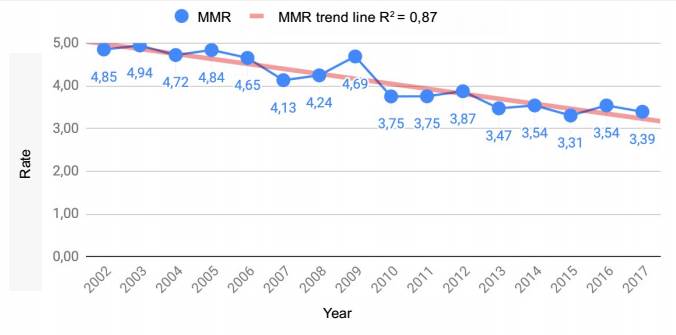
Chart 1
Ratio and trend of overall maternal mortality
Ratio and trend of overall maternal mortality
Thumbnail
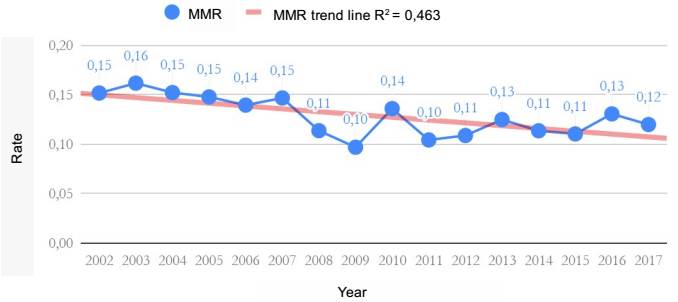
Chart 2
Ratio and trend in maternal mortality due to abortion nationwide
Ratio and trend in maternal mortality due to abortion nationwide
The trend analysis was made through a Pearson’s correlation and a linear regression of maternal mortality ratios and mortality due to the type of abortion analyzed [O04-O049 (medical), O05O059 (other), O06-O069 (unspecified), O07-O079 (failed attempt)] nationwide and in Mexico City between 2002 and 2017.
With the data obtained, a linear regression on nationwide general maternal mortality was made, obtaining R² = 0.87, which shows an adequate data correlation and a downward trend (Chart 1), clearly confirming a decrease in mortality for the 2002-2017 period. In the case of mortality from abortion in the Mexican Republic R² = 0.49 was obtained, which represents a weak downward trend in death from abortion (Chart 2).
The domestic Maternal Mortality Ratio at the beginning of the analyzed period, 2002, was 4.85 deaths from maternal causes per 10,000 live births, and at the end of the period it was 3.39, which represented a 30% decrease in such term, with an annual average decrease of 2.3%. In that period, maternal mortality from abortion in Mexico went from 0.15 deaths in 2002 to 0.12 deaths per 10,000 live births in 2017; which represented a 20.4% decrease, with an annual average of -1.5%.
For Mexico City the deaths from maternal causes and from abortion occurred between 2002 and 2016 were considered. In 2002, the Maternal Mortality Ratio was 6.03 and at the end of the period it was 4.89 maternal deaths per 10,000 live births; the decrease in mortality from maternal causes in such term was 19%, with an annual average of -1.4%. In that term, the mortality ratio from abortion went from 0.14 to 0.07 deaths per 10,000 live births, with a 51% decrease and an average annual decrease of 4.9%.
The Maternal Mortality Ratio in Mexico City for 2017 was 4.17 deaths per 10,000 live births, taking into consideration the period from 2002 to 2017 a 31% decrease was observed, with an annual average decrease of 2.4%. In 2017, an increase in maternal mortality from abortion was observed (0.50 deaths per 10,000 live births); probably due to the decrease in the population base of live births up to that year and the number of deaths occurred.
Thumbnail
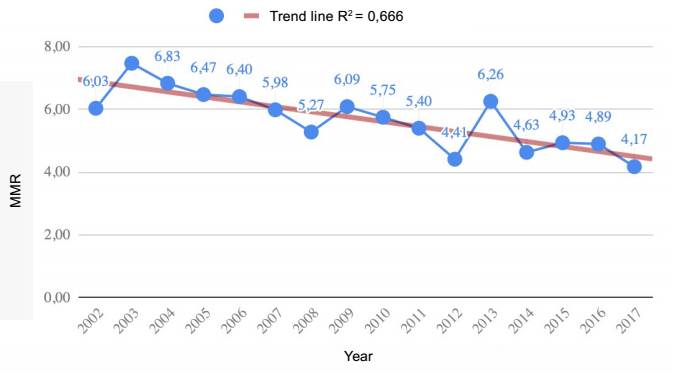
Chart 3
Ratio and trend of maternal mortality in Mexico City
Ratio and trend of maternal mortality in Mexico City
Thumbnail
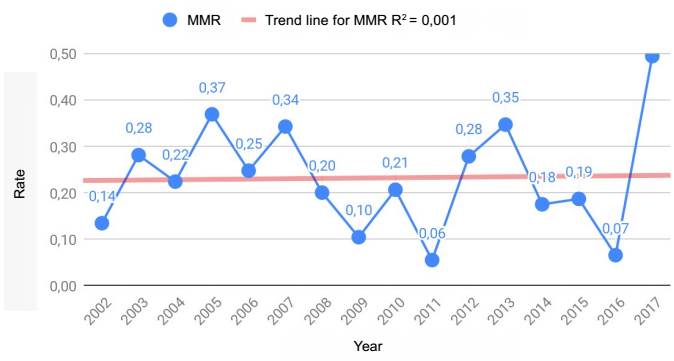
Chart 4
Ratio and trend of maternal abortion mortality in Mexico City
Ratio and trend of maternal abortion mortality in Mexico City
A detailed analysis was made of the causes of maternal deaths in five years, from 2013 to 2017, differentiating the direct causes of maternal mortality (deaths from pregnancy, childbirth and postpartum) (IDC-10: O00-O099) and the indirect causes (IDC-A00Y99) in Mexico City and nationwide, to later breakdown the figures for deaths into the groups and subgroups into which the direct and indirect causes of maternal mortality are divided.
It was observed that in Mexico, from 2013 to 2017, among the main causes of general maternal mortality we found: first, other obstetric disorders not elsewhere classified (29.69%); second, edema, proteinuria and hypertensive disorders during pregnancy, childbirth and postpartum (22.40%); third, complications during labor and childbirth (17.19%); fourth, pregnancy terminated by abortion (9.17%); fifth, complications mainly related to postpartum (8,26); sixth, maternal care related to the fetus and the amniotic cavity (8.04%); and last seventh, other maternal disorders predominantly related to pregnancy (5.21%) for the full term from 2013 to 2017 (Table 3).
Table 3
Number of Women´s Death for General Maternal Mortality in Mexico from 2013 to 2107
Number of Women´s Death for General Maternal Mortality in Mexico from 2013 to 2107
| Cause of Maternal Death | Cause According to IDC | IDC Code | No. Of Deaths 2013* | No. Of Deaths 2014 | No. Of Deaths 2015* | No. Of Deaths 2016 | No. Of Deaths 2017 | Total No. of Deaths in 5 years (2013-2017) | % of total deaths |
|---|---|---|---|---|---|---|---|---|---|
| Pregnancy, childbirth and postpartum | (O00-O99) | 846 | 872 | 777 | 812 | 758 | 4065 | 100% | |
| 1st | Other obstetric disorders not elsewhere classified | (O95-O99) | 231 | 283 | 231 | 248 | 214 | 1207 | 29,69 |
| 2nd | Edema, proteinuria and hypertensive disorders during pregnancy, childbirth and postpartum | (O010-016) | 204 | 179 | 165 | 198 | 165 | 911 | 22,40 |
| 3rd | Complications of labor and delivery | (O60-O75) | 169 | 136 | 125 | 129 | 140 | 699 | 17,19 |
| 4th | Pregnancy terminated by abortion | (O00 -O08) | 77 | 80 | 72 | 70 | 74 | 373 | 9,17 |
| 5th | Complications mainly related to postpartum | (O85-O92) | 72 | 71 | 67 | 66 | 60 | 336 | 8,26 |
| 6th | Maternal care related to the fetus and the amniotic cavity and possible delivery problems | (O30-O48) | 56 | 77 | 72 | 63 | 59 | 327 | 8,04 |
| 7th | Other maternal disorders predominantly related to pregnancy | (O20-O29) | 37 | 46 | 45 | 38 | 46 | 212 | 5,21 |
For General Maternal Mortality in Mexico City (Table 4), the same order in maternal deaths is observed, where pregnancy terminated by abortion ranks fourth among the total number of maternal deaths, representing 10.79% of general maternal mortality in the five years mentioned above.
Table 4
Number of Women´s Death for General Maternal Mortality in Mexico City from 2013 to 2107
Number of Women´s Death for General Maternal Mortality in Mexico City from 2013 to 2107
| Cause of Maternal Death | Cause According to IDC | IDC Code | No. of Deaths 2013* | No. of Deaths 2014 | No. of Deaths 2015* | No. of Deaths 2016 | No. of Deaths 2017 | Total No. of Deaths in 5 years (2013-2017) | % of total deaths |
|---|---|---|---|---|---|---|---|---|---|
| Pregnancy, childbirth and postpartum | (O00-O99) | 89 | 79 | 79 | 74 | 59 | 380 | 100% | |
| 1º | Other obstetric disorders not elsewhere classified | (O95-O99) | 29 | 21 | 31 | 31 | 13 | 125 | 32,89 |
| 2º | Edema, proteinuria and hypertensive disorders during pregnancy, childbirth and postpartum | (O010- 016) | 22 | 12 | 13 | 13 | 16 | 76 | 20,00 |
| 3ª | Complications of labor and delivery | (O60-O75) | 9 | 12 | 8 | 7 | 8 | 44 | 11,58 |
| 4º | Pregnancy terminated by abortion | (O00 -O08) | 10 | 7 | 4 | 9 | 11 | 41 | 10,79 |
| 5º | Complications mainly related to postpartum | (O85-O92) | 14 | 8 | 10 | 5 | 3 | 40 | 10,53 |
| 6º | Maternal care related to the fetus and the amniotic cavity and possible delivery problems | (O30-O48) | 2 | 11 | 12 | 6 | 6 | 37 | 9,74 |
| 7º | Other maternal disorders predominantly related to pregnancy | (O20-O29) | 3 | 8 | 1 | 3 | 2 | 17 | 4,47 |
The maternal deaths in the first group: Pregnancy with abortive outcome (CIE 10: O00-O08) include spontaneous and involuntary conditions such as ectopic pregnancy (O001), hydatidiform mole (O01), other abnormal products of conception (O02), spontaneous abortion (O03); as well as provoked conditions such as medical abortion (O04), other abortion (O05), unspecified abortion (O06) which includes induced abortion without further specification and failed attempted abortion (O07) (6).
A detailed breakdown of deaths from pregnancy with abortive outcome (IDC: O00-O08) was made, ranking them according to our inclusion and exclusion criteria: miscarriage (IDC-10: O00O035) and abortion (IDC-10: O004-O079). It was identified that in Mexico the deaths from miscarriage represent more than half the number of deaths for this cause, this is that in 5 years there were 373 deaths from «pregnancy with abortive outcome» of which 61.93% were miscarriages and 38.07% correspond to induced abortions in Mexico (Table 5).
Table 5
Number of women´s deaths for maternal mortality from pregnancy with abortive outcome (O00-O08) National 2013- 2017
Number of women´s deaths for maternal mortality from pregnancy with abortive outcome (O00-O08) National 2013- 2017
| Cause according to the IDC | IDC code | No. of Deaths 2013 | No. of Deaths 2014 | No. of Deaths 2015 | No. of Deaths 2016 | No. of Deaths 2017 | Total No. of Deaths in 5 years (2013-2017) | % of total Deaths |
|---|---|---|---|---|---|---|---|---|
| Pregnancy with abortive outcome | (O00-O99) | 77 | 80 | 72 | 70 | 74 | 373 | 100% |
| Miscarriage | (O00 - O039) | 46 | 52 | 46 | 40 | 47 | 231 | 61,93% |
| Induced abortion | (O045 - O068) | 31 | 28 | 26 | 30 | 27 | 142 | 38,07% |
For Mexico City it may be observed that the number of deaths from induced abortion is equal to 43% of a total of 41 deaths in the 5 years of the analysis (Table 6); therefore, observing that the ratio of induced abortion versus miscarriage is larger in Mexico City than nationwide (43% vs 38.7%).
Table 6
Number of women´s deaths for maternal mortality from pregnancy with abortive outcome (O00-O08) Mexico City 2013- 2017
Number of women´s deaths for maternal mortality from pregnancy with abortive outcome (O00-O08) Mexico City 2013- 2017
| Cause according to the IDC | IDC code | No. Of Deaths 2013 | No. Of Deaths 2014 | No. Of Deaths 2015 | No. Of Deaths 2016 | No. Of Deaths 2017 | Total No. of Deaths in 5 years (2013-2017) | % of total Deaths |
|---|---|---|---|---|---|---|---|---|
| Pregnancy with abortive outcome | (O00-O99) | 10 | 7 | 4 | 9 | 11 | 41 | 100% |
| Miscarriage | (O00 - O039) | 5 | 4 | 1 | 8 | 4 | 22 | 53,66 |
| Induced abortion | (O045 - O068) | 4 | 3 | 3 | 1 | 7 | 18 | 43,90 |
Table 7 shows a breakdown per group of maternal mortality, the causes of death included in each group and ranking per the number of deaths.
Table 7
Breakdown of number of women deaths in maternal mortality during pregnancy, childbirth and the puerperium (O000-O99) Country-wide 2013-2017
Breakdown of number of women deaths in maternal mortality during pregnancy, childbirth and the puerperium (O000-O99) Country-wide 2013-2017
| Causes of maternal death ranked | Cause according to ICD-10 | ICD-10 Code | Total number of deaths in 5 years (2013-2017) |
|---|---|---|---|
| Group 1: Pregnancy with abortive outcome | (O00-O08) | 373 | |
| 1st | Ectopic pregnancy | O00 | 189 |
| 2nd | Unspecified abortion | O06 | 135 |
| 3rd | Other abnormal products of conception | 002 | 23 |
| 4th | Hydatidiform mole | O01 | 11 |
| 5th | Spontaneous abortion | O03 | 8 |
| 6th | Other abortion | O05 | 6 |
| 7th | Medical abortion | 004 | 1 |
| Group 2: Hypertensive disorders in pregnancy, childbirth and the puerperium | (O10) | 911 | |
| 1 st | Eclampsia | (O15) | 507 |
| 2nd | Pre-eclampsia | (O14) | 346 |
| 3rd | Gestational hypertension without significant proteinuria | (O13) | 20 |
| 4th | Pre-eclampsia superimposed to pre-existing hypertension | (O11) | 18 |
| 5th | Preexisting hypertension complicating pregnancy, childbir th and the puerperium | (O10) | 16 |
| 6th | Unspecified maternal hypertension | (O16) | 4 |
| Group 3: Other maternal disorders predominantly related to pregnancy | (O20-O29) | 212 | |
| 1st | Maternal care for other conditions predominantly related to pregnancy* | (O26) | 124 |
| 2nd | Diabetes mellitus in pregnancy | (O24) | 38 |
| 3rd | Infections of genitourinary tract in pregnancy | (O23) | 34 |
| 4th | Venous complications and hemorrhoids in pregnancy | (O22) | 14 |
| 5th | Hyperemesis gravidarum | (O21) | 1 |
| 5th | Complications of anesthesia during pregnancy | (O29) | 1 |
| * Liver disorders (O266), other complications (O268), unspecified complications (O269) | |||
| Group 4: Maternal care related to the fetus and amniotic cavity and possible delivery problems | (O30-O48) | 327 | |
| 1st | Placental disorders and malformation of placenta | (O43-O45)* | 241 |
| 2nd | Maternal care for other fetal problems | (O36) | 33 |
| 3rd | Other disorders of amniotic fluid and membranes | (O41) | 29 |
| 4th | Premature rupture of membranes | (O42) | 11 |
| 5th | Maternal care for abnormality of pelvic organs | (O34) | 7 |
| 6th | Polyhydramnios | (O40 | 3 |
| 7th | Antepartum hemorrhage, not elsewhere classified | (O46) | 3 |
| 8th | Maternal care for malpresentation of fetus | (O32) | 2 |
| 9th | Maternal care for disproportion | (O33) | 2 |
| * This classification includes: (O43) placental disorders, (O44) placental previa, (O45) premature rupture of membranes | |||
| Group 5: Complications of labor and delivery | (O60-O75) | 699 | |
| 1st | Postpartum hemorrhage | (O72) | 462 |
| 2nd | Other obstetric trauma | (O71) | 149 |
| 3rd | Other labor and delivery complicated, not elsewhere classified | (O75) | 25 |
| 4th | Complications of anesthesia during labor and delivery | (O74) | 14 |
| 5th | Long labor | (O63) | 13 |
| 6th | Perineal laceration during delivery | (O70) | 12 |
| 7th | Labor and delivery complicated by intrapartum hemorrhage, not elsewhere classified | (O67) | 9 |
| 8th | Other obstructed labor | (O66) | 7 |
| 9th | Obstructed labor due to malposition and malpresentation of fetus | (O64) | 5 |
| 10th | Retained placenta and membranes, without hemorrhage | (O73) | 1 |
| 11th | Abnormalities of forces of labor | (O62) | 1 |
| 12th | Labor and delivery complicated by umbilical cord complications | (O69) | 1 |
| Group 6: Complications predominantly related to the puerperium | (O85-O92) | 336 | |
| 1st | Obstetric embolism | (O88) | 201 |
| 2nd | Puerperal sepsis | (O85) | 55 |
| 3rd | Complications of the puerperium, not elsewhere classified | (O90) | 41 |
| 4th | Venous complications and hemorrhoids in the puerperium | (O87) | 24 |
| 5th | Other puerperal infections | (O86) | 12 |
| 6th | Complications of anesthesia during the puerperium | (O89) | 3 |
| Group 7: Other obstetric conditions, not elsewhere classified | (O94-O9A) | 1208 | |
| 1st | Diseases of the digestive system complicating pregnancy, childbirth and the puerperium | (O998) | 342 |
| 2nd | Diseases of the circulatory system complicating pregnancy, childbirth and the puerperium | (O994) | 246 |
| 3rd | Diseases of the respiratory system complicating pregnancy, childbirth and the puerperium | (O995) | 188 |
| 4th | Maternal infectious and parasitic diseases classifiable elsewhere but complicating pregnancy, childbirth and the puerperium | (O98) | 166 |
| 5th | Diseases of the digestive system complicating pregnancy, childbirth and the puerperium | (O996) | 100 |
| 6th | Mental disorders and diseases of the nervous system complicating pregnancy, childbirth and the puerperium | (O993) | 77 |
| 7th | Hematological diseases affecting pregnancy | (O990-O991)* | 41 |
| 8th | Endocrine, nutritional and metabolic diseases complicating pregnancy, childbirth and the puerperium | (O992) | 23 |
| 9th | Obstetric death of unspecified cause | (O95) | 21 |
| 10th | Diseases of the skin and subcutaneous tissue complicating pregnancy, childbirth and the puerperium | (O997) | 4 |
The number of deaths due to such causes were subsequently ranked in a decreasing list, therefore ranking the cause of women´s deaths during pregnancy, childbirth and postpartum in Mexico.
It is observed that in the 5 years analyzed, the first cause of maternal deaths in Mexico was eclampsia, which caused an average of 101.4 maternal deaths per year, representing 12.47% of total maternal deaths; postpartum hemorrhages rank second with an average of 92.4 deaths, representing 11.37% and in the third pace death from preeclampsia with an annual average of 69.2 maternal deaths and 8.51%. In this detailed breakdown of maternal death causes, induced abortion is identified as the 12th cause of maternal deaths in Mexico (Table 8).
Table 8
Main causes of maternal mortality in Mexico from 2013 to 2017
Main causes of maternal mortality in Mexico from 2013 to 2017
| Cause of maternal deaths | Cause according to IDC | IDC code | Total number of deaths in 5 years (2013-2017) | Annual average |
|---|---|---|---|---|
| 1st | Eclampsia | (O15) | 507 | 101,4 |
| 2nd | Postpartum hemorrhage | (O72) | 462 | 92,4 |
| 3rd | Preeclampsia | (O14) | 346 | 69,2 |
| 4th | Other specified diseases and conditions complicating pregnancy, childbirth and the puerperium | (O998) | 342 | 68,4 |
| 5th | Diseases of the circulatory system complicating pregnancy, childbirth and the puerperium | (O994) | 246 | 49,2 |
| 6th | Placental disorders and placental insertion abnormalities | (O43 - O45)* | 241 | 48,2 |
| 7th | Spontaneous abortion | (O00 - O039)** | 231 | 46,2 |
| 8th | Obstetric embolism | (O88) | 201 | 40,2 |
| 9th | Diseases of the respiratory system complicating pregnancy, childbirth and the puerperium | (O995) | 188 | 37,6 |
| 10th | Maternal infectious and parasitic diseases classifiable elsewhere but complicating pregnancy, childbirth and the puerperium | (O98) | 166 | 33,2 |
| 11t | Other obstetric trauma | (O71) | 149 | 29,8 |
| 12th | Induced abortion | (O045 - O068) | 142 | 28,4 |
| 13th | Maternal care for other conditions predominantly related to pregnancy | (O26) | 124 | 24,8 |
With this information, the complete universe in the total number of maternal deaths reported during 2013-2017 period was 4,065 cases. The ratio in these data for deaths caused by induced abortion (n = 142) is 3.49% of the total number of maternal deaths, therefore observing that other causes of maternal mortality, and not induced abortion, show the highest incidence of death.
4. Discussion
Maternal mortality in Mexico from direct causes represents 99.6% of the total number, while indirect causes represent 0.36%, the latter mainly caused by infectious and parasitic diseases, as well as neoplasia.
Among the main causes of maternal mortality in Mexico, death from eclampsia was identified as the first cause of maternal death, with an average of 101.4 deaths, postpartum hemorrhages rank second with an average of 92.4 deaths and in the third place deaths from preeclampsia with an annual average of 69.2 deaths.
These figures reveal that the cause of death from abortion is not in third place among the causes of maternal death, in the classification of deaths from pregnancy with abortive outcome (CIE10O00-O8) separating the spontaneous abortions (or miscarriage) (CIE-O00-O039) and induced abortions (CIE-O045-O068), it reveals that the deaths from spontaneous abortion rank 7th in maternal deaths and the induced abortions rank 12th, compared to what other sources report.
Likewise, our study reports that from 2007 to 2017 326 women have died in Mexico due to abortion, and while these are deaths that no one thinks should happen, they are not 700,000 as other sources have reported (13); in addition, we reported that in 15 years the average number of deaths from abortion nationwide was 33.1 deaths per year and in Mexico city it was 4.1. Likewise, according to INEGI’s figures, in 2009 the death of 25 women from abortion in Mexico are reported, not the 90,000 claimed by other sources (14). These data contrast with the 1,500 and 120 deaths per year nationwide and in Mexico City respectively published by other organizations (10).
-
(13)Más de 700 mil muertes por abortos en MéxicoEl Dictamen, 2018
-
(14)Embarazo no planeado y aborto inducido en México: causas y consecuenciasGuttmacher Institute, 2012
-
(10)El Proceso de despenalización del aborto en la Ciudad de México, 2008
The Children’s Hospital of Mexico Newsletter, based on figures gathered by the researchers of an article published in 2012, claims that 74 out of 1,207 women died from abortion that year (15). According to estimates by the World Health Organization, such percentage is 13% of global maternal mortality. These figures match those reported by INEGI. However, it is important to point-out that the study made by the Children’s Hospital of Mexico analyzed the number of deaths from «Pregnancy with abortive outcome» as classified by IDC 10/2, taking into consideration tubal pregnancy, ectopic pregnancy, mole, embryo development arrest, missed abortion and miscarriage (O001-O03) as well as medical abortion, other abortion, unspecified abortion, failed abortion attempt (O04-O08).
-
(15)La mortalidad materna y el aborto en MéxicoBoletín médico del Hospital Infantil de México, 2012
The last four causes (O04-O08) were included for purposes of this research; therefore, according to INEGI data and excluding abortion classifications O001 to O03, there were 25 deaths from abortion in 2009; which reinforces the importance of performing these studies with this methodology to establish more accurately the cases of induced abortion, with no bias for pathologies that are per se causes of miscarriage (O001-O03) (Table 9, Chart 5).
Table 9
Maternal mortality in 2009 according to INEGI figures
Maternal mortality in 2009 according to INEGI figures
| Rate of abortion-related deaths in general mortality (%) | ||||||
|---|---|---|---|---|---|---|
| Total maternal mortality IDC-10/2 | Pregnancy, childbirth and the puerperium (O00-O99) | Pregnancy with abortive outcome (O00-O08) | Pregnancy with abortive outcome (O04-O08) | Pregnancy, childbirth and the puerperium (%) | Pregnancy with abortive outcome (%) | Pregnancy with abortive outcome (O04-O08) |
| 1.208 | 1.197 | 74 | 25 | 99,09% | 6,18% | 2,1% |
Thumbnail
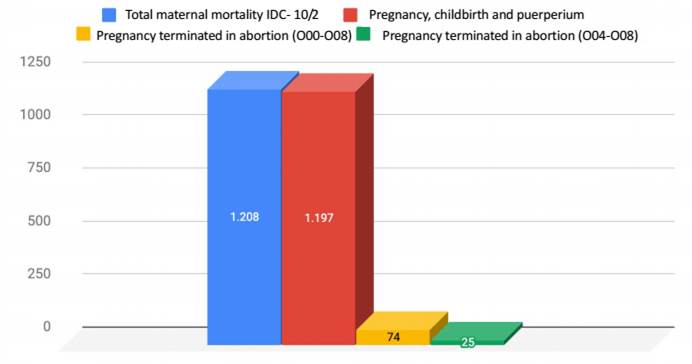
Chart 5
Maternal mortality due to abortion in 2009
Maternal mortality due to abortion in 2009
Taking into consideration the study by the Children’s Hospital of Mexico as a serious institution, it may be observed that the results of their research match the figures provided by INEGI, with a difference in the total number of deaths from abortion because they make no difference between miscarriage and induced abortion.
According to the Millennium Declaration (8), the eradication of maternal deaths will be hardly achieved. However, the enactment of a law favoring legal abortion for women is not the solution to alleviate the problem of maternal mortality, since the cases of maternal death from abortion did not go down in Mexico City, unlike what is observed nationwide.
-
(8)Objetivos de Desarrollo del Milenio y más allá del 2015, 2010
What did happen was the thousands of embryo deaths (male and female) every year according to the Legal Termination of Pregnancy (LTP) statistics. As of the legalization of abortion in 2007, 212,889 legal abortions have been performed; 69.6% of the women served came from Mexico City and 26.4% from the State of Mexico (16). From the total number of abortions performed in these 12 years, 46% were made on women 18 to 24 years old; 23% in women 25 to 29 years old and 14% for women ages 30 to 34, with an adolescent percentage of 5.7% (Table 10).
Table 10
Total abortions in 11 years
Total abortions in 11 years
| Age group | Abortions |
|---|---|
| 11 - 14 | 1.0% |
| 15 - 17 | 5.0% |
| 18 - 24 | 46% |
| 25 - 29 | 23% |
| 30 - 34 | 14% |
| 35 - 39 | 7.9% |
| 40 - 44 | 2.7% |
| 45 - 54 | 0.4% |
According to the results, it may be observed that the number of deaths in global maternal mortality has effectively dropped, and this perfectly matches the national linear regression analysis presented with the INEGI’s data. Regarding abortion decriminalization in Mexico City, which included decreasing maternal mortality from this cause among its goals, deaths from abortion have not been reduced, since no trend downward was shown (R² = 0.001). One of the situations that is significantly influencing this circumstance is that with legalization a large amount of induced abortions will continue to be performed. This is due to the banalization gradually given to the decriminalization, until it is considered, particularly by some women, as a way of contraception. This in itself increases the exposure to a risk for morbimortality.
Access to legal and safe abortion is essential to women’s right to reproductive health services [...] since abortion performed under unsafe conditions and restricted legal frameworks is related to an elevated maternal morbidity and mortality (17). This assertion seems to have been one of the arguments taken into account by the Supreme Court of Justice for abortion decriminalization.
-
(17)Aborto legal y seguro, 2013
5. Conclusions
The first 5 causes of maternal deaths in Mexico are: 1st eclampsia, 2nd postpartum hemorrhage, 3rd preeclampsia, 4th other specified diseases and conditions complicating pregnancy, childbirth and the puerperium and 5th diseases of the circulatory system complicating pregnancy, childbirth and the puerperium.
Induced abortion ranks 12th among the causes of maternal mortality in Mexico, representing 3.49% of total maternal deaths, therefore observing that other causes of maternal mortality and not induced abortion show the higher incidence of death.
Mortality from pregnancy with an abortive outcome (IDC10: O00-O08) is classified into spontaneous abortion (or miscarriage) (IDC-10: O00-O035) and induced abortion (IDC-10: O004-O079), where the largest number is presented by spontaneous abortion and the lowest by induced abortion.
Maternal mortality from abortion has gradually decreased throughout the country between 2002 and 2017, except for Mexico City where a neutral trend is observed, this in spite of the legal possibility of performing voluntary abortions in a hospital.
INEGI’s figures on MMR from abortion nation-wide are a lot lower than those reported by the several institutions that have promoted considering induced abortion as a condition that favors an elevated MMR.
Referencias bibliográficas
-
(1)SADLER, T. Embriología Médica de Langman. Ed. Wolters Klumer, España, 2016. Links
-
(2)TOMÁS Y GARRIDO, G. De la totipotencia del cigoto a las células troncales maduras y de reserva. Cuadernos de Bioética, España, 2009. Links
-
(3)GAYÓN-VERA, E. «Evidencias Científicas en torno a la legalización del aborto en la Ciudad de México», Ginecología y Obstetricia de México, marzo 2010; 78(3), pág. 168. Disponible en: https://www.medigraphic.com/pdfs/ginobsmex/gom-2010/gom103d.pdf; https://doi.org/10.4067/s0717-75262013000400015 Links
-
(4)ORGANIZACIÓN PANAMERICANA DE LA SALUD. Clasificación estadística internacional de enfermedades y problemas relacionados con la salud. OMS, 10a revisión, Ginebra, 1992; 1. Disponible en: https://doi.org/10.1590/s1135-57272003000500015 Links
-
(5)BRIONES, G., Mortalidad materna. Ed. Alfil, Ciudad de México, 2013. Links
-
(6)ORGANIZACIÓN MUNDIAL DE LA SALUD. Guía de la OMS para la aplicación de la CIE-10 a las muertes ocurridas durante el embarazo, parto y puerperio. CIE-MM. Suiza, 2012. https://doi.org/10.18294/sc.2005.45 Links
-
(7)DIRECCIÓN GENERAL DE EPIDEMIOLOGÍA, «Informe semanal de vigilancia epidemiológica». 2018. Links
-
(8)ORGANIZACIÓN MUNDIAL DE LA SALUD. Objetivos de Desarrollo del Milenio y más allá del 2015. 2010. Disponible en: https://doi.org/10.18356/67de1d08-es Links
-
(9)ASAMBLEA GENERAL. Transformar nuestro mundo: Agenda 2030 para el Desarrollo Sostenible, 2015. Links
-
(10)UBALDI, N., SÁNCHEZ, M. «El Proceso de despenalización del aborto en la Ciudad de México». Grupo de Información en Reproducción Elegida, mayo 2008; 1, pág. 3. https://doi.org/10.2307/j.ctv26d9jx.13 Links
-
(11)GONZÁLEZ, J. «Constitucionalidad de la despenalización del aborto en el Distrito Federal». Serie Decisiones Relevantes de la Suprema Corte de Justicia de la Nación, diciembre 2009; I(2), pág. 4. https://doi.org/10.24215/25251678e063 Links
-
(12)CASTILLO, A. «La incidencia de muertes por abortos inseguros en México», Clínicas de Aborto en México, DF. México, 2016. Links
-
(13)ROJAS, D. «Más de 700 mil muertes por abortos en México», El Dictamen, México, 2018. Links
-
(14)JUÁREZ, F. «Embarazo no planeado y aborto inducido en México: causas y consecuencias», Guttmacher Institute, 2012. Links
-
(15)FERNÁNDEZ, S., GUTIÉRREZ, G. «La mortalidad materna y el aborto en México», Boletín médico del Hospital Infantil de México. Enero-febrero 2012; 69(1), pág. 77. https://doi.org/10.1016/j.bmhimx.2016.08.003 Links
-
(16)Sistema de Información de Interrupción Legal del Embarazo. Estadísticas. Abril 2007-16 octubre 2018. México, 2018. Links
-
(17)GRUPO DE INFORMACIÓN EN REPRODUCCIÓN ASISTIDA, «Aborto legal y seguro». GIRE, 2013; I, pág. 16. Links