Distribution notes
New Highest Elevation Records of Two Mexican Endemic Spiny Lizards: Sceloporus megalepidurus and Sceloporus spinosus (Squamata: Phrynosomatidae)
Nuevos registros de elevación máxima de dos lagartijas espinosas endémicas de México: Sceloporus megalepidurus y Sceloporus spinosus (Squamata: Phrynosomatidae)

-
Publication dates-
June 26, 2023
Oct-Dec , 2022
- Article in PDF
- Article in XML
- Automatic translation
- Send this article by e-mail
- Share this article +
The Largescale Spiny Lizard (Sceloporus megalepidurus; Smith, 1934) is a small (55 mm snout-vent length; SVL), terrestrial, and viviparous species. This Mexican endemic inhabits xerophilic scrubland, Yucca forest, Agave plantations, and rocky volcanic outcrops (González-Ruiz, 2014). Its distribution is narrow along the Sierra Madre Oriental in Hidalgo, Tlaxcala, Puebla, Oaxaca, the Estado de México, and central western Veracruz from 2100 to 2, 600 m of elevation (Fig. 1; Smith et al., 2006; Mata-Silva et al., 2015; Woolrich-Piña et al., 2017; Lemos-Espinal & Smith, 2015; 2020a; Torres-Hernández et al., 2021). This species was recorded 40 years ago at 2500 m a.s.l. on La Malinche volcano (Colección Nacional de Anfibios y Reptiles-Universidad Nacional Autónoma de México, CNAR-IB 3836; Méndez-de la Cruz pers. comm.) but was not observed again after an extensive eight-year field sampling effort (Díaz de la Vega-Pérez et al., 2019). It was recently recorded at 3080 m a.s.l. near El Peñón de Tlaxco in Tlaxcala by citizen science records of iNaturalist (https://www.naturalista.mx/observations/82696014; GBIF, 2022).
-
González-Ruiz, 2014Dimorfismo sexual en una población de la lagartija Sceloporus megalepidurus (Squamata: Phrynoisomatidae) que habita en una comunidad de matorral xerófilo al este de Puebla. México, 2014
-
Smith et al., 2006Sceloporus megalepidurusCatalogue of American Amphibians and Reptiles, 2006
-
Mata-Silva et al., 2015The herpetofauna of Oaxaca, Mexico: composition, physiographic distribution, and conservation statusMesoamerican Herpetology, 2015
-
Woolrich-Piña et al., 2017The herpetofauna of Puebla, Mexico: composition, distribution, and conservationMesoamerican Herpetology, 2017
-
Lemos-Espinal & Smith, 2015Amphibians and reptiles of the state of Hidalgo, MexicoCheck List, 2015
-
2020aA conservation checklist of the amphibians and reptiles of the State of Mexico, Mexico with comparisons with adjoining statesZooKeys, 2020
-
Torres-Hernández et al., 2021The herpetofauna of Veracruz, Mexico: composition, distribution, and conservation statusAmphibian & Reptile Conservation, 2021
-
Díaz de la Vega-Pérez et al., 2019Diversity and conservation of amphibians and reptiles of a protected and heavily disturbed forest of central MexicoZooKeys, 2019
-
GBIF, 2022GBIF home page, 2022
Thumbnail
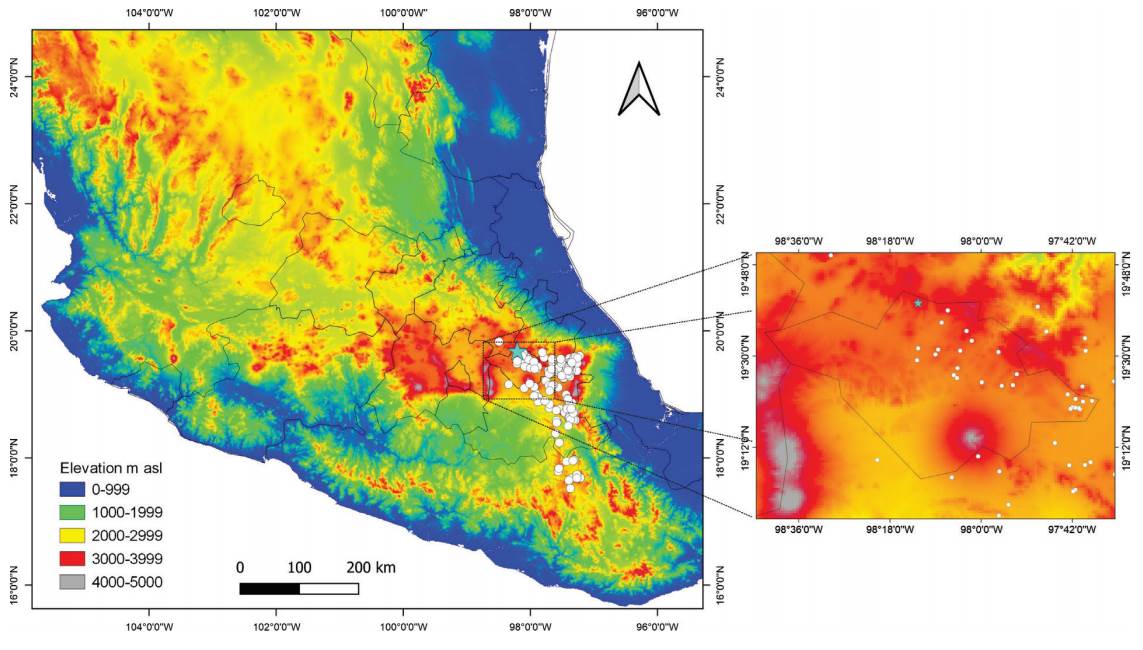
Figure 1
Geographic distribution of the Largescale Spiny Lizard (Sceloporus megalepidurus). Records are from GBIF (2022) and field work. The blue star represents our new record of S. megalepidurus in El Peñon de Tlaxco, Tlaxcala.
Geographic distribution of the Largescale Spiny Lizard (Sceloporus megalepidurus). Records are from GBIF (2022) and field work. The blue star represents our new record of S. megalepidurus in El Peñon de Tlaxco, Tlaxcala.
Figura 1
Distribución geográfica de la lagartija espinosa de escamas grandes (Sceloporus megalepidurus). Los registros provienen de GBIF (2022) y trabajo de campo. La estrella azul representa nuestro nuevo registro de S. megalepidurus en El Peñón de Tlaxco, Tlaxcala.
Distribución geográfica de la lagartija espinosa de escamas grandes (Sceloporus megalepidurus). Los registros provienen de GBIF (2022) y trabajo de campo. La estrella azul representa nuestro nuevo registro de S. megalepidurus en El Peñón de Tlaxco, Tlaxcala.
On December 13th, 2021, we conducted field surveys between 2,500 and 3,445 m a.s.l. on the west slope of the Peñón de Tlaxco, Tlaxcala. We searched principally in grasslands and Yucca spp, Nolina spp, Pinus spp, and Abies spp forests. Nine S. megalepidurus were observed perched on a rocky outcrop in grassland with surrounding vegetation represented by pine forest (19.67º N, 98.20º W; WGS 84; 3,390 m elevation). Two adult females were captured: the first with a total length of 82 mm, tail length of 43 mm, and body mass of 1.6 g (MZFZ 4460), and the second with a total length of 102 mm, tail length of 57 mm, and body mass of 3.3 g (MZFZ 4461).
Both lizards presented 15 femoral pores unilaterally. The primary color of the specimens’ bodies were dark gray, with a dorsolateral light line at the sides. The venters of both specimens were immaculate (Fig. 2). Lizards were identified as S. megalepidurus based on the description by Smith et al. (2006)), following these characteristics: dorsolateral light line, bordered laterally by a dark band in turn bordered by a lateral light line, series of 12-13 small, irregular dark spots on either side of the midline, venter immaculate, 15 femoral pores unilaterally.
-
Smith et al. (2006)Sceloporus megalepidurusCatalogue of American Amphibians and Reptiles, 2006
Thumbnail
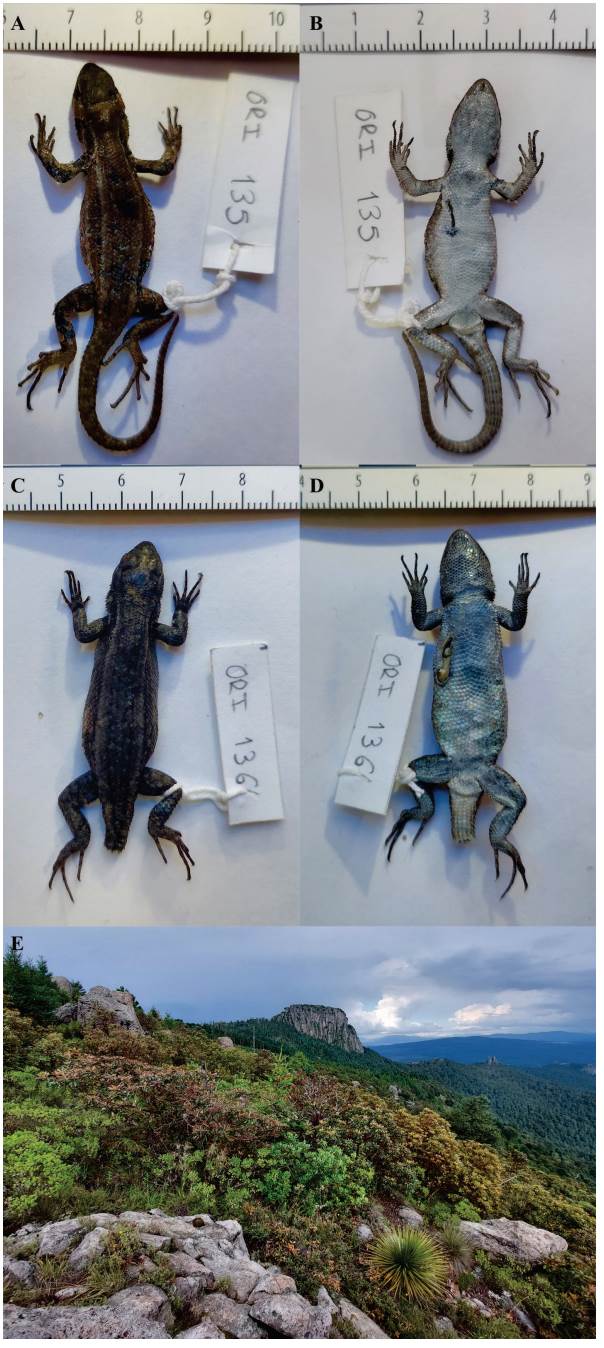
Figure 2
Largescale Spiny Lizard (Sceloporus megalepidurus). A) Dorsal and B) Ventral views of the female MZFZ 4460. C) Dorsal and D) Ventral views of the female MZFZ 4461. E) Habitat.
Largescale Spiny Lizard (Sceloporus megalepidurus). A) Dorsal and B) Ventral views of the female MZFZ 4460. C) Dorsal and D) Ventral views of the female MZFZ 4461. E) Habitat.
Figura 2
Lagartija espinosa de escamas grandes (Sceloporus megalepidurus). A) Vista dorsal y B) vista ventral de la hembra MZFZ 4460. C) Vista dorsal y D) vista ventral de la hembra MZFZ 4461. E) Hábitat.
Lagartija espinosa de escamas grandes (Sceloporus megalepidurus). A) Vista dorsal y B) vista ventral de la hembra MZFZ 4460. C) Vista dorsal y D) vista ventral de la hembra MZFZ 4461. E) Hábitat.
The Eastern Spiny Lizard (Sceloporus spinosus; Wiegmann 1828) is an oviparous species endemic to Mexico with terrestrial, saxicolous, and occasionally arboreal habits (Méndez-de la Cruz et al., 2013). It is one of the largest lizards in the genus, with an average SVL of 100 mm (Ramírez-Bautista et al., 2014). This lizard inhabits coniferous forests, Quercus forests, xerophilic scrubland, and deforested areas near crops, induced grasslands, and man-made structures (Flores-Villela & Gerez, 1994). S. spinosus can be found in Durango, Zacatecas, San Luis Potosí, south of Nuevo León, Tamaulipas, eastern Jalisco, Guanajuato, Querétaro, Hidalgo, the Estado de México, Mexico City, Tlaxcala, Puebla, and Oaxaca (Fig. 2; Grummer et al., 2015; Leyte-Manrique et al., 2015; Mata-Silva et al., 2015; Cruz-Sáenz et al., 2017; Woolrich-Piña et al., 2017; Lemos-Espinal et al., 2018; Lemos-Espinal & Smith 2015; 2020b). This species inhabits elevations between 1,300 (Grummer et al., 2015) and 2,543 m a.s.l. in El Chico, Hidalgo (Sinervo et al., 2010). Recently, this species was located at 2,670 m a.s.l. (CNAR-IB-RF 517-518), inhabiting surrounding areas of cornfields along dirt roads of La Malinche volcano, Tlaxcala (Díaz de la Vega-Pérez et al., 2019).
-
Méndez-de la Cruz et al., 2013Reproductive cycle of a high-elevation, oviparous lizard (Sceloporus spinosus: Reptilia: Phrynosomatidae)The Southwestern Naturalist, 2013
-
Ramírez-Bautista et al., 2014No sexual size-dimorphism in the eastern spiny lizard, Sceloporus spinosus, from Guadalcázar, San Luis Potosí, MexicoThe Southwestern Naturalist, 2014
-
Flores-Villela & Gerez, 1994Biodiversidad y Conservación en México: Vertebrados, Vegetación y Uso de Suelo, 1994
-
Grummer et al., 2015Estimating the temporal and spatial extent of gene flow among sympatric lizard populations (Sceloporus) in the southern Mexican highlandsMolecular Ecology, 2015
-
Leyte-Manrique et al., 2015Herpetofauna de Guanajuato: un análisis histórico y contemporáneo de su conocimientoRevista Mexicana de Herpetología, 2015
-
Mata-Silva et al., 2015The herpetofauna of Oaxaca, Mexico: composition, physiographic distribution, and conservation statusMesoamerican Herpetology, 2015
-
Woolrich-Piña et al., 2017The herpetofauna of Puebla, Mexico: composition, distribution, and conservationMesoamerican Herpetology, 2017
-
Lemos-Espinal et al., 2018Amphibians and reptiles of the state of San Luis Potosí, Mexico, with comparisons with adjoining statesZooKeys, 2018
-
Lemos-Espinal & Smith 2015Amphibians and reptiles of the state of Hidalgo, MexicoCheck List, 2015
-
2020bA conservation checklist of the amphibians and reptiles of Mexico City, with comparisons with adjoining statesZooKeys, 2020
-
Grummer et al., 2015Estimating the temporal and spatial extent of gene flow among sympatric lizard populations (Sceloporus) in the southern Mexican highlandsMolecular Ecology, 2015
-
Sinervo et al., 2010Erosion of lizard diversity by climate change and altered thermal nichesScience, 2010
-
Díaz de la Vega-Pérez et al., 2019Diversity and conservation of amphibians and reptiles of a protected and heavily disturbed forest of central MexicoZooKeys, 2019
Thumbnail
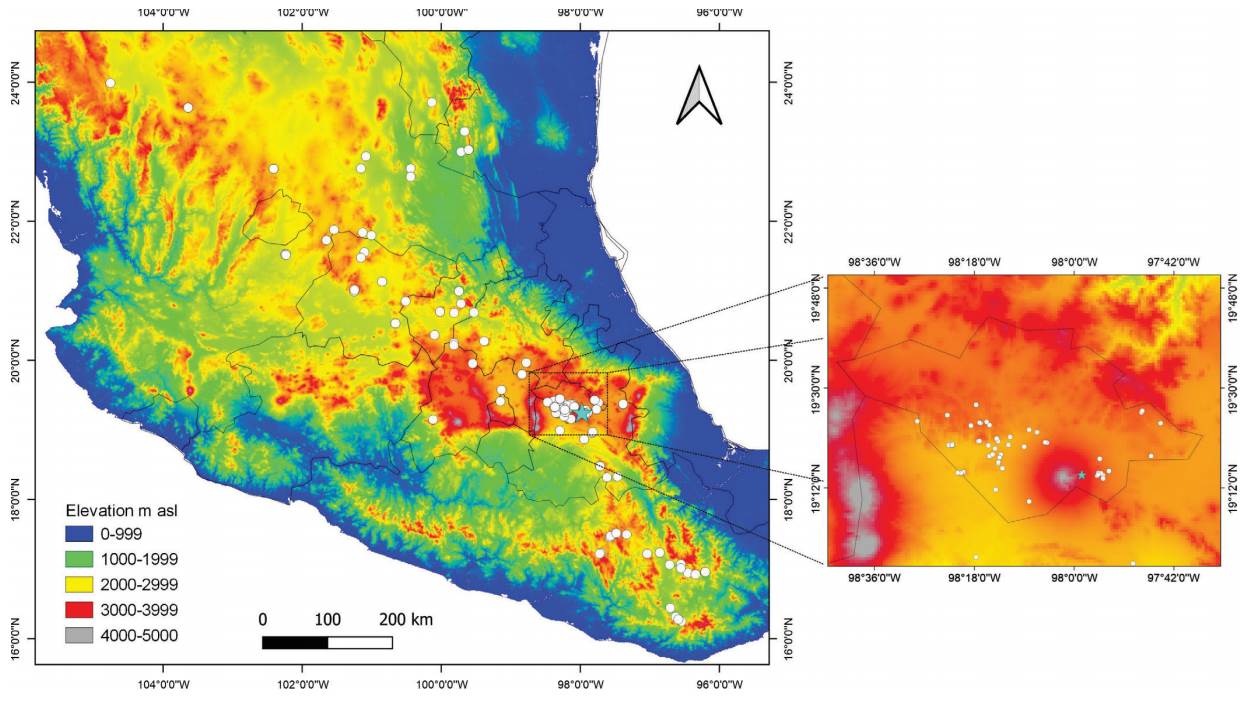
Figure 3
Geographic distribution of the Eastern Spiny Lizard (Sceloporus spinosus). Records are from Grummer et al. (2015), Sinervo et al. (2010), GBIF (2022), and field work. The blue star represents our new record of S. spinosus in La Malinche, Tlaxcala.
Geographic distribution of the Eastern Spiny Lizard (Sceloporus spinosus). Records are from Grummer et al. (2015), Sinervo et al. (2010), GBIF (2022), and field work. The blue star represents our new record of S. spinosus in La Malinche, Tlaxcala.
Figura 3
Distribución geográfica de la lagartija espinosa del este (Sceloporus spinosus). Los registros provienen de Grummer et al. (2015), Sinervo et al. (2010), GBIF (2022) y trabajo de campo. La estrella azul representa nuestro nuevo registro de S. spinosus en La Malinche, Tlaxcala.
Distribución geográfica de la lagartija espinosa del este (Sceloporus spinosus). Los registros provienen de Grummer et al. (2015), Sinervo et al. (2010), GBIF (2022) y trabajo de campo. La estrella azul representa nuestro nuevo registro de S. spinosus en La Malinche, Tlaxcala.
On December 18th, 2021, we conducted field surveys between 2,950 and 3,200 m a.s.l. on the east slope of La Malinche volcano. We searched principally near cornfields, Pinus spp., and Abies spp. forests. We found and captured a lizard of the species S. spinosus; the lizard was discovered under bricks near an abandoned, old cabin in grassland with surrounding vegetation represented by pine forest (19.23º N, 97.97º W; WGS 84; 3,030 m of elevation) in the locality of San Juan Ixtenco, Tlaxcala. The lizard (MZFZ-IMG 361) - an adult male - had a total length of 175 mm, tail length 105 mm, and body mass of 23.3 g. It had a dark band in the middle of the dorsum with 14 irregular dark spots. This dark band is bordered laterally by two light bands and presents blue, black, and white stripes in the dewlap region. The ventral region is white (Fig. 4). The specimen was identified as S. spinosus, based on the following characteristics: large, keeled, and mucronate dorsal scales, two clear dorsal lines from the eye to the base of the tail, blue scale on the patch of the shoulder, two small blue ventral patches, blue, black, and white stripes in the dewlap region, 10 femoral unilateral pores, and two large postcloacal scales.
Thumbnail
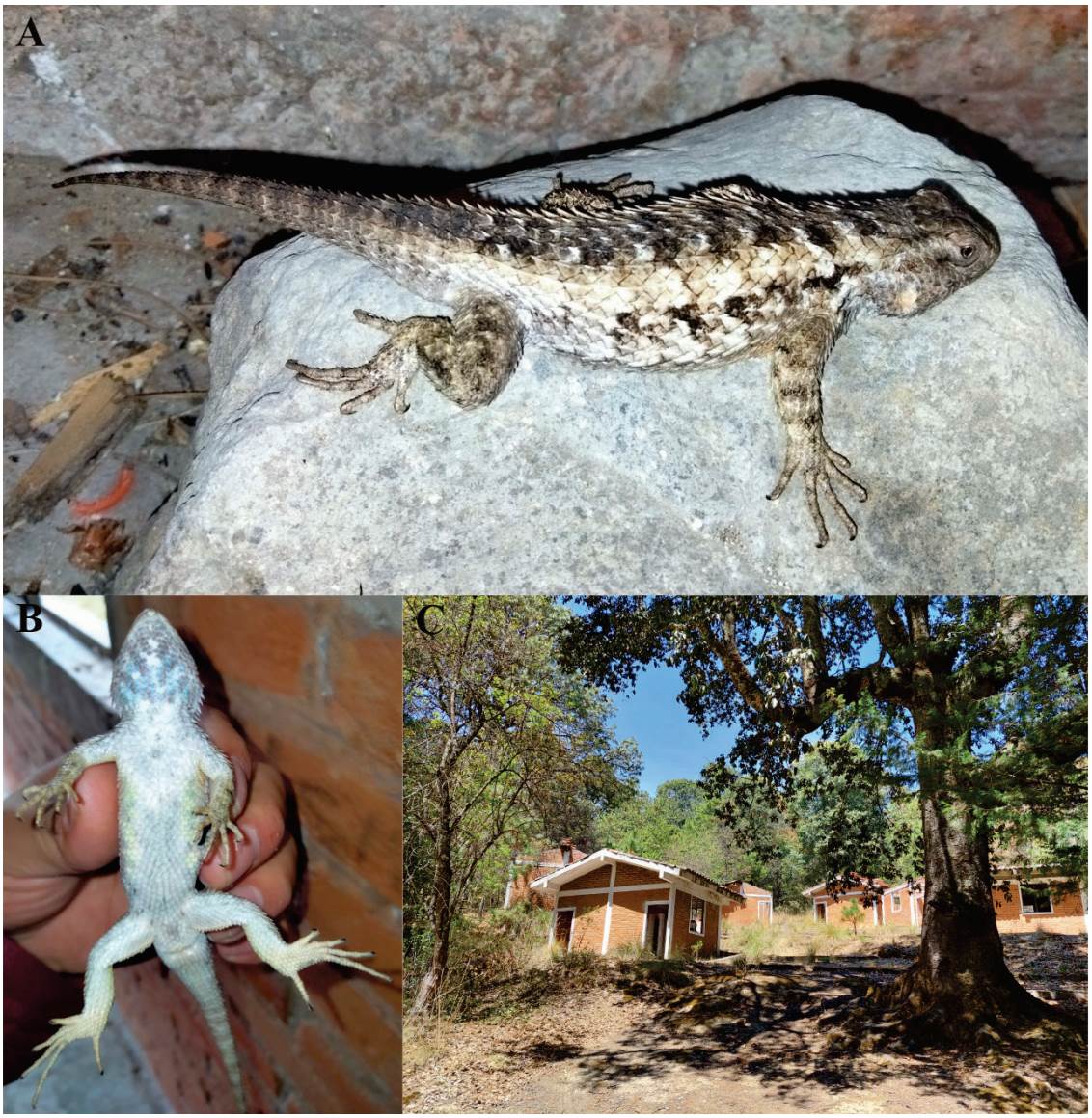
Figure 4
Eastern Spiny Lizard Sceloporus spinosus (MZFZ-IMG 361). A) Dorsal and B) Ventral views of the specimen. C) Habitat.
Eastern Spiny Lizard Sceloporus spinosus (MZFZ-IMG 361). A) Dorsal and B) Ventral views of the specimen. C) Habitat.
Figura 4
Lagartija espinosa del este Sceloporus spinosus (MZFZ-IMG 361). A) Vista dorsal y B) Vista ventral. C) Hábitat.
Lagartija espinosa del este Sceloporus spinosus (MZFZ-IMG 361). A) Vista dorsal y B) Vista ventral. C) Hábitat.
The first record extends the known maximum elevation limit of S. megalepidurus from 2600 m (Smith et al., 2006) to 3390 m a.s.l. Our second record extends the known maximum elevation limit of S. spinosus, previously posited by Díaz de la Vega-Pérez et al., (2019), from 2670 m (CNAR-IB-RF 517-518) to 3030 m a.s.l. Photos and specimens from this note were delivered to the herpetological collection of the Museo de Zoología, Facultad de Estudios Superiores Zaragoza (MZFZ) at Universidad Nacional Autónoma de México (UNAM). All fieldwork was conducted under collecting permits SGPA/DGSV/07931/21 and SGPA/ DGVS/03937/21, granted by the Secretaría de Medio Ambiente y Recursos Naturales (SEMARNAT).
-
Smith et al., 2006Sceloporus megalepidurusCatalogue of American Amphibians and Reptiles, 2006
-
Díaz de la Vega-Pérez et al., (2019)Diversity and conservation of amphibians and reptiles of a protected and heavily disturbed forest of central MexicoZooKeys, 2019
Acknowledgements
We thank Margarita Martínez-Gómez, de Ciencia y Tecnología: two master scholarships (20208667 and Estación Científica La Malinche, and Centro Tlaxcala de Biología 762994) to ORI and JEGC; a postdoctoral fellowship (898668) to de la Conducta for the courtesies provided. Finally, we thank MADG; and a Cátedras-CONACyT project (883) to ADVP. Elizabeth K. Lopez for her careful review of this manuscript. Funding for the fieldwork was provided by the Consejo Nacional.
Cited literature
- Díaz de la Vega-Pérez, A.H., V.H. Jiménez-Arcos, E. Centenero-Alcalá, F.R. Méndez-de la Cruz & A. Ngo. 2019. Diversity and conservation of amphibians and reptiles of a protected and heavily disturbed forest of central Mexico. ZooKeys 830:111-125. Links
- Flores-Villela, O. & P. Gerez. 1994. Biodiversidad y Conservación en México: Vertebrados, Vegetación y Uso de Suelo. Universidad Nacional Autónoma de México, Distrito Federal, México. Links
- GBIF (Global Biodiversity Information Facility). 2022. GBIF home page. https://doi.org/10.15468/dl.2qfnyq. https://doi.org/10.15468/dl.dt539d. [Accessed on 2022-02-22]. Links
- González-Ruiz, M. 2014. Dimorfismo sexual en una población de la lagartija Sceloporus megalepidurus (Squamata: Phrynoisomatidae) que habita en una comunidad de matorral xerófilo al este de Puebla. México. Tesis de Maestría. Facultad de Estudios Superiores Zaragoza, Ecología. UNAM. Links
- Grummer, J.A., M.L. Calderón-Espinosa, A. Nieto-Montes de Oca, E.N. Smith, F.R. Méndez-de la Cruz & A.D. Leaché. 2015. Estimating the temporal and spatial extent of gene flow among sympatric lizard populations (Sceloporus) in the southern Mexican highlands. Molecular Ecology 24:1523-1542. Links
- Leyte-Manrique, A., E.M. Hernández Navarro & L.A. Escobedo-Morales. 2015. Herpetofauna de Guanajuato: un análisis histórico y contemporáneo de su conocimiento. Revista Mexicana de Herpetología 1:1-14. Links
- Lemos-Espinal, J.A. & G.R. Smith. 2015. Amphibians and reptiles of the state of Hidalgo, Mexico. Check List 11:1-11. Links
- Lemos-Espinal, J.A. & G.R. Smith. 2020a. A conservation checklist of the amphibians and reptiles of the State of Mexico, Mexico with comparisons with adjoining states. ZooKeys 953:137-159. Links
- Lemos-Espinal, J.A. & G.R. Smith. 2020b. A conservation checklist of the amphibians and reptiles of Mexico City, with comparisons with adjoining states. ZooKeys 951:109-131. Links
- Lemos-Espinal, J.A. , G.R. Smith & G.A. Woolrich-Piña. 2018. Amphibians and reptiles of the state of San Luis Potosí, Mexico, with comparisons with adjoining states. ZooKeys 753:83-106. Links
- Mata-Silva, V., J.D Johnson, L.D. Wilson & E. García-Padilla. 2015. The herpetofauna of Oaxaca, Mexico: composition, physiographic distribution, and conservation status. Mesoamerican Herpetology 2:6-62. Links
- Méndez-de la Cruz, F.R., M. Villagrán-Santa Cruz, M.L. López-Ortíz & O. Hernández-Gallegos. 2013. Reproductive cycle of a high-elevation, oviparous lizard (Sceloporus spinosus: Reptilia: Phrynosomatidae). The Southwestern Naturalist 58:54-63 Links
- Ramírez-Bautista, A., S. Geoffrey, A. Leyte & U. Hernández-Salinas . 2014. No sexual size-dimorphism in the eastern spiny lizard, Sceloporus spinosus, from Guadalcázar, San Luis Potosí, Mexico. The Southwestern Naturalist 58:508-512. Links
- SEMARNAT (Secretaría de Medio Ambiente y Recursos Naturales). 2013. Acuerdo por el que se da a conocer el Resumen del Programa de Manejo del Parque Nacional La Montaña Malinche o Matlalcuéyatl. Diario Oficial de la Federación (Segunda Sección, 03-April). http://dof.gob.mx/nota_detalle_popup.php?codigo=5294346 . [Accessed on 2022-02-22]. Links
- Sinervo, B., F. Méndez-de la Cruz, D.B. Miles, B. Heulin, E. Bastiaans, M. Villagrán-Santa Cruz. R. Lara-Reséndiz, N. Martínez-Méndez, M.L. Calderón-Espinosa , R.N Meza-Lazaro, H. Gadsden, L.J. Avila, M. Morando, I.J. De la Riva, P. Victoriano, C.F. Duarte-Rocha, N. Ibargüengoytía, C. Aguilar-Puntriano, M. Massot, V. Lepetz, T.A. Oksanen, D.G. Chapple, A.M. Bauer, W.R. Branch, J. Clobert & J.W. Sites Jr. 2010. Erosion of lizard diversity by climate change and altered thermal niches. Science 328:894-899. Links
- Smith, H.M., E.A. Liner, D. Chiszar, G. Perez-Higareda & F. Mendoza-Quijano. 2006. Sceloporus megalepidurus. Catalogue of American Amphibians and Reptiles 837:1-5. Links
- Torres-Hernández, L.A., A. Ramírez-Bautista, R. Cruz-Elizalde, U. Hernández-Salinas, C. Berriozabal-Islas, D.L. De-Santis, J.D. Johnson, A. Rocha, E. García-Padilla, V. Mata-Silva, L.A. Fucsko & L.D. Wilson. 2021. The herpetofauna of Veracruz, Mexico: composition, distribution, and conservation status. Amphibian & Reptile Conservation 15:72-155. Links
- Woolrich-Piña, G.A., E. García-Padilla, D.L. DeSantis, J.D. Johnson, V. Mata-Silva & L.D. Wilson. 2017. The herpetofauna of Puebla, Mexico: composition, distribution, and conservation. Mesoamerican Herpetology 4:794-884. Links