Scientific articles
Ectomycorrhizal association of Astraeus aff. hygrometricus (Pers.) Morgan with an oak forest relict in the Altiplano Potosino, Mexico

-
Publication dates-
February 16, 2024
May-Aug , 2022
- Article in PDF
- Article in XML
- Automatic translation
- Send this article by e-mail
- Share this article +
Abstract
Introduction:
In the high mountain ranges of the Altiplano Potosino there are relict forests of Quercus spp. The species of ectomycorrhizal fungi associated with these ecosystems are so far unknown.
Objective:
To know the morphology of Astraeus aff. hygrometricus (Pers.) Morgan associated with Quercus species in three sites of scarce precipitation in the Altiplano Potosino.
Materials and methods:
Ectomycorrhizal fungi and vegetative structures of oak were collected during the rainy season for morphological characterization and identification. Soil physicochemical variables were evaluated by Tukey's analysis of variance and least significant difference (P = 0.05), to identify differences among the studied sites (Cerro El Peñon Blanco, Sierras de Guanamé and La Mojonera).
Results and discussion:
The ectomycorrhizal species A. aff. hygrometricus was associated with Quercus potosina Trel., Q. pringlei Seemen ex Loes., Q. tinkhamii C. H. Muller and Q. striatula Trel. The fungi had five to 14 laciniae per basidiomata and the following diameter ranges: 13 to 20 mm (endoperidium), 42.3 to 57.4 mm (exoperidium), 8 to 10.1 µm (spore length), 4.4 to 6.9 µm (endoperidium hyphae) and 4.9 to 9.2 µm (exoperidium hyphae). Oak and fungal species were found in friable soils (sandy to clayey) with pH 5 to 7.7 and low nitrogen (<2 %) and high phosphorus contents (85 mg∙kg-1).
Conclusion:
The ectomycorrhizal association of A. aff. hygrometricus with oak species explains the survival of these shrub oak forests under the semi-arid environments of the studied sites.
Keywords::
Quercus, ectomycorrhizal fungi, ecological plasticity, semiarid ecosystems, edaphic characteristics
Highlights:
-
The study sites were Cerro El Peñon Blanco and Sierra de Guanamé and Sierra La Mojonera.
-
Astraeus aff. hygrometricus was associated with Quercus potosina, Q. pringlei, Q. tinkhamii and Q. striatula.
-
The ectomycorrhizal association was found in friable soils with pH 5 to 7.7.
-
The ectomycorrhizal association contributes to the survival of oak forests under semiarid environments.
Introduction
In Mexico, the genus Quercus L. provides a wide variety of ecosystem, economic, and social services (Galicia et al., 2018; Wallace et al., 2015). Some oak species grow and develop in dry climate regions (Villarreal, Encina, & Carranza, 2008). In these areas with a water-restrictive nature, it is important to consider ectomycorrhizal symbiosis (Smith & Read, 2008). Ectomycorrhizal (ECM) fungi are an essential component in most forested communities (Tedersoo, Suvi, Larson, & Koljalg, 2006), because they are involved in nutrient cycling and ecosystem function (Cheeke et al., 2017). Studies of ECM that succeed in semi-arid relict oak ecosystems are scarce.
-
Galicia et al., 2018Perspectivas del enfoque socioecológico en la conservación, el aprovechamiento y pago de servicios ambientales de los bosques templados de MéxicoMadera y Bosques, 2018
-
Wallace et al., 2015Present forest management structures and policies in temperate forests of Mexico: Challenges and prospects for unique tree species assemblagesThe Forestry Chronicle, 2015
-
Villarreal, Encina, & Carranza, 2008Los encinos (Quercus: Fagaceae) de Coahuila, MéxicoJournal of the Botanical Research Institute of Texas, 2008
-
Smith & Read, 2008Mycorrhizal symbiosis, 2008
-
Tedersoo, Suvi, Larson, & Koljalg, 2006Diversity and community structure of ectomycorrhizal fungi in a wooded meadowMycological Research, 2006
-
Cheeke et al., 2017Dominant mycorrhizal association of trees alters carbon and nutrient cycling by selecting for microbial groups with distinct enzyme functionNew Phytologist, 2017
Astraeus hygrometricus (Pers.) Morgan has been shown to establish ectomycorrhizal symbiosis with the genus Quercus (Kayama & Yamanaka, 2014, 2016). Because of its high nutritional, economic and commercial value, the immature stages of this species are widely consumed in several Southeast Asian countries, including Thailand, India and China (Biswas, Nandi, Kuila, & Acharya, 2017; Fangfuk et al., 2010). This species is known for its mycochemical contents with medicinal properties (Biswas et al., 2017), as well as for its positive effect on root elongation, aboveground growth, nutrition and photosynthesis of Quercus species under diverse soil conditions (Kayama & Yamanaka, 2014, 2016; Makita, Hirano, Yamanaka, Yoshimura, & Kosugi, 2012).
-
Kayama & Yamanaka, 2014Growth characteristics of ectomycorrhizal seedlings of Quercus glauca, Quercus salicina, and Castanopsis cuspidata planted on acidic soilTrees, 2014
-
Biswas, Nandi, Kuila, & Acharya, 2017A comprehensive review on food and medicinal prospects of Astraeus hygrometricusPharmacognosy Journal, 2017
-
Fangfuk et al., 2010In vitro mycorrhization of edible Astraeus mushrooms and their morphological characterizationMycoscience, 2010
-
Kayama & Yamanaka, 2014Growth characteristics of ectomycorrhizal seedlings of Quercus glauca, Quercus salicina, and Castanopsis cuspidata planted on acidic soilTrees, 2014
-
2016Growth characteristics of ectomycorrhizal seedlings of Quercus glauca, Quercus salicina, Quercus myrsinaefolia, and Castanopsis cuspidata planted in calcareous soilForests, 2016
-
Makita, Hirano, Yamanaka, Yoshimura, & Kosugi, 2012Ectomycorrhizal-fungal colonization induces physio-morphological changes in Quercus serrata leaves and rootsJournal of Plant Nutrition and Soil Science, 2012
In Mexico, A. hygrometricus is associated with oak, oak-pine, oak-juniper-pine, low deciduous forest, subtropical scrub, and gallery forest (Aguilar-Aguilar, González-Mendoza, & Grimaldo-Juárez, 2011; Esqueda et al., 2009, 2011, 2012; Párdave, Flores, Franco, & Robledo, 2007; Piña-Páez, Esqueda, Gutiérrez, & González-Ríos, 2013; Quiñónez et al., 2008). However, the study of these fungi has received little attention in the arid and semi-arid regions of the country, including the Altiplano Potosino, where fungi are distributed mainly in the mountain ranges (Sabás-Rosales, Sosa-Ramírez, & Luna-Ruiz, 2015).
-
Aguilar-Aguilar, González-Mendoza, & Grimaldo-Juárez, 2011Ectomicorrizas asociadas a Pinus jeffreyi en el Parque Nacional “Constitución de 1857” en Baja California, MéxicoRevista Chapingo Serie Ciencias Forestales y del Ambiente, 2011
-
Esqueda et al., 2009Primeros registros de hongos gasteroides en la Reserva Forestal Nacional y Refugio de Fauna Silvestre Ajos-Bavispe, Sonora, MéxicoRevista Mexicana de Micología, 2009
-
Párdave, Flores, Franco, & Robledo, 2007Contribución al conocimiento de los hongos (Macromicetos) de la Sierra Fría, AguascalientesInvestigación y Ciencia, 2007
-
Piña-Páez, Esqueda, Gutiérrez, & González-Ríos, 2013Diversity of gasteroid fungi in the Sierra de Mazatán, Sonora, MexicoThe Southwestern Naturalist, 2013
-
Quiñónez et al., 2008Índices de diversidad y similitud de hongos ectomicorrizógenos en bosques de Bocoyna, Chihuahua, MéxicoRevista Ciencia Forestal en México, 2008
-
Sabás-Rosales, Sosa-Ramírez, & Luna-Ruiz, 2015Diversidad, distribución y caracterización básica del hábitat de los encinos (Quercus: Fagaceae) del estado de San Luis Potosí, MéxicoBotanical Sciences, 2015
Because of its high ecological, biotechnological and economic potential, as well as its potential value as food, and the scarce information on the ectomycorrhizal association, the present research aimed to know the morphology of A. aff. hygrometricus associated with Quercus species in three sites with scarce precipitation in the Altiplano Potosino.
Materials and methods
The research was carried out in the localities of Cerro El Peñón Blanco (PB), Sierra de Guanamé (SG) and Sierra La Mojonera (SM), located in the municipalities of Salinas, Venado and Vanegas, and San Luis Potosí, respectively. It should be noted that a portion of the Mountain Range La Mojonera belongs to the municipality of Concepción del Oro, Zacatecas (Figure 1).
Thumbnail
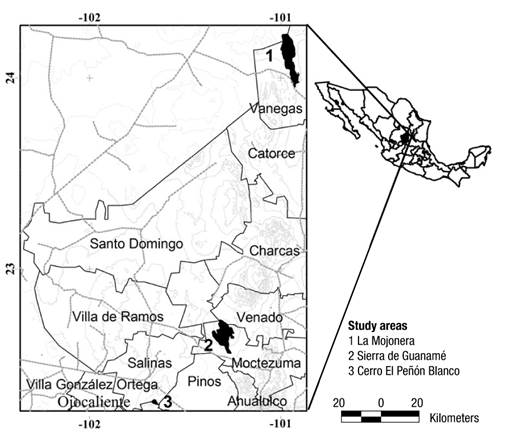
Figure 1
Location of the study area in the Altiplano Potosino, Mexico, where associations of Astraeus aff. hygrometricus grow.
Location of the study area in the Altiplano Potosino, Mexico, where associations of Astraeus aff. hygrometricus grow.
Macro and microscopic characterization of A. aff. hygrometricus
In spring and summer of 2014 and 2015, specimens of A. aff. hygrometricus were collected in each of the three study sites thriving under the shaded area of arboreal and shrubby oak forests. The laciniae were counted and the diameter of the exoperidium and endoperidium of 10 representative Astraeus specimens were measured. Surface sections of these structures were cut and examined in Melzer solution and cotton blue to determine the diameter of hyphae and spores extracted from the spore sac, using an optical microscope (Olympus BX51®) with a digital camera (H100H®) and software (Olympus Microscope Screen Saver, Large Version).
Botanical identification of Quercus species
Vegetative structures of five oak trees were collected at each of the three sites, finding sporomes of A. aff. hygrometricus. Specimens were classified and identified according to Zavala-Chávez (2003) and matched with the collections of the Isidro Palacios Herbarium of the Universidad Autónoma de San Luis Potosí, Herbario Nacional de México and Herbario de la Universidad Autónoma de Aguascalientes.
-
Zavala-Chávez (2003Identificación de encinos de México, 2003
Physicochemical characterization of the soil
A subsample of soil (0 to 20 cm depth) was taken from each of the oak trees in each cardinal point of the shaded area where sporomes were found, to integrate them into a composite sample, for a total of five samples per site. The soil was analyzed in the Plant Nutrition laboratory of the Colegio de Postgraduados, Campus Montecillo. This analysis included texture, pH, organic matter (OM), carbon percentage (C), carbon-nitrogen ratio (C/N), total nitrogen (TN) and phosphorus (P), according to NOM-021-RECNAT-2000 (Secretaría de Medio Ambiente y Recursos Naturales [SEMARNAT], 2000). The values of these measurements were subjected to an ANOVA and Tukey comparison of means (P ≤ 0.05) with the InfoStat® software (Di Rienzo et al., 2015).
-
Secretaría de Medio Ambiente y Recursos Naturales [SEMARNAT], 2000Norma Oficial Mexicana NOM-021-RECNAT-2000, Que establece las especificaciones de fertilidad, salinidad y clasificación de suelos. Estudios, muestreo y análisis, 2000
-
Di Rienzo et al., 2015InfoStat: software para análisis estadístico, 2015
Results and Discussion
At the three studied sites, A. aff. hygrometricus was associated with Quercus potosina Trel, Q. pringlei Seemen ex Loes, Q. tinkhamii C. H. Muller and Q. striatula Trel. (Table 1). These species were recorded in an altitudinal range from 1 820 to 2 740 m (Table 1), consistent with that reported by Giménez de Azcárate and González (2011) and Sabás et al. (2015). Other studies report the association of A. hygrometricus with Q. petraea (Mattuschka) Liebl., Q. robur L., Q. cerris L., Q. ilex L., Q. serrata Thunb., Q. crispula Blume, Q. suber L., Q. faginea Lam. subsp. broteroi A. Camus, Q. glauca Thunb. and Q. salicina Blume (Barrico et al., 2012; Fangfuk, Petchang, To-annun, Fukuda, & Yamada, 2010; Kayama & Yamanaka, 2014; Torrejón, 2007).
-
Giménez de Azcárate and González (2011Pisos de vegetación de la Sierra de Catorce y territorios circundantes (San Luis Potosí, México)Acta Botánica Mexicana, 2011
-
Sabás et al. (2015)Diversidad, distribución y caracterización básica del hábitat de los encinos (Quercus: Fagaceae) del estado de San Luis Potosí, MéxicoBotanical Sciences, 2015
-
Barrico et al., 2012Landscape and urban planning biodiversity in urban ecosystems: Plants and macromycetes as indicators for conservation planning in the city of Coimbra (Portugal)Landscape and Urban Planning, 2012
-
Fangfuk, Petchang, To-annun, Fukuda, & Yamada, 2010Identification of Japanese Astraeus, based on morphological and phylogenetic analysesMycoscience, 2010
-
Kayama & Yamanaka, 2014Growth characteristics of ectomycorrhizal seedlings of Quercus glauca, Quercus salicina, and Castanopsis cuspidata planted on acidic soilTrees, 2014
-
Torrejón, 2007Contribución al estudio de los hongos del parque natural de la Sierra Calderona y su área de influencia: Castelló-València (España)Revista Catalana de Micología, 2007
Table 1
Characteristics of oak trees in association with Astraeus aff. hygrometricus, located in the three study areas of the Altiplano Potosino in Mexico.
Characteristics of oak trees in association with Astraeus aff. hygrometricus, located in the three study areas of the Altiplano Potosino in Mexico.
| Study site | Species | Habitat | Altitude range (m) | Precipitation (mm) |
|---|---|---|---|---|
| El Peñón Blanco | Quercus potosina | Shrubby-arboreal | 2 270 - 2 740 | 335 |
| Sierra de Guanamé | Quercus tinkhamii | Shrubby-arboreal | 2 130 - 2 380 | 446 |
| Quercus pringlei | Shrub | |||
| Sierra La Mojonera | Quercus striatula | Shrub | 1 820 - 2 480 | 344 |
In Mexico, A. hygrometricus has been previously reported from oak forests, shrubby oak forests, disturbed oak forests and pine-oak forests, without specifying the Quercus species in these ecosystems (Esqueda et al., 2009; Pardavé et al., 2007; Piña-Páez et al., 2013; Terríquez, Herrera, & Rodríguez, 2017; Torres, Rodríguez, Herrera-Fonseca, & Figueroa-García, 2020). In Chihuahua, these fungi have been associated with Q. striatula in disturbed areas (44.0 to 63.6 % fungal abundance due to logging and burning, respectively), with Q. depressipes Trel. in areas of forest regeneration, and with Q. sideroxyla Humb. & Bonpl. and Q. crassifolia Humb. & Bonpl. in natural forests (Quiñónez et al., 2008).
-
Esqueda et al., 2009Primeros registros de hongos gasteroides en la Reserva Forestal Nacional y Refugio de Fauna Silvestre Ajos-Bavispe, Sonora, MéxicoRevista Mexicana de Micología, 2009
-
Piña-Páez et al., 2013Diversity of gasteroid fungi in the Sierra de Mazatán, Sonora, MexicoThe Southwestern Naturalist, 2013
-
Terríquez, Herrera, & Rodríguez, 2017Contribución al conocimiento de la micobiota del cerro Punta Grande, Mezcala, municipio de Poncitlán, Jalisco, MéxicoScientia Fungorum, 2017
-
Torres, Rodríguez, Herrera-Fonseca, & Figueroa-García, 2020Catálogo de la micobiota del Complejo Volcánico de Colima, MéxicoActa Botánica Mexicana, 2020
-
Quiñónez et al., 2008Índices de diversidad y similitud de hongos ectomicorrizógenos en bosques de Bocoyna, Chihuahua, MéxicoRevista Ciencia Forestal en México, 2008
In the present study, A. aff. hygrometricus was associated with four Quercus species distributed in a semi-arid environment with a mean annual precipitation of 375 mm (range 335 to 446 mm; Table 1). In this regard, it has been shown that mycorrhizal associations with woody plant species facilitate their absorption of water and minerals, due to the fungal absorptive capacity and different morphophysiological and biochemical strategies (Bréda, Huc, Granier, & Dreyer, 2006). This highlights the importance of A. aff. hygrometricus in the ecological survival of Quercus in the Altiplano Potosino. Gehring, Sthultz, Flores-Rentería, and Whipple (2017) pointed out that ECMs with the capacity to improve plant survival and growth, under conditions with water scarcity, will have a great relevance to forest vulnerability due to the warming and drought conditions predicted for the future. However, the development of mycorrhizal synthesis of Astraeus species is necessary to test the biotechnological and ecophysiological potential that this fungal species could have on the survival of the studied oak forests under semi-arid conditions.
-
Bréda, Huc, Granier, & Dreyer, 2006Temperate forest trees and stands under severe drought: a review of ecophysiological responses, adaptation processes and long-term consequencesAnnals of Forest Science, 2006
-
Gehring, Sthultz, Flores-Rentería, and Whipple (2017Tree genetics defines fungal partner communities that may confer drought toleranceProceedings of the National Academy of Sciences of the United States of America, 2017
Macro and microscopic characterization of Astraeus aff. hygrometricus
Results and comparison with other studies carried out in different climates and, generally, in mixed forests, are shown in Table 2, where it is observed that the morphological characteristics vary depending on the climate according to the geography of the reports. In the study area, the diameter of the endoperidium (13 to 20 mm) was larger than that reported in France (13 to 14 mm). Pérez-Calderón, Botello-Camacho, González-Fernández, and Valero-Galván (2015) indicate that there is an inverse relationship between diameter and amount of rainfall; in this regard, the average annual precipitation was 375 mm in the study area (Phosri, Martín, & Watling, 2013).
-
Pérez-Calderón, Botello-Camacho, González-Fernández, and Valero-Galván (2015Variación morfológica en el género Astraeus (Boletales, Basidiomycota) en relación con las condiciones climáticas y geográficas en las islas de montaña de Chihuahua y Sonora, MéxicoActa Universitaria, 2015
-
Phosri, Martín, & Watling, 2013Astraeus: hidden dimensionsIMA Fungus, 2013
The number of laciniae (7 to 10) was found to be in the global range between regions (5 to 14 per basidiomata); likewise, hyphal diameter (4.4 to 9.2 µm) was similar with that reported in Argentina (4.5 to 8 µm) and France (4.5 a 6.5 µm).
Table 2
Comparison of macroscopic and microscopic characteristics of Astraeus aff. hygrometricus in some world regions.
Comparison of macroscopic and microscopic characteristics of Astraeus aff. hygrometricus in some world regions.
| Macroscopic | Microscopic | Country | ||||
|---|---|---|---|---|---|---|
| DEXP (mm) | DENDP (mm) | Number of laciniae | Spore diameter (µm) | DENDPH (µm) | DEXPH (µm) | |
| 42.3-57.4 | 13-20 | 07-oct | 8-10.1 | 4.4-6.9 | 4.9-9.2 | Mexico (current study) |
| 30-70 | dic-25 | 05-ago | 6.5-11.0 | 05-ago | 4.5 | Argentina (Nouhra & Domínguez, 1998) |
| 20-25 | 13-14 | dic-14 | 10-12.5 | 4.5-6.5 | France (Phosri et al., 2013) | |
| 48.4-58.5 | 15.6-20 | 06-ago | 7.5-9.1 | Mexico (Pérez-Calderón et al., 2015) | ||
-
Nouhra & Domínguez, 1998The first record of Astraeus hygrometricus from ArgentinaMycologist, 1998
-
Phosri et al., 2013Astraeus: hidden dimensionsIMA Fungus, 2013
-
Pérez-Calderón et al., 2015Variación morfológica en el género Astraeus (Boletales, Basidiomycota) en relación con las condiciones climáticas y geográficas en las islas de montaña de Chihuahua y Sonora, MéxicoActa Universitaria, 2015
Variations in macroscopic and microscopic characteristics are an indicator of climatic characteristics that directly affect fungal development and plasticity of Astraeus species to thrive in diverse ecosystems. Figure 2 shows some morphological characteristics of A. aff. hygrometricus, analyzed in the present study.
Thumbnail
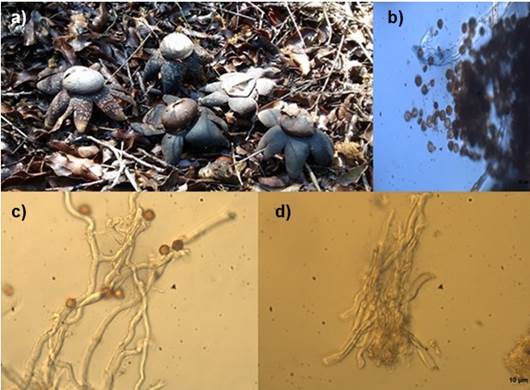
Figure 2
Structures of Astraeus aff. hygrometricus in oak forest relicts of the Altiplano Potosino: (a) sporomes; (b) verrucose globose spores (40x); (c) cylindrical to tortuous hyphae of external exoperidium, septate with y-connections, bifurcate, thick-walled, hyaline (40x); d) smooth, slightly ornamented to sparsely verrucose hyphae of internal exoperidium, cylindrical and thin-walled, with y-connections, sometimes with attenuated apices, hyaline, non-amyloid, with rounded hyphal termination and sparce clamp-connections (40x).
Structures of Astraeus aff. hygrometricus in oak forest relicts of the Altiplano Potosino: (a) sporomes; (b) verrucose globose spores (40x); (c) cylindrical to tortuous hyphae of external exoperidium, septate with y-connections, bifurcate, thick-walled, hyaline (40x); d) smooth, slightly ornamented to sparsely verrucose hyphae of internal exoperidium, cylindrical and thin-walled, with y-connections, sometimes with attenuated apices, hyaline, non-amyloid, with rounded hyphal termination and sparce clamp-connections (40x).
Soil characterization
Table 3 shows the soil characteristics of the sites analyzed. The fungal species A. aff. hygrometricus developed in soils with both clayey and sandy loam texture. In Sonora and other regions of the world, A. hygrometricus has been found in soils with sandy loam and loam texture (Esqueda et al., 2011; Pavithra, Greeshma, Karun, & Sridhar, 2015). The common feature in these studies is the presence of such fungi in soils with a significant proportion of sand.
-
Esqueda et al., 2011Nuevos registros de hongos gasteroides en la Reserva de Biosfera Sierra de Álamos-Río CuchujaquiRevista Mexicana de Micología, 2011
-
Pavithra, Greeshma, Karun, & Sridhar, 2015Observations on the Astraeus spp. of Southwestern IndiaMycosphere, 2015
Table 3
Physical and chemical characteristics of soil where Astraeus aff. hygrometricus grows in association with Quercus in the Altiplano Potosino.
Physical and chemical characteristics of soil where Astraeus aff. hygrometricus grows in association with Quercus in the Altiplano Potosino.
| Characteristics | Study sites | Probability F | CV (%) | LSD | ||
|---|---|---|---|---|---|---|
| PB | SM | SG | ||||
| Texture | Sandy crumb | Clayey crumb | Clayey crumb | |||
| pH | 5.00 a | 7.80 b | 7.70 b | < 0.0001 | 2.78 | 0.32 |
| Organic matter (%) | 39.92 a | 35.04 a | 29.08 a | 0.3427 | 36.75 | 21.24 |
| Carbon (%) | 23.16 a | 18.61 a | 14.99 a | 0.1655 | 33.41 | 10.66 |
| C/N ratio (%) | 11.60 a | 11.60 a | 11.60 a | 0.4914 | 0.03 | 0.005 |
| Total nitrogen (%) | 2.00 a | 1.75 a | 1.39 a | 0.343 | 36.76 | 1.06 |
| P (mg∙kg-1) | 84.97 b | 3.75 a | 0.77 a | 0.0091 | 134.2 | 67.54 |
The soil of El Peñon Blanco site had the lowest H+ concentration (reported as pH) (P < 0.05). A. hygrometricus showed a wide adaptation to soil pH variation (5.0 to 7.8). This coincides with that reported in the state of Sonora, where these fungi grow in soils with pH from 4.5 to 7.8 (Esqueda et al., 2009, 2011). Tolerance to different pH is the basis for recommending inoculation of A. hygrometricus during oak establishment, both in acidic and calcareous environments (Kayama & Yamanaka, 2014, 2016).
-
Esqueda et al., 2009Primeros registros de hongos gasteroides en la Reserva Forestal Nacional y Refugio de Fauna Silvestre Ajos-Bavispe, Sonora, MéxicoRevista Mexicana de Micología, 2009
-
2011Distribución de algunos hongos gasteroides (Agaricomycetes) en la planicie central del Desierto SonorenseRevista Mexicana de Micología, 2012
-
Kayama & Yamanaka, 2014Growth characteristics of ectomycorrhizal seedlings of Quercus glauca, Quercus salicina, and Castanopsis cuspidata planted on acidic soilTrees, 2014
OM, C, C/N and TN values were similar (P > 0.05) for the three sites. The soils were classified as low in TN (1.39-2.0 %). With respect to P, the soils of the Mountain Ranges Guanamé and La Mojonera were classified as low in P (0.77 to 3.75 mg∙kg-1) and only the soil of El Peñon Blanco was classified as high in this nutrient (P < 0.05, 84.97 mg∙kg-1). Arteaga, León, and Amador (2003) reported that the high percentage of OM, composed mostly of oak leaves, is closely related to higher contents of P and other nutrients in the soil. Dieleman, Venter, Ramachandra, Krockenberger, and Bird (2013) indicated that at higher altitudes, colder and wetter conditions prevail, in addition to higher soil acidity, conditions that reduce microbial activity, which is responsible for degradation of forest substrates.
-
Arteaga, León, and Amador (2003Efecto de la mezcla de sustratos y fertilización sobre el crecimiento de Pinus durangensis Martínez en viveroForesta Veracruzana, 2003
-
Dieleman, Venter, Ramachandra, Krockenberger, and Bird (2013Soil carbon stocks vary predictably with altitude in tropical forests: Implications for soil carbon storageGeoderma, 2013
Soil C content was slightly higher (not significant) in El Peñon Blanco (23.16 %); this element, besides being related to the OM content, is also explained by the parent material. This is different between sites: granite in El Peñon Blanco; calcareous shale, siltstone and limestone in Sierra La Mojonera; and limestone-limolite in Sierra de Guanamé. Higher organic C content of soil derived from granite (5.3 kg∙m-2) has been reported compared to that originating from limestone (3.5 kg∙m-2); moreover, the type of parent material has indirect control over soil C dynamics, through its influence on microbiota (Heckman, Welty-Bernard, Rasmussen, & Schwartz, 2009), fertility, soil quality, and environmental impact (Cristóbal-Acevedo, Tinoco-Rueda, Prado-Hernández, & Hernández-Acosta, 2019).
-
Heckman, Welty-Bernard, Rasmussen, & Schwartz, 2009Geologic controls of soil carbon cycling and microbial dynamics in temperate conifer forestsChemical Geology, 2009
-
Cristóbal-Acevedo, Tinoco-Rueda, Prado-Hernández, & Hernández-Acosta, 2019Soil carbon and nitrogen in tropical montane cloud forest, agroforestry and coffee monoculture systemsRevista Chapingo Serie Ciencias Forestales y del Ambiente, 2019
Altitude may be determining the presence of Quercus species; also, the interaction of these with the parental material and environmental factors could influence soil fertility. In this study, Q. potosina (present in El Peñon Blanco with an average altitude of 2 505 m) was associated with higher nutrient and OM contents, while the lowest values were found in the lower altitude sites, where Q. tinkhamii and Q. pringlei (Sierra de Guanamé, 2 225 m) and Q. striatula (Sierra La Mojonera, 2 150 m) grow.
The study of soil conditions where A. aff. hygrometricus grows contributes to the knowledge related to this species, since certain ECM may be adapted to specific niches. This helps to a better use of soil resources (Kranabetter, Durall, & Mackenzie, 2009) by the production of mycelium that can potentially act as an extension of the root system of woody species, which enhances their nutrient and water acquisition efficiency for the host plant (Chalot & Plassard, 2011; Liu, Li, & Kou, 2020) and decreases nutrient losses from the ecosystem (Van Der Heijden & Horton, 2015). The pH is one of the soil characteristics that has a close relationship with the beneficial effect of ECM, since, under acidic conditions, fungal communities will be dominated by taxa that are dependent and efficient in releasing organic P from soil organic matter (Carrino-Kyker et al., 2016). It has been shown that mycorrhizal fungi can increase P availability by the secretion of phosphatases that degrade organic P (Burke, Smemo, & Hewins, 2014). This could explain the high P content in the soil of this study, associated with acid pH.
-
Kranabetter, Durall, & Mackenzie, 2009Diversity and species distribution of ectomycorrhizal fungi along productivity gradients of a southern boreal forestMycorrhiza, 2009
-
Chalot & Plassard, 2011Ectomycorrhiza and nitrogen provision to the host treeEcological aspects of nitrogen metabolism in plants, 2011
-
Liu, Li, & Kou, 2020Ectomycorrhizal fungi: participation in nutrient turnover and community assembly pattern in forest ecosystemsForests, 2020
-
Van Der Heijden & Horton, 2015Socialism in soil? The importance of mycorrhizal fungal networks for facilitation in natural ecosystemsJournal of Ecology, 2015
-
Carrino-Kyker et al., 2016Mycorrhizal fungal communities respond to experimental elevation of soil pH and P availability in temperate hardwood forestsFEMS Microbiology Ecology, 2016
-
Burke, Smemo, & Hewins, 2014Soil biology & biochemistry ectomycorrhizal fungi isolated from old-growth northern hardwood forest display variability in extracellular enzyme activity in the presence of plant litterSoil Biology and Biochemistry, 2014
Conclusions
The ectomycorrhizal fungus Astraeus aff. hygrometricus, associated with four Quercus species (Q. potosina, Q. tinkhamii, Q. pringlei and Q. striatula) was found for the first time in oak forests relicts of the semi-arid Altiplano Potosino at altitudes ranging from 1 820 to 2 740 m. This indicates the ability to establish ectomycorrhizal symbiosis in semiarid environments with low precipitation (375 mm per year) and in soils with acid to basic pH (5.0 to 7.8) with low N and high P levels. The study contributes to strengthen the knowledge related to the macro- and microscopic morphological characteristics of A. aff. hygrometricus (which may vary depending on the study site), its plasticity to thrive in diverse ecosystems, and the importance and survival of Quercus and Astraeus in vulnerable environments.
Acknowledgments
The authors would like to thank the Consejo Nacional de Ciencia y Tecnología for the scholarship granted to the first author for her graduate studies. We also thank Dr. Faustino Hernández Santiago for his support and advice.
References
- Aguilar-Aguilar, S., González-Mendoza, D., & Grimaldo-Juárez, O. (2011). Ectomicorrizas asociadas a Pinus jeffreyi en el Parque Nacional “Constitución de 1857” en Baja California, México. Revista Chapingo Serie Ciencias Forestales y del Ambiente, 17(3), 325-332. doi: 10.5154/r.rchscfa.2011.01.007 Links
- Arteaga, B., León, S., & Amador, C. (2003). Efecto de la mezcla de sustratos y fertilización sobre el crecimiento de Pinus durangensis Martínez en vivero. Foresta Veracruzana, 5(2), 9-16. Retrieved from https://www.redalyc.org/html/497/49750202/ Links
- Barrico, L., Azul, A. M., Morais, M. C., Coutinho, A. P., Freitas, H., & Castro, P. (2012). Landscape and urban planning biodiversity in urban ecosystems: Plants and macromycetes as indicators for conservation planning in the city of Coimbra (Portugal). Landscape and Urban Planning, 106(1), 88-102. doi: 10.1016/j.landurbplan.2012.02.011 Links
- Biswas, G., Nandi, S., Kuila, D., & Acharya, K. (2017). A comprehensive review on food and medicinal prospects of Astraeus hygrometricus. Pharmacognosy Journal, 9(6), 799-806. doi: 10.5530/pj.2017.6.125 Links
- Bréda, N., Huc, R., Granier, A., & Dreyer, E. (2006). Temperate forest trees and stands under severe drought: a review of ecophysiological responses, adaptation processes and long-term consequences. Annals of Forest Science, 63, 625-644. doi: 10.1051/forest:2006042 Links
- Burke, D. J., Smemo, K. A., & Hewins, C. R. (2014). Soil biology & biochemistry ectomycorrhizal fungi isolated from old-growth northern hardwood forest display variability in extracellular enzyme activity in the presence of plant litter. Soil Biology and Biochemistry, 68, 219-222. doi: 10.1016/j.soilbio.2013.10.013 Links
- Carrino-Kyker, S., Kluber, L., Petersen, S., Coyle, K., Hewins, C., De Forest, J., & Burke, D. (2016). Mycorrhizal fungal communities respond to experimental elevation of soil pH and P availability in temperate hardwood forests. FEMS Microbiology Ecology, 92(3), 1-24. doi: 10.1093/femsec/fiw024 Links
- Comisión Nacional del Agua (CONAGUA). (2017). Normales climatológicas por estación, Retrieved from http://smn.cna.gob.mx/index.php?option=com_content&view=article&id=42&Itemid=75 Links
- Cristóbal-Acevedo, D., Tinoco-Rueda, J., Prado-Hernández, J., & Hernández-Acosta, E. (2019). Soil carbon and nitrogen in tropical montane cloud forest, agroforestry and coffee monoculture systems. Revista Chapingo Serie Ciencias Forestales y del Ambiente, 25(2), 169-184. doi: 10.5154/r.rchscfa.2018.09.070 Links
- Chalot, M., & Plassard, C. (2011). Ectomycorrhiza and nitrogen provision to the host tree. In J. C. Polacco, & C. D. Todd (Eds.), Ecological aspects of nitrogen metabolism in plants (pp. 69-94). New York, USA: Wiley. doi: 10.1002/9780470959404.ch4 Links
- Cheeke, T. E., Phillips, R. P., Brzostek, E. R., Rosling, A., Bever, J. D., & Fransson, P. (2017). Dominant mycorrhizal association of trees alters carbon and nutrient cycling by selecting for microbial groups with distinct enzyme function. New Phytologist, 214(1), 432-442. doi: 10.1111/nph.14343 Links
- Dieleman, W. I. J., Venter, M., Ramachandra, A., Krockenberger, A. K., & Bird, M. I. (2013). Soil carbon stocks vary predictably with altitude in tropical forests: Implications for soil carbon storage. Geoderma, 204, 59-67. doi: 10.1016/j.geoderma.2013.04.005 Links
- Di Rienzo, J. A., Casanoves, F., Balzarini, F., Gonzalez, M. G., Tablada, L. M., & Robledo, C. W. (2015). InfoStat: software para análisis estadístico. Argentina: Universidad Nacional de Córdoba. Links
- Esqueda, M., Gutiérrez, A., Coronado, M. L., Lizárraga, M., Raymundo, T., & Valenzuela, R. (2012). Distribución de algunos hongos gasteroides (Agaricomycetes) en la planicie central del Desierto Sonorense. Revista Mexicana de Micología, 36(4), 1-8. Retrieved from http://www.scielo.org.mx/scielo.php?pid=S0187-31802012000200002&script=sci_arttext Links
- Esqueda, M., Sánchez, A., Coronado, M., Gutiérrez, A., Lizárraga, M., & Valenzuela, R. (2011). Nuevos registros de hongos gasteroides en la Reserva de Biosfera Sierra de Álamos-Río Cuchujaqui. Revista Mexicana de Micología, 32, 43-51. Retrieved from http://www.scielo.org.mx/pdf/rmm/v34/v34a7.pdf Links
- Esqueda, M., Sánchez, A., Rivera, M., Coronado, M., Lizárraga, M. & Valenzuela, R. (2009). Primeros registros de hongos gasteroides en la Reserva Forestal Nacional y Refugio de Fauna Silvestre Ajos-Bavispe, Sonora, México. Revista Mexicana de Micología, 30, 19-29. Retrieved from http://www.scielo.org.mx/pdf/rmm/v30/v30a3.pdf Links
- Fangfuk, W., Okada, K., Petchang, R., To-annun, C., Fakuda, M., & Yamada, M. (2010). In vitro mycorrhization of edible Astraeus mushrooms and their morphological characterization. Mycoscience, 51(3), 234-241. doi: 10.1007/s10267-009-0031-1 Links
- Fangfuk, W., Petchang, R., To-annun, C., Fukuda, M., & Yamada, A. (2010). Identification of Japanese Astraeus, based on morphological and phylogenetic analyses. Mycoscience, 51(4), 291-299. doi: 10.1007/s10267-010-0039-6 Links
- Galicia, L., Chávez-Vergara, B., Kolb, M., Jasso-Flores, R. I., Rodríguez-Bustos, L., Solís, L., … Villanueva, A. (2018). Perspectivas del enfoque socioecológico en la conservación, el aprovechamiento y pago de servicios ambientales de los bosques templados de México. Madera y Bosques, 24(2), 1-18. doi: 10.21829/myb.2018.2421443 Links
- Gehring, C. A., Sthultz, C. M., Flores-Rentería, L., & Whipple, A. V. (2017). Tree genetics defines fungal partner communities that may confer drought tolerance. Proceedings of the National Academy of Sciences of the United States of America, 114(42), 11169-11174. doi: 10.1073/pnas.1704022114 Links
- Giménez de Azcárate, J., & González, O. (2011). Pisos de vegetación de la Sierra de Catorce y territorios circundantes (San Luis Potosí, México). Acta Botánica Mexicana, 123, 91-123. Retrieved from http://www.scielo.org.mx/pdf/abm/n94/n94a4.pdf Links
- Heckman, K., Welty-Bernard, A., Rasmussen, C., & Schwartz, E. (2009). Geologic controls of soil carbon cycling and microbial dynamics in temperate conifer forests. Chemical Geology, 267(1-2), 12-23. doi: 10.1016/j.chemgeo.2009.01.004 Links
- Kayama, M., & Yamanaka, T. (2014). Growth characteristics of ectomycorrhizal seedlings of Quercus glauca, Quercus salicina, and Castanopsis cuspidata planted on acidic soil. Trees, 28, 569-583. doi: 10.1007/s00468-013-0973-y Links
- Kayama, M., & Yamanaka, T. (2016). Growth characteristics of ectomycorrhizal seedlings of Quercus glauca, Quercus salicina, Quercus myrsinaefolia, and Castanopsis cuspidata planted in calcareous soil. Forests, 7(11), 266. doi: 10.3390/f7110266 Links
- Kranabetter, J. M., Durall, D. M., & Mackenzie, W. H. (2009). Diversity and species distribution of ectomycorrhizal fungi along productivity gradients of a southern boreal forest. Mycorrhiza, 19, 99-111. doi: 10.1007/s00572-008-0208-z Links
- Liu, Y., Li, X., & Kou, Y. (2020). Ectomycorrhizal fungi: participation in nutrient turnover and community assembly pattern in forest ecosystems. Forests, 11(4), 453. doi: 10.3390/f11040453 Links
- Makita, N., Hirano, Y., Yamanaka, T., Yoshimura, K., & Kosugi, Y. (2012) Ectomycorrhizal-fungal colonization induces physio-morphological changes in Quercus serrata leaves and roots. Journal of Plant Nutrition and Soil Science, 175(6), 900-906. doi: 10.1002/jpln.201100417 Links
- Nouhra, E. R., & Dominguez De Toledo, L. (1998). The first record of Astraeus hygrometricus from Argentina. Mycologist, 12(3), 112-113. doi: 10.1016/S0269-915X(98)80009-8 Links
- Pavithra, M., Greeshma, A. A., Karun, N. C., & Sridhar, K. R. (2015). Observations on the Astraeus spp. of Southwestern India. Mycosphere, 6(4), 421-432. doi: 10.5943/mycosphere/6/4/4 Links
- Párdave, D. L. M., Flores, P. L., Franco, E. E. V., & Robledo, C. M. (2007). Contribución al conocimiento de los hongos (Macromicetos) de la Sierra Fría, Aguascalientes. Investigación y Ciencia, 15(37), 4-12. Retrieved from https://www.redalyc.org/articulo.oa?id=67403702 Links
- Pérez-Calderón, J. R., Botello-Camacho, A., González-Fernández, R., & Valero-Galván, J. (2015). Variación morfológica en el género Astraeus (Boletales, Basidiomycota) en relación con las condiciones climáticas y geográficas en las islas de montaña de Chihuahua y Sonora, México. Acta Universitaria, 25(4), 3-10. doi: 10.15174/au.2015.734 Links
- Phosri, C., Martín, M. P., & Watling, R. (2013). Astraeus: hidden dimensions. IMA Fungus, 4(2), 347-356. doi: 10.5598/imafungus.2013.04.02.13 Links
- Piña-Páez, A. C., Esqueda, M., Gutiérrez, A., & González-Ríos, H. (2013). Diversity of gasteroid fungi in the Sierra de Mazatán, Sonora, Mexico. The Southwestern Naturalist, 58(3), 351-356. doi.10.1894/0038-4909-58.3.351 Links
- Quiñónez, M. M., Garza, O. F., Sosa, C. M., Lebgue, C. T., Lavin, M. P., & Bernal, C. S. (2008). Índices de diversidad y similitud de hongos ectomicorrizógenos en bosques de Bocoyna, Chihuahua, México. Revista Ciencia Forestal en México, 33(103), 59-78. Retrieved from http://cienciasforestales.inifap.gob.mx/index.php/forestales/article/view/741/1903 Links
- Sabás-Rosales, J. L., Sosa-Ramírez, J., & Luna-Ruiz, J. J. (2015). Diversidad, distribución y caracterización básica del hábitat de los encinos (Quercus: Fagaceae) del estado de San Luis Potosí, México. Botanical Sciences, 93(4), 881-897. doi: 10.17129/botsci.205 Links
- Secretaría de Medio Ambiente y Recursos Naturales (SEMARNAT). (2000). Norma Oficial Mexicana NOM-021-RECNAT-2000, Que establece las especificaciones de fertilidad, salinidad y clasificación de suelos. Estudios, muestreo y análisis. México: Diario Oficial de la Federación. Links
- Smith, S. E., & Read, D. J. (2008). Mycorrhizal symbiosis (3rd ed.). Elsevier. Links
- Tedersoo, L., Suvi, T., Larson, E., & Koljalg, U. (2006). Diversity and community structure of ectomycorrhizal fungi in a wooded meadow. Mycological Research, 110(6), 734-748. doi: 10.1016/j.mycres.2006.04.007 Links
- Terríquez, V. A. K., Herrera, F. M. de J., & Rodríguez, A. O. (2017). Contribución al conocimiento de la micobiota del cerro Punta Grande, Mezcala, municipio de Poncitlán, Jalisco, México. Scientia Fungorum, 45, 53-66. Retrieved from http://www.scielo.org.mx/scielo.php?script=sci_arttext&pid=S01873180201700100053&lng=es&tlng=es Links
- Torrejón, H. M. (2007). Contribución al estudio de los hongos del parque natural de la Sierra Calderona y su área de influencia: Castelló-València (España). Revista Catalana de Micología, 29, 17-28. Retrieved from http://micocat.net/UNCINULA09/rcmPdf/RCM29_2007/1728_Contribucion_estudio_hongos_parque_natura_Serra_Calderona-Jarales.pdf Links
- Torres, P. C. O., Rodríguez, A. O., Herrera-Fonseca, M. de J., & Figueroa-García, D. (2020). Catálogo de la micobiota del Complejo Volcánico de Colima, México. Acta Botánica Mexicana, 127, e1686. doi: 10.21829/abm127.2020.1686 Links
- Van Der Heijden, M. G., & Horton, T. (2015). Socialism in soil? The importance of mycorrhizal fungal networks for facilitation in natural ecosystems. Journal of Ecology, 97(6), 1139-1150. doi: 10.1111/j.1365-2745.2009.01570.x Links
- Villarreal, J. A., Encina, J. A., & Carranza, M. A. (2008). Los encinos (Quercus: Fagaceae) de Coahuila, México. Journal of the Botanical Research Institute of Texas, 2(2), 1235-1278. Retrieved from https://www.biodiversitylibrary.org/page/41536502#page/484/mode/1up Links
- Wallace, J., Aquilué, N., Archambault, Ch., Carpentier, S., Francoeur, X., Greffard, M. E., … Messier, Ch. (2015). Present forest management structures and policies in temperate forests of Mexico: Challenges and prospects for unique tree species assemblages. The Forestry Chronicle, 91(3), 306-317. Retrieved from https://pubs.cif-ifc.org/doi/pdf/10.5558/tfc2015-052 Links
- Zavala-Chávez, F. (2003). Identificación de encinos de México. México: División de Ciencias Forestales, Universidad Autónoma Chapingo. Links