Artículo científico
Sustainability verifiers of forest inventories of the tropical forest of the Mato Grosso State, Brazil

-
Publication dates-
August 22, 2022
Jul-Aug , 2022
- Article in PDF
- Article in XML
- Automatic translation
- Send this article by e-mail
- Share this article +
Abstract
Sustainable management plans for tropical forests including wood harvesting should be based on 100 % forest inventories, according to official Brazilian standards. To evaluate the forestry work carried out in 20 sites managed under sustainable forest management plans, located in Mato Grosso state, Brazil, 140 tropical sustainability forest verifiers were analyzed, 17 of them only to monitor the details of the forest inventories, completed and ongoing. 65 % of the 17 verifiers received the annotation to carry out corrective actions within one year, 18 % urged to perform corrective actions in 60 days, 5 % had the annotation of recommended, and 12 % were subject to suspension in the execution of the respective sustainable management forest plans. The textual and cartographic information collected in the technical reports and thematic maps had field verification, allowing to know the position of the felled trees and the location of the usable trees. Official verification standards were objective enough to leave little room for the subjectivity of inventory quality assessors. The evaluation system was efficient. The inventory workers shrew an enormous lack of dendrological knowledge in relation to botanical identification.
Key words:
Forest certification, sustainability evaluation, indicator, forest survey, forest management, sustainable forest management plan
Introduction
Forest management in the sustained yield regime considers that in the management of a stand, only what the forest is capable of producing in a certain period will be extracted, without compromising its natural structure. Brazilian legislation (Brasil, 2007) establishes that the Amazon forest must be exploited under this principle. However, the norms referring to the intensities of sustainable logging were established in 2004, by the government forest bodies: Brazilian Institute of Renewable Natural Resources and Environment and the National Environment Council. These intensities are intended to be economically viable and ecologically acceptable, as well as capable of being modified according to the growth rate of each species, and with the development dynamics of the stand itself.
-
Brasil, 2007Normas florestais federais para a Amazônia, 2007
DeFries et al. (2006), UNEP (2012) and Kleinn (2015) consider it necessary to carry out a rigid monitoring of the forest, especially in areas of forest concessions under an efficient active control of the institutional administration; this would result in a coherent execution of forest inventories carried out at 100 %.
-
DeFries et al. (2006)Reducing greenhouse gas emissions from deforestation in developing countries: Considerations for monitoring and measuringGlobal Terrestrial Observing System, 2006
-
UNEP (2012)Sustainable public procurement implementation guidelines, 2012
-
Kleinn (2015)Lecture notes for the module Monitoring of Forest Resources, 2015
Forest inventory is conceived as the basis for efficient forest planning, in which it is considered that a consistent survey of qualitative and quantitative information can be obtained through a well-structured inventory process (Imaña-Encinas, 2021). For the sustainable management plans of tropical forests for timber harvesting purposes, the inventory will offer the determination or estimation of the mensuration variables and the corresponding growth potential (Imaña-Encinas, 2011; 2021), in addition to showing their relationship with ecological and natural environment elements, as well as the phytosanitary status of the trees.
-
Imaña-Encinas, 2021Parcelas terrestres de muestreo en los inventarios forestales, 2021
-
Imaña-Encinas, 2011Mensura dasométrica, 2011
-
2021Parcelas terrestres de muestreo en los inventarios forestales, 2021
In this context, it is justified that sustainable forest management plans subject to official standards should be structured on the execution of comprehensive forest inventories. In this way, its results will show representative dasometric parameters of the tree population, which allow the efficient planning of wood extraction, and the implementation of the sustainable forest management system itself.
Mallén and Guerra de la Cruz (2008) indicate that the criteria and indicators (C&I) of sustainability of forest management must meet the budget of social, economic and ecological laws guaranteed by the amount of communal goods and services, which are increasingly used by state control agencies (Narváez et al., 2003; FAO, 2015; Ross, 2015; Reygadas and Franco, 2016; Martín and Lafuente, 2017). Thus, the C&I are presented as key concepts for the development of effective information and communication systems as a reference framework to define, monitor and evaluate forest management through their corresponding results (Prabhu et al., 1998; Pokorny and Adams, 2003; González, 2012; Magrama, 2012).
-
Mallén and Guerra de la Cruz (2008)Tlaxcala y sus recursos forestales: conservación, aprovechamiento y bases para su manejo sustentable, 2008
-
Narváez
et al., 2003Criterios e indicadores, una herramienta para evaluar la sustentabilidad del manejo forestal en bosques templados y tropicales, 2003
-
FAO, 2015Taller regional latinoamericano sobre criterios e indicadores para el manejo forestal sostenible, informe final, 2015
-
Ross, 2015Measuring sustainable forest management: A report on on-going and emerging global initiatives to develop results frameworks and performance indicators for sustainable development, agriculture and natural resources management, 2015
-
Reygadas and Franco, 2016Lista de criterios e indicadores (C&I) para bosques tropicales de México, 2016
-
Martín and Lafuente, 2017Referencias bibliográficas: indicadores para su evaluación en trabajos científicosInvestigación Bibliotecológica, 2017
-
Prabhu et al.,
1998Criterios e indicadores para la ordenación forestal sostenible: nuevos hallazgos de la investigación realizada por CIFOR al nivel de la unidad de manejo forestalRed Forestal para el Desarrollo Rural, 1998
-
Pokorny and Adams, 2003Compatibilidade de conjuntos de critérios e indicadores para avaliar a sustentabilidade do manejo florestal na Amazônia brasileira, 2003
-
González, 2012Criterios e indicadores para medir la sustentabilidad del manejo forestal bajo el principio de bienestar económico: el caso del ejido “El Madroño”Debate Económico, 2012
-
Magrama, 2012Criterios e indicadores de gestión forestal sostenible en los bosques españoles, 2012
In the definition of C&I, the first-order concepts are formed by fundamental truths or strategic evaluation (Luján et al., 2003) which are the laws that are called Principles. At a second level, the criteria are the standards that judge the principles. In the case of sustainable forest management, they must express the real state or condition of the forest that is intended to be managed. Indicators are usually specific actions, information or prescriptions that can be evaluated as indicators of the respective criteria. The verifiers, at a fourth level, express pertinent information for the evaluation of the indicators (Magrama, 2012).
-
Luján et
al., 2003Desarrollo forestal sostenible en México: sistema jerárquico de criterios e indicadoresRevista Unasylva, 2003
-
Magrama, 2012Criterios e indicadores de gestión forestal sostenible en los bosques españoles, 2012
According to Barthod (1998), the C&I for sustainable forest management began to form part of the political debate at the initiative of the Canadian delegation in the preparatory process for the United Nations Conference on Environment and Development held in Rio de Janeiro in 1992. The proposal gave rise to the well-known Agenda 21 (Brasil, 2007). From the C&I it is possible to establish the limits of sustainability of natural resources, since they form the basis for monitoring their environmental quality, in addition to conditioning the survey and systematization of the measurement variables, which allows their transformation into synthetic indicators (Morán et al., 2006; FAO, 2015).
-
Barthod (1998)Criterios e indicadores de la ordenación sostenible de los bosques templados: el período 1992-1996Unasylva, 1998
-
Brasil, 2007Normas florestais federais para a Amazônia, 2007
-
Morán et al., 2006Uso de principios, criterios e indicadores para monitorear y evaluar las acciones y efectos de políticas en el manejo de los recursos naturales, 2006
-
FAO, 2015Taller regional latinoamericano sobre criterios e indicadores para el manejo forestal sostenible, informe final, 2015
The principles of the C&I offer a primary structure that is considered essential for sustainable forest management (Prabhu et al., 1998; FSC Brasil, 2002; Forest Management Division, 2003; Nobre da Silva, 2012; FAO, 2015), in addition to left ing the application of the corresponding criteria, indicators and checkers. According to Lammerts van Bueren and Blom (1997), they represent the rules for reasoning and define them as the hierarchical frame of reference for evaluating the quality of forest management. Its aim is to monitor, assess and report on the state of sustainable forest management, at the local, regional or national level (Meza et al., 2003; Magrama, 2012; FAO, 2015).
-
Prabhu et al., 1998Criterios e indicadores para la ordenación forestal sostenible: nuevos hallazgos de la investigación realizada por CIFOR al nivel de la unidad de manejo forestalRed Forestal para el Desarrollo Rural, 1998
-
FSC Brasil, 2002Padrões de certificação do FSC-Forest Stewardship Council para manejo florestal em terra firme na Amazônia Brasileira, 2002
-
Forest
Management Division, 2003Informe Conferencia Internacional sobre la contribución de los Criterios e Indicadores para la Ordenación Forestal Sostenible: El camino a seguir (CICI-2003), 2003
-
Nobre da
Silva, 2012Os requisitos sociais do padrão FSC para manejo florestal em terra firme na Amazônia brasileira, 2012
-
FAO, 2015Taller regional latinoamericano sobre criterios e indicadores para el manejo forestal sostenible, informe final, 2015
-
Lammerts van Bueren
and Blom (1997)Hierarchical framework for the formulation of sustainable forest management standards, principles criteria indicatorsThe Tropenbos Foundation, 1997
-
Meza et al., 2003El proceso de Montreal en Chile: Criterios e indicadores para el manejo forestal sustentable a nivel local. Gobierno de Chile y Corporación Nacional Forestal, 2003
-
Magrama, 2012Criterios e indicadores de gestión forestal sostenible en los bosques españoles, 2012
-
FAO, 2015Taller regional latinoamericano sobre criterios e indicadores para el manejo forestal sostenible, informe final, 2015
Therefore, criteria are the characteristic feature of a process based on the practices of sustainable forest management, which can be considered, interpreted and evaluated.
An indicator is a quantitative or qualitative parameter that can be assessed in relation to a certain criterion (Poschen, 2000; Mendoza and Prabhu, 2002).Criteria are established as intermediate points of the information provided by the indicators. These are structured as a descriptive, quantitative and qualitative attribute that, when measured or monitored periodically, indicates the corresponding level of forest management that is being executed.
-
Poschen,
2000Criterios e indicadores sociales para el manejo forestal sostenible, una guía para los textos de la OIT. Documento de trabajo Núm. 3. Oficina Internacional del Trabajo (OIT) y GTZ-Oficina del programa de estándares sociales y ecológicos, 2000
-
Mendoza and Prabhu,
2002Multidimensional measurements and approaches to forest sustainability assessmentsMulti-objective forest planning. Managing Forest Ecosystems, 2002
The verifier is the set of data or information that is highlighted to evaluate an indicator (Brasil, 2007; González, 2012). Consequently, at the fourth level of specificity, verifiers must provide intrinsic details that indicate or reflect a specific condition of an indicator (Lammerts van Bueren and Blom, 1997; Reygadas and Franco, 2016).
-
Brasil, 2007Normas florestais federais para a Amazônia, 2007
-
González, 2012Criterios e indicadores para medir la sustentabilidad del manejo forestal bajo el principio de bienestar económico: el caso del ejido “El Madroño”Debate Económico, 2012
-
Lammerts van Bueren and Blom, 1997Hierarchical framework for the formulation of sustainable forest management standards, principles criteria indicatorsThe Tropenbos Foundation, 1997
-
Reygadas and Franco, 2016Lista de criterios e indicadores (C&I) para bosques tropicales de México, 2016
The Brazilian Agricultural Research Company (Embrapa), the Center for International Forestry Research (Cifor), the Brazilian Forest Administrations (Ibama) and the Brazilian Forest Service (SFB, as of 2006) have developed the C&I to evaluate the adoption of the sustainable forest management of Amazonian forests (Brasil, 2007).
-
Brasil, 2007Normas florestais federais para a Amazônia, 2007
As of January 2nd, 2019, the SFB was integrated into the organizational chart of the Ministry of Agriculture, Livestock and Supply, created in 2006 by the Ministry of the Environment (SFB, 2019). In 2007, the basic standards were established for the preparation of field procedures aimed at the evaluation of sustainable forest management plans, and the issuance of the corresponding reports (Brasil, 2007; SFB, 2019). For this, 140 verifiers were defined for the stages and aspects of the forest management chain (Embrapa and Ibama, 2006). For each verifier, its evaluation method was determined, which considers the corresponding quantitative limits to facilitate the interpretation of the information contained in the relevant operations.
-
SFB, 2019Florestas do Brasil em resumo, 2019
-
Brasil, 2007Normas florestais federais para a Amazônia, 2007
-
SFB, 2019Florestas do Brasil em resumo, 2019
-
Embrapa and Ibama, 2006Manual de vistoria de campo para planos de manejo florestal madeireiro na Amazônia, 2006
In this context, Mexico has a guide with 10 principles, 25 criteria, 40 identifiers and 69 verifiers (Reygadas and Franco, 2016). Ecuador, on the other hand, considers another concept of quality of life and equity to achieve insertion in the markets for environmental goods and services, which seeks to reconcile population growth with the use of forest products and services (Santamaría, 2019, Almeida-Guzmán and Díaz-Guevara, 2020): biodiversity, forests, bio-aquatic resources, soil, marine, insular and continental water resources, beaches and bays, nature tourism and energy. Chauchard et al. (2016) presents 30 exemplary cases of success in sustainable forest management.
-
Reygadas and
Franco, 2016Lista de criterios e indicadores (C&I) para bosques tropicales de México, 2016
-
Santamaría, 2019Economía circular: líneas maestras de un concepto jurídico en construcciónRevista Catalana de Dret Ambiental, 2019
-
Almeida-Guzmán and
Díaz-Guevara, 2020Economía circular, una estrategia para el desarrollo sostenibleAvances en Ecuador. Estudios de la Gestión, Revista Internacional de Administración, 2020
-
Chauchard et
al. (2016)Casos ejemplares de manejo forestal sostenible en Chile, Costa Rica, Guatemala y Uruguay, 2016
The objective of this study was to assess the forest work carried out in 20 sites managed with sustainable forest management plans, located in the state of Mato Grosso, Brazil, based on 17 tropical sustainability verifiers out of a total of 140, relative to the Forest inventories completed and in progress.
Materials and Methods
The study was carried out in 20 sites with forest management plans (SMF) approved by Ibama, which are located in the north of the state of Mato Grosso (Figure 1). Among the 140 verifiers included in the regulations of the Forest Administration of Brazil, the 17 relative and exclusive ones were applied for the evaluation of the accomplished forest inventories (Table 1). Thus, the methods established in the federal regulations (Embrapa e Ibama, 2006; Brasil, 2007) that evaluate the quality of the forest inventory carried out were used.
-
Embrapa e Ibama, 2006Manual de vistoria de campo para planos de manejo florestal madeireiro na Amazônia, 2006
-
Brasil, 2007Normas florestais federais para a Amazônia, 2007
Thumbnail
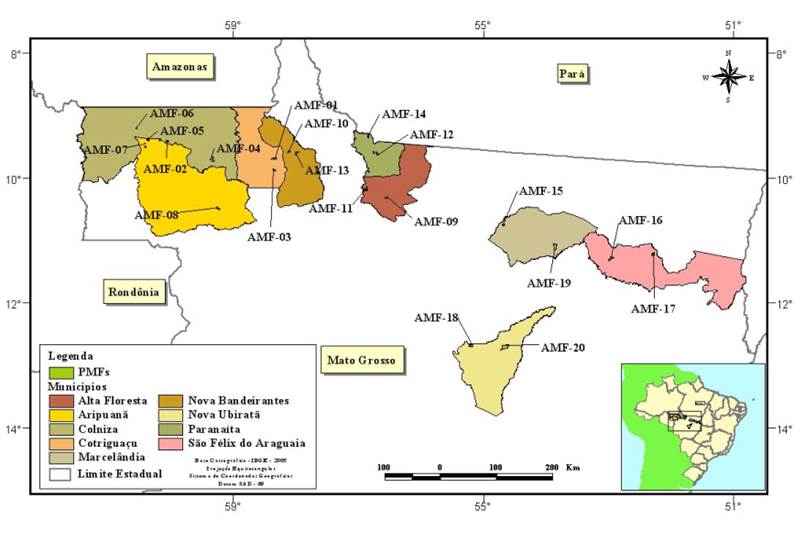
Figure 1
Location of the 20 sites with sustainable forest management plans (AMF).
Location of the 20 sites with sustainable forest management plans (AMF).
Table 1
Verifiers for the assessment of the forest inventories.
Verifiers for the assessment of the forest inventories.
| Verifier | Verification subject |
|---|---|
| V-8 | Distances between exploitation accesses and the management plan |
| V-9 | Systematic enumeration of accesses |
| V-10 | Access markings and orientation |
| V-11 | Azimuth orientation |
| V-12 | Minimum normal diameter (dn) of the inventoried commercial species |
| V-13 | Log quality |
| V-14 | Identification of the three main commercial species inventoried |
| V-15 | Identification of other commercial species |
| V-16 | Existence of felled trees with a diameter smaller than the cut |
| V-17 | Circumferences of the inventoried trees |
| V-18 | Height estimation |
| V-19 | Labeling of inventoried trees |
| V-20 | Permanence of the data in the labels |
| V-21 | Microzonation data quality |
| V-22A | Location of inventoried trees |
| V-22B | Coincidence of the location of the inventoried trees with the maps |
| V-23 | Other data on the microzoning of the work units. |
For the V-8 verifier, the norm indicates to consider two random accesses located on the edge of the work unit (UT), and check their coincidence with the Annual Operational Plan (POA) that is based on the result of 100 % of the inventory. A 50 m tape measure (open tape measure with two metric and inch scales, Startools model) and the maps of each annual production unit (UPA), as well as the UT, were used. For the V-9, the UPA and UT maps were used. In the 20 sites, two accesses were selected for verification in the field. The V-10 was tested within 100 m of a random access point on the UT maps. The azimuth of the V-11 verifier was recorded with a Suunto compass (typical model with 360 degrees, horizontal scale).
For the V-12 verifier, groups of 25 trees were randomly selected on the UPA and UT maps. The quality class of the logs from the V-13 verifier was evaluated in a set of 10 inventoried trees, still standing. Verification of V-14 and V-15 was carried out by a field technician participating in the corresponding inventory, who selected the same trees relative to verifiers V-13, V-17 and V-20.
The V-16 verifier was obtained by choosing from two UT maps per site, five preselected trees for cutting. The coincidence of the circumferences of the V-17 verifier was made in groups of 10 inventoried trees, with a diameter tape or pi tape (Forestry Suppliers Inc., 5 meter diameter tape). In 10 selected trees, by means of a Haga hypsometer, the total height of the tree was measured (verifier V-18). In the same set of trees, the existence of the corresponding labels (V-19) and the information (V-20) recorded in them were verified.
Two UT maps per site were chosen, which contained microzonation information. In them, the V-21 checker was analyzed. For the V-22A and V-22B verifiers, groups of 10 trees were selected on the UT maps, for later verification in the field. The V-23 verifier was obtained by subjective analysis, by comparing the information on the maps with visual observation.
Results and Discussion
For each of the 17 verifiers per site, one of the following values was established: AC/PS corrective action (AC) to be carried out within a period of less than one year (before the next evaluation [PS], which would be in one year); AC/60 corrective action, to be fulfilled in 60 days; CR with recommendation, which identifies the voluntary application of a recommendation for the sustainable forest management plan (PMFS) and does not imply corrective action or administrative sanction; SS subject to suspension, in relation to the PMFS. The final annotation assigned was the one that appeared the greatest number of times in the overall analysis of the 20 sites analyzed.
The AC/PS annotation was recorded in 11 verifiers (65 %), corresponding to V-8, V-10, V-11, V-12, V-13, V-15, V-17, V-18, V-19, V-20 and V-23; the AC/60 annotation in three (18 %) of the verifiers: V-16, V-21 and V-22B; one verifier (5 %) obtained the CR annotation for the V-9 verifier, and two verifiers (12 %) received the SS annotation (V-14 and V-22A), as shown in Table 2.
Table 2
Results of the general annotation.
Results of the general annotation.
| Verifier | Note | |||
|---|---|---|---|---|
| AC/PC | AC/60 | CR | SS | |
| V-8 | X | |||
| V-9 | X | |||
| V-10 | X | |||
| V-11 | X | |||
| V-12 | X | |||
| V-13 | X | |||
| V-14 | X | |||
| V-15 | X | |||
| V-16 | X | |||
| V-17 | X | |||
| V-18 | X | |||
| V-19 | X | |||
| V-20 | X | |||
| V-21 | X | |||
| V-22A | X | |||
| V-22B | X | |||
| V-23 | X | |||
The results of the 17 verifiers were grouped on a percentage scale of four verifier applicability groups: 1) Non- applicable (NA), when the verifier did not exceed 25 %; 2) Little applicable (PA), if it belonged to an interval between 26 and 50 % of applicability; 3) Applicable (AP), when the verifier was between 52 and 75 %; and 4) Applicable without restriction (AsR), from 76 %; the results are shown in Table 3.
Table 3
Final results of the verifiers related to forest inventories.
Final results of the verifiers related to forest inventories.
| Verifier | Final note | |||
|---|---|---|---|---|
| NA | PA | AP | AsR | |
| V-8 | X | |||
| V-9 | X | |||
| V-10 | X | |||
| V-11 | X | |||
| V-12 | X | |||
| V-13 | X | |||
| V-14 | X | |||
| V-15 | X | |||
| V-16 | X | |||
| V-17 | X | |||
| V-18 | X | |||
| V-19 | X | |||
| V-20 | X | |||
| V-21 | X | |||
| V-22A | X | |||
| V-22B | X | |||
| V-23 | X | |||
The verifiers V-8, V-9, V-10 and V-11 referring to the distances between the paths of orientation and access to the inventory, showed high precision according to the provisions of the standards for sustainable forest management plans and annual operating plans. It was determined that 100 % of the trails were numbered systematically and in increasing order as established by Ibama Execution Standard No. 1 (December 18th, 2006) (Brasil, 2007).
-
Brasil, 2007Normas florestais federais para a Amazônia, 2007
Markings were verified along 100 m on selected trails to assess trail width and distance between stakes. In these trails, a high precision of the azimuth direction was verified, which was verified between the observation point and a stake 25 m away. On only four occasions was a small alteration of less than 10 degrees recorded, with respect to the indicated course.
In the extensive literature review in relation to Brazil and Latin American countries carried out for the purposes of this study, no forest inventory verifiers were found; for this reason, the concepts of the methodologies applied in Chile, Colombia, Mexico and Peru were compared (Melero and Steinmetz, 2017). While the use of environmental verifiers has been documented in Argentina (Ministerio de Salud y Ambiente de la Nación Argentina, 2006; Gándara and Guerrero, 2013; Secretaria de Ambiente y Desarrollo Sustentable de la Nación, 2015), Chile (SEA, 2013; Ministerio del Medio Ambiente de Chile, 2019), Ecuador (Grubb et al., 1963; Santamaría-Arinas, 2019; Almeida-Guzmán and Díaz-Guevara, 2020), Colombia (Bárcena and Gurria, 2014), Mexico (Pérez-Calderón, 2010) and Peru (Tacusi-Oblitas et al., 2012; Chappuis, 2019).
-
Melero and Steinmetz, 2017Propuesta regional de criterios sostenibles para Chile, Colombia, México y Perú, 2017
-
Ministerio de Salud y Ambiente de la Nación Argentina, 2006Iniciativa Latinoamericana y Caribeña para el desarrollo sostenible: indicadores de seguimiento: Argentina 2006 Indicadores, 2006
-
Gándara and Guerrero, 2013Indicadores ambientales para la gestión de los residuos sólidos domiciliares en Rosario, ArgentinaRevista Desarrollo Local Sostenible DELOS, 2013
-
Secretaria de Ambiente y Desarrollo Sustentable de
la Nación, 2015Sistema de indicadores de desarrollo sostenible Argentina, 2015
-
SEA,
2013Medidas destacadas en el sistema de evaluación de impacto ambiental, 2013
-
Ministerio del Medio Ambiente
de Chile, 2019Instructivo de aplicación de criterios sustentables, 2019
-
Grubb
et al., 1963A comparison of montane and lowland rain forest in Ecuador; the forest structure, physiognomy and floristicsJournal of Ecology, 1963
-
Santamaría-Arinas, 2019Economía circular: líneas maestras de un concepto jurídico en construcciónRevista Catalana de Dret Ambiental, 2019
-
Almeida-Guzmán and Díaz-Guevara, 2020Economía circular, una estrategia para el desarrollo sostenibleAvances en Ecuador. Estudios de la Gestión, Revista Internacional de Administración, 2020
-
Bárcena and Gurria, 2014Evaluaciones de desempeño ambiental de Colombia Highlights, 2014
-
Pérez-Calderón, 2010La política ambiental en México: Gestión e instrumentos económicosEl Cotidiano, 2010
-
Tacusi-Oblitas et al.,
2012Políticas climáticas: implementación de proyectos REDD+ en el Perú, 2012
-
Chappuis, 2019Remediación y activación de pasivos ambientales mineros (PAM) en el Perú, 2019
All trees with constant normal diameter (dn) in the lists and reports were assigned. The minimum normal diameter (dn) and the quality of the log (V-12 and V-13) were verified in groups of 25 trees of each commercial species included in the PMFS. For V-14 (confirmation of the identification of the three most common commercial species) the same trees were used that were used to verify the quality of the stem.
The botanical names of the selected trees were compared with those listed in the sustainable forest management plans. This verification was of the utmost importance, since negative results (SS note) could conclude with the suspension of the commercial activities established in the sustainable management plan. Only an incorrect identification was accepted as a margin of error. The final result of the V-14 verifier was disastrous, since in none of the sites were high coincidences between the botanical names of the species and the in situ identification obtained.
The verification of the identification of the forest species (V-15) registered in the inventory lists during the field work was carried out in the groups of trees used for the verifiers V-13 and V-17 to V-20. 10 inventoried trees per species were used. The verified V-15 showed a huge discrepancy and insufficient information in all the cases analyzed. At none of the sites did the field staff record the correct scientific name on more than 80 % of the trees, as required by the corresponding method. The error in the botanical identification was higher than what was acceptable by the methodology, which had a significant impact on the verifiers V-14 and V-15. These results show insufficient dendrological knowledge of the great wealth of forest tree species existing in the study area, a situation that detracts from the quality of the corresponding inventories.
The verification of the V-16 verifier was done visually when accessing the cutting areas. V-17 and V-18 were verified with a new measurement of circumferences and heights in two previously inventoried sites, in addition to the marking of 50 trees that would be felled.
The information labels (V-19, V-20) were made of weather resistant material, which made it possible to keep the information of the UPA, UT and tree number. The result of its verification was satisfactory, since only one site did not meet the established standards.
The standard requires identifying all inventoried trees by means of their location on the maps of the Operational Management Plan (V-22A, V-22B). In 51 % of the maps it was not possible to locate all the individuals inventoried. The UT maps showed the microzoning data: topographical variations, water courses, springs or permanent conservation areas. A high coincidence was observed with the legends of the maps (verifiers V-21, V-23). Only in a map was confirmed the need for corrective action.
In an exhaustive literature review on Argentina (Ministerio de Salud y Ambiente de la Nación Argentina, 2006; Secretaria de Ambiente y Desarrollo Sustentable de la Nación, 2015), Chile (SEA, 2013; Ministerio del Medio Ambiente de Chile, 2019), Colombia (Ministerio de Ambiente y Desarrollo Sostenible, 2018), Ecuador (Santamaría-Arinas, 2019; Almeida-Guzmán and Díaz-Guevara, 2020), Mexico (Reygadas and Franco, 2016) and Peru (Dancé and Sáenz, 2013) the use of environmental verifiers was confirmed to identify and qualify the payment for environmental services.
-
Ministerio de Salud y Ambiente de la Nación Argentina, 2006Iniciativa Latinoamericana y Caribeña para el desarrollo sostenible: indicadores de seguimiento: Argentina 2006 Indicadores, 2006
-
Secretaria de Ambiente y Desarrollo Sustentable de
la Nación, 2015Sistema de indicadores de desarrollo sostenible Argentina, 2015
-
SEA,
2013Medidas destacadas en el sistema de evaluación de impacto ambiental, 2013
-
Ministerio del Medio Ambiente
de Chile, 2019Instructivo de aplicación de criterios sustentables, 2019
-
Ministerio
de Ambiente y Desarrollo Sostenible, 2018Reporte de reducción de emisiones bajo el acuerdo REDD Early Movers (REM), 2018
-
Santamaría-Arinas, 2019Economía circular: líneas maestras de un concepto jurídico en construcciónRevista Catalana de Dret Ambiental, 2019
-
Almeida-Guzmán and Díaz-Guevara, 2020Economía circular, una estrategia para el desarrollo sostenibleAvances en Ecuador. Estudios de la Gestión, Revista Internacional de Administración, 2020
-
Reygadas and Franco, 2016Lista de criterios e indicadores (C&I) para bosques tropicales de México, 2016
-
Dancé and Sáenz, 2013Estado de la situación y gestión ambiental en Perú, 2013
In the present study, no verifier not applicable (NA) was recorded at any of the sites. Four verifiers (V-9, V-10, V-19, V-20) were considered as applicable without restrictions (AsR), as opposed to five others (V-13, V-14, V-15, V-17 and V-18) that need to be restructured (PA). Of the latter, verifiers V-14 and V-15, referring to the identification of species, were the most sensitive and critical in their evaluation, considering that the details of any inventory are based on them.
Conclusions
The official verification standards are well described, with clear methods, which considerably reduces the subjectivity of the quality evaluators when they assign the corresponding note to the inventory carried out.
The annual operational production map (POA) is the main product of the forest inventories carried out.
The procedure did not allow the precise location of the inventoried trees that appear indicated on the maps of the work units.
Four areas attended the verifiers minimally, which would represent the immediate cancellation of the right to forest use by the government entity that grants the licenses for the application of sustainable forest management plans.
Agradecimientos
Los autores agradecen el apoyo financiero de la CAPES por la concesión de una beca de doctorado para el segundo autor, y al CNPq por la ayuda financiera que permitió las visitas a las empresas respectivas.
Referencias
- Almeida-Guzmán, M. y C. Díaz-Guevara. 2020. Economía circular, una estrategia para el desarrollo sostenible. Avances en Ecuador. Estudios de la Gestión, Revista Internacional de Administración 8:35-67. Doi: 10.32719/25506641.2020.8.10. Links
- Bárcena, A. y A. Gurria. 2014. Evaluaciones de desempeño ambiental de Colombia Highlights. Organización para la Cooperación y el Desarrollo Económicos (OCDE) y Comisión Económica para América Latina y el Caribe (CEPAL). Bogotá, D. C., Colombia. 16 p. Links
- Barthod, C. 1998. Criterios e indicadores de la ordenación sostenible de los bosques templados: el período 1992-1996. Unasylva 49(192):53-56. https://www.fao.org/3/w7126s/w7126s00.htm . (12 de diciembre de 2021). Links
- Brasil. 2007. Normas florestais federais para a Amazônia. Ministério do Meio Ambiente, Instituto Brasileiro do Meio Ambiente e Recursos Naturais Renováveis (IBAMA). Brasília, D. F., Brasil. 176 p. Links
- Chappuis, M. 2019. Remediación y activación de pasivos ambientales mineros (PAM) en el Perú. Serie Medio Ambiente y Desarrollo, Núm. 168. Comisión Económica para América Latina y el Caribe (CEPAL) y Ministerio Federal de Cooperación Económica y Desarrollo (BMZ). Santiago de Chile, Chile. 50 p. Links
- Chauchard, L., C. Estrada, F. Irisity, G. Hernández, J. Torres y J. Casaza. 2016. Casos ejemplares de manejo forestal sostenible en Chile, Costa Rica, Guatemala y Uruguay. Proyecto TCP/RLA/3404 (D). Organización de las Naciones Unidas para la Alimentación y la Agricultura (FAO). Santiago de Chile, Chile. 246 p. Links
- Dancé C., J. J. y D. F. Sáenz Y. 2013. Estado de la situación y gestión ambiental en Perú, (primera versión). Facultad de Ciencias Contables, Económicas y Financieras, y Universidad San Martín de Porres. Lima, Perú. 179 p. Links
- DeFries, R., F. Achard, S. Brown, M. Herold, D. Murdiyarso, B. Schalamadinger and C. de Souza Jr. 2006. Reducing greenhouse gas emissions from deforestation in developing countries: Considerations for monitoring and measuring. Global Terrestrial Observing System. Rome, Italy. 30 p. https://gofcgold.umd.edu/sites/default/files/docs/ReportSeries/GOLD_26.pdf . (13 de junio de 2022). Links
- Empresa Brasileira de Pesquisa Agropecuária (Embrapa) e Instituto Brasileiro do Meio Ambiente e dos Recursos Naturais Renováveis (Ibama). 2006. Manual de vistoria de campo para planos de manejo florestal madeireiro na Amazônia. Ministério da Agricultura, Pecuária e Abastecimento. Brasilia, D. F., Brasil. 107 p. Links
- Forest Management Division. 2003. Informe Conferencia Internacional sobre la contribución de los Criterios e Indicadores para la Ordenación Forestal Sostenible: El camino a seguir (CICI-2003). Instituto Nacional de Bosques (Inab), FAO, Organización Internacional de las Maderas Tropicales (ITTO) y Ministerio de Agricultura y Bosques de Finlandia. Ciudad de Guatemala, Guatemala. 48 p. Links
- Forest Stewardship Council Brasil (FSC). 2002. Padrões de certificação do FSC-Forest Stewardship Council para manejo florestal em terra firme na Amazônia Brasileira. Documento Final. CBMF-Conselho Brasileiro de Manejo Florestal Brasília, D. F., Brasil. 19 p. https://www.coursehero.com/file/79252591/Brazil-Upland-Amazon-Forest-Port-2-1-05doc/ . (15 de noviembre de 2021). Links
- Gándara, M. P. y E. M. Guerrero. 2013. Indicadores ambientales para la gestión de los residuos sólidos domiciliares en Rosario, Argentina. Revista Desarrollo Local Sostenible DELOS 6(16):1-18. https://www.eumed.net/rev/delos/16/indicadores-ambientales-gestion-residuos-solidos.pdf . (15 de noviembre de 2021). Links
- González S., D. 2012. Criterios e indicadores para medir la sustentabilidad del manejo forestal bajo el principio de bienestar económico: el caso del ejido “El Madroño”. Debate Económico 1(1):61-85. https://biblat.unam.mx/hevila/DebateeconomicoMexicoDF/2012/vol1/no1/4.pdf . (10 de noviembre de 2021). Links
- Grubb, P. J., J. R. Lloyd, T. D. Pennington and T. C. Whitmore. 1963. A comparison of montane and lowland rain forest in Ecuador; the forest structure, physiognomy and floristics. Journal of Ecology 51(3):567-60. Doi: 10.2307/2257748. Links
- Imaña-Encinas, J. 2011. Mensura dasométrica. Universidad de Brasília, Departamento de Ingenieria Forestal. Brasília, D. F., Brasil. 124 p. Links
- Imaña-Encinas, J. 2021. Parcelas terrestres de muestreo en los inventarios forestales. Universidad de Brasília, Departamento de Ingeniería Forestal. Brasília, D. F., Brasil. 180 p. Links
- Kleinn, C. 2015. Lecture notes for the module Monitoring of Forest Resources. Chair of Forest Inventory and Remote Sensing Unit. Georg-August University. Göttingen, Germany. 199 p. Links
- Lammerts van Bueren, E. M. and E. M Blom. 1997. Hierarchical framework for the formulation of sustainable forest management standards, principles criteria indicators. The Tropenbos Foundation. Leiden, Netherlands. 82 p. Links
- Luján Á., C., J. M. Olivas G. y J. E. Magaña M. 2003. Desarrollo forestal sostenible en México: sistema jerárquico de criterios e indicadores. Revista Unasylva 54(214/215):30-36. https://www.fao.org/3/y5189s/y5189s05.pdf. (14 de enero de 2022). Links
- Mallén R., C. y V. Guerra de la Cruz. 2008. Tlaxcala y sus recursos forestales: conservación, aprovechamiento y bases para su manejo sustentable. Libro técnico 4. INIFAP Centro Nacional de Investigación Disciplinaria en Conservación y Mejoramiento de Ecosistemas Forestales. México, D. F., México. 278 p. Links
- Martín, S. G. y V. Lafuente. 2017. Referencias bibliográficas: indicadores para su evaluación en trabajos científicos. Investigación Bibliotecológica 31(71):151-180. http://www.scielo.org.mx/pdf/ib/v31n71/2448-8321-ib-31-71-00151.pdf . (12 de febrero de 2022). Links
- Melero, J. M. y Steinmetz, A. 2017. Propuesta regional de criterios sostenibles para Chile, Colombia, México y Perú, reporte n° 2 (parte 2/2): metodología de implantación para los cuatro países. Ciclo Ambiente, Santiago de Chile, 24 p. https://www.oneplanetnetwork.org/sites/default/filesap_03_-_20170327_metodologia_de_implementacion_final.pdf . (13 de marzo de 2022). Links
- Mendoza, G. A. and R. Prabhu. 2002. Multidimensional measurements and approaches to forest sustainability assessments. In: Pukkala, T. (eds.). Multi-objective forest planning. Managing Forest Ecosystems, vol 6. Springer. Kluwer. Dordrecht, Netherlands. pp. 71-98. Doi: 10.1007/978-94-015-9906-1_4. Links
- Meza A., A., R. Navarro G., R. Torres P., C. Droppelmann H., C. Noton R. y V. Valverde S. 2003. El proceso de Montreal en Chile: Criterios e indicadores para el manejo forestal sustentable a nivel local. Gobierno de Chile y Corporación Nacional Forestal. Santiago de Chile, Chile. 23 p. Links
- Ministerio de Agricultura, Alimentación y Medio Ambiente (Magrama). 2012. Criterios e indicadores de gestión forestal sostenible en los bosques españoles. Ministerio de Agricultura, Alimentación y Medio Ambiente. Madrid, España. 79 p. Links
- Ministerio de Ambiente y Desarrollo Sostenible. 2018. Reporte de reducción de emisiones bajo el acuerdo REDD Early Movers (REM). Gobierno de Colombia, Ministerio de Ambiente y Desarrollo Sostenible e Instituto de Hidrología, Meteorología y Estudios Ambientales. Bogotá, D. C., Colombia. 66 p. Links
- Ministerio de Salud y Ambiente de la Nación Argentina. 2006. Iniciativa Latinoamericana y Caribeña para el desarrollo sostenible: indicadores de seguimiento: Argentina 2006 Indicadores. Secretaría de Ambiente y Desarrollo Sustentable, Programa de las Naciones Unidas para el Medio Ambiente. Ciudad Autónoma de Buenos Aires, Argentina. 72 p. Links
- Ministerio del Medio Ambiente de Chile. 2019. Instructivo de aplicación de criterios sustentables. Ministerio del Medio Ambiente de Chile, Cicloambiente y PNUMA. Santiago de Chile, Chile. 29 p. Links
- Morán M., M., J. J. Campos A. y B. Louman (eds.). 2006. Uso de principios, criterios e indicadores para monitorear y evaluar las acciones y efectos de políticas en el manejo de los recursos naturales. Centro Agronómico Tropical de Investigación y Enseñanza CATIE. Turrialba, Costa Rica. 73 p. Links
- Narváez F., R., P. Wright, M. Martínez S., S. Alvídrez V., … y L. Iglesias G. 2003. Criterios e indicadores, una herramienta para evaluar la sustentabilidad del manejo forestal en bosques templados y tropicales. INIFAP-CIRNOC Campo Experimental La Campana-Madera. Chihuahua, Chih., México. 56 p. Links
- Nobre da Silva, A. C. 2012. Os requisitos sociais do padrão FSC para manejo florestal em terra firme na Amazônia brasileira. Instituto de Manejo e Certificação Florestal e Agrícola (Imaflora). Piracicaba, SP, Brasil. 60 p. Links
- Organización de las Naciones Unidas para la Alimentación y la Agricultura (FAO). 2015. Taller regional latinoamericano sobre criterios e indicadores para el manejo forestal sostenible, informe final. FAO, Ministerio de Agricultura y Riego de Perú y Servicio Nacional Forestal y de Fauna Silvestre. Lima, Perú: 40 p. Links
- Pérez C., J. 2010. La política ambiental en México: Gestión e instrumentos económicos. El Cotidiano 162:91-97. https://www.redalyc.org/pdf/325/32513882011.pdf . (10 de enero de 2021). Links
- Pokorny, B. y M. Adams. 2003. Compatibilidade de conjuntos de critérios e indicadores para avaliar a sustentabilidade do manejo florestal na Amazônia brasileira. CIFOR. Bogor, Java, Indonesia. 143 p. Links
- Poschen, P. 2000. Criterios e indicadores sociales para el manejo forestal sostenible, una guía para los textos de la OIT. Documento de trabajo Núm. 3. Oficina Internacional del Trabajo (OIT) y GTZ-Oficina del programa de estándares sociales y ecológicos. Eschborn, Alemania. 100 p. Links
- Prabhu, R., C. Colfer y G. Shepherd. 1998. Criterios e indicadores para la ordenación forestal sostenible: nuevos hallazgos de la investigación realizada por CIFOR al nivel de la unidad de manejo forestal. Red Forestal para el Desarrollo Rural. Londres, Inglaterra. 24 p. Links
- Reygadas P., G. F. y C. A. Franco C. 2016. Lista de criterios e indicadores (C&I) para bosques tropicales de México. Proyecto PD351/05 Rev. (F). Instituto Nacional de Investigaciones Forestales, Agrícolas y Pecuarias, Organización Internacional de las Maderas Tropicales y Comisión Nacional Forestal. Coyoacán, México D. F., México. 54 p. Links
- Ross, K. 2015. Measuring sustainable forest management: A report on on-going and emerging global initiatives to develop results frameworks and performance indicators for sustainable development, agriculture and natural resources management. Food and Agriculture Organization of the United Nations (FAO). Rome, Italy. 10 p. Links
- Santamaría A., R. J. 2019. Economía circular: líneas maestras de un concepto jurídico en construcción. Revista Catalana de Dret Ambiental 10(1):1-37. Doi: 10.17345/rcda2569. Links
- Secretaria de Ambiente y Desarrollo Sustentable de la Nación. 2015. Sistema de indicadores de desarrollo sostenible Argentina. Dirección de Impacto Ambiental y Social, Secretaría de Ambiente y Desarrollo Sustentable y Jefatura de Gabinete de Ministros. Ciudad Autónoma de Buenos Aires, Argentina. 130 p. Links
- Servicio de Evaluación Ambiental (SEA). 2013. Medidas destacadas en el sistema de evaluación de impacto ambiental. Servicio de Evaluación Ambiental. Santiago de Chile, Chile. 109 p. Links
- Serviço Florestal Brasileiro (SFB). 2019. Florestas do Brasil em resumo. Ministério da Agricultura, Pecuária e Abastecimento. Brasília, D. F., Brasil. 207 p. Links
- Tacusi-Oblitas Z., C., H. Che P. y J. Martínez. 2012, Políticas climáticas: implementación de proyectos REDD+ en el Perú. Derecho, Ambiente y Recursos Naturales-DAR. 16 p. https://alacip.org/cong13/787-zevallos-7c.pdf . (15 de febrero de 2022). Links
- United Nations Environment Programme (UNEP). 2012. Sustainable public procurement implementation guidelines. Introducing UNEP´s Approach. United Nations Environment Programme. Paris, France. 80 p. https://www.oneplanetnetwork.org/sites/default/files/sustainable_public_procurement_implementation_guidelines.pdf . (20 de enero del 2022). Links