Artículo científico
Monitoring of a reforestation survival with native species of the Tamaulipas thorn scrub


-
Publication dates-
August 22, 2022
May-Jun , 2022
- Article in PDF
- Article in XML
- Automatic translation
- Send this article by e-mail
- Share this article +
Abstract
The Tamaulipas thorn scrub (TTS) is a highly diverse ecosystem that has been affected by anthropogenic activities. For its restoration, reforestation with native species has been carried out in search of greater survival. In 2018, a reforestation was carried out with 15 native species of the TTS in a property with previous agricultural use in an area of 15.43 hectares in Los Ramones municipality, Nuevo Leon. During the first two years after reforestation, protection (individual protectors and fencing) and maintenance activities (weed control and plant replacement) were carried out. The objective of this study was to evaluate the survival of reforestation for a three year - period. A sampling of 10 random and scattered lines was used, counting 30 continuous plants to evaluate the presence or absence of living plants. For 2019, 2020 and 2021, survival values of 80.67 %, 95.34 % and 28.7 %, respectively, were recorded. The species that most successfully survived were Cordia boissieri (16.43 %), Prosopis glandulosa (10.67 %), Ebenopsis ebano (7.56 %), Diospyros texana (5.89 %), Ehretia anacua (5.22 %), Parkinsonia aculeata (4.22 %), Vachellia farnesiana (4.11 %) and Vachellia rigidula (4.00 %). It is concluded that the climatic conditions affected the survival of the plantation, the selection of native species to be used determines the success of survival and that the protection and maintenance activities must be established according to the requirements of each species and maintained until the permanence of the plantation is ensured.
Key words:
Environmental compensation, semi-arid forest ecosystem, native species, evaluation, maintenance, protection
Introduction
The Tamaulipas thorn scrub (TTS) is a semi-arid ecosystem with a high diversity of tree and shrub species (Leal-Elizondo et al., 2018). During the last decades, the deterioration of this ecosystem has been increasing as a result of anthropogenic activities (Alanís-Rodríguez et al., 2013). One way to reduce the environmental impacts caused to forest land is the application of environmental compensation measures (Cole et al., 2021). Among these measures there are actions involved in ecological restoration, which consists of recovering the course of succession and resilience in an ecosystem that has suffered a disturbance (Gann et al., 2019). This can be actively carried out by intervening in a site to accelerate its recovery, or passively, by stopping the disturbance and allowing the site to recover naturally (López-Barrera et al., 2016).
-
Leal-Elizondo et al., 2018Estructura y diversidad de especies leñosas del matorral espinoso tamaulipeco regenerado postganadería en el noreste de MéxicoPolibotánica, 2018
-
Alanís-Rodríguez
et al., 2013Análisis de la vegetación secundaria del matorral espinoso tamaulipeco, MéxicoPhyton Revista Internacional de Botánica Experimental, 2013
-
Cole et
al., 2021Environmental compensation for biodiversity and ecosystem services: a flexible framework that addresses human wellbeingEcosystem Services, 2021
-
Gann et al., 2019International principles and standards for the practice of ecological restorationRestoration Ecology, 2019
-
López-Barrera et
al., 2016Ecología de la restauración del bosque nublado en el centro de Veracruz, 2016
One of the actions applied in active restoration is reforestation (Sánchez et al., 2005; Pequeño-Ledezma et al., 2012), a non-natural process that consists of re-establishing forest vegetation induced by means of plantations in a determined area (Reyes et al., 2019). Reforestation can focus on obtaining products for use or it can have the objective of ecosystem conservation, where the recovery of biodiversity is a priority, for which the use of native species is recommended (Cunningham et al., 2015).
-
Sánchez et al., 2005Temas sobre restauración ecológica, 2005
-
Pequeño-Ledezma et al.,
2012Análisis de la restauración pasiva post-pecuaria en el matorral espinoso tamaulipeco del noreste de MéxicoCienciaUAT, 2012
-
Reyes et al., 2019Evaluación de la sobrevivencia en sitios reforestados como indicador de la restauración del paisaje en el Área de Protección de Flora y Fauna Nevado de TolucaTlalli Revista de Investigación en Geografía, 2019
-
Cunningham et al.,
2015Balancing the environmental benefits of reforestation in agricultural regionsPerspectives in Plant Ecology, Evolution and Systematics, 2015
In Mexico, the National Forest Commission (Conafor), the Secretary of National Defense (Sedena), state governments and social organizations have made great reforestation efforts. Between 1985 and 1998, an annual average of 78 500 ha year-1 was planted (Wightman and Cruz, 2003). From 2007 to 2012, Conafor, through the ProÁrbol program, achieved a national reforestation goal of 400 000 year-1; and from 2013 to 2018 through the National Forest Program (Pronafor) a reforestation goal of 200 000 ha year-1 was accomplished (Prieto and Goche, 2016).
-
Wightman and Cruz, 2003La cadena de la reforestación y la importancia en la calidad de las plantasForesta Veracruzana, 2003
-
Prieto and Goche, 2016Las reforestaciones en México: Problemática y alternativas de solución. Durango, México, 2016
However, one of the greatest challenges has been to keep a survival level equal to or greater than that established by some national organizations such as Conafor, which usually requires a minimum 80 % survival of the plantation (Conafor, 2021). During the 2004 to 2016 period, external assessments to this institution showed annual percentages of survival by state and at the national level of different types of ecosystems, which yielded results between 30 and 53 %, with a general average of 43 % (Prieto et al., 2018).
-
Conafor, 2021Reglas de Operación del Programa Apoyos para el Desarrollo Forestal Sustentable 2022, 2021
-
Prieto et al.,
2018Supervivencia y crecimiento de dos especies forestales, con base en la morfología inicial al plantarseRevista Mexicana de Ciencias Forestales, 2018
Thus, it is important to monitor the survival of reforestation and communicate the experiences obtained in different types of ecosystems. This procedure consists of "a series of consecutive and periodic evaluations of quantitative and qualitative aspects of the vegetation of interest" (Prieto and Goche, 2016). The objective of these evaluations is to know the dynamics of the plantation in time and space, by determining parameters such as the number of living individuals and/or their phytosanitary status, as well as the technical circumstances that were not considered at the beginning of the plantation, in order to establish containment, protection and maintenance measures (Conafor, 2010).
-
Prieto and Goche, 2016Las reforestaciones en México: Problemática y alternativas de solución. Durango, México, 2016
-
Conafor, 2010Prácticas de reforestación. Manual básico, 2010
These assessments can be carried out through censuses, however, due to the large amount of resources and time that this demands, it is recommended to measure a part of the population through sampling (Schreuder et al., 2006). A sample is taken to obtain representative data that demonstrates the existing variability in the population, with a level of reliability and estimation error (Ramírez, 2011).
-
Schreuder et al., 2006Técnicas estadísticas para muestreo y monitoreo de recursos naturales, 2006
-
Ramírez, 2011Metodología para realizar y presentar los informes de sobrevivencia inicial (ISI) de las plantaciones forestales comerciales (Aspectos técnicos), 2011
Survival monitoring in a reforestation is usually applied annually and the period in which it is made will depend on the goal established for the project (Stein, 1992). For reforestation projects derived from an environmental impact condition, the Ministry of the Environment and Natural Resources (Semarnat) usually establishes periods of 5 to 10 years for maintenance and monitoring, although Conafor (2009) considers that the planted individuals are established when they have survived after three years. In the TTS, survival monitoring in reforestation with native species has been documented for direct planting in the field by seed and planting of plants from the nursery (Foroughbakhch et al., 2001; Jurado et al., 2006; García, 2011; Arias et al., 2021).
-
Stein, 1992Regeneration surveys and evaluationReforestation practices in southwestern Oregon and northern California, 1992
-
Conafor (2009)Restauración de ecosistemas forestales. Guía básica para comunicadores, 2009
-
Foroughbakhch et al.,
2001Evaluation of 15 indigenous and introduced species for reforestation and agroforestry in northeastern MexicoAgroforestry Systems, 2001
-
Jurado et al.,
2006Leguminous seedling establishment in Tamaulipan thornscrub of northeastern MexicoForest Ecology and Management, 2006
-
García, 2011Can environmental variation affect seedling survival of plants in northeastern Mexico?Archives of Biological Sciences, 2011
-
Arias et al., 2021Do early-successional weeds facilitate or compete with seedlings in forest restoration? Disentangling abiotic versus biotic factorsEcological Solutions and Evidence, 2021
Some of the studied reforestation conditions have been under dense and open scrub, different levels of water stress and temperatures below 0 °C, in competition with early successional weeds and with the use of individual tubular shelters (Foroughbakhch et al., 2001; Jurado et al., 2006; García, 2011; Alexander et al., 2016; Arias et al., 2021). Wide-ranging survival levels have been reported, from 0.4 % to 99 %, varying between the native species used and the natural or experimental conditions present. To date, the use of 18 native TTS species in reforestation has been published. The most frequently documented species are Ebenopsis ebano (Berland.) Barneby & J. W.Grimes, Havardia pallens (Benth.) Britton & Rose, Senegalia berlandieri (Benth.) Britton & Rose, Vachellia rigidula (Benth.) Seigler & Ebinger, Senegalia wrightii (A. Gray) Britton & Rose, Cordia boissieri A. DC. and Prosopis glandulosa Torr. None of these works has been carried out for reforestations greater than 3 600 individuals or a diversity greater than 10 native species.
-
Foroughbakhch et al.,
2001Evaluation of 15 indigenous and introduced species for reforestation and agroforestry in northeastern MexicoAgroforestry Systems, 2001
-
Jurado et al.,
2006Leguminous seedling establishment in Tamaulipan thornscrub of northeastern MexicoForest Ecology and Management, 2006
-
García, 2011Can environmental variation affect seedling survival of plants in northeastern Mexico?Archives of Biological Sciences, 2011
-
Alexander et al., 2016Growth and survival of thornscrub forest seedlings in response to restoration strategies aimed at alleviating abiotic and biotic stressorsJournal of Arid Environments, 2016
-
Arias et al., 2021Do early-successional weeds facilitate or compete with seedlings in forest restoration? Disentangling abiotic versus biotic factorsEcological Solutions and Evidence, 2021
The objective of this study was to evaluate the annual survival of a reforestation with 15 native species of the Tamaulipas thorn scrub during the three years after its establishment, as well as to examine its function within the ecosystem to counteract the impacts caused by the loss of vegetation.
Materials and Methods
Study area
The study area is located in the Los Ramones municipality at Nuevo León State, between 25°39'59.92" and 25°39'40.15" N and 99°27'27.35" and 99°27'24.99" W, at an average altitude of 185 m (Figure 1).
Thumbnail
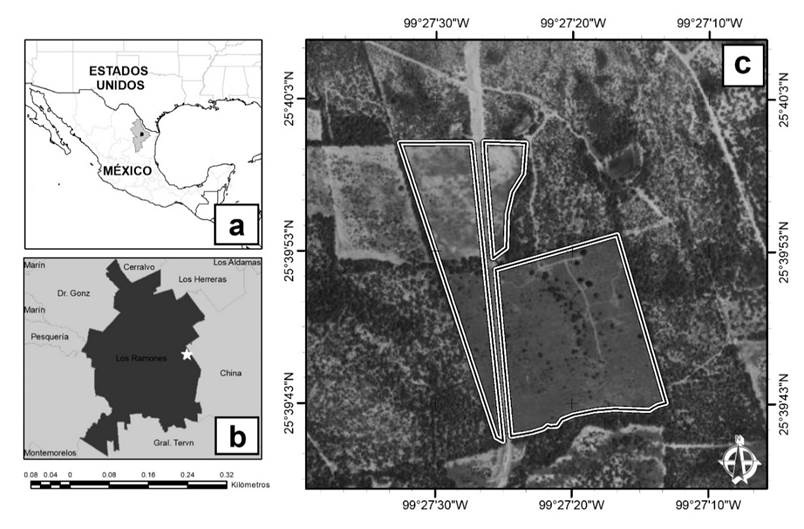
Figure 1
Study site: a) Representation of the state of Nuevo León in northeastern Mexico; b) Area of the Los Ramones municipality and location of the study area to the east; c) Satellite image showing the shape and size of the reforestation polygons.
Study site: a) Representation of the state of Nuevo León in northeastern Mexico; b) Area of the Los Ramones municipality and location of the study area to the east; c) Satellite image showing the shape and size of the reforestation polygons.
The soils in the area are classified as Vertisol, Calcisol and Chernozem, with two types of texture, medium and fine. According to the Topographic Map G14C27 of the National Institute of Statistics and Geography (Inegi, 2019), the use of land and vegetation are recorded as Permanent Cultivated Pasture and Thorn Scrub. According to the classification of degrees of alteration of an ecosystem described by Conafor (2009), the site has a level II of alteration, since "it is significantly unbalanced, but there are still elements of the initial ecosystem that can be taken from reference to intuit which were the initial components of the system”. The climate is warm semi-arid from 22 to 24 °C, with rainfall between summer and winter greater than 18 % per year, according to Köppen's classification modified by García (2004).
-
Inegi, 2019Información Topográfica. G14C27 San Juan escala 1:50 000 serie III, 2019
-
Conafor (2009)Restauración de ecosistemas forestales. Guía básica para comunicadores, 2009
-
García (2004)Modificaciones al Sistema de Clasificación Climática de Köppen, 2004
Plantation establishment
In May 2018, the environmental impact resolution was issued for an electricity generation project in the Los Ramones municipality, Nuevo León. Among its conditions, it is specified to comply with a reforestation program, whose objectives were: “to compensate for the environmental impacts caused by the loss of vegetation, to restore possible nesting, shelter and feeding areas; as well as conserving and increasing the surface with vegetation”.
Based on the summer rainy season in the region (Figure 2), from September to December 2018, 12 596 plants of 15 native TTS species were planted (Table 1). The total reforestation area was 15.43 ha with a density of 816 plants per hectare, in a real frame design and a mixture of random species. The plantation area, number of individuals and species selection were determined according to those most frequently used, with high survival values in reforestation monitoring (Foroughbakhch et al., 2001; Jurado et al., 2006; García, 2011; Alexander et al., 2016; Arias et al., 2021).
-
Foroughbakhch et al., 2001Evaluation of 15 indigenous and introduced species for reforestation and agroforestry in northeastern MexicoAgroforestry Systems, 2001
-
Jurado et al., 2006Leguminous seedling establishment in Tamaulipan thornscrub of northeastern MexicoForest Ecology and Management, 2006
-
García, 2011Can environmental variation affect seedling survival of plants in northeastern Mexico?Archives of Biological Sciences, 2011
-
Alexander et al., 2016Growth and survival of thornscrub forest seedlings in response to restoration strategies aimed at alleviating abiotic and biotic stressorsJournal of Arid Environments, 2016
-
Arias et al.,
2021Do early-successional weeds facilitate or compete with seedlings in forest restoration? Disentangling abiotic versus biotic factorsEcological Solutions and Evidence, 2021
Thumbnail
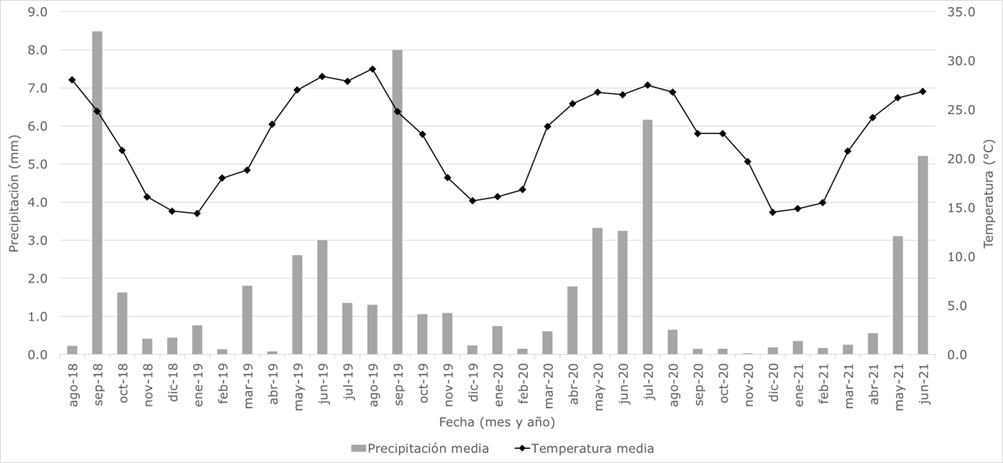
Figure 2
Monthly average temperature (°C) and precipitation (mm) in the reforestation and monitoring period (NASA, 2021).
Monthly average temperature (°C) and precipitation (mm) in the reforestation and monitoring period (NASA, 2021).
Table 1
Native TTS species used in the reforestation essay in Los Ramones, Nuevo León.
Native TTS species used in the reforestation essay in Los Ramones, Nuevo León.
| Family | Scientífic name | Common name | Established |
Surface (Ha) |
|---|---|---|---|---|
| Cannabaceae | Celtis pallida Torr. | Granjeno | 512 | 0.63 |
| Rhamnaceae | Condalia hookeri M. C. Johnst. | Brasil | 378 | 0.46 |
| Boraginaceae | Cordia boissieri A.DC. | Anacahuita | 3 123 | 3.83 |
| Ebenaceae | Diospyros texana Scheele | Chapote prieto | 756 | 0.93 |
| Fabaceae | Ebenopsis ebano (Berland.) Barneby & J. W.Grimes | Ébano | 1 262 | 1.55 |
| Boraginaceae | Ehretia anacua (Terán & Berland.) I. M. Johnst. | Anacua | 630 | 0.77 |
| Fabaceae | Erythrostemon mexicanus (A. Gray.) Gagnon & G. P. Lewis | Árbol de potro | 294 | 0.36 |
| Fabaceae | Havardia pallens (Benth.) Britton & Rose | Tenaza | 420 | 0.51 |
| Fabaceae | Parkinsonia aculeata L. | Retama | 848 | 1.04 |
| Fabaceae | Prosopis glandulosa Torr. | Mezquite dulce | 2 451 | 3.00 |
| Fabaceae | Senegalia berlandieri (Benth.) Britton & Rose | Guajillo | 596 | 0.73 |
| Fabaceae | Senegalia wrightii (Benth.) Britton & Rose | Uña de gato | 428 | 0.52 |
| Fabaceae | Vachellia farnesiana (L.) Wight & Arn. | Huizache | 504 | 0.62 |
| Fabaceae | Vachellia rigidula (Benth.) Seigler & Ebinger | Gavia | 50 | 0.06 |
| Asparagaceae | Yucca filifera Chabaud | Palma pita | 344 | 0.42 |
| Total | 12 596 | 15.4301 | ||
Seedlings were produced in the forest nursery of the company GEMA S.C. in Linares city, Nuevo León. They were cultivated for six months in a 500 mL polyurethane bag, until they reached a minimum height of 0.30 m. They were planted inside circular holes 0.50 m deep x 0.35 m diameter, 3.5 m distant between them and 3.5 m between lines. Fine-grained agricultural hydrogel (Hydrogel MX) was added, based on the manufacturer's application recommendation of 3 g per 30 cm of plant height (Acua-Gel®, 2018), in order to prevent water stress in the face of the high temperatures of the region (Filio-Hernández et al., 2019). Raizone-Plus Fax powder phytoregulator rooter (1.5 mg L-1) was also used to promote vigorous root growth and recovery of possible wounds during the planting process (Fax México, 2018). Each individual was secured with 0.50 m wooden guides on its stem, and a high-density polyurethane perforated tubular protector 0.66 m long by 0.35 m high, fastened in a circular shape, was placed to avoid herbivory predation (Dick et al., 2016; Mohsin et al., 2021).
-
Acua-Gel®, 2018Uso Forestal, 2018
-
Filio-Hernández et
al., 2019Seasonal water relations in four native plants from northeastern MexicoRevista Bio Ciencias, 2019
-
Fax México, 2018Raizone*-PlusFAX, 2018
-
Dick et al., 2016Use of shelter tubes, grass-specific herbicide, and herbivore exclosures to reduce stressors and improve restoration of semiarid thornscrub forestsRestoration Ecology, 2016
-
Mohsin et al.,
2021Species-specific responses to restoration interventions in a Tamaulipan thornforestForest Ecology and Management, 2021
Maintenance activities
Based on the summer rainy periods in the region (Figure 2), during the months of October 2019 and August 2020, two maintenance activities recommended by Conafor (2010) were carried out: weed control and plant replacement. Weed control was carried out by manual removal of the invasive species Cenchrus ciliaris L., to facilitate the growth of the desired native species (Arias et al., 2021).
-
Conafor (2010)Prácticas de reforestación. Manual básico, 2010
-
Arias et
al., 2021Do early-successional weeds facilitate or compete with seedlings in forest restoration? Disentangling abiotic versus biotic factorsEcological Solutions and Evidence, 2021
For the replacement of seedlings, the species identified with the highest mortality were replaced by species with the highest establishment success, in order to promote the highest possible survival of the plantation. In August 2020, the schedule of activities for the reforestation program ended, and so were the maintenance activities.
Sampling reliability
According to the methodology proposed by Stein (1992), the standard error of the total plantation population (s p ) and the confidence limits with a probability level of 80 % were determined; it was tested whether the sample size for the monitoring was statistically reliable by means of a two-tailed Student's t-test.
-
Stein (1992)Regeneration surveys and evaluationReforestation practices in southwestern Oregon and northern California, 1992
Survival anaysis
Three annual samplings were carried out to know the evolution of the plantation survival during September 2019, July 2020 and June 2021, based on the methodology proposed by the United States Department of Agriculture (USDA, 2018). Ten sampling lines distributed randomly and dispersed in each year were established; for each line 30 continuous plants were counted, recording their vigor and species (Mata-Balderas et al., 2010). The following equation was used to calculate survival:
-
USDA, 2018Forestry Inventory Methods., 2018
-
Mata-Balderas et al.,
2010Evaluación de la siembra directa con especies de pino en la restauración de un ecosistema semi-árido templadoCiencia UANL, 2010
e2
%
S
=
p
i
p
N
*
N
Where:
%S = Survival percentage
pi = Number of live plants
p(N) = Number of counted plants per each sampling line
N = Number of sampling lines
To standardize the replenishment dynamics during the first two years of reforestation and the year of monitoring without maintenance, the survival per species per year was calculated, followed by the average of the three years of monitoring per species. Likewise, the annual survival of the study area as a whole was analyzed and the survival of all species within each year of evaluation was added.
Results
For the reliability of sampling, a standard error of the proportion of 0.0262 was determined, with confidence limits of 0.287±0.04 for 80 % probability. The t-Student test yielded a sample size of 8.6 (n=8.6), below the 10 annual sampling lines that were made to assess survival (n=10), so the sample size is considered to be statistically reliable with a 0.20 level significance.
Survival
The survival of 15 native species of the TTS in a reforestation during the first three years of establishment was recorded from 1.11 to 16.43 % (Table 2). The species that recorded the highest survival were Cordia boissieri A. DC. and Prosopis glandulosa Torr. with 16.43 % and 10.67 %, respectively. Some species resulted in a range from 4.00 to 4.22 % such as Vachellia rigidula (Benth.) Seigler & Ebinger, Vachellia farnesiana (L.) Wight & Arn. and Parkinsonia aculeate L. The species with the lowest survival values were Condalia hookeri M. C.Johnst, Senegalia berlandieri (Benth.) Britton & Rose and Senegalia wrightii (A. Gray) Britton & Rose with values below 2 % and Erythrostemon mexicanus (A. Gray.) Gagnon & G.P. Lewis, Havardia pallens (Benth.) Britton & Rose and Yucca filifera Chabaud with values below 1 %.
Table 2
Mean survival values of the TTS native species used in reforestation in Los Ramones, Nuevo León .
Mean survival values of the TTS native species used in reforestation in Los Ramones, Nuevo León .
| Scientific name | %S mean ± e.e., n = 100 | |
|---|---|---|
| Cordia boissieri A. DC. | 16.43 | ± 6.11 |
| Prosopis glandulosa Torr. | 10.67 | ± 5.21 |
| Ebenopsis ebano (Berland.) Barneby & J. W. Grimes | 7.56 | ± 4.21 |
| Diospyros texana Scheele | 5.89 | ± 4.12 |
| Ehretia anacua (Terán & Berland.) I. M. Johnst. | 5.22 | ± 3.77 |
| Parkinsonia aculeata L. | 4.22 | ± 1.44 |
| Vachellia farnesiana (L.) Wight & Arn. | 4.11 | ± 2.23 |
| Vachellia rigidula (Benth.) Seigler & Ebinger | 4.00 | ± 0.00 |
| Celtis pallida Torr. | 3.50 | ± 0.5 |
| Senegalia berlandieri (Benth.) Britton & Rose | 2.44 | ± 0.98 |
| Condalia hookeri M. C. Johnst. | 1.89 | ± 1.16 |
| Senegalia wrightii (Benth.) Britton & Rose | 1.67 | ± 1.08 |
| Havardia pallens Britton & Rose | 1.44 | ± 1.06 |
| Yucca filifera Chabaud | 1.22 | ± 0.75 |
| Erythrostemon mexicanus (A. Gray.) Gagnon & G.P. Lewis | 1.11 | ± 0.71 |
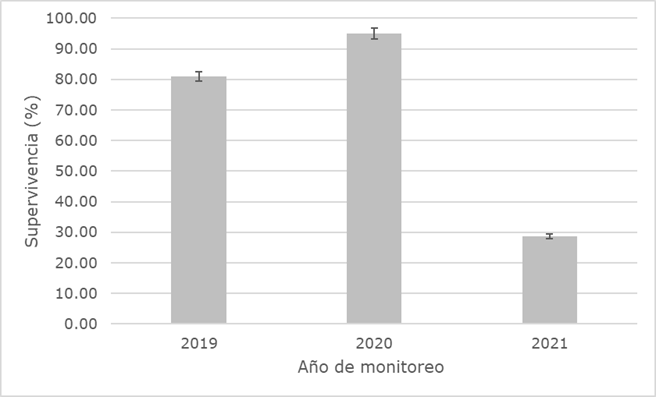
The reforestation annual survival percentage that was measured remained above 80 % during the first two years of establishment due to protection and maintenance efforts, resulting in 80.67 % for 2019 and 95.34 % for 2020. Once the protection and maintenance activities were suspended, a decrease was observed in the evaluated values of 2021 with 28.7 % survival (Figure 3).
Thumbnail
 Los Ramones, Nuevo León.
Figure 3
Total year reforestation survival at the TTS in
Total year reforestation survival at the TTS in
Discussion
In scrub reforestation of arid and semi-arid ecosystems, the survival of plantations is subject to extreme weather, herbivory and competition for resources (Alexander et al., 2016). Especially to weather events, such as the absence of rain or the incidence of drought or frost, which can significantly affect the plantation (Foroughbakhch et al., 2011).
-
Alexander et al.,
2016Growth and survival of thornscrub forest seedlings in response to restoration strategies aimed at alleviating abiotic and biotic stressorsJournal of Arid Environments, 2016
-
Foroughbakhch et al.,
2011Native plants of northeastern Mexico: their potential in the restoration of damaged ecosystemsNative species, 2011
In northeastern Mexico in particular, frosts are repeated around every 10 years, and cause serious effects on TTS (Foroughbakhch et al., 2011). In the frosts that impacted northeastern Mexico and southern Texas in 1983 and 1989, samples of C. pallida Torr, H. pallens and E. ebano (Berland.) Barneby & J.W. Grimes up to 6 m tall, suffered vigor loss from the base (Lonard and Judd, 1991). In the study area, from February 13th to 20th, 2021, there was a drop in temperature that reached -5 °C (AccuWeather, 2021), which is presumed to have adversely affected the plantation, since in the 2021 assessment, morphological damage was observed in several plant structures of the evaluated species from extreme minimum temperatures below the freezing point of water (0 °C) on seedlings; however, this was not tested experimentally. In the same way, García (2011) documented in dense scrub conditions that E. mexicanus (A. Gray.) Gagnon & G. P. Lewis, C. pallida, C. boissieri and E. ebano had higher survival values (3.7 - 6.6 %) for a year with rainfall of 716.8 mm. compared to a previous year with 154.8 mm.
-
Foroughbakhch
et al., 2011Native plants of northeastern Mexico: their potential in the restoration of damaged ecosystemsNative species, 2011
-
Lonard and Judd,
1991Comparison of the effects of the severe freezes of 1983 and 1989 on native woody plants in the lower Rio Grande Valley, TexasThe Southwestern Naturalist, 1991
-
AccuWeather, 2021Tiempo mensual en Los Ramones, 2021
-
García (2011)Can environmental variation affect seedling survival of plants in northeastern Mexico?Archives of Biological Sciences, 2011
On the other hand, the protection and maintenance activities during the first two years of the plantation were useful for the establishment of the species, but they did not seem to contribute greatly to the survival of the seedlings after their removal in 2021, since the percentage decreases drastically below the 80 % acceptable by Conafor (2021). For example, Mohsin et al. (2021) reported that C. pallida and D. texana Scheele had lower mortality a year after planting inside protective tubes, compared to other TTS species used in reforestation. These observations coincide with the study described here for C. pallida. González-Rodríguez et al. (2011) experimented with the water potential of four TTS species, and concluded that there are significant differences in their moisture content, which indicates that each species has a different tolerance to drought and therefore different irrigation requirements or use of supplements such as hydrogel.
-
Conafor (2021)Reglas de Operación del Programa Apoyos para el Desarrollo Forestal Sustentable 2022, 2021
-
Mohsin et al. (2021)Species-specific responses to restoration interventions in a Tamaulipan thornforestForest Ecology and Management, 2021
-
González-Rodríguez et al. (2011)Xylem water potentials of native shrubs from northeastern MexicoActa Agriculturae Scandinavica Section B - Soil and Plant Science, 2011
It should be noted that no information was found related to the dynamics of the replacement of individuals that can occur in reforestation of the TTS, so it is suggested as an area of opportunity for future research.
In the same sense, a common mistake that is made in reforestation is that all species are given the same conditions for establishment and growth. Therefore, it is necessary to deepen the knowledge of the particular needs of the species to be used, especially during the first years of establishment, in order to propose maintenance activities specific to the characteristics of each species.
In regard to the composition of the species used, Domínguez-Gómez et al. (2013) refer that the good development of the Fabaceae family in the TTS is associated with its establishment ability in adverse environmental conditions. Foroughbakhck et al. (2011) points out the ability of this genus to fix nitrogen from the atmosphere to organic molecules. If the combination with trees that contain different levels of carbon and nitrogen concentration - such as C. boissieri (Maiti et al., 2016) - is added, a better humus quality in the ground is promoted, which in the long term, favors an improvement in soil structure; therefore, it is considered that this genus is essential to foster the plant succession process in the TTS.
-
Domínguez-Gómez et al. (2013)Diversidad estructural del matorral espinoso tamaulipeco durante las épocas seca y húmedaRevista Mexicana de Ciencias Forestales, 2013
-
Maiti et al., 2016Adaptive strategy of woody trees and shrubs of Tamaulipan Thorn Scrub in xeric environmentsInternational Journal of Bio-resource and Stress Management, 2016
Likewise, the highest importance values in the TTS in different areas with livestock and agricultural history are frequently supported by the species V. farnesiana (L.) Wight & Arn., P. laevigata and Acacia amantacea DC. (now Vachellia rigidula) (Pequeño-Ledezma et al., 2012; Alanís-Rodríguez et al., 2013; Mora et al., 2013; Martínez et al., 2014; Leal-Elizondo et al., 2018; Sarmiento et al., 2019). The regrowth of foliage, seeds and fruits of these species are usually highly consumed by livestock (Domínguez et al., 2012), which facilitates the scarification of the seeds through the digestive tract of the animals, which they are expelled back to the soil and create a reserve of seeds available for regrowth in the right weather conditions (Villarreal et al., 2013; Rodríguez et al., 2014). Particularly in the applied reforestation, P. glandulosa, V. rigidula and V. farnesiana maintained survival values between 4.00 and 10.67 %; therefore, for future reforestation projects in the TTS it is suggested to examine the available seed reservoir in the degraded areas to eliminate the possibility that these species could regrow with no assistance.
-
Pequeño-Ledezma et al., 2012Análisis de la restauración pasiva post-pecuaria en el matorral espinoso tamaulipeco del noreste de MéxicoCienciaUAT, 2012
-
Alanís-Rodríguez et al., 2013Análisis de la vegetación secundaria del matorral espinoso tamaulipeco, MéxicoPhyton Revista Internacional de Botánica Experimental, 2013
-
Mora et al., 2013Estructura, composición florística y diversidad del matorral espinoso tamaulipeco, MéxicoEcología aplicada, 2013
-
Martínez et al., 2014Regeneración natural del matorral espinoso tamaulipeco en una plantación de Eucalyptus sppRevista Mexicana de Ciencias Forestales, 2014
-
Leal-Elizondo et al.,
2018Estructura y diversidad de especies leñosas del matorral espinoso tamaulipeco regenerado postganadería en el noreste de MéxicoPolibotánica, 2018
-
Sarmiento et
al., 2019Estructura y diversidad de la vegetación leñosa en un área de matorral espinoso tamaulipeco con actividad pecuaria en Nuevo León, MéxicoCienciaUAT, 2019
-
Domínguez et al., 2012Importancia nutrimental en plantas forrajeras del matorral espinoso tamaulipecoCiencia UANL, 2012
-
Villarreal et al., 2013Caracterización morfométrica, viabilidad y germinación de semillas de mezquite y huizache en el noreste de MéxicoPhyton, 2013
-
Rodríguez et al., 2014Análisis técnico del árbol del mezquite (Prosopis laevigata Humb. & Bonpl. ex Willd.) en MéxicoRa Ximhai, 2014
Meanwhile, C. boissieri, with greater establishment success, is not recorded in literature with the highest index of importance value in the composition of TTS; however, it is among the three most notorious species in areas recovered after livestock activity (Leal-Elizondo et al., 2018; Sarmiento-Muñoz et al., 2019).
-
Leal-Elizondo et al., 2018Estructura y diversidad de especies leñosas del matorral espinoso tamaulipeco regenerado postganadería en el noreste de MéxicoPolibotánica, 2018
-
Sarmiento-Muñoz et al., 2019Estructura y diversidad de la vegetación leñosa en un área de matorral espinoso tamaulipeco con actividad pecuaria en Nuevo León, MéxicoCienciaUAT, 2019
The record of P. glandulosa with high survival values contrasts with the study by Foroughbakhch et al. (2001) that highlights P. glandulosa with the lowest survival percentage among 15 native species of the TTS evaluated under herbivore and pest conditions. Filio-Hernández et al. (2019) indicate that the use of P. glandulosa is recommended for restoration projects in arid zones, due to its ability to adapt to low water availability.
-
Foroughbakhch et
al. (2001)Evaluation of 15 indigenous and introduced species for reforestation and agroforestry in northeastern MexicoAgroforestry Systems, 2001
-
Filio-Hernández et al.
(2019)Seasonal water relations in four native plants from northeastern MexicoRevista Bio Ciencias, 2019
In some cases, the action of only excluding disturbance factors from an area is enough to recover the structure and functionality of the degraded ecosystem; however, this process is highly variable (Trujillo-Miranda et al., 2018). Precisely, reforestation seeks to accelerate this regeneration for a greater diversity of timber plants and more advanced stages of succession in less time (Zahawi et al., 2013). In this work we sought to reforest with a high diversity of TTS species and, although the most successful in the establishment (C. boissieri and P. glandulosa) are mentioned in stages of advanced succession of the TTS, not all species develop successfully. In this way, it is necessary to have greater knowledge about the area chosen to reforest, such as the characteristics of the soil, the seed reservoir and the presence of remnant vegetation.
-
Trujillo-Miranda et al., 2018Active versus passive restoration: Recovery of cloud forest structure, diversity and soil condition in abandoned pasturesEcological Engineering, 2018
-
Zahawi et al., 2013Testing applied nucleation as a strategy to facilitate tropical forest recoveryJournal of Applied Ecology, 2013
The plantation must be incorporated into this dynamic, and the selection of species, as well as the management practices to be applied, must be chosen on time to obtain better results and, therefore, the absolute fulfillment of the committed environmental conditions.
Conclusions
According to the results of the reforestation assessments established in the TTS with 15 native species, the climatic conditions during the third monitoring (extreme minimum temperatures and low rainfall) affected the survival of the plantation. The selection of native species to be used must be made with respect to the degradation conditions of the site. Protection and maintenance activities must be established according to the requirements of each species and maintained until the permanent establishment of the plantation is ensured.
This evaluation offers valuable information on the stage of a reforestation project three years after being established in a TTS community.
Acknowledgements
The authors wish to thank INVENERGY and Compañía de Energía Los Ramones, S.A.P.I. de C.V. companies, especially to Ing. Miguel Ángel Catena, for all the facilities granted for the development of this research study; and to the Graduate School of Forest Sciences, U.A.N.L., Master's Program in Ecological Restoration for the support provided.
Referencias
- Acua-Gel®. 2018. Uso Forestal, Acua-Gel@. https://hidrogel.com.mx/aplicaciones/uso_forestal/ (1 de agosto de 2018). Links
- AccuWeather. 2021. Tiempo mensual en Los Ramones, Nuevo León, México. https://www.accuweather.com/es/mx/los-ramones/234485/february-weather/234485?year=2021 (11 de agosto de 2021). Links
- Alanís-Rodríguez, E., J. Jímenez-Pérez, M. A. González-Tagle, J. I. Yerena-Yamallel, G. Cuellar-Rodríguez y A. Mora-Olivo. 2013. Análisis de la vegetación secundaria del matorral espinoso tamaulipeco, México. Phyton Revista Internacional de Botánica Experimental 82(2):185-191. http://www.revistaphyton.fund-romuloraggio.org.ar/vol82.html (agosto de 2021). Links
- Alexander, H. D., J. Moczygemba and K. Dick. 2016. Growth and survival of thornscrub forest seedlings in response to restoration strategies aimed at alleviating abiotic and biotic stressors. Journal of Arid Environments 124:180-188. Doi: 10.1016/j.jaridenv.2015.06.014. Links
- Arias, M., R. Kariyat, K. Wahl, S. Mendez, J. Chavana and B. Christoffersen. 2021. Do early-successional weeds facilitate or compete with seedlings in forest restoration? Disentangling abiotic versus biotic factors. Ecological Solutions and Evidence 2(3):1-13. Doi: 10.1002/2688-8319.12095. Links
- Cole S., P. Moksnes, T. Söderqvist, S. A. Wikström, G. Sundblad, L. Hasselström, U. Bergström, P. Kraufvelin and L. Bergström. 2021. Environmental compensation for biodiversity and ecosystem services: a flexible framework that addresses human wellbeing. Ecosystem Services 50:1-13. Doi: 10.1016/j.ecoser.2021.101319. Links
- Comisión Nacional Forestal (Conafor). 2009. Restauración de ecosistemas forestales. Guía básica para comunicadores. Secretaría del Medio Ambiente y Recursos Naturales Semarnat y Comisión Nacional Forestal Conafor. Zapopan, Jal., México. 69p. http://www.conafor.gob.mx:8080/documentos/docs/7/579Restauraci%c3%b3n%20de%20ecosistemas%20forestales.pdf (18 de marzo del 2022). Links
- Comisión Nacional Forestal (Conafor). 2010. Prácticas de reforestación. Manual básico. Secretaría del Medio Ambiente y Recursos Naturales Semarnat y Comisión Nacional Forestal Conafor. Zapopan, Jalisco, México. 66 p. https://www.conafor.gob.mx/BIBLIOTECA/MANUAL_PRACTICAS_DE_REFORESTACION.PDF (14 de septiembre del 2021). Links
- Comisión Nacional Forestal (Conafor). 2021. Reglas de Operación del Programa Apoyos para el Desarrollo Forestal Sustentable 2022. Diario Oficial de la Federación. https://www.gob.mx/cms/uploads/attachment/file/689256/ROP_2022_CONAFOR.pdf (21 de marzo del 2022). Links
- Cunningham, S. C., R. M. Nally, P. J. Baker, T. R. Cavagnaro, J. Beringer, J. R. Thomson and R. M. Thompson. 2015. Balancing the environmental benefits of reforestation in agricultural regions. Perspectives in Plant Ecology, Evolution and Systematics 17(4):301-317. Doi: 10.1016/j.ppees.2015.06.001. Links
- Dick, K., H. D. Alexander and J. D. Moczygemba. 2016. Use of shelter tubes, grass-specific herbicide, and herbivore exclosures to reduce stressors and improve restoration of semiarid thornscrub forests. Restoration Ecology 24(6):785-793. Doi: 10.1111/rec.12373. Links
- Domínguez G., T. G., R. G. Ramírez L., A. E. Estrada C., L. M. Scott M., H. González R. y M. S. Alvarado. 2012. Importancia nutrimental en plantas forrajeras del matorral espinoso tamaulipeco. Ciencia UANL 15(59):77-93. http://eprints.uanl.mx/id/eprint/2721 (agosto de 2021). Links
- Domínguez G., T. G., H. González R., R. G. Ramírez L., A. E. Estrada C., I. Cantú S., M. V. Gómez M., J. Á. Villarreal Q., M. S. Alvarado y G. Alanís F. 2013. Diversidad estructural del matorral espinoso tamaulipeco durante las épocas seca y húmeda. Revista Mexicana de Ciencias Forestales 4(17):106-122. Doi: 10.29298/rmcf.v4i17.425. Links
- Fax México. 2018. Raizone*-PlusFAX. https://www.tacsa.mx/DEAQ/src/productos/1835_43.htm (1 de agosto de 2018). Links
- Filio-Hernández, E., H. González-Rodríguez, T. G. Domínguez-Gómez, R. G. Ramírez-Lozano, I. Cantú-Silva and M. del S. Alavarado. 2019. Seasonal water relations in four native plants from northeastern Mexico. Revista Bio Ciencias 6:1-16. Doi: 10.15741/revbio.06. e605. Links
- Foroughbakhch, F., J. L. Hernández-Piñero, M. A. Alvarado-Vázquez, A. Carrillo-Parra, C. G. Velasco M. and A. Rocha E. 2011. Native plants of northeastern Mexico: their potential in the restoration of damaged ecosystems. In: Marin, L. y D. Kovac (Eds.). Native species. Nova Science Publishers, Inc. Hauppauge, NY, USA. pp. 85-116. Links
- Foroughbakhch, F., L. A. Háuad, A. E. Cespedes, E. E. Ponce and N. González. 2001. Evaluation of 15 indigenous and introduced species for reforestation and agroforestry in northeastern Mexico. Agroforestry Systems 51(3):213-221. Doi: 10.1023/A:1010702510914. Links
- Gann, G. D., T. McDonald, B. Walder, J. Aronson, C. R. Nelson, J. Jonson, J. G. Hallett, C. Eisenberg, M. R. Guariguata, J. Liu, F. Hua, C. Echeverria, E. Gonzales, N. Shaw, K. Decleer and K. W. Dixon. 2019. International principles and standards for the practice of ecological restoration. Restoration Ecology 27(S1) Special Issue:S1-S46. Doi: 10.1111/rec.13035. Links
- García, E. 2004. Modificaciones al Sistema de Clasificación Climática de Köppen. Serie Libros (Obra general). Quinta Edición. Instituto de Geografía-Universidad Nacional Autónoma de México. México, D. F., México. 97 p. http://www.publicaciones.igg.unam.mx/index.php/ig/catalog/view/83/82/251-1 (14 de septiembre de 2021). Links
- García J., F. 2011. Can environmental variation affect seedling survival of plants in northeastern Mexico? Archives of Biological Sciences 63(3):731-737. Doi: 10.2298/ABS1103731G. Links
- González-Rodríguez, H., I. Cantú-Silva, R. G. Ramírez-Lozano, M. V. Gómez-Meza, J. Sarquis-Ramírez, N. Coria-Gil, J. R. Cervantes-Montoya and R. K. Maiti. 2011. Xylem water potentials of native shrubs from northeastern Mexico. Acta Agriculturae Scandinavica Section B - Soil and Plant Science 61(3):214-219. Doi: 10.1080/09064711003693211. Links
- Instituto Nacional de Estadística, Geografía e Informática (Inegi). 2019. Información Topográfica. G14C27 San Juan escala 1:50 000 serie III. (ITRF08 época 2010.0) 0) https://www.inegi.org.mx/programas/topografia/50000/#Descargas (23 de marzo del 2022) Links
- Jurado, E., J. F. García, J. Flores and E. Estrada. 2006. Leguminous seedling establishment in Tamaulipan thornscrub of northeastern Mexico. Forest Ecology and Management 221:133-139. Doi: 10.1016/j.foreco.2005.09.011. Links
- Leal-Elizondo, N. A., E. Alanís-Rodríguez, J. M. Mata-Bautista, E. J. Treviño-Garza y J. I. Yerena-Yamallel. 2018. Estructura y diversidad de especies leñosas del matorral espinoso tamaulipeco regenerado postganadería en el noreste de México. Polibotánica 45:75-88. Doi: 10.18387/polibotanica.45.6. Links
- Lonard, R. I. and F. W. Judd. 1991. Comparison of the effects of the severe freezes of 1983 and 1989 on native woody plants in the lower Rio Grande Valley, Texas. The Southwestern Naturalist 36(2):213-217. Doi: 10.2307/3671923. Links
- López-Barrera, F., J. G. García-Franco, K. Mehltreter, O. Rojas-Soto, A. Aguirre, R. Landrave, A. Ortega-Pieck, B. Montes-Hernández, K. Aguilar-Dorantes, A. A. Díaz-Sánchez, G. Vázquez-Carrasco y B. B. Rojas S. 2016. Ecología de la restauración del bosque nublado en el centro de Veracruz. In: E. Ceccon y C. Martínez-Garza (Coords.). Experiencias mexicanas en la restauración de los ecosistemas. México. Editorial Centro Regional de Investigaciones Multidisciplinarias - Universidad Nacional Autónoma de México, Universidad Autónoma del Estado de Morelos y Comisión Nacional para el Conocimiento y Uso de la Biodiversidad (Conabio). Cuernavaca, Morelos, México. pp 103-129. Links
- Maiti, R., H. González R. and A. Kumari. 2016. Adaptive strategy of woody trees and shrubs of Tamaulipan Thorn Scrub in xeric environments. International Journal of Bio-resource and Stress Management 7(6):1403-1408. Doi: 10.23910/ijbsm/2016.7.6.1708. Links
- Martínez H., D. D., J. Jiménez P., E. Alanís R., J. I. Uvalle S., P. A. Canizales V. y L. Rocha D. 2014. Regeneración natural del matorral espinoso tamaulipeco en una plantación de Eucalyptus spp. Revista Mexicana de Ciencias Forestales 5(21):95-107. Doi: 10.29298/rmcf.v5i21.360. Links
- Mata B., J. M., E. J. Treviño G., J. Jiménez P., Ó. Aguirre C., E. Alanís R. y W. E. Salinas C. 2010. Evaluación de la siembra directa con especies de pino en la restauración de un ecosistema semi-árido templado. Ciencia UANL 13(1):72-77. https://www.redalyc.org/pdf/402/40211897011.pdf (29 de noviembre de 2021) Links
- Mohsin F., M. Arias, C. Albrecht, K. Wahl, A. Fierro-Cabo and B. Christoffersen. 2021. Species-specific responses to restoration interventions in a Tamaulipan thornforest. Forest Ecology and Management 491:1-13. Doi: 10.1016/j.foreco.2021.119154. Links
- Mora D., C. A., E. Alanís R., J. Jiménez P., M. A. González T., J. I. Yerena Y. y L. G. Cuellar R. 2013. Estructura, composición florística y diversidad del matorral espinoso tamaulipeco, México. Ecología aplicada 12(1):29-34. Doi: 10.21704/rea.v12i1-2.435. Links
- National Aeronautics and Space Administration (NASA). 2021. Prediction of worldwide energy resource. POWER Data Access Viewer. https://power.larc.nasa.gov/data-access-viewer/ (7 de Julio del 2021). Links
- Pequeño-Ledezma, M. Á., E. Alanís-Rodríguez, J. Jiménez-Pérez, M. A. González-Tagle, J. I. Yerena-Yamallel, G. Cuellar-Rodríguez y A. Mora-Olivo. 2012. Análisis de la restauración pasiva post-pecuaria en el matorral espinoso tamaulipeco del noreste de México. CienciaUAT 7(1):48-53. Doi: 10.29059/cienciauat.v7i1.39. Links
- Prieto R., J. Á. y J. R. Goche T. 2016. Las reforestaciones en México: Problemática y alternativas de solución. Durango, México. Editorial de la Universidad Juárez del Estado de Durango. Durango, Dgo., México. 81 p. https://www.ujed.mx/publicaciones/editorial-ujed/las-reforestaciones-en-mexico-problematica-y-alternativas-de-solucion (8 de octubre del 2021). Links
- Prieto R., J. Á., A. Duarte S., J. R. Goche T., M. M. González O. y M. Á. Pulgarin G. 2018. Supervivencia y crecimiento de dos especies forestales, con base en la morfología inicial al plantarse. Revista Mexicana de Ciencias Forestales 9(47):151-168. Doi: 10.29298/rmcf.v9i47.182. Links
- Ramírez D., M. 2011. Metodología para realizar y presentar los informes de sobrevivencia inicial (ISI) de las plantaciones forestales comerciales (Aspectos técnicos). No. 1. Comisión Nacional Forestal Conafor, ProÁrbol y Secretaría del Medio Ambiente y Recursos Naturales Semarnat. 19 p. http://www.conafor.gob.mx:8080/documentos/ver.aspx?grupo=6&articulo=1564 . (7 de julio de 2021). Links
- Reyes G., E., G. E. Hernández J. y A. E. Calvillo A. 2019. Evaluación de la sobrevivencia en sitios reforestados como indicador de la restauración del paisaje en el Área de Protección de Flora y Fauna Nevado de Toluca. Tlalli Revista de Investigación en Geografía 1(2):97-117. Doi: 10.22201/ffyl.26832275e.2019.2.1087. Links
- Rodríguez S., E. N., G. E. Rojo M., B. Ramírez V., R. Martínez R., M. C. Cong H., S. M. Medina T. y H. H. Piña R. 2014. Análisis técnico del árbol del mezquite (Prosopis laevigata Humb. & Bonpl. ex Willd.) en México. Ra Ximhai 10(3):173-193. https:// www.redalyc.org/articulo.oa?id=46131111013 (29 de noviembre de 2021). Links
- Sánchez, O., E. Peters, R. Márquez-Huitzil, E. Vega, G. Portales, M. Valdez y D. Azuara. 2005. Temas sobre restauración ecológica. Secretaría del Medio Ambiente y Recursos Naturales, Instituto Nacional de Ecología, U. S. Fish and Wildlife Service y Unidos para la Conservación A. C. México, D. F. México. 255 p. https://www.researchgate.net/publication/291425685_Temas_sobre_Restauracion_Ecologica (8 de octubre del 2021). Links
- Sarmiento-Muñoz, T. I., E. Alanís-Rodríguez, J. M. Mata-Balderas y A. Mora-Olivo. 2019. Estructura y diversidad de la vegetación leñosa en un área de matorral espinoso tamaulipeco con actividad pecuaria en Nuevo León, México. CienciaUAT 14(1): 31-44. Doi: 10.29059/cienciauat.v14i1.1001. Links
- Schreuder, H. T., R. Ernst y H. Ramírez M. 2006. Técnicas estadísticas para muestreo y monitoreo de recursos naturales. Universidad Autónoma Chapingo. Texcoco, Edo. Méx., México. 151 p. http://dicifo.chapingo.mx/pdf/publicaciones/tecnicas_estadisticas_evaluacion_y_monitoreo_2006.pdf (11 de Julio del 2021). Links
- Stein, W. I. 1992. Regeneration surveys and evaluation. In: S. D. Hobbs (Ed.), Reforestation practices in southwestern Oregon and northern California. Forest Research Laboratory Oregon State University. Corvallis, OR, USA. pp. 346-382. https://ir.library.oregonstate.edu/concern/defaults/g732d954s?locale=en . (15 de julio de 2021). Links
- Trujillo-Miranda, A. L., T. Toledo-Aceves, F. López-Barrera and P. Gerez-Fernández. 2018. Active versus passive restoration: Recovery of cloud forest structure, diversity and soil condition in abandoned pastures. Ecological Engineering 117:50-61. Doi: 10.1016/j.ecoleng.2018.03.011. Links
- United States Department of Agriculture (USDA). 2018. Forestry Inventory Methods. Forestry Technical Note No. FOR-1 (N° 1). United States Department of Agriculture USDA. Washington, DC, USA. 30 p. https://directives.sc.egov.usda.gov/OpenNonWebContent.aspx?content=42554.wba (25 de julio de 2021). Links
- Villarreal G., J. A., A. Rocha E., M. L. Cárdenas-Ávila, S. Moreno L., M. González Á., y V. Vargas L. 2013. Caracterización morfométrica, viabilidad y germinación de semillas de mezquite y huizache en el noreste de México. Phyton 82(2):169-174. http://www.scielo.org.ar/pdf/phyton/v82n2/v82n2a03.pdf (3 de diciembre del 2021). Links
- Wightman, K. E. y B. S. Cruz. 2003. La cadena de la reforestación y la importancia en la calidad de las plantas. Foresta Veracruzana 5(1):45-51. https://www.redalyc.org/pdf/497/49750108.pdf (29 de noviembre de 2021). Links
- Zahawi, R. A., K. D. Holl, R. J. Cole and J. L. Reid. 2013. Testing applied nucleation as a strategy to facilitate tropical forest recovery. Journal of Applied Ecology 50:88-96. Doi: 10.1111/1365-2664.12014. Links