Artículos
Food Field: Rationales of Food Practice among Agricultural Workers in Miguel Alemán, Sonora, Mexico
Arellano Gálvez, María del Carmen*
 http://orcid.org/0000-0001-9951-6960
Alvarez Gordillo, Guadalupe del Carmen**
http://orcid.org/0000-0002-9543-7920
Eroza Solana, Enrique***
http://orcid.org/0000-0002-1430-6022
Tuñón Pablos, Esperanza****
http://orcid.org/0000-0002-1269-6928
http://orcid.org/0000-0001-9951-6960Alvarez Gordillo, Guadalupe del Carmen**
http://orcid.org/0000-0002-9543-7920Eroza Solana, Enrique***
http://orcid.org/0000-0002-1430-6022Tuñón Pablos, Esperanza****
http://orcid.org/0000-0002-1269-6928
Abstract
The objective of this qualitative research is to analyze the rationales operating in the food field among migrant agricultural workers in Miguel Alemán, Sonora, Mexico. Observations, interviews and documentary and journalistic analyses were made. The results highlight self-consumption practices as strategies against the market, while people consume food according to the rationale of what is possible. Free food programs reflect food poverty, which, in addition to social violence, conditions food practice. This research’s limitation was not having information on migrants living in agricultural fields. Its originality lies in the fact that Bourdieu’s theoretical approach was used to analyze the feeding of an affected population. It is concluded that examining the food field allows to understand the logical meaning of the practice, by denaturing food decisions as an individual issue, and to identify the capitals that structure food practice and the situations that affect it, among migrant agricultural workers.
Key words::
food, food practice, migrant agricultural workers, rural migration, Sonora
Introduction
Various social, economic, geographic and political processes converged so that, since the mid-twentieth century, northwestern Mexico became a pole of attraction for peasants in south-southeastern Mexico, who emigrated and continue to do so to be employed in the country’s export agro-industries (Barros, 2015; Bautista, 2017; Chong, Herrera, Chávez & Sánchez, 2015; Durand, 2017; Escobar, Martin, Lowell & Fernández 2013; Gonzalez, 2016; Holmes, 2013; Izcara, 2014; Lara, 2010). Thanks to the labor of this production sector, businessmen obtain economic capital and build the labor market according to the premise of reduction of production costs (Posadas, 2018). This translates into low wages for agricultural workers, a situation caused by legal loopholes for this population to have access to and exercise their labor, social and health rights, which places it in a subordinate position in the global production chain (Aranda & Castro, 2016; Hernández, 2014; Valdivia & Sánchez, 2017; Valdés, 2015).
-
Barros, 2015Apuntes sobre la vivienda para migrantes y crisis inmobiliaria en la California rural. Un estudio de casoEl Cotidiano, 2015
-
Bautista,
2017De ida y vuelta: vulnerabilidad y exclusión del mercado de trabajo a migrantes en los Estados Unidos y retornados en México en un contexto demográfico y migratorio dinámicoGeografares, 2017
-
Chong, Herrera, Chávez &
Sánchez, 2015Mercado rural y precarización: nuevas condiciones socioeconómicas en el sur del Estado de Méxicoregión y sociedad, 2015
-
Durand, 2017Historia mínima de la migración México-Estados Unidos, 2017
-
Escobar, Martin, Lowell & Fernández
2013Estudio binacional sobre migrantes mexicanos en Estados Unidos y en MéxicoForeign Affairs Latinoamérica, 2013
-
Gonzalez, 2016Guest workers or colonized labor? Mexican labor migration to the United States, 2016
-
Holmes, 2013Fresh fruit, broken bodies: Migrant farm workers in the United States, 2013
-
Izcara, 2014La demanda de trabajadores huéspedes en la agricultura estadounidenseCuadernos de Desarrollo Rural, 2014
-
Lara,
2010Migraciones de trabajo y movilidad territorial, 2010
-
Posadas,
2018Mercado de trabajo de los jornaleros agrícolas en Méxicoregión y sociedad, 2018
-
Aranda
& Castro, 2016El campo de la agroindustria en el noroeste de México y la salud de sus jornaleras: una propuesta de estudioSalud Colectiva, 2016
-
Hernández,
2014Condiciones de trabajo e ingreso en la agricultura intensiva mexicanaAnálisis Económico, 2014
-
Valdivia & Sánchez,
2017Protección laboral para los jornaleros agrícolas en MéxicoApuntes para la Equidad, 2017
-
Valdés, 2015Feminización del empleo y trabajo precario en las agriculturas latinoamericanas globalizadasCuadernos de Antropología Social, 2015
The conditions of the migratory process and agricultural work reflect the multiple inequalities experienced by agricultural workers (Espinoza, Ramírez & Tello, 2017; De Grammont & Lara, 2004; Lara, 2012; Ortega, Castañeda & Sariego, 2007; Velasco, 2013; Velasco, Zlolniski & Coubès, 2014), which begin in the places of origin, where both what is produced for self-consumption and local production systems are already unsustainable in the face of the globalized food market (Delgado, 2010). However, people who are employed as agricultural workers do not end the precariousness and circularity of poverty (Rojas, 2017); they are excluded from a decent life, to the point of compromising their food, a basic need and human right that translates into malnutrition that causes diverse effects on their health (Castañeda, 2017; Ortega et al., 2012, 2008). It is paradoxical that with their work they favor that first quality foods are offered in the market, but they cannot consume them.
-
Espinoza, Ramírez & Tello, 2017Vivir, para el surco. Trabajo y derechos en el valle de San Quintín, 2017
-
Grammont & Lara, 2004Encuesta a hogares de jornaleros migrantes en regiones hortícolas de México: Sinaloa, Sonora, Baja California Sur y Jalisco, 2004
-
Lara, 2012Los territorios migratorios como espacios de articulación de migraciones nacionales e internacionales. Cuatro casos del contexto mexicanoPolítica y Sociedad, 2012
-
Ortega, Castañeda & Sariego, 2007Los jornaleros agrícolas invisibles productores de riqueza. Nuevos procesos migratorios en el noroeste de México, 2007
-
Velasco, 2013Escuela y reproducción social de familias migrantes: hijos e hijas de jornaleros indígenas en el noroeste mexicanoEstudios Demográficos y Urbanos, 2013
-
Velasco,
Zlolniski & Coubès, 2014De jornaleros a colonos: residencia, trabajo e identidad en el valle de San Quintín, 2014
-
Delgado, 2010El sistema agroalimentario globalizado: imperios alimenticios y degradación social y ecológicaRevista de Economía Crítica, 2010
-
Rojas, 2017Migración rural jornalera en México: la circularidad de la pobrezaIberoForum, 2017
-
Castañeda, 2017Inseguridad alimentaria y obesidad en jornaleros agrícolas migrantes del estado de Sonora, 2017
-
Ortega et al., 2012Migration, agribusiness and nutritional status of children under five in northwest MexicoInternational Journal of Environmental Research and Public Health, 2012
-
2008Pobreza, migración y seguridad alimentariaCultura y seguridad alimentaria. Enfoques conceptuales, contexto global y experiencias locales, 2008
The objective of this article is to analyze the rationales operating in the food field among migrant agricultural workers in Miguel Alemán, Sonora, Mexico.1 It was based on Bourdieu’s theoretical approach to understand the relationships that allow certain food practices among agricultural workers, by denaturing them as individual decisions and putting them in the context of the inequalities that impede access to food, linked to their precarious living conditions, both material and symbolic, and placing them in a subordinate social position. From this theoretical framework, some studies analyze the relationship between food practices, social class and capital as mechanisms of social differentiation (Atkins & Bowler, 2016; Beagan, Power & Chapman, 2015; Costa, Zepeda & Sirieix, 2014; Kamphuis, Jansen, Mackenbach & Van Lenthe, 2015; Oncini & Guetto, 2017; Paddock, 2016; Wills, Backett-Milburn, Roberts & Lawton, 2011), but few have been conducted in Latin American countries (Da Morais et al., 2014; Da Morais, Gittelsohn, Fernandez, Roble & Baeza, 2016), so this paper seeks to contribute to this area of knowledge.
-
Atkins & Bowler, 2016Food in society: Economy, culture, geography, 2016
-
Beagan, Power & Chapman, 2015“Eating isn´t just swallowing food”: Food practices in the context of social class trajectoryCanadian Food Studies, 2015
-
Costa, Zepeda & Sirieix, 2014Exploring the social value of organic food: A qualitative study in FranceInternational Journal of Consumer, 2014
-
Kamphuis, Jansen, Mackenbach & Van Lenthe,
2015Bourdieu´s cultural capital in relation to food choices: A systematic review of cultural capital indicators and an empirical proof of conceptPLoS ONE, 2015
-
Oncini & Guetto,
2017Cultural capital and gender differences in health behaviors: A study on eating, smoking and drinking patternsHealth Sociology Review, 2017
-
Paddock, 2016Positioning food cultures: “Alternative” food as distinctive consumer practiceSociology, 2016
-
Wills, Backett-Milburn, Roberts & Lawton,
2011The framing of social class distinctions through family food and eating practicesThe Sociological Review, 2011
-
Da Morais et al., 2014Eating practices and habitus in mothers. A Brazilian population based surveyAppetite, 2014
-
Da Morais, Gittelsohn, Fernandez, Roble &
Baeza, 2016The use of Pierre Bourdieu´s distinction concept in scientific articles studying food and eating: A narrative reviewAppetite, 2016
Conceptual Premises
In the document, Bourdieu’s theoretical proposal on field, habitus and capital is taken up in order to analyze the logical sense of the agents’ practices (Bourdieu & Wacqüant, 2005). The field is understood as the space of the game, a network of relationships with rules that define the positions occupied by the agents, and with it the access to power and capitals that structure the relations of domination-subordination within the field and in relation to other fields (Bourdieu & Wacqüant, 2005). One is born in the field, that is to say, in hierarchized spaces where continuous fights take place that redefine their structure in function of the agents’ capitals and of the history that precedes it, internalized through the habitus.
-
Bourdieu & Wacqüant, 2005Una invitación a la sociología reflexiva, 2005
-
Bourdieu &
Wacqüant, 2005Una invitación a la sociología reflexiva, 2005
In order to analyze a field it is necessary to identify the map of relationships and the positions of the agents that compete to legitimize themselves. The habitus of the agents located in different socioeconomic positions will allow us to examine the possibilities and opportunities they have in this field. Through this concept it is recognized that agents are not determined solely by external or internal causes, but that “social agents are the product of history, of the history of the whole social field and of the accumulated experience [...] are determined only to the extent that they determine themselves” (Bourdieu & Wacqüant, 2005, p. 199).
-
Bourdieu & Wacqüant, 2005, p. 199Una invitación a la sociología reflexiva, 2005
For the purpose of examining the food field and the logical sense of the practices that produce and reproduce a social order through dispositions to action, Bourdieu (2008) conceptualizes the habitus as generative and organizing principles of practices, internalized by means of structuring structures (Bourdieu & Wacqüant, 2005). It is a concept that articulates structures with action, which allows the analysis of these dispositions to action, socially constructed and incorporated through schemes of action, appreciation and perception of daily life, through which the practices of common sense, of what is reasonable, expected and desired, are generated. It is the past that acts in the present and corresponds to the conditions of existence, locating the social agents of different classes and social conditioning, that is, in different positions in the fields.
-
Bourdieu
(2008)El sentido práctico, 2008
-
Bourdieu & Wacqüant,
2005Una invitación a la sociología reflexiva, 2005
The analysis of power is central and is expressed in relations of domination and subordination in which both dominators and subordinates have internalized, in their habitus, differentiated positions, expressed in social inequalities (Bourdieu, 2012; Bourdieu & Wacqüant, 2005). capitals enable certain advantages in relation to the position occupied by the agent in a given field and, with it, access to economic, symbolic, cultural, academic and social capitals. Bourdieu (2012) refers that consumption (including the food one) is an embodiment of social class, as it defines the type of capitals that are accessed and reflects the stratification of food in relation to social classes as symbols of distinction.
-
Bourdieu,
2012La distinción: criterios y bases sociales del gusto, 2012
-
Bourdieu & Wacqüant,
2005Una invitación a la sociología reflexiva, 2005
-
Bourdieu
(2012)La distinción: criterios y bases sociales del gusto, 2012
The food market is made up of the economic power of the food industry, in which agricultural workers, with their labor, allow agribusinesses to offer high quality food, but they are not the final consumers, since they are located in the most subordinate position of this production chain. It is the agribusinessmen who compete in the food field for the power to sell the best quality and price of production, and thus achieve a better position and possibility of acquiring more economic and symbolic capital, which is represented by international certifications and a renowned site in the market (Aranda & Castro, 2016).
-
Aranda & Castro,
2016El campo de la agroindustria en el noroeste de México y la salud de sus jornaleras: una propuesta de estudioSalud Colectiva, 2016
The global social policy on food as part of the field defines concrete actions to serve affected populations, such as migrants, women, children, the elderly, the poor and agricultural workers. The food field includes the agents and powers that come into play and define the practices in certain times and spaces, according to economic, political, social and cultural possibilities. The practice “is inseparable from temporality, not only because it is played out in time, but also because it plays strategically with time” (Bourdieu, 2008, p. 131); hence, in order to carry out the relational analysis of practices, they are placed historically and contextually. The use of the concept of field allows analyzing processes of social differentiation, through the framework of closer relations, to explain the social dynamics, conflicts, tensions and adjustments that agents make in their specific contexts (Criado, 2008).
-
Bourdieu, 2008, p. 131El sentido práctico, 2008
-
Criado,
2008El concepto de campo como herramienta metodológicaRevista Española de Investigaciones Sociológicas, 2008
Miguel Alemán as an Area of Attraction for Agricultural Work
In 1950, the pump irrigation district 051, Costa de Hermosillo, was promoted; there cotton and wheat were mainly grown. Miguel Alemán, located there, belongs to the municipality of Hermosillo, Sonora, in the northwest of the country, a state bordering the United States. In its beginnings, this town was made up of migrant population from the mountain region and the south of the state (Moreno, 2006; Pérez, 2014) and later, with the technification of agriculture, more labor was required, and with it the cycles of pendular migration of workers started, especially from southern Mexico, who would return to their places of origin at the end of the agricultural cycle. During the 1990s, when fruit and vegetable crops for export were diversified, it was possible for migrants to settle in the towns surrounding the fields to be employed most of the year (Lara, 2010). Miguel Alemán is the town that has grown the most with the settlement of migrant population (see Figure 1).
-
Moreno, 2006Por abajo del agua. Sobreexplotación y agotamiento del acuífero de la Costa de Hermosillo, 1945-2005, 2006
-
Pérez, 2014Los sobrevivientes del desierto. Producción y estrategias de vida entre los ejidatarios de la Costa de Hermosillo, Sonora (1932-2010), 2014
-
Lara, 2010Migraciones de trabajo y movilidad territorial, 2010
Thumbnail
 Source: Prepared by Emmanuel Valencia Barrera of the Laboratory
of Geographic Information Analysis and Statistics of El Colegio de
la Frontera Sur.
Source: Prepared by Emmanuel Valencia Barrera of the Laboratory
of Geographic Information Analysis and Statistics of El Colegio de
la Frontera Sur.
Figure 1
Geographic Location of Miguel Alemán, Sonora, Mexico
Geographic Location of Miguel Alemán, Sonora, Mexico
Miguel Alemán is located in the Sonoran desert, 44 km from the coastline and 60 meters above sea level. It has one of the highest rates of solar irradiation in the world (Arancibia-Bulnes et al., 2014), its climate is very dry and warm; the average temperature is 25 to 28 °C, but in summer it reaches 49 °C and drops to 0 °C in winter. Since the beginning of the year 2000, the increase in temperature and heat waves was reported (Navarro et al., 2018); it ranked second nationally in deaths due to heat shock from 2002 to 2010 (Calvario & Díaz, 2017). In addition to this there is a high drought risk, and although rains are scarce, they generate a high risk of flooding due to the lack of storm drainage, as happened in September 2015.
-
Arancibia-Bulnes et
al., 2014Beam solar irradiation assessment for Sonora, MexicoEnergy Procedia, 2014
-
Navarro et al.,
2018Observed trends and future projections of extreme heat events in Sonora, MéxicoInternational Journal of Climatology, 2018
-
Calvario & Díaz,
2017Al calor de la masculinidad. Clima, migración y normativas de género en la Costa de Hermosillo, Sonoraregión y sociedad, 2017
The aquifers of the area are overexploited due to the concessions granted to agribusinesses (Moreno, 2006), since 98% of the wells are private. The extended use of resources has led to the salinization of water (Reyes & Quintero, 2009; Salazar, Moreno & Lutz, 2012), agrochemical contamination and deforestation of lands (Instituto Municipal de Planeación [IMPLAN], 2016). In this region more than 200 high-tech agricultural fields operate, in a harvest area greater than 46 thousand hectares of fruit crops, vegetables and fodder whose total sale value exceeded 4.5 billion pesos in the 2013-2014 agricultural cycle (Comisión Nacional del Agua [CONAGUA], 2015). These products are exported to Europe, the United States, Canada and China, and those with the highest harvest value are table grapes, walnuts and oranges, followed by pumpkins, watermelons and melons, while that of forages is considerably smaller (CONAGUA, 2015; Villa & Bracamonte, 2013). The international demand for table grapes has led producers to build complex marketing and certification networks to export it (Lara & Sánchez, 2005).
-
Moreno, 2006Por abajo del agua. Sobreexplotación y agotamiento del acuífero de la Costa de Hermosillo, 1945-2005, 2006
-
Reyes & Quintero,
2009Problemática del agua en los distritos de riego por bombeo del estado de SonoraRevista Digital Universitaria, 2009
-
Salazar, Moreno & Lutz,
2012Agricultura y manejo sustentable del acuífero de la Costa de Hermosilloregión y sociedad, 2012
-
[IMPLAN],
2016Programa de Desarrollo Urbano del Centro de Población Miguel Alemán 2016, 2016
-
[CONAGUA], 2015Estadísticas agrícolas de los distritos de riego año agrícola 2013-2014, 2015
-
CONAGUA, 2015Estadísticas agrícolas de los distritos de riego año agrícola 2013-2014, 2015
-
Villa & Bracamonte, 2013Proceso de aprendizaje y modernización productiva en el agro del noroeste de México: los casos de la agricultura comercial de la Costa de Hermosillo, Sonora y la agricultura orgánica de la zona sur de Baja California SurEstudios Fronterizos, 2013
-
Lara & Sánchez, 2005En búsqueda del control: enganche e industria de la migración en una zona productora de uva de mesa en MéxicoEmpleo rural y asalariados rurales en América Latina, 2005
In this context, thousands of migrants have settled in the area when finding jobs. According to IMPLAN, by 2016 the population was close to 40 000 inhabitants, to which the floating population is added, which has increased due to militarization of the border with the United States. The lack of services such as drinking water, drainage, lighting, electricity and paving placed Miguel Alemán as one of the priority attention areas, because of the high degree of marginalization: more than 40% of the population aged 15 and over does not have complete elementary education and 12% are illiterate (Secretaría de Desarrollo Social [SEDESOL], 2013), despite the fact that it is located in one of the states with the highest level of education and social development. In addition, 28.9% of inhabited dwellings have a dirt floor and 25.75 do not have a refrigerator (SEDESOL, 2013). In 2013 the town was included in the Cruzada Nacional contra el Hambre, as well as in other federal, state and municipal social welfare programs in which food support is the central axis, since part of the inhabitants live in insecurity and food poverty (Castañeda, 2017; Centro de Derechos de la Montaña Tlachinollan, 2011), among whose effects on health are obesity, malnutrition and diabetes (Alcántara, 2014; Castañeda, 2017; Ortega & Alcalá, 2008; Ortega et al., 2012; Ramírez, 2002; Valdez, 2012). These contextual elements refer to the relevance of analyzing food practice and recognizing the agents, capitals and rationales that make up the food field in this particular town.
-
[SEDESOL],
2013Indicadores de marginación, 2013
-
SEDESOL, 2013Indicadores de marginación, 2013
-
Castañeda,
2017Inseguridad alimentaria y obesidad en jornaleros agrícolas migrantes del estado de Sonora, 2017
-
Alcántara, 2014“A todo se acostumbra uno, menos a no comer… azúcar.” Prácticas de alimentación ante la diabetes en grupos domésticos triquis, inmigrantes en Sonora, 2014
-
Castañeda, 2017Inseguridad alimentaria y obesidad en jornaleros agrícolas migrantes del estado de Sonora, 2017
-
Ortega
& Alcalá, 2008Pobreza, migración y seguridad alimentariaCultura y seguridad alimentaria. Enfoques conceptuales, contexto global y experiencias locales, 2008
-
Ortega et
al., 2012Migration, agribusiness and nutritional status of children under five in northwest MexicoInternational Journal of Environmental Research and Public Health, 2012
-
Ramírez, 2002El efecto del proceso de migración en el estado nutricio de familias jornaleras migrantes en el noroeste de México, 2002
-
Valdez, 2012Alimentación, cultura y estado nutricional en jornaleros agrícolas migrantes en un campo de la Costa de Hermosillo, 2012
Methodology
On the basis of an ethnographic study, information collected from January 2016 to January 2018 in Miguel Alemán was analyzed; the project implementation was approved by the ethics committee of El Colegio de la Frontera Sur. The ethnographic approach allows to describe and tackle the social dynamics and to grasp the meaning of practices, in order to devise interpretive frameworks about reality, understood as a process from the point of view of the actor (Hammersley & Atkinson, 1994), for which it is necessary to insert oneself in the context in which people’s daily lives take place, to use observation, interviews, field notes and analytical journals (Denzin & Lincoln, 2005; Taylor & Bogdan, 1994). The first technique mentioned involves participating in the social environment through informal talks, exchange of points of view, and taking into account the non-verbal information of the agents’ practices. In-depth and semi-structured interviews were carried out with various informants, observations in different areas, review of government reports and press notes in electronic media, published from 2016 to 2018. All this bibliographic and empirical information allowed to analyze the agents, powers and rationales operating in the food field.
-
Hammersley & Atkinson, 1994Etnografía. Métodos de investigación, 1994
-
Denzin & Lincoln, 2005The Sage handbook of qualitative research, 2005
-
Taylor & Bogdan, 1994Introducción a los métodos cualitativos de investigación. La búsqueda de significados, 1994
For the interviews, men and women with work experience in the agricultural fields and from a state of southern and southeastern Mexico, characterized for being population expellers, were selected. Settled and pendular migrants were included in order to show the diversity of migratory and social dynamics that interweave and build certain conditions of possibility of feeding themselves. The settled migrants are those who have lived in the same place for more than four years, while the pendular migrants are those who move between the place of origin and the places where they are temporarily employed (Chávez, 1999). With previous informed, verbal and written, consent, 21 interviews were conducted: 11 to pendular migrants and 10 to settled ones, and pseudonyms were used to protect their confidentiality (see Table 1). Some interviews were audio-recorded with prior permission, in other cases notes were taken and all were transcribed. Participant observation was carried out in the households of settled migrant women, while they were preparing dishes, watering plants, storing water and being accompanied to the supermarket.
-
Chávez, 1999La nueva dinámica de la migración interna en México 1970-1990, 1999
Table 1
Sociodemographic Characteristics of the Interviewees
Sociodemographic Characteristics of the Interviewees
| Type of |
Pseudonym | Age | Place of |
Education level | Time of residence |
| Settled |
Jorge | 18 | Oaxaca | Unfinished junior high school | 4** |
| Mónica | 24 | Guerrero | Unfinished high school | 5** | |
| Celia | 34 | Oaxaca | Junior high school | 14** | |
| Elena | 40 | Chiapas | None | 7** | |
| Angelina | 50 | Chiapas | None | 12** | |
| Arnoldo | 50 | Guerrero | None | 22** | |
| Teresa | 50 | Guerrero | None | 22** | |
| Isaura | 52 | Veracruz | None | 20** | |
| Esperanza | 73 | Chiapas | None | 20** | |
| Esteban | 74 | Chiapas | None | 20** | |
| Pendular |
Juan | 18 | Chiapas | Unfinished high school | 5* |
| Anselmo | 24 | Puebla | Primary school | 2** | |
| Lucía | 24 | Guerrero | NA | 3* | |
| Luz | 24 | Chiapas | Unfinished high school | 1* | |
| Germán | 25 | Chiapas | Primary school | 2** | |
| José | 30 | Guerrero | NA | 3* | |
| Isidro | 30 | Guerrero | None | 3* | |
| Alma | 47 | Veracruz | None | 3** | |
| Eduardo | 56 | Guerrero | Unfinished high school | 6* | |
| Sofía | NA | Veracruz | None | 9* | |
| Bernardo | NA | Veracruz | None | 9* |
-
Arellano, Alvarez, Eroza,
Huicochea & Tuñón (2019)Habitus alimentario: prácticas entre trabajadores agrícolas migrantes en una comunidad de Sonora, MéxicoSalud Colectiva, 2019
Observations in public spaces were made in supermarkets and grocery stores, fondas, taquerías and community kitchens. The first point included six businesses identified by the participants as places where they buy food. Four of them are local grocery stores, one regional store and one transnational supermarket. The managers of the establishments were approached, informed of the purpose of the study and asked about the best-selling foods. The observation guide focused on identifying what is offered, what is bought and who buys. With the consent of the women in charge of the establishments, observation was made in two fondas and taquerías, which included data on the food offer, the diners and who provide the service (cooking, serving, cleaning and charging). Observation was made of street vendors of food and drinks located on the main avenue of the town.
In the three community kitchens, consent was requested from the personnel responsible for observations and to identify who goes, what kind of food is offered, what inputs do they have and who are in charge of them. In addition, four semi-structured interviews were conducted with these personnel and with two health professionals in centers attached to the Secretariat of Public Health.
Finally, the search for notes in local newspapers in electronic form focused on the concepts of Miguel Alemán, Costa de Hermosillo, food, groceries, meal and support; the selection of the 2016-2018 period corresponds to that of the field work.2 The NVivo program, version 10, was used to organize the empirical data.
Thumbnail
 Source: Own elaboration, based on the analysis of empirical
data.
Source: Own elaboration, based on the analysis of empirical
data.
Figure 2
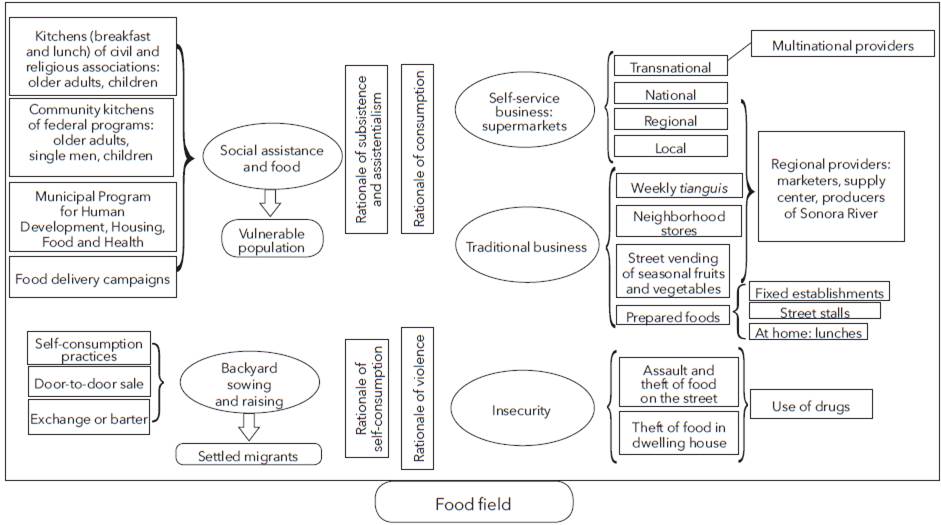
Food Field: Rationales of Food Practice among Agricultural Workers in Miguel Alemán, Sonora, Mexico
Food Field: Rationales of Food Practice among Agricultural Workers in Miguel Alemán, Sonora, Mexico
The Food Field: Different Rationales of a Necessary Practice
In the food field various powers converge and, from a global scale, define food policy, including the economic power of the food industry, which, through processes of commodification, defines what kind of food reach the populations according to the position that they occupy in the social fields.
Based on the empirical results, four axes of analysis are presented in order to identify the rationales and agents that intervene in the conformation of the food field in Miguel Alemán: a) the food market, focused on the rationale of consumption; b) the rationale of assistentialism, which operates in social programs; c) the self-consumption practices; d) the impact of social violence and its relation to the possibilities of accessing food, in a context of widespread insecurity.
Each of these rationales is related to structural and sociocultural processes, such as food industry policies, marketing networks, globalized economies in contrast to domestic and local economy, that of agricultural labor, as well as social exclusion processes, for which government and civil programs are designed, which at a microsocial level enable certain food practices among contextually and historically located agents. The relational analysis of the four thematic axes makes it possible to understand the logical sense of food practices among agricultural workers in which various processes are related.
The Rationale of Consumption: The Food Market in a Migration Context
There are several agents and powers that enable access to food based on the rationale of consumption, such as the 2016 Urban Development Program of Miguel Alemán Population Center, which reports the existence of 167 units that offer temporary accommodation and preparation of food and beverages, as well as other 118 dedicated to the small-scale food industry, with one to five employees per unit (IMPLAN, 2016).
In the 4.6 kilometers in length of the main avenue of Miguel Alemán, which is part of the road to Bahía de Kino, a tourist place, there are the following businesses where food is sold: six regional and one transnational self-service stores, two convenience stores, 11 restaurants, 20 street food stalls, nine take-away food establishments, seven soft-drink stands and a regional patisserie, in addition to the street vending of seasonal fruit (orange, watermelon, tangerine, melon); at least every 80 meters there is a place to buy food (information obtained in field work, January 2018). But this situation changes in neighborhood stores, located inside households, which do not offer a variety of fresh products. Table 2 lists the foods with the highest demand in the six establishments visited, where the sale of non-perishables is higher compared to that of fruits and vegetables.
Table 2
Food Sales Report by Type of Establishment in Miguel Alemán
Food Sales Report by Type of Establishment in Miguel Alemán
| Type of |
Non-perishables | Perishables | Meat and sausages |
| Transnational | Tetra brik juices | Potato | Whole chicken, American thigh |
| Instant soup | Banana | Ground beef | |
| Coca-Cola | Tomato | Chicken wings | |
| Tuna | Apple | Chihuahua cheese | |
| Water | Ham and economic sausage | ||
| Regional | Rice | Tomato | |
| Beans | Onion | ||
| Soup | Chili | ||
| Sugar | Potato | ||
| Maseca corn flour | Cilantro | ||
| Local | Egg | Potato | Chicken |
| Beans | Tomato | Pork | |
| Sugar | Onion | Beef on bone and pork on bone | |
| Oil | Chilies | ||
| Shortening | |||
| Local | Pinto beans | Tomato | Chicken |
| Soups | Chili | Economic turkey sausage | |
| Wheat flour | Onion | ||
| Oil | Potato | ||
| Rice | Banana | ||
| Local | Beans | Fruits and vegetables | |
| Egg | Plantain | ||
| Banana leaf | |||
| Local | Wheat flour | Potato | Homemade chorizo |
| Egg | Tomato | Homemade chilorio | |
| Homemade beans | Onion |
According to testimonies, it is cheaper to buy food in supermarkets than in neighborhood stores, where the most sold are bottled soft drinks and processed foods, such as cookies and potato chips: “In M store there is everything, offers on weekends, because in the changarros that are not so well known it is very expensive” (Esperanza, from Chiapas). This is related to the commercialization network, since the changarros3 buy from local merchandisers or self-service warehouses, and increase the prices. The transnational supermarket was installed seven years ago, and is one of the main suppliers of Miguel Alemán’s changarros and the stores in the agricultural fields. The manager of this store reported that the best-selling products are juices, soft drinks and powders to prepare beverages, especially in the season when work is intense and temperatures are high. He also said that since the prices of fruits and vegetables are set by the central administration, local supermarkets offer them cheaper by buying from small and medium regional producers, especially from the Sonora River, whose direct marketing chain is joined by the tenants of the central supply of Hermosillo.
However, the variety of foods is reduced: tomato, onion, chili, carrot, squash, cilantro and potato. The climatic conditions of the region allow the cultivation of foods that are culturally appropriate for Sonorans and which are offered in the local market. Food habitus of migrant population correspond to products from temperate zones of southern and southeastern Mexico and, although it is not possible to generalize, among the essential foods of the Mesoamerican diet consumed in such states are corn, beans, squash and chili, cultivated in the milpa (cornfield), along with quelites and other vegetables from each region, which gives rise to a complex culinary variety (Carrillo, 2009; Vargas, 2002). These foods are not available geographically or economically, so “we hardly eat vegetables here” (Elena, from Chiapas), since migrants are settled in a desert, which is also a food desert (Joassart, Rossiter & Bosco, 2017), which, beyond availability, is related to social inequality. Difficulties to access fresh food are exacerbated by the economic precariousness, manifest contradiction, being a place where varieties of fruit and vegetables are produced, but which are commercialized among a population group with purchasing power. Agricultural workers see the possibility of deciding and accessing these foods restricted, since they find themselves in a subordinate and precarious position in this social field, a reflection of multiple inequalities.
-
Carrillo, 2009El origen del maízCiencias, 2009
-
Vargas, 2002La alimentación de los criollos y mestizos en el México colonialLa alimentación de los mexicanos, 2002
-
Joassart, Rossiter & Bosco,
2017Ethnic markets and community food security in an urban food desertEnvironmental and Planning, 2017
In certain seasons, products of the rezaga (residue that remains of something) of what they grow and harvest in the fields where they work but which do not meet all the requirements for export are sold on the street. This is an expression of the processes of distinction between agents who can eat first quality foods and others that do not have the economic or symbolic capital to access them. Some of them, such as oranges, tangerines, watermelons, melons, grapes and walnuts, are marketed seasonally, sold on the street by the so-called "greengrocers", who announce their products through a loudspeaker. Others place themselves at strategic points in the community and wait for customers. On weekends a tianguis (open air market) is installed, which extends for five streets. In two places they sell fruits and vegetables, brought from the supply center of Hermosillo, which are offered in plastic bags for 10 pesos (tomato, onion and chili). Although the operation of a market was managed before municipal authorities, permission to install it has not been agreed.
In the observations made in three local supermarkets referred by the participants and that offer “southern products,” it was found that the owners are originally from Oaxaca, which creates an identity link; only one of them sells food produced in southern and southeastern Mexico: plantain, French plantain, purple corn, pasilla chili, ancho chili, habanero chili, mamey, pork rinds and banana leaf for tamales. This business recently opened a branch, and is announced on the commercial radio of Hermosillo. Personnel in charge reported that 15 years ago they started with a small store at home, which grew by positioning itself in people’s taste. Some of its products are from Puebla, which are acquired through a marketing company from Hermosillo. However, in 2017 it closed, so the supply of products “from the south” has been reduced.
During the weekends two of the three establishments offer free transportation to some agricultural fields. This option is an opportunity to save and contributes with its symbolic capital. The empirical data show that when migrating from localities in transition from economies of self-consumption to one of consumption, this rationale dominates food practice, since: “Here you work and everything you want to eat you have to buy it and that’s where all the money is spent. If you do not work, you do not eat” (Mónica, from Guerrero), an expression of the commodification of everyday life (Pla, 2017). Much of what is earned with agricultural work is invested in food, and sometimes this income is insufficient; hence, a part of the population resort to social programs or self-consumption practices as a strategy against food poverty.
-
Pla, 2017Trayectorias de clase y percepciones temporales sobre la posición ocupada en la estructura social. Un abordaje multidimensional de las clases sociales argentinas (2003-2011)Revista Internacional de Sociología, 2017
The Rationale of Assistentialism: Social Programs for the Care of Vulnerable Population
From the linking of national and global social policies, the agents of power that shape the food field and the actions of the States are recognized. A global policy such as the Millennium Goals, through the Zero Hunger objective, had an impact on Mexican politics and resulted in the National System against Hunger and the National Crusade against Hunger, launched in January 2013 (SEDESOL, 2016). In this one, Miguel Alemán was included as a priority attention area due to its social backwardness, in spite of being located in a state with low scores in such an index, which indicates inequalities within it. In Sonora, 21% of the total population is food deprived, while this national percentage is 20%; it is the only indicator that exceeds the national average (SEDESOL, 2018). Press notes allude to extreme poverty and government and civil activities for the delivery of food baskets, as shown in Table 3.
-
SEDESOL,
2016Cruzada Nacional contra el Hambre, 2016
-
SEDESOL, 2018Informe anual sobre la situación de pobreza y rezago social 2018, 2018
Table 3
Press Notes in Electronic Media, 2016-2018
Press Notes in Electronic Media, 2016-2018
| Year | Headline | Available in |
| 2018 | Crece Miguel Alemán |
|
| Arranque de obra de |
|
|
| Llevan atención médica |
|
|
| 2017 | Proyecto de albergue |
|
| ISSSTESON entrega |
|
|
| Entrega DIF Sonora |
|
|
| Sonora gasta 30 mdp |
|
|
| En poblado Miguel |
|
|
| Detienen a hombre por |
|
|
| Hurtan naranjas |
|
|
| 2016 | Abren tienda Diconsa |
|
| Se encuentra comisaría |
|
|
| Miguel Alemán con |
|
The Without Hunger program was launched in December 2016, with a community kitchen in a center run by the municipal government. In July 2017 another kitchen opened, although it had been operated by people from civil society for seven years. In the observations and interviews carried out in both places it was noted that the program does not include fruits, vegetables or meats in its basic basket, which contrasts with the objectives of achieving a healthy and varied food security. The program defines a recovery quota for the purchase of perishables, but the personnel of both kitchens reiterated that it is not possible to apply it due to the precarious economic conditions of the population, and that when they established this quota the beneficiaries stopped attending, mainly boys and girls.
Those in charge of the kitchen operated by civil society refer that the food basket provided by the government covers between 60 and 70% of the food needs of the population served, and that the program should not serve more than 120 people a day, although, in certain seasons, they serve up to 200 children and older adults. This kitchen builds strategies to search for donations in kind or in cash, in order to offer varied menus with fresh foods of vegetable and animal origin.
Another kitchen that is part of the food field in Miguel Alemán is managed by a farmers’ association since 1990, and provides hot meals to older adults and children. This service began in a religious congregation, which was joined by the association, and this one obtains donations and buys food. In 2017, it offered more than 50 000 hot dishes, and in an interview with personnel in charge and in observation the preparation of dishes with red meats, vegetables, beans and corn tortilla was registered.
The three kitchens receive rice, beans, oil, sugar, soy, bottled water and pasta soups, as the most common supplies, and sometimes also dehydrated meat with vegetables, fruits in syrup and fruit bars with chili are part of the basket, as a strategy to cover the consumption of animal protein and fruits, although they are processed industrially. These data indicate the relevance of evaluating the nutritional quality of the foods offered in social programs.
Another common element observed in the three kitchens was that women’s labor power and knowledge is a necessary capital for their functioning. Although in both of them attended by civil society some women receive a salary (two in one and four in another), in the three women participate voluntarily in various tasks. They are part of the human capital required by the structure of policy and social action, although their work does not have symbolic or economic recognition. Older men reproduce their position as recipients of care through food, being the main users of the service. This is linked to sociocultural constructions of gender contained in policies and concrete practices that reproduce inequalities. In the kitchens of civil society, young people or people of productive age are not received, because they can “get a little job” (community kitchen manager, from Miguel Alemán), with which to obtain income to eat, while the government kitchen receives people of any age and sex. Thus, habitus are reproduced and incorporated into objective structures and mental schemes, which place the agents in different positions of power, in this case, women as carers and men as subjects of care.
The Rationale of Self-Consumption: Agriculture and Backyard Farming in a Settled Population
Backyard sowing and raising of animals for self-consumption or retail sale was the strategy registered before the rationale of consumption in four domestic groups settled more than 10 years ago. Women use knowledge of agriculture as part of their capital to cultivate in their courtyards some aromas such as yerba santa, chipilín and other spices to flavor meals, as part of their material and symbolic capital.
Through migration circuits, knowledge and practices related to adjustments in food at the place of settlement are shared; the seeds are part of the baggage: “My son brought chilacayote seed [...] We brought chili plants, we sowed them and it was filled with plants” (Esperanza, from Chiapas).
The reproduction of these practices allows to preserve food habitus, an expression of identity and sustainable food practices. Although it is not widespread, the symbolic capital of food translates into the recognition of agents who grow and sell on a small scale products such as plantain, nopal and corn, as well as backyard animals, in addition to contributing to domestic economy, as Angelina, from Chiapas, recounted: “I told my daughter-in-law, ‘before you leave, sell each duck for at least 50 pesos, 100 pesos are better than nothing.’”
These practices are conceived as saving strategies against the system that imposes consumption as a way of acquiring food, also to improve the domestic economy: “We sow chili, we sow cilantro, some quelites, so we do not buy them [...] [in] poverty one has to manage” (Arnoldo, from Guerrero).
The observations of domestic groups recorded the exchange of some spices, seeds, plants and chickens, as part of their assets and a way to reproduce traditional relationships and build bonds of social cohesion, especially among those from the same place. These practices can be analyzed as agents’ strategies against the subordinate position they keep in the field, since economic income is insufficient to acquire what is necessary. It was also observed door-to-door sale of products derived from backyard cultivation, such as nopales, chives, lemon and banana leaf. Settled women have ventured into the sale of wheat flour tortillas as an economic activity, so it is common to see signs that offer this product outside the houses. All of these women’s domestic economy strategies are related to gender constructions that position them as the main caretakers of food (Brunet & Santamaría, 2016; Criado, 2004; Kleider, 2015), while this knowledge allows them to generate income: “When I made flour tortillas, I had a lot of abonados” (people who pay on credit) (Isaura, from Veracruz).
-
Brunet & Santamaría, 2016La economía feminista y la división sexual del trabajoCulturales, 2016
-
Criado, 2004El valor de la buena madre: oficio de ama de casa, alimentación y salud entre las mujeres de clases popularesRevista Española de Sociología, 2004
-
Kleider,
2015Paid and unpaid work: The impact of social policies on the gender division of laborJournal of European Social Policy, 2015
The agents, in spite of their subordinate position in the field, start up their capitals and strategies to confront precariousness by carrying out activities for the generation of income beyond agricultural work. Women contribute and at certain times are the only ones that contribute to domestic economy by offering prepared food to abonados, single men who hire this service and pay weekly, as well as by engaging in the retail sale of backyard cultivations and / or animals.
The Rationale of Violence: Its Impact on Food Practices
Violence emerged as an issue that conditions food practice and is related to the exclusion and social marginalization that prevails in the locality, translated into daily insecurity. The common denominator of police news in the local media are the robberies and assaults of the macheteros, men who commit robberies with knives or picks, as well as seizures of drugs. In 2017 the Army was installed for almost six months in government offices as a measure in the face of insecurity, and three months after its withdrawal, in April 2018, a municipal policeman was assassinated inside the community center in front of hundreds of people, when he tried to stop the theft of government support.
Informants refer to the theft of food in households and on the streets, due to the lack of such goods. Agricultural workers say that they are assaulted to rob them of lunches that they take to the field; consequently, transiting during the dawn to the points of arrival of the trucks that transport them to the agricultural fields becomes a risk, especially for the men: “Here, it is very ugly […] crime is a habit, we live in poverty. Any day we will see almost everybody asking for food, because even food is being stolen. They assault you to take your lunch” (Eduardo, from Guerrero).
It is also reported the robbery in dwelling house, even the food robbery by members of the domestic group, who then offer it to obtain money and buy drugs, as recounted Esperanza, from Chiapas: “There [her daughter-in-law's room] I have the beans, the mass, eggs, I have everything, because he [his partner] changes it or sells it and brings alcohol.” Faced with this, their strategy to take care of food is to hide it.
They also steal the goods and utensils necessary for the preparation of food, to sell them in the illegal market: “The other day they stole my gas tank and the grill that was out there, in broad daylight. I went to the store and when I returned they had taken it. That's why I'm always locked in” (Elena, from Chiapas). Hence, as a measure of protection, agents limit free movement in the community.
Esperanza commented that also backyard animals are the object of theft: “I had [chickens], but they were stolen by the children.” This risk situation reflects the complexity of social relations in the community, where robberies and impunity are the constant, translated into self-care strategies such as stopping going to establishments at certain times due to risk: “Sometimes they have a lot of food insecurity because there is just a small store and it’s quite dangerous at night; we have already seen that they carry machetes” (Ana, health worker). Food insecurity is related not only to access and availability of food, but also to the possibilities of free movement and safeguarding physical security, which shows the network of relationships that cross food practice.
The main reason for robberies is stealing to buy drugs, which complicates the problems of insecurity and addictions, because, “here you come to learn to be a drug addict. But it's bad, you don’t eat, you get thin [lose body weight], you steal [...] and, truthfully, you spend it on drugs, food is better” (Anselmo, from Puebla). The use of drugs impacts on the economic resources destined for the purchase of food and, therefore, in the domestic organization to meet this need, as Angelina, from Chiapas, said: “He is going down the wrong path, he doesn’t have any money. I didn’t give him any lunch this morning. Oh well, he’s my son, but what can I do?” This affects social relations in domestic groups, and generates conflicts and disagreements linked to the economic precariousness that limits the possibilities of feeding oneself.
The social dynamics of Miguel Alemán is linked to structural processes of inequality and exclusion of people, because they are poor migrants and whose labor is considered disposable and without rights (Valdivia & Sánchez, 2017), and thus, through daily violence, their subordinate position is reproduced in a vital field like food.
-
Valdivia & Sánchez, 2017Protección laboral para los jornaleros agrícolas en MéxicoApuntes para la Equidad, 2017
Conclusions
There are multiple structural processes that make up the global food field, and this paper showed how some of its elements are related to each other in a particular sociohistorical context, based on rationales, powers and capitals that come into play to structure the alimentary habitus among agricultural workers who live in a community characterized by human mobility and extensive agricultural work. The relational analysis, from the theoretical approach of Bourdieu, allows us to reflect on the rationales, agents and powers that operate in the field, producing and reproducing the power relations that disrupt food practice.
The empirical data show the diversity of agents and capitals that make up the food field, highlighting the confluence of practices based on the rationale of consumption, as well as the strategies that agricultural workers put into practice. The rationale of consumption structures processes of class differentiation, and locates agents, in this case agricultural workers, in subordinate relationships in different fields. The historical conditions in the localities of origin, transit and settlement combine to reproduce a subordinate position in the habitus of this production sector. Placing oneself on the lowest scale of agroindustrial production is materialized in flexible labor relations, and thus in difficulties for access to the economic capital necessary to be inserted in consumer societies. Although agricultural workers are not passive and create strategies, such as self-consumption and the exchange of seeds, plants and food among nearby networks, the conditions of constant mobility make it difficult to implement these strategies, especially for pendular migrant men; hence, they are the main users of the services of community kitchens, while women continue to do these jobs. These gender norms are related to the habitus that reproduce inequalities, which define the food task as feminine.
We recognize the capacity of the agents whose precarious living conditions circumscribe their food practice to the economically accessible, to what they obtain from the commodification of their labor. They recognize that fresh and natural foods are healthy. However, not having the necessary economic capital, their access is limited to the possible, that is, to the cheapest and lowest quality food, which is paradoxical because they are who harvest the highest quality food, but do not consume it. This reflects inequality in access to food. Hence, it is important to recognize the strategies they put into practice to deal with the economic model that subordinates them, while resisting the structural and social violence that impacts their conditions of existence, including food.
Another part of the population is even more affected, to the point of finding in the community kitchens the possibility of feeding themselves. This situation shows the precariousness and social exclusion suffered by all age groups, since children and the elderly are subjects of food social assistance programs, an expression of a continuous and sustained poverty in their life course; a kind of subordination trajectory characterized by insecurity and uncertainty. Older men, who worked for many years in agricultural fields and who are sick and homeless, eat daily in community kitchens. During their years as agricultural workers they lived repeated labor violations, which continue to be invisible, socially and legally, exposing them even to food poverty and street situation, as observed in the locality. Likewise, the material conditions of life are exacerbated due to the daily and normalized insecurity to the detriment of food, both by restricting free transit and suffering assaults, since food is valued and necessary goods, but scarce for part of the population. Therefore, they are subjected to violent subtraction in the households and on the street.
On the other hand, the presence of businesses related to ethnicity configures the food field, in which transnational companies come into play, while they intersect with short marketing networks, street vendors (such as greengrocers and tianguis) and even door-to-door sale of backyard products. These practices, focused on domestic economy, constitute strategies in the face of the commercial model of consumption and the possibility of generating own resources, while allowing the reproduction of identity. In addition, they reflect the ability to build survival strategies in the face of precariousness. Ultimately, it expresses the subordinate position of the economies of developing countries, among which is Mexico, which directly impacts on food practices, especially of affected populations such as agricultural workers, despite emigrating to states of the country with the highest rates of social and economic development.
In Miguel Alemán, located in a desert zone in which a sophisticated agricultural technology has been developed, the high quality food produced there is aimed at certain consumers, while the workers who harvest it are excluded from its consumption, a mechanism that reproduces historical subordination and structures a food field in which the social stratification of food prevails.
The analysis of the food field among an affected population allows to put into play the agents and capitals that give a logical sense to the practice, and thus denaturalize food decisions as an individual matter. It enables us to understand the network of social, economic, historical and political relations that place social agents in different positions in relation to available capital. Migrant agricultural workers are a productive and population sector in whose material and symbolic conditions of life various inequalities are reproduced, to the detriment of their possibilities to feed themselves and, with it, the short- and long-term effects on health.
Referencias
- Alcántara, Y. (2014). “A todo se acostumbra uno, menos a no comer… azúcar.” Prácticas de alimentación ante la diabetes en grupos domésticos triquis, inmigrantes en Sonora (tesis de maestría). Recuperada de http://biblioteca.colson.edu.mx:8081/e-docs/RED/RED000942/index.html Links
- Arancibia-Bulnes, C., Peón-Anaya, R., Riveros-Rosas, D., Quiñones, J., Cabanillas, R., y Estrada, C. (2014). Beam solar irradiation assessment for Sonora, Mexico. Energy Procedia, (49), 2290-2296. doi: 10.1016/j.egypro.2014.03.242 Links
- Aranda, P., y Castro, M. (2016). El campo de la agroindustria en el noroeste de México y la salud de sus jornaleras: una propuesta de estudio. Salud Colectiva, 12(1), 55-70. doi: 10.18294/sc.2016.878 Links
- Arellano Gálvez, M. C. (2018). Relaciones sociales y prácticas de alimentación de migrantes del sureste mexicano residentes en una comunidad agroindustrial de Sonora (tesis de doctorado inédita). El Colegio de la Frontera Sur, San Cristóbal de las Casas, Chiapas. Links
- Arellano, M., Alvarez, G., Eroza, E., Huicochea, L., y Tuñón, E. (2019). Habitus alimentario: prácticas entre trabajadores agrícolas migrantes en una comunidad de Sonora, México. Salud Colectiva , 15:e1843. doi: 10.18294/sc.2019.1843. Links
- Atkins, P., y Bowler, I. (2016). Food in society: Economy, culture, geography. Nueva York: Routledge. Links
- Barros, M. (2015). Apuntes sobre la vivienda para migrantes y crisis inmobiliaria en la California rural. Un estudio de caso. El Cotidiano, (191), 33-42. Links
- Bautista, A. (2017). De ida y vuelta: vulnerabilidad y exclusión del mercado de trabajo a migrantes en los Estados Unidos y retornados en México en un contexto demográfico y migratorio dinámico. Geografares, (24), 132-144. Links
- Beagan, B., Power, E., y Chapman, G. (2015). “Eating isn´t just swallowing food”: Food practices in the context of social class trajectory. Canadian Food Studies, 2(1), 75-98. doi: 10.15353/cfs-rcea.v2i1.50 Links
- Bourdieu P. (2008). El sentido práctico. Buenos Aires: Siglo XXI Editores. Links
- Bourdieu, P. (2012). La distinción: criterios y bases sociales del gusto. México: Taurus. Links
- Bourdieu, P., y Wacqüant, L. (2005). Una invitación a la sociología reflexiva. Argentina: Siglo XXI Editores. Links
- Brunet, B., y Santamaría, C. (2016). La economía feminista y la división sexual del trabajo. Culturales, IV(1), 61-86. Links
- Calvario, E., y Díaz, R. (2017). Al calor de la masculinidad. Clima, migración y normativas de género en la Costa de Hermosillo, Sonora. región y sociedad, (5), 115-146. doi:10.22198/rys.2017.0.a291 Links
- Carrillo, C. (2009). El origen del maíz. Ciencias, (92-93), 4-13. Links
- Castañeda, J. (2017). Inseguridad alimentaria y obesidad en jornaleros agrícolas migrantes del estado de Sonora (tesis de maestría inédita). Centro de Investigación en Alimentación y Desarrollo (CIAD), Hermosillo. Links
- Centro de Derechos Humanos de la Montaña Tlachinollan. (2011). La montaña de Guerrero, tierra de mujeres migrantes. México: Tlachinollan. Links
- Chávez, A. (1999). La nueva dinámica de la migración interna en México 1970-1990. Cuernavaca: Ediciones Universidad Nacional Autónoma de México (UNAM) y Centro Regional de Investigaciones Multidisciplinarias. Links
- Chong, E., Herrera, F., Chávez, C., y Sánchez, F. (2015). Mercado rural y precarización: nuevas condiciones socioeconómicas en el sur del Estado de México. región y sociedad , XXVII(63), 155-179. doi: 10.22198/rys.2015.63.a241 Links
- Comisión Nacional del Agua (CONAGUA). (2015). Estadísticas agrícolas de los distritos de riego año agrícola 2013-2014. México: Secretaría de Medio Ambiente y Recursos Naturales, CONAGUA. Links
- Costa, S., Zepeda, L., y Sirieix, L. (2014). Exploring the social value of organic food: A qualitative study in France. International Journal of Consumer, 38(3), 228-237. doi: 10.1111/ijcs.12100 Links
- Criado, E. (2004). El valor de la buena madre: oficio de ama de casa, alimentación y salud entre las mujeres de clases populares. Revista Española de Sociología, (4), 93-118. Links
- Criado, E. (2008). El concepto de campo como herramienta metodológica. Revista Española de Investigaciones Sociológicas, (123), 11-33. Links
- Delgado, M. (2010). El sistema agroalimentario globalizado: imperios alimenticios y degradación social y ecológica. Revista de Economía Crítica, (10), 32-61. Links
- Denzin, N., y Lincoln, Y. (2005). The Sage handbook of qualitative research. Thousand Oaks: Sage Publications. Links
- Durand, J. (2017). Historia mínima de la migración México-Estados Unidos. México: El Colegio de México. Links
- Escobar, A., Martin, S., Lowell, L., y Fernández, R. (2013). Estudio binacional sobre migrantes mexicanos en Estados Unidos y en México. Foreign Affairs Latinoamérica, 13, 12-17. Links
- Espinoza, G., Ramírez, E., y Tello, A. (2017). Vivir, para el surco. Trabajo y derechos en el valle de San Quintín. México: Universidad Autónoma Metropolitana-Xochimilco. Links
- Grammont, H., de, y Lara, S. (2004). Encuesta a hogares de jornaleros migrantes en regiones hortícolas de México: Sinaloa, Sonora, Baja California Sur y Jalisco. México: UNAM. Links
- Gonzalez, G. (2016). Guest workers or colonized labor? Mexican labor migration to the United States. Nueva York: Taylor & Francis. Links
- Hammersley, M., y Atkinson, P. (1994). Etnografía. Métodos de investigación. México: Paidós. Links
- Hernández, J. (2014). Condiciones de trabajo e ingreso en la agricultura intensiva mexicana. Análisis Económico, XXIX(71), 137-160. Links
- Holmes, S. (2013). Fresh fruit, broken bodies: Migrant farm workers in the United States. Berkeley: University of California Press. Links
- Instituto Municipal de Planeación (IMPLAN). (2016). Programa de Desarrollo Urbano del Centro de Población Miguel Alemán 2016. Recuperado de http://www.implanhermosillo.gob.mx/wp-content/uploads/2017/05/PDUMASEP2016.pdf Links
- Izcara, S. (2014). La demanda de trabajadores huéspedes en la agricultura estadounidense. Cuadernos de Desarrollo Rural, 11(73), 149-169. Links
- Joassart, P., Rossiter, J., y Bosco, F. (2017). Ethnic markets and community food security in an urban food desert. Environmental and Planning, 49(7), 1642-1663. doi: 10.1177/0308518X17700394 Links
- Kamphuis, C., Jansen, T., Mackenbach, J., y Lenthe, F., van. (2015). Bourdieu´s cultural capital in relation to food choices: A systematic review of cultural capital indicators and an empirical proof of concept. PLoS ONE, 10(8). doi: 10.1371/journal.pone.0130695 Links
- Kleider, H. (2015). Paid and unpaid work: The impact of social policies on the gender division of labor. Journal of European Social Policy, 25(5), 505-520. doi: 10.1177/0958928715610996 Links
- Lara, S. (coord.). (2010). Migraciones de trabajo y movilidad territorial. México: Cámara de Diputados, Consejo Nacional de Ciencia y Tecnología, Miguel Ángel Porrúa. Links
- Lara, S. (2012). Los territorios migratorios como espacios de articulación de migraciones nacionales e internacionales. Cuatro casos del contexto mexicano. Política y Sociedad, 49(1), 89-102. Links
- Lara, S. , y Sánchez, K. (2005). En búsqueda del control: enganche e industria de la migración en una zona productora de uva de mesa en México. En A. Riella y P. Macheroni (coords.), Empleo rural y asalariados rurales en América Latina (pp. 73-94). Montevideo: Consejo Latinoamericano de Ciencias Sociales. Links
- Morais, P., da, Rocha, P., da, Carvalho, I., de, Fernandez, R., Dimitrov, M., Sabatini, F., Martins, P., y Baeza, F. (2014). Eating practices and habitus in mothers. A Brazilian population based survey. Appetite, 82(1), 16-28. Links
- Morais, P., da, Gittelsohn, J., Fernandez, R. , Roble, O., y Baeza, F. (2016). The use of Pierre Bourdieu´s distinction concept in scientific articles studying food and eating: A narrative review. Appetite, (96), 174-186. Links
- Moreno, J. (2006). Por abajo del agua. Sobreexplotación y agotamiento del acuífero de la Costa de Hermosillo, 1945-2005. Hermosillo: El Colegio de Sonora. Links
- Navarro, J., Robles, A., Vivoni, E., Montoya, J., Espindola, J., y Verduzco, V. (2018). Observed trends and future projections of extreme heat events in Sonora, México. International Journal of Climatology, 5168-5181. doi: 10.1002/joc.5719. Links
- Oncini, F., y Guetto, R. (2017). Cultural capital and gender differences in health behaviors: A study on eating, smoking and drinking patterns. Health Sociology Review, 27(1), 15-30. doi: 10.1080/14461242.2017.1321493 Links
- Ortega, I., Castañeda, A., y Sariego, J. (2007). Los jornaleros agrícolas invisibles productores de riqueza. Nuevos procesos migratorios en el noroeste de México. México: CIAD, Fundación Ford, Plaza y Valdés. Links
- Ortega, I. , y Alcalá, G. (2008). Pobreza, migración y seguridad alimentaria. En S. Sandoval, J. Meléndez (coords.), Cultura y seguridad alimentaria. Enfoques conceptuales, contexto global y experiencias locales (pp. 177-194). México: Plaza y Valdés. Links
- Ortega I., Rosales C., Zapien, J., de, Aranda P., Castañeda, A. , Saucedo, S., Montaño, C., y Contreras, A. (2012). Migration, agribusiness and nutritional status of children under five in northwest Mexico. International Journal of Environmental Research and Public Health, 9, 33-43. Links
- Ortega, I. , Rosales, C., Zapien, J. , de, Aranda, P. , Castañeda, A. , Saucedo, S. , Montaño, C. , y Paddock, J. (2015). Invoking simplicity: “Alternative” food and the reinvention of distinction. Sociologia Ruralis, 55(1), 22-40. doi: 10.1111/soru.12056 Links
- Paddock J. (2016). Positioning food cultures: “Alternative” food as distinctive consumer practice. Sociology, 50(6), 1039-1055. Links
- Pérez, E. (2014). Los sobrevivientes del desierto. Producción y estrategias de vida entre los ejidatarios de la Costa de Hermosillo, Sonora (1932-2010). México: Bonilla Artigas Editores. Links
- Pla, J. (2017). Trayectorias de clase y percepciones temporales sobre la posición ocupada en la estructura social. Un abordaje multidimensional de las clases sociales argentinas (2003-2011). Revista Internacional de Sociología, 75(3). doi: 10.3989/ris.2017.75.3.16.05 Links
- Posadas, F. (2018). Mercado de trabajo de los jornaleros agrícolas en México. región y sociedad , XXX(72), 1-25. doi:10.22198/rys.2018.72.a885 Links
- Ramírez, M. (2002). El efecto del proceso de migración en el estado nutricio de familias jornaleras migrantes en el noroeste de México (tesis de maestría inédita). CIAD, Hermosillo. Links
- Reyes, A., y Quintero, M. (2009). Problemática del agua en los distritos de riego por bombeo del estado de Sonora. Revista Digital Universitaria, 10(6), 1-19. Links
- Rojas, T. (2017). Migración rural jornalera en México: la circularidad de la pobreza. IberoForum, XII(23), 1-35. Links
- Salazar, A., Moreno, J., y Lutz, A. (2012). Agricultura y manejo sustentable del acuífero de la Costa de Hermosillo. región y sociedad (3), 155-179. doi: 10.22198/rys.2012.3.a411 Links
- Sánchez, K. , Saldaña, A., y Lara, S. (2018). ¿Dónde comienza la (in)sostenibilidad social de un enclave agrícola de producción de uva de mesa en Sonora, México? AGER. Revista de Estudios sobre Despoblación y Desarrollo Rural, (24), 95-122. Links
- Secretaría de Desarrollo Social (SEDESOL). (2013). Indicadores de marginación. México: SEDESOL. Recuperado de http://www.microrregiones.gob.mx/catloc/indiMarginacLoc.aspx?refnac=260300343 Links
- Secretaría de Desarrollo Social (SEDESOL). (2015). Informe anual sobre la situación de pobreza y rezago social 2015. Hermosillo, Sonora. México: SEDESOL . Recuperado de https://www.gob.mx/cms/uploads/attachment/file/46482/Sonora_030.pdf- Links
- Secretaría de Desarrollo Social (SEDESOL). (2016). Cruzada Nacional contra el Hambre. México: SEDESOL . Recuperado de https://www.gob.mx/sedesol/acciones-y-programas/cruzada-nacional-contra-el-hambre-18938 Links
- Secretaría de Desarrollo Social (SEDESOL). (2018). Informe anual sobre la situación de pobreza y rezago social 2018. México: SEDESOL . Recuperado de https://www.gob.mx/cms/uploads/attachment/file/288969/Sonora.pdf Links
- Taylor, S., y Bogdan, R. (1994). Introducción a los métodos cualitativos de investigación. La búsqueda de significados. Barcelona: Paidós Básica. Links
- Valdés, X. (2015). Feminización del empleo y trabajo precario en las agriculturas latinoamericanas globalizadas. Cuadernos de Antropología Social, (41), 39-54. Links
- Valdez, J. (2012). Alimentación, cultura y estado nutricional en jornaleros agrícolas migrantes en un campo de la Costa de Hermosillo (tesis de maestría inédita). CIAD, Hermosillo. Links
- Valdivia, M., y Sánchez, L. (2017). Protección laboral para los jornaleros agrícolas en México. Apuntes para la Equidad, (3), 1-4. Links
- Vargas, L. A. (2002). La alimentación de los criollos y mestizos en el México colonial. En D. Alarcón Segovia y H. Bourges Rodríguez (eds.),La alimentación de los mexicanos (pp. 47-66). México: El Colegio Nacional. Links
- Velasco, L. (2013). Escuela y reproducción social de familias migrantes: hijos e hijas de jornaleros indígenas en el noroeste mexicano. Estudios Demográficos y Urbanos, 28(82), 189-218. doi: 10.24201/edu.v28i1.1443 Links
- Velasco, L., Zlolniski, Ch., y Coubès, M. (2014). De jornaleros a colonos: residencia, trabajo e identidad en el valle de San Quintín. Tijuana: El Colegio de la Frontera Norte. Links
- Villa, A., y Bracamonte, A. (2013). Proceso de aprendizaje y modernización productiva en el agro del noroeste de México: los casos de la agricultura comercial de la Costa de Hermosillo, Sonora y la agricultura orgánica de la zona sur de Baja California Sur. Estudios Fronterizos, 14(27), 217-254. Links
- Wills, W., Backett-Milburn, K., Roberts, M., y Lawton, J. (2011). The framing of social class distinctions through family food and eating practices. The Sociological Review, 59(4), 725-740. doi: 10.1111/j.1467-954X.2011.02035.x Links