Regular Articles Paleontology
Pliocene freshwater isopods (Crustacea: Peracarida: Isopoda) from Jalisco, Mexico
Isópodos (Crustacea: Peracarida: Isopoda) de agua dulce del Plioceno de Jalisco, México

-
Publication dates-
May 25, 2024
Jan-Apr , 2023
- Article in PDF
- Article in XML
- Automatic translation
- Send this article by e-mail
- Share this article +
Abstract
A new genus and species of freshwater isopod is described from Pliocene volcanic sedimentary ashes found in an ancient lake basin in the Santa Rosa Dam region, Amatitlán, Jalisco, West-central Mexico. The new isopod is represented by a few corpses and molts. Due to the relatively poor preservation, no further morphological details can be offered to the moment, but the observed features are sufficient to distinguish this isopod from any living or fossil freshwater Sphaeromatidae species. This contribution extends the stratigraphic and geographic record of fossil isopod bearing localities in Mexico, being this the youngest fossil Peracarida recorded from this country.
Keywords::
Sphaeromatidae, new genus and species, Pliocene, lacustrine volcanic ash deposits, mass mortality
1. Introduction
During the 1980s, Professor Mario Ramírez (Facultad de Ciencias, Universidad de Guadalajara, Jalisco), and geologist Jaime Villarino-Guzmán, recovered fossiliferous Neogene rocks from the Santa Rosa Dam region, Municipality Amatitán, Jalisco (Figure 1). The fossil specimens were donated to the paleontology collection of the Instituto de Geología [currently Colección Nacional de Paleontología (CNP) of the Universidad Nacional Autónoma de México (UNAM), Mexico City]. Based on data provided by the collectors, the fossils were linked to two sites with incomplete field data, recorded in the Catalogue of Localities of the CNP under numbers IGM-loc 2449 and IGM-loc 2450. The fossil assemblage includes so far: pollen, diatoms, carbonized plants, ostracods, isopods, insects, fish remains, possible bird bone fragments, ichnofossils, and coprolites (Álvarez and Arriola-Longoria, 1972; Guzmán et al., 1998). Among these fossils, the only properly identified species is the goodeid fish Tapatia occidentalisÁlvarez and Arreola-Longoria, 1972. The presence of complete or partially preserved isopods, laying together with some specimens of T. occidentalis was observed by Mario Ramírez through a handmade note provided together with his fossil donation, also mentioned in a geological study of the Amatitán region (Guzmán et al., 1998), who analyzed the Neogene volcanic-sedimentary deposits present in the vicinity of the Santa Rosa Dam, calling these deposits the “Paleolago Amatitán”, where T. occidentalis is abundant. According to Rosas-Elguera et al. (2000), these sediments represent a Pliocene sequence between 5.0 to 2.5 My old, deposited into the Plan de Barrancas Santa Rosa Graben. In this region, Guzmán et al. (1998) interpreted four stratigraphic units along the ravine of the Santiago River between the curtain dam and the Chome village, suggesting that 100 mm of thick laminar, parallel, and millimeter-tuffaceous silt horizons (corresponding to their section C) is the only fossiliferous portion of this sequence. During a 2014 fieldwork, Alvarado-Ortega and his students found that the fossiliferous portion of Guzmán et al. (1998) is more complex, because the millimeter-lamination tuffaceous silts are interspersed with less-compacted, thinner greenish-gray limolites, which together form a 20 m thick sequence, exposed 500 m alongside the El Amarillo and Chome road (Figure 1). The new exposures found in 2014 were labeled as IGM-loc 3954, registered at the CNP, UNAM.
-
Álvarez and Arriola-Longoria, 1972Primer goodeido fósil procedente del Plioceno jaliscienseBoletín de la Sociedad de Ciencias Naturales de Jalisco, 1972
-
Guzmán et al., 1998El paleolago de Amatitlán, Jalisco: estratigrafía, sedimentología y paleontología de la localidad tipo de Tapatía occidentalis (Osteichthyes: Goodeidae)Revista de la Sociedad Mexicana de Paleontología, 1998
-
Álvarez and
Arreola-Longoria, 1972Primer goodeido fósil procedente del Plioceno jaliscienseBoletín de la Sociedad de Ciencias Naturales de Jalisco, 1972
-
Guzmán et al., 1998El paleolago de Amatitlán, Jalisco: estratigrafía, sedimentología y paleontología de la localidad tipo de Tapatía occidentalis (Osteichthyes: Goodeidae)Revista de la Sociedad Mexicana de Paleontología, 1998
-
Rosas-Elguera et al. (2000)Carta Geológico-Minera Guadalajara F13-12, 2000
-
Guzmán et
al. (1998)El paleolago de Amatitlán, Jalisco: estratigrafía, sedimentología y paleontología de la localidad tipo de Tapatía occidentalis (Osteichthyes: Goodeidae)Revista de la Sociedad Mexicana de Paleontología, 1998
-
Guzmán et
al. (1998)El paleolago de Amatitlán, Jalisco: estratigrafía, sedimentología y paleontología de la localidad tipo de Tapatía occidentalis (Osteichthyes: Goodeidae)Revista de la Sociedad Mexicana de Paleontología, 1998
Thumbnail
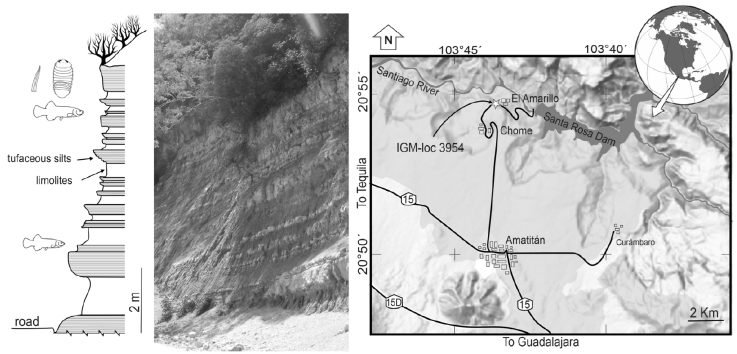
Figure 1
Location map and stratigraphic section of locality IGM-loc 3954, north of Amatitlán, Jalisco, Mexico. The stratigraphic section shows the occurrence of plant remains, fishes and isopods, near the top of the exposed sequence.
Location map and stratigraphic section of locality IGM-loc 3954, north of Amatitlán, Jalisco, Mexico. The stratigraphic section shows the occurrence of plant remains, fishes and isopods, near the top of the exposed sequence.
The aim of this study is to determine the taxonomical identity of the Neogene fossil isopods of Amatitán. Specimens are deposited at the Colección Nacional de Paleontología, Instituto de Geología, Universidad Nacional Autónoma de México, Ciudad Universitaria, Coyoacán, Mexico City, 04510, Mexico.
2. Methodology
The fossil isopods were observed and photographed with a Zeiss Axiozoom v.16; the resulting images were digitized with a Kanvus Life 106 graphic tablet using the software Inkscape v0.92.3.
3. Systematic Palaeontology
-
Class Malacostraca Latreille, 1806
-
Superorder Peracarida Calman, 1904
-
Order Isopoda Latreille, 1817
-
Suborder SphaeromatideaWägele, 1989
-
Family SphaeromatidaeLatreille, 1825
-
Genus Jaliscosphaera n. gen.
-
Latreille, 1806Genera crustaceorum et insectorum secundum ordinem naturalem in familias disposita, iconibus exemplisque plurimis explicataAmand Koenig, Parisiis et Argentorati (Paris and Strasbourg), 1806
-
Calman, 1904On the classification of the Crustacea MalacostracaThe Annals and Magazine of Natural History, 1904
-
Latreille, 1817Les crustacés, les arachnides et les insectesLe règne animal distribué d’après son organisation, pour servir de base à l’histoire naturelle des animaux et d’introduction à l’anatomie comparée, 1817
-
Wägele, 1989Evolution und phylogenetisches System der Isopoda. Stand der Forschung und neue ErkenntnisseZoologica, 1989
-
Latreille, 1825Familles naturelles du règne animal, exposées succinctement et dans un ordre analytique, avec l’indication de leurs genres, 1825
Type species: Jaliscosphaera pliocenica n. gen. et sp., by monotipy.
Etymology: This name refers to the state of Jalisco, Mexico.
Diagnosis: Head partially inserted into pereonite 1; antennal peduncles robust. Pereonite 1 spaced from the rest. Coxal projections visible overlapped. Pleotelson with posterolateral margins with two indentations; uropods biramous finger-like, flattened, obtuse apex. Jaliscosphaera pliocenica n. gen. et sp. Figures 2-4.
Thumbnail
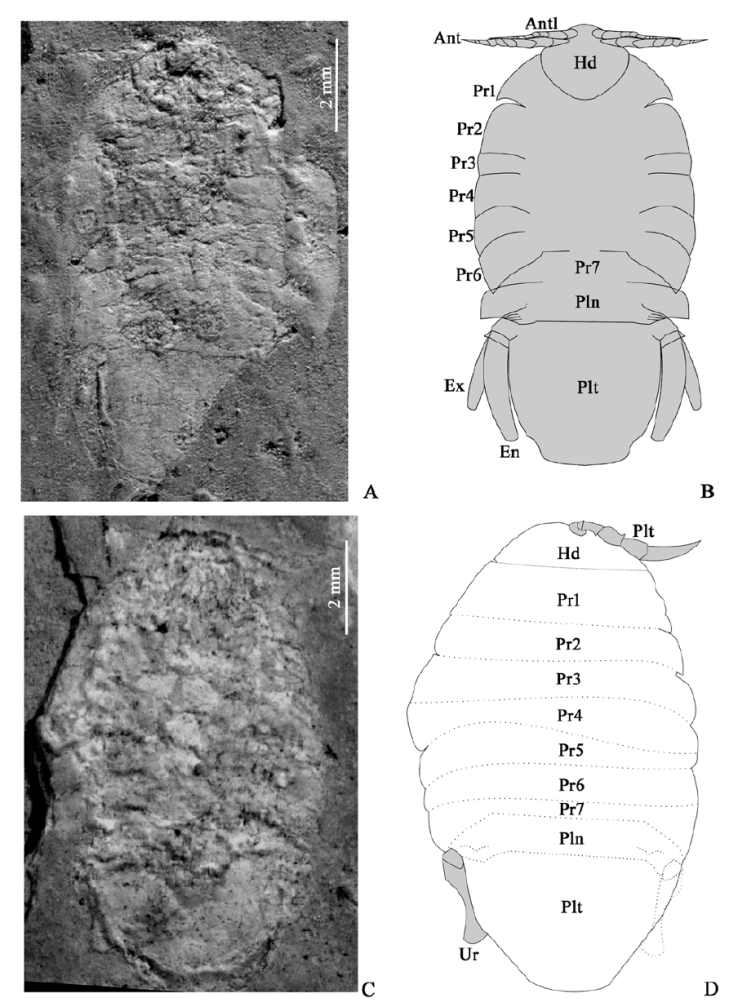
Figure 2
Jaliscosphaera pliocenica n. gen. et sp. A, holotype IGM 13091; B, drawing of same specimen; C, paratype 13092; D, drawing of same specimen. Abbreviations: Ant = antenna, Antl = antennula, Cx = coxa, En = endopod, Ex = exopod, Fs = fish, Hd = head, Pln = pleon, Plt = pleotelson, Pr = pereonite, Prp = pereopod, Ur = uropod.
Jaliscosphaera pliocenica n. gen. et sp. A, holotype IGM 13091; B, drawing of same specimen; C, paratype 13092; D, drawing of same specimen. Abbreviations: Ant = antenna, Antl = antennula, Cx = coxa, En = endopod, Ex = exopod, Fs = fish, Hd = head, Pln = pleon, Plt = pleotelson, Pr = pereonite, Prp = pereopod, Ur = uropod.
Thumbnail
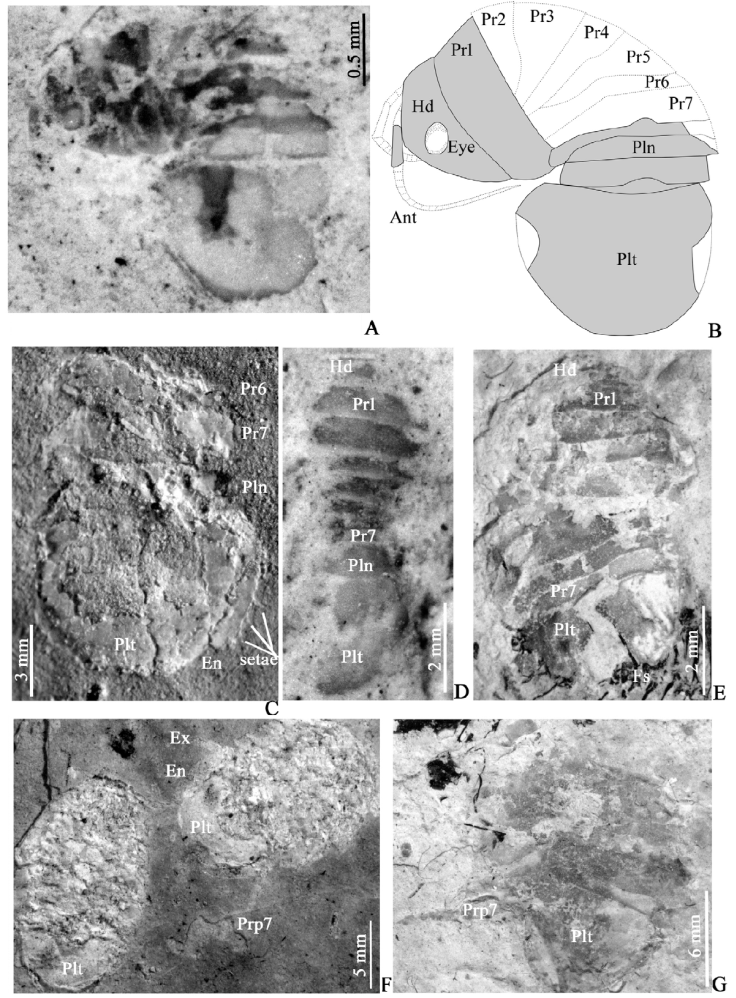
Figure 3
Jaliscosphaera pliocenica n. gen. et sp. A, paratype IGM 13091; B, drawing of same specimen. C, paratype IGM 13092; D, paratype 13093; E, 13094; paratypes 13095 (left), and 13096 (upper right); G, paratype IGM 13097.
Jaliscosphaera pliocenica n. gen. et sp. A, paratype IGM 13091; B, drawing of same specimen. C, paratype IGM 13092; D, paratype 13093; E, 13094; paratypes 13095 (left), and 13096 (upper right); G, paratype IGM 13097.
Thumbnail
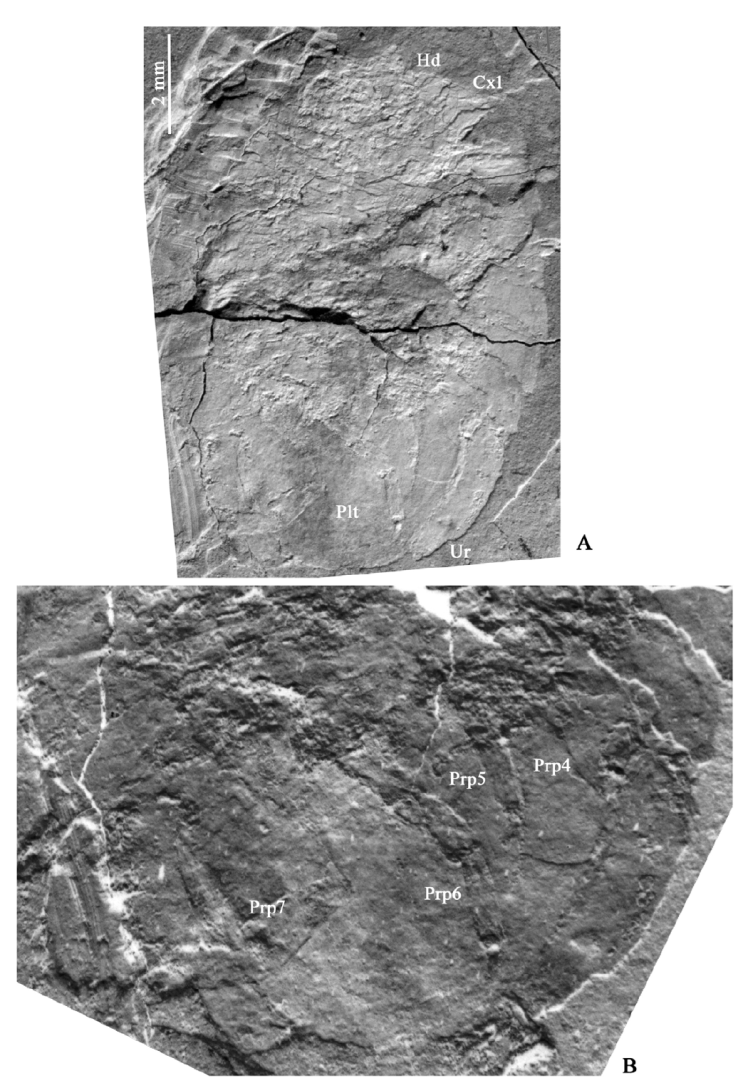
Figure 4
Jaliscosphaera pliocenica n. gen et sp. A, paratype IGM 13098; B, close up to pleotelson, pereopods 4 - 7 and uropods.
Jaliscosphaera pliocenica n. gen et sp. A, paratype IGM 13098; B, close up to pleotelson, pereopods 4 - 7 and uropods.
Etymology: The name refers to the Pliocene age of volcanic ash sediments of the Santa Rosa region, Amatitlán, Jalisco, Mexico.
Material: Holotype IGM 13091; paratypes IGM 13092 to IGM 13104.
Measurements: See Table 1.
Table 1
Measurements (in mm) of Jaliscosphaera pliocenica n. gen et sp.
Measurements (in mm) of Jaliscosphaera pliocenica n. gen et sp.
| Specimen | Length | Width |
|---|---|---|
| IGM 13091 | 12.2 | 6.8 |
| IGM 13092 | 12.8 | 9.6 |
| IGM 13093 | 3.4 | 2.5 |
| IGM 13094 | 10.1 | 5.3 |
| IGM 13095 | 9.7 | 5.3 |
| IGM 13096 | 3.3 | 2.1 |
| IGM 13097 | 10.8 | 8.5 |
| IGM 13098 | 6.3 | 4.1 |
| IGM 13099 | 3.5 | 1.4 |
| IGM 13100 | 8.7 | 5.7 |
| IGM 13101 | 10.8 | 8.6 |
| IGM 13102 | 3.2 | 1.3 |
| IGM 13103 | 3.7 | 1.5 |
| IGM 13104 | 8.2 | 4.1 |
Diagnosis: Body vaulted, convex margins without setae. Pereonite 1 separated from rest, pereionite 3 reduced in length. Coxae 1 separated from the rest posteriorly triangular, coxae 2-7 posteriorly triangular, slightly overlapped. Pleotelson posterolateral margins with two indentations.
Description: Body vaulted, convex, margins smooth, head inserted into pereonite 1. Antennae projecting laterally, extending posteriorly to anterior margin pereonite 2, with 5 peduncular segments, flagellum with 4 articles. Antennula projecting laterally, with 3 peduncular segments, flagellum with 6 articles. Pereon margins strongly convex, pereonite 1 separated from pereonites 2-7, pereonites 2-7 overlapped. Pereopod not prehensile, ambulatory; coxae length 2.25 width; basis triangular reduced as long as coxae; ischium with external margin concave, length 2.6 width; merus subtriangular length; carpus, propodus, dactylus not well differentiated. Pleon subrectangular, width 5.3 length, 5 pleonites visible fused indicated by lateral sutures. Pleotelson subsquare, length 0.95 width, presumptively posterolateral margins with two indentations, uropods inserting anterolaterally. Uropods smooth biramous, protopod trapezoidal broader than long; exopod length 0.7 endopod length, endopod lateral margin simple, smooth, apex obtuse.
Remarks: Jaliscosphaera pliocenica n. gen. et sp. is the first freshwater isopod recorded from the Pliocene from the western slope of Mexico, the rest of the fossil isopods belong to Cretaceous marine environments and terrestrial species as inclusions in early Miocene amber (Feldmann et al., 1998; Vega et al., 2005, 2006, 2018, 2019, 2022; Serrano-Sánchez et al., 2007, 2015, 2016; Broly et al., 2017, 2018; Bruce et al. 2021). Since most of the specimens of Jaliscosphaera pliocenica n. gen. et sp. are preserved in ventral view, the morphological description is limited, although sufficient to erect a new genus and species. Poorly preserved pereopod and no pleopods are preserved and the sex could not be assigned. Along with type specimens of the here described new taxon, other smaller isopods with apparently different morphological characteristics are found. Some these individuals present conglobation (Figures 3A, 3B and 3G), probably due to the sudden burial event occurred that may cause a mass mortality event, affecting not only isopods, but other organisms, such as fishes. Sphaeroma burkatiiBárcena, 1875 is another lacustrine fossil species recorded from Ameca, Jalisco (whose physical position is unknown), the morphological differences in body conformation such as the shape of the head, pereon, pleon, pleotelson, and uropods, allow us to achieve clear separation with Jaliscosphaera pliocenica n. gen. et sp.
-
Feldmann
et al., 1998Early Cretaceous arthropods from the Tlayúa Formation at Tepexi de Rodríguez, Puebla, MexicoJournal of Paleontology, 1998
-
Vega
et al., 2005A review of the Lower Cretaceous (Tlayúa Formation: Albian) Crustacea from Tepexi de Rodríguez, Puebla, Central MexicoBulletin of the Mizunami Fossil Museum, 2005
-
2006Mesozoic and Tertiary Crustacea from MexicoStudies on Mexican Paleontology, 2006
-
2018Review and additions to the Maastrichtian (late Cretaceous) Crustacea from Chiapas, MexicoJournal of South American Earth Sciences, 2018
-
2019Lower Cretaceous marine isopods (Isopoda: Cirolanidae, Sphaeromatidae) from the San Juan Raya and Tlayúa formations, Puebla, MexicoJournal of Crustacean Biology, 2019
-
2022A new genus and species of sphaeromatid (Crustacea: Isopoda) from the Lower Cretaceous (Aptian) Sierra Madre Formation, Chiapas, MexicoJournal of South American Earth Sciences, 2022
-
Serrano-Sánchez et al., 2007Terrestrial isopods included in Miocene amber from Chiapas, MexicoGeological Society of America, 2007
-
2015The aquatic and semiaquatic biota in Miocene amber from the Campo La Granja mine (Chiapas, Mexico): paleoenvironmental implicationsJournal of South American Earth Sciences, 2015
-
2016The first fossil record of larval stages of parasitic isopods: cryptoniscus larvae preserved in Miocene amberNeues Jahrbuch für Geologie und Paläontologie, 2016
-
Broly et al.,
2017Fossil evidence of extended brood care in new Miocene Peracarida (Crustacea) from MexicoJournal of Systematic Palaeontology, 2017
-
2018Diversity of the Crinocheta (Crustacea, Isopoda, Oniscidea) from early Miocene Chiapas amber, MexicoRevista Mexicana de Ciencias Geológicas, 2018
-
Bruce et al. 2021New species of fossil Cirolanidae (Isopoda, Cymothoida) from the Lower Cretaceous (Aptian) Sierra Madre Formation plattenkalk dolomites of El espinal quarries, Chiapas, SE MexicoJournal of South American Earth Sciences, 2021
-
Bárcena, 1875Descripción de un crustáceo fósil del género Sphaeroma (S. burkartii) y reseña geológica del Valle de Ameca, JaliscoLa Naturaleza, 1875
4. Conclusion
To the moment, 27 fossil isopod species from Mexico have been reported, with an age range from the Lower Cretaceous to the Pliocene (see Bruce et al., 2021, table 1; plus Vega et al., 2022 and data herein). Additions to this high diversity are waiting to be published from other Mexican localities under study. Jaliscosphaera pliocenica n. gen. et sp. represents the second freshwater sphaeromatid isopod reported from Mexico, since S. burkartii might also be inhabitant of the Neogene freshwater lacustrine environments of Jalisco. The main problem is that it seems the type specimen of S. burkartii is lost, so a detailed review of the many collections from Jalisco (and elsewhere) is needed to confirm if the name is still valid. Opposed to S. burkartii, Jaliscosphaera pliocenica n. gen. et sp. is represented by several specimens, most of them incomplete, due to the poor preservation, possibly linked to by mass mortality events, caused by volcanic ash fall that might increase not only the temperature, but also trigger anoxia events. The associated second species of isopod is relatively abundant, but its small size and poor preservation prevents a more detailed identification. Future collections at the same locality might produce more complete specimens of both species, but in the meantime, the report of a new fossil isopod is an important addition to the paleobiodiversity of Mexico.
-
Bruce et al., 2021, table 1New species of fossil Cirolanidae (Isopoda, Cymothoida) from the Lower Cretaceous (Aptian) Sierra Madre Formation plattenkalk dolomites of El espinal quarries, Chiapas, SE MexicoJournal of South American Earth Sciences, 2021
-
Vega et al., 2022A new genus and species of sphaeromatid (Crustacea: Isopoda) from the Lower Cretaceous (Aptian) Sierra Madre Formation, Chiapas, MexicoJournal of South American Earth Sciences, 2022
Acknowledgments
Our sincere gratitude to Violeta Romero-Mayén, for curatorial support at the Colección Nacional de Paleontología, Instituto de Geología, UNAM, Mexico City.
References
- Álvarez, J., Arriola-Longoria, J., 1972, Primer goodeido fósil procedente del Plioceno jalisciense: Boletín de la Sociedad de Ciencias Naturales de Jalisco, 6, 6-15. Links
- Bárcena, M., 1875, Descripción de un crustáceo fósil del género Sphaeroma (S. burkartii) y reseña geológica del Valle de Ameca, Jalisco: La Naturaleza, 3, 355-361. Links
- Bruce, N.L., Serrano-Sánchez, M. de L., Carbot-Chanona, G., Vega, F.J., 2021, New species of fossil Cirolanidae (Isopoda, Cymothoida) from the Lower Cretaceous (Aptian) Sierra Madre Formation plattenkalk dolomites of El espinal quarries, Chiapas, SE Mexico: Journal of South American Earth Sciences, 109, 103285. https://doi.org/10.1016/j.jsames.2021.103285 Links
- Broly, P., Serrano-Sánchez, M. de L., Rodríguez-García, S., Vega, F.J., 2017, Fossil evidence of extended brood care in new Miocene Peracarida (Crustacea) from Mexico: Journal of Systematic Palaeontology, 15, 1037-1049. https://doi.org/10.1080/14772019.2016.1 266525 Links
- Broly, P., Serrano-Sánchez, M. de L., Vega, F.J., 2018, Diversity of the Crinocheta (Crustacea, Isopoda, Oniscidea) from early Miocene Chiapas amber, Mexico: Revista Mexicana de Ciencias Geológicas, 35, 204-216. https://doi.org/10.22201/cgeo.20072902e.2018.3.639 Links
- Calman, W.T., 1904, On the classification of the Crustacea Malacostraca: The Annals and Magazine of Natural History, 7(13), 144-158. Links
- Feldmann, R.M., Vega, F.J., Applegate, S.P., Bishop, G.A., 1998, Early Cretaceous arthropods from the Tlayúa Formation at Tepexi de Rodríguez, Puebla, Mexico: Journal of Paleontology, 72, 79-90. https://doi.org/10.1017/S0022336000024033 Links
- Guzmán, A.F., Stinnesbeck, W., Robles-Camacho, J., Polaco, O.J., 1998, El paleolago de Amatitlán, Jalisco: estratigrafía, sedimentología y paleontología de la localidad tipo de Tapatía occidentalis (Osteichthyes: Goodeidae): Revista de la Sociedad Mexicana de Paleontología, 8(2), 127-134. Links
- Latreille, P.A., 1806, Genera crustaceorum et insectorum secundum ordinem naturalem in familias disposita, iconibus exemplisque plurimis explicata: Amand Koenig, Parisiis et Argentorati (Paris and Strasbourg), 303p. https://doi.org/10.5962/bhl.title.65741 Links
- Latreille, P.A., 1817, Les crustacés, les arachnides et les insectes, in Cuvier, G. (ed.), Le règne animal distribué d’après son organisation, pour servir de base à l’histoire naturelle des animaux et d’introduction à l’anatomie comparée, first ed., vol. 3: Paris, Deterville, 653p. Links
- Latreille, P.A., 1825, Familles naturelles du règne animal, exposées succinctement et dans un ordre analytique, avec l’indication de leurs genres: Baillière, 570p. Links
- Levrault, F.G. 1827, Dictionnaire des Sciences Naturelles, dans lequel on traite méthodiquement des diffèrents êtres de la Nature, considérés soit en eux-mêmes, d’après l’état actuel de nos connaissances, soit relativement a l’utilité qu’en peuvent retirer la Médecine, l’Agriculture, le Commerce et les Arts. Suivi d’une biographie des plus Célèbres Naturalistes. Ouvrage destiné aux médecins, aux agriculteurs, aux commerçons, aux artistes, aux manufacturiers, et á tous ceux qui ont intérêt á connaître les productions de la nature, leurs caractéres génériques et spécifiques, leur lieu natal, leurs propriétés et leurs usages, vol. 12: Paris, Le Normant, 564p. Links
- Rosas-Elguera, J., Barrera-Hernández, D., Valladolid-Cacho, R., Pérez-Rodróguez, G., Sánchez-González, A., Maldonado-Sánchez, G., 2000, Carta Geológico-Minera Guadalajara F13-12. Servicio Geológico Mexicano, Escala 1: 250 000. Secretaría de Economía, México. Links
- Serrano-Sánchez, M. de L., Hegna, T.A., Schaaf, P., Pérez, L., Centeno-García, E., Vega, F.J., 2015, The aquatic and semiaquatic biota in Miocene amber from the Campo La Granja mine (Chiapas, Mexico): paleoenvironmental implications: Journal of South American Earth Sciences, 62, 243-256. https://doi.org/10.1016/j.jsames.2015.06.007 Links
- Serrano-Sánchez, M. de L., Vega, F.J., Coutiño, M.A., 2007, Terrestrial isopods included in Miocene amber from Chiapas, Mexico: Geological Society of America, Abstracts, 39(6), 76-77. Links
- Serrano-Sánchez, M. de L., Nagler, C., Haug, C., Haug, J.T., Centeno-García, E., Vega, F.J. 2016, The first fossil record of larval stages of parasitic isopods: cryptoniscus larvae preserved in Miocene amber: Neues Jahrbuch für Geologie und Paläontologie, Abhandlungen, 279, 97-106. https://doi.org/10.1127/njgpa/2016/0543 Links
- Vega, F.J., Bruce, N.L., Serrano, L., Bishop, G.A., Perrilliat, M. del C., 2005, A review of the Lower Cretaceous (Tlayúa Formation: Albian) Crustacea from Tepexi de Rodríguez, Puebla, Central Mexico: Bulletin of the Mizunami Fossil Museum, 32: 25-30. Links
- Vega, F.J., Nyborg, T.G., Perrilliat, M. del C., 2006, Mesozoic and Tertiary Crustacea from Mexico. In Vega, F.J., Nyborg, T.G., Perrilliat, M. del C., Montellano-Ballesteros, M., Cevallos-Ferriz, S.R.S., Quiroz Barroso, S.A. (eds.), Studies on Mexican Paleontology, vol. 24. Topics in Geobiology, 79-100. Links
- Vega, F.J., Charbonnier, S., Gómez-Pérez, L.E., Coutiño, M.A., Carbot-Chanona, G., Távora, V., Serrano-Sánchez, M. de L., Téodori, D., Hernández-Monzón, O., 2018, Review and additions to the Maastrichtian (late Cretaceous) Crustacea from Chiapas, Mexico: Journal of South American Earth Sciences, 85, 325-344. https://doi.org/10.1016/j.jsames.2018.05.017 Links
- Vega, F.J., Bruce, N.L., González-León, O., Jeremiah, J., Serrano-Sánchez, M. de L., Alvarado-Ortega, J., Moreno-Bedmar, J.A., 2019, Lower Cretaceous marine isopods (Isopoda: Cirolanidae, Sphaeromatidae) from the San Juan Raya and Tlayúa formations, Puebla, Mexico: Journal of Crustacean Biology, 39(2), 121-135. https://doi.org/10.1093/jcbiol/ruy107 Links
- Vega, F.J., Bruce, N.L., Serrano-Sánchez, M. de L., Coutiño, M.A., 2022, A new genus and species of sphaeromatid (Crustacea: Isopoda) from the Lower Cretaceous (Aptian) Sierra Madre Formation, Chiapas, Mexico: Journal of South American Earth Sciences, 114, 103720. https://doi.org/10.1016/j.jsames.2022.103720 Links
- Wägele, J.W., 1989, Evolution und phylogenetisches System der Isopoda. Stand der Forschung und neue Erkenntnisse: Zoologica, 140, 1-262. Links