Temática general
Parasocial interactions in Reality Shows: Analysis of Facebook Comments on the narcoreality Cartel Crew
Interações parassociais em reality shows: análise dos comentários no Facebook sobre as protagonistas femininas do programa de narrorealidade Cartel Crew
Inzunza-Acedo, Beatriz E.*
 http://orcid.org/0000-0002-2168-9914
Romero-Domínguez, Lorena R.**
http://orcid.org/0000-0001-6942-0183
http://orcid.org/0000-0002-2168-9914Romero-Domínguez, Lorena R.**
http://orcid.org/0000-0001-6942-0183
-
Publication dates-
October 10, 2025
Jan-Dec , 2025
- Article in PDF
- Article in XML
- Automatic translation
- Send this article by e-mail
- Share this article +
Abstract
This study examined 4 883 Facebook comments on the female protagonists from the Cartel Crew series. The objective is to analyze the parasocial relationships established between the audience and the protagonists. The results revealed that behavior and personality were more frequently mentioned, with simple comments and parasocial relationships being more prevalent. Empathy was reflected in the justification of the characters’ behaviors. Another key finding was the limited feedback on the Facebook page, as only 6.6 % of the comments mentioned the characters. Overall, comments were more negative than positive toward the protagonists, criticizing Nicole’s appearance or accent, as well as Stephanie’s behavior, indicating an unfriendly parasocial relationship from the followers.
Keywords::
Reception, Facebook, Cartel Crew, audiences, parasocial interactions
Introduction
Cartel Crew is a television reality show that aired for three seasons (2019, 2020, and 2021) on the US network VH1, featuring characters with some connections (usually through their parents) to organized crime in Miami, Florida.
This production has not been without controversy, as, like other narco-themed shows in formats such as novels, telenovelas, TV series and movies, many authors fear that the organized crime trades are being legitimized by trivializing violence and mythologizing the drug traffickers’ lifestyle (Carpio-Manickam, 2020; Orozco Macías, 2021; Vásquez Mejías, 2020). The thesis shared by these scholars is that these types of stories promote models of fast-tracked success based on the use of violence in brutal ways (Miller et al., 2019, p. 352), encouraging the audience to imitate, among other things, the drug lords, their lifestyle, their aesthetic preferences, and their hobbies.
-
Carpio-Manickam, 2020Reconstrucción del sujeto femenino mediante la desmitificación del narcotraficante en Perra brava de Orfa AlarcónRevista de Estudios de Género y Sexualidades, 2020
-
Orozco Macías, 2021Realidad social y narconovelas. Perspectivas de la violencia en jóvenes de la Comuna 13 de MedellínEstudios Políticos, 2021
-
Vásquez Mejías, 2020No mirar. Tres razones para defender las narcoseries, 2020
-
Miller et al., 2019, p. 352Prime-time Narcos: the Mafia and gender in Colombian televisionFeminist Media Studies, 2019
Thanks to the chosen TV reality format, the drug world is presented in a pleasant and aesthetically appealing way, “presenting an alternative reality in which hegemonic cultural values are magnified with the purpose of teaching the audience how to behave in their reality” (Vásquez Mejías & Aguilar Rosales, 2022, p. 236).
-
Vásquez Mejías & Aguilar Rosales, 2022, p. 236‘La más buchona’. Representar lo narco a través del dragQuadrata, 2022
As proposed by Escudero Manchado and Gabelas Barroso (2016) “reality shows blend ingredients that are accepted by a broad and diverse range of viewers” (p. 10) to develop a “cognitive and emotional relationship with the audience” (p. 19). Authors have been criticizing the ethics of reality shows before the emergence of Cartel Crew. On this point, Mast (2016) argued that these non-professional actors, their reputations, and their experiences are commodified, treating “human beings as mere means to an end, in this case commercial success in a competitive media environment” (p. 16).
-
Escudero Manchado and Gabelas Barroso (2016)La realidad de la telerrealidad: escáner de una sociedad (híper)televisivaRevista Mediterránea de Comunicación, 2016
-
Mast (2016Negotiating the ‘real’ in ‘reality shows’: production side discourses between deconstruction and reconstructionMedia, Culture & Society, 2016
A previous study (Romero-Domínguez & Inzunza Acedo, 2024) assessed the way female characters are portrayed in Cartel Crew, developing a category card (leading role, relational world, violence and objectification/sexualization of the female character, etc.) to learn about their empowerment level in the social, private, economic, and physical spheres. The study concluded that the agency of female leads in this television reality product was still mostly mediated by men, despite the fact that they achieved certain positions of power in their environment (Campbell, 2008, p. 237). This happens because females are portrayed as “trophy women”, “dolls”, or “Barbies” (Rincón, 2009), “beauty queens”, and “prepaid girls” (Tiznado Armenta, 2017, pp. 137-159) that exploit their beauty as a symbol of power for drug traffickers. This way, a specific role from women continues to be demanded under the male gaze (Soler Jorge, 2021, p. 11).
-
Romero-Domínguez & Inzunza Acedo, 2024Female narrative subversions in the ‘narcoreality show’ Cartel CrewEstudos Feministas, 2024
-
Campbell, 2008, p. 237Female drug smugglers on the US.-Mexico border: Gender, crime, and empowermentAnthropological Quarterly, 2008
-
Rincón, 2009Narco.estética y narco.cultura en Narco.lombiaNuso, 2009
-
Tiznado Armenta, 2017, pp. 137-159Narcotelenovelas: la construcción de nuevos estereotipos de mujer en la ficción televisiva de Colombia y México a través del retrato de una realidad social, 2017
-
Soler Jorge, 2021, p. 11Women in a world of men: Female representation in Narcos and the illusion of ‘Universal’ serial fictionRevista Estudos Feministas, 2021
Alongside these results, a general comment could be identified from the female leads of the narcoreality, who received feedback via social media with regard to the various situations present in the narrative. This feedback made them reconsider their behaviors in some episodes.
This circumstance led to the emergence of new questions concerning the social impact of Cartel Crew, a format that helps rebuild knowledge about drug trafficking and the world of narcotics in the collective imagination. As previously mentioned, this narrative has become commonplace across streaming platforms, social media, and YouTube channels. In this manner, we believe that an evaluation of its impact is fully justified, given the interest shown by the information and entertainment industry in the phenomenon of narco-culture, to understand how, thanks to parasocial interaction, it establishes a framework of empathy and understanding -or rejection or criticism- toward these characters by the public that consumes this format.
Parasocial interaction is the form of unilateral exchange between the audience and the characters, similar to face-to-face interaction (Liebers & Schramm, 2019). In a digital environment, the aforementioned term is used to identify comments directed at the characters, almost as if to trigger a discussion or conversation, rather than expressing something in a detached way. This suggests that the production, while not exactly fiction, incorporates elements scripted by the production team.
-
Liebers & Schramm, 2019Parasocial Interactions and Relationships with Media Characters-An Inventory of 60 Years of ResearchCommunication Research Trends, 2019
Considering the prominent presence of female leading characters, the aim is to analyze the relationships between them and the audience by evaluating both the comments made and the aspects on which the Cartel Crew followers focus (appearance, personality, personal development, professional evolution, etc.).
Therefore, the following research questions are posed:
RQ1: What do the audiences of Cartel Crew express on the official Facebook page regarding the show’s main characters -Marie, Nicole, Kat, and Stephanie?
RQ2: What aspects of Cartel Crew’s female characters do fans express disdain for? Conversely, toward which aspects do they show appreciation?
RQ3: What evidence exists of the parasocial relationship that audiences have with Marie, Nicole, Kat, and Stephanie?
Studies on the acceptance via digital means
Reception studies stem from the tradition of British Cultural Studies, beginning with Hall’s (2019)Encoding/Decoding proposal and subsequently from Latin America with De los medios a las mediaciones by Martín-Barbero (1998). Its premise is to give an active character to the audience, contrary to theoretical proposals such as Media Effects, anchored in Mass Communication Research, in the United States. Although acceptance studies were originally considered a theoretical school by itself, culturalists took advantage of the methods to assess audiences, thereby integrating them to the same discipline.
-
Hall’s (2019)Encoding/Decoding (1980)Crime and Media, 2019
-
Martín-Barbero (1998)De los medios a las mediaciones: comunicación, cultura y hegemonía, 1998
In their work on acceptance, Palmer and Hafen (1999, p. 136) proposed a classification of audience expressions: simplified acceptance, sophisticated acceptance, simplified rejection (Inzunza Acedo, 2013), sophisticated rejection, and deconstruction. Overall, “simplified” is understood as a discussion of events and characters that does not distinguish between narrative and reality, while “sophisticated” is argued and compared with reality. As for “deconstruction”, the program stands out as a created product, highlighting the recognition of the agendas that the production team may include in the content.
-
Palmer and Hafen (1999, p. 136)American TV through the eyes of German teenagersImages of the US around the world. A multicultural perspective, 1999
-
Inzunza Acedo, 2013Recepción de estereotipos de la serie norteamericana ‘Lost’ entre jóvenes que habitan en Monterrey, MéxicoSigno y Pensamiento, 2013
The most simplified comments tend to express a parasocial relationship or interaction. This concept was coined by Horton and Wohl (1956, as cited by Klimmt et al., 2006) to explain the audiences’ response to media personalities in terms of their perception of real similarity with the character. It is established as the unilateral form of interaction between the audience and the characters in the media. In the case of an exposure during the moment of reception, it is defined as a parasocial interaction, while the audiences that develop this interaction in the long term are defined as a parasocial relationship (Liebers & Schramm, 2019). Broadly, Liebers and Schramm (2019) referred to both as parasocial phenomena. The audiences’ responses may vary in type (cognitive, emotional, or behavioral) or intensity, and all of them have been the subject of study for decades. According to Igartua and Muñiz (2008), personal resonance depends on the degree of involvement with the story. It is facilitated by the activation of emotional memories.
-
Klimmt et al., 2006Parasocial interactions and relationshipsPsychology of Entertainment, 2006
-
Liebers & Schramm, 2019Parasocial Interactions and Relationships with Media Characters-An Inventory of 60 Years of ResearchCommunication Research Trends, 2019
-
Liebers and Schramm (2019)Parasocial Interactions and Relationships with Media Characters-An Inventory of 60 Years of ResearchCommunication Research Trends, 2019
-
Igartua and Muñiz (2008)Identificación con personajes y disfrute ante largometrajes de ficción. Una investigación empíricaCommunication and Society, 2008
According to Klimmt et al. (2006), some examples of cognitive responses are as follows:
-
Klimmt et al. (2006)Parasocial interactions and relationshipsPsychology of Entertainment, 2006
-
Understanding and reconstruction. When the audience attempts to understand the goals, attitudes, and decisions of a given character. Igartua and Muñiz (2008) used the concept of cognitive empathy, understood as the ability to adopt another person’s perspective. They differ from emotional empathy, which refers to the ability to be affectively involved, feel concerned about their problems, or experience their emotions.
-
Anticipatory observation. Audiences will think about the future of characters and predict the consequences of their behaviors.
-
Evaluations. Judgments that can be based on a moral dimension and on their behavior, appearance, or credibility. This is crucial for the development of a parasocial relationship.
-
Construction of relationships between the character and him/ herself. A comparison with the character and a search for similarities, contributing to identity construction. This is not only in relation to the character but also in terms of a social group.
-
Igartua and Muñiz (2008)Identificación con personajes y disfrute ante largometrajes de ficción. Una investigación empíricaCommunication and Society, 2008
Igartua and Muñiz (2008, pp. 32-34) also mentioned the experience of becoming the character, the loss of self-awareness and the personal attraction to the characters. The latter is of special interest to this study, as it is linked to the positive (or negative) assessment of characters, the perception of similarity with them, and the desire of being like one of them.
-
Igartua and Muñiz (2008, pp. 32-34)Identificación con personajes y disfrute ante largometrajes de ficción. Una investigación empíricaCommunication and Society, 2008
Unlike traditional acceptance studies, this research analyzes digital feedback to understand part of the acceptance processes of Cartel Crew’s audiences. According to De Piero and Narvaja (2018), digital feedback is: “Dialogical, eminently interactive: this direction becomes the directional character of the statements oriented to a specific community … highlighting brevity and condensation as essential characteristics, alongside general traits, such as clarity, colloquialism, and originality” (p. 761).
-
De Piero and Narvaja (2018)Representaciones de género en comentarios digitales de dos Fan Page en FacebookRevista Latinoamericana de Ciencias Sociales, 2018
On the other hand, De Piero and Narvaja (2018, p. 767) reported that comments show familiarity by using the characters’ names or surnames, as well as elements associated with body image. Although they found more positive evaluations, in the case of Cartel Crew, they are also of a negative nature, as will be shown later in the results section.
-
De Piero and Narvaja (2018, p. 767)Representaciones de género en comentarios digitales de dos Fan Page en FacebookRevista Latinoamericana de Ciencias Sociales, 2018
Method
Facebook was selected as the socio-digital network for evaluation due to its accessibility for downloading information and audience involvement. The official page, managed by VH1 channel, has 692 000 followers. The last post was created in January 2022, and posts and comments were downloaded in June 2022 using the NVivo software. At that moment, the page had 225 posts. Responses to each publication varied widely, with some receiving no comments at all and others getting up to 3 489. Therefore, a first sample was recruited by selecting the posts with over one thousand comments, resulting in 26 posts. The total sum amounted to 79 123 comments on Facebook.
The first analysis revealed that most comments had to be filtered because they included personal conversations, emoji and GIFs, photos, user tagging, or comments taken out of context, which did not allow the researchers to conduct a true analysis of the acceptance of the characters. A complete analysis was made of five publications, accumulating 6 629 comments.
After this first tentative analysis, only 6.6 % of the comments had a direct mention of Marie, Kat, Nicole, or Stephanie. As an exploratory conclusion, it was observed that most audiences used these platforms to interact with their circles, rather than to give feedback on the series.
Given this circumstance, a new sample was conducted on these 26 posts with over one thousand comments, choosing those which directly mentioned “Marie”, “Nicole”, “Steph” (including Stephanie in several spelling forms ), “Kat” (including Katherine and other spellings of this name), and “Tatu” (to include Katherine’s most widely known stage name: Tatu Baby). The four female characters who recurred throughout the series (from beginning to end), and who were mentioned most frequently based on initial observations, were selected, including the following.
Marie Ramírez started as the leading character because she was the love partner of Michael Blanco, son of Griselda Blanco (known as the cocaine queen in Miami). Griselda Blanco had her own TV series in 2024, distributed by Netflix. Marie supports Michael’s business and eventually launches her own makeup firm. She was born in Cuba and has a strained relationship with her parents and brother. She and Michael have a daughter, who is censored throughout the series.
Stephanie Acevedo is portrayed as a singer who attempts to achieve a breakthrough in her career by going to festivals and making recordings. She is single and is reluctant to date men. She is shown as confrontational and sometimes conflictive with the other characters throughout the series. Her parents are separated and do not have a good relationship. However, Stephanie wants to be close to them, but separately. She is frequently accused of having sexual relations with her producer to get him to support her singing career.
Katherine “Kat” Flores, also known as Tatu Baby, is a celebrity who has previously appeared on the reality show Ink Masters. The comments evaluated reflect how the audience acknowledges her. She is Colombian and has her own tattoo shop. At the beginning of the series, her ex-partner is in jail for drug trafficking. After serving his sentence, they try to resume their relationship, but it does not work out. They have a son together. Her father was murdered in New York for drug trafficking.
Finally, Nicole Zavala, native of Colombia, is usually criticized for overusing plastic surgery, although she proudly speaks about her interventions. Her clothing style is controversial, as she frequently uses negligees or sexy outfits to go out in public. During the series, she is seen with her twin brother, as well as several lovers. Although her relationships with Stephanie, Marie, and Kat are troublesome at the beginning, she eventually becomes part of the group.
The sample for each character was made up as presented in Table 1:
Table 1
Sample made up from female characters in Cartel Crew
Sample made up from female characters in Cartel Crew
| Character | Number of comments | Percentage |
|---|---|---|
| Marie | 519 | 9.87 |
| Nicole | 334 | 6.35 |
| Stephanie | 2 552 | 48.53 |
| Kat (Tatu Baby) | 1 854 | 0.38 |
| Total | 5 259 | 35.25 |
The code manual was designed to obtain information on the following categories: comments on body and appearance, personality, specific behaviors, oral or verbal expression, personal development, or relationship with organized crime. In addition, we identified comments in which the user’s parasocial relationship with a particular character was evident (Igartua & Muñiz, 2008), as well as the level of reception expressed in the comment, as defined by Palmer and Hafen (1999), and Inzunza Acedo (2013).
-
Igartua & Muñiz, 2008Identificación con personajes y disfrute ante largometrajes de ficción. Una investigación empíricaCommunication and Society, 2008
-
Palmer and Hafen (1999)American TV through the eyes of German teenagersImages of the US around the world. A multicultural perspective, 1999
-
Inzunza Acedo (2013)Recepción de estereotipos de la serie norteamericana ‘Lost’ entre jóvenes que habitan en Monterrey, MéxicoSigno y Pensamiento, 2013
On the basis of this comment selection, posts were filtered again for those instances in which the names of a female leading character referred to a tag of another user or were not related to the selected female character of Cartel Crew. Accordingly, only 359 comments with the tag “Stephanie” and 17 comments naming “Nicole” were deleted, totaling 4 883 comments under study.
A limitation of this study was the inability to identify the users’ gender, as the names used may not have been their given names, but rather pseudonyms. Furthermore, in the case of gender-neutral names, a profile picture was not always available to help clarify the user identification. Another important limitation is the fact that the object of study is an organic participation of users, which cannot be considered representative of the person, as it consists of only one or a few comments. In other words, it is impossible to delve into the processes of acceptance or parasocial phenomena of each of the users. Thus, the scope of analysis will only be what was authentically expressed in the publications.
Results
Overall, the second sample reduced the filtering of comments in the scope of our research. A total of 92.85 % of the comments in the sample were coded for analysis, leading to 4 883 publications. Notably, in the cases of Marie and Kat, no comment was filtered. This means that both names were exclusively mentioned to refer to the characters.
As indicated in Table 1, the most mentioned female character was Stephanie, followed by Kat, Marie, and Nicole. In general, negative comments are more frequent than positive or neutral ones. This finding contradicts most of the literature on parasocial phenomena, which is based on the premise that audiences have a positive association with media personalities -something not observed with the protagonists of Cartel Crew.
With regard to their body, Figure 1 indicates that, of the 143 positive comments, 85 (59.44 %) referred to Kat. Out of the 91 negative comments, 48 (52 %) were targeted at Nicole. This type of cognitive response (Klimmt et al., 2006) would be considered evaluative, as it generally involves making observations about some element of the character’s body, or how attractive or beautiful users perceive them to be.
-
Klimmt et al., 2006Parasocial interactions and relationshipsPsychology of Entertainment, 2006
Thumbnail
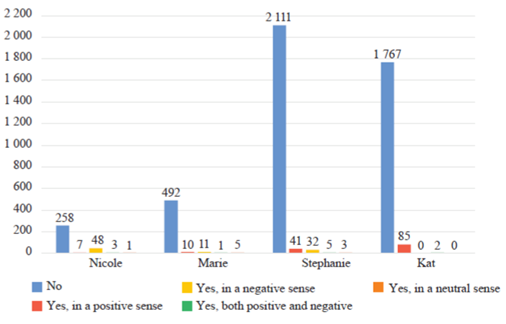 Source: The authors.
Figure 1
Comments regarding the body of female characters in Cartel Crew
Comments regarding the body of female characters in Cartel Crew
In terms of appearance (i.e., makeup, clothes, accessories, and hairstyle), there were fewer comments: only 52 were positive, and 53 were negative, with the majority in both cases referring to Stephanie (37 and 28, respectively). Similar to the category “Body”, the comments are evaluative (Klimmt et al., 2006) when it comes to makeup, clothing, accessories, hairstyle, and so on. Comments with the greatest engagement were those related to personality and behavior. We refer to personality when the commentary mentions elements of attitudes and behaviors consistent throughout the series, not just a particular episode. In other words, if they say something about being generous or selfish, a good or bad friend/partner, or pleasant or nasty.
-
Klimmt et al., 2006Parasocial interactions and relationshipsPsychology of Entertainment, 2006
In this regard, there were 838 negative comments: only 200 were positive, and 10 were neutral. Stephanie was the target of 94.27 % of the negative comments (F = 790). Positive comments were more balanced: 53 % (F = 106) were aimed at Stephanie, and 40.5 % (F = 81) made reference to Kat.
Stephanie was often the focus of attention or prominence in the episodes, as she was consistently aggressive and confrontational. She was there during long confrontation scenes with other characters and was the topic of conversation among other characters. Nevertheless, this was evident in the frequency with which the comments addressed this aspect, as they reiterated this attitude and how the prevalence of their arguments and anti-friendship behavior annoyed the audience. Evidently, as they were constantly the topic of conversation, they also sparked debates. Unsurprisingly, Stephanie received the most positive feedback from followers who defended her against the attacks (although at a significantly lower rate than the negative comments received).
Thumbnail
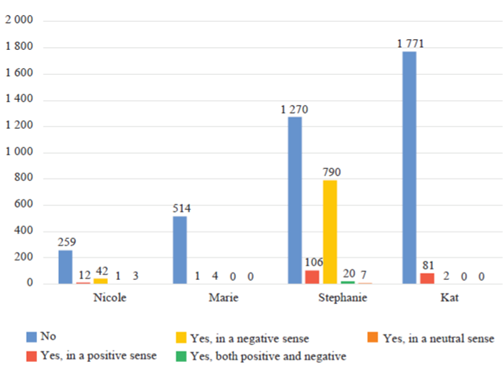 Source: The authors.
Figure 2
Comments of the personality of the female characters
Comments of the personality of the female characters
Behavior was coded when it was associated with a specific event or episode and not necessarily part of the character’s personality. Once again, comments were most frequently negative (F = 1 156). Unlike other items, a greater number of comments referred to positive behaviors (F = 330). Some comments contained both positive and negative opinions (F = 105), while others provided neutral feedback (F = 127). The item had the highest content engagement, and the hypothesis was that the posts that trigger comments are fragments of episodes, usually strategic to motivate users to share their opinion.
A total of 94.29 % (F = 1 090) of negative feedback regarding behavior were targeted at Stephanie, although she also received the highest number of positive comments: 76.06 % (F = 251). Both positive and negative comments tended to be along the same lines as mentioned above with regard to their personality, only addressed in a more specific way to the episode shown. Neutral comments mostly made reference to Kat (59.84
Thumbnail
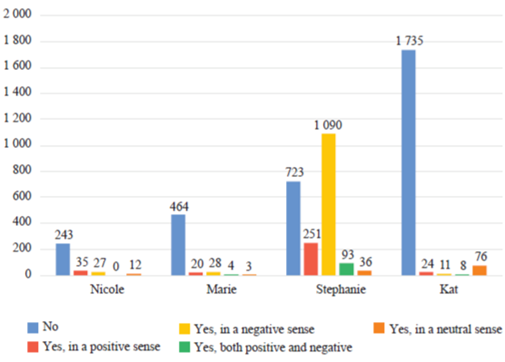 Source: The authors.
Figure 3
Comments to the female character’s behavior
Comments to the female character’s behavior
In some comments, users sometimes made fun of their accents or ways of pronouncing certain words, although it was only occasionally. Once again, Stephanie received the greatest number of negative comments (73.91 %; F = 68). In this item, a search was made for mentions regarding their oral or verbal expression to look for discriminatory expressions regarding the Hispanic community: accent, volume, language, tone, pronunciation, among others: “Affiliarated.
Shut the fuck up nicole you sound like your nostrils stacked” (User: Tracie Lynn).1 It was not a significant element in the comments.
With regard to their personal development, making reference to life projects, such as activism, business or venture, motherhood, among others, there were barely any mentions, and they were mostly negative (F = 94). Stephanie was the target of 90.42 % of negative feedback, usually since she was frequently reported to be in an informal relationship with her music producer, who was not single. That was cause for criticism, both from other characters in the series and from the users in their comments.
Even though Kat was already famous for her appearance on Ink Master, her entrepreneurial nature was not appreciated. Something similar happened with Marie, who suffered discrimination from her husband and partner for not including her in a project because she was a woman, or for launching her own makeup brand, but no discussions were triggered.
As for their relationship with organized crime, there was limited engagement: only 60 comments, including negative, positive, and neutral ones. Of these, 33 were negative, 13 were targeted at Stephanie, and 11 at Nicole. What was interesting about this criticism was not the recrimination of crime, but rather that Stephanie and Nicole’s relationship with organized crime was “not real”. In other words, they ruled out the fact that they could be considered as part of the series because of their distance from members of organized crime, and this was a cause for reproach. For the same reason, it is no surprise that 20 of these comments were neutral. In this sense, the audience validated the authentic narcoculture and criticized those who pretended to imitate it, confirming the romanticization or normalization of the organized crime aesthetic or lifestyle. In fact, the users that commented showed a certain degree of knowledge of the narcoculture, criteria used to compare the leading characters’ aesthetics and lifestyle.
I think it’s funny and shows how Nicole is literally not part of the Cartel (Narco) life. Say she’s from Philly she don’t play. That’s funny to me because if I needed someone to take care of something I wouldn’t ask someone from Philly especially not some chick like Ali. She ain’t anything to the Cartel. How you gonna have Philly above the Cartel. Makes no sense (User: Jessica Vidauri Hernandez).
Thumbnail
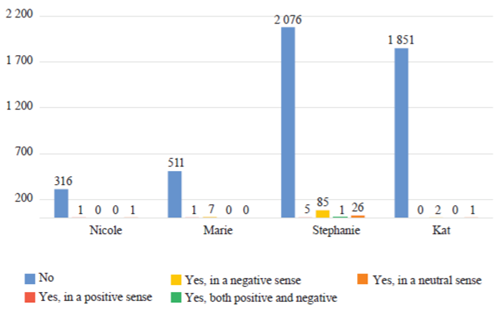 Source: The authors.
Figure 4
Comments regarding personal projects (professional or social) of the female characters
Comments regarding personal projects (professional or social) of the female characters
As for the evidence of a parasocial interaction, it can be observed that most comments used third-person expressions, rather than first. That is, there were comments where they talked about the characters as someone in their daily life, but not addressing them directly, as illustrated in Table 2. Positive comments added up to 861, while the number of negative ones was 1 571. As shown in Figure 5, positive feedback included all the leading characters. Once again, Stephanie ranked first, with 54.81 % of comments, while the negative feedback she received was also higher than those for the rest (92.61 %).
Table 2
Examples of parasocial interaction in first and third person, positive and negative
Examples of parasocial interaction in first and third person, positive and negative
| Type of parasocial interaction | Example |
|---|---|
| Third person/Positive | I think Marie has grew since the first couple episodes and yes, they had fights but her and michael are in a better place and I’m happy for them both ♥ (User: Korina Huynh) |
| Third person/Negative | Stephanie needs to mind her fucking business. I don’t care for Eddie much, but who the fuck Steph think she is stepping to him like that AT HIS JOB! (User: Kim Reeder) |
| First person/Positive | Kat I pray that you find your king because baby girl you deserve it. (User: Natasha Herrera) |
| First person/Negative | Nicole you still need more plastic surgery because ugly is still following you!!!!! (User: Amanda Nicholai) |
Thumbnail
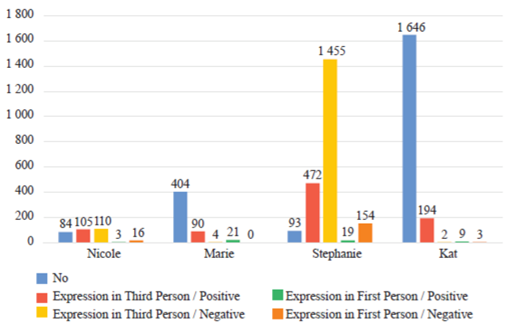 Source: The authors.
Figure 5
Parasocial interactions with female characters
Parasocial interactions with female characters
Positive comments using first person amounted to 52, while the number of negative ones was 173. As for the positive ones, most of them mentioned Marie, while negative feedback was targeted at Stephanie. Referring to the character analysis conducted earlier (Romero- Domínguez & Inzunza Acedo, 2024), some episodes included feedback received from socio-digital networks regarding different situations, which may have motivated some users to give instructions directly on what they should do or criticize how they acted in some scenes. In other words, for the audience, the Facebook page may have served as a platform to establish a dialogue with the characters.
Finally, it can be noted that, as per Palmer and Hafen’s acceptance terms (1999), most comments were simple (78.66 %), 18.26 % were sophisticated (F = 892), and only 3 % (F = 150) reached the deconstruction level. Most comments achieving this deconstruction level (94.66 %) made reference to Stephanie. This suggested that audiences identify that many behaviors that are widely criticized are strategic to gain popularity, thus understanding the marketing dynamics. Some examples are presented in Table 3:
-
Palmer and Hafen’s acceptance terms (1999)American TV through the eyes of German teenagersImages of the US around the world. A multicultural perspective, 1999
Table 3
Examples of types of comments as per Palmer and Hafen’s (1999) acceptance terms
Examples of types of comments as per Palmer and Hafen’s (1999) acceptance terms
| Type of comment | Example |
|---|---|
| Simple | I love loooooove Marie (User: Syami Faidha Zam) |
| Sophisticated | I love Kat... she’s a great mom & boss chica, but considering he’s been unfaithful, broke her and left her to raise their son alone he should really chill and work on acclimating himself into their family. Not them walking on egg shells to appease him (User: Tonía Métoyer) |
| Deconstruction | Steph makes the show look horrible... like seriously... you can tell she’s keeping up drama so that people can stay tuned in... Honestly, Steph is making the show bad (User: Xen Indigo) |
-
Palmer and Hafen’s (1999)American TV through the eyes of German teenagersImages of the US around the world. A multicultural perspective, 1999
Concerning sophisticated comments, 70.62 % of them mentioned Kat, mostly with regard to developing empathy toward the character to rationalize or justify her decisions and behaviors.
As a general conclusion for the results section, it can be said that most users (excluding those who do not make direct reference to female characters) commented to make negative criticism, in a predominantly offensive tone, as shown in Table 4.
Table 4
Positive vs. negative comments regarding topics: “body”, “appearance”, “personality”, “behavior”, and “personal development
Positive vs. negative comments regarding topics: “body”, “appearance”, “personality”, “behavior”, and “personal development
| Topic | Nicole | Marie | Stephanie | Kat | Total |
|---|---|---|---|---|---|
| Body | Positive: 7 | Positive: 10 | Positive: 41 | Positive: 85 | Positive: 143 |
| Negative: 48 | Negative: 11 | Negative: 32 | Negative: 0 | Negative: 91 | |
| Appearance | Positive: 2 | Positive: 4 | Positive: 37 | Positive: 9 | Positive: 52 |
| Negative: 23 | Negative: 2 | Negative: 28 | Negative: 0 | Negative: 53 | |
| Personality | Positive: 12 | Positive: 1 | Positive: 106 | Positive: 81 | Positive: 200 |
| Negative: 42 | Negative: 4 | Negative: 790 | Negative: 2 | Negative: 838 | |
| Behavior | Positive: 35 | Positive: 20 | Positive: 251 | Positive: 24 | Positive: 330 |
| Negative: 27 | Negative: 28 | Negative: 1 090 | Negative: 11 | Negative: 1 156 | |
| Personal development | Positive: 1 | Positive: 1 | Positive: 5 | Positive: 0 | Positive: 7 |
| Negative: 0 | Negative: 7 | Negative: 85 | Negative: 2 | Negative: 94 | |
| Total | Positive: 57 | Positive: 36 | Positive: 440 | Positive: 199 | Positive: 732 |
| Negative: 140 | Negative: 52 | Negative: 2 025 | Negative: 15 | Negative: 2 232 |
In summary, this table shows that engagement is more negative than positive, with a total of 2 247 comments of rejection, dislike, and contempt, compared with only 732 of appreciation. Whether or not they are intended for parasocial interaction, it is assumed that these comments express an opinion as part of their acceptance process. In addition, they are intended to be socialized. The value of these comments as an organic practice from audiences lies in recognizing how emotions and reflections with regard to a show such as Cartel Crew go beyond the mere moment of exposure to the content, both actively and voluntarily by users.
Conclusions
In the context of the culture of engagement, Fishkin (as cited by Meneses, 2015) delineated three conditions for a genuine contribution to dialogue in the digital sphere: substantive messages, thoughtful ideas, and questions that promote interactivity. By studying engagement from users in Cartel Crew’s page, it is made evident that these are hardly fulfilled, since among the 225 publications on the page, only 26 had received more than 1 000 comments.
-
Meneses, 2015Ciberutopías: democracia, redes, movimiento red, 2015
After analyzing the initial sample that yielded 79 123 user comments, the significant majority were found to be personal conversations, beyond contributions or criticisms of the series as such. This first finding shows how Cartel Crew and her Facebook page work as a trigger of social interaction among the circles of the followers themselves, rather than as a platform for parasocial interaction. For methodological purposes, the comments addressed to four main characters were directly analyzed, which yielded 6.6 % of the initial sample: 5 259 comments. This first step is a first reflection on the role that the audience is playing as a user.
Jenkins (2009) pointed out that participatory culture changed the approach of education of individual expression toward community engagement. He suggested that, while interaction is a mere element of technology, participation is part of culture. Nowadays, this engagement has an impact on creative processes and community practices (in this case, as Cartel Crew audiences), among other aspects. This means that all users have (or deem to have or may have) a more active role in culture production. Accepting this thesis leads us to reconsider the research questions.
-
Jenkins (2009)Confronting the challenges of participatory culture. Media education for the 21st century, 2009
In response to the first question (What do the audiences of Cartel Crew express on the official Facebook page regarding the show’s main characters -Marie, Nicole, Kat, and Stephanie?), audiences did not respond to many of the posts, but they reacted to episodes with scenes that caused controversy regarding the behavior of the female characters, mainly Stephanie, who received more mentions in the comments. In the previously conducted analysis (Romero-Dominguez & Inzunza Acedo, 2024), the results showed that Stephanie was a conflictive character, frequently arguing with or attacking other participants, which made her a constant focus of attention in the narrative and in the discussions among Facebook followers in a polarized manner. The case of Kat is the only one that stands out, as she significantly received more positive, supportive, and admiring comments; unlike Nicole and Stephanie, whose negative vs. positive feedback ratio was higher. On the other hand, Kat was a character who acted as a mediator during Stephanie’s conflicts with other women from the show, which made the audience perceive her as more pacifist and sociable.
-
Romero-Dominguez & Inzunza Acedo, 2024Female narrative subversions in the ‘narcoreality show’ Cartel CrewEstudos Feministas, 2024
This leads us to reflect on our second question (What aspects of Cartel Crew’s female characters do fans express disdain for? Conversely, towards which aspects do they show appreciation?) The feedback, as indicated by comments on Facebook, has not focused predominantly on issues related to body or appearance. The publications associated with the behavior of the main characters (particularly when there is a conflict between them) were the ones that received the most negative comments (1 156, compared to 53 negative comments on appearance, and 91 negative comments on the female body), followed by negative references to their respective personalities, with 883 comments (94.27 %). In this regard, it can be stated that Khoshsabk and Southcott’s (2019) thesis concerning the reinforcement of existing stereotypes when women receive more comments in publications related to their appearance and image is not fulfilled.
-
Khoshsabk and Southcott’s (2019)Gender identity and Facebook: Social conservatism and saving faceThe Qualitative Report, 2019
In subsequent studies, it is recommended that the concept of “hatedom” be investigated. This concept posits that individuals who follow the Cartel Crew Facebook page exhibit characteristics indicative of fans or, at the very least, followers. Evidence has been obtained indicating expressions of hate directed toward specific characters. How do fan practices interrelate to the time in which hate exists?
For its part, it is worth highlighting that, as there is predominance of negative over positive comments, there is evidence of verbal violence and invalidation of characters, despite the fact that the leading characters have their own businesses and projects worthy of recognition. Users seem to be more focused on trivial issues and do not consider alternative elements of female empowerment.
Two aspects can be observed in terms of the parasocial interaction. The first has to do with the language used: in other words, if the comment intends to address the character, or whether the user speaks in the third person about her. This form was coded in each of the comments, and the results were previously exposed. However, considering the typologies reported by Klimmt et al. (2006), and Igartua and Muñiz (2008), it was also observed that, regardless of whether the language used was first or third person, many of the users expressed forms of evaluation -positive or negative- as well as understanding and empathy, but also contempt and rejection of the behavior and decisions of the characters.
-
Klimmt et al. (2006)Parasocial interactions and relationshipsPsychology of Entertainment, 2006
-
Igartua and Muñiz (2008)Identificación con personajes y disfrute ante largometrajes de ficción. Una investigación empíricaCommunication and Society, 2008
Nicole listened to her parents, which was the best thing to do by apologizing, and Stephanie responded appropriately. Now, Maria should also apologize and get over herself, as they all try to support each other, since they share similar experiences (User: Nicole Albouras).
This proposal was so heartfelt and real. When he began crying while expressing how much Marie meant to him and how she had essentially saved his life, I felt deeply moved. I’m really happy for them, especially for Michael, considering everything he endured growing up with his mother and brothers in the Cartel, losing them, and his father as well. I’m glad that he is now on the right path and has Marie, who has stuck by him through thick and thin, offering him support and love. I’m pleased that he now has his own little family. ♥ Wish then both the best♥ (User: Crystal Arellano).
Kat has the patience of a saint because it has to be EXHAUSTING being friends with Stephanie’s whiny, snooty, annoying and self-invested ass! Anyone who watches this show knows that Eddie has fallen short in a lot of ways including missing out on a bit of DeNiro’s life. I get that Kat is over Eddie romantically, but she shouldn’t have let Stephanie disrespect the father of her child like that. No matter what space they’re in, there’s no soul on this Earth getting a free pass to speak negatively on my other child’s parent (User: Cordiah Hayes).
Judgments and empathy are developed from a personal perspective; in other words, it requires a moral or cognitive criterion based on which the evaluation of the character is made. This process implies the beginning of a parasocial construction made with a character, which seems confusing in this case as it is a TV reality show. That is, it is not always clear to audiences which elements of the leads’ personalities are authentic and which are produced, planned, or scripted, which became evident in view of the few deconstructive expressions from users. Of course, one of the greatest limitations in this type of studies is the inability to delve into acceptance processes, as we can only depend on the comment expressed by the user. Therefore, assuming that the Cartel Crew audience fails to deconstruct the content of the show would be inaccurate.
Nonetheless, Schramm et al. (2024) found that factors such as perceived sociability, attractiveness of the character, desirability, credibility and authenticity, and similarity between the character and the user influence the process during which a parasocial relationship is built. Moreover, Liebers and Schramm (2019) had already documented that the intensity of the parasocial phenomena was greater when the character was perceived as humorous, intelligent, and credible.
-
Schramm et al. (2024)Research trends on parasocial interactions and relationships with media characters. A review of 281 English and German-language studies from 2016 to 2020Frontiers in Psychology, 2024
-
Liebers and Schramm (2019)Parasocial Interactions and Relationships with Media Characters-An Inventory of 60 Years of ResearchCommunication Research Trends, 2019
In contrast, it was found that most comments in the first person were actually negative and targeted at Stephanie. In line with what Bernhold (2019, cited by Schramm et al., 2024) already proposed, this warrants further study for detecting which negative factors contribute to a higher intensity of parasocial phenomena that trigger emotions such as disgust, contempt, or hatred from the audience.
-
Schramm et al., 2024Research trends on parasocial interactions and relationships with media characters. A review of 281 English and German-language studies from 2016 to 2020Frontiers in Psychology, 2024
References
- Campbell, H. (2008). Female drug smugglers on the US.-Mexico border: Gender, crime, and empowerment. Anthropological Quarterly, 81(1), 233-267. https://www.jstor.org/stable/30052745 Links
- Carpio-Manickam, M. (2020). Reconstrucción del sujeto femenino mediante la desmitificación del narcotraficante en Perra brava de Orfa Alarcón. Revista de Estudios de Género y Sexualidades, 46(1-2), 107-128. https://doi.org/10.14321/jgendsexustud.46.1-2.0107 Links
- Cohen, J. (2001). Defining identification: A theoretical look at the identification of audiences with media characters. Mass Communication & Society, 4(3), 253-272. https://doi.org/10.1207/S15327825MCS0403_01 Links
- De Piero, J. & Narvaja, M. (2018). Representaciones de género en comentarios digitales de dos Fan Page en Facebook. Revista Latinoamericana de Ciencias Sociales, 16(2), 759-775. https://doi.org/10.11600/1692715x.16208 Links
- Escudero Manchado, L. & Gabelas Barroso, J. A. (2016). La realidad de la telerrealidad: escáner de una sociedad (híper)televisiva. Revista Mediterránea de Comunicación, 7(1), 91-117. https://doi.org/10.14198/MEDCOM2016.7.1.6 Links
- Hall, S. (2019). Encoding/Decoding (1980). En C. Greer (Ed.), Crime and Media (pp. 44-55). Routledge. https://doi.org/10.4324/9780367809195 Links
- Igartua, J. & Muñiz, C. (2008). Identificación con personajes y disfrute ante largometrajes de ficción. Una investigación empírica. Communication and Society, 21(1), 25-52. https://doi.org/10.15581/003.21.36288 Links
- Inzunza Acedo, B. E. (2013). Recepción de estereotipos de la serie norteamericana ‘Lost’ entre jóvenes que habitan en Monterrey, México. Signo y Pensamiento, 32(62), 16-31. https://revistas.javeriana.edu.co/index.php/signoypensamiento/article/view/5332 Links
- Jenkins, H. (2009). Confronting the challenges of participatory culture. Media education for the 21st century. MIT Press. Links
- Khoshsabk, N. & Southcott, J. (2019). Gender identity and Facebook: Social conservatism and saving face. The Qualitative Report, 24(4), 632-647. https://doi.org/10.46743/2160-3715/2019.3526 Links
- Klimmt, C., Hartmann, T. & Schramm, H. (2006). Parasocial interactions and relationships. En J. Bryant & P. Vorderer (Eds.), Psychology of Entertainment (pp. 291-313). Routledge. Links
- Liebers, N. & Schramm, H. (2019). Parasocial Interactions and Relationships with Media Characters-An Inventory of 60 Years of Research. Communication Research Trends, 38(2), art. 1. https://scholarcommons.scu.edu/crt/vol38/iss2/1 Links
- Martín-Barbero, J. (1998). De los medios a las mediaciones: comunicación, cultura y hegemonía. Convenio Andrés Bello. Links
- Mast, J. (2016). Negotiating the ‘real’ in ‘reality shows’: production side discourses between deconstruction and reconstruction. Media, Culture & Society, 38(6), 901-917. https://doi.org/10.1177/0163443716635860 Links
- Meneses, M. E. (2015). Ciberutopías: democracia, redes, movimiento red. Porrúa. Links
- Miller, T., Barrios, M. M. & Arroyave, J. (2019). Prime-time Narcos: the Mafia and gender in Colombian television. Feminist Media Studies, 19(3), 348-363. https://doi.org/10.1080/14680777.2018.1434223 Links
- Orozco Macías, A. F. (2021). Realidad social y narconovelas. Perspectivas de la violencia en jóvenes de la Comuna 13 de Medellín. Estudios Políticos, 60, 204-223. http://dx.doi.org/10.17533/udea.espo.n60a09 Links
- Palmer, A. & Hafen, T. (1999). American TV through the eyes of German teenagers. En Y. Kamalipour (Ed.), Images of the US around the world. A multicultural perspective (pp.135-146). State University of New York Press. Links
- Rincón, O. (2009). Narco.estética y narco.cultura en Narco.lombia. Nuso, 222. https://nuso.org/articulo/narcoestetica-y-narcocultura-en-narcolombia/ Links
- Romero-Domínguez, L. R. & Inzunza Acedo, B. (2024). Female narrative subversions in the ‘narcoreality show’ Cartel Crew. Estudos Feministas, 32(3), e91644. https://doi.org/10.1590/1806-9584-2024v32n391644 Links
- Schramm, H., Liebers, N., Biniak, L. & Dettmar, F. (2024). Research trends on parasocial interactions and relationships with media characters. A review of 281 English and German-language studies from 2016 to 2020. Frontiers in Psychology, 15, 1418564. https://doi.org/10.3389/fpsyg.2024.1418564 Links
- Soler Jorge, M. (2021). Women in a world of men: Female representation in Narcos and the illusion of ‘Universal’ serial fiction. Revista Estudos Feministas, 29(1), 1-13. https://doi.org/10.1590/1806-9584-2021v29n167486 Links
- Tiznado Armenta, K. (2017). Narcotelenovelas: la construcción de nuevos estereotipos de mujer en la ficción televisiva de Colombia y México a través del retrato de una realidad social [Tesis doctoral inédita]. Universidad Autónoma de Barcelona. https://www.tdx.cat/handle/10803/459153#page=2 Links
- Vásquez Mejías, A. (2020). No mirar. Tres razones para defender las narcoseries. Universidad Autónoma de Chihuahua; Universidad Autónoma de Sinaloa. Links
- Vásquez Mejías, A. & Aguilar Rosales, A. (2022). ‘La más buchona’. Representar lo narco a través del drag. Quadrata, 4(7), 227-247. https://doi.org/10.54167/qvadrata.v4i7.1002 Links