Artículos
The relation between digital marketing, internet skills, and business characteristics; A study of female entrepreneurs

-
Publication dates-
October 10, 2025
Apr-Jun , 2024
- Article in PDF
- Article in XML
- Automatic translation
- Send this article by e-mail
- Share this article +
Abstract
Digital marketing and internet skills are current digital topics, therefore, the purpose of the study focuses on determining if there is a significant relationship between digital marketing and internet skills in female entrepreneurs, in addition, determining if there is a correlation with business characteristics. Women who reside in Puerto Rico, Venezuela, Argentina and Colombia participated. To analyze the data for hypothesis testing, an econometric model is used with the use of Gretel software. A statistically significant relationship was found between the digital marketing index and the internet skills index. The three components of digital marketing are positively related to the ability of internet self-learning. The strategic emphasis component towards digital marketing, with the highest score (74%), is negatively related to the age of the business. It is advisable to explore the influence of social and cultural factors.
JEL Code::
M30, M31, Z33, C40
Keywords::
women entrepreneurs, digital marketing, internet skills, strategic emphasis
Introduction
Social marketing orientation constitutes a philosophy in which companies establish their purpose, their reason for existing not only to meet the needs of their customers and for their own purposes of profitability or growth, but rather to visualize the common interest of individuals and society itself in the future (Lamb, Hair, & McDaniel, 2011). Alongside technological advances, social and digital media are rapidly transforming marketing (De Swaan, Van Den, & Weed, 2014). In turn, the Internet has become a primary resource for consumers who seek a variety of information before buying any product or service online, while for companies it is a tool that helps to boost their business through digital marketing strategies (Gulati, 2019). According to Yannoupoulos (2011), the Internet is impacting companies’ marketing strategy, so this author recommends that marketing managers use digital marketing appropriately to avoid being at a disadvantage with those using it.
-
Lamb, Hair, & McDaniel, 2011Essentials of Marketing, 2011
-
De Swaan, Van Den, & Weed, 2014The ultimate marketing machineHarvard Business Review, 2014
-
Gulati, 2019Digital Marketing Strategies for Startups in India, 2019
-
Yannoupoulos (2011)Impact of the Internet on marketing strategy formulationInternational Journal of Business and Social Science, 2011
Digital marketing as a strategy requires the means to reach consumers with information about products or services, and the Internet is this conduit, where digital devices are the platforms to purchase the offers published by companies (Núñez et al., 2020). Companies have devoted themselves to the promotion of their brands through the Internet. This popularity has increased as people use more digital devices to make purchases (Del Olmo & Fondevila, 2014). Digital marketing has generated a paradigm shift in product searches and purchases by consumers. Consequently, digital marketing is the strategy through which entrepreneurs carry out actions to promote products or services supported by digital media (Gulati, 2019).
-
Núñez et al., 2020El marketing digital como un elemento de apoyo estratégico a las organizacionesCuadernos Latinoamericanos De Administración, 2020
-
Del Olmo & Fondevila, 2014Marketing digital en la moda, 2014
-
Gulati, 2019Digital Marketing Strategies for Startups in India, 2019
Although there is evidence that the use of digital marketing is relevant for companies, a lack of training on the use of office automation tools and digital networks by the owners or managers has been identified, which limits the use of digital marketing in small and medium-sized companies (Valdez et al., 2019). Research has identified that older businesses do not prioritize using computers in their digital processes.
-
Valdez et al., 2019Aprovechamiento del marketing digital como estrategia para generar ventaja competitiva en la pequeña empresa de SinaloaRevista De Investigación En Tecnologías De La Información, 2019
Several types of research corroborate women’s work as entrepreneurs and even in a higher percentage than men (Ojeda-López et al., 2019). Saavedra and Camarena (2015) conducted a study on women with the characteristics to become entrepreneurs. The result of the research indicates that there is a higher tendency for women than men to start a business out of necessity, albeit the size of the operation of such entrepreneurial businesses is smaller than the entrepreneurial projects led by men.
-
Ojeda-López et al., 2019La participación de la mujer en la economía del Estado de YucatánRECAI Revista de Estudios en Contaduría, Administración e Informática, 2019
-
Saavedra and Camarena (2015)Retos para el emprendimiento femenino en América LatinaCriterio libre, 2015
Therefore, entrepreneurial activity is seen as an activity in which both men and women develop their ideas to carry them out in a reality immersed in technological changes, i.e., technology emerges in and permeates every activity carried out by human beings. An example of this is the study conducted by Olson and Bernhard (2020) on digitalization and the use of social networks by female entrepreneurs. In their study, they analyze how women operate their small companies, as well as their skills and adaptation to the changes in technologies that are occurring more and more rapidly. Furthermore, they identified important aspects that suggest that their learning is obtained informally. Even when they do not have the necessary experience or knowledge, they rely on digital natives to carry out the activities that are difficult for them and related to digital environments.
Continuous training in technological tools of those who lead the companies, whether small, medium, or large, is essential to remain competitive. Among other skills, it involves training in digital aspects, one of the most representative means for commercializing products and services in digital marketing (Núñez et al., 2020).
-
Núñez et al., 2020El marketing digital como un elemento de apoyo estratégico a las organizacionesCuadernos Latinoamericanos De Administración, 2020
Regarding Internet skills, Jiménez et al. (2016) evaluate the previous Internet training of female students: in what type of institution they studied (school, university), if it was on their own initiative, if they were self-taught with books, CD-ROMs, web pages, tutorial blogs, YouTube, if they learned by practicing on a computer, or if they had the support of a colleague, relative, or friends. The authors identify five dimensions of Internet skills: E-Management, Content creation and posting on social networks, Autonomous learning, Privacy and security, and Information and communication. Additionally, Mahmutović (2021) conceptualized the digital marketing variable as comprising three dimensions: Strategic emphasis, Digital intelligence generation, and Resource planning and provisioning.
-
Jiménez et al. (2016)Habilidades en Internet de mujeres estudiantes y su relación con la inclusión digital: Nuevas brechas digitalesEducation in the Knowledge Society (EKS), 2016
-
Mahmutović (2021)Development and validation of the scale for measuring digital marketing orientation in the hotel industryEkonomski vjesnik/Econviews - Review of Contemporary Business, Entrepreneurship and Economic Issues, 2021
From the above arguments, this paper focuses on determining the relation between digital marketing, Internet skills, and business characteristics. The latter are related to the age, size, and sector to which the business belongs.
Review of the literature and the conceptual model of the study
A useful concept in digital marketing is that of Kotler and Keller (2012), who define marketing as an administrative and social process through which individuals and groups obtain what they need and want by generating, offering, and exchanging value products with their peers.
-
Kotler and Keller (2012)Marketing management, 2012
From this definition emerges what could conceptually be labeled as social marketing. Lamb, Hair, and McDaniel (2011) point out that social marketing is a philosophy of the company’s reason for existing, not only to meet customer needs but also to conceive the common interests of individuals and society itself. Other approaches and definitions related to Digital Marketing refer to traditional marketing and add the digital part (Smith, 2010), considering it a practice in which products and services are promoted using digital distribution channels or online advertising to establish communication with consumers. More recently, it has been conceptualized as a dynamic concept with the necessary characteristics to design and implement successful marketing strategies (Nuseir & Aljumah, 2020).
-
Lamb, Hair, and McDaniel (2011)Essentials of Marketing, 2011
-
Smith, 2010Digital Marketing Strategies that Millennials Find Appealing, Motivating, or Just AnnoyingJournal of Strategic Marketing, 2010
-
Nuseir & Aljumah, 2020The role of digital marketing in business performance with the moderating effect of environmental factors among SMEs of UAEInternational Journal of Innovation, Creativity and Change, 2020
In the nineties, digital marketing emerged, which, hand in hand with technological progress, strengthened and increased marketing strategies as more digital platforms emerged. Undoubtedly, companies have devoted themselves to promoting and positioning their brands with the support of the Internet and everything that can be used in digital platforms (Del Olmo & Fondevila, 2014).
-
Del Olmo & Fondevila, 2014Marketing digital en la moda, 2014
The Internet is a fundamental part of human activities since it is used in practically every field: at home, socially, culturally, in sports, and in many other activities. Therefore, this technological tool has become indispensable in business. Such is the case of online entrepreneurship, which requires a certain level of knowledge: understanding the language used to advertise online (Ramli, Mahat, & Abd Razak, 2022).
-
Ramli, Mahat, & Abd Razak, 2022Developing effective online marketing strategies for women entrepreneurs in SelangorInternational Journal of Social Science Research, 2022
The literature identifies studies that explore digital literacy with variables such as English proficiency in female entrepreneurs, whose findings showed that female entrepreneurs have moderate to high skills in the use of technology but not so in English language skills for marketing applications (Ramli, Mahat, & Abd Razak, 2022). The application of digital marketing is observed in every activity beyond entrepreneurship. One example is a study conducted in Hungary, where 5548 job contents related to digital marketing were analyzed (Kovacs & Vamosi, 2022). Of course, they highlight the requirements that must be covered, such as interpersonal skills and other hard skills, but they emphasize the skills in digital marketing.
-
Ramli, Mahat, & Abd Razak, 2022Developing effective online marketing strategies for women entrepreneurs in SelangorInternational Journal of Social Science Research, 2022
-
Kovacs & Vamosi, 2022Digital marketing employability skills in job advertisements - must-have soft skills for entry level workers: A content analysisEconomics and Sociology, 2022
Other scholars on digital marketing have focused on the design of scales to evaluate digital marketing orientation, understanding the use of technology to develop marketing-related activities. An example of this is the work of Mahmutović (2021), who designed and validated the properties of a scale to measure digital marketing orientation (DMO) in the hospitality industry.
-
Mahmutović (2021)Development and validation of the scale for measuring digital marketing orientation in the hotel industryEkonomski vjesnik/Econviews - Review of Contemporary Business, Entrepreneurship and Economic Issues, 2021
Companies interact with their audience to position their brand and achieve their objectives through digital tools, such as website design, e-mail, various mobile media, and social media platforms for online advertisements (Bala & Verma, 2018). This argument coincides with the definition of marketing by Kotler and Keller (2012), who conceive of it as a social process where individuals and groups converge to obtain what they want through the exchange of products and value with other individuals and groups of individuals; hence digital is added to this definition and digital marketing is obtained.
-
Bala & Verma, 2018A Critical Review of Digital MarketingInternational Journal of Management, IT & Engineering, 2018
-
Kotler and Keller (2012)Marketing management, 2012
The most important elements in digital marketing are web design, web analysis, SEO positioning, SEM positioning, SMM positioning, online ads, content generation, and e-mail marketing. Currently, companies are using techniques such as Search Engine Optimization (SEO), Search Engine Marketing (SEM), and Social Media Marketing (SMM) in their digital marketing strategies. In this regard, Rogers and Sexton (2012) state that it is necessary to have clear goals and objectives-even when experimenting with new technology-to determine how to improve the return on investment of digital marketing.
-
Rogers and Sexton (2012)Marketing ROI in the era of big dataThe 2012 BRITENYAMA marketing in transition study, 2012
Decades ago, a four-level structure was proposed to measure Internet skills: First, the operational level includes basic skills such as knowing how to navigate the Internet, backing up files on a hard disk, opening files in different formats, the use of search engines, and filling out forms, among others. The second level includes formal skills such as using hyperlinks and not getting disoriented when navigating between web pages using search engines. The third level suggests informational skills such as defining a problem that requires certain information, the ability to select a website or information search system, defining search options, or selecting and evaluating information. Finally, there are strategic Internet skills, such as seeking advantages through an orientation toward a particular goal, taking the right actions and decisions to achieve it, and obtaining benefits from it (Deursen & Van Dijk, 2010).
-
Deursen & Van Dijk, 2010Measuring internet skillsInternational journal of human-computer interaction, 2010
Nevertheless, it is important to understand the digital gap concept when discussing Internet skills. The definition proposed by Kularski (2012) refers to the digital gap in terms of skills and access to information technologies. This concept can be understood as digital competence, i.e., how the subject combines skills, knowledge, and attitudes related to how individuals perform in virtual environments (Jiménez et al., 2016).
-
Kularski (2012)The digital divide as a continuation of traditional systems of inequalitySociology, 2012
-
Jiménez et al., 2016Habilidades en Internet de mujeres estudiantes y su relación con la inclusión digital: Nuevas brechas digitalesEducation in the Knowledge Society (EKS), 2016
The literature has documented in various research studies that the determinants of Internet skills are related to general digital skills and, in a very particular way to content. In the same line, substantial evidence suggests that sociodemographic and socioeconomic factors most frequently impact Internet skills, and not so social and cultural factors, which apparently have been little studied (Scheerder et al., 2017).
-
Scheerder et al., 2017Determinants of Internet skills, uses and outcomes. A systematic review of the second-and third-level digital divideTelematics and informatics, 2017
Different studies determine how Digital Marketing impacts companies’ performance. In this regard, Bhagat and Sambargi (2019) measured the impact of female entrepreneurs’ digital skills and levels of innovation to adopt digital marketing. The result suggests that both variables strongly impact the intention to adopt digital marketing. Moreover, the applications favor effective communication with customers, hence the companies will be able to react more quickly to the needs of their customers and, above all, be prepared to face the competition in providing information to customers in a timely and effective manner (Nuseir & Aljumah, 2020).
-
Bhagat and Sambargi (2019)Evaluation of personal innovativeness and perceived expertise on digital marketing adoption by women entrepreneurs of micro and small enterprisesInternational Journal of Research and Analytical Reviews (IJRAR), 2019
-
Nuseir & Aljumah, 2020The role of digital marketing in business performance with the moderating effect of environmental factors among SMEs of UAEInternational Journal of Innovation, Creativity and Change, 2020
Regarding female entrepreneurs, some studies have shown that social influence and expectation are important variables that influence the intention to use mobile applications. The importance of digital marketing lies in the use of this technology to obtain information about customers, to launch new products and offers in the consumer market, and, very importantly, to develop the brand and achieve greater reach (Sathye et al., 2014; Abed, 2021).
-
Sathye et al., 2014Mobile Value Added Services for Inclusive growth: a Study of women micro-Entrepreneurs in Fiji, 2014
-
Abed, 2021Women Entrepreneurs’ Adoption of Mobile Applications for Business SustainabilitySustainability, 2021
Based on these arguments, the route of the conceptual model for the empirical study is outlined, as well as the research questions, objectives, and hypotheses to be tested:
Thumbnail
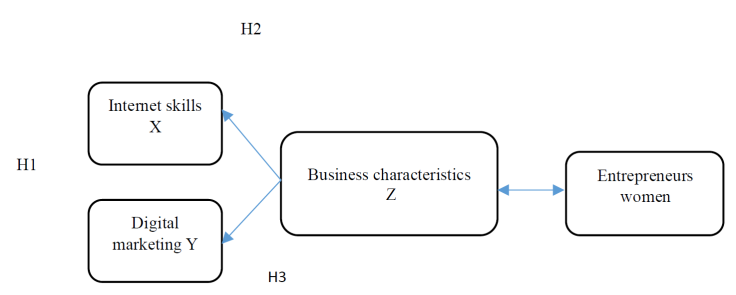 Source: created by the authors
Figure 1
Conceptual model for the empirical study
Conceptual model for the empirical study
Research questions and objectives
The following questions arise based on the different types of Internet skills that Latin American digital female entrepreneurs exhibit: Is there a significant relation between digital marketing and the Internet skills that Latin American female entrepreneurs exhibit? Is there a significant relation between digital marketing and business characteristics? Therefore, the following objectives are established: to determine if there is a significant relation between digital marketing and Internet skills in female entrepreneurs, and to determine if there is a relation between digital marketing and business characteristics (number of collaborators, age of the business, and business sector).
Hypotheses and their statistical form
Null hypothesis: H0: ρ = 0. Alternative hypothesis: Ha: ρ ≠ 0
Where H0 states that the correlation coefficient is not significantly different from zero. There is no significant linear relation between X and Y in the female entrepreneurs analyzed. In the opposite case, Ha shows that the correlation coefficient is significantly different from zero, which gives evidence of the existence of a linear relation between X and Y. Therefore, the purpose is to demonstrate whether:
H1. Digital marketing is significantly related to Internet skills in female entrepreneurs.
H2. The components of digital marketing are significantly related to different types of Internet skills.
H3. Digital marketing is related to business characteristics (number of collaborators, age of the business, and business sector).
Design and method
The population under study comprises female entrepreneurs, whose main characteristic is to have carried out some type of digital entrepreneurship. Non-probabilistic sampling by self-determination is used. Data collection is done through a questionnaire (online), applied during February 2023.
The questionnaire is made up of four sections. The first section has sociodemographic questions (age, marital status, educational level, place of residence, employment status, and monthly income from the business). The second has questions on the business characteristics (number of collaborators, age of the business, and business sector). The third includes questions about the means used to acquire Internet skills. The fourth is composed of two scales. The first scale measures Internet skills with 18 Likert-type items with response options: never, rarely, occasionally, frequently, and very frequently; responses are coded with a value from 1 to 5, respectively (Jiménez et al. (2016). The scale provides information on Internet skills in five categories: E-Management (5 items), content creation and posting on social networks (4 items), autonomous learning (4 items), privacy and security (3 items), and information and communication (2 items). The second scale, proposed by Mahmutović (2021), measures digital marketing through 16 items with responses ranging from total disagreement (1) to total agreement (5). The scale is composed of three components of digital marketing: strategic emphasis on digital marketing (5 items), digital intelligence generation (5 items), and resource planning and provision (6 items).
-
Jiménez et al. (2016)Habilidades en Internet de mujeres estudiantes y su relación con la inclusión digital: Nuevas brechas digitalesEducation in the Knowledge Society (EKS), 2016
-
Mahmutović (2021)Development and validation of the scale for measuring digital marketing orientation in the hotel industryEkonomski vjesnik/Econviews - Review of Contemporary Business, Entrepreneurship and Economic Issues, 2021
Each individual’s total Internet skills score is calculated as the sum of the scores of the 5 categories, which can take any value between 0 and 90. From this, an Internet skills index is constructed to provide a metric. The methodology used in constructing indexes from scales is followed (CNBV, 2022; Martins et al., 2021; OECD, 2022). For comparative purposes, the maximum value of 90 points is standardized to 100, multiplying by 100/90. The indicators of the five categories are calculated similarly.
-
CNBV, 2022Encuesta Nacional de Inclusión Financiera (ENIF) 2021, 2022
-
Martins et al., 2021Women vs Men: Who performs better on Energy Literacy?International Journal of Sustainable Energy Planning and Management, 2021
-
OECD, 2022OECD/INFE Toolkit for Measuring Financial Literacy and Financial Inclusion 2022, 2022
The scores of the three indicators are added together to calculate the digital marketing index, which can take any value between 0 and 80 points. The methodology of Masrianto et al. (2022) is followed and standardized to 100, multiplying by 100/80. Also, the sub-indicator corresponding to each of the three components is calculated similarly.
-
Masrianto et al. (2022)Digital Marketing Utilization Index for Evaluating and Improving Company Digital Marketing CapabilityJournal of Open Innovation: Technology, Market and Complexity, 2022
173 cases were obtained in the application of the instrument, of which 24 were discarded as they did not correctly cover the test answers. The respondents reside in Puerto Rico, Venezuela, Argentina, and Colombia; when the survey was conducted, they indicated they had a digital business. Their ages ranged from 25 to 45 (66.44%), 46 or older (27.52%), and only 6.04% were between 18 and 24 years old.
The multiple linear regression model (Wooldridge, 2015) was used to analyze the relation between digital marketing, Internet skills, and business characteristics. Consequently, an econometric model is estimated to determine the relation between the digital marketing, Internet skills, and business characteristics indices.
-
Wooldridge, 2015Econometric Analysis of Cross Section and Panel Data, 2015
The study was based on the following formula:
e2
y
=
α
+
β
x
+
γ
z
+
u
Where
For the variable “number of collaborators,” two categories are proposed: 1 collaborator, and 2 to 5 collaborators. For the variable “age of the business,” age ranges analogous to those proposed by Valdez et al. (2019) are designed: 0 to 2 years, 3 to 5 years, and 6 years or more. The variable “business sector” is defined by three categories: goods, services, and goods and services. For the statistical strategy, binary variables are designed for each category, in which 1 indicates the presence of the characteristic and 0 indicates the absence.
-
Valdez et al. (2019)Aprovechamiento del marketing digital como estrategia para generar ventaja competitiva en la pequeña empresa de SinaloaRevista De Investigación En Tecnologías De La Información, 2019
The Gretl software version updated in July 2023, available at https://gretl.sourceforge.net/, was used to estimate the models. The statistical method used was ordinary least squares. To identify the variables related to digital marketing, the contrast statistic
Results
The results regarding the means used to acquire Internet skills by the Latin American female entrepreneurs in the sample show that 47.65% of them had no previous Internet training, 97.32% have developed digital Internet skills by practicing (learning by doing), 85.23% have developed Internet skills self-taught with books, CD-ROMs, web pages, blogs, tutorials, or YouTube, and 79.87% have developed Internet skills through informal help from colleagues, relatives, friends, or their children.
Table 1 presents Latin American female entrepreneurs’ digital marketing and Internet skills index scores. The digital marketing index score is 68%. The component strategic emphasis on digital marketing presents the highest score (74%), which suggests that Latin American female entrepreneurs strongly agree that applying digital marketing is a strategic necessity in their businesses and is a way to transfer knowledge to other collaborators.
Table 1
Index score: digital marketing, Internet skills, and components
Index score: digital marketing, Internet skills, and components
| Indicators/components | Score (scale 0% -100%) |
|---|---|
| Y: Digital marketing index | 68% |
| Components: | |
| Y1: Strategic emphasis | 74% |
| Y2: Digital intelligence generation | 65% |
| Y3: Resource planning and provision | 66% |
| X: Internet skills index | 79% |
| Components: | |
| X1: E-Management | 82% |
| X2: Content creation and posting on social networks | 74% |
| X3: Autonomous learning | 76% |
| X4: Privacy and security | 78% |
| X5: Information and communication | 86% |
-
Mahmutović (2021)Development and validation of the scale for measuring digital marketing orientation in the hotel industryEkonomski vjesnik/Econviews - Review of Contemporary Business, Entrepreneurship and Economic Issues, 2021
-
Jiménez et al. (2016)Habilidades en Internet de mujeres estudiantes y su relación con la inclusión digital: Nuevas brechas digitalesEducation in the Knowledge Society (EKS), 2016
The digital intelligence generation component score was 65%. This result indicates that female digital entrepreneurs recognize the importance of metrics for calculating the performance of the digital business and obtaining data from the different customer-related processes. The score for the component of resource planning and provision was 66%. This result shows how important it is for female entrepreneurs to have a strategic approach to their businesses, based on a strategy and a digital marketing plan to respond to the needs and requirements of customers.
The Internet skills index score was 79%. Table 1 presents the score for each component: E-Management (82%), content creation and posting on social networks (74%), autonomous learning (76%), privacy and security (78%), and information and communication (86%). Table 2 shows the frequency of use for each component of the Internet skills by Latin American female entrepreneurs.
Table 2
Frequencies of use of Internet skills (in percentages)
Frequencies of use of Internet skills (in percentages)
| Types of skills | Frequency scale | ||||
|---|---|---|---|---|---|
| Never | Rarely | Occasionally | Frequently | Very frequently | |
| X1: E-Management | |||||
| I manage and monitor my bank account. | 11 | 5 | 5 | 19 | 60 |
| I purchase products and services online (travel, hotels, clothing, books, theater, movies). | 11 | 5 | 7 | 22 | 55 |
| I carry out administrative procedures through the Internet (education, health, etc.). | 13 | 5 | 6 | 23 | 52 |
| I communicate online to inquire about products and services. | 9 | 3 | 7 | 18 | 62 |
| I bookmark websites and services that I find useful. | 11 | 5 | 9 | 18 | 56 |
| X2: Content creation and posting on social networks | |||||
| I post my own original content on the Internet. | 10 | 7 | 10 | 26 | 48 |
| I create and share photos and/or videos over the Internet. | 9 | 3 | 5 | 29 | 54 |
| I create and manage my own websites, blogs, and/or YouTube channels on topics of interest to me. | 30 | 12 | 13 | 17 | 28 |
| I participate in forums and social networks to communicate and be informed. | 14 | 10 | 13 | 24 | 38 |
| X3: Autonomous learning | |||||
| I learn how to solve tasks using Internet tutorials. | 7 | 2 | 11 | 21 | 58 |
| I use other people’s comments on the Internet to solve doubts. | 4 | 6 | 21 | 22 | 47 |
| I use technical support services to solve problems. | 11 | 6 | 18 | 27 | 38 |
| I perform periodic data backups to external devices. | 20 | 12 | 19 | 21 | 27 |
| X4: Privacy and security | |||||
| I configure privacy settings to protect my personal data. | 7 | 6 | 15 | 20 | 52 |
| I download and install software from secure websites. | 10 | 8 | 19 | 19 | 44 |
| I share content on the Internet in compliance with intellectual property rights. | 11 | 6 | 11 | 19 | 54 |
| X5: Information and communication | |||||
| I use Google (or another search engine) to find the information I need. | 7 | 6 | 15 | 20 | 52 |
| I use e-mail, video calls, and instant messaging to communicate online. | 10 | 8 | 19 | 19 | 44 |
-
Jimenez scale (2016)Habilidades en Internet de mujeres estudiantes y su relación con la inclusión digital: Nuevas brechas digitalesEducation in the Knowledge Society (EKS), 2016
Regarding E-Management skills, 62% of Latin American female entrepreneurs use the Internet very frequently as a means of communication to inquire about products and services, 60% to manage and monitor their bank account, 55% to purchase products and services online, and 52% to carry out administrative tasks. Regarding content creation and posting on social networks, 54% of female entrepreneurs create and share photos or videos online, 48% post their own original content on the Internet very frequently, and 30% never create and manage Web pages or YouTube channels interesting to them.
Regarding autonomous learning, 58% of Latin American female entrepreneurs very frequently learn how to solve tasks using Internet tutorials, 47% use other people’s comments on the Internet to solve doubts, 38% use technical support services to solve problems, and less frequently, they make periodic data backups.
Regarding Internet skills for privacy and security, a high percentage of Latin American female entrepreneurs (73%) frequently and very frequently share content on the Internet while complying with intellectual property rights; 72% configure privacy settings to protect personal data. A smaller proportion download and install software.
Regarding Internet skills for information and communication, 52% of the female entrepreneurs use Google very frequently to find information, while 52% use instant messaging tools (e-mail, video calls) to communicate online.
Table 3 presents the results of the estimation of the econometric model relating the digital marketing index to the Internet skills index and the digital marketing components to the different types of Internet skills. Model 1 presents the results of the digital marketing and Internet skills indices. From the results, the coefficient value of the Internet skills index,
Table 3
Digital marketing and Internet skills indices
Digital marketing and Internet skills indices
| Model 1 Y: digital marketing index | Model 2 Y1: strategic emphasis | Model 3 Y2: digital intelligence generation | Model 4 Y3: resource planning and provision | |
|---|---|---|---|---|
| Constant | 23.825*** | 12.5018** | 20.816** | 27.415*** |
| (7.207) | (5.53) | (8.792) | (9.469) | |
| Internet skills index | 0.564*** | |||
| (0.088) | ||||
| Internet skills | ||||
| X1: E-Management | −0.095 | −0.299** | −0.332** | |
| (0.090) | (0.143) | (0.154) | ||
| X2: Content creation and posting on social networks | 0.147 (0.098) | 0.335** (0.155) | 0.311* (0.167) | |
| X3: Autonomous learning | 0.236** | 0.496*** | 0.491*** | |
| (0.091) | (0.144) | (0.155) | ||
| X4: Privacy and security | 0.044 | 0.109 | 0.091 | |
| (0.082) | (0.131) | (0.141) | ||
| X5: Information and communication | 0.428*** | −0.030 | −0.020 | |
| (0.086) | (0.137) | (0.147) | ||
| Mean of variable Y | 68.260 | 74.138 | 64.944 | 66.126 |
| R-squared | 0.215 | 0.497 | 0.223 | 0.174 |
| F-statistic | F(1, 147)= 40.345 | F(5, 143)= 28.311 | F(5, 143)= 8.216 | F(5, 143)= 6.063 |
| P-value (of F) | 0.000 | 0.000 | 0.000 | 0.000 |
| Observations | 149 | 149 | 149 | 149 |
Models 2, 3, and 4 present the results of the econometric model estimation of the three components of digital marketing (strategic emphasis, digital intelligence generation, and resource planning and provision), considering the 5 Internet skills indices (E-Management, content creation, and posting on social networks, autonomous learning, privacy and security, and information and communication) as independent variables.
Models 2, 3, and 4 identify that the three components of digital marketing are positively related to the ability of autonomous Internet learning. The relation is positive and significant (p<0.01), providing evidence supporting hypothesis 2. According to the value of the β coefficient, the effect is greater in the digital intelligence generation component and in resource planning and provision (β=0.496 and β=0.491,respectively). With an increase of 1 percentage point in the autonomous learning indicator, the digital intelligence generation indicator increases by 0.496 percentage points.
The results of model 2 identify that strategic emphasis on digital marketing is positively and significantly related to Internet information and communication skills (β=0.428; p<0.01), which provides evidence in favor of hypothesis 2. With an increase of 1 percentage point in the sub-indicator of Internet information and communication skills, the indicator of strategic emphasis increases by 0.428 percentage points.
Also, in models 3 and 4, the results indicate that both the digital intelligence generation index and the resource planning and provision index are negatively related to E-Management skills (β=-0.299; p<0.05) and (β=-0.332; p<0.05), which favors hypothesis 2.
Models 3 and 4 show that both the digital intelligence generation and the resource planning and provision components are related to content creation and posting on social networks. In both cases, the relation is positive and significant, (β=0.335,p<0.05) and (β=0.311;p<0.1), respectively, which provides evidence in favor of hypothesis 2. With an increase of 1 percentage point in the sub-indicator content creation and posting on social networks, the digital intelligence generation sub-indicator increases by 0.335 percentage points, while the resource planning and provision indicator increases by 0.311 points.
Table 4 presents the results of estimating the econometric model of the digital marketing index, considering as independent variables the Internet skills index and the business characteristics (number of collaborators, age of business, sector). From the results, it is identified that in models 5, 6, 7, and 8 the relation between the digital marketing index and the Internet skills index is positive as in model 1, but none of the business characteristics presents a significant relation.
Table 4
Digital marketing index, Internet skills index, and business characteristics
Digital marketing index, Internet skills index, and business characteristics
| Model 5 Y: digital marketing index | Model 6 Y: digital marketing index | Model 7 Y: digital marketing index | Model 8 Y: digital marketing index | |
|---|---|---|---|---|
| Constant | 23.182*** | 24.540*** | 22.903*** | 23.535*** |
| (7.220) | (7.509) | (7.245) | (7.545) | |
| Internet skills index | 0.563*** | 0.545*** | 0.559*** | 0.539*** |
| (0.088) | (0.089) | (0.089) | (0.089) | |
| Business characteristics | ||||
| Z1: Number of collaborators | ||||
| Dichotomous: 1 collaborator (RC) | ||||
| Dichotomous: 2 to 5 collaborators | ||||
| 6.182 | 4.480 | |||
| (5.316) | (5.402) | |||
| Z2: Age of business | ||||
| Dichotomous: 0 to 2 years (RC) | ||||
| Dichotomous: 3 to 5 years | 4.588 | 3.784 | ||
| (3.856) | (3.940) | |||
| Dichotomous: 6 years or more | −4.588 | -5.120 | ||
| (5.055) | (5.094) | |||
| Z3: Business sector | ||||
| Dichotomous: Goods (RC) | ||||
| Dichotomous: Services | 2.888 | 3.857 | ||
| (6.007) | (6.102) | |||
| Dichotomous: Goods and services | 6.546 | 5.941 | ||
| (4.770) | (4.804) | |||
| Mean of variable Y | 68.260 | 68.260 | 68.260 | 68.260 |
| R-squared | 0.222 | 0.231 | 0.225 | 0.245 |
| F-statistic | F(2, 146) =20.897 | F(3, 145) =14.576 | F(3, 145) =14.101 | F(6, 142) =7.715 |
| P-value (of F) | 0.000 | 0.000 | 0.000 | 0.000 |
| Observations | 149 | 149 | 149 | 149 |
Table 5 presents the results of the estimation of the econometric model of each digital marketing component (model 9, model 10, and model 11), considering the indicators of Internet skills and business characteristics as independent variables. In the results of model 9, the significant relation between the strategic emphasis indicator and the business characteristics is identified, which provides evidence in favor of hypothesis 3.
Table 5
Components of the digital marketing index
Components of the digital marketing index
| Model 9 Y1: strategic emphasis | Model 10 Y2: digital intelligence generation | Model 11 Y3: resource planning and provision | |
|---|---|---|---|
| Constant | 14.048** | 18.560** | 26.579*** |
| (5.610) | (9.338) | (10.150) | |
| Internet skills | |||
| X1: E-Management | −0.111 | −0.299** | −0.344** |
| (0.087) | (0.145) | (0.157) | |
| X2: Content creation and posting on social networks | 0.115 | 0.292* | 0.286* |
| (0.094) | (0.158) | (0.171) | |
| X3: Autonomous learning | 0.243*** | 0.519*** | 0.514*** |
| (0.087) | (0.146) | (0.158) | |
| X4: Privacy and security | 0.071 | 0.097 | 0.0954 |
| (0.080) | (0.133) | (0.145) | |
| X5: Information and communication | 0.408*** | −0.018 | −0.022 |
| (0.084) | (0.139) | (0.152) | |
| Business characteristics | |||
| Z1: Number of collaborators | |||
| Dichotomous: 1 collaborator (RC) | |||
| Dichotomous: 2 to 5 collaborators | 7.224* | 3.769 | 2.109 |
| (3.884) | 6.465 | (7.028) | |
| Z2: Age of business | |||
| Dichotomous: 0 to 2 years (RC) | |||
| Dichotomous: 3 to 5 years | 2.380 | 7.317 | 1.656 |
| (2.877) | (4.789) | (5.205) | |
| Dichotomous: 6 years or more | −9.613** | −2.031 | −2.346 |
| (3.762) | (6.261) | (6.806) | |
| Z3: Business sector | |||
| Dichotomous: Goods (RC) | |||
| Dichotomous: Services | −0.845 | 1.752 | −0.353 |
| (4.465) | (7.432) | (8.079) | |
| Dichotomous: Goods and services | 6.685* | 5.445 | 8.310 |
| (3.472) | (5.779) | (6.282) | |
| Mean of Variable Y | 74.138 | 64.944 | 66.126 |
| R-squared | 0.558 | 0.250 | 0.189 |
| F(10, 138) | 17.43921 | 4.613098 | 3.221 |
| P-value (of F) | 0.000 | 0.000 | 0.000 |
| Observations | 149 | 149 | 149 |
The strategic emphasis on digital marketing is positively related to the number of collaborators (2 to 5 collaborators) and to the business sector goods and services
Results and discussion
This research aims to determine whether there is a significant relation between digital marketing and Internet skills in Latin American female digital entrepreneurs. Furthermore, it seeks to determine the relation between digital marketing with Internet skills and business characteristics (number of collaborators, age of business, and business sector).
The econometric model results provide evidence for Hypothesis 1: digital marketing is positively and significantly related to Internet skills in female entrepreneurs. This result is consistent with that reported by Bhagat and Sambargi (2019), who found that the intention of digital marketing adoption is significantly related to the digital skills exhibited by female entrepreneurs. For their part, Ramli, Mahat, and Abd Razak (2022) identified a relation between the low participation of female entrepreneurs and online businesses with low digital literacy. In this regard, Valdez et al. (2019) state that the lack of training in the use of digital tools limits the use of digital marketing, acting as a consequent impediment to improving the welfare of their lives and businesses (Domínguez et al., 2022). Consequently, Ramli, Mahat, and Abd Razak (2022) emphasize that female entrepreneurs are indeed prepared to venture into online business, but they need to be trained in communication strategies and digital copywriting for advertising and marketing strategies.
-
Bhagat and Sambargi (2019)Evaluation of personal innovativeness and perceived expertise on digital marketing adoption by women entrepreneurs of micro and small enterprisesInternational Journal of Research and Analytical Reviews (IJRAR), 2019
-
Ramli, Mahat, and Abd Razak (2022)Developing effective online marketing strategies for women entrepreneurs in SelangorInternational Journal of Social Science Research, 2022
-
Valdez et al. (2019)Aprovechamiento del marketing digital como estrategia para generar ventaja competitiva en la pequeña empresa de SinaloaRevista De Investigación En Tecnologías De La Información, 2019
-
Domínguez et al., 2022Variables asociadas al uso de internet en mujeres rurales emprendedoras de Yucatán: Relaciones y correlacionesRIDE Revista Iberoamericana Para La Investigación Y El Desarrollo Educativo, 2022
-
Ramli, Mahat, and Abd Razak (2022)Developing effective online marketing strategies for women entrepreneurs in SelangorInternational Journal of Social Science Research, 2022
Likewise, the econometric model provides evidence that the three components of digital marketing are positively and significantly related to the skill of autonomous Internet learning, which provides evidence in favor of hypothesis 2. In this regard, Olson and Bernhard (2021) state that female entrepreneurs have to constantly learn new skills, even informally, to take advantage of the potential of digitization, especially the knowledge and use of social networks, which would allow them to remain competitive and generate business growth.
-
Olson and Bernhard (2021)Keeping up the pace of digitalization in small businesses-Women entrepreneurs' knowledge and use of social mediaInternational Journal of Entrepreneurial Behavior & Research, 2021
The results show a relation between the components of digital marketing and Internet skills for autonomous learning, but with a greater effect on the component of digital intelligence generation. Thus, autonomous learning by Latin American female entrepreneurs through Internet tutorials, comments from other people on the Internet to solve doubts, and consulting technical support services to solve problems influence digital marketing. These results are consistent with the results reported by Cab Pech et al. (2021), which show that 64.4% of female entrepreneurs use the Internet as a support tool for business education and training.
-
Cab Pech et al. (2021)El uso de internet en mujeres emprendedoras de zonas marginadas del sureste de MéxicoRIDE Revista Iberoamericana Para La Investigación Y El Desarrollo Educativo, 2021
Moreover, the results of the model show that the component of strategic emphasis on digital marketing is negatively and significantly related to the age of the business, which supports hypothesis 3. That is, the older the business is (in the results of this research, 6 years or more), the lower the emphasis on digital marketing, which is consistent with the results reported by Valdez et al. (2019). In this regard, Gulati (2019) states that the digital approach to market products and services is an integral quality of entrepreneurs; therefore, in the case of newly established companies, entrepreneurs exploit this imperative advantage that does not require large investments.
-
Valdez et al. (2019)Aprovechamiento del marketing digital como estrategia para generar ventaja competitiva en la pequeña empresa de SinaloaRevista De Investigación En Tecnologías De La Información, 2019
-
Gulati (2019)Digital Marketing Strategies for Startups in India, 2019
From the calculations obtained, the digital marketing index score is 68%, and the Internet skills index score is 79%. Latin American female entrepreneurs scored higher on the digital marketing index than 44% of Indonesian companies, as reported by Masrianto et al. (2022).
-
Masrianto et al. (2022)Digital Marketing Utilization Index for Evaluating and Improving Company Digital Marketing CapabilityJournal of Open Innovation: Technology, Market and Complexity, 2022
From the descriptive results, about 60% of female digital entrepreneurs use the Internet very frequently to perform E-Management-related activities. This result contrasts with that reported by Cab Pech et al. (2021), who identified a low rate of Internet use for business: 15.9% of the female entrepreneur participants in marginalized areas use the Internet for online banking, and 18% make online purchases. In contrast, in the case of young female students, Internet use for digital administration and business procedures is more frequent (Jiménez et al., 2016).
-
Cab Pech et al. (2021)El uso de internet en mujeres emprendedoras de zonas marginadas del sureste de MéxicoRIDE Revista Iberoamericana Para La Investigación Y El Desarrollo Educativo, 2021
-
Jiménez et al., 2016Habilidades en Internet de mujeres estudiantes y su relación con la inclusión digital: Nuevas brechas digitalesEducation in the Knowledge Society (EKS), 2016
Conclusions
The relation between digital marketing and Internet skills is a topic that has gained relevance both from theoretical and empirical points of view. The results of this research provide evidence of the relation between digital marketing and Internet skills in Latin American female entrepreneurs, which supports the proposed hypothesis H1. The econometric model results show that the three components of digital marketing are positively and significantly related to autonomous Internet learning skills but with a greater effect on the digital intelligence generation component, which provides evidence in favor of hypothesis 2. Likewise, there is evidence that the strategic emphasis on digital marketing component is negatively and significantly related to the age of the business, which supports hypothesis 3. These results corroborate the importance of training women entrepreneurs in Internet skills and allow an understanding of these skills’ impact on digital marketing strategies, which applies to businesses with different characteristics in terms of size, age, and sector in which they operate.
On the other hand, it should be noted that the size of the sample was one of the main limitations of this study. First of all, a broader spectrum of cases in different countries would have allowed a better x-ray of the topic, female entrepreneurs’ digital marketing and Internet skills. Moreover, larger and more representative samples lead to better and more conclusive results. Added to this is the time assigned for the fieldwork since it had to be closed by a certain date to continue the study process.
For the above reasons, it would be advisable to replicate the model used in this work in a subsequent attempt to obtain data on female entrepreneurs in more Latin American countries. Similarly, it would be useful to extend the area of research to the involvement of other sociodemographic and socioeconomic variables, as referred to by Scheerder et al. (2017). Finally, it is suggested to address a gap that has been little studied by including social and cultural factors in the econometric model, as well as the different levels of education and regions.
-
Scheerder et al. (2017)Determinants of Internet skills, uses and outcomes. A systematic review of the second-and third-level digital divideTelematics and informatics, 2017
Referencias
- Abed, S. S. (2021). Women Entrepreneurs’ Adoption of Mobile Applications for Business Sustainability. Sustainability, 13(21), 11627. https://doi.org/10.3390/su132111627 Links
- Bala, M., & Verma, D. (2018). A Critical Review of Digital Marketing. International Journal of Management, IT & Engineering, 8(10), 321-339. Links
- Bhagat, R., & Sambargi, S. (2019). Evaluation of personal innovativeness and perceived expertise on digital marketing adoption by women entrepreneurs of micro and small enterprises. International Journal of Research and Analytical Reviews (IJRAR),6(1), 338-351. Links
- Cab Pech, V. M., Domínguez Castillo, J. G., & Cisneros Cohernour, E. J. (2021). El uso de internet en mujeres emprendedoras de zonas marginadas del sureste de México. RIDE Revista Iberoamericana Para La Investigación Y El Desarrollo Educativo, 11(22). https://doi.org/10.23913/ride.v11i22.911 Links
- CNBV [Comisión Nacional Bancaria y de Valores] (2022). Encuesta Nacional de Inclusión Financiera (ENIF) 2021: Reporte de resultados. Disponible en: http://bit.ly/ENIFCNBV. Links
- De Swaan Arons, M., Van Den Driest, F. y Weed, K. (2014). The ultimate marketing machine. Harvard Business Review. Disponible en: https://hbr.org/2014/07/the-ultimate-marketing-machine Links
- Deursen, A. V., & Van Dijk, J. A. (2010). Measuring internet skills. International journal of human-computer interaction, 26(10), 891-916. DOI: 10.1080/10447318.2010.496338 Links
- Del Olmo, José Luis y Fondevila Gascón, Joan F. (2014). Marketing digital en la moda. 1ª. Edición. Ediciones Internacionales Universitarias, Umelia, Madrid. Links
- Domínguez Castillo, J. G., Cab Pech, V. M., Cisneros Cohernour, E. J., & Quiñonez Pech, S. H. (2022). Variables asociadas al uso de internet en mujeres rurales emprendedoras de Yucatán: Relaciones y correlaciones. RIDE Revista Iberoamericana Para La Investigación Y El Desarrollo Educativo, 13(25). https://doi.org/10.23913/ride.v13i25.1247. Links
- Gulati, Sonal (2019). Digital Marketing Strategies for Startups in India. Proceedings of 10th International Conference on Digital Strategies for Organizational Success. http://dx.doi.org/10.2139/ssrn.3317740 Links
- Jiménez Cortés, R., Vega Caro, L., & Vico Bosch, A. (2016). Habilidades en Internet de mujeres estudiantes y su relación con la inclusión digital: Nuevas brechas digitales. Education in the Knowledge Society (EKS), 17(3), 29-48. https://doi.org/10.14201/eks20161732948 Links
- Kotler, P., Keller, K. L. (2012). Marketing management, Prentice Hall. Links
- Kovacs, I., & Vamosi Zarandne, K. (2022). Digital marketing employability skills in job advertisements - must-have soft skills for entry level workers: A content analysis. Economics and Sociology, 15(1), 178-192. doi:10.14254/2071-789X.2022/15-1/11 Links
- Kularski, C., & Moller, S. (2012). The digital divide as a continuation of traditional systems of inequality. Sociology, 5151(15), 1-23. Links
- Lamb, C.W, Hair, J.F & McDaniel, C. (2011). Essentials of Marketing. (7th Ed). Cengage Learning Links
- Mahmutović, K. (2021). Development and validation of the scale for measuring digital marketing orientation in the hotel industry. Ekonomski vjesnik/Econviews - Review of Contemporary Business, Entrepreneurship and Economic Issues, 34(1). https://doi.org/10.51680/ev.34.1.9. Links
- Martins, A., Madaleno, M., & Dias, M. F. (2021). Women vs Men: Who performs better on Energy Literacy?. International Journal of Sustainable Energy Planning and Management, 32, 37-46. https://doi.org/10.5278/ijsepm.6516 Links
- Masrianto, A.; Hartoyo, H.; Hubeis, A.V.S.; Hasanah, N. (2022). Digital Marketing Utilization Index for Evaluating and Improving Company Digital Marketing Capability. Journal of Open Innovation: Technology, Market and Complexity. 2022, 8, 153. https://doi.org/10.3390/ joitmc8030153 Links
- Nuñez Cudriz, E. C., & Miranda Corrales, J. (2020). El marketing digital como un elemento de apoyo estratégico a las organizaciones. Cuadernos Latinoamericanos De Administración, 16(30). https://doi.org/10.18270/cuaderlam.v16i30.2915 Links
- Nuseir, Mohammed & Aljumah, Ahmad. (2020). The role of digital marketing in business performance with the moderating effect of environmental factors among SMEs of UAE. International Journal of Innovation, Creativity and Change. http://www.ijicc.net Volume 11, Issue 3, 2020. Volume 11. 310-324. Links
- OECD (2022). OECD/INFE Toolkit for Measuring Financial Literacy and Financial Inclusion 2022. Disponible en: http://www.oecd.org/financial/education/2022-INFE-Toolkit-Measuring-Finlit-Financial-Inclusion.pdf Links
- Ojeda-López, Ruth Noemí; Encalada, Jennifer Mul; Saavedra-García, María Luisa (2019). La participación de la mujer en la economía del Estado de Yucatán. RECAI Revista de Estudios en Contaduría, Administración e Informática, [S.l.], v. 8, n. 21, p. 1 - 19. https://doi.org/10.36677/recai.v8i21.11492. Links
- Olsson, A.K., and Bernhard, I. (2021). Keeping up the pace of digitalization in small businesses-Women entrepreneurs' knowledge and use of social media. International Journal of Entrepreneurial Behavior & Research, Vol. 27 No. 2, pp. 378-396. https://doi.org/10.1108/IJEBR-10-2019-0615 Links
- Ramli, A. A., Mahat, M. H., & Abd Razak, N. (2022). Developing effective online marketing strategies for women entrepreneurs in Selangor. International Journal of Social Science Research, 4(1), 229-241. Links
- Rogers, D., & Sexton, D. (2012). Marketing ROI in the era of big data. The 2012 BRITENYAMA marketing in transition study, 1-17. Disponible en: https://www.iab.com/wp-content/uploads/2015/05/2012-BRITE-NYAMA-Marketing-ROI-Study.pdf Links
- Saavedra, M. L., y Camarena, M. E. (2015). Retos para el emprendimiento femenino en América Latina. Criterio libre, 13(22), 130. https://doi.org/10.18041/1900-0642/criteriolibre.2015v13n22.129 Links
- Sathye, M., Prasad, B., Sharma, D., Sharma, P., & Sathye, S. (2014). Mobile Value Added Services for Inclusive growth: a Study of women micro-Entrepreneurs in Fiji. In 18th Pacific Asia Conference on Information Systems - Chengdu City, Chengdu City, China PACIS (p. 1-49). Links
- Scheerder, A., Van Deursen, A., & Van Dijk, J. (2017). Determinants of Internet skills, uses and outcomes. A systematic review of the second-and third-level digital divide. Telematics and informatics, 34(8), 1607-1624. https://doi.org/10.1016/j.tele.2017.07.007 Links
- Smith, Katherine Taken (2010). Digital Marketing Strategies that Millennials Find Appealing, Motivating, or Just Annoying. Journal of Strategic Marketing, 19(6), 489-499. http://dx.doi.org/10.2139/ssrn.1692443 Links
- Valdez Palazuelos, O., & Sánchez Beltrán, L. A. (2019). Aprovechamiento del marketing digital como estrategia para generar ventaja competitiva en la pequeña empresa de Sinaloa. Revista De Investigación En Tecnologías De La Información, 7(14), 271-281. https://doi.org/10.36825/RITI.07.14.023 Links
- Wooldridge, Jeffrey M (2015). Econometric Analysis of Cross Section and Panel Data. The MIT Press Cambridge, Massachusetts London, England. Links
- Yannopoulos, P. (2011). Impact of the Internet on marketing strategy formulation. International Journal of Business and Social Science, 2(18), 1-7. Links