Articles
Diversity of robber flies (Diptera: Asilidae) in a tropical deciduous forest of central Mexico
Diversidad de asílidos (Diptera: Asilidae) en una selva baja caducifolia del centro de México

-
Publication dates-
February 17, 2021
, 2020
- Article in PDF
- Article in XML
- Automatic translation
- Send this article by e-mail
- Share this article +
ABSTRACT
Robber flies are an important group in ecosystems, because of their ecological role as predators, thus contributing to maintain a balance in insect populations. Nevertheless, little is known about their diversity and ecological interactions in Mexico. In this study, we analyzed the structure of a community of robber flies collected during three years in a tropical deciduous forest of central Mexico. In this type of vegetation, the dry and rainy seasons are contrasting and generate drastic biotic and abiotic changes that could impact on robber fly populations. Therefore, we compared the structure of the robber fly community across three seasons: cold, dry, and rainy. We collected a total of 191 individuals which included eight species and 21 morphospecies. The rainy season presented higher species richness and diversity, as well as a species composition that differed from that of the cold and dry seasons. However, abundance did not vary significantly across seasons. We also record 14 genera and ten species previously unregistered in the state of Puebla.
Key words::
Assassin flies, seasonal variation, Malaise traps, records, Puebla
INTRODUCTION
Asilidae is a family of predatory dipterans that feed on other arthropods, mainly insects. It is the third most diverse family in the order Diptera with approximately 7,500 described and validated species worldwide (Pape et al., 2011; Brown et al., 2018), of which, 481 species have been recorded in Mexico (Ibáñez-Bernal, 2017). Robber flies are found worldwide, but are more frequent in open areas (Wood, 1981), particularly in arid and semi-arid regions (Hull, 1962). Many robber flies exhibit high specificity for perching sites, and the size and type of prey they consume depends on the size of the robber fly (Shelly, 1985).
-
Pape et al., 2011Order Diptera Linnaeus, 1758Zootaxa, 2011
-
Brown
et al., 2018Comprehensive inventory of true flies (Diptera) at a tropical siteCommunications Biology, 2018
-
Ibáñez-Bernal, 2017Actualización del Catálogo de Autoridades Taxonómicas de los Dípteros (Diptera: Insecta) de México, 2017
-
Wood, 1981AsilidaeManual of Nearctic Diptera, 1981
-
Hull, 1962Robber flies of the world. The genera of the family Asilidae, 1962
-
Shelly, 1985Ecological comparisons of robber fly species (Diptera: Asilidae) coexisting in a Neotropical forestOecologia (Berlin), 1985
Given that robber flies predate on other insects, they contribute to maintaining a balance in insect populations (Hull, 1962). As a result of this, and of their habitat specialization, they are considered an important element within ecosystems (Barnes et al., 2007). However, this is not reflected in Asilidae studies in Mexico. There is a lack of information about their taxonomy, distribution, and, thus, about their species ecology.
-
Hull, 1962Robber flies of the world. The genera of the family Asilidae, 1962
-
Barnes
et al., 2007Robber flies (Diptera: Asilidae) of Arkansas, U.S.A.: notes and a checklistEntomological News, 2007
Tropical deciduous forests have been reported to be important for diversity, species richness and abundance of some dipterans, including robber flies (Martin-Park et al., 2018). This type of vegetation covers close to 8% of Mexico’s surface (Rzedowski, 2006) and approximately 15.6% of the surface of the state of Puebla (Guevara-Romero, 2011). Tropical deciduous forests are characterized by a rainy season and by the loss of leaves during the dry season (Rzedowski, 2006). In other tropical zones, the abundance of robber flies has been reported to be higher during the rainy season compared to the dry season (Denlinger, 1980; Fisher & Hespenheide, 1982; Shelly, 1985; Martin-Park et al., 2018). This is probably related to a decrease in different insect taxa that serve as prey during the dry season in tropical zones (Wolda, 1978; Denlinger, 1980; Shelly, 1985). Nevertheless, this variation could also be an indication of the requirements of robber flies during the larval stages, which are not well known (Shelly, 1985).
-
Martin-Park et al., 2018Diversity of Tabanidae, Asilidae and Syrphidae (Diptera) in natural protected areas of Yucatan, MexicoJournal of Insect Conservation, 2018
-
Rzedowski, 2006Capítulo 12. Bosque Tropical CaducifolioVegetación de México, 2006
-
Guevara-Romero,
2011Tipos de Vegetación de Puebla. In: Comisión Nacional para el Uso de la Biodiversidad (CONABIO)La biodiversidad en Puebla: Estudio de Estado, 2011
-
Rzedowski, 2006Capítulo 12. Bosque Tropical CaducifolioVegetación de México, 2006
-
Denlinger, 1980Seasonal and annual variation of insect abundance in the Nairobi National Park, Kenya.Biotropica, 1980
-
Fisher & Hespenheide, 1982Taxonomy and ethology of a new Central American species of robber fly in the genus Glaphyropyga (Diptera: Asilidae)Proceedings of the Entomological Society of Washington, 1982
-
Shelly, 1985Ecological comparisons of robber fly species (Diptera: Asilidae) coexisting in a Neotropical forestOecologia (Berlin), 1985
-
Martin-Park et
al., 2018Diversity of Tabanidae, Asilidae and Syrphidae (Diptera) in natural protected areas of Yucatan, MexicoJournal of Insect Conservation, 2018
-
Wolda, 1978Seasonal fluctuations in rainfall, food and abundance of tropical insectsJournal of Animal Ecology, 1978
-
Denlinger, 1980Seasonal and annual variation of insect abundance in the Nairobi National Park, Kenya.Biotropica, 1980
-
Shelly,
1985Ecological comparisons of robber fly species (Diptera: Asilidae) coexisting in a Neotropical forestOecologia (Berlin), 1985
-
Shelly, 1985Ecological comparisons of robber fly species (Diptera: Asilidae) coexisting in a Neotropical forestOecologia (Berlin), 1985
Given that tropical deciduous forest exhibit contrasting biotic and abiotic changes between the dry and rainy seasons asilid communities that exist there could be affected. Therefore, in the present study, we describe and compare parameters from a robber fly community (diversity, richness, similarity, and abundance) in a tropical deciduous forest of the state of Puebla, Mexico to evaluate if the rainy season affects community structure. We also develop a checklist of robber flies from Jolalpan, Puebla.
MATERIALS AND METHODS
Study area. The study was carried out in “Rancho El Salado”, located in a locality of the same name, in the municipality of Jolalpan, in the southwest of the state of Puebla (18° 20’ 13’’ N and 98° 57’ 29’’ W) (Fig. 1). The site has an altitude of 920 m. The climate type is Aw (hot, sub-humid with many summer rainfalls and with less than 5% of winter rainfall) and mean annual temperature of 25.6°C. The main type of vegetation is tropical deciduous forest with human-induced grasslands and extensive agriculture (Martínez-Moreno et al., 2016).
-
Martínez-Moreno et
al., 2016Flora útil de la comunidad "Rancho El Salado" en Jolalpan, MéxicoRevista Iberoamericana de Ciencias, 2016
Thumbnail
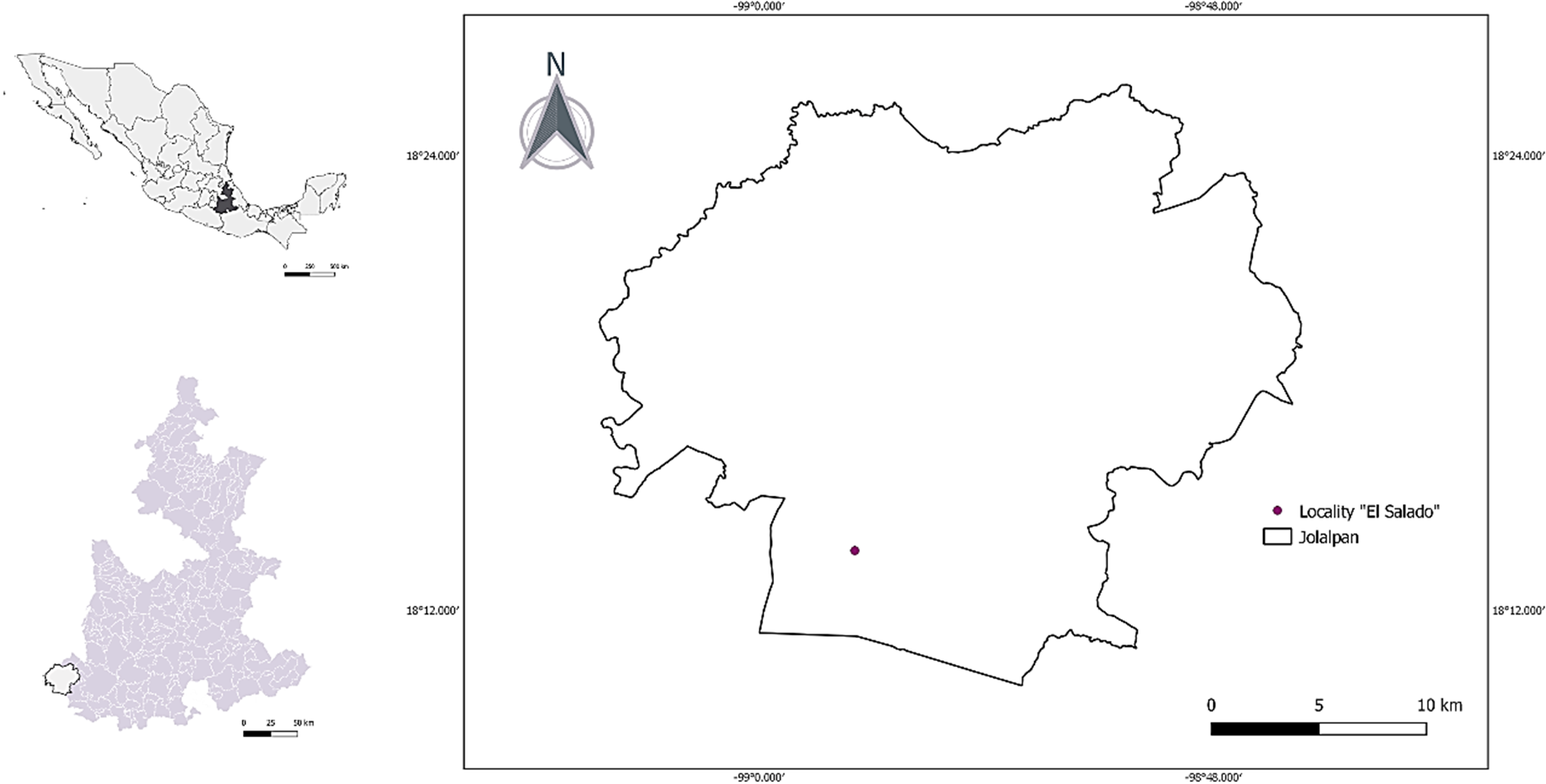
Figure 1
Location of the study site “Rancho El Salado”, Jolalpan, Puebla, Mexico.
Location of the study site “Rancho El Salado”, Jolalpan, Puebla, Mexico.
Insect collecting method. Insects were collected during the cold (CS), dry (DS), and rainy (RS) seasons of the years 2015, 2016, and 2017. For each sampling, eight Malaise traps separated every 200 m, were used for three days. All the collected material was preserved in 96% alcohol.
Specimen preparation and identification procedures. Collected specimens were subjected to the method of mounting insects known as “critical point” (modified from Gordh and Hall, 1979), which consists in: Immersing the specimens in ethyl acetate, mounting them with an entomological pin, and exposing them to the light of an incandescent lamp in order to accelerate the process of dehydration and prevent their bodies from collapsing. The organisms that could not be identified to a specific level, due to a lack of taxonomic information, were classified as morphospecies (Krell, 2004). For subfamily classification, we follow Dikow (2009) except in the cases specified in Table 2 in which we use Geller-Grimm (2004) classification. All individuals were deposited in the Entomological Collection of the Laboratorio de Artropodología y Salud of the Benemérita Universidad Autónoma de Puebla.
-
Gordh and Hall,
1979A critical point drier used as a method of mounting insects from alcoholEntomological News, 1979
-
Krell, 2004Parataxonomy vs. taxonomy in biodiversity studies - pitfalls and applicability of ‘morphospecies’ sortingBiodiversity and Conservation, 2004
-
Dikow (2009)Phylogeny of Asilidae inferred from morphological characters of imagines (Insecta: Diptera: Brachycera: Asiloidea)Bulletin of the American Museum of Natural History, 2009
-
Geller-Grimm (2004)A world catalogue of the genera of the family Asilidae (Diptera)Studia dipterologica, 2004
Data analysis. To determine if there were variations in the structure of the robber fly community between the different seasons, we measured species richness, diversity, similarity, and abundance for each season.
Species richness and diversity
We calculated the effective number of species (Hill numbers) through the indexes q= 0 (species richness), q= 1 (common species) and q= 2 (dominant species) (Jost, 2006; Moreno et al., 2011). We also calculated the 84% confidence intervals (CI) as suggested by MacGregor-Fors and Payton (2013), to determine if there were significant differences between the cold, dry, and rainy seasons. Sample coverage was measured using curves based on rarefaction (interpolation) and extrapolation (Chao et al., 2014). These analyses were performed with the package iNEXT (Hsieh et al., 2016) in R 3.5.2 (R Core Team, 2018).
-
Jost, 2006Entropy and diversityOikos, 2006
-
Moreno et al., 2011Reanálisis de la diversidad alfa: alternativas para interpretar y comparar información sobre comunidades ecológicasRevista Mexicana de Biodiversidad, 2011
-
MacGregor-Fors and Payton (2013)Contrasting Diversity Values: Statistical Inferences Based on Overlapping Confidence IntervalsPloS ONE, 2013
-
Chao et al.,
2014Rarefaction and extrapolation with Hill numbers: a framework for sampling and estimation in species diversity studiesEcological Monographs, 2014
-
Hsieh et al., 2016iNEXT: An R package for rarefaction and extrapolation of species diversity (Hill numbers)Methods in Ecology and Evolution, 2016
-
R Core Team, 2018R: A language and environment for statistical computing, 2018
Similarity
We measured the similarity of the robber flies found in each season with the Jaccard index (Ij) and constructed a dendrogram to facilitate the comparison between seasons. These analyses were run using the Vegan package of R 3.5.2 (R Core Team, 2018).
-
R Core Team, 2018R: A language and environment for statistical computing, 2018
Abundance
We measured abundance as the number of individuals per season. We also constructed a rank-abundance curve by transforming the data to log10 and performed an ANCOVA to determine if abundance varied significantly between seasons (Ortega-Álvarez & MacGregor-Fors, 2009).
-
Ortega-Álvarez & MacGregor-Fors,
2009Living in the big city: Effects of urban land-use on bird community structure, diversity, and compositionLandscape and Urban Planning, 2009
Checklist
The inventory of species was built with the material collected in the cold, dry and rainy seasons from 2015 to 2017. We added material collected in two extra samplings carried out at the end of the rainy season of 2014 and 2015. Even though we used the same collecting method, these data could not be included in the analyses because they were obtained from only two years instead of three like the rest of the data. Nevertheless, we believe it was appropriate to include them in the listing of species and the discussion considering the relevance of our findings.
RESULTS
We collected a total of 191 individuals classified into eight nominal species and 21 morphospecies. Richness and diversity were higher during the rainy season (Table 1). Species composition in CS and DS was different from that in RS, although abundance was not significantly different between seasons.
Table 1
Species/morphospecies richness, diversity, and abundance of robber flies in Jolalpan, Puebla, Mexico, during three different seasons of 2015, 2016, and 2017.
Species/morphospecies richness, diversity, and abundance of robber flies in Jolalpan, Puebla, Mexico, during three different seasons of 2015, 2016, and 2017.
| Species/morphospecies | CS | DS | RS | % of total | Total |
|---|---|---|---|---|---|
| Apachekolos sp. 1 | 21 | 7 | 3 | 16.2% | 31 |
| Apachekolos sp. 2 | 3 | 0 | 7 | 5.2% | 14 |
| Apachekolos sp. 3 | 5 | 1 | 1 | 3.6% | 8 |
| Apachekolos sp. 4 | 0 | 0 | 1 | 0.5% | 1 |
| Atomosia sp. 1 | 0 | 2 | 2 | 2.09% | 4 |
| Atomosia sp. 2 | 0 | 0 | 1 | 0.5% | 1 |
| Atoniomyia sp. | 0 | 0 | 2 | 1.04% | 2 |
| Atractia sp. | 0 | 0 | 1 | 0.5% | 1 |
| Carreraomyia alpuyeca | 0 | 0 | 1 | 0.5% | 1 |
| Cophura sp. | 0 | 0 | 19 | 9.9% | 20 |
| Diogmites sallei | 0 | 0 | 11 | 5.75% | 11 |
| Efferia albibarbis | 2 | 0 | 0 | 1.04% | 2 |
| Efferia triton | 0 | 3 | 0 | 1.57% | 3 |
| Efferia sp. 1 | 2 | 0 | 0 | 1.04% | 2 |
| Efferia sp. 2 | 0 | 0 | 1 | 0.5% | 1 |
| Hadrokolos sp. | 1 | 0 | 0 | 0.5% | 1 |
| Itolia fascia | 0 | 2 | 0 | 1.04% | 2 |
| Leptogaster sp. 1 | 7 | 0 | 1 | 4.1% | 8 |
| Leptogaster sp. 2 | 2 | 1 | 0 | 1.57% | 3 |
| Machimus sp. | 0 | 0 | 4 | 2.09% | 4 |
| Ommatius parvus | 0 | 0 | 1 | 0.5% | 1 |
| Ommatius sp. 1 | 0 | 0 | 1 | 0.5% | 1 |
| Ommatius sp. 2 | 0 | 0 | 1 | 0.5% | 1 |
| Polacantha (E.) xanthocera | 0 | 0 | 1 | 0.5% | 1 |
| Polacantha sp. | 35 | 27 | 0 | 32.4% | 62 |
| Saropogon sp. | 0 | 0 | 1 | 0.5% | 1 |
| Scleropogon sp. 2 | 0 | 0 | 2 | 1.04% | 2 |
| Scleropogon sp. 4 | 1 | 0 | 0 | 0.5% | 1 |
| Stichopogon trifasciatus | 3 | 1 | 3 | 3.6% | 7 |
| n | 82 | 44 | 65 | 98.27% | 191 |
| sc | 0.976 | 0.933 | 0.816 | ||
| 0D | 11 (±1.43) a | 8 (±1.76) a | 21 (±3.55) b | ||
| 1D | 5.55 (±0.93) a | 3.72 (±0.93) a | 11.56 (±2.52) b | ||
| 2D | 2.7 (±0.66) a | 2.42 (±0.6) a | 7.17 (±1.86) b |
Species richness and diversity
The highest richness value was recorded in the rainy season with 21 species/morphospecies, followed by the cold season with 11 species/morphospecies. The lowest value was found in the dry season with eight species/morphospecies. All values of qD were significantly higher in the rainy season (Fig. 2; Table 1). Sample completeness was high (CS= 97%, DS= 93%, RS= 81%) (Table 1).
Thumbnail

Figure 2
Robber fly species diversity of the order 0 (q= 0 species richness), order 1 (q= 1 number of common species), and order 2 (q= 2 number of dominant species) during the cold season (CS), dry season (DS), and rainy season (RS).
Robber fly species diversity of the order 0 (q= 0 species richness), order 1 (q= 1 number of common species), and order 2 (q= 2 number of dominant species) during the cold season (CS), dry season (DS), and rainy season (RS).
Similarity
The obtained dendrogram is composed of two main groups, one corresponding to the rainy season and the other to the cold and dry seasons. This is because more species were shared between CS and DS (40%) than between these seasons and the rainy season (21% and 19%, respectively). Thus, the rainy season formed a separate clade (Fig. 3).
Thumbnail

Figure 3
Dendrogram of robber fly species composition during the cold season (CS), dry season (DS), and rainy season (RS).
Dendrogram of robber fly species composition during the cold season (CS), dry season (DS), and rainy season (RS).
Abundance
Abundance was higher in CS, followed by RS and DS. However, there were no significant differences (F= 1.10, P= 0.39). The most abundant species were Polacantha sp. (62 individuals, 32.4% of the total of robber flies) and Apachekolos sp. 1 (31 individuals, 16.2% of the total of robber flies). Twelve species were rare, with only one specimen of each collected across the three years (Table 1; Total= 1). The most abundant species during CS and DS was Polacantha sp., whereas the most abundant species during the rainy season was Cophura sp. (Fig. 4).
Thumbnail

Figure 4
Rank-abundance curves of the cold season (CS), dry season (DS), and rainy season (RS).
Rank-abundance curves of the cold season (CS), dry season (DS), and rainy season (RS).
Checklist
The inventory of species consisted of eight subfamilies, 19 genera, 11 species and 25 morphospecies (Table 2).
Table 2
Checklist of robber fly species of “Rancho El Salado”, Jolalpan, Puebla, Mexico.
Checklist of robber fly species of “Rancho El Salado”, Jolalpan, Puebla, Mexico.
| Subfamily | Genus | Species/morphospecies |
|---|---|---|
| Asilinae | Carreraomyia* | C. alpuyeca* |
| Efferia* | E. albibarbis* | |
| E. triton* | ||
| Efferia sp. 1 (Gpo. Carinata) | ||
| Efferia sp. 2 | ||
| Machimus | Machimus sp. | |
| Philonicus* | P. truquii* | |
| Philonicus sp. | ||
| Polacantha* | P. (Echinitropis) xanthocera* | |
| Polacantha sp. | ||
| Brachyrhopalinae | Cophura | Cophura sp. |
| Holopogon* | H. pulcher* | |
| H. violaceus* | ||
| Dasypogoninae | Diogmites | D. sallei* |
| Saropogon* | Saropogon sp. | |
| Laphriinae | Atomosia* | Atomosia sp. 1 |
| Atomosia sp. 2 | ||
| Atoniomyia* | Atoniomyia sp. | |
| Atractia* | Atractia sp. | |
| Leptogastrinae | Apachekolos* | Apachekolos sp. 1 |
| Apachekolos sp. 2 | ||
| Apachekolos sp. 3 | ||
| Apachekolos sp. 4 | ||
| Leptogaster* | Leptogaster sp. 1 | |
| Leptogaster sp. 2 | ||
| Leptogaster sp. 3 | ||
| Ommatinae | Ommatius | O. parvus* |
| Ommatius sp. 1 | ||
| Ommatius sp. 2 | ||
| Stenopogoninae | Hadrokolos* 1 | Hadrokolos sp. |
| Itolia1 | I. fascia | |
| Scleropogon* | Scleropogon sp. 1 | |
| Scleropogon sp. 2 | ||
| Scleropogon sp. 3 | ||
| Scleropogon sp. 4 | ||
| Stichopogoninae | Stichopogon* | S. trifasciatus* |
| Total: 8 | 19 | 36 |
-
Geller-Grimm (2004)A world catalogue of the genera of the family Asilidae (Diptera)Studia dipterologica, 2004
DISCUSSION
Species richness and diversity
We collected a total of 29 species/morphospecies of robber flies. The maximum number of species and morphospecies per site recorded in the literature are 38 (Moreira-Junior & Maia, 2018), 20 (Borkent et al., 2018), 17 (Martin-Park et al., 2018), 18 (McCravy & Baxa, 2011) and 14 (Kartawich & McCravy, 2010). Therefore, the richness value obtained in our study is one of the highest recorded values. This supports the assumption that tropical deciduous forests are important for robber fly diversity (Martin-Park et al., 2018).
-
Moreira-Junior & Maia, 2018Asilidae (Diptera) of two Atlantic Forest protected areas of Rio de Janeiro, Southeastern BrazilAnais da Academia Brasileira de Ciências, 2018
-
Borkent et al.,
2018Remarkable fly (Diptera) diversity in a patch of Costa Rican cloud forest: Why inventory is a vital scienceZootaxa, 2018
-
Martin-Park et
al., 2018Diversity of Tabanidae, Asilidae and Syrphidae (Diptera) in natural protected areas of Yucatan, MexicoJournal of Insect Conservation, 2018
-
McCravy
& Baxa, 2011Diversity, seasonal activity and habitat associations of robber flies (Diptera: Asilidae) in West-Central IllinoisThe American Midland Naturalist, 2011
-
Kartawich
& McCravy, 2010A survey of the robber flies (Diptera: Asilidae) of Ira and Reatha T. Post Wildlife Sanctuary, McDonough County, Illinois USATransactions of the Illinois State Academy of Science, 2010
-
Martin-Park et al.,
2018Diversity of Tabanidae, Asilidae and Syrphidae (Diptera) in natural protected areas of Yucatan, MexicoJournal of Insect Conservation, 2018
Tropical deciduous forests are characterized by the absence of leaves during the CS and DS, and by green foliage and an increase in plant biomass during the rainy season (Rzedowski, 2006). In this study, all the orders of qD were significantly higher during the rainy season. This is probably related to an increase in the number of insects that serve as potential prey during this season (Denlinger, 1980; Wolda, 1978). This temporal variation, apart from being caused by precipitation, is related to the increased production of leaves, which can have an indirect effect, by influencing the abundance of prey (Wolda, 1978) that feed on or take shelter in leaves, or a direct effect, by increasing the number of perching sites.
-
Rzedowski, 2006Capítulo 12. Bosque Tropical CaducifolioVegetación de México, 2006
-
Denlinger,
1980Seasonal and annual variation of insect abundance in the Nairobi National Park, Kenya.Biotropica, 1980
-
Wolda, 1978Seasonal fluctuations in rainfall, food and abundance of tropical insectsJournal of Animal Ecology, 1978
-
Wolda,
1978Seasonal fluctuations in rainfall, food and abundance of tropical insectsJournal of Animal Ecology, 1978
We collected 15 exclusive species (not present in the other seasons) during the rainy season, four in the cold season and two in the dry season. In contrast, the species Stichopogon trifasciatus (Say), Apachekolos sp. 1, and Apachekolos sp. 3 were present throughout the year. Stichopogon trifasciatus has been observed in open sites and in sites without vegetation, frequently on exposed rocks and sandy or gravelly places, and its temporal presence has been recorded from April to December in Mexico (Barnes, 2010). In the present study, we also collected this species during the rainy season when the vegetation increased. The range of its presence is extended from eight to ten months (February-December), thus becoming the longest period recorded in any of the countries where this species occurs (Canada, United States, Mexico, Guatemala, El Salvador, and Honduras).
-
Barnes, 2010Revision of Nearctic Stichopogon species (Diptera: Asilidae) with white-banded abdomens, including description of Stichopogon venturiensis, new species, from coastal CaliforniaProceedings of the Entomological Society of Washington, 2010
Similarity
The greatest difference in species composition occurred during the rainy season. This could be explained by the physiognomy of tropical deciduous forests being more similar during CS and DS, since there is a lack of rain and trees with foliage in both seasons, in contrast with RS. During the latter, we found 15 species that were not recorded in the cold and dry seasons. However, Asilidae is not the only Diptera family that show seasonal variation, other examples are Tabanidae (Denlinger, 1980), Psychodidae (Durán-Luz et al., 2018) and Streblidae (Zarazúa-Carbajal et al., 2016), all of them showing seasonal variation.
-
Denlinger, 1980Seasonal and annual variation of insect abundance in the Nairobi National Park, Kenya.Biotropica, 1980
-
Durán-Luz et al.,
2018Phlebotominae and Trichomyiinae (Diptera: Psychodidae) diversity in a tropical dry forest of central Mexico: a comparison of conserved and anthropized habitatsStudies on Neotropical Fauna and Environment, 2019
-
Zarazúa-Carbajal et al., 2016The specificity of host-bat fly interaction networks across vegetation and seasonal variationParasitology Research, 2016
Abundance
Different authors have reported an increase in robber fly abundance during the rainy season (Denlinger, 1980; Shelly, 1985; Martin-Park et al., 2018). This temporal increase in abundance could be due to a restriction caused by a temporal variation in the presence of prey (Wolda, 1978; Shelly, 1985). Nevertheless, this variation could also be related to the phenology of each species, which is not well known, but it has been reported that the larval stage of asilids can last from one to three years (Shelly, 1985). In contrast, we did not find a significant difference in abundance between the seasons of the year (F= 1.101, P= 0.391). Even though abundance during the cold season (82) was higher than in the rainy season (65), a lower number of species was found in the cold season; 42% of the abundance in this season was of Polacantha sp. This species was also the most abundant in the dry season but was absent in the RS. On the other hand, Cophura sp. was the most abundant species during the rainy season and was not present in the other two seasons.
-
Denlinger, 1980Seasonal and annual variation of insect abundance in the Nairobi National Park, Kenya.Biotropica, 1980
-
Shelly, 1985Ecological comparisons of robber fly species (Diptera: Asilidae) coexisting in a Neotropical forestOecologia (Berlin), 1985
-
Martin-Park et al., 2018Diversity of Tabanidae, Asilidae and Syrphidae (Diptera) in natural protected areas of Yucatan, MexicoJournal of Insect Conservation, 2018
-
Wolda,
1978Seasonal fluctuations in rainfall, food and abundance of tropical insectsJournal of Animal Ecology, 1978
-
Shelly, 1985Ecological comparisons of robber fly species (Diptera: Asilidae) coexisting in a Neotropical forestOecologia (Berlin), 1985
-
Shelly, 1985Ecological comparisons of robber fly species (Diptera: Asilidae) coexisting in a Neotropical forestOecologia (Berlin), 1985
In the rank-abundance curve (Fig. 4), we can observe a longer curve for the rainy season (more recorded species), as well as the dominance of Polacantha sp. and Apachekolos sp. 1 in the CS and DS and of Cophura sp. in the RS. However, according to the ANCOVA results, there were no significant differences in abundance between the three seasons (F= 1.101, P= 0.391).
Checklist
The inventory of robber flies of Jolalpan, Puebla is comprised of 36 species (11 nominal species and 25 morphospecies) classified into eight subfamilies and 19 genera. Of these, 14 genera and 10 species had not been previously reported for the state of Puebla (Table 2; Fig. 5) (Hine, 1919; Pritchard, 1943; Carrera, 1953; Cole & Pritchard, 1964; Wilcox, 1965; 1966a; 1966b; 1971; Martin, 1957; 1967; 1968a; 1968b; 1975; Martin & Papavero, 1970; Scarbrough, 1990; Artigas et al., 1991; Barnes, 2008; 2010; Papavero, 2009; Scarbrough et al., 2012).
-
Hine, 1919Robber flies of the genus EraxAnnals Entomological Society of America, 1919
-
Pritchard, 1943Revision of the genus Cophura Osten Sacken (Diptera: Asilidae)Annals Entomological Society of America, 1943
-
Carrera, 1953As espécies neotrópicas do gênero Diogmites (Diptera, Asilidae)Arquivos do Zoología do Estado de São Paulo, 1953
-
Cole & Pritchard, 1964The genus Mallophora and related asilid genera in North America (Diptera: Asilidae), 1964
-
Wilcox, 1965New Cophura, with revised keys to the groups and to the Nearctic species (Diptera: Asilidae)Annals of the Entomological Society of America, 1965
-
1966aEfferia Coquillett in America North of Mexico (Diptera: Asilidae)Proceedings of the California Academy of Sciences, 1966
-
1966bNew species and a key to the species of Saropogon Loew (Diptera: Asilidae)The Pan-Pacific Entomologist, 1966
-
1971The genera Stenopogon Loew and Scleropogon Loew in America North of Mexico (Diptera: Asilidae)Occasional Papers of the California Academy of Sciences, 1971
-
Martin, 1957A revision of the Leptogastrinae in the United States (Diptera, Asilidae)Bulletin of the American Museum of Natural History, 1957
-
1967New Asilidae from Mexico and ArizonaThe Pan-Pacific Entomologist, 1967
-
1968aRevision of Stenopogon Loew (= Scleropogon Loew) as represented in Mexico (Diptera: Asilidae)Proceedings of the California Academy of Sciences, 1968
-
1968b35a. Family LeptogastridaeA catalogue of the Diptera of the Americas south of the United States, 1968
-
1975The generic and specific characters of four old and six new Asilini genera in the western United States, Mexico, and Central America (Diptera: Asilidae)Occasional Papers of the California Academy of Sciences, 1975
-
Martin & Papavero, 197035b. Family AsilidaeA catalogue of the Diptera of the Americas south of the United States, 1970
-
Scarbrough, 1990Revision of the New World Ommatius Wiedemann (Diptera: Asilidae). I. The Pumilus species groupTransactions of the American Entomological Society, 1990
-
Artigas et
al., 1991The American Genera of Asilidae (Diptera): Keys for identification with an atlas of female spermathecae and other morphological details. VI. Tribe Atomosinii Hermann (Laphriinae), with description of two new genera and three new species, and a Catalogue of the Neotropical speciesGayana Zoología, 1991
-
Barnes,
2008The Genus Atomosia Macquart (Diptera: Asilidae) in North America North of MexicoProceedings of the Entomological Society of Washington, 2008
-
2010Revision of Nearctic Stichopogon species (Diptera: Asilidae) with white-banded abdomens, including description of Stichopogon venturiensis, new species, from coastal CaliforniaProceedings of the Entomological Society of Washington, 2010
-
Papavero, 2009Catalogue of Neotropical Diptera. AsilidaeNeotropical Diptera, 2009
-
Scarbrough et al., 2012The Albibarbis-complex of Efferia Coquillett, 1910 from the Grand Canyon region, southwestern U.S.A., with three new species and new distribution records (Diptera: Asilidae)Pan-Pacific Entomologist, 2012
Thumbnail

Figure 5
Asilidae specimens collected at “El Salado” in lateral view: a) Carreraomyia alpuyeca ♂, b) Itolia fascia ♀, c) Philonicus truquii ♂, d) Diogmites sallei ♀, e) Holopogon pulcher ♂, f) Stichopogon trifasciatus ♀, g) Efferia triton ♂, h) Efferia albibarbis ♀, i) Polacantha (E.) xanthocera ♂. All the photos taken by Bello-Morales.
Asilidae specimens collected at “El Salado” in lateral view: a) Carreraomyia alpuyeca ♂, b) Itolia fascia ♀, c) Philonicus truquii ♂, d) Diogmites sallei ♀, e) Holopogon pulcher ♂, f) Stichopogon trifasciatus ♀, g) Efferia triton ♂, h) Efferia albibarbis ♀, i) Polacantha (E.) xanthocera ♂. All the photos taken by Bello-Morales.
We also recorded seven more species that were found during the samplings at the end of the rainy season (2014 and 2015) and that were not found in the other seasons. These data suggest that three samplings per year may not be enough to determine the real composition of robber fly communities. Thus, we suggest performing samplings at least every two months over the entire year in order to obtain more complete inventories; we also suggest conducting a different type of active sampling, such as direct sampling with an entomological net to decrease the bias of Malaise traps, which occurs because they are passive traps (McCravy & Baxa, 2011).
-
McCravy & Baxa, 2011Diversity, seasonal activity and habitat associations of robber flies (Diptera: Asilidae) in West-Central IllinoisThe American Midland Naturalist, 2011
We thus conclude that the structure of the robber fly community is different between the dry and rainy seasons. Species richness and diversity were higher during the rainy season, abundance did not vary significantly, and species composition was different in each season.
Acknowledgments
Special thanks to the people of “Rancho El Salado” for their hospitality during the fieldwork. We appreciate the help of Laboratorio de Artropodología y Salud students in the fieldwork. We thank Helena Ajuria Ibarra for helping us with the English version of the manuscript. Thanks to Agustín Aragón and Miguel Aragón that kindly let us use their photographic equipment. Finally, we appreciate the comments of two anonymous reviewers that improve the manuscript. This study was supported by the project “Dípteros de importancia médica-veterinaria de la selva baja caducifolia de la mixteca poblana” under the “Programa para el Desarrollo Profesional para el Tipo Superior (PRODEP) como NPTC con folio BUAP-PTC-438, No. Convenio DSA/103.5/15/7449” program, coordinated by César Antonio Sandoval Ruiz; PRODEP [BUAP-PTC-438].
LITERATURE CITED
- Artigas, J. N., Papavero, N., Serra, A. L. (1991) The American Genera of Asilidae (Diptera): Keys for identification with an atlas of female spermathecae and other morphological details. VI. Tribe Atomosinii Hermann (Laphriinae), with description of two new genera and three new species, and a Catalogue of the Neotropical species. Gayana Zoología, 55, 23-85. Links
- Barnes, J. K. (2008) The Genus Atomosia Macquart (Diptera: Asilidae) in North America North of Mexico. Proceedings of the Entomological Society of Washington, 110, 701-732. https://doi.org/10.4289/07-073.1 Links
- Barnes, J. K. (2010) Revision of Nearctic Stichopogon species (Diptera: Asilidae) with white-banded abdomens, including description of Stichopogon venturiensis, new species, from coastal California. Proceedings of the Entomological Society of Washington , 112, 367-380. https://doi.org/10.4289/0013-8797.112.3.367 Links
- Barnes, J. K., Lavers, N., Raney, H. (2007) Robber flies (Diptera: Asilidae) of Arkansas, U.S.A.: notes and a checklist. Entomological News, 118, 241-258. https://doi.org/10.3157/0013-872X(2007)118[241:RFDAOA]2.0.CO;2 Links
- Borkent, A., Brown, B. V., Adler, P. H., Amorim, D. D. S., Barber, K., Bickel, D., Boucher, S., Brooks, S. E., Burger, J., Burington, Z. L., Capellari, R. S., Costa, D. N. R., Cumming, J. M., Curler, G., Dick, C. W., Epler, J. H., Fisher, E., Gaimari, S. D., Gelhaus, J., Grimaldi, D. A., Hash, J., Hauser, M., Hippa, H., Ibáñez-Bernal, S., Jaschhof, M., Kameneva, E. P., Kerr, P. H., Korneyev, V., Korytkowski, C. A., Kung, G. A., Kvifte, G. M., Lonsdale, O., Marshall, S. A., Mathis, W. N., Michelsen, V., Naglis, S., Norrbom, A. L., Paiero, S., Pape, T., Pereira-Colavite, A., Pollet, M., Rochefort, S., Rung, A., Runyon, J. B., Savage, J., Silva, V. C., Sinclair, B. J., Skevington, J. H., Stireman III, J. O., Swann, J., Vilkamaa, P., Wheeler, T., Whitworth, T., Wong, M., Wood, D. M., Woodley, N., Yau, T., Zavortink, T. J., Zumbado, M. A. (2018) Remarkable fly (Diptera) diversity in a patch of Costa Rican cloud forest: Why inventory is a vital science. Zootaxa, 4402, 53-90. http://dx.doi.org/10.11646/zootaxa.4402.1.3 Links
- Brown, B. V., Borkent, A., Adler, P. H., Amorim, D. D. S., Barber, K., Bickel, D., Boucher, S., Brooks, S. E., Burger, J., Burington, Z. L., Capellari, R. S., Costa, D. N. R., Cumming, J. M., Curler, G., Dick, C. W., Epler, J. H., Fisher, E., Gaimari, S. D., Gelhaus, J., Grimaldi, D. A., Hash, J., Hauser, M., Hippa, H., Ibáñez-Bernal, S., Jaschhof, M., Kameneva, E. P., Kerr, P. H., Korneyev, V., Korytkowski, C. A., Kung, G. A., Kvifte, G. M., Lonsdale, O., Marshall, S. A., Mathis, W. N., Michelsen, V., Naglis, S., Norrbom, A. L., Paiero, S., Pape, T., Pereira-Colavite, A., Pollet, M., Rochefort, S., Rung, A., Runyon, J. B., Savage, J., Silva, V. C., Sinclair, B. J., Skevington, J. H., Stireman III, J. O., Swann, J., Thompson, F. C., Vilkamaa, P., Wheeler, T., Whitworth, T., Wong, M., Wood, D. M., Woodley, N., Yau, T., Zavortink, T. J., Zumbado, M. A. (2018) Comprehensive inventory of true flies (Diptera) at a tropical site. Communications Biology, 21, 1-8. http://dx.doi.org/10.1038/s42003-018-0022-x Links
- Carrera, M. (1953) As espécies neotrópicas do gênero Diogmites (Diptera, Asilidae). Arquivos do Zoología do Estado de São Paulo, 8, 169-208. Links
- Chao, A., Gotelli, N. J., Hsieh, T. C., Sander, E. L., Ma, K. H., Colwell, R. K., Ellison, A. M. (2014) Rarefaction and extrapolation with Hill numbers: a framework for sampling and estimation in species diversity studies. Ecological Monographs, 84, 45-67. http://dx.doi.org/10.1890/13-0133.1 Links
- Cole, F. R., Pritchard, A. E. (1964) The genus Mallophora and related asilid genera in North America (Diptera: Asilidae). University of California Publications in Entomology, 36, 43-100. Links
- Denlinger, D. L. (1980) Seasonal and annual variation of insect abundance in the Nairobi National Park, Kenya. Biotropica, 12, 100-106. http://dx.doi.org/10.2307/2387725 Links
- Dikow, T. (2009) Phylogeny of Asilidae inferred from morphological characters of imagines (Insecta: Diptera: Brachycera: Asiloidea). Bulletin of the American Museum of Natural History, 319, 1-175. http://dx.doi.org/10.1206/603.1 Links
- Durán-Luz, J., Sandoval-Ruiz, C. A., Ibáñez-Bernal, S. (2019) Phlebotominae and Trichomyiinae (Diptera: Psychodidae) diversity in a tropical dry forest of central Mexico: a comparison of conserved and anthropized habitats. Studies on Neotropical Fauna and Environment, 54 (1), 40-47. https://doi.org/10.1080/01650521.2018.1486496 Links
- Fisher, E. M., Hespenheide, H. A. (1982) Taxonomy and ethology of a new Central American species of robber fly in the genus Glaphyropyga (Diptera: Asilidae). Proceedings of the Entomological Society of Washington , 84, 716-725. Links
- Geller-Grimm, F. (2004) A world catalogue of the genera of the family Asilidae (Diptera). Studia dipterologica, 2, 473-526. Links
- Gordh, G., Hall, J. C. (1979) A critical point drier used as a method of mounting insects from alcohol. Entomological News, 90, 57-59. Links
- Guevara-Romero, M. L. (2011) Tipos de Vegetación de Puebla. In: Comisión Nacional para el Uso de la Biodiversidad (CONABIO). La biodiversidad en Puebla: Estudio de Estado. México. Comisión Nacional para el Uso de la Biodiversidad, Gobierno del Estado de Puebla, Benemérita Universidad Autónoma de Puebla, 440 pp. Links
- Hine, J. S. (1919) Robber flies of the genus Erax. Annals Entomological Society of America, 12, 103-158. https://doi.org/10.1093/aesa/12.2.103 Links
- Hsieh, T. C., Ma, K. H., Chao, A. (2016) iNEXT: An R package for rarefaction and extrapolation of species diversity (Hill numbers). Methods in Ecology and Evolution, 7, 1451-1456. https://doi.org/10.1111/2041-210X.12613 Links
- Hull, F. M. (1962) Robber flies of the world. The genera of the family Asilidae. United States National Museum of Natural History Bulletin 224. (Pts. 1 & 2). U.S. Govt. Printing Office. 907 pp. Links
- Ibáñez-Bernal, S. (2017) Actualización del Catálogo de Autoridades Taxonómicas de los Dípteros (Diptera: Insecta) de México. Instituto de Ecología AC. Red Ambiente y Sustentabilidad. Informe final SNIB-CONABIO proyecto JE006. Ciudad de México, 76 pp. Links
- Jost, L. (2006) Entropy and diversity. Oikos, 113, 363-375. https://doi.org/10.1111/j.2006.0030-1299.14714.x Links
- Kartawich, L. M., McCravy, K. W. (2010) A survey of the robber flies (Diptera: Asilidae) of Ira and Reatha T. Post Wildlife Sanctuary, McDonough County, Illinois USA. Transactions of the Illinois State Academy of Science, 103, 31-38. Links
- Krell, F. T. (2004) Parataxonomy vs. taxonomy in biodiversity studies - pitfalls and applicability of ‘morphospecies’ sorting. Biodiversity and Conservation, 13, 795-812. https://doi.org/10.1023/B:BIOC.0000011727.53780.63 Links
- MacGregor-Fors, I., Payton, M. E. (2013) Contrasting Diversity Values: Statistical Inferences Based on Overlapping Confidence Intervals. PloS ONE, 8, 1-4. https://doi.org/10.1371/journal.pone.0056794 Links
- Martin, C. H. (1957) A revision of the Leptogastrinae in the United States (Diptera, Asilidae). Bulletin of the American Museum of Natural History , 111, 343-386. http://hdl.handle.net/2246/433 Links
- Martin, C. H. (1967) New Asilidae from Mexico and Arizona. The Pan-Pacific Entomologist, 43, 192-201. Links
- Martin, C. H. (1968a) Revision of Stenopogon Loew (= Scleropogon Loew) as represented in Mexico (Diptera: Asilidae). Proceedings of the California Academy of Sciences, 4th series, 35, 371-400. Links
- Martin, C. H. (1968b) 35a. Family Leptogastridae. In: N. Papavero (Ed.). A catalogue of the Diptera of the Americas south of the United States. São Paulo, Museu de Zoologia, Universidade de São Paulo, 139 pp. Links
- Martin, C. H. (1975) The generic and specific characters of four old and six new Asilini genera in the western United States, Mexico, and Central America (Diptera: Asilidae). Occasional Papers of the California Academy of Sciences, 119, 107 pp. Links
- Martin, C. H., Papavero, N. (1970) 35b. Family Asilidae. In: N. Papavero (Ed.). A catalogue of the Diptera of the Americas south of the United States . São Paulo, Museu de Zoologia, Universidade de São Paulo, 139 pp. Links
- Martin-Park, A., Delfín‑González, H., Sosenski, P., Reyes‑Novelo, E., Meléndez‑Ramírez, V., Navarrete‑Carballo, J., Ibáñez‑Bernal, S., Dzul‑Manzanilla, F., González‑Moreno, A., Manrique‑Saide, P. (2018) Diversity of Tabanidae, Asilidae and Syrphidae (Diptera) in natural protected areas of Yucatan, Mexico. Journal of Insect Conservation, 22, 85-97. https://doi.org/10.1007/s10841-017-0040-x Links
- Martínez-Moreno, D., Reyes-Matamoros, J., Andrés-Hernández, A. R., Pérez-Espinosa, L. (2016) Flora útil de la comunidad "Rancho El Salado" en Jolalpan, México. Revista Iberoamericana de Ciencias, 3, 1-15. Links
- McCravy, K. W., Baxa, K. A. (2011) Diversity, seasonal activity and habitat associations of robber flies (Diptera: Asilidae) in West-Central Illinois. The American Midland Naturalist, 166, 85-97. https://doi.org/10.1674/0003-0031-166.1.85 Links
- Moreira-Junior, D. P, Maia, V. C. (2018) Asilidae (Diptera) of two Atlantic Forest protected areas of Rio de Janeiro, Southeastern Brazil. Anais da Academia Brasileira de Ciências, 90, 1579-1589. https://doi.org/10.1590/0001-3765201720170695 Links
- Moreno, C. E., Barragán, F., Pineda, E., Pavón, N. P. (2011) Reanálisis de la diversidad alfa: alternativas para interpretar y comparar información sobre comunidades ecológicas. Revista Mexicana de Biodiversidad, 82, 1249-1261. http://dx.doi.org/10.22201/ib.20078706e.2011.4.745 Links
- Ortega-Álvarez, R., MacGregor-Fors, I. (2009) Living in the big city: Effects of urban land-use on bird community structure, diversity, and composition. Landscape and Urban Planning, 90, 189-195. https://doi.org/10.1016/j.landurbplan.2008.11.003 Links
- Papavero, N. (2009) Catalogue of Neotropical Diptera. Asilidae. Neotropical Diptera, 17, 1-178. Links
- Pape, T., Blagoderov, V., Mostovski, M. B. (2011) Order Diptera Linnaeus, 1758. In: Zhang, Z.-Q. (Ed.), Animal biodiversity: an outline of higher-level classification and survey of taxonomic richness. Zootaxa , 3148, 222-229. http://doi.org/10.11646/zootaxa.3148.1.42 Links
- Pritchard, A. E. (1943) Revision of the genus Cophura Osten Sacken (Diptera: Asilidae). Annals Entomological Society of America , 36, 281-309. https://doi.org/10.1093/aesa/36.2.281 Links
- R Core Team (2018) R: A language and environment for statistical computing. R Foundation for Statistical Computing, Vienna, Austria. https://www.R-project.org/ Links
- Rzedowski, J. (2006) Capítulo 12. Bosque Tropical Caducifolio. In: Vegetación de México. 1ra. Edición digital. Comisión Nacional para el Conocimiento y Uso de la Biodiversidad, México, 200-214 pp. Available: https://www.biodiversidad.gob.mx/publicaciones/librosDig/pdf/VegetacionMxPort.pdf Links
- Scarbrough, A. G. (1990) Revision of the New World Ommatius Wiedemann (Diptera: Asilidae). I. The Pumilus species group. Transactions of the American Entomological Society, 116, 65-102. Available: https://www.jstor.org/stable/25078511 Links
- Scarbrough, A. G., Stevens, L. E., Nelson, C. R. (2012) The Albibarbis-complex of Efferia Coquillett, 1910 from the Grand Canyon region, southwestern U.S.A., with three new species and new distribution records (Diptera: Asilidae). Pan-Pacific Entomologist, 88, 58-86. https://doi.org/10.3956/2012-07.1 Links
- Shelly, T. E. (1985) Ecological comparisons of robber fly species (Diptera: Asilidae) coexisting in a Neotropical forest. Oecologia (Berlin), 67, 57-70. https://doi.org/10.1007/BF00378452 Links
- Wilcox, J. (1965) New Cophura, with revised keys to the groups and to the Nearctic species (Diptera: Asilidae). Annals of the Entomological Society of America, 58, 805-816.https://doi.org/10.1093/aesa/58.6.805 Links
- Wilcox, J. (1966a) Efferia Coquillett in America North of Mexico (Diptera: Asilidae). Proceedings of the California Academy of Sciences , 34, 85-234. Links
- Wilcox, J. (1966b) New species and a key to the species of Saropogon Loew (Diptera: Asilidae). The Pan-Pacific Entomologist, 42, 127-136. Links
- Wilcox, J. (1971) The genera Stenopogon Loew and Scleropogon Loew in America North of Mexico (Diptera: Asilidae). Occasional Papers of the California Academy of Sciences , 89, 1-134. Links
- Wolda, H. (1978) Seasonal fluctuations in rainfall, food and abundance of tropical insects. Journal of Animal Ecology, 47, 369-381. https://doi.org/10.2307/3789 Links
- Wood, G. C. (1981) Asilidae. In: J. F. McAlpine, B. V. Peterson, G. E. Shewell, H. J. Teskey, J. R. Vockeroth, D. M. Wood (Eds.). Manual of Nearctic Diptera Vol. 1. Ottawa (Canada). Research Branch, Agriculture Canada, Monograph No. 27., 549-573 pp. Links
- Zarazúa-Carbajal, M., Saldaña-Vázquez, R. A., Sandoval-Ruiz, C. A., Stoner, K. E., Benítez-Malvido, J. (2016) The specificity of host-bat fly interaction networks across vegetation and seasonal variation. Parasitology Research, 115, 4037-4044. https://doi.org/10.1007/s00436-016-5176-1 Links