Artículos
Evaluation of heavy metals and social behavior associated with water quality in Suches River, Puno, Peru
Salas-Ávila, Dante1
 http://orcid.org/0000-0002-7033-2006
Chaiña-Chura, Fermin Francisco2
http://orcid.org/0000-0003-0559-9748
Belizario-Quispe, Germán3
http://orcid.org/0000-0001-9805-3714
Quispe-Mamani, Edgar4
http://orcid.org/0000-0003-4877-8551
Huanqui-Pérez, Roger5
http://orcid.org/0000-0001-9760-4166
Velarde-Coaquira, Edilberto6
http://orcid.org/0000-0003-1966-7924
Bernedo-Colca, Fernando7
http://orcid.org/0000-0003-0133-3395
Salas-Mercado, Dante8
http://orcid.org/0000-0003-0656-1979
Hermoza-Gutiérrez, Marián9
http://orcid.org/0000-0003-1104-1695
http://orcid.org/0000-0002-7033-2006Chaiña-Chura, Fermin Francisco2
http://orcid.org/0000-0003-0559-9748Belizario-Quispe, Germán3
http://orcid.org/0000-0001-9805-3714Quispe-Mamani, Edgar4
http://orcid.org/0000-0003-4877-8551Huanqui-Pérez, Roger5
http://orcid.org/0000-0001-9760-4166Velarde-Coaquira, Edilberto6
http://orcid.org/0000-0003-1966-7924Bernedo-Colca, Fernando7
http://orcid.org/0000-0003-0133-3395Salas-Mercado, Dante8
http://orcid.org/0000-0003-0656-1979Hermoza-Gutiérrez, Marián9
http://orcid.org/0000-0003-1104-1695
-
Publication dates-
July 04, 2025
Nov-Dec , 2021
- Article in PDF
- Article in XML
- Automatic translation
- Send this article by e-mail
- Share this article +
Abstract
The purpose of this study is to evaluate the concentration of heavy metals in the Suches river and to analyze the social behavior of local agents on the quality of water related to mining activities in Cojata, Puno, Peru. Water and sediment samples were collected from the Suches river for the quantification of As, Cd, Cr, Pb, Cu, and Hg through inductive plasma mass spectrophotometry (ICP-MS). The research included the qualitative analysis of the social behavior of the communal agents of Cojata, based on the collection of representative testimonies. Average concentrations of metals in water are below the ECA-category 3 of Peru; however, As (11.52 mg kg-1) and Cd (1.14 mg kg-1) in the sediment samples exceed the limits recommended by the ISQG of Canada. The presence of these metals in the river is due to the discharges generated by excavations and drainage typical of mining activities, as well as the mineralogical composition and natural weathering of rocks in the study area, which would cause negative impacts on the quality of the river water. The social behavior of rejection of mining is based on the collective association of poor water quality related to its turbidity. The various sources of evidence suggest the need for the formalization of mining activities in Cojata, as well as the implementation of improvements in national environmental regulations.
Keywords::
Water, social behavior, heavy metals, Suches river, sediments
Introduction
Mining is one of the most important economical abstraction activities worldwide. Several river basins at the south of Peru are rich in highly commercial and industrial metal deposits (INGEMMET 2009), however, as time went by, the zones where these processes are being made have faced considerable changes, the exploitation sites as much as the surrounding areas, the environment became affected by the use of the terrain, location of dumping sites and the establishment of wide-spread camps (McIntyre, Bulovic, Cane, & McKenna, 2016).
-
INGEMMET 2009Inventario y situación legal de las operaciones y concesiones mineras ubicadas en la cuenca del río Suches (Perú-Bolivia), 2009
-
McIntyre, Bulovic, Cane, & McKenna, 2016A multi-disciplinary approach to understanding the impacts of mines on traditional uses of water in Northern MongoliaScience of the Total Environment, 2016
The removal and sliding of great quantities of ground can contain heavy metals, considered as contaminating chemicals when they are found in high concentrations in any environmental bodies (Hodges, 1995; Rahim et al., 2019). Metals that are considered toxic are mostly As, Cd, Cu, Cr, Pb y Hg (OMS, 2006; Yi et al., 2020), these metals can significantly affect the hydrological resources in terms of availability of good quality water, and also generate potential impact in a great number of services from the ecosystem (Hodges, 1995; Liang et al., 2020).
-
Hodges, 1995Mineral resources, environmental issues, and land useScience, 1995
-
Rahim et al., 2019Distribution of chromium and gallium in the total suspended solid and surface sediments of Sungai Kelantan, Kelantan, MalaysiaSains Malaysiana, 2019
-
OMS, 2006Preocupaciones en materia de salud y medio ambiente asociadas con los metales pesados: ¿Necesidad de una acción mundial ulterior?, 2006
-
Yi et al., 2020Characteristics and assessment of toxic metal contamination in surface water and sediments near a Uranium mining areaInternational Journal of Environmental Research and Public Health, 2020
-
Liang et al., 2020Spatial variation and source of dissolved heavy metals in the Lancangjiang river, Southwest ChinaInternational Journal of Environmental Research and Public Health, 2020
The risk implied by the transference of metal through the trophic chain (Lu et al., 2019 and the damage that they represent for human health (Topalián, Castañé, Rovedatti, & Salibián, 1999) are highly relevant, especially in developed tows near mining activities (Islam, Ahmed, Raknuzzaman, Habibullah-Al-Mamun, & Islam, 2015), considering these occurrences can be extended beyond the mine’s operative life and is considered that in many cases the social and environmental impact is bigger than the benefits from the project (Ural & Demirkol, 2008).
-
Lu et al., 2019Simulating heavy metal concentrations in an aquatic environment using artificial intelligence models and physicochemical indexesScience of the Total Environment, 2019
-
Topalián, Castañé, Rovedatti, & Salibián, 1999Principal component analysis of dissolved heavy metals in water of the Reconquista River (Buenos Aires, Argentina)Bulletin of Environmental Contamination and Toxicology, 1999
-
Islam, Ahmed, Raknuzzaman, Habibullah-Al-Mamun, & Islam, 2015Heavy metal pollution in surface water and sediment: A preliminary assessment of an urban river in a developing countryEcological Indicators, 2015
-
Ural & Demirkol, 2008Evaluation of occupational safety and health in surface minesSafety Science, 2008
In Peru, minor scale mining activities represent a risk for environmental behavior. There are cases of legal mines with little scale activities covered by regulations that protect aquatic environments through quality water criteria (MINAM, 2017), this they take into account the use of the body of water depending on cataloging: First category (population and recreation); second category (extraction, farming and other marines, coastal and continental activities); third category (watering of crops and drinking for animals); fourth category (conservation of the aquatic environment) (ANA, 2018). However, the Peruvian government has not yet issued a guiding decree to set parameters of quality in sediments, that is the reason why several studies (Ali-Khan, Tobin, Paterson, Khan, & Warren, 2005; Chau & Kulikovsky-Cordeiro, 1995; Flores, Del-Angel, Frías, & Gómez, 2018; Zotou, Tsihrintzis, & Gikas, 2020) use international references, for example, Canadian ones (Canadian Council of Ministers of the Environment, 1995), which can be complemented using the guidelines for levels of probable effects recommended by MacDonald, Ingersoll and Berger (2000) .
-
MINAM, 2017Estándares de calidad ambiental para aguaEl Peruano, 2017
-
Ali-Khan, Tobin, Paterson, Khan, & Warren, 2005Application of CCME Procedures for deriving site-specific water quality guidelines for the CCME Water Quality IndexWater Quality Research Journal of Canada, 2005
-
Chau & Kulikovsky-Cordeiro, 1995Occurrence of nickel in the Canadian environmentEnvironmental Reviews, 1995
-
Flores, Del-Angel, Frías, & Gómez, 2018Evaluation of physicochemical parameters and heavy metals in water and surface sediment in the ilusiones Lagoon, Tabasco, MexicoTecnología y ciencias del agua, 2018
-
Zotou, Tsihrintzis, & Gikas, 2020Water quality evaluation of a lacustrine water body in the Mediterranean based on different water quality index (WQI) methodologiesJournal of Environmental Science and Health - Part A Toxic/Hazardous Substances and Environmental Engineering, 2020
-
Canadian Council of Ministers of the Environment, 1995Protocol for the derivation of Canadian sediment quality guidelines for the protection of aquatic life. CCME EPC-98E. Prepared by Environment Canada, Guidelines Division, Technical Secretariat of the CCME Task Group on Water Quality Guidelines, Ottawa. Reprinted in Canadian environmental quality guidelines, Chapter 6, Canadian Council of Ministers of the Environment, 1999, 1995
-
MacDonald, Ingersoll and Berger (2000)Development and evaluation of consensus-based sediment quality guidelines for freshwater ecosystemsArchives of Environmental Contamination and Toxicology, 2000
The intensive practice of mining along with other uses of the ground that affect the hydric system and the quality of the water at the basins also generates doubt and social arguments regarding the hydrological source of nearby communities (McIntyre et al., 2016). Numerous investigations emphasize the need for a complete diagnosis of the environmental quality of an ecosystem through the discussion between several groups of social actors that are part of the influence area of alternative states of and industrial activity (Chapin, Folke, & Kofinas, 2009; Sánchez-Infantas & Quinteros-Carlos, 2017). Other studies had suggested that there is an influence on the behavior of social actors, based on the observations about characteristics of environmental bodies and the risks that could compromise their health or productivity (Hilson, 2005; Paul, 2017b; Pengli, 2008).
-
McIntyre et al., 2016A multi-disciplinary approach to understanding the impacts of mines on traditional uses of water in Northern MongoliaScience of the Total Environment, 2016
-
Chapin, Folke, & Kofinas, 2009A framework for understanding changePrinciples of Ecosystem Stewardship: Resilience-Based Natural Resource Management in a Changing World, 2009
-
Sánchez-Infantas & Quinteros-Carlos, 2017Pertinencia del concepto de estándar de calidad ambiental (ECA) en la gestión de sistemas ambientales con varios estados alternativos. Estudio de caso de una experiencia peruanaEcología Aplicada, 2017
-
Hilson, 2005The socio-economic impacts of artisanal and small-scale mining in developing countries, 2005
-
Paul, 2017bEcological and sociological implications of Tisza River Mine tailings pollution and effect of chronic cadmium exposure on fish physiology. Dissertations, 2017b
-
Pengli, 2008The sociological research on “Minamata Disease” in JapanJournal of Hohai University, 2008
Dogaru et al. (2009) demonstrate that the results associated with the experiences of the actors and measures of water quality at the Certej basin in Romania are convergent. These discoveries also suggest that the mining activities represent an obvious risk in superficial water, however, the quality of the water was not much predicted by the regression model and it does not seem to be related to mining as other explanatory factors related to mineralogy and hydrological dynamic. Is that how social behavior and the characteristics of environmental bodies give different types of evidence, by relating these they allow to set a base for better management of resources in a more accurate and transdisciplinary way (McIntyre et al., 2016; Morales et al., 2020).
-
Dogaru et al. (2009)Community perception of water quality in a mining-affected area: A case study for the Certej Catchment in the Apuseni Mountains in RomaniaEnvironmental Management, 2009
-
McIntyre et al., 2016A multi-disciplinary approach to understanding the impacts of mines on traditional uses of water in Northern MongoliaScience of the Total Environment, 2016
-
Morales et al., 2020An interdisciplinary approach to perception of water quality for human consumption in a Mapuche community of arid Patagonia, ArgentinaScience of the Total Environment, 2020
The governments from countries that have gold artisanal mining insist that the solution to the conflicts between social actors and informal and illegal miners is the formalization of workers. On this line, Milanez and Puppim-de-Oliveira (2013) evaluated a case in which the formalization and agreed establishment of little groups or economic communal agents have contributed to the environmental improvement by the mining sector in the State of Paiauí (Brasil). The results suggest that some formalization of existing practices and appropriate politics have resulted in the innovation with some positive effects on the performance of artisanal mining.
-
Milanez and Puppim-de-Oliveira (2013)Innovation for sustainable development in artisanal mining: Advances in a cluster of opal mining in BrazilResources Policy, 2013
On the other hand, in the Peruvian state, some failed and erratic series of actions have appeared in the process of formalization of illegal and informal mining. Valdés, Basombrío, and Vera (2014) indicate that factors related to economically-structural deficiencies (informal employment) lack of efficient public policies, and the instability of the government in face of pressures from the mining sector, explain why the objectives and goals were not reached in form and time.
-
Valdés, Basombrío, and Vera (2014)La minería no formal en el Perú, 2014
The purpose of this study is to evaluate the concentration of heavy metals at the Suches river and to analyze the social behavior of local agents on the quality of water-related to the mining activities in Cojata, Puno.
Heavy metals as environmental contaminants
The presence of heavy metals in any type of environmental body it’s a great concern due to biomagnifications that reach the highest trophic levels (Jain, Kapur, Labana, Banwari, & Sarma, 2005; Paul, 2017a).
-
Jain, Kapur, Labana, Banwari, & Sarma, 2005Microbial diversity: Application of microorganisms for the biodegradation of xenobioticsJSTOR, 2005
-
Paul, 2017aResearch on heavy metal pollution of river Ganga: A reviewAnnals of Agrarian Science, 2017a
The abnormal concentration of several metals and metalloids in ecosystems has awoken the need for further precise knowledge about its geochemical behavior in natural environments near mining areas, spillways, urban areas, and industrial centers (ATSDR, 2006), that’s because these elements represent a high risk for human health (ATSDR, 2020). It’s greatly known that if there is a high accumulation of metals in the organism, this can cause tumors, gastrointestinal; muscular; reproductive; neurological and hereditary disorders (Buxton et al., 2019; Genthe, Kapwata, Le-Roux, Chamier & Wright, 2018; Wang, Qin & Liu, 2019).
-
ATSDR, 2006Toxicological profile: Cyanide, 2006
-
ATSDR, 2020ATSDR’s Substance Priority List, 2020
-
Buxton et al., 2019Concise review of nickel human health toxicology and ecotoxicologyInorganics, 2019
-
Genthe, Kapwata, Le-Roux, Chamier & Wright, 2018The reach of human health risks associated with metals/metalloids in water and vegetables along a contaminated river catchment: South Africa and MozambiqueChemosphere, 2018
-
Wang, Qin & Liu, 2019Health risk assessment of heavy metals in the soil-water-rice system around the Xiazhuang uranium mine, ChinaEnvironmental Science and Pollution Research, 2019
In Peru, several studies have reported about the presence and accumulation of heavy metals in the water and sediments in zones where extractive mining activities are developed (Himley, 2014). Donaires-Flores (2017) reported that the first part of the Suches river, starting from its origin point, shows a water pollution ratio of 0.20, considering it of acceptable quality with a low presence of microcontaminants, however, the middle and lower portions show greater deterioration of the river which can be due to high accumulation of heavy metals with a rate of pollution ratio of 0.70 and 0.50, respectively, also, Santos-Frances, Martinez-Grana, Alonso-Rojo and Garcia Sanchez (2017) determined that the rate of contamination produced by metals in Colquirrumi (a high altitude zone of the Western mountain range of the Andes) was high because of the high density of mining sites that work in the area. On the other hand, Pino et al. (2017) determinated the relation between geology, climate, and hydrology at Caplina basin (Tacna, Perú).
-
Himley, 2014Monitoring the impacts of extraction: Science and participation in the governance of mining in PeruEnvironment and Planning A: Economy and Space, 2014
-
Donaires-Flores (2017)Modeling of Suches River contamination using water quality indexs, Puno-PeruWeber Earth Science & Environmental Engineering, 2017
-
Santos-Frances, Martinez-Grana, Alonso-Rojo and Garcia Sanchez (2017)Geochemical background and baseline values determination and spatial distribution of heavy metal pollution in soils of the Andes Mountain Range (Cajamarca-Huancavelica, Peru)International Journal of Environmental Research and Public Health, 2017
-
Pino et al. (2017)Efecto de las características ambientales y geológicas sobre la calidad del agua en la cuenca del río Caplina, Tacna, PerúTecnología y ciencias del agua, 2017
Their research concludes with the identification of three geomorphological units: Western Cordillera, Puna, and Flanco Disectado, where the influence of summer rains plays a high role in the circulation of the biggest percentage of superficial draining, that erodes andesitic and dacitic rocks, transporting sediments through water regularly, also, the biggest sources of influence on water quality had been recognized: arsenic (1.43 mg l-1), lead (0.22 mg l-1) and sodium (296.72 mg l-1); which were beyond de standard levels of environmental quality of Peru (MINAM, 2017).
-
MINAM, 2017Estándares de calidad ambiental para aguaEl Peruano, 2017
That is why, despite de fact that mining generates great economic benefits, it can also cause serious socio-environmental risks, such as modifications of several natural resources and lot social impact, in consequence, the evaluation of the concentration of these metals is essential for the benefit of the ecosystem and the communities in that zone.
Approach on the analysis on social behavior
For the analysis of the social behavior of communal agents around the contamination of water and sediments, we can appeal to the sociological theory of social action. This social action is guided, not by the structures or imposed rules as a way of repression on the subjects, but by feelings, ideas, and critical, reflexive, and comprehensible attitudes of the agents (Weber, 2002). Given this explanation, social action takes care of human behavior regarding the product of social interaction of the agents based on communicative action, where language plays a prominent role, accompanied by the interpretation for coordination and negotiation of the actions (Habermas, 1999; Lorenc, 2014); social action tries to understand how the individuals or people intertwine their actions to carry out a thing in common in a determinate place and time (Allones-Pérez, 2005).
-
Weber, 2002Economía y sociedad. Esbozo de sociología comprensiva, 2002
-
Habermas, 1999Teoría de la acción comunicativa, I. Racionalidad de la acción y racionalización social, 1999
-
Lorenc, 2014Émile Durkheim y la teoría sociológica de la acciónAndamios Revista de Investigación Social, 2014
-
Allones-Pérez, 2005Teoría de la acción social: propuesta de un métodoRevista de Investigaciones Políticas y Sociológicas, 2005
Similarly, we are doing a reference to Giddens, Lutz (2010) who says that social action is a continuous process of reflection that the individual or subject maintains for the control of his body in his everyday life, that is to say, that the organization of daily life is the process from which every individual builds and rebuilds the social structure. This is the product of intentional behavior given thanks to the constant reflection of the agent.
-
Lutz (2010)La acción social en la teoría sociológica: una aproximaciónArgumentos, 2010
On the other hand, from the point of view of the phenomenology of Schutz, one tries to find the comprehension of the subjective meaning of social action (Laffaye, 2013), because every experience is potentially significant, so, through a reflexive look it can be separated from the flow of experience and that way understand it’s subjacent meaning. In that way, as López states (López, 1995), Schultz phenomenology centers its attention on social subjects, which behavior cannot be explained through causal blueprints, it has to be comprehended, which means that said conduct needs to be subjectively comprehended, this implies the knowledge of conscious functions of the agents because the subjectivity of the agents constitutes the objective world.
-
Laffaye, 2013Tiempo, significación y memoria en la fenomenología social de Alfred SchutzPilquen-Sección Ciencias Sociales, 2013
-
López, 1995La sociofenomenología de A. Schütz: entre el constructivismo y el realismo. PapersRevista de Sociología, 1995
Finally, from the socio-phenomenology perspective, one tries to understand the social behavior of the agents by putting them into context with the world and life (Toledo, 2007), this forms the horizon of every form of reality that different social practices, lived and cognitive experiences can come to form.
-
Toledo, 2007Realidades múltiples y mundos sociales. Introducción a la socio-fenomenologíaCinta de Moebio, 2007
Materials and methods
Study area
Suches river watershed, located between Peru and Bolivia (Rodriguez & Ulanowicz, 2015), has a length of 164 km(Iltis, Carmouze, & Lemoalle, 1991)and it flows until it turns into one of the main tributaries rivers of Lake Titicaca (Molina & Pouilly, 2016). At the headwater of this basin at the bank of Suches river, artisanal mining activities are developed (Villegas et al., 2012). In most of these the process of abstraction is open-casted (INGEMMET, 2009). In this study, we keep under observation the section of Suches lagoon, capital of Cojata district (Figure 1), with a length of 33.8km. The sample points are described in Table 1.
-
Rodriguez & Ulanowicz, 2015Water Culture requires fighting corruption and promoting many RRRRRRsWeber Earth Science & Environmental Engineering, 2015
-
Iltis, Carmouze, & Lemoalle, 1991El Lago Titicaca, síntesis del conocimiento limnológico actual, 1991
-
Molina & Pouilly, 2016Mercurio en Bolivia: línea base de usos, emisiones y contaminación 2014, La Paz-Bolivia, 2016
-
Villegas et al., 2012Environmental pollution produced by gold artisanal mining in the Mapiri river basin, Apolobamba, BoliviaEuropean Mineralogical Conference, 2012
-
INGEMMET, 2009Inventario y situación legal de las operaciones y concesiones mineras ubicadas en la cuenca del río Suches (Perú-Bolivia), 2009
Thumbnail
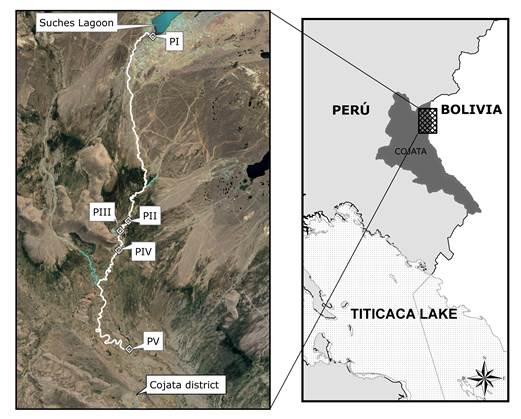
Figure 1
Location of the study area. Source: a self-made elaboration.
Location of the study area. Source: a self-made elaboration.
Table 1
Geolocation of sampling points.
Geolocation of sampling points.
| Sampling Points | South latitude | West longitude | Description |
|---|---|---|---|
| PI | 14° 47’ 44.57” | 69° 20’ 24.85” | Effluent from Suches Lagoon |
| PII | 14° 54’ 28.74” | 69° 21’ 48.33” | Mining dumping collecting zone |
| PIII | 14° 54’ 48.81” | 69° 22’ 8.03” | Agriculture zone |
| PIV | 14° 55’ 30.04” | 69° 22’ 13.8” | Affluents catchment zone from the left bank |
| PV | 14° 59’ 1.22” | 69° 22’ 4.08” | Zone nearby Cojata district capital |
For the valuation of opinions on lived experiences of local agents regarding environmental pollution, we had in mind the participation of local people from Cojata district, which is located in Huancané province at 5000 M.A.S.L, in Puno department (Peru). This town is formed by 16 communities with a total of 769 households (INEI, 2017) and is the first district that receives water from the Suches river (DRA Puno, 2016). Townspeople from Cojata work mostly with agriculture, using the closeness of the river for a freshwater supply (DRA Puno, 2016; Gonzáles & Aparicio, 2009; Huanca, Apaza, & Lazo, 2007).
-
INEI, 2017Censos nacionales 2017, 2017
-
DRA Puno, 2016Síntesis agraria, 2016
-
DRA Puno, 2016Síntesis agraria, 2016
-
Gonzáles & Aparicio, 2009Aprendiendo a adaptarnos al cambio climático en los ámbitos locales: una experiencia de adaptación a nivel local en las regiones de montaña de BoliviaTecnología y Sociedad, 2009
-
Huanca, Apaza, & Lazo, 2007Evaluación del diámetro de fibra en alpacas de las comunidades de los distritos de Cojata y Santa Rosa-PunoArchivos Latinoamericanos de Producción Animal, 2007
Water and sediment sampling
Having in mind the National Protocol for monitoring of water quality of superficial hydric resources of Peru (ANA, 2016) five sampling points have been established, these are described in Table number 1. The samplings were done during the transition of dry to the rainy season in October and December 2019, also in January and February of 2020. At each point 50 ml of water were collected in a falcon kind polyethylene cone-shaped jar 10 cm below water, adding 1 ml of nitric acid, we also collected 250 grams of superficial sediment with a polycarbonate spoon the sediment was put in polyethylene bags with hermetic seal. The samples were kept at 4°C until their analysis at the lab (EPA, 1991)
-
ANA, 2016Protocolo Nacional para el Monitoreo de la Calidad de los Recursos Hídricos Superficiales, 2016
-
EPA, 1991Methods for the determination of metals in environmental samples, 1991
Determination of physical-chemical parameters and heavy metals
Ph, electric conductivity (EC), oxidation-reduction potential (ORP), and temperature were determined in situ, using the multiparameter model HI9829 from the HANNA brand. Also, the field staff registered the turbidity of water in a qualitative form. The samples were quantified in an inductively coupled plasma mass spectrophotometer ICP-MS, Icap Q model Thermo Scientific brand. The concentration of six heavy metals was determined (EPA, 2014) and sediments (EPA, 1996; EPA, 2007): Arsenic (As), Cadmium (Cd), Chromium (Cr), Copper (Cu), Mercury (Hg) y lead (Pb). The concentrations of these metals were evaluated according to Peru’s water quality standards- Category 3 (MINAM, 2017) and Canada’s sediment quality index (Canadian Council of Ministers of the Environment, 1995).
-
EPA, 2014Method 6020B inductively coupled plasma-mass spectrometry, 2014
-
EPA, 1996Method 3050B Acid digestion of sediments, sludges, and soils 1.0 scope and application, 1996
-
EPA, 2007EPA Method 7471B (SW-846): Mercury in solid or semisolid wastes (manual cold-vapor technique), 2007
-
MINAM, 2017Estándares de calidad ambiental para aguaEl Peruano, 2017
-
Canadian Council of Ministers of the Environment, 1995Protocol for the derivation of Canadian sediment quality guidelines for the protection of aquatic life. CCME EPC-98E. Prepared by Environment Canada, Guidelines Division, Technical Secretariat of the CCME Task Group on Water Quality Guidelines, Ottawa. Reprinted in Canadian environmental quality guidelines, Chapter 6, Canadian Council of Ministers of the Environment, 1999, 1995
Methodology for social behavior analysis
For the recollection of data in situ referring to subjectivity and inter-subjectivity of local agents about water quality concerning mining activities. Three qualitative techniques were used (Hernández, Fernández, & Baptista, 2014). In the first stage, we applied the semi-structured guide to 30 deputy governors (authorities from rural zones) that represent Suches river nearby zones (point of study) that allowed us to register the subjective experiences of the local agents. In the second stage, we applied the focal group guide to eight communal authorities and people in charge of the management of crops watering in Cojata District, who have more information about the problematics, this lets us identify and describe the inter-subjectivities of the social agents. Finally, the direct register observation file lets us analyze social actor’s behavior about socio-environmental processes.
-
Hernández, Fernández, & Baptista, 2014Metodología de la investigación, 2014
After all this, we carried out the processing and analysis of the data through qualitative data analysis software Atlas.ti 8, to systematize the data through identification and organization of the testimonies of the local agents in the function of sub-categories where we organized the categories of characterization and river’s social problematic.
Results
Physico-chemical characterization
The PH values of water in the Suches river vary between 6.98 and 7.56, showing minimal variations over the study zone, the electrical conductivity values were between 84.6 and 126 uS/cm, the oxidation-reduction potential varies between 191 and 208 mV. It has been registered that in P1, the turbidity of water was clear and without visible variations, in parts 2 and 3 the turbid state of the river was evident, while in parts 4 and 5, the water looked semi-clear. The river’s temperature fluctuates between 9.04 and 14.3 °C.
Determination of heavy metals in water and sediments.
Table 2 shows the concentration of metals in water, where we can see: As from 0.78 to 6.62 μg L-1; Cr from 1.95 to 10.5 μg L-1; Cu from 2.68 to 6.78 μg L-1; Pb from 0.58 to 5.45 μg L-1, while Cd and Hg are bellow detection levels. All the metals are below the environmental quality standards of water in Peru.
Table 2
The concentration of heavy metals in water.
The concentration of heavy metals in water.
| Sampling points | As μg l-1 | Cd μg l-1 | Cr μg l-1 | Cu μg l-1 | Hg μg l-1 | Pb μg l-1 | |
|---|---|---|---|---|---|---|---|
| PI | 0.78 ±0.084 | BDL | 1.95 ±1.2 | 6.15 ±4.9 | BDL | 0.58 ±0.3 | |
| PII | 5.86 ±4.61 | BDL | 10.5 ±6.7 | 6.02 ±4.7 | BDL | 5.45 ±3.9 | |
| PIII | 6.62 ±3.25 | BDL | 6.24 ±3.0 | 6.78 ±3.2 | BDL | 4.92 ±2.5 | |
| PIV | 4.36 ±2.09 | BDL | 4.2 ±2.2 | 5.52 ±2.6 | BDL | 3.16 ±1.6 | |
| PV | 2.44 ±2.13 | BDL | 3.1 ±2.2 | 2.68 ±2.4 | BDL | 1.95 ±2.1 | |
| Medium Value | 4.01 | --- | 5.2 | 5.43 | --- | 3.21 | |
| DE (1σ) | 2.4 | --- | 3.4 | 1.6 | --- | 2.0 | |
| Medium | 4.36 | --- | 4.2 | 6.02 | --- | 3.16 | |
| Max. | 6.62 | --- | 10.5 | 6.78 | --- | 5.45 | |
| Min. | 0.8 | --- | 1.95 | 2.68 | --- | 0.58 | |
| ECA | water (C-3) | 100 | 10 | --- | 200 | 1 | 50 |
The concentration of these six heavy metals in sediments is shown in Table 3. Cd concentration showed a gap between 0.9 and 1.3 mg Kg-1 with a medium value of 1.14 mg Kg-1 and a homogenous distribution through the study zone that exceeds the ISQG limit of 0.6 mg Kg-1; however, none of the zones present a concentration above the permissible exposure limit of 3.5 mg Kg-1 proposed by MacDonald et al. (2000) . The concentration of As was between 3.6 and 15.5 mg Kg-1 with a medium value of 11.52 mg Kg-1; the PI, PII, PIII, and Pv are over the ISQG limit of 5.9 mg Kg-1, even though all the zones present a concentration below permissible exposure limit of 17 mg Kg-1 (MacDonald et al., 2000).
-
MacDonald et al. (2000)Development and evaluation of consensus-based sediment quality guidelines for freshwater ecosystemsArchives of Environmental Contamination and Toxicology, 2000
-
MacDonald et al., 2000Development and evaluation of consensus-based sediment quality guidelines for freshwater ecosystemsArchives of Environmental Contamination and Toxicology, 2000
Table 3
The concentration of heavy metals in sediments.
The concentration of heavy metals in sediments.
| Sampling points | As mg kg-1 | Cd mg kg-1 | Cr mg kg-1 | Cu mg kg-1 | Hg mg kg-1 | Pb mg kg-1 | |
|---|---|---|---|---|---|---|---|
| PI | 13.5 ± 0.4 | 1.2 ± 0.5 | 15.06 ± 1.7 | 10.48 ± 2.3 | 0.09 ± 0.07 | 11.88 ± 2.6 | |
| PII | 12 ± 6.6 | 0.9 ± 0.4 | 13.98 ± 3.4 | 10.92 ± 3.1 | 0.12 ± 0.07 | 9.7 ± 2.2 | |
| PIII | 13 ± 5.8 | 1.3 ± 0.6 | 15 ± 2.9 | 11.86 ± 3.4 | 0.1 ± 0.04 | 9.82 ± 1.4 | |
| PIV | 3.6 ± 1.6 | 1 ± 0.4 | 13.38 ± 1.1 | 10.02 ± 2.6 | < 0.02 | 9.7 ± 1.2 | |
| PV | 15.5 ± 6.9 | 1.3 ± 0.6 | 13.66 ± 1.9 | 10.98 ± 2.3 | 0.11 ± 0.05 | 10.46 ± 2.5 | |
| Médium value | 11.52 | 1.14 | 14.22 | 10.85 | 0.10 | 10.31 | |
| DE (1σ) | 4.61 | 0.18 | 0.77 | 0.68 | 0.01 | 0.93 | |
| Medium | 13 | 1.2 | 13.98 | 10.92 | 0.11 | 9.82 | |
| Max. | 15.5 | 1.3 | 15.06 | 11.86 | 0.12 | 11.88 | |
| Min. | 3.6 | 0.9 | 13.38 | 10.02 | 0.09 | 9.7 | |
| CEQG | ISQG | 5.9 | 0.6 | 37.3 | 35.7 | 0.17 | 35 |
| PEL | 17 | 3.5 | 90 | 197 | 0.49 | 91.3 | |
Social behavior of local agents
The representative testimonies of local agents based on the interviews processed by Atlas.ti 8 software are shown in Table 4, in which we present the expressions of agent’s social behavior, grouped in 4 analysis sub-categories related to river water quality, cause, contaminating effects, and expectative about mining in Cojata.
Table 4
Testimony of local agents.
Testimony of local agents.
Source: Self-made elaboration, based on interviews, focal group, and direct observation.
All the local agents that were interviewed and the people who participated in the focal group, by consensus, stand that informal mining that is developed at the top of the Suches river basin, generates environmental contamination in Cojata District. Faced with this situation, the agents express rejection of this type of mining, however, they stand that legalization and respect for the technical environmental norms could benefit mining activity and the population from the zone.
Discussion
The analysis of physical-chemical parameters of water in the Suches river indicates that, in general, the PH values, temperature, CE, and oxidation-reduction potential are in normal conditions considering this type of water body (Donaires-Flores, 2017; Iltis & Carmouze, 2003). The variations that gave place to reported values ranks can be because of fluvial precipitations related to monitoring time. The presence of turbid water seen in points 1 and 3 are associated with natural and anthropogenic causes, increasing the number of sediments in suspension.
-
Donaires-Flores, 2017Modeling of Suches River contamination using water quality indexs, Puno-PeruWeber Earth Science & Environmental Engineering, 2017
-
Iltis & Carmouze, 2003El lago Titicaca: síntesis del conocimiento actual, 2003
Is important to emphasize that the tributary rivers and meadows located after point 2 determine the characteristics of the river in parts 3, 4, and 5.
The analyzed metals in the water showed the tendency Cu > Cr > As > Pb. Copper is the metal that shows the biggest concentration in almost every testing point, probably because of natural processes associated with weathering of rocks in the study zone, which mineralogical composition locally merges vulcanite (CuTe) covered by a chain of fluvial deposits, fluvial-glacier, and glaciers, the laters define the morphology of the zone (INGEMMET, 2009).
-
INGEMMET, 2009Inventario y situación legal de las operaciones y concesiones mineras ubicadas en la cuenca del río Suches (Perú-Bolivia), 2009
Due to the low possibility of Cu concentration in sediments, the results of Table 3 confirm that the presence of this metal could be due to natural causes. Favoring the homogeneity of this distribution in the study zone. Furthermore, the metals Cu and Cr tend to create strong complexes through the presence of organic matter (humic substances) in the sediments and then release from the degradation of organic compounds or oxidation of sulfur to sulfate (Botsou, Sungur, Kelepertzis, & Soylak, 2016; Kelepertzis, Botsou, Patinha, Argyraki, & Massas, 2018).
-
Botsou, Sungur, Kelepertzis, & Soylak, 2016Insights into the chemical partitioning of trace metals in roadside and off-road agricultural soils along two major highways in Attica’s region, GreeceEcotoxicology and Environmental Safety, 2016
-
Kelepertzis, Botsou, Patinha, Argyraki, & Massas, 2018Agricultural geochemistry in viticulture: An example of Cu accumulation and geochemical fractionation in Mediterranean calcareous soils (Nemea region, Greece)Applied Geochemistry, 2018
There are important variations regarding the concentrations of As, Cr, and Pb in water corresponding to point 1 and point 2 respectively. This would imply that before point 2 there is a collection of mining waste mostly made from the discharge of mine tailings, typical sterile materials that come from extraction activities, and even organic matter waste. These discharges can contain metal or metalloid particles soluble in water, that assist the stability and transportation depending on the composition of particles and environmental conditions (Langman, Behrens, & Moberly, 2020).
-
Langman, Behrens, & Moberly, 2020Seasonal formation and stability of dissolved metal particles in mining-impacted, lacustrine sedimentsJournal of Contaminant Hydrology, 2020
As is a metalloid commonly associated with metallic mineral deposits such as arsenopyrite (FeAsS) which has an abundant presence according to geological and mineralogical studies on the zone (MINAM 2014) As presents an important concentration charge in water starting in point 2, it is possible that its release in water could be related to extraction and processing of these minerals, that apply the wash and separation methods of the removed material to extract valuable metal (Mamani-Matamet & Marcos-Bonotto, 2019; Villegas et al., 2012).
-
Mamani-Matamet & Marcos-Bonotto, 2019Sedimentation rates at Ramis River, Peruvian Altiplano, South AmericaEnvironmental Earth Sciences, 2019
-
Villegas et al., 2012Environmental pollution produced by gold artisanal mining in the Mapiri river basin, Apolobamba, BoliviaEuropean Mineralogical Conference, 2012
In point 1, the concentration of pb es the lowest (0.58 μg l-1). However, the average concentration in point 2 is 5.45 μg l-1, and it decreases until 1.95 μg l-1 in PV, this concentration behavior may be due to the presence of Pb in the acid drainage of mines (Vieira, Rodriguez, de Paula, Braga & Simões, 2020). Due to its high density, Pb tends to deposit in sediments, quickly occupying the area surface of these particles (Eid & Zawia, 2016), so we can see a homogenous distribution pattern generated by a greater dragging forcé from water in times of flood and bigger superficial drains (Belizario, Capacoila, Huaquisto, Cornejo, & Chui, 2019).
-
Vieira, Rodriguez, de Paula, Braga & Simões, 2020Sustainable treatment of real-mine drainage using crude glycerol and brewery waste as electron donors in a micro-aerobic systemJournal of Water Process Engineering, 2020
-
Eid & Zawia, 2016Consequences of lead exposure, and it’s emerging role as an epigenetic modifier in the aging brainNeurotoxicology, 2016
-
Belizario, Capacoila, Huaquisto, Cornejo, & Chui, 2019Determinación del contenido de fósforo y arsénico, y de otros metales contaminantes de las aguas superficiales del río Coata, afluentes del lago Titicaca, PerúRevista Boliviana de Química, 2019
The mixture of crystalline particles may be caused by the presence of Cd in the Suches river (MINAM, 2014). Donaires-Flores (2017) dismissed the cadmium values found for the determination of water quality in the water of Suches river, considering them insignificant. The presence of Hg in sediments may be due to the use of this element to amalgamate with gold as a technique of mineral recovery, however, in this study, the concentrations of mercury do not exceed the minimum concentrations considered by different normative. A previous study about the concentration of mercury in the Ramis River watershed, an important tributary of Lake Titicaca, concludes that residual exposure and accumulation of mercury in big extensions of water below historical mining zones, it’s five times bigger than in adjacent zones impacted only by outdoor nature and atmospheric deposition (Gammons et al., 2006), this suggests that the disposition of this metal could also be in the lower part of Suches river water, precisely in point five, where the concentration of metals shows important variations being the biggest of the concentration points.
-
MINAM, 2014Estudio del estado de la calidad ambiental de la cuenca del lago Titicaca, 2014
-
Donaires-Flores (2017)Modeling of Suches River contamination using water quality indexs, Puno-PeruWeber Earth Science & Environmental Engineering, 2017
-
Gammons et al., 2006Mercury concentrations of fish, river water, and sediment in the Río Ramis-Lake Titicaca watershed, PeruScience of The Total Environment, 2006
It’s noticeable that the average concentration of all the analyzed metals is bigger in sediment than in water. The possible mechanisms of reduction of metals include the adsorption on clay and other or other solid surfaces, precipitation or co-precipitation of minerals, and biological absorption. It can be expected that a great portion of this mitigated metal charge is transported water down during events of high flow (Gammons et al., 2006).
-
Gammons et al., 2006Mercury concentrations of fish, river water, and sediment in the Río Ramis-Lake Titicaca watershed, PeruScience of The Total Environment, 2006
Speaking about the social behavior of local agents, expressed on their feelings, ideas, attitudes, criticism, and reflection (Weber, 2002), They express the communicative action (Habermas, 1999), questioning the quality of water because they stand that there is contamination on water evidenced in its turbidity, in the deaths toll of alpacas and other problems with community health. This social behavior of communal agents gives into account the presence of heavy metals in the water of Suches river, and that its consumption is affecting human life, animals, and plants (Aliu, Aliu, Mustafi, & Kamberi, 2011; Chibuike & Obiora, 2014); it is also generating various sicknesses (Roman et al., 2013). According to Alvarez-Rodríguez, Rodríguez-Avelló, and Pantoja-Timarán (2005), the use of heavy metals, such as mercury for gold abstraction, inevitably generates contamination to rivers, the land, and even workers, because it does not count with safety measures. In this sense, Betancur-Corredor, Loaiza-Usuga, Denich, and Borgemeister (2018) confirm that gold extraction activities can generate more contamination and environmental degradation, which represents a threat to the natural ecosystems and the health of the communities that live near this zone.
-
Weber, 2002Economía y sociedad. Esbozo de sociología comprensiva, 2002
-
Habermas, 1999Teoría de la acción comunicativa, I. Racionalidad de la acción y racionalización social, 1999
-
Aliu, Aliu, Mustafi, & Kamberi, 2011Environmental pollution in the river Koselska, law, economic and social aspectsThe 2nd International Geography Symposium Geomed, 2011
-
Chibuike & Obiora, 2014Heavy metal polluted soils: Effect on plants and bioremediation methodsApplied and Environmental Soil Science, 2014
-
Roman et al., 2013A sociological study of environmental pollution and its effects on the public health Faisalabad cityInternational Journal of Education and Research, 2013
-
Alvarez-Rodríguez, Rodríguez-Avelló, and Pantoja-Timarán (2005)Methods to reduce mercury pollution in small gold mining operationsRevista de Metalurgia, 2005
-
Betancur-Corredor, Loaiza-Usuga, Denich, and Borgemeister (2018)Gold mining as a potential driver of development in Colombia: Challenges and opportunitiesJournal of Cleaner Production, 2018
This situation in Cojata is a result of informal mining activities in the process of gold exploitation done by the miners, both Bolivians, and Peruvians, what according to Salazar (2014) would be related to the idea of ancestral property and the right upon land and subsoil that the miners claim to possess, and because of this, they would have the right to exploit it freely, generating rejection attitudes and behaviors from the local agents towards informal and illegal mining. For Gonzalez-Rey (2019) this reality will strengthen the skepticism and mistrust from the community social agents because of an erratic response from the state, that has not found a way out of the incapacity to contribute to democracy deepening through the acknowledgment of subordinate social agents, not reaching the objectives and goals for the extension of deadlines that have to do with a formalization process of mining that guarantees better environmental practices (Valdés et al., 2014).
-
Salazar (2014)Tensiones entre la minería y el resto de sectores económicos en el contexto regional: estudios de caso sobre minería informal e ilegalInsumos para el desarrollo del Plan Nacional de Ordenamiento Minero, 2014
-
Gonzalez-Rey (2019)La subjetividad y su significación para el estudio de los procesos políticos: sujeto, sociedad y política, 2019
-
Valdés et al., 2014La minería no formal en el Perú, 2014
Nevertheless, even though there is a feeling of rejection that the agents express, they also identify the positive side of the mining industry, because this activity generates jobs for some of the inhabitants of the zone, as said by Cusiyunca and Morante (2019). From one point, the expectative of life is focused on the continuity of superior education and migration to other cities, in other cases is focused on juvenile employability related or not to gold abstraction, as a previous mean to sustain their possible way to superior education and later settlement in a residence or household in a determined city. For that local agents in Cojata talk about the need for the formalization of mining activities and respect of environmental norms. Carmona-García, Cardona-Trujillo, and Restrepo-Tarquino (2017) stand that the tools for environmental management and a cleaner production would help to minimize the environmental impact during the cycle of mining activity.
-
Cusiyunca and Morante (2019)Expectativas de vida de estudiantes en un contexto de minería informal en la Amazonía de Cusco, Perú, 2019
-
Carmona-García, Cardona-Trujillo, and Restrepo-Tarquino (2017)Gestión ambiental, sostenibilidad y competitividad minera. Contextualización de la situación y retos de un enfoque a través del análisis del ciclo de vidaDYNA, 2017
Based on the analysis of social behavior and the characteristics of the study zone, there is a need for formalization of mining activities obeying the environmental norms. These changes may adjust bilaterally through the system of environmental management and the implementation of clean technologies that minimize the environmental impact of mining activities.
Conclusions
There is evidence of a considerable variation in the concentration of heavy metals in the water and sediments of the Suches river. The heavy metal concentrations decrease in function of the river course, being > Cr > As > Pb the ones below ECA-category 3 for water. In sediment, the concentration of heavy metals varies through the course of the river path, however, As and Cd are above ISQE in most of the points. The presence of metals can be attributed mostly to mining exploitation of secondary deposits of moraine origin where there is the use of traditional technologies for gold extraction and mineralogical composition and weathering of rocks in the study zone.
Based on the analysis of the social behavior of the local agents from Cojata, they associate the turbidity of water with the discharges from mining processes, blaming the bad quality of the water on the presence of mercury, which affects the animal, plant, and human life near the zone. In the context of local agent’s testimonies’, they express rejection towards informal and illegal mining in the zone, that is why they demand the formalization of mining operations and the fulfillment of normative that contribute to the reduction of environmental impact, however, they also stand that there is a positive point about mining, that is because this practice generates employment for some inhabitants of the district.
In general terms, the physical-chemical studies agree with the social behavior of the local agents of Cojata about the quality alteration of water in Suches river due to the presence of heavy metals, however, mercury is not the main cause of the impact generated by mining activities in Cojata, other metals like As, Cd, and Cu are to blame.
Acknowledgments
The authors thank Universidad Nacional del Altiplano - Puno for the funding given to Instituto de Investigación en Metalurgia, Materiales y Medio Ambiente, approved by Resolución Rectoral Nº 3292-2018-R-UNA and funding contract Nº 04-2019-DII-VRI-UNA-PUNO. We also thank Proyecto de Mejoramiento y Ampliación de los Servicios del Sistema Nacional de Ciencia, Tecnología e Innovación Tecnológica 8682-PE, Banco Mundial, CONCYTEC y FONDECYT; also, to Vicerectorado de Investigación de la Universidad Nacional del Altiplano de Puno for the support given for the execution of this Project. Finally, we extend or appreciation to ALS Corplab - Arequipa, for its specialized assistance in the análisis of the simples.
Referencias
- Ali-Khan, A., Tobin, A., Paterson, R., Khan, H., & Warren, R. (2005). Application of CCME Procedures for deriving site-specific water quality guidelines for the CCME Water Quality Index. Water Quality Research Journal of Canada, 40. Recuperado de https://iwaponline.com/wqrj/article-pdf/40/4/448/229970/wqrjc0400448.pdf Links
- Aliu, A., Aliu, S., Mustafi, M., & Kamberi, Z. (2011). Environmental pollution in the river Koselska, law, economic and social aspects. The 2nd International Geography Symposium Geomed, 19, 462-466. Recuperado de https://doi.org/10.1016/j.sbspro.2011.05.155 Links
- Allones-Pérez, C. (2005). Teoría de la acción social: propuesta de un método. Revista de Investigaciones Políticas y Sociológicas, 4(2), 57-68. Links
- Alvarez-Rodríguez, R., Rodríguez-Avelló, A. S., & Pantoja-Timarán, F. (2005). Methods to reduce mercury pollution in small gold mining operations. Revista de Metalurgia, 41(3), 194-203. Recuperado de https://dialnet.unirioja.es/servlet/articulo?codigo=1255923 Links
- ANA, Autoridad Nacional del Agua. (2016). Protocolo Nacional para el Monitoreo de la Calidad de los Recursos Hídricos Superficiales. Resolución Jefatural N° 010-2016-ANA. Lima, Perú: Ministerio de Agricultura y Riego, Autoridad Nacional del Agua. Links
- ANA, Autoridad Nacional del Agua. (2018). Clasificación de cuerpos de agua continentales superficiales. Lima, Perú: Ministerio de Desarrollo Agrario y Riego, Autoridad Nacional del Agua. Links
- ATSDR, Agency for Toxic Substances and Disease Registry. (January 17, 2020). ATSDR’s Substance Priority List. Recuperado de https://www.atsdr.cdc.gov/spl/index.html Links
- ATSDR, Agency for Toxic Substances and Disease Registry. (2006). Toxicological profile: Cyanide. Recuperado de https://www.atsdr.cdc.gov/toxprofiles/tp.asp?id=72&tid=19 Links
- Belizario, G., Capacoila, J., Huaquisto, E., Cornejo, D. A., & Chui, H. N. (2019). Determinación del contenido de fósforo y arsénico, y de otros metales contaminantes de las aguas superficiales del río Coata, afluentes del lago Titicaca, Perú. Revista Boliviana de Química, 36(5), 223-228. Recuperado de https://doi.org/10.34098/2078-3949.36.5.4 Links
- Betancur-Corredor, B., Loaiza-Usuga, J. C., Denich, M., & Borgemeister, C. (October 20, 2018). Gold mining as a potential driver of development in Colombia: Challenges and opportunities. Journal of Cleaner Production, 199, 538-553. Recuperado de https://doi.org/10.1016/j.jclepro.2018.07.142 Links
- Botsou, F., Sungur, A., Kelepertzis, E., & Soylak, M. (2016). Insights into the chemical partitioning of trace metals in roadside and off-road agricultural soils along two major highways in Attica’s region, Greece. Ecotoxicology and Environmental Safety, 132, 101-110. Recuperado de https://doi.org/10.1016/j.ecoenv.2016.05.032 Links
- Buxton, S., Garman, E., Heim, K. E., Lyons-Darden, T., Schlekat, C. E., Taylor, M. D., & Oller, A. R. (2019). Concise review of nickel human health toxicology and ecotoxicology. Inorganics, 7(7), 89. Recuperado de https://doi.org/10.3390/inorganics7070089 Links
- Canadian Council of Ministers of the Environment. (1995). Protocol for the derivation of Canadian sediment quality guidelines for the protection of aquatic life. CCME EPC-98E. Prepared by Environment Canada, Guidelines Division, Technical Secretariat of the CCME Task Group on Water Quality Guidelines, Ottawa. Reprinted in Canadian environmental quality guidelines, Chapter 6, Canadian Council of Ministers of the Environment, 1999. Winnipeg, Canada: Canadian Council of Ministers of the Environment. Links
- Carmona-García, U., Cardona-Trujillo, H., & Restrepo-Tarquino, I. (2017). Gestión ambiental, sostenibilidad y competitividad minera. Contextualización de la situación y retos de un enfoque a través del análisis del ciclo de vida. DYNA (Colombia), 84(201), 50-58. Recuperado de https://doi.org/10.15446/dyna.v84n201.60326 Links
- Chapin, F. S., Folke, C., & Kofinas, G. P. (2009). A framework for understanding change. In: Principles of Ecosystem Stewardship: Resilience-Based Natural Resource Management in a Changing World (pp. 3-28). Recuperado de https://doi.org/10.1007/978-0-387-73033-2_1 Links
- Chau, Y. K., & Kulikovsky-Cordeiro, O. T. (1995). Occurrence of nickel in the Canadian environment. Environmental Reviews, 3(1), 95-120. Recuperado de https://doi.org/10.1139/a95-004 Links
- Chibuike, G. U., & Obiora, S. C. (2014). Heavy metal polluted soils: Effect on plants and bioremediation methods. Applied and Environmental Soil Science, 2014, 752708. Recuperado de https://doi.org/10.1155/2014/752708 Links
- Cusiyunca, A., & Morante, V. (2019). Expectativas de vida de estudiantes en un contexto de minería informal en la Amazonía de Cusco, Perú. Recuperado de https://www.researchgate.net/Alex_Cusiyunca Links
- Dogaru, D., Zobrist, J., Balteanu, D., Popescu, C., Sima, M., Amini, M., & Yang, H. (2009). Community perception of water quality in a mining-affected area: A case study for the Certej Catchment in the Apuseni Mountains in Romania. Environmental Management, 43, 43, 1131-1145. Recuperado de https://doi.org/10.1007/s00267-008-9245-9 Links
- Donaires-Flores, T. (2017). Modeling of Suches River contamination using water quality indexs, Puno-Peru. Weber Earth Science & Environmental Engineering, 3(1), 1-8. Recuperado de http://www.weberpub.org/wesee.htm Links
- DRA Puno, Dirección Regional Agraria de Puno. (2016). Síntesis agraria. Recuperado de https://www.agropuno.gob.pe/files/estadistica/sintesis/sintesis_agrario_08_2017.pdf Links
- Eid, A., & Zawia, N. (2016). Consequences of lead exposure, and it’s emerging role as an epigenetic modifier in the aging brain. Neurotoxicology, 56(2015), 254-261. Recuperado de https://doi.org/10.1016/j.neuro.2016.04.006 Links
- EPA, Environmental Sampling and Analytical Methods (ESAM Program) . (2014). Method 6020B inductively coupled plasma-mass spectrometry. Cincinnati, USA: U.S. Environmental Protection Agency. Links
- EPA, Environmental Sampling and Analytical Methods (ESAM Program). (2007). EPA Method 7471B (SW-846): Mercury in solid or semisolid wastes (manual cold-vapor technique). Cincinnati, USA: U.S. Environmental Protection Agency . Links
- EPA, Environmental Sampling and Analytical Methods (ESAM Program). (1996). Method 3050B Acid digestion of sediments, sludges, and soils 1.0 scope and application. Cincinnati, USA: U.S. Environmental Protection Agency . Links
- EPA, Environmental Sampling and Analytical Methods (ESAM Program). (1991). Methods for the determination of metals in environmental samples. Cincinnati, USA: U.S. Environmental Protection Agency . Links
- Flores, C. M., Del-Angel, E., Frías, D. M., & Gómez, A. L. (2018). Evaluation of physicochemical parameters and heavy metals in water and surface sediment in the ilusiones Lagoon, Tabasco, Mexico. Tecnología y ciencias del agua, 9(2), 39-57. Recuperado de https://doi.org/10.24850/j-tyca-2018-02-02 Links
- Gammons, C. H., Slotton, D. G., Gerbrandt, B., Weight, W., Young, C. A., McNearny, R. L., & Tapia, H. (2006). Mercury concentrations of fish, river water, and sediment in the Río Ramis-Lake Titicaca watershed, Peru. Science of The Total Environment, 368(2-3), 637-648. Recuperado de https://doi.org/10.1016/J.SCITOTENV.2005.09.076 Links
- Genthe, B., Kapwata, T., Le-Roux, W., Chamier, J., & Wright, C. Y. (2018). The reach of human health risks associated with metals/metalloids in water and vegetables along a contaminated river catchment: South Africa and Mozambique. Chemosphere, 199, 1-9. Recuperado de https://doi.org/10.1016/j.chemosphere.2018.01.160 Links
- Gonzáles, J., & Aparicio, M. (2009). Aprendiendo a adaptarnos al cambio climático en los ámbitos locales: una experiencia de adaptación a nivel local en las regiones de montaña de Bolivia. Tecnología y Sociedad, 16(8), 54-64. Links
- González-Rey, F. (2019). La subjetividad y su significación para el estudio de los procesos políticos: sujeto, sociedad y política. Bogotá, Colombia: CLACSO - Consejo Latinoamericano de Ciencias Sociales. Links
- Habermas, J. (1999). Teoría de la acción comunicativa, I. Racionalidad de la acción y racionalización social. Madrid, España: Taurus Humanidades. Links
- Hernández, R., Fernández, C., & Baptista, P. (2014). Metodología de la investigación (6ª ed.). México, DF, México; McGraw-Hill / Interamericana Editores. Recuperado de https://periodicooficial.jalisco.gob.mx/sites/periodicooficial.jalisco.gob.mx Links
- Hilson, G. M. (2005). The socio-economic impacts of artisanal and small-scale mining in developing countries. Recuperado de https://books.google.com.pe/books?hl=es&lr=&id=yEJ5AgAAQBAJ&oi=fnd&pg=PP1&dq=sociological+of+mine+metal+pollution&ots=ncVKKiQFU1&sig=WrDzAWSfnMwIJ-aFUMyP8fD_8LI#v=onepage&q=sociological of mine metal pollution&f=false Links
- Himley, M. (2014). Monitoring the impacts of extraction: Science and participation in the governance of mining in Peru. Environment and Planning A: Economy and Space, 46(5), 1069-1087. Recuperado de https://doi.org/10.1068/a45631 Links
- Hodges, C. A. (1995). Mineral resources, environmental issues, and land use. Science, 268(5215), 1305-1312. Recuperado de https://doi.org/10.1126/science.268.5215.1305 Links
- Huanca, T., Apaza, N., & Lazo, A. (2007). Evaluación del diámetro de fibra en alpacas de las comunidades de los distritos de Cojata y Santa Rosa-Puno. Archivos Latinoamericanos de Producción Animal, 2(1) 1-8. Links
- Iltis, A., & Carmouze, J. (2003). El lago Titicaca: síntesis del conocimiento actual. Cusco, Perú: HISBOL. Links
- Iltis, A., Carmouze, J., & Lemoalle, J. (1991). El Lago Titicaca, síntesis del conocimiento limnológico actual. La Paz, Bolivia: HISBOL. Links
- INEI, Instituto Nacional de Estadística e Informática. (2017). Censos nacionales 2017. Recuperado de https://www.inei.gob.pe Links
- INGEMMET, Instituto Geológico, Minero y Metalúrgico. (2009). Inventario y situación legal de las operaciones y concesiones mineras ubicadas en la cuenca del río Suches (Perú-Bolivia). Recuperado de https://www.ingemmet.gob.pe/documents/73138/177527/Asistencia+técnica+a+la+minería+de+pequeña+escala Links
- Islam, M. S., Ahmed, M. K., Raknuzzaman, M., Habibullah-Al-Mamun, M., & Islam, M. K. (2015). Heavy metal pollution in surface water and sediment: A preliminary assessment of an urban river in a developing country. Ecological Indicators, 48, 282-291. Recuperado de https://doi.org/10.1016/j.ecolind.2014.08.016 Links
- Jain, R. K., Kapur, M., Labana, S., Banwari, L., & Sarma, P. M. (2005). Microbial diversity: Application of microorganisms for the biodegradation of xenobiotics. JSTOR, 89. Recuperado de https://www.jstor.org/stable/24110436?seq=1 Links
- Kelepertzis, E., Botsou, F., Patinha, C., Argyraki, A., & Massas, I. (2018). Agricultural geochemistry in viticulture: An example of Cu accumulation and geochemical fractionation in Mediterranean calcareous soils (Nemea region, Greece). Applied Geochemistry, 88, 23-39. Recuperado de https://doi.org/10.1016/j.apgeochem.2017.04.013 Links
- Laffaye, G. J. (2013). Tiempo, significación y memoria en la fenomenología social de Alfred Schutz. Pilquen-Sección Ciencias Sociales, 16(1), 1-13. Links
- Langman, J. B., Behrens, D., & Moberly, J. G. (2020). Seasonal formation and stability of dissolved metal particles in mining-impacted, lacustrine sediments. Journal of Contaminant Hydrology, 232, 103655. Recuperado de https://doi.org/10.1016/j.jconhyd.2020.103655 Links
- Liang, B., Han, G., Zeng, J., Qu, R., Liu, M., & Liu, J. (2020). Spatial variation and source of dissolved heavy metals in the Lancangjiang river, Southwest China. International Journal of Environmental Research and Public Health, 17(3). Recuperado de https://doi.org/10.3390/ijerph17030732 Links
- López, M. C. (1995). La sociofenomenología de A. Schütz: entre el constructivismo y el realismo. Papers. Revista de Sociología, 47, 55-74. Links
- Lorenc, F. (2014). Émile Durkheim y la teoría sociológica de la acción. Andamios Revista de Investigación Social, 11(26), 299-322. Links
- Lu, H., Li, H., Liu, T., Fan, Y., Yuan, Y., Xie, M., & Qian, X. (2019). Simulating heavy metal concentrations in an aquatic environment using artificial intelligence models and physicochemical indexes. Science of the Total Environment, 694, 133591. Recuperado de https://doi.org/10.1016/j.scitotenv.2019.133591 Links
- Lutz, B. (2010). La acción social en la teoría sociológica: una aproximación. Argumentos, 23(64), 199-218. Links
- MacDonald, D. D., Ingersoll, C. G., & Berger, T. A. (2000). Development and evaluation of consensus-based sediment quality guidelines for freshwater ecosystems. Archives of Environmental Contamination and Toxicology, 39(1), 20-31. Recuperado de https://doi.org/10.1007/s002440010075 Links
- Mamani-Matamet, F. R., & Marcos-Bonotto, D. (2019). Sedimentation rates at Ramis River, Peruvian Altiplano, South America. Environmental Earth Sciences, 78(6). Recuperado de https://doi.org/10.1007/s12665-019-8233-0 Links
- McIntyre, N., Bulovic, N., Cane, I., & McKenna, P. (2016). A multi-disciplinary approach to understanding the impacts of mines on traditional uses of water in Northern Mongolia. Science of the Total Environment, 557-558, 404-414. Recuperado de https://doi.org/10.1016/j.scitotenv.2016.03.092 Links
- Milanez, B., & Puppim-de-Oliveira, J. A. (2013). Innovation for sustainable development in artisanal mining: Advances in a cluster of opal mining in Brazil. Resources Policy, 38(4), 427-434. Recuperado de https://doi.org/10.1016/j.resourpol.2013.07.003 Links
- MINAM, Ministerio del Ambiente. (2017). Estándares de calidad ambiental para agua. El Peruano, 6-9. Recuperado de http://www.minam.gob.pe/wp-content/uploads/2017/06/DS-004-2017-MINAM.pdf Links
- MINAM, Ministerio del Ambiente. (2014). Estudio del estado de la calidad ambiental de la cuenca del lago Titicaca. Recuperado de http://www.minam.gob.pe/puno/wp-content/uploads/sites/55/2014/02/ESTUDIO-DEL-ESTADO-DE-LA-CALIDAD-AMBIENTAL-CUENCA-DEL-TITICACA.pdf Links
- Molina, C. I., & Pouilly, M. (2016). Mercurio en Bolivia: línea base de usos, emisiones y contaminación 2014, La Paz-Bolivia. Recuperado de www.cancilleria.gob.bo Links
- Morales, D., Molares, S., Epele, L., Ladio, A., Manzo, P., & Alday, G. (2020). An interdisciplinary approach to perception of water quality for human consumption in a Mapuche community of arid Patagonia, Argentina. Science of the Total Environment, 720, 137508. Recuperado de https://doi.org/10.1016/j.scitotenv.2020.137508 Links
- OMS, Organización Mundial de la Salud. (2006). Preocupaciones en materia de salud y medio ambiente asociadas con los metales pesados: ¿Necesidad de una acción mundial ulterior? Ginebra, Suiza: Organización Mundial de la Salud. Links
- Paul, D. (2017a). Research on heavy metal pollution of river Ganga: A review. Annals of Agrarian Science, 15(2), 278-286. Recuperado de https://doi.org/10.1016/j.aasci.2017.04.001 Links
- Paul, J. (2017b). Ecological and sociological implications of Tisza River Mine tailings pollution and effect of chronic cadmium exposure on fish physiology. Dissertations. Recuperado de https://opensiuc.lib.siu.edu/dissertations/1450 Links
- Pengli, C. (2008). The sociological research on “Minamata Disease” in Japan. Journal of Hohai University (Philosophy and Social Sciences). Recuperado de http://en.cnki.com.cn/Article_en/CJFDTotal-HHZX200804011.htm Links
- Pino, E., Tacora, P., Steenken, A., Alfaro, L., Valle, A., Chávarri, E., & Mejía-Marcacuzco, J. A. (2017). Efecto de las características ambientales y geológicas sobre la calidad del agua en la cuenca del río Caplina, Tacna, Perú. Tecnología y ciencias del agua, 8(6), 77-99. Recuperado de https://doi.org/10.24850/j-tyca-2017-06-06 Links
- Rahim, M. A. C. A., A/l Aproi, A., Shi, X., Liu, S., Ali, M. M., Yaacob, W. Z. W., & Mohamed, C. A. R. (2019). Distribution of chromium and gallium in the total suspended solid and surface sediments of Sungai Kelantan, Kelantan, Malaysia. Sains Malaysiana, 48(11), 2343-2353. Recuperado de https://doi.org/10.17576/jsm-2019-4811-06 Links
- Rodriguez, M. B., & Ulanowicz, R. E. (2015). Water Culture requires fighting corruption and promoting many RRRRRRs. Weber Earth Science & Environmental Engineering, 1(2), 1-4. Links
- Roman, M., Idrees, M., Ullah, S., Idrees, M., Sahib, N., & Roman, M. (2013). A sociological study of environmental pollution and its effects on the public health Faisalabad city. International Journal of Education and Research, 1(6). Recuperado de www.ijern.com Links
- Salazar, J. C. (2014). Tensiones entre la minería y el resto de sectores económicos en el contexto regional: estudios de caso sobre minería informal e ilegal. En: Ediciones Uniandes (ed.). Insumos para el desarrollo del Plan Nacional de Ordenamiento Minero (pp. 573-630). Recuperado de http://ediciones.uniandes.edu.co Links
- Sánchez-Infantas, E., & Quinteros-Carlos, Z. (2017). Pertinencia del concepto de estándar de calidad ambiental (ECA) en la gestión de sistemas ambientales con varios estados alternativos. Estudio de caso de una experiencia peruana. Ecología Aplicada, 16, 151. Links
- Santos-Frances, F., Martinez-Grana, A., Alonso-Rojo, P., & Garcia-Sanchez, A. (2017). Geochemical background and baseline values determination and spatial distribution of heavy metal pollution in soils of the Andes Mountain Range (Cajamarca-Huancavelica, Peru). International Journal of Environmental Research and Public Health, 14(8). Recuperado de https://doi.org/10.3390/ijerph14080859 Links
- Toledo, U. (2007). Realidades múltiples y mundos sociales. Introducción a la socio-fenomenología. Cinta de Moebio, (30), 211-244. Links
- Topalián, M. L., Castañé, P. M., Rovedatti, M. G., & Salibián, A. (1999). Principal component analysis of dissolved heavy metals in water of the Reconquista River (Buenos Aires, Argentina). Bulletin of Environmental Contamination and Toxicology, 63(4), 484-490. Recuperado de https://doi.org/10.1007/s001289901006 Links
- Ural, S., & Demirkol, S. (2008). Evaluation of occupational safety and health in surface mines. Safety Science, 46(6), 1016-1024. Recuperado de https://doi.org/10.1016/j.ssci.2007.11.010 Links
- Valdés, R., Basombrío, C., & Vera, D. (2014). La minería no formal en el Perú. Recuperado de www.eerp.usp.br/rlaehttp://dx.doi.org/10.1590/1518-8345.0000.2866 Links
- Vieira, B. F., Rodriguez, R. P., De-Paula, E. C., Braga, J. K., & Simões, G. F. (2020). Sustainable treatment of real-mine drainage using crude glycerol and brewery waste as electron donors in a micro-aerobic system. Journal of Water Process Engineering, 36, 101297. Recuperado de https://doi.org/10.1016/j.jwpe.2020.101297 Links
- Villegas, K. S., Alfonso, P., Higueras, P., Palacios, S., Esbrí, J. M., & García-Noguero, E. M. (2012). Environmental pollution produced by gold artisanal mining in the Mapiri river basin, Apolobamba, Bolivia. European Mineralogical Conference, 1(1), 1. Links
- Wang, Z., Qin, H., & Liu, X. (2019). Health risk assessment of heavy metals in the soil-water-rice system around the Xiazhuang uranium mine, China. Environmental Science and Pollution Research, 26(6), 5904-5912. Recuperado de https://doi.org/10.1007/s11356-018-3955-1 Links
- Weber, M. (2002). Economía y sociedad. Esbozo de sociología comprensiva (2da. reimp). Madrid, España: Fondo de Cultura Económica. Links
- Yi, L., Gao, B., Liu, H., Zhang, Y., Du, C., & Li, Y. (2020). Characteristics and assessment of toxic metal contamination in surface water and sediments near a Uranium mining area. International Journal of Environmental Research and Public Health, 17(2). Recuperado de https://doi.org/10.3390/ijerph17020548 Links
- Zotou, I., Tsihrintzis, V. A., & Gikas, G. D. (2020). Water quality evaluation of a lacustrine water body in the Mediterranean based on different water quality index (WQI) methodologies. Journal of Environmental Science and Health - Part A Toxic/Hazardous Substances and Environmental Engineering. Recuperado de https://doi.org/10.1080/10934529.2019.1710956 Links