Artículo de Revisión
Prominent wood protection methods

-
Publication dates-
October 22, 2024
Jul-Aug , 2024
- Article in PDF
- Article in XML
- Automatic translation
- Send this article by e-mail
- Share this article +
Abstract
Wood is a material widely used in construction, furniture, and other applications. Technologies are used to protect its quality and durability against biological damage and the effects of water, temperature and radiation that affect its physical and mechanical properties. The present work reviews the available treatments, evaluates their advantages and disadvantages, and defines the criteria for their use. The theme was divided into two sections: (I) Wood degrading agents, and (II) A classification of protection technologies that included both the traditional methods and novel approaches such as nanotechnology. The conclusions obtained with this approach point to the fact that several traditional chemical treatments substantially reduce biological damage and moisture absorption in wood. However, potential health and environmental effects should be considered. On the other hand, the dimensional stability of the wood is improved through the use of heat treatments. The use of nanometric composites for wood protection is a very promising technique that is under increasing development. However, it is a technology that requires special care because the nanomaterials must be toxic to the agents causing biodeterioration, but harmless or less hazardous to humans and the environment.
Key words:
Wood degradation, durability, nanotechnology, wood protection, chemical treatments, heat treatments
Introduction
According to FAO (2022), the annual global industrial production of wood in 2020 was approximately 3.9 billion cubic meters destined for fuel or roundwood, 473 million cubic meters were produced as sawn timber, and 367 million cubic meters, as materials derived from the wood. The demand for these products, mainly roundwood, is expected to reach 6 billion cubic meters by 2050 (Barua et al., 2014).
-
FAO (2022)Forestry Production and Trade, 2022
-
Barua et al., 2014Plantation vision: Potentials, challenges and policy options for global industrial forest plantation developmentInternational Forestry Review, 2014
Wood protection is crucial in the global timber market, which faces the challenge of preserving it against biodegradation and exposure to water. This challenge can be solved with the help of protection technologies (Chen et al., 2020). As a response, methods have been developed to treat the wood using different protection strategies to improve its resistance to biodegradation.
-
Chen et al., 2020Structure-property-function relationships of natural and engineered woodNature Reviews Materials, 2020
In this regard, the quality, protection and resistance to degradation of wood products depends on such factors as humidity, temperature, wood density, and protection treatments (Gérardin, 2016).
-
Gérardin, 2016New alternatives for wood preservation based on thermal and chemical modification of wood-A reviewAnnals of Forest Science, 2016
UNE-EN 350 (Asociación Española de Normalización, 2017) classifies wood into four categories according to its ease of treatment: Class I, easy to treat; Class II, moderately easy to treat; Class III, difficult to treat; and Class IV, extremely difficult to treat. This standard establishes methods for assessing and classifying the durability of wood, understood as its ability to resist decay and decomposition against fungi, termites, and marine organisms (Reinprecht, 2016), and it is applicable even to treated or modified wood. The use of such a standard is crucial to provide a recognized standardized framework allowing comparison, as well as adding credibility by supporting the information with accepted standards and offering practical guidance through specific criteria and tests. In addition, its reference is essential to determine the commercial quality of the wood.
-
Asociación Española de Normalización, 2017UNE-EN 350:2016 Durabilidad de la madera y de los productos derivados de la madera. Ensayos y clasificación de la resistencia a los agentes biológicos de la madera y de los productos derivados de la madera, 2017
-
Reinprecht, 2016Wood deterioration, protection and maintenance, 2016
In this sense, in recent years, several works have been carried out to show affordable and environmentally friendly alternatives for the protection of wood. Some of these protection treatments are well-known and widely used in the industry, such as the traditional ones described by Peraza (2002), while others are more novel and involve nanotechnological techniques such as those described by Teng et al. (2018) and Jasmani et al. (2020).
-
Peraza (2002)Protección preventiva de la madera, 2002
-
Teng et al. (2018)Conventional technology and nanotechnology in wood preservation: A reviewBioResources, 2018
-
Jasmani et al. (2020)Application of nanotechnology in wood-based products industry: A reviewNanoscale Research Letters, 2020
The objective of this paper is to provide a general review of the main techniques currently available for wood protection and to evaluate their advantages and disadvantages. First, wood degrading agents will be discussed, followed by a classification of protection technologies ranging from traditional methods to modern and novel approaches such as nanotechnology.
Wood degrading agents
Table 1 presents a classification of the most important agents affecting the durability of wood, their effects and the most recent reference research proposing different protective treatments. In general, a distinction is made between biotic and abiotic agents. The former refer to living organisms, and the latter, to physical and chemical components of the environment.
Table 1
Factors influencing wood degradation, damages, and proposed protective treatments.
Factors influencing wood degradation, damages, and proposed protective treatments.
| Agents | Damages | Treatments proposed | Research of reference | |
|---|---|---|---|---|
| Biotics | Xylophagous |
Mechanical properties |
Acetylation Furfurylation |
Goodell et al. (2020)
|
| Xylophagous |
Destruction of the cell walls |
Impregnation of soluble resins or polysaccharides |
Rust y Su (2012)
|
|
| Crustaceans and |
Perforations in wood used in vessels | Impregnation of soluble resins or polysaccharides |
Marais et al. (2022) | |
| Abiotics | Water | Shrinkage and swelling |
Acetylation DMDHEU (1,3-dimethiol-4,5-dihydroxyethyleneurea) |
Rowell (2020)
|
| UV rays | Coloring |
Impregnation of soluble resins or polysaccharides |
McKinley et al. (2019)
|
|
| Thermal |
Elimination of volatile |
DMDHEU (1,3-dimethiol-4,5-dihydroxyethyleneurea) |
Reinprecht (2016)
|
|
| Degradation by |
Degradation of cellulose and |
Varnishes or protective coatings |
Peraza (2002)
|
-
Goodell et al. (2020)Fungal degradation of wood: Emerging data, new insights and changing perceptionsCoatings, 2020
-
Broda (2020)Natural compounds for wood protection against fungi-A reviewMolecules, 2020
-
Martha et al. (2021)Effect of furfurylation treatment on technological properties of short rotation teak woodJournal of Materials Research and Technology, 2021
-
Marais et al. (2022)Wood durability in terrestrial and aquatic environments-A review of biotic and abiotic influence factorsWood Material Science & Engineering, 2022
-
Rust y Su (2012)Managing social insects of urban importanceAnnual Review of Entomology, 2012
-
Yang et al. (2022)Effects of acetylation on moisture sorption of wood under cyclically changing conditions of relative humidityEuropean Journal of Wood and Wood Products, 2022
-
Marais et al. (2022)Wood durability in terrestrial and aquatic environments-A review of biotic and abiotic influence factorsWood Material Science & Engineering, 2022
-
Rowell (2020)Innovation in wood preservationPolymers, 2020
-
Wang et al. (2021)In-situ cross-linking of waterborne epoxy resin inside wood for enhancing its dimensional stability, thermal stability, and decay resistanceACS Applied Polymer Materials, 2021
-
Goodell et al. (2020)Fungal degradation of wood: Emerging data, new insights and changing perceptionsCoatings, 2020
-
Marais et al. (2022)Wood durability in terrestrial and aquatic environments-A review of biotic and abiotic influence factorsWood Material Science & Engineering, 2022
-
McKinley et al. (2019)Understanding the effect of weathering on adhesive bonds for wood composites using digital image correlation (DIC)Holzforschung: International Journal of the Biology, Chemistry, Physics, & Technology of Wood, 2019
-
De Avila et al. (2019)Discolouration of heat-treated fast-growing Eucalyptus wood exposed to natural weatheringCellulose Chemistry and Technology, 2019
-
Reinprecht (2016)Wood deterioration, protection and maintenance, 2016
-
De Avila et al. (2019)Discolouration of heat-treated fast-growing Eucalyptus wood exposed to natural weatheringCellulose Chemistry and Technology, 2019
-
Peraza (2002)Protección preventiva de la madera, 2002
-
Xu et al. (2020)Chemical structure and mechanical properties of wood cell walls treated with acid and alkali solutionForests, 2020
The main factors of wood degradation, understood as damage to the wood structure that can be initiated at both higher and molecular levels, include abiotic or atmospheric agents such as moisture, UV rays, and temperature, together with the presence of xylophagous organisms (Reinprecht, 2016). Exposure to sunlight and thermal decay affect the adhesion of coatings and the appearance of wood structures, leading to early replacement (McKinley et al., 2019).
-
Reinprecht, 2016Wood deterioration, protection and maintenance, 2016
-
McKinley et al., 2019Understanding the effect of weathering on adhesive bonds for wood composites using digital image correlation (DIC)Holzforschung: International Journal of the Biology, Chemistry, Physics, & Technology of Wood, 2019
On the other hand, moisture variations in the environment favor the growth of microorganisms that damage wood and affect its quality and properties, especially outdoors and in contact with the ground (Marais et al., 2022).
-
Marais et al., 2022Wood durability in terrestrial and aquatic environments-A review of biotic and abiotic influence factorsWood Material Science & Engineering, 2022
The main wood degrading agents are fungi, which cause different types of rot, such as white rot, brown rot, soft rot, mold rot, and blue stain, the latter having only an aesthetic effect on the wood. Fungi, with the exception of those causing blue stain, damage the structure of the wood, reducing its strength and visual appeal (Broda, 2020).
-
Broda, 2020Natural compounds for wood protection against fungi-A reviewMolecules, 2020
Insects also damage wood, the most economically relevant being termites. Although only a small percentage of these cause damage, their global economic impact in 2010 was estimated at US $40 billion (Rust and Su, 2012). In addition, marine borers, such as crustaceans and bivalves, bore into the wood of ships, destroying it over time (Marais et al., 2022).
-
Rust and Su, 2012Managing social insects of urban importanceAnnual Review of Entomology, 2012
-
Marais et al., 2022Wood durability in terrestrial and aquatic environments-A review of biotic and abiotic influence factorsWood Material Science & Engineering, 2022
Development and Discussion
In order to establish a certain type of wood protection treatment or preservative to be used, several aspects must be considered. These include the type of wood to be preserved (coniferous or broadleaf), the level of risk of deterioration to the particular service environment, the function the wood will serve (structural, ornamental, container, etc.), and the required service life.
On the one hand, there are hardwoods that are resistant and do not require any treatment for protection. On the other hand, there are softwoods with less natural durability. Figure 1 shows a classification of wood protection technologies.
Thumbnail
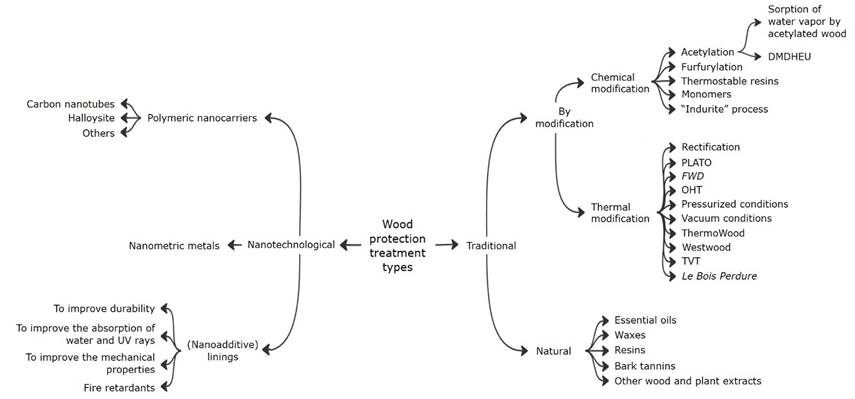 Based on Gérardin (2016), Sandberg et al. (2017), Teng et al. (2018), Papadopoulos et al. (2019), Teacă et al. (2019), Jasmani et al. (2020), and Khademibami and Bobadilha (2022).
Figure 1
Treatments used for wood protection.
Treatments used for wood protection.
Traditional treatments by chemical modification
In chemical modification treatments, as a traditional treatment, the cell wall of the wood is reacted with low molecular weight active monomers or oligomers under certain conditions such as high temperature heating. Chemicals can also be introduced into cell cavities such as lumens and vessels in such a way as to block the physical channels and reduce the access of water into the cell walls of the wood (Xie et al., 2013).
-
Xie et al., 2013Effects of chemical modification on the mechanical properties of woodEuropean Journal of Wood and Wood Products, 2013
In this regard, it is worth mentioning that acetylation is a chemical process in which the free hydroxyl groups of the wood cell wall are converted into acetyl groups and all the weight gained by the acetyl is converted into units of occluded hydroxyl groups. This technique can significantly reduce water absorption and improve resistance to fungal and insect attacks (Yang et al., 2022). However, acetylation presents some disadvantages, such as partial lignin degradation, and deformation and cracking of refractory woods. This, in turn, leads to poor quality and performance (Martins et al., 2019).
-
Yang et al., 2022Effects of acetylation on moisture sorption of wood under cyclically changing conditions of relative humidityEuropean Journal of Wood and Wood Products, 2022
-
Martins et al., 2019Portuguese hardwoods: an overview of its potential for construction purposesInternational Scientific Conference on Hardwood Processing, 2019
Another method is furfurylation, which consists of impregnating the wood with furfuryl alcohol, obtained by processing furfural, a compound derived from biomass by-products. This technique reduces water absorption and, therefore, fungal attack (Martha et al., 2021). However, its limitations include the fact that the weight of the catalyst must be small for it to penetrate the pores effectively (Bi et al., 2021).
-
Martha et al., 2021Effect of furfurylation treatment on technological properties of short rotation teak woodJournal of Materials Research and Technology, 2021
-
Bi et al., 2021Effects of chemical modification and nanotechnology on wood propertiesNanotechnology Reviews, 2021
Furfurylation is suitable for wood species with higher porosity and loose and tidy structures (Dong et al., 2016). Wood treated with furfuryl alcohol has higher hardness and stiffness, good appearance and texture similar to tropical timbers. It can be used for decking boards. Acetylated wood, on the other hand, has greater biological durability and dimensional stability. Therefore, it is good joinery products and for various structural applications (Mantanis, 2017); however, the manufacturing costs are higher (Bi et al., 2021).
-
Dong et al., 2016Assessment of the performance of furfurylated wood and acetylated wood: Comparison among four fast-growing wood speciesBioResources, 2016
-
Mantanis, 2017Chemical modification of wood by acetylation or furfurylation: A review of the present scaled-up technologiesBioResources, 2017
-
Bi et al., 2021Effects of chemical modification and nanotechnology on wood propertiesNanotechnology Reviews, 2021
Among the impregnating materials, resins are a widely used and versatile group in the protection of wood. Their main purpose is to stabilize or reinforce the dimensions of the wood because they polymerize or cross-link easily (Wang et al., 2021). However, their use may present disadvantages, such as possible degradation due to weathering, difficulty in achieving uniform application, and the potential environmental impact associated with chemical compounds present in certain resins (Stefanowski et al., 2018).
-
Wang et al., 2021In-situ cross-linking of waterborne epoxy resin inside wood for enhancing its dimensional stability, thermal stability, and decay resistanceACS Applied Polymer Materials, 2021
-
Stefanowski et al., 2018Review of the use of PF and related resins for modification of solid woodTimber, 2018
Schardosin et al. (2020) point out that impregnation with kerosene emulsions could be a substitute for acetylation, if the objective is to reduce water absorption. However, they also indicate that particle size influences the penetration of the wax into the wood.
-
Schardosin et al. (2020)Comparison of the effects of acetylation and paraffin emulsion impregnation in Pinus caribeaeJournal of Tropical Forest Science, 2020
Traditional treatments by thermal modification
Thermal modification of wood began in 1915 in Wisconsin, USA, but did not become known throughout the world until the 1970s and 1980s. The process usually occurs at a temperature of 150 to 240 °C, and its main objective is to improve dimensional stability and microbial resistance (Hill et al., 2021). However, these treatments have certain drawbacks. First, they significantly affect the fracture toughness of the wood (Khademibami and Bobadilha, 2022); in addition, they modify the color of the wood, especially that of tropical woods. The current challenge is to find the balance between improved protection against agents, the loss of resistance, the preservation of the original color, and the improvement of the equipment used in the application of these treatments (Gu et al., 2019).
-
Hill et al., 2021Thermal modification of wood-a review: chemical changes and hygroscopicityJournal of Materials Science, 2021
-
Khademibami and Bobadilha, 2022Recent developments studies on wood protection research in academia: A reviewFrontiers in Forests and Global Change, 2022
-
Gu et al., 2019Development of wood heat treatment research and industrializationJournal of Forestry Engineering, 2019
Currently, there is a wide variety of processes for the thermal modification of wood. Table 2 lists the main commercial heat treatment processes used in Europe.
Table 2
Treatments used for thermal modification of timbers.
Treatments used for thermal modification of timbers.
| Process | Temperature |
Duration (h) | Pressure |
Utilized |
References |
|---|---|---|---|---|---|
|
FWD |
120-180 | ≈15 | 0.5-0.6 | Vapor | Sandberg et al. (2017) |
| 160-180 | 7-10 bar | Saturated vapor | Acosta-Acosta et al. (2021) | ||
| PLATO |
150-180/ |
4-5/ |
(Partially) |
Saturated vapor/hot air | Sandberg et al. (2017) |
| 150-180/ |
Saturated vapor | Gérardin (2016) | |||
| 160-190/ |
4-5/3-5 days/ |
Atmospheric | Saturated vapor | Acosta-Acosta et al. (2021) | |
| Over 190 | Ormondroyd et al. (2015) | ||||
| 150-190/ | 4-5/3 a 5 |
0.6-1 | Water vapor/hot air | Reinprecht (2016) | |
| ThermoWood | 130/ |
30-70 | Atmospheric | Vapor | Sandberg et al. (2017) |
| 130/ |
2-3 | Overheated vapor | Gérardin (2016) | ||
| 100-130/ |
Hot air or water vapor | Reinprecht (2016) | |||
| 185-215 | 2-15 h | Vapor | Acosta-Acosta et al. (2021) | ||
| 185-215 | Ormondroyd et al. (2015) | ||||
|
Le Bois |
200-230 | 12-36 | Atmospheric | Vapor | Sandberg et al. (2017) |
| 200-230 | Inert | Gérardin (2016) | |||
| 100-120/ |
Depends on the species | Acosta-Acosta et al. (2021) | |||
| 230 | Nitrogen | Ormondroyd et al. (2015) | |||
| Rectification | 160-240 | 8-24 | Nitrogen or |
Sandberg et al. (2017) | |
| 240 | Nitrogen or CO2 | Gérardin (2016) | |||
| 210-260 | Nitrogen with less |
Reinprecht (2016) | |||
| 210-240 | Atmospheric <2.0 % oxygen | Inert gas | Acosta-Acosta et al. (2021) | ||
| OHT (Oil Heat |
24-36 | Vegetable oils | Sandberg et al. (2017) | ||
| 180-220 | 2-4 | Reinprecht (2016) | |||
| 18 | Acosta-Acosta et al. (2021) | ||||
| TVT (Thermo- |
160-220 | Over 25 | Vacuum 150-350 1 000 (mbar) | Vacuum | Sandberg et al. (2017) |
| 100/ |
Over 25 | Vacuum 150-350 1 000 (mbar) | Vacuum | Acosta-Acosta et al. (2021) | |
| Westwood | 204 | Acosta-Acosta et al. (2021) |
-
Sandberg et al. (2017)Wood modification technologies-a reviewiForest-Biogeosciences and Forestry, 2017
-
Acosta-Acosta et al. (2021)Technologies applied to wood heat treatments, a reviewScientia et Technica, 2021
-
Sandberg et al. (2017)Wood modification technologies-a reviewiForest-Biogeosciences and Forestry, 2017
-
Gérardin (2016)New alternatives for wood preservation based on thermal and chemical modification of wood-A reviewAnnals of Forest Science, 2016
-
Acosta-Acosta et al. (2021)Technologies applied to wood heat treatments, a reviewScientia et Technica, 2021
-
Ormondroyd et al. (2015)Modified wood: review of efficacy and service life testingProceedings of the Institution of Civil Engineers-Construction Materials, 2015
-
Reinprecht (2016)Wood deterioration, protection and maintenance, 2016
-
Sandberg et al. (2017)Wood modification technologies-a reviewiForest-Biogeosciences and Forestry, 2017
-
Gérardin (2016)New alternatives for wood preservation based on thermal and chemical modification of wood-A reviewAnnals of Forest Science, 2016
-
Reinprecht (2016)Wood deterioration, protection and maintenance, 2016
-
Acosta-Acosta et al. (2021)Technologies applied to wood heat treatments, a reviewScientia et Technica, 2021
-
Ormondroyd et al. (2015)Modified wood: review of efficacy and service life testingProceedings of the Institution of Civil Engineers-Construction Materials, 2015
-
Sandberg et al. (2017)Wood modification technologies-a reviewiForest-Biogeosciences and Forestry, 2017
-
Gérardin (2016)New alternatives for wood preservation based on thermal and chemical modification of wood-A reviewAnnals of Forest Science, 2016
-
Acosta-Acosta et al. (2021)Technologies applied to wood heat treatments, a reviewScientia et Technica, 2021
-
Ormondroyd et al. (2015)Modified wood: review of efficacy and service life testingProceedings of the Institution of Civil Engineers-Construction Materials, 2015
-
Sandberg et al. (2017)Wood modification technologies-a reviewiForest-Biogeosciences and Forestry, 2017
-
Gérardin (2016)New alternatives for wood preservation based on thermal and chemical modification of wood-A reviewAnnals of Forest Science, 2016
-
Reinprecht (2016)Wood deterioration, protection and maintenance, 2016
-
Acosta-Acosta et al. (2021)Technologies applied to wood heat treatments, a reviewScientia et Technica, 2021
-
Sandberg et al. (2017)Wood modification technologies-a reviewiForest-Biogeosciences and Forestry, 2017
-
Reinprecht (2016)Wood deterioration, protection and maintenance, 2016
-
Acosta-Acosta et al. (2021)Technologies applied to wood heat treatments, a reviewScientia et Technica, 2021
-
Sandberg et al. (2017)Wood modification technologies-a reviewiForest-Biogeosciences and Forestry, 2017
-
Acosta-Acosta et al. (2021)Technologies applied to wood heat treatments, a reviewScientia et Technica, 2021
-
Acosta-Acosta et al. (2021)Technologies applied to wood heat treatments, a reviewScientia et Technica, 2021
-
Sandberg et al. (2017)Wood modification technologies-a reviewiForest-Biogeosciences and Forestry, 2017
The choice of the best heat treatment is sometimes complicated, as all processes have some technical or economic limitations or disadvantages. The species and moisture content of the wood, as well as the intensity of the treatment, must be considered when making the selection. Pockrandt et al. (2018) compared different heat treatments of hardwoods and conclude that the TVT process is less destructive than ThermoWood; however, the durability of the wood is not significantly improved with the TVT process. Jebrane et al. (2018), for their part, cite that for softwoods both processes lead to similar results.
-
Pockrandt et al. (2018)Industrial Thermowood® and Termovuoto thermal modification of two hardwoods from MozambiqueHolzforschung: International Journal of the Biology, Chemistry, Physics, & Technology of Wood, 2018
-
Jebrane et al. (2018)Comparative study of two softwood species industrially modified by Thermowood® and Thermo-Vacuum processBioResources, 2018
Thermogravimetric analysis has shown that hardwoods such as beech, poplar, ash, and eucalyptus are more susceptible to thermal degradation than softwoods such as pine and spruce (Candelier et al., 2016). This is due to the hemicellulose content in hardwoods containing highly acetylated functional groups, compared to softwoods (Martínez-Abad et al., 2018).
-
Candelier et al., 2016Control of wood thermal treatment and its effects on decay resistance: a reviewAnnals of Forest Science, 2016
-
Martínez-Abad et al., 2018Differences in extractability under subcritical water reveal interconnected hemicellulose and lignin recalcitrance in birch hardwoodsGreen Chemistry, 2018
Traditional treatments of natural origin
Traditional treatments of natural origin are usually based on water or oily substances. Water-soluble preservatives are mainly used when the preservation of the color of the wood is an important factor, as is the odor of the preservative substance once applied to the wood. These preservatives have the disadvantage that they do not confer dimensional stability, while they may increase the corrosion rate of nails or metal fasteners (Reinprecht, 2016).
-
Reinprecht, 2016Wood deterioration, protection and maintenance, 2016
Oil-soluble wood preservative methods are a promising alternative as impregnators and binders in paints or in combination with other formulations (Cesprini et al., 2022). They are preservatives that fill the cavities of the wood by capillary action, i. e., they do not chemically bind to the cell walls; therefore, a high retention capacity must be ensured to achieve the desired protection (Woźniak, 2022).
-
Cesprini et al., 2022Quebracho-based wood preservatives: Effect of concentration and hardener on timber propertiesCoatings, 2022
-
Woźniak, 2022Antifungal agents in wood protection-A reviewMolecules, 2022
There are other very effective preservatives such as creosote and PCP (pentachlorophenol); despite not being of natural origin, these were widely used in Europe and North America, but their use has been banned since 2018 due to health and environmental concerns (Khademibami and Bobadilha, 2022). Likewise, although the current acceptance of copper/chromate/arsenic salts (CCA), acid/copper/chromate (ACC), arsenate/cupric/ammonia (ACA), and arsenate/cupric/zinc/ammonia (ACZA) is limited by environmental concerns, they have played a crucial role in the conservation of timber (Tarmian et al., 2020).
-
Khademibami and Bobadilha, 2022Recent developments studies on wood protection research in academia: A reviewFrontiers in Forests and Global Change, 2022
-
Tarmian et al., 2020Treatability of wood for pressure treatment processes: a literature reviewEuropean Journal of Wood and Wood Products, 2020
Natural compounds, on the other hand, are renewable and easily obtainable substances with beneficial antimicrobial properties and less ecological impact than traditional chemical products (Broda, 2020). Wood protection research focuses on plant and animal compounds, such as essential oils, waxes, resins, and tannins from tree bark, as well as extracts and other related preservatives (Cesprini et al., 2022; Ella et al., 2022).
-
Broda, 2020Natural compounds for wood protection against fungi-A reviewMolecules, 2020
-
Cesprini et al., 2022Quebracho-based wood preservatives: Effect of concentration and hardener on timber propertiesCoatings, 2022
-
Ella et al., 2022Phytochemical and anti-termite efficiency study of Guibourtia tessmanii (harms). Léonard (Kévazingo) bark extracts from GabonJournal of the Korean Wood Science and Technology, 2022
The heterogeneity from which the compounds are derived, their lower retention within the wood, their easy leaching, and their high susceptibility to degradation are some of the disadvantages of natural preservatives. Therefore, they are generally costly and not very cost-effective, and their use is limited.
Nanotechnological treatments
The main advantage of nanotechnologies in wood preservation is the high capacity of nanoparticles to penetrate wood structures completely and uniformly, resulting in a product with high physical and mechanical performance (Papadopoulos et al., 2019). Therefore, they can improve wood bonding and durability, moisture resistance, UV absorption, structural performance, fire protection, and reduce excessive leaching (Jasmani et al., 2020).
-
Papadopoulos et al., 2019Nanomaterials and chemical modifications for enhanced key wood properties: A reviewNanomaterials, 2019
-
Jasmani et al., 2020Application of nanotechnology in wood-based products industry: A reviewNanoscale Research Letters, 2020
One of the applications of nanotechnology in wood protection is the use of polymeric nanocarriers, which act as a storage and transport medium for fungicides and bactericides to penetrate the wood, with the polymeric matrix controlling the release rate of the fungicides and bactericides (Teng et al., 2018). However, there are certain limitations such as the need to maintain control of the size and stability of the nanoparticle suspension throughout the process, as well as to improve the surfactant system of the nanoparticles (Bi et al., 2021).
-
Teng et al., 2018Conventional technology and nanotechnology in wood preservation: A reviewBioResources, 2018
-
Bi et al., 2021Effects of chemical modification and nanotechnology on wood propertiesNanotechnology Reviews, 2021
Potential nanocarriers include carbon nanotubes (CNTs) and halloysite, a natural nanotubular material made of aluminosilicate clay, which is inexpensive and has no toxicity or negative environmental impact (Lisuzzo et al., 2021).
-
Lisuzzo et al., 2021Pickering emulsions based on wax and halloysite nanotubes: An ecofriendly protocol for the treatment of archeological woodsACS Applied Materials & Interfaces, 2021
Furthermore, certain nanometals can be synthesized by chemical methods in their gas and liquid states and used in mixtures with other nanometals or even in traditional heat treatments (Teng et al., 2018). They improve the durability of wood in three ways: first, they interact with bacteria or deactivate the enzymes necessary for degradation reactions; second, they do not recognize fungus in the presence of nanometric metal and therefore prevent its development; and third, they generate reactive oxygen species in fungal cells (Bi et al., 2021).
-
Teng et al., 2018Conventional technology and nanotechnology in wood preservation: A reviewBioResources, 2018
-
Bi et al., 2021Effects of chemical modification and nanotechnology on wood propertiesNanotechnology Reviews, 2021
On the other hand, there are nanoadditives used in coatings to improve the durability of wood. Applied alone or with traditional coatings, they enhance the wood’s mechanical properties, its fire resistance and protect against water and UV damage (Jasmani et al., 2020). They can be applied by brushing, dipping, or in situ polymerization to achieve better adhesion (Bi et al., 2021).
-
Jasmani et al., 2020Application of nanotechnology in wood-based products industry: A reviewNanoscale Research Letters, 2020
-
Bi et al., 2021Effects of chemical modification and nanotechnology on wood propertiesNanotechnology Reviews, 2021
When these materials are used in a coating treatment, the slow and controlled release of the active ingredient is important due to its long-lasting effect and minimal environmental impact (Papadopoulos et al., 2019). In this sense, the incorporation of bio-based nanoparticles could significantly improve the performance of existing compounds in traditional markets and promote the development of new types of biocomposites and markets (Pacheco-Torgal et al., 2019).
-
Papadopoulos et al., 2019Nanomaterials and chemical modifications for enhanced key wood properties: A reviewNanomaterials, 2019
-
Pacheco-Torgal et al., 2019Nanotechnology in eco-efficient Construction: Materials, processes and applications, 2019
Conclusions
The choice of the best wood protection treatment depends on the weighing of ecological, economic, and protection aspects.
To improve the dimensional stability of wood against moisture absorption, acetylation is suggested over furfurylation because it is more environmentally friendly, as it utilizes less aggressive compounds, and potentially more cost-effective in the long term. Both methods improve the effectiveness of the protection; acetylation stands out for its resistance to humidity and decomposition, and furfurylation for its improved stability and resistance, although the latter depends on the quality of the products and the precision of the process.
In the choice of heat treatment for wood, it is suggested to consider several options depending on the specific properties of the project. To minimize environmental impact, FWD, PLATO and ThermoWood all offer environmentally friendly alternatives, as they largely avoid the use of aggressive chemicals. If economic efficiency is crucial, ThermoWood could be a cost-effective selection in the long term, while FWD and Le Bois Perdure involve more substantial upfront investments. In terms of protection, all heat treatments provide significant improvements in wood strength and durability. However, it is important to consider that heat treatment leads to the deterioration of certain mechanical properties.
Natural, mostly environmentally friendly treatments, offer effective protection against insects, fungi, and decay. The economic feasibility depends on the specific substance and its availability; however, the possibility of reducing long-term maintenance costs should be considered. Therefore, it is recommended to use these treatments together with other methods.
If the application of advanced treatments for wood protection is desired, the cautious use of nanotechnology with a balanced approach is suggested. It is crucial to assess the sustainability of nanomaterials, minimizing environmental impacts. Despite the initial investment, nanotechnology promises long-term protection and potential cost savings. Its adoption requires addressing environmental considerations and must align with specific objectives to allow profiting from its innovative potential in a gradual and conscious manner.
The importance of adopting environmentally friendly practices is recognized; therefore, it is recommended to focus research on the generation of solutions for the protection of wood that minimize the ecological impact and prioritize treatments of natural origin. The treatment choice must meet the durability and resistance standards indicated in international quality standards. Finally, ways must be sought to optimize costs without compromising the environmental integrity or human health, as well as the effectiveness in protecting the environment.
Acknowledgments
The authors are grateful to Conahcyt for the doctoral scholarship granted and to the UANL Foundation for the scholarship provided for an international stay. In addition, they thank the anonymous reviewers for their constructive comments, which have played a key role in improving this literature review.
Referencias
- Acosta-Acosta, R., J. A. Montoya-Arango and E. Joma-da-Silva. 2021. Technologies applied to wood heat treatments, a review. Scientia et Technica 26(2):127-136. Doi: 10.22517/23447214.22641. Links
- Asociación Española de Normalización. 2017. UNE-EN 350:2016 Durabilidad de la madera y de los productos derivados de la madera. Ensayos y clasificación de la resistencia a los agentes biológicos de la madera y de los productos derivados de la madera. Asociación Española de Normalización. Madrid, MD, España. 60 p. Links
- Barua, S. K., P. Lehtonen and T. Pahkasalo. 2014. Plantation vision: Potentials, challenges and policy options for global industrial forest plantation development. International Forestry Review 16(2):117-127. Doi: 10.1505/146554814811724801. Links
- Bi, W., H. Li, D. Hui, M. Gaff, … and M. Ashraf. 2021. Effects of chemical modification and nanotechnology on wood properties. Nanotechnology Reviews 10(1):978-1008. Doi: 10.1515/ntrev-2021-0065. Links
- Broda, M. 2020. Natural compounds for wood protection against fungi-A review. Molecules 25(15):1-24. Doi: 10.3390/molecules25153538. Links
- Candelier, K., M.-F. Thevenon, A. Petrissans, S. Dumarcay, P. Gerardin and M. Petrissans. 2016. Control of wood thermal treatment and its effects on decay resistance: a review. Annals of Forest Science 73:571-583. Doi: 10.1007/s13595-016-0541-x. Links
- Cesprini, E., R. Baccini, T. Urso, M. Zanetti and G. Tondi. 2022. Quebracho-based wood preservatives: Effect of concentration and hardener on timber properties. Coatings 12(5):568. Doi: 10.3390/coatings12050568. Links
- Chen, C., Y. Kuang, S. Zhu, I. Burgert, … and L. Hu. 2020. Structure-property-function relationships of natural and engineered wood. Nature Reviews Materials 5:642-666. Doi: 10.1038/s41578-020-0195-z. Links
- De Avila D., R., R. Beltrame and D. A. Gatto. 2019. Discolouration of heat-treated fast-growing Eucalyptus wood exposed to natural weathering. Cellulose Chemistry and Technology 53(7-8):635-641. Doi: 10.35812/CelluloseChemTechnol.2019.53.62. Links
- Dong, Y., Y. Qin, K. Wang, Y. Yan, … and S. Zhang. 2016. Assessment of the performance of furfurylated wood and acetylated wood: Comparison among four fast-growing wood species. BioResources 11(2):3679-3690. Doi: 10.15376/biores.11.2.3679-3690. Links
- Ella N., L.-F., C. S. A. Bopenga B., F. E. Ngohang, L. E. Mengome, S. Aboughe A. and P. Edou E. 2022. Phytochemical and anti-termite efficiency study of Guibourtia tessmanii (harms). Léonard (Kévazingo) bark extracts from Gabon. Journal of the Korean Wood Science and Technology 50(2):113-125. Doi: 10.5658/WOOD.2022.50.2.113. Links
- Food and Agriculture Organization (FAO). 2022. Forestry Production and Trade. https://www.fao.org/faostat/en/#data/FO . (10 de abril de 2023). Links
- Gérardin, P. 2016. New alternatives for wood preservation based on thermal and chemical modification of wood-A review. Annals of Forest Science 73:559-570. Doi: 10.1007/s13595-015-0531-4. Links
- Goodell, B., J. E. Winandy and J. J. Morrell. 2020. Fungal degradation of wood: Emerging data, new insights and changing perceptions. Coatings 10(12):1-19. Doi: 10.3390/coatings10121210. Links
- Gu, L., T. Ding and N. Jiang. 2019. Development of wood heat treatment research and industrialization. Journal of Forestry Engineering 4(4):1-11. Doi: 10.13360/j.issn.2096-1359.2019.04.001. Links
- Hill, C., M. Altgen and L. Rautkari. 2021. Thermal modification of wood-a review: chemical changes and hygroscopicity. Journal of Materials Science 56:6581-6614. Doi: 10.1007/s10853-020-05722-z. Links
- Jasmani, L., R. Rusli, T. Khadiran, R. Jalil and S. Adnan. 2020. Application of nanotechnology in wood-based products industry: A review. Nanoscale Research Letters 15:207. Doi: 10.1186/s11671-020-03438-2. Links
- Jebrane, M., M. Pockrandt, I. Cuccui, O. Allegretti, E. Uetimane and N. Terziev. 2018. Comparative study of two softwood species industrially modified by Thermowood® and Thermo-Vacuum process. BioResources 13(1):715-728. Doi: 10.15376/biores.13.1.715-728. Links
- Khademibami, L. and G. S. Bobadilha. 2022. Recent developments studies on wood protection research in academia: A review. Frontiers in Forests and Global Change 5:1-18. Doi: 10.3389/ffgc.2022.793177. Links
- Lisuzzo, L., T. Hueckel, G. Cavallaro, S. Sacanna and G. Lazzara. 2021. Pickering emulsions based on wax and halloysite nanotubes: An ecofriendly protocol for the treatment of archeological woods. ACS Applied Materials & Interfaces 13(1):1651-1661. Doi: 10.1021/acsami.0c20443. Links
- Mantanis, G. I. 2017. Chemical modification of wood by acetylation or furfurylation: A review of the present scaled-up technologies. BioResources 12(2):4478-4489. Doi: 10.15376/biores.12.2.4478-4489. Links
- Marais, B. N., C. Brischke and H. Militz. 2022. Wood durability in terrestrial and aquatic environments-A review of biotic and abiotic influence factors. Wood Material Science & Engineering 17(2):82-105. Doi: 10.1080/17480272.2020.1779810. Links
- Martha, R., M. Mubarok, I. Batubara, I. S. Rahayu, … and P. Gérardin. 2021. Effect of furfurylation treatment on technological properties of short rotation teak wood. Journal of Materials Research and Technology 12:1689-1699. Doi: 10.1016/j.jmrt.2021.03.092. Links
- Martínez-Abad, A., N. Giummarella, M. Lawoko and F. Vilaplana. 2018. Differences in extractability under subcritical water reveal interconnected hemicellulose and lignin recalcitrance in birch hardwoods. Green Chemistry 20(11):2534-2546. Doi: 10.1039/c8gc00385h. Links
- Martins, C., P. Santos and A. M. P. G. Dias. 2019. Portuguese hardwoods: an overview of its potential for construction purposes. In: van de Kuilen, J.-W. and W. Gard (Edits.). 7th International Scientific Conference on Hardwood Processing. Delft University of Technology. Delft, ZH, The Netherlands. pp. 286-294. Links
- McKinley, P., A. Sinha and F. A. Kamke. 2019. Understanding the effect of weathering on adhesive bonds for wood composites using digital image correlation (DIC). Holzforschung: International Journal of the Biology, Chemistry, Physics, & Technology of Wood 73(2):155. Doi: 10.1515/hf-2018-0024. Links
- Ormondroyd, G., M. Spear and S. Curling. 2015. Modified wood: review of efficacy and service life testing. Proceedings of the Institution of Civil Engineers-Construction Materials 168(4):187-203. Doi: 10.1680/coma.14.00072. Links
- Pacheco-Torgal, F., M. V. Diamanti, A. Nazari, C. G. Granqvist, A. Pruna and S. Amirkhanian (Edits.). 2019. Nanotechnology in eco-efficient Construction: Materials, processes and applications. Elsevier. Duxford, Cambs., United Kingdom. 876 p. Links
- Papadopoulos, A. N., D. N. Bikiaris, A. C. Mitropoulos and G. Z. Kyzas. 2019. Nanomaterials and chemical modifications for enhanced key wood properties: A review. Nanomaterials 9:607. Doi: 10.3390/nano9040607. Links
- Peraza S., F. 2002. Protección preventiva de la madera. Asociación de Investigación Técnica de las Industrias de la Madera, AITIM. Madrid, Mad., España. 437 p. Links
- Pockrandt, M., M. Jebrane, I. Cuccui, O. Allegretti, E. Uetimane and N. Terziev. 2018. Industrial Thermowood® and Termovuoto thermal modification of two hardwoods from Mozambique. Holzforschung: International Journal of the Biology, Chemistry, Physics, & Technology of Wood 72(8):701-709. Doi: 10.1515/hf-2017-0153. Links
- Reinprecht, L. 2016. Wood deterioration, protection and maintenance. Wiley Blackwell. Oxford, Oxon, United Kingdom. 384 p. Links
- Rowell, R. M. 2020. Innovation in wood preservation. Polymers 12(7):1-7. Doi: 10.3390/polym12071511. Links
- Rust, M. K. and N.-Y. Su. 2012. Managing social insects of urban importance. Annual Review of Entomology 57:355-375. Doi: 10.1146/annurev-ento-120710-100634. Links
- Sandberg, D., A. Kutnar and G. Mantanis. 2017. Wood modification technologies-a review. iForest-Biogeosciences and Forestry 10(6):895-908. Doi: 10.3832/ifor2380-010. Links
- Schardosin, F. Z., S. Nisgoski, P. H. G. Cademartori, S. R. Morrone and G. I. B. Muniz. 2020. Comparison of the effects of acetylation and paraffin emulsion impregnation in Pinus caribeae. Journal of Tropical Forest Science 32(3):237-245. Doi: 10.26525/jtfs2020.32.3.237. Links
- Stefanowski, B. K., M. J. Spear and A. Pitman. 2018. Review of the use of PF and related resins for modification of solid wood. Timber 2018:165-179. https://research.bangor.ac.uk/portal/files/20769793/Stefanowski_Review.pdf . (15 de abril de 2023). Links
- Tarmian, A., I. Z. Tajrishi, R. Oladi and D. Efhamisisi. 2020. Treatability of wood for pressure treatment processes: a literature review. European Journal of Wood and Wood Products 78(2):635-660. Doi: 10.1007/s00107-020-01541-w. Links
- Teacă, C.-A., D. Roşu, F. Mustaţă, T. Rusu, … and C.-D. Varganici. 2019. Natural bio-based products for wood coating and protection against degradation: A review. BioResources 14(2):4873-4901. Doi: 10.15376/BIORES.14.2.TEACA. Links
- Teng, T.-J., M. N. M. Arip, K. Sudesh, A. Nemoikina, … and H.-L. Lee. 2018. Conventional technology and nanotechnology in wood preservation: A review. BioResources 13(4):9220-9252. Doi: 10.15376/biores.13.4.Teng. Links
- Wang, D., Q. Ling, Y. Nie, Y. Zhang, … and F. Sun. 2021. In-situ cross-linking of waterborne epoxy resin inside wood for enhancing its dimensional stability, thermal stability, and decay resistance. ACS Applied Polymer Materials 3(12):6265-6273. Doi: 10.1021/acsapm.1c01070. Links
- Woźniak, M. 2022. Antifungal agents in wood protection-A review. Molecules 27(19):6392. Doi: 10.3390/molecules27196392. Links
- Xie, Y., Q. Fu, Q. Wang, Z. Xiao and H. Militz. 2013. Effects of chemical modification on the mechanical properties of wood. European Journal of Wood and Wood Products 71:401-416. Doi: 10.1007/s00107-013-0693-4. Links
- Xu, E., D. Wang and L. Lin. 2020. Chemical structure and mechanical properties of wood cell walls treated with acid and alkali solution. Forests 11:1-11. Doi: 10.3390/f11010087. Links
- Yang, T., C. Mei, E. Ma and J. Cao. 2022. Effects of acetylation on moisture sorption of wood under cyclically changing conditions of relative humidity. European Journal of Wood and Wood Products 81(4):1-13. Doi: 10.1007/s00107-022-01903-6. Links