Articles
Land Titling and Household Labor Supply: Evidence From Mexico
Titulación de tierra y oferta laboral de los hogares: evidencia para México

-
Publication dates-
August 29, 2025
Jan-Mar , 2025
- Article in PDF
- Article in XML
- Automatic translation
- Send this article by e-mail
- Share this article +
ABSTRACT
This paper uses a panel dataset of rural households and the roll-out of a nationwide land titling program in Mexico to explore the impact of tenure security on household labor supply. The results of this paper suggest that land titling decreased the number of hours in wage employment, but did not affect labor supply in own-farm agriculture. Moreover, cultivated land increased with the certification program. Suggestive evidence shows that the certification program reduced the number of children working on their own farms. The results are robust to several specifications and support the parallel trends hypothesis.
Keywords::
Land titling, household labor, Mexico
JEL Classification::
O12, O13, O15
1. INTRODUCTION
In the context of weak property rights, farmers use labor to strengthen their ownership of agricultural land. This results in an inefficient allocation of labor because households tend to “waste” labor inputs to protect their property (Galiani and Schargrodsky, 2010; Field, 2007; Chari et al., 2021). Improvements in tenure security can potentially increase efficiency and agricultural productivity by addressing this restriction, incentivizing long-term investments and improving the overall functioning of land and labor markets. Those who are better fit to farm the land can increase their operational scale through land consolidation and investments, while other households with comparative advantage in non-farming activities can gradually leave agriculture for other sectors of the economy (Kai-Sing Kung, 2002; Do and Iyer, 2008; Jin and Deininger, 2009; Adamopoulos et al., 2022; Chen et al., 2017)1.
-
Galiani and Schargrodsky, 2010Property rights for the poor: Effects of land titlingJournal of Public Economics, 2010
-
Field, 2007Entitled to work: Urban property rights and labor supply in PeruThe Quarterly Journal of Economics, 2007
-
Chari et al., 2021Property rights, land misallocation, and agricultural efficiency in ChinaThe Review of Economic Studies, 2021
-
Kai-Sing Kung, 2002Off-farm labor markets and the emergence of land rental markets in rural ChinaJournal of Comparative Economics, 2002
-
Do and Iyer, 2008Land titling and rural transition in VietnamEconomic Development and Cultural Change, 2008
-
Jin and Deininger, 2009Land rental markets in the process of rural structural transformation: Productivity and equity impacts from ChinaJournal of Comparative Economics, 2009
-
Adamopoulos et al., 2022Misallocation, selection, and productivity: A quantitative analysis with panel data from ChinaEconometrica, 2022
-
Chen et al., 2017The effects of land markets on resource allocation and agricultural productivity, 2017
The empirical evidence suggests that increasing tenure security can affect rural labor supply in two ways. First, the certification of land reduces the need for households to devote resources for “guarding” purposes; hence, agents reduce labor in agriculture to pursue other activities (De Janvry et al., 2015; De Moura et al., 2014; Valsecchi, 2014; Field, 2007; Do and Iyer, 2008). For example, Li (2020) finds that a land tenure reform in China increases land in circulation and shifts labor supply towards non-farming activities. Second, improvements in property rights increase the returns of farming activities because households can invest in agricultural endeavors with the certainty that they will reap the fruits of their work (Goldstein et al., 2018; Goldstein and Udry, 2008; Banerjee et al., 2002; Kassie and Holden, 2007; Udry 1996; Besley 1995; Bellemare et al., 2020). Moreover, property rights allow farmers to increase cultivated land and achieve their optimal farm size (Kimura et al., 2011; Ito et al., 2016; Jin and Jayne, 2013; Kai-Sing Kung, 2002).
-
De Janvry et al., 2015Delinking land rights from land use: Certification and migration in MexicoThe American Economic Review, 2015
-
De Moura et al., 2014Are there any distributive effects of land title on labor supply? Evidence from BrazilIZA Journal of Labor & Development, 2014
-
Valsecchi, 2014Land property rights and international migration: Evidence from MexicoJournal of Development Economics, 2014
-
Field, 2007Entitled to work: Urban property rights and labor supply in PeruThe Quarterly Journal of Economics, 2007
-
Do and Iyer, 2008Land titling and rural transition in VietnamEconomic Development and Cultural Change, 2008
-
Li (2020)Property rights, land circulation and off-farm labor supply: Evidence from a land tenure reform in China, 2020
-
Goldstein et al., 2018Formalization without certification? Experimental evidence on property rights and investmentJournal of Development Economics, 2018
-
Goldstein and Udry, 2008The profits of power: Land rights and agricultural investment in GhanaJournal of Political Economy, 2008
-
Banerjee et al., 2002Empowerment and efficiency: Tenancy reform in West BengalJournal of Political Economy, 2002
-
Kassie and Holden, 2007Sharecropping efficiency in Ethiopia: Threats of eviction and kinshipAgricultural Economics, 2007
-
Besley 1995Property rights and investment incentives: Theory and evidence from GhanaJournal of Political Economy, 1995
-
Bellemare et al., 2020Tenurial security and agricultural investment: Evidence from VietnamFood Policy, 2020
-
Kimura et al., 2011Efficiency of land allocation through tenancy markets: Evidence from ChinaEconomic Development and Cultural Change, 2011
-
Ito et al., 2016Land rental development via institutional innovation in rural Jiangsu, ChinaFood Policy, 2016
-
Jin and Jayne, 2013Land rental markets in Kenya: Implications for efficiency, equity, household income, and povertyLand Economics, 2013
-
Kung, 2002Off-farm labor markets and the emergence of land rental markets in rural ChinaJournal of Comparative Economics, 2002
However, land titling programs, while aiming to enhance tenure security and stimulate agricultural investment, can inadvertently lead to adverse social and economic outcomes. If markets for insurance and credit function imperfectly, the liberalization of land markets may exacerbate inequalities. Smallholders, lacking financial buffers or access to affordable credit, could be compelled to sell their land in times of distress, leading to wealth concentration among the rural elite (Borras and Franco, 2012; Goldstein and Udry, 2008, Zoomers, 2010)2. Moreover, the productivity gains of improved tenure security may not materialized in the absence of critical factors such as infrastructure, input markets, and access to credit (Feder and Onchan, 1987; Holden et al., 2007). De Janvry and Sadoulet (2001) argue that land titles alone do not address structural barriers like inadequate roads, irrigation systems, and limited access to agricultural training3.
-
Borras and Franco, 2012Global land grabbing and trajectories of agrarian change: A preliminary analysisJournal of Agrarian Change, 2012
-
Goldstein and Udry, 2008The profits of power: Land rights and agricultural investment in GhanaJournal of Political Economy, 2008
-
Zoomers, 2010Globalisation and the foreignisation of space: Seven processes driving the current global land grabThe Journal of Peasant Studies, 2010
-
Feder and Onchan, 1987Land ownership security and farm investment in ThailandAmerican Journal of Agricultural Economics, 1987
-
Holden et al., 2007Land certification, tenure security, and smallholder productivity in EthiopiaLand Economics, 2007
-
De Janvry and Sadoulet (2001)Access to land and land policy reformsHandbook of Agricultural Economics, 2001
This paper explores the effects of property rights in household’s allocation of labor using data from a nation-wide rural land titling program in Mexico. The Programa de Certificación de Derechos Ejidales y Titulación de Solares (PROCEDE) was carried out between 1993 and 2006 and its mission was to provide land certificates for all members of agrarian communities in the country. This program sought to increase tenure security for small-scale farmers, allowed members of the community to engage in land transactions (e.g. sales, rentals or sharecrops), and provide a legal base for ejido land to become full private property. Making use of the staggered implementation of PROCEDE, we find that households that participated in the land certification program decreased their hours in wage-employment activities and increased their cultivated land. However, the number of household members devoted to own-farm agriculture did not seem to be affected by certification, with the exception of children. Our results suggest that PROCEDE reduced the number of children working in the family farm. Our estimates are robust to several specifications and support the parallel trends assumption.
De Janvry et al. (2015) thoroughly explore the impact of PROCEDE on labor and land allocation in Mexico. They find that the certification increased migration out of rural areas, yet cultivated land was not severely affected by this reduction in labor supply. This paper adds to their contribution and the literature on property rights and labor supply in two ways. First, it explores the effect of land titling on local labor markets and the implications for the household members remaining in the community. Second, it sheds light on the possible impact of land titling that is normally overlooked: its effect on intra-household labor allocation.
-
De Janvry et al. (2015)Delinking land rights from land use: Certification and migration in MexicoThe American Economic Review, 2015
The paper is structured as follows. Section 2 describes the land reforms undertaken in Mexico. In section 3, we present the identification strategy. Section 4 describes the data used in the analysis and presents some descriptive statistics. Section 5 discusses the empirical findings and Section 6 presents a series of robustness checks. We conclude in section 7.
2. BACKGROUND: LAND REFORMS IN MEXICO
This section describes the land tenure system in Mexico and discusses the two main land reforms the country has undertaken. The first reform was the product of the Mexican civil war (1910-1917), where extensive landholdings were gradually disintegrated to form an agricultural social sector composed of agrarian communities. The second reform changed the structure of property rights in these communities, removing restrictions on land use, increasing tenure security and legalizing land transfers.
2.1. The first Land Reform (1917-1992)
From the end of the revolution (1917) until 1992 the Mexican government carried out one of the most extensive land reforms in the world. The purpose of this policy was the reallocation of land from large private landholders to groups of landless peasants organized in agrarian communes called ejidos. The members of the ejido (ejidatarios) were given usufruct rights over an individual plot, access to communal land (e.g. for animal grazing, forestry, etc.), and a plot for housing. Restrictions on land use were harsh. Ejidatarios had to work the land directly with their families (hired labor was forbidden), if the usufruct rights’ holder was absent for more than two years, their land was subject to reallocation to other members of the community (Cornelius and Myhre, 1998). Land sales, rentals and sharecropping were illegal. Moreover, restrictions on usage rights’ inheritance led to a situation where old ejidatarios could not farm the land efficiently and households in the same community lacked access to land and faced tenure insecurity (Deininger and Bresciani, 2001).
-
Cornelius and Myhre, 1998The transformation of rural Mexico: Reforming the Ejido Sector, 1998
-
Deininger and Bresciani, 2001Mexico’s Second Agrarian Reform: Implementation and Impact, 2001
Members of the ejido were also tightly politically controlled. All internal affairs decided in the ejido’s collective decision-making body (the ejido assembly) had to be countersigned by State authorities. Larreguy (2012) finds that ejido political leaders were expected to deliver the community’s vote in block for the autocratic ruling party, pri (Partido Revolucionario Institucional), in exchange for economic support from public institutions. The constraints in farmers’ decisions, along with this clientelistic relationship sunk the ejido into a spiral of low agricultural productivity, state dependence and poverty (De Janvry et al., 1997)4. A series of fiscal reforms after the 1980s debt crisis disturbed the political balance between State and ejidos. Guaranteed prices for major crops were eliminated in the early 1990s; input subsidies for seeds, fertilizer, pesticide, machinery and diesel fuel were also gradually dismantled (Yunez-Naude, 2003).
-
Larreguy (2012)Monitoring political brokers: Evidence from clientelistic networks in MexicoEPSA 2013 Annual General Conference Paper, 2012
-
De Janvry et al., 1997Mexico’s second agrarian reform: Household and community responses, 1990-1994, 1997
-
Yunez-Naude, 2003The dismantling of CONASUPO, a Mexican state trader in agricultureThe World Economy, 2003
In the midst of the negotiation of the North American Free Trade Agreement (NAFTA) -where it was suggested tariffs for all crops should disappear within 15 years- Mexican authorities deemed it necessary to promote agricultural efficiency and prepare the rural sector for international competition. To serve such purpose, it was imperative to reform the property rights system in the ejido sector to one that promoted efficiency and investment (even if it meant losing political control over ejidos)5. Hence, in 1992 congress amended the Constitution to put an end to the land redistribution mandate that had been active for most of the 20th century. The constitutional change was accompanied by a series of legal reforms that made fundamental changes in the property rights system of ejidos.
2.2. The second Land Reform (1992)
The amendment to Article 27 of the Constitution put an end to the presidential mandate (or obligation) to assign agricultural land to groups of landless petitioners. The legislative change paved the way to transform the land tenure system in the ejido sector. The main aspects of the second land reform are:
-
1. Certification of land for all rights holders in the ejido;
-
2. legalization of land transfers (sales can only be made among community members and rentals with any party);
-
3. elimination of restrictions on hired labor;
-
4. a mechanism in which ejido members can vote to turn their land into full private property (dominio pleno)6;
-
5. the creation of an institutional framework to provide a decentralized and accessible system of agrarian justice, an independent land registry, and a de-concentrated entity to provide ejidatarios with legal support7.
All legal changes and institutional arrangements of the second land reform were delivered in a program of collective voluntary land titling (PROCEDE) for ejidos and indigenous communities8. This program was a multiagency effort using resources from several government institutions: The Instituto Nacional de Estadística y Geografía (INEGI), the Registro Nacional Agrario (RAN), the Procuraduría Agraria (PA), and the Secretaría de la Reforma Agraria (SRA), a subsidiary of the Ministry of Agriculture. Each state opened an office to implement the program using resources from the aforementioned institutions. In the first step of the certification program, officials from the PA approached members of the ejido’s ruling body (the commissariat) with information regarding PROCEDE. An assembly was called in the ejido to decide whether to participate in the program; a simple majority was required to continue with the implementation. If the ejido decided to participate, officials from INEGI elaborated the documents demarcating the boundaries of the ejido, and identifying each individual plot, the share of communal land and the residential plots of all members in the community. The documents were posted in public areas of the ejido for a month; if no disagreements occurred, the blueprints were registered by the ran office. The final stage of the process resulted in the simultaneous issuance of land certificates for individual parcels, shares of communal land and residential plots to all rights holders in the ejido9.
The increase in tenure security, the removal of restrictions on hired labor and the legalization of land transfers are likely to affect the allocation of labor in these rural communities. Better property rights may encourage farmers to work harder and devote more labor into own-farming activities (Nakasone, 2011). However, removing the risk of expropriation for landowners who work outside the ejido allows them to migrate without the fear of losing their property (De Janvry et al., 2015; Valsechi 2014; Do and Iyer, 2008). Ultimately, what the overall effect will be is an empirical question which will depend on which of these channels is most at play.
-
Nakasone, 2011The impact of land titling on labor allocation: Evidence from rural Peru, 2011
-
De Janvry et al., 2015Delinking land rights from land use: Certification and migration in MexicoThe American Economic Review, 2015
-
Valsechi 2014Land property rights and international migration: Evidence from MexicoJournal of Development Economics, 2014
-
Do and Iyer, 2008Land titling and rural transition in VietnamEconomic Development and Cultural Change, 2008
Unlike other titling programs where demand for titles is essential, PROCEDE was implemented with a top-to-bottom approach, leaving virtually no space for ejidatarios’ discretion10. Moreover, the fact that land titles were granted simultaneously to all the members of the ejido helps to address endogeneity concerns at the household level11. In most of the Mexican territory the program was carried out quite smoothly; it ran from 1993 to 2006, issuing land certificates for more than 3.6 million rural households and covering more than 90 percent (of the almost 30 thousand) agrarian communes in the country. This paper uses the staggered implementation of PROCEDE across time and space to analyze the effects of land titling on household’s allocation of labor.
The PROCEDE program, while groundbreaking in formalizing property rights and enabling land market operations, has been subject to significant controversy due to its unintended consequences. By legalizing the sale of ejido land, the program created opportunities for wealthier individuals to acquire land from economically vulnerable smallholders (De Ita, 2006). This dynamic has raised concerns about the erosion of the original social goals of the ejido system, which aimed to protect communal land and provide a safety net for rural communities (Assies, 2008). Additionally, PROCEDE’s benefits were not evenly distributed across regions. Areas with better infrastructure and access to markets were more likely to capitalize on the program’s opportunities, while marginalized regions -often lacking basic services and public investment- saw limited gains (De Janvry et al., 1997).
-
De Ita, 2006Land concentration in Mexico after PROCEDE, 2006
-
Assies, 2008Land tenure and tenure regimes in Mexico: An overviewJournal of Agrarian Change, 2008
-
De Janvry et al., 1997Mexico’s second agrarian reform: Household and community responses, 1990-1994, 1997
Identification strategy
The main purpose of this paper is to explore the impact of land titling in the allocation of household labor supply. We use an OLS model with household fixed-effects to empirically test the impact of land certification in household labor decisions. The specification estimated is as follows:
Where Y ijt refers to our dependent variable of interest of household i, in ejido j at time t; Cert jt is a dummy variable that indicates if the ejido j was certified by time t; θi are unobserved household fixed-effects; π j are ejido level characteristics; Tt is a time trend; Xijt is a vector of household level covariates and ε ijt is the error term. We are mainly concern with the magnitude and significance of δ because it represents the effect of an improvement in land property rights for the household.
As discussed in section 3, PROCEDE granted land certificates to all members of the ejido simultaneously. This feature of the program reduces endogeneity concerns regarding unobserved time-varying household characteristics that can be correlated with the timing of PROCEDE. However, a threat to our identification is that features of the ejido itself that can be related to the timing of certification. Although the program started simultaneously in all states, the implementation within the boundaries of the state vary according to several supply and demand aspects.
De Janvry et al. (2014) show that the date of PROCEDE (this is the date in which government officials initially approach ejido authorities with information about the program) is correlated to three main factors. First, certification difficulty. Authorities initially target smaller ejidos with a higher proportion of land under private usage (parceled versus communal), fewer posesionarios (landed non-members farmers), and less conflicts over boundaries (both with other ejidos and within ejido members). Second, higher demand. Ejidos with more private usage parcels, that were closer to cities and whose members engaged more often in non-farming activities and more educated stand to gain more from PROCEDE. This resulted in a clear bias against poorer ejidos in terms of the timing of the program. Third, political forces. Party alignment between the municipality and state government made the land titling program smoother. To address these concerns, we include interaction terms between ejido characteristics and time dummies that allow us to control for ejido features that may be correlated with the timing of PROCEDE12.
-
De Janvry et al. (2014)Are land reforms granting complete property rights politically risky? Electoral outcomes of Mexico's certification programJournal of Development Economics, 2014
3. DATA AND DESCRIPTIVE STATISTICS
We have constructed the database for this paper using two sources of information. First, we gather information regarding the timing of land certification for each ejido (approximately 30 thousand) from the Padrón e Historial de Núcleos Agrarios (PHINA) on the ran website, along with several descriptive characteristics of these ejidos13. Second, we use the 1997-2000 Encuesta de Evaluación de los Hogares (ENCEL) surveys from Mexico’s anti-poverty program Programa de Educación, Salud y Alimentación (PROGRESA)14. The ENCEL surveys are a panel of approximately 25,000 rural households from 506 poor localities that were eligible for the program in seven states of Mexico. The surveys contain vast information on household demographics, labor supply, time use and cultivated land.
Figure 1 shows the roll-out of PROCEDE across time and space. The shaded polygons are ejidos that have completed the program by that year, and states with bold borders are the ones where ENCEL surveys were carried out. Between 1993 and 2006 PROCEDE was implemented in more than 28 thousand ejidos, covering more than 90% of them. The implementation of the program was quite rapid, by 2000 almost half of the ejidos had been certified15. The final dataset was constructed merging the roll-out of PROCEDE with the ENCEL (1997-2000) surveys from PROGRESA, and consists of a four-round unbalanced panel of approximately 7,500 rural households located inside ejidos16.
Thumbnail
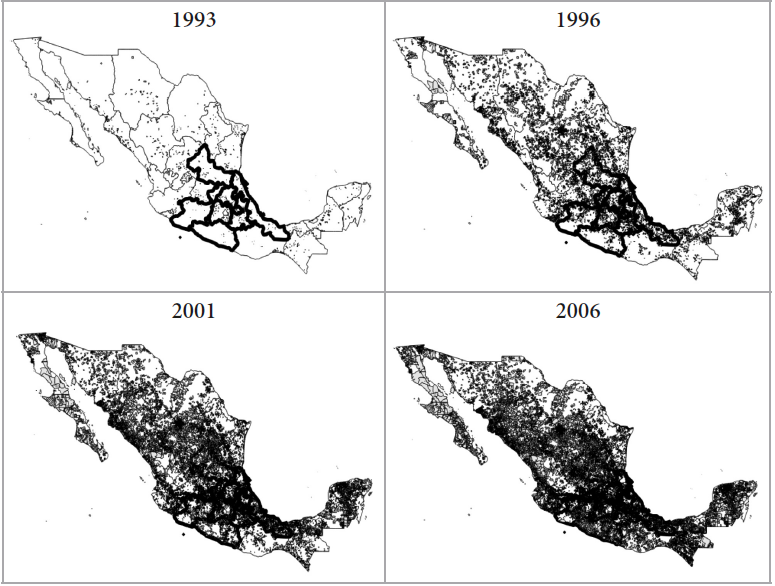 Note: Shaded ejidos are those that completed PROCEDE during or before the listed year. States with bold lines are the seven PROGRESA states for which we have household data (Guerrero, Hidalgo, Michoacán, Puebla, Queretaro, San Luis Potosí and Veracruz).Source: PHINA (2017).
Figure 1
Rollout of PROCEDE across time and space
Rollout of PROCEDE across time and space
Table 1 presents descriptive statistics divided by households in early-certified ejidos (1997-1999) and late-certified ejidos (2000-2006). In terms of socio-demographic characteristics, we can see that titled households have fewer members, and the household head tends to be older. There are no differences in terms of the gender of the household head or the number of household members between 8 and 15 years old. More than two thirds of both types of households report having cultivated some crops. Titled households have slightly more cultivated land, however the difference is not statistically significant.
Table 1
Household characteristics in early-certified and late-certified ejidos
Household characteristics in early-certified and late-certified ejidos
| Untitled | Titled | Difference | |
| Age HH head | 46.84 | 47.85 | 1.01*** |
| HH head is female (1/0) | 0.13 | 0.13 | -0.00 |
| HH members | 5.38 | 5.11 | -0.28*** |
| HH members between 8 and 15 years old | 1.28 | 1.30 | 0.02 |
| HH cultivated land (1/0) | 0.68 | 0.68 | -0.01 |
| Cultivated land (Has) | 2.07 | 2.10 | 0.03 |
| Hours in wage employment | 197.74 | 191.38 | -6.35** |
| Hours in wage employment (children) | 7.77 | 6.78 | -1.00 |
| Hours in non-farm self-employment | 3.57 | 0.87 | -2.70*** |
| Hours in non-farm self-employment (children) | 0.04 | 0.02 | -0.01 |
| HH members in own-farm activities | 0.42 | 0.25 | -0.16*** |
| HH members in own-farm activities (children) | 0.04 | 0.02 | -0.02*** |
| HH has migrant members (1/0) | 0.05 | 0.08 | 0.04*** |
| No. of observations | 21,314 | 5,376 |
In terms of the variables related to household labor supply, the hours of wage employment per month are lower for households in certified ejidos (more than 60 percent of wage workers work in agriculture). Non-farm self-employment (e.g. trading services, elaboration of crafts, etc.) is not a very common activity in our sample, approximately 10 percent of households report having members working in these enterprises. However, untitled farmers report spending more time in this activity. Child labor hours in non-farming self-employed activities are also higher in untitled households. Unfortunately, our data does not provide detailed labor inputs in own-farm agricultural activities; hence, we shed light on this aspect of labor supply by examining the number of household members devoted to this activity. Titled households have fewer members in own-farming agriculture, both adults and children. Additionally, households in certified ejidos are more likely to have a migrant member.
These differences in household characteristics bring concerns regarding our identification strategy. For example, if the differences in household size or age of household head are correlated with the timing of PROCEDE our results may be biased if we do not control for these features. Our specification controls for unobserved fixed household characteristics and a set of household features that vary across time. Moreover, since the implementation of PROCEDE is conducted through a democratic local ejido process, the timing of certification is likely to be correlated with ejido-level characteristics (and not necessarily household unobservable features). We address this endogeneity concern by interacting time dummies with a set of ejido-level characteristics17.
4. RESULTS
4.1. The effect of PROCEDE on household labor supply
In Table 2 we present the results related to hours of wage employment per month. In the first column, the specification only controls for time and ejido fixed-effects. The second column includes household characteristics. The third column controls for household fixed effects, and the fourth column included household covariates to the household fixed-effect specification. In column 5, we control for household fixed-effects and add interaction terms between time dummies and ejido characteristics. Finally, column 6 adds household controls to the previous specification. All six specifications suggest that PROCEDE reduced the hours of wage employment per household member. The magnitude of the title coefficient is between 1.629 and 3.384; this represents a reduction of approximately 5 percent in the hours of per capita wage employment.
Table 2
The effect of PROCEDE on hours of wage employment per capita
The effect of PROCEDE on hours of wage employment per capita
| (1) | (2) | (3) | (4) | (5) | (6) | |
| Title | -1.629** | -1.907** | -1.791** | -1.769** | -3.384*** | -3.160*** |
| (0.799) | (0.797) | (0.791) | (0.797) | (1.105) | (1.111) | |
| Time FE | Yes | Yes | Yes | Yes | Yes | Yes |
| Ejido FE | Yes | Yes | No | No | No | No |
| Household FE | No | No | Yes | Yes | Yes | Yes |
| Ejido characteristics*Time FE | No | No | No | No | Yes | Yes |
| No. of observations | 26,690 | 26,564 | 26,690 | 26,564 | 26,690 | 26,564 |
| No. of households | 7,576 | 7,576 | 7,576 | 7,576 | 7,576 | 7,576 |
-
De Janvry et al. (2015)Delinking land rights from land use: Certification and migration in MexicoThe American Economic Review, 2015
The theory predicts that increases in tenure security can reduce the need for guard labor, allowing households to increase their activities in other areas if they wish to do so (Besley, 1995; Besley and Ghatak, 2010). However, the effect of land certification in investment incentives and land market functioning can also make own-farm agriculture more appealing, especially if non-farming opportunities are still scarce (only around 15 percent of wage workers report having a job outside agriculture). For example, Nakasone (2011) shows that land certification in rural Peru increases labor in own-farm activities and reduces non-farm labor supply. Hence, it is possible that the liberalization of land markets and the increase in tenure security incentivizes households to devote more time to agriculture.
-
Besley, 1995Property rights and investment incentives: Theory and evidence from GhanaJournal of Political Economy, 1995
-
Besley and Ghatak, 2010Property rights and economic developmentHandbook of Development Economics, 2010
-
Nakasone (2011)The impact of land titling on labor allocation: Evidence from rural Peru, 2011
If households are reducing their time in wage employment, we would expect them to engage in other activities. In Table 3 we present the results related to own-farm labor supply. Unfortunately, the ENCEL surveys do not report days or hours spent in agricultural activities. Instead, we focus on the number of household members that declared their main activity to be farming in their own land. Table 3 shows the effect of PROCEDE on the number of household members devoted to own-farm cropping activities. Our results suggest that land titling did not have a significant effect on the extensive margin of labor in own-farm agriculture.
Table 3
The effect of PROCEDE on HH members in own-farm agriculture
The effect of PROCEDE on HH members in own-farm agriculture
| (1) | (2) | (3) | (4) | (5) | (6) | |
| Title | 0.0227 | 0.0261 | 0.0247 | 0.0297 | -0.0308 | -0.0365 |
| (0.0178) | (0.0177) | (0.0182) | (0.0181) | (0.0255) | (0.0255) | |
| Time FE | Yes | Yes | Yes | Yes | Yes | Yes |
| Ejido FE | Yes | Yes | No | No | No | No |
| Household FE | No | No | Yes | Yes | Yes | Yes |
| Ejido characteristics*Time FE | No | No | No | No | Yes | Yes |
| No. of observations | 26,690 | 26,564 | 26,690 | 26,564 | 26,690 | 26,564 |
| No. of households | 7,576 | 7,576 | 7,576 | 7,576 | 7,576 | 7,576 |
-
De Janvry et al. (2015)Delinking land rights from land use: Certification and migration in MexicoThe American Economic Review, 2015
How does the certification of an asset owned by one of the household heads could affect intra-household allocation of labor? In China, Wang (2014) examines the impact of a house titling reform where individual rights were granted to one of the household heads. She finds that property rights transferred to men increased the share of female chores and some male-favored goods. Evidence from Ethiopia and Vietnam suggest that joint-titling of agricultural land (where husband and wife are legal co-owners) can improve expenditure on children’s health and clothing, women’s self-employment, vulnerability to poverty and empowerment (Muchomba, 2017; Menon et al., 2017; Newman et al., 2015).
-
Wang (2014)Property rights and intra-household bargainingJournal of Development Economics, 2014
-
Muchomba, 2017Women’s land tenure security and household human capital: Evidence from Ethiopia’s land certificationWorld Development, 2017
-
Menon et al., 2017Land reform and welfare in Vietnam: Why gender of the land-rights holder mattersJournal of International Development, 2017
-
Newman et al., 2015Property rights and productivity: The case of joint land titling in VietnamLand Economics, 2015
In the case of Mexico, land certificates were given under the name of the rights holder, according to the 2007 Ejido Census more than 75 percent of ejido rights’ holders are men. If this program distorted the balance of intra-household bargaining power, and men have different preferences regarding children’s allocation of time, it is possible that PROCEDE leads to an increase in own-farm agricultural child labor. To shed some light on this issue, we estimate equation [1] with the number of household members between the age of 8 and 15 involved in own-farm agriculture. We restrict the sample to those households with children of those ages. Moreover, PROGRESA is a conditional cash transfer (CCT) transfer program that gives direct debit transfers to women in exchange of ensuring school attendance and medical check-ups of their children. Because this transfer is clearly related to child labor outcomes, we also restrict the sample to include only households that were not part of PROGRESA18. The outcomes for child labor in own-farm agriculture are presented in Table 4. In columns 5 and 6 we can see that there is a negative effect of PROCEDE on the number of children working in agriculture.
Table 4
The effect of PROCEDE on children in own-farm agriculture
The effect of PROCEDE on children in own-farm agriculture
| (1) | (2) | (3) | (4) | (5) | (6) | |
| Title | 0.0051 | 0.0051 | 0.00186 | 0.00219 | -0.0396* | -0.0393* |
| (0.0136) | (0.0136) | (0.0145) | (0.0145) | (0.0208) | (0.0209) | |
| Time FE | Yes | Yes | Yes | Yes | Yes | Yes |
| Ejido FE | Yes | Yes | No | No | No | No |
| Household FE | No | No | Yes | Yes | Yes | Yes |
| Ejido characteristics*Time FE | No | No | No | No | Yes | Yes |
| No. of observations | 9,575 | 9,549 | 9,575 | 9,549 | 9,575 | 9,549 |
| No. of households | 2,955 | 2,955 | 2,955 | 2,955 | 2,955 | 2,955 |
-
De Janvry et al. (2015)Delinking land rights from land use: Certification and migration in MexicoThe American Economic Review, 2015
4.2. The effect of PROCEDE on land access
The land reform of 1992 also liberated land markets. This means households now are able to adjust their operational size given their endowment of other factors of production (e.g. labor). My results are based on the self-reported cultivated area in the ENCEL surveys and show that the certification program allowed households to expand their operational scale, interestingly having a migrant member in the household is also positively related to cultivated land.
5. ROBUSTNESS CHECKS
The main threat to our identification strategy is the correlation between timing of PROCEDE and our main outcome variables. If households anticipated the timing of PROCEDE and increased their labor supply in wage employment and child labor, the land titling program may be a reflection of households going back to average levels of labor supply and child labor when PROCEDE happened. We estimate the following specification to confirm that the timing of PROCEDE is not related to our outcome variables:
Where ∆Yijt is the household-level percentage change in hours of wage employment per capita and number of children in agriculture across time. PROCEDEYEARj are the main explanatory variables and they are dummy variables taking a value one in the year PROCEDE took place. θ t are time FE and ε ijt is the error term. Tables 4.6 and 4.7 present the results of pre-treatment changes on household wage hours per capita and the number of children working in own-farming, respectively. In the first column the sample is restricted to the years 1997 and 1998. The second column restricts the years 1997-1999, and the last column does not restrict the sample. None of the coefficients in Tables 4.6 and 4.7 are statistically significant, this suggests that the effects we observe on these variables are being caused by PROCEDE and no other unobserved time-varying factors.
Table 5
The effect of PROCEDE on land cultivated (log)
The effect of PROCEDE on land cultivated (log)
| (1) | (2) | (3) | (4) | (5) | (6) | |
| Title | 0.0604*** | 0.0651*** | 0.0665*** | 0.0674*** | 0.0703** | 0.0713** |
| (0.0218) | (0.0217) | (0.0222) | (0.0221) | (0.0297) | (0.0297) | |
| Time FE | Yes | Yes | Yes | Yes | Yes | Yes |
| Ejido FE | Yes | Yes | No | No | No | No |
| Household FE | No | No | Yes | Yes | Yes | Yes |
| Ejido Characteristics*Time FE | No | No | No | No | Yes | Yes |
| No. of observations | 26,690 | 26,564 | 26,564 | 26,690 | 26,690 | 26,564 |
| No. of households | 7,576 | 7,576 | 7,576 | 7,576 | 7,576 | 7,576 |
-
De Janvry et al. (2015)Delinking land rights from land use: Certification and migration in MexicoThe American Economic Review, 2015
Table 6
Pre-treatment changes in HH wage hours per capita
Pre-treatment changes in HH wage hours per capita
| ∆HH wage hours,
|
∆HH wage hours,
|
∆HH wage hours,
|
|
| PROCEDE completed in 1999 | -0.0247
|
||
| PROCEDE completed in 2000 | 0.0222
|
0.457
|
|
| PROCEDE completed after 2000 | -0.0125
|
-0.343
|
-0.132
|
| Time FE | Yes | Yes | Yes |
| Ejido FE | No | Yes | Yes |
| No. of observations | 7,016 | 12,019 | 17,689 |
-
De Janvry et al. (2015)Delinking land rights from land use: Certification and migration in MexicoThe American Economic Review, 2015
Table 7
Pre-treatment changes in the number of children working in own-farming
Pre-treatment changes in the number of children working in own-farming
| ∆Child labor,
|
∆Child labor,
|
∆Child labor,
|
|
| PROCEDE completed in 1999 | 0.000595
|
||
| PROCEDE completed in 2000 | 0.000595
|
-0.00000989
|
|
| PROCEDE completed after 2000 | 0.00181
|
0.00000256
|
0.0000125
|
| Time FE | Yes | Yes | Yes |
| Ejido FE | No | Yes | Yes |
| No. of observations | 7,016 | 12,019 | 17,689 |
-
De Janvry et al. (2015)Delinking land rights from land use: Certification and migration in MexicoThe American Economic Review, 2015
6. CONCLUSIONS
Weak enforcement of property rights distorts household allocation of labor. Land titling can reduce the need for labor to be employed for guarding purposes, allowing households to increase their off-farm activities. However, increases in tenure security enhance investment incentives, which can increase the returns to labor in agriculture. Also, property rights give the opportunity to increase the operational size of the farm, incentivizing more labor input in agriculture.
This paper examined the effect of a nation-wide land titling program in Mexico, that along with the official land documents it granted the authorization for land markets to operate legally. Our results show that the certification reduced wage labor and increased cultivated land. However, we did not find any significant effects of the certification on own-farm labor supply. Moreover, we shed light on an issue that is seldom discussed in the property rights literature; the effect of property rights in intra-household labor supply. Our results suggest that households participating in the program decreased the number of children working in their farms.
These findings open several avenues for future research. First, while we explored the impact of land titling on intra-household labor supply, further studies could investigate how such programs affect other dimensions of child well-being, such as education or health outcomes. Second, given the reduction in wage labor observed, it would be valuable to explore whether these households shifted to off-farm employment or diversified income sources in other ways. Third, the relationship between land titling and labor market outcomes deserves closer attention, particularly in terms of whether enhanced tenure security results in transitions to more informal or precarious jobs, as highlighted in broader labor flexibilization debates.
REFERENCES
- Adamopoulos, T., Brandt, L., Leight, J., and Restuccia, D. (2022). Misallocation, selection, and productivity: A quantitative analysis with panel data from China.Econometrica, 90(3), 1261-1282. https://doi.org/10.3982/ECTA16598 Links
- Albertus, M., Diaz-Cayeros, A., Magaloni, B., and Weingast, B.R. (2016). Authoritarian survival and poverty traps: Land reform in Mexico. World Development, 77, 154-170. https://doi.org/10.1016/j.worlddev.2015.08.021 Links
- Appendini, K. (2001). Land regularization and conflict resolution: The case of Mexico [Report for Food and Agriculture Organization of the United Nations, Rural Development Division]. [online] Available at: <https://www.cabidigitallibrary.org/doi/full/10.5555/20033008864>. Links
- Assies, W. (2008). Land tenure and tenure regimes in Mexico: An overview. Journal of Agrarian Change, 8(1), 33-63. https://doi.org/10.1111/j.1471-0366.2007.00162.x Links
- Bhalotra, S., and Heady, C. (2003). Child farm labor: The wealth paradox. The World Bank Economic Review, 17(2), 197-227. https://doi.org/10.1093/wber/lhg012 Links
- Banerjee, A.V., Gertler, P.J., and Ghatak, M. (2002). Empowerment and efficiency: Tenancy reform in West Bengal. Journal of Political Economy, 110(2), 239-280. https://doi.org/10.1086/338744. Links
- Basu, K., Das, S., and Dutta, B. (2010). Child labor and household wealth: Theory and empirical evidence of an inverted-U. Journal of Development Economics, 91(1), 8-14. https://doi.org/10.1016/j.jdeveco.2008.11.003 Links
- Basu, K., and Van, P.H. (1998). The economics of child labor. American Economic Review, 88(3), 412-427. [online] Available at: <https://www.jstor.org/stable/116849>. Links
- Bellemare, M.F., Chua, K., Santamaria, J., and Vu, K. (2020). Tenurial security and agricultural investment: Evidence from Vietnam. Food Policy, 94, 101839. https://doi.org/10.1016/j.foodpol.2020.101839. Links
- Besley, T. (1995). Property rights and investment incentives: Theory and evidence from Ghana. Journal of Political Economy, 103(5), 903-937. https://doi.org/10.1086/262008 Links
- Besley, T., and Ghatak, M. (2010). Property rights and economic development. In: D. Rodrik and M. Rosenzweig (eds.), Handbook of Development Economics (Vol. 5, pp. 4525-4595). Amsterdam: Elsevier. https://doi.org/10.1016/B978-0-444-52944-2.00006-1 Links
- Borras, S.M., and Franco, J.C. (2012). Global land grabbing and trajectories of agrarian change: A preliminary analysis. Journal of Agrarian Change , 12(1), 34-59. https://doi.org/10.1111/j.1471-0366.2011.00339.x Links
- Boucher, S.R., Barham, B.L., and Carter, M.R. (2005). The impact of “market-friendly” reforms on credit and land markets in Honduras and Nicaragua. World Development, 33(1), 107-128. https://doi.org/10.1016/j.worlddev.2004.09.003 Links
- Chari, A., Liu, E.M., Wang, S.Y. and Wang, Y. (2021). Property rights, land misallocation, and agricultural efficiency in China. The Review of Economic Studies, 88(4), 1831-1862. https://doi.org/10.1093/restud/rdaa072 Links
- Castañeda-Dower, P., and Pfutze, T. (2015). Vote suppression and insecure property rights. Journal of Development Economics, 114, 1-19. https://doi.org/10.1016/j.jdeveco.2014.10.004 Links
- Chen, C., Restuccia, D., and Santaeulàlia-Llopis, R. (2017). The effects of land markets on resource allocation and agricultural productivity. National Bureau of Economic Research. https://doi.org/10.3386/w24034. Links
- Cornelius, W., and Myhre, D. (1998). The transformation of rural Mexico: Reforming the Ejido Sector. La Jolla: University of California, San Diego. Links
- De Ita, A. (2006). Land concentration in Mexico after PROCEDE. Land Research Action Network. [online] Available at: <http://www.landaction.org/display.php?article=386>. Links
- De Janvry, A., and Sadoulet, E. (2001). Access to land and land policy reforms. In: Handbook of Agricultural Economics (pp. 1-54). Amsterdam: Elsevier . https://doi.org/10.1016/S1574-0072(01)10002-9 Links
- de Janvry, A., Sadoulet, E., and Gordillo, G. (1997). Mexico’s second agrarian reform: Household and community responses, 1990-1994. Stanford University Press. [online] Available at: <https://www.sup.org/books/title/?id=2872>. Links
- De Janvry, A., Emerick, K., Gonzalez-Navarro, M., and Sadoulet, E. (2015). Delinking land rights from land use: Certification and migration in Mexico. The American Economic Review, 105(10), 3125-3149. https://doi.org/10.1257/aer.20121624 Links
- De Janvry, A., Gonzalez-Navarro, M., and Sadoulet, E. (2014). Are land reforms granting complete property rights politically risky? Electoral outcomes of Mexico's certification program. Journal of Development Economics, 110, 216-225. https://doi.org/10.1016/j.jdeveco.2014.10.001 Links
- De Moura, M.J.S.B., Ribeiro, M., and Piza, C. (2014). Are there any distributive effects of land title on labor supply? Evidence from Brazil. IZA Journal of Labor & Development, 3(1), p.11. https://doi.org/10.1186/2193-9020-3-11 Links
- Deininger, K., and Bresciani, F. (2001). Mexico’s Second Agrarian Reform: Implementation and Impact [World Bank Document]. [online] Available at: <https://documents.worldbank.org/>. Links
- Deininger, K., and Feder, G. (2009). Land registration, governance, and development: Evidence and implications for policy. The World Bank Research Observer, 24(2), 233-266. https://doi.org/10.1093/wbro/lkp007 Links
- Deininger, K., Zegarra, E., and Lavadenz, I. (2003). Determinants and impacts of rural land market activity: Evidence from Nicaragua. World Development, 31(8), 1385-1404. https://doi.org/10.1016/S0305-750X(03)00110-1 Links
- Do, Q.T., and Iyer, L. (2008). Land titling and rural transition in Vietnam. Economic Development and Cultural Change, 56(3), 531-579. https://doi.org/10.1086/533547 Links
- Feder, G., and Onchan, T. (1987). Land ownership security and farm investment in Thailand. American Journal of Agricultural Economics, 69(2), 311-320. https://doi.org/10.2307/1242279 Links
- Field, E. (2007). Entitled to work: Urban property rights and labor supply in Peru. The Quarterly Journal of Economics, 122(4), 1561-1602. https://doi.org/10.1162/qjec.2007.122.4.1561 Links
- Galiani, S., and Schargrodsky, E. (2010). Property rights for the poor: Effects of land titling. Journal of Public Economics, 94(9-10), 700-729. https://doi.org/10.1016/j.jpubeco.2010.06.002 Links
- Goldstein, M., and Udry, C. (2008). The profits of power: Land rights and agricultural investment in Ghana. Journal of Political Economy , 116(6), 981-1022. https://doi.org/10.1086/595561 Links
- Goldstein, M., Houngbedji, K., Kondylis, F., O’Sullivan, M., and Selod, H. (2018). Formalization without certification? Experimental evidence on property rights and investment. Journal of Development Economics, 132, 57-74. https://doi.org/10.1016/j.jdeveco.2017.12.005 Links
- Holden, S.T., Deininger, K., and Ghebru, H. (2007). Land certification, tenure security, and smallholder productivity in Ethiopia. Land Economics, 83(4), 593-607. https://doi.org/10.3368/le.83.4.593 Links
- Ito, J., Bao, Z., and Ni, J. (2016). Land rental development via institutional innovation in rural Jiangsu, China. Food Policy, 59, 1-11. https://doi.org/10.1016/j.foodpol.2015.12.003 Links
- Jin, S., and Deininger, K. (2009). Land rental markets in the process of rural structural transformation: Productivity and equity impacts from China. Journal of Comparative Economics, 37(4), 629-646. https://doi.org/10.1016/j.jce.2009.08.001 Links
- Jin, S., and Jayne, T.S. (2013). Land rental markets in Kenya: Implications for efficiency, equity, household income, and poverty. Land Economics, 89(2), 246-271. https://doi.org/10.3368/le.89.2.246 Links
- Kassie, M., and Holden, S. (2007). Sharecropping efficiency in Ethiopia: Threats of eviction and kinship. Agricultural Economics, 37(2‐3), 179-188. https://doi.org/10.1111/j.1574-0862.2007.00258.x Links
- Kimura, S., Otsuka, K., Sonobe, T., and Rozelle, S. (2011). Efficiency of land allocation through tenancy markets: Evidence from China. Economic Development and Cultural Change, 59(3), 485-510. https://doi.org/10.1086/658368 Links
- Kung, J.K.S. (2002). Off-farm labor markets and the emergence of land rental markets in rural China. Journal of Comparative Economics , 30(2), 395-414. https://doi.org/10.1006/jcec.2002.1788 Links
- Larreguy, H.A. (2012). Monitoring political brokers: Evidence from clientelistic networks in Mexico. EPSA 2013 Annual General Conference Paper (Vol. 655). https://doi.org/10.2139/ssrn.2106295 Links
- Li, K. (2020). Property rights, land circulation and off-farm labor supply: Evidence from a land tenure reform in China. [online] Available at SSRN. https://doi.org/10.2139/ssrn.3933137 Links
- Magaloni, B. (2006). Voting for autocracy: Hegemonic party survival and its demise in Mexico. Cambridge: Cambridge University Press. https://doi.org/10.1017/CBO9780511510266 Links
- Menon, N., van der Meulen Rodgers, Y., and Kennedy, A.R. (2017). Land reform and welfare in Vietnam: Why gender of the land-rights holder matters. Journal of International Development, 29(4), 454-472. https://doi.org/10.1002/jid.3280 Links
- Muchomba, F.M. (2017). Women’s land tenure security and household human capital: Evidence from Ethiopia’s land certification. World Development , 98, 310-324. https://doi.org/10.1016/j.worlddev.2017.05.001 Links
- Nakasone, E. (2011). The impact of land titling on labor allocation: Evidence from rural Peru [IFPRI-Discussion Papers no. 1111]. [online] Available at: <https://www.ifpri.org/publication/impact-land-titling-labor-allocation>. Links
- Newman, C., Tarp, F., and Van Den Broeck, K. (2015). Property rights and productivity: The case of joint land titling in Vietnam. Land Economics , 91(1), 91-105. https://doi.org/10.3368/le.91.1.91 Links
- Oryoie, A.R., Alwang, J., and Tideman, N. (2017). Child labor and household land holding: Theory and empirical evidence from Zimbabwe. World Development , 100, 45-58. https://doi.org/10.1016/j.worlddev.2017.07.003 Links
- Valsecchi, M. (2014). Land property rights and international migration: Evidence from Mexico. Journal of Development Economics , 110, 276-290. https://doi.org/10.1016/j.jdeveco.2014.12.003 Links
- Wang, S.Y. (2014). Property rights and intra-household bargaining. Journal of Development Economics , 107, 192-201. https://doi.org/10.1016/j.jdeveco.2013.11.007 Links
- Yúnez-Naude, A. (2003). The dismantling of CONASUPO, a Mexican state trader in agriculture. The World Economy, 26(1), 97-122. https://doi.org/10.1111/1467-9701.00511 Links
- Yúnez-Naude, A., and Paredes, F.B. (2004). The agriculture of Mexico after ten years of NAFTA implementation [Banco Central de Chile, Documento de Trabajo no. 277]. https://doi.org/10.2139/ssrn.1814521 Links
- Zoomers, A. (2010). Globalisation and the foreignisation of space: Seven processes driving the current global land grab. The Journal of Peasant Studies, 37(2), 429-447. https://doi.org/10.1080/03066151003595325 Links
ONLINE APPENDIX
Appendix A. Merging the rollout of PROCEDE with the ENCEL surveys
The ENCEL surveys do not provide a way to identify if the household is located inside an ejido or community; however, it does show the locality in which the household is located. Using a spatial join in QGIS, we matched localities and ejidos using the coordinates of the centroid of the locality. We considered the locality to match the ejido when the centroid of the locality was inside the boundaries of the ejido. The spatial merge resulted in 249 localities (out of 506) falling into 245 different ejidos19. The number of households that fell inside the ejidos as a result of this process is 14,531. In the final dataset, only households matched in ejidos certified between 1997 and 2006 are included (approximately 7,500 housesholds). Figure A1 illustrates an example of the ejido-locality matching.
Thumbnail
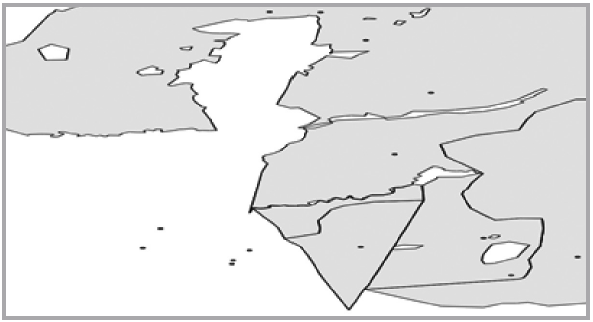 Note: The shaded polygons represent different ejidos, a locality was considered to be inside an ejido if the coordinates of its centroid were inside the boundaries of the ejido. As can be seen, it is possible that more than one locality is matched to an ejido.
Figure A1
Spatial join of ejidos and localities
Spatial join of ejidos and localities
Appendix B. Coefficients of household characteristics
Table B1 presents the estimated coefficients of our specification when the dependent variable is the monthly hours of wage employment per capita. The results suggest that increases in the number of household members reduce labor allocation into wage employment. Similarly, households with more cultivated land tend to spend fewer hours on wage activities. This is not surprising as households with higher endowments of land and labor are more likely to engage in own-farm agriculture, reducing their time in other income-generating activities. Moreover, households that have a migrant member spend fewer hours in wage employment.
Table B1
Hours of wage employment
Hours of wage employment
| (1) | (2) | (3) | |
| HH head age | 0.157*** | -0.132* | -0.111 |
| (0.0193) | (0.0724) | (0.0699) | |
| HH head is female | -3.451*** | 0.843 | -0.348 |
| (0.933) | (1.398) | (1.376) | |
| HH members | -3.034*** | -0.683*** | -0.783*** |
| (0.123) | (0.256) | (0.254) | |
| Cultivated land | 0.0598 | -0.191** | -0.230*** |
| (0.0713) | (0.0744) | (0.0797) | |
| Migrant | -1.302 | -5.929*** | -6.259*** |
| (1.051) | (1.786) | (1.797) | |
| Time FE | Yes | Yes | Yes |
| Ejido FE | Yes | No | No |
| Household FE | No | Yes | Yes |
| Ejido characteristics*Time FE | No | No | Yes |
| No. of observations | 26,564 | 26,564 | 26,564 |
| No. of households | 7,576 | 7,576 | 7,576 |
-
De Janvry et al. (2015)Delinking land rights from land use: Certification and migration in MexicoThe American Economic Review, 2015
In Table B2 we show the coefficients in the case of household members in own-farm agriculture. Although PROCEDE did not show any significant effects on the number of household members in agriculture, it is still worth discussing the implications of some household characteristics. We can see that as the household head grows older, the number of members in agriculture increases. Also, households with more members and more cultivated land tend to participate in own-farm agriculture more intensely.
Table B2
HH members in own-farm agriculture
HH members in own-farm agriculture
| (1) | (2) | (3) | |
| HH head age | 0.0064*** | 0.0034** | 0.0027* |
| (0.000356) | (0.00152) | (0.00151) | |
| HH head is female | -0.0821*** | -0.0059 | -0.0013 |
| (0.0139) | (0.0254) | (0.0254) | |
| HH members | 0.0434*** | 0.0447*** | 0.0480*** |
| (0.00263) | (0.00661) | (0.00648) | |
| Cultivated land | 0.0362*** | 0.0250*** | 0.0226*** |
| (0.00531) | (0.00510) | (0.00485) | |
| Migrant | 0.0423* | -0.0213 | -0.0442 |
| (0.0226) | (0.0437) | (0.0421) | |
| Time FE | Yes | Yes | Yes |
| Ejido FE | Yes | No | No |
| Household FE | No | Yes | Yes |
| Ejido characteristics*Time FE | No | No | Yes |
| No. of observations | 26,564 | 26,564 | 26,564 |
| No. of households | 7,576 | 7,576 | 7,576 |
-
De Janvry et al. (2015)Delinking land rights from land use: Certification and migration in MexicoThe American Economic Review, 2015
For children working on the family farm, most of the controls are not significant. When the household head changes from a man to a woman (columns 2 and 3) there is a decrease in the number of children (suggested by the negative sign). However, given the small variability in these variables the coefficients are not significant. When the specification does not control for household fixed-effects (column 2) we see that household size and cultivated land are positively related to the number of children in agriculture.
Finally, Table B4 presents the results of the control variables’ coefficients when the dependent variable is cultivated land. Increases in the number of household members are positively related to the size of cultivated land. Interestingly, households with a migrant member tend to cultivate more land. This may happen because remittances alleviate financial restrictions to undertake agricultural ventures.
Table B3
Children in own-farm agriculture
Children in own-farm agriculture
| (1) | (2) | (3) | |
| -0.000170 | 0.000480 | 0.000296 | |
| HH head age | (0.000237) | (0.00106) | (0.00101) |
| 0.00293 | -0.0276 | -0.0158 | |
| HH head is female | (0.0108) | (0.0456) | (0.0430) |
| 0.00538*** | 0.000315 | 0.00104 | |
| HH members | (0.00142) | (0.00344) | (0.00344) |
| 0.00275** | 0.00205 | -0.000157 | |
| Cultivated land | (0.00118) | (0.00152) | (0.00154) |
| 0.0257 | 0.00814 | -0.0184 | |
| Migrant | (0.0191) | (0.0247) | (0.0238) |
| Time FE | Yes | Yes | Yes |
| Ejido FE | Yes | No | No |
| Household FE | No | Yes | Yes |
| Ejido characteristics*Time FE | No | No | Yes |
| No. of observations | 9,549 | 9,549 | 9,549 |
| No. of households | 2,955 | 2,955 | 2,955 |
-
De Janvry et al. (2015)Delinking land rights from land use: Certification and migration in MexicoThe American Economic Review, 2015
Table B4
Cultivated land (log)
Cultivated land (log)
| (1) | (2) | (3) | |
| HH head age | 0.0094*** | 0.0022 | 0.0023 |
| (0.000493) | (0.00213) | (0.00215) | |
| HH head is female | -0.0819*** | 0.0786* | 0.0365 |
| (0.0204) | (0.0453) | (0.0457) | |
| HH members | 0.0349*** | 0.0209*** | 0.0252*** |
| (0.00275) | (0.00805) | (0.00786) | |
| 0.0322 | 0.103** | 0.102** | |
| Migrant | (0.0283) | (0.0445) | (0.0434) |
| Time FE | Yes | Yes | Yes |
| Ejido FE | Yes | No | No |
| Household FE | No | Yes | Yes |
| Ejido characteristics*Time FE | No | No | Yes |
| No. of observations | 26,564 | 26,690 | 26,564 |
| No. of households | 7,576 | 7,576 | 7,576 |
-
De Janvry et al. (2015)Delinking land rights from land use: Certification and migration in MexicoThe American Economic Review, 2015