<?xml version="1.0" encoding="ISO-8859-1"?><article xmlns:mml="http://www.w3.org/1998/Math/MathML" xmlns:xlink="http://www.w3.org/1999/xlink" xmlns:xsi="http://www.w3.org/2001/XMLSchema-instance">
<front>
<journal-meta>
<journal-id>0187-6236</journal-id>
<journal-title><![CDATA[Atmósfera]]></journal-title>
<abbrev-journal-title><![CDATA[Atmósfera]]></abbrev-journal-title>
<issn>0187-6236</issn>
<publisher>
<publisher-name><![CDATA[Centro de Ciencias de la Atmósfera, UNAM]]></publisher-name>
</publisher>
</journal-meta>
<article-meta>
<article-id>S0187-62362012000100006</article-id>
<title-group>
<article-title xml:lang="en"><![CDATA[Emission of methane and nitrous oxide from Vigna mungo and Vigna radiata legumes in India during the dry cropping seasons]]></article-title>
</title-group>
<contrib-group>
<contrib contrib-type="author">
<name>
<surname><![CDATA[Swamy]]></surname>
<given-names><![CDATA[Y. V.]]></given-names>
</name>
<xref ref-type="aff" rid="A01"/>
</contrib>
<contrib contrib-type="author">
<name>
<surname><![CDATA[Nikhil]]></surname>
<given-names><![CDATA[G. N.]]></given-names>
</name>
<xref ref-type="aff" rid="A01"/>
</contrib>
<contrib contrib-type="author">
<name>
<surname><![CDATA[Venkanna]]></surname>
<given-names><![CDATA[R.]]></given-names>
</name>
<xref ref-type="aff" rid="A01"/>
</contrib>
<contrib contrib-type="author">
<name>
<surname><![CDATA[Das]]></surname>
<given-names><![CDATA[S. N.]]></given-names>
</name>
<xref ref-type="aff" rid="A02"/>
</contrib>
<contrib contrib-type="author">
<name>
<surname><![CDATA[Roy Chaudhury]]></surname>
<given-names><![CDATA[G.]]></given-names>
</name>
<xref ref-type="aff" rid="A02"/>
</contrib>
</contrib-group>
<aff id="A01">
<institution><![CDATA[,Indian Institute of Chemical Technology  ]]></institution>
<addr-line><![CDATA[Hyderabad ]]></addr-line>
<country>India</country>
</aff>
<aff id="A02">
<institution><![CDATA[,Institute of Minerals and Material Technology  ]]></institution>
<addr-line><![CDATA[Orisa ]]></addr-line>
<country>India</country>
</aff>
<pub-date pub-type="pub">
<day>00</day>
<month>01</month>
<year>2012</year>
</pub-date>
<pub-date pub-type="epub">
<day>00</day>
<month>01</month>
<year>2012</year>
</pub-date>
<volume>25</volume>
<numero>1</numero>
<fpage>107</fpage>
<lpage>120</lpage>
<copyright-statement/>
<copyright-year/>
<self-uri xlink:href="http://www.scielo.org.mx/scielo.php?script=sci_arttext&amp;pid=S0187-62362012000100006&amp;lng=en&amp;nrm=iso&amp;tlng=en"></self-uri><self-uri xlink:href="http://www.scielo.org.mx/scielo.php?script=sci_abstract&amp;pid=S0187-62362012000100006&amp;lng=en&amp;nrm=iso&amp;tlng=en"></self-uri><self-uri xlink:href="http://www.scielo.org.mx/scielo.php?script=sci_pdf&amp;pid=S0187-62362012000100006&amp;lng=en&amp;nrm=iso&amp;tlng=en"></self-uri><abstract abstract-type="short" xml:lang="es"><p><![CDATA[Se hicieron estimaciones de la emisión de metano (CH4) y óxido nitroso (N2O) de las legumbres Vigna mungo y Vigna radiata. Para evaluar estas emisiones se estudió el potencial de óxido reducción (redox) y la temperatura del suelo. El CH4 fue negativo y el N2O positivo para Vigna mungo a lo largo de casi todo el período de cultivo. El potencial redox fue de más de +100 mV durante todo el período de cultivo con un flujo máximo de N2O de 11.67 &#956;g m-2 h-1. El incremento de la temperatura del suelo y del potencial redox durante la cosecha incrementó aún más el flujo de N2O a 18.38 &#956;g m-2 h-1. El flujo integrado estacional E(SIF) de CH4 y N2O para Vigna mungo se calculó en -4.06 g m-2 y 3.38 mg m-2, respectivamente. De manera simmilar los valores E(SIF) estimados para Vigna radiata durante la estación de cultivo fueron de 0.009 g m-2 y -7.6 mg m-2, mientras que para el período post cosecha fueron de 0.02 g m-2 y 4.06 mg m-2 para CH4 y N2O, respectivamente. Durante la estación de cultivo se evaluaron los parámetros del suelo carbón orgánico y nutrimentos como el amonio, nitratos y nitritos. La emisión de gases de efecto invernadero también se correlacionó con varios parámetros fisicoquímicos del suelo.]]></p></abstract>
<abstract abstract-type="short" xml:lang="en"><p><![CDATA[Methane (CH4) and nitrous oxide (N2O) emission estimates were made for Vigna mungo and Vigna radiata legumes. The affecting soil parameters like redox potential, soil temperature were studied to evaluate CH4 and N2O emissions. The CH4 was negative and N2O was positive for Vigna mungo, almost throughout the cropping period. The redox potential was more than +100 mV during the entire cropping period with a maximum N2O flux of 11.67 &#956;g m-2 h-1. The raise in soil temperature and the redox potential during harvest further increased the N2O flux to 18.38 &#956;g m-2 h-1. The seasonally integrated flux E(SIF) for CH4 and N2O for Vigna mungo was calculated to be -4.06 g.m-2 and 3.38 mg m-2 respectively. Similarly E(SIF) values estimated for Vigna radiata cropping season were 0.009 g m-2 and -7.6 mg m-2, whereas for the post harvesting period the fluxes were 0.02 g m-2 and 4.06 mg m-2 for CH4 and N2O respectively. The soil parameters like organic carbon and nutrients such as ammonia, nitrate and nitrite during the cropping season were evaluated. The emission of greenhouse gases (GHG) was also correlated to various physico-chemical parameters of soil.]]></p></abstract>
<kwd-group>
<kwd lng="en"><![CDATA[Methane]]></kwd>
<kwd lng="en"><![CDATA[nitrous oxide]]></kwd>
<kwd lng="en"><![CDATA[soil organic carbon]]></kwd>
<kwd lng="en"><![CDATA[Vigna mungo]]></kwd>
<kwd lng="en"><![CDATA[Vigna radiata]]></kwd>
<kwd lng="en"><![CDATA[legumes]]></kwd>
</kwd-group>
</article-meta>
</front><body><![CDATA[  	    <p align="center"><font face="verdana" size="4"><b>Emission of methane and nitrous oxide from <i>Vigna mungo</i> and <i>Vigna radiata</i> legumes in India during the dry cropping seasons</b></font></p>  	    <p align="justify"><font face="verdana" size="2">&nbsp;</font></p>  	    <p align="center"><font face="verdana" size="2"><b>Y. V. Swamy, G. N. Nikhil, R. Venkanna</b>    <br> 	<i>Indian Institute of Chemical Technology, Discovery Building, Tarnaka,    <br> 	Uppal Road, Hyderabad 500067, India</i>    <br> 	Corresponding author: Y. V. Swamy; email: <a href="mailto:swamy_yv@yahoo.com">swamy_yv@yahoo.com</a></font></p>  	    <p align="center"><font face="verdana" size="2"><b>S. N. Das, G. Roy Chaudhury</b>    <br> 	<i>Institute of Minerals and Material Technology, Bhubaneswar 751013, Orisa, India</i></font></p>  	    <p align="justify"><font face="verdana" size="2">&nbsp;</font></p>  	    ]]></body>
<body><![CDATA[<p align="center"><font face="verdana" size="2">Received June 18, 2011, accepted September 27, 2011</font></p>  	    <p align="justify"><font face="verdana" size="2">&nbsp;</font></p>  	    <p align="justify"><font face="verdana" size="2"><b>RESUMEN</b></font></p>  	    <p align="justify"><font face="verdana" size="2">Se hicieron estimaciones de la emisi&oacute;n de metano (CH<sub>4</sub>) y &oacute;xido nitroso (N<sub>2</sub>O) de las legumbres <i>Vigna mungo</i> y <i>Vigna radiata</i>. Para evaluar estas emisiones se estudi&oacute; el potencial de &oacute;xido reducci&oacute;n (redox) y la temperatura del suelo. El CH<sub>4</sub> fue negativo y el N<sub>2</sub>O positivo para <i>Vigna mungo</i> a lo largo de casi todo el per&iacute;odo de cultivo. El potencial redox fue de m&aacute;s de +100 mV durante todo el per&iacute;odo de cultivo con un flujo m&aacute;ximo de N<sub>2</sub>O de 11.67 &#956;g m<sup>&#45;2</sup> h<sup>&#45;1</sup>. El incremento de la temperatura del suelo y del potencial redox durante la cosecha increment&oacute; a&uacute;n m&aacute;s el flujo de N<sub>2</sub>O a 18.38 &#956;g m<sup>&#45;2</sup> h<sup>&#45;1</sup>. El flujo integrado estacional E(SIF) de CH<sub>4</sub> y N<sub>2</sub>O para <i>Vigna mungo</i> se calcul&oacute; en &#150;4.06 g m<sup>&#45;2</sup> y 3.38 mg m<sup>&#45;2</sup>, respectivamente. De manera simmilar los valores E(SIF) estimados para <i>Vigna radiata</i> durante la estaci&oacute;n de cultivo fueron de 0.009 g m<sup>&#45;2</sup> y &#150;7.6 mg m<sup>&#45;2</sup>, mientras que para el per&iacute;odo post cosecha fueron de 0.02 g m<sup>&#45;2</sup> y 4.06 mg m<sup>&#45;2</sup> para CH<sub>4</sub> y N<sub>2</sub>O, respectivamente. Durante la estaci&oacute;n de cultivo se evaluaron los par&aacute;metros del suelo carb&oacute;n org&aacute;nico y nutrimentos como el amonio, nitratos y nitritos. La emisi&oacute;n de gases de efecto invernadero tambi&eacute;n se correlacion&oacute; con varios par&aacute;metros fisicoqu&iacute;micos del suelo.</font></p>  	    <p align="justify"><font face="verdana" size="2">&nbsp;</font></p>  	    <p align="justify"><font face="verdana" size="2"><b>ABSTRACT</b></font></p>  	    <p align="justify"><font face="verdana" size="2">Methane (CH<sub>4</sub>) and nitrous oxide (N<sub>2</sub>O) emission estimates were made for <i>Vigna mungo</i> and <i>Vigna radiata</i> legumes. The affecting soil parameters like redox potential, soil temperature were studied to evaluate CH<sub>4</sub> and N<sub>2</sub>O emissions. The CH<sub>4</sub> was negative and N<sub>2</sub>O was positive for <i>Vigna mungo</i>, almost throughout the cropping period. The redox potential was more than +100 mV during the entire cropping period with a maximum N<sub>2</sub>O flux of 11.67 &#956;g m<sup>&#45;2</sup> h<sup>&#45;1</sup>. The raise in soil temperature and the redox potential during harvest further increased the N2O flux to 18.38 &#956;g m<sup>&#45;2</sup> h<sup>&#45;1</sup>. The seasonally integrated flux E(SIF) for CH<sub>4</sub> and N<sub>2</sub>O for <i>Vigna mungo</i> was calculated to be &#150;4.06 g.m<sup>&#45;2</sup> and 3.38 mg m<sup>&#45;2</sup> respectively. Similarly E(SIF) values estimated for <i>Vigna radiata</i> cropping season were 0.009 g m<sup>&#45;2</sup> and &#150;7.6 mg m<sup>&#45;2</sup>, whereas for the post harvesting period the fluxes were 0.02 g m<sup>&#45;2</sup> and 4.06 mg m<sup>&#45;2</sup> for CH<sub>4</sub> and N<sub>2</sub>O respectively. The soil parameters like organic carbon and nutrients such as ammonia, nitrate and nitrite during the cropping season were evaluated. The emission of greenhouse gases (GHG) was also correlated to various physico&#45;chemical parameters of soil.</font></p>  	    <p align="justify"><font face="verdana" size="2"><b>Keywords:</b> Methane, nitrous oxide, soil organic carbon, <i>Vigna mungo</i>, <i>Vigna radiata</i>, legumes.</font></p>  	    <p align="justify"><font face="verdana" size="2">&nbsp;</font></p>  	    <p align="justify"><font face="verdana" size="2"><b>1. Introduction</b></font></p>  	    ]]></body>
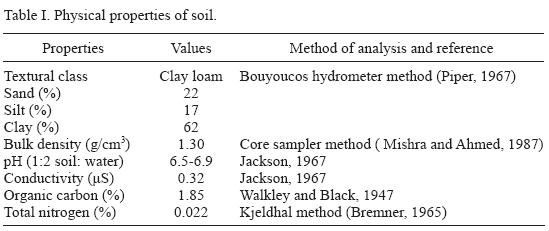
<body><![CDATA[<p align="justify"><font face="verdana" size="2">Due to rapid increase in world population, people are striving hard to produce more and more food to sustain their lives themselves. This needs high input of chemical fertilizer to increase the agricultural productivity. There is a gradual increase of GHG emission from the agricultural sector; believed to be one of the components causing global warming. Presently, N<sub>2</sub>O concentration in the atmosphere stands at 311 ppbv, which is increasing at a rate of 0.22% per year (Machida et al., 1995; Battle et al., 1996). According to the Intergovernmental Panel on Climate Change (IPCC, 1997), the global mean annual atmospheric N2O loading was 16.2 Tg in 1997, to which agricultural sector contributed about 3.3 Tg (20.4%).</font></p>  	    <p align="justify"><font face="verdana" size="2">Legume pulses form an essential component of the Indian daily diet. Land used for growing pulses during 1999 was estimated to be 23.8 million ha, which remained unaltered over the last three decades (Fertiliser Association of India, 2000). The total N<sub>2</sub>O emission from cultivated legumes worldwide has been estimated to be 23&#45;315 Gg N<sub>2</sub>O&#45;N in 1986 (Eichner, 1990).</font></p>  	    <p align="justify"><font face="verdana" size="2">It is important to distinguish the contribution of the various N<sub>2</sub>O sources to atmosphere, such as native soil N, N from recent atmospheric deposition, N from fertilization and N from crop residues. Atmospheric N<sub>2</sub> fixed by the legumes is chemically bound in the plants and the plant debris gets mineralized to release inorganic N, which in turn produces N<sub>2</sub>O when nitrified. NO<sub>3</sub>&#150; is also a product of the same process, which produces N2O via denitrification (Galbally, 1992). In addition, the rhizobia symbiotically living in root nodules are capable of denitrifying, to produce N<sub>2</sub>O (O'Hara and Daniel, 1985). Biological N<sub>2</sub> fixation by legumes induces the availability of NH<sub>4</sub><sup>+</sup> in the soil to serve as a substrate for nitrification (O'Hara and Daniel, 1985; Ghosh et al., 2002). Redox potential and organic carbon were found to be favourable for N<sub>2</sub>O emission (Verma et al., 2006). Organic carbon in the soil is a source for microbial growth and biological decomposition, which is often being considered as a good index of carbon availability (Huang et al., 2004).</font></p>  	    <p align="justify"><font face="verdana" size="2">When the soil is more reducing, a large amount of CH<sub>4</sub> is produced at a critical redox potential (Eh), which increases exponentially with a further decrease of Eh (Ui and Patrick, 2003). Lower CH<sub>4</sub> fluxes were recorded in the fields with less rice residue applications, multi aeration periods, and low fertilization, which normally result in poor rice growth and low yields (Delwiche and Cicerone, 1993). Continuously flooded soils maintain anaerobic conditions that enhance CH4 production whereas reduced flooding duration increases N<sub>2</sub>O production (Neue and Roger, 1994; Cai, 1997; Chen et al., 1997; Abao et al., 2000) because of the contrasting Eh conditions required for N<sub>2</sub>O and CH4 formation. Eh of the soil affects not only the methanogesis, but also transfer of gas through the plant parenchyma (Kludze and Delaune, 1995). Higher temperature accelerates the decomposition of soil carbon due to greater activities of methanogens (Yang and Chang, 1997). Maximum CH<sub>4</sub> emission was observed where the soil Eh varied in the range &#150;100 to &#150;200 mV (Wang et al., 1993).</font></p>  	    <p align="justify"><font face="verdana" size="2">Legume&#45;cropped soils produce considerable amount of N<sub>2</sub>O during the plant metabolism. Unlike pulses, systematic studies are reported for rice and wheat (ALGAS, 1998; Bhattacharya and Mitra, 1998; Moiser et al., 1998; Pathak, 1999; Rath et al., 1999; Adhya et al., 2000; Kumar et al., 2000; Aulakh et al., 2002; Pathak et al., 2003; Swamy et al., 2007) for the estimation of emission factors under different water regimes. In relatively dry soils, the predominantly aerobic environment favours microbial nitrification producing mainly NO. Increased moisture regime directly or indirectly induces denitrification process by denitrifying bacteria in the partially anaerobic conditions (Davidson, 1993; Singh et al., 2003). Under strict anaerobic condition (Bremmer and Blackmer, 1978), substrate depletion through denitrification (Granli and Bockman, 1994) leads to further reduction of N2O to N2. Water is essential for microbial survival and activities. Rapid increase in soil moisture content dilutes the nutrient concentration as well as the microbial population in the water filled pore space (Weitz et al., 2000). Porous soil would drain water easily and help in retaining oxygen, thus enhancing the kinetics of N2O formation (Baruah et al., 1997). In an effort to estimate N<sub>2</sub>O emission from legumes grown on an alluvial soil, pot experiments were conducted by Gosh et al., 2002. These experiments were conducted under both fertilized and unfertilized conditions. The results indicated that legumes may lead to an increase in N<sub>2</sub>O formation and emission from soils, which may vary from crop to crop. These crops are cultivated in moist uplands which are the sources for N2O emission due to mild redox conditions.</font></p>  	    <p align="justify"><font face="verdana" size="2">Information on emission from legumes like <i>Vigna mungo</i> and <i>Vigna radiata</i> is scanty in literature. Hence, an attempt is made to evaluate the role of soil parameters on the emission of CH<sub>4</sub> and N<sub>2</sub>O during dry cropping season (Rabi) in a farmer's field. The field selected is located in upland area having porous rain&#45;fed soil which is used traditionally for cultivating rice in the Kharif season.</font></p>  	    <p align="justify"><font face="verdana" size="2">&nbsp;</font></p>  	    <p align="justify"><font face="verdana" size="2"><b>2. Materials and methods</b></font></p>  	    <p align="justify"><font face="verdana" size="2"><i>2.1 Site for <i>Vigna mungo</i> and <i>Vigna radiata</i></i></font></p>  	    <p align="justify"><font face="verdana" size="2">Field experiments were carried out in an actual farmer's field in the village Raghunathpur, situated at a distance of about 14 km from Bhubaneswar, Orissa, India. <i>Vigna mungo</i> (January 2004&#45;April 2004) and <i>Vigna radiata</i> (January 2005&#45;March 2005) were grown during the Rabi seasons (crop grown during the winter season and pre&#45;summer months) in a plot measuring 25 decimals (0.10 acre). Soil samples were collected randomly at a depth of 10 cm. The physical characteristics of the soil samples are shown in <a href="#t1">Table I</a>. Unlike paddy, pulses do not need any standing water and hence, they are grown in uplands.</font></p>  	    ]]></body>
<body><![CDATA[<p align="center"><font face="verdana" size="2"><a name="t1"></a></font></p>  	    <p align="center"><font face="verdana" size="2"><img src="/img/revistas/atm/v25n1/a6t1.jpg"></font></p>  	    <p align="justify"><font face="verdana" size="2">Being dry crops, these were directly seeded after ploughing the field in slightly wet condition. Intermittent drizzles during the season were the only source of water for the crop. As the plants are leguminous, they fix nitrogen from atmosphere by the micro&#45;organisms present in root nodules and emit N<sub>2</sub>O during the plant metabolism.</font></p>  	    <p align="justify"><font face="verdana" size="2">&nbsp;</font></p>  	    <p align="justify"><font face="verdana" size="2"><i>2.2 Analysis of soil samples</i></font></p>  	    <p align="justify"><font face="verdana" size="2">NH<sub>4</sub><sup>+</sup>&#45;N in the soil sample was estimated by the indo&#45;phenol blue method (Keeny and Nelson, 1982) by extracting NH<sub>3</sub> in 2M KCl. NO<sub>3</sub>&#150; is estimated quantitatively by reducing to nitrite. The NO<sub>2</sub>&#150; produced is determined by diazotization with sulfanilamide and complexing with N&#45;(1&#45;naphthyl)&#45;ethylenediamine dihydrochloride to form a highly coloured azo dye complex and the absorbance was measured at 543 nm (Wood et al., 1967).</font></p>  	    <p align="justify"><font face="verdana" size="2">&nbsp;</font></p>  	    <p align="justify"><font face="verdana" size="2"><i>2.3 Collection of gas samples</i></font></p>  	    <p align="justify"><font face="verdana" size="2">The closed chamber technique prescribed by Hutchison and Moiser (1981) was adopted to collect the gas fluxes. A rectangular aluminium channel was inserted inside the soil to avoid any leakage of external air into the chamber and was allowed to attain equilibrium. A rectangular airtight Perspex box measuring 52 &times; 31.7 &times; 34.5 cm was fixed to the aluminium channel. The aluminium base and Perspex channel interface were made airtight by filling with water. Measurements were carried out at diagonally opposite spots in the rectangular plot measuring 0.1 acre. A battery operated pulse pump (Aerovironment Inc.) was used to circulate the air for homogeneity. The air flux samples were collected at 0, 15, 30 min intervals. A three&#45;way stopcock was fitted at the output of the air&#45;circulating pump to collect gas samples. The chamber temperature was noted with a thermometer inserted into the chamber. Ambient air samples were collected in the forenoon and afternoon hours to have the background levels. The gas flux samples were collected in Teflon bags, which were most convenient compared to water filled glass tubes specially designed for the purpose. Samples were collected weekly once between 8&#45;10 am in the forenoon and 3&#45;5 pm in the afternoon. Eight replicas were collected for each measurement, four in the morning at two diagonally opposite points of the site, four in the afternoon. These measurements were continued throughout the cropping season.</font></p>  	    <p align="justify"><font face="verdana" size="2">&nbsp;</font></p>  	    ]]></body>
<body><![CDATA[<p align="justify"><font face="verdana" size="2"><i>2.4 Analysis of gas samples</i></font></p>  	    <p align="justify"><font face="verdana" size="2">The flux samples were analyzed in laboratory using a Perkin&#45;Elmer AutoSystem gas chromatograph equipped with flame ionization detector (FID) for CH<sub>4</sub> using N<sub>2</sub> (flow rate: 5 mL min<sup>&#45;1</sup>), H<sub>2</sub> (flow rate: 45 mL min<sup>&#45;1</sup>) and zero air (flow rate: 450 mL min<sup>&#45;1</sup>) as carrier, fuel and oxidative gases respectively. A packed semi&#45;micro column of 0.45&micro;m ID, 18 m length was employed to the purpose. The GC parameters fixed for CH4 analysis were: column, injector and detector temperatures were 70, 120 and 250 &ordm;C, respectively. A secondary standard CH<sub>4</sub> (14.2 ppmv) in zero air supplied by the National Physical Laboratory, New Delhi, was used for calibration of the instrument for each set of analysis. Primary certified standard of CH4 (6.02 ppm) in zero air was also used occasionally for calibration. N<sub>2</sub>O was estimated in Shimadzu GC 17A with ECD, using N<sub>2</sub> as carrier gas. SupelcoQ plot capillary column (30 m &times; 0.53 mm ID), with auto&#45;sampling valve fully controlled by Shimazu star software was used in the study. The column, injector and detector temperature were maintained at 70,120 and 350 oC, respectively. NIST traceable N<sub>2</sub>O in N<sub>2</sub> primary standard (Spectra Gases, Inc.) of 5 ppm was dynamically diluted to 500 ppb was used for standardization. The minimum detection limit through dynamic dilution was found to be 90&#45;100 ppbv. However, the range of N<sub>2</sub>O in our samples was at least three times that of the minimum detection limit. A pre&#45;calibrated zero air cylinder (311 ppbv) was used as a standard for calculating N<sub>2</sub>O concentration. The chromatogram was recorded in a computer with TotalChrom Software. The CH<sub>4</sub> and N<sub>2</sub>O flux were calculated (Hou et al., 2000) as per the equation below</font></p>  	    <p align="justify"><font face="verdana" size="2">F = &#8710;m/(A*&#8710;t) = (&#961;*V*&#916;c)/(A*&#916;t) = &#961;*h*&#916;c/&#916;t</font></p>  	    <p align="justify"><font face="verdana" size="2">where F is flux, &#961; is the density of gas at absolute temperature of the chamber headspace, &#8710;m and &#916;c are the mass and mixed ratio concentration of gas increased (or decreased) in the static chamber during &#916;t, respectively. V, A, and h are the volume of effective space, area of bottom and height of the chamber, respectively.</font></p>  	    <p align="justify"><font face="verdana" size="2">&nbsp;</font></p>  	    <p align="justify"><font face="verdana" size="2"><i>2.5 In &#45;situ measurement of pH and redox potential</i></font></p>  	    <p align="justify"><font face="verdana" size="2">The in&#45;situ pH of the soil was measured in replicates by inserting the pH electrode up to 5 cm from the ground connected to a portable pH&#45;meter (Russell model RL 100). The combined electrode along with its protecting sheath was dipped into the soil and the reading was taken after stabilization. Prior to each set of measurement, the instrument was standardized against Orion buffer pH&#45;7.0 and pH&#45;4.1 (Orion Research Incorporated, Boston, certified by NIST Standard Reference Material).</font></p>  	    <p align="justify"><font face="verdana" size="2">The Eh&#45;meter was specially fabricated in the laboratory to meet the field requirements. The electrodes were fabricated with a small piece of platinum wire embedded into an end of sealed glass capillary filled with mercury connected to a copper wire. A pair of such electrodes was used. The other ends of the copper wire were connected to a sensitive multimeter capable of measuring resistance in mV with an accuracy of &plusmn;0.01 mV. The probe used to measure Eh during dry period consists of a Perspex tube, with holes drilled in it to house the sensors (Austin and Huddleston, 1999) and dipped to an approximate depth of 5 cm each time. The second electrode was placed just in contact with the moist soil. The stabilized values after ~15 min of equilibrium were noted. The setup was standardized using a standard redox solution of 0.0033 M K3Fe(CN)<sub>6</sub> and 0.0033 M K<sub>4</sub>Fe(CN)<sub>6</sub> in 0.1M KCl which gives an Eh of 0.222 V at 25 oC.</font></p>  	    <p align="justify"><font face="verdana" size="2">&nbsp;</font></p>  	    <p align="justify"><font face="verdana" size="2"><b>3. Results and discussion</b></font></p>  	    ]]></body>
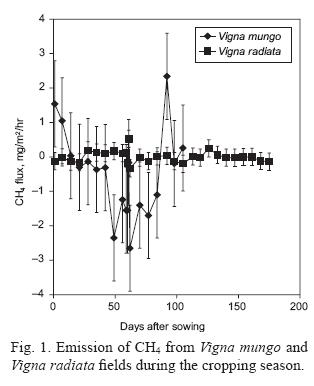
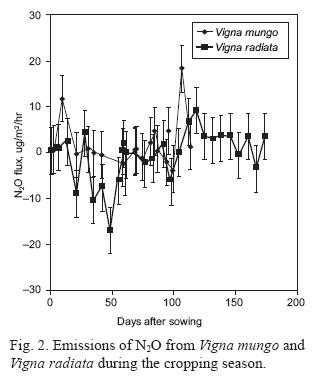
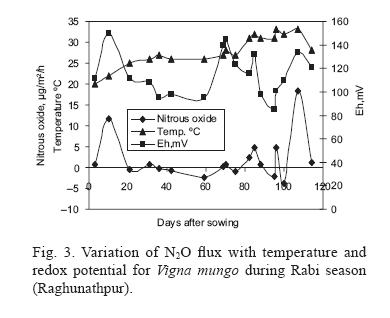
<body><![CDATA[<p align="justify"><font face="verdana" size="2"><i>3.1 Emission pattern of N<sub>2</sub>O and CH<sub>4</sub> from <i>Vigna mungo</i> during 2004 Rabi season</i></font></p>  	    <p align="justify"><font face="verdana" size="2">Air flux samples were collected from the <i>Vigna mungo</i> over 107 days (from 9&#45;1&#45;04 to 6&#45;4&#45;04). The emission pattern for both CH<sub>4</sub> and N<sub>2</sub>O during the entire cropping season is shown in <a href="#f1">Figures 1</a> and <a href="#f2">2</a> respectively. It is observed that CH<sub>4</sub> flux was almost negative or negligible throughout the cropping season barring a few positive values. The overall N2O flux was positive. CH<sub>4</sub> and N<sub>2</sub>O fluxes were almost stable from the 29th day of seeding to 88th day. N<sub>2</sub>O flux was positive but lower compared to the rice fields (Swamy et al., 2007). A slightly higher N<sub>2</sub>O emission at the time of seeding and also during harvest may be due to disturbances in the surface layer of the soil and consequent upheaval.</font></p>  	    <p align="center"><font face="verdana" size="2"><a name="f1"></a></font></p>  	    <p align="center"><font face="verdana" size="2"><img src="/img/revistas/atm/v25n1/a6f1.jpg"></font></p>  	    <p align="center"><font face="verdana" size="2"><a name="f2"></a></font></p>  	    <p align="center"><font face="verdana" size="2"><img src="/img/revistas/atm/v25n1/a6f2.jpg"></font></p>  	    <p align="justify"><font face="verdana" size="2">&nbsp;</font></p>  	    <p align="justify"><font face="verdana" size="2"><i>3.2 Role of redox potential and soil temperature on CH<sub>4</sub> and N<sub>2</sub>O flux</i></font></p>  	    <p align="justify"><font face="verdana" size="2">The change in N<sub>4</sub>O flux with Eh and soil temperature is shown in <a href="#f3">Figure 3</a>. It is observed that the Eh was &gt; +100 mV throughout the cropping season except for a few observations. It was &lt; +100 mV initially on the 36th day after sowing (DAS) to 59th day and again just before harvesting (i.e., 88 DAS and 95 DAS). The Eh range for the minimum generation of both CH<sub>4</sub> and N<sub>2</sub>O was generally between +120 and &#150;170 mV (Yu et al., 2001). A higher flux of 11.67 &micro;g m<sup>&#45;2</sup>h<sup>&#45;1</sup> was observed with the highest Eh of the season on the 10th DAS (150 mV). Previously, it was observed that the critical Eh in US paddy soil for denitrification was approximately + 350 mV (Patrick and Jugsu Inda, 1992).</font></p>  	    <p align="center"><font face="verdana" size="2"><a name="f3"></a></font></p>  	    ]]></body>
<body><![CDATA[<p align="center"><font face="verdana" size="2"><img src="/img/revistas/atm/v25n1/a6f3.jpg"></font></p>  	    <p align="justify"><font face="verdana" size="2">Significant N<sub>2</sub>O accumulation was also noticed at Eh values in the range +120 to +250 mV (Yu et al., 2001). It is important to understand that N<sub>2</sub>O formation depends on the origin of the soil, nitrate availability, pH and Eh status. Relationship between the soil N<sub>2</sub>O concentration and Eh suggests that the denitrification is probably the major mechanism for N<sub>2</sub>O production (Smith et al., 1983; Yu and Patrick, 2003). The maximum soil N<sub>2</sub>O concentration was found at Eh +250 mV, the boundary Eh between the ridge and the swamp (Chen et al., 1997), which is in good agreement with laboratory studies using homogeneous soils (Yu et al., 2001; Yu and Patrick, 2003). N<sub>2</sub>O flux was almost positive in all the cases when the Eh was &gt; +100 mV. In some cases, even though the redox potential was &lt; +100mV, the increase in soil temperature might have played a role. The highest N<sub>2</sub>O (18.38 &micro;g m<sup>&#45;2</sup> h<sup>&#45;1</sup>) emission at the time of harvest (107 DAS) may be due to combined effect of high redox potential (+134mV) and the highest temperature of the season (33 oC).</font></p>  	    <p align="justify"><font face="verdana" size="2">&nbsp;</font></p>  	    <p align="justify"><font face="verdana" size="2"><i>3.3 Seasonally integrated flux E <sub>(SIF)</sub> for <i>Vigna mungo</i></i></font></p>  	    <p align="justify"><font face="verdana" size="2">Seasonally integrated flux E <sub>(SIF)</sub> for CH4 and N<sub>2</sub>O was calculated by taking the daily mean of the flux data and integrating the flux for the entire cropping season (107 days) by taking into consideration the background values. The E(SIF) calculated for CH<sub>4</sub> and N<sub>2</sub>O are &#150;4.06 g m<sup>&#45;2</sup> and 3.38 mg m<sup>&#45;2</sup> respectively. The study indicates that the total N<sub>2</sub>O emission from <i>Vigna mungo</i> cultivated in 3.15 million hectares (Singh and Ahlawat, 2005) in India comes out to be nearly 0.11Gg.</font></p>  	    <p align="justify"><font face="verdana" size="2">&nbsp;</font></p>  	    <p align="justify"><font face="verdana" size="2"><i>3.4 Emission pattern of CH<sub>4</sub> and N<sub>2</sub>O fluxes from <i>Vigna radiata</i> field</i></font></p>  	    <p align="justify"><font face="verdana" size="2">Emission estimates were made for <i>Vigna radiata</i> during the Rabi season of 2005. The measurements were carried out over a period of 175 days including pre&#45;seedling and post&#45; harvesting fallow periods. The emission pattern of CH4 and N2O are represented graphically in <a href="#f1">Figures 1</a> and <a href="#f2">2</a> respectively. Seeds were sown on 29.12.04 and the crop was harvested after 92 days (30&#45;03&#45;05). It is observed that during the initial stage of the plantation, i.e., up to 14 days, the N<sub>2</sub>O flux was positive, while beyond this and up to the 56th day, the flux was negative. The overall N<sub>2</sub>O flux was negative till the harvest. The post&#45;harvest fallow period emissions were positive (<a href="#f2">Fig. 2</a>), indicating a total reverse trend from the cropping period. This might be due to the decomposition of nitrogen bearing nodules in the root structure lying buried in soil after harvest. CH<sub>4</sub> emissions during the same period are shown in <a href="#f1">Figure 1</a>. It is observed from the pattern that CH4 emission is negative during the initial 21 days which is in contrast to N<sub>2</sub>O emission. Similar negative trend was observed for CH<sub>4</sub> during the remaining cropping period.</font></p>  	    <p align="justify"><font face="verdana" size="2">&nbsp;</font></p>  	    <p align="justify"><font face="verdana" size="2"><i>3.5 Influence of Eh on N<sub>2</sub>O emission</i></font></p>  	    ]]></body>
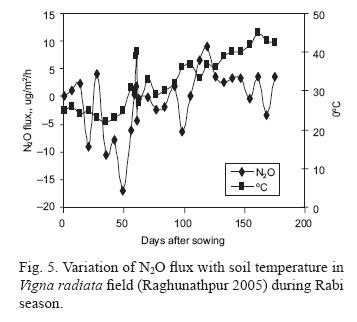
<body><![CDATA[<p align="justify"><font face="verdana" size="2">The redox potential for the <i>Vigna radiata</i> was in the range of +100 to 150 mV during the entire cropping season except on 42nd and 49th days after sowing (DAS). The variation of soil Eh with DAS during the entire season is shown in <a href="#f4">Figure 4</a>. Initially, the Eh was well above 100 mV up to harvesting (92 days). But immediately after harvesting (fallow period) the N<sub>2</sub>O flux was leading to positive continuously.</font></p>  	    <p align="center"><font face="verdana" size="2"><a name="f4"></a></font></p>  	    <p align="center"><font face="verdana" size="2"><img src="/img/revistas/atm/v25n1/a6f4.jpg"></font></p>  	    <p align="justify"><font face="verdana" size="2">&nbsp;</font></p>  	    <p align="justify"><font face="verdana" size="2"><i>3.6 Influence of soil temperature on nitrous oxide flux</i></font></p>  	    <p align="justify"><font face="verdana" size="2">The variation in soil temperature during the cropping season and post&#45; harvest fallow period is shown in Figure 5. The temperature varied in the range 22&#45;32 oC during the cropping period (1&#45;92 days) except on 60th and 61st DAS. During the fallow period, it was in the range of 36&#45;45 &ordm;C (<a href="#f5">Fig. 5</a>). The temperature might be one of the factors contributing to high emission of N2O during the post&#45;harvest fallow period. It was observed that the rate of CH<sub>4</sub> production increased with temperature in rice paddy (Yang and Chang, 1998) with a linear relationship between 15 and 37 oC. Similarly, a linear relationship was also observed between a soil temperature and N<sub>2</sub>O&#45;N emission from legumes in pot experiments (Gosh et al., 2002). The higher N2O emission may be due to the fast degradation of organic matter containing atmospheric N<sub>2</sub>, fixed by legumes, which gets mineralised to release inorganic N producing N<sub>2</sub>O more effectively (Galbally, 1992) with higher temperature. Sensitivity analysis showed that the temperature&#45;soil moisture interaction is critical in the production (Cao et al., 1996) of N2O. The N2O emission was correlated statistically (Statistic XL, version 1.7) with affecting soil parameters. A significant positive correlation (r = 0.46) was observed with temperature while there is no significant correlation with CH<sub>4</sub>.</font></p>  	    <p align="center"><font face="verdana" size="2"><a name="f5"></a></font></p>  	    <p align="center"><font face="verdana" size="2"><img src="/img/revistas/atm/v25n1/a6f5.jpg"></font></p>  	    <p align="justify"><font face="verdana" size="2">&nbsp;</font></p>  	    <p align="justify"><font face="verdana" size="2"><i>3.7 Evaluation of other soil parameters</i></font></p>  	    ]]></body>
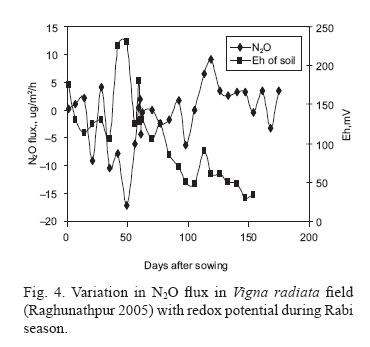
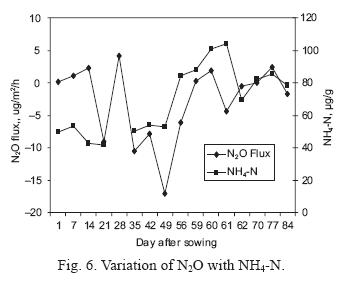
<body><![CDATA[<p align="justify"><font face="verdana" size="2">The nutrients like organic carbon, NH<sub>4</sub><sup>+</sup>, NO<sub>3</sub><sup>&#45;</sup> and NO<sub>2</sub><sup>&#45;</sup> in the soil were evaluated continuously during the measurement period. The results obtained are shown in <a href="/img/revistas/atm/v25n1/a6t2.jpg" target="_blank">Table II</a>. It is observed that the organic carbon was in the range of 0.3&#45;0.5%. Ammonia was maximum on 60th DAS (100 &#956;g g<sup>&#45;1</sup>) and almost similar values were recorded during 56th to 61st DAS. This might be attributed to the generation of NH<sub>4</sub><sup>+</sup>&#45;N from plant roots (rhizosphere), during the flowering stage due to the metabolic activity in the plant. Ammonia values came down to 3&#956;g g&#150;1 during the fallow period. NO<sub>2</sub>&#45;N was maximum (1.4 &#956;g g<sup>&#45;1</sup>) on 42nd and 49th DAS. The increased moisture content (4&#45;20%) due to occasional rains might have enhanced the N<sub>2</sub>O formation as well as emissions (Skiba et al., 1996; Anderson et al., 1988). The moisture in the soil increases nodulations and N fixation and thereby increases N input by changing NH<sub>4</sub><sup>+</sup> and NO<sub>3</sub><sup>&#45;</sup> contents of the soil (Smith et al., 1982). Subsequently, it induces denitrification process driven by denitrifying bacteria in the partially anaerobic condition (Singh et al., 2003; Granli and Bockman, 1994). This might have contributed to the N<sub>2</sub>O emission beyond 61 days till the end of the harvesting season leading to decrease in NH<sub>4</sub>&#45;N and NO<sub>3</sub>&#45;N (<a href="/img/revistas/atm/v25n1/a6t2.jpg" target="_blank">Table II</a>). During the fallow period, NO<sub>2</sub>&#45;N content of soil was as low as 0.0003 &#956;g g<sup>&#45;1</sup>. Similarly, NO<sub>3</sub>&#45;N was maximum (3.79 &#956;g g<sup>&#45;1</sup>) during the initial stages of plantation (up to 35 DAS). For the remaining cropping period and the post&#45;harvest fallow period, the values are in the range of 0.1&#45;0.6 &#956;g g<sup>&#45;1</sup> (<a href="/img/revistas/atm/v25n1/a6t2.jpg" target="_blank">Table II</a>). The relationship of N<sub>2</sub>O and NH<sub>4</sub>&#45;N is shown in <a href="#f6">Figure 6</a>. It is observed that N<sub>2</sub>O emission increased with NH<sub>4</sub>N concentration throughout the cropping period indicating mild anaerobic conditions in the soil which are favourable for N<sub>2</sub>O formation. The other soil parameters like NO<sub>2</sub>&#45;N and NO<sub>3</sub>&#45;N could not be correlated with N<sub>2</sub>O emission due to non&#45;availability of sufficient data during the period.</font></p>  	    <p align="center"><font face="verdana" size="2"><a name="f6"></a></font></p>  	    <p align="center"><font face="verdana" size="2"><img src="/img/revistas/atm/v25n1/a6f6.jpg"></font></p>  	    <p align="justify"><font face="verdana" size="2">&nbsp;</font></p>  	    <p align="justify"><font face="verdana" size="2"><i>3.8 Seasonally integrated flux E(SIF), for <i>Vigna radiata</i></i></font></p>  	    <p align="justify"><font face="verdana" size="2">The E<sub>(SIF)</sub> was calculated based on the emission estimates for the cropping season and also fallow periods. The E<sub>(SIF)</sub> values estimated for CH<sub>4</sub> and N<sub>2</sub>O during the entire cropping season are found to be 0.009 g m<sup>&#45;2</sup> and &#150;7.6 mg m<sup>&#45;2</sup>, where as for the post harvesting period, the E<sub>SIF</sub> values are 0.02 g m<sup>&#45;2</sup> and 4.06 mg m<sup>&#45;2</sup>, respectively. Atmospheric N<sub>2</sub> fixed by the legumes produces N<sub>2</sub>O by rhizobia symbiotically living in root nodules under mild, anaerobic conditions (O'Hara and Daniel, 1985). The grams (<i>Vigna mungo</i> and <i>Vigna radiata</i>) are grown as dry crops, where partial anaerobic conditions prevail in the soil. Absolute dry conditions prevailed in the <i>Vigna radiata</i> soil (soil moisture 1&#45;4% and soil temperature 25&#45;43 &ordm;C, <a href="#f5">Fig. 5</a>) might have supplied O<sub>2</sub> to the micro&#45;sites for nitrification. These prevailing aerobic conditions contributed to the nitrification with low N2O production or negative (N<sub>2</sub>O sink) during the initial period of the cropping season. The precipitation (intermittent drizzles) at the time of harvest has increased the moisture content of the soil to 18%, this might have contributed to the denitrification process to produce N<sub>2</sub>O just before the harvest (84 DAS) and also during the post harvest (fallow period). Increased moisture regime directly or indirectly induces denitrification process driven by denitrifying bacteria in the partially aerobic conditions (Singh et al., 2003). It was also observed that higher soil moisture induces N<sub>2</sub>O emission initially and then gradually declined either due to substrate depletion through denitification (Granli and Bockman, 1994) or further reduction of N<sub>2</sub>O to N<sub>2</sub> in the strict anoxic conditions (Bremner and Blackmer, 1978). The moisture content has decreased the soil reduction potential from an initial value in the range of +100mV to + 150 mV to +30 mV (<a href="#f4">Fig. 4</a>) during the fallow period. Hence, during the fallow period the N<sub>2</sub>O production was almost positive with reduction potential less than +100 mV. In case of <i>Vigna mungo</i> the reduction potential is between +100 to +150 mV (<a href="#f3">Fig. 3</a>) with soil temperature 20&#45;30 &ordm;C and moisture (14&#45;18%), generally required for growing the crop, might have supported in the production of N2O. In a subsequent study by Swamy et al., 2008, in <i>Vigna radiata</i> field at ICRISAT, Hyderabad, the authors reported a E(SIF) of 1.71&#956;g m<sup>&#45;2</sup> for N<sub>2</sub>O. This amounts to total 0.05 Gg of N<sub>2</sub>O emissions from 2.99 million hectors (Singh and Ahlawat, 2005) of <i>Vigna radiata</i> cultivated in India. It confirms that legumes are the source of N<sub>2</sub>O emissions whereas soil is total sink for CH<sub>4</sub>.</font></p>  	    <p align="justify"><font face="verdana" size="2">&nbsp;</font></p>  	    <p align="justify"><font face="verdana" size="2"><b>4. Conclusions</b></font></p>  	    <p align="justify"><font face="verdana" size="2">CH<sub>4</sub> and N<sub>2</sub>O emission studies were carried out on <i>Vigna mungo</i> and <i>Vigna radiata</i> during the two consecutive cropping seasons in a rain&#45;fed upland area. The results indicated a reduction potential of around 100mV for both the crops which supported the formation of N<sub>2</sub>O. The higher soil temperature (&gt;40 oC) enhanced the emission of both CH<sub>4</sub> and N<sub>2</sub>O due to metabolic activity of the plant in the rhizosphere. The E<sub>(SIF)</sub> for CH<sub>4</sub> and N<sub>2</sub>O for <i>Vigna mungo</i> was calculated to be &#150;4.06 and 3.38 mg m<sup>&#45;2</sup>, respectively. The dry condition of the soil contributed positive flux for N<sub>2</sub>O. The N<sub>2</sub>O flux for <i>Vigna radiata</i> was negative attributing to high soil temperature and increased moisture content due to intermittent rains, which acted as total sink for N<sub>2</sub>O. It is observed that during post harvest fallow period the N<sub>2</sub>O flux (4.06 mg m<sup>&#45;2</sup>) was positive due to residual biomass in soil, after harvesting, with almost negligible amount of CH<sub>4</sub>.</font></p>  	    <p align="justify"><font face="verdana" size="2">The maximum NH<sub>4</sub><sup>+</sup>&#45;N content (100 &#956;g g<sup>&#45;1</sup>) during the flowering stage of the crop might be due to higher plant metabolism in the rhizosphere. The NO<sub>2</sub>&#45;N content in the soil was higher (1.4 &#956;g g<sup>&#45;1</sup>) on 42nd and 49th DAS and lower (0.0003 &#956;g g<sup>&#45;1</sup>) during the fallow period. NO<sub>3</sub>&#45;N content was at its maximum (3.79 &#956;g g<sup>&#45;1</sup>) during the initial stages of plantation. Correlation could not be established between NO<sub>2</sub>&#45;N, NO<sub>3</sub>&#45;N and N<sub>2</sub>O emission.</font></p>  	    ]]></body>
<body><![CDATA[<p align="justify"><font face="verdana" size="2">&nbsp;</font></p>  	    <p align="justify"><font face="verdana" size="2"><b>Acknowledgements</b></font></p>  	    <p align="justify"><font face="verdana" size="2">The authors are thankful to the Directors of Institute of Minerals and Materials Technology (IMMT), Bhubaneswar, and Indian Institute of Chemical Technology (IICT), Hyderabad, for their kind permission to publish the paper. They would also like to thank AT/CTM under ISRO&#45;GBP for funding the programme. Thanks are also due to Dr. C.B.S Dutt, Deputy Program Director, ISRO&#45;GBP, Prof. Syam Lal, Project Director, AT/CTM for their kind support and encouragement during the course of the studies.</font></p>  	    <p align="justify"><font face="verdana" size="2">&nbsp;</font></p>  	    <p align="justify"><font face="verdana" size="2"><b>References</b></font></p>  	    <!-- ref --><p align="justify"><font face="verdana" size="2">Abao Jr., E. B., K. R. Bronson, R. Wassmann and U. Singh, 2000. Simultaneous records of methane and nitrous oxide emissions in rice&#45;based cropping systems under rainfed conditions. Nutr. Cycl. Agroecosyst. 58, 131&#45;139.    &nbsp;&nbsp;&nbsp;&nbsp;&nbsp;&nbsp;&nbsp;&nbsp;[&#160;<a href="javascript:void(0);" onclick="javascript: window.open('/scielo.php?script=sci_nlinks&ref=384620&pid=S0187-6236201200010000600001&lng=','','width=640,height=500,resizable=yes,scrollbars=1,menubar=yes,');">Links</a>&#160;]<!-- end-ref --></font></p>  	    <!-- ref --><p align="justify"><font face="verdana" size="2">Adhya T. K., K. Bharti, S. R. Mohanty, B. Ramakrishna, V. R. Rao, N. Sethunathan and R. Wassmann, 2000. Methane emissions from rice fields at Cuttack (India). Nutr. Cycl. Agroecosyst. 58, 95&#45;106.    &nbsp;&nbsp;&nbsp;&nbsp;&nbsp;&nbsp;&nbsp;&nbsp;[&#160;<a href="javascript:void(0);" onclick="javascript: window.open('/scielo.php?script=sci_nlinks&ref=384622&pid=S0187-6236201200010000600002&lng=','','width=640,height=500,resizable=yes,scrollbars=1,menubar=yes,');">Links</a>&#160;]<!-- end-ref --></font></p>  	    <!-- ref --><p align="justify"><font face="verdana" size="2">ALGAS, 1998. National report. Asia Least&#45;cost Greenhouse Gas Abatement Strategy. Ministry of Environment and Forest, Government of India, New Delhi, 32&#45;40.    &nbsp;&nbsp;&nbsp;&nbsp;&nbsp;&nbsp;&nbsp;&nbsp;[&#160;<a href="javascript:void(0);" onclick="javascript: window.open('/scielo.php?script=sci_nlinks&ref=384624&pid=S0187-6236201200010000600003&lng=','','width=640,height=500,resizable=yes,scrollbars=1,menubar=yes,');">Links</a>&#160;]<!-- end-ref --></font></p>  	    <!-- ref --><p align="justify"><font face="verdana" size="2">Anderson I. C., J. S. Levine, M. A. Poth and P. J. Riggan, 1988. Enhanced bionic emissions of nitric oxide and nitrous oxide following surface biomes burning. J. Geophys. Res. 93, 3893&#45;3898.    &nbsp;&nbsp;&nbsp;&nbsp;&nbsp;&nbsp;&nbsp;&nbsp;[&#160;<a href="javascript:void(0);" onclick="javascript: window.open('/scielo.php?script=sci_nlinks&ref=384626&pid=S0187-6236201200010000600004&lng=','','width=640,height=500,resizable=yes,scrollbars=1,menubar=yes,');">Links</a>&#160;]<!-- end-ref --></font></p>  	    <!-- ref --><p align="justify"><font face="verdana" size="2">Aulakh M. S., T. S. Khera, J. W. Doran and K. Bronson, 2002. Denitrification, N2O and CO2 fluxes in rice wheat cropping system as affected by crop residues, fertilizer N and legume green manure. Biol. Fertil. Soils 34, 375&#45;389.    &nbsp;&nbsp;&nbsp;&nbsp;&nbsp;&nbsp;&nbsp;&nbsp;[&#160;<a href="javascript:void(0);" onclick="javascript: window.open('/scielo.php?script=sci_nlinks&ref=384628&pid=S0187-6236201200010000600005&lng=','','width=640,height=500,resizable=yes,scrollbars=1,menubar=yes,');">Links</a>&#160;]<!-- end-ref --></font></p>  	    <!-- ref --><p align="justify"><font face="verdana" size="2">Austin W. E. and J. H. Huddleston, 1999. Viability of permanently installed platinum redox electrodes. Soil Sci. Soc. Am. J. 63, 1757&#45;1762.    &nbsp;&nbsp;&nbsp;&nbsp;&nbsp;&nbsp;&nbsp;&nbsp;[&#160;<a href="javascript:void(0);" onclick="javascript: window.open('/scielo.php?script=sci_nlinks&ref=384630&pid=S0187-6236201200010000600006&lng=','','width=640,height=500,resizable=yes,scrollbars=1,menubar=yes,');">Links</a>&#160;]<!-- end-ref --></font></p>  	    <!-- ref --><p align="justify"><font face="verdana" size="2">Baruah K. K., D. C. Parashar, P. K. Gupta, C. Sharma, M. C. Jain and A. P. Mitra, 1997. Effects of water management and rice genotypes on methane emission from paddy field. Ind. J. Radio Space Phys. 26, 77&#45;81.    &nbsp;&nbsp;&nbsp;&nbsp;&nbsp;&nbsp;&nbsp;&nbsp;[&#160;<a href="javascript:void(0);" onclick="javascript: window.open('/scielo.php?script=sci_nlinks&ref=384632&pid=S0187-6236201200010000600007&lng=','','width=640,height=500,resizable=yes,scrollbars=1,menubar=yes,');">Links</a>&#160;]<!-- end-ref --></font></p>  	    <!-- ref --><p align="justify"><font face="verdana" size="2">Battle M., M. Bender, T. Sowers, P. P. Tans, J. H. Butler, J. W. Elkins, J. T. Ellis, T. Conway, N. Zhang, P. Lang and A. D. Clarke, 1996. Atmospheric gas concentrations over the past century measured in air from firn at the south pole. Nature 383, 231&#45;235.    &nbsp;&nbsp;&nbsp;&nbsp;&nbsp;&nbsp;&nbsp;&nbsp;[&#160;<a href="javascript:void(0);" onclick="javascript: window.open('/scielo.php?script=sci_nlinks&ref=384634&pid=S0187-6236201200010000600008&lng=','','width=640,height=500,resizable=yes,scrollbars=1,menubar=yes,');">Links</a>&#160;]<!-- end-ref --></font></p>  	    <!-- ref --><p align="justify"><font face="verdana" size="2">Bhattacharya S. and A. P. Mitra, 1998. Greenhouse gas emissions in India for the base year 1990. Global Change 11, 30&#45;39.    &nbsp;&nbsp;&nbsp;&nbsp;&nbsp;&nbsp;&nbsp;&nbsp;[&#160;<a href="javascript:void(0);" onclick="javascript: window.open('/scielo.php?script=sci_nlinks&ref=384636&pid=S0187-6236201200010000600009&lng=','','width=640,height=500,resizable=yes,scrollbars=1,menubar=yes,');">Links</a>&#160;]<!-- end-ref --></font></p>  	    <!-- ref --><p align="justify"><font face="verdana" size="2">Bremner J. M., 1965. Total nitrogen. In: Methods of soil analysis: Part 2. (Agronomy 9) C. A. Black D. D. Evans, J. L. White L. E. Ensminger and F. E. Clark, Eds.). Am. Soc. Agron. Madison, WI, USA, 1149&#45;1176.    &nbsp;&nbsp;&nbsp;&nbsp;&nbsp;&nbsp;&nbsp;&nbsp;[&#160;<a href="javascript:void(0);" onclick="javascript: window.open('/scielo.php?script=sci_nlinks&ref=384638&pid=S0187-6236201200010000600010&lng=','','width=640,height=500,resizable=yes,scrollbars=1,menubar=yes,');">Links</a>&#160;]<!-- end-ref --></font></p>  	    <!-- ref --><p align="justify"><font face="verdana" size="2">Bremner J. M. and A.M. Blackmer, 1978. Nitrous oxide emission from soils during nitrification of fertilizer nitrogen. Science 199, 295&#45;296.    &nbsp;&nbsp;&nbsp;&nbsp;&nbsp;&nbsp;&nbsp;&nbsp;[&#160;<a href="javascript:void(0);" onclick="javascript: window.open('/scielo.php?script=sci_nlinks&ref=384640&pid=S0187-6236201200010000600011&lng=','','width=640,height=500,resizable=yes,scrollbars=1,menubar=yes,');">Links</a>&#160;]<!-- end-ref --></font></p>  	    <!-- ref --><p align="justify"><font face="verdana" size="2">Cai Z. C., G. X. Xing, X. Y. Yan, H. Xu, H. Tsuruta, K. Yagi, and K. Minami, 1997. Methane and nitrous oxide emissions from rice paddy fields as affected by nitrogen fertilizers and water management. Plant Soil 196, 7&#45;14.    &nbsp;&nbsp;&nbsp;&nbsp;&nbsp;&nbsp;&nbsp;&nbsp;[&#160;<a href="javascript:void(0);" onclick="javascript: window.open('/scielo.php?script=sci_nlinks&ref=384642&pid=S0187-6236201200010000600012&lng=','','width=640,height=500,resizable=yes,scrollbars=1,menubar=yes,');">Links</a>&#160;]<!-- end-ref --></font></p>  	    <!-- ref --><p align="justify"><font face="verdana" size="2">Cao M., K. Gregson, S. Marshall, J. B. Dent and O. W. Heal, 1996. Global methane emissions from rice paddies. Chemosphere 33, 879&#45;897.    &nbsp;&nbsp;&nbsp;&nbsp;&nbsp;&nbsp;&nbsp;&nbsp;[&#160;<a href="javascript:void(0);" onclick="javascript: window.open('/scielo.php?script=sci_nlinks&ref=384644&pid=S0187-6236201200010000600013&lng=','','width=640,height=500,resizable=yes,scrollbars=1,menubar=yes,');">Links</a>&#160;]<!-- end-ref --></font></p>  	    <!-- ref --><p align="justify"><font face="verdana" size="2">Chen G. X., G. H. Huang, B. Huang, K. W. Yu, J. Wu and H. Xu, 1997. Nitric oxide and methane emissions from soil plant systems. Nutr. Cycl. Agroecosyst. 49, 41&#45;45.    &nbsp;&nbsp;&nbsp;&nbsp;&nbsp;&nbsp;&nbsp;&nbsp;[&#160;<a href="javascript:void(0);" onclick="javascript: window.open('/scielo.php?script=sci_nlinks&ref=384646&pid=S0187-6236201200010000600014&lng=','','width=640,height=500,resizable=yes,scrollbars=1,menubar=yes,');">Links</a>&#160;]<!-- end-ref --></font></p>  	    <!-- ref --><p align="justify"><font face="verdana" size="2">Davidson E. A., 1993. Soil water content and the ratio of nitrous oxide to nitric oxide emitted from soil. In: Biogeochemistry of global change: Radiactively active gases. (R. S. Oremland, Ed.). Chapman and Hall, New York, 369&#45;386.    &nbsp;&nbsp;&nbsp;&nbsp;&nbsp;&nbsp;&nbsp;&nbsp;[&#160;<a href="javascript:void(0);" onclick="javascript: window.open('/scielo.php?script=sci_nlinks&ref=384648&pid=S0187-6236201200010000600015&lng=','','width=640,height=500,resizable=yes,scrollbars=1,menubar=yes,');">Links</a>&#160;]<!-- end-ref --></font></p>  	    <!-- ref --><p align="justify"><font face="verdana" size="2">Delwiche C. C. and R. J. Cicerone, 1993. Factors affecting methane production under rice. Global Biogeochem. Cycles 7, 143&#45;156.    &nbsp;&nbsp;&nbsp;&nbsp;&nbsp;&nbsp;&nbsp;&nbsp;[&#160;<a href="javascript:void(0);" onclick="javascript: window.open('/scielo.php?script=sci_nlinks&ref=384650&pid=S0187-6236201200010000600016&lng=','','width=640,height=500,resizable=yes,scrollbars=1,menubar=yes,');">Links</a>&#160;]<!-- end-ref --></font></p>  	    <!-- ref --><p align="justify"><font face="verdana" size="2">Eichner M. J., 1990. Nitrous oxide emission from fertilized soils: summary of available data. J. Environ. Qual. 19, 272&#45;280.    &nbsp;&nbsp;&nbsp;&nbsp;&nbsp;&nbsp;&nbsp;&nbsp;[&#160;<a href="javascript:void(0);" onclick="javascript: window.open('/scielo.php?script=sci_nlinks&ref=384652&pid=S0187-6236201200010000600017&lng=','','width=640,height=500,resizable=yes,scrollbars=1,menubar=yes,');">Links</a>&#160;]<!-- end-ref --></font></p>  	    <!-- ref --><p align="justify"><font face="verdana" size="2">FAI, 2000. Fertilizer statistics (1998&#45;99), Fertilizer Association of India, New Delhi, India.    &nbsp;&nbsp;&nbsp;&nbsp;&nbsp;&nbsp;&nbsp;&nbsp;[&#160;<a href="javascript:void(0);" onclick="javascript: window.open('/scielo.php?script=sci_nlinks&ref=384654&pid=S0187-6236201200010000600018&lng=','','width=640,height=500,resizable=yes,scrollbars=1,menubar=yes,');">Links</a>&#160;]<!-- end-ref --></font></p>  	    <!-- ref --><p align="justify"><font face="verdana" size="2">Galbally I. E., 1992. Biosphere&#45;atmosphere exchange of trace gases over Australia. In: Australia's renewable resources: Sustainability and global change (Gifford RM, Barson MM, Eds.). Bureau of Rural Resources, Canberra, 117&#45;149.    &nbsp;&nbsp;&nbsp;&nbsp;&nbsp;&nbsp;&nbsp;&nbsp;[&#160;<a href="javascript:void(0);" onclick="javascript: window.open('/scielo.php?script=sci_nlinks&ref=384656&pid=S0187-6236201200010000600019&lng=','','width=640,height=500,resizable=yes,scrollbars=1,menubar=yes,');">Links</a>&#160;]<!-- end-ref --></font></p>  	    <!-- ref --><p align="justify"><font face="verdana" size="2">Ghosh S., D. Majumdar and M. C. Jain, 2002. Nitrous oxide emissions from kharif and rabi legumes grown on an alluvial soil. Biol. Fertil. Soils 35, 473&#45;478.    &nbsp;&nbsp;&nbsp;&nbsp;&nbsp;&nbsp;&nbsp;&nbsp;[&#160;<a href="javascript:void(0);" onclick="javascript: window.open('/scielo.php?script=sci_nlinks&ref=384658&pid=S0187-6236201200010000600020&lng=','','width=640,height=500,resizable=yes,scrollbars=1,menubar=yes,');">Links</a>&#160;]<!-- end-ref --></font></p>  	    <!-- ref --><p align="justify"><font face="verdana" size="2">Granli T. and O. C. Bockman, 1994. Nitrous oxide from agriculture. Nor. J. Agric. Sci. 12 (Suppl.): 1&#45;128.    &nbsp;&nbsp;&nbsp;&nbsp;&nbsp;&nbsp;&nbsp;&nbsp;[&#160;<a href="javascript:void(0);" onclick="javascript: window.open('/scielo.php?script=sci_nlinks&ref=384660&pid=S0187-6236201200010000600021&lng=','','width=640,height=500,resizable=yes,scrollbars=1,menubar=yes,');">Links</a>&#160;]<!-- end-ref --></font></p>  	    <!-- ref --><p align="justify"><font face="verdana" size="2">Hou A. X., G. X. Chen, Z. P. Wang, O. Van Cleemput and W. H. Patrick Jr., 2000. Methane and nitrous oxide emissions from a rice field in relation to soil redox and microbiological process. Soil Sci. Soc. Am. J. 64, 2180&#45;2186.    &nbsp;&nbsp;&nbsp;&nbsp;&nbsp;&nbsp;&nbsp;&nbsp;[&#160;<a href="javascript:void(0);" onclick="javascript: window.open('/scielo.php?script=sci_nlinks&ref=384662&pid=S0187-6236201200010000600022&lng=','','width=640,height=500,resizable=yes,scrollbars=1,menubar=yes,');">Links</a>&#160;]<!-- end-ref --></font></p>  	    <!-- ref --><p align="justify"><font face="verdana" size="2">Huang Y., J. Zou, X. Zheng, Y. Wang and X. Xu, 2004. Nitrous oxide emissions as influenced by amendments of plant residues with different C: N ratio. Soil Biol. Biochem. 36, 973&#45;981.    &nbsp;&nbsp;&nbsp;&nbsp;&nbsp;&nbsp;&nbsp;&nbsp;[&#160;<a href="javascript:void(0);" onclick="javascript: window.open('/scielo.php?script=sci_nlinks&ref=384664&pid=S0187-6236201200010000600023&lng=','','width=640,height=500,resizable=yes,scrollbars=1,menubar=yes,');">Links</a>&#160;]<!-- end-ref --></font></p>  	    <!-- ref --><p align="justify"><font face="verdana" size="2">Hutchison G. L. and A. R. Moiser, 1981. Improved soil cover method for field measurement of nitrous oxide fluxes. Soil Sci. Soc. Am. J. 45, 311&#45;316.    &nbsp;&nbsp;&nbsp;&nbsp;&nbsp;&nbsp;&nbsp;&nbsp;[&#160;<a href="javascript:void(0);" onclick="javascript: window.open('/scielo.php?script=sci_nlinks&ref=384666&pid=S0187-6236201200010000600024&lng=','','width=640,height=500,resizable=yes,scrollbars=1,menubar=yes,');">Links</a>&#160;]<!-- end-ref --></font></p>  	    <!-- ref --><p align="justify"><font face="verdana" size="2">IPCC, 1997. Intergovernmental Panel on Climate Change. Guidelines for National Greenhouse Gas Inventories. OECD, Chapter 4, Paris, France, 59 pp.    &nbsp;&nbsp;&nbsp;&nbsp;&nbsp;&nbsp;&nbsp;&nbsp;[&#160;<a href="javascript:void(0);" onclick="javascript: window.open('/scielo.php?script=sci_nlinks&ref=384668&pid=S0187-6236201200010000600025&lng=','','width=640,height=500,resizable=yes,scrollbars=1,menubar=yes,');">Links</a>&#160;]<!-- end-ref --></font></p>  	    <!-- ref --><p align="justify"><font face="verdana" size="2">Jackson M. L., 1967. Soil chemical analysis. Prentice Hall of India, New Delhi, India, 205 pp.    &nbsp;&nbsp;&nbsp;&nbsp;&nbsp;&nbsp;&nbsp;&nbsp;[&#160;<a href="javascript:void(0);" onclick="javascript: window.open('/scielo.php?script=sci_nlinks&ref=384670&pid=S0187-6236201200010000600026&lng=','','width=640,height=500,resizable=yes,scrollbars=1,menubar=yes,');">Links</a>&#160;]<!-- end-ref --></font></p>  	    <!-- ref --><p align="justify"><font face="verdana" size="2">Keeny D. R. and D. W. Nelson, 1982. Nitrogen&#45;inorganic forms. In: Methods of soil analysis. Part 2. Chemical and microbiological properties (A. L. Page, R. H. Miller and D. R. Keeny, Eds.). 2a ed. Soil Sci. Soc. Am. WI, 643&#45;698.    &nbsp;&nbsp;&nbsp;&nbsp;&nbsp;&nbsp;&nbsp;&nbsp;[&#160;<a href="javascript:void(0);" onclick="javascript: window.open('/scielo.php?script=sci_nlinks&ref=384672&pid=S0187-6236201200010000600027&lng=','','width=640,height=500,resizable=yes,scrollbars=1,menubar=yes,');">Links</a>&#160;]<!-- end-ref --></font></p>  	    <!-- ref --><p align="justify"><font face="verdana" size="2">Kludze H. K. and R. D. Delaune, 1995. Straw application effects on methane and oxygen exchange and growth in rice. Soil Sci. Soc. Am. J. 59, 824&#45;830.    &nbsp;&nbsp;&nbsp;&nbsp;&nbsp;&nbsp;&nbsp;&nbsp;[&#160;<a href="javascript:void(0);" onclick="javascript: window.open('/scielo.php?script=sci_nlinks&ref=384674&pid=S0187-6236201200010000600028&lng=','','width=640,height=500,resizable=yes,scrollbars=1,menubar=yes,');">Links</a>&#160;]<!-- end-ref --></font></p>  	    <!-- ref --><p align="justify"><font face="verdana" size="2">Kumar U., M. C. Jain, S. Kumar, H. Pathak and D. Majumdar, 2000. Effects of moisture levels and nitrification inhibitors on N2O emission from fertilized alluvial clay loam soil. Curr. Sci. 79, 224&#45;228.    &nbsp;&nbsp;&nbsp;&nbsp;&nbsp;&nbsp;&nbsp;&nbsp;[&#160;<a href="javascript:void(0);" onclick="javascript: window.open('/scielo.php?script=sci_nlinks&ref=384676&pid=S0187-6236201200010000600029&lng=','','width=640,height=500,resizable=yes,scrollbars=1,menubar=yes,');">Links</a>&#160;]<!-- end-ref --></font></p>  	    <!-- ref --><p align="justify"><font face="verdana" size="2">Machida T., T. Nakazawa, S. Fujii Yaola and O. Watanabe, 1995. Increase in the atmospheric nitrous oxide concentration during the last 250 years. Geophys. Res. Lett. 22, 2921&#45;2924.    &nbsp;&nbsp;&nbsp;&nbsp;&nbsp;&nbsp;&nbsp;&nbsp;[&#160;<a href="javascript:void(0);" onclick="javascript: window.open('/scielo.php?script=sci_nlinks&ref=384678&pid=S0187-6236201200010000600030&lng=','','width=640,height=500,resizable=yes,scrollbars=1,menubar=yes,');">Links</a>&#160;]<!-- end-ref --></font></p>  	    <!-- ref --><p align="justify"><font face="verdana" size="2">Mishra R. D. and M. Ahmed, 1987. Manual on irrigation agronomy. Oxford and IBH, Publishing Co. Pvt., New Delhi, India, 412 pp.    &nbsp;&nbsp;&nbsp;&nbsp;&nbsp;&nbsp;&nbsp;&nbsp;[&#160;<a href="javascript:void(0);" onclick="javascript: window.open('/scielo.php?script=sci_nlinks&ref=384680&pid=S0187-6236201200010000600031&lng=','','width=640,height=500,resizable=yes,scrollbars=1,menubar=yes,');">Links</a>&#160;]<!-- end-ref --></font></p>  	    <!-- ref --><p align="justify"><font face="verdana" size="2">Moiser A. R., J. M. Duxbury, J. R. Freney, O. Heinemeyer and K. Minami, 1998. Assessing and mitigating N2O emissions from agricultural soils. Clim. Change 40, 7&#45;38.    &nbsp;&nbsp;&nbsp;&nbsp;&nbsp;&nbsp;&nbsp;&nbsp;[&#160;<a href="javascript:void(0);" onclick="javascript: window.open('/scielo.php?script=sci_nlinks&ref=384682&pid=S0187-6236201200010000600032&lng=','','width=640,height=500,resizable=yes,scrollbars=1,menubar=yes,');">Links</a>&#160;]<!-- end-ref --></font></p>  	    <!-- ref --><p align="justify"><font face="verdana" size="2">Neue H. U. and P. A. Roger, 1994. Potential of methane emission in major rice ecologies. In: Climate biosphere interaction (R. G. Zepp, Ed.). John Wiley and Sons, New York, 65&#45;93.    &nbsp;&nbsp;&nbsp;&nbsp;&nbsp;&nbsp;&nbsp;&nbsp;[&#160;<a href="javascript:void(0);" onclick="javascript: window.open('/scielo.php?script=sci_nlinks&ref=384684&pid=S0187-6236201200010000600033&lng=','','width=640,height=500,resizable=yes,scrollbars=1,menubar=yes,');">Links</a>&#160;]<!-- end-ref --></font></p>  	    <!-- ref --><p align="justify"><font face="verdana" size="2">O'Hara G. W. and P. M. Daniel, 1985. Rhizobial denitrification:a review. Soil Boil. Biochem. 17, 1&#45;9.    &nbsp;&nbsp;&nbsp;&nbsp;&nbsp;&nbsp;&nbsp;&nbsp;[&#160;<a href="javascript:void(0);" onclick="javascript: window.open('/scielo.php?script=sci_nlinks&ref=384686&pid=S0187-6236201200010000600034&lng=','','width=640,height=500,resizable=yes,scrollbars=1,menubar=yes,');">Links</a>&#160;]<!-- end-ref --></font></p>  	    <!-- ref --><p align="justify"><font face="verdana" size="2">Pathak H, 1999. Emissions of nitrous oxide from soils. Curr. Sci. 77, 359&#45;369.    &nbsp;&nbsp;&nbsp;&nbsp;&nbsp;&nbsp;&nbsp;&nbsp;[&#160;<a href="javascript:void(0);" onclick="javascript: window.open('/scielo.php?script=sci_nlinks&ref=384688&pid=S0187-6236201200010000600035&lng=','','width=640,height=500,resizable=yes,scrollbars=1,menubar=yes,');">Links</a>&#160;]<!-- end-ref --></font></p>  	    <!-- ref --><p align="justify"><font face="verdana" size="2">Pathak H., Shiv Prasad, A. Bhatia, S. Singh, S. Kumar, M. C. Jain and U. Kumar, 2003. Emission of methane from rice wheat systems of Indo&#45;Gangetic plains of India. Agric. Ecosyst. Environ. 97, 309&#45;316.    &nbsp;&nbsp;&nbsp;&nbsp;&nbsp;&nbsp;&nbsp;&nbsp;[&#160;<a href="javascript:void(0);" onclick="javascript: window.open('/scielo.php?script=sci_nlinks&ref=384690&pid=S0187-6236201200010000600036&lng=','','width=640,height=500,resizable=yes,scrollbars=1,menubar=yes,');">Links</a>&#160;]<!-- end-ref --></font></p>  	    <!-- ref --><p align="justify"><font face="verdana" size="2">Patrick Jr. W. H. and A. Jugsujinda, 1992. Sequential reduction and oxidation of inorganic nitrogen, manganese and iron in flooded soil. Soil Sci. Soc. Am. J. 56, 1071&#45;1073.    &nbsp;&nbsp;&nbsp;&nbsp;&nbsp;&nbsp;&nbsp;&nbsp;[&#160;<a href="javascript:void(0);" onclick="javascript: window.open('/scielo.php?script=sci_nlinks&ref=384692&pid=S0187-6236201200010000600037&lng=','','width=640,height=500,resizable=yes,scrollbars=1,menubar=yes,');">Links</a>&#160;]<!-- end-ref --></font></p>  	    <!-- ref --><p align="justify"><font face="verdana" size="2">Piper C. S., 1967. Soil and plant analysis. Asia Publishing House, Bombay, 369 pp.    &nbsp;&nbsp;&nbsp;&nbsp;&nbsp;&nbsp;&nbsp;&nbsp;[&#160;<a href="javascript:void(0);" onclick="javascript: window.open('/scielo.php?script=sci_nlinks&ref=384694&pid=S0187-6236201200010000600038&lng=','','width=640,height=500,resizable=yes,scrollbars=1,menubar=yes,');">Links</a>&#160;]<!-- end-ref --></font></p>  	    <!-- ref --><p align="justify"><font face="verdana" size="2">Rath A. K., S. R. Mohanty, S. Mishra, S. Kumaraswamy, B. Ramakrishna, and N. Sethunathan, 1999. Methane production in unamended and rice &#150;straw&#45;amended soil at different moisture levels. Biol. Fertil. Soils 28, 145&#45;149.    &nbsp;&nbsp;&nbsp;&nbsp;&nbsp;&nbsp;&nbsp;&nbsp;[&#160;<a href="javascript:void(0);" onclick="javascript: window.open('/scielo.php?script=sci_nlinks&ref=384696&pid=S0187-6236201200010000600039&lng=','','width=640,height=500,resizable=yes,scrollbars=1,menubar=yes,');">Links</a>&#160;]<!-- end-ref --></font></p>  	    <!-- ref --><p align="justify"><font face="verdana" size="2">Singh S. N., A. Verma and L. Tyagi, 2003. Biogenic emission of GHGs from agricultural fields. Physiol. Mol. Biol. Plants 9, 63&#45;73.    &nbsp;&nbsp;&nbsp;&nbsp;&nbsp;&nbsp;&nbsp;&nbsp;[&#160;<a href="javascript:void(0);" onclick="javascript: window.open('/scielo.php?script=sci_nlinks&ref=384698&pid=S0187-6236201200010000600040&lng=','','width=640,height=500,resizable=yes,scrollbars=1,menubar=yes,');">Links</a>&#160;]<!-- end-ref --></font></p>  	    <!-- ref --><p align="justify"><font face="verdana" size="2">Singh D. P. and I. P. S. Ahlawat, 2005. Greengram (<i>Vigna radiata</i>) and black gram (V. mungo) improvement in India: past, present and future aspects, Indian J. Agric. Sci. 75, 243&#45;250.    &nbsp;&nbsp;&nbsp;&nbsp;&nbsp;&nbsp;&nbsp;&nbsp;[&#160;<a href="javascript:void(0);" onclick="javascript: window.open('/scielo.php?script=sci_nlinks&ref=384700&pid=S0187-6236201200010000600041&lng=','','width=640,height=500,resizable=yes,scrollbars=1,menubar=yes,');">Links</a>&#160;]<!-- end-ref --></font></p>  	    <!-- ref --><p align="justify"><font face="verdana" size="2">Skiba U., K. J. Hargreaves, I. J. Beverland, D. H. O'Neill, D. Fowler and J. B. Moncrieff, 1996. Measurement of field scale N2O emission fluxes from a wheat crop using micrometeorological techniques. Plant Soil 181, 139&#45;144.    &nbsp;&nbsp;&nbsp;&nbsp;&nbsp;&nbsp;&nbsp;&nbsp;[&#160;<a href="javascript:void(0);" onclick="javascript: window.open('/scielo.php?script=sci_nlinks&ref=384702&pid=S0187-6236201200010000600042&lng=','','width=640,height=500,resizable=yes,scrollbars=1,menubar=yes,');">Links</a>&#160;]<!-- end-ref --></font></p>  	    <!-- ref --><p align="justify"><font face="verdana" size="2">Smith C. J., M. Bradon and W. H. Patrick Jr., 1982. Nitrous oxide emission following urea N&#45;fertilization of wet land rice. Soil Sci. Plant Nutr. 28, 161&#45;171.    &nbsp;&nbsp;&nbsp;&nbsp;&nbsp;&nbsp;&nbsp;&nbsp;[&#160;<a href="javascript:void(0);" onclick="javascript: window.open('/scielo.php?script=sci_nlinks&ref=384704&pid=S0187-6236201200010000600043&lng=','','width=640,height=500,resizable=yes,scrollbars=1,menubar=yes,');">Links</a>&#160;]<!-- end-ref --></font></p>  	    <!-- ref --><p align="justify"><font face="verdana" size="2">Smith C. J., M. F. Wright and W. H. Patrick Jr., 1983. The effect of soil redox potential and pH on the reduction and production of nitrous oxide. J. Environ. Qual. 12, 186&#45;188.    &nbsp;&nbsp;&nbsp;&nbsp;&nbsp;&nbsp;&nbsp;&nbsp;[&#160;<a href="javascript:void(0);" onclick="javascript: window.open('/scielo.php?script=sci_nlinks&ref=384706&pid=S0187-6236201200010000600044&lng=','','width=640,height=500,resizable=yes,scrollbars=1,menubar=yes,');">Links</a>&#160;]<!-- end-ref --></font></p>  	    <!-- ref --><p align="justify"><font face="verdana" size="2">Swamy Y. V., S. N. Das, Ruby Das and P. K. Behera, 2007. Assessment of methane from agricultural field during the entire paddy cropping seasons&#45; a case study. Toxicol. Environ. Chem. 89, 269&#45;280.    &nbsp;&nbsp;&nbsp;&nbsp;&nbsp;&nbsp;&nbsp;&nbsp;[&#160;<a href="javascript:void(0);" onclick="javascript: window.open('/scielo.php?script=sci_nlinks&ref=384708&pid=S0187-6236201200010000600045&lng=','','width=640,height=500,resizable=yes,scrollbars=1,menubar=yes,');">Links</a>&#160;]<!-- end-ref --></font></p>  	    <!-- ref --><p align="justify"><font face="verdana" size="2">Swamy Y. V., P. N Sarma, S. V. Ramanaiah and M. Ramakrishna, 2008. Studies on emission of nitrous oxide flux from moist uplands of Orissa, Report No. T/ES/679/Sep/2008 submitted by IMMT, Bhubaneswar, page37.    &nbsp;&nbsp;&nbsp;&nbsp;&nbsp;&nbsp;&nbsp;&nbsp;[&#160;<a href="javascript:void(0);" onclick="javascript: window.open('/scielo.php?script=sci_nlinks&ref=384710&pid=S0187-6236201200010000600046&lng=','','width=640,height=500,resizable=yes,scrollbars=1,menubar=yes,');">Links</a>&#160;]<!-- end-ref --></font></p>  	    <!-- ref --><p align="justify"><font face="verdana" size="2">Ui L. and W. H. Patrick Jr., 2003. Redox range with minimum nitrous oxide and methane production in a rise soil under different pH. Soil Sci. Soc. Am. J. 67, 1952&#45;1958.    &nbsp;&nbsp;&nbsp;&nbsp;&nbsp;&nbsp;&nbsp;&nbsp;[&#160;<a href="javascript:void(0);" onclick="javascript: window.open('/scielo.php?script=sci_nlinks&ref=384712&pid=S0187-6236201200010000600047&lng=','','width=640,height=500,resizable=yes,scrollbars=1,menubar=yes,');">Links</a>&#160;]<!-- end-ref --></font></p>  	    <!-- ref --><p align="justify"><font face="verdana" size="2">Verma A., Larisha Tyagi, Sumit Yadav and S. N. Singh, 2006. Temporal changes in N2O efflux from cropped and fallow agricultural fields. Agric. Ecosyst. Environ. 116, 209&#45;215.    &nbsp;&nbsp;&nbsp;&nbsp;&nbsp;&nbsp;&nbsp;&nbsp;[&#160;<a href="javascript:void(0);" onclick="javascript: window.open('/scielo.php?script=sci_nlinks&ref=384714&pid=S0187-6236201200010000600048&lng=','','width=640,height=500,resizable=yes,scrollbars=1,menubar=yes,');">Links</a>&#160;]<!-- end-ref --></font></p>  	    <!-- ref --><p align="justify"><font face="verdana" size="2">Walkley A. and I. A. A. Black, 1947. A critical examination of a rapid method for determining organic carbon in soil: effect of variation in digestion and inorganic soil constituents. Soil Sci. 62, 251&#45;257.    &nbsp;&nbsp;&nbsp;&nbsp;&nbsp;&nbsp;&nbsp;&nbsp;[&#160;<a href="javascript:void(0);" onclick="javascript: window.open('/scielo.php?script=sci_nlinks&ref=384716&pid=S0187-6236201200010000600049&lng=','','width=640,height=500,resizable=yes,scrollbars=1,menubar=yes,');">Links</a>&#160;]<!-- end-ref --></font></p>  	    <!-- ref --><p align="justify"><font face="verdana" size="2">Wang Z. P., R. D. Delanne, P. H. Masschelevn and W. H. Patrick, 1993. Soil redox and pH effect on methane production in a flooded rice soil, Soil Sci. Soc. Am. J. 57, 382&#45;385.    &nbsp;&nbsp;&nbsp;&nbsp;&nbsp;&nbsp;&nbsp;&nbsp;[&#160;<a href="javascript:void(0);" onclick="javascript: window.open('/scielo.php?script=sci_nlinks&ref=384718&pid=S0187-6236201200010000600050&lng=','','width=640,height=500,resizable=yes,scrollbars=1,menubar=yes,');">Links</a>&#160;]<!-- end-ref --></font></p>  	    <!-- ref --><p align="justify"><font face="verdana" size="2">Weitz A. M., E. Linder, S. Frolking, P. M. Crill and M. Keller, 2000. N<sub>2</sub>O emissions from humid tropical agricultural soils: effects of soil moisture, texture and nitrogen availability. Soil Biol. Biochem. 33, 1077&#45;1093.    &nbsp;&nbsp;&nbsp;&nbsp;&nbsp;&nbsp;&nbsp;&nbsp;[&#160;<a href="javascript:void(0);" onclick="javascript: window.open('/scielo.php?script=sci_nlinks&ref=384720&pid=S0187-6236201200010000600051&lng=','','width=640,height=500,resizable=yes,scrollbars=1,menubar=yes,');">Links</a>&#160;]<!-- end-ref --></font></p>  	    <!-- ref --><p align="justify"><font face="verdana" size="2">Wood E. D., F. A. J. Armstrong and F. A. Richards, 1967. Determination of nitrate in sea water by cadmium&#45;copper reduction to nitrite. J. Mar. Biol. Assoc. UK. 47, 23&#45;31.    &nbsp;&nbsp;&nbsp;&nbsp;&nbsp;&nbsp;&nbsp;&nbsp;[&#160;<a href="javascript:void(0);" onclick="javascript: window.open('/scielo.php?script=sci_nlinks&ref=384722&pid=S0187-6236201200010000600052&lng=','','width=640,height=500,resizable=yes,scrollbars=1,menubar=yes,');">Links</a>&#160;]<!-- end-ref --></font></p>  	    <!-- ref --><p align="justify"><font face="verdana" size="2">Yang S. S. and E. H. Chang, 1997. Effect of fertilizer application on methane emission in the paddy soils of Taiwan. Biol. Fertil. Soils 25, 245&#45;251.    &nbsp;&nbsp;&nbsp;&nbsp;&nbsp;&nbsp;&nbsp;&nbsp;[&#160;<a href="javascript:void(0);" onclick="javascript: window.open('/scielo.php?script=sci_nlinks&ref=384724&pid=S0187-6236201200010000600053&lng=','','width=640,height=500,resizable=yes,scrollbars=1,menubar=yes,');">Links</a>&#160;]<!-- end-ref --></font></p>  	    <!-- ref --><p align="justify"><font face="verdana" size="2">Yang S. S. and H.L. Chang, 1998. Effect of environmental conditions on methane production and emission from paddy soil. Agri. Ecosyst. Environ. 69, 69&#45;80.    &nbsp;&nbsp;&nbsp;&nbsp;&nbsp;&nbsp;&nbsp;&nbsp;[&#160;<a href="javascript:void(0);" onclick="javascript: window.open('/scielo.php?script=sci_nlinks&ref=384726&pid=S0187-6236201200010000600054&lng=','','width=640,height=500,resizable=yes,scrollbars=1,menubar=yes,');">Links</a>&#160;]<!-- end-ref --></font></p>  	    <!-- ref --><p align="justify"><font face="verdana" size="2">Yu K. W., Z. P. Wang, A. Vermoesen, W. H. Patrick Jr. and O. Van Cleemput, 2001. Nitrous oxide and methane emissions from different soil suspensions: effect of soil redox status. Biol. Fertil. Soils 34, 25&#45;30.    &nbsp;&nbsp;&nbsp;&nbsp;&nbsp;&nbsp;&nbsp;&nbsp;[&#160;<a href="javascript:void(0);" onclick="javascript: window.open('/scielo.php?script=sci_nlinks&ref=384728&pid=S0187-6236201200010000600055&lng=','','width=640,height=500,resizable=yes,scrollbars=1,menubar=yes,');">Links</a>&#160;]<!-- end-ref --></font></p>  	    <!-- ref --><p align="justify"><font face="verdana" size="2">Yu K.W. and W.H. Patrick Jr., 2003. Redox range with minimum nitrous oxide and methane production in a rice soil under different pH. Soil Sci. Soc. Am. J. 67, 1952&#45;1958.    &nbsp;&nbsp;&nbsp;&nbsp;&nbsp;&nbsp;&nbsp;&nbsp;[&#160;<a href="javascript:void(0);" onclick="javascript: window.open('/scielo.php?script=sci_nlinks&ref=384730&pid=S0187-6236201200010000600056&lng=','','width=640,height=500,resizable=yes,scrollbars=1,menubar=yes,');">Links</a>&#160;]<!-- end-ref --></font></p>      ]]></body><back>
<ref-list>
<ref id="B1">
<nlm-citation citation-type="journal">
<person-group person-group-type="author">
<name>
<surname><![CDATA[Abao]]></surname>
<given-names><![CDATA[E. B.]]></given-names>
</name>
<name>
<surname><![CDATA[Bronson]]></surname>
<given-names><![CDATA[K. R.]]></given-names>
</name>
<name>
<surname><![CDATA[Wassmann]]></surname>
<given-names><![CDATA[R.]]></given-names>
</name>
<name>
<surname><![CDATA[Singh]]></surname>
<given-names><![CDATA[U.]]></given-names>
</name>
</person-group>
<article-title xml:lang="en"><![CDATA[Simultaneous records of methane and nitrous oxide emissions in rice-based cropping systems under rainfed conditions]]></article-title>
<source><![CDATA[Nutr. Cycl. Agroecosyst.]]></source>
<year>2000</year>
<volume>58</volume>
<page-range>131-139</page-range></nlm-citation>
</ref>
<ref id="B2">
<nlm-citation citation-type="journal">
<person-group person-group-type="author">
<name>
<surname><![CDATA[Adhya]]></surname>
<given-names><![CDATA[T. K.]]></given-names>
</name>
<name>
<surname><![CDATA[Bharti]]></surname>
<given-names><![CDATA[K.]]></given-names>
</name>
<name>
<surname><![CDATA[Mohanty]]></surname>
<given-names><![CDATA[S. R.]]></given-names>
</name>
<name>
<surname><![CDATA[Ramakrishna]]></surname>
<given-names><![CDATA[B.]]></given-names>
</name>
<name>
<surname><![CDATA[Rao]]></surname>
<given-names><![CDATA[V. R.]]></given-names>
</name>
<name>
<surname><![CDATA[Sethunathan]]></surname>
<given-names><![CDATA[N.]]></given-names>
</name>
<name>
<surname><![CDATA[Wassmann]]></surname>
<given-names><![CDATA[R.]]></given-names>
</name>
</person-group>
<article-title xml:lang="en"><![CDATA[Methane emissions from rice fields at Cuttack (India)]]></article-title>
<source><![CDATA[Nutr. Cycl. Agroecosyst.]]></source>
<year>2000</year>
<volume>58</volume>
<page-range>95-106</page-range></nlm-citation>
</ref>
<ref id="B3">
<nlm-citation citation-type="book">
<collab>ALGAS</collab>
<source><![CDATA[National report. Asia Least-cost Greenhouse Gas Abatement Strategy]]></source>
<year>1998</year>
<page-range>32-40</page-range><publisher-loc><![CDATA[New Delhi ]]></publisher-loc>
<publisher-name><![CDATA[Ministry of Environment and Forest, Government of India]]></publisher-name>
</nlm-citation>
</ref>
<ref id="B4">
<nlm-citation citation-type="journal">
<person-group person-group-type="author">
<name>
<surname><![CDATA[Anderson]]></surname>
<given-names><![CDATA[I. C.]]></given-names>
</name>
<name>
<surname><![CDATA[Levine]]></surname>
<given-names><![CDATA[J. S.]]></given-names>
</name>
<name>
<surname><![CDATA[Poth]]></surname>
<given-names><![CDATA[M. A.]]></given-names>
</name>
<name>
<surname><![CDATA[Riggan]]></surname>
<given-names><![CDATA[P. J.]]></given-names>
</name>
</person-group>
<article-title xml:lang="en"><![CDATA[Enhanced bionic emissions of nitric oxide and nitrous oxide following surface biomes burning]]></article-title>
<source><![CDATA[J. Geophys. Res.]]></source>
<year>1988</year>
<volume>93</volume>
<page-range>3893-3898</page-range></nlm-citation>
</ref>
<ref id="B5">
<nlm-citation citation-type="journal">
<person-group person-group-type="author">
<name>
<surname><![CDATA[Aulakh]]></surname>
<given-names><![CDATA[M. S.]]></given-names>
</name>
<name>
<surname><![CDATA[Khera]]></surname>
<given-names><![CDATA[T. S.]]></given-names>
</name>
<name>
<surname><![CDATA[Doran]]></surname>
<given-names><![CDATA[J. W.]]></given-names>
</name>
<name>
<surname><![CDATA[Bronson]]></surname>
<given-names><![CDATA[K.]]></given-names>
</name>
</person-group>
<article-title xml:lang="en"><![CDATA[Denitrification, N2O and CO2 fluxes in rice wheat cropping system as affected by crop residues, fertilizer N and legume green manure]]></article-title>
<source><![CDATA[Biol. Fertil. Soils]]></source>
<year>2002</year>
<volume>34</volume>
<page-range>375-389</page-range></nlm-citation>
</ref>
<ref id="B6">
<nlm-citation citation-type="journal">
<person-group person-group-type="author">
<name>
<surname><![CDATA[Austin]]></surname>
<given-names><![CDATA[W. E.]]></given-names>
</name>
<name>
<surname><![CDATA[Huddleston]]></surname>
<given-names><![CDATA[J. H.]]></given-names>
</name>
</person-group>
<article-title xml:lang="en"><![CDATA[Viability of permanently installed platinum redox electrodes]]></article-title>
<source><![CDATA[Soil Sci. Soc. Am. J.]]></source>
<year>1999</year>
<volume>63</volume>
<page-range>1757-1762</page-range></nlm-citation>
</ref>
<ref id="B7">
<nlm-citation citation-type="journal">
<person-group person-group-type="author">
<name>
<surname><![CDATA[Baruah]]></surname>
<given-names><![CDATA[K. K.]]></given-names>
</name>
<name>
<surname><![CDATA[Parashar]]></surname>
<given-names><![CDATA[D. C.]]></given-names>
</name>
<name>
<surname><![CDATA[Gupta]]></surname>
<given-names><![CDATA[P. K.]]></given-names>
</name>
<name>
<surname><![CDATA[Sharma]]></surname>
<given-names><![CDATA[C.]]></given-names>
</name>
<name>
<surname><![CDATA[Jain]]></surname>
<given-names><![CDATA[M. C.]]></given-names>
</name>
<name>
<surname><![CDATA[Mitra]]></surname>
<given-names><![CDATA[A. P.]]></given-names>
</name>
</person-group>
<article-title xml:lang="en"><![CDATA[Effects of water management and rice genotypes on methane emission from paddy field]]></article-title>
<source><![CDATA[Ind. J. Radio Space Phys.]]></source>
<year>1997</year>
<volume>26</volume>
<page-range>77-81</page-range></nlm-citation>
</ref>
<ref id="B8">
<nlm-citation citation-type="journal">
<person-group person-group-type="author">
<name>
<surname><![CDATA[Battle]]></surname>
<given-names><![CDATA[M.]]></given-names>
</name>
<name>
<surname><![CDATA[Bender]]></surname>
<given-names><![CDATA[M.]]></given-names>
</name>
<name>
<surname><![CDATA[Sowers]]></surname>
<given-names><![CDATA[T.]]></given-names>
</name>
<name>
<surname><![CDATA[Tans]]></surname>
<given-names><![CDATA[P. P.]]></given-names>
</name>
<name>
<surname><![CDATA[Butler]]></surname>
<given-names><![CDATA[J. H.]]></given-names>
</name>
<name>
<surname><![CDATA[Elkins]]></surname>
<given-names><![CDATA[J. W.]]></given-names>
</name>
<name>
<surname><![CDATA[Ellis]]></surname>
<given-names><![CDATA[J. T.]]></given-names>
</name>
<name>
<surname><![CDATA[Conway]]></surname>
<given-names><![CDATA[T.]]></given-names>
</name>
<name>
<surname><![CDATA[Zhang]]></surname>
<given-names><![CDATA[N.]]></given-names>
</name>
<name>
<surname><![CDATA[Lang]]></surname>
<given-names><![CDATA[P.]]></given-names>
</name>
<name>
<surname><![CDATA[Clarke]]></surname>
<given-names><![CDATA[A. D.]]></given-names>
</name>
</person-group>
<article-title xml:lang="en"><![CDATA[Atmospheric gas concentrations over the past century measured in air from firn at the south pole]]></article-title>
<source><![CDATA[Nature]]></source>
<year>1996</year>
<volume>383</volume>
<page-range>231-235</page-range></nlm-citation>
</ref>
<ref id="B9">
<nlm-citation citation-type="journal">
<person-group person-group-type="author">
<name>
<surname><![CDATA[Bhattacharya]]></surname>
<given-names><![CDATA[S.]]></given-names>
</name>
<name>
<surname><![CDATA[Mitra]]></surname>
<given-names><![CDATA[A. P.]]></given-names>
</name>
</person-group>
<article-title xml:lang="en"><![CDATA[Greenhouse gas emissions in India for the base year 1990]]></article-title>
<source><![CDATA[Global Change]]></source>
<year>1998</year>
<volume>11</volume>
<page-range>30-39</page-range></nlm-citation>
</ref>
<ref id="B10">
<nlm-citation citation-type="book">
<person-group person-group-type="author">
<name>
<surname><![CDATA[Bremner]]></surname>
<given-names><![CDATA[J. M.]]></given-names>
</name>
</person-group>
<article-title xml:lang="en"><![CDATA[Total nitrogen]]></article-title>
<person-group person-group-type="editor">
<name>
<surname><![CDATA[Black]]></surname>
<given-names><![CDATA[C. A.]]></given-names>
</name>
<name>
<surname><![CDATA[Evans]]></surname>
<given-names><![CDATA[D. D.]]></given-names>
</name>
<name>
<surname><![CDATA[White]]></surname>
<given-names><![CDATA[J. L.]]></given-names>
</name>
<name>
<surname><![CDATA[Ensminger]]></surname>
<given-names><![CDATA[L. E.]]></given-names>
</name>
<name>
<surname><![CDATA[Clark]]></surname>
<given-names><![CDATA[F. E.]]></given-names>
</name>
</person-group>
<source><![CDATA[Methods of soil analysis: Part 2]]></source>
<year>1965</year>
<volume>9</volume>
<page-range>1149-1176</page-range><publisher-loc><![CDATA[Madison^eWI WI]]></publisher-loc>
<publisher-name><![CDATA[Am. Soc. Agron.]]></publisher-name>
</nlm-citation>
</ref>
<ref id="B11">
<nlm-citation citation-type="journal">
<person-group person-group-type="author">
<name>
<surname><![CDATA[Bremner]]></surname>
<given-names><![CDATA[J. M.]]></given-names>
</name>
<name>
<surname><![CDATA[Blackmer]]></surname>
<given-names><![CDATA[A.M.]]></given-names>
</name>
</person-group>
<article-title xml:lang="en"><![CDATA[Nitrous oxide emission from soils during nitrification of fertilizer nitrogen]]></article-title>
<source><![CDATA[Science]]></source>
<year>1978</year>
<volume>199</volume>
<page-range>295-296</page-range></nlm-citation>
</ref>
<ref id="B12">
<nlm-citation citation-type="journal">
<person-group person-group-type="author">
<name>
<surname><![CDATA[Cai]]></surname>
<given-names><![CDATA[Z. C.]]></given-names>
</name>
<name>
<surname><![CDATA[Xing]]></surname>
<given-names><![CDATA[G. X.]]></given-names>
</name>
<name>
<surname><![CDATA[Yan]]></surname>
<given-names><![CDATA[X. Y.]]></given-names>
</name>
<name>
<surname><![CDATA[Xu]]></surname>
<given-names><![CDATA[H.]]></given-names>
</name>
<name>
<surname><![CDATA[Tsuruta]]></surname>
<given-names><![CDATA[H.]]></given-names>
</name>
<name>
<surname><![CDATA[Yagi]]></surname>
<given-names><![CDATA[K.]]></given-names>
</name>
<name>
<surname><![CDATA[Minami]]></surname>
<given-names><![CDATA[K.]]></given-names>
</name>
</person-group>
<article-title xml:lang="en"><![CDATA[Methane and nitrous oxide emissions from rice paddy fields as affected by nitrogen fertilizers and water management]]></article-title>
<source><![CDATA[Plant Soil]]></source>
<year>1997</year>
<volume>196</volume>
<page-range>7-14</page-range></nlm-citation>
</ref>
<ref id="B13">
<nlm-citation citation-type="journal">
<person-group person-group-type="author">
<name>
<surname><![CDATA[Cao]]></surname>
<given-names><![CDATA[M.]]></given-names>
</name>
<name>
<surname><![CDATA[Gregson]]></surname>
<given-names><![CDATA[K.]]></given-names>
</name>
<name>
<surname><![CDATA[Marshall]]></surname>
<given-names><![CDATA[S.]]></given-names>
</name>
<name>
<surname><![CDATA[Dent]]></surname>
<given-names><![CDATA[J. B.]]></given-names>
</name>
<name>
<surname><![CDATA[Heal]]></surname>
<given-names><![CDATA[O. W.]]></given-names>
</name>
</person-group>
<article-title xml:lang="en"><![CDATA[Global methane emissions from rice paddies]]></article-title>
<source><![CDATA[Chemosphere]]></source>
<year>1996</year>
<volume>33</volume>
<page-range>879-897</page-range></nlm-citation>
</ref>
<ref id="B14">
<nlm-citation citation-type="journal">
<person-group person-group-type="author">
<name>
<surname><![CDATA[Chen]]></surname>
<given-names><![CDATA[G. X.]]></given-names>
</name>
<name>
<surname><![CDATA[Huang]]></surname>
<given-names><![CDATA[G. H.]]></given-names>
</name>
<name>
<surname><![CDATA[Huang]]></surname>
<given-names><![CDATA[B.]]></given-names>
</name>
<name>
<surname><![CDATA[Yu]]></surname>
<given-names><![CDATA[K. W.]]></given-names>
</name>
<name>
<surname><![CDATA[Wu]]></surname>
<given-names><![CDATA[J.]]></given-names>
</name>
<name>
<surname><![CDATA[Xu]]></surname>
<given-names><![CDATA[H.]]></given-names>
</name>
</person-group>
<article-title xml:lang="en"><![CDATA[Nitric oxide and methane emissions from soil plant systems]]></article-title>
<source><![CDATA[Nutr. Cycl. Agroecosyst.]]></source>
<year>1997</year>
<volume>49</volume>
<page-range>41-45</page-range></nlm-citation>
</ref>
<ref id="B15">
<nlm-citation citation-type="book">
<person-group person-group-type="author">
<name>
<surname><![CDATA[Davidson]]></surname>
<given-names><![CDATA[E. A.]]></given-names>
</name>
</person-group>
<article-title xml:lang="en"><![CDATA[Soil water content and the ratio of nitrous oxide to nitric oxide emitted from soil]]></article-title>
<person-group person-group-type="editor">
<name>
<surname><![CDATA[Oremland]]></surname>
<given-names><![CDATA[R. S.]]></given-names>
</name>
</person-group>
<source><![CDATA[Biogeochemistry of global change: Radiactively active gases]]></source>
<year>1993</year>
<page-range>369-386</page-range><publisher-loc><![CDATA[New York ]]></publisher-loc>
<publisher-name><![CDATA[Chapman and Hall]]></publisher-name>
</nlm-citation>
</ref>
<ref id="B16">
<nlm-citation citation-type="journal">
<person-group person-group-type="author">
<name>
<surname><![CDATA[Delwiche]]></surname>
<given-names><![CDATA[C. C.]]></given-names>
</name>
<name>
<surname><![CDATA[Cicerone]]></surname>
<given-names><![CDATA[R. J.]]></given-names>
</name>
</person-group>
<article-title xml:lang="en"><![CDATA[Factors affecting methane production under rice]]></article-title>
<source><![CDATA[Global Biogeochem. Cycles]]></source>
<year>1993</year>
<volume>7</volume>
<page-range>143-156</page-range></nlm-citation>
</ref>
<ref id="B17">
<nlm-citation citation-type="journal">
<person-group person-group-type="author">
<name>
<surname><![CDATA[Eichner]]></surname>
<given-names><![CDATA[M. J.]]></given-names>
</name>
</person-group>
<article-title xml:lang="en"><![CDATA[Nitrous oxide emission from fertilized soils: summary of available data]]></article-title>
<source><![CDATA[J. Environ. Qual.]]></source>
<year>1990</year>
<volume>19</volume>
<page-range>272-280</page-range></nlm-citation>
</ref>
<ref id="B18">
<nlm-citation citation-type="book">
<collab>FAI</collab>
<source><![CDATA[Fertilizer statistics (1998-99)]]></source>
<year>2000</year>
<publisher-loc><![CDATA[New Delhi ]]></publisher-loc>
<publisher-name><![CDATA[Fertilizer Association of India]]></publisher-name>
</nlm-citation>
</ref>
<ref id="B19">
<nlm-citation citation-type="book">
<person-group person-group-type="author">
<name>
<surname><![CDATA[Galbally]]></surname>
<given-names><![CDATA[I. E.]]></given-names>
</name>
</person-group>
<article-title xml:lang="en"><![CDATA[Biosphere-atmosphere exchange of trace gases over Australia]]></article-title>
<person-group person-group-type="editor">
<name>
<surname><![CDATA[Gifford]]></surname>
<given-names><![CDATA[RM]]></given-names>
</name>
<name>
<surname><![CDATA[Barson]]></surname>
<given-names><![CDATA[MM]]></given-names>
</name>
</person-group>
<source><![CDATA[Australia's renewable resources: Sustainability and global change]]></source>
<year>1992</year>
<page-range>117-149</page-range><publisher-loc><![CDATA[Canberra ]]></publisher-loc>
<publisher-name><![CDATA[Bureau of Rural Resources]]></publisher-name>
</nlm-citation>
</ref>
<ref id="B20">
<nlm-citation citation-type="journal">
<person-group person-group-type="author">
<name>
<surname><![CDATA[Ghosh]]></surname>
<given-names><![CDATA[S.]]></given-names>
</name>
<name>
<surname><![CDATA[Majumdar]]></surname>
<given-names><![CDATA[D.]]></given-names>
</name>
<name>
<surname><![CDATA[Jain]]></surname>
<given-names><![CDATA[M. C.]]></given-names>
</name>
</person-group>
<article-title xml:lang="en"><![CDATA[Nitrous oxide emissions from kharif and rabi legumes grown on an alluvial soil]]></article-title>
<source><![CDATA[Biol. Fertil. Soils]]></source>
<year>2002</year>
<volume>35</volume>
<page-range>473-478</page-range></nlm-citation>
</ref>
<ref id="B21">
<nlm-citation citation-type="journal">
<person-group person-group-type="author">
<name>
<surname><![CDATA[Granli]]></surname>
<given-names><![CDATA[T.]]></given-names>
</name>
<name>
<surname><![CDATA[Bockman]]></surname>
<given-names><![CDATA[O. C.]]></given-names>
</name>
</person-group>
<article-title xml:lang="en"><![CDATA[Nitrous oxide from agriculture]]></article-title>
<source><![CDATA[Nor. J. Agric. Sci.]]></source>
<year>1994</year>
<numero>^s12</numero>
<issue>^s12</issue>
<supplement>12</supplement>
<page-range>1-128</page-range></nlm-citation>
</ref>
<ref id="B22">
<nlm-citation citation-type="journal">
<person-group person-group-type="author">
<name>
<surname><![CDATA[Hou]]></surname>
<given-names><![CDATA[A. X.]]></given-names>
</name>
<name>
<surname><![CDATA[Chen]]></surname>
<given-names><![CDATA[G. X.]]></given-names>
</name>
<name>
<surname><![CDATA[Wang]]></surname>
<given-names><![CDATA[Z. P.]]></given-names>
</name>
<name>
<surname><![CDATA[Cleemput]]></surname>
<given-names><![CDATA[O. Van]]></given-names>
</name>
<name>
<surname><![CDATA[Patrick]]></surname>
<given-names><![CDATA[W. H.]]></given-names>
</name>
</person-group>
<article-title xml:lang="en"><![CDATA[Methane and nitrous oxide emissions from a rice field in relation to soil redox and microbiological process]]></article-title>
<source><![CDATA[Soil Sci. Soc. Am. J.]]></source>
<year>2000</year>
<volume>64</volume>
<page-range>2180-2186</page-range></nlm-citation>
</ref>
<ref id="B23">
<nlm-citation citation-type="journal">
<person-group person-group-type="author">
<name>
<surname><![CDATA[Huang]]></surname>
<given-names><![CDATA[Y.]]></given-names>
</name>
<name>
<surname><![CDATA[Zou]]></surname>
<given-names><![CDATA[J.]]></given-names>
</name>
<name>
<surname><![CDATA[Zheng]]></surname>
<given-names><![CDATA[X.]]></given-names>
</name>
<name>
<surname><![CDATA[Wang]]></surname>
<given-names><![CDATA[Y.]]></given-names>
</name>
<name>
<surname><![CDATA[Xu]]></surname>
<given-names><![CDATA[X.]]></given-names>
</name>
</person-group>
<article-title xml:lang="en"><![CDATA[Nitrous oxide emissions as influenced by amendments of plant residues with different C: N ratio]]></article-title>
<source><![CDATA[Soil Biol. Biochem.]]></source>
<year>2004</year>
<volume>36</volume>
<page-range>973-981</page-range></nlm-citation>
</ref>
<ref id="B24">
<nlm-citation citation-type="journal">
<person-group person-group-type="author">
<name>
<surname><![CDATA[Hutchison]]></surname>
<given-names><![CDATA[G. L.]]></given-names>
</name>
<name>
<surname><![CDATA[Moiser]]></surname>
<given-names><![CDATA[A. R.]]></given-names>
</name>
</person-group>
<article-title xml:lang="en"><![CDATA[Improved soil cover method for field measurement of nitrous oxide fluxes]]></article-title>
<source><![CDATA[Soil Sci. Soc. Am. J.]]></source>
<year>1981</year>
<volume>45</volume>
<page-range>311-316</page-range></nlm-citation>
</ref>
<ref id="B25">
<nlm-citation citation-type="book">
<collab>IPCC</collab>
<source><![CDATA[Intergovernmental Panel on Climate Change. Guidelines for National Greenhouse Gas Inventories]]></source>
<year>1997</year>
<page-range>59</page-range><publisher-loc><![CDATA[Paris ]]></publisher-loc>
<publisher-name><![CDATA[OECD]]></publisher-name>
</nlm-citation>
</ref>
<ref id="B26">
<nlm-citation citation-type="book">
<person-group person-group-type="author">
<name>
<surname><![CDATA[Jackson]]></surname>
<given-names><![CDATA[M. L.]]></given-names>
</name>
</person-group>
<source><![CDATA[Soil chemical analysis]]></source>
<year>1967</year>
<page-range>205</page-range><publisher-loc><![CDATA[New Delhi ]]></publisher-loc>
<publisher-name><![CDATA[Prentice Hall of India]]></publisher-name>
</nlm-citation>
</ref>
<ref id="B27">
<nlm-citation citation-type="book">
<person-group person-group-type="author">
<name>
<surname><![CDATA[Keeny]]></surname>
<given-names><![CDATA[D. R.]]></given-names>
</name>
<name>
<surname><![CDATA[Nelson]]></surname>
<given-names><![CDATA[D. W.]]></given-names>
</name>
</person-group>
<article-title xml:lang="en"><![CDATA[Nitrogen-inorganic forms]]></article-title>
<person-group person-group-type="editor">
<name>
<surname><![CDATA[Page]]></surname>
<given-names><![CDATA[A. L.]]></given-names>
</name>
<name>
<surname><![CDATA[Miller]]></surname>
<given-names><![CDATA[R. H.]]></given-names>
</name>
<name>
<surname><![CDATA[Keeny]]></surname>
<given-names><![CDATA[D. R.]]></given-names>
</name>
</person-group>
<source><![CDATA[Methods of soil analysis. Part 2. Chemical and microbiological properties]]></source>
<year>1982</year>
<edition>2a</edition>
<page-range>643-698</page-range><publisher-loc><![CDATA[^eWI WI]]></publisher-loc>
<publisher-name><![CDATA[Soil Sci. Soc. Am.]]></publisher-name>
</nlm-citation>
</ref>
<ref id="B28">
<nlm-citation citation-type="journal">
<person-group person-group-type="author">
<name>
<surname><![CDATA[Kludze]]></surname>
<given-names><![CDATA[H. K.]]></given-names>
</name>
<name>
<surname><![CDATA[Delaune]]></surname>
<given-names><![CDATA[R. D.]]></given-names>
</name>
</person-group>
<article-title xml:lang="en"><![CDATA[Straw application effects on methane and oxygen exchange and growth in rice]]></article-title>
<source><![CDATA[Soil Sci. Soc. Am. J.]]></source>
<year>1995</year>
<volume>59</volume>
<page-range>824-830</page-range></nlm-citation>
</ref>
<ref id="B29">
<nlm-citation citation-type="journal">
<person-group person-group-type="author">
<name>
<surname><![CDATA[Kumar]]></surname>
<given-names><![CDATA[U.]]></given-names>
</name>
<name>
<surname><![CDATA[Jain]]></surname>
<given-names><![CDATA[M. C.]]></given-names>
</name>
<name>
<surname><![CDATA[Kumar]]></surname>
<given-names><![CDATA[S.]]></given-names>
</name>
<name>
<surname><![CDATA[Pathak]]></surname>
<given-names><![CDATA[H.]]></given-names>
</name>
<name>
<surname><![CDATA[Majumdar]]></surname>
<given-names><![CDATA[D.]]></given-names>
</name>
</person-group>
<article-title xml:lang="en"><![CDATA[Effects of moisture levels and nitrification inhibitors on N2O emission from fertilized alluvial clay loam soil]]></article-title>
<source><![CDATA[Curr. Sci.]]></source>
<year>2000</year>
<volume>79</volume>
<page-range>224-228</page-range></nlm-citation>
</ref>
<ref id="B30">
<nlm-citation citation-type="journal">
<person-group person-group-type="author">
<name>
<surname><![CDATA[Machida]]></surname>
<given-names><![CDATA[T.]]></given-names>
</name>
<name>
<surname><![CDATA[Nakazawa]]></surname>
<given-names><![CDATA[T.]]></given-names>
</name>
<name>
<surname><![CDATA[Fujii Yaola]]></surname>
<given-names><![CDATA[S.]]></given-names>
</name>
<name>
<surname><![CDATA[Watanabe]]></surname>
<given-names><![CDATA[O.]]></given-names>
</name>
</person-group>
<article-title xml:lang="en"><![CDATA[Increase in the atmospheric nitrous oxide concentration during the last 250 years]]></article-title>
<source><![CDATA[Geophys. Res. Lett.]]></source>
<year>1995</year>
<volume>22</volume>
<page-range>2921-2924</page-range></nlm-citation>
</ref>
<ref id="B31">
<nlm-citation citation-type="book">
<person-group person-group-type="author">
<name>
<surname><![CDATA[Mishra]]></surname>
<given-names><![CDATA[R. D.]]></given-names>
</name>
<name>
<surname><![CDATA[Ahmed]]></surname>
<given-names><![CDATA[M.]]></given-names>
</name>
</person-group>
<source><![CDATA[Manual on irrigation agronomy]]></source>
<year>1987</year>
<page-range>412</page-range><publisher-loc><![CDATA[New Delhi ]]></publisher-loc>
<publisher-name><![CDATA[Oxford and IBHPublishing Co. Pvt.]]></publisher-name>
</nlm-citation>
</ref>
<ref id="B32">
<nlm-citation citation-type="journal">
<person-group person-group-type="author">
<name>
<surname><![CDATA[Moiser]]></surname>
<given-names><![CDATA[A. R.]]></given-names>
</name>
<name>
<surname><![CDATA[Duxbury]]></surname>
<given-names><![CDATA[J. M.]]></given-names>
</name>
<name>
<surname><![CDATA[Freney]]></surname>
<given-names><![CDATA[J. R.]]></given-names>
</name>
<name>
<surname><![CDATA[Heinemeyer]]></surname>
<given-names><![CDATA[O.]]></given-names>
</name>
<name>
<surname><![CDATA[Minami]]></surname>
<given-names><![CDATA[K.]]></given-names>
</name>
</person-group>
<article-title xml:lang="en"><![CDATA[Assessing and mitigating N2O emissions from agricultural soils]]></article-title>
<source><![CDATA[Clim. Change]]></source>
<year>1998</year>
<volume>40</volume>
<page-range>7-38</page-range></nlm-citation>
</ref>
<ref id="B33">
<nlm-citation citation-type="book">
<person-group person-group-type="author">
<name>
<surname><![CDATA[Neue]]></surname>
<given-names><![CDATA[H. U.]]></given-names>
</name>
<name>
<surname><![CDATA[Roger]]></surname>
<given-names><![CDATA[P. A.]]></given-names>
</name>
</person-group>
<article-title xml:lang="en"><![CDATA[Potential of methane emission in major rice ecologies]]></article-title>
<person-group person-group-type="editor">
<name>
<surname><![CDATA[Zepp]]></surname>
<given-names><![CDATA[R. G.]]></given-names>
</name>
</person-group>
<source><![CDATA[Climate biosphere interaction]]></source>
<year>1994</year>
<page-range>65-93</page-range><publisher-loc><![CDATA[New York ]]></publisher-loc>
<publisher-name><![CDATA[John Wiley and Sons]]></publisher-name>
</nlm-citation>
</ref>
<ref id="B34">
<nlm-citation citation-type="journal">
<person-group person-group-type="author">
<name>
<surname><![CDATA[O'Hara]]></surname>
<given-names><![CDATA[G. W.]]></given-names>
</name>
<name>
<surname><![CDATA[Daniel]]></surname>
<given-names><![CDATA[P. M.]]></given-names>
</name>
</person-group>
<article-title xml:lang="en"><![CDATA[Rhizobial denitrification:a review]]></article-title>
<source><![CDATA[Soil Boil. Biochem.]]></source>
<year>1985</year>
<volume>17</volume>
<page-range>1-9</page-range></nlm-citation>
</ref>
<ref id="B35">
<nlm-citation citation-type="journal">
<person-group person-group-type="author">
<name>
<surname><![CDATA[Pathak]]></surname>
<given-names><![CDATA[H]]></given-names>
</name>
</person-group>
<article-title xml:lang="en"><![CDATA[Emissions of nitrous oxide from soils]]></article-title>
<source><![CDATA[Curr. Sci.]]></source>
<year>1999</year>
<volume>77</volume>
<page-range>359-369</page-range></nlm-citation>
</ref>
<ref id="B36">
<nlm-citation citation-type="journal">
<person-group person-group-type="author">
<name>
<surname><![CDATA[Pathak]]></surname>
<given-names><![CDATA[H.]]></given-names>
</name>
<name>
<surname><![CDATA[Shiv Prasad]]></surname>
</name>
<name>
<surname><![CDATA[Bhatia]]></surname>
<given-names><![CDATA[A.]]></given-names>
</name>
<name>
<surname><![CDATA[Singh]]></surname>
<given-names><![CDATA[S.]]></given-names>
</name>
<name>
<surname><![CDATA[Kumar]]></surname>
<given-names><![CDATA[S.]]></given-names>
</name>
<name>
<surname><![CDATA[Jain]]></surname>
<given-names><![CDATA[M. C.]]></given-names>
</name>
<name>
<surname><![CDATA[Kumar]]></surname>
<given-names><![CDATA[U.]]></given-names>
</name>
</person-group>
<article-title xml:lang="en"><![CDATA[Emission of methane from rice wheat systems of Indo-Gangetic plains of India]]></article-title>
<source><![CDATA[Agric. Ecosyst. Environ.]]></source>
<year>2003</year>
<volume>97</volume>
<page-range>309-316</page-range></nlm-citation>
</ref>
<ref id="B37">
<nlm-citation citation-type="journal">
<person-group person-group-type="author">
<name>
<surname><![CDATA[Patrick]]></surname>
<given-names><![CDATA[W. H.]]></given-names>
</name>
<name>
<surname><![CDATA[Jugsujinda]]></surname>
<given-names><![CDATA[A.]]></given-names>
</name>
</person-group>
<article-title xml:lang="en"><![CDATA[Sequential reduction and oxidation of inorganic nitrogen, manganese and iron in flooded soil]]></article-title>
<source><![CDATA[Soil Sci. Soc. Am. J.]]></source>
<year>1992</year>
<volume>56</volume>
<page-range>1071-1073</page-range></nlm-citation>
</ref>
<ref id="B38">
<nlm-citation citation-type="book">
<person-group person-group-type="author">
<name>
<surname><![CDATA[Piper]]></surname>
<given-names><![CDATA[C. S.]]></given-names>
</name>
</person-group>
<source><![CDATA[Soil and plant analysis]]></source>
<year>1967</year>
<page-range>369</page-range><publisher-loc><![CDATA[Bombay ]]></publisher-loc>
<publisher-name><![CDATA[Asia Publishing House]]></publisher-name>
</nlm-citation>
</ref>
<ref id="B39">
<nlm-citation citation-type="journal">
<person-group person-group-type="author">
<name>
<surname><![CDATA[Rath]]></surname>
<given-names><![CDATA[A. K.]]></given-names>
</name>
<name>
<surname><![CDATA[Mohanty]]></surname>
<given-names><![CDATA[S. R.]]></given-names>
</name>
<name>
<surname><![CDATA[Mishra]]></surname>
<given-names><![CDATA[S.]]></given-names>
</name>
<name>
<surname><![CDATA[Kumaraswamy]]></surname>
<given-names><![CDATA[S.]]></given-names>
</name>
<name>
<surname><![CDATA[Ramakrishna]]></surname>
<given-names><![CDATA[B.]]></given-names>
</name>
<name>
<surname><![CDATA[Sethunathan]]></surname>
<given-names><![CDATA[N.]]></given-names>
</name>
</person-group>
<article-title xml:lang="en"><![CDATA[Methane production in unamended and rice -straw-amended soil at different moisture levels]]></article-title>
<source><![CDATA[Biol. Fertil. Soils]]></source>
<year>1999</year>
<volume>28</volume>
<page-range>145-149</page-range></nlm-citation>
</ref>
<ref id="B40">
<nlm-citation citation-type="journal">
<person-group person-group-type="author">
<name>
<surname><![CDATA[Singh]]></surname>
<given-names><![CDATA[S. N.]]></given-names>
</name>
<name>
<surname><![CDATA[Verma]]></surname>
<given-names><![CDATA[A.]]></given-names>
</name>
<name>
<surname><![CDATA[Tyagi]]></surname>
<given-names><![CDATA[L.]]></given-names>
</name>
</person-group>
<article-title xml:lang="en"><![CDATA[Biogenic emission of GHGs from agricultural fields]]></article-title>
<source><![CDATA[Physiol. Mol. Biol. Plants]]></source>
<year>2003</year>
<volume>9</volume>
<page-range>63-73</page-range></nlm-citation>
</ref>
<ref id="B41">
<nlm-citation citation-type="journal">
<person-group person-group-type="author">
<name>
<surname><![CDATA[Singh]]></surname>
<given-names><![CDATA[D. P.]]></given-names>
</name>
<name>
<surname><![CDATA[Ahlawat]]></surname>
<given-names><![CDATA[I. P. S.]]></given-names>
</name>
</person-group>
<article-title xml:lang="en"><![CDATA[Greengram (Vigna radiata) and black gram (V. mungo) improvement in India: past, present and future aspects]]></article-title>
<source><![CDATA[Indian J. Agric. Sci.]]></source>
<year>2005</year>
<volume>75</volume>
<page-range>243-250</page-range></nlm-citation>
</ref>
<ref id="B42">
<nlm-citation citation-type="journal">
<person-group person-group-type="author">
<name>
<surname><![CDATA[Skiba]]></surname>
<given-names><![CDATA[U.]]></given-names>
</name>
<name>
<surname><![CDATA[Hargreaves]]></surname>
<given-names><![CDATA[K. J.]]></given-names>
</name>
<name>
<surname><![CDATA[Beverland]]></surname>
<given-names><![CDATA[I. J.]]></given-names>
</name>
<name>
<surname><![CDATA[O'Neill]]></surname>
<given-names><![CDATA[D. H.]]></given-names>
</name>
<name>
<surname><![CDATA[Fowler]]></surname>
<given-names><![CDATA[D.]]></given-names>
</name>
<name>
<surname><![CDATA[Moncrieff]]></surname>
<given-names><![CDATA[J. B.]]></given-names>
</name>
</person-group>
<article-title xml:lang="en"><![CDATA[Measurement of field scale N2O emission fluxes from a wheat crop using micrometeorological techniques]]></article-title>
<source><![CDATA[Plant Soil]]></source>
<year>1996</year>
<volume>181</volume>
<page-range>139-144</page-range></nlm-citation>
</ref>
<ref id="B43">
<nlm-citation citation-type="journal">
<person-group person-group-type="author">
<name>
<surname><![CDATA[Smith]]></surname>
<given-names><![CDATA[C. J.]]></given-names>
</name>
<name>
<surname><![CDATA[Bradon]]></surname>
<given-names><![CDATA[M.]]></given-names>
</name>
<name>
<surname><![CDATA[Patrick]]></surname>
<given-names><![CDATA[W. H.]]></given-names>
</name>
</person-group>
<article-title xml:lang="en"><![CDATA[Nitrous oxide emission following urea N-fertilization of wet land rice]]></article-title>
<source><![CDATA[Soil Sci. Plant Nutr.]]></source>
<year>1982</year>
<volume>28</volume>
<page-range>161-171</page-range></nlm-citation>
</ref>
<ref id="B44">
<nlm-citation citation-type="journal">
<person-group person-group-type="author">
<name>
<surname><![CDATA[Smith]]></surname>
<given-names><![CDATA[C. J.]]></given-names>
</name>
<name>
<surname><![CDATA[Wright]]></surname>
<given-names><![CDATA[M. F.]]></given-names>
</name>
<name>
<surname><![CDATA[Patrick]]></surname>
<given-names><![CDATA[W. H.]]></given-names>
</name>
</person-group>
<article-title xml:lang="en"><![CDATA[The effect of soil redox potential and pH on the reduction and production of nitrous oxide]]></article-title>
<source><![CDATA[J. Environ. Qual.]]></source>
<year>1983</year>
<volume>12</volume>
<page-range>186-188</page-range></nlm-citation>
</ref>
<ref id="B45">
<nlm-citation citation-type="journal">
<person-group person-group-type="author">
<name>
<surname><![CDATA[Swamy]]></surname>
<given-names><![CDATA[Y. V.]]></given-names>
</name>
<name>
<surname><![CDATA[Das]]></surname>
<given-names><![CDATA[S. N.]]></given-names>
</name>
<name>
<surname><![CDATA[Das]]></surname>
<given-names><![CDATA[Ruby]]></given-names>
</name>
<name>
<surname><![CDATA[Behera]]></surname>
<given-names><![CDATA[P. K.]]></given-names>
</name>
</person-group>
<article-title xml:lang="en"><![CDATA[Assessment of methane from agricultural field during the entire paddy cropping seasons- a case study]]></article-title>
<source><![CDATA[Toxicol. Environ. Chem.]]></source>
<year>2007</year>
<volume>89</volume>
<page-range>269-280</page-range></nlm-citation>
</ref>
<ref id="B46">
<nlm-citation citation-type="book">
<person-group person-group-type="author">
<name>
<surname><![CDATA[Swamy]]></surname>
<given-names><![CDATA[Y. V.]]></given-names>
</name>
<name>
<surname><![CDATA[Sarma]]></surname>
<given-names><![CDATA[P. N]]></given-names>
</name>
<name>
<surname><![CDATA[Ramanaiah]]></surname>
<given-names><![CDATA[S. V.]]></given-names>
</name>
<name>
<surname><![CDATA[Ramakrishna]]></surname>
<given-names><![CDATA[M.]]></given-names>
</name>
</person-group>
<source><![CDATA[Studies on emission of nitrous oxide flux from moist uplands of Orissa]]></source>
<year>2008</year>
<volume>T/ES/679/Sep/2008</volume>
<page-range>37</page-range><publisher-loc><![CDATA[Bhubaneswar ]]></publisher-loc>
<publisher-name><![CDATA[IMMT]]></publisher-name>
</nlm-citation>
</ref>
<ref id="B47">
<nlm-citation citation-type="journal">
<person-group person-group-type="author">
<name>
<surname><![CDATA[Ui]]></surname>
<given-names><![CDATA[L.]]></given-names>
</name>
<name>
<surname><![CDATA[Patrick]]></surname>
<given-names><![CDATA[W. H.]]></given-names>
</name>
</person-group>
<article-title xml:lang="en"><![CDATA[Redox range with minimum nitrous oxide and methane production in a rise soil under different pH]]></article-title>
<source><![CDATA[Soil Sci. Soc. Am. J.]]></source>
<year>2003</year>
<volume>67</volume>
<page-range>1952-1958</page-range></nlm-citation>
</ref>
<ref id="B48">
<nlm-citation citation-type="journal">
<person-group person-group-type="author">
<name>
<surname><![CDATA[Verma]]></surname>
<given-names><![CDATA[A.]]></given-names>
</name>
<name>
<surname><![CDATA[Tyagi]]></surname>
<given-names><![CDATA[Larisha]]></given-names>
</name>
<name>
<surname><![CDATA[Yadav]]></surname>
<given-names><![CDATA[Sumit]]></given-names>
</name>
<name>
<surname><![CDATA[Singh]]></surname>
<given-names><![CDATA[S. N.]]></given-names>
</name>
</person-group>
<article-title xml:lang="en"><![CDATA[Temporal changes in N2O efflux from cropped and fallow agricultural fields]]></article-title>
<source><![CDATA[Agric. Ecosyst. Environ.]]></source>
<year>2006</year>
<volume>116</volume>
<page-range>209-215</page-range></nlm-citation>
</ref>
<ref id="B49">
<nlm-citation citation-type="journal">
<person-group person-group-type="author">
<name>
<surname><![CDATA[Walkley]]></surname>
<given-names><![CDATA[A.]]></given-names>
</name>
<name>
<surname><![CDATA[Black]]></surname>
<given-names><![CDATA[I. A. A.]]></given-names>
</name>
</person-group>
<article-title xml:lang="en"><![CDATA[A critical examination of a rapid method for determining organic carbon in soil: effect of variation in digestion and inorganic soil constituents]]></article-title>
<source><![CDATA[Soil Sci.]]></source>
<year>1947</year>
<volume>62</volume>
<page-range>251-257</page-range></nlm-citation>
</ref>
<ref id="B50">
<nlm-citation citation-type="journal">
<person-group person-group-type="author">
<name>
<surname><![CDATA[Wang]]></surname>
<given-names><![CDATA[Z. P.]]></given-names>
</name>
<name>
<surname><![CDATA[Delanne]]></surname>
<given-names><![CDATA[R. D.]]></given-names>
</name>
<name>
<surname><![CDATA[Masschelevn]]></surname>
<given-names><![CDATA[P. H.]]></given-names>
</name>
<name>
<surname><![CDATA[Patrick]]></surname>
<given-names><![CDATA[W. H.]]></given-names>
</name>
</person-group>
<article-title xml:lang="en"><![CDATA[Soil redox and pH effect on methane production in a flooded rice soil]]></article-title>
<source><![CDATA[Soil Sci. Soc. Am. J.]]></source>
<year>1993</year>
<volume>57</volume>
<page-range>382-385</page-range></nlm-citation>
</ref>
<ref id="B51">
<nlm-citation citation-type="journal">
<person-group person-group-type="author">
<name>
<surname><![CDATA[Weitz]]></surname>
<given-names><![CDATA[A. M.]]></given-names>
</name>
<name>
<surname><![CDATA[Linder]]></surname>
<given-names><![CDATA[E.]]></given-names>
</name>
<name>
<surname><![CDATA[Frolking]]></surname>
<given-names><![CDATA[S.]]></given-names>
</name>
<name>
<surname><![CDATA[Crill]]></surname>
<given-names><![CDATA[P. M.]]></given-names>
</name>
<name>
<surname><![CDATA[Keller]]></surname>
<given-names><![CDATA[M.]]></given-names>
</name>
</person-group>
<article-title xml:lang="en"><![CDATA[N2O emissions from humid tropical agricultural soils: effects of soil moisture, texture and nitrogen availability]]></article-title>
<source><![CDATA[Soil Biol. Biochem.]]></source>
<year>2000</year>
<volume>33</volume>
<page-range>1077-1093</page-range></nlm-citation>
</ref>
<ref id="B52">
<nlm-citation citation-type="journal">
<person-group person-group-type="author">
<name>
<surname><![CDATA[Wood]]></surname>
<given-names><![CDATA[E. D.]]></given-names>
</name>
<name>
<surname><![CDATA[Armstrong]]></surname>
<given-names><![CDATA[F. A. J.]]></given-names>
</name>
<name>
<surname><![CDATA[Richards]]></surname>
<given-names><![CDATA[F. A.]]></given-names>
</name>
</person-group>
<article-title xml:lang="en"><![CDATA[Determination of nitrate in sea water by cadmium-copper reduction to nitrite]]></article-title>
<source><![CDATA[J. Mar. Biol. Assoc.]]></source>
<year>1967</year>
<volume>47</volume>
<page-range>23-31</page-range></nlm-citation>
</ref>
<ref id="B53">
<nlm-citation citation-type="journal">
<person-group person-group-type="author">
<name>
<surname><![CDATA[Yang]]></surname>
<given-names><![CDATA[S. S.]]></given-names>
</name>
<name>
<surname><![CDATA[Chang]]></surname>
<given-names><![CDATA[E. H.]]></given-names>
</name>
</person-group>
<article-title xml:lang="en"><![CDATA[Effect of fertilizer application on methane emission in the paddy soils of Taiwan]]></article-title>
<source><![CDATA[Biol. Fertil. Soils]]></source>
<year>1997</year>
<volume>25</volume>
<page-range>245-251</page-range></nlm-citation>
</ref>
<ref id="B54">
<nlm-citation citation-type="journal">
<person-group person-group-type="author">
<name>
<surname><![CDATA[Yang]]></surname>
<given-names><![CDATA[S. S.]]></given-names>
</name>
<name>
<surname><![CDATA[Chang]]></surname>
<given-names><![CDATA[H.L.]]></given-names>
</name>
</person-group>
<article-title xml:lang="en"><![CDATA[Effect of environmental conditions on methane production and emission from paddy soil]]></article-title>
<source><![CDATA[Agri. Ecosyst. Environ.]]></source>
<year>1998</year>
<volume>69</volume>
<page-range>69-80</page-range></nlm-citation>
</ref>
<ref id="B55">
<nlm-citation citation-type="journal">
<person-group person-group-type="author">
<name>
<surname><![CDATA[Yu]]></surname>
<given-names><![CDATA[K. W.]]></given-names>
</name>
<name>
<surname><![CDATA[Wang]]></surname>
<given-names><![CDATA[Z. P.]]></given-names>
</name>
<name>
<surname><![CDATA[Vermoesen]]></surname>
<given-names><![CDATA[A.]]></given-names>
</name>
<name>
<surname><![CDATA[Patrick]]></surname>
<given-names><![CDATA[W. H.]]></given-names>
</name>
<name>
<surname><![CDATA[Cleemput]]></surname>
<given-names><![CDATA[O. Van]]></given-names>
</name>
</person-group>
<article-title xml:lang="en"><![CDATA[Nitrous oxide and methane emissions from different soil suspensions: effect of soil redox status]]></article-title>
<source><![CDATA[Biol. Fertil. Soils]]></source>
<year>2001</year>
<volume>34</volume>
<page-range>25-30</page-range></nlm-citation>
</ref>
<ref id="B56">
<nlm-citation citation-type="journal">
<person-group person-group-type="author">
<name>
<surname><![CDATA[Yu]]></surname>
<given-names><![CDATA[K.W.]]></given-names>
</name>
<name>
<surname><![CDATA[Patrick]]></surname>
<given-names><![CDATA[W.H.]]></given-names>
</name>
</person-group>
<article-title xml:lang="en"><![CDATA[Redox range with minimum nitrous oxide and methane production in a rice soil under different pH]]></article-title>
<source><![CDATA[Soil Sci. Soc. Am. J.]]></source>
<year>2003</year>
<volume>67</volume>
<page-range>1952-1958</page-range></nlm-citation>
</ref>
</ref-list>
</back>
</article>