<?xml version="1.0" encoding="ISO-8859-1"?><article xmlns:mml="http://www.w3.org/1998/Math/MathML" xmlns:xlink="http://www.w3.org/1999/xlink" xmlns:xsi="http://www.w3.org/2001/XMLSchema-instance">
<front>
<journal-meta>
<journal-id>0036-3634</journal-id>
<journal-title><![CDATA[Salud Pública de México]]></journal-title>
<abbrev-journal-title><![CDATA[Salud pública Méx]]></abbrev-journal-title>
<issn>0036-3634</issn>
<publisher>
<publisher-name><![CDATA[Instituto Nacional de Salud Pública]]></publisher-name>
</publisher>
</journal-meta>
<article-meta>
<article-id>S0036-36342012000500003</article-id>
<title-group>
<article-title xml:lang="en"><![CDATA[Compliance to micronutrient supplementation in children 3 to 24 months of age from a semi-rural community in Mexico]]></article-title>
</title-group>
<contrib-group>
<contrib contrib-type="author">
<name>
<surname><![CDATA[López-Flores]]></surname>
<given-names><![CDATA[Fernando]]></given-names>
</name>
<xref ref-type="aff" rid="A01"/>
</contrib>
<contrib contrib-type="author">
<name>
<surname><![CDATA[Neufeld]]></surname>
<given-names><![CDATA[Lynnette Marie]]></given-names>
</name>
<xref ref-type="aff" rid="A02"/>
<xref ref-type="aff" rid="A03"/>
</contrib>
<contrib contrib-type="author">
<name>
<surname><![CDATA[Sotres-Álvarez]]></surname>
<given-names><![CDATA[Daniela]]></given-names>
</name>
<xref ref-type="aff" rid="A04"/>
</contrib>
<contrib contrib-type="author">
<name>
<surname><![CDATA[García-Guerra]]></surname>
<given-names><![CDATA[Armando]]></given-names>
</name>
<xref ref-type="aff" rid="A02"/>
</contrib>
<contrib contrib-type="author">
<name>
<surname><![CDATA[Ramakrishnan]]></surname>
<given-names><![CDATA[Usha]]></given-names>
</name>
<xref ref-type="aff" rid="A05"/>
</contrib>
</contrib-group>
<aff id="A01">
<institution><![CDATA[,Secretaría de Salud de Nayarit  ]]></institution>
<addr-line><![CDATA[Tepic Nayarit]]></addr-line>
<country>México</country>
</aff>
<aff id="A02">
<institution><![CDATA[,Instituto Nacional de Salud Pública  ]]></institution>
<addr-line><![CDATA[Cuernavaca Morelos]]></addr-line>
<country>México</country>
</aff>
<aff id="A03">
<institution><![CDATA[,Micronutrient Initiative  ]]></institution>
<addr-line><![CDATA[Ottawa ]]></addr-line>
<country>Canada</country>
</aff>
<aff id="A04">
<institution><![CDATA[,University of North Carolina Gillings School of Global Public Health Department of Biostatistics]]></institution>
<addr-line><![CDATA[Chapel Hill NC]]></addr-line>
<country>USA</country>
</aff>
<aff id="A05">
<institution><![CDATA[,Emory University Rollins School of Public Health Department of Global Health]]></institution>
<addr-line><![CDATA[Atlanta ]]></addr-line>
<country>USA</country>
</aff>
<pub-date pub-type="pub">
<day>00</day>
<month>10</month>
<year>2012</year>
</pub-date>
<pub-date pub-type="epub">
<day>00</day>
<month>10</month>
<year>2012</year>
</pub-date>
<volume>54</volume>
<numero>5</numero>
<fpage>470</fpage>
<lpage>478</lpage>
<copyright-statement/>
<copyright-year/>
<self-uri xlink:href="http://www.scielo.org.mx/scielo.php?script=sci_arttext&amp;pid=S0036-36342012000500003&amp;lng=en&amp;nrm=iso&amp;tlng=en"></self-uri><self-uri xlink:href="http://www.scielo.org.mx/scielo.php?script=sci_abstract&amp;pid=S0036-36342012000500003&amp;lng=en&amp;nrm=iso&amp;tlng=en"></self-uri><self-uri xlink:href="http://www.scielo.org.mx/scielo.php?script=sci_pdf&amp;pid=S0036-36342012000500003&amp;lng=en&amp;nrm=iso&amp;tlng=en"></self-uri><abstract abstract-type="short" xml:lang="en"><p><![CDATA[OBJECTIVE: To identify associated factors to compliance for multiple micronutrient (MM) or iron and vitamin A (IVITA) supplementation, in children (3 to 24 months old). MATERIALS AND METHODS: A database (n=465 children) from a randomized, controlled, clinical trial, carried out in a semi-rural setting in Mexico, was analyzed. The compliance rate of MM and IVITA supplements was calculated. Adequate compliance rate (AC&gt;80%), and its association with children and households characteristics, was determined. RESULTS: The compliance mean was high (MM:78.2%, IVITA:80.1%; p<0.05). The odds of AC were 59% greater in the children of IVITA than with MM group, although the estimate was only marginally significant (p=0.052). Maternal education (p<0.001), child birth weight (p=0.003), and children with cough (p<0.001) or fever (p=0.024) were significantly associated with AC and significantly marginal was maternal indigenous (p=0.071). CONCLUSION: The high AC was consistent with others efficacy studies. More research is needed to document physiological, cultural, social and operative factors affecting compliance with supplementation.]]></p></abstract>
<abstract abstract-type="short" xml:lang="es"><p><![CDATA[OBJETIVO: Identificar factores asociados con el cumplimiento del consumo de suplementos con micronutrimentos múltiples (MM) o con hierro y vitamina A (FEVITA) en niños (<24 meses de edad). MATERIAL Y MÉTODOS: Información de un ensayo clínico aleatorizado, doble ciego en una localidad semirrural en México. Se calculó el porcentaje de cumplimiento (n=465 niños), cumplimiento adecuado (CA: &gt;80%) y su asociación con varias características. RESULTADOS: El cumplimiento fue alto (MM: 78.2%, FEVITA: 80.1%; p<0.05). Los momios de CA fueron 59% mayores en niños del grupo FEVITA que en MM (p=0.052). Escolaridad materna (p<0.001), peso al nacer del niño (p=0.003), porcentaje de tiempo con tos (p<0.001) y con fiebre (p=0.024) y marginalmente, la condición indígena materna (p=0.071) se asociaron con el CA. CONCLUSIONES: La alta tasa de cumplimiento fue consistente con otros estudios. Es necesaria mayor investigación sobre factores fisiológicos, culturales, sociales y operativos relacionados con el cumplimiento del consumo de suplementos.]]></p></abstract>
<kwd-group>
<kwd lng="en"><![CDATA[Medication adherence]]></kwd>
<kwd lng="en"><![CDATA[dietary supplements]]></kwd>
<kwd lng="en"><![CDATA[nutrients]]></kwd>
<kwd lng="en"><![CDATA[child]]></kwd>
<kwd lng="en"><![CDATA[Mexico]]></kwd>
<kwd lng="es"><![CDATA[cumplimiento de la medicación]]></kwd>
<kwd lng="es"><![CDATA[suplementos dietéticos]]></kwd>
<kwd lng="es"><![CDATA[nutrientes]]></kwd>
<kwd lng="es"><![CDATA[infantil]]></kwd>
<kwd lng="es"><![CDATA[México]]></kwd>
</kwd-group>
</article-meta>
</front><body><![CDATA[ <p align="right"><font face="Verdana" size="2"><b>ORIGINAL ARTICLE</b></font></p>     <p>&nbsp;</p>     <p><a name="top"></a><font face="Verdana" size="4"><b>Compliance to micronutrient supplementation   in children 3 to 24 months of age from a semi-rural community in Mexico</b></font></p>     <p>&nbsp;</p>     <p>&nbsp;</p>     <p><font size="2" face="Verdana"><b>Fernando L&oacute;pez-Flores, MSc<sup>I</sup>;   Lynnette Marie Neufeld, PhD<sup>II, III</sup>; Daniela Sotres-&Aacute;lvarez,   Dr PH<sup>IV</sup>; Armando Garc&iacute;a-Guerra, MSc<sup>II</sup>; Usha Ramakrishnan,   PhD.<sup>V</sup></b></font></p>     <p><font face="Verdana" size="2"><sup>I</sup>Secretar&iacute;a de Salud de Nayarit.   Tepic, Nayarit, M&eacute;xico    <br>  <sup>II</sup>Instituto Nacional de Salud P&uacute;blica. Cuernavaca, Morelos,   M&eacute;xico    <br>  <sup>III</sup>Micronutrient Initiative. Ottawa, Canada    <br>  <sup>IV</sup>Department of Biostatistics, Gillings School of Global Public Health,   University of North Carolina. Chapel Hill, NC, USA    ]]></body>
<body><![CDATA[<br>  <sup>V</sup>Nutrition and Health Sciences Program and Hubert Department of Global   Health, Rollins School of Public Health, Emory University. Atlanta, USA</font></p>     <p><font face="Verdana" size="2"><a href="#end">Corresponding author</a></font></p>     <p>&nbsp;</p>     <p>&nbsp;</p> <hr size="1" noshade>     <p><font face="Verdana" size="2"><b>ABSTRACT</b></font></p>     <p><font face="Verdana" size="2"><b>OBJECTIVE:</b> To identify associated factors   to compliance for multiple micronutrient (MM) or iron and vitamin A (IVITA)   supplementation, in children (3 to 24 months old).    <br>  <b>MATERIALS AND METHODS:</b> A database (n=465 children) from a randomized,   controlled, clinical trial, carried out in a semi-rural setting in Mexico, was   analyzed. The compliance rate of MM and IVITA supplements was calculated. Adequate   compliance rate (AC&gt;80%), and its association with children and households   characteristics, was determined.    <br>  <b>RESULTS:</b> The compliance mean was high (MM:78.2%, IVITA:80.1%; <i>p</i>&lt;0.05).   The odds of AC were 59% greater in the children of IVITA than with MM group,   although the estimate was only marginally significant (<i>p</i>=0.052). Maternal   education (<i>p</i>&lt;0.001), child birth weight (<i>p</i>=0.003), and children   with cough (<i>p</i>&lt;0.001) or fever (<i>p</i>=0.024) were significantly   associated with AC and significantly marginal was maternal indigenous (<i>p</i>=0.071).    <br>  <b>CONCLUSION:</b> The high AC was consistent with others efficacy studies.   More research is needed to document physiological, cultural, social and operative   factors affecting compliance with supplementation.</font></p>     <p><font face="Verdana" size="2"><b>Key words:</b> Medication adherence; dietary   supplements; nutrients; child; Mexico</font></p> <hr size="1" noshade>     ]]></body>
<body><![CDATA[<p><font face="Verdana" size="2"><b>RESUMEN</b></font></p>     <p><font face="Verdana" size="2"><b>OBJETIVO:</b> Identificar factores asociados   con el cumplimiento del consumo de suplementos con micronutrimentos m&uacute;ltiples   (MM) o con hierro y vitamina A (FEVITA) en ni&ntilde;os (&lt;24 meses de edad).    <br>  <b>MATERIAL Y M&Eacute;TODOS:</b> Informaci&oacute;n de un ensayo cl&iacute;nico   aleatorizado, doble ciego en una localidad semirrural en M&eacute;xico. Se calcul&oacute;   el porcentaje de cumplimiento (n=465 ni&ntilde;os), cumplimiento adecuado (CA:   &gt;80%) y su asociaci&oacute;n con varias caracter&iacute;sticas.    <br>  <b>RESULTADOS:</b> El cumplimiento fue alto (MM: 78.2%, FEVITA: 80.1%; <i>p</i>&lt;0.05).   Los momios de CA fueron 59% mayores en ni&ntilde;os del grupo FEVITA que en   MM (<i>p</i>=0.052). Escolaridad materna (<i>p</i>&lt;0.001), peso al nacer   del ni&ntilde;o (<i>p</i>=0.003), porcentaje de tiempo con tos (<i>p</i>&lt;0.001)   y con fiebre (<i>p</i>=0.024) y marginalmente, la condici&oacute;n ind&iacute;gena   materna (<i>p</i>=0.071) se asociaron con el CA.    <br>  <b>CONCLUSIONES:</b> La alta tasa de cumplimiento fue consistente con otros   estudios. Es necesaria mayor investigaci&oacute;n sobre factores fisiol&oacute;gicos,   culturales, sociales y operativos relacionados con el cumplimiento del consumo   de suplementos.</font></p>     <p><font face="Verdana" size="2"><b>Palabras clave:</b> cumplimiento de la medicaci&oacute;n;   suplementos diet&eacute;ticos; nutrientes; infantil; M&eacute;xico</font></p> <hr size="1" noshade>     <p>&nbsp;</p>     <p>&nbsp;</p>     <p><font face="Verdana" size="2">Micronutrient deficiency in children less than   2 years old is an important public health problem in Mexico. Anemia prevalence   (hemoglobin concentration &lt;11.0 g/dL) is 40.5% in children 12 to 23 months   age),<sup>1</sup> 27.9% of children have depleted vitamin A stores (serum retinol   &lt;20 ug/dL), 33.9% have zinc deficiency (serum zinc &lt;65 ug/dL), 30.3% have   deficiency of vitamin C (serum ascorbic acid &lt;0.2 mg/dL), and 62.4% vitamin   E (serum tocoferol &lt;600 ug/dL).<sup>1,2</sup></font></p>     <p><font face="Verdana" size="2">In order to reduce nutrition problems, diverse   programs and food and nutrition policies have been implemented in Mexico, which   include subsidies, fortified food distribution and micronutrient supplementation.<sup>3</sup>   Of these, supplements have been shown to have the highest efficacy to prevent   and control micronutrient deficiencies during childhood<sup>4-6</sup>. However,   in a program context, an important factor to predict the intervention effectiveness   is compliance to supplement consumption.<sup>7,8</sup></font></p>     ]]></body>
<body><![CDATA[<p><font face="Verdana" size="2">Most of the published studies related to compliance   with supplementation have focused on type, dosage and frequency of supplements   containing iron and its relation to side adverse effects such as constipation,   nausea, vomiting and diarrhea.<sup>9-13</sup> However, there is little evidence   that side effects are the main cause for failure to comply.<sup>10</sup> Some   publications have associated compliance with supplement taste<sup>14</sup> and   type (syrup, powder and porridge),<sup>13,15</sup> others with psychological   factors (self-esteem and health beliefs)<sup>12</sup> or logistic aspects (storage,   supervision and geographical barriers).<sup>10</sup></font></p>     <p><font face="Verdana" size="2">Few studies have been published that explore   predictors of compliance with nutritional supplements. The few that exist are   difficult to compare given differing compliance definitions and measurement   methods.<sup>10-12</sup></font></p>     <p><font face="Verdana" size="2">This limits our ability to understand barriers   to compliance and formulate strategies to improve it.<sup>16</sup> Therefore,   it is suggested that when a study is designed to evaluate the level of compliance,   social and demographic characteristics such as education, housing, family income   and employment status to be included.<sup>17</sup> Understanding factors related   to compliance to micronutrient supplementation may help program implementers   to invest resources in designing and implementing strategies to enhance it.</font></p>     <p><font face="Verdana" size="2">The objective of this study is to compare compliance   with multiple micronutrients or iron and vitamin A supplementation in children   3 to 24 months of age, and to explore factors associated with compliance in   a randomized, double-blind, clinical trial in Mexico.<sup>18</sup> In order   to accomplish this objective, we sought to answer the following research questions:   1) What is the rate of compliance in children from 3 to 24 months of age, supplemented   with two different micronutrient supplements?, 2) Does compliance differ by   supplementation group?, 3) Is the level of compliance associated with child   characteristics (sex, birth weight, nutritional status, morbidity, hemoglobin   concentration) or feeding mode (breastfed)? and, 4) Is the level of compliance   associated with household factors (parental marital status, education, employment,   as indigenous origin, religion, socioeconomic status)?</font></p>     <p>&nbsp;</p>     <p><font face="Verdana" size="3"><b>Materials and methods</b></font></p>     <p><font face="Verdana" size="2"><b>Study design</b></font></p>     <p><font face="Verdana" size="2">Data from a randomized, double-blind, controlled   trial carried out in a semi-rural community of Morelos, Mexico from April 1<sup>st</sup>,   1998 to September 31, 2003, was used for this study.<sup>18</sup> The main objective   of the original study was to determine if a daily intake of multiple micronutrient   syrup improved growth and development in early childhood compared with a syrup   that contained only iron and vitamin A supplement in children from 3 to 24 months   of age. The experimental group received approximately a daily recommended intake   (RDA) of vitamins A, C, D, E, niacin, riboflavin, <sub>1</sub>B,B<sub>6</sub>,   B<sub>12</sub> and folic acid, as well as iron, magnesium and zinc (<a href="#tab1">table&nbsp;I</a>).<sup>19</sup>   The control group received a supplement with the same type and quantities of   iron and vitamin A. Both supplements were distributed six days a week, by trained   field staff and their intake was supervised and registered daily. The supplement   pre-mixture was made and donated by Vitamin Roche Laboratories (Mexico City),   and both the intervention and control syrups were prepared weekly in a dedicated   laboratory at the National Institute of Public Health (INSP), Cuernavaca, Mexico.   The syrup recipe was formulated by the Physiology of Nutrition Laboratory of   the National Institute of Medical Sciences and Nutrition Salvador Zubir&aacute;n,   Mexico City, who also trained chemists in its preparation.</font></p>     <p>&nbsp;</p>     <p align="center"><a name="tab1"></a><img src="/img/revistas/spm/v54n5/a02tab1.jpg"></p>     ]]></body>
<body><![CDATA[<p>&nbsp;</p>     <p><font face="Verdana" size="2"><b>Study subjects and recruitment</b></font></p>     <p><font face="Verdana" size="2">The study was carried out in a semi-rural community   of Morelos state, Mexico with a total population of approximately 19 500 inhabitants.   The study children were the offspring of women who had participated in original   double blind randomized trial.<sup>20,21</sup> The children were followed up   to 3 months of age as part of the prenatal study, at which point they were recruited   to participate in the child supplementation study. Children with congenital   anomalies or consuming other types of supplement were excluded. The objectives,   procedures, risks and benefits of the study were explained to mothers (or principal   caregivers), and if willing to participate were asked to sign an informed consent   declaration. The research protocol was approved by the Ethics, Research and   Biosecurity Commissions of INSP in Cuernavaca, Mexico and by the Institutional   Review Board of Emory University in Atlanta.</font></p>     <p><font face="Verdana" size="2"><b>Data collection and processing</b></font></p>     <p><font face="Verdana" size="2">As part of the prenatal study, child's weight,   length and birth date were registered at delivery. When children were recruited   (3 months of age), anthropometric measurements were taken and information collected   on feeding practices, housing conditions, possession of household goods, marital   status, religion and mothers spoke or understood Nahuatl language, as well as   education level (schooling) and parents employment.</font></p>     <p><font face="Verdana" size="2">Supplement intake was registered by field staff   through daily home visits from Monday to Saturday, including the remaining quantity   in mL as well as if the consumed amount was spat or vomited, classifying it   as nothing, something or everything. In these daily visits information about   presence of diarrhea, cough, flu and fever on the previous day, was obtained.   A capillary blood sample was obtained to determine hemoglobin concentration   with a portable photometer, which has been validated in Mexican population.<sup>22</sup>   Height for age, length for age and weight for length Z-scores were constructed   utilizing the child growth standards.<sup>23</sup></font></p>     <p><font face="Verdana" size="2">At recruitment, children were classified as exclusively   breastfed (breast milk only), predominantly breastfed (breast milk plus water   or water based drinks), partially breastfed (breast milk plus other fluids including   any type of milk) or breastfed with solid foods. The family socioeconomic status   index was constructed with housing characteristics and possession of household   goods, utilizing the first principal component obtained from principal components,   as in previous analysis performed in Mexican population.<sup>1,2</sup> This   index was then categorized in tertiles with the higher tertile representing   better socioeconomic characteristics.</font></p>     <p><font face="Verdana" size="2">The <i>real compliance</i> of multiple micronutrient   supplement or iron and vitamin A was calculated by dividing the number of days   the child consumed the supplement, by the number of days the field staff visited   to administer the syrup, and then multiplied by 100. Since there were days when   field staff did not make home visits to administer the supplement (e.g. on holidays),   we also calculated <i>ideal compliance</i> by dividing the number of days that   the child took the supplement, by the total of days corresponding to the 21   months of treatment (546), multiplied by 100. <i>Adequate compliance</i> was   defined as the real compliance rate equal or higher than 80%, based on the mean   value, which is also consistent with other published articles.<sup>5,10,13-15,24</sup></font></p>     <p><font face="Verdana" size="2">Rates of diarrhea, coughing, cold and fever were   calculated by dividing the number of days the child had the symptom in the interval   between 3 to 24 months old, by the number of days for which data were available   and multiplied by 100. Anemia was diagnosed as hemoglobin concentration &lt;110   g/L.<sup>25</sup></font></p>     <p><font face="Verdana" size="2"><b>Statistical analysis</b></font></p>     ]]></body>
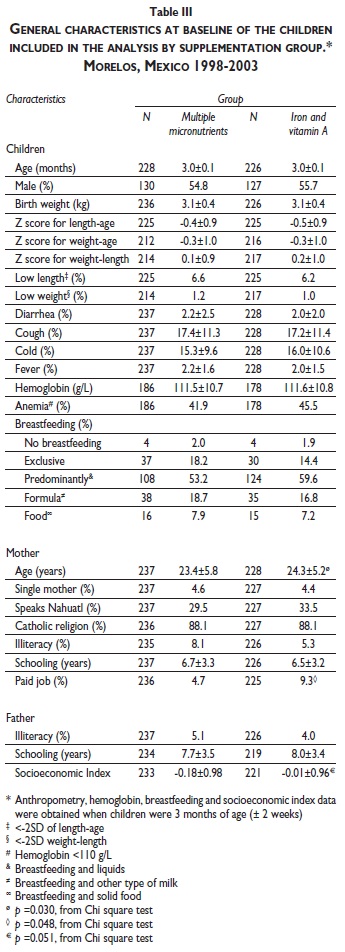
<body><![CDATA[<p><font face="Verdana" size="2">The success of randomization was assessed by   comparing baseline characteristics by supplement group. Characteristics of children   who completed the trial were also compared with those who dropped out. Student's   <i>t</i>-test were used for comparison of continuous variables with a normal   distribution, or a Mann-Whitney test. For categorical data, Chisquare or Fisher's   exact test were used, the latter when the expected value was five or less in   any cell.</font></p>     <p><font face="Verdana" size="2">The association between supplement group and   adequate compliance was assessed using logistic regression adjusting for factors   that were different between groups at baseline and predictors of compliance   as socioeconomic and child characteristics, type of breastfeeding and morbidity,   based on a priori consideration that in addition to supplement characteristics,   child (age, sex, baseline anemia, birthweight) and household factors (indigenous   origin, maternal education and nutritional status, economic well-being of the   household) may affect compliance with supplementation. The potential modifying   effects of baseline hemoglobin concentration, indigenous origin, maternal education,   height for age at baseline on compliance by group were tested as a statistical   interaction between them. The model was assessed by goodness of fit test of<i>Hosmer</i>   and <i>Lemeshow</i>.<sup>26</sup> The statistical significance was considered   for a <i>p</i>&lt;0.05 for the main effects and <i>p</i>&lt;0.10 for the interactions.   The statistical analysis was performed using STATA 8.0.</font></p>     <p>&nbsp;</p>     <p><font face="Verdana" size="3"><b>Results</b></font></p>     <p><font face="Verdana" size="2">Of the 654 children recruited, 465 (71.1%) finished   the study and 189 (28.9%) dropped out before 24 mo of age (<a href="/img/revistas/spm/v54n5/a02fig1.jpg">figure   1</a>). Reasons for dropping out of the study have been published elsewhere<sup>18</sup>   and the most important were parents or tutors withdrawing their permission to   participate (61.9%), moving out to another community (12.7%), disliking the   supplement or ill feeling after consuming it (12.2%). When comparing children   who completed the study with those who dropped out, a statistically significant   difference was observed (&lt;0<i>p</i>.05) for maternal age (23.8 <b>&plusmn;</b>   5.5 vs. 22.2 <b>&plusmn;</b> 4.1 years), maternal education (6.6 <b>&plusmn;</b>   3.3 vs. 7.4 <b>&plusmn;</b> 3.4 years), and coughing (17.3 vs. 26.7%). For the   remaining variables, including the type of supplement, statistically significant   differences were not found (<a href="#tab2">table&nbsp;II</a>).</font></p>     <p>&nbsp;</p>     <p align="center"><a name="tab2"></a><img src="/img/revistas/spm/v54n5/a02tab2.jpg"></p>     <p>&nbsp;</p>     <p><font face="Verdana" size="2">Of the group of children that completed the study,   55.3% were male, 7.8% weighed less than 2500 g at birth, 2.9% had low length-for-age   at three months old, 43.7% suffered anemia and 16.3% were exclusively breastfed   at three months. On average, maternal age was 23.8 &plusmn; 5.5 years, 31.5%   spoke or understood Nahuatl language, 4.5% were single or had no couple and   6.9% had a paid employment. Fathers had a better education level than mothers   with 7.8 &plusmn; 3.4 and 6.6 &plusmn; 3.3 years of study, respectively.</font></p>     <p><font face="Verdana" size="2">The analysis of compliance was performed with   data from children who completed the study, 237 (51%) belonged to the multiple   micronutrient group and 228 (49%) to the iron and vitamin A group. At baseline,   a statistically significant difference between groups were found for maternal   age (23.4 <b>&plusmn;</b> 5.8 vs. 24.2 <b>&plusmn;</b> 5.2 years, <i>p</i>=0.030),   and for the percentage of mothers with a paid job (4.7 vs. 9.3%, <i>p</i>=0.048)   (<a href="#tab3">table&nbsp;III</a>). There were no differences between groups   for the socioeconomic index, anthropometric characteristics, feeding practices   or child morbidity.</font></p>     ]]></body>
<body><![CDATA[<p>&nbsp;</p>     <p align="center"><a name="tab3"></a><img src="/img/revistas/spm/v54n5/a02tab3.jpg"></p>     <p>&nbsp;</p>     <p><font face="Verdana" size="2">The mean number of days that the children consumed   the iron and vitamin A supplement was significantly (<i>p</i>=0.025) higher   (429.1 <b>&plusmn;</b> 53.0) than the multiple micronutrient group (417.5 <b>&plusmn;</b>   57.1). The real compliance rate was also significantly higher (<i>p</i><b>=</b>0.044)   in the iron and vitamin A group (81.8%, interquartile range (IQR) 75.2-87.5)   than the multiple micronutrient group (79.5%, IQR: 72.8-86.1). Similarly, the   percentage of children with an adequate compliance rate (consumed on at least   80% of days offered) in the iron and vitamin A group (60.1%) was significantly   (<b>=</b><i>p</i>0.016) higher than the multiple micronutrient group (48.9%).   The real compliance was significantly higher (<i>p</i>=0.025) in the iron and   vitamin A group (80.3, IQR:73.6-86.0) than the multiple micronutrient group   (78.2, IQR: 71.1-84.1).</font></p>     <p><font face="Verdana" size="2">The odds of adequate compliance (&gt; than 80%)   were 59% greater in the children supplemented with iron and vitamin A than with   multiples micronutrients, although the estimate was only marginally significant   (<i>p</i>=0.052) (<a href="#tab4">table&nbsp;IV</a>). Overall, the probability   of adequate compliance (i.e. compliance higher than 80%) was 0.51 for the multiple   micronutrient group and 0.59 for the vitamin A and iron group (<i>p</i>=0.051).</font></p>     <p>&nbsp;</p>     <p align="center"><a name="tab4"></a><img src="/img/revistas/spm/v54n5/a02tab4.jpg"></p>     <p>&nbsp;</p>     <p><font face="Verdana" size="2">The odds of adequate compliance to supplementation   were 2.09 (95% CI: 1.28, 3.40) times higher for every increment of 100 grams   of weight at birth (<i>p</i>=0.003) (<a href="#tab4">table&nbsp;IV</a>). Children of families of indigenous   origin (spoke or understood Nahuatl language) had 1.56 (95% CI: 0.96, 2.54)   the odds of adequate compliance with supplementation than children of non -indigenous   mothers (<i>p</i>=0.071). Furthermore, for every additional completed year of   formal education, the odds of adequate supplement were reduced by 13% (<i>p</i>&lt;0.001).   Finally, higher rates of morbidity resulted in lower odds of adequate compliance.   For each point increase in the percentage of dates with cough or fever, resulted   in a decrease of 5 and 15% in the odds of adequate compliance (<i>p</i>&lt;0.001   and <i>p</i>=0.024), respectively. None of the interaction terms tested were   statistically significant (<i>p</i>&gt;0.10).</font></p>     <p>&nbsp;</p>     ]]></body>
<body><![CDATA[<p><font face="Verdana" size="3"><b>Discussion</b></font></p>     <p><font face="Verdana" size="2">Overall compliance to supplementation with micronutrient   syrup was very high in both the intervention and control groups. This was not   surprising given the controlled conditions. Similar or higher average intakes   in controlled trials have been reported (80 to 96%).<sup>5,27-29</sup> An important   finding of this study was that compliance differed by supplement type, although   the estimate was only marginally significant. As this was a double blinded randomized   trial, this implies that supplement characteristics can influence the individual   willingness to consume it, even under controlled conditions.</font></p>     <p><font face="Verdana" size="2">Although it has been shown that supplement presentation   influences compliance, there is little evidence that nutrient content affects   acceptance and intake of nutritional supplements. Contrary to our findings,   in a controlled supplementation trial performed with Mexican children from 8   to 14 months old a better compliance rate was found in the multiple micronutrient   group than in the placebo group (91 vs. 80.5%, <i>p</i>&lt;0.05).<sup>5</sup>   In other studies, using different supplement types, no significant difference   has been found between groups with different nutritional content. For example,   in schoolaged children in Tanzania, compliance of the group that consumed a   multiple micronutrient fortified beverage (79.9%) was similar to the control   group (81.1%).<sup>27</sup> In the Philippines, compliance in a group of schoolchildren   receiving a multiple-micronutrient-fortified beverage was of 95.9%, while in   the placebo group was of 96.3%.<sup>29</sup> In a controlled trial conducted   in 6 to 18 months old children from a rural area of Ghana, a microencapsulated   ferrous fumarate plus ascorbic acid supplement consumed with complementary foods   (trade mark <i>Sprinkles</i>) had a lower compliance rate than ferrous sulfate   drops (66 vs. 81%). Although it was not mentioned whether this difference was   statistically significant, the authors argued that in this case this difference   could be due to age of introduction and frequency of complementary food intake   and humidification of the micronutrient powder due to problems with packaging.<sup>13</sup></font></p>     <p><font face="Verdana" size="2">One of the difficulties to compare compliance   rates across studies is the difference in methods used to measure it. It is   possible that the compliance figures are influenced by the way information is   collected. These measurements include the daily supervised record by trained   personnel for this purpose,<sup>5,14,15,27</sup> weekly interviewed record,<sup>6</sup>   pill bottle equipped with an electronic counting device<sup>30,31</sup> and   biochemical determinations.<sup>7</sup> In our study, we have high confidence   in our compliance figures given that supplementation was daily and observed   by project staff. This may explain a lower compliance rate in relation to other   studies in which there may be memory or reporting bias. In addition, it has   been observed in controlled trials in children that multiple micronutrient supplementation   periods vary from 2 to 12 months.<sup>4,5,27,28</sup> The duration of supplementation   may influence compliance through fatigue.</font></p>     <p><font face="Verdana" size="2">In our study, the rate of adequate compliance   (greater than 80%) was significantly different (<i>p</i>&lt;0.05) between the   multiple micronutrient and iron (48.9%) and vitamin A group (60.1%). A possible   explanation of this difference may be the side effects caused by some micronutrients   contained in the supplement. It is known that iron intake could cause diarrhea,   constipation, nausea, vomiting, dizziness, epigastric pain and dark feces when   administered at physiological doses.<sup>9,11,32</sup> Although in young children   it may be difficult to document these symptoms, mothers have reported that when   iron is administered as drops, 74% have rejected the supplement (cry, make gestures,   or spit drops) while when administered as powder mixed with food, this percentage   has been 16%.<sup>13</sup> However, given that the iron content and form of   the two supplements was the same, it seems unlikely that the differences in   compliance are related to iron-related side effects.</font></p>     <p><font face="Verdana" size="2">Other nutrients contained in the multiple micronutrient   supplement have been associated with transient side effects. Niacin administered   in high doses (1 to 2 g three times per day) as nicotinic acid can result in   flushing and sensation of heat especially in the face, neck and ears.<sup>32,33</sup>   This reaction is usually mild, however, when it becomes unbearable my cause   dropout rates of more than 50%.<sup>32</sup> Side effects such as diarrhea,   nausea, vomiting, abdominal pain, dermatitis, allergic reactions, anorexia,   headaches, and drowsiness, among others have also been documented for magnesium   and vitamin C, B1, B6, B12 and folic acid, while zinc, and vitamin A, D, E and   B2 are reported to be well tolerated in recommended doses.<sup>32</sup>Although   similar in appearance, it is possible that the multiple micronutrient syrup   had characteristics less acceptable to the children and/ or mothers that resulted   in greater refusal to offer or consume it. To ensure that supplement properties   do not affect acceptability it is vital to ensure minimum quality control criteria   including stability, homogeneity, viscosity, solubility and sterility.</font></p>     <p><font face="Verdana" size="2">We found a positive association between birth   weight and compliance with supplementation, i.e., children born with higher   weight were more likely to have better compliance. Hence, infants born with   low birth weight which are at higher risk of morbidity and mortality are missing   the opportunity to be most benefitted from nutritional supplementation<sup>34</sup>.   It is therefore very important to understand why children with lower birth weight   complied less and how these barriers could be overcome. Our results indicate   that the association between birth weight with compliance is independent of   concurrent health status, since the model was adjusted for morbidity (diarrhea,   cough and fever percentage). It is possible that association of adequate compliance   with adequate birth weight is due to the differentiated reaction that mothers   have about weight perception of their children. In relation to this, people's   beliefs about health and supplement treatments may interfere with compliance.   For example, some pregnant women from Thailand decided not to take iron supplements   out of fear of having a larger baby and a difficult delivery<sup>10</sup>.</font></p>     <p><font face="Verdana" size="2">In this study we found less adequate compliance   when the percentage of time with cough and fever was higher. This could be due   to infections reducing dietary intake by decreasing appetite.<sup>35,36</sup>   In Mexico, some mothers of children with diarrhea decide to suspend the use   of multiple micronutrient supplementation in the form of gruel while others   keep administering it, in which case the diarrhea disappears within a few days.<sup>37</sup>   In developing countries, other factors associated with compliance to medical   treatment include illiteracy, low education and belonging to an ethnic group.<sup>16</sup>   It is known that indigenous communities may have lower acceptance of nutritional   supplements.<sup>38</sup> In contrast, in this study we found marginally higher   compliance among those of indigenous origin. We also found that compliance was   higher among more vulnerable groups, e.g., children whose mothers had less formal   education. This may be related to the fact that the supplementers in this study   were from the community and could better address concerns and hesitation among   residence with different characteristics. Future studies should include qualitative   methods for a better understanding of the factors that help motivate women to   comply with supplementation, how to overcome barriers to supplementation and   take advantage of opportunities for adequate compliance.</font></p>     <p><font face="Verdana" size="2">There is evidence of a consistent and positive   association between motivation and therapeutic treatment compliance, related   to the health provider ability to advise and to make an empathic and affective   approach with the patient.<sup>39,40</sup> In a vitamin A supplementation cohort   trial, performed in Indonesia in children under 5 years old, there was an association   between compliance of the caregivers and their knowledge about the potential   benefits of this vitamin supplementation<sup>41</sup>. Pregnant women who received   iron supplements, forgot to take the pills because of a lack of motivation and   understanding about anemia.<sup>7</sup> It has been documented that the role   and the attitude of the mother towards the supplement is vital for the child   to consume it. In supplementation programs mothers get "tired" of giving iron   daily doses after three month and because of the daily intake some children   get fed up of the supplement flavour for which the mothers give them a "rest".<sup>37,41</sup>   Perceived health benefits may help overcome this barrier.</font></p>     <p><font face="Verdana" size="2">In conclusion, the compliance rate found in this   study is consistent with the assessments made in randomized trials, and as expected,   higher than in supplementation programs for children. However, the compliance   rate was different between the supplement groups, even though the estimate was   only marginally significant, possibly due the characteristics of the supplements   themselves or side effects of the micronutrient supplement. If these effects   cause more diarrhea or gastrointestinal problems when adjusting for these variables,   the difference between groups should have disappeared. This was not the case   and we conclude that side effects were not the principal determinant of lower   compliance. An understanding of factors that influence compliance is vital to   ensure that barriers and opportunities for adequate compliance can be taken   into consideration in communication strategies.</font></p>     ]]></body>
<body><![CDATA[<p><font face="Verdana" size="2"><i>Declaration of conflict of interests: </i>The   authors declares not to have conflict of interests.</font></p>     <p>&nbsp;</p>     <p><font face="Verdana" size="3"><b>References</b></font></p>     <!-- ref --><p><font face="Verdana" size="2">1. Villalpando S, Shamah-Levy T, Garc&iacute;a-Guerra   A, Mundo-Rosas V, Dom&iacute;nguez C, Mej&iacute;a-Rodr&iacute;guez F. The prevalence   of anemia decreased in Mexican preschooland schoolage children from 1999 to   2006. Salud Publica Mex 2009;51 suppl 4:S507-S514.    &nbsp;&nbsp;&nbsp;&nbsp;&nbsp;&nbsp;&nbsp;&nbsp;[&#160;<a href="javascript:void(0);" onclick="javascript: window.open('/scielo.php?script=sci_nlinks&ref=2412007&pid=S0036-3634201200050000300001&lng=','','width=640,height=500,resizable=yes,scrollbars=1,menubar=yes,');">Links</a>&#160;]<!-- end-ref --></font></p>     <!-- ref --><p><font face="Verdana" size="2">2. Rivera-Dommarco J, Shamah-Levy T, Villalpando-Hern&aacute;ndez   S, Gonz&aacute;lez de Coss&iacute;o T, Hern&aacute;ndez-Prado B, Sep&uacute;lveda   J. Encuesta Nacional de Nutrici&oacute;n 1999. Estado nutricio de ni&ntilde;os   y mujeres en M&eacute;xico. Cuernavaca, Morelos, M&eacute;xico: Instituto Nacional   de Salud P&uacute;blica, 2001.    &nbsp;&nbsp;&nbsp;&nbsp;&nbsp;&nbsp;&nbsp;&nbsp;[&#160;<a href="javascript:void(0);" onclick="javascript: window.open('/scielo.php?script=sci_nlinks&ref=2412009&pid=S0036-3634201200050000300002&lng=','','width=640,height=500,resizable=yes,scrollbars=1,menubar=yes,');">Links</a>&#160;]<!-- end-ref --></font></p>     <!-- ref --><p><font face="Verdana" size="2">3. Barquera S, Rivera-Dommarco J, Gasca-Garc&iacute;a   A. Pol&iacute;ticas y programas de alimentaci&oacute;n y nutrici&oacute;n en   M&eacute;xico. Salud Publica Mex 2001; 43:464-477.    &nbsp;&nbsp;&nbsp;&nbsp;&nbsp;&nbsp;&nbsp;&nbsp;[&#160;<a href="javascript:void(0);" onclick="javascript: window.open('/scielo.php?script=sci_nlinks&ref=2412011&pid=S0036-3634201200050000300003&lng=','','width=640,height=500,resizable=yes,scrollbars=1,menubar=yes,');">Links</a>&#160;]<!-- end-ref --></font></p>     <!-- ref --><p><font face="Verdana" size="2">4. Rivera JA, Hotz C, Gonz&aacute;lez-Coss&iacute;o   T, Neufeld L, Garc&iacute;a-Guerra A. The effect of micronutrient deficiencies   of child growth: a review of results from community-based supplementation trials.   J Nutr 2003; 133: 4010S-4020S.    &nbsp;&nbsp;&nbsp;&nbsp;&nbsp;&nbsp;&nbsp;&nbsp;[&#160;<a href="javascript:void(0);" onclick="javascript: window.open('/scielo.php?script=sci_nlinks&ref=2412013&pid=S0036-3634201200050000300004&lng=','','width=640,height=500,resizable=yes,scrollbars=1,menubar=yes,');">Links</a>&#160;]<!-- end-ref --></font></p>     <!-- ref --><p><font face="Verdana" size="2">5. Rivera JA, Gonz&aacute;lez-Coss&iacute;o T,   Flores M, Romero M, Rivera M, T&eacute;llez-Rojo M, <i>et al.</i> Multiple micronutrient   supplementation increases the growth of Mexican infants. Am J Clin Nutr 2001;   74: 657-663.    &nbsp;&nbsp;&nbsp;&nbsp;&nbsp;&nbsp;&nbsp;&nbsp;[&#160;<a href="javascript:void(0);" onclick="javascript: window.open('/scielo.php?script=sci_nlinks&ref=2412015&pid=S0036-3634201200050000300005&lng=','','width=640,height=500,resizable=yes,scrollbars=1,menubar=yes,');">Links</a>&#160;]<!-- end-ref --></font></p>     <!-- ref --><p><font face="Verdana" size="2">6. Rivera JA, Sotres-Alvarez D, Habicht JP, Shamah   T, Villalpando S. Impact of the Mexican program for education, health, and nutrition   (PRO-GRESA) on rates of growth and anemia in infants and young children. JAMA   2004; 291: 2563-2570.    &nbsp;&nbsp;&nbsp;&nbsp;&nbsp;&nbsp;&nbsp;&nbsp;[&#160;<a href="javascript:void(0);" onclick="javascript: window.open('/scielo.php?script=sci_nlinks&ref=2412017&pid=S0036-3634201200050000300006&lng=','','width=640,height=500,resizable=yes,scrollbars=1,menubar=yes,');">Links</a>&#160;]<!-- end-ref --></font></p>     <!-- ref --><p><font face="Verdana" size="2">7.Schultink W, Ree M, Matulessi P, Gross R. Low   compliance with an iron-supplementation program: a study among pregnant women   in Jakarta, Indonesia. Am J Clin Nutr 1993; 57: 135-39.    &nbsp;&nbsp;&nbsp;&nbsp;&nbsp;&nbsp;&nbsp;&nbsp;[&#160;<a href="javascript:void(0);" onclick="javascript: window.open('/scielo.php?script=sci_nlinks&ref=2412019&pid=S0036-3634201200050000300007&lng=','','width=640,height=500,resizable=yes,scrollbars=1,menubar=yes,');">Links</a>&#160;]<!-- end-ref --></font></p>     <!-- ref --><p><font face="Verdana" size="2">8. Allen LH. Nutritional supplementation for   the pregnant woman. Clin Obstet Gynecol 1994; 37: 587-595.    &nbsp;&nbsp;&nbsp;&nbsp;&nbsp;&nbsp;&nbsp;&nbsp;[&#160;<a href="javascript:void(0);" onclick="javascript: window.open('/scielo.php?script=sci_nlinks&ref=2412021&pid=S0036-3634201200050000300008&lng=','','width=640,height=500,resizable=yes,scrollbars=1,menubar=yes,');">Links</a>&#160;]<!-- end-ref --></font></p>     <!-- ref --><p><font face="Verdana" size="2">9. Charoenlarp P, Dhanamitta S, Kaewvichit R,   Silprasert A, Suwanaradd C, Na-Nakorn S, <i>et al.</i> A WHO collaborative study   on iron supplementation in Burma and in Thailand. Am J Clin Nutr 1988; 47: 280-297.    &nbsp;&nbsp;&nbsp;&nbsp;&nbsp;&nbsp;&nbsp;&nbsp;[&#160;<a href="javascript:void(0);" onclick="javascript: window.open('/scielo.php?script=sci_nlinks&ref=2412023&pid=S0036-3634201200050000300009&lng=','','width=640,height=500,resizable=yes,scrollbars=1,menubar=yes,');">Links</a>&#160;]<!-- end-ref --></font></p>     <!-- ref --><p><font face="Verdana" size="2">10. Galloway R, McGuire J. Determinants of compliance   with iron supplementation: supplies, side effects, or psychology? Soc Sci Med   1994; 39: 381-390.    &nbsp;&nbsp;&nbsp;&nbsp;&nbsp;&nbsp;&nbsp;&nbsp;[&#160;<a href="javascript:void(0);" onclick="javascript: window.open('/scielo.php?script=sci_nlinks&ref=2412025&pid=S0036-3634201200050000300010&lng=','','width=640,height=500,resizable=yes,scrollbars=1,menubar=yes,');">Links</a>&#160;]<!-- end-ref --></font></p>     <!-- ref --><p><font face="Verdana" size="2">11. Allen LH. Iron supplements: scientific issues   concerning efficacy and implications for research and programs. J Nutr 2002;   132 suppl 4: 813-819.    &nbsp;&nbsp;&nbsp;&nbsp;&nbsp;&nbsp;&nbsp;&nbsp;[&#160;<a href="javascript:void(0);" onclick="javascript: window.open('/scielo.php?script=sci_nlinks&ref=2412027&pid=S0036-3634201200050000300011&lng=','','width=640,height=500,resizable=yes,scrollbars=1,menubar=yes,');">Links</a>&#160;]<!-- end-ref --></font></p>     <!-- ref --><p><font face="Verdana" size="2">12. Cromer BA, Steinberg K, Gardner L, Thornton   D, Shannon B. Psychosocial determinants of compliance in adolescents with iron   deficiency. Am J Dis Child 1989; 143: 55-58.    &nbsp;&nbsp;&nbsp;&nbsp;&nbsp;&nbsp;&nbsp;&nbsp;[&#160;<a href="javascript:void(0);" onclick="javascript: window.open('/scielo.php?script=sci_nlinks&ref=2412029&pid=S0036-3634201200050000300012&lng=','','width=640,height=500,resizable=yes,scrollbars=1,menubar=yes,');">Links</a>&#160;]<!-- end-ref --></font></p>     <!-- ref --><p><font face="Verdana" size="2">13. Zlotkin S, Arthur P, Antwi KY, Yeung G. Treatment   of anemia with microencapsulated ferrous fumarate plus ascorbic acid supplied   as sprinkles to complementary (weaning) foods. Am J Clin Nutr 2001; 74: 791-795.    &nbsp;&nbsp;&nbsp;&nbsp;&nbsp;&nbsp;&nbsp;&nbsp;[&#160;<a href="javascript:void(0);" onclick="javascript: window.open('/scielo.php?script=sci_nlinks&ref=2412031&pid=S0036-3634201200050000300013&lng=','','width=640,height=500,resizable=yes,scrollbars=1,menubar=yes,');">Links</a>&#160;]<!-- end-ref --></font></p>     <!-- ref --><p><font face="Verdana" size="2">14. Rosado JL, Rivera J, L&oacute;pez G, Solano   L, Rodr&iacute;guez G, Casanueva E, <i>et al. </i>Desarrollo y evaluaci&oacute;n   de suplementos alimenticios para el Programa de Educaci&oacute;n, Salud y Alimentaci&oacute;n.   Salud Publica Mex 1999;41: 153-162.    &nbsp;&nbsp;&nbsp;&nbsp;&nbsp;&nbsp;&nbsp;&nbsp;[&#160;<a href="javascript:void(0);" onclick="javascript: window.open('/scielo.php?script=sci_nlinks&ref=2412033&pid=S0036-3634201200050000300014&lng=','','width=640,height=500,resizable=yes,scrollbars=1,menubar=yes,');">Links</a>&#160;]<!-- end-ref --></font></p>     <!-- ref --><p><font face="Verdana" size="2">15. Rivera JA, Rodr&iacute;guez G, Shamah T,   Rosado JL, Casanueva E, Maul&eacute;n I, <i>et al.</i> Implementation, monitoring,   and evaluation of the nutrition component of the Mexican Social Program (PROGRESA).   Food Nutr Bull 2000; 21: 35-42.    &nbsp;&nbsp;&nbsp;&nbsp;&nbsp;&nbsp;&nbsp;&nbsp;[&#160;<a href="javascript:void(0);" onclick="javascript: window.open('/scielo.php?script=sci_nlinks&ref=2412035&pid=S0036-3634201200050000300015&lng=','','width=640,height=500,resizable=yes,scrollbars=1,menubar=yes,');">Links</a>&#160;]<!-- end-ref --></font></p>     <!-- ref --><p><font face="Verdana" size="2">16. Homedes N, Ugalde A. Research on patient   compliance in developing countries. Bull Pan Am Health Organ 1994; 28: 17-33.    &nbsp;&nbsp;&nbsp;&nbsp;&nbsp;&nbsp;&nbsp;&nbsp;[&#160;<a href="javascript:void(0);" onclick="javascript: window.open('/scielo.php?script=sci_nlinks&ref=2412037&pid=S0036-3634201200050000300016&lng=','','width=640,height=500,resizable=yes,scrollbars=1,menubar=yes,');">Links</a>&#160;]<!-- end-ref --></font></p>     <!-- ref --><p><font face="Verdana" size="2">17. Murmu LR, Murmu D, Kant S. Supplementation   study compliance and the role of health care staff. Am J Clin Nutr 1994; 59:   433-434.    &nbsp;&nbsp;&nbsp;&nbsp;&nbsp;&nbsp;&nbsp;&nbsp;[&#160;<a href="javascript:void(0);" onclick="javascript: window.open('/scielo.php?script=sci_nlinks&ref=2412039&pid=S0036-3634201200050000300017&lng=','','width=640,height=500,resizable=yes,scrollbars=1,menubar=yes,');">Links</a>&#160;]<!-- end-ref --></font></p>     <!-- ref --><p><font face="Verdana" size="2">18.Ramakrishnan U, Neufeld LM, Flores R, Rivera   J, Martorell R. Multiple micronutrient supplementation during early childhood   increases child size at 2 y of age only among high compliers. Am J Clin Nutr   2009;89:1125-1131.    &nbsp;&nbsp;&nbsp;&nbsp;&nbsp;&nbsp;&nbsp;&nbsp;[&#160;<a href="javascript:void(0);" onclick="javascript: window.open('/scielo.php?script=sci_nlinks&ref=2412041&pid=S0036-3634201200050000300018&lng=','','width=640,height=500,resizable=yes,scrollbars=1,menubar=yes,');">Links</a>&#160;]<!-- end-ref --></font></p>     <!-- ref --><p><font face="Verdana" size="2">19. National Research Council. Recommended Dietary   Allowances. 10<sup>th</sup> edition. Washington, D.C: National Academy Press,   1989.    &nbsp;&nbsp;&nbsp;&nbsp;&nbsp;&nbsp;&nbsp;&nbsp;[&#160;<a href="javascript:void(0);" onclick="javascript: window.open('/scielo.php?script=sci_nlinks&ref=2412043&pid=S0036-3634201200050000300019&lng=','','width=640,height=500,resizable=yes,scrollbars=1,menubar=yes,');">Links</a>&#160;]<!-- end-ref --></font></p>     <!-- ref --><p><font face="Verdana" size="2">20. Ramakrishnan U, Gonzalez-Cossio T, Neufeld   LM, Rivera J, Martorell R. Multiple micronutrient supplementation during pregnancy   does not lead to greater infant birth size than does iron-only supplementation:   a randomized controlled trial in a semi rural community in Mexico. Am J Clin   Nutr 2003; 77: 720-725.    &nbsp;&nbsp;&nbsp;&nbsp;&nbsp;&nbsp;&nbsp;&nbsp;[&#160;<a href="javascript:void(0);" onclick="javascript: window.open('/scielo.php?script=sci_nlinks&ref=2412045&pid=S0036-3634201200050000300020&lng=','','width=640,height=500,resizable=yes,scrollbars=1,menubar=yes,');">Links</a>&#160;]<!-- end-ref --></font></p>     <!-- ref --><p><font face="Verdana" size="2">21. Ramakrishnan U, Neufeld L, Gonzalez-Cossio   T, Villalpando S, Garcia-Guerra A, Rivera J, <i>et al</i>. Multiple micronutrient   supplements during pregnancy do not reduce anemia or improve iron status compared   to iron-only supplements in semi-rural Mexico. J Nutr 2004; 134: 898-903.    &nbsp;&nbsp;&nbsp;&nbsp;&nbsp;&nbsp;&nbsp;&nbsp;[&#160;<a href="javascript:void(0);" onclick="javascript: window.open('/scielo.php?script=sci_nlinks&ref=2412047&pid=S0036-3634201200050000300021&lng=','','width=640,height=500,resizable=yes,scrollbars=1,menubar=yes,');">Links</a>&#160;]<!-- end-ref --></font></p>     <!-- ref --><p><font face="Verdana" size="2">22. Neufeld L, Garc&iacute;a-Guerra A, S&aacute;nchez-Francia   D, Newton S&aacute;nchez O, Ram&iacute;rez Villalobos MD, Rivera Dommarco J.   Haemoglobin measured by Hemocue and a reference method in venous and capillary   blood: a validation study. Salud Publica Mex 2002; 44: 219-227.    &nbsp;&nbsp;&nbsp;&nbsp;&nbsp;&nbsp;&nbsp;&nbsp;[&#160;<a href="javascript:void(0);" onclick="javascript: window.open('/scielo.php?script=sci_nlinks&ref=2412049&pid=S0036-3634201200050000300022&lng=','','width=640,height=500,resizable=yes,scrollbars=1,menubar=yes,');">Links</a>&#160;]<!-- end-ref --></font></p>     <!-- ref --><p><font face="Verdana" size="2">23. World Health Organization. WHO Child Growth   Standards. Length/ height-for-age, weight-for-age, weight-for-length, weight-for-height   and body-mass-index-for-age. Methods and development. Geneva: WHO, 2006.    &nbsp;&nbsp;&nbsp;&nbsp;&nbsp;&nbsp;&nbsp;&nbsp;[&#160;<a href="javascript:void(0);" onclick="javascript: window.open('/scielo.php?script=sci_nlinks&ref=2412051&pid=S0036-3634201200050000300023&lng=','','width=640,height=500,resizable=yes,scrollbars=1,menubar=yes,');">Links</a>&#160;]<!-- end-ref --></font></p>     <!-- ref --><p><font face="Verdana" size="2">24. Hyder SM, Persson LA, Chowdhury AM, Ekstr&ouml;m   EC. Do side-effects reduce compliance to iron supplementation? A study of daily-   and week-ly- dose regimens in pregnancy. J Health Popul Nutr 2002; 20: 175-179.    &nbsp;&nbsp;&nbsp;&nbsp;&nbsp;&nbsp;&nbsp;&nbsp;[&#160;<a href="javascript:void(0);" onclick="javascript: window.open('/scielo.php?script=sci_nlinks&ref=2412053&pid=S0036-3634201200050000300024&lng=','','width=640,height=500,resizable=yes,scrollbars=1,menubar=yes,');">Links</a>&#160;]<!-- end-ref --></font></p>     <!-- ref --><p><font face="Verdana" size="2">25. World Health Organization. The prevalence   of anemia in women: a tabulation of available information. 2<sup>nd</sup> ed.   Ginebra: WHO, 1992.    &nbsp;&nbsp;&nbsp;&nbsp;&nbsp;&nbsp;&nbsp;&nbsp;[&#160;<a href="javascript:void(0);" onclick="javascript: window.open('/scielo.php?script=sci_nlinks&ref=2412055&pid=S0036-3634201200050000300025&lng=','','width=640,height=500,resizable=yes,scrollbars=1,menubar=yes,');">Links</a>&#160;]<!-- end-ref --></font></p>     <!-- ref --><p><font face="Verdana" size="2">26. Hosmer DW, Lemeshow S. Applied Logistic Regression.   2<sup>nd</sup> ed. NJ, USA: John Wiley &amp; Sons, 2000.    &nbsp;&nbsp;&nbsp;&nbsp;&nbsp;&nbsp;&nbsp;&nbsp;[&#160;<a href="javascript:void(0);" onclick="javascript: window.open('/scielo.php?script=sci_nlinks&ref=2412057&pid=S0036-3634201200050000300026&lng=','','width=640,height=500,resizable=yes,scrollbars=1,menubar=yes,');">Links</a>&#160;]<!-- end-ref --></font></p>     <!-- ref --><p><font face="Verdana" size="2">27. Latham MC, Ash DM, Makola D, Tatala SR, Ndossi   GD, Mehansho H. Efficacy trials of micronutrient dietary supplement in schoolchildren   and pregnant women in Tanzania. Food Nutr Bull 2003; 24: S120-S128.    &nbsp;&nbsp;&nbsp;&nbsp;&nbsp;&nbsp;&nbsp;&nbsp;[&#160;<a href="javascript:void(0);" onclick="javascript: window.open('/scielo.php?script=sci_nlinks&ref=2412059&pid=S0036-3634201200050000300027&lng=','','width=640,height=500,resizable=yes,scrollbars=1,menubar=yes,');">Links</a>&#160;]<!-- end-ref --></font></p>     <!-- ref --><p><font face="Verdana" size="2">28. Smuts CM, Dhansay MA, Faber M, van Stuijvenberg   ME, Swanevelder S, Gross R, <i>et al.</i> Efficacy of multiple micronutrient   supplementation for improving anemia, micronutrient status, and growth in South   African infants. J Nutr 2005; 135: 653S-659S.    &nbsp;&nbsp;&nbsp;&nbsp;&nbsp;&nbsp;&nbsp;&nbsp;[&#160;<a href="javascript:void(0);" onclick="javascript: window.open('/scielo.php?script=sci_nlinks&ref=2412061&pid=S0036-3634201200050000300028&lng=','','width=640,height=500,resizable=yes,scrollbars=1,menubar=yes,');">Links</a>&#160;]<!-- end-ref --></font></p>     <!-- ref --><p><font face="Verdana" size="2">29. Solon F, Sarol JN Jr, Bernardo AB, Solon   JA, Mehansho H, Sanchez L, <i>et al. </i>Effect of multiple-micronutrient-fortified   fruit powder beverage on the nutrition status, physical fitness, and cognitive   performance of school-children in the Philippines. Food Nutr Bull 2003; 24:   S129-S140.    &nbsp;&nbsp;&nbsp;&nbsp;&nbsp;&nbsp;&nbsp;&nbsp;[&#160;<a href="javascript:void(0);" onclick="javascript: window.open('/scielo.php?script=sci_nlinks&ref=2412063&pid=S0036-3634201200050000300029&lng=','','width=640,height=500,resizable=yes,scrollbars=1,menubar=yes,');">Links</a>&#160;]<!-- end-ref --></font></p>     <!-- ref --><p><font face="Verdana" size="2">30. Ekstrom EC, Hyder SM, Chowdhury AM, Chowdhury   SA, Lonnerdal B, Habicht JP, <i>et al.</i> Efficacy and trial effectiveness   of weekly and daily iron supplementation among pregnant women in rural Bangladesh:   disentangling the issues. Am J Clin Nutr 2002; 76: 1392-1400.    &nbsp;&nbsp;&nbsp;&nbsp;&nbsp;&nbsp;&nbsp;&nbsp;[&#160;<a href="javascript:void(0);" onclick="javascript: window.open('/scielo.php?script=sci_nlinks&ref=2412065&pid=S0036-3634201200050000300030&lng=','','width=640,height=500,resizable=yes,scrollbars=1,menubar=yes,');">Links</a>&#160;]<!-- end-ref --></font></p>     <!-- ref --><p><font face="Verdana" size="2">31.Hyder SM, Persson LA, Chowdhury AM, Ekstrom   EC. Do side-effects reduce compliance to iron supplementation? A study of daily-   and weekly -dose regimens in pregnancy. J Health Popul Nutr 2002; 20: 175-179.    &nbsp;&nbsp;&nbsp;&nbsp;&nbsp;&nbsp;&nbsp;&nbsp;[&#160;<a href="javascript:void(0);" onclick="javascript: window.open('/scielo.php?script=sci_nlinks&ref=2412067&pid=S0036-3634201200050000300031&lng=','','width=640,height=500,resizable=yes,scrollbars=1,menubar=yes,');">Links</a>&#160;]<!-- end-ref --></font></p>     <!-- ref --><p><font face="Verdana" size="2">32.Mayo Foundation for Medical Education and   Research. Vitamin and mineral supplements: use with care. Medline Plus Web site.   &#91;Accessed: 2005 june 30&#93;. Available at: <a href="http://www.nlm.nih.gov/medlineplus/vitamin-sandminerals.html" target="_blank">http://www.nlm.nih.gov/medlineplus/vitamin-sandminerals.html</a>.    &nbsp;&nbsp;&nbsp;&nbsp;&nbsp;&nbsp;&nbsp;&nbsp;[&#160;<a href="javascript:void(0);" onclick="javascript: window.open('/scielo.php?script=sci_nlinks&ref=2412069&pid=S0036-3634201200050000300032&lng=','','width=640,height=500,resizable=yes,scrollbars=1,menubar=yes,');">Links</a>&#160;]<!-- end-ref --></font></p>     <!-- ref --><p><font face="Verdana" size="2">33.Combs-Gerald F. Jr. Vitaminas. En: Mahan L.   Kathleen, Escott-Stump Sylvia, Ed. Nutrici&oacute;n y dietoterapia de Krause,   10&ordf; edici&oacute;n. M&eacute;xico, DF: McGraw-Hill, 2001: 73-119.    &nbsp;&nbsp;&nbsp;&nbsp;&nbsp;&nbsp;&nbsp;&nbsp;[&#160;<a href="javascript:void(0);" onclick="javascript: window.open('/scielo.php?script=sci_nlinks&ref=2412071&pid=S0036-3634201200050000300033&lng=','','width=640,height=500,resizable=yes,scrollbars=1,menubar=yes,');">Links</a>&#160;]<!-- end-ref --></font></p>     <!-- ref --><p><font face="Verdana" size="2">34.Organizaci&oacute;n Mundial de la Salud. El   estado f&iacute;sico: uso e interpretaci&oacute;n de la antropometr&iacute;a.   Serie de Informes T&eacute;cnicos N&ordm; 854. Ginebra: OMS, 1995.    &nbsp;&nbsp;&nbsp;&nbsp;&nbsp;&nbsp;&nbsp;&nbsp;[&#160;<a href="javascript:void(0);" onclick="javascript: window.open('/scielo.php?script=sci_nlinks&ref=2412073&pid=S0036-3634201200050000300034&lng=','','width=640,height=500,resizable=yes,scrollbars=1,menubar=yes,');">Links</a>&#160;]<!-- end-ref --></font></p>     <!-- ref --><p><font face="Verdana" size="2">35.Fondo de la Naciones Unidas para la Infancia.   Estado mundial de la infancia. Tema: nutrici&oacute;n. Nueva York: UNICEF, 1998.    &nbsp;&nbsp;&nbsp;&nbsp;&nbsp;&nbsp;&nbsp;&nbsp;[&#160;<a href="javascript:void(0);" onclick="javascript: window.open('/scielo.php?script=sci_nlinks&ref=2412075&pid=S0036-3634201200050000300035&lng=','','width=640,height=500,resizable=yes,scrollbars=1,menubar=yes,');">Links</a>&#160;]<!-- end-ref --></font></p>     <!-- ref --><p><font face="Verdana" size="2">36.Scrimshaw NS, Suskind RM. Interactions of   nutrition and infection. Dent Clin North Am 1976;20:461-472.    &nbsp;&nbsp;&nbsp;&nbsp;&nbsp;&nbsp;&nbsp;&nbsp;[&#160;<a href="javascript:void(0);" onclick="javascript: window.open('/scielo.php?script=sci_nlinks&ref=2412077&pid=S0036-3634201200050000300036&lng=','','width=640,height=500,resizable=yes,scrollbars=1,menubar=yes,');">Links</a>&#160;]<!-- end-ref --></font></p>     <!-- ref --><p><font face="Verdana" size="2">37. Zarco A, Mora G, Pelcastre B, Flores M, Bronfman   M. Aceptabilidad de los suplementos alimenticios del programa Oportunidades.   Salud Publica Mex 2006;48:325-331.    &nbsp;&nbsp;&nbsp;&nbsp;&nbsp;&nbsp;&nbsp;&nbsp;[&#160;<a href="javascript:void(0);" onclick="javascript: window.open('/scielo.php?script=sci_nlinks&ref=2412079&pid=S0036-3634201200050000300037&lng=','','width=640,height=500,resizable=yes,scrollbars=1,menubar=yes,');">Links</a>&#160;]<!-- end-ref --></font></p>     <!-- ref --><p><font face="Verdana" size="2">38. Mora JO. Iron supplementation: overcoming   technical and practical barriers. J Nutr 2002; 132 (4 suppl): 853S-855S.    &nbsp;&nbsp;&nbsp;&nbsp;&nbsp;&nbsp;&nbsp;&nbsp;[&#160;<a href="javascript:void(0);" onclick="javascript: window.open('/scielo.php?script=sci_nlinks&ref=2412081&pid=S0036-3634201200050000300038&lng=','','width=640,height=500,resizable=yes,scrollbars=1,menubar=yes,');">Links</a>&#160;]<!-- end-ref --></font></p>     <!-- ref --><p><font face="Verdana" size="2">39. Squier RW. A model of empathic understanding   and adherence to treatment regimens in practitioner-patient relationships. Soc   Sci Med 1990; 30: 325-339.    &nbsp;&nbsp;&nbsp;&nbsp;&nbsp;&nbsp;&nbsp;&nbsp;[&#160;<a href="javascript:void(0);" onclick="javascript: window.open('/scielo.php?script=sci_nlinks&ref=2412083&pid=S0036-3634201200050000300039&lng=','','width=640,height=500,resizable=yes,scrollbars=1,menubar=yes,');">Links</a>&#160;]<!-- end-ref --></font></p>     <!-- ref --><p><font face="Verdana" size="2">40. Pangaribuan R, Erhardt JG, Scherbaum V, Biesalski   HK. Vitamin A capsule distribution to control vitamin A deficiency in Indonesia:   effect of supplementation in pre-school children and compliance with the programmed.   Public Health Nutr 2003; 6: 209-216.    &nbsp;&nbsp;&nbsp;&nbsp;&nbsp;&nbsp;&nbsp;&nbsp;[&#160;<a href="javascript:void(0);" onclick="javascript: window.open('/scielo.php?script=sci_nlinks&ref=2412085&pid=S0036-3634201200050000300040&lng=','','width=640,height=500,resizable=yes,scrollbars=1,menubar=yes,');">Links</a>&#160;]<!-- end-ref --></font></p>     <!-- ref --><p><font face="Verdana" size="2">41. Nestel P, Alnwick D. Iron/ multimicronutrient   supplements for young children. Copenhague: USAID/ UNICEF, 1996.    &nbsp;&nbsp;&nbsp;&nbsp;&nbsp;&nbsp;&nbsp;&nbsp;[&#160;<a href="javascript:void(0);" onclick="javascript: window.open('/scielo.php?script=sci_nlinks&ref=2412087&pid=S0036-3634201200050000300041&lng=','','width=640,height=500,resizable=yes,scrollbars=1,menubar=yes,');">Links</a>&#160;]<!-- end-ref --></font></p>     <p>&nbsp;</p>     <p>&nbsp;</p>     <p><a name="end" href="#top"><img src="/img/revistas/spm/v54n5/seta.jpg" border="0"></a> <font face="Verdana" size="2"><b>Corresponding author:</b>    <br>  Dra. Lynnette Marie Neufeld, PhD    <br>  Micronutrient Initiative.180 Elgin St. Suite 1000    ]]></body>
<body><![CDATA[<br>  Ottawa, Ontario, Canada. K2P 2K3    <br>  E-mail: <a href="mailto:lneufeld@micronutrient.org">lneufeld@micronutrient.org</a></font></p>     <p><font face="Verdana" size="2"><b>Received on: </b>March 11, 2011    <br>  <b>Accepted on: </b>April 17, 2012</font></p>      ]]></body><back>
<ref-list>
<ref id="B1">
<label>1</label><nlm-citation citation-type="journal">
<person-group person-group-type="author">
<name>
<surname><![CDATA[Villalpando]]></surname>
<given-names><![CDATA[S]]></given-names>
</name>
<name>
<surname><![CDATA[Shamah-Levy]]></surname>
<given-names><![CDATA[T]]></given-names>
</name>
<name>
<surname><![CDATA[García-Guerra]]></surname>
<given-names><![CDATA[A]]></given-names>
</name>
<name>
<surname><![CDATA[Mundo-Rosas]]></surname>
<given-names><![CDATA[V]]></given-names>
</name>
<name>
<surname><![CDATA[Domínguez]]></surname>
<given-names><![CDATA[C]]></given-names>
</name>
<name>
<surname><![CDATA[Mejía-Rodríguez]]></surname>
<given-names><![CDATA[F]]></given-names>
</name>
</person-group>
<article-title xml:lang="en"><![CDATA[The prevalence of anemia decreased in Mexican preschooland schoolage children from 1999 to 2006]]></article-title>
<source><![CDATA[Salud Publica Mex]]></source>
<year>2009</year>
<volume>51</volume>
<numero>^s4</numero>
<issue>^s4</issue>
<supplement>4</supplement>
<page-range>S507-S514</page-range></nlm-citation>
</ref>
<ref id="B2">
<label>2</label><nlm-citation citation-type="book">
<person-group person-group-type="author">
<name>
<surname><![CDATA[Rivera-Dommarco]]></surname>
<given-names><![CDATA[J]]></given-names>
</name>
<name>
<surname><![CDATA[Shamah-Levy]]></surname>
<given-names><![CDATA[T]]></given-names>
</name>
<name>
<surname><![CDATA[Villalpando-Hernández]]></surname>
<given-names><![CDATA[S]]></given-names>
</name>
<name>
<surname><![CDATA[González de Cossío]]></surname>
<given-names><![CDATA[T]]></given-names>
</name>
<name>
<surname><![CDATA[Hernández-Prado]]></surname>
<given-names><![CDATA[B]]></given-names>
</name>
<name>
<surname><![CDATA[Sepúlveda]]></surname>
<given-names><![CDATA[J]]></given-names>
</name>
</person-group>
<source><![CDATA[Encuesta Nacional de Nutrición 1999: Estado nutricio de niños y mujeres en México.]]></source>
<year>2001</year>
<publisher-loc><![CDATA[Cuernavaca^eMorelos Morelos]]></publisher-loc>
<publisher-name><![CDATA[Instituto Nacional de Salud Pública]]></publisher-name>
</nlm-citation>
</ref>
<ref id="B3">
<label>3</label><nlm-citation citation-type="journal">
<person-group person-group-type="author">
<name>
<surname><![CDATA[Barquera]]></surname>
<given-names><![CDATA[S]]></given-names>
</name>
<name>
<surname><![CDATA[Rivera-Dommarco]]></surname>
<given-names><![CDATA[J]]></given-names>
</name>
<name>
<surname><![CDATA[Gasca-García]]></surname>
<given-names><![CDATA[A]]></given-names>
</name>
</person-group>
<article-title xml:lang="es"><![CDATA[Políticas y programas de alimentación y nutrición en México]]></article-title>
<source><![CDATA[Salud Publica Mex]]></source>
<year>2001</year>
<volume>43</volume>
<page-range>464-477</page-range></nlm-citation>
</ref>
<ref id="B4">
<label>4</label><nlm-citation citation-type="journal">
<person-group person-group-type="author">
<name>
<surname><![CDATA[Rivera]]></surname>
<given-names><![CDATA[JA]]></given-names>
</name>
<name>
<surname><![CDATA[Hotz]]></surname>
<given-names><![CDATA[C]]></given-names>
</name>
<name>
<surname><![CDATA[González-Cossío]]></surname>
<given-names><![CDATA[T]]></given-names>
</name>
<name>
<surname><![CDATA[Neufeld]]></surname>
<given-names><![CDATA[L]]></given-names>
</name>
<name>
<surname><![CDATA[García-Guerra]]></surname>
<given-names><![CDATA[A]]></given-names>
</name>
</person-group>
<article-title xml:lang="en"><![CDATA[The effect of micronutrient deficiencies of child growth: a review of results from community-based supplementation trials]]></article-title>
<source><![CDATA[J Nutr]]></source>
<year>2003</year>
<volume>133</volume>
<page-range>4010S-4020S</page-range></nlm-citation>
</ref>
<ref id="B5">
<label>5</label><nlm-citation citation-type="journal">
<person-group person-group-type="author">
<name>
<surname><![CDATA[Rivera]]></surname>
<given-names><![CDATA[JA]]></given-names>
</name>
<name>
<surname><![CDATA[González-Cossío]]></surname>
<given-names><![CDATA[T]]></given-names>
</name>
<name>
<surname><![CDATA[Flores]]></surname>
<given-names><![CDATA[M]]></given-names>
</name>
<name>
<surname><![CDATA[Romero]]></surname>
<given-names><![CDATA[M]]></given-names>
</name>
<name>
<surname><![CDATA[Rivera]]></surname>
<given-names><![CDATA[M]]></given-names>
</name>
<name>
<surname><![CDATA[Téllez-Rojo]]></surname>
<given-names><![CDATA[M]]></given-names>
</name>
</person-group>
<article-title xml:lang="en"><![CDATA[Multiple micronutrient supplementation increases the growth of Mexican infants]]></article-title>
<source><![CDATA[Am J Clin Nutr]]></source>
<year>2001</year>
<volume>74</volume>
<page-range>657-663</page-range></nlm-citation>
</ref>
<ref id="B6">
<label>6</label><nlm-citation citation-type="journal">
<person-group person-group-type="author">
<name>
<surname><![CDATA[Rivera]]></surname>
<given-names><![CDATA[JA]]></given-names>
</name>
<name>
<surname><![CDATA[Sotres-Alvarez]]></surname>
<given-names><![CDATA[D]]></given-names>
</name>
<name>
<surname><![CDATA[Habicht]]></surname>
<given-names><![CDATA[JP]]></given-names>
</name>
<name>
<surname><![CDATA[Shamah]]></surname>
<given-names><![CDATA[T]]></given-names>
</name>
<name>
<surname><![CDATA[Villalpando]]></surname>
<given-names><![CDATA[S]]></given-names>
</name>
</person-group>
<article-title xml:lang="en"><![CDATA[Impact of the Mexican program for education, health, and nutrition (PRO-GRESA) on rates of growth and anemia in infants and young children]]></article-title>
<source><![CDATA[JAMA]]></source>
<year>2004</year>
<volume>291</volume>
<page-range>2563-2570</page-range></nlm-citation>
</ref>
<ref id="B7">
<label>7</label><nlm-citation citation-type="journal">
<person-group person-group-type="author">
<name>
<surname><![CDATA[Schultink]]></surname>
<given-names><![CDATA[W]]></given-names>
</name>
<name>
<surname><![CDATA[Ree]]></surname>
<given-names><![CDATA[M]]></given-names>
</name>
<name>
<surname><![CDATA[Matulessi]]></surname>
<given-names><![CDATA[P]]></given-names>
</name>
<name>
<surname><![CDATA[Gross]]></surname>
<given-names><![CDATA[R]]></given-names>
</name>
</person-group>
<article-title xml:lang="en"><![CDATA[Low compliance with an iron-supplementation program: a study among pregnant women in Jakarta, Indonesia]]></article-title>
<source><![CDATA[Am J Clin Nutr]]></source>
<year>1993</year>
<volume>57</volume>
<page-range>135-39</page-range></nlm-citation>
</ref>
<ref id="B8">
<label>8</label><nlm-citation citation-type="journal">
<person-group person-group-type="author">
<name>
<surname><![CDATA[Allen]]></surname>
<given-names><![CDATA[LH]]></given-names>
</name>
</person-group>
<article-title xml:lang="en"><![CDATA[Nutritional supplementation for the pregnant woman]]></article-title>
<source><![CDATA[Clin Obstet Gynecol]]></source>
<year>1994</year>
<volume>37</volume>
<page-range>587-595</page-range></nlm-citation>
</ref>
<ref id="B9">
<label>9</label><nlm-citation citation-type="journal">
<person-group person-group-type="author">
<name>
<surname><![CDATA[Charoenlarp]]></surname>
<given-names><![CDATA[P]]></given-names>
</name>
<name>
<surname><![CDATA[Dhanamitta]]></surname>
<given-names><![CDATA[S]]></given-names>
</name>
<name>
<surname><![CDATA[Kaewvichit]]></surname>
<given-names><![CDATA[R]]></given-names>
</name>
<name>
<surname><![CDATA[Silprasert]]></surname>
<given-names><![CDATA[A]]></given-names>
</name>
<name>
<surname><![CDATA[Suwanaradd]]></surname>
<given-names><![CDATA[C]]></given-names>
</name>
<name>
<surname><![CDATA[Na-Nakorn]]></surname>
<given-names><![CDATA[S]]></given-names>
</name>
</person-group>
<article-title xml:lang="en"><![CDATA[A WHO collaborative study on iron supplementation in Burma and in Thailand]]></article-title>
<source><![CDATA[Am J Clin Nutr]]></source>
<year>1988</year>
<volume>47</volume>
<page-range>280-297</page-range></nlm-citation>
</ref>
<ref id="B10">
<label>10</label><nlm-citation citation-type="journal">
<person-group person-group-type="author">
<name>
<surname><![CDATA[Galloway]]></surname>
<given-names><![CDATA[R]]></given-names>
</name>
<name>
<surname><![CDATA[McGuire]]></surname>
<given-names><![CDATA[J]]></given-names>
</name>
</person-group>
<article-title xml:lang="en"><![CDATA[Determinants of compliance with iron supplementation: supplies, side effects, or psychology?]]></article-title>
<source><![CDATA[Soc Sci Med]]></source>
<year>1994</year>
<volume>39</volume>
<page-range>381-390</page-range></nlm-citation>
</ref>
<ref id="B11">
<label>11</label><nlm-citation citation-type="journal">
<person-group person-group-type="author">
<name>
<surname><![CDATA[Allen]]></surname>
<given-names><![CDATA[LH]]></given-names>
</name>
</person-group>
<article-title xml:lang="en"><![CDATA[Iron supplements: scientific issues concerning efficacy and implications for research and programs]]></article-title>
<source><![CDATA[J Nutr]]></source>
<year>2002</year>
<volume>132</volume>
<numero>^s4</numero>
<issue>^s4</issue>
<supplement>4</supplement>
<page-range>813-819</page-range></nlm-citation>
</ref>
<ref id="B12">
<label>12</label><nlm-citation citation-type="journal">
<person-group person-group-type="author">
<name>
<surname><![CDATA[Cromer]]></surname>
<given-names><![CDATA[BA]]></given-names>
</name>
<name>
<surname><![CDATA[Steinberg]]></surname>
<given-names><![CDATA[K]]></given-names>
</name>
<name>
<surname><![CDATA[Gardner]]></surname>
<given-names><![CDATA[L]]></given-names>
</name>
<name>
<surname><![CDATA[Thornton]]></surname>
<given-names><![CDATA[D]]></given-names>
</name>
<name>
<surname><![CDATA[Shannon]]></surname>
<given-names><![CDATA[B]]></given-names>
</name>
</person-group>
<article-title xml:lang="en"><![CDATA[Psychosocial determinants of compliance in adolescents with iron deficiency]]></article-title>
<source><![CDATA[Am J Dis Child]]></source>
<year>1989</year>
<volume>143</volume>
<page-range>55-58</page-range></nlm-citation>
</ref>
<ref id="B13">
<label>13</label><nlm-citation citation-type="journal">
<person-group person-group-type="author">
<name>
<surname><![CDATA[Zlotkin]]></surname>
<given-names><![CDATA[S]]></given-names>
</name>
<name>
<surname><![CDATA[Arthur]]></surname>
<given-names><![CDATA[P]]></given-names>
</name>
<name>
<surname><![CDATA[Antwi]]></surname>
<given-names><![CDATA[KY]]></given-names>
</name>
<name>
<surname><![CDATA[Yeung]]></surname>
<given-names><![CDATA[G]]></given-names>
</name>
</person-group>
<article-title xml:lang="en"><![CDATA[Treatment of anemia with microencapsulated ferrous fumarate plus ascorbic acid supplied as sprinkles to complementary (weaning) foods]]></article-title>
<source><![CDATA[Am J Clin Nutr]]></source>
<year>2001</year>
<volume>74</volume>
<page-range>791-795</page-range></nlm-citation>
</ref>
<ref id="B14">
<label>14</label><nlm-citation citation-type="journal">
<person-group person-group-type="author">
<name>
<surname><![CDATA[Rosado]]></surname>
<given-names><![CDATA[JL]]></given-names>
</name>
<name>
<surname><![CDATA[Rivera]]></surname>
<given-names><![CDATA[J]]></given-names>
</name>
<name>
<surname><![CDATA[López]]></surname>
<given-names><![CDATA[G]]></given-names>
</name>
<name>
<surname><![CDATA[Solano]]></surname>
<given-names><![CDATA[L]]></given-names>
</name>
<name>
<surname><![CDATA[Rodríguez]]></surname>
<given-names><![CDATA[G]]></given-names>
</name>
<name>
<surname><![CDATA[Casanueva]]></surname>
<given-names><![CDATA[E]]></given-names>
</name>
</person-group>
<article-title xml:lang="es"><![CDATA[Desarrollo y evaluación de suplementos alimenticios para el Programa de Educación, Salud y Alimentación]]></article-title>
<source><![CDATA[Salud Publica Mex]]></source>
<year>1999</year>
<volume>41</volume>
<page-range>153-162</page-range></nlm-citation>
</ref>
<ref id="B15">
<label>15</label><nlm-citation citation-type="journal">
<person-group person-group-type="author">
<name>
<surname><![CDATA[Rivera]]></surname>
<given-names><![CDATA[JA]]></given-names>
</name>
<name>
<surname><![CDATA[Rodríguez]]></surname>
<given-names><![CDATA[G]]></given-names>
</name>
<name>
<surname><![CDATA[Shamah]]></surname>
<given-names><![CDATA[T]]></given-names>
</name>
<name>
<surname><![CDATA[Rosado]]></surname>
<given-names><![CDATA[JL]]></given-names>
</name>
<name>
<surname><![CDATA[Casanueva]]></surname>
<given-names><![CDATA[E]]></given-names>
</name>
<name>
<surname><![CDATA[Maulén]]></surname>
<given-names><![CDATA[I]]></given-names>
</name>
</person-group>
<article-title xml:lang="en"><![CDATA[Implementation, monitoring, and evaluation of the nutrition component of the Mexican Social Program (PROGRESA)]]></article-title>
<source><![CDATA[Food Nutr Bull]]></source>
<year>2000</year>
<volume>21</volume>
<page-range>35-42</page-range></nlm-citation>
</ref>
<ref id="B16">
<label>16</label><nlm-citation citation-type="journal">
<person-group person-group-type="author">
<name>
<surname><![CDATA[Homedes]]></surname>
<given-names><![CDATA[N]]></given-names>
</name>
<name>
<surname><![CDATA[Ugalde]]></surname>
<given-names><![CDATA[A]]></given-names>
</name>
</person-group>
<article-title xml:lang="en"><![CDATA[Research on patient compliance in developing countries]]></article-title>
<source><![CDATA[Bull Pan Am Health Organ]]></source>
<year>1994</year>
<volume>28</volume>
<page-range>17-33</page-range></nlm-citation>
</ref>
<ref id="B17">
<label>17</label><nlm-citation citation-type="journal">
<person-group person-group-type="author">
<name>
<surname><![CDATA[Murmu]]></surname>
<given-names><![CDATA[LR]]></given-names>
</name>
<name>
<surname><![CDATA[Murmu]]></surname>
<given-names><![CDATA[D]]></given-names>
</name>
<name>
<surname><![CDATA[Kant]]></surname>
<given-names><![CDATA[S]]></given-names>
</name>
</person-group>
<article-title xml:lang="en"><![CDATA[Supplementation study compliance and the role of health care staff]]></article-title>
<source><![CDATA[Am J Clin Nutr]]></source>
<year>1994</year>
<volume>59</volume>
<page-range>433-434</page-range></nlm-citation>
</ref>
<ref id="B18">
<label>18</label><nlm-citation citation-type="journal">
<person-group person-group-type="author">
<name>
<surname><![CDATA[Ramakrishnan]]></surname>
<given-names><![CDATA[U]]></given-names>
</name>
<name>
<surname><![CDATA[Neufeld]]></surname>
<given-names><![CDATA[LM]]></given-names>
</name>
<name>
<surname><![CDATA[Flores]]></surname>
<given-names><![CDATA[R]]></given-names>
</name>
<name>
<surname><![CDATA[Rivera]]></surname>
<given-names><![CDATA[J]]></given-names>
</name>
<name>
<surname><![CDATA[Martorell]]></surname>
<given-names><![CDATA[R]]></given-names>
</name>
</person-group>
<article-title xml:lang="en"><![CDATA[Multiple micronutrient supplementation during early childhood increases child size at 2 y of age only among high compliers]]></article-title>
<source><![CDATA[Am J Clin Nutr]]></source>
<year>2009</year>
<volume>89</volume>
<page-range>1125-1131</page-range></nlm-citation>
</ref>
<ref id="B19">
<label>19</label><nlm-citation citation-type="book">
<collab>National Research Council</collab>
<source><![CDATA[Recommended Dietary Allowances]]></source>
<year>1989</year>
<edition>10</edition>
<publisher-loc><![CDATA[Washington^eDC DC]]></publisher-loc>
<publisher-name><![CDATA[National Academy Press]]></publisher-name>
</nlm-citation>
</ref>
<ref id="B20">
<label>20</label><nlm-citation citation-type="journal">
<person-group person-group-type="author">
<name>
<surname><![CDATA[Ramakrishnan]]></surname>
<given-names><![CDATA[U]]></given-names>
</name>
<name>
<surname><![CDATA[Gonzalez-Cossio]]></surname>
<given-names><![CDATA[T]]></given-names>
</name>
<name>
<surname><![CDATA[Neufeld]]></surname>
<given-names><![CDATA[LM]]></given-names>
</name>
<name>
<surname><![CDATA[Rivera]]></surname>
<given-names><![CDATA[J]]></given-names>
</name>
<name>
<surname><![CDATA[Martorell]]></surname>
<given-names><![CDATA[R]]></given-names>
</name>
</person-group>
<article-title xml:lang="en"><![CDATA[Multiple micronutrient supplementation during pregnancy does not lead to greater infant birth size than does iron-only supplementation: a randomized controlled trial in a semi rural community in Mexico]]></article-title>
<source><![CDATA[Am J Clin Nutr]]></source>
<year>2003</year>
<volume>77</volume>
<page-range>720-725</page-range></nlm-citation>
</ref>
<ref id="B21">
<label>21</label><nlm-citation citation-type="journal">
<person-group person-group-type="author">
<name>
<surname><![CDATA[Ramakrishnan]]></surname>
<given-names><![CDATA[U]]></given-names>
</name>
<name>
<surname><![CDATA[Neufeld]]></surname>
<given-names><![CDATA[L]]></given-names>
</name>
<name>
<surname><![CDATA[Gonzalez-Cossio]]></surname>
<given-names><![CDATA[T]]></given-names>
</name>
<name>
<surname><![CDATA[Villalpando]]></surname>
<given-names><![CDATA[S]]></given-names>
</name>
<name>
<surname><![CDATA[Garcia-Guerra]]></surname>
<given-names><![CDATA[A]]></given-names>
</name>
<name>
<surname><![CDATA[Rivera]]></surname>
<given-names><![CDATA[J]]></given-names>
</name>
</person-group>
<article-title xml:lang="en"><![CDATA[Multiple micronutrient supplements during pregnancy do not reduce anemia or improve iron status compared to iron-only supplements in semi-rural Mexico]]></article-title>
<source><![CDATA[J Nutr]]></source>
<year>2004</year>
<volume>134</volume>
<page-range>898-903</page-range></nlm-citation>
</ref>
<ref id="B22">
<label>22</label><nlm-citation citation-type="journal">
<person-group person-group-type="author">
<name>
<surname><![CDATA[Neufeld]]></surname>
<given-names><![CDATA[L]]></given-names>
</name>
<name>
<surname><![CDATA[García-Guerra]]></surname>
<given-names><![CDATA[A]]></given-names>
</name>
<name>
<surname><![CDATA[Sánchez-Francia]]></surname>
<given-names><![CDATA[D]]></given-names>
</name>
<name>
<surname><![CDATA[Newton Sánchez]]></surname>
<given-names><![CDATA[O]]></given-names>
</name>
<name>
<surname><![CDATA[Ramírez Villalobos]]></surname>
<given-names><![CDATA[MD]]></given-names>
</name>
<name>
<surname><![CDATA[Rivera Dommarco]]></surname>
<given-names><![CDATA[J]]></given-names>
</name>
</person-group>
<article-title xml:lang="en"><![CDATA[Haemoglobin measured by Hemocue and a reference method in venous and capillary blood: a validation study]]></article-title>
<source><![CDATA[Salud Publica Mex]]></source>
<year>2002</year>
<volume>44</volume>
<page-range>219-227</page-range></nlm-citation>
</ref>
<ref id="B23">
<label>23</label><nlm-citation citation-type="book">
<collab>World Health Organization</collab>
<source><![CDATA[WHO Child Growth Standards.Length/ height-for-age, weight-for-age, weight-for-length, weight-for-height and body-mass-index-for-age: Methods and development]]></source>
<year>2006</year>
<publisher-loc><![CDATA[Geneva ]]></publisher-loc>
<publisher-name><![CDATA[WHO]]></publisher-name>
</nlm-citation>
</ref>
<ref id="B24">
<label>24</label><nlm-citation citation-type="journal">
<person-group person-group-type="author">
<name>
<surname><![CDATA[Hyder]]></surname>
<given-names><![CDATA[SM]]></given-names>
</name>
<name>
<surname><![CDATA[Persson]]></surname>
<given-names><![CDATA[LA]]></given-names>
</name>
<name>
<surname><![CDATA[Chowdhury]]></surname>
<given-names><![CDATA[AM]]></given-names>
</name>
<name>
<surname><![CDATA[Ekström]]></surname>
<given-names><![CDATA[EC]]></given-names>
</name>
</person-group>
<article-title xml:lang="en"><![CDATA[Do side-effects reduce compliance to iron supplementation: A study of daily- and week-ly- dose regimens in pregnancy]]></article-title>
<source><![CDATA[J Health Popul Nutr]]></source>
<year>2002</year>
<volume>20</volume>
<page-range>175-179</page-range></nlm-citation>
</ref>
<ref id="B25">
<label>25</label><nlm-citation citation-type="book">
<collab>World Health Organization</collab>
<source><![CDATA[The prevalence of anemia in women: a tabulation of available information]]></source>
<year>1992</year>
<edition>2</edition>
<publisher-loc><![CDATA[Ginebra ]]></publisher-loc>
<publisher-name><![CDATA[WHO]]></publisher-name>
</nlm-citation>
</ref>
<ref id="B26">
<label>26</label><nlm-citation citation-type="book">
<person-group person-group-type="author">
<name>
<surname><![CDATA[Hosmer]]></surname>
<given-names><![CDATA[DW]]></given-names>
</name>
<name>
<surname><![CDATA[Lemeshow]]></surname>
<given-names><![CDATA[S]]></given-names>
</name>
</person-group>
<source><![CDATA[Applied Logistic Regression]]></source>
<year>2000</year>
<edition>2</edition>
<publisher-loc><![CDATA[USA ]]></publisher-loc>
<publisher-name><![CDATA[John Wiley & Sons]]></publisher-name>
</nlm-citation>
</ref>
<ref id="B27">
<label>27</label><nlm-citation citation-type="journal">
<person-group person-group-type="author">
<name>
<surname><![CDATA[Latham]]></surname>
<given-names><![CDATA[MC]]></given-names>
</name>
<name>
<surname><![CDATA[Ash]]></surname>
<given-names><![CDATA[DM]]></given-names>
</name>
<name>
<surname><![CDATA[Makola]]></surname>
<given-names><![CDATA[D]]></given-names>
</name>
<name>
<surname><![CDATA[Tatala]]></surname>
<given-names><![CDATA[SR]]></given-names>
</name>
<name>
<surname><![CDATA[Ndossi]]></surname>
<given-names><![CDATA[GD]]></given-names>
</name>
<name>
<surname><![CDATA[Mehansho]]></surname>
<given-names><![CDATA[H]]></given-names>
</name>
</person-group>
<article-title xml:lang="en"><![CDATA[Efficacy trials of micronutrient dietary supplement in schoolchildren and pregnant women in Tanzania]]></article-title>
<source><![CDATA[Food Nutr Bull]]></source>
<year>2003</year>
<volume>24</volume>
<page-range>S120-S128</page-range></nlm-citation>
</ref>
<ref id="B28">
<label>28</label><nlm-citation citation-type="journal">
<person-group person-group-type="author">
<name>
<surname><![CDATA[Smuts]]></surname>
<given-names><![CDATA[CM]]></given-names>
</name>
<name>
<surname><![CDATA[Dhansay]]></surname>
<given-names><![CDATA[MA]]></given-names>
</name>
<name>
<surname><![CDATA[Faber]]></surname>
<given-names><![CDATA[M]]></given-names>
</name>
<name>
<surname><![CDATA[van Stuijvenberg]]></surname>
<given-names><![CDATA[ME]]></given-names>
</name>
<name>
<surname><![CDATA[Swanevelder]]></surname>
<given-names><![CDATA[S]]></given-names>
</name>
<name>
<surname><![CDATA[Gross]]></surname>
<given-names><![CDATA[R]]></given-names>
</name>
</person-group>
<article-title xml:lang="en"><![CDATA[Efficacy of multiple micronutrient supplementation for improving anemia, micronutrient status, and growth in South African infants]]></article-title>
<source><![CDATA[J Nutr]]></source>
<year>2005</year>
<volume>135</volume>
<page-range>653S-659S</page-range></nlm-citation>
</ref>
<ref id="B29">
<label>29</label><nlm-citation citation-type="journal">
<person-group person-group-type="author">
<name>
<surname><![CDATA[Solon]]></surname>
<given-names><![CDATA[F]]></given-names>
</name>
<name>
<surname><![CDATA[Sarol Jr]]></surname>
<given-names><![CDATA[JN]]></given-names>
</name>
<name>
<surname><![CDATA[Bernardo]]></surname>
<given-names><![CDATA[AB]]></given-names>
</name>
<name>
<surname><![CDATA[Solon]]></surname>
<given-names><![CDATA[JA]]></given-names>
</name>
<name>
<surname><![CDATA[Mehansho]]></surname>
<given-names><![CDATA[H]]></given-names>
</name>
<name>
<surname><![CDATA[Sanchez]]></surname>
<given-names><![CDATA[L]]></given-names>
</name>
</person-group>
<article-title xml:lang="en"><![CDATA[Effect of multiple-micronutrient-fortified fruit powder beverage on the nutrition status, physical fitness, and cognitive performance of school-children in the Philippines]]></article-title>
<source><![CDATA[Food Nutr Bull]]></source>
<year>2003</year>
<volume>24</volume>
<page-range>S129-S140</page-range></nlm-citation>
</ref>
<ref id="B30">
<label>30</label><nlm-citation citation-type="journal">
<person-group person-group-type="author">
<name>
<surname><![CDATA[Ekstrom]]></surname>
<given-names><![CDATA[EC]]></given-names>
</name>
<name>
<surname><![CDATA[Hyder]]></surname>
<given-names><![CDATA[SM]]></given-names>
</name>
<name>
<surname><![CDATA[Chowdhury]]></surname>
<given-names><![CDATA[AM]]></given-names>
</name>
<name>
<surname><![CDATA[Chowdhury]]></surname>
<given-names><![CDATA[SA]]></given-names>
</name>
<name>
<surname><![CDATA[Lonnerdal]]></surname>
<given-names><![CDATA[B]]></given-names>
</name>
<name>
<surname><![CDATA[Habicht]]></surname>
<given-names><![CDATA[JP]]></given-names>
</name>
</person-group>
<article-title xml:lang="en"><![CDATA[Efficacy and trial effectiveness of weekly and daily iron supplementation among pregnant women in rural Bangladesh: disentangling the issues]]></article-title>
<source><![CDATA[Am J Clin Nutr]]></source>
<year>2002</year>
<volume>76</volume>
<page-range>1392-1400</page-range></nlm-citation>
</ref>
<ref id="B31">
<label>31</label><nlm-citation citation-type="journal">
<person-group person-group-type="author">
<name>
<surname><![CDATA[Hyder]]></surname>
<given-names><![CDATA[SM]]></given-names>
</name>
<name>
<surname><![CDATA[Persson]]></surname>
<given-names><![CDATA[LA]]></given-names>
</name>
<name>
<surname><![CDATA[Chowdhury]]></surname>
<given-names><![CDATA[AM]]></given-names>
</name>
<name>
<surname><![CDATA[Ekstrom]]></surname>
<given-names><![CDATA[EC]]></given-names>
</name>
</person-group>
<article-title xml:lang="en"><![CDATA[Do side-effects reduce compliance to iron supplementation: A study of daily- and weekly -dose regimens in pregnancy]]></article-title>
<source><![CDATA[J Health Popul Nutr]]></source>
<year>2002</year>
<volume>20</volume>
<page-range>175-179</page-range></nlm-citation>
</ref>
<ref id="B32">
<label>32</label><nlm-citation citation-type="">
<collab>Mayo Foundation for Medical Education and Research</collab>
<article-title xml:lang="en"><![CDATA[Vitamin and mineral supplements: use with care]]></article-title>
<source><![CDATA[Medline Plus Web site]]></source>
<year></year>
</nlm-citation>
</ref>
<ref id="B33">
<label>33</label><nlm-citation citation-type="book">
<person-group person-group-type="author">
<name>
<surname><![CDATA[Combs-Gerald]]></surname>
<given-names><![CDATA[F Jr]]></given-names>
</name>
</person-group>
<article-title xml:lang="pt"><![CDATA[Vitaminas]]></article-title>
<person-group person-group-type="editor">
<name>
<surname><![CDATA[Mahan]]></surname>
<given-names><![CDATA[L Kathleen]]></given-names>
</name>
<name>
<surname><![CDATA[Escott-Stump]]></surname>
<given-names><![CDATA[Sylvia]]></given-names>
</name>
</person-group>
<source><![CDATA[Nutrición y dietoterapia de Krause]]></source>
<year>2001</year>
<edition>10</edition>
<page-range>73-119</page-range><publisher-loc><![CDATA[México^eDF DF]]></publisher-loc>
<publisher-name><![CDATA[McGraw-Hill]]></publisher-name>
</nlm-citation>
</ref>
<ref id="B34">
<label>34</label><nlm-citation citation-type="book">
<collab>Organización Mundial de la Salud</collab>
<source><![CDATA[El estado físico: uso e interpretación de la antropometría]]></source>
<year>1995</year>
<publisher-loc><![CDATA[Ginebra ]]></publisher-loc>
<publisher-name><![CDATA[OMS]]></publisher-name>
</nlm-citation>
</ref>
<ref id="B35">
<label>35</label><nlm-citation citation-type="book">
<collab>Fondo de la Naciones Unidas para la Infancia^dEstado mundial de la infancia</collab>
<source><![CDATA[Tema: nutrición]]></source>
<year>1998</year>
<publisher-loc><![CDATA[Nueva York ]]></publisher-loc>
<publisher-name><![CDATA[UNICEF]]></publisher-name>
</nlm-citation>
</ref>
<ref id="B36">
<label>36</label><nlm-citation citation-type="journal">
<person-group person-group-type="author">
<name>
<surname><![CDATA[Scrimshaw]]></surname>
<given-names><![CDATA[NS]]></given-names>
</name>
<name>
<surname><![CDATA[Suskind]]></surname>
<given-names><![CDATA[RM]]></given-names>
</name>
</person-group>
<article-title xml:lang="en"><![CDATA[Interactions of nutrition and infection]]></article-title>
<source><![CDATA[Dent Clin North Am]]></source>
<year>1976</year>
<volume>20</volume>
<page-range>461-472</page-range></nlm-citation>
</ref>
<ref id="B37">
<label>37</label><nlm-citation citation-type="journal">
<person-group person-group-type="author">
<name>
<surname><![CDATA[Zarco]]></surname>
<given-names><![CDATA[A]]></given-names>
</name>
<name>
<surname><![CDATA[Mora]]></surname>
<given-names><![CDATA[G]]></given-names>
</name>
<name>
<surname><![CDATA[Pelcastre]]></surname>
<given-names><![CDATA[B]]></given-names>
</name>
<name>
<surname><![CDATA[Flores]]></surname>
<given-names><![CDATA[M]]></given-names>
</name>
<name>
<surname><![CDATA[Bronfman]]></surname>
<given-names><![CDATA[M]]></given-names>
</name>
</person-group>
<article-title xml:lang="es"><![CDATA[Aceptabilidad de los suplementos alimenticios del programa Oportunidades]]></article-title>
<source><![CDATA[Salud Publica Mex]]></source>
<year>2006</year>
<volume>48</volume>
<page-range>325-331</page-range></nlm-citation>
</ref>
<ref id="B38">
<label>38</label><nlm-citation citation-type="journal">
<person-group person-group-type="author">
<name>
<surname><![CDATA[Mora]]></surname>
<given-names><![CDATA[JO]]></given-names>
</name>
</person-group>
<article-title xml:lang="en"><![CDATA[Iron supplementation: overcoming technical and practical barriers]]></article-title>
<source><![CDATA[J Nutr]]></source>
<year>2002</year>
<volume>132</volume>
<page-range>853S-855S</page-range></nlm-citation>
</ref>
<ref id="B39">
<label>39</label><nlm-citation citation-type="journal">
<person-group person-group-type="author">
<name>
<surname><![CDATA[Squier]]></surname>
<given-names><![CDATA[RW]]></given-names>
</name>
</person-group>
<article-title xml:lang="en"><![CDATA[A model of empathic understanding and adherence to treatment regimens in practitioner-patient relationships]]></article-title>
<source><![CDATA[Soc Sci Med]]></source>
<year>1990</year>
<volume>30</volume>
<page-range>325-339</page-range></nlm-citation>
</ref>
<ref id="B40">
<label>40</label><nlm-citation citation-type="journal">
<person-group person-group-type="author">
<name>
<surname><![CDATA[Pangaribuan]]></surname>
<given-names><![CDATA[R]]></given-names>
</name>
<name>
<surname><![CDATA[Erhardt]]></surname>
<given-names><![CDATA[JG]]></given-names>
</name>
<name>
<surname><![CDATA[Scherbaum]]></surname>
<given-names><![CDATA[V]]></given-names>
</name>
<name>
<surname><![CDATA[Biesalski]]></surname>
<given-names><![CDATA[HK]]></given-names>
</name>
</person-group>
<article-title xml:lang="en"><![CDATA[Vitamin A capsule distribution to control vitamin A deficiency in Indonesia: effect of supplementation in pre-school children and compliance with the programmed]]></article-title>
<source><![CDATA[Public Health Nutr]]></source>
<year>2003</year>
<volume>6</volume>
<page-range>209-216</page-range></nlm-citation>
</ref>
<ref id="B41">
<label>41</label><nlm-citation citation-type="book">
<person-group person-group-type="author">
<name>
<surname><![CDATA[Nestel]]></surname>
<given-names><![CDATA[P]]></given-names>
</name>
<name>
<surname><![CDATA[Alnwick]]></surname>
<given-names><![CDATA[D]]></given-names>
</name>
</person-group>
<source><![CDATA[Iron/ multimicronutrient supplements for young children]]></source>
<year>1996</year>
<publisher-loc><![CDATA[Copenhague ]]></publisher-loc>
<publisher-name><![CDATA[USAID/ UNICEF]]></publisher-name>
</nlm-citation>
</ref>
</ref-list>
</back>
</article>