<?xml version="1.0" encoding="ISO-8859-1"?><article xmlns:mml="http://www.w3.org/1998/Math/MathML" xmlns:xlink="http://www.w3.org/1999/xlink" xmlns:xsi="http://www.w3.org/2001/XMLSchema-instance">
<front>
<journal-meta>
<journal-id>2007-4298</journal-id>
<journal-title><![CDATA[Botanical Sciences]]></journal-title>
<abbrev-journal-title><![CDATA[Bot. sci]]></abbrev-journal-title>
<issn>2007-4298</issn>
<publisher>
<publisher-name><![CDATA[Sociedad Botánica de México A.C.]]></publisher-name>
</publisher>
</journal-meta>
<article-meta>
<article-id>S2007-42982015000400011</article-id>
<article-id pub-id-type="doi">10.17129/botsci.224</article-id>
<title-group>
<article-title xml:lang="en"><![CDATA[Multipurpose functions of home gardens for family subsistence]]></article-title>
<article-title xml:lang="es"><![CDATA[Función multipropósito de los huertos familiares para el sustento familiar]]></article-title>
</title-group>
<contrib-group>
<contrib contrib-type="author">
<name>
<surname><![CDATA[Ortiz-Sánchez]]></surname>
<given-names><![CDATA[Amanda]]></given-names>
</name>
<xref ref-type="aff" rid="A01"/>
</contrib>
<contrib contrib-type="author">
<name>
<surname><![CDATA[Monroy-Ortiz]]></surname>
<given-names><![CDATA[Columba]]></given-names>
</name>
<xref ref-type="aff" rid="A01"/>
</contrib>
<contrib contrib-type="author">
<name>
<surname><![CDATA[Romero-Manzanares]]></surname>
<given-names><![CDATA[Angélica]]></given-names>
</name>
<xref ref-type="aff" rid="A02"/>
</contrib>
<contrib contrib-type="author">
<name>
<surname><![CDATA[Luna-Cavazos]]></surname>
<given-names><![CDATA[Mario]]></given-names>
</name>
<xref ref-type="aff" rid="A02"/>
</contrib>
<contrib contrib-type="author">
<name>
<surname><![CDATA[Castillo-España]]></surname>
<given-names><![CDATA[Patricia]]></given-names>
</name>
<xref ref-type="aff" rid="A01"/>
</contrib>
</contrib-group>
<aff id="A01">
<institution><![CDATA[,Universidad Autónoma del Estado de Morelos  ]]></institution>
<addr-line><![CDATA[Cuernavaca Morelos]]></addr-line>
<country>México</country>
</aff>
<aff id="A02">
<institution><![CDATA[,Colegio de Postgraduados  ]]></institution>
<addr-line><![CDATA[Montecillo Estado de México]]></addr-line>
<country>México</country>
</aff>
<pub-date pub-type="pub">
<day>00</day>
<month>00</month>
<year>2015</year>
</pub-date>
<pub-date pub-type="epub">
<day>00</day>
<month>00</month>
<year>2015</year>
</pub-date>
<volume>93</volume>
<numero>4</numero>
<fpage>791</fpage>
<lpage>806</lpage>
<copyright-statement/>
<copyright-year/>
<self-uri xlink:href="http://www.scielo.org.mx/scielo.php?script=sci_arttext&amp;pid=S2007-42982015000400011&amp;lng=en&amp;nrm=iso"></self-uri><self-uri xlink:href="http://www.scielo.org.mx/scielo.php?script=sci_abstract&amp;pid=S2007-42982015000400011&amp;lng=en&amp;nrm=iso"></self-uri><self-uri xlink:href="http://www.scielo.org.mx/scielo.php?script=sci_pdf&amp;pid=S2007-42982015000400011&amp;lng=en&amp;nrm=iso"></self-uri><abstract abstract-type="short" xml:lang="en"><p><![CDATA[The floristic composition, species similarity and adopted management practices of 24 home gardens in central Mexico were studied. We investigated the multifunctional role of home gardens and their species richness and focused on food and medicinal plants because they were the largest contributors to families' needs. Data were obtained by interviewing home garden owners, walking through each home garden, and recording field observations. The floristic composition, use, and management practices were documented. The similarity between home gardens was estimated by listing the most frequently mentioned and most important plants. A total of 189 species were recorded, which were classified into eight use types, mainly corresponding to ornamental (48 %), edible (32 %), religious (20 %), and medicinal (20 %) plants. Some species presented more than one application. The similarity between home gardens based on the most cited and important species was 40 %. In 62 % of the home gardens, > 42 % of the species were edible. Among the recorded plants, 84 % were cultivated, 17 % were enhanced, 15 % were tolerated, and 4.2 % were protected. Plants were obtained through purchase, exchange and collection and included exotic species. Plant production was performed predominantly for self-supply, but 25 % of the owners sold corn, squash, ciruela and escoba surplus. The resources provided by the home gardens met the food preferences of the families. Medicinal plants were less important, and ornamental plants represented a luxury. The importance of home gardens as areas with multiple functions, including self-supply and improvement of family life, is highlighted.]]></p></abstract>
<abstract abstract-type="short" xml:lang="es"><p><![CDATA[Se estudiaron la composición florística, semejanza de especies y las prácticas de manejo en 24 huertos familiares del centro de México. Investigamos el papel multifuncional de los huertos, la riqueza de especies y nos enfocamos en las plantas alimenticias y medicinales, porque son las que más contribuyen a las necesidades familiares. Los datos se obtuvieron por entrevistas al responsable del manejo del huerto, caminando en cada huerto y registrando observaciones de campo. Se documentó la composición florística, uso y manejo. Se enfatizó en las plantas alimenticias y medicinales debido a que son las que más contribuyen a las necesidades familiares. Con las listas de plantas más mencionadas y más importantes se calculó la semejanza entre huertos. Se registraron 189, clasificadas en ocho tipos de uso, principalmente el ornamental (48 %), el alimenticio (32 %), el religioso (20 %) y el medicinal (20 %). Hay especies con más de un uso. La semejanza entre huertos por las especies más citadas e importantes fue de 40 %. En el 62 % de los huertos, > 42 % de las especies fueron alimenticias. El 84 % de las plantas fueron cultivadas, 17 % fueron fomentadas, 15 % fueron toleradas y 4.2 % fueron protegidas. La obtención de plantas fue a través de compra, intercambio y recolección, e incluye especies provenientes del extranjero. La producción se destina al autoabasto, pero el 25 % de los propietarios, vende los excedentes de maíz, calabaza, ciruela y escoba. Los recursos que brindan los huertos familiares satisfacen las preferencias alimentarias de las familias. Las plantas medicinales son menos importantes. Las plantas ornamentales representan un lujo. Se resalta la importancia del huerto como espacio de función múltiple, de autoabasto y mejora en la vida familiar.]]></p></abstract>
<kwd-group>
<kwd lng="en"><![CDATA[edible plants]]></kwd>
<kwd lng="en"><![CDATA[medicinal]]></kwd>
<kwd lng="en"><![CDATA[ornamental]]></kwd>
<kwd lng="en"><![CDATA[plant exchange]]></kwd>
<kwd lng="en"><![CDATA[relaxation]]></kwd>
<kwd lng="es"><![CDATA[plantas alimenticias]]></kwd>
<kwd lng="es"><![CDATA[intercambio de plantas]]></kwd>
<kwd lng="es"><![CDATA[medicinales]]></kwd>
<kwd lng="es"><![CDATA[ornato]]></kwd>
<kwd lng="es"><![CDATA[relajación]]></kwd>
</kwd-group>
</article-meta>
</front><body><![CDATA[  	    <p align="justify"><font face="verdana" size="4">Etnobot&aacute;nica</font></p>  	    <p>&nbsp;</p>  	    <p align="center"><font face="verdana" size="4"><b>Multipurpose functions of home gardens for family subsistence</b></font></p>  	    <p>&nbsp;</p>  	    <p align="center"><font face="verdana" size="3"><b>Funci&oacute;n multiprop&oacute;sito de los huertos familiares para el sustento familiar</b></font></p>  	    <p>&nbsp;</p>  	    <p align="center"><font face="verdana" size="2"><b>Amanda Ortiz&#45;S&aacute;nchez<sup>1</sup>, Columba Monroy&#45;Ortiz<sup>1</sup>, Ang&eacute;lica Romero&#45;Manzanares<sup>2</sup>, Mario Luna&#45;Cavazos<sup>2</sup> and Patricia Castillo&#45;Espa&ntilde;a<sup>1,3</sup></b></font></p>  	    <p>&nbsp;</p>  	    <p align="justify"><font face="verdana" size="2"><sup><i>1</i></sup> <i>Universidad Aut&oacute;noma del Estado de Morelos, Cuernavaca Morelos, M&eacute;xico.</i></font></p>  	    ]]></body>
<body><![CDATA[<p align="justify"><font face="verdana" size="2"><i><sup>2</sup> Colegio de Postgraduados, Montecillo, Estado de M&eacute;xico, M&eacute;xico.</i></font></p>  	    <p align="justify"><font face="verdana" size="2"><sup>3</sup> Author for correspondence: <a href="mailto:castillo@uaem.mx">castillo@uaem.mx</a>.</font></p>  	    <p>&nbsp;</p>  	    <p align="justify"><font face="verdana" size="2">Received: September 4th, 2014.    <br> 	Accepted: December 18th, 2014.</font></p>  	    <p>&nbsp;</p>  	    <p align="justify"><font face="verdana" size="2"><b>Abstract</b></font></p>  	    <p align="justify"><font face="verdana" size="2">The floristic composition, species similarity and adopted management practices of 24 home gardens in central Mexico were studied. We investigated the multifunctional role of home gardens and their species richness and focused on food and medicinal plants because they were the largest contributors to families' needs. Data were obtained by interviewing home garden owners, walking through each home garden, and recording field observations. The floristic composition, use, and management practices were documented. The similarity between home gardens was estimated by listing the most frequently mentioned and most important plants. A total of 189 species were recorded, which were classified into eight use types, mainly corresponding to ornamental (48 %), edible (32 %), religious (20 %), and medicinal (20 %) plants. Some species presented more than one application. The similarity between home gardens based on the most cited and important species was 40 %. In 62 % of the home gardens, &gt; 42 % of the species were edible. Among the recorded plants, 84 % were cultivated, 17 % were enhanced, 15 % were tolerated, and 4.2 % were protected. Plants were obtained through purchase, exchange and collection and included exotic species. Plant production was performed predominantly for self&#45;supply, but 25 % of the owners sold corn, squash, ciruela and escoba surplus. The resources provided by the home gardens met the food preferences of the families. Medicinal plants were less important, and ornamental plants represented a luxury. The importance of home gardens as areas with multiple functions, including self&#45;supply and improvement of family life, is highlighted.</font></p>  	    <p align="justify"><font face="verdana" size="2"><b>Key words:</b> edible plants, medicinal, ornamental, plant exchange, relaxation.</font></p>  	    <p>&nbsp;</p>  	    ]]></body>
<body><![CDATA[<p align="justify"><font face="verdana" size="2"><b>Resumen</b></font></p>  	    <p align="justify"><font face="verdana" size="2">Se estudiaron la composici&oacute;n flor&iacute;stica, semejanza de especies y las pr&aacute;cticas de manejo en 24 huertos familiares del centro de M&eacute;xico. Investigamos el papel multifuncional de los huertos, la riqueza de especies y nos enfocamos en las plantas alimenticias y medicinales, porque son las que m&aacute;s contribuyen a las necesidades familiares. Los datos se obtuvieron por entrevistas al responsable del manejo del huerto, caminando en cada huerto y registrando observaciones de campo. Se document&oacute; la composici&oacute;n flor&iacute;stica, uso y manejo. Se enfatiz&oacute; en las plantas alimenticias y medicinales debido a que son las que m&aacute;s contribuyen a las necesidades familiares. Con las listas de plantas m&aacute;s mencionadas y m&aacute;s importantes se calcul&oacute; la semejanza entre huertos. Se registraron 189, clasificadas en ocho tipos de uso, principalmente el ornamental (48 %), el alimenticio (32 %), el religioso (20 %) y el medicinal (20 %). Hay especies con m&aacute;s de un uso. La semejanza entre huertos por las especies m&aacute;s citadas e importantes fue de 40 %. En el 62 % de los huertos, &gt; 42 % de las especies fueron alimenticias. El 84 % de las plantas fueron cultivadas, 17 % fueron fomentadas, 15 % fueron toleradas y 4.2 % fueron protegidas. La obtenci&oacute;n de plantas fue a trav&eacute;s de compra, intercambio y recolecci&oacute;n, e incluye especies provenientes del extranjero. La producci&oacute;n se destina al autoabasto, pero el 25 % de los propietarios, vende los excedentes de ma&iacute;z, calabaza, ciruela y escoba. Los recursos que brindan los huertos familiares satisfacen las preferencias alimentarias de las familias. Las plantas medicinales son menos importantes. Las plantas ornamentales representan un lujo. Se resalta la importancia del huerto como espacio de funci&oacute;n m&uacute;ltiple, de autoabasto y mejora en la vida familiar.</font></p>  	    <p align="justify"><font face="verdana" size="2"><b>Palabras clave:</b> plantas alimenticias, intercambio de plantas, medicinales, ornato, relajaci&oacute;n.</font></p>  	    <p>&nbsp;</p>  	    <p align="justify"><font face="verdana" size="2">Home gardens are sustainable agroecosystems characterized by high diversity and their role as reservoirs for the storage and handling of germplasm (Cano&#45;Ramirez <i>et al.,</i> 2012; Maroyi, 2013). Home garden species typically have multiple uses, meeting family needs for food, medicine, shade, religious rituals and ornamental purposes (Blanckaert <i>et al.,</i> 2004; Abebe <i>et al.,</i> 2010; Boege, 2010), and these species can be cultivated, tolerated, enhanced, and protected (Casas <i>et al.,</i> 1997; Toledo <i>et al.,</i> 2003). Tolerance includes practices within human&#45;made environments that are directly related to the conservation of useful plants that existed before the environments were transformed. Enhancement consists of different strategies that increase the population density of useful plants. Protection includes conscious care activities, such as the elimination of competitors and predators, fertilization, pruning, and protection against frost.</font></p>  	    <p align="justify"><font face="verdana" size="2">Some of the roles of home gardens are of a socio&#45;cultural nature, such as coexistence and the generation of alternative livelihood (Abebe <i>et al.,</i> 2010; Boege, 2010), in addition to the aesthetic and religious use of their components (Lope&#45;Alzina and Howard, 2012; FAO, 2000). However, the species composition has changed over time as a result of urbanization and modernization (Caballero, 1992; Mariaca, 2012). Currently, the floristic composition of home gardens tends toward ornamental plants (Blanckaert <i>et al.,</i> 2004; Neulinger <i>et al.,</i> 2013).</font></p>  	    <p align="justify"><font face="verdana" size="2">Decisions regarding the composition, structure, use, and management of the plant resources of home gardens are dynamic and vary among people. These decisions are related to the needs the plants fulfill and the human cultural importance attributed to the plants (Thomas and Van Damme, 2010). Not all plants receive the same attention. The choice of certain species is associated with their use in community celebrations or as foods consumed in everyday life and the use of certain species to treat diseases for generations (Cano&#45;Ram&iacute;rez <i>et al.,</i> 2012). A plant's use value and the time invested in taking care of home gardens are influenced by people's satisfaction, mainly with respect to the direct consumption of products by households and their commercialization (Albuquerque <i>et al.,</i> 2005; Blancas <i>et al.,</i> 2013). In Latin America, the purpose of home gardens is related to the edible, medicinal and aesthetic uses of a particular species, which are the most common factors due to the high frequency of these uses (Srithi <i>et al.,</i> 2012). In Mexico, where most studies have been conducted on the Yucatan Peninsula, Caballero (1992) observed relative similarity in the floristic composition of home gardens among villas, but variation between regions. Neulinger <i>et al.</i> (2013) reported a clear differentiation of the floristic composition between Mestizo and Maya home gardens. In Morelos, Mexico, home garden plant resource management has been documented as an indicator of the ecological and economic sustainability of the system (Col&iacute;n <i>et al.,</i> 2012).</font></p>  	    <p align="justify"><font face="verdana" size="2">In this study, the floristic composition of home gardens, the similarity between them, the applied management practices and the contribution of edible and medicinal species to household subsistence in Tilzapotla village, Morelos, were analyzed. We explored the hypotheses that home gardens have multiple uses, and that a higher floristic richness and greater number of edible and medicinal plants improve the familial subsistence.</font></p>  	    <p>&nbsp;</p>  	    <p align="justify"><font face="verdana" size="2"><b>Materials and Methods</b></font></p>  	    ]]></body>
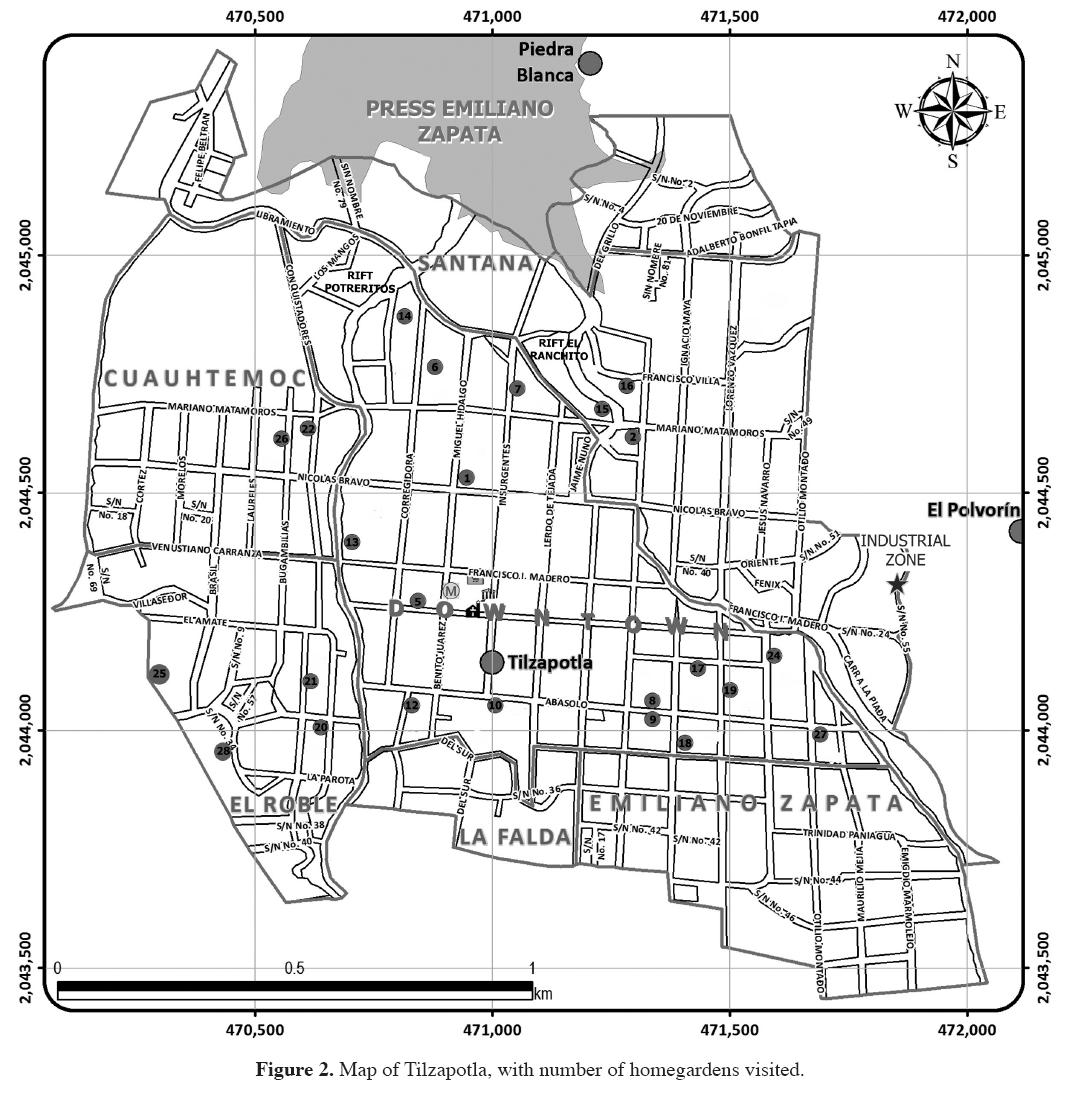
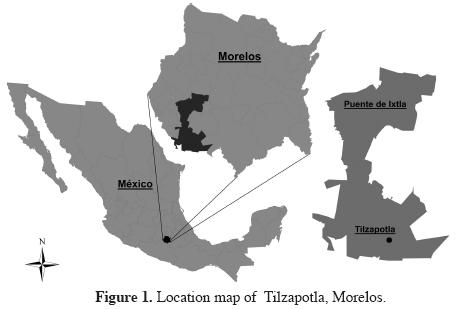
<body><![CDATA[<p align="justify"><font face="verdana" size="2"><i>Study area.</i> Tilzapotla is located in central Mexico, in the municipality of Puente de Ixtla, southern Morelos (<a href="#f1">Figure 1</a>), between 18&deg; 37' 02" and 18&deg; 38' 32" north and 99&deg; 17' 27" and 99&deg; 19' 26" west, with an average elevation of 1,004 m This region exhibits a warm sub&#45;humid climate of the Awo"(w)(i')g type, a mean annual temperature of 22 &deg;C, and an average annual rainfall of 800 mm (Garc&iacute;a, 2004). The vegetation is described as a tropical deciduous forest, with relics of oak forest (Rzedowski, 1978). Tilzapotla was founded in 1919 and has 4,789 inhabitants (INEGI, 2010a), whose activities are dedicated to mining, livestock, irrigation and wet season agriculture. The land tenure is communal; sorghum <i>(Sorghum bicolor</i> Moech), corn (Zea <i>mays</i> L.), sugarcane <i>(Saccharum officinarum</i> L.) and beans <i>(Phaseolus</i> sp L.) are grown for sale and direct consumption. Migration to the USA has generated dynamic communication and knowledge exchange regarding the management of home gardens.</font></p>  	    <p align="center"><font face="verdana" size="2"><a name="f1"></a></font></p>  	    <p align="center"><font face="verdana" size="2"><img src="/img/revistas/bs/v93n4/a11f1.jpg"></font></p>  	    <p align="justify"><font face="verdana" size="2"><i>Sampling design.</i> Home gardens (HGs) were identified and counted (a total of 267) using orthophotos at a scale of 1:10,000 (INEGI, 2010b). A sample of 24 HGs was randomly selected without replacement (<a href="#f2s">Figure 2</a>). Field information from these home gardens was collected from 2011 to 2013.</font></p>  	    <p align="center"><font face="verdana" size="2"><a name="f2s"></a></font></p>  	    <p align="center"><font face="verdana" size="2"><a href="/img/revistas/bs/v93n4/a11f2b.jpg" target="_blank"><img src="/img/revistas/bs/v93n4/a11f2s.jpg" border="0"></a></font>    <br>     <font face="verdana" size="2"><a href="/img/revistas/bs/v93n4/a11f2b.jpg" target="_blank">Haga clic para agrandar</a></font></p>     <p align="justify"><font face="verdana" size="2"><i>Information collection and analysis.</i> Semi&#45;structured interviews with the 24 home garden owners were performed based on Bernard's (2006) methodology. In the first interview, each interviewee was asked the following questions to obtain a list of the most frequently mentioned home garden plants: "What plants do you use?"; "What are their uses?"; and "Which are the three most important plants?" Subsequently, the similarity between the most frequently listed species and the most important species of the 24 home gardens was calculated using the Sorensen index (Magurran, 1988):</font></p>  	    <p align="center"><font face="verdana" size="2"><img src="/img/revistas/bs/v93n4/a11e1.jpg"></font></p>  	    <p align="justify"><font face="verdana" size="2">where <i>A</i> = total species in sample 1, <i>B</i> = total species in sample 2, and <i>C</i> = number of exclusive species in both samples. Because of the prevalence of edible plants recorded in these interviews, a second stage of interviews and field observations was conducted, and information on edible plants was obtained based on four questions of interest: "Which part of the plants do you use?", "How do you prepare it?", "How do you preserve these parts?", and "What is the frequency of use?" For medicinal plants, the following questions were also asked: "Which part of the plant do you use?", "How do you prepare it?", and "What illnesses does this plant treat?" The illnesses were classified using the <i>Atlas de Plantas de la Medicina Tradicional Mexicana</i> (Argueta, 2009), and the frequency at which the plant was mentioned was also recorded.</font></p>  	    ]]></body>
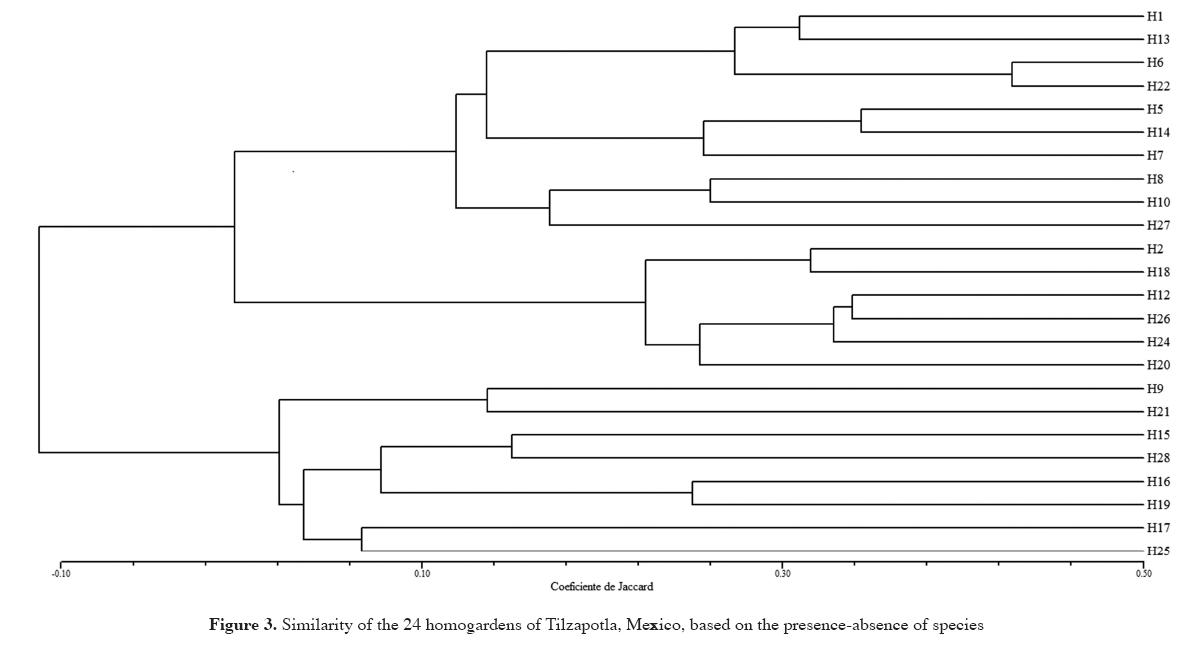
<body><![CDATA[<p align="justify"><font face="verdana" size="2">Trail walks were carried out, and the occurrence of plant species was documented to describe the floristic composition and use. To analyze similarity in terms of floristic composition, a presence&#45;absence matrix of species was developed. For this analysis, 137 species were considered; the remaining species were removed because their presence was considered rare, and they did not contribute to the floristic differentiation among home gardens. A similarity analysis was performed using the Jaccard coefficient and NTSYS&#45;pc ver. 2.1 software (Rohlf, 2000).</font></p>  	    <p align="justify"><font face="verdana" size="2">All plants were classified according to their use and management type (Bye, 1993; Casas <i>et al.,</i> 1997.) as enhanced, tolerated, protected, or cultivated. The place of origin of the plants, the time spent gardening, and the name of who cared for the home garden were recorded. The collection practices were determined by asking what visual and/or sensory characteristics were considered during this activity. In addition, we asked about product use, price and sales level. The "level of sales" category is a qualitative classification of the frequency at which a particular species is mentioned with respect to sales and is classified as high, regular or low. The spatial arrangement of the home garden management zones was described, and the size of the home gardens was recorded.</font></p>  	    <p align="justify"><font face="verdana" size="2">The importance of the home garden was based on its age, and the reasons for its establishment were explained. The botanical material was identified with the support of the Herbarium staff (HUMO) of the Universidad Aut&oacute;noma del Estado de Morelos (UAEM). The species nomenclature was authenticated using the Tropicos&reg; (<a href="http://www.tropicos.org" target="_blank">http://www.tropicos.org</a>) Missouri Botanical Garden (2014) database, and taxon authorities are noted according to Villase&ntilde;or <i>et al.</i> (2008).</font></p>  	    <p>&nbsp;</p>  	    <p align="justify"><font face="verdana" size="2"><b>Results</b></font></p>  	    <p align="justify"><font face="verdana" size="2"><i>Composition and uses.</i> A total of 189 species, 158 genera and 69 families of plants (<a href="/img/revistas/bs/v93n4/html/a11app1.html" target="_blank">Appendix 1</a>) were documented. The richest families were Araceae (15), Euphorbiaceae and Lamiaceae (11) and Crassulaceae and Bignoniaceae (10). Eight use types were documented (<a href="/img/revistas/bs/v93n4/a11t1.jpg" target="_blank">Table 1</a>), the richest of which were ornamental (48 %), edible (32 %), religious (24 %) and medicinal (20 %). Food production was the main use in 45 % of home gardens (<a href="/img/revistas/bs/v93n4/a11t2.jpg" target="_blank">Table 2</a>). A total of 46 (24 %) species with more than one use (<a href="/img/revistas/bs/v93n4/html/a11app1.html" target="_blank">Appendix 1</a>) were recorded. There were botanical families that included species with two and three use classifications.</font></p>  	    <p align="justify"><font face="verdana" size="2"><i>Similarity in species composition.</i> There was low similarity in the species composition between home gardens, and some differences were found (<a href="/img/revistas/bs/v93n4/a11t3.jpg" target="_blank">Table 3</a>, <a href="#f3s">Figure 3</a>). Three groups were recognized (<a href="/img/revistas/bs/v93n4/a11t3.jpg" target="_blank">Table 3</a>). The first group was the largest and included nine out of 24 home gardens. All of the home gardens in groups I, II and III contained lime trees <i>(Citrus aurantifolia),</i> and group III was distinct due to including many fruit trees, such as guam&uacute;chil <i>(Pithecellobium dulce),</i> banana <i>(Musa paradisiaca),</i> guayaba <i>(Psidium guajaba),</i> and ciruela <i>(Spondias mombin).</i> The H15 &#45; H19 subgroup of group III shared fruit trees, and the single shared species subgroup, H27 &#45; H25, of group II corresponded to <i>Citrus aurantifolia.</i> The H12 &#45; H20 subgroup species and H8 &#45; H27 subgroup of group I were distinct from the other home gardens because they included a large number of ornamental plants.</font></p>  	    <p align="center"><font face="verdana" size="2"><a name="f3s"></a></font></p>  	    <p align="center"><font face="verdana" size="2"><a href="/img/revistas/bs/v93n4/a11f3b.jpg" target="_blank"><img src="/img/revistas/bs/v93n4/a11f3s.jpg" border="0"></a></font>    <br>     <font face="verdana" size="2"><a href="/img/revistas/bs/v93n4/a11f3b.jpg" target="_blank">Haga clic para agrandar</a></font></p>     ]]></body>
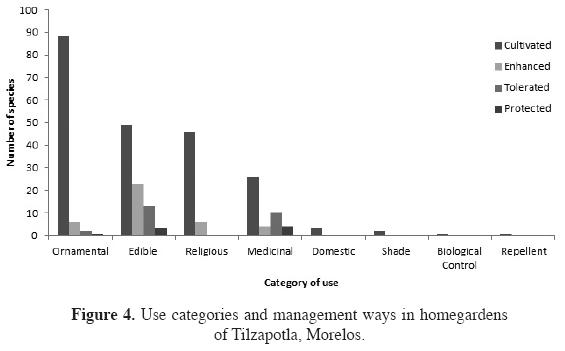
<body><![CDATA[<p align="justify"><font face="verdana" size="2"><i>Frequency of mention.</i> The species that was most commonly mentioned, by 70 % of the interviewees in the semi&#45;structured interviews, was lime <i>(Citrus aurantifolia),</i> followed by wormseed <i>(Teloxys ambrosioides),</i> peppermint <i>(Mentha canadensis),</i> and ciruela <i>(Spondias mombin),</i> which were mentioned by 41.6 % of the interviewees. Furthermore, the three species reported as the most important were lime, mango <i>(Mangifera indica)</i> and wormseed. The similarity between the most frequently mentioned and important species among the home gardens was 40 %, based on the Sorensen index.</font></p>  	    <p align="justify"><font face="verdana" size="2"><i>Edible plants.</i> Between 24 and 60 % of the species from the home gardens were edible (<a href="/img/revistas/bs/v93n4/a11t2.jpg" target="_blank">Table 2</a>). Fruit was the most consumed botanical structure (75 %), followed by leaves (<a href="/img/revistas/bs/v93n4/a11t4.jpg" target="_blank">Table 4</a>). Some fruits, such as ciruela and guaje <i>(Leucaena esculenta</i> subsp. <i>esculenta),</i> were preserved through drying techniques, whereas others, such as nanche <i>(Byrsonima crassifolia),</i> ciruela and passion fruit <i>(Passiflora edulis),</i> were preserved through freezing. Limes were used daily, whereas mango, ciruela and guaje were consumed in the harvest season between January&#45;April. Other fruits, such as wormseed, were used two to three times per week.</font></p>  	    <p align="justify"><font face="verdana" size="2"><i>Medicinal plants.</i> Medicinal plants (mainly <i>Pereskia aculeata)</i> were reportedly used in relation to cancer (nine responses) and as anti&#45;inflammatories (seven) and digestives (six), for respiratory improvement (five), and in rituals referred to as "limpias" (eight). Medicinal plants were mentioned by 20 % of the interviewees and were cultivated by 90 % of them. The number of medicinal species in home gardens ranged from two to 22 (<a href="/img/revistas/bs/v93n4/a11t2.jpg" target="_blank">Table 2</a>). The most common method of use was the preparation of tea leaves, followed by fresh consumption.</font></p>  	    <p align="justify"><font face="verdana" size="2"><i>Home garden management.</i> Some species were subjected to more than one form of management: 84 % of plants were cultivated, 17 % were enhanced, 15 % were tolerated, and 4.2 % were protected. Among these plants, the ornamental, edible, ritual and medicinal uses were the most common, as shown in <a href="#f4">figure 4</a>, and the enhanced, tolerated and protected methods of management and cultivation prevailed.</font></p>  	    <p align="center"><font face="verdana" size="2"><a name="f4"></a></font></p>  	    <p align="center"><font face="verdana" size="2"><img src="/img/revistas/bs/v93n4/a11f4.jpg"></font></p>  	    <p align="justify"><font face="verdana" size="2"><i>Plant collection.</i> Some plants were purchased in regional markets, exchanged, given away or collected from nature, such as capitaneja <i>(Verbesina crocata),</i> biznaga <i>(Coryphantha bumamma),</i> borrego <i>(Acacia acatlensis),</i> nopal <i>(Opuntia</i> sp.), jarilla <i>(Senecio salignus),</i> and bonete <i>(Jacaratia mexicana).</i> Chili <i>(Capsicum annuum)</i> seeds, corn, and some ornamental species were also traded, sometimes from the United States of America because 26 % of the Tilzapotla population is migrant and travel with plants and food. These migrants return annually and eat dishes made with corn, squash, ciruela, and other seasonal fruits. An indirect function of the home garden is the social practice of growing food for the palate and to enjoy in popular gatherings, a tradition that strengthens plant species use.</font></p>  	    <p align="justify"><font face="verdana" size="2"><i>Caring for the home gardens and time spent in them.</i> The home gardens were attended by women (15; 66 %), men (4; 12.5 %) or both (5; 20.8 %). Children did not participate in home garden care, but they assisted with harvesting at certain times. The home garden care activities included the maintenance of "cajetes" (holes where the plants are seated), the changing of the potting soil once or twice each year using home garden compost or forest soil, and fertilization with organic products (sheep manure, poultry manure or bat guano), or chemicals (NPK). To lessen the effect of drought, the frequency of irrigation was increased, and shades were erected to protect plants from direct radiation, or pots were relocated to protect plants from the sun. In 62 % of cases, pests were eradicated using stem pruning and lime application. The average daily time invested in home garden care was 40 min, which equated to 3.7 hr/wk.</font></p>  	    <p align="justify"><font face="verdana" size="2"><i>Harvesting.</i> Fruit color and texture were considered in harvesting, which was performed directly by hand or with the use of a tool, basket, blanket or chicol (a stick with a basket; <a href="/img/revistas/bs/v93n4/a11t5.jpg" target="_blank">Table 5</a>).</font></p>  	    <p align="justify"><font face="verdana" size="2"><i>Destination of products.</i> The production was predominantly destined for self&#45;supply, and only 25 % of owners sold the surplus from their home gardens (<a href="/img/revistas/bs/v93n4/a11t6.jpg" target="_blank">Table 6</a>). The home gardens provided components of the daily diet; 54 % of owners planted crops that included corn, beans <i>(Phaseolus vulgaris),</i> squash, and fruit, such as nanche <i>(Byrsonima crassifolia),</i> guam&uacute;chil <i>(Pithecellobium dulce),</i> and papaya <i>(Carica papaya),</i> which were temporarily enhanced and protected in the home gardens.</font></p>  	    ]]></body>
<body><![CDATA[<p align="justify"><font face="verdana" size="2"><i>Spatial arrangement.</i> Common areas in the home gardens were recorded and are described as follows. While the home gardens differed in size (<a href="/img/revistas/bs/v93n4/a11t2.jpg" target="_blank">Table 2</a>), an average area of 520 m<sup>2</sup> was typically divided into five areas: ornamental plants, condiments near the house, medicinal plants, corn/squash crops, and fruit trees, which were located farthest from the house (<a href="/img/revistas/bs/v93n4/a11f5.jpg" target="_blank">Figure 5</a>). The common areas were used according to space availability in the home gardens. Tolerated species, such as cuatecomate <i>(Crescentia alata),</i> guaje, guam&uacute;chil and cuaulote <i>(Guazuma ulmifolia),</i> and other crops, such as nopal, functioned as a living fence. A space was assigned for species destined for sale, such as escoba <i>(Schkuria pinnata</i> var. <i>virgata)</i> and Mexican marigold <i>(Tagetes erecta).</i> In addition, there was a resting area for family gatherings and shared work, and a designated space for domestic animals, such as poultry or sheep, was common.</font></p>  	    <p align="justify"><font face="verdana" size="2"><i>Importance of home gardens.</i> The average age of the home gardens was 20 years. The predominant importance was described in terms of intangible benefits; e.g., 100 % of the interviewees considered caring for the home garden as family and relaxing time, with women expressing their preference in terms of shapes and colors, such as red. Flowers with a variety of colors were appreciated for religious festivities.</font></p>  	    <p>&nbsp;</p>  	    <p align="justify"><font face="verdana" size="2"><b>Discussion</b></font></p>  	    <p align="justify"><font face="verdana" size="2"><i>Composition and plant use.</i> The species richness found in Tilzapotla represents 55 % of that documented in ten home gardens of a Mayan community (387 species) (Lope&#45;Alzina and Howard, 2012). This information demonstrates the high biological diversity of this agroecosystem in southeastern Mexico, which is influenced by a humid tropical climate, compared with the dry tropical climate of Morelos.</font></p>  	    <p align="justify"><font face="verdana" size="2">The results of the current study agree with those of Caballero <i>et al.</i> (2010), who reported Rutaceae and Fabaceae to be the most common families in the edible category and Asteraceae and Lamiaceae to be the most common families in the medicinal category within Mexico's catalogue of useful plants. The observed floristic composition was similar to the home gardens of San Rafael Coxcatl&aacute;n, Puebla, due to the dominance of ornamental plants (56 %) (Blanckaert <i>et al.,</i> 2004) and to the arrangement of plants in front of home garden perimeters in Calakmul, Mexico. This setting indicated the residents' preference for flowers as well as their ability to care for gardens, displaying the beauty of the flowers. According to Neulinger <i>et al.</i> (2013), the ornamental plant selection provides attractive and aesthetic value, which indicates prestige for families. This is equivalent to "luxury", a term associated with the maintenance of plants without any use other than enjoyment (Moreno&#45;Calles <i>et al.,</i> 2013). The ornamental quality of Tilzapotla's home gardens differed from that in other regions; these home gardens were mainly used for food security, to improve families' nutrition, and for economic growth in some cases (Casas <i>et al.,</i> 1996; Pulido <i>et al.,</i> 2008; Cano&#45;Ram&iacute;rez <i>et al.,</i> 2012).</font></p>  	    <p align="justify"><font face="verdana" size="2"><i>Similarity in species composition.</i> The obtained results did not indicate similarity in the floristic composition between home gardens. However, there was a marked presence of certain edible plants growing spontaneously, and these plants were tolerated based on their use value. This finding suggests that there was an interaction between the plants in home gardens and those in the surrounding vegetation.</font></p>  	    <p align="justify"><font face="verdana" size="2"><i>Frequency of mention.</i> There was a similarity between the most frequently cited and most important home garden species. Edible plants, which are the most commonly used because they are part of the diet, were documented in all of Tilzapotla's home gardens. The edible plants used by the interviewees coincided with those used in Zimbabwe (Maroyi, 2013) in terms of their importance as nutritious foods. The health benefits of these plants were highlighted by the increased consumption of fresh home garden products. Some people do not consider traditional medicinal use to be a core contribution of home gardens because medicinal plants are only occasionally used compared with edible plants, which are frequently consumed. This is likely due to the easy access to healthcare services implemented by the government and the confidence in free allopathic medicine. Nevertheless, medicinal plants were cultivated by 90 % of the interviewees to treat ailments that included serious illnesses, such as cancer. Kuhnlein (2014) stated that the preference for fast food over natural food leads to chronic diseases (e.g. cancer, cardiovascular diseases, diabetes). To treat these diseases, people grow medicinal herbs in their home garden. Medicinal plants function as a complement to medical treatment. Some of the home garden plants were not used immediately but were stored for possible future usage, confirming that they are tolerated medicinal species that will be required at some point in the future.</font></p>  	    <p align="justify"><font face="verdana" size="2"><i>Management.</i> Practices such as farming and protection as well as the collection methods for useful species indicate families' dedication to and interest in continuing to employ useful species. The average time invested in performing various tasks in the home garden coincides with data presented by Kabir and Weeb (2009) from Bangladesh, Asia. Some interviewees considered their available time insufficient for collecting the necessary products because they also had other activities that required attention.</font></p>  	    <p align="justify"><font face="verdana" size="2">The benefit that owners derive from home gardens impacts the decisions made regarding resource management, similar to the findings reported by Thomas and Van Damme (2010). Therefore, plant management in home gardens is common in indigenous communities in both Bolivia and Tilzapotla.</font></p>  	    ]]></body>
<body><![CDATA[<p align="justify"><font face="verdana" size="2"><i>Destination of the products.</i> Most of the products of the home gardens were destined for self&#45;supply. The home garden products supplemented the economy and strengthened the protection of these agroecosystems. While a limited amount of home garden products were sold, their indirect value was significant for the families and beneficial for their economy because people obtain products that are used daily without having to spend money to obtain them. An important decision was to focus greater attention on those species with economic rewards, especially fruit.</font></p>  	    <p align="justify"><font face="verdana" size="2"><i>Spatial arrangement.</i> No clear topological distribution pattern was observed in the studied areas, except for ornamental plants, which were arranged in a linear pattern, mainly around the house. These plants provide aesthetic value and prestige for the families. The division of space included an area for sharing the management of the harvest. The beneficiaries adapted spaces according to the specific requirements of the plants, such as the level of solar exposure. There was a trend in the location of edible plants; i.e., the owners grew these plants in small groups to facilitate handling.</font></p>  	    <p align="justify"><font face="verdana" size="2"><i>Importance of home gardens.</i> Irrespective of age, the importance of home gardens lies in their function as a recreational area. However, the value assigned to these agroecosystems by owners includes tangible benefits, such as the provision of food, medicine and shade and use for religious purposes.</font></p>  	    <p align="justify"><font face="verdana" size="2">This study demonstrates the multiple applications of useful plant resources based on the roles they play in family life. It was confirmed that even though ornamental plants dominated home gardens, the most frequently mentioned and important species were edible plants. Furthermore, edible plants in combination with medicinal plants received greater attention, indicating that these plants have an essential function in the users' daily lives. The number of edible species indicates actual and specific needs, such as required foods and dietary preferences. We confirmed the hypothesis that the home gardens of Tilzapotla play a multi&#45;functional role and exhibit high species richness and a large number of edible and medicinal plants, which contribute to household livelihood. In addition, it was confirmed that edible species support the fulfillment of requirements for self&#45;supply. Therefore, these agroecosystems represent an alternative to meet a family's needs.</font></p>  	    <p>&nbsp;</p>  	    <p align="justify"><font face="verdana" size="2"><b>Acknowledgements</b></font></p>  	    <p align="justify"><font face="verdana" size="2">We acknowledge the Tilzapotla community for their support during the project and the Center for Research in Biodiversity and Conservation (CIByC) for their logistical support. We are grateful to Gabriel Flores Franco, curator of the HUMO herbarium, for his support in identifying the botanical material. We are also thankful for the valuable suggestions and commentaries of two anonymous reviewers whose comments and suggestions substantially improved the article.</font></p>  	    <p>&nbsp;</p>  	    <p align="justify"><font face="verdana" size="2"><b>Literature cited</b></font></p>  	    <!-- ref --><p align="justify"><font face="verdana" size="2">Abebe T., Wiersum K. and Bongers F. 2010. Spatial and temporal variation in crop diversity in agroforestry homegardens of southern Ethiopia. <i>Agroforestry Systems</i> <b>78</b>:309&#45;322.    &nbsp;&nbsp;&nbsp;&nbsp;&nbsp;&nbsp;&nbsp;&nbsp;[&#160;<a href="javascript:void(0);" onclick="javascript: window.open('/scielo.php?script=sci_nlinks&ref=1792426&pid=S2007-4298201500040001100001&lng=','','width=640,height=500,resizable=yes,scrollbars=1,menubar=yes,');">Links</a>&#160;]<!-- end-ref --></font></p>  	    <!-- ref --><p align="justify"><font face="verdana" size="2">Albuquerque U.P., Andrade L.H.C. and Caballero J. 2005. Structure and floristics of homegardens in Northeastern Brazil. <i>Journal of Arid Environments</i> <b>62</b>:491&#45;506.    &nbsp;&nbsp;&nbsp;&nbsp;&nbsp;&nbsp;&nbsp;&nbsp;[&#160;<a href="javascript:void(0);" onclick="javascript: window.open('/scielo.php?script=sci_nlinks&ref=1792428&pid=S2007-4298201500040001100002&lng=','','width=640,height=500,resizable=yes,scrollbars=1,menubar=yes,');">Links</a>&#160;]<!-- end-ref --></font></p>  	    <!-- ref --><p align="justify"><font face="verdana" size="2">Argueta A. 2009. Atlas de las Plantas de la Medicina Tradicional Mexicana. Digital library. Instituto Nacional Indigenista. &lt;<a href="http://www.medicinatradicionalmexicana.unam.mx/responsables.html?obra=ats" target="_blank">http://www.medicinatradicionalmexicana.unam.mx/responsables.html?obra=ats</a> &gt; (accessed January 10, 2014).    &nbsp;&nbsp;&nbsp;&nbsp;&nbsp;&nbsp;&nbsp;&nbsp;[&#160;<a href="javascript:void(0);" onclick="javascript: window.open('/scielo.php?script=sci_nlinks&ref=1792430&pid=S2007-4298201500040001100003&lng=','','width=640,height=500,resizable=yes,scrollbars=1,menubar=yes,');">Links</a>&#160;]<!-- end-ref --></font></p>  	    <!-- ref --><p align="justify"><font face="verdana" size="2">Bernard R. 2006. <i>Structured interviewing.</i> In: Bernard R. Ed. Research methods in cultural anthropology: Qualitative and quantitative approaches. pp. 237&#45;255, Altamira Press, London.    &nbsp;&nbsp;&nbsp;&nbsp;&nbsp;&nbsp;&nbsp;&nbsp;[&#160;<a href="javascript:void(0);" onclick="javascript: window.open('/scielo.php?script=sci_nlinks&ref=1792432&pid=S2007-4298201500040001100004&lng=','','width=640,height=500,resizable=yes,scrollbars=1,menubar=yes,');">Links</a>&#160;]<!-- end-ref --></font></p>  	    <!-- ref --><p align="justify"><font face="verdana" size="2">Blancas J., Casas A., P&eacute;rez&#45;Salicrup D., Caballero J. and Vega E. 2013. Ecological and socio&#45;cultural factors influencing plant management in N&aacute;huatl communities of the Tehuac&aacute;n Valley, Mexico. <i>Journal of Ethnobiology and Ethnomedicine</i> <b>9</b>:1&#45;22</font>&nbsp;&nbsp;&nbsp;&nbsp;&nbsp;&nbsp;&nbsp;&nbsp;[&#160;<a href="javascript:void(0);" onclick="javascript: window.open('/scielo.php?script=sci_nlinks&ref=1792434&pid=S2007-4298201500040001100005&lng=','','width=640,height=500,resizable=yes,scrollbars=1,menubar=yes,');">Links</a>&#160;]<!-- end-ref --><!-- ref --><p align="justify"><font face="verdana" size="2">Blanckaert I., Swennen R., Paredes&#45;Flores M., Rosas&#45;L&oacute;pez R. and Lira&#45;Saade R. 2004. Floristic composition, plant uses and management practices in homegardens of San Rafael Coxcatl&aacute;n, Valley of Tehuac&aacute;n&#45;Cuicatl&aacute;n, Mexico. <i>Journal of Arid Environments</i> <b>57</b>:179&#45;202.    &nbsp;&nbsp;&nbsp;&nbsp;&nbsp;&nbsp;&nbsp;&nbsp;[&#160;<a href="javascript:void(0);" onclick="javascript: window.open('/scielo.php?script=sci_nlinks&ref=1792435&pid=S2007-4298201500040001100006&lng=','','width=640,height=500,resizable=yes,scrollbars=1,menubar=yes,');">Links</a>&#160;]<!-- end-ref --></font></p>  	    ]]></body>
<body><![CDATA[<!-- ref --><p align="justify"><font face="verdana" size="2">Boege E. 2010. <i>El Patrimonio Biocultural de los Pueblos Ind&iacute;genas de M&eacute;xico: Hacia la Conservaci&oacute;n in situ de la Biodiversidad y Agrodiversidad en los Territorios Ind&iacute;genas.</i> Instituto Nacional de Antropolog&iacute;a e Historia. M&eacute;xico, D.F.    &nbsp;&nbsp;&nbsp;&nbsp;&nbsp;&nbsp;&nbsp;&nbsp;[&#160;<a href="javascript:void(0);" onclick="javascript: window.open('/scielo.php?script=sci_nlinks&ref=1792437&pid=S2007-4298201500040001100007&lng=','','width=640,height=500,resizable=yes,scrollbars=1,menubar=yes,');">Links</a>&#160;]<!-- end-ref --></font></p>  	    <!-- ref --><p align="justify"><font face="verdana" size="2">Bye R. 1993. The role of humans in the diversification of plants in Mexico In: Ramamoorthy T.P., Bye R., Lot A. y Fa J. Eds. <i>Biological diversity of Mexico: Origins and distribution,</i> pp. 707&#45;731, Oxford University Press, New York.    &nbsp;&nbsp;&nbsp;&nbsp;&nbsp;&nbsp;&nbsp;&nbsp;[&#160;<a href="javascript:void(0);" onclick="javascript: window.open('/scielo.php?script=sci_nlinks&ref=1792439&pid=S2007-4298201500040001100008&lng=','','width=640,height=500,resizable=yes,scrollbars=1,menubar=yes,');">Links</a>&#160;]<!-- end-ref --></font></p>  	    <!-- ref --><p align="justify"><font face="verdana" size="2">Caballero J. 1992. Maya homegardens: Past, present and future. <i>Etnoecol&oacute;gica</i> <b>1</b>:35&#45;54.    &nbsp;&nbsp;&nbsp;&nbsp;&nbsp;&nbsp;&nbsp;&nbsp;[&#160;<a href="javascript:void(0);" onclick="javascript: window.open('/scielo.php?script=sci_nlinks&ref=1792441&pid=S2007-4298201500040001100009&lng=','','width=640,height=500,resizable=yes,scrollbars=1,menubar=yes,');">Links</a>&#160;]<!-- end-ref --></font></p>  	    <!-- ref --><p align="justify"><font face="verdana" size="2">Caballero J., Cort&eacute;s L. and Mart&iacute;nez&#45;Ballest&eacute; A. 2010. El manejo de la biodiversidad en los huertos familiares. In: Toledo V. (Coord.). <i>La biodiversidad de M&eacute;xico: Inventarios, manejos, usos, inform&aacute;tica, conservaci&oacute;n e importancia cultural,</i> pp. 220&#45;234. Fondo de Cultura Econ&oacute;mica Consejo Nacional para la Cultura y las Artes, M&eacute;xico, D.F.    &nbsp;&nbsp;&nbsp;&nbsp;&nbsp;&nbsp;&nbsp;&nbsp;[&#160;<a href="javascript:void(0);" onclick="javascript: window.open('/scielo.php?script=sci_nlinks&ref=1792443&pid=S2007-4298201500040001100010&lng=','','width=640,height=500,resizable=yes,scrollbars=1,menubar=yes,');">Links</a>&#160;]<!-- end-ref --></font></p>  	    <!-- ref --><p align="justify"><font face="verdana" size="2">Cano&#45;Ram&iacute;rez M., De la Tejera&#45;Hern&aacute;ndez B., Casas A., Salazar L. and Garc&iacute;a&#45;Barrios R. 2012. Migraci&oacute;n rural y huertos familiares en una comunidad ind&iacute;gena del centro de M&eacute;xico. <i>Botanical Sciences</i> <b>90</b>:287&#45;304.    &nbsp;&nbsp;&nbsp;&nbsp;&nbsp;&nbsp;&nbsp;&nbsp;[&#160;<a href="javascript:void(0);" onclick="javascript: window.open('/scielo.php?script=sci_nlinks&ref=1792445&pid=S2007-4298201500040001100011&lng=','','width=640,height=500,resizable=yes,scrollbars=1,menubar=yes,');">Links</a>&#160;]<!-- end-ref --></font></p>  	    ]]></body>
<body><![CDATA[<!-- ref --><p align="justify"><font face="verdana" size="2">Casas A., Caballero J., Mapes C. and Z&aacute;rate S. 1997. Manejo de la vegetaci&oacute;n, domesticaci&oacute;n de plantas y origen de la agricultura en Mesoam&eacute;rica. <i>Bolet&iacute;n de la Sociedad Bot&aacute;nica de M&eacute;xico</i> <b>61</b>:1&#45;47.    &nbsp;&nbsp;&nbsp;&nbsp;&nbsp;&nbsp;&nbsp;&nbsp;[&#160;<a href="javascript:void(0);" onclick="javascript: window.open('/scielo.php?script=sci_nlinks&ref=1792447&pid=S2007-4298201500040001100012&lng=','','width=640,height=500,resizable=yes,scrollbars=1,menubar=yes,');">Links</a>&#160;]<!-- end-ref --></font></p>  	    <!-- ref --><p align="justify"><font face="verdana" size="2">Casas A., V&aacute;zquez M.C., Viveros J.L. and Caballero J. 1996. Plant management among the N&aacute;hua and the Mixtec in the Balsas River Basin, Mexico: An etnobotanical approach to the study of plant domestication. <i>Human Ecology</i> <b>24</b>:455&#45;478.    &nbsp;&nbsp;&nbsp;&nbsp;&nbsp;&nbsp;&nbsp;&nbsp;[&#160;<a href="javascript:void(0);" onclick="javascript: window.open('/scielo.php?script=sci_nlinks&ref=1792449&pid=S2007-4298201500040001100013&lng=','','width=640,height=500,resizable=yes,scrollbars=1,menubar=yes,');">Links</a>&#160;]<!-- end-ref --></font></p>  	    <!-- ref --><p align="justify"><font face="verdana" size="2">Col&iacute;n H., Hern&aacute;ndez A. and Monroy R. 2012. El manejo tradicional y agroecol&oacute;gico en un huerto familiar de M&eacute;xico, como ejemplo de sostenibilidad. <i>Etnobiolog&iacute;a</i> <b>10</b>:12&#45;28.    &nbsp;&nbsp;&nbsp;&nbsp;&nbsp;&nbsp;&nbsp;&nbsp;[&#160;<a href="javascript:void(0);" onclick="javascript: window.open('/scielo.php?script=sci_nlinks&ref=1792451&pid=S2007-4298201500040001100014&lng=','','width=640,height=500,resizable=yes,scrollbars=1,menubar=yes,');">Links</a>&#160;]<!-- end-ref --></font></p>  	    <!-- ref --><p align="justify"><font face="verdana" size="2">FAO &#91;Food and Agriculture Organization of the United Nations&#93;. 2000. Mejorando la nutrici&oacute;n a trav&eacute;s de Huertos y Granjas Familiares. Departamento de Agricultura. Food and Agriculture Organization &lt;<a href="http://www.fao.org/docrep/v5290s/v5290s06.htm" target="_blank">http://www.fao.org/docrep/v5290s/v5290s06.htm</a>&gt; (accessed April 22, 2014).    &nbsp;&nbsp;&nbsp;&nbsp;&nbsp;&nbsp;&nbsp;&nbsp;[&#160;<a href="javascript:void(0);" onclick="javascript: window.open('/scielo.php?script=sci_nlinks&ref=1792453&pid=S2007-4298201500040001100015&lng=','','width=640,height=500,resizable=yes,scrollbars=1,menubar=yes,');">Links</a>&#160;]<!-- end-ref --></font></p>  	    <!-- ref --><p align="justify"><font face="verdana" size="2">Garc&iacute;a E. 2004. <i>Modificaciones al R&eacute;gimen de Clasificaci&oacute;n Clim&aacute;tica de K&ouml;ppen, Serie Libros 6.</i> Instituto de Geograf&iacute;a, Universidad Nacional Aut&oacute;noma de M&eacute;xico, M&eacute;xico, D.F.    &nbsp;&nbsp;&nbsp;&nbsp;&nbsp;&nbsp;&nbsp;&nbsp;[&#160;<a href="javascript:void(0);" onclick="javascript: window.open('/scielo.php?script=sci_nlinks&ref=1792455&pid=S2007-4298201500040001100016&lng=','','width=640,height=500,resizable=yes,scrollbars=1,menubar=yes,');">Links</a>&#160;]<!-- end-ref --></font></p>  	    ]]></body>
<body><![CDATA[<!-- ref --><p align="justify"><font face="verdana" size="2">INEGI &#91;Instituto Nacional de Estad&iacute;stica y Geograf&iacute;a&#93;. 2010a. II Conteo de Poblaci&oacute;n y Vivienda 2010. INEGI. M&eacute;xico D.F.    &nbsp;&nbsp;&nbsp;&nbsp;&nbsp;&nbsp;&nbsp;&nbsp;[&#160;<a href="javascript:void(0);" onclick="javascript: window.open('/scielo.php?script=sci_nlinks&ref=1792457&pid=S2007-4298201500040001100017&lng=','','width=640,height=500,resizable=yes,scrollbars=1,menubar=yes,');">Links</a>&#160;]<!-- end-ref --></font></p>  	    <!-- ref --><p align="justify"><font face="verdana" size="2">INEGI 2010b. Ortofoto digital escala 1:10000 a color, vuelo 2010. INEGI. M&eacute;xico D.F.    &nbsp;&nbsp;&nbsp;&nbsp;&nbsp;&nbsp;&nbsp;&nbsp;[&#160;<a href="javascript:void(0);" onclick="javascript: window.open('/scielo.php?script=sci_nlinks&ref=1792459&pid=S2007-4298201500040001100018&lng=','','width=640,height=500,resizable=yes,scrollbars=1,menubar=yes,');">Links</a>&#160;]<!-- end-ref --></font></p>  	    <!-- ref --><p align="justify"><font face="verdana" size="2">Kabir E. y Weeb E. 2009. Household and homegarden characteristics in southwestern. Bangladesh. <i>Agroforestry Systems</i> <b>75</b>:129&#45;145.    &nbsp;&nbsp;&nbsp;&nbsp;&nbsp;&nbsp;&nbsp;&nbsp;[&#160;<a href="javascript:void(0);" onclick="javascript: window.open('/scielo.php?script=sci_nlinks&ref=1792461&pid=S2007-4298201500040001100019&lng=','','width=640,height=500,resizable=yes,scrollbars=1,menubar=yes,');">Links</a>&#160;]<!-- end-ref --></font></p>     <!-- ref --><p align="justify"><font face="verdana" size="2">Kuhnlein, H. V. 2014. How ethnobiology can contribute to food security. <i>Journal of Ethnobiology</i> <b>34</b>:12&#45;27.    &nbsp;&nbsp;&nbsp;&nbsp;&nbsp;&nbsp;&nbsp;&nbsp;[&#160;<a href="javascript:void(0);" onclick="javascript: window.open('/scielo.php?script=sci_nlinks&ref=1792463&pid=S2007-4298201500040001100020&lng=','','width=640,height=500,resizable=yes,scrollbars=1,menubar=yes,');">Links</a>&#160;]<!-- end-ref --></font></p>  	    <!-- ref --><p align="justify"><font face="verdana" size="2">Lope&#45;Alzina D.G. and Howard P.L. 2012. The structure, composition, and functions of homergardens: Focus on the Yucat&aacute;n Peninsula. <i>Etnoecol&oacute;gica</i> <b>9</b>:17&#45;41.    &nbsp;&nbsp;&nbsp;&nbsp;&nbsp;&nbsp;&nbsp;&nbsp;[&#160;<a href="javascript:void(0);" onclick="javascript: window.open('/scielo.php?script=sci_nlinks&ref=1792465&pid=S2007-4298201500040001100021&lng=','','width=640,height=500,resizable=yes,scrollbars=1,menubar=yes,');">Links</a>&#160;]<!-- end-ref --></font></p>  	    ]]></body>
<body><![CDATA[<!-- ref --><p align="justify"><font face="verdana" size="2">Magurran, E.A. 1988. A variety of diversities. In: Magurran E.A. Eds. <i>Ecological diversity and its measurement,</i> pp. 81&#45;99, Springer International Publisching AG, Princeton.    &nbsp;&nbsp;&nbsp;&nbsp;&nbsp;&nbsp;&nbsp;&nbsp;[&#160;<a href="javascript:void(0);" onclick="javascript: window.open('/scielo.php?script=sci_nlinks&ref=1792467&pid=S2007-4298201500040001100022&lng=','','width=640,height=500,resizable=yes,scrollbars=1,menubar=yes,');">Links</a>&#160;]<!-- end-ref --></font></p>  	    <!-- ref --><p align="justify"><font face="verdana" size="2">Mariaca M.R. 2012. <i>El Huerto Familiar del Sureste de M&eacute;xico.</i> Secretar&iacute;a de Recursos Naturales y Protecci&oacute;n Ambiental del Estado de Tabasco. El Colegio de la Frontera Sur. ECOSUR. Villahermosa, Tabasco.    &nbsp;&nbsp;&nbsp;&nbsp;&nbsp;&nbsp;&nbsp;&nbsp;[&#160;<a href="javascript:void(0);" onclick="javascript: window.open('/scielo.php?script=sci_nlinks&ref=1792469&pid=S2007-4298201500040001100023&lng=','','width=640,height=500,resizable=yes,scrollbars=1,menubar=yes,');">Links</a>&#160;]<!-- end-ref --></font></p>  	    <!-- ref --><p align="justify"><font face="verdana" size="2">Maroyi A. 2013. Use and management of homegarden plants in Zvishavane district, Zimbabwe. <i>Tropical Ecology</i> <b>54</b>:191&#45;203.    &nbsp;&nbsp;&nbsp;&nbsp;&nbsp;&nbsp;&nbsp;&nbsp;[&#160;<a href="javascript:void(0);" onclick="javascript: window.open('/scielo.php?script=sci_nlinks&ref=1792471&pid=S2007-4298201500040001100024&lng=','','width=640,height=500,resizable=yes,scrollbars=1,menubar=yes,');">Links</a>&#160;]<!-- end-ref --></font></p>  	    <!-- ref --><p align="justify"><font face="verdana" size="2">Moreno&#45;Calles A.I., Toledo V.M. and Casas A. 2013. Los sistemas agroforestales tradicionales de M&eacute;xico: una aproximaci&oacute;n biocultural. <i>Botanical Sciences</i> <b>91</b>:375&#45;398.    &nbsp;&nbsp;&nbsp;&nbsp;&nbsp;&nbsp;&nbsp;&nbsp;[&#160;<a href="javascript:void(0);" onclick="javascript: window.open('/scielo.php?script=sci_nlinks&ref=1792473&pid=S2007-4298201500040001100025&lng=','','width=640,height=500,resizable=yes,scrollbars=1,menubar=yes,');">Links</a>&#160;]<!-- end-ref --></font></p>  	    <!-- ref --><p align="justify"><font face="verdana" size="2">Neulinger K., Vogl C.R. and Alay&oacute;n&#45;Gamboa J.A. 2013. Plant species and their uses in homegardens of migrant Maya and mestizo smallholder farmers in Calakmul, Campeche, Mexico. <i>Journal of Ethnobiology</i> <b>33</b>:105&#45;124.    &nbsp;&nbsp;&nbsp;&nbsp;&nbsp;&nbsp;&nbsp;&nbsp;[&#160;<a href="javascript:void(0);" onclick="javascript: window.open('/scielo.php?script=sci_nlinks&ref=1792475&pid=S2007-4298201500040001100026&lng=','','width=640,height=500,resizable=yes,scrollbars=1,menubar=yes,');">Links</a>&#160;]<!-- end-ref --></font></p>  	    ]]></body>
<body><![CDATA[<!-- ref --><p align="justify"><font face="verdana" size="2">Pulido M.T., Pagaza&#45;Calder&oacute;n E.M., Mart&iacute;nez&#45;Ballest&eacute; A., Maldonado&#45;Almanza B., Saynes A. and Pacheco R.M. 2008. Home gardens as an alternative form sustainability: challenges and perspectives in Latin America. In: Albuquerque U.P. y Alves&#45;Ramos M. Eds. <i>Current Topics in Ethnobotany,</i> pp. 55&#45;79, Research Signpost, Kerala.    &nbsp;&nbsp;&nbsp;&nbsp;&nbsp;&nbsp;&nbsp;&nbsp;[&#160;<a href="javascript:void(0);" onclick="javascript: window.open('/scielo.php?script=sci_nlinks&ref=1792477&pid=S2007-4298201500040001100027&lng=','','width=640,height=500,resizable=yes,scrollbars=1,menubar=yes,');">Links</a>&#160;]<!-- end-ref --></font></p>  	    <!-- ref --><p align="justify"><font face="verdana" size="2">Rohlf F.J. 2000. NTSYS&#45;pc, numerical taxonomy and multivariate analysis system, version 2.1. Exeter Software, Applied Biostatistic Inc., New York.    &nbsp;&nbsp;&nbsp;&nbsp;&nbsp;&nbsp;&nbsp;&nbsp;[&#160;<a href="javascript:void(0);" onclick="javascript: window.open('/scielo.php?script=sci_nlinks&ref=1792479&pid=S2007-4298201500040001100028&lng=','','width=640,height=500,resizable=yes,scrollbars=1,menubar=yes,');">Links</a>&#160;]<!-- end-ref --></font></p>  	    <!-- ref --><p align="justify"><font face="verdana" size="2">Rzedowski J. 1978. <i>Vegetaci&oacute;n de M&eacute;xico.</i> Limusa, M&eacute;xico, D.F.    &nbsp;&nbsp;&nbsp;&nbsp;&nbsp;&nbsp;&nbsp;&nbsp;[&#160;<a href="javascript:void(0);" onclick="javascript: window.open('/scielo.php?script=sci_nlinks&ref=1792481&pid=S2007-4298201500040001100029&lng=','','width=640,height=500,resizable=yes,scrollbars=1,menubar=yes,');">Links</a>&#160;]<!-- end-ref --></font></p>  	    <!-- ref --><p align="justify"><font face="verdana" size="2">Srithi K., Trisonthi C., Wangpakapattanawong P., Srisanga P. and Balslev H. 2012. Plant diversity in Hmong and Mien homegardens in northern Thailand. <i>Economic Botany</i> <b>66</b>:192&#45;206.    &nbsp;&nbsp;&nbsp;&nbsp;&nbsp;&nbsp;&nbsp;&nbsp;[&#160;<a href="javascript:void(0);" onclick="javascript: window.open('/scielo.php?script=sci_nlinks&ref=1792483&pid=S2007-4298201500040001100030&lng=','','width=640,height=500,resizable=yes,scrollbars=1,menubar=yes,');">Links</a>&#160;]<!-- end-ref --></font></p>  	    <!-- ref --><p align="justify"><font face="verdana" size="2">Thomas E. and Van Damme P. 2010. Plant use and management in homegardens and swiddens: evidence from the Bolivian Amazon. <i>Agroforestry Systems</i> <b>80</b>:131&#45;152.    &nbsp;&nbsp;&nbsp;&nbsp;&nbsp;&nbsp;&nbsp;&nbsp;[&#160;<a href="javascript:void(0);" onclick="javascript: window.open('/scielo.php?script=sci_nlinks&ref=1792485&pid=S2007-4298201500040001100031&lng=','','width=640,height=500,resizable=yes,scrollbars=1,menubar=yes,');">Links</a>&#160;]<!-- end-ref --></font></p>  	    ]]></body>
<body><![CDATA[<!-- ref --><p align="justify"><font face="verdana" size="2">Toledo V., Ortiz&#45;Espejel B., Cort&eacute;s L., Moguel P and Ordo&ntilde;ez M. 2003. The multiple use of tropical forests by indigenous peoples in Mexico: A case of adaptive management. <i>Conservation Ecology</i> <b>7</b>:9&#91;online&#93;    &nbsp;&nbsp;&nbsp;&nbsp;&nbsp;&nbsp;&nbsp;&nbsp;[&#160;<a href="javascript:void(0);" onclick="javascript: window.open('/scielo.php?script=sci_nlinks&ref=1792487&pid=S2007-4298201500040001100032&lng=','','width=640,height=500,resizable=yes,scrollbars=1,menubar=yes,');">Links</a>&#160;]<!-- end-ref -->.</font></p>  	    <!-- ref --><p align="justify"><font face="verdana" size="2">Villase&ntilde;or J.L., Ortiz E. and Redonda&#45;Mart&iacute;nez R. 2008. <i>Cat&aacute;logo de Autores de Plantas Vasculares de M&eacute;xico.</i> Universidad Nacional Aut&oacute;noma de M&eacute;xico, Comisi&oacute;n Nacional para el Conocimiento de la Biodiversidad M&eacute;xico, D.F.    &nbsp;&nbsp;&nbsp;&nbsp;&nbsp;&nbsp;&nbsp;&nbsp;[&#160;<a href="javascript:void(0);" onclick="javascript: window.open('/scielo.php?script=sci_nlinks&ref=1792489&pid=S2007-4298201500040001100033&lng=','','width=640,height=500,resizable=yes,scrollbars=1,menubar=yes,');">Links</a>&#160;]<!-- end-ref --></font></p>      ]]></body><back>
<ref-list>
<ref id="B1">
<nlm-citation citation-type="journal">
<person-group person-group-type="author">
<name>
<surname><![CDATA[Abebe]]></surname>
<given-names><![CDATA[T.]]></given-names>
</name>
<name>
<surname><![CDATA[Wiersum]]></surname>
<given-names><![CDATA[K.]]></given-names>
</name>
<name>
<surname><![CDATA[Bongers]]></surname>
<given-names><![CDATA[F.]]></given-names>
</name>
</person-group>
<article-title xml:lang="en"><![CDATA[Spatial and temporal variation in crop diversity in agroforestry homegardens of southern Ethiopia]]></article-title>
<source><![CDATA[Agroforestry Systems]]></source>
<year>2010</year>
<volume>78</volume>
<page-range>309-322</page-range></nlm-citation>
</ref>
<ref id="B2">
<nlm-citation citation-type="journal">
<person-group person-group-type="author">
<name>
<surname><![CDATA[Albuquerque]]></surname>
<given-names><![CDATA[U.P.]]></given-names>
</name>
<name>
<surname><![CDATA[Andrade]]></surname>
<given-names><![CDATA[L.H.C.]]></given-names>
</name>
<name>
<surname><![CDATA[Caballero]]></surname>
<given-names><![CDATA[J.]]></given-names>
</name>
</person-group>
<article-title xml:lang="en"><![CDATA[Structure and floristics of homegardens in Northeastern Brazil]]></article-title>
<source><![CDATA[Journal of Arid Environments]]></source>
<year>2005</year>
<volume>62</volume>
<page-range>491-506</page-range></nlm-citation>
</ref>
<ref id="B3">
<nlm-citation citation-type="book">
<person-group person-group-type="author">
<name>
<surname><![CDATA[Argueta]]></surname>
<given-names><![CDATA[A.]]></given-names>
</name>
</person-group>
<source><![CDATA[Atlas de las Plantas de la Medicina Tradicional Mexicana]]></source>
<year>2009</year>
<publisher-name><![CDATA[Instituto Nacional Indigenista]]></publisher-name>
</nlm-citation>
</ref>
<ref id="B4">
<nlm-citation citation-type="book">
<person-group person-group-type="author">
<name>
<surname><![CDATA[Bernard]]></surname>
<given-names><![CDATA[R.]]></given-names>
</name>
</person-group>
<article-title xml:lang="en"><![CDATA[Structured interviewing]]></article-title>
<person-group person-group-type="editor">
<name>
<surname><![CDATA[Bernard]]></surname>
<given-names><![CDATA[R.]]></given-names>
</name>
</person-group>
<source><![CDATA[Research methods in cultural anthropology: Qualitative and quantitative approaches]]></source>
<year>2006</year>
<page-range>237-255</page-range><publisher-loc><![CDATA[London ]]></publisher-loc>
<publisher-name><![CDATA[Altamira Press]]></publisher-name>
</nlm-citation>
</ref>
<ref id="B5">
<nlm-citation citation-type="journal">
<person-group person-group-type="author">
<name>
<surname><![CDATA[Blancas]]></surname>
<given-names><![CDATA[J.]]></given-names>
</name>
<name>
<surname><![CDATA[Casas]]></surname>
<given-names><![CDATA[A.]]></given-names>
</name>
<name>
<surname><![CDATA[Pérez-Salicrup]]></surname>
<given-names><![CDATA[D.]]></given-names>
</name>
<name>
<surname><![CDATA[Caballero]]></surname>
<given-names><![CDATA[J.]]></given-names>
</name>
<name>
<surname><![CDATA[Vega]]></surname>
<given-names><![CDATA[E.]]></given-names>
</name>
</person-group>
<article-title xml:lang="en"><![CDATA[Ecological and socio-cultural factors influencing plant management in Náhuatl communities of the Tehuacán Valley, Mexico]]></article-title>
<source><![CDATA[Journal of Ethnobiology and Ethnomedicine]]></source>
<year>2013</year>
<volume>9</volume>
<page-range>1-22</page-range></nlm-citation>
</ref>
<ref id="B6">
<nlm-citation citation-type="journal">
<person-group person-group-type="author">
<name>
<surname><![CDATA[Blanckaert]]></surname>
<given-names><![CDATA[I.]]></given-names>
</name>
<name>
<surname><![CDATA[Swennen]]></surname>
<given-names><![CDATA[R.]]></given-names>
</name>
<name>
<surname><![CDATA[Paredes-Flores]]></surname>
<given-names><![CDATA[M.]]></given-names>
</name>
<name>
<surname><![CDATA[Rosas-López]]></surname>
<given-names><![CDATA[R.]]></given-names>
</name>
<name>
<surname><![CDATA[Lira-Saade]]></surname>
<given-names><![CDATA[R.]]></given-names>
</name>
</person-group>
<article-title xml:lang="en"><![CDATA[Floristic composition, plant uses and management practices in homegardens of San Rafael Coxcatlán, Valley of Tehuacán-Cuicatlán, Mexico]]></article-title>
<source><![CDATA[Journal of Arid Environments]]></source>
<year>2004</year>
<volume>57</volume>
<page-range>179-202</page-range></nlm-citation>
</ref>
<ref id="B7">
<nlm-citation citation-type="book">
<person-group person-group-type="author">
<name>
<surname><![CDATA[Boege]]></surname>
<given-names><![CDATA[E.]]></given-names>
</name>
</person-group>
<source><![CDATA[El Patrimonio Biocultural de los Pueblos Indígenas de México: Hacia la Conservación in situ de la Biodiversidad y Agrodiversidad en los Territorios Indígenas]]></source>
<year>2010</year>
<publisher-loc><![CDATA[México^eD.F. D.F.]]></publisher-loc>
<publisher-name><![CDATA[Instituto Nacional de Antropología e Historia]]></publisher-name>
</nlm-citation>
</ref>
<ref id="B8">
<nlm-citation citation-type="book">
<person-group person-group-type="author">
<name>
<surname><![CDATA[Bye]]></surname>
<given-names><![CDATA[R.]]></given-names>
</name>
</person-group>
<article-title xml:lang="en"><![CDATA[The role of humans in the diversification of plants in Mexico]]></article-title>
<person-group person-group-type="editor">
<name>
<surname><![CDATA[Ramamoorthy]]></surname>
<given-names><![CDATA[T.P.]]></given-names>
</name>
<name>
<surname><![CDATA[Bye]]></surname>
<given-names><![CDATA[R.]]></given-names>
</name>
<name>
<surname><![CDATA[Lot]]></surname>
<given-names><![CDATA[A.]]></given-names>
</name>
<name>
<surname><![CDATA[Fa]]></surname>
<given-names><![CDATA[J.]]></given-names>
</name>
</person-group>
<source><![CDATA[Biological diversity of Mexico: Origins and distribution]]></source>
<year>1993</year>
<page-range>707-731</page-range><publisher-loc><![CDATA[New York ]]></publisher-loc>
<publisher-name><![CDATA[Oxford University Press]]></publisher-name>
</nlm-citation>
</ref>
<ref id="B9">
<nlm-citation citation-type="journal">
<person-group person-group-type="author">
<name>
<surname><![CDATA[Caballero]]></surname>
<given-names><![CDATA[J.]]></given-names>
</name>
</person-group>
<article-title xml:lang="en"><![CDATA[Maya homegardens: Past, present and future]]></article-title>
<source><![CDATA[Etnoecológica]]></source>
<year>1992</year>
<volume>1</volume>
<page-range>35-54</page-range></nlm-citation>
</ref>
<ref id="B10">
<nlm-citation citation-type="book">
<person-group person-group-type="author">
<name>
<surname><![CDATA[Caballero]]></surname>
<given-names><![CDATA[J.]]></given-names>
</name>
<name>
<surname><![CDATA[Cortés]]></surname>
<given-names><![CDATA[L.]]></given-names>
</name>
<name>
<surname><![CDATA[Martínez-Ballesté]]></surname>
<given-names><![CDATA[A.]]></given-names>
</name>
</person-group>
<article-title xml:lang="es"><![CDATA[El manejo de la biodiversidad en los huertos familiares]]></article-title>
<person-group person-group-type="editor">
<name>
<surname><![CDATA[Toledo]]></surname>
<given-names><![CDATA[V.]]></given-names>
</name>
</person-group>
<source><![CDATA[La biodiversidad de México: Inventarios, manejos, usos, informática, conservación e importancia cultural]]></source>
<year>2010</year>
<page-range>220-234</page-range><publisher-loc><![CDATA[México^eD.F. D.F.]]></publisher-loc>
<publisher-name><![CDATA[Fondo de Cultura EconómicaConsejo Nacional para la Cultura y las Artes]]></publisher-name>
</nlm-citation>
</ref>
<ref id="B11">
<nlm-citation citation-type="journal">
<person-group person-group-type="author">
<name>
<surname><![CDATA[Cano-Ramírez]]></surname>
<given-names><![CDATA[M.]]></given-names>
</name>
<name>
<surname><![CDATA[De la Tejera-Hernández]]></surname>
<given-names><![CDATA[B.]]></given-names>
</name>
<name>
<surname><![CDATA[Casas]]></surname>
<given-names><![CDATA[A.]]></given-names>
</name>
<name>
<surname><![CDATA[Salazar]]></surname>
<given-names><![CDATA[L.]]></given-names>
</name>
<name>
<surname><![CDATA[García-Barrios]]></surname>
<given-names><![CDATA[R.]]></given-names>
</name>
</person-group>
<article-title xml:lang="es"><![CDATA[Migración rural y huertos familiares en una comunidad indígena del centro de México]]></article-title>
<source><![CDATA[Botanical Sciences]]></source>
<year>2012</year>
<volume>90</volume>
<page-range>287-304</page-range></nlm-citation>
</ref>
<ref id="B12">
<nlm-citation citation-type="journal">
<person-group person-group-type="author">
<name>
<surname><![CDATA[Casas]]></surname>
<given-names><![CDATA[A.]]></given-names>
</name>
<name>
<surname><![CDATA[Caballero]]></surname>
<given-names><![CDATA[J.]]></given-names>
</name>
<name>
<surname><![CDATA[Mapes]]></surname>
<given-names><![CDATA[C.]]></given-names>
</name>
<name>
<surname><![CDATA[Zárate]]></surname>
<given-names><![CDATA[S.]]></given-names>
</name>
</person-group>
<article-title xml:lang="es"><![CDATA[Manejo de la vegetación, domesticación de plantas y origen de la agricultura en Mesoamérica]]></article-title>
<source><![CDATA[Boletín de la Sociedad Botánica de México]]></source>
<year>1997</year>
<volume>61</volume>
<page-range>1-47</page-range></nlm-citation>
</ref>
<ref id="B13">
<nlm-citation citation-type="journal">
<person-group person-group-type="author">
<name>
<surname><![CDATA[Casas]]></surname>
<given-names><![CDATA[A.]]></given-names>
</name>
<name>
<surname><![CDATA[Vázquez]]></surname>
<given-names><![CDATA[M.C.]]></given-names>
</name>
<name>
<surname><![CDATA[Viveros]]></surname>
<given-names><![CDATA[J.L.]]></given-names>
</name>
<name>
<surname><![CDATA[Caballero]]></surname>
<given-names><![CDATA[J.]]></given-names>
</name>
</person-group>
<article-title xml:lang="en"><![CDATA[Plant management among the Náhua and the Mixtec in the Balsas River Basin, Mexico: An etnobotanical approach to the study of plant domestication]]></article-title>
<source><![CDATA[Human Ecology]]></source>
<year>1996</year>
<volume>24</volume>
<page-range>455-478</page-range></nlm-citation>
</ref>
<ref id="B14">
<nlm-citation citation-type="journal">
<person-group person-group-type="author">
<name>
<surname><![CDATA[Colín]]></surname>
<given-names><![CDATA[H.]]></given-names>
</name>
<name>
<surname><![CDATA[Hernández]]></surname>
<given-names><![CDATA[A.]]></given-names>
</name>
<name>
<surname><![CDATA[Monroy]]></surname>
<given-names><![CDATA[R.]]></given-names>
</name>
</person-group>
<article-title xml:lang="es"><![CDATA[El manejo tradicional y agroecológico en un huerto familiar de México, como ejemplo de sostenibilidad]]></article-title>
<source><![CDATA[Etnobiología]]></source>
<year>2012</year>
<volume>10</volume>
<page-range>12-28</page-range></nlm-citation>
</ref>
<ref id="B15">
<nlm-citation citation-type="book">
<collab>Food and Agriculture Organization of the United Nations</collab>
<source><![CDATA[Mejorando la nutrición a través de Huertos y Granjas Familiares]]></source>
<year>2000</year>
<publisher-name><![CDATA[Departamento de AgriculturaFood and Agriculture Organization]]></publisher-name>
</nlm-citation>
</ref>
<ref id="B16">
<nlm-citation citation-type="book">
<person-group person-group-type="author">
<name>
<surname><![CDATA[García]]></surname>
<given-names><![CDATA[E.]]></given-names>
</name>
</person-group>
<source><![CDATA[Modificaciones al Régimen de Clasificación Climática de Köppen]]></source>
<year>2004</year>
<publisher-loc><![CDATA[México^eD.F. D.F.]]></publisher-loc>
<publisher-name><![CDATA[Instituto de Geografía, Universidad Nacional Autónoma de México]]></publisher-name>
</nlm-citation>
</ref>
<ref id="B17">
<nlm-citation citation-type="book">
<collab>Instituto Nacional de Estadística y Geografía</collab>
<source><![CDATA[II Conteo de Población y Vivienda 2010]]></source>
<year>2010</year>
<month>a</month>
<publisher-loc><![CDATA[México^eD.F. D.F.]]></publisher-loc>
<publisher-name><![CDATA[INEGI]]></publisher-name>
</nlm-citation>
</ref>
<ref id="B18">
<nlm-citation citation-type="book">
<collab>INEGI</collab>
<source><![CDATA[Ortofoto digital escala 1:10000 a color, vuelo 2010]]></source>
<year>2010</year>
<month>b</month>
<publisher-loc><![CDATA[México^eD.F. D.F.]]></publisher-loc>
<publisher-name><![CDATA[INEGI]]></publisher-name>
</nlm-citation>
</ref>
<ref id="B19">
<nlm-citation citation-type="journal">
<person-group person-group-type="author">
<name>
<surname><![CDATA[Kabir]]></surname>
<given-names><![CDATA[E.]]></given-names>
</name>
<name>
<surname><![CDATA[Weeb]]></surname>
<given-names><![CDATA[E.]]></given-names>
</name>
</person-group>
<article-title xml:lang="en"><![CDATA[Household and homegarden characteristics in southwestern. Bangladesh]]></article-title>
<source><![CDATA[Agroforestry Systems]]></source>
<year>2009</year>
<volume>75</volume>
<page-range>129-145</page-range></nlm-citation>
</ref>
<ref id="B20">
<nlm-citation citation-type="journal">
<person-group person-group-type="author">
<name>
<surname><![CDATA[Kuhnlein]]></surname>
<given-names><![CDATA[H. V.]]></given-names>
</name>
</person-group>
<article-title xml:lang="en"><![CDATA[How ethnobiology can contribute to food security]]></article-title>
<source><![CDATA[Journal of Ethnobiology]]></source>
<year>2014</year>
<volume>34</volume>
<page-range>12-27</page-range></nlm-citation>
</ref>
<ref id="B21">
<nlm-citation citation-type="journal">
<person-group person-group-type="author">
<name>
<surname><![CDATA[Lope-Alzina]]></surname>
<given-names><![CDATA[D.G.]]></given-names>
</name>
<name>
<surname><![CDATA[Howard]]></surname>
<given-names><![CDATA[P.L.]]></given-names>
</name>
</person-group>
<article-title xml:lang="en"><![CDATA[The structure, composition, and functions of homergardens: Focus on the Yucatán Peninsula]]></article-title>
<source><![CDATA[Etnoecológica]]></source>
<year>2012</year>
<volume>9</volume>
<page-range>17-41</page-range></nlm-citation>
</ref>
<ref id="B22">
<nlm-citation citation-type="book">
<person-group person-group-type="author">
<name>
<surname><![CDATA[Magurran]]></surname>
<given-names><![CDATA[E.A.]]></given-names>
</name>
</person-group>
<article-title xml:lang="en"><![CDATA[A variety of diversities]]></article-title>
<person-group person-group-type="editor">
<name>
<surname><![CDATA[Magurran]]></surname>
<given-names><![CDATA[E.A.]]></given-names>
</name>
</person-group>
<source><![CDATA[Ecological diversity and its measurement]]></source>
<year>1988</year>
<page-range>81-99</page-range><publisher-loc><![CDATA[Princeton ]]></publisher-loc>
<publisher-name><![CDATA[Springer International Publisching AG]]></publisher-name>
</nlm-citation>
</ref>
<ref id="B23">
<nlm-citation citation-type="book">
<person-group person-group-type="author">
<name>
<surname><![CDATA[Mariaca]]></surname>
<given-names><![CDATA[M.R.]]></given-names>
</name>
</person-group>
<source><![CDATA[El Huerto Familiar del Sureste de México]]></source>
<year>2012</year>
<publisher-loc><![CDATA[Villahermosa^eTabasco Tabasco]]></publisher-loc>
<publisher-name><![CDATA[Secretaría de Recursos Naturales y Protección Ambiental del Estado de TabascoEl Colegio de la Frontera Sur. ECOSUR]]></publisher-name>
</nlm-citation>
</ref>
<ref id="B24">
<nlm-citation citation-type="journal">
<person-group person-group-type="author">
<name>
<surname><![CDATA[Maroyi]]></surname>
<given-names><![CDATA[A.]]></given-names>
</name>
</person-group>
<article-title xml:lang="en"><![CDATA[Use and management of homegarden plants in Zvishavane district, Zimbabwe]]></article-title>
<source><![CDATA[Tropical Ecology]]></source>
<year>2013</year>
<volume>54</volume>
<page-range>191-203</page-range></nlm-citation>
</ref>
<ref id="B25">
<nlm-citation citation-type="journal">
<person-group person-group-type="author">
<name>
<surname><![CDATA[Moreno-Calles]]></surname>
<given-names><![CDATA[A.I.]]></given-names>
</name>
<name>
<surname><![CDATA[Toledo]]></surname>
<given-names><![CDATA[V.M.]]></given-names>
</name>
<name>
<surname><![CDATA[Casas]]></surname>
<given-names><![CDATA[A.]]></given-names>
</name>
</person-group>
<article-title xml:lang="es"><![CDATA[Los sistemas agroforestales tradicionales de México: una aproximación biocultural]]></article-title>
<source><![CDATA[Botanical Sciences]]></source>
<year>2013</year>
<volume>91</volume>
<page-range>375-398</page-range></nlm-citation>
</ref>
<ref id="B26">
<nlm-citation citation-type="journal">
<person-group person-group-type="author">
<name>
<surname><![CDATA[Neulinger]]></surname>
<given-names><![CDATA[K.]]></given-names>
</name>
<name>
<surname><![CDATA[Vogl]]></surname>
<given-names><![CDATA[C.R.]]></given-names>
</name>
<name>
<surname><![CDATA[Alayón-Gamboa]]></surname>
<given-names><![CDATA[J.A.]]></given-names>
</name>
</person-group>
<article-title xml:lang="en"><![CDATA[Plant species and their uses in homegardens of migrant Maya and mestizo smallholder farmers in Calakmul, Campeche, Mexico]]></article-title>
<source><![CDATA[Journal of Ethnobiology]]></source>
<year>2013</year>
<volume>33</volume>
<page-range>105-124</page-range></nlm-citation>
</ref>
<ref id="B27">
<nlm-citation citation-type="book">
<person-group person-group-type="author">
<name>
<surname><![CDATA[Pulido]]></surname>
<given-names><![CDATA[M.T.]]></given-names>
</name>
<name>
<surname><![CDATA[Pagaza-Calderón]]></surname>
<given-names><![CDATA[E.M]]></given-names>
</name>
<name>
<surname><![CDATA[Martínez-Ballesté]]></surname>
<given-names><![CDATA[A.]]></given-names>
</name>
<name>
<surname><![CDATA[Maldonado-Almanza]]></surname>
<given-names><![CDATA[B.]]></given-names>
</name>
<name>
<surname><![CDATA[Saynes]]></surname>
<given-names><![CDATA[A.]]></given-names>
</name>
<name>
<surname><![CDATA[Pacheco]]></surname>
<given-names><![CDATA[R.M.]]></given-names>
</name>
</person-group>
<article-title xml:lang="en"><![CDATA[Home gardens as an alternative form sustainability: challenges and perspectives in Latin America]]></article-title>
<person-group person-group-type="editor">
<name>
<surname><![CDATA[Albuquerque]]></surname>
<given-names><![CDATA[U.P.]]></given-names>
</name>
<name>
<surname><![CDATA[Alves-Ramos]]></surname>
<given-names><![CDATA[M.]]></given-names>
</name>
</person-group>
<source><![CDATA[Current Topics in Ethnobotany]]></source>
<year>2008</year>
<page-range>55-79</page-range><publisher-loc><![CDATA[^eKerala Kerala]]></publisher-loc>
<publisher-name><![CDATA[Research Signpost]]></publisher-name>
</nlm-citation>
</ref>
<ref id="B28">
<nlm-citation citation-type="book">
<person-group person-group-type="author">
<name>
<surname><![CDATA[Rohlf]]></surname>
<given-names><![CDATA[F.J.]]></given-names>
</name>
</person-group>
<source><![CDATA[NTSYS-pc, numerical taxonomy and multivariate analysis system, version 2.1]]></source>
<year>2000</year>
<publisher-loc><![CDATA[New York ]]></publisher-loc>
<publisher-name><![CDATA[Exeter SoftwareApplied Biostatistic Inc.]]></publisher-name>
</nlm-citation>
</ref>
<ref id="B29">
<nlm-citation citation-type="book">
<person-group person-group-type="author">
<name>
<surname><![CDATA[Rzedowski]]></surname>
<given-names><![CDATA[J.]]></given-names>
</name>
</person-group>
<source><![CDATA[Vegetación de México]]></source>
<year>1978</year>
<publisher-loc><![CDATA[México^eD.F. D.F.]]></publisher-loc>
<publisher-name><![CDATA[Limusa]]></publisher-name>
</nlm-citation>
</ref>
<ref id="B30">
<nlm-citation citation-type="journal">
<person-group person-group-type="author">
<name>
<surname><![CDATA[Srithi]]></surname>
<given-names><![CDATA[K.]]></given-names>
</name>
<name>
<surname><![CDATA[Trisonthi]]></surname>
<given-names><![CDATA[C.]]></given-names>
</name>
<name>
<surname><![CDATA[Wangpakapattanawong]]></surname>
<given-names><![CDATA[P.]]></given-names>
</name>
<name>
<surname><![CDATA[Srisanga]]></surname>
<given-names><![CDATA[P.]]></given-names>
</name>
<name>
<surname><![CDATA[Balslev]]></surname>
<given-names><![CDATA[H.]]></given-names>
</name>
</person-group>
<article-title xml:lang="en"><![CDATA[Plant diversity in Hmong and Mien homegardens in northern Thailand]]></article-title>
<source><![CDATA[Economic Botany]]></source>
<year>2012</year>
<volume>66</volume>
<page-range>192-206</page-range></nlm-citation>
</ref>
<ref id="B31">
<nlm-citation citation-type="journal">
<person-group person-group-type="author">
<name>
<surname><![CDATA[Thomas]]></surname>
<given-names><![CDATA[E.]]></given-names>
</name>
<name>
<surname><![CDATA[Van Damme]]></surname>
<given-names><![CDATA[P.]]></given-names>
</name>
</person-group>
<article-title xml:lang="en"><![CDATA[Plant use and management in homegardens and swiddens: evidence from the Bolivian Amazon]]></article-title>
<source><![CDATA[Agroforestry Systems]]></source>
<year>2010</year>
<volume>80</volume>
<page-range>131-152</page-range></nlm-citation>
</ref>
<ref id="B32">
<nlm-citation citation-type="journal">
<person-group person-group-type="author">
<name>
<surname><![CDATA[Toledo]]></surname>
<given-names><![CDATA[V.]]></given-names>
</name>
<name>
<surname><![CDATA[Ortiz-Espejel]]></surname>
<given-names><![CDATA[B]]></given-names>
</name>
<name>
<surname><![CDATA[Cortés]]></surname>
<given-names><![CDATA[L.]]></given-names>
</name>
<name>
<surname><![CDATA[Moguel]]></surname>
<given-names><![CDATA[P]]></given-names>
</name>
<name>
<surname><![CDATA[Ordoñez]]></surname>
<given-names><![CDATA[M.]]></given-names>
</name>
</person-group>
<article-title xml:lang="en"><![CDATA[The multiple use of tropical forests by indigenous peoples in Mexico: A case of adaptive management]]></article-title>
<source><![CDATA[Conservation Ecology]]></source>
<year>2003</year>
<volume>7</volume>
<page-range>9</page-range></nlm-citation>
</ref>
<ref id="B33">
<nlm-citation citation-type="book">
<person-group person-group-type="author">
<name>
<surname><![CDATA[Villaseñor]]></surname>
<given-names><![CDATA[J.L.]]></given-names>
</name>
<name>
<surname><![CDATA[Ortiz]]></surname>
<given-names><![CDATA[E.]]></given-names>
</name>
<name>
<surname><![CDATA[Redonda-Martínez]]></surname>
<given-names><![CDATA[R.]]></given-names>
</name>
</person-group>
<source><![CDATA[Catálogo de Autores de Plantas Vasculares de México]]></source>
<year>2008</year>
<publisher-loc><![CDATA[México^eD.F. D.F.]]></publisher-loc>
<publisher-name><![CDATA[Universidad Nacional Autónoma de MéxicoComisión Nacional para el Conocimiento de la Biodiversidad]]></publisher-name>
</nlm-citation>
</ref>
</ref-list>
</back>
</article>