<?xml version="1.0" encoding="ISO-8859-1"?><article xmlns:mml="http://www.w3.org/1998/Math/MathML" xmlns:xlink="http://www.w3.org/1999/xlink" xmlns:xsi="http://www.w3.org/2001/XMLSchema-instance">
<front>
<journal-meta>
<journal-id>2007-4298</journal-id>
<journal-title><![CDATA[Botanical Sciences]]></journal-title>
<abbrev-journal-title><![CDATA[Bot. sci]]></abbrev-journal-title>
<issn>2007-4298</issn>
<publisher>
<publisher-name><![CDATA[Sociedad Botánica de México A.C.]]></publisher-name>
</publisher>
</journal-meta>
<article-meta>
<article-id>S2007-42982013000300005</article-id>
<title-group>
<article-title xml:lang="en"><![CDATA[Variability of the Foliar Phenol Profiles of the Agave victoriae-reginae Complex (Agavaceae)]]></article-title>
<article-title xml:lang="es"><![CDATA[Variabilidad de los Perfiles Fenólicos Foliares del Complejo Agave victoriae-reginae (Agavaceae)]]></article-title>
</title-group>
<contrib-group>
<contrib contrib-type="author">
<name>
<surname><![CDATA[Almaraz-Abarca]]></surname>
<given-names><![CDATA[Norma]]></given-names>
</name>
<xref ref-type="aff" rid="A01"/>
</contrib>
<contrib contrib-type="author">
<name>
<surname><![CDATA[González-Elizondo]]></surname>
<given-names><![CDATA[María del Socorro]]></given-names>
</name>
<xref ref-type="aff" rid="A01"/>
</contrib>
<contrib contrib-type="author">
<name>
<surname><![CDATA[Campos]]></surname>
<given-names><![CDATA[María da Graça]]></given-names>
</name>
<xref ref-type="aff" rid="A02"/>
</contrib>
<contrib contrib-type="author">
<name>
<surname><![CDATA[Ávila-Sevilla]]></surname>
<given-names><![CDATA[Zeila Eréndira]]></given-names>
</name>
<xref ref-type="aff" rid="A01"/>
</contrib>
<contrib contrib-type="author">
<name>
<surname><![CDATA[Delgado-Alvarado]]></surname>
<given-names><![CDATA[Eli Amanda]]></given-names>
</name>
<xref ref-type="aff" rid="A01"/>
</contrib>
<contrib contrib-type="author">
<name>
<surname><![CDATA[Ávila-Reyes]]></surname>
<given-names><![CDATA[José Antonio]]></given-names>
</name>
<xref ref-type="aff" rid="A01"/>
</contrib>
</contrib-group>
<aff id="A01">
<institution><![CDATA[,Instituto Politécnico Naciona Centro Interdisciplinario de Investigación para el Desarrollo Integral Regional Unidad Durango ]]></institution>
<addr-line><![CDATA[Durango Durango]]></addr-line>
<country>México</country>
</aff>
<aff id="A02">
<institution><![CDATA[,University of Coimbra Laboratory of Pharmacognosy and Phytotherapy Faculty of Pharmacy Center of Pharmaceutical Studies]]></institution>
<addr-line><![CDATA[Coimbra ]]></addr-line>
<country>Portugal</country>
</aff>
<pub-date pub-type="pub">
<day>00</day>
<month>00</month>
<year>2013</year>
</pub-date>
<pub-date pub-type="epub">
<day>00</day>
<month>00</month>
<year>2013</year>
</pub-date>
<volume>91</volume>
<numero>3</numero>
<fpage>295</fpage>
<lpage>306</lpage>
<copyright-statement/>
<copyright-year/>
<self-uri xlink:href="http://www.scielo.org.mx/scielo.php?script=sci_arttext&amp;pid=S2007-42982013000300005&amp;lng=en&amp;nrm=iso"></self-uri><self-uri xlink:href="http://www.scielo.org.mx/scielo.php?script=sci_abstract&amp;pid=S2007-42982013000300005&amp;lng=en&amp;nrm=iso"></self-uri><self-uri xlink:href="http://www.scielo.org.mx/scielo.php?script=sci_pdf&amp;pid=S2007-42982013000300005&amp;lng=en&amp;nrm=iso"></self-uri><abstract abstract-type="short" xml:lang="en"><p><![CDATA[The foliar phenol profiles of eight populations of the Agave victoriae-reginae complex were determined by high performance liquid chromatography with diode array detection in order to assess the variability of those compounds across the natural distribution of the complex, and to determine their taxonomical significance. With comparative aims Agave lechuguilla and A. striata were analyzed in the same manner. A total of 81 phenolic compounds were detected, comprising 18 phenolic acids, 51 flavonoids (26 flavonols, 19 dihydrovonoids, and six flavones), and 12 non identified phenols. Each population of the A. victoriae-reginae complex showed a different foliar phenol composition, and A. pintilla, the most recently described species of the group, could be distinguished by four compounds not shared with any other analyzed population. Phenolic acids were detected in all taxa. However, a higher proportion of those compounds was found in the A. victoriae-reginae complex, while a predominance of flavonols (quercetin-3-O-glycosides) was found in A. striata, and a codominance of dihydroflavonoids and flavonols in A. lechuguilla, allowing to distinguish species-specific profiles. Differences in the contents of some phenolic compounds among those three species and within the A. victoriae-reginae complex were also found. Our results sustain the proposal of considering A. victoriae-reginae as a species complex and the separation of A. pintilla as an independent species. The results also reveal the foliar phenol patterns as valuable chemical markers in Agave.]]></p></abstract>
<abstract abstract-type="short" xml:lang="es"><p><![CDATA[Se determinaron los perfiles fenólicos foliares de ocho poblaciones del complejo Agave victoriae-reginae por medio de cromatografía líquida de alta resolución con detector de arreglo de diodos para evaluar la variabilidad de esos compuestos a través de la distribución natural del complejo, y para determinar su valor taxonómico. Con fines comparativos Agave lechuguilla y Agave striata se analizaron de la misma manera. Se encontró un total de 81 compuestos fenólicos, que incluyeron 18 ácidos fenólicos, 51 flavonoides (26 flavonoles, 19 dihidroflavonoides y seis flavonas), además de 12 compuestos fenólicos no identificados. Cada población del complejo A. victoriae-reginae presentó una composición fenólica foliar diferente, y A. pintilla, la especie más recientemente descrita del grupo, se pudo distinguir por cuatro compuestos no compartidos con ninguna otra población analizada. En todos los taxa se detectaron ácidos fenólicos; sin embargo, una predominancia de estos compuestos se encontró en el complejo A. victoriae-reginae, mientras que en A. striata se encontró predominancia de flavonoles (derivados de quercetina), y en A. lechuguilla una codominancia de dihidroflavonoides y flavonoles, lo que permitió discernir perfiles especie-específicos. Diferencias en los contenidos de algunos compuestos fenólicos entre estas tres especies y dentro del complejo A. victoriae-reginae también fueron encontradas. Los resultados son consistentes con la propuesta de considerar a A. victoriae-reginae como un complejo de especies y con la separación de A. pintilla como una especie independiente. Estos resultados revelan a los patrones fenólicos foliares como marcadores químicos valiosos en Agave.]]></p></abstract>
<kwd-group>
<kwd lng="en"><![CDATA[Agave lechuguilla]]></kwd>
<kwd lng="en"><![CDATA[Agave striata]]></kwd>
<kwd lng="en"><![CDATA[Agave victoriae-reginae]]></kwd>
<kwd lng="en"><![CDATA[chemical variability]]></kwd>
<kwd lng="en"><![CDATA[phenol profiles]]></kwd>
<kwd lng="es"><![CDATA[Agave lechuguilla]]></kwd>
<kwd lng="es"><![CDATA[Agave striata]]></kwd>
<kwd lng="es"><![CDATA[Agave victoriae-reginae]]></kwd>
<kwd lng="es"><![CDATA[perfiles fenólicos]]></kwd>
<kwd lng="es"><![CDATA[variabilidad química]]></kwd>
</kwd-group>
</article-meta>
</front><body><![CDATA[  	    <p align="justify"><font face="verdana" size="4">Fitoqu&iacute;mica</font></p>          <p align="justify"><font face="verdana" size="2">&nbsp;</font></p>  	    <p align="center"><font face="verdana" size="4"><b>Variability of the Foliar Phenol Profiles of the <i>Agave victoriae&#45;reginae</i> Complex (Agavaceae)</b></font></p>          <p align="center"><font face="verdana" size="2">&nbsp;</font></p>              <p align="center"><font face="verdana" size="3"><b>Variabilidad de los Perfiles Fen&oacute;licos Foliares del Complejo <i>Agave victoriae-reginae</i> (Agavaceae)</b></font></p>              <p align="center"><font face="verdana" size="2">&nbsp;</font></p>  	    <p align="center"><font face="verdana" size="2"><b>Norma Almaraz&#45;Abarca<sup>1,3</sup>, Mar&iacute;a del Socorro Gonz&aacute;lez&#45;Elizondo<sup>1</sup>, Mar&iacute;a da Gra&ccedil;a Campos<sup>2</sup>, Zeila Er&eacute;ndira &Aacute;vila&#45;Sevilla<sup>1</sup>, Eli Amanda Delgado&#45;Alvarado<sup>1</sup>, Jos&eacute; Antonio &Aacute;vila&#45;Reyes<sup>1</sup></b></font></p>  	    <p align="justify"><font face="verdana" size="2">&nbsp;</font></p>  	    <p align="justify"><font face="verdana" size="2"><i><sup>1</sup> Centro Interdisciplinario de Investigaci&oacute;n para el Desarrollo Integral Regional Unidad Durango, Instituto Polit&eacute;cnico Nacional, Durango, Durango, M&eacute;xico</i></font></p>  	    ]]></body>
<body><![CDATA[<p align="justify"><font face="verdana" size="2"><i><sup>2</sup> Center of Pharmaceutical Studies, Laboratory of Pharmacognosy and Phytotherapy Faculty of Pharmacy, University of Coimbra, P&oacute;lo III&#45;Health Sciences, Coimbra, Portugal</i></font></p>  	    <p align="justify"><font face="verdana" size="2"><i><sup>3</sup> Correspondence author: e&#45;mail: </i><a href="mailto:nalmaraz@ipn.mx">nalmaraz@ipn.mx</a>.</font></p>          <p align="justify"><font face="verdana" size="2">&nbsp;</font></p>  	    <p align="justify"><font face="verdana" size="2">Received: September 12th, 2012    <br> 	Accepted: November 16th, 2012</font></p>  	    <p align="justify"><font face="verdana" size="2">&nbsp;</font></p>  	    <p align="justify"><font face="verdana" size="2"><b>Abstract</b></font></p>  	    <p align="justify"><font face="verdana" size="2">The foliar phenol profiles of eight populations of the <i>Agave victoriae&#45;reginae</i> complex were determined by high performance liquid chromatography with diode array detection in order to assess the variability of those compounds across the natural distribution of the complex, and to determine their taxonomical significance. With comparative aims <i>Agave lechuguilla</i> and A. <i>striata</i> were analyzed in the same manner. A total of 81 phenolic compounds were detected, comprising 18 phenolic acids, 51 flavonoids (26 flavonols, 19 dihydrovonoids, and six flavones), and 12 non identified phenols. Each population of the <i>A. victoriae&#45;reginae</i> complex showed a different foliar phenol composition, and <i>A. pintilla,</i> the most recently described species of the group, could be distinguished by four compounds not shared with any other analyzed population. Phenolic acids were detected in all taxa. However, a higher proportion of those compounds was found in the <i>A. victoriae&#45;reginae</i> complex, while a predominance of flavonols (quercetin&#45;3&#45;O&#45;glycosides) was found in <i>A. striata,</i> and a codominance of dihydroflavonoids and flavonols in <i>A. lechuguilla,</i> allowing to distinguish species&#45;specific profiles. Differences in the contents of some phenolic compounds among those three species and within the <i>A. victoriae&#45;reginae</i> complex were also found. Our results sustain the proposal of considering <i>A. victoriae&#45;reginae</i> as a species complex and the separation of <i>A. pintilla</i> as an independent species. The results also reveal the foliar phenol patterns as valuable chemical markers in <i>Agave.</i></font></p>  	    <p align="justify"><font face="verdana" size="2"><b>Key words:</b> <i>Agave lechuguilla, Agave striata, Agave victoriae&#45;reginae,</i> chemical variability, phenol profiles.</font></p>  	    <p align="justify"><font face="verdana" size="2">&nbsp;</font></p> 	         ]]></body>
<body><![CDATA[<p align="justify"><font face="verdana" size="2"><b>Resumen</b></font></p>              <p align="justify"><font face="verdana" size="2">Se determinaron los perfiles fen&oacute;licos foliares de ocho poblaciones del complejo <i>Agave victoriae&#45;reginae</i> por medio de cromatograf&iacute;a l&iacute;quida de alta resoluci&oacute;n con detector de arreglo de diodos para evaluar la variabilidad de esos compuestos a trav&eacute;s de la distribuci&oacute;n natural del complejo, y para determinar su valor taxon&oacute;mico. Con fines comparativos <i>Agave lechuguilla</i> y <i>Agave striata</i> se analizaron de la misma manera. Se encontr&oacute; un total de 81 compuestos fen&oacute;licos, que incluyeron 18 &aacute;cidos fen&oacute;licos, 51 flavonoides (26 flavonoles, 19 dihidroflavonoides y seis flavonas), adem&aacute;s de 12 compuestos fen&oacute;licos no identificados. Cada poblaci&oacute;n del complejo <i>A. victoriae&#45;reginae</i> present&oacute; una composici&oacute;n fen&oacute;lica foliar diferente, y <i>A. pintilla,</i> la especie m&aacute;s recientemente descrita del grupo, se pudo distinguir por cuatro compuestos no compartidos con ninguna otra poblaci&oacute;n analizada. En todos los taxa se detectaron &aacute;cidos fen&oacute;licos; sin embargo, una predominancia de estos compuestos se encontr&oacute; en el complejo <i>A. victoriae&#45;reginae,</i> mientras que en <i>A. striata</i> se encontr&oacute; predominancia de flavonoles (derivados de quercetina), y en <i>A. lechuguilla</i> una codominancia de dihidroflavonoides y flavonoles, lo que permiti&oacute; discernir perfiles especie&#45;espec&iacute;ficos. Diferencias en los contenidos de algunos compuestos fen&oacute;licos entre estas tres especies y dentro del complejo <i>A. victoriae&#45;reginae</i> tambi&eacute;n fueron encontradas. Los resultados son consistentes con la propuesta de considerar a <i>A. victoriae&#45;reginae</i> como un complejo de especies y con la separaci&oacute;n de <i>A. pintilla</i> como una especie independiente. Estos resultados revelan a los patrones fen&oacute;licos foliares como marcadores qu&iacute;micos valiosos en <i>Agave.</i></font></p>  	    <p align="justify"><font face="verdana" size="2"><b>Palabras clave:</b> <i>Agave lechuguilla, Agave striata, Agave victoriae&#45;reginae,</i> perfiles fen&oacute;licos, variabilidad qu&iacute;mica.</font></p>  	    <p align="justify"><font face="verdana" size="2">&nbsp;</font></p> 	         <p align="justify"><font face="verdana" size="2"><i>Agave victoriae&#45;reginae</i> T.Moore is one of the about 166 (Good&#45;&Aacute;vila <i>et al.,</i> 2006) to 200 (Garc&iacute;a&#45;Mendoza, 2002) species of <i>Agave.</i> It is one of the most important ornamental species of the genus, belonging to subgenus <i>Littaea</i> (Gentry, 1982). Because its popularity as ornamental, some of its populations have become endangered due to illegal collections, and the Mexican government has listed the species as endangered to protect it (SEMARNAT, 2010). It has been considered as endemic to the Chihuahuan Desert of Mexico, with populations occurring in western Nuevo Le&oacute;n, central Coahuila, and northeastern Durango (Eguiarte <i>et al.,</i> 1999; Mart&iacute;nez&#45;Palacios <i>et al.,</i> 1999, 2003), as well as in southern Durango (Gonz&aacute;lez&#45;Elizondo <i>et al.,</i> 2009), outside the limits of the Chihuahuan Desert. High levels of genetic diversity within populations and of differentiation among populations of <i>Agave victoriae&#45;reginae</i> were found by Mart&iacute;nez&#45;Palacios <i>et al.</i> (1999), who reported that the levels of differentiation among some populations are comparable to those observed among subspecies or even species.</font></p>          <p align="justify"><font face="verdana" size="2">A recent taxonomic revision (Gonz&aacute;lez&#45;Elizondo <i>et al.,</i> 2011) reveals that what has been considered as <i>A. victoriae&#45;reginae</i> represents a complex of three species, one with two subspecies: (1a) <i>Agave victoriae&#45;reginae</i> subsp. <i>victoriae&#45;reginae</i> (western Nuevo Le&oacute;n and eastern Coahuila); (1b) <i>A. victoriae&#45;reginae</i> subsp. <i>swobodae</i> J.J.Halda (southern Coahuila and northeastern Durango); (2) <i>Agave nickelsiae</i> Goss. ex Rol.&#45;Goss. (microendemic to southeastern Coahuila); and (3) <i>Agavepintilla</i> S.Gonz&aacute;lez, M.Gonz&aacute;lez &amp; L.Res&eacute;ndiz, a newly described species (southeastern Durango). References to this complex from now on in this paper are given as <i>A. victoriae&#45;reginae</i> s.l., whereas references to <i>A. victoriae&#45;reginae</i> as a species are given without "s.l." or, when both cases are contrasted, as <i>A. victoriae&#45;reginae</i> s. str.</font></p>  	    <p align="justify"><font face="verdana" size="2">Flavonoid profiles have been reported as worthy chemical markers with a species&#45;specific tendency (Campos, 1997; Fiasson <i>et al.,</i> 1997; Almaraz&#45;Abarca <i>et al.,</i> 2004; Almaraz&#45;Abarca <i>et al.,</i> 2006). In spite of the many taxonomic controversies about the delimitation of many species of <i>Agave</i> (Gentry, 1982; Gonz&aacute;lez&#45;Elizondo <i>et al.,</i> 2009), efforts focused in determining the taxonomic significance of the flavonoid profiles in this genus have been scarce. <i>Agave americana</i> (Parmar <i>et al.,</i> 1992; Subramanian and Nair, 1970; Tinto <i>et al.,</i> 2005), and <i>A. barbadensis</i> (Tinto <i>et al.,</i> 2005) are among the few species of <i>Agave</i> studied for the flavonoid composition, although with no taxonomic aims. For those species, complex flavanoids were reported. One study focused on the taxonomic significance of the phenol profiles in <i>Agave</i> (Almaraz&#45;Abarca <i>et al.,</i> 2009), pointed out that foliar flavonoid profiles are valuable markers to discriminate among <i>Agave asperrima, A. durangensis, A. shrevei</i> subsp. <i>shrevei, A. shrevei</i> subsp. <i>matapensis,</i> and <i>A. wocomahi.</i></font></p>  	    <p align="justify"><font face="verdana" size="2">In the present study, foliar flavonoid profiles of eight populations representing the total geographical distribution of <i>Agave victoriae&#45;reginae</i> s.l. were obtained by high performance liquid chromatography with diode array detection (HPLC/DAD) in order to establish the variability among populations and the significance of these markers to support taxonomical proposals based on morphological traits. <i>Agave lechuguilla</i> Torr. and <i>A. striata</i> Zucc. were analyzed in the same manner as references and for identifying some accumulation tendencies of phenolic compounds in species of subgenus <i>Littaea.</i></font></p>  	    <p align="justify"><font face="verdana" size="2">&nbsp;</font></p>  	    <p align="justify"><font face="verdana" size="2"><b>Materials and methods</b></font></p>  	    ]]></body>
<body><![CDATA[<p align="justify"><font face="verdana" size="2"><i>Plant material.</i> Foliar tissue of adult plants of 64 individuals from eight populations assumed as <i>Agave victoriae&#45;reginae,</i> covering its natural distribution, was analyzed for their phenol composition by HPLC/DAD. With comparative purposes, ten individuals of <i>Agave lechuguilla</i> (series 2000) and an equal number of individuals of <i>Agave striata</i> (series 1000) were collected and analyzed in the same manner. Voucher specimens for each population sampled were deposited at Herbarium CIIDIR. The description of each sampling site and the number of individuals sampled for population and species are shown in <a href="/img/revistas/bs/v91n3/a5t1.jpg" target="_blank">Table 1</a>.</font></p>  	    <p align="justify"><font face="verdana" size="2"><i>Phenol extraction.</i> Each sample was individually analyzed. Five grams of foliar dried grinded tissue were extracted by maceration for 24 h, in 25 mL 60% methanol (v/v), in darkness and at room temperature. The extracts were centrifuged (8,500 rpm) for 10 min at room temperature. The supernatants were separated and the pellets reextracted in 25 mL 60% methanol (v/v) by maceration for 3 h. The extracts were centrifuged at the same conditions. Similar superna&#45;tants were brought together to form the total extracts; these were concentrated and fractionated with ethyl acetate before taking them to dryness under vacuum. Each organic fraction was then dissolved in 3 mL methanol; aliquots were taken to be used in the HPLC/DAD analyses.</font></p>  	    <p align="justify"><font face="verdana" size="2"><i>HPLC/DAD analysis.</i> The individual HPLC/DAD phenol profiles were obtained according to the method described by Campos (1997). Extracts (20 &#956;L) were analyzed on a Perkin Elmer Series 200 HPLC system and Perkin Elmer Brownlee Analytical C18 column (4.6 x 250 mm, 5 &#956;m), by an acidified acetonitrile&#45;water gradient. The flow rate was 0.8 mL/min. Standard chromatograms were plotted at 280 and 340 nm. Spectral data for all peaks were accumulated in the range 200&#45;400 nm using a diode&#45;array detector (DAD) (Perkin Elmer Series 200). The structural information was obtained by direct comparison of retention times and UV spectra of the compounds found with those of standards, and according to the compilations done by Mabry <i>et al.</i> (1970) and Campos and Markham (2007). The contents of eight selected compounds, according to their presence only in both <i>A. lechuguilla</i> and <i>A. striata</i> (compounds <b>4</b> and <b>33),</b> only in <i>A. victoriae&#45;reginae</i> from El Mezquital (compounds <b>5</b> and <b>37),</b> and only in most populations of <i>A. victoriae&#45;reginae</i> s.l. (compounds <b>8, 11</b>, <b>29,</b> and <b>48)</b> were estimated by calibration curves (5&#45;100 &#956;g mL<sup>&#45;1</sup> vs. peak area) constructed by linear regression via HPLC (peak areas) obtained from quercetin&#45;3&#45;O&#45;rhamnoside (intercept = &#45;0.00121, slope = 0.05849, r = 0.9963) for quercetin derivatives, and from gallic acid (intercept = 0.0184, slope = 0.0894, r = 0.9963) for derivatives of phenolic acids. The contents were expressed in &#956;g g<sup>&#45;1</sup> dry weight. They were estimated and compared for samples collected in April&#45;May (the population of Viesca was excluded because it was collected in August), and in April&#45;May and August only for the samples of <i>A. victoriae&#45;reginae</i> from El Mezquital.</font></p>  	    <p align="justify"><font face="verdana" size="2"><i>Data analysis.</i> The individual phenol profiles were made up of all compounds present in the respective HPLC/DAD chromatograms. Each compound was treated as a single chemical character. A binary matrix coded by 1 (presence) or 0 (absence) formed by all individual samples vs. all resolved compounds (84 individuals <i>vs.</i> 81 compounds) was analyzed using Principal Components Analysis (PCA) from Past 1.43 (Hammer <i>et al.,</i> 2001).</font></p>  	    <p align="justify"><font face="verdana" size="2">&nbsp;</font></p>  	    <p align="justify"><font face="verdana" size="2"><b>Results</b></font></p>  	    <p align="justify"><font face="verdana" size="2"><i>Foliar phenol composition.</i> Eighty one compounds were detected for the 84 analyzed individuals. Their retention times and spectral data are shown in <a href="/img/revistas/bs/v91n3/html/a5tablas.html#t2" target="_blank">Table 2</a>. Flavonoids (51 compounds) and phenolic acids (18 compounds) were the major phenols detected in the foliar tissue of <i>Agave victoriae&#45;reginae</i> s.l., <i>A. lechuguilla,</i> and <i>A. striata.</i> Among the phenolic acids, nine were identified as benzoic acid derivatives and nine as cinnamic acid derivatives. Flavonols (26 compounds), flavones (6 compounds), and dihydroflavonoids (19 compounds) were the classes of flavonoids identified. <a href="/img/revistas/bs/v91n3/a5f1.jpg" target="_blank">Figure 1</a> shows the UV&#45;spectra of compounds representing the different classes of phenols detected in the foliar tissue of <i>A. victoriae&#45;reginae</i> s.l., <i>A. lechuguilla,</i> and <i>A. striata.</i></font></p>          <p align="justify"><font face="verdana" size="2">Kaempferol (a flavonol aglycone, compound <b>68</b>) was detected in <i>Agave victoriae&#45;reginae</i> of Bustamante, Nuevo Le&oacute;n; its UV&#45;spectrum is shown in <a href="#f2">Figure 2</a>. The foliar phenol profiles of the different <i>A. victoriae&#45;reginae</i> s.l. populations, <i>A. striata,</i> and <i>A. lechuguilla</i> are shown in <a href="/img/revistas/bs/v91n3/html/a5tablas.html#t3" target="_blank">Table 3</a>.</font></p>  	    <p align="center"><font face="verdana" size="2"><a name="f2"></a></font></p>  	    <p align="center"><font face="verdana" size="2"><img src="/img/revistas/bs/v91n3/a5f2.jpg"></font></p>  	    ]]></body>
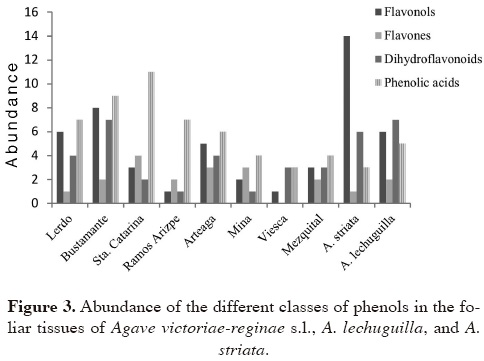
<body><![CDATA[<p align="justify"><font face="verdana" size="2"><i>Taxonomic significance.</i> The abundance of each type of phenolic compound found in the foliar tissue of <i>Agave victoriae&#45;reginae</i> s.l., <i>A. striata,</i> and <i>A. lechuguilla</i> are shown in <a href="#f3">Figure 3</a>. Variations in the accumulation levels of compounds can be observed in the different taxa. The levels of eight compounds <b>(4, 5, 8, 11, 29, 33, 37,</b> and <b>48)</b> present in the taxa analyzed are displayed in <a href="/img/revistas/bs/v91n3/a5t4.jpg" target="_blank">Table 4</a>. Some variations among taxa and between two seasons in the same taxon <i>(A. victoriae&#45;reginae</i> s.l. from El Mezquital) are observed.</font></p>  	    <p align="center"><font face="verdana" size="2"><a name="f3"></a></font></p>  	    <p align="center"><font face="verdana" size="2"><img src="/img/revistas/bs/v91n3/a5f3.jpg"></font></p>              <p align="justify"><font face="verdana" size="2">The PCA based in a matrix constructed with all the compounds resolved in the HPLC/DAD chromatograms vs. all the individuals analyzed, revealed the separation of <i>Agave striata</i> from <i>A. lechuguilla</i> and <i>A. victoriae&#45;reginae</i> s.l. (<a href="/img/revistas/bs/v91n3/a5f4.jpg" target="_blank">Figure 4</a>). The separation of <i>A. lechuguilla, A. victoriae&#45;reginae</i> s.l. from El Mezquital, and all other populations of <i>A. victoriae&#45;reginae</i> s.l., is observed in the same <a href="/img/revistas/bs/v91n3/a5f4.jpg" target="_blank">Figure 4</a>, agreeing with the fact that they are independent species.</font></p>              <p align="justify"><font face="verdana" size="2">&nbsp;</font></p>              <p align="justify"><font face="verdana" size="2"><b>Discussion</b></font></p>              <p align="justify"><font face="verdana" size="2"><i>Foliar phenol composition.</i> In order to obtain fingerprinting chromatograms, the HPLC analysis were done with the unhydrolyzed extracts. The HPLC/DAD is considered as a highly effective technique for the separation and for obtaining structural information of phenolic acids and flavonoids (Markham and Bloor, 1998).</font></p>  	    <p align="justify"><font face="verdana" size="2">The presence of kaempferol (compound <b>68</b>) in <i>Agave victoriae&#45;reginae</i> of Bustamante, Nuevo Le&oacute;n, one of the most arid sites among the studied here, and the report about flavonoid aglycones being most often produced and accumulated externally in plants from arid and semiarid habitats (Wollenweber, 1994) suggest that the species here analyzed may synthesize more flavonoid aglycones, but they could not be detected because polar solvents were used in the extract preparations, which preferentially dissolve flavonoid glycosides. Even so, the identification of 25 flavonol glycosides in the taxa of <i>Agave</i> here analyzed indicate that these species of plants from arid and semiarid habitats can synthesize and accumulate a relatively high number of flavonoid glycosides. The screening of flavonoid aglycones in those species would deserve further investigation for exploring their taxonomic significance, as well as for the role that those compounds play in protecting the plant tissues from damaging UV&#45;B (280&#45;315 nm) radiation (Williams and Harborne, 1994), and for the pharmacological properties those compounds show (Wollenweber, 1994). Quercetin&#45;O&#45;glycoside derivatives were the most abundant (18 compounds) among the flavonols. Derivatives of herbacetin (compound <b>31</b> ), and isorhamnetin derivative (compound <b>69</b>) were other flavonols also found.</font></p>  	    <p align="justify"><font face="verdana" size="2">A complex flavanone (5,7dihydroxi&#45;6,5'&#45;di&#45;metoxi&#45;3', 4'&#45;metilenedioxiflavanone) present in somatic tissues (Parmar <i>et al.,</i> 1992), and of two flavonol glycosides (kaempferol&#45;3&#45;O&#45;glucoside and kaempferol&#45;3&#45;O&#45;rutinoside) from the flowers of <i>A. americana</i> (Subramanian and Nair, 1970) have been reported. Also, three complex isoflavanoids have been identified in the rhizomes of <i>A. barbadensis</i> (Tinto <i>et al.,</i> 2005). Twenty three flavonoids were recently reported by Almaraz&#45;Abarca <i>et al.</i> (2009) for adult foliar tissues of <i>A. durangensis</i>, all flavonol glycosides, most of them being derivatives of kaempferol. Those last authors also reported three kaempferol glycosides, as unique components of the phenolic profile for <i>Agave asperrima.</i> Flavonols, one of the three classes of flavonoids previously reported in species of <i>Agave</i> (flavanones, flavonols and isoflavonoids) were also found in the present study for <i>A. victoriae&#45;reginae</i> s.l., <i>A. lechuguilla,</i> and <i>A. striata,</i> and contrary to those former reports, phenolic acids derivatives, flavones, dihydroflavonoids, and a higher diversity of flavonols, including derivatives of herbacetin, and ishoramnetin were detected (<a href="/img/revistas/bs/v91n3/a5f1.jpg" target="_blank">Figure 1</a>, <a href="/img/revistas/bs/v91n3/html/a5tablas.html#t2" target="_blank">Table 2</a>). Phenolic acids provide the precursors for lignin, tannins, and flavonoid biosynthesis (Hrazdina, 1992; Heller and Forkmann, 1994). in species of <i>Agave,</i> which do not accumulate relevant amounts of foliar lignin neither tannins (Wall <i>et al.,</i> 1957; Seigler, 2002), phenolic acids could have several other functions, like protection against herbivores and pathogens, action as cementing material joining phenolic polymers to polysaccharides of cell walls (Wallace and Fry, 1994), participation in the regulation of cell growth and division (Binns <i>et al.,</i> 1987), inhibition of ion intake by a generalized increase in membrane permeability to inorganic ions as a mode of action of allelopathic compounds (Glass and Dunlop, 1974), protection to thermal stress (Dixon and Paiva, 1995), and function as antioxidants (Rice&#45;Evans <i>et al.,</i> 1997; Almaraz&#45;Abarca <i>et al.,</i> 2007), which could give survival advantages to <i>A. victoriae&#45;reginae</i> s.l., <i>A. lechuguilla,</i> and <i>A. striata,</i> that synthesize those phenols.</font></p>          <p align="justify"><font face="verdana" size="2"><i>Taxonomic significance.</i> Fifty one phenols were found by HPLC/DAD in the foliar tissue of <i>Agave victoriae&#45;reginae</i> s.l. (considering the eight populations). From those, 45 were found in <i>A. victoriae&#45;reginae</i> s. str., excluding the populations of Ramos Arizpe and Arteaga, which correspond to <i>A. nickelsiae,</i> and the population of El Mezquital, which corresponds to <i>A. pintilla,</i> according to Gonz&aacute;lez&#45;Elizondo <i>et al.</i> (2011). For <i>A. striata</i> were detected 24, and also 24 (most of them different) in <i>A. lechuguilla</i> (<a href="/img/revistas/bs/v91n3/html/a5tablas.html#t3" target="_blank">Table 3</a>). This distribution of phenols indicates that the group most diverse, regarding these secondary metabolites, is that of <i>A. victoriae&#45;reginae.</i> That chemical richness is the highest reported yet for any species of <i>Agave</i> if compared with the reports of Subramanian and Nair (1970), and Parmar <i>et al.</i> (1992) for <i>A. americana;</i> Tinto <i>et al.</i> (2005) for <i>A. barbadensis;</i> Chen <i>et al.</i> (2009) for <i>A. sisalana;</i> and Almaraz&#45;Abarca <i>et al.</i> (2009) for <i>A. asperrima, A. durangensis, A. shrevei</i> subsp. <i>shrevei, A. shrevei</i> subsp. <i>matapensis,</i> and <i>A. wocomahi.</i> Nineteen (compounds <b>6, 12, 17, 18, 26, 28, 31, 34, 40, 42, 44, 45, 49, 50, 58, 61, 63, 70,</b> and <b>78</b>) among the 24 phenols forming the profile of <i>A. striata</i> were unique to this species, and six of them (compounds <b>34, 42, 45, 50, 70,</b> and <b>78)</b> were present in every analyzed individual of this taxon; while seven (compounds <b>2, 14, 54, 71, 79, 80,</b> and <b>81)</b> among the 24 phenols detected for <i>A. lechuguilla</i> were only present in this species (<a href="/img/revistas/bs/v91n3/html/a5tablas.html#t2" target="_blank">Table 2</a>). A higher number, thirty seven (compounds <b>3, 5,</b> <b>8, 10, 11, 13, 16, 19, 22, 23, 24, 27, 29, 30, 32, 37, 38, 41, 43, 47, 48, 51, 53, 55, 56, 57, 60, 62, 64, 66, 67, 68, 69, 72,</b> <b>75, 76,</b> and <b>77</b>) among 51 phenols, was detected only in <i>A. victoriae&#45;reginae</i> s.l. (<a href="/img/revistas/bs/v91n3/html/a5tablas.html#t2" target="_blank">Table 2</a>). The predominance of phenolic acids in <i>A. victoriae&#45;reginae</i> s.l. and of flavonols, majorly quercetin<i>&#45;o</i>&#45;glycosides, in <i>A. striata,</i> can be observed in <a href="#f3">Figure 3</a>. <i>Agave striata</i> was collected at the same location than one of the populations of <i>A. victoriae&#45;reginae,</i> at Lerdo, Durango (<a href="/img/revistas/bs/v91n3/a5t1.jpg" target="_blank">Table 1</a>), where they are sympatric, exposed to the same environmental conditions. This allows to conclude that the evident differences in their foliar phenol profiles are the result of genetic differences that command species&#45;specific sequential order in the biosynthesis pathway, as Heller and Forkmann (1994) pointed out, of which many of individual steps of the flavonoid modification have shown to be controlled by single genes (Forkmann, 1994). our results indicate a species&#45;specific tendency of phenol profiles for those taxa, as has been found for other groups of plants (Bate&#45;Smith <i>et al.,</i> 1975; Campos, 1997; Almaraz&#45;Abarca <i>et al.,</i> 2006).</font></p>  	    ]]></body>
<body><![CDATA[<p align="justify"><font face="verdana" size="2">The remarkable differences in the phenol profiles between <i>Agave victoriae&#45;reginae</i> s.l. and <i>A. striata</i> correspond to the fact that the former belongs to a different series (Marginatae) than <i>A. striata,</i> which belongs to the series Striatae (Gentry, 1982). And although <i>Agave lechuguilla</i> is closer to <i>A. victoriae&#45;reginae</i> s.l. (both belonging to the series Marginatae), the differences in the phenol profiles can also be observed between them (<a href="/img/revistas/bs/v91n3/html/a5tablas.html#t3" target="_blank">Table 3</a>). in both, <i>A. lechuguilla</i> and <i>A. victoriae&#45;reginae</i> s.l., flavonols are not predominant, but in <i>A. lechuguilla</i> a codominance of flavonols and dihydroflavonoids was detected, unlike <i>A. victoriae&#45;reginae</i> s.l., in which phenolic acids are abundant (<a href="#f2">Figure 2</a>). <i>Agave lechuguilla</i> grows also in Lerdo, Durango, under the same environmental conditions that <i>A. victoriae&#45;reginae</i> and <i>A. striata,</i> so that differences in the phenolic profiles can be also assumed as specific expression patterns.</font></p>  	    <p align="justify"><font face="verdana" size="2">Although flavonoids are the major chemotaxonomic markers (Markham, 1982; Harborne and Turner, 1984), phenolic acids also possess a certain value as chemical markers (Van Sumere, 1989), and may be ubiquitous and accumulated at significant levels in plant tissues (Tamagnone <i>et al.,</i> 1998). Pollen of some plant species may be particularly rich in phenolic acids (Campos, 1997; Almaraz&#45;Abarca <i>et al.,</i> 2004; Almaraz&#45;Abarca <i>et al.,</i> 2007) but these may be completely missing in the pollen of others, as in <i>A. durangensis</i> (Almaraz&#45;Abarca <i>et al.,</i> 2009). To our knowledge, the ubiquitous richness and diversity of benzoic acid and cinnamic acid derivatives in the foliar tissue of <i>Agave,</i> particularly of <i>A. victoriae&#45;reginae</i> s.l. and <i>A. lechuguilla,</i> are reported for the first time.</font></p>  	    <p align="justify"><font face="verdana" size="2">The presence of phenolic acids in the species here studied, all of them belonging to <i>Agave</i> subgenus <i>Littaea,</i> contrasts with their absence in <i>A. americana</i> (Parmar <i>et al.,</i> 1992), <i>A. asperrima, A. durangensis, A. shrevei, A. wocomahi,</i> (Almaraz&#45;Abarca <i>et al.,</i> 2009), and <i>A. sisalana</i> (Chen <i>et al.,</i> 2009), which belong to <i>Agave</i> subgenus <i>Agave.</i> if those tendencies are found in more species of both subgenera, it could be suggested that the relative abundance of phenolic acids may have some taxonomic relevance at the subgeneric level in <i>Agave.</i> The trend of a taxon to synthesize preferentially one phenol type rather than other one could be an indicator of evolutionary tendencies within Agavaceae, as has been established for Asteraceae by Emerenciano <i>et al.</i> (2001), among other many dicotyledonous, and for monocotyledonous other than Agavaceae, e.g., for Juncaceae (Williams and Harborne, 1975), Liliaceae (Williams, 1975), Fluviales (Harborne and Williams, 1976a), Gramineae (Harborne and Williams, 1976b), and orchidaceae (Williams, 1979). To establish the evolutionary connotation of the flavonoid accumulation in this group is necessary to analyze more taxa of monocots, since some differences have been detected with respect to the tendencies found in dicotyledons, as has been pointed out by Harborne (1977).</font></p>  	    <p align="justify"><font face="verdana" size="2">The species of <i>Agave</i> here analyzed showed some chemical characters reported by Salatino <i>et al.</i> (2000) as primitive in Ericaulaceae (a monocotyledonous family), such as complex patterns of flavonoids (formed by several different types of phenols). Some chemical features, such as the accumulation of methylated flavonoids, considered as evolved for <i>Pinus</i> (Kaundun and Lebreton, 2010), were found in this study (compound <b>69,</b> an isorhamnetin derivative) for plants from Lerdo, Bustamante, and Viesca, all belonging to <i>A. victoriae&#45;reginae</i> s.str. To establish the evolutionary tendency of the accumulation of phenolic compounds in Agavaceae, and particularly in <i>Agave,</i> more detailed analysis on a broader number of species are needed.</font></p>  	    <p align="justify"><font face="verdana" size="2">Mart&iacute;nez&#45;Palacios <i>et al.</i> (1999) mentioned for <i>Agave victoriae&#45;reginae</i> high levels of genetic variability within populations as well as high levels of interpopulation differentiation. This variability is also observed in the foliar phenol profiles exhibited by the different populations here analyzed (<a href="/img/revistas/bs/v91n3/html/a5tablas.html#t3" target="_blank">Table 3</a>, <a href="#f3">Figures 3</a>, <a href="/img/revistas/bs/v91n3/a5f4.jpg" target="_blank">4</a>). Six among the eight populations of <i>A. victoriae&#45;reginae</i> s.l. (Santa Catarina, El Mezquital, Arteaga, Mina, Lerdo, and Bustamante) displayed one to six unique compounds, not found in any other. Thus, compound <b>22</b> was found only in the population of Mina; compounds <b>41</b> and <b>55</b> were detected in Lerdo; compounds <b>56</b> and <b>68</b> in Bustamante; compounds <b>10</b> and <b>35</b> in Arteaga; compounds <b>5, 16, 37,</b> and <b>77</b> in El Mezquital; and compounds <b>3, 13, 21, 27, 57,</b> and <b>62</b> in Santa Catarina.</font></p>  	    <p align="justify"><font face="verdana" size="2">This distribution of phenol profiles corresponds partially to the separation of taxa based on morphological traits. The population of El Mezquital, the most isolated geographically, which corresponds to a different species, namely <i>A. pin</i><i>tilla</i> (Gonz&aacute;lez&#45;Elizondo <i>et al.,</i> 2011), is distinguished by possessing four unique compounds. But phenol profiles did not allow to distinguish between <i>Agave victoriae&#45;reginae</i> s. str. and <i>A. nickelsiae,</i> as found by Mart&iacute;nez&#45;Palacios <i>et al.</i> (1999) using allozymes. in the <a href="/img/revistas/bs/v91n3/a5f4.jpg" target="_blank">Figure 4</a>, the eight populations of <i>Agave victoriae&#45;reginae</i> s.l. formed four groups: (A) Viesca; (B) Arteaga with some individuals from Bustamante, and Lerdo; (C) Mina, Santa Catarina, Ramos Arizpe, and some individuals from Bustamante; and (D) El Mezquital. The separation of all the individuals of El Mezquital from the rest is consistent with the proposal, based on morphological attributes, of non conspecificity for this population, and of considering to <i>A. victoriae&#45;reginae</i> as a complex instead of a single species (Gonz&aacute;lez&#45;Elizondo <i>et al.,</i> 2011). However, some inconsistencies were found among our chemical results and the ones reported by Gonz&aacute;lez&#45;Elizondo <i>et al.</i> (2011) based on morphological traits and by Mart&iacute;nez&#45;Palacios <i>et al.</i> (1999) based on allozymes. Excluding the population of El Mezquital, which was not analyzed by Mart&iacute;nez&#45;Palacios <i>et al.</i> (1999), the three other groups (<a href="/img/revistas/bs/v91n3/a5f4.jpg" target="_blank">Figure 4</a>) did not clearly correspond to the groups proposed by either Gonz&aacute;lez&#45;Elizondo <i>et al.</i> (2011) or Mart&iacute;nez&#45;Palacios <i>et al.</i> (1999), except for group (C) (<a href="/img/revistas/bs/v91n3/a5f4.jpg" target="_blank">Figure 4</a>), which roughly corresponds to the eastern populations found by Mart&iacute;nez&#45;Palacios <i>et al.</i> (1999). The incongruence between our results and those reported by those authors are comparable to those reported between morphological and molecular features for other species of <i>Agave</i> (Alfaro <i>et al.,</i> 2007). incongruence between different kinds of markers has been explained by H&ouml;randl (2010) as a result of an asynchronous marker evolution.</font></p>          <p align="justify"><font face="verdana" size="2">The foliar tissues of <i>Agave victoriae&#45;reginae</i> s.l., <i>A. lechuguilla,</i> and <i>A. striata</i> have complex profiles of phenols, which are rich in number and classes of those compounds, including phenolic acids, flavonols, flavones, and dihydroflavonoids. The three taxa can be distinguished by the different qualitative and quantitative phenol patterns. The presence of unique phenols in the different populations of <i>A. victoriae&#45;reginae</i> s.l. suggests the recognition of four chemotypes in that variable group. Phenol composition supports the proposal of considering the population of El Mezquital as an independent species <i>(A. pintilla).</i></font></p>  	    <p align="justify"><font face="verdana" size="2"><i>Quantitative variations.</i> Variations in the amount accumulated of some compounds could be detected among the different populations of <i>Agave victoriae&#45;reginae</i> s.l., <i>A. lechuguilla,</i> and <i>A. striata</i> (<a href="/img/revistas/bs/v91n3/a5t4.jpg" target="_blank">Table 4</a>). Concerning the levels of the compounds <b>8, 11</b>, <b>29,</b> and <b>48,</b> the populations of Lerdo, Bustamante, Santa Catarina, Ramos Arizpe, Arteaga, and Mina (all sampled in May) showed different levels of them, suggesting that those variations depend on the geographical origin. The difference observed in compound <b>33,</b> a flavone (<a href="/img/revistas/bs/v91n3/a5t4.jpg" target="_blank">Table 4</a>), common to <i>A. lechuguilla</i> and <i>A. striata,</i> collected at the same season and the same location, suggests that important variation can be found between species synthesizing the same compound. Considerable variation in concentrations were observed in the compounds <b>5</b> and <b>37</b> (unidentified), both in the population of El Mezquital (A. <i>pintilla)</i> between individuals sampled in May&#45;June and those sampled in October (<a href="/img/revistas/bs/v91n3/a5t4.jpg" target="_blank">Table 4</a>), with an increased concentration in october with respect to May&#45;June, suggesting fluctuations correlated to seasonal changes in adult plants of <i>Agave.</i> This increase in concentration could be associated to a response to the increase of herbivores and pathogenic fungi and bacteria attack due to an increase of the precipitation, since phenols are known to be active against those organisms (Echeverri <i>et al.,</i> 1991; Hadacek, 2002).</font></p>  	    <p align="justify"><font face="verdana" size="2">Due to their stability, qualitative phenolic profiles have more taxonomic significance than quantitative patterns (Harborne and Turner, 1984); however, further investigation needs to be performed to determine the fluctuation patterns associated to different environmental conditions and also to developmental stages of the accumulated phenolics in <i>Agave,</i> not only with taxonomic aims but also in order to extend our knowledge on the role and synthesis regulation of those compounds in the genus.</font></p>  	    <p align="justify"><font face="verdana" size="2">&nbsp;</font></p>  	    ]]></body>
<body><![CDATA[<p align="justify"><font face="verdana" size="2"><b>Acknowledgements</b></font></p>  	    <p align="justify"><font face="verdana" size="2">The authors appreciate the help of Martha Gonz&aacute;lez Elizondo, Lorenzo Rez&eacute;ndiz Rojas, and Lorena L&oacute;pez Enr&iacute;quez to solve taxonomical issues and in part of the field work. The authors also thanks the Comisi&oacute;n de Fomento a las Actividades Acad&eacute;micas del Instituto Polit&eacute;cnico Nacional (COFAA IPN) for stimuli for research, and the reviewers, who made suggestions that improved the quality of the manuscript.</font></p>  	    <p align="justify"><font face="verdana" size="2">&nbsp;</font></p>  	    <p align="justify"><font face="verdana" size="2"><b>Literature cited</b></font></p>  	    <!-- ref --><p align="justify"><font face="verdana" size="2">Alfaro R.G., Legaria S.J.P and Rodr&iacute;guez P.J.E. 2007. Diversidad gen&eacute;tica en poblaciones de agaves pulqueros <i>(Agave</i> spp.) del nororiente del Estado de M&eacute;xico. <i>Revista Fitotecnia Mexicana</i> <b>30</b>:1&#45;12.    &nbsp;&nbsp;&nbsp;&nbsp;&nbsp;&nbsp;&nbsp;&nbsp;[&#160;<a href="javascript:void(0);" onclick="javascript: window.open('/scielo.php?script=sci_nlinks&ref=1764974&pid=S2007-4298201300030000500001&lng=','','width=640,height=500,resizable=yes,scrollbars=1,menubar=yes,');">Links</a>&#160;]<!-- end-ref --></font></p>  	    <!-- ref --><p align="justify"><font face="verdana" size="2">Almaraz&#45;Abarca N., Campos M.G., &Aacute;vila&#45;Reyes J.A., Naranjo&#45;Jim&eacute;nez N., Herrera&#45;Corral J. and Gonz&aacute;lez&#45;Valdez L.S. 2004. Variability of antioxidant activity among honeybee&#45;collected pollen of different botanical origin. <i>Interciencia</i> <b>29</b>:574&#45;578.    &nbsp;&nbsp;&nbsp;&nbsp;&nbsp;&nbsp;&nbsp;&nbsp;[&#160;<a href="javascript:void(0);" onclick="javascript: window.open('/scielo.php?script=sci_nlinks&ref=1764976&pid=S2007-4298201300030000500002&lng=','','width=640,height=500,resizable=yes,scrollbars=1,menubar=yes,');">Links</a>&#160;]<!-- end-ref --></font></p>  	    <!-- ref --><p align="justify"><font face="verdana" size="2">Almaraz&#45;Abarca N., Gonz&aacute;lez&#45;Elizondo M.S., Tena&#45;Flores J.A., &Aacute;vila&#45;Reyes J.A., Herrera&#45;Corral J. and Naranjo&#45;Jim&eacute;nez N. 2006. Foliar flavonoids distinguish <i>Pinus leiophylla</i> and <i>Pinus chihuahuana</i> (Coniferales: Pinaceae). <i>Proceedings of the Biological Society of Washington</i> <b>119</b>:426&#45;436.    &nbsp;&nbsp;&nbsp;&nbsp;&nbsp;&nbsp;&nbsp;&nbsp;[&#160;<a href="javascript:void(0);" onclick="javascript: window.open('/scielo.php?script=sci_nlinks&ref=1764978&pid=S2007-4298201300030000500003&lng=','','width=640,height=500,resizable=yes,scrollbars=1,menubar=yes,');">Links</a>&#160;]<!-- end-ref --></font></p>  	    ]]></body>
<body><![CDATA[<!-- ref --><p align="justify"><font face="verdana" size="2">Almaraz&#45;Abarca N., Campos M.G., &Aacute;vila&#45;Reyes J.A., Naranjo&#45;Jim&eacute;nez N., Herrera&#45;Corral J. and Gonz&aacute;lez&#45;Valdez L.S. 2007. Antioxidant activity of polyphenolic extract of monofloral honeybee&#45;collected pollen from mesquite <i>(Prosopis juliflora,</i> Leguminosae). <i>Journal of Food Composition and Analysis</i> <b>20</b>:119&#45;124.    &nbsp;&nbsp;&nbsp;&nbsp;&nbsp;&nbsp;&nbsp;&nbsp;[&#160;<a href="javascript:void(0);" onclick="javascript: window.open('/scielo.php?script=sci_nlinks&ref=1764980&pid=S2007-4298201300030000500004&lng=','','width=640,height=500,resizable=yes,scrollbars=1,menubar=yes,');">Links</a>&#160;]<!-- end-ref --></font></p>  	    <!-- ref --><p align="justify"><font face="verdana" size="2">Almaraz&#45;Abarca N., Delgado&#45;Alvarado E.A., Hern&aacute;ndez&#45;Vargas V., Ortega&#45;Ch&aacute;vez M., Orea&#45;Lara G., Cifuentes&#45;D&iacute;az de Le&oacute;n A.&nbsp;, &Aacute;vila&#45;Reyes J.A. and Mu&ntilde;iz&#45;Mart&iacute;nez R. 2009. Profiling of phenolic compounds of somatic and reproductive tissues of <i>Agave durangensis</i> Gentry (Agavaceae). <i>American Journal of Applied Sciences</i> <b>6</b>:1076&#45;1085.    &nbsp;&nbsp;&nbsp;&nbsp;&nbsp;&nbsp;&nbsp;&nbsp;[&#160;<a href="javascript:void(0);" onclick="javascript: window.open('/scielo.php?script=sci_nlinks&ref=1764982&pid=S2007-4298201300030000500005&lng=','','width=640,height=500,resizable=yes,scrollbars=1,menubar=yes,');">Links</a>&#160;]<!-- end-ref --></font></p>          <!-- ref --><p align="justify"><font face="verdana" size="2">Bate&#45;Smith E.C., Ferguson I.K., Hutson K., Jensen S.R., Nielsen B.&nbsp;J. and Swain T. 1975. Phytochemical interrelationships in the Cornaceae. <i>Biochemical Systematics and Ecology</i> <b>3</b>:79&#45;89.    &nbsp;&nbsp;&nbsp;&nbsp;&nbsp;&nbsp;&nbsp;&nbsp;[&#160;<a href="javascript:void(0);" onclick="javascript: window.open('/scielo.php?script=sci_nlinks&ref=1764984&pid=S2007-4298201300030000500006&lng=','','width=640,height=500,resizable=yes,scrollbars=1,menubar=yes,');">Links</a>&#160;]<!-- end-ref --></font></p>          <!-- ref --><p align="justify"><font face="verdana" size="2">Binns A.N., Chen R.H., Wood H.N. and Lynn D.G. 1987. Cell division promoting activity of naturally occurring dehydrodi&#45;coniferyl glucosides: do cell wall components control cell division? <i>Proceedings of the National Academy of Sciences USA</i> <b>84</b>:980&#45;984.    &nbsp;&nbsp;&nbsp;&nbsp;&nbsp;&nbsp;&nbsp;&nbsp;[&#160;<a href="javascript:void(0);" onclick="javascript: window.open('/scielo.php?script=sci_nlinks&ref=1764986&pid=S2007-4298201300030000500007&lng=','','width=640,height=500,resizable=yes,scrollbars=1,menubar=yes,');">Links</a>&#160;]<!-- end-ref --></font></p>  	    <!-- ref --><p align="justify"><font face="verdana" size="2">Campos M.G.R. 1997. Caracteriza&ccedil;&atilde;o do p&oacute;len ap&iacute;cola pelo seu perfil em compostos fen&oacute;licos e pesquisa de algumas actividades biol&oacute;gicas. Tesis de Doutoramento, Faculdade de Farm&aacute;cia, Universidade de Coimbra. Portugal, 318 pp.    &nbsp;&nbsp;&nbsp;&nbsp;&nbsp;&nbsp;&nbsp;&nbsp;[&#160;<a href="javascript:void(0);" onclick="javascript: window.open('/scielo.php?script=sci_nlinks&ref=1764988&pid=S2007-4298201300030000500008&lng=','','width=640,height=500,resizable=yes,scrollbars=1,menubar=yes,');">Links</a>&#160;]<!-- end-ref --></font></p>  	    ]]></body>
<body><![CDATA[<!-- ref --><p align="justify"><font face="verdana" size="2">Campos M.G. and Markham K.R. 2007. <i>Structure Information from HPLc and on&#45;line Measured Absorption Spectra: Flavo&#45;nes, Flavonols and Phenolic Acids.</i> impresa da Universidade de Coimbra, Coimbra.    &nbsp;&nbsp;&nbsp;&nbsp;&nbsp;&nbsp;&nbsp;&nbsp;[&#160;<a href="javascript:void(0);" onclick="javascript: window.open('/scielo.php?script=sci_nlinks&ref=1764990&pid=S2007-4298201300030000500009&lng=','','width=640,height=500,resizable=yes,scrollbars=1,menubar=yes,');">Links</a>&#160;]<!-- end-ref --></font></p>  	    <!-- ref --><p align="justify"><font face="verdana" size="2">Chen PY., Kuo Y.C., Chen C.H., Kuo Y.H. and Lee C.K. 2009. Isolation and immunomodulatory effect of homoisoflavones and flavones from <i>Agave sisalana</i> Perrine ex Engelm. <i>Molecules</i> <b>14</b>:1789&#45;1795.    &nbsp;&nbsp;&nbsp;&nbsp;&nbsp;&nbsp;&nbsp;&nbsp;[&#160;<a href="javascript:void(0);" onclick="javascript: window.open('/scielo.php?script=sci_nlinks&ref=1764992&pid=S2007-4298201300030000500010&lng=','','width=640,height=500,resizable=yes,scrollbars=1,menubar=yes,');">Links</a>&#160;]<!-- end-ref --></font></p>  	    <!-- ref --><p align="justify"><font face="verdana" size="2">Dixon R.A. and Paiva N.L. 1995. Stress&#45;induced phenylpropanoid metabolism. <i>The Plant Cell</i> <b>7</b>:1085&#45;1097.    &nbsp;&nbsp;&nbsp;&nbsp;&nbsp;&nbsp;&nbsp;&nbsp;[&#160;<a href="javascript:void(0);" onclick="javascript: window.open('/scielo.php?script=sci_nlinks&ref=1764994&pid=S2007-4298201300030000500011&lng=','','width=640,height=500,resizable=yes,scrollbars=1,menubar=yes,');">Links</a>&#160;]<!-- end-ref --></font></p>  	    <!-- ref --><p align="justify"><font face="verdana" size="2">Eguiarte L.E., Larson&#45;Guerra J., Nu&ntilde;ez&#45;Farf&aacute;n J., Mart&iacute;nez&#45;Palacios A., Santos del Prado K. and Arita H.T. 1999. Diversidad filogen&eacute;tica y conservaci&oacute;n: ejemplos a diferentes escalas y una propuesta a nivel poblacional para <i>Agave victoriae&#45;reginae</i> en el desierto de Chihuahua, M&eacute;xico. <i>Revista Chilena de Historia Natural</i> <b>72</b>:475&#45;492.    &nbsp;&nbsp;&nbsp;&nbsp;&nbsp;&nbsp;&nbsp;&nbsp;[&#160;<a href="javascript:void(0);" onclick="javascript: window.open('/scielo.php?script=sci_nlinks&ref=1764996&pid=S2007-4298201300030000500012&lng=','','width=640,height=500,resizable=yes,scrollbars=1,menubar=yes,');">Links</a>&#160;]<!-- end-ref --></font></p>  	    <!-- ref --><p align="justify"><font face="verdana" size="2">Echeverri F., Cardona G., Torres F., Pelaez C., Qui&ntilde;ones W. and Renter&iacute;a E. 1991. Ermanin: an insect deterrent flavonoid from <i>Passiflora foetida</i> resin. <i>Phytochemistry</i> <b>30</b>:153&#45;155.    &nbsp;&nbsp;&nbsp;&nbsp;&nbsp;&nbsp;&nbsp;&nbsp;[&#160;<a href="javascript:void(0);" onclick="javascript: window.open('/scielo.php?script=sci_nlinks&ref=1764998&pid=S2007-4298201300030000500013&lng=','','width=640,height=500,resizable=yes,scrollbars=1,menubar=yes,');">Links</a>&#160;]<!-- end-ref --></font></p>  	    ]]></body>
<body><![CDATA[<!-- ref --><p align="justify"><font face="verdana" size="2">Emerenciano V.P., Milit&atilde;o J.S.L.T., Campos C.C., Romoff P., Kaplan M.A.C., Zambon M. and Brant A.J.C. 2001. Flavonoids as chemotaxonomic markers for Asteraceae. <i>Biochemical Systematics and Ecology</i> <b>29</b>:947&#45;957.    &nbsp;&nbsp;&nbsp;&nbsp;&nbsp;&nbsp;&nbsp;&nbsp;[&#160;<a href="javascript:void(0);" onclick="javascript: window.open('/scielo.php?script=sci_nlinks&ref=1765000&pid=S2007-4298201300030000500014&lng=','','width=640,height=500,resizable=yes,scrollbars=1,menubar=yes,');">Links</a>&#160;]<!-- end-ref --></font></p>  	    <!-- ref --><p align="justify"><font face="verdana" size="2">Fiasson J.L., Gluchoff&#45;Fiasson K. and Dahlgren G. 1997. Flavonoid patterns in European <i>Ranunculus</i> L. subgenus <i>Batrachium</i> (Ranunculaceae). <i>Biochemical Systematics and Ecology</i> <b>25</b>:327&#45;333.    &nbsp;&nbsp;&nbsp;&nbsp;&nbsp;&nbsp;&nbsp;&nbsp;[&#160;<a href="javascript:void(0);" onclick="javascript: window.open('/scielo.php?script=sci_nlinks&ref=1765002&pid=S2007-4298201300030000500015&lng=','','width=640,height=500,resizable=yes,scrollbars=1,menubar=yes,');">Links</a>&#160;]<!-- end-ref --></font></p>  	    <!-- ref --><p align="justify"><font face="verdana" size="2">Forkmann G. 1994. Genetics of flavonoids. In: Harborne J.B. Ed. <i>The Flavonoids. Advances in Research since 1986,</i> pp. 537-564, Chapman and Hall, London.    &nbsp;&nbsp;&nbsp;&nbsp;&nbsp;&nbsp;&nbsp;&nbsp;[&#160;<a href="javascript:void(0);" onclick="javascript: window.open('/scielo.php?script=sci_nlinks&ref=1765004&pid=S2007-4298201300030000500016&lng=','','width=640,height=500,resizable=yes,scrollbars=1,menubar=yes,');">Links</a>&#160;]<!-- end-ref --></font></p>  	    <!-- ref --><p align="justify"><font face="verdana" size="2">Garc&iacute;a&#45;Mendoza A. 2002. Distribution of the genus <i>Agave</i> (Agavaceae) and its endemic species in Mexico. <i>Cactus and Succulent Journal</i> <b>74</b>:177&#45;187.    &nbsp;&nbsp;&nbsp;&nbsp;&nbsp;&nbsp;&nbsp;&nbsp;[&#160;<a href="javascript:void(0);" onclick="javascript: window.open('/scielo.php?script=sci_nlinks&ref=1765006&pid=S2007-4298201300030000500017&lng=','','width=640,height=500,resizable=yes,scrollbars=1,menubar=yes,');">Links</a>&#160;]<!-- end-ref --></font></p>  	    <!-- ref --><p align="justify"><font face="verdana" size="2">Gentry H. S. 1982. <i>Agaves of Continental North America.</i> University of Arizona Press, Tucson.    &nbsp;&nbsp;&nbsp;&nbsp;&nbsp;&nbsp;&nbsp;&nbsp;[&#160;<a href="javascript:void(0);" onclick="javascript: window.open('/scielo.php?script=sci_nlinks&ref=1765008&pid=S2007-4298201300030000500018&lng=','','width=640,height=500,resizable=yes,scrollbars=1,menubar=yes,');">Links</a>&#160;]<!-- end-ref --></font></p>  	    ]]></body>
<body><![CDATA[<!-- ref --><p align="justify"><font face="verdana" size="2">Glass A.D.M. and Dunlop J. 1974. Influence of phenolic acids on ion uptake: IV. Depolarization of membrane potentials. <i>Plant Physiology</i> <b>54</b>:855&#45;858.    &nbsp;&nbsp;&nbsp;&nbsp;&nbsp;&nbsp;&nbsp;&nbsp;[&#160;<a href="javascript:void(0);" onclick="javascript: window.open('/scielo.php?script=sci_nlinks&ref=1765010&pid=S2007-4298201300030000500019&lng=','','width=640,height=500,resizable=yes,scrollbars=1,menubar=yes,');">Links</a>&#160;]<!-- end-ref --></font></p>  	    <!-- ref --><p align="justify"><font face="verdana" size="2">Gonz&aacute;lez&#45;Elizondo M., Galv&aacute;n&#45;Villanueva R., L&oacute;pez&#45;Enr&iacute;quez I.L., Res&eacute;ndiz&#45;Rojas L. and Gonz&aacute;lez&#45;Elizondo M.S. 2009. <i>Agaves. Magueyes, Lechuguillas y Noas del Estado de Durango y sus Alrededores.</i> IPN&#45;CONABIO&#45;COCYTED, Durango.    &nbsp;&nbsp;&nbsp;&nbsp;&nbsp;&nbsp;&nbsp;&nbsp;[&#160;<a href="javascript:void(0);" onclick="javascript: window.open('/scielo.php?script=sci_nlinks&ref=1765012&pid=S2007-4298201300030000500020&lng=','','width=640,height=500,resizable=yes,scrollbars=1,menubar=yes,');">Links</a>&#160;]<!-- end-ref --></font></p>  	    <!-- ref --><p align="justify"><font face="verdana" size="2">Gonz&aacute;lez&#45;Elizondo M.S., Gonz&aacute;lez&#45;Elizondo M., L&oacute;pez&#45;Enriquez I.L., Res&eacute;ndiz&#45;Rojas L., Tena&#45;Flores J.A. and Retana&#45;Renter&iacute;a F.i. 2011. El Complejo <i>Agave victoriae&#45;reginae</i> (Agavaceae). <i>Acta Botanica Mexicana</i> <b>95</b>:65&#45;94.    &nbsp;&nbsp;&nbsp;&nbsp;&nbsp;&nbsp;&nbsp;&nbsp;[&#160;<a href="javascript:void(0);" onclick="javascript: window.open('/scielo.php?script=sci_nlinks&ref=1765014&pid=S2007-4298201300030000500021&lng=','','width=640,height=500,resizable=yes,scrollbars=1,menubar=yes,');">Links</a>&#160;]<!-- end-ref --></font></p>  	    <!-- ref --><p align="justify"><font face="verdana" size="2">Good&#45;&Aacute;vila S.V., Souza V., Gaut B.S. and Eguiarte L.E. 2006. Timing and rate of speciation in <i>Agave</i> (Agavaceae). <i>Proceedings of the National Academy of Sciences USA</i> <b>103</b>:9124&#45;9129.    &nbsp;&nbsp;&nbsp;&nbsp;&nbsp;&nbsp;&nbsp;&nbsp;[&#160;<a href="javascript:void(0);" onclick="javascript: window.open('/scielo.php?script=sci_nlinks&ref=1765016&pid=S2007-4298201300030000500022&lng=','','width=640,height=500,resizable=yes,scrollbars=1,menubar=yes,');">Links</a>&#160;]<!-- end-ref --></font></p>  	    <!-- ref --><p align="justify"><font face="verdana" size="2">Hadacek F. 2002. Secondary metabolites as plant traits: current assessment and future perspectives. <i>Critical Reviews in Plant Sciences</i> <b>21</b>:273&#45;322.    &nbsp;&nbsp;&nbsp;&nbsp;&nbsp;&nbsp;&nbsp;&nbsp;[&#160;<a href="javascript:void(0);" onclick="javascript: window.open('/scielo.php?script=sci_nlinks&ref=1765018&pid=S2007-4298201300030000500023&lng=','','width=640,height=500,resizable=yes,scrollbars=1,menubar=yes,');">Links</a>&#160;]<!-- end-ref --></font></p>  	    ]]></body>
<body><![CDATA[<!-- ref --><p align="justify"><font face="verdana" size="2">Hammer &Oslash;., Harper D.A.T. and Ryan PD. 2001. PAST: Paleonto&#45;logical statistics software package for education and data analysis. <i>Palaeontologia Electronica</i> <b>4</b>:4.    &nbsp;&nbsp;&nbsp;&nbsp;&nbsp;&nbsp;&nbsp;&nbsp;[&#160;<a href="javascript:void(0);" onclick="javascript: window.open('/scielo.php?script=sci_nlinks&ref=1765020&pid=S2007-4298201300030000500024&lng=','','width=640,height=500,resizable=yes,scrollbars=1,menubar=yes,');">Links</a>&#160;]<!-- end-ref --></font></p>  	    <!-- ref --><p align="justify"><font face="verdana" size="2">Harborne J.B. 1977. Flavonoids and the evolution of the angiosperms. <i>Biochemical Systematics and Ecology</i> <b>5</b>:7&#45;22.    &nbsp;&nbsp;&nbsp;&nbsp;&nbsp;&nbsp;&nbsp;&nbsp;[&#160;<a href="javascript:void(0);" onclick="javascript: window.open('/scielo.php?script=sci_nlinks&ref=1765022&pid=S2007-4298201300030000500025&lng=','','width=640,height=500,resizable=yes,scrollbars=1,menubar=yes,');">Links</a>&#160;]<!-- end-ref --></font></p>  	    <!-- ref --><p align="justify"><font face="verdana" size="2">Harborne J.B. and Turner B.L. 1984. <i>Plant Chemosystematics.</i> Academic Press, London.    &nbsp;&nbsp;&nbsp;&nbsp;&nbsp;&nbsp;&nbsp;&nbsp;[&#160;<a href="javascript:void(0);" onclick="javascript: window.open('/scielo.php?script=sci_nlinks&ref=1765024&pid=S2007-4298201300030000500026&lng=','','width=640,height=500,resizable=yes,scrollbars=1,menubar=yes,');">Links</a>&#160;]<!-- end-ref --></font></p>  	    <!-- ref --><p align="justify"><font face="verdana" size="2">Harborne J.B. and Williams C.A. 1976a. Occurrence of sulphated flavones and caffeic acid esters in members of the Fluviales. <i>Biochemical Systematics and Ecology</i> <b>4</b>:37&#45;41.    &nbsp;&nbsp;&nbsp;&nbsp;&nbsp;&nbsp;&nbsp;&nbsp;[&#160;<a href="javascript:void(0);" onclick="javascript: window.open('/scielo.php?script=sci_nlinks&ref=1765026&pid=S2007-4298201300030000500027&lng=','','width=640,height=500,resizable=yes,scrollbars=1,menubar=yes,');">Links</a>&#160;]<!-- end-ref --></font></p>  	    <!-- ref --><p align="justify"><font face="verdana" size="2">Harborne J.B. and Williams C.A. 1976b. Flavonoid patterns in leaves of the Gramineae. <i>Biochemical Systematics and Ecology</i> <b>4</b>:267&#45;280.    &nbsp;&nbsp;&nbsp;&nbsp;&nbsp;&nbsp;&nbsp;&nbsp;[&#160;<a href="javascript:void(0);" onclick="javascript: window.open('/scielo.php?script=sci_nlinks&ref=1765028&pid=S2007-4298201300030000500028&lng=','','width=640,height=500,resizable=yes,scrollbars=1,menubar=yes,');">Links</a>&#160;]<!-- end-ref --></font></p>  	    ]]></body>
<body><![CDATA[<!-- ref --><p align="justify"><font face="verdana" size="2">Heller W. and Forkmann G. 1994. Biosynthesis of flavonoids. In: Harborne J.B. Ed. <i>The Flavonoids. Advances in Research since</i> <i>1986,</i> pp. 499&#45;535, Chapman and Hall, London.    &nbsp;&nbsp;&nbsp;&nbsp;&nbsp;&nbsp;&nbsp;&nbsp;[&#160;<a href="javascript:void(0);" onclick="javascript: window.open('/scielo.php?script=sci_nlinks&ref=1765030&pid=S2007-4298201300030000500029&lng=','','width=640,height=500,resizable=yes,scrollbars=1,menubar=yes,');">Links</a>&#160;]<!-- end-ref --></font></p>  	    <!-- ref --><p align="justify"><font face="verdana" size="2">H&ouml;randl E. 2010. Beyond cladistics: extending evolutionary classification into deeper time levels. <i>Taxon</i> <b>59</b>:345&#45;350.    &nbsp;&nbsp;&nbsp;&nbsp;&nbsp;&nbsp;&nbsp;&nbsp;[&#160;<a href="javascript:void(0);" onclick="javascript: window.open('/scielo.php?script=sci_nlinks&ref=1765032&pid=S2007-4298201300030000500030&lng=','','width=640,height=500,resizable=yes,scrollbars=1,menubar=yes,');">Links</a>&#160;]<!-- end-ref --></font></p>  	    <!-- ref --><p align="justify"><font face="verdana" size="2">Hrazdina G. 1992. Biosynthesis of flavonoids. In: Hemingway R.W. and Laks P.E. Eds. <i>Plant Polyphenols Synthesis, Properties and Significance,</i> pp. 61&#45;72, Plenum Press, New York.    &nbsp;&nbsp;&nbsp;&nbsp;&nbsp;&nbsp;&nbsp;&nbsp;[&#160;<a href="javascript:void(0);" onclick="javascript: window.open('/scielo.php?script=sci_nlinks&ref=1765034&pid=S2007-4298201300030000500031&lng=','','width=640,height=500,resizable=yes,scrollbars=1,menubar=yes,');">Links</a>&#160;]<!-- end-ref --></font></p>  	    <!-- ref --><p align="justify"><font face="verdana" size="2">Kaundun S.S. and Lebreton P 2010. Taxonomy and systematic of the genus <i>Pinus</i> based on morphological, biogeographical and biochemical characters. <i>Plant Systematics and Evolution</i> <b>284</b>:1&#45;15</font>&nbsp;&nbsp;&nbsp;&nbsp;&nbsp;&nbsp;&nbsp;&nbsp;[&#160;<a href="javascript:void(0);" onclick="javascript: window.open('/scielo.php?script=sci_nlinks&ref=1765036&pid=S2007-4298201300030000500032&lng=','','width=640,height=500,resizable=yes,scrollbars=1,menubar=yes,');">Links</a>&#160;]<!-- end-ref --><!-- ref --><p align="justify"><font face="verdana" size="2">Mabry T.J., Markham K.R. and Thomas M.B. 1970. <i>The Systematic Identification of Flavonoids.</i> Springer&#45;Verlag, New York.    &nbsp;&nbsp;&nbsp;&nbsp;&nbsp;&nbsp;&nbsp;&nbsp;[&#160;<a href="javascript:void(0);" onclick="javascript: window.open('/scielo.php?script=sci_nlinks&ref=1765037&pid=S2007-4298201300030000500033&lng=','','width=640,height=500,resizable=yes,scrollbars=1,menubar=yes,');">Links</a>&#160;]<!-- end-ref --></font></p>  	    <!-- ref --><p align="justify"><font face="verdana" size="2">Markham K.R. 1982. <i>Techniques of Flavonoid Identification.</i> Academic Press, London.    &nbsp;&nbsp;&nbsp;&nbsp;&nbsp;&nbsp;&nbsp;&nbsp;[&#160;<a href="javascript:void(0);" onclick="javascript: window.open('/scielo.php?script=sci_nlinks&ref=1765039&pid=S2007-4298201300030000500034&lng=','','width=640,height=500,resizable=yes,scrollbars=1,menubar=yes,');">Links</a>&#160;]<!-- end-ref --></font></p>  	    <!-- ref --><p align="justify"><font face="verdana" size="2">Markham K.R. and Bloor S.J. 1998. Analysis and identification of flavonoids in practice. In: Rice&#45;Evans C.A. and Packer L. Eds. <i>Flavonoids in Health and Disease,</i> pp. 1&#45;33, Marcel Dekker, New York.    &nbsp;&nbsp;&nbsp;&nbsp;&nbsp;&nbsp;&nbsp;&nbsp;[&#160;<a href="javascript:void(0);" onclick="javascript: window.open('/scielo.php?script=sci_nlinks&ref=1765041&pid=S2007-4298201300030000500035&lng=','','width=640,height=500,resizable=yes,scrollbars=1,menubar=yes,');">Links</a>&#160;]<!-- end-ref --></font></p>  	    <!-- ref --><p align="justify"><font face="verdana" size="2">Mart&iacute;nez&#45;Palacios A., Eguiarte L.E. and Furnier G.R. 1999. Genetic diversity of the endangered endemic <i>Agave victoriae&#45;reginae</i> (Agavaceae) in the Chihuahuan Desert. <i>American Journal of Botany</i> <b>86</b>:1093&#45;1098.    &nbsp;&nbsp;&nbsp;&nbsp;&nbsp;&nbsp;&nbsp;&nbsp;[&#160;<a href="javascript:void(0);" onclick="javascript: window.open('/scielo.php?script=sci_nlinks&ref=1765043&pid=S2007-4298201300030000500036&lng=','','width=640,height=500,resizable=yes,scrollbars=1,menubar=yes,');">Links</a>&#160;]<!-- end-ref --></font></p>  	    <!-- ref --><p align="justify"><font face="verdana" size="2">Mart&iacute;nez&#45;Palacios A., Ortega&#45;Larrocea M.P., Ch&aacute;vez V.M. and Bye R. 2003. Somatic embryogenesis and organogenesis of <i>Agave victoriae&#45;reginae:</i> Considerations for its conservation. <i>Plant Cell, Tissue and organ Culture</i> <b>74</b>:135&#45;142.    &nbsp;&nbsp;&nbsp;&nbsp;&nbsp;&nbsp;&nbsp;&nbsp;[&#160;<a href="javascript:void(0);" onclick="javascript: window.open('/scielo.php?script=sci_nlinks&ref=1765045&pid=S2007-4298201300030000500037&lng=','','width=640,height=500,resizable=yes,scrollbars=1,menubar=yes,');">Links</a>&#160;]<!-- end-ref --></font></p>  	    <!-- ref --><p align="justify"><font face="verdana" size="2">Parmar VS., Jha H.N., Gupta A.K. and Prasad A.K. 1992. Agamanone, a flavanone from <i>Agave americana. Phytochemistry</i> <b>31</b>:2567&#45;2568.    &nbsp;&nbsp;&nbsp;&nbsp;&nbsp;&nbsp;&nbsp;&nbsp;[&#160;<a href="javascript:void(0);" onclick="javascript: window.open('/scielo.php?script=sci_nlinks&ref=1765047&pid=S2007-4298201300030000500038&lng=','','width=640,height=500,resizable=yes,scrollbars=1,menubar=yes,');">Links</a>&#160;]<!-- end-ref --></font></p>  	    <!-- ref --><p align="justify"><font face="verdana" size="2">Rice&#45;Evans C., Miller N. and Papanga G. 1997. Antioxidant properties of phenolic compounds. <i>Trends in Plant Science</i> <b>2</b>:152&#45;159.    &nbsp;&nbsp;&nbsp;&nbsp;&nbsp;&nbsp;&nbsp;&nbsp;[&#160;<a href="javascript:void(0);" onclick="javascript: window.open('/scielo.php?script=sci_nlinks&ref=1765049&pid=S2007-4298201300030000500039&lng=','','width=640,height=500,resizable=yes,scrollbars=1,menubar=yes,');">Links</a>&#160;]<!-- end-ref --></font></p>  	    <!-- ref --><p align="justify"><font face="verdana" size="2">Salatino A., Salatino M.L.F., dos Santos D.Y.A.C. and Patr&iacute;cio M.C.B. 2000. Distribution and evolution of secondary metabolites in Eriocaulaceae, Lythraceae and Velloziaceae from "campos rupestres". <i>Genetics and Molecular Biology</i> <b>23</b>:931&#45;940.    &nbsp;&nbsp;&nbsp;&nbsp;&nbsp;&nbsp;&nbsp;&nbsp;[&#160;<a href="javascript:void(0);" onclick="javascript: window.open('/scielo.php?script=sci_nlinks&ref=1765051&pid=S2007-4298201300030000500040&lng=','','width=640,height=500,resizable=yes,scrollbars=1,menubar=yes,');">Links</a>&#160;]<!-- end-ref --></font></p>  	    <!-- ref --><p align="justify"><font face="verdana" size="2">SEMARNAT. Secretar&iacute;a de Medio Ambiente y Recursos Naturales. 2010. Norma Oficial Mexicana NOM&#45;059&#45;ECOL&#45;2010. Protecci&oacute;n ambiental&#45;Especies nativas de M&eacute;xico de flora y fauna silvestres&#45;Categor&iacute;as de riesgo y especificaciones para su inclusi&oacute;n, exclusi&oacute;n o cambio&#45;Lista de especies en riesgo. Secretar&iacute;a de Medio Ambiente y Recursos Naturales. M&eacute;xico, D.F</font>&nbsp;&nbsp;&nbsp;&nbsp;&nbsp;&nbsp;&nbsp;&nbsp;[&#160;<a href="javascript:void(0);" onclick="javascript: window.open('/scielo.php?script=sci_nlinks&ref=1765053&pid=S2007-4298201300030000500041&lng=','','width=640,height=500,resizable=yes,scrollbars=1,menubar=yes,');">Links</a>&#160;]<!-- end-ref --><!-- ref --><p align="justify"><font face="verdana" size="2">Seigler D.S. 2002. <i>Plant Secondary Metabolism.</i> Kluwer Academic Publishers, Boston.    &nbsp;&nbsp;&nbsp;&nbsp;&nbsp;&nbsp;&nbsp;&nbsp;[&#160;<a href="javascript:void(0);" onclick="javascript: window.open('/scielo.php?script=sci_nlinks&ref=1765054&pid=S2007-4298201300030000500042&lng=','','width=640,height=500,resizable=yes,scrollbars=1,menubar=yes,');">Links</a>&#160;]<!-- end-ref --></font></p>  	    <!-- ref --><p align="justify"><font face="verdana" size="2">Subramanian S.S. and Nair A.G.R. 1970. Chlorogenin and kaem&#45;pferol glycosides from the flowers of <i>Agave americana. Phyto</i><i>chemistry</i> <b>9</b>:2582.    &nbsp;&nbsp;&nbsp;&nbsp;&nbsp;&nbsp;&nbsp;&nbsp;[&#160;<a href="javascript:void(0);" onclick="javascript: window.open('/scielo.php?script=sci_nlinks&ref=1765056&pid=S2007-4298201300030000500043&lng=','','width=640,height=500,resizable=yes,scrollbars=1,menubar=yes,');">Links</a>&#160;]<!-- end-ref --></font></p>  	    <!-- ref --><p align="justify"><font face="verdana" size="2">Tamagnone L., Merida A., Stacey N., Plaskitt K., Parr A., Chang C.&nbsp;F., Lynn D., Dow M., Roberts K. and Martin C. 1998. Inhibition of phenolic acid metabolism results in precocious cell death and altered cell morphology in leaves of transgenic tobacco plants. <i>The Plant Cell</i> <b>10</b>:1801&#45;1816.    &nbsp;&nbsp;&nbsp;&nbsp;&nbsp;&nbsp;&nbsp;&nbsp;[&#160;<a href="javascript:void(0);" onclick="javascript: window.open('/scielo.php?script=sci_nlinks&ref=1765058&pid=S2007-4298201300030000500044&lng=','','width=640,height=500,resizable=yes,scrollbars=1,menubar=yes,');">Links</a>&#160;]<!-- end-ref --></font></p>  	    ]]></body>
<body><![CDATA[<!-- ref --><p align="justify"><font face="verdana" size="2">Tinto W.F., Simmons&#45;Boyce J.L., McLean S. and Reynolds W.F. 2005. Constituents of <i>Agave americana</i> and <i>Agave barbaden</i><i>sis. Fitoterapia</i> <b>76</b>:594&#45;597.    &nbsp;&nbsp;&nbsp;&nbsp;&nbsp;&nbsp;&nbsp;&nbsp;[&#160;<a href="javascript:void(0);" onclick="javascript: window.open('/scielo.php?script=sci_nlinks&ref=1765060&pid=S2007-4298201300030000500045&lng=','','width=640,height=500,resizable=yes,scrollbars=1,menubar=yes,');">Links</a>&#160;]<!-- end-ref --></font></p>  	    <!-- ref --><p align="justify"><font face="verdana" size="2">Van Sumere C.F. 1989. Phenols and phenolic acids. In: Harborne J.B. and Dey P.M. Eds. <i>Methods in Plant Biochemistry vol. 1,</i> pp. 29&#45;73, Academic Press, London.    &nbsp;&nbsp;&nbsp;&nbsp;&nbsp;&nbsp;&nbsp;&nbsp;[&#160;<a href="javascript:void(0);" onclick="javascript: window.open('/scielo.php?script=sci_nlinks&ref=1765062&pid=S2007-4298201300030000500046&lng=','','width=640,height=500,resizable=yes,scrollbars=1,menubar=yes,');">Links</a>&#160;]<!-- end-ref --></font></p>  	    <!-- ref --><p align="justify"><font face="verdana" size="2">Wall M.E., Fenske C.S., Kenney H.E., Willaman J.J., Correll D.&nbsp;S., Schubert B.G. and Gentry H.S. 1957. Steroidal sapogenins XLIII. Survey of plants for steroidal sapogenins and other constituents. <i>Journal of the American Pharmacists Association</i> <b>46</b>:653&#45;684.    &nbsp;&nbsp;&nbsp;&nbsp;&nbsp;&nbsp;&nbsp;&nbsp;[&#160;<a href="javascript:void(0);" onclick="javascript: window.open('/scielo.php?script=sci_nlinks&ref=1765064&pid=S2007-4298201300030000500047&lng=','','width=640,height=500,resizable=yes,scrollbars=1,menubar=yes,');">Links</a>&#160;]<!-- end-ref --></font></p>  	    <!-- ref --><p align="justify"><font face="verdana" size="2">Wallace G. and Fry S.C. 1994. Phenolic components of the plant cell. <i>International Review of Cytology</i> <b>151</b>:229&#45;267.    &nbsp;&nbsp;&nbsp;&nbsp;&nbsp;&nbsp;&nbsp;&nbsp;[&#160;<a href="javascript:void(0);" onclick="javascript: window.open('/scielo.php?script=sci_nlinks&ref=1765066&pid=S2007-4298201300030000500048&lng=','','width=640,height=500,resizable=yes,scrollbars=1,menubar=yes,');">Links</a>&#160;]<!-- end-ref --></font></p>  	    <!-- ref --><p align="justify"><font face="verdana" size="2">Williams C.A. 1975. Biosystematics of the Monocotyledoneae&#45;flavonoid patterns in leaves of the Liliaceae. <i>Biochemical Systematics and Ecology</i> <b>3</b>:229&#45;244.    &nbsp;&nbsp;&nbsp;&nbsp;&nbsp;&nbsp;&nbsp;&nbsp;[&#160;<a href="javascript:void(0);" onclick="javascript: window.open('/scielo.php?script=sci_nlinks&ref=1765068&pid=S2007-4298201300030000500049&lng=','','width=640,height=500,resizable=yes,scrollbars=1,menubar=yes,');">Links</a>&#160;]<!-- end-ref --></font></p>  	    ]]></body>
<body><![CDATA[<!-- ref --><p align="justify"><font face="verdana" size="2">Williams C.A. 1979. The leaf flavonoids of the Orchidaceae. <i>Phytochemistry</i> <b>18</b>:803&#45;813.    &nbsp;&nbsp;&nbsp;&nbsp;&nbsp;&nbsp;&nbsp;&nbsp;[&#160;<a href="javascript:void(0);" onclick="javascript: window.open('/scielo.php?script=sci_nlinks&ref=1765070&pid=S2007-4298201300030000500050&lng=','','width=640,height=500,resizable=yes,scrollbars=1,menubar=yes,');">Links</a>&#160;]<!-- end-ref --></font></p>  	    <!-- ref --><p align="justify"><font face="verdana" size="2">Williams C.A. and Harborne J.B. 1975. Luteolin and daphnetin derivatives in the Juncaceae and their systematic significance. <i>Biochemical Systematics and Ecology</i> <b>3</b>:181&#45;190.    &nbsp;&nbsp;&nbsp;&nbsp;&nbsp;&nbsp;&nbsp;&nbsp;[&#160;<a href="javascript:void(0);" onclick="javascript: window.open('/scielo.php?script=sci_nlinks&ref=1765072&pid=S2007-4298201300030000500051&lng=','','width=640,height=500,resizable=yes,scrollbars=1,menubar=yes,');">Links</a>&#160;]<!-- end-ref --></font></p>  	    <!-- ref --><p align="justify"><font face="verdana" size="2">Williams C.A. and Harborne J.B. 1994. Flavone and flavonol glycosides. in: Harborne J.B. Ed. <i>The Flavonoids. Advances in Research since 1986,</i> pp. 337&#45;385, Chapman and Hall, London.    &nbsp;&nbsp;&nbsp;&nbsp;&nbsp;&nbsp;&nbsp;&nbsp;[&#160;<a href="javascript:void(0);" onclick="javascript: window.open('/scielo.php?script=sci_nlinks&ref=1765074&pid=S2007-4298201300030000500052&lng=','','width=640,height=500,resizable=yes,scrollbars=1,menubar=yes,');">Links</a>&#160;]<!-- end-ref --></font></p>  	    <!-- ref --><p align="justify"><font face="verdana" size="2">Wollenweber E. 1994. Flavones and flavonols. In: Harborne J.B. Ed. <i>The Flavonoids. Advances in Research since 1986,</i> pp. 259-335, Chapman and Hall, London.    &nbsp;&nbsp;&nbsp;&nbsp;&nbsp;&nbsp;&nbsp;&nbsp;[&#160;<a href="javascript:void(0);" onclick="javascript: window.open('/scielo.php?script=sci_nlinks&ref=1765076&pid=S2007-4298201300030000500053&lng=','','width=640,height=500,resizable=yes,scrollbars=1,menubar=yes,');">Links</a>&#160;]<!-- end-ref --></font></p>      ]]></body><back>
<ref-list>
<ref id="B1">
<nlm-citation citation-type="journal">
<person-group person-group-type="author">
<name>
<surname><![CDATA[Alfaro]]></surname>
<given-names><![CDATA[R.G.]]></given-names>
</name>
<name>
<surname><![CDATA[Legaria]]></surname>
<given-names><![CDATA[S.J.P]]></given-names>
</name>
<name>
<surname><![CDATA[Rodríguez]]></surname>
<given-names><![CDATA[P.J.E.]]></given-names>
</name>
</person-group>
<article-title xml:lang="es"><![CDATA[Diversidad genética en poblaciones de agaves pulqueros (Agave spp.) del nororiente del Estado de México]]></article-title>
<source><![CDATA[Revista Fitotecnia Mexicana]]></source>
<year>2007</year>
<volume>30</volume>
<page-range>1-12</page-range></nlm-citation>
</ref>
<ref id="B2">
<nlm-citation citation-type="journal">
<person-group person-group-type="author">
<name>
<surname><![CDATA[Almaraz-Abarca]]></surname>
<given-names><![CDATA[N.]]></given-names>
</name>
<name>
<surname><![CDATA[Campos]]></surname>
<given-names><![CDATA[M.G.]]></given-names>
</name>
<name>
<surname><![CDATA[Ávila-Reyes]]></surname>
<given-names><![CDATA[J.A.]]></given-names>
</name>
<name>
<surname><![CDATA[Naranjo-Jiménez]]></surname>
<given-names><![CDATA[N.]]></given-names>
</name>
<name>
<surname><![CDATA[Herrera-Corral]]></surname>
<given-names><![CDATA[J.]]></given-names>
</name>
<name>
<surname><![CDATA[González-Valdez]]></surname>
<given-names><![CDATA[L.S.]]></given-names>
</name>
</person-group>
<article-title xml:lang="en"><![CDATA[Variability of antioxidant activity among honeybee-collected pollen of different botanical origin]]></article-title>
<source><![CDATA[Interciencia]]></source>
<year>2004</year>
<volume>29</volume>
<page-range>574-578</page-range></nlm-citation>
</ref>
<ref id="B3">
<nlm-citation citation-type="journal">
<person-group person-group-type="author">
<name>
<surname><![CDATA[Almaraz-Abarca]]></surname>
<given-names><![CDATA[N.]]></given-names>
</name>
<name>
<surname><![CDATA[González-Elizondo]]></surname>
<given-names><![CDATA[M.S.]]></given-names>
</name>
<name>
<surname><![CDATA[Tena-Flores]]></surname>
<given-names><![CDATA[J.A.]]></given-names>
</name>
<name>
<surname><![CDATA[Ávila-Reyes]]></surname>
<given-names><![CDATA[J.A.]]></given-names>
</name>
<name>
<surname><![CDATA[Herrera-Corral]]></surname>
<given-names><![CDATA[J.]]></given-names>
</name>
<name>
<surname><![CDATA[Naranjo-Jiménez]]></surname>
<given-names><![CDATA[N.]]></given-names>
</name>
</person-group>
<article-title xml:lang="en"><![CDATA[Foliar flavonoids distinguish Pinus leiophylla and Pinus chihuahuana (Coniferales: Pinaceae)]]></article-title>
<source><![CDATA[Proceedings of the Biological Society of Washington]]></source>
<year>2006</year>
<volume>119</volume>
<page-range>426-436</page-range></nlm-citation>
</ref>
<ref id="B4">
<nlm-citation citation-type="journal">
<person-group person-group-type="author">
<name>
<surname><![CDATA[Almaraz-Abarca]]></surname>
<given-names><![CDATA[N.]]></given-names>
</name>
<name>
<surname><![CDATA[Campos]]></surname>
<given-names><![CDATA[M.G.]]></given-names>
</name>
<name>
<surname><![CDATA[Ávila-Reyes]]></surname>
<given-names><![CDATA[J.A.]]></given-names>
</name>
<name>
<surname><![CDATA[Naranjo-Jiménez]]></surname>
<given-names><![CDATA[N.]]></given-names>
</name>
<name>
<surname><![CDATA[Herrera-Corral]]></surname>
<given-names><![CDATA[J.]]></given-names>
</name>
<name>
<surname><![CDATA[González-Valdez]]></surname>
<given-names><![CDATA[L.S.]]></given-names>
</name>
</person-group>
<article-title xml:lang="en"><![CDATA[Antioxidant activity of polyphenolic extract of monofloral honeybee-collected pollen from mesquite (Prosopis juliflora, Leguminosae)]]></article-title>
<source><![CDATA[Journal of Food Composition and Analysis]]></source>
<year>2007</year>
<volume>20</volume>
<page-range>119-124</page-range></nlm-citation>
</ref>
<ref id="B5">
<nlm-citation citation-type="journal">
<person-group person-group-type="author">
<name>
<surname><![CDATA[Almaraz-Abarca]]></surname>
<given-names><![CDATA[N.]]></given-names>
</name>
<name>
<surname><![CDATA[Delgado-Alvarado]]></surname>
<given-names><![CDATA[E.A.]]></given-names>
</name>
<name>
<surname><![CDATA[Hernández-Vargas]]></surname>
<given-names><![CDATA[V.]]></given-names>
</name>
<name>
<surname><![CDATA[Ortega-Chávez]]></surname>
<given-names><![CDATA[M.]]></given-names>
</name>
<name>
<surname><![CDATA[Orea-Lara]]></surname>
<given-names><![CDATA[G.]]></given-names>
</name>
<name>
<surname><![CDATA[Cifuentes-Díaz de León]]></surname>
<given-names><![CDATA[A.]]></given-names>
</name>
<name>
<surname><![CDATA[Ávila-Reyes]]></surname>
<given-names><![CDATA[J.A.]]></given-names>
</name>
<name>
<surname><![CDATA[Muñiz-Martínez]]></surname>
<given-names><![CDATA[R.]]></given-names>
</name>
</person-group>
<article-title xml:lang="en"><![CDATA[Profiling of phenolic compounds of somatic and reproductive tissues of Agave durangensis Gentry (Agavaceae)]]></article-title>
<source><![CDATA[American Journal of Applied Sciences]]></source>
<year>2009</year>
<volume>6</volume>
<page-range>1076-1085</page-range></nlm-citation>
</ref>
<ref id="B6">
<nlm-citation citation-type="journal">
<person-group person-group-type="author">
<name>
<surname><![CDATA[Bate-Smith]]></surname>
<given-names><![CDATA[E.C.]]></given-names>
</name>
<name>
<surname><![CDATA[Ferguson]]></surname>
<given-names><![CDATA[I.K.]]></given-names>
</name>
<name>
<surname><![CDATA[Hutson]]></surname>
<given-names><![CDATA[K.]]></given-names>
</name>
<name>
<surname><![CDATA[Jensen]]></surname>
<given-names><![CDATA[S.R.]]></given-names>
</name>
<name>
<surname><![CDATA[Nielsen]]></surname>
<given-names><![CDATA[B. J.]]></given-names>
</name>
<name>
<surname><![CDATA[Swain]]></surname>
<given-names><![CDATA[T.]]></given-names>
</name>
</person-group>
<article-title xml:lang="en"><![CDATA[Phytochemical interrelationships in the Cornaceae]]></article-title>
<source><![CDATA[Biochemical Systematics and Ecology]]></source>
<year>1975</year>
<volume>3</volume>
<page-range>79-89</page-range></nlm-citation>
</ref>
<ref id="B7">
<nlm-citation citation-type="journal">
<person-group person-group-type="author">
<name>
<surname><![CDATA[Binns]]></surname>
<given-names><![CDATA[A.N.]]></given-names>
</name>
<name>
<surname><![CDATA[Chen]]></surname>
<given-names><![CDATA[R.H.]]></given-names>
</name>
<name>
<surname><![CDATA[Wood]]></surname>
<given-names><![CDATA[H.N.]]></given-names>
</name>
<name>
<surname><![CDATA[Lynn]]></surname>
<given-names><![CDATA[D.G.]]></given-names>
</name>
</person-group>
<article-title xml:lang="en"><![CDATA[Cell division promoting activity of naturally occurring dehydrodi-coniferyl glucosides: do cell wall components control cell division?]]></article-title>
<source><![CDATA[Proceedings of the National Academy of Sciences USA]]></source>
<year>1987</year>
<volume>84</volume>
<page-range>980-984</page-range></nlm-citation>
</ref>
<ref id="B8">
<nlm-citation citation-type="">
<person-group person-group-type="author">
<name>
<surname><![CDATA[Campos]]></surname>
<given-names><![CDATA[M.G.R.]]></given-names>
</name>
</person-group>
<source><![CDATA[Caracterização do pólen apícola pelo seu perfil em compostos fenólicos e pesquisa de algumas actividades biológicas]]></source>
<year>1997</year>
<page-range>318</page-range></nlm-citation>
</ref>
<ref id="B9">
<nlm-citation citation-type="book">
<person-group person-group-type="author">
<name>
<surname><![CDATA[Campos]]></surname>
<given-names><![CDATA[M.G.]]></given-names>
</name>
<name>
<surname><![CDATA[Markham]]></surname>
<given-names><![CDATA[K.R.]]></given-names>
</name>
</person-group>
<source><![CDATA[Structure Information from HPLc and on-line Measured Absorption Spectra: Flavo-nes, Flavonols and Phenolic Acids]]></source>
<year>2007</year>
<publisher-loc><![CDATA[Coimbra ]]></publisher-loc>
<publisher-name><![CDATA[Universidade de Coimbra]]></publisher-name>
</nlm-citation>
</ref>
<ref id="B10">
<nlm-citation citation-type="journal">
<person-group person-group-type="author">
<name>
<surname><![CDATA[Chen]]></surname>
<given-names><![CDATA[PY.]]></given-names>
</name>
<name>
<surname><![CDATA[Kuo]]></surname>
<given-names><![CDATA[Y.C.]]></given-names>
</name>
<name>
<surname><![CDATA[Chen]]></surname>
<given-names><![CDATA[C.H.]]></given-names>
</name>
<name>
<surname><![CDATA[Kuo]]></surname>
<given-names><![CDATA[Y.H.]]></given-names>
</name>
<name>
<surname><![CDATA[Lee]]></surname>
<given-names><![CDATA[C.K.]]></given-names>
</name>
</person-group>
<article-title xml:lang="en"><![CDATA[Isolation and immunomodulatory effect of homoisoflavones and flavones from Agave sisalana Perrine ex Engelm]]></article-title>
<source><![CDATA[Molecules]]></source>
<year>2009</year>
<volume>14</volume>
<page-range>1789-1795</page-range></nlm-citation>
</ref>
<ref id="B11">
<nlm-citation citation-type="journal">
<person-group person-group-type="author">
<name>
<surname><![CDATA[Dixon]]></surname>
<given-names><![CDATA[R.A.]]></given-names>
</name>
<name>
<surname><![CDATA[Paiva]]></surname>
<given-names><![CDATA[N.L.]]></given-names>
</name>
</person-group>
<article-title xml:lang="en"><![CDATA[Stress-induced phenylpropanoid metabolism]]></article-title>
<source><![CDATA[The Plant Cell]]></source>
<year>1995</year>
<volume>7</volume>
<page-range>1085-1097</page-range></nlm-citation>
</ref>
<ref id="B12">
<nlm-citation citation-type="journal">
<person-group person-group-type="author">
<name>
<surname><![CDATA[Eguiarte]]></surname>
<given-names><![CDATA[L.E.]]></given-names>
</name>
<name>
<surname><![CDATA[Larson-Guerra]]></surname>
<given-names><![CDATA[J.]]></given-names>
</name>
<name>
<surname><![CDATA[Nuñez-Farfán]]></surname>
<given-names><![CDATA[J.]]></given-names>
</name>
<name>
<surname><![CDATA[Martínez-Palacios]]></surname>
<given-names><![CDATA[A.]]></given-names>
</name>
<name>
<surname><![CDATA[Santos del Prado]]></surname>
<given-names><![CDATA[K.]]></given-names>
</name>
<name>
<surname><![CDATA[Arita]]></surname>
<given-names><![CDATA[H.T.]]></given-names>
</name>
</person-group>
<article-title xml:lang="es"><![CDATA[Diversidad filogenética y conservación: ejemplos a diferentes escalas y una propuesta a nivel poblacional para Agave victoriae-reginae en el desierto de Chihuahua, México]]></article-title>
<source><![CDATA[Revista Chilena de Historia Natural]]></source>
<year>1999</year>
<volume>72</volume>
<page-range>475-492</page-range></nlm-citation>
</ref>
<ref id="B13">
<nlm-citation citation-type="journal">
<person-group person-group-type="author">
<name>
<surname><![CDATA[Echeverri]]></surname>
<given-names><![CDATA[F.]]></given-names>
</name>
<name>
<surname><![CDATA[Cardona]]></surname>
<given-names><![CDATA[G.]]></given-names>
</name>
<name>
<surname><![CDATA[Torres]]></surname>
<given-names><![CDATA[F.]]></given-names>
</name>
<name>
<surname><![CDATA[Pelaez]]></surname>
<given-names><![CDATA[C.]]></given-names>
</name>
<name>
<surname><![CDATA[Quiñones]]></surname>
<given-names><![CDATA[W.]]></given-names>
</name>
<name>
<surname><![CDATA[Rentería]]></surname>
<given-names><![CDATA[E.]]></given-names>
</name>
</person-group>
<article-title xml:lang="en"><![CDATA[Ermanin: an insect deterrent flavonoid from Passiflora foetida resin]]></article-title>
<source><![CDATA[Phytochemistry]]></source>
<year>1991</year>
<volume>30</volume>
<page-range>153-155</page-range></nlm-citation>
</ref>
<ref id="B14">
<nlm-citation citation-type="journal">
<person-group person-group-type="author">
<name>
<surname><![CDATA[Emerenciano]]></surname>
<given-names><![CDATA[V.P.]]></given-names>
</name>
<name>
<surname><![CDATA[Militão]]></surname>
<given-names><![CDATA[J.S.L.T.]]></given-names>
</name>
<name>
<surname><![CDATA[Campos]]></surname>
<given-names><![CDATA[C.C.]]></given-names>
</name>
<name>
<surname><![CDATA[Romoff]]></surname>
<given-names><![CDATA[P.]]></given-names>
</name>
<name>
<surname><![CDATA[Kaplan]]></surname>
<given-names><![CDATA[M.A.C.]]></given-names>
</name>
<name>
<surname><![CDATA[Zambon]]></surname>
<given-names><![CDATA[M.]]></given-names>
</name>
<name>
<surname><![CDATA[Brant]]></surname>
<given-names><![CDATA[A.J.C.]]></given-names>
</name>
</person-group>
<article-title xml:lang="en"><![CDATA[Flavonoids as chemotaxonomic markers for Asteraceae]]></article-title>
<source><![CDATA[Biochemical Systematics and Ecology]]></source>
<year>2001</year>
<volume>29</volume>
<page-range>947-957</page-range></nlm-citation>
</ref>
<ref id="B15">
<nlm-citation citation-type="journal">
<person-group person-group-type="author">
<name>
<surname><![CDATA[Fiasson]]></surname>
<given-names><![CDATA[J.L.]]></given-names>
</name>
<name>
<surname><![CDATA[Gluchoff-Fiasson]]></surname>
<given-names><![CDATA[K.]]></given-names>
</name>
<name>
<surname><![CDATA[Dahlgren]]></surname>
<given-names><![CDATA[G.]]></given-names>
</name>
</person-group>
<article-title xml:lang="en"><![CDATA[Flavonoid patterns in European Ranunculus L. subgenus Batrachium (Ranunculaceae)]]></article-title>
<source><![CDATA[Biochemical Systematics and Ecology]]></source>
<year>1997</year>
<volume>25</volume>
<page-range>327-333</page-range></nlm-citation>
</ref>
<ref id="B16">
<nlm-citation citation-type="book">
<person-group person-group-type="author">
<name>
<surname><![CDATA[Forkmann]]></surname>
<given-names><![CDATA[G.]]></given-names>
</name>
</person-group>
<article-title xml:lang="en"><![CDATA[Genetics of flavonoids]]></article-title>
<person-group person-group-type="editor">
<name>
<surname><![CDATA[Harborne]]></surname>
<given-names><![CDATA[J.B.]]></given-names>
</name>
</person-group>
<source><![CDATA[The Flavonoids. Advances in Research since 1986]]></source>
<year>1994</year>
<page-range>537-564</page-range><publisher-loc><![CDATA[London ]]></publisher-loc>
<publisher-name><![CDATA[Chapman and Hall]]></publisher-name>
</nlm-citation>
</ref>
<ref id="B17">
<nlm-citation citation-type="journal">
<person-group person-group-type="author">
<name>
<surname><![CDATA[García-Mendoza]]></surname>
<given-names><![CDATA[A.]]></given-names>
</name>
</person-group>
<article-title xml:lang="en"><![CDATA[Distribution of the genus Agave (Agavaceae) and its endemic species in Mexico]]></article-title>
<source><![CDATA[Cactus and Succulent Journal]]></source>
<year>2002</year>
<volume>74</volume>
<page-range>177-187</page-range></nlm-citation>
</ref>
<ref id="B18">
<nlm-citation citation-type="book">
<person-group person-group-type="author">
<name>
<surname><![CDATA[Gentry]]></surname>
<given-names><![CDATA[H. S.]]></given-names>
</name>
</person-group>
<source><![CDATA[Agaves of Continental North America]]></source>
<year>1982</year>
<publisher-loc><![CDATA[Tucson ]]></publisher-loc>
<publisher-name><![CDATA[University of Arizona Press]]></publisher-name>
</nlm-citation>
</ref>
<ref id="B19">
<nlm-citation citation-type="journal">
<person-group person-group-type="author">
<name>
<surname><![CDATA[Glass]]></surname>
<given-names><![CDATA[A.D.M.]]></given-names>
</name>
<name>
<surname><![CDATA[Dunlop]]></surname>
<given-names><![CDATA[J.]]></given-names>
</name>
</person-group>
<article-title xml:lang="en"><![CDATA[Influence of phenolic acids on ion uptake: IV. Depolarization of membrane potentials]]></article-title>
<source><![CDATA[Plant Physiology]]></source>
<year>1974</year>
<volume>54</volume>
<page-range>855-858</page-range></nlm-citation>
</ref>
<ref id="B20">
<nlm-citation citation-type="book">
<person-group person-group-type="author">
<name>
<surname><![CDATA[González-Elizondo]]></surname>
<given-names><![CDATA[M.]]></given-names>
</name>
<name>
<surname><![CDATA[Galván-Villanueva]]></surname>
<given-names><![CDATA[R.]]></given-names>
</name>
<name>
<surname><![CDATA[López-Enríquez]]></surname>
<given-names><![CDATA[I.L.]]></given-names>
</name>
<name>
<surname><![CDATA[Reséndiz-Rojas]]></surname>
<given-names><![CDATA[L.]]></given-names>
</name>
<name>
<surname><![CDATA[González-Elizondo]]></surname>
<given-names><![CDATA[M.S.]]></given-names>
</name>
</person-group>
<source><![CDATA[Agaves. Magueyes, Lechuguillas y Noas del Estado de Durango y sus Alrededores]]></source>
<year>2009</year>
<publisher-loc><![CDATA[^eDurango Durango]]></publisher-loc>
<publisher-name><![CDATA[IPNCONABIOCOCYTED]]></publisher-name>
</nlm-citation>
</ref>
<ref id="B21">
<nlm-citation citation-type="journal">
<person-group person-group-type="author">
<name>
<surname><![CDATA[González-Elizondo]]></surname>
<given-names><![CDATA[M.S.]]></given-names>
</name>
<name>
<surname><![CDATA[González-Elizondo]]></surname>
<given-names><![CDATA[M.]]></given-names>
</name>
<name>
<surname><![CDATA[López-Enriquez]]></surname>
<given-names><![CDATA[I.L.]]></given-names>
</name>
<name>
<surname><![CDATA[Reséndiz-Rojas]]></surname>
<given-names><![CDATA[L.]]></given-names>
</name>
<name>
<surname><![CDATA[Tena-Flores]]></surname>
<given-names><![CDATA[J.A.]]></given-names>
</name>
<name>
<surname><![CDATA[Retana-Rentería]]></surname>
<given-names><![CDATA[F.i.]]></given-names>
</name>
</person-group>
<article-title xml:lang="es"><![CDATA[El Complejo Agave victoriae-reginae (Agavaceae)]]></article-title>
<source><![CDATA[Acta Botanica Mexicana]]></source>
<year>2011</year>
<volume>95</volume>
<page-range>65-94</page-range></nlm-citation>
</ref>
<ref id="B22">
<nlm-citation citation-type="journal">
<person-group person-group-type="author">
<name>
<surname><![CDATA[Good-Ávila]]></surname>
<given-names><![CDATA[S.V.]]></given-names>
</name>
<name>
<surname><![CDATA[Souza]]></surname>
<given-names><![CDATA[V.]]></given-names>
</name>
<name>
<surname><![CDATA[Gaut]]></surname>
<given-names><![CDATA[B.S.]]></given-names>
</name>
<name>
<surname><![CDATA[Eguiarte]]></surname>
<given-names><![CDATA[L.E.]]></given-names>
</name>
</person-group>
<article-title xml:lang="en"><![CDATA[Timing and rate of speciation in Agave (Agavaceae)]]></article-title>
<source><![CDATA[Proceedings of the National Academy of Sciences USA]]></source>
<year>2006</year>
<volume>103</volume>
<page-range>9124-9129</page-range></nlm-citation>
</ref>
<ref id="B23">
<nlm-citation citation-type="journal">
<person-group person-group-type="author">
<name>
<surname><![CDATA[Hadacek]]></surname>
<given-names><![CDATA[F.]]></given-names>
</name>
</person-group>
<article-title xml:lang="en"><![CDATA[Secondary metabolites as plant traits: current assessment and future perspectives]]></article-title>
<source><![CDATA[Critical Reviews in Plant Sciences]]></source>
<year>2002</year>
<volume>21</volume>
<page-range>273-322</page-range></nlm-citation>
</ref>
<ref id="B24">
<nlm-citation citation-type="journal">
<person-group person-group-type="author">
<name>
<surname><![CDATA[Hammer]]></surname>
<given-names><![CDATA[Ø.]]></given-names>
</name>
<name>
<surname><![CDATA[Harper]]></surname>
<given-names><![CDATA[D.A.T.]]></given-names>
</name>
<name>
<surname><![CDATA[Ryan]]></surname>
<given-names><![CDATA[PD.]]></given-names>
</name>
</person-group>
<article-title xml:lang="en"><![CDATA[PAST: Paleonto-logical statistics software package for education and data analysis]]></article-title>
<source><![CDATA[Palaeontologia Electronica]]></source>
<year>2001</year>
<volume>4</volume>
<page-range>4</page-range></nlm-citation>
</ref>
<ref id="B25">
<nlm-citation citation-type="journal">
<person-group person-group-type="author">
<name>
<surname><![CDATA[Harborne]]></surname>
<given-names><![CDATA[J.B.]]></given-names>
</name>
</person-group>
<article-title xml:lang="en"><![CDATA[Flavonoids and the evolution of the angiosperms]]></article-title>
<source><![CDATA[Biochemical Systematics and Ecology]]></source>
<year>1977</year>
<volume>5</volume>
<page-range>7-22</page-range></nlm-citation>
</ref>
<ref id="B26">
<nlm-citation citation-type="book">
<person-group person-group-type="author">
<name>
<surname><![CDATA[Harborne]]></surname>
<given-names><![CDATA[J.B.]]></given-names>
</name>
<name>
<surname><![CDATA[Turner]]></surname>
<given-names><![CDATA[B.L.]]></given-names>
</name>
</person-group>
<source><![CDATA[Plant Chemosystematics]]></source>
<year>1984</year>
<publisher-loc><![CDATA[London ]]></publisher-loc>
<publisher-name><![CDATA[Academic Press]]></publisher-name>
</nlm-citation>
</ref>
<ref id="B27">
<nlm-citation citation-type="journal">
<person-group person-group-type="author">
<name>
<surname><![CDATA[Harborne]]></surname>
<given-names><![CDATA[J.B.]]></given-names>
</name>
<name>
<surname><![CDATA[Williams]]></surname>
<given-names><![CDATA[C.A.]]></given-names>
</name>
</person-group>
<article-title xml:lang="en"><![CDATA[Occurrence of sulphated flavones and caffeic acid esters in members of the Fluviales]]></article-title>
<source><![CDATA[Biochemical Systematics and Ecology]]></source>
<year>1976</year>
<volume>4</volume>
<page-range>37-41</page-range></nlm-citation>
</ref>
<ref id="B28">
<nlm-citation citation-type="journal">
<person-group person-group-type="author">
<name>
<surname><![CDATA[Harborne]]></surname>
<given-names><![CDATA[J.B.]]></given-names>
</name>
<name>
<surname><![CDATA[Williams]]></surname>
<given-names><![CDATA[C.A.]]></given-names>
</name>
</person-group>
<article-title xml:lang="en"><![CDATA[Flavonoid patterns in leaves of the Gramineae]]></article-title>
<source><![CDATA[Biochemical Systematics and Ecology]]></source>
<year>1976</year>
<volume>4</volume>
<page-range>267-280</page-range></nlm-citation>
</ref>
<ref id="B29">
<nlm-citation citation-type="book">
<person-group person-group-type="author">
<name>
<surname><![CDATA[Heller]]></surname>
<given-names><![CDATA[W.]]></given-names>
</name>
<name>
<surname><![CDATA[Forkmann]]></surname>
<given-names><![CDATA[G.]]></given-names>
</name>
</person-group>
<article-title xml:lang="en"><![CDATA[Biosynthesis of flavonoids]]></article-title>
<person-group person-group-type="editor">
<name>
<surname><![CDATA[Harborne]]></surname>
<given-names><![CDATA[J.B.]]></given-names>
</name>
</person-group>
<source><![CDATA[The Flavonoids. Advances in Research since 1986]]></source>
<year>1994</year>
<page-range>499-535</page-range><publisher-loc><![CDATA[London ]]></publisher-loc>
<publisher-name><![CDATA[Chapman and Hall]]></publisher-name>
</nlm-citation>
</ref>
<ref id="B30">
<nlm-citation citation-type="journal">
<person-group person-group-type="author">
<name>
<surname><![CDATA[Hörandl]]></surname>
<given-names><![CDATA[E.]]></given-names>
</name>
</person-group>
<article-title xml:lang="en"><![CDATA[Beyond cladistics: extending evolutionary classification into deeper time levels]]></article-title>
<source><![CDATA[Taxon]]></source>
<year>2010</year>
<volume>59</volume>
<page-range>345-350</page-range></nlm-citation>
</ref>
<ref id="B31">
<nlm-citation citation-type="book">
<person-group person-group-type="author">
<name>
<surname><![CDATA[Hrazdina]]></surname>
<given-names><![CDATA[G.]]></given-names>
</name>
</person-group>
<article-title xml:lang="en"><![CDATA[Biosynthesis of flavonoids]]></article-title>
<person-group person-group-type="editor">
<name>
<surname><![CDATA[Hemingway]]></surname>
<given-names><![CDATA[R.W.]]></given-names>
</name>
<name>
<surname><![CDATA[Laks]]></surname>
<given-names><![CDATA[P.E.]]></given-names>
</name>
</person-group>
<source><![CDATA[Plant Polyphenols Synthesis, Properties and Significance]]></source>
<year>1992</year>
<page-range>61-72</page-range><publisher-loc><![CDATA[New York ]]></publisher-loc>
<publisher-name><![CDATA[Plenum Press]]></publisher-name>
</nlm-citation>
</ref>
<ref id="B32">
<nlm-citation citation-type="journal">
<person-group person-group-type="author">
<name>
<surname><![CDATA[Kaundun]]></surname>
<given-names><![CDATA[S.S.]]></given-names>
</name>
<name>
<surname><![CDATA[Lebreton]]></surname>
<given-names><![CDATA[P]]></given-names>
</name>
</person-group>
<article-title xml:lang="en"><![CDATA[Taxonomy and systematic of the genus Pinus based on morphological, biogeographical and biochemical characters]]></article-title>
<source><![CDATA[Plant Systematics and Evolution]]></source>
<year>2010</year>
<volume>284</volume>
<page-range>1-15</page-range></nlm-citation>
</ref>
<ref id="B33">
<nlm-citation citation-type="book">
<person-group person-group-type="author">
<name>
<surname><![CDATA[Mabry]]></surname>
<given-names><![CDATA[T.J.]]></given-names>
</name>
<name>
<surname><![CDATA[Markham]]></surname>
<given-names><![CDATA[K.R.]]></given-names>
</name>
<name>
<surname><![CDATA[Thomas]]></surname>
<given-names><![CDATA[M.B.]]></given-names>
</name>
</person-group>
<source><![CDATA[The Systematic Identification of Flavonoids]]></source>
<year>1970</year>
<publisher-loc><![CDATA[New York ]]></publisher-loc>
<publisher-name><![CDATA[SpringerVerlag]]></publisher-name>
</nlm-citation>
</ref>
<ref id="B34">
<nlm-citation citation-type="book">
<person-group person-group-type="author">
<name>
<surname><![CDATA[Markham]]></surname>
<given-names><![CDATA[K.R.]]></given-names>
</name>
</person-group>
<source><![CDATA[Techniques of Flavonoid Identification]]></source>
<year>1982</year>
<publisher-loc><![CDATA[London ]]></publisher-loc>
<publisher-name><![CDATA[Academic Press]]></publisher-name>
</nlm-citation>
</ref>
<ref id="B35">
<nlm-citation citation-type="book">
<person-group person-group-type="author">
<name>
<surname><![CDATA[Markham]]></surname>
<given-names><![CDATA[K.R.]]></given-names>
</name>
<name>
<surname><![CDATA[Bloor]]></surname>
<given-names><![CDATA[S.J.]]></given-names>
</name>
</person-group>
<article-title xml:lang="en"><![CDATA[Analysis and identification of flavonoids in practice]]></article-title>
<person-group person-group-type="editor">
<name>
<surname><![CDATA[Rice-Evans]]></surname>
<given-names><![CDATA[C.A.]]></given-names>
</name>
<name>
<surname><![CDATA[Packer]]></surname>
<given-names><![CDATA[L.]]></given-names>
</name>
</person-group>
<source><![CDATA[Flavonoids in Health and Disease]]></source>
<year>1998</year>
<page-range>1-33</page-range><publisher-loc><![CDATA[New York ]]></publisher-loc>
<publisher-name><![CDATA[Marcel Dekker]]></publisher-name>
</nlm-citation>
</ref>
<ref id="B36">
<nlm-citation citation-type="journal">
<person-group person-group-type="author">
<name>
<surname><![CDATA[Martínez-Palacios]]></surname>
<given-names><![CDATA[A.]]></given-names>
</name>
<name>
<surname><![CDATA[Eguiarte]]></surname>
<given-names><![CDATA[L.E.]]></given-names>
</name>
<name>
<surname><![CDATA[Furnier]]></surname>
<given-names><![CDATA[G.R.]]></given-names>
</name>
</person-group>
<article-title xml:lang="en"><![CDATA[Genetic diversity of the endangered endemic Agave victoriae-reginae (Agavaceae) in the Chihuahuan Desert]]></article-title>
<source><![CDATA[American Journal of Botany]]></source>
<year>1999</year>
<volume>86</volume>
<page-range>1093-1098</page-range></nlm-citation>
</ref>
<ref id="B37">
<nlm-citation citation-type="journal">
<person-group person-group-type="author">
<name>
<surname><![CDATA[Martínez-Palacios]]></surname>
<given-names><![CDATA[A.]]></given-names>
</name>
<name>
<surname><![CDATA[Ortega-Larrocea]]></surname>
<given-names><![CDATA[M.P.]]></given-names>
</name>
<name>
<surname><![CDATA[Chávez]]></surname>
<given-names><![CDATA[V.M.]]></given-names>
</name>
<name>
<surname><![CDATA[Bye]]></surname>
<given-names><![CDATA[R.]]></given-names>
</name>
</person-group>
<article-title xml:lang="en"><![CDATA[Somatic embryogenesis and organogenesis of Agave victoriae-reginae: Considerations for its conservation]]></article-title>
<source><![CDATA[Plant Cell, Tissue and organ Culture]]></source>
<year>2003</year>
<volume>74</volume>
<page-range>135-142</page-range></nlm-citation>
</ref>
<ref id="B38">
<nlm-citation citation-type="journal">
<person-group person-group-type="author">
<name>
<surname><![CDATA[Parmar]]></surname>
<given-names><![CDATA[VS.]]></given-names>
</name>
<name>
<surname><![CDATA[Jha]]></surname>
<given-names><![CDATA[H.N.]]></given-names>
</name>
<name>
<surname><![CDATA[Gupta]]></surname>
<given-names><![CDATA[A.K.]]></given-names>
</name>
<name>
<surname><![CDATA[Prasad]]></surname>
<given-names><![CDATA[A.K.]]></given-names>
</name>
</person-group>
<article-title xml:lang="en"><![CDATA[Agamanone, a flavanone from Agave americana]]></article-title>
<source><![CDATA[Phytochemistry]]></source>
<year>1992</year>
<volume>31</volume>
<page-range>2567-2568</page-range></nlm-citation>
</ref>
<ref id="B39">
<nlm-citation citation-type="journal">
<person-group person-group-type="author">
<name>
<surname><![CDATA[Rice-Evans]]></surname>
<given-names><![CDATA[C.]]></given-names>
</name>
<name>
<surname><![CDATA[Miller]]></surname>
<given-names><![CDATA[N.]]></given-names>
</name>
<name>
<surname><![CDATA[Papanga]]></surname>
<given-names><![CDATA[G.]]></given-names>
</name>
</person-group>
<article-title xml:lang="en"><![CDATA[Antioxidant properties of phenolic compounds]]></article-title>
<source><![CDATA[Trends in Plant Science]]></source>
<year>1997</year>
<volume>2</volume>
<page-range>152-159</page-range></nlm-citation>
</ref>
<ref id="B40">
<nlm-citation citation-type="journal">
<person-group person-group-type="author">
<name>
<surname><![CDATA[Salatino]]></surname>
<given-names><![CDATA[A.]]></given-names>
</name>
<name>
<surname><![CDATA[Salatino]]></surname>
<given-names><![CDATA[M.L.F.]]></given-names>
</name>
<name>
<surname><![CDATA[dos Santos]]></surname>
<given-names><![CDATA[D.Y.A.C.]]></given-names>
</name>
<name>
<surname><![CDATA[Patrício]]></surname>
<given-names><![CDATA[M.C.B.]]></given-names>
</name>
</person-group>
<article-title xml:lang="en"><![CDATA[Distribution and evolution of secondary metabolites in Eriocaulaceae, Lythraceae and Velloziaceae from "campos rupestres"]]></article-title>
<source><![CDATA[Genetics and Molecular Biology]]></source>
<year>2000</year>
<volume>23</volume>
<page-range>931-940</page-range></nlm-citation>
</ref>
<ref id="B41">
<nlm-citation citation-type="book">
<collab>Secretaría de Medio Ambiente y Recursos Naturales</collab>
<source><![CDATA[Norma Oficial Mexicana NOM-059-ECOL-2010. Protección ambiental-Especies nativas de México de flora y fauna silvestres-Categorías de riesgo y especificaciones para su inclusión, exclusión o cambio-Lista de especies en riesgo]]></source>
<year>2010</year>
<publisher-loc><![CDATA[México^eD.F D.F]]></publisher-loc>
<publisher-name><![CDATA[Secretaría de Medio Ambiente y Recursos Naturales]]></publisher-name>
</nlm-citation>
</ref>
<ref id="B42">
<nlm-citation citation-type="book">
<person-group person-group-type="author">
<name>
<surname><![CDATA[Seigler]]></surname>
<given-names><![CDATA[D.S.]]></given-names>
</name>
</person-group>
<source><![CDATA[Plant Secondary Metabolism]]></source>
<year>2002</year>
<publisher-loc><![CDATA[Boston ]]></publisher-loc>
<publisher-name><![CDATA[Kluwer Academic Publishers]]></publisher-name>
</nlm-citation>
</ref>
<ref id="B43">
<nlm-citation citation-type="journal">
<person-group person-group-type="author">
<name>
<surname><![CDATA[Subramanian]]></surname>
<given-names><![CDATA[S.S.]]></given-names>
</name>
<name>
<surname><![CDATA[Nair]]></surname>
<given-names><![CDATA[A.G.R.]]></given-names>
</name>
</person-group>
<article-title xml:lang="en"><![CDATA[Chlorogenin and kaem-pferol glycosides from the flowers of Agave americana]]></article-title>
<source><![CDATA[Phytochemistry]]></source>
<year>1970</year>
<volume>9</volume>
<page-range>2582</page-range></nlm-citation>
</ref>
<ref id="B44">
<nlm-citation citation-type="journal">
<person-group person-group-type="author">
<name>
<surname><![CDATA[Tamagnone]]></surname>
<given-names><![CDATA[L.]]></given-names>
</name>
<name>
<surname><![CDATA[Merida]]></surname>
<given-names><![CDATA[A.]]></given-names>
</name>
<name>
<surname><![CDATA[Stacey]]></surname>
<given-names><![CDATA[N.]]></given-names>
</name>
<name>
<surname><![CDATA[Plaskitt]]></surname>
<given-names><![CDATA[K.]]></given-names>
</name>
<name>
<surname><![CDATA[Parr]]></surname>
<given-names><![CDATA[A.]]></given-names>
</name>
<name>
<surname><![CDATA[Chang]]></surname>
<given-names><![CDATA[C. F.]]></given-names>
</name>
<name>
<surname><![CDATA[Lynn]]></surname>
<given-names><![CDATA[D.]]></given-names>
</name>
<name>
<surname><![CDATA[Dow]]></surname>
<given-names><![CDATA[M.]]></given-names>
</name>
<name>
<surname><![CDATA[Roberts]]></surname>
<given-names><![CDATA[K.]]></given-names>
</name>
<name>
<surname><![CDATA[Martin]]></surname>
<given-names><![CDATA[C.]]></given-names>
</name>
</person-group>
<article-title xml:lang="en"><![CDATA[Inhibition of phenolic acid metabolism results in precocious cell death and altered cell morphology in leaves of transgenic tobacco plants]]></article-title>
<source><![CDATA[The Plant Cell]]></source>
<year>1998</year>
<volume>10</volume>
<page-range>1801-1816</page-range></nlm-citation>
</ref>
<ref id="B45">
<nlm-citation citation-type="journal">
<person-group person-group-type="author">
<name>
<surname><![CDATA[Tinto]]></surname>
<given-names><![CDATA[W.F.]]></given-names>
</name>
<name>
<surname><![CDATA[Simmons-Boyce]]></surname>
<given-names><![CDATA[J.L.]]></given-names>
</name>
<name>
<surname><![CDATA[McLean]]></surname>
<given-names><![CDATA[S.]]></given-names>
</name>
<name>
<surname><![CDATA[Reynolds]]></surname>
<given-names><![CDATA[W.F.]]></given-names>
</name>
</person-group>
<article-title xml:lang="en"><![CDATA[Constituents of Agave americana and Agave barbadensis]]></article-title>
<source><![CDATA[Fitoterapia]]></source>
<year>2005</year>
<volume>76</volume>
<page-range>594-597</page-range></nlm-citation>
</ref>
<ref id="B46">
<nlm-citation citation-type="book">
<person-group person-group-type="author">
<name>
<surname><![CDATA[Van Sumere]]></surname>
<given-names><![CDATA[C.F.]]></given-names>
</name>
</person-group>
<article-title xml:lang="en"><![CDATA[Phenols and phenolic acids]]></article-title>
<person-group person-group-type="editor">
<name>
<surname><![CDATA[Harborne]]></surname>
<given-names><![CDATA[J.B.]]></given-names>
</name>
<name>
<surname><![CDATA[Dey]]></surname>
<given-names><![CDATA[P.M.]]></given-names>
</name>
</person-group>
<source><![CDATA[Methods in Plant Biochemistry vol. 1]]></source>
<year>1989</year>
<page-range>29-73</page-range><publisher-loc><![CDATA[London ]]></publisher-loc>
<publisher-name><![CDATA[Academic Press]]></publisher-name>
</nlm-citation>
</ref>
<ref id="B47">
<nlm-citation citation-type="journal">
<person-group person-group-type="author">
<name>
<surname><![CDATA[Wall]]></surname>
<given-names><![CDATA[M.E.]]></given-names>
</name>
<name>
<surname><![CDATA[Fenske]]></surname>
<given-names><![CDATA[C.S.]]></given-names>
</name>
<name>
<surname><![CDATA[Kenney]]></surname>
<given-names><![CDATA[H.E.]]></given-names>
</name>
<name>
<surname><![CDATA[Willaman]]></surname>
<given-names><![CDATA[J.J.]]></given-names>
</name>
<name>
<surname><![CDATA[Correll]]></surname>
<given-names><![CDATA[D. S.]]></given-names>
</name>
<name>
<surname><![CDATA[Schubert]]></surname>
<given-names><![CDATA[B.G.]]></given-names>
</name>
<name>
<surname><![CDATA[Gentry]]></surname>
<given-names><![CDATA[H.S.]]></given-names>
</name>
</person-group>
<article-title xml:lang="en"><![CDATA[Steroidal sapogenins XLIII. Survey of plants for steroidal sapogenins and other constituents]]></article-title>
<source><![CDATA[Journal of the American Pharmacists Association]]></source>
<year>1957</year>
<volume>46</volume>
<page-range>653-684</page-range></nlm-citation>
</ref>
<ref id="B48">
<nlm-citation citation-type="journal">
<person-group person-group-type="author">
<name>
<surname><![CDATA[Wallace]]></surname>
<given-names><![CDATA[G.]]></given-names>
</name>
<name>
<surname><![CDATA[Fry]]></surname>
<given-names><![CDATA[S.C.]]></given-names>
</name>
</person-group>
<article-title xml:lang="en"><![CDATA[Phenolic components of the plant cell]]></article-title>
<source><![CDATA[International Review of Cytology]]></source>
<year>1994</year>
<volume>151</volume>
<page-range>229-267</page-range></nlm-citation>
</ref>
<ref id="B49">
<nlm-citation citation-type="journal">
<person-group person-group-type="author">
<name>
<surname><![CDATA[Williams]]></surname>
<given-names><![CDATA[C.A.]]></given-names>
</name>
</person-group>
<article-title xml:lang="en"><![CDATA[Biosystematics of the Monocotyledoneae-flavonoid patterns in leaves of the Liliaceae]]></article-title>
<source><![CDATA[Biochemical Systematics and Ecology]]></source>
<year>1975</year>
<volume>3</volume>
<page-range>229-244</page-range></nlm-citation>
</ref>
<ref id="B50">
<nlm-citation citation-type="journal">
<person-group person-group-type="author">
<name>
<surname><![CDATA[Williams]]></surname>
<given-names><![CDATA[C.A.]]></given-names>
</name>
</person-group>
<article-title xml:lang="en"><![CDATA[The leaf flavonoids of the Orchidaceae]]></article-title>
<source><![CDATA[Phytochemistry]]></source>
<year>1979</year>
<volume>18</volume>
<page-range>803-813</page-range></nlm-citation>
</ref>
<ref id="B51">
<nlm-citation citation-type="journal">
<person-group person-group-type="author">
<name>
<surname><![CDATA[Williams]]></surname>
<given-names><![CDATA[C.A.]]></given-names>
</name>
<name>
<surname><![CDATA[Harborne]]></surname>
<given-names><![CDATA[J.B.]]></given-names>
</name>
</person-group>
<article-title xml:lang="en"><![CDATA[Luteolin and daphnetin derivatives in the Juncaceae and their systematic significance]]></article-title>
<source><![CDATA[Biochemical Systematics and Ecology]]></source>
<year>1975</year>
<volume>3</volume>
<page-range>181-190</page-range></nlm-citation>
</ref>
<ref id="B52">
<nlm-citation citation-type="book">
<person-group person-group-type="author">
<name>
<surname><![CDATA[Williams]]></surname>
<given-names><![CDATA[C.A.]]></given-names>
</name>
<name>
<surname><![CDATA[Harborne]]></surname>
<given-names><![CDATA[J.B.]]></given-names>
</name>
</person-group>
<article-title xml:lang="en"><![CDATA[Flavone and flavonol glycosides]]></article-title>
<person-group person-group-type="editor">
<name>
<surname><![CDATA[Harborne]]></surname>
<given-names><![CDATA[J.B.]]></given-names>
</name>
</person-group>
<source><![CDATA[The Flavonoids. Advances in Research since 1986]]></source>
<year>1994</year>
<page-range>337-385</page-range><publisher-loc><![CDATA[London ]]></publisher-loc>
<publisher-name><![CDATA[Chapman and Hall]]></publisher-name>
</nlm-citation>
</ref>
<ref id="B53">
<nlm-citation citation-type="book">
<person-group person-group-type="author">
<name>
<surname><![CDATA[Wollenweber]]></surname>
<given-names><![CDATA[E.]]></given-names>
</name>
</person-group>
<article-title xml:lang="en"><![CDATA[Flavones and flavonols]]></article-title>
<person-group person-group-type="editor">
<name>
<surname><![CDATA[Harborne]]></surname>
<given-names><![CDATA[J.B.]]></given-names>
</name>
</person-group>
<source><![CDATA[The Flavonoids. Advances in Research since 1986]]></source>
<year>1994</year>
<page-range>259-335</page-range><publisher-loc><![CDATA[London ]]></publisher-loc>
<publisher-name><![CDATA[Chapman and Hall]]></publisher-name>
</nlm-citation>
</ref>
</ref-list>
</back>
</article>