<?xml version="1.0" encoding="ISO-8859-1"?><article xmlns:mml="http://www.w3.org/1998/Math/MathML" xmlns:xlink="http://www.w3.org/1999/xlink" xmlns:xsi="http://www.w3.org/2001/XMLSchema-instance">
<front>
<journal-meta>
<journal-id>2007-4018</journal-id>
<journal-title><![CDATA[Revista Chapingo serie ciencias forestales y del ambiente]]></journal-title>
<abbrev-journal-title><![CDATA[Rev. Chapingo ser. cienc. for. ambient]]></abbrev-journal-title>
<issn>2007-4018</issn>
<publisher>
<publisher-name><![CDATA[Universidad Autónoma Chapingo, Coordinación de Revistas Institucionales]]></publisher-name>
</publisher>
</journal-meta>
<article-meta>
<article-id>S2007-40182012000200007</article-id>
<article-id pub-id-type="doi">10.5154/r.rchscfa.2011.02.017</article-id>
<title-group>
<article-title xml:lang="es"><![CDATA[Taxoides: metabolitos secundarios del árbol del tejo (Taxus spp.)]]></article-title>
<article-title xml:lang="en"><![CDATA[Taxoids: secondary metabolites of the yew tree (Taxus spp.)]]></article-title>
</title-group>
<contrib-group>
<contrib contrib-type="author">
<name>
<surname><![CDATA[Barrales-Cureño]]></surname>
<given-names><![CDATA[Hebert J.]]></given-names>
</name>
<xref ref-type="aff" rid="A01"/>
</contrib>
<contrib contrib-type="author">
<name>
<surname><![CDATA[Soto-Hernández]]></surname>
<given-names><![CDATA[Ramón M.]]></given-names>
</name>
</contrib>
</contrib-group>
<aff id="A01">
<institution><![CDATA[,Colegio de Postgraduados Postgrado en Botánica ]]></institution>
<addr-line><![CDATA[Montecillo Estado de México]]></addr-line>
</aff>
<pub-date pub-type="pub">
<day>00</day>
<month>08</month>
<year>2012</year>
</pub-date>
<pub-date pub-type="epub">
<day>00</day>
<month>08</month>
<year>2012</year>
</pub-date>
<volume>18</volume>
<numero>2</numero>
<fpage>207</fpage>
<lpage>218</lpage>
<copyright-statement/>
<copyright-year/>
<self-uri xlink:href="http://www.scielo.org.mx/scielo.php?script=sci_arttext&amp;pid=S2007-40182012000200007&amp;lng=en&amp;nrm=iso"></self-uri><self-uri xlink:href="http://www.scielo.org.mx/scielo.php?script=sci_abstract&amp;pid=S2007-40182012000200007&amp;lng=en&amp;nrm=iso"></self-uri><self-uri xlink:href="http://www.scielo.org.mx/scielo.php?script=sci_pdf&amp;pid=S2007-40182012000200007&amp;lng=en&amp;nrm=iso"></self-uri><abstract abstract-type="short" xml:lang="es"><p><![CDATA[El árbol del tejo (Taxus spp.) es una gimnosperma dicotiledónea que pertenece a la familia Taxaceae; se distribuye en America, Europa y Asia. Taxus spp. contiene en la corteza y en las hojas, alcaloides diterpénicos conocidos como taxoides. éstos se caracterizan químicamente por la presencia de un esqueleto de taxano y un anillo de oxetano, tal como el taxol, que es utilizado en el tratamiento del cáncer de ovario, seno, próstata y pulmón; enfermedad que actualmente es una de las principales causas de muerte a nivel mundial. El contenido de taxol es bajo en los árboles, por tanto, es necesario el uso de alternativas biotecnológicas como lo es el cultivo in vitro de tejidos vegetales para incrementar la cantidad de taxoides y preservar el recurso natural. En esta revisión científica se reportan las características químicas de los taxoides, el mecanismo de acción biológico y semisíntesis orgánica del taxol, se detalla también la ruta biosintética de los principales taxoides, así como las principales enzimas involucradas para la obtención de éstos a nivel bioquímico y, finalmente, se indica de manera general la producción de taxoides en cultivos in vitro.]]></p></abstract>
<abstract abstract-type="short" xml:lang="en"><p><![CDATA[The yew tree (Taxus spp.) is a dicot gymnosperm belonging to the Taxaceae family and it can be found in America, Europe and Asia. These trees have in their bark and leaves diterpenic alkaloids known as taxoids, which are chemically characterized by the presence of a taxane skeleton and an oxetane ring such as taxol, which is used in the treatment of ovarian, breast, prostate and lung cancer; disease that is currently one of the leading causes of death worldwide. Taxol content is low in trees, so it is necessary to use biotechnology alternatives such as in vitro cultivation of plant tissue to increase the amount of taxoids and preserve the natural resource. The chemical characteristics of taxoids, the mechanism of the biological action and the semi-synthetic organic of taxol were reported in this scientific review; as well as, the biosynthetic pathway of major taxoids and the main enzymes involved in obtaining taxoids at biochemical level and, finally the production of taxoids in vitro cultures is indicated.]]></p></abstract>
<kwd-group>
<kwd lng="es"><![CDATA[Taxol]]></kwd>
<kwd lng="es"><![CDATA[biosíntesis]]></kwd>
<kwd lng="es"><![CDATA[cáncer]]></kwd>
<kwd lng="es"><![CDATA[cultivo in vitro]]></kwd>
<kwd lng="en"><![CDATA[Taxol]]></kwd>
<kwd lng="en"><![CDATA[biosynthesis]]></kwd>
<kwd lng="en"><![CDATA[cancer]]></kwd>
<kwd lng="en"><![CDATA[in vitro culture]]></kwd>
</kwd-group>
</article-meta>
</front><body><![CDATA[  	    <p align="center"><font face="verdana" size="4"><b>Taxoides: metabolitos secundarios del &aacute;rbol del tejo (<i>Taxus</i> spp.)</b></font></p>  	    <p align="center"><font face="verdana" size="2">&nbsp;</font></p>  	    <p align="center"><font face="verdana" size="3"><b>Taxoids: secondary metabolites of the yew tree (<i>Taxus</i> spp.)</b></font></p>  	    <p align="center"><font face="verdana" size="2">&nbsp;</font></p>  	    <p align="center"><font face="verdana" size="2"><b>Hebert J. Barrales&#150;Cure&ntilde;o<sup>1*</sup>; Ram&oacute;n M. Soto&#150;Hern&aacute;ndez</b></font></p>  	    <p align="justify"><font face="verdana" size="2">&nbsp;</font></p>  	    <p align="justify"><font face="verdana" size="2"><i>Postgrado en Bot&aacute;nica, Colegio de Postgraduados, Campus Montecillo. km. 36.5 Carretera M&eacute;xico&#150;Texcoco, Montecillo, Estado de M&eacute;xico. C. P. 56230. (*Autor para correspondencia) </i>Correo&#150;e: <a href="mailto:barrales.hebert@colpos.mx">barrales.hebert@colpos.mx</a></font></p>  	    <p align="justify"><font face="verdana" size="2">&nbsp;</font></p>  	    <p align="justify"><font face="verdana" size="2">Recibido: 17 de febrero, 2011    ]]></body>
<body><![CDATA[<br> 	Aceptado: 2 de mayo, 2012</font></p>  	    <p align="justify"><font face="verdana" size="2">&nbsp;</font></p>  	    <p align="justify"><font face="verdana" size="2"><b>RESUMEN</b></font></p>  	    <p align="justify"><font face="verdana" size="2">El &aacute;rbol del tejo (<i>Taxus</i> spp.) es una gimnosperma dicotiled&oacute;nea que pertenece a la familia Taxaceae; se distribuye en America, Europa y Asia. <i>Taxus</i> spp. contiene en la corteza y en las hojas, alcaloides diterp&eacute;nicos conocidos como taxoides. &eacute;stos se caracterizan qu&iacute;micamente por la presencia de un esqueleto de taxano y un anillo de oxetano, tal como el taxol, que es utilizado en el tratamiento del c&aacute;ncer de ovario, seno, pr&oacute;stata y pulm&oacute;n; enfermedad que actualmente es una de las principales causas de muerte a nivel mundial. El contenido de taxol es bajo en los &aacute;rboles, por tanto, es necesario el uso de alternativas biotecnol&oacute;gicas como lo es el cultivo <i>in vitro</i> de tejidos vegetales para incrementar la cantidad de taxoides y preservar el recurso natural. En esta revisi&oacute;n cient&iacute;fica se reportan las caracter&iacute;sticas qu&iacute;micas de los taxoides, el mecanismo de acci&oacute;n biol&oacute;gico y semis&iacute;ntesis org&aacute;nica del taxol, se detalla tambi&eacute;n la ruta biosint&eacute;tica de los principales taxoides, as&iacute; como las principales enzimas involucradas para la obtenci&oacute;n de &eacute;stos a nivel bioqu&iacute;mico y, finalmente, se indica de manera general la producci&oacute;n de taxoides en cultivos <i>in vitro</i>.&nbsp;</font></p>  	    <p align="justify"><font face="verdana" size="2"><b>Palabras clave:</b> Taxol, bios&iacute;ntesis, c&aacute;ncer, cultivo <i>in vitro</i>.</font></p>  	    <p align="justify"><font face="verdana" size="2">&nbsp;</font></p>  	    <p align="justify"><font face="verdana" size="2"><b>ABSTRACT</b></font></p>  	    <p align="justify"><font face="verdana" size="2">The yew tree (<i>Taxus</i> spp.) is a dicot gymnosperm belonging to the Taxaceae family and it can be found in America, Europe and Asia. These trees have in their bark and leaves diterpenic alkaloids known as taxoids, which are chemically characterized by the presence of a taxane skeleton and an oxetane ring such as taxol, which is used in the treatment of ovarian, breast, prostate and lung cancer; disease that is currently one of the leading causes of death worldwide. Taxol content is low in trees, so it is necessary to use biotechnology alternatives such as <i>in vitro</i> cultivation of plant tissue to increase the amount of taxoids and preserve the natural resource. The chemical characteristics of taxoids, the mechanism of the biological action and the semi&#150;synthetic organic of taxol were reported in this scientific review; as well as, the biosynthetic pathway of major taxoids and the main enzymes involved in obtaining taxoids at biochemical level and, finally the production of taxoids <i>in vitro</i> cultures is indicated.</font></p>  	    <p align="justify"><font face="verdana" size="2"><b>Key words:</b> Taxol, biosynthesis, cancer, <i>in vitro</i> culture.</font></p>  	    <p align="justify"><font face="verdana" size="2">&nbsp;</font></p>  	    ]]></body>
<body><![CDATA[<p align="justify"><font face="verdana" size="2"><b>INTRODUCCI&Oacute;N</b></font></p>  	    <p align="justify"><font face="verdana" size="2">El tejo (<i>Taxus</i> spp.) es una gimnosperma dicotiled&oacute;nea, perteneciente a la familia Taxaceae. Tiene nueve especies distribuidas alrededor del mundo: <i>Taxus baccata, Taxus canadensis, Taxus brevifolia, Taxus floridana, Taxus mairei, Taxus globosa, Taxus chinensis, Taxus sumatrana</i> y <i>Taxus wallichiana.</i> La especie representativa en M&eacute;xico es <i>T. globosa;</i> su taxonom&iacute;a se apoya en la distribuci&oacute;n geogr&aacute;fica, de manera discontinua, desde el norte de M&eacute;xico (Tamaulipas y Nuevo Le&oacute;n) hasta Honduras en Centroam&eacute;rica; florece de enero a marzo y fructifica de mayo a noviembre; su regeneraci&oacute;n natural se basa en las semillas, que no son t&oacute;xicas para las aves cuando est&aacute;n cubiertas por un arilo de color rojo (Zavala, Soto, &amp; Rodr&iacute;guez, 2001).</font></p>  	    <p align="justify"><font face="verdana" size="2">Los taxoides son metabolitos secundarios que son sintetizados por <i>Taxus</i> spp. y se encuentran en el follaje y la corteza de &eacute;ste. El principal taxoide de inter&eacute;s farmacol&oacute;gico es el taxol; un alcaloide diterp&eacute;nico polioxigenado aprobado por la Oficina de la Administraci&oacute;n de F&aacute;rmacos y Alimentos (Wickremesinhe &amp; Arteca, 1994). Este taxoide se utiliza en el tratamiento del c&aacute;ncer de seno, ovario, pulm&oacute;n y sarcoma de Kaposi relacionado con el VIH (Soto, Sanjuijo, Gonz&aacute;lez, Cruz, &amp; Giral, 2000). En el a&ntilde;o 2002, se estim&oacute; que hab&iacute;a 10.9 millones de casos nuevos de c&aacute;ncer, 6.7 millones de muertes y 24.6 millones de personas viviendo con esta enfermedad alrededor del mundo (Parkin, Bray, Ferlay, &amp; Pisani, 2005). Adem&aacute;s, el taxol se est&aacute; probando en el tratamiento de taupat&iacute;as (afecciones en las prote&iacute;nas tau), tales como, el Alzheimer's o el Parkinson ligado al cromosoma 17 (Zhang et al., 2005). La cantidad estimada necesaria del f&aacute;rmaco taxol purificado para tratar s&oacute;lo a 500 pacientes con c&aacute;ncer es de 1 kg, equivalente al rendimiento de cerca de 10 toneladas de corteza o la tala de 700 &aacute;rboles. Por consiguiente, el &aacute;rbol del tejo est&aacute; expuesto al riesgo de la extinci&oacute;n debido a su tala y uso excesivo (Liao, Chen, Sun, &amp; Tang, 2006).</font></p>  	    <p align="justify"><font face="verdana" size="2">Los f&aacute;rmacos quimioterap&eacute;uticos act&uacute;an fundamentalmente inhibiendo el ciclo de la divisi&oacute;n celular. El taxol, debido a su actividad biol&oacute;gica, se clasifica dentro del grupo de los f&aacute;rmacos antimit&oacute;ticos. El principal mecanismo de acci&oacute;n de este taxoide consiste en promover la polimerizaci&oacute;n de microt&uacute;bulos, estabilizando los haces con la consiguiente paralizaci&oacute;n de la mitosis. As&iacute;, queda bloqueado el ciclo celular en la transici&oacute;n metafase&#150;anafase induci&eacute;ndose la apoptosis (Centelles &amp; Imperial, 2010).</font></p>  	    <p align="justify"><font face="verdana" size="2">Actualmente, algunas alternativas biotecnol&oacute;gicas como la t&eacute;cnica de cultivo <i>in vitro</i> de tejidos vegetales es una fuente promisoria para la inducci&oacute;n de callos y cultivos de c&eacute;lulas <i>in vitro</i> a partir de hojas de la especie mexicana <i>T. globosa</i> (Barrales et al., 2011; Barrios, Zhang, Sandoval, &amp; Liao, 2009). En esta revisi&oacute;n se describen la actividad biol&oacute;gica del taxol a nivel celular; las principales caracter&iacute;sticas qu&iacute;micas; la semis&iacute;ntesis org&aacute;nica y bioqu&iacute;mica de formaci&oacute;n de los taxoides, &uacute;nicos en la familia Taxaceae; as&iacute; como las enzimas involucradas en la ruta bios&iacute;ntetica, y se presenta de manera general la producci&oacute;n de taxoides en cultivos <i>in vitro.</i></font></p>  	    <p align="justify"><font face="verdana" size="2"><b>Aislamiento e identificaci&oacute;n del taxol</b></font></p>  	    <p align="justify"><font face="verdana" size="2">En 1958, el Instituto Nacional del C&aacute;ncer (INC) de Estados Unidos encarg&oacute; a bot&aacute;nicos del Departamento de Agricultura de Estados Unidos, la recolecci&oacute;n de muestras de plantas para comprobar sus propiedades anticancer&iacute;genas. Uno de los bot&aacute;nicos, Arthur S. Barclay, recolect&oacute; 15 libras de ramas, agujas y corteza de <i>T. brevifolia</i> en un bosque cercano al Monte Saint Helens (Baloglu &amp; Kingston, 1999). En 1963, Wall descubri&oacute; que las extracciones realizadas a partir de la corteza de esta especie ten&iacute;an actividad citot&oacute;xica contra c&aacute;nceres humanos (Baloglu &amp; Kingston, 1999). En 1968, el taxol fue descubierto y aislado por Wani y Wall en el Research Triangle Institute (RTI) en Carolina del Norte, a partir de la corteza de <i>T. brevifolia</i> conocido com&uacute;nmente como tejo del Pac&iacute;fico. Wani y Wall publicaron los resultados en 1971, incluyendo la estructura qu&iacute;mica (Wani, Taylor, &amp; Wall, 1971) et al., 1971). Actualmente, el f&aacute;rmaco se vende con el nombre comercial de Taxol<sup>&reg;</sup> por Bristol&#150;Myers Squibb, desde 1993. El t&eacute;rmino paclitaxel se refiere al nombre gen&eacute;rico.</font></p>  	    <p align="justify"><font face="verdana" size="2"><b>Caracter&iacute;sticas qu&iacute;micas del taxol</b></font></p>  	    <p align="justify"><font face="verdana" size="2">La determinaci&oacute;n de la estructura qu&iacute;mica se realiz&oacute; en 1971 (Jaziri et al., 1996) a partir de los an&aacute;lisis mediante difracci&oacute;n por rayos X. Fue todo un reto para los cient&iacute;ficos de la &eacute;poca; as&iacute; como posteriormente lo fue tambi&eacute;n, su s&iacute;ntesis total publicada en 1994 (Guo, Kai, Jin, &amp; Tang, 2006). El nombre com&uacute;n para este taxoide ahora es paclitaxel y por lo tanto taxol es una marca registrada. El taxol tiene una estructura qu&iacute;mica compleja (<a href="#f1">Figura 1</a>) en la que destaca un esqueleto hidrocarbonado formado por tres ciclos de 6, 8 y 6 carbonos polisustituidos con cuatro metilos y ocho funciones oxigenadas (entre ellas, una de &#946;&#150;fenilisoserina que esterifica la posici&oacute;n C<sub>13</sub>). La mol&eacute;cula posee un total de 11 estereocentros.</font></p>  	    <p align="center"><font face="verdana" size="2"><a name="f1"></a></font></p>  	    ]]></body>
<body><![CDATA[<p align="center"><font face="verdana" size="2"><img src="/img/revistas/rcscfa/v18n2/a7f1.jpg"></font></p>  	    <p align="justify"><font face="verdana" size="2"><b>Semis&iacute;ntesis</b></font></p>  	    <p align="justify"><font face="verdana" size="2">La s&iacute;ntesis qu&iacute;mica total del taxol no ha tenido &eacute;xito y la s&iacute;ntesis parcial requiere a baccatina III como el material de partida, que debe ser extra&iacute;do del material vegetal; no obstante, se encuentra en niveles bajos en los tejidos vegetales. La s&iacute;ntesis total del paclitaxel fue obtenida, finalmente, por Holton et al. (1994) y por Nicolaou, Yang, y Liu (1994), casi simult&aacute;neamente, pero siguiendo secuencias distintas. Sin embargo, este proceso resulta impr&aacute;ctico porque requiere de al menos 28 pasos qu&iacute;micos para la obtenci&oacute;n del taxol y el rendimiento es muy bajo. Tanto el taxol como su an&aacute;logo el docetaxel, se producen semi&#150;sint&eacute;ticamente a trav&eacute;s de la acilaci&oacute;n de 10&#150;diacetilbaccatina III aislado de las hojas de diferentes especies de <i>Taxus,</i> pero conlleva a contraindicaciones o efectos secundarios no deseados en los pacientes.</font></p>  	    <p align="justify"><font face="verdana" size="2"><b>Actividad biol&oacute;gica del taxol</b></font></p>  	    <p align="justify"><font face="verdana" size="2">El taxol act&uacute;a a nivel del huso mit&oacute;tico, funcionando como un potente agente quimioterap&eacute;utico aprovechado en el tratamiento de una gran variedad de tipos de c&aacute;ncer: seno, pulm&oacute;n y ovario, principalmente. Este metabolito vegetal secundario tiene un mecanismo de acci&oacute;n biol&oacute;gico, &uacute;nico y espec&iacute;fico, debido a que se encarga del ensamblaje de los microt&uacute;bulos e inhibe el proceso del desensamblamiento de la tubulina. El detenimiento del ciclo puede efectuarse en la interfase o en la mitosis (Centelles &amp; Imperial, 2010).</font></p>  	    <p align="justify"><font face="verdana" size="2">Para entender el efecto del taxol es importante conocer c&oacute;mo se forma y degrada el huso mit&oacute;tico, puesto que esta estructura celular es de gran importancia durante la proliferaci&oacute;n celular. Si no es posible formar el huso, las c&eacute;lulas no podr&aacute;n duplicarse, evitando as&iacute; su proliferaci&oacute;n. El huso mit&oacute;tico est&aacute; formado por microt&uacute;bulos, que son tubos formados por la combinaci&oacute;n de dos tipos de prote&iacute;na: &#945;&#150;tubulina y &#946;&#150;tubulina. Estas prote&iacute;nas forman heterod&iacute;meros &#945;&#946; capaces de agruparse en pol&iacute;meros (microt&uacute;bulos), en presencia de otras prote&iacute;nas denominadas prote&iacute;nas asociadas a microt&uacute;bulos (MAPs, microtubul associated protein) de GTP y de Mg<sup>2+</sup>. Los microt&uacute;bulos son estructuras din&aacute;micas y poseen dos extremos; uno de ellos identificado con un signo matem&aacute;tico (&#150;) donde se inicia la nucleaci&oacute;n y el segundo (+) donde el microt&uacute;bulo va creciendo. El microt&uacute;bulo, cuando inicia su crecimiento, adopta un aspecto cil&iacute;ndrico de unos 25 nm de di&aacute;metro con 13 protofilamentos que forman el c&iacute;rculo (Centelles &amp; Imperial, 2010).</font></p>  	    <p align="justify"><font face="verdana" size="2">El microt&uacute;bulo estabilizado con taxol posee 12 protofilamentos (en lugar de los 13 protofilamentos normales) y un di&aacute;metro inferior al normal (22 nm). La estabilizaci&oacute;n de los microt&uacute;bulos provoca la p&eacute;rdida de funci&oacute;n del huso, la consiguiente parada del ciclo celular en la transici&oacute;n metafase&#150;anafase y, Analmente, la muerte celular (Centelles &amp; Imperial, 2010).</font></p>  	    <p align="justify"><font face="verdana" size="2"><b>Metabolismo secundario del tejo</b></font></p>  	    <p align="justify"><font face="verdana" size="2">En las plantas se sintetiza un gran n&uacute;mero de compuestos secundarios que proveen un reservorio para la generaci&oacute;n de agentes activos farmac&eacute;uticos. Algunas de las funciones ecol&oacute;gicas de los metabolitos secundarios: sirven a las plantas para su adaptaci&oacute;n al ambiente y su interrelaci&oacute;n con otros organismos; sirven de protecci&oacute;n contra la luz UV, el ozono, los herb&iacute;voros y contra microorganismos pat&oacute;genos. Los roles defensivos de los metabolitos secundarios son experimentalmente confirmados por el uso de m&eacute;todos moleculares modernos (Zulak y Bohlmann, 2010).</font></p>  	    <p align="justify"><font face="verdana" size="2">Los isoprenoides constituyen una familia compleja de compuestos (m&aacute;s de 35,000 identificados hasta el momento) que presentan una gran variedad de estructuras y funciones. En muchos organismos vegetales existe una dicotom&iacute;a respecto a la bios&iacute;ntesis de los precursores de los terpenoides. No obstante, a pesar de su gran diversidad, todos los isoprenoides derivan de dos precursores estructurales comunes de cinco &aacute;tomos de carbono, el isopentenil difosfato (IPP) y su is&oacute;mero, el dimetilalildifosfato (DMAPP) (Zulak &amp; Bohlmann, 2010).</font></p>  	    ]]></body>
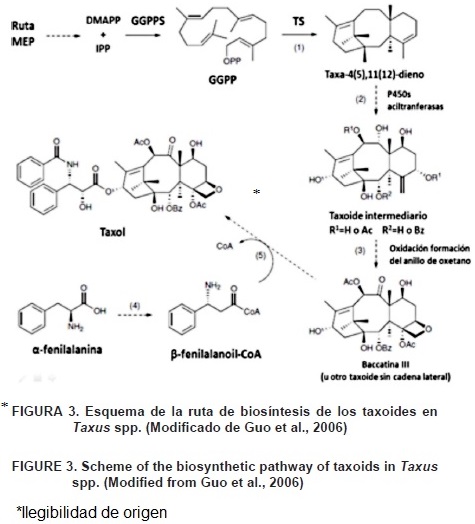
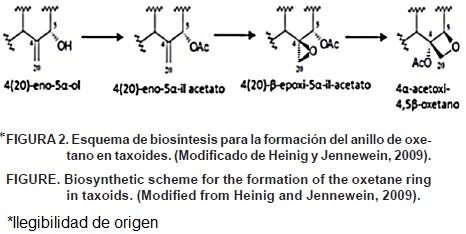
<body><![CDATA[<p align="justify"><font face="verdana" size="2">El taxol es un compuesto de naturaleza isoprenoide. En el citosol, la ruta cl&aacute;sica del mevalonato produce IPP de acetil coenzima A para la bios&iacute;ntesis de los sesquiterpenos y triterpenos. Los plastidios son el sitio de la ruta alternativa del nomevalonato que produce IPP y DMAPP a partir de piruvato y gliceraldehido&#150;3&#150;fosfato comenzando con los isoprenoides plast&iacute;dicos: monoterpenos, diterpenos y tetraterpenos (Azcon &amp; Tal&oacute;n, 2008; Cusid&oacute; et al., 2007). El esqueleto central de la mol&eacute;cula de taxol es un anillo de taxano de naturaleza isoprenoide y deriva del geranilgeranil difosfato (GGPP), el precursor com&uacute;n de los isoprenoides de 20 &aacute;tomos de carbono llamados diterpenos. Entre &eacute;stos se encuentran compuestos, tales como; los carotenoides, la cadena de fitol de las clorofilas o las giberelinas, el &aacute;cido absc&iacute;sico, la cadena isoprenoide de algunas citoquininas que participan en el crecimiento y desarrollo de las plantas, la plastoquinona, la ubiquinona y los fitoesteroles esenciales para la integridad de las biomembranas y los dolicoles (Azcon &amp; Tal&oacute;n, 2008).</font></p>  	    <p align="justify"><font face="verdana" size="2"><b>Bios&iacute;ntesis de los taxoides</b></font></p>  	    <p align="justify"><font face="verdana" size="2">Actualmente, se han realizado muchos avances con respecto a la identificaci&oacute;n de los genes responsables de la bios&iacute;ntesis del taxol o paclitaxel (<a href="/img/revistas/rcscfa/v18n2/a7c1.jpg" target="_blank">Cuadro 1</a>). En este proceso se requieren conocer, principalmente, las reacciones enzim&aacute;ticas que involucran la construcci&oacute;n del esqueleto tetrac&iacute;clico y la adici&oacute;n de varios ox&iacute;genos y grupos funcionales acilo.</font></p>  	    <p align="justify"><font face="verdana" size="2">Existe una gran variaci&oacute;n en el contenido de taxoides, que se debe principalmente a las diferentes especies y variedades. Hasta el momento, se conoce la estructura qu&iacute;mica de m&aacute;s de 300 taxoides. &eacute;stos se empezaron a clasificar de acuerdo a la oxigenaci&oacute;n del C<sub>20</sub> y a la presencia o no de cadenas laterales. Los taxoides m&aacute;s importantes sin la cadena lateral C<sub>13</sub> son baccatina III y sus compuestos derivados; mientras que los principales taxoides con la cadena lateral C<sub>13</sub> son el taxol, cefalomanina y compuestos relacionados (Cusid&oacute; et al., 2007).</font></p>  	    <p align="justify"><font face="verdana" size="2">El taxol es un protoalcaloide (el nitr&oacute;geno se encuentra en una cadena alif&aacute;tica y no en un sistema heteroc&iacute;clico) diterp&eacute;nico c&iacute;clico polioxigenado caracterizado por un sistema de anillo de taxano; es portador de una cadena lateral derivada de la fenilalanina, la N&#150;benzoil&#150;(2R&#150;3S)&#150;3&#150;fenilisoserina. La s&iacute;ntesis del taxol implica una descarboxilaci&oacute;n del amino&aacute;cido precursor que da lugar a las respectivas aminas simples, de las que, mediante modificaciones estructurales, se origina el protoalcaloide (Azc&oacute;n &amp; Tal&oacute;n, 2008); su bios&iacute;ntesis en las plantas de <i>Taxus</i> spp. no se conoce completamente. El anillo de oxetano es principalmente encontrado en las especies de <i>Taxus</i> spp. La formaci&oacute;n de este anillo en la bios&iacute;ntesis del taxol (<a href="#f2">Figura 2</a>) involucra dos enzimas: 1) CitP450 C<sub>4</sub>&#150;C<sub>20</sub> epoxidasa y 2) isomerasa (oxomutasa) (Frense, 2007). Los estudios sobre la bios&iacute;ntesis de taxol muestran que el sistema de anillo de los taxoides no se sintetiza v&iacute;a mevalonato, sino por la ruta plast&iacute;dica del nomevalonato o ruta del metil&#150;4&#150;eritritol&#150;fosfato (MEP), lo cual es coherente con su naturaleza de diterpenos (Eisenreich, Mewnhard, Hylands, Zenk, &amp; Bacher, 1996).</font></p>  	    <p align="center"><font face="verdana" size="2"><a name="f2"></a></font></p>  	    <p align="center"><font face="verdana" size="2"><img src="/img/revistas/rcscfa/v18n2/a7f2.jpg"></font></p>  	    <p align="justify"><font face="verdana" size="2">El primer paso en la bios&iacute;ntesis de taxol (<a href="#f3">Figura 3</a>) es la ciclizaci&oacute;n de geranilgeranil difosfato (GGPP), el cual comienza con la formaci&oacute;n de taxa&#150;(4,5), (11,12)&#150;dieno, que es el primer compuesto en la ruta biosint&eacute;tica del taxol que presenta el esqueleto de taxoide. Esta reacci&oacute;n es catalizada por la enzima taxadieno sintasa (TS), una enzima formada por una prote&iacute;na monom&eacute;rica de 79 kDa con propiedades similares a otras ciclasas de terpenoides. La enzima fue purificada y caracterizada por Hezari, Lewis, Croteau (1995) y los genes que codifican para la TS fueron identificados y clonados por Wildung y Croteau (1996). El producto de la reacci&oacute;n es la hidroxilaci&oacute;n de la posici&oacute;n del C<sub>5</sub> por la enzima Cit P450 taxadieno&#150;5&#945;&#150;hidroxilasa (T5&#945;H) para formar taxa&#150;4(20),11(12)&#150;dien&#150;5&#945;&#150;ol. Esta enzima, aparte de su actividad hidroxilativa, tiene condiciones de migraci&oacute;n del doble enlace de 4(5) a 4(20). Estos dos pasos metab&oacute;licos, ciclizaci&oacute;n e hidroxilaci&oacute;n, son bajos y no se observan por ser limitantes en la velocidad de la bios&iacute;ntesis del taxol (Hefner et al., 1996). El pr&oacute;ximo paso en la ruta de bios&iacute;ntesis que comienza a formar el taxol es catalizado por una enzima espec&iacute;fica: taxadieno&#150;5&#945;&#150;ol&#150;O&#150;acetil transferasa (TDAT) que acila taxa&#150;4(20),11(12)&#150;dien&#150;5&#945;&#150;ol a la posici&oacute;n del C<sub>5</sub> para formar taxa&#150;4(20), 11(12)&#150;dien&#150;5&#945;&#150;yl&#150;acetato. Este taxoide se hidroxila por una P450&#150;dependiente monooxigenasa, encontrada en <i>T. cuspidata</i> (tejo japon&eacute;s), la cual cataliza la hidroxilaci&oacute;n a la posici&oacute;n C<sub>10</sub> para producir taxa&#150;4(20),11(12)&#150;dien&#150;5&#945;, 10&#946;&#150;diol 5&#150;acetato. La enzima que controla este paso, la taxoide 10&#946;&#150;hidroxilasa (T10pH), fue clonada y caracterizada funcionalmente en levaduras (Schoendorf, Rithner, Williams, &amp; Csroteau, 2000).</font></p>  	    <p align="center"><font face="verdana" size="2"><a name="f3"></a></font></p>  	    <p align="center"><font face="verdana" size="2"><img src="/img/revistas/rcscfa/v18n2/a7f3.jpg"></font></p>  	    ]]></body>
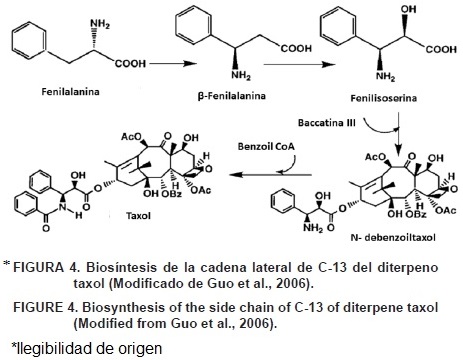
<body><![CDATA[<p align="justify"><font face="verdana" size="2">Jennewein, Rithner, Williams, y Croteau (2001) encontraron una Cit P450&#150;dependiente hidroxilasa usando taxa&#150;4(20),11(29)&#150;dien&#150;5&#945;&#150;ol como sustrato, comenzando con ello la formaci&oacute;n de taxa&#150;4(20),11(12)&#150;dien&#150;5&#945;&#150;13&#945;&#150;diol. La enzima taxol 13&#945;&#150;hidroxilasa (T13&#945;H) presenta 63 % de identidad y 67 % similitud con la hidroxilasa responsable para la hidroxilaci&oacute;n en la posici&oacute;n C<sub>10</sub>. Al mismo tiempo, el hecho de que esta enzima use el mismo sustrato, como taxa&#150;4(20),11(12)&#150;dien&#150;5&#945;&#150;ol (TDAD), sugiere que la bios&iacute;ntesis del taxol no es una ruta lineal y que algunas ramas de la ruta pueden dar comienzo a otros taxoides relacionados. Se ha observado que este paso alternativo fue especialmente frecuente en cultivos de c&eacute;lulas elicitadas con metil jasmonato (Wheeler et al., 2001). Posteriormente, se encontr&oacute; otra Cit P450&#150;dependiente de hidroxilasa (taxoide 14&#946;&#150;hidroxilasa; T14&#946;H) responsable para la producci&oacute;n de taxa&#150;4(20),11(12)&#150;dien&#150;5&#945;&#150;acetoxi&#150;10&#946;&#150;14&#946;&#150;diol (Jennewein, Rithner, Williams, &amp; Croteau, 2003). Esta enzima utiliza sustratos hidroxilando a la posici&oacute;n del C<sub>10</sub>, pero no los hidroxila a la posici&oacute;n C<sub>13</sub>, sugiriendo que podr&iacute;a estar involucrada en la producci&oacute;n del taxol desde este compuesto sin presentar alguna hidroxilaci&oacute;n a la posici&oacute;n C<sub>14</sub>. Despu&eacute;s de la formaci&oacute;n de taxa&#150;4(20),11(12)&#150;dien&#150;5&#945;,10&#946;&#150;diol 5&#150;acetato se originan hidroxilaciones en las posiciones de C<sub>1</sub>, C<sub>2</sub>, C<sub>4</sub> y C<sub>7</sub>, oxidaci&oacute;n de C<sub>9</sub> y epoxidaci&oacute;n en el doble enlace C<sub>4</sub>C<sub>5</sub> en la ruta biosint&eacute;tica del taxol. El orden de las hidroxilaciones mediadas por enzimas Citocromo P450 no es completamente conocido; pero sobre la base de la frecuencia de la oxidaci&oacute;n de los taxoides se ha encontrado en cultivo de c&eacute;lulas, una secuencia probable que podr&iacute;a ser: C<sub>5</sub>, C<sub>10</sub>, C<sub>2</sub>, C<sub>9</sub>, C<sub>13</sub> y Analmente C<sub>1</sub>. Se debe tomar en cuenta que algunos de los taxoides considerados podr&iacute;an no participar en la formaci&oacute;n del taxol o podr&iacute;an ser artefactos de los cultivos <i>in vitro.</i> Esta secuencia de oxidaci&oacute;n se ha validado por an&aacute;lisis filogen&eacute;ticos de enzimas taxoide oxigenasas P450 clonadas previamente (Vongpaseuth &amp; Roberts, 2007).</font></p>  	    <p align="justify"><font face="verdana" size="2">Sin embargo, la formaci&oacute;n del anillo de oxetano es tambi&eacute;n muy importante, ya que es esencial para la actividad anti&#150;c&aacute;ncer de la mol&eacute;cula del taxol. Se han propuesto diferentes mecanismos para su formaci&oacute;n. En la actualidad se acepta que tal proceso involucra la epoxidaci&oacute;n del puente doble 4(20) seguido por una migraci&oacute;n del grupo &#945;&#150;acetoxi del C<sub>5</sub> a la posici&oacute;n C<sub>4</sub>, junto con la expansi&oacute;n del oxirano al grupo oxetano. Es posible que la formaci&oacute;n de oxirano&#150;oxetano preceda a la hidroxilaci&oacute;n del C<sub>1</sub> en la bios&iacute;ntesis del taxol, y en este caso el intermediario polihi&#150;droxilado hipot&eacute;tico podr&iacute;a ser m&aacute;s bien un taxadien&#150;hexaol que un heptaol hidroxilado a C<sub>1</sub> (Croteau, Ketchum, Long, Kospera, &amp; Wildung, 2006). La enzima que epoxida el doble enlace C<sub>4</sub>&#150;C<sub>20</sub> a&uacute;n no se ha caracterizado funcionalmente y la expansi&oacute;n del anillo de oxirano&#150;oxetano es tambi&eacute;n un paso incompletamente conocido.</font></p>  	    <p align="justify"><font face="verdana" size="2">Despu&eacute;s de la formaci&oacute;n del precursor polihidroxilado hipot&eacute;tico por la actividad de la enzima 2&#945;&#150;O&#150;benzoyl transferasa (DBT), el pr&oacute;ximo compuesto obtenido es 10&#150;diacetil baccatina III. La enzima 10&#150;deacetil&#150;baccatinIII&#150;10&#150;O&#150;acetyl transferasa (DBAT) acila el grupo hidroxilo a la posici&oacute;n del C<sub>10</sub> para formar baccatina III. Un paso esencial en la bios&iacute;ntesis del taxol es la esterificaci&oacute;n del C<sub>13</sub> del grupo hidroxilo de la baccatina III con la cadena lateral &#946;&#150;fenilalanoil&#150;CoA. La cadena lateral es obtenida del amino&aacute;cido a&#150;fenilalanina por la acci&oacute;n de la fenilalanina aminomutasa (PAM) (Walker, Klettke, Akiyama, &amp; Croteau, 2004). La enzima C<sub>13</sub>&#150;fenilpropanoil&#150;CoA transferasa (BAPT) cataliza la conjugaci&oacute;n de la cadena lateral de la &#946;&#150;fenilalanoyl&#150;CoA a baccatina III, mejorando o produciendo el compuesto 3'&#150;N&#150;debenzoil&#150;2'&#150;deoxitaxol (<a href="#f4">Figura 4</a>). Este compuesto hidroxila la posici&oacute;n C<sub>2</sub> por la acci&oacute;n de una enzima desconocida Cit P450&#150;dependiente hidroxilasa, y la enzima 3'&#150;N&#150;debenzoil&#150;2'&#150;deoxitaxol N&#150;benzoil transferasa (DBTNBT) conjuga a benzoil&#150;CoA a 3'&#150;N&#150;debenzoil&#150;2'&#150;deoxitaxol produciendo taxol como un compuesto Anal (Walker, Long, &amp; Croteau, 2002).</font></p>  	    <p align="center"><font face="verdana" size="2"><a name="f4"></a></font></p>  	    <p align="center"><font face="verdana" size="2"><img src="/img/revistas/rcscfa/v18n2/a7f4.jpg"></font></p>  	    <p align="justify"><font face="verdana" size="2"><b>Producci&oacute;n de taxoides en cultivos <i>in vitro</i></b></font></p>  	    <p align="justify"><font face="verdana" size="2">Christen, Biand, y Gibson (1989) reportaron por primera vez la producci&oacute;n de taxol usando cultivos celulares de <i>Taxus.</i> Despu&eacute;s, muchos cient&iacute;ficos empezaron a optimizar las condiciones para el crecimiento prol&iacute;fico de las c&eacute;lulas e incrementar la producci&oacute;n de taxoides en varios sistemas de cultivo <i>in vitro,</i> tales como, c&eacute;lulas, ra&iacute;ces, tallos y cultivos embriog&eacute;nicos de diferentes especies de <i>Taxus</i> (Mirjalili &amp; Linden, 1996). El cultivo de c&eacute;lulas de <i>Taxus</i> en suspensi&oacute;n a partir de callos <i>in vitro</i> es considerada una herramienta promisoria para producir taxol y taxoides relacionados. Por tal motivo, se ha investigado extensamente el contenido de taxol en diferentes cultivos de <i>Taxus</i> spp., tanto para optimizar la tasa de producci&oacute;n como para incrementarlo (Barrales et al., 2009, 2011; Khosroushahi et al., 2006; Nguyen, Eshraghi, Gonyea, Ream, &amp; Smith, 2001; Tabata, 2006; Zhong, 2002). Los medios de cultivo utilizados <i>in vitro</i> para la iniciaci&oacute;n, proliferaci&oacute;n y mantenimiento de los callos y cultivos de c&eacute;lulas en suspensi&oacute;n de <i>Taxus</i> spp., son el medio basal Gamborg's (B5), MS (Murashige &amp; Skoog, 1962) y Medio vegetal Woody (WPM) (Frense, 2007). En pocas especies de <i>Taxus</i> se han detectado otros taxoides tales como: baccatina III (Agrawal et al., 2000), epitaxol y 7&#150;epi&#150;10&#150;diacetil taxol (KetchumTandon, Gibson, Begley, &amp; Shuler, 1999), y 10&#150;diacetil taxol en <i>T. baccata</i> (Vander et al., 1994), entre otros. En el <a href="/img/revistas/rcscfa/v18n2/a7c2.jpg" target="_blank">Cuadro 2</a> se presenta la tasa de producci&oacute;n de taxol en cultivos <i>in vitro</i> de c&eacute;lulas de <i>Taxus</i> spp. en sistemas de matraces y biorreactores. El tama&ntilde;o de in&oacute;culo, periodo de subcultivo, intensidad de luz y fotoperiodo, son factores decisivos para la multiplicaci&oacute;n, apariencia fenot&iacute;pica, producci&oacute;n de taxol y proliferaci&oacute;n de c&eacute;lulas de <i>Taxus</i> spp. (Hirasuna, Pestchanker, Srinivasan, &amp; Shuler, 1996; Navia&#150;Osorio et al., 2002). Adem&aacute;s, la suplementaci&oacute;n de sustancias org&aacute;nicas tales como: case&iacute;na hidrolizada, polivinil pirrolidona (PVP), &aacute;cido asc&oacute;rbico y amino&aacute;cidos esenciales como glutamina, &aacute;cido asp&aacute;rtico, prolina, fenilalanina y vitaminas en el medio, puede incrementar el crecimiento celular de los callos y c&eacute;lulas de <i>Taxus</i> spp. (Navia&#150;Osorio et al., 2002).</font></p>  	    <p align="justify"><font face="verdana" size="2">&nbsp;</font></p>  	    <p align="justify"><font face="verdana" size="2"><b>CONCLUSIONES</b></font></p>  	    <p align="justify"><font face="verdana" size="2">Los taxoides son de gran importancia comercial debido a la actividad anti&#150;c&aacute;ncer que presentan. Estos taxoides se a&iacute;slan a partir de la corteza y follaje de &aacute;rboles de <i>Taxus.</i> Las t&eacute;cnicas de cultivo <i>in vitro</i> de callos y c&eacute;lulas vegetales se explotan para el aislamiento de l&iacute;neas celulares productoras de taxol. El cultivo <i>in vitro</i> de <i>Taxus</i> no s&oacute;lo ayuda a la conservaci&oacute;n de este valioso recurso natural, sino que se considera una alternativa biotecnol&oacute;gica viable; adem&aacute;s tiene un amplio uso sustentable en la producci&oacute;n del f&aacute;rmaco taxol y taxoides relacionados. Aunque la ruta biosint&eacute;tica no se conoce completamente; el conocimiento de las enzimas clave en la bios&iacute;ntesis del taxol es importante para hacer experimentos de biolog&iacute;a molecular e identificar los genes que expresen una producci&oacute;n mayor de &eacute;ste y otros taxoides relacionados con las especies de <i>Taxus,</i> mediante estrategias de elicitaci&oacute;n de tipo bi&oacute;tico o abi&oacute;tico.</font></p>  	    ]]></body>
<body><![CDATA[<p align="justify"><font face="verdana" size="2">&nbsp;</font></p>  	    <p align="justify"><font face="verdana" size="2"><b>AGRADECIMIENTOS</b></font></p>  	    <p align="justify"><font face="verdana" size="2">El autor agradece a la M.C. Petra Andrade&#150;Hoyos por sus valiosas sugerencias al presente art&iacute;culo y al Colegio de Postgraduados por el Fideicomiso Institucional N&uacute;m. 167304 otorgado para el desarrollo del proyecto de investigaci&oacute;n.</font></p>  	    <p align="justify"><font face="verdana" size="2">&nbsp;</font></p>  	    <p align="justify"><font face="verdana" size="2"><b>REFERENCIAS</b></font></p>  	    <!-- ref --><p align="justify"><font face="verdana" size="2">Agrawal, S., Banerjee, S., Chattopadhyay, S. K., Kulshreshtha, M., Musudanan, K. P., Mehta, V. K., &amp; Kumar, S. (2000). Isolation of taxoids from cell suspension cultures of <i>Taxus wallichiana. Plant Medica, 66,</i> 1&#150;3. doi: 10.1055/s&#150;2000&#150;9782.    &nbsp;&nbsp;&nbsp;&nbsp;&nbsp;&nbsp;&nbsp;&nbsp;[&#160;<a href="javascript:void(0);" onclick="javascript: window.open('/scielo.php?script=sci_nlinks&ref=6618515&pid=S2007-4018201200020000700001&lng=','','width=640,height=500,resizable=yes,scrollbars=1,menubar=yes,');">Links</a>&#160;]<!-- end-ref --></font></p>  	    <!-- ref --><p align="justify"><font face="verdana" size="2">Azc&oacute;n, B. J., &amp; Tal&oacute;n, M. (2008). <i>Fundamentos de Fisiolog&iacute;a Vegetal.</i> Espa&ntilde;a: McGraw&#150;Hill.    &nbsp;&nbsp;&nbsp;&nbsp;&nbsp;&nbsp;&nbsp;&nbsp;[&#160;<a href="javascript:void(0);" onclick="javascript: window.open('/scielo.php?script=sci_nlinks&ref=6618517&pid=S2007-4018201200020000700002&lng=','','width=640,height=500,resizable=yes,scrollbars=1,menubar=yes,');">Links</a>&#160;]<!-- end-ref --></font></p>  	    <!-- ref --><p align="justify"><font face="verdana" size="2">Baloglu, E., &amp; Kingston, D. G. I. (1999). The taxane diterpenoids. <i>Journal of Natural Products, 62,</i> 1448&#150;1472. doi: 10.1021/np990176i</font>&nbsp;&nbsp;&nbsp;&nbsp;&nbsp;&nbsp;&nbsp;&nbsp;[&#160;<a href="javascript:void(0);" onclick="javascript: window.open('/scielo.php?script=sci_nlinks&ref=6618519&pid=S2007-4018201200020000700003&lng=','','width=640,height=500,resizable=yes,scrollbars=1,menubar=yes,');">Links</a>&#160;]<!-- end-ref --><!-- ref --><p align="justify"><font face="verdana" size="2">Barrales, C. H. J., Soto, H. M., Ramos, V. A. C., Luna, P. R. G., Trejo, T. L. I., Mart&iacute;nez, V. M., &amp; Ram&iacute;rez, G. M. E. (2009). Inducci&oacute;n de callos <i>in vitro</i> de <i>Taxus globosa</i> a partir de ac&iacute;culas. <i>Revista Latinoamericana de Qu&iacute;mica,</i> Suplemento especial ISNN 0370&#150;5943. pp. 89.    &nbsp;&nbsp;&nbsp;&nbsp;&nbsp;&nbsp;&nbsp;&nbsp;[&#160;<a href="javascript:void(0);" onclick="javascript: window.open('/scielo.php?script=sci_nlinks&ref=6618520&pid=S2007-4018201200020000700004&lng=','','width=640,height=500,resizable=yes,scrollbars=1,menubar=yes,');">Links</a>&#160;]<!-- end-ref --></font></p>  	    <!-- ref --><p align="justify"><font face="verdana" size="2">Barrales, C. H. J., Soto, H. R. M., Ramos, V. A. C., Trejo, T. L. I., Mart&iacute;nez, V. M., Ram&iacute;rez, G. M. E., L&oacute;pez, U. J. (2011). Extracci&oacute;n y cuantificaci&oacute;n de taxoides por HPLC en hojas <i>in situ</i> y en callos inducidos <i>in vitro</i> de <i>Taxus globosa</i> Schlecht. <i>Spanish Journal of Rural Development, 2,</i> 103&#150;114.    &nbsp;&nbsp;&nbsp;&nbsp;&nbsp;&nbsp;&nbsp;&nbsp;[&#160;<a href="javascript:void(0);" onclick="javascript: window.open('/scielo.php?script=sci_nlinks&ref=6618522&pid=S2007-4018201200020000700005&lng=','','width=640,height=500,resizable=yes,scrollbars=1,menubar=yes,');">Links</a>&#160;]<!-- end-ref --></font></p>  	    <!-- ref --><p align="justify"><font face="verdana" size="2">Barrios, H., Zhang, Y., Sandoval, C., &amp; Xiao, Z. (2009). Increase of taxol production in <i>Taxus globosa</i> Shoot callus by Chlorocholine Chloride. <i>Open Natural Products Journal, 2,</i> 33&#150;37. doi: 10.2174/1874848100902010033</font>&nbsp;&nbsp;&nbsp;&nbsp;&nbsp;&nbsp;&nbsp;&nbsp;[&#160;<a href="javascript:void(0);" onclick="javascript: window.open('/scielo.php?script=sci_nlinks&ref=6618524&pid=S2007-4018201200020000700006&lng=','','width=640,height=500,resizable=yes,scrollbars=1,menubar=yes,');">Links</a>&#160;]<!-- end-ref --><!-- ref --><p align="justify"><font face="verdana" size="2">Bentebibel, S., Moyano, E., Palaz&oacute;n, J., Cusid&oacute;, R. M., Bonfill, M., Eibl, R., &amp; Pinol, M. T. (2005). Effects of inmobilization by entrapment in alginate and scale&#150;up on paclitaxel and baccatin III production in cell suspension cultures of <i>Taxus baccata. Biotechnology and Bioengineering, 89,</i> 647&#150;655. doi: 10.1002/bit.20321</font>&nbsp;&nbsp;&nbsp;&nbsp;&nbsp;&nbsp;&nbsp;&nbsp;[&#160;<a href="javascript:void(0);" onclick="javascript: window.open('/scielo.php?script=sci_nlinks&ref=6618525&pid=S2007-4018201200020000700007&lng=','','width=640,height=500,resizable=yes,scrollbars=1,menubar=yes,');">Links</a>&#160;]<!-- end-ref --><!-- ref --><p align="justify"><font face="verdana" size="2">Centelles, J., &amp; Imperial, S. (2010). Paclitaxel, descubrimiento, propiedades y uso cl&iacute;nico. <i>Fitoterapia, 29,</i> 69&#150;75.    &nbsp;&nbsp;&nbsp;&nbsp;&nbsp;&nbsp;&nbsp;&nbsp;[&#160;<a href="javascript:void(0);" onclick="javascript: window.open('/scielo.php?script=sci_nlinks&ref=6618526&pid=S2007-4018201200020000700008&lng=','','width=640,height=500,resizable=yes,scrollbars=1,menubar=yes,');">Links</a>&#160;]<!-- end-ref --></font></p>  	    <!-- ref --><p align="justify"><font face="verdana" size="2">Christen, A. A., Bland, J., &amp; Gibson, D. M. (1989). Cell cultures as a means to produce taxol. <i>Proceedings of the American Association for Cancer Research, 30,</i> 566.    &nbsp;&nbsp;&nbsp;&nbsp;&nbsp;&nbsp;&nbsp;&nbsp;[&#160;<a href="javascript:void(0);" onclick="javascript: window.open('/scielo.php?script=sci_nlinks&ref=6618528&pid=S2007-4018201200020000700009&lng=','','width=640,height=500,resizable=yes,scrollbars=1,menubar=yes,');">Links</a>&#160;]<!-- end-ref --></font></p>  	    ]]></body>
<body><![CDATA[<!-- ref --><p align="justify"><font face="verdana" size="2">Croteau, R. B., Ketchum, R. E. B., Long, R. M., Kaspera, R., &amp; Wildung, M. R. (2006). Taxol biosynthesis and molecular genetics. <i>Phytochemistry Reviews, 5,</i> 75&#150;97. doi: 10.1007/s11101&#150;005&#150;3748&#150;2</font>&nbsp;&nbsp;&nbsp;&nbsp;&nbsp;&nbsp;&nbsp;&nbsp;[&#160;<a href="javascript:void(0);" onclick="javascript: window.open('/scielo.php?script=sci_nlinks&ref=6618530&pid=S2007-4018201200020000700010&lng=','','width=640,height=500,resizable=yes,scrollbars=1,menubar=yes,');">Links</a>&#160;]<!-- end-ref --><!-- ref --><p align="justify"><font face="verdana" size="2">Cusid&oacute;, R. M., Palaz&oacute;n, J., Bonfill, M., Exposit&oacute;, O., Moyano, E., &amp; Pi&ntilde;ol M. T. (2007). Source of isopentenyl diphosphate for taxol and baccatin III biosynthesis in cell cultures of <i>Taxus baccata. Biochemical Engineering Journal, 33,</i> 159&#150;167. doi: 10.1016/j.bej.2006.10.016</font>&nbsp;&nbsp;&nbsp;&nbsp;&nbsp;&nbsp;&nbsp;&nbsp;[&#160;<a href="javascript:void(0);" onclick="javascript: window.open('/scielo.php?script=sci_nlinks&ref=6618531&pid=S2007-4018201200020000700011&lng=','','width=640,height=500,resizable=yes,scrollbars=1,menubar=yes,');">Links</a>&#160;]<!-- end-ref --><!-- ref --><p align="justify"><font face="verdana" size="2">Cusid&oacute;, R. M., Palaz&oacute;n, J., Bonfill, M., Navia, O. A., Morales, C., &amp; Pi&ntilde;ol, M. T. (2002). Improved paclitaxel and baccatin III production in suspension cultures of <i>Taxus media. Biotechnology Progress, 18,</i> 418&#150;423. doi: 10.1021/bp0101583</font>&nbsp;&nbsp;&nbsp;&nbsp;&nbsp;&nbsp;&nbsp;&nbsp;[&#160;<a href="javascript:void(0);" onclick="javascript: window.open('/scielo.php?script=sci_nlinks&ref=6618532&pid=S2007-4018201200020000700012&lng=','','width=640,height=500,resizable=yes,scrollbars=1,menubar=yes,');">Links</a>&#160;]<!-- end-ref --><!-- ref --><p align="justify"><font face="verdana" size="2">Eisenreich, W., Mewnhard, B., Hylands, P. J., Zenk, M. H., &amp; Bacher, A. (1996). Studies on the biosynthesis of taxol: The taxane carbon skeleton is not of mevalonoid origin. <i>Proceedings of the National Academy of Sciences, 93,</i> 6431&#150;6436.    &nbsp;&nbsp;&nbsp;&nbsp;&nbsp;&nbsp;&nbsp;&nbsp;[&#160;<a href="javascript:void(0);" onclick="javascript: window.open('/scielo.php?script=sci_nlinks&ref=6618533&pid=S2007-4018201200020000700013&lng=','','width=640,height=500,resizable=yes,scrollbars=1,menubar=yes,');">Links</a>&#160;]<!-- end-ref --></font></p>  	    <!-- ref --><p align="justify"><font face="verdana" size="2">Frense, D. (2007). Taxanes: Perspectives for biotechnological production. <i>Applied Microbiology and Biotechnology, 73,</i> 1233&#150;1240. doi: 10.1007/s00253&#150;006&#150;0711&#150;0</font>&nbsp;&nbsp;&nbsp;&nbsp;&nbsp;&nbsp;&nbsp;&nbsp;[&#160;<a href="javascript:void(0);" onclick="javascript: window.open('/scielo.php?script=sci_nlinks&ref=6618535&pid=S2007-4018201200020000700014&lng=','','width=640,height=500,resizable=yes,scrollbars=1,menubar=yes,');">Links</a>&#160;]<!-- end-ref --><!-- ref --><p align="justify"><font face="verdana" size="2">Guo, B. H., Kai, G. Y., Jin, H. B., &amp;. Tang, K. X. (2006). Taxol synthesis. <i>African Journal of Biotechnology,</i> <i>5</i>(1), 15&#150;20.    &nbsp;&nbsp;&nbsp;&nbsp;&nbsp;&nbsp;&nbsp;&nbsp;[&#160;<a href="javascript:void(0);" onclick="javascript: window.open('/scielo.php?script=sci_nlinks&ref=6618536&pid=S2007-4018201200020000700015&lng=','','width=640,height=500,resizable=yes,scrollbars=1,menubar=yes,');">Links</a>&#160;]<!-- end-ref --></font></p>  	    <!-- ref --><p align="justify"><font face="verdana" size="2">Hefner, J., Rubenstein, S. M., Ketchum, R. E. B., Gibson, D. M., Williams, R. M., &amp; Croteau, R. (1996). Citochrome p450&#150;catalyzed hydroxylation of taxa&#150;4(5), 11(12)&#150;dien to taxa&#150;4(20),11(12)&#150;dien&#150;alpha&#150;ol. The first oxygenation step in taxol biosynthesis. <i>Chemistry &amp; Biology, 3,</i> 479. doi: 10.1016/S1074&#150;5521(96)90096&#150;4</font>&nbsp;&nbsp;&nbsp;&nbsp;&nbsp;&nbsp;&nbsp;&nbsp;[&#160;<a href="javascript:void(0);" onclick="javascript: window.open('/scielo.php?script=sci_nlinks&ref=6618538&pid=S2007-4018201200020000700016&lng=','','width=640,height=500,resizable=yes,scrollbars=1,menubar=yes,');">Links</a>&#160;]<!-- end-ref --><!-- ref --><p align="justify"><font face="verdana" size="2">Heinig, U., &amp; Jennewein S. (2009). Taxol: A complex diterpenoid natural product with an evolutionarily obscure origin. <i>African Journal of Biotechnology,</i> <i>8</i>(8), 1370&#150;1385.    &nbsp;&nbsp;&nbsp;&nbsp;&nbsp;&nbsp;&nbsp;&nbsp;[&#160;<a href="javascript:void(0);" onclick="javascript: window.open('/scielo.php?script=sci_nlinks&ref=6618539&pid=S2007-4018201200020000700017&lng=','','width=640,height=500,resizable=yes,scrollbars=1,menubar=yes,');">Links</a>&#160;]<!-- end-ref --></font></p>  	    <!-- ref --><p align="justify"><font face="verdana" size="2">Hezari, M., Lewis, N. G., &amp; Croteau, R. (1995). Purification and characterization of taxa&#150;4(5), 11(12)&#150;diene synthase from pacific yew <i>(Taxus brevifolia)</i> that catalyzes the first commited step of taxol biosynthesis. <i>Archives of Biochemistry and Biophysics, 322,</i> 437</font>&nbsp;&nbsp;&nbsp;&nbsp;&nbsp;&nbsp;&nbsp;&nbsp;[&#160;<a href="javascript:void(0);" onclick="javascript: window.open('/scielo.php?script=sci_nlinks&ref=6618541&pid=S2007-4018201200020000700018&lng=','','width=640,height=500,resizable=yes,scrollbars=1,menubar=yes,');">Links</a>&#160;]<!-- end-ref --><!-- ref --><p align="justify"><font face="verdana" size="2">Hirasuna, T. J., Pestchanker, L. J., Srinivasan, V., &amp; Shuler M. L. (1996). Taxol production in suspension cultures of <i>Taxus baccata. Plant Cell, Tissue and Organ Culture, 44,</i> 95&#150;102. doi: 10.1007/BF00048185</font>&nbsp;&nbsp;&nbsp;&nbsp;&nbsp;&nbsp;&nbsp;&nbsp;[&#160;<a href="javascript:void(0);" onclick="javascript: window.open('/scielo.php?script=sci_nlinks&ref=6618542&pid=S2007-4018201200020000700019&lng=','','width=640,height=500,resizable=yes,scrollbars=1,menubar=yes,');">Links</a>&#160;]<!-- end-ref --><!-- ref --><p align="justify"><font face="verdana" size="2">Holton, R. A., Somoza, C., Kim, H. B., Liang, F., Biediger, R. J., &amp; Boatman, P. D. (1994). First total synthesis of taxol 1. Functionalization of the B ring. <i>Journal of American Chemical Society, 116,</i> 1599&#150;1600. doi: 10.1021/ja00083a066</font>&nbsp;&nbsp;&nbsp;&nbsp;&nbsp;&nbsp;&nbsp;&nbsp;[&#160;<a href="javascript:void(0);" onclick="javascript: window.open('/scielo.php?script=sci_nlinks&ref=6618543&pid=S2007-4018201200020000700020&lng=','','width=640,height=500,resizable=yes,scrollbars=1,menubar=yes,');">Links</a>&#160;]<!-- end-ref --><!-- ref --><p align="justify"><font face="verdana" size="2">Jaziri, M., Zhiri, A., Guo, Y., Dupont, J., Shimomura, K., Hamada, H., ...&nbsp;Homes, J. (1996). <i>Taxus</i> sp. cell, tissue and organ cultures as alternative sources for taxoids production: A literatura survey. <i>Plant Cell, Tissue and Organ Culture, 46,</i> 59&#150;75. doi: 10.1007/BF00039697</font>&nbsp;&nbsp;&nbsp;&nbsp;&nbsp;&nbsp;&nbsp;&nbsp;[&#160;<a href="javascript:void(0);" onclick="javascript: window.open('/scielo.php?script=sci_nlinks&ref=6618544&pid=S2007-4018201200020000700021&lng=','','width=640,height=500,resizable=yes,scrollbars=1,menubar=yes,');">Links</a>&#160;]<!-- end-ref --><!-- ref --><p align="justify"><font face="verdana" size="2">Jennewein, S., Rithner, C. H. D., Williams, R. M., &amp; Croteau, R. (2003). Taxol metabolism:&nbsp;Taxoid 14&#946;&#150;hydroxylase is a Citochrome p450&#150;dependent monooxygenase. <i>Archives of Biochemistry and Biophysics, 413,</i> 262&#150;270. doi: 10.1016/S00039861(03)00090&#150;0</font>&nbsp;&nbsp;&nbsp;&nbsp;&nbsp;&nbsp;&nbsp;&nbsp;[&#160;<a href="javascript:void(0);" onclick="javascript: window.open('/scielo.php?script=sci_nlinks&ref=6618545&pid=S2007-4018201200020000700022&lng=','','width=640,height=500,resizable=yes,scrollbars=1,menubar=yes,');">Links</a>&#160;]<!-- end-ref --><!-- ref --><p align="justify"><font face="verdana" size="2">Jennewein, S., Rithner, CH. D., Williams, R. M., &amp; Croteau, R. B. (2001) Taxol biosynthesis: Taxane 13&#945;&#150;hidroxilase is a Citochrome P450&#150;dependent monooxygenase. <i>Proceedings of the National Academy of Sciences, 98,</i> 13595&#150;13600. doi: 10.1073/pnas.251539398</font>&nbsp;&nbsp;&nbsp;&nbsp;&nbsp;&nbsp;&nbsp;&nbsp;[&#160;<a href="javascript:void(0);" onclick="javascript: window.open('/scielo.php?script=sci_nlinks&ref=6618546&pid=S2007-4018201200020000700023&lng=','','width=640,height=500,resizable=yes,scrollbars=1,menubar=yes,');">Links</a>&#160;]<!-- end-ref --><!-- ref --><p align="justify"><font face="verdana" size="2">Ketchum, R. E. B., Tandon, M., Gibson, D. M., Begley, T., &amp; Shuler, M. L. (1999). Isolation of&nbsp;labeled 9&#150;Dihydrobaccatin III and related taxoids from cell cultures of <i>Taxus canadensis</i> elicited with methyl jasmonate. <i>Journal of Natural Products, 62,</i> 1395&#150;1398. doi: 10.1021/np990201k</font>&nbsp;&nbsp;&nbsp;&nbsp;&nbsp;&nbsp;&nbsp;&nbsp;[&#160;<a href="javascript:void(0);" onclick="javascript: window.open('/scielo.php?script=sci_nlinks&ref=6618547&pid=S2007-4018201200020000700024&lng=','','width=640,height=500,resizable=yes,scrollbars=1,menubar=yes,');">Links</a>&#160;]<!-- end-ref --><!-- ref --><p align="justify"><font face="verdana" size="2">Khosroushahi, A. Y., Valizadeh, M., Ghasempour, A., Khosrowshahli, M., Kim, B. J., Gibson, D. M., &amp; Shuler, M. L. (2006). Improved Taxol production by combination of inducing factors in suspension cell culture of <i>Taxus baccata. Cell Biology International, 30,</i> 262&#150;269. doi: 10.1016/j.cellbi.2005.11.004</font>&nbsp;&nbsp;&nbsp;&nbsp;&nbsp;&nbsp;&nbsp;&nbsp;[&#160;<a href="javascript:void(0);" onclick="javascript: window.open('/scielo.php?script=sci_nlinks&ref=6618548&pid=S2007-4018201200020000700025&lng=','','width=640,height=500,resizable=yes,scrollbars=1,menubar=yes,');">Links</a>&#160;]<!-- end-ref --><!-- ref --><p align="justify"><font face="verdana" size="2">Kim, B. J., Gibson, D. M., &amp; Shuler, M. L. (2006). Effect of the plant peptide regulator, phytosulfokine&#150;alpha, on the growth and taxol production from <i>Taxus</i> sp. suspension cultures. <i>Biotechnology and Bioengineering, 95,</i> 8&#150;14. doi: 10.1002/bit.20934</font>&nbsp;&nbsp;&nbsp;&nbsp;&nbsp;&nbsp;&nbsp;&nbsp;[&#160;<a href="javascript:void(0);" onclick="javascript: window.open('/scielo.php?script=sci_nlinks&ref=6618549&pid=S2007-4018201200020000700026&lng=','','width=640,height=500,resizable=yes,scrollbars=1,menubar=yes,');">Links</a>&#160;]<!-- end-ref --><!-- ref --><p align="justify"><font face="verdana" size="2">Kim, S. I., Choi, H. K., Kim, J. H., Lee, H. S., &amp; Hong, S. S. (2001). Effect of osmotic pressure on paclitaxel production in suspension cell cultures of <i>Taxus chinensis. Enzyme and Microbial Technology, 28,</i> 202&#150;209. doi: 10.1016/S0141&#150;0229(00)00292&#150;1</font>&nbsp;&nbsp;&nbsp;&nbsp;&nbsp;&nbsp;&nbsp;&nbsp;[&#160;<a href="javascript:void(0);" onclick="javascript: window.open('/scielo.php?script=sci_nlinks&ref=6618550&pid=S2007-4018201200020000700027&lng=','','width=640,height=500,resizable=yes,scrollbars=1,menubar=yes,');">Links</a>&#160;]<!-- end-ref --><!-- ref --><p align="justify"><font face="verdana" size="2">Liao, Z., Chen, M., Sun, X., &amp; Tang, K. (2006). Micropropagation of endangered plant species. <i>Methods Molecular Biology, 318,</i> 179&#150;185. doi: 10.1385/1&#150;59259&#150;959&#150;1:179</font>&nbsp;&nbsp;&nbsp;&nbsp;&nbsp;&nbsp;&nbsp;&nbsp;[&#160;<a href="javascript:void(0);" onclick="javascript: window.open('/scielo.php?script=sci_nlinks&ref=6618551&pid=S2007-4018201200020000700028&lng=','','width=640,height=500,resizable=yes,scrollbars=1,menubar=yes,');">Links</a>&#160;]<!-- end-ref --><!-- ref --><p align="justify"><font face="verdana" size="2">Mirjalili, N., &amp; Linden, J. C. (1996). Methyl jasmonate induced production of taxol in suspension cultures of <i>Taxus cuspidata:</i> Ethylene interaction and induction models. <i>Biotechnology Progress, 12,</i> 110&#150;118. doi: 10.1021/ bp9500831</font>&nbsp;&nbsp;&nbsp;&nbsp;&nbsp;&nbsp;&nbsp;&nbsp;[&#160;<a href="javascript:void(0);" onclick="javascript: window.open('/scielo.php?script=sci_nlinks&ref=6618552&pid=S2007-4018201200020000700029&lng=','','width=640,height=500,resizable=yes,scrollbars=1,menubar=yes,');">Links</a>&#160;]<!-- end-ref --><!-- ref --><p align="justify"><font face="verdana" size="2">Mulabagal, V., &amp; Tsay, H. S. (2004). Plant Cell Cultures&#150;an alternative and efficient source for the production of biologically important secondary metabolites. <i>International Journal of Applied Science and Engineering, 2,</i> 29&#150;48.    &nbsp;&nbsp;&nbsp;&nbsp;&nbsp;&nbsp;&nbsp;&nbsp;[&#160;<a href="javascript:void(0);" onclick="javascript: window.open('/scielo.php?script=sci_nlinks&ref=6618553&pid=S2007-4018201200020000700030&lng=','','width=640,height=500,resizable=yes,scrollbars=1,menubar=yes,');">Links</a>&#160;]<!-- end-ref --></font></p>  	    <!-- ref --><p align="justify"><font face="verdana" size="2">Murashige, T., &amp; Skoog F. (1962). A revised medium for rapid growth and bioassays with tobacco tissue cultures. <i>Physiologia Plantarum, 15,</i> 473&#150;497. doi: 10.1111/j.1399&#150;3054.1962.tb08052.x</font>&nbsp;&nbsp;&nbsp;&nbsp;&nbsp;&nbsp;&nbsp;&nbsp;[&#160;<a href="javascript:void(0);" onclick="javascript: window.open('/scielo.php?script=sci_nlinks&ref=6618555&pid=S2007-4018201200020000700031&lng=','','width=640,height=500,resizable=yes,scrollbars=1,menubar=yes,');">Links</a>&#160;]<!-- end-ref --><!-- ref --><p align="justify"><font face="verdana" size="2">Navia&#150;Osorio, A., Garden, H., Cusido, R. M., Palazon, J., Alfermann, A. W., &amp; Pi&ntilde;ol, M. T. (2002). Taxol and baccatin III production in suspension cultures of <i>Taxus baccata</i> and <i>Taxus wallichiana</i> in an airlift bioreactor. <i>Journal of Plant Physiology, 159,</i> 97&#150;102. doi: 10.1078/01761617&#150;00576</font>&nbsp;&nbsp;&nbsp;&nbsp;&nbsp;&nbsp;&nbsp;&nbsp;[&#160;<a href="javascript:void(0);" onclick="javascript: window.open('/scielo.php?script=sci_nlinks&ref=6618556&pid=S2007-4018201200020000700032&lng=','','width=640,height=500,resizable=yes,scrollbars=1,menubar=yes,');">Links</a>&#160;]<!-- end-ref --><!-- ref --><p align="justify"><font face="verdana" size="2">Nguyen, T., Eshraghi, J., Gonyea, G., Ream, R., &amp; Smith, R. (2001). Studies on factors influencing stability and recovery of paclitaxel from suspension media and cultures of <i>Taxus uspidate</i> cv Densiformis by Highperformance liquid chromatography. <i>Journal of Chromatography A, 911, 55&#150;61.</i> doi: 10.1016/S00219673(00)01272&#150;3</font>&nbsp;&nbsp;&nbsp;&nbsp;&nbsp;&nbsp;&nbsp;&nbsp;[&#160;<a href="javascript:void(0);" onclick="javascript: window.open('/scielo.php?script=sci_nlinks&ref=6618557&pid=S2007-4018201200020000700033&lng=','','width=640,height=500,resizable=yes,scrollbars=1,menubar=yes,');">Links</a>&#160;]<!-- end-ref --><!-- ref --><p align="justify"><font face="verdana" size="2">Nicolaou, K. C., Yang, Z., &amp; Liu, J. J. (1994). Total synthesis of taxol. <i>Nature, 367,</i> 630&#150;634. doi: 10.1038/367630a0</font>&nbsp;&nbsp;&nbsp;&nbsp;&nbsp;&nbsp;&nbsp;&nbsp;[&#160;<a href="javascript:void(0);" onclick="javascript: window.open('/scielo.php?script=sci_nlinks&ref=6618558&pid=S2007-4018201200020000700034&lng=','','width=640,height=500,resizable=yes,scrollbars=1,menubar=yes,');">Links</a>&#160;]<!-- end-ref --><!-- ref --><p align="justify"><font face="verdana" size="2">Parkin, D. M., Bray, F., Ferlay, J., &amp; Pisani, P. (2005). Global cancer statistics 2002. <i>CA: A Cancer Journal for Clinicians, 55,</i> 74&#150;108.    &nbsp;&nbsp;&nbsp;&nbsp;&nbsp;&nbsp;&nbsp;&nbsp;[&#160;<a href="javascript:void(0);" onclick="javascript: window.open('/scielo.php?script=sci_nlinks&ref=6618559&pid=S2007-4018201200020000700035&lng=','','width=640,height=500,resizable=yes,scrollbars=1,menubar=yes,');">Links</a>&#160;]<!-- end-ref --></font></p>  	    <!-- ref --><p align="justify"><font face="verdana" size="2">Schoendorf, A., Rithner, C. H. D., Williams, R., &amp; Croteau, R. B. (2000). Molecular cloning of a Citochrome p450 taxane 10&#946;&#150;hydroxylase cDNA from <i>Taxus</i> and functional expression&nbsp;in yeast. <i>Proceedings of the National Academy of Sciences. 98,</i> 1501&#150;1506. doi: 10.1073/pnas.98.4.1501</font>&nbsp;&nbsp;&nbsp;&nbsp;&nbsp;&nbsp;&nbsp;&nbsp;[&#160;<a href="javascript:void(0);" onclick="javascript: window.open('/scielo.php?script=sci_nlinks&ref=6618561&pid=S2007-4018201200020000700036&lng=','','width=640,height=500,resizable=yes,scrollbars=1,menubar=yes,');">Links</a>&#160;]<!-- end-ref --><!-- ref --><p align="justify"><font face="verdana" size="2">Son, S. H., Choi, S. M., Lee, Y. H., Choi, K. B., Yun, S. R., Kim, J. K.,. Park, Y. G. (2000). Large&#150;scale growth and taxane production in cell cultures of <i>Taxus cuspidate</i> (Japanese yew) using a novel bioreactor. <i>Plant Cell Reports, 19,</i> 628&#150;633. doi: 10.1007/s002990050784</font>&nbsp;&nbsp;&nbsp;&nbsp;&nbsp;&nbsp;&nbsp;&nbsp;[&#160;<a href="javascript:void(0);" onclick="javascript: window.open('/scielo.php?script=sci_nlinks&ref=6618562&pid=S2007-4018201200020000700037&lng=','','width=640,height=500,resizable=yes,scrollbars=1,menubar=yes,');">Links</a>&#160;]<!-- end-ref --><!-- ref --><p align="justify"><font face="verdana" size="2">Soto, M., Sanjurjo, M., Gonz&aacute;lez, M., Cruz, D., &amp; Giral, F. (2000). El tejo mexicano (<i>Taxus globosa</i> Sch.). Potencial de su aprovechamiento en taxol. <i>Ciencia Ergo Sum, 7,</i> 277&#150;279.    &nbsp;&nbsp;&nbsp;&nbsp;&nbsp;&nbsp;&nbsp;&nbsp;[&#160;<a href="javascript:void(0);" onclick="javascript: window.open('/scielo.php?script=sci_nlinks&ref=6618563&pid=S2007-4018201200020000700038&lng=','','width=640,height=500,resizable=yes,scrollbars=1,menubar=yes,');">Links</a>&#160;]<!-- end-ref --></font></p>  	    <!-- ref --><p align="justify"><font face="verdana" size="2">Tabata, H. (2006). Production of paclitaxel and the related Tax&#150;anes by cell suspension&nbsp;cultures of <i>Taxus</i> species. <i>Current Drug Targets, 7,</i> 453&#150;461. doi: 10.2174/138945006776359368</font>&nbsp;&nbsp;&nbsp;&nbsp;&nbsp;&nbsp;&nbsp;&nbsp;[&#160;<a href="javascript:void(0);" onclick="javascript: window.open('/scielo.php?script=sci_nlinks&ref=6618565&pid=S2007-4018201200020000700039&lng=','','width=640,height=500,resizable=yes,scrollbars=1,menubar=yes,');">Links</a>&#160;]<!-- end-ref --><!-- ref --><p align="justify"><font face="verdana" size="2">Vander, V. D. G., George, G. I., Gollapudi, S. R., Jampani, H. B., Liang, X. Z., Mitscher, L. A., &amp; Ye, Q. M. (1994). Wallifoliol, a taxol congener with a novel carbon skeleton, from Himalayan <i>Taxus wallichiana. Journal of Natural Products,</i> <i>57</i>(6), 862&#150;867. doi: 10.1021/np50108a032</font>&nbsp;&nbsp;&nbsp;&nbsp;&nbsp;&nbsp;&nbsp;&nbsp;[&#160;<a href="javascript:void(0);" onclick="javascript: window.open('/scielo.php?script=sci_nlinks&ref=6618566&pid=S2007-4018201200020000700040&lng=','','width=640,height=500,resizable=yes,scrollbars=1,menubar=yes,');">Links</a>&#160;]<!-- end-ref --><!-- ref --><p align="justify"><font face="verdana" size="2">Vongpaseuth, K., &amp; Roberts, S. C. (2007). Advancements in the understanding of paclitaxel metabolism in tissue culture. <i>Current Pharmaceutical Biotechnology, 8,</i> 219&#150;236. doi: 10.2174/138920107781387393</font>&nbsp;&nbsp;&nbsp;&nbsp;&nbsp;&nbsp;&nbsp;&nbsp;[&#160;<a href="javascript:void(0);" onclick="javascript: window.open('/scielo.php?script=sci_nlinks&ref=6618567&pid=S2007-4018201200020000700041&lng=','','width=640,height=500,resizable=yes,scrollbars=1,menubar=yes,');">Links</a>&#160;]<!-- end-ref --><!-- ref --><p align="justify"><font face="verdana" size="2">Walker, K., &amp; Croteau R. (2001). Taxol biosynthetic genes. <i>Phytochemistry, 58,</i> 1&#150;7. doi: 10.1016/S00319422(01)00160&#150;1</font>&nbsp;&nbsp;&nbsp;&nbsp;&nbsp;&nbsp;&nbsp;&nbsp;[&#160;<a href="javascript:void(0);" onclick="javascript: window.open('/scielo.php?script=sci_nlinks&ref=6618568&pid=S2007-4018201200020000700042&lng=','','width=640,height=500,resizable=yes,scrollbars=1,menubar=yes,');">Links</a>&#160;]<!-- end-ref --><!-- ref --><p align="justify"><font face="verdana" size="2">Walker, K., Long, R., &amp; Croteau, R. (2002). The final acylation step in taxol biosynthesis: Cloning of the taxoid C13&#150;side&#150;chain N&#150;benzoyltransferase from <i>Taxus. Proceedings of the National Academy of Sciences, 99,</i> 9166&#150;9171. doi: 10.1073/pnas.082115799</font>&nbsp;&nbsp;&nbsp;&nbsp;&nbsp;&nbsp;&nbsp;&nbsp;[&#160;<a href="javascript:void(0);" onclick="javascript: window.open('/scielo.php?script=sci_nlinks&ref=6618569&pid=S2007-4018201200020000700043&lng=','','width=640,height=500,resizable=yes,scrollbars=1,menubar=yes,');">Links</a>&#160;]<!-- end-ref --><!-- ref --><p align="justify"><font face="verdana" size="2">Walker, K., Klettke, K., Akiyama, T., &amp; Croteau, R. B. (2004). Cloning, heterologous expression, and characterization of a phenylalanine aminomutase involved in taxol biosynthesis. <i>The Journal of Biological Chemistry, 279,</i> 53947&#150;53954. doi: 10.1074/jbc.M411215200</font>&nbsp;&nbsp;&nbsp;&nbsp;&nbsp;&nbsp;&nbsp;&nbsp;[&#160;<a href="javascript:void(0);" onclick="javascript: window.open('/scielo.php?script=sci_nlinks&ref=6618570&pid=S2007-4018201200020000700044&lng=','','width=640,height=500,resizable=yes,scrollbars=1,menubar=yes,');">Links</a>&#160;]<!-- end-ref --><!-- ref --><p align="justify"><font face="verdana" size="2">Wang, C., Wu, J., &amp; Mei, X. (2001). Enhancement of taxol production and excretion in <i>Taxus chinensis</i> cell culture by fungal elicitation and medium renewal. <i>Applied Microbiology and Biotechnology, 55,</i> 404&#150;410. doi: 10.1007/s002530000567</font>&nbsp;&nbsp;&nbsp;&nbsp;&nbsp;&nbsp;&nbsp;&nbsp;[&#160;<a href="javascript:void(0);" onclick="javascript: window.open('/scielo.php?script=sci_nlinks&ref=6618571&pid=S2007-4018201200020000700045&lng=','','width=640,height=500,resizable=yes,scrollbars=1,menubar=yes,');">Links</a>&#160;]<!-- end-ref --><!-- ref --><p align="justify"><font face="verdana" size="2">Wani, M. C., Taylor, H. L., &amp; Wall, M. E. (1971). Plant antitumor agents VI. The isolation and structure of taxol, a novel antileukemic and antitumor agent from <i>Taxus trevifolia. Journal of the American Chemical Society, 93,</i> 2325&#150;2327. doi:10.1021/ja00738a045</font>&nbsp;&nbsp;&nbsp;&nbsp;&nbsp;&nbsp;&nbsp;&nbsp;[&#160;<a href="javascript:void(0);" onclick="javascript: window.open('/scielo.php?script=sci_nlinks&ref=6618572&pid=S2007-4018201200020000700046&lng=','','width=640,height=500,resizable=yes,scrollbars=1,menubar=yes,');">Links</a>&#160;]<!-- end-ref --><!-- ref --><p align="justify"><font face="verdana" size="2">Wheeler, A. L., Long, R. M., Ketchum, R. E., Rithner, C. D., Williams, R. M., &amp; Croteau, R. (2001). Taxol biosynthesis: Differential transformations of taxadien&#150;5&#945;&#150;ol and its acetate ester by Citochrome p450 hydroxylases from <i>Taxus</i> suspension cells. <i>Archives of Biochemistry and Biophysics, 390,</i> 265&#150;278. doi: 10.1006/ abbi.2001.2377</font>&nbsp;&nbsp;&nbsp;&nbsp;&nbsp;&nbsp;&nbsp;&nbsp;[&#160;<a href="javascript:void(0);" onclick="javascript: window.open('/scielo.php?script=sci_nlinks&ref=6618573&pid=S2007-4018201200020000700047&lng=','','width=640,height=500,resizable=yes,scrollbars=1,menubar=yes,');">Links</a>&#160;]<!-- end-ref --><!-- ref --><p align="justify"><font face="verdana" size="2">Wickremesinhe, E. R. M., &amp; Arteca, R. N. (1994). <i>Taxus</i> cell suspension cultures: Optimizing growth and taxol production. <i>Journal of Plant Physiology. 144,</i> 183&#150;188. doi: 10.1016/S0176&#150;1617(11)80541&#150;9}</font>&nbsp;&nbsp;&nbsp;&nbsp;&nbsp;&nbsp;&nbsp;&nbsp;[&#160;<a href="javascript:void(0);" onclick="javascript: window.open('/scielo.php?script=sci_nlinks&ref=6618574&pid=S2007-4018201200020000700048&lng=','','width=640,height=500,resizable=yes,scrollbars=1,menubar=yes,');">Links</a>&#160;]<!-- end-ref --><!-- ref --><p align="justify"><font face="verdana" size="2">Wildung, M. R., &amp; Croteau, R. (1996). A cDNA clone for taxadiene synthase, the diterpene cyclase that catalyzes the committed step of taxol biosynthesis. <i>The Journal of Biological Chemistry, 271,</i> 9201&#150;9204. doi: 10.1074/ jbc.271.16.9201</font>&nbsp;&nbsp;&nbsp;&nbsp;&nbsp;&nbsp;&nbsp;&nbsp;[&#160;<a href="javascript:void(0);" onclick="javascript: window.open('/scielo.php?script=sci_nlinks&ref=6618575&pid=S2007-4018201200020000700049&lng=','','width=640,height=500,resizable=yes,scrollbars=1,menubar=yes,');">Links</a>&#160;]<!-- end-ref --><!-- ref --><p align="justify"><font face="verdana" size="2">Zavala, C. F., Soto, H. M., &amp; Rodr&iacute;guez, M. T. (2001). El romerillo <i>(Taxus globosa</i> Schlecht.): Biolog&iacute;a, dificultades y perspectivas de uso. <i>Revista Chapingo Serie Horticultura, 7</i>(1), 77&#150;94.    &nbsp;&nbsp;&nbsp;&nbsp;&nbsp;&nbsp;&nbsp;&nbsp;[&#160;<a href="javascript:void(0);" onclick="javascript: window.open('/scielo.php?script=sci_nlinks&ref=6618576&pid=S2007-4018201200020000700050&lng=','','width=640,height=500,resizable=yes,scrollbars=1,menubar=yes,');">Links</a>&#160;]<!-- end-ref --></font></p>  	    <!-- ref --><p align="justify"><font face="verdana" size="2">Zhang, B., Maiti, A., Shively, S., Lakhani, F., McDonald, J. G., &amp; Bruce, J. (2005). Microtubule&#150;binding drugs offset tau sequestration by stabilizing microtubules and reversing fast axonal transport deficits in a tauopathy model. <i>Proceedings of the National Academy of Sciences,</i> 102(1), 227&#150;231. doi: 10.1073/pnas.0406361102</font>&nbsp;&nbsp;&nbsp;&nbsp;&nbsp;&nbsp;&nbsp;&nbsp;[&#160;<a href="javascript:void(0);" onclick="javascript: window.open('/scielo.php?script=sci_nlinks&ref=6618578&pid=S2007-4018201200020000700051&lng=','','width=640,height=500,resizable=yes,scrollbars=1,menubar=yes,');">Links</a>&#160;]<!-- end-ref --><!-- ref --><p align="justify"><font face="verdana" size="2">Zhang, C. H., Wu, J. Y., &amp; He, G. Y. (2002). Effects of inoculum size and age on biomass growth and paclitaxel production of elicitor&#150;treated <i>Taxus yunnanensis</i> cell cultures. <i>Applied Microbiology and Biotechnology, 60,</i> 396&#150;402. doi: 10.1007/s00253&#150;002&#150;1130&#150;5</font>&nbsp;&nbsp;&nbsp;&nbsp;&nbsp;&nbsp;&nbsp;&nbsp;[&#160;<a href="javascript:void(0);" onclick="javascript: window.open('/scielo.php?script=sci_nlinks&ref=6618579&pid=S2007-4018201200020000700052&lng=','','width=640,height=500,resizable=yes,scrollbars=1,menubar=yes,');">Links</a>&#160;]<!-- end-ref --><!-- ref --><p align="justify"><font face="verdana" size="2">Zhong, J. J. (2002). Plant cell culture for production of paclitaxel and other taxanes. <i>Journal of Bioscience and Bioengineering, 94,</i> 591&#150;599. doi: 10.1016/S13891723(02)80200&#150;6</font>&nbsp;&nbsp;&nbsp;&nbsp;&nbsp;&nbsp;&nbsp;&nbsp;[&#160;<a href="javascript:void(0);" onclick="javascript: window.open('/scielo.php?script=sci_nlinks&ref=6618580&pid=S2007-4018201200020000700053&lng=','','width=640,height=500,resizable=yes,scrollbars=1,menubar=yes,');">Links</a>&#160;]<!-- end-ref --><!-- ref --><p align="justify"><font face="verdana" size="2">Zulak, K. G., &amp; Bohlmann, J. (2010). Terpenoid biosynthesis and specialized vascular cells of conifer defense. <i>Journal of Integrative Plant Biology, 52</i>(1), 86&#150;97. doi: 10.1111/j.1744&#150;7909.2010.00910.x</font>&nbsp;&nbsp;&nbsp;&nbsp;&nbsp;&nbsp;&nbsp;&nbsp;[&#160;<a href="javascript:void(0);" onclick="javascript: window.open('/scielo.php?script=sci_nlinks&ref=6618581&pid=S2007-4018201200020000700054&lng=','','width=640,height=500,resizable=yes,scrollbars=1,menubar=yes,');">Links</a>&#160;]<!-- end-ref --> ]]></body><back>
<ref-list>
<ref id="B1">
<nlm-citation citation-type="journal">
<person-group person-group-type="author">
<name>
<surname><![CDATA[Agrawal]]></surname>
<given-names><![CDATA[S.]]></given-names>
</name>
<name>
<surname><![CDATA[Banerjee]]></surname>
<given-names><![CDATA[S.]]></given-names>
</name>
<name>
<surname><![CDATA[Chattopadhyay]]></surname>
<given-names><![CDATA[S. K.]]></given-names>
</name>
<name>
<surname><![CDATA[Kulshreshtha]]></surname>
<given-names><![CDATA[M.]]></given-names>
</name>
<name>
<surname><![CDATA[Musudanan]]></surname>
<given-names><![CDATA[K. P.]]></given-names>
</name>
<name>
<surname><![CDATA[Mehta]]></surname>
<given-names><![CDATA[V. K.]]></given-names>
</name>
<name>
<surname><![CDATA[Kumar]]></surname>
<given-names><![CDATA[S.]]></given-names>
</name>
</person-group>
<article-title xml:lang="en"><![CDATA[Isolation of taxoids from cell suspension cultures of Taxus wallichiana]]></article-title>
<source><![CDATA[Plant Medica]]></source>
<year>2000</year>
<volume>66</volume>
<page-range>1-3</page-range></nlm-citation>
</ref>
<ref id="B2">
<nlm-citation citation-type="book">
<person-group person-group-type="author">
<name>
<surname><![CDATA[Azcón]]></surname>
<given-names><![CDATA[B. J.]]></given-names>
</name>
<name>
<surname><![CDATA[Talón]]></surname>
<given-names><![CDATA[M.]]></given-names>
</name>
</person-group>
<source><![CDATA[Fundamentos de Fisiología Vegetal]]></source>
<year>2008</year>
<publisher-name><![CDATA[McGraw-Hill]]></publisher-name>
</nlm-citation>
</ref>
<ref id="B3">
<nlm-citation citation-type="journal">
<person-group person-group-type="author">
<name>
<surname><![CDATA[Baloglu]]></surname>
<given-names><![CDATA[E.]]></given-names>
</name>
<name>
<surname><![CDATA[Kingston]]></surname>
<given-names><![CDATA[D. G. I.]]></given-names>
</name>
</person-group>
<article-title xml:lang="en"><![CDATA[The taxane diterpenoids]]></article-title>
<source><![CDATA[Journal of Natural Products]]></source>
<year>1999</year>
<volume>62</volume>
<page-range>1448-1472</page-range></nlm-citation>
</ref>
<ref id="B4">
<nlm-citation citation-type="journal">
<person-group person-group-type="author">
<name>
<surname><![CDATA[Barrales]]></surname>
<given-names><![CDATA[C. H. J.]]></given-names>
</name>
<name>
<surname><![CDATA[Soto]]></surname>
<given-names><![CDATA[H. M.]]></given-names>
</name>
<name>
<surname><![CDATA[Ramos]]></surname>
<given-names><![CDATA[V. A. C.]]></given-names>
</name>
<name>
<surname><![CDATA[Luna]]></surname>
<given-names><![CDATA[P. R. G.]]></given-names>
</name>
<name>
<surname><![CDATA[Trejo]]></surname>
<given-names><![CDATA[T. L. I.]]></given-names>
</name>
<name>
<surname><![CDATA[Martínez]]></surname>
<given-names><![CDATA[V. M.]]></given-names>
</name>
<name>
<surname><![CDATA[Ramírez]]></surname>
<given-names><![CDATA[G. M. E.]]></given-names>
</name>
</person-group>
<article-title xml:lang="es"><![CDATA[Inducción de callos in vitro de Taxus globosa a partir de acículas]]></article-title>
<source><![CDATA[Revista Latinoamericana de Química]]></source>
<year>2009</year>
<numero>^sespecial</numero>
<issue>^sespecial</issue>
<supplement>especial</supplement>
<page-range>89</page-range></nlm-citation>
</ref>
<ref id="B5">
<nlm-citation citation-type="journal">
<person-group person-group-type="author">
<name>
<surname><![CDATA[Barrales]]></surname>
<given-names><![CDATA[C. H. J.]]></given-names>
</name>
<name>
<surname><![CDATA[Soto]]></surname>
<given-names><![CDATA[H. R. M.]]></given-names>
</name>
<name>
<surname><![CDATA[Ramos]]></surname>
<given-names><![CDATA[V. A. C.]]></given-names>
</name>
<name>
<surname><![CDATA[Trejo]]></surname>
<given-names><![CDATA[T. L. I.]]></given-names>
</name>
<name>
<surname><![CDATA[Martínez]]></surname>
<given-names><![CDATA[V. M.]]></given-names>
</name>
<name>
<surname><![CDATA[Ramírez]]></surname>
<given-names><![CDATA[G. M. E.]]></given-names>
</name>
<name>
<surname><![CDATA[López]]></surname>
<given-names><![CDATA[U. J.]]></given-names>
</name>
</person-group>
<article-title xml:lang="es"><![CDATA[Extracción y cuantificación de taxoides por HPLC en hojas in situ y en callos inducidos in vitro de Taxus globosa Schlecht]]></article-title>
<source><![CDATA[Spanish Journal of Rural Development]]></source>
<year>2011</year>
<volume>2</volume>
<page-range>103-114</page-range></nlm-citation>
</ref>
<ref id="B6">
<nlm-citation citation-type="journal">
<person-group person-group-type="author">
<name>
<surname><![CDATA[Barrios]]></surname>
<given-names><![CDATA[H.]]></given-names>
</name>
<name>
<surname><![CDATA[Zhang]]></surname>
<given-names><![CDATA[Y.]]></given-names>
</name>
<name>
<surname><![CDATA[Sandoval]]></surname>
<given-names><![CDATA[C.]]></given-names>
</name>
<name>
<surname><![CDATA[Xiao]]></surname>
<given-names><![CDATA[Z.]]></given-names>
</name>
</person-group>
<article-title xml:lang="en"><![CDATA[Increase of taxol production in Taxus globosa Shoot callus by Chlorocholine Chloride]]></article-title>
<source><![CDATA[Open Natural Products Journal]]></source>
<year>2009</year>
<volume>2</volume>
<page-range>33-37</page-range></nlm-citation>
</ref>
<ref id="B7">
<nlm-citation citation-type="journal">
<person-group person-group-type="author">
<name>
<surname><![CDATA[Bentebibel]]></surname>
<given-names><![CDATA[S.]]></given-names>
</name>
<name>
<surname><![CDATA[Moyano]]></surname>
<given-names><![CDATA[E.]]></given-names>
</name>
<name>
<surname><![CDATA[Palazón]]></surname>
<given-names><![CDATA[J.]]></given-names>
</name>
<name>
<surname><![CDATA[Cusidó]]></surname>
<given-names><![CDATA[R. M.]]></given-names>
</name>
<name>
<surname><![CDATA[Bonfill]]></surname>
<given-names><![CDATA[M.]]></given-names>
</name>
<name>
<surname><![CDATA[Eibl]]></surname>
<given-names><![CDATA[R.]]></given-names>
</name>
<name>
<surname><![CDATA[Pinol]]></surname>
<given-names><![CDATA[M. T.]]></given-names>
</name>
</person-group>
<article-title xml:lang="en"><![CDATA[Effects of inmobilization by entrapment in alginate and scale-up on paclitaxel and baccatin III production in cell suspension cultures of Taxus baccata]]></article-title>
<source><![CDATA[Biotechnology and Bioengineering]]></source>
<year>2005</year>
<volume>89</volume>
<page-range>647-655</page-range></nlm-citation>
</ref>
<ref id="B8">
<nlm-citation citation-type="journal">
<person-group person-group-type="author">
<name>
<surname><![CDATA[Centelles]]></surname>
<given-names><![CDATA[J.]]></given-names>
</name>
<name>
<surname><![CDATA[Imperial]]></surname>
<given-names><![CDATA[S.]]></given-names>
</name>
</person-group>
<article-title xml:lang="es"><![CDATA[Paclitaxel, descubrimiento, propiedades y uso clínico]]></article-title>
<source><![CDATA[Fitoterapia]]></source>
<year>2010</year>
<volume>29</volume>
<page-range>69-75</page-range></nlm-citation>
</ref>
<ref id="B9">
<nlm-citation citation-type="journal">
<person-group person-group-type="author">
<name>
<surname><![CDATA[Christen]]></surname>
<given-names><![CDATA[A. A.]]></given-names>
</name>
<name>
<surname><![CDATA[Bland]]></surname>
<given-names><![CDATA[J.]]></given-names>
</name>
<name>
<surname><![CDATA[Gibson]]></surname>
<given-names><![CDATA[D. M.]]></given-names>
</name>
</person-group>
<article-title xml:lang="en"><![CDATA[Cell cultures as a means to produce taxol]]></article-title>
<source><![CDATA[Proceedings of the American Association for Cancer Research]]></source>
<year>1989</year>
<volume>30</volume>
<page-range>566</page-range></nlm-citation>
</ref>
<ref id="B10">
<nlm-citation citation-type="journal">
<person-group person-group-type="author">
<name>
<surname><![CDATA[Croteau]]></surname>
<given-names><![CDATA[R. B.]]></given-names>
</name>
<name>
<surname><![CDATA[Ketchum]]></surname>
<given-names><![CDATA[R. E. B.]]></given-names>
</name>
<name>
<surname><![CDATA[Long]]></surname>
<given-names><![CDATA[R. M.]]></given-names>
</name>
<name>
<surname><![CDATA[Kaspera]]></surname>
<given-names><![CDATA[R.]]></given-names>
</name>
<name>
<surname><![CDATA[Wildung]]></surname>
<given-names><![CDATA[M. R.]]></given-names>
</name>
</person-group>
<article-title xml:lang="en"><![CDATA[Taxol biosynthesis and molecular genetics]]></article-title>
<source><![CDATA[]Phytochemistry Reviews]]></source>
<year>2006</year>
<volume>5</volume>
<page-range>75-97</page-range></nlm-citation>
</ref>
<ref id="B11">
<nlm-citation citation-type="journal">
<person-group person-group-type="author">
<name>
<surname><![CDATA[Cusidó]]></surname>
<given-names><![CDATA[R. M.]]></given-names>
</name>
<name>
<surname><![CDATA[Palazón]]></surname>
<given-names><![CDATA[J.]]></given-names>
</name>
<name>
<surname><![CDATA[Bonfill]]></surname>
<given-names><![CDATA[M.]]></given-names>
</name>
<name>
<surname><![CDATA[Expositó]]></surname>
<given-names><![CDATA[O.]]></given-names>
</name>
<name>
<surname><![CDATA[Moyano]]></surname>
<given-names><![CDATA[E.]]></given-names>
</name>
<name>
<surname><![CDATA[Piñol]]></surname>
<given-names><![CDATA[M. T.]]></given-names>
</name>
</person-group>
<article-title xml:lang="en"><![CDATA[Source of isopentenyl diphosphate for taxol and baccatin III biosynthesis in cell cultures of Taxus baccata]]></article-title>
<source><![CDATA[Biochemical Engineering Journal]]></source>
<year>2007</year>
<volume>33</volume>
<page-range>159-167</page-range></nlm-citation>
</ref>
<ref id="B12">
<nlm-citation citation-type="journal">
<person-group person-group-type="author">
<name>
<surname><![CDATA[Cusidó]]></surname>
<given-names><![CDATA[R. M.]]></given-names>
</name>
<name>
<surname><![CDATA[Palazón]]></surname>
<given-names><![CDATA[J.]]></given-names>
</name>
<name>
<surname><![CDATA[Bonfill]]></surname>
<given-names><![CDATA[M.]]></given-names>
</name>
<name>
<surname><![CDATA[Navia]]></surname>
<given-names><![CDATA[O. A.]]></given-names>
</name>
<name>
<surname><![CDATA[Morales]]></surname>
<given-names><![CDATA[C.]]></given-names>
</name>
<name>
<surname><![CDATA[Piñol]]></surname>
<given-names><![CDATA[M. T.]]></given-names>
</name>
</person-group>
<article-title xml:lang="en"><![CDATA[Improved paclitaxel and baccatin III production in suspension cultures of Taxus media]]></article-title>
<source><![CDATA[Biotechnology Progress]]></source>
<year>2002</year>
<volume>18</volume>
<page-range>418-423</page-range></nlm-citation>
</ref>
<ref id="B13">
<nlm-citation citation-type="journal">
<person-group person-group-type="author">
<name>
<surname><![CDATA[Eisenreich]]></surname>
<given-names><![CDATA[W.]]></given-names>
</name>
<name>
<surname><![CDATA[Mewnhard]]></surname>
<given-names><![CDATA[B.]]></given-names>
</name>
<name>
<surname><![CDATA[Hylands]]></surname>
<given-names><![CDATA[P. J.]]></given-names>
</name>
<name>
<surname><![CDATA[Zenk]]></surname>
<given-names><![CDATA[M. H.]]></given-names>
</name>
<name>
<surname><![CDATA[Bacher]]></surname>
<given-names><![CDATA[A.]]></given-names>
</name>
</person-group>
<article-title xml:lang="en"><![CDATA[Studies on the biosynthesis of taxol: The taxane carbon skeleton is not of mevalonoid origin]]></article-title>
<source><![CDATA[Proceedings of the National Academy of Sciences]]></source>
<year>1996</year>
<volume>93</volume>
<page-range>6431-6436</page-range></nlm-citation>
</ref>
<ref id="B14">
<nlm-citation citation-type="journal">
<person-group person-group-type="author">
<name>
<surname><![CDATA[Frense]]></surname>
<given-names><![CDATA[D.]]></given-names>
</name>
</person-group>
<article-title xml:lang="en"><![CDATA[Taxanes: Perspectives for biotechnological production]]></article-title>
<source><![CDATA[Applied Microbiology and Biotechnology]]></source>
<year>2007</year>
<volume>73</volume>
<page-range>1233-1240</page-range></nlm-citation>
</ref>
<ref id="B15">
<nlm-citation citation-type="journal">
<person-group person-group-type="author">
<name>
<surname><![CDATA[Guo]]></surname>
<given-names><![CDATA[B. H.]]></given-names>
</name>
<name>
<surname><![CDATA[Kai]]></surname>
<given-names><![CDATA[G. Y.]]></given-names>
</name>
<name>
<surname><![CDATA[Jin]]></surname>
<given-names><![CDATA[H. B.]]></given-names>
</name>
<name>
<surname><![CDATA[Tang]]></surname>
<given-names><![CDATA[K. X.]]></given-names>
</name>
</person-group>
<article-title xml:lang="en"><![CDATA[Taxol synthesis]]></article-title>
<source><![CDATA[African Journal of Biotechnology]]></source>
<year>2006</year>
<volume>5</volume>
<numero>1</numero>
<issue>1</issue>
<page-range>15-20</page-range></nlm-citation>
</ref>
<ref id="B16">
<nlm-citation citation-type="journal">
<person-group person-group-type="author">
<name>
<surname><![CDATA[Hefner]]></surname>
<given-names><![CDATA[J.]]></given-names>
</name>
<name>
<surname><![CDATA[Rubenstein]]></surname>
<given-names><![CDATA[S. M.]]></given-names>
</name>
<name>
<surname><![CDATA[Ketchum]]></surname>
<given-names><![CDATA[R. E. B.]]></given-names>
</name>
<name>
<surname><![CDATA[Gibson]]></surname>
<given-names><![CDATA[D. M.]]></given-names>
</name>
<name>
<surname><![CDATA[Williams]]></surname>
<given-names><![CDATA[R. M.]]></given-names>
</name>
<name>
<surname><![CDATA[Croteau]]></surname>
<given-names><![CDATA[R.]]></given-names>
</name>
</person-group>
<article-title xml:lang="en"><![CDATA[Citochrome p450-catalyzed hydroxylation of taxa-4(5), 11(12)-dien to taxa-4(20),11(12)-dien-alpha-ol. The first oxygenation step in taxol biosynthesis]]></article-title>
<source><![CDATA[Chemistry & Biology]]></source>
<year>1996</year>
<volume>3</volume>
<numero>479</numero>
<issue>479</issue>
</nlm-citation>
</ref>
<ref id="B17">
<nlm-citation citation-type="journal">
<person-group person-group-type="author">
<name>
<surname><![CDATA[Heinig]]></surname>
<given-names><![CDATA[U.]]></given-names>
</name>
<name>
<surname><![CDATA[Jennewein]]></surname>
<given-names><![CDATA[S.]]></given-names>
</name>
</person-group>
<article-title xml:lang="en"><![CDATA[Taxol: A complex diterpenoid natural product with an evolutionarily obscure origin]]></article-title>
<source><![CDATA[African Journal of Biotechnology]]></source>
<year>2009</year>
<volume>8</volume>
<numero>8</numero>
<issue>8</issue>
<page-range>1370-1385</page-range></nlm-citation>
</ref>
<ref id="B18">
<nlm-citation citation-type="journal">
<person-group person-group-type="author">
<name>
<surname><![CDATA[Hezari]]></surname>
<given-names><![CDATA[M.]]></given-names>
</name>
<name>
<surname><![CDATA[Lewis]]></surname>
<given-names><![CDATA[N. G.]]></given-names>
</name>
<name>
<surname><![CDATA[Croteau]]></surname>
<given-names><![CDATA[R.]]></given-names>
</name>
</person-group>
<article-title xml:lang="en"><![CDATA[Purification and characterization of taxa-4(5), 11(12)-diene synthase from pacific yew (Taxus brevifolia) that catalyzes the first commited step of taxol biosynthesis]]></article-title>
<source><![CDATA[Archives of Biochemistry and Biophysics]]></source>
<year>1995</year>
<volume>322</volume>
<page-range>437</page-range></nlm-citation>
</ref>
<ref id="B19">
<nlm-citation citation-type="journal">
<person-group person-group-type="author">
<name>
<surname><![CDATA[Hirasuna]]></surname>
<given-names><![CDATA[T. J.]]></given-names>
</name>
<name>
<surname><![CDATA[Pestchanker]]></surname>
<given-names><![CDATA[L. J.]]></given-names>
</name>
<name>
<surname><![CDATA[Srinivasan]]></surname>
<given-names><![CDATA[V.]]></given-names>
</name>
<name>
<surname><![CDATA[Shuler]]></surname>
<given-names><![CDATA[M. L.]]></given-names>
</name>
</person-group>
<article-title xml:lang="en"><![CDATA[Taxol production in suspension cultures of Taxus baccata]]></article-title>
<source><![CDATA[Plant Cell, Tissue and Organ Culture]]></source>
<year>1996</year>
<volume>44</volume>
<page-range>95-102</page-range></nlm-citation>
</ref>
<ref id="B20">
<nlm-citation citation-type="journal">
<person-group person-group-type="author">
<name>
<surname><![CDATA[Holton]]></surname>
<given-names><![CDATA[R. A.]]></given-names>
</name>
<name>
<surname><![CDATA[Somoza]]></surname>
<given-names><![CDATA[C.]]></given-names>
</name>
<name>
<surname><![CDATA[Kim]]></surname>
<given-names><![CDATA[H. B.]]></given-names>
</name>
<name>
<surname><![CDATA[Liang]]></surname>
<given-names><![CDATA[F.]]></given-names>
</name>
<name>
<surname><![CDATA[Biediger]]></surname>
<given-names><![CDATA[R. J.]]></given-names>
</name>
<name>
<surname><![CDATA[Boatman]]></surname>
<given-names><![CDATA[P. D.]]></given-names>
</name>
</person-group>
<article-title xml:lang="en"><![CDATA[First total synthesis of taxol 1. Functionalization of the Bring]]></article-title>
<source><![CDATA[Journal of American Chemical Society]]></source>
<year>1994</year>
<volume>116</volume>
<page-range>1599-1600</page-range></nlm-citation>
</ref>
<ref id="B21">
<nlm-citation citation-type="journal">
<person-group person-group-type="author">
<name>
<surname><![CDATA[Jaziri]]></surname>
<given-names><![CDATA[M.]]></given-names>
</name>
<name>
<surname><![CDATA[Zhiri]]></surname>
<given-names><![CDATA[A.]]></given-names>
</name>
<name>
<surname><![CDATA[Guo]]></surname>
<given-names><![CDATA[Y.]]></given-names>
</name>
<name>
<surname><![CDATA[Dupont]]></surname>
<given-names><![CDATA[J.]]></given-names>
</name>
<name>
<surname><![CDATA[Shimomura]]></surname>
<given-names><![CDATA[K.]]></given-names>
</name>
<name>
<surname><![CDATA[Hamada]]></surname>
<given-names><![CDATA[H.]]></given-names>
</name>
<name>
<surname><![CDATA[Homes]]></surname>
<given-names><![CDATA[J.]]></given-names>
</name>
</person-group>
<article-title xml:lang="en"><![CDATA[Taxus sp. cell, tissue and organ cultures as alternative sources for taxoids production: A literatura survey]]></article-title>
<source><![CDATA[Plant Cell, Tissue and Organ Culture]]></source>
<year>1996</year>
<volume>46</volume>
<page-range>59-75</page-range></nlm-citation>
</ref>
<ref id="B22">
<nlm-citation citation-type="journal">
<person-group person-group-type="author">
<name>
<surname><![CDATA[Jennewein]]></surname>
<given-names><![CDATA[S.]]></given-names>
</name>
<name>
<surname><![CDATA[Rithner]]></surname>
<given-names><![CDATA[C. H. D.]]></given-names>
</name>
<name>
<surname><![CDATA[Williams]]></surname>
<given-names><![CDATA[R. M.]]></given-names>
</name>
<name>
<surname><![CDATA[Croteau]]></surname>
<given-names><![CDATA[R.]]></given-names>
</name>
</person-group>
<article-title xml:lang="en"><![CDATA[Taxol metabolism: Taxoid 14&#946;-hydroxylase is a Citochrome p450-dependent monooxygenase]]></article-title>
<source><![CDATA[Archives of Biochemistry and Biophysics]]></source>
<year>2003</year>
<volume>413</volume>
<page-range>262-270</page-range></nlm-citation>
</ref>
<ref id="B23">
<nlm-citation citation-type="journal">
<person-group person-group-type="author">
<name>
<surname><![CDATA[Jennewein]]></surname>
<given-names><![CDATA[S.]]></given-names>
</name>
<name>
<surname><![CDATA[Rithner]]></surname>
<given-names><![CDATA[CH. D.]]></given-names>
</name>
<name>
<surname><![CDATA[Williams]]></surname>
<given-names><![CDATA[R. M.]]></given-names>
</name>
<name>
<surname><![CDATA[Croteau]]></surname>
<given-names><![CDATA[R. B.]]></given-names>
</name>
</person-group>
<article-title xml:lang="en"><![CDATA[Taxol biosynthesis: Taxane 13&#945;-hidroxilase is a Citochrome P450-dependent monooxygenase]]></article-title>
<source><![CDATA[Proceedings of the National Academy of Sciences]]></source>
<year>2001</year>
<volume>98</volume>
<page-range>13595-13600</page-range></nlm-citation>
</ref>
<ref id="B24">
<nlm-citation citation-type="journal">
<person-group person-group-type="author">
<name>
<surname><![CDATA[Ketchum]]></surname>
<given-names><![CDATA[R. E. B.]]></given-names>
</name>
<name>
<surname><![CDATA[Tandon]]></surname>
<given-names><![CDATA[M.]]></given-names>
</name>
<name>
<surname><![CDATA[Gibson]]></surname>
<given-names><![CDATA[D. M.]]></given-names>
</name>
<name>
<surname><![CDATA[Begley]]></surname>
<given-names><![CDATA[T.]]></given-names>
</name>
<name>
<surname><![CDATA[Shuler]]></surname>
<given-names><![CDATA[M. L.]]></given-names>
</name>
</person-group>
<article-title xml:lang="en"><![CDATA[Isolation of labeled 9-Dihydrobaccatin III and related taxoids from cell cultures of Taxus canadensis elicited with methyl jasmonate]]></article-title>
<source><![CDATA[Journal of Natural Products]]></source>
<year>1999</year>
<volume>62</volume>
<page-range>1395-1398</page-range></nlm-citation>
</ref>
<ref id="B25">
<nlm-citation citation-type="journal">
<person-group person-group-type="author">
<name>
<surname><![CDATA[Khosroushahi]]></surname>
<given-names><![CDATA[A. Y.]]></given-names>
</name>
<name>
<surname><![CDATA[Valizadeh]]></surname>
<given-names><![CDATA[M.]]></given-names>
</name>
<name>
<surname><![CDATA[Ghasempour]]></surname>
<given-names><![CDATA[A.]]></given-names>
</name>
<name>
<surname><![CDATA[Khosrowshahli]]></surname>
<given-names><![CDATA[M.]]></given-names>
</name>
<name>
<surname><![CDATA[Kim]]></surname>
<given-names><![CDATA[B. J.]]></given-names>
</name>
<name>
<surname><![CDATA[Gibson]]></surname>
<given-names><![CDATA[D. M.]]></given-names>
</name>
<name>
<surname><![CDATA[Shuler]]></surname>
<given-names><![CDATA[M. L.]]></given-names>
</name>
</person-group>
<article-title xml:lang="en"><![CDATA[Improved Taxol production by combination of inducing factors in suspension cell culture of Taxus baccata]]></article-title>
<source><![CDATA[Cell Biology International]]></source>
<year>2006</year>
<volume>30</volume>
<page-range>262-269</page-range></nlm-citation>
</ref>
<ref id="B26">
<nlm-citation citation-type="journal">
<person-group person-group-type="author">
<name>
<surname><![CDATA[Kim]]></surname>
<given-names><![CDATA[B. J.]]></given-names>
</name>
<name>
<surname><![CDATA[Gibson]]></surname>
<given-names><![CDATA[D. M.]]></given-names>
</name>
<name>
<surname><![CDATA[Shuler]]></surname>
<given-names><![CDATA[M. L.]]></given-names>
</name>
</person-group>
<article-title xml:lang="en"><![CDATA[Effect of the plant peptide regulator, phytosulfokine-alpha, on the growth and taxol production from Taxus sp. suspension cultures]]></article-title>
<source><![CDATA[Biotechnology and Bioengineering]]></source>
<year>2006</year>
<volume>95</volume>
<page-range>8-14</page-range></nlm-citation>
</ref>
<ref id="B27">
<nlm-citation citation-type="journal">
<person-group person-group-type="author">
<name>
<surname><![CDATA[Kim]]></surname>
<given-names><![CDATA[S. I.]]></given-names>
</name>
<name>
<surname><![CDATA[Choi]]></surname>
<given-names><![CDATA[H. K.]]></given-names>
</name>
<name>
<surname><![CDATA[Kim]]></surname>
<given-names><![CDATA[J. H.]]></given-names>
</name>
<name>
<surname><![CDATA[Lee]]></surname>
<given-names><![CDATA[H. S.]]></given-names>
</name>
<name>
<surname><![CDATA[Hong]]></surname>
<given-names><![CDATA[S. S.]]></given-names>
</name>
</person-group>
<article-title xml:lang="en"><![CDATA[Effect of osmotic pressure on paclitaxel production in suspension cell cultures of Taxus chinensis]]></article-title>
<source><![CDATA[Enzyme and Microbial Technology]]></source>
<year>2001</year>
<numero>28</numero>
<issue>28</issue>
<page-range>202-209</page-range></nlm-citation>
</ref>
<ref id="B28">
<nlm-citation citation-type="journal">
<person-group person-group-type="author">
<name>
<surname><![CDATA[Liao]]></surname>
<given-names><![CDATA[Z.]]></given-names>
</name>
<name>
<surname><![CDATA[Chen]]></surname>
<given-names><![CDATA[M.]]></given-names>
</name>
<name>
<surname><![CDATA[Sun]]></surname>
<given-names><![CDATA[X.]]></given-names>
</name>
<name>
<surname><![CDATA[Tang]]></surname>
<given-names><![CDATA[K.]]></given-names>
</name>
</person-group>
<article-title xml:lang="en"><![CDATA[Micropropagation of endangered plant species]]></article-title>
<source><![CDATA[Methods Molecular Biology]]></source>
<year>2006</year>
<volume>318</volume>
<page-range>179-185</page-range></nlm-citation>
</ref>
<ref id="B29">
<nlm-citation citation-type="journal">
<person-group person-group-type="author">
<name>
<surname><![CDATA[Mirjalili]]></surname>
<given-names><![CDATA[N.]]></given-names>
</name>
<name>
<surname><![CDATA[Linden]]></surname>
<given-names><![CDATA[J. C.]]></given-names>
</name>
</person-group>
<article-title xml:lang="en"><![CDATA[Methyl jasmonate induced production of taxol in suspension cultures of Taxus cuspidata: Ethylene interaction and induction models]]></article-title>
<source><![CDATA[Biotechnology Progress]]></source>
<year>1996</year>
<volume>12</volume>
<page-range>110-118</page-range></nlm-citation>
</ref>
<ref id="B30">
<nlm-citation citation-type="journal">
<person-group person-group-type="author">
<name>
<surname><![CDATA[Mulabagal]]></surname>
<given-names><![CDATA[V.]]></given-names>
</name>
<name>
<surname><![CDATA[Tsay]]></surname>
<given-names><![CDATA[H. S.]]></given-names>
</name>
</person-group>
<article-title xml:lang="en"><![CDATA[Plant Cell Cultures-an alternative and efficient source for the production of biologically important secondary metabolites]]></article-title>
<source><![CDATA[International Journal of Applied Science and Engineering]]></source>
<year>2004</year>
<volume>2</volume>
<page-range>29-48</page-range></nlm-citation>
</ref>
<ref id="B31">
<nlm-citation citation-type="journal">
<person-group person-group-type="author">
<name>
<surname><![CDATA[Murashige]]></surname>
<given-names><![CDATA[T.]]></given-names>
</name>
<name>
<surname><![CDATA[Skoog]]></surname>
<given-names><![CDATA[F.]]></given-names>
</name>
</person-group>
<article-title xml:lang="en"><![CDATA[A revised medium for rapid growth and bioassays with tobacco tissue cultures]]></article-title>
<source><![CDATA[Physiologia Plantarum]]></source>
<year>1962</year>
<volume>15</volume>
<page-range>473-497</page-range></nlm-citation>
</ref>
<ref id="B32">
<nlm-citation citation-type="journal">
<person-group person-group-type="author">
<name>
<surname><![CDATA[Navia-Osorio]]></surname>
<given-names><![CDATA[A.]]></given-names>
</name>
<name>
<surname><![CDATA[Garden]]></surname>
<given-names><![CDATA[H.]]></given-names>
</name>
<name>
<surname><![CDATA[Cusido]]></surname>
<given-names><![CDATA[R. M.]]></given-names>
</name>
<name>
<surname><![CDATA[Palazon]]></surname>
<given-names><![CDATA[J.]]></given-names>
</name>
<name>
<surname><![CDATA[Alfermann]]></surname>
<given-names><![CDATA[A. W.]]></given-names>
</name>
<name>
<surname><![CDATA[Piñol]]></surname>
<given-names><![CDATA[M. T.]]></given-names>
</name>
</person-group>
<article-title xml:lang="en"><![CDATA[Taxol and baccatin III production in suspension cultures of Taxus baccata and Taxus wallichiana in an airlift bioreactor]]></article-title>
<source><![CDATA[Journal of Plant Physiology]]></source>
<year>2002</year>
<volume>159</volume>
<page-range>97-102</page-range></nlm-citation>
</ref>
<ref id="B33">
<nlm-citation citation-type="journal">
<person-group person-group-type="author">
<name>
<surname><![CDATA[Nguyen]]></surname>
<given-names><![CDATA[T.]]></given-names>
</name>
<name>
<surname><![CDATA[Eshraghi]]></surname>
<given-names><![CDATA[J.]]></given-names>
</name>
<name>
<surname><![CDATA[Gonyea]]></surname>
<given-names><![CDATA[G.]]></given-names>
</name>
<name>
<surname><![CDATA[Ream]]></surname>
<given-names><![CDATA[R.]]></given-names>
</name>
<name>
<surname><![CDATA[Smith]]></surname>
<given-names><![CDATA[R.]]></given-names>
</name>
</person-group>
<article-title xml:lang="en"><![CDATA[Studies on factors influencing stability and recovery of paclitaxel from suspension media and cultures of Taxus uspidate cv Densiformis by Highperformance liquid chromatography]]></article-title>
<source><![CDATA[Journal of Chromatography A]]></source>
<year>2001</year>
<volume>911</volume>
<page-range>55-61</page-range></nlm-citation>
</ref>
<ref id="B34">
<nlm-citation citation-type="journal">
<person-group person-group-type="author">
<name>
<surname><![CDATA[Nicolaou]]></surname>
<given-names><![CDATA[K. C.]]></given-names>
</name>
<name>
<surname><![CDATA[Yang]]></surname>
<given-names><![CDATA[Z.]]></given-names>
</name>
<name>
<surname><![CDATA[Liu]]></surname>
<given-names><![CDATA[J. J.]]></given-names>
</name>
</person-group>
<article-title xml:lang="en"><![CDATA[Total synthesis of taxol]]></article-title>
<source><![CDATA[Nature]]></source>
<year>1994</year>
<volume>367</volume>
<page-range>630-634</page-range></nlm-citation>
</ref>
<ref id="B35">
<nlm-citation citation-type="journal">
<person-group person-group-type="author">
<name>
<surname><![CDATA[Parkin]]></surname>
<given-names><![CDATA[D. M.]]></given-names>
</name>
<name>
<surname><![CDATA[Bray]]></surname>
<given-names><![CDATA[F.]]></given-names>
</name>
<name>
<surname><![CDATA[Ferlay]]></surname>
<given-names><![CDATA[J.]]></given-names>
</name>
<name>
<surname><![CDATA[Pisani]]></surname>
<given-names><![CDATA[P.]]></given-names>
</name>
</person-group>
<article-title xml:lang="en"><![CDATA[Global cancer statistics 2002]]></article-title>
<source><![CDATA[CA: A Cancer Journal for Clinicians]]></source>
<year>2005</year>
<volume>55</volume>
<page-range>74-108</page-range></nlm-citation>
</ref>
<ref id="B36">
<nlm-citation citation-type="journal">
<person-group person-group-type="author">
<name>
<surname><![CDATA[Schoendorf]]></surname>
<given-names><![CDATA[A.]]></given-names>
</name>
<name>
<surname><![CDATA[Rithner]]></surname>
<given-names><![CDATA[C. H. D.]]></given-names>
</name>
<name>
<surname><![CDATA[Williams]]></surname>
<given-names><![CDATA[R.]]></given-names>
</name>
<name>
<surname><![CDATA[Croteau]]></surname>
<given-names><![CDATA[R. B.]]></given-names>
</name>
</person-group>
<article-title xml:lang="en"><![CDATA[Molecular cloning of a Citochrome p450 taxane 10&#946;-hydroxylase cDNA from Taxus and functional expression in yeast]]></article-title>
<source><![CDATA[Proceedings of the National Academy of Sciences]]></source>
<year>2000</year>
<volume>98</volume>
<page-range>1501-1506</page-range></nlm-citation>
</ref>
<ref id="B37">
<nlm-citation citation-type="journal">
<person-group person-group-type="author">
<name>
<surname><![CDATA[Son]]></surname>
<given-names><![CDATA[S. H.]]></given-names>
</name>
<name>
<surname><![CDATA[Choi]]></surname>
<given-names><![CDATA[S. M.]]></given-names>
</name>
<name>
<surname><![CDATA[Lee]]></surname>
<given-names><![CDATA[Y. H.]]></given-names>
</name>
<name>
<surname><![CDATA[Choi]]></surname>
<given-names><![CDATA[K. B.]]></given-names>
</name>
<name>
<surname><![CDATA[Yun]]></surname>
<given-names><![CDATA[S. R.]]></given-names>
</name>
<name>
<surname><![CDATA[Kim]]></surname>
<given-names><![CDATA[J. K.]]></given-names>
</name>
<name>
<surname><![CDATA[Park]]></surname>
<given-names><![CDATA[Y. G.]]></given-names>
</name>
</person-group>
<article-title xml:lang="en"><![CDATA[Large-scale growth and taxane production in cell cultures of Taxus cuspidate (Japanese yew) using a novel bioreactor]]></article-title>
<source><![CDATA[Plant Cell Reports]]></source>
<year>2000</year>
<volume>19</volume>
<page-range>628-633</page-range></nlm-citation>
</ref>
<ref id="B38">
<nlm-citation citation-type="journal">
<person-group person-group-type="author">
<name>
<surname><![CDATA[Soto]]></surname>
<given-names><![CDATA[M.]]></given-names>
</name>
<name>
<surname><![CDATA[Sanjurjo]]></surname>
<given-names><![CDATA[M.]]></given-names>
</name>
<name>
<surname><![CDATA[González]]></surname>
<given-names><![CDATA[M.]]></given-names>
</name>
<name>
<surname><![CDATA[Cruz]]></surname>
<given-names><![CDATA[D.]]></given-names>
</name>
<name>
<surname><![CDATA[Giral]]></surname>
<given-names><![CDATA[F.]]></given-names>
</name>
</person-group>
<article-title xml:lang="es"><![CDATA[El tejo mexicano (Taxus globosa Sch.). Potencial de su aprovechamiento en taxol]]></article-title>
<source><![CDATA[Ciencia Ergo Sum]]></source>
<year>2000</year>
<volume>7</volume>
<page-range>277-279</page-range></nlm-citation>
</ref>
<ref id="B39">
<nlm-citation citation-type="journal">
<person-group person-group-type="author">
<name>
<surname><![CDATA[Tabata]]></surname>
<given-names><![CDATA[H.]]></given-names>
</name>
</person-group>
<article-title xml:lang="en"><![CDATA[Production of paclitaxel and the related Tax-anes by cell suspension cultures of Taxus species]]></article-title>
<source><![CDATA[Current Drug Targets]]></source>
<year>2006</year>
<volume>7</volume>
<page-range>453-461</page-range></nlm-citation>
</ref>
<ref id="B40">
<nlm-citation citation-type="journal">
<person-group person-group-type="author">
<name>
<surname><![CDATA[Vander]]></surname>
<given-names><![CDATA[V. D. G.]]></given-names>
</name>
<name>
<surname><![CDATA[George]]></surname>
<given-names><![CDATA[G. I.]]></given-names>
</name>
<name>
<surname><![CDATA[Gollapudi]]></surname>
<given-names><![CDATA[S. R.]]></given-names>
</name>
<name>
<surname><![CDATA[Jampani]]></surname>
<given-names><![CDATA[H. B.]]></given-names>
</name>
<name>
<surname><![CDATA[Liang]]></surname>
<given-names><![CDATA[X. Z.]]></given-names>
</name>
<name>
<surname><![CDATA[Mitscher]]></surname>
<given-names><![CDATA[L. A.]]></given-names>
</name>
<name>
<surname><![CDATA[Ye]]></surname>
<given-names><![CDATA[Q. M.]]></given-names>
</name>
</person-group>
<article-title xml:lang="en"><![CDATA[Wallifoliol, a taxol congener with a novel carbon skeleton, from Himalayan Taxus wallichiana]]></article-title>
<source><![CDATA[Journal of Natural Products]]></source>
<year>1994</year>
<volume>57</volume>
<numero>6</numero>
<issue>6</issue>
<page-range>862-867</page-range></nlm-citation>
</ref>
<ref id="B41">
<nlm-citation citation-type="journal">
<person-group person-group-type="author">
<name>
<surname><![CDATA[Vongpaseuth]]></surname>
<given-names><![CDATA[K.]]></given-names>
</name>
<name>
<surname><![CDATA[Roberts]]></surname>
<given-names><![CDATA[S. C.]]></given-names>
</name>
</person-group>
<article-title xml:lang="en"><![CDATA[Advancements in the understanding of paclitaxel metabolism in tissue culture]]></article-title>
<source><![CDATA[Current Pharmaceutical Biotechnology]]></source>
<year>2007</year>
<volume>8</volume>
<page-range>219-236</page-range></nlm-citation>
</ref>
<ref id="B42">
<nlm-citation citation-type="journal">
<person-group person-group-type="author">
<name>
<surname><![CDATA[Walker]]></surname>
<given-names><![CDATA[K.]]></given-names>
</name>
<name>
<surname><![CDATA[Croteau]]></surname>
<given-names><![CDATA[R.]]></given-names>
</name>
</person-group>
<article-title xml:lang="en"><![CDATA[Taxol biosynthetic genes]]></article-title>
<source><![CDATA[Phytochemistry]]></source>
<year>2001</year>
<volume>58</volume>
<page-range>1-7</page-range></nlm-citation>
</ref>
<ref id="B43">
<nlm-citation citation-type="journal">
<person-group person-group-type="author">
<name>
<surname><![CDATA[Walker]]></surname>
<given-names><![CDATA[K.]]></given-names>
</name>
<name>
<surname><![CDATA[Long]]></surname>
<given-names><![CDATA[R.]]></given-names>
</name>
<name>
<surname><![CDATA[Croteau]]></surname>
<given-names><![CDATA[R.]]></given-names>
</name>
</person-group>
<article-title xml:lang="en"><![CDATA[The final acylation step in taxol biosynthesis: Cloning of the taxoid C13-side-chain N-benzoyltransferase from Taxus]]></article-title>
<source><![CDATA[Proceedings of the National Academy of Sciences]]></source>
<year>2002</year>
<volume>99</volume>
<page-range>9166-9171</page-range></nlm-citation>
</ref>
<ref id="B44">
<nlm-citation citation-type="journal">
<person-group person-group-type="author">
<name>
<surname><![CDATA[Walker]]></surname>
<given-names><![CDATA[K.]]></given-names>
</name>
<name>
<surname><![CDATA[Klettke]]></surname>
<given-names><![CDATA[K.]]></given-names>
</name>
<name>
<surname><![CDATA[Akiyama]]></surname>
<given-names><![CDATA[T.]]></given-names>
</name>
<name>
<surname><![CDATA[Croteau]]></surname>
<given-names><![CDATA[R. B.]]></given-names>
</name>
</person-group>
<article-title xml:lang="en"><![CDATA[Cloning, heterologous expression, and characterization of a phenylalanine aminomutase involved in taxol biosynthesis]]></article-title>
<source><![CDATA[The Journal of Biological Chemistry]]></source>
<year>2004</year>
<volume>279</volume>
<page-range>53947-53954</page-range></nlm-citation>
</ref>
<ref id="B45">
<nlm-citation citation-type="journal">
<person-group person-group-type="author">
<name>
<surname><![CDATA[Wang]]></surname>
<given-names><![CDATA[C.]]></given-names>
</name>
<name>
<surname><![CDATA[Wu]]></surname>
<given-names><![CDATA[J.]]></given-names>
</name>
<name>
<surname><![CDATA[Mei]]></surname>
<given-names><![CDATA[X.]]></given-names>
</name>
</person-group>
<article-title xml:lang="en"><![CDATA[Enhancement of taxol production and excretion in Taxus chinensis cell culture by fungal elicitation and medium renewal]]></article-title>
<source><![CDATA[Applied Microbiology and Biotechnology]]></source>
<year>2001</year>
<volume>55</volume>
<page-range>404-410</page-range></nlm-citation>
</ref>
<ref id="B46">
<nlm-citation citation-type="journal">
<person-group person-group-type="author">
<name>
<surname><![CDATA[Wani]]></surname>
<given-names><![CDATA[M. C.]]></given-names>
</name>
<name>
<surname><![CDATA[Taylor]]></surname>
<given-names><![CDATA[H. L.]]></given-names>
</name>
<name>
<surname><![CDATA[Wall]]></surname>
<given-names><![CDATA[M. E.]]></given-names>
</name>
</person-group>
<article-title xml:lang="en"><![CDATA[Plant antitumor agents VI. The isolation and structure of taxol, a novel antileukemic and antitumor agent from Taxus trevifolia]]></article-title>
<source><![CDATA[Journal of the American Chemical Society]]></source>
<year>1971</year>
<volume>93</volume>
<page-range>2325-2327</page-range></nlm-citation>
</ref>
<ref id="B47">
<nlm-citation citation-type="journal">
<person-group person-group-type="author">
<name>
<surname><![CDATA[Wheeler]]></surname>
<given-names><![CDATA[A. L.]]></given-names>
</name>
<name>
<surname><![CDATA[Long]]></surname>
<given-names><![CDATA[R. M.]]></given-names>
</name>
<name>
<surname><![CDATA[Ketchum]]></surname>
<given-names><![CDATA[R. E.]]></given-names>
</name>
<name>
<surname><![CDATA[Rithner]]></surname>
<given-names><![CDATA[C. D.]]></given-names>
</name>
<name>
<surname><![CDATA[Williams]]></surname>
<given-names><![CDATA[R. M.]]></given-names>
</name>
<name>
<surname><![CDATA[Croteau]]></surname>
<given-names><![CDATA[R.]]></given-names>
</name>
</person-group>
<article-title xml:lang="en"><![CDATA[Taxol biosynthesis: Differential transformations of taxadien-5&#945;-ol and its acetate ester by Citochrome p450 hydroxylases from Taxus suspension cells]]></article-title>
<source><![CDATA[Archives of Biochemistry and Biophysics]]></source>
<year>2001</year>
<volume>390</volume>
<page-range>265-278</page-range></nlm-citation>
</ref>
<ref id="B48">
<nlm-citation citation-type="journal">
<person-group person-group-type="author">
<name>
<surname><![CDATA[Wickremesinhe]]></surname>
<given-names><![CDATA[E. R. M.]]></given-names>
</name>
<name>
<surname><![CDATA[Arteca]]></surname>
<given-names><![CDATA[R. N.]]></given-names>
</name>
</person-group>
<article-title xml:lang="en"><![CDATA[Taxus cell suspension cultures: Optimizing growth and taxol production]]></article-title>
<source><![CDATA[Journal of Plant Physiology]]></source>
<year>1994</year>
<volume>144</volume>
<page-range>183-188</page-range></nlm-citation>
</ref>
<ref id="B49">
<nlm-citation citation-type="journal">
<person-group person-group-type="author">
<name>
<surname><![CDATA[Wildung]]></surname>
<given-names><![CDATA[M. R.]]></given-names>
</name>
<name>
<surname><![CDATA[Croteau]]></surname>
<given-names><![CDATA[R.]]></given-names>
</name>
</person-group>
<article-title xml:lang="en"><![CDATA[A cDNA clone for taxadiene synthase, the diterpene cyclase that catalyzes the committed step of taxol biosynthesis]]></article-title>
<source><![CDATA[The Journal of Biological Chemistry]]></source>
<year>1996</year>
<volume>271</volume>
<page-range>9201-9204</page-range></nlm-citation>
</ref>
<ref id="B50">
<nlm-citation citation-type="journal">
<person-group person-group-type="author">
<name>
<surname><![CDATA[Zavala]]></surname>
<given-names><![CDATA[C. F.]]></given-names>
</name>
<name>
<surname><![CDATA[Soto]]></surname>
<given-names><![CDATA[H. M.]]></given-names>
</name>
<name>
<surname><![CDATA[Rodríguez]]></surname>
<given-names><![CDATA[M. T.]]></given-names>
</name>
</person-group>
<article-title xml:lang="es"><![CDATA[El romerillo (Taxus globosa Schlecht.): Biología, dificultades y perspectivas de uso]]></article-title>
<source><![CDATA[Revista Chapingo Serie Horticultura]]></source>
<year>2001</year>
<volume>7</volume>
<numero>1</numero>
<issue>1</issue>
<page-range>77-94</page-range></nlm-citation>
</ref>
<ref id="B51">
<nlm-citation citation-type="journal">
<person-group person-group-type="author">
<name>
<surname><![CDATA[Zhang]]></surname>
<given-names><![CDATA[B.]]></given-names>
</name>
<name>
<surname><![CDATA[Maiti]]></surname>
<given-names><![CDATA[A.]]></given-names>
</name>
<name>
<surname><![CDATA[Shively]]></surname>
<given-names><![CDATA[S.]]></given-names>
</name>
<name>
<surname><![CDATA[Lakhani]]></surname>
<given-names><![CDATA[F.]]></given-names>
</name>
<name>
<surname><![CDATA[McDonald]]></surname>
<given-names><![CDATA[J. G.]]></given-names>
</name>
<name>
<surname><![CDATA[Bruce]]></surname>
<given-names><![CDATA[J.]]></given-names>
</name>
</person-group>
<article-title xml:lang="en"><![CDATA[Microtubule-binding drugs offset tau sequestration by stabilizing microtubules and reversing fast axonal transport deficits in a tauopathy model]]></article-title>
<source><![CDATA[Proceedings of the National Academy of Sciences]]></source>
<year>2005</year>
<volume>102</volume>
<numero>1</numero>
<issue>1</issue>
<page-range>227-231</page-range></nlm-citation>
</ref>
<ref id="B52">
<nlm-citation citation-type="journal">
<person-group person-group-type="author">
<name>
<surname><![CDATA[Zhang]]></surname>
<given-names><![CDATA[C. H.]]></given-names>
</name>
<name>
<surname><![CDATA[Wu]]></surname>
<given-names><![CDATA[J. Y.]]></given-names>
</name>
<name>
<surname><![CDATA[He]]></surname>
<given-names><![CDATA[G. Y.]]></given-names>
</name>
</person-group>
<article-title xml:lang="en"><![CDATA[Effects of inoculum size and age on biomass growth and paclitaxel production of elicitor-treated Taxus yunnanensis cell cultures]]></article-title>
<source><![CDATA[Applied Microbiology and Biotechnology]]></source>
<year>2002</year>
<volume>60</volume>
<page-range>396-402</page-range></nlm-citation>
</ref>
<ref id="B53">
<nlm-citation citation-type="journal">
<person-group person-group-type="author">
<name>
<surname><![CDATA[Zhong]]></surname>
<given-names><![CDATA[J. J.]]></given-names>
</name>
</person-group>
<article-title xml:lang="en"><![CDATA[Plant cell culture for production of paclitaxel and other taxanes]]></article-title>
<source><![CDATA[Journal of Bioscience and Bioengineering]]></source>
<year>2002</year>
<volume>94</volume>
<page-range>591-599</page-range></nlm-citation>
</ref>
<ref id="B54">
<nlm-citation citation-type="journal">
<person-group person-group-type="author">
<name>
<surname><![CDATA[Zulak]]></surname>
<given-names><![CDATA[K. G.]]></given-names>
</name>
<name>
<surname><![CDATA[Bohlmann]]></surname>
<given-names><![CDATA[J.]]></given-names>
</name>
</person-group>
<article-title xml:lang="en"><![CDATA[Terpenoid biosynthesis and specialized vascular cells of conifer defense]]></article-title>
<source><![CDATA[Journal of Integrative Plant Biology]]></source>
<year>2010</year>
<volume>52</volume>
<numero>1</numero>
<issue>1</issue>
<page-range>86-97</page-range></nlm-citation>
</ref>
</ref-list>
</back>
</article>