<?xml version="1.0" encoding="ISO-8859-1"?><article xmlns:mml="http://www.w3.org/1998/Math/MathML" xmlns:xlink="http://www.w3.org/1999/xlink" xmlns:xsi="http://www.w3.org/2001/XMLSchema-instance">
<front>
<journal-meta>
<journal-id>1870-3453</journal-id>
<journal-title><![CDATA[Revista mexicana de biodiversidad]]></journal-title>
<abbrev-journal-title><![CDATA[Rev. Mex. Biodiv.]]></abbrev-journal-title>
<issn>1870-3453</issn>
<publisher>
<publisher-name><![CDATA[Instituto de Biología]]></publisher-name>
</publisher>
</journal-meta>
<article-meta>
<article-id>S1870-34532013000100008</article-id>
<article-id pub-id-type="doi">10.7550/rmb.31955</article-id>
<title-group>
<article-title xml:lang="en"><![CDATA[Seven new species of Allorhogas (Hymenoptera: Braconidae: Doryctinae) from Mexico]]></article-title>
<article-title xml:lang="es"><![CDATA[Siete especies nuevas de Allorhogas (Hymenoptera: Braconidae: Doryctinae) de México]]></article-title>
</title-group>
<contrib-group>
<contrib contrib-type="author">
<name>
<surname><![CDATA[Martínez]]></surname>
<given-names><![CDATA[Juan José]]></given-names>
</name>
</contrib>
<contrib contrib-type="author">
<name>
<surname><![CDATA[Zaldívar-Riverón]]></surname>
<given-names><![CDATA[Alejandro]]></given-names>
</name>
</contrib>
</contrib-group>
<aff id="A01">
<institution><![CDATA[,Universidad Nacional Autónoma de México Instituto de Biología ]]></institution>
<addr-line><![CDATA[México D. F.]]></addr-line>
<country>Mexico</country>
</aff>
<pub-date pub-type="pub">
<day>00</day>
<month>03</month>
<year>2013</year>
</pub-date>
<pub-date pub-type="epub">
<day>00</day>
<month>03</month>
<year>2013</year>
</pub-date>
<volume>84</volume>
<numero>1</numero>
<fpage>117</fpage>
<lpage>139</lpage>
<copyright-statement/>
<copyright-year/>
<self-uri xlink:href="http://www.scielo.org.mx/scielo.php?script=sci_arttext&amp;pid=S1870-34532013000100008&amp;lng=en&amp;nrm=iso"></self-uri><self-uri xlink:href="http://www.scielo.org.mx/scielo.php?script=sci_abstract&amp;pid=S1870-34532013000100008&amp;lng=en&amp;nrm=iso"></self-uri><self-uri xlink:href="http://www.scielo.org.mx/scielo.php?script=sci_pdf&amp;pid=S1870-34532013000100008&amp;lng=en&amp;nrm=iso"></self-uri><abstract abstract-type="short" xml:lang="en"><p><![CDATA[Seven new Mexican species of the gall associated doryctine genus Allorhogas are described, illustrated and molecularly characterized: A. amuzgo sp. nov., A. coccolobae sp. nov., A. crassifemur sp. nov., A. jaliscoensis sp. nov., A. marshi sp. nov., A. parvus sp. nov., and A. scotti sp. nov. These new species were collected in tropical dry forests situated along the Pacific coast of Mexico in the states of Jalisco, Oaxaca and Guerrero. Allorhogas coccolobae was reared from leaf galls probably induced by an unidentified cecidomyiid (Diptera) on Coccoloba barbadensis Jacq., representing the first record of this genus on Polygonaceae galls. A key to the described Mexican species of Allorhogas is provided.]]></p></abstract>
<abstract abstract-type="short" xml:lang="es"><p><![CDATA[Se describen, ilustran y caracterizan molecularmente 7 especies nuevas del género gallícola Allorhogas (Braconidae: Doryctinae): A. amuzgo sp. nov., A. coccolobae sp. nov., A. crassifemur sp. nov., A. jaliscoensis sp. nov., A. marshi sp. nov., A. parvus sp. nov. y A. scotti sp. nov. Estas especies fueron recolectadas en bosques tropicales caducifolios de la costa del Pacífico mexicano en Jalisco, Oaxaca y Guerrero. Allorhogas coccolobae fue criada de agallas foliares en Coccoloba barbadensis Jacq., inducidas probablemente por un cecidómido (Diptera) no identificado, representando el primer registro de este género en agallas de Polygonaceae. Se presenta una clave para las especies de Allorhogas descritas para México.]]></p></abstract>
<kwd-group>
<kwd lng="en"><![CDATA[galls]]></kwd>
<kwd lng="en"><![CDATA[Insecta]]></kwd>
<kwd lng="en"><![CDATA[Mexico]]></kwd>
<kwd lng="en"><![CDATA[taxonomy]]></kwd>
<kwd lng="es"><![CDATA[agallas]]></kwd>
<kwd lng="es"><![CDATA[Insecta]]></kwd>
<kwd lng="es"><![CDATA[México]]></kwd>
<kwd lng="es"><![CDATA[taxonomía]]></kwd>
</kwd-group>
</article-meta>
</front><body><![CDATA[  	    <p align="justify"><font face="verdana" size="4">Taxonom&iacute;a y sistem&aacute;tica</font></p>  	    <p align="justify"><font face="verdana" size="2">&nbsp;</font></p>  	    <p align="center"><font face="verdana" size="4"><b>Seven new species of <i>Allorhogas</i> (Hymenoptera: Braconidae: Doryctinae) from Mexico</b></font></p>  	    <p align="center"><font face="verdana" size="2">&nbsp;</font></p>  	    <p align="center"><font face="verdana" size="3"><b>Siete especies nuevas de <i>Allorhogas</i> (Hymenoptera: Braconidae: Doryctinae) de M&eacute;xico</b></font></p>  	    <p align="center"><font face="verdana" size="2">&nbsp;</font></p>  	    <p align="center"><font face="verdana" size="2"><b>Juan Jos&eacute; Mart&iacute;nez<sup>1</sup> and Alejandro Zald&iacute;var&#45;River&oacute;n<sup>1</sup>*</b></font></p>  	    <p align="justify"><font face="verdana" size="2">&nbsp;</font></p>  	    <p align="justify"><font face="verdana" size="2"><i>Colecci&oacute;n Nacional de Insectos, Instituto de Biolog&iacute;a, Universidad Nacional Aut&oacute;noma de M&eacute;xico, Ciudad Universitaria, Apartado postal 70&#45;233, 04510 M&eacute;xico, D. F., Mexico. </i>*<a href="mailto:azaldivar@ibiologia.unam.mx">azaldivar@ibiologia.unam.mx</a></font></p>      ]]></body>
<body><![CDATA[<p align="justify"><font face="verdana" size="2"><i><sup>1</sup> Current address: CONICET &#151; Divisi&oacute;n Entomolog&iacute;a, Museo Argentino de Ciencias Naturales "Bernardino Rivadavia", Avda. &Aacute;ngel Gallardo 470, C1405DJR Buenos Aires, Argentina.</i></font></p>  	    <p align="justify"><font face="verdana" size="2">&nbsp;</font></p>  	    <p align="justify"><font face="verdana" size="2">Recibido: 22 mayo 2012    <br> 	Aceptado: 13 agosto 2012</font></p>  	    <p align="justify"><font face="verdana" size="2">&nbsp;</font></p>  	    <p align="justify"><font face="verdana" size="2"><b>Abstract</b></font></p>  	    <p align="justify"><font face="verdana" size="2">Seven new Mexican species of the gall associated doryctine genus <i>Allorhogas</i> are described, illustrated and molecularly characterized: <i>A. amuzgo</i> sp. nov., <i>A. coccolobae</i> sp. nov., <i>A. crassifemur</i> sp. nov., <i>A. jaliscoensis</i> sp. nov., <i>A. marshi</i> sp. nov., <i>A. parvus</i> sp. nov., and <i>A. scotti</i> sp. nov. These new species were collected in tropical dry forests situated along the Pacific coast of Mexico in the states of Jalisco, Oaxaca and Guerrero. <i>Allorhogas coccolobae</i> was reared from leaf galls probably induced by an unidentified cecidomyiid (Diptera) on <i>Coccoloba barbadensis</i> Jacq., representing the first record of this genus on Polygonaceae galls. A key to the described Mexican species of <i>Allorhogas</i> is provided.</font></p>  	    <p align="justify"><font face="verdana" size="2"><b>Key words:</b> galls, Insecta, Mexico, taxonomy.</font></p>  	    <p align="justify"><font face="verdana" size="2">&nbsp;</font></p>  	    <p align="justify"><font face="verdana" size="2"><b>Resumen</b></font></p>  	    ]]></body>
<body><![CDATA[<p align="justify"><font face="verdana" size="2">Se describen, ilustran y caracterizan molecularmente 7 especies nuevas del g&eacute;nero gall&iacute;cola <i>Allorhogas</i> (Braconidae: Doryctinae): <i>A. amuzgo</i> sp. nov., <i>A. coccolobae</i> sp. nov., <i>A. crassifemur</i> sp. nov., <i>A. jaliscoensis</i> sp. nov., <i>A. marshi</i> sp. nov., <i>A. parvus</i> sp. nov. y <i>A. scotti</i> sp. nov. Estas especies fueron recolectadas en bosques tropicales caducifolios de la costa del Pac&iacute;fico mexicano en Jalisco, Oaxaca y Guerrero. <i>Allorhogas coccolobae</i> fue criada de agallas foliares en <i>Coccoloba barbadensis</i> Jacq., inducidas probablemente por un cecid&oacute;mido (Diptera) no identificado, representando el primer registro de este g&eacute;nero en agallas de Polygonaceae. Se presenta una clave para las especies de <i>Allorhogas</i> descritas para M&eacute;xico.</font></p>  	    <p align="justify"><font face="verdana" size="2"><b>Palabras clave:</b> agallas, Insecta, M&eacute;xico, taxonom&iacute;a.</font></p>  	    <p align="justify"><font face="verdana" size="2">&nbsp;</font></p>  	    <p align="justify"><font face="verdana" size="2"><b>Introduction</b></font></p>  	    <p align="justify"><font face="verdana" size="2"><i>Allorhogas</i> is a moderately diverse doryctine wasp genus with 35 currently described and a large number of undescribed species (Marsh, 2002; Yu et al., 2005; Mart&iacute;nez et al., 2008, 2011; Penteado&#45;Dias and Carvalho, 2008; Chavarr&iacute;a et al., 2009; Centrella and Shaw, 2010). Members of this group are mainly distributed in the Neotropical region, though 3 species were described from North America and a fourth one, <i>A. semitemporalis</i> Fischer, 1960, was described from Iraq. All <i>Allorhogas</i> species for which biological information is available are associated with plant galls. Some species are known to induce galls, mainly in seed tissues of representatives of the plant families Fabaceae and Melastomataceae (Macedo et al., 1998; Chavarr&iacute;a et al., 2009; Centrella and Shaw, 2010), whereas others have been obtained from galls induced by other insects, although their interaction with these inducers is essentially unknown (Gahan, 1912; Penteado&#45;Dias and Carvalho, 2008).</font></p>  	    <p align="justify"><font face="verdana" size="2">To date, no Mexican specimens of <i>Allorhogas</i> have been identified at species level. All available information for this country only consists of scattered records of unidentified specimens assigned to <i>Allorhogas</i> from 9 different states: Guanajuato, Guerrero, Nuevo Le&oacute;n, Oaxaca, Puebla, Quintana Roo, Sinaloa, Yucatan and Tamaulipas (Delf&iacute;n&#45;Gonz&aacute;lez and Le&oacute;n, 1997; S&aacute;nchez&#45;Garc&iacute;a and L&oacute;pez&#45;Mart&iacute;nez, 2000; Gonz&aacute;lez&#45;Hern&aacute;ndez et al., 2003; Coronado&#45;Blanco, 2011). Recent collecting trips conducted in tropical dry forests in the states of Guerrero, Jalisco and Oaxaca allowed us to obtain a number of specimens of <i>Allorhogas,</i> all of which belong to undescribed species.</font></p>  	    <p align="justify"><font face="verdana" size="2">Our aim is to describe 7 of these new species, which we also characterize molecularly with the mitochondrial DNA sequence fragment belonging to the barcoding locus. We also provide a key to these first described species of <i>Allorhogas</i> from Mexico and give information about the biology of one of these species, which was reared from leaf galls of a Polygonaceae plant species.</font></p>  	    <p align="justify"><font face="verdana" size="2">&nbsp;</font></p>  	    <p align="justify"><font face="verdana" size="2"><b>Materials and methods</b></font></p>  	    <p align="justify"><font face="verdana" size="2">All our studied specimens were collected during the past 3 years and are housed at the Colecci&oacute;n Nacional de Insectos, Instituto de Biolog&iacute;a, Universidad Nacional Aut&oacute;noma de M&eacute;xico, Mexico (CNIN), and the Museo Argentino de Ciencias Naturales "Bernardino Rivadavia", Buenos Aires, Argentina (MACN).</font></p>  	    ]]></body>
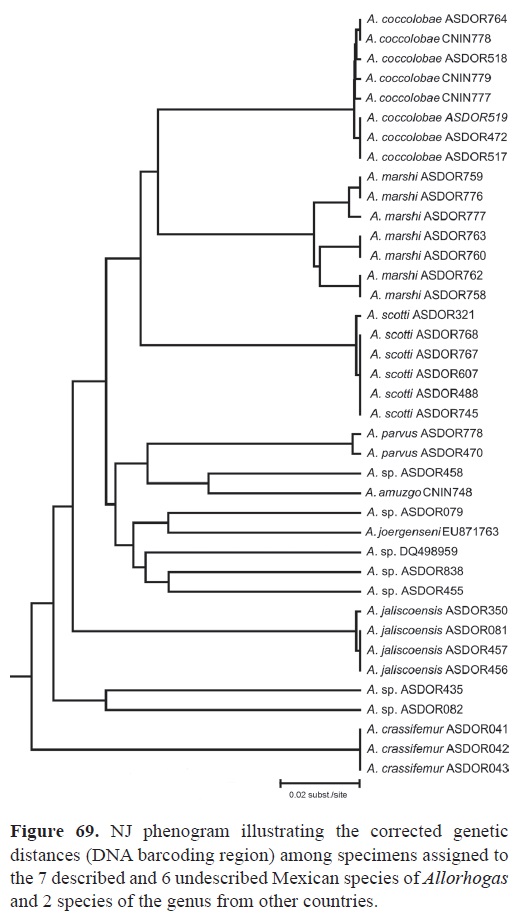
<body><![CDATA[<p align="justify"><font face="verdana" size="2">Photographs were taken and edited using a Leica&reg; Z16 APO&#45;A stereoscopic microscope, a Leica&reg; DFC295/ DFC290 HD camera, and the Leica Application Suite&reg; program. General morphological terminology follows Sharkey and Wharton (1997), except for the use of the term "precoxal sulcus", which replaces "sternaulus" according to Wharton (2006). Surface sculpture terminology follows Harris (1979), and wing veins are described according to Mason (1986). Abbreviations used in the descriptions are: POL (posterior ocellar line, the minimum distance between lateral ocelli), OD (ocellar diameter, the maximum diameter of lateral ocellus), OOL (ocular&#45;ocellar line, the distance between the compound eye and the lateral ocellus). The term "metasomal tergite" refers to the median metasomal tergites, no laterotergites are described since they bear no relevant features for the diagnoses. The areas of propodeum and first metasomal tergite used in the descriptions are indicated in <a href="/img/revistas/rmbiodiv/v84n1/a8f1.jpg" target="_blank">Figures 1, 2</a>.</font></p>  	    <p align="justify"><font face="verdana" size="2">We also characterized molecularly the species described in this work. For this, we generated DNA sequences of the barcoding region (658 bp of the cytochrome oxidase I mitochondrial gene; Hebert et al., 2003) for most of the type material belonging to our 7 described species, as well as for specimens of other 6 Mexican species of <i>Allorhogas</i> that were not described here since they were only represented by singletons. Most of the DNA extraction, amplification and DNA sequencing were carried out at the University of Guelph following the same laboratory protocols employed in Smith et al. (2009). DNA extraction and amplification of the barcoding region for the wasps reared from leaf galls (see below) were carried out at the Instituto de Biolog&iacute;a, UNAM, following the same protocols employed by Ceccarelli et al. (2012). Non&#45;purified PCR products of these samples were sent to the High&#45;Throughput Genomics Unit at the University of Washington (<a href="http://www.htseq.org/index.html" target="_blank">http://www.htseq.org/index.html</a>) for DNA sequencing. All sequences are deposited in GenBank (see below), and most of them are also deposited in the project file "Parasitoid wasps from the Chamela&#45;Cuixmala Biosphere Reserve" (ASDOR project), available in the projects section of the Barcode of Life Data System (<a href="http://www.boldsystem.org" target="_blank">www.boldsystem.org</a>).</font></p>  	    <p align="justify"><font face="verdana" size="2">Corrected genetic distances among the sequenced specimens and a neighbor joining (NJ) phenogram were obtained using the K2P distance model (Kimura, 1980) with MEGA version 5 (Tamura et al., 2011). We included in these analyses previously published COI sequences of 2 species of <i>Allorhogas</i> from Argentina <i>(A. joergenseni</i> Mart&iacute;nez and Zald&iacute;var&#45;River&oacute;n, 2008; GenBank accession number EU871763) and Costa Rica <i>(Allorhogas</i> sp. DQ498959).</font></p>  	    <p align="justify"><font face="verdana" size="2">&nbsp;</font></p>  	    <p align="justify"><font face="verdana" size="2"><b>Descriptions</b></font></p>  	    <p align="justify"><font face="verdana" size="2"><i>Allorhogas</i> Gahan</font></p>  	    <p align="justify"><font face="verdana" size="2"><i>Allorhogas</i> Gahan, 1912: 3 (type species: <i>A. gallicola</i> Gahan, 1912).</font></p>  	    <p align="justify"><font face="verdana" size="2"><i>Catolestes</i> Br&egrave;thes 1922: 136 (synoymized by Marsh, 1993; type species: <i>C. argentinus</i> Br&egrave;thes, 1922).</font></p>  	    <p align="justify"><font face="verdana" size="2"><i>Diagnosis.</i> Small sized doryctines (1&#45;4 mm), head distinctly to slightly transverse, frons excavated, usually with well defined lateral edges, vertex coriaceous, sometimes almost smooth, never striate; occipital carina present and complete, meeting hypostomal carina; pronotal collar very short, usually not visible in dorsal view; mesoscutum declivous anteriorly; notauli present, rarely obscured by sculpture, median lobe of mesoscutum ocassionally with a median longitudinal sulcus; propodeum with 2 basal semicircular or subtriangular areas, otherwise rugose areolate, rarely with more or less defined areola; hindcoxa with distinct basoventral tooth or tubercule; hindfemur in many cases sexually dimorphic, swollen in males; forewing with first submarginal cell closed by vein r&#45;m; first subdiscal cell open apically; m&#45;cu from slightly antefurcal, to instertitial or postfurcal, thus vein (2RS+M)b present or absent; hindwing with vein M+CU subequal to 1M or slightly shorter; cu&#45;a present but sometimes spectral; m&#45;cu straight or often slightly curved towards wing apex; males without a stigma&#45;like swelling on hindwing veins; metasoma not petiolate, basal sternal plate about one fourth the length of first metasomal tergite; first tergite generally with basal smooth area delimited by a transverse carina, often with dorsal median area defined by 2 longitudinal carinae; ovipositor from barely exerted to longer than metasoma.</font></p>  	    <p align="center"><font face="verdana" size="2"><img src="/img/revistas/rmbiodiv/v84n1/a8k1.jpg"></font></p>  	    ]]></body>
<body><![CDATA[<p align="justify"><font face="verdana" size="2"><b><i>Allorhogas amuzgo</i></b> sp. nov.</font></p>  	    <p align="justify"><font face="verdana" size="2">(<a href="/img/revistas/rmbiodiv/v84n1/a8f3.jpg" target="_blank">Figs. 3</a>&#45;<a href="/img/revistas/rmbiodiv/v84n1/a8f11.jpg" target="_blank">12</a>)</font></p>  	    <p align="justify"><font face="verdana" size="2"><i>Diagnosis.</i> Morphologically similar to <i>A. jaliscoensis</i> sp. nov., from which can be distinguished by its uniformly orange brown to honey yellow mesosoma and its longer ovipositor sheaths. It is also similar to the Costa Rican <i>A. ingavera</i> Marsh, 2002, but differs from it by the longer forewing vein r, which is 0.8 times as long as 3RSa (at most 0.3 times as long in <i>A. ingavera).</i></font></p>  	    <p align="justify"><font face="verdana" size="2"><i>Female.</i> Body size 2.4&#45;2.7 mm (<a href="/img/revistas/rmbiodiv/v84n1/a8f3.jpg" target="_blank">Fig. 3</a>), forewing 2.12.2 mm. <i>Head:</i> transverse in dorsal view, 1.8&#45;2.0 times wider than its median length, and 1.1&#45;1.3 times wider than high (<a href="/img/revistas/rmbiodiv/v84n1/a8f3.jpg" target="_blank">Fig. 4</a>); occipital carina complete and reaching hypostomal carina; POL as long as OD, 0.5 times OOL; frons, vertex, gena and face coriaceous, frons excavation distinct but narrow; eye 1.1&#45;1.2 times longer than wide; eye width 2.7&#45;3.0 times longer than temple in dorsal view (<a href="/img/revistas/rmbiodiv/v84n1/a8f3.jpg" target="_blank">Fig. 5</a>); malar space 0.2&#45;0.3 times eye height and 0.8&#45;0.9 times the width of hypoclypeal depression; mandibles 3&#45;dentate; antenna with 24&#45;25 antennomeres, first flagellar segment 3.8&#45;4.0 times longer than wide, 1.0&#45;1.1 times longer than second segment. <i>Mesosoma:</i> 1.6&#45;1.7 times longer tan high (<a href="/img/revistas/rmbiodiv/v84n1/a8f3.jpg" target="_blank">Fig. 6</a>) and 1.6&#45;1.7 times longer than wide; pronotal collar very short, not visible in dorsal view, pronotal furrow scrobiculate; mesoscutum distinctly transverse in dorsal view, its median length 0.8 times its width; notauli present and complete (<a href="/img/revistas/rmbiodiv/v84n1/a8f3.jpg" target="_blank">Fig. 7</a>); scutellum coriaceous, prescutellar sulcus with 5 carinae; propodeum with dorsal and apical faces subequal in length (<a href="/img/revistas/rmbiodiv/v84n1/a8f3.jpg" target="_blank">Fig. 7</a>), basolateral areas coriaceous and distinctly delimited by carinae, remaining areas rugose&#45;areolate, sometimes with a poorly defined areola (<a href="/img/revistas/rmbiodiv/v84n1/a8f3.jpg" target="_blank">Fig. 8</a>); precoxal sulcus coriaceous to weakly scrobiculate, 0.7 times as long as mesopleuron (<a href="/img/revistas/rmbiodiv/v84n1/a8f3.jpg" target="_blank">Fig. 7</a>). <i>Legs:</i> foretibia with a row of spines along anterior margin. Hindcoxa with distinct basoventral tooth. Hindfemur 3.2 times longer than wide (<a href="/img/revistas/rmbiodiv/v84n1/a8f3.jpg" target="_blank">Fig. 9</a>). <i>Wings:</i> forewing (<a href="/img/revistas/rmbiodiv/v84n1/a8f11.jpg" target="_blank">Fig. 11</a>) 2.6&#45;2.7 times longer than wide. Pterostigma 2.7&#45;2.9 times as long as wide and 0.6 times as long as R. Vein r 0.8&#45;1.0 times as long as 3RSa, 0.2&#45;0.3 times as long as 3RSb, and as long as r&#45;m. Vein 2RS meeting RS+M posterior to m&#45;cu, vein RS+Mb short but always distinguishable. Hindwing (<a href="/img/revistas/rmbiodiv/v84n1/a8f11.jpg" target="_blank">Fig. 12</a>) vein M+CU 0.8&#45;0.9 times as long as 1 M, m&#45;cu from slightly and evenly curved towards wing apex. <i>Metasoma:</i> first tergite 0.9&#45;1.1 times as long as its apical width, rugose&#45;striate over most of its dorsal surface, median dorsal area separated from dorsolateral areas by carinae; anterior area smooth and delimited by a transverse carina (<a href="/img/revistas/rmbiodiv/v84n1/a8f3.jpg" target="_blank">Fig. 8</a>). Second tergite striate, separated from third tergite by a distinct and slightly sinuate furrow. Third tergite striate basally, gradually turning coriaceous to apex. Remaining tergites coriaceous basally, turning smooth apically. Ovipositor sheaths about 1.4&#45;1.5 times as long as metasoma. <i>Color:</i> head, mesosoma and first metasomal terigte orange brown to honey yellow; remaining metasomal tergites and legs honey yellow, except telotarsi which are brown; antenna honey yellow basally, turning orange brown apically, ovipositor sheaths dark brown; wings hyaline, veins brown to light brown. <i>Male.</i> Similar to female, with hindfemur not distinctly swollen, 2.8 times longer than wide (<a href="/img/revistas/rmbiodiv/v84n1/a8f3.jpg" target="_blank">Fig. 10</a>).</font></p>  	    <p align="justify"><font face="verdana" size="2"><i>Taxonomic summary</i></font></p>  	    <p align="justify"><font face="verdana" size="2"><i>Biology.</i> Unknown.</font></p>  	    <p align="justify"><font face="verdana" size="2"><i>Etymology.</i> The specific epithet refers to the Amuzgo people, from the states of Oaxaca and Guerrero. <i>Material examined.</i> Holotype female: <b>Mexico:</b> Oaxaca, Base Cerro Huatulco, 15.85093N &#45;96.3646O, 238m, 20.vi.2010, red, Ceccarelli, De Jes&uacute;s col., selva mediana. <i>Paratypes:</i> 1 female, Oaxaca, P. Nac. Lag. de Chacahua, 16. 0154N &#45;97.7666O, 20m, 24.vi.2010, Ceccarelli, De Jes&uacute;s col., selva baja. (DNA voucher no. CNIN748; GenBank accession no. JX462512); 1 female, Oaxaca, Pinotepa Nacional, 16.33082N &#45;98.01401O, 58m, 25.vi.2010, red, Ceccarelli&#45;De Jes&uacute;s col., selva baja perturbada; 1 male, Guerrero, Tierra Blanca, 16.1526N&#45;98.32206W, 261m, 26.vi.2010, red, Ceccarelli, De Jes&uacute;s, selva baja.</font></p>  	    <p align="justify"><font face="verdana" size="2"><b><i>Allorhogas coccolobae</i></b> sp. nov.</font></p>  	    <p align="justify"><font face="verdana" size="2">(<a href="/img/revistas/rmbiodiv/v84n1/a8f13.jpg" target="_blank">Figs. 13</a>&#45;<a href="/img/revistas/rmbiodiv/v84n1/a8f21.jpg" target="_blank">22</a>)</font></p>  	    <p align="justify"><font face="verdana" size="2"><i>Diagnosis.</i> Morphologically similar to <i>A. scotti,</i> from which it differs by the coarser sculpture on the second and third metasomal tergites and the less striate first metasomal tergite. Following the key to <i>Allorhogas</i> species from Costa Rica (Marsh, 2002), it runs to <i>A. shawi,</i> Marsh 2002, but it differs from the latter by its longer second submarginal cell.</font></p>  	    ]]></body>
<body><![CDATA[<p align="justify"><font face="verdana" size="2"><i>Female.</i> Body size 1.8&#45;2.0 mm (<a href="/img/revistas/rmbiodiv/v84n1/a8f13.jpg" target="_blank">Fig. 13</a>), forewing 1.7&#45;1.8 mm. <i>Head:</i> distinctly transverse in dorsal view, 1.6&#45;1.7 times wider than its median length and 1.1&#45;1.2 times wider than high (<a href="/img/revistas/rmbiodiv/v84n1/a8f13.jpg" target="_blank">Fig. 14</a>); occipital carina complete and reaching hypostomal carina; POL 1.2&#45;1.3 times OD, 0.4 times OOL; frons, vertex, gena and face coriaceous, frons excavation shallow, without sharp edges; eye 1.1 times longer than wide; eye width 2.7&#45;3.0 times longer than temple in dorsal view (<a href="/img/revistas/rmbiodiv/v84n1/a8f13.jpg" target="_blank">Fig. 15</a>); malar space 0.3 times eye height (<a href="/img/revistas/rmbiodiv/v84n1/a8f13.jpg" target="_blank">Fig. 16</a>) and 0.9&#45;1.0 times the width of hypoclypeal depression; mandibles bidentate; antenna with 19&#45;20 antennomeres, first flagellar segment 5.0 times longer than wide and as long as second segment. <i>Mesosoma:</i> 1.5&#45;1.6 times longer tan high (<a href="/img/revistas/rmbiodiv/v84n1/a8f13.jpg" target="_blank">Fig. 17</a>) and 1.4&#45;1.5 times longer than wide; pronotal collar very short, not visible in dorsal view, pronotal furrow scrobiculate; mesoscutum transverse in dorsal view, its median length 0.7&#45;0.8 times its width; notauli present and complete (<a href="/img/revistas/rmbiodiv/v84n1/a8f13.jpg" target="_blank">Fig. 18</a>) meeting in a rugose striate median area; scutellum weakly coriaceous, prescutellar furrow with 3&#45;4 carinae; propodeum not distinctly angled in lateral view, its dorsal surface subequal to slightly longer than apical face; dorsolateral areas distinctly delimited by carinae and coriaceous; remaining areas irregularly carinated but delimiting a fairly distinguishable pentagonal areola; precoxal sulcus coriaceous to weakly scrobiculate, 0.5&#45;0.6 times as long as mesopleuron. <i>Legs:</i> foretibia with a row of spines along anterior margin. Hindcoxa with distinct basoventral tooth. Hindfemur 3.5&#45;3.7 times longer than wide (<a href="/img/revistas/rmbiodiv/v84n1/a8f13.jpg" target="_blank">Fig. 19</a>). <i>Wings:</i> forewing (<a href="/img/revistas/rmbiodiv/v84n1/a8f21.jpg" target="_blank">Fig. 21</a>) 2.8&#45;2.9 times longer than wide. Pterostigma 3.3 times as long as wide and 0.7&#45;0.8 times as long as R. Vein r 0.4&#45;0.5 times as long as 3RSa, 0.2 times as long as 3RSb, and 0.7 times as long as r&#45;m. Vein 2RS meeting RS+M anterio to m&#45;cu, sometimes almost interstitial, vein RS+Mb absent. Hindwing (<a href="/img/revistas/rmbiodiv/v84n1/a8f21.jpg" target="_blank">Fig. 22</a>) vein M + CU 0.6&#45;0.8 times as long as 1 M, m&#45;cu from almost straight to slightly and evenly curved towards wing apex. <i>Metasoma:</i> first tergite 0.9&#45;1.0 times as long as its apical width, median dorsal area coriaceous, delimited by a pair of dorsolateral carinae (<a href="/img/revistas/rmbiodiv/v84n1/a8f13.jpg" target="_blank">Fig. 18</a>), lateral areas largely coriaceous with a few longitudinal striations, anterior area not distinctly delimited by a transverse carina. Second tergite striate. Third tergite striate basally and smooth and polished apically. Remaining tergites smooth and polished. Ovipositor sheats about 0.5 times as long as metasoma. <i>Color:</i> head, mesosoma and metasoma light brown to honey yellow; sometimes propodeum, metapleuron and second and third metasomal tergites darker, brownish; antenna honey yellow, turning orange brown apically, ovipositor sheaths dark brown; coxae, trochaters, trochantelli and basoventral areas of femora pale, whitish, apico&#45;dorsal areas of femora, tibiae and tarsi pale brown; wings hyaline, veins and pterostigma brown, except veins M+CU and 1&#45;1A, which are lighter, and veins 3RSa, 3RSb, 3M, r&#45;m, and apical two thirds of 2M, which are entirely unpigmented.</font></p>  	    <p align="justify"><font face="verdana" size="2"><i>Male.</i> Similar to female, sometimes darker; with hindfemur not distinctly swollen, 3.1 times longer than wide (<a href="/img/revistas/rmbiodiv/v84n1/a8f13.jpg" target="_blank">Fig. 20</a>).</font></p>  	    <p align="justify"><font face="verdana" size="2"><i>Taxonomic summmary</i></font></p>  	    <p align="justify"><font face="verdana" size="2"><i>Biology.</i> We collected leaves of a tree belonging to <i>Coccoloba barbadensis</i> Jacq. (<a href="/img/revistas/rmbiodiv/v84n1/a8f21.jpg" target="_blank">Fig. 23</a>), each one infested with several galls, on May 5, 2011. These galls consist of a conical abnormal growth that projects from the adaxial surface of the leave (<a href="/img/revistas/rmbiodiv/v84n1/a8f21.jpg" target="_blank">Fig. 24</a>), whereas on the abaxial surface they are blunt (<a href="/img/revistas/rmbiodiv/v84n1/a8f21.jpg" target="_blank">Fig. 25</a>). Approximately 1&#45;2 weeks after collecting these leaves, a large number of individuals of an unidentified species of Cecidomyiidae (Diptera) came out from the abaxial surface of these galls, leaving their characteristic exuviae attached outside their emergence hole. Two&#45;three weeks after this, around 25 specimens assigned to <i>A. coccolobae</i> emerged from the galls together with specimens of at least 5 different species belonging to other parasitoid wasp families (Eulophidae, Torymidae Eurytomidae). This suggests that the gall midge species is the one that induces these galls. We also observed at least 2 other kind of galls in leaves collected during different times of the year, but rearing was not successful.</font></p>  	    <p align="justify"><font face="verdana" size="2"><i>Etymology.</i> The specific epithet refers to the known biology of this species, associated with galls on <i>Coccoloba.</i></font></p>     <p align="justify"><font face="verdana" size="2"><i>Material examined.</i> Holotype female: <b>Mexico:</b> Jalisco, Chamela Biostation, 19.49590N&#45;105.04202O, 113m, 5.v.2011, tropical dry forest, Zaldivar, Zaragoza, Ibarra colls. (DNA voucher no. CNIN777; GenBank accession no. JX462509 ). <i>Paratypes:</i> 10 females and 7 males, same data as holotype (2 females with DNA voucher nos CNIN778, 779; GenBank accession nos JX462510&#45;11); 1 male, Jalisco, Chamela Biostation, camino Calandria, 19.4950485N&#45;105.043786W, 45m, 28.iii.2010, sweep, selva baja&#45;mediana, Zaldivar, Salinas&#45;Ramos colls. (DNA voucher no. BOLD&#45;ASDOR764; GenBank accession number HQ200974); 3 females, Jalisco, Chamela Biostation, camino Chachalaca, 19.4997N&#45;105.03851W, 51m, 21.ii.2010, sweep, tropical dry forest, Zaldivar coll. (DNA voucher nos BOLD&#45;ASDOR 517&#45;19; GenBank accession nos HQ200980&#45;82); 1 female, Jalisco, Estaci&oacute;n Chamela, camino Buho&#45;Chachalaca 19.49913N/19.49786N&#45;105.04217W/105.0444W, 68&#45;106m, 20.ii.2010, sweep, tropical dry forest, Zaldivar, Zaragoza, Ibarra colls. (DNA voucher no. BOLD&#45;ASDOR472; GenBank accession no. HQ200961).</font></p>  	    <p align="justify"><font face="verdana" size="2"><b><i>Allorhogas crassifemur</i></b> sp. nov.</font></p>  	    <p align="justify"><font face="verdana" size="2">(<a href="/img/revistas/rmbiodiv/v84n1/a8f26.jpg" target="_blank">Figs. 26</a>&#45;<a href="/img/revistas/rmbiodiv/v84n1/a8f34.jpg" target="_blank">35</a>)</font></p>  	    <p align="justify"><font face="verdana" size="2"><i>Diagnosis.</i> Easily distinguished from all other species of the genus with vein 2RS meeting RS+M anterior to m&#45;cu</font></p>  	    <p align="justify"><font face="verdana" size="2">by the distinctly long first flagellomere, short ovipositor sheaths and convergent striations on apical area of first metasomal tergite.</font></p>  	    ]]></body>
<body><![CDATA[<p align="justify"><font face="verdana" size="2"><i>Female.</i> Body size 2.8&#45;2.9 mm (<a href="/img/revistas/rmbiodiv/v84n1/a8f26.jpg" target="_blank">Fig. 26</a>), forewing 2.22.3 mm. <i>Head:</i> transverse in dorsal view, 1.7&#45;1.8 times wider than its median length, and 1.1 times wider than high (<a href="/img/revistas/rmbiodiv/v84n1/a8f26.jpg" target="_blank">Fig. 27</a>); occipital carina complete and reaching hypostomal carina; POL 1.8&#45;2.0 times OD, 0.8 times OOL (<a href="/img/revistas/rmbiodiv/v84n1/a8f26.jpg" target="_blank">Fig. 28</a>); frons, vertex, gena and face coriaceous, frons excavation distinct and narrow, defined by sharp edges; eye 1.8&#45;1.9 times longer than wide; eye width 1.5&#45;1.6 times longer than temple in dorsal view; malar space 0.3 times eye height and 0.8&#45;0.9 times the width of hypoclypeal depression; mandibles bidentate; antenna with 27&#45;28 antennomeres, first flagellar segment very long 6.0&#45;6.5 times longer than wide, 1.4 times longer than second segment (<a href="/img/revistas/rmbiodiv/v84n1/a8f26.jpg" target="_blank">Fig. 29</a>). <i>Mesosoma:</i> 1.7 times longer tan high (<a href="/img/revistas/rmbiodiv/v84n1/a8f26.jpg" target="_blank">Fig. 29</a>) and 1.7&#45;1.8 times longer than wide; pronotal collar very short, not visible in dorsal view, pronotal furrow scrobiculate; mesoscutum transverse in dorsal view, its median length 0.7&#45;0.8 times its width; notauli present and complete (<a href="/img/revistas/rmbiodiv/v84n1/a8f26.jpg" target="_blank">Fig. 30</a>), obscured in a posterior rugose median area, scutellum weakly coriaceous, prescutellar furrow with 4&#45;5 carinae; propodeum evenly rounded in lateral view (<a href="/img/revistas/rmbiodiv/v84n1/a8f26.jpg" target="_blank">Fig. 29</a>), dorsal and apical faces not easily distinguishable, dorsolateral areas distinctly delimited by carinae, remaining areas of propodeum coarsely rugose&#45;areolate (<a href="/img/revistas/rmbiodiv/v84n1/a8f26.jpg" target="_blank">Figs. 29, 30, 31</a>); precoxal sulcus coriaceous, 0.6&#45;08 times as long as mesopleuron. <i>Legs:</i> foretibia with a row of spines along anterior margin. Hindcoxa with distinct basoventral tooth. Hindfemur 2.6 times longer than wide (<a href="/img/revistas/rmbiodiv/v84n1/a8f26.jpg" target="_blank">Fig. 32</a>). <i>Wings:</i> forewing (<a href="/img/revistas/rmbiodiv/v84n1/a8f34.jpg" target="_blank">Fig. 34</a>) 2.8&#45;2.9 times longer than wide. Pterostigma 2.7 times longer than wide and 0.8 times as long as R. Vein r 0.5&#45;0.6 times as long as 3RSa, 0.2&#45;0.3 times as long as 3RSb, and 0.7&#45;0.8 times as long as r&#45;m. Vein 2RS meeting RS+M distinctly anterior to m&#45;cu, thus vein RS+Mb absent. Hindwing (<a href="/img/revistas/rmbiodiv/v84n1/a8f34.jpg" target="_blank">Fig. 35</a>) Vein M + CU 0.6&#45;0.7 times as long as 1 M, m&#45;cu usually straight, directed to wing apex. <i>Metasoma:</i> first tergite 0.9&#45;1.0 times as long as apically wide, striate over most of its dorsal surface, anterior area delimited by a V&#45;shaped transverse carina, dorsal surface, entirely striate, striation convergent apically (<a href="/img/revistas/rmbiodiv/v84n1/a8f26.jpg" target="_blank">Fig. 31</a>). Second tergite striate. Third tergite striate basally and smooth and polished apically. Remaining tergites, weakly sculptured, coriaceous basally and smooth apically. Ovipositor sheats about 0.3&#45;0.4 times as long as metasoma. <i>Color:</i> most of body dark brown; except lower face, genae, clypeous, mouth parts and lower area of mesopleuron which are lighter, basal antennomeres honey yellow to light brown, legs honey yellow; wings hyaline, veins brown.</font></p>  	    <p align="justify"><font face="verdana" size="2"><i>Male.</i> Similar to female, with the hindfemur distinctly swollen and much darker, 1.8 times longer than wide</font></p>  	    <p align="justify"><font face="verdana" size="2">(<a href="/img/revistas/rmbiodiv/v84n1/a8f26.jpg" target="_blank">Fig. 33</a>).</font></p>  	    <p align="justify"><font face="verdana" size="2"><i>Taxonomic summary</i></font></p>  	    <p align="justify"><font face="verdana" size="2"><i>Biology.</i> Unknown.</font></p>  	    <p align="justify"><font face="verdana" size="2"><i>Etymology.</i> The specific epithet derives from the Latin words <i>crassus</i> (thick, fat) and <i>femur,</i> in reference to the distinctly swollen hindfemur of the males of this species. <i>Material examined.</i> Holotype female: <b>Mexico:</b> Jalisco, Estaci&oacute;n Chamela, cerca del laboratorio, 19.49814N &#45;105.0444O, 95m, 23&#45;24.vi.2009, trampa de luz, selva baja caducifolia, Cham006A, Clebsch&#45;Zaldivar&#45;Polaszek col. (DNA voucher no. BOLD&#45;ASDOR043; GenBank accession no. JF912208). <i>Paratypes:</i> 1 female, same data as holotype; 1 male, same data as holotype except date, 24&#45;25.vi.2009 (DNA voucher no. BOLD&#45;ASDOR042; GenBank accession no. JF912207).</font></p>  	    <p align="justify"><font face="verdana" size="2"><b><i>Allorhogas jaliscoensis</i></b> sp. nov.</font></p>  	    <p align="justify"><font face="verdana" size="2">(<a href="/img/revistas/rmbiodiv/v84n1/a8f36.jpg" target="_blank">Figs. 36</a>&#45;<a href="/img/revistas/rmbiodiv/v84n1/a8f42.jpg" target="_blank">43</a>)</font></p>  	    <p align="justify"><font face="verdana" size="2"><i>Diagnosis.</i> Morphologically similar to <i>A. amuzgo,</i> from which it differs by the dark markings on mesoscutum and shorter ovipositor sheaths, which are about 1.1 times longer than metasoma.</font></p>  	    <p align="justify"><font face="verdana" size="2"><i>Female.</i> Body size 1.9&#45;2.0 mm (<a href="/img/revistas/rmbiodiv/v84n1/a8f36.jpg" target="_blank">Fig. 36</a>), forewing 1.8 mm. <i>Head:</i> transverse in dorsal view, 1.7&#45;1.9 times wider than its median length, and 1.3&#45;1.4 times wider than high (<a href="/img/revistas/rmbiodiv/v84n1/a8f36.jpg" target="_blank">Fig. 37</a>); occipital carina complete and reaching hypostomal carina; POL 1.3&#45;1.5 times OD, 0.6&#45;0.8 times OOL (<a href="/img/revistas/rmbiodiv/v84n1/a8f36.jpg" target="_blank">Fig. 38</a>); frons, vertex, gena and face coriaceous, frons excavation shallow; eye 1.1 times longer than wide; eye width about 3 times longer than temple in dorsal view; malar space 0.3 times eye height (<a href="/img/revistas/rmbiodiv/v84n1/a8f36.jpg" target="_blank">Fig. 37</a>) and as long as width of hypoclypeal depression; mandibles bidentate; antenna with 22&#45;23 antennomeres, first flagellar segment 4.2&#45;4.6 times longer than wide, 1.1 times longer than second segment. <i>Mesosoma:</i> about 1.4 times longer tan high (<a href="/img/revistas/rmbiodiv/v84n1/a8f36.jpg" target="_blank">Fig. 39</a>) and 1.4&#45;1.6 times longer than wide; pronotal collar very short, not visible in dorsal view, pronotal furrow scrobiculate; mesoscutum distinctly transverse in dorsal view, its median length 0.60.8 times its width; notauli present and complete (<a href="/img/revistas/rmbiodiv/v84n1/a8f36.jpg" target="_blank">Fig. 40</a>), obscured in a striate&#45;rugose median area; scutellum coriaceous, prescutellar furrow with 3 transeverse carinae; propodeum with dorsal and apical faces subequal in length, basal areas rugose&#45;areolate and distinctly delimited by carinae, remaining areas rugose&#45;areolate (<a href="/img/revistas/rmbiodiv/v84n1/a8f36.jpg" target="_blank">Figs. 40, 41</a>); precoxal sulcus weakly scrobiculate, 0.50.6 times as long as mesopleuron. <i>Legs:</i> foretibia with a row of spines along anterior margin. Hindcoxa with distinct basoventral tooth. Hindfemur 3 times longer than wide. <i>Wings:</i> forewing (<a href="/img/revistas/rmbiodiv/v84n1/a8f42.jpg" target="_blank">Fig. 42</a>) 3.5 times longer than wide. Pterostigma 2.7 times as long as wide and 0.8 times as long as R. Vein r 0.8&#45;0.9 times as long as 3RSa, 0.20.3 times as long as 3RSb, and 1.1&#45;1.2 times as long as r&#45;m. Vein 2RS meeting RS+M slightly anterior to m&#45;cu to almost interstitial, vein RS+Mb not distinguishable. Hindwing (<a href="/img/revistas/rmbiodiv/v84n1/a8f42.jpg" target="_blank">Fig. 43</a>) vein M + CU 0.8&#45;0.9 times as long as 1 M, m&#45;cu slightly and evenly curved towards wing apex. <i>Metasoma:</i> first tergite distinctly wider than long, 0.8 times as long as its apical width, irregularly striate over most of its dorsal surface, anterior area smooth and delimited by a transverse carina, mediodorsal area trapezoidal, about twice longer than wide, defined by a pair of dorsolateral carinae (<a href="/img/revistas/rmbiodiv/v84n1/a8f36.jpg" target="_blank">Fig. 39</a>). Second tergite striate. Third tergite striate basally gradually turning coriaceous apically. Remaining tergites, largely coriaceous, apical tergites smooth apically. Ovipositor sheats about 1.1&#45;1.2 times longer than metasoma. <i>Color:</i> most of mesosoma and second and third metasomal tergites brown, most of mesoscutum except rugose median area, upper areas of mesopleuron darker; head, most of metasomal tergites and legs light brown to honey yellow; antenna honey yellow basally turning brown apically; ovipositor sheaths brown; wings hyaline, veins brown.</font></p>  	    ]]></body>
<body><![CDATA[<p align="justify"><font face="verdana" size="2"><i>Male.</i> Unknown.</font></p>  	    <p align="justify"><font face="verdana" size="2"><i>Taxonomic summary</i></font></p>  	    <p align="justify"><font face="verdana" size="2"><i>Biology.</i> Unknown.</font></p>  	    <p align="justify"><font face="verdana" size="2"><i>Etymology.</i> The specific epithet of this species refers to the type locality in Jalisco, Mexico.</font></p>  	    <p align="justify"><font face="verdana" size="2"><i>Material examined.</i> Holotype female: <b>Mexico:</b> Jalisco, Estaci&oacute;n Chamela, camino Ardilla, 20&#45;XI&#45;2009, red de barrido, selva baja caducifolia, Cham032, Zaldivar col. (DNA voucher no. BOLD&#45;ASDOR457; GenBank accession no. HQ200993). <i>Paratypes: 1</i> female, same data as holotype (DNA voucher no. BOLD&#45;ASDOR456; GenBank accession no. HM434542); 1 female, Jalisco, Estaci&oacute;n Chamela, cerca del laboratorio, 19.49814N&#45;105.0444W, 95m, 23&#45;24&#45;VI&#45;2009, Trampa de luz, Selva baja caducifolia, Cham006A, Clebsch, Zaldivar, Polaszek coll. (DNA voucher no. BOLD&#45; ASDOR081; GenBank accession no. HM434331); 1 female, Jalisco, Estaci&oacute;n Chamela, camino Calandria, 19.50496N&#45;105.0377, 52 m, 3&#45;IX&#45;2009, red barrido, selva baja&#45;mediana, Cham&#45;0018, Clebsch, Zaldivar coll. (DNA voucher no. BOLD&#45;ASDOR350; GenBank accession no. HM434506).</font></p>  	    <p align="justify"><font face="verdana" size="2"><b><i>Allorhogas marshi</i></b> sp. nov.</font></p>  	    <p align="justify"><font face="verdana" size="2">(<a href="/img/revistas/rmbiodiv/v84n1/a8f44.jpg" target="_blank">Figs. 44</a>&#45;<a href="/img/revistas/rmbiodiv/v84n1/a8f51.jpg" target="_blank">52</a>)</font></p>  	    <p align="justify"><font face="verdana" size="2"><i>Diagnosis.</i> Among the Mexican species, similar to <i>A. scotti</i> sp. nov., from which it differs by the color pattern of metasomal terga and the coarser sculpture on second and third metasomal tergites. Following the key to Costa Rican species (Marsh 2002), this species runs to <i>A. shawi</i> Marsh, from which it can be distinguished by its relatively longer second submarginal cell and by its apical metasomal tergites contrastingly lighter.</font></p>  	    <p align="justify"><font face="verdana" size="2"><i>Female.</i> Body size 2.2&#45;2.6 mm (<a href="/img/revistas/rmbiodiv/v84n1/a8f44.jpg" target="_blank">Fig. 44</a>), forewing 1.8&#45;2.2 mm. <i>Head:</i> transverse in dorsal view, 1.9 times wider than its median length, and 1.2&#45;1.3 times wider than high (<a href="/img/revistas/rmbiodiv/v84n1/a8f44.jpg" target="_blank">Fig. 45</a>); occipital carina complete and reaching hypostomal carina; POL 1.3 times OD, 0.5&#45;0.6 times OOL (<a href="/img/revistas/rmbiodiv/v84n1/a8f44.jpg" target="_blank">Fig. 46</a>); frons, vertex, gena and face coriaceous, frons excavation shallow, its edges not acute; eye 1.2 times longer than wide (<a href="/img/revistas/rmbiodiv/v84n1/a8f44.jpg" target="_blank">Fig. 47</a>); eye width 2.5&#45;2.8 times longer than temple in dorsal view; malar space 0.3 times eye height and 0.9&#45;1.0 times the width of hypoclypeal depression; mandibles bidentate; antenna with 24&#45;25 antennomeres, first flagellar segment 4.3&#45;4.5 times longer than wide, 1.1&#45;1.2 times longer than second segment. <i>Mesosoma:</i> 1.8&#45;1.9 times longer tan high (<a href="/img/revistas/rmbiodiv/v84n1/a8f44.jpg" target="_blank">Fig. 48</a>) and 1.7&#45;1.9 times longer than wide; pronotal collar very short, not visible in dorsal view, pronotal furrow scrobiculate; mesoscutum transverse in dorsal view, its median length 0.8 times its width; notauli present and complete (<a href="/img/revistas/rmbiodiv/v84n1/a8f44.jpg" target="_blank">Fig. 49</a>); scutellum coriaceous,prescutellar furrow with 3 transverse carinae; propodeum with dorsal and apical faces subequal, basal areas coriaceous, delimited by carinae, remaining areas rugose areolate; precoxal sulcus coriaceous to weakly scrobiculate, 0.6 times as long as mesopleuron. <i>Wings:</i> forewing (<a href="/img/revistas/rmbiodiv/v84n1/a8f51.jpg" target="_blank">Fig. 51</a>) 2.9&#45;3.1 times longer than wide. Pterostigma 2.9&#45;3.2 times longer than wide and 0.6&#45;0.7 times as long as R. Vein r 0.4&#45;0.5 times as long as 3RSa, 0.2 times as long as 3RSb, and 1.1 times as long as r&#45;m. Vein 2RS meeting RS+M slightly anterior to m&#45;cu, almost interstitial, vein RS+Mb not distinguishable. Hindwing (<a href="/img/revistas/rmbiodiv/v84n1/a8f51.jpg" target="_blank">Fig. 52</a>) vein M + CU 1.5&#45;1.7 times as long as 1 M, m&#45;cu stright. <i>Legs:</i> foretibia with a row of spines along anterior margin. Hindcoxa with distinct basoventral tooth. Hindfemur about 3 times longer than wide. <i>Metasoma:</i> first tergite 1.3&#45;1.4 times longer than wide, striate with coriaceous microscultpure over most of its dorsal surface, anterior area smooth and delimited by a transverse carina, mediodorsal area long and narrow, delimited by a pair of dorsolateral carinae (<a href="/img/revistas/rmbiodiv/v84n1/a8f44.jpg" target="_blank">Fig. 50</a>). Second tergite striate with coriaceous microsculpture. Third tergite striate basally and smooth and polished apically. Remaining tergites entirely smooth and polished. Ovipositor sheaths about 0.8 times as long as metasoma. <i>Color:</i> mesosoma and first 4 metasomal terigtes dark brown, metanotum, propodeum and first metasomal tergite lighter; remaining visible metasomal tergites and legs contrastingly pale yellowish; head honey yellow; antenna honey yellow basally, turning brown apically, ovipositor sheaths dark brown; wings hyaline, veins brown.</font></p>  	    <p align="justify"><font face="verdana" size="2"><i>Male. Unknown.</i></font></p>  	    ]]></body>
<body><![CDATA[<p align="justify"><font face="verdana" size="2"><i>Taxonomic summary</i></font></p>  	    <p align="justify"><font face="verdana" size="2"><i>Biology.</i> Unknown.</font></p>  	    <p align="justify"><font face="verdana" size="2"><i>Etymology.</i> This species is named after Paul M. Marsh, for his valuable contribution to the knowledge of the doryctine wasps from the New World. <i>Material examined.</i> Holotype female: <b>Mexico:</b> Jalisco, Estaci&oacute;n Chamela, camino Buho&#45;Chachalaca, 19.49913N/19.49786N&#45;105.04217W/105.0444, 68&#45;106 m, 25&#45;ii&#45;2010, red barrido, selva baja caducifolia, Cham54, Zaldivar coll. (DNA voucher no. BOLD&#45;ASDOR777; GenBank accession no. HQ200969). <i>Paratypes:</i> 4 females same data as holotype (DNA voucher no. BOLD&#45;ASDOR758, 759, 760, 776; GenBank accession nos HQ200978; HQ200984&#45;5); 2 females, Estaci&oacute;n Chamela, camino Zarco&#45;Chachalaca, 19.49566N&#45;105.03931W, 30 m, 28&#45;iii&#45;2010, red barrido, selva baja&#45;mediana, Cham&#45;58, Zaldivar&#45;Salinas&#45;Ramos coll. (DNA voucher no. BOLD&#45;ASDOR762, 763; GenBank accession nos HQ200975&#45;6).</font></p>  	    <p align="justify"><font face="verdana" size="2"><b><i>Allorhogas parvus</i></b> sp. nov.</font></p>  	    <p align="justify"><font face="verdana" size="2">(<a href="/img/revistas/rmbiodiv/v84n1/a8f53.jpg" target="_blank">Figs. 53</a>&#45;<a href="/img/revistas/rmbiodiv/v84n1/a8f59.jpg" target="_blank">60</a>)</font></p>  	    <p align="justify"><font face="verdana" size="2"><i>Diagnosis.</i> The small body size, distinctly compact mesosoma and an almost entirely vertical or oblique propodeum relates this species with <i>A. minimus</i> Centrella and Shaw, 2010, from Costa Rica, and <i>A. argentinus</i> (Br&egrave;thes, 1922), from Argentina; however, it can be distinguished from the latter 2 species by its distinct honey yellow body color.</font></p>  	    <p align="justify"><font face="verdana" size="2"><i>Female.</i> Body size 1.6&#45;1.7 mm (<a href="/img/revistas/rmbiodiv/v84n1/a8f53.jpg" target="_blank">Fig. 53</a>), forewing 1.6 mm. <i>Head:</i> distinctly transverse in dorsal view, 2.3&#45;2.4 times wider than its median length, and 1.1&#45;1.2 times wider than high (<a href="/img/revistas/rmbiodiv/v84n1/a8f53.jpg" target="_blank">Fig. 54</a>); occipital carina complete and reaching hypostomal carina; POL 1.5&#45;2.0 times OD, 0.50.6 times OOL (<a href="/img/revistas/rmbiodiv/v84n1/a8f53.jpg" target="_blank">Fig. 55</a>); frons, vertex, gena and face coriaceous, frons excavation narrow indicated by slightly acute edges; eye 1.2&#45;1.4 times longer than wide; eye width 2.0&#45;2.2 times longer than temple in dorsal view; malar space 0.4 times eye height (<a href="/img/revistas/rmbiodiv/v84n1/a8f53.jpg" target="_blank">Fig. 54</a>) and 1.2 times the width of hypoclypeal depression; mandibles bidentate; antenna with 19 antennomeres, first flagellar segment 4.2 times longer than wide, 1.1 times longer than second segment. <i>Mesosoma:</i> short and compact, 1.3&#45;1.4 times longer than high (<a href="/img/revistas/rmbiodiv/v84n1/a8f53.jpg" target="_blank">Fig. 56</a>) and 1.3&#45;1.4 times longer than wide; pronotal collar very short, not visible in dorsal view, pronotal furrow smooth, not scrobiculate; mesoscutum distinctly transverse in dorsal view, its median length 0.50.6 times its width; notauli present and complete (<a href="/img/revistas/rmbiodiv/v84n1/a8f53.jpg" target="_blank">Fig. 57</a>); scutellum weakly scrobiculate, prescutellar furrow with 3&#45;4 transverse carinae; propodeum almost entirely vertical or oblique, its dorsal surface very short (<a href="/img/revistas/rmbiodiv/v84n1/a8f53.jpg" target="_blank">Fig. 57</a>), basal areas coriaceous, small and semicircular, remaining areas rugose&#45;areolate; precoxal sulcus coriaceous, 0.6 times as long as mesopleuron. <i>Wings:</i> forewing (<a href="/img/revistas/rmbiodiv/v84n1/a8f59.jpg" target="_blank">Fig. 59</a>) 2.3&#45;2.4 times longer than wide. Pterostigma 2.7&#45;3.0 times as long as wide and 0.8 times as long as R. Vein r 0.8 times as long as 3RSa, 0.2 times as long as 3RSb, and 0.91.0 times as long as r&#45;m. Vein 2RS almost directly in line with m&#45;cu, vein RS+Mb not distinguishable. Hindwing (<a href="/img/revistas/rmbiodiv/v84n1/a8f59.jpg" target="_blank">Fig. 60</a>) vein M + CU as long as 1 M, m&#45;cu slightly curved towards wing apex. <i>Legs:</i> foretibia with a row of spines along anterior margin. Hindcoxa with distinct basoventral tooth. Hindfemur 3.3 times longer than wide. <i>Metasoma:</i> first tergite wider than long, 0.7&#45;0.8 times as long as its apical width, striate with coriaceous rugulose microsculpture over most of its dorsal surface, anterior area smooth and delimited by a transverse carina (<a href="/img/revistas/rmbiodiv/v84n1/a8f53.jpg" target="_blank">Fig. 58</a>). Second tergite striate with coriaceous microsculpture. Third tergite striate basally gradually turning coriaceous and smooth apically. Remaining tergites smooth. Ovipositor sheaths 0.9&#45;1.1 times as long as metasoma. <i>Color:</i> almost uniformly honey yellow, with head and legs slightly lighter, antenna and ovipositor sheaths darker apically; wings hyaline, veins brown.</font></p>  	    <p align="justify"><font face="verdana" size="2"><i>Male.</i> Unknown.</font></p>  	    <p align="justify"><font face="verdana" size="2"><i>Taxonomic summary Biology.</i> Unknown.</font></p>  	    <p align="justify"><font face="verdana" size="2"><i>Etymology.</i> The specific epithet derives from the Latin word <i>parvus</i> (small) in reference to the small body size of this species.</font></p>  	    ]]></body>
<body><![CDATA[<p align="justify"><font face="verdana" size="2"><i>Material examined.</i> Holotype female: <b>Mexico:</b> Jalisco, Estaci&oacute;n Chamela, camino B&uacute;ho&#45;Chachalaca, 19.49913N/19.49786N &#45;105.0421O/105.0444O, 106m, 25.ii.2010, red de barrido, selva baja caducifolia, Cham 54, Zaldivar col., DNA voucher no. BOLD&#45;ASDOR 778, GenBank accession no. HQ200968. <i>Paratypes:</i> 1 female, same data as holotype except date: 20.ii.2010, DNA voucher no. BOLD&#45;ASDOR 470, GenBank accession no. HQ200963; 1 female, Jalisco, Estaci&oacute;n Chamela, camino Chachalaca, 19.49934N &#45;105.03833O, 56m, 1&#45;21. xi.2009, trampa malaise, selva baja caducifolia, Cham 028, Zaldivar col. DNA voucher number no. BOLD&#45;ASDOR 458; GenBank accession no. HQ200994.</font></p>  	    <p align="justify"><font face="verdana" size="2"><b><i>Allorhogas scotti</i></b> sp. nov.</font></p>  	    <p align="justify"><font face="verdana" size="2">(<a href="/img/revistas/rmbiodiv/v84n1/a8f61.jpg" target="_blank">Figs. 61</a>&#45;<a href="/img/revistas/rmbiodiv/v84n1/a8f67.jpg" target="_blank">68</a>)</font></p>  	    <p align="justify"><font face="verdana" size="2"><i>Diagnosis.</i> Morphologically similar to <i>A. coccolobae,</i> from which it can be distinguished by its fine striations on second metasomal tergite and an almost smooth third metasomal tergite, with a few striations basally.</font></p>  	    <p align="justify"><font face="verdana" size="2"><i>Female.</i> Body size 2.0&#45;2.2 mm (<a href="/img/revistas/rmbiodiv/v84n1/a8f61.jpg" target="_blank">Fig. 61</a>), forewing 1.92.0 mm. <i>Head:</i> transverse in dorsal view, 1.5&#45;1.7 times wider than its median length, and 1.3&#45;1.4 times wider than high (<a href="/img/revistas/rmbiodiv/v84n1/a8f61.jpg" target="_blank">Fig. 62</a>); occipital carina complete and reaching hypostomal carina; POL 1.7&#45;1.8 times OD, 0.5 times OOL (<a href="/img/revistas/rmbiodiv/v84n1/a8f61.jpg" target="_blank">Fig. 63</a>); frons, vertex, gena and face coriaceous, frons excavation shallow without sharp edges; eye 1.1 times longer than wide; eye width 2.5&#45;2.6 times longer than temple in dorsal view; malar space 0.3&#45;0.4 times eye height and 0.9&#45;1.0 times the width of hypoclypeal depression; mandibles bidentate; antenna with 21&#45;22 antennomeres, first flagellar segment 5.0&#45;5.4 times longer than wide, 1.0&#45;1.1 times longer than second segment. <i>Mesosoma:</i> 1.6&#45;2.0 times longer tan high (<a href="/img/revistas/rmbiodiv/v84n1/a8f61.jpg" target="_blank">Fig. 64</a>) and 1.7&#45;2.0 times longer than wide; pronotal collar very short, not visible in dorsal view, pronotal furrow scrobiculate; mesoscutum slightly transverse in dorsal view, its median length 0.7&#45;0.9 times its width; notauli present and complete, obscured in a striate median area (<a href="/img/revistas/rmbiodiv/v84n1/a8f61.jpg" target="_blank">Fig. 65</a>); scutellum coriaceous, prescutellar furrow with 4&#45;5 transverse carinae; propodeum with dorsal face slightly longer than apical face (<a href="/img/revistas/rmbiodiv/v84n1/a8f61.jpg" target="_blank">Fig. 64</a>), basal areas coriaceous; irregularly carinated, with a more or less defined pentagonal areola; precoxal sulcus weakly scrobiculate, 0.5&#45;0.6 times as long as mesopleuron. <i>Wings:</i> forewing (<a href="/img/revistas/rmbiodiv/v84n1/a8f67.jpg" target="_blank">Fig. 67</a>) 3.3&#45;3.4 times longer than wide. Pterostigma 3.13.4 times longer than wide and 0.7&#45;0.8 times as long as R. Vein r 0.4 times as long as 3RSa, 0.2 times as long as 3RSb, and 0.8 times as long as r&#45;m. Vein 2RS meeting RS+M anterior to m&#45;cu, sometimes almost interstitial, vein RS+Mb not distinguishable. Hindwing (<a href="/img/revistas/rmbiodiv/v84n1/a8f67.jpg" target="_blank">Fig. 68</a>) vein M + CU 0.7 times as long as 1 M, m&#45;cu from slightly curved towards wing apex. <i>Legs:</i> Foretibia with a row of spines along anterior margin. Hindcoxa with distinct basoventral tooth. Hindfemur 3.2 times longer than wide. <i>Metasoma:</i> first tergite distinctly wider than long, 1.31.4 times longer than apically wide, striate over most of its dorsal surface, anterior area smooth and delimited by a transverse carina, mediodorsal area long and narrow, delimited by a pair of dorsolateral carinae (<a href="/img/revistas/rmbiodiv/v84n1/a8f61.jpg" target="_blank">Fig. 66</a>). Second tergite finely striate. Third tergite with a few weak strations basally, otherwise smooth (<a href="/img/revistas/rmbiodiv/v84n1/a8f61.jpg" target="_blank">Fig. 66</a>). Remaining tergites, smooth and polished. Ovipositor sheaths 0.8&#45;0.9 times as long as metasoma. <i>Color:</i> mostly light brown to honey yellow, with some dark irregular areas on lower metapleuron and second and third metasomal tergites; coxae, trohanters and trochantelli pale, whitish; femora, tibiae and tarsi light yellow; wings hyaline, veins brown. <i>Male.</i> Essentially as in female, with hindfemur not distinctly swollen.</font></p>  	    <p align="justify"><font face="verdana" size="2"><i>Taxonomic summary</i></font></p>  	    <p align="justify"><font face="verdana" size="2"><i>Biology.</i> Unknown.</font></p>  	    <p align="justify"><font face="verdana" size="2"><i>Etymology.</i> This species is named after our dear colleague Scott Shaw.</font></p>  	    <p align="justify"><font face="verdana" size="2"><i>Material examined.</i> Holotype female: <b>Mexico:</b> Jalisco, Chamela Biostation, camino Calandria, 19.4950485N&#45;105.043786W, 45m, 28.iii.2010, sweep, selva baja&#45;mediana, Zaldivar, Salinas&#45;Ramos colls. (DNA voucher no. BOLD&#45;ASDOR767; GenBank accession number HQ200972); <i>Paratypes:</i> 1 male, same data as holotype (DNA voucher no. BOLD&#45;ASDOR768; GenBank accession number HQ200971); 1 female, Estaci&oacute;n Chamela, camino Zarco&#45;Chachalaca, 19.49566N&#45;105.03931W, 30 m, 28&#45;iii&#45;2010, red barrido, selva baja&#45;mediana, Cham&#45;58, Zaldivar&#45;Salinas&#45;Ramos coll. (DNA voucher no. BOLD&#45;ASDOR745; GenBank accession no. HQ200987); 1 female, Jalisco, Estaci&oacute;n Chamela, camino a calandria, 19.50485/19.50369N &#45;105.03786/105.03642W, 45&#45;62m, 23&#45;ii&#45;2010, red barrido, selva baja caducifolia, Cham&#45;50, Zaldivar (DNA voucher no. BOLD&#45;ASDOR607; GenBank accession no. HQ200966); 1 female, Jalisco, Estaci&oacute;n Chamela, camino B&uacute;ho&#45;Chachalaca, 19.49913/19.49786N &#45;105.04217/105.0444W, 68&#45;106m, 20&#45;ii&#45;2010, red de barrido, selva baja caducifolia, Cham&#45;38, Zaldivar (DNA voucher no. BOLD&#45;ASDOR488; GenBank accession no. HQ200960); 1 female, Jalisco, Fundaci&oacute;n Chamela&#45;Cuixmala, Poza Jaguar, 19.42927N&#45;104.97968W, 66m, 5&#45;IX&#45;2009, red barrido, selva baja caducifolia, Cham020, Clebsh, zaldivar coll. (DNA voucher no. BOLD&#45;ASDOR321; GenBank accession no. HM434481). <i>Molecular characterization.</i> A NJ phenogram showing the pairwise corrected distances for the barcoding locus among the specimens examined is given in <a href="#f69">Figure 69</a>. Corrected genetic distances within our 7 described species of <i>Allorhogas</i> ranged from 0 to 0.4%, except for the variation found within <i>A. marshi,</i> which varied from 0 to 2.4%. We did not find any external morphological variation among the specimens assigned to the latter species and therefore decided to consider them as a single taxon until further morphological, molecular and biological studies help to clarify their taxonomic status. Genetic distances among the 15 included species of the genus on the other hand varied from 7.7 to 19.4%.</font></p>  	    <p align="center"><font face="verdana" size="2"><a name="f69"></a></font></p>  	    ]]></body>
<body><![CDATA[<p align="center"><font face="verdana" size="2"><img src="/img/revistas/rmbiodiv/v84n1/a8f69.jpg"></font></p>  	    <p align="justify"><font face="verdana" size="2">&nbsp;</font></p>  	    <p align="justify"><font face="verdana" size="2"><b>Acknowledgments</b></font></p>  	    <p align="justify"><font face="verdana" size="2">Grateful thanks are extended to Juliano Fiorelini Nunes (Universidade Federal de S&atilde;o Carlos, S&atilde;o Carlos, S&atilde;o Paulo, Brasil), Scott Shaw (Insect Museum, Department of Renewable Resources, University of Wyoming, Laramie, Wyoming, USA) and Robert Kula (Smithsonian Institution, National Museum of Natural History, Washington DC, USA) for the loan of many type and non&#45;type specimens for comparisons; to Rafael Torres Colin for identifying the species of Coccoloba; to Alex M. Smith for his help for obtaining most of the DNA sequences at the University of Guelph, and to Susana Guzm&aacute;n G&oacute;mez (UNIBIO, Instituto de Biologia, UNAM, Mexico), who kindly assisted us in taking the images. This work was supported by a postdoctoral grant given by UNAM&#45;DGAPA to JJM, grants given by the Comisi&oacute;n Nacional para el Conocimiento y Uso de la Biodiversidad (proyecto HB&#45;033, CONABIO, Mexico) and UNAM (DGAPA&#45;IACOD convocatoria 2011, Mexico) to AZR, and a grant given by the Programa de Cooperaci&oacute;n Bilateral CONACYT (Mexico)&#45;CONICET (Argentina) to JJM and AZR.</font></p>  	    <p align="justify"><font face="verdana" size="2">&nbsp;</font></p>  	    <p align="justify"><font face="verdana" size="2"><b>Literature cited</b></font></p>  	    <!-- ref --><p align="justify"><font face="verdana" size="2">Ceccarelli, F. S., M. J. Sharkey and A. Zaldivar&#45;River&oacute;n. 2012. Species identification in the taxonomically neglected, highly diverse, Neotropical parasitoid wasp genus <i>Notiospathius</i> (Braconidae: Doryctinae) based on an integrative molecular and morphological approach. Molecular Phylogenetics and Evolution 62:485&#45;495.    &nbsp;&nbsp;&nbsp;&nbsp;&nbsp;&nbsp;&nbsp;&nbsp;[&#160;<a href="javascript:void(0);" onclick="javascript: window.open('/scielo.php?script=sci_nlinks&ref=7585770&pid=S1870-3453201300010000800001&lng=','','width=640,height=500,resizable=yes,scrollbars=1,menubar=yes,');">Links</a>&#160;]<!-- end-ref --></font></p>  	    <!-- ref --><p align="justify"><font face="verdana" size="2">Centrella, M. L. and S. R. Shaw. 2010. A new species of phytophagous braconid <i>Allorhogas</i> minimus (Hymenoptera: Braconidae: Doryctinae) reared from fruit galls on <i>Miconia</i> <i>longifolia</i> (Melastomataceae) in Costa Rica. International Journal of Tropical Insect Science 30:101&#45;107.    &nbsp;&nbsp;&nbsp;&nbsp;&nbsp;&nbsp;&nbsp;&nbsp;[&#160;<a href="javascript:void(0);" onclick="javascript: window.open('/scielo.php?script=sci_nlinks&ref=7585772&pid=S1870-3453201300010000800002&lng=','','width=640,height=500,resizable=yes,scrollbars=1,menubar=yes,');">Links</a>&#160;]<!-- end-ref --></font></p>  	    ]]></body>
<body><![CDATA[<!-- ref --><p align="justify"><font face="verdana" size="2">Chavarria, L., P. Hanson, P. M. Marsh and S. R. Shaw. 2009. A phytophagous braconid, <i>Allorhogas conostegia</i> sp. nov. (Hymenoptera: Braconidae), in the fruits of <i>Conostegia xalapensis</i> (Bonpl.) D. Don (Melastomataceae). Journal of Natural History 43:2677&#45;2689.    &nbsp;&nbsp;&nbsp;&nbsp;&nbsp;&nbsp;&nbsp;&nbsp;[&#160;<a href="javascript:void(0);" onclick="javascript: window.open('/scielo.php?script=sci_nlinks&ref=7585774&pid=S1870-3453201300010000800003&lng=','','width=640,height=500,resizable=yes,scrollbars=1,menubar=yes,');">Links</a>&#160;]<!-- end-ref --></font></p>  	    <!-- ref --><p align="justify"><font face="verdana" size="2">Coronado&#45;Blanco, J. M. 2011. Braconidae (Hymenoptera) de Tamaulipas, M&eacute;xico. Universidad Aut&oacute;noma de Tamaulipas. Editorial Planea. Ciudad Victoria. 203 p.    &nbsp;&nbsp;&nbsp;&nbsp;&nbsp;&nbsp;&nbsp;&nbsp;[&#160;<a href="javascript:void(0);" onclick="javascript: window.open('/scielo.php?script=sci_nlinks&ref=7585776&pid=S1870-3453201300010000800004&lng=','','width=640,height=500,resizable=yes,scrollbars=1,menubar=yes,');">Links</a>&#160;]<!-- end-ref --></font></p>  	    <!-- ref --><p align="justify"><font face="verdana" size="2">Delf&iacute;n&#45;Gonz&aacute;lez, H. D. and F. A. Le&oacute;n. 1997. G&eacute;neros de Braconidae (Hymenoptera) en Yucat&aacute;n. Algunos elementos para el planteamiento de patrones de riqueza. Acta Zool&oacute;gica Mexicana (n. s.) 70:65&#45;67.    &nbsp;&nbsp;&nbsp;&nbsp;&nbsp;&nbsp;&nbsp;&nbsp;[&#160;<a href="javascript:void(0);" onclick="javascript: window.open('/scielo.php?script=sci_nlinks&ref=7585778&pid=S1870-3453201300010000800005&lng=','','width=640,height=500,resizable=yes,scrollbars=1,menubar=yes,');">Links</a>&#160;]<!-- end-ref --></font></p>  	    <!-- ref --><p align="justify"><font face="verdana" size="2">Gahan, A. B. 1912. Descriptions of 2 new genera and 6 new species of parasitic Hymenoptera. Proceedings of the Entomological Society of Washington 14:2&#45;8.    &nbsp;&nbsp;&nbsp;&nbsp;&nbsp;&nbsp;&nbsp;&nbsp;[&#160;<a href="javascript:void(0);" onclick="javascript: window.open('/scielo.php?script=sci_nlinks&ref=7585780&pid=S1870-3453201300010000800006&lng=','','width=640,height=500,resizable=yes,scrollbars=1,menubar=yes,');">Links</a>&#160;]<!-- end-ref --></font></p>  	    <!-- ref --><p align="justify"><font face="verdana" size="2">Gonz&aacute;lez&#45;Hern&aacute;ndez A., R. A. Wharton, J. A. S&aacute;nchez&#45;Garcia, V. L&oacute;pez&#45;Martinez, J. R. Lomeli&#45;Flores, I. Figueroa de la Rosa and H. Delfin&#45;Gonz&aacute;lez. 2003. Cat&aacute;logo ilustrado de Braconidae (Hymenoptera: Ichnumonoidea) en M&eacute;xico. CD ROM, Universidad Aut&oacute;noma de Nuevo Le&oacute;n.    &nbsp;&nbsp;&nbsp;&nbsp;&nbsp;&nbsp;&nbsp;&nbsp;[&#160;<a href="javascript:void(0);" onclick="javascript: window.open('/scielo.php?script=sci_nlinks&ref=7585782&pid=S1870-3453201300010000800007&lng=','','width=640,height=500,resizable=yes,scrollbars=1,menubar=yes,');">Links</a>&#160;]<!-- end-ref --></font></p>  	    ]]></body>
<body><![CDATA[<!-- ref --><p align="justify"><font face="verdana" size="2">Harris R. A. 1979. A glossary of surface sculpturing. Occasional Papers of Entomology, California Department of Food and Agriculture 28:1&#45;31.    &nbsp;&nbsp;&nbsp;&nbsp;&nbsp;&nbsp;&nbsp;&nbsp;[&#160;<a href="javascript:void(0);" onclick="javascript: window.open('/scielo.php?script=sci_nlinks&ref=7585784&pid=S1870-3453201300010000800008&lng=','','width=640,height=500,resizable=yes,scrollbars=1,menubar=yes,');">Links</a>&#160;]<!-- end-ref --></font></p>  	    <!-- ref --><p align="justify"><font face="verdana" size="2">Hebert, P. D. N., S. Ratnasingham and J. R. Dewaard. 2003. Barcoding animal life: cytochrome c oxidase subunit 1 divergences among closely related species. Proceedings of the Royal Society of London B 270:96&#45;99.    &nbsp;&nbsp;&nbsp;&nbsp;&nbsp;&nbsp;&nbsp;&nbsp;[&#160;<a href="javascript:void(0);" onclick="javascript: window.open('/scielo.php?script=sci_nlinks&ref=7585786&pid=S1870-3453201300010000800009&lng=','','width=640,height=500,resizable=yes,scrollbars=1,menubar=yes,');">Links</a>&#160;]<!-- end-ref --> </font></p> 	    <!-- ref --><p align="justify"><font face="verdana" size="2">Kimura, M. 1980. A simple method for estimating evolutionary rates of base substitutions through comparative studies of nucleotide sequences. Journal of Molecular Evolution 16:111120.    &nbsp;&nbsp;&nbsp;&nbsp;&nbsp;&nbsp;&nbsp;&nbsp;[&#160;<a href="javascript:void(0);" onclick="javascript: window.open('/scielo.php?script=sci_nlinks&ref=7585788&pid=S1870-3453201300010000800010&lng=','','width=640,height=500,resizable=yes,scrollbars=1,menubar=yes,');">Links</a>&#160;]<!-- end-ref --></font></p>     <!-- ref --><p align="justify"><font face="verdana" size="2">Mac&ecirc;do, M. V de, M. C. P. Pimental and R. C. Vieira. 1998. Response of <i>Pithecellobium tortum</i> Martius (Leguminosiae) seeds to the attack of the phytophagous braconid <i>Allorhogas dyspistis</i> Marsh (Hymenoptera: Braconidae). Journal of Hymenoptera Research 72:274&#45;279.    &nbsp;&nbsp;&nbsp;&nbsp;&nbsp;&nbsp;&nbsp;&nbsp;[&#160;<a href="javascript:void(0);" onclick="javascript: window.open('/scielo.php?script=sci_nlinks&ref=7585790&pid=S1870-3453201300010000800011&lng=','','width=640,height=500,resizable=yes,scrollbars=1,menubar=yes,');">Links</a>&#160;]<!-- end-ref --></font></p>  	    <!-- ref --><p align="justify"><font face="verdana" size="2">Marsh P. M. 2002. The Doryctinae of Costa Rica (excluding the genus <i>Heterospilus).</i> Memoirs of the American Entomological Institute 70:1&#45;319.    &nbsp;&nbsp;&nbsp;&nbsp;&nbsp;&nbsp;&nbsp;&nbsp;[&#160;<a href="javascript:void(0);" onclick="javascript: window.open('/scielo.php?script=sci_nlinks&ref=7585792&pid=S1870-3453201300010000800012&lng=','','width=640,height=500,resizable=yes,scrollbars=1,menubar=yes,');">Links</a>&#160;]<!-- end-ref --></font></p>  	    ]]></body>
<body><![CDATA[<!-- ref --><p align="justify"><font face="verdana" size="2">Martinez J. J., A. Altamirano and A. Salvo. 2011. New species of <i>Allorhogas</i> Gahan (Hymenoptera: Braconidae) reared from galls on <i>Lycium cestroides</i> Schltdl. (Solanaceae) in Argentina. Entomological Science 14:304&#45;308.    &nbsp;&nbsp;&nbsp;&nbsp;&nbsp;&nbsp;&nbsp;&nbsp;[&#160;<a href="javascript:void(0);" onclick="javascript: window.open('/scielo.php?script=sci_nlinks&ref=7585794&pid=S1870-3453201300010000800013&lng=','','width=640,height=500,resizable=yes,scrollbars=1,menubar=yes,');">Links</a>&#160;]<!-- end-ref --></font></p>  	    <!-- ref --><p align="justify"><font face="verdana" size="2">Martinez J. J., A. Zaldivar&#45;River&oacute;n and A. S&aacute;ez. 2008. Reclassification of <i>Bracon mendocinus,</i> a gall associated doryctine wasp, and description of a new closely related species of <i>Allorhogas</i> (Hymenoptera: Braconidae). Journal of Natural History 42:2689&#45;2701.    &nbsp;&nbsp;&nbsp;&nbsp;&nbsp;&nbsp;&nbsp;&nbsp;[&#160;<a href="javascript:void(0);" onclick="javascript: window.open('/scielo.php?script=sci_nlinks&ref=7585796&pid=S1870-3453201300010000800014&lng=','','width=640,height=500,resizable=yes,scrollbars=1,menubar=yes,');">Links</a>&#160;]<!-- end-ref --></font></p>  	    <!-- ref --><p align="justify"><font face="verdana" size="2">Mason, W. R. M. 1986. Standard drawing conventions for venational and other features of wings of Hymenoptera. Proceedings of the Entomological Society of Washington 88:1&#45;7.    &nbsp;&nbsp;&nbsp;&nbsp;&nbsp;&nbsp;&nbsp;&nbsp;[&#160;<a href="javascript:void(0);" onclick="javascript: window.open('/scielo.php?script=sci_nlinks&ref=7585798&pid=S1870-3453201300010000800015&lng=','','width=640,height=500,resizable=yes,scrollbars=1,menubar=yes,');">Links</a>&#160;]<!-- end-ref --></font></p>  	    <!-- ref --><p align="justify"><font face="verdana" size="2">Penteado&#45;Dias, A. M. and F. M. de Carvalho. 2008. Novas esp&eacute;cies de Hymenoptera associadas a galhas de <i>Calliandra brevipes</i> Benth. (Fabaceae, Mimosoidea). Revista Brasileira de Entomologia 52:305&#45;310.    &nbsp;&nbsp;&nbsp;&nbsp;&nbsp;&nbsp;&nbsp;&nbsp;[&#160;<a href="javascript:void(0);" onclick="javascript: window.open('/scielo.php?script=sci_nlinks&ref=7585800&pid=S1870-3453201300010000800016&lng=','','width=640,height=500,resizable=yes,scrollbars=1,menubar=yes,');">Links</a>&#160;]<!-- end-ref --></font></p>  	    <!-- ref --><p align="justify"><font face="verdana" size="2">S&aacute;nchez&#45;Garcia, J. A. and V. L&oacute;pez&#45;Martinez. 2000. G&eacute;neros de Braconidae (Insecta: Hymenoptera) depositados en la Colecci&oacute;n Entomol&oacute;gica del Instituto de Fitosanidad del Colegio de Postgraduados. Acta Zool&oacute;gica Mexicana (n.s.) 79:257&#45;276.    &nbsp;&nbsp;&nbsp;&nbsp;&nbsp;&nbsp;&nbsp;&nbsp;[&#160;<a href="javascript:void(0);" onclick="javascript: window.open('/scielo.php?script=sci_nlinks&ref=7585802&pid=S1870-3453201300010000800017&lng=','','width=640,height=500,resizable=yes,scrollbars=1,menubar=yes,');">Links</a>&#160;]<!-- end-ref --></font></p>  	    ]]></body>
<body><![CDATA[<!-- ref --><p align="justify"><font face="verdana" size="2">Sharkey, M. J. y R. A. Wharton. 1997. Morphology and terminology. <i>In</i> Manual of the New World genera of the familiy Braconidae (Hymenoptera), R. A. Wharton, P. M. Marsh and M. J. Sharkey (eds.). Special publication of the International Society of Hymenopterists, n&deg; 1. Washington, D.C. p. 19&#45;37.    &nbsp;&nbsp;&nbsp;&nbsp;&nbsp;&nbsp;&nbsp;&nbsp;[&#160;<a href="javascript:void(0);" onclick="javascript: window.open('/scielo.php?script=sci_nlinks&ref=7585804&pid=S1870-3453201300010000800018&lng=','','width=640,height=500,resizable=yes,scrollbars=1,menubar=yes,');">Links</a>&#160;]<!-- end-ref --></font></p>  	    <!-- ref --><p align="justify"><font face="verdana" size="2">Smith, M. A., J. Fern&aacute;ndez&#45;Triana, R. Roughley and P. D. N. Hebert. 2009. DNA barcode accumulation curves for understudied taxa and areas. Molecular Ecology Resources 9s1:208&#45;216.    &nbsp;&nbsp;&nbsp;&nbsp;&nbsp;&nbsp;&nbsp;&nbsp;[&#160;<a href="javascript:void(0);" onclick="javascript: window.open('/scielo.php?script=sci_nlinks&ref=7585806&pid=S1870-3453201300010000800019&lng=','','width=640,height=500,resizable=yes,scrollbars=1,menubar=yes,');">Links</a>&#160;]<!-- end-ref --></font></p>  	    <!-- ref --><p align="justify"><font face="verdana" size="2">Tamura, K, D. Peterson, N. Peterson, G. Stecher, M. Nei and S. Kumar. 2011. MEGA5: Molecular Evolutionary Genetics Analysis using Maximum Likelihood, Evolutionary Distance, and Maximum Parsimony Methods. Molecular Biology and Evolution 28:2731&#45;2739.    &nbsp;&nbsp;&nbsp;&nbsp;&nbsp;&nbsp;&nbsp;&nbsp;[&#160;<a href="javascript:void(0);" onclick="javascript: window.open('/scielo.php?script=sci_nlinks&ref=7585808&pid=S1870-3453201300010000800020&lng=','','width=640,height=500,resizable=yes,scrollbars=1,menubar=yes,');">Links</a>&#160;]<!-- end-ref --></font></p>  	    <!-- ref --><p align="justify"><font face="verdana" size="2">Wharton, R. A. 2006. The species of <i>Sternaulopius</i> Fischer (Hymenoptera: Braconidae, Opiinae) and the braconid sternaulus. Journal of Hymenoptera Research 17:317&#45;347.    &nbsp;&nbsp;&nbsp;&nbsp;&nbsp;&nbsp;&nbsp;&nbsp;[&#160;<a href="javascript:void(0);" onclick="javascript: window.open('/scielo.php?script=sci_nlinks&ref=7585810&pid=S1870-3453201300010000800021&lng=','','width=640,height=500,resizable=yes,scrollbars=1,menubar=yes,');">Links</a>&#160;]<!-- end-ref --></font></p>  	    <!-- ref --><p align="justify"><font face="verdana" size="2">Yu, D. S., C. van Achterberg and K. Horstmann. 2005. World Ichneumonoidea 2004. Taxonomy, biology, morphology and distribution. CD/DVD. Taxapad, Vancouver, Canada. <a href="http://www.taxapad.com" target="_blank">www.taxapad.com</a>.    &nbsp;&nbsp;&nbsp;&nbsp;&nbsp;&nbsp;&nbsp;&nbsp;[&#160;<a href="javascript:void(0);" onclick="javascript: window.open('/scielo.php?script=sci_nlinks&ref=7585812&pid=S1870-3453201300010000800022&lng=','','width=640,height=500,resizable=yes,scrollbars=1,menubar=yes,');">Links</a>&#160;]<!-- end-ref --></font></p>     ]]></body>
<body><![CDATA[ ]]></body><back>
<ref-list>
<ref id="B1">
<nlm-citation citation-type="journal">
<person-group person-group-type="author">
<name>
<surname><![CDATA[Ceccarelli]]></surname>
<given-names><![CDATA[F. S.]]></given-names>
</name>
<name>
<surname><![CDATA[Sharkey]]></surname>
<given-names><![CDATA[M. J.]]></given-names>
</name>
<name>
<surname><![CDATA[Zaldivar-Riverón]]></surname>
<given-names><![CDATA[A.]]></given-names>
</name>
</person-group>
<article-title xml:lang="en"><![CDATA[Species identification in the taxonomically neglected, highly diverse, Neotropical parasitoid wasp genus Notiospathius (Braconidae: Doryctinae) based on an integrative molecular and morphological approach]]></article-title>
<source><![CDATA[Molecular Phylogenetics and Evolution]]></source>
<year>2012</year>
<volume>62</volume>
<page-range>485-495</page-range></nlm-citation>
</ref>
<ref id="B2">
<nlm-citation citation-type="journal">
<person-group person-group-type="author">
<name>
<surname><![CDATA[Centrella]]></surname>
<given-names><![CDATA[M. L.]]></given-names>
</name>
<name>
<surname><![CDATA[Shaw]]></surname>
<given-names><![CDATA[S. R.]]></given-names>
</name>
</person-group>
<article-title xml:lang="en"><![CDATA[A new species of phytophagous braconid Allorhogas minimus (Hymenoptera: Braconidae: Doryctinae) reared from fruit galls on Miconia longifolia (Melastomataceae) in Costa Rica]]></article-title>
<source><![CDATA[International Journal of Tropical Insect Science]]></source>
<year>2010</year>
<volume>30</volume>
<page-range>101-107</page-range></nlm-citation>
</ref>
<ref id="B3">
<nlm-citation citation-type="journal">
<person-group person-group-type="author">
<name>
<surname><![CDATA[Chavarria]]></surname>
<given-names><![CDATA[L.]]></given-names>
</name>
<name>
<surname><![CDATA[Hanson]]></surname>
<given-names><![CDATA[P.]]></given-names>
</name>
<name>
<surname><![CDATA[Marsh]]></surname>
<given-names><![CDATA[P. M.]]></given-names>
</name>
<name>
<surname><![CDATA[Shaw]]></surname>
<given-names><![CDATA[S. R.]]></given-names>
</name>
</person-group>
<article-title xml:lang="en"><![CDATA[A phytophagous braconid, Allorhogas conostegia sp. nov. (Hymenoptera: Braconidae), in the fruits of Conostegia xalapensis (Bonpl.) D. Don (Melastomataceae)]]></article-title>
<source><![CDATA[Journal of Natural History]]></source>
<year>2009</year>
<volume>43</volume>
<page-range>2677-2689</page-range></nlm-citation>
</ref>
<ref id="B4">
<nlm-citation citation-type="book">
<person-group person-group-type="author">
<name>
<surname><![CDATA[Coronado-Blanco]]></surname>
<given-names><![CDATA[J. M.]]></given-names>
</name>
</person-group>
<source><![CDATA[Braconidae (Hymenoptera) de Tamaulipas, México]]></source>
<year>2011</year>
<page-range>203</page-range><publisher-loc><![CDATA[Ciudad Victoria ]]></publisher-loc>
<publisher-name><![CDATA[Universidad Autónoma de TamaulipasEditorial Planea]]></publisher-name>
</nlm-citation>
</ref>
<ref id="B5">
<nlm-citation citation-type="journal">
<person-group person-group-type="author">
<name>
<surname><![CDATA[Delfín-González]]></surname>
<given-names><![CDATA[H. D.]]></given-names>
</name>
<name>
<surname><![CDATA[León]]></surname>
<given-names><![CDATA[F. A.]]></given-names>
</name>
</person-group>
<article-title xml:lang="es"><![CDATA[Géneros de Braconidae (Hymenoptera) en Yucatán. Algunos elementos para el planteamiento de patrones de riqueza]]></article-title>
<source><![CDATA[Acta Zoológica Mexicana]]></source>
<year>1997</year>
<volume>70</volume>
<page-range>65-67</page-range></nlm-citation>
</ref>
<ref id="B6">
<nlm-citation citation-type="journal">
<person-group person-group-type="author">
<name>
<surname><![CDATA[Gahan]]></surname>
<given-names><![CDATA[A. B]]></given-names>
</name>
</person-group>
<article-title xml:lang="en"><![CDATA[Descriptions of 2 new genera and 6 new species of parasitic Hymenoptera]]></article-title>
<source><![CDATA[Proceedings of the Entomological Society of Washington]]></source>
<year>1912</year>
<volume>14</volume>
<page-range>2-8</page-range></nlm-citation>
</ref>
<ref id="B7">
<nlm-citation citation-type="book">
<person-group person-group-type="author">
<name>
<surname><![CDATA[González-Hernández]]></surname>
<given-names><![CDATA[A.]]></given-names>
</name>
<name>
<surname><![CDATA[Wharton]]></surname>
<given-names><![CDATA[R. A.]]></given-names>
</name>
<name>
<surname><![CDATA[Sánchez-Garcia]]></surname>
<given-names><![CDATA[J. A.]]></given-names>
</name>
<name>
<surname><![CDATA[López-Martinez]]></surname>
<given-names><![CDATA[V.]]></given-names>
</name>
<name>
<surname><![CDATA[Lomeli-Flores]]></surname>
<given-names><![CDATA[J. R.]]></given-names>
</name>
<name>
<surname><![CDATA[Figueroa de la Rosa]]></surname>
<given-names><![CDATA[I.]]></given-names>
</name>
<name>
<surname><![CDATA[Delfin-González]]></surname>
<given-names><![CDATA[H.]]></given-names>
</name>
</person-group>
<source><![CDATA[Catálogo ilustrado de Braconidae (Hymenoptera: Ichnumonoidea) en México]]></source>
<year>2003</year>
<publisher-name><![CDATA[Universidad Autónoma de Nuevo León]]></publisher-name>
</nlm-citation>
</ref>
<ref id="B8">
<nlm-citation citation-type="journal">
<person-group person-group-type="author">
<name>
<surname><![CDATA[Harris]]></surname>
<given-names><![CDATA[R. A]]></given-names>
</name>
</person-group>
<article-title xml:lang="en"><![CDATA[A glossary of surface sculpturing]]></article-title>
<source><![CDATA[Occasional Papers of Entomology, California Department of Food and Agriculture]]></source>
<year>1979</year>
<volume>28</volume>
<page-range>1-31</page-range></nlm-citation>
</ref>
<ref id="B9">
<nlm-citation citation-type="journal">
<person-group person-group-type="author">
<name>
<surname><![CDATA[Hebert]]></surname>
<given-names><![CDATA[P. D. N.]]></given-names>
</name>
<name>
<surname><![CDATA[Ratnasingham]]></surname>
<given-names><![CDATA[S.]]></given-names>
</name>
<name>
<surname><![CDATA[Dewaard]]></surname>
<given-names><![CDATA[J. R.]]></given-names>
</name>
</person-group>
<article-title xml:lang="en"><![CDATA[Barcoding animal life: cytochrome c oxidase subunit 1 divergences among closely related species]]></article-title>
<source><![CDATA[Proceedings of the Royal Society of London B]]></source>
<year>2003</year>
<volume>270</volume>
<page-range>96-99</page-range></nlm-citation>
</ref>
<ref id="B10">
<nlm-citation citation-type="journal">
<person-group person-group-type="author">
<name>
<surname><![CDATA[Kimura]]></surname>
<given-names><![CDATA[M]]></given-names>
</name>
</person-group>
<article-title xml:lang="en"><![CDATA[A simple method for estimating evolutionary rates of base substitutions through comparative studies of nucleotide sequences]]></article-title>
<source><![CDATA[Journal of Molecular Evolution]]></source>
<year>1980</year>
<volume>16</volume>
<page-range>111120</page-range></nlm-citation>
</ref>
<ref id="B11">
<nlm-citation citation-type="journal">
<person-group person-group-type="author">
<name>
<surname><![CDATA[Macêdo]]></surname>
<given-names><![CDATA[M. V de]]></given-names>
</name>
<name>
<surname><![CDATA[Pimental]]></surname>
<given-names><![CDATA[M. C. P.]]></given-names>
</name>
<name>
<surname><![CDATA[Vieira]]></surname>
<given-names><![CDATA[R. C.]]></given-names>
</name>
</person-group>
<article-title xml:lang="en"><![CDATA[Response of Pithecellobium tortum Martius (Leguminosiae) seeds to the attack of the phytophagous braconid Allorhogas dyspistis Marsh (Hymenoptera: Braconidae)]]></article-title>
<source><![CDATA[Journal of Hymenoptera Research]]></source>
<year>1998</year>
<volume>72</volume>
<page-range>274-279</page-range></nlm-citation>
</ref>
<ref id="B12">
<nlm-citation citation-type="journal">
<person-group person-group-type="author">
<name>
<surname><![CDATA[Marsh]]></surname>
<given-names><![CDATA[P. M]]></given-names>
</name>
</person-group>
<article-title xml:lang="en"><![CDATA[The Doryctinae of Costa Rica (excluding the genus Heterospilus)]]></article-title>
<source><![CDATA[Memoirs of the American Entomological Institute]]></source>
<year>2002</year>
<volume>70</volume>
<page-range>1-319</page-range></nlm-citation>
</ref>
<ref id="B13">
<nlm-citation citation-type="journal">
<person-group person-group-type="author">
<name>
<surname><![CDATA[Martinez]]></surname>
<given-names><![CDATA[J. J.]]></given-names>
</name>
<name>
<surname><![CDATA[Altamirano]]></surname>
<given-names><![CDATA[A.]]></given-names>
</name>
<name>
<surname><![CDATA[Salvo]]></surname>
<given-names><![CDATA[A.]]></given-names>
</name>
</person-group>
<article-title xml:lang="en"><![CDATA[New species of Allorhogas Gahan (Hymenoptera: Braconidae) reared from galls on Lycium cestroides Schltdl. (Solanaceae) in Argentina]]></article-title>
<source><![CDATA[Entomological Science]]></source>
<year>2011</year>
<volume>14</volume>
<page-range>304-308</page-range></nlm-citation>
</ref>
<ref id="B14">
<nlm-citation citation-type="journal">
<person-group person-group-type="author">
<name>
<surname><![CDATA[Martinez]]></surname>
<given-names><![CDATA[J. J.]]></given-names>
</name>
<name>
<surname><![CDATA[Zaldivar-Riverón]]></surname>
<given-names><![CDATA[A.]]></given-names>
</name>
<name>
<surname><![CDATA[Sáez]]></surname>
<given-names><![CDATA[A.]]></given-names>
</name>
</person-group>
<article-title xml:lang="en"><![CDATA[Reclassification of Bracon mendocinus, a gall associated doryctine wasp, and description of a new closely related species of Allorhogas (Hymenoptera: Braconidae)]]></article-title>
<source><![CDATA[Journal of Natural History]]></source>
<year>2008</year>
<volume>42</volume>
<page-range>2689-2701</page-range></nlm-citation>
</ref>
<ref id="B15">
<nlm-citation citation-type="journal">
<person-group person-group-type="author">
<name>
<surname><![CDATA[Mason]]></surname>
<given-names><![CDATA[W. R. M]]></given-names>
</name>
</person-group>
<article-title xml:lang="en"><![CDATA[Standard drawing conventions for venational and other features of wings of Hymenoptera]]></article-title>
<source><![CDATA[Proceedings of the Entomological Society of Washington]]></source>
<year>1986</year>
<volume>88</volume>
<page-range>1-7</page-range></nlm-citation>
</ref>
<ref id="B16">
<nlm-citation citation-type="journal">
<person-group person-group-type="author">
<name>
<surname><![CDATA[Penteado-Dias]]></surname>
<given-names><![CDATA[A. M.]]></given-names>
</name>
<name>
<surname><![CDATA[de Carvalho]]></surname>
<given-names><![CDATA[F. M.]]></given-names>
</name>
</person-group>
<article-title xml:lang="pt"><![CDATA[Novas espécies de Hymenoptera associadas a galhas de Calliandra brevipes Benth. (Fabaceae, Mimosoidea)]]></article-title>
<source><![CDATA[Revista Brasileira de Entomologia]]></source>
<year>2008</year>
<volume>52</volume>
<page-range>305-310</page-range></nlm-citation>
</ref>
<ref id="B17">
<nlm-citation citation-type="journal">
<person-group person-group-type="author">
<name>
<surname><![CDATA[Sánchez-Garcia]]></surname>
<given-names><![CDATA[J. A.]]></given-names>
</name>
<name>
<surname><![CDATA[López-Martinez]]></surname>
<given-names><![CDATA[V.]]></given-names>
</name>
</person-group>
<article-title xml:lang="es"><![CDATA[Géneros de Braconidae (Insecta: Hymenoptera) depositados en la Colección Entomológica del Instituto de Fitosanidad del Colegio de Postgraduados]]></article-title>
<source><![CDATA[Acta Zoológica Mexicana]]></source>
<year>2000</year>
<volume>79</volume>
<page-range>257-276</page-range></nlm-citation>
</ref>
<ref id="B18">
<nlm-citation citation-type="">
<person-group person-group-type="author">
<name>
<surname><![CDATA[Sharkey]]></surname>
<given-names><![CDATA[M. J.]]></given-names>
</name>
<name>
<surname><![CDATA[Wharton]]></surname>
<given-names><![CDATA[R. A.]]></given-names>
</name>
</person-group>
<article-title xml:lang="en"><![CDATA[Morphology and terminology]]></article-title>
<person-group person-group-type="editor">
<name>
<surname><![CDATA[Wharton]]></surname>
<given-names><![CDATA[R. A.]]></given-names>
</name>
<name>
<surname><![CDATA[Marsh]]></surname>
<given-names><![CDATA[P. M.]]></given-names>
</name>
<name>
<surname><![CDATA[Sharkey]]></surname>
<given-names><![CDATA[M. J.]]></given-names>
</name>
</person-group>
<source><![CDATA[Manual of the New World genera of the familiy Braconidae (Hymenoptera)]]></source>
<year>1997</year>
<page-range>19-37</page-range><publisher-loc><![CDATA[Washington^eD.C D.C]]></publisher-loc>
</nlm-citation>
</ref>
<ref id="B19">
<nlm-citation citation-type="journal">
<person-group person-group-type="author">
<name>
<surname><![CDATA[Smith]]></surname>
<given-names><![CDATA[M. A.]]></given-names>
</name>
<name>
<surname><![CDATA[Fernández-Triana]]></surname>
<given-names><![CDATA[J.]]></given-names>
</name>
<name>
<surname><![CDATA[Roughley]]></surname>
<given-names><![CDATA[R.]]></given-names>
</name>
<name>
<surname><![CDATA[Hebert]]></surname>
<given-names><![CDATA[P. D. N.]]></given-names>
</name>
</person-group>
<article-title xml:lang="en"><![CDATA[DNA barcode accumulation curves for understudied taxa and areas]]></article-title>
<source><![CDATA[Molecular Ecology Resources]]></source>
<year>2009</year>
<page-range>208-216</page-range></nlm-citation>
</ref>
<ref id="B20">
<nlm-citation citation-type="journal">
<person-group person-group-type="author">
<name>
<surname><![CDATA[Tamura]]></surname>
<given-names><![CDATA[K]]></given-names>
</name>
<name>
<surname><![CDATA[Peterson]]></surname>
<given-names><![CDATA[D.]]></given-names>
</name>
<name>
<surname><![CDATA[Peterson]]></surname>
<given-names><![CDATA[N.]]></given-names>
</name>
<name>
<surname><![CDATA[Stecher]]></surname>
<given-names><![CDATA[G.]]></given-names>
</name>
<name>
<surname><![CDATA[Nei]]></surname>
<given-names><![CDATA[M.]]></given-names>
</name>
<name>
<surname><![CDATA[Kumar]]></surname>
<given-names><![CDATA[S.]]></given-names>
</name>
</person-group>
<article-title xml:lang="en"><![CDATA[MEGA5: Molecular Evolutionary Genetics Analysis using Maximum Likelihood, Evolutionary Distance, and Maximum Parsimony Methods]]></article-title>
<source><![CDATA[Molecular Biology and Evolution]]></source>
<year>2011</year>
<volume>28</volume>
<page-range>2731-2739</page-range></nlm-citation>
</ref>
<ref id="B21">
<nlm-citation citation-type="journal">
<person-group person-group-type="author">
<name>
<surname><![CDATA[Wharton]]></surname>
<given-names><![CDATA[R. A]]></given-names>
</name>
</person-group>
<article-title xml:lang="en"><![CDATA[The species of Sternaulopius Fischer (Hymenoptera: Braconidae, Opiinae) and the braconid sternaulus]]></article-title>
<source><![CDATA[Journal of Hymenoptera Research]]></source>
<year>2006</year>
<volume>17</volume>
<page-range>317-347</page-range></nlm-citation>
</ref>
<ref id="B22">
<nlm-citation citation-type="">
<person-group person-group-type="author">
<name>
<surname><![CDATA[Yu]]></surname>
<given-names><![CDATA[D. S.]]></given-names>
</name>
<name>
<surname><![CDATA[Achterberg]]></surname>
<given-names><![CDATA[C. van]]></given-names>
</name>
<name>
<surname><![CDATA[Horstmann]]></surname>
<given-names><![CDATA[K.]]></given-names>
</name>
</person-group>
<source><![CDATA[World Ichneumonoidea 2004. Taxonomy, biology, morphology and distribution]]></source>
<year>2005</year>
<publisher-loc><![CDATA[Vancouver ]]></publisher-loc>
</nlm-citation>
</ref>
</ref-list>
</back>
</article>