<?xml version="1.0" encoding="ISO-8859-1"?><article xmlns:mml="http://www.w3.org/1998/Math/MathML" xmlns:xlink="http://www.w3.org/1999/xlink" xmlns:xsi="http://www.w3.org/2001/XMLSchema-instance">
<front>
<journal-meta>
<journal-id>1870-3453</journal-id>
<journal-title><![CDATA[Revista mexicana de biodiversidad]]></journal-title>
<abbrev-journal-title><![CDATA[Rev. Mex. Biodiv.]]></abbrev-journal-title>
<issn>1870-3453</issn>
<publisher>
<publisher-name><![CDATA[Instituto de Biología]]></publisher-name>
</publisher>
</journal-meta>
<article-meta>
<article-id>S1870-34532005000100015</article-id>
<title-group>
<article-title xml:lang="en"><![CDATA[Short-term clearing of opaque otoliths from larval fish]]></article-title>
<article-title xml:lang="es"><![CDATA[Transparentación de otolitos de larvas de peces]]></article-title>
</title-group>
<contrib-group>
<contrib contrib-type="author">
<name>
<surname><![CDATA[Flores Coto]]></surname>
<given-names><![CDATA[César]]></given-names>
</name>
<xref ref-type="aff" rid="A01"/>
</contrib>
<contrib contrib-type="author">
<name>
<surname><![CDATA[Sánchez Iturbe]]></surname>
<given-names><![CDATA[Arturo]]></given-names>
</name>
</contrib>
</contrib-group>
<aff id="A01">
<institution><![CDATA[,UNAM Instituto de Ciencias del Mar y Limnología Laboratorio de Zooplancton]]></institution>
<addr-line><![CDATA[México D. F.]]></addr-line>
</aff>
<pub-date pub-type="pub">
<day>00</day>
<month>06</month>
<year>2005</year>
</pub-date>
<pub-date pub-type="epub">
<day>00</day>
<month>06</month>
<year>2005</year>
</pub-date>
<volume>76</volume>
<numero>1</numero>
<fpage>101</fpage>
<lpage>102</lpage>
<copyright-statement/>
<copyright-year/>
<self-uri xlink:href="http://www.scielo.org.mx/scielo.php?script=sci_arttext&amp;pid=S1870-34532005000100015&amp;lng=en&amp;nrm=iso"></self-uri><self-uri xlink:href="http://www.scielo.org.mx/scielo.php?script=sci_abstract&amp;pid=S1870-34532005000100015&amp;lng=en&amp;nrm=iso"></self-uri><self-uri xlink:href="http://www.scielo.org.mx/scielo.php?script=sci_pdf&amp;pid=S1870-34532005000100015&amp;lng=en&amp;nrm=iso"></self-uri><abstract abstract-type="short" xml:lang="en"><p><![CDATA[A simple technique for otolith of larval fishes is described. After fixing the otolith with some resin and drying, lift one edge of the resin and add 1-2 drops of xylene. The otolith becomes transparent and allows counting the growth rings before the xylene evaporates.]]></p></abstract>
<abstract abstract-type="short" xml:lang="es"><p><![CDATA[Se describe una técnica sencilla para transparentar otolitos de larvas de peces. Después de fijar los otolitos con alguna resina y dejar secar, se levanta la resina en algún punto y se agrega 1-2 gotas de Xilol. El otolito se transparenta y permite contar los anillos de crecimiento, antes de que el xilol se evapore.]]></p></abstract>
<kwd-group>
<kwd lng="en"><![CDATA[Clearing]]></kwd>
<kwd lng="en"><![CDATA[otoliths]]></kwd>
<kwd lng="en"><![CDATA[fish larvae]]></kwd>
<kwd lng="es"><![CDATA[Transparentación]]></kwd>
<kwd lng="es"><![CDATA[otolitos]]></kwd>
<kwd lng="es"><![CDATA[larvas de peces]]></kwd>
</kwd-group>
</article-meta>
</front><body><![CDATA[ <p align="justify"><font face="Verdana" color="#000000" size="4">Notas cient&iacute;ficas</font></p>           <p align="justify"><font face="Verdana" color="#000000" size="2">&nbsp;</font></p>           <p align="justify"><font face="Verdana" color="#000000" size="4"><b>Short-term clearing of opaque otoliths from larval          fish</b></font></p>           <p align="justify"><font face="Verdana" color="#000000" size="4"><b>Transparentaci&oacute;n de otolitos de larvas          de peces </b></font></p>           <p align="justify"><font face="Verdana" color="#000000" size="2">&nbsp;</font></p>           <p align="justify"><font face="Verdana" color="#000000" size="2">C&eacute;sar Flores Coto* and Arturo S&aacute;nchez Iturbe </font></p>           <p align="justify"><font face="Verdana" color="#000000" size="2"><i>Laboratorio de Zooplancton, Instituto de Ciencias          del Mar y Limnolog&iacute;a, UNAM.     <br>         Apartado Postal 70-305, Cd. Universitaria, Coyoac&aacute;n 04510 M&eacute;xico          D. F.    <br>         *Correspondent: <a href="mailto:coto@icmyl.unam.mx">coto@icmyl.unam.mx </a></i></font></p>           <p align="justify"><font face="Verdana" color="#000000" size="2">&nbsp;</font></p>           ]]></body>
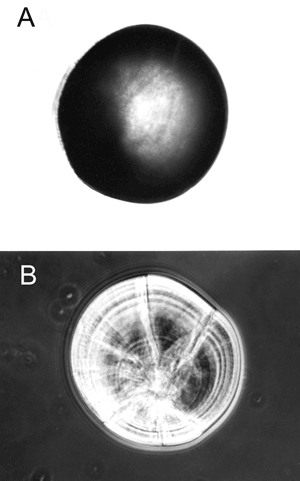
<body><![CDATA[<p align="justify"><font face="Verdana" color="#000000" size="2">Recibido: 02 de septiembre del 2004     <br>       Aceptado: 16 de diciembre del 2004 </font></p>           <p align="justify"><font face="Verdana" color="#000000" size="2">&nbsp;</font></p>           <p align="justify"><font face="Verdana" color="#000000" size="2"><b>Abstract. </b>A          simple technique for otolith of larval fishes is described. After fixing          the otolith with some resin and drying, lift one edge of the resin and          add 1-2 drops of xylene. The otolith becomes transparent and allows counting          the growth rings before the xylene evaporates. </font></p>           <p align="justify"><font face="Verdana" color="#000000" size="2">Key words: Clearing, otoliths, fish larvae.  </font></p>           <p align="justify"><font face="Verdana" color="#000000" size="2"><b>Resumen. </b>Se describe          una t&eacute;cnica sencilla para transparentar otolitos de larvas de peces.          Despu&eacute;s de fijar los otolitos con alguna resina y dejar secar,          se levanta la resina en alg&uacute;n punto y se agrega 1-2 gotas de Xilol.          El otolito se transparenta y permite contar los anillos de crecimiento,          antes de que el xilol se evapore. </font></p>           <p align="justify"><font face="Verdana" color="#000000" size="2">Palabras clave: Transparentaci&oacute;n,          otolitos, larvas de peces. </font></p>           <p align="justify"><font face="Verdana" color="#000000" size="2">&nbsp;</font></p>           <p align="justify"><font face="Verdana" color="#000000" size="2">The technique for aging larval fish by counting growth          rings in their otoliths is widely used (Brothers 1982, 1984; Secor et          al. 1991; Morales-Nin 1992). However, often the otoliths are too opaque          and cannot be used. When the material is plentiful, opaque otoliths can          be discarded. When the material is scarce, every otolith becomes valuable.          The polishing technique is not always successful with small otoliths because          it is easy to loose them or the growth rings can be masked by marks from          the polishing medium (Secor et al. 1991; Morales-Nin 1992). </font></p>           <p align="justify"><font face="Verdana" color="#000000" size="2">We tried to solve the problem of opaque otoliths (<a href="#a14f1">Fig.          1A</a>) by placing them in diluted hydrochloric acid, sodium hypochlorite          solution (chlorine bleach solution) and other substances. We discovered          that opaque otoliths became transparent when placed in xylol, and the          growth rings could be read (<a href="#a14f1">Fig. 1B</a>). Although, upon evaporation of the          xylol the otolith returns to an opaque condition. </font></p>           ]]></body>
<body><![CDATA[<p align="justify"><a name="a14f1"></a></p>           <p align="center"><font face="Verdana" color="#000000" size="2"><img src="/img/revistas/rmbiodiv/v76n1/a15f1.gif"></font></p>           <p align="center"><font face="Verdana" color="#000000" size="2"><b>Figure (1 </b>.- Sagittae          otolith of blackcheek tonguefish (6.2 mm SL <i>Symphurus plagiusa</i>) enlarged          400 x. <b>    <br> A. </b> Opaque condition. <b>B. </b> transparent        condition. </font></p>           <p align="justify"><font face="Verdana" color="#000000" size="2"><b>Literature cited </b></font></p>           <p align="justify"><font face="Verdana" color="#000000" size="2">The recommended technique is to place the otolith on          a glass slide and cover it with resin, such as Flotexx. Let the resin          dry for at least 24 hours. Later, lift one edge of the resin using a scalpel          blade until the otolith is reached. Add 1-2 drops of xylol to the otolith          with a micropipette. The opaque otolith will immediately become transparent,        and there will be sufficient time 10 min).</font></p>           <!-- ref --><p align="justify"><font face="Verdana" color="#000000" size="2">Brothers, E. B. 1982. Methodological approaches to the          examination of otoliths in ageing studies. <i>In</i> Age and Age and Growth of          fish. R. C. Summerfelt &amp; G. E.Hall (eds.). Iowa Sate University Press,          Ames Growth of fish. R. C. Summerfelt &amp; G. E.Hall (eds.). Iowa Sate          University Press, Ames Iowa, USA. p. 319- 330. </font>&nbsp;&nbsp;&nbsp;&nbsp;&nbsp;&nbsp;&nbsp;&nbsp;[&#160;<a href="javascript:void(0);" onclick="javascript: window.open('/scielo.php?script=sci_nlinks&ref=7469823&pid=S1870-3453200500010001500001&lng=','','width=640,height=500,resizable=yes,scrollbars=1,menubar=yes,');">Links</a>&#160;]<!-- end-ref --><!-- ref --><p align="justify"><font face="Verdana" color="#000000" size="2">Brothers, E. B. 1984. Otolith studies. In Ontogeny and          Systematics of Fishes. H. G. Moser, W. J. Richards, D. M. Cohen, M. P.          Fahay, A. W. Kendall Jr., S. L. Richardson. (eds.). Special Publication.          No. 1, American Society of Ichthyologist and Herpetologist. p. 50-57.        </font>&nbsp;&nbsp;&nbsp;&nbsp;&nbsp;&nbsp;&nbsp;&nbsp;[&#160;<a href="javascript:void(0);" onclick="javascript: window.open('/scielo.php?script=sci_nlinks&ref=7469824&pid=S1870-3453200500010001500002&lng=','','width=640,height=500,resizable=yes,scrollbars=1,menubar=yes,');">Links</a>&#160;]<!-- end-ref --><!-- ref --><p align="justify"><font face="Verdana" color="#000000" size="2">Morales-Nin, B. 1992. Determination of Growth in bony          fishes from otolith microstructure. FAO Fisheries Technical Paper 322.          51 p. </font>&nbsp;&nbsp;&nbsp;&nbsp;&nbsp;&nbsp;&nbsp;&nbsp;[&#160;<a href="javascript:void(0);" onclick="javascript: window.open('/scielo.php?script=sci_nlinks&ref=7469825&pid=S1870-3453200500010001500003&lng=','','width=640,height=500,resizable=yes,scrollbars=1,menubar=yes,');">Links</a>&#160;]<!-- end-ref --><!-- ref --><p align="justify"><font face="Verdana" color="#000000" size="2">Secor, D. H., J. M. Dean y E. H. Laban. 1991. Manual          for otolith removal and preparation for microstructural otolith removal          and preparation for examination. Electrical Power Research Institute and          the Belle W. Baruch Institute for Marine Biology and Coastal Research,          U.S.A. 85 p. </font>&nbsp;&nbsp;&nbsp;&nbsp;&nbsp;&nbsp;&nbsp;&nbsp;[&#160;<a href="javascript:void(0);" onclick="javascript: window.open('/scielo.php?script=sci_nlinks&ref=7469826&pid=S1870-3453200500010001500004&lng=','','width=640,height=500,resizable=yes,scrollbars=1,menubar=yes,');">Links</a>&#160;]<!-- end-ref --> ]]></body><back>
<ref-list>
<ref id="B1">
<nlm-citation citation-type="book">
<person-group person-group-type="author">
<name>
<surname><![CDATA[Brothers]]></surname>
<given-names><![CDATA[E. B.]]></given-names>
</name>
</person-group>
<article-title xml:lang="en"><![CDATA[Methodological approaches to the examination of otoliths in ageing studies]]></article-title>
<person-group person-group-type="editor">
<name>
<surname><![CDATA[Summerfelt]]></surname>
<given-names><![CDATA[R. C.]]></given-names>
</name>
<name>
<surname><![CDATA[Hall]]></surname>
<given-names><![CDATA[G. E.]]></given-names>
</name>
</person-group>
<source><![CDATA[Age and Age and Growth of fish]]></source>
<year>1982</year>
<page-range>319-330</page-range><publisher-loc><![CDATA[Ames^eIowa Iowa]]></publisher-loc>
<publisher-name><![CDATA[Iowa Sate University Press]]></publisher-name>
</nlm-citation>
</ref>
<ref id="B2">
<nlm-citation citation-type="book">
<person-group person-group-type="author">
<name>
<surname><![CDATA[Brothers]]></surname>
<given-names><![CDATA[E. B.]]></given-names>
</name>
</person-group>
<article-title xml:lang="en"><![CDATA[Otolith studies]]></article-title>
<person-group person-group-type="editor">
<name>
<surname><![CDATA[Moser]]></surname>
<given-names><![CDATA[H. G.]]></given-names>
</name>
<name>
<surname><![CDATA[Richards]]></surname>
<given-names><![CDATA[W. J.]]></given-names>
</name>
<name>
<surname><![CDATA[Cohen]]></surname>
<given-names><![CDATA[D. M.]]></given-names>
</name>
<name>
<surname><![CDATA[Fahay]]></surname>
<given-names><![CDATA[M. P.]]></given-names>
</name>
<name>
<surname><![CDATA[Kendall Jr.]]></surname>
<given-names><![CDATA[A. W.]]></given-names>
</name>
<name>
<surname><![CDATA[Richardson]]></surname>
<given-names><![CDATA[S. L.]]></given-names>
</name>
</person-group>
<source><![CDATA[Ontogeny and Systematics of Fishes]]></source>
<year>1984</year>
<volume>1</volume>
<page-range>50-57</page-range><publisher-name><![CDATA[American Society of Ichthyologist and Herpetologist]]></publisher-name>
</nlm-citation>
</ref>
<ref id="B3">
<nlm-citation citation-type="journal">
<person-group person-group-type="author">
<name>
<surname><![CDATA[Morales-Nin]]></surname>
<given-names><![CDATA[B.]]></given-names>
</name>
</person-group>
<article-title xml:lang="en"><![CDATA[Determination of Growth in bony fishes from otolith microstructure]]></article-title>
<source><![CDATA[FAO Fisheries Technical Paper]]></source>
<year>1992</year>
<numero>322</numero>
<issue>322</issue>
<page-range>51</page-range></nlm-citation>
</ref>
<ref id="B4">
<nlm-citation citation-type="book">
<person-group person-group-type="author">
<name>
<surname><![CDATA[Secor]]></surname>
<given-names><![CDATA[D. H.]]></given-names>
</name>
<name>
<surname><![CDATA[Dean]]></surname>
<given-names><![CDATA[J. M.]]></given-names>
</name>
<name>
<surname><![CDATA[Laban]]></surname>
<given-names><![CDATA[E. H.]]></given-names>
</name>
</person-group>
<source><![CDATA[Manual for otolith removal and preparation for microstructural otolith removal and preparation for examination]]></source>
<year>1991</year>
<page-range>85</page-range><publisher-name><![CDATA[Electrical Power Research InstituteBelle W. Baruch Institute for Marine Biology and Coastal Research]]></publisher-name>
</nlm-citation>
</ref>
</ref-list>
</back>
</article>
