<?xml version="1.0" encoding="ISO-8859-1"?><article xmlns:mml="http://www.w3.org/1998/Math/MathML" xmlns:xlink="http://www.w3.org/1999/xlink" xmlns:xsi="http://www.w3.org/2001/XMLSchema-instance">
<front>
<journal-meta>
<journal-id>1405-9940</journal-id>
<journal-title><![CDATA[Archivos de cardiología de México]]></journal-title>
<abbrev-journal-title><![CDATA[Arch. Cardiol. Méx.]]></abbrev-journal-title>
<issn>1405-9940</issn>
<publisher>
<publisher-name><![CDATA[Instituto Nacional de Cardiología Ignacio Chávez]]></publisher-name>
</publisher>
</journal-meta>
<article-meta>
<article-id>S1405-99402006000100002</article-id>
<title-group>
<article-title xml:lang="en"><![CDATA[Comparison of 18FDG PET with thallium SPECT in the assessment of myocardial viability: A segmental model analysis]]></article-title>
<article-title xml:lang="es"><![CDATA[Comparación de 18FDG PET con talio SPECT en la evaluación de la viabilidad mocárdiaca: Un modelo de análisis segmentario]]></article-title>
</title-group>
<contrib-group>
<contrib contrib-type="author">
<name>
<surname><![CDATA[Alexánderson]]></surname>
<given-names><![CDATA[Erick]]></given-names>
</name>
<xref ref-type="aff" rid="A01"/>
</contrib>
<contrib contrib-type="author">
<name>
<surname><![CDATA[Ricalde]]></surname>
<given-names><![CDATA[Alejandro]]></given-names>
</name>
</contrib>
<contrib contrib-type="author">
<name>
<surname><![CDATA[Romero-Ibarra]]></surname>
<given-names><![CDATA[José Luis]]></given-names>
</name>
</contrib>
<contrib contrib-type="author">
<name>
<surname><![CDATA[Meave]]></surname>
<given-names><![CDATA[Aloha]]></given-names>
</name>
</contrib>
</contrib-group>
<aff id="A01">
<institution><![CDATA[,Instituto Nacional de Cardiología Ignacio Chávez Department of Nuclear Cardiology ]]></institution>
<addr-line><![CDATA[México, D.F. ]]></addr-line>
</aff>
<pub-date pub-type="pub">
<day>00</day>
<month>03</month>
<year>2006</year>
</pub-date>
<pub-date pub-type="epub">
<day>00</day>
<month>03</month>
<year>2006</year>
</pub-date>
<volume>76</volume>
<numero>1</numero>
<fpage>9</fpage>
<lpage>15</lpage>
<copyright-statement/>
<copyright-year/>
<self-uri xlink:href="http://www.scielo.org.mx/scielo.php?script=sci_arttext&amp;pid=S1405-99402006000100002&amp;lng=en&amp;nrm=iso"></self-uri><self-uri xlink:href="http://www.scielo.org.mx/scielo.php?script=sci_abstract&amp;pid=S1405-99402006000100002&amp;lng=en&amp;nrm=iso"></self-uri><self-uri xlink:href="http://www.scielo.org.mx/scielo.php?script=sci_pdf&amp;pid=S1405-99402006000100002&amp;lng=en&amp;nrm=iso"></self-uri><abstract abstract-type="short" xml:lang="en"><p><![CDATA[Background: In patients with myocardial infarction and left ventricular dysfunction, the evidence of myocardial viability is primordial. There are some methods to detect the presence of myocardial viability, 201 thallium reinjection SPECT protocol represents the most common radioisotopic technique to evaluate it. Positron emission tomography (PET) using FDG is considered the gold standard. The aim of this study was to compare globally and by segments the value of both techniques in the detection of viable myocardium. Methods: Twenty-three consecutive patients with previous myocardial infarction and left ventricular dysfunction were studied. All of them underwent into a SPECT perfusión scan and a FDG PET study to asses myocardial viability. Each study was performed in less than one week between the other. For the analysis, the myocardium was divided into 17 segments. A visual semi-quantitative analysis was carried out according to the following score indicating radiotracer uptake: O = normal to 4 = absent. Myocardial viability was defined as the presence of normal, mildly or moderately reduced radiotracer uptake. The scores obtained by PET were compared to those obtained in SPECT. A statistical analysis was performed using the SPSS v. 10. Results: 391 segments were analyzed. PET detected viability in 130 segments that had been defined as non-viable by SPECT. No differences in the analysis by vascular territories were found. Thirty percent of the segments that were defined as non viable by SPECT were viable by PET, meanwhile only 1% of the segments detected viable by SPECT were considered non viable with PET. Conclusions: FDG PET study represents a better technique to detect myocardial viability, compared to thallium reinjection SPECT protocol. By this study we have demonstrated that more of 3 of each 10 studies may be diagnosed as non viable where viability is present.]]></p></abstract>
<abstract abstract-type="short" xml:lang="es"><p><![CDATA[Antecedentes: La detección de la viabilidad miocárdica en pacientes con infarto de miocardio y disfunción del ventrículo izquierdo resulta indispensable. Existen varios métodos que permiten identificar viabilidad miocárdica, la técnica SPECT con protocolo reinyección con talio 201 representa la técnica radioisotópica más comúnmente empleada para evaluarla. Sin embargo, la tomografía por emisión de positrones (PET) usando fluorodeoxiglucosa es considerada hoy el "estándar de oro". El objetivo del presente trabajo es comparar en forma global y segmentaria el valor de ambas técnicas en la detección de miocardio viable. Método: Se estudiaron 23 pacientes con antecedente de infarto de miocardio y disfunción ventricular izquierda, a todos se les realizó un SPECT de perfusión y un estudio PET-FDG para identificar viabilidad. Los estudios fueron realizados al menos con una semana de diferencia. Para su análisis se utilizó el modelo de 17 segmentos. Las imágenes se evaluaron mediante un análisis visual semicuantitativo de acuerdo a la escala de 0 = captación normal a 4 = ausencia de captación. Se definió viabilidad miocárdica como la presencia de captación de radiotrazador normal, leve o moderadamente reducida. Los resultados obtenidos con ambas técnicas fueron comparados y analizados en forma estadística con el programa SPSS v. 10. Resultados: Se analizó 391 segmentos. PET detectó viabilidad en 130 segmentos que el SPECT definió como no viables. No se encontraron diferencias estadísticamente significativas al analizarlos por territorio vascular. El 30% de los segmentos que fueron definidos como no viables por el SPECT fueron reconocidos como viables por PET, mientras que sólo 1% de los segmentos detectados como viables por el SPECT fueron considerados como no viables con PET Conclusiones: El PET-FDG representa una mejor técnica para detectar viabilidad, comparada con el protocolo SPECT reinyección con talio. Mediante este estudio se demostró que más de 3 de cada 10 estudios evaluados por SPECT pueden ser diagnosticados como no viables donde existe viabilidad.]]></p></abstract>
<kwd-group>
<kwd lng="en"><![CDATA[Myocardial viability]]></kwd>
<kwd lng="en"><![CDATA[Positron emission tomography]]></kwd>
<kwd lng="en"><![CDATA[PET]]></kwd>
<kwd lng="en"><![CDATA[Myocardial perfusión]]></kwd>
<kwd lng="en"><![CDATA[SPECT]]></kwd>
<kwd lng="es"><![CDATA[Viabilidad miocárdica]]></kwd>
<kwd lng="es"><![CDATA[Tomografía por emisión de positrones]]></kwd>
<kwd lng="es"><![CDATA[PET]]></kwd>
<kwd lng="es"><![CDATA[Perfusión miocárdica]]></kwd>
<kwd lng="es"><![CDATA[SPECT]]></kwd>
</kwd-group>
</article-meta>
</front><body><![CDATA[ <p align="justify"><font face="verdana" size="4">Investigaci&oacute;n b&aacute;sica</font></p>     <p align="justify"><font face="verdana" size="2">&nbsp;</font></p>     <p align="center"><font face="verdana" size="4"><b><i>Comparison of <sup> 18</sup>FDG PET with thallium SPECT in the assessment of myocardial viability. A segmental model analysis</i></b></font></p>     <p align="center"><font face="verdana" size="2">&nbsp;</font></p>     <p align="center"><font face="verdana" size="3"><b>Comparaci&oacute;n de <sup>18</sup>FDG PET con talio SPECT en la evaluaci&oacute;n de la viabilidad moc&aacute;rdiaca. Un modelo de an&aacute;lisis segmentario </b></font></p>     <p align="center"><font face="verdana" size="2">&nbsp;</font></p>     <p align="center"><font face="verdana" size="2"><b>Erick Alex&aacute;nderson,*** Alejandro Ricalde,** Jos&eacute; Luis Romero&#150;Ibarra,** Aloha Meave***</b></font></p>     <p align="justify"><font face="verdana" size="2">&nbsp;</font></p>     <p align="justify"><font face="verdana" size="2"><i>* Department of Nuclear Cardiology, Instituto Nacional de Cardiolog&iacute;a "Ignacio Ch&aacute;vez", Mexico City, Mexico.</i></font></p>     <p align="justify"><i><font face="verdana" size="2">** PET&#150;Cyclotron Unit, Medical School, Universidad Nacional Aut&oacute;noma de M&eacute;xico. Mexico, City.</font></i></p>     ]]></body>
<body><![CDATA[<p align="justify"><i><font face="verdana" size="2">*** Department of Cardiovascular Magnetic Resonance, Instituto Nacional de Cardiolog&iacute;a "Ignacio Ch&aacute;vez", Mexico City, Mexico.</font></i></p>     <p align="justify"><font face="verdana" size="2">&nbsp;</font></p>     <p align="justify"><font face="verdana" size="2"><b>Address:    <br> </b><i>Erick Alexanderson    <br> Department of Nuclear Cardiology, Instituto Nacional de Cardiolog&iacute;a "Ignacio Ch&aacute;vez"    <br> (INCICH, Juan Badiano No. 1, Col. Secci&oacute;n XVI, Tlalpan, M&eacute;xico, D.F.)    <br> Business telephone number: (0052) (55) 56232299    <br> Home telephone number: (0052) (55) 54241026    <br> Fax number: (0052) (55) 5623    <br> E&#150;mail: <a href="mailto:alexanderick@yahoo.com">alexanderick@yahoo.com</a></i></font></p>     ]]></body>
<body><![CDATA[<p align="justify"><font face="verdana" size="2">&nbsp;</font></p>     <p align="justify"><font face="verdana" size="2">Recibido: 20 de septiembre de 2005    <br> Aceptado:</font></p>     <p align="justify"><font face="verdana" size="2">&nbsp;</font></p>     <p align="justify"><font face="verdana" size="2"><b>Summary</b></font></p>     <p align="justify"><font face="verdana" size="2"><i>Background: </i>In patients with myocardial infarction and left ventricular dysfunction, the evidence of myocardial viability is primordial. There are some methods to detect the presence of myocardial viability, 201 thallium reinjection SPECT protocol represents the most common radioisotopic technique to evaluate it. Positron emission tomography (PET) using FDG is considered the gold standard. The aim of this study was to compare globally and by segments the value of both techniques in the detection of viable myocardium.</font></p>     <p align="justify"><font face="verdana" size="2"><i>Methods: </i>Twenty&#150;three consecutive patients with previous myocardial infarction and left ventricular dysfunction were studied. All of them underwent into a SPECT perfusi&oacute;n scan and a FDG PET study to asses myocardial viability. Each study was performed in less than one week between the other. For the analysis, the myocardium was divided into 17 segments. A visual semi&#150;quantitative analysis was carried out according to the following score indicating radiotracer uptake: O = normal to 4 = absent. Myocardial viability was defined as the presence of normal, mildly or moderately reduced radiotracer uptake. The scores obtained by PET were compared to those obtained in SPECT. A statistical analysis was performed using the SPSS v. 10.</font></p>     <p align="justify"><font face="verdana" size="2"><i>Results: </i>391 segments were analyzed. PET detected viability in 130 segments that had been defined as non&#150;viable by SPECT. No differences in the analysis by vascular territories were found. Thirty percent of the segments that were defined as non viable by SPECT were viable by PET, meanwhile only 1% of the segments detected viable by SPECT were considered non viable with PET.</font></p>     <p align="justify"><font face="verdana" size="2"><i>Conclusions: </i>FDG PET study represents a better technique to detect myocardial viability, compared to thallium reinjection SPECT protocol. By this study we have demonstrated that more of 3 of each 10 studies may be diagnosed as non viable where viability is present.</font></p>     <p align="justify"><font face="verdana" size="2"><b>Key words: </b>Myocardial viability. Positron emission tomography. PET. Myocardial perfusi&oacute;n. SPECT.</font></p>     ]]></body>
<body><![CDATA[<p align="justify"><font face="verdana" size="2">&nbsp;</font></p>     <p align="justify"><font face="verdana" size="2"><b>Resumen</b></font></p>     <p align="justify"><font face="verdana" size="2"><i>Antecedentes: </i>La detecci&oacute;n de la viabilidad mioc&aacute;rdica en pacientes con infarto de miocardio y disfunci&oacute;n del ventr&iacute;culo izquierdo resulta indispensable. Existen varios m&eacute;todos que permiten identificar viabilidad mioc&aacute;rdica, la t&eacute;cnica SPECT con protocolo reinyecci&oacute;n con talio 201 representa la t&eacute;cnica radioisot&oacute;pica m&aacute;s com&uacute;nmente empleada para evaluarla. Sin embargo, la tomograf&iacute;a por emisi&oacute;n de positrones (PET) usando fluorodeoxiglucosa es considerada hoy el "est&aacute;ndar de oro". El objetivo del presente trabajo es comparar en forma global y segmentaria el valor de ambas t&eacute;cnicas en la detecci&oacute;n de miocardio viable.</font></p>     <p align="justify"><font face="verdana" size="2"><i>M&eacute;todo: </i>Se estudiaron 23 pacientes con antecedente de infarto de miocardio y disfunci&oacute;n ventricular izquierda, a todos se les realiz&oacute; un SPECT de perfusi&oacute;n y un estudio PET&#150;FDG para identificar viabilidad. Los estudios fueron realizados al menos con una semana de diferencia. Para su an&aacute;lisis se utiliz&oacute; el modelo de 17 segmentos. Las im&aacute;genes se evaluaron mediante un an&aacute;lisis visual semicuantitativo de acuerdo a la escala de 0 = captaci&oacute;n normal a 4 = ausencia de captaci&oacute;n. Se defini&oacute; viabilidad mioc&aacute;rdica como la presencia de captaci&oacute;n de radiotrazador normal, leve o moderadamente reducida. Los resultados obtenidos con ambas t&eacute;cnicas fueron comparados y analizados en forma estad&iacute;stica con el programa SPSS v. 10.</font></p>     <p align="justify"><font face="verdana" size="2"><i>Resultados: </i>Se analiz&oacute; 391 segmentos. PET detect&oacute; viabilidad en 130 segmentos que el SPECT defini&oacute; como no viables. No se encontraron diferencias estad&iacute;sticamente significativas al analizarlos por territorio vascular. El 30% de los segmentos que fueron definidos como no viables por el SPECT fueron reconocidos como viables por PET, mientras que s&oacute;lo 1% de los segmentos detectados como viables por el SPECT fueron considerados como no viables con PET</font></p>     <p align="justify"><font face="verdana" size="2"><i>Conclusiones: </i>El PET&#150;FDG representa una mejor t&eacute;cnica para detectar viabilidad, comparada con el protocolo SPECT reinyecci&oacute;n con talio. Mediante este estudio se demostr&oacute; que m&aacute;s de 3 de cada 10 estudios evaluados por SPECT pueden ser diagnosticados como no viables donde existe viabilidad.</font></p>     <p align="justify"><font face="verdana" size="2"><b>Palabras clave: </b>Viabilidad mioc&aacute;rdica. Tomograf&iacute;a por emisi&oacute;n de positrones. PET. Perfusi&oacute;n mioc&aacute;rdica. SPECT.</font></p>     <p align="justify"><font face="verdana" size="2">&nbsp;</font></p>     <p align="justify"><font face="verdana" size="2"><b>Introduction</b></font></p>     <p align="justify"><font face="verdana" size="2">The recognition of myocardial viability has important therapeutic and prognostic implications in patients with coronary artery disease and left ventricular dysfunction.<sup>12 </sup>In patients with chronic ischemic cardiomyopathy, the presence of hibernating myocardial tissue represents regions at risk of infarction, potentially contributing to the development or exacerbation of heart failure.<sup>3,4</sup> During the present decades, the management of patients with coronary artery disease and left ventricular dysfunction was limited to medical therapy; nonetheless, this strategy has been associated with a high mortality rate (15&#150;60%).<sup>5</sup> The revascularization of dysfunctional (asinergic) segments showing viability in patients with coronary artery disease and left ventricular dysfunction has been associated to improved survival and New York Heart Association (NYHA) class. An improvement in global as well as regional left ventricular function has also been described.<sup>1,6</sup> The identification of myocardial viability, in patients with coronary artery disease and left ventricular dysfunction is useful in risk stratification, for it allows the prediction of a group of patients that may benefit the most from a revascularization procedure.<sup>3</sup> The outcome from revascularization depends on the presence as well as the amount of hibernating myocardium related to dysfunctional segment.<sup>7</sup> <sup>201</sup>T1 SPECT (stress&#150;redistribution&#150;reinjection or late redistribution images) has been the most employed imaging technique for the assessment of myocardial viability in patients with coronary artery disease and left ventricular dysfunction.<sup>8,9</sup> PET imaging has demonstrated viability in almost half of myocardial regions with reversible perfusi&oacute;n defects on <sup>201</sup>T1 SPECT.<sup>3</sup> This non&#150;invasive technique allows the assessment of cellular metabolism, associated with the presence of viable myocites, by obtaining images with great resolution, with the advantage of low radiation exposure for the patient. Dilsizian et al<sup>12</sup> and Marin&#150;Neto et al<sup>13 </sup>compared <sup>201</sup>T1 SPECT and <sup>18</sup>FDG PET for the detection of myocardial viability, reporting 72% and 78% correlation between these methods, respectively. Various studies<sup>12&#150;17</sup> assessing myocardial viability with <sup>18</sup>FDG PET have been published. Image analysis in these studies has been made by dividing the myocardium in different segments. No studies have been performed in Mexico to compare <sup>201</sup>Tl SPECT and <sup>18</sup>FDG PET for the detection of myocardial viability. The aim of this study was to compare globally and by segments the value of both techniques in the detection of myocardial viability.</font></p>     ]]></body>
<body><![CDATA[<p align="justify"><font face="verdana" size="2">&nbsp;</font></p>     <p align="justify"><font face="verdana" size="2"><b>Material and methods</b></font></p>     <p align="justify"><font face="verdana" size="2">Twenty&#150;three patients were studied. All patients included in the study had a history of myocardial infarction, proved by electrocardiogram; coronary artery disease by coronary angiography; and left ventricular dysfunction (ejection fraction (EF) &lt; 50%). Unstable angina, valvulopathies, congenital heart disease, and blood glucose higher than 120 mg/dL at the time of the study were considered as exclusion criteria. Poor quality images from either <sup>18</sup>FDG PET or <sup>201</sup>T1 SPECT were used as elimination criteria.</font></p>     <p align="justify"><font face="verdana" size="2">All patients underwent a <sup>201</sup>T1 stress&#150;redistribution&#150;reinjection SPECT protocol. To induce a pharmacologic stress, dypiridamole was administered intravenously at a dose of 0.56 mg/kg over 4 minutes. During infusion, regular electrocardiographic and blood pressure monitoring was performed. <sup>201</sup>T1 (3mCi) was injected at minute 7, and stress images acquisition was started 5 minutes later. Redistribution images were obtained 4 hours later. Additional 1.5 mCi of <sup>201</sup>T1 were injected, images were acquired 3 hours later (reinjection). None of the patients had taken xanthine&#150;containing drugs nor caffeine at least 24 hours previous to the study.</font></p>     <p align="justify"><font face="verdana" size="2">Image acquisition was performed with a dualhead SPECT gamma camera Millennium VG Hawkeye (General Electric, Milwaukee, Wisconsin) equipped with a high resolution collimator, 75 photomultiplier tubes, 0.64 cm width iodide crystals, and an Entegra processing system. Thirty&#150;two projections (25 seconds/projection) were acquired by continuously rotating the camera through a 180&deg; semicircular orbit (45&deg; RAOLPO). A 20% energy window centered at 60&#150;80 KeV, and a second 10% energy window centered at 167 KeV were employed. A 64 x 64&#150;pixel matrix was used.</font></p>     <p align="justify"><font face="verdana" size="2">A <sup>18</sup>FDG PET study was performed to assess cardiac metabolism. Radiotracer was produced at the Cyclotron&#150;UNAM. Subsequent to an overnight fast, a loading dose of 50 g of glucose was administered to every patient, after capillary glucose determination. Thirty minutes later, 10 mCi of <sup>18</sup>FDG were injected intravenously. Image acquisition was performed 40 minutes after injection of the tracer, for a period of 40 minutes. A transmission scan was obtained to correct emission images for photon attenuation. PET imaging was performed on a full ring, whole&#150;body system ECAT EXACT HR+ (Siemens/CTI, Knoxville, TN, USA) in a 2&#150;dimensional mode. This system covers an axial field&#150;of&#150;view of 14.5 cm by collecting 63 transverse slices with 4 mm slice thickness, with an in&#150;plane resolution of 4.5&#150;5.8 mm in transverse direction and 4.9&#150;8.8 in axial direction.<sup>18</sup></font></p>     <p align="justify"><font face="verdana" size="2">All patients underwent to both studies within a mean period of 11 days (1&#150;22 days). During this time, none of the patients presented acute coronary syndromes or were admitted to the hospital for cardiovascular reasons. All patients signed a written informed consent. All images acquired in both studies (SPECT and PET) were reconstructed in short&#150;axis, vertical long axis and horizontal long&#150;axis. For the analysis, the myocardium was divided into 17 segments.<sup>19</sup> A visual semiquantitative analysis was made according to the following score related to the qualitative radiotracer uptake: 0 = normal to 4 = absent.<sup>8 </sup>Images were assessed by consensus of two experienced observers, unaware of the clinical data of each patient.</font></p>     <p align="justify"><font face="verdana" size="2">For either SPECT (reinjection) or PET images, myocardial viability was defined as the presence of normal (0) to moderately reduced (2) radiotracer uptake for each analyzed segment. Besides, the relationship between perfusi&oacute;n and metabolism (SPECT&#150;PET) was classified as: normal (perfusion&#150;metabolism preserved); match (diminished perfusi&oacute;n and metabolism); mismatch (diminished perfusi&oacute;n and preserved metabolism) or reverse mismatch (preserved perfusi&oacute;n and diminished metabolism).<sup>1</sup></font></p>     <p align="justify"><font face="verdana" size="2">Statistical analysis was performed using SPSS v. 10. Data are expressed as mean values &plusmn; standard deviation (SD). Correlations were obtained for each segment and vascular territory.</font></p>     <p align="justify"><font face="verdana" size="2">&nbsp;</font></p>     ]]></body>
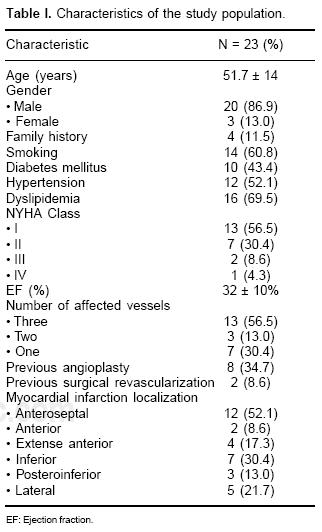
<body><![CDATA[<p align="justify"><font face="verdana" size="2"><b>Results</b></font></p>     <p align="justify"><font face="verdana" size="2">We studied twenty&#150;three consecutive patients with history of myocardial infarction and left ventricular dysfunction (EF: mean = 32%; SD:10); 20 men and 3 women; mean age: 54 years (SD 14). Principal characteristics of the study population are described in <i><a href="#t1">Table I</a>. </i>Dislipidemia (n = 16, 61.5%) and smoking (n = 14, 53.8%) were the most prevalent coronary risk factors; 10 patients (43.4%) had diagnosis of non&#150;insulin dependent diabetes mellitus; most (n = 16, 69.5%) of them were in NYHA class I. The most prevalent myocardial infarction localization was anteroseptal, in 12 patients (52.1%). Fourteen patients (60.8%) presented triple&#150;vessel disease, as documented by coronary angiography. A total of 391 segments were analyzed, 127 were classified as normal, 67 matched, 182 mismatched and 15 reverse mismatched segments. Correlation between methods for each segment is shown in <i><a href="#f1">Figure 1</a>. </i>Differences in the analysis were found among both methods. No differences were found regarding the score assigned by SPECT and PET in the analysis by vascular territory between diabetic <i>vs </i>non&#150;diabetic patients. Differences were encountered between the number of segments detected as non&#150;viable by SPECT and PET, most of the segments considered non&#150;viable by SPECT were found viable with PET <i><a href="#f1">(Fig. 1)</a></i>.</font></p>     <p align="center"><font face="verdana" size="2"><a name="t1"></a></font></p>     <p align="center"><font face="verdana" size="2"><img src="/img/revistas/acm/v76n1/a2t1.jpg"></font></p>     <p align="center"><font face="verdana" size="2"><a name="f1"></a></font></p>     <p align="center"><font face="verdana" size="2"><img src="/img/revistas/acm/v76n1/a2f1.jpg"></font></p>     <p align="justify"><font face="verdana" size="2">Among the 391 segments analyzed, 205 segments (52.4%) were detected as viable by PET as well as SPECT, 130 segments (33.3%) were defined as viable by PET and as non&#150;viable by <sup>201</sup>T1 SPECT, 5 segments (1.2%) were defined as viable by SPECT and as non&#150;viable by PET and the rest of the segments (13.1%) did not show viability neither by PET nor by SPECT <i><a href="#t2">(Table II)</a></i>.</font></p>     <p align="center"><font face="verdana" size="2"><a name="t2"></a></font></p>     <p align="center"><font face="verdana" size="2"><img src="/img/revistas/acm/v76n1/a2t2.jpg"></font></p>     <p align="justify"><font face="verdana" size="2">&nbsp;</font></p>     ]]></body>
<body><![CDATA[<p align="justify"><font face="verdana" size="2"><b>Discussion</b></font></p>     <p align="justify"><font face="verdana" size="2">Nuclear medicine, using <sup>201</sup>T1 SPECT (stressre&#150;distribution&#150;reinjection) has been the most used method to evaluate myocardial viability.<sup>20</sup> FDG PET study has been reported as the better technique for the evaluation of myocardial viability previously to the revascularization therapy. However, because of the poor availability of this technique, a comparison between both techniques has not been done in our country before. The importance of the detection of myocardial viability is funded in the fact that patients with myocardial infarctions and left ventricular dysfunction with viability demonstrated by PET may be benefited from a revascularization procedure and patients without viability demonstrated may not.<sup>21</sup> In the present study, we compared <sup>201</sup>T1 SPECT and <sup>18</sup>FDG for the detection of myocardial viability in patients with coronary artery disease and left ventricular dysfunction.</font></p>     <p align="justify"><font face="verdana" size="2">Among the 391 analyzed segments, we found more segments that showed perfusion/metabolism mismatch than perfusion/metabolism match (127 F567). A bad correlation (r &lt; 0.7) between SPECT and PET was observed in the left anterior descendent artery and in the right coronary artery territories when vascular territories were analyzed. Using the segmental model, we showed a low correlation (p &lt; 0.50) between both techniques in 5 of the 7 segments assigned to the LAD territory (all except basal anterior and basal anteroseptal) in 3 of the 5 segments assigned to the RCA territory (all except basal inferoseptal and mid inferoseptal) and in 2 of the 5 segments assigned to the LCx (basal inferolateral and mid inferolateral), which means that PET detected more viable segments than SPECT did (11 of 17 segments analyzed) and that these differences are statistically significant.</font></p>     <p align="justify"><font face="verdana" size="2">In this study, <sup>18</sup>FDG PET detected more viable segments (30%) than <sup>201</sup>T1 SPECT. It means that 3 of each 10 patients may be diagnosed as without myocardial viability when in fact there is viability present.</font></p>     <p align="justify"><font face="verdana" size="2">Comparing this study to the one reported by Bonow et al,<sup>22</sup> in the present study a higher percentage of viable segments were founded, however patients at Bonow et al study had a lower mean EF than ours (27% <i>vs </i>32%) which may explain this difference.</font></p>     <p align="justify"><font face="verdana" size="2">The results of this study are in agreement with those reported by Burt et al,<sup>23</sup> who compared both methods in 20 patients with coronary artery disease and left ventricular dysfunction, and reported that in 23.3% of the segments that had been classified as non&#150;viable by SPECT, PET detected viability.</font></p>     <p align="justify"><font face="verdana" size="2">A poor myocardial radiotracer uptake has been described in diabetic patients, with a subsequent poor image quality and lower accuracy of this technique.<sup>23</sup> The use of the "euglycemic hyperinsulinemic clamp" has been reported to improve PET accuracy in diabetic patients.<sup>24</sup> However, in our study, no differences between SPECT and PET scores were found in the analysis by vascular territories in diabetic <i>vs </i>non&#150;diabetic patients, even in the absence of the euglycemic clamp method.</font></p>     <p align="justify"><font face="verdana" size="2"><i>Limitations of the study: </i>This study did not include the follow up of patients that were revascularized in agreement with the PET or SPECT results. However, several studies have shown that 18&#150;FDG PET as well as Tl&#150;201 SPECT are accurate methods for the prediction of postrevascularization improvement of ventricular function. Bonow et al<sup>20</sup> reported a good correlation between qualitative and quantitative image analysis, in the present study only semiquantitative analysis was performed. We should also take an account the issue of limited clinical sample, we only included 23 patients. Trials that include a larger number of patients should be done in order to confirm the results founded in this study.</font></p>     <p align="justify"><font face="verdana" size="2">&nbsp;</font></p>     <p align="justify"><font face="verdana" size="2"><b>Conclusions</b></font></p>     ]]></body>
<body><![CDATA[<p align="justify"><font face="verdana" size="2">The recognition of myocardial viability has important therapeutic and prognostic implications in patients with coronary artery disease and left ventricular dysfunction.<sup>1,2</sup></font></p>     <p align="justify"><font face="verdana" size="2">PET constitutes an advanced technique that has high sensitivity in detection of myocardial viability. The segmental model analysis could be useful to recognize in precise form the specific number of viable segments that can improve after a coronary revascularization procedure. Based on the results of this study, <sup>18</sup>FDG PET detects a higher number of viable segments in comparison with <sup>201</sup>T1 SPECT justifying its use in patients with coronary artery disease and left ventricular dysfunction.</font></p>     <p align="justify"><font face="verdana" size="2">&nbsp;</font></p>     <p align="justify"><font face="verdana" size="2"><b>Acknowledgements</b></font></p>     <p align="justify"><font face="verdana" size="2">We wish to thank the physicist Adolfo Z&aacute;rate&#150;Morales, and the chemist Efrain Zamora for their help in the radiotracer production, as well as the nuclear medicine technicians Luis Osorio and Isabel Porras who helped us with the acquiring and processing of data.</font></p>     <p align="justify"><font face="verdana" size="2">&nbsp;</font></p>     <p align="justify"><font face="verdana" size="2"><b>References</b></font></p>     <!-- ref --><p align="justify"><font face="verdana" size="2">1. Marwick TH: <i>The viable myocardium: epidemiology, detection and clinical implications. </i>Lancet 1998; 351: 815&#150;19.</font>&nbsp;&nbsp;&nbsp;&nbsp;&nbsp;&nbsp;&nbsp;&nbsp;[&#160;<a href="javascript:void(0);" onclick="javascript: window.open('/scielo.php?script=sci_nlinks&ref=1041866&pid=S1405-9940200600010000200001&lng=','','width=640,height=500,resizable=yes,scrollbars=1,menubar=yes,');">Links</a>&#160;]<!-- end-ref --><!-- ref --><p align="justify"><font face="verdana" size="2">2. Bonow RO: <i>Identification of viable myocardium. </i>Circulation 1996; 94: 2674&#150;80.</font>&nbsp;&nbsp;&nbsp;&nbsp;&nbsp;&nbsp;&nbsp;&nbsp;[&#160;<a href="javascript:void(0);" onclick="javascript: window.open('/scielo.php?script=sci_nlinks&ref=1041867&pid=S1405-9940200600010000200002&lng=','','width=640,height=500,resizable=yes,scrollbars=1,menubar=yes,');">Links</a>&#160;]<!-- end-ref --><!-- ref --><p align="justify"><font face="verdana" size="2">3. Stillman AE, Wilke N, Jerosch&#150;Herold M: <i>Myocardial viability. </i>Radiol Clin North Am 1999; 37(2): 361&#150;78.</font>&nbsp;&nbsp;&nbsp;&nbsp;&nbsp;&nbsp;&nbsp;&nbsp;[&#160;<a href="javascript:void(0);" onclick="javascript: window.open('/scielo.php?script=sci_nlinks&ref=1041868&pid=S1405-9940200600010000200003&lng=','','width=640,height=500,resizable=yes,scrollbars=1,menubar=yes,');">Links</a>&#160;]<!-- end-ref --><!-- ref --><p align="justify"><font face="verdana" size="2">4. Wijns W, Vatner S, Camici P: <i>Hibernating myocardium. </i>N Engl J Med 1998; 339(3): 173&#150;81.</font>&nbsp;&nbsp;&nbsp;&nbsp;&nbsp;&nbsp;&nbsp;&nbsp;[&#160;<a href="javascript:void(0);" onclick="javascript: window.open('/scielo.php?script=sci_nlinks&ref=1041869&pid=S1405-9940200600010000200004&lng=','','width=640,height=500,resizable=yes,scrollbars=1,menubar=yes,');">Links</a>&#160;]<!-- end-ref --><!-- ref --><p align="justify"><font face="verdana" size="2">5. Maddahi J: <i>The use of positron emission tomography in management of patients with ischemic cardiomyopathy. </i>Adv Card Surg 1996; 7: 163&#150;88.</font>&nbsp;&nbsp;&nbsp;&nbsp;&nbsp;&nbsp;&nbsp;&nbsp;[&#160;<a href="javascript:void(0);" onclick="javascript: window.open('/scielo.php?script=sci_nlinks&ref=1041870&pid=S1405-9940200600010000200005&lng=','','width=640,height=500,resizable=yes,scrollbars=1,menubar=yes,');">Links</a>&#160;]<!-- end-ref --><!-- ref --><p align="justify"><font face="verdana" size="2">6. Perrone&#150;Filardi P, Chiariello M: <i>The Identification of myocardial hibernation in patients with ischemic heart failure by echocardiography and radionucleide studies. </i>Prog Cardiovasc Dis 2001; 43(5): 419&#150;32.</font>&nbsp;&nbsp;&nbsp;&nbsp;&nbsp;&nbsp;&nbsp;&nbsp;[&#160;<a href="javascript:void(0);" onclick="javascript: window.open('/scielo.php?script=sci_nlinks&ref=1041871&pid=S1405-9940200600010000200006&lng=','','width=640,height=500,resizable=yes,scrollbars=1,menubar=yes,');">Links</a>&#160;]<!-- end-ref --><!-- ref --><p align="justify"><font face="verdana" size="2">7. Ordoubadi F, Beatt KJ, Spyrou N: <i>Efficacy of coronary angioplasty for the treatment of hibernating myocardium. </i>Heart 1999; 82: 212&#150;16.</font>&nbsp;&nbsp;&nbsp;&nbsp;&nbsp;&nbsp;&nbsp;&nbsp;[&#160;<a href="javascript:void(0);" onclick="javascript: window.open('/scielo.php?script=sci_nlinks&ref=1041872&pid=S1405-9940200600010000200007&lng=','','width=640,height=500,resizable=yes,scrollbars=1,menubar=yes,');">Links</a>&#160;]<!-- end-ref --><!-- ref --><p align="justify"><font face="verdana" size="2">8. Alex&aacute;nderson E, Varguez V, Bialostozky D, Arroyo A, Alex&aacute;nderson G, Victoria D: <i>Valoraci&oacute;n simult&aacute;nea de la perfusi&oacute;n y la viabilidad mioc&aacute;rdica a trav&eacute;s del estudio de dos is&oacute;topos (Talio reposo/MIBI esfuerzo). Experiencia inicial en M&eacute;xico y Am&eacute;rica latina. </i>Arch Inst Cardiol Mex 1997; 67: 106&#150;13.</font>&nbsp;&nbsp;&nbsp;&nbsp;&nbsp;&nbsp;&nbsp;&nbsp;[&#160;<a href="javascript:void(0);" onclick="javascript: window.open('/scielo.php?script=sci_nlinks&ref=1041873&pid=S1405-9940200600010000200008&lng=','','width=640,height=500,resizable=yes,scrollbars=1,menubar=yes,');">Links</a>&#160;]<!-- end-ref --><!-- ref --><p align="justify"><font face="verdana" size="2">9. Dilsizian V, Rocco TP, Freedman NM, Leon MB, Bonow RO: <i>Enhanced detection of ischemic but viable myocardium by the reinjection of thallium after stress&#150;redistribution imaging. </i>N Engl J Med 1990; 323(3): 141&#150;6.</font>&nbsp;&nbsp;&nbsp;&nbsp;&nbsp;&nbsp;&nbsp;&nbsp;[&#160;<a href="javascript:void(0);" onclick="javascript: window.open('/scielo.php?script=sci_nlinks&ref=1041874&pid=S1405-9940200600010000200009&lng=','','width=640,height=500,resizable=yes,scrollbars=1,menubar=yes,');">Links</a>&#160;]<!-- end-ref --><!-- ref --><p align="justify"><font face="verdana" size="2">10. Dutka DP, Camici PG: <i>The contribution of </i><i>positron emission tomography to the study of is</i><i>chemic heart failure. </i>Prog Cardiovasc Dis 2001; 43(5): 399&#150;418.</font>&nbsp;&nbsp;&nbsp;&nbsp;&nbsp;&nbsp;&nbsp;&nbsp;[&#160;<a href="javascript:void(0);" onclick="javascript: window.open('/scielo.php?script=sci_nlinks&ref=1041875&pid=S1405-9940200600010000200010&lng=','','width=640,height=500,resizable=yes,scrollbars=1,menubar=yes,');">Links</a>&#160;]<!-- end-ref --><!-- ref --><p align="justify"><font face="verdana" size="2">11. Bax JJ, Wijns W, Cornel JH, Visser FC, Boersma E, Fioretti PM: <i>Accuracy of currently available techniques for prediction of functional recovery after revascularization in patients with left ventricular dysfunction due to chronic coronary artery disease: comparison of pooled data. </i>J Am Coll Cardiol 1997; 30: 1451&#150;60.</font>&nbsp;&nbsp;&nbsp;&nbsp;&nbsp;&nbsp;&nbsp;&nbsp;[&#160;<a href="javascript:void(0);" onclick="javascript: window.open('/scielo.php?script=sci_nlinks&ref=1041876&pid=S1405-9940200600010000200011&lng=','','width=640,height=500,resizable=yes,scrollbars=1,menubar=yes,');">Links</a>&#160;]<!-- end-ref --><!-- ref --><p align="justify"><font face="verdana" size="2">12. Dilsizian V, Perrone&#150;Filardi P, Arrighi JA, Bacharach SL, Quyyumi AA, Freedman NM, et al: <i>Concordance and discordance between stress&#150;redistribution&#150;reinjection and rest&#150;redistribution thallium imaging for assessing viable myocardium. Comparison with metabolic activity by positron emission tomography. </i>Circulation 1993; 88(3): 941&#150;52.</font>&nbsp;&nbsp;&nbsp;&nbsp;&nbsp;&nbsp;&nbsp;&nbsp;[&#160;<a href="javascript:void(0);" onclick="javascript: window.open('/scielo.php?script=sci_nlinks&ref=1041877&pid=S1405-9940200600010000200012&lng=','','width=640,height=500,resizable=yes,scrollbars=1,menubar=yes,');">Links</a>&#160;]<!-- end-ref --><!-- ref --><p align="justify"><font face="verdana" size="2">13. Marin&#150;Neto JA, Dilsizian V, Arrighi JA, Perrone&#150;Filardi P, Bacharach SL, Bonow RO: <i>Thallium scintigraphy compared with 18&#150;F&#150;f&iacute;u</i><i>orodeoxyglucose positron emission tomography for assessing myocardial viability in patients with moderate versus severe left ventric</i><i>ular dysfunction. </i>Am J Cardiol 1998; 82: 1001&#150;7.</font>&nbsp;&nbsp;&nbsp;&nbsp;&nbsp;&nbsp;&nbsp;&nbsp;[&#160;<a href="javascript:void(0);" onclick="javascript: window.open('/scielo.php?script=sci_nlinks&ref=1041878&pid=S1405-9940200600010000200013&lng=','','width=640,height=500,resizable=yes,scrollbars=1,menubar=yes,');">Links</a>&#160;]<!-- end-ref --><!-- ref --><p align="justify"><font face="verdana" size="2">14. Eitzman D, Al&#150;Aouar ZR, Kanter HL: <i>Clinical outcome of patients with advanced coronary artery disease after viability studies with positron emission tomography. </i>J Am Coll Cardiol 1992; 20:559&#150;65.</font>&nbsp;&nbsp;&nbsp;&nbsp;&nbsp;&nbsp;&nbsp;&nbsp;[&#160;<a href="javascript:void(0);" onclick="javascript: window.open('/scielo.php?script=sci_nlinks&ref=1041879&pid=S1405-9940200600010000200014&lng=','','width=640,height=500,resizable=yes,scrollbars=1,menubar=yes,');">Links</a>&#160;]<!-- end-ref --><!-- ref --><p align="justify"><font face="verdana" size="2">15. Brunken RC, Mody FV, Hawkins RA, Nienaber C, Phelps ME, Schelbert HR: <i>Positron emission tomography detects metabolic viability in myocardium with persistent 24&#150;hour single&#150;photon emission tomography 201Tl defects. </i>Circulation 1992; 86(5): 1357&#150;69.</font>&nbsp;&nbsp;&nbsp;&nbsp;&nbsp;&nbsp;&nbsp;&nbsp;[&#160;<a href="javascript:void(0);" onclick="javascript: window.open('/scielo.php?script=sci_nlinks&ref=1041880&pid=S1405-9940200600010000200015&lng=','','width=640,height=500,resizable=yes,scrollbars=1,menubar=yes,');">Links</a>&#160;]<!-- end-ref --><!-- ref --><p align="justify"><font face="verdana" size="2">16. Pagano D, Bonser RS, Townend JN, Ordoubadi F, Lorenzoni R, Camici PG: <i>Predictive value of dobutamine echocardiography and positron emission tomography in identifying hibernating myocardium in patients with postischaemic heart failure. </i>Heart 1998; 79: 281&#150;8.</font>&nbsp;&nbsp;&nbsp;&nbsp;&nbsp;&nbsp;&nbsp;&nbsp;[&#160;<a href="javascript:void(0);" onclick="javascript: window.open('/scielo.php?script=sci_nlinks&ref=1041881&pid=S1405-9940200600010000200016&lng=','','width=640,height=500,resizable=yes,scrollbars=1,menubar=yes,');">Links</a>&#160;]<!-- end-ref --><!-- ref --><p align="justify"><font face="verdana" size="2">17. Kuhl HP, Beek AM, van der Weerdt AP, Hofman MB, Visser CA, Lammertsma AA, et al: <i>Myocardial viability in chronic ischemic heart disease: comparison of contrast&#150;enhanced magnetic resonance imaging with (18)F&#150;fiuorodeoxyglucose positron emission tomography. </i>J Am Coll Cardiol 2003; 41(8): 1341&#150;8.</font>&nbsp;&nbsp;&nbsp;&nbsp;&nbsp;&nbsp;&nbsp;&nbsp;[&#160;<a href="javascript:void(0);" onclick="javascript: window.open('/scielo.php?script=sci_nlinks&ref=1041882&pid=S1405-9940200600010000200017&lng=','','width=640,height=500,resizable=yes,scrollbars=1,menubar=yes,');">Links</a>&#160;]<!-- end-ref --><!-- ref --><p align="justify"><font face="verdana" size="2">18. Adam L, Zaers J: <i>Performance evaluation of the whole&#150;body PET scanner. </i>Proc IEEE 1997; 2: 1270&#150;4.</font>&nbsp;&nbsp;&nbsp;&nbsp;&nbsp;&nbsp;&nbsp;&nbsp;[&#160;<a href="javascript:void(0);" onclick="javascript: window.open('/scielo.php?script=sci_nlinks&ref=1041883&pid=S1405-9940200600010000200018&lng=','','width=640,height=500,resizable=yes,scrollbars=1,menubar=yes,');">Links</a>&#160;]<!-- end-ref --><!-- ref --><p align="justify"><font face="verdana" size="2">19. Cerqueira M, Weissman N, Dilsizian V, Jacobs A, Kaul S, Laskey W, et al: <i>Standardized myocardial segmentation and nomenclature for tomographic imaging of the heart. A statement for healthcare professionals from the Cardiac Imaging Committee of the Council on Clinical Cardiology of the American Heart Association. </i>Circulation 2002; 105: 539&#150;42.</font>&nbsp;&nbsp;&nbsp;&nbsp;&nbsp;&nbsp;&nbsp;&nbsp;[&#160;<a href="javascript:void(0);" onclick="javascript: window.open('/scielo.php?script=sci_nlinks&ref=1041884&pid=S1405-9940200600010000200019&lng=','','width=640,height=500,resizable=yes,scrollbars=1,menubar=yes,');">Links</a>&#160;]<!-- end-ref --><!-- ref --><p align="justify"><font face="verdana" size="2">20. Maddahi J, Shelbert H, Brunken R, Di Carli MF: <i>Role of thallium&#150;201 and PET imaging in evaluation of myocardial viability and management of patients with coronary artery disease and left ventricular dysfunction. </i>Journal of Nuclear Medicine 1994; 35(4): 707&#150;15.</font>&nbsp;&nbsp;&nbsp;&nbsp;&nbsp;&nbsp;&nbsp;&nbsp;[&#160;<a href="javascript:void(0);" onclick="javascript: window.open('/scielo.php?script=sci_nlinks&ref=1041885&pid=S1405-9940200600010000200020&lng=','','width=640,height=500,resizable=yes,scrollbars=1,menubar=yes,');">Links</a>&#160;]<!-- end-ref --><!-- ref --><p align="justify"><font face="verdana" size="2">21. Di Carli MF, Davidson M, Little R, Khanna S, Mody FV, Brunken RC, et al: <i>Value of metabol</i><i>ic imaging with positron emission tomography for evaluating prognosis in patients with coronary artery disease and left ventricular dysfunc</i><i>tion. </i>American Journal of Cardiology 1994; 73(8): 527&#150;33.</font>&nbsp;&nbsp;&nbsp;&nbsp;&nbsp;&nbsp;&nbsp;&nbsp;[&#160;<a href="javascript:void(0);" onclick="javascript: window.open('/scielo.php?script=sci_nlinks&ref=1041886&pid=S1405-9940200600010000200021&lng=','','width=640,height=500,resizable=yes,scrollbars=1,menubar=yes,');">Links</a>&#160;]<!-- end-ref --><!-- ref --><p align="justify"><font face="verdana" size="2">22. Bonow RO, Dilsizian V, Cuocolo A, Bacharach SL: <i>Identification of viable myocardium in patients with chronic coronary artery disease and </i><i>left ventricular dysfunction. Comparison of thallium scintigraphy with reinjection and PET imaging with 18&#150;F&#150;fluorodeoxyglucose. </i>Circulation 1991; 83(1): 26&#150;37.</font>&nbsp;&nbsp;&nbsp;&nbsp;&nbsp;&nbsp;&nbsp;&nbsp;[&#160;<a href="javascript:void(0);" onclick="javascript: window.open('/scielo.php?script=sci_nlinks&ref=1041887&pid=S1405-9940200600010000200022&lng=','','width=640,height=500,resizable=yes,scrollbars=1,menubar=yes,');">Links</a>&#160;]<!-- end-ref --><!-- ref --><p align="justify"><font face="verdana" size="2">23. Burt RW, Perkins OW, Oppenheim BE, Schauwecker DS, Stein L, Wellman HN: <i>Direct comparison offluorine&#150;18&#150;FDG SPECT, fluorine&#150;18&#150;FDG PET and rest thallium&#150;201 SPECT for detection of myocardial viability. </i>J Nucl Med 1995; 36(2): 176&#150;9.</font>&nbsp;&nbsp;&nbsp;&nbsp;&nbsp;&nbsp;&nbsp;&nbsp;[&#160;<a href="javascript:void(0);" onclick="javascript: window.open('/scielo.php?script=sci_nlinks&ref=1041888&pid=S1405-9940200600010000200023&lng=','','width=640,height=500,resizable=yes,scrollbars=1,menubar=yes,');">Links</a>&#160;]<!-- end-ref --><!-- ref --><p align="justify"><font face="verdana" size="2">24. Marinho NVS, Keogh BE, Costa DC, Lammerstma AA, Ell PJ, Camici PG: <i>Pathophysiology of chronic left ventricular dysfunction. New insights from the measurement of absolute myocardial blood flow and glucose utilization. </i>Circulation 1996; 93: 737&#150;44.</font>&nbsp;&nbsp;&nbsp;&nbsp;&nbsp;&nbsp;&nbsp;&nbsp;[&#160;<a href="javascript:void(0);" onclick="javascript: window.open('/scielo.php?script=sci_nlinks&ref=1041889&pid=S1405-9940200600010000200024&lng=','','width=640,height=500,resizable=yes,scrollbars=1,menubar=yes,');">Links</a>&#160;]<!-- end-ref --><!-- ref --><p align="justify"><font face="verdana" size="2">25. Knutti MJ, Nuutila P, Ruotsalainen U: <i>Euglycemic hyperinsulinemic clamp and oral glucose load in simulating myocardial glucose utilization during positron emission tomography. </i>J Nucl Med 1992; 33: 1255&#150;62.</font>&nbsp;&nbsp;&nbsp;&nbsp;&nbsp;&nbsp;&nbsp;&nbsp;[&#160;<a href="javascript:void(0);" onclick="javascript: window.open('/scielo.php?script=sci_nlinks&ref=1041890&pid=S1405-9940200600010000200025&lng=','','width=640,height=500,resizable=yes,scrollbars=1,menubar=yes,');">Links</a>&#160;]<!-- end-ref --> ]]></body><back>
<ref-list>
<ref id="B1">
<nlm-citation citation-type="journal">
<person-group person-group-type="author">
<name>
<surname><![CDATA[Marwick]]></surname>
<given-names><![CDATA[TH]]></given-names>
</name>
</person-group>
<article-title xml:lang="en"><![CDATA[The viable myocardium: epidemiology, detection and clinical implications]]></article-title>
<source><![CDATA[Lancet]]></source>
<year>1998</year>
<numero>351</numero>
<issue>351</issue>
<page-range>815-19</page-range></nlm-citation>
</ref>
<ref id="B2">
<nlm-citation citation-type="journal">
<person-group person-group-type="author">
<name>
<surname><![CDATA[Bonow]]></surname>
<given-names><![CDATA[RO]]></given-names>
</name>
</person-group>
<article-title xml:lang="en"><![CDATA[Identification of viable myocardium]]></article-title>
<source><![CDATA[Circulation]]></source>
<year>1996</year>
<numero>94</numero>
<issue>94</issue>
<page-range>2674-80</page-range></nlm-citation>
</ref>
<ref id="B3">
<nlm-citation citation-type="journal">
<person-group person-group-type="author">
<name>
<surname><![CDATA[Stillman]]></surname>
<given-names><![CDATA[AE]]></given-names>
</name>
<name>
<surname><![CDATA[Wilke]]></surname>
<given-names><![CDATA[N]]></given-names>
</name>
<name>
<surname><![CDATA[Jerosch-Herold]]></surname>
<given-names><![CDATA[M]]></given-names>
</name>
</person-group>
<article-title xml:lang="en"><![CDATA[Myocardial viability]]></article-title>
<source><![CDATA[Radiol Clin North Am]]></source>
<year>1999</year>
<volume>37</volume>
<numero>2</numero>
<issue>2</issue>
<page-range>361-78</page-range></nlm-citation>
</ref>
<ref id="B4">
<nlm-citation citation-type="journal">
<person-group person-group-type="author">
<name>
<surname><![CDATA[Wijns]]></surname>
<given-names><![CDATA[W]]></given-names>
</name>
<name>
<surname><![CDATA[Vatner]]></surname>
<given-names><![CDATA[S]]></given-names>
</name>
<name>
<surname><![CDATA[Camici]]></surname>
<given-names><![CDATA[P]]></given-names>
</name>
</person-group>
<article-title xml:lang="en"><![CDATA[Hibernating myocardium]]></article-title>
<source><![CDATA[N Engl J Med]]></source>
<year>1998</year>
<volume>339</volume>
<numero>3</numero>
<issue>3</issue>
<page-range>173-81</page-range></nlm-citation>
</ref>
<ref id="B5">
<nlm-citation citation-type="journal">
<person-group person-group-type="author">
<name>
<surname><![CDATA[Maddahi]]></surname>
<given-names><![CDATA[J]]></given-names>
</name>
</person-group>
<article-title xml:lang="en"><![CDATA[The use of positron emission tomography in management of patients with ischemic cardiomyopathy]]></article-title>
<source><![CDATA[Adv Card Surg]]></source>
<year>1996</year>
<numero>7</numero>
<issue>7</issue>
<page-range>163-88</page-range></nlm-citation>
</ref>
<ref id="B6">
<nlm-citation citation-type="journal">
<person-group person-group-type="author">
<name>
<surname><![CDATA[Perrone-Filardi]]></surname>
<given-names><![CDATA[P]]></given-names>
</name>
<name>
<surname><![CDATA[Chiariello]]></surname>
<given-names><![CDATA[M]]></given-names>
</name>
</person-group>
<article-title xml:lang="en"><![CDATA[The Identification of myocardial hibernation in patients with ischemic heart failure by echocardiography and radionucleide studies]]></article-title>
<source><![CDATA[Prog Cardiovasc Dis]]></source>
<year>2001</year>
<volume>43</volume>
<numero>5</numero>
<issue>5</issue>
<page-range>419-32</page-range></nlm-citation>
</ref>
<ref id="B7">
<nlm-citation citation-type="journal">
<person-group person-group-type="author">
<name>
<surname><![CDATA[Ordoubadi]]></surname>
<given-names><![CDATA[F]]></given-names>
</name>
<name>
<surname><![CDATA[Beatt]]></surname>
<given-names><![CDATA[KJ]]></given-names>
</name>
<name>
<surname><![CDATA[Spyrou]]></surname>
<given-names><![CDATA[N]]></given-names>
</name>
</person-group>
<article-title xml:lang="en"><![CDATA[Efficacy of coronary angioplasty for the treatment of hibernating myocardium]]></article-title>
<source><![CDATA[Heart]]></source>
<year>1999</year>
<numero>82</numero>
<issue>82</issue>
<page-range>212-16</page-range></nlm-citation>
</ref>
<ref id="B8">
<nlm-citation citation-type="journal">
<person-group person-group-type="author">
<name>
<surname><![CDATA[Alexánderson]]></surname>
<given-names><![CDATA[E]]></given-names>
</name>
<name>
<surname><![CDATA[Varguez]]></surname>
<given-names><![CDATA[V]]></given-names>
</name>
<name>
<surname><![CDATA[Bialostozky]]></surname>
<given-names><![CDATA[D]]></given-names>
</name>
<name>
<surname><![CDATA[Arroyo]]></surname>
<given-names><![CDATA[A]]></given-names>
</name>
<name>
<surname><![CDATA[Alexánderson]]></surname>
<given-names><![CDATA[G]]></given-names>
</name>
<name>
<surname><![CDATA[Victoria]]></surname>
<given-names><![CDATA[D]]></given-names>
</name>
</person-group>
<article-title xml:lang="es"><![CDATA[Valoración simultánea de la perfusión y la viabilidad miocárdica a través del estudio de dos isótopos (Talio reposo/MIBI esfuerzo): Experiencia inicial en México y América latina]]></article-title>
<source><![CDATA[Arch Inst Cardiol Mex]]></source>
<year>1997</year>
<numero>67</numero>
<issue>67</issue>
<page-range>106-13</page-range></nlm-citation>
</ref>
<ref id="B9">
<nlm-citation citation-type="journal">
<person-group person-group-type="author">
<name>
<surname><![CDATA[Dilsizian]]></surname>
<given-names><![CDATA[V]]></given-names>
</name>
<name>
<surname><![CDATA[Rocco]]></surname>
<given-names><![CDATA[TP]]></given-names>
</name>
<name>
<surname><![CDATA[Freedman]]></surname>
<given-names><![CDATA[NM]]></given-names>
</name>
<name>
<surname><![CDATA[Leon]]></surname>
<given-names><![CDATA[MB]]></given-names>
</name>
<name>
<surname><![CDATA[Bonow]]></surname>
<given-names><![CDATA[RO]]></given-names>
</name>
</person-group>
<article-title xml:lang="en"><![CDATA[Enhanced detection of ischemic but viable myocardium by the reinjection of thallium after stress-redistribution imaging]]></article-title>
<source><![CDATA[N Engl J Med]]></source>
<year>1990</year>
<volume>323</volume>
<numero>3</numero>
<issue>3</issue>
<page-range>141-6</page-range></nlm-citation>
</ref>
<ref id="B10">
<nlm-citation citation-type="journal">
<person-group person-group-type="author">
<name>
<surname><![CDATA[Dutka]]></surname>
<given-names><![CDATA[DP]]></given-names>
</name>
<name>
<surname><![CDATA[Camici]]></surname>
<given-names><![CDATA[PG]]></given-names>
</name>
</person-group>
<article-title xml:lang="en"><![CDATA[The contribution of positron emission tomography to the study of ischemic heart failure]]></article-title>
<source><![CDATA[Prog Cardiovasc Dis]]></source>
<year>2001</year>
<volume>43</volume>
<numero>5</numero>
<issue>5</issue>
<page-range>399-418</page-range></nlm-citation>
</ref>
<ref id="B11">
<nlm-citation citation-type="journal">
<person-group person-group-type="author">
<name>
<surname><![CDATA[Bax]]></surname>
<given-names><![CDATA[JJ]]></given-names>
</name>
<name>
<surname><![CDATA[Wijns]]></surname>
<given-names><![CDATA[W]]></given-names>
</name>
<name>
<surname><![CDATA[Cornel]]></surname>
<given-names><![CDATA[JH]]></given-names>
</name>
<name>
<surname><![CDATA[Visser]]></surname>
<given-names><![CDATA[FC]]></given-names>
</name>
<name>
<surname><![CDATA[Boersma]]></surname>
<given-names><![CDATA[E]]></given-names>
</name>
<name>
<surname><![CDATA[Fioretti]]></surname>
<given-names><![CDATA[PM]]></given-names>
</name>
</person-group>
<article-title xml:lang="en"><![CDATA[Accuracy of currently available techniques for prediction of functional recovery after revascularization in patients with left ventricular dysfunction due to chronic coronary artery disease: comparison of pooled data]]></article-title>
<source><![CDATA[J Am Coll Cardiol]]></source>
<year>1997</year>
<numero>30</numero>
<issue>30</issue>
<page-range>1451-60</page-range></nlm-citation>
</ref>
<ref id="B12">
<nlm-citation citation-type="journal">
<person-group person-group-type="author">
<name>
<surname><![CDATA[Dilsizian]]></surname>
<given-names><![CDATA[V]]></given-names>
</name>
<name>
<surname><![CDATA[Perrone-Filardi]]></surname>
<given-names><![CDATA[P]]></given-names>
</name>
<name>
<surname><![CDATA[Arrighi]]></surname>
<given-names><![CDATA[JA]]></given-names>
</name>
<name>
<surname><![CDATA[Bacharach]]></surname>
<given-names><![CDATA[SL]]></given-names>
</name>
<name>
<surname><![CDATA[Quyyumi]]></surname>
<given-names><![CDATA[AA]]></given-names>
</name>
<name>
<surname><![CDATA[Freedman]]></surname>
<given-names><![CDATA[NM]]></given-names>
</name>
</person-group>
<article-title xml:lang="en"><![CDATA[Concordance and discordance between stress-redistribution-reinjection and rest-redistribution thallium imaging for assessing viable myocardium: Comparison with metabolic activity by positron emission tomography]]></article-title>
<source><![CDATA[Circulation]]></source>
<year>1993</year>
<volume>88</volume>
<numero>3</numero>
<issue>3</issue>
<page-range>941-52</page-range></nlm-citation>
</ref>
<ref id="B13">
<nlm-citation citation-type="journal">
<person-group person-group-type="author">
<name>
<surname><![CDATA[Marin-Neto]]></surname>
<given-names><![CDATA[JA]]></given-names>
</name>
<name>
<surname><![CDATA[Dilsizian]]></surname>
<given-names><![CDATA[V]]></given-names>
</name>
<name>
<surname><![CDATA[Arrighi]]></surname>
<given-names><![CDATA[JA]]></given-names>
</name>
<name>
<surname><![CDATA[Perrone-Filardi]]></surname>
<given-names><![CDATA[P]]></given-names>
</name>
<name>
<surname><![CDATA[Bacharach]]></surname>
<given-names><![CDATA[SL]]></given-names>
</name>
<name>
<surname><![CDATA[Bonow]]></surname>
<given-names><![CDATA[RO]]></given-names>
</name>
</person-group>
<article-title xml:lang="en"><![CDATA[Thallium scintigraphy compared with 18-F-fíuorodeoxyglucose positron emission tomography for assessing myocardial viability in patients with moderate versus severe left ventricular dysfunction]]></article-title>
<source><![CDATA[Am J Cardiol]]></source>
<year>1998</year>
<numero>82</numero>
<issue>82</issue>
<page-range>1001-7</page-range></nlm-citation>
</ref>
<ref id="B14">
<nlm-citation citation-type="journal">
<person-group person-group-type="author">
<name>
<surname><![CDATA[Eitzman]]></surname>
<given-names><![CDATA[D]]></given-names>
</name>
<name>
<surname><![CDATA[Al-Aouar]]></surname>
<given-names><![CDATA[ZR]]></given-names>
</name>
<name>
<surname><![CDATA[Kanter]]></surname>
<given-names><![CDATA[HL]]></given-names>
</name>
</person-group>
<article-title xml:lang="en"><![CDATA[Clinical outcome of patients with advanced coronary artery disease after viability studies with positron emission tomography]]></article-title>
<source><![CDATA[J Am Coll Cardiol]]></source>
<year>1992</year>
<numero>20</numero>
<issue>20</issue>
<page-range>559-65</page-range></nlm-citation>
</ref>
<ref id="B15">
<nlm-citation citation-type="journal">
<person-group person-group-type="author">
<name>
<surname><![CDATA[Brunken]]></surname>
<given-names><![CDATA[RC]]></given-names>
</name>
<name>
<surname><![CDATA[Mody]]></surname>
<given-names><![CDATA[FV]]></given-names>
</name>
<name>
<surname><![CDATA[Hawkins]]></surname>
<given-names><![CDATA[RA]]></given-names>
</name>
<name>
<surname><![CDATA[Nienaber]]></surname>
<given-names><![CDATA[C]]></given-names>
</name>
<name>
<surname><![CDATA[Phelps]]></surname>
<given-names><![CDATA[ME]]></given-names>
</name>
<name>
<surname><![CDATA[Schelbert]]></surname>
<given-names><![CDATA[HR]]></given-names>
</name>
</person-group>
<article-title xml:lang="en"><![CDATA[Positron emission tomography detects metabolic viability in myocardium with persistent 24-hour single-photon emission tomography 201Tl defects]]></article-title>
<source><![CDATA[Circulation]]></source>
<year>1992</year>
<volume>86</volume>
<numero>5</numero>
<issue>5</issue>
<page-range>1357-69</page-range></nlm-citation>
</ref>
<ref id="B16">
<nlm-citation citation-type="journal">
<person-group person-group-type="author">
<name>
<surname><![CDATA[Pagano]]></surname>
<given-names><![CDATA[D]]></given-names>
</name>
<name>
<surname><![CDATA[Bonser]]></surname>
<given-names><![CDATA[RS]]></given-names>
</name>
<name>
<surname><![CDATA[Townend]]></surname>
<given-names><![CDATA[JN]]></given-names>
</name>
<name>
<surname><![CDATA[Ordoubadi]]></surname>
<given-names><![CDATA[F]]></given-names>
</name>
<name>
<surname><![CDATA[Lorenzoni]]></surname>
<given-names><![CDATA[R]]></given-names>
</name>
<name>
<surname><![CDATA[Camici]]></surname>
<given-names><![CDATA[PG]]></given-names>
</name>
</person-group>
<article-title xml:lang="en"><![CDATA[Predictive value of dobutamine echocardiography and positron emission tomography in identifying hibernating myocardium in patients with postischaemic heart failure]]></article-title>
<source><![CDATA[Heart]]></source>
<year>1998</year>
<numero>79</numero>
<issue>79</issue>
<page-range>281-8.</page-range></nlm-citation>
</ref>
<ref id="B17">
<nlm-citation citation-type="journal">
<person-group person-group-type="author">
<name>
<surname><![CDATA[Kuhl]]></surname>
<given-names><![CDATA[HP]]></given-names>
</name>
<name>
<surname><![CDATA[Beek]]></surname>
<given-names><![CDATA[AM]]></given-names>
</name>
<name>
<surname><![CDATA[van der Weerdt]]></surname>
<given-names><![CDATA[AP]]></given-names>
</name>
<name>
<surname><![CDATA[Hofman]]></surname>
<given-names><![CDATA[MB]]></given-names>
</name>
<name>
<surname><![CDATA[Visser]]></surname>
<given-names><![CDATA[CA]]></given-names>
</name>
<name>
<surname><![CDATA[Lammertsma]]></surname>
<given-names><![CDATA[AA]]></given-names>
</name>
</person-group>
<article-title xml:lang="en"><![CDATA[Myocardial viability in chronic ischemic heart disease: comparison of contrast-enhanced magnetic resonance imaging with (18)F-fiuorodeoxyglucose positron emission tomography]]></article-title>
<source><![CDATA[J Am Coll Cardiol]]></source>
<year>2003</year>
<volume>41</volume>
<numero>8</numero>
<issue>8</issue>
<page-range>1341-8</page-range></nlm-citation>
</ref>
<ref id="B18">
<nlm-citation citation-type="journal">
<person-group person-group-type="author">
<name>
<surname><![CDATA[Adam]]></surname>
<given-names><![CDATA[L]]></given-names>
</name>
<name>
<surname><![CDATA[Zaers]]></surname>
<given-names><![CDATA[J]]></given-names>
</name>
</person-group>
<article-title xml:lang="en"><![CDATA[Performance evaluation of the whole-body PET scanner]]></article-title>
<source><![CDATA[Proc IEEE]]></source>
<year>1997</year>
<numero>2</numero>
<issue>2</issue>
<page-range>1270-4</page-range></nlm-citation>
</ref>
<ref id="B19">
<nlm-citation citation-type="journal">
<person-group person-group-type="author">
<name>
<surname><![CDATA[Cerqueira]]></surname>
<given-names><![CDATA[M]]></given-names>
</name>
<name>
<surname><![CDATA[Weissman]]></surname>
<given-names><![CDATA[N]]></given-names>
</name>
<name>
<surname><![CDATA[Dilsizian]]></surname>
<given-names><![CDATA[V]]></given-names>
</name>
<name>
<surname><![CDATA[Jacobs]]></surname>
<given-names><![CDATA[A]]></given-names>
</name>
<name>
<surname><![CDATA[Kaul]]></surname>
<given-names><![CDATA[S]]></given-names>
</name>
<name>
<surname><![CDATA[Laskey]]></surname>
<given-names><![CDATA[W]]></given-names>
</name>
</person-group>
<article-title xml:lang="en"><![CDATA[Standardized myocardial segmentation and nomenclature for tomographic imaging of the heart: A statement for healthcare professionals from the Cardiac Imaging Committee of the Council on Clinical Cardiology of the American Heart Association]]></article-title>
<source><![CDATA[Circulation]]></source>
<year>2002</year>
<numero>105</numero>
<issue>105</issue>
<page-range>539-42</page-range></nlm-citation>
</ref>
<ref id="B20">
<nlm-citation citation-type="journal">
<person-group person-group-type="author">
<name>
<surname><![CDATA[Maddahi]]></surname>
<given-names><![CDATA[J]]></given-names>
</name>
<name>
<surname><![CDATA[Shelbert]]></surname>
<given-names><![CDATA[H]]></given-names>
</name>
<name>
<surname><![CDATA[Brunken]]></surname>
<given-names><![CDATA[R]]></given-names>
</name>
<name>
<surname><![CDATA[Di Carli]]></surname>
<given-names><![CDATA[MF]]></given-names>
</name>
</person-group>
<article-title xml:lang="en"><![CDATA[Role of thallium-201 and PET imaging in evaluation of myocardial viability and management of patients with coronary artery disease and left ventricular dysfunction]]></article-title>
<source><![CDATA[Journal of Nuclear Medicine]]></source>
<year>1994</year>
<volume>35</volume>
<numero>4</numero>
<issue>4</issue>
<page-range>707-15</page-range></nlm-citation>
</ref>
<ref id="B21">
<nlm-citation citation-type="journal">
<person-group person-group-type="author">
<name>
<surname><![CDATA[Di Carli]]></surname>
<given-names><![CDATA[MF]]></given-names>
</name>
<name>
<surname><![CDATA[Davidson]]></surname>
<given-names><![CDATA[M]]></given-names>
</name>
<name>
<surname><![CDATA[Little]]></surname>
<given-names><![CDATA[R]]></given-names>
</name>
<name>
<surname><![CDATA[Khanna]]></surname>
<given-names><![CDATA[S]]></given-names>
</name>
<name>
<surname><![CDATA[Mody]]></surname>
<given-names><![CDATA[FV]]></given-names>
</name>
<name>
<surname><![CDATA[Brunken]]></surname>
<given-names><![CDATA[RC]]></given-names>
</name>
</person-group>
<article-title xml:lang="en"><![CDATA[Value of metabolic imaging with positron emission tomography for evaluating prognosis in patients with coronary artery disease and left ventricular dysfunction]]></article-title>
<source><![CDATA[American Journal of Cardiology]]></source>
<year>1994</year>
<volume>73</volume>
<numero>8</numero>
<issue>8</issue>
<page-range>527-33</page-range></nlm-citation>
</ref>
<ref id="B22">
<nlm-citation citation-type="journal">
<person-group person-group-type="author">
<name>
<surname><![CDATA[Bonow]]></surname>
<given-names><![CDATA[RO]]></given-names>
</name>
<name>
<surname><![CDATA[Dilsizian]]></surname>
<given-names><![CDATA[V]]></given-names>
</name>
<name>
<surname><![CDATA[Cuocolo]]></surname>
<given-names><![CDATA[A]]></given-names>
</name>
<name>
<surname><![CDATA[Bacharach]]></surname>
<given-names><![CDATA[SL]]></given-names>
</name>
</person-group>
<article-title xml:lang="en"><![CDATA[Identification of viable myocardium in patients with chronic coronary artery disease and left ventricular dysfunction: Comparison of thallium scintigraphy with reinjection and PET imaging with 18-F-fluorodeoxyglucose]]></article-title>
<source><![CDATA[Circulation]]></source>
<year>1991</year>
<volume>83</volume>
<numero>1</numero>
<issue>1</issue>
<page-range>26-37</page-range></nlm-citation>
</ref>
<ref id="B23">
<nlm-citation citation-type="journal">
<person-group person-group-type="author">
<name>
<surname><![CDATA[Burt]]></surname>
<given-names><![CDATA[RW]]></given-names>
</name>
<name>
<surname><![CDATA[Perkins]]></surname>
<given-names><![CDATA[OW]]></given-names>
</name>
<name>
<surname><![CDATA[Oppenheim]]></surname>
<given-names><![CDATA[BE]]></given-names>
</name>
<name>
<surname><![CDATA[Schauwecker]]></surname>
<given-names><![CDATA[DS]]></given-names>
</name>
<name>
<surname><![CDATA[Stein]]></surname>
<given-names><![CDATA[L]]></given-names>
</name>
<name>
<surname><![CDATA[Wellman]]></surname>
<given-names><![CDATA[HN]]></given-names>
</name>
</person-group>
<article-title xml:lang="en"><![CDATA[Direct comparison offluorine-18-FDG SPECT, fluorine-18-FDG PET and rest thallium-201 SPECT for detection of myocardial viability]]></article-title>
<source><![CDATA[J Nucl Med]]></source>
<year>1995</year>
<volume>36</volume>
<numero>2</numero>
<issue>2</issue>
<page-range>176-9</page-range></nlm-citation>
</ref>
<ref id="B24">
<nlm-citation citation-type="journal">
<person-group person-group-type="author">
<name>
<surname><![CDATA[Marinho]]></surname>
<given-names><![CDATA[NVS]]></given-names>
</name>
<name>
<surname><![CDATA[Keogh]]></surname>
<given-names><![CDATA[BE]]></given-names>
</name>
<name>
<surname><![CDATA[Costa]]></surname>
<given-names><![CDATA[DC]]></given-names>
</name>
<name>
<surname><![CDATA[Lammerstma]]></surname>
<given-names><![CDATA[AA]]></given-names>
</name>
<name>
<surname><![CDATA[Ell]]></surname>
<given-names><![CDATA[PJ]]></given-names>
</name>
<name>
<surname><![CDATA[Camici]]></surname>
<given-names><![CDATA[PG]]></given-names>
</name>
</person-group>
<article-title xml:lang="en"><![CDATA[Pathophysiology of chronic left ventricular dysfunction: New insights from the measurement of absolute myocardial blood flow and glucose utilization]]></article-title>
<source><![CDATA[Circulation]]></source>
<year>1996</year>
<numero>93</numero>
<issue>93</issue>
<page-range>737-44</page-range></nlm-citation>
</ref>
<ref id="B25">
<nlm-citation citation-type="journal">
<person-group person-group-type="author">
<name>
<surname><![CDATA[Knutti]]></surname>
<given-names><![CDATA[MJ]]></given-names>
</name>
<name>
<surname><![CDATA[Nuutila]]></surname>
<given-names><![CDATA[P]]></given-names>
</name>
<name>
<surname><![CDATA[Ruotsalainen]]></surname>
<given-names><![CDATA[U]]></given-names>
</name>
</person-group>
<article-title xml:lang="en"><![CDATA[Euglycemic hyperinsulinemic clamp and oral glucose load in simulating myocardial glucose utilization during positron emission tomography]]></article-title>
<source><![CDATA[J Nucl Med]]></source>
<year>1992</year>
<numero>33</numero>
<issue>33</issue>
<page-range>1255-62</page-range></nlm-citation>
</ref>
</ref-list>
</back>
</article>
