<?xml version="1.0" encoding="ISO-8859-1"?><article xmlns:mml="http://www.w3.org/1998/Math/MathML" xmlns:xlink="http://www.w3.org/1999/xlink" xmlns:xsi="http://www.w3.org/2001/XMLSchema-instance">
<front>
<journal-meta>
<journal-id>1405-888X</journal-id>
<journal-title><![CDATA[TIP. Revista especializada en ciencias químico-biológicas]]></journal-title>
<abbrev-journal-title><![CDATA[TIP]]></abbrev-journal-title>
<issn>1405-888X</issn>
<publisher>
<publisher-name><![CDATA[Universidad Nacional Autónoma de México, Facultad de Estudios Superiores Zaragoza]]></publisher-name>
</publisher>
</journal-meta>
<article-meta>
<article-id>S1405-888X2012000200004</article-id>
<title-group>
<article-title xml:lang="es"><![CDATA[Estructura y función de la ATP sintasa de las arqueas aeróbicas]]></article-title>
<article-title xml:lang="en"><![CDATA[Structure and function of ATP synthase in aerobic archaea]]></article-title>
</title-group>
<contrib-group>
<contrib contrib-type="author">
<name>
<surname><![CDATA[Miranda-Astudillo]]></surname>
<given-names><![CDATA[Héctor Vicente]]></given-names>
</name>
<xref ref-type="aff" rid="A01"/>
</contrib>
</contrib-group>
<aff id="A01">
<institution><![CDATA[,Universidad Nacional Autónoma de México. Instituto de Fisiología Celular. Departamento de Genética Molecular.]]></institution>
<addr-line><![CDATA[México D.F.]]></addr-line>
</aff>
<pub-date pub-type="pub">
<day>00</day>
<month>12</month>
<year>2012</year>
</pub-date>
<pub-date pub-type="epub">
<day>00</day>
<month>12</month>
<year>2012</year>
</pub-date>
<volume>15</volume>
<numero>2</numero>
<fpage>104</fpage>
<lpage>115</lpage>
<copyright-statement/>
<copyright-year/>
<self-uri xlink:href="http://www.scielo.org.mx/scielo.php?script=sci_arttext&amp;pid=S1405-888X2012000200004&amp;lng=en&amp;nrm=iso"></self-uri><self-uri xlink:href="http://www.scielo.org.mx/scielo.php?script=sci_abstract&amp;pid=S1405-888X2012000200004&amp;lng=en&amp;nrm=iso"></self-uri><self-uri xlink:href="http://www.scielo.org.mx/scielo.php?script=sci_pdf&amp;pid=S1405-888X2012000200004&amp;lng=en&amp;nrm=iso"></self-uri><abstract abstract-type="short" xml:lang="es"><p><![CDATA[Desde el descubrimiento de las arqueas ha llamado la atención su capacidad para sobrevivir en ambientes difíciles. A través de los ańos, las arqueas han pasado de ser rarezas extremófilas a ser consideradas organismos de importancia universal que han sido utilizados para elucidar preguntas biológicas fundamentales. La filogenia del dominio Arquea se encuentra en constante cambio y cuenta hasta la fecha con 5 ramas principales: Crenarchaeota, Euryarchaeota, Thaumarchaeota, Korarchaeota y Nanoarchaeota. En el presente trabajo se enlistan las principales características estructurales de los complejos respiratorios de los géneros de arqueas aeróbicas más estudiados. Se presenta una comparación morfológica de la ATP sintasa de estos organismos con el resto de la familia de las ATPasas rotatorias (F- y V-ATPasas); así como un análisis topológico de este complejo enzimático (A1Ao-ATP sintasa) tomando como base la función de cada una de las subunidades que lo conforman.]]></p></abstract>
<abstract abstract-type="short" xml:lang="en"><p><![CDATA[Ever since Archaea were discovered, their ability to thrive in extreme environments has attracted much attention. Over the years, archaea have gone from microbial extremophilic oddities to organisms of universal importance and have been used to elucidate fundamental biological questions. The phylogeny of the Archaea domain is in constant evolution; to this day it is composed by five main branches: Crenarchaeota, Euryarchaeota, Thaumarchaeota, Korarchaeota and Nanoarchaeota. In the present study, we list the main structural features of the respiratory complexes of the most studied genera of aerobic archaea. We present a morphological comparison of the ATP synthase of these organisms with the rest of the family of rotary ATPases (F- and V-ATPases) as well as a topological analysis of this enzymatic complex (A1Ao-ATP synthase) based on the function of each of the subunits that comprise it.]]></p></abstract>
<kwd-group>
<kwd lng="es"><![CDATA[ATPasas rotatorias]]></kwd>
<kwd lng="es"><![CDATA[A1 Ao-ATP sintasa]]></kwd>
<kwd lng="es"><![CDATA[cadena respiratoria]]></kwd>
<kwd lng="es"><![CDATA[dominio Arquea]]></kwd>
<kwd lng="en"><![CDATA[Rotary ATPases]]></kwd>
<kwd lng="en"><![CDATA[A1Ao-ATP synthase]]></kwd>
<kwd lng="en"><![CDATA[respiratory chain]]></kwd>
<kwd lng="en"><![CDATA[Archaea domain]]></kwd>
</kwd-group>
</article-meta>
</front><body><![CDATA[  	    <p align="justify"><font face="verdana" size="4">Art&iacute;culo de revisi&oacute;n</font></p>  	    <p align="justify"><font face="verdana" size="2">&nbsp;</font></p>  	    <p align="center"><font face="verdana" size="4"><b>Estructura y funci&oacute;n de la ATP sintasa de las arqueas aer&oacute;bicas</b></font></p>  	    <p align="center"><font face="verdana" size="2">&nbsp;</font></p>  	    <p align="center"><font face="verdana" size="3"><b>Structure and function of ATP synthase in aerobic archaea</b></font></p>  	    <p align="center"><font face="verdana" size="2">&nbsp;</font></p>  	    <p align="center"><font face="verdana" size="2"><b>H&eacute;ctor Vicente Miranda&#45;Astudillo</b></font></p>  	    <p align="center"><font face="verdana" size="2">&nbsp;</font></p>  	    <p align="justify"><font face="verdana" size="2"><i>Departamento de Gen&eacute;tica Molecular, Instituto de Fisiolog&iacute;a Celular, Universidad Nacional Aut&oacute;noma de M&eacute;xico.</i> <i>Apdo. Postal 70&#45;600, C.P. 04510, Coyoac&aacute;n, M&eacute;xico, D.F. Correo:</i> <a href="mailto:hmiranda@email.ifc.unam.mx">hmiranda@email.ifc.unam.mx</a></font></p>  	    ]]></body>
<body><![CDATA[<p align="justify"><font face="verdana" size="2">&nbsp;</font></p>  	    <p align="justify"><font face="verdana" size="2">Art&iacute;culo recibido el 29 de agosto de 2012    <br> 	Aceptado el 01 de octubre de 2012</font></p>  	    <p align="justify"><font face="verdana" size="2">&nbsp;</font></p>  	    <p align="justify"><font face="verdana" size="2"><b>Resumen</b></font></p>  	    <p align="justify"><font face="verdana" size="2">Desde el descubrimiento de las arqueas ha llamado la atenci&oacute;n su capacidad para sobrevivir en ambientes dif&iacute;ciles. A trav&eacute;s de los a&ntilde;os, las arqueas han pasado de ser rarezas extrem&oacute;filas a ser consideradas organismos de importancia universal que han sido utilizados para elucidar preguntas biol&oacute;gicas fundamentales. La filogenia del dominio Arquea se encuentra en constante cambio y cuenta hasta la fecha con 5 ramas principales: Crenarchaeota, Euryarchaeota, Thaumarchaeota, Korarchaeota y Nanoarchaeota. En el presente trabajo se enlistan las principales caracter&iacute;sticas estructurales de los complejos respiratorios de los g&eacute;neros de arqueas aer&oacute;bicas m&aacute;s estudiados. Se presenta una comparaci&oacute;n morfol&oacute;gica de la ATP sintasa de estos organismos con el resto de la familia de las ATPasas rotatorias (F&#45; y V&#45;ATPasas); as&iacute; como un an&aacute;lisis topol&oacute;gico de este complejo enzim&aacute;tico (A<sub>1</sub>A<sub>o</sub>&#45;ATP sintasa) tomando como base la funci&oacute;n de cada una de las subunidades que lo conforman.</font></p>  	    <p align="justify"><font face="verdana" size="2"><b>Palabras Clave:</b> ATPasas rotatorias, A<sub>1</sub> A<sub>o</sub>&#45;ATP sintasa, cadena respiratoria, dominio Arquea.</font></p>  	    <p align="justify"><font face="verdana" size="2">&nbsp;</font></p>  	    <p align="justify"><font face="verdana" size="2"><b>Abstract</b></font></p>  	    <p align="justify"><font face="verdana" size="2">Ever since Archaea were discovered, their ability to thrive in extreme environments has attracted much attention. Over the years, archaea have gone from microbial extremophilic oddities to organisms of universal importance and have been used to elucidate fundamental biological questions. The phylogeny of the Archaea domain is in constant evolution; to this day it is composed by five main branches: Crenarchaeota, Euryarchaeota, Thaumarchaeota, Korarchaeota and Nanoarchaeota. In the present study, we list the main structural features of the respiratory complexes of the most studied genera of aerobic archaea. We present a morphological comparison of the ATP synthase of these organisms with the rest of the family of rotary ATPases (F&#45; and V&#45;ATPases) as well as a topological analysis of this enzymatic complex (A<sub>1</sub>A<sub>o</sub>&#45;ATP synthase) based on the function of each of the subunits that comprise it.</font></p>  	    ]]></body>
<body><![CDATA[<p align="justify"><font face="verdana" size="2"><b>KeyWords:</b> Rotary ATPases, A<sub>1</sub>A<sub>o</sub>&#45;ATP synthase, respiratory chain, Archaea domain.</font></p>  	    <p align="justify"><font face="verdana" size="2">&nbsp;</font></p>  	    <p align="justify"><font face="verdana" size="2"><b>Introducci&oacute;n</b></font></p>  	    <p align="justify"><font face="verdana" size="2">Desde el descubrimiento de las arqueas su capacidad para sobrevivir en ambientes dif&iacute;ciles con temperaturas elevadas, pHs extremos o altas concentraciones de sales ha llamado la atenci&oacute;n. Aun cuando comparten muchas caracter&iacute;sticas b&aacute;sicas de su maquinaria gen&eacute;tica y metab&oacute;lica con las bacterias<sup>1</sup>, se ha propuesto que la organizaci&oacute;n estructural y metab&oacute;lica de las arqueas corresponde a organismos ancestrales, ya que poseen propiedades esenciales distintas de las bacterias y eucarias, que las ubican filogen&eacute;ticamente m&aacute;s cerca de la ra&iacute;z hipot&eacute;tica del &aacute;rbol de la vida<sup>2</sup>. A trav&eacute;s de los a&ntilde;os, las arqueas han pasado de rarezas extrem&oacute;filas a organismos de importancia universal pues han sido utilizadas para elucidar preguntas biol&oacute;gicas fundamentales<sup>3</sup>.</font>	</p>     <p align="justify"><font face="verdana" size="2">A la fecha, el &aacute;rbol filogen&eacute;tico de las arqueas se separa en dos grandes ramas: la Crenarchaeota y la Euryarchaeota; y tres menores: Thaumarchaeota, Korarchaeota y Nanoarchaeota<sup>4</sup> (<a href="#f1">Figura 1</a>)<sup>5</sup>, esta &uacute;ltima representada &uacute;nicamente por la especie <i>Nanoarchaeum equitans,</i> la cual crece adherida a la superficie de otra arquea del g&eacute;nero <i>lgnicoccu</i><sup>6</sup><i>.</i> A&uacute;n no se ha logrado cultivar alg&uacute;n miembro de la rama Korarchaeota y este grupo de organismos s&oacute;lo ha sido identificado por estudios metagen&oacute;micos<sup>7</sup>. El grupo Thaumarchaeota est&aacute; formado solamente por la especie mes&oacute;fila <i>Cenarchaeum symbiosum<sup>8</sup>.</i> Por su parte, el grupo Crenarchaeota est&aacute; constituido en su mayor&iacute;a por organismos hiperterm&oacute;filos que se consideran modelos de la vida temprana en la Tierra. Finalmente, la rama Euryarchaeota es filogen&eacute;ticamente muy diversa e incluye metan&oacute;genos anaer&oacute;bicos estrictos, hal&oacute;filos extremos y acid&oacute;filos extremos como los <i>Thermoplasmatales.</i><sup>5</sup></font></p>  	    <p align="center"><font face="verdana" size="2"><a name="f1"></a></font></p>  	    <p align="center"><font face="verdana" size="2"><img src="/img/revistas/tip/v15n2/a4f1.jpg"></font></p>  	    <p align="justify"><font face="verdana" size="2">Las arqueas son un grupo muy heterog&eacute;neo con respecto a su metabolismo energ&eacute;tico. Dentro de las reacciones asociadas con la obtenci&oacute;n de energ&iacute;a en este grupo de organismos, se encuentran: respiraci&oacute;n aer&oacute;bica y anaer&oacute;bica (que utilizan ox&iacute;geno y azufre/nitratos, respectivamente), fermentaci&oacute;n, fotorrespiraci&oacute;n anaer&oacute;bica (que utiliza bacteriorodopsina como bomba de protones activada por luz), reacciones de transferencia de metilos para generaci&oacute;n de gradientes de sodio e hidrogenasas reductoras de protones<sup>9</sup>. En este sentido, debe remarcarse que la conservaci&oacute;n de energ&iacute;a para la mayor&iacute;a de las formas existentes de vida recae en el principio universal de transducci&oacute;n quimiosm&oacute;tica<sup>10</sup>, que en t&eacute;rminos filogen&eacute;ticos evolucion&oacute; de forma temprana. En las arqueas la s&iacute;ntesis de ATP se encuentra acorde con la teor&iacute;a quimiosm&oacute;tica, basada en gradientes de iones a trav&eacute;s de membranas. La <a href="/img/revistas/tip/v15n2/a4f2.jpg" target="_blank">Figura 2</a> a ilustra los procesos para la generaci&oacute;n de gradientes i&oacute;nicos mediante bombas primarias y su utilizaci&oacute;n en la s&iacute;ntesis de ATP en arqueas.</font></p>  	    <p align="justify"><font face="verdana" size="2">En las siguientes secciones, se revisan las propiedades estructurales de los complejos membranales respiratorios involucrados en la s&iacute;ntesis de ATP en las arqueas aer&oacute;bicas, principalmente la ATP sintasa de arqueas (A<sub>1</sub>A<sub>o</sub>&#45;ATP sintasa). Con respecto al resto de la bioenerg&eacute;tica de estos organismos existen revisiones excelentes<sup>5,9,11,12</sup>, por lo que esos aspectos no se abordar&aacute;n en este trabajo.</font></p>  	    <p align="justify"><font face="verdana" size="2">&nbsp;</font></p>  	    ]]></body>
<body><![CDATA[<p align="justify"><font face="verdana" size="2"><b>Componentes de la cadena de transporte de electrones</b></font></p>  	    <p align="justify"><font face="verdana" size="2">El paradigma derivado de los estudios de la cadena respiratoria mitocondrial y de bacterias sugiere la presencia de cuatro complejos principales para una generaci&oacute;n &oacute;ptima de energ&iacute;a. En este esquema, el complejo I act&uacute;a como una NADH deshidrogenasa (NDH) en el punto m&aacute;s bajo de su potencial, mientras que el complejo II sirve como una succinato deshidrogenasa (SDH); ambos son reductores de quinonas (Q). Las quinonas reducidas son reoxidadas por el complejo III, llamado complejo <i>bcl,</i> el cual transfiere los electrones a un aceptor proteico de potencial mayor en la fase acuosa, el citocromo <i>c</i> (cyt <i>c),</i> que finalmente transfiere los electrones a una oxidasa terminal (complejo IV) (<a href="/img/revistas/tip/v15n2/a4f2.jpg" target="_blank">Figura 2b</a>). En contraste con este concepto cl&aacute;sico, los complejos integrales de membrana encargados del transporte de electrones en algunas arqueas pueden estar fusionados y, en algunos casos, tener composiciones polipept&iacute;dicas inusuales<sup>13,14</sup>.</font></p>  	    <p align="justify"><font face="verdana" size="2">Dentro del estudio reciente del metabolismo de las arqueas el papel preponderante lo ocupan los organismos metanog&eacute;nicos, seguido de los implicados en los ciclos del azufre y nitr&oacute;geno, debido a su importancia ecol&oacute;gica y biotecnol&oacute;gica<sup>3</sup>. El grupo de arqueas aer&oacute;bicas estudiado se reduce a pocos g&eacute;neros entre los que destacan: <i>Acidianus, Aeropyrum, Halobacterium, Picrophilus, Pyrobaculum, Sulfolobus, Thermoplasma</i> y <i>Metallosphaera<sup>9,14,15</sup>.</i> Sin embargo, existen muy pocos estudios estructurales de los complejos respiratorios de estos g&eacute;neros de microorganismos. La <a href="/img/revistas/tip/v15n2/a4t1.jpg" target="_blank">Tabla I</a><sup>13,15&#45;30</sup> presenta las caracter&iacute;sticas principales encontradas en los complejos respiratorios de arqueas aer&oacute;bicas.</font></p>  	    <p align="justify"><font face="verdana" size="2">De algunos de estos organismos s&oacute;lo se conoce su car&aacute;cter aer&oacute;bico, no existen estudios bioqu&iacute;micos o gen&eacute;ticos sobre sus complejos respiratorios, como es el caso del g&eacute;nero <i>Picrophilus;</i> por otro lado, existen g&eacute;neros que se destacan por el estudio de su complejo V<sup>31&#45;33</sup>, pero en cuanto a sus complejos respiratorios no hay estudios bioqu&iacute;micos o estructurales disponibles.</font></p>  	    <p align="justify"><font face="verdana" size="2">&nbsp;</font></p>  	    <p align="justify"><font face="verdana" size="2"><b>A<sub>1</sub>A<sub>o</sub>&#45;ATP sintasa (EC 3.6.3.14)</b></font></p>  	    <p align="justify"><font face="verdana" size="2">Como se mencion&oacute;, dentro del dominio Arquea existe una gran diversidad de formas de obtenci&oacute;n del potencial electroqu&iacute;mico de membrana y la mayor&iacute;a de estas rutas convergen en el complejo A<sub>1</sub>A<sub>o</sub>&#45;ATP sintasa (<a href="/img/revistas/tip/v15n2/a4f2.jpg" target="_blank">Figura 2a</a>). Este complejo se encuentra presente en todas las arqueas secuenciadas y, en la mayor&iacute;a de estos organismos, es el encargado de llevar a cabo la s&iacute;ntesis de ATP<sup>34</sup>. Sin embargo, para obtener un modelo universal de la ATPasa de arqueas deben tomarse en cuenta todas las diferencias fisiol&oacute;gicas dentro del dominio Arquea.</font></p>  	    <p align="justify"><font face="verdana" size="2">Los metan&oacute;genos son estrictamente quimiosm&oacute;ticos, lo que significa que es indispensable una enzima que sintetice ATP<sup>35</sup>. Por otro lado, los hal&oacute;filos pueden realizar respiraci&oacute;n/ fotos&iacute;ntesis, e igualmente fermentaci&oacute;n; en este caso necesitan una enzima capaz de trabajar en ambas direcciones (s&iacute;ntesis e hidr&oacute;lisis)<sup>36</sup>. La mayor&iacute;a de los hiperterm&oacute;filos son estrictamente anaerobios y la obtenci&oacute;n de ATP se encuentra ligada a la enzima Acetil CoA sintetasa (ACS), en donde el ATP se forma a partir de un derivado de CoA, ADP y fosfato inorg&aacute;nico<sup>37</sup>, por lo tanto, no hay necesidad de una A<sub>1</sub>A<sub>o</sub>&#45;ATP sintasa.</font></p>  	    <p align="justify"><font face="verdana" size="2">Se ha propuesto que las ATPasas provienen de un ancestro com&uacute;n, la hip&oacute;tesis m&aacute;s aceptada postula que un organismo anaer&oacute;bico desarroll&oacute; una bomba de protones dependiente de ATP para la formaci&oacute;n de un gradiente en su membrana, esta enzima evolucion&oacute; a una ATP sintasa y, posteriormente, a una bomba de H<sup>+</sup> ajustando nuevamente la relaci&oacute;n estructural mediante la duplicaci&oacute;n de genes en el rotor y la inactivaci&oacute;n de sitios catal&iacute;ticos en el sector soluble, a fin de modificar la relaci&oacute;n H+/ATP de acuerdo a la funci&oacute;n a desarrollar<sup>34,</sup> <sup>38</sup> (<a href="/img/revistas/tip/v15n2/a4f3.jpg" target="_blank">Figura 3</a>).</font></p>  	    <p align="justify"><font face="verdana" size="2">La familia de los complejos membranales de ATPasas rotatorias contiene tres miembros y cada uno juega un papel fundamental en la conversi&oacute;n de la energ&iacute;a. La F<sub>1</sub>F<sub>o</sub>&#45;ATPasa (F&#45;ATPasa) acopla la s&iacute;ntesis de ATP con el potencial electroqu&iacute;mico de membrana (&#916;&#956;i) en bacteria, mitocondria y cloroplasto, mientras que la H<sup>+</sup>&#45;ATPasa (V&#45;ATPasa) opera como una bomba de protones dependiente de la hidr&oacute;lisis de ATP en membranas de eucariontes. En diferentes especies de arqueas y bacterias, la A<sub>1</sub>A<sub>o</sub>&#45;ATPasa (A&#45;ATPasa) puede funcionar tanto como una ATP sintasa o como una bomba de iones<sup>39</sup>. Basados en su composici&oacute;n polipept&iacute;dica y la secuencia primaria de las subunidades, las A&#45;ATPasas se encuentran m&aacute;s relacionadas con las V&#45;ATPasas que con las F&#45;ATPasas<sup>40</sup>. Morfol&oacute;gicamente, las A&#45; F&#45; y V&#45;ATPasas contienen tres componentes (<a href="/img/revistas/tip/v15n2/a4f4.jpg" target="_blank">Figura 4a</a> y <a href="/img/revistas/tip/v15n2/a4f4.jpg" target="_blank">4b</a>): un dominio de membrana A<sub>O</sub>/F<sub>O</sub>/V<sub>O</sub> formado por el canal de protones, un tallo central (rotor) y un dominio soluble A<sub>1</sub>/F<sub>1</sub>/ V<sub>1</sub> que contiene las subunidades catal&iacute;ticas<sup>41&#45;43</sup>. Una diferencia fundamental entre las ATPasas tipo V&#45; y A&#45; es la disociaci&oacute;n reversible del dominio V<sub>1</sub> del V<sub>o</sub> como un mecanismo de regulaci&oacute;n <i>in vivo</i> de la actividad de ATPasa<sup>44</sup>.</font></p>      ]]></body>
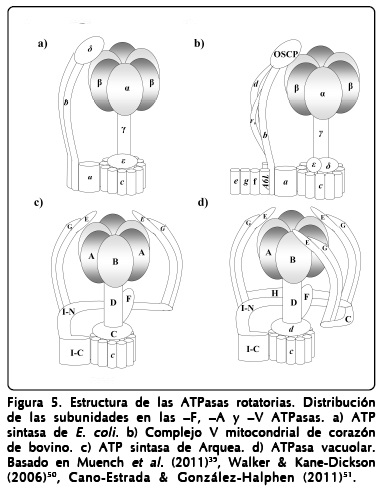
<body><![CDATA[<p align="justify"><font face="verdana" size="2">Debido a su origen com&uacute;n, las subunidades mayores de las A&#45;ATPasas comparten cerca del 50% de identidad en la secuencia con las V&#45;ATPasas y alrededor del 25% con las F&#45;ATPasas<sup>45</sup>. Las estructuras cristalogr&aacute;ficas de las subunidades catal&iacute;ticas de los tres tipos de ATPasas al empalmarse muestran que la diferencia primordial entre estas estructuras es la denominada regi&oacute;n no hom&oacute;loga (NHR) (<a href="/img/revistas/tip/v15n2/a4f4.jpg" target="_blank">Figura 4c</a>), que se encuentra presente en las ATPasas tipo &#45;V y tipo &#45;A, &uacute;nicamente, y se ha sugerido que juega un papel en la regulaci&oacute;n de la actividad enzim&aacute;tica<sup>46</sup>.</font></p>  	    <p align="justify"><font face="verdana" size="2">Los modelos tridimensionales obtenidos mediante crio&#45;microscop&iacute;a electr&oacute;nica de la A&#45;ATPasa de <i>Pyrococcus furiosus</i> permitieron la observaci&oacute;n de lo que corresponde a una estructura de "collar" que act&uacute;a como un segundo estator alrededor del n&uacute;cleo catal&iacute;tico A<sub>3</sub>/B<sub>3</sub><sup>47,48</sup>. Esta estructura se encuentra m&aacute;s pronunciada en la familia de las V&#45;ATPasas como se observa en el modelo del gusano de tabaco, <i>Manduca sexta<sup>49</sup>,</i> esta estructura de "collar" no se encuentra en las F&#45;ATPasa (<a href="/img/revistas/tip/v15n2/a4f4.jpg" target="_blank">Figura 4b</a>). La A<sub>1</sub>A<sub>o</sub>&#45;ATP sintasa est&aacute; compuesta por un dominio catal&iacute;tico (A<sub>3</sub>/B<sub>3</sub>), un rotor central (D, F, C y <i>c),</i> dos brazos perif&eacute;ricos (E y G), una regi&oacute;n translocadora de protones embebida en la membrana (I) y una estructura tipo "collar" compuesta por el extremo amino de la subunidad I (<a href="#f5">Figura 5</a>).</font></p>  	    <p align="center"><font face="verdana" size="2"><a name="f5"></a></font></p>  	    <p align="center"><font face="verdana" size="2"><img src="/img/revistas/tip/v15n2/a4f5.jpg"></font></p>  	    <p align="justify"><font face="verdana" size="2">A la fecha no se ha reportado la estructura completa de una ATP sintasa. Para este tipo de enzimas existen 155 estructuras disponibles en el banco de datos estructurales de prote&iacute;nas (PDB), las m&aacute;s completas corresponden a las F&#45;ATPasas mitocondriales de bovino, de levadura y de <i>E. coli.</i> En el caso de las A&#45;ATPasas s&oacute;lo se encuentra disponible un n&uacute;mero reducido de estructuras (25), la mayor&iacute;a de ellas corresponden a subunidades aisladas (A, B, E y F). Uno de los mejores acercamientos a una estructura completa de una V&#45;ATPasa se realiz&oacute; mediante un empalme de los modelos cristalogr&aacute;ficos de las subunidades de 6 especies diferentes ajustando al mapa tridimensional obtenido para la V&#45;ATPasa de <i>M. sexta<sup>49</sup>;</i> esta misma estrategia se utiliz&oacute; para reconstruir un modelo completo para la A<sub>1</sub>A<sub>o</sub>&#45;ATPasa de la bacteria <i>Thermus thermophilu</i><sup>52</sup><i>.</i></font></p>  	    <p align="justify"><font face="verdana" size="2">&nbsp;</font></p>  	    <p align="justify"><font face="verdana" size="2"><b>N&uacute;cleo catal&iacute;tico</b></font></p>  	    <p align="justify"><font face="verdana" size="2">Como se anot&oacute;, la estructura del n&uacute;cleo catal&iacute;tico de la familia de las ATPasas se encuentra altamente conservada. Se ha propuesto que el tr&iacute;mero de d&iacute;meros A/B (p/a para las F&#45;ATPasas) proviene de una duplicaci&oacute;n de los genes de la subunidad catal&iacute;tica y la subsecuente p&eacute;rdida de la actividad de tres de ellas (<a href="/img/revistas/tip/v15n2/a4f3.jpg" target="_blank">Figura 3</a>). Como las A&#45;ATPasas comparten una estructura central con las V&#45;ATPasas, es posible equiparar la informaci&oacute;n estructural de estas ATPasas. Existe un total de seis posibles sitios de uni&oacute;n a nucle&oacute;tido en el sector A<sub>1</sub> localizados en el n&uacute;cleo catal&iacute;tico A<sub>3</sub>/B<sub>3</sub><sup>9</sup>. Estudios de marcaje de fotoafinidad y espectroscop&iacute;a de correlaci&oacute;n de fluorescencia (FCS) demostraron que tanto la subunidad catal&iacute;tica A como la no catal&iacute;tica B pueden unir an&aacute;logos de nucle&oacute;tido a pesar de que la secuencia consenso GXXGXGKTV, denominada regi&oacute;n de uni&oacute;n a fosfato <i>P&#45;Loop,</i> no se encuentra en la subunidad B<sup>53</sup>. El mecanismo catal&iacute;tico de la A A &#45;ATP sintasa es acorde con el propuesto por Paul Boyer para la cat&aacute;lisis rotacional<sup>54</sup> en los tres sitios catal&iacute;ticos formados en la interfase B&#45;A del dominio A<sub>1</sub>.</font></p>  	    <p align="justify"><font face="verdana" size="2">La estructura cristalogr&aacute;fica de la subunidad A de la A&#45;ATPasa de <i>Pyrococcus horikoshii</i> revel&oacute; una inserci&oacute;n de aproximadamente 90 residuos en la parte superior, denominada regi&oacute;n no hom&oacute;loga (NHR), la cual no se encuentra en la subunidad no catal&iacute;tica B de las A/V&#45;ATPasas y en las F&#45;ATPasas (<a href="/img/revistas/tip/v15n2/a4f6.jpg" target="_blank">Figura 6a</a> y <a href="/img/revistas/tip/v15n2/a4f6.jpg" target="_blank">6b</a>)<sup>55</sup>. Como se observa en la estructura cristalogr&aacute;fica del sector A<sub>3</sub>/B<sub>3</sub> de la bacteria <i>T. thermophilus,</i> esta NHR tambi&eacute;n se encuentra presente en la subunidad A de las V&#45;ATPasas<sup>56</sup>. Lo anterior implica que la estructura global del sector A<sub>1</sub>/V<sub>1</sub> difiere notablemente de la estructura semiesf&eacute;rica observada para el dominio F<sub>1</sub> de las F&#45;ATPasas, en donde las subunidades &#945; y &#946; se sobreponen con un RMS menor a 1 sin tomar en cuenta el <i>P&#45;Loop<sup>57</sup>.</i> Estructuralmente, la subunidad B puede ser dividida en tres dominios: amino terminal barril &#946; (1&#45;71), dominio &#945;/&#946; (113&#45;184) y extremo carboxilo (442&#45;565). Por su parte, la subunidad catal&iacute;tica A adicionalmente posee el dominio NHR (185&#45;204), el <i>P&#45;loop</i> (222&#45;250), y un asa hidrof&oacute;bica (374&#45;407)<sup>56</sup> (<a href="/img/revistas/tip/v15n2/a4f6.jpg" target="_blank">Figura 6a</a>).</font></p>  	    <p align="justify"><font face="verdana" size="2">&nbsp;</font></p>  	    ]]></body>
<body><![CDATA[<p align="justify"><font face="verdana" size="2"><b>Canal de H+/Na+ y rotor central</b></font></p>  	    <p align="justify"><font face="verdana" size="2">El dominio traslocador de iones (A<sub>o</sub>) contiene un anillo de proteol&iacute;pidos (subunidad <i>c)</i> y una copia de la subunidad anfif&iacute;lica I que se encuentra adyacente al anillo, ambos forman un canal para el flujo de iones<sup>58</sup>. Por otro lado, el tallo central se compone por las subunidades C, D y F. La subunidad D tiene una estructura larga de h&eacute;lices entrecruzadas y se inserta en una cavidad hidrof&oacute;bica en el interior del n&uacute;cleo catal&iacute;tico A<sub>3</sub>/B<sub>3</sub><sup>59</sup> de forma similar a la subunidad y de las F&#45;ATPasas<sup>60</sup>. La evidencia experimental de la rotaci&oacute;n del tallo central de la A&#45;ATPasa se obtuvo de forma an&aacute;loga a la del dominio F<sub>1</sub> de la F&#45;ATPasa<sup>61</sup>, detectando el movimiento de una perla unida a la subunidad D mediante un filamento de biotina&#45;estreptavidina al agregar ATP que es hidrolizado por el dominio V<sub>1</sub> (A<sub>3</sub>/B<sub>3</sub>, D, F), que a su vez se encuentra inmovilizado en una superficie por medio de una etiqueta de histidinas en la subunidad A<sup>62</sup>.</font></p>  	    <p align="justify"><font face="verdana" size="2">Asociada a la subunidad D en el tallo central se ubica la subunidad F que s&oacute;lo se encuentra presente en las A&#45; y V&#45;ATPasas y no tiene contraparte en las F&#45;ATPasas<sup>39</sup> (<a href="#f5">Figura 5</a>). Utilizando estructuras de RMN de segmentos de las subunidades D y B de <i>Methanosarcina mazei,</i> en estudios de din&aacute;mica molecular y otros, se ha propuesto que ambas subunidades interaccionan por sus extremos carboxilos de forma tal que la subunidad D adquiere una estructura contra&iacute;da o elongada acorde a la rotaci&oacute;n del tallo central en esta arquea<sup>63</sup>. Sin embargo, esta interacci&oacute;n no pudo ser corroborada en la estructura cristalogr&aacute;fica obtenida para el dominio V<sub>1</sub> de <i>Thermus thermophilus</i> debido a la baja resoluci&oacute;n (4.51&Agrave;) del modelo obtenido<sup>59</sup>. En un estudio reciente, se ha propuesto una contribuci&oacute;n de esta interacci&oacute;n entre las subunidades D y B en la s&iacute;ntesis de ATP favoreciendo la uni&oacute;n del nucle&oacute;tido a la subunidad B, acoplando energ&eacute;ticamente la rotaci&oacute;n del tallo central con el n&uacute;cleo catal&iacute;tico<sup>64</sup>.</font></p>  	    <p align="justify"><font face="verdana" size="2">En general, las subunidades <i>c</i> que han sido purificadas a partir de arqueas tienen una masa molecular parecida a la subunidad <i>c</i> de las F <sub>1</sub>F<sub>o</sub>&#45;ATPasas de aproximadamente 8 kDa con dos segmentos transmembranales<sup>65&#45;67</sup>. En contraste, algunos metan&oacute;genos como <i>Methanothermobacter thermoautotrophicus</i> y <i>M. jannaschii</i> poseen subunidades de mayor tama&ntilde;o de dos o tres rizos transmembrana que posiblemente provienen de duplicaci&oacute;n y triplicaci&oacute;n de genes respectivamente, con la subsecuente fusi&oacute;n de &eacute;stos (<a href="/img/revistas/tip/v15n2/a4f7.jpg" target="_blank">Figura 7</a>)<sup>68</sup>. En el caso de <i>M. thermoautotrophicus</i> el carboxilato del canal de iones se encuentra presente en las h&eacute;lices 2 y 4, mientras que en <i>M. jannaschii</i> se encuentra &uacute;nicamente en las h&eacute;lices 4 y 6, dado que en la h&eacute;lice 2 ha sido sustituido por un residuo de glutamina<sup>69,70</sup>. En el organismo hiperterm&oacute;filo <i>P. furiosus</i> la subunidad <i>c</i>tiene una masa molecular de ~16 kDa. Al purificar la enzima se observ&oacute; una asociaci&oacute;n del olig&oacute;mero de subunidades cy la subunidad I de 60 kDa resistente al SDS en geles desnaturalizantes<sup>48</sup>. Un caso extraordinario es el organismo <i>Methanopyrus kandleri</i> en donde el gen <i>ntpK</i> codifica para una subunidad <i>c</i> repetida 13 veces y se propone que la base del rotor se forma por una sola subunidad, aunque no es posible descartar una edici&oacute;n postraduccional de la prote&iacute;na, por lo que el tama&ntilde;o real de la subunidad en el complejo debe ser verificado<sup>71</sup>.</font></p>  	    <p align="justify"><font face="verdana" size="2">&nbsp;</font></p>  	    <p align="justify"><font face="verdana" size="2"><b>Brazos perif&eacute;ricos</b></font></p>  	    <p align="justify"><font face="verdana" size="2">El brazo perif&eacute;rico es un componente adicional requerido para contrarrestar la fuerza de torsi&oacute;n mec&aacute;nica generada por la rotaci&oacute;n del tallo central de la enzima durante la s&iacute;ntesis e hidr&oacute;lisis de ATP, as&iacute; como para conectar el n&uacute;cleo catal&iacute;tico con la base membranal. El n&uacute;mero de estos estatores var&iacute;a seg&uacute;n el tipo de ATP sintasa siendo de 1, 2 y 3 para las F&#45;, A&#45; y V&#45;, respectivamente (<a href="#f5">Figura 5</a>). Cada uno de los tallos perif&eacute;ricos de las enzimas tipo A&#45; y V&#45; se forman por un heterod&iacute;mero de subunidades E y G<sup>52,</sup> <sup>72</sup>, mientras que la composici&oacute;n del brazo en las F&#45;ATPasas es muy variable entre organismos<sup>51</sup>. A la fecha no se ha logrado resolver la estructura de ning&uacute;n estator perif&eacute;rico completo junto con la porci&oacute;n membranal y la informaci&oacute;n disponible corresponde a estudios estructurales de subcomplejos aislados o junto al n&uacute;cleo catal&iacute;tico<sup>73&#45;75</sup>.</font></p>  	    <p align="justify"><font face="verdana" size="2">Las subunidades G(H) y E fueron propuestas inicialmente para la formaci&oacute;n de la estructura de tipo "collar" por los grupos de M&uuml;ller y Gruber<sup>47,</sup> <sup>76</sup>; sin embargo, a partir de estudios del mismo y otros grupos de investigaci&oacute;n se ha podido llegar a un modelo m&aacute;s detallado en el cual la estructura de "collar" se encuentra formada por la subunidad I que extiende su extremo amino hacia la fracci&oacute;n extramembranal<sup>77</sup> y es la encargada de unir los dos estatores<sup>31,</sup> <sup>52</sup> (<a href="#f5">Figura 5</a>), en contraste con las F&#45;ATPasas, en las que la subunidad <i>b</i> desarrolla esta funci&oacute;n<sup>78</sup>.</font></p>  	    <p align="justify"><font face="verdana" size="2">La estructura cristalogr&aacute;fica del estator heterodim&eacute;rico (E y G) que une a la subunidad I con una subunidad B del n&uacute;cleo catal&iacute;tico permiti&oacute; observar una estructura de h&eacute;lices entrecruzadas dextr&oacute;giras<sup>75</sup> (<a href="/img/revistas/tip/v15n2/a4f6.jpg" target="_blank">Figura 6</a>). Se ha postulado que este tipo de plegamiento se encuentra presente en la regi&oacute;n formadora del d&iacute;mero de las subunidades B del brazo de la F&#45;ATPasa de <i>E. coli<sup>79,</sup></i> <sup>80</sup>; sin embargo, existen estudios que proponen que esta regi&oacute;n podr&iacute;a formar h&eacute;lices entrecruzadas lev&oacute;giras<sup>81,</sup> <sup>82</sup>. En el caso del brazo perif&eacute;rico de la F&#45;ATPasa de bovino no est&aacute; claro el sentido de las h&eacute;lices presentes, ya que las estructuras se han obtenido a partir de segmentos de las subunidades<sup>73,</sup> <sup>74</sup> (<a href="/img/revistas/tip/v15n2/a4f6.jpg" target="_blank">Figura 6</a>).</font></p>  	    <p align="justify"><font face="verdana" size="2">&nbsp;</font></p>  	    ]]></body>
<body><![CDATA[<p align="justify"><font face="verdana" size="2"><b>Utilizaci&oacute;n del &#916;&#956;(Na<sup>+</sup>) y &#916;&#956;(H<sup>+</sup>) en arqueas</b> <b>Metanog&eacute;nicas</b></font></p>      <p align="justify"><font face="verdana" size="2">Las arqueas metanog&eacute;nicas son una de las pocas formas de vida que producen un potencial electroqu&iacute;mico transmembranal (&#916;&#956;i) de iones H+ y Na+, simult&aacute;neamente. La metanog&eacute;nesis se sugiere como una de las primeras rutas metab&oacute;licas desarrolladas en la Tierra<sup>83</sup>. La especificidad de la ATP sintasa por el i&oacute;n a utilizar se encuentra definida por la regi&oacute;n traslocadora en la base de la enzima (A<sub>o</sub>), formada por un anillo que agrupa m&uacute;ltiples copias de la subunidad <i>c</i> (K/L), cada una de las cuales posee un sitio de uni&oacute;n<sup>68</sup>. Una de las inc&oacute;gnitas m&aacute;s representativas es c&oacute;mo aprovechan cada uno de estos gradientes este grupo de organismos. Los primeros estudios con inhibidores indicaron la presencia de una F <sub>1</sub>F<sub>o</sub>&#45;ATP sintasa y una A<sub>1</sub>A<sub>o</sub>&#45;ATP sintasa en la membrana plasm&aacute;tica de <i>M. mazei</i> Go1, se propuso que estas enzimas utilizan los iones Na+ y H+ para la s&iacute;ntesis de ATP respectivamente, lo que indica una independencia del i&oacute;n en la s&iacute;ntesis de ATP<sup>84</sup>. Por otra parte, el crecimiento de la especie <i>Methanobrevibacter ruminantium</i> M1 fue inhibido por ion&oacute;foros y proton&oacute;foros de sodio lo que demuestra que ambos gradientes son esenciales<sup>85</sup>. Para elucidar la importancia de la F<sub>1</sub>F<sub>o</sub>&#45;ATPasa en estos organismos, el oper&oacute;n de la ATPasa en <i>Methanosarcina acetivorans</i> se intercambi&oacute; por un <i>cassette</i> de resistencia a puromicina. La mutante present&oacute; un crecimiento equivalente al de la cepa silvestre, con un contenido de ATP celular id&eacute;ntico, lo que demostr&oacute; que los genes de la F<sub>1</sub>F<sub>o</sub>&#45;ATPasa no son esenciales para la supervivencia de este organismo<sup>86</sup>. Recientemente, Schlegel y colaboradores demostraron que la A<sub>1</sub>A<sub>o</sub>&#45;ATP sintasa de <i>M. acetivorans</i> es capaz de utilizar ambos gradientes (Na+ y H+) simult&aacute;neamente para sintetizar ATP<sup>87</sup>.</font></p>      <p align="justify"><font face="verdana" size="2">&nbsp;</font></p>  	    <p align="justify"><font face="verdana" size="2"><b>Conclusiones</b></font></p>  	    <p align="justify"><font face="verdana" size="2">El estudio de los complejos respiratorios en arqueas aer&oacute;bicas a&uacute;n se encuentra en una etapa temprana, lo que parcialmente se debe a la dificultad para aislar y cultivar estos organismos, por su dependencia de condiciones muy espec&iacute;ficas (extremas) para su desarrollo. Sin embargo, la investigaci&oacute;n con arqueas ha permitido esclarecer mecanismos biol&oacute;gicos y caracter&iacute;sticas estructurales que proporcionan una visi&oacute;n mucho m&aacute;s amplia de los organismos vivos y, por lo tanto, es necesario continuar con el estudio de estos complejos para abrir las puertas a todo un abanico de nuevas posibilidades sobre la transducci&oacute;n primaria de energ&iacute;a a trav&eacute;s de las membranas.</font></p>  	    <p align="justify"><font face="verdana" size="2">Por otro lado, muchas v&iacute;as de obtenci&oacute;n de energ&iacute;a en arqueas involucran al complejo A<sub>1</sub>A<sub>o</sub>&#45;ATP sintasa (<a href="/img/revistas/tip/v15n2/a4f2.jpg" target="_blank">Figura 2a</a>); esto, aunado a su similitud con las V V &#45;ATP sintasa de eucariontes y su importancia en las arqueas metanog&eacute;nicas, ha despertado inter&eacute;s por una gran diversidad de estudios estructurales y bioqu&iacute;micos sobre este complejo. El conjunto de trabajos disponibles hasta la fecha permiti&oacute; proponer un modelo estructural (inicial) que ha evolucionado y actualmente ha sido construido casi por completo (<a href="/img/revistas/tip/v15n2/a4f8.jpg" target="_blank">Figura 8</a>). Esto no implica el final de su estudio, sino el comienzo de una nueva etapa abriendo puertas hacia la elucidaci&oacute;n de su mecanismo catal&iacute;tico, su regulaci&oacute;n y las diferencias estructurales dentro de cada una de las especies, entre otros aspectos.</font></p>  	    <p align="justify"><font face="verdana" size="2">En general, la informaci&oacute;n disponible acerca de las arqueas se ha obtenido en relativamente poco tiempo; su importancia evolutiva, biol&oacute;gica y biotecnol&oacute;gica<sup>3,</sup> <sup>88</sup> parece representar s&oacute;lo una peque&ntilde;a proporci&oacute;n de lo que las arqueas tienen que ofrecer, lo que es un incentivo para continuar con la investigaci&oacute;n referente a este fascinante dominio de la vida.</font></p>  	    <p align="justify"><font face="verdana" size="2">&nbsp;</font></p>  	    <p align="justify"><font face="verdana" size="2"><b>Agradecimientos</b></font></p>  	    <p align="justify"><font face="verdana" size="2">Este trabajo fue apoyado por los proyectos: 128110 (CONACyT) e IN203311&#45;3 de la DGAPA (UNAM). H&eacute;ctor Vicente Miranda&#45;Astudillo es becario de CONACyT (229474). Se agradece a los doctores Diego Gonz&aacute;lez&#45;Halphen (IFC&#45;UNAM), Salvador Uribe&#45;Carvajal (IFC&#45;UNAM) y Arturo Becerra&#45;Bracho (FC&#45;UNAM) por sus valiosas opiniones en la realizaci&oacute;n de este manuscrito.</font></p>  	    ]]></body>
<body><![CDATA[<p align="justify"><font face="verdana" size="2">&nbsp;</font></p>  	    <p align="justify"><font face="verdana" size="2"><b>Referencias</b></font></p>  	    <!-- ref --><p align="justify"><font face="verdana" size="2">1. Zillig, W. Comparative biochemistry of Archaea and Bacteria. <i>Curr.</i> <i>Opin. Genet Dev.</i> <b>1,</b> 544&#45;551 (1991).    &nbsp;&nbsp;&nbsp;&nbsp;&nbsp;&nbsp;&nbsp;&nbsp;[&#160;<a href="javascript:void(0);" onclick="javascript: window.open('/scielo.php?script=sci_nlinks&ref=9911596&pid=S1405-888X201200020000400001&lng=','','width=640,height=500,resizable=yes,scrollbars=1,menubar=yes,');">Links</a>&#160;]<!-- end-ref --></font></p>  	    <!-- ref --><p align="justify"><font face="verdana" size="2">2. Woese, C.R., Kandler, O. &amp; Wheelis, M.L. Towards a natural system of organisms: proposal for the domains Archaea, Bacteria, and Eucarya. <i>Proc. Natl. Acad. Sci. USA</i> <b>87,</b> 4576&#45;4579 (1990).    &nbsp;&nbsp;&nbsp;&nbsp;&nbsp;&nbsp;&nbsp;&nbsp;[&#160;<a href="javascript:void(0);" onclick="javascript: window.open('/scielo.php?script=sci_nlinks&ref=9911598&pid=S1405-888X201200020000400002&lng=','','width=640,height=500,resizable=yes,scrollbars=1,menubar=yes,');">Links</a>&#160;]<!-- end-ref --></font></p>  	    <!-- ref --><p align="justify"><font face="verdana" size="2">3. Jarrell, K.F. <i>et al.</i> Major players on the microbial stage: why archaea are important. <i>Microbiology</i> <b>157,</b> 919&#45;936 (2011).    &nbsp;&nbsp;&nbsp;&nbsp;&nbsp;&nbsp;&nbsp;&nbsp;[&#160;<a href="javascript:void(0);" onclick="javascript: window.open('/scielo.php?script=sci_nlinks&ref=9911600&pid=S1405-888X201200020000400003&lng=','','width=640,height=500,resizable=yes,scrollbars=1,menubar=yes,');">Links</a>&#160;]<!-- end-ref --></font></p>  	    <!-- ref --><p align="justify"><font face="verdana" size="2">4. Gupta, R.S. &amp; Shami, A. Molecular signatures for the Crenarchaeota and the Thaumarchaeota. <i>Antonie van Leeuwenhoek</i> <b>99,</b> 133-157 (2011).    &nbsp;&nbsp;&nbsp;&nbsp;&nbsp;&nbsp;&nbsp;&nbsp;[&#160;<a href="javascript:void(0);" onclick="javascript: window.open('/scielo.php?script=sci_nlinks&ref=9911602&pid=S1405-888X201200020000400004&lng=','','width=640,height=500,resizable=yes,scrollbars=1,menubar=yes,');">Links</a>&#160;]<!-- end-ref --></font></p>  	    ]]></body>
<body><![CDATA[<!-- ref --><p align="justify"><font face="verdana" size="2">5. Lewalter, K. &amp; M&uuml;ller, V. Bioenergetics of archaea: ancient energy conserving mechanisms developed in the early history of life. <i>Biochim. Biophys. Acta</i> <b>1757,</b> 437&#45;445 (2006).    &nbsp;&nbsp;&nbsp;&nbsp;&nbsp;&nbsp;&nbsp;&nbsp;[&#160;<a href="javascript:void(0);" onclick="javascript: window.open('/scielo.php?script=sci_nlinks&ref=9911604&pid=S1405-888X201200020000400005&lng=','','width=640,height=500,resizable=yes,scrollbars=1,menubar=yes,');">Links</a>&#160;]<!-- end-ref --></font></p>  	    <!-- ref --><p align="justify"><font face="verdana" size="2">6. Huber, H. <i>et al.</i> A new phylum of Archaea represented by a nanosized hyperthermophilic symbiont. <i>Nature</i> <b>2,</b> 63&#45;67 (2002).    &nbsp;&nbsp;&nbsp;&nbsp;&nbsp;&nbsp;&nbsp;&nbsp;[&#160;<a href="javascript:void(0);" onclick="javascript: window.open('/scielo.php?script=sci_nlinks&ref=9911606&pid=S1405-888X201200020000400006&lng=','','width=640,height=500,resizable=yes,scrollbars=1,menubar=yes,');">Links</a>&#160;]<!-- end-ref --></font></p>  	    <!-- ref --><p align="justify"><font face="verdana" size="2">7. Barns, S.M., Delwiche, C.F., Palmer, J.D. &amp; Pace, N.R. Perspectives on archaeal diversity, thermophily and monophyly from environmental rRNA sequences. <i>Proc. Natl. Acad. Sci. USA</i> <b>93,</b> 9188&#45;9193 (1996).    &nbsp;&nbsp;&nbsp;&nbsp;&nbsp;&nbsp;&nbsp;&nbsp;[&#160;<a href="javascript:void(0);" onclick="javascript: window.open('/scielo.php?script=sci_nlinks&ref=9911608&pid=S1405-888X201200020000400007&lng=','','width=640,height=500,resizable=yes,scrollbars=1,menubar=yes,');">Links</a>&#160;]<!-- end-ref --></font></p>  	    <!-- ref --><p align="justify"><font face="verdana" size="2">8. Brochier&#45;Armanet, C., Boussau, B., Gribaldo, S. &amp; Forterre, P. Mesophilic Crenarchaeota: proposal for a third archaeal phylum, the Thaumarchaeota. <i>Nat. Rev. Microbiol.</i> <b>6,</b> 245&#45;252 (2008).    &nbsp;&nbsp;&nbsp;&nbsp;&nbsp;&nbsp;&nbsp;&nbsp;[&#160;<a href="javascript:void(0);" onclick="javascript: window.open('/scielo.php?script=sci_nlinks&ref=9911610&pid=S1405-888X201200020000400008&lng=','','width=640,height=500,resizable=yes,scrollbars=1,menubar=yes,');">Links</a>&#160;]<!-- end-ref --></font></p>  	    <!-- ref --><p align="justify"><font face="verdana" size="2">9. Schafer, G., Engelhard, M. &amp; M&uuml;ller, V. Bioenergetics of the Archaea. <i>Microbiol. Mol. Biol. Rev.</i> <b>63,</b> 570&#45;620 (1999).    &nbsp;&nbsp;&nbsp;&nbsp;&nbsp;&nbsp;&nbsp;&nbsp;[&#160;<a href="javascript:void(0);" onclick="javascript: window.open('/scielo.php?script=sci_nlinks&ref=9911612&pid=S1405-888X201200020000400009&lng=','','width=640,height=500,resizable=yes,scrollbars=1,menubar=yes,');">Links</a>&#160;]<!-- end-ref --></font></p>  	    ]]></body>
<body><![CDATA[<!-- ref --><p align="justify"><font face="verdana" size="2">10. Mitchell, P. Coupling of phosphorylation to electron and hydrogen transfer by a chemi&#45;osmotic type of mechanism. <i>Nature</i> <b>4784,</b> 144&#45;148 (1961).    &nbsp;&nbsp;&nbsp;&nbsp;&nbsp;&nbsp;&nbsp;&nbsp;[&#160;<a href="javascript:void(0);" onclick="javascript: window.open('/scielo.php?script=sci_nlinks&ref=9911614&pid=S1405-888X201200020000400010&lng=','','width=640,height=500,resizable=yes,scrollbars=1,menubar=yes,');">Links</a>&#160;]<!-- end-ref --></font></p>  	    <!-- ref --><p align="justify"><font face="verdana" size="2">11. Deppenmeier, U. Redox&#45;driven proton translocation in methanogenic Archaea. <i>Cell Mol. Life Sci.</i> <b>59,</b> 1513&#45;1533 (2002).    &nbsp;&nbsp;&nbsp;&nbsp;&nbsp;&nbsp;&nbsp;&nbsp;[&#160;<a href="javascript:void(0);" onclick="javascript: window.open('/scielo.php?script=sci_nlinks&ref=9911616&pid=S1405-888X201200020000400011&lng=','','width=640,height=500,resizable=yes,scrollbars=1,menubar=yes,');">Links</a>&#160;]<!-- end-ref --></font></p>  	    <!-- ref --><p align="justify"><font face="verdana" size="2">12. M&uuml;ller, V. <i>et al.</i> Bioenergetics of archaea: ATP synthesis under harsh environmental conditions. <i>J. Mol. Microbiol. Biotechnol.</i> <b>10,</b> 167&#45;180 (2005).    &nbsp;&nbsp;&nbsp;&nbsp;&nbsp;&nbsp;&nbsp;&nbsp;[&#160;<a href="javascript:void(0);" onclick="javascript: window.open('/scielo.php?script=sci_nlinks&ref=9911618&pid=S1405-888X201200020000400012&lng=','','width=640,height=500,resizable=yes,scrollbars=1,menubar=yes,');">Links</a>&#160;]<!-- end-ref --></font></p>  	    <!-- ref --><p align="justify"><font face="verdana" size="2">13. Iwasaki, T., Matsuura, K. &amp; Oshima, T. Resolution of the aerobic respiratory system of the thermoacidophilic archaeon, <i>Sulfolobus</i> sp. strain 7. I. The archaeal terminal oxidase supercomplex is a functional fusion of respiratory complexes III and IV with no <i>c</i>&#45;type cytochromes. <i>J. Biol. Chem.</i> <b>270,</b> 30881&#45;30892 (1995).    &nbsp;&nbsp;&nbsp;&nbsp;&nbsp;&nbsp;&nbsp;&nbsp;[&#160;<a href="javascript:void(0);" onclick="javascript: window.open('/scielo.php?script=sci_nlinks&ref=9911620&pid=S1405-888X201200020000400013&lng=','','width=640,height=500,resizable=yes,scrollbars=1,menubar=yes,');">Links</a>&#160;]<!-- end-ref --></font></p>  	    <!-- ref --><p align="justify"><font face="verdana" size="2">14. Schafer, G., Purschke, W.G., Gleissner, M. &amp; Schmidt, C.L. Respiratory chains of archaea and extremophiles. <i>Biochim. Biophys. Acta</i> <b>1275,</b> 16&#45;20 (1996).    &nbsp;&nbsp;&nbsp;&nbsp;&nbsp;&nbsp;&nbsp;&nbsp;[&#160;<a href="javascript:void(0);" onclick="javascript: window.open('/scielo.php?script=sci_nlinks&ref=9911622&pid=S1405-888X201200020000400014&lng=','','width=640,height=500,resizable=yes,scrollbars=1,menubar=yes,');">Links</a>&#160;]<!-- end-ref --></font></p>  	    ]]></body>
<body><![CDATA[<!-- ref --><p align="justify"><font face="verdana" size="2">15. Pereira, M.M. <i>et al.</i> Respiratory chains from aerobic thermophilic prokaryotes. <i>J. Bioenerg. Biomembr.</i> <b>36,</b> 93&#45;105 (2004).    &nbsp;&nbsp;&nbsp;&nbsp;&nbsp;&nbsp;&nbsp;&nbsp;[&#160;<a href="javascript:void(0);" onclick="javascript: window.open('/scielo.php?script=sci_nlinks&ref=9911624&pid=S1405-888X201200020000400015&lng=','','width=640,height=500,resizable=yes,scrollbars=1,menubar=yes,');">Links</a>&#160;]<!-- end-ref --></font></p>  	    <!-- ref --><p align="justify"><font face="verdana" size="2">16. Brito, J.A., Bandeiras, T.M., Teixeira, M., Vonrhein, C. &amp; Archer, M. Crystallisation and preliminary structure determination of a NADH: quinone oxidoreductase from the extremophile <i>Acidianus ambivalens. Biochim. Biophys. Acta</i> <b>1764,</b> 842&#45;845 (2006).    &nbsp;&nbsp;&nbsp;&nbsp;&nbsp;&nbsp;&nbsp;&nbsp;[&#160;<a href="javascript:void(0);" onclick="javascript: window.open('/scielo.php?script=sci_nlinks&ref=9911626&pid=S1405-888X201200020000400016&lng=','','width=640,height=500,resizable=yes,scrollbars=1,menubar=yes,');">Links</a>&#160;]<!-- end-ref --></font></p>  	    <!-- ref --><p align="justify"><font face="verdana" size="2">17. Gomes, C.M., Bandeiras, T.M. &amp; Teixeira, M. A new type&#45;II NADH dehydrogenase from the archaeon <i>Acidianus</i> <i>ambivalens:</i> characterization and in vitro reconstitution of the respiratory chain. <i>J. Bioenerg. Biomembr.</i> <b>33,</b> 1&#45;8 (2001).    &nbsp;&nbsp;&nbsp;&nbsp;&nbsp;&nbsp;&nbsp;&nbsp;[&#160;<a href="javascript:void(0);" onclick="javascript: window.open('/scielo.php?script=sci_nlinks&ref=9911628&pid=S1405-888X201200020000400017&lng=','','width=640,height=500,resizable=yes,scrollbars=1,menubar=yes,');">Links</a>&#160;]<!-- end-ref --></font></p>  	    <!-- ref --><p align="justify"><font face="verdana" size="2">18. Gomes, C.M. <i>et al.</i> The unusual iron sulfur composition of the <i>Acidianus ambivalens</i> succinate dehydrogenase complex. <i>Biochim. Biophys. Acta</i> <b>1411,</b> 134&#45;141 (1999).    &nbsp;&nbsp;&nbsp;&nbsp;&nbsp;&nbsp;&nbsp;&nbsp;[&#160;<a href="javascript:void(0);" onclick="javascript: window.open('/scielo.php?script=sci_nlinks&ref=9911630&pid=S1405-888X201200020000400018&lng=','','width=640,height=500,resizable=yes,scrollbars=1,menubar=yes,');">Links</a>&#160;]<!-- end-ref --></font></p>  	    <!-- ref --><p align="justify"><font face="verdana" size="2">19. Lemos, R.S., Gomes, C.M. &amp; Teixeira, M. <i>Acidianus ambivalens</i> Complex II typifies a novel family of succinate dehydrogenases. <i>Biochem. Biophys. Res. Commun.</i> <b>281,</b> 141&#45;150 (2001).    &nbsp;&nbsp;&nbsp;&nbsp;&nbsp;&nbsp;&nbsp;&nbsp;[&#160;<a href="javascript:void(0);" onclick="javascript: window.open('/scielo.php?script=sci_nlinks&ref=9911632&pid=S1405-888X201200020000400019&lng=','','width=640,height=500,resizable=yes,scrollbars=1,menubar=yes,');">Links</a>&#160;]<!-- end-ref --></font></p>  	    ]]></body>
<body><![CDATA[<!-- ref --><p align="justify"><font face="verdana" size="2">20. Bandeiras, T.M. <i>et al.</i> The cytochrome <i>ba</i> complex from the thermoacidophilic crenarchaeote <i>Acidianus ambivalens</i> is an analog of <i>bc1</i> complexes. <i>Biochim. Biophys. Acta</i> <b>1787,</b> 37&#45;45 (2009).    &nbsp;&nbsp;&nbsp;&nbsp;&nbsp;&nbsp;&nbsp;&nbsp;[&#160;<a href="javascript:void(0);" onclick="javascript: window.open('/scielo.php?script=sci_nlinks&ref=9911634&pid=S1405-888X201200020000400020&lng=','','width=640,height=500,resizable=yes,scrollbars=1,menubar=yes,');">Links</a>&#160;]<!-- end-ref --></font></p>  	    <!-- ref --><p align="justify"><font face="verdana" size="2">21. Gilderson, G. <i>et al.</i> Kinetics of electron and proton transfer during O<sub>2</sub> reduction in cytochrome aa<sub>3</sub> from <i>A. ambivalens:</i> an enzyme lacking Glu(I&#45;286). <i>Biochim. Biophys. Acta</i> <b>1503,</b> 261&#45;270 (2001).    &nbsp;&nbsp;&nbsp;&nbsp;&nbsp;&nbsp;&nbsp;&nbsp;[&#160;<a href="javascript:void(0);" onclick="javascript: window.open('/scielo.php?script=sci_nlinks&ref=9911636&pid=S1405-888X201200020000400021&lng=','','width=640,height=500,resizable=yes,scrollbars=1,menubar=yes,');">Links</a>&#160;]<!-- end-ref --></font></p>  	    <!-- ref --><p align="justify"><font face="verdana" size="2">22. Kabashima, Y. &amp; Sakamoto, J. Purification and biochemical properties of a cytochrome <i>bc</i> complex from the aerobic hyperthermophilic archaeon <i>Aeropyrum pernix. BMC Microbiology</i> <b>11,</b> 52 (2011).    &nbsp;&nbsp;&nbsp;&nbsp;&nbsp;&nbsp;&nbsp;&nbsp;[&#160;<a href="javascript:void(0);" onclick="javascript: window.open('/scielo.php?script=sci_nlinks&ref=9911638&pid=S1405-888X201200020000400022&lng=','','width=640,height=500,resizable=yes,scrollbars=1,menubar=yes,');">Links</a>&#160;]<!-- end-ref --></font></p>  	    <!-- ref --><p align="justify"><font face="verdana" size="2">23. Ishikawa, R. <i>et al. Aeropyrum pernix</i> K1, a strictly aerobic and hyperthermophilic archaeon, has two terminal oxidases, cytochrome ba<sub>3</sub> and cytochrome aa<sub>3</sub>. <i>Arch. Microbiol.</i> <b>179,</b> 42-49 (2002).    &nbsp;&nbsp;&nbsp;&nbsp;&nbsp;&nbsp;&nbsp;&nbsp;[&#160;<a href="javascript:void(0);" onclick="javascript: window.open('/scielo.php?script=sci_nlinks&ref=9911640&pid=S1405-888X201200020000400023&lng=','','width=640,height=500,resizable=yes,scrollbars=1,menubar=yes,');">Links</a>&#160;]<!-- end-ref --></font></p>  	    <!-- ref --><p align="justify"><font face="verdana" size="2">24. Sreeramulu, K., Schmidt, C.L., Schafer, G. &amp; Anem&uuml;ller, S. Studies of the electron transport chain of the euryarcheon <i>Halobacterium salinarum:</i> indications for a type II NADH dehydrogenase and a complex III analog. <i>J. Bioenerg. Biomembr.</i> <b>30,</b> 443&#45;453 (1998).    &nbsp;&nbsp;&nbsp;&nbsp;&nbsp;&nbsp;&nbsp;&nbsp;[&#160;<a href="javascript:void(0);" onclick="javascript: window.open('/scielo.php?script=sci_nlinks&ref=9911642&pid=S1405-888X201200020000400024&lng=','','width=640,height=500,resizable=yes,scrollbars=1,menubar=yes,');">Links</a>&#160;]<!-- end-ref --></font></p>  	    ]]></body>
<body><![CDATA[<!-- ref --><p align="justify"><font face="verdana" size="2">25. Gonz&aacute;lez, O. <i>et al.</i> Systems analysis of bioenergetics and growth of the extreme halophile <i>Halobacterium salinarum. PLoS Comput. Biol.</i> <b>5,</b> e1000332 (2009).    &nbsp;&nbsp;&nbsp;&nbsp;&nbsp;&nbsp;&nbsp;&nbsp;[&#160;<a href="javascript:void(0);" onclick="javascript: window.open('/scielo.php?script=sci_nlinks&ref=9911644&pid=S1405-888X201200020000400025&lng=','','width=640,height=500,resizable=yes,scrollbars=1,menubar=yes,');">Links</a>&#160;]<!-- end-ref --></font></p>  	    <!-- ref --><p align="justify"><font face="verdana" size="2">26. Nunoura, T., Sako, Y., Wakagi, T. &amp; Uchida, A. Regulation of the aerobic respiratory chain in the facultatively aerobic and hyperthermophilic archaeon <i>Pyrobaculum oguniense.</i> <i>Microbiology</i> <b>149,</b> 673&#45;688 (2003).    &nbsp;&nbsp;&nbsp;&nbsp;&nbsp;&nbsp;&nbsp;&nbsp;[&#160;<a href="javascript:void(0);" onclick="javascript: window.open('/scielo.php?script=sci_nlinks&ref=9911646&pid=S1405-888X201200020000400026&lng=','','width=640,height=500,resizable=yes,scrollbars=1,menubar=yes,');">Links</a>&#160;]<!-- end-ref --></font></p>  	    <!-- ref --><p align="justify"><font face="verdana" size="2">27. Nunoura, T., Sako, Y., Wakagi, T. &amp; Uchida, A. Cytochrome aa3 in facultatively aerobic and hyperthermophilic archaeon <i>Pyrobaculum oguniense. Can. J. Microbiol.</i> <b>51</b>, 621&#45;627 (2005).    &nbsp;&nbsp;&nbsp;&nbsp;&nbsp;&nbsp;&nbsp;&nbsp;[&#160;<a href="javascript:void(0);" onclick="javascript: window.open('/scielo.php?script=sci_nlinks&ref=9911648&pid=S1405-888X201200020000400027&lng=','','width=640,height=500,resizable=yes,scrollbars=1,menubar=yes,');">Links</a>&#160;]<!-- end-ref --></font></p>  	    <!-- ref --><p align="justify"><font face="verdana" size="2">28. Bandeiras, T.M., Salgueiro, C.A., Huber, H., Gomes, C.M. &amp; Teixeira, M. The respiratory chain of the thermophilic archaeon <i>Sulfolobus metallicus:</i> studies on the type&#45;II NADH dehydrogenase. <i>Biochim. Biophys. Acta.</i> <b>1557,</b> 13&#45;19 (2003).    &nbsp;&nbsp;&nbsp;&nbsp;&nbsp;&nbsp;&nbsp;&nbsp;[&#160;<a href="javascript:void(0);" onclick="javascript: window.open('/scielo.php?script=sci_nlinks&ref=9911650&pid=S1405-888X201200020000400028&lng=','','width=640,height=500,resizable=yes,scrollbars=1,menubar=yes,');">Links</a>&#160;]<!-- end-ref --></font></p>  	    <!-- ref --><p align="justify"><font face="verdana" size="2">29. Hamann, N. <i>et al.</i> The CCG&#45;domain&#45;containing subunit SdhE of succinate: quinone oxidoreductase from <i>Sulfolobus solfataricus</i> P2 binds a &#91;4Fe&#45;4S&#93; cluster. <i>J. Biol. Inorg. Chem.</i> <b>14,</b> 457&#45;470 (2009).    &nbsp;&nbsp;&nbsp;&nbsp;&nbsp;&nbsp;&nbsp;&nbsp;[&#160;<a href="javascript:void(0);" onclick="javascript: window.open('/scielo.php?script=sci_nlinks&ref=9911652&pid=S1405-888X201200020000400029&lng=','','width=640,height=500,resizable=yes,scrollbars=1,menubar=yes,');">Links</a>&#160;]<!-- end-ref --></font></p>  	    ]]></body>
<body><![CDATA[<!-- ref --><p align="justify"><font face="verdana" size="2">30. Auernik, K.S. &amp; Kelly, R.M. Identification of components of electron transport chains in the extremely thermoacidophilic crenarchaeon <i>Metallosphaera sedula</i> through iron and sulfur compound oxidation transcriptomes. <i>Appl. Environ. Microbiol.</i> <b>74,</b> 7723&#45;7732 (2008).    &nbsp;&nbsp;&nbsp;&nbsp;&nbsp;&nbsp;&nbsp;&nbsp;[&#160;<a href="javascript:void(0);" onclick="javascript: window.open('/scielo.php?script=sci_nlinks&ref=9911654&pid=S1405-888X201200020000400030&lng=','','width=640,height=500,resizable=yes,scrollbars=1,menubar=yes,');">Links</a>&#160;]<!-- end-ref --></font></p>  	    <!-- ref --><p align="justify"><font face="verdana" size="2">31. Kish&#45;Trier, E., Briere, L.K., Dunn, S.D. &amp; Wilkens, S. The stator complex of the A<sub>1</sub>A<sub>0</sub>&#45;ATP synthase&#45;structural characterization of the E and H subunits. <i>J. Mol. Biol.</i> <b>375,</b> 673&#45;685 (2008).    &nbsp;&nbsp;&nbsp;&nbsp;&nbsp;&nbsp;&nbsp;&nbsp;[&#160;<a href="javascript:void(0);" onclick="javascript: window.open('/scielo.php?script=sci_nlinks&ref=9911656&pid=S1405-888X201200020000400031&lng=','','width=640,height=500,resizable=yes,scrollbars=1,menubar=yes,');">Links</a>&#160;]<!-- end-ref --></font></p>  	    <!-- ref --><p align="justify"><font face="verdana" size="2">32. Kish&#45;Trier, E. &amp; Wilkens, S. Domain architecture of the stator complex of the A<sub>1</sub>A<sub>0</sub>&#45;ATP synthase from <i>Thermoplasma acidophilum. J. Biol. Chem.</i> <b>284,</b> 12031&#45;12040 (2009).    &nbsp;&nbsp;&nbsp;&nbsp;&nbsp;&nbsp;&nbsp;&nbsp;[&#160;<a href="javascript:void(0);" onclick="javascript: window.open('/scielo.php?script=sci_nlinks&ref=9911658&pid=S1405-888X201200020000400032&lng=','','width=640,height=500,resizable=yes,scrollbars=1,menubar=yes,');">Links</a>&#160;]<!-- end-ref --></font></p>  	    <!-- ref --><p align="justify"><font face="verdana" size="2">33. Kish&#45;Trier, E. &amp; Wilkens, S. Interaction of the <i>Thermoplasma</i> <i>acidophilum</i> A<sub>1</sub>A<sub>0</sub>&#45;ATP synthase peripheral stalk with the catalytic domain. <i>FEBS Letters</i> <b>583,</b> 3121&#45;3126 (2009).    &nbsp;&nbsp;&nbsp;&nbsp;&nbsp;&nbsp;&nbsp;&nbsp;[&#160;<a href="javascript:void(0);" onclick="javascript: window.open('/scielo.php?script=sci_nlinks&ref=9911660&pid=S1405-888X201200020000400033&lng=','','width=640,height=500,resizable=yes,scrollbars=1,menubar=yes,');">Links</a>&#160;]<!-- end-ref --></font></p>  	    <!-- ref --><p align="justify"><font face="verdana" size="2">34. Cross, R.L. &amp; M&uuml;ller, V. The evolution of A&#45;, F&#45;, and V&#45;type ATP synthases and ATPases: reversals in function and changes in the H+/ATP coupling ratio. <i>FEBS Letters</i> <b>576,</b> 1&#45;4 (2004).    &nbsp;&nbsp;&nbsp;&nbsp;&nbsp;&nbsp;&nbsp;&nbsp;[&#160;<a href="javascript:void(0);" onclick="javascript: window.open('/scielo.php?script=sci_nlinks&ref=9911662&pid=S1405-888X201200020000400034&lng=','','width=640,height=500,resizable=yes,scrollbars=1,menubar=yes,');">Links</a>&#160;]<!-- end-ref --></font></p>  	    ]]></body>
<body><![CDATA[<!-- ref --><p align="justify"><font face="verdana" size="2">35. Deppenmeier, U., M&uuml;ller, V. &amp; Gottschalk, G. Pathways of energy conservation in methanogenic archaea. <i>Arch. Microbiol.</i> <b>165,</b> 149&#45;163 (1996).    &nbsp;&nbsp;&nbsp;&nbsp;&nbsp;&nbsp;&nbsp;&nbsp;[&#160;<a href="javascript:void(0);" onclick="javascript: window.open('/scielo.php?script=sci_nlinks&ref=9911664&pid=S1405-888X201200020000400035&lng=','','width=640,height=500,resizable=yes,scrollbars=1,menubar=yes,');">Links</a>&#160;]<!-- end-ref --></font></p>  	    <!-- ref --><p align="justify"><font face="verdana" size="2">36. Bickel&#45;Sandkotter, S., Gartner, W. &amp; Dane, M. Conversion of energy in halobacteria: ATP synthesis and phototaxis. <i>Arch. Microbiol.</i> <b>166,</b> 1&#45;11 (1996).    &nbsp;&nbsp;&nbsp;&nbsp;&nbsp;&nbsp;&nbsp;&nbsp;[&#160;<a href="javascript:void(0);" onclick="javascript: window.open('/scielo.php?script=sci_nlinks&ref=9911666&pid=S1405-888X201200020000400036&lng=','','width=640,height=500,resizable=yes,scrollbars=1,menubar=yes,');">Links</a>&#160;]<!-- end-ref --></font></p>  	    <!-- ref --><p align="justify"><font face="verdana" size="2">37. Adams, M.W. The biochemical diversity of life near and above 100&deg;C in marine environments. <i>J. Appl. Microbiol. Syn. Sup.</i> <b>85,</b> 108s&#45;117s (1998).    &nbsp;&nbsp;&nbsp;&nbsp;&nbsp;&nbsp;&nbsp;&nbsp;[&#160;<a href="javascript:void(0);" onclick="javascript: window.open('/scielo.php?script=sci_nlinks&ref=9911668&pid=S1405-888X201200020000400037&lng=','','width=640,height=500,resizable=yes,scrollbars=1,menubar=yes,');">Links</a>&#160;]<!-- end-ref --></font></p>  	    <!-- ref --><p align="justify"><font face="verdana" size="2">38. Cross, R.L. &amp; Taiz, L. Gene duplication as a means for altering H+/ ATP ratios during the evolution of F<sub>o</sub>F<sub>1</sub> ATPases and synthases. <i>FEBS Letters</i> <b>259,</b> 227&#45;229 (1990).    &nbsp;&nbsp;&nbsp;&nbsp;&nbsp;&nbsp;&nbsp;&nbsp;[&#160;<a href="javascript:void(0);" onclick="javascript: window.open('/scielo.php?script=sci_nlinks&ref=9911670&pid=S1405-888X201200020000400038&lng=','','width=640,height=500,resizable=yes,scrollbars=1,menubar=yes,');">Links</a>&#160;]<!-- end-ref --></font></p>  	    <!-- ref --><p align="justify"><font face="verdana" size="2">39. Muench, S.P., Trinick, J. &amp; Harrison, M.A. Structural divergence of the rotary ATPases. <i>Q. Rev. Biophys.</i> <b>44,</b> 311&#45;356 (2011).    &nbsp;&nbsp;&nbsp;&nbsp;&nbsp;&nbsp;&nbsp;&nbsp;[&#160;<a href="javascript:void(0);" onclick="javascript: window.open('/scielo.php?script=sci_nlinks&ref=9911672&pid=S1405-888X201200020000400039&lng=','','width=640,height=500,resizable=yes,scrollbars=1,menubar=yes,');">Links</a>&#160;]<!-- end-ref --></font></p>  	    ]]></body>
<body><![CDATA[<!-- ref --><p align="justify"><font face="verdana" size="2">40. Iwabe, N., Kuma, K., Hasegawa, M., Osawa, S. &amp; Miyata, T. Evolutionary relationship of archaebacteria, eubacteria, and eukaryotes inferred from phylogenetic trees of duplicated genes. <i>Proc. Natl. Acad. Sci. USA</i> <b>86,</b> 9355&#45;9359 (1989).    &nbsp;&nbsp;&nbsp;&nbsp;&nbsp;&nbsp;&nbsp;&nbsp;[&#160;<a href="javascript:void(0);" onclick="javascript: window.open('/scielo.php?script=sci_nlinks&ref=9911674&pid=S1405-888X201200020000400040&lng=','','width=640,height=500,resizable=yes,scrollbars=1,menubar=yes,');">Links</a>&#160;]<!-- end-ref --></font></p>  	    <!-- ref --><p align="justify"><font face="verdana" size="2">41. Stock, D., Gibbons, C., Arechaga, I., Leslie, A.G. &amp; Walker, J.E. The rotary mechanism of ATP synthase. <i>Curr. Opin. Struct. Biol.</i> <b>10,</b> 672&#45;679 (2000).    &nbsp;&nbsp;&nbsp;&nbsp;&nbsp;&nbsp;&nbsp;&nbsp;[&#160;<a href="javascript:void(0);" onclick="javascript: window.open('/scielo.php?script=sci_nlinks&ref=9911676&pid=S1405-888X201200020000400041&lng=','','width=640,height=500,resizable=yes,scrollbars=1,menubar=yes,');">Links</a>&#160;]<!-- end-ref --></font></p>  	    <!-- ref --><p align="justify"><font face="verdana" size="2">42. Gr&uuml;ber, G., Wieczorek, H., Harvey, W.R. &amp; M&uuml;ller, V. Structure&#45;function relationships of A&#45;, F&#45; and V&#45;ATPases. <i>J. Exp. Biol.</i> <b>204,</b> 2597&#45;2605 (2001).    &nbsp;&nbsp;&nbsp;&nbsp;&nbsp;&nbsp;&nbsp;&nbsp;[&#160;<a href="javascript:void(0);" onclick="javascript: window.open('/scielo.php?script=sci_nlinks&ref=9911678&pid=S1405-888X201200020000400042&lng=','','width=640,height=500,resizable=yes,scrollbars=1,menubar=yes,');">Links</a>&#160;]<!-- end-ref --></font></p>  	    <!-- ref --><p align="justify"><font face="verdana" size="2">43. Nishi, T. &amp; Forgac, M. The vacuolar H+&#45;ATPases&#151;nature's most versatile proton pumps. <i>Nat. Rev. Mol. Cell Biol.</i> <b>3,</b> 94&#45;103 (2002).    &nbsp;&nbsp;&nbsp;&nbsp;&nbsp;&nbsp;&nbsp;&nbsp;[&#160;<a href="javascript:void(0);" onclick="javascript: window.open('/scielo.php?script=sci_nlinks&ref=9911680&pid=S1405-888X201200020000400043&lng=','','width=640,height=500,resizable=yes,scrollbars=1,menubar=yes,');">Links</a>&#160;]<!-- end-ref --></font></p>  	    <!-- ref --><p align="justify"><font face="verdana" size="2">44. Wieczorek, H. <i>et al.</i> Structure and regulation of insect plasma membrane H+ V&#45;ATPase. <i>J. Exp. Biol.</i> <b>203,</b> 127&#45;135 (2000).    &nbsp;&nbsp;&nbsp;&nbsp;&nbsp;&nbsp;&nbsp;&nbsp;[&#160;<a href="javascript:void(0);" onclick="javascript: window.open('/scielo.php?script=sci_nlinks&ref=9911682&pid=S1405-888X201200020000400044&lng=','','width=640,height=500,resizable=yes,scrollbars=1,menubar=yes,');">Links</a>&#160;]<!-- end-ref --></font></p>  	    ]]></body>
<body><![CDATA[<!-- ref --><p align="justify"><font face="verdana" size="2">45. M&uuml;ller, V., Ruppert, C. &amp; Lemker, T. Structure and function of the A<sub>1</sub>A<sub>0</sub>&#45;ATPases from methanogenic Archaea. <i>J. Bioenerg. Biomembr.</i> <b>31,</b> 15&#45;27 (1999).    &nbsp;&nbsp;&nbsp;&nbsp;&nbsp;&nbsp;&nbsp;&nbsp;[&#160;<a href="javascript:void(0);" onclick="javascript: window.open('/scielo.php?script=sci_nlinks&ref=9911684&pid=S1405-888X201200020000400045&lng=','','width=640,height=500,resizable=yes,scrollbars=1,menubar=yes,');">Links</a>&#160;]<!-- end-ref --></font></p>  	    <!-- ref --><p align="justify"><font face="verdana" size="2">46. Shao, E., Nishi, T., Kawasaki&#45;Nishi, S. &amp; Forgac, M. Mutational analysis of the non&#45;homologous region of subunit A of the yeast V&#45;ATPase. <i>J. Biol. Chem.</i> <b>278,</b> 12985&#45;12991 (2003).    &nbsp;&nbsp;&nbsp;&nbsp;&nbsp;&nbsp;&nbsp;&nbsp;[&#160;<a href="javascript:void(0);" onclick="javascript: window.open('/scielo.php?script=sci_nlinks&ref=9911686&pid=S1405-888X201200020000400046&lng=','','width=640,height=500,resizable=yes,scrollbars=1,menubar=yes,');">Links</a>&#160;]<!-- end-ref --></font></p>  	    <!-- ref --><p align="justify"><font face="verdana" size="2">47. Coskun, U. <i>et al.</i> Structure and subunit arrangement of the A&#45;type ATP synthase complex from the archaeon <i>Methanococcus</i> jannaschiivisualized by electron microscopy. <i>J. Mol. Biol.</i> <b>279,</b> 38644&#45;38648 (2004).    &nbsp;&nbsp;&nbsp;&nbsp;&nbsp;&nbsp;&nbsp;&nbsp;[&#160;<a href="javascript:void(0);" onclick="javascript: window.open('/scielo.php?script=sci_nlinks&ref=9911688&pid=S1405-888X201200020000400047&lng=','','width=640,height=500,resizable=yes,scrollbars=1,menubar=yes,');">Links</a>&#160;]<!-- end-ref --></font></p>  	    <!-- ref --><p align="justify"><font face="verdana" size="2">48. Vonck, J., Pisa, K.Y., Morgner, N., Brutschy, B. &amp; M&uuml;ller, V. Three&#45;dimensional structure of A<sub>1</sub>A<sub>0</sub> ATP synthase from the hyperthermophilic archaeon <i>Pyrococcus furiosus</i> by electron microscopy. <i>J. Biol. Chem.</i> <b>284,</b> 10110&#45;10119 (2009).    &nbsp;&nbsp;&nbsp;&nbsp;&nbsp;&nbsp;&nbsp;&nbsp;[&#160;<a href="javascript:void(0);" onclick="javascript: window.open('/scielo.php?script=sci_nlinks&ref=9911690&pid=S1405-888X201200020000400048&lng=','','width=640,height=500,resizable=yes,scrollbars=1,menubar=yes,');">Links</a>&#160;]<!-- end-ref --></font></p>  	    <!-- ref --><p align="justify"><font face="verdana" size="2">49. Muench, S.P. <i>et al.</i> Cryo&#45;electron microscopy of the vacuolar ATPase motor reveals its mechanical and regulatory complexity. <i>J. Mol. Biol.</i> <b>386,</b> 989&#45;999 (2009).    &nbsp;&nbsp;&nbsp;&nbsp;&nbsp;&nbsp;&nbsp;&nbsp;[&#160;<a href="javascript:void(0);" onclick="javascript: window.open('/scielo.php?script=sci_nlinks&ref=9911692&pid=S1405-888X201200020000400049&lng=','','width=640,height=500,resizable=yes,scrollbars=1,menubar=yes,');">Links</a>&#160;]<!-- end-ref --></font></p>  	    ]]></body>
<body><![CDATA[<!-- ref --><p align="justify"><font face="verdana" size="2">50. Walker, J.E. &amp; Kane&#45;Dickson, V. The peripheral stalk of the mitochondrial ATP synthase. <i>Biochim. Biophys. Acta</i> <b>1757,</b> 286&#45;296 (2006).    &nbsp;&nbsp;&nbsp;&nbsp;&nbsp;&nbsp;&nbsp;&nbsp;[&#160;<a href="javascript:void(0);" onclick="javascript: window.open('/scielo.php?script=sci_nlinks&ref=9911694&pid=S1405-888X201200020000400050&lng=','','width=640,height=500,resizable=yes,scrollbars=1,menubar=yes,');">Links</a>&#160;]<!-- end-ref --></font></p>  	    <!-- ref --><p align="justify"><font face="verdana" size="2">51. Cano&#45;Estrada, A. &amp; Gonz&aacute;lez&#45;Halphen, D. F<sub>1</sub>F<sub>o</sub>&#45;ATP sintasa y sus diferencias estructurales. <i>REB</i> <b>30,</b> 98&#45;108 (2011).    &nbsp;&nbsp;&nbsp;&nbsp;&nbsp;&nbsp;&nbsp;&nbsp;[&#160;<a href="javascript:void(0);" onclick="javascript: window.open('/scielo.php?script=sci_nlinks&ref=9911696&pid=S1405-888X201200020000400051&lng=','','width=640,height=500,resizable=yes,scrollbars=1,menubar=yes,');">Links</a>&#160;]<!-- end-ref --></font></p>  	    <!-- ref --><p align="justify"><font face="verdana" size="2">52. Stewart, A.G., Lee, L.K., Donohoe, M., Chaston, J.J. &amp; Stock, D. The dynamic stator stalk of rotary ATPases. <i>Nat. Commun.</i> <b>3,</b> 687 (2012).    &nbsp;&nbsp;&nbsp;&nbsp;&nbsp;&nbsp;&nbsp;&nbsp;[&#160;<a href="javascript:void(0);" onclick="javascript: window.open('/scielo.php?script=sci_nlinks&ref=9911698&pid=S1405-888X201200020000400052&lng=','','width=640,height=500,resizable=yes,scrollbars=1,menubar=yes,');">Links</a>&#160;]<!-- end-ref --></font></p>  	    <!-- ref --><p align="justify"><font face="verdana" size="2">53. Schafer, I.B. <i>et al.</i> Crystal structure of the archaeal A<sub>1</sub>A<sub>o</sub> ATP synthase subunit B from <i>Methanosarcina mazei</i> Go1: Implications of nucleotide&#45;binding differences in the major A<sub>1</sub>A<sub>o</sub> subunits A and B. <i>J. Mol. Biol.</i> <b>358,</b> 725&#45;740 (2006).    &nbsp;&nbsp;&nbsp;&nbsp;&nbsp;&nbsp;&nbsp;&nbsp;[&#160;<a href="javascript:void(0);" onclick="javascript: window.open('/scielo.php?script=sci_nlinks&ref=9911700&pid=S1405-888X201200020000400053&lng=','','width=640,height=500,resizable=yes,scrollbars=1,menubar=yes,');">Links</a>&#160;]<!-- end-ref --></font></p>  	    <!-- ref --><p align="justify"><font face="verdana" size="2">54. Boyer, P.D. A perspective of the binding change mechanism for ATP synthesis. <i>FASEB J.</i> <b>3,</b> 2164&#45;2178 (1989).    &nbsp;&nbsp;&nbsp;&nbsp;&nbsp;&nbsp;&nbsp;&nbsp;[&#160;<a href="javascript:void(0);" onclick="javascript: window.open('/scielo.php?script=sci_nlinks&ref=9911702&pid=S1405-888X201200020000400054&lng=','','width=640,height=500,resizable=yes,scrollbars=1,menubar=yes,');">Links</a>&#160;]<!-- end-ref --></font></p>  	    ]]></body>
<body><![CDATA[<!-- ref --><p align="justify"><font face="verdana" size="2">55. Maegawa, Y. <i>et al.</i> Structure of the catalytic nucleotide&#45;binding subunit A of A&#45;type ATP synthase from <i>Pyrococcus horikosh&uuml;</i> reveals a novel domain related to the peripheral stalk. <i>Acta</i> <i>Crystallogr. D. Biol. Crystallogr.</i> <b>62,</b> 483&#45;488 (2006).    &nbsp;&nbsp;&nbsp;&nbsp;&nbsp;&nbsp;&nbsp;&nbsp;[&#160;<a href="javascript:void(0);" onclick="javascript: window.open('/scielo.php?script=sci_nlinks&ref=9911704&pid=S1405-888X201200020000400055&lng=','','width=640,height=500,resizable=yes,scrollbars=1,menubar=yes,');">Links</a>&#160;]<!-- end-ref --></font></p>  	    <!-- ref --><p align="justify"><font face="verdana" size="2">56. Maher, M.J. <i>et al.</i> Crystal structure of A<sub>3</sub>B<sub>3</sub> complex of V&#45;ATPase from <i>Thermus thermophilus. EMBO Journal</i> <b>28,</b> 3771&#45;3779 (2009).    &nbsp;&nbsp;&nbsp;&nbsp;&nbsp;&nbsp;&nbsp;&nbsp;[&#160;<a href="javascript:void(0);" onclick="javascript: window.open('/scielo.php?script=sci_nlinks&ref=9911706&pid=S1405-888X201200020000400056&lng=','','width=640,height=500,resizable=yes,scrollbars=1,menubar=yes,');">Links</a>&#160;]<!-- end-ref --></font></p>  	    <!-- ref --><p align="justify"><font face="verdana" size="2">57. Abrahams, J.P., Leslie, A.G., Lutter, R. &amp; Walker, J.E. Structure at 2.8 &Agrave; resolution of F <sub>1</sub>&#45;ATPase from bovine heart mitochondria. <i>Nature</i> <b>370,</b> 621&#45;628 (1994).    &nbsp;&nbsp;&nbsp;&nbsp;&nbsp;&nbsp;&nbsp;&nbsp;[&#160;<a href="javascript:void(0);" onclick="javascript: window.open('/scielo.php?script=sci_nlinks&ref=9911708&pid=S1405-888X201200020000400057&lng=','','width=640,height=500,resizable=yes,scrollbars=1,menubar=yes,');">Links</a>&#160;]<!-- end-ref --></font></p>  	    <!-- ref --><p align="justify"><font face="verdana" size="2">58. Bernal, R.A. &amp; Stock, D. Three&#45;dimensional structure of the intact <i>Thermus thermophilus</i> H<sup>+</sup>&#45;ATPase/synthase by electron microscopy. <i>Structure</i> <b>12,</b> 1789&#45;1798 (2004).    &nbsp;&nbsp;&nbsp;&nbsp;&nbsp;&nbsp;&nbsp;&nbsp;[&#160;<a href="javascript:void(0);" onclick="javascript: window.open('/scielo.php?script=sci_nlinks&ref=9911710&pid=S1405-888X201200020000400058&lng=','','width=640,height=500,resizable=yes,scrollbars=1,menubar=yes,');">Links</a>&#160;]<!-- end-ref --></font></p>  	    <!-- ref --><p align="justify"><font face="verdana" size="2">59. Numoto, N., Hasegawa, Y., Takeda, K. &amp; Miki, K. Inter&#45;subunit interaction and quaternary rearrangement defined by the central stalk of prokaryotic V<sub>1</sub>&#45;ATPase. <i>EMBO Reports</i> <b>10,</b> 1228-1234 (2009).    &nbsp;&nbsp;&nbsp;&nbsp;&nbsp;&nbsp;&nbsp;&nbsp;[&#160;<a href="javascript:void(0);" onclick="javascript: window.open('/scielo.php?script=sci_nlinks&ref=9911712&pid=S1405-888X201200020000400059&lng=','','width=640,height=500,resizable=yes,scrollbars=1,menubar=yes,');">Links</a>&#160;]<!-- end-ref --></font></p>  	    ]]></body>
<body><![CDATA[<!-- ref --><p align="justify"><font face="verdana" size="2">60. Gibbons, C., Montgomery, M.G., Leslie, A.G. &amp; Walker, J.E. The structure of the central stalk in bovine F<sub>1</sub>&#45;ATPase at 2.4 &Agrave; resolution. <i>Nature Structural Biology</i> <b>7,</b> 1055&#45;1061 (2000).    &nbsp;&nbsp;&nbsp;&nbsp;&nbsp;&nbsp;&nbsp;&nbsp;[&#160;<a href="javascript:void(0);" onclick="javascript: window.open('/scielo.php?script=sci_nlinks&ref=9911714&pid=S1405-888X201200020000400060&lng=','','width=640,height=500,resizable=yes,scrollbars=1,menubar=yes,');">Links</a>&#160;]<!-- end-ref --></font></p>  	    <!-- ref --><p align="justify"><font face="verdana" size="2">61. Noji, H., Yasuda, R., Yoshida, M. &amp; Kinosita, K. Direct observation of the rotation of F<sub>1</sub>&#45;ATPase. <i>Nature</i> <b>386,</b> 299&#45;302 (1997).    &nbsp;&nbsp;&nbsp;&nbsp;&nbsp;&nbsp;&nbsp;&nbsp;[&#160;<a href="javascript:void(0);" onclick="javascript: window.open('/scielo.php?script=sci_nlinks&ref=9911716&pid=S1405-888X201200020000400061&lng=','','width=640,height=500,resizable=yes,scrollbars=1,menubar=yes,');">Links</a>&#160;]<!-- end-ref --></font></p>  	    <!-- ref --><p align="justify"><font face="verdana" size="2">62. Imamura, H. <i>et al.</i> Evidence for rotation of V<sub>1</sub>&#45;ATPase. <i>Proc. Natl.</i> <i>Acad. Sci. USA</i> <b>100,</b> 2312&#45;2315 (2003).    &nbsp;&nbsp;&nbsp;&nbsp;&nbsp;&nbsp;&nbsp;&nbsp;[&#160;<a href="javascript:void(0);" onclick="javascript: window.open('/scielo.php?script=sci_nlinks&ref=9911718&pid=S1405-888X201200020000400062&lng=','','width=640,height=500,resizable=yes,scrollbars=1,menubar=yes,');">Links</a>&#160;]<!-- end-ref --></font></p>  	    <!-- ref --><p align="justify"><font face="verdana" size="2">63. Raghunathan, D., Gayen, S., Gr&uuml;ber, G. &amp; Verma, C.S. Crosstalk along the stalk: dynamics of the interaction of subunits B and F in the A<sub>1</sub>A<sub>O</sub>ATP synthase of <i>Methanosarcina mazei</i> Go1. <i>Biochemistry</i> <b>49,</b> 4181&#45;4190 (2010).    &nbsp;&nbsp;&nbsp;&nbsp;&nbsp;&nbsp;&nbsp;&nbsp;[&#160;<a href="javascript:void(0);" onclick="javascript: window.open('/scielo.php?script=sci_nlinks&ref=9911720&pid=S1405-888X201200020000400063&lng=','','width=640,height=500,resizable=yes,scrollbars=1,menubar=yes,');">Links</a>&#160;]<!-- end-ref --></font></p>  	    <!-- ref --><p align="justify"><font face="verdana" size="2">64. Raghunathan, D. <i>et al.</i> Subunit F modulates ATP binding and migration in the nucleotide&#45;binding subunit B of the A<sub>1</sub>A<sub>O</sub>ATP synthase of <i>Methanosarcina mazeiGo1. J. Bioenerg. Biomembr.</i> <b>44,</b> 213&#45;224 (2012).    &nbsp;&nbsp;&nbsp;&nbsp;&nbsp;&nbsp;&nbsp;&nbsp;[&#160;<a href="javascript:void(0);" onclick="javascript: window.open('/scielo.php?script=sci_nlinks&ref=9911722&pid=S1405-888X201200020000400064&lng=','','width=640,height=500,resizable=yes,scrollbars=1,menubar=yes,');">Links</a>&#160;]<!-- end-ref --></font></p>  	    ]]></body>
<body><![CDATA[<!-- ref --><p align="justify"><font face="verdana" size="2">65. Ihara, K., Watanabe, S., Sugimura, K., Katagiri, I. &amp; Mukohata, Y. Identification of proteolipid from an extremely halophilic archaeon Halobacterium salinarum as an N,N'&#45;dicyclohexyl&#45;carbodiimide binding subunit of ATP synthase. <i>Arch. Biochem.</i> <i>Biophys.</i> <b>341,</b> 267&#45;272 (1997).    &nbsp;&nbsp;&nbsp;&nbsp;&nbsp;&nbsp;&nbsp;&nbsp;[&#160;<a href="javascript:void(0);" onclick="javascript: window.open('/scielo.php?script=sci_nlinks&ref=9911724&pid=S1405-888X201200020000400065&lng=','','width=640,height=500,resizable=yes,scrollbars=1,menubar=yes,');">Links</a>&#160;]<!-- end-ref --></font></p>  	    <!-- ref --><p align="justify"><font face="verdana" size="2">66. Wilms, R. <i>et al.</i> Subunit structure and organization of the genes of the A<sub>1</sub>A<sub>0</sub> ATPase from the Archaeon <i>Methanosarcina mazei</i> Go1. <i>J. Biol. Chem.</i> <b>271,</b> 18843&#45;18852 (1996).    &nbsp;&nbsp;&nbsp;&nbsp;&nbsp;&nbsp;&nbsp;&nbsp;[&#160;<a href="javascript:void(0);" onclick="javascript: window.open('/scielo.php?script=sci_nlinks&ref=9911726&pid=S1405-888X201200020000400066&lng=','','width=640,height=500,resizable=yes,scrollbars=1,menubar=yes,');">Links</a>&#160;]<!-- end-ref --></font></p>  	    <!-- ref --><p align="justify"><font face="verdana" size="2">67. Inatomi, K., Maeda, M. &amp; Futai, M. Dicyclohexylcarbodiimidebinding protein is a subunit of the Methanosarcina barkeri ATPase complex. <i>Biochem. Biophys. Res. Commun.</i> <b>162,</b> 1585&#45;1590 (1989).    &nbsp;&nbsp;&nbsp;&nbsp;&nbsp;&nbsp;&nbsp;&nbsp;[&#160;<a href="javascript:void(0);" onclick="javascript: window.open('/scielo.php?script=sci_nlinks&ref=9911728&pid=S1405-888X201200020000400067&lng=','','width=640,height=500,resizable=yes,scrollbars=1,menubar=yes,');">Links</a>&#160;]<!-- end-ref --></font></p>  	    <!-- ref --><p align="justify"><font face="verdana" size="2">68. M&uuml;ller, V., Lingl, A., Lewalter, K. &amp; Fritz, M. ATP synthases with novel rotor subunits: new insights into structure, function and evolution of ATPases. <i>J. Bioenerg. Biomembr.</i> <b>37,</b> 455&#45;460 (2006).    &nbsp;&nbsp;&nbsp;&nbsp;&nbsp;&nbsp;&nbsp;&nbsp;[&#160;<a href="javascript:void(0);" onclick="javascript: window.open('/scielo.php?script=sci_nlinks&ref=9911730&pid=S1405-888X201200020000400068&lng=','','width=640,height=500,resizable=yes,scrollbars=1,menubar=yes,');">Links</a>&#160;]<!-- end-ref --></font></p>  	    <!-- ref --><p align="justify"><font face="verdana" size="2">69. Ruppert, C., Wimmers, S., Lemker, T. &amp; M&uuml;ller, V. The A<sub>1</sub>A<sub>0</sub> ATPase from <i>Methanosarcina mazei</i> cloning of the 5' end of the aha operon encoding the membrane domain and expression of the proteolipid in a membrane&#45;bound form in <i>Escherichia coli. J. Bacteriol.</i> <b>180,</b> 3448&#45;3452 (1998).    &nbsp;&nbsp;&nbsp;&nbsp;&nbsp;&nbsp;&nbsp;&nbsp;[&#160;<a href="javascript:void(0);" onclick="javascript: window.open('/scielo.php?script=sci_nlinks&ref=9911732&pid=S1405-888X201200020000400069&lng=','','width=640,height=500,resizable=yes,scrollbars=1,menubar=yes,');">Links</a>&#160;]<!-- end-ref --></font></p>  	    ]]></body>
<body><![CDATA[<!-- ref --><p align="justify"><font face="verdana" size="2">70. Ruppert, C. <i>et al.</i> The proteolipid of the A<sub>1</sub>A<sub>0</sub> ATP synthase from <i>Methanococcus jannaschii</i> has six predicted transmembrane helices but only two proton&#45;translocating carboxyl groups. <i>J.</i><i>Biol. Chem.</i> <b>274,</b> 25281&#45;25284 (1999).    &nbsp;&nbsp;&nbsp;&nbsp;&nbsp;&nbsp;&nbsp;&nbsp;[&#160;<a href="javascript:void(0);" onclick="javascript: window.open('/scielo.php?script=sci_nlinks&ref=9911734&pid=S1405-888X201200020000400070&lng=','','width=640,height=500,resizable=yes,scrollbars=1,menubar=yes,');">Links</a>&#160;]<!-- end-ref --></font></p>  	    <!-- ref --><p align="justify"><font face="verdana" size="2">71. Lolkema, J.S. &amp; Boekema, E.J. The A&#45;type ATP synthase subunit K of <i>Methanopyrus kandleri</i> is deduced from its sequence to form a monomeric rotor comprising 13 hairpin domains. <i>FEBS</i> <i>Lettes</i> <b>543,</b> 47&#45;50 (2003).    &nbsp;&nbsp;&nbsp;&nbsp;&nbsp;&nbsp;&nbsp;&nbsp;[&#160;<a href="javascript:void(0);" onclick="javascript: window.open('/scielo.php?script=sci_nlinks&ref=9911736&pid=S1405-888X201200020000400071&lng=','','width=640,height=500,resizable=yes,scrollbars=1,menubar=yes,');">Links</a>&#160;]<!-- end-ref --></font></p>  	    <!-- ref --><p align="justify"><font face="verdana" size="2">72. Zhang, Z. <i>et al.</i> Structure of the yeast vacuolar ATPase. <i>J. Biol.</i> <i>Chem.</i> <b>283,</b> 35983&#45;35995 (2008).    &nbsp;&nbsp;&nbsp;&nbsp;&nbsp;&nbsp;&nbsp;&nbsp;[&#160;<a href="javascript:void(0);" onclick="javascript: window.open('/scielo.php?script=sci_nlinks&ref=9911738&pid=S1405-888X201200020000400072&lng=','','width=640,height=500,resizable=yes,scrollbars=1,menubar=yes,');">Links</a>&#160;]<!-- end-ref --></font></p>  	    <!-- ref --><p align="justify"><font face="verdana" size="2">73. Dickson, V.K., Silvester, J.A., Fearnley, I.M., Leslie, A.G. &amp; Walker, J.E. On the structure of the stator of the mitochondrial ATP synthase. <i>EMBO Journal</i> <b>25,</b> 2911&#45;2918 (2006).    &nbsp;&nbsp;&nbsp;&nbsp;&nbsp;&nbsp;&nbsp;&nbsp;[&#160;<a href="javascript:void(0);" onclick="javascript: window.open('/scielo.php?script=sci_nlinks&ref=9911740&pid=S1405-888X201200020000400073&lng=','','width=640,height=500,resizable=yes,scrollbars=1,menubar=yes,');">Links</a>&#160;]<!-- end-ref --></font></p>  	    <!-- ref --><p align="justify"><font face="verdana" size="2">74. Rees, D.M., Leslie, A.G. &amp; Walker, J.E. The structure of the membrane extrinsic region of bovine ATP synthase. <i>Proc. Natl. Acad. Sci. USA</i> <b>106,</b> 21597&#45;21601 (2009).    &nbsp;&nbsp;&nbsp;&nbsp;&nbsp;&nbsp;&nbsp;&nbsp;[&#160;<a href="javascript:void(0);" onclick="javascript: window.open('/scielo.php?script=sci_nlinks&ref=9911742&pid=S1405-888X201200020000400074&lng=','','width=640,height=500,resizable=yes,scrollbars=1,menubar=yes,');">Links</a>&#160;]<!-- end-ref --></font></p>  	    ]]></body>
<body><![CDATA[<!-- ref --><p align="justify"><font face="verdana" size="2">75. Lee, L.K., Stewart, A.G., Donohoe, M., Bernal, R.A. &amp; Stock, D. The structure of the peripheral stalk of <i>Thermus thermophilus</i> H<sup>+</sup>&#45;ATPase/synthase. <i>Nature Structural Biology</i> <b>17,</b> 373&#45;378 (2010).    &nbsp;&nbsp;&nbsp;&nbsp;&nbsp;&nbsp;&nbsp;&nbsp;[&#160;<a href="javascript:void(0);" onclick="javascript: window.open('/scielo.php?script=sci_nlinks&ref=9911744&pid=S1405-888X201200020000400075&lng=','','width=640,height=500,resizable=yes,scrollbars=1,menubar=yes,');">Links</a>&#160;]<!-- end-ref --></font></p>  	    <!-- ref --><p align="justify"><font face="verdana" size="2">76. Gr&uuml;ber, G. &amp; Marshansky, V. New insights into structure&#45;function relationships between archeal ATP synthase (A<sub>1</sub>A<sub>0</sub>) and vacuolar type ATPase (V<sub>1</sub>V<sub>0</sub>). <i>BioEssays</i><b>30,</b> 1096&#45;1109 (2008).    &nbsp;&nbsp;&nbsp;&nbsp;&nbsp;&nbsp;&nbsp;&nbsp;[&#160;<a href="javascript:void(0);" onclick="javascript: window.open('/scielo.php?script=sci_nlinks&ref=9911746&pid=S1405-888X201200020000400076&lng=','','width=640,height=500,resizable=yes,scrollbars=1,menubar=yes,');">Links</a>&#160;]<!-- end-ref --></font></p>  	    <!-- ref --><p align="justify"><font face="verdana" size="2">77. M&uuml;ller, V. &amp; Gr&uuml;ber, G. ATP synthases: structure, function and evolution of unique energy converters. <i>Cell Mol. Life Sci.</i> <b>60,</b> 474&#45;494 (2003).    &nbsp;&nbsp;&nbsp;&nbsp;&nbsp;&nbsp;&nbsp;&nbsp;[&#160;<a href="javascript:void(0);" onclick="javascript: window.open('/scielo.php?script=sci_nlinks&ref=9911748&pid=S1405-888X201200020000400077&lng=','','width=640,height=500,resizable=yes,scrollbars=1,menubar=yes,');">Links</a>&#160;]<!-- end-ref --></font></p>  	    <!-- ref --><p align="justify"><font face="verdana" size="2">78. Weber, J. ATP synthase&#45;the structure of the stator stalk. <i>Trends</i> <i>Biochem. Sci.</i> <b>32,</b> 53&#45;56 (2007).    &nbsp;&nbsp;&nbsp;&nbsp;&nbsp;&nbsp;&nbsp;&nbsp;[&#160;<a href="javascript:void(0);" onclick="javascript: window.open('/scielo.php?script=sci_nlinks&ref=9911750&pid=S1405-888X201200020000400078&lng=','','width=640,height=500,resizable=yes,scrollbars=1,menubar=yes,');">Links</a>&#160;]<!-- end-ref --></font></p>  	    <!-- ref --><p align="justify"><font face="verdana" size="2">79. Del Rizzo, P.A., Bi, Y., Dunn, S.D. &amp; Shilton, B.H. The "second stalk" of <i>Escherichia coli</i> ATP synthase: structure of the isolated dimerization domain. <i>Biochemistry</i> <b>41,</b> 6875&#45;6884 (2002).    &nbsp;&nbsp;&nbsp;&nbsp;&nbsp;&nbsp;&nbsp;&nbsp;[&#160;<a href="javascript:void(0);" onclick="javascript: window.open('/scielo.php?script=sci_nlinks&ref=9911752&pid=S1405-888X201200020000400079&lng=','','width=640,height=500,resizable=yes,scrollbars=1,menubar=yes,');">Links</a>&#160;]<!-- end-ref --></font></p>  	    ]]></body>
<body><![CDATA[<!-- ref --><p align="justify"><font face="verdana" size="2">80. Del Rizzo, P.A., Bi, Y. &amp; Dunn, S.D. ATP synthase <i>b</i> subunit dimerization domain: a right&#45;handed coiled coil with offset helices. <i>J. Mol. Biol.</i> <b>364,</b> 735&#45;746 (2006).    &nbsp;&nbsp;&nbsp;&nbsp;&nbsp;&nbsp;&nbsp;&nbsp;[&#160;<a href="javascript:void(0);" onclick="javascript: window.open('/scielo.php?script=sci_nlinks&ref=9911754&pid=S1405-888X201200020000400080&lng=','','width=640,height=500,resizable=yes,scrollbars=1,menubar=yes,');">Links</a>&#160;]<!-- end-ref --></font></p>  	    <!-- ref --><p align="justify"><font face="verdana" size="2">81. Wise, J.G. &amp; Vogel, P.D. Subunit b&#45;dimer of the <i>Escherichia coli</i> ATP synthase can form left&#45;handed coiled&#45;coils. <i>Biophysical</i> <i>Journal</i> <b>94,</b> 5040&#45;5052 (2008).    &nbsp;&nbsp;&nbsp;&nbsp;&nbsp;&nbsp;&nbsp;&nbsp;[&#160;<a href="javascript:void(0);" onclick="javascript: window.open('/scielo.php?script=sci_nlinks&ref=9911756&pid=S1405-888X201200020000400081&lng=','','width=640,height=500,resizable=yes,scrollbars=1,menubar=yes,');">Links</a>&#160;]<!-- end-ref --></font></p>  	    <!-- ref --><p align="justify"><font face="verdana" size="2">82. Wise, J.G. &amp; Vogel, P.D. Accommodating discontinuities in dimeric left&#45;handed coiled coils in ATP synthase external stalks. <i>Biophysical Journal</i> <b>96,</b> 2823&#45;2831 (2009).    &nbsp;&nbsp;&nbsp;&nbsp;&nbsp;&nbsp;&nbsp;&nbsp;[&#160;<a href="javascript:void(0);" onclick="javascript: window.open('/scielo.php?script=sci_nlinks&ref=9911758&pid=S1405-888X201200020000400082&lng=','','width=640,height=500,resizable=yes,scrollbars=1,menubar=yes,');">Links</a>&#160;]<!-- end-ref --></font></p>  	    <!-- ref --><p align="justify"><font face="verdana" size="2">83. Deppenmeier, U. &amp; M&uuml;ller, V. Life close to the thermodynamic limit: how methanogenic archaea conserve energy. <i>Results Probl. Cell Differ.</i> <b>45</b>,123&#45;152 (2007).    &nbsp;&nbsp;&nbsp;&nbsp;&nbsp;&nbsp;&nbsp;&nbsp;[&#160;<a href="javascript:void(0);" onclick="javascript: window.open('/scielo.php?script=sci_nlinks&ref=9911760&pid=S1405-888X201200020000400083&lng=','','width=640,height=500,resizable=yes,scrollbars=1,menubar=yes,');">Links</a>&#160;]<!-- end-ref --></font></p>  	    <!-- ref --><p align="justify"><font face="verdana" size="2">84. Becher, B. &amp; M&uuml;ller, V. &#916;&#181;Na+ drives the synthesis of ATP via an &#916;&#181;Na+&#45;translocating F <sub>1</sub>F<sub>o</sub>&#45;ATP synthase in membrane vesicles of the archaeon <i>Methanosarcina mazei</i>G&ouml;1. <i>J. Bacteriol.</i> <b>176,</b> 2543&#45;2550 (1994).    &nbsp;&nbsp;&nbsp;&nbsp;&nbsp;&nbsp;&nbsp;&nbsp;[&#160;<a href="javascript:void(0);" onclick="javascript: window.open('/scielo.php?script=sci_nlinks&ref=9911762&pid=S1405-888X201200020000400084&lng=','','width=640,height=500,resizable=yes,scrollbars=1,menubar=yes,');">Links</a>&#160;]<!-- end-ref --></font></p>  	    ]]></body>
<body><![CDATA[<!-- ref --><p align="justify"><font face="verdana" size="2">85. McMillan, D.G. <i>et al.</i> A<sub>1</sub>A<sub>o</sub>&#45;ATP synthase of <i>Methanobrevibacter</i> <i>ruminantium</i> couples sodium ions for ATP synthesis under physiological conditions. <i>J. Biol. Chem.</i> <b>286,</b> 39882&#45;39892 (2011).    &nbsp;&nbsp;&nbsp;&nbsp;&nbsp;&nbsp;&nbsp;&nbsp;[&#160;<a href="javascript:void(0);" onclick="javascript: window.open('/scielo.php?script=sci_nlinks&ref=9911764&pid=S1405-888X201200020000400085&lng=','','width=640,height=500,resizable=yes,scrollbars=1,menubar=yes,');">Links</a>&#160;]<!-- end-ref --></font></p>  	    <!-- ref --><p align="justify"><font face="verdana" size="2">86. Saum, R., Schlegel, K., Meyer, B. &amp; M&uuml;ller, V. The F<sub>1</sub>F<sub>O</sub> ATP synthase genes in <i>Methanosarcina acetivorans</i> are dispensable for growth and ATP synthesis. <i>FEMS Microbiol. Lett.</i> <b>300,</b> 230&#45;236 (2009).    &nbsp;&nbsp;&nbsp;&nbsp;&nbsp;&nbsp;&nbsp;&nbsp;[&#160;<a href="javascript:void(0);" onclick="javascript: window.open('/scielo.php?script=sci_nlinks&ref=9911766&pid=S1405-888X201200020000400086&lng=','','width=640,height=500,resizable=yes,scrollbars=1,menubar=yes,');">Links</a>&#160;]<!-- end-ref --></font></p>  	    <!-- ref --><p align="justify"><font face="verdana" size="2">87. Schlegel, K., Leone, V., Faraldo&#45;G&oacute;mez, J.D. &amp; M&uuml;ller, V. Promiscuous archaeal ATP synthase concurrently coupled to Na+ and H+ translocation. <i>Proc. Natl. Acad. Sci. USA</i> <b>109,</b> 947-952 (2012).    &nbsp;&nbsp;&nbsp;&nbsp;&nbsp;&nbsp;&nbsp;&nbsp;[&#160;<a href="javascript:void(0);" onclick="javascript: window.open('/scielo.php?script=sci_nlinks&ref=9911768&pid=S1405-888X201200020000400087&lng=','','width=640,height=500,resizable=yes,scrollbars=1,menubar=yes,');">Links</a>&#160;]<!-- end-ref --></font></p>  	    <!-- ref --><p align="justify"><font face="verdana" size="2">88. de Champdor&eacute;, M., Staiano, M., Rossi, M. &amp; D'Auria, S. Proteins from extremophiles as stable tools for advanced biotechnological applications of high social interest. <i>J. R. Soc. Interface</i> <b>4,</b> 183-191 (2007).    &nbsp;&nbsp;&nbsp;&nbsp;&nbsp;&nbsp;&nbsp;&nbsp;[&#160;<a href="javascript:void(0);" onclick="javascript: window.open('/scielo.php?script=sci_nlinks&ref=9911770&pid=S1405-888X201200020000400088&lng=','','width=640,height=500,resizable=yes,scrollbars=1,menubar=yes,');">Links</a>&#160;]<!-- end-ref --></font></p>  	    <p align="justify"><font face="verdana" size="2">&nbsp;</font></p>  	    <p align="justify"><font face="verdana" size="2"><b>Informaci&oacute;n sobre el autor</b></font></p>  	    ]]></body>
<body><![CDATA[<p align="justify"><font face="verdana" size="2"><b>H</b><b>&eacute;ctor</b> <b>V</b><b>icente</b> <b>Miranda&#45;Astudillo</b></font></p>  	    <p align="justify"><font face="verdana" size="2">H&eacute;ctor Vicente Miranda&#45;Astudillo es Qu&iacute;mico Farmac&eacute;utico Bi&oacute;logo (2009), por la Facultad de Qu&iacute;mica de la Universidad Nacional Aut&oacute;noma de M&eacute;xico. Fue miembro del equipo que represent&oacute; a M&eacute;xico en el <i>15<sup>th</sup> International Young Physicist' Tournament</i> en Odessa, Ucrania (2002). A partir del a&ntilde;o 2006 se incorpor&oacute; al grupo de trabajo del Dr. Diego Gonz&aacute;lez Halphen. en el Instituto de Fisiolog&iacute;a Celular (UNAM). Es coautor del art&iacute;culo "Subunit&#45;subunit interactions and overall topology of the dimeric mitochondrial ATP synthase of <i>Polytomella sp", Biochimica et Biophysica Acta</i> (2010). Actualmente es candidato a Doctor en Ciencias, bajo la direcci&oacute;n del Dr. Diego Gonz&aacute;lez Halphen; y Profesor Invitado en el posgrado de Doctorado en Ciencias Biom&eacute;dicas (UNAM).</font></p>      ]]></body><back>
<ref-list>
<ref id="B1">
<label>1</label><nlm-citation citation-type="journal">
<person-group person-group-type="author">
<name>
<surname><![CDATA[Zillig]]></surname>
<given-names><![CDATA[W.]]></given-names>
</name>
</person-group>
<article-title xml:lang="en"><![CDATA[Comparative biochemistry of Archaea and Bacteria]]></article-title>
<source><![CDATA[Curr. Opin. Genet Dev.]]></source>
<year>1991</year>
<volume>1</volume>
<page-range>544-551</page-range></nlm-citation>
</ref>
<ref id="B2">
<label>2</label><nlm-citation citation-type="journal">
<person-group person-group-type="author">
<name>
<surname><![CDATA[Woese]]></surname>
<given-names><![CDATA[C.R.]]></given-names>
</name>
<name>
<surname><![CDATA[Kandler]]></surname>
<given-names><![CDATA[O.]]></given-names>
</name>
<name>
<surname><![CDATA[Wheelis]]></surname>
<given-names><![CDATA[M.L.]]></given-names>
</name>
</person-group>
<article-title xml:lang="en"><![CDATA[Towards a natural system of organisms: proposal for the domains Archaea, Bacteria, and Eucarya]]></article-title>
<source><![CDATA[Proc. Natl. Acad. Sci. USA]]></source>
<year>1990</year>
<volume>87</volume>
<page-range>4576-4579</page-range></nlm-citation>
</ref>
<ref id="B3">
<label>3</label><nlm-citation citation-type="journal">
<person-group person-group-type="author">
<name>
<surname><![CDATA[Jarrell]]></surname>
<given-names><![CDATA[K.F.]]></given-names>
</name>
</person-group>
<article-title xml:lang="en"><![CDATA[Major players on the microbial stage: why archaea are important]]></article-title>
<source><![CDATA[Microbiology]]></source>
<year>2011</year>
<volume>157</volume>
<page-range>919-936</page-range></nlm-citation>
</ref>
<ref id="B4">
<label>4</label><nlm-citation citation-type="journal">
<person-group person-group-type="author">
<name>
<surname><![CDATA[Gupta]]></surname>
<given-names><![CDATA[R.S.]]></given-names>
</name>
<name>
<surname><![CDATA[Shami]]></surname>
<given-names><![CDATA[A.]]></given-names>
</name>
</person-group>
<article-title xml:lang="en"><![CDATA[Molecular signatures for the Crenarchaeota and the Thaumarchaeota]]></article-title>
<source><![CDATA[Antonie van Leeuwenhoek]]></source>
<year>2011</year>
<volume>99</volume>
<page-range>133-157</page-range></nlm-citation>
</ref>
<ref id="B5">
<label>5</label><nlm-citation citation-type="journal">
<person-group person-group-type="author">
<name>
<surname><![CDATA[Lewalter]]></surname>
<given-names><![CDATA[K.]]></given-names>
</name>
<name>
<surname><![CDATA[Müller]]></surname>
<given-names><![CDATA[V.]]></given-names>
</name>
</person-group>
<article-title xml:lang="en"><![CDATA[Bioenergetics of archaea: ancient energy conserving mechanisms developed in the early history of life]]></article-title>
<source><![CDATA[Biochim. Biophys. Acta]]></source>
<year>2006</year>
<volume>1757</volume>
<page-range>437-445</page-range></nlm-citation>
</ref>
<ref id="B6">
<label>6</label><nlm-citation citation-type="journal">
<person-group person-group-type="author">
<name>
<surname><![CDATA[Huber]]></surname>
<given-names><![CDATA[H.]]></given-names>
</name>
</person-group>
<article-title xml:lang="en"><![CDATA[A new phylum of Archaea represented by a nanosized hyperthermophilic symbiont]]></article-title>
<source><![CDATA[Nature]]></source>
<year>2002</year>
<volume>2</volume>
<page-range>63-67</page-range></nlm-citation>
</ref>
<ref id="B7">
<label>7</label><nlm-citation citation-type="journal">
<person-group person-group-type="author">
<name>
<surname><![CDATA[Barns]]></surname>
<given-names><![CDATA[S.M.]]></given-names>
</name>
<name>
<surname><![CDATA[Delwiche]]></surname>
<given-names><![CDATA[C.F.]]></given-names>
</name>
<name>
<surname><![CDATA[Palmer]]></surname>
<given-names><![CDATA[J.D.]]></given-names>
</name>
<name>
<surname><![CDATA[Pace]]></surname>
<given-names><![CDATA[N.R.]]></given-names>
</name>
</person-group>
<article-title xml:lang="en"><![CDATA[Perspectives on archaeal diversity, thermophily and monophyly from environmental rRNA sequences]]></article-title>
<source><![CDATA[Proc. Natl. Acad. Sci. USA]]></source>
<year>1996</year>
<volume>93</volume>
<page-range>9188-9193</page-range></nlm-citation>
</ref>
<ref id="B8">
<label>8</label><nlm-citation citation-type="journal">
<person-group person-group-type="author">
<name>
<surname><![CDATA[Brochier-Armanet]]></surname>
<given-names><![CDATA[C.]]></given-names>
</name>
<name>
<surname><![CDATA[Boussau]]></surname>
<given-names><![CDATA[B.]]></given-names>
</name>
<name>
<surname><![CDATA[Gribaldo]]></surname>
<given-names><![CDATA[S.]]></given-names>
</name>
<name>
<surname><![CDATA[Forterre]]></surname>
<given-names><![CDATA[P.]]></given-names>
</name>
</person-group>
<article-title xml:lang="en"><![CDATA[Mesophilic Crenarchaeota: proposal for a third archaeal phylum, the Thaumarchaeota]]></article-title>
<source><![CDATA[Nat. Rev. Microbiol.]]></source>
<year>2008</year>
<volume>6</volume>
<page-range>245-252</page-range></nlm-citation>
</ref>
<ref id="B9">
<label>9</label><nlm-citation citation-type="journal">
<person-group person-group-type="author">
<name>
<surname><![CDATA[Schafer]]></surname>
<given-names><![CDATA[G.]]></given-names>
</name>
<name>
<surname><![CDATA[Engelhard]]></surname>
<given-names><![CDATA[M.]]></given-names>
</name>
<name>
<surname><![CDATA[Müller]]></surname>
<given-names><![CDATA[V.]]></given-names>
</name>
</person-group>
<article-title xml:lang="en"><![CDATA[Bioenergetics of the Archaea]]></article-title>
<source><![CDATA[Microbiol. Mol. Biol. Rev.]]></source>
<year>1999</year>
<volume>63</volume>
<page-range>570-620</page-range></nlm-citation>
</ref>
<ref id="B10">
<label>10</label><nlm-citation citation-type="journal">
<person-group person-group-type="author">
<name>
<surname><![CDATA[Mitchell]]></surname>
<given-names><![CDATA[P.]]></given-names>
</name>
</person-group>
<article-title xml:lang="en"><![CDATA[Coupling of phosphorylation to electron and hydrogen transfer by a chemi-osmotic type of mechanism]]></article-title>
<source><![CDATA[Nature]]></source>
<year>1961</year>
<volume>4784</volume>
<page-range>144-148</page-range></nlm-citation>
</ref>
<ref id="B11">
<label>11</label><nlm-citation citation-type="journal">
<person-group person-group-type="author">
<name>
<surname><![CDATA[Deppenmeier]]></surname>
<given-names><![CDATA[U.]]></given-names>
</name>
</person-group>
<article-title xml:lang="en"><![CDATA[Redox-driven proton translocation in methanogenic Archaea]]></article-title>
<source><![CDATA[Cell Mol. Life Sci.]]></source>
<year>2002</year>
<volume>59</volume>
<page-range>1513-1533</page-range></nlm-citation>
</ref>
<ref id="B12">
<label>12</label><nlm-citation citation-type="journal">
<person-group person-group-type="author">
<name>
<surname><![CDATA[Müller]]></surname>
<given-names><![CDATA[V.]]></given-names>
</name>
</person-group>
<article-title xml:lang="en"><![CDATA[Bioenergetics of archaea: ATP synthesis under harsh environmental conditions]]></article-title>
<source><![CDATA[J. Mol. Microbiol. Biotechnol.]]></source>
<year>2005</year>
<volume>10</volume>
<page-range>167-180</page-range></nlm-citation>
</ref>
<ref id="B13">
<label>13</label><nlm-citation citation-type="journal">
<person-group person-group-type="author">
<name>
<surname><![CDATA[Iwasaki]]></surname>
<given-names><![CDATA[T.]]></given-names>
</name>
<name>
<surname><![CDATA[Matsuura]]></surname>
<given-names><![CDATA[K.]]></given-names>
</name>
<name>
<surname><![CDATA[Oshima]]></surname>
<given-names><![CDATA[T.]]></given-names>
</name>
</person-group>
<article-title xml:lang="en"><![CDATA[Resolution of the aerobic respiratory system of the thermoacidophilic archaeon, Sulfolobus sp. strain 7. I. The archaeal terminal oxidase supercomplex is a functional fusion of respiratory complexes III and IV with no c-type cytochromes]]></article-title>
<source><![CDATA[J. Biol. Chem.]]></source>
<year>1995</year>
<volume>270</volume>
<page-range>30881-30892</page-range></nlm-citation>
</ref>
<ref id="B14">
<label>14</label><nlm-citation citation-type="journal">
<person-group person-group-type="author">
<name>
<surname><![CDATA[Schafer]]></surname>
<given-names><![CDATA[G.]]></given-names>
</name>
<name>
<surname><![CDATA[Purschke]]></surname>
<given-names><![CDATA[W.G.]]></given-names>
</name>
<name>
<surname><![CDATA[Gleissner]]></surname>
<given-names><![CDATA[M.]]></given-names>
</name>
<name>
<surname><![CDATA[Schmidt]]></surname>
<given-names><![CDATA[C.L.]]></given-names>
</name>
</person-group>
<article-title xml:lang="en"><![CDATA[Respiratory chains of archaea and extremophiles]]></article-title>
<source><![CDATA[Biochim. Biophys. Acta]]></source>
<year>1996</year>
<volume>1275</volume>
<page-range>16-20</page-range></nlm-citation>
</ref>
<ref id="B15">
<label>15</label><nlm-citation citation-type="journal">
<person-group person-group-type="author">
<name>
<surname><![CDATA[Pereira]]></surname>
<given-names><![CDATA[M.M.]]></given-names>
</name>
</person-group>
<article-title xml:lang="en"><![CDATA[Respiratory chains from aerobic thermophilic prokaryotes]]></article-title>
<source><![CDATA[J. Bioenerg. Biomembr.]]></source>
<year>2004</year>
<volume>36</volume>
<page-range>93-105</page-range></nlm-citation>
</ref>
<ref id="B16">
<label>16</label><nlm-citation citation-type="journal">
<person-group person-group-type="author">
<name>
<surname><![CDATA[Brito]]></surname>
<given-names><![CDATA[J.A.]]></given-names>
</name>
<name>
<surname><![CDATA[Bandeiras]]></surname>
<given-names><![CDATA[T.M.]]></given-names>
</name>
<name>
<surname><![CDATA[Teixeira]]></surname>
<given-names><![CDATA[M.]]></given-names>
</name>
<name>
<surname><![CDATA[Vonrhein]]></surname>
<given-names><![CDATA[C.]]></given-names>
</name>
<name>
<surname><![CDATA[Archer]]></surname>
<given-names><![CDATA[M.]]></given-names>
</name>
</person-group>
<article-title xml:lang="en"><![CDATA[Crystallisation and preliminary structure determination of a NADH: quinone oxidoreductase from the extremophile Acidianus ambivalens]]></article-title>
<source><![CDATA[Biochim. Biophys. Acta]]></source>
<year>2006</year>
<volume>1764</volume>
<page-range>842-845</page-range></nlm-citation>
</ref>
<ref id="B17">
<label>17</label><nlm-citation citation-type="journal">
<person-group person-group-type="author">
<name>
<surname><![CDATA[Gomes]]></surname>
<given-names><![CDATA[C.M.]]></given-names>
</name>
<name>
<surname><![CDATA[Bandeiras]]></surname>
<given-names><![CDATA[T.M.]]></given-names>
</name>
<name>
<surname><![CDATA[Teixeira]]></surname>
<given-names><![CDATA[M.]]></given-names>
</name>
</person-group>
<article-title xml:lang="en"><![CDATA[A new type-II NADH dehydrogenase from the archaeon Acidianus ambivalens: characterization and in vitro reconstitution of the respiratory chain]]></article-title>
<source><![CDATA[J. Bioenerg. Biomembr.]]></source>
<year>2001</year>
<volume>33</volume>
<page-range>1-8</page-range></nlm-citation>
</ref>
<ref id="B18">
<label>18</label><nlm-citation citation-type="journal">
<person-group person-group-type="author">
<name>
<surname><![CDATA[Gomes]]></surname>
<given-names><![CDATA[C.M.]]></given-names>
</name>
</person-group>
<article-title xml:lang="en"><![CDATA[The unusual iron sulfur composition of the Acidianus ambivalens succinate dehydrogenase complex]]></article-title>
<source><![CDATA[Biochim. Biophys. Acta]]></source>
<year>1999</year>
<volume>1411</volume>
<page-range>134-141</page-range></nlm-citation>
</ref>
<ref id="B19">
<label>19</label><nlm-citation citation-type="journal">
<person-group person-group-type="author">
<name>
<surname><![CDATA[Lemos]]></surname>
<given-names><![CDATA[R.S.]]></given-names>
</name>
<name>
<surname><![CDATA[Gomes]]></surname>
<given-names><![CDATA[C.M.]]></given-names>
</name>
<name>
<surname><![CDATA[Teixeira]]></surname>
<given-names><![CDATA[M.]]></given-names>
</name>
</person-group>
<article-title xml:lang="en"><![CDATA[Acidianus ambivalens Complex II typifies a novel family of succinate dehydrogenases]]></article-title>
<source><![CDATA[Biochem. Biophys. Res. Commun.]]></source>
<year>2001</year>
<volume>281</volume>
<page-range>141-150</page-range></nlm-citation>
</ref>
<ref id="B20">
<label>20</label><nlm-citation citation-type="journal">
<person-group person-group-type="author">
<name>
<surname><![CDATA[Bandeiras]]></surname>
<given-names><![CDATA[T.M.]]></given-names>
</name>
</person-group>
<article-title xml:lang="en"><![CDATA[The cytochrome ba complex from the thermoacidophilic crenarchaeote Acidianus ambivalens is an analog of bc1 complexes]]></article-title>
<source><![CDATA[Biochim. Biophys. Acta]]></source>
<year>2009</year>
<volume>1787</volume>
<page-range>37-45</page-range></nlm-citation>
</ref>
<ref id="B21">
<label>21</label><nlm-citation citation-type="journal">
<person-group person-group-type="author">
<name>
<surname><![CDATA[Gilderson]]></surname>
<given-names><![CDATA[G.]]></given-names>
</name>
</person-group>
<article-title xml:lang="en"><![CDATA[Kinetics of electron and proton transfer during O2 reduction in cytochrome aa3 from A. ambivalens: an enzyme lacking Glu(I-286)]]></article-title>
<source><![CDATA[Biochim. Biophys. Acta]]></source>
<year>2001</year>
<volume>1503</volume>
<page-range>261-270</page-range></nlm-citation>
</ref>
<ref id="B22">
<label>22</label><nlm-citation citation-type="journal">
<person-group person-group-type="author">
<name>
<surname><![CDATA[Kabashima]]></surname>
<given-names><![CDATA[Y.]]></given-names>
</name>
<name>
<surname><![CDATA[Sakamoto]]></surname>
<given-names><![CDATA[J.]]></given-names>
</name>
</person-group>
<article-title xml:lang="en"><![CDATA[Purification and biochemical properties of a cytochrome bc complex from the aerobic hyperthermophilic archaeon Aeropyrum pernix]]></article-title>
<source><![CDATA[BMC Microbiology]]></source>
<year>2011</year>
<volume>11</volume>
<page-range>52</page-range></nlm-citation>
</ref>
<ref id="B23">
<label>23</label><nlm-citation citation-type="journal">
<person-group person-group-type="author">
<name>
<surname><![CDATA[Ishikawa]]></surname>
<given-names><![CDATA[R.]]></given-names>
</name>
</person-group>
<article-title xml:lang="en"><![CDATA[Aeropyrum pernix K1, a strictly aerobic and hyperthermophilic archaeon, has two terminal oxidases, cytochrome ba3 and cytochrome aa3]]></article-title>
<source><![CDATA[Arch. Microbiol.]]></source>
<year>2002</year>
<volume>179</volume>
<page-range>42-49</page-range></nlm-citation>
</ref>
<ref id="B24">
<label>24</label><nlm-citation citation-type="journal">
<person-group person-group-type="author">
<name>
<surname><![CDATA[Sreeramulu]]></surname>
<given-names><![CDATA[K.]]></given-names>
</name>
<name>
<surname><![CDATA[Schmidt]]></surname>
<given-names><![CDATA[C.L.]]></given-names>
</name>
<name>
<surname><![CDATA[Schafer]]></surname>
<given-names><![CDATA[G.]]></given-names>
</name>
<name>
<surname><![CDATA[Anemüller]]></surname>
<given-names><![CDATA[S.]]></given-names>
</name>
</person-group>
<article-title xml:lang="en"><![CDATA[Studies of the electron transport chain of the euryarcheon Halobacterium salinarum: indications for a type II NADH dehydrogenase and a complex III analog]]></article-title>
<source><![CDATA[J. Bioenerg. Biomembr.]]></source>
<year>1998</year>
<volume>30</volume>
<page-range>443-453</page-range></nlm-citation>
</ref>
<ref id="B25">
<label>25</label><nlm-citation citation-type="journal">
<person-group person-group-type="author">
<name>
<surname><![CDATA[González]]></surname>
<given-names><![CDATA[O.]]></given-names>
</name>
</person-group>
<article-title xml:lang="en"><![CDATA[Systems analysis of bioenergetics and growth of the extreme halophile Halobacterium salinarum]]></article-title>
<source><![CDATA[PLoS Comput. Biol.]]></source>
<year>2009</year>
<volume>5</volume>
</nlm-citation>
</ref>
<ref id="B26">
<label>26</label><nlm-citation citation-type="journal">
<person-group person-group-type="author">
<name>
<surname><![CDATA[Nunoura]]></surname>
<given-names><![CDATA[T.]]></given-names>
</name>
<name>
<surname><![CDATA[Sako]]></surname>
<given-names><![CDATA[Y.]]></given-names>
</name>
<name>
<surname><![CDATA[Wakagi]]></surname>
<given-names><![CDATA[T.]]></given-names>
</name>
<name>
<surname><![CDATA[Uchida]]></surname>
<given-names><![CDATA[A.]]></given-names>
</name>
</person-group>
<article-title xml:lang="en"><![CDATA[Regulation of the aerobic respiratory chain in the facultatively aerobic and hyperthermophilic archaeon Pyrobaculum oguniense]]></article-title>
<source><![CDATA[Microbiology]]></source>
<year>2003</year>
<volume>149</volume>
<page-range>673-688</page-range></nlm-citation>
</ref>
<ref id="B27">
<label>27</label><nlm-citation citation-type="journal">
<person-group person-group-type="author">
<name>
<surname><![CDATA[Nunoura]]></surname>
<given-names><![CDATA[T.]]></given-names>
</name>
<name>
<surname><![CDATA[Sako]]></surname>
<given-names><![CDATA[Y.]]></given-names>
</name>
<name>
<surname><![CDATA[Wakagi]]></surname>
<given-names><![CDATA[T.]]></given-names>
</name>
<name>
<surname><![CDATA[Uchida]]></surname>
<given-names><![CDATA[A.]]></given-names>
</name>
</person-group>
<article-title xml:lang="en"><![CDATA[Cytochrome aa3 in facultatively aerobic and hyperthermophilic archaeon Pyrobaculum oguniense]]></article-title>
<source><![CDATA[Can. J. Microbiol.]]></source>
<year>2005</year>
<volume>51</volume>
<page-range>621-627</page-range></nlm-citation>
</ref>
<ref id="B28">
<label>28</label><nlm-citation citation-type="journal">
<person-group person-group-type="author">
<name>
<surname><![CDATA[Bandeiras]]></surname>
<given-names><![CDATA[T.M.]]></given-names>
</name>
<name>
<surname><![CDATA[Salgueiro]]></surname>
<given-names><![CDATA[C.A.]]></given-names>
</name>
<name>
<surname><![CDATA[Huber]]></surname>
<given-names><![CDATA[H.]]></given-names>
</name>
<name>
<surname><![CDATA[Gomes]]></surname>
<given-names><![CDATA[C.M.]]></given-names>
</name>
<name>
<surname><![CDATA[Teixeira]]></surname>
<given-names><![CDATA[M.]]></given-names>
</name>
</person-group>
<article-title xml:lang="en"><![CDATA[The respiratory chain of the thermophilic archaeon Sulfolobus metallicus: studies on the type-II NADH dehydrogenase]]></article-title>
<source><![CDATA[Biochim. Biophys. Acta.]]></source>
<year>2003</year>
<volume>1557</volume>
<page-range>13-19</page-range></nlm-citation>
</ref>
<ref id="B29">
<label>29</label><nlm-citation citation-type="journal">
<person-group person-group-type="author">
<name>
<surname><![CDATA[Hamann]]></surname>
<given-names><![CDATA[N.]]></given-names>
</name>
</person-group>
<article-title xml:lang="en"><![CDATA[The CCG-domain-containing subunit SdhE of succinate: quinone oxidoreductase from Sulfolobus solfataricus P2 binds a [4Fe-4S] cluster]]></article-title>
<source><![CDATA[J. Biol. Inorg. Chem.]]></source>
<year>2009</year>
<volume>14</volume>
<page-range>457-470</page-range></nlm-citation>
</ref>
<ref id="B30">
<label>30</label><nlm-citation citation-type="journal">
<person-group person-group-type="author">
<name>
<surname><![CDATA[Auernik]]></surname>
<given-names><![CDATA[K.S.]]></given-names>
</name>
<name>
<surname><![CDATA[Kelly]]></surname>
<given-names><![CDATA[R.M.]]></given-names>
</name>
</person-group>
<article-title xml:lang="en"><![CDATA[Identification of components of electron transport chains in the extremely thermoacidophilic crenarchaeon Metallosphaera sedula through iron and sulfur compound oxidation transcriptomes]]></article-title>
<source><![CDATA[Appl. Environ. Microbiol.]]></source>
<year>2008</year>
<volume>74</volume>
<page-range>7723-7732</page-range></nlm-citation>
</ref>
<ref id="B31">
<label>31</label><nlm-citation citation-type="journal">
<person-group person-group-type="author">
<name>
<surname><![CDATA[Kish-Trier]]></surname>
<given-names><![CDATA[E.]]></given-names>
</name>
<name>
<surname><![CDATA[Briere]]></surname>
<given-names><![CDATA[L.K.]]></given-names>
</name>
<name>
<surname><![CDATA[Dunn]]></surname>
<given-names><![CDATA[S.D.]]></given-names>
</name>
<name>
<surname><![CDATA[Wilkens]]></surname>
<given-names><![CDATA[S.]]></given-names>
</name>
</person-group>
<article-title xml:lang="en"><![CDATA[The stator complex of the A1A0-ATP synthase-structural characterization of the E and H subunits]]></article-title>
<source><![CDATA[J. Mol. Biol.]]></source>
<year>2008</year>
<volume>375</volume>
<page-range>673-685</page-range></nlm-citation>
</ref>
<ref id="B32">
<label>32</label><nlm-citation citation-type="journal">
<person-group person-group-type="author">
<name>
<surname><![CDATA[Kish-Trier]]></surname>
<given-names><![CDATA[E.]]></given-names>
</name>
<name>
<surname><![CDATA[Wilkens]]></surname>
<given-names><![CDATA[S.]]></given-names>
</name>
</person-group>
<article-title xml:lang="en"><![CDATA[Domain architecture of the stator complex of the A1A0-ATP synthase from Thermoplasma acidophilum]]></article-title>
<source><![CDATA[J. Biol. Chem.]]></source>
<year>2009</year>
<volume>284</volume>
<page-range>12031-12040</page-range></nlm-citation>
</ref>
<ref id="B33">
<label>33</label><nlm-citation citation-type="journal">
<person-group person-group-type="author">
<name>
<surname><![CDATA[Kish-Trier]]></surname>
<given-names><![CDATA[E.]]></given-names>
</name>
<name>
<surname><![CDATA[Wilkens]]></surname>
<given-names><![CDATA[S.]]></given-names>
</name>
</person-group>
<article-title xml:lang="en"><![CDATA[Interaction of the Thermoplasma acidophilum A1A0-ATP synthase peripheral stalk with the catalytic domain]]></article-title>
<source><![CDATA[FEBS Letters]]></source>
<year>2009</year>
<volume>583</volume>
<page-range>3121-3126</page-range></nlm-citation>
</ref>
<ref id="B34">
<label>34</label><nlm-citation citation-type="journal">
<person-group person-group-type="author">
<name>
<surname><![CDATA[Cross]]></surname>
<given-names><![CDATA[R.L.]]></given-names>
</name>
<name>
<surname><![CDATA[Müller]]></surname>
<given-names><![CDATA[V.]]></given-names>
</name>
</person-group>
<article-title xml:lang="en"><![CDATA[The evolution of A-, F-, and V-type ATP synthases and ATPases: reversals in function and changes in the H+/ATP coupling ratio]]></article-title>
<source><![CDATA[FEBS Letters]]></source>
<year>2004</year>
<volume>576</volume>
<page-range>1-4</page-range></nlm-citation>
</ref>
<ref id="B35">
<label>35</label><nlm-citation citation-type="journal">
<person-group person-group-type="author">
<name>
<surname><![CDATA[Deppenmeier]]></surname>
<given-names><![CDATA[U.]]></given-names>
</name>
<name>
<surname><![CDATA[Müller]]></surname>
<given-names><![CDATA[V.]]></given-names>
</name>
<name>
<surname><![CDATA[Gottschalk]]></surname>
<given-names><![CDATA[G.]]></given-names>
</name>
</person-group>
<article-title xml:lang="en"><![CDATA[Pathways of energy conservation in methanogenic archaea]]></article-title>
<source><![CDATA[Arch. Microbiol.]]></source>
<year>1996</year>
<volume>165</volume>
<page-range>149-163</page-range></nlm-citation>
</ref>
<ref id="B36">
<label>36</label><nlm-citation citation-type="journal">
<person-group person-group-type="author">
<name>
<surname><![CDATA[Bickel-Sandkotter]]></surname>
<given-names><![CDATA[S.]]></given-names>
</name>
<name>
<surname><![CDATA[Gartner]]></surname>
<given-names><![CDATA[W.]]></given-names>
</name>
<name>
<surname><![CDATA[Dane]]></surname>
<given-names><![CDATA[M.]]></given-names>
</name>
</person-group>
<article-title xml:lang="en"><![CDATA[Conversion of energy in halobacteria: ATP synthesis and phototaxis]]></article-title>
<source><![CDATA[Arch. Microbiol.]]></source>
<year>1996</year>
<volume>166</volume>
<page-range>1-11</page-range></nlm-citation>
</ref>
<ref id="B37">
<label>37</label><nlm-citation citation-type="journal">
<person-group person-group-type="author">
<name>
<surname><![CDATA[Adams]]></surname>
<given-names><![CDATA[M.W.]]></given-names>
</name>
</person-group>
<article-title xml:lang="en"><![CDATA[The biochemical diversity of life near and above 100°C in marine environments]]></article-title>
<source><![CDATA[J. Appl. Microbiol. Syn. Sup.]]></source>
<year>1998</year>
<volume>85</volume>
<page-range>108s-117s</page-range></nlm-citation>
</ref>
<ref id="B38">
<label>38</label><nlm-citation citation-type="journal">
<person-group person-group-type="author">
<name>
<surname><![CDATA[Cross]]></surname>
<given-names><![CDATA[R.L.]]></given-names>
</name>
<name>
<surname><![CDATA[Taiz]]></surname>
<given-names><![CDATA[L.]]></given-names>
</name>
</person-group>
<article-title xml:lang="en"><![CDATA[Gene duplication as a means for altering H+/ ATP ratios during the evolution of FoF1 ATPases and synthases]]></article-title>
<source><![CDATA[FEBS Letters]]></source>
<year>1990</year>
<volume>259</volume>
<page-range>227-229</page-range></nlm-citation>
</ref>
<ref id="B39">
<label>39</label><nlm-citation citation-type="journal">
<person-group person-group-type="author">
<name>
<surname><![CDATA[Muench]]></surname>
<given-names><![CDATA[S.P.]]></given-names>
</name>
<name>
<surname><![CDATA[Trinick]]></surname>
<given-names><![CDATA[J.]]></given-names>
</name>
<name>
<surname><![CDATA[Harrison]]></surname>
<given-names><![CDATA[M.A.]]></given-names>
</name>
</person-group>
<article-title xml:lang="en"><![CDATA[Structural divergence of the rotary ATPases]]></article-title>
<source><![CDATA[Q. Rev. Biophys.]]></source>
<year>2011</year>
<volume>44</volume>
<page-range>311-356</page-range></nlm-citation>
</ref>
<ref id="B40">
<label>40</label><nlm-citation citation-type="journal">
<person-group person-group-type="author">
<name>
<surname><![CDATA[Iwabe]]></surname>
<given-names><![CDATA[N.]]></given-names>
</name>
<name>
<surname><![CDATA[Kuma]]></surname>
<given-names><![CDATA[K.]]></given-names>
</name>
<name>
<surname><![CDATA[Hasegawa]]></surname>
<given-names><![CDATA[M.]]></given-names>
</name>
<name>
<surname><![CDATA[Osawa]]></surname>
<given-names><![CDATA[S.]]></given-names>
</name>
<name>
<surname><![CDATA[Miyata]]></surname>
<given-names><![CDATA[T.]]></given-names>
</name>
</person-group>
<article-title xml:lang="en"><![CDATA[Evolutionary relationship of archaebacteria, eubacteria, and eukaryotes inferred from phylogenetic trees of duplicated genes]]></article-title>
<source><![CDATA[Proc. Natl. Acad. Sci. USA]]></source>
<year>1989</year>
<volume>86</volume>
<page-range>9355-9359</page-range></nlm-citation>
</ref>
<ref id="B41">
<label>41</label><nlm-citation citation-type="journal">
<person-group person-group-type="author">
<name>
<surname><![CDATA[Stock]]></surname>
<given-names><![CDATA[D.]]></given-names>
</name>
<name>
<surname><![CDATA[Gibbons]]></surname>
<given-names><![CDATA[C.]]></given-names>
</name>
<name>
<surname><![CDATA[Arechaga]]></surname>
<given-names><![CDATA[I.]]></given-names>
</name>
<name>
<surname><![CDATA[Leslie]]></surname>
<given-names><![CDATA[A.G.]]></given-names>
</name>
<name>
<surname><![CDATA[Walker]]></surname>
<given-names><![CDATA[J.E.]]></given-names>
</name>
</person-group>
<article-title xml:lang="en"><![CDATA[The rotary mechanism of ATP synthase]]></article-title>
<source><![CDATA[Curr. Opin. Struct. Biol.]]></source>
<year>2000</year>
<volume>10</volume>
<page-range>672-679</page-range></nlm-citation>
</ref>
<ref id="B42">
<label>42</label><nlm-citation citation-type="journal">
<person-group person-group-type="author">
<name>
<surname><![CDATA[Grüber]]></surname>
<given-names><![CDATA[G.]]></given-names>
</name>
<name>
<surname><![CDATA[Wieczorek]]></surname>
<given-names><![CDATA[H.]]></given-names>
</name>
<name>
<surname><![CDATA[Harvey]]></surname>
<given-names><![CDATA[W.R.]]></given-names>
</name>
<name>
<surname><![CDATA[Müller]]></surname>
<given-names><![CDATA[V.]]></given-names>
</name>
</person-group>
<article-title xml:lang="en"><![CDATA[Structure-function relationships of A-, F- and V-ATPases]]></article-title>
<source><![CDATA[J. Exp. Biol.]]></source>
<year>2001</year>
<volume>204</volume>
<page-range>2597-2605</page-range></nlm-citation>
</ref>
<ref id="B43">
<label>43</label><nlm-citation citation-type="journal">
<person-group person-group-type="author">
<name>
<surname><![CDATA[Nishi]]></surname>
<given-names><![CDATA[T.]]></given-names>
</name>
<name>
<surname><![CDATA[Forgac]]></surname>
<given-names><![CDATA[M.]]></given-names>
</name>
</person-group>
<article-title xml:lang="en"><![CDATA[The vacuolar H+-ATPases-nature's most versatile proton pumps]]></article-title>
<source><![CDATA[Nat. Rev. Mol. Cell Biol.]]></source>
<year>2002</year>
<volume>3</volume>
<page-range>94-103</page-range></nlm-citation>
</ref>
<ref id="B44">
<label>44</label><nlm-citation citation-type="journal">
<person-group person-group-type="author">
<name>
<surname><![CDATA[Wieczorek]]></surname>
<given-names><![CDATA[H.]]></given-names>
</name>
</person-group>
<article-title xml:lang="en"><![CDATA[Structure and regulation of insect plasma membrane H+ V-ATPase]]></article-title>
<source><![CDATA[J. Exp. Biol.]]></source>
<year>2000</year>
<volume>203</volume>
<page-range>127-135</page-range></nlm-citation>
</ref>
<ref id="B45">
<label>45</label><nlm-citation citation-type="journal">
<person-group person-group-type="author">
<name>
<surname><![CDATA[Müller]]></surname>
<given-names><![CDATA[V.]]></given-names>
</name>
<name>
<surname><![CDATA[Ruppert]]></surname>
<given-names><![CDATA[C.]]></given-names>
</name>
<name>
<surname><![CDATA[Lemker]]></surname>
<given-names><![CDATA[T.]]></given-names>
</name>
</person-group>
<article-title xml:lang="en"><![CDATA[Structure and function of the A1A0-ATPases from methanogenic Archaea]]></article-title>
<source><![CDATA[J. Bioenerg. Biomembr.]]></source>
<year>1999</year>
<volume>31</volume>
<page-range>15-27</page-range></nlm-citation>
</ref>
<ref id="B46">
<label>46</label><nlm-citation citation-type="journal">
<person-group person-group-type="author">
<name>
<surname><![CDATA[Shao]]></surname>
<given-names><![CDATA[E.]]></given-names>
</name>
<name>
<surname><![CDATA[Nishi]]></surname>
<given-names><![CDATA[T.]]></given-names>
</name>
<name>
<surname><![CDATA[Kawasaki-Nishi]]></surname>
<given-names><![CDATA[S.]]></given-names>
</name>
<name>
<surname><![CDATA[Forgac]]></surname>
<given-names><![CDATA[M.]]></given-names>
</name>
</person-group>
<article-title xml:lang="en"><![CDATA[Mutational analysis of the non-homologous region of subunit A of the yeast V-ATPase]]></article-title>
<source><![CDATA[J. Biol. Chem.]]></source>
<year>2003</year>
<volume>278</volume>
<page-range>12985-12991</page-range></nlm-citation>
</ref>
<ref id="B47">
<label>47</label><nlm-citation citation-type="journal">
<person-group person-group-type="author">
<name>
<surname><![CDATA[Coskun]]></surname>
<given-names><![CDATA[U.]]></given-names>
</name>
</person-group>
<article-title xml:lang="en"><![CDATA[Structure and subunit arrangement of the A-type ATP synthase complex from the archaeon Methanococcus jannaschiivisualized by electron microscopy]]></article-title>
<source><![CDATA[J. Mol. Biol.]]></source>
<year>2004</year>
<volume>279</volume>
<page-range>38644-38648</page-range></nlm-citation>
</ref>
<ref id="B48">
<label>48</label><nlm-citation citation-type="journal">
<person-group person-group-type="author">
<name>
<surname><![CDATA[Vonck]]></surname>
<given-names><![CDATA[J.]]></given-names>
</name>
<name>
<surname><![CDATA[Pisa]]></surname>
<given-names><![CDATA[K.Y.]]></given-names>
</name>
<name>
<surname><![CDATA[Morgner]]></surname>
<given-names><![CDATA[N.]]></given-names>
</name>
<name>
<surname><![CDATA[Brutschy]]></surname>
<given-names><![CDATA[B.]]></given-names>
</name>
<name>
<surname><![CDATA[Müller]]></surname>
<given-names><![CDATA[V.]]></given-names>
</name>
</person-group>
<article-title xml:lang="en"><![CDATA[Three-dimensional structure of A1A0 ATP synthase from the hyperthermophilic archaeon Pyrococcus furiosus by electron microscopy]]></article-title>
<source><![CDATA[J. Biol. Chem.]]></source>
<year>2009</year>
<volume>284</volume>
<page-range>10110-10119</page-range></nlm-citation>
</ref>
<ref id="B49">
<label>49</label><nlm-citation citation-type="journal">
<person-group person-group-type="author">
<name>
<surname><![CDATA[Muench]]></surname>
<given-names><![CDATA[S.P.]]></given-names>
</name>
</person-group>
<article-title xml:lang="en"><![CDATA[Cryo-electron microscopy of the vacuolar ATPase motor reveals its mechanical and regulatory complexity]]></article-title>
<source><![CDATA[J. Mol. Biol.]]></source>
<year>2009</year>
<volume>386</volume>
<page-range>989-999</page-range></nlm-citation>
</ref>
<ref id="B50">
<label>50</label><nlm-citation citation-type="journal">
<person-group person-group-type="author">
<name>
<surname><![CDATA[Walker]]></surname>
<given-names><![CDATA[J.E.]]></given-names>
</name>
<name>
<surname><![CDATA[Kane-Dickson]]></surname>
<given-names><![CDATA[V.]]></given-names>
</name>
</person-group>
<article-title xml:lang="en"><![CDATA[The peripheral stalk of the mitochondrial ATP synthase]]></article-title>
<source><![CDATA[Biochim. Biophys. Acta]]></source>
<year>2006</year>
<volume>1757</volume>
<page-range>286-296</page-range></nlm-citation>
</ref>
<ref id="B51">
<label>51</label><nlm-citation citation-type="journal">
<person-group person-group-type="author">
<name>
<surname><![CDATA[Cano-Estrada]]></surname>
<given-names><![CDATA[A.]]></given-names>
</name>
<name>
<surname><![CDATA[González-Halphen]]></surname>
<given-names><![CDATA[D.]]></given-names>
</name>
</person-group>
<article-title xml:lang="en"><![CDATA[F1Fo-ATP sintasa y sus diferencias estructurales]]></article-title>
<source><![CDATA[REB]]></source>
<year>2011</year>
<volume>30</volume>
<page-range>98-108</page-range></nlm-citation>
</ref>
<ref id="B52">
<label>52</label><nlm-citation citation-type="journal">
<person-group person-group-type="author">
<name>
<surname><![CDATA[Stewart]]></surname>
<given-names><![CDATA[A.G.]]></given-names>
</name>
<name>
<surname><![CDATA[Lee]]></surname>
<given-names><![CDATA[L.K.]]></given-names>
</name>
<name>
<surname><![CDATA[Donohoe]]></surname>
<given-names><![CDATA[M.]]></given-names>
</name>
<name>
<surname><![CDATA[Chaston]]></surname>
<given-names><![CDATA[J.J.]]></given-names>
</name>
<name>
<surname><![CDATA[Stock]]></surname>
<given-names><![CDATA[D.]]></given-names>
</name>
</person-group>
<article-title xml:lang="en"><![CDATA[The dynamic stator stalk of rotary ATPases]]></article-title>
<source><![CDATA[Nat. Commun.]]></source>
<year>2012</year>
<volume>3</volume>
<page-range>687</page-range></nlm-citation>
</ref>
<ref id="B53">
<label>53</label><nlm-citation citation-type="journal">
<person-group person-group-type="author">
<name>
<surname><![CDATA[Schafer]]></surname>
<given-names><![CDATA[I.B.]]></given-names>
</name>
</person-group>
<article-title xml:lang="en"><![CDATA[Crystal structure of the archaeal A1Ao ATP synthase subunit B from Methanosarcina mazei Go1: Implications of nucleotide-binding differences in the major A1Ao subunits A and B]]></article-title>
<source><![CDATA[J. Mol. Biol.]]></source>
<year>2006</year>
<volume>358</volume>
<page-range>725-740</page-range></nlm-citation>
</ref>
<ref id="B54">
<label>54</label><nlm-citation citation-type="journal">
<person-group person-group-type="author">
<name>
<surname><![CDATA[Boyer]]></surname>
<given-names><![CDATA[P.D.]]></given-names>
</name>
</person-group>
<article-title xml:lang="en"><![CDATA[A perspective of the binding change mechanism for ATP synthesis]]></article-title>
<source><![CDATA[FASEB J.]]></source>
<year>1989</year>
<volume>3</volume>
<page-range>2164-2178</page-range></nlm-citation>
</ref>
<ref id="B55">
<label>55</label><nlm-citation citation-type="journal">
<person-group person-group-type="author">
<name>
<surname><![CDATA[Maegawa]]></surname>
<given-names><![CDATA[Y.]]></given-names>
</name>
</person-group>
<article-title xml:lang="en"><![CDATA[Structure of the catalytic nucleotide-binding subunit A of A-type ATP synthase from Pyrococcus horikoshü reveals a novel domain related to the peripheral stalk]]></article-title>
<source><![CDATA[Acta Crystallogr. D. Biol. Crystallogr.]]></source>
<year>2006</year>
<volume>62</volume>
<page-range>483-488</page-range></nlm-citation>
</ref>
<ref id="B56">
<label>56</label><nlm-citation citation-type="journal">
<person-group person-group-type="author">
<name>
<surname><![CDATA[Maher]]></surname>
<given-names><![CDATA[M.J.]]></given-names>
</name>
</person-group>
<article-title xml:lang="en"><![CDATA[Crystal structure of A3B3 complex of V-ATPase from Thermus thermophilus]]></article-title>
<source><![CDATA[EMBO Journal]]></source>
<year>2009</year>
<volume>28</volume>
<page-range>3771-3779</page-range></nlm-citation>
</ref>
<ref id="B57">
<label>57</label><nlm-citation citation-type="journal">
<person-group person-group-type="author">
<name>
<surname><![CDATA[Abrahams]]></surname>
<given-names><![CDATA[J.P.]]></given-names>
</name>
<name>
<surname><![CDATA[Leslie]]></surname>
<given-names><![CDATA[A.G.]]></given-names>
</name>
<name>
<surname><![CDATA[Lutter]]></surname>
<given-names><![CDATA[R.]]></given-names>
</name>
<name>
<surname><![CDATA[Walker]]></surname>
<given-names><![CDATA[J.E.]]></given-names>
</name>
</person-group>
<article-title xml:lang="en"><![CDATA[Structure at 2.8 Ŕ resolution of F 1-ATPase from bovine heart mitochondria]]></article-title>
<source><![CDATA[Nature]]></source>
<year>1994</year>
<volume>370</volume>
<page-range>621-628</page-range></nlm-citation>
</ref>
<ref id="B58">
<label>58</label><nlm-citation citation-type="journal">
<person-group person-group-type="author">
<name>
<surname><![CDATA[Bernal]]></surname>
<given-names><![CDATA[R.A.]]></given-names>
</name>
<name>
<surname><![CDATA[Stock]]></surname>
<given-names><![CDATA[D.]]></given-names>
</name>
</person-group>
<article-title xml:lang="en"><![CDATA[Three-dimensional structure of the intact Thermus thermophilus H+-ATPase/synthase by electron microscopy]]></article-title>
<source><![CDATA[Structure]]></source>
<year>2004</year>
<volume>12</volume>
<page-range>1789-1798</page-range></nlm-citation>
</ref>
<ref id="B59">
<label>59</label><nlm-citation citation-type="journal">
<person-group person-group-type="author">
<name>
<surname><![CDATA[Numoto]]></surname>
<given-names><![CDATA[N.]]></given-names>
</name>
<name>
<surname><![CDATA[Hasegawa]]></surname>
<given-names><![CDATA[Y.]]></given-names>
</name>
<name>
<surname><![CDATA[Takeda]]></surname>
<given-names><![CDATA[K.]]></given-names>
</name>
<name>
<surname><![CDATA[Miki]]></surname>
<given-names><![CDATA[K.]]></given-names>
</name>
</person-group>
<article-title xml:lang="en"><![CDATA[Inter-subunit interaction and quaternary rearrangement defined by the central stalk of prokaryotic V1-ATPase]]></article-title>
<source><![CDATA[EMBO Reports]]></source>
<year>2009</year>
<volume>10</volume>
<page-range>1228-1234</page-range></nlm-citation>
</ref>
<ref id="B60">
<label>60</label><nlm-citation citation-type="journal">
<person-group person-group-type="author">
<name>
<surname><![CDATA[Gibbons]]></surname>
<given-names><![CDATA[C.]]></given-names>
</name>
<name>
<surname><![CDATA[Montgomery]]></surname>
<given-names><![CDATA[M.G.]]></given-names>
</name>
<name>
<surname><![CDATA[Leslie]]></surname>
<given-names><![CDATA[A.G.]]></given-names>
</name>
<name>
<surname><![CDATA[Walker]]></surname>
<given-names><![CDATA[J.E.]]></given-names>
</name>
</person-group>
<article-title xml:lang="en"><![CDATA[The structure of the central stalk in bovine F1-ATPase at 2.4 Ŕ resolution]]></article-title>
<source><![CDATA[Nature Structural Biology]]></source>
<year>2000</year>
<volume>7</volume>
<page-range>1055-1061</page-range></nlm-citation>
</ref>
<ref id="B61">
<label>61</label><nlm-citation citation-type="journal">
<person-group person-group-type="author">
<name>
<surname><![CDATA[Noji]]></surname>
<given-names><![CDATA[H.]]></given-names>
</name>
<name>
<surname><![CDATA[Yasuda]]></surname>
<given-names><![CDATA[R.]]></given-names>
</name>
<name>
<surname><![CDATA[Yoshida]]></surname>
<given-names><![CDATA[M.]]></given-names>
</name>
<name>
<surname><![CDATA[Kinosita]]></surname>
<given-names><![CDATA[K.]]></given-names>
</name>
</person-group>
<article-title xml:lang="en"><![CDATA[Direct observation of the rotation of F1-ATPase]]></article-title>
<source><![CDATA[Nature]]></source>
<year>1997</year>
<volume>386</volume>
<page-range>299-302</page-range></nlm-citation>
</ref>
<ref id="B62">
<label>62</label><nlm-citation citation-type="journal">
<person-group person-group-type="author">
<name>
<surname><![CDATA[Imamura]]></surname>
<given-names><![CDATA[H.]]></given-names>
</name>
</person-group>
<article-title xml:lang="en"><![CDATA[Evidence for rotation of V1-ATPase]]></article-title>
<source><![CDATA[Proc. Natl. Acad. Sci. USA]]></source>
<year>2003</year>
<volume>100</volume>
<page-range>2312-2315</page-range></nlm-citation>
</ref>
<ref id="B63">
<label>63</label><nlm-citation citation-type="journal">
<person-group person-group-type="author">
<name>
<surname><![CDATA[Raghunathan]]></surname>
<given-names><![CDATA[D.]]></given-names>
</name>
<name>
<surname><![CDATA[Gayen]]></surname>
<given-names><![CDATA[S.]]></given-names>
</name>
<name>
<surname><![CDATA[Grüber]]></surname>
<given-names><![CDATA[G.]]></given-names>
</name>
<name>
<surname><![CDATA[Verma]]></surname>
<given-names><![CDATA[C.S.]]></given-names>
</name>
</person-group>
<article-title xml:lang="en"><![CDATA[Crosstalk along the stalk: dynamics of the interaction of subunits B and F in the A1A O ATP synthase of Methanosarcina mazei Go1]]></article-title>
<source><![CDATA[Biochemistry]]></source>
<year>2010</year>
<volume>49</volume>
<page-range>4181-4190</page-range></nlm-citation>
</ref>
<ref id="B64">
<label>64</label><nlm-citation citation-type="journal">
<person-group person-group-type="author">
<name>
<surname><![CDATA[Raghunathan]]></surname>
<given-names><![CDATA[D.]]></given-names>
</name>
</person-group>
<article-title xml:lang="en"><![CDATA[Subunit F modulates ATP binding and migration in the nucleotide-binding subunit B of the A1A O ATP synthase of Methanosarcina mazeiGo1]]></article-title>
<source><![CDATA[J. Bioenerg. Biomembr.]]></source>
<year>2012</year>
<volume>44</volume>
<page-range>213-224</page-range></nlm-citation>
</ref>
<ref id="B65">
<label>65</label><nlm-citation citation-type="journal">
<person-group person-group-type="author">
<name>
<surname><![CDATA[Ihara]]></surname>
<given-names><![CDATA[K.]]></given-names>
</name>
<name>
<surname><![CDATA[Watanabe]]></surname>
<given-names><![CDATA[S.]]></given-names>
</name>
<name>
<surname><![CDATA[Sugimura]]></surname>
<given-names><![CDATA[K.]]></given-names>
</name>
<name>
<surname><![CDATA[Katagiri]]></surname>
<given-names><![CDATA[I.]]></given-names>
</name>
<name>
<surname><![CDATA[Mukohata]]></surname>
<given-names><![CDATA[Y.]]></given-names>
</name>
</person-group>
<article-title xml:lang="en"><![CDATA[Identification of proteolipid from an extremely halophilic archaeon Halobacterium salinarum as an N,N'-dicyclohexyl-carbodiimide binding subunit of ATP synthase]]></article-title>
<source><![CDATA[Arch. Biochem. Biophys.]]></source>
<year>1997</year>
<volume>341</volume>
<page-range>267-272</page-range></nlm-citation>
</ref>
<ref id="B66">
<label>66</label><nlm-citation citation-type="journal">
<person-group person-group-type="author">
<name>
<surname><![CDATA[Wilms]]></surname>
<given-names><![CDATA[R.]]></given-names>
</name>
</person-group>
<article-title xml:lang="en"><![CDATA[Subunit structure and organization of the genes of the A1A0 ATPase from the Archaeon Methanosarcina mazei Go1]]></article-title>
<source><![CDATA[J. Biol. Chem.]]></source>
<year>1996</year>
<volume>271</volume>
<page-range>18843-18852</page-range></nlm-citation>
</ref>
<ref id="B67">
<label>67</label><nlm-citation citation-type="journal">
<person-group person-group-type="author">
<name>
<surname><![CDATA[Inatomi]]></surname>
<given-names><![CDATA[K.]]></given-names>
</name>
<name>
<surname><![CDATA[Maeda]]></surname>
<given-names><![CDATA[M.]]></given-names>
</name>
<name>
<surname><![CDATA[Futai]]></surname>
<given-names><![CDATA[M.]]></given-names>
</name>
</person-group>
<article-title xml:lang="en"><![CDATA[Dicyclohexylcarbodiimidebinding protein is a subunit of the Methanosarcina barkeri ATPase complex]]></article-title>
<source><![CDATA[Biochem. Biophys. Res. Commun.]]></source>
<year>1989</year>
<volume>162</volume>
<page-range>1585-1590</page-range></nlm-citation>
</ref>
<ref id="B68">
<label>68</label><nlm-citation citation-type="journal">
<person-group person-group-type="author">
<name>
<surname><![CDATA[Müller]]></surname>
<given-names><![CDATA[V.]]></given-names>
</name>
<name>
<surname><![CDATA[Lingl]]></surname>
<given-names><![CDATA[A.]]></given-names>
</name>
<name>
<surname><![CDATA[Lewalter]]></surname>
<given-names><![CDATA[K.]]></given-names>
</name>
<name>
<surname><![CDATA[Fritz]]></surname>
<given-names><![CDATA[M.]]></given-names>
</name>
</person-group>
<article-title xml:lang="en"><![CDATA[ATP synthases with novel rotor subunits: new insights into structure, function and evolution of ATPases]]></article-title>
<source><![CDATA[J. Bioenerg. Biomembr.]]></source>
<year>2006</year>
<volume>37</volume>
<page-range>455-460</page-range></nlm-citation>
</ref>
<ref id="B69">
<label>69</label><nlm-citation citation-type="journal">
<person-group person-group-type="author">
<name>
<surname><![CDATA[Ruppert]]></surname>
<given-names><![CDATA[C.]]></given-names>
</name>
<name>
<surname><![CDATA[Wimmers]]></surname>
<given-names><![CDATA[S.]]></given-names>
</name>
<name>
<surname><![CDATA[Lemker]]></surname>
<given-names><![CDATA[T.]]></given-names>
</name>
<name>
<surname><![CDATA[Müller]]></surname>
<given-names><![CDATA[V.]]></given-names>
</name>
</person-group>
<article-title xml:lang="en"><![CDATA[The A1A0 ATPase from Methanosarcina mazei cloning of the 5' end of the aha operon encoding the membrane domain and expression of the proteolipid in a membrane-bound form in Escherichia coli]]></article-title>
<source><![CDATA[J. Bacteriol.]]></source>
<year>1998</year>
<volume>180</volume>
<page-range>3448-3452</page-range></nlm-citation>
</ref>
<ref id="B70">
<label>70</label><nlm-citation citation-type="journal">
<person-group person-group-type="author">
<name>
<surname><![CDATA[Ruppert]]></surname>
<given-names><![CDATA[C.]]></given-names>
</name>
</person-group>
<article-title xml:lang="en"><![CDATA[The proteolipid of the A1A0 ATP synthase from Methanococcus jannaschii has six predicted transmembrane helices but only two proton-translocating carboxyl groups]]></article-title>
<source><![CDATA[J.Biol. Chem.]]></source>
<year>1999</year>
<volume>274</volume>
<page-range>25281-25284</page-range></nlm-citation>
</ref>
<ref id="B71">
<label>71</label><nlm-citation citation-type="journal">
<person-group person-group-type="author">
<name>
<surname><![CDATA[Lolkema]]></surname>
<given-names><![CDATA[J.S.]]></given-names>
</name>
<name>
<surname><![CDATA[Boekema]]></surname>
<given-names><![CDATA[E.J.]]></given-names>
</name>
</person-group>
<article-title xml:lang="en"><![CDATA[The A-type ATP synthase subunit K of Methanopyrus kandleri is deduced from its sequence to form a monomeric rotor comprising 13 hairpin domains]]></article-title>
<source><![CDATA[FEBS Lettes]]></source>
<year>2003</year>
<volume>543</volume>
<page-range>47-50</page-range></nlm-citation>
</ref>
<ref id="B72">
<label>72</label><nlm-citation citation-type="journal">
<person-group person-group-type="author">
<name>
<surname><![CDATA[Zhang]]></surname>
<given-names><![CDATA[Z.]]></given-names>
</name>
</person-group>
<article-title xml:lang="en"><![CDATA[Structure of the yeast vacuolar ATPase]]></article-title>
<source><![CDATA[J. Biol. Chem.]]></source>
<year>2008</year>
<volume>283</volume>
<page-range>35983-35995</page-range></nlm-citation>
</ref>
<ref id="B73">
<label>73</label><nlm-citation citation-type="journal">
<person-group person-group-type="author">
<name>
<surname><![CDATA[Dickson]]></surname>
<given-names><![CDATA[V.K.]]></given-names>
</name>
<name>
<surname><![CDATA[Silvester]]></surname>
<given-names><![CDATA[J.A.]]></given-names>
</name>
<name>
<surname><![CDATA[Fearnley]]></surname>
<given-names><![CDATA[I.M.]]></given-names>
</name>
<name>
<surname><![CDATA[Leslie]]></surname>
<given-names><![CDATA[A.G.]]></given-names>
</name>
<name>
<surname><![CDATA[Walker]]></surname>
<given-names><![CDATA[J.E.]]></given-names>
</name>
</person-group>
<article-title xml:lang="en"><![CDATA[On the structure of the stator of the mitochondrial ATP synthase]]></article-title>
<source><![CDATA[EMBO Journal]]></source>
<year>2006</year>
<volume>25</volume>
<page-range>2911-2918</page-range></nlm-citation>
</ref>
<ref id="B74">
<label>74</label><nlm-citation citation-type="journal">
<person-group person-group-type="author">
<name>
<surname><![CDATA[Rees]]></surname>
<given-names><![CDATA[D.M.]]></given-names>
</name>
<name>
<surname><![CDATA[Leslie]]></surname>
<given-names><![CDATA[A.G.]]></given-names>
</name>
<name>
<surname><![CDATA[Walker]]></surname>
<given-names><![CDATA[J.E.]]></given-names>
</name>
</person-group>
<article-title xml:lang="en"><![CDATA[The structure of the membrane extrinsic region of bovine ATP synthase]]></article-title>
<source><![CDATA[Proc. Natl. Acad. Sci. USA]]></source>
<year>2009</year>
<volume>106</volume>
<page-range>21597-21601</page-range></nlm-citation>
</ref>
<ref id="B75">
<label>75</label><nlm-citation citation-type="journal">
<person-group person-group-type="author">
<name>
<surname><![CDATA[Lee]]></surname>
<given-names><![CDATA[L.K.]]></given-names>
</name>
<name>
<surname><![CDATA[Stewart]]></surname>
<given-names><![CDATA[A.G.]]></given-names>
</name>
<name>
<surname><![CDATA[Donohoe]]></surname>
<given-names><![CDATA[M.]]></given-names>
</name>
<name>
<surname><![CDATA[Bernal]]></surname>
<given-names><![CDATA[R.A.]]></given-names>
</name>
<name>
<surname><![CDATA[Stock]]></surname>
<given-names><![CDATA[D.]]></given-names>
</name>
</person-group>
<article-title xml:lang="en"><![CDATA[The structure of the peripheral stalk of Thermus thermophilus H+-ATPase/synthase]]></article-title>
<source><![CDATA[Nature Structural Biology]]></source>
<year>2010</year>
<volume>17</volume>
<page-range>373-378</page-range></nlm-citation>
</ref>
<ref id="B76">
<label>76</label><nlm-citation citation-type="journal">
<person-group person-group-type="author">
<name>
<surname><![CDATA[Grüber]]></surname>
<given-names><![CDATA[G.]]></given-names>
</name>
<name>
<surname><![CDATA[Marshansky]]></surname>
<given-names><![CDATA[V.]]></given-names>
</name>
</person-group>
<article-title xml:lang="en"><![CDATA[New insights into structure-function relationships between archeal ATP synthase (A1A0) and vacuolar type ATPase (V1V0)]]></article-title>
<source><![CDATA[BioEssays]]></source>
<year>2008</year>
<volume>30</volume>
<page-range>1096-1109</page-range></nlm-citation>
</ref>
<ref id="B77">
<label>77</label><nlm-citation citation-type="journal">
<person-group person-group-type="author">
<name>
<surname><![CDATA[Müller]]></surname>
<given-names><![CDATA[V.]]></given-names>
</name>
<name>
<surname><![CDATA[Grüber]]></surname>
<given-names><![CDATA[G.]]></given-names>
</name>
</person-group>
<article-title xml:lang="en"><![CDATA[ATP synthases: structure, function and evolution of unique energy converters]]></article-title>
<source><![CDATA[Cell Mol. Life Sci.]]></source>
<year>2003</year>
<volume>60</volume>
<page-range>474-494</page-range></nlm-citation>
</ref>
<ref id="B78">
<label>78</label><nlm-citation citation-type="journal">
<person-group person-group-type="author">
<name>
<surname><![CDATA[Weber]]></surname>
<given-names><![CDATA[J.]]></given-names>
</name>
</person-group>
<article-title xml:lang="en"><![CDATA[ATP synthase-the structure of the stator stalk]]></article-title>
<source><![CDATA[Trends Biochem. Sci.]]></source>
<year>2007</year>
<volume>32</volume>
<page-range>53-56</page-range></nlm-citation>
</ref>
<ref id="B79">
<label>79</label><nlm-citation citation-type="journal">
<person-group person-group-type="author">
<name>
<surname><![CDATA[Del Rizzo]]></surname>
<given-names><![CDATA[P.A.]]></given-names>
</name>
<name>
<surname><![CDATA[Bi]]></surname>
<given-names><![CDATA[Y.]]></given-names>
</name>
<name>
<surname><![CDATA[Dunn]]></surname>
<given-names><![CDATA[S.D.]]></given-names>
</name>
<name>
<surname><![CDATA[Shilton]]></surname>
<given-names><![CDATA[B.H.]]></given-names>
</name>
</person-group>
<article-title xml:lang="en"><![CDATA[The "second stalk" of Escherichia coli ATP synthase: structure of the isolated dimerization domain]]></article-title>
<source><![CDATA[Biochemistry]]></source>
<year>2002</year>
<volume>41</volume>
<page-range>6875-6884</page-range></nlm-citation>
</ref>
<ref id="B80">
<label>80</label><nlm-citation citation-type="journal">
<person-group person-group-type="author">
<name>
<surname><![CDATA[Del Rizzo]]></surname>
<given-names><![CDATA[P.A.]]></given-names>
</name>
<name>
<surname><![CDATA[Bi]]></surname>
<given-names><![CDATA[Y.]]></given-names>
</name>
<name>
<surname><![CDATA[Dunn]]></surname>
<given-names><![CDATA[S.D.]]></given-names>
</name>
</person-group>
<article-title xml:lang="en"><![CDATA[ATP synthase b subunit dimerization domain: a right-handed coiled coil with offset helices]]></article-title>
<source><![CDATA[J. Mol. Biol.]]></source>
<year>2006</year>
<volume>364</volume>
<page-range>735-746</page-range></nlm-citation>
</ref>
<ref id="B81">
<label>81</label><nlm-citation citation-type="journal">
<person-group person-group-type="author">
<name>
<surname><![CDATA[Wise]]></surname>
<given-names><![CDATA[J.G.]]></given-names>
</name>
<name>
<surname><![CDATA[Vogel]]></surname>
<given-names><![CDATA[P.D.]]></given-names>
</name>
</person-group>
<article-title xml:lang="en"><![CDATA[Subunit b-dimer of the Escherichia coli ATP synthase can form left-handed coiled-coils]]></article-title>
<source><![CDATA[Biophysical Journal]]></source>
<year>2008</year>
<volume>94</volume>
<page-range>5040-5052</page-range></nlm-citation>
</ref>
<ref id="B82">
<label>82</label><nlm-citation citation-type="journal">
<person-group person-group-type="author">
<name>
<surname><![CDATA[Wise]]></surname>
<given-names><![CDATA[J.G.]]></given-names>
</name>
<name>
<surname><![CDATA[Vogel]]></surname>
<given-names><![CDATA[P.D.]]></given-names>
</name>
</person-group>
<article-title xml:lang="en"><![CDATA[Accommodating discontinuities in dimeric left-handed coiled coils in ATP synthase external stalks]]></article-title>
<source><![CDATA[Biophysical Journal]]></source>
<year>2009</year>
<volume>96</volume>
<page-range>2823-2831</page-range></nlm-citation>
</ref>
<ref id="B83">
<label>83</label><nlm-citation citation-type="journal">
<person-group person-group-type="author">
<name>
<surname><![CDATA[Deppenmeier]]></surname>
<given-names><![CDATA[U.]]></given-names>
</name>
<name>
<surname><![CDATA[Müller]]></surname>
<given-names><![CDATA[V.]]></given-names>
</name>
</person-group>
<article-title xml:lang="en"><![CDATA[Life close to the thermodynamic limit: how methanogenic archaea conserve energy]]></article-title>
<source><![CDATA[Results Probl. Cell Differ.]]></source>
<year>2007</year>
<volume>45</volume>
<page-range>123-152</page-range></nlm-citation>
</ref>
<ref id="B84">
<label>84</label><nlm-citation citation-type="journal">
<person-group person-group-type="author">
<name>
<surname><![CDATA[Becher]]></surname>
<given-names><![CDATA[B.]]></given-names>
</name>
<name>
<surname><![CDATA[Müller]]></surname>
<given-names><![CDATA[V.]]></given-names>
</name>
</person-group>
<article-title xml:lang="en"><![CDATA[&#916;µNa+ drives the synthesis of ATP via an &#916;µNa+-translocating F 1Fo-ATP synthase in membrane vesicles of the archaeon Methanosarcina mazeiGö1.]]></article-title>
<source><![CDATA[J. Bacteriol.]]></source>
<year>1994</year>
<volume>176</volume>
<page-range>2543-2550</page-range></nlm-citation>
</ref>
<ref id="B85">
<label>85</label><nlm-citation citation-type="journal">
<person-group person-group-type="author">
<name>
<surname><![CDATA[McMillan]]></surname>
<given-names><![CDATA[D.G.]]></given-names>
</name>
</person-group>
<article-title xml:lang="en"><![CDATA[A1Ao-ATP synthase of Methanobrevibacter ruminantium couples sodium ions for ATP synthesis under physiological conditions]]></article-title>
<source><![CDATA[J. Biol. Chem.]]></source>
<year>2011</year>
<volume>286</volume>
<page-range>39882-39892</page-range></nlm-citation>
</ref>
<ref id="B86">
<label>86</label><nlm-citation citation-type="journal">
<person-group person-group-type="author">
<name>
<surname><![CDATA[Saum]]></surname>
<given-names><![CDATA[R.]]></given-names>
</name>
<name>
<surname><![CDATA[Schlegel]]></surname>
<given-names><![CDATA[K.]]></given-names>
</name>
<name>
<surname><![CDATA[Meyer]]></surname>
<given-names><![CDATA[B.]]></given-names>
</name>
<name>
<surname><![CDATA[Müller]]></surname>
<given-names><![CDATA[V.]]></given-names>
</name>
</person-group>
<article-title xml:lang="en"><![CDATA[The F1F O ATP synthase genes in Methanosarcina acetivorans are dispensable for growth and ATP synthesis]]></article-title>
<source><![CDATA[FEMS Microbiol. Lett.]]></source>
<year>2009</year>
<volume>300</volume>
<page-range>230-236</page-range></nlm-citation>
</ref>
<ref id="B87">
<label>87</label><nlm-citation citation-type="journal">
<person-group person-group-type="author">
<name>
<surname><![CDATA[Schlegel]]></surname>
<given-names><![CDATA[K.]]></given-names>
</name>
<name>
<surname><![CDATA[Leone]]></surname>
<given-names><![CDATA[V.]]></given-names>
</name>
<name>
<surname><![CDATA[Faraldo-Gómez]]></surname>
<given-names><![CDATA[J.D.]]></given-names>
</name>
<name>
<surname><![CDATA[Müller]]></surname>
<given-names><![CDATA[V.]]></given-names>
</name>
</person-group>
<article-title xml:lang="en"><![CDATA[Promiscuous archaeal ATP synthase concurrently coupled to Na+ and H+ translocation]]></article-title>
<source><![CDATA[Proc. Natl. Acad. Sci. USA]]></source>
<year>2012</year>
<volume>109</volume>
<page-range>947-952</page-range></nlm-citation>
</ref>
<ref id="B88">
<label>88</label><nlm-citation citation-type="journal">
<person-group person-group-type="author">
<name>
<surname><![CDATA[de Champdoré]]></surname>
<given-names><![CDATA[M.]]></given-names>
</name>
<name>
<surname><![CDATA[Staiano]]></surname>
<given-names><![CDATA[M.]]></given-names>
</name>
<name>
<surname><![CDATA[Rossi]]></surname>
<given-names><![CDATA[M.]]></given-names>
</name>
<name>
<surname><![CDATA[D'Auria]]></surname>
<given-names><![CDATA[S.]]></given-names>
</name>
</person-group>
<article-title xml:lang="en"><![CDATA[Proteins from extremophiles as stable tools for advanced biotechnological applications of high social interest]]></article-title>
<source><![CDATA[J. R. Soc. Interface]]></source>
<year>2007</year>
<volume>4</volume>
<page-range>183-191</page-range></nlm-citation>
</ref>
</ref-list>
</back>
</article>