<?xml version="1.0" encoding="ISO-8859-1"?><article xmlns:mml="http://www.w3.org/1998/Math/MathML" xmlns:xlink="http://www.w3.org/1999/xlink" xmlns:xsi="http://www.w3.org/2001/XMLSchema-instance">
<front>
<journal-meta>
<journal-id>1405-7743</journal-id>
<journal-title><![CDATA[Ingeniería, investigación y tecnología]]></journal-title>
<abbrev-journal-title><![CDATA[Ing. invest. y tecnol.]]></abbrev-journal-title>
<issn>1405-7743</issn>
<publisher>
<publisher-name><![CDATA[Universidad Nacional Autónoma de México, Facultad de Ingeniería]]></publisher-name>
</publisher>
</journal-meta>
<article-meta>
<article-id>S1405-77432009000100007</article-id>
<title-group>
<article-title xml:lang="en"><![CDATA[Fusing Interesting Topics in the Web]]></article-title>
<article-title xml:lang="es"><![CDATA[Fusión de temas importantes en la Web]]></article-title>
</title-group>
<contrib-group>
<contrib contrib-type="author">
<name>
<surname><![CDATA[Cuevas-Rasgado]]></surname>
<given-names><![CDATA[A.D.]]></given-names>
</name>
<xref ref-type="aff" rid="A01"/>
</contrib>
<contrib contrib-type="author">
<name>
<surname><![CDATA[Guzman-Arenas]]></surname>
<given-names><![CDATA[A]]></given-names>
</name>
<xref ref-type="aff" rid="A02"/>
</contrib>
</contrib-group>
<aff id="A01">
<institution><![CDATA[,Instituto Tecnológico de Oaxaca  ]]></institution>
<addr-line><![CDATA[ ]]></addr-line>
<country>México</country>
</aff>
<aff id="A02">
<institution><![CDATA[,IPN Centro de Investigación en Computación ]]></institution>
<addr-line><![CDATA[ ]]></addr-line>
<country>México</country>
</aff>
<pub-date pub-type="pub">
<day>00</day>
<month>03</month>
<year>2009</year>
</pub-date>
<pub-date pub-type="epub">
<day>00</day>
<month>03</month>
<year>2009</year>
</pub-date>
<volume>10</volume>
<numero>1</numero>
<fpage>63</fpage>
<lpage>73</lpage>
<copyright-statement/>
<copyright-year/>
<self-uri xlink:href="http://www.scielo.org.mx/scielo.php?script=sci_arttext&amp;pid=S1405-77432009000100007&amp;lng=en&amp;nrm=iso"></self-uri><self-uri xlink:href="http://www.scielo.org.mx/scielo.php?script=sci_abstract&amp;pid=S1405-77432009000100007&amp;lng=en&amp;nrm=iso"></self-uri><self-uri xlink:href="http://www.scielo.org.mx/scielo.php?script=sci_pdf&amp;pid=S1405-77432009000100007&amp;lng=en&amp;nrm=iso"></self-uri><abstract abstract-type="short" xml:lang="en"><p><![CDATA[A person builds his or her knowledge from different sources of information. In school he learns that Buonarroti was born in Caprese and at home they tell him that the name of the neighbor's dog is Fido. In order to know more, he combines information from many sources. But this multi-source information can contain repetitions, different level of details or precision, and contradictions. These problems are not easy to solve by computers. Nevertheless, the enormous masses of accumulated knowledge (in the Web there exist more than one billion different pages) demand computer efforts to combine them, since merging manually this information in a consistent way is outside human capabilities. In this paper, a method is explained to combine multi-source information in a manner that is automatic and robust; contradictions are detected and sometimes solved. Redundancy is expunged. The method combines two source ontologies into a third; through iteration, any number can be combined.]]></p></abstract>
<abstract abstract-type="short" xml:lang="es"><p><![CDATA[Una persona construye su conocimiento usando diversas fuentes de información. En la escuela aprende que Buonarroti nació en Caprese y en casa le dicen que Fido se llama el perro del vecino. Para saber más, él combina información de muchas fuentes. Pero esta multiplicidad de fuentes contiene repeticiones, distintos niveles de detalle o precisión, y contradicciones. Estos problemas no son nada fáciles para que una computadora los resuelva. Sin embargo, la enorme masa de conocimiento acumulado (en la Web existen más de mil millones de páginas) demanda esfuerzos computarizados para combinarlas, puesto que la fusión manual de esta información rebasa las capacidades humanas. En este artículo se explica un método para combinar información de varias fuentes en una manera que es automática y robusta, y donde las contradicciones se detectan y a veces se resuelven. La redundancia se elimina. El método combina dos ontologías fuentes en una tercera; por iteración, cualquier número de ellas puede ser combinada.]]></p></abstract>
<kwd-group>
<kwd lng="en"><![CDATA[Ontology fusion]]></kwd>
<kwd lng="en"><![CDATA[knowledge representation]]></kwd>
<kwd lng="en"><![CDATA[semantic processing]]></kwd>
<kwd lng="en"><![CDATA[artificial intelligence]]></kwd>
<kwd lng="en"><![CDATA[text processing]]></kwd>
<kwd lng="en"><![CDATA[ontology]]></kwd>
<kwd lng="es"><![CDATA[Fusión de ontologías]]></kwd>
<kwd lng="es"><![CDATA[representación del conocimiento]]></kwd>
<kwd lng="es"><![CDATA[procesamiento semántico]]></kwd>
<kwd lng="es"><![CDATA[inteligencia artificial]]></kwd>
<kwd lng="es"><![CDATA[procesamiento de texto]]></kwd>
<kwd lng="es"><![CDATA[ontología]]></kwd>
</kwd-group>
</article-meta>
</front><body><![CDATA[ <p align="justify"><font face="verdana" size="4">Estudios e investigaciones recientes</font></p>     <p align="justify"><font face="verdana" size="2">&nbsp;</font></p>     <p align="center"><font face="verdana" size="4"><b>Fusing Interesting Topics in the Web </b></font></p>     <p align="center"><font face="verdana" size="2">&nbsp;</font></p>     <p align="center"><font face="verdana" size="3"><b>Fusi&oacute;n de temas importantes en la Web</b></font></p>     <p align="center"><font face="verdana" size="2">&nbsp;</font></p>     <p align="center"><font face="verdana" size="2"><b>A.D. Cuevas&#150;Rasgado<sup>1</sup> and A. Guzman&#150;Arenas<sup>2</sup></b></font></p>     <p align="justify"><font face="verdana" size="2">&nbsp;</font></p>     <p align="justify"><font face="verdana" size="2"><i><sup>1</sup> Instituto Tecnol&oacute;gico de Oaxaca, M&eacute;xico. E&#150;mail: <a href="mailto:almadeliacuevas@gmail.com">almadeliacuevas@gmail.com</a></i></font></p>     <p align="justify"><font face="verdana" size="2"><i><sup>2</sup> Centro de Investigaci&oacute;n en Computaci&oacute;n del IPN, M&eacute;xico. E&#150;mail: <a href="mailto:almadeliacuevas@gmail.com">a.guzman@acm.org</a></i></font></p>     ]]></body>
<body><![CDATA[<p align="justify"><font face="verdana" size="2">&nbsp;</font></p>     <p align="justify"><font face="verdana" size="2">Recibido: septiembre de 2007    <br> Aceptado: abril de 2008</font></p>     <p align="justify"><font face="verdana" size="2">&nbsp;</font></p>     <p align="justify"><font face="verdana" size="2"><b>Abstract</b></font></p>     <p align="justify"><font face="verdana" size="2"><i>A person builds his or her knowledge from different sources of information. In school he learns that Buonarroti was born in Caprese and at home they tell him that the name of the neighbor's dog is Fido. In order to know more, he combines information from many sources. But this multi&#150;source information can contain repetitions, different level of details or precision, and contradictions. These problems are not easy to solve by computers. Nevertheless, the enormous masses of accumulated knowledge (in the Web there exist more than one billion different pages) demand computer efforts to combine them, since merging manually this information in a consistent way is outside human capabilities. In this paper, a method is explained to combine multi&#150;source information in a manner that is automatic and robust; contradictions are detected and sometimes solved. Redundancy is expunged. The method combines two source ontologies into a third; through iteration, any number can be combined.</i></font></p>     <p align="justify"><font face="verdana" size="2"><i><b>Keywords: </b>Ontology fusion, knowledge representation, semantic processing, artificial intelligence, text processing, ontology.</i></font></p>     <p align="justify"><font face="verdana" size="2">&nbsp;</font></p>     <p align="justify"><font face="verdana" size="2"><b>Resumen</b></font></p>     <p align="justify"><font face="verdana" size="2">Una persona construye su conocimiento usando diversas fuentes de informaci&oacute;n. En la escuela aprende que Buonarroti naci&oacute; en Caprese y en casa le dicen que Fido se llama el perro del vecino. Para saber m&aacute;s, &eacute;l combina informaci&oacute;n de muchas fuentes. Pero esta multiplicidad de fuentes contiene repeticiones, distintos niveles de detalle o precisi&oacute;n, y contradicciones. Estos problemas no son nada f&aacute;ciles para que una computadora los resuelva. Sin embargo, la enorme masa de conocimiento acumulado (en la Web existen m&aacute;s de mil millones de p&aacute;ginas) demanda esfuerzos computarizados para combinarlas, puesto que la fusi&oacute;n manual de esta informaci&oacute;n rebasa las capacidades humanas. En este art&iacute;culo se explica un m&eacute;todo para combinar informaci&oacute;n de varias fuentes en una manera que es autom&aacute;tica y robusta, y donde las contradicciones se detectan y a veces se resuelven. La redundancia se elimina. El m&eacute;todo combina dos ontolog&iacute;as fuentes en una tercera; por iteraci&oacute;n, cualquier n&uacute;mero de ellas puede ser combinada.</font></p>     ]]></body>
<body><![CDATA[<p align="justify"><font face="verdana" size="2"><b>Descriptores: </b>Fusi&oacute;n de ontolog&iacute;as, representaci&oacute;n del conocimiento, procesamiento sem&aacute;ntico, inteligencia artificial, procesamiento de texto, ontolog&iacute;a.</font></p>     <p align="justify"><font face="verdana" size="2">&nbsp;</font></p>     <p align="justify"><font face="verdana" size="2"><b>1. The importance of knowledge fusion</b></font></p>     <p align="justify"><font face="verdana" size="2">Knowledge accumulation is important. A person accrues knowledge gradually, as he adds concepts to his previous knowledge. Initial knowledge is not zero, even for animals. How can a machine do the same?</font></p>     <p align="justify"><font face="verdana" size="2">Learning occurs by adding new concepts, associat ing them to the information already learnt. New information can contradict or confuse a human being, or be simply redundant (already known, said with more words) or less accurate (more vague). A person some how solves these tasks, and keeps a consistent know ledge base.</font></p>     <p align="justify"><font face="verdana" size="2">This paper is centered in the fusion of ontologies (arising from different sources) between computers. During this fusion the same problems (redundan cy, repetition, inconsistency...) arise; the difference is that the machines have no common sense (Lenat, <i>et al., </i>1989) and the challenge is to make them understand that beneficial is the same as generous, and that triangle represents:</font></p>     <blockquote>       <p align="justify"><font face="verdana" size="2">&bull; A three&#150;sided polygon;</font></p>       <p align="justify"><font face="verdana" size="2">&bull; A musical percussion instrument; or</font></p>       <p align="justify"><font face="verdana" size="2">&bull; A social situation involving three parties.</font></p> </blockquote>     ]]></body>
<body><![CDATA[<p align="justify"><font face="verdana" size="2">The computer solution to fusion should be very close to people's solution.</font></p>     <p align="justify"><font face="verdana" size="2">Works exist (Dou <i>et al., </i>2002; McGuinness, <i>et al., </i>2000 and Noy, <i>et al., </i>2000) that perform the union of ontologies in a semiautomatic way (requir ing user's assistance). Others (Kalfoglou, <i>et al., </i>2002 and Stumme, <i>et al., </i>2002) require ontologies to be organized in formal ways, and to be consistent with each other. In real life, ontologies coming from different sources are not likely to be similarly organized, nor they are expected to be mutually consistent. The automation of fusion needs to solve these problems.</font></p>     <p align="justify"><font face="verdana" size="2">This paper explains a process of union of ontologies in automatic and robust form. Automatic because the (unaided) computer detects and solves the problems appearing during the union, and robust because it performs the union in spite of different organization (taxonomies) and when the sources are jointly inconsistent.</font></p>     <p align="justify"><font face="verdana" size="2">The fusion is demonstrated by taking samples of real Web documents and converting them by hand to ontologies. These are then fed to the computer, which produces (without human intervention) a third ontology as result. This result is hand&#150;compared with the result obtained by a person. Mis takes are low (<a href="/img/revistas/iit/v10n1/a7t1.jpg" target="_blank">table 1</a>).</font></p>     <blockquote>       <p align="justify"><font face="verdana" size="2">1.1 The problem to solve: To merge two data sources into a result containing its common knowledge, without inconsistencies or contradictions.</font></p> </blockquote>     <p align="justify"><font face="verdana" size="2">OM (Ontology Merging) is a program that automatically merges two ontologies into a third one containing the joint knowledge at the sources, with out contradictions or redundancies. OM is based in</font></p>     <blockquote>       <p align="justify"><font face="verdana" size="2">&bull; The theory of confusion (2.1);</font></p>       <p align="justify"><font face="verdana" size="2">&bull; The use of COM (2.3), to map a concept in to the closest concept of another ontology;</font></p>       ]]></body>
<body><![CDATA[<p align="justify"><font face="verdana" size="2">&bull; The use of the OM notation (2.3) to better represent ontologies.</font></p> </blockquote>     <p align="justify"><font face="verdana" size="2">These are briefly explained in section 2, whereas section 3 explains the OM Algorithm, and gives examples of its use.</font></p>     <blockquote>       <p align="justify"><font face="verdana" size="2">1.2 The importance of automatic knowledge fusion</font></p> </blockquote>     <p align="justify"><font face="verdana" size="2">How can we profit from computers automatically fusing two ontologies?</font></p>     <p align="justify"><font face="verdana" size="2">a. We   could   use   crawlers   or   distributed   crawlers (Olguin, 2007) to automatically find most Web pages and documents about a given topic (say, One Hundred Years of Solitude by Gabriel Garc&iacute;a&#150;M&aacute;rquez). After a good parser (3.4) converts these documents to their corresponding ontologies, OM can produce a large, well&#150;organized, consistent and machine&#150;processable ontology on a given topic, containing most of the knowledge about this theme.</font></p>     <p align="justify"><font face="verdana" size="2">b.&nbsp;By repeating (a) on a large variety of topics, we could produce a single unified ontology containing most of the knowledge on what ever collection of topics<sup><a href="#notas">1</a></sup> we wish to have. This ontology will contain not only common sense knowledge (Lenat &amp; Guha, 1989), but specialized knowledge as well.</font></p>     <p align="justify"><font face="verdana" size="2">c. Ontology (b) can be exploited by a question&#150; answerer or deductive software (Botello, 2007), that answers complex questions (not just factual questions), thus avoiding the need to read and understand several works about One Hundred Years of Solitude to find out the full name of the father of the person who built small gold fish in Macondo, or to find out why   the   text&#150;process ing   com pany   Verity   was bought by rival Autonomy around 2005. </font></p>     <p align="justify"><font face="verdana" size="2">d. Ontology (b) could be kept up to date by periodically running (a) and OM in new documents.</font></p>     <p align="justify"><font face="verdana" size="2">Commercial applications of automatic fusion appear in (Cuevas &amp; Guzman, 2007).</font></p>     ]]></body>
<body><![CDATA[<p align="justify"><font face="verdana" size="2">&nbsp;</font></p>     <p align="justify"><font face="verdana" size="2"><b>2. Background and relevant work</b></font></p>     <p align="justify"><font face="verdana" size="2">This section reveals the work on which OM is based, as well as previous relevant work.</font></p>     <blockquote>       <p align="justify"><font face="verdana" size="2">2.1 Hierarchy and confusion</font></p> </blockquote>     <p align="justify"><font face="verdana" size="2">A hierarchy (Levachkine <i>et al., </i>2007) is a tree where each node is a concept (a symbolic value) or, if it is a set, its descendants must form a partition of it. example: see <a href="/img/revistas/iit/v10n1/a7f1.jpg" target="_blank">figure 1</a>.</font></p>     <p align="justify"><font face="verdana" size="2">Hierarchies code a tax on omy of related terms, and are used to measure confusion, which OM uses for synonym detection and to solve inconsistencies.</font></p>     <p align="justify"><font face="verdana" size="2">Contradiction or inconsistency arises when a concept in ontology A has a relation that is incompatible, contradicts or negates other relation of the same concept in B. For instance, Isaac New ton in A may have the relation born in Italy; and in B Earth Isaac Newton may have the relation born in Lincolnshire, Eng land. Contradiction arises from these two relations: in our example, the born in places are not the same, and they are inconsistent as born in can only have a single value. Since OM must copy concepts keeping the s e mantics of the sources in the result, and both semantics are incompatible, a contradiction is detected. It is not possible to keep both meanings in the result because they are inconsistent<sup><a href="#notas">2</a></sup>. OM uses confusion (Levachkine <i>et al., </i>2007) to solve this.</font></p>     <p align="justify"><font face="verdana" size="2">Function CONF(r, s), called the absolute confusion, computes the confusion that occurs when object r is used instead of objects, as follows:</font></p>     <blockquote>       ]]></body>
<body><![CDATA[<p align="justify"><font face="verdana" size="2">CONF(r, r) = CONF(r, s)=0, when s is some as cen dant of r;</font></p>       <p align="justify"><font face="verdana" size="2">CONF(r, s) =1+CONF (descendant of (r), s) in other cases.</font></p> </blockquote>     <p align="justify"><font face="verdana" size="2">CONF is the number of descending links when one travels from r (the used value) to s (the intended value), in the hierarchy to which r and s belong.</font></p>     <p align="justify"><font face="verdana" size="2">Absolute confusion CONF returns a number between 0 and h, where h is the height of the hierarchy. We normalize to a number between 0 and 1, thus:</font></p>     <blockquote>       <p align="justify"><font face="verdana" size="2">Definition.</font></p>       <p align="justify"><font face="verdana" size="2">conf(r, s), the confusion when using instead of s, is</font></p>       <p align="justify"><font face="verdana" size="2">conf(r, s) = CONF(r, s)/h</font></p> </blockquote>     <p align="justify"><font face="verdana" size="2">conf returns a number between 0 and 1. Example: In <a href="/img/revistas/iit/v10n1/a7f1.jpg" target="_blank">figure 1</a>, conf (Hydrology, river) = 0.2. OM uses conf, whereas (Levachkine <i>et al., </i>2007) describes CONF. The function conf is used by OM to detect apparent or real inconsistencies (3.1, example 1), and to solve some of them.</font></p>     <blockquote>       ]]></body>
<body><![CDATA[<p align="justify"><font face="verdana" size="2">2.2 Ontology</font></p> </blockquote>     <p align="justify"><font face="verdana" size="2">Formally, an ontology is a hypergraph (C, R) where C is a set of concepts, some of which are relations; and R is a set of restrictions of the form (r c<sub>1</sub> c <sub>2</sub>... c<sub>k</sub>) among relation r and concepts c<sub>1</sub> through c<sub>k</sub>. It is said that the arity of r is k.</font></p>     <p align="justify"><font face="verdana" size="2">Computationally, an ontology is a data structure where information is stored as nodes (representing concepts such as house, computer, desk) and relations (representing restrictions amongnodes, such as shelters, rests in or weight, as in (shelters house computer), (rests on computer desk) (<a href="/img/revistas/iit/v10n1/a7f2.jpg" target="_blank">figure 2</a>). Usuall y, the information stored in an ontology is "high level" and it is known as knowledge. Notice that relations are also concepts.</font></p>     <p align="justify"><font face="verdana" size="2">We have found current ontology languages restricted, so we have developed our own language, called OM notation (2.3).</font></p>     <p align="justify"><font face="verdana" size="2">An important task when dealing with several ontologies is to identify most similar concepts. We wrote COM (2.3) that finds this similar ity across ontologies.</font></p>     <blockquote>       <p align="justify"><font face="verdana" size="2">2.3 COM and OM notation</font></p> </blockquote>     <p align="justify"><font face="verdana" size="2">Given two ontologies B and C, COM (Guzman <i>et al., </i>2004) is an important algorithm that, given a concept c<sub>C</sub> &epsilon; C, finds cms = COM(c<sub>C</sub>, B), the most similar concept (in B) to c<sub>C</sub>. For instance, if B knows Falkland Is lands, an archipelago in the Atlantic Ocean about 300 miles off the coast of Argentina, and C knows Islas Malvinas, a chain of is lands situated in the South Atlantic Ocean about 480 km East of the coast of South America, COM may deduce that the most similar concept in C to Falkland Is lands (in B) is Islas Malvinas. COM greatly facilitates the work of OM, which extensively uses an im proved version (Cuevas, 2006) of it.</font></p>     <p align="justify"><font face="verdana" size="2">OM notation (Cuevas, 2006) represents ontologies through an XML&#150;like notation. The labels describe the concepts and their restrictions. In OM notation:</font></p>     <blockquote>       ]]></body>
<body><![CDATA[<p align="justify"><font face="verdana" size="2">&bull; Relations are concepts;</font></p>       <p align="justify"><font face="verdana" size="2">&bull; Relations are n&#150;ary relations;</font></p>       <p align="justify"><font face="verdana" size="2">&bull; A particular case of a relation is a partition.</font></p>       <p align="justify"><font face="verdana" size="2">2.4 Computer&#150;aided ontology merging</font></p> </blockquote>     <p align="justify"><font face="verdana" size="2">Initially, merging was ac complished with the help of a user. Previous solutions to 1.1. (Kotis K. <i>et al., </i>2006), which applies WordNet and user intervention, focuses on a single aspect of the merging process. IF&#150;Map (Kalfoglou <i>et al., </i>2002) and FCA&#150;Merge (Stumme <i>et al., </i>2002), require consistent ontologies that are expressed in a formal notation employed in Formal Concept Analysis (Bemhard <i>et al., </i>2005), which limits their use. Prompt (Noy <i>et al., </i>2000), Chimaera (McGuinness <i>et al., </i>2000), OntoMerge (Dou <i>et al., </i>2002), are best considered as non automatic mergers, because many important problems are solved by the user. Also, &#91;11&#93; has a fusion method (applied in the ISI project) that requires human intervention.</font></p>     <p align="justify"><font face="verdana" size="2">Our solution to 1.1 is the OM algorithm (3), which performs the fusion in a:</font></p>     <blockquote>       <p align="justify"><font face="verdana" size="2">&#150; Robust (OM forges ahead and does not fall into loops),</font></p>       <p align="justify"><font face="verdana" size="2">&#150; Consistent (without contradictions),</font></p>       <p align="justify"><font face="verdana" size="2">&#150; Complete   (the result contains all available knowledge from the sources, but it expunges redundancies and detects synonyms, among other tasks) and</font></p>       ]]></body>
<body><![CDATA[<p align="justify"><font face="verdana" size="2">&#150; Automatic manner (without user intervention).</font></p>       <p align="justify"><font face="verdana" size="2">2.5  Knowledge support for OM</font></p> </blockquote>     <p align="justify"><font face="verdana" size="2">OM uses some built&#150;in knowledge bases and knowledge resources, which help to detect contradictions, find synonyms, and the like. These are:</font></p>     <p align="justify"><font face="verdana" size="2">1. In the coding, stop words (in, the, for, this, those, it, and,   or...)   are   expunged   (ignored)   form   word phrases;</font></p>     <p align="justify"><font face="verdana" size="2">2. Words that change the meaning of a relation (with out, except...) are considered;</font></p>     <p align="justify"><font face="verdana" size="2">3. Several hierarchies are built&#150;in into OM, to facilitate the calculus of confusion;</font></p>     <p align="justify"><font face="verdana" size="2">In the near future (see Dis cus sion at 3.4),</font></p>     <p align="justify"><font face="verdana" size="2">4. OM can rely on external language sources (WordNet, dictionaries, thesaurus..);</font></p>     <p align="justify"><font face="verdana" size="2">5. OM will use as base knowledge the results of previous merges!</font></p>     <p align="justify"><font face="verdana" size="2">&nbsp;</font></p>     ]]></body>
<body><![CDATA[<p align="justify"><font face="verdana" size="2"><b>3. Merging ontologies automatically: the OM algorithm</b></font></p>     <p align="justify"><font face="verdana" size="2">This algorithm fuses two ontologies (Cuevas, 2006) A and B into a third ontology C = A <img src="/img/revistas/iit/v10n1/a7s3.jpg"> B<sup><a href="#notas">3</a></sup> containing the information in A, plus the information in B not contained in A, without repetitions (redundancies) nor contradictions.</font></p>     <p align="justify"><font face="verdana" size="2">OM proceeds as follows:</font></p>     <p align="justify"><font face="verdana" size="2">1.&nbsp;C <img src="/img/revistas/iit/v10n1/a7s1.jpg">A. Ontology A is copied into C. Thus, initially, C contains A.</font></p>     <p align="justify"><font face="verdana" size="2">2.&nbsp;Add to each concept c<sub>C</sub> &epsilon; C additional concepts from B,&nbsp; one layer at a time, contained in or belong ing to the restrictions (relations) that c<sub>C</sub> has already in C. At the beginning, concept c<sub>C</sub> is the root of ontology C.&nbsp;Then, c<sub>C</sub> will be each of the descendants of c<sub>C</sub>, in turn, so that each node in C will become c<sub>C</sub><sup><a href="#notas">4</a></sup>. For each c<sub>C</sub> &epsilon; C, COM (2.3) looks in B for the concept that best resembles c<sub>C</sub>, such concept is called the most similar concept in B to c<sub>C</sub>, or cms. Two cases exist:</font></p>     <p align="justify"><font face="verdana" size="2">A. If c<sub>C</sub> has a most similar concept cms e B, then:</font></p>     <blockquote>       <p align="justify"><font face="verdana" size="2">i. Relations that are synonyms (3.1, example 2) are enriched. </font></p>       <p align="justify"><font face="verdana" size="2">ii. New relations (including partitions) that cms has in B, are added to c<sub>C</sub>. For each added relation, concepts related by that relation and not present in C are copied to C. </font></p>       <p align="justify"><font face="verdana" size="2">iii. Inconsistencies (2.2) between the relations of c<sub>C</sub> and those of cms are detected.</font></p>       ]]></body>
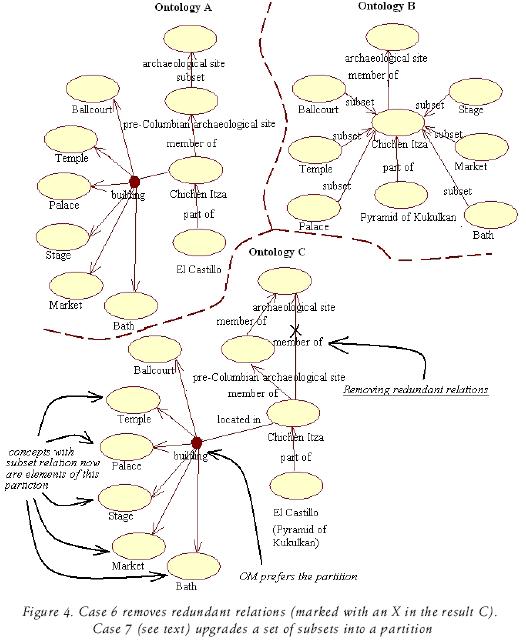
<body><![CDATA[<p align="justify"><font face="verdana" size="2">&bull;&nbsp;If it is possible, by using confusion, to resolve the   inconsistency,   the   correct   concepts   are added to C.</font></p>       <p align="justify"><font face="verdana" size="2">&bull; When the inconsistency can not be solved, OM rejects the contradicting information in B, and c<sub>C</sub> keeps its orig i nal relation from A.</font></p> </blockquote>     <p align="justify"><font face="verdana" size="2">3.&nbsp;c<sub>C</sub> <img src="/img/revistas/iit/v10n1/a7s1.jpg">next descendant of c<sub>C</sub> (Take the next descendant of c<sub>C</sub>).</font></p>     <p align="justify"><font face="verdana" size="2">4. Go back to step 2 until all the nodes of C are visited (including the new nodes that are being added by OM as it works). (Cuevas, 2006) explains OM fully.</font></p>     <p align="justify"><font face="verdana" size="2">3.1 Examples of merges by OM</font></p>     <p align="justify"><font face="verdana" size="2">In this section, figures show only relevant parts of ontologies A, B and the resultant C, because they are too large to fit.</font></p>     <p align="justify"><font face="verdana" size="2">Example 1. Merging ontologies with inconsistent knowledge. Differences between A and B could be due to: different subjects, names of concepts or relations; repetitions; reference to the same facts but with different words; different level of details (precision, depth of description); different perspectives (people are partitioned in A into male and female, whereas in B they are young or old); and contradictions.</font></p>     <p align="justify"><font face="verdana" size="2">Let A (the information was obtained in &#91;2&#93;) contains: The Renaissance painter, sculptor, architect and poet Michelangelo di Lodovico Buonarroti Simoni was born in Caprese, Italy while B &#91;7&#93; contains: The painter Michelangelo Buonarroti was born in Caprece, Italy. Both ontologies duplicate some information (about Mi chelangelo's place of birth), different expressions (painter, sculp tor, architect and poet versus painter), different level of details (Michelangelo di Lodovico Buonarroti Simoni versus Michelangelo Buonarroti), and contradictions (Caprese vs. Caprece). A person will have in her mind a consistent combination of information: Michelangelo Buonarroti and Michelangelo di Lodovico Buonarroti Simoni are not the same person, or perhaps they are the same, they are synonyms. If she knows them, she may deduce that Michelangelo di Lodovico Buonarroti Simoni is the complete name of Michelangelo Buonarroti. We solve these problems ev eryday, using previously acquired knowledge (2.5) and common sense knowledge (Lenat et al., 1989), which computers lack. Also, they did not have a way to gradually and automatically grow their ontology. OM measures the inconsistency (of two apparently contradict ing facts) by asking conf to determine the size of the confusion in using Caprese in place of Caprece and viceversa, or the confusion of using Michelangelo Buonarroti instead of Michelangelo di Lodovico Buonarroti Simoni. In the example Caprece is a write error, therhefore in C the value of A is conserved (Caprese).</font></p>     <p align="justify"><font face="verdana" size="2">OM does not accept two different names for a birth place (a person can not be born at the same time in two places). If A said that Michelangelo Buonarroti was born in Caprese and B Michelangelo Buonarroti was born in Italy, OM chooses Caprese instead of Italy because it is more specific place whereas Italy that is more general (it deduces this from a hierarchy of Europe). Small inconsistencies cause C to retain the most specific value, while if it is large, OM keeps C unchanged (ignoring the contradict ing fact from B). In case of inconsistency, A prevails<sup><a href="#notas">5</a></sup>.</font></p>     <p align="justify"><font face="verdana" size="2">Example 2. Joining partitions, synonym identification, organization of subset to partition, identification of similar concepts, elimination of redundant relations and addition of new concepts. <a href="/img/revistas/iit/v10n1/a7f2.jpg" target="_blank">Figure 2</a> displays ontologies A, B and the fusion of these, C. Cases of OM exemplified in the figure are shown with under lined terms.</font></p>     ]]></body>
<body><![CDATA[<p align="justify"><font face="verdana" size="2">Cases of OM: the fusion is ac complished throug seven cases:</font></p>     <p align="justify"><font face="verdana" size="2">1.&nbsp;Copying new partitions. building i s a partition in A (indicated in the small circle) of Chichen Itza, therefore it is added to the resulting ontology C.</font></p>     <p align="justify"><font face="verdana" size="2">2. Copying new concepts. Concepts Toltec, M&eacute;rida and Canc&uacute;n were not in A, but they appear in B. Therefore, they were copied by OM to C.</font></p>     <p align="justify"><font face="verdana" size="2">3. Reorganization of relations. Relation located in it appears twice but with different values, there fore they are added to C because it is possible for that relation to have several values. In case of single&#150;valued relations, confusion is used, as in Example 1.</font></p>     <p align="justify"><font face="verdana" size="2">4. Synonym identification. Concept Chac Mool in A (<a href="/img/revistas/iit/v10n1/a7f3.jpg" target="_blank">figure 3</a>) has Chac in it definition (the words that defines it, between parenthesis), and Chac in B is synonymous of chac Mool in</font></p>     <p align="justify"><font face="verdana" size="2">5.&nbsp;Identification of similar concepts. Concept sculpture of a jaguar in A and throne in the shape of jaguar in B they have the same properties (Color and its value) there fore, OM fuses them into a single concept. The same  happens with  El  Castillo  and  Pyramid  of Kukulkan since they have the same properties and children.</font></p>     <p align="justify"><font face="verdana" size="2">6. Removing redundant relations. In A, Chichen Itza is member of pre&#150;Columbian archaeological site (<a href="#f4">figure 4</a>), which is in turn a member of archaeological sites. In B, Chichen Itza is member of archaeological site (which is parent of pre&#150;Colombian archaeological site in B), there fore it is eliminated in C because it is a redundant relation. In C, pre&#150;Columbian archaeological site is parent of Chichen Itza.</font></p>     <p align="center"><font face="verdana" size="2"><a name="f4"></a></font></p>     <p align="center"><font face="verdana" size="2"><img src="/img/revistas/iit/v10n1/a7f4.jpg"></font></p>     <p align="justify"><font face="verdana" size="2">7. Organization of subset to partition. In the building partition in A there are six subsets (<a href="#f4">figure 4</a>): Ballcourt, Palace, Stage, Market and Bath. OM identifies them in B, where they appear as subsets of Chichen Itza. OM thus copies then into C like a partition, not as simple subsets. OM prefers the partition because it means that the elements are mutually exclusive and collectively exhaustive.</font></p>     ]]></body>
<body><![CDATA[<p align="justify"><font face="verdana" size="2">3.2 More applications of OM in real cases taken from the web</font></p>     <p align="justify"><font face="verdana" size="2">OM has merged ontologies derived from real documents. The ontologies were obtained manually from several documents (100 Years of Loneliness &#91;8 and 10&#93;, Oaxaca &#91;4 and 9&#93;, poppy &#91;1 and 3&#93; and tur tles &#91;5 and 6&#93;) describing the same thing. The obtained ontologies were merged (automatically) by OM. Validation of results has been mademanually, obtaining good results (<a href="/img/revistas/iit/v10n1/a7t1.jpg" target="_blank">table 1</a>).</font></p>     <p align="justify"><font face="verdana" size="2">&nbsp;</font></p>     <p align="justify"><font face="verdana" size="2"><b>3.3   Conclusions</b></font></p>     <p align="justify"><font face="verdana" size="2">The paper presents an automatic, robust algorithm that fuses two ontologies into a third one, which preserves the knowledge obtained from the sources. It solves some inconsisten cies and avoids adding redundancies to the result. Thus, it is a notice able improvement to the computer&#150;aided merging editors currently available (2.4).</font></p>     <p align="justify"><font face="verdana" size="2">The examples shown, as well as others in (Cuevas, 2006), provide evidence that OM does a good job, in spite of joining very general or very specific ontologies. This is because the algorithm takes into account not only the words in the definition of each concept, but its semantics &#91;context, synonyms, resemblance (through conf) to other concepts...&#93; too. In addition, its base knowledge (2.5) helps.</font></p>     <p align="justify"><font face="verdana" size="2">&nbsp;</font></p>     <p align="justify"><font face="verdana" size="2"><b>3.4 Discussion</b></font></p>     <p align="justify"><font face="verdana" size="2">Is it possible to keep fusing several on tologies about the same subject, in order to have a larger and larger ontology that faith fully represents and merges the knowledge in each of the formant ontologies? OM seems to say "yes, it is possible." What are the main road blocks? As we perceive them, they are:</font></p>     <p align="justify"><font face="verdana" size="2">a. A good parser. Documents are now transformed into ontologies by hand, thus fusing of these hand&#150;produced ontologies, al though fully au to mated, it is hardly practical. It has been found difficult to build a parser that reliably transforms a natural language document into a suitable ontology, due to the ambiguity of natural language and to the difficulty of representing relations (verbs, actions, processes) in a transparent fashion (see next point).</font></p>     ]]></body>
<body><![CDATA[<p align="justify"><font face="verdana" size="2">b. Exploitation of hypergraphs. Although we define ontologies as hypergraphs (2.2), the restrictions (r c1 c2 ... ck), where r is a relation, are lists, and consequently, order matters. For instance, it is not the same (kills; Cain; Abel; jaw of don key) that (kills; Abel; Cain; jaw of don key). More over, the role of each argument (such as jaw of donkey) matters and must be explained &#150;in the example it is the instrument used in the killing. Restrictions have different number of arguments, each with different roles: consider (born; Abraham Lincoln; Kentucky; 1809; log cabin). Many arguments may be missing in a given piece of text.</font></p>     <p align="justify"><font face="verdana" size="2">The role of each argument must be explained or described in a transparent (not opaque) fashion <sup><a href="#notas">6</a></sup>, so that OM can understand such explanations, manipulate them and create new ones. For instance, f rom a given argument, it should be able to take two different explanations (coming from ontologies A and B, respectively) and fuse them into a third explanation about such argument, to go into C. Ways to do all of this should be devised.</font></p>     <p align="justify"><font face="verdana" size="2">c. A query answerer that queries a large ontology and makes deductions. It should be able to provide answers to complex questions, so that "reasonable intelligence" is exhibited. (Botello, 2007) works on this for data bases, not over a large ontology. He has obtained no results for real data, yet.</font></p>     <p align="justify"><font face="verdana" size="2">d. Additional language&#150;dependent knowledge sources could further enhance OM. For instance, WordNet, WordMenu, automatic discovery of ontologies by analyzing titles of conferences, university departments (Makagonov, P).</font></p>     <p align="justify"><font face="verdana" size="2">In this regard, probably the best way to proceed is (1) carefully building by hand a base ontology, and then (2) fusing to it (by OM) ontologies hand&#150;translated from carefully cho sen documents, while (3) building the parser (a). This parser could very well use as built&#150;in knowledge the very ontology that (2) produces. Also, OM can use as its built&#150;in knowledge (2.5) the ontology (2). In parallel, (4) the language&#150;dependent knowledge sources of (d) can also be some how parsed by (a) into ontologies in OM notation (2.3), thus "including" them or absorbing them in side OM's built&#150;in knowledge. All of this while (5) the question&#150;answerer (c) is finished and tested, first on feder ated or in dependent data bases, then (6) on ontologies. An alternative to (6) is (7) to build the question&#150;answerer or deductive machinery based on Robinson's resolution principle, helped by the the ory of confusion (2.3). We see four parallel paths of work: &#91;l<img src="/img/revistas/iit/v10n1/a7s2.jpg">2&#93;; &#91;3&#93;; &#91;4&#93;; &#91;5 <img src="/img/revistas/iit/v10n1/a7s2.jpg"> (6 &zwnj;&zwnj;  &zwnj;&zwnj; 7)&#93;.</font></p>     <p align="justify"><font face="verdana" size="2">&nbsp;</font></p>     <p align="justify"><font face="verdana" size="2"><b>Acknowledgments</b></font></p>     <p align="justify"><font face="verdana" size="2">Work herein reported was partially supported by CONACYT Grant 43377, EDI&#150;IPN and EDD&#150;COFAA scholar ships. A.G. has support from SNI. A&#150;D. C. had an Excellence student grant from CONACYT.</font></p>     <p align="justify"><font face="verdana" size="2">&nbsp;</font></p>     <p align="justify"><font face="verdana" size="2"><b>References</b></font></p>     ]]></body>
<body><![CDATA[<!-- ref --><p align="justify"><font face="verdana" size="2">Bemhard G., Stumme G., Wille R. <i>Formal Concept Analysis: </i><i>Foundations and Applications. </i>LNCS 3626. Springer 2005. ISBN 3&#150;540&#150;27891&#150;5. </font>&nbsp;&nbsp;&nbsp;&nbsp;&nbsp;&nbsp;&nbsp;&nbsp;[&#160;<a href="javascript:void(0);" onclick="javascript: window.open('/scielo.php?script=sci_nlinks&ref=4245407&pid=S1405-7743200900010000700001&lng=','','width=640,height=500,resizable=yes,scrollbars=1,menubar=yes,');">Links</a>&#160;]<!-- end-ref --><!-- ref --><p align="justify"><font face="verdana" size="2">Botello A. Query Resolution in Heterogeneous Data Bases by Partial Integration. Thesis (Ph. D. in progress). Mexico. Centro de Investigaci&oacute;n en Computaci&oacute;n (CIC), Instituto Polit&eacute;cnico Nacional (IPN). 2007. </font>&nbsp;&nbsp;&nbsp;&nbsp;&nbsp;&nbsp;&nbsp;&nbsp;[&#160;<a href="javascript:void(0);" onclick="javascript: window.open('/scielo.php?script=sci_nlinks&ref=4245408&pid=S1405-7743200900010000700002&lng=','','width=640,height=500,resizable=yes,scrollbars=1,menubar=yes,');">Links</a>&#160;]<!-- end-ref --><!-- ref --><p align="justify"><font face="verdana" size="2">Cuevas A. Merging of Ontologies Using Semantic Properties. Thesis (Ph. D) CIC&#150;IPN &#91;on line&#93;, 2006. In spanish. Available on: <a href="http://148.204.20.100:8080/bibliodigital/ShowObject.jsp?idobject=34274&idreposiorio=2&tpe=recipiente" target="_blank">http://148.204.20.100:8080/bibliodigital/ShowObject.jsp?idobject=34274idreposiorio=2tpe=recipiente</a> </font>&nbsp;&nbsp;&nbsp;&nbsp;&nbsp;&nbsp;&nbsp;&nbsp;[&#160;<a href="javascript:void(0);" onclick="javascript: window.open('/scielo.php?script=sci_nlinks&ref=4245409&pid=S1405-7743200900010000700003&lng=','','width=640,height=500,resizable=yes,scrollbars=1,menubar=yes,');">Links</a>&#160;]<!-- end-ref --><!-- ref --><p align="justify"><font face="verdana" size="2">Cuevas A. Guzman A. A Language and Algorithm for Automatic Merging of Ontologies. At: Chapter of the Book Handbook of Ontologies for Business Interaction. Peter Rittgen, ed. Idea Group Inc. 2007. In press. </font>&nbsp;&nbsp;&nbsp;&nbsp;&nbsp;&nbsp;&nbsp;&nbsp;[&#160;<a href="javascript:void(0);" onclick="javascript: window.open('/scielo.php?script=sci_nlinks&ref=4245410&pid=S1405-7743200900010000700004&lng=','','width=640,height=500,resizable=yes,scrollbars=1,menubar=yes,');">Links</a>&#160;]<!-- end-ref --><!-- ref --><p align="justify"><font face="verdana" size="2">Dou D., McDermott D., Qi. P. <i>Ontology Translation by Onto</i><i>logy Merging and Automated Reasoning. Proc. </i>EKAW Workshop on Ontologies for Multi&#150;Agent Systems. 2002. </font>&nbsp;&nbsp;&nbsp;&nbsp;&nbsp;&nbsp;&nbsp;&nbsp;[&#160;<a href="javascript:void(0);" onclick="javascript: window.open('/scielo.php?script=sci_nlinks&ref=4245411&pid=S1405-7743200900010000700005&lng=','','width=640,height=500,resizable=yes,scrollbars=1,menubar=yes,');">Links</a>&#160;]<!-- end-ref --><!-- ref --><p align="justify"><font face="verdana" size="2">Guzman A., Olivares J. <i>Finding the Most Similar Concepts in two </i><i>Different Ontologies. </i>LNAI 2972. Springer&#150;Verlag. 2004. Pp. 129&#150;138. </font>&nbsp;&nbsp;&nbsp;&nbsp;&nbsp;&nbsp;&nbsp;&nbsp;[&#160;<a href="javascript:void(0);" onclick="javascript: window.open('/scielo.php?script=sci_nlinks&ref=4245412&pid=S1405-7743200900010000700006&lng=','','width=640,height=500,resizable=yes,scrollbars=1,menubar=yes,');">Links</a>&#160;]<!-- end-ref --><!-- ref --><p align="justify"><font face="verdana" size="2">Kalfoglou   Y.,   Schorlemmer   M.   Information&#150;Flow&#150;based Ontology Mapping. At: Proceedings of the International Conference on Ontologies (1<sup>st</sup>, 2002,   Irvine, CA, USA). Data bases and Application of Semantics, 2002,</font>&nbsp;&nbsp;&nbsp;&nbsp;&nbsp;&nbsp;&nbsp;&nbsp;[&#160;<a href="javascript:void(0);" onclick="javascript: window.open('/scielo.php?script=sci_nlinks&ref=4245413&pid=S1405-7743200900010000700007&lng=','','width=640,height=500,resizable=yes,scrollbars=1,menubar=yes,');">Links</a>&#160;]<!-- end-ref --><!-- ref --><p align="justify"><font face="verdana" size="2">Kotis K., Vouros G., Stergiou, K. Towards Automatic of Domain   Ontologies:   The   HCONE   Merge  Approach. <i>Journal of Web Semantics (JWS)  </i>&#91;on line&#93;, Elsevier, 4(1): 60&#150;79. 2006. Available on: ScienceDirect: <a href="http://www.sciencedirect.com/science?_ob=ArticleURL&_udi=B758F-4HC774D-1&_user=945819&_rdoc=1&_fmt=&_orig=search&_sort=d&view=c&_acct=C000048981&_version=1&_urlVersion=0&_userid=945819&md5=48ae05d5ca8f354afa7d51aacc4e108b" target="_blank">http://authors.elsevier.com/sd/article/S1570826805000259</a>. </font>&nbsp;&nbsp;&nbsp;&nbsp;&nbsp;&nbsp;&nbsp;&nbsp;[&#160;<a href="javascript:void(0);" onclick="javascript: window.open('/scielo.php?script=sci_nlinks&ref=4245414&pid=S1405-7743200900010000700008&lng=','','width=640,height=500,resizable=yes,scrollbars=1,menubar=yes,');">Links</a>&#160;]<!-- end-ref --><!-- ref --><p align="justify"><font face="verdana" size="2">Lenat D., Guha V. <i>Building Large Knowledge&#150;Based Systems. </i>Addison&#150;Wesley. 1989. </font>&nbsp;&nbsp;&nbsp;&nbsp;&nbsp;&nbsp;&nbsp;&nbsp;[&#160;<a href="javascript:void(0);" onclick="javascript: window.open('/scielo.php?script=sci_nlinks&ref=4245415&pid=S1405-7743200900010000700009&lng=','','width=640,height=500,resizable=yes,scrollbars=1,menubar=yes,');">Links</a>&#160;]<!-- end-ref --><!-- ref --><p align="justify"><font face="verdana" size="2">Levachkine S., Guzman A. Hierarchy as a New Data Type for Qualitative Values. <i>Journal Expert Systems with Applications, 32(3). June </i>2007. </font>&nbsp;&nbsp;&nbsp;&nbsp;&nbsp;&nbsp;&nbsp;&nbsp;[&#160;<a href="javascript:void(0);" onclick="javascript: window.open('/scielo.php?script=sci_nlinks&ref=4245416&pid=S1405-7743200900010000700010&lng=','','width=640,height=500,resizable=yes,scrollbars=1,menubar=yes,');">Links</a>&#160;]<!-- end-ref --><!-- ref --><p align="justify"><font face="verdana" size="2">Makagonov P. Automatic Formation of Ontologies by Analysis of Titles of Conferences, Sessions and Articles. Work in Preparation. </font>&nbsp;&nbsp;&nbsp;&nbsp;&nbsp;&nbsp;&nbsp;&nbsp;[&#160;<a href="javascript:void(0);" onclick="javascript: window.open('/scielo.php?script=sci_nlinks&ref=4245417&pid=S1405-7743200900010000700011&lng=','','width=640,height=500,resizable=yes,scrollbars=1,menubar=yes,');">Links</a>&#160;]<!-- end-ref --><!-- ref --><p align="justify"><font face="verdana" size="2">McGuinness D., Fikes R., Rice J., Wilder S. The Chimaera Ontology Environment Knowledge. At: Proceedings of the International Conference on Conceptual Structures Logical, Linguistic, and Computational Issues. (Eighth, 2000, Darmstadt, Germany). </font>&nbsp;&nbsp;&nbsp;&nbsp;&nbsp;&nbsp;&nbsp;&nbsp;[&#160;<a href="javascript:void(0);" onclick="javascript: window.open('/scielo.php?script=sci_nlinks&ref=4245418&pid=S1405-7743200900010000700012&lng=','','width=640,height=500,resizable=yes,scrollbars=1,menubar=yes,');">Links</a>&#160;]<!-- end-ref --><!-- ref --><p align="justify"><font face="verdana" size="2">Noy N., Musen M. PROMPT: Algoritm and Tool for Automated Ontology Merging and Alignment. In Proc. of the National Conference on Artificial Intelligence, 2000. </font>&nbsp;&nbsp;&nbsp;&nbsp;&nbsp;&nbsp;&nbsp;&nbsp;[&#160;<a href="javascript:void(0);" onclick="javascript: window.open('/scielo.php?script=sci_nlinks&ref=4245419&pid=S1405-7743200900010000700013&lng=','','width=640,height=500,resizable=yes,scrollbars=1,menubar=yes,');">Links</a>&#160;]<!-- end-ref --><!-- ref --><p align="justify"><font face="verdana" size="2">Olguin Luis&#150;Antonio. Distributed Crawlers. Effective Work Assignment to Avoid Duplication in Space and Time. Thesis (M. Sc.). Mexico. CIC&#150;IPN. In Spanish. 2007.</font>&nbsp;&nbsp;&nbsp;&nbsp;&nbsp;&nbsp;&nbsp;&nbsp;[&#160;<a href="javascript:void(0);" onclick="javascript: window.open('/scielo.php?script=sci_nlinks&ref=4245420&pid=S1405-7743200900010000700014&lng=','','width=640,height=500,resizable=yes,scrollbars=1,menubar=yes,');">Links</a>&#160;]<!-- end-ref --><!-- ref --><p align="justify"><font face="verdana" size="2">Stumme G., Maedche A. Ontology Merging for Federated Ontologies on the Semantic Web. At: E. Franconi K. Barker D. Calvanese (Eds.). Proc. Intl. Workshop on Foundations of Models for Information Integration, Viterbo, Italy, 2001. LNAI, Springer 2002 (in press).</font>&nbsp;&nbsp;&nbsp;&nbsp;&nbsp;&nbsp;&nbsp;&nbsp;[&#160;<a href="javascript:void(0);" onclick="javascript: window.open('/scielo.php?script=sci_nlinks&ref=4245421&pid=S1405-7743200900010000700015&lng=','','width=640,height=500,resizable=yes,scrollbars=1,menubar=yes,');">Links</a>&#160;]<!-- end-ref --><p align="justify"><font face="verdana" size="2">&nbsp;</font></p>     <p align="justify"><font face="verdana" size="2"><b>URLs:</b></font></p>     <p align="justify"><font face="verdana" size="2">1.&nbsp;<a href="http://es.wikipedia.org/wiki/Amapola" target="_blank">es.wikipedia.org/wiki/Amapola</a></font></p>     <p align="justify"><font face="verdana" size="2">2.&nbsp;<a href="http://es.wikipedia.org/wiki/Miguel_%C3%81ngel" target="_blank">es.wikipedia.org/wiki/Miguel_%C3%81ngel</a></font></p>     <p align="justify"><font face="verdana" size="2">3.<a href="http://magazinemx.com/bj/salud/herbolaria.php?id=1" target="_blank"> &nbsp;www.buscajalisco.com/bj/salud/herbolaria.php?id=1</a></font></p>     ]]></body>
<body><![CDATA[<p align="justify"><font face="verdana" size="2">4. <a href="http://www.elbalero.gob.mx/explora/html/oaxaca/" target="_blank">www.elbalero.gob.mx/explora/html/oaxaca/geografia.html</a></font></p>     <p align="justify"><font face="verdana" size="2">5. <a href="http://www.damisela.com/zoo/rep/tortugas/index.htm" target="_blank">www.damisela.com/zoo/rep/tortugas/index.htm</a></font></p>     <p align="justify"><font face="verdana" size="2">6. <a href="http://www.foyel.com/cartillas/37/tortugas_-_accesorios_para_acuarios_i.html" target="_blank">www.foyel.com/cartillas/37/tortugas_-_accesorios_para_acuarios_i.html</a></font></p>     <p align="justify"><font face="verdana" size="2">7. <a href="http://www.historiadelartemgm.com.ar/biografiamichelangelobuonarroti.htm" target="_blank">www.historiadelartemgm.com.ar/biografiamichelangelobuonarroti.htm</a></font></p>     <p align="justify"><font face="verdana" size="2">8. <a href="http://www.monografias.com/trabajos10/ciso/ciso.shtml" target="_blank">www.monografias.com/trabajos10/ciso/ciso.shtml</a></font></p>     <p align="justify"><font face="verdana" size="2">9.&nbsp;<a href="http://www.oaxaca-mio.com/atrac_turisticos/infooaxaca.htm" target="_blank">www.oaxaca-mio.com/atrac_turisticos/infooaxaca.htm</a></font></p>     <p align="justify"><font face="verdana" size="2">10. <a href="http://www.rincondelvago.com/" target="_blank">www.rincondelvago.com/cien-anos-de-soledad_gabriel-garcia-marquez_22.html</a></font></p>     <p align="justify"><font face="verdana" size="2">11. <a href="http://plainmoor.open.ac.uk/ocml/domains/aktive-portal-ontology/techs.html" target="_blank">http://plainmoor.open.ac.uk/ocml/domains/aktive-portal-ontology/techs.html</a></font></p>     <p align="justify"><font face="verdana" size="2">&nbsp;</font></p>     <p align="justify"><font face="verdana" size="2"><b><a name="notas" id="notas"></a>Notes</b></font></p>     ]]></body>
<body><![CDATA[<p align="justify"><font face="verdana" size="2"><sup>1</sup> Or just by applying the parser in (a) to all articles of Wikipedia and then using OM to fuse the resulting ontologies.</font></p>     <p align="justify"><font face="verdana" size="2"><sup>2</sup> OM assumes A and B to be well&#150;formed (each without contradictions and no duplicate nodes). Even then, an inconsistency can arise when considering their joint knowledge.</font></p>     <p align="justify"><font face="verdana" size="2"><sup>3</sup>&nbsp;Symbol <img src="/img/revistas/iit/v10n1/a7s3.jpg"> when it referes to ontology merging, it means not only set union, but "careful" merging of concepts, using their semantics.</font></p>     <p align="justify"><font face="verdana" size="2"><sup>4</sup>&nbsp;The ontology C is searched <i>depth&#150;first</i>: first, <i>c<sub>C</sub> </i>is the root. Then, c<sub>C</sub> is the first child of the root, then <i>c<sub>C</sub> </i>is the first child of <i>this </i>child (a grand son of the root)... Thus, a branch of the tree is traveled only until the deepest descendant is</font></p>     <p align="justify"><font face="verdana" size="2"><sup>5</sup> We can consider that an agent's previous knowledge is A, and that such agent is trying to learn ontology B. In case of inconsistency, it is natural for the agent to trust more its previous knowledge, and to disregard inconsistent knowledge in B as "not trust worthy" and there fore not acquired &#150; the agent refuses to learn knowledge what it finds inconsistent, if the inconsistency (measured by conf) is too large.</font></p>     <p align="justify"><font face="verdana" size="2"><sup>6 </sup>Ideally, in OM notation.</font></p>     <p align="justify"><font face="verdana" size="2">&nbsp;</font></p>     <p align="justify"><font face="verdana" size="2"><b>Semblanza de los autores</b></font></p>     <p align="justify"><font face="verdana" size="2"><i>Alma Delia Cuevas&#150;Rasgado. </i>Recently obtained her masters and Ph degrees in Computer Science at CIC&#150;IPN (Centro de Investigaci&oacute;n en Computaci&oacute;n, Instituto Politecnico Nacional) in Mexico. Her lines of research: Software engineering &#150;specifically about Quality of software and representation knowledge&#150; specifically about representation and fusion of ontologies. University professor at the Technological Institute of Oaxaca since October 1992, teaching courses in the areas of: Data base and Information systems, Programming and Technology for the Web and Low level Programming.</font></p>     <p align="justify"><font face="verdana" size="2"><i>Adolfo Guzman&#150;Arenas. </i>Is a computer science professor at Centro de Investigaci&oacute;n en Computaci&oacute;n, Instituto Polit&eacute;cnico Nacional, Mexico City, of which he was Founding Director . He holds a B. Sc. in Electronics from ESIME&#150;IPN, and a Ph.D. degree from MIT; he is an ACM Fellow, an IEEE Life Senior Member, a Member of the Academia de Ingenier&iacute;a and the Academia Nacional de Ciencias (Mexico). He has received (1996) the National Prize in Science and Technology (Mexico) and (2006) the Premio Nacional a la Excelencia "Jaime Torres Bodet." His work is in semantic information processing and AI techniques, often mixed with distributed information systems.</font></p>     ]]></body>
<body><![CDATA[ ]]></body><back>
<ref-list>
<ref id="B1">
<nlm-citation citation-type="book">
<person-group person-group-type="author">
<name>
<surname><![CDATA[Bemhard]]></surname>
<given-names><![CDATA[G]]></given-names>
</name>
<name>
<surname><![CDATA[Stumme]]></surname>
<given-names><![CDATA[G]]></given-names>
</name>
<name>
<surname><![CDATA[Wille]]></surname>
<given-names><![CDATA[R]]></given-names>
</name>
</person-group>
<source><![CDATA[Formal Concept Analysis: Foundations and Applications]]></source>
<year>2005</year>
<publisher-name><![CDATA[Springer]]></publisher-name>
</nlm-citation>
</ref>
<ref id="B2">
<nlm-citation citation-type="">
<person-group person-group-type="author">
<name>
<surname><![CDATA[Botello]]></surname>
<given-names><![CDATA[A]]></given-names>
</name>
</person-group>
<source><![CDATA[Query Resolution in Heterogeneous Data Bases by Partial Integration]]></source>
<year></year>
</nlm-citation>
</ref>
<ref id="B3">
<nlm-citation citation-type="">
<person-group person-group-type="author">
<name>
<surname><![CDATA[Cuevas]]></surname>
<given-names><![CDATA[A]]></given-names>
</name>
</person-group>
<source><![CDATA[Merging of Ontologies Using Semantic Properties]]></source>
<year></year>
</nlm-citation>
</ref>
<ref id="B4">
<nlm-citation citation-type="book">
<person-group person-group-type="author">
<name>
<surname><![CDATA[Cuevas]]></surname>
<given-names><![CDATA[A]]></given-names>
</name>
<name>
<surname><![CDATA[Guzman]]></surname>
<given-names><![CDATA[A]]></given-names>
</name>
</person-group>
<article-title xml:lang="en"><![CDATA[A Language and Algorithm for Automatic Merging of Ontologies]]></article-title>
<person-group person-group-type="editor">
<name>
<surname><![CDATA[Rittgen]]></surname>
<given-names><![CDATA[Peter]]></given-names>
</name>
</person-group>
<source><![CDATA[Chapter of the Book Handbook of Ontologies for Business Interaction]]></source>
<year>2007</year>
<publisher-name><![CDATA[Idea Group Inc.]]></publisher-name>
</nlm-citation>
</ref>
<ref id="B5">
<nlm-citation citation-type="confpro">
<person-group person-group-type="author">
<name>
<surname><![CDATA[Dou]]></surname>
<given-names><![CDATA[D]]></given-names>
</name>
<name>
<surname><![CDATA[McDermott]]></surname>
<given-names><![CDATA[D]]></given-names>
</name>
<name>
<surname><![CDATA[Qi]]></surname>
<given-names><![CDATA[P]]></given-names>
</name>
</person-group>
<source><![CDATA[Ontology Translation by Ontology Merging and Automated Reasoning]]></source>
<year>2002</year>
<conf-name><![CDATA[ Proc. EKAW Workshop on Ontologies for Multi-Agent Systems]]></conf-name>
<conf-loc> </conf-loc>
</nlm-citation>
</ref>
<ref id="B6">
<nlm-citation citation-type="book">
<person-group person-group-type="author">
<name>
<surname><![CDATA[Guzman]]></surname>
<given-names><![CDATA[A]]></given-names>
</name>
<name>
<surname><![CDATA[Olivares]]></surname>
<given-names><![CDATA[J]]></given-names>
</name>
</person-group>
<source><![CDATA[Finding the Most Similar Concepts in two Different Ontologies]]></source>
<year>2004</year>
<page-range>129-138</page-range><publisher-name><![CDATA[Springer-Verlag]]></publisher-name>
</nlm-citation>
</ref>
<ref id="B7">
<nlm-citation citation-type="confpro">
<person-group person-group-type="author">
<name>
<surname><![CDATA[Kalfoglou]]></surname>
<given-names><![CDATA[Y]]></given-names>
</name>
<name>
<surname><![CDATA[Schorlemmer]]></surname>
<given-names><![CDATA[M]]></given-names>
</name>
</person-group>
<source><![CDATA[Information-Flow-based Ontology Mapping]]></source>
<year>2002</year>
<conf-name><![CDATA[ Proceedings of the International Conference on Ontologies]]></conf-name>
<conf-date>2002</conf-date>
<conf-loc>Irvine CA</conf-loc>
</nlm-citation>
</ref>
<ref id="B8">
<nlm-citation citation-type="journal">
<person-group person-group-type="author">
<name>
<surname><![CDATA[Kotis]]></surname>
<given-names><![CDATA[K]]></given-names>
</name>
<name>
<surname><![CDATA[Vouros]]></surname>
<given-names><![CDATA[G]]></given-names>
</name>
<name>
<surname><![CDATA[Stergiou]]></surname>
<given-names><![CDATA[K]]></given-names>
</name>
</person-group>
<article-title xml:lang="en"><![CDATA[Towards Automatic of Domain Ontologies: The HCONE Merge Approach]]></article-title>
<source><![CDATA[Journal of Web Semantics (JWS)]]></source>
<year>2006</year>
<volume>4</volume>
<numero>1</numero>
<issue>1</issue>
<page-range>60-79</page-range><publisher-name><![CDATA[Elsevier]]></publisher-name>
</nlm-citation>
</ref>
<ref id="B9">
<nlm-citation citation-type="book">
<person-group person-group-type="author">
<name>
<surname><![CDATA[Lenat]]></surname>
<given-names><![CDATA[D]]></given-names>
</name>
<name>
<surname><![CDATA[Guha]]></surname>
<given-names><![CDATA[V]]></given-names>
</name>
</person-group>
<source><![CDATA[Building Large Knowledge-Based Systems]]></source>
<year>1989</year>
<publisher-name><![CDATA[Addison-Wesley]]></publisher-name>
</nlm-citation>
</ref>
<ref id="B10">
<nlm-citation citation-type="journal">
<person-group person-group-type="author">
<name>
<surname><![CDATA[Levachkine]]></surname>
<given-names><![CDATA[S]]></given-names>
</name>
<name>
<surname><![CDATA[Guzman]]></surname>
<given-names><![CDATA[A]]></given-names>
</name>
</person-group>
<article-title xml:lang="en"><![CDATA[Hierarchy as a New Data Type for Qualitative Values]]></article-title>
<source><![CDATA[Journal Expert Systems with Applications]]></source>
<year>2007</year>
<volume>32</volume>
<numero>3</numero>
<issue>3</issue>
</nlm-citation>
</ref>
<ref id="B11">
<nlm-citation citation-type="">
<person-group person-group-type="author">
<name>
<surname><![CDATA[Makagonov]]></surname>
<given-names><![CDATA[P]]></given-names>
</name>
</person-group>
<source><![CDATA[Automatic Formation of Ontologies by Analysis of Titles of Conferences, Sessions and Articles]]></source>
<year></year>
</nlm-citation>
</ref>
<ref id="B12">
<nlm-citation citation-type="confpro">
<person-group person-group-type="author">
<name>
<surname><![CDATA[McGuinness]]></surname>
<given-names><![CDATA[D]]></given-names>
</name>
<name>
<surname><![CDATA[Fikes]]></surname>
<given-names><![CDATA[R]]></given-names>
</name>
<name>
<surname><![CDATA[Rice]]></surname>
<given-names><![CDATA[J]]></given-names>
</name>
<name>
<surname><![CDATA[Wilder]]></surname>
<given-names><![CDATA[S]]></given-names>
</name>
</person-group>
<article-title xml:lang="en"><![CDATA[The Chimaera Ontology Environment Knowledge]]></article-title>
<source><![CDATA[]]></source>
<year>2000</year>
<conf-name><![CDATA[ Proceedings of the International Conference on Conceptual Structures Logical, Linguistic, and Computational Issues]]></conf-name>
<conf-loc> </conf-loc>
<publisher-loc><![CDATA[Darmstadt ]]></publisher-loc>
<publisher-name><![CDATA[Eighth]]></publisher-name>
</nlm-citation>
</ref>
<ref id="B13">
<nlm-citation citation-type="confpro">
<person-group person-group-type="author">
<name>
<surname><![CDATA[Noy]]></surname>
<given-names><![CDATA[N]]></given-names>
</name>
<name>
<surname><![CDATA[Musen]]></surname>
<given-names><![CDATA[M]]></given-names>
</name>
</person-group>
<source><![CDATA[PROMPT: Algoritm and Tool for Automated Ontology Merging and Alignment]]></source>
<year></year>
<conf-name><![CDATA[ In Proc. of the National Conference on Artificial Intelligence]]></conf-name>
<conf-date>2000</conf-date>
<conf-loc> </conf-loc>
</nlm-citation>
</ref>
<ref id="B14">
<nlm-citation citation-type="">
<person-group person-group-type="author">
<name>
<surname><![CDATA[Olguin]]></surname>
<given-names><![CDATA[Luis-Antonio]]></given-names>
</name>
</person-group>
<source><![CDATA[Distributed Crawlers: Effective Work Assignment to Avoid Duplication in Space and Time]]></source>
<year></year>
</nlm-citation>
</ref>
<ref id="B15">
<nlm-citation citation-type="confpro">
<person-group person-group-type="author">
<name>
<surname><![CDATA[Stumme]]></surname>
<given-names><![CDATA[G]]></given-names>
</name>
<name>
<surname><![CDATA[Maedche]]></surname>
<given-names><![CDATA[A]]></given-names>
</name>
</person-group>
<article-title xml:lang="en"><![CDATA[Ontology Merging for Federated Ontologies on the Semantic Web]]></article-title>
<person-group person-group-type="editor">
<name>
<surname><![CDATA[Franconi]]></surname>
<given-names><![CDATA[E]]></given-names>
</name>
<name>
<surname><![CDATA[Barker]]></surname>
<given-names><![CDATA[K]]></given-names>
</name>
<name>
<surname><![CDATA[Calvanese]]></surname>
<given-names><![CDATA[D]]></given-names>
</name>
</person-group>
<source><![CDATA[]]></source>
<year>2002</year>
<conf-name><![CDATA[ Proc. Intl. Workshop on Foundations of Models for Information Integration]]></conf-name>
<conf-date>2001</conf-date>
<conf-loc>Viterbo </conf-loc>
<publisher-loc><![CDATA[Springer ]]></publisher-loc>
<publisher-name><![CDATA[LNAI]]></publisher-name>
</nlm-citation>
</ref>
</ref-list>
</back>
</article>