<?xml version="1.0" encoding="ISO-8859-1"?><article xmlns:mml="http://www.w3.org/1998/Math/MathML" xmlns:xlink="http://www.w3.org/1999/xlink" xmlns:xsi="http://www.w3.org/2001/XMLSchema-instance">
<front>
<journal-meta>
<journal-id>1405-3322</journal-id>
<journal-title><![CDATA[Boletín de la Sociedad Geológica Mexicana]]></journal-title>
<abbrev-journal-title><![CDATA[Bol. Soc. Geol. Mex]]></abbrev-journal-title>
<issn>1405-3322</issn>
<publisher>
<publisher-name><![CDATA[Sociedad Geológica Mexicana A.C.]]></publisher-name>
</publisher>
</journal-meta>
<article-meta>
<article-id>S1405-33222014000300007</article-id>
<title-group>
<article-title xml:lang="en"><![CDATA[Mexican archives for the major Cretaceous Oceanic Anoxic Events]]></article-title>
<article-title xml:lang="es"><![CDATA[Archivos mexicanos de Eventos Anóxicos Oceánicos del Cretácico de orden mayor]]></article-title>
</title-group>
<contrib-group>
<contrib contrib-type="author">
<name>
<surname><![CDATA[Núñez-Useche]]></surname>
<given-names><![CDATA[Fernando]]></given-names>
</name>
<xref ref-type="aff" rid="A01"/>
</contrib>
<contrib contrib-type="author">
<name>
<surname><![CDATA[Barragán]]></surname>
<given-names><![CDATA[Ricardo]]></given-names>
</name>
<xref ref-type="aff" rid="A02"/>
</contrib>
<contrib contrib-type="author">
<name>
<surname><![CDATA[Moreno-Bedmar]]></surname>
<given-names><![CDATA[Josep A.]]></given-names>
</name>
<xref ref-type="aff" rid="A02"/>
</contrib>
<contrib contrib-type="author">
<name>
<surname><![CDATA[Canet]]></surname>
<given-names><![CDATA[Carles]]></given-names>
</name>
<xref ref-type="aff" rid="A03"/>
</contrib>
</contrib-group>
<aff id="A01">
<institution><![CDATA[,Universidad Nacional Autónoma de México Posgrado en Ciencias de la Tierra ]]></institution>
<addr-line><![CDATA[México Distrito Federal]]></addr-line>
<country>México</country>
</aff>
<aff id="A02">
<institution><![CDATA[,Universidad Nacional Autónoma de México Instituto de Geología ]]></institution>
<addr-line><![CDATA[México Distrito Federal]]></addr-line>
<country>México</country>
</aff>
<aff id="A03">
<institution><![CDATA[,Universidad Nacional Autónoma de México Instituto de Geofísica ]]></institution>
<addr-line><![CDATA[México Distrito Federal]]></addr-line>
<country>México</country>
</aff>
<pub-date pub-type="pub">
<day>00</day>
<month>00</month>
<year>2014</year>
</pub-date>
<pub-date pub-type="epub">
<day>00</day>
<month>00</month>
<year>2014</year>
</pub-date>
<volume>66</volume>
<numero>3</numero>
<fpage>491</fpage>
<lpage>505</lpage>
<copyright-statement/>
<copyright-year/>
<self-uri xlink:href="http://www.scielo.org.mx/scielo.php?script=sci_arttext&amp;pid=S1405-33222014000300007&amp;lng=en&amp;nrm=iso"></self-uri><self-uri xlink:href="http://www.scielo.org.mx/scielo.php?script=sci_abstract&amp;pid=S1405-33222014000300007&amp;lng=en&amp;nrm=iso"></self-uri><self-uri xlink:href="http://www.scielo.org.mx/scielo.php?script=sci_pdf&amp;pid=S1405-33222014000300007&amp;lng=en&amp;nrm=iso"></self-uri><abstract abstract-type="short" xml:lang="en"><p><![CDATA[Oceanic Anoxic Events (OAEs) are interpreted as brief episodes of oxygen-depleted conditions in the global ocean that resulted from profound perturbations in the carbon cycle. These events favored widespread deposition of organic carbon-rich sediments and the subsequent formation of hydrocarbon source rocks. The most important of these events for the Cretaceous period are the globally recognized OAE 1a (early Aptian, Selli event), the OAE 2 (Cenomanian/Turonian boundary, Bonarelli event), and the Atlantic-restricted OAE 3 (Coniacian/Santonian boundary). In Mexico, several sedimentary successions of these ages are proved hydrocarbon source rocks and potential targets for oil and gas shale exploration; however, in most cases, it is unknown how these global events influenced redox conditions under which they were deposited. In general, there is little research to document and characterize properly these events. This work exposes and analyzes the current state of the study of these events in Mexico, and proposes new stratigraphic units to prospect and methodologies for further studies. The OAE 1a has been isotopically constrained in the northeastern part of the country within sediments with high organic carbon content in the lowermost part of the La Peña Formation. However, recent research suggests that the base of the La Peña Formation seems isochronous and younger than the OAE 1a. Accordingly, this event must be recorded in the underlying sediments of the Cupido/Lower Tamaulipas formations. Because of its age and lithostratigraphic features, the Agua Salada Formation of the Lampazos Platform also seems to be linked to this event. The OAE 2 has been documented in northeastern Mexico in the Agua Nueva and Indidura formations, and in southern Mexico in the uppermost part of the Morelos Formation. Trace metal enrichment in these rocks indicates that the emplacement of the Caribbean plateau probably played an important role in the record of this anoxic event across Mexico. Poorly oxygenated conditions during the Cenomanian/Turonian in northeastern México lasted until the early Coniacian. Other stratigraphic units that probably record this event are the Agua Nueva, Eagle Ford, Soyatal, and Maltrata formations. The record of the OAE 3 remains unknown. We hypothesize that Coniacian/Santonian Mexican paleogeography and sedimentary pattern could trigger at least intermittent anoxic/dysoxic conditions favorable for organic carbon burial, and suggest searching for these conditions in the San Felipe, Indidura or Austin formations.]]></p></abstract>
<abstract abstract-type="short" xml:lang="es"><p><![CDATA[Los Eventos Anóxicos Oceánicos (OAEs, por sus siglas en inglés) corresponden a breves periodos en los que predominan condiciones empobrecidas en oxígeno disuelto en el océano global como resultado de profundas transformaciones en el ciclo del carbono. Estos eventos favorecieron el depósito de sedimentos ricos en carbono orgánico y la subsiguiente formación de rocas generadoras de hidrocarburos. Los eventos más importantes que tuvieron lugar durante el Cretácico son los globalmente reconocidos: OAE 1a (Aptiano temprano, evento Selli), OAE 2 (límite Cenomaniano/Turoniano, evento Bonarelli), y el OAE 3 (límite Coniaciano/Santoniano) restringido a la cuenca del océano Atlántico. En México, numerosas unidades estratigráficas depositadas durante el tiempo de ocurrencia de estos eventos son rocas generadoras de hidrocarburos y potenciales objetivos de exploración para petróleo y gas. Sin embargo, en la mayoría de los casos no es clara la forma en que estos eventos influyeron en las condiciones redox bajo las cuales tuvo lugar su depósito. En general, son pocas las investigaciones que documentan y caracterizan apropiadamente estos eventos. Este trabajo expone y analiza el estado actual de estudio de estos eventos en México y propone nuevas localidades y unidades estratigráficas a prospectar, así como metodologías a aplicar en futuros estudios. El OAE 1a se ha definido isotópicamente en el noreste de México en los sedimentos con alto contenido de carbono orgánico de la parte inferior de la Formación La Peña. Sin embargo, estudios recientes indican que la base de esta unidad parece ser isocrónica y asignable a una edad más joven que la definida para el OAE 1a. En consecuencia, esta investigación propone que es probable que el registro de dicho evento se encuentre en las formaciones subyacentes Cupido/Tamaulipas Inferior. Por su edad y características litológicas, la Formación Agua Salada de la Plataforma de Lampazos también parece estar ligado a este evento. El OAE 2 ha sido documentado en el noreste de México en las formaciones Agua Nueva e Indidura, y en el sur de México en la parte superior de la Formación Morelos. El enriquecimiento en metales traza de estas unidades indican que el emplazamiento de la plateau del Caribe desempeñó un papel clave en el registro de este OAE a lo largo del país. Las condiciones empobrecidas en oxígeno durante el Cenomaniano/Turoniano persistieron en el noreste de México hasta el Coniaciano temprano. Otras unidades estratigráficas cuyo estudio parece prometedor para encontrar el OAE 2 son las formaciones Agua Nueva, Eagle Ford, Soyatal y Maltrata. Aunque el registro del OAE 3 es aún desconocido, es posible considerar que la paleogeografía y el patrón sedimentario durante el Coniaciano/Santoniano pudieron al menos originar condiciones anóxicas/disóxicas intermitentes, favorables para el enterramiento de materia orgánica. Se sugiere la búsqueda de este evento en las formaciones San Felipe, Indidura o Austin.]]></p></abstract>
<kwd-group>
<kwd lng="en"><![CDATA[Cretaceous organic-carbon-rich sediments]]></kwd>
<kwd lng="en"><![CDATA[Oceanic Anoxic Events (OAEs)]]></kwd>
<kwd lng="en"><![CDATA[Mexico]]></kwd>
<kwd lng="en"><![CDATA[hydrocarbon source rocks]]></kwd>
<kwd lng="en"><![CDATA[stable carbon isotopes]]></kwd>
<kwd lng="es"><![CDATA[Sedimentos cretácicos enriquecidos en carbono orgánico]]></kwd>
<kwd lng="es"><![CDATA[eventos anóxicos oceánicos (OAEs)]]></kwd>
<kwd lng="es"><![CDATA[México]]></kwd>
<kwd lng="es"><![CDATA[rocas generadoras de hidrocarburos]]></kwd>
<kwd lng="es"><![CDATA[isótopos estables de carbono]]></kwd>
</kwd-group>
</article-meta>
</front><body><![CDATA[  	    <p align="left"><font face="verdana" size="4">Art&iacute;culos regulares</font></p>      <p align="center"><font face="verdana" size="2">&nbsp;</font></p>  	    <p align="center"><font face="verdana" size="4"><b>Mexican archives for the major Cretaceous Oceanic Anoxic Events</b></font></p>      <p align="center"><font face="verdana" size="2">&nbsp;</font></p>  	    <p align="center"><strong><font face="verdana" size="3">Archivos mexicanos de Eventos An&oacute;xicos Oce&aacute;nicos del Cret&aacute;cico de orden mayor</font></strong></p>      <p align="center"><font face="verdana" size="2">&nbsp;</font></p>  	    <p align="center"><font face="verdana" size="2"><b>Fernando N&uacute;&ntilde;ez&#45;Useche<sup>1,2,*</sup>, Ricardo Barrag&aacute;n<sup>2</sup>, Josep A. Moreno&#45;Bedmar<sup>2</sup>, Carles Canet<sup>3</sup></b></font></p>  	    <p align="justify"><font face="verdana" size="2">&nbsp;</font></p>  	    <p align="justify"><font face="verdana" size="2"><sup><i>1</i></sup> <i>Posgrado en Ciencias de la Tierra, Universidad Nacional Aut&oacute;noma de M&eacute;xico, Delegaci&oacute;n Coyoac&aacute;n, 04510, Distrito Federal, M&eacute;xico.</i> <sup>*</sup> <a href="mailto:fernandonunezu@comunidad.unam.mx">fernandonunezu@comunidad.unam.mx</a></font></p>  	    ]]></body>
<body><![CDATA[<p align="justify"><font face="verdana" size="2"><sup><i>2</i></sup> <i>Instituto de Geolog&iacute;a, Universidad Nacional Aut&oacute;noma de M&eacute;xico, Delegaci&oacute;n Coyoac&aacute;n, 04510, Distrito Federal, M&eacute;xico.</i></font></p>  	    <p align="justify"><font face="verdana" size="2"><i><sup>3</sup> Instituto de Geof&iacute;sica, Universidad Nacional Aut&oacute;noma de M&eacute;xico, Delegaci&oacute;n Coyoac&aacute;n, 04510, Distrito Federal, M&eacute;xico.</i></font></p>  	    <p align="justify"><font face="verdana" size="2">&nbsp;</font></p>  	    <p align="justify"><font face="verdana" size="2">Manuscript received: May 5, 2014.    <br> 	Corrected manuscript received: August 20, 2014.    <br> 	Manuscript accepted: September 8, 2014.</font></p>  	    <p align="justify"><font face="verdana" size="2">&nbsp;</font></p>  	    <p align="justify"><font face="verdana" size="2"><b>Abstract</b></font></p>  	    <p align="justify"><font face="verdana" size="2">Oceanic Anoxic Events (OAEs) are interpreted as brief episodes of oxygen&#45;depleted conditions in the global ocean that resulted from profound perturbations in the carbon cycle. These events favored widespread deposition of organic carbon&#45;rich sediments and the subsequent formation of hydrocarbon source rocks. The most important of these events for the Cretaceous period are the globally recognized OAE 1a (early Aptian, Selli event), the OAE 2 (Cenomanian/Turonian boundary, Bonarelli event), and the Atlantic&#45;restricted OAE 3 (Coniacian/Santonian boundary). In Mexico, several sedimentary successions of these ages are proved hydrocarbon source rocks and potential targets for oil and gas shale exploration; however, in most cases, it is unknown how these global events influenced redox conditions under which they were deposited. In general, there is little research to document and characterize properly these events. This work exposes and analyzes the current state of the study of these events in Mexico, and proposes new stratigraphic units to prospect and methodologies for further studies. The OAE 1a has been isotopically constrained in the northeastern part of the country within sediments with high organic carbon content in the lowermost part of the La Pe&ntilde;a Formation. However, recent research suggests that the base of the La Pe&ntilde;a Formation seems isochronous and younger than the OAE 1a. Accordingly, this event must be recorded in the underlying sediments of the Cupido/Lower Tamaulipas formations. Because of its age and lithostratigraphic features, the Agua Salada Formation of the Lampazos Platform also seems to be linked to this event. The OAE 2 has been documented in northeastern Mexico in the Agua Nueva and Indidura formations, and in southern Mexico in the uppermost part of the Morelos Formation. Trace metal enrichment in these rocks indicates that the emplacement of the Caribbean plateau probably played an important role in the record of this anoxic event across Mexico. Poorly oxygenated conditions during the Cenomanian/Turonian in northeastern M&eacute;xico lasted until the early Coniacian. Other stratigraphic units that probably record this event are the Agua Nueva, Eagle Ford, Soyatal, and Maltrata formations. The record of the OAE 3 remains unknown. We hypothesize that Coniacian/Santonian Mexican paleogeography and sedimentary pattern could trigger at least intermittent anoxic/dysoxic conditions favorable for organic carbon burial, and suggest searching for these conditions in the San Felipe, Indidura or Austin formations.</font></p>  	    <p align="justify"><font face="verdana" size="2"><b>Keywords:</b> Cretaceous organic&#45;carbon&#45;rich sediments, Oceanic Anoxic Events (OAEs), Mexico, hydrocarbon source rocks, stable carbon isotopes.</font></p>  	    ]]></body>
<body><![CDATA[<p align="justify"><font face="verdana" size="2">&nbsp;</font></p>  	    <p align="justify"><font face="verdana" size="2"><b>Resumen</b></font></p>  	    <p align="justify"><font face="verdana" size="2">Los Eventos An&oacute;xicos Oce&aacute;nicos (OAEs, por sus siglas en ingl&eacute;s) corresponden a breves periodos en los que predominan condiciones empobrecidas en ox&iacute;geno disuelto en el oc&eacute;ano global como resultado de profundas transformaciones en el ciclo del carbono. Estos eventos favorecieron el dep&oacute;sito de sedimentos ricos en carbono org&aacute;nico y la subsiguiente formaci&oacute;n de rocas generadoras de hidrocarburos. Los eventos m&aacute;s importantes que tuvieron lugar durante el Cret&aacute;cico son los globalmente reconocidos: OAE 1a (Aptiano temprano, evento Selli), OAE 2 (l&iacute;mite Cenomaniano/Turoniano, evento Bonarelli), y el OAE 3 (l&iacute;mite Coniaciano/Santoniano) restringido a la cuenca del oc&eacute;ano Atl&aacute;ntico. En M&eacute;xico, numerosas unidades estratigr&aacute;ficas depositadas durante el tiempo de ocurrencia de estos eventos son rocas generadoras de hidrocarburos y potenciales objetivos de exploraci&oacute;n para petr&oacute;leo y gas. Sin embargo, en la mayor&iacute;a de los casos no es clara la forma en que estos eventos influyeron en las condiciones redox bajo las cuales tuvo lugar su dep&oacute;sito. En general, son pocas las investigaciones que documentan y caracterizan apropiadamente estos eventos. Este trabajo expone y analiza el estado actual de estudio de estos eventos en M&eacute;xico y propone nuevas localidades y unidades estratigr&aacute;ficas a prospectar, as&iacute; como metodolog&iacute;as a aplicar en futuros estudios. El OAE 1a se ha definido isot&oacute;picamente en el noreste de M&eacute;xico en los sedimentos con alto contenido de carbono org&aacute;nico de la parte inferior de la Formaci&oacute;n La Pe&ntilde;a. Sin embargo, estudios recientes indican que la base de esta unidad parece ser isocr&oacute;nica y asignable a una edad m&aacute;s joven que la definida para el OAE 1a. En consecuencia, esta investigaci&oacute;n propone que es probable que el registro de dicho evento se encuentre en las formaciones subyacentes Cupido/Tamaulipas Inferior. Por su edad y caracter&iacute;sticas litol&oacute;gicas, la Formaci&oacute;n Agua Salada de la Plataforma de Lampazos tambi&eacute;n parece estar ligado a este evento. El OAE 2 ha sido documentado en el noreste de M&eacute;xico en las formaciones Agua Nueva e Indidura, y en el sur de M&eacute;xico en la parte superior de la Formaci&oacute;n Morelos. El enriquecimiento en metales traza de estas unidades indican que el emplazamiento de la plateau del Caribe desempe&ntilde;&oacute; un papel clave en el registro de este OAE a lo largo del pa&iacute;s. Las condiciones empobrecidas en ox&iacute;geno durante el Cenomaniano/Turoniano persistieron en el noreste de M&eacute;xico hasta el Coniaciano temprano. Otras unidades estratigr&aacute;ficas cuyo estudio parece prometedor para encontrar el OAE 2 son las formaciones Agua Nueva, Eagle Ford, Soyatal y Maltrata. Aunque el registro del OAE 3 es a&uacute;n desconocido, es posible considerar que la paleogeograf&iacute;a y el patr&oacute;n sedimentario durante el Coniaciano/Santoniano pudieron al menos originar condiciones an&oacute;xicas/dis&oacute;xicas intermitentes, favorables para el enterramiento de materia org&aacute;nica. Se sugiere la b&uacute;squeda de este evento en las formaciones San Felipe, Indidura o Austin.</font></p>  	    <p align="justify"><font face="verdana" size="2"><b>Palabras clave:</b> Sedimentos cret&aacute;cicos enriquecidos en carbono org&aacute;nico, eventos an&oacute;xicos oce&aacute;nicos (OAEs), M&eacute;xico, rocas generadoras de hidrocarburos, is&oacute;topos estables de carbono.</font></p>  	    <p align="justify"><font face="verdana" size="2">&nbsp;</font></p>  	    <p align="justify"><font face="verdana" size="2"><b>1. Introduction</b></font></p>  	    <p align="justify"><font face="verdana" size="2">The Cretaceous period represents a time of profound transformations in the history of the planet with significant implications in the course towards current conditions. Some of the major episodes of environmental change in the ocean&#45;atmosphere system occurred during the so&#45;called Oceanic Anoxic Events (OAEs). They were short&#45;lived episodes (&#60;1 My) of global marine anoxia that in some cases resuted in widespread organic carbon burial (Schlanger and Jenkyns, 1976; Arthur and Schlanger, 1979; Jenkyns, 1980; Arthur <i>et al</i>., 1990). Such events were the result of important chemical changes in the Cretaceous ocean related to perturbations in the carbon cycle. The study of the sedimentary, geochemical and biological records of these goes back over 30 years (Schlanger and Jenkyns, 1976; Arthur and Schlanger, 1979), with the Deep Sea Drilling Project (DSDP) and the Ocean Drilling Program (ODP). These research programs provided geological data for investigations related to the evolution of the Mesozoic oceans. Numerous subsequent investigations focused on pelagic and hemipelagic sediments of the Paleo&#45;Tethys Ocean improved high resolution definition of age and duration of these events, explored the environmental changes under which they took place, and detected regional and local variations that affected their occurrence (Menegatti <i>et al</i>., 1998; Erba <i>et al</i>., 1999; Leckie <i>et al</i>., 2002; Hofmann <i>et al</i>., 2003; Weissert and Erba, 2004; Lamolda and Paul, 2007; Mort <i>et al</i>., 2007; Mill&aacute;n <i>et al.</i>, 2009; Moreno&#45;Bedmar <i>et al</i>., 2009, 2012a; Bover&#45;Arnal <i>et al</i>., 2010; Westermann <i>et al</i>., 2010; Keller <i>et al</i>., 2011; F&ouml;llmi, 2012; Eldrett <i>et al</i>., 2014, and others referenced in this paper).</font></p>  	    <p align="justify"><font face="verdana" size="2">The importance of recognizing and studying such Cretaceous events resides in the fact that, along with the Jurassic OAEs, they are responsible for the generation of more than 50 &#37; of the global hydrocarbons (Klemme and Ulmishek, 1991).</font></p>  	    <p align="justify"><font face="verdana" size="2">In Mexico, important hydrocarbon source rocks were deposited during the Cretaceous OAEs; however, research documenting and characterizing such events is scarce. In part, this situation is due to a shortage of biostratigraphic and/or geochronologic studies, which prevents the construction of a proper time framework and the identification of distinctive stratigraphic levels coeval with these events. In some cases a later diagenetic overprint related to tectonic deformation further complicates identification by disturbing the primary geochemical signatures of these events.</font></p>  	    <p align="justify"><font face="verdana" size="2">In this paper, we discuss the current state of study of the major Cretaceous OAEs in Mexico based on available literature. The examination of this information highlights inconsistencies and agreements between the existing records and allows identifying critical unresolved questions. We also propose a way to tackle the problematic issues and listed stratigraphic units with minor reports of high organic carbon content and/or poorly oxygenated conditions potentially linked to these OAEs. This contribution summarizes and integrates this knowledge, so that it provides a comprehensive view of the major Cretaceous OAEs in Mexico. It aims to be a starting point to search for new records of such events. This study seeks to contribute to a better understanding of the development of poorly oxygenated conditions associated with the deposition of hydrocarbon source rocks, and thus it can assist in evaluating potential exploration opportunities.</font></p>  	    ]]></body>
<body><![CDATA[<p align="justify"><font face="verdana" size="2">&nbsp;</font></p>  	    <p align="justify"><font face="verdana" size="2"><b>2. A brief look at the major Cretaceous OAEs</b></font></p>  	    <p align="justify"><font face="verdana" size="2">The Mesozoic DSDP and ODP record mostly comprises Cretaceous sedimentary rocks, which is why OAEs were originally described from deposits of this age (Schlanger and Jenkyns, 1976; Arthur and Schlanger, 1979; Jenkyns, 1980). From their conception, the OAEs were linked to the deposition of organic carbon&#45;rich sediments (mostly referred to as black shales) acting as hydrocarbon source rocks and commonly related to giant oil&#45;field reservoirs (Arthur and Schlanger, 1979). The causes of enhanced synchronous organic matter sequestration by sediments during OAEs are thought to be the result of complex feedback mechanisms such as sea level rise, increase in oceanic crust production and CO<sub>2</sub> outgassing, emplacement of large igneous provinces, high surface ocean temperature, acceleration of the hydrological cycle, changes in ocean circulation patterns and, enhanced marine productivity (Sinton and Duncan, 1997; Leckie <i>et al</i>., 2002; Mort <i>et al</i>., 2007; M&eacute;hay <i>et al</i>., 2009; Keller <i>et al</i>., 2011; F&ouml;llmi, 2012). These components controlled production and preservation of organic matter in sedimentary environments and resulted in characteristic sedimentary features, carbon isotope patterns and trace element enrichment; signatures that can be traced in the sedimentary record. Its is noteworthy that regional or local conditions have the potential to modify these records.</font></p>  	    <p align="justify"><font face="verdana" size="2">Several OAEs occurred during the Cretaceous, particularly during the Barremian&#45;Santonian interval; <a href="/img/revistas/bsgm/v66n3/a7f1.jpg" target="_blank">Figure 1A</a> (Leckie <i>et al</i>., 2002; Jenkyns, 2010; F&ouml;llmi, 2012). However, the most studied OAEs due to the distribution of their record, duration, global impact on the ocean&#45;atmosphere system, and importance for hydrocarbons production, are (a) the early Aptian OAE 1a (Selli event), (b) the Cenomanian/Turonian boundary OAE 2 (Bonarelli event), and (c) the Coniacian/Santonian boundary OAE 3. They are classically recognized by the presence of a long&#45;term positive &#948;<sup>13</sup>C excursion that can be predated by a short&#45;lived negative spike. The positive carbon isotope excursions are related with a heightened <sup>12</sup>C removal from seawater resulting from the enhanced burial of organic carbon in marine sediments during episodes of high productivity (Ingall <i>et al</i>., 1993; Lekie <i>et al</i>., 2002; Jarvis <i>et al</i>., 2006; Mort <i>et al</i>., 2007). The negative carbon isotope excursions are commonly linked to a rapid release of isotopically light carbon into the ocean&#45;atmosphere system either to organic matter decomposition or CO<sub>2</sub> degassing associated with volcanism and/or massive methane release from clathrates (Beerling <i>et al</i>., 2002; Jahren, 2002; M&eacute;hay <i>et al</i>., 2009).</font></p>  	    <p align="justify"><font face="verdana" size="2">The OAE 1a was included in the initially described OAE 1 occurring from late Barremian through middle Albian (Schlanger and Jenkyns, 1976; Arthur and Schlanger, 1979; Jenkyns, 1980). It was not until Arthur <i>et al</i>. (1990) that the OAE 1a was recognized as an isolated event in the early Aptian. This event is associated with increased marine productivity, a sea&#45;level rise, a major episode of drowning of carbonate platforms, and a widespread nannoconid crisis (Erbacher <i>et al</i>., 1996; Menegatti <i>et al</i>., 1998; Weissert and Erba, 2004; Mill&aacute;n <i>et al</i>., 2009; F&ouml;llmi, 2012). It has a temporal relationship with (a) the onset of the long&#45;term mid&#45;Cretaceous greenhouse, which prompted high rates of continental runoff and nutrient supply (Jones and Jenkyns, 2001; Leckie <i>et al</i>., 2002; Weissert and Erba, 2004), and (b) the initiation of an interval of increased submarine volcanism in the Pacific ocean related to the emplacement of the Ontong Java&#45;Manihiki plateau, which stimulated marine productivity through the hydrothermal input of biolimiting metals (<i>e.g</i>. Fe, Co, Mn, Cu, Zn, Se) (Larson, 1991; Jones and Jenkyns, 2001; Jahren, 2002). Currently, the proper way to record this event is by identifying the distinctive segments of Menegatti <i>et al</i>. (1998), which are characteristic long&#45;term carbon isotope trends linked to different disturbances in the global carbon cycle during the late Barremian/Aptian. According to this global standard pattern, the onset of OAE 1a is marked by a sharp negative &#948;<sup>13</sup>C excursion (segment C3) followed by an abrupt and prolonged positive &#948;<sup>13</sup>C excursion (segments C4 to C6) (Erba <i>et al</i>., 1999; Leckie <i>et al</i>., 2002; Mill&aacute;n <i>et al</i>., 2009; Bover&#45;Arnal <i>et al</i>., 2010; Najarro <i>et al</i>., 2011; Moreno&#45;Bedmar <i>et al</i>., 2012a).</font></p>  	    <p align="justify"><font face="verdana" size="2">The OAE 2 is the most widespread and best defined OAE of the Cretaceous OAE. The anoxic conditions developed during this event are interpreted as the consequence of enhanced marine productivity due to iron fertilization prompted by the emplacement of the Caribbean large igneous province (Sinton and Duncan, 1997; Snow <i>et al</i>., 2005). According to Mort <i>et al</i>. (2007), an active mechanism that sustained marine productivity during the OAE 2 was the recycling of P and other nutrients from sediments overlain by anoxic waters. The Bonarelli event is traditionally associated with a broad positive carbon isotope excursion (Schlanger and Jenkyns, 1976; Jenkyns, 1980; Snow <i>et</i> <i>al</i>., 2005; Jarvis <i>et al</i>., 2006; Westermann <i>et al</i>., 2010). Other investigations report the occurrence of a small abrupt negative carbon isotope excursion predating the positive shift in &#948;<sup>13</sup>C (Hasegawa and Saito, 1993; Erbacher <i>et al</i>., 2004; Kuroda <i>et al</i>., 2007).</font></p>  	    <p align="justify"><font face="verdana" size="2">The less studied among the Cretaceous OAEs is the OAE 3 (Jenkyns, 1980; Arthur <i>et al</i>., 1990; Hofmann <i>et al</i>., 2003). It is the longest of the OAEs and, unlike OAE 1a and OAE 2, its record is regionally limited and characterized by a moderate positive &#948;<sup>13</sup>C excursion. Organic carbon&#45;rich sediments related to this OAE have been documented on both sides of the Atlantic Basin (Wagner <i>et al</i>., 2004). This distribution was likely influenced by the deepening and widening of the connection between the Central and South Atlantic, and the free exchange between deep and surface water masses during the Coniacian/Santonian (Wagner and Pletsch, 1999; Pletsch <i>et al</i>., 2001; Wagner <i>et al</i>., 2004). As result, restricted epicontinental basins developed along the upper continental margins of the Atlantic Basin, together with an oxygen minimum zone favoring the preservation of rich organic sediment (Dean <i>et al</i>., 1984; Erlich <i>et al</i>., 1999).</font></p>  	    <p align="justify"><font face="verdana" size="2"><a href="/img/revistas/bsgm/v66n3/a7f1.jpg" target="_blank">Figure 1. A</a>. Cretaceous Oceanic Anoxic Events (OAEs) of the Barremian&#45;Santonian interval. Approximate absolute&#45;age durations are from Ogg <i>et al</i>. (2004) and Wagner <i>et al</i>. (2004). Three major events are in bold and red. B. Stratigraphic correlation chart of the areas mentioned in this investigation. Sources: Sierra Madre Oriental : Goldhammer (1999); Parras Basin: Lehmann <i>et al</i>., (1999); Sabinas Basin: Eguiluz&#45;de Antu&ntilde;ano and Amezcua (2003); Burgos Basin: Salvador and Quezada&#45;Mu&ntilde;et&oacute;n (1989); Lampazos Platform: Monreal and Longoria (2000), Santa Mar&iacute;a&#45;D&iacute;az and Monreal (2008); Guerrero&#45;Morelos Platform: Hern&aacute;ndez&#45;Romano <i>et al</i>. (1997), Aguilera&#45;Franco (2003), Elrick <i>et al</i>. (2009); Tampico&#45;Misantla Basin: L&oacute;pez&#45;Doncel (2003); Valles San Luis Potos&iacute; Platform: L&oacute;pez&#45;Doncel (2003), Oma&ntilde;a (2011); Veracruz Basin: Ortu&ntilde;o&#45;Arzate <i>et al</i>. (2003).</font></p>  	    <p align="justify"><font face="verdana" size="2">&nbsp;</font></p>  	    <p align="justify"><font face="verdana" size="2"><b>3. Major Cretaceous OAEs in Mexico: current state and discussion</b></font></p>  	    ]]></body>
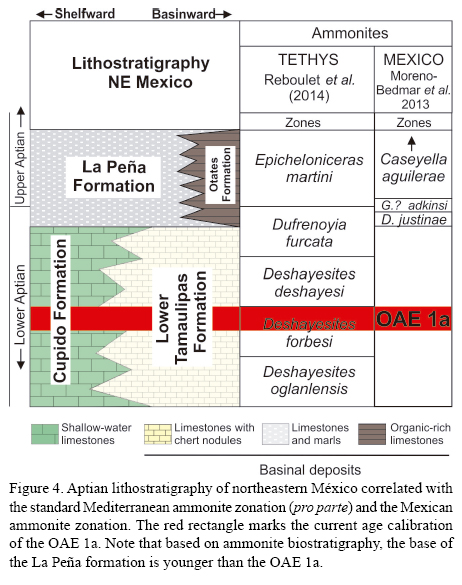
<body><![CDATA[<p align="justify"><font face="verdana" size="2">3.1. The OAE 1a (Selli event)</font></p>  	    <p align="justify"><font face="verdana" size="2">Research regarding the OAE 1a has focused on the pelagic Barremian/Aptian succession of northeastern Mexico. Although the &#948;<sup>13</sup>C signal of this event was identified, little effort has been done in order to study its effects on the Mexican Sea. Critical questions that remain unanswered are those related to (a) the redox regime, (b) changes on the water chemistry, and (c) impact on the carbonate platform development. A multi&#45;proxy investigation based on sedimentary, paleontological and geochemical proxies could provide answers to these questions. Given that the Aptian&#45;Albian is a time interval containing hydrocarbons source rocks in some wells across northern Mexico (Monreal and Longoria, 2000), answering these questions is also important in order to increase the knowledge of the hydrocarbon system.</font></p>  	    <p align="justify"><font face="verdana" size="2">Early studies related to the known (at that time) OAE 1 were conducted by Scholle and Arthur (1980) at cretaceous organic carbon&#45;rich pelagic limestones of the Sierra Madre Oriental exposed at Peregrina Canyon and rancho Jacalitos (Tamaulipas and Nuevo Le&oacute;n states, respectively; <a href="/img/revistas/bsgm/v66n3/a7f1.jpg" target="_blank">Figures 1B</a> and <a href="/img/revistas/bsgm/v66n3/a7f2.jpg" target="_blank">2</a>). These authors identified a positive carbon isotope excursion (&#948;<sup>13</sup>C<sub>carb</sub> &#61; &#126;1.5 &#8210; 2.0 &#8240;) near the Aptian/Albian boundary that assigned to this event. At Peregrina Canyon, the &#948;<sup>13</sup>C anomaly is predated by an interval with high total organic carbon (TOC) content (up to &#126;0.8 &#37;; &#126;3 &#8210; 4 &times; background) (<a href="/img/revistas/bsgm/v66n3/a7f3.jpg" target="_blank">Figure 3A</a>). Unfortunately, they failed to mention about the exact lithostratigraphic position of such anomaly. It was not until the study of Bralower <i>et al</i>. (1999) that the first report of the OAE 1a occurred. They studied the carbon isotope record of four Barremian/Aptian localities in northeastern Mexico. The most complete record of the OAE 1a was found in the Santa Rosa Canyon section, in the leading edge of the Sierra Madre Oriental thrust and fold belt (Nuevo Le&oacute;n State; <a href="/img/revistas/bsgm/v66n3/a7f1.jpg" target="_blank">Figures 1B</a> and <a href="/img/revistas/bsgm/v66n3/a7f2.jpg" target="_blank">2</a>). The Barremian/Aptian exposed succession of such section corresponds to the lime mudstones with chert nodules of the Lower Tamaulipas Formation and the overlying intercalation of marls and mudstones of the La Pe&ntilde;a Formation. The former is the basinal equivalent of the shallow&#45;water skeletal limestones of the Cupido Formation, which represents a carbonate platform with the same name that developed around the Coahuila block. Bralower <i>et</i> <i>al</i>. (1999) constructed an organic carbon isotope (&#948;<sup>13</sup>C<sub>org</sub>) curve for Santa Rosa and compared it to the curve of Peregrina Canyon developed by Scholle and Arthur (1980).</font></p>  	    <p align="justify"><font face="verdana" size="2">Based on this comparison, these authors reinterpreted the chronostratigraphic position of the latter, defined the segments of Menegatti <i>et al</i>. (1998), and identified the OAE 1a at Peregrina Canyon (<a href="/img/revistas/bsgm/v66n3/a7f3.jpg" target="_blank">Figure 3B</a>). At Santa Rosa, the OAE 1a consists of a positive &#948;<sup>13</sup>C shift about 2.0 &#8240; predated by a &#126;1.5 &#8240; negative spike toward the base of the La Pe&ntilde;a Formation (<a href="/img/revistas/bsgm/v66n3/a7f3.jpg" target="_blank">Figure 3C</a>). This stratigraphic interval is also characterized by a two&#45;fold increase in TOC (2 &#8210; 3 &#37;). Later, Li <i>et al</i>. (2008) resampled in greater detail the Santa Rosa Canyon section, and developed a new &#948;<sup>13</sup>C<sub>org</sub> curve with a new position of the OAE 1a. According to their results, this event is located between the uppermost part of the Lower Tamaulipas Formation and the base of the La Pe&ntilde;a Formation (<a href="/img/revistas/bsgm/v66n3/a7f3.jpg" target="_blank">Figure 3D</a>). Besides the isotope data, Bralower <i>et al</i>. (1999) and Li <i>et al</i>. (2008) constrained their &#948;<sup>13</sup>C<sub>org</sub> curves through the determination of planktonic foraminifera and calcareous nannofossil biozones. Based on the magnetostratigraphic data of Clement <i>et al</i>. (2000), Li <i>et al</i>. (2008) also suggested that OAE 1a lasted &#126;1.28 My, being its record at Santa Rosa a relatively expanded OAE 1a succession.</font></p>  	    <p align="justify"><font face="verdana" size="2">The investigations of Bralower <i>et al</i>. (1999) and Li <i>et al</i>. (2008) might be questionable considering that they sampled separate segments instead of a continuous stratigraphic section, with a lack of data for &#126;7 m at the Lower Tamaulipas/La Pe&ntilde;a contact, immediately above the negative &#948;<sup>13</sup>C spike of Li <i>et al</i>. (2008) (<a href="/img/revistas/bsgm/v66n3/a7f3.jpg" target="_blank">Figure 3D</a>). Considering the ammonite biostratigraphy (the most accurate for the Aptian to date), a misidentification of the OAE 1a at Santa Rosa Canyon section is indeed highly possible. Although there is no ammonite database for the La Pe&ntilde;a Formation of Santa Rosa, if we consider that the base of this formation is isochronous and assignable to the <i>Dufrenoyia justinae</i> Zone (Barrag&aacute;n&#45;Manzo and M&eacute;ndez&#45;Franco, 2005; Barrag&aacute;n and Maurrasse, 2008; Moreno&#45;Bedmar <i>et al</i>., 2011; 2012b; Moreno&#45;Bedmar and Delanoy, 2013), we can infer that the lowermost part this unit at Santa Rosa Canyon section also belongs to this ammonite zone. At La Boca and the Huasteca Canyon sections (Nuevo Le&oacute;n State; <a href="/img/revistas/bsgm/v66n3/a7f2.jpg" target="_blank">Figure 2</a>), close to Santa Rosa Canyon, the ammonite record of the lowermost part of the La Pe&ntilde;a Formation also starts in the <i>Dufrenoyia justinae</i> Zone (Cant&uacute;&#45;Chapa, 1976; Barrag&aacute;n&#45;Manzo and M&eacute;ndez&#45;Franco, 2005; Barrag&aacute;n and Maurrasse, 2008). In the ammonite Mediterranean biostratigraphic scheme of Reboulet <i>et al</i>. (2014), this Mexican ammonite zone is representative of the uppermost part of the late early Aptian <i>Dufrenoyia</i> <i>furcata</i> Zone. Therefore, it is likely that the base of the La Pe&ntilde;a Formation at Santa Rosa section has a younger age than the OAE 1a event, commonly restricted to the early Aptian <i>Deshayesites forbesi</i> Zone (Moreno&#45;Bedmar <i>et al</i>., 2009; 2012a; Najarro <i>et al</i>., 2011; Bover&#45;Arnal <i>et al</i>., 2010; Gaona&#45;Narvaez <i>et al</i>., 2013). Hence, the OAE 1a should be located within the Lower Tamaulipas Formation (or the Cupido Formation) instead of the La Pe&ntilde;a Formation (or the time&#45;equivalent Otates Formation consisting of shaly and organic&#45;rich limestones) (<a href="#f4">Figure 4</a>). This situation would imply that the deposition of the Cupido Formation lasted beyond the early Aptian and probably the Cupido Platform survived the OAE 1a.</font></p>  	    <p align="center"><font face="verdana" size="2"><a name="f4"></a></font></p>  	    <p align="center"><font face="verdana" size="2"><img src="/img/revistas/bsgm/v66n3/a7f4.jpg"></font></p>  	    <p align="justify"><font face="verdana" size="2">If the previous scenario is correct, what is the significance of the organic carbon&#45;rich sediments at the base of the La Pe&ntilde;a Formation? Such levels with high TOC have been reported at the Francisco Zarco dam section (Durango State; <a href="/img/revistas/bsgm/v66n3/a7f2.jpg" target="_blank">Figure 2</a>) (Barrag&aacute;n, 2001) and La Huasteca section (Nuevo Le&oacute;n State; <a href="/img/revistas/bsgm/v66n3/a7f2.jpg" target="_blank">Figure 2</a>) (Barrag&aacute;n and Maurrasse, 2008). In both places, the La Pe&ntilde;a Formation also starts within the <i>Dufrenoyia justinae</i> Zone. This interval has been correlated by Mill&aacute;n <i>et al</i>. (2009) and Skelton and Gili (2012) with TOC&#45;enriched sediments of the base of the Lareo Formation (<i>Dufrenoyia furcata</i> Zone) from the Basque&#45;Cantabrian basin in Spain, and corresponding to the so&#45;called Aparein level. It is a new OAE occurring in the upper part of the early Aptian, associated with a carbonte platform termination. As suggested for the Aparein level by Mill&aacute;n <i>et al</i>. (2009), the TOC&#45;enriched levels at the base of the La Pe&ntilde;a Formation may represent the last period of dysoxia/anoxia at the top of the early Aptian (Bralower <i>et al</i>., 1994; F&ouml;llmi, 2012).</font></p>  	    <p align="justify"><font face="verdana" size="2">On the other hand, it is noteworthy that magneto&#45;stratigraphic and micropaleontological data support the presence of the OAE 1a at the base of the La Pe&ntilde;a Formation. In this regard, a characteristic interval link to the record of the OAE 1a that both Bralower <i>et al</i>. (1999) and Li <i>et al</i>. (2008) documented at the base of the La Pe&ntilde;a Formation is the nannoconid crisis interval. In this case, our supposition might be wrong and key topics such as the isochronism/diachronism of the La Pe&ntilde;a Formation and the correspondence between planktonic foraminifera, calcareous nannofossil and ammonite biozones have to be strongly addressed.</font></p>  	    <p align="justify"><font face="verdana" size="2">In order to answer these questions, further carbon isotope and biostratigraphic/magnetostratigraphic studies must be conducted in the Lower Tamaulipas(Cupido)/La Pe&ntilde;a formations. The age of the demise of the Cupido Platform (the Cupidito facies) should be determined along with a precise identification of the segments of Menegatti <i>et al</i>. (1998). For instance, these tasks could be undertaken in the lowermost 7 m of the La Pe&ntilde;a Formation at the Santa Rosa Canyon section. A properly constrained C&#45;isotope curve is key to identify the signal of global and regional/local events. Given the nature of nearshore deposits of the Cupido Formation along with diagenetic processes that could mask the primary geochemical signal (<i>e.g</i>. fresh&#45;water input, elevated evaporation rates), the Lower Tamaulipas Formation seems to be a suitable candidate for carbon isotope studies. In the search for the record of anoxic/dysoxic conditions, an interesting new approach could be the study of oxygen levels from the fossil assemblage and trace element data. Thus, these redox regimes would not only be recorded but could also be deciphered in terms of their global and/or local effects. On the other hand, if the Aparein level was precisely located, it will be its first record outside Europe, implying a wider paleogeographic extension for this event, and supporting its probable use as a chemostratigraphic marker.</font></p>  	    ]]></body>
<body><![CDATA[<p align="justify"><font face="verdana" size="2"><i>3.1.1. Other reports and prospects for further studies    <br></i> Lampazos Platform: Monreal and Longoria (2000) correlated the OAE 1a (as defined by Bralower <i>et al</i>., 1999 at Santa Rosa Canyon) with the base of the Agua Salada Formation of the Lampazos Platform (<a href="/img/revistas/bsgm/v66n3/a7f1.jpg" target="_blank">Figures 1B</a> and <a href="/img/revistas/bsgm/v66n3/a7f2.jpg" target="_blank">2</a>). This unit is characterized mainly by calcareous shale and limestone beds consisting of pelagic skeletal wackestones and floatstones. It is important to mention that the re&#45;assignment of the middle part of the Agua Salada Formation to the early Aptian, as well as the presence of black shales in its lower part (which may be the lithologic expression of the anoxic episode), support the hypothesis of the base of this unit recording the OEA la (Gonz&aacute;lez&#45;Le&oacute;n, 1988; Monreal and Longoria, 2000; Santa Mar&iacute;a&#45;D&iacute;az and Monreal, 2008). The occurrence of the ammonite <i>Dufrenoyia justinae</i> in the upper part of the unit at Rancho Agua Salada section (Sonora State; <a href="/img/revistas/bsgm/v66n3/a7f2.jpg" target="_blank">Figure 2</a>) (Gonz&aacute;lez&#45;Le&oacute;n, 1988) does not exclude this possibility.</font></p>  	    <p align="justify"><font face="verdana" size="2">&nbsp;</font></p>  	    <p align="justify"><font face="verdana" size="2">3.2. The OAE 2 (Bonarelli event)</font></p>  	    <p align="justify"><font face="verdana" size="2">This OAE is the most documented and studied in Mexico and elsewhere. The record of the OAE 2 has been reported in southern, central and northern Mexico (Scholle and Arthur, 1980; Duque&#45;Botero and Maurrasse, 2004; Ifrim, 2006; Blanco&#45;Pi&ntilde;&oacute;n <i>et al</i>., 2008, 2014; Rojas&#45;Le&oacute;n <i>et al</i>., 2008; Duque&#45;Botero <i>et al</i>., 2009; Elrick <i>et al</i>., 2009; Blanco <i>et al</i>., 2010, 2011; Ifrim <i>et al</i>., 2011). The interest in studying this event lies in the fact that several Cenomanian/Turonian rocks are proved or potential prolific hydrocarbon source rocks. Despite this, the genetic link of the OAE 2 with these rocks in several basins is still poorly understood.</font></p>  	    <p align="justify"><font face="verdana" size="2"><i>3.2.1. Northeastern Mexico    <br></i>At Peregrina Canyon (<a href="/img/revistas/bsgm/v66n3/a7f2.jpg" target="_blank">Figure 2</a>), within the hemipelagic limestones and shaly limestones (mudstones and wackestones) of the Agua Nueva Formation, Scholle and Arthur (1980) found a positive shift in &#948;<sup>13</sup>C values of cabonates of &#126;1.5 &#8240; spanning almost the entire Turonian, which was interpreted as the geochemical signature of the OAE 2 (<a href="/img/revistas/bsgm/v66n3/a7f5.jpg" target="_blank">Figure 5A</a>). This positive &#948;<sup>13</sup>C excursion overlaps partly with an organic carbon&#45;rich interval (up to 2.5 &#37;, about 10 &#8210; 12 &times; background values).</font></p>  	    <p align="justify"><font face="verdana" size="2">Recent studies focused on the Agua Nueva Formation have linked its informal Vallecillo Member (Blanco&#45;Pi&ntilde;&oacute;n, 2003), a Konservat&#45;Lagerst&auml;tten deposit, to the OAE 2 occurrence (Blanco&#45;Pi&ntilde;&oacute;n, 2003; Ifrim, 2006; Ifrim <i>et al</i>., 2011). At Vallecillo section (Nuevo L&eacute;on State; <a href="/img/revistas/bsgm/v66n3/a7f2.jpg" target="_blank">Figure 2</a>), this member is characterized by laminated marly limestones to plattenkalk with abundant and very well preserved fish fossils. At Las Mitras section (Nuevo Le&oacute;n State; <a href="/img/revistas/bsgm/v66n3/a7f2.jpg" target="_blank">Figure 2</a>), the base of this member is a black shale level. Ifrim (2006) constrained the age of the Vallecillo Member to the latest Cenomanian/early Turonian time interval through ammonite, inoceramid and planktonic foraminifera biostratigraphy. This author unsuccessfully searched for the carbon isotope signal of the OAE 2 in both the Vallecillo and Las Mitras sections. According to him, such task was not possible due to the existence of a diagenetic overprint evidenced by a clear negative correlation between &#948;<sup>13</sup>C and &#948;<sup>18</sup>O values. In this regard, we recommend further efforts to find the carbon isotope signature of this event, including a characterization of the TOC content. It is possible that the characteristic inflection point in the &#948;<sup>13</sup>C curve at the Vallecillo section that marks the onset of the OAE 2 is recorded in a lower stratigraphic position, considering that such point occurs in an older planktonic foraminifera biozone (<i>Rotalipora cushmani</i>) than that recorded at the base of the Vallecillo section (<i>Whiteinella archaeocretacea</i>). Ifrim (2006) interpreted the presence of pyrite framboids with the same morphology and uniform size of around 2 &micro;m in the Vallecillo Member as a sign of anoxic pore&#45;water conditions with high H<sub>2</sub>S content. Strong depletion in Mn and remarkable peaks of Cu, Ni and Zn also portray poorly oxygenated settings. Based on the fossil assemblage distribution, this author proposed that the onset of the oxygen depletion above the seafloor began in the late Cenomanian and reached the seafloor in the latest Cenomanian as result of the vertical expansion of the oxygen minimum zone.</font></p>  	    <p align="justify"><font face="verdana" size="2">Duque&#45;Botero and Maurrasse (2004) and Duque&#45;Botero <i>et al</i>. (2009) examined the Cenomanian/Turonian stratigraphic interval of the Indidura Formation in several stratigraphic sections from the Parras Basin at the Coahuila State (<a href="/img/revistas/bsgm/v66n3/a7f1.jpg" target="_blank">Figure 1B</a>). This unit consists mainly of pelagic mudstones to wackestones and intercalated shales. At the base of the Parras de la Fuente section (<a href="/img/revistas/bsgm/v66n3/a7f2.jpg" target="_blank">Figure 2</a>), within the identified CC10 (containing the Cenomanian/Turonian boundary) and the lower part of the CC11 calcareous nannoplankton biozones, these investigations documented a positive &#948;<sup>13</sup>C anomaly up to &#126;2 &#8240; in organic carbon that related to the OAE 2 (<a href="/img/revistas/bsgm/v66n3/a7f5.jpg" target="_blank">Figure 5B</a>). This interval comprises &#126;15 &#8210; 16 m and does not exhibit high TOC (0 &#8210; 1.5 &#37;); however, it records redox indices &#91;(V/(V&#43;Ni), V/Cr and Mo content)&#93; that reveal oxygen&#45;depleted conditions at the time of its deposition.</font></p>  	    <p align="justify"><font face="verdana" size="2">According to Duque&#45;Botero <i>et al</i>. (2009), poorly oxygenated conditions favoring the deposition of organic carbon&#45;rich sediments in northeastern Mexico prevailed during the Cenomanian/Turonian and lasted for about 4 million years (that is, until the Coniacian). Therefore, such conditions also influenced the deposition of the Indidura Formation. As it is attested by the cyclic laminations of bacterial microspheres, interpreted as blooms of cyanobacteria, these conditions resulted from intense primary productivity associated with periodic incursions of riverine Fe&#45;rich waters. Accordingly, Ifrim (2006) suggest that although the uppermost water layers became oxygenated during the early Turonian, the bottom remained anoxic. Stinnesbeck <i>et al</i>. (2005) also pointed to the prevalence of poorly oxygenated conditions until the early Coniacian, based on the excellent preservation showed by a Turonian/lower Coniacian fossil assemblage (including vertebrate fossils with soft tissues) at El Rosario quarry (Coahuila State; <a href="/img/revistas/bsgm/v66n3/a7f2.jpg" target="_blank">Figure 2</a>), in strata assigned to the Austin Formation of the Sabinas Basin (<a href="/img/revistas/bsgm/v66n3/a7f1.jpg" target="_blank">Figures 1B</a> and <a href="/img/revistas/bsgm/v66n3/a7f2.jpg" target="_blank">2</a>). This unit consists of intercalated marl and limestone (chalk) deposited under open marine conditions.</font></p>  	    ]]></body>
<body><![CDATA[<p align="justify"><font face="verdana" size="2"><i>3.2.2. Guerrero&#45;Morelos Platform    <br></i>The OAE 2 in southern Mexico was mentioned for the first time by Hern&aacute;ndez&#45;Romano <i>et al</i>. (1997) in a study of the Guerrero&#45;Morelos Platform (<a href="/img/revistas/bsgm/v66n3/a7f1.jpg" target="_blank">Figures 1B</a> and <a href="/img/revistas/bsgm/v66n3/a7f2.jpg" target="_blank">2</a>). These authors studied the Morelos and Mezcala formations at the Barranca del Tigre, Axaxacoalco and Zotoltitl&aacute;n sections (Guerrero State; <a href="/img/revistas/bsgm/v66n3/a7f2.jpg" target="_blank">Figure 2</a>). The Morelos Formation is composed of shallow&#45;marine limestones that was part of an Albian/Cenomanian carbonate platform in southern Mexico. It is characterized by bioclastic and intraclastic limestones. On the other hand, the Mezcala Formation corresponds to interbedded hemipelagic limestones and siliciclastic turbidites. Based on the vertical distribution of microfossils (benthonic and planktonic foraminifera, calcareous algae and calcisphaerulids), the three sections were constrained to the middle Cenomanian/early Turonian time interval. These authors suggested that the OAE 2 caused, in part, the drowning of the platform, which occurred first in the western zone. According to their model, the expansion of an oxygen minimum zone related to an upwelling system along the Pacific side of the platform and the sea level rise during the latest Cenomanian/earliest Turonian, resulted in the invasion of oxygen&#45;poor waters over the platform, disappearance of benthos, and shut down of the carbonate production. This is reflected by a drastic diminishing of benthic flora and fauna, and the appearance of an organism assemblage resistant to low oxygen levels from the Morelos Formation to the Mezcala Formation. This transition is also characterized by black, organic&#45;rich, laminated sediments lacking bioturbation. A greater subsidence rate of the western portion of the platform also stimulated its demise. On the other hand, the platform termination in the eastern part occurred in the middle Turonian as result of the interplay of terrigenous&#45;clastic supply and a new impingement of anoxic waters.</font></p>  	    <p align="justify"><font face="verdana" size="2">Elrick <i>et al</i>. (2009) also studied the Barranca del Tigre and Axaxacoalco sections and added them to their investigation of the Barranca el Ca&ntilde;&oacute;n section (Guerrero State; <a href="/img/revistas/bsgm/v66n3/a7f2.jpg" target="_blank">Figure 2</a>). Over a &#126;40 m&#45;thick interval of the Morelos Formation containing the Cenomanian/Turonian boundary (in the three sections), they found an abrupt &#948;<sup>13</sup>C positive shift (3 &#150; 4 &#8240;) in carbonates that related to the isotopic signature of the OAE 2 (<a href="/img/revistas/bsgm/v66n3/a7f5.jpg" target="_blank">Figure 5C</a>). However, the sediments of this interval lack the typical features of oxygen&#45;depleted conditions, such as TOC enrichment or laminated fabrics; instead, these rocks exhibit a bioturbated fabric reflecting a well oxygenated setting. Such redox regime was associated with the abundant supply of oxygen from the ocean surface&#45;atmosphere interface to the shallow&#45;water sediments. The study of Elrick <i>et al</i>. (2009) not only resulted in the first isotopically constrained expression of the Bonarelli event in southern Mexico, but is also an important contribution to the poor database of this event in both the proto&#45;Pacific area and carbonate platform settings. So far, the Mexican record of the OAE 2 at the Guerrero&#45;Morelos Platform is one of the most stratigraphically expanded and contains one of the largest reported positive &#948;<sup>13</sup>C excursions to date.</font></p>  	    <p align="justify"><font face="verdana" size="2">Across the Mexican territory, the &#948;<sup>13</sup>C anomaly related to the OAE 2 has been interpreted as the response of seawater to the increase of iron caused by the emplacement of the Caribbean plateau. Such scenario is feasible since the area of volcanic eruptions (over the Galapagos hot spot) took place at a relatively short distance from Mexico (&#126;2000 to 4000 km according to the tectonic plate reconstruction of Wignall, 1994). Considering the model of surface circulation during Late Cretaceous (Barron and Peterson, 1990), and the Cenomanian/Turonian Mexican paleogeography (Goldhammer, 1999; Padilla y S&aacute;nchez, 2007), water masses carrying metals may have been transported to the Mexican Sea, thereby intensifying primary production and producing &#948;<sup>13</sup>C positive values. For the Mezcala Formation, Snow (2003) measured the abundance of trace elements with short and long residence time in seawater and found concentrations consistent with the increase of magmatic and hydrothermal activities. According to Elrick <i>et al</i>. (2009), this hypothesis is also supported by the coincidence of strong peaks of trace elements at the onset of the &#948;<sup>13</sup>C excursion and at the end of the maximum positive excursion at the Barranca el Ca&ntilde;&oacute;n. Duque&#45;Botero <i>et al</i>. (2009) also suggest the influence of the Caribbean plateau volcanism on the Indidura Formation deposition; however, this relation is still poorly studied. Arguments supporting this scenario are: (1) the record of the effects of this activity on the positive &#948;<sup>13</sup>C excursion at the Rock Canyon section in the Western Interior Seaway (around 5000 km from the source) (Snow, 2003; Snow <i>et al</i>., 2005), indicating that the Mexican Sea must have acted as a bridge and was also affected; and (2) the trace element abundances measured by Duque&#45;Botero <i>et al</i>. (2009) coinciding with the end of the maximum &#948;<sup>13</sup>C positive excursion. In order to corroborate the link between the OAE 2 and the Caribbean plateau volcanic and hydrothermal activity, it is necessary to examine trace metal enrichment patterns of elements in other sections deposited at the Cenomanian/Turonian sections.</font></p>  	    <p align="justify"><font face="verdana" size="2">Unlike the studies that have addressed the OAE 1a, those focused on the OAE 2 have looked into the causes of the drawdown in seawater oxygen concentrations and/or the occurrence of the positive carbon isotope excursion; however, additional studies are still needed. Some of the promising stratigraphic units that could constitute the basis for further research are listed below. It is significantly important to search for signs of submarine volcanic activity by measuring trace metal abundances. It allows to clarify the effects of this activity on sewater chemistry and Mexican carbonate platforms. In this task, useful proxies that could be included are the strontium (<sup>87</sup>Sr/<sup>86</sup>Sr) and osmium (<sup>197</sup>Os/<sup>186</sup>Os) isotope ratios. These isotope measurements will allow an accurate differentiation between the signatures of local weathering and global ocean crust production (Jones and Jenkyns, 2001; Leckie <i>et al</i>., 2002). Furthermore, <sup>87</sup>Sr/<sup>86</sup>Sr ratios will help increasing the age control, especially in stratigraphic sections lacking a proper biostratigraphic age control.</font></p>  	    <p align="justify"><font face="verdana" size="2"><i>3.2.3. Other references and prospects for further studies    <br></i>Burgos and Sabinas basins: The Eagle Ford Formation of the Burgos and Sabinas basins (<a href="/img/revistas/bsgm/v66n3/a7f1.jpg" target="_blank">Figures 1B</a> and <a href="/img/revistas/bsgm/v66n3/a7f2.jpg" target="_blank">2</a>) is a proved oil and gas source rock. This unit was deposited on a shallow&#45;marine shelf at the southern end of the Western Interior Seaway (WIS) of North America, and is characterized by mixed siliciclastic&#45;carbonate mudstones and shales. It has a TOC content of about 1 &#8210; 4 &#37; with mainly marine&#45;derived organic matter (type II) (Escalera&#45;Alcocer, 2012). Within the frame of the current interest for non&#45;conventional hydrocarbons, the Eagle Ford Formation is one of the top&#45;ranked prospects in Mexico (EIA/ARI, 2013). The OAE 2 recorded in the organic carbon&#45;rich deposits of this unit has been recognized and characterized in Texas, USA (Kearns, 2011; Eldrett <i>et al</i>., 2014).</font></p>  	    <p align="justify"><font face="verdana" size="2">Tampico&#45;Misantla Basin: Several studies report that the Agua Nueva Formation of the Tampico&#45;Misantla Basin (<a href="/img/revistas/bsgm/v66n3/a7f1.jpg" target="_blank">Figure 1B</a>) at the Xilitla section contains the record of the OAE 2 (Blanco <i>et al</i>., 2010, 2011; Blanco&#45;Pi&ntilde;&oacute;n <i>et al</i>., 2008, 2014; Rojas&#45;Le&oacute;n <i>et al</i>., 2008). The Xilitla section (San Luis Potos&iacute; State; <a href="/img/revistas/bsgm/v66n3/a7f2.jpg" target="_blank">Figure 2</a>) consists mainly of intercalated hemipelagic mudstones and wackestones, shales and bentonites. Calcareous beds contain common fishes and inoceramids. The evidences of poorly oxygenated conditions near the seafloor during its deposition are: (a) total lack of bioturbation, (b) fine lamination of the sediments, (c) TOC up to 9.9 &#37;, and (d) presence of framboidal pyrite. These investigations also found structures of algal/bacterial origin in both micritic matrix and pyrite laminae. Recently, Casta&ntilde;eda&#45;Posadas <i>et al</i>. (2014) reported also the presence of brackish and fresh&#45;water stomatocysts in laminated pyrite from Xilitla beds preserved under oxygen&#45;deficiency conditions in a low energy environment. They proposed that the riverine input could be responsible for the delivery of this type of continental material to the marine realm.</font></p>  	    <p align="justify"><font face="verdana" size="2">Valles&#45;San Luis Potos&iacute; Platform: The base of the Soyatal Fomation in the western margin of the Valles&#45;San Luis Potos&iacute; Platform (<a href="/img/revistas/bsgm/v66n3/a7f1.jpg" target="_blank">Figures 1B</a> and <a href="/img/revistas/bsgm/v66n3/a7f2.jpg" target="_blank">2</a>) has been assigned by Oma&ntilde;a (2011) and Oma&ntilde;a <i>et al</i>. (2013) to the latest Cenomanian/early Turonian through planktonic foraminifera. It is composed of dark calcareous limestones, marly limestones and shales, commonly interpreted as turbidite deposits. The analysis of several stratigraphic sections, mainly the Sierra de &Aacute;lvarez section (<a href="/img/revistas/bsgm/v66n3/a7f2.jpg" target="_blank">Figure 2</a>), allowed these authors to determinate that changes in nutrient gradient across the El Abra/Soyatal formations was a determinant factor for the drowning of the Valles&#45;San Luis Potos&iacute; Platform. This event was triggered by changes in the global sea&#45;level and eutrophic conditions during the OAE 2. At the Cerritos section (<a href="/img/revistas/bsgm/v66n3/a7f2.jpg" target="_blank">Figure 2</a>), these changes are evidenced by a pithonellid bloom associated with a microfossil assemblage indicative of low oxic&#150;dysoxic bottom conditions (Oma&ntilde;a <i>et al</i>., 2014).</font></p>  	    <p align="justify"><font face="verdana" size="2">Veracruz Basin: The deep&#45;water facies of the Turonian Maltrata Formation of the Veracruz Basin (<a href="/img/revistas/bsgm/v66n3/a7f1.jpg" target="_blank">Figures 1B</a> and <a href="/img/revistas/bsgm/v66n3/a7f2.jpg" target="_blank">2</a>), and the tectonic front of the C&oacute;rdoba Platform, are well&#45;known source rocks of hydrocarbons (Gonz&aacute;lez&#45;Garc&iacute;a and Holgu&iacute;n&#45;Qui&ntilde;ones, 1992; Ortu&ntilde;o&#45;Arzate <i>et al</i>., 2003). This unit consists of dark limestones and shaly limestones with an average TOC content of 3 &#8210; 4 &#37; and marine&#45;derived organic matter (type II) (Ortu&ntilde;o&#45;Arzate <i>et al</i>., 2003).</font></p>  	    ]]></body>
<body><![CDATA[<p align="justify"><font face="verdana" size="2">&nbsp;</font></p>  	    <p align="justify"><font face="verdana" size="2">3.3. The OAE 3</font></p>  	    <p align="justify"><font face="verdana" size="2">The OAE 3 has not yet been recognized in Mexico; however sediments linked to this OAE in America have been documented in Venezuela (Davis <i>et al</i>., 1999; Erlich <i>et al</i>., 1999; Crespo de Cabrera <i>et al</i>., 1999), Colombia (Vergara, 1997; Rangel <i>et al</i>., 2000), Surinam (Shipboard Scientific Party, 2002), Ecuador (Brookfield <i>et al</i>., 2009), and in areas rather close to Mexico such as Costa Rica and Panama (Erlich <i>et al</i>., 1996; 2003), and the Western Interior Seaway, USA (Bottjer and Stein, 1994; Dean and Arthur, 1998). In most of these areas, the temporal distribution of black shales related to the OAE 3 indicates that it was not a single and distinct event, but several discrete episodes that occurred over a long time interval, from the Coniacian to the Santonian (Wagreich, 2012). Considering the basin conditions favorable for the development of the OAE 3 in the aforementioned areas and the Coniacian/Santonian Mexican paleogeography and sedimentary pattern, we explore the possibilities of Mexican basins and stratigraphic units for recording this OAE.</font></p>  	    <p align="justify"><font face="verdana" size="2">Unlike the areas where the OAE 3 is documented, in Mexico there was not a restricted epicontinental sea during the Late Cretaceous. Although the Mexican Sea was separated from the Pacific Ocean by a large Cenomanian volcanic arc (Grajales&#45;Nishimura <i>et al</i>., 1992; Goldhammer, 1999; Centeno&#45;Garc&iacute;a <i>et al</i>., 2008) as result of a major eustatic sea level rise, it had a real connection with both the Atlantic (through the proto&#45;Caribbean) and the Western Interior Seaway (McFarlan and Menes, 1991; Goldhammer, 1999). Such scenario may have allowed for the mixing of intermediate waters, reducing the possible occurrence of oxygen&#45;depleted at the seafloor. However, a closer assessment of the Coniacian/Santonian Mexican Sea shows that it was not a broad unbroken depositional realm. This sea consisted of marine basins separated by relatively prominent topographic submerged/emerged highs. In eastern Mexico, most of the basement high blocks that resulted from the opening of the Gulf of Mexico had been flooded and only persisted as shrunken islands that on top gave rise to isolated shelf carbonates. The karstic platforms of the Upper Guzmantla and the Upper Tamasopo formations were developed on the drowned and backstepped C&oacute;rdoba and Valles San Luis Potos&iacute; platforms, respectively (Horbury <i>et al</i>., 2003). Further south, the Artesa&#45;Nuevo Mundo and Chiapas platforms also remained high (Cros <i>et al</i>., 1998; Williams&#45;Rojas and Hurley, 2001). On the other hand, in central Mexico the Laramide phase of deformation occurred between 90 and 65 Ma (Hern&aacute;ndez&#45;J&aacute;uregui, 1997; L&oacute;pez&#45;Oliva <i>et al</i>., 1998), and resulted in a foreland basin system to the east of the tectonic front, encompassing syntectonic sub&#45;basins confined by positive topography (folds and overthrust faults). Together, these topographic highs (submerged or emerged) constituted paleobathymetric barriers that could have controlled (partially restricted) the exchange of bottom waters between basins and the open sea, thus favoring bottom dysoxic/anoxic conditions.</font></p>  	    <p align="justify"><font face="verdana" size="2">Widespread volcanic ash fall is characteristic of the Coniacian/Santonian time interval in the eastern and southern Gulf of Mexico, as evidenced by abundant bentonite beds interlayered with limestones and shales (Salvador, 1991; Padilla y S&aacute;nchez, 2007). This volcanic activity might increase nutrient availability in the ocean surface. Different investigations have determined that ash particles can supply large amounts of bio&#45;available elements to the ocean such as Fe and other important nutrients (PO<sub>3</sub><sup>&#45;4</sup>, Si, Zn, Mn, Ni, Co and Cu) (Frogner <i>et</i> <i>al</i>., 2001; Langmann <i>et al</i>., 2010). On the other hand, an increase of terrigenous input prompted by the presence of mountain blocks built by the Laramide orogeny could also enhance primary productivity. The magnified export of organic matter coupled with soil&#45;derived nutrients can stimulate primary production and increase mid&#45;water oxygen consumption (Erbacher <i>et al</i>., 1996; Leckie <i>et al</i>., 2002). Furthermore, an enhanced continental runoff caused salinity stratification, which is another factor favorable for oxygen&#45;drawdown (Arthur and Natland, 1979); however, associated processes such as massive fluvial outflow and turbidite sedimentation can cause mixing of intermediate&#45;deep waters with oxygenated surface waters (Erlich <i>et al</i>., 2003), reducing the preservation potential of organic matter in the water column and on the seafloor.</font></p>  	    <p align="justify"><font face="verdana" size="2">The foregoing scenario allows the assumption that Coniacian/Santonian Mexican Sea likely developed oxygen&#45;depleted conditions related to the OAE 3; however, they must have been intermittent, disturbed by mixing with oxygenated waters (anoxic/dysoxic variations). One of the main hurdles to overcome in the search for these conditions is the volcanic and detrital supply that may have diluted carbonate and organic material, complicating the detection of the OAE 3. This is the case in the study of (a) the San Felipe Formation, deposited in almost the entire eastern and southern Gulf of Mexico Basin (<a href="/img/revistas/bsgm/v66n3/a7f1.jpg" target="_blank">Figure 1B</a>) and consisting of shaly limestones, calcareous shales and abundant bentonite; (b) the Soyatal Formation (Valles&#45;San Luis Potos&iacute; Platform; <a href="/img/revistas/bsgm/v66n3/a7f1.jpg" target="_blank">Figures 1B</a> and <a href="/img/revistas/bsgm/v66n3/a7f2.jpg" target="_blank">2</a>); and (c) the Mezcala Formation (Guerrero&#45;Morelos Platform; <a href="/img/revistas/bsgm/v66n3/a7f1.jpg" target="_blank">Figures 1B</a> and <a href="/img/revistas/bsgm/v66n3/a7f2.jpg" target="_blank">2</a>). These stratigraphic units do not seem to be the most suitable for studying redox conditions. In the Formation, TOC content above 1 &#37; is a promising feature likely related to the OAE 3. (Gonz&aacute;lez Garc&iacute;a and Holgu&iacute;n Qui&ntilde;ones, 1992). Given that this unit is a target for shale gas exploration (EIA/ARI, 2013), an appropriate paleoredox study searching for possible links with OAE 3 is key to assisting the exploration. Furthermore, the presence of bentonite beds in this stratigraphic unit allow its radiometric dating (<i>e.g</i>. U/Pb, K/Ar, <sup>40</sup>Ar/<sup>39</sup>Ar). For the Soyatal Formation is noteworthy that Oma&ntilde;a (2011) did not report foraminiferal evidence suggesting stressed poorly oxygenated conditions during the Coniacian/Santonian. According to this author, after the crisis suffered by planktonic foraminifera during the OAE 2, the fossil assemblage from Turonian to late Santonian reflects normal conditions. Since in northeastern Mexico orogenic deformation and subsequent shift from carbonate to clastic deposition started in the early Campanian (Gray <i>et al</i>., 2001), the Indidura (Parras Basin; <a href="/img/revistas/bsgm/v66n3/a7f1.jpg" target="_blank">Figures 1B</a> and <a href="/img/revistas/bsgm/v66n3/a7f2.jpg" target="_blank">2</a>) and Austin formations (Sabinas Basin; <a href="/img/revistas/bsgm/v66n3/a7f1.jpg" target="_blank">Figures 1B</a> and <a href="/img/revistas/bsgm/v66n3/a7f2.jpg" target="_blank">2</a>) were less prone to detrital contamination.</font></p>  	    <p align="justify"><font face="verdana" size="2">As previously mentioned, poorly oxygenated conditions during deposition of both units has already been proposed for the early Coniacian (Stinnesbeck <i>et al</i>., 2005; Duque&#45;Botero <i>et al</i>., 2009); however, similar redox conditions across the Coniacian/Santonian time interval (related to the OAE 3) have not been documented.</font></p>  	    <p align="justify"><font face="verdana" size="2">&nbsp;</font></p>  	    <p align="justify"><font face="verdana" size="2"><b>4. Conclusions</b></font></p>  	    <p align="justify"><font face="verdana" size="2">The &#948;<sup>13</sup>C signal of the OAE 1a has been found in northeastern Mexico in the lower part of the La Pe&ntilde;a Formation. Considering the ammonite data, it is probable that the OAE 1a has been misidentified and its record is present within the Cupido/Lower Tamaulipas formations. Sediments with high TOC content at the base of the La Pe&ntilde;a Formation could correspond to the European Aparein level or represent the last pulse of dysoxia/anoxia that occurred at the top of the early Aptian. To clarify this situation are necessary new studies that calibrate the age of the Cupido (Lower Tamuilipas)/La Pe&ntilde;a formational contact, and construct high&#45;resolution carbon isotope curves throughout such interval. The Agua Salada Formation of the Lampazos platform is another promising unit to be examined searching for the record of this event.</font></p>  	    ]]></body>
<body><![CDATA[<p align="justify"><font face="verdana" size="2">The most documented and studied Cretaceous OAE in Mexico is the OAE 2. It is documented in the organic carbon&#45;rich sediments of the Agua Nueva and Indidura formations in northeastern Mexico, and in the nearshore sediments of the Morelos Formation in southern Mexico. Although trace element concentrations of these records suggest that the emplacement of the Caribbean plateau stimulated surface water productivity, thereby decreasing O<sub>2</sub> availability and causing the positive &#948;<sup>13</sup>C excursion, it is important to search for new evidence of this activity. The Eagle Ford Formation (Burgos and Sabinas basins), the Agua Nueva Formation (Tampico&#45;Misantla Basin), the Soyatal Formation (Tampico&#45;Misantla Basin), and the Maltrata Formation (Veracruz Basin) are excellent prospects in which to document this event.</font></p>  	    <p align="justify"><font face="verdana" size="2">Although the OAE 3 has been reported in areas relatively close to Mexico, its record in this country is unknown. Even though the Coniacian/Santonian Mexican Sea was not a truly favorable setting for the record of this event, the paleogeography and the sedimentary pattern may have contributed at least to the development of intermittent anoxic/dysoxic conditions. The San Felipe (several basins), Indidura (Parras Basin) and Austin (Sabinas Basin) formations are candidates to study the record of such conditions.</font></p>  	    <p align="justify"><font face="verdana" size="2">&nbsp;</font></p>  	    <p align="justify"><font face="verdana" size="2"><b>Acknowledgements</b></font></p>  	    <p align="justify"><font face="verdana" size="2">We are most grateful to Miguel Company and Hugh Jenkyns for their insightful comments that helped to improve the final version of the manuscript. We also thank the member of the editorial advisory board Hermann Dar&iacute;o Berm&uacute;dez for his valuable suggestions.</font></p>  	    <p align="justify"><font face="verdana" size="2">&nbsp;</font></p>  	    <p align="justify"><font face="verdana" size="2"><b>References</b></font></p>  	    <!-- ref --><p align="justify"><font face="verdana" size="2">Aguilera&#45;Franco, N., 2003, Cenomanian&#150;Coniacian zonation (foraminifers and calcareous algae) in the Guerrero&#150;Morelos basin, southern M&eacute;xico: Revista Mexicana de Ciencias Geol&oacute;gicas, 20 (3), 202&#45;222.    &nbsp;&nbsp;&nbsp;&nbsp;&nbsp;&nbsp;&nbsp;&nbsp;[&#160;<a href="javascript:void(0);" onclick="javascript: window.open('/scielo.php?script=sci_nlinks&ref=1429357&pid=S1405-3322201400030000700001&lng=','','width=640,height=500,resizable=yes,scrollbars=1,menubar=yes,');">Links</a>&#160;]<!-- end-ref --></font></p>  	    <!-- ref --><p align="justify"><font face="verdana" size="2">Arthur, M.A., Natland, J.H., 1979, Carbonaceous sediments in the North and South Atlantic: The role of salinity in stable stratification of Early Cretaceous basins: Maurice Ewing Series, 3, 375&#45;401.    &nbsp;&nbsp;&nbsp;&nbsp;&nbsp;&nbsp;&nbsp;&nbsp;[&#160;<a href="javascript:void(0);" onclick="javascript: window.open('/scielo.php?script=sci_nlinks&ref=1429359&pid=S1405-3322201400030000700002&lng=','','width=640,height=500,resizable=yes,scrollbars=1,menubar=yes,');">Links</a>&#160;]<!-- end-ref --></font></p>  	    <!-- ref --><p align="justify"><font face="verdana" size="2">Arthur, M.A., Schlanger, S.O., 1979, Cretaceous "oceanic anoxic events" as causal factors in development of reef&#45;reservoired giant oil fields: American Association of Petroleum Geologists Bulletin, 63 (6), 870&#45;885.    &nbsp;&nbsp;&nbsp;&nbsp;&nbsp;&nbsp;&nbsp;&nbsp;[&#160;<a href="javascript:void(0);" onclick="javascript: window.open('/scielo.php?script=sci_nlinks&ref=1429361&pid=S1405-3322201400030000700003&lng=','','width=640,height=500,resizable=yes,scrollbars=1,menubar=yes,');">Links</a>&#160;]<!-- end-ref --></font></p>  	    <!-- ref --><p align="justify"><font face="verdana" size="2">Arthur, M.A., Brumsack, H.&#45;J., Jenkyns, H.C., Schlanger, S.O., 1990, Stratigraphy, geochemistry, and paleoceanography of organic carbon&#45;rich Cretaceous sequences, <i>in</i> Ginsburg, R.N., Beaudoin, B. (eds.), Cretaceous Resources, Events, and Rhythms: Norwell, Massachusetts, Kluwer Academic, 75&#45;119.    &nbsp;&nbsp;&nbsp;&nbsp;&nbsp;&nbsp;&nbsp;&nbsp;[&#160;<a href="javascript:void(0);" onclick="javascript: window.open('/scielo.php?script=sci_nlinks&ref=1429363&pid=S1405-3322201400030000700004&lng=','','width=640,height=500,resizable=yes,scrollbars=1,menubar=yes,');">Links</a>&#160;]<!-- end-ref --></font></p>  	    <!-- ref --><p align="justify"><font face="verdana" size="2">Barrag&aacute;n, R., 2001, Sedimentological and paleoecological aspects of the Aptian transgressive event of Sierra del Rosario, Durango, northeast M&eacute;xico: Journal of South American Earth Sciences, 14 (2), 189&#45;202.    &nbsp;&nbsp;&nbsp;&nbsp;&nbsp;&nbsp;&nbsp;&nbsp;[&#160;<a href="javascript:void(0);" onclick="javascript: window.open('/scielo.php?script=sci_nlinks&ref=1429365&pid=S1405-3322201400030000700005&lng=','','width=640,height=500,resizable=yes,scrollbars=1,menubar=yes,');">Links</a>&#160;]<!-- end-ref --></font></p>  	    <!-- ref --><p align="justify"><font face="verdana" size="2">Barrag&aacute;n, R., Maurrasse, F.J&#45;M.R., 2008, Lower Aptian (Lower Cretaceous) ammonites from the basal strata of the La Pe&ntilde;a Formation of Nuevo Le&oacute;n State, northeast M&eacute;xico: biochronostratigraphic implications: Revista Mexicana de Ciencias Geol&oacute;gicas, 25 (1), 145&#45;157.    &nbsp;&nbsp;&nbsp;&nbsp;&nbsp;&nbsp;&nbsp;&nbsp;[&#160;<a href="javascript:void(0);" onclick="javascript: window.open('/scielo.php?script=sci_nlinks&ref=1429367&pid=S1405-3322201400030000700006&lng=','','width=640,height=500,resizable=yes,scrollbars=1,menubar=yes,');">Links</a>&#160;]<!-- end-ref --></font></p>  	    <!-- ref --><p align="justify"><font face="verdana" size="2">Barrag&aacute;n&#45;Manzo, R., M&eacute;ndez&#45;Franco, A.L., 2005, Towards a standard ammonite zonation for the Aptian (Lower Cretaceous) of northern M&eacute;xico: Revista Mexicana de Ciencias Geol&oacute;gicas, 22 (1), 39&#45;47.    &nbsp;&nbsp;&nbsp;&nbsp;&nbsp;&nbsp;&nbsp;&nbsp;[&#160;<a href="javascript:void(0);" onclick="javascript: window.open('/scielo.php?script=sci_nlinks&ref=1429369&pid=S1405-3322201400030000700007&lng=','','width=640,height=500,resizable=yes,scrollbars=1,menubar=yes,');">Links</a>&#160;]<!-- end-ref --></font></p>  	    <!-- ref --><p align="justify"><font face="verdana" size="2">Barron, E.J., Peterson, W.H., 1990, Mid&#45;Cretaceous ocean circulation: Results from model sensitivity studies: Paleoceanography, 5, 319&#45;337.    &nbsp;&nbsp;&nbsp;&nbsp;&nbsp;&nbsp;&nbsp;&nbsp;[&#160;<a href="javascript:void(0);" onclick="javascript: window.open('/scielo.php?script=sci_nlinks&ref=1429371&pid=S1405-3322201400030000700008&lng=','','width=640,height=500,resizable=yes,scrollbars=1,menubar=yes,');">Links</a>&#160;]<!-- end-ref --></font></p>  	    <!-- ref --><p align="justify"><font face="verdana" size="2">Beerling, D.J., Lomas, M.R., Gr&ouml;cke, D.R., 2002, On the nature of methane gas&#45;hydrate dissociation during the Toarcian and Aptian oceanic anoxic events: American Journal of Science, 302, 28&#45;49.    &nbsp;&nbsp;&nbsp;&nbsp;&nbsp;&nbsp;&nbsp;&nbsp;[&#160;<a href="javascript:void(0);" onclick="javascript: window.open('/scielo.php?script=sci_nlinks&ref=1429373&pid=S1405-3322201400030000700009&lng=','','width=640,height=500,resizable=yes,scrollbars=1,menubar=yes,');">Links</a>&#160;]<!-- end-ref --></font></p>  	    <!-- ref --><p align="justify"><font face="verdana" size="2">Blanco&#45;Pi&ntilde;&oacute;n, A., 2003, Peces f&oacute;siles de la Formaci&oacute;n Agua Nueva (Turoniano) en el Municipio de Vallecillo, Nuevo Le&oacute;n, NE&#45;M&eacute;xico: Linares, Nuevo Le&oacute;n, M&eacute;xico, Universidad Aut&oacute;noma de Nuevo Le&oacute;n, tesis doctoral, 330 p.    &nbsp;&nbsp;&nbsp;&nbsp;&nbsp;&nbsp;&nbsp;&nbsp;[&#160;<a href="javascript:void(0);" onclick="javascript: window.open('/scielo.php?script=sci_nlinks&ref=1429375&pid=S1405-3322201400030000700010&lng=','','width=640,height=500,resizable=yes,scrollbars=1,menubar=yes,');">Links</a>&#160;]<!-- end-ref --></font></p>  	    <!-- ref --><p align="justify"><font face="verdana" size="2">Blanco&#45;Pi&ntilde;&oacute;n, A., Maurrasse, F.J&#45;M.R., Rojas&#45;Le&oacute;n, A., Duque&#45;Botero, F., 2008, Cyanobacteria/Foraminifera Association from Anoxic/Dysoxic Beds of the Agua Nueva Formation (Upper Cretaceous &#45; Cenomanian/Turonian) at Xilitla, San Luis Potos&iacute;, Central M&eacute;xico, <i>in</i> American Geophysical Union, Spring Meeting 2008, Eos Transactions AGU 89 (23), 24A&#45;04.    &nbsp;&nbsp;&nbsp;&nbsp;&nbsp;&nbsp;&nbsp;&nbsp;[&#160;<a href="javascript:void(0);" onclick="javascript: window.open('/scielo.php?script=sci_nlinks&ref=1429377&pid=S1405-3322201400030000700011&lng=','','width=640,height=500,resizable=yes,scrollbars=1,menubar=yes,');">Links</a>&#160;]<!-- end-ref --></font></p>  	    <!-- ref --><p align="justify"><font face="verdana" size="2">Blanco&#45;Pi&ntilde;&oacute;n, A., Maurrasse, F.J.&#45;M.R., Zavala D&iacute;az&#45;de la Serna, F.J., L&oacute;pez&#45;Doncel, R.A., &Aacute;ngeles&#45;Trigueros, S.A., Hern&aacute;ndez&#45;Avila, J., Ju&aacute;rez&#45;Arriaga, E., 2014, Evidencias petrogr&aacute;ficas de estructuras de origen algal/bacteriano en carbonatos de la Formaci&oacute;n Agua Nueva (Cenomaniano/Turoniano: Cret&aacute;cico Superior) en Xilitla, S.L.P., M&eacute;xico Central: Bolet&iacute;n de la Sociedad Geol&oacute;gica Mexicana, 66 (2), 397&#45;412.    &nbsp;&nbsp;&nbsp;&nbsp;&nbsp;&nbsp;&nbsp;&nbsp;[&#160;<a href="javascript:void(0);" onclick="javascript: window.open('/scielo.php?script=sci_nlinks&ref=1429379&pid=S1405-3322201400030000700012&lng=','','width=640,height=500,resizable=yes,scrollbars=1,menubar=yes,');">Links</a>&#160;]<!-- end-ref --></font></p>  	    <!-- ref --><p align="justify"><font face="verdana" size="2">Blanco, A., Zavala, F.J., Hern&aacute;ndez&#45;&Aacute;vila, J., Maurrasse, F., Duque&#45;Botero, F., Ram&iacute;rez&#45;Cardona M., 2010, Microbial preservation in sedimentary pyrite from Cretaceous organic matter&#45;rich carbonate mudstone: a preliminary report (Resume): Lunar and Planetary Science Conference, The Woodlands, Tx, EUA, Lunar and Planetary Institute 2487.    &nbsp;&nbsp;&nbsp;&nbsp;&nbsp;&nbsp;&nbsp;&nbsp;[&#160;<a href="javascript:void(0);" onclick="javascript: window.open('/scielo.php?script=sci_nlinks&ref=1429381&pid=S1405-3322201400030000700013&lng=','','width=640,height=500,resizable=yes,scrollbars=1,menubar=yes,');">Links</a>&#160;]<!-- end-ref --></font></p>  	    <!-- ref --><p align="justify"><font face="verdana" size="2">Blanco, A., Maurrasse, F.J., Duque, F., Delgado, A., 2011, Anoxic&#150;dysoxic&#150;oxic conditions in the Cenomanian Agua Nueva Formation (Upper Cretaceous) in central M&eacute;xico, and their relation to Oceanic Anoxic Event 2 (OAE 2), in Geological Society of America Annual Meeting, Minneapolis, USA, Abstracts with Programs, 43 (5), 421.    &nbsp;&nbsp;&nbsp;&nbsp;&nbsp;&nbsp;&nbsp;&nbsp;[&#160;<a href="javascript:void(0);" onclick="javascript: window.open('/scielo.php?script=sci_nlinks&ref=1429383&pid=S1405-3322201400030000700014&lng=','','width=640,height=500,resizable=yes,scrollbars=1,menubar=yes,');">Links</a>&#160;]<!-- end-ref --></font></p>  	    <!-- ref --><p align="justify"><font face="verdana" size="2">Bottjer, R.J., Stein, J.A., 1994, Relationship of stratigraphic traps to submarine unconformities: Examples from the Tocito Sandstone, San Juan Basin, New M&eacute;xico and Colorado, <i>in</i> Dolson, C., Hendricks, M.L., Wescott, W.A. (eds.), Unconformity&#45;Related Hydrocarbons in Sedimentary Sequence: Rocky Mountain Association of Geologists, Denver, Colorado, 181&#45;208.    &nbsp;&nbsp;&nbsp;&nbsp;&nbsp;&nbsp;&nbsp;&nbsp;[&#160;<a href="javascript:void(0);" onclick="javascript: window.open('/scielo.php?script=sci_nlinks&ref=1429385&pid=S1405-3322201400030000700015&lng=','','width=640,height=500,resizable=yes,scrollbars=1,menubar=yes,');">Links</a>&#160;]<!-- end-ref --></font></p>  	    <!-- ref --><p align="justify"><font face="verdana" size="2">Bover&#45;Arnal, T., Moreno&#45;Bedmar, J.A., Salas, R., Skelton, P.W., Bitzer, K., Gili, E., 2010, Sedimentary evolution of an Aptian syn&#45;rifting carbonate system (Maestrat Basin, E Spain): effects of accommodation and environmental change: Geologica Acta, 8 (3), 249&#45;280.    &nbsp;&nbsp;&nbsp;&nbsp;&nbsp;&nbsp;&nbsp;&nbsp;[&#160;<a href="javascript:void(0);" onclick="javascript: window.open('/scielo.php?script=sci_nlinks&ref=1429387&pid=S1405-3322201400030000700016&lng=','','width=640,height=500,resizable=yes,scrollbars=1,menubar=yes,');">Links</a>&#160;]<!-- end-ref --></font></p>  	    <!-- ref --><p align="justify"><font face="verdana" size="2">Bralower, T.J., Arthur, M.A., Leckie, R.M., Sliter, W.V., Allard, D.J., Schlanger, S.O., 1994, Timing and paleoceanography of oceanic dysoxia/anoxia in the Late Barremian to Early Aptian (Early Cretaceous): Palaios, 9(4), 335&#45;369.    &nbsp;&nbsp;&nbsp;&nbsp;&nbsp;&nbsp;&nbsp;&nbsp;[&#160;<a href="javascript:void(0);" onclick="javascript: window.open('/scielo.php?script=sci_nlinks&ref=1429389&pid=S1405-3322201400030000700017&lng=','','width=640,height=500,resizable=yes,scrollbars=1,menubar=yes,');">Links</a>&#160;]<!-- end-ref --></font></p>  	    <!-- ref --><p align="justify"><font face="verdana" size="2">Bralower, T.J, CoBabe, E., Clement, B., Sliter,W.V., Osburn, C.L., Longoria, J., 1999, The record of global change in mid&#45;Cretaceous (Barremian&#45;Albian) sections from the Sierra Madre, northeastern M&eacute;xico: Journal of Foraminiferal Research, 29 (4), 418&#45;437.    &nbsp;&nbsp;&nbsp;&nbsp;&nbsp;&nbsp;&nbsp;&nbsp;[&#160;<a href="javascript:void(0);" onclick="javascript: window.open('/scielo.php?script=sci_nlinks&ref=1429391&pid=S1405-3322201400030000700018&lng=','','width=640,height=500,resizable=yes,scrollbars=1,menubar=yes,');">Links</a>&#160;]<!-- end-ref --></font></p>  	    <!-- ref --><p align="justify"><font face="verdana" size="2">Brookfield, M.E., Hemmings, D.P., Van Straaten, P., 2009, Paleoenvironments and origin of the sedimentary phosphorites of the Napo Formation (Late Cretaceous, Oriente Basin, Ecuador): Journal of South American Earth Sciences, 28 (2), 180&#45;192.    &nbsp;&nbsp;&nbsp;&nbsp;&nbsp;&nbsp;&nbsp;&nbsp;[&#160;<a href="javascript:void(0);" onclick="javascript: window.open('/scielo.php?script=sci_nlinks&ref=1429393&pid=S1405-3322201400030000700019&lng=','','width=640,height=500,resizable=yes,scrollbars=1,menubar=yes,');">Links</a>&#160;]<!-- end-ref --></font></p>  	    <!-- ref --><p align="justify"><font face="verdana" size="2">Cant&uacute;&#45;Chapa, C.M., 1976, Estratigraf&iacute;a de la Formaci&oacute;n La Pe&ntilde;a (Aptiano Sup.) en el &aacute;rea de Monterrey, N. L.: Revista del Instituto Mexicano del Petr&oacute;leo, 8 (4), 7&#45;16.    &nbsp;&nbsp;&nbsp;&nbsp;&nbsp;&nbsp;&nbsp;&nbsp;[&#160;<a href="javascript:void(0);" onclick="javascript: window.open('/scielo.php?script=sci_nlinks&ref=1429395&pid=S1405-3322201400030000700020&lng=','','width=640,height=500,resizable=yes,scrollbars=1,menubar=yes,');">Links</a>&#160;]<!-- end-ref --></font></p>  	    <!-- ref --><p align="justify"><font face="verdana" size="2">Casta&ntilde;eda&#45;Posadas, C., Blanco&#45;Pi&ntilde;&oacute;n, A., Hern&aacute;ndez&#45;&Aacute;vila, J., Ambrocio&#45;Cruz, S.P., Liz&aacute;rraga&#45;Mendiola, L., &Aacute;ngeles&#45;Trigueros, S.A., 2014, Fossil stomatocysts in Upper Cretaceous sedimentary pyrite from central M&eacute;xico: International Journal of Geosciences, 5, 214&#45;221.    &nbsp;&nbsp;&nbsp;&nbsp;&nbsp;&nbsp;&nbsp;&nbsp;[&#160;<a href="javascript:void(0);" onclick="javascript: window.open('/scielo.php?script=sci_nlinks&ref=1429397&pid=S1405-3322201400030000700021&lng=','','width=640,height=500,resizable=yes,scrollbars=1,menubar=yes,');">Links</a>&#160;]<!-- end-ref --></font></p>  	    <!-- ref --><p align="justify"><font face="verdana" size="2">Centeno&#45;Garc&iacute;a, E., Guerrero&#45;Su&aacute;stegui, M., Talavera&#45;Mendoza, O., 2008, The Guerrero Composite Terrane of western M&eacute;xico: Collision and subsequent rifting in a supra&#45;subduction zone, <i>in</i> Draut, A.E., Clift, P.D., Scholl, D.W. (eds.), Formation and Application of the Sedimentary record in Arc Collisions Zones: Boulder, Colorado, Geological Society of America Special Paper, 436, 279&#45;308.    &nbsp;&nbsp;&nbsp;&nbsp;&nbsp;&nbsp;&nbsp;&nbsp;[&#160;<a href="javascript:void(0);" onclick="javascript: window.open('/scielo.php?script=sci_nlinks&ref=1429399&pid=S1405-3322201400030000700022&lng=','','width=640,height=500,resizable=yes,scrollbars=1,menubar=yes,');">Links</a>&#160;]<!-- end-ref --></font></p>  	    <!-- ref --><p align="justify"><font face="verdana" size="2">Clement, B.M, Poetisi, E., Bralower, T.J., CoBabe, E., Longoria, J., 2000, Magnetostratigraphy of mid&#45;Cretaceous limestones from the Sierra Madre of northeastern M&eacute;xico: Geophysical Journal International, 143 (1), 219&#45;229.    &nbsp;&nbsp;&nbsp;&nbsp;&nbsp;&nbsp;&nbsp;&nbsp;[&#160;<a href="javascript:void(0);" onclick="javascript: window.open('/scielo.php?script=sci_nlinks&ref=1429401&pid=S1405-3322201400030000700023&lng=','','width=640,height=500,resizable=yes,scrollbars=1,menubar=yes,');">Links</a>&#160;]<!-- end-ref --></font></p>  	    <!-- ref --><p align="justify"><font face="verdana" size="2">Crespo de Cabrera, S., Sliter, W.V., Jarvis, I., 1999, Integrated foraminiferal biostratigraphy and chemostratigraphy of the Querecual Formation (Cretaceous), eastern Venezuela: Journal of Foraminiferal Research, 29 (4), 487&#45;499.    &nbsp;&nbsp;&nbsp;&nbsp;&nbsp;&nbsp;&nbsp;&nbsp;[&#160;<a href="javascript:void(0);" onclick="javascript: window.open('/scielo.php?script=sci_nlinks&ref=1429403&pid=S1405-3322201400030000700024&lng=','','width=640,height=500,resizable=yes,scrollbars=1,menubar=yes,');">Links</a>&#160;]<!-- end-ref --></font></p>  	    <!-- ref --><p align="justify"><font face="verdana" size="2">Cros, P., Michaud, F., Fourcade, E., Fleury, J.J., 1998, Sedimentological evolution of the Cretaceous carbonate platform of Chiapas (M&eacute;xico): Journal of South American Earth Sciences, 11 (4), 311&#45;332.    &nbsp;&nbsp;&nbsp;&nbsp;&nbsp;&nbsp;&nbsp;&nbsp;[&#160;<a href="javascript:void(0);" onclick="javascript: window.open('/scielo.php?script=sci_nlinks&ref=1429405&pid=S1405-3322201400030000700025&lng=','','width=640,height=500,resizable=yes,scrollbars=1,menubar=yes,');">Links</a>&#160;]<!-- end-ref --></font></p>  	    <!-- ref --><p align="justify"><font face="verdana" size="2">Davis, C., Pratt, L., Sliter, W., Mompart, L., Murat, B., 1999, Factors influencing organic carbon and trace metal accumulation in the upper Cretaceous La Luna Formation of the western Maracaibo Basin, Venezuela, <i>in</i> Barrera, E., Johnson, C. (eds.), The Evolution of Cretaceous Ocean/Climate Systems: Boulder, Colorado, Geological Society of America Special Paper, 332, 203&#45;230.    &nbsp;&nbsp;&nbsp;&nbsp;&nbsp;&nbsp;&nbsp;&nbsp;[&#160;<a href="javascript:void(0);" onclick="javascript: window.open('/scielo.php?script=sci_nlinks&ref=1429407&pid=S1405-3322201400030000700026&lng=','','width=640,height=500,resizable=yes,scrollbars=1,menubar=yes,');">Links</a>&#160;]<!-- end-ref --></font></p>  	    <!-- ref --><p align="justify"><font face="verdana" size="2">Dean, W.E., Arthur, M.A., 1998, Geochemical expressions of cyclicity in Cretaceous pelagic limestone sequences: Niobrara Formation, Western Interior Seaway, <i>in</i> Dean, W.E., Arthur, M.A. (eds.), Stratigraphy and Paleoenvironments of the Cretaceous Western Interior Seaway, USA: Society for Sedimentary Geology (SEPM), Concepts in Sedimentology and Paleontology, 6, 227&#45;255.    &nbsp;&nbsp;&nbsp;&nbsp;&nbsp;&nbsp;&nbsp;&nbsp;[&#160;<a href="javascript:void(0);" onclick="javascript: window.open('/scielo.php?script=sci_nlinks&ref=1429409&pid=S1405-3322201400030000700027&lng=','','width=640,height=500,resizable=yes,scrollbars=1,menubar=yes,');">Links</a>&#160;]<!-- end-ref --></font></p>  	    <!-- ref --><p align="justify"><font face="verdana" size="2">Dean, W.E., Arthur, M.A., Stow, D.A.V., 1984, Origin and geochemistry of Cretaceous deep&#45;sea black shales and multicolored claystones, with emphasis on Deep Sea Drilling Project Site 530, southern Angola Basin: Initial Reports of the Deep Sea Drilling Project, 75, 819&#45;844.    &nbsp;&nbsp;&nbsp;&nbsp;&nbsp;&nbsp;&nbsp;&nbsp;[&#160;<a href="javascript:void(0);" onclick="javascript: window.open('/scielo.php?script=sci_nlinks&ref=1429411&pid=S1405-3322201400030000700028&lng=','','width=640,height=500,resizable=yes,scrollbars=1,menubar=yes,');">Links</a>&#160;]<!-- end-ref --></font></p>  	    <!-- ref --><p align="justify"><font face="verdana" size="2">Duque&#45;Botero, F., Maurrasse, F.J&#45;M.R., 2004, Cyanobacterial productivity, variations of the organic carbon and facies of the Indidura Formation (Cenomanian&#45;Turonian), Northeastern M&eacute;xico: Journal of Iberian Geology: an international publication of Earth Sciences, 31, 85&#45;98.    &nbsp;&nbsp;&nbsp;&nbsp;&nbsp;&nbsp;&nbsp;&nbsp;[&#160;<a href="javascript:void(0);" onclick="javascript: window.open('/scielo.php?script=sci_nlinks&ref=1429413&pid=S1405-3322201400030000700029&lng=','','width=640,height=500,resizable=yes,scrollbars=1,menubar=yes,');">Links</a>&#160;]<!-- end-ref --></font></p>  	    <!-- ref --><p align="justify"><font face="verdana" size="2">Duque&#45;Botero, F., Maurrasse, F.J&#45;M.R., Hickey&#45;Vargas, R., Melinte, M. C., Jaffe, R., L&oacute;pez&#45;Oliva, J.G., 2009, Microspheroid accumulations and geochemical characteristics of a Cenomanian&#150;Turonian anoxic basin: the record of the Indidura Formation, NE M&eacute;xico: Geologic Problem Solving with Microfossils: A Volume in Honor of Garry D. Jones, Society of Economic Paleontologists and Mineralogists, Special Publications, 93, 171&#45;186.    &nbsp;&nbsp;&nbsp;&nbsp;&nbsp;&nbsp;&nbsp;&nbsp;[&#160;<a href="javascript:void(0);" onclick="javascript: window.open('/scielo.php?script=sci_nlinks&ref=1429415&pid=S1405-3322201400030000700030&lng=','','width=640,height=500,resizable=yes,scrollbars=1,menubar=yes,');">Links</a>&#160;]<!-- end-ref --></font></p>  	    <!-- ref --><p align="justify"><font face="verdana" size="2">Eguiluz&#45;de Antu&ntilde;ano S., Amezcua, N.T., 2003, Coalbed methane resources of the Sabinas Basin, Coahuila, M&eacute;xico, <i>in</i> Bartolini, C., Buffler, R.T., Blickwede, J. (eds.), The Circum&#45;Gulf of M&eacute;xico and the Caribbean: Hydrocarbon habitats, basin formation, and plate tectonics: American Association of Petroleum Geologists Memoir, 79, 395&#150;402.    &nbsp;&nbsp;&nbsp;&nbsp;&nbsp;&nbsp;&nbsp;&nbsp;[&#160;<a href="javascript:void(0);" onclick="javascript: window.open('/scielo.php?script=sci_nlinks&ref=1429417&pid=S1405-3322201400030000700031&lng=','','width=640,height=500,resizable=yes,scrollbars=1,menubar=yes,');">Links</a>&#160;]<!-- end-ref --></font></p>  	    <p align="justify"><font face="verdana" size="2">Eldrett, J.S., Minisini, D., Bergman, S.C., 2014, Decoupling of the carbon cycle during Ocean Anoxic Event 2: Geology, doi 10.1130/G35520&#45;1.</font></p>  	    ]]></body>
<body><![CDATA[<!-- ref --><p align="justify"><font face="verdana" size="2">Elrick, M., Molina&#45;Garza, R., Duncan, R., Snow, L., 2009, C&#45;isotope stratigraphy and paleoenvironmental changes across OAE2 (mid&#45;Cretaceous) from shallow&#45;water platform carbonates of southern M&eacute;xico: Earth and Planetary Science Letters, 277 (3), 295&#45;306.    &nbsp;&nbsp;&nbsp;&nbsp;&nbsp;&nbsp;&nbsp;&nbsp;[&#160;<a href="javascript:void(0);" onclick="javascript: window.open('/scielo.php?script=sci_nlinks&ref=1429420&pid=S1405-3322201400030000700032&lng=','','width=640,height=500,resizable=yes,scrollbars=1,menubar=yes,');">Links</a>&#160;]<!-- end-ref --></font></p>  	    <!-- ref --><p align="justify"><font face="verdana" size="2">Energy Information Administration (EIA)/ Advanced Resources International (ARI), 2013, World Shale Gas and Shale Oil Resource Assessment Technically Recoverable Shale Gas and Shale Oil Resources: An Assessment of 137 Shale Formations in 41 Countries Outside the United States, United States Department of Energy, 707 p.    &nbsp;&nbsp;&nbsp;&nbsp;&nbsp;&nbsp;&nbsp;&nbsp;[&#160;<a href="javascript:void(0);" onclick="javascript: window.open('/scielo.php?script=sci_nlinks&ref=1429422&pid=S1405-3322201400030000700033&lng=','','width=640,height=500,resizable=yes,scrollbars=1,menubar=yes,');">Links</a>&#160;]<!-- end-ref --></font></p>  	    <!-- ref --><p align="justify"><font face="verdana" size="2">Erba, E., Channell, J.E.T., Claps, M., Jones, C., Larson, R., Opdyke, B., Premoli Silva, I., Riva, A., Salvini, G., Torricelli, S., 1999, Integrated stratigraphy of the Cismon APTICORE (Southern Alps, Italy): a "reference section" for the Barremian&#150;Aptian interval at low latitudes: Journal of Foraminiferal Research, 29, 371&#45;392.    &nbsp;&nbsp;&nbsp;&nbsp;&nbsp;&nbsp;&nbsp;&nbsp;[&#160;<a href="javascript:void(0);" onclick="javascript: window.open('/scielo.php?script=sci_nlinks&ref=1429424&pid=S1405-3322201400030000700034&lng=','','width=640,height=500,resizable=yes,scrollbars=1,menubar=yes,');">Links</a>&#160;]<!-- end-ref --></font></p>  	    <!-- ref --><p align="justify"><font face="verdana" size="2">Erbacher, J., Thurow, J., Littke, R., 1996, Evolution patterns of radiolaria and organic matter variations: A new approach to identify sea level changes in mid&#45;Cretaceous pelagic environments: Geology, 24 (6), 499&#45;502.    &nbsp;&nbsp;&nbsp;&nbsp;&nbsp;&nbsp;&nbsp;&nbsp;[&#160;<a href="javascript:void(0);" onclick="javascript: window.open('/scielo.php?script=sci_nlinks&ref=1429426&pid=S1405-3322201400030000700035&lng=','','width=640,height=500,resizable=yes,scrollbars=1,menubar=yes,');">Links</a>&#160;]<!-- end-ref --></font></p>  	    <!-- ref --><p align="justify"><font face="verdana" size="2">Erbacher, J., Friedrich, O., Wilson, P.A., Birch, H., Mutterlose, J., 2004, Stable organic carbon isotope stratigraphy across Oceanic Anoxic Event 2 of Demerara Rise, western tropical Atlantic: Geochemistry Geophysics Geosystems, 6 (6), 1&#45;9.    &nbsp;&nbsp;&nbsp;&nbsp;&nbsp;&nbsp;&nbsp;&nbsp;[&#160;<a href="javascript:void(0);" onclick="javascript: window.open('/scielo.php?script=sci_nlinks&ref=1429428&pid=S1405-3322201400030000700036&lng=','','width=640,height=500,resizable=yes,scrollbars=1,menubar=yes,');">Links</a>&#160;]<!-- end-ref --></font></p>  	    ]]></body>
<body><![CDATA[<!-- ref --><p align="justify"><font face="verdana" size="2">Erlich, R.N., Astorga, A., Sofer, Z., Pratt, L.M., Palmer, S.E., 1996, Palaeoceanography of organic &#45;rich rocks of the Loma Chumico Formation of Costa Rica, Late Cretaceous, eastern Pacific: Sedimentology, 43 (4), 691&#45;718.    &nbsp;&nbsp;&nbsp;&nbsp;&nbsp;&nbsp;&nbsp;&nbsp;[&#160;<a href="javascript:void(0);" onclick="javascript: window.open('/scielo.php?script=sci_nlinks&ref=1429430&pid=S1405-3322201400030000700037&lng=','','width=640,height=500,resizable=yes,scrollbars=1,menubar=yes,');">Links</a>&#160;]<!-- end-ref --></font></p>  	    <!-- ref --><p align="justify"><font face="verdana" size="2">Erlich, R.N., Palmer&#45;Koleman, S.E., Lorente, M.A., 1999, Geochemical characterization of oceanographic and climatic changes recorded in upper Albian to lower Maastrichtian strata, western Venezuela: Cretaceous Research, 20 (5), 547&#45;581.    &nbsp;&nbsp;&nbsp;&nbsp;&nbsp;&nbsp;&nbsp;&nbsp;[&#160;<a href="javascript:void(0);" onclick="javascript: window.open('/scielo.php?script=sci_nlinks&ref=1429432&pid=S1405-3322201400030000700038&lng=','','width=640,height=500,resizable=yes,scrollbars=1,menubar=yes,');">Links</a>&#160;]<!-- end-ref --></font></p>  	    <!-- ref --><p align="justify"><font face="verdana" size="2">Erlich, R.N., Villamil, T., Keens&#45;Dumas, J., 2003, Controls on the deposition of Upper Cretaceous organic carbon&#150;rich rocks from Costa Rica to Suriname, <i>in</i> Bartolini, C., Buffler, R.T., Blickwede, J. (eds.), The Circum&#45;Gulf of M&eacute;xico and the Caribbean: Hydrocarbon habitats, basin formation, and plate tectonics: American Association of Petroleum Geologists Memoir, 79, 1&#45;45.    &nbsp;&nbsp;&nbsp;&nbsp;&nbsp;&nbsp;&nbsp;&nbsp;[&#160;<a href="javascript:void(0);" onclick="javascript: window.open('/scielo.php?script=sci_nlinks&ref=1429434&pid=S1405-3322201400030000700039&lng=','','width=640,height=500,resizable=yes,scrollbars=1,menubar=yes,');">Links</a>&#160;]<!-- end-ref --></font></p>  	    <!-- ref --><p align="justify"><font face="verdana" size="2">Escalera&#45;Alcocer, J., 2012, Producci&oacute;n Potencial de recursos no convencionales asociado a plays de aceite y gas de lutitas en M&eacute;xico, en ExpoForo PEMEX, Ciudad de M&eacute;xico, M&eacute;xico, 37 p.    &nbsp;&nbsp;&nbsp;&nbsp;&nbsp;&nbsp;&nbsp;&nbsp;[&#160;<a href="javascript:void(0);" onclick="javascript: window.open('/scielo.php?script=sci_nlinks&ref=1429436&pid=S1405-3322201400030000700040&lng=','','width=640,height=500,resizable=yes,scrollbars=1,menubar=yes,');">Links</a>&#160;]<!-- end-ref --></font></p>  	    <!-- ref --><p align="justify"><font face="verdana" size="2">F&ouml;llmi, K.B., 2012, Early Cretaceous life, climate and anoxia: Cretaceous Research, 35, 230&#45;257.    &nbsp;&nbsp;&nbsp;&nbsp;&nbsp;&nbsp;&nbsp;&nbsp;[&#160;<a href="javascript:void(0);" onclick="javascript: window.open('/scielo.php?script=sci_nlinks&ref=1429438&pid=S1405-3322201400030000700041&lng=','','width=640,height=500,resizable=yes,scrollbars=1,menubar=yes,');">Links</a>&#160;]<!-- end-ref --></font></p>  	    ]]></body>
<body><![CDATA[<!-- ref --><p align="justify"><font face="verdana" size="2">Frogner, P., G&iacute;slason, S.R., &Oacute;skarsson, N., 2001, Fertilizing potential of volcanic ash in ocean surface water: Geology, 29 (6), 487&#45;490.    &nbsp;&nbsp;&nbsp;&nbsp;&nbsp;&nbsp;&nbsp;&nbsp;[&#160;<a href="javascript:void(0);" onclick="javascript: window.open('/scielo.php?script=sci_nlinks&ref=1429440&pid=S1405-3322201400030000700042&lng=','','width=640,height=500,resizable=yes,scrollbars=1,menubar=yes,');">Links</a>&#160;]<!-- end-ref --></font></p>  	    <!-- ref --><p align="justify"><font face="verdana" size="2">Gaona&#45;Narvaez, T., Maurrasse, J&#45;M.R., Moreno&#45;Bedmar, J.A., 2013, Stable carbon&#45;isotope stratigraphy and ammonite biochronology at Madotz, Navarra, northern Spain: implications for the timing and duration of oxygen depletion during OAE&#45;1a: Cretaceous Research, 40, 143&#45;157.    &nbsp;&nbsp;&nbsp;&nbsp;&nbsp;&nbsp;&nbsp;&nbsp;[&#160;<a href="javascript:void(0);" onclick="javascript: window.open('/scielo.php?script=sci_nlinks&ref=1429442&pid=S1405-3322201400030000700043&lng=','','width=640,height=500,resizable=yes,scrollbars=1,menubar=yes,');">Links</a>&#160;]<!-- end-ref --></font></p>  	    <!-- ref --><p align="justify"><font face="verdana" size="2">Goldhammer, R.K.,1999, Mesozoic sequence stratigraphy and paleogeographic evolution of northeast M&eacute;xico, <i>in</i> Bartolini, C., Wilson, J.L., Lawton, T.F. (eds.), Mesozoic Sedimentary and Tectonic History of North&#45;Central M&eacute;xico: Boulder, Colorado, Geological Society of America Special Paper, 340, 1&#45;58.    &nbsp;&nbsp;&nbsp;&nbsp;&nbsp;&nbsp;&nbsp;&nbsp;[&#160;<a href="javascript:void(0);" onclick="javascript: window.open('/scielo.php?script=sci_nlinks&ref=1429444&pid=S1405-3322201400030000700044&lng=','','width=640,height=500,resizable=yes,scrollbars=1,menubar=yes,');">Links</a>&#160;]<!-- end-ref --></font></p>  	    <!-- ref --><p align="justify"><font face="verdana" size="2">Gonz&aacute;lez&#45;Garc&iacute;a, R., Holgu&iacute;n&#45;Qui&ntilde;ones, N., 1992, Las rocas generadoras de M&eacute;xico: Bolet&iacute;n de la Asociaci&oacute;n Mexicana de Ge&oacute;logos Petroleros, 42 (1), 16&#45;30.    &nbsp;&nbsp;&nbsp;&nbsp;&nbsp;&nbsp;&nbsp;&nbsp;[&#160;<a href="javascript:void(0);" onclick="javascript: window.open('/scielo.php?script=sci_nlinks&ref=1429446&pid=S1405-3322201400030000700045&lng=','','width=640,height=500,resizable=yes,scrollbars=1,menubar=yes,');">Links</a>&#160;]<!-- end-ref --></font></p>  	    <!-- ref --><p align="justify"><font face="verdana" size="2">Gonz&aacute;lez&#45;Le&oacute;n, C., 1988, Estratigraf&iacute;a y geolog&iacute;a estructural de las rocas sedimentarias cret&aacute;cicas del &aacute;rea de Lampazos, Sonora: Revista de la Universidad Nacional Aut&oacute;noma de M&eacute;xico, Instituto de Geolog&iacute;a, 7 (2), 148&#45;162.    &nbsp;&nbsp;&nbsp;&nbsp;&nbsp;&nbsp;&nbsp;&nbsp;[&#160;<a href="javascript:void(0);" onclick="javascript: window.open('/scielo.php?script=sci_nlinks&ref=1429448&pid=S1405-3322201400030000700046&lng=','','width=640,height=500,resizable=yes,scrollbars=1,menubar=yes,');">Links</a>&#160;]<!-- end-ref --></font></p>  	    ]]></body>
<body><![CDATA[<!-- ref --><p align="justify"><font face="verdana" size="2">Grajales&#45;Nishimura, J.M., Terrell, D.J., Damon, P.E., 1992, Evidencias de la prolongaci&oacute;n del arco magm&aacute;tico cordillerano del Tri&aacute;sico Tard&iacute;o&#45;Jur&aacute;sico en Chihuahua, Durango y Coahuila: Bolet&iacute;n de la Asociaci&oacute;n Mexicana de Ge&oacute;logos Petroleros, 42 (2), 1&#45;18.    &nbsp;&nbsp;&nbsp;&nbsp;&nbsp;&nbsp;&nbsp;&nbsp;[&#160;<a href="javascript:void(0);" onclick="javascript: window.open('/scielo.php?script=sci_nlinks&ref=1429450&pid=S1405-3322201400030000700047&lng=','','width=640,height=500,resizable=yes,scrollbars=1,menubar=yes,');">Links</a>&#160;]<!-- end-ref --></font></p>  	    <!-- ref --><p align="justify"><font face="verdana" size="2">Gray, G.G., Pottorf, R.J., Yurewicz, D.A., Mahon, K.I., Pevear, D.R., Chuchla, R.J., 2001, Thermal and chronological record of syn&#45; to post&#45;Laramide burial and exhumation, Sierra Madre Oriental, M&eacute;xico, <i>in</i> Bartolini, C., Buffler, R.T., Cant&uacute;&#45;Chapa, A. (eds.), The western Gulf of M&eacute;xico Basin: Tectonics, sedimentary basins, and petroleum systems: American Association of Petroleum Geologists Memoir, 75, 159&#45;181.    &nbsp;&nbsp;&nbsp;&nbsp;&nbsp;&nbsp;&nbsp;&nbsp;[&#160;<a href="javascript:void(0);" onclick="javascript: window.open('/scielo.php?script=sci_nlinks&ref=1429452&pid=S1405-3322201400030000700048&lng=','','width=640,height=500,resizable=yes,scrollbars=1,menubar=yes,');">Links</a>&#160;]<!-- end-ref --></font></p>  	    <!-- ref --><p align="justify"><font face="verdana" size="2">Hasegawa, T., Saito, T., 1993, Global synchroneity of a positive carbon isotope excursion at the Cenomanian/Turonian boundary: validation by calcareous microfossil biostratigraphy of the Yezo Group, Hokkaido, Japan: The Island Arc, 2, 181&#45;191.    &nbsp;&nbsp;&nbsp;&nbsp;&nbsp;&nbsp;&nbsp;&nbsp;[&#160;<a href="javascript:void(0);" onclick="javascript: window.open('/scielo.php?script=sci_nlinks&ref=1429454&pid=S1405-3322201400030000700049&lng=','','width=640,height=500,resizable=yes,scrollbars=1,menubar=yes,');">Links</a>&#160;]<!-- end-ref --></font></p>  	    <!-- ref --><p align="justify"><font face="verdana" size="2">Hern&aacute;ndez&#45;J&aacute;uregui, R., 1997, Sedimentaci&oacute;n sintect&oacute;nica de la Formaci&oacute;n Soyatal (Turoniano Medio&#45;Campaniano) y modelado cinem&aacute;tico de la cuenca de flexura de Macon&iacute;, Quer&eacute;taro: M&eacute;xico D.F., M&eacute;xico, Instituto Polit&eacute;cnico Nacional, tesis de maestr&iacute;a, 94 p.    &nbsp;&nbsp;&nbsp;&nbsp;&nbsp;&nbsp;&nbsp;&nbsp;[&#160;<a href="javascript:void(0);" onclick="javascript: window.open('/scielo.php?script=sci_nlinks&ref=1429456&pid=S1405-3322201400030000700050&lng=','','width=640,height=500,resizable=yes,scrollbars=1,menubar=yes,');">Links</a>&#160;]<!-- end-ref --></font></p>  	    <!-- ref --><p align="justify"><font face="verdana" size="2">Hern&aacute;ndez&#45;Romano, U., Aguilera&#45;Franco, N., Mart&#305;&#769;nez&#45;Medrano, M., Barcel&oacute;&#45;Duarte, J., 1997, Guerrero&#45;Morelos Platform drowning at the Cenomanian&#150;Turonian boundary, Huitziltepec area, Guerrero State, southern M&eacute;xico: Cretaceous Research, 18 (5), 661&#45;686.    &nbsp;&nbsp;&nbsp;&nbsp;&nbsp;&nbsp;&nbsp;&nbsp;[&#160;<a href="javascript:void(0);" onclick="javascript: window.open('/scielo.php?script=sci_nlinks&ref=1429458&pid=S1405-3322201400030000700051&lng=','','width=640,height=500,resizable=yes,scrollbars=1,menubar=yes,');">Links</a>&#160;]<!-- end-ref --></font></p>  	    ]]></body>
<body><![CDATA[<!-- ref --><p align="justify"><font face="verdana" size="2">Hofmann, P., Wagner, T., Beckmann, B., 2003, Millennial&#45; to centennial&#45;scale record of African climate variability and organic carbon accumulation in the Coniacian&#150;Santonian eastern tropical Atlantic (Ocean Drilling Program Site 959, off Ivory Coast and Ghana): Geology, 31 (2), 135&#45;138.    &nbsp;&nbsp;&nbsp;&nbsp;&nbsp;&nbsp;&nbsp;&nbsp;[&#160;<a href="javascript:void(0);" onclick="javascript: window.open('/scielo.php?script=sci_nlinks&ref=1429460&pid=S1405-3322201400030000700052&lng=','','width=640,height=500,resizable=yes,scrollbars=1,menubar=yes,');">Links</a>&#160;]<!-- end-ref --></font></p>  	    <!-- ref --><p align="justify"><font face="verdana" size="2">Horbury, A.D., Hall, S., Gonz&aacute;lez, P.F., Rodr&iacute;guez, F.D., Reyes, F.A., Ortiz, G.P. Mart&iacute;nez, M.M, Quintanilla, R.G., 2003, Tectonic sequence stratigraphy of the western margin of the Gulf of M&eacute;xico in the late Mesozoic and Cenozoic: Less passive than previously imagined, <i>in</i> Bartolini, C., Buffler, R.T., Blickwede, J. (eds.), The Circum&#45;Gulf of M&eacute;xico and the Caribbean: Hydrocarbon habitats, basin formation, and plate tectonics: American Association of Petroleum Geologists Memoir, 79, 184&#45;245.    &nbsp;&nbsp;&nbsp;&nbsp;&nbsp;&nbsp;&nbsp;&nbsp;[&#160;<a href="javascript:void(0);" onclick="javascript: window.open('/scielo.php?script=sci_nlinks&ref=1429462&pid=S1405-3322201400030000700053&lng=','','width=640,height=500,resizable=yes,scrollbars=1,menubar=yes,');">Links</a>&#160;]<!-- end-ref --></font></p>  	    <!-- ref --><p align="justify"><font face="verdana" size="2">Ifrim, C., 2006, The fossil lagerst&auml;tte at Vallecillo, north&#45;eastern M&eacute;xico: Pelagic plattenkalks related to Cenomanian&#45;Turonian boundary anoxia: Karlsruhe, Germany, Universit&auml;t Fridericiana, tesis doctoral, 151 p.    &nbsp;&nbsp;&nbsp;&nbsp;&nbsp;&nbsp;&nbsp;&nbsp;[&#160;<a href="javascript:void(0);" onclick="javascript: window.open('/scielo.php?script=sci_nlinks&ref=1429464&pid=S1405-3322201400030000700054&lng=','','width=640,height=500,resizable=yes,scrollbars=1,menubar=yes,');">Links</a>&#160;]<!-- end-ref --></font></p>  	    <!-- ref --><p align="justify"><font face="verdana" size="2">Ifrim, C., G&ouml;tz, S., Stinnesbeck, W., 2011, Fluctuations of the oxygen minimum zone at the end of Oceanic Anoxic Event 2 reflected by benthic and planktic fossils: Geology, 39 (11), 1043&#45;1046.    &nbsp;&nbsp;&nbsp;&nbsp;&nbsp;&nbsp;&nbsp;&nbsp;[&#160;<a href="javascript:void(0);" onclick="javascript: window.open('/scielo.php?script=sci_nlinks&ref=1429466&pid=S1405-3322201400030000700055&lng=','','width=640,height=500,resizable=yes,scrollbars=1,menubar=yes,');">Links</a>&#160;]<!-- end-ref --></font></p>  	    <!-- ref --><p align="justify"><font face="verdana" size="2">Ingall, E.D., Bustin, R.M., Van Cappellen, P., 1993, Influence of water column anoxia on the burial and preservation of carbon and phosphorus in marine shales: Geochimica et Cosmochimica Acta, 57, 303&#45;316.    &nbsp;&nbsp;&nbsp;&nbsp;&nbsp;&nbsp;&nbsp;&nbsp;[&#160;<a href="javascript:void(0);" onclick="javascript: window.open('/scielo.php?script=sci_nlinks&ref=1429468&pid=S1405-3322201400030000700056&lng=','','width=640,height=500,resizable=yes,scrollbars=1,menubar=yes,');">Links</a>&#160;]<!-- end-ref --></font></p>  	    ]]></body>
<body><![CDATA[<!-- ref --><p align="justify"><font face="verdana" size="2">Jahren, A.H., 2002, The biogeochemical consequences of the mid&#45;Cretaceous superplume: Journal of Geodynamics, 34, 177&#45;191.    &nbsp;&nbsp;&nbsp;&nbsp;&nbsp;&nbsp;&nbsp;&nbsp;[&#160;<a href="javascript:void(0);" onclick="javascript: window.open('/scielo.php?script=sci_nlinks&ref=1429470&pid=S1405-3322201400030000700057&lng=','','width=640,height=500,resizable=yes,scrollbars=1,menubar=yes,');">Links</a>&#160;]<!-- end-ref --></font></p>  	    <!-- ref --><p align="justify"><font face="verdana" size="2">Jarvis, I., Gale, A.S., Jenkyns, H.C., Pearce, M.A., 2006, Secular variation in Late Cretaceous carbon isotopes: a new &#948;<sup>13</sup>C carbonate reference curve for the Cenomanian&#150;Campanian (99.6&#150;70.6 Ma): Geological Magazine, 143 (5), 561&#45;608.    &nbsp;&nbsp;&nbsp;&nbsp;&nbsp;&nbsp;&nbsp;&nbsp;[&#160;<a href="javascript:void(0);" onclick="javascript: window.open('/scielo.php?script=sci_nlinks&ref=1429472&pid=S1405-3322201400030000700058&lng=','','width=640,height=500,resizable=yes,scrollbars=1,menubar=yes,');">Links</a>&#160;]<!-- end-ref --></font></p>  	    <!-- ref --><p align="justify"><font face="verdana" size="2">Jenkyns, H.C., 1980, Cretaceous anoxic events: from continents to oceans: Journal of the Geological Society, 137 (2), 171&#45;188.    &nbsp;&nbsp;&nbsp;&nbsp;&nbsp;&nbsp;&nbsp;&nbsp;[&#160;<a href="javascript:void(0);" onclick="javascript: window.open('/scielo.php?script=sci_nlinks&ref=1429474&pid=S1405-3322201400030000700059&lng=','','width=640,height=500,resizable=yes,scrollbars=1,menubar=yes,');">Links</a>&#160;]<!-- end-ref --></font></p>  	    <!-- ref --><p align="justify"><font face="verdana" size="2">Jenkyns, H.C., 2010, Geochemistry of oceanic anoxic events: Geochemistry, Geophysics, Geosystems, 11 (3), 1&#45;30.    &nbsp;&nbsp;&nbsp;&nbsp;&nbsp;&nbsp;&nbsp;&nbsp;[&#160;<a href="javascript:void(0);" onclick="javascript: window.open('/scielo.php?script=sci_nlinks&ref=1429476&pid=S1405-3322201400030000700060&lng=','','width=640,height=500,resizable=yes,scrollbars=1,menubar=yes,');">Links</a>&#160;]<!-- end-ref --></font></p>  	    <!-- ref --><p align="justify"><font face="verdana" size="2">Jones, C.E., Jenkyns, H.C., 2001, Seawater strontium isotopes, oceanic anoxic events, and seafloor hydrothermal activity in the Jurassic and Cretaceous: American Journal of Science, 301 (2), 112&#45;149.    &nbsp;&nbsp;&nbsp;&nbsp;&nbsp;&nbsp;&nbsp;&nbsp;[&#160;<a href="javascript:void(0);" onclick="javascript: window.open('/scielo.php?script=sci_nlinks&ref=1429478&pid=S1405-3322201400030000700061&lng=','','width=640,height=500,resizable=yes,scrollbars=1,menubar=yes,');">Links</a>&#160;]<!-- end-ref --></font></p>  	    ]]></body>
<body><![CDATA[<!-- ref --><p align="justify"><font face="verdana" size="2">Kearns, T.J., 2011, Chemostratigraphy of the Eagle Ford Formation: Texas, USA, University of Texas at Arlington, USA, master degree thesis, 254 p.    &nbsp;&nbsp;&nbsp;&nbsp;&nbsp;&nbsp;&nbsp;&nbsp;[&#160;<a href="javascript:void(0);" onclick="javascript: window.open('/scielo.php?script=sci_nlinks&ref=1429480&pid=S1405-3322201400030000700062&lng=','','width=640,height=500,resizable=yes,scrollbars=1,menubar=yes,');">Links</a>&#160;]<!-- end-ref --></font></p>  	    <!-- ref --><p align="justify"><font face="verdana" size="2">Keller, C.E., Hochuli, P.A., Weissert, H., Bernasconi, S.M., Giorgioni, M., Garcia, T.I., 2011, A volcanically induced climate warming and floral change preceded the onset of OAE1a (Early Cretaceous): Palaeogeography, Palaeoclimatology, Palaeoecology, 305 (1), 43&#45;49.    &nbsp;&nbsp;&nbsp;&nbsp;&nbsp;&nbsp;&nbsp;&nbsp;[&#160;<a href="javascript:void(0);" onclick="javascript: window.open('/scielo.php?script=sci_nlinks&ref=1429482&pid=S1405-3322201400030000700063&lng=','','width=640,height=500,resizable=yes,scrollbars=1,menubar=yes,');">Links</a>&#160;]<!-- end-ref --></font></p>  	    <!-- ref --><p align="justify"><font face="verdana" size="2">Klemme, H.D., Ulmishek, G.F., 1991, Effective Petroleum Source Rocks of the World: Stratigraphic Distribution and Controlling Depositional Factors: American Association of Petroleum Geologists Bulletin, 75 (12), 1809&#45;1851.    &nbsp;&nbsp;&nbsp;&nbsp;&nbsp;&nbsp;&nbsp;&nbsp;[&#160;<a href="javascript:void(0);" onclick="javascript: window.open('/scielo.php?script=sci_nlinks&ref=1429484&pid=S1405-3322201400030000700064&lng=','','width=640,height=500,resizable=yes,scrollbars=1,menubar=yes,');">Links</a>&#160;]<!-- end-ref --></font></p>  	    <!-- ref --><p align="justify"><font face="verdana" size="2">Kuroda, J., Ogawa, N.O., Tanimizu, M., Coffin, M. F., Tokuyama, H., Kitazato, H., Ohkouchi, N., 2007, Contemporaneous massive subaerial volcanism and late cretaceous Oceanic Anoxic Event 2: Earth and Planetary Science Letters, 256 (1), 211&#45;223.    &nbsp;&nbsp;&nbsp;&nbsp;&nbsp;&nbsp;&nbsp;&nbsp;[&#160;<a href="javascript:void(0);" onclick="javascript: window.open('/scielo.php?script=sci_nlinks&ref=1429486&pid=S1405-3322201400030000700065&lng=','','width=640,height=500,resizable=yes,scrollbars=1,menubar=yes,');">Links</a>&#160;]<!-- end-ref --></font></p>  	    <!-- ref --><p align="justify"><font face="verdana" size="2">Lawton, T.F., Vega, F.J., Giles, K.A., Rosales&#45;Domnguez, C., 2001, Stratigraphy and Origin of the La Popa Basin, Nuevo Len and Coahuila, M&eacute;xico, <i>in Bartolini</i>, C., Buffler, R.T., Cant&uacute;&#45;Chapa, A., (eds.), The Western Gulf of M&eacute;xico Basin: Tectonics, sedimentary basins, and petroleum systems: American Association of Petroleum Geologists Memoir, 75, 219&#45;240.    &nbsp;&nbsp;&nbsp;&nbsp;&nbsp;&nbsp;&nbsp;&nbsp;[&#160;<a href="javascript:void(0);" onclick="javascript: window.open('/scielo.php?script=sci_nlinks&ref=1429488&pid=S1405-3322201400030000700066&lng=','','width=640,height=500,resizable=yes,scrollbars=1,menubar=yes,');">Links</a>&#160;]<!-- end-ref --></font></p>  	    ]]></body>
<body><![CDATA[<!-- ref --><p align="justify"><font face="verdana" size="2">Lamolda, M.A., Paul, C.R.C., 2007, Carbon and oxygen stable isotopes across the Coniacian/Santonian boundary at Olazagutia, northern Spain: Cretaceous Research, 28 (1), 37&#45;45.    &nbsp;&nbsp;&nbsp;&nbsp;&nbsp;&nbsp;&nbsp;&nbsp;[&#160;<a href="javascript:void(0);" onclick="javascript: window.open('/scielo.php?script=sci_nlinks&ref=1429490&pid=S1405-3322201400030000700067&lng=','','width=640,height=500,resizable=yes,scrollbars=1,menubar=yes,');">Links</a>&#160;]<!-- end-ref --></font></p>  	    <!-- ref --><p align="justify"><font face="verdana" size="2">Langmann, B., Zak&#353;ek, K., Hort, M., Duggen, S., 2010, Volcanic ash as fertilizer for the surface ocean: Atmospheric Chemistry and Physics Discussions, 10 (8), 711&#45;734.    &nbsp;&nbsp;&nbsp;&nbsp;&nbsp;&nbsp;&nbsp;&nbsp;[&#160;<a href="javascript:void(0);" onclick="javascript: window.open('/scielo.php?script=sci_nlinks&ref=1429492&pid=S1405-3322201400030000700068&lng=','','width=640,height=500,resizable=yes,scrollbars=1,menubar=yes,');">Links</a>&#160;]<!-- end-ref --></font></p>  	    <!-- ref --><p align="justify"><font face="verdana" size="2">Larson, R.L., 1991, Latest pulse of the Earth: evidence for a mid&#45;Cretaceous super plume: Geology, 19, 547&#45;550.    &nbsp;&nbsp;&nbsp;&nbsp;&nbsp;&nbsp;&nbsp;&nbsp;[&#160;<a href="javascript:void(0);" onclick="javascript: window.open('/scielo.php?script=sci_nlinks&ref=1429494&pid=S1405-3322201400030000700069&lng=','','width=640,height=500,resizable=yes,scrollbars=1,menubar=yes,');">Links</a>&#160;]<!-- end-ref --></font></p>  	    <!-- ref --><p align="justify"><font face="verdana" size="2">Leckie, R.M., Bralower, T.J., Cashman, R., 2002, Oceanic anoxic events and plankton evolution: Biotic response to tectonic forcing during the mid&#45;Cretaceous: Paleoceanography, 17 (3), 13.1&#45;13.29 doi 10.1029/2001PA000623.    &nbsp;&nbsp;&nbsp;&nbsp;&nbsp;&nbsp;&nbsp;&nbsp;[&#160;<a href="javascript:void(0);" onclick="javascript: window.open('/scielo.php?script=sci_nlinks&ref=1429496&pid=S1405-3322201400030000700070&lng=','','width=640,height=500,resizable=yes,scrollbars=1,menubar=yes,');">Links</a>&#160;]<!-- end-ref --></font></p>  	    <!-- ref --><p align="justify"><font face="verdana" size="2">Lehmann, C., Osleger, D.A., Monta&ntilde;ez, I.P., Sliter, W., Vanneau, A.A., Banner, J., 1999, Evolution of Cupido and Coahuila carbonate platforms, early Cretaceous, northeastern M&eacute;xico: Geological Society of America Bulletin, 111(7), 1010&#45;1029.    &nbsp;&nbsp;&nbsp;&nbsp;&nbsp;&nbsp;&nbsp;&nbsp;[&#160;<a href="javascript:void(0);" onclick="javascript: window.open('/scielo.php?script=sci_nlinks&ref=1429498&pid=S1405-3322201400030000700071&lng=','','width=640,height=500,resizable=yes,scrollbars=1,menubar=yes,');">Links</a>&#160;]<!-- end-ref --></font></p>  	    ]]></body>
<body><![CDATA[<!-- ref --><p align="justify"><font face="verdana" size="2">Li, Y.&#45;X., Bralower, T.J., Monta&ntilde;ez, I.P., Osleger, D.A., Arthur, M.A., Bice, D.M., Herbert, T.D., Erba, E., Premoli Silva, I., 2008, Toward an orbital chronology for the early Aptian Oceanic Anoxic Event (OAE1a, &#126;120 Ma): Earth and Planetary Science Letters, 271 (1), 88&#150;100.    &nbsp;&nbsp;&nbsp;&nbsp;&nbsp;&nbsp;&nbsp;&nbsp;[&#160;<a href="javascript:void(0);" onclick="javascript: window.open('/scielo.php?script=sci_nlinks&ref=1429500&pid=S1405-3322201400030000700072&lng=','','width=640,height=500,resizable=yes,scrollbars=1,menubar=yes,');">Links</a>&#160;]<!-- end-ref --></font></p>  	    <!-- ref --><p align="justify"><font face="verdana" size="2">L&oacute;pez&#45;Doncel, 2003, La Formaci&oacute;n Tamabra del Cret&aacute;cico medio en la porci&oacute;n central del margen occidental de la Plataforma Valles&#45;San Luis Potos&iacute;, centro&#45;noreste de M&eacute;xico: Revista Mexicana de Ciencias Geol&oacute;gicas, 20 (1), 1&#45;19.    &nbsp;&nbsp;&nbsp;&nbsp;&nbsp;&nbsp;&nbsp;&nbsp;[&#160;<a href="javascript:void(0);" onclick="javascript: window.open('/scielo.php?script=sci_nlinks&ref=1429502&pid=S1405-3322201400030000700073&lng=','','width=640,height=500,resizable=yes,scrollbars=1,menubar=yes,');">Links</a>&#160;]<!-- end-ref --></font></p>  	    <!-- ref --><p align="justify"><font face="verdana" size="2">L&oacute;pez&#45;Oliva, J.G., Keller, G., Stinnesbeck, W., 1998, El l&iacute;mite Cret&aacute;cico/Terciario (K/T) en el noreste de M&eacute;xico; extinci&oacute;n de foramin&iacute;feros planct&oacute;nicos: Revista Mexicana de Ciencias Geol&oacute;gicas, 15 (1), 109&#45;113.    &nbsp;&nbsp;&nbsp;&nbsp;&nbsp;&nbsp;&nbsp;&nbsp;[&#160;<a href="javascript:void(0);" onclick="javascript: window.open('/scielo.php?script=sci_nlinks&ref=1429504&pid=S1405-3322201400030000700074&lng=','','width=640,height=500,resizable=yes,scrollbars=1,menubar=yes,');">Links</a>&#160;]<!-- end-ref --></font></p>  	    <!-- ref --><p align="justify"><font face="verdana" size="2">McFarlan Jr, E., Menes, L.S., 1991, Lower Cretaceous. The Gulf of M&eacute;xico Basin: Boulder, Colorado, Geological Society of America, The Geology of North America, J, 181&#45;204.    &nbsp;&nbsp;&nbsp;&nbsp;&nbsp;&nbsp;&nbsp;&nbsp;[&#160;<a href="javascript:void(0);" onclick="javascript: window.open('/scielo.php?script=sci_nlinks&ref=1429506&pid=S1405-3322201400030000700075&lng=','','width=640,height=500,resizable=yes,scrollbars=1,menubar=yes,');">Links</a>&#160;]<!-- end-ref --></font></p>  	    <!-- ref --><p align="justify"><font face="verdana" size="2">M&eacute;hay, S., Keller, C.E., Bernasconi, S.M., Weissert, H., Erba, E., Bottini, C., Hochuli, P.A., 2009, A volcanic CO<sub>2</sub>pulse triggered the Cretaceous Oceanic Anoxic Event 1a and a biocalcification crisis: Geology, 37, 819&#45;822.    &nbsp;&nbsp;&nbsp;&nbsp;&nbsp;&nbsp;&nbsp;&nbsp;[&#160;<a href="javascript:void(0);" onclick="javascript: window.open('/scielo.php?script=sci_nlinks&ref=1429508&pid=S1405-3322201400030000700076&lng=','','width=640,height=500,resizable=yes,scrollbars=1,menubar=yes,');">Links</a>&#160;]<!-- end-ref --></font></p>  	    ]]></body>
<body><![CDATA[<!-- ref --><p align="justify"><font face="verdana" size="2">Menegatti, A.P., Weissert, H., Brown, R.S., Tyson, R.V., Farrimond, P., Strasser, A., Caron M., 1998, High resolution &#948;<sup>13</sup>C stratigraphy through the early Aptian "Livello Selli" of the Alpine Tethys: Paleoceanography, 13 (5), 530&#45;545.    &nbsp;&nbsp;&nbsp;&nbsp;&nbsp;&nbsp;&nbsp;&nbsp;[&#160;<a href="javascript:void(0);" onclick="javascript: window.open('/scielo.php?script=sci_nlinks&ref=1429510&pid=S1405-3322201400030000700077&lng=','','width=640,height=500,resizable=yes,scrollbars=1,menubar=yes,');">Links</a>&#160;]<!-- end-ref --></font></p>  	    <!-- ref --><p align="justify"><font face="verdana" size="2">Mill&aacute;n, M.I., Weissert, H.J., Fern&aacute;ndez&#45;Mendiola, P.A., Garc&iacute;a&#45;Mond&eacute;jar, J., 2009, Impact of Early Aptian carbon cycle perturbations on evolution of a marine shelf system in the Basque&#45;Cantabrian Basin (Aralar, N Spain): Earth and Planetary Science Letters, 287 (3), 392&#45;401.    &nbsp;&nbsp;&nbsp;&nbsp;&nbsp;&nbsp;&nbsp;&nbsp;[&#160;<a href="javascript:void(0);" onclick="javascript: window.open('/scielo.php?script=sci_nlinks&ref=1429512&pid=S1405-3322201400030000700078&lng=','','width=640,height=500,resizable=yes,scrollbars=1,menubar=yes,');">Links</a>&#160;]<!-- end-ref --></font></p>  	    <!-- ref --><p align="justify"><font face="verdana" size="2">Monreal, R., Longoria, F., 2000, Stratigraphy and structure of the Lower Cretaceous of Lampazos, Sonora, (northwest M&eacute;xico) and its relationship to the Gulf Coast succession: American Association of Petroleum Geologists Bulletin, 84 (11), 1811&#45;1831.    &nbsp;&nbsp;&nbsp;&nbsp;&nbsp;&nbsp;&nbsp;&nbsp;[&#160;<a href="javascript:void(0);" onclick="javascript: window.open('/scielo.php?script=sci_nlinks&ref=1429514&pid=S1405-3322201400030000700079&lng=','','width=640,height=500,resizable=yes,scrollbars=1,menubar=yes,');">Links</a>&#160;]<!-- end-ref --></font></p>  	    <!-- ref --><p align="justify"><font face="verdana" size="2">Moreno&#45;Bedmar, J.A., Delanoy, G., 2013, About the generic attribution of <i>Megatyloceras casei</i>Humphrey, 1949 (Ammonoidea, Ancyloceratina), from the Aptian of M&eacute;xico: Carnets de G&eacute;ologie &#91;Notebooks on Geology&#93;, Brest, Letter 2013/06 (CG2013_L06), 315&#45;323.    &nbsp;&nbsp;&nbsp;&nbsp;&nbsp;&nbsp;&nbsp;&nbsp;[&#160;<a href="javascript:void(0);" onclick="javascript: window.open('/scielo.php?script=sci_nlinks&ref=1429516&pid=S1405-3322201400030000700080&lng=','','width=640,height=500,resizable=yes,scrollbars=1,menubar=yes,');">Links</a>&#160;]<!-- end-ref --></font></p>  	    <!-- ref --><p align="justify"><font face="verdana" size="2">Moreno&#45;Bedmar, J.A., Company, M., Bover&#45;Arnal, T., Salas, R., Delanoy, G., Mart&iacute;nez, R., Grauges, A., 2009, Biostratigraphic characterization by means of ammonoids of the lower Aptian Oceanic Anoxic Event (OAE 1a) in the eastern Iberian Chain (Maestrat Basin, eastern Spain): Cretaceous Research, 30, 864&#45;872.    &nbsp;&nbsp;&nbsp;&nbsp;&nbsp;&nbsp;&nbsp;&nbsp;[&#160;<a href="javascript:void(0);" onclick="javascript: window.open('/scielo.php?script=sci_nlinks&ref=1429518&pid=S1405-3322201400030000700081&lng=','','width=640,height=500,resizable=yes,scrollbars=1,menubar=yes,');">Links</a>&#160;]<!-- end-ref --></font></p>  	    ]]></body>
<body><![CDATA[<!-- ref --><p align="justify"><font face="verdana" size="2">Moreno&#45;Bedmar, J.A., Bover&#45;Arnal, T., Barrag&aacute;n, R., Salas, R., 2011, La transgresi&oacute;n tetisiana del Aptiense inferior terminal: comparaci&oacute;n entre su registro en M&eacute;xico y Espa&ntilde;a y relaci&oacute;n con el ciclo global de tercer orden Ap4: Paleontologia i Evoluci&oacute;, Mem&ograve;ria especial, Sabadell, 5, 259&#45;262.    &nbsp;&nbsp;&nbsp;&nbsp;&nbsp;&nbsp;&nbsp;&nbsp;[&#160;<a href="javascript:void(0);" onclick="javascript: window.open('/scielo.php?script=sci_nlinks&ref=1429520&pid=S1405-3322201400030000700082&lng=','','width=640,height=500,resizable=yes,scrollbars=1,menubar=yes,');">Links</a>&#160;]<!-- end-ref --></font></p>  	    <!-- ref --><p align="justify"><font face="verdana" size="2">Moreno&#45;Bedmar, J.A., Company, M., Sandoval, J., Tavera, J.M., Bover&#45;Arnal, T., Salas, R., Delanoy, G., Maurrasse F.J.&#45;M.R., Mart&iacute;nez, R., 2012a, Lower Aptian ammonite and carbon isotope stratigraphy in the eastern Prebetic Domain (Betic Cordillera, southeastern Spain): Geologica Acta, 10 (4), 333&#45;350.    &nbsp;&nbsp;&nbsp;&nbsp;&nbsp;&nbsp;&nbsp;&nbsp;[&#160;<a href="javascript:void(0);" onclick="javascript: window.open('/scielo.php?script=sci_nlinks&ref=1429522&pid=S1405-3322201400030000700083&lng=','','width=640,height=500,resizable=yes,scrollbars=1,menubar=yes,');">Links</a>&#160;]<!-- end-ref --></font></p>  	    <!-- ref --><p align="justify"><font face="verdana" size="2">Moreno&#45;Bedmar, J.A., Bover&#45;Arnal, T., Barrag&aacute;n, R., Salas, R., 2012b, Uppermost Lower Aptian transgressive records in M&eacute;xico and Spain: chronostratigraphic implications for the Tethyan sequences: Terra Nova, 24 (4), 333&#45;338.    &nbsp;&nbsp;&nbsp;&nbsp;&nbsp;&nbsp;&nbsp;&nbsp;[&#160;<a href="javascript:void(0);" onclick="javascript: window.open('/scielo.php?script=sci_nlinks&ref=1429524&pid=S1405-3322201400030000700084&lng=','','width=640,height=500,resizable=yes,scrollbars=1,menubar=yes,');">Links</a>&#160;]<!-- end-ref --></font></p>  	    <!-- ref --><p align="justify"><font face="verdana" size="2">Mort, M., Adatte, T., F&ouml;llmi, K.B., Keller, G., Steinmann, P., Matera, V., Berner, Z., St&uuml;ben, D., 2007, Phosphorous and the roles of productivity and nutrient recycling during oceanic event 2: Geology, 35, 483&#45;486.    &nbsp;&nbsp;&nbsp;&nbsp;&nbsp;&nbsp;&nbsp;&nbsp;[&#160;<a href="javascript:void(0);" onclick="javascript: window.open('/scielo.php?script=sci_nlinks&ref=1429526&pid=S1405-3322201400030000700085&lng=','','width=640,height=500,resizable=yes,scrollbars=1,menubar=yes,');">Links</a>&#160;]<!-- end-ref --></font></p>  	    <!-- ref --><p align="justify"><font face="verdana" size="2">Najarro, M., Rosales, I., Moreno&#45;Bedmar, J.A., de Gea, G.A., Barr&oacute;n, E., Company, M., Delanoy, G., 2011, High&#45;resolution chemo&#45; and biostratigraphic records of the Early Aptian oceanic anoxic event in Cantabria (N Spain): Palaeoceanographic and palaeoclimatic implications: Palaeogeography, Palaeoclimatology, Palaeoecology, 299, 137&#45;158.    &nbsp;&nbsp;&nbsp;&nbsp;&nbsp;&nbsp;&nbsp;&nbsp;[&#160;<a href="javascript:void(0);" onclick="javascript: window.open('/scielo.php?script=sci_nlinks&ref=1429528&pid=S1405-3322201400030000700086&lng=','','width=640,height=500,resizable=yes,scrollbars=1,menubar=yes,');">Links</a>&#160;]<!-- end-ref --></font></p>  	    ]]></body>
<body><![CDATA[<!-- ref --><p align="justify"><font face="verdana" size="2">Ogg, J., Agterberg, F.P., Gradstein, F.M., 2004, The Cretaceous Period, <i>in</i> Gradstein, F., Ogg, J., Smith, A. (eds.), A Geologic Time Scale: Cambridge, Cambridge University Press, 344&#45;383.    &nbsp;&nbsp;&nbsp;&nbsp;&nbsp;&nbsp;&nbsp;&nbsp;[&#160;<a href="javascript:void(0);" onclick="javascript: window.open('/scielo.php?script=sci_nlinks&ref=1429530&pid=S1405-3322201400030000700087&lng=','','width=640,height=500,resizable=yes,scrollbars=1,menubar=yes,');">Links</a>&#160;]<!-- end-ref --></font></p>  	    <!-- ref --><p align="justify"><font face="verdana" size="2">Oma&ntilde;a, L., 2011, Bioestratigraf&iacute;a, Paleoecolog&iacute;a y paleogeograf&iacute;a del Cret&aacute;cico Superior con base en Foramin&iacute;feros de la parte occidental de la Plataforma de Valles&#45;San Luis Potos&iacute;, M&eacute;xico: M&eacute;xico D.F., M&eacute;xico, Universidad Nacional Aut&oacute;noma de M&eacute;xico, tesis doctoral, 198 p.    &nbsp;&nbsp;&nbsp;&nbsp;&nbsp;&nbsp;&nbsp;&nbsp;[&#160;<a href="javascript:void(0);" onclick="javascript: window.open('/scielo.php?script=sci_nlinks&ref=1429532&pid=S1405-3322201400030000700088&lng=','','width=640,height=500,resizable=yes,scrollbars=1,menubar=yes,');">Links</a>&#160;]<!-- end-ref --></font></p>  	    <!-- ref --><p align="justify"><font face="verdana" size="2">Oma&ntilde;a, L., L&oacute;pez&#45;Doncel, R., Torres J.R., Alenc&aacute;ster G., 2013, Biostratigraphy and paleoenvironment of the Cenomanian/Turonian boundary interval based on foraminifera from W Valles&#45;San Luis Potos&iacute; Platform, M&eacute;xico: Micropaleontology, 58 (6), 457&#45;485.    &nbsp;&nbsp;&nbsp;&nbsp;&nbsp;&nbsp;&nbsp;&nbsp;[&#160;<a href="javascript:void(0);" onclick="javascript: window.open('/scielo.php?script=sci_nlinks&ref=1429534&pid=S1405-3322201400030000700089&lng=','','width=640,height=500,resizable=yes,scrollbars=1,menubar=yes,');">Links</a>&#160;]<!-- end-ref --></font></p>  	    <!-- ref --><p align="justify"><font face="verdana" size="2">Oma&ntilde;a, L., Torres, J.R., L&oacute;pez&#45;Doncel, R., Alenc&aacute;ster, G., L&oacute;pez&#45;Caballero, I., 2014, A pithonellid bloom in the Cenomanian&#45;Turonian boundary interval from Cerritos in the western Valles&#150;San Luis Potos&iacute; platform, M&eacute;xico: Paleoenviromental significance: Revista Mexicana de Ciencias Geol&oacute;gicas, 31 (1), 28&#45;44.    &nbsp;&nbsp;&nbsp;&nbsp;&nbsp;&nbsp;&nbsp;&nbsp;[&#160;<a href="javascript:void(0);" onclick="javascript: window.open('/scielo.php?script=sci_nlinks&ref=1429536&pid=S1405-3322201400030000700090&lng=','','width=640,height=500,resizable=yes,scrollbars=1,menubar=yes,');">Links</a>&#160;]<!-- end-ref --></font></p>  	    <!-- ref --><p align="justify"><font face="verdana" size="2">Ortu&ntilde;o&#45;Arzate, S., Ferket, H., Cacas, M.C., Swennen, R., Roure, F., 2003, Late Cretaceous carbonate reservoirs in the C&oacute;rdoba Platform and Veracruz Basin (Eastern M&eacute;xico), <i>in Bartolini</i>, C., Buffler, R.T., Blickwede, J.F. (eds.), The circum&#45;Gulf of M&eacute;xico and Caribbean region: Plate tectonics, basin formation and hydrocarbon habitats: American Association of Petroleum Geologists Memoir, 79, 476&#45;514.    &nbsp;&nbsp;&nbsp;&nbsp;&nbsp;&nbsp;&nbsp;&nbsp;[&#160;<a href="javascript:void(0);" onclick="javascript: window.open('/scielo.php?script=sci_nlinks&ref=1429538&pid=S1405-3322201400030000700091&lng=','','width=640,height=500,resizable=yes,scrollbars=1,menubar=yes,');">Links</a>&#160;]<!-- end-ref --></font></p>  	    ]]></body>
<body><![CDATA[<!-- ref --><p align="justify"><font face="verdana" size="2">Padilla y S&aacute;nchez, R.J., 2007, Evoluci&oacute;n geol&oacute;gica del sureste mexicano desde el Mesozoico al presente en el contexto regional del Golfo de M&eacute;xico: Bolet&iacute;n de la Sociedad Geol&oacute;gica Mexicana, 59 (1), 19&#45;42.    &nbsp;&nbsp;&nbsp;&nbsp;&nbsp;&nbsp;&nbsp;&nbsp;[&#160;<a href="javascript:void(0);" onclick="javascript: window.open('/scielo.php?script=sci_nlinks&ref=1429540&pid=S1405-3322201400030000700092&lng=','','width=640,height=500,resizable=yes,scrollbars=1,menubar=yes,');">Links</a>&#160;]<!-- end-ref --></font></p>  	    <!-- ref --><p align="justify"><font face="verdana" size="2">Pletsch, T., Erbacher, J., Holbourn, A. E. J., Kuhnt, W., Moullade, M., Oboh&#45;Ikuenobe, F.E., S&ouml;ding, E., Wagner, T., 2001, Cretaceous separation of Africa and South America: the view from the West African margin (ODP Leg 159): Journal of South American Earth Sciences, 14 (2), 147&#45;174.    &nbsp;&nbsp;&nbsp;&nbsp;&nbsp;&nbsp;&nbsp;&nbsp;[&#160;<a href="javascript:void(0);" onclick="javascript: window.open('/scielo.php?script=sci_nlinks&ref=1429542&pid=S1405-3322201400030000700093&lng=','','width=640,height=500,resizable=yes,scrollbars=1,menubar=yes,');">Links</a>&#160;]<!-- end-ref --></font></p>  	    <!-- ref --><p align="justify"><font face="verdana" size="2">Rangel, A., Parra, P., Ni&ntilde;o, C., 2000, The La Luna formation: Chemostratigraphy and organic facies in the Middle Magdalena Basin: Organic Geochemistry, 31 (12), 1267&#45;1284.    &nbsp;&nbsp;&nbsp;&nbsp;&nbsp;&nbsp;&nbsp;&nbsp;[&#160;<a href="javascript:void(0);" onclick="javascript: window.open('/scielo.php?script=sci_nlinks&ref=1429544&pid=S1405-3322201400030000700094&lng=','','width=640,height=500,resizable=yes,scrollbars=1,menubar=yes,');">Links</a>&#160;]<!-- end-ref --></font></p>  	    <!-- ref --><p align="justify"><font face="verdana" size="2">Reboulet, S., Szives, O., Aguirre&#45;Urreta, B., Barrag&aacute;n, R., Company, M., Idakieva, V., Ivanov, M., Kakabadze, M.V., Moreno&#45;Bedmar, J.A., Sandoval, J., Baraboshkin, E.J., &#199;aglar, M.K., F&#337;zy, I., Gonz&aacute;lez&#45;Arreola, C., Kenjo, S., Lukeneder, A., Raisossadat, S.N., Rawson, P.F., Tavera, J.M., 2014, Report on the 5<sup>th</sup> International Meeting of the IUGS Lower Cretaceous Ammonite Working Group, the Kilian Group (Ankara, Turkey, 31<sup>st</sup>August 2013), Cretaceous Research, 50, 126&#45;137.    &nbsp;&nbsp;&nbsp;&nbsp;&nbsp;&nbsp;&nbsp;&nbsp;[&#160;<a href="javascript:void(0);" onclick="javascript: window.open('/scielo.php?script=sci_nlinks&ref=1429546&pid=S1405-3322201400030000700095&lng=','','width=640,height=500,resizable=yes,scrollbars=1,menubar=yes,');">Links</a>&#160;]<!-- end-ref --></font></p>  	    <!-- ref --><p align="justify"><font face="verdana" size="2">Rojas&#45;Le&oacute;n, A., Blanco&#45;Pi&ntilde;&oacute;n, A., Maurrasse F., J.&#45;M.R., Hern&aacute;ndez&#45;&Aacute;vila, J., 2008, Contenido de material org&aacute;nico en los sedimentos de la Formaci&oacute;n Agua Nueva (Cenomaniano/Turoniano) en Xilitla, San Luis Potos&iacute; y su relaci&oacute;n con el OAE 2, <i>in</i> XVIII Congreso Nacional de Geoqu&iacute;mica, Hermosillo, Sonora, Actas INAGEQ, 18 (1), 55&#45;57.    &nbsp;&nbsp;&nbsp;&nbsp;&nbsp;&nbsp;&nbsp;&nbsp;[&#160;<a href="javascript:void(0);" onclick="javascript: window.open('/scielo.php?script=sci_nlinks&ref=1429548&pid=S1405-3322201400030000700096&lng=','','width=640,height=500,resizable=yes,scrollbars=1,menubar=yes,');">Links</a>&#160;]<!-- end-ref --></font></p>  	    ]]></body>
<body><![CDATA[<!-- ref --><p align="justify"><font face="verdana" size="2">Salvador, A., 1991, Triassic&#45;Jurassic, <i>in</i>Salvador, A. (ed.), The Gulf of M&eacute;xico Basin: Boulder, Colorado, The Geological Society of North America, Geology of North America, J, 131&#45;180.    &nbsp;&nbsp;&nbsp;&nbsp;&nbsp;&nbsp;&nbsp;&nbsp;[&#160;<a href="javascript:void(0);" onclick="javascript: window.open('/scielo.php?script=sci_nlinks&ref=1429550&pid=S1405-3322201400030000700097&lng=','','width=640,height=500,resizable=yes,scrollbars=1,menubar=yes,');">Links</a>&#160;]<!-- end-ref --></font></p>  	    <!-- ref --><p align="justify"><font face="verdana" size="2">Salvador, A., Quezada&#45;Mu&ntilde;et&oacute;n, J.M., 1989, Stratigraphic Correlation Chart, Gulf of M&eacute;xico Basin, in The Geology of North America, The Gulf of M&eacute;xico Basin: The Geological Society of America, J, 131&#45;180.    &nbsp;&nbsp;&nbsp;&nbsp;&nbsp;&nbsp;&nbsp;&nbsp;[&#160;<a href="javascript:void(0);" onclick="javascript: window.open('/scielo.php?script=sci_nlinks&ref=1429552&pid=S1405-3322201400030000700098&lng=','','width=640,height=500,resizable=yes,scrollbars=1,menubar=yes,');">Links</a>&#160;]<!-- end-ref --></font></p>  	    <!-- ref --><p align="justify"><font face="verdana" size="2">Santa Mar&iacute;a&#45;D&iacute;az, A., Monreal, R., 2008, La Formaci&oacute;n Los Picachos en la Sierra de Los Chinos, Sonora, M&eacute;xico: Bolet&iacute;n de la Sociedad Geol&oacute;gica Mexicana, 60 (1), 111&#45;120.    &nbsp;&nbsp;&nbsp;&nbsp;&nbsp;&nbsp;&nbsp;&nbsp;[&#160;<a href="javascript:void(0);" onclick="javascript: window.open('/scielo.php?script=sci_nlinks&ref=1429554&pid=S1405-3322201400030000700099&lng=','','width=640,height=500,resizable=yes,scrollbars=1,menubar=yes,');">Links</a>&#160;]<!-- end-ref --></font></p>  	    <!-- ref --><p align="justify"><font face="verdana" size="2">Schlanger, S.O., Jenkyns, H.C., 1976, Cretaceous oceanic anoxic events &#150;causes and consequences: Geologie en Mijnbouw, 55 (3&#45;4), 179&#45;184.    &nbsp;&nbsp;&nbsp;&nbsp;&nbsp;&nbsp;&nbsp;&nbsp;[&#160;<a href="javascript:void(0);" onclick="javascript: window.open('/scielo.php?script=sci_nlinks&ref=1429556&pid=S1405-3322201400030000700100&lng=','','width=640,height=500,resizable=yes,scrollbars=1,menubar=yes,');">Links</a>&#160;]<!-- end-ref --></font></p>  	    <!-- ref --><p align="justify"><font face="verdana" size="2">Scholle, P.A., Arthur, M.A., 1980, Carbon isotope fluctuations in Cretaceous pelagic limestones: potential stratigraphic and petroleum exploration tool: American Association of Petroleum Geologists Bulletin, 64 (1), 67&#45;87.    &nbsp;&nbsp;&nbsp;&nbsp;&nbsp;&nbsp;&nbsp;&nbsp;[&#160;<a href="javascript:void(0);" onclick="javascript: window.open('/scielo.php?script=sci_nlinks&ref=1429558&pid=S1405-3322201400030000700101&lng=','','width=640,height=500,resizable=yes,scrollbars=1,menubar=yes,');">Links</a>&#160;]<!-- end-ref --></font></p>  	    ]]></body>
<body><![CDATA[<!-- ref --><p align="justify"><font face="verdana" size="2">Shipboard Scientific Party, Leg 207, 2002, preliminary report: Ocean Drilling Project Preliminary Report, 63 p.    &nbsp;&nbsp;&nbsp;&nbsp;&nbsp;&nbsp;&nbsp;&nbsp;[&#160;<a href="javascript:void(0);" onclick="javascript: window.open('/scielo.php?script=sci_nlinks&ref=1429560&pid=S1405-3322201400030000700102&lng=','','width=640,height=500,resizable=yes,scrollbars=1,menubar=yes,');">Links</a>&#160;]<!-- end-ref --></font></p>  	    <!-- ref --><p align="justify"><font face="verdana" size="2">Sinton, C.W., Duncan, R.A., 1997, Potential links between ocean plateau volcanism and global ocean anoxia at the Cenomanian&#45;Turonian boundary: Economic Geology, 92 (7&#45;8), 836&#45;842.    &nbsp;&nbsp;&nbsp;&nbsp;&nbsp;&nbsp;&nbsp;&nbsp;[&#160;<a href="javascript:void(0);" onclick="javascript: window.open('/scielo.php?script=sci_nlinks&ref=1429562&pid=S1405-3322201400030000700103&lng=','','width=640,height=500,resizable=yes,scrollbars=1,menubar=yes,');">Links</a>&#160;]<!-- end-ref --></font></p>  	    <!-- ref --><p align="justify"><font face="verdana" size="2">Skelton, P.W., Gili, E., 2012, Rudists and carbonate platforms in the Aptian: a case study on biotic interactions with ocean chemistry and climate: Sedimentology, 59 (1), 81&#45;117.    &nbsp;&nbsp;&nbsp;&nbsp;&nbsp;&nbsp;&nbsp;&nbsp;[&#160;<a href="javascript:void(0);" onclick="javascript: window.open('/scielo.php?script=sci_nlinks&ref=1429564&pid=S1405-3322201400030000700104&lng=','','width=640,height=500,resizable=yes,scrollbars=1,menubar=yes,');">Links</a>&#160;]<!-- end-ref --></font></p>  	    <!-- ref --><p align="justify"><font face="verdana" size="2">Snow, L.J, 2003, Hydrothermal links between ocean plateau formation and global anoxia at the Cenomanian&#45;Turonian Boundary: Oregon, USA, Oregon State University, Master degree thesis, 213 p.    &nbsp;&nbsp;&nbsp;&nbsp;&nbsp;&nbsp;&nbsp;&nbsp;[&#160;<a href="javascript:void(0);" onclick="javascript: window.open('/scielo.php?script=sci_nlinks&ref=1429566&pid=S1405-3322201400030000700105&lng=','','width=640,height=500,resizable=yes,scrollbars=1,menubar=yes,');">Links</a>&#160;]<!-- end-ref --></font></p>  	    <!-- ref --><p align="justify"><font face="verdana" size="2">Snow, L.J., Duncan R.A., Bralower T.J., 2005, Trace element abundances in the Rock Canyon Anticline, Pueblo, Colorado, marine sedimentary section and their relationship to Caribbean plateau construction and oxygen anoxic event 2: Paleoceanography, 20, PA3005.    &nbsp;&nbsp;&nbsp;&nbsp;&nbsp;&nbsp;&nbsp;&nbsp;[&#160;<a href="javascript:void(0);" onclick="javascript: window.open('/scielo.php?script=sci_nlinks&ref=1429568&pid=S1405-3322201400030000700106&lng=','','width=640,height=500,resizable=yes,scrollbars=1,menubar=yes,');">Links</a>&#160;]<!-- end-ref --></font></p>  	    ]]></body>
<body><![CDATA[<!-- ref --><p align="justify"><font face="verdana" size="2">Stinnesbeck, W., Ifrim, C., Schmidt, H., Rindfleisch, A., Buchy, M. C., Frey, E., Gonz&aacute;lez&#45;Gonz&aacute;lez, A.H., Vega, F.J., Cavin, L., Keller, G., Smith, K.T., 2005, A new lithographic limestone deposit in the Upper Cretaceous Austin Group at El Rosario, county of M&uacute;zquiz, Coahuila, northeastern M&eacute;xico: Revista Mexicana de Ciencias Geol&oacute;gicas, 22 (3), 401&#45;418.    &nbsp;&nbsp;&nbsp;&nbsp;&nbsp;&nbsp;&nbsp;&nbsp;[&#160;<a href="javascript:void(0);" onclick="javascript: window.open('/scielo.php?script=sci_nlinks&ref=1429570&pid=S1405-3322201400030000700107&lng=','','width=640,height=500,resizable=yes,scrollbars=1,menubar=yes,');">Links</a>&#160;]<!-- end-ref --></font></p>  	    <!-- ref --><p align="justify"><font face="verdana" size="2">Vergara, L.S., 1997, Cretaceous black shales in the Upper Magdalena Valley, Colombia. New organic geochemical results (Part II): Journal of South American Earth Sciences, 10 (2), 133&#45;145.    &nbsp;&nbsp;&nbsp;&nbsp;&nbsp;&nbsp;&nbsp;&nbsp;[&#160;<a href="javascript:void(0);" onclick="javascript: window.open('/scielo.php?script=sci_nlinks&ref=1429572&pid=S1405-3322201400030000700108&lng=','','width=640,height=500,resizable=yes,scrollbars=1,menubar=yes,');">Links</a>&#160;]<!-- end-ref --></font></p>  	    <!-- ref --><p align="justify"><font face="verdana" size="2">Wagner, T., Pletsch, T., 1999, Tectono&#45;sedimentary controls on Cretaceous black shale deposition along the opening equatorial Atlantic gateway (ODP Leg 159), <i>in</i> Cameron, N., Bate, R., Clure, V. (eds.), The Oil and Gas Habitat of the South Atlantic: London, Geological Society Special Publication, 153, 241&#45;265.    &nbsp;&nbsp;&nbsp;&nbsp;&nbsp;&nbsp;&nbsp;&nbsp;[&#160;<a href="javascript:void(0);" onclick="javascript: window.open('/scielo.php?script=sci_nlinks&ref=1429574&pid=S1405-3322201400030000700109&lng=','','width=640,height=500,resizable=yes,scrollbars=1,menubar=yes,');">Links</a>&#160;]<!-- end-ref --></font></p>  	    <!-- ref --><p align="justify"><font face="verdana" size="2">Wagner, T., Sinninghe Damst&eacute;, J.S., Hofmann, P., Beckmann, B., 2004, Euxinia and primary production in Late Cretaceous eastern equatorial Atlantic surface waters fostered orbitally driven formation of marine black shales: Paleoceanography, 19, PA3009.    &nbsp;&nbsp;&nbsp;&nbsp;&nbsp;&nbsp;&nbsp;&nbsp;[&#160;<a href="javascript:void(0);" onclick="javascript: window.open('/scielo.php?script=sci_nlinks&ref=1429576&pid=S1405-3322201400030000700110&lng=','','width=640,height=500,resizable=yes,scrollbars=1,menubar=yes,');">Links</a>&#160;]<!-- end-ref --></font></p>  	    <!-- ref --><p align="justify"><font face="verdana" size="2">Wagreich, M., 2012, OAE 3&#45;regional Atlantic organic carbon burial during the Coniacian&#45;Santonian: Climate of the Past, 8 (5), 1447&#45;1455.    &nbsp;&nbsp;&nbsp;&nbsp;&nbsp;&nbsp;&nbsp;&nbsp;[&#160;<a href="javascript:void(0);" onclick="javascript: window.open('/scielo.php?script=sci_nlinks&ref=1429578&pid=S1405-3322201400030000700111&lng=','','width=640,height=500,resizable=yes,scrollbars=1,menubar=yes,');">Links</a>&#160;]<!-- end-ref --></font></p>  	    ]]></body>
<body><![CDATA[<!-- ref --><p align="justify"><font face="verdana" size="2">Weissert, H., Erba, E., 2004, Volcanism, CO<sub>2</sub>and palaeoclimate: a Late Jurasic&#150;Early Cretaceous carbon oxygen isotope record: Journal of the Geological Society, 161, 1&#45;8.    &nbsp;&nbsp;&nbsp;&nbsp;&nbsp;&nbsp;&nbsp;&nbsp;[&#160;<a href="javascript:void(0);" onclick="javascript: window.open('/scielo.php?script=sci_nlinks&ref=1429580&pid=S1405-3322201400030000700112&lng=','','width=640,height=500,resizable=yes,scrollbars=1,menubar=yes,');">Links</a>&#160;]<!-- end-ref --></font></p>  	    <!-- ref --><p align="justify"><font face="verdana" size="2">Westermann, S., Caron, M., Fiet, N., Fleitmann, D., Matera, V., Adatte, T., F&ouml;llmi, K.B., 2010, Evidence for oxic conditions during oceanic anoxic event 2 in the northern Tethyan pelagic realm: Cretaceous Research, 31 (5), 500&#45;514.    &nbsp;&nbsp;&nbsp;&nbsp;&nbsp;&nbsp;&nbsp;&nbsp;[&#160;<a href="javascript:void(0);" onclick="javascript: window.open('/scielo.php?script=sci_nlinks&ref=1429582&pid=S1405-3322201400030000700113&lng=','','width=640,height=500,resizable=yes,scrollbars=1,menubar=yes,');">Links</a>&#160;]<!-- end-ref --></font></p>  	    <!-- ref --><p align="justify"><font face="verdana" size="2">Wignall, P.B., 1994, Black Shales: Oxford, Oxford University Press, 127 p.    &nbsp;&nbsp;&nbsp;&nbsp;&nbsp;&nbsp;&nbsp;&nbsp;[&#160;<a href="javascript:void(0);" onclick="javascript: window.open('/scielo.php?script=sci_nlinks&ref=1429584&pid=S1405-3322201400030000700114&lng=','','width=640,height=500,resizable=yes,scrollbars=1,menubar=yes,');">Links</a>&#160;]<!-- end-ref --></font></p>  	    <!-- ref --><p align="justify"><font face="verdana" size="2">Williams&#45;Rojas, C.T, Hurley, N.F., 2001, Geologic controls on reservoir performance in Muspac and Catedral gas fields, southeastern M&eacute;xico, <i>in Bartolini</i>, C., Buffler, R.T., Cant&uacute;&#45;Chapa, A. (eds.), The western Gulf of M&eacute;xico Basin: Tectonics, sedimentary basins, and petroleum systems: Boulder, Colorado, American Association of Petroleum Geologist Memoir, 75, 443&#45;472.    &nbsp;&nbsp;&nbsp;&nbsp;&nbsp;&nbsp;&nbsp;&nbsp;[&#160;<a href="javascript:void(0);" onclick="javascript: window.open('/scielo.php?script=sci_nlinks&ref=1429586&pid=S1405-3322201400030000700115&lng=','','width=640,height=500,resizable=yes,scrollbars=1,menubar=yes,');">Links</a>&#160;]<!-- end-ref --></font></p>      ]]></body><back>
<ref-list>
<ref id="B1">
<nlm-citation citation-type="journal">
<person-group person-group-type="author">
<name>
<surname><![CDATA[Aguilera-Franco]]></surname>
<given-names><![CDATA[N.]]></given-names>
</name>
</person-group>
<article-title xml:lang="en"><![CDATA[Cenomanian-Coniacian zonation (foraminifers and calcareous algae) in the Guerrero-Morelos basin, southern México]]></article-title>
<source><![CDATA[Revista Mexicana de Ciencias Geológicas]]></source>
<year>2003</year>
<volume>20</volume>
<numero>3</numero>
<issue>3</issue>
<page-range>202-222</page-range></nlm-citation>
</ref>
<ref id="B2">
<nlm-citation citation-type="journal">
<person-group person-group-type="author">
<name>
<surname><![CDATA[Arthur]]></surname>
<given-names><![CDATA[M.A.]]></given-names>
</name>
<name>
<surname><![CDATA[Natland]]></surname>
<given-names><![CDATA[J.H.]]></given-names>
</name>
</person-group>
<article-title xml:lang="en"><![CDATA[Carbonaceous sediments in the North and South Atlantic: The role of salinity in stable stratification of Early Cretaceous basins]]></article-title>
<source><![CDATA[Maurice Ewing Series]]></source>
<year>1979</year>
<volume>3</volume>
<page-range>375-401</page-range></nlm-citation>
</ref>
<ref id="B3">
<nlm-citation citation-type="journal">
<person-group person-group-type="author">
<name>
<surname><![CDATA[Arthur]]></surname>
<given-names><![CDATA[M.A.]]></given-names>
</name>
<name>
<surname><![CDATA[Schlanger]]></surname>
<given-names><![CDATA[S.O.]]></given-names>
</name>
</person-group>
<article-title xml:lang="en"><![CDATA[Cretaceous "oceanic anoxic events" as causal factors in development of reef-reservoired giant oil fields]]></article-title>
<source><![CDATA[American Association of Petroleum Geologists Bulletin]]></source>
<year>1979</year>
<volume>63</volume>
<numero>6</numero>
<issue>6</issue>
<page-range>870-885</page-range></nlm-citation>
</ref>
<ref id="B4">
<nlm-citation citation-type="book">
<person-group person-group-type="author">
<name>
<surname><![CDATA[Arthur]]></surname>
<given-names><![CDATA[M.A.]]></given-names>
</name>
<name>
<surname><![CDATA[Brumsack]]></surname>
<given-names><![CDATA[H.-J.]]></given-names>
</name>
<name>
<surname><![CDATA[Jenkyns]]></surname>
<given-names><![CDATA[H.C.]]></given-names>
</name>
<name>
<surname><![CDATA[Schlanger]]></surname>
<given-names><![CDATA[S.O.]]></given-names>
</name>
</person-group>
<article-title xml:lang="en"><![CDATA[Stratigraphy, geochemistry, and paleoceanography of organic carbon-rich Cretaceous sequences]]></article-title>
<person-group person-group-type="editor">
<name>
<surname><![CDATA[Ginsburg]]></surname>
<given-names><![CDATA[R.N.]]></given-names>
</name>
<name>
<surname><![CDATA[Beaudoin]]></surname>
<given-names><![CDATA[B.]]></given-names>
</name>
</person-group>
<source><![CDATA[Cretaceous Resources, Events, and Rhythms]]></source>
<year>1990</year>
<page-range>75-119</page-range><publisher-loc><![CDATA[Norwell^eMassachusetts Massachusetts]]></publisher-loc>
<publisher-name><![CDATA[Kluwer Academic]]></publisher-name>
</nlm-citation>
</ref>
<ref id="B5">
<nlm-citation citation-type="journal">
<person-group person-group-type="author">
<name>
<surname><![CDATA[Barragán]]></surname>
<given-names><![CDATA[R.]]></given-names>
</name>
</person-group>
<article-title xml:lang="en"><![CDATA[Sedimentological and paleoecological aspects of the Aptian transgressive event of Sierra del Rosario, Durango, northeast México]]></article-title>
<source><![CDATA[Journal of South American Earth Sciences]]></source>
<year>2001</year>
<volume>14</volume>
<numero>2</numero>
<issue>2</issue>
<page-range>189-202</page-range></nlm-citation>
</ref>
<ref id="B6">
<nlm-citation citation-type="journal">
<person-group person-group-type="author">
<name>
<surname><![CDATA[Barragán]]></surname>
<given-names><![CDATA[R.]]></given-names>
</name>
<name>
<surname><![CDATA[Maurrasse]]></surname>
<given-names><![CDATA[F.J-M.R.]]></given-names>
</name>
</person-group>
<article-title xml:lang="en"><![CDATA[Lower Aptian (Lower Cretaceous) ammonites from the basal strata of the La Peña Formation of Nuevo León State, northeast México: biochronostratigraphic implications]]></article-title>
<source><![CDATA[Revista Mexicana de Ciencias Geológicas]]></source>
<year>2008</year>
<volume>25</volume>
<numero>1</numero>
<issue>1</issue>
<page-range>145-157</page-range></nlm-citation>
</ref>
<ref id="B7">
<nlm-citation citation-type="journal">
<person-group person-group-type="author">
<name>
<surname><![CDATA[Barragán-Manzo]]></surname>
<given-names><![CDATA[R.]]></given-names>
</name>
<name>
<surname><![CDATA[Méndez-Franco]]></surname>
<given-names><![CDATA[A.L.]]></given-names>
</name>
</person-group>
<article-title xml:lang="en"><![CDATA[Towards a standard ammonite zonation for the Aptian (Lower Cretaceous) of northern México]]></article-title>
<source><![CDATA[Revista Mexicana de Ciencias Geológicas]]></source>
<year>2005</year>
<volume>22</volume>
<numero>1</numero>
<issue>1</issue>
<page-range>39-47</page-range></nlm-citation>
</ref>
<ref id="B8">
<nlm-citation citation-type="journal">
<person-group person-group-type="author">
<name>
<surname><![CDATA[Barron]]></surname>
<given-names><![CDATA[E.J.]]></given-names>
</name>
<name>
<surname><![CDATA[Peterson]]></surname>
<given-names><![CDATA[W.H.]]></given-names>
</name>
</person-group>
<article-title xml:lang="en"><![CDATA[Mid-Cretaceous ocean circulation: Results from model sensitivity studies]]></article-title>
<source><![CDATA[Paleoceanography]]></source>
<year>1990</year>
<volume>5</volume>
<page-range>319-337</page-range></nlm-citation>
</ref>
<ref id="B9">
<nlm-citation citation-type="journal">
<person-group person-group-type="author">
<name>
<surname><![CDATA[Beerling]]></surname>
<given-names><![CDATA[D.J.]]></given-names>
</name>
<name>
<surname><![CDATA[Lomas]]></surname>
<given-names><![CDATA[M.R.]]></given-names>
</name>
<name>
<surname><![CDATA[Gröcke]]></surname>
<given-names><![CDATA[D.R.]]></given-names>
</name>
</person-group>
<article-title xml:lang="en"><![CDATA[On the nature of methane gas-hydrate dissociation during the Toarcian and Aptian oceanic anoxic events]]></article-title>
<source><![CDATA[American Journal of Science]]></source>
<year>2002</year>
<volume>302</volume>
<page-range>28-49</page-range></nlm-citation>
</ref>
<ref id="B10">
<nlm-citation citation-type="">
<person-group person-group-type="author">
<name>
<surname><![CDATA[Blanco-Piñón]]></surname>
<given-names><![CDATA[A.]]></given-names>
</name>
</person-group>
<source><![CDATA[Peces fósiles de la Formación Agua Nueva (Turoniano) en el Municipio de Vallecillo, Nuevo León, NE-México]]></source>
<year>2003</year>
</nlm-citation>
</ref>
<ref id="B11">
<nlm-citation citation-type="">
<person-group person-group-type="author">
<name>
<surname><![CDATA[Blanco-Piñón]]></surname>
<given-names><![CDATA[A.]]></given-names>
</name>
<name>
<surname><![CDATA[Maurrasse]]></surname>
<given-names><![CDATA[F.J-M.R.]]></given-names>
</name>
<name>
<surname><![CDATA[Rojas-León]]></surname>
<given-names><![CDATA[A.]]></given-names>
</name>
<name>
<surname><![CDATA[Duque-Botero]]></surname>
<given-names><![CDATA[F.]]></given-names>
</name>
</person-group>
<article-title xml:lang="en"><![CDATA[Cyanobacteria/Foraminifera Association from Anoxic/Dysoxic Beds of the Agua Nueva Formation (Upper Cretaceous - Cenomanian/Turonian) at Xilitla, San Luis Potosí, Central México]]></article-title>
<source><![CDATA[American Geophysical Union, Spring Meeting 2008, Eos Transactions AGU 89]]></source>
<year>2008</year>
<volume>23</volume>
</nlm-citation>
</ref>
<ref id="B12">
<nlm-citation citation-type="journal">
<person-group person-group-type="author">
<name>
<surname><![CDATA[Blanco-Piñón]]></surname>
<given-names><![CDATA[A.]]></given-names>
</name>
<name>
<surname><![CDATA[Maurrasse]]></surname>
<given-names><![CDATA[F.J.-M.R.]]></given-names>
</name>
<name>
<surname><![CDATA[Zavala Díaz-de la Serna]]></surname>
<given-names><![CDATA[F.J.]]></given-names>
</name>
<name>
<surname><![CDATA[López-Doncel]]></surname>
<given-names><![CDATA[R.A.]]></given-names>
</name>
<name>
<surname><![CDATA[Ángeles-Trigueros]]></surname>
<given-names><![CDATA[S.A.]]></given-names>
</name>
<name>
<surname><![CDATA[Hernández-Avila]]></surname>
<given-names><![CDATA[J.]]></given-names>
</name>
<name>
<surname><![CDATA[Juárez-Arriaga]]></surname>
<given-names><![CDATA[E.]]></given-names>
</name>
</person-group>
<article-title xml:lang="en"><![CDATA[Evidencias petrográficas de estructuras de origen algal/bacteriano en carbonatos de la Formación Agua Nueva (Cenomaniano/Turoniano: Cretácico Superior) en Xilitla, S.L.P., México Central]]></article-title>
<source><![CDATA[Boletín de la Sociedad Geológica Mexicana]]></source>
<year>2014</year>
<volume>66</volume>
<numero>2</numero>
<issue>2</issue>
<page-range>397-412</page-range></nlm-citation>
</ref>
<ref id="B13">
<nlm-citation citation-type="book">
<person-group person-group-type="author">
<name>
<surname><![CDATA[Blanco]]></surname>
<given-names><![CDATA[A.]]></given-names>
</name>
<name>
<surname><![CDATA[Zavala]]></surname>
<given-names><![CDATA[F.J.]]></given-names>
</name>
<name>
<surname><![CDATA[Hernández-Ávila]]></surname>
<given-names><![CDATA[J.]]></given-names>
</name>
<name>
<surname><![CDATA[Maurrasse]]></surname>
<given-names><![CDATA[F.]]></given-names>
</name>
<name>
<surname><![CDATA[Duque-Botero]]></surname>
<given-names><![CDATA[F.]]></given-names>
</name>
<name>
<surname><![CDATA[Ramírez-Cardona]]></surname>
<given-names><![CDATA[M.]]></given-names>
</name>
</person-group>
<source><![CDATA[Microbial preservation in sedimentary pyrite from Cretaceous organic matter-rich carbonate mudstone: a preliminary report (Resume)]]></source>
<year>2010</year>
<page-range>2487</page-range><publisher-loc><![CDATA[The Woodlands^eTx Tx]]></publisher-loc>
<publisher-name><![CDATA[Lunar and Planetary Institute]]></publisher-name>
</nlm-citation>
</ref>
<ref id="B14">
<nlm-citation citation-type="">
<person-group person-group-type="author">
<name>
<surname><![CDATA[Blanco]]></surname>
<given-names><![CDATA[A.]]></given-names>
</name>
<name>
<surname><![CDATA[Maurrasse]]></surname>
<given-names><![CDATA[F.J.]]></given-names>
</name>
<name>
<surname><![CDATA[Duque]]></surname>
<given-names><![CDATA[F.]]></given-names>
</name>
<name>
<surname><![CDATA[Delgado]]></surname>
<given-names><![CDATA[A.]]></given-names>
</name>
</person-group>
<source><![CDATA[Anoxic-dysoxic-oxic conditions in the Cenomanian Agua Nueva Formation (Upper Cretaceous) in central México, and their relation to Oceanic Anoxic Event 2 (OAE 2)]]></source>
<year>2011</year>
<page-range>421</page-range><publisher-loc><![CDATA[Minneapolis ]]></publisher-loc>
</nlm-citation>
</ref>
<ref id="B15">
<nlm-citation citation-type="book">
<person-group person-group-type="author">
<name>
<surname><![CDATA[Bottjer]]></surname>
<given-names><![CDATA[R.J.]]></given-names>
</name>
<name>
<surname><![CDATA[Stein]]></surname>
<given-names><![CDATA[J.A.]]></given-names>
</name>
</person-group>
<article-title xml:lang="en"><![CDATA[Relationship of stratigraphic traps to submarine unconformities: Examples from the Tocito Sandstone, San Juan Basin, New México and Colorado]]></article-title>
<person-group person-group-type="editor">
<name>
<surname><![CDATA[Dolson]]></surname>
<given-names><![CDATA[C.]]></given-names>
</name>
<name>
<surname><![CDATA[Hendricks]]></surname>
<given-names><![CDATA[M.L.]]></given-names>
</name>
<name>
<surname><![CDATA[Wescott]]></surname>
<given-names><![CDATA[W.A.]]></given-names>
</name>
</person-group>
<source><![CDATA[Unconformity-Related Hydrocarbons in Sedimentary Sequence]]></source>
<year>1994</year>
<page-range>181-208</page-range><publisher-loc><![CDATA[Denver^eColorado Colorado]]></publisher-loc>
<publisher-name><![CDATA[Rocky Mountain Association of Geologists]]></publisher-name>
</nlm-citation>
</ref>
<ref id="B16">
<nlm-citation citation-type="journal">
<person-group person-group-type="author">
<name>
<surname><![CDATA[Bover-Arnal]]></surname>
<given-names><![CDATA[T.]]></given-names>
</name>
<name>
<surname><![CDATA[Moreno-Bedmar]]></surname>
<given-names><![CDATA[J.A.]]></given-names>
</name>
<name>
<surname><![CDATA[Salas]]></surname>
<given-names><![CDATA[R.]]></given-names>
</name>
<name>
<surname><![CDATA[Skelton]]></surname>
<given-names><![CDATA[P.W.]]></given-names>
</name>
<name>
<surname><![CDATA[Bitzer]]></surname>
<given-names><![CDATA[K.]]></given-names>
</name>
<name>
<surname><![CDATA[Gili]]></surname>
<given-names><![CDATA[E.]]></given-names>
</name>
</person-group>
<article-title xml:lang="en"><![CDATA[Sedimentary evolution of an Aptian syn-rifting carbonate system (Maestrat Basin, E Spain): effects of accommodation and environmental change]]></article-title>
<source><![CDATA[Geologica Acta]]></source>
<year>2010</year>
<volume>8</volume>
<numero>3</numero>
<issue>3</issue>
<page-range>249-280</page-range></nlm-citation>
</ref>
<ref id="B17">
<nlm-citation citation-type="journal">
<person-group person-group-type="author">
<name>
<surname><![CDATA[Bralower]]></surname>
<given-names><![CDATA[T.J.]]></given-names>
</name>
<name>
<surname><![CDATA[Arthur]]></surname>
<given-names><![CDATA[M.A.]]></given-names>
</name>
<name>
<surname><![CDATA[Leckie]]></surname>
<given-names><![CDATA[R.M.]]></given-names>
</name>
<name>
<surname><![CDATA[Sliter]]></surname>
<given-names><![CDATA[W.V.]]></given-names>
</name>
<name>
<surname><![CDATA[Allard]]></surname>
<given-names><![CDATA[D.J.]]></given-names>
</name>
<name>
<surname><![CDATA[Schlanger]]></surname>
<given-names><![CDATA[S.O.]]></given-names>
</name>
</person-group>
<article-title xml:lang="en"><![CDATA[Timing and paleoceanography of oceanic dysoxia/anoxia in the Late Barremian to Early Aptian (Early Cretaceous)]]></article-title>
<source><![CDATA[Palaios]]></source>
<year>1994</year>
<volume>9</volume>
<numero>4</numero>
<issue>4</issue>
<page-range>335-369</page-range></nlm-citation>
</ref>
<ref id="B18">
<nlm-citation citation-type="journal">
<person-group person-group-type="author">
<name>
<surname><![CDATA[Bralower]]></surname>
<given-names><![CDATA[T.J]]></given-names>
</name>
<name>
<surname><![CDATA[CoBabe]]></surname>
<given-names><![CDATA[E.]]></given-names>
</name>
<name>
<surname><![CDATA[Clement]]></surname>
<given-names><![CDATA[B.]]></given-names>
</name>
<name>
<surname><![CDATA[Sliter]]></surname>
<given-names><![CDATA[W.V.]]></given-names>
</name>
<name>
<surname><![CDATA[Osburn]]></surname>
<given-names><![CDATA[C.L.]]></given-names>
</name>
<name>
<surname><![CDATA[Longoria]]></surname>
<given-names><![CDATA[J.]]></given-names>
</name>
</person-group>
<article-title xml:lang="en"><![CDATA[The record of global change in mid-Cretaceous (Barremian-Albian) sections from the Sierra Madre, northeastern México]]></article-title>
<source><![CDATA[Journal of Foraminiferal Research]]></source>
<year>1999</year>
<volume>29</volume>
<numero>4</numero>
<issue>4</issue>
<page-range>418-437</page-range></nlm-citation>
</ref>
<ref id="B19">
<nlm-citation citation-type="journal">
<person-group person-group-type="author">
<name>
<surname><![CDATA[Brookfield]]></surname>
<given-names><![CDATA[M.E.]]></given-names>
</name>
<name>
<surname><![CDATA[Hemmings]]></surname>
<given-names><![CDATA[D.P.]]></given-names>
</name>
<name>
<surname><![CDATA[Van Straaten]]></surname>
<given-names><![CDATA[P.]]></given-names>
</name>
</person-group>
<article-title xml:lang="en"><![CDATA[Paleoenvironments and origin of the sedimentary phosphorites of the Napo Formation (Late Cretaceous, Oriente Basin, Ecuador)]]></article-title>
<source><![CDATA[Journal of South American Earth Sciences]]></source>
<year>2009</year>
<volume>28</volume>
<numero>2</numero>
<issue>2</issue>
<page-range>180-192</page-range></nlm-citation>
</ref>
<ref id="B20">
<nlm-citation citation-type="journal">
<person-group person-group-type="author">
<name>
<surname><![CDATA[Cantú-Chapa]]></surname>
<given-names><![CDATA[C.M.]]></given-names>
</name>
</person-group>
<article-title xml:lang="es"><![CDATA[Estratigrafía de la Formación La Peña (Aptiano Sup.) en el área de Monterrey, N. L.]]></article-title>
<source><![CDATA[Revista del Instituto Mexicano del Petróleo]]></source>
<year>1976</year>
<volume>8</volume>
<numero>4</numero>
<issue>4</issue>
<page-range>7-16</page-range></nlm-citation>
</ref>
<ref id="B21">
<nlm-citation citation-type="journal">
<person-group person-group-type="author">
<name>
<surname><![CDATA[Castañeda-Posadas]]></surname>
<given-names><![CDATA[C.]]></given-names>
</name>
<name>
<surname><![CDATA[Blanco-Piñón]]></surname>
<given-names><![CDATA[A.]]></given-names>
</name>
<name>
<surname><![CDATA[Hernández-Ávila]]></surname>
<given-names><![CDATA[J.]]></given-names>
</name>
<name>
<surname><![CDATA[Ambrocio-Cruz]]></surname>
<given-names><![CDATA[S.P.]]></given-names>
</name>
<name>
<surname><![CDATA[Lizárraga-Mendiola]]></surname>
<given-names><![CDATA[L.]]></given-names>
</name>
<name>
<surname><![CDATA[Ángeles-Trigueros]]></surname>
<given-names><![CDATA[S.A.]]></given-names>
</name>
</person-group>
<article-title xml:lang="en"><![CDATA[Fossil stomatocysts in Upper Cretaceous sedimentary pyrite from central México]]></article-title>
<source><![CDATA[International Journal of Geosciences]]></source>
<year>2014</year>
<volume>5</volume>
<page-range>214-221</page-range></nlm-citation>
</ref>
<ref id="B22">
<nlm-citation citation-type="book">
<person-group person-group-type="author">
<name>
<surname><![CDATA[Centeno-García]]></surname>
<given-names><![CDATA[E.]]></given-names>
</name>
<name>
<surname><![CDATA[Guerrero-Suástegui]]></surname>
<given-names><![CDATA[M.]]></given-names>
</name>
<name>
<surname><![CDATA[Talavera-Mendoza]]></surname>
<given-names><![CDATA[O.]]></given-names>
</name>
</person-group>
<article-title xml:lang="en"><![CDATA[The Guerrero Composite Terrane of western México: Collision and subsequent rifting in a supra-subduction zone]]></article-title>
<person-group person-group-type="editor">
<name>
<surname><![CDATA[Draut]]></surname>
<given-names><![CDATA[A.E.]]></given-names>
</name>
<name>
<surname><![CDATA[Clift]]></surname>
<given-names><![CDATA[P.D.]]></given-names>
</name>
<name>
<surname><![CDATA[Scholl]]></surname>
<given-names><![CDATA[D.W.]]></given-names>
</name>
</person-group>
<source><![CDATA[Formation and Application of the Sedimentary record in Arc Collisions Zones]]></source>
<year>2008</year>
<page-range>279-308</page-range><publisher-loc><![CDATA[Boulder^eColorado Colorado]]></publisher-loc>
<publisher-name><![CDATA[Geological Society of America]]></publisher-name>
</nlm-citation>
</ref>
<ref id="B23">
<nlm-citation citation-type="journal">
<person-group person-group-type="author">
<name>
<surname><![CDATA[Clement]]></surname>
<given-names><![CDATA[B.M]]></given-names>
</name>
<name>
<surname><![CDATA[Poetisi]]></surname>
<given-names><![CDATA[E.]]></given-names>
</name>
<name>
<surname><![CDATA[Bralower]]></surname>
<given-names><![CDATA[T.J.]]></given-names>
</name>
<name>
<surname><![CDATA[CoBabe]]></surname>
<given-names><![CDATA[E.]]></given-names>
</name>
<name>
<surname><![CDATA[Longoria]]></surname>
<given-names><![CDATA[J.]]></given-names>
</name>
</person-group>
<article-title xml:lang="en"><![CDATA[Magnetostratigraphy of mid-Cretaceous limestones from the Sierra Madre of northeastern México]]></article-title>
<source><![CDATA[Geophysical Journal International]]></source>
<year>2000</year>
<volume>143</volume>
<numero>1</numero>
<issue>1</issue>
<page-range>219-229</page-range></nlm-citation>
</ref>
<ref id="B24">
<nlm-citation citation-type="journal">
<person-group person-group-type="author">
<name>
<surname><![CDATA[Crespo de Cabrera]]></surname>
<given-names><![CDATA[S.]]></given-names>
</name>
<name>
<surname><![CDATA[Sliter]]></surname>
<given-names><![CDATA[W.V.]]></given-names>
</name>
<name>
<surname><![CDATA[Jarvis]]></surname>
<given-names><![CDATA[I.]]></given-names>
</name>
</person-group>
<article-title xml:lang="en"><![CDATA[Integrated foraminiferal biostratigraphy and chemostratigraphy of the Querecual Formation (Cretaceous), eastern Venezuela]]></article-title>
<source><![CDATA[Journal of Foraminiferal Research]]></source>
<year>1999</year>
<volume>29</volume>
<numero>4</numero>
<issue>4</issue>
<page-range>487-499</page-range></nlm-citation>
</ref>
<ref id="B25">
<nlm-citation citation-type="journal">
<person-group person-group-type="author">
<name>
<surname><![CDATA[Cros]]></surname>
<given-names><![CDATA[P.]]></given-names>
</name>
<name>
<surname><![CDATA[Michaud]]></surname>
<given-names><![CDATA[F.]]></given-names>
</name>
<name>
<surname><![CDATA[Fourcade]]></surname>
<given-names><![CDATA[E.]]></given-names>
</name>
<name>
<surname><![CDATA[Fleury]]></surname>
<given-names><![CDATA[J.J.]]></given-names>
</name>
</person-group>
<article-title xml:lang="en"><![CDATA[Sedimentological evolution of the Cretaceous carbonate platform of Chiapas (México)]]></article-title>
<source><![CDATA[Journal of South American Earth Sciences]]></source>
<year>1998</year>
<volume>11</volume>
<numero>4</numero>
<issue>4</issue>
<page-range>311-332</page-range></nlm-citation>
</ref>
<ref id="B26">
<nlm-citation citation-type="book">
<person-group person-group-type="author">
<name>
<surname><![CDATA[Davis]]></surname>
<given-names><![CDATA[C.]]></given-names>
</name>
<name>
<surname><![CDATA[Pratt]]></surname>
<given-names><![CDATA[L.]]></given-names>
</name>
<name>
<surname><![CDATA[Sliter]]></surname>
<given-names><![CDATA[W.]]></given-names>
</name>
<name>
<surname><![CDATA[Mompart]]></surname>
<given-names><![CDATA[L.]]></given-names>
</name>
<name>
<surname><![CDATA[Murat]]></surname>
<given-names><![CDATA[B.]]></given-names>
</name>
</person-group>
<article-title xml:lang="en"><![CDATA[Factors influencing organic carbon and trace metal accumulation in the upper Cretaceous La Luna Formation of the western Maracaibo Basin, Venezuela]]></article-title>
<person-group person-group-type="editor">
<name>
<surname><![CDATA[Barrera]]></surname>
<given-names><![CDATA[E.]]></given-names>
</name>
<name>
<surname><![CDATA[Johnson]]></surname>
<given-names><![CDATA[C.]]></given-names>
</name>
</person-group>
<source><![CDATA[The Evolution of Cretaceous Ocean/Climate Systems]]></source>
<year>1999</year>
<page-range>203-230</page-range><publisher-loc><![CDATA[Boulder^eColorado Colorado]]></publisher-loc>
<publisher-name><![CDATA[Geological Society of America]]></publisher-name>
</nlm-citation>
</ref>
<ref id="B27">
<nlm-citation citation-type="book">
<person-group person-group-type="author">
<name>
<surname><![CDATA[Dean]]></surname>
<given-names><![CDATA[W.E.]]></given-names>
</name>
<name>
<surname><![CDATA[Arthur]]></surname>
<given-names><![CDATA[M.A.]]></given-names>
</name>
</person-group>
<article-title xml:lang="en"><![CDATA[Geochemical expressions of cyclicity in Cretaceous pelagic limestone sequences: Niobrara Formation, Western Interior Seaway]]></article-title>
<person-group person-group-type="editor">
<name>
<surname><![CDATA[Dean]]></surname>
<given-names><![CDATA[W.E.]]></given-names>
</name>
<name>
<surname><![CDATA[Arthur]]></surname>
<given-names><![CDATA[M.A.]]></given-names>
</name>
</person-group>
<source><![CDATA[Stratigraphy and Paleoenvironments of the Cretaceous Western Interior Seaway, USA]]></source>
<year>1998</year>
<page-range>227-255</page-range><publisher-name><![CDATA[Society for Sedimentary Geology (SEPM)]]></publisher-name>
</nlm-citation>
</ref>
<ref id="B28">
<nlm-citation citation-type="">
<person-group person-group-type="author">
<name>
<surname><![CDATA[Dean]]></surname>
<given-names><![CDATA[W.E.]]></given-names>
</name>
<name>
<surname><![CDATA[Arthur]]></surname>
<given-names><![CDATA[M.A.]]></given-names>
</name>
<name>
<surname><![CDATA[Stow]]></surname>
<given-names><![CDATA[D.A.V.]]></given-names>
</name>
</person-group>
<source><![CDATA[Origin and geochemistry of Cretaceous deep-sea black shales and multicolored claystones, with emphasis on Deep Sea Drilling Project Site 530, southern Angola Basin]]></source>
<year>1984</year>
<page-range>819-844</page-range></nlm-citation>
</ref>
<ref id="B29">
<nlm-citation citation-type="journal">
<person-group person-group-type="author">
<name>
<surname><![CDATA[Duque-Botero]]></surname>
<given-names><![CDATA[F.]]></given-names>
</name>
<name>
<surname><![CDATA[Maurrasse]]></surname>
<given-names><![CDATA[F.J-M.R.]]></given-names>
</name>
</person-group>
<article-title xml:lang="en"><![CDATA[Cyanobacterial productivity, variations of the organic carbon and facies of the Indidura Formation (Cenomanian-Turonian), Northeastern México]]></article-title>
<source><![CDATA[Journal of Iberian Geology: an international publication of Earth Sciences]]></source>
<year>2004</year>
<volume>31</volume>
<page-range>85-98</page-range></nlm-citation>
</ref>
<ref id="B30">
<nlm-citation citation-type="book">
<person-group person-group-type="author">
<name>
<surname><![CDATA[Duque-Botero]]></surname>
<given-names><![CDATA[F.]]></given-names>
</name>
<name>
<surname><![CDATA[Maurrasse]]></surname>
<given-names><![CDATA[F.J-M.R.]]></given-names>
</name>
<name>
<surname><![CDATA[Hickey-Vargas]]></surname>
<given-names><![CDATA[R.]]></given-names>
</name>
<name>
<surname><![CDATA[Melinte]]></surname>
<given-names><![CDATA[M. C.]]></given-names>
</name>
<name>
<surname><![CDATA[Jaffe]]></surname>
<given-names><![CDATA[R.]]></given-names>
</name>
<name>
<surname><![CDATA[López-Oliva]]></surname>
<given-names><![CDATA[J.G.]]></given-names>
</name>
</person-group>
<source><![CDATA[Microspheroid accumulations and geochemical characteristics of a Cenomanian-Turonian anoxic basin: the record of the Indidura Formation, NE México: Geologic Problem Solving with Microfossils: A Volume in Honor of Garry D. Jones]]></source>
<year>2009</year>
<page-range>171-186</page-range><publisher-name><![CDATA[Society of Economic Paleontologists and Mineralogists]]></publisher-name>
</nlm-citation>
</ref>
<ref id="B31">
<nlm-citation citation-type="book">
<person-group person-group-type="author">
<name>
<surname><![CDATA[Eguiluz-de Antuñano]]></surname>
<given-names><![CDATA[S.]]></given-names>
</name>
<name>
<surname><![CDATA[Amezcua]]></surname>
<given-names><![CDATA[N.T.]]></given-names>
</name>
</person-group>
<article-title xml:lang="en"><![CDATA[Coalbed methane resources of the Sabinas Basin, Coahuila, México]]></article-title>
<person-group person-group-type="editor">
<name>
<surname><![CDATA[Bartolini]]></surname>
<given-names><![CDATA[C.]]></given-names>
</name>
<name>
<surname><![CDATA[Buffler]]></surname>
<given-names><![CDATA[R.T.]]></given-names>
</name>
<name>
<surname><![CDATA[Blickwede]]></surname>
<given-names><![CDATA[J.]]></given-names>
</name>
</person-group>
<source><![CDATA[The Circum-Gulf of México and the Caribbean: Hydrocarbon habitats, basin formation, and plate tectonics]]></source>
<year>2003</year>
<page-range>395-402</page-range><publisher-name><![CDATA[American Association of Petroleum Geologists]]></publisher-name>
</nlm-citation>
</ref>
<ref id="B32">
<nlm-citation citation-type="journal">
<person-group person-group-type="author">
<name>
<surname><![CDATA[Elrick]]></surname>
<given-names><![CDATA[M.]]></given-names>
</name>
<name>
<surname><![CDATA[Molina-Garza]]></surname>
<given-names><![CDATA[R.]]></given-names>
</name>
<name>
<surname><![CDATA[Duncan]]></surname>
<given-names><![CDATA[R.]]></given-names>
</name>
<name>
<surname><![CDATA[Snow]]></surname>
<given-names><![CDATA[L.]]></given-names>
</name>
</person-group>
<article-title xml:lang="en"><![CDATA[C-isotope stratigraphy and paleoenvironmental changes across OAE2 (mid-Cretaceous) from shallow-water platform carbonates of southern México]]></article-title>
<source><![CDATA[Earth and Planetary Science Letters]]></source>
<year>2009</year>
<volume>277</volume>
<numero>3</numero>
<issue>3</issue>
<page-range>295-306</page-range></nlm-citation>
</ref>
<ref id="B33">
<nlm-citation citation-type="book">
<collab>Energy Information Administration (EIA)</collab>
<collab>Advanced Resources International (ARI)</collab>
<source><![CDATA[World Shale Gas and Shale Oil Resource Assessment Technically Recoverable Shale Gas and Shale Oil Resources: An Assessment of 137 Shale Formations in 41 Countries Outside the United States]]></source>
<year>2013</year>
<page-range>707</page-range><publisher-name><![CDATA[United States Department of Energy]]></publisher-name>
</nlm-citation>
</ref>
<ref id="B34">
<nlm-citation citation-type="journal">
<person-group person-group-type="author">
<name>
<surname><![CDATA[Erba]]></surname>
<given-names><![CDATA[E.]]></given-names>
</name>
<name>
<surname><![CDATA[Channell]]></surname>
<given-names><![CDATA[J.E.T.]]></given-names>
</name>
<name>
<surname><![CDATA[Claps]]></surname>
<given-names><![CDATA[M.]]></given-names>
</name>
<name>
<surname><![CDATA[Jones]]></surname>
<given-names><![CDATA[C.]]></given-names>
</name>
<name>
<surname><![CDATA[Larson]]></surname>
<given-names><![CDATA[R.]]></given-names>
</name>
<name>
<surname><![CDATA[Opdyke]]></surname>
<given-names><![CDATA[B.]]></given-names>
</name>
<name>
<surname><![CDATA[Premoli Silva]]></surname>
<given-names><![CDATA[I.]]></given-names>
</name>
<name>
<surname><![CDATA[Riva]]></surname>
<given-names><![CDATA[A.]]></given-names>
</name>
<name>
<surname><![CDATA[Salvini]]></surname>
<given-names><![CDATA[G.]]></given-names>
</name>
<name>
<surname><![CDATA[Torricelli]]></surname>
<given-names><![CDATA[S.]]></given-names>
</name>
</person-group>
<article-title xml:lang="en"><![CDATA[Integrated stratigraphy of the Cismon APTICORE (Southern Alps, Italy): a "reference section" for the Barremian-Aptian interval at low latitudes]]></article-title>
<source><![CDATA[Journal of Foraminiferal Research]]></source>
<year>1999</year>
<volume>29</volume>
<page-range>371-392</page-range></nlm-citation>
</ref>
<ref id="B35">
<nlm-citation citation-type="journal">
<person-group person-group-type="author">
<name>
<surname><![CDATA[Erbacher]]></surname>
<given-names><![CDATA[J.]]></given-names>
</name>
<name>
<surname><![CDATA[Thurow]]></surname>
<given-names><![CDATA[J.]]></given-names>
</name>
<name>
<surname><![CDATA[Littke]]></surname>
<given-names><![CDATA[R.]]></given-names>
</name>
</person-group>
<article-title xml:lang="en"><![CDATA[Evolution patterns of radiolaria and organic matter variations: A new approach to identify sea level changes in mid-Cretaceous pelagic environments]]></article-title>
<source><![CDATA[Geology]]></source>
<year>1996</year>
<volume>24</volume>
<numero>6</numero>
<issue>6</issue>
<page-range>499-502</page-range></nlm-citation>
</ref>
<ref id="B36">
<nlm-citation citation-type="journal">
<person-group person-group-type="author">
<name>
<surname><![CDATA[Erbacher]]></surname>
<given-names><![CDATA[J.]]></given-names>
</name>
<name>
<surname><![CDATA[Friedrich]]></surname>
<given-names><![CDATA[O.]]></given-names>
</name>
<name>
<surname><![CDATA[Wilson]]></surname>
<given-names><![CDATA[P.A.]]></given-names>
</name>
<name>
<surname><![CDATA[Birch]]></surname>
<given-names><![CDATA[H.]]></given-names>
</name>
<name>
<surname><![CDATA[Mutterlose]]></surname>
<given-names><![CDATA[J.]]></given-names>
</name>
</person-group>
<article-title xml:lang="en"><![CDATA[Stable organic carbon isotope stratigraphy across Oceanic Anoxic Event 2 of Demerara Rise, western tropical Atlantic]]></article-title>
<source><![CDATA[Geochemistry Geophysics Geosystems]]></source>
<year>2004</year>
<volume>6</volume>
<numero>6</numero>
<issue>6</issue>
<page-range>1-9</page-range></nlm-citation>
</ref>
<ref id="B37">
<nlm-citation citation-type="journal">
<person-group person-group-type="author">
<name>
<surname><![CDATA[Erlich]]></surname>
<given-names><![CDATA[R.N.]]></given-names>
</name>
<name>
<surname><![CDATA[Astorga]]></surname>
<given-names><![CDATA[A.]]></given-names>
</name>
<name>
<surname><![CDATA[Sofer]]></surname>
<given-names><![CDATA[Z.]]></given-names>
</name>
<name>
<surname><![CDATA[Pratt]]></surname>
<given-names><![CDATA[L.M.]]></given-names>
</name>
<name>
<surname><![CDATA[Palmer]]></surname>
<given-names><![CDATA[S.E.]]></given-names>
</name>
</person-group>
<article-title xml:lang="en"><![CDATA[Palaeoceanography of organic -rich rocks of the Loma Chumico Formation of Costa Rica, Late Cretaceous, eastern Pacific]]></article-title>
<source><![CDATA[Sedimentology]]></source>
<year>1996</year>
<volume>43</volume>
<numero>4</numero>
<issue>4</issue>
<page-range>691-718</page-range></nlm-citation>
</ref>
<ref id="B38">
<nlm-citation citation-type="journal">
<person-group person-group-type="author">
<name>
<surname><![CDATA[Erlich]]></surname>
<given-names><![CDATA[R.N.]]></given-names>
</name>
<name>
<surname><![CDATA[Palmer-Koleman]]></surname>
<given-names><![CDATA[S.E.]]></given-names>
</name>
<name>
<surname><![CDATA[Lorente]]></surname>
<given-names><![CDATA[M.A.]]></given-names>
</name>
</person-group>
<article-title xml:lang="en"><![CDATA[Geochemical characterization of oceanographic and climatic changes recorded in upper Albian to lower Maastrichtian strata, western Venezuela]]></article-title>
<source><![CDATA[Cretaceous Research]]></source>
<year>1999</year>
<volume>20</volume>
<numero>5</numero>
<issue>5</issue>
<page-range>547-581</page-range></nlm-citation>
</ref>
<ref id="B39">
<nlm-citation citation-type="">
<person-group person-group-type="author">
<name>
<surname><![CDATA[Erlich]]></surname>
<given-names><![CDATA[R.N.]]></given-names>
</name>
<name>
<surname><![CDATA[Villamil]]></surname>
<given-names><![CDATA[T.]]></given-names>
</name>
<name>
<surname><![CDATA[Keens-Dumas]]></surname>
<given-names><![CDATA[J.]]></given-names>
</name>
</person-group>
<article-title xml:lang="en"><![CDATA[Controls on the deposition of Upper Cretaceous organic carbon-rich rocks from Costa Rica to Suriname]]></article-title>
<person-group person-group-type="editor">
<name>
<surname><![CDATA[Bartolini]]></surname>
<given-names><![CDATA[C.]]></given-names>
</name>
<name>
<surname><![CDATA[Buffler]]></surname>
<given-names><![CDATA[R.T.]]></given-names>
</name>
<name>
<surname><![CDATA[Blickwede]]></surname>
<given-names><![CDATA[J.]]></given-names>
</name>
</person-group>
<source><![CDATA[The Circum-Gulf of México and the Caribbean: Hydrocarbon habitats, basin formation, and plate tectonics]]></source>
<year>2003</year>
<page-range>1-45</page-range></nlm-citation>
</ref>
<ref id="B40">
<nlm-citation citation-type="">
<person-group person-group-type="author">
<name>
<surname><![CDATA[Escalera-Alcocer]]></surname>
<given-names><![CDATA[J.]]></given-names>
</name>
</person-group>
<source><![CDATA[Producción Potencial de recursos no convencionales asociado a plays de aceite y gas de lutitas en México]]></source>
<year>2012</year>
<page-range>37</page-range><publisher-loc><![CDATA[Ciudad de México ]]></publisher-loc>
</nlm-citation>
</ref>
<ref id="B41">
<nlm-citation citation-type="journal">
<person-group person-group-type="author">
<name>
<surname><![CDATA[Föllmi]]></surname>
<given-names><![CDATA[K.B.]]></given-names>
</name>
</person-group>
<article-title xml:lang="en"><![CDATA[Early Cretaceous life, climate and anoxia]]></article-title>
<source><![CDATA[Cretaceous Research]]></source>
<year>2012</year>
<volume>35</volume>
<page-range>230-257</page-range></nlm-citation>
</ref>
<ref id="B42">
<nlm-citation citation-type="journal">
<person-group person-group-type="author">
<name>
<surname><![CDATA[Frogner]]></surname>
<given-names><![CDATA[P.]]></given-names>
</name>
<name>
<surname><![CDATA[Gíslason]]></surname>
<given-names><![CDATA[S.R.]]></given-names>
</name>
<name>
<surname><![CDATA[Óskarsson]]></surname>
<given-names><![CDATA[N.]]></given-names>
</name>
</person-group>
<article-title xml:lang="en"><![CDATA[Fertilizing potential of volcanic ash in ocean surface water]]></article-title>
<source><![CDATA[Geology]]></source>
<year>2001</year>
<volume>29</volume>
<numero>6</numero>
<issue>6</issue>
<page-range>487-490</page-range></nlm-citation>
</ref>
<ref id="B43">
<nlm-citation citation-type="journal">
<person-group person-group-type="author">
<name>
<surname><![CDATA[Gaona-Narvaez]]></surname>
<given-names><![CDATA[T.]]></given-names>
</name>
<name>
<surname><![CDATA[Maurrasse]]></surname>
<given-names><![CDATA[J-M.R.]]></given-names>
</name>
<name>
<surname><![CDATA[Moreno-Bedmar]]></surname>
<given-names><![CDATA[J.A.]]></given-names>
</name>
</person-group>
<article-title xml:lang="en"><![CDATA[Stable carbon-isotope stratigraphy and ammonite biochronology at Madotz, Navarra, northern Spain: implications for the timing and duration of oxygen depletion during OAE-1a]]></article-title>
<source><![CDATA[Cretaceous Research]]></source>
<year>2013</year>
<volume>40</volume>
<page-range>143-157</page-range></nlm-citation>
</ref>
<ref id="B44">
<nlm-citation citation-type="book">
<person-group person-group-type="author">
<name>
<surname><![CDATA[Goldhammer]]></surname>
<given-names><![CDATA[R.K.]]></given-names>
</name>
</person-group>
<article-title xml:lang="en"><![CDATA[Mesozoic sequence stratigraphy and paleogeographic evolution of northeast México]]></article-title>
<person-group person-group-type="editor">
<name>
<surname><![CDATA[Bartolini]]></surname>
<given-names><![CDATA[C.]]></given-names>
</name>
<name>
<surname><![CDATA[Wilson]]></surname>
<given-names><![CDATA[J.L.]]></given-names>
</name>
<name>
<surname><![CDATA[Lawton]]></surname>
<given-names><![CDATA[T.F.]]></given-names>
</name>
</person-group>
<source><![CDATA[Mesozoic Sedimentary and Tectonic History of North-Central México]]></source>
<year>1999</year>
<page-range>1-58</page-range><publisher-loc><![CDATA[Boulder^eColorado Colorado]]></publisher-loc>
<publisher-name><![CDATA[Geological Society of America]]></publisher-name>
</nlm-citation>
</ref>
<ref id="B45">
<nlm-citation citation-type="journal">
<person-group person-group-type="author">
<name>
<surname><![CDATA[González-García]]></surname>
<given-names><![CDATA[R.]]></given-names>
</name>
<name>
<surname><![CDATA[Holguín-Quiñones]]></surname>
<given-names><![CDATA[N.]]></given-names>
</name>
</person-group>
<article-title xml:lang="es"><![CDATA[Las rocas generadoras de México]]></article-title>
<source><![CDATA[Boletín de la Asociación Mexicana de Geólogos Petroleros]]></source>
<year>1992</year>
<volume>42</volume>
<numero>1</numero>
<issue>1</issue>
<page-range>16-30</page-range></nlm-citation>
</ref>
<ref id="B46">
<nlm-citation citation-type="journal">
<person-group person-group-type="author">
<name>
<surname><![CDATA[González-León]]></surname>
<given-names><![CDATA[C.]]></given-names>
</name>
</person-group>
<article-title xml:lang="es"><![CDATA[Estratigrafía y geología estructural de las rocas sedimentarias cretácicas del área de Lampazos, Sonora]]></article-title>
<source><![CDATA[Revista de la Universidad Nacional Autónoma de México, Instituto de Geología]]></source>
<year>1988</year>
<volume>7</volume>
<numero>2</numero>
<issue>2</issue>
<page-range>148-162</page-range></nlm-citation>
</ref>
<ref id="B47">
<nlm-citation citation-type="journal">
<person-group person-group-type="author">
<name>
<surname><![CDATA[Grajales-Nishimura]]></surname>
<given-names><![CDATA[J.M.]]></given-names>
</name>
<name>
<surname><![CDATA[Terrell]]></surname>
<given-names><![CDATA[D.J.]]></given-names>
</name>
<name>
<surname><![CDATA[Damon]]></surname>
<given-names><![CDATA[P.E.]]></given-names>
</name>
</person-group>
<article-title xml:lang="es"><![CDATA[Evidencias de la prolongación del arco magmático cordillerano del Triásico Tardío-Jurásico en Chihuahua, Durango y Coahuila]]></article-title>
<source><![CDATA[Boletín de la Asociación Mexicana de Geólogos Petroleros]]></source>
<year>1992</year>
<volume>42</volume>
<numero>2</numero>
<issue>2</issue>
<page-range>1-18</page-range></nlm-citation>
</ref>
<ref id="B48">
<nlm-citation citation-type="">
<person-group person-group-type="author">
<name>
<surname><![CDATA[Gray]]></surname>
<given-names><![CDATA[G.G.]]></given-names>
</name>
<name>
<surname><![CDATA[Pottorf]]></surname>
<given-names><![CDATA[R.J.]]></given-names>
</name>
<name>
<surname><![CDATA[Yurewicz]]></surname>
<given-names><![CDATA[D.A.]]></given-names>
</name>
<name>
<surname><![CDATA[Mahon]]></surname>
<given-names><![CDATA[K.I.]]></given-names>
</name>
<name>
<surname><![CDATA[Pevear]]></surname>
<given-names><![CDATA[D.R.]]></given-names>
</name>
<name>
<surname><![CDATA[Chuchla]]></surname>
<given-names><![CDATA[R.J.]]></given-names>
</name>
</person-group>
<article-title xml:lang="en"><![CDATA[Thermal and chronological record of syn- to post-Laramide burial and exhumation, Sierra Madre Oriental, México]]></article-title>
<person-group person-group-type="editor">
<name>
<surname><![CDATA[Bartolini]]></surname>
<given-names><![CDATA[C.]]></given-names>
</name>
<name>
<surname><![CDATA[Buffler]]></surname>
<given-names><![CDATA[R.T.]]></given-names>
</name>
<name>
<surname><![CDATA[Cantú-Chapa]]></surname>
<given-names><![CDATA[A.]]></given-names>
</name>
</person-group>
<source><![CDATA[The western Gulf of México Basin: Tectonics, sedimentary basins, and petroleum systems]]></source>
<year>2001</year>
<page-range>159-181</page-range></nlm-citation>
</ref>
<ref id="B49">
<nlm-citation citation-type="journal">
<person-group person-group-type="author">
<name>
<surname><![CDATA[Hasegawa]]></surname>
<given-names><![CDATA[T.]]></given-names>
</name>
<name>
<surname><![CDATA[Saito]]></surname>
<given-names><![CDATA[T.]]></given-names>
</name>
</person-group>
<article-title xml:lang="en"><![CDATA[Global synchroneity of a positive carbon isotope excursion at the Cenomanian/Turonian boundary: validation by calcareous microfossil biostratigraphy of the Yezo Group, Hokkaido, Japan]]></article-title>
<source><![CDATA[The Island Arc]]></source>
<year>1993</year>
<volume>2</volume>
<page-range>181-191</page-range></nlm-citation>
</ref>
<ref id="B50">
<nlm-citation citation-type="">
<person-group person-group-type="author">
<name>
<surname><![CDATA[Hernández-Jáuregui]]></surname>
<given-names><![CDATA[R.]]></given-names>
</name>
</person-group>
<source><![CDATA[Sedimentación sintectónica de la Formación Soyatal (Turoniano Medio-Campaniano) y modelado cinemático de la cuenca de flexura de Maconí, Querétaro]]></source>
<year>1997</year>
<page-range>94</page-range></nlm-citation>
</ref>
<ref id="B51">
<nlm-citation citation-type="journal">
<person-group person-group-type="author">
<name>
<surname><![CDATA[Hernández-Romano]]></surname>
<given-names><![CDATA[U.]]></given-names>
</name>
<name>
<surname><![CDATA[Aguilera-Franco]]></surname>
<given-names><![CDATA[N.]]></given-names>
</name>
<name>
<surname><![CDATA[Mart&#305;&#769;nez-Medrano]]></surname>
<given-names><![CDATA[M.]]></given-names>
</name>
<name>
<surname><![CDATA[Barceló-Duarte]]></surname>
<given-names><![CDATA[J.]]></given-names>
</name>
</person-group>
<article-title xml:lang="en"><![CDATA[Guerrero-Morelos Platform drowning at the Cenomanian-Turonian boundary, Huitziltepec area, Guerrero State, southern México]]></article-title>
<source><![CDATA[Cretaceous Research]]></source>
<year>1997</year>
<volume>18</volume>
<numero>5</numero>
<issue>5</issue>
<page-range>661-686</page-range></nlm-citation>
</ref>
<ref id="B52">
<nlm-citation citation-type="journal">
<person-group person-group-type="author">
<name>
<surname><![CDATA[Hofmann]]></surname>
<given-names><![CDATA[P.]]></given-names>
</name>
<name>
<surname><![CDATA[Wagner]]></surname>
<given-names><![CDATA[T.]]></given-names>
</name>
<name>
<surname><![CDATA[Beckmann]]></surname>
<given-names><![CDATA[B.]]></given-names>
</name>
</person-group>
<article-title xml:lang="en"><![CDATA[Millennial- to centennial-scale record of African climate variability and organic carbon accumulation in the Coniacian-Santonian eastern tropical Atlantic (Ocean Drilling Program Site 959, off Ivory Coast and Ghana)]]></article-title>
<source><![CDATA[Geology]]></source>
<year>2003</year>
<volume>31</volume>
<numero>2</numero>
<issue>2</issue>
<page-range>135-138</page-range></nlm-citation>
</ref>
<ref id="B53">
<nlm-citation citation-type="book">
<person-group person-group-type="author">
<name>
<surname><![CDATA[Horbury]]></surname>
<given-names><![CDATA[A.D.]]></given-names>
</name>
<name>
<surname><![CDATA[Hall]]></surname>
<given-names><![CDATA[S.]]></given-names>
</name>
<name>
<surname><![CDATA[González]]></surname>
<given-names><![CDATA[P.F.]]></given-names>
</name>
<name>
<surname><![CDATA[Rodríguez]]></surname>
<given-names><![CDATA[F.D.]]></given-names>
</name>
<name>
<surname><![CDATA[Reyes]]></surname>
<given-names><![CDATA[F.A.]]></given-names>
</name>
<name>
<surname><![CDATA[Ortiz]]></surname>
<given-names><![CDATA[G.P.]]></given-names>
</name>
<name>
<surname><![CDATA[Martínez]]></surname>
<given-names><![CDATA[M.M]]></given-names>
</name>
<name>
<surname><![CDATA[Quintanilla]]></surname>
<given-names><![CDATA[R.G.]]></given-names>
</name>
</person-group>
<article-title xml:lang="en"><![CDATA[Tectonic sequence stratigraphy of the western margin of the Gulf of México in the late Mesozoic and Cenozoic: Less passive than previously imagined]]></article-title>
<person-group person-group-type="editor">
<name>
<surname><![CDATA[Bartolini]]></surname>
<given-names><![CDATA[C.]]></given-names>
</name>
<name>
<surname><![CDATA[Buffler]]></surname>
<given-names><![CDATA[R.T.]]></given-names>
</name>
<name>
<surname><![CDATA[Blickwede]]></surname>
<given-names><![CDATA[J.]]></given-names>
</name>
</person-group>
<source><![CDATA[The Circum-Gulf of México and the Caribbean: Hydrocarbon habitats, basin formation, and plate tectonics]]></source>
<year>2003</year>
<page-range>184-245</page-range><publisher-name><![CDATA[American Association of Petroleum Geologists]]></publisher-name>
</nlm-citation>
</ref>
<ref id="B54">
<nlm-citation citation-type="">
<person-group person-group-type="author">
<name>
<surname><![CDATA[Ifrim]]></surname>
<given-names><![CDATA[C.]]></given-names>
</name>
</person-group>
<source><![CDATA[The fossil lagerstätte at Vallecillo, north-eastern México: Pelagic plattenkalks related to Cenomanian-Turonian boundary anoxia]]></source>
<year>2006</year>
<page-range>151</page-range></nlm-citation>
</ref>
<ref id="B55">
<nlm-citation citation-type="journal">
<person-group person-group-type="author">
<name>
<surname><![CDATA[Ifrim]]></surname>
<given-names><![CDATA[C.]]></given-names>
</name>
<name>
<surname><![CDATA[Götz]]></surname>
<given-names><![CDATA[S.]]></given-names>
</name>
<name>
<surname><![CDATA[Stinnesbeck]]></surname>
<given-names><![CDATA[W.]]></given-names>
</name>
</person-group>
<article-title xml:lang="en"><![CDATA[Fluctuations of the oxygen minimum zone at the end of Oceanic Anoxic Event 2 reflected by benthic and planktic fossils]]></article-title>
<source><![CDATA[Geology]]></source>
<year>2011</year>
<volume>39</volume>
<numero>11</numero>
<issue>11</issue>
<page-range>1043-1046</page-range></nlm-citation>
</ref>
<ref id="B56">
<nlm-citation citation-type="journal">
<person-group person-group-type="author">
<name>
<surname><![CDATA[Ingall]]></surname>
<given-names><![CDATA[E.D.]]></given-names>
</name>
<name>
<surname><![CDATA[Bustin]]></surname>
<given-names><![CDATA[R.M.]]></given-names>
</name>
<name>
<surname><![CDATA[Van Cappellen]]></surname>
<given-names><![CDATA[P.]]></given-names>
</name>
</person-group>
<article-title xml:lang="en"><![CDATA[Influence of water column anoxia on the burial and preservation of carbon and phosphorus in marine shales]]></article-title>
<source><![CDATA[Geochimica et Cosmochimica Acta]]></source>
<year>1993</year>
<volume>57</volume>
<page-range>303-316</page-range></nlm-citation>
</ref>
<ref id="B57">
<nlm-citation citation-type="journal">
<person-group person-group-type="author">
<name>
<surname><![CDATA[Jahren]]></surname>
<given-names><![CDATA[A.H.]]></given-names>
</name>
</person-group>
<article-title xml:lang="en"><![CDATA[The biogeochemical consequences of the mid-Cretaceous superplume]]></article-title>
<source><![CDATA[Journal of Geodynamics]]></source>
<year>2002</year>
<volume>34</volume>
<page-range>177-191</page-range></nlm-citation>
</ref>
<ref id="B58">
<nlm-citation citation-type="journal">
<person-group person-group-type="author">
<name>
<surname><![CDATA[Jarvis]]></surname>
<given-names><![CDATA[I.]]></given-names>
</name>
<name>
<surname><![CDATA[Gale]]></surname>
<given-names><![CDATA[A.S.]]></given-names>
</name>
<name>
<surname><![CDATA[Jenkyns]]></surname>
<given-names><![CDATA[H.C.]]></given-names>
</name>
<name>
<surname><![CDATA[Pearce]]></surname>
<given-names><![CDATA[M.A.]]></given-names>
</name>
</person-group>
<article-title xml:lang="en"><![CDATA[Secular variation in Late Cretaceous carbon isotopes: a new &#948;13C carbonate reference curve for the Cenomanian-Campanian (99.6-70.6 Ma)]]></article-title>
<source><![CDATA[Geological Magazine]]></source>
<year>2006</year>
<volume>143</volume>
<numero>5</numero>
<issue>5</issue>
<page-range>561-608</page-range></nlm-citation>
</ref>
<ref id="B59">
<nlm-citation citation-type="journal">
<person-group person-group-type="author">
<name>
<surname><![CDATA[Jenkyns]]></surname>
<given-names><![CDATA[H.C.]]></given-names>
</name>
</person-group>
<article-title xml:lang="en"><![CDATA[Cretaceous anoxic events: from continents to oceans]]></article-title>
<source><![CDATA[Journal of the Geological Society]]></source>
<year>1980</year>
<volume>137</volume>
<numero>2</numero>
<issue>2</issue>
<page-range>171-188</page-range></nlm-citation>
</ref>
<ref id="B60">
<nlm-citation citation-type="journal">
<person-group person-group-type="author">
<name>
<surname><![CDATA[Jenkyns]]></surname>
<given-names><![CDATA[H.C.]]></given-names>
</name>
</person-group>
<article-title xml:lang="en"><![CDATA[Geochemistry of oceanic anoxic events]]></article-title>
<source><![CDATA[Geochemistry, Geophysics, Geosystems]]></source>
<year>2010</year>
<volume>11</volume>
<numero>3</numero>
<issue>3</issue>
<page-range>1-30</page-range></nlm-citation>
</ref>
<ref id="B61">
<nlm-citation citation-type="journal">
<person-group person-group-type="author">
<name>
<surname><![CDATA[Jones]]></surname>
<given-names><![CDATA[C.E.]]></given-names>
</name>
<name>
<surname><![CDATA[Jenkyns]]></surname>
<given-names><![CDATA[H.C.]]></given-names>
</name>
</person-group>
<article-title xml:lang="en"><![CDATA[Seawater strontium isotopes, oceanic anoxic events, and seafloor hydrothermal activity in the Jurassic and Cretaceous]]></article-title>
<source><![CDATA[American Journal of Science]]></source>
<year>2001</year>
<volume>301</volume>
<numero>2</numero>
<issue>2</issue>
<page-range>112-149</page-range></nlm-citation>
</ref>
<ref id="B62">
<nlm-citation citation-type="">
<person-group person-group-type="author">
<name>
<surname><![CDATA[Kearns]]></surname>
<given-names><![CDATA[T.J.]]></given-names>
</name>
</person-group>
<source><![CDATA[Chemostratigraphy of the Eagle Ford Formation]]></source>
<year>2011</year>
<page-range>254</page-range></nlm-citation>
</ref>
<ref id="B63">
<nlm-citation citation-type="journal">
<person-group person-group-type="author">
<name>
<surname><![CDATA[Keller]]></surname>
<given-names><![CDATA[C.E.]]></given-names>
</name>
<name>
<surname><![CDATA[Hochuli]]></surname>
<given-names><![CDATA[P.A.]]></given-names>
</name>
<name>
<surname><![CDATA[Weissert]]></surname>
<given-names><![CDATA[H.]]></given-names>
</name>
<name>
<surname><![CDATA[Bernasconi]]></surname>
<given-names><![CDATA[S.M.]]></given-names>
</name>
<name>
<surname><![CDATA[Giorgioni]]></surname>
<given-names><![CDATA[M.]]></given-names>
</name>
<name>
<surname><![CDATA[Garcia]]></surname>
<given-names><![CDATA[T.I.]]></given-names>
</name>
</person-group>
<article-title xml:lang="en"><![CDATA[A volcanically induced climate warming and floral change preceded the onset of OAE1a (Early Cretaceous)]]></article-title>
<source><![CDATA[Palaeogeography, Palaeoclimatology, Palaeoecology]]></source>
<year>2011</year>
<volume>305</volume>
<numero>1</numero>
<issue>1</issue>
<page-range>43-49</page-range></nlm-citation>
</ref>
<ref id="B64">
<nlm-citation citation-type="journal">
<person-group person-group-type="author">
<name>
<surname><![CDATA[Klemme]]></surname>
<given-names><![CDATA[H.D.]]></given-names>
</name>
<name>
<surname><![CDATA[Ulmishek]]></surname>
<given-names><![CDATA[G.F.]]></given-names>
</name>
</person-group>
<article-title xml:lang="en"><![CDATA[Effective Petroleum Source Rocks of the World: Stratigraphic Distribution and Controlling Depositional Factors]]></article-title>
<source><![CDATA[American Association of Petroleum Geologists Bulletin]]></source>
<year>1991</year>
<volume>75</volume>
<numero>12</numero>
<issue>12</issue>
<page-range>1809-1851</page-range></nlm-citation>
</ref>
<ref id="B65">
<nlm-citation citation-type="journal">
<person-group person-group-type="author">
<name>
<surname><![CDATA[Kuroda]]></surname>
<given-names><![CDATA[J.]]></given-names>
</name>
<name>
<surname><![CDATA[Ogawa]]></surname>
<given-names><![CDATA[N.O.]]></given-names>
</name>
<name>
<surname><![CDATA[Tanimizu]]></surname>
<given-names><![CDATA[M.]]></given-names>
</name>
<name>
<surname><![CDATA[Coffin]]></surname>
<given-names><![CDATA[M. F.]]></given-names>
</name>
<name>
<surname><![CDATA[Tokuyama]]></surname>
<given-names><![CDATA[H.]]></given-names>
</name>
<name>
<surname><![CDATA[Kitazato]]></surname>
<given-names><![CDATA[H.]]></given-names>
</name>
<name>
<surname><![CDATA[Ohkouchi]]></surname>
<given-names><![CDATA[N.]]></given-names>
</name>
</person-group>
<article-title xml:lang="en"><![CDATA[Contemporaneous massive subaerial volcanism and late cretaceous Oceanic Anoxic Event 2]]></article-title>
<source><![CDATA[Earth and Planetary Science Letters]]></source>
<year>2007</year>
<volume>256</volume>
<numero>1</numero>
<issue>1</issue>
<page-range>211-223</page-range></nlm-citation>
</ref>
<ref id="B66">
<nlm-citation citation-type="book">
<person-group person-group-type="author">
<name>
<surname><![CDATA[Lawton]]></surname>
<given-names><![CDATA[T.F.]]></given-names>
</name>
<name>
<surname><![CDATA[Vega]]></surname>
<given-names><![CDATA[F.J.]]></given-names>
</name>
<name>
<surname><![CDATA[Giles]]></surname>
<given-names><![CDATA[K.A.]]></given-names>
</name>
<name>
<surname><![CDATA[Rosales-Domnguez]]></surname>
<given-names><![CDATA[C.]]></given-names>
</name>
</person-group>
<article-title xml:lang="en"><![CDATA[Stratigraphy and Origin of the La Popa Basin, Nuevo Len and Coahuila, México]]></article-title>
<person-group person-group-type="editor">
<name>
<surname><![CDATA[Bartolini]]></surname>
<given-names><![CDATA[C.]]></given-names>
</name>
<name>
<surname><![CDATA[Buffler]]></surname>
<given-names><![CDATA[R.T.]]></given-names>
</name>
<name>
<surname><![CDATA[Cantú-Chapa]]></surname>
<given-names><![CDATA[A.]]></given-names>
</name>
</person-group>
<source><![CDATA[The Western Gulf of México Basin: Tectonics, sedimentary basins, and petroleum systems]]></source>
<year>2001</year>
<page-range>219-240</page-range><publisher-name><![CDATA[American Association of Petroleum Geologists]]></publisher-name>
</nlm-citation>
</ref>
<ref id="B67">
<nlm-citation citation-type="journal">
<person-group person-group-type="author">
<name>
<surname><![CDATA[Lamolda]]></surname>
<given-names><![CDATA[M.A.]]></given-names>
</name>
<name>
<surname><![CDATA[Paul]]></surname>
<given-names><![CDATA[C.R.C.]]></given-names>
</name>
</person-group>
<article-title xml:lang="en"><![CDATA[Carbon and oxygen stable isotopes across the Coniacian/Santonian boundary at Olazagutia, northern Spain]]></article-title>
<source><![CDATA[Cretaceous Research]]></source>
<year>2007</year>
<volume>28</volume>
<numero>1</numero>
<issue>1</issue>
<page-range>37-45</page-range></nlm-citation>
</ref>
<ref id="B68">
<nlm-citation citation-type="journal">
<person-group person-group-type="author">
<name>
<surname><![CDATA[Langmann]]></surname>
<given-names><![CDATA[B.]]></given-names>
</name>
<name>
<surname><![CDATA[Zak&#353;ek]]></surname>
<given-names><![CDATA[K.]]></given-names>
</name>
<name>
<surname><![CDATA[Hort]]></surname>
<given-names><![CDATA[M.]]></given-names>
</name>
<name>
<surname><![CDATA[Duggen]]></surname>
<given-names><![CDATA[S.]]></given-names>
</name>
</person-group>
<article-title xml:lang="en"><![CDATA[Volcanic ash as fertilizer for the surface ocean]]></article-title>
<source><![CDATA[Atmospheric Chemistry and Physics Discussions]]></source>
<year>2010</year>
<volume>10</volume>
<numero>8</numero>
<issue>8</issue>
<page-range>711-734</page-range></nlm-citation>
</ref>
<ref id="B69">
<nlm-citation citation-type="journal">
<person-group person-group-type="author">
<name>
<surname><![CDATA[Larson]]></surname>
<given-names><![CDATA[R.L.]]></given-names>
</name>
</person-group>
<article-title xml:lang="en"><![CDATA[Latest pulse of the Earth: evidence for a mid-Cretaceous super plume]]></article-title>
<source><![CDATA[Geology]]></source>
<year>1991</year>
<volume>19</volume>
<page-range>547-550</page-range></nlm-citation>
</ref>
<ref id="B70">
<nlm-citation citation-type="journal">
<person-group person-group-type="author">
<name>
<surname><![CDATA[Leckie]]></surname>
<given-names><![CDATA[R.M.]]></given-names>
</name>
<name>
<surname><![CDATA[Bralower]]></surname>
<given-names><![CDATA[T.J.]]></given-names>
</name>
<name>
<surname><![CDATA[Cashman]]></surname>
<given-names><![CDATA[R.]]></given-names>
</name>
</person-group>
<article-title xml:lang="en"><![CDATA[Oceanic anoxic events and plankton evolution: Biotic response to tectonic forcing during the mid-Cretaceous]]></article-title>
<source><![CDATA[Paleoceanography]]></source>
<year>2002</year>
<volume>17</volume>
<numero>3</numero>
<issue>3</issue>
<page-range>13.1-13.29</page-range></nlm-citation>
</ref>
<ref id="B71">
<nlm-citation citation-type="journal">
<person-group person-group-type="author">
<name>
<surname><![CDATA[Lehmann]]></surname>
<given-names><![CDATA[C.]]></given-names>
</name>
<name>
<surname><![CDATA[Osleger]]></surname>
<given-names><![CDATA[D.A.]]></given-names>
</name>
<name>
<surname><![CDATA[Montañez]]></surname>
<given-names><![CDATA[I.P.]]></given-names>
</name>
<name>
<surname><![CDATA[Sliter]]></surname>
<given-names><![CDATA[W.]]></given-names>
</name>
<name>
<surname><![CDATA[Vanneau]]></surname>
<given-names><![CDATA[A.A.]]></given-names>
</name>
<name>
<surname><![CDATA[Banner]]></surname>
<given-names><![CDATA[J.]]></given-names>
</name>
</person-group>
<article-title xml:lang="en"><![CDATA[Evolution of Cupido and Coahuila carbonate platforms, early Cretaceous, northeastern México]]></article-title>
<source><![CDATA[Geological Society of America Bulletin]]></source>
<year>1999</year>
<volume>111</volume>
<numero>7</numero>
<issue>7</issue>
<page-range>1010-1029</page-range></nlm-citation>
</ref>
<ref id="B72">
<nlm-citation citation-type="journal">
<person-group person-group-type="author">
<name>
<surname><![CDATA[Li]]></surname>
<given-names><![CDATA[Y.-X.]]></given-names>
</name>
<name>
<surname><![CDATA[Bralower]]></surname>
<given-names><![CDATA[T.J.]]></given-names>
</name>
<name>
<surname><![CDATA[Montañez]]></surname>
<given-names><![CDATA[I.P.]]></given-names>
</name>
<name>
<surname><![CDATA[Osleger]]></surname>
<given-names><![CDATA[D.A.]]></given-names>
</name>
<name>
<surname><![CDATA[Arthur]]></surname>
<given-names><![CDATA[M.A.]]></given-names>
</name>
<name>
<surname><![CDATA[Bice]]></surname>
<given-names><![CDATA[D.M.]]></given-names>
</name>
<name>
<surname><![CDATA[Herbert]]></surname>
<given-names><![CDATA[T.D.]]></given-names>
</name>
<name>
<surname><![CDATA[Erba]]></surname>
<given-names><![CDATA[E.]]></given-names>
</name>
<name>
<surname><![CDATA[Premoli Silva]]></surname>
<given-names><![CDATA[I.]]></given-names>
</name>
</person-group>
<article-title xml:lang="en"><![CDATA[Toward an orbital chronology for the early Aptian Oceanic Anoxic Event (OAE1a, ~120 Ma)]]></article-title>
<source><![CDATA[Earth and Planetary Science Letters]]></source>
<year>2008</year>
<volume>271</volume>
<numero>1</numero>
<issue>1</issue>
<page-range>88-100</page-range></nlm-citation>
</ref>
<ref id="B73">
<nlm-citation citation-type="journal">
<person-group person-group-type="author">
<name>
<surname><![CDATA[López-Doncel]]></surname>
</name>
</person-group>
<article-title xml:lang="es"><![CDATA[La Formación Tamabra del Cretácico medio en la porción central del margen occidental de la Plataforma Valles-San Luis Potosí, centro-noreste de México]]></article-title>
<source><![CDATA[Revista Mexicana de Ciencias Geológicas]]></source>
<year>2003</year>
<volume>20</volume>
<numero>1</numero>
<issue>1</issue>
<page-range>1-19</page-range></nlm-citation>
</ref>
<ref id="B74">
<nlm-citation citation-type="journal">
<person-group person-group-type="author">
<name>
<surname><![CDATA[López-Oliva]]></surname>
<given-names><![CDATA[J.G.]]></given-names>
</name>
<name>
<surname><![CDATA[Keller]]></surname>
<given-names><![CDATA[G.]]></given-names>
</name>
<name>
<surname><![CDATA[Stinnesbeck]]></surname>
<given-names><![CDATA[W.]]></given-names>
</name>
</person-group>
<article-title xml:lang="es"><![CDATA[El límite Cretácico/Terciario (K/T) en el noreste de México; extinción de foraminíferos planctónicos]]></article-title>
<source><![CDATA[Revista Mexicana de Ciencias Geológicas]]></source>
<year>1998</year>
<volume>15</volume>
<numero>1</numero>
<issue>1</issue>
<page-range>109-113</page-range></nlm-citation>
</ref>
<ref id="B75">
<nlm-citation citation-type="book">
<person-group person-group-type="author">
<name>
<surname><![CDATA[McFarlan Jr]]></surname>
<given-names><![CDATA[E.]]></given-names>
</name>
<name>
<surname><![CDATA[Menes]]></surname>
<given-names><![CDATA[L.S.]]></given-names>
</name>
</person-group>
<source><![CDATA[Lower Cretaceous. The Gulf of México Basin]]></source>
<year>1991</year>
<page-range>181-204</page-range><publisher-loc><![CDATA[Boulder^eColorado Colorado]]></publisher-loc>
<publisher-name><![CDATA[Geological Society of America]]></publisher-name>
</nlm-citation>
</ref>
<ref id="B76">
<nlm-citation citation-type="journal">
<person-group person-group-type="author">
<name>
<surname><![CDATA[Méhay]]></surname>
<given-names><![CDATA[S.]]></given-names>
</name>
<name>
<surname><![CDATA[Keller]]></surname>
<given-names><![CDATA[C.E.]]></given-names>
</name>
<name>
<surname><![CDATA[Bernasconi]]></surname>
<given-names><![CDATA[S.M.]]></given-names>
</name>
<name>
<surname><![CDATA[Weissert]]></surname>
<given-names><![CDATA[H.]]></given-names>
</name>
<name>
<surname><![CDATA[Erba]]></surname>
<given-names><![CDATA[E.]]></given-names>
</name>
<name>
<surname><![CDATA[Bottini]]></surname>
<given-names><![CDATA[C.]]></given-names>
</name>
<name>
<surname><![CDATA[Hochuli]]></surname>
<given-names><![CDATA[P.A.]]></given-names>
</name>
</person-group>
<article-title xml:lang="en"><![CDATA[A volcanic CO2pulse triggered the Cretaceous Oceanic Anoxic Event 1a and a biocalcification crisis]]></article-title>
<source><![CDATA[Geology]]></source>
<year>2009</year>
<volume>37</volume>
<page-range>819-822</page-range></nlm-citation>
</ref>
<ref id="B77">
<nlm-citation citation-type="journal">
<person-group person-group-type="author">
<name>
<surname><![CDATA[Menegatti]]></surname>
<given-names><![CDATA[A.P.]]></given-names>
</name>
<name>
<surname><![CDATA[Weissert]]></surname>
<given-names><![CDATA[H.]]></given-names>
</name>
<name>
<surname><![CDATA[Brown]]></surname>
<given-names><![CDATA[R.S.]]></given-names>
</name>
<name>
<surname><![CDATA[Tyson]]></surname>
<given-names><![CDATA[R.V.]]></given-names>
</name>
<name>
<surname><![CDATA[Farrimond]]></surname>
<given-names><![CDATA[P.]]></given-names>
</name>
<name>
<surname><![CDATA[Strasser]]></surname>
<given-names><![CDATA[A.]]></given-names>
</name>
<name>
<surname><![CDATA[Caron]]></surname>
<given-names><![CDATA[M.]]></given-names>
</name>
</person-group>
<article-title xml:lang="en"><![CDATA[High resolution &#948;13C stratigraphy through the early Aptian "Livello Selli" of the Alpine Tethys]]></article-title>
<source><![CDATA[Paleoceanography]]></source>
<year>1998</year>
<volume>13</volume>
<numero>5</numero>
<issue>5</issue>
<page-range>530-545</page-range></nlm-citation>
</ref>
<ref id="B78">
<nlm-citation citation-type="journal">
<person-group person-group-type="author">
<name>
<surname><![CDATA[Millán]]></surname>
<given-names><![CDATA[M.I.]]></given-names>
</name>
<name>
<surname><![CDATA[Weissert]]></surname>
<given-names><![CDATA[H.J.]]></given-names>
</name>
<name>
<surname><![CDATA[Fernández-Mendiola]]></surname>
<given-names><![CDATA[P.A.]]></given-names>
</name>
<name>
<surname><![CDATA[García-Mondéjar]]></surname>
<given-names><![CDATA[J.]]></given-names>
</name>
</person-group>
<article-title xml:lang="en"><![CDATA[Impact of Early Aptian carbon cycle perturbations on evolution of a marine shelf system in the Basque-Cantabrian Basin (Aralar, N Spain)]]></article-title>
<source><![CDATA[Earth and Planetary Science Letters]]></source>
<year>2009</year>
<volume>287</volume>
<numero>3</numero>
<issue>3</issue>
<page-range>392-401</page-range></nlm-citation>
</ref>
<ref id="B79">
<nlm-citation citation-type="journal">
<person-group person-group-type="author">
<name>
<surname><![CDATA[Monreal]]></surname>
<given-names><![CDATA[R.]]></given-names>
</name>
<name>
<surname><![CDATA[Longoria]]></surname>
<given-names><![CDATA[F.]]></given-names>
</name>
</person-group>
<article-title xml:lang="en"><![CDATA[Stratigraphy and structure of the Lower Cretaceous of Lampazos, Sonora, (northwest México) and its relationship to the Gulf Coast succession]]></article-title>
<source><![CDATA[American Association of Petroleum Geologists Bulletin]]></source>
<year>2000</year>
<volume>84</volume>
<numero>11</numero>
<issue>11</issue>
<page-range>1811-1831</page-range></nlm-citation>
</ref>
<ref id="B80">
<nlm-citation citation-type="">
<person-group person-group-type="author">
<name>
<surname><![CDATA[Moreno-Bedmar]]></surname>
<given-names><![CDATA[J.A.]]></given-names>
</name>
<name>
<surname><![CDATA[Delanoy]]></surname>
<given-names><![CDATA[G.]]></given-names>
</name>
</person-group>
<source><![CDATA[About the generic attribution of Megatyloceras caseiHumphrey, 1949 (Ammonoidea, Ancyloceratina), from the Aptian of México]]></source>
<year>2013</year>
<page-range>315-323</page-range></nlm-citation>
</ref>
<ref id="B81">
<nlm-citation citation-type="journal">
<person-group person-group-type="author">
<name>
<surname><![CDATA[Moreno-Bedmar]]></surname>
<given-names><![CDATA[J.A.]]></given-names>
</name>
<name>
<surname><![CDATA[Company]]></surname>
<given-names><![CDATA[M.]]></given-names>
</name>
<name>
<surname><![CDATA[Bover-Arnal]]></surname>
<given-names><![CDATA[T.]]></given-names>
</name>
<name>
<surname><![CDATA[Salas]]></surname>
<given-names><![CDATA[R.]]></given-names>
</name>
<name>
<surname><![CDATA[Delanoy]]></surname>
<given-names><![CDATA[G.]]></given-names>
</name>
<name>
<surname><![CDATA[Martínez]]></surname>
<given-names><![CDATA[R.]]></given-names>
</name>
<name>
<surname><![CDATA[Grauges]]></surname>
<given-names><![CDATA[A.]]></given-names>
</name>
</person-group>
<article-title xml:lang="en"><![CDATA[Biostratigraphic characterization by means of ammonoids of the lower Aptian Oceanic Anoxic Event (OAE 1a) in the eastern Iberian Chain (Maestrat Basin, eastern Spain)]]></article-title>
<source><![CDATA[Cretaceous Research]]></source>
<year>2009</year>
<volume>30</volume>
<page-range>864-872</page-range></nlm-citation>
</ref>
<ref id="B82">
<nlm-citation citation-type="journal">
<person-group person-group-type="author">
<name>
<surname><![CDATA[Moreno-Bedmar]]></surname>
<given-names><![CDATA[J.A.]]></given-names>
</name>
<name>
<surname><![CDATA[Bover-Arnal]]></surname>
<given-names><![CDATA[T.]]></given-names>
</name>
<name>
<surname><![CDATA[Barragán]]></surname>
<given-names><![CDATA[R.]]></given-names>
</name>
<name>
<surname><![CDATA[Salas]]></surname>
<given-names><![CDATA[R.]]></given-names>
</name>
</person-group>
<article-title xml:lang="es"><![CDATA[La transgresión tetisiana del Aptiense inferior terminal: comparación entre su registro en México y España y relación con el ciclo global de tercer orden Ap4]]></article-title>
<source><![CDATA[Paleontologia i Evolució, Memòria especial, Sabadell]]></source>
<year>2011</year>
<volume>5</volume>
<page-range>259-262</page-range></nlm-citation>
</ref>
<ref id="B83">
<nlm-citation citation-type="journal">
<person-group person-group-type="author">
<name>
<surname><![CDATA[Moreno-Bedmar]]></surname>
<given-names><![CDATA[J.A.]]></given-names>
</name>
<name>
<surname><![CDATA[Company]]></surname>
<given-names><![CDATA[M.]]></given-names>
</name>
<name>
<surname><![CDATA[Sandoval]]></surname>
<given-names><![CDATA[J.]]></given-names>
</name>
<name>
<surname><![CDATA[Tavera]]></surname>
<given-names><![CDATA[J.M.]]></given-names>
</name>
<name>
<surname><![CDATA[Bover-Arnal]]></surname>
<given-names><![CDATA[T.]]></given-names>
</name>
<name>
<surname><![CDATA[Salas]]></surname>
<given-names><![CDATA[R.]]></given-names>
</name>
<name>
<surname><![CDATA[Delanoy]]></surname>
<given-names><![CDATA[G.]]></given-names>
</name>
<name>
<surname><![CDATA[Maurrasse]]></surname>
<given-names><![CDATA[F.J.-M.R.]]></given-names>
</name>
<name>
<surname><![CDATA[Martínez]]></surname>
<given-names><![CDATA[R.]]></given-names>
</name>
</person-group>
<article-title xml:lang="en"><![CDATA[Lower Aptian ammonite and carbon isotope stratigraphy in the eastern Prebetic Domain (Betic Cordillera, southeastern Spain)]]></article-title>
<source><![CDATA[Geologica Acta]]></source>
<year>2012</year>
<volume>10</volume>
<numero>4</numero>
<issue>4</issue>
<page-range>333-350</page-range></nlm-citation>
</ref>
<ref id="B84">
<nlm-citation citation-type="journal">
<person-group person-group-type="author">
<name>
<surname><![CDATA[Moreno-Bedmar]]></surname>
<given-names><![CDATA[J.A.]]></given-names>
</name>
<name>
<surname><![CDATA[Bover-Arnal]]></surname>
<given-names><![CDATA[T.]]></given-names>
</name>
<name>
<surname><![CDATA[Barragán]]></surname>
<given-names><![CDATA[R.]]></given-names>
</name>
<name>
<surname><![CDATA[Salas]]></surname>
<given-names><![CDATA[R.]]></given-names>
</name>
</person-group>
<article-title xml:lang="en"><![CDATA[Uppermost Lower Aptian transgressive records in México and Spain: chronostratigraphic implications for the Tethyan sequences]]></article-title>
<source><![CDATA[Terra Nova]]></source>
<year>2012</year>
<volume>24</volume>
<numero>4</numero>
<issue>4</issue>
<page-range>333-338</page-range></nlm-citation>
</ref>
<ref id="B85">
<nlm-citation citation-type="journal">
<person-group person-group-type="author">
<name>
<surname><![CDATA[Mort]]></surname>
<given-names><![CDATA[M.]]></given-names>
</name>
<name>
<surname><![CDATA[Adatte]]></surname>
<given-names><![CDATA[T.]]></given-names>
</name>
<name>
<surname><![CDATA[Föllmi]]></surname>
<given-names><![CDATA[K.B.]]></given-names>
</name>
<name>
<surname><![CDATA[Keller]]></surname>
<given-names><![CDATA[G.]]></given-names>
</name>
<name>
<surname><![CDATA[Steinmann]]></surname>
<given-names><![CDATA[P.]]></given-names>
</name>
<name>
<surname><![CDATA[Matera]]></surname>
<given-names><![CDATA[V.]]></given-names>
</name>
<name>
<surname><![CDATA[Berner]]></surname>
<given-names><![CDATA[Z.]]></given-names>
</name>
<name>
<surname><![CDATA[Stüben]]></surname>
<given-names><![CDATA[D.]]></given-names>
</name>
</person-group>
<article-title xml:lang="en"><![CDATA[Phosphorous and the roles of productivity and nutrient recycling during oceanic event 2]]></article-title>
<source><![CDATA[Geology]]></source>
<year>2007</year>
<volume>35</volume>
<page-range>483-486</page-range></nlm-citation>
</ref>
<ref id="B86">
<nlm-citation citation-type="journal">
<person-group person-group-type="author">
<name>
<surname><![CDATA[Najarro]]></surname>
<given-names><![CDATA[M.]]></given-names>
</name>
<name>
<surname><![CDATA[Rosales]]></surname>
<given-names><![CDATA[I.]]></given-names>
</name>
<name>
<surname><![CDATA[Moreno-Bedmar]]></surname>
<given-names><![CDATA[J.A.]]></given-names>
</name>
<name>
<surname><![CDATA[de Gea]]></surname>
<given-names><![CDATA[G.A.]]></given-names>
</name>
<name>
<surname><![CDATA[Barrón]]></surname>
<given-names><![CDATA[E.]]></given-names>
</name>
<name>
<surname><![CDATA[Company]]></surname>
<given-names><![CDATA[M.]]></given-names>
</name>
<name>
<surname><![CDATA[Delanoy]]></surname>
<given-names><![CDATA[G.]]></given-names>
</name>
</person-group>
<article-title xml:lang="en"><![CDATA[High-resolution chemo- and biostratigraphic records of the Early Aptian oceanic anoxic event in Cantabria (N Spain): Palaeoceanographic and palaeoclimatic implications]]></article-title>
<source><![CDATA[Palaeogeography, Palaeoclimatology, Palaeoecology]]></source>
<year>2011</year>
<volume>299</volume>
<page-range>137-158</page-range></nlm-citation>
</ref>
<ref id="B87">
<nlm-citation citation-type="book">
<person-group person-group-type="author">
<name>
<surname><![CDATA[Ogg]]></surname>
<given-names><![CDATA[J.]]></given-names>
</name>
<name>
<surname><![CDATA[Agterberg]]></surname>
<given-names><![CDATA[F.P.]]></given-names>
</name>
<name>
<surname><![CDATA[Gradstein]]></surname>
<given-names><![CDATA[F.M.]]></given-names>
</name>
</person-group>
<article-title xml:lang="en"><![CDATA[The Cretaceous Period]]></article-title>
<person-group person-group-type="editor">
<name>
<surname><![CDATA[Gradstein]]></surname>
<given-names><![CDATA[F.]]></given-names>
</name>
<name>
<surname><![CDATA[Ogg]]></surname>
<given-names><![CDATA[J.]]></given-names>
</name>
<name>
<surname><![CDATA[Smith]]></surname>
<given-names><![CDATA[A.]]></given-names>
</name>
</person-group>
<source><![CDATA[A Geologic Time Scale]]></source>
<year>2004</year>
<page-range>344-383</page-range><publisher-loc><![CDATA[Cambridge ]]></publisher-loc>
<publisher-name><![CDATA[Cambridge University Press]]></publisher-name>
</nlm-citation>
</ref>
<ref id="B88">
<nlm-citation citation-type="">
<person-group person-group-type="author">
<name>
<surname><![CDATA[Omaña]]></surname>
<given-names><![CDATA[L.]]></given-names>
</name>
</person-group>
<source><![CDATA[Bioestratigrafía, Paleoecología y paleogeografía del Cretácico Superior con base en Foraminíferos de la parte occidental de la Plataforma de Valles-San Luis Potosí, México]]></source>
<year>2011</year>
<page-range>198</page-range></nlm-citation>
</ref>
<ref id="B89">
<nlm-citation citation-type="journal">
<person-group person-group-type="author">
<name>
<surname><![CDATA[Omaña]]></surname>
<given-names><![CDATA[L.]]></given-names>
</name>
<name>
<surname><![CDATA[López-Doncel]]></surname>
<given-names><![CDATA[R.]]></given-names>
</name>
<name>
<surname><![CDATA[Torres]]></surname>
<given-names><![CDATA[J.R.]]></given-names>
</name>
<name>
<surname><![CDATA[Alencáster]]></surname>
<given-names><![CDATA[G.]]></given-names>
</name>
</person-group>
<article-title xml:lang="en"><![CDATA[Biostratigraphy and paleoenvironment of the Cenomanian/Turonian boundary interval based on foraminifera from W Valles-San Luis Potosí Platform, México]]></article-title>
<source><![CDATA[Micropaleontology]]></source>
<year>2013</year>
<volume>58</volume>
<numero>6</numero>
<issue>6</issue>
<page-range>457-485</page-range></nlm-citation>
</ref>
<ref id="B90">
<nlm-citation citation-type="journal">
<person-group person-group-type="author">
<name>
<surname><![CDATA[Omaña]]></surname>
<given-names><![CDATA[L.]]></given-names>
</name>
<name>
<surname><![CDATA[Torres]]></surname>
<given-names><![CDATA[J.R.]]></given-names>
</name>
<name>
<surname><![CDATA[López-Doncel]]></surname>
<given-names><![CDATA[R.]]></given-names>
</name>
<name>
<surname><![CDATA[Alencáster]]></surname>
<given-names><![CDATA[G.]]></given-names>
</name>
<name>
<surname><![CDATA[López-Caballero]]></surname>
<given-names><![CDATA[I.]]></given-names>
</name>
</person-group>
<article-title xml:lang="en"><![CDATA[A pithonellid bloom in the Cenomanian-Turonian boundary interval from Cerritos in the western Valles-San Luis Potosí platform, México: Paleoenviromental significance]]></article-title>
<source><![CDATA[Revista Mexicana de Ciencias Geológicas]]></source>
<year>2014</year>
<volume>31</volume>
<numero>1</numero>
<issue>1</issue>
<page-range>28-44</page-range></nlm-citation>
</ref>
<ref id="B91">
<nlm-citation citation-type="book">
<person-group person-group-type="author">
<name>
<surname><![CDATA[Ortuño-Arzate]]></surname>
<given-names><![CDATA[S.]]></given-names>
</name>
<name>
<surname><![CDATA[Ferket]]></surname>
<given-names><![CDATA[H.]]></given-names>
</name>
<name>
<surname><![CDATA[Cacas]]></surname>
<given-names><![CDATA[M.C.]]></given-names>
</name>
<name>
<surname><![CDATA[Swennen]]></surname>
<given-names><![CDATA[R.]]></given-names>
</name>
<name>
<surname><![CDATA[Roure]]></surname>
<given-names><![CDATA[F.]]></given-names>
</name>
</person-group>
<article-title xml:lang="en"><![CDATA[Late Cretaceous carbonate reservoirs in the Córdoba Platform and Veracruz Basin (Eastern México)]]></article-title>
<person-group person-group-type="editor">
<name>
<surname><![CDATA[Bartolini]]></surname>
<given-names><![CDATA[C.]]></given-names>
</name>
<name>
<surname><![CDATA[Buffler]]></surname>
<given-names><![CDATA[R.T.]]></given-names>
</name>
<name>
<surname><![CDATA[Blickwede]]></surname>
<given-names><![CDATA[J.F.]]></given-names>
</name>
</person-group>
<source><![CDATA[The circum-Gulf of México and Caribbean region: Plate tectonics, basin formation and hydrocarbon habitats]]></source>
<year>2003</year>
<page-range>476-514</page-range><publisher-name><![CDATA[American Association of Petroleum Geologists]]></publisher-name>
</nlm-citation>
</ref>
<ref id="B92">
<nlm-citation citation-type="journal">
<person-group person-group-type="author">
<name>
<surname><![CDATA[Padilla y Sánchez]]></surname>
<given-names><![CDATA[R.J.]]></given-names>
</name>
</person-group>
<article-title xml:lang="es"><![CDATA[Evolución geológica del sureste mexicano desde el Mesozoico al presente en el contexto regional del Golfo de México]]></article-title>
<source><![CDATA[Boletín de la Sociedad Geológica Mexicana]]></source>
<year>2007</year>
<volume>59</volume>
<numero>1</numero>
<issue>1</issue>
<page-range>19-42</page-range></nlm-citation>
</ref>
<ref id="B93">
<nlm-citation citation-type="journal">
<person-group person-group-type="author">
<name>
<surname><![CDATA[Pletsch]]></surname>
<given-names><![CDATA[T.]]></given-names>
</name>
<name>
<surname><![CDATA[Erbacher]]></surname>
<given-names><![CDATA[J.]]></given-names>
</name>
<name>
<surname><![CDATA[Holbourn]]></surname>
<given-names><![CDATA[A. E. J.]]></given-names>
</name>
<name>
<surname><![CDATA[Kuhnt]]></surname>
<given-names><![CDATA[W.]]></given-names>
</name>
<name>
<surname><![CDATA[Moullade]]></surname>
<given-names><![CDATA[M.]]></given-names>
</name>
<name>
<surname><![CDATA[Oboh-Ikuenobe]]></surname>
<given-names><![CDATA[F.E.]]></given-names>
</name>
<name>
<surname><![CDATA[Söding]]></surname>
<given-names><![CDATA[E.]]></given-names>
</name>
<name>
<surname><![CDATA[Wagner]]></surname>
<given-names><![CDATA[T.]]></given-names>
</name>
</person-group>
<article-title xml:lang="en"><![CDATA[Cretaceous separation of Africa and South America: the view from the West African margin (ODP Leg 159)]]></article-title>
<source><![CDATA[Journal of South American Earth Sciences]]></source>
<year>2001</year>
<volume>14</volume>
<numero>2</numero>
<issue>2</issue>
<page-range>147-174</page-range></nlm-citation>
</ref>
<ref id="B94">
<nlm-citation citation-type="journal">
<person-group person-group-type="author">
<name>
<surname><![CDATA[Rangel]]></surname>
<given-names><![CDATA[A.]]></given-names>
</name>
<name>
<surname><![CDATA[Parra]]></surname>
<given-names><![CDATA[P.]]></given-names>
</name>
<name>
<surname><![CDATA[Niño]]></surname>
<given-names><![CDATA[C.]]></given-names>
</name>
</person-group>
<article-title xml:lang="en"><![CDATA[The La Luna formation: Chemostratigraphy and organic facies in the Middle Magdalena Basin]]></article-title>
<source><![CDATA[Organic Geochemistry]]></source>
<year>2000</year>
<volume>31</volume>
<numero>12</numero>
<issue>12</issue>
<page-range>1267-1284</page-range></nlm-citation>
</ref>
<ref id="B95">
<nlm-citation citation-type="journal">
<person-group person-group-type="author">
<name>
<surname><![CDATA[Reboulet]]></surname>
<given-names><![CDATA[S.]]></given-names>
</name>
<name>
<surname><![CDATA[Szives]]></surname>
<given-names><![CDATA[O.]]></given-names>
</name>
<name>
<surname><![CDATA[Aguirre-Urreta]]></surname>
<given-names><![CDATA[B.]]></given-names>
</name>
<name>
<surname><![CDATA[Barragán]]></surname>
<given-names><![CDATA[R.]]></given-names>
</name>
<name>
<surname><![CDATA[Company]]></surname>
<given-names><![CDATA[M.]]></given-names>
</name>
<name>
<surname><![CDATA[Idakieva]]></surname>
<given-names><![CDATA[V.]]></given-names>
</name>
<name>
<surname><![CDATA[Ivanov]]></surname>
<given-names><![CDATA[M.]]></given-names>
</name>
<name>
<surname><![CDATA[Kakabadze]]></surname>
<given-names><![CDATA[M.V.]]></given-names>
</name>
<name>
<surname><![CDATA[Moreno-Bedmar]]></surname>
<given-names><![CDATA[J.A.]]></given-names>
</name>
<name>
<surname><![CDATA[Sandoval]]></surname>
<given-names><![CDATA[J.]]></given-names>
</name>
<name>
<surname><![CDATA[Baraboshkin]]></surname>
<given-names><![CDATA[E.J.]]></given-names>
</name>
<name>
<surname><![CDATA[Çaglar]]></surname>
<given-names><![CDATA[M.K.]]></given-names>
</name>
<name>
<surname><![CDATA[F&#337;zy]]></surname>
<given-names><![CDATA[I.]]></given-names>
</name>
<name>
<surname><![CDATA[González-Arreola]]></surname>
<given-names><![CDATA[C.]]></given-names>
</name>
<name>
<surname><![CDATA[Kenjo]]></surname>
<given-names><![CDATA[S.]]></given-names>
</name>
<name>
<surname><![CDATA[Lukeneder]]></surname>
<given-names><![CDATA[A.]]></given-names>
</name>
<name>
<surname><![CDATA[Raisossadat]]></surname>
<given-names><![CDATA[S.N.]]></given-names>
</name>
<name>
<surname><![CDATA[Rawson]]></surname>
<given-names><![CDATA[P.F.]]></given-names>
</name>
<name>
<surname><![CDATA[Tavera]]></surname>
<given-names><![CDATA[J.M.]]></given-names>
</name>
</person-group>
<article-title xml:lang="en"><![CDATA[Report on the 5th International Meeting of the IUGS Lower Cretaceous Ammonite Working Group, the Kilian Group (Ankara, Turkey, 31stAugust 2013)]]></article-title>
<source><![CDATA[Cretaceous Research]]></source>
<year>2014</year>
<volume>50</volume>
<page-range>126-137</page-range></nlm-citation>
</ref>
<ref id="B96">
<nlm-citation citation-type="journal">
<person-group person-group-type="author">
<name>
<surname><![CDATA[Rojas-León]]></surname>
<given-names><![CDATA[A.]]></given-names>
</name>
<name>
<surname><![CDATA[Blanco-Piñón]]></surname>
<given-names><![CDATA[A.]]></given-names>
</name>
<name>
<surname><![CDATA[Maurrasse]]></surname>
<given-names><![CDATA[F., J.-M.R.]]></given-names>
</name>
<name>
<surname><![CDATA[Hernández-Ávila]]></surname>
<given-names><![CDATA[J.]]></given-names>
</name>
</person-group>
<article-title xml:lang="es"><![CDATA[Contenido de material orgánico en los sedimentos de la Formación Agua Nueva (Cenomaniano/Turoniano) en Xilitla, San Luis Potosí y su relación con el OAE 2]]></article-title>
<source><![CDATA[Actas INAGEQ]]></source>
<year>2008</year>
<volume>18</volume>
<numero>1</numero>
<issue>1</issue>
<page-range>55-57</page-range></nlm-citation>
</ref>
<ref id="B97">
<nlm-citation citation-type="book">
<person-group person-group-type="author">
<name>
<surname><![CDATA[Salvador]]></surname>
<given-names><![CDATA[A.]]></given-names>
</name>
</person-group>
<article-title xml:lang="en"><![CDATA[Triassic-Jurassic]]></article-title>
<person-group person-group-type="editor">
<name>
<surname><![CDATA[Salvador]]></surname>
<given-names><![CDATA[A.]]></given-names>
</name>
</person-group>
<source><![CDATA[The Gulf of México Basin]]></source>
<year>1991</year>
<page-range>131-180</page-range><publisher-loc><![CDATA[Boulder^eColorado Colorado]]></publisher-loc>
<publisher-name><![CDATA[The Geological Society of North America]]></publisher-name>
</nlm-citation>
</ref>
<ref id="B98">
<nlm-citation citation-type="book">
<person-group person-group-type="author">
<name>
<surname><![CDATA[Salvador]]></surname>
<given-names><![CDATA[A.]]></given-names>
</name>
<name>
<surname><![CDATA[Quezada-Muñetón]]></surname>
<given-names><![CDATA[J.M.]]></given-names>
</name>
</person-group>
<article-title xml:lang="en"><![CDATA[Stratigraphic Correlation Chart]]></article-title>
<source><![CDATA[Gulf of México Basin]]></source>
<year>1989</year>
<page-range>131-180</page-range><publisher-name><![CDATA[The Geology of North America]]></publisher-name>
</nlm-citation>
</ref>
<ref id="B99">
<nlm-citation citation-type="journal">
<person-group person-group-type="author">
<name>
<surname><![CDATA[Santa María-Díaz]]></surname>
<given-names><![CDATA[A.]]></given-names>
</name>
<name>
<surname><![CDATA[Monreal]]></surname>
<given-names><![CDATA[R.]]></given-names>
</name>
</person-group>
<article-title xml:lang="es"><![CDATA[La Formación Los Picachos en la Sierra de Los Chinos, Sonora, México]]></article-title>
<source><![CDATA[Boletín de la Sociedad Geológica Mexicana]]></source>
<year>2008</year>
<volume>60</volume>
<numero>1</numero>
<issue>1</issue>
<page-range>111-120</page-range></nlm-citation>
</ref>
<ref id="B100">
<nlm-citation citation-type="journal">
<person-group person-group-type="author">
<name>
<surname><![CDATA[Schlanger]]></surname>
<given-names><![CDATA[S.O.]]></given-names>
</name>
<name>
<surname><![CDATA[Jenkyns]]></surname>
<given-names><![CDATA[H.C.]]></given-names>
</name>
</person-group>
<article-title xml:lang="en"><![CDATA[Cretaceous oceanic anoxic events -causes and consequences]]></article-title>
<source><![CDATA[Geologie en Mijnbouw]]></source>
<year>1976</year>
<volume>55</volume>
<numero>3</numero><numero>4</numero>
<issue>3</issue><issue>4</issue>
<page-range>179-184</page-range></nlm-citation>
</ref>
<ref id="B101">
<nlm-citation citation-type="journal">
<person-group person-group-type="author">
<name>
<surname><![CDATA[Scholle]]></surname>
<given-names><![CDATA[P.A.]]></given-names>
</name>
<name>
<surname><![CDATA[Arthur]]></surname>
<given-names><![CDATA[M.A.]]></given-names>
</name>
</person-group>
<article-title xml:lang="en"><![CDATA[Carbon isotope fluctuations in Cretaceous pelagic limestones: potential stratigraphic and petroleum exploration tool]]></article-title>
<source><![CDATA[American Association of Petroleum Geologists Bulletin]]></source>
<year>1980</year>
<volume>64</volume>
<numero>1</numero>
<issue>1</issue>
<page-range>67-87</page-range></nlm-citation>
</ref>
<ref id="B102">
<nlm-citation citation-type="">
<collab>Shipboard Scientific Party^dLeg 207</collab>
<source><![CDATA[Ocean Drilling Project Preliminary Report]]></source>
<year>2002</year>
<page-range>63</page-range></nlm-citation>
</ref>
<ref id="B103">
<nlm-citation citation-type="journal">
<person-group person-group-type="author">
<name>
<surname><![CDATA[Sinton]]></surname>
<given-names><![CDATA[C.W.]]></given-names>
</name>
<name>
<surname><![CDATA[Duncan]]></surname>
<given-names><![CDATA[R.A.]]></given-names>
</name>
</person-group>
<article-title xml:lang="en"><![CDATA[Potential links between ocean plateau volcanism and global ocean anoxia at the Cenomanian-Turonian boundary]]></article-title>
<source><![CDATA[Economic Geology]]></source>
<year>1997</year>
<volume>92</volume>
<numero>7</numero><numero>8</numero>
<issue>7</issue><issue>8</issue>
<page-range>836-842</page-range></nlm-citation>
</ref>
<ref id="B104">
<nlm-citation citation-type="journal">
<person-group person-group-type="author">
<name>
<surname><![CDATA[Skelton]]></surname>
<given-names><![CDATA[P.W.]]></given-names>
</name>
<name>
<surname><![CDATA[Gili]]></surname>
<given-names><![CDATA[E.]]></given-names>
</name>
</person-group>
<article-title xml:lang="en"><![CDATA[Rudists and carbonate platforms in the Aptian: a case study on biotic interactions with ocean chemistry and climate]]></article-title>
<source><![CDATA[Sedimentology]]></source>
<year>2012</year>
<volume>59</volume>
<numero>1</numero>
<issue>1</issue>
<page-range>81-117</page-range></nlm-citation>
</ref>
<ref id="B105">
<nlm-citation citation-type="">
<person-group person-group-type="author">
<name>
<surname><![CDATA[Snow]]></surname>
<given-names><![CDATA[L.J]]></given-names>
</name>
</person-group>
<source><![CDATA[Hydrothermal links between ocean plateau formation and global anoxia at the Cenomanian-Turonian Boundary]]></source>
<year>2003</year>
<page-range>213</page-range></nlm-citation>
</ref>
<ref id="B106">
<nlm-citation citation-type="journal">
<person-group person-group-type="author">
<name>
<surname><![CDATA[Snow]]></surname>
<given-names><![CDATA[L.J.]]></given-names>
</name>
<name>
<surname><![CDATA[Duncan]]></surname>
<given-names><![CDATA[R.A.]]></given-names>
</name>
<name>
<surname><![CDATA[Bralower]]></surname>
<given-names><![CDATA[T.J.]]></given-names>
</name>
</person-group>
<article-title xml:lang="en"><![CDATA[Trace element abundances in the Rock Canyon Anticline, Pueblo, Colorado, marine sedimentary section and their relationship to Caribbean plateau construction and oxygen anoxic event 2]]></article-title>
<source><![CDATA[Paleoceanography]]></source>
<year>2005</year>
<volume>20</volume>
</nlm-citation>
</ref>
<ref id="B107">
<nlm-citation citation-type="journal">
<person-group person-group-type="author">
<name>
<surname><![CDATA[Stinnesbeck]]></surname>
<given-names><![CDATA[W.]]></given-names>
</name>
<name>
<surname><![CDATA[Ifrim]]></surname>
<given-names><![CDATA[C.]]></given-names>
</name>
<name>
<surname><![CDATA[Schmidt]]></surname>
<given-names><![CDATA[H.]]></given-names>
</name>
<name>
<surname><![CDATA[Rindfleisch]]></surname>
<given-names><![CDATA[A.]]></given-names>
</name>
<name>
<surname><![CDATA[Buchy]]></surname>
<given-names><![CDATA[M. C.]]></given-names>
</name>
<name>
<surname><![CDATA[Frey]]></surname>
<given-names><![CDATA[E.]]></given-names>
</name>
<name>
<surname><![CDATA[González-González]]></surname>
<given-names><![CDATA[A.H.]]></given-names>
</name>
<name>
<surname><![CDATA[Vega]]></surname>
<given-names><![CDATA[F.J.]]></given-names>
</name>
<name>
<surname><![CDATA[Cavin]]></surname>
<given-names><![CDATA[L.]]></given-names>
</name>
<name>
<surname><![CDATA[Keller]]></surname>
<given-names><![CDATA[G.]]></given-names>
</name>
<name>
<surname><![CDATA[Smith]]></surname>
<given-names><![CDATA[K.T.]]></given-names>
</name>
</person-group>
<article-title xml:lang="en"><![CDATA[A new lithographic limestone deposit in the Upper Cretaceous Austin Group at El Rosario, county of Múzquiz, Coahuila, northeastern México]]></article-title>
<source><![CDATA[Revista Mexicana de Ciencias Geológicas]]></source>
<year>2005</year>
<volume>22</volume>
<numero>3</numero>
<issue>3</issue>
<page-range>401-418</page-range></nlm-citation>
</ref>
<ref id="B108">
<nlm-citation citation-type="journal">
<person-group person-group-type="author">
<name>
<surname><![CDATA[Vergara]]></surname>
<given-names><![CDATA[L.S.]]></given-names>
</name>
</person-group>
<article-title xml:lang="en"><![CDATA[Cretaceous black shales in the Upper Magdalena Valley, Colombia. New organic geochemical results (Part II)]]></article-title>
<source><![CDATA[Journal of South American Earth Sciences]]></source>
<year>1997</year>
<volume>10</volume>
<numero>2</numero>
<issue>2</issue>
<page-range>133-145</page-range></nlm-citation>
</ref>
<ref id="B109">
<nlm-citation citation-type="book">
<person-group person-group-type="author">
<name>
<surname><![CDATA[Wagner]]></surname>
<given-names><![CDATA[T.]]></given-names>
</name>
<name>
<surname><![CDATA[Pletsch]]></surname>
<given-names><![CDATA[T.]]></given-names>
</name>
</person-group>
<article-title xml:lang="en"><![CDATA[Tectono-sedimentary controls on Cretaceous black shale deposition along the opening equatorial Atlantic gateway (ODP Leg 159)]]></article-title>
<person-group person-group-type="editor">
<name>
<surname><![CDATA[Cameron]]></surname>
<given-names><![CDATA[N.]]></given-names>
</name>
<name>
<surname><![CDATA[Bate]]></surname>
<given-names><![CDATA[R.]]></given-names>
</name>
<name>
<surname><![CDATA[Clure]]></surname>
<given-names><![CDATA[V.]]></given-names>
</name>
</person-group>
<source><![CDATA[The Oil and Gas Habitat of the South Atlantic]]></source>
<year>1999</year>
<page-range>241-265</page-range><publisher-loc><![CDATA[London ]]></publisher-loc>
<publisher-name><![CDATA[Geological Society]]></publisher-name>
</nlm-citation>
</ref>
<ref id="B110">
<nlm-citation citation-type="journal">
<person-group person-group-type="author">
<name>
<surname><![CDATA[Wagner]]></surname>
<given-names><![CDATA[T.]]></given-names>
</name>
<name>
<surname><![CDATA[Sinninghe Damsté]]></surname>
<given-names><![CDATA[J.S.]]></given-names>
</name>
<name>
<surname><![CDATA[Hofmann]]></surname>
<given-names><![CDATA[P.]]></given-names>
</name>
<name>
<surname><![CDATA[Beckmann]]></surname>
<given-names><![CDATA[B.]]></given-names>
</name>
</person-group>
<article-title xml:lang="en"><![CDATA[Euxinia and primary production in Late Cretaceous eastern equatorial Atlantic surface waters fostered orbitally driven formation of marine black shales]]></article-title>
<source><![CDATA[Paleoceanography]]></source>
<year>2004</year>
<volume>19</volume>
</nlm-citation>
</ref>
<ref id="B111">
<nlm-citation citation-type="journal">
<person-group person-group-type="author">
<name>
<surname><![CDATA[Wagreich]]></surname>
<given-names><![CDATA[M.]]></given-names>
</name>
</person-group>
<article-title xml:lang="en"><![CDATA[OAE 3-regional Atlantic organic carbon burial during the Coniacian-Santonian]]></article-title>
<source><![CDATA[Climate of the Past]]></source>
<year>2012</year>
<volume>8</volume>
<numero>5</numero>
<issue>5</issue>
<page-range>1447-1455</page-range></nlm-citation>
</ref>
<ref id="B112">
<nlm-citation citation-type="journal">
<person-group person-group-type="author">
<name>
<surname><![CDATA[Weissert]]></surname>
<given-names><![CDATA[H.]]></given-names>
</name>
<name>
<surname><![CDATA[Erba]]></surname>
<given-names><![CDATA[E.]]></given-names>
</name>
</person-group>
<article-title xml:lang="en"><![CDATA[Volcanism, CO2and palaeoclimate: a Late Jurasic-Early Cretaceous carbon oxygen isotope record]]></article-title>
<source><![CDATA[Journal of the Geological Society]]></source>
<year>2004</year>
<volume>161</volume>
<page-range>1-8</page-range></nlm-citation>
</ref>
<ref id="B113">
<nlm-citation citation-type="journal">
<person-group person-group-type="author">
<name>
<surname><![CDATA[Westermann]]></surname>
<given-names><![CDATA[S.]]></given-names>
</name>
<name>
<surname><![CDATA[Caron]]></surname>
<given-names><![CDATA[M.]]></given-names>
</name>
<name>
<surname><![CDATA[Fiet]]></surname>
<given-names><![CDATA[N.]]></given-names>
</name>
<name>
<surname><![CDATA[Fleitmann]]></surname>
<given-names><![CDATA[D.]]></given-names>
</name>
<name>
<surname><![CDATA[Matera]]></surname>
<given-names><![CDATA[V.]]></given-names>
</name>
<name>
<surname><![CDATA[Adatte]]></surname>
<given-names><![CDATA[T.]]></given-names>
</name>
<name>
<surname><![CDATA[Föllmi]]></surname>
<given-names><![CDATA[K.B.]]></given-names>
</name>
</person-group>
<article-title xml:lang="en"><![CDATA[Evidence for oxic conditions during oceanic anoxic event 2 in the northern Tethyan pelagic realm]]></article-title>
<source><![CDATA[Cretaceous Research]]></source>
<year>2010</year>
<volume>31</volume>
<numero>5</numero>
<issue>5</issue>
<page-range>500-514</page-range></nlm-citation>
</ref>
<ref id="B114">
<nlm-citation citation-type="book">
<person-group person-group-type="author">
<name>
<surname><![CDATA[Wignall]]></surname>
<given-names><![CDATA[P.B.]]></given-names>
</name>
</person-group>
<source><![CDATA[Black Shales]]></source>
<year>1994</year>
<page-range>127</page-range><publisher-loc><![CDATA[Oxford ]]></publisher-loc>
<publisher-name><![CDATA[Oxford University Press]]></publisher-name>
</nlm-citation>
</ref>
<ref id="B115">
<nlm-citation citation-type="book">
<person-group person-group-type="author">
<name>
<surname><![CDATA[Williams-Rojas]]></surname>
<given-names><![CDATA[C.T]]></given-names>
</name>
<name>
<surname><![CDATA[Hurley]]></surname>
<given-names><![CDATA[N.F.]]></given-names>
</name>
</person-group>
<article-title xml:lang="en"><![CDATA[Geologic controls on reservoir performance in Muspac and Catedral gas fields, southeastern México]]></article-title>
<person-group person-group-type="editor">
<name>
<surname><![CDATA[Bartolini]]></surname>
<given-names><![CDATA[C.]]></given-names>
</name>
<name>
<surname><![CDATA[Buffler]]></surname>
<given-names><![CDATA[R.T.]]></given-names>
</name>
<name>
<surname><![CDATA[Cantú-Chapa]]></surname>
<given-names><![CDATA[A.]]></given-names>
</name>
</person-group>
<source><![CDATA[The western Gulf of México Basin: Tectonics, sedimentary basins, and petroleum systems]]></source>
<year>2001</year>
<page-range>443-472</page-range><publisher-loc><![CDATA[Boulder^eColorado Colorado]]></publisher-loc>
<publisher-name><![CDATA[American Association of Petroleum Geologist]]></publisher-name>
</nlm-citation>
</ref>
</ref-list>
</back>
</article>
