<?xml version="1.0" encoding="ISO-8859-1"?><article xmlns:mml="http://www.w3.org/1998/Math/MathML" xmlns:xlink="http://www.w3.org/1999/xlink" xmlns:xsi="http://www.w3.org/2001/XMLSchema-instance">
<front>
<journal-meta>
<journal-id>1405-3322</journal-id>
<journal-title><![CDATA[Boletín de la Sociedad Geológica Mexicana]]></journal-title>
<abbrev-journal-title><![CDATA[Bol. Soc. Geol. Mex]]></abbrev-journal-title>
<issn>1405-3322</issn>
<publisher>
<publisher-name><![CDATA[Sociedad Geológica Mexicana A.C.]]></publisher-name>
</publisher>
</journal-meta>
<article-meta>
<article-id>S1405-33222008000100007</article-id>
<title-group>
<article-title xml:lang="en"><![CDATA[New records for Crustacea from the Arida Formation (Lower Cretaceous, Barremian) of Japan]]></article-title>
<article-title xml:lang="es"><![CDATA[Nuevos registros de Crustacea en la Formación Árida (Cretácico Inferior, Barremiano) de Japón]]></article-title>
</title-group>
<contrib-group>
<contrib contrib-type="author">
<name>
<surname><![CDATA[Karasawa]]></surname>
<given-names><![CDATA[Hiroaki]]></given-names>
</name>
<xref ref-type="aff" rid="A01"/>
</contrib>
<contrib contrib-type="author">
<name>
<surname><![CDATA[Ohara]]></surname>
<given-names><![CDATA[Masaaki]]></given-names>
</name>
<xref ref-type="aff" rid="A02"/>
</contrib>
<contrib contrib-type="author">
<name>
<surname><![CDATA[Kato]]></surname>
<given-names><![CDATA[Hisayoshi]]></given-names>
</name>
<xref ref-type="aff" rid="A03"/>
</contrib>
</contrib-group>
<aff id="A01">
<institution><![CDATA[,Mizunami Fossil Museum  ]]></institution>
<addr-line><![CDATA[Mizunami Gifu]]></addr-line>
<country>Japan</country>
</aff>
<aff id="A02">
<institution><![CDATA[,Wakayama Prefectural Museum of Natural History  ]]></institution>
<addr-line><![CDATA[Kainan Wakayama]]></addr-line>
<country>Japan</country>
</aff>
<aff id="A03">
<institution><![CDATA[,Natural History Museum and Institute, Chiba  ]]></institution>
<addr-line><![CDATA[Chiba ]]></addr-line>
<country>Japan</country>
</aff>
<pub-date pub-type="pub">
<day>00</day>
<month>00</month>
<year>2008</year>
</pub-date>
<pub-date pub-type="epub">
<day>00</day>
<month>00</month>
<year>2008</year>
</pub-date>
<volume>60</volume>
<numero>1</numero>
<fpage>101</fpage>
<lpage>110</lpage>
<copyright-statement/>
<copyright-year/>
<self-uri xlink:href="http://www.scielo.org.mx/scielo.php?script=sci_arttext&amp;pid=S1405-33222008000100007&amp;lng=en&amp;nrm=iso"></self-uri><self-uri xlink:href="http://www.scielo.org.mx/scielo.php?script=sci_abstract&amp;pid=S1405-33222008000100007&amp;lng=en&amp;nrm=iso"></self-uri><self-uri xlink:href="http://www.scielo.org.mx/scielo.php?script=sci_pdf&amp;pid=S1405-33222008000100007&amp;lng=en&amp;nrm=iso"></self-uri><abstract abstract-type="short" xml:lang="en"><p><![CDATA[Four new species of decapods and one new species of isopod are described from the Barremian (Lower Cretaceous) Arida Formation in Wakayama Prefecture, Japan. Xanthosia sakoi new species (Brachyura, Etyidae) and Palaega yamadai new species (Isopoda, Cirolanidae) represents the first record of each genus from the North Pacific realm. Xanthosia sakoi is the oldest member of this genus. Eryma nippon new species (Astacidea, Erymidae) is the first Cretaceous record for the genus Eryma from the North Pacific realm. Hoploparia natsumiae new species (Astacidea, Nephropidae) comprises the second record of this genus from the Barremian of Japan. Eomunidopsis kinokunica new species (Anómala, Galatheidae) represents the oldest record from the North Pacific realm. The systematic position of the family Etyidae is discussed and the Etyidae is elevated to full superfamily status.]]></p></abstract>
<abstract abstract-type="short" xml:lang="es"><p><![CDATA[Cuatro especies nuevas de decápodos y una especie nueva de isópodo, son descritas para el Barremiano (Cretácico Inferior) de la Formación Arida en la Prefectura de Wakayama, Japón. Xanthosia sakoi especie nueva (Brachyura, Etyidae) y Palaega yamadai especie nueva (Isopoda, Cirolanidae), representan el primer registro de cada género para la región del Pacífico Norte. Xanthosia sakoi es el miembro más antiguo de este género. Eryma nippon especie nueva (Astacidea, Erymidae), es el primer registro del Cretácico para el género Eryma en la región del Pacífico Norte. Hoploparia natsumiae especie nueva (Astacidea, Nephropidae), representa el segundo registro para este género en el Barremiano de Japón. Eomunidopsis kinokunica especie nueva (Anomala, Galatheidae), representa el registro más antiguo para la región del Pacífico Norte. Se discute la posición sistemática de la familia Etyidae, y su estatus es elevado al de superfamilia.]]></p></abstract>
<kwd-group>
<kwd lng="en"><![CDATA[Cretaceous]]></kwd>
<kwd lng="en"><![CDATA[Crustacea]]></kwd>
<kwd lng="en"><![CDATA[Decapoda]]></kwd>
<kwd lng="en"><![CDATA[Isopoda]]></kwd>
<kwd lng="en"><![CDATA[Etyidae]]></kwd>
<kwd lng="en"><![CDATA[Japan]]></kwd>
<kwd lng="es"><![CDATA[Cretácico]]></kwd>
<kwd lng="es"><![CDATA[Crustácea]]></kwd>
<kwd lng="es"><![CDATA[Decapoda]]></kwd>
<kwd lng="es"><![CDATA[Isopoda]]></kwd>
<kwd lng="es"><![CDATA[Etyidae]]></kwd>
<kwd lng="es"><![CDATA[Japón]]></kwd>
</kwd-group>
</article-meta>
</front><body><![CDATA[ <p align="justify"><font face="verdana" size="4">Art&iacute;culos</font></p>     <p align="justify"><font face="verdana" size="4">&nbsp;</font></p>     <p align="center"><font face="verdana" size="4"><b>New records for Crustacea from the Arida Formation (Lower Cretaceous, Barremian) of Japan</b></font></p>     <p align="center"><font face="verdana" size="2">&nbsp;</font></p>     <p align="center"><font face="verdana" size="3"><b> Nuevos registros de Crustacea en la Formaci&oacute;n &Aacute;rida (Cret&aacute;cico Inferior, Barremiano) de Jap&oacute;n  </b></font></p>     <p align="center"><font face="verdana" size="2">&nbsp;</font></p>     <p align="center"><font face="verdana" size="2"><b>Hiroaki Karasawa<sup>1,</sup>*, Masaaki Ohara<sup>2</sup>, and Hisayoshi Kato<sup>3</sup></b></font></p>     <p align="justify"><font face="verdana" size="2">&nbsp;</font></p>     <p align="justify"><font face="verdana" size="2"><i><sup>1</sup> Mizunami Fossil Museum, Yamanouchi, Akeyo, Mizunami, Gifu 509&#150;6132, Japan. *Email: <a href="mailto:GHA06103@nifty.com">GHA06103@nifty.com</a></i></font></p>     <p align="justify"><font face="verdana" size="2"><i><sup>2</sup> Wakayama Prefectural Museum of Natural History, Funao, Kainan, Wakayama 642&#150;0001, Japan. </i></font></p>     ]]></body>
<body><![CDATA[<p align="justify"><font face="verdana" size="2"><i><sup>3</sup> Natural History Museum and Institute, Chiba, 955&#150;2, Aoba&#150;cho, Chiba 260&#150;8682, Japan. </i></font></p>     <p align="justify"><font face="verdana" size="2">&nbsp;</font></p>     <p align="justify"><font face="verdana" size="2">Manuscript received: June 11, 2008.    <br> Corrected Manuscript received: July 8, 2008.    <br> Manuscript acepted: July 11, 2008.</font></p>     <p align="justify"><font face="verdana" size="2">&nbsp;</font></p>     <p align="justify"><font face="verdana" size="2"><b>Abstract</b></font></p>     <p align="justify"><font face="verdana" size="2">Four new species of decapods and one new species of isopod are described from the Barremian (Lower Cretaceous) Arida Formation in Wakayama Prefecture, Japan. <i>Xanthosia sakoi </i>new species (Brachyura, Etyidae) and <i>Palaega yamadai </i>new species (Isopoda, Cirolanidae) represents the first record of each genus from the North Pacific realm. <i>Xanthosia sakoi </i>is the oldest member of this genus. <i>Eryma nippon </i>new species (Astacidea, Erymidae) is the first Cretaceous record for the genus <i>Eryma </i>from the North Pacific realm. <i>Hoploparia natsumiae </i>new species (Astacidea, Nephropidae) comprises the second record of this genus from the Barremian of Japan. <i>Eomunidopsis kinokunica </i>new species (An&oacute;mala, Galatheidae) represents the oldest record from the North Pacific realm. The systematic position of the family Etyidae is discussed and the Etyidae is elevated to full superfamily status.</font></p>     <p align="justify"><font face="verdana" size="2"><b>Key words:</b> Cretaceous, Crustacea, Decapoda, Isopoda, Etyidae, Japan.</font></p>     <p align="justify"><font face="verdana" size="2">&nbsp;</font></p>     ]]></body>
<body><![CDATA[<p align="justify"><font face="verdana" size="2"><b>Resumen</b></font></p>     <p align="justify"><font face="verdana" size="2">Cuatro especies nuevas de dec&aacute;podos y una especie nueva de is&oacute;podo, son descritas para el Barremiano (Cret&aacute;cico Inferior) de la Formaci&oacute;n Arida en la Prefectura de Wakayama, Jap&oacute;n. <u>Xanthosia sakoi</u> especie nueva (Brachyura, Etyidae) y <u>Palaega yamadai </u>especie nueva (Isopoda, Cirolanidae), representan el primer registro de cada g&eacute;nero para la regi&oacute;n del Pac&iacute;fico Norte. <u>Xanthosia sakoi </u>es el miembro m&aacute;s antiguo de este g&eacute;nero. <u>Eryma nippon</u> especie nueva (Astacidea, Erymidae), es el primer registro del Cret&aacute;cico para el g&eacute;nero <u>Eryma</u> en la regi&oacute;n del Pac&iacute;fico Norte. <u>Hoploparia natsumiae</u> especie nueva (Astacidea, Nephropidae), representa el segundo registro para este g&eacute;nero en el Barremiano de Jap&oacute;n. <u>Eomunidopsis kinokunica</u> especie nueva (Anomala, Galatheidae), representa el registro m&aacute;s antiguo para la regi&oacute;n del Pac&iacute;fico Norte. Se discute la posici&oacute;n sistem&aacute;tica de la familia Etyidae, y su estatus es elevado al de superfamilia.</font></p>     <p align="justify"><font face="verdana" size="2"><b>Palabras clave:</b> Cret&aacute;cico, Crust&aacute;cea, Decapoda, Isopoda, Etyidae, Jap&oacute;n.</font></p>     <p align="justify"><font face="verdana" size="2">&nbsp;</font></p>     <p align="justify"><font face="verdana" size="2"><b>1. Introduction</b></font></p>     <p align="justify"><font face="verdana" size="2">The Barremian (Lower Cretaceous) decapod fossils have been poorly recorded from Japan. <i>Callianassa </i>s. l. <i>sakakuraorum </i>Karasawa, 2000, and <i>Glyphea yoshiakii </i>Kato and Karasawa, 2006, have been known from the Arida Formation (Karasawa, 2000; Kato and Karasawa, 2006; Karasawa <i>et al., </i>2006). <i>Glyphea </i>sp., <i>Hoploparia kamimurai </i>Kato and Karasawa, 2006, <i>Callianassa </i>s. l. sp., and <i>Nipponopon hasegawai </i>Karasawa <i>et al, </i>2006, have been recorded from the Barremian of the Sanchu region (Kato <i>et al., </i>2006; Kato and Karasawa, 2006; Karasawa <i>et al., </i>2006).</font></p>     <p align="justify"><font face="verdana" size="2">The collections of the Wakayama Prefectural Museum of Natural History contain specimens of crustaceans from the Barremian Arida Formation of Wakayama Prefecture, Japan. During the systematic survey of these crustaceans, the authors found a single species of isopod and six species of decapods, including previously known <i>Callianassa </i>s. l. <i>sakakuraorum </i>and <i>Glyphea yoshiakii. </i>The purpose of this paper is to describe five additional new crustacean species, one isopod, two astacideans, one anomalan, and one brachyuran, from the Arida Formation.</font></p>     <p align="justify"><font face="verdana" size="2">The described specimens are deposited in the Wakayama Prefectural Museum of Natural History (WMNH&#150;Ge).</font></p>     <p align="justify">&nbsp;</p>     <p align="justify"><font face="verdana" size="2"><b>2. Localities and geological setting</b></font></p>     ]]></body>
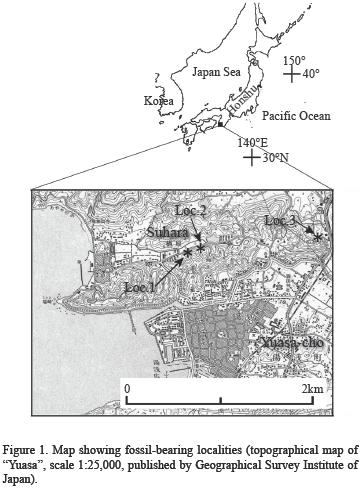
<body><![CDATA[<p align="justify"><font face="verdana" size="2">The Arida Formation is distributed in the Yuasa&#150;area, Wakayama Prefecture, southwest Japan. This formation conformably overlies the Yuasa Formation and is unconformably overlain by the Nishihiro Formation (Obata and Ogawa, 1976). The Arida Formation consists of gravelly sandstone, sandstone, and mudstone, which contains numerous shallow&#150;marine molluscs (Obata and Ogawa, 1976; Matsukawa and Obata, 1993; Komatsu, 1999). Obata and Ogawa (1976) and Matsukawa and Obata (1993) indicated that the geologic age of the Arida Formation is Barremian, based upon the occurrence of <i>Crioceratites (Paracrioceras) asiaticum </i>(Matsumoto, 1947) and <i>Shastcrioceras nipponicum </i>Matsumoto, 1947.</font></p>     <p align="justify"><font face="verdana" size="2">The crustaceans described herein were collected from the following localities (<a href="#f1">Figure 1</a>):</font></p>     <p align="center"><font face="verdana" size="2"><a name="f1"></a></font></p>     <p align="center"><font face="verdana" size="2"><img src="/img/revistas/bsgm/v60n1/a7f1.jpg"></font></p>     <p align="justify"><font face="verdana" size="2">Loc. 01. Cliff (now lost) of Suhara, Yuasa&#150;cho, Wakayama Prefecture (34&deg;2'34.4" N; 135&deg;10'24.8" E); Sandy mudstone of the Arida Formation.</font></p>     <p align="justify"><font face="verdana" size="2">Loc. 02. Cliff, northeast of loc. 1, Suhara, Yuasa&#150;cho, Wakayama Prefecture (34&deg;2'35.6" N; 135&deg;10'29.4" E); Sandy mudstone of the Arida Formation. Karasawa (2000) described <i>Callianassa </i>s.l. <i>sakakuraorum </i>Karasawa, 2000, and <i>Hoploparia </i>sp. from the same locality. Subsequently, Kato and Karasawa (2006) redescribed <i>Hoploparia </i>sp. as <i>Glyphea yoshiakii </i>Kato and Karasawa, 2006.</font></p>     <p align="justify"><font face="verdana" size="2">Loc. 03. Cliff (present lost), east of loc. 2, Suhara, Yuasa&#150;cho, Wakayama Prefecture (34&deg;2'38.2"N; 135&deg;11'20.8"E); Sandy mudstone of the Arida Formation.</font></p>     <p align="justify"><font face="verdana" size="2">&nbsp;</font></p>     <p align="justify"><font face="verdana" size="2"><b>3. Systematics</b></font></p>     <p align="center"><font face="verdana" size="2">Order Decapoda Latreille, 1802</font></p>     ]]></body>
<body><![CDATA[<p align="center"><font face="verdana" size="2">Suborder Reptantia Boas, 1880</font></p>     <p align="center"><font face="verdana" size="2">Infraorder Astacidea Latreille, 1802</font></p>     <p align="center"><font face="verdana" size="2">Superfamily Erymoidea Van Straelen, 1924</font></p>     <p align="center"><font face="verdana" size="2">Family Erymidae Van Straelen, 1924</font></p>     <p align="center"><font face="verdana" size="2"><b>Genus <i>Eryma </i>von Meyer, 1840</b></font></p>     <p align="justify"><font face="verdana" size="2"><b>Type species. </b><i>Macrourites modestiformis </i>von Schlotheim, 1822, by original designation.</font></p>     <p align="center"><font face="verdana" size="2"><b><i>Eryma nippon </i>new species</b></font></p>     <p align="center"><font face="verdana" size="2"><a href="/img/revistas/bsgm/v60n1/a7f2.jpg" target="_blank">Figures 2.6</a> &#150; <a href="/img/revistas/bsgm/v60n1/a7f2.jpg" target="_blank">2.9</a></font></p>     <p align="justify"><font face="verdana" size="2"><b>Diagnosis. </b>Moderate&#150;sized <i>Eryma. </i>Rostrum short with rimmed lateral margins. Gastro&#150;orbital groove weakly developed. Cervical groove deep, sinuous, extending ventrally to join deep antennal groove. Prominence omega and chi well defined. Hepatic groove deep, joining cervical andbranchiocardiac grooves. Postcervical groove deep, but shallow dorsally, joining branchiocardiac groove. Inferior groove shallow. Carapace with scabrous ornamentation. Regionbetween cervical and postcervical grooves coarsely scabrous. Intercalated plate narrow, longitudinally ridged; median suture following posterior end of intercalated plate, extending to posterior margin. Gastric region coarsely tuberculate; subdorsal carinae coarsely tuberculate.</font></p>     <p align="justify"><font face="verdana" size="2"><b>Etymology. </b>The new species is named for its occurrence in Nippon.</font></p>     ]]></body>
<body><![CDATA[<p align="justify"><font face="verdana" size="2"><b>Description. </b><i>Eryma </i>with moderate sized body. Carapace width about 65 % carapace length, height about 50 % its length; surface with scabrous ornamentation. Rostrum poorly preserved, short, gently downturned, dorsoventrally flattened, with rimmed lateral margins; rostrum spines not preserved. Orbit concave. Supraorbital spine small. Antennal spine weakly developed, small, directed anterolaterally. Gastro&#150;orbital groove very weak, inconspicuous, originating from median portion of cervical groove, becoming shallower toward anterior margin, terminating at about mid&#150;length of gastric region. Antennal groove deep, arcuate ventrally, paralleling anterior margin laterally, extending dorsally to level of supraorbital spine. Cervical groove deep, sinuous, extending ventrally to join antennal groove. Prominence omega well defined, triangular, swollen. Prominence chi well defined, subrectangular, inflated. Hepatic groove deep, strongly sinuous, joining cervical and branchiocardiac grooves. Postcervical groove deep, but shallow dorsally, obliquely extending ventrally, to join branchiocardiac groove. Branchiocardiac groove shallow, slightly sinuous, extending anteroventrally to join shallow, concave forward inferior groove. Postmarginal groove weakly developed. Lateral margins rimmed. Region between cervical and postcervical grooves coarsely scabrous. Intercalated plate narrow, longitudinally ridged, extending from mid&#150;point of rostrum to posterior one&#150;third of gastric region; median suture posterior to intercalated plate, extending to posterior margin. Gastric region coarsely tuberculate; subdorsal carinae coarsely tuberculate, present on each side of intercalated plate.</font></p>     <p align="justify"><font face="verdana" size="2">Right 1<sup>st</sup> cheliped poorly preserved. Merus about 3/5 longer than high with finely tuberculated dorsal and ventral margins. Carpus about 3/4 meras length; lateral margin finely tuberculate. Palm about 3/5 longer than high, about equal to meras length; margins and surfaces finely tuberculated. Dactylus broken and fixed finger not preserved.</font></p>     <p align="justify"><font face="verdana" size="2"><b>Remarks. </b><i>Eryma nippon </i>new species is closely related with <i>Eryma glaessneri </i>(Van Straelen, 1936) from the Hauterivian of France, but differs by the presence of a weak branchiocardiac groove and the absence of post antennal spines. Kato <i>et al. </i>(2007) reported the cheliped identified with Erymidae gen. et sp. indet. from the Tithonian Somanakamura Group of Fukushima Prefecture, Japan. This species differs from <i>E. nippon </i>by having a punctuated surface.</font></p>     <p align="justify"><font face="verdana" size="2"><i>Eryma </i>has a geologic record ranging from the Early Jurassic to the Late Cretaceous and has a rich Jurassic record from Europe, North America, and Madagascar (Glaessner, 1969). The previously known Cretaceous records of <i>Eryma </i>are from France, Germany, England, Argentina, and Lebanon (Aguirre&#150;Urreta, 1989). Among these, <i>Eryma cretacea </i>Roger, 1946, from the Cenomanian of Lebanon lacks the diagnostic characters of <i>Eryma, </i>absence of postcervical, branchiocardiac, hepatic, and inferior grooves, the prominence chi, and the intercalated plate. Therefore, <i>Eryma cretacea </i>might be referred to some other astacidean genus; however, detailed examination of type and additional material will be necessary to confirm the generic placement of this species, which is beyond the scope of this study.</font></p>     <p align="justify"><font face="verdana" size="2"><i>Eryma nippon </i>represents the first Cretaceous record of the genus from the North Pacific realm and the youngest occurrence of the genus.</font></p>     <p align="justify"><font face="verdana" size="2"><b>Material examined. </b>WMNH&#150;Ge&#150;1140320056 (holotype) from Loc. 2 collected by Y. Sako.</font></p>     <p align="center"><font face="verdana" size="2">Superfamily Nephropoidea Dana, 1852a</font></p>     <p align="center"><font face="verdana" size="2">Family Nephropidae Dana, 1852a</font></p>     <p align="center"><font face="verdana" size="2">Subfamily Homarinae Huxley, 1879</font></p>     <p align="center"><font face="verdana" size="2"><b>Genus <i>Hoploparia </i>McCoy, 1849</b></font></p>     ]]></body>
<body><![CDATA[<p align="justify"><font face="verdana" size="2"><b>Type species. </b><i>Astacus longimanus </i>Sowerby, 1826, by subsequent designation of Rathbun (1926).</font></p>     <p align="center"><font face="verdana" size="2"><b><i>Hoploparia natsumiae </i>new species</b></font></p>     <p align="center"><font face="verdana" size="2"><a href="/img/revistas/bsgm/v60n1/a7f2.jpg" target="_blank">Figures 2.11</a> &#150;<a href="/img/revistas/bsgm/v60n1/a7f2.jpg" target="_blank">2.13</a></font></p>     <p align="justify"><font face="verdana" size="2"><b>Diagnosis. </b>Moderate&#150;sized <i>Hoploparia. </i>Carapace with well defined cervical and postcervical grooves; antennal region with antennal ridge bearing small, forwardly directed spines; dorsomedian line weakly developed; supraorbital and subdorsal carinae weak, granular; regions between cervical and postcervical grooves coarsely granulated; median carina and lateral carinae finely granulate; sparsely granulated ridge present on branchial region behind postcervical groove, nearly parallel to postcervical groove. Propodus of 1<sup>st</sup> cheliped slender, elongate; mesial surface and dorsal and ventral margins of propodus and dactylus smooth; both fingers slender, elongate, about 1.5 times palm length.</font></p>     <p align="justify"><font face="verdana" size="2"><b>Etymology. </b>The specific name is derived from the surname of N. Kumagai, who collected the type specimen.</font></p>     <p align="justify"><font face="verdana" size="2"><b>Description. </b><i>Hoploparia </i>with moderate&#150;sized body. Carapace about twice as long as high, surface with irregular, scabrous ornamentation. Rostrum not preserved. Orbit small, rounded. Postcervical groove well defined, deep, broad, obliquely extending ventrally, becoming shallower at junction with hepatic groove. Intercervical groove shallow, extending anteroventrally to, but not joining cervical groove. Second intercervical groove broad, shallow, extending to cervical groove. Hepatic groove shallow, curving to join antennal and cervical grooves. Cervical groove well defined, deep, slightly arcuate, parallel to postcervical groove, extending ventrally to join antennal groove. Antennal groove weakly arcuate, well defined over prominence omega. Prominence omega well defined, triangular. Gastro&#150;orbital groove shallow, extending to near upper part of cervical groove. Antennal region with antennal ridge bearing small, forwardly directed spines; first antennal spine not preserved. Two postorbital spines present, small, longitudinally arranged. Dorsomedian line present, but inconspicuous. Supraorbital carinae granular, tapering distally, terminating at about anterior one&#150;fourth of carapace length. Subdorsal carinae weak, finely granulate, tapering distally, not reaching posterior end of supradorsal carinae. Regions between cervical and postcervical grooves coarsely granulated. Median carina and lateral carinae finely granulate. Sparsely granulated ridge present on branchial regionbehind postcervical groove, nearly parallel to postcervical groove, extending from near junction with intercervical groove to lateral carina. Posterior margin sinuous.</font></p>     <p align="justify"><font face="verdana" size="2">Abdominal somites 1&#150;4 poorly preserved; surfaces smooth. Pleura well developed, but detailed characters unknown.</font></p>     <p align="justify"><font face="verdana" size="2">Propodus of left 1<sup>st</sup> cheliped slender, elongate, cylindrical, about 1.8 times length of carapace excluding rostrum. Mesial surface and dorsal and ventral margins of chela smooth. Palm height about 30 percent its length. Both fingers slender, elongate, about 1.5 times palm length.</font></p>     <p align="justify"><font face="verdana" size="2"><b>Remarks. </b><i>Hoploparia natsumiae </i>new species possesses carapace characters most like those of <i>Hoploparia intermedia </i>Secretan, 1964, from the Albian of Madagascar, but differs in having the smooth mesial surface and dorsal and ventral margins of the 1<sup>st</sup> cheliped. <i>Hoploparia </i>from Japan comprises three species, <i>H. kamuy </i>Karasawa and Hayakawa, 2000, from the Turonian&#150;Santonian Upper Yezo Group, <i>H. kamimurai </i>Kato and Karasawa, 2006, from the Barremian Ishido Formation, and <i>H. miyamotoi </i>Karasawa, 1998, from the Maastrichtian Izumi Group. The present species is readily distinguished from these species because it has well developed carapace grooves and granulated supraorbital, subdorsal, median, and lateral carinae. <i>Hoploparia natsumiae </i>represents the second record of the genus from the Barremian of Japan.</font></p>     <p align="justify"><font face="verdana" size="2"><b>Material examined. </b>WMNH&#150;Ge&#150;1140320065 (holotype) from Loc. 2 collected by N. Kumagai.</font></p>     ]]></body>
<body><![CDATA[<p align="center"><font face="verdana" size="2">Infraorder Anomala Boas, 1880</font></p>     <p align="center"><font face="verdana" size="2">Superfamily Galatheoidea Samouelle, 1819</font></p>     <p align="center"><font face="verdana" size="2">Family Galatheidae Samouelle, 1819</font></p>     <p align="center"><font face="verdana" size="2"><b>Genus <i>Eomunidopsis </i>Via Boada, 1981</b></font></p>     <p align="justify"><font face="verdana" size="2"><b>Type species. </b><i>Galathea navarrensis </i>Van Straelen, 1940, by original designation of Via Boada (1981).</font></p>     <p align="center"><font face="verdana" size="2"><b><i>Eomunidopsis kinokunica </i>new species</b></font></p>     <p align="center"><font face="verdana" size="2"><a href="/img/revistas/bsgm/v60n1/a7f2.jpg" target="_blank">Figures 2.4</a>, <a href="/img/revistas/bsgm/v60n1/a7f2.jpg" target="_blank">2.5</a></font></p>     <p align="justify"><font face="verdana" size="2"><b>Diagnosis. </b>Small&#150;sized <i>Eomunidopsis. </i>Carapace excluding rostrum, subquadrate, slightly longer than wide, widest at mid&#150;length. Rostrum triangular; lateral margins smooth, very weakly concave, rimmed; dorsal surface smooth with median ridge. Outer orbital angle not produced. Lateral margin gently convex without spines. Gastric, cardiac, hepatic, intestinal, and branchial regions ornamented with transverse and/or oblique ridges. Cervical groove deep, well defined. Postcervical groove moderately defined.</font></p>     <p align="justify"><font face="verdana" size="2"><b>Etymology. </b>The trivial name is derived from "Kinokuni", meaning Wakayama in an ancient age.</font></p>     <p align="justify"><font face="verdana" size="2"><b>Description. </b>Small&#150;sized carapace for <i>Eomunidopsis. </i>Carapace excluding rostrum, subquadrate in outline, slightly longer than wide, widest at mid&#150;length. Rostrum triangular, slightly downturned, about as long as wide, occupying about 43% carapace width at the base; lateral margin smooth, very weakly concave, rimmed. Orbital margin slightly concave. Outer orbital angle not produced. Lateral margin gently convex without spines. Posterior margin weakly concave. Dorsal surface moderately vaulted longitudinally. Dorsal surface of rostrum smooth, weakly concave longitudinally, with longitudinal ridge. Gastric regions inflated; epigastric regions interrupted medially, ornamented with 2 oblique ridges; protogastric and mesogastric regions confluent; anterior half with 3 transverse ridges; posterior half ornamented with 2 anterior transverse ridges, followed by sinuous ridge and posteriormost transverse ridge. Cervical groove deep, well defined. Anterior branchial regions ornamented with short, oblique ridges anteriorly. Postcervical groove moderately defined. Cardiac region poorly defined with gently curved anteriormost ridges and 4 transverse ridges. Posterior branchial regions ornamented with slightly oblique ridges. Intestinal region covered with 2 transverse ridges, extending to lateral margins across posterior branchial regions.</font></p>     ]]></body>
<body><![CDATA[<p align="justify"><font face="verdana" size="2"><b>Remarks. </b>The present new species has close affinity <i>with Eomunidopsis meerssensis </i>Collins <i>et al., </i>1995, from the Maastrichtian of The Netherlands, but differs by having a wide base of the rostrum and gently convex lateral margins. This species resembles <i>Eomunidopsis navarrensis </i>(Van Straelen, 1940) from the Cenomanian of Spain, but differs by having a smooth dorsal surface of the rostrum and lacking granules and tubercles on ridges of the dorsal regions. The lateral margins in <i>Eomunidopsis navarrensis </i>are divergent posteriorly, but the species has gently arched lateral margins and is widest at the mid&#150;length of the carapace. A wide rostrum and lateral margins without spines easily distinguish the present species from <i>Eomunidopsis kojimai </i>Karasawa and Hayakawa, 2000, the sole species hitherto known from the North Pacific regions.</font></p>     <p align="justify"><font face="verdana" size="2"><i>Eomunidopsis kojimai </i>has been recorded from the Santonian of Hokkaido. The discovery of the present species extends the geologic range for <i>Eomunidopsis </i>from the North Pacific rim back to the Barremian.</font></p>     <p align="justify"><font face="verdana" size="2"><b>Material examined. </b>WMNH&#150;Ge&#150;1140320058 (holotype) from Loc. 2 collected by M. Ohara.</font></p>     <p align="center"><font face="verdana" size="2">Infraorder Brachyura Latreille, 1802</font></p>     <p align="center"><font face="verdana" size="2">Section <i>incertae sedis</i></font></p>     <p align="center"><font face="verdana" size="2">Superfamily Etyoidea Guinot and Tavares, 2001, new rank</font></p>     <p align="justify"><font face="verdana" size="2"><b>Included family. </b>Etyidae Guinot and Tavares, 2001. </font></p>     <p align="justify"><font face="verdana" size="2"><b>Diagnosis. </b>as for family.</font></p>     <p align="center"><font face="verdana" size="2">Family Etyidae Guinot and Tavares, 2001. </font></p>     <p align="justify"><font face="verdana" size="2"><b>Type genus. </b><i>Etyus </i>Leach in Mantell, 1822.</font></p>     ]]></body>
<body><![CDATA[<p align="justify"><font face="verdana" size="2"><b>Included genera. </b><i>Etyus </i>Leach in Mantell, 1822; <i>Etyxanthosia </i>Fraaije <i>et al., </i>2008 in press; <i>Feldmannia </i>Guinot and Tavares, 2001; <i>Guinotosia </i>Beschin <i>et al., </i>2007; <i>Sharania </i>Collins and Saward, 2006; <i>Xanthosia </i>Bell, 1863.</font></p>     <p align="justify"><font face="verdana" size="2"><b>Geologic range. </b>Early Cretaceous (Barremian)&#150;Eocene.</font></p>     <p align="justify"><font face="verdana" size="2"><b>Diagnosis. </b>Cephalothorax transversely oblong, much wider than long, dorsally flattened, branchial region elongated. Dorsal surface markedly areolated. Fronto&#150;orbital margin wide. Front not projecting, straight to bilobed. Lateral margin distinct. Anterolateral margin convex with teeth, longer than posterolateral, both well delimited. Posterior margin narrow, more or less concave. Orbit large, deep. Urinal tubercles well developed. Epistome triangular. Buccal cavern quadrangular. Third maxillipeds operculiform, palp well developed. Cheliped elongated, meras long, stout fingers longer than palm. Anterior pair of legs long. Last two pairs subdorsal. Sternites 6&#150;8 or 7&#150;8, or only 8 subperpendicular to preceding sternites (upturned). Spermathecal openings at end of suture 7/8. Abdomen covering whole sternum in female. Sternite 4 large, visible beyond and laterally to telson in male. Abdomen fixed laterally by coxae of 1&#150;2 anterior pairs of pereiopods. Uropods absent (from <img src="/img/revistas/bsgm/v60n1/a7s3.jpg">tev<img src="/img/revistas/bsgm/v60n1/a7s1.jpg">i<img src="/img/revistas/bsgm/v60n1/a7s2.jpg">, 2005).</font></p>     <p align="justify"><font face="verdana" size="2"><b>Remarks. </b>Guinot and Tavares (2001) originally placed the Etyidae Guinot and Tavares, 2001, together with the Dakoticancridae Rathbun, 1917, Phyllotymolinidae Tavares, 1998, Cymonomidae Bouvier, 1897, Cyclodorippidae Ortmann, 1892, and Raninoidea de Haan, 1841, within the podotreme subsection Archaeobrachyura Guinot, 1977, based upon the presence of a pair of spermathecae at the end of the thoracic sternal suture between 7 and 8 and the absence of uropod of the abdomen. At that time, Guinot and Tavares (2001) did not place it within a known superfamily. After their work, <img src="/img/revistas/bsgm/v60n1/a7s3.jpg">tev<img src="/img/revistas/bsgm/v60n1/a7s1.jpg">i<img src="/img/revistas/bsgm/v60n1/a7s2.jpg"> (2005) placed the Etyidae within the superfamily Cyclodorippoidea Ortmann, 1892, without discussion. However, the Etyidae differs from the Cyclodorippidae, Cymonomidae, and Phyllotymolinidae in several important characters. The carapace is much wider than long and transversely hexagonal to ovate in outline, whereas in the Cyclodorippidae, Cymonomidae, and Phyllotymolinidae it is longer than wide or slightly wider than long, and usually ovate to circular in outline. The meri of maxillipeds 3 are subrectangular in outline, while the Cyclodorippidae, Cymonomidae, and Phyllotymolinidae have the elongated meri of maxilliped 3, which is sometimes visible dorsally. Based upon these differences, the Etyidae is herein elevated to superfamily status.</font></p>     <p align="justify"><font face="verdana" size="2">Although the Etyidae has been placed within the Podotremata, the systematic position of it has been uncertain. Recent phylogenetic works suggested that the Podotremata is not monophyletic and paraphyletic, based upon the molecular analysis (Ahyong and O'Meally, 2004; Ahyong <i>et al., </i>2007) and the morphology&#150;based cladistic analysis (Br&ouml;sing <i>et al., </i>2007). Ahyong <i>et al. </i>(2007) proposed three sections, Dromiacea de Haan, 1833, Raninoida de Haan, 1841, and Cyclodorippoida Ortmann, 1892, for the podotreme group. The Raninoida with the Raninoidea is the sister to the Cyclodorippoida with the Cyclodorippoidea + Eubrachyura (Ahyong <i>et al., </i>2007); therefore, the Archaeobrachyura sensu Guinot and Tavares (2001) is also paraphyletic. More morphology&#150;based cladistic analysis within the "podotreme" families, including extant and extinct taxa, will be necessary to confirm the phylogenetic position of the Etyidae.</font></p>     <p align="center"><font face="verdana" size="2"><b>Genus <i>Xanthosia </i>Bell, 1863</b></font></p>     <p align="justify"><font face="verdana" size="2"><b>Type species. </b><i>Podophthalmus buchii </i>Reuss, 1845 = <i>Xanthosia gibbosa </i>Bell, 1863, by subsequent designation of Glaessner (1929).</font></p>     <p align="justify"><font face="verdana" size="2"><b>Included species. </b><i>X. buchii </i>(Reuss, 1845); <i>X. buteonis </i>Wright and Collins, 1972; <i>X. delicata </i>Fraaye, 1996; <i>X. elegans </i>Roberts, 1962; <i>X. granulosa </i>(McCoy, 1854); <i>X. </i><i>gracilis </i>Jakobsen and Collins, 1997; <i>X. jacksoni </i>Wright and Collins, 1972; X. <i>occidentalis </i>Bishop, 1991; X. <i>robertsi </i>Secretan, 1982; X. <i>sakoi </i>new species; X. <i>semiornata </i>Jagt <i>et al., </i>1991; X. <i>similis </i>(Bell, 1863); X. <i>spinosa </i>Bishop, 1991; X. <i>socialis </i>van Bakel, Fraaije, and Jagt, 2005 ; X. <i>zoquiapensis </i>Fraaije et al., 2006.</font></p>     <p align="justify"><font face="verdana" size="2"><b>Remarks. </b>The genus <i>Xanthosia </i>is recognized as a heterogeneous group (Guinot and Tavares, 2001; Fraaije <i>et al., </i>2008; Schweitzer <i>per. com.); </i>therefore, Guinot and Tavares (2001) erected a new genus <i>Feldmannia </i>for X. <i>wintoni </i>Rathbun, 1935, and moved <i>Xanthosia arcuata </i>Secretan, 1964, to a new heterotreme genus <i>Secretanella. </i>Most recently, Fraaije <i>et al. </i>(2008) proposed a new genus <i>Etyxanthosia </i>for<i>Xanthosia aspera </i>Rathbun, 193 5, X. <i>fossa </i>Wright and Collins, 1972, X. <i>pawpawensis </i>Schweitzer Hopkins <i>et al., </i>1999, and X. <i>reidi </i>Schweitzer Hopkins <i>et al., </i>1999. However, a further generic level reconsideration of remaining species <i>of Xanthosia </i>is needed (Guinot and Tavares, 2001; Karasawa and Schweitzer, 2006; Schweitzer <i>per. com.).</i></font></p>     <p align="center"><font face="verdana" size="2"><b><i>Xanthosia sakoi </i>new species</b></font></p>     ]]></body>
<body><![CDATA[<p align="center"><font face="verdana" size="2"><a href="/img/revistas/bsgm/v60n1/a7f2.jpg" target="_blank">Figure 2.3</a></font></p>     <p align="justify"><font face="verdana" size="2"><b>Diagnosis. </b>Moderate&#150;sized <i>Xanthosia. </i>Carapace hexagonal, wider than long, widest at mid&#150;length. Fronto&#150;orbital margin wide. Front bearing 2 rounded lobes, weakly separated from small inner orbital angle. Orbit small. Upper orbital margin narrow with 2 shallow, upper orbital fissures. Anterolateral margin with 4 lobes; 1<sup>st</sup> lobe (=outer orbital angle) smallest, acutely triangular; 2<sup>nd</sup> &#150; 4<sup>th</sup> lobes broadly triangular; 3<sup>rd</sup> and 4<sup>th</sup> lobes largerthan 2<sup>nd</sup> lobe. Posterolateral margin slightly shorter than anterolateral margin, slightly sinuous. Posterior margin slightly concave, narrow. Dorsal surface gently convex, covered with fine granules. Protogastric regions wide, strongly tumid. Mesogastric region flattened posteriorly. Hepatic regions strongly tumid, weakly separated from protogastric regions by shallow, wide depression. Cervical groove sinuous, medially interrupted. Cardiac region pentagonal, flattened. Branchiocardiac grooves shallow. Epibranchial regions slightly swollen. Meso&#150; and metabranchial regions undifferentiated.</font></p>     <p align="justify"><font face="verdana" size="2"><b>Etymology. </b>From Y. Sako who collected the type specimen.</font></p>     <p align="justify"><font face="verdana" size="2"><b>Description. </b>Moderate&#150;sized carapace for <i>Xanthosia. </i>Carapace hexagonal in outline, length about 66 % maximum carapace width, widest at mid&#150;length. Fronto&#150;orbital margin about 65 % carapace width. Front bilobed, composed of 2 rounded lobes, medially interrupted by deep V&#150;shaped notch, separated from broadly triangular inner orbital angle by weak V&#150;shaped groove. Upper orbital margin narrow, concave, with 2 shallow, upper orbital fissures. Anterolateral margin convex with 4 lobes; 1<sup>st</sup> lobe (=outer orbital angle) smallest, acutely triangular, directed anteriorly; 2<sup>nd</sup> and 3<sup>rd </sup>lobes broadly triangular, directed anterolaterally; 3<sup>rd</sup> and 4<sup>th</sup> lobes larger than 2<sup>nd</sup> lobe; 4<sup>th</sup> lobe broadly triangular, directed laterally. Posterolateral margin slightly shorter than anterolateral margin, slightly sinuous. Posterior margin slightly concave, about 24 % carapace width. Dorsal surface gently convex transversely and longitudinally. Surface covered with fine granules. Protogastric regions wide, strongly tumid. Mesogastric region triangular posteriorly, flattened, separated from protogastric regions by shallow, narrow groove, with narrow anterior mesogastric process. Hepatic regions strongly tumid, weakly separated from protogastric regions by shallow, wide depression. Cervical groove sinuous; lateral elements gently concave, wide, shallow; axial element moderately concave, narrow, shallow, medially interrupted. Urogastric region narrow, much wider than long, separated from cardiac region by shallow, narrow furrow. Cardiac region pentagonal, slightly wider than long, flattened. Intestinal region flattened. Branchiocardiac grooves shallow, wide. Epibranchial regions slightly vaulted. Meso&#150; and metabranchial regions undifferentiated.</font></p>     <p align="justify"><font face="verdana" size="2"><b>Remarks. </b>The present species is closely related to <i>Xanthosia buteonis </i>Wright and Collins, 1972, from the Lower Albian of England, but differs in having a narrow orbit, two rounded frontal lobes, shallow cervical grooves, a wide intestinal region. <i>Xanthosia sakoi </i>has a broadly triangular last anterolateral tooth, while X. <i>buteonis </i>has a bifid last anterolateral tooth. Additionally, the carapace of <i>Xanthosia sakoi </i>is much wider than that of X. <i>buteonis.</i></font></p>     <p align="justify"><font face="verdana" size="2">The previously known members of <i>Xanthosia </i>have been recorded from Europe, Madagascar, and Gulf Coastal Plain, Atlantic Coastal Plain, and Western Interior of North America, ranging from the Early Cretaceous (Aptian) to the Danian (Schweitzer Hopkins <i>et al., </i>1999; Guinot and Tavares, 2001; van Bakel <i>et al., </i>2005). The discovery of <i>Xanthosia </i>from Japan extends the known geologic range for this genus back to the Early Cretaceous (Barremian) and greatly expands the geographic range to the west side of the North Pacific realm.</font></p>     <p align="justify"><font face="verdana" size="2"><b>Material examined. </b>WMNH&#150;Ge&#150;1140320064 (holotype) from Loc. 3 collected by Y. Sako.</font></p>     <p align="center"><font face="verdana" size="2">Order Isopoda Latreille, 1817</font></p>     <p align="center"><font face="verdana" size="2">Suborder Cymothoida W&auml;gele, 1989</font></p>     <p align="center"><font face="verdana" size="2">Superfamily Cirolanoidea Dana, 1852b</font></p>     ]]></body>
<body><![CDATA[<p align="center"><font face="verdana" size="2">Family Cirolanidae Dana, 1852b</font></p>     <p align="center"><font face="verdana" size="2"><b>Genus <i>Palaega </i>Woodward, 1870 sensu lato</b></font></p>     <p align="justify"><font face="verdana" size="2"><b>Type species. </b><i>Palaega carteri </i>Woodward, 1870, by monotypy.</font></p>     <p align="justify"><font face="verdana" size="2"><b>Remarks. </b>Feldmann and Rust (2006) listed 26 species referred to as <i>Palaega. </i>After that, Polz <i>et al. </i>(2006) described two new species, <i>Palaega willmandingensis </i>and <i>Palaega nusplingensis, </i>from the Upper Jurassic of Germany. Among these, <i>Palaega undecimspinosa </i>Karasawa <i>et al., </i>1992, from the Miocene of Japan is excluded here because Karasawa <i>et al. </i>(1995) moved it to <i>Bathynomus </i>A. Milne Edwards, 1879. <i>Palaega </i>has a wide geologic record extending from the Triassic to Pliocene and has been reported from Europe, Africa, America, and New Zealand. Recognition <i>of Palaega yamadai </i>new species greatly expands the geographic range for the genus to the west side of the North Pacific region.</font></p>     <p align="center"><font face="verdana" size="2"><b><i>Palaega yamadai </i>new species</b></font></p>     <p align="center"><font face="verdana" size="2"><a href="/img/revistas/bsgm/v60n1/a7f2.jpg" target="_blank">Figures 2.1</a>, <a href="/img/revistas/bsgm/v60n1/a7f2.jpg" target="_blank">2.2</a></font></p>     <p align="justify"><font face="verdana" size="2"><b>Diagnosis. </b>Small&#150;sized <i>Palaega. </i>Posterior half of all pereonites andpleonites ornamented with fine, longitudinal striations. Pleotelson ovate, longer than wide, narrowing posteriorly, widest at suture with pleonite 5; posterior margin finely dentate.</font></p>     <p align="justify"><font face="verdana" size="2"><b>Etymology. </b>From S. Yamada who collected the type specimen.</font></p>     <p align="justify"><font face="verdana" size="2"><b>Description. </b>Small&#150;sized for genus. Pereonites decreasing in length posteriorly with posteriorly curved pleurae; posterior half of all pereonites ornamented with fine, longitudinal striations. Pleonites 1&#150;5 with posteriorly directed pleurae; posterior half of all pleonites with fine, longitudinal striations. Pleotelson ovate, longer than wide, narrowing posteriorly, widest at suture with pleonite 5; dorsal surface with well defined median carina; posterior margin poorly preserved, convex, finely dentate.</font></p>     <p align="justify"><font face="verdana" size="2"><b>Remarks. </b><i>Palaega yamadai </i>new species resembles <i>Palaega williamsonensis </i>Rathbun, 1935, from the Upper Cretaceous of Texas by having a finely dentate posterior margin of the pleotelson. However, it differs from <i>P. williamsonensis </i>by the presence of fine, longitudinal striations on all pereonites and pleonites. The present species represents the first occurrence in the Early Cretaceous of Japan.</font></p>     ]]></body>
<body><![CDATA[<p align="justify"><font face="verdana" size="2"><b>Material examined. </b>WMNH&#150;Ge&#150;1140320049 (holotype) and WMNH&#150;Ge&#150;1140320050 (paratype) from Loc. 1 collected by S. Yamada.</font></p>     <p align="justify"><font face="verdana" size="2">&nbsp;</font></p>     <p align="justify"><font face="verdana" size="2"><b>4. Acknowledgements</b></font></p>     <p align="justify"><font face="verdana" size="2">We thank N. Kumagai (Hannan, Osaka), Y. Sako (Kushimoto, Wakayama), and S. Yamada (Kimino, Wakayama) for offering us specimens, A. Nakase (Yuasa, Wakayama) for allowing us to collect fossils in his quarry, and F. J. Vega (Universidad Nacional Aut&oacute;noma de M&eacute;xico) for assisting in our manuscript. I am grateful for the reviews by R. M. Feldmann (Kent State University, U.S.A.), R. H. B. Fraaije (Oertijdmuseum de Groene Poort, The Netherlands), and T. Nyborg (Loma Linda University, U.S.A.).</font></p>     <p align="justify"><font face="verdana" size="2">&nbsp;</font></p>     <p align="justify"><font face="verdana" size="2"><b>5. References</b></font></p>     <!-- ref --><p align="justify"><font face="verdana" size="2">Aguirre&#150;Urreta, M.B., 1989, The Cretaceous decapod Crustacea of Argentina and the Antarctic Peninsula: Palaeontology, 32, 499&#150;552.</font>&nbsp;&nbsp;&nbsp;&nbsp;&nbsp;&nbsp;&nbsp;&nbsp;[&#160;<a href="javascript:void(0);" onclick="javascript: window.open('/scielo.php?script=sci_nlinks&ref=1371757&pid=S1405-3322200800010000700001&lng=','','width=640,height=500,resizable=yes,scrollbars=1,menubar=yes,');">Links</a>&#160;]<!-- end-ref --><!-- ref --><p align="justify"><font face="verdana" size="2">Ahyong, S.T., O'Meally, D., 2004, Phylogeny of the Decapoda Reptantia: resolution using three molecular loci and morphology: Raffles Bulletin of Zoology, 52, 673&#150;693.</font>&nbsp;&nbsp;&nbsp;&nbsp;&nbsp;&nbsp;&nbsp;&nbsp;[&#160;<a href="javascript:void(0);" onclick="javascript: window.open('/scielo.php?script=sci_nlinks&ref=1371758&pid=S1405-3322200800010000700002&lng=','','width=640,height=500,resizable=yes,scrollbars=1,menubar=yes,');">Links</a>&#160;]<!-- end-ref --><!-- ref --><p align="justify"><font face="verdana" size="2">Ahyong, S.T., Lai, J.C.Y., Sharkey, D., Colgan, D.J., Ng, P.K.L., 2007, Phylogenetics of the brachyuran crabs (Crustacea: Decapoda): the status of Podotremata based on small subunit nuclear ribosomal RNA: Molecular Phylogenetics and Evolution, 45, 576&#150;586.</font>&nbsp;&nbsp;&nbsp;&nbsp;&nbsp;&nbsp;&nbsp;&nbsp;[&#160;<a href="javascript:void(0);" onclick="javascript: window.open('/scielo.php?script=sci_nlinks&ref=1371759&pid=S1405-3322200800010000700003&lng=','','width=640,height=500,resizable=yes,scrollbars=1,menubar=yes,');">Links</a>&#160;]<!-- end-ref --><!-- ref --><p align="justify"><font face="verdana" size="2">Bakel, B.W.M. van, Fraaije R.H.B., Jagt, J.W.M., 2005, A new Early Campanian species of <i>Xanthosia </i>(Decapoda, Brachyura) from northwestern Germany: Crustaceana, 78, 285&#150;295.</font>&nbsp;&nbsp;&nbsp;&nbsp;&nbsp;&nbsp;&nbsp;&nbsp;[&#160;<a href="javascript:void(0);" onclick="javascript: window.open('/scielo.php?script=sci_nlinks&ref=1371760&pid=S1405-3322200800010000700004&lng=','','width=640,height=500,resizable=yes,scrollbars=1,menubar=yes,');">Links</a>&#160;]<!-- end-ref --><!-- ref --><p align="justify"><font face="verdana" size="2">Beschin, C., Busulini, A., De Angeli, A., Tessier, G., 2007, I Decapodi dell'Eocene inferiore di Contrada Gecchelina (Vicenza &#150; Italia settentrionale) (Anomura e Brachiura). Museo di Archeologia e Scienze Naturali "G. Zannato", Montecchio Maggiore (Vicenza), 9&#150;76.</font>&nbsp;&nbsp;&nbsp;&nbsp;&nbsp;&nbsp;&nbsp;&nbsp;[&#160;<a href="javascript:void(0);" onclick="javascript: window.open('/scielo.php?script=sci_nlinks&ref=1371761&pid=S1405-3322200800010000700005&lng=','','width=640,height=500,resizable=yes,scrollbars=1,menubar=yes,');">Links</a>&#160;]<!-- end-ref --><!-- ref --><p align="justify"><font face="verdana" size="2">Bell, T., 1863, A Monograph of the fossil malacostracous Crustacea of Great Britain, Pt. II, Crustacea of the Gault and Greensand: Palaeontographical Society Monographs, London, 40 p., 11 pls.</font>&nbsp;&nbsp;&nbsp;&nbsp;&nbsp;&nbsp;&nbsp;&nbsp;[&#160;<a href="javascript:void(0);" onclick="javascript: window.open('/scielo.php?script=sci_nlinks&ref=1371762&pid=S1405-3322200800010000700006&lng=','','width=640,height=500,resizable=yes,scrollbars=1,menubar=yes,');">Links</a>&#160;]<!-- end-ref --><!-- ref --><p align="justify"><font face="verdana" size="2">Bishop, G.A., <i>1991, Xanthosia occidentalis </i>Bishop, 1985, <i>and Xanthosia spinosa </i>new species, two late Cretaceous crabs from the Pierre Shale of the western Interior: Journal of Crustacean Biology, 11, 305&#150;314.</font>&nbsp;&nbsp;&nbsp;&nbsp;&nbsp;&nbsp;&nbsp;&nbsp;[&#160;<a href="javascript:void(0);" onclick="javascript: window.open('/scielo.php?script=sci_nlinks&ref=1371763&pid=S1405-3322200800010000700007&lng=','','width=640,height=500,resizable=yes,scrollbars=1,menubar=yes,');">Links</a>&#160;]<!-- end-ref --><!-- ref --><p align="justify"><font face="verdana" size="2">Boas, J.E.V., 1880, Studier over Decapodernes Slaegtskabsforhold: Kongelige Danske Videnskabernes Selskabs Skrifter, Naturvidenskabelig og Mathematisk Affeling, series 5, 6, 25&#150;210.</font>&nbsp;&nbsp;&nbsp;&nbsp;&nbsp;&nbsp;&nbsp;&nbsp;[&#160;<a href="javascript:void(0);" onclick="javascript: window.open('/scielo.php?script=sci_nlinks&ref=1371764&pid=S1405-3322200800010000700008&lng=','','width=640,height=500,resizable=yes,scrollbars=1,menubar=yes,');">Links</a>&#160;]<!-- end-ref --><!-- ref --><p align="justify"><font face="verdana" size="2">Bouvier, E.&#150;L., 1897, Sur la classification, les origines et la distribution des Crabes de la famille des Dorippid&eacute;s: Bulletin de la Soci&eacute;t&eacute; philomatique, Paris, series 8, 9, 54&#150;70.</font>&nbsp;&nbsp;&nbsp;&nbsp;&nbsp;&nbsp;&nbsp;&nbsp;[&#160;<a href="javascript:void(0);" onclick="javascript: window.open('/scielo.php?script=sci_nlinks&ref=1371765&pid=S1405-3322200800010000700009&lng=','','width=640,height=500,resizable=yes,scrollbars=1,menubar=yes,');">Links</a>&#160;]<!-- end-ref --><!-- ref --><p align="justify"><font face="verdana" size="2">Br&ouml;sing, A., Richter, S., Scholz, G., 2007, Phylogenetic analysis of the Brachyura (Crustacea, Decapoda) based on characters of the foregut with establishment of anewtaxon: Journal of Zoological Systematics and Evolutionary Research, 45, 20&#150;32.</font>&nbsp;&nbsp;&nbsp;&nbsp;&nbsp;&nbsp;&nbsp;&nbsp;[&#160;<a href="javascript:void(0);" onclick="javascript: window.open('/scielo.php?script=sci_nlinks&ref=1371766&pid=S1405-3322200800010000700010&lng=','','width=640,height=500,resizable=yes,scrollbars=1,menubar=yes,');">Links</a>&#160;]<!-- end-ref --><!-- ref --><p align="justify"><font face="verdana" size="2">Collins, J.S.H., Saward, J., 2006, Three new genera and species of crabs from the Lower Eocene of London Clay of Essex, England: Bulletin of the Mizunami Fossil Museum, 33, 67&#150;76.</font>&nbsp;&nbsp;&nbsp;&nbsp;&nbsp;&nbsp;&nbsp;&nbsp;[&#160;<a href="javascript:void(0);" onclick="javascript: window.open('/scielo.php?script=sci_nlinks&ref=1371767&pid=S1405-3322200800010000700011&lng=','','width=640,height=500,resizable=yes,scrollbars=1,menubar=yes,');">Links</a>&#160;]<!-- end-ref --><!-- ref --><p align="justify"><font face="verdana" size="2">Collins, J.S.H., Fraaye, R.H.B., Jagt, J.W.M., 1995, Late Cretaceous anomurans and brachyurans from the Maastrichtian type area: Acta Palaeontologica Polonica, 40, 165&#150;210.</font>&nbsp;&nbsp;&nbsp;&nbsp;&nbsp;&nbsp;&nbsp;&nbsp;[&#160;<a href="javascript:void(0);" onclick="javascript: window.open('/scielo.php?script=sci_nlinks&ref=1371768&pid=S1405-3322200800010000700012&lng=','','width=640,height=500,resizable=yes,scrollbars=1,menubar=yes,');">Links</a>&#160;]<!-- end-ref --><!-- ref --><p align="justify"><font face="verdana" size="2">Dana, J.D., 1852a, Crustacea: United States Exploring Expedition during the Years 1838, 1839, 1840, 1841, 1842 Under the Command of Charles Wilkes, U.S.N., 13, 1620 p.</font>&nbsp;&nbsp;&nbsp;&nbsp;&nbsp;&nbsp;&nbsp;&nbsp;[&#160;<a href="javascript:void(0);" onclick="javascript: window.open('/scielo.php?script=sci_nlinks&ref=1371769&pid=S1405-3322200800010000700013&lng=','','width=640,height=500,resizable=yes,scrollbars=1,menubar=yes,');">Links</a>&#160;]<!-- end-ref --><!-- ref --><p align="justify"><font face="verdana" size="2">Dana, J.D., 1852b, On the classification of the Crustacea Choristopoda or Tetradecapoda: American Journal of Science and Arts, series 2, 14, 297&#150;316.</font>&nbsp;&nbsp;&nbsp;&nbsp;&nbsp;&nbsp;&nbsp;&nbsp;[&#160;<a href="javascript:void(0);" onclick="javascript: window.open('/scielo.php?script=sci_nlinks&ref=1371770&pid=S1405-3322200800010000700014&lng=','','width=640,height=500,resizable=yes,scrollbars=1,menubar=yes,');">Links</a>&#160;]<!-- end-ref --><!-- ref --><p align="justify"><font face="verdana" size="2">De Haan, W., 1833&#150;1850, Crustacea. In, Siebold, P. F. von, Fauna Japonica sive descriptio animalium, quae in Itinere per Japoniam, Jussu et auspiciis superiorum, qui Summun in India Batava Imperium tenent, suscepto, annis 1823&#150;1830 collegit, notis, observationibus et adumbrationibus illustravit; Ludguni&#150;Batavorum, i&#150;xvii + i&#150;xxxi + ix&#150;xvi + 1&#150;243, pls. A&#150;J + L&#150;Q + 1&#150;55.</font>&nbsp;&nbsp;&nbsp;&nbsp;&nbsp;&nbsp;&nbsp;&nbsp;[&#160;<a href="javascript:void(0);" onclick="javascript: window.open('/scielo.php?script=sci_nlinks&ref=1371771&pid=S1405-3322200800010000700015&lng=','','width=640,height=500,resizable=yes,scrollbars=1,menubar=yes,');">Links</a>&#160;]<!-- end-ref --><!-- ref --><p align="justify"><font face="verdana" size="2">Feldmann, R.M., Rust, S., 2006, <i>Palaega kakatahi </i>n. sp.: the first record of a marine isopod from the Pliocene of New Zealand: New Zealand Journal of Geology and Geophysics, 49, 411&#150;415.</font>&nbsp;&nbsp;&nbsp;&nbsp;&nbsp;&nbsp;&nbsp;&nbsp;[&#160;<a href="javascript:void(0);" onclick="javascript: window.open('/scielo.php?script=sci_nlinks&ref=1371772&pid=S1405-3322200800010000700016&lng=','','width=640,height=500,resizable=yes,scrollbars=1,menubar=yes,');">Links</a>&#160;]<!-- end-ref --><!-- ref --><p align="justify"><font face="verdana" size="2">Fraaije, R.H.B., Van Bakel, W.M., Jagt, J.W.M., Artal, P., 2008 in press, New decapod crustaceans (Anomura, Brachyura) from Middle Cretaceous reefal deposits at Monte Orobe (Navarra, northern Spain), and comments on related type&#150;Maastrichtian material: Bulletin de l'Institut royal des Sciences naturelles de Belgique, Sciences de la Terre, 78. </font>&nbsp;&nbsp;&nbsp;&nbsp;&nbsp;&nbsp;&nbsp;&nbsp;[&#160;<a href="javascript:void(0);" onclick="javascript: window.open('/scielo.php?script=sci_nlinks&ref=1371773&pid=S1405-3322200800010000700017&lng=','','width=640,height=500,resizable=yes,scrollbars=1,menubar=yes,');">Links</a>&#160;]<!-- end-ref --><!-- ref --><p align="justify"><font face="verdana" size="2">Fraaije, R.H.B., Vega, F.J., van Bakel, B.M., Garibay&#150;Romero, L.M., 2006, Late Cretaceous dwarf decapods from Guerrero, southern Mexico and their migration patterns: Contributions to Zoology, 75, 121&#150;132. </font>&nbsp;&nbsp;&nbsp;&nbsp;&nbsp;&nbsp;&nbsp;&nbsp;[&#160;<a href="javascript:void(0);" onclick="javascript: window.open('/scielo.php?script=sci_nlinks&ref=1371774&pid=S1405-3322200800010000700018&lng=','','width=640,height=500,resizable=yes,scrollbars=1,menubar=yes,');">Links</a>&#160;]<!-- end-ref --><!-- ref --><p align="justify"><font face="verdana" size="2">Fraaye, R.H.B., 1996, Late Cretaceous swimming crabs: radiation, migration, competition, and extinction: Acta Geologica Polonica, 46, 269&#150;278. </font>&nbsp;&nbsp;&nbsp;&nbsp;&nbsp;&nbsp;&nbsp;&nbsp;[&#160;<a href="javascript:void(0);" onclick="javascript: window.open('/scielo.php?script=sci_nlinks&ref=1371775&pid=S1405-3322200800010000700019&lng=','','width=640,height=500,resizable=yes,scrollbars=1,menubar=yes,');">Links</a>&#160;]<!-- end-ref --><!-- ref --><p align="justify"><font face="verdana" size="2">Glaessner, M.F., 1929, Crustacea Decapoda, Part 41, p. 1&#150;141: In J.F. Pompeckj (ed.), Fossilium Catalogus I: Animalia. W. J&uuml;nk, Berlin. </font>&nbsp;&nbsp;&nbsp;&nbsp;&nbsp;&nbsp;&nbsp;&nbsp;[&#160;<a href="javascript:void(0);" onclick="javascript: window.open('/scielo.php?script=sci_nlinks&ref=1371776&pid=S1405-3322200800010000700020&lng=','','width=640,height=500,resizable=yes,scrollbars=1,menubar=yes,');">Links</a>&#160;]<!-- end-ref --><!-- ref --><p align="justify"><font face="verdana" size="2">Glaessner, M.F., 1969, Decapoda, p. R399&#150;R651: In R.C. Moore (ed.), Treatise on Invertebrate Paleontology, Part R, Arthropoda 4. Vol. 2. Geological Society of America and University of Kansas Press. </font>&nbsp;&nbsp;&nbsp;&nbsp;&nbsp;&nbsp;&nbsp;&nbsp;[&#160;<a href="javascript:void(0);" onclick="javascript: window.open('/scielo.php?script=sci_nlinks&ref=1371777&pid=S1405-3322200800010000700021&lng=','','width=640,height=500,resizable=yes,scrollbars=1,menubar=yes,');">Links</a>&#160;]<!-- end-ref --><!-- ref --><p align="justify"><font face="verdana" size="2">Guinot, D., 1977, Propositions pour une nouvelle classification des Crustac&eacute;s D&eacute;capodes Brachyoures: Comptes Rendus hebdomadaires des S&eacute;ances de l'Acad&eacute;mie des Sciences, Paris, S&eacute;rie D, 285: 1049&#150;1052. </font>&nbsp;&nbsp;&nbsp;&nbsp;&nbsp;&nbsp;&nbsp;&nbsp;[&#160;<a href="javascript:void(0);" onclick="javascript: window.open('/scielo.php?script=sci_nlinks&ref=1371778&pid=S1405-3322200800010000700022&lng=','','width=640,height=500,resizable=yes,scrollbars=1,menubar=yes,');">Links</a>&#160;]<!-- end-ref --><!-- ref --><p align="justify"><font face="verdana" size="2">Guinot, D., Tavares, M., 2001, Une nouvelle famille de Crabes du Cretac&eacute; et la notion de Podotremata Guinot, 1977 (Crustacea, Decapoda, Brachyura): Zoosystema, 23, 507&#150;546. </font>&nbsp;&nbsp;&nbsp;&nbsp;&nbsp;&nbsp;&nbsp;&nbsp;[&#160;<a href="javascript:void(0);" onclick="javascript: window.open('/scielo.php?script=sci_nlinks&ref=1371779&pid=S1405-3322200800010000700023&lng=','','width=640,height=500,resizable=yes,scrollbars=1,menubar=yes,');">Links</a>&#160;]<!-- end-ref --><!-- ref --><p align="justify"><font face="verdana" size="2">Huxley, T.H., 1879 (1878), On the classification and the distribution of the crayfishes: Proceedings of the Scientific Meetings of the Zoological Society of London, 1878, 752&#150;788. </font>&nbsp;&nbsp;&nbsp;&nbsp;&nbsp;&nbsp;&nbsp;&nbsp;[&#160;<a href="javascript:void(0);" onclick="javascript: window.open('/scielo.php?script=sci_nlinks&ref=1371780&pid=S1405-3322200800010000700024&lng=','','width=640,height=500,resizable=yes,scrollbars=1,menubar=yes,');">Links</a>&#160;]<!-- end-ref --><!-- ref --><p align="justify"><font face="verdana" size="2">Jakobsen, S.L., Collins, J.S.H., 1997, New Middle Danian species of anomuran and brachyuran crabs from Fakse, Denmark: Bulletin of the Geological Society of Denmark, 44, 89&#150;100. </font>&nbsp;&nbsp;&nbsp;&nbsp;&nbsp;&nbsp;&nbsp;&nbsp;[&#160;<a href="javascript:void(0);" onclick="javascript: window.open('/scielo.php?script=sci_nlinks&ref=1371781&pid=S1405-3322200800010000700025&lng=','','width=640,height=500,resizable=yes,scrollbars=1,menubar=yes,');">Links</a>&#160;]<!-- end-ref --><!-- ref --><p align="justify"><font face="verdana" size="2">Jagt, J.W.M., Collins, J.S.H., Fraaye, R.H.B., 1991, A new late Maastrichtian xanthid crab from southern Limburg (the Netherlands): Cretaceous Research, 12, 553&#150;560. </font>&nbsp;&nbsp;&nbsp;&nbsp;&nbsp;&nbsp;&nbsp;&nbsp;[&#160;<a href="javascript:void(0);" onclick="javascript: window.open('/scielo.php?script=sci_nlinks&ref=1371782&pid=S1405-3322200800010000700026&lng=','','width=640,height=500,resizable=yes,scrollbars=1,menubar=yes,');">Links</a>&#160;]<!-- end-ref --><!-- ref --><p align="justify"><font face="verdana" size="2">Karasawa, H., 1998, Two new species of Decapoda (Crustacea) from the Upper Cretaceous Izumi Group, Japan: Paleontological Research, 2,217&#150;223. </font>&nbsp;&nbsp;&nbsp;&nbsp;&nbsp;&nbsp;&nbsp;&nbsp;[&#160;<a href="javascript:void(0);" onclick="javascript: window.open('/scielo.php?script=sci_nlinks&ref=1371783&pid=S1405-3322200800010000700027&lng=','','width=640,height=500,resizable=yes,scrollbars=1,menubar=yes,');">Links</a>&#160;]<!-- end-ref --><!-- ref --><p align="justify"><font face="verdana" size="2">Karasawa, H., 2000, Discovery of Early Cretaceous (Barremian) decapod Crustacea from the Arida Formation of Wakayama Prefecture, Japan: Paleontological Research, 4, 235&#150;238. </font>&nbsp;&nbsp;&nbsp;&nbsp;&nbsp;&nbsp;&nbsp;&nbsp;[&#160;<a href="javascript:void(0);" onclick="javascript: window.open('/scielo.php?script=sci_nlinks&ref=1371784&pid=S1405-3322200800010000700028&lng=','','width=640,height=500,resizable=yes,scrollbars=1,menubar=yes,');">Links</a>&#160;]<!-- end-ref --><!-- ref --><p align="justify"><font face="verdana" size="2">Karasawa, H., Hayakawa, H., 2000, Additions to Cretaceous decapod crustaceans from Hokkaido, Japan&#151;Part 1. Nephropidae, Micheleidae and Galatheidae: Paleontological Research, 4, 139&#150; 145. </font>&nbsp;&nbsp;&nbsp;&nbsp;&nbsp;&nbsp;&nbsp;&nbsp;[&#160;<a href="javascript:void(0);" onclick="javascript: window.open('/scielo.php?script=sci_nlinks&ref=1371785&pid=S1405-3322200800010000700029&lng=','','width=640,height=500,resizable=yes,scrollbars=1,menubar=yes,');">Links</a>&#160;]<!-- end-ref --><!-- ref --><p align="justify"><font face="verdana" size="2">Karasawa, H., Schweitzer, C.E., 2006, A new classification of the Xanthoidea sensu lato (Crustacea: Decapoda: Brachyura) based on phylogenetic analysis and traditional systematics and evaluation of all fossil Xanthoidea sensu lato. Contributions to Zoology, 75, 23&#150;73. </font>&nbsp;&nbsp;&nbsp;&nbsp;&nbsp;&nbsp;&nbsp;&nbsp;[&#160;<a href="javascript:void(0);" onclick="javascript: window.open('/scielo.php?script=sci_nlinks&ref=1371786&pid=S1405-3322200800010000700030&lng=','','width=640,height=500,resizable=yes,scrollbars=1,menubar=yes,');">Links</a>&#160;]<!-- end-ref --><!-- ref --><p align="justify"><font face="verdana" size="2">Karasawa, H., Kato, H., Terabe, K., 2006, A new member of the family Prosopidae (Crustacea: Decapoda: Brachyura) from the Lower Cretaceous of Japan: Revista Mexicana de Ciencias Geol&oacute;gicas, 23, 344&#150;349. </font>&nbsp;&nbsp;&nbsp;&nbsp;&nbsp;&nbsp;&nbsp;&nbsp;[&#160;<a href="javascript:void(0);" onclick="javascript: window.open('/scielo.php?script=sci_nlinks&ref=1371787&pid=S1405-3322200800010000700031&lng=','','width=640,height=500,resizable=yes,scrollbars=1,menubar=yes,');">Links</a>&#160;]<!-- end-ref --><!-- ref --><p align="justify"><font face="verdana" size="2">Karasawa H., Nobuhara T., Matsuoka, K., 1992, Fossil and living species of the giant isopod genus <i>Palaega </i>Woodward, 1870 of Japan: Science Reports of the Toyohashi Museum of Natural History, 2, 1&#150;12. </font>&nbsp;&nbsp;&nbsp;&nbsp;&nbsp;&nbsp;&nbsp;&nbsp;[&#160;<a href="javascript:void(0);" onclick="javascript: window.open('/scielo.php?script=sci_nlinks&ref=1371788&pid=S1405-3322200800010000700032&lng=','','width=640,height=500,resizable=yes,scrollbars=1,menubar=yes,');">Links</a>&#160;]<!-- end-ref --><!-- ref --><p align="justify"><font face="verdana" size="2">Karasawa. H., Suzuki, A., Kato, H., 1995, <i>Bathynomus undecimspinosus </i>(Karasawa, Nobuhara &amp; Matsuoka, 1992) (Crustacea, Isopoda) from the Miocene Hidarimatagawa Formation of southwestern Hokkaido, Japan: Bulletin of the Mizunami Fossil Museum, 22, 121&#150;125. </font>&nbsp;&nbsp;&nbsp;&nbsp;&nbsp;&nbsp;&nbsp;&nbsp;[&#160;<a href="javascript:void(0);" onclick="javascript: window.open('/scielo.php?script=sci_nlinks&ref=1371789&pid=S1405-3322200800010000700033&lng=','','width=640,height=500,resizable=yes,scrollbars=1,menubar=yes,');">Links</a>&#160;]<!-- end-ref --><!-- ref --><p align="justify"><font face="verdana" size="2">Kato, H., Karasawa, H., 2006, New nephropid and glypheid lobsters from the Mesozoic of Japan: Revista Mexicana de Ciencias Geol&oacute;gicas, 23, 338&#150;343. </font>&nbsp;&nbsp;&nbsp;&nbsp;&nbsp;&nbsp;&nbsp;&nbsp;[&#160;<a href="javascript:void(0);" onclick="javascript: window.open('/scielo.php?script=sci_nlinks&ref=1371790&pid=S1405-3322200800010000700034&lng=','','width=640,height=500,resizable=yes,scrollbars=1,menubar=yes,');">Links</a>&#160;]<!-- end-ref --><!-- ref --><p align="justify"><font face="verdana" size="2">Kato, H., Takahashi, T., Taira, M., 2007, Decapod crustaceans from the upper Jurassic of Somanakayama Group, northeast Japan: first record of the Jurassic crab from the circum Pacific region: Abstracts with Programs, The 156th Regular Meeting, The Palaeontological Society of Japan, Tokushima, Japan, 26. </font>&nbsp;&nbsp;&nbsp;&nbsp;&nbsp;&nbsp;&nbsp;&nbsp;[&#160;<a href="javascript:void(0);" onclick="javascript: window.open('/scielo.php?script=sci_nlinks&ref=1371791&pid=S1405-3322200800010000700035&lng=','','width=640,height=500,resizable=yes,scrollbars=1,menubar=yes,');">Links</a>&#160;]<!-- end-ref --><!-- ref --><p align="justify"><font face="verdana" size="2">Kato, H., Karasawa, H., Terabe, K., Sato, K., Takakuwa, Y., Kamimura, H., 2006, Decapod crustaceans from the lower Cretaceous of Sanchu region: Abstracts with Programs, The 2006 Annual Meeting, The Palaeontological Society of Japan, Matsue, Japan, 64. </font>&nbsp;&nbsp;&nbsp;&nbsp;&nbsp;&nbsp;&nbsp;&nbsp;[&#160;<a href="javascript:void(0);" onclick="javascript: window.open('/scielo.php?script=sci_nlinks&ref=1371792&pid=S1405-3322200800010000700036&lng=','','width=640,height=500,resizable=yes,scrollbars=1,menubar=yes,');">Links</a>&#160;]<!-- end-ref --><!-- ref --><p align="justify"><font face="verdana" size="2">Komatsu, T., 1999, Depositional environments and bivalve fossil assemblages of the Lower Cretaceous Arida Formation, southwest Japan: The Journal of the Geological Society of Japan, 105, 643&#150; 650. </font>&nbsp;&nbsp;&nbsp;&nbsp;&nbsp;&nbsp;&nbsp;&nbsp;[&#160;<a href="javascript:void(0);" onclick="javascript: window.open('/scielo.php?script=sci_nlinks&ref=1371793&pid=S1405-3322200800010000700037&lng=','','width=640,height=500,resizable=yes,scrollbars=1,menubar=yes,');">Links</a>&#160;]<!-- end-ref --><!-- ref --><p align="justify"><font face="verdana" size="2">Latreille, P.A., 1802&#150;1803, Histoire naturelle, g&eacute;n&eacute;rale et particuli&egrave;re, des Crustac&eacute;s et des Insectes, volume 3: F. Dufart, Paris, 467 p.</font>&nbsp;&nbsp;&nbsp;&nbsp;&nbsp;&nbsp;&nbsp;&nbsp;[&#160;<a href="javascript:void(0);" onclick="javascript: window.open('/scielo.php?script=sci_nlinks&ref=1371794&pid=S1405-3322200800010000700038&lng=','','width=640,height=500,resizable=yes,scrollbars=1,menubar=yes,');">Links</a>&#160;]<!-- end-ref --><!-- ref --><p align="justify"><font face="verdana" size="2">Latreille, P.A., 1817, Nouveau dictionnaire d'histoire naturelle, appliqu&eacute;e aux arts, &agrave; l'agriculture, &agrave; l'economie rurale et domestique, &agrave; la m&eacute;decine, etc. volume 10: D&eacute;terville, Paris, 404 p. </font>&nbsp;&nbsp;&nbsp;&nbsp;&nbsp;&nbsp;&nbsp;&nbsp;[&#160;<a href="javascript:void(0);" onclick="javascript: window.open('/scielo.php?script=sci_nlinks&ref=1371795&pid=S1405-3322200800010000700039&lng=','','width=640,height=500,resizable=yes,scrollbars=1,menubar=yes,');">Links</a>&#160;]<!-- end-ref --><!-- ref --><p align="justify"><font face="verdana" size="2">Leach, W.E., 1815, A tabular view ofthe external characters of four classes of animals, which Linn&eacute; arranged under Insecta, with the distribution of the genera composing three of these classes into orders, and description of several new genera and species: Transactions of the Linnean Society of London, 11, 306&#150;400. </font>&nbsp;&nbsp;&nbsp;&nbsp;&nbsp;&nbsp;&nbsp;&nbsp;[&#160;<a href="javascript:void(0);" onclick="javascript: window.open('/scielo.php?script=sci_nlinks&ref=1371796&pid=S1405-3322200800010000700040&lng=','','width=640,height=500,resizable=yes,scrollbars=1,menubar=yes,');">Links</a>&#160;]<!-- end-ref --><!-- ref --><p align="justify"><font face="verdana" size="2">Mantell, G.A., 1822, The Fossils ofthe South Downs; or Illustrations of the Geology of Sussex: Lupton Relfe, London, 327 p., 42 pls. </font>&nbsp;&nbsp;&nbsp;&nbsp;&nbsp;&nbsp;&nbsp;&nbsp;[&#160;<a href="javascript:void(0);" onclick="javascript: window.open('/scielo.php?script=sci_nlinks&ref=1371797&pid=S1405-3322200800010000700041&lng=','','width=640,height=500,resizable=yes,scrollbars=1,menubar=yes,');">Links</a>&#160;]<!-- end-ref --><!-- ref --><p align="justify"><font face="verdana" size="2">Matsukawa, M., Obata, I., 1993, The ammonites Crioceratites and Shasticrioceras from the Barremian of southwest Japan: Palaeontology, 36, 249&#150;266. </font>&nbsp;&nbsp;&nbsp;&nbsp;&nbsp;&nbsp;&nbsp;&nbsp;[&#160;<a href="javascript:void(0);" onclick="javascript: window.open('/scielo.php?script=sci_nlinks&ref=1371798&pid=S1405-3322200800010000700042&lng=','','width=640,height=500,resizable=yes,scrollbars=1,menubar=yes,');">Links</a>&#160;]<!-- end-ref --><!-- ref --><p align="justify"><font face="verdana" size="2">Matsumoto, T., 1947, On some interesting ammonites from Paleocretaceous of the Yuasa district, southwest Japan: Science Reports of Kyushu University, Geology Series, 2, 13&#150;18. </font>&nbsp;&nbsp;&nbsp;&nbsp;&nbsp;&nbsp;&nbsp;&nbsp;[&#160;<a href="javascript:void(0);" onclick="javascript: window.open('/scielo.php?script=sci_nlinks&ref=1371799&pid=S1405-3322200800010000700043&lng=','','width=640,height=500,resizable=yes,scrollbars=1,menubar=yes,');">Links</a>&#160;]<!-- end-ref --><!-- ref --><p align="justify"><font face="verdana" size="2">McCoy, F., 1849, On the classification of some British fossil Crustacea with notices of new forms in the University Collection at Cambridge: Annals and Magazine of Natural History, series 2, 4, 161&#150;179, 330&#150;335. </font>&nbsp;&nbsp;&nbsp;&nbsp;&nbsp;&nbsp;&nbsp;&nbsp;[&#160;<a href="javascript:void(0);" onclick="javascript: window.open('/scielo.php?script=sci_nlinks&ref=1371800&pid=S1405-3322200800010000700044&lng=','','width=640,height=500,resizable=yes,scrollbars=1,menubar=yes,');">Links</a>&#160;]<!-- end-ref --><!-- ref --><p align="justify"><font face="verdana" size="2">McCoy, F., 1854, On some new Cretaceous Crustacea: Annals and Magazine of Natural History, series 2, 14, 116&#150;122. </font>&nbsp;&nbsp;&nbsp;&nbsp;&nbsp;&nbsp;&nbsp;&nbsp;[&#160;<a href="javascript:void(0);" onclick="javascript: window.open('/scielo.php?script=sci_nlinks&ref=1371801&pid=S1405-3322200800010000700045&lng=','','width=640,height=500,resizable=yes,scrollbars=1,menubar=yes,');">Links</a>&#160;]<!-- end-ref --><!-- ref --><p align="justify"><font face="verdana" size="2">Meyer, H. von, 1840, Neue Gattungen fossiler Krebse aus Gebilden vom bunten Sandstein bis in die Kreide: Zoological Museum, Stuttgart, 28 p., 4 pls. </font>&nbsp;&nbsp;&nbsp;&nbsp;&nbsp;&nbsp;&nbsp;&nbsp;[&#160;<a href="javascript:void(0);" onclick="javascript: window.open('/scielo.php?script=sci_nlinks&ref=1371802&pid=S1405-3322200800010000700046&lng=','','width=640,height=500,resizable=yes,scrollbars=1,menubar=yes,');">Links</a>&#160;]<!-- end-ref --><!-- ref --><p align="justify"><font face="verdana" size="2">Milne Edwards, A., 1879, Sur un isopode gigantesque des grandes profondeurs de lamer: Comptes Rendus de l'Acad&eacute;mie des Sciences, Paris, 88, 21&#150;23. </font>&nbsp;&nbsp;&nbsp;&nbsp;&nbsp;&nbsp;&nbsp;&nbsp;[&#160;<a href="javascript:void(0);" onclick="javascript: window.open('/scielo.php?script=sci_nlinks&ref=1371803&pid=S1405-3322200800010000700047&lng=','','width=640,height=500,resizable=yes,scrollbars=1,menubar=yes,');">Links</a>&#160;]<!-- end-ref --><!-- ref --><p align="justify"><font face="verdana" size="2">Obata, I., Ogawa, M., 1976, Ammonite biostratigraphy of the Cretaceous Arida Formation, Wakayama Prefecture: Bulletin of the National Science Museum, series C, 2, 93&#150;110. </font>&nbsp;&nbsp;&nbsp;&nbsp;&nbsp;&nbsp;&nbsp;&nbsp;[&#160;<a href="javascript:void(0);" onclick="javascript: window.open('/scielo.php?script=sci_nlinks&ref=1371804&pid=S1405-3322200800010000700048&lng=','','width=640,height=500,resizable=yes,scrollbars=1,menubar=yes,');">Links</a>&#160;]<!-- end-ref --><!-- ref --><p align="justify"><font face="verdana" size="2">Ortmann, A., 1892, Die Abtheilungen Hippidea, Dromiidea und Oxystomata: Die Decapoden&#150;Krebse des Strassburger Museums, mit besonderer Ber&uuml;cksichtigung der von Herrn Dr. D&ouml;derlein bei Japan und bei den Liu&#150;Kiu&#150;Inseln gesammelten und z.Z. im Strassburger Museum aufbewahrten Formen. V. Theil: Zoologische Jahrb&uuml;cher, Abtheilung f&uuml;r Systematik, Geographie und Biologie der Thiere, 6, 532&#150;588, pl. 26. </font>&nbsp;&nbsp;&nbsp;&nbsp;&nbsp;&nbsp;&nbsp;&nbsp;[&#160;<a href="javascript:void(0);" onclick="javascript: window.open('/scielo.php?script=sci_nlinks&ref=1371805&pid=S1405-3322200800010000700049&lng=','','width=640,height=500,resizable=yes,scrollbars=1,menubar=yes,');">Links</a>&#160;]<!-- end-ref --><!-- ref --><p align="justify"><font face="verdana" size="2">Polz, H., Schweigert, G., Maisch, M. W., 2006, Two new species <i>of Palaega </i>(Isopoda: Cymothoida: Cirolanidae) from the Upper Jurassic of the Swabian Alb, South Germany: Stuttgarter Beitr&auml;ge zur Naturkunde, Serie B (Geologie und Pal&auml;ontologie), 362, 1&#150;17. </font>&nbsp;&nbsp;&nbsp;&nbsp;&nbsp;&nbsp;&nbsp;&nbsp;[&#160;<a href="javascript:void(0);" onclick="javascript: window.open('/scielo.php?script=sci_nlinks&ref=1371806&pid=S1405-3322200800010000700050&lng=','','width=640,height=500,resizable=yes,scrollbars=1,menubar=yes,');">Links</a>&#160;]<!-- end-ref --><!-- ref --><p align="justify"><font face="verdana" size="2">Rathbun, M.J., 1917, New species of South Dakota Cretaceous crabs: Proceedings of the U.S. National Museum, 52, 385&#150;391. </font>&nbsp;&nbsp;&nbsp;&nbsp;&nbsp;&nbsp;&nbsp;&nbsp;[&#160;<a href="javascript:void(0);" onclick="javascript: window.open('/scielo.php?script=sci_nlinks&ref=1371807&pid=S1405-3322200800010000700051&lng=','','width=640,height=500,resizable=yes,scrollbars=1,menubar=yes,');">Links</a>&#160;]<!-- end-ref --><!-- ref --><p align="justify"><font face="verdana" size="2">Rathbun, M.J., 1926, The fossil stalk&#150;eyed Crustacea ofthe Pacific slope of North America: U. S. National Museum, Bulletin, 138, 155 p. </font>&nbsp;&nbsp;&nbsp;&nbsp;&nbsp;&nbsp;&nbsp;&nbsp;[&#160;<a href="javascript:void(0);" onclick="javascript: window.open('/scielo.php?script=sci_nlinks&ref=1371808&pid=S1405-3322200800010000700052&lng=','','width=640,height=500,resizable=yes,scrollbars=1,menubar=yes,');">Links</a>&#160;]<!-- end-ref --><!-- ref --><p align="justify"><font face="verdana" size="2">Rathbun, M.J., 1935, Fossil Crustacea of the Atlantic and Gulf Coastal Plain: Geological Society of America Special Paper, 2, viii + 1&#150;160. </font>&nbsp;&nbsp;&nbsp;&nbsp;&nbsp;&nbsp;&nbsp;&nbsp;[&#160;<a href="javascript:void(0);" onclick="javascript: window.open('/scielo.php?script=sci_nlinks&ref=1371809&pid=S1405-3322200800010000700053&lng=','','width=640,height=500,resizable=yes,scrollbars=1,menubar=yes,');">Links</a>&#160;]<!-- end-ref --><!-- ref --><p align="justify"><font face="verdana" size="2">Reuss, A., 1845&#150;1846, Die Versteinerungen der B&ouml;hmischen Kreide&#150;Formation: Schweizerbart, Stuttgart, iv + 58 p. (1845); iv + 148 p. (1846). </font>&nbsp;&nbsp;&nbsp;&nbsp;&nbsp;&nbsp;&nbsp;&nbsp;[&#160;<a href="javascript:void(0);" onclick="javascript: window.open('/scielo.php?script=sci_nlinks&ref=1371810&pid=S1405-3322200800010000700054&lng=','','width=640,height=500,resizable=yes,scrollbars=1,menubar=yes,');">Links</a>&#160;]<!-- end-ref --><!-- ref --><p align="justify"><font face="verdana" size="2">Roberts, H.B., 1962, The upper Cretaceous decapod crustaceans of New Jersey and Delaware, p. 163&#150;191: In H. B. Richard (ed.), The Cretaceous Fossils of New Jersey, Paleontology series 61, Bureau of Geology and Topography Kemble Widner, State Geologist, Trenton. </font>&nbsp;&nbsp;&nbsp;&nbsp;&nbsp;&nbsp;&nbsp;&nbsp;[&#160;<a href="javascript:void(0);" onclick="javascript: window.open('/scielo.php?script=sci_nlinks&ref=1371811&pid=S1405-3322200800010000700055&lng=','','width=640,height=500,resizable=yes,scrollbars=1,menubar=yes,');">Links</a>&#160;]<!-- end-ref --><!-- ref --><p align="justify"><font face="verdana" size="2">Roger, J., 1946, Les invert&eacute;br&eacute;s des couches poissons du Cr&eacute;tac&eacute; sup&eacute;rieur du Liban: M&eacute;moires de la Soci&eacute;t&eacute; g&eacute;ologique de France, 23, 1&#150;92. </font>&nbsp;&nbsp;&nbsp;&nbsp;&nbsp;&nbsp;&nbsp;&nbsp;[&#160;<a href="javascript:void(0);" onclick="javascript: window.open('/scielo.php?script=sci_nlinks&ref=1371812&pid=S1405-3322200800010000700056&lng=','','width=640,height=500,resizable=yes,scrollbars=1,menubar=yes,');">Links</a>&#160;]<!-- end-ref --><!-- ref --><p align="justify"><font face="verdana" size="2">Samouelle, G., 1819, The Entomologist's Useful Compendium, or an Introduction to the Knowledge of British Insects: London, 486 p.</font>&nbsp;&nbsp;&nbsp;&nbsp;&nbsp;&nbsp;&nbsp;&nbsp;[&#160;<a href="javascript:void(0);" onclick="javascript: window.open('/scielo.php?script=sci_nlinks&ref=1371813&pid=S1405-3322200800010000700057&lng=','','width=640,height=500,resizable=yes,scrollbars=1,menubar=yes,');">Links</a>&#160;]<!-- end-ref --><!-- ref --><p align="justify"><font face="verdana" size="2">Schlotheim, E. F. von, 1822, Beitr&auml;ge zur n&auml;heren Bestimmung der versteinerten und fossilen Krebsarten: Nachtr&auml;ge zur Petrefactenkunde, 2, 1&#150;88, pls. 1&#150;29. </font>&nbsp;&nbsp;&nbsp;&nbsp;&nbsp;&nbsp;&nbsp;&nbsp;[&#160;<a href="javascript:void(0);" onclick="javascript: window.open('/scielo.php?script=sci_nlinks&ref=1371814&pid=S1405-3322200800010000700058&lng=','','width=640,height=500,resizable=yes,scrollbars=1,menubar=yes,');">Links</a>&#160;]<!-- end-ref --><!-- ref --><p align="justify"><font face="verdana" size="2">Schweitzer Hopkins, C.E., Salva, W., Feldmann, R.M., 1999, Reevaluation of the genus <i>Xanthosia </i>Bell, 1863 (Decapoda: Brachyura: Xanthidae) and description of two new species from the Cretaceous of Texas: Journal of Paleontology, 73, 77&#150;90. </font>&nbsp;&nbsp;&nbsp;&nbsp;&nbsp;&nbsp;&nbsp;&nbsp;[&#160;<a href="javascript:void(0);" onclick="javascript: window.open('/scielo.php?script=sci_nlinks&ref=1371815&pid=S1405-3322200800010000700059&lng=','','width=640,height=500,resizable=yes,scrollbars=1,menubar=yes,');">Links</a>&#160;]<!-- end-ref --><!-- ref --><p align="justify"><font face="verdana" size="2">Secretan, S., 1964, Les Crustac&eacute;s d&eacute;capodes du Jurassique sup&eacute;rieur et du Cr&eacute;tac&eacute; de Madagascar: M&eacute;moires du Mus&eacute;um National d'Histoire Naturelle, Nouvelle s&eacute;rie, S&eacute;rie C, Sciences de la Terre, 14, 226 p., 20 pls.</font>&nbsp;&nbsp;&nbsp;&nbsp;&nbsp;&nbsp;&nbsp;&nbsp;[&#160;<a href="javascript:void(0);" onclick="javascript: window.open('/scielo.php?script=sci_nlinks&ref=1371816&pid=S1405-3322200800010000700060&lng=','','width=640,height=500,resizable=yes,scrollbars=1,menubar=yes,');">Links</a>&#160;]<!-- end-ref --><!-- ref --><p align="justify"><font face="verdana" size="2">Secretan, S., 1982, <i>Xanthosia robertsi, </i>Crustac&eacute; d&eacute;capode du Cr&eacute;tac&eacute; de Madagascar: nouveau nom et nouvelles hypoth&egrave;se sur son origine: G&eacute;obios, 15, 927&#150;933. </font>&nbsp;&nbsp;&nbsp;&nbsp;&nbsp;&nbsp;&nbsp;&nbsp;[&#160;<a href="javascript:void(0);" onclick="javascript: window.open('/scielo.php?script=sci_nlinks&ref=1371817&pid=S1405-3322200800010000700061&lng=','','width=640,height=500,resizable=yes,scrollbars=1,menubar=yes,');">Links</a>&#160;]<!-- end-ref --><!-- ref --><p align="justify"><font face="verdana" size="2">Sowerby, J., 1826, Description of a new species of <i>Astacus, </i>found in a fossil state at Lyme Regis: Zoological Journal, 2, 493&#150;494. </font>&nbsp;&nbsp;&nbsp;&nbsp;&nbsp;&nbsp;&nbsp;&nbsp;[&#160;<a href="javascript:void(0);" onclick="javascript: window.open('/scielo.php?script=sci_nlinks&ref=1371818&pid=S1405-3322200800010000700062&lng=','','width=640,height=500,resizable=yes,scrollbars=1,menubar=yes,');">Links</a>&#160;]<!-- end-ref --><!-- ref --><p align="justify"><font face="verdana" size="2">Stevcic, Z., 2005., The reclassification of brachyuran crabs (Crustacea: Decapoda: Brachyura): Natura Croatica, 14, supplement 1, 1&#150;159. </font>&nbsp;&nbsp;&nbsp;&nbsp;&nbsp;&nbsp;&nbsp;&nbsp;[&#160;<a href="javascript:void(0);" onclick="javascript: window.open('/scielo.php?script=sci_nlinks&ref=1371819&pid=S1405-3322200800010000700063&lng=','','width=640,height=500,resizable=yes,scrollbars=1,menubar=yes,');">Links</a>&#160;]<!-- end-ref --><!-- ref --><p align="justify"><font face="verdana" size="2">Tavares, M., 1998, Phyllotymolinidae, nouvelle famille de Brachyoures Podotremata (Crustacea, Decapoda): Zoosystema, 20, 109&#150;122. </font>&nbsp;&nbsp;&nbsp;&nbsp;&nbsp;&nbsp;&nbsp;&nbsp;[&#160;<a href="javascript:void(0);" onclick="javascript: window.open('/scielo.php?script=sci_nlinks&ref=1371820&pid=S1405-3322200800010000700064&lng=','','width=640,height=500,resizable=yes,scrollbars=1,menubar=yes,');">Links</a>&#160;]<!-- end-ref --><!-- ref --><p align="justify"><font face="verdana" size="2">Van Straelen, V., 1924 (1925), Contribution &agrave; l'&eacute;tude des crustac&eacute;s d&eacute;capodes de la p&eacute;riode jurassique: Memoires d'Academie Royale de Belgique, Classe des Sciences, collected in number 4, series 2, 7, 1&#150;462, pls. 1&#150;10. </font>&nbsp;&nbsp;&nbsp;&nbsp;&nbsp;&nbsp;&nbsp;&nbsp;[&#160;<a href="javascript:void(0);" onclick="javascript: window.open('/scielo.php?script=sci_nlinks&ref=1371821&pid=S1405-3322200800010000700065&lng=','','width=640,height=500,resizable=yes,scrollbars=1,menubar=yes,');">Links</a>&#160;]<!-- end-ref --><!-- ref --><p align="justify"><font face="verdana" size="2">Van Straelen, V., 1936, Crustac&eacute;s d&eacute;capodes nouveaux ou peu connus de l'&eacute;poque Cr&eacute;tacique: Bulletin du Mus&eacute;e Royal d'Histoire Naturelle de Belgique, tome 15, 12, 1&#150;49.</font>&nbsp;&nbsp;&nbsp;&nbsp;&nbsp;&nbsp;&nbsp;&nbsp;[&#160;<a href="javascript:void(0);" onclick="javascript: window.open('/scielo.php?script=sci_nlinks&ref=1371822&pid=S1405-3322200800010000700066&lng=','','width=640,height=500,resizable=yes,scrollbars=1,menubar=yes,');">Links</a>&#160;]<!-- end-ref --><!-- ref --><p align="justify"><font face="verdana" size="2">Van Straelen, V., 1940, Crustac&eacute;s d&eacute;capodes nouveaux du cr&eacute;tacique de la Navarre: Bulletin du Mu&eacute;e royal d'Histoire naturelle de Belgique, tome 16, 4, 1&#150;5. </font>&nbsp;&nbsp;&nbsp;&nbsp;&nbsp;&nbsp;&nbsp;&nbsp;[&#160;<a href="javascript:void(0);" onclick="javascript: window.open('/scielo.php?script=sci_nlinks&ref=1371823&pid=S1405-3322200800010000700067&lng=','','width=640,height=500,resizable=yes,scrollbars=1,menubar=yes,');">Links</a>&#160;]<!-- end-ref --><!-- ref --><p align="justify"><font face="verdana" size="2">Via Boada, L., 1981, Les Crustac&eacute;s d&eacute;capodes du C&eacute;nomanien de Navarre (Espagne): Premier r&eacute;sultats de l'&eacute;tude des Galatheidae: G&eacute;obios, 14,247&#150;251. </font>&nbsp;&nbsp;&nbsp;&nbsp;&nbsp;&nbsp;&nbsp;&nbsp;[&#160;<a href="javascript:void(0);" onclick="javascript: window.open('/scielo.php?script=sci_nlinks&ref=1371824&pid=S1405-3322200800010000700068&lng=','','width=640,height=500,resizable=yes,scrollbars=1,menubar=yes,');">Links</a>&#160;]<!-- end-ref --><!-- ref --><p align="justify"><font face="verdana" size="2">W&auml;gele, J.&#150;W., 1989, Evolution und phylogenetisches System der Isopoda. Stand der Forschung und neue Erkenntnisse: Zoologica, 140, 1&#150;262. </font>&nbsp;&nbsp;&nbsp;&nbsp;&nbsp;&nbsp;&nbsp;&nbsp;[&#160;<a href="javascript:void(0);" onclick="javascript: window.open('/scielo.php?script=sci_nlinks&ref=1371825&pid=S1405-3322200800010000700069&lng=','','width=640,height=500,resizable=yes,scrollbars=1,menubar=yes,');">Links</a>&#160;]<!-- end-ref --><!-- ref --><p align="justify"><font face="verdana" size="2">Woodward, H., 1870, Contributions to British fossil Crustacea: Geological Magazine, 7, 493&#150;497. </font>&nbsp;&nbsp;&nbsp;&nbsp;&nbsp;&nbsp;&nbsp;&nbsp;[&#160;<a href="javascript:void(0);" onclick="javascript: window.open('/scielo.php?script=sci_nlinks&ref=1371826&pid=S1405-3322200800010000700070&lng=','','width=640,height=500,resizable=yes,scrollbars=1,menubar=yes,');">Links</a>&#160;]<!-- end-ref --><!-- ref --><p align="justify"><font face="verdana" size="2">Wright, C.W., Collins, J.S.H., 1972. British Cretaceous Crabs: Palaeontographical Society Monographs, London, 126, 1&#150;113.</font>&nbsp;&nbsp;&nbsp;&nbsp;&nbsp;&nbsp;&nbsp;&nbsp;[&#160;<a href="javascript:void(0);" onclick="javascript: window.open('/scielo.php?script=sci_nlinks&ref=1371827&pid=S1405-3322200800010000700071&lng=','','width=640,height=500,resizable=yes,scrollbars=1,menubar=yes,');">Links</a>&#160;]<!-- end-ref --> ]]></body><back>
<ref-list>
<ref id="B1">
<nlm-citation citation-type="journal">
<person-group person-group-type="author">
<name>
<surname><![CDATA[Aguirre-Urreta]]></surname>
<given-names><![CDATA[M.B.]]></given-names>
</name>
</person-group>
<article-title xml:lang="en"><![CDATA[The Cretaceous decapod Crustacea of Argentina and the Antarctic Peninsula]]></article-title>
<source><![CDATA[Palaeontology]]></source>
<year>1989</year>
<volume>32</volume>
<page-range>499-552</page-range></nlm-citation>
</ref>
<ref id="B2">
<nlm-citation citation-type="journal">
<person-group person-group-type="author">
<name>
<surname><![CDATA[Ahyong]]></surname>
<given-names><![CDATA[S.T.]]></given-names>
</name>
<name>
<surname><![CDATA[O'Meally]]></surname>
<given-names><![CDATA[D.]]></given-names>
</name>
</person-group>
<article-title xml:lang="en"><![CDATA[Phylogeny of the Decapoda Reptantia: resolution using three molecular loci and morphology]]></article-title>
<source><![CDATA[Raffles Bulletin of Zoology]]></source>
<year>2004</year>
<volume>52</volume>
<page-range>673-693</page-range></nlm-citation>
</ref>
<ref id="B3">
<nlm-citation citation-type="journal">
<person-group person-group-type="author">
<name>
<surname><![CDATA[Ahyong]]></surname>
<given-names><![CDATA[S.T.]]></given-names>
</name>
<name>
<surname><![CDATA[Lai]]></surname>
<given-names><![CDATA[J.C.Y.]]></given-names>
</name>
<name>
<surname><![CDATA[Sharkey]]></surname>
<given-names><![CDATA[D.]]></given-names>
</name>
<name>
<surname><![CDATA[Colgan]]></surname>
<given-names><![CDATA[D.J.]]></given-names>
</name>
<name>
<surname><![CDATA[Ng]]></surname>
<given-names><![CDATA[P.K.L.]]></given-names>
</name>
</person-group>
<article-title xml:lang="en"><![CDATA[Phylogenetics of the brachyuran crabs (Crustacea: Decapoda): the status of Podotremata based on small subunit nuclear ribosomal RNA]]></article-title>
<source><![CDATA[Molecular Phylogenetics and Evolution]]></source>
<year>2007</year>
<volume>45</volume>
<page-range>576-586</page-range></nlm-citation>
</ref>
<ref id="B4">
<nlm-citation citation-type="journal">
<person-group person-group-type="author">
<name>
<surname><![CDATA[Bakel]]></surname>
<given-names><![CDATA[B.W.M. van]]></given-names>
</name>
<name>
<surname><![CDATA[Fraaije]]></surname>
<given-names><![CDATA[R.H.B.]]></given-names>
</name>
<name>
<surname><![CDATA[Jagt]]></surname>
<given-names><![CDATA[J.W.M.]]></given-names>
</name>
</person-group>
<article-title xml:lang="en"><![CDATA[A new Early Campanian species of Xanthosia (Decapoda, Brachyura) from northwestern Germany]]></article-title>
<source><![CDATA[Crustaceana]]></source>
<year>2005</year>
<volume>78</volume>
<page-range>285-295</page-range></nlm-citation>
</ref>
<ref id="B5">
<nlm-citation citation-type="book">
<person-group person-group-type="author">
<name>
<surname><![CDATA[Beschin]]></surname>
<given-names><![CDATA[C.]]></given-names>
</name>
<name>
<surname><![CDATA[Busulini]]></surname>
<given-names><![CDATA[A.]]></given-names>
</name>
<name>
<surname><![CDATA[De Angeli]]></surname>
<given-names><![CDATA[A.]]></given-names>
</name>
<name>
<surname><![CDATA[Tessier]]></surname>
<given-names><![CDATA[G.]]></given-names>
</name>
</person-group>
<source><![CDATA[I Decapodi dell'Eocene inferiore di Contrada Gecchelina (Vicenza - Italia settentrionale) (Anomura e Brachiura)]]></source>
<year>2007</year>
<page-range>9-76</page-range><publisher-loc><![CDATA[Montecchio Maggiore^eVicenza Vicenza]]></publisher-loc>
<publisher-name><![CDATA[Museo di Archeologia e Scienze Naturali "G. Zannato"]]></publisher-name>
</nlm-citation>
</ref>
<ref id="B6">
<nlm-citation citation-type="book">
<person-group person-group-type="author">
<name>
<surname><![CDATA[Bell]]></surname>
<given-names><![CDATA[T.]]></given-names>
</name>
</person-group>
<source><![CDATA[A Monograph of the fossil malacostracous Crustacea of Great Britain, Pt. II, Crustacea of the Gault and Greensand]]></source>
<year>1863</year>
<page-range>40</page-range><publisher-loc><![CDATA[London ]]></publisher-loc>
<publisher-name><![CDATA[Palaeontographical Society Monographs]]></publisher-name>
</nlm-citation>
</ref>
<ref id="B7">
<nlm-citation citation-type="journal">
<person-group person-group-type="author">
<name>
<surname><![CDATA[Bishop]]></surname>
<given-names><![CDATA[G.A.]]></given-names>
</name>
</person-group>
<article-title xml:lang="en"><![CDATA[Xanthosia occidentalis Bishop, 1985, and Xanthosia spinosa new species, two late Cretaceous crabs from the Pierre Shale of the western Interior]]></article-title>
<source><![CDATA[Journal of Crustacean Biology]]></source>
<year>1991</year>
<volume>11</volume>
<page-range>305-314</page-range></nlm-citation>
</ref>
<ref id="B8">
<nlm-citation citation-type="book">
<person-group person-group-type="author">
<name>
<surname><![CDATA[Boas]]></surname>
<given-names><![CDATA[J.E.V.]]></given-names>
</name>
</person-group>
<source><![CDATA[Studier over Decapodernes Slaegtskabsforhold]]></source>
<year>1880</year>
<volume>5, 6</volume>
<page-range>25-210</page-range><publisher-name><![CDATA[Kongelige Danske Videnskabernes Selskabs Skrifter]]></publisher-name>
</nlm-citation>
</ref>
<ref id="B9">
<nlm-citation citation-type="journal">
<person-group person-group-type="author">
<name>
<surname><![CDATA[Bouvier]]></surname>
<given-names><![CDATA[E.-L.]]></given-names>
</name>
</person-group>
<article-title xml:lang="fr"><![CDATA[Sur la classification, les origines et la distribution des Crabes de la famille des Dorippidés]]></article-title>
<source><![CDATA[Bulletin de la Société philomatique]]></source>
<year>1897</year>
<volume>8</volume>
<numero>9</numero>
<issue>9</issue>
<page-range>54-70</page-range><publisher-loc><![CDATA[Paris ]]></publisher-loc>
</nlm-citation>
</ref>
<ref id="B10">
<nlm-citation citation-type="journal">
<person-group person-group-type="author">
<name>
<surname><![CDATA[Brösing]]></surname>
<given-names><![CDATA[A.]]></given-names>
</name>
<name>
<surname><![CDATA[Richter]]></surname>
<given-names><![CDATA[S.]]></given-names>
</name>
<name>
<surname><![CDATA[Scholz]]></surname>
<given-names><![CDATA[G.]]></given-names>
</name>
</person-group>
<article-title xml:lang="en"><![CDATA[Phylogenetic analysis of the Brachyura (Crustacea, Decapoda) based on characters of the foregut with establishment of anewtaxon]]></article-title>
<source><![CDATA[Journal of Zoological Systematics and Evolutionary Research]]></source>
<year>2007</year>
<volume>45</volume>
<page-range>20-32</page-range></nlm-citation>
</ref>
<ref id="B11">
<nlm-citation citation-type="journal">
<person-group person-group-type="author">
<name>
<surname><![CDATA[Collins]]></surname>
<given-names><![CDATA[J.S.H.]]></given-names>
</name>
<name>
<surname><![CDATA[Saward]]></surname>
<given-names><![CDATA[J.]]></given-names>
</name>
</person-group>
<article-title xml:lang="en"><![CDATA[Three new genera and species of crabs from the Lower Eocene of London Clay of Essex, England]]></article-title>
<source><![CDATA[Bulletin of the Mizunami Fossil Museum]]></source>
<year>2006</year>
<volume>33</volume>
<page-range>67-76</page-range></nlm-citation>
</ref>
<ref id="B12">
<nlm-citation citation-type="journal">
<person-group person-group-type="author">
<name>
<surname><![CDATA[Collins]]></surname>
<given-names><![CDATA[J.S.H.]]></given-names>
</name>
<name>
<surname><![CDATA[Fraaye]]></surname>
<given-names><![CDATA[R.H.B.]]></given-names>
</name>
<name>
<surname><![CDATA[Jagt]]></surname>
<given-names><![CDATA[J.W.M.]]></given-names>
</name>
</person-group>
<article-title xml:lang="en"><![CDATA[Late Cretaceous anomurans and brachyurans from the Maastrichtian type area]]></article-title>
<source><![CDATA[Acta Palaeontologica Polonica]]></source>
<year>1995</year>
<volume>40</volume>
<page-range>165-210</page-range></nlm-citation>
</ref>
<ref id="B13">
<nlm-citation citation-type="">
<person-group person-group-type="author">
<name>
<surname><![CDATA[Dana]]></surname>
<given-names><![CDATA[J.D.]]></given-names>
</name>
</person-group>
<source><![CDATA[Crustacea: United States Exploring Expedition during the Years 1838, 1839, 1840, 1841, 1842 Under the Command of Charles Wilkes, U.S.N.]]></source>
<year>1852</year>
<volume>13</volume>
<page-range>1620</page-range></nlm-citation>
</ref>
<ref id="B14">
<nlm-citation citation-type="journal">
<person-group person-group-type="author">
<name>
<surname><![CDATA[Dana]]></surname>
<given-names><![CDATA[J.D.]]></given-names>
</name>
</person-group>
<article-title xml:lang="en"><![CDATA[On the classification of the Crustacea Choristopoda or Tetradecapoda]]></article-title>
<source><![CDATA[American Journal of Science and Arts, series]]></source>
<year>1852</year>
<volume>2</volume>
<numero>14</numero>
<issue>14</issue>
<page-range>297-316</page-range></nlm-citation>
</ref>
<ref id="B15">
<nlm-citation citation-type="">
<person-group person-group-type="author">
<name>
<surname><![CDATA[De Haan]]></surname>
<given-names><![CDATA[W.]]></given-names>
</name>
</person-group>
<person-group person-group-type="editor">
<name>
<surname><![CDATA[Siebold]]></surname>
<given-names><![CDATA[P. F. von]]></given-names>
</name>
</person-group>
<source><![CDATA[Fauna Japonica sive descriptio animalium, quae in Itinere per Japoniam, Jussu et auspiciis superiorum, qui Summun in India Batava Imperium tenent, suscepto, annis 1823-1830 collegit, notis, observationibus et adumbrationibus illustravit]]></source>
<year>1833</year>
<publisher-loc><![CDATA[Ludguni^eBatavorum Batavorum]]></publisher-loc>
</nlm-citation>
</ref>
<ref id="B16">
<nlm-citation citation-type="journal">
<person-group person-group-type="author">
<name>
<surname><![CDATA[Feldmann]]></surname>
<given-names><![CDATA[R.M.]]></given-names>
</name>
<name>
<surname><![CDATA[Rust]]></surname>
<given-names><![CDATA[S.]]></given-names>
</name>
</person-group>
<article-title xml:lang="en"><![CDATA[Palaega kakatahi n. sp.: the first record of a marine isopod from the Pliocene of New Zealand]]></article-title>
<source><![CDATA[New Zealand Journal of Geology and Geophysics]]></source>
<year>2006</year>
<volume>49</volume>
<page-range>411-415</page-range></nlm-citation>
</ref>
<ref id="B17">
<nlm-citation citation-type="journal">
<person-group person-group-type="author">
<name>
<surname><![CDATA[Fraaije]]></surname>
<given-names><![CDATA[R.H.B.]]></given-names>
</name>
<name>
<surname><![CDATA[Bakel]]></surname>
<given-names><![CDATA[W.M.]]></given-names>
</name>
<name>
<surname><![CDATA[Jagt]]></surname>
<given-names><![CDATA[J.W.M.]]></given-names>
</name>
<name>
<surname><![CDATA[Artal]]></surname>
<given-names><![CDATA[P.]]></given-names>
</name>
</person-group>
<article-title xml:lang="en"><![CDATA[New decapod crustaceans (Anomura, Brachyura) from Middle Cretaceous reefal deposits at Monte Orobe (Navarra, northern Spain), and comments on related type-Maastrichtian material]]></article-title>
<source><![CDATA[Bulletin de l'Institut royal des Sciences naturelles de Belgique, Sciences de la Terre]]></source>
<year>2008</year>
<volume>78</volume>
</nlm-citation>
</ref>
<ref id="B18">
<nlm-citation citation-type="journal">
<person-group person-group-type="author">
<name>
<surname><![CDATA[Fraaije]]></surname>
<given-names><![CDATA[R.H.B.]]></given-names>
</name>
<name>
<surname><![CDATA[Vega]]></surname>
<given-names><![CDATA[F.J.]]></given-names>
</name>
<name>
<surname><![CDATA[Bakel]]></surname>
<given-names><![CDATA[B.M.]]></given-names>
</name>
<name>
<surname><![CDATA[Garibay-Romero]]></surname>
<given-names><![CDATA[L.M.]]></given-names>
</name>
</person-group>
<article-title xml:lang="en"><![CDATA[Late Cretaceous dwarf decapods from Guerrero, southern Mexico and their migration patterns]]></article-title>
<source><![CDATA[Contributions to Zoology]]></source>
<year>2006</year>
<volume>75</volume>
<page-range>121-132</page-range></nlm-citation>
</ref>
<ref id="B19">
<nlm-citation citation-type="journal">
<person-group person-group-type="author">
<name>
<surname><![CDATA[Fraaye]]></surname>
<given-names><![CDATA[R.H.B.]]></given-names>
</name>
</person-group>
<article-title xml:lang="en"><![CDATA[Late Cretaceous swimming crabs: radiation, migration, competition, and extinction]]></article-title>
<source><![CDATA[Acta Geologica Polonica]]></source>
<year>1996</year>
<volume>46</volume>
<page-range>269-278</page-range></nlm-citation>
</ref>
<ref id="B20">
<nlm-citation citation-type="book">
<person-group person-group-type="author">
<name>
<surname><![CDATA[Glaessner]]></surname>
<given-names><![CDATA[M.F.]]></given-names>
</name>
</person-group>
<article-title xml:lang="de"><![CDATA[Crustacea Decapoda, Part 41]]></article-title>
<person-group person-group-type="editor">
<name>
<surname><![CDATA[Pompeckj]]></surname>
<given-names><![CDATA[J.F.]]></given-names>
</name>
</person-group>
<source><![CDATA[Fossilium Catalogus I: Animalia]]></source>
<year>1929</year>
<page-range>1-141</page-range><publisher-loc><![CDATA[Berlin ]]></publisher-loc>
<publisher-name><![CDATA[W. Jünk]]></publisher-name>
</nlm-citation>
</ref>
<ref id="B21">
<nlm-citation citation-type="book">
<person-group person-group-type="author">
<name>
<surname><![CDATA[Glaessner]]></surname>
<given-names><![CDATA[M.F.]]></given-names>
</name>
</person-group>
<article-title xml:lang="de"><![CDATA[Decapoda]]></article-title>
<person-group person-group-type="editor">
<name>
<surname><![CDATA[Moore]]></surname>
<given-names><![CDATA[R.C.]]></given-names>
</name>
</person-group>
<source><![CDATA[Treatise on Invertebrate Paleontology, Part R, Arthropoda 4]]></source>
<year>1969</year>
<volume>2</volume>
<page-range>R399-R651</page-range><publisher-name><![CDATA[Geological Society of AmericaUniversity of Kansas Press]]></publisher-name>
</nlm-citation>
</ref>
<ref id="B22">
<nlm-citation citation-type="journal">
<person-group person-group-type="author">
<name>
<surname><![CDATA[Guinot]]></surname>
<given-names><![CDATA[D.]]></given-names>
</name>
</person-group>
<article-title xml:lang="fr"><![CDATA[Propositions pour une nouvelle classification des Crustacés Décapodes Brachyoures]]></article-title>
<source><![CDATA[Comptes Rendus hebdomadaires des Séances de l'Académie des Sciences]]></source>
<year>1977</year>
<volume>285</volume>
<page-range>1049-1052</page-range><publisher-loc><![CDATA[Paris ]]></publisher-loc>
</nlm-citation>
</ref>
<ref id="B23">
<nlm-citation citation-type="journal">
<person-group person-group-type="author">
<name>
<surname><![CDATA[Guinot]]></surname>
<given-names><![CDATA[D.]]></given-names>
</name>
<name>
<surname><![CDATA[Tavares]]></surname>
<given-names><![CDATA[M.]]></given-names>
</name>
</person-group>
<article-title xml:lang="fr"><![CDATA[Une nouvelle famille de Crabes du Cretacé et la notion de Podotremata Guinot, 1977 (Crustacea, Decapoda, Brachyura)]]></article-title>
<source><![CDATA[Zoosystema]]></source>
<year>2001</year>
<volume>23</volume>
<page-range>507-546</page-range></nlm-citation>
</ref>
<ref id="B24">
<nlm-citation citation-type="confpro">
<person-group person-group-type="author">
<name>
<surname><![CDATA[Huxley]]></surname>
<given-names><![CDATA[T.H.]]></given-names>
</name>
</person-group>
<source><![CDATA[On the classification and the distribution of the crayfishes]]></source>
<year>1879</year>
<conf-name><![CDATA[ Proceedings of the Scientific Meetings]]></conf-name>
<conf-date>1878</conf-date>
<conf-loc> </conf-loc>
<page-range>752-788</page-range></nlm-citation>
</ref>
<ref id="B25">
<nlm-citation citation-type="journal">
<person-group person-group-type="author">
<name>
<surname><![CDATA[Jakobsen]]></surname>
<given-names><![CDATA[S.L.]]></given-names>
</name>
<name>
<surname><![CDATA[Collins]]></surname>
<given-names><![CDATA[J.S.H.]]></given-names>
</name>
</person-group>
<article-title xml:lang="en"><![CDATA[New Middle Danian species of anomuran and brachyuran crabs from Fakse, Denmark]]></article-title>
<source><![CDATA[Bulletin of the Geological Society of Denmark]]></source>
<year>1997</year>
<volume>44</volume>
<page-range>89-100</page-range></nlm-citation>
</ref>
<ref id="B26">
<nlm-citation citation-type="journal">
<person-group person-group-type="author">
<name>
<surname><![CDATA[Jagt]]></surname>
<given-names><![CDATA[J.W.M.]]></given-names>
</name>
<name>
<surname><![CDATA[Collins]]></surname>
<given-names><![CDATA[J.S.H.]]></given-names>
</name>
<name>
<surname><![CDATA[Fraaye]]></surname>
<given-names><![CDATA[R.H.B.]]></given-names>
</name>
</person-group>
<article-title xml:lang="en"><![CDATA[A new late Maastrichtian xanthid crab from southern Limburg (the Netherlands)]]></article-title>
<source><![CDATA[Cretaceous Research]]></source>
<year>1991</year>
<volume>12</volume>
<page-range>553-560</page-range></nlm-citation>
</ref>
<ref id="B27">
<nlm-citation citation-type="journal">
<person-group person-group-type="author">
<name>
<surname><![CDATA[Karasawa]]></surname>
<given-names><![CDATA[H.]]></given-names>
</name>
</person-group>
<article-title xml:lang="en"><![CDATA[Two new species of Decapoda (Crustacea) from the Upper Cretaceous Izumi Group, Japan]]></article-title>
<source><![CDATA[Paleontological Research]]></source>
<year>1998</year>
<volume>2</volume>
<page-range>217-223</page-range></nlm-citation>
</ref>
<ref id="B28">
<nlm-citation citation-type="journal">
<person-group person-group-type="author">
<name>
<surname><![CDATA[Karasawa]]></surname>
<given-names><![CDATA[H.]]></given-names>
</name>
</person-group>
<article-title xml:lang="en"><![CDATA[Discovery of Early Cretaceous (Barremian) decapod Crustacea from the Arida Formation of Wakayama Prefecture, Japan]]></article-title>
<source><![CDATA[Paleontological Research]]></source>
<year>2000</year>
<volume>4</volume>
<page-range>235-238</page-range></nlm-citation>
</ref>
<ref id="B29">
<nlm-citation citation-type="journal">
<person-group person-group-type="author">
<name>
<surname><![CDATA[Karasawa]]></surname>
<given-names><![CDATA[H.]]></given-names>
</name>
<name>
<surname><![CDATA[Hayakawa]]></surname>
<given-names><![CDATA[H.]]></given-names>
</name>
</person-group>
<article-title xml:lang="en"><![CDATA[Additions to Cretaceous decapod crustaceans from Hokkaido, Japan-Part 1: Nephropidae, Micheleidae and Galatheidae]]></article-title>
<source><![CDATA[Paleontological Research]]></source>
<year>2000</year>
<volume>4</volume>
<page-range>139- 145</page-range></nlm-citation>
</ref>
<ref id="B30">
<nlm-citation citation-type="journal">
<person-group person-group-type="author">
<name>
<surname><![CDATA[Karasawa]]></surname>
<given-names><![CDATA[H.]]></given-names>
</name>
<name>
<surname><![CDATA[Schweitzer]]></surname>
<given-names><![CDATA[C.E.]]></given-names>
</name>
</person-group>
<article-title xml:lang="en"><![CDATA[A new classification of the Xanthoidea sensu lato (Crustacea: Decapoda: Brachyura) based on phylogenetic analysis and traditional systematics and evaluation of all fossil Xanthoidea sensu lato]]></article-title>
<source><![CDATA[Contributions to Zoology]]></source>
<year>2006</year>
<volume>75</volume>
<page-range>23-73</page-range></nlm-citation>
</ref>
<ref id="B31">
<nlm-citation citation-type="journal">
<person-group person-group-type="author">
<name>
<surname><![CDATA[Karasawa]]></surname>
<given-names><![CDATA[H.]]></given-names>
</name>
<name>
<surname><![CDATA[Kato]]></surname>
<given-names><![CDATA[H.]]></given-names>
</name>
<name>
<surname><![CDATA[Terabe]]></surname>
<given-names><![CDATA[K.]]></given-names>
</name>
</person-group>
<article-title xml:lang="en"><![CDATA[A new member of the family Prosopidae (Crustacea: Decapoda: Brachyura) from the Lower Cretaceous of Japan]]></article-title>
<source><![CDATA[Revista Mexicana de Ciencias Geológicas]]></source>
<year>2006</year>
<volume>23</volume>
<page-range>344-349</page-range></nlm-citation>
</ref>
<ref id="B32">
<nlm-citation citation-type="journal">
<person-group person-group-type="author">
<name>
<surname><![CDATA[Karasawa]]></surname>
<given-names><![CDATA[H.]]></given-names>
</name>
<name>
<surname><![CDATA[Nobuhara]]></surname>
<given-names><![CDATA[T.]]></given-names>
</name>
<name>
<surname><![CDATA[Matsuoka]]></surname>
<given-names><![CDATA[K.]]></given-names>
</name>
</person-group>
<article-title xml:lang="en"><![CDATA[Fossil and living species of the giant isopod genus Palaega Woodward, 1870 of Japan]]></article-title>
<source><![CDATA[Science Reports of the Toyohashi Museum of Natural History]]></source>
<year>1992</year>
<volume>2</volume>
<page-range>1-12</page-range></nlm-citation>
</ref>
<ref id="B33">
<nlm-citation citation-type="journal">
<person-group person-group-type="author">
<name>
<surname><![CDATA[Karasawa]]></surname>
<given-names><![CDATA[H.]]></given-names>
</name>
<name>
<surname><![CDATA[Suzuki]]></surname>
<given-names><![CDATA[A.]]></given-names>
</name>
<name>
<surname><![CDATA[Kato]]></surname>
<given-names><![CDATA[H.]]></given-names>
</name>
</person-group>
<article-title xml:lang="en"><![CDATA[Bathynomus undecimspinosus (Karasawa, Nobuhara & Matsuoka, 1992) (Crustacea, Isopoda) from the Miocene Hidarimatagawa Formation of southwestern Hokkaido, Japan]]></article-title>
<source><![CDATA[Bulletin of the Mizunami Fossil Museum]]></source>
<year>1995</year>
<volume>22</volume>
<page-range>121-125</page-range></nlm-citation>
</ref>
<ref id="B34">
<nlm-citation citation-type="journal">
<person-group person-group-type="author">
<name>
<surname><![CDATA[Kato]]></surname>
<given-names><![CDATA[H.]]></given-names>
</name>
<name>
<surname><![CDATA[Karasawa]]></surname>
<given-names><![CDATA[H.]]></given-names>
</name>
</person-group>
<article-title xml:lang="en"><![CDATA[New nephropid and glypheid lobsters from the Mesozoic of Japan]]></article-title>
<source><![CDATA[Revista Mexicana de Ciencias Geológicas]]></source>
<year>2006</year>
<volume>23</volume>
<page-range>338-343</page-range></nlm-citation>
</ref>
<ref id="B35">
<nlm-citation citation-type="confpro">
<person-group person-group-type="author">
<name>
<surname><![CDATA[Kato]]></surname>
<given-names><![CDATA[H.]]></given-names>
</name>
<name>
<surname><![CDATA[Takahashi]]></surname>
<given-names><![CDATA[T.]]></given-names>
</name>
<name>
<surname><![CDATA[Taira]]></surname>
<given-names><![CDATA[M.]]></given-names>
</name>
</person-group>
<source><![CDATA[Decapod crustaceans from the upper Jurassic of Somanakayama Group, northeast Japan: first record of the Jurassic crab from the circum Pacific region]]></source>
<year>2007</year>
<conf-name><![CDATA[156th Regular Meeting]]></conf-name>
<conf-loc>Tokushima </conf-loc>
<page-range>26</page-range></nlm-citation>
</ref>
<ref id="B36">
<nlm-citation citation-type="confpro">
<person-group person-group-type="author">
<name>
<surname><![CDATA[Kato]]></surname>
<given-names><![CDATA[H.]]></given-names>
</name>
<name>
<surname><![CDATA[Karasawa]]></surname>
<given-names><![CDATA[H.]]></given-names>
</name>
<name>
<surname><![CDATA[Terabe]]></surname>
<given-names><![CDATA[K.]]></given-names>
</name>
<name>
<surname><![CDATA[Sato]]></surname>
<given-names><![CDATA[K.]]></given-names>
</name>
<name>
<surname><![CDATA[Takakuwa]]></surname>
<given-names><![CDATA[Y.]]></given-names>
</name>
<name>
<surname><![CDATA[Kamimura]]></surname>
<given-names><![CDATA[H.]]></given-names>
</name>
</person-group>
<source><![CDATA[Decapod crustaceans from the lower Cretaceous of Sanchu region]]></source>
<year>2006</year>
<conf-name><![CDATA[ The 2006 Annual Meeting]]></conf-name>
<conf-loc>Matsue </conf-loc>
<page-range>64</page-range></nlm-citation>
</ref>
<ref id="B37">
<nlm-citation citation-type="journal">
<person-group person-group-type="author">
<name>
<surname><![CDATA[Komatsu]]></surname>
<given-names><![CDATA[T.]]></given-names>
</name>
</person-group>
<article-title xml:lang="en"><![CDATA[Depositional environments and bivalve fossil assemblages of the Lower Cretaceous Arida Formation, southwest Japan]]></article-title>
<source><![CDATA[The Journal of the Geological Society of Japan]]></source>
<year>1999</year>
<volume>105</volume>
<page-range>643- 650</page-range></nlm-citation>
</ref>
<ref id="B38">
<nlm-citation citation-type="book">
<person-group person-group-type="author">
<name>
<surname><![CDATA[Latreille]]></surname>
<given-names><![CDATA[P.A.]]></given-names>
</name>
</person-group>
<source><![CDATA[Histoire naturelle, générale et particulière, des Crustacés et des Insectes]]></source>
<year>1802</year>
<volume>3</volume>
<page-range>467</page-range><publisher-loc><![CDATA[Paris ]]></publisher-loc>
<publisher-name><![CDATA[F. Dufart]]></publisher-name>
</nlm-citation>
</ref>
<ref id="B39">
<nlm-citation citation-type="book">
<person-group person-group-type="author">
<name>
<surname><![CDATA[Latreille]]></surname>
<given-names><![CDATA[P.A.]]></given-names>
</name>
</person-group>
<source><![CDATA[Nouveau dictionnaire d'histoire naturelle, appliquée aux arts, à l'agriculture, à l'economie rurale et domestique, à la médecine, etc]]></source>
<year>1817</year>
<volume>10</volume>
<page-range>404</page-range><publisher-loc><![CDATA[Paris ]]></publisher-loc>
<publisher-name><![CDATA[Déterville]]></publisher-name>
</nlm-citation>
</ref>
<ref id="B40">
<nlm-citation citation-type="journal">
<person-group person-group-type="author">
<name>
<surname><![CDATA[Leach]]></surname>
<given-names><![CDATA[W.E.]]></given-names>
</name>
</person-group>
<article-title xml:lang="en"><![CDATA[A tabular view ofthe external characters of four classes of animals, which Linné arranged under Insecta, with the distribution of the genera composing three of these classes into orders, and description of several new genera and species]]></article-title>
<source><![CDATA[Transactions of the Linnean Society of London]]></source>
<year>1815</year>
<volume>11</volume>
<page-range>306-400</page-range></nlm-citation>
</ref>
<ref id="B41">
<nlm-citation citation-type="book">
<person-group person-group-type="author">
<name>
<surname><![CDATA[Mantell]]></surname>
</name>
</person-group>
<source><![CDATA[The Fossils ofthe South Downs; or Illustrations of the Geology of Sussex]]></source>
<year>1822</year>
<page-range>327</page-range><publisher-loc><![CDATA[London ]]></publisher-loc>
<publisher-name><![CDATA[Lupton Relfe]]></publisher-name>
</nlm-citation>
</ref>
<ref id="B42">
<nlm-citation citation-type="journal">
<person-group person-group-type="author">
<name>
<surname><![CDATA[Matsukawa]]></surname>
<given-names><![CDATA[M.]]></given-names>
</name>
<name>
<surname><![CDATA[Obata]]></surname>
<given-names><![CDATA[I.]]></given-names>
</name>
</person-group>
<article-title xml:lang="en"><![CDATA[The ammonites Crioceratites and Shasticrioceras from the Barremian of southwest Japan]]></article-title>
<source><![CDATA[Palaeontology]]></source>
<year>1993</year>
<volume>36</volume>
<page-range>249-266</page-range></nlm-citation>
</ref>
<ref id="B43">
<nlm-citation citation-type="journal">
<person-group person-group-type="author">
<name>
<surname><![CDATA[Matsumoto]]></surname>
<given-names><![CDATA[T.]]></given-names>
</name>
</person-group>
<article-title xml:lang="en"><![CDATA[On some interesting ammonites from Paleocretaceous of the Yuasa district, southwest Japan]]></article-title>
<source><![CDATA[Science Reports of Kyushu University]]></source>
<year>1947</year>
<volume>2</volume>
<page-range>13-18</page-range></nlm-citation>
</ref>
<ref id="B44">
<nlm-citation citation-type="journal">
<person-group person-group-type="author">
<name>
<surname><![CDATA[McCoy]]></surname>
<given-names><![CDATA[F.]]></given-names>
</name>
</person-group>
<article-title xml:lang="en"><![CDATA[On the classification of some British fossil Crustacea with notices of new forms in the University Collection at Cambridge]]></article-title>
<source><![CDATA[Annals and Magazine of Natural History, series]]></source>
<year>1849</year>
<volume>2</volume>
<numero>4</numero>
<issue>4</issue>
<page-range>161-179</page-range></nlm-citation>
</ref>
<ref id="B45">
<nlm-citation citation-type="journal">
<person-group person-group-type="author">
<name>
<surname><![CDATA[McCoy]]></surname>
<given-names><![CDATA[F.]]></given-names>
</name>
</person-group>
<article-title xml:lang="en"><![CDATA[On some new Cretaceous Crustacea]]></article-title>
<source><![CDATA[Annals and Magazine of Natural History, series]]></source>
<year>1854</year>
<volume>2</volume>
<numero>14</numero>
<issue>14</issue>
<page-range>116-122</page-range></nlm-citation>
</ref>
<ref id="B46">
<nlm-citation citation-type="journal">
<person-group person-group-type="author">
<name>
<surname><![CDATA[Meyer]]></surname>
<given-names><![CDATA[H. von]]></given-names>
</name>
</person-group>
<article-title xml:lang="de"><![CDATA[Neue Gattungen fossiler Krebse aus Gebilden vom bunten Sandstein bis in die Kreide]]></article-title>
<source><![CDATA[Zoological Museum, Stuttgart]]></source>
<year>1840</year>
<page-range>28</page-range></nlm-citation>
</ref>
<ref id="B47">
<nlm-citation citation-type="journal">
<person-group person-group-type="author">
<name>
<surname><![CDATA[Milne Edwards]]></surname>
<given-names><![CDATA[A.]]></given-names>
</name>
</person-group>
<article-title xml:lang="fr"><![CDATA[Sur un isopode gigantesque des grandes profondeurs de lamer]]></article-title>
<source><![CDATA[Comptes Rendus de l'Académie des Sciences]]></source>
<year>1879</year>
<volume>88</volume>
<page-range>21-23</page-range><publisher-loc><![CDATA[Paris ]]></publisher-loc>
</nlm-citation>
</ref>
<ref id="B48">
<nlm-citation citation-type="journal">
<person-group person-group-type="author">
<name>
<surname><![CDATA[Obata]]></surname>
<given-names><![CDATA[I.]]></given-names>
</name>
<name>
<surname><![CDATA[Ogawa]]></surname>
<given-names><![CDATA[M.]]></given-names>
</name>
</person-group>
<article-title xml:lang="en"><![CDATA[Ammonite biostratigraphy of the Cretaceous Arida Formation, Wakayama Prefecture]]></article-title>
<source><![CDATA[Bulletin of the National Science Museum, series C]]></source>
<year>1976</year>
<volume>2</volume>
<page-range>93-110</page-range></nlm-citation>
</ref>
<ref id="B49">
<nlm-citation citation-type="journal">
<person-group person-group-type="author">
<name>
<surname><![CDATA[Ortmann]]></surname>
<given-names><![CDATA[A.]]></given-names>
</name>
</person-group>
<article-title xml:lang="de"><![CDATA[Die Abtheilungen Hippidea, Dromiidea und Oxystomata: Die Decapoden-Krebse des Strassburger Museums, mit besonderer Berücksichtigung der von Herrn Dr. Döderlein bei Japan und bei den Liu-Kiu-Inseln gesammelten und z.Z. im Strassburger Museum aufbewahrten Formen. V. Theil]]></article-title>
<source><![CDATA[Zoologische Jahrbücher, Abtheilung für Systematik, Geographie und Biologie der Thiere]]></source>
<year>1892</year>
<volume>6</volume>
<page-range>532-588</page-range></nlm-citation>
</ref>
<ref id="B50">
<nlm-citation citation-type="journal">
<person-group person-group-type="author">
<name>
<surname><![CDATA[Polz]]></surname>
<given-names><![CDATA[H.]]></given-names>
</name>
<name>
<surname><![CDATA[Schweigert]]></surname>
<given-names><![CDATA[G.]]></given-names>
</name>
<name>
<surname><![CDATA[Maisch]]></surname>
<given-names><![CDATA[M. W.]]></given-names>
</name>
</person-group>
<article-title xml:lang="en"><![CDATA[Two new species of Palaega (Isopoda: Cymothoida: Cirolanidae) from the Upper Jurassic of the Swabian Alb, South Germany]]></article-title>
<source><![CDATA[Stuttgarter Beiträge zur Naturkunde]]></source>
<year>2006</year>
<volume>362</volume>
<page-range>1-17</page-range></nlm-citation>
</ref>
<ref id="B51">
<nlm-citation citation-type="confpro">
<person-group person-group-type="author">
<name>
<surname><![CDATA[Rathbun]]></surname>
<given-names><![CDATA[M.J.]]></given-names>
</name>
</person-group>
<source><![CDATA[New species of South Dakota Cretaceous crabs]]></source>
<year>1917</year>
<conf-name><![CDATA[52 52]]></conf-name>
<conf-loc> </conf-loc>
<page-range>385-391</page-range></nlm-citation>
</ref>
<ref id="B52">
<nlm-citation citation-type="journal">
<person-group person-group-type="author">
<name>
<surname><![CDATA[Rathbun]]></surname>
<given-names><![CDATA[M.J.]]></given-names>
</name>
</person-group>
<article-title xml:lang="en"><![CDATA[The fossil stalk-eyed Crustacea ofthe Pacific slope of North America]]></article-title>
<source><![CDATA[U. S. National Museum, Bulletin]]></source>
<year>1926</year>
<volume>138</volume>
<page-range>155</page-range></nlm-citation>
</ref>
<ref id="B53">
<nlm-citation citation-type="journal">
<person-group person-group-type="author">
<name>
<surname><![CDATA[Rathbun]]></surname>
<given-names><![CDATA[M.J.]]></given-names>
</name>
</person-group>
<article-title xml:lang="en"><![CDATA[Fossil Crustacea of the Atlantic and Gulf Coastal Plain]]></article-title>
<source><![CDATA[Geological Society of America Special Paper]]></source>
<year>1935</year>
<volume>2</volume>
<page-range>1-160</page-range></nlm-citation>
</ref>
<ref id="B54">
<nlm-citation citation-type="book">
<person-group person-group-type="author">
<name>
<surname><![CDATA[Reuss]]></surname>
<given-names><![CDATA[A.]]></given-names>
</name>
</person-group>
<source><![CDATA[Die Versteinerungen der Böhmischen Kreide-Formation]]></source>
<year>1845</year>
<publisher-loc><![CDATA[Stuttgart ]]></publisher-loc>
<publisher-name><![CDATA[Schweizerbart]]></publisher-name>
</nlm-citation>
</ref>
<ref id="B55">
<nlm-citation citation-type="journal">
<person-group person-group-type="author">
<name>
<surname><![CDATA[Roberts]]></surname>
<given-names><![CDATA[H.B.]]></given-names>
</name>
</person-group>
<article-title xml:lang="en"><![CDATA[The upper Cretaceous decapod crustaceans of New Jersey and Delaware]]></article-title>
<person-group person-group-type="editor">
<name>
<surname><![CDATA[Richard]]></surname>
<given-names><![CDATA[H. B.]]></given-names>
</name>
</person-group>
<source><![CDATA[Paleontology seriesThe Cretaceous Fossils of New Jersey]]></source>
<year>1962</year>
<volume>61</volume>
<page-range>163-191</page-range><publisher-loc><![CDATA[Trenton ]]></publisher-loc>
<publisher-name><![CDATA[Bureau of Geology and Topography Kemble WidnerState Geologist]]></publisher-name>
</nlm-citation>
</ref>
<ref id="B56">
<nlm-citation citation-type="confpro">
<person-group person-group-type="author">
<name>
<surname><![CDATA[Roger]]></surname>
<given-names><![CDATA[J.]]></given-names>
</name>
</person-group>
<source><![CDATA[Les invertébrés des couches poissons du Crétacé supérieur du Liban]]></source>
<year>1946</year>
<conf-name><![CDATA[23 Mémoires de la Société géologique de France]]></conf-name>
<conf-loc> </conf-loc>
<page-range>1-92</page-range></nlm-citation>
</ref>
<ref id="B57">
<nlm-citation citation-type="">
<person-group person-group-type="author">
<name>
<surname><![CDATA[Samouelle]]></surname>
<given-names><![CDATA[G.]]></given-names>
</name>
</person-group>
<source><![CDATA[The Entomologist's Useful Compendium, or an Introduction to the Knowledge of British Insects]]></source>
<year>1819</year>
<page-range>486</page-range><publisher-loc><![CDATA[London ]]></publisher-loc>
</nlm-citation>
</ref>
<ref id="B58">
<nlm-citation citation-type="journal">
<person-group person-group-type="author">
<name>
<surname><![CDATA[Schlotheim]]></surname>
<given-names><![CDATA[E. F. von]]></given-names>
</name>
</person-group>
<article-title xml:lang="de"><![CDATA[Beiträge zur näheren Bestimmung der versteinerten und fossilen Krebsarten]]></article-title>
<source><![CDATA[Nachträge zur Petrefactenkunde]]></source>
<year>1822</year>
<volume>2</volume>
<page-range>1-88</page-range></nlm-citation>
</ref>
<ref id="B59">
<nlm-citation citation-type="journal">
<person-group person-group-type="author">
<name>
<surname><![CDATA[Schweitzer Hopkins]]></surname>
<given-names><![CDATA[C.E.]]></given-names>
</name>
<name>
<surname><![CDATA[Salva]]></surname>
<given-names><![CDATA[W.]]></given-names>
</name>
<name>
<surname><![CDATA[Feldmann]]></surname>
<given-names><![CDATA[R.M.]]></given-names>
</name>
</person-group>
<article-title xml:lang="en"><![CDATA[Reevaluation of the genus Xanthosia Bell, 1863 (Decapoda: Brachyura: Xanthidae) and description of two new species from the Cretaceous of Texas]]></article-title>
<source><![CDATA[Journal of Paleontology]]></source>
<year>1999</year>
<volume>73</volume>
<page-range>77-90</page-range></nlm-citation>
</ref>
<ref id="B60">
<nlm-citation citation-type="journal">
<person-group person-group-type="author">
<name>
<surname><![CDATA[Secretan]]></surname>
<given-names><![CDATA[S.]]></given-names>
</name>
</person-group>
<article-title xml:lang="fr"><![CDATA[Les Crustacés décapodes du Jurassique supérieur et du Crétacé de Madagascar]]></article-title>
<source><![CDATA[Mémoires du Muséum National d'Histoire Naturelle, Nouvelle série]]></source>
<year>1964</year>
<volume>14</volume>
<page-range>226</page-range></nlm-citation>
</ref>
<ref id="B61">
<nlm-citation citation-type="journal">
<person-group person-group-type="author">
<name>
<surname><![CDATA[Secretan]]></surname>
<given-names><![CDATA[S.]]></given-names>
</name>
</person-group>
<article-title xml:lang="fr"><![CDATA[Xanthosia robertsi, Crustacé décapode du Crétacé de Madagascar: nouveau nom et nouvelles hypothèse sur son origine]]></article-title>
<source><![CDATA[Géobios]]></source>
<year>1982</year>
<volume>15</volume>
<page-range>927-933</page-range></nlm-citation>
</ref>
<ref id="B62">
<nlm-citation citation-type="journal">
<person-group person-group-type="author">
<name>
<surname><![CDATA[Sowerby]]></surname>
<given-names><![CDATA[J.]]></given-names>
</name>
</person-group>
<article-title xml:lang="en"><![CDATA[Description of a new species of Astacus, found in a fossil state at Lyme Regis]]></article-title>
<source><![CDATA[Zoological Journal]]></source>
<year>1826</year>
<volume>2</volume>
<page-range>493-494</page-range></nlm-citation>
</ref>
<ref id="B63">
<nlm-citation citation-type="journal">
<person-group person-group-type="author">
<name>
<surname><![CDATA[Stevcic]]></surname>
<given-names><![CDATA[Z.]]></given-names>
</name>
</person-group>
<article-title xml:lang="en"><![CDATA[The reclassification of brachyuran crabs (Crustacea: Decapoda: Brachyura)]]></article-title>
<source><![CDATA[Natura Croatica]]></source>
<year>2005</year>
<volume>14</volume>
<numero>^s1</numero>
<issue>^s1</issue>
<supplement>1</supplement>
<page-range>1-159</page-range></nlm-citation>
</ref>
<ref id="B64">
<nlm-citation citation-type="journal">
<person-group person-group-type="author">
<name>
<surname><![CDATA[Tavares]]></surname>
<given-names><![CDATA[M.]]></given-names>
</name>
</person-group>
<article-title xml:lang="fr"><![CDATA[Phyllotymolinidae, nouvelle famille de Brachyoures Podotremata (Crustacea, Decapoda)]]></article-title>
<source><![CDATA[Zoosystema]]></source>
<year>1998</year>
<volume>20</volume>
<page-range>109-122</page-range></nlm-citation>
</ref>
<ref id="B65">
<nlm-citation citation-type="confpro">
<person-group person-group-type="author">
<name>
<surname><![CDATA[Van Straelen]]></surname>
<given-names><![CDATA[V.]]></given-names>
</name>
</person-group>
<source><![CDATA[Contribution à l'étude des crustacés décapodes de la période jurassique]]></source>
<year>1924</year>
<volume>4</volume>
<conf-name><![CDATA[ Memoires d'Academie Royale de Belgique, Classe des Sciences]]></conf-name>
<conf-loc> </conf-loc>
</nlm-citation>
</ref>
<ref id="B66">
<nlm-citation citation-type="journal">
<person-group person-group-type="author">
<name>
<surname><![CDATA[Van Straelen]]></surname>
<given-names><![CDATA[V.]]></given-names>
</name>
</person-group>
<article-title xml:lang="fr"><![CDATA[Crustacés décapodes nouveaux ou peu connus de l'époque Crétacique]]></article-title>
<source><![CDATA[Bulletin du Musée Royal d'Histoire Naturelle de Belgique]]></source>
<year>1936</year>
<volume>15</volume>
<numero>12</numero>
<issue>12</issue>
<page-range>1-49</page-range></nlm-citation>
</ref>
<ref id="B67">
<nlm-citation citation-type="journal">
<person-group person-group-type="author">
<name>
<surname><![CDATA[Van Straelen]]></surname>
<given-names><![CDATA[V.]]></given-names>
</name>
</person-group>
<article-title xml:lang="fr"><![CDATA[Crustacés décapodes nouveaux du crétacique de la Navarre]]></article-title>
<source><![CDATA[Bulletin du Muée royal d'Histoire naturelle de Belgique]]></source>
<year>1940</year>
<volume>16</volume>
<numero>4</numero>
<issue>4</issue>
<page-range>1-5</page-range></nlm-citation>
</ref>
<ref id="B68">
<nlm-citation citation-type="journal">
<person-group person-group-type="author">
<name>
<surname><![CDATA[Via Boada]]></surname>
<given-names><![CDATA[L.]]></given-names>
</name>
</person-group>
<article-title xml:lang="fr"><![CDATA[Les Crustacés décapodes du Cénomanien de Navarre (Espagne): Premier résultats de l'étude des Galatheidae]]></article-title>
<source><![CDATA[Géobios]]></source>
<year>1981</year>
<volume>14</volume>
<page-range>247-251</page-range></nlm-citation>
</ref>
<ref id="B69">
<nlm-citation citation-type="journal">
<person-group person-group-type="author">
<name>
<surname><![CDATA[Wägele]]></surname>
<given-names><![CDATA[J.-W.]]></given-names>
</name>
</person-group>
<article-title xml:lang="de"><![CDATA[Evolution und phylogenetisches System der Isopoda: Stand der Forschung und neue Erkenntnisse]]></article-title>
<source><![CDATA[Zoologica]]></source>
<year>1989</year>
<volume>140</volume>
<page-range>1-262</page-range></nlm-citation>
</ref>
<ref id="B70">
<nlm-citation citation-type="journal">
<person-group person-group-type="author">
<name>
<surname><![CDATA[Woodward]]></surname>
<given-names><![CDATA[H.]]></given-names>
</name>
</person-group>
<article-title xml:lang="en"><![CDATA[Contributions to British fossil Crustacea]]></article-title>
<source><![CDATA[Geological Magazine]]></source>
<year>1870</year>
<volume>7</volume>
<page-range>493-497</page-range></nlm-citation>
</ref>
<ref id="B71">
<nlm-citation citation-type="journal">
<person-group person-group-type="author">
<name>
<surname><![CDATA[Wright]]></surname>
<given-names><![CDATA[C.W.]]></given-names>
</name>
<name>
<surname><![CDATA[Collins]]></surname>
<given-names><![CDATA[J.S.H.]]></given-names>
</name>
</person-group>
<source><![CDATA[Palaeontographical Society MonographsBritish Cretaceous Crabs]]></source>
<year>1972</year>
<volume>126</volume>
<page-range>1-113</page-range><publisher-loc><![CDATA[London ]]></publisher-loc>
</nlm-citation>
</ref>
</ref-list>
</back>
</article>
