<?xml version="1.0" encoding="ISO-8859-1"?><article xmlns:mml="http://www.w3.org/1998/Math/MathML" xmlns:xlink="http://www.w3.org/1999/xlink" xmlns:xsi="http://www.w3.org/2001/XMLSchema-instance">
<front>
<journal-meta>
<journal-id>1405-2253</journal-id>
<journal-title><![CDATA[América Latina en la historia económica]]></journal-title>
<abbrev-journal-title><![CDATA[Am. Lat. Hist. Econ]]></abbrev-journal-title>
<issn>1405-2253</issn>
<publisher>
<publisher-name><![CDATA[Instituto de Investigaciones Dr. José María Luis Mora]]></publisher-name>
</publisher>
</journal-meta>
<article-meta>
<article-id>S1405-22532012000300006</article-id>
<title-group>
<article-title xml:lang="en"><![CDATA[Adoption of Double Entry Bookkeeping in Mexico and Spain]]></article-title>
<article-title xml:lang="es"><![CDATA[Adopción de la partida doble en México y España]]></article-title>
</title-group>
<contrib-group>
<contrib contrib-type="author">
<name>
<surname><![CDATA[Bátiz-Lazo]]></surname>
<given-names><![CDATA[Bernardo]]></given-names>
</name>
<xref ref-type="aff" rid="A01"/>
</contrib>
<contrib contrib-type="author">
<name>
<surname><![CDATA[Hernández Borreguero]]></surname>
<given-names><![CDATA[J. Julián]]></given-names>
</name>
<xref ref-type="aff" rid="A02"/>
</contrib>
<contrib contrib-type="author">
<name>
<surname><![CDATA[Maixé-Altés]]></surname>
<given-names><![CDATA[J. Carles]]></given-names>
</name>
<xref ref-type="aff" rid="A03"/>
</contrib>
<contrib contrib-type="author">
<name>
<surname><![CDATA[Núñez Torrado]]></surname>
<given-names><![CDATA[Miriam]]></given-names>
</name>
<xref ref-type="aff" rid="A04"/>
</contrib>
</contrib-group>
<aff id="A01">
<institution><![CDATA[,Universidad de Bangor  ]]></institution>
<addr-line><![CDATA[ ]]></addr-line>
<country>Gales</country>
</aff>
<aff id="A02">
<institution><![CDATA[,Universidad de Sevilla  ]]></institution>
<addr-line><![CDATA[ ]]></addr-line>
</aff>
<aff id="A03">
<institution><![CDATA[,Universidad de La Coruña  ]]></institution>
<addr-line><![CDATA[ ]]></addr-line>
<country>España</country>
</aff>
<aff id="A04">
<institution><![CDATA[,Universidad de Sevilla Departamento de Contabilidad y Economía Financiera ]]></institution>
<addr-line><![CDATA[ ]]></addr-line>
</aff>
<pub-date pub-type="pub">
<day>00</day>
<month>12</month>
<year>2012</year>
</pub-date>
<pub-date pub-type="epub">
<day>00</day>
<month>12</month>
<year>2012</year>
</pub-date>
<volume>19</volume>
<numero>3</numero>
<fpage>164</fpage>
<lpage>205</lpage>
<copyright-statement/>
<copyright-year/>
<self-uri xlink:href="http://www.scielo.org.mx/scielo.php?script=sci_arttext&amp;pid=S1405-22532012000300006&amp;lng=en&amp;nrm=iso"></self-uri><self-uri xlink:href="http://www.scielo.org.mx/scielo.php?script=sci_abstract&amp;pid=S1405-22532012000300006&amp;lng=en&amp;nrm=iso"></self-uri><self-uri xlink:href="http://www.scielo.org.mx/scielo.php?script=sci_pdf&amp;pid=S1405-22532012000300006&amp;lng=en&amp;nrm=iso"></self-uri><abstract abstract-type="short" xml:lang="en"><p><![CDATA[There are conflicting and even contradictory claims as to when exactly double entry bookkeeping arrived to New Spain as well as its diffusion during the colonial era. Although we fail to present evidence from Mexican private enterprise, we address the apparent contradictions while putting forward the idea that the history of "modern" accounting practice in Latin America should be framed by developments in its former colonial power. Our conclusion is that the history of Latin American accounting should be wary of extrapolating everyday practice by interpreting bibliographic material and proceed to pay greater attention to the appropriation of accounting technology through the examination of surviving company documents as well as informal educational practices amongst organizations based in Spain and its colonies.]]></p></abstract>
<abstract abstract-type="short" xml:lang="es"><p><![CDATA[Las fuentes y la información disponible son contradictorias respecto al origen y difusión de la partida doble durante la colonización española y tras la independencia. Aunque no ofrecemos evidencia sobre actividades en el ámbito de la empresa privada, este artículo se propone acotar dicho debate y obtener nuevas conclusiones al proponer que la historia de la contabilidad "moderna" en América Latina debería estar enmarcada por los acontecimientos en la metrópoli. Nuestra conclusión es que la historia de la contabilidad en América Latina debe proceder con el examen de fuentes y prácticas de las organizaciones y no llegar a conclusiones únicamente basadas en el examen de libros de texto.]]></p></abstract>
<kwd-group>
<kwd lng="en"><![CDATA[digraphic method]]></kwd>
<kwd lng="en"><![CDATA[accounting systems]]></kwd>
<kwd lng="en"><![CDATA[knowledge transfer]]></kwd>
<kwd lng="en"><![CDATA[viceroyalty]]></kwd>
<kwd lng="es"><![CDATA[método digráfico]]></kwd>
<kwd lng="es"><![CDATA[sistemas contables]]></kwd>
<kwd lng="es"><![CDATA[transferencia de conocimiento]]></kwd>
<kwd lng="es"><![CDATA[virreinato]]></kwd>
</kwd-group>
</article-meta>
</front><body><![CDATA[ <p align="justify"><font face="verdana" size="4">Art&iacute;culos</font></p>          <p align="justify"><font face="verdana" size="2">&nbsp;</font></p>          <p align="center"><font face="verdana" size="4"><b>Adoption of Double Entry Bookkeeping in Mexico and Spain</b></font></p>          <p align="center"><font face="verdana" size="2">&nbsp;</font></p>          <p align="center"><font face="verdana" size="3"><b>Adopci&oacute;n de la partida doble en M&eacute;xico y Espa&ntilde;a</b></font></p>          <p align="center"><font face="verdana" size="2">&nbsp;</font></p>          <p align="center"><font face="verdana" size="2"><b>Bernardo B&aacute;tiz&#45;Lazo<sup><a name="n0b"></a><a href="#n0a">*</a></sup>, J. Juli&aacute;n Hern&aacute;ndez Borreguero**, J. Carles Maix&eacute;&#45;Alt&eacute;s***, Miriam N&uacute;&ntilde;ez Torrado</b><b>****</b></font></p>          <p align="center"><font face="verdana" size="2">&nbsp;</font></p>          <p align="justify"><font face="verdana" size="2"><i>* Universidad de Bangor, Gales, Reino Unido,</i> &lt;<a href="mailto:b.batiz&#45;lazo@bangor.ac.uk">b.batiz&#45;lazo@bangor.ac.uk</a>&gt;</font></p>          <p align="justify"><font face="verdana" size="2"><i>** Universidad de Sevilla, Sevilla, Espa&ntilde;a,</i> &lt;<a href="mailto:julianhdez@us.es">julianhdez@us.es</a>&gt;</font></p>          ]]></body>
<body><![CDATA[<p align="justify"><font face="verdana" size="2"><i>*** Universidad de La Coru&ntilde;a, La Coru&ntilde;a, Espa&ntilde;a,</i> &lt;<a href="mailto:maixe@udc.es">maixe@udc.es</a>&gt;</font></p>          <p align="justify"><font face="verdana" size="2"><i>**** Universidad de Sevilla, Sevilla, Espa&ntilde;a,</i> &lt;<a href="mailto:miriam@us.es">miriam@us.es</a>&gt;</font></p>          <p align="justify"><font face="verdana" size="2">&nbsp;</font></p>          <p align="justify"><font face="verdana" size="2">Fecha de recepci&oacute;n: mayo de 2011.    <br>     Fecha de aceptaci&oacute;n: febrero de 2012.</font></p>          <p align="justify"><font face="verdana" size="2">&nbsp;</font></p>     <hr>          <p align="justify"><font face="verdana" size="2"><b>Abstract</b></font></p>          <p align="justify"><font face="verdana" size="2">There are conflicting and even contradictory claims as to when exactly double entry bookkeeping arrived to New Spain as well as its diffusion during the colonial era. Although we fail to present evidence from Mexican private enterprise, we address the apparent contradictions while putting forward the idea that the history of "modern" accounting practice in Latin America should be framed by developments in its former colonial power. Our conclusion is that the history of Latin American accounting should be wary of extrapolating everyday practice by interpreting bibliographic material and proceed to pay greater attention to the appropriation of accounting technology through the examination of surviving company documents as well as informal educational practices amongst organizations based in Spain and its colonies.</font></p>          <p align="justify"><font face="verdana" size="2"><b>Key words:</b> digraphic method, accounting systems, knowledge transfer, viceroyalty.</font></p>          <p align="justify"><font face="verdana" size="2">&nbsp;</font></p>     <hr>          ]]></body>
<body><![CDATA[<p align="justify"><font face="verdana" size="2"><b>Resumen</b></font></p>          <p align="justify"><font face="verdana" size="2">Las fuentes y la informaci&oacute;n disponible son contradictorias respecto al origen y difusi&oacute;n de la partida doble durante la colonizaci&oacute;n espa&ntilde;ola y tras la independencia. Aunque no ofrecemos evidencia sobre actividades en el &aacute;mbito de la empresa privada, este art&iacute;culo se propone acotar dicho debate y obtener nuevas conclusiones al proponer que la historia de la contabilidad "moderna" en Am&eacute;rica Latina deber&iacute;a estar enmarcada por los acontecimientos en la metr&oacute;poli. Nuestra conclusi&oacute;n es que la historia de la contabilidad en Am&eacute;rica Latina debe proceder con el examen de fuentes y pr&aacute;cticas de las organizaciones y no llegar a conclusiones &uacute;nicamente basadas en el examen de libros de texto.</font></p>          <p align="justify"><font face="verdana" size="2"><b>Palabras clave:</b> m&eacute;todo digr&aacute;fico, sistemas contables, transferencia de conocimiento, virreinato.</font></p>     <hr>          <p align="justify"><font face="verdana" size="2">&nbsp;</font></p>          <p align="justify"><font face="verdana" size="2"><b>Introduction</b></font></p>          <p align="justify"><font face="verdana" size="2">The research in this article aims to enhance understanding of the use and diffusion of "modern" accounting techniques outside of Europe and Anglo&#45;Saxon countries by outlining empirical considerations for the comparison of practices in the American colonies with those in Spain. The issues at hand are the timing and nature of the adoption and diffusion of double entry accounting in Latin America. This article does not provide a definitive answer to these questions. Instead, it offers a new empirical framework for the discussion whilst pointing towards a research agenda for an accounting history of Latin America, through the case of Mexico.</font></p>          <p align="justify"><font face="verdana" size="2">The motivation for this project lies in the handful of contributions which explore accounting practices in former Spanish colonies in Latin America before and after their independence.<sup><a name="n1b"></a><a href="#n1a">1</a></sup> The idea is that developments in Latin America should not be studied in isolation but as an educational process in which the transfer of knowledge is mapped while considering developments in accounting practice and accounting thought within the former colonial power. One potential starting point for this analysis is the so&#45;called "Transfer of Accounting Technology" framework.<sup><a name="n2b"></a><a href="#n2a">2</a></sup> According to this approach, accounting can be transferred from one country to another through a rather complex process that can be described by answering one or more of the following questions: <i>a</i>) what inhibiting factors were there (technical and non&#45;technical)?, <i>b</i>) what were the vehicles of transfer, the networks of access to the originating economy, the information goals of the acquirers, the methods of information collection, the speed of transfer of the technology?, <i>c</i>) what was the rate of adoption, the networks of distribution into the receptor economy, the hindrances faced by the carriers of the new technology?, <i>d</i>) was the incoming technology reshaped by economic conditions, social factors or conditions in the physical environment?, and <i>e</i>) were there any reverse flows of technology?</font></p>          <p align="justify"><font face="verdana" size="2">This approach, however, perceives accounting as a technology that is neutral, unchanging and detached from social actors. Instead, we prefer to follow the lead of Tom Misa and Johann Schott in characterizing the international transfer of technology and knowhow as a process of "appropriation".<sup><a name="n3b"></a><a href="#n3a">3</a></sup> Whereas diffusion is a passive and directionless process driven by random collisions, appropriation suggests an active process in which ownership of a new technology is deliberately and forcefully established by its recipients. In other words, culture and context are relevant in researching accounting history in Latin America. However, during the course of our research and as will be shown below, it became evident that there was a need to reinterpret some of the key studies on accounting history in Spain because these studies often tackled the migration of double entry bookkeeping on the back of evidence emerging from accounting manuals and textbooks. The possibility of appropriation was neglected as these contributions failed to consider accounting as a social and institutional practice that has to be studied in the context in which it operates.<sup><a name="n4b"></a><a href="#n4a">4</a></sup> Without this reassessment, therefore, current and future work documenting the history of accounting in Latin America risks building upon false premises. We will show there was continuity in the use of double entry in Spain and this is the basis for establishing its potential use by public and private enterprise in Latin American colonies. We support this claim through the examination of everyday practices rather than interpreting bibliographic material.</font></p>          <p align="justify"><font face="verdana" size="2">The research focused on developments in Spain and then ascertains the likelihood of its adoption within the viceroyalty of New Spain, a territory whose location, extension and wealth made it a geo&#45;strategic priority for both the Spanish crown and Spanish merchant houses. Most of this territory became a sovereign state after a process of independence that began in 1810. Since 1917 this republic has been formally known as Estados Unidos Mexicanos (henceforward Mexico).<sup><a name="n5b"></a><a href="#n5a">5</a></sup> In light of a dearth of systematic studies on Mexican private enterprise accounting, our chief aim is to establish a framework upon which to assess these developments. In order to do so, we revise and offer new evidence of accounting practices in Spain during the colonial period.</font></p>          <p align="justify"><font face="verdana" size="2">As a starting point, the second section summarizes established views regarding the introduction of accounting techniques within Spain before and in the early colonial era. This is followed by a survey and reinterpretation of contributions published in Mexico dealing with the arrival and diffusion of double entry bookkeeping in public bodies. The third section expands these studies by looking at the context and rationale behind the first attempt to introduce the double entry method in the public management of colonial institutions. It documents in detail the accounting guidelines introduced during Bourbonic reforms in order to identify its influence on colonial and postcolonial accounting practice in the Mexican public sector. This third section also offers indirect evidence that double entry was known within the Mexican private sector.</font></p>          ]]></body>
<body><![CDATA[<p align="justify"><font face="verdana" size="2">The fourth section retakes the survey of contributions published in Mexico dealing with the arrival and diffusion of double entry bookkeeping in the Mexican private sector and looks at the possibilities of knowledge transfer amongst private companies across the Atlantic during the colonial era. However, during the course of the research it became evident that there was a need to revisit the consensus about the evolution of "modern" accounting in Spain and specifically the so called "stage of silence and apparent oblivion in accounting doctrine",<sup><a name="n6b"></a><a href="#n6a">6</a></sup> which oscillates between the end of the 17th century and the early 18th century. As its name suggests, it claims that double entry bookkeeping was "abandoned" or at least "overlooked" as far as the production of didactic texts was concerned whilst implying the practice was discontinued in private enterprise. Ascertaining the validity of this claim was important because, if true, it would imply that the actual transfer between Spain and Latin America took place either at the start or the end of the colonial era rather than during a dilated period. Evidence documented in this article emerges from surviving company records. It details the use of double entry bookkeeping in private organizations based in Madrid and Barcelona circa 1690s and 1800s. It suggests double entry was very much alive in the everyday practice of business organizations based in key geographies of economic activity in the Spanish mainland. This clarification is the basis for our empirical framework and thus for future analyses of the nature of appropriation of double entry bookkeeping in the Mexican private sector. Admittedly, we do not resolve the issue but we do provide clarification and a solid basis for future research.</font></p>          <p align="justify"><font face="verdana" size="2">The last section offers a discussion and conclusions. Here it is claimed that the future of the study of accounting history in Latin America will emerge from a synthesis based on contrasting contemporary accounting practices (as reflected in surviving documents of public and private organizations), trade regulation, contemporary manuals and treaties as well as informal education practices (such as apprenticeships and visiting stays).</font></p>          <p align="left"><font face="verdana" size="2">&nbsp;</font></p>          <p align="left"><font face="verdana" size="2"><b>Development of accounting practice</b></font></p>          <p align="justify"><font face="verdana" size="2"><i>From pre&#45;modern capitalism (circa 1200 to 1500) to the adoption and diffusion of double entry bookkeeping (circa 1500 to 1630)</i></font></p>          <p align="justify"><font face="verdana" size="2">Gary Carnegie and L&uacute;cia L. Rodrigues<sup><a name="n7b"></a><a href="#n7a">7</a></sup> have noted how academic circles in Spain are one of the handful of non&#45;English speaking spaces characterized by a vibrant research agenda in accounting history. This "maturity" implies that there is a considerable number of systematic studies documenting the overall development of Spanish accounting practices. In particular, Esteban Hern&aacute;ndez Esteve and Jos&eacute; Gonz&aacute;lez Ferrando<sup><a name="n8b"></a><a href="#n8a">8</a></sup> offer comprehensive compilations on the evolution of accounting technology in both the public and private spheres (such as accounting for merchants, local and central treasury).<sup><a name="n9b"></a><a href="#n9a">9</a></sup> Hern&aacute;ndez Esteve proposes an interesting scheme to segment developments from the Middle Ages up to the 20<sup>th</sup> century. Its starting point is the period that immediately precedes the development of double entry bookkeeping (labelled "pre&#45;modern state", <i>circa</i> 1200 to 1500). Accounting documents act chiefly as an <i>aide&#45;memoir</i>, due to the number of operations businessmen had to remember or consider.<sup><a name="n10b"></a><a href="#n10a">10</a></sup></font></p>          <p align="justify"><font face="verdana" size="2">Vlaemminck states that the single entry method replaced memorial and merchant books as it offered greater order, was much more systematic and methodical and incorporated a greater number of books as this method was responsible for introducing dedicated books to record debits and credits. Although interesting, this first stage is of little relevance to the overall purpose of our study given that the Spanish conquerors did not arrive in what was to become Latin America until 1492.</font></p>          <p align="justify"><font face="verdana" size="2">A second stage for Hern&aacute;ndez Esteve and Gonz&aacute;lez<sup><a name="n11b"></a><a href="#n11a">11</a></sup> regarding the evolution of accounting technology in Spain coincides with Columbus' voyages and the start of the process of constructing modern day Spain. They specifically point to the Reales Pragm&aacute;ticas de (Royal decrees of) Cigales, 1549, and Madrid, 1552, enacted under Phillip II, which became the first ever&#45;recorded regulation in Spain &ndash;and in the world&ndash; that the adoption of double entry bookkeeping.<sup><a name="n12b"></a><a href="#n12a">12</a></sup> This regulation called "to have and to register entries in the Spanish language on a handbook (journal) and cash book (ledger) using debits and credits". Interestingly, in the vernacular this method was identified as journal and ledger system (<i>libro de caja con manual</i>) rather than "double entry".<sup><a name="n13b"></a><a href="#n13a">13</a></sup></font></p>          <p align="justify"><font face="verdana" size="2">Early developments in the Spanish metropolis were almost immediately followed in New Spain. For one, Cordero y Bernal<sup><a name="n14b"></a><a href="#n14a">14</a></sup> identifies an initial development taking place in 1519, namely the appointment of the first "accountant" in the Spanish colonies (and specifically in the government of the port of Veracruz) and in 1536 the introduction of an accounting book in the Casa de Moneda (Mexico City's mint), the oldest in the new continent and which carried its entries with Roman numerals (the so called <i>cuenta castellana</i>). In a similar vein, Hern&aacute;ndez Esteve<sup><a name="n15b"></a><a href="#n15a">15</a></sup> notes that 150 copies of Bartolom&eacute; Salvador de Solorzano's treaty on double entry accounting were taken by Diego Felipe de Aldino and Bartolom&eacute; Porras in 1591 to be sold in New Spain. However, this fact has been neglected by Mexican accounting historiography. See <a href="/img/revistas/alhe/v19n3/a6t1.jpg" target="_blank"> table 1</a>, which summarizes contributions by Mexican authors and foreign academics studying Mexican accounting history published in professional and academic forums and dealing with the adoption of double entry bookkeeping in Mexico. Two of these studies date back to the colonial period while most of them date back to the second half of the 20th century. A "bird's eye view" seems to predominate in the latter contributions, that is, studies which offer a broad and rather general overview of the development of accounting methods in capitalist societies (with a bias towards developments in Western Europe and North America). A common thread of these contributions is their didactic nature and textbook roots. Most of these sources progressed using prior research rather than through the systematic study of archival sources. Lack of research based on surviving business and government records thus resulted in the perpetuation of myths, errors, omissions and misunderstandings particularly regarding the arrival, diffusion and actual use of double entry bookkeeping.</font></p>           <p align="justify"><font face="verdana" size="2">The small quantity of systematic studies also reflects a lack of a research program around the history of accounting within Mexican educational institutions.<sup><a name="n16b"></a><a href="#n16a">16</a></sup> Indeed, systematic studies on the diffusion of accounting history as a research agenda have failed to identify any critical mass of activity in Mexico<sup><a name="n17b"></a><a href="#n17a">17</a></sup> while others point to the absence of any substantive effort for the whole of Latin America.<sup><a name="n18b"></a><a href="#n18a">18</a></sup></font></p>          ]]></body>
<body><![CDATA[<p align="justify"><font face="verdana" size="2">It is possible that <a href="/img/revistas/alhe/v19n3/a6t1.jpg" target="_blank">table 1</a> is not inclusive of all studies in the area. It is also possible (if not probable) that our survey failed to detect dissertations and other published and unpublished contributions that might be of relevance. However, no other study was identified within the digital catalogues of the aforementioned universities. Nevertheless there are citations within the publications in <a href="/img/revistas/alhe/v19n3/a6t1.jpg" target="_blank">table 1</a> to other studies (mainly dissertations) but these have either not survived or not been catalogued by these universities. The research thus proceeded under the assumption that <a href="/img/revistas/alhe/v19n3/a6t1.jpg" target="_blank">table 1</a> encompassed the totality of empirical studies by authors dealing with the adoption and diffusion of "modern" accounting techniques during the colonial and postcolonial eras.</font></p>          <p align="justify"><font face="verdana" size="2">A recurrent theme within the studies summarized in <a href="/img/revistas/alhe/v19n3/a6t1.jpg" target="_blank">table 1</a> is a debate regarding the adoption and first use of double entry bookkeeping in Mexico. On the one hand, within this debate there is some consensus as to developments in public accounting. For instance, Joaqu&iacute;n Maniau<sup><a name="n19b"></a><a href="#n19a">19</a></sup> claims that the first attempt to introduce the "admirable method of double entry" bookkeeping dates to 1785. The aim was to 'standardise different practices within colonial public accounting but it was abandoned given the confusion in its application toppled with the problems to eradicate long standing practices".<sup><a name="n20b"></a><a href="#n20a">20</a></sup> Maniau's view is consistent with that of John TePaske and colleagues<sup><a name="n21b"></a><a href="#n21a">21</a></sup> who state that this innovation was adopted within the <i>caja de M&eacute;xico</i> in the colonial capital in 1786 and a year later in the provincial administration. Alvarado<sup><a name="n22b"></a><a href="#n22a">22</a></sup> states that it is 1784 when the introduction of an unspecified piece of regulation institutes the use of the double entry method across the colonial government. But in the same line as Maniau and TePaske, Alvarado and colleagues claim that Spanish authorities lost the "tug of war" with civil servants who opposed the former's attempts" and the regulation was repealed three years later.</font></p>          <p align="justify"><font face="verdana" size="2">To better understand these contributions to Mexican historiography and specifically the first use and derogation of the double entry method in the public accounting of the New Spain one has to consider developments in the Spanish metropolis during the colonial period. The next section will detail how Bourbonic reforms had an impact on accounting regulation and practice.<sup><a name="n23b"></a><a href="#n23a">23</a></sup> During the discussion note how, as has been documented by N&uacute;&ntilde;ez Torrado,<sup><a name="n24b"></a><a href="#n24a">24</a></sup> ledgers for the different "monopolies" were all prepared <i>in situ</i> and then posted to metropolitan authorities for auditing, thus opening up the possibility for reverse flows of technology &ndash;a possibility that has been neglected by other studies of public accounting in New Spain.<sup><a name="n25b"></a><a href="#n25a">25</a></sup></font></p>          <p align="justify"><font face="verdana" size="2">&nbsp;</font></p>          <p align="justify"><font face="verdana" size="2"><b>Double entry in the public Accounting of Spain and New Spain</b></font></p>          <p align="justify"><font face="verdana" size="2"><i>Early developments and the influence of French Enlightenment</i></font></p>          <p align="justify"><font face="verdana" size="2">As noted above the double entry system began to be used as part of government records in Spain during the 16<sup>th</sup> century. For instance the local government of Seville used this method from 1565 onwards, that is, 25 years before the Spanish central Treasury.<sup><a name="n26b"></a><a href="#n26a">26</a></sup> Another early adopter was also found in Seville, namely the treasury office of the Casa de la Contrataci&oacute;n (Board of Trade with the Americas).<sup><a name="n27b"></a><a href="#n27a">27</a></sup> In 1592, Phillip ii introduced double entry accounting in the kingdom of Castille but it failed to expand to provincial governments as its use was suspended in 1621.<sup><a name="n28b"></a><a href="#n28a">28</a></sup></font></p>          <p align="justify"><font face="verdana" size="2">Charles ii of Spain, the last of the Habsburgs, died in 1700. This was immediately followed by the coronation of Phillip v, who became the first monarch of the ruling Bourbon dynasty. The establishment of a new dynasty introduced several institutional, economic and administrative changes, many of which took more than one attempt to be successfully implemented. The introduction of innovations in the social, economic and political spheres was inspired by the philosophical tenants of the French Enlightenment. These reforms extended to the Spanish overseas dominions.<sup><a name="n29b"></a><a href="#n29a">29</a></sup></font></p>          <p align="justify"><font face="verdana" size="2">Since early in the 18th century, the newly arrived Bourbon administrators gave the viceroyalty of New Spain priority as a geo&#45;strategic enclave for three main reasons, namely: <i>a</i>) deep water coastal ports on two oceans, which also allowed maritime links with Spanish possession in the Far East (namely, the Philippines);<sup><a name="n30b"></a><a href="#n30a">30</a></sup> <i>b</i>) act as a platform to originate capital investments into Asian and Caribbean possessions, with the side effect that these investments strengthened the raison d'&ecirc;tre to remain part of the Spanish crown,<sup><a name="n31b"></a><a href="#n31a">31</a></sup> and <i>c</i>) it regularly made substantial fiscal contributions to the Treasury as well as transferring precious metals (mainly silver) to the peninsular economy.</font></p>          <p align="justify"><font face="verdana" size="2">Bourbonic administrative reforms initially attempted to introduce double entry in the public sector in 1743 at the Giro Real or Cross Border Payments Department. But it was unsuccessful as it found resistance from bureaucrats who were unwilling or unable to adopt the method due to a lack of training as well as doubting its usefulness on "ideological" and "conceptual" grounds (rejection to which bureaucrats failed to provide detailed arguments).<sup><a name="n32b"></a><a href="#n32a">32</a></sup></font></p>          ]]></body>
<body><![CDATA[<p align="justify"><font face="verdana" size="2">The pace of the Bourbonic reforms strengthened during the reign of Charles iii (1759&#45;1788). This period of change began with the introduction of major fiscal measures following the arrival of Jos&eacute; de G&aacute;lvez y Gallardo, Marquis of Sonora as <i>visitador de Hacienda y Justicia e intendente general del ej&eacute;rcito</i> (visitor for Treasury and Justice as well as Army Quartermaster general).<sup><a name="n33b"></a><a href="#n33a">33</a></sup> G&aacute;lvez's mandate was detailed in a confidential memorandum dated 14<sup>th</sup> April 1765. In his letter, Charles iii urged G&aacute;lvez to look for ways to maximize financial returns to the crown but without creating new taxes or increasing taxable income thresholds.<sup><a name="n34b"></a><a href="#n34a">34</a></sup> The king wanted G&aacute;lvez to compile as much information as possible regarding the situation of public finances in New Spain so that, at a later date, this would become the basis for a plan of action to achieve greater efficiency in the use of public funds while also looking to improve the running of public bodies.</font></p>          <p align="justify"><font face="verdana" size="2">The general disorder of New Spain's treasury was considerable. For instance, the Tribunal de Cuentas de Nueva Espa&ntilde;a (General Accounts Court of New Spain) had a duty to send an income and expense report every six months to the Contadur&iacute;a General del Consejo de Indias (General Accounts Office of the Council of the Indies). By 1759, when Charles iii ascended to the throne, the Accounts Court had failed to inform the General Accounts Office for many years. In view of the situation, the king immediately ordered a review and audit of all the books and accounts of the viceroyalty between 1703 and 1759. After a meticulous examination, the General Accountant Office's report criticized the lack of method and procedure determining the order of entries in the accounts as well as the absence of any rigor in the process of checking and verification of these books.<sup><a name="n35b"></a><a href="#n35a">35</a></sup> Indeed it was the apparent loss of income to the crown, due to the lack of order and information regarding New Spain's accounts, which led to G&aacute;lvez's visit. To highlight its importance, the king issued a Royal Order (11<sup>th</sup> March 1765). In this order he instructed the General Accounts Court to send detailed accounts of all incomes that belonged to the Royal Treasury.<sup><a name="n36b"></a><a href="#n36a">36</a></sup></font></p>          <p align="justify"><font face="verdana" size="2">In response to the Royal Order, the General Accounts Court issued a decree dated 1<sup>st</sup> July 1765. This decree basically reinstated the contents of the Royal Order but retroactively, so that the information not yet supplied to the Council of the Indies was forthcoming.<sup><a name="n37b"></a><a href="#n37a">37</a></sup> Meanwhile, when G&aacute;lvez arrived in New Spain, he found that most sources of income were leased to private bodies. This <i>arrendamiento</i> or <i>asiento</i> (leasing system) had been typical of the Hapsburg administration, where a person or company gained exclusivity in the exploitation of a specific source of income of the Royal Treasury. In return for allowing the exploitation of a lease, the <i>asentista</i> (contractor) paid the crown a fixed amount in cash and/or made a payment in kind.<sup><a name="n38b"></a><a href="#n38a">38</a></sup> Under the Hapsburgs, therefore, the Royal Treasury effectively outsourced to private contractors unknown income streams emerging from the collection of taxes, import duties, tithes, etc., in exchange for a known fixed payment.</font></p>          <p align="justify"><font face="verdana" size="2">However, the leasing system was detrimental to both taxpayers and the Royal Treasury. On the one hand, contractors profited from the ignorance of crown representatives regarding the potential of individual leases. On the other, in cases where winning bidders were forced to pay a predetermined <i>canon</i> (tax or rent), they would simply pass on these to taxpayers or ultimate consumers.</font></p>          <p align="justify"><font face="verdana" size="2">The introduction and relative success of fiscal reforms in Spain were the basis for eliminating the leasing system while increasing tax income but without changing the tax base in New Spain. To achieve this, G&aacute;lvez engaged in a swift process of economic reform while implementing a new collection system. It replaced the leasing system with one where cadres of trained and competent bureaucrats were directly responsible for the collection of all the Royal Treasury's income streams. Furthermore, direct management of the collection system by crown representatives met ideals such as centralization and more effective administration which had been instrumental in fuelling the start of the reforms.</font></p>          <p align="justify"><font face="verdana" size="2">G&aacute;lvez's first set of measures were resisted by Tom&aacute;s Ort&iacute;z de Land&aacute;zuri, <i>contador general del Consejo de Indias</i> (general comptroller of the Council of the Indies) with the support of the <i>Consulado de M&eacute;xico</i> (Mexican Consulate). The latter was a body that brought together representatives of the most important merchants and import houses, which in a letter dated 22<sup>th</sup> December 1767, detailed their complaints about the reforms. To resolve the dispute, the then minister for the Indies, Juli&aacute;n de Arriaga, requested the intervention of Pedro Rodr&iacute;guez Campomanes, <i>fiscal del Consejo de Castilla</i> (public prosecutor of the Council of Castile). In his long and meticulous report, Rodr&iacute;guez effectively obliterated the main arguments against the fiscal reform. Rodr&iacute;guez considered that the new method could "prevent by using fair and recognized means in all cultured Nations, the frauds which annihilated the Exchequer and destroyed legitimate commerce &#91;...&#93; the new rules were clear, easy, fair, destroyed vices, suitable for the public good".<sup><a name="n39b"></a><a href="#n39a">39</a></sup></font></p>          <p align="justify"><font face="verdana" size="2">The reform also faced the challenge of ending the long established custom of interpreting colonial laws and regulations according to personal or local interests. It was common practice in the dominions that regulation from Spain was acknowledged but in fact it was seldom implemented.<sup><a name="n40b"></a><a href="#n40a">40</a></sup></font></p>          <p align="justify"><font face="verdana" size="2">A major challenge that G&aacute;lvez had to tackle was ascertaining the fair value of the Royal Treasury's income streams. The income paid by contractors to the Royal Treasury appeared as a debit in the annual accounts of the Royal Public Office of Mexico,<sup><a name="n41b"></a><a href="#n41a">41</a></sup> but as mentioned, the Royal Treasury lacked the means and relevant information.<sup><a name="n42b"></a><a href="#n42a">42</a></sup> It seems the contractors were so secretive that no record of their transactions survived even for their contemporaries.</font></p>          <p align="justify"><font face="verdana" size="2">In summary, G&aacute;lvez introduced measures for the centralized and direct administration of the Royal Treasury's income streams during the last quarter of the 18<sup>th</sup> century. These measures brought about a radical change in the financial management of the Royal Treasury in New Spain, and included an exhaustive control of cash flows and detailed explanations of the concepts related to these cash flows as well as physical inventories related to individual income streams.</font></p>          <p align="justify"><font face="verdana" size="2">&nbsp;</font></p>          ]]></body>
<body><![CDATA[<p align="justify"><font face="verdana" size="2"><i>Changes in the accounting system of the Royal Treasury in New Spain</i></font></p>          <p align="justify"><font face="verdana" size="2">A consequence of the new measures for centralizing the administration of the Royal Treasury's income stream in New Spain was the introduction of changes in the accounting system. Initially the new accounting system used the <i>m&eacute;todo de cargo y data</i> or <i>partida simple</i> (charge and discharge or single entry method), which envisioned, first, charging all the amounts perceived and, second, crediting all the amounts spent or delivered.<sup><a name="n43b"></a><a href="#n43a">43</a></sup> G&aacute;lvez was thus following the prescribed method for public administration accounting in Spain since 1596.</font></p>          <p align="justify"><font face="verdana" size="2">However, according to Donoso,<sup><a name="n44b"></a><a href="#n44a">44</a></sup> there was a first attempt to introduce double entry bookkeeping in all the royal public offices of the Indies in 1784. This included the Real Hacienda de las Indias or the Indies Administration Department in 1785.<sup><a name="n45b"></a><a href="#n45a">45</a></sup> Donoso points to the years 1786 and 1787 as those marking the introduction and subsequent derogation of the double entry method in the management of the viceroyalty of New Spain. Rivarola<sup><a name="n46b"></a><a href="#n46a">46</a></sup> provides additional empirical support by documenting developments in the province of Paraguay (viceroyalty of the River Plate).<sup><a name="n47b"></a><a href="#n47a">47</a></sup> Rivarola's daily journals and ledgers for 1786 show that double entry was used only after 1784 and abandoned <i>circa</i> 1787. He also notes that there was no immediate return to single entry but to a "hybrid" method.<sup><a name="n48b"></a><a href="#n48a">48</a></sup> At the time of writing, Dom&iacute;nguez<sup><a name="n49b"></a><a href="#n49a">49</a></sup> was in the process of documenting similar developments for the general government of the viceroyalty of the River Plate.</font></p>          <p align="justify"><font face="verdana" size="2">Further empirical evidence in support of these authors was found in the General Archive of the Indies for the viceroyalty of New Spain, which enables the mapping of accounting studies in the public sector. The General Archive of the Indies held in reserve monthly cash flow statements of the <i>monopolio</i> or <i>renta de la p&oacute;lvora de Nueva Espa&ntilde;a</i> (New Spain's gunpowder monopoly).<sup><a name="n50b"></a><a href="#n50a">50</a></sup> <a href="/img/revistas/alhe/v19n3/a6f1.jpg" target="_blank"> Figure 1</a> illustrates a facsimile of these statements for the 1786&#45;1787 period, where entries appear ordered by debits and credits instead of the single entry or charge and discharge method.</font></p>            <p align="justify"><font face="verdana" size="2">As mentioned above, the differences between double and single entry methods were beyond issues of format and presentation. The financial statements of the double entry accounting system of the gunpowder monopoly included information about accounts receivable, whereas in the single entry that same information would have been added through off&#45;balance sheet documents and specifically through sworn statements.<sup><a name="n51b"></a><a href="#n51a">51</a></sup> Moreover, the double entry system resulted in the delivery of copies of the journal, ledger and cash book from the Council of the Indies to the General Accounting Office.</font></p>          <p align="justify"><font face="verdana" size="2">Jos&eacute; de G&aacute;lvez returned to Spain in 1772. Upon his return he was appointed both minister of the Indies and president of the Council of the Indies in 1776. He held these offices until his death in June 1787. During his tenure, Francisco Machado, who replaced Tom&aacute;s Ortiz de Land&aacute;zuri as general comptroller of the Council of Indies, was the precursor of the establishment of double entry bookkeeping at the royal public offices of the Indies in 1786. The rationale was that with this method, the employees of the General Accounting Office could swiftly detect possible frauds or errors in the accounts.</font></p>          <p align="justify"><font face="verdana" size="2">After G&aacute;lvez's death, his successor as minister of the Indies, Antonio Valdes, commissioned in July 1787 several reports regarding the convenience of using double entry bookkeeping for the financial control of Spanish public administration. The people responsible for elaborating these reports were government employees that had not been involved in the process of introducing accounting reforms in the colonial administration.<sup><a name="n52b"></a><a href="#n52a">52</a></sup> The reports were unanimous in asking for a return to the single entry method, using similar arguments to those used by Baron Von Bielfeld in his <i>Institutions politiques</i> of 1762. Valdes disregarded the arguments put forward by Machado and other top government officials in support of the double entry method while, at the same time, taking steps so that the king would fail to learn about alternative views. As a result, the double entry bookkeeping method was abolished from Spanish public accounting on the 25<sup>th</sup> October 1797.</font></p>          <p align="justify"><font face="verdana" size="2">Donoso<sup><a name="n53b"></a><a href="#n53a">53</a></sup> claims that the rejection of double entry took place solely on the basis of political considerations. No evidence was found that double entry would cause technical or conceptual problems based upon which it could be deemed a lower quality method or considered an inferior accounting technique; but, at the same time, there was resistance to its adoption amongst civil servants in the colonies.<sup><a name="n54b"></a><a href="#n54a">54</a></sup> For instance, the then viceroy of New Spain, <i>conde de Revillagigedo</i>, sent a letter to the Spanish crown defending the usefulness of "such an interesting development".<sup><a name="n55b"></a><a href="#n55a">55</a></sup> The double entry system was abolished without considering its effects on the management of the royal public offices of the Indies. The latter were ignored simply because financial statements and books of accounts took two to three years to arrive in Spain. The double entry method was abolished before any such statements or books had physically arrived on the Spanish mainland. Thus, the double entry method was abolished irrespective of any difficulties or shortcomings encountered during its introduction in colonial institutions. Moreover, it was abolished whilst disregarding the support for double entry from government employees in the colonies.</font></p>          <p align="justify"><font face="verdana" size="2">&nbsp;</font></p>          <p align="justify"><font face="verdana" size="2"><b>Apropriation of double entry method in private enterprise</b></font></p>          ]]></body>
<body><![CDATA[<p align="justify"><font face="verdana" size="2"><i>Las Ordenanzas de Bilbao (The Bilbao Regulations)</i></font></p>          <p align="justify"><font face="verdana" size="2">The most important regulation for private enterprise of that epoch in Spain and its colonies were the Ordenanzas de Bilbao (Bilbao Regulations).<sup><a name="n56b"></a><a href="#n56a">56</a></sup> They were published in 1737 and effectively became the cornerstone of Spanish commercial law until the 19<sup>th</sup> century, when Spain unified its patchwork of codes and mercantile regulations.<sup><a name="n57b"></a><a href="#n57a">57</a></sup> In chapter 9 ("Sobre los mercaderes y sus libros" or About Merchants and their Books) the regulator "Casa de Contrataci&oacute;n de Bilbao" (Bilbao's Board of Trade) explicitly stated that accounts could be kept by following either the single or double entry method, leaving the ultimate choice to the merchant's own discretion. It is quite clear that both accounting methods were well known to members of the Board of Trade. Otherwise the Board of Trade would have been unable to point to them in such general terms. Yet the Regulations are mute on detailing the superiority of one or other accounting technique in any of the 723 articles. Instead, restoring and guaranteeing commercial good faith were recurrent topics. This suggests the latter were the priority for the Board of Trade in issuing its Regulations.</font></p>          <p align="justify"><font face="verdana" size="2">In principle the Regulations had a standing as supplementary law across the Spanish dominions but it is hard to ascertain the degree to which they were enforced and implemented. Moreover and as noted above, they were lax regarding the specifics of accounting systems. Thus opening opportunities for locals to design fit for purpose systems, that is, for the appropriation of accounting techniques within private accounting systems of colonial enterprises.</font></p>          <p align="justify"><font face="verdana" size="2">Along side opening opportunities for the appropriation of accounting methods, the passing of the Bilbao Regulations is also important as it broadly coincides with the publication of seminal contributions by Luis Luque y Leva<sup><a name="n58b"></a><a href="#n58a">58</a></sup> and that by Sebast&aacute;n J&oacute;cano.<sup><a name="n59b"></a><a href="#n59a">59</a></sup> These books mark a revitalization and renewal in the production of Spanish accounting literature from 1770 onwards which, according to Hern&aacute;ndez Esteve,<sup><a name="n60b"></a><a href="#n60a">60</a></sup> together with the Regulations responds to a reinvigoration of economic activity in public and private organizations in the metropolis.</font></p>          <p align="justify"><font face="verdana" size="2">&nbsp;</font></p>          <p align="justify"><font face="verdana" size="2"><b>Controversies in Mexican historiography</b></font></p>          <p align="justify"><font face="verdana" size="2">Evidence is yet to emerge regarding the impact of the Bilbao Regulations over private accounting practices in Latin American at the end of the colonial period. But as far as the historiography of the New Spain is concern there is little consensus and even contradiction (as summarised in <a href="/img/revistas/alhe/v19n3/a6t1.jpg" target="_blank">table 1</a>). For one, Alvarado and colleagues state that in the decades that followed the birth of the Mexican Republic (after its independence from Spain in 1821): "&#91;accountants in public and private enterprise&#93; continued using standards and accounting practices developed under the colonial administration, with the further difficulty that volatility in the economic environment and political situation originated in confusion in public and private enterprise, losing with it the pressures associated with day to day practice".<sup><a name="n61b"></a><a href="#n61a">61</a></sup></font></p>          <p align="justify"><font face="verdana" size="2">Alvarado<sup><a name="n62b"></a><a href="#n62a">62</a></sup> also points to Manuel Payno's report to his successor as minister of Finance (<i>circa</i> 1850). In this report Payno gives his opinion on the failed attempt to introduce double entry bookkeeping in the Mexican central government during his tenure.<sup><a name="n63b"></a><a href="#n63a">63</a></sup> The interpretation of this evidence by Alvarado and colleagues is to suggest that there was wide acceptance of double entry bookkeeping within private enterprise in the mid&#45;19<sup>th</sup> century "otherwise &#91;Manuel&#93; Payno would not have complained about the lack of skills within the public sector".<sup><a name="n64b"></a><a href="#n64a">64</a></sup> This view has some merit when considering that Rafael Cancino's translation of Deplanque's<sup><a name="n65b"></a><a href="#n65a">65</a></sup> text was printed in Mexico City in 1844, that is, a year after its original publication in France. Cancino's translation,<sup><a name="n66b"></a><a href="#n66a">66</a></sup> together with that by Bartolom&eacute; Salvador de Sol&oacute;rzano,<sup><a name="n67b"></a><a href="#n67a">67</a></sup> are the oldest indigenous accounting textbooks currently on record in electronic libraries in Mexico. Their existence is consistent with contemporary late&#45;19<sup>th</sup> century writings by Fonseca and Urrutia<sup><a name="n68b"></a><a href="#n68a">68</a></sup> who describe the organization of the Accounting Court (but are mute on its practices). More recently, Rigoberto Cordero y Bernal<sup><a name="n69b"></a><a href="#n69a">69</a></sup> notes that in 1877 core teaching requirements for secondary school education in the state of Puebla included double entry accounting.</font></p>          <p align="justify"><font face="verdana" size="2">A late development of "modern" accounting in private Mexican enterprise is also expressed by Alfredo Chavero e H&iacute;jar, Esq., C. P. A.<sup><a name="n70b"></a><a href="#n70a">70</a></sup> who claims that "university lectures" in the 1900s taught single entry bookkeeping and dates widespread use of double entry bookkeeping to the late 19<sup>th</sup> and early 20<sup>th</sup> Centuries. Chavero's view coincides with the publication of several "novel books on modern accounting" in Mexico City as identified in the compilation by Rosendo Mill&aacute;n:<sup><a name="n71b"></a><a href="#n71a">71</a></sup> firstly <i>Tratado de tenedur&iacute;a de libros en partida doble</i> (A Treatise on Double Entry Bookkeeping) by Eduardo Jim&eacute;nez de la Cuesta in 1886; secondly, the <i>Teor&iacute;a de la partida doble</i> (The Theory of Double Entry Bookkeeping) by Antonio Orozco in 1894, and thirdly, <i>Tratado complejo de tenedur&iacute;a de libros por partida doble</i> (A Complex Treatise on Double Entry Bookkeeping) by Emilio A. Mar&iacute;n in 1903. Both Chavero and Mill&aacute;n date the start of professional accounting in Mexico to two key developments; firstly, the creation of a <i>contador de comercio</i> (business accounting degree) in 1905 and of its first graduate, Fernando D&iacute;ez Barroso, in 1907. D&iacute;ez Barroso was instrumental in changing the title of graduates to <i>contador p&uacute;blico titulado</i> (certified public accountant). Secondly, the establishment in 1917 of the Asociaci&oacute;n de Contadores Titulados (Association of Certified Accountants).<sup><a name="n72b"></a><a href="#n72a">72</a></sup></font></p>          <p align="justify"><font face="verdana" size="2">However, any view on the matter of an early or late adoption of modern accounting in private Mexican enterprise is largely speculative in the absence of systematic studies of surviving company documents. One exception is the use of double entry bookkeeping from an <i>hacienda</i> which was part of the estate of count P&eacute;rez G&aacute;lvez in Guanajato. The <i>hacienda</i> was a large, autonomous, self&#45;sustaining holding of private land typically associated with agriculture or mining. During the colonial period these grew to be the dominant productive unit and remained so until the 1930s. Some of these engaged in international trade mainly by exporting agricultural products such as natural dyes (e. g. cochineal) or precious metals (e. g. silver). The P&eacute;rez G&aacute;lvez's <i>hacienda</i> is used by Gallo<sup><a name="n73b"></a><a href="#n73a">73</a></sup> to claim that there was extensive use of double entry bookkeeping in the everyday trading of that <i>hacienda</i> in 1802 and that this should be seen as representative of accounting practice within private businesses of the time. He implicitly claims that double entry arrived some time before but fails to specify when or through which means. Garc&iacute;a Guidot<sup><a name="n74b"></a><a href="#n74a">74</a></sup> also points to the same P&eacute;rez de G&aacute;lvez's <i>hacienda</i> in Guanajuato as well as the "thriving Mexican mining sector" as examples of the widespread use of double entry bookkeeping "at the dawn of the 19<sup>th</sup> century".<sup><a name="n75b"></a><a href="#n75a">75</a></sup> Garc&iacute;a Guidot is thus in agreement with Gallo that there was widespread use of double entry in Mexico at the start of the 19<sup>th</sup> century. However, Garc&iacute;a Guidot<sup><a name="n76b"></a><a href="#n76a">76</a></sup> dates the introduction of double entry bookkeeping to developments in public accounting and specifically the passing and adoption of the Instrucci&oacute;n pr&aacute;ctica y provisional (Practice and Provisional Instruction) by the Contadur&iacute;a General de Indias (General Accounting Office of the Indies) in 1774 and a <i>real orden</i> (Royal Decree) of November 26, 1787 by the Tribunal de Cuentas (Accounting Court).</font></p>          ]]></body>
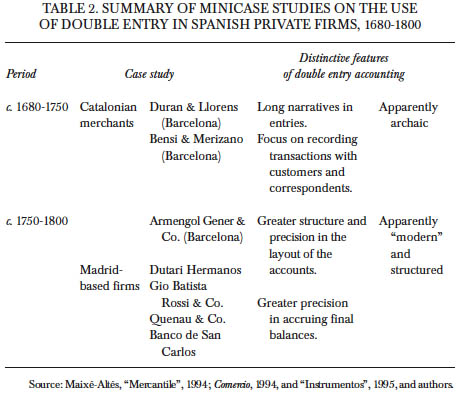
<body><![CDATA[<p align="justify"><font face="verdana" size="2">In summary one is led to believe that at least in the mid to late&#45;19<sup>th</sup> century there was intense interest in double entry accounting. But it is hard to ascertain if that was the case before or when exactly this accounting technique first arrived in Mexico. Opinions amongst Mexican authors and academic contributions to Mexican accounting history regarding the introduction of double entry are diverse and most if not all disregard developments in the early colonial period. In light of a lack of archival research, the next section discusses developments in Spanish historiography and private accounting in order to ascertain possibilities for early adoption and indeed appropriation by Novo Spanish firms.</font></p>          <p align="justify"><font face="verdana" size="2">&nbsp;</font></p>          <p align="justify"><font face="verdana" size="2"><b>The silence of Which LAMB?</b></font></p>          <p align="justify"><font face="verdana" size="2">Hern&aacute;ndez Esteve<sup><a name="n77b"></a><a href="#n77a">77</a></sup> was the first to introduce the idea that the 1630s saw the start of a third stage in Spanish accounting history: for the next hundred years or so, there was a general fall in the production of accounting manuals and textbooks in the kingdom of Castille. Donoso<sup><a name="n78b"></a><a href="#n78a">78</a></sup> documents in detail this period, a time when double entry as a method "disappears" from regulation and accounting thought in Spain.</font></p>          <p align="justify"><font face="verdana" size="2">Other empirical studies have failed to clarify the extent to which double entry was indeed "forgotten". For instance, there are reports claiming that contemporary bookkeepers in Spain and elsewhere in Europe were familiar with the intricacies of double entry but these same studies admitted that this method was not evenly distributed amongst bookkeepers.<sup><a name="n79b"></a><a href="#n79a">79</a></sup> Moreover, to date and to the best of our knowledge, the potential effect that the "silence and apparent oblivion" hypothesis might have had over public or private sector accounting in Latin America has not been documented. Hence there is a need to determine the impact of this "deceleration" in the production of analytical developments around double entry accounting in Spain during the 18<sup>th</sup> century and specifically, in the absence of surviving business records, whether this apparent oblivion helps to explain the contradictions in modern Mexican historiography. Determining the nature and scope of this apparent "silence" requires ascertaining whether there is evidence of a void in terms of analytical developments as well as in terms of everyday practice.</font></p>          <p align="justify"><font face="verdana" size="2">There is evidence to suggest that the dearth of an idiosyncratic production in Spanish accounting thought from the Mediterranean basin from <i>circa</i> 1630 to <i>circa</i> 1730 was substituted by (or remedied through the study of) foreign contributions. Some of these were read in the original whilst others were translated into Spanish. This fact emerges from evidence documented by Capelo and &Aacute;lvarez&#45;Dardet<sup><a name="n80b"></a><a href="#n80a">80</a></sup> for Andalucian companies active in commerce across the Atlantic, as well as those by Manera<sup><a name="n81b"></a><a href="#n81a">81</a></sup> for Mallorca, Franch<sup><a name="n82b"></a><a href="#n82a">82</a></sup> for Valencia, and Vilar<sup><a name="n83b"></a><a href="#n83a">83</a></sup> and Maix&eacute;&#45;Alt&eacute;s<sup><a name="n84b"></a><a href="#n84a">84</a></sup> for Catalonia.</font></p>          <p align="justify"><font face="verdana" size="2">Spanish traders and merchants particularly favoured Genovese authors<sup><a name="n85b"></a><a href="#n85a">85</a></sup> as well as Sicilian writers,<sup><a name="n86b"></a><a href="#na86">86</a></sup> and other Italian authors.<sup><a name="n87b"></a><a href="#n87a">87</a></sup> There is also evidence of a French influence.<sup><a name="n88b"></a><a href="#n88a">88</a></sup></font></p>          <p align="justify"><font face="verdana" size="2">But what of everyday practice? The record is obscure as to whether business organization, especially in the maritime trade activities, had simply an intellectual interest in developments in "modern" accounting or whether these handbooks, guides and treatises actually influenced daily practice. Indeed, accounts of "silence and oblivion" in Spain have failed to pin point the nature of this phenomenon in specific geographical domains and types of business activity. In order to readdress this, the next section provides empirical evidence emerging from companies established in Madrid and Catalonia which effectively challenges the "silence and apparent oblivion" hypothesis. <a href="#t2">Table 2</a> summarises the discussion that follows. This is based on surviving records of accounting systems within private businesses whose activities were related to domestic and international commerce as well as some activities related to financial intermediation during the 17<sup>th</sup> and 18<sup>th</sup> centuries. Admittedly, Catalonian and Madrid&#45;based firms were unlikely to be fully involved in transatlantic trade.<sup><a name="n89b"></a><a href="#n89a">89</a></sup> However, this evidence documents how double entry became rooted in the accounting system of wholesalers during the course of the second half of the 17<sup>th</sup> century. This evidence thus helps to support the idea that, during this period, different levels of complexity coexisted. It provides evidence not only of continuity but also of appropriation as accounting systems could be more or less sophisticated according to the users' "needs" and the nature of their business.<sup><a name="n90b"></a><a href="#n90a">90</a></sup> Of course this, in turn, opens up the question as to whether coexistence of accounting systems in Spain was also the case for organizations in New Spain.</font></p>          <p align="center"><font face="verdana" size="2"><a name="t2" id="t2"></a></font></p>          <p align="center"><font face="verdana" size="2"><img src="/img/revistas/alhe/v19n3/a6t2.jpg"></font></p>          ]]></body>
<body><![CDATA[<p align="justify"><font face="verdana" size="2">&nbsp;</font></p>          <p align="justify"><font face="verdana" size="2"><b>Accounting for domestic and international wholesale trade in the Mediterranean</b></font></p>          <p align="justify"><font face="verdana" size="2">There are noticeable differences in bookkeeping practices within <i>compa&ntilde;&iacute;as de comercio</i> or <i>casas de comercio</i> (merchant houses) based along the Spanish Mediterranean coastline at the end of the 1690s from the accounting practices these same companies used after the 1750s. These differences are greater in terms of analytical precision than accounting method. Below evidence is provided to support the idea that greater analytical precision resulted from a combination of overall economic growth and business practices of individual firms. Indeed during the 18<sup>th</sup> century the turnover of Catalonian businesses grew substantially while individual wholesalers aimed to diversify their investments. As the examples that follow suggest, double entry bookkeeping was well established. But it was the need to ascertain the profitability of different investments the element that instigated a more detailed set of accounts and sophisticated bookkeeping system. This suggests that the bookkeepers of 1699 or 1725 were as skilled and knowledgeable as those of the 1750s.<sup><a name="n91b"></a><a href="#n91a">91</a></sup></font></p>          <p align="justify"><font face="verdana" size="2">Surviving records of two merchant houses helped to ascertain continuity in the use of double entry accounting. On the one hand, Duran &amp; Llorens provided an insight into their accounting practices for the last decade of the 17<sup>th</sup> century and early years of the 18<sup>th</sup> century. On the other hand, similar records were available for Bensi &amp; Merizano between 1724 and 1750.<sup><a name="n92b"></a><a href="#n92a">92</a></sup> Together they provide a first approximation to the changes in accounting practice between those typical of the first half of the 18<sup>th</sup> century and those at the end of that century.</font></p>          <p align="justify"><font face="verdana" size="2">The accounting system at Duran &amp; Llorens displayed all the technical characteristics of double entry bookkeeping as they kept the two basic books, <i>libro diario</i> or <i>manual</i> (the daily journal) and <i>libro mayor</i> (the ledger).<sup><a name="n93b"></a><a href="#n93a">93</a></sup> The basic accounts were perfectly defined: for example, the cash account in the assets/debits side and the capital account in the liabilities/ credits side. The principal analytical difficulty of these accounting books related to the lack of definition of what 19<sup>th</sup> century authors called <i>cuentas transitorias</i> (auxiliary accounts). Here clearly defined accounts were only found for debits and credits relating to the profit and loss account. The use of other accounts, such as general expenses account, is inconsistent, while other "first class accounts" such as those to register <i>cambios mar&iacute;timos</i> (bottomry contracts),<sup><a name="n94b"></a><a href="#n94a">94</a></sup> bills of exchange and commissions, were nonexistent.<sup><a name="n95b"></a><a href="#n95a">95</a></sup> Hence, this only offered a collection of accounts that lacked any aggregate analytical concepts on debits and credits.</font></p>          <p align="justify"><font face="verdana" size="2">The only accounts that showed a certain degree of "maturity" in that regard were called customer current accounts and current accounts for correspondents. These were representative of accounting practices at that point in time because in their construction bookkeepers indistinctively mixed debits and credits. This particular organization of the accounting plan responded to the interweaving of two idiosyncratic elements of Catalonian accounting in the early 18<sup>th</sup> century.<sup><a name="n96b"></a><a href="#n96a">96</a></sup> On the one hand, until the middle of the 18<sup>th</sup> century entries in ledgers by bookkeepers in Catalonian companies followed the entry style of the primary books. This involved a rather descriptive type of entry, which was closer to an explanation in the draft book or the journal than to the rather "analytical" nature of the charge and discharge system of the ledgers. There was thus no basic function, system, key or index to reconcile the whole system of accounts. On the other hand, the rather archaic, disaggregated and unconsolidated nature of Catalonian accounting systems also responded to the diversification of Catalonian investment portfolios. Businessmen opened a dedicated account for every business and even individual investments. The idea was that, at a later date, this approach would facilitate prompt recognition of the profit or loss for each and every transaction. The analytical nature of this approach was evident in the fact that these accounts were consolidated into a balance sheet.<sup><a name="n97b"></a><a href="#n97a">97</a></sup></font></p>          <p align="justify"><font face="verdana" size="2">Strong similarities were also found when comparing the accounting system at Duran &amp; Llorens with that at Bensi &amp; Merizano<i>.</i> A superficial examination of the accounting system at Bensi &amp; Merizano could have branded it as elementary, archaic, and even backward in comparison with that at Duran &amp; Llorens. But closer examination suggested that accounting at Bensi &amp; Merizano offered a large degree of flexibility. The accounting plan opted for a procedure that gave analytical priority to the customer&#45;correspondent. As a result, entries for personal current accounts predominated within the ledger. The ledger as the key source of information for the running of the business focused on two concepts: it informed and provided details of account balances for all the intermediaries of the company and it also provided a summary of profit and loss per account.</font></p>          <p align="justify"><font face="verdana" size="2">Other information could be obtained by consulting two auxiliary books, namely the invoice book and the <i>libro de tratas</i> (bill of exchange book). The invoice book recorded information regarding the exchange of goods while the second book recorded future payments.<sup><a name="n98b"></a><a href="#n98a">98</a></sup> Several objections could be made to the accounting plan at Bensi &amp; Merizano. However, we must admit that its approach seemed "fit for purpose" when considering other options for a medium&#45;sized company, with a highly diversified business portfolio (that encompassed both mercantile trade and financial services) and a business model geared towards fee income generation. Moreover, building the accounts system around personal current accounts offered the possibility of a prompt and swift calculation of the balance sheet.<sup><a name="n99b"></a><a href="#n99a">99</a></sup></font></p>          <p align="justify"><font face="verdana" size="2">Accounting systems at Duran &amp; Llorens and Bensi &amp; Merizano seemed to be in contrast with the practices and accounting plans of other businesses in Catalonia during the second half of the 18<sup>th</sup> century. For instance, practices at Armengol Gener &amp; Co. in 1747 have been documented as the first case of a well structured accounting system as well as representative of the "modern" practices pursued by 18<sup>th</sup> century companies in Barcelona. Firstly, the "basic" accounts were found to be perfectly determined: capital account<i>,</i> profit and loss, cash, overheads, fee income and commissions, bottomry contracts, <i>diners deixats a la part</i> (income derived from the medieval <i>commenda</i> contracts), insurance and <i>barca</i> (the share of ownership of merchant ships). Secondly, accounts to record transactions around bills of exchange followed a mixed system. In 1747 this mixed system was consolidated into a single account (<i>cuenta de sacas y remesas</i>). Later on, however, growth of trading and financial activity resulted in the creation of new accounts.</font></p>          <p align="justify"><font face="verdana" size="2">Thirdly, accounting for merchandise trade and commerce also offered a system geared towards the business model of Armengol Gener. This part of the accounting system was found to offer greater precision and aggregation of the entries than those relating to the bill of exchange account and "basic" accounts, although it should be noted that there was a bias towards creating individual accounts by business sector or type of goods traded. Hence, there was a high degree of personalized entries (reflecting significant personal customers and business correspondents). However, a key element of the accounting system of Armengol Gener was the precision and speed at which they could draft a closing balance sheet. For instance, the ledger systematically recorded initial and final balance statements for every year. These balances clearly specified creditors and debtors as well as the different concepts contributing to overall profitability of the business, providing a snapshot of the financial situation of the company at that point in time.</font></p>          ]]></body>
<body><![CDATA[<p align="justify"><font face="verdana" size="2">The accounting practices at other highly diversified businesses, such as the business activities of the Gl&ograve;ria family and merchant house Huguet &amp; Dupr&eacute; at the end of the 18<sup>th</sup> century as well as Crist&oacute;bal Roig &amp; Co. in the first quarter of the 19<sup>th</sup> century, bear great similarity to the system pioneered by Armengol Gener (1747&#45;1784).<sup><a name="n100b"></a><a href="#n100a">100</a></sup></font></p>          <p align="justify"><font face="verdana" size="2">This evidence helps to support the claim that by the 1750s the double entry system was used by some family firms and merchant houses in Barcelona with a certain degree of sophistication and structure. Yet at the same time, great variety can be observed in the accounting practices of Catalonian and many other merchant houses established within the Mediterranean basin. But this does not mean that some firms with rather archaic accounting practices developed qualitatively inferior businesses, when compared to other businesses with apparently more structured system of accounts.<sup><a name="n101b"></a><a href="#n101a">101</a></sup> Our evidence suggested that many merchant houses kept their accounting system largely unchanged and ran their organization based on tailor&#45;made approaches to their small volume of trade and high degree specialization in investments and business portfolio.</font></p>          <p align="justify"><font face="verdana" size="2">There could be a temptation to classify the accounting systems at merchants such as Duran &amp; Llorens and Bensi &amp; Merizano from 1690 to 1750 as confusing and archaic when compared to the "technically modern systems" at merchant houses such as that of Armengol Gener from 1747 to 1784. However, the evidence presented above suggests that such a view would be somewhat inappropriate because all of these accounting systems ultimately rely on double entry bookkeeping. Their design and resulting reports were quite different, and given the absence of detailed regulation or generally accepted accounting principles, each followed a number of practices which were largely idiosyncratic to the custom and business model of the merchant or family firm.</font></p>          <p align="justify"><font face="verdana" size="2">&nbsp;</font></p>          <p align="justify"><font face="verdana" size="2"><b>A brief comparison of accounting practices in catalonian and Madrid&#45;based firms</b></font></p>          <p align="justify"><font face="verdana" size="2">Comparing accounting systems Catalonian companies between <i>circa</i> 1675 and 1800 (all of which build on the concept of double entry) with Madrid&#45;based firms in the second half of the 18<sup>th</sup> century is interesting since the latter offer the opportunity to analyze firms involved in "domestic" trading within the Iberian peninsula as well as being involved in foreign trade and financial services.</font></p>          <p align="justify"><font face="verdana" size="2">Further analysis of the accounting practices at Dutari Hermanos suggests that from 1742 onwards this company developed significant financial service activities by providing credit in the form of discounting bills of exchange and direct loans to businesses involved in the production of Castilian wool. A similar analysis was carried out of the activities of Gio Batista Rossi after 1758, Quenau &amp; Co. after 1759 and Banco de San Carlos after 1782.<sup><a name="n102b"></a><a href="#n102a">102</a></sup> Besides having an important part of their business located in Madrid, they all engaged in financial services, as they all acted as independent clearing houses for bills of exchange and offered <i>bureau de change</i> facilities to customers. Another common characteristic was that they all developed a double entry bookkeeping system with a "classic" structure, that is, using the ledger and journal for the management of their accounting system.</font></p>          <p align="justify"><font face="verdana" size="2">At Dutari Hermanos, for example, discounting bills of exchange was one of the most important income generating activities of the company, so naturally it had a bearing on the account plan. These activities required keeping detailed records and control of the number of days elapsed since an advance was made (whether in the form of a direct loan or discounting a bill of exchange). This tally was the basis for calculating accumulated interest. To record the transaction several auxiliary books were used together with the journal and ledger. These auxiliary books included one for cash, one for discounted bills of exchange and another for outstanding bills of exchange.<sup><a name="n103b"></a><a href="#n103a">103</a></sup> Recording changes in bills of exchange, discounting and other credit operations all the way through from auxiliary books to the journal and ledger is thus evidence that suggests an accounting system based on double entry.</font></p>          <p align="justify"><font face="verdana" size="2">In summary, this section documented evidence from Catalonian firms involved in wholesale international trade and investment together with Madrid&#45;based firms involved in domestic and foreign trade and financial services, suggesting that double entry bookkeeping was common practice in the accounting of private firms in the Spanish mainland at the end of the 17<sup>th</sup> century and during the 18<sup>th</sup> century.</font></p>          <p align="justify"><font face="verdana" size="2">&nbsp;</font></p>          ]]></body>
<body><![CDATA[<p align="justify"><font face="verdana" size="2"><b>A proposal for further research</b></font></p>          <p align="justify"><font face="verdana" size="2">To the best of our knowledge there is no systematic study that documents links in the use of "sophisticated" accounting technology between Spain and its colonies in Latin America in both public and private enterprise. Research in this article helps to fill this gap by putting forward the idea that future studies of Latin American accounting history should be framed by the evolution of accounting practice in Spain. These studies should offer a synthesis that emerges from different contemporary sources such as textbooks and manuals, surviving company and government records as well as paying attention to educational practices. Furthermore, there is evidence to suggest that different accounting systems coexisted for long periods within Spanish early modern capitalism, sometimes even in the same organization. That is, different organizational forms in Spain are seen as adopting the accounting system that best suited their purpose and business model. In the absence of empirical evidence to the contrary, there is reason to believe that private firms on the west coast of the Atlantic also adopted fit&#45;for&#45;purpose accounting.</font></p>          <p align="justify"><font face="verdana" size="2">The point of departure to illustrate the above is a reinterpretation of indigenous contributions and non&#45;native authors discussing the arrival of double entry bookkeeping in private and public accounting in Mexico. These contributions debate whether there was continuity or discontinuity in Mexican practice immediately after independence from Spain (i. e. the end of the colonial period). The comparison between, on the one hand, Federico Gertz Manero, Luis de la Puente, Alvarado <i>et al.,</i> and Rodr&iacute;guez and Y&aacute;&ntilde;ez<sup><a name="n104b"></a><a href="#n104a">104</a></sup> and, on the other hand, Garc&iacute;a, Gallo and Avella<sup><a name="n105b"></a><a href="#n105a">105</a></sup> suggests that double entry bookkeeping was known in Mexico during the last decades of the 18<sup>th</sup> century. This view claims that there was some initial success, while the handful of systematic studies by indigenous authors and academics studying Mexico are somewhat biased towards developments in the public sector.<sup><a name="n106b"></a><a href="#n106a">106</a></sup></font></p>          <p align="justify"><font face="verdana" size="2">There seems to be some consistency in the view that this accounting technique diffused at lukewarm pace so that it was "overlooked" as a practice during the first half of the 19<sup>th</sup> century. Double entry bookkeeping was then reintroduced from 1850 onwards, first in some private firms, as suggested by the publications of Deplanque<sup><a name="n107b"></a><a href="#n107a">107</a></sup> and Salvador.<sup><a name="n108b"></a><a href="#n108a">108</a></sup> This was followed by its adoption in central government thanks to its successful use within the Mexican Army<sup><a name="n109b"></a><a href="#n109a">109</a></sup> and as a remnant of French military intervention.<sup><a name="n110b"></a><a href="#n110a">110</a></sup> Meanwhile, foreign direct investments from the USA, France and Britain during the <i>porfiriato</i> (1876&#45;1910) brought about its widespread use within private enterprise.<sup><a name="n111b"></a><a href="#n111a">111</a></sup></font></p>          <p align="justify"><font face="verdana" size="2">Throughout the above studies, however, there is an implicit assumption that accounting manuals and textbooks are an unbiased reflection of the development of accounting practice and thought. At the time there were some formal education outlets. Mexico City was home to the oldest university in the continent<sup><a name="n112b"></a><a href="#n112a">112</a></sup> and there were some institutions offering business administration and accounting courses,<sup><a name="n113b"></a><a href="#n113a">113</a></sup>113 but by and large most of the knowledge transfer during the Spanish American Empire is most likely to have taken place through informal, on&#45;the&#45;job training (such as apprenticeships or visiting stays).</font></p>          <p align="justify"><font face="verdana" size="2">The existence of surviving contemporary manuals and textbooks can be a helpful but not a decisive piece of information in determining everyday accounting practices. Indeed, there is evidence documented for other geographies which points to the development of accounting regardless of an absence of accounting texts and university curricula. For instance, Fleischman and Parker<sup><a name="n114b"></a><a href="#n114a">114</a></sup> point to this conclusion in the context of cost&#45;accounting during the British Industrial Revolution. In an independent study, Edwards and Boyns<sup><a name="n115b"></a><a href="#n115a">115</a></sup> state that despite the lack of any significant industrial accounting literature to guide them, businessmen and key individuals employed or developed accounting techniques in British private enterprise.</font></p>          <p align="justify"><font face="verdana" size="2">Moreover, the above citations from Mexican authors and non&#45;natives studying Mexican accounting practice fail to make a clear distinction as to whether the double entry method was established in the public sector or in the <i>haciendas</i> (and more precisely, whether any of these were involved in international trade with merchant houses in Spain). This blurring of economic activity is as much a concern as the assumptions regarding the speed of diffusion of "modern" accounting in Mexico.</font></p>          <p align="justify"><font face="verdana" size="2">In summary, all authors identified above have made implicit or explicit claims regarding how the continuity of accounting practice in New Spain was subject to vicissitudes in its colonial ruler, while disregarding possibilities for the appropriation of accounting techniques. It is indeed fair to assume that the introduction of double entry bookkeeping in Mexico was influenced by practices and institutions in Spain during the colonial period. As mentioned above, Hern&aacute;ndez Esteve<sup><a name="n116b"></a><a href="#n116a">116</a></sup> notes that 150 copies of Bartolom&eacute; Salvador de Solorzano's treaty on double entry accounting were taken by Diego Felipe de Aldino and Bartolom&eacute; Porras in 1591 to be sold in New Spain. But when exactly Mexicans adopted double entry bookkeeping, and to what extent there were differences and similarities between private and public enterprise, remain primary unresolved issues.</font></p>          <p align="justify"><font face="verdana" size="2">The path of adoption and diffusion of this accounting technology in Spain provides a framework to begin ascertaining the likelihood of adoption given the handful of sources that survive from pre&#45;independence Mexico. A brief summary of the historiography of double entry in Spain noted that some Spanish authors have pointed to an apparent crisis in Spanish history of double entry while pointing to a desertion in the use of this method between the 17<sup>th</sup> and 18<sup>th</sup> Centuries. However, through the analysis of surviving company records, evidence documented in this article shows how the technique had a much wider use in private companies than is otherwise claimed. This is very much the case for firms involved in large volume business or diversified investments. This result was in line with developments documented elsewhere and in particular around Anglo&#45;American accounting.</font></p>          <p align="justify"><font face="verdana" size="2">That evidence also led us to believe that, first, the apparent desertion (at least as far as the production of Spanish bibliographic material is concerned) must be understood in the context of the predicaments and general chaos that characterized the end of the Hapsburg dynasty. This period had a significant impact on accounting regulation and doctrinal production in Spain. The Hapsburg's economic mismanagement was also instrumental in decimating the number of skilled practitioners by reducing opportunities for training new cadres of competent bookkeepers. At the same time, large numbers of bankruptcies and business failures with the consequent reduction of surviving records significantly lowered possibilities of studying this epoch systematically. Hence one must be careful not to equate a "slow down" in the diffusion of the double entry method in Spain with total desertion or even neglect of this accounting technology.</font></p>          ]]></body>
<body><![CDATA[<p align="justify"><font face="verdana" size="2">Second, this article presents evidence which suggests that the use of double entry method had taken a hold in firms established in the more industrious geographies of Spain by the 1690s. There is no reason to believe that firms outside of the colonial powerhouse and particularly those based in New Spain and involved in foreign trade or investments in Asia and the Caribbean, were excluded from learning about the double entry method. However, it is likely that Novo Spanish firms adopted European accounting technologies with some delay and chiefly through interaction with peers in business and commerce as well as migration of skilled employees and entrepreneurs. This is because "on&#45;the&#45;job training" rather than formal education was the chief method for knowledge transfer. But as noted above, the crisis at the end of the Hapsburg Empire could have disrupted opportunities for knowledge transfer to the colonies. One is thus led to believe that this accounting technique was first adopted in New Spain as early as the 17<sup>th</sup> century. This claim would position its adoption considerably earlier than that suggested in most Mexican contributions. But since were unable to provide evidence in this regard, the validity of our claim remains hypothetical and subject to future empirical research.</font></p>          <p align="justify"><font face="verdana" size="2">Third, with regards to the public sector, it could be said that public accounting systems may have had a lesser degree of complexity when compared with the requirements of private accounting systems, but in fact the accounting systems of public and private bodies were very different during the early modern capitalist era. It would be erroneous to think they are equivalent mainly because the analytical criteria of each type of corporate body were very different. For instance, evidence has been provided of accounting systems in private firms which specifically associated with a large number of accounts and accounting books whereas in others there was no variety and they followed more traditional practices. Key concepts for private firms include capital, profits and the role of partners, whereas these same concepts are non&#45;existent for public administration.</font></p>          <p align="justify"><font face="verdana" size="2">Nonetheless, our interest in highlighting the comparison of public and private bodies is that public accounting systems introduced criteria that went beyond the charge and discharge method much earlier than anticipated by Mexican historiography. Admittedly this effort seemed more successful in Spain than in its colony. Indeed, the numerous forms of Spanish institutions and administrations (municipalities, colonial, etc.) first introduced the double entry method during the second half of the 16<sup>th</sup> century. At the beginning of the 17<sup>th</sup> century the Spanish Treasury and other public administrative bodies developed double entry accounting systems, while it was in the middle of the 18<sup>th</sup> century that the Bourbon introduced double entry bookkeeping to colonial public administration (although these efforts were not always successful). Specifically, top officials of the viceroyalty of New Spain (namely administrators at the Accounting Court and General Accounting Office of the Indies) were keener to adopt double entry bookkeeping than top officials in colonial administrative bodies. However, it seems that the progressive deterioration of political and economic control of the dominions at the end of the 18<sup>th</sup> century together with non&#45;standardized rules (i. e. no concept of generally accepted accounting principles) and the processes leading to independence, generated a break up in New Spanish&#45;Mexican accounting practices which indigenous firms most have found difficult to solve in the short term.</font></p>          <p align="justify"><font face="verdana" size="2">The lack of clarity regarding accounting practice at the end of the colonial period and during the early independent Mexico, probably resulted in an informal setting where some individuals employed double entry bookkeeping while others in similar organizations stuck to the charge and discharge method. This view helps to explain why our survey of Mexican sources apparently found contradicting claims based on surviving records of several <i>haciendas</i> and mines at the beginning of the 19<sup>th</sup> century. The volatile economic and political climate that followed included mass outward migration of Spanish businessmen and capital, and the separation of Central American states as well as armed conflict with France and the USA, the latter resulting in the loss of over half the territory at independence from Spain. Moreover, industrialization in Europe meant a loss of many traditional export markets for natural dyes. All this had a profound effect on any attempt by the former colony to regain continuity in accounting practice. In fact and as above mentioned, it was not until the second half of the 19<sup>th</sup> century when a more stable economic and political environment and a reintroduction of European investments and some migration, when the modernization of the economic system entailed the gradual introduction of double entry bookkeeping in Mexico. The introduction and adoption of double entry bookkeeping in Mexico was thus a consequence of knowledge transfer from its former colonial ruler as much as a consequence of institutional "normalization".</font></p>          <p align="justify"><font face="verdana" size="2">Lastly, some caveats. First, our research documented evidence from Madrid&#45;based firms involved in domestic and foreign trade and financial services, together with Catalonian firms involved in wholesale international trade and investment, suggesting that double entry bookkeeping was common practice in the accounting of private firms in the Spanish mainland at the end of the 17<sup>th</sup> century and during the 18<sup>th</sup> century. This evidence contests the current framework for the historical analysis of accounting technology in Spain and in particular, the soundness of the so called "stage of silence and apparent oblivion" hypothesis.<sup><a name="n117b"></a><a href="#n117a">117</a></sup> It must be acknowledged that Madrid&#45;based and even more so Catalonian merchant houses were, in general, excluded from trade with the American colonies in the early colonial period. However, there is enough evidence to suggest the <i>possibility</i> of an early adoption of this technique in Latin America and that this <i>could have</i> happened much earlier than anticipated by Mexican historiography.</font></p>          <p align="justify"><font face="verdana" size="2">Second, this article is not making the claim that there was generalized use of double entry in Spain during the 17<sup>th</sup> and 18<sup>th</sup> centuries. The absence of widely accepted accounting principles together with the slowdown in intellectual and economic environments at the end of the Habsburg Monarchy in Spain<sup><a name="n118b"></a><a href="#n118a">118</a></sup> resulted in many bookkeepers devising accounting systems that best fitted the purpose of their organization. The accounting practices in firms of different sizes and degrees of diversification discussed above, suggest that the nature of the accounting system and the prevalence of rudimentary methods was strongly influenced by the business model and the level of complexity in their operations, complexity that arose from a combination of the type of market they were involved with and the volume of their trade. Our evidence thus suggests that double entry bookkeeping was most likely to be found amongst large or diversified organizations. These were the types of firms that usually engaged in trade with others elsewhere in Europe and the American dominions, thus <i>opening up the possibility</i> for technological transfer to private firms established in the colonies. Of course, the use (even if widespread) of this accounting technique in Spain is not in itself sufficient to make a similar claim for its colony. There is a possibility for other accounting techniques to have had been more suitable in New Spain. As a result, this article offers a robust, empirically&#45;based, new framework to assess future evidence regarding accounting practice in Mexico and elsewhere in Latin America during the Spanish colonial era.</font></p>          <p align="justify"><font face="verdana" size="2">&nbsp;</font></p>          <p align="justify"><font face="verdana" size="2"><b>Sources consulted</b></font></p>          <p align="justify"><font face="verdana" size="2"><i>Archives</i></font></p>          <p align="justify"><font face="verdana" size="2">AGI Archivo General de Indias, Sevilla, Seville, Spain. </font></p>         ]]></body>
<body><![CDATA[<p align="justify"><font face="verdana" size="2">AHBE Archivo Hist&oacute;rico del Banco de Espa&ntilde;a, Madrid, Spain. Secretar&iacute;a: Dutari Hermanos, libros 18560, 18637, 18638, 18616; Gio Batista Rossi, libros 18558, 18559, 278P, 235P, 272; Rossi, Gosse &amp; Co., libro 322; Casa Quenau, libros 272, 423, 453; Banco de San Carlos, libros, 240, 246, 251. </font></p>         <p align="justify"><font face="verdana" size="2">AHPB Arxiu Hist&ograve;ric de Protocols de Barcelona, Barcelona, Spain. </font></p>         <p align="justify"><font face="verdana" size="2">AHMB Archivo Hist&oacute;rico de la Ciudad de Barcelona, Catalu&ntilde;a, Spain. </font></p>         <p align="justify"><font face="verdana" size="2">ACM Archivo y Biblioteca de Can Mayans, Vilassar de Dalt, Barcelona, Spain. Private records of the landed estate of the Bensi&#45;Olmera's family. </font></p>     <p align="justify"><font face="verdana" size="2">AD Archivio Storico dei Durazzo, marchesi di Gabiano, Genoa, Italy. Private archive.</font></p>      <p align="justify">&nbsp;</p>     <p align="justify"><font face="verdana" size="2"><i>Hemerograph</i><i>y</i> </font></p>     <!-- ref --><p align="justify"><font face="verdana" size="2"><i>El Universal</i>, Mexico City.    &nbsp;&nbsp;&nbsp;&nbsp;&nbsp;&nbsp;&nbsp;&nbsp;[&#160;<a href="javascript:void(0);" onclick="javascript: window.open('/scielo.php?script=sci_nlinks&ref=702123&pid=S1405-2253201200030000600001&lng=','','width=640,height=500,resizable=yes,scrollbars=1,menubar=yes,');">Links</a>&#160;]<!-- end-ref --></font></p>      <p align="justify"><font face="verdana" size="2">&nbsp;</font></p>          ]]></body>
<body><![CDATA[<p align="justify"><font face="verdana" size="2"><i><b>Bibliography</b></i></font></p>          <!-- ref --><p align="justify"><font face="verdana" size="2">Alberts, Gerard, "Appropriating America: Americanization in the History of European Computing", <i>Annals of the History of Computing, Institute of Electrical and Electronics Engineers</i>, vol. 32, num. 2, April&#45;June, 2010, pp. 4&#45;7.    &nbsp;&nbsp;&nbsp;&nbsp;&nbsp;&nbsp;&nbsp;&nbsp;[&#160;<a href="javascript:void(0);" onclick="javascript: window.open('/scielo.php?script=sci_nlinks&ref=702127&pid=S1405-2253201200030000600002&lng=','','width=640,height=500,resizable=yes,scrollbars=1,menubar=yes,');">Links</a>&#160;]<!-- end-ref --></font></p>          <!-- ref --><p align="justify"><font face="verdana" size="2">Alvarado Mart&iacute;nez y Escobar, Lourdes <i>et al., La contadur&iacute;a p&uacute;blica: estudio de su g&eacute;nesis y de su evoluci&oacute;n hasta nuestros d&iacute;as</i>, M&eacute;xico, Universidad Nacional Aut&oacute;noma de M&eacute;xico, 1983.    &nbsp;&nbsp;&nbsp;&nbsp;&nbsp;&nbsp;&nbsp;&nbsp;[&#160;<a href="javascript:void(0);" onclick="javascript: window.open('/scielo.php?script=sci_nlinks&ref=702129&pid=S1405-2253201200030000600003&lng=','','width=640,height=500,resizable=yes,scrollbars=1,menubar=yes,');">Links</a>&#160;]<!-- end-ref --></font></p>          <!-- ref --><p align="justify"><font face="verdana" size="2">Amato ed Urso, Giuseppe Carlo, <i>Il microscopio de computisti</i>, Palermo, A. Felicella, 1740.    &nbsp;&nbsp;&nbsp;&nbsp;&nbsp;&nbsp;&nbsp;&nbsp;[&#160;<a href="javascript:void(0);" onclick="javascript: window.open('/scielo.php?script=sci_nlinks&ref=702131&pid=S1405-2253201200030000600004&lng=','','width=640,height=500,resizable=yes,scrollbars=1,menubar=yes,');">Links</a>&#160;]<!-- end-ref --></font></p>          <!-- ref --><p align="justify"><font face="verdana" size="2">Anes, Gonzalo, <i>Historia de Espa&ntilde;</i>a, Miguel Artola (ed.), vol. 4, Madrid, Alianza Editorial, 1994.    &nbsp;&nbsp;&nbsp;&nbsp;&nbsp;&nbsp;&nbsp;&nbsp;[&#160;<a href="javascript:void(0);" onclick="javascript: window.open('/scielo.php?script=sci_nlinks&ref=702133&pid=S1405-2253201200030000600005&lng=','','width=640,height=500,resizable=yes,scrollbars=1,menubar=yes,');">Links</a>&#160;]<!-- end-ref --></font></p>          <!-- ref --><p align="justify"><font face="verdana" size="2">Anonymous, <i>Reflexiones sobre el acuerdo del Senado, relativo a la adopci&oacute;n del sistema de partida doble, para las cuentas del erario p&uacute;blico</i>, M&eacute;xico, Imprenta de Jos&eacute; Mariano Lara, 1850.    &nbsp;&nbsp;&nbsp;&nbsp;&nbsp;&nbsp;&nbsp;&nbsp;[&#160;<a href="javascript:void(0);" onclick="javascript: window.open('/scielo.php?script=sci_nlinks&ref=702135&pid=S1405-2253201200030000600006&lng=','','width=640,height=500,resizable=yes,scrollbars=1,menubar=yes,');">Links</a>&#160;]<!-- end-ref --></font></p>          <!-- ref --><p align="justify"><font face="verdana" size="2">Arcila Far&iacute;as, Eduardo, <i>El siglo ilustrado en Am&eacute;rica: reformas econ&oacute;micas del siglo XVIII en Nueva Espa&ntilde;a</i>, Caracas, Ediciones del Ministerio de Educaci&oacute;n, 1995.    &nbsp;&nbsp;&nbsp;&nbsp;&nbsp;&nbsp;&nbsp;&nbsp;[&#160;<a href="javascript:void(0);" onclick="javascript: window.open('/scielo.php?script=sci_nlinks&ref=702137&pid=S1405-2253201200030000600007&lng=','','width=640,height=500,resizable=yes,scrollbars=1,menubar=yes,');">Links</a>&#160;]<!-- end-ref --></font></p>          <!-- ref --><p align="justify"><font face="verdana" size="2">Avella Alaminos, Isabel, "La experiencia de la partida doble en la Real Hacienda en la Nueva Espa&ntilde;a (1784&#45;1789)" in Ernest S&aacute;nchez Santir&oacute;,&nbsp;Luis J&aacute;uregui and&nbsp;Antonio Ibarra (eds.), <i>Finanzas y pol&iacute;tica en el mundo iberoamericano: del antiguo r&eacute;gimen a las naciones independientes, 1754&#45;1850</i>, M&eacute;xico, Universidad Nacional Aut&oacute;noma de M&eacute;xico, 2001, pp. 115&#45;138.    &nbsp;&nbsp;&nbsp;&nbsp;&nbsp;&nbsp;&nbsp;&nbsp;[&#160;<a href="javascript:void(0);" onclick="javascript: window.open('/scielo.php?script=sci_nlinks&ref=702139&pid=S1405-2253201200030000600008&lng=','','width=640,height=500,resizable=yes,scrollbars=1,menubar=yes,');">Links</a>&#160;]<!-- end-ref --></font></p>          <!-- ref --><p align="justify"><font face="verdana" size="2">Ba&ntilde;os S&aacute;nchez&#45;Matamoros <i>et al.</i>, "Govern (mentality) and Accounting: the Influence of Different Enlightenment Discourses in Two Spanish Cases (1761&#45;1777)", <i>Abacus. A Journal of Accounting, Finance and Business Studies</i>, University of Sidney, vol. 41, num. 2, June, 2005, pp. 181&#45;210.    &nbsp;&nbsp;&nbsp;&nbsp;&nbsp;&nbsp;&nbsp;&nbsp;[&#160;<a href="javascript:void(0);" onclick="javascript: window.open('/scielo.php?script=sci_nlinks&ref=702141&pid=S1405-2253201200030000600009&lng=','','width=640,height=500,resizable=yes,scrollbars=1,menubar=yes,');">Links</a>&#160;]<!-- end-ref --></font></p>          <!-- ref --><p align="justify"><font face="verdana" size="2">B&aacute;tiz&#45;Lazo, Bernardo, "Business Elite and the Diffusion of US&#45;Style Business Education in Mexico (1955&#45;2005)", <i>Research Papers in Economics</i>, 2008, Leicester, &lt;<a href="http://ideas.repec.org/p/pra/mprapa/7473.html" target="_blank">http://ideas.repec.org/p/pra/mprapa/7473.html</a>&gt;. &#91;Accessed: 26 Nov., 2011.    &nbsp;&nbsp;&nbsp;&nbsp;&nbsp;&nbsp;&nbsp;&nbsp;[&#160;<a href="javascript:void(0);" onclick="javascript: window.open('/scielo.php?script=sci_nlinks&ref=702143&pid=S1405-2253201200030000600010&lng=','','width=640,height=500,resizable=yes,scrollbars=1,menubar=yes,');">Links</a>&#160;]<!-- end-ref -->&#93;</font></p>          <!-- ref --><p align="justify"><font face="verdana" size="2">Bici, Antonella, "Modelli di contabilit&agrave; nella seconda met&agrave; del Seicento" in Simonetta Cavaciocchi (a cura di), <i>L'impresa industria commercio banca (secc. XIII&#45;XVIII)</i>, Firenze, Le Monnier, 1991, pp. 393&#45;397 (Serie ii, Atti della Settimane di Studio e Altri Convegni, 22).    &nbsp;&nbsp;&nbsp;&nbsp;&nbsp;&nbsp;&nbsp;&nbsp;[&#160;<a href="javascript:void(0);" onclick="javascript: window.open('/scielo.php?script=sci_nlinks&ref=702145&pid=S1405-2253201200030000600011&lng=','','width=640,height=500,resizable=yes,scrollbars=1,menubar=yes,');">Links</a>&#160;]<!-- end-ref --></font></p>          <!-- ref --><p align="justify"><font face="verdana" size="2">Capelo Bernal, Mar&iacute;a Dolores and Concepci&oacute;n &Aacute;lvarez&#45;Dardet Espejo, "La reputaci&oacute;n de los gestores y su elecci&oacute;n contable: el caso del almac&eacute;n central de Ag&uuml;era (1822&#45;1830)", <i>Revista Espa&ntilde;ola de Financiaci&oacute;n y Contabilidad</i>, Asociaci&oacute;n Espa&ntilde;ola de Contabilidad y Administraci&oacute;n de Empresas, vol. XXXIII, num. 121, April&#45;June, 2004, pp. 281&#45;312.    &nbsp;&nbsp;&nbsp;&nbsp;&nbsp;&nbsp;&nbsp;&nbsp;[&#160;<a href="javascript:void(0);" onclick="javascript: window.open('/scielo.php?script=sci_nlinks&ref=702147&pid=S1405-2253201200030000600012&lng=','','width=640,height=500,resizable=yes,scrollbars=1,menubar=yes,');">Links</a>&#160;]<!-- end-ref --></font></p>          <!-- ref --><p align="justify"><font face="verdana" size="2">Carmona, Salvador, "Accounting History Research and its Diffusion in an International Context", <i>Accounting History</i>, Accounting History Special Interest Group of the Accounting and Finance Association of Australia and New Zealand, vol. 9, num. 3, November, 2004, pp. 7&#45;23.    &nbsp;&nbsp;&nbsp;&nbsp;&nbsp;&nbsp;&nbsp;&nbsp;[&#160;<a href="javascript:void(0);" onclick="javascript: window.open('/scielo.php?script=sci_nlinks&ref=702149&pid=S1405-2253201200030000600013&lng=','','width=640,height=500,resizable=yes,scrollbars=1,menubar=yes,');">Links</a>&#160;]<!-- end-ref --></font></p>          <!-- ref --><p align="justify"><font face="verdana" size="2">Carnegie, Gary D. and L&uacute;cia L. Rodrigues, "Exploring the Dimensions of the International Accounting History Community", <i>Accounting History</i>, Accounting History Special Interest Group of the Accounting and Finance Association of Australia and New Zealand, vol. 12, num. 4, November, 2007, pp. 441&#45;464.    &nbsp;&nbsp;&nbsp;&nbsp;&nbsp;&nbsp;&nbsp;&nbsp;[&#160;<a href="javascript:void(0);" onclick="javascript: window.open('/scielo.php?script=sci_nlinks&ref=702151&pid=S1405-2253201200030000600014&lng=','','width=640,height=500,resizable=yes,scrollbars=1,menubar=yes,');">Links</a>&#160;]<!-- end-ref --></font></p>          <!-- ref --><p align="justify"><font face="verdana" size="2">Carnegie, Gary D.&nbsp;and&nbsp;Robert H. Parker, "The Transfer of Accounting Technology to the Southern Hemisphere: The Case of William Butler Yaldwyn", <i>Accounting, Business and Financial History</i>, Routledge, vol. 6, num. 1, 1996, pp. 23&#45;49.    &nbsp;&nbsp;&nbsp;&nbsp;&nbsp;&nbsp;&nbsp;&nbsp;[&#160;<a href="javascript:void(0);" onclick="javascript: window.open('/scielo.php?script=sci_nlinks&ref=702153&pid=S1405-2253201200030000600015&lng=','','width=640,height=500,resizable=yes,scrollbars=1,menubar=yes,');">Links</a>&#160;]<!-- end-ref --></font></p>          <!-- ref --><p align="justify"><font face="verdana" size="2">Casaregis, Josephus Laurentius Maria de, <i>Discursus legales de commercio</i>, Venecia, ex Typographia Balleoniana, 1740, 3 vols.    &nbsp;&nbsp;&nbsp;&nbsp;&nbsp;&nbsp;&nbsp;&nbsp;[&#160;<a href="javascript:void(0);" onclick="javascript: window.open('/scielo.php?script=sci_nlinks&ref=702155&pid=S1405-2253201200030000600016&lng=','','width=640,height=500,resizable=yes,scrollbars=1,menubar=yes,');">Links</a>&#160;]<!-- end-ref --></font></p>          <!-- ref --><p align="justify"><font face="verdana" size="2">Cordero y Bernal, Rigoberto, <i>Historia de la contadur&iacute;a en Puebla</i>, Puebla, Centro de Estudios Hist&oacute;ricos de Puebla, 1997.    &nbsp;&nbsp;&nbsp;&nbsp;&nbsp;&nbsp;&nbsp;&nbsp;[&#160;<a href="javascript:void(0);" onclick="javascript: window.open('/scielo.php?script=sci_nlinks&ref=702157&pid=S1405-2253201200030000600017&lng=','','width=640,height=500,resizable=yes,scrollbars=1,menubar=yes,');">Links</a>&#160;]<!-- end-ref --></font></p>          <!-- ref --><p align="justify"><font face="verdana" size="2">Deplanque, Luis, <i>La tenue des livres en partie simple et en partie double...</i>, Paris, Dutertre, 1843.    &nbsp;&nbsp;&nbsp;&nbsp;&nbsp;&nbsp;&nbsp;&nbsp;[&#160;<a href="javascript:void(0);" onclick="javascript: window.open('/scielo.php?script=sci_nlinks&ref=702159&pid=S1405-2253201200030000600018&lng=','','width=640,height=500,resizable=yes,scrollbars=1,menubar=yes,');">Links</a>&#160;]<!-- end-ref --></font></p>          <!-- ref --><p align="justify"><font face="verdana" size="2">----------, <i>La tenedur&iacute;a de libros en partida simple y doble, puesta al alcance de todas las inteligencias para ser aprendida sin maestro</i>, trad. Rafael Cancino, M&eacute;xico,&nbsp;Imprenta de Vicente Garc&iacute;a Torres, 1844.    &nbsp;&nbsp;&nbsp;&nbsp;&nbsp;&nbsp;&nbsp;&nbsp;[&#160;<a href="javascript:void(0);" onclick="javascript: window.open('/scielo.php?script=sci_nlinks&ref=702161&pid=S1405-2253201200030000600019&lng=','','width=640,height=500,resizable=yes,scrollbars=1,menubar=yes,');">Links</a>&#160;]<!-- end-ref --></font></p>          <!-- ref --><p align="justify"><font face="verdana" size="2">Dom&iacute;nguez, Manuela, "El sistema de intendencias y su influencia en la estructura organizativa y recaudaci&oacute;n de la hacienda: el caso del virreinato del R&iacute;o de la Plata (1776&#45;1782)", XIII Jornadas Hispano Lusas de Gesti&oacute;n Cient&iacute;fica, Baeza, 2009.    &nbsp;&nbsp;&nbsp;&nbsp;&nbsp;&nbsp;&nbsp;&nbsp;[&#160;<a href="javascript:void(0);" onclick="javascript: window.open('/scielo.php?script=sci_nlinks&ref=702163&pid=S1405-2253201200030000600020&lng=','','width=640,height=500,resizable=yes,scrollbars=1,menubar=yes,');">Links</a>&#160;]<!-- end-ref --></font></p>          <!-- ref --><p align="justify"><font face="verdana" size="2">Donoso, Alberto, "La contabilidad virreinal americana, an&aacute;lisis de una experiencia: la aplicaci&oacute;n del m&eacute;todo de la partida doble en las Reales Cajas de Indias (1784&#45;1787)", doctoral dissertation, Seville, Universidad de Sevilla, 1996.    &nbsp;&nbsp;&nbsp;&nbsp;&nbsp;&nbsp;&nbsp;&nbsp;[&#160;<a href="javascript:void(0);" onclick="javascript: window.open('/scielo.php?script=sci_nlinks&ref=702165&pid=S1405-2253201200030000600021&lng=','','width=640,height=500,resizable=yes,scrollbars=1,menubar=yes,');">Links</a>&#160;]<!-- end-ref --></font></p>          <!-- ref --><p align="justify"><font face="verdana" size="2">----------, "Estudio hist&oacute;rico de un intento de reforma en la contabilidad p&uacute;blica: la aplicaci&oacute;n del m&eacute;todo de la partida doble en las Cajas Reales de Indias (1784&#45;1787)", <i>Revista Espa&ntilde;ola de Financiaci&oacute;n y Contabilidad</i>, Asociaci&oacute;n Espa&ntilde;ola de Contabilidad y Administraci&oacute;n de Empresas, vol. XXVII, num. 93, October&#45;December, 1997, pp. 1045&#45;1089.    &nbsp;&nbsp;&nbsp;&nbsp;&nbsp;&nbsp;&nbsp;&nbsp;[&#160;<a href="javascript:void(0);" onclick="javascript: window.open('/scielo.php?script=sci_nlinks&ref=702167&pid=S1405-2253201200030000600022&lng=','','width=640,height=500,resizable=yes,scrollbars=1,menubar=yes,');">Links</a>&#160;]<!-- end-ref --></font></p>          <!-- ref --><p align="justify"><font face="verdana" size="2">----------, "Nuevo m&eacute;todo de cuenta y raz&oacute;n para la Real Hacienda en las Indias. La instrucci&oacute;n pr&aacute;ctica y provisional en forma de advertencias comentada (27 de abril de 1784)", <i>Revista Espa&ntilde;ola de Financiaci&oacute;n y Contabilidad</i>, Asociaci&oacute;n Espa&ntilde;ola de Contabilidad y Administraci&oacute;n de Empresas, vol. XXVIII, num. 101, July&#45;September, 1999, pp. 817&#45;862.    &nbsp;&nbsp;&nbsp;&nbsp;&nbsp;&nbsp;&nbsp;&nbsp;[&#160;<a href="javascript:void(0);" onclick="javascript: window.open('/scielo.php?script=sci_nlinks&ref=702169&pid=S1405-2253201200030000600023&lng=','','width=640,height=500,resizable=yes,scrollbars=1,menubar=yes,');">Links</a>&#160;]<!-- end-ref --></font></p>          <!-- ref --><p align="justify"><font face="verdana" size="2">----------, "El virrey de Lima, caballero de Croix, defensor de la partida doble en el siglo XVIII", <i>Revista Espa&ntilde;ola de Financiaci&oacute;n y Contabilidad</i>, Asociaci&oacute;n Espa&ntilde;ola de Contabilidad y Administraci&oacute;n de Empresas, vol. XXX, num. 107, October&#45;December, 2001, pp. 165&#45;206.    &nbsp;&nbsp;&nbsp;&nbsp;&nbsp;&nbsp;&nbsp;&nbsp;[&#160;<a href="javascript:void(0);" onclick="javascript: window.open('/scielo.php?script=sci_nlinks&ref=702171&pid=S1405-2253201200030000600024&lng=','','width=640,height=500,resizable=yes,scrollbars=1,menubar=yes,');">Links</a>&#160;]<!-- end-ref --></font></p>          <!-- ref --><p align="justify"><font face="verdana" size="2">Donoso, Rafael, <i>Una contribuci&oacute;n a la historia de la contabilidad: an&aacute;lisis de las pr&aacute;cticas contables desarrolladas por la tesorer&iacute;a de la Casa de la Contrataci&oacute;n de las Indias de Sevilla (1503&#45;1717)</i>, Seville, Universidad de Sevilla, 1996.    &nbsp;&nbsp;&nbsp;&nbsp;&nbsp;&nbsp;&nbsp;&nbsp;[&#160;<a href="javascript:void(0);" onclick="javascript: window.open('/scielo.php?script=sci_nlinks&ref=702173&pid=S1405-2253201200030000600025&lng=','','width=640,height=500,resizable=yes,scrollbars=1,menubar=yes,');">Links</a>&#160;]<!-- end-ref --></font></p>          <!-- ref --><p align="justify"><font face="verdana" size="2">Edwards, John R. and Trevor Boyns, "The Construction of Cost Accounting Systems in Britain to 1900: the Case of the Coal, Iron, and Steel Industries",&nbsp;<i>Business History</i>, Routledge, vol. 39, num. 3, July, 1997, pp. 1&#45;29.    &nbsp;&nbsp;&nbsp;&nbsp;&nbsp;&nbsp;&nbsp;&nbsp;[&#160;<a href="javascript:void(0);" onclick="javascript: window.open('/scielo.php?script=sci_nlinks&ref=702175&pid=S1405-2253201200030000600026&lng=','','width=640,height=500,resizable=yes,scrollbars=1,menubar=yes,');">Links</a>&#160;]<!-- end-ref --></font></p>          <!-- ref --><p align="justify"><font face="verdana" size="2">----------, "The Development of Cost and Management Accounting in Britain" in Christopher S. Chapman, Anthony G. Hopwood and Michael D. Shield (eds.), <i>Handbook of Management Accounting Research</i>, vol. 2, Amsterdam &amp; London, Elsevier Science, 2007, pp. 969&#45;1034.    &nbsp;&nbsp;&nbsp;&nbsp;&nbsp;&nbsp;&nbsp;&nbsp;[&#160;<a href="javascript:void(0);" onclick="javascript: window.open('/scielo.php?script=sci_nlinks&ref=702177&pid=S1405-2253201200030000600027&lng=','','width=640,height=500,resizable=yes,scrollbars=1,menubar=yes,');">Links</a>&#160;]<!-- end-ref --></font></p>          <!-- ref --><p align="justify"><font face="verdana" size="2">Eglash, Ron et al. (eds.), <i>Appropriating Technology: Vernacular Science and Social Power</i>, Minneapolis, University of Minnesota Press, 2004.    &nbsp;&nbsp;&nbsp;&nbsp;&nbsp;&nbsp;&nbsp;&nbsp;[&#160;<a href="javascript:void(0);" onclick="javascript: window.open('/scielo.php?script=sci_nlinks&ref=702179&pid=S1405-2253201200030000600028&lng=','','width=640,height=500,resizable=yes,scrollbars=1,menubar=yes,');">Links</a>&#160;]<!-- end-ref --></font></p>          <!-- ref --><p align="justify"><font face="verdana" size="2">Ej&eacute;rcito Mexicano, <i>Reglamento de tenedur&iacute;a de libros por partida doble:&nbsp;para la contabilidad de los cuerpos del ej&eacute;rcito, &aacute; que deber&aacute;n sujetarse los gefes de ellos y los pagadores</i>, M&eacute;xico, Imprenta del Gobierno&#45;Palacio Nacional, 1868.    &nbsp;&nbsp;&nbsp;&nbsp;&nbsp;&nbsp;&nbsp;&nbsp;[&#160;<a href="javascript:void(0);" onclick="javascript: window.open('/scielo.php?script=sci_nlinks&ref=702181&pid=S1405-2253201200030000600029&lng=','','width=640,height=500,resizable=yes,scrollbars=1,menubar=yes,');">Links</a>&#160;]<!-- end-ref --></font></p>          <!-- ref --><p align="justify"><font face="verdana" size="2">Espuny, Ma. Jes&uacute;s and Jos&eacute; Sarri&oacute;n, "Las ordenanzas de 1766 de la Junta de Comercio de Barcelona. Datos para su reconstrucci&oacute;n", Actas del IV Congreso de la Asociaci&oacute;n Espa&ntilde;ola de Historia Econ&oacute;mica, Alicante, 1989, pp. 43&#45;59.    &nbsp;&nbsp;&nbsp;&nbsp;&nbsp;&nbsp;&nbsp;&nbsp;[&#160;<a href="javascript:void(0);" onclick="javascript: window.open('/scielo.php?script=sci_nlinks&ref=702183&pid=S1405-2253201200030000600030&lng=','','width=640,height=500,resizable=yes,scrollbars=1,menubar=yes,');">Links</a>&#160;]<!-- end-ref --></font></p>          <!-- ref --><p align="justify"><font face="verdana" size="2">Fleischman, Richard K. and Lee D. Parker, "British Entrepreneurs and pre&#45;Industrial Revolution Evidence of Cost&#45;management", <i>The Accounting Review</i>, vol. 66, num. 2, April, 1991, pp. 361&#45;375.    &nbsp;&nbsp;&nbsp;&nbsp;&nbsp;&nbsp;&nbsp;&nbsp;[&#160;<a href="javascript:void(0);" onclick="javascript: window.open('/scielo.php?script=sci_nlinks&ref=702185&pid=S1405-2253201200030000600031&lng=','','width=640,height=500,resizable=yes,scrollbars=1,menubar=yes,');">Links</a>&#160;]<!-- end-ref --></font></p>          <!-- ref --><p align="justify"><font face="verdana" size="2">Fonseca, Fabi&aacute;n de and Carlos L. de Urrutia, <i>Historia general de la Real Hacienda en Nueva Espa&ntilde;a</i>, M&eacute;xico, Imp. Vicente G. Torres, 1845&#45;1853, 6 vols.    &nbsp;&nbsp;&nbsp;&nbsp;&nbsp;&nbsp;&nbsp;&nbsp;[&#160;<a href="javascript:void(0);" onclick="javascript: window.open('/scielo.php?script=sci_nlinks&ref=702187&pid=S1405-2253201200030000600032&lng=','','width=640,height=500,resizable=yes,scrollbars=1,menubar=yes,');">Links</a>&#160;]<!-- end-ref --></font></p>          <!-- ref --><p align="justify"><font face="verdana" size="2">Franch Benavent, Ricardo, <i>El capital comercial valenciano en el siglo XVIII</i>, Valencia, Universitat de Valencia, 1989.    &nbsp;&nbsp;&nbsp;&nbsp;&nbsp;&nbsp;&nbsp;&nbsp;[&#160;<a href="javascript:void(0);" onclick="javascript: window.open('/scielo.php?script=sci_nlinks&ref=702189&pid=S1405-2253201200030000600033&lng=','','width=640,height=500,resizable=yes,scrollbars=1,menubar=yes,');">Links</a>&#160;]<!-- end-ref --></font></p>          <!-- ref --><p align="justify"><font face="verdana" size="2">Gallo, Joaqu&iacute;n, "La partida doble en M&eacute;xico", <i>Contabilidad&#45;Administraci&oacute;n</i>, Universidad Nacional Aut&oacute;noma de M&eacute;xico, vol. 5, December, 1957, pp. 51&#45;59.    &nbsp;&nbsp;&nbsp;&nbsp;&nbsp;&nbsp;&nbsp;&nbsp;[&#160;<a href="javascript:void(0);" onclick="javascript: window.open('/scielo.php?script=sci_nlinks&ref=702191&pid=S1405-2253201200030000600034&lng=','','width=640,height=500,resizable=yes,scrollbars=1,menubar=yes,');">Links</a>&#160;]<!-- end-ref --></font></p>          <!-- ref --><p align="justify"><font face="verdana" size="2">Garatti, Francesco, <i>Saggio di scrittura doppia de mercantie...</i>, Venice, P. D'Orlandi, 1711.    &nbsp;&nbsp;&nbsp;&nbsp;&nbsp;&nbsp;&nbsp;&nbsp;[&#160;<a href="javascript:void(0);" onclick="javascript: window.open('/scielo.php?script=sci_nlinks&ref=702193&pid=S1405-2253201200030000600035&lng=','','width=640,height=500,resizable=yes,scrollbars=1,menubar=yes,');">Links</a>&#160;]<!-- end-ref --></font></p>          <!-- ref --><p align="justify"><font face="verdana" size="2">Garc&iacute;a Guidot, Silvano, "Primeros pasos de la contabilidad en la Nueva Espa&ntilde;a", Banca y Comercio, January, 1940, pp. 1&#45;9.    &nbsp;&nbsp;&nbsp;&nbsp;&nbsp;&nbsp;&nbsp;&nbsp;[&#160;<a href="javascript:void(0);" onclick="javascript: window.open('/scielo.php?script=sci_nlinks&ref=702195&pid=S1405-2253201200030000600036&lng=','','width=640,height=500,resizable=yes,scrollbars=1,menubar=yes,');">Links</a>&#160;]<!-- end-ref --></font></p>          <!-- ref --><p align="justify"><font face="verdana" size="2">----------, "Evoluci&oacute;n de la contabilidad y de la profesi&oacute;n de contador p&uacute;blico en M&eacute;xico", <i>Revista de la Escuela de Estudios Contables</i>, Escuela de Estudios Contables, vol. 4, num. 13, 1952, pp. 13&#45;23.    &nbsp;&nbsp;&nbsp;&nbsp;&nbsp;&nbsp;&nbsp;&nbsp;[&#160;<a href="javascript:void(0);" onclick="javascript: window.open('/scielo.php?script=sci_nlinks&ref=702197&pid=S1405-2253201200030000600037&lng=','','width=640,height=500,resizable=yes,scrollbars=1,menubar=yes,');">Links</a>&#160;]<!-- end-ref --></font></p>          <!-- ref --><p align="justify"><font face="verdana" size="2">Gertz, Federico, <i>Origen y evoluci&oacute;n de la contabilidad: ensayo hist&oacute;rico</i>, M&eacute;xico, Trillas, 1976.    &nbsp;&nbsp;&nbsp;&nbsp;&nbsp;&nbsp;&nbsp;&nbsp;[&#160;<a href="javascript:void(0);" onclick="javascript: window.open('/scielo.php?script=sci_nlinks&ref=702199&pid=S1405-2253201200030000600038&lng=','','width=640,height=500,resizable=yes,scrollbars=1,menubar=yes,');">Links</a>&#160;]<!-- end-ref --></font></p>          <!-- ref --><p align="justify"><font face="verdana" size="2">Gomes, Delfina, L&uacute;cia L. Rodrigues and Gary Carnegie, "Accounting Change in Central Government: the Adoption of Double Entry Bookkeeping at the Portuguese Royal Treasury (1761)", <i>Accounting, Auditing and Accountability Journal</i>, vol. 21, num. 8, 2008, pp. 1144&#45;1184.    &nbsp;&nbsp;&nbsp;&nbsp;&nbsp;&nbsp;&nbsp;&nbsp;[&#160;<a href="javascript:void(0);" onclick="javascript: window.open('/scielo.php?script=sci_nlinks&ref=702201&pid=S1405-2253201200030000600039&lng=','','width=640,height=500,resizable=yes,scrollbars=1,menubar=yes,');">Links</a>&#160;]<!-- end-ref --></font></p>          <!-- ref --><p align="justify"><font face="verdana" size="2">Gonz&aacute;lez Ferrando, Jos&eacute; M., "El sevillano Luis Luque de Leyva, reintroductor de la partida doble en la bibliograf&iacute;a espa&ntilde;ola", <i>Cuadernos de Investigaci&oacute;n Contable</i>, vol. 4, nums. 1&#45;2, 1992, pp. 81&#45;148.    &nbsp;&nbsp;&nbsp;&nbsp;&nbsp;&nbsp;&nbsp;&nbsp;[&#160;<a href="javascript:void(0);" onclick="javascript: window.open('/scielo.php?script=sci_nlinks&ref=702203&pid=S1405-2253201200030000600040&lng=','','width=640,height=500,resizable=yes,scrollbars=1,menubar=yes,');">Links</a>&#160;]<!-- end-ref --></font></p>          <!-- ref --><p align="justify"><font face="verdana" size="2">-----------, <i>Panorama hist&oacute;rico de las fuentes de la historia de la contabilidad en Espa&ntilde;a, siglos XII al XVIII</i>, Madrid, Comisi&oacute;n de Estudio de Historia de la Contabilidad&#45;Asociaci&oacute;n Espa&ntilde;ola de Contabilidad y Administraci&oacute;n, 1996.    &nbsp;&nbsp;&nbsp;&nbsp;&nbsp;&nbsp;&nbsp;&nbsp;[&#160;<a href="javascript:void(0);" onclick="javascript: window.open('/scielo.php?script=sci_nlinks&ref=702205&pid=S1405-2253201200030000600041&lng=','','width=640,height=500,resizable=yes,scrollbars=1,menubar=yes,');">Links</a>&#160;]<!-- end-ref --></font></p>          <!-- ref --><p align="justify"><font face="verdana" size="2">H&aring;rd, Mikael and Andrew Jamison (eds.), <i>The Intellectual Appropriation of Technology: Discourses on Modernity, 1900&#45;1939</i>, Cambridge, Massachusetts Institute of Technology Press, 1998.    &nbsp;&nbsp;&nbsp;&nbsp;&nbsp;&nbsp;&nbsp;&nbsp;[&#160;<a href="javascript:void(0);" onclick="javascript: window.open('/scielo.php?script=sci_nlinks&ref=702207&pid=S1405-2253201200030000600042&lng=','','width=640,height=500,resizable=yes,scrollbars=1,menubar=yes,');">Links</a>&#160;]<!-- end-ref --></font></p>          <!-- ref --><p align="justify"><font face="verdana" size="2">Hern&aacute;ndez Borreguero, J. Juli&aacute;n, "El Cabildo Catedral de Sevilla: organizaci&oacute;n y sistema contable (1625&#45;1650)", doctoral dissertation, Seville, Universidad de Sevilla, 2003.    &nbsp;&nbsp;&nbsp;&nbsp;&nbsp;&nbsp;&nbsp;&nbsp;[&#160;<a href="javascript:void(0);" onclick="javascript: window.open('/scielo.php?script=sci_nlinks&ref=702209&pid=S1405-2253201200030000600043&lng=','','width=640,height=500,resizable=yes,scrollbars=1,menubar=yes,');">Links</a>&#160;]<!-- end-ref --></font></p>          <!-- ref --><p align="justify"><font face="verdana" size="2">Hern&aacute;ndez Esteve, Esteban, "La historia de la contabilidad y los primeros tiempos de la partida doble en Espa&ntilde;a", <i>Revista T&eacute;cnica Econ&oacute;mica</i>, vol. 11, num. 1, 1982, pp. 103&#45;122.    &nbsp;&nbsp;&nbsp;&nbsp;&nbsp;&nbsp;&nbsp;&nbsp;[&#160;<a href="javascript:void(0);" onclick="javascript: window.open('/scielo.php?script=sci_nlinks&ref=702211&pid=S1405-2253201200030000600044&lng=','','width=640,height=500,resizable=yes,scrollbars=1,menubar=yes,');">Links</a>&#160;]<!-- end-ref --></font></p>          <!-- ref --><p align="justify"><font face="verdana" size="2">----------, <i>Establecimiento de la partida doble en las cuentas centrales de la Real Hacienda de Castilla (1592)</i>. Pedro Luis de Torregrosa, primer contador del libro de caja, Madrid, Banco de Espa&ntilde;a, 1986.    &nbsp;&nbsp;&nbsp;&nbsp;&nbsp;&nbsp;&nbsp;&nbsp;[&#160;<a href="javascript:void(0);" onclick="javascript: window.open('/scielo.php?script=sci_nlinks&ref=702213&pid=S1405-2253201200030000600045&lng=','','width=640,height=500,resizable=yes,scrollbars=1,menubar=yes,');">Links</a>&#160;]<!-- end-ref --></font></p>          <!-- ref --><p align="justify"><font face="verdana" size="2">----------, "Comentario hist&oacute;rico contable sobre los libros de cuentas de Diego Ordo&ntilde;es, del 29 de noviembre al 28 de diciembre de 1518", <i>Revista Espa&ntilde;ola de Financiaci&oacute;n y Contabilidad</i>, Asociaci&oacute;n Espa&ntilde;ola de Contabilidad y Administraci&oacute;n de Empresas, vol. 18, num. 55, 1988, pp. 223&#45;276.    &nbsp;&nbsp;&nbsp;&nbsp;&nbsp;&nbsp;&nbsp;&nbsp;[&#160;<a href="javascript:void(0);" onclick="javascript: window.open('/scielo.php?script=sci_nlinks&ref=702215&pid=S1405-2253201200030000600046&lng=','','width=640,height=500,resizable=yes,scrollbars=1,menubar=yes,');">Links</a>&#160;]<!-- end-ref --></font></p>          <!-- ref --><p align="justify"><font face="verdana" size="2">----------, "The Life of Bartolom&eacute; Salvador de Sol&oacute;rzano: Some Further Evidence", <i>The Accounting Historians Journal</i>, Academy of Accounting Historians, vol. 16, num. 1, 1989, pp. 87&#45;99.    &nbsp;&nbsp;&nbsp;&nbsp;&nbsp;&nbsp;&nbsp;&nbsp;[&#160;<a href="javascript:void(0);" onclick="javascript: window.open('/scielo.php?script=sci_nlinks&ref=702217&pid=S1405-2253201200030000600047&lng=','','width=640,height=500,resizable=yes,scrollbars=1,menubar=yes,');">Links</a>&#160;]<!-- end-ref --></font></p>          <!-- ref --><p align="justify"><font face="verdana" size="2">----------, "Merchants' organizations and accounting regulation in 18th century Spain. The ordinances of the Tribunal of Commerce of Bilbao", <i>Accounting, Business and Financial History</i>, Routledge, vol. 6, num. 3, 1996, pp. 277&#45;299.    &nbsp;&nbsp;&nbsp;&nbsp;&nbsp;&nbsp;&nbsp;&nbsp;[&#160;<a href="javascript:void(0);" onclick="javascript: window.open('/scielo.php?script=sci_nlinks&ref=702219&pid=S1405-2253201200030000600048&lng=','','width=640,height=500,resizable=yes,scrollbars=1,menubar=yes,');">Links</a>&#160;]<!-- end-ref --></font></p>          <!-- ref --><p align="justify"><font face="verdana" size="2">----------, "Problem&aacute;tica general de una historia de la contabilidad en Espa&ntilde;a. Revisi&oacute;n gen&eacute;rica de las modernas corrientes epistemol&oacute;gicas y metodol&oacute;gicas, y cuestiones espec&iacute;ficas" in AA.VV., <i>En torno a la elaboraci&oacute;n de una historia de la contabilidad en Espa&ntilde;a</i>, Madrid, Asociaci&oacute;n Espa&ntilde;ola de Contabilidad y Administraci&oacute;n de Empresas/Ilustre Colegio Oficial de Titulados Mercantiles y Empresariales de Madrid, 1996, pp. 45&#45;114.    &nbsp;&nbsp;&nbsp;&nbsp;&nbsp;&nbsp;&nbsp;&nbsp;[&#160;<a href="javascript:void(0);" onclick="javascript: window.open('/scielo.php?script=sci_nlinks&ref=702221&pid=S1405-2253201200030000600049&lng=','','width=640,height=500,resizable=yes,scrollbars=1,menubar=yes,');">Links</a>&#160;]<!-- end-ref --></font></p>          <!-- ref --><p align="justify"><font face="verdana" size="2">----------, "Reflexiones sobre la naturaleza y los or&iacute;genes de la contabilidad por partida doble", Pecunia. <i>Revista de la Facultad de Ciencias Econ&oacute;micas y Empresariales</i>, Universidad de Le&oacute;n, n&uacute;m. 1, 2005, pp. 93&#45;124.    &nbsp;&nbsp;&nbsp;&nbsp;&nbsp;&nbsp;&nbsp;&nbsp;[&#160;<a href="javascript:void(0);" onclick="javascript: window.open('/scielo.php?script=sci_nlinks&ref=702223&pid=S1405-2253201200030000600050&lng=','','width=640,height=500,resizable=yes,scrollbars=1,menubar=yes,');">Links</a>&#160;]<!-- end-ref --></font></p>          <!-- ref --><p align="justify"><font face="verdana" size="2">----------, "Renacimiento del pensamiento contable espa&ntilde;ol en el siglo XVIII", VI Encuentro de Trabajo sobre Historia de la Contabilidad, Valladolid, 5&#45;7 November, 2008.    &nbsp;&nbsp;&nbsp;&nbsp;&nbsp;&nbsp;&nbsp;&nbsp;[&#160;<a href="javascript:void(0);" onclick="javascript: window.open('/scielo.php?script=sci_nlinks&ref=702225&pid=S1405-2253201200030000600051&lng=','','width=640,height=500,resizable=yes,scrollbars=1,menubar=yes,');">Links</a>&#160;]<!-- end-ref --></font></p>          <!-- ref --><p align="justify"><font face="verdana" size="2">Hopwood, Anthony G. and Peter Miller, <i>Accounting as a Social and Institutional Practice</i>, Cambridge, Cambridge University Press, 1994.    &nbsp;&nbsp;&nbsp;&nbsp;&nbsp;&nbsp;&nbsp;&nbsp;[&#160;<a href="javascript:void(0);" onclick="javascript: window.open('/scielo.php?script=sci_nlinks&ref=702227&pid=S1405-2253201200030000600052&lng=','','width=640,height=500,resizable=yes,scrollbars=1,menubar=yes,');">Links</a>&#160;]<!-- end-ref --></font></p>          <!-- ref --><p align="justify"><font face="verdana" size="2">Humboldt, Alejandro von, <i>Ensayo pol&iacute;tico sobre el reino de Nueva Espa&ntilde;a</i>. Estudio preliminar, revisi&oacute;n del texto, cotejos, notas y anexos de Juan A. Ortega y Medina, M&eacute;xico, Porr&uacute;a, 1822.    &nbsp;&nbsp;&nbsp;&nbsp;&nbsp;&nbsp;&nbsp;&nbsp;[&#160;<a href="javascript:void(0);" onclick="javascript: window.open('/scielo.php?script=sci_nlinks&ref=702229&pid=S1405-2253201200030000600053&lng=','','width=640,height=500,resizable=yes,scrollbars=1,menubar=yes,');">Links</a>&#160;]<!-- end-ref --></font></p>          <!-- ref --><p align="justify"><font face="verdana" size="2">Jeremy, David J. (ed.), <i>International Technology Transfer: Europe, Japan and the USA 1700&#45;1914</i>, Aldershot, Edward Elgar, 1991.    &nbsp;&nbsp;&nbsp;&nbsp;&nbsp;&nbsp;&nbsp;&nbsp;[&#160;<a href="javascript:void(0);" onclick="javascript: window.open('/scielo.php?script=sci_nlinks&ref=702231&pid=S1405-2253201200030000600054&lng=','','width=640,height=500,resizable=yes,scrollbars=1,menubar=yes,');">Links</a>&#160;]<!-- end-ref --></font></p>          <!-- ref --><p align="justify"><font face="verdana" size="2">J&oacute;cano, Sebasti&aacute;n, <i>Disertaci&oacute;n cr&iacute;tica y apolog&eacute;tica del arte de llevar cuenta y raz&oacute;n contra la opini&oacute;n del bar&oacute;n de Bielfeld, acerca del arte en general y del m&eacute;todo llamado de partidas dobles en particular</i>, Madrid, Imprenta de Jer&oacute;nimo Ortega y Herederos de Ibarra, 1791.    &nbsp;&nbsp;&nbsp;&nbsp;&nbsp;&nbsp;&nbsp;&nbsp;[&#160;<a href="javascript:void(0);" onclick="javascript: window.open('/scielo.php?script=sci_nlinks&ref=702233&pid=S1405-2253201200030000600055&lng=','','width=640,height=500,resizable=yes,scrollbars=1,menubar=yes,');">Links</a>&#160;]<!-- end-ref --></font></p>          <!-- ref --><p align="justify"><font face="verdana" size="2">Klein, Herbert S. and John J. TePaske, <i>Ingresos y egresos de la Real Hacienda de Nueva Espa&ntilde;a</i>, M&eacute;xico, Instituto Nacional de Antropolog&iacute;a e Historia, 1986, vol. 1.    &nbsp;&nbsp;&nbsp;&nbsp;&nbsp;&nbsp;&nbsp;&nbsp;[&#160;<a href="javascript:void(0);" onclick="javascript: window.open('/scielo.php?script=sci_nlinks&ref=702235&pid=S1405-2253201200030000600056&lng=','','width=640,height=500,resizable=yes,scrollbars=1,menubar=yes,');">Links</a>&#160;]<!-- end-ref --></font></p>          <!-- ref --><p align="justify"><font face="verdana" size="2">----------, <i>Ingresos y egresos de la Real Hacienda de Nueva Espa&ntilde;a</i>, vol. 2, M&eacute;xico, Instituto Nacional de Antropolog&iacute;a e Historia, 1988.    &nbsp;&nbsp;&nbsp;&nbsp;&nbsp;&nbsp;&nbsp;&nbsp;[&#160;<a href="javascript:void(0);" onclick="javascript: window.open('/scielo.php?script=sci_nlinks&ref=702237&pid=S1405-2253201200030000600057&lng=','','width=640,height=500,resizable=yes,scrollbars=1,menubar=yes,');">Links</a>&#160;]<!-- end-ref --></font></p>          <!-- ref --><p align="justify"><font face="verdana" size="2">Larruga Boneta, Eugenio, <i>Memorias pol&iacute;ticas y econ&oacute;micas sobre los frutos, comercio, f&aacute;bricas y minas de Espa&ntilde;a</i>, reprinted in 1995 by the Instituci&oacute;n Fernando el Cat&oacute;lico, Zaragoza, Spain, 1794.    &nbsp;&nbsp;&nbsp;&nbsp;&nbsp;&nbsp;&nbsp;&nbsp;[&#160;<a href="javascript:void(0);" onclick="javascript: window.open('/scielo.php?script=sci_nlinks&ref=702239&pid=S1405-2253201200030000600058&lng=','','width=640,height=500,resizable=yes,scrollbars=1,menubar=yes,');">Links</a>&#160;]<!-- end-ref --></font></p>          <!-- ref --><p align="justify"><font face="verdana" size="2">Luque y Leyva, Luis, <i>Arte de partida doble, dividido en tres partes</i>, C&aacute;diz, Imprenta de Luque y Leyva, 1773.    &nbsp;&nbsp;&nbsp;&nbsp;&nbsp;&nbsp;&nbsp;&nbsp;[&#160;<a href="javascript:void(0);" onclick="javascript: window.open('/scielo.php?script=sci_nlinks&ref=702241&pid=S1405-2253201200030000600059&lng=','','width=640,height=500,resizable=yes,scrollbars=1,menubar=yes,');">Links</a>&#160;]<!-- end-ref --></font></p>          <!-- ref --><p align="justify"><font face="verdana" size="2">Maix&eacute;&#45;Alt&eacute;s, J. Carles, <i>Comercio y banca en la Catalu&ntilde;a del siglo XVIII</i>, La Coru&ntilde;a, Universidad de La Coru&ntilde;a, 1994.    &nbsp;&nbsp;&nbsp;&nbsp;&nbsp;&nbsp;&nbsp;&nbsp;[&#160;<a href="javascript:void(0);" onclick="javascript: window.open('/scielo.php?script=sci_nlinks&ref=702243&pid=S1405-2253201200030000600060&lng=','','width=640,height=500,resizable=yes,scrollbars=1,menubar=yes,');">Links</a>&#160;]<!-- end-ref --></font></p>          <!-- ref --><p align="justify"><font face="verdana" size="2">----------, "Mercantile and Banking Practices in Eighteenth&#45;Century Catalonia" in Paola Subacchi (ed.), <i>Recent Doctoral Research in Economic History</i>, Milan, Bocconi, 1994, pp. 81&#45;92.    &nbsp;&nbsp;&nbsp;&nbsp;&nbsp;&nbsp;&nbsp;&nbsp;[&#160;<a href="javascript:void(0);" onclick="javascript: window.open('/scielo.php?script=sci_nlinks&ref=702245&pid=S1405-2253201200030000600061&lng=','','width=640,height=500,resizable=yes,scrollbars=1,menubar=yes,');">Links</a>&#160;]<!-- end-ref --></font></p>          <!-- ref --><p align="justify"><font face="verdana" size="2">----------, "Los instrumentos jur&iacute;dicos de la circulaci&oacute;n mercantil y la actividad econ&oacute;mica catalana en el siglo XVIII" in Carlos Mart&iacute;nez Shaw (ed.), <i>El derecho y el mar en la Espa&ntilde;a moderna</i>, Granada, Biblioteca Chronica Nova de Estudios Hist&oacute;ricos/Universidad de Granada, 1995, pp. 357&#45;382.    &nbsp;&nbsp;&nbsp;&nbsp;&nbsp;&nbsp;&nbsp;&nbsp;[&#160;<a href="javascript:void(0);" onclick="javascript: window.open('/scielo.php?script=sci_nlinks&ref=702247&pid=S1405-2253201200030000600062&lng=','','width=640,height=500,resizable=yes,scrollbars=1,menubar=yes,');">Links</a>&#160;]<!-- end-ref --></font></p>          <!-- ref --><p align="justify"><font face="verdana" size="2">Manera, Carles, <i>Comer&ccedil; i capital mercantil a Mallorca 1720&#45;1800</i>, Palma de Mallorca, Consell Insular, 1988.    &nbsp;&nbsp;&nbsp;&nbsp;&nbsp;&nbsp;&nbsp;&nbsp;[&#160;<a href="javascript:void(0);" onclick="javascript: window.open('/scielo.php?script=sci_nlinks&ref=702249&pid=S1405-2253201200030000600063&lng=','','width=640,height=500,resizable=yes,scrollbars=1,menubar=yes,');">Links</a>&#160;]<!-- end-ref --></font></p>          <!-- ref --><p align="justify"><font face="verdana" size="2">Maniau, Joaqu&iacute;n, <i>Compendio de la historia de la Real Hacienda de Nueva Espa&ntilde;a que present&oacute; su autor en 1793 al ministro secretario de estado don Diego de Gardoqu&iacute;</i>, Mexico, Secretar&iacute;a de Industria y Comercio, 1793.    &nbsp;&nbsp;&nbsp;&nbsp;&nbsp;&nbsp;&nbsp;&nbsp;[&#160;<a href="javascript:void(0);" onclick="javascript: window.open('/scielo.php?script=sci_nlinks&ref=702251&pid=S1405-2253201200030000600064&lng=','','width=640,height=500,resizable=yes,scrollbars=1,menubar=yes,');">Links</a>&#160;]<!-- end-ref --></font></p>          <!-- ref --><p align="justify"><font face="verdana" size="2">Mart&iacute;, Antonio, <i>Tratado te&oacute;rico&#45;pr&aacute;ctico de llevar los libros por partida doble... dalo &aacute; luz su disc&iacute;pulo don Antonio Al&aacute;...</i>, Barcelona, Imprenta de la viuda de Agust&iacute;n Roca, 1819.    &nbsp;&nbsp;&nbsp;&nbsp;&nbsp;&nbsp;&nbsp;&nbsp;[&#160;<a href="javascript:void(0);" onclick="javascript: window.open('/scielo.php?script=sci_nlinks&ref=702253&pid=S1405-2253201200030000600065&lng=','','width=640,height=500,resizable=yes,scrollbars=1,menubar=yes,');">Links</a>&#160;]<!-- end-ref --></font></p>          <!-- ref --><p align="justify"><font face="verdana" size="2">Mart&iacute;nez Churiaque, J. Ignacio, "La reforma de la contadur&iacute;a municipal de Sevilla y la introducci&oacute;n del Libro de Caja (1567). Una aportaci&oacute;n al estudio de la modernizaci&oacute;n de la contabilidad p&uacute;blica en Espa&ntilde;a", <i>Revista Espa&ntilde;ola de Financiaci&oacute;n y Contabilidad</i>, Asociaci&oacute;n Espa&ntilde;ola de Contabilidad y Administraci&oacute;n de Empresas, vol. XVIII, num. 56, 1988, pp. 335&#45;349.    &nbsp;&nbsp;&nbsp;&nbsp;&nbsp;&nbsp;&nbsp;&nbsp;[&#160;<a href="javascript:void(0);" onclick="javascript: window.open('/scielo.php?script=sci_nlinks&ref=702255&pid=S1405-2253201200030000600066&lng=','','width=640,height=500,resizable=yes,scrollbars=1,menubar=yes,');">Links</a>&#160;]<!-- end-ref --></font></p>          <!-- ref --><p align="justify"><font face="verdana" size="2">Mart&iacute;nez Ruiz, J. Ignacio, <i>Finanzas municipales y cr&eacute;dito p&uacute;blico en la Espa&ntilde;a moderna. La Hacienda de la ciudad de Sevilla. 1528&#45;1768</i>, Seville, Ayuntamiento de Sevilla, 1992.    &nbsp;&nbsp;&nbsp;&nbsp;&nbsp;&nbsp;&nbsp;&nbsp;[&#160;<a href="javascript:void(0);" onclick="javascript: window.open('/scielo.php?script=sci_nlinks&ref=702257&pid=S1405-2253201200030000600067&lng=','','width=640,height=500,resizable=yes,scrollbars=1,menubar=yes,');">Links</a>&#160;]<!-- end-ref --></font></p>          <!-- ref --><p align="justify"><font face="verdana" size="2">Mart&iacute;nez Shaw, Carlos, <i>Catalu&ntilde;a en la carrera de Indias, 1680&#45;1756</i>, Barcelona, Cr&iacute;tica, 1981.    &nbsp;&nbsp;&nbsp;&nbsp;&nbsp;&nbsp;&nbsp;&nbsp;[&#160;<a href="javascript:void(0);" onclick="javascript: window.open('/scielo.php?script=sci_nlinks&ref=702259&pid=S1405-2253201200030000600068&lng=','','width=640,height=500,resizable=yes,scrollbars=1,menubar=yes,');">Links</a>&#160;]<!-- end-ref --></font></p>          <!-- ref --><p align="justify"><font face="verdana" size="2">Mattessich, Richard, "Accounting Research and Researchers of the Nineteenth Century and the Beginning of the Twentieth Century: an International Survey of Authors, Ideas and Publications", <i>Accounting, Business and Financial History</i>, Routledge, vol. 13, num. 2, July, 2003, pp. 127&#45;170.    &nbsp;&nbsp;&nbsp;&nbsp;&nbsp;&nbsp;&nbsp;&nbsp;[&#160;<a href="javascript:void(0);" onclick="javascript: window.open('/scielo.php?script=sci_nlinks&ref=702261&pid=S1405-2253201200030000600069&lng=','','width=640,height=500,resizable=yes,scrollbars=1,menubar=yes,');">Links</a>&#160;]<!-- end-ref --></font></p>          <!-- ref --><p align="justify"><font face="verdana" size="2">----------, <i>Two Hundred Years of Accounting Research</i>, London, Routledge, 2007.    &nbsp;&nbsp;&nbsp;&nbsp;&nbsp;&nbsp;&nbsp;&nbsp;[&#160;<a href="javascript:void(0);" onclick="javascript: window.open('/scielo.php?script=sci_nlinks&ref=702263&pid=S1405-2253201200030000600070&lng=','','width=640,height=500,resizable=yes,scrollbars=1,menubar=yes,');">Links</a>&#160;]<!-- end-ref --></font></p>          <!-- ref --><p align="justify"><font face="verdana" size="2">Mill&aacute;n Torres, Rosendo (comp.), <i>Historia antigua de la tenedur&iacute;a de libros en M&eacute;xico basada en libros de texto</i>, M&eacute;xico, Instituto Mexicano de Contadores P&uacute;blicos, 2000.    &nbsp;&nbsp;&nbsp;&nbsp;&nbsp;&nbsp;&nbsp;&nbsp;[&#160;<a href="javascript:void(0);" onclick="javascript: window.open('/scielo.php?script=sci_nlinks&ref=702265&pid=S1405-2253201200030000600071&lng=','','width=640,height=500,resizable=yes,scrollbars=1,menubar=yes,');">Links</a>&#160;]<!-- end-ref --></font></p>          <!-- ref --><p align="justify"><font face="verdana" size="2">Miller, Peter, "Accounting as a Social and Institutional Practice: an Introduction" in Anthony G. Hopwood and Peter Miller (comps.), <i>Accounting as a Social and Institutional Practice</i>, Cambridge, Cambridge University Press, 1994.    &nbsp;&nbsp;&nbsp;&nbsp;&nbsp;&nbsp;&nbsp;&nbsp;[&#160;<a href="javascript:void(0);" onclick="javascript: window.open('/scielo.php?script=sci_nlinks&ref=702267&pid=S1405-2253201200030000600072&lng=','','width=640,height=500,resizable=yes,scrollbars=1,menubar=yes,');">Links</a>&#160;]<!-- end-ref --></font></p>          <!-- ref --><p align="justify"><font face="verdana" size="2">----------, Trevor Hopper and Richard Laughlin, "The New Accounting History: an Introduction", <i>Accounting Organizations and Society</i>, vol. 16, nums. 5&#45;6, 1991, pp. 395&#45;403.    &nbsp;&nbsp;&nbsp;&nbsp;&nbsp;&nbsp;&nbsp;&nbsp;[&#160;<a href="javascript:void(0);" onclick="javascript: window.open('/scielo.php?script=sci_nlinks&ref=702269&pid=S1405-2253201200030000600073&lng=','','width=640,height=500,resizable=yes,scrollbars=1,menubar=yes,');">Links</a>&#160;]<!-- end-ref --></font></p>          <!-- ref --><p align="justify"><font face="verdana" size="2">Navarro Garc&iacute;a, Luis, <i>Hispanoam&eacute;rica en el siglo XVIII</i>, Seville, Universidad de Sevilla, 1991.    &nbsp;&nbsp;&nbsp;&nbsp;&nbsp;&nbsp;&nbsp;&nbsp;[&#160;<a href="javascript:void(0);" onclick="javascript: window.open('/scielo.php?script=sci_nlinks&ref=702271&pid=S1405-2253201200030000600074&lng=','','width=640,height=500,resizable=yes,scrollbars=1,menubar=yes,');">Links</a>&#160;]<!-- end-ref --></font></p>          <!-- ref --><p align="justify"><font face="verdana" size="2">----------, Las reformas borb&oacute;nicas en Am&eacute;rica. El plan de Intendencias y su aplicaci&oacute;n, Seville, Universidad de Sevilla, 1994.    &nbsp;&nbsp;&nbsp;&nbsp;&nbsp;&nbsp;&nbsp;&nbsp;[&#160;<a href="javascript:void(0);" onclick="javascript: window.open('/scielo.php?script=sci_nlinks&ref=702273&pid=S1405-2253201200030000600075&lng=','','width=640,height=500,resizable=yes,scrollbars=1,menubar=yes,');">Links</a>&#160;]<!-- end-ref --></font></p>          <!-- ref --><p align="justify"><font face="verdana" size="2">N&uacute;&ntilde;ez Torrado, Miriam, "Organizational Change and Accounting: the Gunpowder Monopoly in New Spain, 1757&#45;87", <i>Accounting, Business and Financial History</i>, Routledge, vol. 12, num. 2, July, 2002, pp. 275&#45;315.    &nbsp;&nbsp;&nbsp;&nbsp;&nbsp;&nbsp;&nbsp;&nbsp;[&#160;<a href="javascript:void(0);" onclick="javascript: window.open('/scielo.php?script=sci_nlinks&ref=702275&pid=S1405-2253201200030000600076&lng=','','width=640,height=500,resizable=yes,scrollbars=1,menubar=yes,');">Links</a>&#160;]<!-- end-ref --></font></p>          <!-- ref --><p align="justify"><font face="verdana" size="2"><i>Ordenanzas de la ilustre universidad y casa de contrataci&oacute;n de la M. N. y M. L., Villa de Bilbao (insertos reales privilegios), aprobadas y confirmadas por el rey nuestro se&ntilde;or D. Phelipe Quinto, a&ntilde;o 1735</i>, Vilanova i la Geltr&uacute;, Oficina de Jos&eacute; Rubio, 1813.    &nbsp;&nbsp;&nbsp;&nbsp;&nbsp;&nbsp;&nbsp;&nbsp;[&#160;<a href="javascript:void(0);" onclick="javascript: window.open('/scielo.php?script=sci_nlinks&ref=702277&pid=S1405-2253201200030000600077&lng=','','width=640,height=500,resizable=yes,scrollbars=1,menubar=yes,');">Links</a>&#160;]<!-- end-ref --></font></p>          <!-- ref --><p align="justify"><font face="verdana" size="2">Peri, Domenico, <i>Il negotiante</i>, Venecia, Gio Giacomo Hertz, 1744.    &nbsp;&nbsp;&nbsp;&nbsp;&nbsp;&nbsp;&nbsp;&nbsp;[&#160;<a href="javascript:void(0);" onclick="javascript: window.open('/scielo.php?script=sci_nlinks&ref=702279&pid=S1405-2253201200030000600078&lng=','','width=640,height=500,resizable=yes,scrollbars=1,menubar=yes,');">Links</a>&#160;]<!-- end-ref --></font></p>          <!-- ref --><p align="justify"><font face="verdana" size="2">Petit, Carlos, <i>La compa&ntilde;&iacute;a mercantil bajo el r&eacute;gimen de las Ordenanzas del Consulado de Bilbao, 1737&#45;1829</i>, Seville, Universidad de Sevilla, 1980.    &nbsp;&nbsp;&nbsp;&nbsp;&nbsp;&nbsp;&nbsp;&nbsp;[&#160;<a href="javascript:void(0);" onclick="javascript: window.open('/scielo.php?script=sci_nlinks&ref=702281&pid=S1405-2253201200030000600079&lng=','','width=640,height=500,resizable=yes,scrollbars=1,menubar=yes,');">Links</a>&#160;]<!-- end-ref --></font></p>          <!-- ref --><p align="justify"><font face="verdana" size="2">Puente Ruiz, Luis de la, "Desarrollo hist&oacute;rico de la contabilidad en M&eacute;xico", tesis profesional, Monterrey, Escuela de Contabilidad, Econom&iacute;a y Administraci&oacute;n&#45;Instituto Tecnol&oacute;gico y de Estudios Superiores de Monterrey, 1959.    &nbsp;&nbsp;&nbsp;&nbsp;&nbsp;&nbsp;&nbsp;&nbsp;[&#160;<a href="javascript:void(0);" onclick="javascript: window.open('/scielo.php?script=sci_nlinks&ref=702283&pid=S1405-2253201200030000600080&lng=','','width=640,height=500,resizable=yes,scrollbars=1,menubar=yes,');">Links</a>&#160;]<!-- end-ref --></font></p>          <!-- ref --><p align="justify"><font face="verdana" size="2">Pugliesi Sbernia, Onofrio, <i>Prattica economica numerale... per tenere regolarmente i libri de conti...</i>, Palermo, Angelo Felicella, 1678 (new editions 1745 and 1770).    &nbsp;&nbsp;&nbsp;&nbsp;&nbsp;&nbsp;&nbsp;&nbsp;[&#160;<a href="javascript:void(0);" onclick="javascript: window.open('/scielo.php?script=sci_nlinks&ref=702285&pid=S1405-2253201200030000600081&lng=','','width=640,height=500,resizable=yes,scrollbars=1,menubar=yes,');">Links</a>&#160;]<!-- end-ref --></font></p>          <!-- ref --><p align="justify"><font face="verdana" size="2">"Recopilaci&oacute;n de las leyes de los Reinos de las Indias mandadas escribir y publicar por la majestad cat&oacute;lica del rey don Carlos II" in Juli&aacute;n Paredes, Madrid, Cultura Hisp&aacute;nica, 1973 &#91;reproduction in facsimile, 1681&#93;    &nbsp;&nbsp;&nbsp;&nbsp;&nbsp;&nbsp;&nbsp;&nbsp;[&#160;<a href="javascript:void(0);" onclick="javascript: window.open('/scielo.php?script=sci_nlinks&ref=702287&pid=S1405-2253201200030000600082&lng=','','width=640,height=500,resizable=yes,scrollbars=1,menubar=yes,');">Links</a>&#160;]<!-- end-ref -->.</font></p>          <!-- ref --><p align="justify"><font face="verdana" size="2">Ricard, Samuel, <i>L'art de bien tenir les livres de comptes en partie double &agrave; l'italienne</i>, Amsterdam, Paul Marret, 1724.    &nbsp;&nbsp;&nbsp;&nbsp;&nbsp;&nbsp;&nbsp;&nbsp;[&#160;<a href="javascript:void(0);" onclick="javascript: window.open('/scielo.php?script=sci_nlinks&ref=702289&pid=S1405-2253201200030000600083&lng=','','width=640,height=500,resizable=yes,scrollbars=1,menubar=yes,');">Links</a>&#160;]<!-- end-ref --></font></p>          <!-- ref --><p align="justify"><font face="verdana" size="2">Rivarola Paoli, Juan B., <i>La contabilidad colonial y las cajas reales de Hacienda</i>, Asunci&oacute;n, Intercontinental Editora, 2008.    &nbsp;&nbsp;&nbsp;&nbsp;&nbsp;&nbsp;&nbsp;&nbsp;[&#160;<a href="javascript:void(0);" onclick="javascript: window.open('/scielo.php?script=sci_nlinks&ref=702291&pid=S1405-2253201200030000600084&lng=','','width=640,height=500,resizable=yes,scrollbars=1,menubar=yes,');">Links</a>&#160;]<!-- end-ref --></font></p>          <!-- ref --><p align="justify"><font face="verdana" size="2">Rodr&iacute;guez &Aacute;lvarez, Ma. de los &Aacute;ngeles and E. Y&aacute;&ntilde;ez Morales (coords.), <i>Escuela Superior de Comercio y Administraci&oacute;n, 1845&#45;1995</i>, M&eacute;xico, Instituto Polit&eacute;cnico Nacional, 1995.    &nbsp;&nbsp;&nbsp;&nbsp;&nbsp;&nbsp;&nbsp;&nbsp;[&#160;<a href="javascript:void(0);" onclick="javascript: window.open('/scielo.php?script=sci_nlinks&ref=702293&pid=S1405-2253201200030000600085&lng=','','width=640,height=500,resizable=yes,scrollbars=1,menubar=yes,');">Links</a>&#160;]<!-- end-ref --></font></p>          <!-- ref --><p align="justify"><font face="verdana" size="2">Roover, Raymond de, "Aux origines d'une technique intellectuelle: la formation et l'expansion de la comptabilit&eacute; &agrave; partie double", <i>Annales d'Histoire &Eacute;conomique et Sociale</i>, L'&Eacute;cole des Hautes &Eacute;tudes en Sciences Sociales, vol. 9, num. 44, 1937, pp. 170&#45;193 and 270&#45;298.    &nbsp;&nbsp;&nbsp;&nbsp;&nbsp;&nbsp;&nbsp;&nbsp;[&#160;<a href="javascript:void(0);" onclick="javascript: window.open('/scielo.php?script=sci_nlinks&ref=702295&pid=S1405-2253201200030000600086&lng=','','width=640,height=500,resizable=yes,scrollbars=1,menubar=yes,');">Links</a>&#160;]<!-- end-ref --></font></p>          <!-- ref --><p align="justify"><font face="verdana" size="2">Rub&iacute;n, Fernando, "La contabilidad en el Ayuntamiento de Sevilla", III Encuentro de trabajo de la Historia de la Contabilidad, Sevilla, 1998.    &nbsp;&nbsp;&nbsp;&nbsp;&nbsp;&nbsp;&nbsp;&nbsp;[&#160;<a href="javascript:void(0);" onclick="javascript: window.open('/scielo.php?script=sci_nlinks&ref=702297&pid=S1405-2253201200030000600087&lng=','','width=640,height=500,resizable=yes,scrollbars=1,menubar=yes,');">Links</a>&#160;]<!-- end-ref --></font></p>          <!-- ref --><p align="justify"><font face="verdana" size="2">---------- and J. Antonio Mallado, "The Beginnings of the Double Entry Bookkepping Method in the City Hall of Sevilla, 1570", VIII World Congress of Accounting Historians, Madrid, 2000.    &nbsp;&nbsp;&nbsp;&nbsp;&nbsp;&nbsp;&nbsp;&nbsp;[&#160;<a href="javascript:void(0);" onclick="javascript: window.open('/scielo.php?script=sci_nlinks&ref=702299&pid=S1405-2253201200030000600088&lng=','','width=640,height=500,resizable=yes,scrollbars=1,menubar=yes,');">Links</a>&#160;]<!-- end-ref --></font></p>          <!-- ref --><p align="justify"><font face="verdana" size="2">Salvador de Sol&oacute;rzano, Bartolom&eacute;, <i>Libro de caxa y manual de cuentas de mercaderes, y otras personas, con la declaraci&oacute;n dello ...</i>, Madrid, Imprenta de Pedro Madrigal, 1590.    &nbsp;&nbsp;&nbsp;&nbsp;&nbsp;&nbsp;&nbsp;&nbsp;[&#160;<a href="javascript:void(0);" onclick="javascript: window.open('/scielo.php?script=sci_nlinks&ref=702301&pid=S1405-2253201200030000600089&lng=','','width=640,height=500,resizable=yes,scrollbars=1,menubar=yes,');">Links</a>&#160;]<!-- end-ref --></font></p>          <!-- ref --><p align="justify"><font face="verdana" size="2">Salvador y Aznar, Felipe, <i>Manual de tenedur&iacute;a de libros por partida doble</i>, M&eacute;xico, Imprenta de Vicente Garc&iacute;a Torres, 1852.    &nbsp;&nbsp;&nbsp;&nbsp;&nbsp;&nbsp;&nbsp;&nbsp;[&#160;<a href="javascript:void(0);" onclick="javascript: window.open('/scielo.php?script=sci_nlinks&ref=702303&pid=S1405-2253201200030000600090&lng=','','width=640,height=500,resizable=yes,scrollbars=1,menubar=yes,');">Links</a>&#160;]<!-- end-ref --></font></p>          <!-- ref --><p align="justify"><font face="verdana" size="2">Savary des Bruslons, Jacques, <i>Dictionnaire universel du commerce</i>, Paris, Jacques Estienne, 1723, 2 vols.    &nbsp;&nbsp;&nbsp;&nbsp;&nbsp;&nbsp;&nbsp;&nbsp;[&#160;<a href="javascript:void(0);" onclick="javascript: window.open('/scielo.php?script=sci_nlinks&ref=702305&pid=S1405-2253201200030000600091&lng=','','width=640,height=500,resizable=yes,scrollbars=1,menubar=yes,');">Links</a>&#160;]<!-- end-ref --></font></p>          <!-- ref --><p align="justify"><font face="verdana" size="2">Targa, Carlos, <i>Reflexiones sobre los contratos mar&iacute;timos, sacadas del derecho civil, y can&oacute;nico, del consulado del mar y de los usos mar&iacute;timos...</i>, Madrid, Francisco X. Garc&iacute;a, 1753 (first ed. in Italian, G&eacute;nova, Antonio M. Scionico, 1692).    &nbsp;&nbsp;&nbsp;&nbsp;&nbsp;&nbsp;&nbsp;&nbsp;[&#160;<a href="javascript:void(0);" onclick="javascript: window.open('/scielo.php?script=sci_nlinks&ref=702307&pid=S1405-2253201200030000600092&lng=','','width=640,height=500,resizable=yes,scrollbars=1,menubar=yes,');">Links</a>&#160;]<!-- end-ref --></font></p>          <!-- ref --><p align="justify"><font face="verdana" size="2">TePaske, John J., Herbert S. Klein and Kendall W. Brown (comps.), <i>The Royal Treasuries of the Spanish Empire in America</i>, Durham, Duke University Press, 1982&#45;1990, 4 vols.    &nbsp;&nbsp;&nbsp;&nbsp;&nbsp;&nbsp;&nbsp;&nbsp;[&#160;<a href="javascript:void(0);" onclick="javascript: window.open('/scielo.php?script=sci_nlinks&ref=702309&pid=S1405-2253201200030000600093&lng=','','width=640,height=500,resizable=yes,scrollbars=1,menubar=yes,');">Links</a>&#160;]<!-- end-ref --></font></p>          <!-- ref --><p align="justify"><font face="verdana" size="2">TePaske, John J., Jos&eacute; J. Hern&aacute;ndez Palomo and Mari Luz Hern&aacute;ndez Palomo, <i>La real Hacienda de Nueva Espa&ntilde;a: La real caja de M&eacute;xico, 1576&#45;1816</i>, M&eacute;xico, Instituto Nacional de Antropolog&iacute;a e Historia, 1976.    &nbsp;&nbsp;&nbsp;&nbsp;&nbsp;&nbsp;&nbsp;&nbsp;[&#160;<a href="javascript:void(0);" onclick="javascript: window.open('/scielo.php?script=sci_nlinks&ref=702311&pid=S1405-2253201200030000600094&lng=','','width=640,height=500,resizable=yes,scrollbars=1,menubar=yes,');">Links</a>&#160;]<!-- end-ref --></font></p>          <!-- ref --><p align="justify"><font face="verdana" size="2">Vilar, Pierre, <i>Manual de la Compa&ntilde;ya Nova de Gibraltar 1709&#45;1723</i>, Paris, Sevpen, 1962.    &nbsp;&nbsp;&nbsp;&nbsp;&nbsp;&nbsp;&nbsp;&nbsp;[&#160;<a href="javascript:void(0);" onclick="javascript: window.open('/scielo.php?script=sci_nlinks&ref=702313&pid=S1405-2253201200030000600095&lng=','','width=640,height=500,resizable=yes,scrollbars=1,menubar=yes,');">Links</a>&#160;]<!-- end-ref --></font></p>          <!-- ref --><p align="justify"><font face="verdana" size="2">Vlaemminck, Josep M., <i>Historias y doctrinas de la contabilidad</i>, Madrid, Index, 1961.    &nbsp;&nbsp;&nbsp;&nbsp;&nbsp;&nbsp;&nbsp;&nbsp;[&#160;<a href="javascript:void(0);" onclick="javascript: window.open('/scielo.php?script=sci_nlinks&ref=702315&pid=S1405-2253201200030000600096&lng=','','width=640,height=500,resizable=yes,scrollbars=1,menubar=yes,');">Links</a>&#160;]<!-- end-ref --></font></p>          <p align="justify"><font face="verdana" size="2">&nbsp;</font></p>          <p align="justify"><font face="verdana" size="2"><b>Notas</b></font></p>          <p align="justify"><font face="verdana" size="2"><sup><a name="n0a"></a><a href="#n0b">*</a></sup> We are indebted to extensive and detailed comments on a previous draft by Esteban Hern&aacute;ndez Esteve and also to those of Dick Fleischman, Gary Carnegie, Julian Barqu&iacute;n, Antonio Ibarra, Luis J&aacute;uregui and anonymous referees. These were very helpful in identifying a number of sources as well to re&#45;orient some sections. Elena Mor&aacute;n and Sarah Wale provided editorial assistance. We are also grateful to comments made by participants in the 3rd International Congress of the Asociaci&oacute;n Mexicana de Historia Econ&oacute;mica, Cuernavaca, September, 2007; the 6th Workshop of the Asociaci&oacute;n Espa&ntilde;ola de Contabilidad y Administraci&oacute;n de Empresas&#45;Comisi&oacute;n de Historia de la Contabilidad, Valladolid, November, 2008; II Encuentro de Historia Econ&oacute;mica Regional de M&eacute;xico, Guadalajara, November, 2009; the 6th Accounting History International Conference, Wellington, 2010. The usual caveats apply.</font></p>          <p align="justify"><font face="verdana" size="2"><sup><a name="n1a"></a><a href="#n1b">1</a></sup> Avella, "Experiencia", 2001; Dom&iacute;nguez, "Sistema", 2009; Donoso, "Contabilidad", 1996, and "Estudio", 1997; Klein and TePaske, <i>Ingresos</i>, 1986&#45;1988, vols.1&#45;2; Larruga, <i>Memorias</i>, 1794; Maniau, <i>Compendio</i>, 1793; N&uacute;&ntilde;ez, "Organizational", 2002; TePaske, Hern&aacute;ndez and Hern&aacute;ndez, <i>Real</i>, 1976, and TePaske, Klein and Brown, <i>Royal</i>, 1982&#45;1990.</font></p>          <p align="justify"><font face="verdana" size="2"><sup><a name="n2a"></a><a href="#n2b">2</a></sup> Jeremy, <i>International</i>, 1991, pp. 3&#45;5, and Carnegie and Parker, "Transfer", 1996, p. 25.</font></p>          <p align="justify"><font face="verdana" size="2"><sup><a name="n3a"></a><a href="#n3b">3</a></sup> Discussion of the "appropriation" of technology emerged quite recently as an alternative to the idea of its use or consumption. It implies a more active and creative role for the recipient. Early use was often intended to grant historical agency to members of marginalized social groups &ndash;for example in much of the work in Eglash <i>et al.</i>, <i>Appropriating</i>, 2004. However it has also been used to describe international transfer of technology, for example H&aring;rd and Jamison, <i>Intellectual</i>, 1998. The concept recently gained currency within other areas including the history of computing as a way of conceptualizing the international transfer of computer technology from the USA to Europe, see Alberts, "Appropriating", 2010. To the best of our knowledge the concept of "appropriation" has not been explicitly used in the history of accounting.</font></p>          <p align="justify"><font face="verdana" size="2"><sup><a name="n4a"></a><a href="#n4b">4</a></sup> Miller, "Accounting", 1994.</font></p>          <p align="justify"><font face="verdana" size="2"><sup><a name="n5a"></a><a href="#n5b">5</a></sup> Estados Unidos Mexicanos was first adopted in 1824, some three years after the end of the war of independence. However, it changed a number of times during the 19<sup>th</sup> century following changes in forms of government. It was reinstated with the passing of the Constitution of 1917 and has remained its official name ever since. However, in 2003 the then <i>diputado</i> (congressman) Felipe Calder&oacute;n (who took office as president of the Republic in 2006) introduced but failed to win a motion to replace it with <i>M&eacute;xico</i> in 2010.</font></p>          <p align="justify"><font face="verdana" size="2"><sup><a name="n6a"></a><a href="#n6b">6</a></sup> Donoso, <i>Contribuci&oacute;n</i>, 1996, and Hern&aacute;ndez, "Problem&aacute;tica", 1996.</font></p>          ]]></body>
<body><![CDATA[<p align="justify"><font face="verdana" size="2"><sup><a name="n7a"></a><a href="#n7b">7</a></sup> Carnegie and Rodriguez, "Exploring", 2007, p. 453.</font></p>          <p align="justify"><font face="verdana" size="2"><sup><a name="n8a"></a><a href="#n8b">8</a></sup> <i>Ibid</i>., and Gonz&aacute;lez, <i>Panorama</i>, 1996.</font></p>          <p align="justify"><font face="verdana" size="2"><sup><a name="n9a"></a><a href="#n9b">9</a></sup> See also Carnegie and Parker, "Transfer", 1996, p. 24.</font></p>          <p align="justify"><font face="verdana" size="2"><sup><a name="n10a"></a><a href="#n10b">10</a></sup> See further Vlaemminck, <i>Historias</i>, 1961, and Hern&aacute;ndez, "Cabildo", 2003.</font></p>          <p align="justify"><font face="verdana" size="2"><sup><a name="n11a"></a><a href="#n11b">11</a></sup> Hern&aacute;ndez, "Problem&aacute;tica", 1996, and Gonz&aacute;lez, <i>Panorama</i>, 1996.</font></p>          <p align="justify"><font face="verdana" size="2"><sup><a name="n12a"></a><a href="#n12b">12</a></sup> These Reales Pragm&aacute;ticas (Royal Laws) appeared in the <i>Nov&iacute;sima recopilaci&oacute;n de las leyes de Espa&ntilde;a, mandada formar por el se&ntilde;or don Carlos IV</i> (New Compilation of Spanish Laws, entrusted by King Carlos IV) of 1805. Specifically the 12th Law stated that "all banks and public lenders, and merchants, and other people, Spanish as well as foreign people, making business here as well as other countries".</font></p>          <p align="justify"><font face="verdana" size="2"><sup><a name="n13a"></a><a href="#n13b">13</a></sup> Hern&aacute;ndez, <i>Cabildo</i>, 2003, p. 297.</font></p>          <p align="justify"><font face="verdana" size="2"><sup><a name="n14a"></a><a href="#n14b">14</a></sup> Cordero y Bernal, <i>Historia</i>, 1997, p. 24.</font></p>          <p align="justify"><font face="verdana" size="2"><sup><a name="n15a"></a><a href="#n15b">15</a></sup> Hern&aacute;ndez, "Life", 1989, p. 94.</font></p>          <p align="justify"><font face="verdana" size="2"><sup><a name="n16a"></a><a href="#n16b">16</a></sup> The same view was shared by participants at the recent 3<sup>rd</sup> International Congress of the Asociaci&oacute;n Mexicana de Historia Econ&oacute;mica, Cuernavaca, 2007.</font></p>          ]]></body>
<body><![CDATA[<p align="justify"><font face="verdana" size="2"><sup><a name="n17a"></a><a href="#n17b">17</a></sup> Carnegie and Rodrigues, "Exploring", 2007; Mattessich, "Accounting", 2003, and <i>Hundred</i>, 2007.</font></p>          <p align="justify"><font face="verdana" size="2"><sup><a name="n18a"></a><a href="#n18b">18</a></sup> Carmona, "Accounting", 2004.</font></p>          <p align="justify"><font face="verdana" size="2"><sup><a name="n19a"></a><a href="#n19b">19</a></sup> Maniau, <i>Compendio</i>, 1793, p. 7.</font></p>          <p align="justify"><font face="verdana" size="2"><sup><a name="n20a"></a><a href="#n20b">20</a></sup> <i>Ibid.</i></font></p>          <p align="justify"><font face="verdana" size="2"><sup><a name="n21a"></a><a href="#n21b">21</a></sup> TePaske, Hern&aacute;ndez and Hern&aacute;ndez, <i>Real</i>, 1976, p. 10.</font></p>          <p align="justify"><font face="verdana" size="2"><sup><a name="n22a"></a><a href="#n22b">22</a></sup> Alvarado <i>et al</i>., <i>Contadur&iacute;a</i>, 1983, p. 107.</font></p>          <p align="justify"><font face="verdana" size="2"><sup><a name="n23a"></a><a href="#n23b">23</a></sup> For instance see, Ba&ntilde;os <i>et al.</i>, "Govern", 2005.</font></p>          <p align="justify"><font face="verdana" size="2"><sup><a name="n24a"></a><a href="#n24b">24</a></sup> N&uacute;&ntilde;ez, "Organizational", 2002.</font></p>          <p align="justify"><font face="verdana" size="2"><sup><a name="n25a"></a><a href="#n25b">25</a></sup> The assumption of an unadulterated transfer of technology from the metropolis to the provincial governments is a common assumption in Spanish colonial accounting literature. See for instance Ba&ntilde;os <i>et al.</i>, "Govern", 2005; N&uacute;&ntilde;ez, "Organizational", 2002; Avella, "Experiencia", 2001, and Donoso, "Contabilidad", 1996, and "Estudio", 1997.</font></p>          <p align="justify"><font face="verdana" size="2"><sup><a name="n26a"></a><a href="#n26b">26</a></sup> See further Hern&aacute;ndez, <i>Establecimiento</i>, 1986, p. 20; Mart&iacute;nez, "Reforma", 1988; Mart&iacute;nez, <i>Finanzas</i>, 1992; Rub&iacute;n, "Contabilidad", 1998, and Rub&iacute;n and Mallado, "Beginnings", 2000.</font></p>          ]]></body>
<body><![CDATA[<p align="justify"><font face="verdana" size="2"><sup><a name="n27a"></a><a href="#n27b">27</a></sup> Hern&aacute;ndez, <i>Establecimiento</i>, 1986, pp. 8 and 22.</font></p>          <p align="justify"><font face="verdana" size="2"><sup><a name="n28a"></a><a href="#n28b">28</a></sup> <i>Ibid</i>., p. 58, and Donoso, <i>Contribuci&oacute;n</i>, 1996, pp. 119 and ff.</font></p>          <p align="justify"><font face="verdana" size="2"><sup><a name="n29a"></a><a href="#n29b">29</a></sup> Anes, <i>Historia</i>, 1994, and Navarro, <i>Hispanoam&eacute;rica</i>, 1991.</font></p>          <p align="justify"><font face="verdana" size="2"><sup><a name="n30a"></a><a href="#n30b">30</a></sup> Navarro, <i>Reformas</i>, 1994.</font></p>          <p align="justify"><font face="verdana" size="2"><sup><a name="n31a"></a><a href="#n31b">31</a></sup> Humboldt, <i>Ensayo</i>, 1822.</font></p>          <p align="justify"><font face="verdana" size="2"><sup><a name="n32a"></a><a href="#n32b">32</a></sup> Donoso, <i>Contribuci&oacute;n</i>, 1996, p. 140.</font></p>          <p align="justify"><font face="verdana" size="2"><sup><a name="n33a"></a><a href="#n33b">33</a></sup> Arcila, <i>Siglo</i>, 1955.</font></p>          <p align="justify"><font face="verdana" size="2"><sup><a name="n34a"></a><a href="#n34b">34</a></sup> Archivo General de Indias (henceforth AGI), Audiencia de M&eacute;xico, leg. 1249.</font></p>          <p align="justify"><font face="verdana" size="2"><sup><a name="n35a"></a><a href="#n35b">35</a></sup> Royal Certificate of 11<sup>th</sup> December 1763, AGI, Audiencia de M&eacute;xico, leg. 1249.</font></p>          <p align="justify"><font face="verdana" size="2"><sup><a name="n36a"></a><a href="#n36b">36</a></sup> AGI, Audiencia de M&eacute;xico, leg. 2045&#45;A, Cuenta general de la Caja Real de M&eacute;xico, 1764&#45;1769.</font></p>          ]]></body>
<body><![CDATA[<p align="justify"><font face="verdana" size="2"><sup><a name="n37a"></a><a href="#n37b">37</a></sup> AGI, Audiencia de M&eacute;xico, leg. 2045&#45;A.</font></p>          <p align="justify"><font face="verdana" size="2"><sup><a name="n38a"></a><a href="#n38b">38</a></sup> <i>Ibid.</i>, leg. 1249.</font></p>          <p align="justify"><font face="verdana" size="2"><sup><a name="n39a"></a><a href="#n39b">39</a></sup> <i>Ibid.</i>, leg. 1250.</font></p>          <p align="justify"><font face="verdana" size="2"><sup><a name="n40a"></a><a href="#n40b">40</a></sup> This kind of behavior was caused by the distance between the metropolis and the colonies, together with the independent proceedings followed by some institutions in the Indies. This occurred at the Royal Treasury Board in New Spain, which was sometimes used as a way not to obey Royal Decrees coming from the crown. When a Royal Decree arrived in the Indies, the viceroy had to implement its contents. He would call a meeting of the Treasury Board to make a decision regarding the decree, and if the resolution of the Board was against it, the implementation process was stopped until the matter had been reported to the king. They postponed the implementation of the decree seeking protection under the slogan "I obey but not execute, because I must report about it", see Donoso, "Contabilidad", 1996, p. 72.</font></p>          <p align="justify"><font face="verdana" size="2"><sup><a name="n41a"></a><a href="#n41b">41</a></sup> AGI, Audiencia de Mexico, leg. 2045&#45;A.</font></p>          <p align="justify"><font face="verdana" size="2"><sup><a name="n42a"></a><a href="#n42b">42</a></sup> <i>Ibid.</i>, leg. 1123.</font></p>          <p align="justify"><font face="verdana" size="2"><sup><a name="n43a"></a><a href="#n43b">43</a></sup> Hern&aacute;ndez, "Historia", 1982.</font></p>          <p align="justify"><font face="verdana" size="2"><sup><a name="n44a"></a><a href="#n44b">44</a></sup> Donoso, "Estudio", 1997.</font></p>          <p align="justify"><font face="verdana" size="2"><sup><a name="n45a"></a><a href="#n45b">45</a></sup> Gonz&aacute;lez, "Sevillano", 1992, p. 62, and Donoso, <i>Contribuci&oacute;n</i>, 1996, p. 140.</font></p>          <p align="justify"><font face="verdana" size="2"><sup><a name="n46a"></a><a href="#n46b">46</a></sup> Rivarola, <i>Contabilidad</i>, 2008, pp. 159 and ff.</font></p>          ]]></body>
<body><![CDATA[<p align="justify"><font face="verdana" size="2"><sup><a name="n47a"></a><a href="#n47b">47</a></sup> The virreynato del R&iacute;o de la Plata (viceroyalty of the River Plate), roughly contained the territories of present day Argentina, Bolivia, Paraguay and Uruguay.</font></p>          <p align="justify"><font face="verdana" size="2"><sup><a name="n48a"></a><a href="#n48b">48</a></sup> Rivarola, <i>Contabilidad</i>, 2008, p. 189.</font></p>          <p align="justify"><font face="verdana" size="2"><sup><a name="n49a"></a><a href="#n49b">49</a></sup> Dom&iacute;nguez, "Sistema", 2009.</font></p>          <p align="justify"><font face="verdana" size="2"><sup><a name="n50a"></a><a href="#n50b">50</a></sup> AGI, Audiencia de M&eacute;xico, leg. 2217.</font></p>          <p align="justify"><font face="verdana" size="2"><sup><a name="n51a"></a><a href="#n51b">51</a></sup> Real c&eacute;dula 20<sup>th</sup> May 1629, Accounting Court of New Spain, en AGI, Audiencia de M&eacute;xico, leg. 320.</font></p>          <p align="justify"><font face="verdana" size="2"><sup><a name="n52a"></a><a href="#n52b">52</a></sup> According to Donoso, "Estudio", 1997, the individuals who supplied their view through <i>v&iacute;a reservada</i> (private channels) were all resident at the metropolis but all had first hand knowledge of public administration in the American colonies. These people were: Josef Garc&iacute;a de Le&oacute;n y Pizarro (ministro togado del Consejo de Indias, presidente y visitador de Quito), Manuel Ignacio Fern&aacute;ndez (ministro de capa y espada del Tribunal de Cuentas, intendente de Buenos Aires), Joaqu&iacute;n Guti&eacute;rrez de Rubalcaba (intendiente de Marina del Departamento de C&aacute;diz) and Pedro Carranza (oficial de la Contadur&iacute;a General de Indias).</font></p>          <p align="justify"><font face="verdana" size="2"><sup><a name="n53a"></a><a href="#n53b">53</a></sup> Donoso, "Nuevo", 1999, and "Virrey", 2001.</font></p>          <p align="justify"><font face="verdana" size="2"><sup><a name="n54a"></a><a href="#n54b">54</a></sup> Avella, "Experiencia", 2001.</font></p>          <p align="justify"><font face="verdana" size="2"><sup><a name="n55a"></a><a href="#n55b">55</a></sup> Donoso, "Estudio", 1997, p. 1083.</font></p>          <p align="justify"><font face="verdana" size="2"><sup><a name="n56a"></a><a href="#n56b">56</a></sup> Hern&aacute;ndez, "Merchants'", 1996.</font></p>          ]]></body>
<body><![CDATA[<p align="justify"><font face="verdana" size="2"><sup><a name="n57a"></a><a href="#n57b">57</a></sup> Petit, <i>Compa&ntilde;&iacute;a</i>, 1980, and Espuny and Sarri&oacute;n, "Ordenanzas", 1989.</font></p>          <p align="justify"><font face="verdana" size="2"><sup><a name="n58a"></a><a href="#n58b">58</a></sup> Luque, <i>Arte</i>, 1773.</font></p>          <p align="justify"><font face="verdana" size="2"><sup><a name="n59a"></a><a href="#n59b">59</a></sup> J&oacute;cano, <i>Disertaci&oacute;n</i>, 1791.</font></p>          <p align="justify"><font face="verdana" size="2"><sup><a name="n60a"></a><a href="#n60b">60</a></sup> Hern&aacute;ndez, "Renacimiento", 2008.</font></p>          <p align="justify"><font face="verdana" size="2"><sup><a name="n61a"></a><a href="#n61b">61</a></sup> <i>Ibid.</i>, p. 106.</font></p>          <p align="justify"><font face="verdana" size="2"><sup><a name="n62a"></a><a href="#n62b">62</a></sup> <i>Ibid.</i>, pp. 105&#45;106.</font></p>          <p align="justify"><font face="verdana" size="2"><sup><a name="n63a"></a><a href="#n63b">63</a></sup> Anonymous, <i>Reflexiones</i>, 1850.</font></p>          <p align="justify"><font face="verdana" size="2"><sup><a name="n64a"></a><a href="#n64b">64</a></sup> Alvarado <i>et al</i>., <i>Contadur&iacute;a</i>, 1983, p. 106.</font></p>          <p align="justify"><font face="verdana" size="2"><sup><a name="n65a"></a><a href="#n65b">65</a></sup> Deplanque, <i>Tenue</i>, 1843.</font></p>          <p align="justify"><font face="verdana" size="2"><sup><a name="n66a"></a><a href="#n66b">66</a></sup> Deplanque, <i>Tenedur&iacute;a</i>, 1844.</font></p>          ]]></body>
<body><![CDATA[<p align="justify"><font face="verdana" size="2"><sup><a name="n67a"></a><a href="#n67b">67</a></sup> Salvador, <i>Manual</i>, 1852.</font></p>          <p align="justify"><font face="verdana" size="2"><sup><a name="n68a"></a><a href="#n68b">68</a></sup> Fonseca and Urrutia, <i>Historia</i>, 1845&#45;1853, vol. 1, p. 27.</font></p>          <p align="justify"><font face="verdana" size="2"><sup><a name="n69a"></a><a href="#n69b">69</a></sup> Cordero y Bernal, <i>Historia</i>, 1997, p. 31.</font></p>          <p align="justify"><font face="verdana" size="2"><sup><a name="n70a"></a><a href="#n70b">70</a></sup> Alfredo Chavero e H&iacute;jar, "Historia de la contabilidad", <i>El Universal</i>, Mexico, 7 June 1957. The abbreviation responds to developments dating back to 1917 when university graduates of accounting programs adopted the <i>contador p&uacute;blico titulado</i> (<i>C. P. T</i>.) to distinguish themselves from those with "technical" degrees (<i>contadores</i> or bookkeepers). It also made reference to the American, certified public accountant or C. P. A. This form was replaced by <i>contador p&uacute;blico</i> or <i>C. P.</i> (public accountant) in the 1950s following changes in the study plan at the National University (Universidad Nacional Aut&oacute;noma de M&eacute;xico, UnAM). See Alvarado <i>et al.</i>, <i>Contadur&iacute;a</i>, 1983; B&aacute;tiz&#45;Lazo, "Business", 2008; Gertz, <i>Origen</i>, 1976, and Rodr&iacute;guez and Y&aacute;&ntilde;ez, <i>Escuela</i>, 1995.</font></p>          <p align="justify"><font face="verdana" size="2"><sup><a name="n71a"></a><a href="#n71b">71</a></sup> Mill&aacute;n, <i>Historia</i>, 2000.</font></p>          <p align="justify"><font face="verdana" size="2"><sup><a name="n72a"></a><a href="#n72b">72</a></sup> Gertz, <i>Origen</i>, 1976, pp. 138&#45;139, and Rodr&iacute;guez and Y&aacute;&ntilde;ez, <i>Escuela</i>, 1995. In 1923 the Asociaci&oacute;n de Contadores Titulados (Mexican Association of Accountants) changed its name to Asociaci&oacute;n de Contadores P&uacute;blicos Titulados (Mexican Association of Certified Public Accountants) and in 1955 to Instituto Mexicano de Contadores P&uacute;blicos (Mexican Institute of Public Accountants), see Instituto Mexicano de Contadores P&uacute;blicos, in &lt;<a href="http://portal.imcp.org.mx/content/view/23/287/" target="_blank">http://portal.imcp.org.mx/content/view/23/287/</a>&gt;. &#91;Accessed: 18<sup>th</sup> July 2008.&#93;</font></p>          <p align="justify"><font face="verdana" size="2"><sup><a name="n73a"></a><a href="#n73b">73</a></sup> Gallo, "Partida", 1957, p. 51.</font></p>          <p align="justify"><font face="verdana" size="2"><sup><a name="n74a"></a><a href="#n74b">74</a></sup> Garc&iacute;a, "Evoluci&oacute;n", 1952.</font></p>          <p align="justify"><font face="verdana" size="2"><sup><a name="n75a"></a><a href="#n75b">75</a></sup> <i>Ibid.</i>, p. 17.</font></p>          <p align="justify"><font face="verdana" size="2"><sup><a name="n76a"></a><a href="#n76b">76</a></sup> <i>Ibid</i>., pp. 16&#45;17.</font></p>          ]]></body>
<body><![CDATA[<p align="justify"><font face="verdana" size="2"><sup><a name="n77a"></a><a href="#n77b">77</a></sup> Hern&aacute;ndez, "Problem&aacute;tica", 1996, p. 71.</font></p>          <p align="justify"><font face="verdana" size="2"><sup><a name="n78a"></a><a href="#n78b">78</a></sup> Donoso, <i>Contribuci&oacute;n</i>, 1996, p. 140.</font></p>          <p align="justify"><font face="verdana" size="2"><sup><a name="n79a"></a><a href="#n79b">79</a></sup> Hern&aacute;ndez, "Cabildo", 2003, p. 298, and Gomes, Rodrigues and Carnegie, "Accounting", 2008, p. 1180.</font></p>          <p align="justify"><font face="verdana" size="2"><sup><a name="n80a"></a><a href="#n80b">80</a></sup> Capelo and &Aacute;lvarez&#45;Dardet, "Reputaci&oacute;n", 2004.</font></p>          <p align="justify"><font face="verdana" size="2"><sup><a name="n81a"></a><a href="#n81b">81</a></sup> Manera, <i>Comer&ccedil;</i>, 1988.</font></p>          <p align="justify"><font face="verdana" size="2"><sup><a name="n82a"></a><a href="#n82b">82</a></sup> Franch, <i>Capital</i>, 1989.</font></p>          <p align="justify"><font face="verdana" size="2"><sup><a name="n83a"></a><a href="#n83b">83</a></sup> Vilar, <i>Manual</i>, 1962.</font></p>          <p align="justify"><font face="verdana" size="2"><sup><a name="n84a"></a><a href="#n84b">84</a></sup> Maix&eacute;&#45;Alt&eacute;s, "Mercantile", 1994, and <i>Comercio</i>, 1994.</font></p>          <p align="justify"><font face="verdana" size="2"><sup><a name="n85a"></a><a href="#n85b">85</a></sup> These included the likes of Peri, <i>Negotiante</i>, 1744, the Venetian edition of 1697 includes Mattia Cramero, <i>Il segretario di banco</i>, Venice, Hertz, 1682, and Targa, <i>Reflexiones</i>, 1753.</font></p>          <p align="justify"><font face="verdana" size="2"><sup><a name="n86a"></a><a href="#n86b">86</a></sup> Amato, <i>Microscopio</i>, 1740, and Pugliesi, <i>Prattica</i>, 1678.</font></p>          ]]></body>
<body><![CDATA[<p align="justify"><font face="verdana" size="2"><sup><a name="n87a"></a><a href="#n87b">87</a></sup> Such as Garatti, <i>Saggio</i>, 1711, and Casaregis, <i>Discursus</i>, 1740.</font></p>          <p align="justify"><font face="verdana" size="2"><sup><a name="n88a"></a><a href="#n88b">88</a></sup> Ricard, <i>Art</i>, 1724, and Savary, <i>Dictionnaire</i>, 1723.</font></p>          <p align="justify"><font face="verdana" size="2"><sup><a name="n89a"></a><a href="#n89b">89</a></sup> Although Cadiz was formally the only port enabled to trade with the Americas until 1765 (see Mart&iacute;nez, <i>Catalu&ntilde;a</i>, 1981); documents evidence of Catalan trade with the colonies before 1765 through representatives and agents based in Cadiz.</font></p>          <p align="justify"><font face="verdana" size="2"><sup><a name="n90a"></a><a href="#n90b">90</a></sup> Maix&eacute;&#45;Alt&eacute;s, <i>Comercio</i>, 1994, p. 43.</font></p>          <p align="justify"><font face="verdana" size="2"><sup><a name="n91a"></a><a href="#n91b">91</a></sup> <i>Ibid</i>., p. 44, and Maix&eacute;&#45;Alt&eacute;s, "Mercantile", 1994.</font></p>          <p align="justify"><font face="verdana" size="2"><sup><a name="n92a"></a><a href="#n92b">92</a></sup> Archivo Hist&oacute;rico Municipal de Barcelona (henceforth AHMB), Fondo Comercial (fc), Duran&#45;Llorens Co., legs. A. 195, 197, and Ignasi Llorens, legs. A. 199, 213. Archivo y Biblioteca de Can Mayans (ACM), Accounting books of Bensi &amp; Merizano, 1724&#45;1750.</font></p>          <p align="justify"><font face="verdana" size="2"><sup><a name="n93a"></a><a href="#n93b">93</a></sup> As mentioned above, we consider these practices as using double entry bookkeeping not because they employed the journal and ledger, but because the accounting system actively employed double references: every credit demanded the existence of one debit, see Amato, <i>Microscopio</i>, 1740, p. 333.</font></p>          <p align="justify"><font face="verdana" size="2"><sup><a name="n94a"></a><a href="#n94b">94</a></sup> The <i>cambios mar&iacute;timos</i> or <i>pr&eacute;stamo a la gruesa ventura</i> (bottomry contract) was a variant of the mutual contract. This contract involved lenders providing money (or any other consumable) to a ship owner (or his agent) with the sole purpose of maritime transportation (usually for trans&#45;Atlantic voyages). The owner of the ship or his agent (be the captain or a sailor), mortgages and binds the ship (and sometimes the accruing freight) as security for the repayment of money advanced or lent. If he terminated his voyage successfully then the ship owner (or his agent) paid to the lender a <i>pretium periculi</i> (interest or premium). If the ship or the cargo failed to arrive to the port of destination, then the lender lost capital and interest.</font></p>          <p align="justify"><font face="verdana" size="2"><sup><a name="n95a"></a><a href="#n95b">95</a></sup> See Mart&iacute;, <i>Tratado</i>, 1819.</font></p>          <p align="justify"><font face="verdana" size="2"><sup><a name="n96a"></a><a href="#n96b">96</a></sup> Maix&eacute;&#45;Alt&eacute;s, <i>Comercio</i>, 1994, p. 44, and "Instrumentos", 1995.</font></p>          ]]></body>
<body><![CDATA[<p align="justify"><font face="verdana" size="2"><sup><a name="n97a"></a><a href="#n97b">97</a></sup> The use of double entry bookkeeping is clear in other cases as well. This evidence proceeded from the existence of opening and closing balances at the beginning and end of the accounting year. For instance, the ledger for 1719&#45;1722 of Ignasi Llorens shows entries for 1722 while stating: "Bilans del present llibre a 1722" (Balance sheet at the end of 1722), en AHMB, fc, leg. A&#45;213.</font></p>          <p align="justify"><font face="verdana" size="2"><sup><a name="n98a"></a><a href="#n98b">98</a></sup> The <i>Ordenanzas de Bilbao</i> stipulated four compulsory books: a draft book or a journal, the ledger, a book to record the largest volume of business or an invoice book and a letter copier, en <i>Ordenanzas</i>, 1813, cap. ix, tit. 1. Evidently, this norm or rule complied with what was usually practiced at a large number of merchant houses.</font></p>          <p align="justify"><font face="verdana" size="2"><sup><a name="n99a"></a><a href="#n99b">99</a></sup> The constitution certificate of the company in 1724 made a specific reference to this point. See Arxiu Hist&ograve;ric de Protocols de Barcelona (AHPB), Ant&oacute;n Comellas, mayor, primer manual, 1724.</font></p>          <p align="justify"><font face="verdana" size="2"><sup><a name="n100a"></a><a href="#n100b">100</a></sup> AHMB, fc, leg. A. 1&#45;9, Ledger of Armengol Gener &amp; Co., 1747&#45;1784. The other companies' ledgers were stored in the same archive.</font></p>          <p align="justify"><font face="verdana" size="2"><sup><a name="n101a"></a><a href="#n101b">101</a></sup> See Bici, "Modelli", 1991. In this sense we could include the case of the Durazzo family firm. This was a very important and well&#45;known company. Its accounting system could be considered quite "advanced", yet the entries in the ledger were accompanied by substantial handwritten details about the transactions. This approach confirms the idiosyncratic nature of accounting systems at this point in time (where the development was strongly influenced by previous practices within each organization). See Archivio Storico dei Durazzo, Ledgers and correspondence, 18th century.</font></p>          <p align="justify"><font face="verdana" size="2"><sup><a name="n102a"></a><a href="#n102b">102</a></sup> Archivo Hist&oacute;rico del Banco de Espa&ntilde;a (henceforth AHBE), Secretar&iacute;a, Dutari Hermanos, libros 18560, 18637, 18638, 18616; Gio Batista Rossi, libros 18558, 18559, 278P, 235P, 272; Rossi, Gosse &amp; Co., libro 322; Casa Quenau, libros 272, 423, 453, and Banco de San Carlos, libros, 240, 246, 251.</font></p>          <p align="justify"><font face="verdana" size="2"><sup><a name="n103a"></a><a href="#n103b">103</a></sup> AHBE, Secretar&iacute;a, Rossi, Gosse &amp; Co., libro 322, and Dutari Hermanos, libro 18616.</font></p>          <p align="justify"><font face="verdana" size="2"><sup><a name="n104a"></a><a href="#n104b">104</a></sup> Gertz, <i>Origen</i>, 1976; Puente, "Desarrollo", 1959; Alvarado <i>et al</i>., <i>Contadur&iacute;a</i>, 1983, and Rodr&iacute;guez and Y&aacute;&ntilde;ez, <i>Escuela</i>, 1995.</font></p>          <p align="justify"><font face="verdana" size="2"><sup><a name="n105a"></a><a href="#n105b">105</a></sup> Garc&iacute;a, "Evoluci&oacute;n", 1952; Gallo, "Partida", 1957, and Avella, "Experiencia", 2001.</font></p>          <p align="justify"><font face="verdana" size="2"><sup><a name="n106a"></a><a href="#n106b">106</a></sup> E. g. Avella, "Experiencia", 2001; TePaske, Hern&aacute;ndez and Hern&aacute;ndez, <i>Real</i>, 1976, and Klein and TePaske, <i>Ingresos</i>, 1986, and <i>Ingresos</i>, 1988.</font></p>          ]]></body>
<body><![CDATA[<p align="justify"><font face="verdana" size="2"><sup><a name="n107a"></a><a href="#n107b">107</a></sup> Deplanque, <i>Tenedur&iacute;a</i>, 1844.</font></p>          <p align="justify"><font face="verdana" size="2"><sup><a name="n108a"></a><a href="#n108b">108</a></sup> Salvador, <i>Manual</i>, 1852.</font></p>          <p align="justify"><font face="verdana" size="2"><sup><a name="n109a"></a><a href="#n109b">109</a></sup> Alvarado <i>et al.</i>, <i>Contadur&iacute;a</i>, 1983, p. 107, and Ej&eacute;rcito, <i>Reglamento</i>, 1868.</font></p>          <p align="justify"><font face="verdana" size="2"><sup><a name="n110a"></a><a href="#n110b">110</a></sup> Gertz, <i>Origen</i>, 1976, p. 128.</font></p>          <p align="justify"><font face="verdana" size="2"><sup><a name="n111a"></a><a href="#n111b">111</a></sup> The belated arrival of German investments and their emphasis in financial transactions before the start of the revolution in 1910, could explain the lack of influence of accounting thinking of this country in Mexico. However, this is purely speculative and thus, a question open to empirical investigation.</font></p>          <p align="justify"><font face="verdana" size="2"><sup><a name="n112a"></a><a href="#n112b">112</a></sup> Today's <i>Universidad Nacional Aut&oacute;noma de M&eacute;xico</i> traces its roots to the Real y Pontificia Universidad de M&eacute;xico, which was established in 1551.</font></p>          <p align="justify"><font face="verdana" size="2"><sup><a name="n113a"></a><a href="#n113b">113</a></sup> B&aacute;tiz&#45;Lazo, "Business", 2008.</font></p>          <p align="justify"><font face="verdana" size="2"><sup><a name="n114a"></a><a href="#n114b">114</a></sup> Fleischman and Parker, "British", 1991, p. 362.</font></p>          <p align="justify"><font face="verdana" size="2"><sup><a name="n115a"></a><a href="#n115b">115</a></sup> Edwards and Boyns, "Construction", 1997, and "Development", 2007.</font></p>          <p align="justify"><font face="verdana" size="2"><sup><a name="n116a"></a><a href="#n116b">116</a></sup> Hern&aacute;ndez, "Life", 1989, p. 94.</font></p>          ]]></body>
<body><![CDATA[<p align="justify"><font face="verdana" size="2"><sup><a name="n117a"></a><a href="#n117b">117</a></sup> As stated in Donoso, <i>Contribuci&oacute;n</i>, 1996, and Hern&aacute;ndez, "Problem&aacute;tica", 1996.</font></p>          <p align="justify"><font face="verdana" size="2"><sup><a name="n118a"></a><a href="#n118b">118</a></sup> Donoso, "Contabilidad", 1996.</font></p>          <p align="justify"><font face="verdana" size="2">&nbsp;</font></p>     <hr>          <p align="justify"><font face="verdana" size="2"><b>Informaci&oacute;n sobre los autores</b></font></p>          <p align="justify"><font face="verdana" size="2"><b>Bernardo B&aacute;tiz&#45;Lazo</b></font></p>          <p align="justify"><font face="verdana" size="2">Catedr&aacute;tico en Historia de la Empresa y Gesti&oacute;n Bancaria en la Universidad de Bangor, Gales. Licenciado en Econom&iacute;a por el Instituto Tecnol&oacute;gico Aut&oacute;nomo de M&eacute;xico, maestro en Econom&iacute;a Aplicada (especialidad en finanzas) por la Universidad Aut&oacute;noma de Barcelona y doctor en Administraci&oacute;n por la Manchester Business School de la Universidad de Manchester y diplomado avanzado en Historia por la Universidad de Oxford. Publica regularmente en revistas arbitradas internacionalmente y es miembro del consejo editorial de revistas como <i>Business History</i>; <i>Economic History of Developing Regions</i> y <i>Journal of Management History</i>, entre otras publicaciones. Edit&oacute; en coautor&iacute;a con J. Carl&eacute;s Maix&eacute; Alt&eacute;s y Paul Thomes, <i>Technological Innovation in Retail Finance: International Historical Perspectives</i>, Londres/Nueva York, Routledge International Studies in Business History, 2011, 336 pp. Es miembro del consejo de la <i>Association of Business Historians</i> y semanalmente edita <i>New Economic Papers in Economic, Business and Financial History (NEP&#45;HIS)</i>, en &lt;<a href="http://nep.repec.org" target="_blank">http://nep.repec.org</a> y <a href="http://www.nephis.org" target="_blank">www.nephis.org</a>&gt;. Correo electr&oacute;nico: &lt;<a href="mailto:b.batiz&#45;lazo@bangor.ac.uk">b.batiz&#45;lazo@bangor.ac.uk</a>&gt;.</font></p>          <p align="justify"><font face="verdana" size="2">&nbsp;</font></p>          <p align="left"><font face="verdana" size="2"><b>J. Juli&aacute;n Hern&aacute;ndez Borreguero</b></font></p>          <p align="justify"><font face="verdana" size="2">Doctor en Econom&iacute;a por la Universidad de Sevilla. Actualmente es profesor ayudante en la Universidad de Sevilla. Su investigaci&oacute;n se dirige a la historia de la contabilidad y la metodolog&iacute;a docente. Recientemente ha publicado <i>Catedral de Sevilla: econom&iacute;a y esplendor (siglos</i> <i>XVI&#45;XVII)</i>, Sevilla, Instituto de Cultura y Artes de Sevilla/Ayuntamiento de Sevilla, 2010, 222 pp. Correo electr&oacute;nico: &lt;<a href="mailto:julianhdez@us.es">julianhdez@us.es</a>&gt;.</font></p>          <p align="justify"><font face="verdana" size="2">&nbsp;</font></p>          ]]></body>
<body><![CDATA[<p align="left"><font face="verdana" size="2"><b>J. Carles Maix&eacute;&#45;Alt&eacute;s</b></font></p>          <p align="justify"><font face="verdana" size="2">Doctor en Historia y licenciado en Ciencias Econ&oacute;micas por la Universidad de Barcelona. Actualmente es profesor titular de la Universidad de La Coru&ntilde;a, Espa&ntilde;a. Su investigaci&oacute;n se dirige al estudio de la historia financiera y bancaria de los siglos XVIII&#45;XX y al cambio tecnol&oacute;gico y organizativo en las finanzas minoristas desde 1950. Recientemente est&aacute; tratando la distribuci&oacute;n alimentaria espa&ntilde;ola y europea en la segunda mitad del siglo XX. Sus &uacute;ltimos trabajos son, en coedici&oacute;n con Bernardo B&aacute;tiz&#45;Lazo y Paul Thomes, <i>Technological Innovation in Retail Finance, International Historical Perspectives</i>, Londres/Nueva York, Routledge International Studies in Business History, 2011, 336 pp., y en coautor&iacute;a con B. B&aacute;tiz&#45;Lazo, "Managing Technological Change by Committee: Adoption of Computers in Spanish and British Savings Banks (<i>ca.</i> 1960&#45;1988)", <i>Revista de Historia Industrial</i>, Centre d'Estudis Antoni de Capmany&#45;Universitat de Barcelona, n&uacute;m. 47, tercer cuatrimestre de 2011, Barcelona, pp. 117&#45;150. Correo electr&oacute;nico: &lt;<a href="mailto:maixe@udc.es">maixe@udc.es</a>&gt;.</font></p>          <p align="justify"><font face="verdana" size="2">&nbsp;</font></p>          <p align="justify"><font face="verdana" size="2"><b>Miriam N&uacute;&ntilde;ez Torrado</b></font></p>          <p align="justify"><font face="verdana" size="2">Profesora titular del Departamento de Contabilidad y Econom&iacute;a Financiera de la Universidad de Sevilla. Doctora en Administraci&oacute;n y Direcci&oacute;n de Empresas con la tesis "El papel de los individuos en la institucionalizaci&oacute;n de pr&aacute;cticas contables: el caso de la renta de la p&oacute;lvora en Nueva Espa&ntilde;a en el siglo XVIII". Sus &aacute;reas de inter&eacute;s de investigaci&oacute;n se centran en la historia de la contabilidad, la contabilidad de gesti&oacute;n y la gesti&oacute;n de la diversidad dentro del &aacute;mbito de la responsabilidad social corporativa. Entre sus publicaciones se encuentran <i>Mujer y poder empresarial en Espa&ntilde;a</i>, Madrid, Instituto de la Mujer/Ministerio de Igualdad, 2009, 338 pp.; "Women and Globalization" en Charles Wankel y Shaun Malleck (eds.), <i>Ethical Models and Applications of Globalization: Cultural, Socio&#45;Political and Economic Perspectives</i>, Estados Unidos, igi&#45;Global, 2012, pp. 119&#45;140; "La eficiencia en el sector financiero en Espa&ntilde;a: un enfoque de g&eacute;nero", <i>Cuadernos de Administraci&oacute;n</i>, Pontificia Universidad Javeriana, vol. 24, n&uacute;m. 42, enero&#45;junio de 2011, pp. 147&#45;164, y "Cost and Management Accounting in Pre&#45;Industrial Revolution Spain", <i>Accounting Historians Journal</i>, The Academy of Accounting Historians, vol. 32, n&uacute;m. 1, junio de 2005, pp. 111&#45;148. Fundadora del grupo de investigaci&oacute;n de la Universidad de Sevilla seJ&#45;488 Responsabilidad Social Corporativa y &Eacute;xito Empresarial. Correo electr&oacute;nico: &lt;<a href="mailto:miriam@us.es">miriam@us.es</a>&gt;.</font></p>      ]]></body><back>
<ref-list>
<ref id="B1">
<nlm-citation citation-type="journal">
<source><![CDATA[El Universal]]></source>
<year></year>
<publisher-loc><![CDATA[Mexico ]]></publisher-loc>
</nlm-citation>
</ref>
<ref id="B2">
<nlm-citation citation-type="journal">
<person-group person-group-type="author">
<name>
<surname><![CDATA[Alberts]]></surname>
<given-names><![CDATA[Gerard]]></given-names>
</name>
</person-group>
<article-title xml:lang="en"><![CDATA[Appropriating America: Americanization in the History of European Computing]]></article-title>
<source><![CDATA[Annals of the History of Computing, Institute of Electrical and Electronics Engineers]]></source>
<year>Apri</year>
<month>l-</month>
<day>Ju</day>
<volume>32</volume>
<numero>2</numero>
<issue>2</issue>
<page-range>4-7</page-range></nlm-citation>
</ref>
<ref id="B3">
<nlm-citation citation-type="">
<person-group person-group-type="author">
<name>
<surname><![CDATA[Alvarado Martínez y Escobar]]></surname>
<given-names><![CDATA[Lourdes]]></given-names>
</name>
</person-group>
<source><![CDATA[La contaduría pública: estudio de su génesis y de su evolución hasta nuestros días]]></source>
<year></year>
</nlm-citation>
</ref>
<ref id="B4">
<nlm-citation citation-type="book">
<person-group person-group-type="author">
<name>
<surname><![CDATA[Amato ed Urso]]></surname>
<given-names><![CDATA[Giuseppe Carlo]]></given-names>
</name>
</person-group>
<source><![CDATA[Il microscopio de computisti]]></source>
<year>1740</year>
<publisher-loc><![CDATA[Palermo ]]></publisher-loc>
<publisher-name><![CDATA[A. Felicella]]></publisher-name>
</nlm-citation>
</ref>
<ref id="B5">
<nlm-citation citation-type="book">
<person-group person-group-type="author">
<name>
<surname><![CDATA[Anes]]></surname>
<given-names><![CDATA[Gonzalo]]></given-names>
</name>
<name>
<surname><![CDATA[Artola]]></surname>
<given-names><![CDATA[Miguel]]></given-names>
</name>
</person-group>
<source><![CDATA[Historia de España]]></source>
<year>1994</year>
<volume>4</volume>
<publisher-loc><![CDATA[Madrid ]]></publisher-loc>
<publisher-name><![CDATA[Alianza Editorial]]></publisher-name>
</nlm-citation>
</ref>
<ref id="B6">
<nlm-citation citation-type="book">
<person-group person-group-type="author">
<name>
<surname><![CDATA[Anes]]></surname>
<given-names><![CDATA[Gonzalo]]></given-names>
</name>
</person-group>
<person-group person-group-type="editor">
<name>
</name>
</person-group>
<source><![CDATA[Reflexiones sobre el acuerdo del Senado, relativo a la adopción del sistema de partida doble, para las cuentas del erario público]]></source>
<year>1850</year>
<publisher-loc><![CDATA[México ]]></publisher-loc>
<publisher-name><![CDATA[Imprenta de José Mariano Lara]]></publisher-name>
</nlm-citation>
</ref>
<ref id="B7">
<nlm-citation citation-type="book">
<person-group person-group-type="author">
<name>
<surname><![CDATA[Arcila Farías]]></surname>
<given-names><![CDATA[Eduardo]]></given-names>
</name>
</person-group>
<source><![CDATA[El siglo ilustrado en América: reformas económicas del siglo XVIII en Nueva España]]></source>
<year>1995</year>
<publisher-loc><![CDATA[Caracas ]]></publisher-loc>
<publisher-name><![CDATA[Ediciones del Ministerio de Educación]]></publisher-name>
</nlm-citation>
</ref>
<ref id="B8">
<nlm-citation citation-type="book">
<person-group person-group-type="author">
<name>
<surname><![CDATA[Avella Alaminos]]></surname>
<given-names><![CDATA[Isabel]]></given-names>
</name>
</person-group>
<article-title xml:lang="es"><![CDATA[La experiencia de la partida doble en la Real Hacienda en la Nueva España (1784-1789)]]></article-title>
<person-group person-group-type="editor">
<name>
<surname><![CDATA[Sánchez Santiró]]></surname>
<given-names><![CDATA[Ernest]]></given-names>
</name>
<name>
<surname><![CDATA[Jáuregui]]></surname>
<given-names><![CDATA[Luis]]></given-names>
</name>
<name>
<surname><![CDATA[Ibarra]]></surname>
<given-names><![CDATA[Antonio]]></given-names>
</name>
</person-group>
<source><![CDATA[Finanzas y política en el mundo iberoamericano: del antiguo régimen a las naciones independientes, 1754-1850]]></source>
<year>2001</year>
<page-range>115-138</page-range><publisher-loc><![CDATA[México ]]></publisher-loc>
<publisher-name><![CDATA[Universidad Nacional Autónoma de México]]></publisher-name>
</nlm-citation>
</ref>
<ref id="B9">
<nlm-citation citation-type="journal">
<person-group person-group-type="author">
<name>
<surname><![CDATA[Baños Sánchez-Matamoros]]></surname>
</name>
</person-group>
<article-title xml:lang="en"><![CDATA[Govern (mentality) and Accounting: the Influence of Different Enlightenment Discourses in Two Spanish Cases (1761-1777)]]></article-title>
<source><![CDATA[Abacus. A Journal of Accounting, Finance and Business Studies]]></source>
<year>June</year>
<month>, </month>
<day>20</day>
<volume>41</volume>
<numero>2</numero>
<issue>2</issue>
<page-range>181-210</page-range><publisher-name><![CDATA[University of Sidney]]></publisher-name>
</nlm-citation>
</ref>
<ref id="B10">
<nlm-citation citation-type="journal">
<person-group person-group-type="author">
<name>
<surname><![CDATA[Bátiz-Lazo]]></surname>
<given-names><![CDATA[Bernardo]]></given-names>
</name>
</person-group>
<article-title xml:lang="en"><![CDATA[Business Elite and the Diffusion of US-Style Business Education in Mexico (1955-2005)]]></article-title>
<source><![CDATA[Research Papers in Economics]]></source>
<year>2008</year>
<publisher-loc><![CDATA[Leicester ]]></publisher-loc>
</nlm-citation>
</ref>
<ref id="B11">
<nlm-citation citation-type="book">
<person-group person-group-type="author">
<name>
<surname><![CDATA[Bici]]></surname>
<given-names><![CDATA[Antonella]]></given-names>
</name>
</person-group>
<article-title xml:lang="it"><![CDATA[Modelli di contabilità nella seconda metà del Seicento]]></article-title>
<person-group person-group-type="editor">
<name>
<surname><![CDATA[Cavaciocchi]]></surname>
<given-names><![CDATA[Simonetta]]></given-names>
</name>
</person-group>
<source><![CDATA[L'impresa industria commercio banca (secc. XIII-XVIII)]]></source>
<year>1991</year>
<page-range>393-397</page-range><publisher-loc><![CDATA[Firenze ]]></publisher-loc>
<publisher-name><![CDATA[Le Monnier]]></publisher-name>
</nlm-citation>
</ref>
<ref id="B12">
<nlm-citation citation-type="journal">
<person-group person-group-type="author">
<name>
<surname><![CDATA[Capelo Bernal]]></surname>
<given-names><![CDATA[María Dolores]]></given-names>
</name>
<name>
<surname><![CDATA[Álvarez-Dardet Espejo]]></surname>
<given-names><![CDATA[Concepción]]></given-names>
</name>
</person-group>
<source><![CDATA[Revista Española de Financiación y Contabilidad]]></source>
<year>Apri</year>
<month>l-</month>
<day>Ju</day>
<volume>XXXIII</volume>
<numero>121</numero>
<issue>121</issue>
<page-range>281-312</page-range><publisher-name><![CDATA[Asociación Española de Contabilidad y Administración de Empresas]]></publisher-name>
</nlm-citation>
</ref>
<ref id="B13">
<nlm-citation citation-type="journal">
<person-group person-group-type="author">
<name>
<surname><![CDATA[Carmona]]></surname>
<given-names><![CDATA[Salvador]]></given-names>
</name>
</person-group>
<article-title xml:lang="en"><![CDATA[Accounting History Research and its Diffusion in an International Context]]></article-title>
<source><![CDATA[Accounting History]]></source>
<year>Nove</year>
<month>mb</month>
<day>er</day>
<volume>9</volume>
<numero>3</numero>
<issue>3</issue>
<page-range>7-23</page-range><publisher-name><![CDATA[Accounting History Special Interest Group of the Accounting and Finance Association of Australia and New Zealand]]></publisher-name>
</nlm-citation>
</ref>
<ref id="B14">
<nlm-citation citation-type="journal">
<person-group person-group-type="author">
<name>
<surname><![CDATA[Carnegie]]></surname>
<given-names><![CDATA[Gary D.]]></given-names>
</name>
<name>
<surname><![CDATA[Rodrigues]]></surname>
<given-names><![CDATA[Lúcia L.]]></given-names>
</name>
</person-group>
<article-title xml:lang="en"><![CDATA[Exploring the Dimensions of the International Accounting History Community]]></article-title>
<source><![CDATA[Accounting History]]></source>
<year>Nove</year>
<month>mb</month>
<day>er</day>
<volume>12</volume>
<numero>4</numero>
<issue>4</issue>
<page-range>. 441-464</page-range><publisher-name><![CDATA[Accounting History Special Interest Group of the Accounting and Finance Association of Australia and New Zealand]]></publisher-name>
</nlm-citation>
</ref>
<ref id="B15">
<nlm-citation citation-type="journal">
<person-group person-group-type="author">
<name>
<surname><![CDATA[Carnegie]]></surname>
<given-names><![CDATA[Gary D.]]></given-names>
</name>
<name>
<surname><![CDATA[Parker]]></surname>
<given-names><![CDATA[Robert H.]]></given-names>
</name>
</person-group>
<article-title xml:lang="en"><![CDATA[The Transfer of Accounting Technology to the Southern Hemisphere: The Case of William Butler Yaldwyn]]></article-title>
<source><![CDATA[Accounting, Business and Financial History]]></source>
<year>1996</year>
<volume>6</volume>
<numero>1</numero>
<issue>1</issue>
<page-range>23-49</page-range><publisher-name><![CDATA[Routledge]]></publisher-name>
</nlm-citation>
</ref>
<ref id="B16">
<nlm-citation citation-type="book">
<person-group person-group-type="author">
<name>
<surname><![CDATA[Casaregis]]></surname>
<given-names><![CDATA[Josephus Laurentius Maria de]]></given-names>
</name>
</person-group>
<source><![CDATA[Discursus legales de commercio]]></source>
<year>1740</year>
<volume>3</volume>
<publisher-loc><![CDATA[Venecia ]]></publisher-loc>
<publisher-name><![CDATA[ex Typographia Balleoniana]]></publisher-name>
</nlm-citation>
</ref>
<ref id="B17">
<nlm-citation citation-type="book">
<person-group person-group-type="author">
<name>
<surname><![CDATA[Cordero y Bernal]]></surname>
<given-names><![CDATA[Rigoberto]]></given-names>
</name>
</person-group>
<source><![CDATA[Historia de la contaduría en Puebla]]></source>
<year>1997</year>
<publisher-loc><![CDATA[Puebla ]]></publisher-loc>
<publisher-name><![CDATA[Centro de Estudios Históricos de Puebla]]></publisher-name>
</nlm-citation>
</ref>
<ref id="B18">
<nlm-citation citation-type="book">
<person-group person-group-type="author">
<name>
<surname><![CDATA[Deplanque]]></surname>
<given-names><![CDATA[Luis]]></given-names>
</name>
</person-group>
<source><![CDATA[La tenue des livres en partie simple et en partie double...]]></source>
<year>1843</year>
<publisher-loc><![CDATA[Paris ]]></publisher-loc>
<publisher-name><![CDATA[Dutertre]]></publisher-name>
</nlm-citation>
</ref>
<ref id="B19">
<nlm-citation citation-type="book">
<person-group person-group-type="author">
<name>
<surname><![CDATA[Deplanque]]></surname>
<given-names><![CDATA[Luis]]></given-names>
</name>
</person-group>
<person-group person-group-type="editor">
<name>
</name>
<name>
<surname><![CDATA[Cancino]]></surname>
<given-names><![CDATA[Rafael]]></given-names>
</name>
</person-group>
<source><![CDATA[La teneduría de libros en partida simple y doble, puesta al alcance de todas las inteligencias para ser aprendida sin maestro]]></source>
<year>1844</year>
<publisher-loc><![CDATA[México ]]></publisher-loc>
<publisher-name><![CDATA[Imprenta de Vicente García Torres]]></publisher-name>
</nlm-citation>
</ref>
<ref id="B20">
<nlm-citation citation-type="confpro">
<person-group person-group-type="author">
<name>
<surname><![CDATA[Domínguez]]></surname>
<given-names><![CDATA[Manuela]]></given-names>
</name>
</person-group>
<article-title xml:lang="es"><![CDATA[El sistema de intendencias y su influencia en la estructura organizativa y recaudación de la hacienda: el caso del virreinato del Río de la Plata (1776-1782)]]></article-title>
<source><![CDATA[]]></source>
<year></year>
<conf-name><![CDATA[XIII Jornadas Hispano Lusas de Gestión Científica]]></conf-name>
<conf-date>2009</conf-date>
<conf-loc>Baeza </conf-loc>
</nlm-citation>
</ref>
<ref id="B21">
<nlm-citation citation-type="">
<person-group person-group-type="author">
<name>
<surname><![CDATA[Donoso]]></surname>
<given-names><![CDATA[Alberto]]></given-names>
</name>
</person-group>
<source><![CDATA[La contabilidad virreinal americana, análisis de una experiencia: la aplicación del método de la partida doble en las Reales Cajas de Indias (1784-1787)]]></source>
<year></year>
</nlm-citation>
</ref>
<ref id="B22">
<nlm-citation citation-type="journal">
<person-group person-group-type="author">
<name>
<surname><![CDATA[Donoso]]></surname>
<given-names><![CDATA[Alberto]]></given-names>
</name>
</person-group>
<article-title xml:lang="es"><![CDATA[Estudio histórico de un intento de reforma en la contabilidad pública: la aplicación del método de la partida doble en las Cajas Reales de Indias (1784-1787)]]></article-title>
<source><![CDATA[Revista Española de Financiación y Contabilidad]]></source>
<year>Octo</year>
<month>be</month>
<day>r-</day>
<volume>XXVII</volume>
<numero>93</numero>
<issue>93</issue>
<page-range>1045-1089</page-range><publisher-name><![CDATA[Asociación Española de Contabilidad y Administración de Empresas]]></publisher-name>
</nlm-citation>
</ref>
<ref id="B23">
<nlm-citation citation-type="journal">
<person-group person-group-type="author">
<name>
<surname><![CDATA[Donoso]]></surname>
<given-names><![CDATA[Alberto]]></given-names>
</name>
</person-group>
<article-title xml:lang="es"><![CDATA[Nuevo método de cuenta y razón para la Real Hacienda en las Indias. La instrucción práctica y provisional en forma de advertencias comentada (27 de abril de 1784)]]></article-title>
<source><![CDATA[Revista Española de Financiación y Contabilidad]]></source>
<year>July</year>
<month>-S</month>
<day>ep</day>
<volume>XXVIII</volume>
<numero>101</numero>
<issue>101</issue>
<page-range>817-862</page-range><publisher-name><![CDATA[Asociación Española de Contabilidad y Administración de Empresas]]></publisher-name>
</nlm-citation>
</ref>
<ref id="B24">
<nlm-citation citation-type="journal">
<person-group person-group-type="author">
<name>
<surname><![CDATA[Donoso]]></surname>
<given-names><![CDATA[Alberto]]></given-names>
</name>
</person-group>
<article-title xml:lang="es"><![CDATA[El virrey de Lima, caballero de Croix, defensor de la partida doble en el siglo XVIII]]></article-title>
<source><![CDATA[Revista Española de Financiación y Contabilidad]]></source>
<year>Octo</year>
<month>be</month>
<day>r-</day>
<volume>XXX</volume>
<numero>107</numero>
<issue>107</issue>
<page-range>165-206</page-range><publisher-name><![CDATA[Asociación Española de Contabilidad y Administración de Empresas]]></publisher-name>
</nlm-citation>
</ref>
<ref id="B25">
<nlm-citation citation-type="book">
<person-group person-group-type="author">
<name>
<surname><![CDATA[Donoso]]></surname>
<given-names><![CDATA[Rafael]]></given-names>
</name>
</person-group>
<source><![CDATA[Una contribución a la historia de la contabilidad: análisis de las prácticas contables desarrolladas por la tesorería de la Casa de la Contratación de las Indias de Sevilla (1503-1717)]]></source>
<year>1996</year>
<publisher-loc><![CDATA[Seville ]]></publisher-loc>
<publisher-name><![CDATA[Universidad de Sevilla]]></publisher-name>
</nlm-citation>
</ref>
<ref id="B26">
<nlm-citation citation-type="journal">
<person-group person-group-type="author">
<name>
<surname><![CDATA[Edwards]]></surname>
<given-names><![CDATA[John R.]]></given-names>
</name>
<name>
<surname><![CDATA[Boyns]]></surname>
<given-names><![CDATA[Trevor]]></given-names>
</name>
</person-group>
<article-title xml:lang="en"><![CDATA[The Construction of Cost Accounting Systems in Britain to 1900: the Case of the Coal, Iron, and Steel Industries]]></article-title>
<source><![CDATA[Business History]]></source>
<year>July</year>
<month>, </month>
<day>19</day>
<volume>39</volume>
<numero>3</numero>
<issue>3</issue>
<page-range>1-29</page-range><publisher-name><![CDATA[Routledge]]></publisher-name>
</nlm-citation>
</ref>
<ref id="B27">
<nlm-citation citation-type="book">
<person-group person-group-type="author">
<name>
<surname><![CDATA[Edwards]]></surname>
<given-names><![CDATA[John R.]]></given-names>
</name>
</person-group>
<article-title xml:lang="en"><![CDATA[The Development of Cost and Management Accounting in Britain]]></article-title>
<person-group person-group-type="editor">
<name>
<surname><![CDATA[Chapman]]></surname>
<given-names><![CDATA[Christopher S.]]></given-names>
</name>
<name>
<surname><![CDATA[Hopwood]]></surname>
<given-names><![CDATA[Anthony G.]]></given-names>
</name>
<name>
<surname><![CDATA[Shield]]></surname>
<given-names><![CDATA[Michael D.]]></given-names>
</name>
</person-group>
<source><![CDATA[Handbook of Management Accounting Research]]></source>
<year>2007</year>
<volume>2</volume>
<page-range>969-1034</page-range><publisher-loc><![CDATA[AmsterdamLondon ]]></publisher-loc>
<publisher-name><![CDATA[Elsevier Science]]></publisher-name>
</nlm-citation>
</ref>
<ref id="B28">
<nlm-citation citation-type="book">
<person-group person-group-type="author">
<name>
<surname><![CDATA[Eglash]]></surname>
<given-names><![CDATA[Ron]]></given-names>
</name>
</person-group>
<source><![CDATA[Appropriating Technology: Vernacular Science and Social Power]]></source>
<year>2004</year>
<publisher-loc><![CDATA[Minneapolis ]]></publisher-loc>
<publisher-name><![CDATA[University of Minnesota Press]]></publisher-name>
</nlm-citation>
</ref>
<ref id="B29">
<nlm-citation citation-type="book">
<collab>Ejército Mexicano</collab>
<source><![CDATA[Reglamento de teneduría de libros por partida doble: para la contabilidad de los cuerpos del ejército, á que deberán sujetarse los gefes de ellos y los pagadores]]></source>
<year>1868</year>
<publisher-loc><![CDATA[México ]]></publisher-loc>
<publisher-name><![CDATA[Imprenta del Gobierno-Palacio Nacional]]></publisher-name>
</nlm-citation>
</ref>
<ref id="B30">
<nlm-citation citation-type="confpro">
<person-group person-group-type="author">
<name>
<surname><![CDATA[Espuny]]></surname>
<given-names><![CDATA[Ma. Jesús]]></given-names>
</name>
<name>
<surname><![CDATA[Sarrión]]></surname>
<given-names><![CDATA[José]]></given-names>
</name>
</person-group>
<article-title xml:lang="es"><![CDATA[Las ordenanzas de 1766 de la Junta de Comercio de Barcelona. Datos para su reconstrucción]]></article-title>
<source><![CDATA[]]></source>
<year></year>
<conf-name><![CDATA[ Actas del IV Congreso de la Asociación Española de Historia Económica]]></conf-name>
<conf-date>1989</conf-date>
<conf-loc>Alicante </conf-loc>
<page-range>43-59</page-range></nlm-citation>
</ref>
<ref id="B31">
<nlm-citation citation-type="journal">
<person-group person-group-type="author">
<name>
<surname><![CDATA[Fleischman]]></surname>
<given-names><![CDATA[Richard K.]]></given-names>
</name>
<name>
<surname><![CDATA[Parker]]></surname>
<given-names><![CDATA[Lee D.]]></given-names>
</name>
</person-group>
<article-title xml:lang="en"><![CDATA[British Entrepreneurs and pre-Industrial Revolution Evidence of Cost-management]]></article-title>
<source><![CDATA[The Accounting Review]]></source>
<year>Apri</year>
<month>l,</month>
<day> 1</day>
<volume>66</volume>
<numero>2</numero>
<issue>2</issue>
<page-range>361-375</page-range></nlm-citation>
</ref>
<ref id="B32">
<nlm-citation citation-type="book">
<person-group person-group-type="author">
<name>
<surname><![CDATA[Fonseca]]></surname>
<given-names><![CDATA[Fabián de]]></given-names>
</name>
<name>
<surname><![CDATA[Urrutia]]></surname>
<given-names><![CDATA[Carlos L. de]]></given-names>
</name>
</person-group>
<source><![CDATA[Historia general de la Real Hacienda en Nueva España]]></source>
<year></year>
<volume>6</volume>
<publisher-loc><![CDATA[México ]]></publisher-loc>
<publisher-name><![CDATA[Imp. Vicente G. Torres]]></publisher-name>
</nlm-citation>
</ref>
<ref id="B33">
<nlm-citation citation-type="book">
<person-group person-group-type="author">
<name>
<surname><![CDATA[Franch Benavent]]></surname>
<given-names><![CDATA[Ricardo]]></given-names>
</name>
</person-group>
<source><![CDATA[El capital comercial valenciano en el siglo XVIII]]></source>
<year>1989</year>
<publisher-loc><![CDATA[Valencia ]]></publisher-loc>
<publisher-name><![CDATA[Universitat de Valencia]]></publisher-name>
</nlm-citation>
</ref>
<ref id="B34">
<nlm-citation citation-type="journal">
<person-group person-group-type="author">
<name>
<surname><![CDATA[Gallo]]></surname>
<given-names><![CDATA[Joaquín]]></given-names>
</name>
</person-group>
<article-title xml:lang="es"><![CDATA[La partida doble en México]]></article-title>
<source><![CDATA[Contabilidad-Administración]]></source>
<year>Dece</year>
<month>mb</month>
<day>er</day>
<volume>5</volume>
<page-range>51-59</page-range><publisher-name><![CDATA[Universidad Nacional Autónoma de México]]></publisher-name>
</nlm-citation>
</ref>
<ref id="B35">
<nlm-citation citation-type="book">
<person-group person-group-type="author">
<name>
<surname><![CDATA[Garatti]]></surname>
<given-names><![CDATA[Francesco]]></given-names>
</name>
</person-group>
<source><![CDATA[Saggio di scrittura doppia de mercantie...]]></source>
<year>1711</year>
<publisher-loc><![CDATA[Venice ]]></publisher-loc>
<publisher-name><![CDATA[P. D'Orlandi]]></publisher-name>
</nlm-citation>
</ref>
<ref id="B36">
<nlm-citation citation-type="journal">
<person-group person-group-type="author">
<name>
<surname><![CDATA[García Guidot]]></surname>
<given-names><![CDATA[Silvano]]></given-names>
</name>
</person-group>
<article-title xml:lang="es"><![CDATA[Primeros pasos de la contabilidad en la Nueva España]]></article-title>
<source><![CDATA[Banca y Comercio]]></source>
<year>Janu</year>
<month>ar</month>
<day>y,</day>
<page-range>1-9</page-range></nlm-citation>
</ref>
<ref id="B37">
<nlm-citation citation-type="journal">
<person-group person-group-type="author">
<name>
<surname><![CDATA[García Guidot]]></surname>
<given-names><![CDATA[Silvano]]></given-names>
</name>
</person-group>
<article-title xml:lang="es"><![CDATA[Evolución de la contabilidad y de la profesión de contador público en México]]></article-title>
<source><![CDATA[Revista de la Escuela de Estudios Contables]]></source>
<year>1952</year>
<numero>4</numero><numero>13</numero>
<issue>4</issue><issue>13</issue>
<page-range>13-23</page-range><publisher-name><![CDATA[Escuela de Estudios Contables]]></publisher-name>
</nlm-citation>
</ref>
<ref id="B38">
<nlm-citation citation-type="book">
<person-group person-group-type="author">
<name>
<surname><![CDATA[Gertz]]></surname>
<given-names><![CDATA[Federico]]></given-names>
</name>
</person-group>
<source><![CDATA[Origen y evolución de la contabilidad: ensayo histórico]]></source>
<year>1976</year>
<publisher-loc><![CDATA[México ]]></publisher-loc>
<publisher-name><![CDATA[Trillas]]></publisher-name>
</nlm-citation>
</ref>
<ref id="B39">
<nlm-citation citation-type="journal">
<person-group person-group-type="author">
<name>
<surname><![CDATA[Gomes]]></surname>
<given-names><![CDATA[Delfina]]></given-names>
</name>
<name>
<surname><![CDATA[Rodrigues]]></surname>
<given-names><![CDATA[Lúcia L.]]></given-names>
</name>
<name>
<surname><![CDATA[Carnegie]]></surname>
<given-names><![CDATA[Gary]]></given-names>
</name>
</person-group>
<article-title xml:lang="en"><![CDATA[Accounting Change in Central Government: the Adoption of Double Entry Bookkeeping at the Portuguese Royal Treasury (1761)]]></article-title>
<source><![CDATA[Accounting, Auditing and Accountability Journal]]></source>
<year>2008</year>
<volume>21</volume>
<numero>8</numero>
<issue>8</issue>
<page-range>1144-1184</page-range></nlm-citation>
</ref>
<ref id="B40">
<nlm-citation citation-type="journal">
<person-group person-group-type="author">
<name>
<surname><![CDATA[González Ferrando]]></surname>
<given-names><![CDATA[José M.]]></given-names>
</name>
</person-group>
<article-title xml:lang="es"><![CDATA[El sevillano Luis Luque de Leyva, reintroductor de la partida doble en la bibliografía española]]></article-title>
<source><![CDATA[Cuadernos de Investigación Contable]]></source>
<year>1992</year>
<volume>4</volume>
<numero>1</numero><numero>2</numero>
<issue>1</issue><issue>2</issue>
<page-range>81-148</page-range></nlm-citation>
</ref>
<ref id="B41">
<nlm-citation citation-type="book">
<person-group person-group-type="author">
<name>
<surname><![CDATA[González Ferrando]]></surname>
<given-names><![CDATA[José M.]]></given-names>
</name>
</person-group>
<person-group person-group-type="editor">
<name>
</name>
</person-group>
<source><![CDATA[Panorama histórico de las fuentes de la historia de la contabilidad en España, siglos XII al XVIII]]></source>
<year>1996</year>
<publisher-loc><![CDATA[Madrid ]]></publisher-loc>
<publisher-name><![CDATA[Comisión de Estudio de Historia de la Contabilidad-Asociación Española de Contabilidad y Administración]]></publisher-name>
</nlm-citation>
</ref>
<ref id="B42">
<nlm-citation citation-type="book">
<person-group person-group-type="author">
<name>
<surname><![CDATA[Hård]]></surname>
<given-names><![CDATA[Mikael]]></given-names>
</name>
<name>
<surname><![CDATA[Jamison]]></surname>
<given-names><![CDATA[Andrew]]></given-names>
</name>
</person-group>
<source><![CDATA[The Intellectual Appropriation of Technology: Discourses on Modernity, 1900-1939]]></source>
<year>1998</year>
<publisher-loc><![CDATA[Cambridge ]]></publisher-loc>
<publisher-name><![CDATA[Massachusetts Institute of Technology Press]]></publisher-name>
</nlm-citation>
</ref>
<ref id="B43">
<nlm-citation citation-type="">
<person-group person-group-type="author">
<name>
<surname><![CDATA[Hernández Borreguero]]></surname>
<given-names><![CDATA[J. Julián]]></given-names>
</name>
</person-group>
<source><![CDATA[El Cabildo Catedral de Sevilla: organización y sistema contable (1625-1650)]]></source>
<year></year>
</nlm-citation>
</ref>
<ref id="B44">
<nlm-citation citation-type="journal">
<person-group person-group-type="author">
<name>
<surname><![CDATA[Hernández Esteve]]></surname>
<given-names><![CDATA[Esteban]]></given-names>
</name>
</person-group>
<article-title xml:lang="es"><![CDATA[La historia de la contabilidad y los primeros tiempos de la partida doble en España]]></article-title>
<source><![CDATA[Revista Técnica Económica]]></source>
<year>1982</year>
<volume>11</volume>
<numero>1</numero>
<issue>1</issue>
<page-range>103-122</page-range></nlm-citation>
</ref>
<ref id="B45">
<nlm-citation citation-type="book">
<person-group person-group-type="author">
<name>
<surname><![CDATA[Hernández Esteve]]></surname>
<given-names><![CDATA[Esteban]]></given-names>
</name>
</person-group>
<person-group person-group-type="editor">
<name>
</name>
</person-group>
<source><![CDATA[Establecimiento de la partida doble en las cuentas centrales de la Real Hacienda de Castilla (1592)]]></source>
<year>1986</year>
<publisher-loc><![CDATA[Madrid ]]></publisher-loc>
<publisher-name><![CDATA[Banco de España]]></publisher-name>
</nlm-citation>
</ref>
<ref id="B46">
<nlm-citation citation-type="journal">
<person-group person-group-type="author">
<name>
<surname><![CDATA[Hernández Esteve]]></surname>
<given-names><![CDATA[Esteban]]></given-names>
</name>
</person-group>
<article-title xml:lang="es"><![CDATA[Comentario histórico contable sobre los libros de cuentas de Diego Ordoñes, del 29 de noviembre al 28 de diciembre de 1518]]></article-title>
<source><![CDATA[Revista Española de Financiación y Contabilidad]]></source>
<year>1988</year>
<volume>18</volume>
<numero>55</numero>
<issue>55</issue>
<page-range>223-276</page-range><publisher-name><![CDATA[Asociación Española de Contabilidad y Administración de Empresas]]></publisher-name>
</nlm-citation>
</ref>
<ref id="B47">
<nlm-citation citation-type="journal">
<person-group person-group-type="author">
<name>
<surname><![CDATA[Hernández Esteve]]></surname>
<given-names><![CDATA[Esteban]]></given-names>
</name>
</person-group>
<article-title xml:lang="en"><![CDATA[The Life of Bartolomé Salvador de Solórzano: Some Further Evidence]]></article-title>
<source><![CDATA[The Accounting Historians Journal]]></source>
<year>1989</year>
<volume>16</volume>
<numero>1</numero>
<issue>1</issue>
<page-range>87-99</page-range><publisher-name><![CDATA[Academy of Accounting Historians]]></publisher-name>
</nlm-citation>
</ref>
<ref id="B48">
<nlm-citation citation-type="journal">
<person-group person-group-type="author">
<name>
<surname><![CDATA[Hernández Esteve]]></surname>
<given-names><![CDATA[Esteban]]></given-names>
</name>
</person-group>
<article-title xml:lang="en"><![CDATA[Merchants' organizations and accounting regulation in 18th century Spain. The ordinances of the Tribunal of Commerce of Bilbao]]></article-title>
<source><![CDATA[Accounting, Business and Financial History]]></source>
<year>1996</year>
<numero>3</numero>
<issue>3</issue>
<page-range>277-299</page-range><publisher-loc><![CDATA[6 ]]></publisher-loc>
<publisher-name><![CDATA[Routledge]]></publisher-name>
</nlm-citation>
</ref>
<ref id="B49">
<nlm-citation citation-type="book">
<person-group person-group-type="author">
<name>
<surname><![CDATA[Hernández Esteve]]></surname>
<given-names><![CDATA[Esteban]]></given-names>
</name>
</person-group>
<article-title xml:lang="es"><![CDATA[Problemática general de una historia de la contabilidad en España. Revisión genérica de las modernas corrientes epistemológicas y metodológicas, y cuestiones específicas]]></article-title>
<source><![CDATA[En torno a la elaboración de una historia de la contabilidad en España]]></source>
<year>1996</year>
<page-range>45-114</page-range><publisher-loc><![CDATA[Madrid ]]></publisher-loc>
<publisher-name><![CDATA[Asociación Española de Contabilidad y Administración de EmpresasIlustre Colegio Oficial de Titulados Mercantiles y Empresariales de Madrid]]></publisher-name>
</nlm-citation>
</ref>
<ref id="B50">
<nlm-citation citation-type="journal">
<person-group person-group-type="author">
<name>
<surname><![CDATA[Hernández Esteve]]></surname>
<given-names><![CDATA[Esteban]]></given-names>
</name>
</person-group>
<article-title xml:lang="es"><![CDATA[Reflexiones sobre la naturaleza y los orígenes de la contabilidad por partida doble]]></article-title>
<source><![CDATA[Revista de la Facultad de Ciencias Económicas y Empresariales]]></source>
<year>2005</year>
<numero>1</numero>
<issue>1</issue>
<page-range>93-124</page-range><publisher-name><![CDATA[Universidad de León]]></publisher-name>
</nlm-citation>
</ref>
<ref id="B51">
<nlm-citation citation-type="confpro">
<person-group person-group-type="author">
<name>
<surname><![CDATA[Hernández Esteve]]></surname>
<given-names><![CDATA[Esteban]]></given-names>
</name>
</person-group>
<article-title xml:lang="es"><![CDATA[Renacimiento del pensamiento contable español en el siglo XVIII]]></article-title>
<source><![CDATA[]]></source>
<year></year>
<conf-name><![CDATA[VI Encuentro de Trabajo sobre Historia de la Contabilidad]]></conf-name>
<conf-date>5-7 November, 2008</conf-date>
<conf-loc>Valladolid </conf-loc>
</nlm-citation>
</ref>
<ref id="B52">
<nlm-citation citation-type="book">
<person-group person-group-type="author">
<name>
<surname><![CDATA[Hopwood]]></surname>
<given-names><![CDATA[Anthony G.]]></given-names>
</name>
<name>
<surname><![CDATA[Miller]]></surname>
<given-names><![CDATA[Peter]]></given-names>
</name>
</person-group>
<source><![CDATA[Accounting as a Social and Institutional Practice]]></source>
<year>1994</year>
<publisher-loc><![CDATA[Cambridge ]]></publisher-loc>
<publisher-name><![CDATA[Cambridge University Press]]></publisher-name>
</nlm-citation>
</ref>
<ref id="B53">
<nlm-citation citation-type="book">
<person-group person-group-type="author">
<name>
<surname><![CDATA[Humboldt]]></surname>
<given-names><![CDATA[Alejandro von]]></given-names>
</name>
</person-group>
<source><![CDATA[Ensayo político sobre el reino de Nueva España]]></source>
<year>1822</year>
<publisher-loc><![CDATA[México ]]></publisher-loc>
<publisher-name><![CDATA[Porrúa]]></publisher-name>
</nlm-citation>
</ref>
<ref id="B54">
<nlm-citation citation-type="book">
<person-group person-group-type="author">
<name>
<surname><![CDATA[Jeremy]]></surname>
<given-names><![CDATA[David J.]]></given-names>
</name>
</person-group>
<source><![CDATA[International Technology Transfer: Europe, Japan and the USA 1700-1914]]></source>
<year>1991</year>
<publisher-loc><![CDATA[Aldershot ]]></publisher-loc>
<publisher-name><![CDATA[Edward Elgar]]></publisher-name>
</nlm-citation>
</ref>
<ref id="B55">
<nlm-citation citation-type="book">
<person-group person-group-type="author">
<name>
<surname><![CDATA[Jócano]]></surname>
<given-names><![CDATA[Sebastián]]></given-names>
</name>
</person-group>
<source><![CDATA[Disertación crítica y apologética del arte de llevar cuenta y razón contra la opinión del barón de Bielfeld, acerca del arte en general y del método llamado de partidas dobles en particular]]></source>
<year>1791</year>
<publisher-loc><![CDATA[Madrid ]]></publisher-loc>
<publisher-name><![CDATA[Imprenta de Jerónimo Ortega y Herederos de Ibarra]]></publisher-name>
</nlm-citation>
</ref>
<ref id="B56">
<nlm-citation citation-type="book">
<person-group person-group-type="author">
<name>
<surname><![CDATA[Klein]]></surname>
<given-names><![CDATA[Herbert S.]]></given-names>
</name>
<name>
<surname><![CDATA[TePaske]]></surname>
<given-names><![CDATA[John J.]]></given-names>
</name>
</person-group>
<source><![CDATA[Ingresos y egresos de la Real Hacienda de Nueva España]]></source>
<year>1986</year>
<volume>1</volume>
<publisher-loc><![CDATA[México ]]></publisher-loc>
<publisher-name><![CDATA[Instituto Nacional de Antropología e Historia]]></publisher-name>
</nlm-citation>
</ref>
<ref id="B57">
<nlm-citation citation-type="book">
<person-group person-group-type="author">
<name>
<surname><![CDATA[Klein]]></surname>
<given-names><![CDATA[Herbert S.]]></given-names>
</name>
</person-group>
<person-group person-group-type="editor">
<name>
</name>
</person-group>
<source><![CDATA[Ingresos y egresos de la Real Hacienda de Nueva España]]></source>
<year>1988</year>
<volume>2</volume>
<publisher-loc><![CDATA[México ]]></publisher-loc>
<publisher-name><![CDATA[Instituto Nacional de Antropología e Historia]]></publisher-name>
</nlm-citation>
</ref>
<ref id="B58">
<nlm-citation citation-type="book">
<person-group person-group-type="author">
<name>
<surname><![CDATA[Larruga Boneta]]></surname>
<given-names><![CDATA[Eugenio]]></given-names>
</name>
</person-group>
<source><![CDATA[Memorias políticas y económicas sobre los frutos, comercio, fábricas y minas de España]]></source>
<year>1995</year>
<publisher-loc><![CDATA[Zaragoza ]]></publisher-loc>
<publisher-name><![CDATA[Institución Fernando el Católico]]></publisher-name>
</nlm-citation>
</ref>
<ref id="B59">
<nlm-citation citation-type="book">
<person-group person-group-type="author">
<name>
<surname><![CDATA[Luque y Leyva]]></surname>
<given-names><![CDATA[Luis]]></given-names>
</name>
</person-group>
<source><![CDATA[Arte de partida doble, dividido en tres partes]]></source>
<year>1773</year>
<publisher-loc><![CDATA[Cádiz ]]></publisher-loc>
<publisher-name><![CDATA[Imprenta de Luque y Leyva]]></publisher-name>
</nlm-citation>
</ref>
<ref id="B60">
<nlm-citation citation-type="book">
<person-group person-group-type="author">
<name>
<surname><![CDATA[Maixé-Altés]]></surname>
<given-names><![CDATA[J. Carles]]></given-names>
</name>
</person-group>
<source><![CDATA[Comercio y banca en la Cataluña del siglo XVIII]]></source>
<year>1994</year>
<publisher-loc><![CDATA[La Coruña ]]></publisher-loc>
<publisher-name><![CDATA[Universidad de La Coruña]]></publisher-name>
</nlm-citation>
</ref>
<ref id="B61">
<nlm-citation citation-type="book">
<person-group person-group-type="author">
<name>
<surname><![CDATA[Maixé-Altés]]></surname>
<given-names><![CDATA[J. Carles]]></given-names>
</name>
</person-group>
<article-title xml:lang="en"><![CDATA[Mercantile and Banking Practices in Eighteenth-Century Catalonia]]></article-title>
<person-group person-group-type="editor">
<name>
<surname><![CDATA[Subacchi]]></surname>
<given-names><![CDATA[Paola]]></given-names>
</name>
</person-group>
<source><![CDATA[Recent Doctoral Research in Economic History]]></source>
<year>1994</year>
<page-range>81-92</page-range><publisher-loc><![CDATA[Milan ]]></publisher-loc>
<publisher-name><![CDATA[Bocconi]]></publisher-name>
</nlm-citation>
</ref>
<ref id="B62">
<nlm-citation citation-type="book">
<person-group person-group-type="author">
<name>
<surname><![CDATA[Maixé-Altés]]></surname>
<given-names><![CDATA[J. Carles]]></given-names>
</name>
</person-group>
<article-title xml:lang="es"><![CDATA[Los instrumentos jurídicos de la circulación mercantil y la actividad económica catalana en el siglo XVIII]]></article-title>
<person-group person-group-type="editor">
<name>
<surname><![CDATA[Martínez Shaw]]></surname>
<given-names><![CDATA[Carlos]]></given-names>
</name>
</person-group>
<source><![CDATA[El derecho y el mar en la España moderna]]></source>
<year>1995</year>
<publisher-loc><![CDATA[Granada ]]></publisher-loc>
<publisher-name><![CDATA[Biblioteca Chronica Nova de Estudios HistóricosUniversidad de Granada]]></publisher-name>
</nlm-citation>
</ref>
<ref id="B63">
<nlm-citation citation-type="book">
<person-group person-group-type="author">
<name>
<surname><![CDATA[Manera]]></surname>
<given-names><![CDATA[Carles]]></given-names>
</name>
</person-group>
<source><![CDATA[Comerç i capital mercantil a Mallorca 1720-1800]]></source>
<year>1988</year>
<publisher-loc><![CDATA[Palma de Mallorca ]]></publisher-loc>
<publisher-name><![CDATA[Consell Insular]]></publisher-name>
</nlm-citation>
</ref>
<ref id="B64">
<nlm-citation citation-type="book">
<person-group person-group-type="author">
<name>
<surname><![CDATA[Maniau]]></surname>
<given-names><![CDATA[Joaquín]]></given-names>
</name>
</person-group>
<source><![CDATA[Compendio de la historia de la Real Hacienda de Nueva España que presentó su autor en 1793 al ministro secretario de estado don Diego de Gardoquí]]></source>
<year>1793</year>
<publisher-loc><![CDATA[Mexico ]]></publisher-loc>
<publisher-name><![CDATA[Secretaría de Industria y Comercio]]></publisher-name>
</nlm-citation>
</ref>
<ref id="B65">
<nlm-citation citation-type="book">
<person-group person-group-type="author">
<name>
<surname><![CDATA[Martí]]></surname>
<given-names><![CDATA[Antonio]]></given-names>
</name>
</person-group>
<source><![CDATA[Tratado teórico-práctico de llevar los libros por partida doble... dalo á luz su discípulo don Antonio Alá...]]></source>
<year>1819</year>
<publisher-loc><![CDATA[Barcelona ]]></publisher-loc>
<publisher-name><![CDATA[Imprenta de la viuda de Agustín Roca]]></publisher-name>
</nlm-citation>
</ref>
<ref id="B66">
<nlm-citation citation-type="journal">
<person-group person-group-type="author">
<name>
<surname><![CDATA[Martínez Churiaque]]></surname>
<given-names><![CDATA[J. Ignacio]]></given-names>
</name>
</person-group>
<article-title xml:lang="es"><![CDATA[La reforma de la contaduría municipal de Sevilla y la introducción del Libro de Caja (1567). Una aportación al estudio de la modernización de la contabilidad pública en España]]></article-title>
<source><![CDATA[Revista Española de Financiación y Contabilidad]]></source>
<year>1988</year>
<volume>XVIII</volume>
<numero>56</numero>
<issue>56</issue>
<page-range>335-349</page-range><publisher-name><![CDATA[Asociación Española de Contabilidad y Administración de Empresas]]></publisher-name>
</nlm-citation>
</ref>
<ref id="B67">
<nlm-citation citation-type="book">
<person-group person-group-type="author">
<name>
<surname><![CDATA[Martínez Ruiz]]></surname>
<given-names><![CDATA[J. Ignacio]]></given-names>
</name>
</person-group>
<source><![CDATA[Finanzas municipales y crédito público en la España moderna. La Hacienda de la ciudad de Sevilla. 1528-1768]]></source>
<year>1992</year>
<publisher-loc><![CDATA[Seville ]]></publisher-loc>
<publisher-name><![CDATA[Ayuntamiento de Sevilla]]></publisher-name>
</nlm-citation>
</ref>
<ref id="B68">
<nlm-citation citation-type="book">
<person-group person-group-type="author">
<name>
<surname><![CDATA[Martínez Shaw]]></surname>
<given-names><![CDATA[Carlos]]></given-names>
</name>
</person-group>
<source><![CDATA[Cataluña en la carrera de Indias, 1680-1756]]></source>
<year>1981</year>
<publisher-loc><![CDATA[Barcelona ]]></publisher-loc>
<publisher-name><![CDATA[Crítica]]></publisher-name>
</nlm-citation>
</ref>
<ref id="B69">
<nlm-citation citation-type="journal">
<person-group person-group-type="author">
<name>
<surname><![CDATA[Mattessich]]></surname>
<given-names><![CDATA[Richard]]></given-names>
</name>
</person-group>
<article-title xml:lang="en"><![CDATA[Accounting Research and Researchers of the Nineteenth Century and the Beginning of the Twentieth Century: an International Survey of Authors, Ideas and Publications]]></article-title>
<source><![CDATA[Accounting, Business and Financial History]]></source>
<year>July</year>
<month>, </month>
<day>20</day>
<volume>13</volume>
<numero>2</numero>
<issue>2</issue>
<page-range>127-170</page-range><publisher-name><![CDATA[Routledge]]></publisher-name>
</nlm-citation>
</ref>
<ref id="B70">
<nlm-citation citation-type="book">
<person-group person-group-type="author">
<name>
<surname><![CDATA[Mattessich]]></surname>
<given-names><![CDATA[Richard]]></given-names>
</name>
</person-group>
<person-group person-group-type="editor">
<name>
</name>
</person-group>
<source><![CDATA[Two Hundred Years of Accounting Research]]></source>
<year>2007</year>
<publisher-loc><![CDATA[London ]]></publisher-loc>
<publisher-name><![CDATA[Routledge]]></publisher-name>
</nlm-citation>
</ref>
<ref id="B71">
<nlm-citation citation-type="book">
<person-group person-group-type="author">
<name>
<surname><![CDATA[Millán Torres]]></surname>
<given-names><![CDATA[Rosendo]]></given-names>
</name>
</person-group>
<source><![CDATA[Historia antigua de la teneduría de libros en México basada en libros de texto]]></source>
<year>2000</year>
<publisher-loc><![CDATA[México ]]></publisher-loc>
<publisher-name><![CDATA[Instituto Mexicano de Contadores Públicos]]></publisher-name>
</nlm-citation>
</ref>
<ref id="B72">
<nlm-citation citation-type="book">
<person-group person-group-type="author">
<name>
<surname><![CDATA[Miller]]></surname>
<given-names><![CDATA[Peter]]></given-names>
</name>
</person-group>
<article-title xml:lang="en"><![CDATA[Accounting as a Social and Institutional Practice: an Introduction]]></article-title>
<person-group person-group-type="editor">
<name>
<surname><![CDATA[Hopwood]]></surname>
<given-names><![CDATA[Anthony G.]]></given-names>
</name>
<name>
<surname><![CDATA[Miller]]></surname>
<given-names><![CDATA[Peter]]></given-names>
</name>
</person-group>
<source><![CDATA[Accounting as a Social and Institutional Practice]]></source>
<year>1994</year>
<publisher-loc><![CDATA[Cambridge ]]></publisher-loc>
<publisher-name><![CDATA[Cambridge University Press]]></publisher-name>
</nlm-citation>
</ref>
<ref id="B73">
<nlm-citation citation-type="journal">
<person-group person-group-type="author">
<name>
<surname><![CDATA[Miller]]></surname>
<given-names><![CDATA[Peter]]></given-names>
</name>
<name>
<surname><![CDATA[Hopper]]></surname>
<given-names><![CDATA[Trevor]]></given-names>
</name>
<name>
<surname><![CDATA[Laughlin]]></surname>
<given-names><![CDATA[Richard]]></given-names>
</name>
</person-group>
<article-title xml:lang="en"><![CDATA[The New Accounting History: an Introduction]]></article-title>
<source><![CDATA[Accounting Organizations and Society]]></source>
<year>1991</year>
<volume>16</volume>
<numero>5</numero><numero>6</numero>
<issue>5</issue><issue>6</issue>
<page-range>395-403</page-range></nlm-citation>
</ref>
<ref id="B74">
<nlm-citation citation-type="book">
<person-group person-group-type="author">
<name>
<surname><![CDATA[Navarro García]]></surname>
<given-names><![CDATA[Luis]]></given-names>
</name>
</person-group>
<source><![CDATA[Hispanoamérica en el siglo XVIII]]></source>
<year>1991</year>
<publisher-loc><![CDATA[Seville ]]></publisher-loc>
<publisher-name><![CDATA[Universidad de Sevilla]]></publisher-name>
</nlm-citation>
</ref>
<ref id="B75">
<nlm-citation citation-type="book">
<person-group person-group-type="author">
<name>
<surname><![CDATA[Navarro García]]></surname>
<given-names><![CDATA[Luis]]></given-names>
</name>
</person-group>
<person-group person-group-type="editor">
<name>
</name>
</person-group>
<source><![CDATA[Las reformas borbónicas en América. El plan de Intendencias y su aplicación]]></source>
<year>1994</year>
<publisher-loc><![CDATA[Seville ]]></publisher-loc>
<publisher-name><![CDATA[Universidad de Sevilla]]></publisher-name>
</nlm-citation>
</ref>
<ref id="B76">
<nlm-citation citation-type="journal">
<person-group person-group-type="author">
<name>
<surname><![CDATA[Núñez Torrado]]></surname>
<given-names><![CDATA[Miriam]]></given-names>
</name>
</person-group>
<article-title xml:lang="en"><![CDATA[Organizational Change and Accounting: the Gunpowder Monopoly in New Spain, 1757-87]]></article-title>
<source><![CDATA[Accounting, Business and Financial History]]></source>
<year>July</year>
<month>, </month>
<day>20</day>
<volume>12</volume>
<numero>2</numero>
<issue>2</issue>
<page-range>275-315</page-range><publisher-name><![CDATA[Routledge]]></publisher-name>
</nlm-citation>
</ref>
<ref id="B77">
<nlm-citation citation-type="">
<source><![CDATA[Ordenanzas de la ilustre universidad y casa de contratación de la M. N. y M. L., Villa de Bilbao (insertos reales privilegios), aprobadas y confirmadas por el rey nuestro señor D. Phelipe Quinto, año 1735]]></source>
<year>1813</year>
<publisher-loc><![CDATA[Vilanova i la Geltrú ]]></publisher-loc>
</nlm-citation>
</ref>
<ref id="B78">
<nlm-citation citation-type="book">
<person-group person-group-type="author">
<name>
<surname><![CDATA[Peri]]></surname>
<given-names><![CDATA[Domenico]]></given-names>
</name>
</person-group>
<source><![CDATA[Il negotiante]]></source>
<year>1744</year>
<publisher-loc><![CDATA[Venecia ]]></publisher-loc>
<publisher-name><![CDATA[Gio Giacomo Hertz]]></publisher-name>
</nlm-citation>
</ref>
<ref id="B79">
<nlm-citation citation-type="book">
<person-group person-group-type="author">
<name>
<surname><![CDATA[Petit]]></surname>
<given-names><![CDATA[Carlos]]></given-names>
</name>
</person-group>
<source><![CDATA[La compañía mercantil bajo el régimen de las Ordenanzas del Consulado de Bilbao, 1737-1829]]></source>
<year>1980</year>
<publisher-loc><![CDATA[Seville ]]></publisher-loc>
<publisher-name><![CDATA[Universidad de Sevilla]]></publisher-name>
</nlm-citation>
</ref>
<ref id="B80">
<nlm-citation citation-type="">
<person-group person-group-type="author">
<name>
<surname><![CDATA[Puente Ruiz]]></surname>
<given-names><![CDATA[Luis de la]]></given-names>
</name>
</person-group>
<source><![CDATA[Desarrollo histórico de la contabilidad en México]]></source>
<year></year>
</nlm-citation>
</ref>
<ref id="B81">
<nlm-citation citation-type="book">
<person-group person-group-type="author">
<name>
<surname><![CDATA[Pugliesi Sbernia]]></surname>
<given-names><![CDATA[Onofrio]]></given-names>
</name>
</person-group>
<source><![CDATA[Prattica economica numerale... per tenere regolarmente i libri de conti...]]></source>
<year>1678</year>
<publisher-loc><![CDATA[Palermo ]]></publisher-loc>
<publisher-name><![CDATA[Angelo Felicella]]></publisher-name>
</nlm-citation>
</ref>
<ref id="B82">
<nlm-citation citation-type="book">
<article-title xml:lang="es"><![CDATA[Recopilación de las leyes de los Reinos de las Indias mandadas escribir y publicar por la majestad católica del rey don Carlos II]]></article-title>
<person-group person-group-type="author">
<name>
<surname><![CDATA[Paredes]]></surname>
<given-names><![CDATA[Julián]]></given-names>
</name>
</person-group>
<source><![CDATA[]]></source>
<year>1973</year>
<publisher-loc><![CDATA[Madrid ]]></publisher-loc>
<publisher-name><![CDATA[Cultura Hispánica]]></publisher-name>
</nlm-citation>
</ref>
<ref id="B83">
<nlm-citation citation-type="book">
<person-group person-group-type="author">
<name>
<surname><![CDATA[Ricard]]></surname>
<given-names><![CDATA[Samuel]]></given-names>
</name>
</person-group>
<source><![CDATA[L'art de bien tenir les livres de comptes en partie double à l'italienne]]></source>
<year>1724</year>
<publisher-loc><![CDATA[Amsterdam ]]></publisher-loc>
<publisher-name><![CDATA[Paul Marret]]></publisher-name>
</nlm-citation>
</ref>
<ref id="B84">
<nlm-citation citation-type="book">
<person-group person-group-type="author">
<name>
<surname><![CDATA[Rivarola Paoli]]></surname>
<given-names><![CDATA[Juan B.]]></given-names>
</name>
</person-group>
<source><![CDATA[La contabilidad colonial y las cajas reales de Hacienda]]></source>
<year>2008</year>
<publisher-loc><![CDATA[Asunción ]]></publisher-loc>
<publisher-name><![CDATA[Intercontinental Editora]]></publisher-name>
</nlm-citation>
</ref>
<ref id="B85">
<nlm-citation citation-type="book">
<person-group person-group-type="author">
<name>
<surname><![CDATA[Rodríguez Álvarez]]></surname>
<given-names><![CDATA[Ma. de los Ángeles]]></given-names>
</name>
<name>
<surname><![CDATA[Yáñez Morales]]></surname>
<given-names><![CDATA[E.]]></given-names>
</name>
</person-group>
<source><![CDATA[Escuela Superior de Comercio y Administración, 1845-1995]]></source>
<year>1995</year>
<publisher-loc><![CDATA[México ]]></publisher-loc>
<publisher-name><![CDATA[Instituto Politécnico Nacional]]></publisher-name>
</nlm-citation>
</ref>
<ref id="B86">
<nlm-citation citation-type="journal">
<person-group person-group-type="author">
<name>
<surname><![CDATA[Roover]]></surname>
<given-names><![CDATA[Raymond de]]></given-names>
</name>
</person-group>
<article-title xml:lang="fr"><![CDATA[Aux origines d'une technique intellectuelle: la formation et l'expansion de la comptabilité à partie double]]></article-title>
<source><![CDATA[Annales d'Histoire Économique et Sociale]]></source>
<year>1937</year>
<volume>9</volume>
<numero>44</numero>
<issue>44</issue>
<page-range>170-193</page-range><page-range>270-298</page-range><publisher-name><![CDATA[L'École des Hautes Études en Sciences Sociales]]></publisher-name>
</nlm-citation>
</ref>
<ref id="B87">
<nlm-citation citation-type="confpro">
<person-group person-group-type="author">
<name>
<surname><![CDATA[Rubín]]></surname>
<given-names><![CDATA[Fernando]]></given-names>
</name>
</person-group>
<article-title xml:lang="es"><![CDATA[La contabilidad en el Ayuntamiento de Sevilla]]></article-title>
<source><![CDATA[]]></source>
<year></year>
<conf-name><![CDATA[III Encuentro de trabajo de la Historia de la Contabilidad]]></conf-name>
<conf-date>1998</conf-date>
<conf-loc>Sevilla </conf-loc>
</nlm-citation>
</ref>
<ref id="B88">
<nlm-citation citation-type="confpro">
<person-group person-group-type="author">
<name>
<surname><![CDATA[Rubín]]></surname>
<given-names><![CDATA[Fernando]]></given-names>
</name>
<name>
<surname><![CDATA[Antonio Mallado]]></surname>
<given-names><![CDATA[J.]]></given-names>
</name>
</person-group>
<article-title xml:lang="en"><![CDATA[The Beginnings of the Double Entry Bookkepping Method in the City Hall of Sevilla, 1570]]></article-title>
<source><![CDATA[]]></source>
<year></year>
<conf-name><![CDATA[VIII World Congress of Accounting Historians]]></conf-name>
<conf-date>2000</conf-date>
<conf-loc>Madrid </conf-loc>
</nlm-citation>
</ref>
<ref id="B89">
<nlm-citation citation-type="book">
<person-group person-group-type="author">
<name>
<surname><![CDATA[Salvador de Solórzano]]></surname>
<given-names><![CDATA[Bartolomé]]></given-names>
</name>
</person-group>
<source><![CDATA[Libro de caxa y manual de cuentas de mercaderes, y otras personas, con la declaración dello ...]]></source>
<year>1590</year>
<publisher-loc><![CDATA[Madrid ]]></publisher-loc>
<publisher-name><![CDATA[Imprenta de Pedro Madrigal]]></publisher-name>
</nlm-citation>
</ref>
<ref id="B90">
<nlm-citation citation-type="book">
<person-group person-group-type="author">
<name>
<surname><![CDATA[Salvador y Aznar]]></surname>
<given-names><![CDATA[Felipe]]></given-names>
</name>
</person-group>
<source><![CDATA[Manual de teneduría de libros por partida doble]]></source>
<year>1852</year>
<publisher-loc><![CDATA[México ]]></publisher-loc>
<publisher-name><![CDATA[Imprenta de Vicente García Torres]]></publisher-name>
</nlm-citation>
</ref>
<ref id="B91">
<nlm-citation citation-type="book">
<person-group person-group-type="author">
<name>
<surname><![CDATA[Savary des Bruslons]]></surname>
<given-names><![CDATA[Jacques]]></given-names>
</name>
</person-group>
<source><![CDATA[Dictionnaire universel du commerce]]></source>
<year>1723</year>
<volume>2</volume>
<publisher-loc><![CDATA[Paris ]]></publisher-loc>
<publisher-name><![CDATA[Jacques Estienne]]></publisher-name>
</nlm-citation>
</ref>
<ref id="B92">
<nlm-citation citation-type="book">
<person-group person-group-type="author">
<name>
<surname><![CDATA[Targa]]></surname>
<given-names><![CDATA[Carlos]]></given-names>
</name>
</person-group>
<source><![CDATA[Reflexiones sobre los contratos marítimos, sacadas del derecho civil, y canónico, del consulado del mar y de los usos marítimos...]]></source>
<year>1753</year>
<publisher-loc><![CDATA[Madrid ]]></publisher-loc>
<publisher-name><![CDATA[Francisco X. García]]></publisher-name>
</nlm-citation>
</ref>
<ref id="B93">
<nlm-citation citation-type="book">
<person-group person-group-type="author">
<name>
<surname><![CDATA[TePaske]]></surname>
<given-names><![CDATA[John J.]]></given-names>
</name>
<name>
<surname><![CDATA[Klein]]></surname>
<given-names><![CDATA[Herbert S.]]></given-names>
</name>
<name>
<surname><![CDATA[Brown]]></surname>
<given-names><![CDATA[Kendall W.]]></given-names>
</name>
</person-group>
<source><![CDATA[The Royal Treasuries of the Spanish Empire in America]]></source>
<year>1982</year>
<month>-1</month>
<day>99</day>
<publisher-loc><![CDATA[Durham ]]></publisher-loc>
<publisher-name><![CDATA[Duke University Press]]></publisher-name>
</nlm-citation>
</ref>
<ref id="B94">
<nlm-citation citation-type="book">
<person-group person-group-type="author">
<name>
<surname><![CDATA[TePaske]]></surname>
<given-names><![CDATA[John J.]]></given-names>
</name>
<name>
<surname><![CDATA[Hernández Palomo]]></surname>
<given-names><![CDATA[José J.]]></given-names>
</name>
<name>
<surname><![CDATA[Hernández Palomo]]></surname>
<given-names><![CDATA[Mari Luz]]></given-names>
</name>
</person-group>
<source><![CDATA[La real Hacienda de Nueva España: La real caja de México, 1576-1816]]></source>
<year>1976</year>
<publisher-loc><![CDATA[México ]]></publisher-loc>
<publisher-name><![CDATA[Instituto Nacional de Antropología e Historia]]></publisher-name>
</nlm-citation>
</ref>
<ref id="B95">
<nlm-citation citation-type="book">
<person-group person-group-type="author">
<name>
<surname><![CDATA[Vilar]]></surname>
<given-names><![CDATA[Pierre]]></given-names>
</name>
</person-group>
<source><![CDATA[Manual de la Compañya Nova de Gibraltar 1709-1723]]></source>
<year>1962</year>
<publisher-loc><![CDATA[Paris ]]></publisher-loc>
<publisher-name><![CDATA[Sevpen]]></publisher-name>
</nlm-citation>
</ref>
<ref id="B96">
<nlm-citation citation-type="book">
<person-group person-group-type="author">
<name>
<surname><![CDATA[Vlaemminck]]></surname>
<given-names><![CDATA[Josep M.]]></given-names>
</name>
</person-group>
<source><![CDATA[Historias y doctrinas de la contabilidad]]></source>
<year>1961</year>
<publisher-loc><![CDATA[Madrid ]]></publisher-loc>
<publisher-name><![CDATA[Index]]></publisher-name>
</nlm-citation>
</ref>
</ref-list>
</back>
</article>
